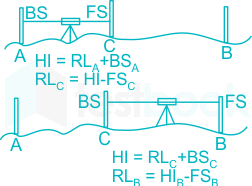
Official Paper

FCI JE Civil Official Paper 2015 (Previous Year Paper)

120 questions · 90 minutes · with answers · free

Test (120 questions)

1

Excess of alumina in the clay:

  1. ((a))

    Makes the brick brittle and weak

  2. ((b))

    Makes the brick crack and warp on drying

  3. ((c))

    Changes colour of the brick from red to yellow

  4. ((d))

    Improves impermeability and durability of the brick

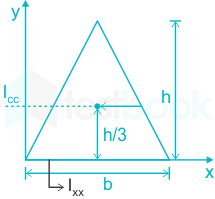
Show Answer
Answer: ((b))

Makes the brick crack and warp on drying

The composition of good brick earth:

1) Silica

  • Good brick earth should contain 50 – 60% of silica.
  • It prevents cracking, shrinking and wrapping of raw bricks.
  • Silica imparts uniform shape to the bricks.
  • Excess of silica makes the bricks brittle.

2) Alumina

  • Good brick earth should contain 20 – 30% of Alumina.
  • Alumina imparts plasticity to the earth so that it can be moulded.
  • If it is excess raw bricks shrink and warp during drying and burning.

3) Lime

  • It should not be greater than 5% for good bricks

4) Iron oxides

  • It should be in the range of 5 – 6% for the good bricks.
  • It imparts colour to the brick.

5) Magnesia

  • It imparts color to the brick.
  • It also decreases shrinkage in the bricks.

2

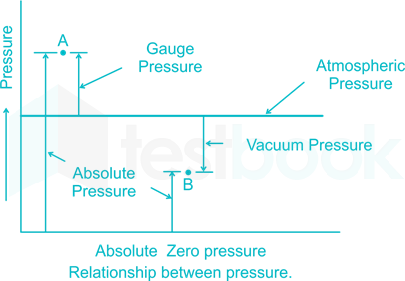
When the angular and linear measurements are equally precise in traversing, the balancing of a traverse is done by:

  1. ((a))

    Transit rule

  2. ((b))

    Empirical rule

  3. ((c))

    Bowditch's rule

  4. ((d))

    Simpsons rule

Show Answer
Answer: ((c))

Bowditch's rule

Concept:

Bowditch Rule is used when length and bearing both are equally precise. In this method, total error in Latitude and Departure is distributed as per the ratio of length of lines i.e.

Correction in Latitude is:

CL=;lΣl×ΣL{C_L} = ;\frac{l}{{{\rm{\Sigma }}l}} \times {\rm{\Sigma }}L

Correction in Departure is:

CD=;lΣl×ΣD{C_D} = ;\frac{l}{{{\rm{\Sigma }}l}} \times {\rm{\Sigma }}D

Where ΣL and ΣD are total error in latitude and departure respectively.

Σl is the summation of length of all lines involved in closed traverse.

Note:

Transit rule is used when bearings are more precise then length of line.

3

In measuring horizontal angles, the theodolite should be turned

  1. ((a))

    clockwise from the forward station to the back station

  2. ((b))

    clockwise from the back station to the forward station

  3. ((c))

    Anticlockwise from the forward station to the back station

  4. ((d))

    Anticlockwise from the back station to the ​forward station

Show Answer
Answer: ((b))

clockwise from the back station to the forward station

Concept

Measurement of Horizontal Angles

a) Repetition Method:

  • This method is used for very accurate work.
  • In this method, the same angle is added several times mechanically and the correct value of the angle is obtained by dividing the accumulated reading by the no. of repetitions.
  • The angle should be measured clockwise in the face left to face right positions, with three repetitions at each face.
  • The final reading of the first observation will be the initial reading of the second observation and so on.

b) Reiteration Method. 

  • This method is another precise and comparatively less tedious method of measuring horizontal angles.
  • It is generally preferred when several angles are to be measured at a particular station.
  • This method consists of measuring several angles successively and finally closing the horizon at the starting point.

Additional Information The method of repetition eliminates different errors present in the measurement of a horizontal angle as follows:

  • The errors due to the eccentricity of Vernier’s and centers get eliminated as readings from both the Vernier’s are taken
  • The errors due to inaccurate graduations get eliminated as the readings are observed at different parts of the circle
  • The errors due to lack in the adjustment of the line of collimation and the horizontal axis of the instrument get eliminated for considering both face readings
  • Errors due to the inaccurate bisection of the object, eccentric centering, etc are eliminated partially as these get counter-balanced in different observations

Note: The errors due to slip, due to the displacement of the station or its signal do not get eliminated and moreover, these errors are cumulative in nature.

4

A line joining optical centre of the object glass and the centre of the eye piece is known as:

  1. ((a))

    Fundamental line

  2. ((b))

    Axis of telescope

  3. ((c))

    Axis of level tube

  4. ((d))

    Line of collimation

Show Answer
Answer: ((b))

Axis of telescope

Explanation:

Line of sight: 

  • It is the imaginary line passing through the intersection of the crosshair on the diaphragm and the optical center of the objective lens.
  • when a line of sight comes in a horizontal plane, it is called a line of collimation.
  • The line of sight generates a vertical plane when the horizontal axis is perpendicular to the vertical axis.

Line of collimation: 

  • It is an imaginary line passing through the intersection of the crosshairs at the diaphragm and the optical center of the object-glass and its continuation.

Axis of Bubble tube: 

  • It is an imaginary line tangential to the longitudinal curve of the bubble tube at its midpoint.

Axis of a telescope: 

  • This axis is an imaginary passing through the optical center of the object-glass and the optical center of the eye-piece.
5

Direct ranging is possible only when the end stations are:

  1. ((a))

    Close to each other

  2. ((b))

    Not more than 100m apart

  3. ((c))

    Mutually intervisible

  4. ((d))

    None of these

Show Answer
Answer: ((c))

Mutually intervisible

Concept:

Ranging is the process of aligning the chain in a straight line between two extremities.

In order to measure the length of the survey/chain line greater than the chain length, we are required to fix or establish some intermediate points. This process is known as Ranging.

Different types of ranging based on intervisibility between two stations are:

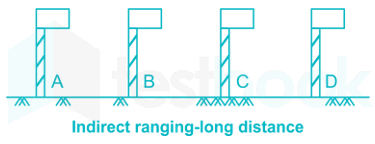
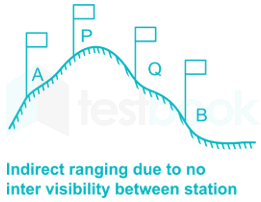
  1. Direct ranging: It is applicable when the two ends of the survey lines are intervisible.

  1. Indirect ranging: It is applicable when both the ends of the survey line are not intervisible either due to the high intervening ground or due to the long distance between them.

6

The working from whole to the part is done in surveying in order to ensure that:

  1. ((a))

    number of errors is minimum

  2. ((b))

    errors and mistakes of one portion do not affect the remaining portion

  3. ((c))

    survey work is completed more quickly

  4. ((d))

    plotting is done more quickly

Show Answer
Answer: ((b))

errors and mistakes of one portion do not affect the remaining portion

Explanation:

  • In whole to part, the error is localized as it prevents accumulation of error and,
  • In part to whole, the error is expanded.

The fundamental principles of plane surveying are:

  1. Location of a point by measurement from two point of reference: Two control points are selected in an area and the distance between them is measured accurately.
  2. Working from whole to the part: Major control points are selected and measured first with high degree of precision, minor details can be collected later on even with less degree of precision. In this manner, errors involved in minor detailing will be compensating and will not affect the major dimensions.

Note:

  • The main idea of working from whole to part is to localise errors and prevent their accumulation.
  • On the contrary, working from part to whole, the errors accumulate and expand to a greater magnitude and the survey work becomes uncontrollable at the end.
7

If the ratio of all the corresponding linear dimensions are equal, then the model and the prototype are said to have:

  1. ((a))

    Geometric similarity

  2. ((b))

    Kinematic similarity

  3. ((c))

    Dynamic similarity

  4. ((d))

    Static similarity

Show Answer
Answer: ((a))

Geometric similarity

Explantion:

To achieve the similarity between the flow in the model and its prototype, every dimensionless parameter for certain conditions in the model must have the same value as the corresponding parameter referring to the prototype.

Types of similarity:

Geometric Similarity: 

  • It is the similarity of shape i.e. geometric similarity exists if the ratio of all the corresponding linear dimensions is equal in the model and prototype. Geometrical parameters are Length, Width, Height, Area, and Volume.

Length Ratio: Lr=LmLp=BmBp=HmHpL_{r}=\frac{L_{m}}{L_{p}}=\frac{B_{m}}{B_{p}}=\frac{H_{m}}{H_{p}}

Area Ratio: Ar=AmApA_{r}=\frac{A_{m}}{A_{p}}

Volume Ratio: Vr=VmVpV_{r}=\frac{V_{m}}{V_{p}}

Kinematic similarity: It is similarity of motion i.e. Kinematic similarity exist if ratio of all the kinematic parameters in model and the prototype is same.

Kinematic parameters includes velocity, acceleration, discharge etc.

Velocity Ratio: vr=vmvpv_{r}=\frac{v_{m}}{v_{p}}

Acceleration Ratio: ar=amapa_{r}=\frac{a_{m}}{a_{p}}

Discharge Ratio: Qr=QmQpQ_{r}=\frac{Q_{m}}{Q_{p}}

Dynamic Similarity: It is similarity of forces i.e. Dynamic similarity exist if identical force and its ratio at all corresponding points is same in model and prototype.

Force Ratio: Fr=FmFpF_{r}=\frac{F_{m}}{F_{p}}

Pressure ratio: Pr=PmPpP_{r}=\frac{P_{m}}{P_{p}}

Note:

  • For kinematic similarity, geometric similarity must exist and for dynamic similarity both geometric and kinematic similarity must exist. These are necessary but not sufficient conditions.
  • For complete similarity Geometric, Kinematic and Dynamic similarity must exist.
8

Which of the following pump is suitable for small discharge and high heads:

  1. ((a))

    Centrifugal Pump

  2. ((b))

    Axial flow pump

  3. ((c))

    Mixed flow pump

  4. ((d))

    Reciprocating Pump

Show Answer
Answer: ((d))

Reciprocating Pump

Explanation:

Pumps

  • The hydraulic machines which convert the mechanical energy into hydraulic energy are called pumps.
Centrifugal pumpsReciprocating pumps
The discharge is continuous and smoothThe discharge is fluctuating and pulsating
It can handle a large quantity of liquid with low pressureIt handles a small quantity of liquid only with high pressure
It can be used for lifting highly viscous liquidsIt is used only for lifting pure or less viscous liquids
It is used for large discharge through smaller headsIt is meant for a small discharge and high heads
The cost of a centrifugal pump is less as compared to a reciprocating pumpThe cost of a reciprocating pump is approximately four times the cost of a centrifugal pump
The Centrifugal pump runs at high speed. They can be coupled to an electric motorIt runs at a low speed. Speed is limited due to consideration of separation and cavitation
The operation of a centrifugal pump is smooth and without much noise. The maintenance cost is lowThe operation of a reciprocating pump is complicated and with much noise. The maintenance cost is high.
It requires a smaller floor area and installation cost is lowIt requires a larger floor area and installation cost is high
Efficiency is highEfficiency is low
9

The most efficient channel section is:

  1. ((a))

    Triangular

  2. ((b))

    Rectangular

  3. ((c))

    Trapezoidal

  4. ((d))

    Circular

Show Answer
Answer: ((c))

Trapezoidal

Explanation:

  • A section is said to be most efficient, if, for a given cross-section area, the discharge carrying capacity is maximum.
  • The highest component of total construction cost is lining & if the perimeter is kept minimum the cost of lining will be minimum, hence it will be the most economical section.
  • There are some important sections and conditions to be most efficient;
SectionCondition
RectangularR = y/2
Triangularθ = 45°
Trapezoidal- R = y/2 - θ = 60° - Most efficient trapezoidal section is half hexagone
10

Cohesionless soils are:

  1. ((a))

    Sands

  2. ((b))

    Clays

  3. ((c))

    Silts

  4. ((d))

    Silts and clays

Show Answer
Answer: ((a))

Sands

Concept:

Soils are generally classified in two types:

  • Cohesive and
  • Cohesion less soils.

Cohesive soils are soils having strong intermolecular force of attraction when water is added into them. This type of behaviour is shown by clays and silt. So, any soil having very high content of clay can be considered as cohesive soils. Cohesive soil does not crumble and can be excavated with vertical side slopes. The shear strength of these type of soils depends on inherent cohesion, friction in between them and normal stress acting on them.

Examples:  Clayey silt, Sandy clay, Silty clay, clay and organic clay.

Cohesionless soils are having no cohesion i.e. no intermolecular force of attraction when water is added into them. The shear strength of these type of soils depends on friction between particles and also normal stress acting on them.

Examples: Sand and Gravel.

11

Thickened part of the flat slab over its supporting column is known as:

  1. ((a))

    Coloumn head

  2. ((b))

    Drop panel

  3. ((c))

    Capital

  4. ((d))

    None of these

Show Answer
Answer: ((b))

Drop panel

Explanation:

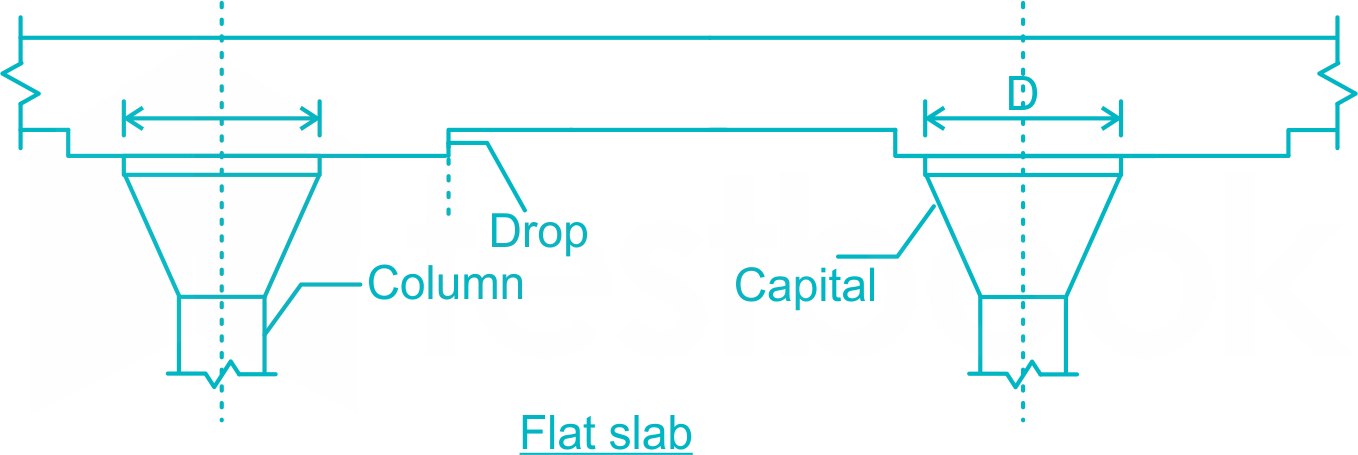
  • Flat slab is a slab that directly rests on the column without any beam. Sometimes column capital or drop panels are provided to prevent punching failure of flat slab.
  • The Thickened part of the flat slab over its supporting column is known as the column Drop panel.
  • Its thickness is invariably higher than the thickness of the slab in a normal slab system in which beams are provided.
  • Flat slabs are uneconomical and can be used for medium span only because in large span deflection is comparatively more.
  • Some of the advantages of flat slab:
  1. It has a better aesthetic appearance than normal slab system.
  2. It has better dispersion of light than normal slab system.
  3. Flat slab provides ease in providing AC ducts, Electrical ducts, etc.
  4. Used in case of lesser story height.


12

Allowable bearing pressure for a foundation depends on

  1. ((a))

    Allowable settlement only.

  2. ((b))

    Ultimate bearing capacity of soil

  3. ((c))

    Both allowable settlement and ultimate bearing capacity

  4. ((d))

    Neither allowable settlement nor ultimate bearing capacity

Show Answer
Answer: ((c))

Both allowable settlement and ultimate bearing capacity

Explanation:

(i) There are two basic design criteria. One is the bearing capacity criteria or the shear failure criteria another is the settlement criteria. When we design the footing, it should take the load coming from the superstructure without shear cracking.

(ii) At the same time there should not be an excessive amount of settlement in the footing. So the pressure that we can apply on a soil is the minimum pressure on a soil in terms of shear criteria or in terms of the settlement criteria.

(iii) Tension failure, compression failure or bond failure hardly occur in foundation structures and are never a serious concern.

So The correct answer is Both allowable settlement and ultimate bearing capacity

13

In a riveted connection, a minimum distance of the rivet from the edge is kept with a view to preventing failure due to 

  1. ((a))

    Shearing of rivet

  2. ((b))

    Bearing on rivet 

  3. ((c))

    Shearing of plate 

  4. ((d))

    Tearing of plate 

Show Answer
Answer: ((c))

Shearing of plate 

Explanation:

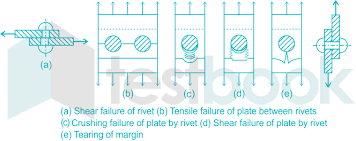
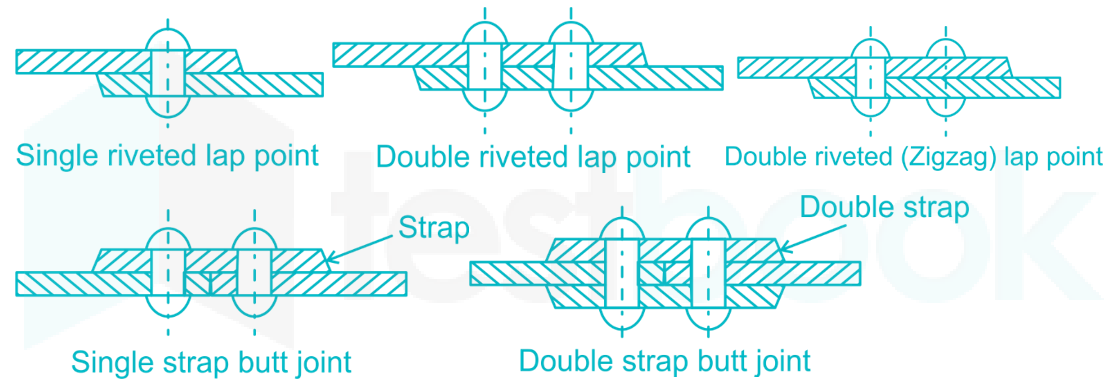
A riveted joint may fail in the following ways

  • Tearing of the plate at an edge
  • Shear failure of the rivets
  • Tensile failure of rivet across the row of rivets
  • Crushing failure of plate
  • Shear failure of plate at the marginal area.

Shearing of the plate  

A joint may fail due to shearing of the plate at an edge as shown in Fig. This can be avoided by keeping the margin, m = 1.5d, where “d” is the diameter of the rivet hole.


Confusion Points The minimum edge distance from the center of any hole to the nearest edge of plate shall not less than 1.7 times the hole diameter in case of sheared or hand flame cut edges; and 1.5 times the hole diameter in case of rolled, machine-flame cut, sawn and planned edges. Adequate edge distance (margin) is maintained to prevent the plate from failing due to tearing of plate.

Note: According to commission option (c) is correct

14

Moment of Inertia for a circular section has 20 cm diameter, is:

  1. ((a))

    7852 cm4

  2. ((b))

    7853 cm4

  3. ((c))

    7854 cm4

  4. ((d))

    7855 cm4

Show Answer
Answer: ((c))

7854 cm4

Concept:

Area moment of inertia is given by, I = A × k2

Where A is area of section and k is radius of gyration of the section.

For circular section, k = D/4

A=π4D2{\rm{A}} = \frac{{\rm{\pi }}}{4}{{\rm{D}}^2}

k=D4{\rm{k}} = \frac{{\rm{D}}}{4}

I=A×k2=π64D4\therefore {\rm{I}} = {\rm{A}} \times {{\rm{k}}^2} = \frac{{\rm{\pi }}}{{64}}{{\rm{D}}^4}

Calculation:

D = 20 cm

Moment of Inertia for a circular section

I=π64(20)4\therefore {\rm{I}} = \frac{{\rm{\pi }}}{{64}}{{\rm{(20)}}^4} = 7854 cm4 

Important Points

Polar Moment of Inertia (J) = 2I = π32D4\frac{{\rm{\pi }}}{{32}}{{\rm{D}}^4}

15

The point at which the resultant pressure on a immersed surface acts, is known as:

  1. ((a))

    Centre of Gravity

  2. ((b))

    Centre of depth

  3. ((c))

    Centre of pressure

  4. ((d))

    Centre of immersed surface

Show Answer
Answer: ((c))

Centre of pressure

Centre of pressure:

The point of action of total hydrostatic force on a submerged surface is called the centre of pressure. It is the point at which the resultant pressure on a immersed surface acts.

16

Piezometric head is the sum of

  1. ((a))

    Velocity head and pressure head

  2. ((b))

    Pressure head and datum head

  3. ((c))

    Datum head and velocity head

  4. ((d))

    Velocity head, pressure head and datum head

Show Answer
Answer: ((b))

Pressure head and datum head

Explanation:

The total energy of a flowing fluid can be represented in terms of head, which is given by -

pρg;+;V22g;+;z;\frac{p}{ρ{g}};+;\frac{V^2}{2g};+;z;

Piezometric head:

The sum of pressure head and datum is known as piezometric head. It is given by -

pρg+z\frac{p}{ρ{g}}+z

where;pρg=pressure;head,;V22g=velocity;head;and;z=datumwhere;\frac{p}{\rho{g}}=pressure;head,;\frac{V^2}{2g}=velocity;head;and;z=datum

Piezometric head is the sum of the pressure head and datum head.

17

The method of traversing in survey is:

  1. ((a))

    Measurement of all angles only

  2. ((b))

    Measurement of angles and distances

  3. ((c))

    Measurement of all distances

  4. ((d))

    Measurement of all bearings only

Show Answer
Answer: ((b))

Measurement of angles and distances

A traverse consists of series of straight lines of known length related to one another by known angles between the lines.

Traverse survey is a method of establishing control points, their position being determined by measuring the distances between the traverse stations which serve as control points and the angles subtended at the various stations by their adjacent stations.

A traverse is developed by measuring the distance and angles between points that found the boundary of a site.

18

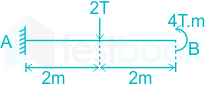
The B.M. of a cantilever beam at A shown in the figure is:

  1. ((a))

    Zero

  2. ((b))

    8 T.m

  3. ((c))

    10 T.m

  4. ((d))

    16 T.m

Show Answer
Answer: ((a))

Zero

Explanation:

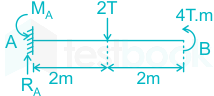
The given beam with end moment and resultant reaction:

Taking clockwise moment as a positive and anticlockwise moment as negative

Taking the moment of the beam at A is 

Σ MA = 0

2 × 2 - 4 - MA = 0

MA = 0

19

The discharge through a channel of rectangular section will be maximum, if:

  1. ((a))

    Its depth is twice the breadth

  2. ((b))

    Its breadth is twice the depth

  3. ((c))

    The depth is thrice the breadth

  4. ((d))

    Its breadth is thrice the depth

Show Answer
Answer: ((b))

Its breadth is twice the depth

Explanation:

The most efficient section is one that gives maximum discharge for a given amount of excavation. 

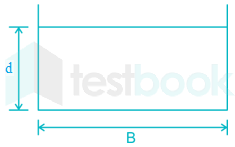
For maximum discharge through the rectangular channels, the geometric conditions can be found by minimizing the wetted perimeter P.

P=B+2dP=B+2d

P=Bdd+2dP=\frac{Bd}{d}+2d

P=Ad+2dP=\frac{A}{d}+2d

Now, 

dPdd=Ad2+2=0\frac{dP}{dd}=-\frac{A}{d^2}+2=0

A = 2d2

Bd = 2d2

B = 2d

Hydraulic;mean;radius,;ym=AP=BdB+2d=2d.d2d+2d=d2Hydraulic;mean;radius,;{y_m} = \frac{A}{P} = \frac{{Bd}}{{B + 2d}} = \frac{{2d.d}}{{2d + 2d}} = \frac{d}{2}

20

The hydraulic mean depth for a circular pipe of diameter (d) and flowing full is:

  1. ((a))

    d/6

  2. ((b))

    d/4

  3. ((c))

    d/2

  4. ((d))

    d

Show Answer
Answer: ((b))

d/4

Concept:

The hydraulic mean depth or also called Hydraulic radius is defined as:

R=APR = \frac{{A}}{{P}}

where A = cross-sectional area of the flow, P = wetted perimeter.

Wetted area,  A=π4d2A = \frac{\pi }{4}{d^2}

Wetted perimeter, P = πd

Hydraulic radius, R=APR = \frac{A}{P}

Hydraulic radiusR=πd24πd=d4R=\frac{\frac{\pi d^2}{4}}{\pi d}=\frac{d}{4}

21

Bernoulli's equation is applied to -

  1. ((a))

    Venturimeter

  2. ((b))

    Orifice meter

  3. ((c))

    Pitot tube

  4. ((d))

    All of the above

Show Answer
Answer: ((d))

All of the above

Explanation

  • The flow rate through a pipe is usually measured by providing a coaxial area contraction within the pipe and by recording the pressure drop across the contraction, which is the application of Bernoulli’s equation.
  • Bernoulli's principle can be derived from the principle of conservation of energy.
  • Bernoulli's theorem states that, in a steady flow, the sum of all forms of energy in a fluid along a streamline is the same at all points on that streamline
  • Bernoulli equation represented in head form (the total energy per unit weight):

   Pρg+v22g+Z=Constant\frac{P}{\rho g} + \frac{{{v^2}}}{{2g}} + Z = Constant

  • Three flow meters primarily operate on this principle:
  1. Pitot tube
  2. Venturimeter
  3. Orifice meter
22

The pressure measured with the help of piezometer tube is in:

  1. ((a))

    kg/cm2

  2. ((b))

    kg/m2

  3. ((c))

    N/mm2

  4. ((d))

    Head of liquid

Show Answer
Answer: ((d))

Head of liquid

Concept:

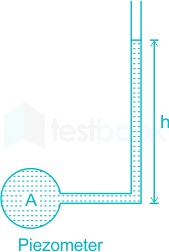
  • Piezometer is the simplest form of manometer used for measuring gauge pressure
  • One end of this manometer is connected to the point where the pressure is to be measured and the other end is open to the atmosphere
  • As one end is open to the atmosphere so it can’t be used for measuring the gas pressure
  • Piezometer is used to measure the static pressure (Gauge) in the pipe.
  • It measures the pressure in the form of the height (head)of the liquid column in the piezometer.
  • Gas pressure cannot be measured by means of piezometers because a gas forms no free atmosphere surface and it can’t be used when large pressures in the lighter liquid are to be measured. So gauge pressure is used for measuring low pressure.
23

The weight per unit volume of a liquid at standard temperature and pressure is called:

  1. ((a))

    Specific weight

  2. ((b))

    Specific mass

  3. ((c))

    Mass density

  4. ((d))

    Specific gravity

Show Answer
Answer: ((a))

Specific weight

Explanation:

Specific weight:

The specific weight (also known as the unit weight) is the weight per unit volume of a material. Weight is a force. The SI unit for specific weight is N/m3. 

γ=ρg\gamma =\rho g

A commonly used value is the specific weight of water on Earth at 4°C which is 9.81 kN/m3.

Mass density: 

  • Mass density represents the mass (or the number of particles) per unit volume of a substance, material, or object. Mass density is also known as density.
  • Its SI unit is kg/m3

Mass Density = MassVolume\frac{Mass}{Volume}

Specific gravity or Relative density:

  • The ratio of density or specific weight of a subject matter to that of a standard matter is known as specific gravity relative density.

\({\rm{S}} = \frac{{{{\rm{\rho }}{{\rm{subject}}}}}}{{{{\rm{\rho }}{{\rm{standard}}}}}}{\rm{or}}\frac{{{{\rm{\gamma }}{{\rm{subject}}}}}}{{{{\rm{\gamma }}{{\rm{standard}}}}}}\)

24

According to Unwin's formula, the relationship between diameter of rivet hole (d) and thickness of pate (t) is given by:

  1. ((a))

    d=td=\sqrt{t}

  2. ((b))

    d=1.6td=1.6 \sqrt{t}

  3. ((c))

    d=2td=2 \sqrt{t}

  4. ((d))

    d=2.6td=2.6 \sqrt{t}

Show Answer
Answer: ((c))

d=2td=2 \sqrt{t}

Concept:

  • The Unwin’s formula is used to determine the size of the rivet.
  • Unwin's formula gives a relation between the hole diameter of the rivet and the thickness of the connected plates.
  • The 'd' in the formula represents the nominal diameter of the rivet in mm and 't' represents the thickness of the plate

According to Unwin’s formula,

The nominal diameter (ɸ) of the rivet is given by:

ɸ = 6.04√t        {t = thickness of plate in “mm”}

ɸ = 1.91√t        {t = thickness of plate in “cm”}

25

When a shaft is subjected to a twisting moment, every cross-section of the shaft will be under

  1. ((a))

    Tensile stress

  2. ((b))

    Shear stress

  3. ((c))

    Compressive stress

  4. ((d))

    Bending stress

Show Answer
Answer: ((b))

Shear stress

Explanation:

Twisting moment impart an angular displacement of one end cross-section with respect to the other end and it will setup shear stresses on any cross section of the bar perpendicular to its axis.

Torsion Equation of a shaft is given by,

TJ=τr=GθL\frac{T}{J} = \frac{τ }{r} = \frac{{Gθ }}{L}

Polar section modulus of shaft is given by,

Zp=Jr=πD432D2=πD316{Z_p} = \frac{J}{r} = \frac{{\frac{{\pi {D^4}}}{{32}}}}{{\frac{D}{2}}} = \frac{{\pi {D^3}}}{{16}}

Where, T = Torque, J = Polar moment of inertia, τ = Shear stress, r = Radius of shaft, G = Shear modulus, θ = Angle of twist and L = Length of shaft

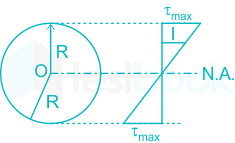
Shear stress distribution across the section of the circular shaft is shown below.

Using Torsinal formula

TJ=τr=GθL\frac{T}{J} = \frac{τ }{r} = \frac{{G\theta }}{L}

Forgiven T and J; τ ∝ r i.e.

The shear stress distribution is linear.

Shear stress at centre, τcentre = 0

26

The shear force of a cantilever beam of length l carrying a uniformly distributed load of w per unit length is _____________ at the free end.

  1. ((a))

    Zero

  2. ((b))

    wl/4

  3. ((c))

    wl/2

  4. ((d))

    wl

Show Answer
Answer: ((a))

Zero

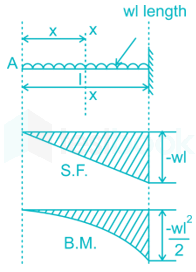
SFxx=WxS{F_{xx}} = - Wx

SFx=0=0;SFx=L=wLS{F_{x = 0}} = 0;S{F_{x = L}} = wL

Shear force at free end is zero and at fixed end it will be wL.

27

When a body is subjected to 3 mutually perpendicular stresses, of equal intensity, the ratio of direct stress to the corresponding volumetric strain is known as:

  1. ((a))

    Young's modulus 

  2. ((b))

    Modulus of Rigidity 

  3. ((c))

    Bulk Modulus 

  4. ((d))

    Poisson's ratio 

Show Answer
Answer: ((c))

Bulk Modulus 

Explanation:

Young's modulus:

  • The mechanical property of a material to withstand the compression or the elongation with respect to its length of linear elastic solids like rods, wires etc is called Young's modulus.
  • It is also referred to as the Elastic Modulus or Tensile Modulus
  • It gives us information about the tensile elasticity of a material (ability to deform along an axis).

The formula of young modulus is given as,

E=Normal stressNormal strain=σϵE =\frac {Normal ~stress}{Normal ~strain}= \frac {\sigma}{\epsilon}

where E is Young’s modulus in Pa, 𝞂 is the uniaxial stress in Pa,ε is the Normal strain or proportional deformation.

Modulus of rigidity:

  • It is also known as shear modulus.
  • It is the mechanical property of a material due to which it withstand shear stress and resists torsion.
  • It is the ratio of shear stress to the corresponding shear strain within the elastic limit. This is denoted by G and given by.

G=Shear;stressShear;strain=τϕ\therefore {G} = \frac{{Shear;stress}}{{Shear;strain}} = \frac{\tau }{\phi }

Bulk modulus:

  • It is the mechanical property of a material due to which it resists the change in volume due to external pressure or equal stress in all directions.
  • The concept of bulk modulus can be used in case of Hydrostatic loading.
  • It is defined as the ratio of normal stress to the volumetric strain and denoted by 'K' and given by,

K=Normal stressVolumetric strain=σϵvK = \frac {Normal ~stress}{Volumetric ~strain}= \frac {\sigma }{\epsilon _v}

Poisson's ratio:

  • When the body is loaded within its elastic limit, the ratio of lateral or transverse strain and linear or longitudinal strain is constant. This constant is known as Poisson's ratio. It is given by,

Additional Information

Relations between Young's modulus(E), Shear modulus(G), Bulk modulus(K), and Poisson's ratio(μ) 

  • E = 2G (1 + μ)

  • E = 3K (1 – 2μ)

  • E=9KG3K +;G{\bf{E}} = \frac{{9{\bf{KG}}}}{{3{\bf{K}}~ + ;{\bf{G}}}}

  • μ=3K  2G2G + 6K{\bf{\mu }} = \frac{{3{\bf{K}}~ - ~2{\bf{G}}}}{{2{\bf{G}} ~+ ~6{\bf{K}}}}

28

The total strain energy stored in a body within elastic limit is termed as

  1. ((a))

    resilience

  2. ((b))

    proof resilience

  3. ((c))

    impact energy

  4. ((d))

    modulus of resilience

Show Answer
Answer: ((a))

resilience

Explanation:

Strain Energy: 

  • Strain Energy of the member is defined as the internal work done in deforming the body by the action of externally applied forces.
  • Strain energy is given by:
  • Strain;Energy=;12×Stress×Strain×VolumeStrain;Energy = ;\frac{1}{2} \times Stress \times Strain \times Volume

Resilience:

  • Resilience is the total strain energy stored in a given volume of material within the elastic limit.
  • On removal of load, this energy is released.
  • In other words, it is the area under the load-deflection curve within the elastic limit.

Proof resilience:

  • The maximum energy which can be stored in a body up to the elastic limit is called proof resilience.

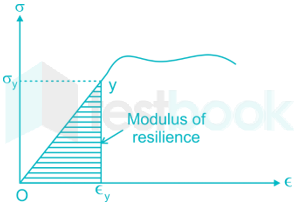
Modulus of resilience:

  • Modulus of resilience is defined as proof resilience per unit volume. It is the area under the stress-strain curve up to the elastic limit.

29

The angle of inclination of the plane at which the body begins to move down the plane, is called:

  1. ((a))

    Angle of friction

  2. ((b))

    Angle of repose

  3. ((c))

    Angle of projection

  4. ((d))

    Angle of contact

Show Answer
Answer: ((b))

Angle of repose

Explanation:

The main difference between the angle of friction and the angle of repose is that:

The angle of friction is defined as the angle between the normal reaction force and the resultant force of normal reaction force and friction when an object just begins to move,

Whereas the angle of repose is defined as the minimum angle of an inclined plane which causes an object to slide down the plane.

In general, The angle of repose is the maximum angle that a surface can be tilted from the horizontal, such that an object on it is just able to stay on the surface without it sliding down.

30

A vertical wall is subjected to a pressure due to one kind of liquid, on one of its sides. The total pressure on the wall acts at a distance _________ from the liquid surface.

  1. ((a))

    H/3

  2. ((b))

    H/2

  3. ((c))

    2H/3

  4. ((d))

    3H/4

Show Answer
Answer: ((c))

2H/3

Explanation:

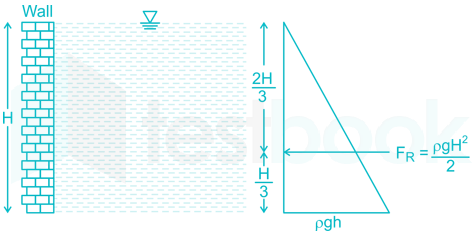
Pressure at the top of the wall = 0

Pressure at the bottom of the wall = ρgh

Total Resultant Pressure = ρgH22\frac{{\rho g{H^2}}}{2}

<br>

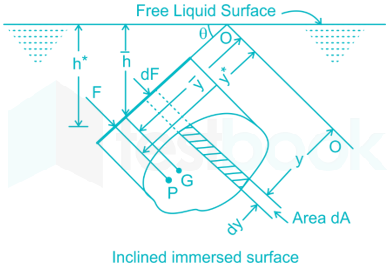
For a plane surface immersed in a liquid in such a way that the plane of the surface makes an angle θ with the free surface of the liquid:

A = Total area of an inclined surface

h̅ = Depth of centre of gravity of inclined area from a free surface

h* = Distance of centre of pressure from the free surface of a liquid

\({h^*} = \frac{{{I_G}{{\sin }^2}\theta }}{{A̅ h}} + \bar h\)

For vertical plane surface: θ = 90°

h=IGAhˉ+hˉ{h^*} = \frac{{{I_G}}}{{A \bar h}} + \bar h

h=H2+bH3×212×b×H×H{h^*} = \frac H2+\frac{bH^3 \times2}{12\times b\times H\times H}

h=H2+H6h^*=\frac H2+\frac H6

h=2H3h^*=\frac {2H}3

This resultant pressure will act through the centroid of the pressure diagram i.e. at H/3 from the base of the wall. Hence it acts at 2H/3 from the free surface of the wall.

31

The point, through which the whole weight of the body acts, irrespective of its position is known as:

  1. ((a))

    Moment of inertia

  2. ((b))

    Centre-of gravity

  3. ((c))

    Centre of pressure

  4. ((d))

    Centre of mass

Show Answer
Answer: ((b))

Centre-of gravity

Explanation:

Center of Gravity

  • The force of attraction, which is proportional to the mass of the particle, acts vertically downwards and is known as the weight of the body.
  • As the distance between the different particles of a body and the center of the earth is taken as the same, therefore these forces may be taken to act along parallel lines.
  • A point may be found out in a body, through which the resultant of all such parallel forces act.
  • This point, through which the whole weight of the body acts is known as the Center of gravity.

Centroid

  • The plane figures (triangle, quadrilateral, circle, etc) have only areas, but no mass. The center of the area of plane figures is known as Centrold.
32

The forces, which meet at one point and their lines of action also lie on the same plane, are known as

  1. ((a))

    Coplanar concurrent forces

  2. ((b))

    Coplanar non-concurrent forces

  3. ((c))

    Non-coplanar concurrent forces

  4. ((d))

    Non-coplanar non-concurrent forces

Show Answer
Answer: ((a))

Coplanar concurrent forces

Concept:

When two or more forces act on a body, they are called to form a system of forces.

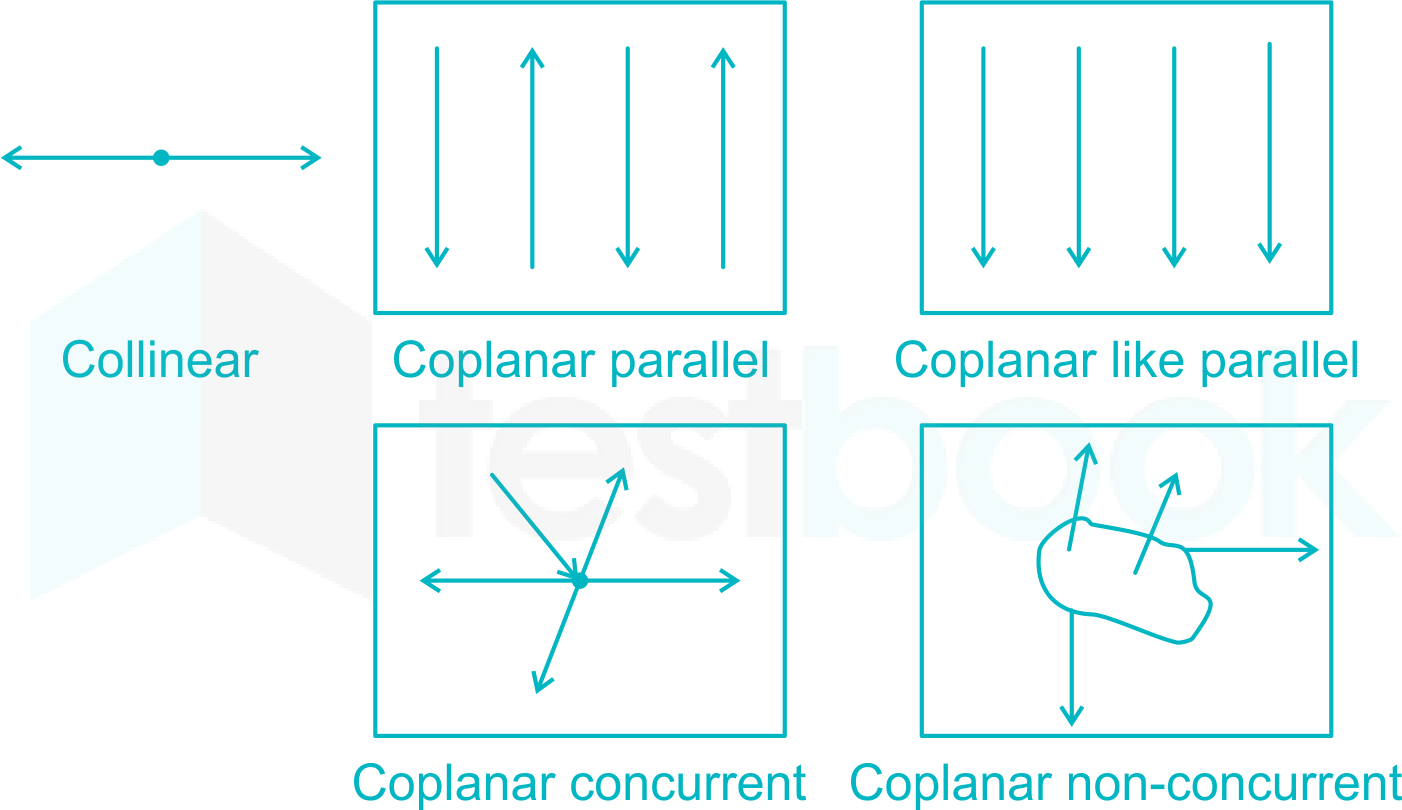
Coplanar forces: The forces, whose lines of action lie on the same plane, are known as coplanar forces.

Collinear forces: The forces, whose lines of action lie on the same line, are known as collinear forces.

Concurrent forces: The forces, which meet at one point, are known as concurrent forces. The concurrent forces may or may not be collinear.

Coplanar concurrent forces: The forces, which meet at one point and their lines of action also lie on the same plane, are known as coplanar concurrent forces.

Coplanar non-concurrent forces: The forces, which do not meet at one point, but their lines of action lie on the same plane, are known as coplanar non-concurrent forces.

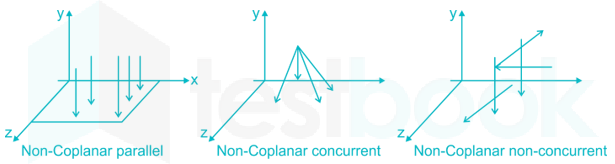
Non-coplanar concurrent forces: The forces, which meet at one point, but their lines of action do not lie on the same plane, are known as non-coplanar concurrent forces.

Non-coplanar non-concurrent forces: The forces, which do not meet at one point and their lines of action do not lie on the same plane, are called non-coplanar non-concurrent forces.

33

A fine grained soil has:

  1. ((a))

    Low permeability and high compressibility

  2. ((b))

    High permeability and low compressibility

  3. ((c))

    Low permeability and low compressibility

  4. ((d))

    High permeability and high compressibility

Show Answer
Answer: ((a))

Low permeability and high compressibility

Explanation:

Fine-Grained Soil:

  • The majority of the fine-grained soils are physico-chemically active, which can be attributed to their unbalanced surface charges.
  • Some of the undesirable properties of these soils such as high swell-shrink potential, high compressibility, low permeability, low strength and low CBR are essentially due to the surface charges of fine-grained soils.
  • These surface charges favour the development of a diffuse double layer, which in turn can be taken to contribute to the water-holding capacity of soils. As a consequence of this, the volume stability of the soils gets adversely affected; effective voids volume gets reduced which is responsible for the low permeability of such soil: actual void ratio becomes more than the theoretical which is responsible for higher compressibility, double layer repulsion increases which is responsible for the lower effective stress and hence, for lesser strength.
34

Which one of the following pairs is NOT correctly matched?

  1. ((a))

    Water losses ................. Evaporation

  2. ((b))

    Run off ................ Stream flow

  3. ((c))

    Percolation ............... Soil Erosion

  4. ((d))

    Storm ................ Precipitation

Show Answer
Answer: ((c))

Percolation ............... Soil Erosion

Explanation: 

  • Evaporation is one of the cause of water losses.
  • Runoff is the quantity of water that discharge in surface stream.
  • Percolation is the downward movement of soil also called infiltration of soil. Percolation do not cause soil erosion.
  • Storm is a violent disturbance of atmosphere with strong wind, rain, thunder, lightning or snow.
35

The maximum area of tension reinforcement in beams shall not exceed:

  1. ((a))

    0.15%

  2. ((b))

    1.5%

  3. ((c))

    4.0%

  4. ((d))

    1.0%

Show Answer
Answer: ((c))

4.0%

Explanation

In IS 456:2000 Clause 26, requirements related to reinforcement used in RCC are given below.

MemberMinimumMaximum
BeamLongitudinal: As = 0.85 bd/fy Side face: 0.1% of web area4% of c/s area
SlabHYSD steel: 0.12% Mild steel: 0.15% of effective c/s area4% of c/s area
Column0.8% of c/s area6% of c/s area, (In practice ≤ 4%)
36

Gauge pressure is:

  1. ((a))

    Absolute pressure - atmospheric pressure

  2. ((b))

    Absolute pressure + atmospheric pressure

  3. ((c))

    Atmospheric pressure - absolute pressure

  4. ((d))

    None of these

Show Answer
Answer: ((a))

Absolute pressure - atmospheric pressure

Explanation:

The pressure in a fluid is measured in two different systems.

  1. In the first system, it is measured above the absolute zero or zero vacuum which is termed as Absolute pressure.
  2. In the second system, Pressure is measured above the atmospheric pressure, it is known as Gauge Pressure.
  • ​​Gauge Pressure is measured after taking atmospheric pressure as a datum, i.e. atmospheric pressure is marked as zero.
  • Thus it can be concluded that on the gauge pressure is relative to local atmospheric pressure.
<br>

Mathematically, it can be represented as:

Absolute Pressure = Atmospheric pressure + Gauge Pressure

Therefore, Gauge Pressure = Absolute Pressure - Atmospheric pressure 

37

If the gravitational acceleration at any place is doubled, the weight of a body, will:

  1. ((a))

    Be reduced to half

  2. ((b))

    Be doubled

  3. ((c))

    Not be affected

  4. ((d))

    None of these

Show Answer
Answer: ((b))

Be doubled

CONCEPT:

  • Weight of the body (W): It is defined as the force acting on a body due to gravity.

The weight of a body is calculated by the formula:

W = mg

where W is the weight of the body, m is the mass of the body, and g is the gravitational acceleration.

EXPLANATION:

From the definition, the weight of the body at a place is given by W = mg

g1 is the acceleration due to gravity when weight is W1

g2 is the acceleration due to gravity when weight is W2

According to the given condition in question, g2 = 2g1

Mass remains the same, So

M1 = M2

W1g1=W2g2{{W_1\over g_1}} = {W_2 \over g_2}

W1g1=W22g1{{W_1\over g_1}} = {W_2 \over2g_1}

W2 = 2 × W1

38

Two forces of 6 Newton and 8 Newton which are acting at right angles to each other, will have a resultant of:

  1. ((a))

    5 Nt

  2. ((b))

    8 Nt

  3. ((c))

    10 Nt

  4. ((d))

    12 Nt

Show Answer
Answer: ((c))

10 Nt

Concept:

Methods of finding resultant of forces

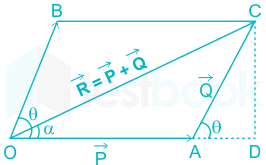
A) Law of a parallelogram of forces

Where P and Q are two forces acting on a body with angle θ between them

α = Angle made by resultant with respect to force P

α is the direction of resultant R

R=P2+Q2+2PQcosθ{\rm{R}} = \sqrt {{{\rm{P}}^2} + {{\rm{Q}}^2} + 2{\rm{PQ}}\cos {\rm{\theta }}}

α=tan1[QsinθP+Qcosθ];;{\rm{\alpha }} = {\tan ^{ - 1}}\left[ {\frac{{{\rm{Q}}\sin {\rm{\theta }}}}{{{\rm{P}} + {\rm{Q}}\cos {\rm{\theta }}}}} \right]{\rm{;;}}

B) Method of resolution of forces

ΣFX = summation of forces acting in X-direction

ΣFY = Summation of forces acting in Y-direction

\({\rm{R}} = \sqrt {{{\left( {{\rm{\Sigma }}{{\rm{F}}{\rm{X}}}} \right)}^2} + {{\left( {{\rm{\Sigma }}{{\rm{F}}{\rm{Y}}}} \right)}^2}} \)

\({\rm{\theta }} = {\tan ^{ - 1}}\left| {\frac{{{\rm{\Sigma }}{{\rm{F}}{\rm{Y}}}}}{{{\rm{\Sigma }}{{\rm{F}}{\rm{X}}}}}} \right|\)

Calculation:

Let the force P = 6 Nt and Q = 8 Nt and θ = 90°

By law of parallelogram of forces

R=P2+Q2+2PQcosθ{\rm{R}} = \sqrt {{{\rm{P}}^2} + {{\rm{Q}}^2} + 2{\rm{PQ}}\cos {\rm{\theta }}}

R=62+82+2×6×8×cos90{\rm{R}} = \sqrt {{6^2} + {{8}^2} + 2 \times 6 \times 8 \times \cos 90^\circ }

R=62+82{\rm{R}} = \sqrt {{6^2} + {{8}^2}}

R = 10 Nt

39

When a bar of length (I), breadth (b) and thickness (t) is subjected to a push of (P) kg, its:

  1. ((a))

    Length, width and thickness increases.

  2. ((b))

    Length, width and thickness decreases

  3. ((c))

    Length increases, width and thickness decreases

  4. ((d))

    Length decreases, width and thickness increases

Show Answer
Answer: ((d))

Length decreases, width and thickness increases

Explanation: 

When the bar is subjected to compressive force P (Push), it gets compressed but due to Poisson's effect its width and thickness increase. 

Poisson's effect:

  • When a material is elongated in one direction, it tends to compress in the perpendicular direction of loading and vice-versa. This phenomenon is known as Poisson's effect. The measure of Poisson's effect is given in terms of Poisson's ratio.

Poisson's ratio: 

Poisson's ratio is defined as the ratio of Transverse strain to Longitudinal strain, as the Transverse strain is always opposite in nature to longitudinal strain thus negative sign is used.

Poisson ratio μ=LateralstrainLongitudinalstrain=ϵyϵx=ϵzϵx\mu= -\frac{Lateral strain}{Longitudinal strain} = -\frac{\epsilon _{y}}{\epsilon _{x}}= -\frac{\epsilon _{z}}{\epsilon _{x}}

Where ϵx\epsilon _{x} = Longitudinal strain in the direction of loading,

            \(\epsilon {y}\)  and \(\epsilon{z}\) = Lateral strain in the perpendicular direction of loading.

For most materials,Value of the Poisson ratio lies between 0 to 0.5 

Thus if a bar of length (I), breadth (b), and thickness (t) is subjected to a push of (P) kg, its Length decreases, and Width and Thickness increase.

Additional Information

MaterialPoisson's ratio (μ\mu)
Cork0.0
Glass0.18-0.3
Concrete0.1-0.2
Cast Iron0.21-0.26
Steel0.27-0.30
Stainless Steel0.30-0.31
Aluminium alloy0.32
Copper0.33
Rubber0.5
40

Gauge width of the standard gauge (BG):

  1. ((a))

    1.676

  2. ((b))

    1.5

  3. ((c))

    2.0

  4. ((d))

    None of these

Show Answer
Answer: ((a))

1.676

Explanation:

  • The distance between the inner sides of two tracks on any railway line is called Railway Guage.
  • There are 4 types of railway gauges used in India: Broad gauge, Metre Gauge, Narrow gauge, and Standard gauge.

Broad gauge:

  • It is often called a wide gauge.
  • The distance between the two tracks in these railway gauges or the width of the broad gauge used in the Indian railway track is 1676 mm or 1.676 m.

Standard gauge:

  • The width of the standard gauge used in the Indian railway track is 1435 mm.

Metre Gauge:

  • The width of the Metre gauge used in the Indian railway track is 1000 mm.

Narrow Gauge:

  • It is often called a small gauge.
  • The width of the narrow gauge used in the Indian railway track is 762 mm and 610 mm.
41

Hardening of lime under water is due to:

  1. ((a))

    Alumina

  2. ((b))

    Iron oxide

  3. ((c))

    Calcium oxide

  4. ((d))

    None of these

Show Answer
Answer: ((a))

Alumina

Explanation:

Hardening of Lime under Water:

  • Hydraulic lime consists of calcium oxide, magnesium oxide, calcium silicates, and aluminum silicates.
  • On hydration, it forms hydroxides of calcium and magnesium.
  • When sand is added to lime for the preparation of mortars, complicated chemical reactions take place.
  • The chief reaction is the decomposition of complex aluminum-calcium silicate into hydrated calcium silicate and hydrated calcium aluminates.
  • Also calcium hydrate is formed due to the hydration of free lime. To some extent, calcium oxide remains unslaked.
  • All these reactions take place in the presence of water.
  • Calcium silicates and calcium aluminates crystallize and form a hard substance that has great strength.
  • The calcium hydrate formed is highly soluble in water, rises to the surface in the form of a solution, gets the free supply of carbon dioxide, and hardens in the same way as fat lime.
  • It crystallizes to form calcium carbonate. Thus the setting of hydraulic lime depends upon water because reactions take place only when water is added.
  • It is due to this reason that hydraulic lime is most suitable for use in structures underwater.
  • Hardening of lime does not depend on air and therefore, should not be slaked immediately after burning. Water should be added just before use.
42

A partially saturated sample of soil has a unit weight of 2.0 g/cm3 and specific gravity of soil particles is 2.6. If the moisture content in the soil is 20%, the degree of saturation is:

  1. ((a))

    20%

  2. ((b))

    77%

  3. ((c))

    92%

  4. ((d))

    None of these

Show Answer
Answer: ((c))

92%

Concept:

Relationship Between e, w, G, s is given by,

e;=;wGs{\rm{e;}} = {\rm{;}}\frac{{{\rm{wG}}}}{{\rm{s}}}               ……. (i)

Relationship between γt, G, s, γw, e is given by,  

\({{\rm{γ }}{\rm{t}}}{\rm{;}} = {\rm{;}}\frac{{\left( {{\rm{G}} + {\rm{se}}} \right){{\rm{γ }}{\rm{w}}}}}{{1 + {\rm{e}}}}\)     ……. (ii)

Where,

e = void ratio, w = water content, G = Specific gravity of soil, s = Degree of saturation, γt = density of soil particles, γw = density of water

Calculation:

Given, w = 20% = 0.20, γt = 2 g/cm3, , and G = 2.6

Specific gravity of water = 1 .i.e. γw = 1 g/cm3

\({{\rm{γ }}{\rm{t}}}; = ;\frac{{\left( {G + se} \right){{\rm{γ }}{\rm{w}}}}}{{1 + e}}; = ;\frac{{\left( {G + wG} \right) \times \gamma_w}}{{1 + e}}\)

γt;=;(1+w)×Gγw1+e=;(1+0.2)×2.6 ×11+e{{\rm{γ }}_{\rm{t}}}; = ;\frac{{\left( {1 + w} \right) \times G\gamma_w}}{{1 + e}} = ;\frac{{\left( {1 + 0.2} \right) \times 2.6\ \times 1}}{{1 + e}}

⇒ 1 + e = 1.56

⇒ e = 0.56

From (i)

0.56;=;0.2×2.6S0.56{\rm{;}} = {\rm{;}}\frac{{0.2 \times 2.6}}{S}

S = 0.928

∴ Degree of saturation = 92.8%

43

In chain surveying tie lines are primarily provided:

  1. ((a))

    To check the accuracy of the survey

  2. ((b))

    To take offsets for detail survey.

  3. ((c))

    To avoid long offsets from chain lines

  4. ((d))

    To increase the number of chain lines

Show Answer
Answer: ((c))

To avoid long offsets from chain lines

Explanation:

Tie Line:

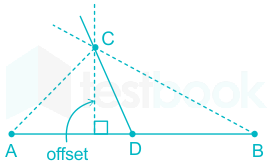
(i) If the distance of the point or detail from the chain line is very large, then long offsets need to be taken.

(ii) Tie lines are the lines that are run to locate details in order to avoid long offsets.

So line CD represented in the figure is a tie line.

Important Points

Base line: It is the long survey line which is run through the middle of the area to be surveyed. The frame work of triangles is built on the base line.

Here AB is the base line

Check line:

(i) These lines are run to check the accuracy of the traverse consisting of a frame work of triangles

(ii) Check lines are measured in the field during the survey process of the land.

(iii) It is also known as Proof lines.

44

The load factor is defined as the ratio of:

  1. ((a))

    Maximum peak load to average load

  2. ((b))

    Total load minimum load

  3. ((c))

    Average load to the maximum load

  4. ((d))

    Minimum load to total load

Show Answer
Answer: ((c))

Average load to the maximum load

Concept:

Load factor: The ratio of average load to the maximum demand during a given period is known as the load factor.

Load factor = average load/maximum demand

If the plant is in the operation for T hours

Load;factor=Avearge;load×TMaximum;demand×TLoad;factor = \frac{{Avearge;load \times T}}{{Maximum;demand \times T}}

=Units;generated;in;T;hoursMaximum;demand×T= \frac{{Units;generated;in;T;hours}}{{Maximum;demand \times T}}

Important Points

  • The load factor may be daily load factor, monthly or annually if the period considered is a day or month, or year.
  • The load factor is always less than 1 because the average load is smaller than the maximum demand.
  • It plays a key role in determining the overall cost per unit generated.
  • The higher the load factor of the power station, the lesser will be the cost per unit generated, is because a higher load factor means lesser maximum demand.
  • The station capacity is so selected that it must meet the maximum demand.
  • Now, lower maximum demand means a lower capacity of the plant which reduces the cost of the plant.
45

Which of the following scale is largest one?

  1. ((a))

    1 cm = 100 m

  2. ((b))

    1:42000

  3. ((c))

    1 cm = 50 km

  4. ((d))

    RF = 1/500000

Show Answer
Answer: ((a))

1 cm = 100 m

To find the largest scale among given set of scale, Covert all the scale into its Representative fraction (RF).

I) For 1 cm = 100 m

RF=110000=0.0001;(Largest)RF = \frac{1}{{10000}} = 0.0001;\left( {Largest} \right)

ii) For 1:42000,

RF=142000=0.00002381RF = \frac{1}{{42000}} = 0.00002381

iii) For 1 cm = 50 km

RF=15000000=0.0000002RF = \frac{1}{{5000000}} = 0.0000002

iv) For 1/500000

RF=1500000=0.000002RF = \frac{1}{{500000}} = 0.000002

46

PVC stands for:

  1. ((a))

    Polythene vanadium carbide

  2. ((b))

    Poly vinyl chloride

  3. ((c))

    Poly vinyl carbide

  4. ((d))

    Polythene vinyl chloride

Show Answer
Answer: ((b))

Poly vinyl chloride

Explanation:

Polyvinyl chloride ((C2H3Cl)n):

  • PVC stands for Polyvinyl chloride.
  • It is widely used as a thermoplastic.
  • It is a synthetic polymer made from the polymerization of vinyl chloride.
  • It comes in two basic forms i.e rigid and flexible.
  • Because of its hardness, it is used in a variety of applications in the building and construction, health care, automobiles, etc.
47

Gypsum consists of:

  1. ((a))

    H2S and CO2

  2. ((b))

    CaSO4 and H2O

  3. ((c))

    Lime and H2O

  4. ((d))

    COand calcium

Show Answer
Answer: ((b))

CaSO4 and H2O

Explanation:

  • Gypsum is composed of Calcium sulphate (CaSO4) and water (H2O). ​Its chemical name is calcium sulphate dihydrate (CaSO4. 2H2O).
  • Gypsum slows down the setting time of cement.
  • It is a crystalline mineral composed of calcium sulfate dihydrate.
  • Gypsum helps in controlling the rate of hardening of the cement.
  • It also prevents early hardening allowing long working time, hence we can say that it helps in the rapid setting of cement.
48

The representative fraction of the scale 1 cm = 100 km will be:

  1. ((a))

    110000\frac{1}{10000}

  2. ((b))

    1100\frac{1}{100}

  3. ((c))

    1100000\frac{1}{100000}

  4. ((d))

    110000000\frac{1}{10000000}

Show Answer
Answer: ((d))

110000000\frac{1}{10000000}

Concept:

Representative Fraction (R.F.):

  • It is a ratio or fraction, that expresses the mathematical relationship between map and land.
  • It is the ratio of the distance between any two fixed points on the map to the original distance on the land.

R.F.=Distance;on;MapActual;corresponding;distance;on;ground\rm{R.F. =\frac{Distance; on; Map}{Actual; corresponding; distance; on ;ground}}

Scale (S): It is a fixed ratio that every distance on the plan bears with the corresponding distance on the ground.

Calculation:

Given, scale is 1 cm =100 km

∴ R.F=1;cm100;km=1;cm10000000;cm=110000000R.F = \frac{{1;cm}}{{100;km}} = \frac{{1;cm}}{{10000000;cm}} = \frac{1}{{10000000}}

49

The most important geometrical form of a truss is:

  1. ((a))

    Triangle

  2. ((b))

    Parallelogram

  3. ((c))

    Trapezoidal

  4. ((d))

    None of these

Show Answer
Answer: ((a))

Triangle

Concept:

A truss is used in architecture and structural engineering as a means of structural support. The simplest type of truss is a triangle truss.

Simple triangle trusses consist of a series of triangles arranged so that the weight being supported is distributed evenly for maximum support.

The basic triangle in a truss consists of three beams connected in the corners by three joints.

A triangle on its own could be considered a simple truss, but most trusses are comprised of many triangles, connected by a series of chords. An upper chord and lower chord will span the length of the truss, with at least two triangles along the chord.

50

In a reinforced concrete column, the cross-sectional area of steel bar is At and that of concrete is Ac. The equivalent area of the section in terms of concrete is equal to:

  1. ((a))

    At + mAc

  2. ((b))

    Ac + m At

  3. ((c))

    At - mAc

  4. ((d))

    Ac - mAt

Show Answer
Answer: ((b))

Ac + m At

Explanation: 

  • An equivalent area is used when computing the strength requirements of a reinforced concrete section.
  • The reinforcement is usually steel which has a much higher strength per cross-section area than concrete. So an equivalent area of concrete is used to make the calculations easier and simpler.
  • The cross-sectional area of concrete is replaced by the equivalent area of steel with the same strength equivalence.
  • The equivalent area concept is used to make sections homogeneous.
  • Modular Ratio (m) is defined as the ratio of the modulus of Elasticity of Steel to the Modulus of Elasticity of Concrete,   m=EsEcm = \frac{E_{s}}{E_{c}}
  • The equivalent area of the section = Area of concrete + m × Area of steel​

Equivalent area  Ae=Ac+mAtA_{e}= A_{c}+mA_{t}

At = Area of steel bars, Ac = Area of concrete, m = Modular ratio


51

Plain cement concrete is strong in taking:

  1. ((a))

    Tensile stresses

  2. ((b))

    Compressive stresses

  3. ((c))

    Shear stresses

  4. ((d))

    Bending stresses

Show Answer
Answer: ((b))

Compressive stresses

Explanation:

Pain concrete:

  • Plain concrete is brittle and it has low tensile strength and high compressive strength
  • Innately, this mechanical property of concrete depends on the synergistic contribution of its components which are water, cement, and aggregate.
  • At the appropriate ratio of water and cement, plain concrete structures have high resistance to compression but a low resistance to tension.
  • To improve tensile strength of concrete reinforcement is provided on tensile zone.
  • Reinforcement in concrete is generally provided in the form of steel but various other form of reinforcement can be provided to improve tensile strength of concrete such as fibers, bamboo etc.​
52

The lever arm in a singly reinforced beam is equal to:

  1. ((a))

    dn3\frac{d-n}{3}

  2. ((b))

    2dn3\frac{2 d-n}{3}

  3. ((c))

    3 dn3\frac{3 \mathrm{~d}-\mathrm{n}}{3}

  4. ((d))

    None of these

Show Answer
Answer: ((c))

3 dn3\frac{3 \mathrm{~d}-\mathrm{n}}{3}

Explanation:

Lever arm of the beam:

  • Lever arm is the perpendicular distance between the line of action of the couple forming compressive and tensile force in a Reinforced concrete section.
  • The lever arm plays vital role in the calculation of the moment of resistance, maximum and minimum reinforcement ratios etc. thus influencing the entire design of a RCC section.

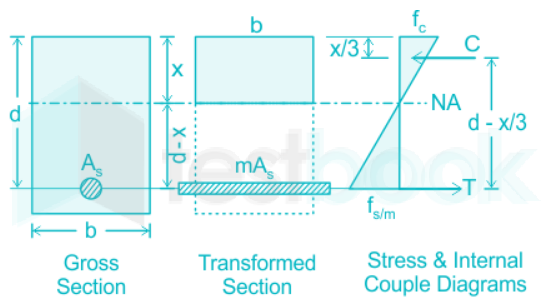
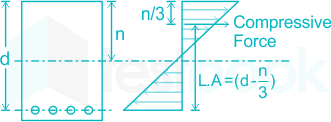
Let us take a common example of Reinforced concrete section subjected to bending as shown below:

The section above the neutral axis is in compression whereas the section below the neutral axis is in tension. The stress diagram in working stress method is assumed to be linear, hence the compressive force will act at one third of the neutral axis from top. The entire tensile stress is taken by steel alone (one of the assumption), hence the tensile force will act at the level of steel.

Therefore, liver arm becomes:

Liver;arm=dn3{\rm{Liver;arm}} = {\rm{d}} - \frac{{\rm{n}}}{3} = 3 dn3\frac{3 \mathrm{~d}-\mathrm{n}}{3}

Where, d = effective depth of the section and n = neutral axis depth

53

The following methods are used for structural analysis:

  1. Macaulay method
  2. Column analogy method
  3. Kani's method
  4. Method of sections

Those used for indeterminate structural analysis would include

  1. ((a))

    1 and 2

  2. ((b))

    1 and 3

  3. ((c))

    2 and 3

  4. ((d))

    2, 3 and 4

Show Answer
Answer: ((d))

2, 3 and 4

Concept:

Method of analysis of indeterminate structures:

Method of section for indeterminate truss:

  • The method of sections can be used to analyze indeterminate trusses also, but it needs to be combined with other methods to obtain a complete solution.
  • For an indeterminate truss, the method of sections alone cannot determine all the unknown forces in the truss. However, it can be used to determine the unknown forces in some of the truss members.
  • To obtain a complete solution for an indeterminate truss using the method of sections, it is necessary to combine it with other methods, such as the method of joints, method of consistent deformations, or slope-deflection method. These methods can be used to obtain additional equations needed to solve for the unknown forces in the truss members.
  • The general approach to analyzing an indeterminate truss using the method of sections involves cutting the truss into smaller sections and solving for the unknown forces in the members of each section using the method of sections. The method is then combined with other methods to solve for the remaining unknown forces in the truss members.

In the force method of analysis:

In this method, the primary unknown forces in the members and compatibility equations are written for displacement and rotations (which are calculated by force-displacement equations).

In solving these equations, redundant forces are calculated. Once the redundant forces are calculated, the remaining reactions are evaluated by equilibrium equations.

In the displacement method of analysis:

Primary unknowns are the displacements and initially, force-displacement relations are computed and subsequently, equations are written satisfying the equilibrium conditions of the structure in this method. After determining the unknown displacements, the other forces are calculated satisfying the compatibility conditions and force-displacement relations.

Difference between Force & Displacement Methods

Force MethodsDisplacement Methods
Types of indeterminacy: Static IndeterminacyTypes of indeterminacy: Kinematic Indeterminacy
Governing equation: Compatibility EquationsGoverning equations: Equilibrium Equations
Force displacement relations: Flexibility matrixForce displacement relations: Stiffness matrix
Example: 1. Method of consistent deformation 2. Theorem of least work 3. Column analogy method 4. Flexibility matrix method 5. Castigliano’s Theorem- IIExample: 1. Slope deflection method 2. Moment distribution method 3. Kani’s method 4. Stiffness matrix method 5. Castigliano’s Theorem- I
54

In a simply supported singly reinforced concrete beam, the reinforcement is placed:

  1. ((a))

    At the Neutral axis

  2. ((b))

    Above the Neutral axis

  3. ((c))

    Below the Neutral axis

  4. ((d))

    At corners of the beam

Show Answer
Answer: ((c))

Below the Neutral axis

In a simply supported singly reinforced concrete beam, the reinforcement is placed below the neutral axis of the beam.

It is due to the fact that concrete is weak in tension, and the portion below the neutral axis is in tension. In order to bear these tension stresses the reinforcement is placed below the neutral axis.

55

The construction joints in cement concrete:

  1. ((a))

    Should be located where bending moment is large

  2. ((b))

    Should be located where shear force is large

  3. ((c))

    Should not be provided at the corners

  4. ((d))

    Should be spaced at a distance of 3 m apart in case of huge structures

Show Answer
Answer: ((c))

Should not be provided at the corners

Explanation: 

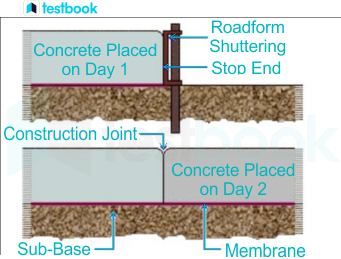
Construction joints in Cement concrete work occur where two successive placement of concrete meet. These joints are placed at the end of days work. They may be design to permit movement or load transfer.

Construction joints in cement concrete work is provided at the location where bending moment and shear force is minimum and should not be provided at the corner.

A large area cannot be concreted within a day. it will take a long time and a huge volume of concrete could be required. Therefore, as per the capacity of the batching plants and the contractor's human resource, the size of the pours could be selected, so the joint form between previous concreting and a fresh concreting called construction joint.


56

Water cement ratio is usually, expressed in:

  1. ((a))

    Litres of water required per bag of cement

  2. ((b))

    Litres of water required per kg of cement

  3. ((c))

    m3 of water required per bag of cement

  4. ((d))

    m3 of water required per kg of cement

Show Answer
Answer: ((b))

Litres of water required per kg of cement

Explanation: 

Water Cement Ratio: 

  • The water-cement ratio of the fresh concrete mix is important factors determining the quality and properties of hardened concrete, as it directly affects the concrete porosity, and a good concrete is always a concrete as compact and as dense as possible.
  • A good concrete must be therefore prepared with as little water as possible, but with enough water to hydrate the cement minerals and to properly handle it.
  • Water–cement ratios in the range of 0.40 to 0.60 are typically used. For higher-strength concrete, lower w/c ratios are necessary, along with a plasticizer to increase flowability.
  • Water Cement ratio is expressed in Litres of water required per kg of cement.
57

The gypsum is added to the cement for:

  1. ((a))

    Providing high strength to the cement

  2. ((b))

    Controlling the initial setting time of cement

  3. ((c))

    Lowering the clinkering temperature of cement

  4. ((d))

    All of these

Show Answer
Answer: ((b))

Controlling the initial setting time of cement

Explanation:

Cement

  • Cement is important for construction activities like building houses, factories, bridges, roads, airports, dams, and for other commercial establishments.
  • This industry requires bulky and heavy raw materials like limestone, silica, alumina, and gypsum.
  • Coal and electrical power are needed for production and rail for transportation.
  • When cement is mixed with water, it becomes hard over a period of time. This is called the setting of cement.
  • Gypsum is usually added to cement to prevent early hardening or “flash setting”, allowing extended working time.
58

Calcareous material used in the manufacture of cement consists of:

  1. ((a))

    Lime stone

  2. ((b))

    Chalk

  3. ((c))

    Shells

  4. ((d))

    All of these

Show Answer
Answer: ((d))

All of these

Cement basically constitutes of calcareous and argillaceous materials.

Raw material ingredients used for manufacturing of Portland Cement are:

Calcareous Materials: Calcareous Materials are compounds of calcium and magnesium. Limestones are common calcareous material used in manufacturing cement. Chalk and shells are also used as calcareous material.

Argillaceous Materials: Argillaceous Materials are mainly silica, alumina and oxides of iron. Clay and shale are common argillaceous material used as cement ingredient in the process of manufacturing cement.

59

The horizontal members of wood or steel used to support the common rafter of a sloping roof, are called:

  1. ((a))

    Purlins

  2. ((b))

    Cleats

  3. ((c))

    Hip rafters

  4. ((d))

    Valley rafters

Show Answer
Answer: ((a))

Purlins

Explanation:

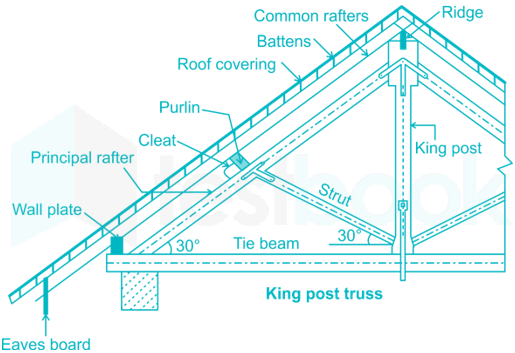
The different components used in the pitched roof are:

Purlins:

They are horizontal wooden or steel members that are used to support the common rafters of a sloping route when the span is larger.

Eaves:

The bottom edge of the sloped roof surface is called the eaves from which rainwater drops down during rain. 

Gable: 

The triangular upper part of a wall formed at the end of a pitched roof is called a gable.

Rise of truss: 

The vertical distance between the wall plate and the top of the ridge is known as rising.

Hip:

It is a place where two sloping surfaces meet, where the exterior angle is more than 180°.

Span:

The horizontal distance between the internal faces of walls or supports is called a span.

​Verge:

The edge of a gable running between the eaves and ridge is called a verge.

Pitch: 

The inclination of the sides of a roof to the horizontal plane is called pitch.

Ridge:

The apex of the angle is developed at the top by the inclined surfaces at the top of the slope. 

Rafters:

It runs from the ridge or hip of the roof to the wall plate of the external wall.

60

The process of maintaining or improving the performance of a soil as a constructional material, usually by the use of admixtures, is known as:

  1. ((a))

    Soil exploration

  2. ((b))

    Soil stabilization

  3. ((c))

    Soil compaction

  4. ((d))

    Soil consolidation

Show Answer
Answer: ((b))

Soil stabilization

Explanation:

Soil stabilization:

Soil stabilization aims at improving soil strength and increasing resistance to softening by water by bonding the soil particles together, waterproofing the particles, or a combination of the two.

Soil Stabilization is either achieved by Mechanical, Physical, Chemical or Physio chemical Stabilization.

Physical stabilization may be achieved by the addition of:

  1. Cement stabilisation
  2. Lime stabilisation
  3. Bitumen stabilisation
  4. Chemical stabilization
  5. Resin stabilisation

Chemical stabilization may be achieved by the addition of:

  1. Calcium Chloride
  2. Sodium Chloride
  3. Sodium Silicate
  4. Polymers
  5. Chrome Lignin
  6. Other Chemicals, etc.
61

Force is a:

  1. ((a))

    Scalar quantity

  2. ((b))

    Vector quantity

  3. ((c))

    Non Linear equation

  4. ((d))

    None of these

Show Answer
Answer: ((b))

Vector quantity

CONCEPT:

  • All measurable quantities are divided into two broad categories:
Scalar quantitiesVector quantities
The physical quantities which have only magnitude and no direction are called scalar quantities or scalars.The physical quantities which have both magnitude and direction and obey the laws of vector addition are called vector quantities or vectors.
A scalar quantity can be specified by a single number, along with the proper unit.A vector quantity is specified by a number with a unit and its direction.
Examples: Mass, volume, density, time, temperature, electric current, distance, Energy, speed, etc.Examples Displacement, velocity, force, weight, torque, momentum, acceleration, velocity, etc
62

Dimension of the power is:

  1. ((a))

    M-1L2T-2

  2. ((b))

    M1L2T-3

  3. ((c))

    M-1LT-3

  4. ((d))

    M-1LT-2

Show Answer
Answer: ((b))

M1L2T-3

Solution: 

Power is the amount of energy transferred or converted per unit of time. It is a scalar quantity. It is work done per unit of time.

    P=dWdt=d(F.x)dt=FdxdtP= \frac{\mathrm{d} W}{\mathrm{d} t} = \frac{\mathrm{d} (F.x)}{\mathrm{d} t} =F \frac{\mathrm{d} x}{\mathrm{d} t} ​

         P=F.vP= F.v      ...................................................................................(1)​

Where P = Power , W = work done, x = Displacement, v = Velocity

Let Dimension of Power = [MaLbTc][M^{a}L^{b}T^{c}]

From equation (1), by equating the dimension of LHS expression to RHS expression.

[MaLbTc]=[M1L1T2][M0L1T1][M^{a}L^{b}T^{c}]= [M^{1}L^{1}T^{-2}][M^{0}L^{1}T^{-1}]

[MaLbTc]=[M1L2T3][M^{a}L^{b}T^{c}]= [M^{1}L^{2}T^{-3}]

Comparing the power of fundamental quantity on both side we get,

a = 1, b = 2, c = - 3 

\therefore  Dimension of Power = [M1L2T3][M^{1}L^{2}T^{-3}]

63

The red color obtained by the brick is due to the presence of:

  1. ((a))

    Lime

  2. ((b))

    Silica

  3. ((c))

    Manganese

  4. ((d))

    Iron oxide

Show Answer
Answer: ((d))

Iron oxide

Explanation:

Iron Oxide in brick: 

Iron oxide constituting less than 7 percent of clay imparts the following properties:

1. Gives red color on burning when an excess of oxygen is available and dark brown or even black color when oxygen available is insufficient. However, an excess of ferric oxide makes the brick dark blue.

  1. Improves impermeability and durability.
  2. Tends to lower the fusion point of the clay, especially if present as a ferrous oxide.
  3. Gives strength and hardness.

 Important Points

Silica:

  • If it is in proper proportion then there is good cohesion between the particles and imparts uniform shape.
  • Excess of silica makes the brick brittle and weak on burning.

Alumina: 

  • It imparts plasticity to the brick. Absorbs water and renders the clay plastic. If alumina is present in excess of the specified quantity, it produces cracks in brick on drying.

Lime:

 Lime in brick clay has the following effects:

1. Provide bondage 2. Causes silica in clay to melt on burning and thus helps to bind it. 3. In carbonated form, lime lowers the fusion point. 4. Excess of lime causes the brick to melt and the brick loses its shape.

64

The dog legged stair is a:

  1. ((a))

    Half turn stair

  2. ((b))

    Quarter turn stair

  3. ((c))

    Three quarter turn stair

  4. ((d))

    Continuous stair

Show Answer
Answer: ((a))

Half turn stair

Explanation: 

Half turn stairs: Half turn stairs are of two types

  1. Dog legged stairs 2. Open well stairs

1. Dog legged stairs: It consist of two flight of stairs which are opposite direction, no space is provided between flight in plan.

2. Open well stairs: A half turn stairs with a space between its flight is known as open well stairs. This type of stairs are suitable for multistorey building.

Quarter turn stairs: When direction of flight is changed at right angle either to be left or to be right quarter turn stairs is used. It is suitable when width is more and length is limited.

Three quarter turn stairs: A stair turning through three right angle is known as three quarter turn stairs.

Continuous stairs: A stair which do not have any landing or intermediate newel post are termed as continuous stair.

65

An ideal vertical curve to join two gradients is:-

  1. ((a))

    Circular

  2. ((b))

    Parabolic

  3. ((c))

    Elliptical

  4. ((d))

    Hyperbolic

Show Answer
Answer: ((a))

Circular

Concepts:

Vertical Curves are of two types: Summit Curve and Valley Curve

The ideal shape for summit curve is circular because sight distance available throughout its length remains constant. However, if deviation angle is very small, behavior of parabola and circular is same**. Hence, parabola is preferred for summit curves.**

For Valley curves**, cubic parabola** is preferred as introduction of centrifugal force on this curve is gradual and hence, there is no problem of discomfort. However, IRC suggest Square parabola for valley curves due to simplicity of calculation.

66

The main constituent of fly-ash is:

  1. ((a))

    Ferrous oxide

  2. ((b))

    Aluminium oxide

  3. ((c))

    Silica

  4. ((d))

    All of the above

Show Answer
Answer: ((d))

All of the above

Explanation:

Fly Ash

It is a heterogeneous by-product material produced in the combustion process of coal used in power stations. It is a fine grey-colored powder having spherical glassy particles that rise with the flue gases. As fly ash contains pozzolanic materials components which reach with lime to form cementitious materials. Thus Fly ash is used in concrete, mines, landfills, and dams.

Chemical Composition of Fly Ash as follows:

The chemical composition of fly ash depends upon the type of coal used and the methods used for the combustion of coal. Table No 1:  Chemical composition of fly ash of different coals.

ComponentBituminous CoalSub bituminous CoalLignite Coal
SiO2 (%)20-6040-6015-45
Al2O3 (%)5-3520-3020-25
Fe2O3 (%)10-404-104-15
CaO (%)1-125-3015-40
LOI (%)0-150-30-5
67

In the cement the compound quickest to react with water, is:

  1. ((a))

    Tri-calcium silicate

  2. ((b))

    Di-calcium silicate

  3. ((c))

    Tri-calcium aluminate

  4. ((d))

    Tetra-calcium alumino ferrite

Show Answer
Answer: ((c))

Tri-calcium aluminate

Concept:

  1. Tricalcium Aluminate: C3A is formed within 24 hours of the addition of water in the cement and is responsible for the maximum evolution of heat of hydration. It is the first compound that is formed after the addition of water and sets early.
  2. Tetracalcium aluminoferrite: C4AF is also formed within 24 hours of the addition of water in the cement but its individual contribution to the overall strength of the cement is insignificant.
  3. Tricalcium silicate: C3S is formed within a week or so of the addition of water in the cement and is responsible for the early development of the strength of the cement.
  4. Dicalcium silicate: C2S is the last compound that is formed after the addition of water in the cement which may require a year or so for its formation. It is responsible for the progressive strength of the cement.
68

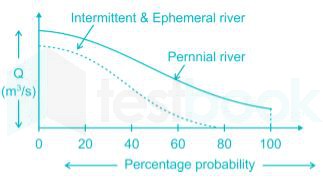
Flow duration curve is the graph drawn between:

  1. ((a))

    Discharge time

  2. ((b))

    The discharge and the percentage of the time such discharge is exceeded

  3. ((c))

    Cumulative rate of flow

  4. ((d))

    Cumulative volume of flow

Show Answer
Answer: ((b))

The discharge and the percentage of the time such discharge is exceeded

Concept:

A flow duration curve is a plot of discharge against the percent of time the flow was equaled or exceeded. This is known as the discharge frequency curve.

The area under the flow duration curve gives the average daily flow for a given period for which flow duration curve is plotted.

Application:

  1. To find out the maximum and minimum flow for a hydroelectric power plant.
  2. The shape of a flow-duration curve is used to evaluate the stream and catchment characteristics.
  3. A very steep curve means high flow for very short period of time and it would cause flood. On the other hand, flat curve means low flow region and it can sustain the flow.

The flow duration curve is the 

69

Ultimate strength to cement is provided by

  1. ((a))

    Tri calcium silicate

  2. ((b))

    Di calcium silicate

  3. ((c))

    Tri calcium aluminate

  4. ((d))

    Tetra calcium alumina ferrite

Show Answer
Answer: ((b))

Di calcium silicate

These compounds are known as Bogue’s Compounds.

  • Tricalcium silicate (C3S): This is also called as Alite. This is also responsible for the early strength of the concrete. The cement that has more C3S content is good for cold weather concreting. The heat of hydration is 500 J/Cal. Its proportion is 25 - 50%.
  • Dicalcium Silicate (C2S): This compound will undergo reaction slowly. It is responsible for the ultimate strength of concrete. This is also called as Belite. The heat of hydration is 260 J/Cal. Its proportion is 25 - 40%.
  • Tricalcium aluminate (C3A): Celite is the quickest one to react when the water is added to the cement. It is responsible for the flash setting. The increase of this content will help in the manufacture of Quick Setting Cement. The heat of hydration is 865 J/Cal. Its proportion is 5 - 11%.
  • Tetra calcium Alumino ferrite (C4AF): This is called as Felite. The heat of hydration is 420 J/Cal. It has the poorest cementing value but it responsible for long term gain of strength of the cement. Its proportion is 8 - 14%.
70

Wrought iron contains carbon upto:

  1. ((a))

    0.25%

  2. ((b))

    1.0%

  3. ((c))

    1.5%

  4. ((d))

    2.0%

Show Answer
Answer: ((a))

0.25%

Explanation:

Wrought iron

  • Wrought iron is a very pure iron where the iron content is of the order of 99.5%.
  • It usually contains less than 0.1% carbon and 1 or 2% slag.

Pig iron 

  • Pig iron is an intermediate product of the iron industry.
  • Pig iron has a very high carbon content, typically 3.8–4.7%, along with silica and other constituents of dross, which makes it very brittle.

Cast iron

  • Cast iron is an alloy of iron, carbon and silicon and it is hard and brittle.
  • Carbon content in CI may be within 1.7% to 3% and carbon may be present as free carbon or iron carbide Fe3C.

Steel 

  • Steel is basically an alloy of iron and carbon in which the carbon content can be less than 1.7% and carbon is present in the form of iron carbide to impart hardness and strength.
71

In a mortar, the binding material is:

  1. ((a))

    Cement

  2. ((b))

    Sand

  3. ((c))

    Cinder

  4. ((d))

    None of these

Show Answer
Answer: ((a))

Cement

Explanation:

The paste obtained by the addition of water in suitable quantity in the mixture of binding material like cement or lime and aggregates like sand is known as Mortar.

This binding material is also termed as Matrix and the aggregate used is also known as Adulterant.

Admixture is added in the concrete to modify its property such as strength, setting time etc.

72

Minimum size of the particles of silt soil, is:

  1. ((a))

    0.002 mm

  2. ((b))

    0.04 mm

  3. ((c))

    0.06 mm

  4. ((d))

    0.08 mm

Show Answer
Answer: ((a))

0.002 mm

Explanation:

Silt size varies from 0.002 mm - 0.075 mm.

In the Indian Standard Soil Classification System (ISSCS) or BIS, soils are classified according to their grain size as boulder, cobble, gravel, sand, silt, or clay, as shown below in the tabulated form.

Soil GroupType of SoilSub - GroupSize Range
Very Coarse SoilsBoulder> 300 mm
Cobble80 – 300 mm
Coarse SoilsGravelCoarse20 – 80 mm
Fine4.75 – 20 mm
SandCoarse2- 4.75 mm
Medium0.425- 2 mm
Fine0.075 – 0.425 mm
Fine SoilsSilt0.002 – 0.075 mm
Clay< 0.002 mm
73

A steel cable of 2 cm diameter is used to lift a board 500π kg. Given that the length of the cable is 10 m and the value of E = 2 × 10⁶ kg/cm2, the elongation of the cable will be:

  1. ((a))

    0.25 cm

  2. ((b))

    1.00 cm

  3. ((c))

    0.50 cm

  4. ((d))

    1/π cm

Show Answer
Answer: ((a))

0.25 cm

Concept:

Elongation of the cable is given by,

δL = PLAE\frac{PL}{AE}

E = Elastic Modulus, P = Applied Load, L = Length of cable

A = Area of the cross-section, δL = Elongation

Explanation:

Given:

E =  2 × 10⁶ kg/cm2 

P = 500π kg, L = 10 m = 1000 cm

A = π4×(2)2\frac{π}{4}\times (2)^2 cm2 = π cm2

∴ δL = PLAE\frac{PL}{AE}

δL = 500π;×;1000π;×;2;×;106\frac{500π ;\times; 1000}{\pi ;\times; 2;\times; 10^6}

δL  = 0.25 cm

74

The azimuth of a line is the:

  1. ((a))

    Clockwise angle that a line makes with the south end of the selected material

  2. ((b))

    Anti-clockwise angle that a line makes with the south end of the selected material

  3. ((c))

    Clockwise angle that a line makes with the north end of the selected material

  4. ((d))

    None of these

Show Answer
Answer: ((c))

Clockwise angle that a line makes with the north end of the selected material

Explanation-

Surveyors express angles in several ways. When specifying directions, as is done in the preparation of a property survey, angles may be specified as bearings or azimuths.

A bearing is an angle less than 90° within a quadrant defined by the cardinal directions.

Azimuth is an angle between 0° and 360° measured clockwise from the North.

"South 45° East" and "135°" are the same direction expressed as a bearing and as an azimuth.

75

The tie bars in a concrete pavement are provided in:

  1. ((a))

    Contraction joints

  2. ((b))

    Expansion Joints

  3. ((c))

    Longitudinal joints

  4. ((d))

    Construction joints

Show Answer
Answer: ((c))

Longitudinal joints

Explanation:

Longitudinal joint

  • These are provided along the length of the pavement.
  • They are provided if the pavement width is more than 4.5 m.
  • It reduces the warping stress and uneven settlement of subgrade.
  • The tie bars in concrete pavement are provided across the Longitudinal joint.
  • Tie bars are not load transfer devices but serve as a means to tie two slabs.
  • Hence tie bars must be deformed or hooked and must be finally anchored into the concrete to function properly.
  • They are smaller than dowel bars and placed at large intervals.

Additional Information

There are mainly two types of joints provided in the cement concrete pavement:

(i) Longitudinal joint

(ii) Transverse joint

  • Expansion joint
  • Contraction joint
  • Construction joint
  • Warping joint
76

In a CBR test, If the CBR value at 5 mm is greater than that at 2.5 mm:

  1. ((a))

    The higher value should be chosen 

  2. ((b))

    The test should be repeated 

  3. ((c))

    Average value of the two should be used 

  4. ((d))

    None of these 

Show Answer
Answer: ((b))

The test should be repeated 

Concept:

CBR Test:

  • The California bearing ratio test is penetration test meant for the evaluation of subgrade strength of road and pavements. The results obtained by these tests are used with the empirical curves to determine the thickness of pavement and its component layers.
  • This is the most widely used method for the design of flexible pavement.
  • Generally CBR value is calculated at 2.5 mm and 5 mm penetration.
  • The CBR value at 2.5 mm penetration will be greater than the CBR value at 5 mm penetration and in such a case the former will be taken as the CBR value.
  • If CBR for 5 mm exceeds that for 2.5 mm, the test should be repeated. If identical result follows, the CBR for 5 mm penetration should be taken for design.
77

Salvaging is:

  1. ((a))

    Dumping of solid waste

  2. ((b))

    Sanitary land filling of solid waste

  3. ((c))

    Composing and soil conditioning

  4. ((d))

    Extraction of essence from waste

Show Answer
Answer: ((d))

Extraction of essence from waste

Explanation:

Salvaging:

  • Salvaging is described as an observed collection of solid waste for reuse.
  • Salvaging is considered an advanced way of solid waste management.
  • Salvaged material should be treated with care and should be avoided to mix with surrounding materials.
  • Salvaged material is then reused by passing through different stages of recycling.
78

A cantilever beam is one which is -

  1. ((a))

    Fixed at one end and free at the other end

  2. ((b))

    Fixed at both ends

  3. ((c))

    Supported at its ends

  4. ((d))

    Supported at more than two points

Show Answer
Answer: ((a))

Fixed at one end and free at the other end

Explanation:

There are different types of beam:

Overhanging beam:

  • A beam having its end portion extended beyond the support is known as an overhanging beam.
  • A beam may be overhanging on one side or on both sides.

Cantilever beam:

  • A beam fixed at one end and free at the other end is known as a cantilever beam.

Simply Supported Beam:

  • A beam supported at its both ends is known as a simply supported beam.

Fixed beam:

  • A beam whose both ends are fixed is known as a fixed beam.

Continuous beam:

  • A beam supported on more than two supports is known as a continuous beam.

79

Compression index on a soil helps to determine:

  1. ((a))

    Total time required for consolidation 

  2. ((b))

    Time required for 50% consolidation 

  3. ((c))

    Total settlement of clay layer 

  4. ((d))

    Pre-consolidation pressure of clay 

Show Answer
Answer: ((c))

Total settlement of clay layer 

Concept:

The coefficient of compression or compression index:

  • The compression index (Cc) is the slope of the linear portion of the pressure–void ratio curve on a semi-log plot, with pressure on the log scale (IS: 8009 – Part 1, 1976).
  • This is a dimensionless parameter.

Compression index on a soil helps to determine total settlement of clay layer.

Mathematically consolidation settlement(Sc) is given by,

SC=HCC1+e0logp0+Δpp0{S_C} = H\frac{{{C_C}}}{{1 + {e_0}}}log\frac{{{p_0} + {{\rm{\Delta }}_{\rm{p}}}}}{{{p_0}}}

Where CC = Co-efficient of the compression index, H = Thickness of clay layer, e0 = Initial void ratio = wGSwG\over S , w = water content, G = specific gravity, S = degree of saturation, p0 = Initial overburden pressure at the middle of clay layer, Δp\Delta p = Extra pressure due to the new

Important Points

For undisturbed low to medium sensitivity soils,  (Terzaghi and Peck empirical index) 

→ Cc = 0.009 × (WL - 10%)

For disturbed(remolded) low to medium sensitive soil (Skempton's empirical index)

→ Cc = 0.007 × (WL - 10%)

80

If levelling staff is held inclined at a staff station, the reduced level calculated from observation would be:

  1. ((a))

    True R.L.

  2. ((b))

    More than true R. L.

  3. ((c))

    Less than true R. L.

  4. ((d))

    Equal to R. L. of Bench mark

Show Answer
Answer: ((c))

Less than true R. L.

Explanation: 

  • Staff reading is less when staff held vertical as compare to when staff is held inclined at staff station.
  • Reduced level calculated for the inclined position of the staff is less as the staff reading is more as compare to staff held vertical.
  • Reduce level of a point = Height of instrument - Staff reading at that point
  • So as the staff reading increases, the RL of a that staff station decreases as compare to R.L of instrument station.


​ 

81

A document containing detailed description of all the items of work (but their quantities are not mentioned) together with their current rates is called:

  1. ((a))

    Tender

  2. ((b))

    Scheduled of rates

  3. ((c))

    Analysis of rate

  4. ((d))

    Abstract estimate.

Show Answer
Answer: ((b))

Scheduled of rates

Explanation: 

Tender: It refers to an invitation to bid for a project. It is offered in writing to execute the work as specified by the owner. Tendering usually refers to the process whereby governments and financial institutions invite bids for large projects that must be submitted within a finite deadline.

Schedule of rates: It is the list of rates of various items. It is a document containing a detailed description of all the items of work (but their quantities are not mentioned) together with their current rates.

Analysis of rates: In order to determine the rate of a particular item, the factors affecting the rate of that item are studied carefully and then a rate is decided for that item. This process of fixing the rate of an item is termed an analysis of rates or rate analysis.

Abstract Estimate: An abstract estimate is prepared in order to enable the authority competent to give administrative approval to the expenditure. No detailed knowledge is required to prepare abstract estimates or approximate estimates.

82

When two plates are placed end to end and are joined by cover plates, the joint is known as:

  1. ((a))

    Lap joint

  2. ((b))

    Butt joint

  3. ((c))

    Chain riveted lap joint

  4. ((d))

    Double cover butt joint

Show Answer
Answer: ((d))

Double cover butt joint

Explanation:

The different forms of joints are as follows:

Single riveted lap joint: In this, the plates to be joined are overlapped at the ends and a single row of rivets is placed in the middle of the lap

Double riveted lap joint: This type of joint will have two rows of rivets. The overlap is large enough to accommodate two rows of rivets

Single strap butt joint: A separate piece of metal called STRAP is used to hold the edges of the components together; This joint is also used for joining the edges of components together

Double strap butt joint: Double straps are used for riveted butt joints

Further the joint may be either chain or staggered depending upon the bolt/rivet pattern.

83

Curing of concrete can be done by:

  1. ((a))

    Spraying

  2. ((b))

    Ponding

  3. ((c))

    Drenching

  4. ((d))

    Any of the above

Show Answer
Answer: ((d))

Any of the above

Explanation:

Method of  CuringWhen to Use
Covering concrete surfaces with hessian or gunny bagsAdopted mainly in case of large concrete surfaces such as road slabs.
Shading concrete workStructural concrete work i.e. RCC work on beams/slabs
Pounding MethodSuitable for curing horizontal surfaces such as floors, roof slabs, road and airfield pavements
Sprinkling of WaterMostly used for curing floor slabs.
Membrane curingAdopted where water is not available in sufficient quantity or where constant supervision is not possible.
DrenchingIt is a process of curing for different concrete members.
High-pressure steam curingAdopted where strength development of concrete is very rapid.
Infrared radiation curingIt has much more rapid gain of strength that can be obtained than even with steam curing.
84

The process of applying cement mortar under pressure through a nozzle is called:

  1. ((a))

    Pressurizing

  2. ((b))

    Prestressing

  3. ((c))

    Guniting

  4. ((d))

    Screeding

Show Answer
Answer: ((c))

Guniting

Explanation: 

Guniting: 

  • It is a process of applying mortar or concrete under pressure with a cement gun, resulting in highly strong concrete. It is also used to restore concrete that has been damaged by fire, earthquakes, or chemicals.

Prestressing: 

  • It is the introduction of a compressive force to the concrete to counteract the tensile stresses that will result from an applied load. Prestressing is done by the following methods:
  1. ​Pre-tensioning
  2. Post-tensioning

Screeding:

  • Screeding is the process of flattening the poured concrete surface into a smooth and flat layer prior to finishing the surface.
  • Screeding is only the first step in finishing concrete, and it is not intended to produce a completely smooth final surface.
85

The increase in volume of dry sand when water is added is called

  1. ((a))

    Honey combing

  2. ((b))

    Bulking

  3. ((c))

    Segregation

  4. ((d))

    Bleeding

Show Answer
Answer: ((b))

Bulking

Concept:

Bulking of sand:

The increase in moisture of sand increases the volume of sand. The reason is that moisture causes film of water around sand particles which results in the increase of volume of sand. For a moisture content percentage of 5 to 8 there will be an increase in volume up to 20 to 40 percent depending upon sand. If the sand is finer there will be more increase in volume. This is known as bulking of sand.

The important facts in connection with the bulking of sand are as follows:

(1) When moisture content is increased by adding more water, the sand particles pack near each other and the amount of bulking of sand is decreased. Thus the dry sand and the sand completely flooded with water have practically the same volume.

(2) The coarse aggregate is little affected by the moisture content.

(3) One of the reasons of adopting proportioning by weight is the bulking of sand as proportioning by weight avoids the difficulty due to the bulking of sand.

(4) The bulking of sand should be taken into account when volumetric proportioning of the aggregates is adopted. Otherwise, less quantity of concrete per bag of cement will be produced, which naturally will increase the cost of concrete. Also, there will be less quantity of line aggregate in the concrete mix which may make the concrete difficult to place.

Honey combing, segregation and bleeding are the defects occur in concrete.

86

The best type of ballast is:

  1. ((a))

    Granite

  2. ((b))

    Sand stone

  3. ((c))

    Lime stone

  4. ((d))

    Quartzite

Show Answer
Answer: ((a))

Granite

Explanation: 

Ballast:

  • Ballast is a granular material made up of broken stone or brick or kankar/gravel etc. which is placed below the sleeper and is used to transmit the load from the sleeper to the subgrade.
  • Type of Ballast:
  1. Broken stone ballast
  2. Gravel Ballast
  3. Sand Ballast
  4. Brick Ballast
  5. Blast Furnace Slag Ballast
  • Broken stone is the best material for the ballast. Igneous rocks such as granite, quartz, etc. are used for broken stones. The size of broken stones varies from 1.9 cm to 5.08 cm.
  • The functions of ballast are:
  1. Load transfer
  2. To provide Drainage
  3. To Impart elasticity to the track.
  4. To Impart longitudinal and lateral stability to the sleeper.
  5. To absorb shock and vibration.

87

Fine sand is used as media in case of:

  1. ((a))

    Slow sand filter

  2. ((b))

    Rapid sand filter

  3. ((c))

    Pressure filter

  4. ((d))

    Gravity filter

Show Answer
Answer: ((a))

Slow sand filter

Explanation:

Filtration is the process in which fine suspended particles and flocs are removed from the water. It also removes organic matter and dissolved solids from water. Filtration is carried out in units termed filters.

Type of Filters: 1. Gravity Filter 2. Pressure Filter

1. Gravity Filter: 

  • Gravity filters are those in which the head required to flow water through filter media is provided by the height of water above the filter media itself.

Gravity filters further classified into

  1. Slow Sand Filter
  2. Rapid Sand Filter

(A) Slow Sand Filter: (SSF)

  • It utilizes water from a source or plain sedimentation tank, as in coagulation-aided sedimentation, effluent leads to frequent choking of filler media and requires frequent cleaning which increases operational cost.
  • A gravel layer is provided at the bottom to support the sand medium.
  • The depth of tank is 2.5 m to 3.5 m
  • Fine sand is used as filter media.
  • Effective size of grain (D10) = 0.2 - 0.3 mm
  • Coefficient of uniformity (Cu) = 1.8 - 2.5/3
  • Bacteria removal efficiency is 98 - 99%

(B) Rapid Sand Filter: (RSF)

  • The working of RSF is the same as SSF.
  • As the size of filter media is comparatively bigger than SSF and filter media is poorly graded, impurities are able to penetrate in the lower part of filter media.
  • Hence surface cleaning is not sufficient thus Back Washing is done.
  • Effective size of grain (D10) = 0.35 - 0.55 mm
  • Coefficient of uniformity (Cu) = 1.3 - 1.7
  • Bacteria removal efficiency is 80 - 90%

2. Pressure Filter: 

  • Gravity filters are those in which the head required to flow water through filter media is provided by the external application of pressure
  • These are less efficient than RSF.
88

The rate of change of velocity of body is called:

  1. ((a))

    Acceleration

  2. ((b))

    Velocity

  3. ((c))

    Momentum

  4. ((d))

    None of these

Show Answer
Answer: ((a))

Acceleration

Concept:

Velocity/ Speed:

  • The rate of change of displacement/distance of a body is called the velocity/speed of that body.
  • Velocity is a vector quantity that has both magnitudes as well as direction.

Acceleration:

  • The rate of change of velocity is called the acceleration of the body.
  • Acceleration is also a vector quantity.
  • The slope of any velocity-time graph gives an acceleration of the body.

Displacement:

  • The minimum path length between two points is called displacement.

Distance:

  • The total path length between two points is called distance.
89

Float or slack represent s the difference between the:

  1. ((a))

    Earliest completion time and latest allowable time

  2. ((b))

    Latest allowable time and earliest completion time

  3. ((c))

    Earliest completion time and normal expected time

  4. ((d))

    Latest allowable time and normal allowable time

Show Answer
Answer: ((b))

Latest allowable time and earliest completion time

Concept:

Slack time 

  • It is the amount of time a task can be delayed before the project finish date is delayed. Thus, the slack is the difference between event times denoting the range within which an event time can vary.
  • The Earliest Expected Time (TE) is the time when an event can be expected to occur earlier.
  • The Latest allowable occurrence time (TE)is the latest time by which an event must occur to keep the project on schedule (without delaying the project).
  • Event slack is defined as the difference between the latest event and the earliest event times. i.e. Slack = TL - TE
  • Slack is defined as the difference between the latest occurrence time and earliest occurrence time.
  • It is also given by the difference between the Latest allowable time and the earliest completion time.

Important Points

Positive slack: When TL > TE. It indicates the project is ahead of schedule meaning thereby the excess resources.

Zero slack: When TL = TE. It indicates that the project is going on schedule meaning thereby adequate resources.

Negative slack: When TL < TE. It indicates the project is behind schedule meaning thereby the lack of resources.

90

PERT stands for:

  1. ((a))

    Programme Estimation and Reporting Techniques

  2. ((b))

    Programme Evaluation and Review Technique

  3. ((c))

    Planning Estimation and Resulting Technique

  4. ((d))

    Process Evaluation and Reporting Technique

Show Answer
Answer: ((b))

Programme Evaluation and Review Technique

Concept:

  • Network models can be used as an aid in scheduling large complex projects that consist of many activities.
  • If the duration of each activity is known with certainty, then the Critical Path Method (CPM) can be used to determine the length of time required to complete a project.
  • If the duration of the activities is not known with certainty, the Program Evaluation and Review Technique (PERT) can be used to estimate the probability that the project will be completed by a given deadline.

Difference between PERT and CPM (Critical Path Method)

PERTCPM
1. Probabilistic approach1. Deterministic approach
2. Three-time estimate2. One - time estimate
3. Event oriented network model3. Activity-oriented network model
4. The slack concept is used4. Float concept is used
5. Project crashing is not possible5. Project crashing is possible
6. Deals with probabilistic time estimates6. Deals with deterministic time estimates
91

The construction of a temporary structure required to support an unsafe structure is called:

  1. ((a))

    Underpinning

  2. ((b))

    Shoring

  3. ((c))

    Scaffolding

  4. ((d))

    Jacking

Show Answer
Answer: ((b))

Shoring

Explanation: 

Underpinning:

  • The process of constructing a new foundation below the existing foundation or the process of strengthening the existing foundation is called underpinning.

Shoring: 

  • The process of construction of temporary structures to support unsafe structures temporarily. Shoring can be used when walls bulge out, or when walls crack due to unequal settlement of the foundation.

Types of shoring: 1. Racking Shoring 2.Flying Shoring 3. Dead Shoring

Scaffolding:

  • It is a temporary structure to support a platform over which the workman can stand or sit to execute the construction work in case of height of the wall exceed 1.5 m.
  • Ordinary Scaffolding consists of standards, ledgers, putlogs, guardrails, free boards, and braces.

Jacking: 

  • Jacking is a term used to describe the application of a force with the aim of pushing or lifting an object.
  • In the trenchless construction and rehabilitation industry, jacking is used to install subterranean pipes by pushing them through the soil.
92

The distance between C.G of compression flange and C.G of tension flange of a plate girder, is known as:

  1. ((a))

    Gross depth

  2. ((b))

    Net depth

  3. ((c))

    Effective depth

  4. ((d))

    Clear depth

Show Answer
Answer: ((c))

Effective depth

Concept:


As shown in the above figure.

de = effective depth (Distance between C.G of comp. flange & tension flange)

D = overall depth

d = clear depth of web

Important Points

  • In a plate girder webs of required depth and thickness are provided to keep flange plates at required distances, to resist shear in the beam.
  • Flanges of required width and thickness are provided to resist bending moment acting on the beam by developing compressive force in one flange and tensile force on another flange
93

The Euler's formula for column is valid for:

  1. ((a))

    Zero slenderness ratio

  2. ((b))

    Small slenderness ratio

  3. ((c))

    Large slenderness ratio

  4. ((d))

    None of these

Show Answer
Answer: ((c))

Large slenderness ratio

Concept:

Euler’s theory:

  • This theory is valid only for long columns only.
  • This theory is valid only when slenderness ratio is greater or equal to critical slenderness ratio.
  • For any slenderness ratio above critical slenderness ratio, column fails by buckling and for any value of slenderness ratio less than this value, the column fails in crushing not in buckling.

Euler’s critical load formula is,

P = n2π2EIL2\frac{{{n^2}{\pi ^2}EI}}{{{L^2}}}

Euler’s formula is applicable when, Crushing stress ≥ Buckling stress

σcrπ2Eλc2(λc;is;critical;slenderness;ratio){σ _{cr}} ≥ \frac{{{\pi ^2}E}}{{{λ _c^2}}}({λ _c};is;critical;slenderness;ratio)

λmin2=λc2π2Eσcr{λ _{min}^2} = {λ _c^2} ≥ \frac{{{\pi ^2}E}}{{{σ _{cr}}}}    

For mild steel,

E = 2 × 105 N/mm2

σcr = 330 N/mm2

∴ λ ≥ 80 N/mm2

∴ When slenderness ratio for mild steel column is less than 80, the Euler’s theory is not applicable. 

According to the given options, Option 3 will be correct. Euler's formula for column is valid for Large slenderness ratio.

94

The working stress is the stress which may be developed in the member:

  1. ((a))

    Causing structural damage to it.

  2. ((b))

    Without causing structural damage to it

  3. ((c))

    Causing residual strain

  4. ((d))

    Causing ultimate load to it

Show Answer
Answer: ((b))

Without causing structural damage to it

Explanation: 

Working stress:

  • Working stress is the stress which may be developed in the member without causing structural damage to it.
  • Maximum stress induced in the structure should be less than the stress at which failure occurs. Stress that is capable of preventing failure is called working stress.
  • Working Stress=Yield StressFactor of SafetyWorking \ Stress = \frac{Yield \ Stress}{Factor \ of \ Safety}
95

A channel section consists of

  1. ((a))

    Two webs

  2. ((b))

    Two flanges

  3. ((c))

    Two webs and two flanges

  4. ((d))

    One web and two flanges

Show Answer
Answer: ((d))

One web and two flanges

Channel Section as can be observed in the figure consists of one web and two flanges.

96

If the width and thickness of a structure is small in comparison to its length, it is known as:

  1. ((a))

    One dimensional structure

  2. ((b))

    Two dimensional structure

  3. ((c))

    Three dimensional structure

  4. ((d))

    Space structure

Show Answer
Answer: ((a))

One dimensional structure

Explanation:

Surface structure: It is made from a material having a very small thickness compared to its other dimensions.

  • Material for surface structure may be flexible taking any form of a tent or air-inflated structure or may be made up of rigid material such as reinforced concrete.
  • These structures act like cables or arches since they support loads primarily in tension or compression, with very little bending.
  • If the thickness of a structural member is small as compared to its length and width, it is classified as a surface structure or two dimension structure.
  • Similarly, if the width and thickness of a structure is less than its length then it is called a one-dimensional structure
97

In a simply supported slab, alternate bars are curtailed at:

  1. ((a))

    1/5 of the span 

  2. ((b))

    1/6 of the span

  3. ((c))

    1/7 of the span

  4. ((d))

    1/8 of the span

Show Answer
Answer: ((c))

1/7 of the span

Curtailment is a way of reducing the area of tensile reinforcement at points/areas (either on a beam/slab) where bending moment is minimum or zero for the purpose of achieving an economic design.

Condition of curtailment - At least 50 % percent of   the total main reinforcement shall be carried through at the bottom on to the bearing and anchored in accordance

In simply supported slab let us find out the BM at 1/7th of span or 0.15L from the face of the support. (Considering unit strip)

BM=wl;2;×0.15lw×0.15l×0.15l2;=0.0635×w×l2{\rm{BM}} = \frac{{{\rm{wl}}}}{{{\rm{;}}2}}{\rm{;}} \times 0.15{\rm{l}} - {\rm{w}} \times 0.15{\rm{l}} \times \frac{{0.15{\rm{l}}}}{2}; = 0.0635 \times {\rm{w}} \times {{\rm{l}}^2}

Which is almost equal to 1/16 wl² or in other words it is 50 %of maximum. Moment at mid span (for udl) wl²/8

Thus we can curtail 50 % of bars or alternate bars depending upon moment requirement at app. 1/7th   of the span from face of the support, subject to the provision of min. reinforcement.

98

​When a vertical member is carrying mainly axial loads, it is termed as:

  1. ((a))

    Struct

  2. ((b))

    Column

  3. ((c))

    Tie

  4. ((d))

    All of these

Show Answer
Answer: ((b))

Column

Explanation:

Compression members:

The members subjected to axial compressive force in a direction parallel to the longitudinal axis are called compression members

Following are some examples of compression members

Strut:

  • A strut is a slender bar or member in any position other than vertical, subjected to a compressive load and fixed rigidly or hinged or pined jointed at one end or both ends.

Column

  • A column is a long vertical slender bar or member, subjected to an axial compressive load and fixed at both ends.

Principal strut:

  • It is a top chord member of a roof truss or a truss girder subjected to heavy axial compression

A tie is a tension member

99

The breadth of rib in a T-beam should at least be equal to the __________ depth of rib.

  1. ((a))

    one-half

  2. ((b))

    one-third

  3. ((c))

    one-fourth

  4. ((d))

    one-sixth

Show Answer
Answer: ((b))

one-third

Explanation:

RCC T-beam:

(i) The beam consists of a flange and a rib in the form of a T, generally made of RC concrete or metal is known as T-beam.

(ii) The top part of the slab which acts along the beam to resist the compressive stress is called flange.

(iii) The part which lies below the slab and resists the shear stress is called the rib.

Dimension of T-beam:

  • The effective width of the flange is adopted as the minimum of c/c distance of the nearby ribs or beams.
  • The overall thickness of the slab crossing over the beam is taken as flange thickness.
  • The breadth of the rib is taken down earth ground. It should be adequate to hold the steel zone in it, effectively. It might be taken as between 1/3 to 2/3 of the rib depth of the beam.
  • The depth of T-beam is taken between 1/10 to 1/20 of the span.
100

The section in which concrete is not fully stressed to its permissible value when stress in steel reaches its maximum value, is called

  1. ((a))

    Under reinforced section

  2. ((b))

    Over reinforced section

  3. ((c))

    Critical section

  4. ((d))

    Balanced section

Show Answer
Answer: ((a))

Under reinforced section

Explanation:

The different types of sections are as follows:

Under reinforcedBalanced sectionOver reinforced
Xu < Xu(lim)Xu = Xu(lim)Xu > Xu(lim)
Ast < Ast(lim)Ast = Ast(lim)Ast > Ast(lim)
MOR < MORlimMOR = MORlimMOR > MORlim
Z > ZlimZ = ZlimZ < Zlim
Steel yields first then concrete reaches maximum strain of 0.0035Both steel yields and concrete reaches a maximum strain of 0.0035 simultaneouslyConcrete reaches a maximum strain of 0.0035 before steel yields
The final failure is due to cracking of concrete (when strain is 0.0035)
Ductile failure (Gradual / Warning is issued)Brittle failure (Sudden / No warning is issued)
Secondary compression failurePrimary compression failure
101

The pitch of stair should never exceed:

  1. ((a))

    20°

  2. ((b))

    25°

  3. ((c))

    30°

  4. ((d))

    40°

Show Answer
Answer: ((d))

40°

Explanation:

Pitch:

  • It is the angle at which the line of the nosing of the stairs makes with the horizontal.
  • It is also known as slept.
  • For a good staircase, angle of inclination ( pitch ) = ( 25o – 40o )

Important Points

  • Width of stair in domestic building 90 cm and in public building (1.5 - 1.8 ) m.
  • The number of steps is not more than 12 and not less than 3 in a flight.
  • Headroom must not be less than 2.05 m.
  • The width of the landing should not be less than the width of stairs.
102

In made up ground having a low value of its bearing power, heavy concentrated structural loads are generally supported by providing:

  1. ((a))

    Combined footing

  2. ((b))

    Strap footing

  3. ((c))

    Raft footing

  4. ((d))

    Strip footing

Show Answer
Answer: ((c))

Raft footing

Explanation:

Raft Foundation:

A raft foundation is generally a thick concrete slab resting on a large area of soil reinforced with steel rods and is used to support columns or walls and transfer loads from the structure to the soil.

Raft foundation may be used under the following conditions:

  • The soil has a low bearing capacity.
  • The load of the structure has to be distributed over a large area
  • Individual or any other foundation area would approximately cover 50% of the total ground area beneath the structure.
  • The columns or walls are placed so closely that the individual footings would overlap.
  • Stress on soil needs to be reduced.
  • There is a possibility of differential settlement in case individual footing is used.
  • When soil strata are unpredictable and contain pockets of compressible soil.
  • The basement is to be constructed.
  • Any other type of footing cannot be used advantageously.
103

The coefficient of active earth pressure for cohesionless granular soils is given by:

  1. ((a))

    1+sinϕ1sinϕ\frac{1+\sin \phi}{1-\sin \phi}

  2. ((b))

    1sinϕ1+sinϕ\frac{1-\sin \phi}{1+\sin \phi}

  3. ((c))

    1+cosϕ1cosϕ\frac{1+\cos \phi}{1-\cos \phi}

  4. ((d))

    None of these

Show Answer
Answer: ((b))

1sinϕ1+sinϕ\frac{1-\sin \phi}{1+\sin \phi}

Concept:

Coefficient of Active Earth Pressure Coefficient:

Ka=1sin(ϕ)1+sin(ϕ)=tan2(45ϕ2);{K_a} = \frac{{1 - \sin \left( \phi \right)}}{{1 + \sin \left( \phi \right)}} = {\tan ^2}\left( {45 - \frac{\phi }{2}} \right);

Coefficient of Passive Earth Pressure Coefficient:

Kp=1+sin(ϕ)1sin(ϕ)=tan2(45+ϕ2);{K_p} = \frac{{1 + \sin \left( \phi \right)}}{{1 - \sin \left( \phi \right)}} = {\tan ^2}\left( {45 + \frac{\phi }{2}} \right);

104

The relation between porosity (n) and Void ratio (e) is given by:

  1. ((a))

    n=1+een=\frac{1+e}{e}

  2. ((b))

    n=e1+en=\frac{e}{1+e}

  3. ((c))

    e=1nne=\frac{1-n}{n}

  4. ((d))

    None of these

Show Answer
Answer: ((b))

n=e1+en=\frac{e}{1+e}

Concept:

Void ratio (e):

Void ratio is usually defined as the ratio of the volume of voids to the total volume of soil solid.

Porosity (n):

Porosity is defined as the ratio of the volume of voids to the total volume of the soil.

The relationship between void ratio and porosity are as follows:

e=n1n;and;n=e1+e\rm{e=\frac{n}{1-n}; and; n=\frac{e}{1+e}}

105

The longitudinal movement of the rails in a track is technically known as:

  1. ((a))

    Buckling

  2. ((b))

    Creeping

  3. ((c))

    Hogging

  4. ((d))

    Bending

Show Answer
Answer: ((b))

Creeping

Explanation:

Creep of rail:

  • Creep is defined as the longitudinal movement of the rail with respect to the sleepers. Rails tend to gradually move in the direction of dominant traffic.

Theories for the development of creep

  1. Wave motion theory:
  • According to this theory the rails have a wavy formation, as the wheels move forward, the depression also moves with them and the previously depressed portion springs back to the original one.

  1. Percussion theory:
  • According to this theory, creep is developed due to the impact of wheels at the rail end ahead of the joint. The continuous movement of several wheels passing over the joint pushes the facing or landing rail forward, thereby causing creep

Major causes for creep in rail are as follows:

  • Forces developed when the train is starting or stopping by application of brakes.
  • While starting, the wheels push the rail backwards and hence the direction of creep is in the backward direction.
  • When brakes are applied then the wheels of the vehicles push the rails in the forward direction and hence the creep is in the forward direction.
  • Due to wave motions developed when the wheels of the vehicle hit the crest.
  • Unequal expansion/contraction due to the different temperature gradient along the track.
106

A gradient at which no tractive force is required to maintain constant speed by the vehicle is called:

  1. ((a))

    Average gradient

  2. ((b))

    Limiting gradient

  3. ((c))

    Exceptional gradient

  4. ((d))

    Floating gradient

Show Answer
Answer: ((d))

Floating gradient

Explanation:

Floating gradient:

(i) The gradient on which a motor vehicle moving with a constant speed continues to descend with the same speed without any application of power brakes is called floating gradient i.e the vehicle does not require any tractive effort to maintain the specific speed.

Additional Information 

Ruling gradient:

(i) The gradient usually adopted while making the road alignment is called the ruling gradient.

(ii) It is the maximum gradient within which the designer attempts to design the vertical profile of a road. It is also known as design gradient.

(iii) As per IRC, the recommended value of ruling gradient for plain or rolling terrain is 1 in 30 or 3.3 %.

Limiting gradient:

(i) The gradient steeper than the ruling gradient, which may be used for a limited Road length, is called limiting gradient or maximum gradient.

(ii) It is used where the topography of place compels adopting a steeper gradient than the ruling gradient to minimize the cost of road construction. 

Exceptional gradient :

(i) The gradient steeper than the limiting gradient which may be used in a short length of the road, only in an extraordinary situation is called exponential gradient.

(ii) This type of gradient is adopted only in a very difficult situation and for a short length not exceeding 100 m at a stretch.

(iii) As per IRC, the recommended value of Exceptional gradient for plain or rolling terrain is 1 in 15 or 6.7 %.

Minimum gradient:

(i) The minimum desirable slope essential for effective drainage of rainwater from the road surface is called minimum gradient.

(ii) The desirable minimum gradient for this purpose is 0.5 % if the side drains are lined and 1 % if the side drains are unlined.

107

The sum of first and last ordinates, add twice the sum of the remaining odd ordinates and four times the sum of all the even ordinates. The total sum thus obtained is multiplied by one-third of the common distance between the ordinates and the result gives the required area. This rule of finding the area is called:

  1. ((a))

    Mid-ordinate rule

  2. ((b))

    Trapezoidal rule

  3. ((c))

    Average ordinate rule

  4. ((d))

    Simpson's rule

Show Answer
Answer: ((d))

Simpson's rule

Explanation:

Simpson's rule:

This rule is based on the assumption that the figures are trapezoids.

In order to apply Simpson's rule, the area must be divided in even number i.e., the number of offsets must be odd i.e., n term in the last offset 'On' should be odd. 

The area is given by Simpson's rule:

Area=d3[(O1+On)+4(O2+O4+........+On1)+2(O3+O5+......On2)]Area = \frac{d}{3}\left[ {({O_1} + {O_n}) + 4({O_2} + {O_4} + ........ + {O_{n - 1}}) + 2({O_3} + {O_5} + ......{O_{n - 2}})} \right]

where O1, O2, O3, .........On is the offset

Important Points 

  • In case of an even number of cross-sections, the end strip is treated separately and the area of the remaining strip is calculated by Simpson's rule. The area of the last strip can be calculated by either trapezoidal or Simpson's rule.
108

Moment of inertia of a triangular section of base (b) and height (h) about an axis passing through its C.G and parallel to the base is:

  1. ((a))

    bh3/4

  2. ((b))

    bh3/8

  3. ((c))

    bh3/12

  4. ((d))

    bh3/36

Show Answer
Answer: ((d))

bh3/36

Concept:

Moment of inertia of a triangle with base b and height h

Ibase=bh312{I_{base}} = \frac{{b{h^3}}}{{12}}

Parallel axis theorem

  • The parallel axis theorem is used to find a moment of inertia about an axis that is at some distance from the centroidal axis and parallel to the centroidal.
  • Suppose an axis is at distance d from the centroidal axis and parallel to the centroidal axis.

According to the parallel axis theorem, the moment of inertia about that axis is given by,

\({I_{aboutaxisparalleltocentroidalaxis}} = {I_{aboutcentroidal~axis}} + A{d^2}\)

Moment of inertia about the centroidal axis of the triangle

Applying parallel axis theorem we get

Ixx=Icc+A(h3)2{I_{xx}} = {I_{cc}} + A{\left( {\frac{h}{3}} \right)^2}

Icc=IxxA(h3)2{I_{cc}} = {I_{xx}} - A{\left( {\frac{h}{3}} \right)^2}

Icc=bh312bh2×h29=bh336I_{cc}=\frac{{b{h^3}}}{{12}} - \frac{{bh}}{2} \times \frac{{{h^2}}}{9} = \frac{{b{h^3}}}{{36}}

Icentroid=bh336{I_{centroid}} = \frac{{b{h^3}}}{{36}}

109

The chart which gives an estimate about the amount of material handling between various work stations is known as:

  1. ((a))

    Flow chart

  2. ((b))

    Process chart

  3. ((c))

    Travel chart

  4. ((d))

    Operation chart

Show Answer
Answer: ((c))

Travel chart

Explanation:

Flow Chart: 

  • A flowchart is a visual representation of the sequence of steps and decisions need to perform a process.
  • It is a generic tool that can be adapted for a wide variety of purposes and can be used to describe various processes, such as a manufacturing process, an administrative or service process, or a project plan.

Process Chart: 

  • Any graphical and visual representation of any process related to the business by chart or flowchart is called a process flowchart.
  • It is used to have a clear and systematic understanding regarding how the operation of the company progresses or works, which are the steps that are taken to get a favorable outcome and which are the factors that changed the expected results etc.

Travel Chart: 

  • The chart which gives an estimate of the number of materials handled between various workstations is known as Travel Chart.
  • The aim of the construction of the Travel Chart is to decide on such a layout where the overall materials handling function is performed at a minimum cost.

Operational Chart: 

  • This is also known as an outline process chart and it provides an overall view of the whole system of operations involved in the production of a product.
  • In this chart only the main activities (i.e. operations and inspections) carried out to complete a job are recorded in the sequence of their occurrence but irrespective of where they are performed and who performs them.
110

The useful method of finding the shear strength of very plastic cohesive soils is by

  1. ((a))

    cone test

  2. ((b))

    penetration test

  3. ((c))

    vane shear test

  4. ((d))

    torsional shear test

Show Answer
Answer: ((c))

vane shear test

Concept:

Vane shear test:

  • It is used to determine the undrained shear strength of soils, especially very soft and sensitive clays.
  • This test can be done in a laboratory or in the field directly on the ground. Vane shear test gives accurate results for soils of low shear strength.

One way shearing:

If the vane is punched into the soil such that the top of the vane is at ground level then shearing will occur at the sides and bottom only.

S=τf=TπD2(H2+D12)S = {\tau _f} = \frac{T}{{\pi {D^2}\left( {\frac{H}{2} + \frac{D}{{12}}} \right)}}

Two-way shearing:

If the vane is punched into the ground such that the top of the vane is at some depth below the ground level then sharing will occurs at the side and top and bottom of the vanes.

S=τf=TπD2(H2+D6)S = {\tau _f} = \frac{T}{{\pi {D^2}\left( {\frac{H}{2} + \frac{D}{6}} \right)}}

111

Which of the following is highly permeable?

  1. ((a))

    Gravel

  2. ((b))

    Silt

  3. ((c))

    Coarse sand

  4. ((d))

    Clay

Show Answer
Answer: ((a))

Gravel

Explanation:

Permeability:

  • Permeability is the property of soil by virtue of which it allows the flow of fluid through it.
  • Permeability is also termed hydraulic conductivity.
  • The permeability of coarse-grained soil is competitively more than that of fine-grained soil.​​
Type of soilPermeability (k)
Gravel> 1 cm/sec
Sand1-10-3 cm/sec
Silt10-3 -10-7 cm/sec
Clay< 10-7 cm/sec

Note:

∴ Permeability (low to high) clay < silty clay < fine sand < coarse gravel.

Important Points Factors affecting permeability:

  1. K = f(Medium properties, Fluid properties)

2) K=D2e31+e(γμ)fK1.K2.K3.K4.K5.K6K = {D^2}\frac{{{e^3}}}{{1 + e}}{\left( {\frac{\gamma }{\mu }} \right)_f}{K_1}.{K_2}.{K_3}.{K_4}.{K_5}.{K_6}

  1. More is the presence of entrapped gases, the lesser is the permeability of the medium.

  2. Na clays have the least permeability.

112

The property of soil which is of great importance in finding a settlement of structures is:

  1. ((a))

    Permeability

  2. ((b))

    Shear strength

  3. ((c))

    Consolidation

  4. ((d))

    Compressive strength

Show Answer
Answer: ((c))

Consolidation

Concept:

Consolidation: 

It is the process of reduction in volume due to the expulsion of water under an increased load. To compute the settlement of structure after a few years, this term is utilized because it is a time taking phenomenon.

Permeability:

Permeability is the property of soil to transmit water through it. 

It is usually expressed either as a permeability rate in centimeters per hour (cm/h), millimeters per hour (mm/h), or centimeters per day (cm/d) or as a coefficient of permeability k in meters per second (m/s) or in centimeters per second (cm/s).

Shear strength:

The shear strength of soil is the capacity of soil to resist shearing stresses.  It can be defined as the maximum value of shear stress that can be mobilized within a soil mass. If this value is exceeded by the shear stress on any plane or a surface at a point, failure will occur in the soil because of the movement of a portion of the soil mass along that particular plane.

113

Silt is a:

  1. ((a))

    Fine grained soil with little or no plasticity

  2. ((b))

    Clay with a high percentage of the clay mineral

  3. ((c))

    Material deposited by a glacier

  4. ((d))

    Soil composed of two different soils

Show Answer
Answer: ((a))

Fine grained soil with little or no plasticity

Explanation:

According to USCS, coarse-grained soils are classified on the basis of grain size distribution and fine-grained soils are classified based on plasticity.

Coarse-grained soils

  • These are those having 50 % or more retained on a 0.075 mm sieve. They are further divided into Gravel and Sand.
  • They are designated as Gravel (G) if more than 50% coarse fraction is retained on a 4.75 mm sieve otherwise, they are designated as Sand (S).
  • Both Gravel and Sand are further divided into sub-groups depending on whether the soil is well-graded or poorly graded (decided based on the Coefficient of Uniformity and coefficient of curvature) and also based on the nature of fines in them.

Fine-grained soils

  • These are those having 50 % or more passing through a 0.075 mm sieve. They are further divided into Silt (S), Clay (C), and Organic (O) based on their liquid limit and plasticity index.
  • They are further divided into sub-groups based on liquid limit i.e. if the liquid limit is less than 50 % then they are low plasticity (L) and designated as ‘ML- Silt with Low plasticity’, ‘CL- Clay with Low plasticity’, OL- organic soils with Low plasticity’  and if liquid limit greater than 50 % they are high plasticity and designated as ‘MH- Silt with high plasticity’, ‘CH - Clay with high plasticity’, OH- organic soils with high plasticity.
114

The top of the ground on which foundation of road rests is called

  1. ((a))

    Soling 

  2. ((b))

    base

  3. ((c))

    Either 1 or 2

  4. ((d))

    None of the above 

Show Answer
Answer: ((d))

None of the above 

Foundation of the road:

A screenshot of a cell phoneDescription automatically generated

A pavement may be constructed in a number of layers and the top layer has to be of the best quality to sustain maximum compressive stress, in addition, to wear and tear. The lower layers will experience the lesser magnitude of stress and low-quality material can be used.

∴ The top of the ground on which foundation of road rests is subgrade.

115

The sewage is treated by aerobic bacteria action in:

  1. ((a))

    Settling tank

  2. ((b))

    Tricking filter

  3. ((c))

    Oxidation pond

  4. ((d))

    All of these

Show Answer
Answer: ((c))

Oxidation pond

Concept:

Trickling Filter:

  • The rate of oxidation in a conventional bed is at a peak at the surface and just below the surface, where oxygen may possibly be limiting, and declines down through the bed as the food concentration decreases.

  • In a conventional filter bed the microorganisms tend to be stratified with large numbers of bacteria and fungi carrying out carbonaceous oxidation in the upper layers. Their numbers decline with depth into the bed as the carbon content of the feed decreases and nitrifying bacteria become established in the lower layers.
  • As the film thickness increases, food and O2 cannot penetrate deep inside the film layer and endogenous metabolism starts at the film-medium interface. Thus the bond weakens and sloughing starts.

Hence the aerobic layer will be at the surface whereas the anaerobic layer will be deeper inside the film where O2 cannot penetrate. Facultative bacteria are the predominant organisms in any trickling filter.

Oxidation pond:

  • In an aerobic pond, the depth should be 0.5 m at the max so that sunlight can penetrate the whole depth. For a totally aerobic pond, PST is necessary so that turbidity reduces and sunlight can penetrate the whole depth.
  • The actual oxidation pond used for domestic sewage is facultative in which three zones exist throughout the pond depth, viz, aerobic zone at the surface, anaerobic zone at the bottom, and facultative zone at the mid-depth of the pond.
<br>

Imhoff Tank:

An Imhoff tank is an improvement over the septic tank, in which the incoming sewage is not allowed to get mixed up with the sludge produced, and the outgoing effluent is not allowed to carry with it large amount of organic load, as in the case of the septic tank. They are sometimes also known as Two-storey Digestion Tanks. It removes 60 to 65% solids and 30 to 40% BOD.
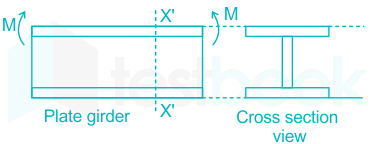
The primary bacteria carrying out the digestion is anaerobic.

Important PointsIn tricking filter, the upper part is aerobic and the lower part, which is the majority of the total depth is anaerobic in nature,  and in the settling tank there is neither aerobic nor anaerobic bacteria so according to the given options the most appropriate answer has been chosen

116

In secondary treatment of sewage the operation which take places:

  1. ((a))

    Removal of heavier suspended inorganic material

  2. ((b))

    Removal of fine dissolved organic material

  3. ((c))

    Removal of harmful bacteria

  4. ((d))

    All of these

Show Answer
Answer: ((b))

Removal of fine dissolved organic material

Explanation:  

Stages of Waste Water Treatment: 

Preliminary Treatment: 

  • Preliminary or pretreatment is the first stage of wastewater treatment.
  • This process separates out the large and medium-sized solid waste using different thickness screens and sieves.
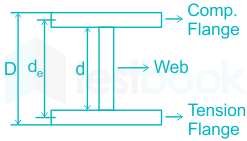
Primary Treatment: 

  • The objective of this stage is to remove part of the suspended solids.

  • Other benefits of this process include flow homogenization and the removal of organic matter linked to the suspended solids.

Secondary Treatment: 

  • This process is designed to dissolved remove organic matter from the water, as well as nutrients such as nitrogen and phosphorus.
  • This secondary treatment, which is mainly biological, generally utilizes bacteria and microorganisms to degrade and eliminate the organic matter and the different nutrients contained in the water.

Tertiary Treatment: 

  • During tertiary, the aim is to increase the final quality of the water so that it can be returned to the environment and, in some cases, used for human activity.
  • The techniques used include filtration with sand beds or other materials, and disinfection, either using chlorine (usually sodium hypochlorite) or UV light, to reduce the number of microscopic living organisms that have been generated in the previous stages.​
117

The method adopted for removing bushes, branches, debris etc., from waste water is known is

  1. ((a))

    Sedimentation

  2. ((b))

    Coagulation

  3. ((c))

    Screening

  4. ((d))

    Filtration

Show Answer
Answer: ((c))

Screening

Explanation:

Sewage treatment plants consists of the following procedures:

  1. Screening
  • These are placed before grit chambers so as to trap and remove floating matter, such as pieces of cloth, paper, wood cork, hair, fiber, kitchen refuse, fecal solids, etc in the sewage.
  • Those floating material if not removed will choke the pipes or adversely affect the working of the pumps.
  1. Grit removal basins
  • Grit chambers or detritus tanks are the sedimentation basins placed in front of the wastewater treatment plant to remove inorganic particles such as sand, gravel, grits, shells, bones, and other non-putrescible material.
  • They are usually placed after the fine screens to remove particles of size up to 0.2 mm or so.
  1. Primary sedimentation
  • The primary sedimentation tanks are thus designed to remove a part of the organic matter from the sewage effluent coming from the grit chambers.
  • These are designed for effecting the settlement of particles by reducing the flow velocity or by detaining the sewage in them.
  1. Aeration
  • From the primary sedimentation tank, the sewage flows to the aeration tank and is mixed with activated sludge.
  • These are rectangular tanks in which air is continuously introduced into these tanks. 5. Secondary sedimentation
  • From the aeration tank, the sewage flows to the final secondary sedimentation tank.
  • The secondary sedimentation tank removes bioflocculated solids.
  • The produce an effluent sufficiently classified to meet discharge standards and must concentrate the biological solids to minimize the quantity of sludge to handle.
118

Dissolved impurities consists of:

  1. ((a))

    Bacteria

  2. ((b))

    Organic substances

  3. ((c))

    Silt

  4. ((d))

    Fungi

Show Answer
Answer: ((b))

Organic substances

Explanation:

Dissolved Impurities:

  • The dissolved impurities is contain organic compounds, inorganic salts and gases etc.
  • The concentration of total dissolved solids is usually expressed imp pm and is obtained by weighing the residue after evaporation of the water sample from a filtered sample.

Dissolved impurities include

  • Calcium and magnesium (sulphate cause hardness, fluorides cause mottled enamel of teeth)
  • Sodium ( chloride cause taste, manganese cause black or brown colour)
  • Metal ( lead cause lead poisoning, arsenic - poisoning , oxygen - corrode the metal)
  • Gases (hydrogen sulphate cause rotten-egg odour, acidity and corrode the metals)
  • Organic impurities
119

The water bearing strata is called:

  1. ((a))

    An aquifer

  2. ((b))

    An aquiclude

  3. ((c))

    An aquifuge

  4. ((d))

    Zone of saturation

Show Answer
Answer: ((a))

An aquifer

Explanation:

Aquifer:

 It is an underground geological formation which contains water and sufficient amount of water can be extracted economically using water wells. It generally comprises layers of sand and gravel and fracture bedrock.

  • Unconfined Aquifer: When water table serves as the upper boundary of the aquifer, the aquifer is known as unconfined aquifer. The unconfined aquifer is also known as water table aquifer and phreatic aquifer. An impervious layer is generally served as the bottom boundary of an unconfined aquifer and top layer is not confined.

  • Confined Aquifer: An aquifer which is bounded by two impervious layers at top and bottom of the aquifer is called confined aquifer. The confined aquifer is also known as pressure aquifer. Top and bottom layer of a confined aquifer is generally impervious.

Sometimes these layers may be semi pervious in nature and are known as semi confined aquifer.

  • When piezometric surface of a confined aquifer is above the ground level, the confined aquifer is then called an artesian aquifer.
120

A hydrograph representing one cm of runoff from a rain fall of some unit duration and specific area distribution is known as:

  1. ((a))

    Hyetograph

  2. ((b))

    Flood hydrograph

  3. ((c))

    Unit hydrograph

  4. ((d))

    S-Hydrograph

Show Answer
Answer: ((c))

Unit hydrograph

Explanation:

Unit Hydrograph:

(i) A unit hydrograph is defined as the hydrograph of direct runoff resulting from one unit depth of rainfall excess occurring uniformly over the basin and at a uniform rate for a specified duration.

(ii) The term Unit here refer to a unit depth of rainfall excess which is usually taken as 1 cm.

Additional Information

The following table shows the meaning of different types of curves in Hydrology.

Type of CurveMeaning
Mass CurveCumulative rainfall vs Time
Double Mass CurveCumulative rainfall of nearby stations vs Cumulative rainfall of concerned station
HydrographDischarge vs time
HyetographRainfall Intensity vs time
DAD - Depth Area duration CurvesRainfall depth vs Area &Time

Attempt this paper under real exam conditions

Timed interface, section switching, instant scoring, and question-by-question analytics — free.

Start Timed Attempt