Official Paper

FCI AG III Memory Based Question Paper (Held on: 1st January 2023 Shift 1) (Previous Year Paper)

100 questions · 60 minutes · with answers · free

English Language (25 questions)

1

Directions: In each of the questions below, four sentences are given that may or may not contain an error. Choose the one that is grammatically as well as contextually correct and meaningful. If all the sentences are correct, mark 'All are correct as your answer'.

  1. ((a))

    Neither the contestants nor the principal were aware of the fire.

  2. ((b))

    Instead criticizing why don't you help with the presentation?

  3. ((c))

    It is requested that a detailed report be sent urgent on the representations and ongoing strike by the employees.

  4. ((d))

    Neither Sameera nor Vinod knows anything about the accident.

  5. ((e))

    All are correct.

Show Answer
Answer: ((d))

Neither Sameera nor Vinod knows anything about the accident.

The correct answer is 'Neither Sameera nor Vinod knows anything about the accident' i.e. this sentence is grammatically and contextually correct.

Key Points

  • Let us explore the grammatical errors in the sentences:
  • In Option 1, the use of the plural form of the verb 'were' is incorrect.
  • We know that if two subjects are joined by expressions like ''either…or, or neither … nor, or, nor, not only...but also'', the verb agrees with the subject nearest to it.
  • For Example - Neither John nor his friends are coming today. (Here, the verb agrees with the second subject i.e. his friends)
  • Therefore, the singular form of the verb 'was' (since 'principal' is singular) should be used in place of the plural form of the verb 'were'.
  • Correct Sentence: Neither the contestants nor the principal was aware of the fire.
  • In Option 2, the use of the plural form of the adverb 'instead' is incorrect.
  • In the sentence, 'instead' must be replaced with the prepositional phrase ''instead of'' which means ''in place of.''
  • Correct Sentence: Instead of criticizing why don't you help with the presentation?
  • In Option 3, the use of the adjective 'urgent' is incorrect.
  • In the sentence, 'urgent' is an adjective and fails to modify the verb 'send'.
  • We know that if a verb is to be modified, we should use an adverb.
  • Therefore, the adverb 'urgently' should be used in place of the adjective 'urgent'.
  • Correct Sentence: It is requested that a detailed report be sent urgently on the representations and ongoing strike by the employees.
  • In Option 4, the verb agrees correctly with the subject nearest to it i.e. Vinod. It is a singular subject. Therefore, 'knows' will be used.

Hence, the correct answer is option 4.

2

Directions: In each of the questions below, four sentences are given that may or may not contain an error. Choose the one that is grammatically as well as contextually correct and meaningful. If all the sentences are correct, mark 'All are correct as your answer'.

  1. ((a))

    The greatest benefit is the opportunities presented to our staff.

  2. ((b))

    She had been working from the same company for fifteen years.

  3. ((c))

    Chelsea isn’t getting a elite player in goal involvement terms, but there are other points of encouragement for the club’s fans.

  4. ((d))

    As they enquired about the boy and was informed that he had been shifted to the hospital, they volunteered to help him.

  5. ((e))

    All are correct.

Show Answer
Answer: ((a))

The greatest benefit is the opportunities presented to our staff.

The correct answer is 'The greatest benefit is the opportunities presented to our staff' i.e. this sentence is grammatically and contextually correct.

Key Points

  • Let us explore the grammatical errors in the sentences:
  • In Option 2, the use of the preposition 'from' is incorrect.
  • The preposition 'from' is used for indicating the source or provenance of someone or something.
  • The preposition 'for' is used for stating the purpose of an object or action.
  • Therefore, the preposition 'for' should be used in place of the preposition 'from'.
  • Correct Sentence: She had been working for the same company for fifteen years.
  • In Option 3, the use of the article 'a' before the word 'elite' is incorrect.
  • The article 'a' goes before words that begin with consonants.
  • The article 'an' goes before words that begin with vowels.
  • Therefore, the article 'an' should be used in place of the article 'a'.
  • Correct Sentence: Chelsea isn’t getting an elite player in goal involvement terms, but there are other points of encouragement for the club’s fans.
  • In Option 4, the use of the singular form of the verb 'was' is incorrect.
  • We know that the plural subject takes a plural verb.
  • Therefore, the plural form of the verb 'were' should be used in place of the singular form of the verb 'was'.
  • Correct Sentence: As they enquired about the boy and were informed that he had been shifted to the hospital, they volunteered to help him.

Hence, the correct answer is option 1.

3

Directions: In each of the questions below, four sentences are given that may or may not contain an error. Choose the one that is grammatically as well as contextually correct and meaningful. If all the sentences are correct, mark 'All are correct as your answer'.

  1. ((a))

    Great Expectations were written by Dickens.

  2. ((b))

    Every man and woman are required to check-in.

  3. ((c))

    The Grapes of Wrath take a long time to read.

  4. ((d))

    Either Shilpi or Raj is to blame for the accident.

  5. ((e))

    All are correct.

Show Answer
Answer: ((d))

Either Shilpi or Raj is to blame for the accident.

The correct answer is 'Either Shilpi or Raj is to blame for the accident' i.e. this sentence is grammatically and contextually correct.

Key Points

  • Let us explore the grammatical errors in the sentences:
  • In Option 1, the use of the plural form of the verb 'were' is incorrect.
  • We know that a singular subject (here, 'Great Expectations' which is a novel) requires a singular verb (here, was).
  • Titles of single entities (books, organizations, countries, etc.) are always singular.
  • Therefore, the singular form of the verb 'was' should be used in place of the plural form of the verb 'were'.
  • Correct Sentence: Great Expectations was written by Dickens.
  • In Option 2, the use of the plural form of the verb 'are' is incorrect.
  • We know that the determiner 'Every' is always followed by a singular verb.
  • Therefore, the singular form of the verb 'is' should be used in place of the plural form of the verb 'are'.
  • Correct Sentence: Every man and woman is required to check-in.
  • In Option 3, the use of the plural form of the verb 'take' is incorrect.
  • We know that a singular subject (here, 'The Grapes of Wrath' which is a novel) requires a singular verb (here, takes).
  • Titles of single entities (books, organizations, countries, etc.) are always singular.
  • Therefore, the singular form of the verb 'takes' should be used in place of the plural form of the verb 'take'.
  • Correct Sentence: The Grapes of Wrath takes a long time to read.

Hence, the correct answer is option 4.

4

Directions: In each of the questions below, four sentences are given that may or may not contain an error. Choose the one that is grammatically as well as contextually correct and meaningful. If all the sentences are correct, mark 'All are correct as your answer'.

  1. ((a))

    Some companies have already voluntarily disclosed similar informations.

  2. ((b))

    Trading involves only a handful of traders which make the markets.

  3. ((c))

    An extraordinary general meeting to decide the company's fate will be held in Thursday.

  4. ((d))

    Make sure your belongings are tagged with your name before you check them in.

  5. ((e))

    All are correct.

Show Answer
Answer: ((d))

Make sure your belongings are tagged with your name before you check them in.

The correct answer is 'Make sure your belongings are tagged with your name before you check them in' i.e. this sentence is grammatically and contextually correct.

Key Points

  • Let us explore the grammatical errors in the sentences:
  • In Option 1, the use of the plural form of the noun 'informations' is incorrect.
  • We know that the noun 'information' is an uncountable noun and the uncountable nouns are used in the singular structure.
  • Therefore, the singular form of the noun 'information' should be used in place of the plural form of the noun 'informations'.
  • Correct Sentence: Some companies have already voluntarily disclosed similar information.
  • In Option 2, the use of the pronoun 'which' is incorrect.
  • The pronoun 'which' is used to refer to something previously mentioned when introducing a clause giving further information.
  • The pronoun 'who' is used to introduce a clause giving further information about a person or people previously mentioned.
  • Therefore, the pronoun 'who' should be used in place of the pronoun 'which'.
  • Correct Sentence: Trading involves only a handful of traders who make the markets.
  • In Option 3, the use of the preposition 'in' is incorrect.
  • The preposition 'in' is used for expressing a period of time during which an event happens or a situation remains the case.
  • The preposition 'on' is used for indicating the day or part of a day during which an event takes place.
  • Therefore, the preposition 'on' should have been placed before that day of the week, instead of 'in' as used in the given sentence.
  • Correct Sentence: An extraordinary general meeting to decide the company's fate will be held on Thursday.

Hence, the correct answer is option 4.

5

Directions: In each of the questions below, four sentences are given that may or may not contain an error. Choose the one that is grammatically as well as contextually correct and meaningful. If all the sentences are correct, mark 'All are correct as your answer'.

  1. ((a))

    He could find himself making enemies as well as friends unless he proceeds with utmost caution.

  2. ((b))

    Swimming in the ocean and playing drums are my hobbies.

  3. ((c))

    The friar preached again stealing and had a goose in his sleeve.

  4. ((d))

    Maybe Newton's law of gravitation, the law that describes how their trajectories should be playing out, is in need of a overhaul.

  5. ((e))

    All are correct.

Show Answer
Answer: ((b))

Swimming in the ocean and playing drums are my hobbies.

The correct answer is 'Swimming in the ocean and playing drums are my hobbies' i.e. this sentence is grammatically and contextually correct.

Key Points

  • Let us explore the grammatical errors in the sentences:
  • In Option 1, the use of 'no article' before the superlative adjective 'utmost' is incorrect.
  • We use a superlative to say that a thing or person is the most of a group, when we use a superlative adjective before the noun, we generally use it with the article  'the'.
  • Therefore, the article 'the' should be used before the superlative adjective 'utmost'.
  • Correct Sentence: He could find himself making enemies as well as friends unless he proceeds with the utmost caution.
  • In Option 3, the use of the adverb 'again' is incorrect.
  • The adverb 'again' means another time; once more.
  • The preposition 'against' means in opposition to.
  • Therefore, the preposition 'against' should be used in place of the adverb 'again'.
  • Correct Sentence: The friar preached against stealing and had a goose in his sleeve.
  • In Option 4, the use of the article 'a' before the word 'overhaul' is incorrect.
  • The article 'a' goes before words that begin with consonants.
  • The article 'an' goes before words that begin with vowels.
  • Therefore, the article 'an' should be used in place of the article 'a'.
  • Correct Sentence: Maybe Newton's law of gravitation, the law that describes how their trajectories should be playing out, is in need of an overhaul.

Hence, the correct answer is option 2.

6

In the following sentence, four words have been printed in bold. One of these words might either be wrongly spelt or inappropriate in the context of the sentence. Find out the word that is inappropriate or wrongly spelt, if any. If the words printed in bold are correctly spelt and appropriate in the sentence context, then mark (5) i.e. ‘No error’ as your answer.

The State is concsious it has to defeat the politics of terror, irrespective of sources and motivation.

  1. ((a))

    concsious 

  2. ((b))

    defeat 

  3. ((c))

    irrespective 

  4. ((d))

    motivation

  5. ((e))

    None of the above

Show Answer
Answer: ((a))

concsious 

The misspelled word is 'concsious'.

Key Points

  • The correct spelling is 'conscious'.
  • Conscious means noticing or realizing that something exists; aware of something.
  • Example - I wasn't even conscious that I had drunk too much until I started to feel sick.
  • Its synonyms are - aware, awake, wide awake, alert, responsive, etc.
  • Its antonyms are - careless, heedless, inattentive, insensible, mindless, etc.
  • Hence, the correct answer is option 1.
<br>

Additional Information

  • Defeat- the act of losing or not being successful.
  • Irrespective- not taking (something) into account; regardless of.
  • Motivation- enthusiasm for doing something.
7

In the following sentence, four words or phrases have been printed in bold. One bold part in the sentence is not acceptable in Standard English. Pick up that part and mark its number. If there are no errors in the bold parts, mark (5) i.e. No error as the answer.

The earthquake caused a deep fisure in the house’s foundation.

  1. ((a))

    Earthquake

  2. ((b))

    Deep

  3. ((c))

    Fisure

  4. ((d))

    Foundation

  5. ((e))

    None of the above

Show Answer
Answer: ((c))

Fisure

The correct answer is Fisure

Key Points

Reading the above sentence we find that: 

  • The word fisure has no meaning as it does not exist.
  • The correct word is 'fissure' which means a long, narrow opening or line of breakage made by cracking or splitting, especially in rock or earth.
  • Therefore the incorrectly spelt word is fisure and thus it is the correct answer.
8

Find the misspelt word out of the given bold words in the sentence. If all are correct then choose option 5.

The BJP inductad AGP leaders and appropriated many of their demands.

  1. ((a))

    Inductad

  2. ((b))

    Leaders

  3. ((c))

    Appropriated

  4. ((d))

    Demands

  5. ((e))

    All are correct

Show Answer
Answer: ((a))

Inductad

The correct answer is Inductad i.e. this word is misspelt.

Key Points

  • The correct word is Inducted.
  • Inducted: Place ceremoniously or formally in an office or position.
  • Ex: "there was a ceremony to induct the president of the Academy"
  • Hence, the correct answer is option 1.
9

Direction: Select the most appropriate option to fill in the blank.

Raghu takes care to remain ______ fit by going to the gym every day.

  1. ((a))

    extremely

  2. ((b))

    thoughtfully

  3. ((c))

    brutally

  4. ((d))

    honestly

  5. ((e))

    None of the above

Show Answer
Answer: ((a))

extremely

The correct answer is '​extremely.'

Key Points

  • Let us see the meanings of the words:
  • Extremely: very. (अत्‍यधिक)
  • Example: She is extremely beautiful.
  • Thoughtfully: in a way that shows you are thinking a lot about something. (विचारपूर्वक, अच्‍छी तरह विचार करके)
  • Brutally: in a very cruel and violent way. (क्रूरता से; निर्दयता के साथ)
  • Honestly: in an honest way. (ईमानदारी से, सत्‍यनिष्‍ठ भाव से)
  • As the sentence is referring to "being very fit", the correct option must be "extremely." 

Correct sentence: Raghu takes care to remain extremely fit by going to the gym every day.​

10

Directions: Fill in the blank with the most appropriate option as given.

Director, he said, would ________ the matter at once.

  1. ((a))

    investigate

  2. ((b))

    survey

  3. ((c))

    invigilate

  4. ((d))

    explore

  5. ((e))

    None of the above

Show Answer
Answer: ((a))

investigate

The correct answer is 'investigate.'

Key Points

  • The given sentence is talking about finding out all the facts related to a matter.
  • The word 'matter' in the sentence is indicating something which is to be tried or proved in court; a case.
  • Therefore, the most appropriate word to be filled in the blank is 'investigate'.
  • The word 'investigate' means to try to find out all the facts about something
  • Example: The Government set up a commission to investigate allegations of police violence.

Hence, the correct answer is option 1.

Complete Sentence: Director, he said, would investigate the matter at once.

Additional Information

  • Let us explore  the other options:
  • 'Survey' means to look carefully at the whole of something. (किसी वस्‍तु का सामान्‍य रूप से सावधानी के साथ अवलोकन करना)
  • 'Invigilate' means to watch the people taking an exam to make sure that nobody is cheating. (परीक्षा में परीक्षार्थियों पर निगाह रखना, परीक्षा में निरीक्षण-कार्य करना)
  • 'Explore' means to travel around a place, etc. in order to learn about it. (किसी जगह के विषय में जानकारी प्राप्त करने के लिए उसका भ्रमण करना, खोजयात्रा करना)

Hinglish

  • दिया गया वाक्य किसी मामले से संबंधित सभी तथ्यों का पता लगाने की बात कर रहा है
  • वाक्य में 'matter' शब्द कुछ ऐसा इंगित कर रहा है जिसे अदालत में आजमाया या साबित किया जाना है; एक मामला
  • इसलिए, रिक्त स्थान में भरने के लिए सबसे उपयुक्त शब्द 'investigate' है।
  • 'Investigate' शब्द का अर्थ है तथ्‍यों के लिए किसी मामले की छानबीन करना, तहक़ीक़ात करना
  • उदाहरण: The Government set up a commission to investigate allegations of police violence.
<br>

अत: सही उत्तर विकल्प 1 है।

पूर्ण वाक्य: Director, he said, would investigate the matter at once.

11

A sentence has been given with a blank to be filled with an appropriate word. Choose the correct alternative.

Many problems associated with food systems require _____ at the national and international level.

  1. ((a))

    action

  2. ((b))

    deviation

  3. ((c))

    motion

  4. ((d))

    abrasions

  5. ((e))

    None of the above

Show Answer
Answer: ((a))

action

The correct answer is 'action'.

Key Points

  • The most appropriate word for the given blank is 'action'.
  • It means 'doing things, often for a particular purpose'. (सक्रियता, गतिविधि, क्रिया, कार्रवाही, प्रायः किसी विशेष उद्देश्‍य से)
  • Example: If we don’t take action quickly it’ll be too late!
  • Thus, the correct answer is Option 1.

Correct Sentence: Many problems associated with food systems require action at the national and international level.

Additional Information

  • Let's look at the meaning of the other words:
  • deviation: a difference from what is normal or expected, or from what is approved of by society. (समाज में स्‍वीकृत व्‍यवहार से भिन्‍नता या परिवर्तन, मर्यादा भंग, विचलन, नव रूढ़ि निर्माण)
  • motion: movement or a way of moving. (गति या गति करने का प्रकार)
  • abrasions: a damaged area of the skin where it has been rubbed against something hard and rough. (त्‍वचा का वह भाग जो किसी कड़ी और खुरदरी वस्‍तु से रगड़ खाकर क्षतिग्रस्‍त हो गया हो; खरोंच)
12

The question below contains five scattered segments of a sentence. Indicate the sequence which correctly assembles the segments and completes the sentence.

A. supplies and 

B. increased employment

C. World War I resulted

D. in the manufacturing of 

E. munitions and other war

  1. ((a))

    CDEAB

  2. ((b))

    DEABC

  3. ((c))

    EDABC

  4. ((d))

    BAEDC

  5. ((e))

    None of the above

Show Answer
Answer: ((a))

CDEAB

The correct answer is option 1 i.e. CDEAB.


  Explanation   

  • First is C as it establishes the subject i.e. World War I. C is the only opening segment that can lead to the formation of a meaningful and grammatically correct sentence.
  • Next is D as it tells what the war resulted in.
  • E follows D as it mentions what was manufactured.
  • Next is A as it elaborates E.
  • Last is B as it mentions what else WW1 resulted in i.e. increased employment.
<br>

Correct sentence- World War I resulted in the manufacturing of munitions and other war supplies and increased employment.

13

Direction: Rearrange the following parts of a sentence labeled as PQRS to make a meaningful sentence.

P. leave no regret are

Q. gained over ignorance

R. the only victories which

S. those which are

  1. ((a))

    QRSP

  2. ((b))

    SRQP

  3. ((c))

    RPSQ

  4. ((d))

    PQSR

  5. ((e))

    Not attempted

Show Answer
Answer: ((c))

RPSQ

The correct answer is 'RPSQ​.'

Key Points 

  • While arranging the parts of the sentence given in the options, we have to find some grammatical or contextual connections between them, so let’s find out.
  • In this sentence, we can see that there are different parts like Subject, indirect object, subject of subordinating clause and verb, indirect object, and direct object.
  • The first part of the answer should be "The only victories" as it is providing a subject to the sentence.
  • The next part must be "leave no regret are" because it is providing the verb "leave" to the subject "The only victories."
  • The next part must be "those which are" as it is completing the relative phrase "which leave no regret are those which are."
  • The last part must be "gained over ignorance"
  • The verb "gained" is followed by the preposition "over."
  • Considering these rules, the correct answer is Option 3.

​​Correct sentence: The only victories which leave no regret are those which are gained over ignorance.

14

Direction: Parts of a sentence are given in jumbled order. Arrange the parts in the correct order to form a meaningful sentence.

P) the quickening pace of economic transactions

Q) one consequence of lockdowns

R) shifting from physical to digital market places

S) imposed across the world to cope with Covid was

  1. ((a))

    PSQR

  2. ((b))

    RPSQ

  3. ((c))

    QSPR

  4. ((d))

    SQRP

  5. ((e))

    Not Attempted

Show Answer
Answer: ((c))

QSPR

The correct answer is 'QSPR.'

Key Points

  • While arranging the parts of the sentence given in options, we have to find some grammatical or contextual connections between them, so let’s find out.
  • The sentence should start with part Q as it consists of the subject 'One consequence of lockdowns'.
  • Q must be followed by S as it consists of the verb 'imposed' that should be used after the subject 'One consequence of lockdowns'.
  • S must be followed by P as we have to provide an indirect object to the phrase " to cope with Covid was."
  • P must be followed by R as it is the concluding part.
  • Hence, the correct answer is Option 3.

​​Correct sentence: One consequence of lockdowns imposed across the world to cope with Covid was the quickening pace of economic transactions shifting from physical to digital market places

15

In the following sentence, four words or phrases have been printed in bold. One bold part in the sentence is not acceptable in Standard English. Pick up that part and mark its number. If there are no errors in the bold parts, mark (5) i.e. No error as the answer.

John Milton was an English poet and intellectual who served as a civil servant for the Commonwealth of England under its Council of State and later under Oliver Cromwell.

  1. ((a))

    intellectual 

  2. ((b))

    servant 

  3. ((c))

    Commonwealth 

  4. ((d))

    Council 

  5. ((e))

    No error

Show Answer
Answer: ((e))

No error

The correct answer is 'No error'.

Key Points

  • Intellectual means connected with a person’s ability to think in a logical way and to understand things.
  • Servant: a person who is paid to work in somebody’s house, doing work such as cooking, cleaning, etc.
  • Commonwealth: an organization whose members are the United Kingdom and some other countries that were once a part of the British Empire.
  • Council means a group of people who are elected to govern an area such as a town or county.
  • Hence, option 5 is correct.

DIRECTIONS: Read the passage and answer the questions that follow.

Standing in the veranda, he turned back and looked into the hall and felt slightly uneasy. He would have felt more comfortable if all the boys had given their papers as he had done, twenty minutes before time. With his left shoulder resting against the wall, Sankar was lost to the world. Rajam, sitting under the second ventilator, between two fourth class boys, had become a writing-machine. Mani was still gazing at the rafters, scratching his chin with the pen. The Pea was leaning back in his seat, revising his answers. One supervisor was drowsing in his chair; another was pacing up and down with an abstracted look in his eyes. The scratchy noise of active nibs, the rustle of papers, and the clearing of the throats came through the brooding silence of the hall. Swaminathan suddenly wished that he had not come out so soon. But how could he have stayed in the hall longer? The Tamil paper was set to go on till five o’clock. He had found himself writing the last line of the last question at four-thirty. Out of the six questions set, he had answered the first question to his satisfaction, the second was doubtful, the third was satisfactory, the fourth he knew was clearly wrong (but then, he did not know the correct answer). The sixth answer was the best of the lot. It took only a minute to answer it. He had read the question at two minutes to four-thirty, started to answer a minute later, and finished it at four-thirty. He had found it hard to kill time. Why wasn’t the paper set for two and a half hours instead of three? He had looked wistfully at the veranda outside. If only he could pluck up enough courage to hand in the paper and go out – he would have no more examinations for a long time to come – he could do what he pleased – roam about the town in the evenings and afternoons and mornings – throw away the books – command Granny to tell endless tales. He had seen a supervisor observing him and had at once pretended to be busy with the answer paper. He thought that while he was about it, he might as well do a little revision. He read a few lines of the first question and was bored. He had to pretend that he was revising. He set his pen to work. He went on improving the little dash under the last line indicating the end, till it became an elaborate complicated pattern. He had looked at the clock again, thinking that it must be nearly five now. It was ten minutes past four-thirty. He saw two or three boys giving up their papers and going out, and felt happy. He briskly folded the paper and wrote his name. The bell rang. In twos or threes, the boys came out of the hall. It was a thorough contrast to the preceding three hours. There was a din of excited chatter.

16

What was the duration of the exam?

  1. ((a))

    Three hours

  2. ((b))

    Two hours

  3. ((c))

    Two and a half hours

  4. ((d))

    One hour

  5. ((e))

    None of these

Show Answer
Answer: ((a))

Three hours

The correct answer is Three hours

Key Points

  • It is mentioned that ''Why wasn’t the paper set for two and a half hours instead of three? ''
  • So, option 1 is correct.
17

Why was he uncomfortable after giving the paper?

  1. ((a))

    He was scared thinking about his score

  2. ((b))

    All others were still giving the paper

  3. ((c))

    He had not attempted a question

  4. ((d))

    All of the above

  5. ((e))

    None of these

Show Answer
Answer: ((b))

All others were still giving the paper

The correct answer is All others were still giving the paper

Key Points

  • It is mentioned that ''He would have felt more comfortable if all the boys had given their papers as he had done, twenty minutes before time. ''
  • So, option 2 is correct.
18

Which of these boys was continuously writing in his sheet?

  1. ((a))

    Sankar

  2. ((b))

    Rajam

  3. ((c))

    Mani

  4. ((d))

    All of the above

  5. ((e))

    None of these

Show Answer
Answer: ((b))

Rajam

The correct answer is Rajam

Key Points

  • It is mentioned that ''Rajam, sitting under the second ventilator, between two third-form boys, had become a writing-machine.''
  • So, option 2 is correct.
19

Why was the sixth answer considered the best?

  1. ((a))

    It was the easiest one

  2. ((b))

    It was the shortest among all

  3. ((c))

    It took only one minute to answer it

  4. ((d))

    All of the above

  5. ((e))

    None of these

Show Answer
Answer: ((c))

It took only one minute to answer it

The correct answer is It took only one minute to answer it

Key Points

  • It is mentioned that ''The sixth answer was the best of the lot. It took only a minute to answer it.''
  • So, option 3 is correct.
20

What would he do after giving the examination?

  1. ((a))

    Could do whatever he liked

  2. ((b))

    Roam about the town

  3. ((c))

    Listen tales from granny

  4. ((d))

    All of the above

  5. ((e))

    None of these

Show Answer
Answer: ((d))

All of the above

The correct answer is All of the above

Key Points

  • It is mentioned that ''If only he could pluck up enough courage to hand in the paper and go out – he would have no more examinations for a long time to come – he could do what he pleased – roam about the town in the evenings and afternoons and mornings – throw away the books – command Granny to tell endless tales.''
  • So, options 1,2 and 3 are correct.
21

Which of these is not correct about the supervisors?

  1. ((a))

    One of them was walking in the class

  2. ((b))

    They were busy with handling the papers

  3. ((c))

    One of them was almost asleep

  4. ((d))

    Both 2 and 3

  5. ((e))

    None of these

Show Answer
Answer: ((b))

They were busy with handling the papers

The correct answer is They were busy with handling the papers

Key Points

  • It is mentioned that ''One supervisor was drowsing in his chair; another was pacing up and down with an abstracted look in his eyes. ''
  • So, option 2 is incorrect.
22

What is referred to as a 'thorough contrast' in the given statement?

It was a thorough contrast to the preceding three hours.

  1. ((a))

    The happy faces of the boys

  2. ((b))

    The noise made by the boys in the hall

  3. ((c))

    The ringing of the bell

  4. ((d))

    All of the above

  5. ((e))

    None of these

Show Answer
Answer: ((b))

The noise made by the boys in the hall

The correct answer is The noise made by the boys in the hall

Key Points

  • From the lines given in the passage: He briskly folded the paper and wrote his name. The bell rang. In twos or threes, the boys came out of the hall. It was a thorough contrast to the preceding three hours. There was a din of excited chatter.
  • The author has mentioned that the hall was silent in the previous three hours. Now, the boys had come out in the hall and there was a lot of noise.
  • So, option 2 is correct.
23

Why did the narrator had to pretend that he was revising?

  1. ((a))

    He was bored

  2. ((b))

    The other boys were busy with their papers

  3. ((c))

    He had already completed his paper

  4. ((d))

    The supervisor was observing him

  5. ((e))

    None of these

Show Answer
Answer: ((d))

The supervisor was observing him

The correct answer is The supervisor was observing him

Key Points

  • It is mentioned that '' He had seen a supervisor observing him and had at once pretended to be busy with the answer paper. He thought that while he was about it, he might as well do a little revision. He read a few lines of the first question and was bored. He had to pretend that he was revising.''
  • So, option 4 is correct.
24

Choose the correct synonym for the word 'uneasy'?

  1. ((a))

    anxious

  2. ((b))

    calm

  3. ((c))

    composed

  4. ((d))

    tranquil

  5. ((e))

    None of the above

Show Answer
Answer: ((a))

anxious

The correct answer is Anxious.

Key Points

  • Let's look at the meaning of the given word:-
  • Uneasy - causing or feeling anxiety; troubled or uncomfortable.
  • For Example -She felt guilty now and a little uneasy.
  • Let's look at the meaning of the correct answer:-
  • Anxious - feeling or showing worry, nervousness, or unease about something with an uncertain outcome.
  • For Example - She was extremely anxious about her exams.
  • Thus, the correct answer is Option 1.

Additional Information

  • Let's look at the meaning of the other words given in options:
  • Calm - not showing or feeling nervousness, anger, or other strong emotions.
  • Composed - having one's feelings and expression under control; calm.
  • Tranquil - free from disturbance; calm.
25

Choose the correct synonym for the word 'briskly'?

  1. ((a))

    Wistfully

  2. ((b))

    Sluggishly

  3. ((c))

    Rapidly

  4. ((d))

    Listlessly

  5. ((e))

    None of the above

Show Answer
Answer: ((c))

Rapidly

The correct answer is Rapidly.

Key Points

  • Let's look at the meaning of the given word:-
  • Briskly - in an active, quick, or energetic way; in an impatient or brusque way.
  • For Example - She walked briskly into the building.
  • Let's look at the meaning of the correct answer:-
  • Rapidly - very quickly; at a great rate.
  • For Example - The business is expanding rapidly.
  • Thus, the correct answer is Option 3.

Additional Information

  • Let's look at the meaning of the words given in options:-
  • Wistfully - with a feeling of vague or regretful longing.
  • Listlessly - in a way that shows you have no energy and enthusiasm and are unwilling to do anything needing effort.
  • Sluggishly - in a sluggish way (= moving or operating more slowly than usual and with less energy).

Reasoning Ability (25 questions)

26

Directions: In the following question assuming the given statements to be true, find which of the conclusion among the given conclusions is/are definitely true and then give your answers accordingly.

Statements: U ≤ F ≤ G ≤ Y; Y ≤ R > I < O

Conclusions:

I. R > U

II. U = R

  1. ((a))

    Only I follow

  2. ((b))

    Only II follow

  3. ((c))

    Both I and II follow

  4. ((d))

    Either I or II follow

  5. ((e))

    Neither I nor II follow

Show Answer
Answer: ((d))

Either I or II follow

Given statement: U ≤ F ≤ G ≤ Y; Y ≤ R > I < O

Conclusions:

I. R > U → False (Given U ≤ F ≤ G ≤ Y and Y ≤ R > I < O so by combining both statement U ≤ F ≤ G ≤ Y ≤ R > I < O. Thus R > U is false)

II. U = R → False (Given U ≤ F ≤ G ≤ Y and Y ≤ R > I < O so by combining both statement U ≤ F ≤ G ≤ Y ≤ R > I < O. Thus U = R is false)

As U ≤ R  → R > U or R = U

Hence, Either I or II follow is the correct answer.

27

Directions: In the following question, assume the given statements to be true, find which of the conclusions among given conclusions is/are definitely true, and then give your answers accordingly.

Statements: W > B > H > N; L > J > K > N

Conclusions:

I. L > B

II. H > J

  1. ((a))

    Only I follow

  2. ((b))

    Only II follow

  3. ((c))

    Both I and II follow

  4. ((d))

    Either I or II follow

  5. ((e))

    Neither I nor II follow

Show Answer
Answer: ((e))

Neither I nor II follow

Given statements: W > B > H > N; L > J > K > N

On combining: W > B > H > N < K < J < L

Conclusions: 

I. L > B → False (On combining the two statements we get W > B > H > N < K < J < L, as there is no definite path the conclusion L > B is false)

II. H > J → False (On combining the two statements we get W > B > H > N < K < J < L, as there is no definite path the conclusion H > J is false)

Hence, Neither I nor II follow is the correct answer.

28

Directions: In the following question assuming the given statements to be true, find which of the conclusion among given conclusions is/are definitely true and then give your answers accordingly.

Statements: K < L = M ≥ N; O < P ≥ N = Q

Conclusion:

I. M > O

II. K > N

  1. ((a))

    Only I follow

  2. ((b))

    Only II follow

  3. ((c))

    Either I or II follows

  4. ((d))

    Neither I nor II follows

  5. ((e))

    Both I and II follows

Show Answer
Answer: ((d))

Neither I nor II follows

Given statements: K < L = M ≥ N; O < P ≥ N = Q

On combining: K < L = M ≥ N = Q ≤ P > O

Conclusions:

I. M > O → False (As K < L = M ≥ N = Q ≤ P > O, there is no relation between M and O because there are opposite signs between M and O. So, it is false)

II. K > N → False (As K < L = M ≥ N = Q ≤ P > O, there is no relation between K and N because there are opposite signs between K and N. So, it is false)

Hence, Neither I nor II follows.

29

Directions: In the following question assuming the given statements to be true, find which of the conclusion among given conclusions is/are definitely true and then give your answers accordingly.

Statements: A > B ≥ C ≥ D; D = E < F = G ≤ H

Conclusion:

I. D ≤ F

II. A < H

  1. ((a))

    Only I follow

  2. ((b))

    Either I or II follows

  3. ((c))

    Only II follow

  4. ((d))

    Both I and II follow

  5. ((e))

    Neither I nor II follows

Show Answer
Answer: ((e))

Neither I nor II follows

Given statements: A > B ≥ C ≥ D; D = E < F = G ≤ H

On combining: A > B ≥ C ≥ D = E < F = G ≤ H

Conclusions:

I. D ≤ F → False (As A > B ≥ C ≥ D = E < F = G ≤ H → D < F. So, it is false)

II. A < H → False (As A > B ≥ C ≥ D = E < F = G ≤ H, there is no relation between A and H because there are opposite signs between A and H. So, it is false)

Hence, Neither I nor II follows.

30

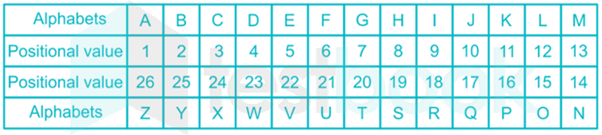
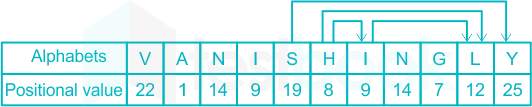
How many such pairs of letters are there in the word ‘VANISHINGLY’, each of which has as many letters between them in the word (both forward and backward direction) as they have between them in the English alphabetical series?

  1. ((a))

    More than four 

  2. ((b))

    Three

  3. ((c))

    Two 

  4. ((d))

    One 

  5. ((e))

    Zero

Show Answer
Answer: ((a))

More than four 

Forward Pair - SY, HI, HL, IL

Backward Pair - IG,NL

Hence, six such pair of which has as many letters between them in the word as they have between them in the English alphabetical series.

DIRECTIONS: Read the following information carefully and answer the following questions.

In a certain code language:

'stem get ice recall' is coded as 'st sa jy xy'

'stem melts more get' is coded as 'st ei nm sa'

'tell on melts more' is coded as 'nm nb ts ei'

'world tell more get' is coded as 'dc sa nm nb'

31

What can be the code for ice?

  1. ((a))

    sa

  2. ((b))

    jy

  3. ((c))

    xy

  4. ((d))

    nm

  5. ((e))

    Either 'jy' or 'xy'

Show Answer
Answer: ((e))

Either 'jy' or 'xy'

Given coded sentences can be represented as-

Code for 'ice' may be 'jy' or 'xy'

Code for 'recall' may be 'jy' or 'xy'

Code for 'on' will be 'ts'

 Hence, 'ice' can be coded as either 'jy' or 'xy'.

32

What would be the possible code for 'more age'?

  1. ((a))

    'nm st'

  2. ((b))

    'nm zc'

  3. ((c))

    'ei dc'

  4. ((d))

    'ei st'

  5. ((e))

    'sa st'

Show Answer
Answer: ((b))

'nm zc'

Given coded sentences can be represented as-

Code for 'ice' may be 'jy' or 'xy'

Code for 'recall' may be 'jy' or 'xy'

Code for 'on' will be 'ts'

Hence, 'more' is coded as 'nm' and 'age' is a new word hence possibly 'zc'.

33

'st' is code for the word?

  1. ((a))

    get

  2. ((b))

    stem

  3. ((c))

    more

  4. ((d))

    ice

  5. ((e))

    tell

Show Answer
Answer: ((b))

stem

Given coded sentences can be represented as-

Code for 'ice' may be 'jy' or 'xy'

Code for 'recall' may be 'jy' or 'xy'

Code for 'on' will be 'ts'

Hence, 'stem' is coded as st.

34

'world' is coded as?

  1. ((a))

    dc

  2. ((b))

    ei

  3. ((c))

    nm

  4. ((d))

    sa

  5. ((e))

    st

Show Answer
Answer: ((a))

dc

Given coded sentences can be represented as-

Code for 'ice' may be 'jy' or 'xy'

Code for 'recall' may be 'jy' or 'xy'

Code for 'on' will be 'ts'

Hence, 'world' is coded as 'dc'.

35

In the following question, select the one which is different from the other four responses.

  1. ((a))

    VPS

  2. ((b))

    RMP

  3. ((c))

    OIL

  4. ((d))

    WQT

  5. ((e))

    XRU

Show Answer
Answer: ((b))

RMP

Here according to the position of each letter we can say that,

  1. V – 6 = P; P + 3 = S

2) R – 6 ≠ M

  1. O – 6 = I; I + 3 = L

  2. W – 6 = Q; Q + 3 = T

  3. X - 6 = R; R + 3 = U

Therefore, "RMP" is the answer.

Direction: Study the following information carefully and answer the questions following it.

Eight friends Manu, Vickie, Rinku, Sonu, Golu, Ravi, Teju and Munna are living in an eight-floor building but not necessarily in the same order. The lowermost floor is Numbered one and above as two and so on. Munna lives on floor number four. Two people stay between Sonu and Munna. Five people live between Ravi and sonu. Only one person is living between Ravi and Teju. Rinku is staying immediately above Vickie. Golu stays on one of the floors above Manu, who is staying below Ravi.

36

Who is staying on the top floor?

  1. ((a))

    Manu

  2. ((b))

    Munna

  3. ((c))

    Sonu

  4. ((d))

    Ravi

  5. ((e))

    Golu

Show Answer
Answer: ((e))

Golu

According to the given information,

  1. Munna lives on floor number four.
  2. Two people stay between Sonu and Munna.
Case - 1Case - 2
FloorPersonFloorPerson
88
7Sonu7
66
55
4Munna4Munna
33
22
11Sonu
<br>
  1. Five people live between Ravi and sonu.
  2. Only one person is living between Ravi and Teju.
Case - 1Case - 2
FloorPersonFloorPerson
88
7Sonu7Ravi
66
55Teju
4Munna4Munna
3Teju3
22
1Ravi1Sonu
<br>
  1. Rinku is staying immediately above Vickie.
  2. Golu stays on one of the floors above Manu, who is staying below Ravi. Here case – 1 gets eliminated.
Case - 2
FloorPerson
8Golu
7Ravi
6Manu
5Teju
4Munna
3Rinku
2Vickie
1Sonu
<br>

Hence, Golu is the correct answer.

37

Who is staying immediately above Rinku?

  1. ((a))

    Teju

  2. ((b))

    Sanu

  3. ((c))

    Munna

  4. ((d))

    Ravi

  5. ((e))

    Golu

Show Answer
Answer: ((c))

Munna

According to the given information,

  1. Munna lives on floor number four.
  2. Two people stay between Sonu and Munna.
Case - 1Case - 2
FloorPersonFloorPerson
88
7Sonu7
66
55
4Munna4Munna
33
22
11Sonu
<br>
  1. Five people live between Ravi and sonu.
  2. Only one person is living between Ravi and Teju.
Case - 1Case - 2
FloorPersonFloorPerson
88
7Sonu7Ravi
66
55Teju
4Munna4Munna
3Teju3
22
1Ravi1Sonu
<br>
  1. Rinku is staying immediately above Vickie.
  2. Golu stays on one of the floors above Manu, who is staying below Ravi. Here case – 1 gets eliminated.
Case - 2
FloorPerson
8Golu
7Ravi
6Manu
5Teju
4Munna
3Rinku
2Vickie
1Sonu
<br>

Hence, Munna is the correct answer.

38

How many people are staying between Rinku and Golu?

  1. ((a))

    One

  2. ((b))

    Two

  3. ((c))

    More than three

  4. ((d))

    Three

  5. ((e))

    None

Show Answer
Answer: ((c))

More than three

According to the given information,

  1. Munna lives on floor number four.
  2. Two people stay between Sonu and Munna.
Case - 1Case - 2
FloorPersonFloorPerson
88
7Sonu7
66
55
4Munna4Munna
33
22
11Sonu
<br>
  1. Five people live between Ravi and sonu.
  2. Only one person is living between Ravi and Teju.
Case - 1Case - 2
FloorPersonFloorPerson
88
7Sonu7Ravi
66
55Teju
4Munna4Munna
3Teju3
22
1Ravi1Sonu
<br>
  1. Rinku is staying immediately above Vickie.
  2. Golu stays on one of the floors above Manu, who is staying below Ravi. Here case – 1 gets eliminated.
Case - 2
FloorPerson
8Golu
7Ravi
6Manu
5Teju
4Munna
3Rinku
2Vickie
1Sonu
<br>

Hence, More than three is the correct answer.

39

Who is staying three floors above Munna?

  1. ((a))

    Golu

  2. ((b))

    Manu

  3. ((c))

    Sonu

  4. ((d))

    Rinku

  5. ((e))

    Ravi

Show Answer
Answer: ((e))

Ravi

According to the given information,

  1. Munna lives on floor number four.
  2. Two people stay between Sonu and Munna.
Case - 1Case - 2
FloorPersonFloorPerson
88
7Sonu7
66
55
4Munna4Munna
33
22
11Sonu
<br>
  1. Five people live between Ravi and sonu.
  2. Only one person is living between Ravi and Teju.
Case - 1Case - 2
FloorPersonFloorPerson
88
7Sonu7Ravi
66
55Teju
4Munna4Munna
3Teju3
22
1Ravi1Sonu
<br>
  1. Rinku is staying immediately above Vickie.
  2. Golu stays on one of the floors above Manu, who is staying below Ravi. Here case – 1 gets eliminated.
Case - 2
FloorPerson
8Golu
7Ravi
6Manu
5Teju
4Munna
3Rinku
2Vickie
1Sonu
<br>

Hence, Ravi is the correct answer.

40

Who is living immediately below Vickie?

  1. ((a))

    Ravi

  2. ((b))

    Teju

  3. ((c))

    Sonu

  4. ((d))

    Golu

  5. ((e))

    Manu

Show Answer
Answer: ((c))

Sonu

According to the given information,

  1. Munna lives on floor number four.
  2. Two people stay between Sonu and Munna.
Case - 1Case - 2
FloorPersonFloorPerson
88
7Sonu7
66
55
4Munna4Munna
33
22
11Sonu
<br>
  1. Five people live between Ravi and sonu.
  2. Only one person is living between Ravi and Teju.
Case - 1Case - 2
FloorPersonFloorPerson
88
7Sonu7Ravi
66
55Teju
4Munna4Munna
3Teju3
22
1Ravi1Sonu
<br>
  1. Rinku is staying immediately above Vickie.
  2. Golu stays on one of the floors above Manu, who is staying below Ravi. Here case – 1 gets eliminated.
Case - 2
FloorPerson
8Golu
7Ravi
6Manu
5Teju
4Munna
3Rinku
2Vickie
1Sonu
<br>

Hence, Sonu is the correct answer.

Directions: Read the following information carefully and answer the questions.

In a horizontal line, some people are sitting and all are facing in North direction. Less than three seats are there between Pavani and Avinash who is not neighbour of Amit.There are five seats between Sejal and Amit who is sitting one of the places to left of Arun. Arvind is sitting second to the left of Arun who is sitting three places away from Amit. No one is sitting to the left of Reshma but Reshma is not sitting near any vacant seat. At least eight seats are there between Arun and Jaggu who sits one of the places left of Arun.Two persons are sitting between Sejal and Reshma. Sunil is sitting to one of the places to the left of Jaggu but four places away from Pavani. Not more than two seats are there between Avinash and Arvind.

41

How many persons are there between Jaggu and Arun?

  1. ((a))

    Six

  2. ((b))

    Five

  3. ((c))

    Three

  4. ((d))

    One

  5. ((e))

    None

Show Answer
Answer: ((b))

Five

  1. There are five seats between Sejal and Amit who is sitting one of the places to left of Arun.

  1. Arvind is sitting second to the left of Arun who is sitting three places away from Amit.

Arun sits one of the rights of Amit as per statement 1.

  1. Two persons are sitting between Sejal and Reshma.

  2. No one is sitting to the left of Reshma but Reshma is not sitting near any vacant seat.

This means Reshma is sitting at the left end and there are some vacant seats.

Case 2: this case is eliminated because Reshma is sitting at left end and two persons are sitting between them.

  1. At least eight seats are there between Arun and Jaggu who sits one of the places left of Arun.

  2. Sunil is sitting to one of the places to the left of Jaggu but four places away from Pavani.

  1. Less than three seats are there between Pavani and Avinash who is not neighbour of Amit.

  1. Not more than two seats are there between Avinash and Arvind.

Case 1.1 and case 1.2 are eliminated because three and five seats are there between Avinash and Arvind respectively.

So the final arrangement is-

There are five persons with three vacant seats.

Therefore the correct answer is five.

42

Who are sitting at extreme ends?

  1. ((a))

    Pavani

  2. ((b))

    Arun

  3. ((c))

    Sunil

  4. ((d))

    Reshma

  5. ((e))

    Both b and d

Show Answer
Answer: ((e))

Both b and d

  1. There are five seats between Sejal and Amit who is sitting one of the places to left of Arun.

  1. Arvind is sitting second to the left of Arun who is sitting three places away from Amit.

Arun sits one of the rights of Amit as per statement 1.

  1. Two persons are sitting between Sejal and Reshma.

  2. No one is sitting to the left of Reshma but Reshma is not sitting near any vacant seat.

This means Reshma is sitting at the left end and there are some vacant seats.

Case 2: this case is eliminated because Reshma is sitting at left end and two persons are sitting between them.

  1. At least eight seats are there between Arun and Jaggu who sits one of the places left of Arun.

  2. Sunil is sitting to one of the places to the left of Jaggu but four places away from Pavani.

  1. Less than three seats are there between Pavani and Avinash who is not neighbour of Amit.

  1. Not more than two seats are there between Avinash and Arvind.

Case 1.1 and case 1.2 are eliminated because three and five seats are there between Avinash and Arvind respectively.

So the final arrangement is-

Hence the answer is Arun and Reshma.

43

Who is sitting third from the right end?

  1. ((a))

    Jaggu

  2. ((b))

    Sejal

  3. ((c))

    Arvind

  4. ((d))

    Arun

  5. ((e))

    No one

Show Answer
Answer: ((c))

Arvind

  1. There are five seats between Sejal and Amit who is sitting one of the places to left of Arun.

  1. Arvind is sitting second to the left of Arun who is sitting three places away from Amit.

Arun sits one of the rights of Amit as per statement 1.

  1. Two persons are sitting between Sejal and Reshma.

  2. No one is sitting to the left of Reshma but Reshma is not sitting near any vacant seat.

This means Reshma is sitting at the left end and there are some vacant seats.

Case 2: this case is eliminated because Reshma is sitting at left end and two persons are sitting between them.

  1. At least eight seats are there between Arun and Jaggu who sits one of the places left of Arun.

  2. Sunil is sitting to one of the places to the left of Jaggu but four places away from Pavani.

  1. Less than three seats are there between Pavani and Avinash who is not neighbour of Amit.

  1. Not more than two seats are there between Avinash and Arvind.

Case 1.1 and case 1.2 are eliminated because three and five seats are there between Avinash and Arvind respectively.

So the final arrangement is-

Arvind is sitting third from the right end.

44

Who is sitting third to the left of Avinash?

  1. ((a))

    No one

  2. ((b))

    Sejal

  3. ((c))

    Pavani

  4. ((d))

    Either b or c

  5. ((e))

    Cannot be determined

Show Answer
Answer: ((a))

No one

  1. There are five seats between Sejal and Amit who is sitting one of the places to left of Arun.

  1. Arvind is sitting second to the left of Arun who is sitting three places away from Amit.

Arun sits one of the rights of Amit as per statement 1.

  1. Two persons are sitting between Sejal and Reshma.

  2. No one is sitting to the left of Reshma but Reshma is not sitting near any vacant seat.

This means Reshma is sitting at the left end and there are some vacant seats.

Case 2: this case is eliminated because Reshma is sitting at left end and two persons are sitting between them.

  1. At least eight seats are there between Arun and Jaggu who sits one of the places left of Arun.

  2. Sunil is sitting to one of the places to the left of Jaggu but four places away from Pavani.

  1. Less than three seats are there between Pavani and Avinash who is not neighbour of Amit.

  1. Not more than two seats are there between Avinash and Arvind.

Case 1.1 and case 1.2 are eliminated because three and five seats are there between Avinash and Arvind respectively.

So the final arrangement is-

Hence the correct answer is no one.

45

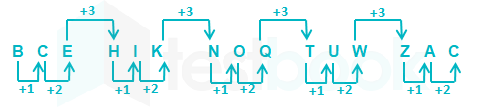
A series is given with one term missing. Select the correct alternative from the given ones that completes the series.

BCE, HIK, NOQ, TUW, ?

  1. ((a))

    ZAC

  2. ((b))

    ZAD

  3. ((c))

    ZCA

  4. ((d))

    ZKP

  5. ((e))

    None of above

Show Answer
Answer: ((a))

ZAC

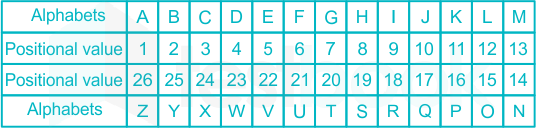
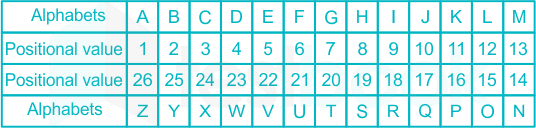
Table show alphabet serial number –

The logic is shown below –

Hence, “ZAC” is the missing term that completes the series.

Directions: Study the following information to answer the questions.

Ten persons are sitting in two parallel rows containing five-person each in such a way that there is an equal distance between adjacent persons. In row-1 P, Q, R, S, and T are seated and all of them are facing South. In row-2 A, B, C, D, and E are seated and all of them are facing North. Therefore, in the given seating arrangement each member seated in a row faces another member in the other row. S sits third to the right of Q where either of them is sitting on any of the extreme ends of the row. The one who faces Q sits second to the right of E. Two persons are sitting between B and E. Neither A nor C sits at an end of the row. The immediate neighbour of A faces the person who sits immediately to the right of Q. R and T are immediate neighbours of each other. T does not face the immediate neighbour of D.

46

Who among the following is facing P?

  1. ((a))

    S

  2. ((b))

    R

  3. ((c))

    Q

  4. ((d))

    A

  5. ((e))

    B

Show Answer
Answer: ((e))

B

Facing South: P, Q, R, S, and T (Row – 1)

Facing North: A, B, C, D, and E (Row – 2)

  1. S sits third to the right of Q where either of them is sitting on any of the extreme ends of the row

(Here, there are two possible cases, Case 1: Q sits at the extreme right end of the row, Case 2: S sits at the extreme left end of the row)

  1. The one who faces Q sits second to the right of E.

  1. Two persons are sitting between B and E.

(Here we can eliminate Case 1)

  1. Neither A nor C sits at an extreme end of the row. 

(So D sits at the extreme end of row 2)

  1. The immediate neighbour of A faces the person who sits immediately to the right of Q.

6)  R and T are immediate neighbours of each other.

  1. T does not face the immediate neighbour of D.

The final arrangement will be as follows.

Hence, B is facing P.

47

Which of the following statements is true regarding R?

  1. ((a))

    R faces one of the immediate neighbors of D

  2. ((b))

    P is one of the immediate neighbors of R

  3. ((c))

    None of the given statement is true

  4. ((d))

    R sits to the immediate right of Q

  5. ((e))

    All of the given statements are true

Show Answer
Answer: ((a))

R faces one of the immediate neighbors of D

Facing South: P, Q, R, S, and T (Row – 1)

Facing North: A, B, C, D, and E (Row – 2)

  1. S sits third to the right of Q where either of them is sitting on any of the extreme ends of the row

(Here, there are two possible cases, Case 1: Q sits at the extreme right end of the row, Case 2: S sits at the extreme left end of the row)

  1. The one who faces Q sits second to the right of E.

  1. Two persons are sitting between B and E.

(Here we can eliminate Case 1)


  1. Neither A nor C sits at an extreme end of the row. 

(So D sits at the extreme end of row 2)

  1. The immediate neighbour of A faces the person who sits immediately to the right of Q.

6)  R and T are immediate neighbours of each other.

  1. T does not face the immediate neighbour of D. 

The final arrangement will be as follows.

Hence, R faces one of the immediate neighbours of the D is a true statement.

48

Who among the following is facing T?

  1. ((a))

    D

  2. ((b))

    E

  3. ((c))

    B

  4. ((d))

    C

  5. ((e))

    A

Show Answer
Answer: ((d))

C

Facing South: P, Q, R, S, and T (Row – 1)

Facing North: A, B, C, D, and E (Row – 2)

  1. S sits third to the right of Q where either of them is sitting on any of the extreme ends of the row

(Here, there are two possible cases, Case 1: Q sits at the extreme right end of the row, Case 2: S sits at the extreme left end of the row)

  1. The one who faces Q sits second to the right of E.

  1. Two persons are sitting between B and E.

(Here we can eliminate Case 1)


  1. Neither A nor C sits at an extreme end of the row. 

(So D sits at the extreme end of row 2)

  1. The immediate neighbour of A faces the person who sits immediately to the right of Q.

6)  R and T are immediate neighbours of each other.

  1. T does not face the immediate neighbour of D.

The final arrangement will be as follows.

Hence, C is facing T.

49

What is the position of C with respect to A?

  1. ((a))

    Second to the left

  2. ((b))

    Immediate left

  3. ((c))

    Immediate right

  4. ((d))

    Third to the right

  5. ((e))

    Second to the right

Show Answer
Answer: ((b))

Immediate left

Facing South: P, Q, R, S, and T (Row – 1)

Facing North: A, B, C, D, and E (Row – 2)

  1. S sits third to the right of Q where either of them is sitting on any of the extreme ends of the row

(Here, there are two possible cases, Case 1: Q sits at the extreme right end of the row, Case 2: S sits at the extreme left end of the row)

  1. The one who faces Q sits second to the right of E.

  1. Two persons are sitting between B and E.

(Here we can eliminate Case 1)


  1. Neither A nor C sits at an extreme end of the row. 

(So D sits at the extreme end of row 2)

  1. The immediate neighbour of A faces the person who sits immediately to the right of Q.

6) R and T are immediate neighbours of each other.

  1. T does not face the immediate neighbour of D.

The final arrangement will be as follows.

Hence, C sits immediate left of A.

50

Four of the following five are alike in a certain way and so form a group, find the one which does not belong to the group?

  1. ((a))

    S

  2. ((b))

    P

  3. ((c))

    D

  4. ((d))

    B

  5. ((e))

    C

Show Answer
Answer: ((e))

C

Facing South: P, Q, R, S, and T (Row – 1)

Facing North: A, B, C, D, and E (Row – 2)

  1. S sits third to the right of Q where either of them is sitting on any of the extreme ends of the row

(Here, there are two possible cases, Case 1: Q sits at the extreme right end of the row, Case 2: S sits at the extreme left end of the row)

  1. The one who faces Q sits second to the right of E.

  1. Two persons are sitting between B and E.

(Here we can eliminate Case 1)


  1. Neither A nor C sits at an extreme end of the row. 

(So D sits at the extreme end of row 2)

  1. The immediate neighbour of A faces the person who sits immediately to the right of Q.

6) R and T are immediate neighbours of each other.

  1. T does not face the immediate neighbour of D.

The final arrangement will be as follows.

S, P, D, and B are sitting at the extreme ends of the row. C sits in the middle of the row.

Hence, C does not belong to the group.

Numerical Aptitude (25 questions)

51

What will come in the place of the question mark '?' in the following question?

 360 × 9 ÷ 3 + 120 + 900 ÷ 5 = ?

  1. ((a))

     1426

  2. ((b))

     1286

  3. ((c))

     1380

  4. ((d))

     1275

  5. ((e))

     1180

Show Answer
Answer: ((c))

 1380

Given :

 360 × 9 ÷ 3 + 120 + 900÷ 5 = ?

 Calculation : 

 360 × 9 ÷ 3 + 120 + 900 ÷ 5 = ?

 ⇒ 360 × 3 + 120 + 180 = ?

 ⇒ 1080 + 300 = ?

 ⇒ ? = 1380

 Hence,1380 will be come in the place of '?'.

52

What will come in the place of the question mark ‘?’ in the following question?

(292 – 141) ÷ 5 + (40 ÷ 2) + 23 = ?

  1. ((a))

    127

  2. ((b))

    145

  3. ((c))

    168

  4. ((d))

    179

  5. ((e))

    None of these

Show Answer
Answer: ((c))

168

Given:

(292 – 141) ÷ 5 + (40 ÷ 2) + 23 = ? 

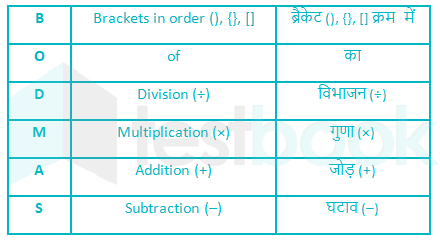
Concept used:

Follow the BODMAS rule according to the table given below:

Calculation:

(292 – 141) ÷ 5 + (40 ÷ 2) + 23 = ? 

⇒ (841 – 141) ÷ 5 + 20 + 8 = ?

⇒ ? = 700 ÷ 5 + 20 + 8 

⇒ ? = 140 + 20 + 8 

⇒ ? = 168

∴ The value of ? is 168.

53

What will come in the place of the question mark ‘?’ in the following question?

(54/6) × 5 + 12 × (17/2) = ?% of 700

  1. ((a))

    20

  2. ((b))

    21

  3. ((c))

    35

  4. ((d))

    25

  5. ((e))

    11

Show Answer
Answer: ((b))

21

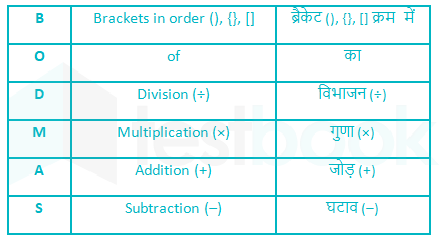
Concept used:

Follow BODMAS rule to solve this question, as per the order given below:

Calculation:

(54/6) × 5 + 12 × (17/2) = ?% of 700

⇒ 9 × 5 + 12 × 8.5 = (?/100) × 700

⇒ 45 + 102 = 7 × ?

⇒ 147 = 7 × ?

⇒ ? = 147/7

⇒ ? = 21

∴ The value of ? is 21.

54

What should come in the place of the question mark '?' in the following question?

12.5% of 384 - 16.66% of 66 = √16 + √? + 22

  1. ((a))

    289

  2. ((b))

    625

  3. ((c))

    841

  4. ((d))

    676

  5. ((e))

    324

Show Answer
Answer: ((c))

841

The correct answer is: 3


Given:

12.5% of 384 - 16.66% of 66 = √16 + √? + 22

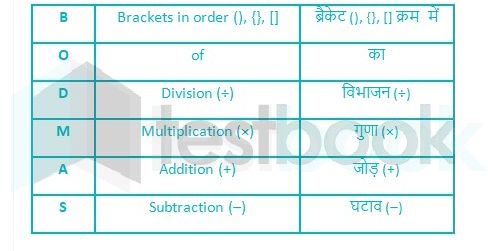
Concept used:

the BODMAS rule should be followed as per the given table:

calculation:

12.5% of 384 - 16.66% of 66 = √16 + √? + 22

1/8 of 384 - 1/6 of 66 = 4 + √? + 4                   { 12.5% = 1/8 and 16.66% = 1/6}

48 - 11 = 8 + √?

37 = 8 + √?

⇒ √? = 29

or ? = 841


∴ the value of ? is 841

55

What will come in the place of the question mark ‘?’ in the following question?

1813+9231013=123+;?18\frac{1}{3} + 9\frac{2}{3} - 10\frac{1}{3} = 1\frac{2}{3} + ;?

  1. ((a))

    10

  2. ((b))

    15

  3. ((c))

    18

  4. ((d))

    16

  5. ((e))

    Answer not known

Show Answer
Answer: ((d))

16

Given:

1813+9231013=123+;?18\frac{1}{3} + 9\frac{2}{3} - 10\frac{1}{3} = 1\frac{2}{3} + ;?

Concept used:

Follow the BODMAS rule according to the table given below:

Calculation:

1813+9231013=123+;?18\frac{1}{3} + 9\frac{2}{3} - 10\frac{1}{3} = 1\frac{2}{3} + ;?

⇒ ;553+;29331353=;?;\frac{55}{3} + ;\frac{29}{3} - \frac{31}{3} - \frac{5}{3}= ;?

⇒ 48/3 = ?

⇒ ? = 16

∴ The value of ? is 16.

56

In each of the following number series, a wrong number is given, find out that number.

23, 45, 89, 177, 363, 705

  1. ((a))

    177

  2. ((b))

    45

  3. ((c))

    89

  4. ((d))

    363

  5. ((e))

    705

Show Answer
Answer: ((d))

363

Given:

23, 45, 89, 177, 363, 705

Calculation:

The logic follows here is:

⇒ 23 × 2 – 1 = 45

⇒ 45 × 2 – 1 = 89

⇒ 89 × 2 – 1 = 177

⇒ 177 × 2 – 1 = 353 ≠ 363

⇒ 353 × 2 – 1 = 705

There should be 353 instead of 363.

∴ 363 is the wrong term in the series

57

In the following number series, a wrong number is given. Find out the wrong number.

100, 221, 77, 245, 50, 275

  1. ((a))

    245

  2. ((b))

    275

  3. ((c))

    77

  4. ((d))

    100

  5. ((e))

    221

Show Answer
Answer: ((a))

245

Given:

100, 221, 77, 245, 50, 275

Calculation:

Considering the above series, the logic should be

100 + (11)2 = 221

221 - (12)2 = 77

77 + (13)2 = 246

246 - (14)2 = 50

50 + (15)2 = 275

∴ The wrong term in this series is 245.

58

In the following number series, a wrong number is given. Find out the wrong number.

5, 10, 30, 150, 950, 11550

  1. ((a))

    10

  2. ((b))

    30

  3. ((c))

    950

  4. ((d))

    11550

  5. ((e))

    5

Show Answer
Answer: ((c))

950

Given:

5, 10, 30, 150, 950, 11550

Calculation:

The series follows the following pattern,

5 × 2 = 10

10 × 3 = 30

30 × 5 = 150

150 × 7 = 1050 ≠ 950

1050 × 11 = 11550

Since 1050 will come in place of 950.

∴ The required wrong number will be 950.

59

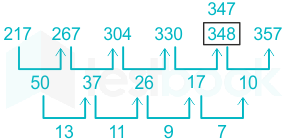
In the following number series, a wrong number is given. Find out the wrong number.

217, 267, 304, 330, 348, 357

  1. ((a))

    217

  2. ((b))

    267

  3. ((c))

    330

  4. ((d))

    357

  5. ((e))

    348

Show Answer
Answer: ((e))

348

Calculation:

<br> <br>

The series follows the following pattern:

⇒ 217 + 50 = 267

⇒ 267 + 37 = 304

⇒ 304 + 26 = 330

⇒ 330 + 17 = 347

⇒ 347 + 10 = 357

∴ The wrong number is 348

60

In each of the following number series, the wrong number is given, find out that number.

​5, 13, 36, 145, 719, 4321

  1. ((a))

    5

  2. ((b))

    36

  3. ((c))

    13

  4. ((d))

    145

  5. ((e))

    719

Show Answer
Answer: ((b))

36

Calculation:

5 × 2 + 3 = 13

13 × 3 – 4 = 35

35 × 4 + 5 = 145

145 × 5 – 6 = 719

719 × 6 + 7 = 4321

∴ The wrong number is 36.

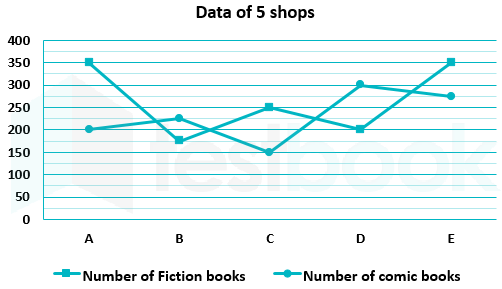
Direction: Study the data carefully and answer the following questions.

Following is the data given of selling of 5 shops A, B, C, D and E of two different types of books.

61

Find the difference between total comic books sold to total fiction books sold from all the shops.

  1. ((a))

    200

  2. ((b))

    150

  3. ((c))

    175

  4. ((d))

    100

  5. ((e))

    250

Show Answer
Answer: ((c))

175

Calculation:


ShopsNumber of fiction booksNumber of comic books
A350200
B175225
C250150
D200300
E350275

number of comic books sold from all the 5 shops = (200 + 225 + 150 + 300 + 275) = 1150

number of fiction books sold from all the 5 shops = (350 + 175 + 250 + 200 + 350) = 1325

∴ Required difference = (1325 - 1150) = 175

62

Find the ratio between total books sold from shop C to that of shop B.

  1. ((a))

    3 : 4

  2. ((b))

    1 : 1

  3. ((c))

    4 : 3

  4. ((d))

    2 : 1

  5. ((e))

    None of these

Show Answer
Answer: ((b))

1 : 1

Calculation:

ShopsNumber of fiction booksNumber of comic books
A350200
B175225
C250150
D200300
E350275

total books sold from shop C = (150 + 250) = 400

total books sold from shop B = (175 + 225) = 400

∴ Required ratio = 400 : 400 = 1 : 1

63

Number of comic books sold from shop E is what % more than number of comic books sold from shop A?

  1. ((a))

    40%

  2. ((b))

    33.33%

  3. ((c))

    27.5%

  4. ((d))

    37.5%

  5. ((e))

    75%

Show Answer
Answer: ((d))

37.5%

Calculation:

ShopsNumber of fiction booksNumber of comic books
A350200
B175225
C250150
D200300
E350275

Number of comic books sold from shop E = 275

number of comic books sold from shop A = 200

∴ Required % = (275 - 200)/200 × 100 = 37.5%

64

Find the average of total number of fictions books sold from all the 5 shops.

  1. ((a))

    265

  2. ((b))

    275

  3. ((c))

    305

  4. ((d))

    315

  5. ((e))

    None of these

Show Answer
Answer: ((a))

265

Calculation:

ShopsNumber of fiction booksNumber of comic books
A350200
B175225
C250150
D200300
E350275

number of fiction books sold from all the 5 shops = (350 + 175 + 250 + 200 + 350) = 1325

∴ Required average = 1325/5 = 265

65

Find the difference between number of fiction books sold from shop B to number of comic books sold from shop D.

  1. ((a))

    150

  2. ((b))

    100

  3. ((c))

    125

  4. ((d))

    75

  5. ((e))

    None of these

Show Answer
Answer: ((c))

125

Calculation:

ShopsNumber of fiction booksNumber of comic books
A350200
B175225
C250150
D200300
E350275

number of fiction books sold from shop B = 175

number of comic books sold from shop D = 300

∴ Required difference = 300 - 175 = 125

66

A sum of money invested for 2 years at 20% compounded annually and similar money invested for 3 years on simple interest at 10% per annum. If the difference between interests is Rs. 280, then find the sum of money.

  1. ((a))

    Rs. 2500

  2. ((b))

    Rs. 3000

  3. ((c))

    Rs. 4000

  4. ((d))

    Rs. 2000

  5. ((e))

    Rs. 1500

Show Answer
Answer: ((d))

Rs. 2000

Given

Sum of money invested for 2 years at 20% compounded annually.

Same sum is invested for 3 years on simple interest at 10% per annum.

Difference between interests = Rs. 280.

Calculation

Effective rate of interest for CI = x + y + (xy/100) = 20 + 20 + (20 × 20)/100 = 44%

Effective rate of interest for SI = 3 × 10 = 30%

Difference in rates = 44 - 30 = 14%

Let sum be S.

Hence, 14% of S = 280

⇒ S × (14/100) = 280

⇒ S = 2,000.

67

55 litres of a solution contains alcohol and water in the ratio 2 : 3. Water is added in the solution. The new mixture has a ratio of alcohol and water as 1 : 5. Find the quantity of water added.

  1. ((a))

    87 litres

  2. ((b))

    97 litres

  3. ((c))

    67 litres

  4. ((d))

    77 litres

  5. ((e))

    None of these.

Show Answer
Answer: ((d))

77 litres

Given:

Initial quantity of mixture = 55 litres

Initial ratio of mixture = 2 : 3

Final ratio of mixture = 1 : 5

Calculation:

Let initial quantity of alcohol and water be 2x and 3x.

⇒ 2x + 3x = 55

⇒ 5x = 55

⇒ x = 11

Initial quantity of alcohol = 2x

⇒ 22 litres

Initial quantity of water = 3x

⇒ 33 litres

Let the water to be added be x litres.

22/(33 + x) = 1/5

⇒ 110 = 33 + x

⇒ 77 = x

Quantity of water added is 77 litres.

68

A bag contains black and white balls, such that the probability of picking a black ball is 4/7. If the probability of picking two black balls without replacing the first is 4/13, how many black balls are there in the bag?

  1. ((a))

    4

  2. ((b))

    5

  3. ((c))

    6

  4. ((d))

    7

  5. ((e))

    8

Show Answer
Answer: ((e))

8

Let the bag contain ‘x’ black and ‘y’ white balls

Total no. of balls = x + y

Probability of picking a black ball = 4/7

⇒ x/(x + y) = 4/7

⇒ 7x = 4x + 4y

⇒ 3x = 4y

⇒ y = 3x/4

⇒ Total no. of balls = x + 3x/4 = 7x/4

Now, probability of picking two black balls without replacement = 4/13

⇒ [x/(x + y)] × [(x – 1)/(x + y – 1)] = 4/13

⇒ 4/7 × (x – 1)/(7x/4 – 1) = 4/13

⇒ 4(x – 1)/(7x – 4) = 7/13

⇒ 52(x – 1) = 7(7x – 4)

⇒ 52x – 52 = 49x – 28

⇒ 52x – 49x = 52 – 28

⇒ 3x = 24

⇒ x = 24/3 = 8

∴ There are 8 black balls in the bag

69

The ratio of ages of Aryan's grandfather and his father 14 years ago was 5 : 3. The present age of Aryan's grandfather is 7/2 of Aryan's age. If the age of Aryan 8 years ago was 16 years, then find the sum of present ages of all three.

  1. ((a))

    158 years

  2. ((b))

    161 years

  3. ((c))

    164 years

  4. ((d))

    170 years

  5. ((e))

    162 years

Show Answer
Answer: ((c))

164 years

GIVEN:

Grandfather : father (14 yrs ago) = 5 : 3

Grandfather = 7/2 × Aryan

Aryan's age = 16 + 8

EXPLANATION:

Aryan's present age = 24 yrs

Grandfather's age = 7/2 × 24 = 84 yrs

Grandfather's age 14 years ago = 70 yrs 

A.T.Q

70/(Father's age 14 yrs ago) = 5/3

5 ratio = 70 

3 ratio = 70/5 × 3 = 42 yrs

Father's present age = 42 + 14 = 56 yrs

∴ Sum of ages = 24 + 84 + 56 = 164 years

∴ The sum is 164 years.

70

Ujjawal is 8 years older than Amar while Amar is 6 years older than Sourav. If the ratio of the ages of Sourav to the age of Ujjawal is 5 : 12, then what will be the age of Amar after 12 years?

  1. ((a))

    21

  2. ((b))

    38

  3. ((c))

    22

  4. ((d))

    28

  5. ((e))

    None of these.

Show Answer
Answer: ((d))

28

Given:

Ratio between sourav and ujjawal is 5 : 12

Age of ujjwal is 8 years more than amar

Age of amar is 6 years more than sourav

Calculation:

Let the age of Sourav be x years.

Age of Amar be (x + 6) years

Age of Ujjawal be (x + 14) years

from these x is equal to 5 units and x + 14 is equal to 12

from these after substract x from x + 14 and 5 units from 12 units 

7 units is equal to 14 years 

1 units is equal to 2 years 

now age of sourav is 

⇒ 5 × 2

⇒ 10 years

age of Amar after 12 years is

⇒ 10 + 6 + 12

⇒ 28 years

The age of amar is 28 years.

71

Length and breadth of a rectangular room are in the ratio 4 ∶ 5. The perimeter of the room is 180 m. Cost of flooring is Rs. 75 per square metre. Find the cost of flooring the room.

  1. ((a))

    Rs. 1,50,000

  2. ((b))

    Rs. 1,20,000

  3. ((c))

    Rs. 1,75,000

  4. ((d))

    Rs. 1,68,000

  5. ((e))

    Rs. 1,45,000

Show Answer
Answer: ((a))

Rs. 1,50,000

Given:

The perimeter of room = 180 m

Cost of flooring = Rs. 75 per square metre.

Ratio of length of breadth = 4 ∶ 5

Formula used:

Perimeter of rectangular room = 2 × (length + breadth)

Calculation:

Let the length and breadth of rectangular room is 4x and 5x

⇒ 2 × (4x + 5x) = 180

⇒ 18x = 180

⇒ x = 10

Area of floor = length × breadth

⇒ (4 × 10) × (5 × 10)

⇒ 2000 m2

Cost of flooring = 2000 × 75

⇒ Rs. 1,50,000

72

Vaibhav brought a pen for Rs.2000. He sold it to Ravi at a loss of 20%. Ravi had to earn some profit, so he sold it to Vikas at 10% profit. If Vikas has to earn a profit of 10% from selling it, at what price (in Rs.) should he sell the pen?

  1. ((a))

    1975

  2. ((b))

    1936

  3. ((c))

    1950

  4. ((d))

    1924

  5. ((e))

    1904

Show Answer
Answer: ((b))

1936

Shortcut Trick

Net multiplier method: Final SP = Initial CP × (100 − L1)% × (100 + P1)% × (100 + P2)%

Final SP = 2000 × (80/100) × (110/100) × (110/100)

Final SP = 2000 × 0.8 × 1.1 × 1.1

Final SP = 1600 × 1.21 = 1936

∴ The correct answer is Rs.1936.

Alternate Method

Given → Initial Cost Price (CP) = Rs.2000, Loss to Ravi = 20%, Profit to Vikas = 10%, Profit by Vikas = 10%. Formulas: SP = CP × (100 ± Change%) ÷ 100

Price at which Ravi bought = 2000 × (80/100) = Rs.1600. ⇒ Price at which Vikas bought = 1600 × (110/100) = Rs.1760. ⇒ Price at which Vikas should sell = 1760 × (110/100) = Rs.1936.

∴ The correct answer is Rs.1936.

Additional Information

Successive Percentage Change

When a value changes multiple times, the net percentage change can be calculated using the formula: Net % = a + b + (ab/100).

Effective Profit/Loss

In a chain of transactions, the final price is simply the initial price multiplied by each respective (100 ± change%)/100 factor.

73

A boat covers a certain distance downstream in 5 hours but takes 7 hours to return upstream to the starting point. If the speed of the stream is 3 km/h, then find the speed of the boat.

  1. ((a))

    20 km/h

  2. ((b))

    24 km/h

  3. ((c))

    18 km/h

  4. ((d))

    26 km/h

  5. ((e))

    48 km/h

Show Answer
Answer: ((c))

18 km/h

Shortcut Trick

Ratio of Time (Downstream : Upstream) = 5 : 7

Ratio of Speed (Downstream : Upstream) = 7 : 5 (Inverse of time)

Boat Speed (B) : Stream Speed (S) = (7 + 5)/2 : (7 − 5)/2 = 6 : 1

Given 1 unit (Stream Speed) = 3 km/h, so 6 units (Boat Speed) = 6 × 3 = 18 km/h.

∴ The correct answer is 18 km/h.

Alternate Method

Given:

Time downstream (td) = 5 hours

Time upstream (tu) = 7 hours

Speed of the stream (v) = 3 km/h

Formula Used:

Distance = Speed × Time

Downstream Speed = u + v | Upstream Speed = u − v (where u = boat speed)

Calculations:

⇒ Let the speed of the boat in still water be u km/h.

⇒ Downstream speed = (u + 3) km/h

⇒ Upstream speed = (u − 3) km/h

⇒ Distance is constant: (u + 3) × 5 = (u − 3) × 7

⇒ 5u + 15 = 7u − 21

⇒ 7u − 5u = 15 + 21

⇒ 2u = 36

⇒ u = 18 km/h

∴ The correct answer is 18 km/h.

Additional Information

Boat and Stream Basic Relations

Boat Speed in Still Water (u) = (Downstream Speed + Upstream Speed) ÷ 2

Stream Speed Relation

Stream Speed (v) = (Downstream Speed − Upstream Speed) ÷ 2

Average Speed for Round Trip

Average Speed = (Downstream Speed × Upstream Speed) ÷ Boat Speed in still water

74

A can finish a job in 20 days while B can finish same job in 30 days. A and B both worked for 5 days and C joins them. In next 3.5 days, all three have manage to complete the job. Find in how many days C alone can finish the job.

  1. ((a))

    9 days

  2. ((b))

    3 days

  3. ((c))

    12 days

  4. ((d))

    24 days

  5. ((e))

    6 days

Show Answer
Answer: ((c))

12 days

Given,

A's 1 day's work = 1/20

B's 1 day's work = 1/30

(A + B)’s 1 day's work = 1/20 + 1/30 = 1/12

(A + B)’s 5 day's work = 5/12

Remaining fraction of work after 5 days = 1 – 5/12 = 7/12

Let C's 1 day's work be 1/M.

Then,

⇒ (1/12 + 1/M) = 7/12 × 1/3.5

⇒ (1/12 + 1/M) = 1/6

⇒ 1/M = 1/12

C alone can complete the work in 12 days.

75

The average weight of A, B, C, D, and E is 48 kg while the average weight of C and E is 42 kg. If the weight of F is also added, then the average weight of all six is reduced by 2.5 kg. Find the average weight of A, B, D, and  F.

  1. ((a))

    52.25 kg

  2. ((b))

    42.25 kg

  3. ((c))

    47.25 kg

  4. ((d))

    57.25 kg

  5. ((e))

    45.25 kg

Show Answer
Answer: ((c))

47.25 kg

Shortcut Trick

Total weight (A+B+C+D+E) = 5 × 48 = 240 kg.

New average for 6 people = 48 − 2.5 = 45.5 kg.

Weight of F = (6 × 45.5) − 240 = 273 − 240 = 33 kg.

Total weight (C+E) = 2 × 42 = 84 kg.

Total weight (A+B+D+F) = (240 − 84) + 33 = 156 + 33 = 189 kg.

Average (A, B, D, F) = 189 ÷ 4 = 47.25 kg.

∴ The correct answer is 47.25 kg.

Alternate Method

Given: Average (A,B,C,D,E) = 48 kg, Average (C,E) = 42 kg, Average (6 people) = 45.5 kg.

Formula Used: Sum = Average × Number of observations.

⇒ Sum (A+B+C+D+E) = 48 × 5 = 240 kg

⇒ Sum (C+E) = 42 × 2 = 84 kg

⇒ Sum (A+B+D) = 240 − 84 = 156 kg

⇒ Sum (A+B+C+D+E+F) = 45.5 × 6 = 273 kg

⇒ Weight of F = 273 − 240 = 33 kg

⇒ Sum (A+B+D+F) = 156 + 33 = 189 kg

⇒ Average (A,B,D,F) = 189 ÷ 4 = 47.25 kg

∴ The correct answer is 47.25 kg.

Additional Information

Average weight of a group

Average = (Sum of weights) ÷ (Total number of people). If one person is added, New Sum = (Old Average + Change) × (n + 1).

Net Deviation Method

The sum of deviations of all observations from the average is always zero. This can be used to find a new member's value quickly.

Weighted Average

When two groups are combined: Combined Average = (n1x1 + n2x2) ÷ (n1 + n2).

General Studies (25 questions)

76

Which is the largest state of India on the basis of area-

  1. ((a))

    Uttar Pradesh

  2. ((b))

    Rajasthan 

  3. ((c))

    Gujarat 

  4. ((d))

    Maharashtra

  5. ((e))

    Bihar

Show Answer
Answer: ((b))

Rajasthan 

Rajasthan is the largest state in terms of the area followed by Madhya Pradesh &  Maharashtra at second and third places respectively.

  • The total area covered by the state of Rajasthan is 342239 Km2 which is the largest area covered by any state in India and it accounts for 10.41% of the total country's area.
  • On the contrary, Goa is the smallest state in India in terms of area as it covers only 3,702 Km2 area which is 0.11% of the geographical area of the country.
  • The largest state in terms of the population is Uttar Pradesh as there was approximately 20Cr population according to the 2011 Census.
  • The smallest state in terms of the population is Sikkim with a handful population of only 6.11 Lakhs people.


Important Points

  • The smallest state in India area wise - Goa.
  • The largest state in India by population - Uttar Pradesh.
  • The smallest state in India by population - Sikkim.
  • Biggest district in India (Area wise) - Kachchh (Gujarat).
77

National animal of India is___.

  1. ((a))

    Bull

  2. ((b))

    Tiger

  3. ((c))

    Cow

  4. ((d))

    Lion

  5. ((e))

    Elephant

Show Answer
Answer: ((b))

Tiger

The correct answer is Tiger.

Key Points

  • Royal Bengal Tiger is the National Animal of India. The scientific name of this animal is Panthera Tigris.
  • It was conferred the status in April 1973.
  • Tiger was picked as the National animal of India because of its elegance, strength, agility, and colossal power.
  • Till 1972, the Lion was the national animal of India.

Additional Information

National FlagTiranga
National BirdPeacock
National FlowerLotus
National TreeBanyan
National AnthemJana Gana Mana
National RiverGanga
National EmblemLion Capital of Ashoka
National SongVande Matram
National FruitMango
National Aquatic AnimalDolphin
78

With respect to the Mughal history of India, Shahjahan was the successor of:

  1. ((a))

    Humayun

  2. ((b))

    Jahangir

  3. ((c))

    Babur

  4. ((d))

    Akbar

  5. ((e))

    Aurangzeb

Show Answer
Answer: ((b))

Jahangir

Shahjahan(1627-1658):

  • Shahjahan was a son of Jahangir.
  • After the death of Jahangir in 1627 AD, Shahjahan ascended the throne. Hence, option B is correct.
  • Humayun was the great grandfather of Shahjahan.
  • Jahangir was the father of Shahjahan.
  • Akbar was a grandfather of Shahjahan.
  • Hence, options A,C, & D are not correct.
Mistake Point: - Sometimes it is confusing to remember the successors of the Mughals. - Memorizing them is important to solve the contemporary based questions in the UPSC prelim examination.


Memory Tip: Mughal Successors - “B-H-A”: Bharat (Hindi name of India). - “J”: Jeetega (Hindi name of Victory). - “S-A”: South Africa ke khilaf (Against South Africa) - The Trick of remembering successors in chronology: - ‘BHArat Jeetega South Africa ke khilaf’. - B-Babur, H-Humayun, A-Akbar. - J-Jahangir. - S- Shahjahan, A- Aurangzeb.
79

Demonetisation was a new initiative taken by the Government of India in ______.

  1. ((a))

    October 2018

  2. ((b))

    November 2016

  3. ((c))

    January 2017

  4. ((d))

    December 2015

  5. ((e))

    January 2019

Show Answer
Answer: ((b))

November 2016

The correct answer is November 2016.

Key Points

  • In November 2016, the decision of Demonetisation was taken by the Government of India.
  • Demonetization means is the act of stripping a currency unit of its status as legal tender.
  • It occurs whenever there is a change of national currency.
  • In the current form or forms of money is pulled from circulation and retired, often to be replaced with new notes or coins.
  • On 8th November 2016 Government of India announced the demonetization of all 500 and 1000 banknotes.
  • The purpose of demonetization was to move India from a tax noncompliant society to a compliant society.

Important Points

YearDemonetization Details
1946In 1946 all 1000 and 10000 currency notes were removed from circulation.
1978In 1978 Murarji Desai Government 1000, 5000, and 10000 currency notes were removed from circulation.
20161n 2016 Narendra Modi Government 500 and 1000 currency notes were removed from the circulation.
80

Which is the currency of Bangladesh ?

  1. ((a))

    Taka

  2. ((b))

    Dinar

  3. ((c))

    Ringgit

  4. ((d))

    Dirham

  5. ((e))

    None of the above

Show Answer
Answer: ((a))

Taka

The correct answer is ​Taka.

  • Bangladeshi taka is the currency of Bangladesh.

Key Points

  • Issuing of banknotes of denomination of 10 or higher is under Bangladesh Bank while the issuance of banknotes of denominations 2 and 5 is the responsibility of the Ministry of Finance which works under the Government of finance.
  • The Security Printing Corporation Bangladesh Limited is responsible for printing and minting the banknotes.
  • The word taka is a Bangla word that means currency, money, or note.
  • In short form, it is written as Tk.
  • This word is common in Tripura and West Bengal where the other name of Indian rupees is known as Taka as well.
81

Which of the following was a famous Sufi Saint of Medieval India?

  1. ((a))

    Khwaja Nizamuddin Auliya

  2. ((b))

    Amir Khusro

  3. ((c))

    Ramananda

  4. ((d))

    Namdeva

  5. ((e))

    None of the above

Show Answer
Answer: ((a))

Khwaja Nizamuddin Auliya

The correct answer is Khwaja Nizamuddin Auliya.

Key Points

 Famous Sufi saints - 

  • The first Sufi saint Shaikh Ismail of Lahore started preaching his ideas.
  • The most famous of the Sufi saints of India was Khwaja Muinuddin Chishti, who settled in Ajmer which became the centre of his activities. He had a number of disciples who are called Sufis of the Chishti order.
  • Another well-known Sufi saint was Bahauddin Zakariya who came under the influence of another famous mystic Shihabuddin Suhrawardi. His branch of Sufi saints was known as the Sufis of the Suhrawardi Order.
  • Yet another famous Sufi saint was Nizamuddin Auliya who belonged to the Chishti order.
  • These Sufi saints are revered even today by not only Muslims but by a large number of Hindus.

Additional Information

Sufi movement -  

  • Sufism was a liberal reform movement within Islam.
  • It had its origin in Persia and spread into India in the eleventh century.
  • Sufism stressed the elements of love and devotion as an effective means of the realization of God.
  • Love of God meant love of humanity and so the Sufis believed service to humanity was tantamount to service to God.
  • In Sufism, self-discipline was considered an essential condition to gain knowledge of God by a sense of perception.
  • While orthodox Muslims emphasize external conduct, the Sufis lay stress on inner purity.
  • While the orthodox belief in the blind observance of rituals, the Sufis consider love and devotion as the only means of attaining salvation.
  • These liberal and unorthodox features of Sufism had a profound influence on medieval Bhakti saints.
  • In the later period, Akbar, the Mughal emperor, appreciated Sufi doctrines which shaped his religious outlook and religious policies.
82

Which one of the following is a natural fibre?

  1. ((a))

    Nylon

  2. ((b))

    Jute

  3. ((c))

    Acryclic

  4. ((d))

    Rayon

  5. ((e))

    None of the above

Show Answer
Answer: ((b))

Jute

The correct answer is Jute.

Key Points

  • Jute:
  • Jute is extracted from the bark of the white jute plant (Corchorus capsularis) and to a lesser extent from tossa jute (C. olitorius).
  • It is also known as golden fibre.
  • It is a natural fibre with a golden and silky shine and hence called the Golden Fibre. Hence statement 2 is correct.
  • Jute is long, soft and shiny, with a length of 1 to 4 m and a diameter of from 17 to 20 microns.
  • Jute is a versatile fibre. During the Industrial Revolution, jute yarn largely replaced flax and hemp fibres in sackcloth.
  • Today, sacking still makes up the bulk of manufactured jute products.
  • Jute fibre is 100% bio-degradable and recyclable and thus environmentally friendly.

Important Points

  • Nylon:
  • It is a synthetic thermoplastic linear polyamide (a large molecule whose components are bound by a particular type of bond) that was first produced in 1935 by American chemist Wallace Carothers, who was then working at the DuPont research facility in Delaware.
  • Acrylic:
  • It is a transparent plastic material with outstanding strength, stiffness, and optical clarity. Acrylic sheet is easy to fabricate, bonds well with adhesives and solvents, and is easy to thermoform.
  • Rayon:
  • Rayon is a synthetic fibre, made from natural sources of regenerated cellulose, such as wood and related agricultural products.
  • It has the same molecular structure as cellulose.
83

What is the position of India in terms of total exports of sugar in the world?

  1. ((a))

    Fifth

  2. ((b))

    Fourth

  3. ((c))

    Third

  4. ((d))

    Second

  5. ((e))

    First

Show Answer
Answer: ((d))

Second

The Correct Answer is Second.

Key Points

  • During the Sugar Season (October-September) 2021-22, the country produced a record of more than 5000 Lakh Metric Tons (LMT) of sugarcane, of which approximately 3574 LMT was crushed by sugar mills to produce approximately 394 LMT of sugar (Sucrose).
  • 35 LMT sugar was diverted to ethanol production, while sugar mills produced 359 LMT sugar.
  • As a result, India has surpassed the United States as the world's largest producer and consumer of sugar, as well as the world's second-largest exporter of sugar.

Important Points

  • India has emerged as the world's largest producer and second largest exporter of sugar. (As of Oct 2022)
84

Which country hosted the 2022 ICC Men's T20 World Cup? 

  1. ((a))

    South Africa 

  2. ((b))

    England 

  3. ((c))

    Australia 

  4. ((d))

    India 

  5. ((e))

    New Zealand

Show Answer
Answer: ((c))

Australia 

The correct answer is Australia.

Key Points

  • The ICC Men's T20 World Cup was founded in 2007.
  • It generally occurs every 2 years.
  • Hosts:
  • South Africa in 2007
  • England in 2009
  • West Indies in 2010
  • Sri Lanka in 2012
  • Bangladesh in 2014
  • India in 2016
  • Oman and UAE in 2021
  • Australia in 2022 (TBH)

Additional Information

  • List of winners
  • India 2007
  • Pakistan 2009
  • England 2010
  • West Indies 2012
  • Sri Lanka 2014
  • West Indies 2016
  • Australia 2021
85

Which is the highest literate state of India as per Census 2011?

  1. ((a))

    Kerala

  2. ((b))

    Mizoram

  3. ((c))

    Lakshadweep

  4. ((d))

    Goa

  5. ((e))

    Telangana

Show Answer
Answer: ((a))

Kerala

The correct answer is Kerala.

  • The highest literate state of India as per Census 2011 is Kerala.
  • According to the 2011 census, the literacy rate of Kerala is 94%.
  • Kerala, Lakshadweep, Mizoram, Goa, Tripura are the top five literate states in India as per the 2011 census.

Important Points

  • Census 2011 is the 15th National Census Survey conducted by the Census Organization of India.
  • Shri C. Chandramouli is the Commissioner and Registrar General of Census of India 2011.

Additional Information

PlaceDetails
Kerala- Kerala is a state on India's tropical Malabar Coast. - The capital of Kerala is Thiruvananthapuram.
Mizoram- Mizoram is a state in northeastern India. - The capital of Mizoram is Aizawl.
Lakshadweep- Lakshadweep is a union territory of India. - The capital of Lakshadweep is Kavaratti.
Goa- Goa is a state in western India. - The capital of Goa is Panaji.
86

Which city on the banks of Tungbhadra river became the capital of Vijayanagar empire in 14th century?

  1. ((a))

    Ahmedabad

  2. ((b))

    Hampi

  3. ((c))

    Hyderabad

  4. ((d))

    Madras

  5. ((e))

    None of the above

Show Answer
Answer: ((b))

Hampi

The correct answer is Tungabhadra river.

Key Points

  • Hampi was the capital of the Vijayanagara Empire(1336-1672) in 14th century.
  • Founders- Harihara and Bukka.
  • The four important dynasties are Sangama, Saluva, Tuluva and Aravidu.
  • Devaraya 2 was the greatest ruler of sangama dynasty.
  • Venkata 1 belongs to Tuluva dynasty.
  • Krishnadevaraya (1509-1529) was the most able emperors of Vijayanagara empire, belongs to Tuluva dynasty.
  • Ramaraya of Aravidu dynasty was an able commander.
  • During his reign the great battle of Rakkasa-Tangadi (1565) took place.
  • Foreign travellers who visited Vijayabagara 
  • Nicolo De conti(Italian) 1420- Devaraya 1
  • Abdurr Razzak(Persian) 1443- Devaraya 2
  • Dominigo paes(Portugese) 1520- Krishnadevaraya
  • Nuniz(Portugese) 1535- Achyutadevaraya

Additional Information

  • Vijayanagara art followed Dravidian style.
  • They combined features of Chola, Hoysala, Pandya, Chalukyan architectural styles.
  • The walls of temples were highly decorated with carvings and geometrical patterns.
  • More than one mandapa built in each temple. The central mandapa known as Kalyana Mandapa.

Important Points

Confluences:

  • Kudalasangama- Malaprabha joins the Krishna.
  • Kudli- Tunga and Bhadra rivers.
  • K.R. Sagar- Hemavathi river joins the cauvery.
87

Tulsidas's Ramcharitmanas was written in

  1. ((a))

    Sanskrit

  2. ((b))

    Hindustani

  3. ((c))

    Brijbhasha

  4. ((d))

    Awadhi

  5. ((e))

    Pali

Show Answer
Answer: ((d))

Awadhi

The correct answer is Awadhi.

  • Tulsidas was a Ramanandi Vaishnava Hindu saint and poet, renowned for his devotion to the deity Rama.
  • He wrote several popular works in Sanskrit and Awadhi.

Key Points

  1. Ramcharitmanas is an epic poem in the Awadhi language, composed by the 16th-century Indian bhakti poet Tulsidas.
  2. The word Ramcharitmanas means "Lake of the deeds of Rama".
  3. It is considered one of the greatest works of Hindu literature.

Hence, Tulsidas wrote Ramcharitmanas in the Awadhi language.

88

Materials which allow electricity to pass through them are ________ of electricity.

  1. ((a))

    Insulators

  2. ((b))

    Conductors

  3. ((c))

    Dispersion

  4. ((d))

    Refraction

  5. ((e))

    None of the above

Show Answer
Answer: ((b))

Conductors

Conductors allow electricity to pass through them some examples are copper, iron, saline water etc. Insulators allow electricity to not pass through them some examples are rubber, wood, wax etc. 

89

Rearing of silk worms for the production of silk fibre is known as:

  1. ((a))

    sericulture

  2. ((b))

    apiculture

  3. ((c))

    floriculture

  4. ((d))
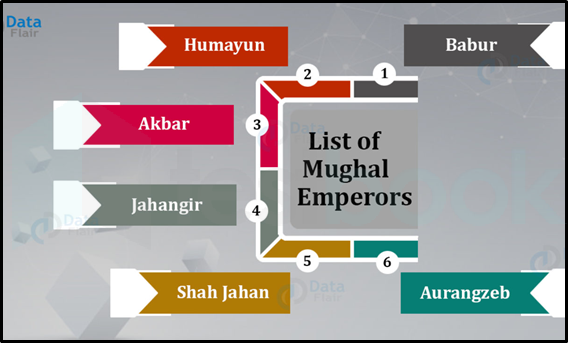
    horticulture

  5. ((e))

    pisciculture

Show Answer
Answer: ((a))

sericulture

The correct answer is sericulture.

Key Points

  • Sericulture is the cultivation of silkworms to produce silk.
  • Sericulture is an industry that is characterized by a two-step process.
  • the cultivation of mulberry trees.
  • the rearing of silkworms on mulberry leaves to produce cocoons.
  • The process of breeding, growing, management of silkworms to get pure raw silk is sericulture.
  • There are numerous varieties of silkworms.
  • Mulberry silkworms, airy silkworms, enormous silkworms, etc. are a few examples.
  • The term "silkworm" refers to the insect that makes silk.

Additional Information

  • Apiculture is the process of maintaining beehives and producing honey and beeswax.
  • Floriculture is the area of ornamental horticulture that deals with growing, marketing, and arranging flowers and ornamental plants.
  • Horticulture is the practise of growing plants in yards or other outside spaces for ornamental, dietary, or medical purposes. Growers of flowers, fruits, nuts, vegetables, herbs, ornamental trees, and lawns are known as horticulturists.
90

In the big states category, which state has been given the first prize award for Swachh Survekshan Grameen 2022?

  1. ((a))

    Kerala

  2. ((b))

    Telangana

  3. ((c))

    Tamil Nadu

  4. ((d))

    Haryana

  5. ((e))

    None of the above

Show Answer
Answer: ((b))

Telangana

The correct answer is Telangana.

Key Points

  • President Droupadi Murmu on 2 Oct 2022 conferred the awards for Swachh Survekshan Grameen 2022 in New Delhi.
  • In the big states category, the first award for Swachh Survekshan Grameen was given to Telangana, 2nd to Haryana & the 3rd award was bagged by Tamil Nadu.
  • Among the smaller States & UTs, Andaman & Nicobar secured the 1st position followed by Dadra & Nagar Haveli and Daman & Diu.

Important Points

  • The Swachh Survekshan Gramin-2022 aimed to undertake a ranking of States and Districts on the basis of their performance attained on key quantitative and qualitative Swachh Bharat Mission Grameen parameters.
  • It also envisages engaging rural communities in the improvement of their sanitation status through an intensive and holistic IEC campaign.
  • In small states and the UTs category, Sikkim got the third award.
91

Who among the following is not an economist?

  1. ((a))

    Amartya Sen

  2. ((b))

    Anurag Singh Thakur

  3. ((c))

    Manmohan Singh

  4. ((d))

    Raghunath Rajan

  5. ((e))

    Krishnamurthy Subramanian

Show Answer
Answer: ((b))

Anurag Singh Thakur

The correct answer is Anurag Singh Thakur.

Key Points

  • Anurag Singh Thakur is an Indian politician from the Bharatiya Janata Party and a Member of Parliament in the Lok Sabha from Hamirpur, Himachal Pradesh.
  • He is the current Minister of Sports, Youth Affairs and Minister of Information and Broadcasting.
  • Previously, Thakur served as a Minister of State for Finance and Corporate Affairs. He was first elected to the Lok Sabha in May 2008 in a by poll as a candidate of the Bharatiya Janata Party.
  • Coming from a political family of Himachal Pradesh, he is a long serving, four time Member of Parliament, being a member of 14th, 15th, 16th, and 17th Lok Sabha.
  • Previously, he was the president of the Board of Control for Cricket in India (BCCI) from May 2015 to February 2017, and had to leave that position after the Supreme Court order on BCCI governance.

Additional Information

  • Amartya Sen
  • Amartya Sen is an economist and philosopher from India.
  • He has been a professor and employee in the US and the UK since 1972.
  • Sen has contributed to welfare economics, social choice theory, economic and social justice, decision theory, development economics, public health, and metrics of country well-being.
  • He has also studied the economics of famines.
  • In 1998, he received the Economic Sciences Nobel Memorial Prize.
  • In 1999, he received India's Bharat Ratna award for his contributions to welfare economics.
  • He received the 2020 Peace Prize of the German Book Trade from the German Publishers and Booksellers Association in recognition of his work addressing issues of global justice and addressing social injustice in healthcare and education.
92

The Pradhan Mantri Vaya Vandana Yojana being implemented through Life Insurance Corporation of India is open for subscription up to _______.

  1. ((a))

    31 March 2024

  2. ((b))

    31 March 2023

  3. ((c))

    31 December 2022

  4. ((d))

    31 January 2023

  5. ((e))

    31 July 2023

Show Answer
Answer: ((b))

31 March 2023

The correct answer is 31 March 2023.

Key Points

  • The Pradhan Mantri Vaya Vandana Yojana being implemented through LIC (Life Insurance Corporation) of India is open for subscription up to 31 March 2023.
  • Pradhan Mantri Vaya Vandana Yojna is a pension scheme that is started by the Indian Government on 4 May 2017.
  • This pension scheme is for senior citizens age 60 years and above.
  • Assured return of 8% payable monthly for 10 years.
  • Exempted from Service Tax or GST.
  • Loan of up to 75% of purchase price allowed after 3 policy years.
  • Allows for premature exit for treatment of any critical/terminal illness of self or spouse.
93

According to the EdelGive Hurun India Philanthropy List 2022, who has emerged as India's most generous person?

  1. ((a))

    Adar Poonawala

  2. ((b))

    Rahul Bajaj

  3. ((c))

    Mukesh Ambani

  4. ((d))

    Shiv Nadar

  5. ((e))

    None of the above

Show Answer
Answer: ((d))

Shiv Nadar

The correct answer is Shiv Nadar.

Key Points

  • HCL founder Shiv Nadar has emerged as India's most generous person with an annual donation of Rs 1,161 crore, according to the EdelGive Hurun India Philanthropy List 2022.
  • Wipro's Azim Premji came in second with an annual donation of Rs 484 crore.
  • With a donation of Rs 120 crore, Rohini Nilekani is the most generous woman philanthropist in the country.

Additional Information

  • Hurun Report is a leading research group established in London in 1998.
  • It has a presence in India, China, France, the UK, the USA, Australia, Japan, Canada and Luxembourg.
  • Hurun Report is the largest compiler of the rich list globally.
94

Operation Flood is related to which of the following?

  1. ((a))

    Building reservoirs

  2. ((b))

    Increasing milk production

  3. ((c))

    Developing hydropower

  4. ((d))

    Disaster management

  5. ((e))

    Fertilizers

Show Answer
Answer: ((b))

Increasing milk production

The correct answer is to increase milk production.

Key Points

  • "Operation Flood" is a mission to increase the performance of the dairy sector.
  • Operation Flood was launched in 1970 by National Dairy Development Board during the time of the Fourth Five Year Plan.
  • Operation flood was the world's biggest dairy development program which gave a major thrust to the milk production of the nation.
  • It aimed at helping the dairy industry sustain itself economically while providing employment to poor farmers.
  • The result was that India became the largest producer of Milk and Milk Products.
  • White Revolution contributed to a large extent to alleviating poverty in India.
  • Gujarat-based cooperation “Anand Milk Union Limited” (Amul) was the engine behind the success of the programme.
  • Operation Flood is called the White Revolution in India.
  • The programme to increase the production of milk is called White Revolution.
  • Indian Dairy Association decided to observe the birthday of Verghese Kurien as National Milk Day.
  • 'Unfinished Dream' is a book written by Verghese Kurien.
95

In which state, 'Gir National Park' is situated?

  1. ((a))

    Punjab

  2. ((b))

    Maharashtra

  3. ((c))

    Andhra Pradesh

  4. ((d))

    Madhya Pradesh

  5. ((e))

    Gujarat

Show Answer
Answer: ((e))

Gujarat

The correct answer is Gujarat.

Key Points

  • Gir national park is located in Gujarat.
  • Gir national park is also known as Sasan Gir.
  • It is famous for Asiatic lions.
  • It is located in Junagadh, Gir Somnath and Amreli districts of Gujarat.

Additional Information

StateNational Parks
Maharashtra- Chandoli National Park - Gugamal National Park - Nawegaon National Park
Andhra Pradesh- Papikonda National Park - Sri Venkateswara National Park
Madhya Pradesh- Kanha Tiger Reserve - Bandhavgarh Tiger Reserve - Panna Tiger Reserve - Pench Tiger Reserve - Satpura Tiger Reserve - Sanjay-Dubri Tiger Reserve - Madhav National Park - Vanvihar National Park - Fossil National Park - Dinasour Fossil National Park
96

'World Water Day' is celebrated on _____ of every year.

  1. ((a))

    22nd March

  2. ((b))

    1st March

  3. ((c))

    10th March

  4. ((d))

    4th March

  5. ((e))

    6th April

Show Answer
Answer: ((a))

22nd March

The correct answer is 22nd March.

Key Points

  • World water day is celebrated on 22nd March.

Additional Information

  • World Water Day, held on 22 March every year since 1993, focuses on the importance of freshwater.
  • The theme of 2021 World water day is Valuing Water.
  • International days and weeks are occasions to educate the public on issues of concern, to mobilize political will and resources to address global problems.
  • Source:-https://www.un.org/en/observances/water-day
97

Calcium Hydroxide is also known as _________.

  1. ((a))

    Plaster

  2. ((b))

    Slaked lime

  3. ((c))

    Baking soda

  4. ((d))

    Washing soda

  5. ((e))

    Quick lime

Show Answer
Answer: ((b))

Slaked lime

  • Calcium Hydroxide or Ca(OH)2 is also known as Slaked lime.
  • It is a white powder or colourless crystal which is obtained when Quicklime (calcium oxide) is mixed with water.
98

According to India’s Ministry of Culture, How many classical dances are there in India?

  1. ((a))

    6

  2. ((b))

    7

  3. ((c))

    10

  4. ((d))

    5

  5. ((e))

    9

Show Answer
Answer: ((e))

9

The correct answer is 9**.**

Chhau dance is the 9th dance form in India.

Key Points

  • According to India’s Ministry of Culture, there are nine recognised classical dances.
  • Dance is first mentioned in a well-known work in Bharat Muni’s book Natya Shastra.
  • Chhau dance is the 9th dance form in India.

Additional Information

  • Ministry of Culture currently confers classical status on nine Indian classical dance styles: Bharatanatyam (Tamil Nadu), Kathak (North, West and Central India), Kathakali (Kerala), Kuchipudi (Andhra Pradesh), Odissi (Odissa), Manipuri (Manipur), Mohiniyattam (Kerala), and Sattriya (Assam) and Chhau
99

In a bid to give a push to inland waterways, India is planning to launch the world's longest river cruise between Varanasi and ____________, in January 2023.

  1. ((a))

    Assam

  2. ((b))

    Sikkim

  3. ((c))

    Puducherry

  4. ((d))

    Arunachal Pradesh

  5. ((e))

    Odisha

Show Answer
Answer: ((a))

Assam

The correct answer is 'Assam'.

Key Points

  • In a bid to give a push to inland waterways, India is planning to launch the world's longest river cruise between Varanasi in Uttar Pradesh and Dibrugarh in Assam in January 2023.
  • During its 50-day journey, the "Ganga Vilas" cruise will cover a distance of 4,000 km and also pass through Bangladesh.
  • The journey will start on January 10 and reach Dibrugarh on March 1 after visiting Kolkata and Dhaka.
  • The cruise is expected to run on a PPP model.
  • The Inland Waterways Authority of India (IWAI) has signed an MoU with Antara Luxury River Cruises and JM Baxi River Cruises for this.
  • After starting at Varanasi, the cruise will reach Patna on the 8th day. From there, it will reach Kolkata on the 20th day. After a day's halt, it will again set sail for Bangladesh, where it will spend 15 days before entering India again and reaching Bogibeel (Dibrugarh).

Additional Information

  • The Indo-Bangladesh Protocol Route will facilitate the cruise's 1,100-km journey in the neighbouring country. This route, which connects the Ganga and Brahmaputra rivers, has already opened trade and transit channels between the two countries.
  • Dibrugarh is an industrial city in Upper Assam with sprawling tea gardens. It is located 435 kms East from the state capital of Dispur.
100

Which of the following is a physical change?

  1. ((a))

    Melting of ice

  2. ((b))

    Milk is set into curd

  3. ((c))

    Ripening of frutis

  4. ((d))

    Grapes get fermented

  5. ((e))

    None of the above

Show Answer
Answer: ((a))

Melting of ice

The correct answer is Melting of ice.

Key Points

  • The melting of ice is a physical change.
  • The change that does not lead to changes in the chemical composition of a substance is termed as physical change.
  • Physical changes lead to changes in the physical properties and are generally reversible in nature.
  • Examples of physical changes are: melting of ice, transition into gas, textural changes, changes in size, shape, color, etc.

Additional Information

  • In the case of the melting of ice, only a phase transition takes place, the chemical composition of ice does not change.
  • Chemical changes lead to the transformation in the chemical composition of the substance. Either a new substance is synthesized or a substance is decomposed.
  • The setting of milk into curd, the ripening of fruits, and fermentation of grapes all are examples of chemical changes since the chemical properties of each are changed.

Attempt this paper under real exam conditions

Timed interface, section switching, instant scoring, and question-by-question analytics — free.

Start Timed Attempt