Official Paper

EMRS TGT (Social Science) Official Paper (Held On: 23 Dec, 2023) (Previous Year Paper)

150 questions · 180 minutes · with answers · free

General Awareness (10 questions)

1

According to the Economic Survey of India 2022-23, the Gross Enrolment Ratio in schools has seen a decline in 2021-22 in comparison with 2013-14 for which of the following levels?

(a) Primary

(b) Upper primary

(c) Secondary

Choose the correct answer from the codes given below.

  1. ((a))

    Only (c)

  2. ((b))

    Only (b) and (c)

  3. ((c))

    Only (a)

  4. ((d))

    Only (b)

Show Answer
Answer: ((d))

Only (b)

The correct answer is Only (b).

Key Points

  • Gross Enrolment Ratio (GER) is a statistical measure used in the education sector to determine the number of students enrolled in a specific level of education, regardless of age, expressed as a percentage of the official school-age population for that level.
  • According to the Economic Survey of India 2022-23, the GER in schools has shown varied trends across different levels of education when comparing 2021-22 to 2013-14.
  • Primary level: The GER at the primary level did not witness a decline in 2021-22 compared to 2013-14. Instead, it remained stable or improved. Hence, statement (a) is incorrect.
  • Upper primary level: The GER at the upper primary level saw a decline in 2021-22 compared to 2013-14, as highlighted in the survey. This indicates challenges in retaining students beyond the primary level of education. Hence, statement (b) is correct.
  • Secondary level: The GER at the secondary level has generally improved over the years due to increased focus on secondary education policies, infrastructure development, and incentives for retention. Hence, statement (c) is incorrect.

Additional Information

  • Gross Enrolment Ratio (GER):
  • GER is calculated as the total enrolment of students at a particular level of education divided by the population of the age group that officially corresponds to that level. It is expressed as a percentage.
  • A GER above 100% indicates that there are students outside the official age group enrolled in education, which is a positive indicator of inclusivity.
  • Trends in GER in India:
  • The primary level has seen consistent enrolment rates due to government initiatives like the Mid-Day Meal Scheme and the Right to Education Act, 2009, which focus on universal access to primary education.
  • The upper primary level has witnessed a decline in GER, indicating challenges such as dropout rates due to socio-economic factors or lack of access to higher grades in rural areas.
  • The secondary level has shown improvement, with the GER increasing significantly due to programs like Rashtriya Madhyamik Shiksha Abhiyan (RMSA) and scholarships for students from marginalized communities.
  • Challenges in GER:
  • Dropout rates at the upper primary level are influenced by factors such as poverty, lack of awareness, and gender-based disparities.
  • Geographical and infrastructural barriers in rural and remote areas contribute to lower GER at higher education levels.

Important Points

  • Government Initiatives to Improve GER:
  • Samagra Shiksha Abhiyan: An integrated scheme for school education that aims to improve enrolment, retention, and quality of education at all levels.
  • Mid-Day Meal Scheme: Provides free meals to children in schools to enhance enrolment and retention, especially at the primary level.
  • Kasturba Gandhi Balika Vidyalaya: Focuses on improving GER for girls at the upper primary level in rural areas.
  • Digital Education Initiatives: Programs like DIKSHA and e-learning platforms aim to increase accessibility to education resources and reduce dropout rates.
2

Which of the following women's hockey teams won the Torneo del Centenario 2023 title?

  1. ((a))

    People's Republic of China

  2. ((b))

    India

  3. ((c))

    Spain

  4. ((d))

    England

Show Answer
Answer: ((b))

India

The correct answer is India.

Key Points

  • Torneo del Centenario 2023: The Torneo del Centenario is an international hockey tournament organized to celebrate the centenary of the sport. It attracts top teams from across the globe to compete for the title.
  • India's Victory: The Indian women's hockey team clinched the Torneo del Centenario 2023 title, showcasing their exceptional skills and teamwork throughout the tournament. This win highlights the growing prowess of Indian women in international hockey.
  • Performance Highlights: India displayed a series of stellar performances against teams like Spain, England, and others. Their strategic gameplay, focused defense, and attacking prowess played a vital role in securing the championship.
  • Historical Achievement: Winning the Torneo del Centenario 2023 is a significant achievement for Indian women's hockey, further strengthening their position in the global rankings and boosting morale for future tournaments.
  • This victory is a testament to the hard work and dedication of the players, coaching staff, and support systems. It reflects the efforts to promote women's hockey in India.

Additional Information

  • Indian Women's Hockey Team:
  • Formation: The Indian women's hockey team has a rich history and has emerged as a strong contender in international tournaments over the years.
  • Achievements: The team has consistently delivered exceptional performances, including qualifying for the Tokyo Olympics and finishing fourth, marking one of their best performances on a global stage.
  • Role of Government and Federations:
  • The Sports Authority of India (SAI) and Hockey India have been instrumental in providing infrastructure, training, and resources to improve the team's competitiveness.
  • Under various schemes like Khelo India, players are nurtured from grassroots levels, ensuring a steady pipeline of talent for national teams.
  • Global Competitors:
  • Spain: Known for their aggressive playing style, Spain has been a strong contender in international hockey.
  • England: England's women's hockey team has traditionally been a dominant force, often competing at the top levels in tournaments like the Olympics and World Cup.
  • China: China's women’s hockey team is also regarded as a competitive team on the global stage, focusing heavily on strategic gameplay.

Important Points

  • Significance of the Victory:
  • This victory is a morale booster for Indian women's hockey, inspiring young players and promoting the sport in the country.
  • It highlights the importance of teamwork, strategy, and resilience, serving as an example for upcoming athletes.
  • Future Prospects:
  • India's win at the Torneo del Centenario 2023 lays the foundation for better performances in tournaments like the Asian Games and World Cup.
  • With continued support and investment in women's hockey, India aims to achieve greater success on international platforms.
3

Alamgir Nama' is the chronicle of the reign of which of the following Mughal emperors?

  1. ((a))

    Aurangzeb

  2. ((b))

    Bahadur Shah Zafar

  3. ((c))

    Jahangir

  4. ((d))

    Shah Jahan

Show Answer
Answer: ((a))

Aurangzeb

The correct answer is Aurangzeb.

Key Points

  • Alamgir Nama is a historical chronicle that provides a detailed account of the reign of the Mughal Emperor Aurangzeb, who ruled India from 1658 to 1707.
  • The book was written by Mirza Muhammad Kazim, a court historian during Aurangzeb’s reign. It documents the events, policies, and achievements of the emperor.
  • Aurangzeb was also known as Alamgir, which means "Conqueror of the World," and the chronicle is named after this title.
  • The Alamgir Nama is considered an important historical source for understanding the political and administrative systems during Aurangzeb's rule.
  • It covers key aspects of Aurangzeb’s reign, including his military campaigns, religious policies, and governance style.
  • The chronicle ends in the 10th year of Aurangzeb's reign, as the author passed away before completing the full account of his rule.

Additional Information

  • Aurangzeb’s Reign:
  • Aurangzeb was the sixth Mughal Emperor, who ascended the throne in 1658 after defeating his brothers in a bitter succession war.
  • He is known for his strict adherence to Islamic principles and his efforts to enforce Sharia law across his empire.
  • Aurangzeb expanded the Mughal Empire to its greatest territorial extent, covering almost the entire Indian subcontinent.
  • He implemented policies that were often criticized for being intolerant towards non-Muslims, such as the reimposition of the Jizya tax on non-Muslims.
  • Other Mughal Chronicles:
  • The Mughal dynasty is known for its rich historical chronicles, such as the Baburnama (memoirs of Babur), Akbarnama (chronicle of Akbar), and Shah Jahan Nama (chronicle of Shah Jahan).
  • These works provide valuable insights into the reigns of different emperors, including their administrative systems, military campaigns, cultural achievements, and personal lives.
  • Mirza Muhammad Kazim:
  • Mirza Muhammad Kazim, the author of Alamgir Nama, was a prominent historian and writer of the Mughal court.
  • His work is regarded as an authoritative account of the early years of Aurangzeb’s rule, offering detailed insights into the emperor’s policies and governance.

Important Points

  • Key Features of Alamgir Nama:
  • The chronicle provides detailed descriptions of Aurangzeb’s military campaigns, particularly in the Deccan region, against rulers like the Marathas and the Bijapur Sultanate.
  • It documents the administrative reforms introduced by Aurangzeb, including his efforts to curb corruption and enforce Islamic law.
  • The book also sheds light on Aurangzeb’s personal character, portraying him as a devout and disciplined ruler.
  • Significance in Indian History:
  • The Alamgir Nama serves as a vital source for historians studying the Mughal Empire, especially the transitional period leading to its decline.
  • It highlights the challenges faced by Aurangzeb, such as internal dissent and external threats, which eventually contributed to the weakening of the Mughal dynasty.
4

Which of the following is an example of a permanent executive in India?

  1. ((a))

    A Civil Servant

  2. ((b))

    The Prime Minister of India

  3. ((c))

    A Central Cabinet Minister

  4. ((d))

    The Governor of a State

Show Answer
Answer: ((a))

A Civil Servant

The correct answer is A Civil Servant.

Key Points

  • A permanent executive refers to individuals who are part of the administrative machinery of the government and serve irrespective of changes in political leadership.
  • Civil servants are the backbone of the permanent executive. They are career bureaucrats who work in various government departments and are responsible for implementing policies, programs, and laws enacted by the legislature.
  • Unlike the political executive (e.g., Prime Minister, Governor, and Cabinet Ministers), civil servants continue to serve across different governments and are not affected by elections or changes in ruling parties.
  • Civil servants are selected through competitive exams like the Union Public Service Commission (UPSC) and state-level public service commissions. They are appointed based on merit and serve for a fixed tenure until retirement or resignation.
  • The political executives, such as the Prime Minister, Governors, and Cabinet Ministers, are temporary executives because they hold office only as long as they retain political power or until their term ends. Hence, the correct answer is A Civil Servant.

Additional Information

  • Permanent Executive:
  • The permanent executive is responsible for the day-to-day administration of the country. They ensure the smooth functioning of government machinery by implementing laws, policies, and programs efficiently.
  • Civil servants remain impartial and apolitical. Their role is to serve the government of the day without being influenced by political ideologies or biases.
  • Selection and Functions of Civil Servants:
  • Civil servants are selected through competitive exams like the UPSC Civil Services Examination, which recruits candidates for prestigious posts such as IAS, IPS, and IFS.
  • Their functions include policy formulation, implementation, managing public resources, and advising political executives on administrative matters.
  • Political Executives:
  • The Prime Minister, Cabinet Ministers, and Governors are part of the political executive. They are temporary executives who hold office as long as they have political power or until the tenure of the government ends.
  • Their role is to make decisions, set policies, and guide the administration. However, they rely on the permanent executive for effective implementation of these decisions.
  • Examples of Permanent Executive:
  • The Indian Administrative Service (IAS) and Indian Police Service (IPS) are prime examples of civil servants who are part of the permanent executive.
  • Other examples include officers working in state-level administrative services, revenue departments, and other government agencies.

Important Points

  • Difference Between Permanent and Temporary Executives:
  • Permanent executives (civil servants) are selected based on merit and serve irrespective of changes in government, while temporary executives (political leaders) are elected for a fixed term and depend on electoral outcomes.
  • Permanent executives focus on implementation and administration, while temporary executives focus on decision-making and policy formulation.
  • Significance of Civil Servants:
  • Civil servants ensure continuity and stability in governance, especially during political transitions.
  • They act as a link between the government and the citizens, ensuring that public resources are managed efficiently.
5

In which country is the first ever Indian Institute of Technology (IIT) campus outside India going to be set up?

  1. ((a))

    Ghana

  2. ((b))

    Nigeria

  3. ((c))

    South Africa

  4. ((d))

    Tanzania

Show Answer
Answer: ((d))

Tanzania

The correct answer is Tanzania.

Key Points

  • Indian Institute of Technology (IIT) is an internationally recognized institution established to promote technical education and innovation in India.
  • In 2023, India announced plans to set up the first-ever IIT campus outside the country in Tanzania. This marks a significant step in extending Indian higher education globally.
  • The campus will be established in Zanzibar, Tanzania, as part of the India-Tanzania bilateral agreement. This decision reflects India's commitment to fostering international academic cooperation. Hence, statement is correct.
  • This initiative aligns with India's New Education Policy (NEP) 2020, which emphasizes internationalization of Indian education.
  • The establishment aims to provide quality technical education to students in Africa and build stronger ties between India and Tanzania. Hence, statement is correct.
  • The IIT Zanzibar campus will offer a variety of programs including undergraduate, postgraduate, and doctoral studies in engineering, technology, science, and mathematics.
  • This campus is expected to foster research collaborations in emerging fields like Artificial Intelligence, Data Science, and Renewable EnergyHence, statement is correct.
  • The decision reflects India's growing emphasis on soft diplomacy through educational and cultural exchanges, strengthening its image as a global leader in education. Hence, statement is correct.
  • Hence, the correct answer is Tanzania.

Additional Information

  • Indian Institute of Technology (IIT):
  • IITs are globally renowned for their quality education, research, and innovation. They are ranked among the top engineering institutions worldwide.
  • Currently, India has 23 IITs, which specialize in diverse fields such as engineering, technology, science, and management.
  • The establishment of an IIT campus in Tanzania will mark the first-ever expansion of IITs outside India.
  • Why Tanzania?
  • Tanzania is strategically located in East Africa, making it an accessible education hub for African nations.
  • Zanzibar is known for its cultural and economic significance, attracting investment and partnerships in education, trade, and tourism.
  • By setting up the IIT campus in Zanzibar, India aims to provide affordable and quality education to African students.
  • India-Tanzania Relations:
  • India and Tanzania share long-standing diplomatic, economic, and cultural ties.
  • India has been actively involved in promoting developmental cooperation in Africa through projects in education, healthcare, and infrastructure.
  • The IIT campus is part of a broader effort to enhance bilateral relations and contribute to the African continent's development.

Important Points

  • Key Features of IIT Zanzibar Campus:
  • The campus will offer programs in engineering, technology, and science to students from Africa and other regions.
  • It aims to establish research facilities in emerging technologies and promote collaborative projects.
  • The campus is designed to foster cultural exchange and strengthen India's image as a global leader in education.
  • Significance of IIT Expansion:
  • The move aligns with India's New Education Policy (NEP) 2020, which emphasizes internationalization.
  • It contributes to global access to quality education and promotes India's diplomatic outreach through education.
6

When an ant bites a human, what does it inject into the human skin?

  1. ((a))

    Calamine solution

  2. ((b))

    Formic acid

  3. ((c))

    Sodium hydrogencarbonate

  4. ((d))

    Zinc carbonate

Show Answer
Answer: ((b))

Formic acid

The correct answer is Formic acid.

Key Points

  • When an ant bites a human, it injects formic acid into the skin through its sting.
  • Formic acid, also known as methanoic acid, is a chemical compound that causes a stinging or burning sensation upon injection. This is why ant bites often result in pain, redness, and swelling around the affected area.
  • The acidic nature of formic acid irritates the skin, leading to inflammation and discomfort. Hence, the correct answer is Formic acid.
  • In some cases, individuals may experience allergic reactions to formic acid, causing more severe symptoms such as excessive swelling, itching, or even anaphylaxis (in rare cases).
  • Formic acid is not harmful in small quantities but can be neutralized by applying a basic substance, such as sodium bicarbonate, to the affected area to reduce irritation. This helps alleviate the pain and redness caused by the ant bite.
  • The primary function of formic acid in ants is as a defense mechanism to protect themselves and their colonies from predators or threats.

Additional Information

  • Formic Acid:
  • Formic acid is a naturally occurring compound found in ants and some other insects. It is one of the simplest carboxylic acids, with the chemical formula HCOOH.
  • It is used by ants as a defense mechanism and as a way to subdue prey. This acid is secreted through the ant's sting or bite, causing pain to the victim.
  • Other Substances Mentioned in the Question:
  • Calamine solution: This is a soothing lotion containing zinc oxide and ferric oxide, typically used to relieve itching and discomfort caused by insect bites or skin irritations. It is not injected by ants.
  • Sodium hydrogencarbonate (baking soda): This is a basic compound that can neutralize acids, such as formic acid, to reduce irritation. It is used as a remedy, not injected by ants.
  • Zinc carbonate: This is an inorganic compound used in industrial applications and as a treatment for skin conditions. It is unrelated to ant bites.
  • Reactions to Ant Bites:
  • The irritation and pain caused by an ant bite are due to the acidic nature of formic acid. This can be alleviated by applying a cold compress or a basic substance.
  • Individuals allergic to ant bites may require medical attention if symptoms persist or worsen.

Important Points

  • Neutralizing Formic Acid:
  • Applying sodium bicarbonate (baking soda) to the site of the bite can neutralize the acidic effect of formic acid and reduce irritation.
  • Over-the-counter antihistamines or hydrocortisone creams may also help alleviate symptoms.
  • Role of Formic Acid in Ants:
  • Apart from being a defense mechanism, formic acid helps ants in hunting or subduing prey. Some ant species also use it to mark territories or communicate with fellow ants.
7

Which of the following statements is correct in relation to the Right of Children to Free and Compulsory Education Act, 2009 (RTE)?

  1. ((a))

    No child is denied admission in a school according to this Act, for the lack of age proof.

  2. ((b))

    The Act applies to the whole of India except the state of Jammu and Kashmir.

  3. ((c))

    Elementary Education in this Act is defined as education from class 1 to 6.

  4. ((d))

    The Act provides for free education to all children upto the age of 16.

Show Answer
Answer: ((a))

No child is denied admission in a school according to this Act, for the lack of age proof.

The correct answer is No child is denied admission in a school according to this Act, for the lack of age proof..

Key Points

  • Statement 1: The Right of Children to Free and Compulsory Education Act (RTE), 2009, mandates that no child shall be denied admission to a school for the lack of age proof. Schools are required to ensure that every child has access to education without imposing unnecessary restrictions. This statement is correct.
  • Statement 2: The Act applies to the whole of India except the state of Jammu and Kashmir. However, after the abrogation of Article 370 in August 2019, the Act became applicable to Jammu and Kashmir as well. This statement is incorrect.
  • Statement 3: Elementary education, as defined under the Act, refers to education from Class 1 to 8, not Class 1 to 6. This statement is incorrect.
  • Statement 4: The Act provides for free education to all children aged 6 to 14 years, not up to the age of 16. This provision is in alignment with Article 21A of the Constitution of India. This statement is incorrect.
  • Hence, the correct answer is "No child is denied admission in a school according to this Act, for the lack of age proof.".

Additional Information

  • Right of Children to Free and Compulsory Education Act, 2009:
  • The Act was enacted to provide free and compulsory education to children aged between 6 to 14 years as a fundamental right under Article 21A of the Constitution.
  • It ensures that every child has access to education without discrimination based on gender, caste, religion, or socio-economic background.
  • Schools are required to reserve 25% of seats for children from economically weaker sections (EWS) and disadvantaged groups.
  • Key Features of the Act:
  • The Act prohibits schools from charging any form of fees, ensuring that education is truly free for eligible children.
  • It mandates the establishment of a neighborhood school within a certain distance to ensure accessibility.
  • The Act prescribes norms for infrastructure, teacher qualifications, and pupil-teacher ratios to maintain quality education.
  • Age and Coverage:
  • The Act covers children aged 6 to 14 years, focusing on elementary education (Class 1 to 8).
  • It applies to all government schools and aided schools, while unaided private schools are required to reserve seats for children from EWS and disadvantaged groups.

Important Points

  • Prohibition of Discrimination:
  • Schools are prohibited from denying admission based on age, gender, caste, or economic background.
  • They cannot subject children to screening procedures or entrance tests for admission.
  • Role of Local Authorities:
  • Local authorities are responsible for identifying children who are out of school and ensuring their enrollment.
  • They must ensure the availability of adequate infrastructure and trained teachers.
  • Impact of the Act:
  • The Act has significantly improved enrollment rates and reduced dropout rates among children in the target age group.
  • It has empowered economically weaker sections and disadvantaged groups by ensuring access to quality education.
8

The longitudinal valley lying between lesser Himalaya and the Shivaliks are known as _______

  1. ((a))

    Kullus

  2. ((b))

    Pir Panjal Range

  3. ((c))

    Purvanchals

  4. ((d))

    Duns

Show Answer
Answer: ((d))

Duns

The correct answer is Duns.

Key Points

  • Duns are elongated valleys located between the Lesser Himalayas (Middle Himalayas) and the Shivalik Hills.
  • These valleys are formed due to the folding and faulting of the Earth’s crust during the process of Himalayan orogeny.
  • Dehradun, Kotli Dun, and Patli Dun are prominent examples of duns in India. They serve as significant geographical and ecological features.
  • The duns are characterized by their rich soil, making them suitable for agriculture. They are largely fertile plains surrounded by hills.
  • These valleys are also important for human settlements due to their favorable climatic conditions and natural resources. Hence, the term "Duns" correctly refers to the longitudinal valleys lying between the Lesser Himalayas and Shivaliks.

Additional Information

  • Formation of Duns:
  • Duns are formed as a result of tectonic activity, specifically the collision between the Indian Plate and the Eurasian Plate.
  • The folding and faulting during this collision created depressions or valleys between the mountain ranges.
  • Characteristics of Duns:
  • Duns are typically narrow and elongated, with fertile soil suitable for crops like rice, wheat, and sugarcane.
  • They are surrounded by rugged terrain, making them distinct geographical features.
  • The valleys have rich biodiversity, serving as habitats for various flora and fauna.
  • Other Options Explained:
  • Kullus: Refers to the Kullu Valley, located in Himachal Pradesh, and is not associated with the longitudinal valleys between the Lesser Himalayas and Shivaliks.
  • Pir Panjal Range: A mountain range in the Himalayas, located in Jammu and Kashmir, and not a valley.
  • Purvanchals: Refers to the hills located in northeastern India, which are not related to the Shivalik Hills or Lesser Himalayas.

Important Points

  • Dehradun: The most famous dun valley in India, known for its scenic beauty, educational institutions, and tourist attractions.
  • Human Settlements: Duns are preferred for settlements due to their fertile lands, availability of water, and pleasant climate.
  • Geographical Importance: These valleys act as a transition zone between the mountainous regions and plains, influencing both climate and ecology.
9

Which of the following pairs of the places of historical significance and the countries within which they fall, is matched correctly?

  1. ((a))

    Nuremberg-  France

  2. ((b))

    Rivonia - South Africa

  3. ((c))

    Versailles - Germany

  4. ((d))

    St. Petersburg - England

Show Answer
Answer: ((b))

Rivonia - South Africa

The correct answer is Rivonia - South Africa.

Key Points

  • Nuremberg - France: This statement is incorrect. Nuremberg is a city located in Germany, not France. It is historically significant due to the Nuremberg Trials, conducted after World War II to prosecute prominent leaders of Nazi Germany for war crimes.
  • Rivonia - South Africa: This statement is correct. Rivonia is a suburb in South Africa. It is historically significant as the location where key leaders of the African National Congress (ANC), including Nelson Mandela, were arrested in 1963 during apartheid. The Rivonia Trial that followed led to Mandela's imprisonment for 27 years.
  • Versailles - Germany: This statement is incorrect. Versailles is located in France, not Germany. It is historically significant for the Treaty of Versailles signed in 1919, which ended World War I and imposed harsh conditions on Germany.
  • St. Petersburg - England: This statement is incorrect. St. Petersburg is located in Russia, not England. It is historically significant as a cultural hub, the former capital of Imperial Russia, and the site of significant events during the Russian Revolution.
  • Hence, the correct answer is Rivonia - South Africa.

Additional Information

  • Rivonia Trial:
  • Year: Conducted in 1963-1964.
  • Purpose: The trial targeted leaders of the ANC who were accused of sabotage against the apartheid government.
  • Outcome: Key figures like Nelson Mandela, Walter Sisulu, and Govan Mbeki were convicted and sentenced to life imprisonment.
  • Impact: The trial highlighted global opposition to apartheid and made Mandela a symbol of the anti-apartheid struggle.
  • Nuremberg Trials:
  • Location: Conducted in Nuremberg, Germany.
  • Year: Held between 1945-1946.
  • Purpose: To prosecute Nazi leaders for war crimes, crimes against humanity, and crimes of aggression during World War II.
  • Significance: Established principles of international law and accountability for leaders committing atrocities.
  • Versailles Treaty:
  • Location: Signed at the Palace of Versailles, France.
  • Year: 1919.
  • Purpose: To formally end World War I and impose reparations and territorial losses on Germany.
  • Impact: The treaty is considered one of the causes of World War II due to its harsh terms on Germany.
  • St. Petersburg:
  • Location: A city in Russia.
  • Historical Significance: Served as the capital of Imperial Russia until 1918.
  • Events: Key events include the October Revolution of 1917 and the siege during World War II.
  • Current Status: Renamed from Leningrad to St. Petersburg in 1991 and remains a cultural and historical center in Russia.

Important Points

  • Significance of Rivonia:
  • The Rivonia Trial was pivotal in raising awareness about the oppression under apartheid in South Africa.
  • It led to international condemnation of apartheid policies and increased support for the ANC.
  • Nelson Mandela’s statement from the dock during the trial became a defining moment in the struggle for freedom.
  • Other Historical Places:
  • Nuremberg: Symbolizes justice and accountability in international law.
  • Versailles: Represents the consequences of war and the challenges of international diplomacy.
  • St. Petersburg: Reflects Russia's cultural and political history through centuries.
10

Which of the following industrialists was awarded the Padma Bhushan 2023 in the field of Trade and Industry?

  1. ((a))

    Adar Poonawalla

  2. ((b))

    Gautam Adani

  3. ((c))

    Mukesh Ambani

  4. ((d))

    Kumar Mangalam Birla

Show Answer
Answer: ((d))

Kumar Mangalam Birla

The correct answer is Kumar Mangalam Birla.

Key Points

  • Kumar Mangalam Birla is a renowned Indian industrialist and the chairman of the Aditya Birla Group, one of India's largest multinational conglomerates.
  • He was awarded the prestigious Padma Bhushan in 2023 for his exceptional contribution to the field of Trade and Industry.
  • The Padma Bhushan is India's third-highest civilian award, conferred for distinguished service of high order in various fields including art, public affairs, science, and trade and industry. Hence, Kumar Mangalam Birla's recognition is highly significant.
  • Kumar Mangalam Birla has been instrumental in transforming the Aditya Birla Group into a global entity, driving innovation and growth across diverse sectors such as metals, cement, textiles, financial services, and telecom.
  • The group operates in over 100 countries with more than 140,000 employees, showcasing Kumar Mangalam Birla's visionary leadership. Hence, his award is a recognition of his immense contributions.

Additional Information

  • About Kumar Mangalam Birla:
  • Kumar Mangalam Birla was born on June 14, 1967, in Mumbai, Maharashtra, India.
  • He succeeded his father, Aditya Vikram Birla, as chairman of the Aditya Birla Group at the young age of 28, following his father's untimely demise.
  • Under his leadership, the group expanded globally, entering sectors like telecom, financial services, and retail.
  • He is also known for his philanthropic contributions, particularly in education and healthcare, through initiatives like the Aditya Birla Centre for Community Initiatives and Rural Development.
  • About the Padma Bhushan Award:
  • The Padma Bhushan was established in 1954 and is awarded by the Government of India on Republic Day.
  • It recognizes individuals for their distinguished contributions in various fields, including trade and industry, sports, arts, and science.
  • Recipients are selected based on their achievements, irrespective of nationality, reflecting the award's global recognition.
  • Other Notable Industrialists Considered:
  • Adar Poonawalla: CEO of the Serum Institute of India, known for its contributions to vaccine manufacturing, especially during the COVID-19 pandemic.
  • Gautam Adani: Chairman of the Adani Group, a leading infrastructure conglomerate in India.
  • Mukesh Ambani: Chairman of Reliance Industries, one of India's largest corporations with a significant presence in energy, retail, and telecom.

Important Points

  • Achievements of Kumar Mangalam Birla:
  • Under his leadership, the Aditya Birla Group became one of India's first multinational corporations, with operations across Asia, Europe, America, and Africa.
  • He pioneered expansions into high-growth sectors such as telecom, financial services, and luxury retail.
  • He has been recognized with numerous awards, including the International Advertising Association’s CEO of the Year and the Ernst & Young Entrepreneur of the Year Award.
  • Significance of the Padma Bhushan:
  • The award highlights outstanding contributions to India’s growth and development, celebrating achievements that inspire the nation.
  • It underscores the importance of leadership, vision, and innovation in driving progress across industries.

Reasoning Ability, (10 questions)

11

In this question, a question is followed by two statements numbered (I) and (II). You have to decide whether the data provided in the statements are sufficient to answer the question. Read both the statements and decide the appropriate answer.

How many students of class 11th have got e×actly 80% marks in Physics in annual e×amination, if total number of students in the class is 80 ?

(I) 45 students of class 11th have got more than 80% marks in Physics in annual e×amination.

(II) 30 students of class 11th have got less than 80% marks in Physics in annual e×amination.

  1. ((a))

    Either statement (I) or (II) alone is sufficient to answer the question

  2. ((b))

    Both statements (I) and (II) together are necessary to answer the question

  3. ((c))

    Statement (I) alone is sufficient while (II) alone is not sufficient to answer the question

  4. ((d))

    Statement (II) alone is sufficient while (I) alone is not sufficient to answer the question

Show Answer
Answer: ((b))

Both statements (I) and (II) together are necessary to answer the question

Given: Total number of students in the class is 80.

(I) 45 students of class 11th have got more than 80% marks in Physics in annual e×amination.

Here, the number of students who got e×actly 80% marks in Physics in annual e×amination cannot be determined.

(II) 30 students of class 11th have got less than 80% marks in Physics in annual e×amination.

Here, the number of students who got more than 80% marks in Physics in annual e×amination cannot be determined.

Combining (I) and (II): 45 students of class 11th have got more than 80% marks in Physics in annual e×amination. 30 students of class 11th have got less than 80% marks in Physics in annual e×amination.

Number of students who got e×actly 80% marks in Physics in annual e×amination = Total students - Students of class 11th have got more than 80% marks in Physics in annual e×amination - Students of class 11th have got less than 80% marks in Physics in annual e×amination 

→ 80 - 45 - 30 = 5

Here, the number of students who got e×actly than 80% marks in Physics in annual e×amination can be determined.

Thus, Both statements (I) and (II) together are necessary to answer the question.

Hence, "Option 2" is the correct answer.

12

Three statements have been given, which are | 1 followed by two conclusions (1) and (II). Assuming that the given statements are true, find out which of the conclusion(s) is/are definitely true.

Statements:

P < T, Y > W, P ≥ Y

Conclusions:

(I) W ≤ P

(II) T > Y

  1. ((a))

    Both conclusions (I) and (II) are true. 

  2. ((b))

    Neither conclusion (I) nor (II) is true.

  3. ((c))

    Only conclusion (I) is true.

  4. ((d))

    Only conclusion (II) is true.

Show Answer
Answer: ((d))

Only conclusion (II) is true.

Given statement: 

P < T

Y > W

P ≥ Y

Combining the statements: T > P ≥ Y > W

Conclusions:

I. W ≤ P → False (As T > P ≥ Y > W. So, we get P > W but not P = W, therefore is false.)

II. T > Y → True (As T > P ≥ Y > W. So, we get T > Y, therefore is true.)

Thus, Only conclusion (II) is true.

Hence, the correct answer is "Option 4".

13

In this question, three statements are given, followed by two conclusions numbered (I) and (II). Assuming that the information given in the statements are true, even if they seem to be at variance with commonly known facts, decide which of the conclusion(s) logically follows/follow from the statements.

Statements:

All caps are socks.

All frocks are masks.

All masks are socks.

Conclusions:

(I) Some frocks are caps.

(II) Some masks are caps.

  1. ((a))

    Both conclusions (I) and (II) follow

  2. ((b))

    Neither conclusion (I) nor (II) follows

  3. ((c))

    Only conclusion (I) follows

  4. ((d))

    Only conclusion (II) follows

Show Answer
Answer: ((b))

Neither conclusion (I) nor (II) follows

The least possible Venn diagram for the given statements is as shown below :

Conclusions:

(I) Some frocks are caps. → Does not follow (As all caps are socks, all frocks are masks and all masks are socks. So it is possible but not definite.)

(II) Some masks are caps. → Does not follow (As all caps are socks and all masks are socks. So it is possible but not definite.)

∴ Here, Neither conclusion (I) nor (II) follows.​

Hence, the correct answer is "Option 2".

14

Study the given diagram carefully and answer the question. The number in different sections indicate the number of persons in an area who buy different magazines.

<br>

What is the number of persons who buy both Champak and Nandan but not Sarita ?

  1. ((a))

    9

  2. ((b))

    12

  3. ((c))

    3

  4. ((d))

    6

Show Answer
Answer: ((c))

3

According to the given Venn diagram:

The shaded area represents the number of persons who buy both Champak and Nandan but not Sarita → 3

Hence, the correct answer is "Option 3".

15

A+B means 'A is the father of B

A-B means 'A is the mother of B

AxB means 'A is the sister of B'

A÷B means 'A is the brother of B

Based on the above, if 'S - G ÷ T - M × P + R',

then how is 'S' related to 'P'?

  1. ((a))

    Father's mother

  2. ((b))

    Sister

  3. ((c))

    Mother

  4. ((d))

    Mother's mother

Show Answer
Answer: ((d))

Mother's mother

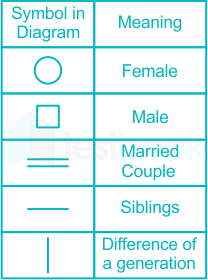
A simple family tree diagram showing different relations.

A is
Symbol+-×÷
MeaningFatherMotherSisterBrother
of B

Given Expression: S - G ÷ T - M × P + R

S - G → S is the mother of G

G ÷ T → G is the brother of T

T - M → T is the mother of M.

M × P → M is the sister of P

P + R → P is the father of R.

Thus, S is P's mother's mother.

Hence, "Option 4" is the correct answer.

16

Eight girls G, K, P, A, D, Q, S and M are sitting around a square table but not necessarily in the same order. Four of them sit at four corners of the table while four sit in the middle of each of four sides. The one who sits at the four corners face outside the center while those who sit in the middle of the sides face inside.

'Q' is sitting at one of the corners and she is third to the right of 'K'. 'A' is not sitting at any of the corners. 'P' is sitting second to the left of 'K' and immediately right of 'S'. 'K' and 'D' are facing each other. Who is sitting immediately left of 'Q'?

  1. ((a))

    K

  2. ((b))

    G

  3. ((c))

    D

  4. ((d))

    A

Show Answer
Answer: ((c))

D

Given: Eight girls G, K, P, A, D, Q, S and M are sitting around a square table but not necessarily in the same order. Four of them sit at four corners of the table while four sit in the middle of each of four sides. The one who sits at the four corners face outside the center while those who sit in the middle of the sides face inside.

1) 'Q' is sitting at one of the corners and she is third to the right of 'K'.

  1. 'P' is sitting second to the left of 'K' and immediately right of 'S'.

3) 'K' and 'D' are facing each other. 

  1. 'A' is not sitting at any of the corners.

After positioning D and A only two positions are left which will be occupied by the only two people left i.e. G and M.

Thus, D is sitting immediately left of 'Q'.

The correct answer is "Option 3".

17

Two statements are labelled below as Assertion (A) and Reason (R)

Assertion (A): Government of India has banned more than 10 years old Diesel Vehicles on the roads of Delhi.

Reason (R): Diesel prices have increased in the past few years.

Select correct answer with the help of code.

  1. ((a))

    (A) is true but (R) is false

  2. ((b))

    ​(A) is false but (R) is true

  3. ((c))

    Both (A) and (R) are true and (R) is correct explanation of (A)

  4. ((d))

    Both (A) and (R) are true but (R) is not correct explanation of (A)

Show Answer
Answer: ((d))

Both (A) and (R) are true but (R) is not correct explanation of (A)

According to the question:

Assertion (A): Government of India has banned more than 10 years old Diesel Vehicles on the roads of Delhi. → True

Reason (R): Diesel prices have increased in the past few years. → True

The government of India has banned diesel vehicles older than 10 years in Delhi to reduce air pollution and control harmful emissions, not because diesel prices have increased. while the assertion is true, the stated reason about fuel prices is unrelated.

Both (A) and (R) are true but (R) is not correct explanation of (A)

Hence, "Option 4" is the correct answer.

18

Tanya wears T-shirts of seven different colours Red, Green, Yellow, Blue, Purple, Orange and Magenta on seven different days of the week starting from Monday. She wears green T-shirt on Thursday. She does not wear yellow or purple colour T-shirts on Friday. She wears red colour T-shirt after the green colour T-shirt. She wears only purple colour T-shirt on the day between the days on which she wears Blue and Magenta colour T-shirts. She wears orange colour T-shirt after yellow colour T-shirt.

On which day she wears orange colour T-shirt?

  1. ((a))

    Saturday

  2. ((b))

    Wednesday

  3. ((c))

    Tuesday

  4. ((d))

    Sunday

Show Answer
Answer: ((d))

Sunday

Given: Tanya wears T-shirts of seven different colours Red, Green, Yellow, Blue, Purple, Orange and Magenta on seven different days of the week starting from Monday.

1) She wears green T-shirt on Thursday.

2) She does not wear yellow or purple colour T-shirts on Friday.

WeekdaysColour
Monday
Tuesday
Wednesday
ThursdayGreen
FridayYellow / Purple
Saturday
Sunday

3) She wears red colour T-shirt after the green colour T-shirt.

4) She wears only purple colour T-shirt on the day between the days on which she wears Blue and Magenta colour T-shirts.

  1. She wears orange colour T-shirt after yellow colour T-shirt.
WeekdaysColour
MondayBlue / Magenta
TuesdayPurple
WednesdayBlue / Magenta
ThursdayGreen
FridayRed
SaturdayYellow
SundayOrange

Thus, Tanya wears orange colour T-shirt on Sunday.

The correct answer is "Option 4".

19

Bhairav started from his home and travelled 50 meters towards East then turned to his right and travelled 150 meters from there he turned to his left and travelled 100 meters to reach a temple. From the temple he moved 250 meters towards North and then turned left and travelled 100 meters. Finally, he turned to his left and moved 100 meters to reach a point 'P. What is the direction and shortest distance of his home from the point 'P'?

  1. ((a))

    North, 150 meters

  2. ((b))

    West, 50 meters

  3. ((c))

    East, 100 meters

  4. ((d))

    North East, 90 meters

Show Answer
Answer: ((b))

West, 50 meters

Given:

Bhairav started from his home and travelled 50 meters towards East

then turned to his right and travelled 150 meters

from there he turned to his left and travelled 100 meters to reach a temple.

From the temple he moved 250 meters towards North and

then turned left and travelled 100 meters.

Finally, he turned to his left and moved 100 meters to reach a point 'P.

Thus, the shortest distance of Bhairav's home from the point 'P' is 50 m in the west direction.

Hence, "Option 2" is the correct answer.

20

If the first half of the following sequence is made the second half, which letter/number/ symbol will come at seventh place towards the left of the fifth place from the right end?

L, X, J, K, L, 1, U, A, 5, 9, H, 2, T, %, 9, @, 1, #

  1. ((a))

  2. ((b))

    1

  3. ((c))

    U

  4. ((d))

    @

Show Answer
Answer: ((d))

@

Given series: L, X, J, K, L, 1, U, A, 5, 9, H, 2, T, %, 9, @, 1, #

According to the question, the first half is made the second half.

New Sequence: 9, H, 2, T, %, 9, @, 1, #, L, X, J, K, L, 1, U, A, 5

Thus, the letter/number/ symbol that will come at seventh place towards the left of the fifth place from the right end → 9, H, 2, T, %, 9, @, 1, #, L, X, J, K, L, 1, U, A, 5 → @

The correct answer is "Option 4".

Alternate MethodNew Sequence: 9, H, 2, T, %, 9, @, 1, #, L, X, J, K, L, 1, U, A, 5

Fifth place from the right end : This is the 5th element from the end, which is L (at position 14).

Seventh place towards the left of L: Moving left means moving towards the beginning (subtracting positions).

Target Position = 14 - 7 = 7th position.

Find the element at the 7th position in the New Sequence:

9, H, 2, T, %, 9, @, 1, #, L, X, J, K, L, 1, U, A, 5.

The 7th element is @

Knowledge of ICT (10 questions)

21

Out of the following, which software you suggest most to develop and present a multimedia presentation on Cyber Security?

  1. ((a))

    Microsoft Word

  2. ((b))

    Microsoft PowerPoint

  3. ((c))

    Microsoft Edge

  4. ((d))

    Microsoft Excel

Show Answer
Answer: ((b))

Microsoft PowerPoint

The correct answer is Microsoft PowerPoint.

Key Points

  • Microsoft PowerPoint is a software application that is specifically designed for creating and presenting multimedia presentations.
  • It allows users to include text, images, videos, animations, and other multimedia elements to enhance the presentation.
  • PowerPoint offers features such as slide transitions, audio integration, and visual effects to make presentations engaging and interactive.
  • For a topic like Cyber Security, PowerPoint can help create structured slides with diagrams, visuals, and key points to effectively convey information.

Additional Information

  • Microsoft Word: This software is primarily used for word processing and creating text-based documents. It is not ideal for multimedia presentations.
  • Microsoft Edge: A web browser used for accessing the internet, not suitable for creating presentations.
  • Microsoft Excel: A spreadsheet software designed for data analysis, calculations, and charts, not for multimedia presentations.
22

The computer hardware device Switch is an example of:

  1. ((a))

    Networking device

  2. ((b))

    Output device

  3. ((c))

    Input device

  4. ((d))

    Storage device

Show Answer
Answer: ((a))

Networking device

The correct answer is Networking device.

Key Points

  • A switch is a networking device used to connect multiple devices on a local area network (LAN).
  • It operates at the Data Link Layer (Layer 2) of the OSI model and sometimes at the Network Layer (Layer 3).
  • Switches use MAC addresses to forward data to the correct device within the network, ensuring efficient communication.
  • They are essential in modern networks for managing traffic, reducing collisions, and improving overall network performance.

Additional Information

  • Output device: An output device is hardware that conveys information from a computer to the user, such as a monitor, printer, or speaker.
  • Input device: An input device is hardware used to provide data to a computer, such as a keyboard, mouse, or scanner.
  • Storage device: A storage device is hardware used to store digital data, such as a hard drive, SSD, or USB drive.
  • Switches: Unlike input, output, or storage devices, switches are specifically designed to connect devices within a network, enabling efficient data transfer.
23

Which of the following is the least threat for virus infection?

  1. ((a))

    Downloaded free software

  2. ((b))

    Downloaded email attachment

  3. ((c))

    Online printer

  4. ((d))

    Portable storage devices

Show Answer
Answer: ((c))

Online printer

The correct answer is Online Printer.

Key Points

  • Online printers are generally less likely to be sources of virus infections compared to other options like downloaded free software, email attachments, or portable storage devices.
  • This is because online printers typically do not execute files or programs that could carry malicious code.
  • However, it’s important to ensure the printer firmware is updated and secured to avoid vulnerabilities.
  • Other methods, like downloaded software or email attachments, are more prone to carrying viruses as they may contain executable files or malicious code.

Additional Information

  • Downloaded Free Software: Free software from unreliable sources can often contain hidden malware or viruses that infect your system when installed.
  • Downloaded Email Attachments: Email attachments are a common method for spreading viruses. Malicious actors often disguise malware as legitimate attachments.
  • Portable Storage Devices: USB drives and external hard drives can carry viruses that automatically execute once connected to a computer.
  • Online Printer: While less likely to be a direct threat, printers connected to the internet can still be exploited if not properly secured, but this risk is minimal compared to other options.
24

Which of the following set contains only input devices?

  1. ((a))

    Printer, Speaker, Monitor

  2. ((b))

    Keyboard, Mouse, Printer

  3. ((c))

    Keyboard, Mouse, Scanner

  4. ((d))

    Printer, Scanner, Speaker

Show Answer
Answer: ((c))

Keyboard, Mouse, Scanner

The correct answer is Option 3

Key Points

  • Input devices are hardware components that allow users to send data or instructions to a computer system.
  • Examples of input devices include the keyboard, mouse, scanner, microphone, and webcam.
  • Option 3 contains only input devices:
  • Keyboard: Used for typing and providing textual input to the computer.
  • Mouse: Used for pointing, clicking, and interacting with graphical user interfaces.
  • Scanner: Used for digitizing physical documents and images into electronic format.
  • Other options include output devices like printers, speakers, and monitors, which are not input devices.

Additional Information

  • Output Devices: These devices are used to display, project, or print information from the computer. Examples include printers, monitors, and speakers.
  • Hybrid Devices: Some devices, like touchscreens, can function as both input and output devices.
  • Understanding Input vs. Output: Input devices take user data and send it to the computer, while output devices take processed data from the computer and present it to the user.
25

Select the shortcut key, out of the following, which is popularly used to paste a selected (and copied) text or image in most of the MS Office applications.

  1. ((a))

    Ctrl+'X'

  2. ((b))

    Ctrl+'Z'

  3. ((c))

    Ctrl+'P'

  4. ((d))

    Ctrl+'V'

Show Answer
Answer: ((d))

Ctrl+'V'

The correct answer is Ctrl+'V'

Key Points

  • Ctrl+'V' is the universal shortcut key used for pasting content in most MS Office applications, including Word, Excel, and PowerPoint.
  • It is part of the standard keyboard shortcuts designed for copy-paste operations, where Ctrl+'C' is used for copying and Ctrl+'X' is used for cutting.
  • Using Ctrl+'V' allows users to quickly paste copied or cut text, images, or other content into the desired location.
  • This shortcut is widely recognized and utilized across various platforms and software applications.

Additional Information

  • Ctrl+'X': This shortcut key is used to cut selected content, removing it from its original location and copying it to the clipboard.
  • Ctrl+'Z': This shortcut key is used to undo the last action performed in most MS Office applications.
  • Ctrl+'P': This shortcut key is used to open the print dialog box in MS Office applications, allowing users to print the current document.
26

Which type of network, generally we establish, when we connect 20 computers in our school's computer lab, using some additional networking devices and wired cable?

  1. ((a))

    MAN

  2. ((b))

    WAN

  3. ((c))

    PAN

  4. ((d))

    LAN

Show Answer
Answer: ((d))

LAN

The correct answer is LAN (Local Area Network).

Key Points

  • LAN (Local Area Network): A LAN is generally used to connect computers and devices within a small geographical area, such as a school computer lab, office, or home.
  • It provides high-speed connectivity using wired or wireless methods, enabling efficient data sharing and communication among connected devices.
  • Networking devices: Devices such as switches, routers, and hubs are commonly used for establishing a LAN.
  • LANs are cost-effective and provide secure communication within the network.

Additional Information

  • MAN (Metropolitan Area Network): MAN covers a larger area than LAN, typically a city or campus, and is often used for interconnecting LANs within the same region.
  • WAN (Wide Area Network): WAN spans large geographical areas, such as countries or continents, connecting multiple LANs and MANs. The internet is an example of a WAN.
  • PAN (Personal Area Network): PAN is a small network used for connecting personal devices, such as smartphones, tablets, and laptops, typically within a few meters range.
27

In computer terminology, https stands for:

  1. ((a))

    Hyper Text Transfer Protocol Scheme

  2. ((b))

    Hyper Text Transfer Protocol Storage

  3. ((c))

    Hyper Text Transfer Protocol Server

  4. ((d))

    Hyper Text Transfer Protocol Secure

Show Answer
Answer: ((d))

Hyper Text Transfer Protocol Secure

The correct answer is Hyper Text Transfer Protocol Secure.

Key Points

  • HTTPS stands for Hyper Text Transfer Protocol Secure.
  • It is an extension of HTTP and uses a secure protocol to encrypt data transferred over the internet.
  • HTTPS ensures data security by using SSL (Secure Sockets Layer) or TLS (Transport Layer Security).
  • It protects users' sensitive information like passwords, credit card numbers, and other personal data from being intercepted by unauthorized parties.
  • Websites with HTTPS can be identified by the padlock icon in the browser's address bar and the "https://" prefix in the URL.

Additional Information

  • HTTP vs HTTPS: HTTP (Hyper Text Transfer Protocol) does not encrypt the communication between the client and server, making it less secure. HTTPS, on the other hand, provides encryption and ensures secure communication.
  • SSL/TLS: Secure Sockets Layer (SSL) and Transport Layer Security (TLS) are cryptographic protocols used to provide secure communications over computer networks.
  • Importance of HTTPS: It is essential for websites that handle sensitive user data, such as online shopping websites, banking portals, and other secure services.
  • SEO Benefits: Search engines like Google prioritize HTTPS-enabled websites in their rankings, as they provide a secure browsing experience to users.
28

Which of the following is not an example of web browser ?

  1. ((a))

    Edge

  2. ((b))

    Firefox

  3. ((c))

    Android

  4. ((d))

    Opera

Show Answer
Answer: ((c))

Android

The correct answer is Android.

Key Points

  • Web browsers are software applications used to access and view websites on the internet.
  • Examples of popular web browsers include Edge, Firefox, and Opera, which are specifically designed for this purpose.
  • Android, however, is an operating system designed for mobile devices, not a web browser.
  • While Android devices can run web browsers, Android itself is not a browser.

Additional Information

  • Edge: A web browser developed by Microsoft, known for its integration with Windows operating systems.
  • Firefox: A free and open-source web browser developed by the Mozilla Foundation.
  • Opera: A web browser known for its built-in features like ad-blocking and VPN services.
  • Android: An operating system for mobile devices, developed by Google, which provides a platform for running applications, including web browsers.
29

Arrange the following memory units in ascending order of their capacities.

Giga Byte, Kilo Byte, Mega Byte, Tera Byte

  1. ((a))

    Kilo Byte < Giga Byte < Mega Byte < Tera Byte

  2. ((b))

    Kilo Byte Mega Byte < Tera Byte < Giga Byte

  3. ((c))

    Giga Byte < Kilo Byte < Mega Byte < Tera Byte

  4. ((d))

    Kilo Byte < Mega Byte < Giga Byte < Tera Byte

Show Answer
Answer: ((d))

Kilo Byte < Mega Byte < Giga Byte < Tera Byte

The correct answer is Option 4

Key Points

  • Memory units are hierarchical in terms of their storage capacity.
  • Ascending order implies arranging memory units from smallest to largest capacity.
  • The correct order is: Kilo Byte < Mega Byte < Giga Byte < Tera Byte.
  • Explanation:
  • Kilo Byte (KB): The smallest unit among the options, equivalent to 1,024 bytes.
  • Mega Byte (MB): Larger than KB, equivalent to 1,024 KB.
  • Giga Byte (GB): Larger than MB, equivalent to 1,024 MB.
  • Tera Byte (TB): The largest among the options, equivalent to 1,024 GB.

Additional Information

  • Memory Hierarchy: Memory hierarchy includes various storage units like bit, byte, kilobyte, megabyte, gigabyte, terabyte, petabyte, and beyond. It is structured to optimize speed and capacity for different use cases.
  • Binary System: Memory units follow the binary system, where each level is 1,024 times larger than the previous unit (e.g., 1 KB = 1,024 Bytes).
  • Understanding memory hierarchy is important for computer storage, data processing, and optimizing system performance.
30

Which of the following is not a popular file  extension of an audio file?

  1. ((a))

    wav

  2. ((b))

    flac

  3. ((c))

    mp3

  4. ((d))

    pdf

Show Answer
Answer: ((d))

pdf

The correct answer is pdf.

Key Points

  • Popular audio file extensions include: wav, flac, and mp3.
  • pdf is not an audio file extension. It stands for Portable Document Format and is used for documents, not audio files.
  • wav: A popular uncompressed audio file format often used for high-quality sound recordings.
  • flac: A lossless audio compression format that provides high-quality sound while reducing file size.
  • mp3: A common audio file format that compresses sound while maintaining acceptable quality.

Additional Information

  • pdf files are primarily used to share documents that preserve their formatting across different devices.
  • Audio files are typically used for music, podcasts, sound effects, and other sound-based media, while pdf files are used for textual and graphical document sharing.

Teaching Aptitude (10 questions)

31

Which one of the following is least likely a factor affecting, learning?

  1. ((a))

    Readiness

  2. ((b))

    Co-curricular activities

  3. ((c))

    Imitation

  4. ((d))

    Maturation

Show Answer
Answer: ((b))

Co-curricular activities

Learning is a continuous process influenced by several internal and external factors such as motivation, interest, maturation, environment, and readiness. These factors determine how effectively an individual can acquire, retain, and apply knowledge or skills.

Key Points

  • Co-curricular activities are organized beyond classroom learning to promote holistic development, social interaction, and practical exposure.
  • Although they contribute to personality growth and life skills, they do not directly determine the process or pace of learning academic content.
  • Learning is primarily affected by internal psychological and biological factors, while co-curricular activities serve as supportive, not decisive, elements.
  • They enhance learning indirectly by fostering interest and motivation but are not fundamental determinants of learning outcomes. Hence, they are least likely to be considered a core factor affecting learning.

Hint

  • Readiness is a crucial factor because learning occurs best when the learner is mentally, physically, and emotionally prepared to acquire new knowledge.
  • Imitation strongly influences learning, especially in children, as they model behaviors and skills by observing others.
  • Maturation plays a vital role as certain levels of physical and mental growth are necessary before specific learning tasks can be mastered effectively.

Hence, the correct answer is co-curricular activities.

32

Which kind of ICT tools is not useful in learner centred approach?

  1. ((a))

    Constructive

  2. ((b))

    Communicative

  3. ((c))

    Informative 

  4. ((d))

    Situating

Show Answer
Answer: ((c))

Informative 

Information and Communication Technology (ICT) tools play a vital role in modern education by supporting different teaching-learning approaches. In a learner-centered approach, ICT is used to promote active participation, collaboration, exploration, and self-directed learning.

Key Points

  • Informative ICT tools mainly provide information in a one-way manner such as through digital textbooks, videos, or presentations.
  • They do not promote interaction, exploration, or problem-solving. In a learner-centered approach, students are expected to engage, discuss, and construct understanding rather than just receive facts.
  • Hence, informative tools are more teacher-directed and less participatory, making them less useful in learner-centered learning environments.

Hint

  • Constructive tools such as concept mapping or simulation software allow learners to build their own understanding and apply knowledge creatively.
  • Communicative tools like emails, discussion forums, or chats promote collaboration and sharing of ideas among learners and teachers.
  • Situating tools, such as virtual reality or interactive environments, place learners in realistic contexts to explore and apply knowledge meaningfully.

Hence**, the correct answer is informative.**

33

Identify the statement which is not correct: 

  1. ((a))

    Matching type of item is a form of multiple choice item.

  2. ((b))

    Every supply type item can be converted into selection type of item.

  3. ((c))

    ​Extended response item is an essay type item.

  4. ((d))

    Objective type of items are more preferable in measuring creative ability of the students.

Show Answer
Answer: ((d))

Objective type of items are more preferable in measuring creative ability of the students.

Assessment items in education are designed in different formats such as objective, subjective, and essay-type to measure various learning outcomes. Objective tests like multiple-choice or matching type are used to assess recall and understanding, while essay or extended response items evaluate higher-order skills like analysis and creativity.

Key Points

  • Objective type questions generally assess factual knowledge, comprehension, and application in a structured form with fixed answers.
  • Creativity, however, requires open-ended expression, originality, and elaboration, which cannot be effectively measured through fixed-response formats.
  • To evaluate creativity, essay-type or project-based assessments are more suitable. Hence, objective tests are not preferable for measuring students' creative ability.

Hint

  • Matching type items indeed belong to the category of multiple-choice items since they involve selecting correct responses from given options.
  • Supply type items, where learners generate answers, can often be converted into selection type by providing choices, although not always perfectly.
  • Extended response items allow students to write detailed answers and express ideas freely, making them a form of essay-type assessment.

Hence, the correct answer is objective type of items are more preferable in measuring creative ability of the students.

34

Which one of the following is not associated with unit test?

  1. ((a))

    Use of standardised achievement tests. 

  2. ((b))

    Results shared with parents.

  3. ((c))

    Confined to limited number of competencies.

  4. ((d))

    Totally controlled by the teacher.

Show Answer
Answer: ((a))

Use of standardised achievement tests. 

A unit test is a teacher-made assessment tool designed to evaluate learners’ understanding of a specific unit or topic taught in class. It helps teachers identify students’ strengths and weaknesses, provide feedback, and plan remedial teaching accordingly.

Key Points

  • Standardized achievement tests are developed by experts at a broader level to compare students’ performance across schools or regions.
  • These tests are not specific to a single unit and are not prepared or controlled by individual teachers.
  • Unit tests, on the other hand, are teacher-made, flexible, and focus on limited competencies within a unit. Therefore, the use of standardized achievement tests is not associated with unit testing, as their purpose and nature are entirely different.

Hint

  • Results of unit tests are usually shared with parents to keep them informed about their child’s progress.
  • Unit tests are confined to a limited number of competencies as they cover only a specific portion of the syllabus.
  • They are completely controlled by the teacher in terms of preparation, administration, and evaluation.

Thus, the correct answer is use of standardised achievement tests.

35

A creative student is one who has:

  1. ((a))

    Memorization ability

  2. ((b))

    Ability to solve problems

  3. ((c))

    Originality and flexibility of ideas

  4. ((d))

    Above average IQ

Show Answer
Answer: ((c))

Originality and flexibility of ideas

Creativity refers to the ability to generate new, original, and valuable ideas or solutions. In education, creative students are those who go beyond rote memorization and demonstrate imagination, flexibility, and innovation in thinking.

Key Points

  • A creative learner shows originality in thought, meaning they can come up with ideas that are new or different from the usual.
  • Flexibility allows them to view a situation from multiple perspectives and adapt their thinking to find various possible solutions.
  • Such students often express imagination and innovation in their work, demonstrating divergent rather than convergent thinking. Hence, creativity is best reflected through originality and flexibility of ideas rather than mere intelligence or memorization.

Hint

  • Memorization ability involves recalling facts, which reflects rote learning, not creativity.
  • Ability to solve problems is related to intelligence or reasoning but may not necessarily involve innovative or original approaches.
  • Above-average IQ supports learning efficiency but does not ensure creativity, as creative thinking requires imagination and risk-taking beyond logical reasoning.

Hence, the correct answer is originality and flexibility of ideas.

36

Which principle of play way method helps in cultivating self discipline?

  1. ((a))

    Principle of creativity 

  2. ((b))

    Principle of responsibility

  3. ((c))

    Principle of complete freedom 

  4. ((d))

    Principle of activity

Show Answer
Answer: ((b))

Principle of responsibility

The Play Way Method, developed by H. Caldwell Cook, emphasizes learning through play, activity, and joyful experiences rather than rote memorization. It is based on principles that promote natural development, freedom of expression, creativity, and self-learning.

Key Points

  • When learners are given freedom in play-based activities, they also learn to take responsibility for their actions and decisions.
  • This sense of responsibility gradually develops self-discipline, as children learn to follow rules, cooperate with peers, and manage their own behavior.
  • Through responsible participation, they understand the balance between freedom and discipline, which is essential for social and emotional growth.
  • Thus, the principle of responsibility helps cultivate self-discipline naturally through guided independence.

Hint

  • Principle of creativity focuses on developing imagination and innovation rather than discipline.
  • Principle of complete freedom may lead to lack of control if not guided properly, and does not necessarily build self-discipline.
  • Principle of activity emphasizes learning by doing but does not directly aim at fostering responsibility or discipline.

Hence, the correct answer is principle of responsibility.

37

Complete the statement:

In teaching if nothing has been learned, nothing has been

  1. ((a))

    examined

  2. ((b))

    observed

  3. ((c))

    taught 

  4. ((d))

    studied

Show Answer
Answer: ((c))

taught 

Teaching and learning are two interdependent processes. The effectiveness of teaching is judged not by what the teacher delivers but by what the learner understands, internalizes, and applies. Hence, the learning outcome is the true measure of successful teaching.

Key Points

  • If students have not learned anything, it means the teaching process has failed to achieve its purpose.
  • Teaching is meaningful only when it results in learning, comprehension, or change in behavior.
  • Therefore, if no learning takes place, it cannot be considered that real teaching has occurred.
  • This idea emphasizes that teaching is not about transmission of information but about facilitating understanding and growth.

Hint

  • Examined refers to assessment or evaluation, which comes after learning, not during the teaching process.
  • Observed relates to watching or noticing, which is not directly connected with the success of teaching.
  • Studied refers to the learner’s effort but does not ensure that effective teaching has taken place.

Hence, the correct answer is taught.

38

Which is not an advantage of integrated textbooks?

  1. ((a))

    These may not suit student's individual learning styles.

  2. ((b))

    Such textbooks provide support to inexperienced teachers.

  3. ((c))

    Textbook can be used as a syllabus.

  4. ((d))

    These provide readymade materials.

Show Answer
Answer: ((a))

These may not suit student's individual learning styles.

Integrated textbooks combine content from various subjects or themes into a single book to promote holistic learning. They are designed according to child-centered and activity-based approaches, making learning more meaningful and interconnected.

Key Points

  • Integrated textbooks follow a common structure designed for all learners, which may not align with every student’s preferred way of learning.
  • Some students may require more subject-specific depth or different learning approaches that integrated materials do not always address.
  • Hence, while they promote connected learning, they might not cater equally to individual learning differences, making this statement not an advantage of integrated textbooks.

 Hint

  • They provide support to inexperienced teachers by offering structured lesson plans and integrated activities for effective classroom delivery.
  • They can serve as a syllabus since they cover multiple subjects and align with curriculum objectives.
  • They offer readymade materials like activities, worksheets, and stories that simplify lesson planning for teachers.

Hence, the correct answer is these may not suit student's individual learning styles.

39

A teacher first tells the rule and principle and then cites examples to explain the concept. Which approach she/he is adopting? 

  1. ((a))

    Explanatory

  2. ((b))

    Investigatory

  3. ((c))

    Inductive

  4. ((d))

    Deductive

Show Answer
Answer: ((d))

Deductive

In teaching, different approaches are used to help students understand concepts. The deductive approach begins with a general rule, principle, or theory and then illustrates it with specific examples. In contrast, the inductive approach starts with observations or examples and leads learners to infer the general principle.

Key Points

  • When a teacher first presents a rule or principle and then provides examples to explain it, the method follows a deductive approach.
  • This approach helps learners understand the general concept first and then see how it applies in specific situations. It is particularly effective when students need clear guidance or when the rule is complex and requires structured explanation.
  • By showing examples after the principle, learners can easily relate abstract concepts to practical applications.

Hint

  • Investigatory approach involves learners actively exploring, experimenting, and discovering concepts themselves rather than being told the rule.
  • Inductive approach works from specific examples or observations to derive a general principle, opposite to the deductive method.
  • Explanatory can be seen as a general description but specifically matches the deductive method of teaching rather than exploration or induction.

Hence**, the correct answer is deductive.**

40

Which one of the following is not a characteristics of 'Assessment for Learning'?

  1. ((a))

    It is judgmental and hence evaluative.

  2. ((b))

    It provides continuous feedback.

  3. ((c))

    It helps in identifying strengths and weaknesses of every student.

  4. ((d))

    It allows students to reflect upon their work so as to take specific-actions to improve upon.

Show Answer
Answer: ((a))

It is judgmental and hence evaluative.

Assessment for Learning (AfL) is a formative approach aimed at improving learning rather than merely judging it. It focuses on providing continuous feedback, guiding students to identify their strengths and weaknesses, and enabling them to take corrective actions.

Key Points

  • Assessment for Learning is not primarily judgmental.
  • Its goal is to support learning by giving constructive feedback and helping students improve.
  • Being judgmental or evaluative focuses on ranking or grading, which aligns more with Assessment of Learning.
  • AfL seeks to create a supportive environment where mistakes are opportunities for growth rather than reasons for judgment, fostering self-reflection and active learning.

Hint

  • Providing continuous feedback helps learners understand what they have mastered and where they need improvement.
  • Identifying strengths and weaknesses allows teachers to tailor instruction according to individual learner needs.
  • Allowing students to reflect on their work encourages self-regulation and the development of strategies to improve performance.

Hence**, the correct answer is it is judgmental and hence evaluative.**

Domain Knowledge (80 questions)

41

Given below are two statements. Read them carefully and choose the correct answer with the help of given options.

Statement (I): There is a general consensus that high level of buffer stocks of food grains is very undesirable and can be wasteful.

Statement (II): The rising Minimum Support Prices (MSP) have raised the maintenance cost of procuring foodgrains by the government.

  1. ((a))

    Both Statement (I) and Statement (II) are false.

  2. ((b))

    Statement (I) is true but Statement (II) is false.

  3. ((c))

    Statement (I) is false but Statement (II) is true.

  4. ((d))

    Both Statement (I) and Statement (II) are true.

Show Answer
Answer: ((d))

Both Statement (I) and Statement (II) are true.

The correct answer is - Both Statement (I) and Statement (II) are true.

Key Points

  • Statement (I): There is a general consensus that high levels of buffer stocks of food grains are very undesirable and can be wasteful.
  • Buffer stocks are maintained by the government to ensure food security and stabilize prices during shortages or emergencies.
  • However, excessive buffer stocks lead to wastage due to storage limitations, degradation of food quality, and high maintenance costs.
  • Large stocks can also create inefficiencies in resource allocation, as funds could be better utilized for infrastructure or welfare programs.
  • Thus, there is widespread agreement on the need to optimize buffer stock levels to avoid wastage and ensure efficient resource usage.
  • Statement (II): The rising Minimum Support Prices (MSP) have raised the maintenance cost of procuring food grains by the government.
  • MSP is a pre-announced price set by the government to protect farmers from price fluctuations and ensure fair remuneration.
  • In recent years, the government has consistently raised MSP for various crops to support farmers and encourage agricultural production.
  • Higher MSP leads to increased procurement costs for the government, as it has to purchase food grains at elevated prices.
  • This, in turn, raises the maintenance cost of buffer stocks and puts additional financial pressure on the government.

Additional Information

  • Buffer Stock Management:
  • The Food Corporation of India (FCI) is responsible for maintaining buffer stocks under the Public Distribution System (PDS).
  • Excessive stocks not only lead to wastage but also incur high storage costs due to infrastructure requirements such as warehouses and cold storage facilities.
  • Minimum Support Price (MSP):
  • MSP is announced by the government based on recommendations from the Commission for Agricultural Costs and Prices (CACP).
  • It serves as a safety net for farmers, ensuring they receive a minimum income even in case of market fluctuations.
  • However, rising MSPs have implications for fiscal stability, as they increase the government's procurement expenses and subsidy burden.
42

Given below are two statements. One of them is Assertion (A) and the other is Reason (R). Read them carefully and choose the correct answer with the help of given options.

Assertion (A): Different countries use different poverty lines.

Reason (R): What is necessary to satisfy the basic needs is different for different countries.

  1. ((a))

    (A) and (R) both are true but (R) is not the correct explanation of (A).

  2. ((b))

    (A) is true but (R) is false.

  3. ((c))

    (A) is false but (R) is true.

  4. ((d))

    (A) and (R) both are true and (R) is the correct explanation of (A).

Show Answer
Answer: ((d))

(A) and (R) both are true and (R) is the correct explanation of (A).

The correct answer is - (A) and (R) both are true and (R) is the correct explanation of (A)

Key Points

  • Assertion (A): Different countries use different poverty lines.
  • Poverty lines are benchmarks used to determine the minimum income level necessary for individuals to meet their basic needs such as food, clothing, and shelter.
  • Different countries set their poverty lines based on factors like income levels, cost of living, and socio-economic conditions of their population.
  • Reason (R): What is necessary to satisfy the basic needs is different for different countries.
  • Basic needs vary by region due to differences in cultural practices, climate, infrastructure, and economic conditions.
  • For example, the poverty line in developed nations like the United States considers access to technology and healthcare, while in developing countries, it may focus primarily on food and shelter.
  • This variation in basic needs explains why countries use different poverty lines.
  • Conclusion: Since the reason (R) clearly explains why assertion (A) is true, the correct answer is that both (A) and (R) are true, and (R) is the correct explanation of (A).

Additional Information

  • Poverty Line:
  • The concept of a poverty line is used globally to measure and address poverty. It represents the income threshold below which an individual or family cannot afford basic necessities.
  • The World Bank uses an international poverty line of $2.15 per day (2022 figures), adjusted for purchasing power parity (PPP), to compare poverty across countries.
  • Economic and Social Factors:
  • Differences in poverty lines arise due to varying economic indicators like GDP, inflation, and employment rates.
  • Social factors, such as expectations regarding living standards, also influence what is considered "basic needs."
43

Food security means:

  1. ((a))

    Availability and affordability of food to all the people.

  2. ((b))

    Accessibility and affordability of food to poor people.

  3. ((c))

    Availability, accessibility and affordability of food to all people.

  4. ((d))

    Availability and accessibility of food to poor people.

Show Answer
Answer: ((c))

Availability, accessibility and affordability of food to all people.

The correct answer is - Availability, accessibility, and affordability of food to all people

Key Points

  • Food security
  • Food security refers to ensuring that all individuals have access to sufficient, safe, and nutritious food to meet their dietary needs and preferences for an active and healthy life.
  • It encompasses three primary dimensions:
  • Availability: There must be an adequate supply of food through production, distribution, and trade.
  • Accessibility: People should have physical and economic access to food. This includes affordability, infrastructure, and location considerations.
  • Affordability: Food should be economically accessible to all, regardless of income level.
  • The concept of food security is inclusive, addressing the needs of all people, not just the poor, as food insecurity can affect individuals across socioeconomic groups.

Additional Information

  • Availability of food
  • This refers to the physical presence of food in sufficient quantities. It is influenced by factors such as agricultural production, imports, stock levels, and trade policies.
  • Availability alone does not ensure food security, as people must also be able to access and afford the food.
  • Accessibility of food
  • This includes both physical and economic access to food. People should be able to obtain food through proper transportation, market systems, and affordability.
  • Accessibility issues may arise due to social inequalities, conflict, or poor infrastructure.
  • Affordability of food
  • Affordability ensures that food prices are within reach for all individuals, including those with lower incomes.
  • Economic instability, inflation, and poverty can severely impact food affordability.
44

Which of the following teaching learning material/methods can you use in your secondary class to discuss about 1943's famine of Bengal?

(A) Drama

(B) Novels

(C) Photographs

(D) Newspaper Reports

  1. ((a))

    (A), (B), (D) 

  2. ((b))

    (B), (C), (D)

  3. ((c))

    (A), (C), (D)

  4. ((d))

    (A), (B), (C)

Show Answer
Answer: ((b))

(B), (C), (D)

Teaching historical events like the 1943 Bengal Famine requires methods that make the social, economic, and human impact tangible for students. Using varied teaching-learning materials helps learners understand the gravity of events, encourages empathy, and develops analytical and critical thinking skills.

Key Points

  • Historical novels or literary works portraying the Bengal famine help students emotionally and intellectually connect with the event. They provide context, perspectives, and human experiences associated with the famine.
  • Photographs provide visual evidence of the famine’s impact, showing conditions, suffering, and relief efforts.
  • Newspaper reports from that period serve as primary sources, helping students analyze contemporary accounts and perspectives.
  • Combining these methods offers experiential, visual, and analytical learning, making the historical event more vivid and comprehensible in the classroom.

Hint

  • While drama is useful for expressing ideas, it does not provide factual historical evidence for a sensitive event like the Bengal famine.

Dramatization may oversimplify or fictionalize facts. Therefore, it is not the most appropriate material for studying such a historically significant tragedy in a secondary class.

Hence**, the correct answer is (B), (C), (D).**

45

Given below are two statements. Read them carefully and choose the correct answer with the help of given options.

Statement (I): Hunger brings about poverty.

Statement (II): Hunger is the only indication of food insecurity.

  1. ((a))

    Both Statement (I) and Statement (II) are false.

  2. ((b))

    Statement (I) is true but Statement (II) is false.

  3. ((c))

    Statement (I) is false but Statement (II) is true.

  4. ((d))

    Both Statement (I) and Statement (II) are true.

Show Answer
Answer: ((b))

Statement (I) is true but Statement (II) is false.

The correct answer is - Both Statement (I) and Statement (II) are false

Key Points

  • Statement (I): Hunger brings about poverty.
  • This statement is false. Hunger is not the direct cause of poverty; rather, it is often a consequence of poverty. Poverty limits access to sufficient food, healthcare, and education, leading to hunger and malnutrition.
  • Poverty is caused by a combination of factors, including lack of resources, unemployment, inequality, and systemic issues. Hunger is an outcome of these factors rather than a root cause.
  • Statement (II): Hunger is the only indication of food insecurity.
  • This statement is also false. Hunger is one of the indicators of food insecurity, but it is not the only one.
  • Food insecurity also includes aspects such as:
  • Uncertainty about the ability to acquire food.
  • Reduced quality and variety of food available.
  • Inadequate nutritional intake, even if the quantity of food is sufficient.
  • Stress and anxiety related to food availability.
  • Thus, food insecurity encompasses a broader range of issues beyond hunger.

Additional Information

  • Why are other options incorrect?
  • Statement (I) is true but Statement (II) is false: This is incorrect because Statement (I) is false. Hunger does not cause poverty; rather, poverty can cause hunger.
  • Statement (I) is false but Statement (II) is true: This is incorrect because Statement (II) is also false. Hunger is not the sole indicator of food insecurity.
  • Both Statement (I) and Statement (II) are true: This is incorrect because neither Statement (I) nor Statement (II) is true, as explained above.
  • Food Insecurity:
  • Food insecurity refers to the lack of consistent access to enough safe and nutritious food for an active and healthy life.
  • It is a global issue that affects millions of people, especially in developing countries.
  • Factors contributing to food insecurity include poverty, climate change, conflict, and economic instability.
46

Given below are two statements, one of them is Assertion (A) and the other is Reason (R). Read them carefully and choose the correct answer with the help of given options.

Assertion (A): The social composition along with the inability to buy food plays a role in food insecurity.

Reason (R): The SCs, STs and some sections of the OBCs, who have either poor land-base or very low land productivity are prone to food insecurity.

  1. ((a))

    Both (A) and (R) are true but (R) is not the correct explanation of (A).

  2. ((b))

    (A) is true but (R) is false.

  3. ((c))

    (A) is false but (R) is true.

  4. ((d))

    Both (A) and (R) are true and (R) is the is the correct explanation of (A).

Show Answer
Answer: ((d))

Both (A) and (R) are true and (R) is the is the correct explanation of (A).

The correct answer is - Both (A) and (R) are true and (R) is the correct explanation of (A).

Key Points

  • Assertion (A): The social composition along with the inability to buy food plays a role in food insecurity.
  • The assertion highlights the interplay between social factors, such as caste and economic challenges, in determining food security.
  • People from marginalized sections of society often face systemic discrimination, which limits their access to resources, including food.
  • Food insecurity is closely tied to poverty, land ownership, and productivity, making it a multifaceted problem.
  • Reason (R): The SCs, STs, and some sections of the OBCs, who have either poor land-base or very low land productivity are prone to food insecurity.
  • This reasoning directly explains the assertion, as it identifies specific social groups that are more vulnerable to food insecurity due to their economic and social circumstances.
  • Marginalized communities often have limited access to fertile land or own land that has low productivity, which directly impacts their ability to grow or afford food.
  • Such structural inequalities in land ownership and economic opportunities perpetuate cycles of poverty and food insecurity.

Additional Information

  • Explanation of other options:
  • (A) is true but (R) is false: This is incorrect because (R) is true and provides a valid explanation of (A).
  • (A) is false but (R) is true: This is incorrect because (A) is valid, as social composition and purchasing power significantly affect food security.
  • Both (A) and (R) are true but (R) is not the correct explanation of (A): This is incorrect because (R) directly explains why social composition and economic factors contribute to food insecurity.
  • Relevant concepts:
  • Food Insecurity: It refers to the lack of consistent access to enough food for an active, healthy life, often caused by poverty, unemployment, or systemic inequalities.
  • Marginalized Communities: Social groups such as Scheduled Castes (SCs), Scheduled Tribes (STs), and sections of Other Backward Classes (OBCs) often face social and economic exclusion, limiting their access to resources like land, education, and employment.
  • Land Productivity: The ability of land to produce crops is crucial for food security. Low land productivity makes it harder for farmers to sustain themselves and their families, leading to food insecurity.
47

Choose the correct statement from the following.

(A) The proportion of people below poverty line is same for all social groups and economic categories in India.

(B) Social groups which are most vulnerable to poverty is scheduled caste and scheduled tribe households.

(C) Among the economic groups, the most vulnerable groups are the rural agricultural labour households and the urban casual labour households.

  1. ((a))

    (B) and (C)

  2. ((b))

    Only (A)

  3. ((c))

    Only (C)

  4. ((d))

    (A) and (B)

Show Answer
Answer: ((a))

(B) and (C)

The correct answer is - (B) and (C)

Key Points

  • Social groups vulnerable to poverty (Statement B):
  • In India, poverty is not equally distributed across all social groups.
  • Scheduled Caste (SC) and Scheduled Tribe (ST) households are disproportionately affected by poverty due to historical socio-economic disadvantages, discrimination, and limited access to resources.
  • The lack of education, inadequate representation in formal sectors, and geographical isolation of ST communities amplify their vulnerability.
  • This makes SC and ST households the most vulnerable to poverty among the social groups.
  • Economic groups vulnerable to poverty (Statement C):
  • Among the economic groups, rural agricultural labor households and urban casual labor households are the most vulnerable.
  • Rural agricultural laborers often face seasonal unemployment, low wages, and a lack of alternative livelihood opportunities.
  • Urban casual laborers are frequently engaged in informal and insecure jobs with low pay and no job security, making them highly susceptible to poverty.
  • The lack of social security measures for these groups exacerbates their economic vulnerability.

Additional Information

  • Why statement (A) is incorrect:
  • The proportion of people below the poverty line is not the same for all social groups and economic categories in India.
  • Various factors, such as caste, occupation, geographical location, and access to resources, contribute to the disparity in poverty levels.
  • For instance, Scheduled Castes and Scheduled Tribes, as well as agricultural laborers, face higher poverty rates compared to other groups.
  • Poverty in India:
  • Poverty is measured based on consumption expenditure and varies across rural and urban areas.
  • Government schemes such as the Mahatma Gandhi National Rural Employment Guarantee Act (MGNREGA) aim to address poverty among vulnerable groups.
  • Despite these measures, socio-economic inequalities persist, contributing to high poverty levels among certain groups.
48

Which of the following Statement is true about 'Perspective Plan' ?

  1. ((a))

    Equal importance is given to each goal in these plans.

  2. ((b))

    It comprises of specific goals and general objectives.

  3. ((c))

    Goals in these plans may be in conflict with each other.

  4. ((d))

    They are for a duration of 5 Years.

Show Answer
Answer: ((c))

Goals in these plans may be in conflict with each other.

The correct answer is - Goals in these plans may be in conflict with each other.

Key Points

  • Goals in Perspective Plans may be in conflict with each other
  • Perspective Plans are long-term strategic plans that outline broader objectives and goals for a specified period, often spanning 15 to 20 years.
  • These plans aim to set a vision for the future development of a nation, sector, or organization.
  • However, since they involve multiple goals across different sectors and areas, some goals may conflict with others due to competing interests or resources. For example, industrial growth goals might conflict with environmental sustainability goals.
  • The conflicting nature arises due to the diverse priorities and the need to balance economic, social, and environmental factors.

Additional Information

  • Equal importance is given to each goal in these plans
  • Perspective Plans generally prioritize goals differently based on the importance and feasibility of achieving them within the long-term framework.
  • Not all goals are given equal importance, as some might take precedence due to urgent needs or greater impact on development.
  • It comprises specific goals and general objectives
  • Perspective Plans typically focus more on general objectives and broader visions rather than specific, detailed goals. Detailed goals are often included in shorter-term plans like annual or five-year plans.
  • They are for a duration of 5 Years
  • Five-year plans are a separate category of planning with a medium-term horizon, focusing on specific and actionable goals for national development.
  • Perspective Plans differ from five-year plans, as they are long-term strategies that provide a broader framework for development over 15-20 years.
49

Choose the correct answer from the following:

(A) There is disguised employment in urban areas.

(B) Increase in unemployment is an indicators of a depressed economy.

(C) The workforce population includes people from 12 years to 59 years.

(D) In the case of the tertiary sector, various new services are now appearing like Bio-technology, information technology and so on.

  1. ((a))

    (B) and (C)

  2. ((b))

    (B) and (D)

  3. ((c))

    (A) and (D)

  4. ((d))

    (A) and (B)

Show Answer
Answer: ((b))

(B) and (D)

The Correct Answer is: (B) and (D)

Key Points

  • (A) There is disguised employment in urban areas:
  • This statement is incorrect.
  • Disguised employment primarily occurs in rural areas, especially in the agricultural sector, where more people are engaged in work than required, leading to inefficiency.
  • In urban areas, employment issues are typically related to structural unemployment, underemployment, or lack of skill matching, but disguised unemployment is not a major concern.
  • (B) Increase in unemployment is an indicator of a depressed economy:
  • This statement is correct.
  • Unemployment is a key indicator of economic health. A rise in unemployment reflects reduced economic activity, lower demand for goods and services, and a lack of job opportunities, signaling economic depression.
  • Depressed economies often experience declining GDP, reduced investments, and a shrinking labor market, all contributing to higher unemployment rates.
  • (C) The workforce population includes people from 12 years to 59 years:
  • This statement is incorrect.
  • The workforce population includes people aged from 15 years to 59 years.
  • The working-age population gives an estimate of the total number of potential workers within an economy. The age limits of the working-age population can vary from country to country.
  • There were around 521 million workers in India, the second largest after China based on the world factbook data.
  • (D) In the case of the tertiary sector, various new services are now appearing like Bio-technology, information technology and so on:
  • This statement is correct.
  • The tertiary sector, also known as the service sector, includes industries that provide services rather than goods. Emerging fields like biotechnology, information technology, and digital services are expanding rapidly within this sector.
  • These new services play a vital role in modern economies, driving innovation, employment, and economic growth.

Additional Information

  • Disguised Employment:
  • Disguised employment occurs when more workers are employed than are actually required for a job, leading to inefficient utilization of labor.
  • It is common in rural agricultural settings where family members contribute to farming despite the lack of necessity.
  • Indicators of Economic Depression:
  • Besides unemployment, other indicators include declining GDP, reduced consumer spending, falling investments, and deflation or stagnation in prices.
  • Policy measures such as fiscal stimulus and employment generation schemes are often used to counter economic depression.
  • Tertiary Sector Growth:
  • The tertiary sector is increasingly driven by advancements in technology and globalization, creating opportunities in sectors like healthcare, education, financial services, and IT.
  • These services are essential for the functioning of modern economies, contributing significantly to GDP and employment.
50

Fill in the blanks:

'Physical Capital' formation is a/an _________.

(A) Economic Process

(B) Technical Process

(C) Social Process

  1. ((a))

    (B) and (C)

  2. ((b))

    (A) and (C)

  3. ((c))

    Only (A)

  4. ((d))

    (A) and (B)

Show Answer
Answer: ((d))

(A) and (B)

The correct answer is - (A) and (B)

Key Points

  • Physical Capital Formation
  • Physical capital formation refers to the creation or accumulation of physical assets such as tools, machinery, infrastructure, equipment, and buildings that support production.
  • It is an economic process because it involves investment decisions, allocation of resources, and contributes to production and economic growth.
  • It is also a technical process because the development, installation, and use of physical capital require technical knowledge, engineering, and technology-based methods.
  • Hence, the formation of physical capital has both economic and technical dimensions.

Additional Information

  • Economic Process
  • Involves activities related to production, distribution, and consumption of goods and services.
  • Physical capital formation fits here because it increases productive capacity through investment.
  • Technical Process
  • Relates to the application of methods, innovations, engineering, and technology.
  • The creation and use of machinery, tools, and infrastructure depend heavily on technical expertise.
  • Social Process
  • Concerns interactions among individuals and groups in society.
  • Physical capital formation is not primarily social, as it deals with material assets rather than relationships or social behavior.
51

Which of the following is/are true about Department of school education as per NEP 2020 ?

(A) It is the apex-state level body in school education.

(B) It will be involved with the provisions and operations of schools.

(C) It will be responsible for overall monitoring and policy making for continued improvement of the public education system.

  1. ((a))

    (B) and (C)

  2. ((b))

    (A) and (C)

  3. ((c))

    Only (A)

  4. ((d))

    (A) and (B)

Show Answer
Answer: ((b))

(A) and (C)

The National Education Policy (NEP) 2020 emphasizes strengthening governance and administration in school education through clear roles at different levels.

Key Points

  • The Department of School Education serves as the apex body at the state level, providing leadership and direction for school education. It is tasked with overall monitoring, policy making, and continuous improvement of public education systems.
  • While it sets standards, designs programs, and ensures accountability, it does not typically involve itself in the day-to-day operations of schools. Its focus is on governance, planning, and systemic development rather than direct school management.

Hence, the correct answer is (A) and (C).

52

Which of the following is true about "the languages of India" project as per NEP 2020 ?

(A) It will be for grades VI-VIII.

(B) It will be part of assessment.

(C) In this, the students will learn to say commonly spoken phrases and sentences in every major language.

  1. ((a))

    (B) and (C)

  2. ((b))

    (A) and (C)

  3. ((c))

    Only (C)

  4. ((d))

    (A) and (B)

Show Answer
Answer: ((b))

(A) and (C)

The National Education Policy (NEP) 2020 emphasizes multilingualism and the promotion of all Indian languages. One initiative in this direction is the “Languages of India” project, which aims to familiarize students with linguistic diversity, promote respect for different languages, and encourage functional multilingual communication.

Key Points

  • Under the “Languages of India” project, students are encouraged to learn to say commonly spoken phrases and sentences in major Indian languages.
  • It will be for grades VI-VIII.
  • This initiative is meant to develop basic communication skills and cultural understanding, fostering multilingual awareness.
  • It is not limited to specific grades, nor is it formally part of assessment; the focus is experiential and participatory rather than evaluative.

Hence, the correct answer is (A) and (C).

53

Which of the following methods have been proposed by NEP 2020 for promoting the culture of reading across the country?

(A) Development of enjoyable and inspirational books only in Hindi language. 

(B) Establishment of public and school libraries.

(C) Development of digital libraries.

(D) Formation of National book promotion policy.

  1. ((a))

    (B), (C) and (D)

  2. ((b))

    (A), (C) and (D)

  3. ((c))

    (A), (B) and (D)

  4. ((d))

    (A), (B) and (C)

Show Answer
Answer: ((a))

(B), (C) and (D)

NEP 2020 emphasizes fostering a culture of reading to enhance literacy, critical thinking, and lifelong learning. It recognizes that access to diverse reading materials, both physical and digital, and policies promoting books are essential to encourage reading habits among students and the general public.

Key Points

  • Establishing public and school libraries provides physical spaces where students and citizens can access books, creating an environment conducive to reading.
  • Developing digital libraries ensures wider reach and access to a variety of resources across languages.
  • The formation of a national book promotion policy creates systematic support for authors, publishers, and reading initiatives to promote reading habits. These measures collectively foster a robust culture of reading nationwide, addressing both accessibility and motivation.

Hint

  • Development of books only in Hindi language is incorrect because NEP 2020 promotes multilingualism and encourages reading materials in multiple languages, not just one.

Hence, the correct answer is (B), (C) and (D).

54

Which of the following is true about NEP 2020 ?

(A) It is the first policy which talks about providing breakfast in addition to mid- day meal nationally.

(B) It modifies and restructures the school education as 5 + 3 + 3 + 4 system.

(C) It focuses on promotion of Sanskrit over

other Indian language.

  1. ((a))

    (B) and (C)

  2. ((b))

    (A) and (C)

  3. ((c))

    Only (B)

  4. ((d))

    (A) and (B)

Show Answer
Answer: ((d))

(A) and (B)

The National Education Policy (NEP) 2020 is a comprehensive framework aimed at transforming school and higher education in India. It addresses curriculum, pedagogy, assessment, teacher training, and equitable access to education. 

Key Points

  • Research indicates that the morning period following a nutritious breakfast is especially effective for learning cognitively demanding subjects. Therefore, this time can be optimally utilized by offering a simple yet energizing breakfast alongside the mid-day meal.
  • NEP 2020 restructures school education into a 5 + 3 + 3 + 4 system: the first 5 years include foundational education (ages 3–8), followed by preparatory (3 years), middle (3 years), and secondary (4 years) stages.
  • This system replaces the older 10+2 structure and aims to align schooling with cognitive and developmental stages of children.

Hint

  • (C): NEP 2020 promotes multilingualism and classical languages like Sanskrit, but it does not prioritize Sanskrit over other Indian languages; it encourages learning multiple languages based on regional and cultural contexts.

Hence, the correct answer is only (A) and (B).

55

Which among the following is true about 'School Preparation Module'?

(A) It is for all grade - I students.

(B) It is for a duration of 3 months.

(C) It will be developed on a central mode only by the NCERT for standardization.

  1. ((a))

    (B) and (C)

  2. ((b))

    (A) and (C)

  3. ((c))

    Only (A)

  4. ((d))

    (A) and (B)

Show Answer
Answer: ((d))

(A) and (B)

The ‘School Preparation Module’ under NEP 2020 is designed to help children transition smoothly into formal schooling, particularly into Grade I. It focuses on developing foundational skills, social-emotional readiness, and familiarity with classroom routines before regular academic sessions begin. This module is meant to bridge gaps between early childhood care and education (ECCE) and formal schooling.

Key Points

  • The module is specifically intended for all Grade I students to ensure they are ready for formal schooling. Its duration is typically around three months, providing sufficient time for children to develop cognitive, social, and emotional preparedness.
  • Through structured activities, play, and early literacy and numeracy experiences, the module facilitates a smooth transition from pre-primary to primary education, ensuring that students begin Grade I with confidence and basic readiness skills.

Hint(C) – The module is not developed centrally in a standardized form only by NCERT. States and schools are encouraged to adapt it according to local context and learner needs, allowing flexibility in implementation.

Hence**, the correct answer is (A) and (B).**

56

Given below are two statements, one of them is Assertion (A) and the other is Reason (R). Read them carefully and choose the correct answer.

Assertion (A): The powers given by the constitution to the local bodies are called decentralisation of power.

Reason (R): The basic idea behind decentralisation is that many issues and problems can be dealt with locally.

  1. ((a))

    Both (A) and (R) are true but (R) is not the correct explanation of (A).

  2. ((b))

    (A) is true but (R) is false.

  3. ((c))

    Both (A) and (R) are true and (R) is the correct explanation of (A).

  4. ((d))

    (A) is false but (R) is true.

Show Answer
Answer: ((a))

Both (A) and (R) are true but (R) is not the correct explanation of (A).

The correct answer is - Both (A) and (R) are true and (R) is the correct explanation of (A).

Key Points

  • Decentralisation of power:
  • The term refers to the delegation of governance and decision-making powers from the central authority to local governing bodies like municipalities and panchayats.
  • It enhances the efficiency of governance by addressing local issues at the grassroots level.
  • Assertion (A):
  • The Constitution of India recognizes the importance of decentralization and provides powers to local bodies through the 73rd and 74th Constitutional Amendments.
  • These amendments establish the Panchayati Raj system and urban local bodies with specified responsibilities and functions.
  • Reason (R):
  • Decentralization is based on the principle that local issues can be better addressed by local authorities due to their proximity to the problem and better understanding of the local context.
  • This approach fosters participation, accountability, and responsiveness in governance.
  • The reason (R) directly supports the assertion (A) by explaining the fundamental idea behind decentralization.

Additional Information

  • Constitutional Amendments:
  • The 73rd Amendment Act of 1992 established the Panchayati Raj institutions for rural governance.
  • The 74th Amendment Act of 1992 introduced urban local bodies like municipalities.
  • These amendments mandate the formation of elected bodies at the local level with defined powers and responsibilities.
  • Significance of Local Governance:
  • Promotes democratic participation by involving citizens directly in decision-making processes.
  • Ensures better resource allocation and implementation of development programs.
  • Facilitates quicker resolution of local issues, such as sanitation, water supply, and infrastructure development.
  • Related concepts:
  • Decentralization: A process of distributing decision-making powers to lower levels of government.
  • Grassroots Democracy: Encourages active participation of local communities in governance and decision-making.
  • Challenges in Decentralization:
  • Limited financial resources and dependency on higher levels of government.
  • Lack of administrative capacity and trained personnel at the local level.
  • Political interference and inadequate accountability mechanisms.
57

Given below are two statements, one of them is Assertion (A) and the other is Reason (R). Read them carefully and choose the correct answer with the help of given options.

Assertion (A): Presently, the popular form of democracy is representative democracy. In this form of system the majority has the right to take decision on the behalf of the people. Majority rule also takes place through elected representatives.

Reason (R): There are so many people in the modern democratic system of governance that it is not possible for everyone to sit together and make a collective decision for everything.

  1. ((a))

    Both (A) and (R) are true but (R) is not the correct explanation of (A).

  2. ((b))

    (A) is true but (R) is false.

  3. ((c))

    Both (A) and (R) are true (R) is the correct explanation of (A).

  4. ((d))

    (A) is false but (R) is true.

Show Answer
Answer: ((c))

Both (A) and (R) are true (R) is the correct explanation of (A).

The correct answer is - Both (A) and (R) are true (R) is the correct explanation of (A).

Key Points

  • Representative democracy
  • A form of democracy where citizens elect representatives to make decisions and formulate laws on their behalf.
  • The elected representatives exercise majority rule to make decisions for the entire population.
  • Assertion (A) is true because representative democracy is the most widely practiced form of democracy globally.
  • Reason for representative democracy
  • Modern states have large populations, making direct democracy impractical.
  • Reason (R) is true because it explains the logistical challenges that arise when trying to involve every individual in decision-making processes.
  • Since (R) directly explains the necessity of representative democracy mentioned in (A), it is the correct explanation.

Additional Information

  • Forms of democracy
  • Direct democracy: Citizens directly participate in decision-making. This is feasible only in small communities or groups.
  • Representative democracy: Elected representatives make decisions on behalf of citizens, suitable for large populations and modern states.
  • Features of modern representative democracy
  • Majority rule: Decisions are based on the preference of the majority, but minority rights are protected.
  • Regular elections: Citizens vote periodically to choose their representatives.
  • Accountability: Representatives are held accountable for their actions and policies.
  • Rule of law: The governance system operates within the framework of established laws and constitutions.
  • Global examples of representative democracy
  • The United States follows a presidential system of representative democracy.
  • India follows a parliamentary system of representative democracy.
  • The European Union employs a hybrid representative system across multiple member states.
58

In the first-past-the-post system, the candidate is declared the winner who _________.

  1. ((a))

    is a member of the party that gets the most votes in the country.

  2. ((b))

    gets more votes than other candidates in the constituency.

  3. ((c))

    secures more than 50% votes and comes first.

  4. ((d))

    gets the most votes.

Show Answer
Answer: ((b))

gets more votes than other candidates in the constituency.

The correct answer is - gets more votes than other candidates in the constituency

Key Points

  • First-past-the-post (FPTP) system
  • In the FPTP system, the candidate who secures the highest number of votes in a particular constituency is declared the winner.
  • This system does not require the winning candidate to secure an absolute majority (more than 50% of the votes). Instead, they only need to have more votes than any other candidate.
  • It is commonly used in elections for legislative bodies such as the Lok Sabha in India and the House of Commons in the United Kingdom.
  • It is also referred to as the plurality voting system.

Additional Information

  • Advantages of the FPTP System
  • It is easy to understand and simple to implement.
  • Election results are quick to calculate and announce.
  • It promotes stability in governance as it often leads to the formation of majority governments.
  • Encourages a direct link between elected representatives and their constituencies.
  • Disadvantages of the FPTP System
  • It can lead to a situation where the winning candidate does not represent the views of the majority of voters.
  • Votes for losing candidates do not contribute to representation, leading to a "wasted votes" phenomenon.
  • FPTP can result in disproportionate representation, where the number of seats won by a party does not reflect the share of votes it received nationally.
  • Countries using FPTP
  • India (Lok Sabha and Legislative Assembly elections).
  • The United Kingdom (House of Commons elections).
  • Canada, United States (for Congressional elections), and several other nations.
59

Given below are two statements read them carefully and choose the correct answer with the help of given options.

Statement (I): The future of the country depends on the work of the rulers even more than the work of the citizens.

Statement (II): Whatever work we do as citizens also helps to strengthen or weaken the democracy of our country.

  1. ((a))

    Both Statement (I) and Statement (II) are false.

  2. ((b))

    Statement (I) is true but Statement (II) is false.

  3. ((c))

    Statement (I) is false but Statement (II) is true.

  4. ((d))

    Both Statement (I) and Statement (II) are true.

Show Answer
Answer: ((c))

Statement (I) is false but Statement (II) is true.

The correct answer is - Statement (I) is false but Statement (II) is true

Key Points

  • Statement (I) is false:
  • The future of a country is not solely dependent on the work of its rulers. It is a collective responsibility that involves contributions from both rulers and citizens.
  • While rulers play a significant role in governance and policy-making, the active participation of citizens in democratic processes is equally crucial.
  • Democracy thrives on the engagement and accountability of its citizens, making their role indispensable in shaping the country's future.
  • Statement (II) is true:
  • The actions and responsibilities undertaken by citizens directly impact the strength and stability of a democracy.
  • Civic duties such as voting, following laws, paying taxes, and engaging in social activities collectively contribute to the success of democratic governance.
  • Failure to fulfill these responsibilities can weaken democratic institutions and governance.
  • Citizens' participation ensures accountability, transparency, and inclusiveness in decision-making processes.

Additional Information

  • Role of Rulers in Democracy:
  • Rulers or elected representatives are responsible for enacting laws, policies, and reforms that promote social welfare and economic development.
  • They are accountable to the citizens and must act in the best interest of the country.
  • Effective leadership and governance are critical for addressing national challenges and ensuring stability.
  • Role of Citizens in Democracy:
  • Civic engagement, such as voting in elections, participating in public discussions, and holding leaders accountable, strengthens democratic principles.
  • Citizens must be aware of their rights and responsibilities to ensure the proper functioning of democratic institutions.
  • Active involvement in community initiatives and social work also contributes to nation-building.
  • Interdependence of Rulers and Citizens:
  • Democracy is a system of shared responsibilities where both rulers and citizens play complementary roles.
  • While rulers implement policies, citizens provide feedback, support, and oversight to ensure governance remains effective and inclusive.
  • Mutual trust and cooperation between rulers and citizens are essential for a healthy democracy.
60

In which of the following circumstances, No fundamental right is being violated?

  1. ((a))

    A leader of a state is preventing the people of another state from working.

  2. ((b))

    A group is not allowed to open a Telugu medium school in Delhi.

  3. ((c))

    The government is not promoting an officer serving in the armed forces because that authority is a woman.

  4. ((d))

    A 15-year-old boy is working as a labourer in a carpet factory.

Show Answer
Answer: ((d))

A 15-year-old boy is working as a labourer in a carpet factory.

The correct answer is - Option 4: A 15-year-old boy is working as a labourer in a carpet factory.

Key Points

  • Fundamental rights and child labour laws:
  • The Constitution of India prohibits employment of children below the age of 14 years under hazardous occupations through Article 24.
  • However, the law allows children to work in non-hazardous industries or family businesses, which is why Option 4 does not violate fundamental rights.
  • Other options involve violation of fundamental rights:
  • Option 1: Preventing people of another state from working violates Article 19(1)(d), which guarantees the right to move freely throughout the territory of India.
  • Option 2: Not allowing a group to open a Telugu medium school violates Article 30, which gives minorities the right to establish educational institutions.
  • Option 3: Denying promotion based on gender violates Article 15(1), which prohibits discrimination on grounds of gender.

Additional Information

  • Child Labour (Prohibition and Regulation) Act, 1986:
  • The act prohibits employment of children in hazardous occupations but allows work in family businesses or non-hazardous industries.
  • Hazardous industries include those involving chemicals, explosives, and mining.
  • Constitutional Provisions Related to Fundamental Rights:
  • Article 14: Guarantees equality before the law.
  • Article 15: Prohibits discrimination based on religion, race, caste, sex, or place of birth.
  • Article 19: Protects freedoms including speech, movement, and profession.
  • Article 30: Provides minorities the right to establish and administer educational institutions of their choice.
  • Supreme Court Rulings:
  • In the case of MC Mehta vs State of Tamil Nadu, the court emphasized the importance of prohibiting child labour in hazardous industries.
  • Judicial precedents highlight the enforcement of child labour regulations and protection of fundamental rights.
61

Which of the following statement/s is/are true about the Human Capital?

(A) It is intangible.

(B) It can be sold in market.

(C) It is inseparable from its owner.

(D) It is completely mobile in different countries.

  1. ((a))

    (B) and (C)

  2. ((b))

    (A) and (C)

  3. ((c))

    (B) and (D) 

  4. ((d))

    (A) and (B)

Show Answer
Answer: ((b))

(A) and (C)

The Correct answer is: A and C

Key Points

  • (A) It is intangible:
  • This statement is correct.
  • Human capital refers to the skills, knowledge, experience, and abilities possessed by individuals, which are intangible assets.
  • Unlike physical assets, human capital cannot be physically seen or touched but is reflected in an individual's productivity and contribution to economic activities.
  • For example, education, training, and health contribute to the development of human capital.
  • (B) It can be sold in the market:
  • This statement is incorrect.
  • Human capital is inseparable from the individual, meaning it cannot be directly sold or transferred in the market like physical goods or assets.
  • While individuals can use their skills and knowledge to earn wages, the human capital itself remains tied to the individual.
  • (C) It is inseparable from its owner:
  • This statement is correct.
  • Human capital resides within the individual and cannot be separated or transferred to another person.
  • For example, a person's education and skills are part of their identity and cannot be detached or handed over to someone else.
  • (D) It is completely mobile in different countries:
  • This statement is incorrect.
  • Human capital is not completely mobile across different countries due to factors such as immigration laws, cultural differences, language barriers, and other constraints.
  • While skilled labor might migrate to other countries, the process is not seamless or unrestricted.

Additional Information

  • What is Human Capital?
  • Human capital refers to the economic value of a worker's experience, education, skills, and abilities.
  • It is an essential factor in economic growth and development as it directly impacts productivity and innovation.
  • Key Features of Human Capital:
  • It is intangible and resides within individuals.
  • It requires investment in education, health, and training for development.
  • It is inseparable from its owner and cannot be sold or transferred.
  • Examples of Human Capital Development:
  • Government spending on education and healthcare to improve the quality of the workforce.
  • Corporate training programs aimed at enhancing employee skills and productivity.
  • Importance of Human Capital:
  • It contributes to innovation, entrepreneurship, and economic growth.
  • It helps in reducing poverty and improving the standard of living in a society.
62

Which of the following topics may be explained to the students with the help of a visit to the National Museum?

(A) The concept of Time Line.

(B) Idea of Primary and Secondary Sources.

(C) Impact of Artificial Intelligence on early industrial revolution.

(D) Socio-Economic condition of people of different historical times.

  1. ((a))

    (B), (C), (D)

  2. ((b))

    (A), (C), (D)

  3. ((c))

    (A), (B), (D)

  4. ((d))

    (A), (B), (C)

Show Answer
Answer: ((c))

(A), (B), (D)

The Correct answer is: (A), (B), (D)

Key Points

  • (A) The concept of Time Line:
  • This statement is correct.
  • National Museums often display chronological exhibits of different civilizations, cultures, and historical events.
  • By observing these sequences, students can easily understand the concept of a timeline and how historical events are placed in order.
  • For example, displays of Harappan, Mauryan, Gupta, Mughal, and Modern Indian periods provide a clear sense of chronology.
  • (B) Idea of Primary and Secondary Sources:
  • This statement is correct.
  • Museums exhibit primary sources such as coins, tools, manuscripts, paintings, sculptures, and pottery.
  • These objects serve as original pieces of evidence about past societies, giving students a hands-on understanding of primary sources.
  • Explanatory notes, plaques, and digital guides provided in museums act as secondary sources that interpret and explain these primary evidences.
  • (C) Impact of Artificial Intelligence on early industrial revolution:
  • This statement is incorrect.
  • The early industrial revolution (18th–19th centuries) was driven by steam power, mechanization, and industrial machinery, not artificial intelligence.
  • AI is a 20th–21st century development and has no connection with exhibits typically found in a National Museum focused on historical periods.
  • Therefore, this topic cannot be explained through a visit to the museum.
  • (D) Socio-Economic condition of people of different historical times:
  • This statement is correct.
  • Exhibits like tools, weapons, ornaments, household objects, and paintings provide insights into the living standards, occupations, and cultural practices of different times.
  • For instance, artifacts from Harappan culture highlight urban planning and trade, while Mughal miniatures depict royal lifestyles and socio-economic hierarchies.
  • Thus, museums serve as a direct medium to understand social and economic conditions across ages.

Additional Information

  • Educational Role of Museums:
  • Museums act as a “living classroom” where theoretical concepts from textbooks are linked to real artifacts.
  • They help students develop observational, analytical, and interpretative skills by directly engaging with historical evidence.
  • Types of Exhibits in National Museums:
  • Prehistoric tools, Harappan seals, Mauryan sculptures, Buddhist relics, Mughal manuscripts, colonial documents, and independence movement memorabilia.
  • These provide a direct connection to India’s cultural, political, and socio-economic history.
  • Link to Pedagogy:
  • By contextualizing artifacts, teachers can explain timelines, historical sources, and socio-economic aspects effectively.
  • This approach creates curiosity, critical thinking, and a deeper appreciation of heritage among students.
63

Given below are two statements, read them carefully and choose the correct answer with the help of given options.

Statement (I): Public interest litigations have increased the power of the judiciary to protect the rights of the citizens.

Statement (II): There was a case in the Supreme Court regarding undertrial prisoners which became famous as the first public interest litigation.

  1. ((a))

    Both Statement (I) and Statement (II) are false.

  2. ((b))

    Statement (I) is true but Statement (II) is false.

  3. ((c))

    Both Statement (I) and Statement (II) are true.

  4. ((d))

    Statement (I) is false but Statement (II) is true.

Show Answer
Answer: ((c))

Both Statement (I) and Statement (II) are true.

The correct answer is - Both Statement (I) and Statement (II) are true.

Key Points

  • Public Interest Litigation (PIL)
  • PIL is a judicial mechanism that allows individuals or groups to approach courts to seek justice on matters of public interest, especially in cases where rights of marginalized sections are violated.
  • Statement I: The judiciary plays a critical role in upholding citizens' rights through PILs. It empowers courts to address issues such as environmental protection, human rights violations, and socioeconomic inequalities.
  • Through PILs, the judiciary has significantly expanded its role in governance, promoting justice and protecting fundamental rights.
  • First PIL in India
  • Statement II: The first PIL in India was filed in 1979 by lawyer Kapila Hingorani on behalf of undertrial prisoners in Bihar. The case was titled "Hussainara Khatoon vs. State of Bihar."
  • The Supreme Court ruled that the prolonged detention of undertrial prisoners violated their fundamental rights under Article 21 of the Constitution (Right to Life and Personal Liberty).
  • This landmark case led to reforms in the criminal justice system, highlighting the need for speedy trials and better prison management.

Additional Information

  • Features of Public Interest Litigation:
  • PIL can be filed by any individual or organization, not necessarily the aggrieved party.
  • Its objective is to ensure justice for the disadvantaged and marginalized sections of society.
  • The judiciary’s proactive approach in PIL cases has led to the development of new rights and remedies.
  • Important Articles in PIL Cases:
  • Article 21: Protects the Right to Life and Personal Liberty.
  • Article 32: Grants individuals the right to approach the Supreme Court for enforcement of their fundamental rights.
  • Article 226: Empowers High Courts to issue writs for the enforcement of fundamental rights and other legal rights.
  • Impact of PILs:
  • Facilitated environmental protection, such as judgments on pollution control and wildlife preservation.
  • Improved access to education, healthcare, and basic amenities for underprivileged citizens.
  • Empowered the judiciary to act as a watchdog in cases of government inaction or neglect.
64

Which of the following resources/methods may be used for discussing about the Harappan Civilization in Secondary Classrooms?

(A) Seals of those times.

(B) Visit to the museums.

(C) Books written during those times.

  1. ((a))

    (B) and (C)

  2. ((b))

    (A) and (C)

  3. ((c))

    Only (B)

  4. ((d))

    (A) and (B)

Show Answer
Answer: ((d))

(A) and (B)

Teaching history effectively involves using diverse resources that make the past tangible and engaging for students. In discussing ancient civilizations like the Harappan Civilization, primary and secondary sources, visual aids, and experiential learning methods help learners understand cultural, social, and economic aspects of the era.

Key Points

  • Seals from the Harappan Civilization are primary archaeological artifacts that provide direct evidence of trade, writing, and cultural practices, making them highly effective teaching resources.
  • Visiting museums allows students to see these artifacts, models, and excavated materials firsthand, creating a concrete understanding of historical contexts.
  • Combining these methods provides experiential and visual learning opportunities, enhancing comprehension and engagement in the classroom.

Hint

  • Books written during those times – There are no surviving books from the Harappan period, as their script remains undeciphered; hence, this cannot be used as a teaching resource.

Hence, the correct answer is (A) and (B).

65

Which of the following statements is/are correct?

(A) After 18 months of emergency, the government decided to hold elections in January 1977. 

(B) Morarji Desai was the Prime Minister from 1976-77, on behalf of a non- Congress party.

(C) A party was formed under the leadership of Jagjivan Ram, the Janata party.

(D) In the Lok Sabha elections held after the Emergency, the Janata Party and its allies got 36 seats out of the total 542 seats in the Lok Sabha.

  1. ((a))

    (B) and (C)

  2. ((b))

    (C) and (D)

  3. ((c))

    (A) and (D)

  4. ((d))

     (A) and (B)

Show Answer
Answer: ((d))

 (A) and (B)

The correct answer is A only, but as per the official answer key, all are correct.

Key Points

  • Statement A: After 18 months of emergency, the government decided to hold elections in January 1977
  • This statement is correct. The Emergency in India was declared on June 25, 1975, and lasted until March 21, 1977.
  • After 18 months of Emergency, the then Prime Minister, Indira Gandhi, announced general elections in January 1977 to be held in March 1977.
  • Statement B: Morarji Desai was the Prime Minister from 1976-77, on behalf of a non-Congress party
  • This statement is incorrect. During 1976-77, Indira Gandhi, from the Congress Party, was the Prime Minister. Morarji Desai became the Prime Minister after the Emergency ended in 1977.
  • Statement C: A party was formed under the leadership of Jagjivan Ram, the Janata Party
  • This statement is incorrect. The Janata Party was formed in 1977 as an amalgamation of several opposition parties, but it was not led by Jagjivan Ram. Leaders like Jayaprakash Narayan and Morarji Desai were prominent figures in the Janata Party.
  • Statement D: In the Lok Sabha elections held after the Emergency, the Janata Party and its allies got 36 seats out of the total 542 seats in the Lok Sabha
  • This statement is incorrect. In the 1977 Lok Sabha elections, the Janata Party and its allies won a landslide victory, securing over 300 seats, while the Congress Party suffered a significant defeat.

Additional Information

  • The Emergency (1975-77)
  • It was declared by Indira Gandhi under Article 352 of the Indian Constitution, citing "internal disturbance."
  • During the Emergency, civil liberties were suspended, and political opponents were imprisoned.
  • The period witnessed significant censorship of the press and curtailment of democratic processes.
  • 1977 General Elections
  • The elections were held in March 1977 after the Emergency ended.
  • The Congress Party, led by Indira Gandhi, faced a massive defeat, while the Janata Party emerged as the winner.
  • Morarji Desai became the first non-Congress Prime Minister of India.
  • Formation of the Janata Party
  • The Janata Party was formed as a coalition of opposition parties, including the Bharatiya Jana Sangh, Congress (O), and others, to counter the Congress Party.
  • The party's success in the 1977 elections was attributed to widespread public discontent with the Emergency.
66

Which of the following methods will be best suited for discussing about the functioning of Public Distribution System at local level in secondary classroom?

  1. ((a))

    Book Discussion

  2. ((b))

    Debate competition

  3. ((c))

    Visit to Ration Shop

  4. ((d))

    Story Telling

Show Answer
Answer: ((c))

Visit to Ration Shop

Teaching social and civic concepts effectively often requires experiential and participatory learning methods. When discussing systems like the Public Distribution System (PDS), the goal is for students to understand its real-world functioning, challenges, and impact on the community.

Key Points

  • A visit to a local ration shop allows students to see the PDS in action, observe how food grains are distributed, and interact with shopkeepers and beneficiaries.
  • This hands-on experience helps students understand practical procedures, challenges, and community impact.
  • It transforms abstract knowledge into concrete understanding and fosters critical thinking, making the learning process active and learner-centered.

Hint

  • Book discussion – Provides theoretical knowledge but lacks real-life observation of PDS functioning.
  • Debate competition – Helps develop critical thinking and argumentation skills but does not provide firsthand experience.
  • Storytelling – Engages students and can illustrate concepts, but it remains abstract and does not show the system’s practical workings.

Hence, the correct answer is visit to ration shop.

67

Given below are two statements read them carefully and choose the correct answer with the help of given options.

Statement (I): The executive does not consist only the President, the Prime Minister or the ministers, but the entire administrative structure is also included in it.

Statement (II): The head of the government and his ministers are called the political executive and they are responsible for all the policies of the government.

  1. ((a))

    Both Statement (I) and Statement (II) are true.

  2. ((b))

    Statement (I) is true but Statement (II) is false.

  3. ((c))

    Statement (I) is false but Statement (II) is true.

  4. ((d))

    Both Statement (I) and Statement (II) are false.

Show Answer
Answer: ((a))

Both Statement (I) and Statement (II) are true.

The correct answer is - Both Statement (I) and Statement (II) are true.

Key Points

  • Statement (I): The executive does not consist only of the President, the Prime Minister, or the ministers but includes the entire administrative structure.
  • In the Indian political system, the term executive encompasses not only the elected representatives like the President, Prime Minister, and Council of Ministers but also the administrative machinery responsible for implementing government policies and laws.
  • The administrative structure includes bureaucrats, civil servants, and other officers working under ministries and departments.
  • The executive is divided into two categories: Political Executive and Permanent Executive.
  • Statement (II): The head of the government and his ministers are called the political executive and are responsible for all policies of the government.
  • The Political Executive refers to elected officials such as the Prime Minister, Chief Ministers, and their Council of Ministers, who make policy decisions and govern the country.
  • These individuals are directly responsible to the legislature and ultimately to the people for all decisions and policies implemented by the government.
  • They are distinct from the Permanent Executive, which consists of civil servants who assist in implementing policies but are not involved in policymaking.

Additional Information

  • Division of Executive in India
  • The executive is broadly divided into two components:
  • Political Executive: Composed of elected representatives who determine policies, make decisions, and lead the government.
  • Permanent Executive: Composed of bureaucrats and civil servants, responsible for executing and implementing the policies and decisions made by the political executive.
  • This division ensures a balance between policymaking and policy implementation while maintaining continuity in governance.
  • Responsibilities of the Political Executive
  • The political executive is responsible for:
  • Formulating policies to address national and state-level issues.
  • Ensuring accountability to the legislature and the people for the implementation and outcomes of these policies.
  • Providing leadership and direction to the administrative machinery.
  • Role of Permanent Executive
  • The permanent executive, consisting of bureaucrats and civil servants, has the following roles:
  • Policy implementation: Ensures that the policies formulated by the political executive are carried out effectively.
  • Continuity: Provides stability in governance during political transitions.
  • Expertise: Offers technical knowledge and advice to the political executive for informed decision-making.
68

Which of the following field visit will be the most suitable for discussing about the manufacturing industries in secondary classrooms?

(A) Taking students to a Wheat Field.

(B) Taking students to a Sugar Mill.

(C) Taking students to a call centre.

  1. ((a))

    (B) and (C)

  2. ((b))

    Only (B)

  3. ((c))

    Only (C)

  4. ((d))

    (A) and (B)

Show Answer
Answer: ((b))

Only (B)

The Correct answer is: Only (B)

Key Points

  • (A) Taking students to a Wheat Field:
  • This statement is incorrect.
  • A wheat field represents the primary sector, i.e., agriculture and raw material production.
  • It does not demonstrate manufacturing processes, as no conversion of raw materials into finished goods occurs here.
  • Hence, it cannot be considered suitable for teaching about manufacturing industries.
  • (B) Taking students to a Sugar Mill:
  • This statement is correct.
  • A sugar mill is a manufacturing unit where raw sugarcane is processed into sugar and other by-products.
  • It falls under the secondary sector, as it involves industrial transformation of raw materials into consumable goods.
  • Students can directly observe machinery, processes, labor, and industrial management, making it the most suitable field visit for this topic.
  • (C) Taking students to a Call Centre:
  • This statement is incorrect.
  • A call centre belongs to the tertiary sector, which deals with services like communication, information, and customer support.
  • It does not involve physical production or transformation of raw materials, so it does not illustrate manufacturing industries.

Additional Information

  • Sectors of the Economy:
  • Primary Sector: Involves extraction of natural resources (farming, fishing, mining, forestry).
  • Secondary Sector: Includes manufacturing and processing industries where raw materials are transformed into finished products (sugar mills, textile mills, iron & steel plants).
  • Tertiary Sector: Comprises services such as transport, banking, education, healthcare, and IT-enabled services.
  • Why Sugar Mill is Ideal:
  • Provides firsthand exposure to industrial machinery and processes.
  • Connects theory with real-life applications of secondary industries.
  • Helps students understand linkages between agriculture (raw sugarcane) and industry (sugar production).
69

Which of the following chart/graph can be used to depict the poverty lines of different countries of the world in secondary classroom?

  1. ((a))

    Pictograph

  2. ((b))

    Pie Chart

  3. ((c))

    Venn Chart

  4. ((d))

    Bar Graph

Show Answer
Answer: ((d))

Bar Graph

The correct answer is 'Pictograph'

Key Points

  • Pictograph:
  • Pictographs are visual representations of data using symbols or images, where each symbol represents a specific quantity or value.
  • They are particularly effective for younger students or in secondary classrooms as they make data more engaging, simple, and easy to understand.
  • When depicting the poverty lines of different countries, pictographs can use icons (e.g., coins, dollar signs, or people) to represent levels of poverty. This creates an intuitive and visually appealing way to compare data across nations.
  • They are ideal for categorical or comparison data, such as poverty levels, as the visual symbols allow a clear and immediate understanding of relative differences.

Additional Information

  • Why the other options are incorrect:
  • Pie Chart:
  • A pie chart represents data as slices of a circle, with each slice proportional to a category's value in relation to the whole.
  • While useful for showing proportions or percentages, it is not ideal for comparing individual countries' poverty lines since it does not effectively represent absolute values or allow direct comparisons between multiple entities.
  • For instance, comparing poverty lines across several countries would require a complex and cluttered pie chart, making it harder to interpret.
  • Venn Chart:
  • A Venn chart (or diagram) shows logical relationships between different sets using overlapping circles.
  • It is commonly used for understanding shared and unique characteristics among groups or categories but is not designed for depicting numerical data like poverty lines.
  • Using a Venn diagram for this purpose would be inappropriate and would not effectively convey the required information.
  • Bar Graph:
  • A bar graph uses rectangular bars to represent data values, with the length of the bar proportional to the value it represents.
  • Although bar graphs are suitable for comparing numerical data across categories (e.g., countries), they lack the simplicity and visual engagement of pictographs for a secondary classroom setting.
  • Pictographs are more intuitive and relatable for younger students, making them a better choice for teaching purposes.

Important Points

  • Pictographs are particularly effective in classrooms because they simplify complex data and make it accessible to students of varying levels of comprehension.
  • While other chart types like bar graphs and pie charts are widely used in data visualization, their complexity may hinder engagement and understanding for younger learners.
  • Choosing the right visualization depends on the audience and the purpose of the data representation; for secondary classrooms, the focus is often on clarity and relatability, which pictographs provide effectively.
70

Given below are two statements, one of them is Assertion (A) and the other is Reason (R). Read them carefully and choose the correct answer with the help of given options.

Assertion (A): Teachers mostly use written or oral tests to measure the understanding of learners in Social Science classrooms.

Reason (R): Assessment tools like quizzes, drawing and plays can not be used at all in social science classrooms.

  1. ((a))

    Both (A) and (R) are true but (R) is not the correct explanation of (A).

  2. ((b))

    (A) is true but (R) is false.

  3. ((c))

    (A) is false but (R) is true.

  4. ((d))

    Both (A) and (R) are true and (R) is the ​the correct explanation of (A).

Show Answer
Answer: ((b))

(A) is true but (R) is false.

Assessment in Social Science classrooms can be conducted through a variety of tools, including written tests, oral tests, projects, quizzes, drawings, and role-plays. While traditional assessments like written or oral tests are commonly used, innovative and activity-based assessments can also effectively measure learners’ understanding and critical thinking.

Key Points

  • It is true that teachers mostly rely on written or oral tests to assess understanding in Social Science due to convenience and standardization.
  • However, the reason provided is false because tools like quizzes, drawings, and plays can be used effectively to assess comprehension, analytical skills, and creativity in Social Science classrooms.
  • These alternative methods often make assessment more engaging and allow evaluation of skills beyond rote memorization, which contradicts the statement in (R).

Thus, the correct answer is (A) is true but (R) is false.

71

Which of the following topics could be explained well with the help of map in a geography classroom?

(A) Shape of the Earth

(B) Different countries around the world

(C) Latitude and Longitude

  1. ((a))

    (B) and (C)

  2. ((b))

    (A) and (C)

  3. ((c))

    Only (A)

  4. ((d))

    (A) and (B)

Show Answer
Answer: ((a))

(B) and (C)

`The Correct answer is: B and C

Key Points

  • Shape of the Earth:
  • This statement is incorrect.
  • The shape of the Earth, which is an oblate spheroid, is better explained through 3D models, diagrams, or animations rather than maps.
  • While a globe provides a visual representation of the Earth, it doesn’t effectively explain the Earth’s shape as an oblate spheroid.
  • A map, being a two-dimensional representation, cannot convey the three-dimensional shape of the Earth.
  • Different countries around the world:
  • This statement is correct.
  • A world map is an ideal tool to depict the location, size, and boundaries of different countries around the globe.
  • It helps students visually understand the distribution of nations and their geographical relationships with one another.
  • Maps provide valuable context for studying political geography, international borders, and regional groupings.
  • Latitude and Longitude:
  • This statement is correct.
  • Latitude and longitude lines are clearly represented on maps and globes, making them essential tools for teaching this concept.
  • Maps help students understand the grid system of the Earth, which is used to determine precise locations and navigate the globe.
  • Through maps, students can practice plotting coordinates and identifying locations based on latitude and longitude values.

Additional Information

  • Importance of Maps in Geography:
  • Maps are one of the most fundamental tools in a geography classroom, helping students visualize spatial relationships and patterns.
  • They are used to study physical, political, economic, and cultural aspects of the world.
  • Types of Maps:
  • Physical Maps: Show natural features like mountains, rivers, and oceans.
  • Political Maps: Highlight countries, states, and cities.
  • Thematic Maps: Focus on specific topics such as population, climate, or vegetation.
  • Latitudes and Longitudes:
  • Latitude lines run parallel to the Equator and indicate the distance north or south of it.
  • Longitude lines run from the North Pole to the South Pole and indicate the distance east or west of the Prime Meridian.
  • The intersection of these lines is used for pinpointing exact locations on Earth.
Code
72

Read the following lines carefully.

"Ahmad is a rickshaw puller in Bangalore. He has shifted from Jhumri Talaih along with his 3 brothers, 2 sisters and old parents. He stays in a jhuggi. The survival of all members of his family depends on his daily earnings from pulling rickshaw. However, he does not have a secured employment and his earnings fluctuate every day."

Above lines can be used for discussing which of the following topics related to Social Science in secondary classroom?

(A) Migration

(B) Food Security

(C) Economic System

(D) Family System

  1. ((a))

    (A) and (C)

  2. ((b))

    (A), (B), (C)

  3. ((c))

    (A), (B), (D)

  4. ((d))

    (A) and (B)

Show Answer
Answer: ((b))

(A), (B), (C)

The correct answer is - (A), (B), (C)

Key Points

  • Migration
  • Ahmad has shifted from Jhumri Talaiya to Bangalore, indicating rural-to-urban migration.
  • This movement of people in search of work is a major theme in Social Science.
  • Food Security
  • The family’s survival completely depends on Ahmad’s unstable daily income.
  • Fluctuating earnings create vulnerability to food insecurity, making this topic relevant.
  • Economic System
  • His work as a rickshaw puller represents the unorganised sector.
  • Lack of job security, fluctuating wages, and dependence on daily labor relate to economic systems and informal economy.
  • Family System
  • This passage does not describe family structure or social roles.
  • Hence, the Family System is not relevant here.
73

Given below are two statements read them carefully and choose the correct answer with the help of given options.

Statement (I): With the declaration of emergency, the federal structure of distribution of powers remains suspended.

Statement (II): In the condition of emergency, the government can ban (cancel) any or all the fundamental rights or curtail them.

  1. ((a))

    Both Statement (I) and Statement (II) are false.

  2. ((b))

    Statement (I) is true but Statement (II) is false.

  3. ((c))

    Statement (I) is false but Statement (II) is true.

  4. ((d))

    Both Statement (I) and Statement (II) are true.

Show Answer
Answer: ((d))

Both Statement (I) and Statement (II) are true.

The correct answer is - Both Statement (I) and Statement (II) are true.

Key Points

  • Emergency and Federal Structure:
  • During a national emergency, the federal structure of India is effectively suspended. The Constitution allows the central government to assume powers normally vested in the states.
  • This is detailed under Articles 352, 356, and 360 of the Indian Constitution.
  • State governments may function under the instructions of the central government, reducing their autonomy.
  • Suspension of Fundamental Rights:
  • In emergencies, Article 359 allows the President to suspend the enforcement of specific fundamental rights guaranteed under Part III of the Constitution.
  • Rights such as freedom of speech and expression (Article 19) may be curtailed or suspended.
  • This provision ensures the government can take necessary actions to maintain security and public order during crises.

Additional Information

  • Types of Emergencies:
  • National Emergency (Article 352): Declared in case of war, external aggression, or armed rebellion.
  • State Emergency (Article 356): Known as President’s Rule, imposed when a state government fails to function constitutionally.
  • Financial Emergency (Article 360): Declared when India's financial stability is threatened.
  • Impact on Fundamental Rights:
  • During a national emergency, Articles 19, 21, and 22 can be restricted.
  • However, Articles 20 (protection in respect of conviction of offenses) and Article 21 (right to life and personal liberty) are not suspended even during an emergency.
  • Article 32 (right to constitutional remedies) may also be suspended under specific conditions.
  • Judicial Interpretation:
  • The Supreme Court has upheld that the Constitution provides these emergency provisions to preserve the sovereignty and security of the nation.
  • In landmark cases like Keshavananda Bharati v. State of Kerala (1973), the Court emphasized that emergency powers must not be misused.
74

Which of the following will be the most suitable method to explain the process of election to the students?

  1. ((a))

    Asking students to write a report on the political parties of India.

  2. ((b))

    Conducting the election for selection of classroom representative.

  3. ((c))

    Conducting a seminar by a University Professor on the process of party formulation.

  4. ((d))

    Showing a documentary on the formulation of constitution.

Show Answer
Answer: ((b))

Conducting the election for selection of classroom representative.

Teaching democratic processes like elections is most effective when students can experience or simulate the process themselves. Active learning methods help learners understand concepts such as voting, representation, and electoral procedures in a practical and engaging way. 

Key Points

  • By organizing a classroom election, students participate directly in the process, understanding steps such as candidate nomination, campaigning, voting, and counting.
  • This hands-on approach fosters comprehension of democratic principles, responsibility, and fairness.
  • Experiencing the process helps students internalize concepts more effectively than theoretical explanations alone, promoting civic awareness and practical understanding of elections.

Hint

  • Asking students to write a report – Encourages research and writing skills but does not provide experiential understanding of elections.
  • Conducting a seminar by a university professor – Provides expert knowledge but remains largely theoretical and may not engage students actively.
  • Showing a documentary – Offers visual information about historical or procedural aspects but does not allow direct participation or practical experience.

Hence, the correct answer is conducting the election for selection of classroom representative.

75

Suppose you are taking your students of Secondary class to a nearby Park. Which of the following topics of Social Sciences would be relevant to be discussed during the visit?

(A) Pollution

(B) Flora and Fauna

(C) Shape of Earth

  1. ((a))

    (B) and (C)

  2. ((b))

    Only (A)

  3. ((c))

    Only (B)

  4. ((d))

    (A) and (B)

Show Answer
Answer: ((d))

(A) and (B)

The Correct answer is: (A) and (B)

Key Points

  • (A) Pollution:
  • This statement is correct.
  • In a park setting, students can observe air quality, waste management, noise pollution, and water contamination if present.
  • Discussion on pollution connects classroom learning with real-life examples, making the topic meaningful and practical.
  • (B) Flora and Fauna:
  • This statement is correct.
  • Parks host a variety of plants (flora) and animals/birds (fauna), which students can directly observe.
  • It helps them understand biodiversity, interdependence in ecosystems, and conservation practices.
  • (C) Shape of Earth:
  • This statement is incorrect.
  • The shape of the Earth is a geographical concept better explained using globes, maps, or models.
  • A park visit does not provide a direct environment to study or explain this concept effectively.

Additional Information

  • Relevance of Field Visits in Social Science:
  • They make abstract concepts more concrete by linking theory to real-world observations.
  • They encourage inquiry-based learning, critical thinking, and environmental awareness.
  • Other topics possible in a park visit:
  • Community spaces and their role in urban planning.
  • Human-environment interaction and sustainable development practices.
  • Role of civic bodies in maintaining public amenities.
76

Choose the correct option from the following:

(A) Manipur, Tripura and Meghalaya became states in 1972 while Mizoram and Arunachal Pradesh were given statehood in 1987.

(B) The movement of 'AASU' was against illegal immigration, dominance of Bengali and other people and enrolment of lakhs of immigrants in voter list.

(C) 'North decreases everyday, south increases day by day' was a popular slogan of the Dravidian movement.

(D) 'Operation Blue star' was launched by the Government of India in December 1986.

  1. ((a))

    (B) and (C)

  2. ((b))

    (B) and (D)

  3. ((c))

    (A) and (B)

  4. ((d))

    (A) and (D)

Show Answer
Answer: ((c))

(A) and (B)

The correct answer is - (A) and (B) 

As per the official answer key, the correct answer is (A) and (B) 

Key Points

  • (A) Manipur, Tripura, and Meghalaya became states in 1972, while Mizoram and Arunachal Pradesh were given statehood in 1987.
  • Manipur, Tripura, and Meghalaya were officially granted full statehood status on 21 January 1972.
  • Mizoram and Arunachal Pradesh attained full statehood on 20 February 1987 under the State Reorganization Act.
  • This statement is factually accurate as per historical and constitutional records.
  • (B) The movement of 'AASU' was against illegal immigration, dominance of Bengali and other people, and the enrolment of lakhs of immigrants in the voter list.
  • The All Assam Students' Union (AASU) led the Assam Agitation (1979–1985), which was a powerful student movement.
  • The agitation was primarily against the issue of illegal immigration from Bangladesh into Assam.
  • The movement also opposed the inclusion of illegal immigrants in the electoral rolls, which threatened the socio-cultural and political identity of the indigenous Assamese people.
  • This statement is historically correct and aligns with the objectives of the AASU movement.

Additional Information

  • (C) 'North decreases every day, south increases day by day' was a popular slogan of the Dravidian movement.
  • This statement is correct as it was a slogan used during the Dravidian movement in Tamil Nadu to oppose the perceived imposition of North Indian dominance, especially in terms of culture and language (Hindi).
  • The Dravidian movement was led by figures like Periyar E. V. Ramasamy and was instrumental in shaping the socio-political landscape of Tamil Nadu.
  • (D) 'Operation Blue Star' was launched by the Government of India in December 1986.
  • This statement is factually incorrect. Operation Blue Star was launched in June 1984 by the Indian Army under the orders of Prime Minister Indira Gandhi.
  • The operation aimed to remove Sikh militants, including Jarnail Singh Bhindranwale, from the Golden Temple complex in Amritsar, Punjab.
  • It was one of the most controversial military operations in Indian history and led to significant political and social consequences.
77

'What reasons did the Government give for the construction of a big dam?'

The above question seeks to assess which cognitive domain of the student ?

  1. ((a))

    Recall and knowledge

  2. ((b))

    Evaluation of knowledge

  3. ((c))

    Analysis

  4. ((d))

    Application of knowledge

Show Answer
Answer: ((a))

Recall and knowledge

The Correct answer is: Analysis

Key Points

  • Nature of the Question:
  • The question asks students to identify and interpret the reasons given by the government for constructing a dam.
  • This requires the student to break down information, distinguish different arguments, and interpret their purpose.
  • Why it is Analysis:
  • According to Bloom’s Taxonomy, the Analysis domain involves examining motives, causes, and justifications.
  • The student is not just recalling facts but is required to analyze reasons and understand the underlying rationale.
  • This aligns with higher-order thinking skills like differentiating, comparing, and identifying relationships.
  • Incorrect Options:
  • Recall and knowledge: Only demands memory-based answers, not reasoning.
  • Evaluation of knowledge: Involves judging the merits/demerits of reasons, which is not asked here.
  • Application of knowledge: Applies concepts to new situations, but here analysis of government reasoning is required instead.

Additional Information

  • Bloom’s Cognitive Domains:
  • Knowledge/Recall: Remembering facts (e.g., naming rivers).
  • Comprehension: Understanding meaning (e.g., explaining why dams are important).
  • Application: Using knowledge in new contexts (e.g., planning water usage).
  • Analysis: Breaking down and interpreting reasons/causes (e.g., reasons for building dams).
  • Evaluation: Judging based on criteria (e.g., whether dams are beneficial or harmful).
  • Synthesis/Creation: Creating new ideas or solutions (e.g., designing an alternative irrigation plan).
78

Choose the correct statement from the following about judicial activism.

Statement (I): This has made the Judicial system democratized and the executive as a result has become accountable.

Statement (II): Due to Judicial activism, the difference between the functions of the legislature executive and the judiciary has become clear.

  1. ((a))

    Both Statement (I) and Statement (II) are false.

  2. ((b))

    Statement (I) is true but Statement (II) is false.

  3. ((c))

    Statement (I) is false but Statement (II) is true.

  4. ((d))

    Both Statement (I) and Statement (II) are true.

Show Answer
Answer: ((b))

Statement (I) is true but Statement (II) is false.

The correct answer is - Statement (I) is true but Statement (II) is false

Key Points

  • Judicial Activism and Democratization
  • Judicial activism has played a significant role in democratizing the judicial system by empowering citizens to approach the judiciary directly, especially in matters of public interest.
  • It ensures that the executive remains accountable for its actions through judicial scrutiny.
  • Landmark cases such as the introduction of Public Interest Litigation (PIL) have expanded access to justice for marginalized groups.
  • Misinterpretation of Statement (II)
  • Judicial activism does not necessarily make the functions of the legislature, executive, and judiciary clearer.
  • In fact, judicial activism sometimes leads to an overlap of functions, which can blur the boundaries between the three organs of government.
  • Critics argue that this overlap could lead to judicial overreach, where the judiciary interferes excessively in areas that are the prerogative of the executive or legislature.

Additional Information

  • Judicial Activism
  • Judicial activism refers to the proactive role played by the judiciary in protecting rights, ensuring justice, and checking the arbitrariness of the executive and legislature.
  • It often involves the judiciary interpreting laws and constitutional provisions expansively to address social issues and uphold the spirit of the Constitution.
  • Judicial Overreach
  • Judicial overreach occurs when the judiciary steps beyond its constitutional mandate and interferes excessively in the domains of the executive or legislature.
  • This can lead to a disturbance in the balance of powers among the three organs of government.
  • Public Interest Litigation (PIL)
  • PIL is a tool of judicial activism that allows any individual or organization to file a petition in court to seek justice for a public cause.
  • It has been instrumental in addressing issues such as environmental degradation, human rights violations, and corruption.
79

That statement of the constitution in which a country clearly states all the basic values and concepts of its constitution:

  1. ((a))

    Preamble

  2. ((b))

    Section

  3. ((c))

    Law

  4. ((d))

    Act

Show Answer
Answer: ((a))

Preamble

The correct answer is - Preamble

Key Points

  • Preamble
  • The Preamble of a constitution is an introductory statement that outlines the fundamental values, principles, and objectives that guide the governance of a nation.
  • It reflects the aspirations and vision of the founding members of the constitution, serving as a guiding light for all its provisions.
  • In the Indian Constitution, the Preamble starts with the words "We, the people of India" and includes terms like sovereign, socialist, secular, and democratic, which define the nature of the Indian state.
  • It is considered the essence or soul of the constitution, providing an overview of the goals and values to be upheld by the government and society.

Additional Information

  • Significance of the Preamble
  • The Preamble serves as a preface to the constitution and helps in interpreting its provisions and objectives.
  • It reflects the source of authority of the constitution, which is derived from the people of the country.
  • It lays down the framework for the ideals and philosophy on which the constitution is based.
  • Key Components of the Indian Preamble
  • Sovereign: Indicates that India is an independent and self-governing nation.
  • Socialist: Reflects the aim of achieving social and economic equality for all citizens.
  • Secular: Denotes that India does not promote or favor any particular religion and treats all religions equally.
  • Democratic: Emphasizes that the government is elected by the people and is accountable to them.
  • Republic: Specifies that India has an elected head of state rather than a hereditary monarch.
  • Justice: Refers to ensuring social, economic, and political justice for all citizens.
  • Liberty: Ensures freedom of thought, expression, belief, faith, and worship for all individuals.
  • Equality: Ensures equality of status and opportunity for all citizens, removing any form of discrimination.
  • Fraternity: Promotes a sense of brotherhood and unity among all citizens, ensuring the dignity of the individual and the unity of the nation.
  • Role of the Preamble in Judicial Interpretation
  • The Preamble has been used by courts, including the Supreme Court of India, as a guiding principle for interpreting ambiguous provisions of the constitution.
  • While the Preamble is not enforceable in a court of law, it holds immense importance as a source of inspiration and guidance in understanding the fundamental principles of the constitution.
80

"The late 1980's saw some very important changes that had a profound impact on our future politics".

Choose the correct option from the following.

(A) Rise of 'Mandal Issue' in national politics.

(B) Various governments launched a structural adjustment programme known as economic reform.

(C) The congress got 297 seats in the 1989's Lok Sabha election (general election).

(D) Narsimha Rao was elected Prime Minister by the Congress in 1989.

  1. ((a))

    (B) and (C)

  2. ((b))

    (A) and (C)

  3. ((c))

    (A) and (D)

  4. ((d))

    (A) and (B)

Show Answer
Answer: ((d))

(A) and (B)

The correct answer is - (A) and (B)

Key Points

  • Rise of 'Mandal Issue' in national politics
  • The late 1980s marked a significant shift in Indian politics with the introduction of the Mandal Commission report, which recommended reservations for Other Backward Classes (OBCs).
  • This created widespread debate and protests, leading to the polarization of political and social opinions.
  • The Mandal issue reshaped electoral politics by emphasizing caste-based representation in governance.
  • Structural adjustment program and economic reforms
  • During the late 1980s, economic challenges prompted the Indian government to adopt structural reforms to liberalize the economy.
  • These reforms included measures like reducing trade barriers, deregulating industries, and encouraging foreign investments.
  • The economic reforms eventually laid the foundation for India's rapid economic growth in the 1990s.

Additional Information

  • Political context of the late 1980s
  • The 1989 Lok Sabha elections resulted in the Congress losing its majority, which marked the beginning of coalition politics in India.
  • While the Congress party remained a key player, regional and caste-based parties gained prominence.
  • Economic context
  • India faced a severe balance of payments crisis during this period, necessitating urgent economic policy changes.
  • The structural reforms initiated in the late 1980s were a precursor to the landmark 1991 economic liberalization under Prime Minister Narasimha Rao.
  • Impact of Mandal Commission
  • It led to changes in governance and policymaking, with increased focus on social justice.
  • The Mandal Commission also influenced political alignments and the rise of regional parties advocating caste-based representation.
81

Among the following persons, who all have participated in international trade?

(A) An Afghan person visiting Delhi for medical treatment.

(B) An Uzbek clothes trader purchasing garments from a manufacturer in Noida.

(C) A Person of Indian Origin (PIO) from Canada visiting Rajasthan for a holiday to learn about their heritage.

  1. ((a))

    Only (B) and (C)

  2. ((b))

    Only (A) and (C)

  3. ((c))

    (A), (B) and (C)

  4. ((d))

    Only (A) and (B)

Show Answer
Answer: ((c))

(A), (B) and (C)

The correct answer is: "(A), (B) and (C)"

Key Points

  • Participation of an Afghan individual seeking medical treatment in India:
  • When a foreign national enters another country to obtain health services, it falls under trade in services.
  • The Afghan patient is engaging in a cross-border exchange by paying for medical facilities in India, making the activity part of international trade.
  • Involvement of an Uzbek trader purchasing garments from Noida:
  • Buying goods from a manufacturer in another country constitutes international trade in merchandise.
  • This activity reflects a typical import–export transaction where garments are sold across national borders.
  • PIO from Canada travelling to Rajasthan for tourism:
  • Tourism is a major component of global trade in services, as expenditure by international visitors generates foreign exchange.
  • The Canadian visitor contributes to international trade by spending on accommodation, travel, food, and cultural experiences in India.

Additional Information

  • International trade includes both goods and services:
  • Beyond physical commodities, global trade now covers sectors like tourism, education, financial services, and healthcare.
  • Growing importance of trade in services:
  • Medical travel, higher education, leisure tourism, and business services form a significant share of international economic exchanges.
  • These activities generate economic benefits similar to merchandise trade, as they involve cross-border payments.
  • Modern trade extends to emerging sectors:
  • Digital platforms, e-commerce, intellectual property, and online services are increasingly shaping international trade patterns.
  • Tourism as a global service industry:
  • Millions of people travel abroad for leisure, cultural learning, education, and medical reasons, making tourism one of the largest service-export sectors worldwide.
82

On a geological time scale of Epochs, when did Homosapiens arrive?

  1. ((a))

    Oligocene

  2. ((b))

    Miocene

  3. ((c))

    Pleistocene

  4. ((d))

    Palaeocene

Show Answer
Answer: ((c))

Pleistocene

The correct answer is 'Pleistocene'

Key Points

  • Pleistocene Epoch:
  • The Pleistocene Epoch, often referred to as the "Ice Age," is a geological time period that lasted from approximately 2.6 million to 11,700 years ago.
  • It is significant for the evolution and emergence of modern humans (Homo sapiens), who appeared around 300,000 years ago during this epoch.
  • During this period, humans developed advanced tools, engaged in hunting and gathering, and began to exhibit cultural and social behaviors.
  • The Pleistocene is marked by cycles of glacial and interglacial periods, shaping the environment and influencing human migration and adaptation.
  • Homo sapiens spread out of Africa during the later stages of the Pleistocene, gradually populating different parts of the world.

Additional Information

  • Oligocene Epoch:
  • The Oligocene Epoch lasted from approximately 34 to 23 million years ago.
  • It is characterized by the diversification of mammals and the development of early primates, but it predates the emergence of the genus Homo.
  • The climate during this period was cooler and drier, leading to the expansion of grasslands and a decline in tropical forests.
  • No evidence suggests the presence of Homo sapiens during this epoch.
  • Miocene Epoch:
  • The Miocene Epoch lasted from about 23 to 5.3 million years ago.
  • It saw the proliferation of apes and the divergence of early hominins from the common ancestor shared with other primates.
  • While significant in terms of human evolution, the Miocene predates the appearance of Homo sapiens.
  • Notable genera such as Australopithecus emerged later, well after the Miocene ended.
  • Palaeocene Epoch:
  • The Palaeocene Epoch is the earliest epoch of the Paleogene period, lasting from about 66 to 56 million years ago.
  • It followed the mass extinction event that wiped out the dinosaurs, leading to the rise of mammals.
  • The epoch is far too early for any hominin species, including Homo sapiens, which appeared millions of years later.
  • This period is primarily associated with the early evolution of mammals, not primates or humans.

Important Points

  • The Pleistocene Epoch is critical in understanding human evolution as it encompasses the development of Homo sapiens, their migration patterns, and the beginnings of cultural advancements such as art and tool-making.
  • While earlier epochs like the Miocene contributed to the evolutionary lineage leading to humans, the Pleistocene is directly associated with the emergence and spread of modern humans.
83

Given below are hypothetical examples of resources with their categorisation. Which of the pairs are correctly matched?

(A) 'Four hundred nautical miles from the Indian coastline, a huge reserve of fossil oil deposits are found': National and Developed resource.

(B) 'There is a possibility for tapping into energy generated by the cells of a human body to light up a person's surrounding': Potential-Biotic resource.

  1. ((a))

    Only (A)

  2. ((b))

    Only (B)

  3. ((c))

    Both are incorrectly matched

  4. ((d))

    (A) and (B) both are correctly matched

Show Answer
Answer: ((c))

Both are incorrectly matched

The correct answer is Only (B).

Key Points

Statement (A): 'Four hundred nautical miles from the Indian coastline, a huge reserve of fossil oil deposits are found': National and Developed resource.

  • This statement is incorrect because the Exclusive Economic Zone (EEZ) of India extends only up to 200 nautical miles from the coastline. Beyond this, resources cannot be claimed as "national resources."
  • Developed resources are those which are surveyed, quantified, and their quality and utility established. A “huge reserve found” does not mean it is already developed—it is still an actual resource but not developed until proper exploitation begins.
  • Thus, categorising the oil reserves found at 400 nautical miles as “National and Developed” is factually and conceptually wrong.

Statement (B): 'There is a possibility for tapping into energy generated by the cells of a human body to light up a person's surrounding': Potential-Biotic resource.

  • This statement is correct because it refers to a potential resource—something that exists but has not yet been tapped or utilised fully.
  • The energy stored within human body cells is biotic in nature, since it is derived from a living organism.
  • Potential resources are resources that may be used in the future once technology advances. Human bioelectricity is a futuristic example of this.
  • Hence, the categorisation of this resource as “Potential-Biotic” is appropriately matched.

Additional Information

  • National resources: Resources within the political boundaries, including EEZ up to 200 nautical miles, that a nation has the legal right to exploit.
  • Developed resources: Resources that have been surveyed and their quantity and quality determined for utilisation.
  • Potential resources: Resources found in a region but not yet exploited due to lack of technology or feasibility.
  • Biotic resources: Derived from living organisms (plants, animals, human beings).
  • Abiotic resources: Derived from non-living things such as minerals, metals, and fossil fuels.
84

Match the physiographic features with the physiographic divisions.

(a)Duns(i)The Indian Desert
(b)Molassis basin(ii)The Northern Mountains
(c)Barchans(iii)The Eastern Hills
  1. ((a))

    (a) - (iii), (b) - (i), (c) - (ii)

  2. ((b))

    (a) - (ii), (b) - (iii), (c) - (i)

  3. ((c))

    (a) - (ii), (b) - (i), (c) - (iii)

  4. ((d))

    (a) - (i), (b) - (iii), (c) - (ii)

Show Answer
Answer: ((b))

(a) - (ii), (b) - (iii), (c) - (i)

The correct answer is: (a) - (ii), (b) - (iii), (c) - (i)

Key Points

Physiographic Feature (List I)Physiographic Division (List II)
(a) Duns(ii) The Northern Mountains
(b) Molassis basin(iii) The Eastern Hills
(c) Barchans(i) The Indian Desert

Additional Information

  • Duns (Northern Mountains):
  • Duns are narrow longitudinal valleys found in the Himalayan region, especially between the outer Himalayas (Siwaliks) and the lesser Himalayas.
  • Examples include the Dehra Dun, Kotli Dun, and Patli Dun.
  • They are fertile and agriculturally productive areas because they are filled with alluvial soil deposited by rivers descending from the Himalayas.
  • Molassis Basin (Eastern Hills):
  • The Molassis basin is a depositional basin filled with sediments, located in the Eastern Hills (Purvanchal).
  • It mainly covers areas like Mizoram and Manipur, where valleys are filled with soft sedimentary deposits.
  • These basins are important physiographic features that differentiate the Purvanchal hills from the rest of the Himalayas.
  • Barchans (Indian Desert):
  • Barchans are crescent-shaped sand dunes formed by wind action in desert areas.
  • They are commonly found in the Thar Desert (Indian Desert) of Rajasthan.
  • These dunes migrate over time due to prevailing winds and are typical desert landforms that indicate arid conditions.
85

Consider the following statements on salinity by students.

(A) 'Water is equally salty across the world's oceans'.

(B) 'Salinity increases with depth'.

(C) 'Salinity increases on the surface also because of evaporation'.

Arrange the understanding level of the students on the topic starting from the one who is least clear.

  1. ((a))

    (A), (B), (C)

  2. ((b))

    (A), (C), (B)

  3. ((c))

    (B), (A), (C)

  4. ((d))

    (C), (B), (A)

Show Answer
Answer: ((a))

(A), (B), (C)

The correct answer is: (A), (B), (C)

Salinity refers to the concentration of dissolved salts, primarily sodium chloride, in ocean water.

Key Points

  • (A) 'Water is equally salty across the world's oceans':
  • This is the least clear understanding.
  • Salinity is not uniform across oceans; it varies with location, climate, and circulation.
  • For example, enclosed seas like the Red Sea have much higher salinity due to intense evaporation, while regions near river mouths (e.g., Bay of Bengal) have lower salinity due to freshwater inflow.
  • (B) 'Salinity increases with depth':
  • This is a partially clear but inaccurate understanding.
  • Salinity does not consistently increase with depth. In fact, near-surface waters often show higher salinity due to evaporation, while deeper layers are more stable and can be less saline in some areas.
  • The salinity profile depends on the thermocline and halocline layers of the ocean.
  • (C) 'Salinity increases on the surface also because of evaporation':
  • This reflects the most accurate understanding.
  • High evaporation in tropical and subtropical regions increases surface salinity (e.g., Arabian Sea, Mediterranean Sea).
  • Conversely, heavy rainfall or river discharge lowers salinity at the surface.
  • This statement demonstrates a correct grasp of the relationship between climate processes and salinity.

Additional Information

  • Average ocean salinity is about 35‰ (parts per thousand), but it varies between 32‰ and 37‰ across the globe.
  • Factors affecting salinity: evaporation, precipitation, river inflow, melting/freezing of sea ice, and ocean currents.
  • High salinity zones: Subtropical oceans (due to high evaporation, low rainfall).
  • Low salinity zones: Equatorial regions with heavy rainfall, polar regions with melting ice, and areas near large river mouths.
  • Salinity affects ocean density, which in turn drives thermohaline circulation—an essential component of global climate regulation.
86

Which of the following is/are true about Globe?

(A) It is a true model of Earth.

(B) It does not comprise of imaginary lines, which are used to locate position.

(C) The countries, continents and oceans are not shown in their actual size on the globe.

  1. ((a))

    (B) and (C)

  2. ((b))

    (A) and (C)

  3. ((c))

    Only (A)

  4. ((d))

    (A) and (B)

Show Answer
Answer: ((b))

(A) and (C)

The Correct answer is: (A and C)

Key Points

  • (A) It is a true model of Earth:
  • This statement is correct.
  • A globe is indeed a true representation or model of Earth, showcasing its spherical shape accurately.
  • Unlike maps, which are flat, a globe provides a three-dimensional perspective of Earth, helping to understand its actual shape and orientation.
  • It displays features such as continents, oceans, and poles in their correct relative positions.
  • (B) It does not comprise of imaginary lines, which are used to locate position:
  • This statement is incorrect.
  • A globe does include imaginary lines such as the equator, longitude lines, and latitude lines, which are essential for locating positions on Earth.
  • These lines are a critical part of geographical studies and aid in understanding concepts such as time zones, hemispheres, and global coordinates.
  • Without these imaginary lines, it would be difficult to determine exact locations or navigate across the globe.
  • (C) The countries, continents, and oceans are not shown in their actual size on the globe:
  • This statement is correct.
  • While a globe is a true model of Earth, it cannot perfectly display the actual size of countries, continents, and oceans due to scaling limitations.
  • Globe sizes vary, and features are reduced proportionally to fit the spherical surface of the globe.
  • However, the relative positioning and shape of these features remain accurate, making globes useful for understanding Earth's geography.

Additional Information

  • Globe and its importance:
  • A globe is a miniature model of Earth that represents its spherical shape and helps in understanding geographical concepts.
  • It is widely used for educational purposes to visualize Earth’s surface and its features.
  • Unlike maps, which can distort the size and shape of landmasses due to projection methods, a globe provides a more realistic representation.
  • Imaginary lines on the globe:
  • Imaginary lines such as the equator, tropics, longitudes, and latitudes are key elements in navigation and geography.
  • The equator divides the Earth into Northern and Southern Hemispheres, while longitude lines help determine time zones.
  • Latitude lines assist in understanding climate zones and geographical positioning.
  • Limitations of globes:
  • Globes cannot show detailed geographical information due to their small scale.
  • They are not portable or practical for large-scale navigation compared to maps.
  • Globes are limited in terms of representing specific regional or local features accurately.
87

Match cropping season with the crops:

Column - AColumn - B
(a)Kharif(i)Fodder
(b)Rabi(ii)Cotton
(c)Zaid(iii)Mustard
  1. ((a))

    (a) - (iii), (b) - (i), (c) - (ii)

  2. ((b))

    (a) - (ii), (b) - (i), (c) - (iii)

  3. ((c))

    (a) - (iii), (b) - (ii), (c) - (i) 

  4. ((d))

    (a) - (ii), (b) - (iii), (c) - (i)

Show Answer
Answer: ((d))

(a) - (ii), (b) - (iii), (c) - (i)

The correct answer is: (a) - (ii), (b) - (iii), (c) - (i)

Key Points

Cropping Season (List I)Crop (List II)
(a) Kharif(ii) Cotton
(b) Rabi(iii) Mustard
(c) Zaid(i) Fodder

Additional Information

  • Kharif Season:
  • Time Period: June to October, with crops sown at the beginning of the monsoon and harvested in autumn.
  • Example Crop: Cotton is a major Kharif crop as it requires warm weather and rainfall during its early growth stages.
  • Other Crops: Rice, maize, jowar, bajra, pulses, and groundnut are also sown during this season.
  • Climatic Requirement: Dependent on monsoon rainfall, making irrigation and timely rains crucial for yield.
  • Rabi Season:
  • Time Period: October to March, with crops sown after the monsoon rains and harvested in spring.
  • Example Crop: Mustard is a prominent Rabi crop as it grows well in cooler climates and requires less water.
  • Other Crops: Wheat, barley, peas, and gram are other significant Rabi crops.
  • Climatic Requirement: Cooler temperatures and irrigation through canals, wells, or tube-wells are essential for Rabi crops.
  • Zaid Season:
  • Time Period: March to June, between the Rabi harvest and Kharif sowing.
  • Example Crop: Fodder crops are grown in this short season, often to feed livestock.
  • Other Crops: Watermelon, cucumber, and other vegetables are typically grown during this season.
  • Climatic Requirement: Requires warm dry weather with sufficient irrigation from wells, canals, or tube-wells.
88

Which of the following statements are true about the Drainage System of the rivers?

(A) The drainage pattern resembling the branches of a tree is known as 'dendritic'.

(B) The drainage pattern of rivers originating from hill is known as 'radial'.

(C) When the primary tributaries of rivers flow parallel to each other and secondary tributaries join them at right angles, the pattern is known as 'centripetal'.

(D) When the rivers discharge their waters from all directions in a lake or depression, the pattern is known as 'trellis'.

  1. ((a))

    (B) and (C)

  2. ((b))

    (C) and (A)

  3. ((c))

    (A) and (D)

  4. ((d))

    (A) and (B)

Show Answer
Answer: ((d))

(A) and (B)

The Correct answer is: A and B

Key Points

  • (A) The drainage pattern resembling the branches of a tree is known as 'dendritic':
  • This statement is correct.
  • The dendritic drainage pattern is the most common type of drainage system where the rivers and their tributaries resemble the branches of a tree.
  • It develops in regions where the underlying rock structure is uniform and does not impose significant resistance to the flow of water, allowing the streams to follow the slope of the terrain freely.
  • Examples of dendritic drainage systems can be found in the Indo-Gangetic Plain.
  • (B) The drainage pattern of rivers originating from a hill is known as 'radial':
  • This statement is correct.
  • In a radial drainage pattern, the rivers radiate outward from a central point, such as a hill, volcanic cone, or dome-like structure.
  • This pattern forms when rivers originate from an elevated region and flow in all directions, resembling the spokes of a wheel.
  • An example of a radial drainage pattern can be seen in the Amarkantak Plateau, where rivers like the Narmada and Son originate.
  • (C) When the primary tributaries of rivers flow parallel to each other and secondary tributaries join them at right angles, the pattern is known as 'centripetal':
  • This statement is incorrect.
  • The described drainage pattern, where secondary tributaries join primary tributaries at right angles, is known as a trellis pattern, not a centripetal pattern.
  • A centripetal drainage pattern occurs when rivers or streams flow inward toward a central point, such as a depression or basin, and converge into a lake or a low-lying area.
  • The trellis drainage pattern, on the other hand, is commonly found in regions with alternating hard and soft rock strata.
  • (D) When the rivers discharge their waters from all directions in a lake or depression, the pattern is known as 'trellis':
  • This statement is incorrect.
  • The described drainage pattern is actually a centripetal pattern, not a trellis pattern.
  • In a centripetal drainage system, rivers or streams flow toward a central depression or basin, such as an inland lake or a desert basin.
  • The trellis drainage pattern, as explained above, is associated with regions of folded topography and differs from centripetal drainage.

Additional Information

  • Types of Drainage Patterns:
  • Dendritic Pattern: The most common pattern, resembling the branches of a tree, formed in regions with uniform rock resistance.
  • Radial Pattern: Rivers radiate outward from a central elevated area, such as a hill or volcanic cone.
  • Trellis Pattern: Characterized by primary tributaries running parallel and secondary tributaries joining at right angles, commonly found in folded mountain regions.
  • Centripetal Pattern: Streams converge toward a central point, such as a depression or basin.
  • Rectangular Pattern: Rivers form right-angle bends, typically due to faulted or jointed rock structures.
  • Importance of Drainage Patterns:
  • Drainage patterns provide insights into the geological structure, slope, and rock type of a region.
  • They influence water availability, soil fertility, and agricultural practices in the area.
89

Which of the following States or Union Territories has zero percent forest area?

  1. ((a))

    Pondicherry

  2. ((b))

    Chandigarh

  3. ((c))

    Lakshadweep

  4. ((d))

    Goa

Show Answer
Answer: ((c))

Lakshadweep

The Correct answer is: Lakshadweep

Key Points

  • Lakshadweep:
  • This Union Territory has 0% recorded forest area.
  • It consists of small coral islands where natural conditions do not support forest growth.
  • The vegetation is mainly coconut palms and coastal shrubs, but these are not classified as forest cover in government records.
  • Pondicherry (Puducherry):
  • Has some notified forest area, though relatively small.
  • Forests are mainly mangroves and coastal plantations.
  • Chandigarh:
  • Despite being urban, Chandigarh has reserved forest areas and tree cover, especially in Sukhna Wildlife Sanctuary and surrounding regions.
  • Goa:
  • Has a high percentage of forest area (around one-third of its geographical area).
  • Mainly dense forests in the Western Ghats, rich in biodiversity.

Additional Information

  • Forest Cover in India:
  • As per the Forest Survey of India (FSI) reports, India’s forest and tree cover is around 24% of the geographical area.
  • States like Madhya Pradesh, Arunachal Pradesh, Chhattisgarh, Odisha, and Maharashtra have the largest forest areas.
  • Union Territories with low forest cover:
  • Lakshadweep – 0% (lowest in India).
  • Chandigarh and Puducherry – limited forest cover due to urbanization and small area.
90

Given below are two statements. Read them carefully and choose the correct answer with the help of given codes :

Statement (I): Differences in Air pressure causes reversal in the direction of monsoon winds.

Statement (II): The variations in the atmospheric pressure closer to the surface of the Earth plays a crucial role in the making of upper air pressure.

  1. ((a))

    Both Statement (I) and Statement (II) are false.

  2. ((b))

    Statement (I) is true, but Statement (II) is false.

  3. ((c))

    Statement (I) is false, but Statement (II) is true.

  4. ((d))

    Both Statement (I) and Statement (II) are true.

Show Answer
Answer: ((b))

Statement (I) is true, but Statement (II) is false.

The correct answer is Statement (I) is true, but Statement (II) is false.

Key Points

Statement (I): Differences in Air pressure causes reversal in the direction of monsoon winds.

  • This statement is true. The monsoon system is primarily driven by the differential heating of land and water.
  • During summer, the Indian landmass heats up faster compared to the surrounding oceans, creating a low-pressure area over northwestern India.
  • The Indian Ocean retains relatively higher pressure, causing moist winds from the sea to blow toward the land, leading to the southwest monsoon.
  • In winter, the pressure conditions reverse—the landmass develops a high-pressure area, while the ocean has relatively lower pressure, resulting in the northeast monsoon.
  • Thus, reversal in the direction of monsoon winds is caused by the seasonal difference in air pressure.

Statement (II): The variations in the atmospheric pressure closer to the surface of the Earth plays a crucial role in the making of upper air pressure.

  • This statement is false because upper-air circulation is primarily influenced by global wind belts, Coriolis force, and jet streams, not directly by surface pressure variations.
  • Surface pressure systems do impact wind direction at lower altitudes, but upper-air circulation develops independently
  • In fact, the upper-air pressure patterns often influence surface systems rather than being formed directly by them.
  • Therefore, this statement misrepresents the relationship between surface and upper-air pressure dynamics.

Additional Information

  • Monsoons are seasonal winds that reverse direction due to thermal contrast between land and sea.
  • Southwest Monsoon: Moist winds blowing from the Indian Ocean toward the subcontinent (June–September).
  • Northeast Monsoon: Dry winds blowing from land to sea (October–December), but bringing rainfall to Tamil Nadu and parts of Andhra Pradesh.
  • Jet streams and the Tibetan Plateau’s heating also significantly influence monsoon dynamics.
  • The interplay of ITCZ (Inter-Tropical Convergence Zone) shift and differential heating is the key reason behind monsoon reversal.
91

The economic strength of a country is measured by the development of:

  1. ((a))

    Informal industries

  2. ((b))

    Agricultural activities

  3. ((c))

    manufacturing industries

  4. ((d))

    Urban services

Show Answer
Answer: ((c))

manufacturing industries

The correct answer is 'manufacturing industries'

Key Points

  • Manufacturing industries:
  • The economic strength of a country is largely determined by the development of its manufacturing industries, as they play a crucial role in driving industrialization and economic growth.
  • These industries transform raw materials into finished products, adding significant value and creating employment opportunities, which boosts the GDP of the nation.
  • Countries with strong manufacturing sectors tend to have diversified economies, reducing dependence on a single sector like agriculture or services.
  • Manufacturing industries also promote technological innovation, infrastructure development, and foreign direct investments, which contribute to long-term economic stability and strength.
  • Examples include sectors like automobile production, electronics, textiles, pharmaceuticals, and heavy machinery.

Additional Information

  • Informal industries:
  • Informal industries involve small-scale, unregulated economic activities such as street vending, home-based businesses, or casual labor.
  • While they provide livelihoods for many, especially in developing countries, they lack formal infrastructure, technological advancement, and scalability, limiting their contribution to long-term economic strength.
  • These industries often operate outside the tax and legal systems, which reduces their impact on a nation’s GDP and formal economic growth.
  • Agricultural activities:
  • Agriculture is the backbone of many economies, especially in developing countries, and it ensures food security and rural employment.
  • However, over-reliance on agriculture can hinder economic diversification, and agricultural economies are often vulnerable to external factors like climate change and global market fluctuations.
  • In modern economies, agriculture, though important, does not contribute as significantly to GDP as manufacturing or services due to its lower value addition.
  • Urban services:
  • Urban services include sectors like education, healthcare, retail, and financial services, which are essential for human development and quality of life.
  • While urban services play a key role in supporting economic activities and improving standards of living, they rely on the foundation laid by manufacturing and industrial sectors.
  • Services alone cannot drive sustained economic strength, as they depend on the production and goods generated by industries.

Important Points

  • Countries like Germany, Japan, and South Korea have demonstrated the importance of a robust manufacturing sector in achieving high levels of economic development.
  • Developing nations are increasingly focusing on industrialization and manufacturing to transition from agrarian economies to industrialized economies.
92

Which of the following is/are the main reason/s for the occurrence of earthquakes along the Himalayan Arch?

(A) Movement of Indian plate towards south and southwest direction.

(B) Obstruction of movement of Indian plate by Eurasian plate.

(C) Release of the accumulated energy and stress resulting from breaking of lock between Indian and Eurasian Plate.

  1. ((a))

    (B) and (C)

  2. ((b))

    (A) and (C)

  3. ((c))

    Only (B)

  4. ((d))

    (A) and (B)

Show Answer
Answer: ((a))

(B) and (C)

The Correct answer is: (B) and (C)

Key Points

  • Statement (A): Movement of Indian plate towards south and southwest direction:
  • This statement is incorrect.
  • The Indian plate is moving towards the north-northeast direction, not south or southwest. This movement brings it into collision with the Eurasian plate.
  • This plate movement is driven by tectonic forces arising from the dynamics of the Earth's mantle and the breakup of the supercontinent Pangaea.
  • As a result, this statement is invalid in explaining the occurrence of earthquakes along the Himalayan Arch.
  • Statement (B): Obstruction of movement of Indian plate by Eurasian plate:
  • This statement is correct.
  • The Indian plate collides with the Eurasian plate, resulting in immense compressive forces.
  • The Eurasian plate acts as a barrier to the northward movement of the Indian plate. This obstruction leads to the accumulation of stress along the plate boundary.
  • This stress is responsible for the development of faults and seismic activity along the Himalayan region.
  • Statement (C): Release of the accumulated energy and stress resulting from breaking of lock between Indian and Eurasian Plate:
  • This statement is correct.
  • The Indian and Eurasian plates are locked at certain points due to friction. Over time, stress and energy accumulate at these locked zones.
  • When the stress exceeds the frictional resistance, the plates suddenly slip, releasing the accumulated energy in the form of seismic waves, causing earthquakes.
  • This process is a significant reason for the frequent and high-magnitude earthquakes observed in the Himalayan region.

Additional Information

  • The Himalayan Tectonic Activity:
  • The Himalayan region is one of the most seismically active areas in the world due to the ongoing collision between the Indian and Eurasian plates.
  • This tectonic activity began around 50 million years ago when the Indian plate began colliding with the Eurasian plate, leading to the formation of the Himalayas.
  • Types of Earthquakes in the Himalayas:
  • Shallow-focus earthquakes are common in the Himalayan region and are caused by the release of stress along faults and thrusts in the upper crust.
  • Intermediate and deep-focus earthquakes are less frequent but may occur due to subduction-related processes at the plate margins.
  • Plate Tectonics Theory:
  • The Plate Tectonics theory explains the movement of Earth's lithospheric plates and the resulting geological phenomena, including earthquakes, volcanism, and mountain formation.
  • The theory highlights the interaction of plates at convergent, divergent, and transform boundaries, with the Himalayas being a classic example of a convergent boundary (continental-continental collision).
Code
93

Which of the following is/are true about 'Reserved Forests' ?

(A) They have full degree of protection.

(B) All activities are prohibited in that area unless permitted by the government.

(C) They are notified under Indian Forest Act only.

  1. ((a))

    (B) and (C)

  2. ((b))

    (A) and (C)

  3. ((c))

    Only (A)

  4. ((d))

    (A) and (B)

Show Answer
Answer: ((d))

(A) and (B)

The Correct answer is: (A) and (B)

Key Points

  • (A) They have full degree of protection:
  • This statement is correct.
  • Reserved Forests enjoy the highest level of legal protection among all categories of forests in India.
  • Activities such as grazing, hunting, or resource extraction are strictly regulated to conserve biodiversity.
  • (B) All activities are prohibited unless permitted by the government:
  • This statement is correct.
  • By default, no human activity is allowed in Reserved Forests.
  • Only activities explicitly authorized by the government are permitted (e.g., controlled collection of minor forest produce or research activity).
  • (C) They are notified under Indian Forest Act only:
  • This statement is incorrect.
  • Reserved Forests can be declared under the Indian Forest Act, 1927 as well as corresponding State Forest Acts.
  • Thus, it is not restricted to the Indian Forest Act alone.

Additional Information

  • Categories of Forests in India:
  • Reserved Forests: Maximum protection, all activities banned unless permitted.
  • Protected Forests: Some protection, activities allowed unless prohibited.
  • Unclassed Forests: Minimal protection, often community-managed or privately owned.
  • Legal Basis:
  • Indian Forest Act, 1927 and State-specific forest laws empower governments to declare Reserved Forests.
  • Objective: Protect biodiversity, prevent deforestation, and regulate forest resource use.
94

Given below are two statements. Read them carefully and choose the correct answer with the help of given codes.

Statement (I): The Gram Panchayat Secretary, is also the Secretary of the Gram Sabha.

Statement (II): Secretary is not elected, he/she is appointed by the government.

  1. ((a))

    Both Statement (I) and Statement (II) are false.

  2. ((b))

    Both Statement (I) and Statement (II) is true.

  3. ((c))

    Statement (I) is false, but Statement (II) is true.

  4. ((d))

    Statement (I) is true, but Statement (II) is false.

Show Answer
Answer: ((b))

Both Statement (I) and Statement (II) is true.

The correct answer is - Both Statement (I) and Statement (II) are true.

Key Points

  • Statement (I): The Gram Panchayat Secretary is also the Secretary of the Gram Sabha.
  • The Gram Sabha is the assembly of all the voters of a village or group of villages. It is the basic unit of governance in rural areas.
  • The Gram Panchayat Secretary acts as the Secretary of the Gram Sabha and is responsible for maintaining records, preparing agendas, and assisting in the execution of decisions taken by the Gram Sabha.
  • This role is administrative in nature and is crucial for facilitating communication between the Gram Sabha and higher levels of governance.
  • Statement (II): The Secretary is not elected; he/she is appointed by the government.
  • Unlike elected members of the Gram Panchayat, the Secretary is a government-appointed official.
  • The Secretary is usually appointed by the state government and is responsible for carrying out administrative and clerical duties such as maintaining records and assisting in the implementation of government schemes.
  • This appointment ensures that the Secretary operates as a neutral facilitator rather than a political representative.

Additional Information


  • Gram Sabha
  • The Gram Sabha is a fundamental component of local governance in India, where all adult members of a village or group of villages meet to discuss and decide on local governance issues.
  • It serves as a platform for direct democracy, enabling citizens to participate in decision-making processes related to development projects, budget allocation, and other governance matters.
  • The Gram Sabha meets at least twice a year and is responsible for approving village development plans and budgets.
  • Gram Panchayat Secretary
  • The Secretary plays a pivotal role in ensuring smooth functioning of the Gram Sabha and Gram Panchayat.
  • They are responsible for maintaining the records, including resolutions passed in the Gram Sabha, financial accounts, and other administrative documents.
  • The Secretary also acts as a bridge between the Gram Panchayat and higher-level government authorities, facilitating the implementation of government schemes at the village level.
  • Appointment of the Secretary
  • The Secretary is usually appointed by the State Government or the relevant department, such as the Department of Panchayati Raj.
  • The appointment process ensures that the Secretary is a neutral official who operates independently of local political dynamics.
95

In federalism: 

  1. ((a))

    There is more than one level of government in the country.

  2. ((b))

    All states have autonomy to decide on all the issues.

  3. ((c))

    On questions of national importance, some states have to follow the rules made by the central government.

  4. ((d))

    The states are only the representatives of the central government.

Show Answer
Answer: ((a))

There is more than one level of government in the country.

The correct answer is - There is more than one level of government in the country.

Key Points

  • Federalism
  • Federalism is a system of governance where power is divided between multiple levels of government, typically central and state or provincial governments.
  • Each level of government operates independently within its own sphere of authority, as outlined in the constitution.
  • This ensures a balance of power, preventing any single authority from having absolute control.
  • Key Feature of Federalism
  • The existence of more than one level of government is a defining characteristic of federalism.
  • In India, for example, the constitution establishes three levels of government: central, state, and local.
  • Incorrect Options
  • Option 2: "All states have autonomy to decide on all the issues." - This is incorrect because federal systems typically involve a division of powers, where some powers are exclusive to the central government.
  • Option 3: "On questions of national importance, some states have to follow the rules made by the central government." - While this is partially true, it does not define federalism as a concept.
  • Option 4: "The states are only the representatives of the central government." - This is incorrect because federalism allows states to have their own independent authority in certain areas.

Additional Information

  • Types of Federalism
  • Dual Federalism: Known as "layer cake" federalism, where the central and state governments operate independently in their own areas of jurisdiction.
  • Cooperative Federalism: Known as "marble cake" federalism, where there is significant collaboration between different levels of government.
  • Federalism in India
  • The Indian constitution establishes India as a quasi-federal system, where the central government has more power compared to the states.
  • The division of powers is based on three lists:
  • Union List: Subjects on which only the central government can legislate (e.g., defense, foreign affairs).
  • State List: Subjects on which only state governments can legislate (e.g., police, public health).
  • Concurrent List: Subjects on which both central and state governments can legislate (e.g., education, marriage laws).
  • Examples of Federal Nations
  • India, USA, Canada, Australia, and Switzerland are examples of countries with federal systems of governance.
96

'Democracy' is a better option in politics because:

(A) It enhances the dignity of a person.

(B) It promotes equality among citizens.

(C) It satisfies the wants of every individual.

  1. ((a))

    (B) and (C)

  2. ((b))

    (A) and (C)

  3. ((c))

    (A) and (B)

  4. ((d))

    Only (B)

Show Answer
Answer: ((c))

(A) and (B)

The correct answer is - (A) and (B)

Key Points

  • Democracy enhances the dignity of a person (Statement A):
  • Democracy is based on the principle of individual freedom and recognizes that every individual is equal and has inherent dignity.
  • It provides opportunities for individuals to express their opinions, participate in decision-making, and contribute to societal development.
  • The democratic setup fosters the idea that every person, regardless of their background, deserves respect and equal treatment under the law.
  • Democracy promotes equality among citizens (Statement B):
  • Democracy ensures equality by granting every citizen the right to vote and participate in governance, regardless of caste, creed, religion, or gender.
  • It enshrines the principle of equality in its functioning, ensuring that no individual or group is above the law.
  • Fundamental rights and freedoms, such as the right to equality, are guaranteed in democratic constitutions, such as the Indian Constitution (Articles 14-18).
  • Democracy does not satisfy the wants of every individual (Statement C):
  • While democracy provides a platform for collective decision-making, it is not always possible to fulfill the demands or expectations of every individual due to diverse needs and opinions.
  • In a democracy, decisions are made based on majority rule, which may not align with the desires of every single citizen but aims to serve the collective interest.

Additional Information

  • Principles of Democracy:
  • Democracy is built on the principles of liberty, equality, justice, and fraternity.
  • It ensures representative governance, where elected officials are accountable to the people.
  • It respects human rights and protects the interests of all social groups.
  • Importance of Citizen Participation:
  • Citizen participation is a cornerstone of democracy, allowing individuals to influence decisions that affect their lives.
  • Participation can take various forms, such as voting, attending public meetings, joining protests, or engaging in civic activities.
  • It strengthens democratic institutions and ensures transparency and accountability in governance.
  • Challenges to Democracy:
  • Challenges such as inequality, corruption, and lack of education can hinder the effective functioning of democracy.
  • To address these challenges, governments must work towards inclusive development and ensure that democratic principles are upheld at all levels.
97

Which of the following statements is/are correct about the Constituent Assembly?

(A) The assembly that wrote the Indian Constitution had 299 members.

(B) Mahatma Gandhi was not a member of the Constituent Assembly.

(C) Serious discussions in the Constituent Assembly have been published in volumes under the name 'Constituent Assembly Debates'.

  1. ((a))

    (B) and (C)

  2. ((b))

    (A) and (C)

  3. ((c))

    (A), (B) and (C)

  4. ((d))

    (A) and (B)

Show Answer
Answer: ((c))

(A), (B) and (C)

The correct answer is - (3) (A), (B) and (C)

Key Points

  • Statement (A): The assembly that wrote the Indian Constitution had 299 members.
  • The Constituent Assembly of India was formed in 1946 to draft the Constitution of India.
  • Initially, it had 389 members, but after the partition of India, the number was reduced to 299 members.
  • Out of these, 229 represented British India and 70 represented princely states.
  • Statement (B): Mahatma Gandhi was not a member of the Constituent Assembly.
  • Mahatma Gandhi, despite being a key leader of the Indian freedom struggle, was not a member of the Constituent Assembly.
  • He was involved in guiding the process indirectly through his ideology and principles, but he did not hold any official membership.
  • Statement (C): Serious discussions in the Constituent Assembly have been published in volumes under the name 'Constituent Assembly Debates'.
  • The deliberations and debates of the Constituent Assembly were meticulously recorded.
  • These records were later compiled into volumes known as the 'Constituent Assembly Debates', providing valuable insights into the thought processes behind the formation of the Indian Constitution.

Additional Information

  • Composition and Formation of the Constituent Assembly
  • The Constituent Assembly was established under the provisions of the Cabinet Mission Plan of 1946.
  • The members were elected by the provincial legislative assemblies, while representatives of princely states were nominated.
  • Dr. Rajendra Prasad was elected as the President of the Constituent Assembly.
  • It took nearly three years (from December 9, 1946, to November 26, 1949) to draft the Constitution.
  • Notable Members of the Constituent Assembly
  • Key members included Dr. B.R. Ambedkar (Chairman of the Drafting Committee), Jawaharlal Nehru, Sardar Vallabhbhai Patel, Maulana Abul Kalam Azad, and others.
  • Dr. B.R. Ambedkar is widely regarded as the chief architect of the Indian Constitution.
  • Significance of the Constituent Assembly Debates
  • The debates serve as a critical source of understanding the intentions of the framers of the Constitution.
  • They are frequently referenced in legal cases to interpret the Constitution.
  • The debates are available in multiple volumes and provide a detailed account of each clause discussed and adopted in the Constitution.
98

Given below are two statements. Read them

carefully and choose the correct answer with the help of given codes.

Statement (I): Nepal was a Hindu state in the past and was a constitutional monarchy for many years in the modern period.

Statement (II): In 2006, there were nationwide pro-democracy demonstrations in Nepal, but following which the King was reinstated.

  1. ((a))

    Both Statement (I) and Statement (II) are false.

  2. ((b))

    Statement (I) is true, but Statement (II) is false.

  3. ((c))

    Statement (I) is false, but Statement (II) is true.

  4. ((d))

    Both Statement (I) and Statement (II) are true.

Show Answer
Answer: ((b))

Statement (I) is true, but Statement (II) is false.

The correct answer is - Statement (I) is true, but Statement (II) is false.

Key Points

  • Statement (I) is true
  • Nepal was historically a Hindu state and remained so until the political changes in the mid-2000s.
  • For many years during its modern history, Nepal was under a constitutional monarchy. The monarchy played a central role in governance.
  • In 2007, Nepal officially transitioned to a secular state, ending the formal designation as a Hindu kingdom.
  • Statement (II) is false
  • In 2006, Nepal experienced a series of nationwide pro-democracy demonstrations, known as the People’s Movement or "Jana Andolan II".
  • These protests led to the end of absolute monarchy, and King Gyanendra was forced to relinquish power.
  • Contrary to the statement, the King was not reinstated; instead, Nepal transitioned to a parliamentary democracy, and the monarchy was eventually abolished in 2008.

Additional Information

  • History of Nepal’s political transformation
  • Nepal was ruled as a monarchy for centuries, with the Shah dynasty being established in 1768.
  • In 1990, a constitutional monarchy was introduced, allowing for limited democracy alongside the monarchy.
  • The People’s Movement of 2006 was a landmark event, leading to the abolition of the monarchy and the establishment of a secular and democratic republic in 2008.
  • Role of the King during the pro-democracy movement
  • King Gyanendra assumed absolute power in 2005, dismissing the government and controlling the administration.
  • The People’s Movement (April 2006) resulted in the King losing his absolute power and handing over authority to an interim government.
  • The monarchy was permanently abolished in Nepal on May 28, 2008, by the Constituent Assembly.
  • Impact of Nepal’s transition to democracy
  • The transition marked a significant shift in Nepal’s political landscape, paving the way for the drafting of a new constitution.
  • In 2015, Nepal adopted a new constitution, officially recognizing Nepal as a secular, democratic republic.
99

Which of the following types of justice is discussed in the Preamble of the Indian Constitution? 

  1. ((a))

    Social and Economic Justice

  2. ((b))

    Social and Political Justice

  3. ((c))

    Economic, Political and Social Justice

  4. ((d))

    Social and Cultural Justice

Show Answer
Answer: ((c))

Economic, Political and Social Justice

The correct answer is - Economic, Political, and Social Justice

Key Points

  • Economic, Political, and Social Justice is specifically mentioned in the Preamble of the Indian Constitution.
  • The Preamble declares the commitment to securing justice in all its forms: social, economic, and political.
  • Social justice ensures the removal of inequalities among individuals and communities, and guarantees equal treatment and opportunities for all.
  • Economic justice aims to eliminate income disparities and ensure equitable distribution of wealth, resources, and opportunities.
  • Political justice ensures equal participation in the political process and protects individual rights in governance.
  • These principles reflect the ideals of equality and fairness outlined in the Constitution.

Additional Information

  • The Preamble of the Indian Constitution
  • The Preamble serves as an introduction to the Constitution and reflects its philosophy and objectives.
  • It declares India as a Sovereign, Socialist, Secular, and Democratic Republic.
  • It aims to secure Justice, Liberty, Equality, and Fraternity for its citizens.
  • Justice in the Indian Constitution
  • Justice is one of the core ideals of the Constitution and is emphasized in various provisions like Fundamental Rights and Directive Principles of State Policy.
  • The goal of justice is to establish fairness in society and remove social, economic, and political inequalities.
  • Historical Context
  • The concept of justice in the Preamble reflects the values enshrined in the Indian freedom struggle, particularly the aspirations of equality and inclusion.
  • It draws inspiration from modern democratic ideals and the socio-economic challenges faced by the country at the time of independence.
100

The supreme law of the country, which contains the fundamental laws governing the politics and society of a country, is called: 

  1. ((a))

    Constitution

  2. ((b))

    Preamble

  3. ((c))

    Fundamental Rights

  4. ((d))

    Ordinance

Show Answer
Answer: ((a))

Constitution

The correct answer is - Constitution

Key Points

  • Constitution
  • The Constitution is the supreme law of a country that provides the legal framework and fundamental principles for governance.
  • It outlines the powers, duties, and structure of the government, as well as the rights and duties of citizens.
  • The Constitution is often considered the backbone of a country's political and legal systems, ensuring justice, equality, and liberty.
  • It serves as a guiding document that helps resolve disputes and maintain order in society.
  • The Constitution is a written document in most countries, and its provisions have a binding effect on all citizens and institutions.
  • For example, the Constitution of India establishes the framework for governance in India, including the division of powers between the central and state governments, and enshrines the Fundamental Rights and Directive Principles of State Policy.

Additional Information

  • Preamble
  • The Preamble is an introductory statement in the Constitution that outlines its objectives and values.
  • For instance, the Preamble to the Indian Constitution declares India to be a sovereign, socialist, secular, and democratic republic, committed to justice, liberty, equality, and fraternity.
  • Fundamental Rights
  • Fundamental Rights are the basic rights guaranteed to citizens by the Constitution.
  • They are enforceable by the courts and are aimed at ensuring individual freedom and equality.
  • Examples include the right to equality, the right to freedom, and the right to constitutional remedies in the Indian Constitution.
  • Ordinance
  • An ordinance is a temporary law issued by the President or the Governor when the legislature is not in session.
  • It holds the same force as a law passed by the legislature but must be approved by the legislature within a specified time frame to remain valid.
101

In the first half of the 20th century, what was considered necessary for developing modern agriculture in Russia and industrial farming?

(A) 'Eliminating kulaks'.

(B) Taking away land from small and medium farmers and handing it over to big farmers.

(C) Offering large scale loans to the 'Kulaks' by the state.

(D) Taking away land from peasants, and establishing state-controlled large farms.

  1. ((a))

    (B) and (C)

  2. ((b))

    (A) and (D)

  3. ((c))

    (B) and (D)

  4. ((d))

    (A) and (B)

Show Answer
Answer: ((b))

(A) and (D)

The correct answer is - (A) and (D)

Key Points

  • Eliminating kulaks
  • The term kulaks referred to relatively affluent peasants in Russia.
  • During the early 20th century, the Soviet government aimed to eradicate kulaks as a class because they were seen as obstacles to the establishment of state-controlled agriculture.
  • This policy was part of the larger collectivization effort to consolidate land and resources under state control.
  • State-controlled large farms
  • The Soviet Union adopted collectivization, seizing land from small peasants and forming state-controlled farms known as kolkhozes or sovkhozes.
  • This approach was intended to modernize agriculture and increase productivity through industrial farming methods.
  • The policy involved significant coercion, leading to widespread resistance and suffering among peasants.

Additional Information

  • Collectivization in the Soviet Union
  • Introduced by Joseph Stalin in the late 1920s and early 1930s, collectivization aimed to transform traditional agriculture into a modern industrial system.
  • Peasant resistance led to widespread confiscation of grain and livestock, contributing to famines such as the Holodomor in Ukraine.
  • Impact of collectivization on agriculture
  • While collectivization increased state control over agriculture, it led to significant inefficiencies and a decline in productivity in the initial years.
  • The lack of individual incentives and widespread destruction of agricultural infrastructure were major drawbacks.
  • Kulaks and their role in Russian agriculture
  • Kulaks were landowners who hired labor and owned significant agricultural resources.
  • They were targeted for elimination due to their perceived opposition to collectivization and socialist policies.
102

Which among the following is/are true about Marx's ideas?

(A) Capitalists own the capital invested in factories and the profit of capitalists is produced by the labour of workers.

(B) The condition of workers could not improve as long as this profit was accumulated by private capitalists.

(C) Workers have to construct a radical society where all properties will be privately controlled.

(D) A communist society was the natural society of the future.

  1. ((a))

    (B), (C), (D)

  2. ((b))

    (A), (B), (D)

  3. ((c))

    (A), (C), (D) 

  4. ((d))

    (A), (B), (C)

Show Answer
Answer: ((b))

(A), (B), (D)

The correct answer is - (A), (B), (D)

Key Points

  • Capitalists own the capital
  • According to Karl Marx, the capitalist system is based on the ownership of capital by a minority class (capitalists).
  • Workers provide labour to produce goods, which generates profit for capitalists.
  • Workers' condition cannot improve under private capital accumulation
  • Marx argued that the capitalist system inherently exploits workers, as the profit generated is accumulated by private capitalists.
  • This creates a cycle where workers remain in poor conditions while capitalists accumulate wealth.
  • Communist society as the natural future
  • Marx believed that capitalism would eventually give way to a communist society, where resources and wealth are shared equally.
  • In a communist society, private property is abolished, and production is controlled collectively.

Additional Information

  • Marx's theory of surplus value
  • Marx emphasized the concept of surplus value, which refers to the profit generated by workers' labour but appropriated by capitalists.
  • This surplus value is the source of exploitation and inequality in the capitalist system.
  • Class struggle
  • Marx highlighted the inevitable class struggle between the bourgeoisie (capitalist class) and the proletariat (working class).
  • This struggle, driven by exploitation, is expected to lead to a revolution and the establishment of a classless society.
  • Historical materialism
  • Marx's ideas are rooted in historical materialism, which asserts that economic factors drive societal changes and development.
  • He argued that each stage of society—feudalism, capitalism, socialism—leads to the next through systemic contradictions and class conflicts.
103

Below are two statements, one of them is Assertion (A) and the other is Reason (R). Read them carefully and choose the correct answer with the help of given options.

Assertion (A): When the Bolsheviks ordered land redistribution, the Russian army began to break up.

Reason (R): Soldiers were mostly peasants. They wished to go home for the redistribution and deserted.

  1. ((a))

    Both (A) and (R) are true but (R) is not the correct explanation of (A).

  2. ((b))

    (A) is true but (R) is false.

  3. ((c))

    (A) is false but (R) is true.

  4. ((d))

    Both (A) and (R) are true and (R) is the correct explanation of (A).

Show Answer
Answer: ((d))

Both (A) and (R) are true and (R) is the correct explanation of (A).

The correct answer is - Both (A) and (R) are true and (R) is the correct explanation of (A).

Key Points

  • Assertion (A): When the Bolsheviks ordered land redistribution, the Russian army began to break up.
  • This statement is true because the Bolshevik policies, including land redistribution, disrupted the Russian army's cohesion.
  • Land redistribution appealed to peasants, who made up a significant proportion of the army. They prioritized returning to their villages over continuing military service.
  • Reason (R): Soldiers were mostly peasants. They wished to go home for the redistribution and deserted.
  • This statement is also true, as the majority of soldiers in the Russian army were peasants.
  • Desertion was widespread because peasants wanted to claim their share of redistributed land, aligning with their personal interests rather than military loyalty.
  • Relationship between (A) and (R):
  • Although (R) explains the behavior of soldiers, it is not the direct cause of the army breaking up as a whole.
  • Other factors, such as the Bolsheviks' broader political and economic policies, contributed to army disintegration.

Additional Information

  • Bolshevik policies and their impact:
  • The Bolsheviks aimed to redistribute land to peasants as part of their socialist agenda.
  • This policy caused significant unrest among landowners and disrupted traditional social hierarchies.
  • While popular among peasants, land redistribution alienated other groups, such as the aristocracy and some military leaders.
  • Peasant composition in the Russian army:
  • During World War I, the majority of Russian soldiers were conscripted peasants.
  • Peasants had limited loyalty to the state and were more interested in securing their livelihoods through land ownership.
  • Mass desertions weakened the army, reflecting the broader social and political instability of the Russian Revolution.
  • Russian Revolution and military breakdown:
  • The Russian army's disintegration was part of a larger collapse of institutions during the revolution.
  • Factors such as poor leadership, low morale, and Bolshevik propaganda contributed to the army's decline.
  • The Bolsheviks leveraged this chaos to consolidate power and implement radical reforms.
Code
104

Choose the correct statement from the following:

  1. ((a))

    The League of Nations was founded as a successor to the United Nations (UN).

  2. ((b))

    The League of Nations tried to achieve what the 'United Nations' could not between the two World Wars.

  3. ((c))

    The United Nations objective was to prevent international conflict and to facilitate co-operation among states.

  4. ((d))

    After the 2nd World War an international organisation called 'League of Nations' was formed to settle conflict of global level.

Show Answer
Answer: ((c))

The United Nations objective was to prevent international conflict and to facilitate co-operation among states.

The correct answer is - The United Nations objective was to prevent international conflict and to facilitate co-operation among states.

Key Points

  • The United Nations (UN) was established in 1945 after the Second World War with the primary aim of maintaining international peace and security.
  • The UN seeks to prevent conflicts, resolve disputes, and foster global cooperation among member states.
  • Its objectives are outlined in the United Nations Charter, which emphasizes promoting human rights, fostering social and economic development, and maintaining international law.
  • Unlike the League of Nations, which failed to prevent the Second World War, the UN was designed with stronger mechanisms to address global challenges.

Additional Information

  • League of Nations vs United Nations:
  • The League of Nations was established in 1920 after the First World War to promote international cooperation and peace, but it failed to prevent World War II.
  • The United Nations was formed as a successor to the League of Nations in 1945, with a more robust framework to address global issues.
  • Unlike the League, the UN has a more effective structure, including the Security Council, which can enforce decisions through resolutions and peacekeeping operations.
  • Key Organs of the United Nations:
  • General Assembly: Represents all member states and serves as a deliberative body.
  • Security Council: Responsible for maintaining international peace and security; has 5 permanent members with veto power.
  • Economic and Social Council (ECOSOC): Focuses on economic, social, and environmental issues.
  • International Court of Justice (ICJ): Settles legal disputes between states and provides advisory opinions.
  • Secretariat: Carries out the day-to-day work of the UN.
  • Differences in Objectives:
  • The League of Nations aimed to prevent war through collective security and disarmament but lacked enforcement mechanisms.
  • The UN’s objectives include maintaining peace, promoting development, protecting human rights, and providing humanitarian aid in crises.
105

Below are two statements, one of them is Assertion (A) and the other is Reason (R). Read them carefully and choose the correct answer with the help of given options.

Assertion (A): A large group among the Jacobins decided to start wearing long striped trousers similar to those worn by dock workers.

Reason (R): This was to set themselves apart from the fashionable sections of the society, especially nobles, who wore knee breeches.

  1. ((a))

    Both (A) and (R) are true but (R) is not the correct explanation of (A).

  2. ((b))

    (A) is true but (R) is false.

  3. ((c))

    (A) is false but (R) is true.

  4. ((d))

    Both (A) and (R) are true and (R) is the correct explanation of (A).

Show Answer
Answer: ((d))

Both (A) and (R) are true and (R) is the correct explanation of (A).

The correct answer is - Both (A) and (R) are true and (R) is the correct explanation of (A).

Key Points

  • Assertion (A): A large group among the Jacobins decided to start wearing long striped trousers similar to those worn by dock workers.
  • The Jacobins were a revolutionary group in France during the French Revolution (1789-1799).
  • They wanted to establish a society based on equality and rejected aristocratic and noble traditions.
  • Wearing long striped trousers was a symbolic act to align themselves with the working-class and distance themselves from the nobility.
  • Reason (R): This was to set themselves apart from the fashionable sections of the society, especially nobles, who wore knee breeches.
  • The nobility and wealthy sections of society traditionally wore knee breeches as part of their aristocratic attire.
  • By adopting the working-class attire, the Jacobins reinforced their revolutionary ideology and rejection of the old social hierarchy.
  • However, while (R) provides a valid reason, it is not the direct explanation for the assertion, as the decision to wear striped trousers was rooted in aligning with the working class rather than merely rejecting noble fashion.

Additional Information

  • The Jacobins and the French Revolution:
  • The Jacobins were led by prominent revolutionaries like Maximilien Robespierre during the Reign of Terror (1793-1794).
  • They promoted radical reforms, including universal male suffrage, abolition of monarchy, and redistribution of wealth.
  • Symbolism in Revolutionary Clothing:
  • Clothing played an important role in expressing political allegiance during the French Revolution.
  • The Jacobins adopted symbols like red caps, striped trousers, and clogs to signify their solidarity with the working class.
  • These symbolic choices were aimed at rejecting the privileged aristocratic lifestyle.
  • Social Hierarchy in Pre-Revolutionary France:
  • French society was divided into three estates: the First Estate (clergy), the Second Estate (nobility), and the Third Estate (commoners).
  • The Third Estate bore the burden of taxation while being denied political representation, sparking widespread unrest.
  • Impact of Revolutionary Ideals:
  • The French Revolution influenced global movements advocating democracy, equality, and human rights.
  • It marked the decline of monarchical and feudal systems in Europe.
106

Below are two statements, read them carefully and choose the correct answer with the help of given options. 

Statement (I): The National Social Conference as an adjunct body to the National Congress was created in 1887.

Statement (II): The reform movement essentially attempted to bring changes in Hindu social organisation and practice from within.

  1. ((a))

    Both statement (I) and statement (II) are false.

  2. ((b))

    Statement (I) is true but statement (II) is false.

  3. ((c))

    Statement (I) is false but statement (II) is true.

  4. ((d))

    Both statement (I) and statement (II) are true.

Show Answer
Answer: ((d))

Both statement (I) and statement (II) are true.

The correct answer is - Both statement (I) and statement (II) are false.

Key Points

  • Statement (I): The National Social Conference was not created in 1887.
  • The National Social Conference was established in 1885, not 1887.
  • It was started by reform-minded leaders like Justice Mahadev Govind Ranade to address social issues such as child marriage, caste discrimination, and women's rights.
  • Statement (II): The reform movement attempted changes in Hindu social practices but not exclusively from within.
  • Reform movements in India aimed to address social issues across all communities, not just Hindus.
  • These movements were often influenced by external ideas, including Western liberal and Christian ideals.
  • Prominent leaders like Raja Ram Mohan Roy, Swami Vivekananda, and others incorporated global perspectives into their efforts for change.

Additional Information

  • National Social Conference
  • It functioned as the social reform wing of the Indian National Congress.
  • The conference aimed to address social issues and promote progressive ideas, such as the abolition of child marriage, promotion of widow remarriage, and eradication of caste discrimination.
  • It held its sessions alongside the annual sessions of the Indian National Congress.
  • Reform Movements in India
  • Many movements, such as the Brahmo Samaj, Arya Samaj, and Ramakrishna Mission, played a significant role in addressing social issues.
  • These movements sought to combine traditional Indian values with modern ideas to bring about meaningful social change.
  • Some reform movements were influenced by Western ideals and worked to address issues such as women's education, abolition of sati, and promotion of rational thinking.
Code
107

Which of the following statements are true about the French middle class?

(A) The 18th century witnessed the emergence of social groups, termed as the middle class.

(B) In the 18th century, the middle class earned immense wealth through an expanding overseas trade and the production of woollen and silk textiles.

(C) The rich people of France were the only buyers of the woollen and silk textiles produced.

(D) The emerging middle class in the 18th century believed that a person's social position must depend on his wealth not the privilege.

  1. ((a))

    (B) and (C)

  2. ((b))

    (A) and (D) 

  3. ((c))

    (B) and (D) 

  4. ((d))

    (A) and (B)

Show Answer
Answer: ((d))

(A) and (B)

The correct answer is - (A) and (B)

Key Points

  • Emergence of middle class in the 18th century
  • The 18th century witnessed the rise of a new social group known as the middle class in France.
  • This class included people like merchants, manufacturers, professionals (lawyers, doctors), and writers, who were distinct from the nobility and clergy.
  • Belief in wealth-based social position
  • The emerging middle class believed that a person's social position should depend on their wealth and achievements, rather than inherited privileges.
  • This ideology challenged the existing feudal system where privileges were based on birth and class hierarchy.
  • Such beliefs laid the foundation for revolutionary ideas that later influenced the French Revolution.

Additional Information

  • Economic activities of the middle class
  • While the middle class did earn wealth through expanding overseas trade and the production of textiles like wool and silk, they were not the sole producers or consumers of these goods.
  • The demand for textiles extended beyond the rich, with various segments of society contributing to the economy.
  • Role of Enlightenment thinkers
  • The middle class was influenced by Enlightenment thinkers such as Voltaire, Rousseau, and Montesquieu, who advocated equality, liberty, and rationality.
  • These ideas further fueled their belief that privileges should be earned and not inherited.
  • Impact on the French Revolution
  • The middle class played a crucial role in the French Revolution by advocating for the abolition of feudal privileges and the establishment of a society based on merit and wealth.
  • They were instrumental in pushing forward revolutionary ideas like democracy and equality.
108

Below are two statements read them carefully and choose the correct answer.

Statement (I): The Bastille was hated by all, because it stood for the despotic power of the King.

Statement (II): During the French revolution, the Bastille fortress was preserved so that the history of social inequality would remain in the memory of the people.

  1. ((a))

    Both statement (I) and statement (II) are false.

  2. ((b))

    Statement (I) is true but statement (II) is false.

  3. ((c))

    Statement (I) is false but statement (II) is true.

  4. ((d))

    Both statement (I) and statement (II) are true.

Show Answer
Answer: ((b))

Statement (I) is true but statement (II) is false.

The correct answer is - Statement (I) is true but Statement (II) is false.

Key Points

  • Statement (I): The Bastille was hated by all, because it stood for the despotic power of the King
  • The Bastille was a fortress-prison in Paris, symbolizing the oppressive rule of the French monarchy.
  • It was widely hated by the French people as it represented the absolute power of King Louis XVI and the monarchy's disregard for the common people.
  • The storming of the Bastille on July 14, 1789 marked the beginning of the French Revolution and became a symbol of the fight against tyranny.
  • Statement (II): During the French revolution, the Bastille fortress was preserved
  • This statement is false.
  • The Bastille was destroyed by revolutionaries after its storming, as it was viewed as a symbol of oppression and injustice.
  • Its destruction symbolized the end of royal despotism and the beginning of a new era of liberty and equality.
  • The stones of the Bastille were repurposed, and the site became a historical landmark, but the fortress itself was not preserved.

Additional Information

  • French Revolution
  • The French Revolution (1789–1799) was a significant movement that led to the overthrow of the monarchy and the establishment of a republic in France.
  • Key causes of the revolution included social inequality, economic hardship, and the influence of Enlightenment ideas promoting liberty and equality.
  • Major events included:
  • The storming of the Bastille (July 14, 1789), which symbolized the people's resistance to royal tyranny.
  • The adoption of the Declaration of the Rights of Man and of the Citizen, affirming principles of liberty and equality.
  • The execution of King Louis XVI and Queen Marie Antoinette, marking the end of monarchy.
  • Significance of the Bastille
  • The Bastille remains a powerful symbol in French history, representing the struggle against oppression and the quest for freedom.
  • Its fall is celebrated annually in France as Bastille Day (July 14), a national holiday commemorating the revolution.
Code
109

Why did Hitler choose war to get out of the economic crisis ? Choose the most appropriate reason from the following. 

  1. ((a))

    His first goal was towards expanding national boundaries.

  2. ((b))

    He wanted to kill more and more people in his hatred towards those who came in his way.

  3. ((c))

    He wanted accumulation of maximum resources while expanding territory.

  4. ((d))

    He was used to fighting.

Show Answer
Answer: ((c))

He wanted accumulation of maximum resources while expanding territory.

The correct answer is - He wanted accumulation of maximum resources while expanding territory.

Key Points

  • Hitler’s goal of territorial expansion
  • Adolf Hitler believed in the ideology of Lebensraum, which translates to "living space."
  • He aimed to expand Germany's boundaries to provide more space and resources for the German people.
  • This expansionist policy was central to his plans for Germany's recovery and dominance in Europe.
  • Economic recovery through war
  • Hitler envisioned that war and territorial expansion would provide Germany with abundant resources, land, and labor to overcome the economic crisis caused by the Great Depression and the Treaty of Versailles.
  • Conquering new territories would allow Germany to access raw materials and markets, boosting its economy and industrial growth.
  • Nationalism and militarism
  • Hitler’s ideology was rooted in extreme nationalism, which included rebuilding Germany's military strength and restoring its global status.
  • He believed war was a necessary tool to achieve these goals and to unify the German people under a common cause.

Additional Information

  • Impact of the Treaty of Versailles
  • The Treaty of Versailles (1919) imposed harsh penalties on Germany after World War I, including reparations, territorial losses, and military restrictions.
  • These penalties created widespread economic hardship and resentment in Germany, which Hitler used to gain support for his policies.
  • Role of propaganda
  • Hitler used propaganda to spread ideas of nationalism and justify the need for territorial expansion and war.
  • The Nazi regime portrayed Germany as a victim of international conspiracies and promised to restore its lost glory.
  • World War II
  • Hitler’s aggressive expansionist policies ultimately led to the outbreak of World War II in 1939 when Germany invaded Poland.
  • The war was a direct result of his plans to dominate Europe and establish German supremacy.
110

Which statement(s) is/are true about Russia in the late 19th and early 20th centuries?

(A) Nobles got their power and position through their local popularity.

(B) In Russia, peasants wanted the land of the nobles to be given to them.

(C) Russian peasants from time to time handed over all the land to their commune (mir).

(D) Generally commune (mir) divided the land according to the status of the individual families.

  1. ((a))

    (B) and (C)

  2. ((b))

    (A) and (D)

  3. ((c))

    (B) and (D)

  4. ((d))

    (A) and (B)

Show Answer
Answer: ((a))

(B) and (C)

The correct answer is - (B) and (C)

Key Points

  • Statement (B): In Russia, peasants wanted the land of the nobles to be given to them.
  • During the late 19th and early 20th centuries, the majority of the Russian population consisted of peasants who worked on the land owned by nobles.
  • Peasants were dissatisfied with the unequal distribution of land and demanded that the land owned by nobles be redistributed to them.
  • This demand for land reform was one of the key causes of unrest leading to the Russian Revolution.
  • Statement (C): Russian peasants from time to time handed over all the land to their commune (mir).
  • The "mir" was a traditional communal organization in Russian villages that controlled land distribution among peasants.
  • Peasants periodically redistributed the land among themselves through their commune to ensure equitable access.
  • This practice was based on the principle that land should belong to those who worked it, reflecting the communal nature of rural society in Russia.

Additional Information

  • Statement (A): Nobles got their power and position through their local popularity.
  • This statement is incorrect because nobles in Russia derived their power and position from hereditary privileges granted by the Tsar, not through local popularity.
  • The Russian nobility was a class that enjoyed significant economic and political power due to their land ownership and connections to the monarchy.
  • Statement (D): Generally, commune (mir) divided the land according to the status of individual families.
  • This statement is incorrect. The mir typically redistributed land based on the size of families and their needs rather than their status.
  • The primary goal of the mir was to ensure equitable distribution of resources among the peasant families.
  • Historical Context
  • The late 19th and early 20th centuries in Russia were marked by social and economic inequality, with a majority of the population being peasants under the feudal-like system of landownership.
  • The dissatisfaction of peasants with their living conditions and lack of land ownership played a significant role in the revolutionary movements in Russia, culminating in the 1917 Russian Revolution.
111

Why in the late 18th century at many places in Bengal, weavers deserted villages and migrated?

(A) Due to clash between weavers and gomasthas.

(B) Due to the punishment given to the weavers by the gomasthas in case the supplies were delayed.

(C) Weavers could not sell their goods to anyone else because of taking advance from the company.

(D) Due to gomasthas, preventing weavers from doing agricultural work.

  1. ((a))

    (B), (C), (D)

  2. ((b))

    (A), (B), (D)

  3. ((c))

    (A), (C), (D)

  4. ((d))

    (A), (B), (C)

Show Answer
Answer: ((d))

(A), (B), (C)

The correct answer is - (A), (B), (C)

Key Points

  • Conflict between weavers and gomasthas
  • The gomasthas (company-appointed officials) often clashed with weavers over unfair practices and strict regulations.
  • These conflicts led to the weavers deserting villages and looking for alternative livelihoods.
  • Punishment for delayed supplies
  • Weavers faced harsh punishments from gomasthas if they failed to meet the company’s strict deadlines for supplying goods.
  • Such punishments created a hostile work environment, forcing weavers to leave their homes.
  • Restriction on selling goods
  • Weavers who had taken advance payments from the company were legally bound to sell their products exclusively to the company.
  • This restriction on free trade significantly affected their income and autonomy, compelling many to migrate.

Additional Information

  • Role of gomasthas
  • The East India Company appointed gomasthas to supervise weavers and ensure a steady supply of goods for export.
  • Gomasthas were known for their exploitation and high-handed behavior, which created widespread resentment among weavers.
  • Impact on agriculture
  • Weavers were often discouraged from engaging in agricultural work to focus solely on producing textiles for the company.
  • This led to economic hardships during times of low demand for textiles, as they had no alternate sources of income.
  • Decline of traditional industries
  • The company’s monopoly and restrictive practices caused a decline in traditional weaving industries in Bengal.
  • Many weavers were forced to migrate in search of better opportunities or to escape oppressive conditions.
Code
112

By the time of Dalhousie's resignation, the British imperialist forces had conquered vast territory of Indian land and created a system of governance that:

(A) Ended the anarchy spread across the country in the 18th century.

(B) Politically united the people of India.

(C) Became an empire incomparable in term of expansion, opulence and resources.

(D) Because of its size became unmanageable.

  1. ((a))

    (B), (C), (D)

  2. ((b))

    (A), (C), (D)

  3. ((c))

    (A), (B), (D)

  4. ((d))

    (A), (B), (C)

Show Answer
Answer: ((d))

(A), (B), (C)

The correct answer is - Politically united the people of India

Key Points

  • Politically united the people of India
  • During Dalhousie's tenure, the British implemented policies that led to the political consolidation of various regions in India under British rule.
  • The Doctrine of Lapse and annexation policies enabled the British to integrate princely states and territories, creating a unified administrative framework.
  • This political unification facilitated the establishment of a centralized governance system, crucial for the British empire's functioning in India.
  • While this unification was primarily aimed at administrative efficiency, it inadvertently laid the groundwork for later nationalistic movements against colonial rule.

Additional Information

  • Doctrine of Lapse
  • Introduced by Dalhousie, this policy allowed the British to annex princely states where the ruler died without a legitimate male heir.
  • Some prominent states annexed under this doctrine include Satara, Jhansi, and Nagpur.
  • This policy was a major cause of discontent among Indian rulers and contributed to the outbreak of the Revolt of 1857.
  • Economic and Social Impacts
  • The British established infrastructure such as railways, telegraphs, and postal systems, which facilitated administrative control and economic exploitation.
  • While these developments contributed to modernization, they were primarily intended to serve the interests of the British empire.
  • Revolt of 1857
  • The policies of Dalhousie, including the Doctrine of Lapse and heavy taxation, were among the factors leading to widespread dissatisfaction and rebellion.
  • The revolt marked the beginning of organized resistance against British rule, eventually leading to India's independence movement.
113

Which important person is being referred to in the following lines?

'He was the first Indian who challenged the supremacy of the West. He did not show any inferiority complex for his religion. He answered the critics of his religion and made a loud (strong) statement of its spiritual superiority.'

  1. ((a))

    Ishwar Chandra Vidyasagar

  2. ((b))

    Sri Aurobindo Ghosh

  3. ((c))

    Swami Vivekanand

  4. ((d))

    Raja RamMohan Ray

Show Answer
Answer: ((c))

Swami Vivekanand

The correct answer is - Swami Vivekanand

Key Points

  • Swami Vivekanand
  • Known for his historic speech at the Parliament of the World’s Religions in Chicago in 1893, where he represented Hinduism and highlighted its spiritual superiority.
  • He challenged the supremacy of Western ideologies and advocated for the rich spiritual heritage of India.
  • Did not show any inferiority complex about Indian religion and culture, emphasizing their global relevance.
  • His contributions made a strong statement about the spiritual wisdom of India.

Additional Information

  • Swami Vivekanand’s Contributions
  • He was a disciple of Ramakrishna Paramhansa and founded the Ramakrishna Mission in 1897 to promote social service and spirituality.
  • Swami Vivekanand emphasized Vedanta philosophy and encouraged the youth to take pride in their heritage.
  • Chicago Speech Highlights
  • He began his speech with the famous words, “Sisters and Brothers of America”, which were met with a standing ovation.
  • He articulated the essence of Indian spirituality and the importance of religious tolerance.
  • Legacy
  • National Youth Day in India is celebrated on January 12 to honor Swami Vivekanand’s contributions.
  • He remains a symbol of Indian spirituality and cultural pride.
114

The main methods adopted by the British in colonial India in the 2nd half of the 19th century to reduce expenditure and increase government revenue were:

(A) Confiscation of Jagirs of old servants of the native kings.

(B) Confiscation of rewards of old servants of the native kings.

(C) Stopping social welfare works.

(D) Grant of large jagirs to the native kings by the East India Company.

  1. ((a))

    (B), (C), (D)

  2. ((b))

    (A), (C), (D)

  3. ((c))

    (A), (B), (D)

  4. ((d))

    (A), (B), (C)

Show Answer
Answer: ((d))

(A), (B), (C)

The correct answer is - (A), (B), (C)

Key Points

  • Confiscation of Jagirs
  • During British rule in India, the confiscation of Jagirs (land grants) that were previously awarded to old servants of native kings was a significant method of reducing expenditure.
  • By reclaiming these lands, the British reduced the financial burden of maintaining hereditary grants.
  • Confiscation of Rewards
  • The British also targeted other forms of rewards and financial privileges that were provided by native rulers to their loyal servants.
  • This measure helped increase government revenue while reducing unnecessary payouts.
  • Stopping Social Welfare Works
  • Social welfare activities such as public projects and community development were halted to cut costs.
  • The focus was shifted to revenue generation rather than welfare, which aligned with British colonial economic policies.

Additional Information

  • British Economic Policies in Colonial India
  • The British adopted a policy of economic exploitation in India, focusing on generating revenue through taxes and resource extraction.
  • Land revenue systems like the Permanent Settlement and the Ryotwari System were introduced to maximize income.
  • Administrative costs were minimized by reducing subsidies and welfare programs.
  • Impact on Native Kings and Servants
  • Many native kings and their loyal servants lost their privileges and income sources due to confiscation policies.
  • This weakened the traditional power structures and consolidated British control over Indian territories.
  • Revenue Generation Strategies
  • The British focused on maximizing revenue through aggressive taxation of agriculture, trade, and industry.
  • They also introduced monopolies on items like salt and opium to ensure high profits for the East India Company.
115

Identify the reasons why moderate politics remained narrow in nature.

(A) Social backgrounds of the leaders.

(B) Most of the leaders belonged to the powerful classes.

(C) Prominence of new professional classes.

(D) Increasing influence of leaders belonging to the Muslim League.

  1. ((a))

    (B), (C), (D)

  2. ((b))

    (A), (B), (D)

  3. ((c))

    (A), (C), (D) 

  4. ((d))

    (A), (B), (C)

Show Answer
Answer: ((d))

(A), (B), (C)

The correct answer is - (A), (B), (C)

Key Points

  • Social backgrounds of the leaders
  • Moderate politics in India was largely influenced by the social backgrounds of the leaders, who were predominantly educated elites.
  • These leaders came from the upper-class sections of society, including landlords, merchants, and professionals, which limited their ability to connect with the masses.
  • Their focus was on constitutional and legal reforms, rather than mass mobilization, keeping their political agenda narrow.
  • Due to their social positioning, their demands primarily reflected the interests of the educated and privileged sections, leaving large parts of the population, especially the poor and uneducated, out of the political discourse.

Additional Information

  • Moderate Phase of Indian National Congress
  • The Moderate phase (1885–1905) focused on constitutional methods, such as petitions, resolutions, and speeches, to demand reforms from the British government.
  • Moderates believed in the concept of loyalty to the British Crown, expecting that reforms would come through peaceful negotiations.
  • Major leaders during this period included Dadabhai Naoroji, Gopal Krishna Gokhale, and Surendranath Banerjee.
  • Limitations of Moderate Politics
  • Moderates failed to appeal to the masses as their demands were often restricted to educated and urban elites.
  • Their lack of focus on economic and social issues, such as poverty, illiteracy, and exploitation, made their politics less inclusive.
  • Their belief in British fairness and justice was challenged by events like the partition of Bengal (1905), leading to the rise of more radical groups.
Code
116

Why did Manchester imports into India decline in the first decade of 20th century?

  1. ((a))

    Due to the imposition of additional duty on cargo ships coming from Britain to India.

  2. ((b))

    Due to the deterioration in the quality of the goods produced in the British factories.

  3. ((c))

    Due to the pan India Swadeshi Movement.

  4. ((d))

    Due to the British mills being busy with war related production.

Show Answer
Answer: ((d))

Due to the British mills being busy with war related production.

The correct answer is - Due to the British mills being busy with war related production.

Key Points

  • Swadeshi Movement
  • The Swadeshi Movement (1905–1908) was launched as part of the broader struggle against British colonial rule, particularly in response to the partition of Bengal in 1905.
  • It emphasized the use of indigenous goods and the boycott of foreign goods, especially those imported from Britain.
  • Indian nationalist leaders like Bal Gangadhar Tilak, Bipin Chandra Pal, and Lala Lajpat Rai encouraged people to support Indian-made products and avoid British goods.
  • Decline of Manchester Imports
  • The Swadeshi Movement led to a significant reduction in the demand for imported British goods, including textiles from Manchester.
  • The boycott of British products was economically impactful and disrupted trade between Britain and India.
  • Indian industries began to grow during this period, producing goods to replace the imports.

Additional Information

  • Other Factors Impacting Manchester Imports
  • Indian Textile Industry Growth
  • The Swadeshi Movement fueled the growth of Indian textile mills, which started producing high-quality goods to compete with British imports.
  • Indian industrialists like J.N. Tata and others played a pivotal role in establishing a strong local industrial base.
  • Economic Nationalism
  • The movement was part of a larger wave of economic nationalism, where Indians sought to reclaim control over their economy.
  • This shift in mindset encouraged investments in Indian industries and reduced reliance on British imports.
  • Impact of World Wars
  • Although the World Wars (1914–1918 and 1939–1945) later impacted British textile production, the decline in Manchester imports to India in the early 20th century was primarily due to the Swadeshi Movement.
117

Which of the following statements is/are true in the context of the first world war?

(A) When the war began in August 1914, many governments thought it would be over by Christmas.

(B) The deaths and injuries reduced the able bodied workforce in Europe.

(C) With fewer numbers within the family, household incomes increased after the war.

(D) The war transformed the US from being an international creditor to an international debtor.

  1. ((a))

    (A) and (C) only

  2. ((b))

    (B) and (C) only

  3. ((c))

    (C) and (D) only

  4. ((d))

    (A) and (B) only

Show Answer
Answer: ((d))

(A) and (B) only

The correct answer is - (A) and (B) only

Key Points

  • Statement A: When the war began in August 1914, many governments thought it would be over by Christmas.
  • This is true as the initial expectation was that the war would be short-lived due to the belief in swift military strategies and rapid victories.
  • However, this assumption proved incorrect, and the war lasted for over four years, ending in November 1918.
  • Statement B: The deaths and injuries reduced the able-bodied workforce in Europe.
  • This is true as the enormous casualties during the war led to a significant decline in the working-age population.
  • Millions of soldiers and civilians lost their lives or were severely injured, impacting industries and economic productivity.
  • Statement C: With fewer numbers within the family, household incomes increased after the war.
  • This is false as the loss of family members often led to financial hardship rather than an increase in household income.
  • Economic recovery was slow, and many families faced poverty due to the war's devastating impact.
  • Statement D: The war transformed the US from being an international creditor to an international debtor.
  • This is false as the opposite occurred—the United States emerged as a major international creditor after the war.
  • Europe borrowed heavily from the US to finance the war, increasing US economic influence globally.

Additional Information

  • Impact of the First World War
  • The war caused unprecedented economic losses, with infrastructure destruction and a decline in industrial production.
  • Political changes, including the collapse of monarchies such as in Russia, Germany, and Austria-Hungary, reshaped global geopolitics.
  • Social changes included women's greater participation in the workforce due to the absence of men fighting on the front lines.
  • Economic Role of the US During the War
  • The US provided significant financial loans and supplies to Allied nations during the war.
  • Its rise as a global economic power was cemented in the post-war period.
  • Casualties of the War
  • An estimated 16 million deaths and 21 million wounded occurred globally during the war.
  • The physical and psychological scars of the war affected generations.
118

Given below are two statements, one of them is Assertion (A) and the other is Reason (R). Read them carefully and choose the correct answer with the help of given options.

Assertion (A): Town planning in London emerged from fears of social revolution.

Reason (R): Town planning in Bombay came about as a result of fears about the plague epidemic.

  1. ((a))

    Both (A) and (R) are true but (R) is not the correct explanation of (A).

  2. ((b))

    (A) is true but (R) is false.

  3. ((c))

    (A) is false but (R) is true.

  4. ((d))

    Both (A) and (R) are true and (R) is the correct explanation of (A).

Show Answer
Answer: ((a))

Both (A) and (R) are true but (R) is not the correct explanation of (A).

The correct answer is - Both (A) and (R) are true but (R) is not the correct explanation of (A).

Key Points

  • Assertion (A): Town planning in London emerged from fears of social revolution.
  • The Industrial Revolution led to rapid urbanization in London, causing overcrowding, poor sanitation, and unhealthy living conditions.
  • These conditions led to fears of social unrest and revolution, pushing authorities to plan and improve urban spaces to mitigate these risks.
  • Urban planning was driven by a need to control the population and address the social issues arising from poor living conditions.
  • Reason (R): Town planning in Bombay came about as a result of fears about the plague epidemic.
  • Bombay faced a severe outbreak of the bubonic plague in the late 19th century, which led to significant loss of life.
  • The outbreak highlighted the necessity of better urban planning to improve sanitation and hygiene conditions in the city.
  • This was a major factor in initiating town planning efforts in Bombay, but it is not directly related to the reasons behind London’s town planning.
  • Since both statements are true but address different reasons for town planning in London and Bombay, (R) does not explain (A).

Additional Information

  • Urban Planning in London
  • During the 19th century, rapid industrialization in London led to overcrowded and unsanitary conditions in urban areas.
  • The fear of social unrest and revolutionary movements, especially after events like the French Revolution, prompted authorities to focus on urban planning.
  • Efforts included the creation of public parks, better sewage systems, and wider streets to improve living conditions and prevent the spread of diseases.
  • Urban Planning in Bombay
  • The bubonic plague epidemic in Bombay in 1896 caused significant alarm among the colonial authorities and the local population.
  • To combat the spread of the disease, the British government initiated measures like improving sanitation, creating drainage systems, and regulating housing standards.
  • The Bombay Improvement Trust was established in 1898 to oversee urban planning and infrastructure development in response to the plague epidemic.
  • Key Differences
  • While London’s urban planning was driven by fears of social unrest, Bombay’s town planning was a response to a public health crisis.
  • Both cities faced challenges related to industrialization and urbanization, but the immediate triggers for urban planning efforts were different.
119

Consider the following statements with reference to the early decades of the 20th century and choose the correct answer with the help of given options:

(A) Amongst weavers some produced coarse cloth while others wove finer varieties.

(B) The coarser cloth was bought by the poor and its demand was more stable.

(C) The demand for the finer varieties bought by the well-to-do fluctuated violently.

(D) Famines did not affect the sale of Banarasi or Baluchari saris.

  1. ((a))

    (B) and (C)

  2. ((b))

    (C) and (D)

  3. ((c))

    (A) and (D)

  4. ((d))

    (A) and (B)

Show Answer
Answer: ((c))

(A) and (D)

The correct answer is – Statements A, and  D are correct

Key Points

  • Coarse and fine cloth production
  • In the early 20th century, weavers produced both coarse and fine varieties of cloth.
  • This reflected diversification based on market demand and purchasing power.
  • Stable demand for coarse cloth
  • Coarse cloth was mainly purchased by poorer sections.
  • Its demand remained relatively stable even during economic fluctuations.
  • Fluctuating demand for fine cloth
  • Fine varieties like those used by the well-to-do saw high fluctuation in demand.
  • This was due to changes in income patterns and market instability during this period.

Additional Information

  • Banarasi and Baluchari sarees
  • These were fine luxury textiles purchased by the affluent class.
  • Famines did affect their sale, as demand for luxury textiles declined in periods of distress.
  • Thus, Statement D is incorrect.
  • Impact of economic instability
  • Early 20th-century India faced famines, price fluctuations and declining rural incomes.
  • These factors impacted the demand for high-value textiles more than basic cloth.
120

A bell-shaped age-sex pyramid which is tapered towards the top is indicative of :

  1. ((a))

    Declining population

  2. ((b))

    Constant population

  3. ((c))

    Declining population of women

  4. ((d))

    Expanding population

Show Answer
Answer: ((b))

Constant population

The correct answer is: "Constant population"

Key Points

  • Understanding a Bell-Shaped Age–Sex Pyramid:
  • A bell-shaped pyramid indicates that the population has balanced proportions across most age groups, with neither a very wide base nor a sharply narrowing middle.
  • The gentle tapering at the top reflects natural ageing patterns and normal mortality among older individuals.
  • Such a structure emerges when both birth and death rates remain low and relatively stable over time.
  • This pattern is typical of societies that have undergone demographic transition and now experience slow or zero population growth.
  • Therefore, a bell-shaped and moderately tapered pyramid is a clear indicator of a constant or stable population.
  • Demographic Interpretation:
  • Stable populations usually have high life expectancy, controlled fertility rates, and balanced sex ratios.
  • This pattern is commonly observed in more developed nations where socio-economic conditions support steady population levels.

Additional Information

  • "Declining population"
  • A declining population typically has a noticeably narrow base and a comparatively broader upper section, showing very low birth rates and an ageing population.
  • The bell shape does not show such sharp contraction at the base, so it does not represent decline.
  • "Declining population of women"
  • Gender decline would appear as an imbalance between the male and female sides of the pyramid, not a symmetrical bell shape.
  • The question refers to shape, not sex ratio distortions.
  • "Expanding population"
  • An expanding population has a triangular form with a very broad base caused by high fertility rates.
  • This is different from a bell-shaped pyramid where the base is only moderately wide and growth is slow.

General English & Hindi (20 questions)

121

Fill in the given blanks with correct options.

Bread and butter ______ to be provided.

  1. ((a))

    have

  2. ((b))

    are going

  3. ((c))

    are

  4. ((d))

    has

Show Answer
Answer: ((d))

has

The correct answer is 'has'.


Key Points

  • The phrase "bread and butter" is considered singular because it refers to a single dish, hence it requires a singular verb.
  • The correct verb to use in this sentence is "has."
  • Options 1, 2, and 3 are grammatically incorrect as they do not match the singular subject.

Therefore, the correct answer is Option 4.


Complete Sentence: "Bread and butter has to be provided."


Additional Information

  • Option 1: "have" is incorrect because the subject is singular.
  • Option 2: "are going" is incorrect; it does not fit the sentence context.
  • Option 3: "are" is incorrect because the verb does not agree with the singular subject.
122

Fill in the given blanks with correct options.

I _____ your letter yesterday."

  1. ((a))

    had received

  2. ((b))

    would receive

  3. ((c))

    received

  4. ((d))

    have received

Show Answer
Answer: ((c))

received

The correct answer is 3) received.


Key Points

  • The sentence refers to an action that was completed in the past, and thus the simple past tense "received" is the correct choice.
  • "Yesterday" indicates a specific time in the past, so we use the simple past tense, "received," to describe the action.
  • Option 1: "had received" is incorrect because the past perfect tense is used for actions completed before another past event, which isn't the case here.
  • Option 2: "would receive" is incorrect because "would" is used for future or hypothetical situations, not for past completed actions.
  • Option 4: "have received" is incorrect because the present perfect tense is used for actions that started in the past and continue into the present, which doesn't fit this context.

Therefore, the correct answer is Option 3.


Complete Sentence: "I received your letter yesterday."


Additional Information

  • Option 1: "had received" is used when two past events occur, one before the other. Example: "I had received your letter before the meeting."
  • Option 2: "would receive" is typically used for hypothetical or future events, not for actions completed in the past.
  • Option 4: "have received" is used for present perfect tense, but this refers to an action completed yesterday, not something ongoing.
123

Choose the sequence in which the following words/phrases can be rearranged to form a correct sentence.

(A) whether

(B) be true

(C) she

(D) it could

(E) wondered

  1. ((a))

    (C) (E) (A) (D) (B)

  2. ((b))

    (D) (E) (A) (B) (C)

  3. ((c))

    (B) (C) (D) (E) (A) 

  4. ((d))

    (A) (D) (E) (B) (C)

Show Answer
Answer: ((a))

(C) (E) (A) (D) (B)

The correct answer is Option (1) i.e. (C) (E) (A) (D) (B)


Key Points

  • The sentence begins with (C) "she," which is the subject of the sentence.
  • Following the subject, (E) "wondered" continues the logical sequence, indicating the action performed by the subject.
  • The word (A) "whether" then introduces the object of the wonder or thought.
  • Next, (D) "it could" logically follows, forming a conditional clause.
  • Finally, (B) "be true" completes the sentence with the predicate.

Therefore, the correct rearrangement of the sequence is (C) (E) (A) (D) (B).


Additional Information

  • Option 2 (D) (E) (A) (B) (C): This sequence does not begin with the subject "she," making the sentence grammatically incorrect.
  • Option 3 (B) (C) (D) (E) (A): This sequence starts with "be true," which is not appropriate as it fails to introduce the subject and action first.
  • Option 4 (A) (D) (E) (B) (C): This sequence begins with "whether," which is incomplete and does not introduce the subject or action.
124

Identify the part of the sentence that has an error in it.

This is the only one of (D) /  his novels (B) / that are (C) / not worth reading. (A)

  1. ((a))

    C

  2. ((b))

    D

  3. ((c))

    A

  4. ((d))

    B

Show Answer
Answer: ((a))

C

The correct answer is Option 1.


Key Points

  • The primary issue in the sentence lies in part C, where the verb "are" is incorrect.
  • The antecedent of "that" is "the only one," which is singular. Therefore, the verb should be singular as well.
  • The correct verb to use here is "is" instead of "are."
  • Thus, the error is located in part C of the sentence.

Therefore, the correct answer is C.


Correct Sentence: "This is the only one of his novels that is not worth reading."

125

Identify the Tense in the given sentence.

Ram should have gone to the market.

  1. ((a))

    Future Indefinite

  2. ((b))

    Present Perfect 

  3. ((c))

    Past Indefinite

  4. ((d))

    Past Perfect

Show Answer
Answer: ((d))

Past Perfect

The correct answer is Option 4 i.e 'Past Perfect'.


Key Points

  • The sentence "Ram should have gone to the market" is in the Past Perfect Tense.
  • The structure of the sentence includes "should have" followed by the past participle of the verb "gone," which is a key indicator of Past Perfect Tense.
  • Past Perfect Tense expresses actions that were completed before some point in the past or before another past action.
  • The auxiliary verb "should" suggests a recommendation or obligation that existed in the past but was not fulfilled.

Therefore, the correct answer is- Option 4.


Additional Information

  • Future Indefinite: Refers to actions that will take place in the future. It is formed using "will/shall" + base verb. The given sentence does not fit this pattern.
  • Present Perfect: Refers to actions completed at the present time. It is formed using "has/have" + past participle. This is not applicable here.
  • Past Indefinite: Refers to actions completed in the past. It is formed using the base verb + "-ed" or irregular past forms. The sentence does not fit this tense.
126

Choose the word nearly similar in meaning to the given one.

COURAGE

  1. ((a))

    Hesitation

  2. ((b))

    Cowardice

  3. ((c))

    Fortitude

  4. ((d))

    Virtue

Show Answer
Answer: ((c))

Fortitude

The correct answer is: Fortitude.

Key Points

  • The word "COURAGE" means the ability to face fear, danger, or adversity with bravery and determination. (साहस)
  • Example: She showed great courage by standing up for what she believed in, despite the opposition.
  • "Fortitude" refers to mental and emotional strength in facing difficulties, adversity, or danger with resolve and endurance. (धैर्य)
  • Example: He displayed remarkable fortitude by overcoming all the challenges during the tough times.
  • Hence, we can infer that the word nearly similar in meaning to "COURAGE" is "Fortitude".

Therefore, the correct answer is: Fortitude.

Additional Information

Here are the other options explained along with their Hindi meanings and example sentences:

  • Hesitation (हिचकिचाहट): The act of pausing or delaying due to uncertainty or fear.
  • Example: His hesitation to speak in public was evident during the meeting.
  • Cowardice (कायरता): Lack of bravery or courage; timidity in the face of danger.
  • Example: His cowardice prevented him from confronting the bully.
  • Virtue (पुण्य): Behavior showing high moral standards or excellence.
  • Example: Honesty is considered a virtue that everyone should practice.
127

Choose the option which nearly means the same as the underlined idiom.

He bids fair to rival his father as a lawyer.

  1. ((a))

    trying very hard

  2. ((b))

    seems likely

  3. ((c))

    much opposed

  4. ((d))

    not qualified

Show Answer
Answer: ((b))

seems likely

The correct answer is: Option 2 (seems likely).

Key Points

  • The idiom "bids fair" means something or someone that seems likely to achieve or succeed in a particular area. (संभावना है कि सफल होगा)
  • Example: The young athlete bids fair to become the next champion in her field.
  • "Seems likely" indicates a strong probability or appearance that something is true or may occur. (संभावना है)
  • Example: From the current trends, it seems likely that the event will be a huge success.
  • Hence, the idiom 'bids fair' aligns with the meaning of "seems likely."

Therefore, the correct answer is: Option 2 (seems likely).

Additional Information

Here are the other options explained along with their Hindi meanings and example sentences:

  • Option 1 (trying very hard) (कड़ी मेहनत करना): Refers to putting in a lot of effort to achieve something.
  • Example: He is trying very hard to finish his project before the deadline.
  • Option 3 (much opposed) (कड़ी विरोध): Refers to having strong resistance or disapproval toward something.
  • Example: The community was much opposed to the new construction plan.
  • Option 4 (not qualified) (अयोग्य): Refers to lacking the necessary skills or credentials for a particular role or task.
  • Example: She felt she was not qualified for the managerial position.
128

Choose the word nearly opposite in meaning to the given one.

DAMAGE

  1. ((a))

    Compensation

  2. ((b))

    Wrong

  3. ((c))

    Rupture

  4. ((d))

    Mayhem.

Show Answer
Answer: ((a))

Compensation

The correct answer is: Compensation.

Key Points

  • The word "damage" means harm or injury caused to something, reducing its value or usefulness. (नुकसान)
  • Example: The storm caused extensive damage to the crops in the village.
  • "Compensation" refers to something, such as money, given to make up for loss, harm, or damage. It is essentially a remedy for a wrong done. (क्षतिपूर्ति)
  • Example: The company offered monetary compensation to the employees affected by the layoffs.
  • Hence, we can infer that the opposite of 'damage' is 'compensation'.

Therefore, the correct answer is: Compensation.

Additional Information

Here are the other options explained along with their Hindi meanings and example sentences:

  • Wrong (गलत): Incorrect or unjust action or decision.
  • Example: It is wrong to make assumptions without knowing the facts.
  • Rupture (फटना): A break or split in something, often sudden or violent.
  • Example: The rupture in the pipeline caused a water leakage.
  • Mayhem (अराजकता): Violent or chaotic disorder.
  • Example: The protest turned into mayhem as tensions escalated.
129

Choose the option in which VOICE in the given sentence has been changed correctly.

Who is knocking at the door?

  1. ((a))

    By whom is the door being knocked at?

  2. ((b))

    The door is knocked at by whom?

  3. ((c))

    By whom is the door being knocked? 

  4. ((d))

    By whom is the door being knocked at.

Show Answer
Answer: ((a))

By whom is the door being knocked at?

The correct answer is Option 1.


Key Points

  • Passive voice structure: The object of the active voice sentence becomes the subject of the passive voice sentence.
  • In the active voice, the sentence is: "Who is knocking at the door?"
  • To convert to passive voice: Place the object "the door" at the beginning.
  • Change the active verb form "is knocking" to "is being knocked" (present continuous passive).
  • Add the preposition "by" followed by "whom" (subject in question form).
  • Ensure the preposition "at" remains correctly placed after "knocked" for grammatical accuracy.

Therefore, the correct answer is Option 1.


Correct Sentence: "By whom is the door being knocked at?"


Additional Information

  • Option 2: "The door is knocked at by whom?" – Incorrect as the tense is not continuous (present simple passive is used).
  • Option 3: "By whom is the door being knocked?" – Incorrect as the preposition "at" is omitted.
  • Option 4: "By whom is the door being knocked at." – Incorrect punctuation (missing question mark).
130

Fill in the blank in the given sentence by choosing one of the given options. useful metal.

Copper is _____ useful metal.

  1. ((a))

    the

  2. ((b))

    no article

  3. ((c))

    a

  4. ((d))

    an

Show Answer
Answer: ((c))

a

The correct answer is 'a'.


Key Points

  • The article "a" is used before singular countable nouns that begin with a consonant sound. (एक)
  • In the given sentence, the word "useful" starts with a consonant sound, not a vowel sound, so we use "a" instead of "an".
  • The article "a" is appropriate here as it introduces the noun phrase "useful metal" in a general sense.
  • Hence, the correct sentence is: "Copper is a useful metal."

Therefore, the correct answer is Option 3.


Complete Sentence: "Copper is a useful metal."


Additional Information

  • Option 1: "the" – Incorrect, as "the" is used to refer to specific or previously mentioned nouns, not general ones.
  • Option 2: "no article" – Incorrect, because "useful metal" is singular countable; it requires an article.
  • Option 4: "an" – Incorrect, because "useful" starts with a consonant sound, not a vowel sound.

निम्नलिखित गद्यांश को ध्यानपूर्वक पढ़कर उस पर आधारित प्रश्नों के सटीक उत्तर दीजिए

दूसरों को उपदेश देना बहुत ही सरल है, मगर उन उपदेशों को व्यवहार में लाना कठिन है। बहुत से लोग ऐसे हैं जो मंच पर खड़े होकर लोगों को सदाचार, ईमानदारी और कर्तव्यनिष्ठा पर लंबे-लंबे उपदेश देते हैं, पर स्वयं कभी उन पर आचरण नहीं करते। यदि उपदेशकर्ता की कथनी और करनी में अंतर न हो अर्थात् वह जो कुछ कहे, उस पर अमल करके दिखाए तब उसकी बात का प्रभाव भाषण से कहीं अधिक पड़ेगा। ऐसी स्थिति में लोग उपदेशक का अनुसरण करने में प्रसन्नता का अनुभव करेंगे। यदि वह केवल उपदेश देने का ही लक्ष्य रखता है, और उस उपदेश को अपने आचरण में नहीं लाता, तब उसका उपदेश कोई प्रभाव नहीं डालता।

131

निम्नलिखित में क्या करना आसान नहीं है ?

  1. ((a))

    उपदेश पर अमल न करना

  2. ((b))

    उपदेश न देना

  3. ((c))

    उपदेश पर अमल करना 

  4. ((d))

    उपदेश देना

Show Answer
Answer: ((c))

उपदेश पर अमल करना 

उपदेश पर अमल करना सबसे आसान नहीं है।

Key Pointsविश्लेषण-

  • गद्यांश में कहा गया है: "दूसरों को उपदेश देना बहुत ही सरल है, मगर उन उपदेशों को व्यवहार में लाना कठिन है।"
  • यह स्पष्ट करता है कि उपदेश देना आसान है, लेकिन उस पर अमल करना (व्यवहार में लाना) कठिन है।

Additional Information

  • विकल्प 1: उपदेश पर अमल न करना - यह आसान है, क्योंकि कई लोग उपदेश देते हैं लेकिन उस पर अमल नहीं करते।
  • विकल्प 2: उपदेश न देना - यह भी आसान हो सकता है, लेकिन गद्यांश का केंद्र उपदेश देने और उसके अमल पर है।
  • विकल्प 3: उपदेश पर अमल करना - गद्यांश में इसे कठिन माना गया है, क्योंकि यह अनुशासन और प्रयास की म��ंग करता है।
  • विकल्प 4: उपदेश देना - गद्यांश में इसे सरल बताया गया है।
132

लोग किस पर उपदेश नहीं देते ?

  1. ((a))

    ईमानदारी 

  2. ((b))

    कर्तव्यनिष्ठा

  3. ((c))

    ​सदाचार

  4. ((d))

    धर्मपरायणता

Show Answer
Answer: ((d))

धर्मपरायणता

लोग धर्मपरायणता पर उपदेश नहीं देते।

Key Pointsविश्लेषण-

  • गद्यांश में उल्लेख है कि लोग "सदाचार, ईमानदारी और कर्तव्यनिष्ठा" पर उपदेश देते हैं, लेकिन "धर्मपरायणता" का कोई उल्लेख नहीं है।
  • गद्यांश में केवल इन तीन गुणों (सदाचार, ईमानदारी, कर्तव्यनिष्ठा) को उपदेश का विषय माना गया है, और अन्य गुणों (जैसे धर्मपरायणता) पर उपदेश देने का उल्लेख नहीं है।

Additional Information

  • ईमानदारी - सत्यनिष्ठा, निष्ठा और ईमानदारी का भाव
  • कर्तव्यनिष्ठा - जिम्मेदारी, सावधानी और संगठित तरीके से काम करने का गुण
  • सदाचार - अच्छा आचरण या व्यवहार
  • धर्मपरायणता - ईश्वर या धर्म के प्रति समर्पण, भक्ति और निष्ठा
133

बात का प्रभाव भाषण से अधिक कब पड़ता है ?

  1. ((a))

    जब आप उस पर अमल करके दिखाएँ 

  2. ((b))

    जब आप किसी अन्य की बात करें

  3. ((c))

    ​जब उपदेश प्रभावी हो

  4. ((d))

    जब आपकी बात में सच्चाई हो

Show Answer
Answer: ((a))

जब आप उस पर अमल करके दिखाएँ 

बात का प्रभाव भाषण से अधिक तब पड़ता है जब आप उस पर अमल करके दिखाएँ।

Key Pointsविश्लेषण-

  • गद्यांश में कहा गया है: "यदि उपदेशकर्ता की कथनी और करनी में अंतर न हो अर्थात् वह जो कुछ कहे, उस पर अमल करके दिखाए तब उसकी बात का प्रभाव भाषण से कहीं अधिक पड़ेगा।"
  • यह स्पष्ट करता है कि जब कोई व्यक्ति अपने उपदेश पर अमल करके दिखाता है, तभी उसकी बात का प्रभाव भाषण से अधिक पड़ता है।
134

निम्नलिखित में जातिवाचक संज्ञा शब्द है:

  1. ((a))

    नदी

  2. ((b))

    गंगा

  3. ((c))

    राम

  4. ((d))

    काशी

Show Answer
Answer: ((a))

नदी

जातिवाचक संज्ञा शब्द नदी है।

Key Pointsविश्लेषण-

  • हिंदी व्याकरण में संज्ञा को उनके अर्थ और प्रयोग के आधार पर वर्गीकृत किया जाता है।
  • जातिवाचक संज्ञा वह होती है जो किसी वर्ग, जाति, या समूह की सामान्य संज्ञा को दर्शाती है, जैसे मनुष्य, पशु, नदी, पेड़ आदि। यह किसी विशिष्ट व्यक्ति, स्थान, या वस्तु को नहीं, बल्कि उसकी प्रजाति या वर्ग को संदर्भित करती है।

Additional Information

  • विकल्प 1: नदी
  • विश्लेषण: "नदी" एक जातिवाचक संज्ञा है, क्योंकि यह सभी नदियों (जैसे गंगा, यमुना) के वर्ग या प्रजाति को दर्शाती है। यह किसी विशिष्ट नदी का नाम नहीं, बल्कि नदियों की समग्रता को संदर्भित करती है।
  • निष्कर्ष: यह जातिवाचक संज्ञा है।
  • विकल्प 2: गंगा
  • विश्लेषण: "गंगा" एक व्यक्तिवाचक संज्ञा है, क्योंकि यह एक विशिष्ट नदी (गंगा नदी) का नाम है, जो एक निश्चित पहचान रखती है।
  • निष्कर्ष: यह जातिवाचक नहीं है।
  • विकल्प 3: राम
  • विश्लेषण: "राम" एक व्यक्तिवाचक संज्ञा है, क्योंकि यह एक विशिष्ट व्यक्ति (भगवान राम) का नाम है, जो एक निश्चित पहचान रखता है।
  • निष्कर्ष: यह जातिवाचक नहीं है।
  • विकल्प 4: काशी
  • विश्लेषण: "काशी" एक व्यक्तिवाचक संज्ञा है, क्योंकि यह एक विशिष्ट स्थान (वाराणसी शहर) का नाम है, जो एक निश्चित पहचान रखता है।
  • निष्कर्ष: यह जातिवाचक नहीं है।
135

निम्नलिखित में तत्पुरुष समास नहीं है:

  1. ((a))

    जलपिपासु

  2. ((b))

    मदांध

  3. ((c))

    नराधम

  4. ((d))

    स्वर्गप्राप्त

Show Answer
Answer: ((c))

नराधम

तत्पुरुष समास नहीं है- नराधम

Key Pointsविश्लेषण-

  • नराधम का समास विग्रह "नर है जो अधम" या "नरों में अधम" है।
  • इस शब्द में कर्मधारय समास होता है क्योंकि इसमें विशेषण-विशेष्य का संबंध है ('नर' और 'अधम')।

Important Points

  • तत्पुरुष समास वह होता है जिसमें दो या अधिक शब्द मिलकर एक नई संज्ञा बनाते हैं, और इसका विग्रह करने पर संबंधसूचक अव्यय (जैसे "का", "के", "की") का प्रयोग होता है।
  • इसमें उत्तरपद (दूसरा शब्द) प्रधान होता है।

Additional Information

  • जलपिपासु का समास विग्रह है "जल को पीने की इच्छा रखने वाला" या "जल की प्यास" और यह शब्द तत्पुरुष समास (विशेष रूप से कर्म तत्पुरुष) का उदाहरण है, क्योंकि इसमें 'को' कारक चिह्न का लोप है, जो किसी कार्य (पीने की इच्छा) को दर्शा रहा है, जो प्यास लगने का भाव है, यानी जो पानी पीना चाहता है।
  • मदांध का समास विग्रह है 'मद से अंधा'। यह करण तत्पुरुष समास का उदाहरण है, क्योंकि इसमें 'से' कारक चिह्न का लोप हुआ है।
  • स्वर्गप्राप्त का समास विग्रह स्वर्ग को प्राप्त है, और इसमें कर्म तत्पुरुष समास है।
136

निम्नलिखित में स्वर संधि वाला शब्द नहीं है :

  1. ((a))

    वार्तालाप

  2. ((b))

    तल्लीन

  3. ((c))

    परमार्थ

  4. ((d))

    कुशासन

Show Answer
Answer: ((b))

तल्लीन

स्वर संधि वाला शब्द नहीं है- तल्लीन

Key Pointsविश्लेषण-

  • तल्लीन का संधि विच्छेद तत् + लीन है, और यह एक व्यंजन संधि का उदाहरण है। इस संधि में, 'त्' के बाद 'ल' आने पर 'त्' का 'ल्' में परिवर्तन हो जाता है।

Important Points

  • 'वार्तालाप' का सही संधि विच्छेद वार्���ा + आलाप है, और इसमें दीर्घ संधि होती है, जहाँ 'वार्ता' के अंत का 'आ' और 'आलाप' के आरंभ का 'आ' मिलकर दीर्घ 'आ' बनाते हैं, जिससे 'वार्तालाप' शब्द बनता है।
  • परमार्थ का संधि विच्छेद परम + अर्थ है, और यह दीर्घ स्वर संधि का उदाहरण है, जिसमें 'अ' और 'अ' मिलकर 'आ' बनाते हैं (अ + अ = आ)। इसका अर्थ परोपकार या दूसरों का भला होता है।
  • कुशासन का सही संधि-विच्छेद कुश + आसन है, जिसका अर्थ 'कुश (एक प्रकार की घास) से बना आसन' होता है और यह दीर्घ स्वर संधि का उदाहरण है, जहाँ 'अ' (कुश के अंत में) और 'आ' (आसन के आदि में) मिलकर 'आ' बनाते हैं, लेकिन यह शब्द कई बार 'कु' (बुरा) + शासन (शासन) के रूप में भी प्रयोग होता है और इसमें अव्ययीभाव समास होता है, जिसका अर्थ 'बुरा शासन' होता है।
137

'इन्द्र' शब्द का पर्यायवाची शब्द नहीं है:

  1. ((a))

    पुरंदर

  2. ((b))

    सुरपति

  3. ((c))

    सुरेन्द्र

  4. ((d))

    मनोज

Show Answer
Answer: ((d))

मनोज

'इन्द्र' शब्द का पर्यायवाची शब्द नहीं है- मनोज

Key Pointsविश्लेषण-

  • हिंदी में पर्यायवाची शब्द (Synonyms) वे शब्द होते हैं जो समान या निकटतम अर्थ रखते हों।

Important Pointsइन्द्र के पर्यायवाची है-

  • देवराज, सुरपति, शचीपति, देवराज, पुरंदर, वज्रधर, सहस्राक्ष, सुरेश, मघवा, और वासव।

मनोज के पर्यायवाची है-

  • कामदेव, मदन, मन्मथ, अनंग, कंदर्प, मार, मनसिज और आत्मभू।

Additional Informatio

  • कुछ महत्वपूर्ण पर्यायवाची शब्द:-
  • पानी - जल, वारि, नीर, तोय, सलिल, अंबु, सर।
  • आकाश - व्योम, शून्य, गगन, अम्बर, आसमान, अंतरिक्ष, नभ, अनंत।
  • हवा - पवन, वायु, समीर, अनिल, वात, मरुत्, पवमान, बयार, प्रकंपन।
  • साँप - सर्प, नाग, विषधर, व्याल, भुजंग, उरग, अहि पन्नग।
  • जंगल - वन, कानन, बीहड़, विटप, विपिन।
  • घर - गृह, सदन, आवास, आलय, गेह, निवास, निलय, मंदिर।
  • अमृत - सुधा, सोम, पीयूष, अमिय, जीवनोदक
  • असुर - राक्षस, दैत्य, दानव, निशाचर, दनुज, यातुधान, निशिचर, रजनीचर।
  • अश्व - घोड़ा, हय, तुरंग, वाजी, घोटक, सैंधव, तुरंग।
  • आँख - नेत्र, दृग, नयन, लोचन, चक्षु, अक्षि, अंबक, दृष्टि, विलोचन।
138

'सोने में सुहागा' मुहावरे का सटीक अर्थ है :

  1. ((a))

    सोने में सुहाग मिलाना

  2. ((b))

    किसी को अत्यधिक लाभ पहुँचाना 

  3. ((c))

    अच्छी चीज का और अच्छा हो जाना

  4. ((d))

    लाभ का दो गुना हो जाना

Show Answer
Answer: ((c))

अच्छी चीज का और अच्छा हो जाना

'सोने में सुहागा' मुहावरे का सटीक अर्थ है- अच्छी चीज का और अच्छा हो जाना

Key Pointsसोने में सुहागा-

  • अर्थ- अच्छी चीज का और अच्छा हो जाना
  • वाक्य प्रयोग-
  • "दीवाली पर तुषार ने कार खरीदी और उसे माइक्रोवेव भी मुफ़्त मिला, यह तो सोने पर सुहागा हो गया।"

Important Pointsमुहावरे की परिभाषा-

  • मुहावरे वे स्थायी वाक्यांश होते हैं जिनका अर्थ सामान्य शब्दों से भिन्न और प्रतीकात्मक होता है।
  • इन्हें रोजमर्रा की भाषा में प्रयोग करके, भाषाई प्रभाव और अभिव्यक्ति को रोचक बनाया जाता है।

Additional Informationमुहावरे- उदाहरण, अर्थ और वाक्य प्रयोग-

मुहावराअर्थवाक्य प्रयोग
नाक में दम करनाबहुत परेशान करनाछोटे बच्चे ने अपनी शरारतों से सबकी नाक में दम कर दिया।
आसमान सर पर उठानाबहुत शोर करना या हंगामा करनाउसने छोटी सी बात पर ही घर का आसमान सर पर उठा लिया।
दिल पर हाथ रखनाबहुत डर या चिंता महसूस होनापरीक्षा के परिणाम सुनकर छात्र ने दिल पर हाथ रख लिया।
हाथ-पाँव फूलनाघबराना या परेशान होनापहले मैच की बल्लेबाजी करते हुए उसके हाथ-पाँव फूल गए।
खून का प्यासा होनाबहुत ज्यादा दुश्मनी रखनावह व्यक्ति मेरे खून का प्यासा बन गया है।
139

निम्नलिखित में अशुद्ध शब्द है:

  1. ((a))

    दुष्कर

  2. ((b))

    सीधा-साधा

  3. ((c))

    धोखा

  4. ((d))

    हिन्दुस्तान

Show Answer
Answer: ((b))

सीधा-साधा

अशुद्ध शब्द है- सीधा-साधा

Key Pointsविश्लेषण-

  • 'सीधा साधा' का शुद्ध रूप सीधा-सादा है, जिसमें दोनों शब्दों के बीच हाइफ़न (-) लगता है, क्योंकि यह एक युग्म शब्द (जोड़े वाला शब्द) है जिसका अर्थ 'सरल', 'निष्कपट' या 'भोला-भाला' होता है, और इसे इस तरह हाइफ़न के साथ ही प्रयोग किया जाता है, जैसे 'वह सीधा-सादा आदमी है'।

Important Points

  • विकल्प 1: दुष्कर
  • विश्लेषण: "दुष्कर" का अर्थ है "कठिन" या "संकटपूर्ण"। यह शब्द दुष् (उपसर्ग, अर्थ: बुरा) + कर (क्रिया, अर्थ: करना) से बना है, और यह मानक हिंदी में सही वर्तनी और प्रयोग वाला शब्द है।
  • निष्कर्ष: यह शुद्ध है।
  • विकल्प 3: धोखा
  • विश्लेषण: "धोखा" का अर्थ है- "छल" या "धोखाधड़ी"। यह एक मानक हिंदी शब्द है, जो फारसी से तद्भव रूप में आया है, और इसकी वर्तनी व उच्चारण सही है।
  • निष्कर्ष: यह शुद्ध है।
  • विकल्प 4: हिन्दुस्तान
  • विश्लेषण: "हिन्दुस्तान" भारत के लिए एक प्रचलित नाम है, जो फारसी से लिया गया है (हिंद + स्थान = हिन्दुस्तान)।
  • निष्कर्ष: यह शुद्ध है।
140

विलोम शब्द के आधार पर असंगत शब्द युग्म है:

  1. ((a))

    दुर्लभ - सुलभ

  2. ((b))

    उन्नति - अवनति 

  3. ((c))

    निंदा - प्रार्थना

  4. ((d))

    तीव्र - मंद

Show Answer
Answer: ((c))

निंदा - प्रार्थना

विलोम शब्द के आधार पर असंगत शब्द युग्म है- निंदा - प्रार्थना

  • निंदा का विलोम शब्द प्रशंसा है।
  • प्रार्थना का विलोम आज्ञा है।

Key Pointsविलोम - 

  • जो शब्द किसी एक शब्द के विपरीत अर्थ को व्यक्त करते हैं, वे विलोम शब्द कहलाते हैं।

Important Pointsकुछ अन्य महत्वपूर्ण विलोम शब्द-

शब्दविलोम
उन्नतिअवनति
सफलताअसफलता
आरोहणअवरोहण
विकासविनाश
उदयअस्त
प्रगतिपतन
सृजनसंहार
आदरनिरादर

Regional Hindi (10 questions)

141

निम्नलिखित में स्वर की मात्राओं की दृष्टि से अशुद्ध शब्द है:

  1. ((a))

    सिंधूर्मी

  2. ((b))

    पत्नी

  3. ((c))

    मृग

  4. ((d))

    आहार

Show Answer
Answer: ((a))

सिंधूर्मी

स्वर की मात्राओं की दृष्टि से अशुद्ध शब्द सिंधूर्मी है।

Key Pointsविश्लेषण-

  • हिंदी व्याकरण में स्वर की मात्राएँ (दीर्घ और ह्रस्व) शब्दों के सही उच्चारण और वर्तनी के लिए महत्वपूर्ण होती हैं।
  • अशुद्ध शब्द वह है जिसमें स्वर की मात्रा (दीर्घता या ह्रस्वता) गलत हो या मानक रूप से मेल न खाए।

Important Points

  • विकल्प 1: सिंधूर्मी
  • विश्लेषण: "सिंधू" का अर्थ है समुद्र, और "र्मी" एक संभावित प्रत्यय या संधि हो सकता है। लेकिन "सिंधूर्मी" एक मानक हिंदी शब्द नहीं है। सही शब्द "सिंधुर्मि" या "सिंधुरमी" नहीं हो सकता, क्योंकि "र्मी" में "ृ" (ह्रस्व स्वर) और "ी" (दीर्घ स्वर) का संयोजन अस्वाभाविक और व्याकरणिक रूप से गलत है। मानक रूप में "सिंधु" (दीर्घ "ु") के बाद "र्मी" का प्रयोग अनुचित है। संभवतः यह "सिंधुर्मणि" (समुद्र का मणि) का अपभ्रंश हो सकता है, लेकिन वर्तमान रूप में यह अशुद्ध है।
  • निष्कर्ष: यह अशुद्ध है।
  • विकल्प 2: पत्नी
  • विश्लेषण: "पत्नी" एक मानक हिंदी शब्द है, जिसका अर्थ है पति की पत्नी। इसमें स्वर "अ" (ह्रस्व), "ी" (दीर्घ) हैं, जो सही उच्चारण और वर्तनी के अनुरूप हैं। यह संस्कृत से तत्सम शब्द है और व्याकरणिक रूप से सही है।
  • निष्कर्ष: यह शुद्ध है।
  • विकल्प 3: मृग
  • विश्लेषण: "मृग" का अर्थ है हिरण, और यह एक मानक हिंदी शब्द है। इसमें "ृ" (ह्रस्व स्वर) और "ग" (व्यंजन) हैं, जो संस्कृत से तत्सम रूप में सही हैं। स्वर की मात्राएँ सही हैं।
  • निष्कर्ष: यह शुद्ध है।
  • विकल्प 4: आहार
  • विश्लेषण: "आहार" का अर्थ है भोजन या पोषण। इसमें "आ" (दीर्घ स्वर) और "अ" (ह्रस्व स्वर) हैं, जो सही उच्चारण और वर्तनी के अनुरूप हैं। यह संस्कृत से तत्सम शब्द है और व्याकरणिक रूप से सही है।
  • निष्कर्ष: यह शुद्ध है।
142

अनेक शब्दों के लिए एक शब्द के युग्मों में असंगत है:

  1. ((a))

    अधिक दिनों तक जीने वाला - चिरंजीवी

  2. ((b))

    बुरा आचरण करने वाला - दुराचारी

  3. ((c))

    आदि से अंत तक - आद्योपांत

  4. ((d))

    आयोजन करने वाला - प्रायोजक

Show Answer
Answer: ((d))

आयोजन करने वाला - प्रायोजक

अनेक शब्दों के लिए एक शब्द के युग्मों में असंगत है- आयोजन करने वाला-प्रायोजक

  • आयोजन करने वाला- आयोजक

Key Points

  • वाक्यांश के लिए उपयुक्त शब्द - अनेक शब्दों के लिए एक शब्द को प्रयुक्त करना ही वाक्यांश के लिए एक शब्द कहलाता है।

Important Pointsकुछ महत्वपूर्ण वाक्यांश के लिए एक शब्द -

वाक्यांशशब्द
जिसका कोई मूल्य न होअमूल्य
जो निन्दा के योग्य होनिन्दनीय
किसी विषय का पूर्ण ज्ञातापारंगत
जीवित रहने की इच्छ��जिजीविषा
जिसका पति परदेश जाने वाला होप्रवत्स्यत्पतिका
कनक जैसी आभा वालाकनकाय
दूसरों के दोष को खोजने वालाछिद्रान्वेषी

Additional Information

  • 'आयोजन करने वाला' वह व्यक्ति या संस्था है जो किसी कार्यक्रम की योजना बनाता, उसे व्यवस्थित करता और उसे क्रियान्वित करता है, जबकि 'प्रायोजक' वह व्यक्ति, व्यवसाय या संगठन है जो उस आयोजन को वित्तीय सहायता, उत्पाद, सेवाएँ या मीडिया कवरेज प्रदान करता है, जिसके बदले में उसे प्रचार, ब्रांड प्रदर्शन और अन्य व्यावसायिक लाभ मिलते हैं; संक्षेप में, आयोजक कार्यक्रम बनाता है और प्रायोजक उसे संभव बनाने में मदद करता है।
143

निम्नलिखित अनेक शब्दों के लिए एक शब्द के युग्मों में असंगत है।

  1. ((a))

    अचानक होने वाला - आकस्मिक

  2. ((b))

    आवश्यकता से अधिक वर्षा - अतिवृष्टि

  3. ((c))

    आशा से अधिक - आशातीत

  4. ((d))

    आँखों के सामने -प्रत्यक्षदर्शी

Show Answer
Answer: ((d))

आँखों के सामने -प्रत्यक्षदर्शी

अनेक शब्दों के लिए एक शब्द के युग्मों में असंगत है- आँखों के सामने -प्रत्यक्षदर्शी

  • आँखों के सामने -प्रत्यक्ष

Key Points

  • वाक्यांश के लिए उपयुक्त शब्द - अनेक शब्दों के लिए एक शब्द को प्रयुक्त करना ही वाक्यांश के लिए एक शब्द कहलाता है।

Important Pointsकुछ महत्वपूर्ण वाक्यांश के लिए एक शब्द -

वाक्यांशशब्द
जिसका कोई मूल्य न होअमूल्य
जो निन्दा के योग्य होनिन्दनीय
किसी विषय का पूर्ण ज्ञातापारंगत
जीवित रहने की इच्छाजिजीविषा
जिसका पति परदेश जाने वाला होप्रवत्स्यत्पतिका
कनक जैसी आभा वालाकनकाय
दूसरों के दोष को खोजने वालाछिद्रान्वेषी

निम्नलिखित गद्यांश को ध्यानपूर्वक पढ़कर उस पर आधारित प्रश्नों (144-146) के सटीक उत्तर दीजिए।

भाषा का मौखिक प्रयोग ही भाषा का मूल रूप है। इसलिए बोलचाल की भाषा को ही भाषा का वास्तविक रूप माना जाता है। यद्यपि भाषा का लिखित रूप सभ्यता और संस्कृति के विकास के साथ ही विकसित हो गया है, परंतु मानव जीवन में लिखित भाषा की अपेक्षा मौखिक भाषा ही अधिक महत्वपूर्ण होती है। इसका प्रमुख कारण है कि हम अपने दैनिक जीवन के अधिकांश कार्य मौखिक भाषा द्वारा ही संपन्न करते हैं। हास-परिहास, वार्तालाप, विचार विमर्श, प्रवचन और भाषण में मौखिक भाषा का उपयोग होता है।

144

भाषा का वास्तविक रूप है:

  1. ((a))

    मौखिक भाषा

  2. ((b))

    जन भाषा

  3. ((c))

    लिखित भाषा

  4. ((d))

    लोकभाषा

Show Answer
Answer: ((a))

मौखिक भाषा

भाषा का वास्तविक रूप मौखिक भाषा है।

Key Pointsविश्लेषण-

  • गद्यांश में स्पष्ट रूप से कहा गया है: "भाषा का मौखिक प्रयोग ही भाषा का मूल रूप है। इसलिए बोलचाल की भाषा को ही भाषा का वास्तविक रूप माना जाता है।" यह दर्शाता है कि भाषा का मूल और वास्तविक रूप मौखिक भाषा है, जो दैनिक जीवन में सबसे अधिक प्रचलित और उपयोगी है।

Additional Information

  • विकल्प 2: जन भाषा: यह कोई मानक शब्द नहीं है और गद्यांश में इसका उल्लेख नहीं है।
  • विकल्प 3: लिखित भाषा: गद्यांश में लिखित भाषा को सभ्यता और संस्कृति के विकास के साथ विकसित माना गया है, लेकिन इसे वास्तविक रूप नहीं कहा गया।
  • विकल्प 4: लोकभाषा: यह क्षेत्रीय बोलियों को दर्शाती है, लेकिन गद्यांश में इसे वास्तविक रूप के रूप में परिभाषित नहीं किया गया।
145

भाषा का लिखित रूप विकसित हो जाता है:

  1. ((a))

    शास्त्रीय भाषा के द्वारा

  2. ((b))

    सभ्यता और संस्कृति के विकास के द्वारा

  3. ((c))

    मौखिक भाषा के द्वारा

  4. ((d))

    लोकभाषा के द्वारा

Show Answer
Answer: ((b))

सभ्यता और संस्कृति के विकास के द्वारा

भाषा का लिखित रूप सभ्यता और संस्कृति के विकास के द्वारा विकसित होता है।

Key Pointsविश्लेषण-

  • गद्यांश में कहा गया है: "यद्यपि भाषा का लिखित रूप सभ्यता और संस्कृति के विकास के साथ ही विकसित हो गया है।" यह स्पष्ट करता है कि लिखित भाषा का विकास सभ्यता और संस्कृति के प्रगति के साथ हुआ।

Additional Information

  • विकल्प 1: शास्त्रीय भाषा के द्वारा: शास्त्रीय भाषाएँ लिखित रूप का हिस्सा हो सकती हैं, लेकिन गद्यांश में यह कारण नहीं बताया गया।
  • विकल्प 3: मौखिक भाषा के द्वारा: मौखिक भाषा मूल रूप है, लेकिन लिखित रूप का विकास इसके कारण नहीं, बल्कि सभ्यता के कारण हुआ।
  • विकल्प 4: लोकभाषा के द्वारा: लोकभाषाएँ मौखिक रूप से प्रचलित हो सकती हैं, लेकिन लिखित रूप का विकास इसके कारण नहीं है।
146

निम्नलिखित में से किसमें मौखिक भाषा का उपयोग नही होता है?

  1. ((a))

    लेखन

  2. ((b))

    भाषण

  3. ((c))

    हास परिहास

  4. ((d))

    वार्तालाप

Show Answer
Answer: ((a))

लेखन

मौखिक भाषा का उपयोग "लेखन" में होता है।

Key Pointsविश्लेषण-

  • : लेखन - लेखन लिखित भाषा का हिस्सा है, न कि मौखिक।

Additional Information

  • भाषण - गद्यांश में स्पष्ट रूप से "भाषण" को मौखिक भाषा के उपयोग का उदाहरण माना गया है।
  • हास परिहास - गद्यांश में यह मौखिक भाषा का उदाहरण है, लेकिन विकल्पों में से "भाषण" अधिक प्रचलित और संदर्भ-विशिष्ट है।
  • वार्तालाप - गद्यांश में यह भी मौखिक भाषा का उदाहरण है, लेकिन "भाषण" को प्राथमिकता दी जा सकती है क्योंकि यह एक विशिष्ट और औपचारिक संदर्भ है।
147

निम्नलिखित में संधि नियमों की दृष्टि से अशुद्ध श

  1. ((a))

    अनधिकार

  2. ((b))

    दुरवस्था

  3. ((c))

    जगतगुरु

  4. ((d))

    उपर्युक्त

Show Answer
Answer: ((c))

जगतगुरु

संधि नियमों की दृष्टि से अशुद्ध शब्द जगतगुरु है।

Key Pointsविश्लेषण-

  • हिंदी व्याकरण में संधि वह प्रक्रिया है जिसमें दो शब्दों के मेल से उत्पन्न होने पर उनके स्वरों या व्यंजनों में परिवर्तन होता है।
  • संधि के तीन मुख्य प्रकार हैं: स्वर संधि, व्यंजन संधि, और विसर्ग संधि
  • यदि संधि के नियमों का पालन नहीं होता या शब्द का निर्माण संधि के बिना गलत है, तो वह अशुद्ध माना जाता है।

Important Points

  • विकल्प 1: अनधिकार
  • विश्लेषण: यह शब्द अन (उपसर्ग) + अधिकार (मूल शब्द) से बना है।
  • अन (स्वर "अ") और अधिकार (स्वर "अ") के मेल में स्वर संधि होती है। नियम के अनुसार, दो समान ह्रस्व स्वरों ("अ" + "अ") के मिलने पर संधि नहीं होती, और शब्द अनधिकार ही रहता है, जो सही है।
  • निष्कर्ष: यह संधि नियमों के अनुसार शुद्ध है।
  • विकल्प 2: दुरवस्था
  • विश्लेषण: यह शब्द दुर् (उपसर्ग) + अवस्था (मूल शब्द) से बना है।
  • दुर् (स्वर "उ") और अवस्था (स्वर "अ") के मेल में स्वर संधि के नियम लागू होते हैं। दो भिन्न स्वरों ("उ" + "अ") के मिलने पर संधि नहीं होती, और शब्द दुरवस्था ही सही रहता है, जो मानक है।
  • निष्कर्ष: यह संधि नियमों के अनुसार शुद्ध है।
  • विकल्प 3: जगतगुरु
  • विश्लेषण: यह शब्द जगत् + गुरु से बना प्रतीत होता है।
  • जगत् (विसर्ग संधि के साथ समाप्त) और गुरु (स्वर "गु") के मेल में विसर्ग संधि लागू होनी चाहिए। नियम के अनुसार:
  • यदि विसर्ग ("ः") के बाद कंठ्य वर्ण (क, ख, ग, घ, ङ) आए, तो विसर्ग "ो" में बदलता है (जगतो गुरु)।
  • लेकिन जगत् + गुरु से सही संधि "जगद्गुरु" होनी चाहिए, क्योंकि विसर्ग के बाद "ग" (कंठ्य वर्ण) होने पर "द्" जुड़ता है (जगत् + ग → जगद्ग)।
  • जगतगुरु में "द्" का अभाव और सीधा "ग" का प्रयोग संधि नियमों का उल्लंघन है। सही रूप जगद्गुरु होना चाहिए।
  • निष्कर्ष: यह संधि नियमों के अनुसार अशुद्ध है।
  • विकल्प 4: उपर्युक्त
  • विश्लेषण: यह शब्द उपरि + युक्त से बना है।
  • उपरि (स्वर "इ") और युक्त (स्वर "यु") के मेल में गुण संधि होनी चाहिए। नियम के अनुसार, "इ" + "यु" → "ई" (दीर्घ स्वर) + "युक्त" → उपरीयुक्त, लेकिन मानक रूप में उपर्युक्त स्वीकार्य है, क्योंकि "रि" और "य" के बीच संधि में "य" का लोप होकर "उपर्युक्त" बनता है, जो प्रचलित और सही है।
  • निष्कर्ष: यह संधि नियमों के अनुसार शुद्ध है।
148

निम्नलिखित में बहुब्रीहि समास है-

  1. ((a))

    कालीमिर्च

  2. ((b))

    ध्यानमग्न

  3. ((c))

    मुखचंद्र

  4. ((d))

    गिरिधर

Show Answer
Answer: ((d))

गिरिधर

बहुब्रीहि समास है- गिरिधर

Key Pointsविश्लेषण-

  • हिंदी व्याकरण में समास शब्दों के संक्षिप्त रूप को कहते हैं, और इसके विभिन्न भेद हैं, जैसे तत्पुरुष, कर्मधारय, द्विगु, बहुब्रीहि आदि।

Important Points

  • बहुब्रीहि समास वह होता है जिसमें दो या अधिक शब्द मिलकर एक नई संज्ञा बनाते हैं, जो किसी वस्तु, व्यक्ति, या गुण को उसके किसी विशेष लक्षण या संबंध से दर्शाती है, और यह समस्तपद (पूर्ण शब्द) किसी अन्य वस्तु का विशेषण बन जाता है।
  • इसमें मूल शब्दों का विग्रह करने पर संबंधसूचक अव्यय (जैसे "जिसका", "जिनका") का प्रयोग होता है।

Additional Information

शब्दविग्रहसमास का प्रकार
कालीमिर्चकाली है जो मिर्चकर्मधारय समास
ध्यानमग्नध्यान में मग्नतत्पुरुष समास
मुखचंद्रमुख के समान चंद्रकर्मधारय समास
गिरिधरगिरि को धारण करने वालाबहुव्रीहि समास
149

निम्नलिखित में भौंरा का पर्यायवाची नहीं है:

  1. ((a))

    मनोभव

  2. ((b))

    षट्पद

  3. ((c))

    मधुप

  4. ((d))

    मधुकर

Show Answer
Answer: ((a))

मनोभव

भौंरा का पर्यायवाची नहीं है- मनोभव

Key Pointsविश्लेषण-

  • हिंदी में पर्यायवाची शब्द (Synonyms) वे शब्द होते हैं जो समान या निकटतम अर्थ रखते हों। भौंरा एक कीट है, जो मधु���क्खी या भ्रमर के समान होता है और शहद इकट्ठा करता है।

Important Points

  • विकल्प 1: मनोभव
  • विश्लेषण: "मनोभव" का अर्थ है "मन से उत्पन्न" या "कामदेव" (प्रेम का देवता, जो मन से संबंधित है)। यह भौंरा (एक कीट) का पर्यायवाची नहीं है, क्योंकि इसका अर्थ पूर्णतः भिन्न है।
  • निष्कर्ष: यह भौंरा का पर्यायवाची नहीं है।
  • अन्य पर्यायवाची: मनोभव का पर्यायवाची हो सकता है "कामदेव", "मदन", "अनंग" आदि (प्रेम या मन से संबंधित शब्द)।
  • विकल्प 2: षट्पद
  • विश्लेषण: "षट्पद" का अर्थ है "छह पैरों वाला", जो मधुमक्खी या भौंरा जैसे कीटों के लिए प्रयोग होता है, क्योंकि ये कीट छह पैरों वाले होते हैं। यह भौंरा का पर्यायवाची है।
  • निष्कर्ष: यह भौंरा का पर्यायवाची है।
  • अन्य पर्यायवाची: मधुमक्खी, भ्रमर, मधुप आदि।
  • विकल्प 3: मधुप
  • विश्लेषण: "मधुप" का अर्थ है "मधु (शहद) पीने वाला", जो भौंरा या मधुमक्खी के लिए प्रयोग होता है। यह भौंरा का पर्यायवाची है।
  • निष्कर्ष: यह भौंरा का पर्यायवाची है।
  • अन्य पर्यायवाची: मधुकर, भ्रमर, षट्पद आदि।
  • विकल्प 4: मधुकर
  • विश्लेषण: "मधुकर" का अर्थ है "शहद बनाने वाला" या "शहद इकट्ठा करने वाला", जो भौंरा या मधुमक्खी के लिए प्रयोग होता है। यह भौंरा का पर्यायवाची है।
  • निष्कर्ष: यह भौंरा का पर्यायवाची है।
  • अन्य पर्यायवाची: मधुप, भ्रमर, षट्पद आदि।

Additional Informationपर्यायवाची शब्द-

  • जो शब्द समान अर्थ के कारण किसी दूसरे शब्द की जगह ले लेते हैं उन्हें पर्यायवाची शब्द कहते है।
  • कुछ महत्वपूर्ण पर्यायवाची शब्द:-
  • पानी - जल, वारि, नीर, तोय, सलिल, अंबु, सर।
  • आकाश - व्योम, शून्य, गगन, अम्बर, आसमान, अंतरिक्ष, नभ, अनंत।
  • हवा - पवन, वायु, समीर, अनिल, वात, मरुत्, पवमान, बयार, प्रकंपन।
  • साँप - सर्प, नाग, विषधर, व्याल, भुजंग, उरग, अहि पन्नग।
  • जंगल - वन, कानन, बीहड़, विटप, विपिन।
  • घर - गृह, सदन, आवास, आलय, गेह, निवास, निलय, मंदिर।
  • अमृत - सुधा, सोम, पीयूष, अमिय, जीवनोदक
  • असुर - राक्षस, दैत्य, दानव, निशाचर, दनुज, यातुधान, निशिचर, रजनीचर।
  • अश्व - घोड़ा, हय, तुरंग, वाजी, घोटक, सैंधव, तुरंग।
  • आँख - नेत्र, दृग, नयन, लोचन, चक्षु, अक्षि, अंबक, दृष्टि, विलोचन।
150

निम्नलिखित विलोमार्थी शब्द-युग्मों में असंगत है।

  1. ((a))

    कुटिल - सरल

  2. ((b))

    जीवित - मृत 

  3. ((c))

    आविर्भाव - प्रादुर्भाव

  4. ((d))

    आगत - निर्गत

Show Answer
Answer: ((c))

आविर्भाव - प्रादुर्भाव

दिए गए विकल्पों में असंगत (गलत) युग्म है: 3) आविर्भाव - प्रादुर्भाव

Key Points

यह युग्म असंगत है क्योंकि ये दोनों शब्द एक-दूसरे के विलोम नहीं, बल्कि समानार्थी (पर्यायवाची) हैं।

  • आविर्भाव और प्रादुर्भाव दोनों का अर्थ होता है - प्रकट होना, उत्पन्न होना या उदय होना।
  • आविर्भाव का सही विलोम शब्द 'तिरोभाव' (गायब होना या ओझल होना) होता है।

अन्य विकल्पों का विश्लेषण:

  • कुटिल - सरल: यह सही विलोम युग्म है। (कुटिल = टेढ़ा/चालाक, सरल = सीधा/आसान)
  • जीवित - मृत: यह सही विलोम युग्म है।
  • आगत - निर्गत: यह सही विलोम युग्म है। (आगत = आया हुआ, निर्गत = निकला हुआ या गया हुआ)

Additional Informationकुछ अन्य महत्वपूर्ण विलोम शब्द-

शब्दविलोम
उन्नतिअवनति
सफलताअसफलता
आरोहणअवरोहण
विकासविनाश
उदयअस्त
प्रगतिपतन
सृजनसंहार
आदरनिरादर

Attempt this paper under real exam conditions

Timed interface, section switching, instant scoring, and question-by-question analytics — free.

Start Timed Attempt