Official Paper

EMRS TGT (Librarian) Re-Exam Official Paper (Held On: 31 Dec, 2023) (Previous Year Paper)

150 questions · 180 minutes · with answers · free

General Awareness (10 questions)

1

Which of the following Indian Institutes of Technology (IIT) is going to establish its first campus in Abu Dhabi ?

  1. ((a))

    IIT Chennai

  2. ((b))

    IIT Bombay

  3. ((c))

    IIT Delhi

  4. ((d))

    IIT Guwahati

Show Answer
Answer: ((c))

IIT Delhi

The correct answer is IIT Delhi.

Key Points

  • IIT Delhi is set to establish its first campus in Abu Dhabi, which is a landmark achievement for Indian institutions on an international scale.
  • This initiative is part of the comprehensive Indo-UAE collaboration aimed at strengthening bilateral ties in education and technological advancements.
  • The new campus is expected to focus on cutting-edge research, innovation, and academic excellence in areas such as artificial intelligence, energy, sustainability, and engineering.
  • This decision aligns with the Indian government’s vision of promoting the internationalization of Indian educational institutions, as outlined in the National Education Policy (NEP) 2020.
  • The Abu Dhabi campus will offer graduate and undergraduate programs, with an emphasis on catering to global students and creating a diverse academic environment.
  • This is a significant milestone for IIT Delhi, which is one of India’s premier institutions and consistently ranks among the top engineering institutes globally.
  • The establishment of this campus will further enhance the reputation of Indian higher education on the global stage and contribute to fostering scientific collaboration between India and the UAE.

Additional Information

  • About IIT Delhi:
  • IIT Delhi was established in 1961 and is one of the most prestigious engineering institutes in India.
  • Located in Hauz Khas, New Delhi, the institute offers undergraduate, postgraduate, and doctoral programs in various fields of engineering, technology, and management.
  • It is consistently ranked among the top institutions globally and is part of the Institutes of National Importance in India.
  • National Education Policy (NEP) 2020:
  • NEP 2020 emphasizes the importance of internationalization of education and encourages Indian institutions to set up campuses abroad.
  • The policy aims to make India a global knowledge hub by promoting research, innovation, and collaboration with international institutions.
  • Indo-UAE Collaboration:
  • The establishment of the IIT Delhi campus in Abu Dhabi is a result of strengthened bilateral relations between India and the UAE.
  • This collaboration aims to foster educational and technological exchange between the two nations, further enhancing their strategic partnership.

Important Points

  • The IIT Delhi campus in Abu Dhabi will be the first overseas campus of the institute, marking a significant step in its global outreach.
  • The collaboration is expected to focus on addressing global challenges such as sustainability, renewable energy, artificial intelligence, and more.
  • The initiative also represents a broader trend of Indian educational institutions expanding their presence to international locations, enhancing India’s soft power globally.
  • This campus will not only cater to Indian students but will also attract international students, fostering a diverse and vibrant academic community.

2

As per the norms and standards for a schbl prescribed by the Right of Children to Free and Compulsory Education Act, 2009, what is the minimum number of working hours per week for the teacher?

  1. ((a))

    48 hours

  2. ((b))

    40 hours

  3. ((c))

    42 hours

  4. ((d))

    45 hours

Show Answer
Answer: ((d))

45 hours

The correct answer is 45 hours.

Key Points

  • The Right of Children to Free and Compulsory Education Act, 2009, also known as the RTE Act, ensures that children aged 6 to 14 years receive free and compulsory education in India.
  • As per the norms and standards specified under the RTE Act, every teacher is required to devote a minimum of 45 working hours per week to their professional duties, including teaching, planning, and other responsibilities. Hence, the correct answer is 45 hours.
  • This provision ensures that teachers are adequately engaged in both instructional and preparatory activities, contributing to the overall development and learning of students.
  • The norms and standards mentioned in the RTE Act aim to maintain the quality of education and ensure that teachers fulfill their duties effectively. These include not only classroom teaching but also other roles such as assessments, lesson planning, and administrative responsibilities.
  • This regulation of 48 hours per week is applicable across government and private schools that fall under the ambit of the RTE Act, 2009.

Additional Information

  • Right of Children to Free and Compulsory Education Act, 2009:
  • This Act was enacted on 4th August 2009 and came into force on 1st April 2010. It is a landmark legislation that provides the right to education as a fundamental right under Article 21A of the Indian Constitution.
  • The Act mandates free and compulsory education to all children aged 6 to 14 years in a neighborhood school until the completion of elementary education.
  • It also lays down specific norms and standards for schools, such as teacher-student ratio, infrastructure, working hours for teachers, and other quality benchmarks.
  • Teacher's Responsibilities under the RTE Act:
  • Teachers are required to dedicate 45 hours per week to teaching and related activities.
  • Their responsibilities include conducting classroom teaching, preparing lesson plans, evaluating student performance, and engaging in co-curricular activities to promote overall learning.
  • Teachers are also expected to participate in training programs and other professional development activities to enhance their skills.
  • Other Provisions under the RTE Act:
  • Section 25: Ensures that the prescribed teacher-student ratio is maintained to provide quality education.
  • Section 19: Mandates minimum infrastructure requirements, such as classrooms, toilets, drinking water facilities, and playgrounds in schools.
  • The Act also prohibits physical punishment, mental harassment, and private tuitions by teachers.

Important Points

  • Options Explained:
  • Option 1: 48 hours - Incorrect. This is the minimum number of working hours per week for teachers as per the RTE Act, 2009.
  • Option 2: 40 hours - Incorrect. While 40 hours is the standard working duration in many professions, the RTE Act prescribes a higher minimum for teachers to ensure adequate time for teaching and preparatory work.
  • Option 3: 42 hours - Incorrect. This value does not align with the norms specified in the RTE Act.
  • Option 4: 45 hours -Correct. While closer to the correct value, this is not the prescribed minimum as per the RTE guidelines.
  • Significance: The 48-hour work week ensures that teachers have enough time for both academic and non-academic duties, promoting a holistic learning environment for students.
3

According to the Economic Survey of India 2022-23, the school enrolment of children in the Financial Year 2022 has seen a decline in comparison with the Financial Year 2021 at which of the following levels?

  1. ((a))

    Higher Secondary

  2. ((b))

    Pre-Primary

  3. ((c))

    Primary

  4. ((d))

    Secondary

Show Answer
Answer: ((a))

Higher Secondary

The correct answer is Higher Secondary.

Key Points

  • Economic Survey of India 2022-23: The Economic Survey, released annually by the Government of India, provides an overview of the economic trends and policy developments across various sectors, including education.
  • School Enrolment Decline: According to the Survey, there was a noticeable decline in school enrolment at the Higher Secondary level during Financial Year 2022 compared to Financial Year 2021.
  • This decline could be due to multiple factors such as economic challenges, impact of the COVID-19 pandemic, and reduced access to education for children transitioning to higher grades. Hence, this statement is correct.
  • Higher Secondary Education: The Higher Secondary level typically includes classes XI and XII, where students prepare for higher education or vocational training. A decline in enrolment at this level can impact the overall educational attainment of the population.
  • The pandemic has been a major contributor to disruptions in education across all levels, with students from economically weaker sections being the most affected. Hence, this statement is correct.
  • Hence, the correct answer is Higher Secondary.

Additional Information

  • Impact of COVID-19 Pandemic:
  • The COVID-19 pandemic disrupted education globally, with schools being closed for extended periods. In India, many students faced challenges such as lack of access to digital learning tools and internet connectivity.
  • Students transitioning to Higher Secondary education were particularly affected due to the abrupt shift to online learning and reduced support systems.
  • Factors Contributing to Decline in Enrolment:
  • Economic hardships faced by families during Financial Year 2022 led to many students dropping out or postponing their education.
  • The lack of infrastructure in rural areas, such as proper school facilities and transportation, compounded the issue of declining enrolment.
  • Social factors like early marriage for girls or the need for children to join the workforce also contributed to the reduced enrolment at the Higher Secondary level.
  • Government Initiatives to Address Enrolment Issues:
  • Programs like Samagra Shiksha Abhiyan aim to provide universal access to education and improve school infrastructure.
  • Special efforts are being made to ensure students complete their schooling and transition smoothly to higher education.
  • Scholarship programs and vocational training initiatives are being introduced to reduce dropout rates, especially at the Higher Secondary level.

Important Points

  • Importance of Higher Secondary Education:
  • Higher Secondary education serves as a critical stage for students to prepare for specialized education or enter the workforce.
  • It is essential for building a skilled workforce, and any decline in enrolment can have long-term consequences on national development.
  • Role of Economic Surveys:
  • The Economic Survey helps policymakers understand trends and challenges in sectors like education.
  • Recommendations from the survey are often used to shape future policies and allocate resources effectively.
4

Which of the following substances contains oxalic acid?

  1. ((a))

    Magnesium

  2. ((b))

    Lime water

  3. ((c))

    Spinach

  4. ((d))

    Soap

Show Answer
Answer: ((c))

Spinach

The correct answer is Spinach.

 Key Points

  • Oxalic acid is a naturally occurring organic compound that is found in many plants, vegetables, and fruits.
  • Spinach is one of the richest sources of oxalic acid among vegetables. Its leaves contain significant quantities of this compound, which can bind with minerals like calcium and magnesium.
  • Oxalic acid in spinach can contribute to the formation of kidney stones when consumed in excessive amounts. It binds to calcium and forms insoluble calcium oxalate crystals. Hence, spinach contains oxalic acid.
  • Magnesium, lime water, and soap do not contain oxalic acid. Magnesium is a mineral, lime water is a solution of calcium hydroxide, and soap is a surfactant used for cleaning purposes. These substances do not naturally contain oxalic acid. Hence, options 1, 2, and 4 are incorrect.
  • Spinach is often recommended to be consumed in moderation, especially for individuals prone to kidney stones, due to its high oxalic acid content. Hence, the correct answer is spinach.

  Additional Information

  • Oxalic acid:
  • Oxalic acid is a naturally occurring compound found in plants, vegetables, and fruits. It is an organic acid that can form crystals when combined with calcium or magnesium.
  • It is commonly found in spinach, rhubarb, beet leaves, and Swiss chard. These foods are considered high-oxalate foods.
  • Oxalic acid is harmless in small quantities, but excessive consumption can lead to health complications like kidney stones due to the formation of calcium oxalate crystals.
  • Spinach:
  • Spinach is a leafy green vegetable rich in nutrients like iron, vitamins, and minerals, but it also contains high levels of oxalic acid.
  • It is cultivated globally and is an essential part of many diets, especially in regions like India, the Mediterranean, and North America.
  • Cooking spinach can reduce its oxalic acid content, making it safer for consumption in larger quantities. Boiling or steaming spinach helps in breaking down oxalates.
  • Other substances:
  • Magnesium: It is a mineral essential for human health and does not contain oxalic acid.
  • Lime water: A solution of calcium hydroxide, used in construction and as a neutralizing agent, does not contain oxalic acid.
  • Soap: A cleaning agent made from fats or oils and alkaline substances like sodium hydroxide, does not contain oxalic acid.

 Important Points

  • Health Implications:
  • Consuming high amounts of oxalic acid can lead to kidney stone formation due to the binding of oxalates with calcium to form insoluble crystals.
  • Individuals with kidney problems or prone to kidney stones should limit the intake of high-oxalate foods like spinach.
  • Dietary Advice:
  • Cooking methods: Cooking spinach reduces its oxalic acid content and minimizes the risk of adverse effects.
  • Pairing foods: Consuming spinach with calcium-rich foods can further reduce the risk of oxalate absorption in the body.
5

Performance Grading Index (PGI) 2-0 for 2021-22 classified the States / UTs into ten grades. Which among the following is lowest grade as per the PGI 2-0 ? 

  1. ((a))

    Akanshi - 3

  2. ((b))

    Daksh – 1 

  3. ((c))

    Daksh 2

  4. ((d))

    Akanshi - 2

Show Answer
Answer: ((a))

Akanshi - 3

The correct answer is Akanshi - 3.

Key Points

  • The Performance Grading Index (PGI) 2.0 for the year 2021-22 is a tool introduced by the Ministry of Education, Government of India to measure the performance of states and Union Territories in the field of school education.
  • The PGI 2.0 classifies states and UTs into ten grades based on their performance in various parameters related to education, such as access, equity, infrastructure, governance, and learning outcomes.
  • The ten grades in PGI 2.0 range from the highest grade, Daksh - 1, to the lowest grade, Akanshi - 3. Hence, Akanshi - 3 is the lowest grade.
  • The grading framework aims to encourage healthy competition among states and UTs to improve their performance in school education and achieve better outcomes.
  • The states/UTs in the Akanshi - 3 grade are those that perform the lowest on the key parameters of the index, indicating the need for significant improvement in their education systems.
  • The purpose of PGI is to assess the performance of the education system and identify gaps to help policymakers improve educational outcomes. Hence, Akanshi - 3 is the correct and lowest grade in PGI 2.0.

Additional Information

  • Performance Grading Index (PGI):
  • The PGI was introduced by the Ministry of Education to measure the performance of states and UTs in school education and provide insights into their strengths and weaknesses.
  • It assesses performance across 70 indicators, covering five key domains: Access, Equity, Governance Processes, Infrastructure & Facilities, and Learning Outcomes.
  • The highest grade, Daksh - 1, represents excellent performance, while Akanshi - 3, the lowest grade, indicates the need for significant improvement.
  • Purpose and Benefits of PGI:
  • PGI aims to encourage states and UTs to focus on improving their education systems by identifying gaps and implementing targeted interventions.
  • It promotes healthy competition among states to improve their rankings and motivates stakeholders to strive for excellence in education delivery.
  • Grading System in PGI:
  • The PGI grading system includes ten levels, starting from the highest grade, Daksh - 1, to the lowest grade, Akanshi - 3.
  • The grades are based on performance scores, which range from 951-1000 (Daksh - 1) to less than 551 (Akanshi - 3).
  • States and UTs in the lower grades are required to focus on improving their policies, infrastructure, and student outcomes to move towards higher grades.

Important Points

  • States and UTs in Akanshi - 3:
  • States or UTs in the Akanshi - 3 grade have scored less than 551 points on the PGI scale. These regions require immediate attention to improve their education systems.
  • The government uses these findings to allocate resources and design policies to address the specific needs of states/UTs in lower grades.
  • Examples of PGI in Action:
  • In recent years, PGI has been instrumental in identifying gaps in areas such as teacher availability, school infrastructure, and student learning outcomes.
  • States like Kerala, Punjab, and Chandigarh have consistently performed well, achieving higher grades like Daksh - 1.
  • On the other hand, some states in the northeast and regions with socio-economic challenges have been placed in lower grades like Akanshi - 2 or Akanshi - 3, requiring focused intervention.
6

Who administers the oath of the office to the President of India?

  1. ((a))

    The Speaker of the Lok Sabha

  2. ((b))

    The Vice-President of India

  3. ((c))

    The Chief Justice of India

  4. ((d))

    The Prime Minister of India

Show Answer
Answer: ((c))

The Chief Justice of India

The correct answer is The Chief Justice of India.

Key Points

  • The President of India is the highest constitutional authority in the country and represents the unity and integrity of the nation.
  • Before assuming office, the President is required to take an oath of office. This oath is administered by the Chief Justice of India or, in their absence, the senior-most Judge of the Supreme Court.
  • The oath is prescribed under Article 60 of the Constitution of India. It emphasizes the President's commitment to uphold the Constitution and perform their duties faithfully. Hence, the correct option is The Chief Justice of India.
  • The oath includes the promise to preserve, protect, and defend the Constitution and the law, ensuring the sovereignty and integrity of India.
  • This process is symbolic of the constitutional framework of India, emphasizing the separation of powers and the rule of law. Hence, this tradition underscores the significance of the judiciary in the functioning of the democratic system.

Additional Information

  • Article 60 of the Constitution of India:
  • Article 60 specifies the oath or affirmation that the President of India must take before entering office. It underscores the President's duty to uphold the Constitution and the law.
  • The oath is a legal and moral commitment to ensure the sovereignty, integrity, and independence of India.
  • Role of the Chief Justice of India:
  • The Chief Justice of India heads the judiciary system and is responsible for administering the oath to the President.
  • In the absence of the Chief Justice, the senior-most Judge of the Supreme Court performs this duty.
  • Historical Examples:
  • For instance, Dr. Rajendra Prasad, the first President of India, took his oath of office administered by the Chief Justice of India.
  • This tradition has been followed consistently since the inception of the Republic of India in 1950.

Important Points

  • Significance of the Oath:
  • The oath taken by the President symbolizes their commitment to the Constitution, the highest law of the land.
  • It ensures that the President performs their duties without bias and respects the principles of democracy and justice.
  • Judiciary's Role in Constitutional Processes:
  • The judiciary plays a crucial role in maintaining the constitutional framework, as seen in the administration of oaths.
  • This reinforces the independence of the judiciary and its significance in the functioning of a democracy.
7

Which of the following pairs of the Padma Awardees is matched correctly with the field in which they received the award in 2023 ?

  1. ((a))

    Deepak Dhar - Art

  2. ((b))

    Zakir Hussain - Public Affairs

  3. ((c))

    Srinivas Varadhan - Public Affairs

  4. ((d))

    Kapil Kapoor - Literature and Education

Show Answer
Answer: ((d))

Kapil Kapoor - Literature and Education

The correct answer is Kapil Kapoor - Literature and Education.

Key Points

  • Deepak Dhar: He received the Padma Bhushan in 2023 for his contributions to the field of Science and Engineering. He is a renowned physicist known for his work in statistical physics. Hence, the statement "Deepak Dhar - Art" is incorrect.
  • Zakir Hussain: A celebrated tabla maestro, he was awarded the Padma Vibhushan in 2023 for his unparalleled contributions to the field of Art, particularly music. He is recognized globally for his performances and collaborations. Hence, the statement "Zakir Hussain - Public Affairs" is incorrect.
  • Srinivas Varadhan: He is a distinguished mathematician who received the Padma Vibhushan in 2023 for his outstanding work in Science and Engineering, specifically in probability theory. Hence, the statement "Srinivas Varadhan - Public Affairs" is incorrect.
  • Kapil Kapoor: He was honored with the Padma Bhushan in 2023 for his exceptional contributions to Literature and Education. Kapil Kapoor is a linguist, academician, and scholar in the field of Indian literature, focusing on Sanskrit and English. Hence, the statement "Kapil Kapoor - Literature and Education" is correct.
  • Therefore, the correct answer is Kapil Kapoor - Literature and Education.

Additional Information

  • Padma Awards:
  • The Padma Awards are among the highest civilian honors in India, instituted in 1954. They include Padma Vibhushan (for exceptional and distinguished service), Padma Bhushan (for distinguished service of high order), and Padma Shri (for distinguished service).
  • These awards are announced annually on the eve of Republic Day, recognizing individuals from fields such as art, literature, science, social work, public affairs, and sports.
  • Contributions of Awardees:
  • Kapil Kapoor: A renowned linguist and professor, his work in Sanskrit literature and education has made significant contributions to the understanding of Indian philosophy and culture.
  • Zakir Hussain: He is celebrated globally for his mastery of the tabla and contribution to Indian classical music. His collaborations with international artists have promoted cultural exchange.
  • Deepak Dhar: Known for his contributions to statistical physics, his research has helped advance understanding in theoretical science.
  • Srinivas Varadhan: His groundbreaking work in probability theory has earned him recognition as one of the leading mathematicians globally.

Important Points

  • Significance of Padma Awards:
  • The awards aim to recognize individuals who have contributed to various fields such as social work, public affairs, science and engineering, trade and industry, medicine, literature, education, sports, and arts.
  • They are conferred upon individuals irrespective of their race, occupation, position, or religion, highlighting the inclusive nature of the awards.
  • 2023 Padma Awards:
  • A total of 106 awards were presented in 2023, including 6 Padma Vibhushan, 9 Padma Bhushan, and 91 Padma Shri.
  • The recipients included individuals from diverse fields, showcasing the wide range of talent and contributions across India.
8

The Battle of Waterloo is known for the defeat of which of the following emperors?

  1. ((a))

    Julius Caesar

  2. ((b))

    Napoleon Bonaparte

  3. ((c))

    Louis XVI

  4. ((d))

    Alexander of Macedon

Show Answer
Answer: ((b))

Napoleon Bonaparte

The correct answer is Napoleon Bonaparte.

Key Points

  • The Battle of Waterloo was fought on June 18, 1815, near Waterloo in present-day Belgium (then part of the United Kingdom of the Netherlands).
  • It marked the final defeat of the French emperor Napoleon Bonaparte, effectively ending his rule and the Napoleonic Wars.
  • Napoleon's army was defeated by the forces of the Seventh Coalition, which included an Anglo-Allied army under the Duke of Wellington and a Prussian army under Gebhard Leberecht von Blücher. Hence, the correct answer is Napoleon Bonaparte.
  • This battle was significant as it ended Napoleon's "Hundred Days" return from exile and led to his subsequent abdication and exile to Saint Helena.
  • The defeat at Waterloo also marked the beginning of a period of relative peace in Europe, known as the Concert of Europe, which lasted until the mid-19th century.

Additional Information

  • Napoleon Bonaparte:
  • Napoleon Bonaparte, born in 1769 in Corsica, was a military general and the first emperor of France. He played a key role in the French Revolution and its associated wars.
  • He rose to power during the late 18th century and became the Emperor of the French in 1804. His reign is marked by the Napoleonic Wars, during which he expanded the French Empire across much of Europe.
  • Napoleon introduced several reforms, including the Napoleonic Code, which influenced civil law systems worldwide.
  • After his defeat at the Battle of Leipzig in 1814, Napoleon was exiled to the island of Elba. However, he escaped, returned to France, and resumed power during the "Hundred Days."
  • Following his defeat at Waterloo, he was exiled to Saint Helena, where he died in 1821.
  • Other Options:
  • Julius Caesar: A Roman general and statesman who played a critical role in the events leading to the demise of the Roman Republic. He lived long before Napoleon's time and was assassinated in 44 BCE.
  • Louis XVI: The last King of France before the French Revolution. He was overthrown and executed during the French Revolution in 1793, long before the Battle of Waterloo.
  • Alexander of Macedon: Known as Alexander the Great, he was a king of the ancient Greek kingdom of Macedon. He lived in the 4th century BCE, centuries before the Battle of Waterloo.
  • The Seventh Coalition:
  • The Seventh Coalition was an alliance of European powers, including Britain, Prussia, Russia, and Austria, formed to defeat Napoleon after his return from exile in 1815.
  • The coalition forces were led by the Duke of Wellington and Field Marshal Blücher, who played key roles in defeating Napoleon at the Battle of Waterloo.

Important Points

  • Significance of the Battle of Waterloo:
  • The Battle of Waterloo is considered one of the most important battles in European history, as it marked the end of the Napoleonic Wars and the French domination of Europe.
  • The defeat of Napoleon at Waterloo ensured the restoration of monarchies across Europe and the establishment of a balanced power structure among European nations.
  • The battle also demonstrated the military prowess of the British and Prussian forces, particularly the strategic brilliance of the Duke of Wellington and Field Marshal Blücher.
9

'Pass the Ball Trophy Tour' is associated with which of the following sports?

  1. ((a))

    Hockey

  2. ((b))

    Football

  3. ((c))

    Basketball

  4. ((d))

    Lawn Tennis

Show Answer
Answer: ((b))

Football

The correct answer is Football.

Key Points

  • Pass the Ball Trophy Tour is an event associated with Football, aimed at promoting the sport globally.
  • The event is organized in connection with major football tournaments, such as the FIFA World Cup or regional competitions like the UEFA European Championship.
  • The tour showcases the official trophy across various cities worldwide to build excitement and engage fans. Hence, the association with football is correct.
  • Such tours often include activities like football clinics, fan engagement events, and cultural programs, emphasizing the global and inclusive nature of football.
  • The aim of the tour is to inspire communities and promote football as a unifying sport. Hence, the correct answer is Football.
  • Thus, the correct answer is Football.

Additional Information

  • Football as a Global Sport:
  • Football is the most popular sport globally, with billions of fans and players spanning all continents.
  • The sport is governed by the Fédération Internationale de Football Association (FIFA), which organizes international tournaments like the FIFA World Cup held every four years.
  • Trophy Tours in Football:
  • Football trophy tours are promotional campaigns conducted by organizations like FIFA or regional football bodies.
  • These tours aim to showcase the trophy to fans worldwide and build anticipation for upcoming tournaments.
  • Example: The FIFA World Cup Trophy Tour is a global event where the official World Cup trophy is displayed in multiple countries prior to the tournament.
  • Key Features of Football Trophy Tours:
  • The tours include fan interaction, live demonstrations, and football clinics to engage with local communities.
  • They emphasize football's role in fostering unity, inclusivity, and passion among fans worldwide.
  • Trophy tours often highlight the cultural and social significance of football in different regions.

Important Points

  • Other Sports Trophy Tours:
  • Hockey: Trophy tours in hockey are less frequent but are organized for events like the Hockey World Cup.
  • Basketball: Trophy tours in basketball are usually conducted for the NBA Finals or FIBA tournaments.
  • Lawn Tennis: Tennis does not traditionally conduct trophy tours, as the focus is on individual players and tournaments like Wimbledon and the Grand Slam events.
  • Significance of Trophy Tours:
  • They promote the sport and create a connection between fans and the tournament.
  • The tours emphasize the spirit of competition, unity, and sportsmanship.
10

Which of the following is known as the Lesser Himalaya?

  1. ((a))

    Purvi

  2. ((b))

    Himadri

  3. ((c))

    Shiwalik

  4. ((d))

    Himachal

Show Answer
Answer: ((d))

Himachal

The correct answer is Himachal.

Key Points

  • The Lesser Himalaya, also known as the Himachal Range, lies between the Shiwalik Hills (Outer Himalaya) and the Himadri (Greater Himalaya).
  • This range is known for its intermediate altitude, ranging from 3,700 to 4,500 meters, and consists of rugged and dissected terrain.
  • The Himachal Range primarily includes regions like Kumaon, Garhwal, Kangra, and Kullu, which are famous for their valleys, steep slopes, and beautiful landscapes.
  • Geological Composition: These ranges are mainly composed of highly metamorphosed sedimentary rocks, including slates, limestones, and quartzites.
  • Climate: The Lesser Himalaya experiences a moderate climate. The valleys are known for their fertile lands, while higher altitudes experience harsher weather conditions.
  • Economic Importance: This range supports agriculture, horticulture (such as apple farming in Himachal Pradesh), and tourism due to its scenic beauty.
  • Many popular hill stations, such as Shimla, Mussoorie, and Nainital, are located in this region, attracting tourists from across the globe.
  • Hence, the correct answer is Himachal.

Additional Information

  • Characteristics of the Himachal Range:
  • The Himachal range is located in the central part of the Himalayan mountain system, extending from Jammu & Kashmir to Arunachal Pradesh.
  • It serves as a transitional zone between the Outer Himalaya (Shiwalik) and the Greater Himalaya (Himadri).
  • The valleys in this range are formed by rivers such as the Beas, Ravi, and Sutlej, which are a lifeline for agriculture and human settlements.
  • Comparison with Other Himalaya Ranges:
  • Himadri: The Himadri (Greater Himalaya) is the highest range of the Himalayan system, with an average altitude of over 6,000 meters. It contains peaks such as Mount Everest, Kanchenjunga, and Nanda Devi.
  • Shiwalik: The Shiwalik Hills form the foothills of the Himalayas, with an average elevation ranging between 900 and 1,200 meters. This region is prone to erosion due to its loose sedimentary rocks.
  • Purvi Himalaya: Also called the Eastern Himalayas, this range includes regions like Arunachal Pradesh and Sikkim. It is characterized by dense forests, unique biodiversity, and moderate elevation.
  • Importance of Lesser Himalaya:
  • The Himachal Range contributes significantly to India's natural beauty, attracting millions of tourists every year.
  • It plays a crucial role in agriculture and horticulture, especially in the production of fruits like apples and cherries.
  • The rivers originating from this range support irrigation and hydroelectric power generation, vital for the region's economy.

Important Points

  • Key Features of the Himalayan Ranges:
  • Himadri: Known for its high peaks and glaciers, it is home to the highest mountains in the world.
  • Himachal: Famous for its valleys, hill stations, and moderate height, enabling diverse vegetation.
  • Shiwalik: Characterized by its low elevation and erosion-prone landscape, it forms the outermost range of the Himalayas.
  • Purvi Himalaya: Rich in biodiversity and covered with dense forests, it is crucial for ecological balance.

Reasoning Ability, (10 questions)

11

Two statements are labelled below as Assertion (A) and Reason (R).

Assertion (A) : Nowdays even allopathic doctors are recommending people to do some yoga exercises daily.

Reason (R) : Yoga exercises can help people to improve their physical and mental health.

Select the correct answer with the help of the code:

  1. ((a))

    (A) is false, but (R) is true.

  2. ((b))

    Both (A) and (R) are true and (R) is the correct explanation of (A).

  3. ((c))

    Both (A) and (R) are true, but (R) is not the correct explanation of (A).

  4. ((d))

    (A) is true, but (R) is false.

Show Answer
Answer: ((b))

Both (A) and (R) are true and (R) is the correct explanation of (A).

The logic followed here is:

Logic:

Assertion (A): “Nowadays even allopathic doctors are recommending people to do some yoga exercises daily.”

True — Many doctors today do recommend yoga as a supportive practice for overall health.

Reason (R): “Yoga exercises can help people to improve their physical and mental health.”

True — This is scientifically and medically supported.

Also, the reason (R) directly explains why doctors recommend yoga — because it improves physical and mental health.

So, Both (A) and (R) are true and (R) is the correct explanation of (A).​

Hence, the correct answer is 'Option 2'

12

How many such numbers are there in the given sequence, each of which is immediately preceded by a vowel and immediately followed by a consonant?

Q, 5, N, 2, A, 5, B, 2, E, 6, D, P, I, 2, A, 9, E, 6, P, U, 7, T, 2, P, 5, Q

  1. ((a))

    5

  2. ((b))

    2

  3. ((c))

    3

  4. ((d))

    4

Show Answer
Answer: ((d))

4

Given numbers: Q, 5, N, 2, A, 5, B, 2, E, 6, D, P, I, 2, A, 9, E, 6, P, U, 7, T, 2, P, 5, Q

The logic followed here is:

Logic:

5 at position 6: preceded by A (vowel), followed by B (consonant).

6 at position 10: preceded by E, followed by D.

6 at position 18: preceded by E, followed by P.

7 at position 21: preceded by U, followed by T.

So, there are 4 such numbers which is immediately preceded by a vowel and immediately followed by a consonant.

Hence, the correct answer is 'Option 4.'

13

Shivani, Tanu, Usha, Parul, Kiran, Ritu and Vinita are sitting in a straight line, all facing the North direction. Shivani is third to the left of Tanu. Kiran is third to the right of Parul. Vinita is fourth to the left of Kiran. Only three persons sit between Parul and Usha. Who is sitting between Parul and Shivani ?

  1. ((a))

    Vinita

  2. ((b))

    Usha

  3. ((c))

    Tanu

  4. ((d))

    Ritu

Show Answer
Answer: ((a))

Vinita

Given: Shivani, Tanu, Usha, Parul, Kiran, Ritu and Vinita are sitting in a straight line, all facing the North direction.

  1. Shivani is third to the left of Tanu. 

  2. Kiran is third to the right of Parul.

3) Vinita is fourth to the left of Kiran.

  1. Only three persons sit between Parul and Usha.

So, Vinita is sitting between Parul and Shivani

Hence, the correct answer is "Option 1".

14

Study the given diagram and answer the question. The alphabets in different sections indicate the number of persons who have faith in different types of medicines.

Which of the options represents the number of persons who have faith in both Allopathic and Homeopathic medicines?

  1. ((a))

    A + B+ C + E

  2. ((b))

    B

  3. ((c))

    B+ E

  4. ((d))

    A + B + C

Show Answer
Answer: ((c))

B+ E

The logic followed here is:

Region B: People who have faith in Allopathic and Homeopathic, but not Ayurvedic.

Region E: People who have faith in Allopathic, Homeopathic, and Ayurvedic (all three).

So, the number of persons is represented by B + E.

Hence, the correct answer is "Option 1".

15

Devika started walking from a point 'P' and moved 210 m towards East. Then she turned to her right and moved 190 m and then turned to her right and moved 400m and again turned to her right and moved 200 m to reach a point 'Q' ?

What is the direction and shortest distance of point 'Q' from point 'P'?

  1. ((a))

    West, 200 m

  2. ((b))

    East, 190 m

  3. ((c))

    West, 190 m

  4. ((d))

    East, 200 m

Show Answer
Answer: ((a))

West, 200 m

Given: 

Devika started walking from a point 'P' and moved 210 m towards East.

Then she turned to her right and moved 190 m

and then turned to her right and moved 400m

and again turned to her right and moved 200 m to reach a point 'Q'

So, the direction and shortest distance of point 'Q' from point 'P' is West, 200 m

Hence, the correct answer is "Option 1".

16

A + B means 'A is the wife of B'

 A - B means 'A is the brother of B'

A x B means 'A is the father of B'

A ÷ B means 'A is the son of B'

Based on the above, if 'P - T ÷ V + F x M + R', then how is 'M' related to 'P'?

  1. ((a))

    Mother

  2. ((b))

    Sister

  3. ((c))

    Daughter

  4. ((d))

    Brother's wife

Show Answer
Answer: ((b))

Sister

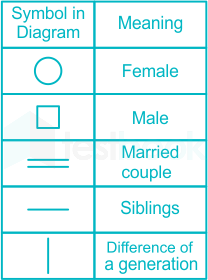
Family Chart:

Decoding the Symbols:

Symbol+-×÷
MeaningWifeBrotherFatherSon


Given: P - T ÷ V + F x M + R

It means: P is the Brother of T, T is the Son of V, V is the Wife of F, F is the Father of M, M is the wife of R.


So, M is the 'Sister' of P.

Hence, the correct answer is "Option 2".

17

In this question three statements are given, followed by two conclusions numbered I and II. Assuming that the information given in the statements is true, even if they seem to be at variance with commonly known facts, decide which of the conclusions logically follows/follow from the statements.

Statements:

Some boys are dancers.

Some dancers are singers.

All singers are directors.

Conclusions:

I. Some directors are boys.

II. All dancers are directors.

  1. ((a))

    Neither conclusion I nor II follows.

  2. ((b))

    Only conclusion I follows.

  3. ((c))

    Only conclusion II follows.

  4. ((d))

    Both conclusion I and II follow.

Show Answer
Answer: ((a))

Neither conclusion I nor II follows.

Given Statements:

Some boys are dancers.

Some dancers are singers.

All singers are directors.

The least possible Venn diagram for the given statement is:

Conclusions:

Conclusion I ("Some directors are boys"):

possible but not guaranteed — the dancers who are boys may be different from the dancers who are singers (and hence directors). So we cannot be sure some directors are boys.

Conclusion II ("All dancers are directors"):

false — only some dancers are singers, and only singers are known to be directors; there is no statement that all dancers are singers.

So, Neither conclusion I nor II follows.

Hence, the correct answer is "Option 1".

18

Given below is a question followed by two statements numbered I and II, each containing some information. Decide which of the statements is/are sufficient to answer the question.

How many girls are younger than B in a group of six girls B, F, D, G, R and L, where each is of a different age?

Statements :

I : Only G is older than D and B is younger than D.

II : Age of only one girl lies between the ages of D and B.

  1. ((a))

    Both statements I and II together are not sufficient to answer the question.

  2. ((b))

    Statement I alone is sufficient to answer the question, while statement II alone is not sufficient to answer the question.

  3. ((c))

    Statement II alone is sufficient to answer the question, while statement I alone is not sufficient to answer the question.

  4. ((d))

    Both the statements I and II together are necessary to answer the question.

Show Answer
Answer: ((d))

Both the statements I and II together are necessary to answer the question.

Given Statements:

I : Only G is older than D and B is younger than D.

 “Only G is older than D” → D is 2nd oldest (position 2). Also B is younger than D,

So, B is in positions 3–6. Alone this is insufficient.

II : Age of only one girl lies between the ages of D and B.

Exactly one girl lies between D and B. Combining with D at position 2, B cannot be older than D (there's only G at position 1),

So, B must be two positions below D, i.e. at position 4.

Conclusions:

In a 6-girl list, positions 5 and 6 are younger than B → 2 girls are younger than B.

So, both statements together are required and they give the answer.

Hence, the correct answer is "Option 4".

19

Three statements have been given, which are followed by two conclusions I and II. Assuming that the given statements are true, find out which of the conclusion(s) is/are definitely true.

<br>

Statements:

X < Y

B > A

Y ≤ Z ≤ A

Conclusion:

I. X > A

II. Z < B

  1. ((a))

    Neither conclusion I nor II is true.

  2. ((b))

    Only conclusion I is true.

  3. ((c))

    Only conclusion II is true.

  4. ((d))

    Both conclusions I and II are true.

Show Answer
Answer: ((c))

Only conclusion II is true.

Given Statement: 

X < Y

B > A

Y ≤ Z ≤ A

Now,

Conclusions:

I. X > A → Conclusion I is false.

From X < Y and Y ≤ A, we get

X < Y ≤ A,

which means X < A, not X > A.

II. Z < B → Conclusion II is true.

(From Z ≤ A and B > A,

we can deduce Z < B (since if Z ≤ A and A < B → Z < B).

So, Only conclusion II is true.

Hence, the correct answer is "Option 3".

20

Five girls Anju, Ritu, Prinshi, Ishika and Tanvi fhare from five different States – Gujarat, Assam, Bihar, Kerala and Nagaland, and they are in different professions Doctor, Singer, Lawyer, Teacher and Engineer. Prinshi is a Laywer. Anji is a Doctor and she is not from Gujarat. Ritu is from Bihar and she is not a Teacher. Ishika is from Assam and she is either a Singer or a Laywer. If Prinshi is from Nagaland, then the girl, who is an Engineer, belongs to which State?

  1. ((a))

    Nagaland

  2. ((b))

    Gujarat

  3. ((c))

    Bihar

  4. ((d))

    Kerala

Show Answer
Answer: ((c))

Bihar

Given: Five girls Anju, Ritu, Prinshi, Ishika and Tanvi are

⇒ from five different States – Gujarat, Assam, Bihar, Kerala and Nagaland,

⇒ and they are in different professions Doctor, Singer, Lawyer, Teacher and Engineer. Prinshi is a Laywer.

i) Anju is a Doctor and she is not from Gujarat.

ii) Ritu is from Bihar and she is not a Teacher.

iii) Ishika is from Assam and she is either a Singer or a Laywer.

iv) Prinshi is from Nagaland.

NameProfessionState
AnjuDoctorKerala
RituEngineerBihar
PrinshiLawyerNagaland
IshikaSingerAssam
TanviTeacherGujrat

Hence, the correct answer is Option 3.

Knowledge of ICT (10 questions)

21

What is the function of a router in a computer network?

  1. ((a))

    To display web pages

  2. ((b))

    To connect devices wirelessly

  3. ((c))

    To manage network security

  4. ((d))

    To provide Internet access to multiple devices

Show Answer
Answer: ((d))

To provide Internet access to multiple devices

The correct answer is To provide Internet access to multiple devices.

Key Points

  • A router is a device that forwards data packets between computer networks.
  • It is designed to distribute Internet access to multiple devices within a network, allowing them to communicate with external networks.
  • Routers work at the network layer (Layer 3) of the OSI model, utilizing IP addresses to determine the best path for data transmission.
  • It can connect both wired and wireless devices, enabling seamless communication within and outside the network.

Additional Information

  • Switch: A switch operates at the data link layer (Layer 2) of the OSI model. It connects multiple devices within the same network and uses MAC addresses to forward data to the correct device.
  • Access Point: Access points enable wireless devices to connect to a wired network using Wi-Fi technology. It acts as a bridge between wireless and wired connections.
  • Firewall: A firewall is a security device that monitors and controls incoming and outgoing network traffic based on predetermined security rules. It protects the network from unauthorized access.
  • Modem: A modem modulates and demodulates signals for Internet access. It connects a home or business network to the Internet through an ISP (Internet Service Provider).
22

What does "HTTP" stand for?

  1. ((a))

    HyperText Transmission Protocol 

  2. ((b))

    HyperText Transport Protocol 

  3. ((c))

    HyperText Transfer Protocol 

  4. ((d))

    HyperText Transfer Procedure 

Show Answer
Answer: ((c))

HyperText Transfer Protocol 

The correct answer is HyperText Transfer Protocol.

Key Points

  • HTTP stands for HyperText Transfer Protocol, which is a protocol used for transferring hypertext documents on the World Wide Web.
  • It is the foundation of any data exchange on the web and facilitates communication between web browsers and servers.
  • HTTP operates at the application layer of the OSI model.
  • It is a stateless protocol, meaning each request from a client to a server is independent of the previous one.
  • HTTP is used for accessing websites, APIs, and other web-based services.

Additional Information

  • HTTPS: HTTPS (HyperText Transfer Protocol Secure) is an extension of HTTP that uses encryption (via SSL/TLS) to secure communication between the client and server.
  • Protocol Layers: HTTP is an application-layer protocol, meaning it operates at the topmost layer of the OSI model.
  • Other Protocols: Other protocols at the application layer include FTP (File Transfer Protocol), SMTP (Simple Mail Transfer Protocol), and DNS (Domain Name System).
  • Stateless Nature: Since HTTP is stateless, techniques like cookies and sessions are used to maintain state and track user activities.
23

Which of the following devices is specially used for printing large sized maps on vinyl sheets?

  1. ((a))

    Dot Matrix Printer

  2. ((b))

    Barcode Printer

  3. ((c))

    Laser Printer

  4. ((d))

    Plotter

Show Answer
Answer: ((d))

Plotter

The correct answer is Plotter.

Key Points

  • Plotters are specialized devices used for printing large-sized maps, engineering drawings, and graphics on various materials, including vinyl sheets.
  • Unlike traditional printers, plotters use pens or markers to draw lines, making them ideal for precision work such as maps and blueprints.
  • They can handle large-format printing tasks with high accuracy and are commonly used in industries like architecture, engineering, and design.
  • Plotters are capable of producing detailed outputs on various surfaces, including paper, vinyl, and other specialized sheets.

Additional Information

  • Dot Matrix Printer: A dot matrix printer is used for printing text and simple graphics using a matrix of dots. It is not suitable for large-format printing or high-precision tasks.
  • Barcode Printer: Barcode printers are specialized for printing barcodes on small labels and are not intended for map printing.
  • Laser Printer: Laser printers are commonly used for high-quality text and image printing on standard-sized sheets but are not designed for large-format maps.
  • Plotter: As mentioned earlier, plotters are the ideal devices for printing large-sized maps and graphics with precision.
24

Which of the following is considered as a good cyber-safe practice? 

  1. ((a))

    Using 2 factor authentication

  2. ((b))

    Adding comments on every post regularly

  3. ((c))

    Uploading every trip's photos on social media regularly

  4. ((d))

    Keeping same password for all accounts for ease of use

Show Answer
Answer: ((a))

Using 2 factor authentication

The correct answer is Using 2-factor authentication.

Key Points

  • Using 2-factor authentication is one of the most effective ways to enhance your online security.
  • It adds an additional layer of protection by requiring two forms of verification — typically your password and a code sent to your device.
  • This reduces the chances of unauthorized access to your accounts, even if your password is compromised.
  • It is considered a good cyber-safe practice to safeguard sensitive information.

Additional Information

  • Adding comments on every post regularly: This does not contribute to cybersecurity and may expose unnecessary personal information.
  • Uploading every trip's photos on social media regularly: Sharing such information can pose privacy risks and make users vulnerable to cyber threats, such as stalking or phishing.
  • Keeping the same password for all accounts for ease of use: This is a risky practice as it increases the chances of all accounts being compromised if one account is hacked.
25

Which of the following is an extension of the most commonly used audio file?

  1. ((a))

    .gif

  2. ((b))

    .mp3

  3. ((c))

    .jpeg

  4. ((d))

    .docx

Show Answer
Answer: ((b))

.mp3

The correct answer is MP3

Key Points

  • MP3 (MPEG-1 Audio Layer III) is one of the most widely used audio file extensions.
  • It is a compressed audio format that reduces file size while maintaining acceptable sound quality.
  • MP3 files are compatible with most devices and software, making them the preferred choice for audio storage and playback.
  • Other formats like GIF, JPEG, and DOCX are not audio file extensions but are used for images and documents respectively.

Additional Information

  • GIF: Graphics Interchange Format, commonly used for images and animations.
  • JPEG: Joint Photographic Experts Group, a widely used format for images.
  • DOCX: A file extension for documents created in Microsoft Word.
  • MP3: Specifically designed for audio files, making it the correct answer for this question.
26

What is the purpose of a cache in a computer system?

  1. ((a))

    To provide Internet connectivity

  2. ((b))

    To store data permanently

  3. ((c))

    To protect against viruses and worms

  4. ((d))

    To improve the performance by storing frequently accessed data

Show Answer
Answer: ((d))

To improve the performance by storing frequently accessed data

The correct answer is To improve the performance by storing frequently accessed data.

Key Points

  • A cache is a smaller, faster memory located close to the CPU or integrated into the CPU itself.
  • It stores frequently accessed data or instructions to reduce the time required for fetching them from the main memory.
  • The purpose of the cache is to improve system performance by minimizing delays caused by slower memory access.
  • There are different levels of cache memory, such as L1 (Level 1), L2 (Level 2), and L3 (Level 3), each varying in size and proximity to the CPU.

Additional Information

  • Main Memory: The main memory (RAM) is larger but slower compared to the cache. It stores data temporarily while the system is running.
  • Virtual Memory: Virtual memory is a section of the hard drive used as an extension of RAM to store data that cannot fit into physical memory.
  • Storage: Permanent storage devices like hard drives or SSDs are used to store data persistently, but they are slower compared to cache memory.
  • Cache Hit: A cache hit occurs when the required data is found in the cache, reducing access time.
  • Cache Miss: A cache miss happens when the required data is not found in the cache, and it has to be fetched from the main memory.
27

Which of the following is a web browser? 

  1. ((a))

    Acrobat Reader 

  2. ((b))

    Microsoft Excel

  3. ((c))

    Adobe Photoshop

  4. ((d))

    Mozilla Firefox

Show Answer
Answer: ((d))

Mozilla Firefox

The correct answer is Mozilla Firefox.

Key Points

  • Mozilla Firefox is a web browser.
  • Web browsers are applications used to access and view websites on the internet.
  • Popular web browsers include Mozilla Firefox, Google Chrome, Safari, Microsoft Edge, and Opera.
  • Web browsers use protocols like HTTP (Hypertext Transfer Protocol) and HTTPS (HTTP Secure) to retrieve and display web pages.

Additional Information

  • Acrobat Reader: Acrobat Reader is a software application used to view, print, and annotate PDF documents. It is not a web browser.
  • Microsoft Excel: Microsoft Excel is a spreadsheet application used for data analysis, calculations, and visualization. It is not a web browser.
  • Adobe Photoshop: Adobe Photoshop is a graphic design and image editing software. It is not a web browser.
  • Mozilla Firefox: Mozilla Firefox is a free and open-source web browser developed by Mozilla Foundation. It enables users to browse the internet and access web pages.
28

What does "URL" stand for?

  1. ((a))

    Universal Resource Link

  2. ((b))

    Uniform Resource Locator 

  3. ((c))

    Universal Reference Locator 

  4. ((d))

    Unified Resource Link

Show Answer
Answer: ((b))

Uniform Resource Locator 

The correct answer is Uniform Resource Locator

Key Points

  • The term "URL" stands for Uniform Resource Locator.
  • A URL is a reference or address used to access resources on the internet.
  • It indicates the location of a resource as well as the protocol used to retrieve it.
  • For example, in "https://www.example.com", the protocol is "https" and the domain is "www.example.com".

Additional Information

  • Universal Resource Link: This is an incorrect option as it is not the standard term for URL.
  • Universal Reference Locator: This is also incorrect because it does not accurately describe the purpose of a URL.
  • Unified Resource Link: This is an incorrect option and not a valid term for URL.
29

Yaadrani Jaisal is looking for an Open Source Software/Tool, which can help her create a multipage document to be printed on A4 size pages. Which of the following will you suggest for the same?

  1. ((a))

    PowerPoint

  2. ((b))

    Impress

  3. ((c))

    Calc

  4. ((d))

    Writer

Show Answer
Answer: ((d))

Writer

The correct answer is Writer.

Key Points

  • Writer is a part of the LibreOffice suite, which is an open-source software designed for document creation.
  • It enables users to create multipage documents with advanced formatting options, including text, tables, images, and headers/footers.
  • Writer supports printing documents on A4 size pages and provides customizable settings for page layout and orientation.
  • It is comparable to MS Word but is free and open-source, making it accessible for all users.

Additional Information

  • PowerPoint: PowerPoint is primarily used for creating presentations, not multipage documents.
  • Impress: Impress is the presentation tool in LibreOffice and similar to PowerPoint, meant for slide-based content rather than document creation.
  • Calc: Calc is a spreadsheet tool in LibreOffice, used for data analysis and calculations, unsuitable for creating multipage documents.
  • Writer: Writer is explicitly designed for word processing and document creation, making it the best choice for Yaadrani Jaisal's requirements.
30

While using any documentation tool, the key combination CTRL+V on a keyboard is used for

  1. ((a))

    moving the selected text/object 

  2. ((b))

    ) cutting the selected text/object

  3. ((c))

     copying the selected text/object

  4. ((d))

    pasting the copied text/object

Show Answer
Answer: ((d))

pasting the copied text/object

The correct answer is Pasting the copied text/object.

Key Points

  • The CTRL+V key combination is universally used for pasting the copied or cut text/object in most documentation tools and software applications.
  • This operation works by inserting the content from the clipboard (the temporary storage area for copied or cut data).
  • CTRL+V does not copy or cut the text/object; these operations are performed by CTRL+C and CTRL+X, respectively.
  • It is an essential shortcut for improving efficiency while working with text, images, or other objects.

Additional Information

  • CTRL+C: Used for copying the selected text/object to the clipboard without removing it from its original location.
  • CTRL+X: Used for cutting the selected text/object, removing it from its original location, and placing it on the clipboard.
  • CTRL+Z: Used for undoing the last action performed in a document or application.
  • CTRL+Y: Used for redoing an action that was undone using CTRL+Z.

Teaching Aptitude (10 questions)

31

The major characteristic of subject centered approach is :

  1. ((a))

    The learning needs of the students are supposed to be fulfilled through the textbook

  2. ((b))

    Textbook is not the only and the main source for teacher. 

  3. ((c))

    Emphasis is given on real-life experiences

  4. ((d))

    There is stress on quantity-oriented output rather than quality.

Show Answer
Answer: ((a))

The learning needs of the students are supposed to be fulfilled through the textbook

The subject-centered approach is a traditional model of teaching in which the curriculum is organized around subjects rather than students’ interests or experiences. It emphasizes structured content delivery, systematic coverage of the syllabus, and mastery of knowledge through textbooks and other prescribed resources.

Key Points

  • In the subject-centered approach, textbooks serve as the primary medium to fulfill learning objectives.
  • The teacher relies on structured chapters and content to guide instruction. Students are expected to follow the textbook systematically to acquire knowledge in each subject.
  • This ensures coverage of the curriculum and adherence to prescribed learning outcomes.
  • The approach prioritizes subject content over individual learner needs or personal experiences. By focusing on textbooks, the approach maintains uniformity and order in teaching.

Hint

  • Textbook is not the only source for the teacher aligns more with learner-centered approaches.
  • Emphasis on real-life experiences is characteristic of experiential or activity-based learning.
  • Stress on quantity-oriented output rather than quality is a limitation seen in rote or exam-driven methods but not a defining characteristic of subject-centered pedagogy.

Hence, the correct answer is The learning needs of the students are supposed to be fulfilled through the textbook.

32

Classroom discipline depends upon :   

A. Maintained Student-Teacher Ratio

B. Content knowledge of the teacher

C. Strict behaviour of the teacher

D. Good infrastructure in classroom

Choose the correct option:

  1. ((a))

    A, C and D only

  2. ((b))

    A, B and D only

  3. ((c))

    A only

  4. ((d))

    A and C only

Show Answer
Answer: ((b))

A, B and D only

Classroom discipline is primarily the management of student behavior to ensure an effective learning environment.

 Key PointsSeveral factors contribute to its success:

  • A. Maintained Student-Teacher Ratio: A lower, or well-maintained, ratio allows the teacher to give more individual attention to students, better understand their needs, and proactively address disruptive behavior before it escalates.
  • B. Content knowledge of the teacher: A teacher with strong content knowledge delivers engaging, confident, and well-structured lessons. Engaged students are far less likely to become bored and act out. Effective instruction is a key preventative measure for discipline problems.
  • D. Good infrastructure in classroom: A well-designed, comfortable, and organized classroom (lighting, seating, materials access) can reduce discomfort and distractions, thereby promoting a focused and respectful environment conducive to learning and good behavior.

Hint

  • Strict behavior of the teacher: While consistency and clear boundaries are essential, discipline relies more on firmness, fairness, and establishing positive relationships than on strictness alone. An overly strict or authoritarian approach can foster fear, resentment, and covert misbehavior rather than genuine self-discipline and cooperation.

Thus, it is concluded that A, B and D only is the correct answer.

33

Which of the following is the best teacher?

  1. ((a))

    The one who takes classes daily.

  2. ((b))

    The one who helps the students to solve the problems,

  3. ((c))

    The one who prepares the students to solve the problems.

  4. ((d))

    The one who talks gently with students.

Show Answer
Answer: ((c))

The one who prepares the students to solve the problems.

A teacher’s effectiveness is measured not just by presence or behavior but by their ability to develop learners’ thinking, problem-solving skills, and independence.

Key Points

  • The best teacher is one who prepares students to solve problems because this approach empowers learners to think independently, apply knowledge, and develop lifelong skills.
  • Such a teacher guides students to analyze situations, explore solutions, and make decisions on their own.
  • This strategy fosters critical thinking, creativity, and self-confidence.
  • By preparing students rather than giving direct solutions, the teacher ensures deeper understanding and transferable skills. It also aligns with constructivist and learner-centered approaches that prioritize active learning and student autonomy.

Hint

  • Taking classes daily ensures presence but does not guarantee effective learning.
  • Helping students solve problems  is useful but may promote dependency if overused.
  • Talking gently creates a positive environment but alone does not develop problem-solving abilities.

Hence, the correct answer is The one who prepares the students to solve the problems.

34

Which of the following is/are the characteristics of reflective level of teaching?

A. This is very thoughtful teaching.

B. In this, the subject-matter is unstructured and free.

C. Here, students play a passive role.

D. Here the source of motivation is external.

Choose the correct option:

  1. ((a))

    D only

  2. ((b))

    A and C only

  3. ((c))

    C and D only

  4. ((d))

    A and B only

Show Answer
Answer: ((d))

A and B only

Reflective level of teaching emphasizes deep thinking, analysis, and thoughtful engagement with the subject matter. At this level, students are encouraged to reflect on concepts, link ideas, and develop understanding beyond rote memorization. It focuses on the quality of thought and internal motivation rather than external pressure or passive reception.

Key Points

  • The reflective level of teaching is characterized by being very thoughtful (A) and often dealing with unstructured or open-ended subject matter (B).
  • Teachers encourage inquiry, discussion, and exploration, allowing students to construct knowledge actively.
  • This level promotes critical thinking, problem-solving, and thoughtful decision-making.
  • Students are active participants, and motivation is primarily intrinsic, arising from curiosity and engagement with meaningful content.

Hint

  • Students playing a passive role is typical of memory-level or teacher-centered teaching, not reflective teaching.
  • External motivation is associated with rote learning or discipline-driven approaches and does not define reflective teaching.

Hence, the correct answer is A and B only.

35

If you get an opportunity to teach a visually challenged student along with normal students, what type of treatment would you like to give him in the class?

You will

  1. ((a))

    arrange a seat in the front row and try to teach at a pace convenient to his.

  2. ((b))

    not give him extra attention because major may suffer.

  3. ((c))

    take care of him sympathetically in the class

  4. ((d))

    think that blindness is his destiny and hence you cannot do anything.

Show Answer
Answer: ((a))

arrange a seat in the front row and try to teach at a pace convenient to his.

Inclusive education aims to integrate students with special needs into regular classrooms while ensuring equitable learning opportunities. A teacher’s role is to adapt instruction, seating, pace, and teaching strategies so that all students, including visually challenged learners, can participate meaningfully and achieve learning outcomes.

Key Points

  • Arranging a seat in the front row and teaching at a pace convenient for the visually challenged student ensures that they can see and hear clearly, follow instructions, and participate actively.
  • This approach provides necessary accommodations without singling out or isolating the student. It respects their learning needs while maintaining dignity and integration with peers.
  • The teacher can also use tactile materials, verbal explanations, and peer support to enhance understanding. This method embodies the principles of inclusive education and fosters equity in the classroom.

Hint

  • Not giving extra attention risks neglecting the student’s needs and creates learning gaps.
  • Sympathetic care may be well-intentioned but is often passive and does not actively support learning.
  • Accepting blindness as destiny reflects a defeatist attitude and denies the student opportunities for learning and growth.

Hence, the correct answer is arrange a seat in the front row and try to teach at a pace convenient to his.

36

Which of the following is/are the characteristics of measurement?

  1. ((a))

    It is universal in nature.

  2. ((b))

    It is non-comparative in nature.

  3. ((c))

    It is non-dimensional in nature.

  4. ((d))

    It is absolute.

Show Answer
Answer: ((a))

It is universal in nature.

Measurement is the process of assigning numbers or values to objects, events, or performances according to specific rules. In education and science, measurement helps in quantifying learning outcomes, behavior, or phenomena.

Key Points

  • Measurement is comparative rather than non-comparative because values are meaningful when compared to a standard, criterion, or scale.
  • It is dimensional, meaning measurements are expressed in units (like meters, kilograms, marks) rather than being unitless.
  • Measurement is relative or context-dependent, not absolute; its interpretation depends on standards or norms.
  • These three statements do not align with the fundamental properties of measurement.
  • Only the universality of measurement (Option 1) is correct, as measurement principles can be applied consistently across contexts.

Hence, the correct answer is it is universal in nature is/are the characteristics of measurement.

37

Which of the following is/are not a type of graph?

  1. ((a))

    Flow

  2. ((b))

    Line

  3. ((c))

    Pictorial

  4. ((d))

    Flannel

Show Answer
Answer: ((d))

Flannel

Graphs are visual representations of data that help in understanding trends, comparisons, and relationships. Common types of graphs include line graphs, bar graphs, pictorial graphs, and flow charts, each serving a specific purpose in data presentation. Graphs are distinct from display tools or teaching aids that do not represent data quantitatively.

Key Points

  • A flannel is not a type of graph; it is a teaching aid used for display purposes, such as showing charts, pictures, or diagrams on a flannel board.
  • It does not inherently represent numerical data or trends.
  • Unlike line, pictorial, or flow graphs, it serves as a medium rather than a method for graphing information.

Hint

  • Flow  is a type of graph that shows processes or sequences.
  • Line is used to represent trends over time.
  • Pictorial uses pictures or symbols to depict quantities visually.

Hence, the correct answer is Flannel.

38

Which of the following statement(s) is/are true about Inductive method?

A. It starts with formulae/rules/concept and Ends in solutions of problems. 

B. It starts with examples and ends in formulae/rules/concept.

C. Correct and valid cannot be verified by employing Induction again.

D. All of the above

Choose the correct option:

  1. ((a))

    C only

  2. ((b))

    A and B only

  3. ((c))

    B and C only

  4. ((d))

    D only

Show Answer
Answer: ((c))

B and C only

The Inductive Method (or Inductive Reasoning) is a teaching and learning approach that moves from specific observations to broad generalizations.

Key Points

  • B. It starts with examples and ends in formulae/rules/concept: This is the defining characteristic of induction. Students are presented with several specific examples, cases, or problems (the specifics) and are guided to analyze them, observe patterns, and ultimately derive the general rule or concept (the generalization/formula) themselves.
  • A. It starts with formulae/rules/concept and Ends in solutions of problems: This statement describes the Deductive Method (or Deductive Reasoning). Deduction starts with a general rule/formula and applies it to specific problems/examples.
  • C. Correct and valid cannot be verified by employing Induction again: Induction, by its nature, provides conclusions that are probable, not absolutely certain. Since the conclusion (the derived rule) is based only on the specific instances observed, and there might be unseen counterexamples, the principle of induction itself cannot be used to prove the absolute correctness or validity of its own outcome.

Therefore, the statements that are true about the Inductive method are B and C.

39

Classroom communication should essentially as

  1. ((a))

    Abstract

  2. ((b))

    Non-descriptive

  3. ((c))

    Contrived

  4. ((d))

    Empathetic

Show Answer
Answer: ((d))

Empathetic

Classroom communication is the process by which teachers convey ideas, instructions, and feedback to students, and students respond with questions or ideas. Effective communication in the classroom is clear, meaningful, and responsive to learners’ needs. It plays a crucial role in fostering understanding, engagement, and a positive learning environment.

Key Points

  • Classroom communication should be empathetic, meaning the teacher considers students’ perspectives, needs, and feelings while delivering content.
  • Empathy helps in building trust, reducing anxiety, and motivating learners to participate actively.
  • By being empathetic, a teacher can adjust language, tone, pace, and examples to ensure that students understand concepts and feel supported in their learning journey.

Hint

  • Abstract is not suitable because communication should be concrete and relatable for understanding.
  • Non-descriptive fails to provide clarity or sufficient information.
  • Contrived refers to artificial or forced communication, which can hinder genuine learning.

Hence, the correct answer is Empathetic.

40

The special audio reproduction in a classroom can reduce the students:

  1. ((a))

    Motivation for excellence

  2. ((b))

    Interest in technology-orientation

  3. ((c))

    Cognitive load in understanding

  4. ((d))

    Respect for the teacher

Show Answer
Answer: ((c))

Cognitive load in understanding

In classroom teaching, special audio reproduction refers to the use of microphones, speakers, or sound systems to ensure that all students clearly hear the lesson. Effective audio support can enhance learning by making information more accessible and reducing misunderstandings, especially in large or noisy classrooms.

Key Points

  • Special audio reproduction can reduce cognitive load in understanding because students do not have to strain to hear or interpret the teacher’s speech.
  • With clear audio, learners can focus their mental resources on processing content rather than decoding speech, leading to better comprehension and engagement.
  • This improves learning efficiency and allows students to absorb complex concepts more easily.

Hint

  • Motivation for excellence is not reduced by audio aids; it is influenced by teaching quality and encouragement.
  • Interest in technology-orientation may actually increase if audio tools are used effectively.
  • Respect for the teacher depends on teacher behavior and pedagogy, not merely on audio reproduction.

Hence, the correct answer is Cognitive load in understanding.

Domain Knowledge (80 questions)

41

What is Selective Dissemination of Information?

  1. ((a))

    Translation Service

  2. ((b))

    Reference Service

  3. ((c))

    Current Awareness Service

  4. ((d))

    Referral Service

Show Answer
Answer: ((c))

Current Awareness Service

The Correct answer is Current Awareness Service.

Key Points

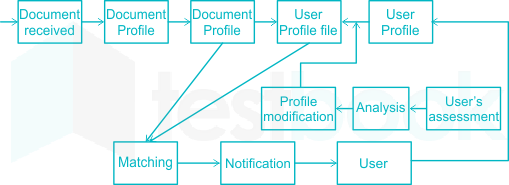
  • Selective Dissemination of Information (SDI) refers to a service provided by libraries and information centers, aiming to deliver information on particular topics to individuals or groups based on their specific information requirements.
  • The concept of selective dissemination of information (SDI) was originally proposed by Hans Peter Luhn in 1958.
  • The initial implementation of the mechanized SDI system, following Luhn's design, took place in 1959 at the Advanced Systems Development Division of IBM Corporation.
  • ​Components of SDI:
  • User Profile
  • Document Profile
  • Matching.
  • Notification.
  • Feedback
  • SDI Flowchart:


Additional InformationTranslation service:

  • A translation service is a service that provides the conversion of written or spoken language from one language to another.

Referral Service:

  • Referral services in the context of information services refer to a specific function or process where information professionals or systems direct users to relevant information sources, experts, or resources that can help answer their queries or meet their information needs.
42

'Readers' Guide to Periodical Literature' is a/an:

  1. ((a))

    Guide

  2. ((b))

    Dictionary

  3. ((c))

    Yearbook

  4. ((d))

    Indexing Periodical

Show Answer
Answer: ((d))

Indexing Periodical

The Correct answer is Indexing Periodical.

Key Points

  • The Readers' Guide to Periodical Literature serves as an index for a wide array of popular and significant periodicals, spanning topics like art, business, education, and entertainment.
  • This comprehensive reference database proves valuable for educators, students, and patrons seeking information.
  • The index covers periodicals published from 1983 onwards, with ongoing updates incorporating the latest content daily.
  • Originally established in 1901 by the H. W. Wilson Company, the Readers' Guide has been a consistent resource in public and academic reference libraries across the United States.
  • Additionally, a retrospective index covering general periodicals from 1890 to 1982 is also accessible.
43

Who defined reference service as "to provide the right book for the right reader, in the right way and at the right time, in the right personal way"?

  1. ((a))

    Krishan Kumar

  2. ((b))

    S.R. Ranganathan

  3. ((c))

    William A. Katz

  4. ((d))

    Margaret Hutchins

Show Answer
Answer: ((b))

S.R. Ranganathan

The Correct answer is S.R. Ranganathan.

Key Points Definition of Reference Services:

  • According to the American Library Association Glossary of Library Terms, "Reference Service is that phase of library work which is directly concerned with assistance to readers in securing information and in using the resources of the library in study and research".
  • Ranganathan defines Reference Service as `Personal service to each reader in helping him to find the documents answering the interest at the moment pin-pointedly, exhaustively and expeditiously.' It is also, he says, attempts "to provide the right book for the right reader, in the right way and at the right time, in the right personal way."
  • Margaret Hutchins defines `Reference Services' as those that include "the direct personal aid, within a library, to persons in search of information for whatever purpose and also various library activities especially aimed at making information as easily available as possible."
  • Donald Davidson says that it is “not just answering questions posed by readers. It is also about the maintenance of the resources banks from which answers to questions are provided for selection and the associated development of close awareness of sources of supply of needed materials is another aspect of the reference librarian's work that needs to be given attention.
  • William Katz views 'Reference Service' as "the behind-the-scene activities of the reference library in the selection, acquisition, and maintenance of library stock and its careful recording and administration.
  • A B Kroeger says "Reference services work as an assistance in the resources of the library.
  • James I Wyer says "Reference services is that part of library administration which deals with assistance given to the readers in their use of resources of the library.
44

Which of the following standards is related to the 'library catalog and abstract card'?

  1. ((a))

    IS 8338 : 1976

  2. ((b))

    IS 1358 : 2018

  3. ((c))

    IS 1553 : 1989

  4. ((d))

    IS 7150 : 1974

Show Answer
Answer: ((d))

IS 7150 : 1974

The Correct answer is IS 7150: 1974.

Key Points

  • IS 7150: 1974, issued by the Bureau of Indian Standards (BIS), deals with the library catalogue and abstract card.
  • The key details of this standard are as follows:
  • Title: Library Catalogue and Abstract Card Designator of Legally Binding Document: IS 7150
  • Year of Publication: 1974
  • Number of Amendments: 1
  • This standard outlines recommendations for crafting library catalog cards and abstracts, aiming to enhance the organization and accessibility of information within libraries.

Additional Information

  • IS 8338: 1976; Recommendations relating to primary elements in the design of school library buildings.
  • IS 1358: 2018; Practice for layout of library catalogue code (Second Revision).
  • IS 1553: 1989; Design of Library Buildings - Recommendations Relating to its Primary Elements
45

Which among the following is related to the currency of evaluation of a web resource?

  1. ((a))

    Claims of certainty

  2. ((b))

    Advertisements

  3. ((c))

    Date of the last revision

  4. ((d))

    Date of birth of the author

Show Answer
Answer: ((c))

Date of the last revision

The Correct answer is the Date of the last revision.

Key PointsEvaluating web resources require users to approach sites with a discerning mindset, using criteria like those outlined below to assess the quality of the information provided:

  • Authority: Check who published the content.
  • Look for the author’s credentials and expertise related to the subject matter.
  • Objectivity: Is the purpose and intention of the site clear, including any biases?
  • Are the purpose and scope clearly stated?
  • Accuracy: Is the presented information accurate?
  • Are facts well-documented or well-researched?
  • Currency: Is the information current?
  • Is the content up-to-date?
  • Are the pages date-stamped with the last update?
  • ​Usability: Is the site well-designed and stable?
  • Is the site organization logical and easy to navigate?
46

In-depth investigations of a single person, group, event or community is called _______.

  1. ((a))

    Descriptive method

  2. ((b))

    Survey method

  3. ((c))

    Case study method

  4. ((d))

    Historical method

Show Answer
Answer: ((c))

Case study method

The Correct answer is the Case study method.

Key PointsCase study method:

  • Case studies involve in-depth examinations of a singular individual, group, event, or community, and this research methodology falls within the realm of qualitative methods.
  • Psychologists often employ case study research to comprehensively investigate individual patients, delving into their behavior and mental health.
  • This approach provides psychologists with a nuanced understanding of a patient's mental illness, aiding in more effective treatment strategies.
  • Case study research facilitates extensive interviews and behavior observations over a specified period, contributing to a thorough comprehension of the subject's experiences.

Additional Information

  • Descriptive method:
  • The descriptive method involves observing and recording behaviors without manipulating variables.
  • It aims to describe the characteristics of a phenomenon or the relationship between variables but doesn't delve into the depth of understanding that case studies offer.
  • Survey method:
  • The survey method involves collecting data from a large population through questionnaires or interviews.
  • It is used to gather information about people's opinions, attitudes, behaviors, or demographics but doesn't provide the in-depth analysis of a specific case that case studies do.
  • Historical method:
  • The historical method involves studying past events and occurrences to understand patterns, causes, and effects.
  • It relies on analyzing historical documents, records, and artifacts.
  • While it offers insights into trends over time, it may not provide the detailed examination of a specific case that a case study does.
47

Match the following:

A.Kuhlthaui.PLUS Model
B.James Herringii.Big6 Skills Model
C.Trevor Bondiii.SAUCE Model
D.Mike Eisenberg and Bob Berkowitziv.Information Search Process Model
  1. ((a))

    A-iv, B-ii, C-i, D-iii

  2. ((b))

    A-i, B-ii, C-iv, D-iii

  3. ((c))

    A-iv, B-iii, C-i, D-ii

  4. ((d))

    A-iv, B-i, C-iii, D-ii

Show Answer
Answer: ((d))

A-iv, B-i, C-iii, D-ii

The Correct answer is A-iv, B-i, C-iii, D-ii.

Key Points

  • Carol Kuhlthau propounded an Information Search Model (ISM) in 1991.
  • Kuhlthau ‘Six stages’ are
  • Initiation:
  • Selection:
  • Exploration
  • Formulation
  • Collection
  • Presentation/Closure
  • The PLUS Model was introduced by James Herring.
  • ​The PLUS model was developed by James Herring and published in 1996.
  • this model has been used in schools in the U.K., South Africa, Australia, and New Zealand.
  • The main elements of the PLUS model are Purpose, Location, Use, and Self-evaluation.
  • This model incorporates basic elements of information literacy skills and also adds emphasis on thinking skills and self-evaluation.
  • The SAUCE Model was introduced by Trevor Bond.
  • ​SAUCE is a process for users to use in research, problem-solving, and inquiry learning.
  • This model was initially developed in the year 1999 and then it was slightly revised in April 2009.
  • This model was created by Trevor Bond and this can be depicted as information literacy, inquiry learning, and problem-solving or research process.
  • The Big6:
  • ​Developed by Michael B. Eisenberg and Robert E. Berkowitz, the Big 6 is one of the earliest and most widely used information literacy models.
  • It consists of six stages, namely task definition, information-seeking strategies, location, and access, use of information, synthesis, and evaluation.
48

In which year was 'PubMed Central (PMC) launched?

  1. ((a))

    2005

  2. ((b))

    1995

  3. ((c))

    1998

  4. ((d))

    2000

Show Answer
Answer: ((d))

2000

The Correct answer is 2000.

Key Points

  • PubMed Central (PMC) is a digital repository that stores open-access full-text scholarly articles from biomedical and life sciences journals.
  • PubMed Central, originally conceived as E-Biomed, was first proposed in May 1999 by Harold Varmus, the then-NIH director.
  • Established in February 2000, the repository has experienced significant growth due to the NIH Public Access Policy.
  • This policy aims to ensure that all research funded by the National Institutes of Health (NIH) is readily available to the public.
  • The PMCID (PubMed Central identifier), also referred to as the PMC reference number, serves as a bibliographic identifier specific to the PubMed Central open-access database.
  • Similar to the PMID for the PubMed database, the PMCID is a distinct identifier and follows the format "PMC" followed by a string of numbers.
49

'A Pre-test of a questionnaire on a small number of cases or units to test the quality of responses' is a _______.

  1. ((a))

    Footnote

  2. ((b))

    Hypothesis

  3. ((c))

    Sampling technique

  4. ((d))

    Pilot study

Show Answer
Answer: ((d))

Pilot study

The Correct answer is Pilot study.

Key PointsPilot study:

  • Pilot testing, also referred to as pre-testing, plays a crucial role in enhancing the effectiveness of data collection tools, particularly in the context of primary data.
  • This process involves administering the questionnaire to a smaller sample group, collecting responses, and analyzing the outcomes.
  • The interpretations derived from pilot testing should be compared against the intended answers and objectives to ensure alignment with the established criteria.

Additional Information

  • Footnote:
  • A footnote in research is a reference or explanatory note provided at the bottom of a page, article, or paper.
  • It typically contains additional information, comments, or citations to sources.
  • Hypothesis:
  • In research, a hypothesis is a tentative, testable statement that predicts the relationship between two or more variables.
  • It serves as the basis for further investigation and testing.
  • Sampling Technique:
  • The sampling technique refers to the method used to select a subset of individuals or items from a larger population.
  • It involves choosing a representative sample to make inferences about the entire population.
50

Which of the following can be considered for evaluating the content of a reference source?

(A) Objectivity

(B) Accuracy

(C) Purpose and scope of information

(D) Binding

  1. ((a))

    (A), (C) and (D) are correct

  2. ((b))

    (A), (B) and (C) are correct

  3. ((c))

    (A), (B) and (D) are correct

  4. ((d))

    (B), (C) and (D) are correct

Show Answer
Answer: ((b))

(A), (B) and (C) are correct

The Correct answer is (A), (B), and (C) are correct.

Key PointsGeneral Evaluation Criteria for Reference Sources:

  • Scope and Purpose: Examine the introduction or preface of the source to understand the author's stated scope and purpose.
  • This provides insights into the utility of the source for the library.
  • Authority: Investigate the publishers and author(s) of the source.
  • Reputable publishers typically employ trained editors and subject experts for compilation.
  • Objectivity: Objectivity refers to the unbiased and impartial nature of the information presented in a reference source.
  • It assesses whether the content is free from personal opinions, emotions, or undue influence.
  • Accuracy and Currency: Verify the accuracy by cross-referencing with other works on the same topic.
  • Check the currency by reviewing the copyright date and references cited by the source.
  • Arrangement: Ensure the content is well-organized for ease of use.
  • Look for proper headings, subheadings, clear typography, and a readable page layout.
  • A good table of contents and index, with cross-references if needed, enhances usability.
  • E-version: When deciding between print and electronic formats, opt for electronic sources for content that undergoes frequent changes.
  • Examples include indexing and abstracting periodicals or directories, where electronic formats facilitate regular updates.
  • Printed sources may be suitable for materials like geographical sources or handbooks.
51

Standard 'IS 2672: 1966' is related with _______.

  1. ((a))

    Mobile library van

  2. ((b))

    Code of practice for library lighting

  3. ((c))

    Library catalogue and abstract card

  4. ((d))

    Design of library building

Show Answer
Answer: ((b))

Code of practice for library lighting

The Correct answer is the Code of Practice for library lighting.

Key Points

  • IS 2672 (1966): Code of practice for library lighting.
  • The Indian Standards Institution adopted this standard on August 5, 1966, following the approval of the draft by the Illuminating Engineering and Lifts Sectional Committee and subsequent approval by the Electrotechnical Division Council.

Additional Information Other Standards:

  • IS: 1892 (Part I) - 1978 Specifications for Library Furniture’s and Fittings, Part I: Timber (1st Revision).
  • IS: 1892 (Part II) – 1977 Specifications for Library Furniture’s and Fittings, Part II: Steel.
  • IS: 1233 – 1969 Recommendations for Modular Coordination of Dimensions in the Building Industry (1st Revision).
  • IS: 1172 – 1971 Code of Basic Requirements for Water Supply, Drainage, and Sanitation (2nd Revision).
  • IS: 1883 – 1975 Metal Shelving Racks (Adjustable Type)(2nd Revision).
  • IS: 8338 – 1976 Recommendations relating to Primary Elements in Design of School Library Buildings.
  • IS: 3312 – 1974 Steel Shelving Cabinets (Adjustable Type)(1st Revision).
  • IS: 4116 – 1976 Wooden Shelving Cabinets (Adjustable Type)(1st Revision)
  • IS 2661 (1978): Mobile library van.
52

Now 'LISA' is produced by ________.

  1. ((a))

    Clarivate

  2. ((b))

    ProQuest

  3. ((c))

    Oxford

  4. ((d))

    OCLC

Show Answer
Answer: ((b))

ProQuest

The Correct answer is ProQuest

Key PointsLibrary and Information Science Abstracts (LISA):

  • The frequency of the Library and Information Science Abstracts (LISA) Print version is Monthly.
  • The frequency of the Library and Information Science Abstracts (LISA) Database is Fortnightly.
  • LISA was started in 1969.
  • It is an international abstracting and indexing tool specially designed for library professionals or information scientists.
  • LISA is currently published by ProQuest since 2007.
  • It contains 440 periodicals in 20 different languages.
53

Which of the following use the terms 'AND', 'OR' and 'NOT'?

  1. ((a))

    Phrase search

  2. ((b))

    Truncation search

  3. ((c))

    Boolean operators

  4. ((d))

    Proximity search

Show Answer
Answer: ((c))

Boolean operators

The Correct answer is Boolean operators.

Key Points

  • Boolean Search:
  • ​Boolean Operators are simple words (AND, OR, NOT, or AND NOT) used as conjunctions to combine or exclude keywords in a search, resulting in more focus and productivity.
  • When Boolean operators are used for searching it is known as Boolean search
  • This kind of searching is also known as Combinatorial search.
  • The basic operations of Boolean algebra are conjunction, disjunction, and negation.
  • AND:
  • This operator will retrieve all the documents which contain all the keywords occurring at both ends of the AND operator.
  • OR:
  • This operator will retrieve all the documents which contain all the keywords occurring at both ends of the OR operator.
  • NOT or AND NOT:
  • These operators increase the precision of the search result.

Additional InformationPhrase Searching:

  • ​Phrase searching involves placing search keywords within quotes (e.g., "...").

​Proximity Search:

  • A proximity search enables you to define the closeness required between two or more words to constitute a match.

Truncation, marked by an asterisk (*) during searching, aims to broaden search results.

54

Ranganathan's Five Laws of Library Science are helpful today as they were a century ago, because:

  1. ((a))

    They are useful to university libraries only.

  2. ((b))

    Changes are required regularly.

  3. ((c))

    They focus on core values of librarianship.

  4. ((d))

    They are not useful to small libraries.

Show Answer
Answer: ((c))

They focus on core values of librarianship.

The Correct answer is They focus on core values of librarianship.

Key Points

  • Ranganathan's Five Laws of Library Science were formulated by Dr. S.R. Ranganathan, a renowned Indian librarian and mathematician, in 1931.
  • These laws are considered foundational principles guiding the philosophy and practices of library science.
  • Ranganathan's Five Laws of Library Science are helpful today as they were a century ago because they focus on the core values of librarianship.
  • These laws are:
  • Books Are For Use
  • Every Reader His/Her Book
  • Every Book Its Reader
  • Save The Time Of The Reader
  • The Library Is A Growing Organism
55

Identify the primary source of information from the alternatives given below:

  1. ((a))

    Theory of Classification by Krishan Kumar

  2. ((b))

    Encyclopaedia Britannica

  3. ((c))

    Oxford English Dictionary

  4. ((d))

    Historical Journal

Show Answer
Answer: ((d))

Historical Journal

The Correct answer is Historical Journal.

Key Points

  • A primary source of information is a firsthand, original, or contemporary account or evidence about a topic or event.
  • In this context, the "Historical Journal" is considered a primary source because it likely contains original articles, documents, or research related to historical events, interpretations, or analyses.
  • Historical journals often publish scholarly articles, research papers, and firsthand accounts, making them valuable sources for historians and researchers studying specific periods or events.
  • These materials contribute directly to the understanding and interpretation of historical topics, and that aligns with the characteristics of primary sources.

Additional Information

  • Following is the selected list of primary sources of information:
  • Primary periodicals, Newspapers, Research reports, Dissertations, Conference Proceedings, Patents, Standards, Trade and Product Bulletins, etc.
  • Secondary Sources:
  • Secondary sources of information are mostly dependent upon primary sources of information for their existence.
  • Tertiary Sources:
  • Tertiary sources are based on primary and secondary sources of information and serve as a key to the primary and secondary sources.
56

To ascertain the information needs of the users of a public library, what should a librarian do?

  1. ((a))

    H-index

  2. ((b))

    User survey

  3. ((c))

    User Education Programme

  4. ((d))

    Bibliometric Study

Show Answer
Answer: ((b))

User survey

The Correct answer is the User survey.

Key Points

  • User Survey:
  • ​To ascertain the information needs of the users of a public library, a librarian should conduct a User Survey.
  • A user survey involves directly engaging with library users to gather feedback and insights into their information needs, preferences, and expectations.
  • This method allows librarians to collect valuable information about the community's interests, the types of resources they require, and their satisfaction with current library services.
  • By understanding the users' perspectives through surveys, librarians can make informed decisions to enhance the library's collection, services, and overall user experience.

Additional Information

  • H-index:​
  • The h-index, introduced by physicist Jorge E. Hirsch in 2005, serves as a valuable tool for evaluating the relative excellence of researchers.
  • This index aims to gauge a scientist's scientific output and the perceived influence of their work in the academic community.
  • User Education Programme:
  • User Education Program (UEP), also known as Information Literacy Program, refers to a structured initiative designed by libraries or educational institutions to educate users on how to effectively and critically access, evaluate, and use information.
  • Bibliometric Study:
  • A bibliometric study is a quantitative and statistical analysis of bibliographic information, which involves the measurement and evaluation of various aspects of written communication, such as books, articles, and other publications.
57

According to S.R. Ranganathan, which type of phase relation can be applied while classifying a book titled "Mathematics for Engineers"?

  1. ((a))

    Bias Relation

  2. ((b))

    General Relation

  3. ((c))

    Comparison Relation

  4. ((d))

    Influencing Relation

Show Answer
Answer: ((a))

Bias Relation

The Correct answer is Bias Relation.

Key Points

  • Kinds of Relations: At the first instance, in the 6th edition (1963) of the CC, Ranganathan recognizes five kinds of relations or interactions between the involved phases.
  • In the 7th edition (1987) one more relation Tool Phase has been rather reintroduced to make six
  • General Relation: It is an unspecified relation comprehending all other relations not included in any of the following five relations.
  • This sort of relation is vague and undefined.
  • For example, Relation of Political Science with History; the Relation between Algebra and Geometry
  • Bias Relation: When the exposition of a phase is favorable to or inclined towards another phase, it is deemed to be a BiasRelation.
  • The biased subject is specifically attuned to the needs of a specified group, especially a specialist, or examples selected are of use to that group.
  • It is a form of presentation.
  • For example, Mathematics for Engineers
  • Comparison Relation: When the involved phases are compared with one another, then it is called a Comparison Relation.
  • Ranganathan states such a relationship is comprehensive or nondescriptive. e.g., AACR 1 compared with AACR 2; Comparative study of Indian and British constitutions
  • Difference Relation: ​As the name implies, this type of relation involves the exposition of the difference between the involved phases.
  • For example, the difference between the Indian Constitution and the British Constitution is the difference between Hindu and Jain religions.
  • This type of relation is either redundant or can be treated as a simple corollary of comparisonrelation
  • Tool Relation: A subject may be used as a tool to study the exposition of other subjects.
  • Then such subjects are called the tool phase.
  • It is a method to investigate the original subject by using another subject.
  • For example, mathematical economics.
  • Influencing Relation: When the phases are so involved that one is influencing the exposition of the other, it is termed as the Influencing Relation.
  • This phase relation is very prominent and frequent in research.
  • For example, the Influence of the British Constitution on the Indian Constitution and the impact of IT on library services.
58

Disparities in access to Information Technology and the varying abilities of citizens to pay the access fee for commercialized information has raised the gap between ________.

  1. ((a))

    Information Silo and Knowledge Silo

  2. ((b))

    Tacit and explicit knowledge

  3. ((c))

    Information-rich and Information-poor

  4. ((d))

    Information society and Knowledge society

Show Answer
Answer: ((c))

Information-rich and Information-poor

The Correct answer is ​Information-rich and Information-poor.

Key Points

  • The disparities in access to Information Technology and the varying abilities of citizens to pay the access fee for commercialized information have raised the gap between Information-rich and Information-poor.
  • This refers to the growing divide between those who have easy access to information and digital resources (information-rich) and those who face barriers due to economic constraints or limited access to technology (information-poor).
  • The term underscores the importance of addressing inequalities in information access and technological resources to promote a more inclusive and equitable society.

Additional Information

  • Information Silo and Knowledge Silo: An information silo occurs when data or information is confined within specific departments or units of an organization, hindering its seamless flow and accessibility across the entire organization.
  • A knowledge silo is similar but pertains specifically to knowledge resources and expertise within an organization. It occurs when knowledge is not effectively shared among employees or teams.
  • Tacit knowledge refers to knowledge that is difficult to articulate, document, or transfer to others through formal language or explicit instructions.
  • ​Explicit knowledge is knowledge that can be easily articulated, documented, and communicated.
  • The Information Society refers to a stage in societal development where the creation, distribution, and manipulation of information play a central role in economic, social, and cultural activities.
  • The Knowledge Society represents a more advanced stage where the focus shifts from mere information to the creation, dissemination, and application of knowledge. It emphasizes the role of knowledge as a critical resource.
59

Select the most suitable software for creating an institutional repository for your organization.

  1. ((a))

    DSpace

  2. ((b))

    LIBSYS

  3. ((c))

    e-Granthalaya

  4. ((d))

    SOUL

Show Answer
Answer: ((a))

DSpace

The Correct answer is DSpace

Key Points

  • ​Dspace:
  • It is an open-source repository software that can manage and preserve all types of digital content, it was initially released in 2002.
  • The DSpace interface is available in 22 languages.
  • It is most widely used as the institutional repository in the digital library.
  • DSpace is one of the most widely used open-source institutional repository platforms.
  • Developed by the DuraSpace organization, DSpace offers a flexible and customizable solution for managing and publishing digital content.

Additional Information

  • LIBSYS: LibSys is an indigenous ILS designed and developed by LibSys Corporation, New Delhi in 1984.LibSys is presently available in six different editions/versions.
  • SOUL: SOUL Libraries) started by INFLIBNET

in collaboration with DESIDOC. First version

(version 1.0) of SOUL (Software for University Library) released in February 1999 during CALIBER-99 at Nagpur.

  • ​e-Granthalaya is a digital platform created by the National Informatics Centre (NIC), Ministry of Electronics and Information Technology, Government of India, specifically designed for government libraries.
60

Which organisation is mandated under National Education Policy, 2020, for an overall monitoring and policy-making for continual improvement of the public education system within a State?

  1. ((a))

    The Department of School Education of the State

  2. ((b))

    The NCERT

  3. ((c))

    The Department of Higher Education of the State

  4. ((d))

    The Board of Technical Education of the State

Show Answer
Answer: ((a))

The Department of School Education of the State

The Correct answer is The Department of School Education of the State.

Key Points

  • National Education Policy 2020 highlights the importance of active learning, where students engage in inquiry-based activities, explore concepts, and discover knowledge through hands-on experiences.
  • The Department of School Education, which is the apex state-level body in school education, will be responsible for overall monitoring and policymaking for continual improvement of the public education system; it will not be involved with the provision and operation of schools or with the regulation of schools, to ensure due focus on the improvement of public schools and to eliminate conflict of interests.
  • The policy aims to provide universal access to quality education for all children, regardless of their location.
  • The NEP 2020 replaces the National Policy on Education of 1986
61

What is the minimum duration per year for participation in Continuous Professional Development Programme for a teacher under National Education Policy, 2020?

  1. ((a))

    70 hours

  2. ((b))

    40 hours

  3. ((c))

    50 hours

  4. ((d))

    60 hours

Show Answer
Answer: ((c))

50 hours

The Correct answer is 50 hours.

Key Points

  • Continuous Professional Development of Teachers and Teacher Educators:
  • The policy has given due importance to the Continuing Professional Development Programme for teachers.
  • Continuous opportunities for self-improvement will be offered in multiple modes, such as, workshops, online teacher development modules, etc.
  • Each teacher will be expected to participate in at least 50 hours of CPD opportunities every year for their own professional development, driven by their own interests through multiple modes.
  • School Principals will also be expected to participate in 50 hours or more of CPD modules per year, covering leadership and management, with a focus on preparing and implementing pedagogical plans based on competency-based education.
62

The assessment system in school education is based on which of the following components?

  1. ((a))

    Mathematical Aptitude-Based

  2. ((b))

    Memory-Based

  3. ((c))

    Communication-Based

  4. ((d))

    Competency-Based

Show Answer
Answer: ((d))

Competency-Based

The Correct answer is Competency-Based.

Key Points

  • Competency-Based Assessment:
  • Competency-based assessment is an approach that focuses on evaluating a student's mastery of specific competencies or skills rather than relying solely on traditional measures such as memorization or test scores.
  • It emphasizes what a student can do and how well they can apply their knowledge in practical situations.

Additional Information

  • Mathematical Aptitude-Based:
  • Assessing mathematical aptitude involves evaluating an individual's inherent or acquired ability in mathematical concepts and problem-solving.
  • This type of assessment often includes tests, exercises, or questions related to mathematical reasoning, calculations, and understanding of mathematical principles.
  • Memory-Based:
  • Memory-based assessment primarily focuses on evaluating a student's ability to recall information.
  • This could involve memorizing facts, dates, or details without necessarily emphasizing the understanding or application of the information.
  • Traditional exams with a focus on rote memorization align with memory-based assessment.
  • Communication-Based: 
  • Communication-based assessment assesses a student's proficiency in expressing ideas, thoughts, and information.
  • This can include written communication (essays, reports) or verbal communication (presentations, discussions).
  • Evaluations may consider clarity, coherence, and effectiveness in conveying information.
63

Select the appropriate pedagogical and curricular structure adopted in school education under National Education Policy, 2020.

  1. ((a))

    3 + 4 + 3 + 5

  2. ((b))

    5 + 3 + 3 + 5

  3. ((c))

    5 + 3 + 3 + 4

  4. ((d))

    5 + 4 + 3 + 4

Show Answer
Answer: ((c))

5 + 3 + 3 + 4

The Correct answer is 5 + 3 + 3 + 4.

Key Points

New Curricular and Pedagogical Structure according to NEP 2020.

  • With an emphasis on Early Childhood Care and Education, the 10+2 structure of school curricula is to be replaced by a 5+3+3+4 curricular structure corresponding to ages 3-8, 8-11, 11-14, and 14-18 years respectively.

The new system will cover four stages: 

  • Foundational Stage (in two parts, that is, 3 years of Anganwadi/pre-school + 2 years in primary school in Grades 1-2; both together covering ages 3-8),
  • Preparatory Stage (Grades 3-5, covering ages 8-11),
  • Middle Stage (Grades 68, covering ages 11-14), and
  • Secondary Stage (Grades 9-12 in two phases, i.e., 9 and 10 in the first and 11 and 12 in the second, covering ages 14-18).
64

In which grade are the students introduced to "Ek Bharat Shrestha Bharat"?

  1. ((a))

    Grades 8 - 10

  2. ((b))

    Grades 3 - 5

  3. ((c))

    Grades 7 - 9

  4. ((d))

    Grades 6 - 8

Show Answer
Answer: ((d))

Grades 6 - 8

The Correct answer is Grades 6 - 8.

Key PointsNational Education Policy 2020 lays down as follows:

  • Every student in the country will participate in a fun project/activity on ‘The Languages of India’, sometime in Grades 6-8, such as, under the ‘Ek Bharat Shrestha Bharat’ initiative.
  • The canvas of Ek Bharat Shreshtha Bharat (EBSB) encompasses all the States/UTs and Union Territories of India.

MISSION OF EK BHARAT SHRESTHA BHARAT: 

  • To CELEBRATE the Unity in Diversity of our Nation and to maintain and strengthen the fabric of traditionally existing emotional bonds between the people of our Country;
  • To PROMOTE the spirit of national integration through a deep and structured engagement between all Indian States and Union Territories through a year-long planned engagement between States;
  • To SHOWCASE the rich heritage and culture, customs and traditions of either State for enabling people to understand and appreciate the diversity that is India, thus fostering a sense of common identity
  • To ESTABLISH long-term engagements and,
  • To CREATE an environment that promotes learning between States/UTs by sharing best practices and experiences.
65

'Constructivism' has important implications for teaching library and information science. In this context, which of the following statements is not correct?

  1. ((a))

    It relates with real life situations.

  2. ((b))

    Teaching is transmission of knowledge only.

  3. ((c))

    Teachers create a context for learning.

  4. ((d))

    Teachers promote thinking about issues and problems.

Show Answer
Answer: ((b))

Teaching is transmission of knowledge only.

The Correct answer is ​Teaching is the transmission of knowledge only.

Key Points

  • Constructivism posits that learners actively construct knowledge rather than passively absorbing information.
  • Through engaging with the world and reflecting on their experiences, individuals develop their mental representations, integrating new information into their existing cognitive frameworks or schemas.

It relates to real-life situations:

  • Constructivism encourages connecting learning to real-life situations, making education more relevant and meaningful for learners.

Teachers create a context for learning:

  • In constructivist teaching, educators play a crucial role in creating environments that stimulate inquiry, exploration, and collaborative learning.

Teachers promote thinking about issues and problems:

  • Constructivism emphasizes problem-solving and critical thinking.

Additional Information

  • Constructivist teaching involves essential components to align with constructivist principles.
  • Based on Baviskar, Hartle & Whitney (2009), these components include:
  • Elicit Prior Knowledge
  • Create Cognitive Dissonance
  • Apply Knowledge with Feedback
  • Reflect on Learning

Constructivism encompasses several principles that shape its learning application:

  • Knowledge Construction
  • Learning to Learn
  • Active Learning
  • Social Nature of Learning
  • Contextual Learning
  • Personal Nature of Knowledge
  • Mental Engagement
  • Motivation in Learning
66

What is the paradigm shift in plagiarism regarding the method of copying in the web era?

  1. ((a))

    Only printed text

  2. ((b))

    By hand

  3. ((c))

    Cut and Paste

  4. ((d))

    Purchase papers

Show Answer
Answer: ((c))

Cut and Paste

The Correct answer is Cut and Paste.

Key Points

  • Cut and Paste" refers to a method of plagiarism where individuals, typically students, copy content from digital sources and paste it into their work without proper attribution.
  • This method became prevalent with the widespread use of computers and the internet.

Ease of Copying:

  • Digital platforms and the internet have made it incredibly easy to access a vast amount of information.
  • Students can quickly copy text from websites, articles, or other digital sources.

Lack of Attribution:

  • Plagiarism involves presenting someone else's work or ideas as one's own without giving credit.
  • Cut and Paste plagiarism often occurs when individuals use verbatim text without proper citation.

Electronic Documents:

  • With electronic documents and word processing software, individuals can easily copy sections of text and insert them into their documents.

Additional Information

  • Traditional plagiarism primarily involved copying from printed texts, where students might reproduce content from physical sources.
  • In the past, some instances of plagiarism involved manually transcribing content by hand from books or other printed materials.
67

Identify the most suitable mode of providing library services to persons living in a temporary settlement due to some disasters like floods, earthquakes, war, etc.

  1. ((a))

    Establishing digital library

  2. ((b))

    Establishing public library near temporary settlement

  3. ((c))

    Extending mobile library service

  4. ((d))

    Establishing special library near temporary settlement

Show Answer
Answer: ((c))

Extending mobile library service

The Correct answer is ​Extending the mobile library service.

Key Points

  • The most suitable mode of providing library services to persons living in a temporary settlement due to disasters like floods, earthquakes, war, etc., would be Extending mobile library service.

Mobile Library-

  • A mobile library is a large vehicle designed for storing books and goes from place to place so that people can borrow the books.
  • It serves the public as a library and is useful in exposing people to books in remote areas such as villages and distant places.

Benefits of Mobile Library Services:

  • Flexibility and Mobility
  • Timely Response
  • Accessibility
  • Community Engagement
  • Resource Variety
  • Crisis Response

Additional Information

  • The first Mobile Library in India was started at "Melavasal Village, Mannarkudi Taluk, Thiruvarur District of Tamil Nadu".
68

Select the most suitable pair of library functions where Radio Frequency Identification technology can be most productive.

  1. ((a))

    Periodical Management and Shelving

  2. ((b))

    Circulation and Stock Verification

  3. ((c))

    Reference Service and Article Indexing

  4. ((d))

    Cataloguing and Classification

Show Answer
Answer: ((b))

Circulation and Stock Verification

The Correct answer is Circulation and Stock Verification.

Key Points

  • Radio Frequency Identification (RFID) technology can be most productive in the library functions of Circulation and Stock Verification.
  • Circulation: Check-in and Check-out Processes: RFID technology streamlines the circulation process by automating the check-in and check-out of library materials.
  • Self-Checkout Stations: RFID enables the implementation of self-checkout stations where library patrons can independently borrow materials without the need for manual assistance.
  • Stock Verification: Inventory Management: RFID simplifies the inventory management process.
  • Shelving and Reshelving: RFID technology aids in the efficient shelving and reshelving of library materials.
  • Security Checks: RFID-enabled security systems help prevent theft and unauthorized removal of library materials.

Additional Information RFID-

  • It stands for "Radio Frequency Identification".
  • An RFID Library Management System automates the task of borrowing and returning a book to the circulation department.
  • This system involves the installation of an RFID tag and special software for detecting that tag.

Other Benefits of RFID:

  • Data Accuracy
  • Workflow Efficiency
  • User Convenienc
69

In which of the following sampling method, each person interviewed may be asked to suggest additional people for interviewing?

  1. ((a))

    Random

  2. ((b))

    Snowball

  3. ((c))

    Purposive

  4. ((d))

    Cluster

Show Answer
Answer: ((b))

Snowball

The Correct answer is Snowball.

Key Points

  • Snowball Sampling:
  • ​Also known as network or chain referral sampling, snowball sampling begins with the identification of a small number of respondents with specific characteristics of interest.
  • After collecting data from these respondents, they are then asked to identify others with similar characteristics.
  • This method is often used in sensitive studies like those involving drug addicts or rape victims.

Types of Snowball Sampling:

  • Linear Snowball Sampling: The formation of a sample group begins with one individual subject providing information about just one other subject. The chain of referrals continues, with each subject referring only one new participant.
  • Exponential Non-Discriminative Snowball Sampling: In this type, the initial subject is recruited, and they provide multiple referrals. Each new referral, in turn, provides additional referrals, creating an exponential growth in the sample.
  • Exponential Discriminative Snowball Sampling: Each subject in this technique provides multiple referrals; however, only one subject is recruited from each referral. The selection of a new subject depends on the specific criteria or nature of the research study.

Additional Information

  • Random or probability sampling ensures that each element in the population has an equal and independent chance of being selected for the sample.
  • Cluster sampling relies on dividing the population into clusters and selecting entire clusters randomly.
  • Purposive sampling refers to a group of non-probability sampling techniques in which units are selected because they have characteristics that you need in your sample.
70

Who among the following devised the 'Browne Issue System'?

  1. ((a))

    Nina E. Browne

  2. ((b))

    A.C. Browne

  3. ((c))

    G.J. Browne

  4. ((d))

    G. Browne

Show Answer
Answer: ((a))

Nina E. Browne

The correct answer is "Nina E. Browne".

Key Points

  • Nina E. Browne-
  • She is an American Librarian and Archivist at the Library Bureau in Boston.
  • She is the inventor of a library book charging system known as the Browne Card Lending System or Browne Issue System.

Additional Information

  • Browne Charging System-
  • It is an old system of loaning books developed by Nina E. Browne in 1895.
  • The Browne system used pockets or envelopes for each borrower instead of cards.
  • When a book was to be charged, the book card was removed and placed in the borrower's pocket which bore the borrower's name, address, and registration number
  • This system involved only a single operation to make books available to patrons
  • Advantages of Browne Charging System-
  • There is a permanent record of the number and type of books circulated.
  • Dis-Advantages of Browne Charging System-
  • It makes the routine work slow for lending and borrowing books.
71

Pigeon Hole type racks are suitable for which function of library?

  1. ((a))

    Reference Material Display

  2. ((b))

    Newspaper Display

  3. ((c))

    New Arrival Display

  4. ((d))

    Periodical Display

Show Answer
Answer: ((d))

Periodical Display

The Correct answer is Periodical Display.

Key Points

  • Pigeon hole type:
  • ​The pigeon-hole type display rack is widely employed in libraries, especially those with extensive periodical subscriptions.
  • This rack consists of two sections: a lower cupboard and upper pigeon holes.
  • Typically measuring 7.5 feet in height and 6 feet in width, with a depth of about one foot in the pigeon-hole area and 1.5 feet in the lower cupboard section.
  • The lower cupboard serves as storage for back issues of periodicals, while the pigeon holes can accommodate approximately 36 current periodicals.
  • While this display rack is highly convenient and practical for library use, a drawback is that it may not provide optimal visibility for showcasing periodicals effectively.

Additional InformationOther display racks are:

  • Step type
  • Inclined Type
72

Which principle of management says that "each person should answer to only one immediate superior"?

  1. ((a))

    Principle of balance

  2. ((b))

    Unity of direction

  3. ((c))

    Span of control

  4. ((d))

    Unity of command

Show Answer
Answer: ((d))

Unity of command

The Correct answer is Unity of command.

Key Points

  • Unity of command:
  • Each person should report to only one immediate superior, i.e., each employee should have only one supervisor. Dual subordination must be avoided.
  • Definitions – Unity of Command Principle of Management
  • Henry Fayol: “For action whatsoever, an employee should receive orders from one superior only.”
  • **Pfiffner and Presthus: “**The concept of the unity of command requires that every member of an organization should report to one, and only one leader.”
  • Dimock and Dimock: “A corollary of the chain of command is the unity of command, the principle that each employee should have only one boss.”
  • William Fox and Ivan H. Meyer: “Unity of command means an organizational principle that each person within the line of authority should be responsible to only other person.”

Additional Information

  • Span of control (span of management):
  • ​There should be a limit on the number of direct subordinates reporting to a manager.
  • The span of control should minimum and should depend on the nature and variety of activities, the time required for each activity, and the person.
  • Principle of balance:
  • ​There should be a reasonable balance in the size of various departments, between centralization-and decentralisation, between the span of control and the number of levels, and among all types of factors, viz. human, technical, and financial.
  • Principle of unity of direction:
  • ​There should be one objective and one plan for a group of activities having the same objective.
73

Performance Budget affects which segment of library activity?

  1. ((a))

    Outreach Programme

  2. ((b))

    Staff Efficiency

  3. ((c))

    Collection Development

  4. ((d))

    Operational Efficiency

Show Answer
Answer: ((d))

Operational Efficiency

The Correct answer is ​Operational Efficiency.

Key Points

  • Performance Budgeting;
  • ​The expenditure is based on the performance of activities and the stress is laid upon operational efficiency
  • Operational Efficiency refers to the effectiveness and productivity of day-to-day tasks and processes within a library.
  • A performance budget is based on expenditure incurred on the performance of activities and the stress is on operational efficiency.
  • Management techniques such as cost-benefit analysis are used to measure performance and establish norms.
  • The advantage of the method is the emphasis on the service mission of the library.
  • This method measures only quantity not quality, which is rather difficult to measure in terms of money.

Additional Information Other Budgeting Techniques:

  • Line Item or Incremental or Historical or Object-of-Expenditure Type Budgeting
  • Formula Budgeting
  • Programme Budgeting
  • Planning Programming Budgeting System (PPBS)
  • Zero-Based Budgeting (ZBB)
74

Who proposed the 'Demand and Supply' theory of book selection?

  1. ((a))

    S.R. Ranganathan

  2. ((b))

    L. R. McColvin

  3. ((c))

    Melvil Dewey

  4. ((d))

    Francis Drury

Show Answer
Answer: ((b))

L. R. McColvin

The Correct answer is L. R. McColvin.

Key Points

  • L R . Mc Colvin Principle:
  • ​He introduced his Demand and supply theory of book selection in his book Theory of Book Selection in Public Libraries first published in 1925.
  • According to him, Books in themselves have no meaning unless they are made serviceable by Demand.

Additional Information Other Book Selection Principles:

  • Dewey’s Principles: Melvil Dewey suggested that in selecting a document the librarian should see that the document is “the best reading for the largest number at the least cost”
  • ​According to this principle, Libraries should select, within their financial resources, the best reading materials that may satisfy the user's needs.
  • Drury’s Principles:
  • ​Drury described his principles in his book, Book Selection, published by ALA in 1930. It is a list of 21 points. The gist of his principles is that the

aim of selection should be “to provide the right book to the right reader at the right time”.

  • The reader is the central theme according to this principle.
  • H E Haines Principle:
  • His Book Living with Books the art of book selection is the first true textbook aimed at training in book selection for librarians.
  • it was published in 1935.
  • S R Ranganathan principle:
  • The first edition of the Library book selection by S R Ranganathan appeared in 1952.
  • The first three laws of Ranganthan advocated the book selection theory and methods.
  • He also advocated the concept of umbral documents, penumbral documents, and alien documents.
75

Which of the following is not an App/Service of Microsoft?

  1. ((a))

    OneDrive

  2. ((b))

    Excel

  3. ((c))

    Gmail

  4. ((d))

    Outlook

Show Answer
Answer: ((c))

Gmail

The Correct answer is Gmail.

Key Points

  • Gmail:
  • Gmail is a free email service provided by Google.
  • At its launch in 2004, Gmail provided a storage capacity of one gigabyte per user, which was significantly higher than its competitors offered at the time.

Additional InformationOneDrive:

  • OneDrive is a file hosting service operated by Microsoft and it was first time launched on 1 August 2007.
  • OneDrive offers Individual storage space(up to 5 GB) free of charge, and with Microsoft 365 subscriptions(100 GB,1 TB, and 6 TB storage options available).

MS Excel:

  • ​Microsoft Excel is a spreadsheet software developed by Microsoft.
  • It is primarily used for tasks involving calculations, data analysis, and visualization.
  • Excel enables users to create complex spreadsheets, perform mathematical operations, and generate graphs and charts based on data input

Ms-Outlook

  • It is the email client included with the Microsoft Office suite.
  • It is a personal information manager software system from Microsoft.
  • It is a part of the Microsoft Office suite.

Other Microsoft applications:

  • Collaboration platform: Microsoft Teams
  • Word processor: Word
  • Spreadsheet software: Microsoft Excel
  • Presentation software: Microsoft PowerPoint
  • Email and calendar: Microsoft Outlook
  • Note-taking app: Microsoft OneNote
  • Cloud storage service: OneDrive
  • Appointment scheduling app: Microsoft Bookings
  • Video editing app: Clipchamp
  • Web browser: Microsoft Edge
  • Writing assistant: Microsoft Editor
76

Which one is the open-source library automation software?

  1. ((a))

    JAVA

  2. ((b))

    Koha

  3. ((c))

    LIBSYS

  4. ((d))

    MySQL

Show Answer
Answer: ((b))

Koha

The Correct answer is Koha.

Key Points

  • KOHA is World's first free and open-source integrated library management system.
  • Koha was created in 1999 by Katipo Communications for the Horowhenua Library Trust in New Zealand.
  • Koha is designed to work on Linux, but will work on Windows with the installation of a series of additional modules.
  • It is released under a GNU General Public License (GPL).

Additional Information

  • Libsys-
  • The LibSys is a group of integrated multi-user library management systems that runs on various platforms such as UNIX, NOVELL LAN, WINDOWS NT, WINDOWS XP, etc.
  • It is an Commercial software package.
  • It is a dominant software written in `C / C++'and 'Java' providing an extremely user-friendly interface.
  • It is built around its indigenous bibliographic database following ANSI Z39.2 format and supports variable field lengths for different types of documents
  • JAVA: Java is a versatile, object-oriented programming language that was developed by Sun Microsystems in the mid-1990s.
  • MySQL; MySQL is an open-source relational database management system (RDBMS) that is widely used for building web applications and managing dynamic content.

Important Points Open Source Software Packages

  • Evergreen
  • Koha
  • NewGenLib
  • PMB

Commercial Software Packages

  • LibSys
  • SLIM
  • SOUL
  • Virtua ILS
77

Who had coined POSDCORB for seven functions of management?

  1. ((a))

    Kotler and Drucker

  2. ((b))

    Gulick and Urwick

  3. ((c))

    Taylor and Fayol

  4. ((d))

    Drucker and Collin

Show Answer
Answer: ((b))

Gulick and Urwick

The Correct answer is Gulick and Urwick.

Key Points

  • POSDCORB is a widely recognized management and administrative framework originating from a 1937 paper by Luther Gulick and Lyndall Urwick.
  • The acronym breaks down the key functions of management:
  • P - Planning: Involves crafting a comprehensive roadmap based on expertise and understanding of the task at hand.
  • O - Organizing: Encompasses designing, structuring, space planning, and job allocation, as well as establishing a logical framework for activities, assigning tasks, and coordinating group efforts.
  • S - Staffing: Also referred to as Human Resource Management, it emphasizes the critical role of personnel within an organization, particularly significant in contexts such as libraries.
  • D - Directing: Encompasses providing guidance, instructions, and advice to employees to ensure the accurate and efficient completion of tasks.
  • C - Coordinating: Focuses on integrating and aligning various organizational components to promote seamless operations and prevent redundancy.
  • R - Reporting: Involves keeping all stakeholders informed about completed tasks, ongoing activities, and future initiatives within the organization.
  • B - Budgeting: Refers to the preliminary estimation of an organization's income and expenses over a specific period, forming the basis for financial planning and control.

Additional Information

  • Philip Kotler is known for marketing mix". He is the founder of the "World Marketing Summit"
  • Peter Drucker is known for MBO.
  • Taylor is often considered the father of scientific management, also known as Taylorism.
  • Henry Fayol is considered the father of the modern theory of general and industrial management.
78

'Building expenditure' comes under:

  1. ((a))

    Revenue expenditure

  2. ((b))

    Capital expenditure

  3. ((c))

    Contingency expenditure

  4. ((d))

    Recurring expenditure

Show Answer
Answer: ((b))

Capital expenditure

The Correct answer is Capital expenditure:

Key Points

  • Capital expenditure:
  • Also called capital expense is the money an organization or corporate entity spends to buy, maintain, or improve its fixed assets, such as buildings, vehicles, equipment, or land.
  • Key characteristics of capital expenditures include:
  • Long term Benefit
  • Capitalization:

Additional Information

  • Recurring expenditure:
  • A recurring expense is any cost which incurs weekly, monthly, or annually.
  • Expenditure on the purchase of books and

periodicals, maintenance of regular services etc are examples.

  • Contingent expenditure:
  • ​The term “contingent charges” or “contingencies” used in these rules mean and include all incidental and other expenses which are incurred for the management of an office as an office or for the technical working of a department, other than those under prescribed rules of classification of expenditure fall under some other head of expenditure,
  • Eg “works”, “stores”, “tools and plant” etc.
  • Revenue expenditure:
  • Revenue expenditures is an expense that is incurred as a result of producing products and services.
  • In other words, it refers to operational expenditure.
79

Which of the following are the internal factors of SWOT Analysis?

  1. ((a))

    Strengths and Threats

  2. ((b))

    Strengths and Opportunities

  3. ((c))

    Opportunities and Threats

  4. ((d))

    Strengths and Weaknesses

Show Answer
Answer: ((d))

Strengths and Weaknesses

The correct answer is Strength and Weakness.

Key Points SWOT analysis:

  • SWOT (strengths, weaknesses, opportunities, and threats) analysis is a framework used to evaluate a company's competitive position and to develop strategic planning.
  • SWOT analysis assesses internal and external factors and current and future potential.
  • Strengths and weaknesses are usually considered internal, while opportunities and threats are usually considered external

  • A SWOT analysis is designed to facilitate a realistic, fact-based, data-driven look at the strengths and weaknesses of an organization, initiatives, or within its industry.
  • The organization needs to keep the analysis accurate by avoiding preconceived beliefs or gray areas and instead focusing on real-life contexts. Companies should use it as a guide and not necessarily as a prescription.
80

"The electronic or mechanical conversion of images of typed, handwritten or printed text into Machine-encoded text" is called _______.

  1. ((a))

    Monitor

  2. ((b))

    Printer

  3. ((c))

    Keyboard

  4. ((d))

    OCR

Show Answer
Answer: ((d))

OCR

The Correct answer is OCR.

Key Points

  • Optical Character Recognition (OCR) is the process of converting images containing typed, handwritten, or printed text into machine-encoded text.
  • This conversion can occur from various sources such as scanned documents, photos, scene images, or even subtitles on images.
  • Ray Kurzweil founded Kurzweil Computer Products, Inc. in 1974 and advanced omni-font OCR, capable of recognizing text in virtually any font.
  • OCR technology comes in different types: 
  • Optical Character Recognition (OCR)
  • Optical Word Recognition
  • Intelligent Character Recognition (ICR)
  • Intelligent Word Recognition (IWR)

Additional Information

  • Monitor: A monitor is a display screen for computers and electronic devices. It visually presents digital data or images generated by the computer's graphics card.
  • Printer: A printer is a device that produces a hard copy (permanent human-readable text or graphics) of documents stored in electronic form, usually on physical print media such as paper.
  • Keyboard: A keyboard is an input device that uses a set of keys or buttons to send data to a computer or other devices. It is commonly used for typing text and providing commands to the computer.
81

Which of the following does not fall under the Professional Staff category of the Library?

  1. ((a))

    Section Officer

  2. ((b))

    Assistant Librarian

  3. ((c))

    Deputy Librarian

  4. ((d))

    Documentation Officer

Show Answer
Answer: ((a))

Section Officer

The Correct answer is Section Officer.

Key Points

Professional Staff 

  • Assistant Librarian: This is a professional staff position within a library.
  • Assistant Librarians typically support the overall management and organization of library resources.
  • They may be responsible for specific collections, providing reference services, and assisting in library programs.
  • Deputy Librarian: Similar to Assistant Librarian, a Deputy Librarian is a higher-ranking professional staff member.
  • They often play a more significant role in library administration, managing various library functions, and may be involved in strategic planning.
  • Documentation Officer: This is another professional staff position that involves managing and organizing documents and information.
  • A Documentation Officer may focus on creating and maintaining systems for efficient document storage, retrieval, and dissemination within an organization.

Additional InformationSemi-Professional Staff:

  • In academic libraries, semi-professional staff consists of assistants who may be referred to as Library Assistants or Technical Assistants in various libraries.
  • Their roles encompass a range of functions, working under the supervision of professional staff.

Non-professional staff:

  • Non-professional staff consists of individuals with specialized expertise, often in specific subjects or technical fields related to computer hardware and software.
  • Their appointments are typically for specific purposes and shorter durations, and they may not be considered part of the regular staff.
  • Instead, their role is advisory, and they are not assigned any managerial or routine responsibilities.
82

In which of the following area of libraries has Philanthropist Andrew Carnegie made financial donations?

  1. ((a))

    Library collection

  2. ((b))

    Publication of books

  3. ((c))

    Building libraries

  4. ((d))

    Library education

Show Answer
Answer: ((c))

Building libraries

The Correct answer is Building libraries.

Key Points

  • Andrew Carnegie:
  • Andrew Carnegie (November 25, 1835 – August 11, 1919) was a Scottish-American industrialist and philanthropist.
  • During the last 18 years of his life, he gave away around 350million(roughly350 million (roughly 5.9 billion in 2022),almost 90 percent of his fortune, to charities, foundations, and universities.
  • He donated 2M pounds for the development of the Library Building.
  • He is Known for:
  • ​Founding and leading the Carnegie Steel Company.
  • Founding the Carnegie Library, etc
  • A total of 2,509 Carnegie libraries were built between 1883 and 1929
  • Carnegie's inaugural public library, Dunfermline Carnegie Library, was established in his birthplace, Dunfermline, Scotland.
  • Commissioned in 1880 to James Campbell Walker, it officially opened its doors in 1883.
  • The initial Carnegie library commissioned in the United States was in 1886, situated in his adopted hometown of Allegheny, Pennsylvania (now the North Side of Pittsburgh)
  • The debut Carnegie library to open in the United States was in Braddock, Pennsylvania, approximately 9 miles up the Monongahela River from Pittsburgh.
83

Which of the following is not a 'Stock-Taking Method'?

  1. ((a))

    Counting Method

  2. ((b))

    Shelf List

  3. ((c))

    Accession Register

  4. ((d))

    Proportional Method

Show Answer
Answer: ((d))

Proportional Method

The Correct answer is Proportional Method.

Key PointsStock Taking-

  • Stock taking is the physical checkup of the articles on record.
  • It is undertaken to ascertain that all the books acquired by the library are accounted for.
  • Stock Taking by Accession Numbers:
  • When all the books in the library and out in circulation, are checked in this manner, the unmarked accession numbers give us a list of lost books.
  • The accession numbers of the books from the shelves are read by one person and another person checks and tick marks the corresponding accession number in the register.
  • Stock Taking by Numerical Counting Method:
  • In this method, all the books on the shelves and the books out on loan are counted and tallied with the total number of books as per records.
  • The comparison indicates the loss of books in terms of only numbers
  • Stock Verification by Shelf List Method:
  • This is an easy, simple, and very efficient method of stock-taking.
  • In this method, the shelf list cards are taken to the stack and the call number of each book on the shelf is read' by one person, and another person either ticks it or takes out and keeps it in another tray or kept separately.

Additional Information

  • Proportional Method-
  • ​This method presupposes that the adequate finances provided to the libraries are the percentage of the institutional budget that is allocated for library purposes.
  • The University Education Commission Proportional recommendation for the university library is 6.5% of the university's budget.
  • Ranganathan's Proportional recommendation for the public library is 6% to 10%f of the total library budget.
84

A library having collection above 20,000 and upto 50,000 documents is required to undertake the stock verification on an interval of

  1. ((a))

    Four Years

  2. ((b))

    One Year

  3. ((c))

    Two Years

  4. ((d))

    Three Years

Show Answer
Answer: ((d))

Three Years

The Correct answer is Three Years.

 Key PointsGuidelines / SOP for the Physical Stock Verification ( Print Books of the Library) 

  • Rule 215(i) of GFR-2017: 
  • Stipulates that the complete physical verification of book should be done every year in case of libraries having not more than 20000 volumes;
  • Stipulates that for libraries having more than 20000 volumes and up to 50000 volumes, complete verification of books should be done at least once in three years;
  • Stipulates sample physical verification intervals of not more than three years should be done in case of libraries having more than 50000 volumes.  In case such verification reveals unusual or unreasonable shortage, complete verification shall be done.
  • Rule 215(ii) of GFR-2017:
  • stipulates that loss of five volumes per one thousand volumes of books issued/consulted in a year may be taken as reasonable provided such losses are not attributable to dishonesty or negligence.  However, a loss of a value exceeding Rs. 1000/- and rare books irrespective of value shall invariably be investigated and appropriate action taken.
85

Which Indian organisation is mandated to frame the guidelines for Public Libraries?

  1. ((a))

    National Library, Kolkata

  2. ((b))

    NISCAIR

  3. ((c))

    RRRLF

  4. ((d))

    ILA

Show Answer
Answer: ((c))

RRRLF

The Correct answer is RRRLF.

Key Points

  • RRRLF-
  • It stands for "Raja Rammohun Roy Library Foundation".
  • It was established in May 1972 by the Department of Culture, Government of India.
  • It is the nodal agency of the Government of India to support public library service and promote the public library movement in the country.
  • The Raja Rammohan Roy Library Foundation (RRRLF), which is providing assistance to promote public library services in States and Union Territories, advised State Governments to set up State Library Committee (SLC) as an advisory body to look after their library services.
  • It is headquartered in Kolkata with 4 zonal offices located in Kolkata, Mumbai, New Delhi, and Chennai.

Additional Information

  • National Library of India
  • The National Library of India is a library located in Belvedere Estate, Alipore, Kolkata, India.
  • It is India's largest library by volume and public record.
  • Maulana Abul Kalam Azad, the then Union Minister of Education opened the Library for the Public on 1st February 1953.
  • The National Library is under the Ministry of Culture, Government of India.
  • NISCAIR
  • ​The National Institute of Science Communication and Information Resources (NISCAIR) ) came into existence on 30th September 2002 following the NISCOM and INSDOC.
  • CSIR-NISCPR-: It stands for National Institute of Science Communication and Policy Research (CSIR-NIScPR).
  • It came into existence on 14th January 2021 with the merger of two internationally acclaimed CSIR Institutions namely CSIR-NISCAIR and CSIR-NISTADS.
  • Indian Library Association-
  • The Indian Library Association was formed on 13th September 1933 on the occasion of the 1st All India Library Conference held at Calcutta (now Kolkata).
  • The Indian Library Association is the largest professional body in the field of library and information science in the country.
  • It is the premier national association representing the library profession in the country.
86

Regional Network for the Exchange of Information and Experience in Science and Technology in Asia and the Pacific (ASTINFO) is a programme of:

  1. ((a))

    NISCAIR

  2. ((b))

    RRRLF

  3. ((c))

    ILA

  4. ((d))

    UNESCO

Show Answer
Answer: ((d))

UNESCO

The Correct answer is UNESCO.

Key Points

  • ASTINFO:
  • ​ASTINFO is a notable initiative by UNESCO designed to foster regional cooperation in the exchange of information and experiences in the fields of science and technology in the Asia and Pacific regions.
  • It was established as a direct result of the recommendations from the Second Conference of Ministers Responsible for the Application of Science and Technology to Development and Those Responsible for Economic Planning in Asia and the Pacific (CASTASIA II) in 1982.
  • Commencing in 1984, the program has seen the active participation of fifteen Member States in the region, including Australia, China, India, Indonesia, Iran, Japan, Republic of Korea, Malaysia, Nepal, New Zealand, Pakistan, Philippines, Sri Lanka, Thailand, and Vietnam.
  • The ASTINFO infrastructure within a Member Country comprises the following elements:
  • National Coordinating Unit (NCU)
  • Liaison Officer (LO)
  • National Advisory Group (NAG)
  • Associate Centres (ACs)
87

In which State of India was Library Legislation enacted first?

  1. ((a))

    Tamil Nadu

  2. ((b))

    Andhra Pradesh

  3. ((c))

    Uttar Pradesh

  4. ((d))

    Punjab

Show Answer
Answer: ((a))

Tamil Nadu

The Correct answer is ​Tamil Nadu.

Key Points

  • Madras (Tamil Nadu) Public Library Act-
  • It was the first act introduced in Independent India, in 1948.
  • The act was enacted based on the research and activity by S.R. Ranganathan and the Madras Library Association.
  • Ranganathan brought the book "Library Legislation: Handbook to Madras Library Act".​

Additional Information

StateYear of EnactmentProvision for library Cess
Tamil Nadu194810 paisa per rupee on property tax (Revised by Govt. in 1992 from 5 to 10)
Andra Pradesh19608 paise per rupee as a surcharge on house tax and property tax collected by local bodies
Karnataka19653% of Land Revenue
Maharashtra​1967No Library Cess
West Bengal1979No Library Cess
Manipur1988No Library Cess
Kerala19895% surcharge on House and Property Tax
Haryana1989Surcharge on House and Property tax as decided by Govt.
Mizoram1993No Library Cess
Goa1993A library cess shall be levied in the form of a surcharge on the Excise Duty on Indian-Made Foreign Liquor (IMFL) as well as a bulk liter of beer at the rate of 0.50p
Gujarat2001No Library Cess
Orissa2001No Library Cess
Uttarakhand2005No Library Cess
Rajasthan2006No Library Cess
Uttar Pradesh2006No Library Cess
Bihar2008No Library Cess
Chhattisgarh2009No Library Cess
Arunachal Pradesh2009No Library Cess
Telangana2015No Library Cess
88

Promotion of District Youth Resource Centres (DYRC) is a major activity of:

  1. ((a))

    National Library, Kolkata

  2. ((b))

    ILA

  3. ((c))

    IASLIC

  4. ((d))

    RRRLF

Show Answer
Answer: ((d))

RRRLF

The Correct answer is RRRLF.

Key Points

  • District Youth Resource Centre (DYRC):
  • Since 2005-06 the RRRLF has also taken up the initiative to develop the District Youth Resource Centre (DYRC) in collaboration with Nehru Yuvak Kendra
  • These centers aim to offer a space for youth participation in diverse activities, including sports, cultural events, and skill development programs.
  • Additionally, the DYRCs are furnished with libraries that grant individuals access to books, newspapers, and magazines.

Additional Information

RRRLF:

  • RRRLF was established in May 1972 by the department of culture, govt. of India.
  • It consists of 22 members nominated by Govt. of India amongst eminent Educationists, Librarians, Administrators, and senior officials.
  • RRRLF is resister under the west Bengal society’s registration Act, 1961.​

Nehru Yuva Kendras were established in the year 1972.

  • In the year 1987-88, Nehru Yuva Kendra Sangathan(NYKS) was set up as an autonomous organization under the Government of India, Ministry of Youth Affairs and Sports, to oversee the working of these Kendras.
89

Which Law of Library Science focuses on 'Location' of Library?

  1. ((a))

    Fourth Law

  2. ((b))

    First Law

  3. ((c))

    Second Law

  4. ((d))

    Third Law

Show Answer
Answer: ((b))

First Law

The Correct answer is First Law

Key Points

  • First Law: Books are for Use
  • Implications of the first law are.
  • Library Location
  • Working Hours
  • Library Building and Furniture
  • Staff​

Additional Information

  • The second law is “Every reader his/her book is the variant form of which is “books for all
  • In this Law, Every ready means all types of users of the library irrespective of sex, caste, and physical appearance.
  • Implications of the second law are
  • The obligation of the State: It must be emphasized that it is obligatory on the part of the State to develop and organize a library system capable of providing adequate library service to all people.
  • This has to be accomplished through suitable legislation, which should make provisions for the financial support of the library system.
  • Obligations of the Library Authority. The second law emphasizes the fact that it is obligatory on the part of the library authority to accept responsibility to book selection and the provision of suitable staff.
  • ​Third Law: Every Book its Reader. The approach of this law is oriented toward the book.
  • As per the law, every book in a library should have a chance of finding its appropriate reader and be useful to her/him.

The third law implicitly means that “resources look for users. the librarian must help the library resources find the people who want and need them most.

  • Fourth Law: Save the Time of the Reader, presents the biggest challenge to the library administrator. Policies must always be formulated keeping in view the needs of the readers (users) in mind.
  • implications of 4th law are;
  • open access system
  • Proper classification system
  • Effective circulation systems with all recently developed methods and techniques like photo-charging systems, ticket systems, computerized charging systems, barcode systems, and radio frequency identification (RFID) systems.
  • Fifth Law: Library is a Growing Organism: Dr. Ranganathan compares the library to a growing organism. In a living organism, the growth is of two kinds: the child's growth and the adult's growth.
  • ​Implications:
  • Book Stock
  • Classification and the Catalogue;
  • Weeding of Books
90

Five Laws of Library Science was published in the year

  1. ((a))

    1935

  2. ((b))

    1929

  3. ((c))

    1933

  4. ((d))

    1931

Show Answer
Answer: ((d))

1931

The correct answer is 1931:

Key Points

  • Dr. S.R. Ranganathan conceived the Five Laws of Library Science in 1924.
  • The statements embodying these laws were formulated in 1928.
  • These laws were first published in Ranganathan's classic book entitled Five Laws of Library Science in 1931.
  • These laws are:
    1. Books Are For Use
  1. Every Reader His/Her Book
  2. Every Book Its Reader
  3. Save The Time Of The Reader
  4. The Library Is A Growing Organism.​

Additional Information

  • Books by S.R. Ranganathan
  • The Five Laws of Library Science (1931)
  • Colon Classification (1933)
  • Classified Cataloguing Code (1934)
  • Prolegomena to Library Classification 1937
  • 2nd ed 1957
  • ​3rd Ed 1967
  • Classification and Communication 1951
  • Documentation: Genesis and Development1973
  • Documentation and its facets 1963
  • Reference Service 1961
  • Library Book Selection 1952
  • Library Book Selection (2nd ed.) 1966
  • Philosophy of Library Classification 1951
  • Library Administration 1935
  • Library Manual 1951
  • Ramanujan: The man and the mathematician 1967
  • Suggestion for the organization of the Libraries in India 1946
  • Heading and Canons 1955
  • A Librarian Looks Back: An autobiography of Dr. S. R. Rangnathan (Editor: P. N. Kaula) 1992
  • Colon Classification (1 " ed.) 1933
  • Colon Classification (2nd ed.)1939
  • Colon Classification (3rd ed.) 1950
  • Colon Classification (4h ed.)1952
  • Colon Classification (5th ed.) 1957
  • Colon Classification (6th ed.)1960
91

Pick the odd one out.

  1. ((a))

    Mouse

  2. ((b))

    Joystick

  3. ((c))

    Scanner

  4. ((d))

    Speaker

Show Answer
Answer: ((d))

Speaker

The Correct answer is ​Speaker.

Key Points

  • Mouse, Joystick, and Scanner are input devices. They are used to provide input to a computer system.
  • Speaker, on the other hand, is an output device. It is used to produce sound or audio output from the computer.

Additional Information

  • Mouse:
  • ​Input Device
  • Function: Used to interact with the graphical user interface (GUI) of a computer.
  • It typically has buttons and a scroll wheel.
  • Joystick:
  • Input Device
  • Function: Commonly used for controlling the movement of objects in computer games.
  • It usually consists of a stick that can be tilted or moved in various directions.
  • Scanner:
  • Input Device
  • Function: Used to convert physical documents or images into digital format.
  • It captures the content of a document or image and creates a digital copy.
  • Speaker: 
  • Output Device
  • Function: Produces sound or audio output.
  • Speakers are used to play music, system sounds, and other audio content generated by a computer or other audio-producing devices.
92

Which memory is the most volatile in nature?

  1. ((a))

    DVD

  2. ((b))

    HDD

  3. ((c))

    SSD

  4. ((d))

    RAM

Show Answer
Answer: ((d))

RAM

The Correct answer is RAM.

Key Points

  • RAM:
  • ​RAM, an often-used computing acronym, stands for random-access memory.
  • It is also referred to as PC memory or simply memory.
  • RAM is a type of volatile memory used by computers to store data that is actively being used or processed. It is volatile, meaning it loses its contents when the power is turned off.
  • RAM is crucial for the smooth operation of a computer, as it allows for quick access to data that the CPU needs for immediate tasks.
  • RAM (Random Access Memory) is classified as primary memory in a computer system. Primary memory, often referred to as main memory, is a type of storage that is directly accessible by the computer's central processing unit (CPU).

Additional Information

  • DVD (Digital Versatile Disc):
  • DVDs are optical storage devices used for storing digital data.
  • They are non-volatile, meaning they retain data even when the power is turned off.
  • DVDs are commonly used for distributing software, movies, and other large data files.
  • HDD (Hard Disk Drive):
  • Hard disk drives use magnetic storage to store and retrieve digital information.
  • They are non-volatile, making them suitable for long-term storage.
  • HDDs are commonly found in computers and are used to store the operating system, applications, and user data.
  • SSD (Solid State Drive):
  • Solid-state drives use NAND-based flash memory for data storage.
  • Similar to HDDs, SSDs are non-volatile and retain data even when powered off.
93

Which kinds of entries are not recognized by AACR-2?

  1. ((a))

    Reference Entry

  2. ((b))

    Main Entry

  3. ((c))

    Classified Entry

  4. ((d))

    Added Entry

Show Answer
Answer: ((c))

Classified Entry

The Correct answer is ​Classified Entry.

Key PointsTypes of Entries according to AACR-2R

  • AACR-2R recognizes following three types of entries:
  • Main entry
  • Added entries
  • References
  • ​​According to AACR-2R the main entry is ‘the complete catalogue record of an item, presented in the form by which the entry is to be informally identified and cited. The main entry may include the tracings’.
  • According to AACR-2R, added entry is ‘an entry, additional to the main entry, by which an item is represented in a catalogue; a secondary entry’.
  • AACR-2R glossary defines reference as a ‘direction from one heading or entry toc another. AACR-2R prescribes two kinds of references, see reference and see also reference.
94

Which of the following scale is used to assess attitude or opinion?

  1. ((a))

    Nominal

  2. ((b))

    Interval

  3. ((c))

    Likert

  4. ((d))

    Ratio

Show Answer
Answer: ((c))

Likert

The Correct answer is Likert.

Key Points

  • Likert scales are commonly employed for assessing attitudes and opinions in a more nuanced manner compared to binary questions like “Yes/No.”
  • These scales typically present a range of options, often from 1-10 or from "Strongly disagree" to "Strongly agree," allowing for a more detailed evaluation of respondents' sentiments.
  • The Likert scale, introduced to survey research in 1930 and named after Rensis Likert is a bipolar scale with equidistant intervals.

Additional Information Nominal Scale:

  • ​This is the simplest form of measurement where data is categorized into mutually exclusive and unordered groups or classes.
  • The categories are used to label variables without any quantitative value.
  • Nominal data allows for the classification of items into distinct groups, but these groups have no inherent order or ranking.

Interval Scale:

  • Combines nominal and ordinal properties, allowing quantification of differences between variables.
  • Examples include temperature or the year a car was made.3

Ratio Scale:

  • Incorporates properties of all scales, allowing addition, subtraction, multiplication, and division. Weight, height, and distance are examples, featuring a 'true zero.'
  • The ratio scale is a measurement scale that not only categorizes data into ordered classes but also has equal intervals between the categories.
95

Under which tag is the principal individual author entered in MARC 21?

  1. ((a))

    245

  2. ((b))

    080

  3. ((c))

    090

  4. ((d))

    100

Show Answer
Answer: ((d))

100

The Correct answer is 100

Key Points

  • Some important MARC tags:
  • 010 tag: marks the Library of Congress Control Number (LCCN)
  • 020 tag: marks the International Standard Book Number (ISBN)
  • 080 Universal Decimal Classification Number
  • 082 tag: marks DDC number
  • 100 tag: marks a personal name main entry (author)
  • 130 tag: marks Main Entry – Uniform Title.
  • 245 tag: marks the title information (which includes the title, other title information, and the statement of responsibility)
  • 250 tag: marks the edition
  • 260 tag: marks the publication information
  • 270 tag: Marks the Adress
  • 300 tag: marks the physical description (often referred to as the "collation" when describing books)
  • 490 tag: marks the series statement
  • 520 tag: marks the annotation or summary note
  • 600 tag: marks Subject Added Entry– Personal Name
  • 650 tag: marks a topical subject heading
  • 700 tag: marks a personal name added entry (joint author, editor, or illustrator)
96

Who is the producer of the 'Web of Science'?

  1. ((a))

    Europa

  2. ((b))

    Cambridge

  3. ((c))

    Clarivate

  4. ((d))

    Oxford

Show Answer
Answer: ((c))

Clarivate

The Correct answer is Clarivate

Key Points

Web of Science

  • The Web of Science WoS; was previously known as the Web of Knowledge.
  • is a paid-access platform that provides access to multiple databases that provide reference and citation data from academic journals, and conference proceedings.
  • It was originally produced by the Institute for Scientific Information.
  • It is currently owned by Clarivate (previously the Intellectual Property and Science business of Thomson Reuters.)
  • Web of Science is described as a unifying research tool that enables the user to acquire, analyze, and disseminate database information in a timely manner.
  • Expanding the coverage of the Web of Science, in November 2009 Thomson Reuters introduced the Century of Social Sciences. ​

Additional Information

  • **Europa:**​
  • Europa Editions, established in 2005 by the owners of the Italian press Edizioni E/O, is an independent trade publisher located in New York.
  • The focus of the company lies in literary fiction, mysteries, and narrative non-fiction.
  • Cambridge University Press:
  • Cambridge University Press, the university press of the University of Cambridge, holds the distinction of being the oldest university press globally, having received letters patent from King Henry VIII in 1534.
  • Additionally, it serves as the King's Printer.
  • Oxford University Press-
  • It is the largest university press in the world.
  • It was founded in 1586.
  • It is the second oldest university press in the world, the first one is Cambridge University Press.
  • Clarivate-
  • It is a British-American publicly traded analytic company.
  • It was formerly the Intellectual Property and science division of Thomson Reuters.
97

Which organisation developed CDS/ISIS?

  1. ((a))

    UNESCO

  2. ((b))

    Library of Congress

  3. ((c))

    OCLC

  4. ((d))

    ALA

Show Answer
Answer: ((a))

UNESCO

The Correct answer is UNESCO.

Key Points

  • CDS/ISIS, initially launched in 1985, is a software package designed for Information Storage and Retrieval systems.
  • Developed and maintained by UNESCO, the acronym CDS/ISIS stands for Computerised Documentation Service / Integrated Set of Information Systems.
  • Versions of CDS/ISIS exist in multiple languages, including Arabic, Chinese, English, French, German, Portuguese, Russian, and Spanish.
  • Over time, various versions emerged:
  • In 1985, a version programmed in Pascal was produced for mini- and microcomputers running on IBM PCs under MS-DOS.
  • WINISIS, the Windows version, debuted in 1995 and can operate on a single computer or within a local area network.
  • A JavaISIS client/server component was developed in 2000, enabling remote database management over the Internet from Windows, Linux, and Macintosh computers.
  • GenISIS facilitates the creation of HTML web forms for searching CDS/ISIS databases.
  • The ISIS_DLL provides an API for developing CDS/ISIS-based applications.
  • The independent OpenIsis library (2002–2004) also offers an API for similar applications.
98

Which table of DDC provides notations for Racial, Ethnic and National Groups?

  1. ((a))

    Table 4

  2. ((b))

    Table 7

  3. ((c))

    Table 6

  4. ((d))

    Table 5

Show Answer
Answer: ((d))

Table 5

The correct answer is Table - 5:

Key Points

  • The tables are provided in Volume I of DDC.
  • The following seven tables appear in the 19th editionof DDC:
  • Table 1 : Standard SubdivisionTable 2 : Areas
  • Table 3 : Subdivisions of Individual Literatures
  • Table 4 : Subdivisions of Individual Languages
  • Table 5 : Racial, Ethnic, National Groups
  • Table 6 : Languages
  • Table 7 : Persons
  • Of these seven tables, the Areas table occupies most number of pages in this volume.

Additional Information

  • The nineteenth edition contains the same seven tables of the eighteenth edition.
  • The seventeenth edition had only two tables: Area table and standard subdivisions.
  • The nineftnth edition of DDC appeared in 1979.
  • DDC 19th edition appeared in three volumes:
  • Volume 1 - Introduction: Tables;
  • Volume 2 - Schedules; and
  • Volume 3 - Relative Index.
  • 19th ed was the fourth and final edition to appear under the editorship of Benjamin Custer.
99

Which data is provided in the leading area of catalogue according to CCC?

  1. ((a))

    Call Number

  2. ((b))

    Author Name

  3. ((c))

    Title

  4. ((d))

    Subject name

Show Answer
Answer: ((a))

Call Number

The Correct answer is Call Number.

Key Points

  • CCC defines a main entry as a specific entry giving maximum information about the whole of a document.
  • All the other entries-specific or related to the document, are normally derived from the main entry.
  • According to Rule MB0 of CCC, the sections of the main entry of the classified catalog consist of the following sections:
  • Leading section: 
  • The Leading section is to consist of the call number of the document.
  • It is recorded on the leading line from the first vertical. After the class number, the book number is to be written after leaving a double space.
  • The collection number, if any is to be written above the book number.
  • As there is the possibility of a change of call number, it is recorded in pencil.
  • As per Rule ED87, no full stop is given after this section.
  • Heading section:
  • ​It starts from the second vertical on the next line of the leading line.
  • Continuation of this section if needed will commence at the first vertical.
  • This section includes the Entry element, Secondary element, and Individualizing element.
  • Title Section:
  • This section will start on the next line from the second vertical. This section is further divided into the following three subsections:
  • Title, subtitle, or explanatory title.
  • Edition statement (Other than the First edition).
  • Collaborator statement
  • Note section: 
  • On the next line note section will commence from the second vertical and continuation if any will commence from the first vertical.
  • CCC Rule MF6 prescribes 6 kinds of notes, but generally series note is used which is generally given on the half-title page of the book
  • Accession number:
  • ​As per Rule ED45, the Accession number section is to begin at the First vertical of the bottommost line.
  • As per Rule ED87, no full stop is to be put at the end of the accession number section.
  • Tracing:
  • ​ It is recorded on the back of the main entry card.
  • The back of the main entry card is to be imagined to be divided into two halves known as the left half and the right half respectively.
  • The right half is again to be divided into three convenient parts, known as the upper part, the middle part, and the lower part.
100

Part 'J' of Classified Catalogue Code (Ed. 5) is related with _______.

  1. ((a))

    Rendering of Names

  2. ((b))

    Name of Person

  3. ((c))

    Class Index Entry

  4. ((d))

    Book Index Entry

Show Answer
Answer: ((a))

Rendering of Names

The Correct answer is Rendering of Names

Key Points Colon classification Ed. 5 contents:

  • ​Part A - Introduction
  • Part B - Canons of Cataloguing
  • Part C - General Normative Principles
  • Part D - Evolution of Catalogue
  • Part E - Recording
  • Part F - Terminology
  • Part G - Conflict of Authorship
  • Part H - Name of Person
  • Part J - Rendering of Names
  • Part K - Class Index Entry
  • Part L - Cross-reference Index Entry
  • Part M -  Single Volumed- Simple Book
  • Part N - Composite Book and Multi-Volumed Book
  • Part P- Periodical Publications
  • Part Q- Union Catalogue of Books
  • Part R- Union Catalogue of Periodical Publications
  • Part S- National Bibliography
  • Part T- Indexing Periodicals
  • Part U- Abstracting Periodicals
  • Part V- Incunabula and Non-Book Materials
  • Part W- End Matter
101

In which year was AACR-1 published?

  1. ((a))

    1988

  2. ((b))

    1957

  3. ((c))

    1967

  4. ((d))

    1978

Show Answer
Answer: ((c))

1967

The Correct answer is 1967.

Key Points

  • AACR-1:
  • A​ACR-1 ( 1967): It was prepared by the ALA, The LC, The Library Association (London) & The Canadian Library Association.
  • It was edited by Seymour Lubetzky from 1956-62.Mr. C Sumner Spalding completed the work in 1962-65.
  • AACR-1 is based on the „Statement of Principles‟ adopted by the ICCP in 1961 with certain significant departures.
  • AACR-1 includes rules for author/title main entry headings, added entry headings and references, uniform titles for both title and author entry, description, and all these about any forms, including three-dimensional ones.
  • According to Tail and Anderson AACR-1 is a complete code in the sense that it covers both choice and form of entry word and description of the material.

Confusion Points

  • AACR-2:
  • ​It is prepared by ALA, The British Library, the Canadian Committee on Cataloguing, The Library Association, and the Library of Congress and is edited by Michael Gorman and Paul W. Winkler.
  • It was published in 1978.​​
  • AACR-2R (1988 revision and 2002 revision):, AACR-2 has been updated by occasional amendments, and was significantly revised in 1988 and 2002. These revised editions are known as AACR-2R.
102

Where is the headquarter of 'EBSCO Information Services' situated?

  1. ((a))

    Sydney, Australia

  2. ((b))

    London, Great Britain

  3. ((c))

    New Delhi, India

  4. ((d))

    Massachusetts, USA

Show Answer
Answer: ((d))

Massachusetts, USA

The Correct answer is Massachusetts, USA.

Key Points

  • EBSCO Information Services, a division of EBSCO Industries Inc., headquartered in Ipswich, Massachusetts, is a prominent provider of products and services to various types of libraries worldwide.
  • Established in 1984 as Popular Magazine Review, it evolved under EBSCO Industries in 1987, becoming EBSCO Publishing.
  • The company offers a range of products, including the comprehensive e-resource management system EBSCONET and the fee-based online research service EBSCOhost.
  • With a vast array of databases, ebooks, medical references, and historical digital archives, EBSCO serves libraries globally.
  • In 2010, EBSCO introduced the EBSCO Discovery Service (EDS), enabling institutions to conduct searches across a portfolio of journals and magazines.
  • EBSCO Industries, founded in 1944, is a major private company headquartered in Birmingham, Alabama, with annual sales of approximately $3 billion, making it one of Alabama's largest privately held companies and among the top 200 in the United States based on revenues and employee numbers.
103

Who developed the 'Everyday Life Information Seeking' Model?

  1. ((a))

    R. Savolainen

  2. ((b))

    N.J. Belkin

  3. ((c))

    David Ellis

  4. ((d))

    Sanda Erdelez

Show Answer
Answer: ((a))

R. Savolainen

The Correct anwer is R. Savolainen.

Key Points

  • The concept of everyday life information seeking (ELIS) was coined by Savolainen (1995).
  • Savolainen defined the concept of way of life as the “order of things,” which is based on the choices that individuals make. “​​
  • As meaningful order doesn't naturally reoccur, individuals must actively maintain it. This action is termed "mastery of life."

Additional Information

  • "Everyday Life Information Seeking" refers to the process through which individuals gather, manage, and utilize information as part of their daily routines and activities to make sense of their surroundings and enhance their understanding of their lives.
  • Marcia Bates introduced the concept of life information in 1974.
  • THEORIES AND MODELS OF ELIS:
  • The Sense-Making Approach (Dervin),
  • ELIS in the Context of Small World (Chatman),
  • The Ecological Model of ELIS (Williamson),
  • ELIS in the Context of Way of Life (Savolainen),
  • Information Practices (McKenzie),
  • Information Grounds (Fisher).
  • ​The concept of information encountering information behavior literature was introduced by Sanda Erdelez.
  • The Big Six information literacy model was formulated by Mike Eisenberg and Bob Berkowitz.
104

According to Ranganathan 'Basic Subject' is a _______.

  1. ((a))

    Subject with a two sub-isolate idea

  2. ((b))

    Subject without any isolate idea as a component

  3. ((c))

    Subject with one isolate idea

  4. ((d))

    Subject formed by joining three subjects

Show Answer
Answer: ((b))

Subject without any isolate idea as a component

The correct answer is A subject without any isolate idea as a component:

Key Points

  • Basic subjects:
  • ​It is a subject without any isolate idea as a component.
  • A Basic subject is a subject that is Enumerated in the schedules of Basic subjects and is evolved through the full cycle of the spiral of scientific methods as propounded by Dr. S R Ranganathan.
  • Mathematics, Economics, and Law are the Examples.
  • Compound Subjects:
  • These subjects are composed of a basic class and one or more isolates.
  • The enumerative classification systems such as the DDC or the Library of Congress mostly

enumerate compound subjects.

  • A compound subject comprises of a basic subject and facets arranged in some systematic order.
  • Eye Medicine, Human Diseases are Examples.
  • Complex subjects:
  • ​A complex subject is formed by a combination of two or more subjects-Basic or compound.
  • A complex class is defined as a class comprising two (or more) phases taken from different main classes.
105

Which of the following is not a characteristic of Tacit Knowledge?

  1. ((a))

    Difficult to access

  2. ((b))

    Easily Codified

  3. ((c))

    Highly personal

  4. ((d))

    Context-Specific

Show Answer
Answer: ((b))

Easily Codified

The Correct answer is Easily Codified.

Key Points

  • Tacit Knowledge refers to knowledge that is difficult to formalize, articulate, or express in words or numbers.
  • It is deeply rooted in personal experience, insights, intuition, and understanding.
  • Unlike Explicit Knowledge, which can be easily codified and documented, Tacit Knowledge is often challenging to communicate or transfer to others.
  • Characteristics of Tacit Knowledge:
  • Difficult to access: Tacit Knowledge is often subconscious and ingrained in an individual's actions, skills, and experiences. It may not be readily available for explicit communication.
  • Highly personal: Tacit Knowledge is unique to individuals. It is shaped by personal experiences, skills, and the context in which one operates. Sharing this knowledge requires a deep level of interpersonal interaction.
  • Context-Specific: Tacit Knowledge is closely tied to specific situations and contexts. It may be highly effective in certain scenarios but less applicable in others. Understanding the context is crucial for leveraging tacit knowledge effectively.
  • Easily Codified: This is the opposite characteristic. Tacit Knowledge is not easily codified, as it involves subjective insights, personal perspectives, and intuitive understanding, making it challenging to convert into explicit, formalized formats.
106

Identify the mode of formation of the subject "The Relation of Mathematics to Economics".

  1. ((a))

    Cluster

  2. ((b))

    Fusion

  3. ((c))

    Lamination

  4. ((d))

    Loose Assemblage

Show Answer
Answer: ((d))

Loose Assemblage

The Correct answer is Loose Assemblage.

Key PointsLoose Assemblage:

  • ​Loose assemblage is assembling two or more of
  • subjects (basic or compound)
  • isolate ideas (in the same facet, or isolate ideas in the same array).
  • ​​Assembling is done to express one or the other of possible relations, between the components of the assembly.
  • The result is a complex subject, or a complex isolate idea, or a complex array isolate idea, as the case may be.
  • Examples include:
  • General relation between political science and economics
  • Statistics for librarians
  • Influence of geography on history.
  • The Relation of Mathematics to Economics
  • Influence of Buddhism on Christianity
  • Difference between Lemuroidea and Anthropoidea
  • Loose assemblage may be of three kinds. They are
  • Loose Assemblage of Kind-1:
  • Loose Assemblage of Kind-2
  • Loose Assemblage of Kind-3

Additional InformationCluster:

  • ​Cluster refers to the formation of a group comprising similar entities, either due to their interrelationship, simultaneous occurrence, or for the sake of convenience in treatment or discussion.
  • It also refers to the document that consolidates initial findings, akin to a collection.
  • Examples of clusters include area studies, where the geographical area serves as the focal point, such as Sinology (Chinese studies), Nippinology (Japanese studies), and Oceanography.​

Fusion:

  • ​Fusion is an advanced stage of loose assemblage. When a loose assemblage solidifies into a permanent relationship and the different constituents are irreversibly joined to form an entirely new subject with its own special isolates and literary warrant, it is called a fused subject or a subject born by the fusion.

Lamination-

  • Lamination is the construction of an overlaying facet.
  • According to Ranganathan "When the basic layer is a basic subject, and the other layers are isolated ideas, a compound subject is formed"
107

Find the correct sequence of Book Number formulas per Colon Classification Scheme:

  1. ((a))

    [V], [S]; [C]: [Cr] - [L], [F], [A] [Y]

  2. ((b))

    [S]; [C]: [Cr], [L] - [F] [Y] [A], [V]

  3. ((c))

    [L] [F] [Y] [A], [V] - [S]; [C]: [Cr]

  4. ((d))

    [A], [V], [S]; [C]: [Cr] - [L], [F] [Y]

Show Answer
Answer: ((c))

[L] [F] [Y] [A], [V] - [S]; [C]: [Cr]

The Correct answer is [L] [F] [Y] [A], [V] - [S]; [C]: [Cr]

Key Points

  • The Book Number of a book is a symbol used to fix

its position relative to the other books having the same Ultimate Class.

  • Facet formula for book-number

[L] [F] [Y] [A]. [V]-- [S]; [C]: [Cr]

  • The Book Number may consist of one or more of the

following successive Facets:

  • Language Number;
  • Form Number;

Year Number;

  • Accession Part of Book Number;
  • Volume Number;
  • Supplement Number;
  • Copy Number;
  • Criticism Number;
  • Accession Part of Criticism Number.
108

The National Library Kolkata was declared 'open' to the nation in:

  1. ((a))

    1953

  2. ((b))

    1950

  3. ((c))

    1951

  4. ((d))

    1952

Show Answer
Answer: ((a))

1953

The Correct answer is 1953.

Key Points

  • The National Library of India is a library located in Belvedere Estate, Alipore, Kolkata, India.
  • It is India's largest library by volume and public record.
  • Maulana Abul Kalam Azad, the then Union Minister of Education opened the Library to the Public on 1st February 1953.

Confusion Points

History

  • The Calcutta Public Library began its journey on 21st March 1836.
  • The Library was established for reference and lending, open to all, irrespective of class, color & nationalities, on the self-financing principle.
  • The Calcutta Public Library was subsequently merged with the Imperial Library and combined the collection of a number of secretariat libraries,
  • The Imperial Library was opened to the public in January 1903.
  • After the Independence of India, the National Library came into being in place of the Imperial Library by the “Imperial Library (Change of Name) Act” in 1948.
109

'The Delivery of Books Act' was enacted in the year:

  1. ((a))

    1959

  2. ((b))

    1954

  3. ((c))

    1955

  4. ((d))

    1958

Show Answer
Answer: ((b))

1954

The Correct answer is 1954.

Key Points 

  • Delivery of Books Act,
  • ​In 1954 Indian parliament passed the Delivery of Books (Public Libraries) Act.
  • According to this Act, the publisher of every book, newspaper, or serial must deliver at his own expense a copy of the book within thirty days from the date of its publication to the National Library at Calcutta (Kolkata) and one copy each to three other public libraries specified by the Central Government.
  • The Delivery of Books (Public Libraries) Act, 1954: No. 27 of 1954, amended by the Delivery of Books (Public Libraries) Amendment Act, 1956: No. 99 of 1956, and thus it became “The Delivery of Books 'and Newspapers' (Public Libraries) Act, 1954”.
  • The insertions “and Newspapers” provided by the Delivery of Books (Public Libraries) Amendment Act, 1956 include serials as well. The Delivery of Books (Public Libraries) Act, 1954 extends to the whole of India except the state of Jammu and Kashmir.
  • The copy to be delivered to the National Library, Kolkata should be the best of its kind.
  • The person in charge of a Depository library shall give to the publisher a receipt in writing and send it to the publisher by registered post and such receipt shall be conclusive proof of the fact that a copy of the book has been duly delivered to the public library of which he is the librarian.
  • Any publisher who contravenes any provision of this Act shall be punishable with a fine which may extend to fifty rupees and, if the contravention is in respect of a book, shall also be punishable with a fine which shall be equivalent to” the value of the book.

Additional Information

  • Press and Registration of Books Act were passed in 1867.
  • The RTI Bill was passed by the Parliament of India on 15 June 2005 and came into force with effect from 12 October 2005.
  • It replaced the former Freedom of Information Act, of 2002.
  • Tamil Nadu became the first Indian state to pass the RTI law in 1997.
110

The Indian Association of Special Libraries and Information Centres (IASLIC) was founded in the year:

  1. ((a))

    1965

  2. ((b))

    1950

  3. ((c))

    1955

  4. ((d))

    1960

Show Answer
Answer: ((c))

1955

The Correct answer is 1955.

Key Points

  • IASLIC:​
  • The Indian Association of Special Libraries and Information Centres (IASLIC) was founded on 25 June 1955.
  • Dr. S L hora was elected as the first president and Mr. J Saha as the first honorary General Secretary of IASLIC.
  • The second edition of the Directory of Special and Research Libraries in India was in 1985.
  • ​Research in progress: IASLIC has launched a compilation of a register of Research in Progress (RiP) from October 2012.
  • Publications:
  • The serial publications of IASLIC are the IASLIC Bulletin (quarterly) established in 1956.
  • IASLIC Newsletter (monthly).
  • Indian Library Science Abstracts (annual).
  • IASLIC gives the Best Librarian of the Year and Best Article in the IASLIC Bulletin awards every year.
  • THE IASLIC SM Ganguly Award has been given to the Librarian of the year since 1993.​​

In News

  • ​Collaborative Librarianship is the main theme of the IASLIC 33rd All India Conference 2023.
  • The IASLIC 33rd All India Conference 2023 will be organized in collaboration with the Department of Library & Information Science, Pondicherry University, Puducherry, India, and was scheduled to be held at the Pondicherry University, Puducherry, from December 7-9, 2023.

Additional Information

  • IASLIC 32nd All India Conference:
  • IASLIC 32nd All India Conference was held on December 3-5, 2019.
  • The main theme was Future of Library and Information Profession in India".
  • It was held at Cochin University of Science and Technology.
  • IASLIC 31st  All India Conference:
  • IASLIC 31st  All India Conference 2017 was Organised by the Department of Library and Information Science, Banaras Hindu University, Varanasi.
  • The main theme was Public Libraries in India in the 21st Century.
  • IASLIC 30th  All India Conference ;
  • IASLIC 30th  All India Conference 2015 was organized by the Department of Library & Information Science & at Gujarat University Library Gujarat University.
  • The main theme was library Legislation and Community Information Service
111

The International Federation of Library Associations and Institutions (IFLA) was founded in the year:

  1. ((a))

    1931

  2. ((b))

    1925

  3. ((c))

    1927

  4. ((d))

    1929

Show Answer
Answer: ((c))

1927

The Correct answer is 1927.

Key Points

  • IFLA:
  • Established in 1927 to foster global connections among library associations and professionals, the International Federation of Library Associations and Institutions (IFLA) is a non-governmental organization with its headquarters situated in Hague.
  • Presently, it boasts over 1,400 member institutions hailing from more than 140 countries.
  • One of its programs, Sister Libraries for Children's and Young Adults Reading, reflects its commitment to fostering literacy among the youth.
  • Among its core activities are the
  • ALP Action for Development through Libraries Programme,
  • PAC for Preservation and Conservation,
  • ICADS for IFLA-CDNL Alliance for Digital Strategies,
  • IFLA UNIMARC,
  • FAIFE for Free Access to Information and Freedom of Expression,
  • CLM for Committee on Copyright and Other Legal Matters, and
  • COS for Committee on Standards.

 In News

WLIC 2023:

  • IFLA World Library and Information Congress 88th IFLA General Conference and Assembly was held at Rotterdam, The Netherlands.
  • it was held from 21 - 25 August 2023.
  • The theme is Let's work together, let's Library.
112

'P.V. Verghese' Prize is given by:

  1. ((a))

    ALA

  2. ((b))

    IFLA

  3. ((c))

    LA

  4. ((d))

    ILA

Show Answer
Answer: ((d))

ILA

The Correct answer is ILA.

Key Points

ILA AWARDS:

  • ILA - P V VERGHESE AWARD:
  • ​The Award has been instituted by Sh. P.V. Verghese is meant to be given to the author of the best paper published in the Journal of ILA.
  • ILA DR PSG KUMAR LIFE TIME ACHIEVEMENT AWARD:
  • ​The Award, instituted by Dr. P. S. G. Kumar Felicitation Committee, Amravati (Maharashtra), is for professionals in the field of LIS in India.
  • ​ ILA SM GANGULY BEST SCHOOL LIBRARY AWARD:
  • ​The award is meant for the best school library in the country.
  • ILA - KAULA BEST LIBRARIAN AWARD:
  • The Award, instituted by Prof. P.N. Kaula Endowment for Library and Information Science, Guntur (AP), is for professionals in the field of LIS in India..
  • ​.ILA - DR. L M PADHYA BEST UNIVERSITY LIBRARY AWARD:
  • The Award was instituted by Mrs. Kantaben L. Padhya in memory of her late husband Dr. L. M. Padhya.
  • .ILA - GIDWANI-DESHPANDEY BEST ACADEMIC LIBRARIAN AWARD:
  • ​The award, instituted by Prof. K. Navalani, is for professionals in the field of Academic Libraries in India.
  • ILA - C D SHARMA AWARD:
  • ​​The Award is meant for the author of the best paper written and presented during the Conference of ILA.
  • ILA - A G MOTIWALE AWARD:
  • ​The Award is meant for the young author of the best paper written and presented during the

conference of ILA.

  • The author must be below the age of 40 years.
  • The Award was instituted by Mrs. Sushila Motiwale w/o Late Dr. A. G. Motiwale.
  • ILA - VENDANAIKEE FELLOWSHIP:
  • ​ The ILA-Vendanaikee Fellowship was instituted by Mrs. V. K. Sundaram, formerly Reader, DLIS, University of Delhi.

Additional InformationAwards / American Library Association

  • John Newbery Medal
  • Children's Literature Legacy Award
  • Coretta Scott King Award
  • Odyssey Award

IFLA Awards:

  • Honorary Fellow
  • IFLA Medal
  • IFLA Scroll of Appreciation
113

Name the second State of India where the Public Libraries Act was enacted.

  1. ((a))

    Tamil Nadu

  2. ((b))

    Andhra Pradesh

  3. ((c))

    Maharashtra

  4. ((d))

    West Bengal

Show Answer
Answer: ((b))

Andhra Pradesh

The Correct answer is Andhra Pradesh.

Key Points

 List of public libraries acts in India

  1. Madras Public Libraries Act, 1948
  2. Andhra Pradesh Public Libraries Act, 1960
  3. Karnataka Public Libraries Act, 196
  4. Maharashtra​ Public Libraries Act, 1967
  5. West Bengal Public Libraries Act, 1979
  6. Manipur Public Libraries Act, 1988
  7. Kerala Public Libraries Act, 1989
  8. Haryana Public Libraries Act, 1989
  9. Mizoram Public Libraries Act, 1993
  10. Goa Public Libraries Act; 1993
  11. Gujrat Public Libraries Act, 2001
  12. Orissa Public Libraries Act, 2001
  13. Uttarakhand Public Libraries Act,2005
  14. Rajasthan Public Libraries Act, 2006
  15. Uttar Pradesh Public Libraries Act, 2006
  16. Bihar Public Libraries Act, 2008
  17. Chhattisgarh Public Libraries Act, 2009
  18. Arunachal Pradesh Public Libraries Act, 2009
  19. Telangana Public Libraries Act, 2015

Additional Information

  • Andhra Pradesh Public Libraries Act-
  • ​The act was brought in 1960 in India.
  • The act has resulted in the constitution of Andhra Pradesh Granthalaya Parishad, a State Library Authority as the apex body.
  • The act makes provision to collect library cess up to eight paise per rupee as a surcharge on house tax and property tax collected by local bodies.
114

Indian National Scientific Documentation Centre (INSDOC) was established in the year:

  1. ((a))

    1961

  2. ((b))

    1952

  3. ((c))

    1957

  4. ((d))

    1959

Show Answer
Answer: ((b))

1952

The Correct answer is 1952.

Key Points

  • INSDOC:
  • ​Established in 1952, the Indian National Scientific Documentation Centre (INSDOC) is a premier S&T information organization in the country, with its headquarters in New Delhi.
  • Since 1990, the semi-monthly abstracting service, Indian Science Abstracts, has been available in machine-readable form through INSDOC.
  • INSDOC publishes the Annals of Library Science and Documentation every quarter.
  • The National Union Catalogue of Scientific Serials in India (NUCSSI) Database, the first major database created at INSDOC, is highly regarded.
  • INSDOC has developed the user-friendly software package 'Granthalaya'.
  • The 49th FID conference was hosted by INSDOC in 1998.
  • The "INSDOC List of current scientific literature" is a survey conducted by INSDOC in 1964.
  • B. S. Kesavan served as the first director of INSDOC.
115

The Modern Library Movement in India may be said to have begun in

  1. ((a))

    Baroda

  2. ((b))

    Madras

  3. ((c))

    Calcutta

  4. ((d))

    Bombay

Show Answer
Answer: ((a))

Baroda

The Correct answer is Baroda.

Key Points

  • The development of public libraries as a movement may be said to have started with the measures taken by the ruler of the erstwhile Baroda State in 1906.
  • In 1906-1907 the Maharaja of Baroda Sayajirao Gaekwad III introduced compulsory and free primary education and In the same year, he conceived the idea of a free public library system in all villages and towns of the State of Baroda.
  • The Central Library of Baroda was started at Lakshmi Vilas Palace and later shifted to a newly constructed building at Sarkawada.
  • Formally the library movement in India started in the year 1910 with the Baroda Library Movement.
  • The Maharaja initiated the publication of Gaekwad’s Oriental Series in 1915.​
  • Baroda Library Association was started in 1926. Library Associations from the Taluk level organized ‘Mitra Mandal’ (friendly groups in the libraries) in the town and village libraries and organized regular library conferences.

Additional Information

  • Madras Library Association:
  • Madras Library Association (MALA) was founded on 31st January 1928 by Dr. S.R. Ranganathan and Mr. K.V. Krishnanswamy Aiyar
  • Bengal Library Association:
  • ​Bengal Library Association, formerly known as All Bengal Library Association, was established in 1925 under the presidentship of Poet Rabindranath Tagore and the first Secretary of the Association was Mr. Sushilkumar Ghosh.3
  • Bombay Science Librarian’s Association (BOSLA):
  • The Bombay Science Librarian’s Association (BOSLA), established in October 1977, emerged as a response to the pressing challenges faced by scientific libraries in the mid-1970s.
116

Encyclopedia Britannica was first published in the year _______.

  1. ((a))

    1768

  2. ((b))

    1762

  3. ((c))

    1764

  4. ((d))

    1766

Show Answer
Answer: ((a))

1768

The Correct answer is 1768.

Key Points

  • Encyclopedia Britannica -
  • "Encyclopædia Britannica" is the world's oldest continuous encyclopedia published by the British-American company 'Encyclopedia Britannica Inc'.
  • "Encyclopædia Britannica" is a well extensive digital effort that is aimed at educational tools for primary and secondary schools, and for everyday learners accessing information through online search.
  • The first edition of it was published in 1768.
  • Parts of Encyclopedia Britannica-
  • Since 1985, the Britannica encyclopedia had four parts:  the Micropædia, the Macropædia, the Propædia, and a two-volume index.
  • The Britannica's articles are found in the Micro- and Macropædia, which encompass 12 and 17 volumes, respectively, each volume having roughly one thousand pages.

Additional Information 

  • ​Macropaedia-
  • ​The Macropædia was introduced in the 15th edition in 1974 with 19 volumes having 4,207 articles.
  • in 1985, these articles were combined and condensed into 17 volumes with roughly 700 articles, ranging in length from 2-310 pages.
  • The Macropædia articles are meant both as authoritative, well-written articles on their subjects and as storehouses of information not covered elsewhere.
  • Propaedia-
  • The core of the Propædia is its Outline of Knowledge, which seeks to provide a logical framework for all human knowledge.
  • The one-volume Propaedia was introduced in 1974 with the 15th edition and as a compendium and topical organization of the 12-volume Micropædia and the 17-volume Macropædia.
  • Micropaedia-
  • The Micropædia was introduced in 1974 with 10 volumes having 102,214 short articles, all of which were strictly fewer than 750 words.
  • This limit was relaxed to 12 volumes in the major re-organization of the 15th edition resulting in roughly 65,000 articles in 12 volumes.
  • The Micropædia articles are intended for quick fact-checking and to help in finding more thorough information in the Macropædia.
  • The two-volume index spans 2,350 pages and catalogs 228,274 topics featured in the Britannica. It includes 474,675 subentries under these topics.
117

Who envisaged compulsory elementary education in his state with a network of Free Libraries?

  1. ((a))

    Maharaja Sawai Man Singh

  2. ((b))

    Maharaja Ranjit Singh

  3. ((c))

    Tipu Sultan

  4. ((d))

    Maharaja Sayajirao Gaekwad III

Show Answer
Answer: ((d))

Maharaja Sayajirao Gaekwad III

The Correct answer is ​Maharaja Sayajirao Gaekwad III.

Key PointsSayajirao Gaekwad III (1862-1939):

  • He is regarded as the Apostle of the Indian Library Movement: Maharaj Sayaji Rao Gaekwad III is considered the "Apostle of the Indian Library Movement."
  • He played a significant role in promoting and advancing library services and education in India.
  • He was the first Indian ruler to introduce, in 1906, compulsory and free primary education in his state, placing his territory far in advance of contemporary British India.
  • The Maharaja initiated the publication of Gaekwad’s Oriental Series in 1915.​
  • Baroda Library Association was started in 1926.​

Additional Information

Other Pioneers:

  • Motibhai Amin: In 1906 he established the first public library at village Petlad in Gujarat named ‘Mitramandal Pustakalay’.
  • He arranged the State Level Conference on the 12th and 13th April 1925. He organized the Platinum Jubilee Celebration of the first public library of Vadodara.
  • Newton Mohan Dutt: Mr Newton Mohan Dutt was Curator of State Libraries, Baroda
  • Mr Dutt brought out the second edition of the Baroda Library Handbook in 1921. The third edition was brought out by him in 1924.
  • J. S. Kudalkar: Gaekwad appointed J.S. Kudalkar as his Principal Assistant with the designation of Assistant Director.
118

Calcutta Public Library was set up in the year:

  1. ((a))

    1847

  2. ((b))

    1836

  3. ((c))

    1845

  4. ((d))

    1846

Show Answer
Answer: ((b))

1836

The Correct answer is 1836.

Key Points

  • The Calcutta Public Library began its journey on 21st March 1836.
  • The Library was established for reference and lending, open to all, irrespective of class, colour& nationalities, on the self-financing principle.
  • The Calcutta Public Library was subsequently merged with the Imperial Library and combining the collection of a number of secretariat libraries, the Imperial Library was opened to the public in January in 1903.
  • After Independence of India, the National Library came into being in place of Imperial Library by the “Imperial Library (Change of Name) Act” in 1948.
  • It was accorded a special status of an institution of national importance in the Article 62 in the 7th Schedule of the Union list of the Constitution of India and Maulana Abul Kalam Azad, the then Union Minister of Education opened the Library to Public on 1st February 1953.
119

Which law of library science demands an 'obligation of the state' and an 'obligation of the library authority'?

  1. ((a))

    Fifth law

  2. ((b))

    First law

  3. ((c))

    Second law

  4. ((d))

    Third law

Show Answer
Answer: ((c))

Second law

The Correct answer is the Second law.

Key Points

  • The second law is “Every reader his/her book is the variant form of which is “books for all.
  • Implications of the second law are
  • The obligation of the State: 
  • ​​The State is obligated to establish and manage a robust library system capable of delivering adequate library services to the entire population.
  • This necessitates the implementation of appropriate legislation, which should include provisions for financial support and the establishment of a coordinating authority to oversee the various units within the system.
  • Obligations of the Library Authority:
  • It is important to note that acquiring books with no apparent demand contradicts the essence of the second law.
  • User surveys serve as an effective tool for understanding user preferences, thereby aiding in the selection process.

Additional Information

  • First Law: Books are for Use:
  • ​In his work "Library Science and Scientific Method," Ranganathan dismissed the First Law - "Books are for Use" - as a "trivial truism," implying that it is a statement of little significance that merely restates an obvious fact.
  • According to him, the idea that books are meant to be utilized is already widely understood and accepted.
  • Implications:
  • Open Access
  • Library Location
  • Working Hours
  • Library Building and Furniture
  • Staff
  • 3rd law;
  • Every Book its Reader.
  • A book misplaced is a book lost forever is the principle of the 3rd law on the reader's side.
  • The third law also advocates the maintenance of a well-designed library catalog.​
  • Fourth Law: Save the Time of the Reader, presents the biggest challenge to the library administrator. Policies must always be formulated keeping in view the needs of the readers (users) in mind.
  • Implications of 4th law are;
  • open access system
  • Proper classification system
  • Effective circulation systems
  • Fifth Law: A Library is a Growing Organism:
  • ​Implication:​
  • Qualitative growth of Staff - The staff should be provided with opportunities to receive training in new areas of development.
  • Classification and Cataloguing scheme - Classification schemes should be hospitable to books arriving in the library on new subjects.
  • Building modernization - The library building should be planned and designed keeping in mind the expansion of the building both horizontally and vertically.
  • Weeding of Books - Removal of obsolete books from a library where their relevance has ceased to make room for current and relevant books.
120

The earliest writing literature was founded in which language?

  1. ((a))

    Wall painting

  2. ((b))

    Pictography

  3. ((c))

    Akkadian language

  4. ((d))

    Inscription

Show Answer
Answer: ((b))

Pictography

The Correct answer is Pictography.

Key Points

  • Pictographs:
  • The first known writing system is the concept of pictographs.
  • These symbols were often straightforward and easily recognizable.
  • Photography is a stepping stone toward more sophisticated writing systems.
  • Pictographs are drawings that represent a physical object and are used to communicate ideas.
  • They originated in around 9000 BC in cultures everywhere, including ancient civilizations like Mesopotamia and Ancient Egypt.


Additional Information

  • Wall Painting:
  • Before the development of formal writing systems, early humans communicated through visual representations such as wall paintings.
  • These paintings, found in caves and on rocks, depicted scenes from daily life, hunting activities, and various symbols.
  • Ideographs:
  • Pictographs can’t represent concepts or feelings, such as hope or need, so ideographs were developed.
  • Ideographs are pictographs that can represent concepts through metonymy or combinations of similar pictographs.
  • Evidence shows this was developed around 8000 years ago in China.
  • Akkadian Language:
  • The Akkadian language is one of the earliest Semitic languages and was spoken in ancient Mesopotamia.
  • Akkadian used a script known as cuneiform, characterized by wedge-shaped marks on clay tablets.
  • Inscription:
  • The term "inscription" refers to writing or carving on a surface.
  • Throughout ancient history, inscriptions were made in various languages and scripts.
  • The choice of language and script depended on the region and period.

General English & Hindi (20 questions)

121

Identify the Tense in the given sentence.

Sita is going to her college tomorrow.

  1. ((a))

    Present Indefinite

  2. ((b))

    Future Indefinite

  3. ((c))

    Future Continuous

  4. ((d))

    Present Continuous

Show Answer
Answer: ((d))

Present Continuous

The correct answer is Option 4.


Key Points

  • The sentence "Sita is going to her college tomorrow" is written in the Present Continuous Tense.
  • Present Continuous Tense is used to describe actions that are happening at the moment of speaking or future actions that are already planned or decided.
  • The use of the verb "is going" along with the adverb "tomorrow" indicates a planned future action.
  • Thus, the tense of the sentence is Present Continuous.

Therefore, the correct answer is Option 4.


Additional Information

  • Present Indefinite: Used for actions that happen regularly or facts. Example: "She goes to college every day."
  • Future Indefinite: Used for actions that will happen in the future without indication of planning. Example: "She will go to college tomorrow."
  • Future Continuous: Used for actions that will be ongoing at a specific time in the future. Example: "She will be going to college at 10 AM tomorrow."
122

Fill in the blank in the given sentence by choosing the correct option out of the ones that follow:

Mr. Sharma became _______ Principal of our school last year.

  1. ((a))

    No article

  2. ((b))

    a

  3. ((c))

    an

  4. ((d))

    the

Show Answer
Answer: ((d))

the

The correct answer is 'the'.


Key Points

  • The article ‘the’ is used before a noun that is unique or specific.
  • In this sentence, the noun ‘Principal’ refers to a specific person — the only one holding that position in the school.
  • Hence, the definite article ‘the’ fits correctly before ‘Principal’.
  • Other articles like ‘a’ or ‘an’ are used for general or non-specific references, which is not suitable here.

Therefore, the correct answer is Option 4.


Complete Sentence: "Mr. Sharma became the Principal of our school last year."


Additional Information

  • Option 1: No article — Incorrect, because a definite article is required to refer to a specific Principal.
  • Option 2: ‘a’ — Incorrect, as ‘a’ is used with singular countable nouns when referring to something non-specific.
  • Option 3: ‘an’ — Incorrect, because ‘an’ is used before vowel sounds, and ‘Principal’ begins with a consonant sound.
123

Choose the option in which Voice in the given sentence has been correctly changed.

Latika is giving me a loan.

  1. ((a))

    I am given a loan by Latika.

  2. ((b))

    A loan is given to me by Latika.

  3. ((c))

    A loan is being given to me by Latika

  4. ((d))

    A loan has been given to me by Latika

Show Answer
Answer: ((c))

A loan is being given to me by Latika

The correct answer is Option 3.


Key Points

  • The sentence is in the active voice: "Latika is giving me a loan."
  • To change it into passive voice, identify the object ("a loan") and make it the subject of the sentence.
  • The correct passive voice should be "A loan is being given to me by Latika."
  • Option 3 correctly changes the voice while maintaining the tense (present continuous).

Therefore, the correct answer is Option 3.


Correct Sentence: "A loan is being given to me by Latika."


Additional Information

  • Option 1: "I am given a loan by Latika" – This changes the subject incorrectly and alters the meaning of the sentence.
  • Option 2: "A loan is given to me by Latika" – This is incorrect as it changes the tense from present continuous to simple present.
  • Option 4: "A loan has been given to me by Latika" – This is incorrect as it changes the tense to present perfect.
124

In the following sentence, fill in the blank with the correct option.

The Mayor, with his councillors, ____ present.

  1. ((a))

    have to be

  2. ((b))

    have been

  3. ((c))

    are going to be

  4. ((d))

    is to be

Show Answer
Answer: ((d))

is to be

The correct answer is 'is to be'.


Key Points

  • The subject "Mayor, with his councillors" is considered singular because "with his councillors" is a prepositional phrase that does not affect the number of the subject.
  • The verb must agree with the singular subject "Mayor," so the singular verb "is" is required.
  • Options 1, 2, and 3 are grammatically incorrect as they use plural forms of the verb, which do not agree with the singular subject.

Therefore, the correct answer is Option 4.


Complete Sentence: "The Mayor, with his councillors, is to be present."


Additional Information

  • Option 1: "have to be" is incorrect because it is plural and does not agree with the singular subject.
  • Option 2: "have been" is incorrect because it implies past tense and does not fit the context of the sentence.
  • Option 3: "are going to be" is incorrect because "are" is plural and does not agree with the singular subject.
125

In the following sentence, fill in the blank with the correct option.

If he had requested me, I____ him the Book.

  1. ((a))

    had given

  2. ((b))

    should have given

  3. ((c))

    would give

  4. ((d))

    would have given

Show Answer
Answer: ((d))

would have given

The correct answer is 'would have given'.


Key Points

  • The sentence uses the phrase "If he had requested me", which indicates an unreal condition in the past.
  • For unreal past conditional sentences, the structure is: If + past perfect, would have + past participle.
  • Option 4: "would have given" follows the correct structure for unreal past conditional sentences.

Therefore, the correct answer is Option 4.


Complete Sentence: "If he had requested me, I would have given him the Book."


Additional Information

  • Option 1: "had given" is incorrect because it does not align with the conditional structure used here.
  • Option 2: "should have given" is incorrect because "should have" is used to express regret or obligation, not unreal past conditions.
  • Option 3: "would give" is incorrect because it is used in present or future conditional sentences, not past unreal conditional sentences.
126

Choose the word nearly similar in meaning to the given one.

Patience

  1. ((a))

    Obedience

  2. ((b))

    Wilfulness

  3. ((c))

    Resistance

  4. ((d))

    Forbearance

Show Answer
Answer: ((d))

Forbearance

The correct answer is: Forbearance.

Key Points

  • Patience means the ability to remain calm and not get annoyed, especially when waiting or facing difficulties. (धैर्य, सब्र)
  • Example: She showed great patience while waiting for the doctor for hours.
  • Forbearance means self-control, restraint, or tolerance towards others even when provoked. (संयम, सहनशीलता)
  • Example: The teacher’s forbearance with the mischievous students was admirable.
  • Thus, Patience and Forbearance are similar in meaning as both refer to calm endurance and self-restraint.

Therefore, the correct answer is: Forbearance.

Additional Information

Here are the other options explained along with their Hindi meanings and example sentences:

  • Obedience (आज्ञाकारिता): The act of following orders or rules.
  • Example: The dog’s obedience to its master was impressive.
  • Wilfulness (जिद्दीपन): The quality of being stubborn or determined to do what one wants.
  • Example: His wilfulness often got him into trouble at work.
  • Resistance (विरोध, प्रतिरोध): The act of opposing or withstanding something.
  • Example: The villagers put up a strong resistance against the invaders.
127

Choose the option which nearly means the sameras the underlined idiom.

He is not worth his salt if he fails now.

  1. ((a))

    not trustworthy

  2. ((b))

    worthless

  3. ((c))

    dishonest

  4. ((d))

    ineligible

Show Answer
Answer: ((a))

not trustworthy

The correct answer is: not trustworthy.

Key Points

  • The idiom "not worth his salt" means someone who is not trustworthy or does not deserve respect because they are unable to perform their duties properly. (विश्वसनीय नहीं)
  • Example: A manager who does not stand up for his team is not worth his salt.
  • "Not trustworthy" refers to someone who cannot be relied upon or trusted to perform their responsibilities or commitments. (विश्वसनीय नहीं)
  • Example: If he keeps breaking promises, he is not trustworthy.
  • Hence, the correct answer is "not trustworthy".

Therefore, the correct answer is: not trustworthy.

Additional Information

Here are the other options explained along with their Hindi meanings and example sentences:

  • Worthless (बेकार): Refers to something that has no value or is useless.
  • Example: The broken watch is worthless since it doesn't work anymore.
  • Dishonest (बेईमान): Refers to someone who is not truthful or trustworthy in their actions.
  • Example: She was caught being dishonest about her qualifications.
  • Ineligible (अयोग्य): Refers to someone who does not meet the requirements or qualifications for something.
  • Example: He was ineligible to participate in the competition due to his age.
128

Choose the word nearly opposite in meaning to the given one.

Glorious

  1. ((a))

    Modest

  2. ((b))

    Magnetic

  3. ((c))

    Majestic

  4. ((d))

    Massive

Show Answer
Answer: ((a))

Modest

The correct answer is: Modest.

Key Points

  • The word "Glorious" means something that is magnificent, splendid, or full of fame and admiration. It refers to something grand, seeking attention, or worthy of high praise. (गौरवशाली / शानदार)
  • Example: India had a glorious past filled with cultural and scientific achievements.
  • "Modest" means humble, simple, or not seeking attention or praise. It is used for a person or thing that does not show off or claim importance. (विनम्र / साधारण)
  • Example: Despite his glorious achievements, the scientist remained a modest person.
  • Hence, 'Modest' is the opposite of 'Glorious' because while ‘glorious’ denotes greatness and grandeur, ‘modest’ denotes simplicity and humility.

Therefore, the correct answer is: Modest.

Additional Information

Here are the other options explained along with their Hindi meanings and example sentences:

  • Magnetic (चुंबकीय): Having an attractive or charming quality that draws people or things toward it.
  • Example: The leader had a magnetic personality that inspired confidence in his followers.
  • Majestic (भव्य / राजसी): Possessing grandeur, beauty, and dignity; grand or impressive in appearance.
  • Example: The Taj Mahal looks majestic under the full moon.
  • Massive (विशाल / भारी): Extremely large, heavy, or solid in form.
  • Example: The massive structure of the fort stood strong for centuries.
129

Identify the part of the sentence that has an error in it.

One must (B) /  not boast (C) /  of (A) / his success. (D)

  1. ((a))

    D

  2. ((b))

    A

  3. ((c))

    B

  4. ((d))

    C

Show Answer
Answer: ((a))

D

The correct answer is Option 1.


Key Points

  • The error in the sentence lies in part D.
  • The use of the pronoun "his" is incorrect when referring to "One" as it should be gender-neutral.
  • Instead of "his success," the correct phrase should be "one's success" to maintain inclusivity and grammatical correctness.
  • Thus, the error is located in part D of the sentence.

Therefore, the correct answer is D.


Correct Sentence: "One must not boast of one's success."

130

Choose the sequence in which the following words/phrases can be rearranged to form a correct sentence.

A. not run into

B. fortunate that

C. a lamp post

D. you did

E. you are

  1. ((a))

    B, E, A, D, C

  2. ((b))

    E, B, D, A, C

  3. ((c))

    D, E, B, C, A

  4. ((d))

    D, E, C, A, B

Show Answer
Answer: ((b))

E, B, D, A, C

The correct answer is Option (2) i.e. E, B, D, A, C.


Key Points

  • The sentence should start with the subject "you are" (E), which introduces the person being addressed.
  • Next comes "fortunate that" (B), which connects to the subject to express a feeling of luck or relief.
  • Then comes "you did" (D), which indicates the action that happened.
  • After that, we add "not run into" (A) to explain what the person avoided doing.
  • Finally, the phrase "a lamp post" (C) completes the sentence by specifying what was avoided.
  • Hence, the correctly arranged sentence is: "You are fortunate that you did not run into a lamp post."

Therefore, the correct answer is E, B, D, A, C.


Additional Information

  • Option 1 (B, E, A, D, C): Begins with “fortunate that you are,” which sounds awkward and ungrammatical.
  • Option 3 (D, E, B, C, A): Starts with “you did you are,” which does not form a logical structure.
  • Option 4 (D, E, C, A, B): Makes no grammatical sense — “you did you are a lamp post not run into fortunate that.”

निम्नलिखित गद्यांश को ध्यानपूर्वक पढ़िए और उस पर आधारित प्रश्नों के सटीक उत्तर दीजिए: 

आधुनिक युग में नारी को जहाँ आर्थिक स्वतंत्रता प्राप्त हुई है वहीं उसके लिए नई समस्याएँ भी उभर कर सामने आई हैं । आर्थिक स्वतंत्रता के बिना स्वतंत्रता का कोई अर्थ नहीं रह जाता । इससे उसके अधिकार बढ़े हैं, पर नई ज़िम्मेदारियाँ भी उस पर लद गई हैं । वह इन समस्याओं को सुलझाने के प्रयास में लगी हुई है। नौकरी करना आज उसकी जीविका का साधन है । नौकरी उसे स्वावलंबन प्रदान करती है । नारी मातृत्व और करुणा की सजीव मूर्ति है । यदि वह अपने घर-परिवार को छोड़कर बाहर नौकरी करने जाती है, तो इसका एकमात्र कारण उस पर आर्थिक दबाव है । उसे नौकरी इसलिए करनी पड़ती है ताकि वह अपने घर-परिवार की आर्थिक स्थिति को सुधार सके । नौकरी से उसकी दूसरों पर आर्थिक निर्भरता समाप्त होती है । यही आर्थिक स्वतंत्रता उसे शारीरिक एवं मानसिक यंत्रणा झेलने को विवश करती है। आज भी कार्यस्थल नारी के लिए अपेक्षित सुविधाएँ प्रदान नहीं करते । अधिकांश स्थानों पर कार्यालयों में पुरुषों की प्रधानता दिखाई देती है । वह घर से बाहर भी असहज और असुरक्षित महसूस करती है।

131

नारी द्वारा आर्थिक स्वतंत्रता प्राप्त करने से क्या हुआ है ?

  1. ((a))

    देश के विकास में वृद्धि हो गई है।

  2. ((b))

    उसको समाज में अपेक्षित स्थान प्राप्त हुआ है।

  3. ((c))

    परिवार में उसकी गरिमा बढ़ गई है।

  4. ((d))

    नई समस्याएँ भी उभरकर उसके सामने आई हैं

Show Answer
Answer: ((d))

नई समस्याएँ भी उभरकर उसके सामने आई हैं

इसका सही उत्तर "नई समस्याएँ भी उभरकर उसके सामने आई हैं है।

Key Points

गद्यांश के अनुसार,

  • आर्थिक स्वतंत्रता के साथ नारी के लिए नई जिम्मेदारियाँ और समस्याएँ भी उभर कर सामने आई हैं।
  • उसे नौकरी करनी पड़ती है ताकि वह अपने घर-परिवार की आर्थिक स्थिति को सुधार सके।
  • आज भी कार्यस्थल पर नारी के लिए अपेक्षित सुविधाएँ नहीं हैं और उसे असहज और असुरक्षित महसूस करना पड़ता है।

Additional Information अन्य विकल्प:

��ेश के विकास में वृद्धि हो गई है -

  • गद्यांश में देश के विकास पर कोई चर्चा नहीं है।

उसको समाज में अपेक्षित स्थान प्राप्त हुआ है -

  • गद्यांश में समाज में स्थान प्राप्ति की बात नहीं की गई है।

परिवार में उसकी गरिमा बढ़ गई है -

  • गद्यांश में परिवार में गरिमा के बढ़ने की कोई जानकारी नहीं है।
132

नारी के अधिकारों में वृद्धि का परिणाम क्या हुआ है ?

  1. ((a))

    सामाजिक विकास में उसकी दखल बढ़ गई है। 

  2. ((b))

    उसको समानता मिल गई है।

  3. ((c))

    उसको आज़ादी मिल गई है। 

  4. ((d))

    नई ज़िम्मेदारियाँ आ गई हैं।

Show Answer
Answer: ((d))

नई ज़िम्मेदारियाँ आ गई हैं।

इसका सही उत्तर "नई ज़िम्मेदारियाँ आ गई हैं है।

Key Points

गद्यांश के अनुसार,

  • नारी के अधिकारों में वृद्धि होने से उसकी नई ज़िम्मेदारियाँ भी बढ़ गई हैं।
  • उसे आर्थिक स्वतंत्रता ने स्वावलंबन प्रदान किया है, पर इसी के साथ वो नई चुनौतियों का सामना भी कर रही है।
  • घर-परिवार की आर्थिक स्थिति सुधारने के लिए उसे नौकरी करनी पड़ती है जिससे उसकी जिम्मेदारियाँ बढ़ जाती हैं।

Additional Information अन्य विकल्प:

सामाजिक विकास में उसकी दखल बढ़ गई है -

  • गद्यांश में सामाजिक विकास के बारे में चर्चा नहीं की गई है।

उसको समानता मिल गई है -

  • गद्यांश में समानता की चर्चा नहीं है।

उसको आज़ादी मिल गई है -

  • गद्यांश में आज़ादी की चर्चा नहीं की गई है।
133

नारी किस कारण से घर-परिवार को छोड़कर बाहर नौकरी करने जाती है ?

  1. ((a))

    ​आर्थिक दबाव के कारण

  2. ((b))

    वेतन के कारण

  3. ((c))

    आज़ादी के कारण

  4. ((d))

    समानता के कारण

Show Answer
Answer: ((a))

​आर्थिक दबाव के कारण

इसका सही उत्तर "आर्थिक दबाव के कारण है।

Key Points

गद्यांश के अनुसार,

  • यदि नारी अपने घर-परिवार को छोड़कर बाहर नौकरी करने जाती है, तो इसका एक मात्र कारण उस पर आर्थिक दबाव है।
  • उसे नौकरी इसलिए करनी पड़ती है ताकि वह अपने घर-परिवार की आर्थिक स्थिति को सुधार सके।

Additional Information अन्य विकल्प:

वेतन के कारण -

  • गद्यांश में यह नहीं बताया गया है कि नारी वेतन के कारण नौकरी करती है।

आज़ादी के कारण -

  • गद्यांश में आज़ादी के बारे में बात नहीं की गई है।

समानता के कारण -

  • गद्यांश में समानता की प्राप्ति का उल्लेख नहीं किया गया है।
134

विलोम शब्द के आधार पर असंगत शब्द-युग्म

  1. ((a))

    अल्पज्ञ - विद्वान

  2. ((b))

    दुर्जन - सज्जन

  3. ((c))

    ज्योति - तम

  4. ((d))

    जटिल - सरल

Show Answer
Answer: ((a))

अल्पज्ञ - विद्वान

विलोम शब्द के आधार पर असंगत शब्द युग्म है- अल्पज्ञ - विद्वान

  • अल्पज्ञ का विलोम शब्द है- सर्वज्ञ

Key Pointsविलोम - 

  • जो शब्द किसी एक शब्द के विपरीत अर्थ को व्यक्त करते हैं, वे विलोम शब्द कहलाते हैं।

Important Pointsकुछ अन्य महत्वपूर्ण विलोम शब्द-

शब्दविलोम
उन्नतिअवनति
सफलताअसफलता
आरोहणअवरोहण
विकासविनाश
उदयअस्त
प्रगतिपतन
सृजनसंहार
आदरनिरादर
135

'सूर्य' शब्द का पर्यायवाची शब्द है:

  1. ((a))

    तनय

  2. ((b))

    नभचर

  3. ((c))

    हिमांशु

  4. ((d))

    अर्क

Show Answer
Answer: ((d))

अर्क

"सूर्य" का पर्यायवाची शब्द है- अर्क

Key Pointsसूर्य के पर्यायवाची शब्द - 

  • दिनकर, दिवाकर, भानु, भास्कर, आक, आदित्य, दिनेश, मित्र, मार्तण्ड, मन्दार, पतंग, विहंगम, रवि, प्रभाकर, अरुण, अंशुमाली और सूरज भगत।

Additional Informationपर्यायवाची - 

  • एक ही अर्थ में प्रयुक्त होने वाले शब्द, जो बनावट में भले ही अलग हों। 'पर्यायवाची-शब्द' को 'समानार्थी-शब्द' भी कहा जाता है।
  • जैसे - आग - अनल, पावक, दहन, वह्नि, कृशानु, हुताशन आदि।
136

निम्नलिखित में से अशुद्ध शब्द है 

  1. ((a))

    सामर्थ

  2. ((b))

    टिप्पणी

  3. ((c))

    पुण्य

  4. ((d))

    उपलक्ष्य

Show Answer
Answer: ((a))

सामर्थ

अशुद्ध शब्द है- 'सामर्थ'

  • शुद्ध शब्द है- सामर्थ्य

Key Points

  • किसी शब्द में आये हुए अक्षरों को मात्राओं सहित कहने या लिखने की रीति को वर्तनी कहते हैं।
  • वर्तनी का सीधा सम्बन्ध उच्चारण से होता है।
  • यदि उच्चारण शुद्ध होगा तो वर्तनी शुद्ध होगी और यदि उच्चारण अशुद्ध होगा तो वर्तनी भी अशुद्ध होगी।

Additional Information कुछ अशुद्ध से शुद्ध शब्द:-

  • अशुद्ध - शुद्ध
  • उंतीस - उनतीस
  • अनभिग्य - अनभिज्ञ
  • सन्यास - संन्यास
  • नमष्कार - नमस्कार
  • दुरावस्था - दुरवस्था
137

निम्नलिखित में व्यक्तिवाचक संज्ञा शब्द है :

  1. ((a))

    पहाड़

  2. ((b))

    मनुष्य 

  3. ((c))

    ईश्वर

  4. ((d))

    घर

Show Answer
Answer: ((c))

ईश्वर

व्यक्तिवाचक संज्ञा है- ईश्वर

Key Points

शब्दसंज्ञा का प्रकारकारण
पहाड़जातिवाचक संज्ञाकिसी जाति या वर्ग का बोध (सभी पहाड़)
मनुष्यजातिवाचक संज्ञापूरी मानव जाति का बोध
ईश्वरव्यक्तिवाचक संज्ञाकिसी एक निश्चित/विशिष्ट सत्ता या व्यक्ति का नाम (भगवान) का बोध कराता है
घरजातिवाचक संज्ञासभी घरों की जाति या वर्ग का बोध

Important Pointsसंज्ञा-

  • किसी भी व्यक्ति, वस्तु, जाति, भाव या स्थान के नाम को संज्ञा कहते हैं।
  • जैसे - मनुष्य (जाति), भारत (स्थान), बचपन (भाव), टेबल (वस्तु) आदि।

संज्ञा के भेद -

  1. व्यक्तिवाचक संज्ञा
  2. जातिवाचक संज्ञा
  3. भाववाचक संज्ञा
  4. समुदाय या समूहवाचक संज्ञा
  5. द्रव्यवाचक संज्ञा

Additional Information

संज्ञापरिभाषाउदाहरण
जातिवाचकजो शब्द किसी व्यक्ति, वस्तु या स्थान की संपूर्ण जाति का बोध कराते हैं, उन शब्दों को जातिवाचक संज्ञा कहते हैं।जैसे- मोबाइल, टीवी, गाँव, स्कूल, शहर, बगीचा, नदी, जानवर, पशु, पक्षी, गाय, लड़का आदि।पेड़ों पर पक्षी बैठे हैं। ​मुझे कुत्ते पालने का शौक है।
भाववाचकजो शब्द किसी चीज़ या पदार्थ की अवस्था, दशा या भाव का बोध कराते हैं, उन शब्दों को भाववाचक संज्ञा कहते हैं।जैसे- बचपन, बुढ़ापा, मोटापा, मिठास, उमंग, चढाई, थकावट, मानवता, चतुराई, जवानी, लम्बाई, मित्रता, मुस्कुराहट, अपनापन, भूख, आदि।भारत में गरीबी बढ़ रही है। ​ मेरा बचपन खेलकूद में बीता।
138

'मुँह फुलाना' मुहावरे का सटीक अर्थ है :

  1. ((a))

    गुस्सा करना

  2. ((b))

    नाराज़ होना

  3. ((c))

    बहुत खुश होना 

  4. ((d))

    ​चिढ़ाना

Show Answer
Answer: ((b))

नाराज़ होना

'मुँह फुलाना' मुहावरे का सही अर्थ है- नाराज होना

Key Pointsमुँह फुलाना-

  • अर्थ- नाराज होना
  • वाक्य प्रयोग- 
  • जब माँ ने गोलू को आइसक्रीम नहीं दिलाई, तो वह मुँह फुलाकर बैठ गया।

Important Points

  • मुहावरा एक ऐसा वाक्य होता है
  • जो वाक्य की रचना करने पर अपना एक अलग अर्थ या विशेष अर्थ प्रकट करता है
  • इनका प्रयोग करने से भाषा,आकर्षक, प्रभावपूर्ण तथा रोचक बन जाती है।

Additional Informationकुछ अन्य महत्वपूर्ण मुहावरा, अर्थ और उनके वाक्य प्रयोग:- ​

  • खून के आँसू रोना- बहुत दुःखी या परेशान होना
  • वाक्य प्रयोग-
  • ​व्यापार में घाटा होने पर सेठजी "खून के आँसू रो रहे हैं"।
  • दाँतों पसीना आना- बहुत अधिक परेशानी उठाना।
  • वाक्य प्रयोग- 
  • ​कार्यालय में सुबह से शाम इतना काम करते करते "दांतो पसीना आ जाता है"।
  • लोहे के चने चबाना- बहुत कठिनाई उठाना।
  • वाक्य प्रयोग- 
  • ​कला प्रतियोगिता में प्रथम आने के लिए प्रतिभा को "लोहे के चने चबाने पड़े"।
  • हाथ-पाँव फूल जाना- घबरा जाना।
  • वाक्य प्रयोग- 
  • ​मनविंदर की कार एक्सीडेंट की खबर को सुनकर उसके परिवार वालों के "हाथ पैर फूल गए"।
  • रंग दिखाना- प्रभाव या स्वरूप दिखाना।
  • वाक्य प्रयोग- 
  • ​परिवार में समस्याओं की वजह से सभी परेशान थे ऐसे वक्त में छोटे बेटे ने अपना असली "रंग दिखा दिया"।
139

निम्नलिखित में अव्ययीभाव समास नहीं है:

  1. ((a))

    यथाशक्ति

  2. ((b))

    आमरण

  3. ((c))

    प्रतिदिन

  4. ((d))

    आशातीत

Show Answer
Answer: ((d))

आशातीत

अव्ययीभाव समास नहीं है- आशातीत

Key Points


शब्दसमास का प्रकारकारण
यथाशक्तिअव्ययीभाव समासयथा + शक्ति = जैसे अपनी शक्ति हो (अव्यय)
आमरणअव्ययीभाव समासआ + मरण = मरण तक (अव्यय)
प्रतिदिनअव्ययीभाव समासप्रति + दिन = हर दिन (अव्यय)
आशातीततत्पुरुष समासआशा + अतीत = आशा से परे, आशा से आगे (यहाँ “आशा” संज्ञा है, “अतीत” विशेषण नहीं, इसलिए तत्पुरुष समास है, अव्ययीभाव नहीं)

Important Points

समास - समास उस प्रक्रिया को कहते हैं, जिसमें दो शब्द मिलाकर उनके बीच के संबंधसूचक आदि का लोप करके नया शब्द बनाया जाता है। समास से तात्पर्य 'संक्षिप्तीकरण' से है। समास के माध्यम से कम शब्दों में अधिक अर्थ प्रकट किया जाता है। जैसे - राजा का पुत्र – राजपुत्र, समास के छःप्रकार हैं -
समासपरिभाषाउदाहरण
तत्पुरुषजिस समास में उत्तरपद प्रधान हो तथा समास करने के उपरांत विभक्ति (कारक चिन्ह) का लोप हो।धर्म का ग्रन्थ = धर्मग्रन्थ, तुलसीदास द्वारा कृत = तुलसीदासकृत।
बहुव्रीहिजिस समास में दोनों पद प्रधान नहीं होते हैं और दोनों पद मिलकर किसी अन्य विशेष अर्थ की ओर संकेत कर रहे होते हैं।जो महान वीर है = महावीर अर्थात हनुमान, तीन आँखों वाला = त्रिलोचन अर्थात शिव।
कर्मधारयजिस समास के दोनों शब्दों के बीच विशेषण-विशेष्य अथवा उपमान-उपमेय का सम्बन्ध हो। पहचान: विग्रह करने पर दोनों पद के मध्य में 'है जो', 'के समान' आदि आते हैं।कमल के समान नयन = कमलनयन, महान है जो देव = महादेव।
द्विगुजिस समास में पूर्वपद (पहला पद) संख्यावाचक विशेषण हो।दो पहरों का समूह = दोपहर, तीनों लोकों का समाहार = ��्रिलोक।
अव्यययीभावजिस समास में पहला पद प्रधान हो और समस्त शब्द अव्यय का काम करे।प्रति + दिन = प्रतिदिन, एक + एक = एकाएक
द्वंद्वद्वन्द्व समास में समस्तपद के दोनों पद प्रधान हों या दोनों पद सामान हों एवं दोंनों पदों को मिलाते समय "और, अथवा, या, एवं" आदि योजक लुप्त हो जाएँ, वह समास द्वंद्व समास कहलाता है।माता- पिता = माता और पिता, हाँ- न = हाँ या न
140

निम्नलिखित में व्यंजन संधि वाला शब्द नहीं

  1. ((a))

    लघूर्मि 

  2. ((b))

    बागीश

  3. ((c))

    षडानन

  4. ((d))

    अजंत

Show Answer
Answer: ((a))

लघूर्मि 

सही उत्तर - लघूर्मि ।

Key Points

  • लघूर्मि व्यंजन संधि वाला शब्द नहीं है, क्योंकि यह दीर्घ स्वर संधि का उदाहरण है।
  • अन्य विकल्प व्यंजन संधि के हैं: बागीश, षडानन और अजंत।

Important Points

  • लघूर्मि: यह लघु + ऊर्मि से बना है, जिसमें दो स्वरों (उ+ऊ) का मेल हुआ है। यह दीर्घ स्वर संधि है।
  • बागीश: यह वाक् + ईश से बना है। यहाँ 'क्' का 'ग्' में परिवर्तन हुआ है। यह व्यंजन संधि है।
  • षडानन: यह षट् + आनन से बना है। यहाँ 'ट' का 'ड़' में परिवर्तन हुआ है। यह व्यंजन संधि है।
  • अजंत: यह अच् + अन्त से बना है। यहाँ 'च्' का 'ज्' में परिवर्तन हुआ है। यह व्यंजन संधि है।

Additional Information

  • संधि की परिभाषा - दो निकटवर्ती वर्णों के परस्पर मेल से जो विकार (परिवर्तन) होता है वह संधि कहलाता है।
  • संधि के तीन प्रकार निम्न है -
  • स्वर संधि - स्वर का स्वर में मिलन ही स्वर संधि कहलाते है। उदाहरण - देवालय = देव + आलय ।
  • व्यंजन संधि - एक व्यंजन का मेल एक स्वर से या दो व्यंजन का मेल ही व्यंजन संधि कहलाता है। उदाहरण - जगन्नाथ = जगत् + नाथ।
  • विसर्ग संधि - विसर्ग का वर्ण में परिवर्तन हो या वर्ण का विसर्ग में परिवर्तन हो। उदाहरण - रजोगुण - रज: + गुण।
  • स्वर संधि के 5 भेद होते है।

Regional Hindi (10 questions)

समस्त मानव-जीवन का प्रवर्तन भाव या मनोविकार ही होते हैं । मनुष्य की प्रवृत्तियों की तह में अनेक प्रकार के प्रेरक के रूप में पाए जाते हैं । शील या चरित्र का मूल भी भावों के विशेष प्रकार के संगठन में ही समझना चाहिए | लोक और लोक-रंजन की सारी व्यवस्था का ढाँचा इन्हीं पर ठहराया गया है।

141

लोक-रक्षा और लोक रंजन की सारी व्यवस्था का ढाँचा टिका है : 

  1. ((a))

    लोक पर

  2. ((b))

    मनोविकार पर

  3. ((c))

    चरित्र पर

  4. ((d))

    संगठन पर

Show Answer
Answer: ((a))

लोक पर

इस प्रश्न का सही उत्तर मनोविकार पर है।

Key Points

गद्यांश के अनुसार,

  • समस्त मानव-जीवन का प्रवर्तन भाव या मनोविकार ही होते हैं ।
  • शील या चरित्र का मूल भी भावों के विशेष प्रकार के संगठन में ही समझना चाहिए।
  • लोक और लोक-रंजन की सारी व्यवस्था का ढाँचा इन्हीं पर ठहराया गया है।

Additional Information अन्य विकल्प:

लोक -

  • यह शब्द समुदाय या समाज के लिए प्रयोग किया जाता है, लेकिन यहाँ इसका संदर्भ समाज रक्षा या रंजन से नहीं है।

चरित्र -

  • चरित्र का उल्लेख संगठन के भावना के संदर्भ में किया गया है, लेकिन यह सही उत्तर नहीं है।

संगठन -

  • संगठन का यहाँ विशेष संदर्भ भाव और चरित्र के संगठन से है, लेकिन सही उत्तर नहीं है।

समस्त मानव-जीवन का प्रवर्तन भाव या मनोविकार ही होते हैं । मनुष्य की प्रवृत्तियों की तह में अनेक प्रकार के प्रेरक के रूप में पाए जाते हैं । शील या चरित्र का मूल भी भावों के विशेष प्रकार के संगठन में ही समझना चाहिए | लोक औ��� लोक-रंजन की सारी व्यवस्था का ढाँचा इन्हीं पर ठहराया गया है।

142

मनुष्य की प्रवृत्तियों की तह में अनेक प्रकार के भाव :

  1. ((a))

    उद्दीपक होते हैं

  2. ((b))

    उत्तेजक होते हैं

  3. ((c))

    छिपे होते हैं

  4. ((d))

    व्याप्त होते हैं

Show Answer
Answer: ((a))

उद्दीपक होते हैं

इसका सही उत्तर "उद्दीपक होते हैं​" है।

Key Points

गद्यांश के अनुसार,

  • मनुष्य की प्रवृत्तियों की तह में अनेक प्रकार के प्रेरक होते हैं।
  • इन प्रेरकों का एक अन्य रूप उद्दीपक भावों के रूप में प्रकट होता है।
  • इस प्रकार, सही उत्तर उद्दीपक होता है।

Additional Information अन्य विकल्प:

उत्तेजक -

  • यह विकल्प सही नहीं है क्योंकि मनोविकारों को उत्तेजक नहीं कहा जा सकता है।

छिपे -

  • यह विकल्प सही नहीं है क्योंकि भाव स्पष्ट रूप से प्रकट होते हैं।

व्याप्त -

  • यह विकल्प सही नहीं है क्योंकि भाव मनुष्य की प्रवृत्तियों में उद्दीपक के रूप में कार्य करते हैं।
143

मनोविकार होते हैं :

  1. ((a))

    समस्त मानव जीवन का विस्तार

  2. ((b))

    समस्त मानव जीवन का उद्देश्य

  3. ((c))

    समस्त मानव जीवन का सार

  4. ((d))

    समस्त मानव जीवन का आरंभ

Show Answer
Answer: ((c))

समस्त मानव जीवन का सार

इसका सही उत्तर "समस्त मानव जीवन का सार" है।

Key Points

गद्यांश के अनुसार,

  • समस्त मानव-जीवन का प्रवर्तन भाव या मनोविकार ही होते हैं।
  • मनुष्य की प्रवृत्तियों की तह में अनेक प्रकार के प्रेरक के रूप में होते हैं।
  • अतः, मनोविकार समस्त मानव जीवन का सार होते हैं।

Additional Information अन्य विकल्प:

विस्तार -

  • यह विकल्प सही नहीं है क्योंकि मनोविकार जीवन का विस्तार नहीं होते।

उद्देश्य -

  • यह विकल्प सही नहीं है क्योंकि मनोविकार जीवन का उद्देश्य नहीं होते, बल्कि वे जीवन का सार होते हैं।

आरंभ -

  • यह विकल्प सही नहीं है क्योंकि मनोविकार जीवन का आरंभ नहीं होते।
144

निम्नलिखित में से अव्ययीभाव समास वाला शब्द

  1. ((a))

    मंदबुद्धि

  2. ((b))

    भरपेट

  3. ((c))

    भक्तिवश

  4. ((d))

    लूटमार

Show Answer
Answer: ((b))

भरपेट

अव्ययीभाव समास नहीं है- भरपेट

  • भरपेट अव्ययीभाव समास में पहला पद अव्यय होता है और पूरा समस्त पद ही क्रियाविशेषण का काम करता है।
  • 'भरपेट' का विग्रह 'पेट भर कर' होता है, जिसमें 'भर' एक अव्यय है।

Important Points

समास - समास उस प्रक्रिया को कहते हैं, जिसमें दो शब्द मिलाकर उनके बीच के संबंधसूचक आदि का लोप करके नया शब्द बनाया जाता है। समास से तात्पर्य 'संक्षिप्तीकरण' से है। समास के माध्यम से कम शब्दों में अधिक अर्थ प्रकट किया जाता है। जैसे - राजा का पुत्र – राजपुत्र, समास के छःप्रकार हैं -
समासपरिभाषाउदाहरण
तत्पुरुषजिस समास में उत्तरपद प्रधान हो तथा समास करने के उपरांत विभक्ति (कारक चिन्ह) का लोप हो।धर्म का ग्रन्थ = धर्मग्रन्थ, तुलसीदास द्वारा कृत = तुलसीदासकृत।
बहुव्रीहिजिस समास में दोनों पद प्रधान नहीं होते हैं और दोनों पद मिलकर किसी अन्य विशेष अर्थ की ओर संकेत कर रहे होते हैं।जो महान वीर है = महावीर अर्थात हनुमान, तीन आँखों वाला = त्रिलोचन अर्थात शिव।
कर्मधारयजिस समास के दोनों शब्दों के बीच विशेषण-विशेष्य अथवा उपमान-उपमेय का सम्बन्ध हो। पहचान: विग्रह करने पर दोनों पद के मध्य में 'है जो', 'के समान' आदि आते हैं।कमल के समान नयन = कमलनयन, महान है जो देव = महादेव।
द्विगुजिस समास में पूर्वपद (पहला पद) संख्यावाचक विशेषण हो।दो पहरों का समूह = दोपहर, तीनों लोकों का समाहार = त्रिलोक।
अव्यययीभावजिस समास में पहला पद प्रधान हो और समस्त शब्द अव्यय का काम करे।प्रति + दिन = प्रतिदिन, एक + एक = एकाएक
द्वंद्वद्वन्द्व समास में समस्तपद के दोनों पद प्रधान हों या दोनों पद सामान हों एवं दोंनों पदों को मिलाते समय "और, अथवा, या, एवं" आदि योजक लुप्त हो जाएँ, वह समास द्वंद्व समास कहलाता है।माता- पिता = माता और पिता, हाँ- न = हाँ या न
145

निम्नलिखित में से स्वर संधि वाला शब्द है :

  1. ((a))

    भानूदय

  2. ((b))

    अजंत

  3. ((c))

    षडानन

  4. ((d))

    दिग्गज

Show Answer
Answer: ((a))

भानूदय

सही उत्तर है- भानूदय

Key Points

  • भानूदय स्वर संधि (दीर्घ स्वर संधि) वाला शब्द है, क्योंकि इसका संधि विच्छेद 'भानु + उदय' होता है, जिसमें 'उ' और 'उ' मिलकर 'ऊ' बन जाता है।

Important Points

  • अजंत: अच् + अंत (व्यंजन संधि)
  • षडानन: षट् + आनन (व्यंजन संधि)
  • दिग्गज: दिक् + गज (व्यंजन संधि)

Additional Information

  • संधि की परिभाषा - दो निकटवर्ती वर्णों के परस्पर मेल से जो विकार (परिवर्तन) होता है वह संधि कहलाता है।
  • संधि के तीन प्रकार निम्न है -
  • स्वर संधि - स्वर का स्वर में मिलन ही स्वर संधि कहलाते है। उदाहरण - देवालय = देव + आलय ।
  • व्यंजन संधि - एक व्यंजन का मेल एक स्वर से या दो व्यंजन का मेल ही व्यंजन संधि कहलाता है। उदाहरण - जगन्नाथ = जगत् + नाथ।
  • विसर्ग संधि - विसर्ग का वर्ण में परिवर्तन हो या वर्ण का विसर्ग में परिवर्तन हो। उदाहरण - रजोगुण - रज: + गुण।
  • स्वर संधि के 5 भेद होते है।
146

निम्नलिखित में से स्वर संधि वाला शब्द है

  1. ((a))

    जगन्नाथ

  2. ((b))

    दुश्शासन

  3. ((c))

    अधोगति

  4. ((d))

    विधूदय

Show Answer
Answer: ((d))

विधूदय

सही उत्तर - विधूदय

Key Points

  • यह स्वर संधि का उदाहरण है क्योंकि इसका संधि-विच्छेद विधु + उदय से हुआ है, जिसमें 'उ' और 'उ' मिलकर 'ऊ' बनाते हैं।

Important Points

  • जगन्नाथ: यह व्यंजन संधि है (जगत् + नाथ)।
  • दुश्शासन: यह विसर्ग संधि है (दुः + शासन)।
  • अधोगति: यह विसर्ग संधि है (अधः + गति)।

Additional Information

  • संधि की परिभाषा - दो निकटवर्ती वर्णों के परस्पर मेल से जो विकार (परिवर्तन) होता है वह संधि कहलाता है।
  • संधि के तीन प्रकार निम्न है -
  • स्वर संधि - स्वर का स्वर में मिलन ही स्वर संधि कहलाते है। उदाहरण - देवालय = देव + आलय ।
  • व्यंजन संधि - एक व्यंजन का मेल एक स्वर से या दो व्यंजन का मेल ही व्यंजन संधि कहलाता है। उदाहरण - जगन्नाथ = जगत् + नाथ।
  • विसर्ग संधि - विसर्ग का वर्ण में परिवर्तन हो या वर्ण का विसर्ग में परिवर्तन हो। उदाहरण - रजोगुण - रज: + गुण।
  • स्वर संधि के 5 भेद होते है।
147

निम्नलिखित में से शुद्ध वाक्य है :

  1. ((a))

    मोहन सोहन के लिए पुस्तक को लाया ।

  2. ((b))

    हम देश पर अपने मर मिटेंगे ।

  3. ((c))

    मैं कक्षा दसवीं में पढ़ता हूँ ।

  4. ((d))

    अध्यापक ने सभी छात्रों को बुलाया ।

Show Answer
Answer: ((d))

अध्यापक ने सभी छात्रों को बुलाया ।

सही उत्तर है- अध्यापक ने सभी छात्रों को बुलाया ।

Key Pointsशुद्ध वाक्य होगा-

  • अध्यापक ने सभी छात्रों को बुलाया ।
  • मोहन सोहन के लिए पुस्तक लाया।
  • हम अपने देश पर मर मिटेंगे।
  • मैं दसवीं कक्षा में पढ़ता हूँ।

Important Points

  • वर्तनी - किसी शब्द में आये हुए अक्षरों को मात्राओं सहित कहने या लिखने की रीति को वर्तनी कहते हैं।

Additional Information वर्तनी संबंधी अशुद्धियाँ - 

अशुद्ध वाक्यशुद्ध वाक्य
मेले में विद्यार्थियों की कई टोलीयाँ थीं।मेले में विद्यार्थियों की कई टोलियाँ थीं।
गुलाम की एक माला खरीद लेना।गुलाब की माला खरीद लेना।
सहित्य और संस्कृती का गहरा संबंध हैं।साहित्य और संस्कृति का गहरा संबंध हैं।
यह आपकी अनाधिकार चेष्टा हैं।यह आपकी अनधिकार चेष्टा हैं।
उसे पैत्रिक संपत्ति में हिस्सा नहीं मिला।उसे पैतृक संपत्ति में हिस्सा नहीं मिला।
148

निम्नलिखित में अनेक शब्दों के लिए एक शब्द की दृष्टि से असंगत युग्म है :

  1. ((a))

    वंदना करने योग्य - वंदनीय

  2. ((b))

    संग्रह करने योग्य - संग्रहनीय 

  3. ((c))

    निंदा करने योग्य - निंदनीय

  4. ((d))

    प्रदर्शन करने योग्य - दर्शनीय

Show Answer
Answer: ((d))

प्रदर्शन करने योग्य - दर्शनीय

'अनेक शब्दों के लिए एक शब्द' के युग्म ग़लत है- प्रदर्शन करने योग्य - दर्शनीय

Key Points

  • 'प्रदर्शन करने योग्य' वाक्यांश के लिए एक शब्द होगा - प्रदर्शनीय
  • 'दर्शन करने योग्य' वाक्यांश के लिए एक शब्द होगा -  दर्शनीय

Important Points

  • वाक्यांश के लिए उपयुक्त शब्द - अनेक शब्दों के लिए एक शब्द को प्रयुक्त करना ही वाक्यांश के लिए एक शब्द कहलाता है।

Additional Informationकुछ महत्वपूर्ण वाक्यांश के लिए एक शब्द -

वाक्यांशशब्द
​जो दर्शनशास्त्र का ज्ञाता होदार्शनिक
​जिसकी उपमा न दी जा सकेनिरुपम
​जो उक्ति बार-बार कहीं जाएपुनरुक्ति
​जो बहुत कुछ जानता होबहुज्ञ
​किसी बात का गूढ रहस्य जानने वालामर्मज्ञ
​जिसके पास लाखों रुपए की संपत्ति होलखपति
​जो स्त्री पढ़ी लिखी वह ज्ञानी होविदुषी
149

निम्नलिखित विलोमार्थी शब्द युग्मों में असंगत है :

  1. ((a))

    आभ्यंता - अग्राह्य

  2. ((b))

    उपकार - अपकार

  3. ((c))

    उत्थान-पतन

  4. ((d))

    कनिष्ठ - ज्येष्ठ

Show Answer
Answer: ((a))

आभ्यंता - अग्राह्य

विलोम शब्द के आधार पर असंगत शब्द युग्म है- आभ्यंता - अग्राह्य

  • 'आभ्यंतर' का विलोम शब्द बाह्य है।

Key Pointsविलोम - 

  • जो शब्द किसी एक शब्द के विपरीत अर्थ को व्यक्त करते हैं, वे विलोम शब्द कहलाते हैं।

Important Pointsकुछ अन्य महत्वपूर्ण विलोम शब्द-

शब्दविलोम
उन्नतिअवनति
सफलताअसफलता
आरोहणअवरोहण
विकासविनाश
उदयअस्त
प्रगतिपतन
सृजनसंहार
आदरनिरादर
150

निम्नलिखित में से आग का पर्यायवाची नहीं है :

  1. ((a))

    अग्नि

  2. ((b))

    पावक

  3. ((c))

    अनल

  4. ((d))

    हता

Show Answer
Answer: ((d))

हता

आग का पर्यायवाची नहीं है - हता

Key Pointsकामिनी के पर्यायवाची शब्द हैं-

  • नारी, स्त्री, रमणी, ललना, अबला, कांता, महिला, वनिता, सुंदरी​

Important Points

शब्दपरिभाषाउदाहरण
पर्यायवाचीजो विभिन्न शब्द एक ही अर्थ का बोध कराएं, उन्हें पर्यायवाची शब्द कहते हैं। सामान्य भाषा में इनको समानार्थक शब्द भी कहते हैं।अक्षर- वर्ण, हर्फ़ आज्ञा- आदेश, हुक्म, निर्देश

Attempt this paper under real exam conditions

Timed interface, section switching, instant scoring, and question-by-question analytics — free.

Start Timed Attempt