Official Paper

EMRS Librarian Official Paper (Held On: 24 Dec, 2023) (Previous Year Paper)

150 questions · 180 minutes · with answers · free

General Awareness (10 questions)

1

The part of Himalayas lying between Satluj and Kali rivers is known as _______.

  1. ((a))

    Kumaon Himalaya

  2. ((b))

    Assam Himalaya

  3. ((c))

    Punjab Himalaya

  4. ((d))

    Kashmir Himalaya

Show Answer
Answer: ((a))

Kumaon Himalaya

The correct answer is Kumaon Himalaya.

Key Points

  • Kumaon Himalaya refers to the part of the Himalayan range that lies between the Satluj River in the west and the Kali River in the east. It is primarily located in the state of Uttarakhand, India.
  • The Satluj River marks the western boundary of this region, while the Kali River forms the eastern boundary. These rivers serve as natural demarcations for the Kumaon Himalayas.
  • This region is known for its stunning natural beauty, including snow-capped peaks, pristine valleys, and dense forests. Hence, the correct answer is Kumaon Himalaya.
  • The Kumaon Himalaya includes some of the most popular hill stations and tourist destinations, such as Nainital, Almora, and Mukteshwar.
  • The area is known for its diverse flora and fauna, including unique species of plants and animals found in the Himalayan ecosystem.
  • The Kumaon Himalaya forms part of the Middle Himalayan region, which is geologically younger than the Outer Himalayas (Shivaliks) and more stable than the Inner Himalayas.
  • The region experiences a temperate climate, with cold winters and moderate summers, making it an important destination for tourism and agricultural activities.

Additional Information

  • Punjab Himalaya:
  • The Punjab Himalaya lies between the Indus River in the west and the Satluj River in the east. It is primarily located in the regions of Jammu and Kashmir, Himachal Pradesh, and Punjab.
  • This region includes notable peaks such as Nanga Parbat, and it is known for its rugged terrain and deep valleys.
  • Assam Himalaya:
  • The Assam Himalaya refers to the easternmost part of the Himalayas, lying between the Tista River in the west and the Dihang River in the east. It covers parts of Arunachal Pradesh and Bhutan.
  • This region is characterized by its steep slopes and significant rainfall, supporting dense forests and biodiversity.
  • Kashmir Himalaya:
  • The Kashmir Himalaya lies between the Indus River in the west and the Jhelum River in the east. It covers the Kashmir Valley and parts of Himachal Pradesh.
  • This region is famous for its beautiful valleys like the Kashmir Valley, Gulmarg, and Sonmarg.
  • Climatic conditions: The Kashmir Himalaya experiences a cool, temperate climate, with heavy snowfall during winters.

Important Points

  • Significance of the Kumaon Himalaya:
  • The Kumaon Himalaya is a key region for agriculture, with terraced farming being a common practice. Crops like rice, wheat, and millet are cultivated here.
  • It is also an important tourism hub, with visitors flocking to its scenic spots, trekking trails, and pilgrimage sites such as Kedarnath and Badrinath.
  • The region has rich reserves of minerals and is known for its forests that provide timber and medicinal plants.
  • Rivers of Kumaon Himalaya:
  • Kali River: Also known as the Sarda River, it forms the eastern boundary of the Kumaon Himalaya and is significant for irrigation and hydroelectric projects.
  • Satluj River: It marks the western boundary of the Kumaon Himalaya and is one of the major rivers of North India.

2

As per the norms and standards for a school prescribed by the Right of Children to Free and Compulsory Education Act, 2009, what is the minimum number of working days in an academic year for class 1 to 5?

  1. ((a))

    220 days

  2. ((b))

    250 days

  3. ((c))

    180 days

  4. ((d))

    200 days

Show Answer
Answer: ((d))

200 days

The correct answer is 200 days.

Key Points

  • The Right of Children to Free and Compulsory Education Act, 2009 mandates schools to adhere to specific norms and standards to ensure quality education and inclusivity for all children.
  • As per the Act, the minimum number of working days required in an academic year for classes 1 to 5 is 200 days.
  • This provision ensures that children in the foundational years receive adequate instructional time to build essential skills and knowledge. Hence, this statement is correct.
  • The Act also prescribes a minimum of 220 working days for classes 6 to 8, ensuring older students have enough time for advanced learning and skill development. This is beyond the scope of this question but is relevant for understanding the Act comprehensively.
  • The provision for 200 days of schooling is particularly significant for younger children, as it aligns with their developmental needs and promotes regular attendance. Hence, the correct answer is 200 days.

Additional Information

  • Right of Children to Free and Compulsory Education Act, 2009:
  • This Act is a landmark legislation in India aimed at providing free and compulsory education to children aged 6 to 14 years.
  • It ensures children receive quality education in a formal school system that adheres to prescribed norms and standards.
  • Norms for Working Days:
  • The minimum number of working days is set to ensure that children spend sufficient time in classrooms, engaging in learning activities.
  • For classes 1 to 5, the requirement is 200 days, while for classes 6 to 8, it is 220 days.
  • Example: A school following the RTE Act would plan its academic calendar accordingly to meet these minimum standards.
  • Importance of Minimum Working Days:
  • Ensures children receive adequate instructional time for developing foundational literacy and numeracy skills.
  • Promotes equitable access to education, ensuring children from all backgrounds can benefit from regular schooling.
  • Aligns with the broader goals of the National Education Policy (NEP) 2020, which emphasizes quality and holistic education.

Important Points

  • Key Features of the RTE Act:
  • The Act mandates that no child shall be held back, expelled, or required to pass a board examination until the completion of elementary education.
  • It emphasizes inclusive education by ensuring access for children belonging to disadvantaged groups and economically weaker sections.
  • Applicability of the Act:
  • Applies to all government and private schools, ensuring uniform standards across the country.
  • Schools are required to maintain prescribed pupil-teacher ratios and provide necessary infrastructure.
  • Impact of the Act:
  • Has significantly improved enrollment rates in primary and upper primary education across India.
  • Addresses disparities in access to education by making it a fundamental right under Article 21A of the Constitution.
3

Who among the following was a member of the Constituent Assembly of India, who also served as the Governor of West Bengal ?

  1. ((a))

    Sarojini Naidu

  2. ((b))

    Shyama Prasad Mukherjee

  3. ((c))

    H.C. Mookherjee

  4. ((d))

    K.M. Munshi

Show Answer
Answer: ((c))

H.C. Mookherjee

The correct answer is H.C. Mookherjee.

Key Points

  • H.C. Mookherjee, also known as Harendra Coomar Mookherjee, was an eminent member of the Constituent Assembly of India, which drafted the Indian Constitution.
  • He served as the Vice President of the Constituent Assembly and played a significant role in the debates and discussions that shaped the Constitution. Hence, he was part of the Constituent Assembly.
  • H.C. Mookherjee was later appointed as the Governor of West Bengal, serving in this role from 1947 to 1951. His tenure as Governor was marked by his efforts to ensure stability and governance in the state during the post-Independence period. Hence, the statement is correct.
  • He was a noted educationist and social worker, and his contributions extended beyond politics to areas such as education, culture, and social reform.
  • His role in the Constituent Assembly and later as Governor of West Bengal highlights his leadership qualities and commitment to public service. Hence, H.C. Mookherjee is the correct answer.

Additional Information

  • Constituent Assembly of India:
  • The Constituent Assembly was established in 1946 to draft the Indian Constitution. It consisted of members representing various provinces and princely states of British India.
  • The Assembly was chaired by Dr. Rajendra Prasad, while prominent figures like B.R. Ambedkar, Jawaharlal Nehru, H.C. Mookherjee, and Sardar Vallabhbhai Patel contributed significantly to its discussions.
  • The Constitution was adopted on 26th November 1949 and came into force on 26th January 1950.
  • Role of H.C. Mookherjee:
  • H.C. Mookherjee was known for his strong advocacy for minority rights and inclusion in the Constitution.
  • He emphasized the importance of secularism and equality in a diverse country like India.
  • As the Governor of West Bengal, he played a crucial role in maintaining peace and order during the turbulent post-Independence period.
  • Significance of Governors in Indian States:
  • Governors act as the constitutional heads of states, appointed by the President of India.
  • They ensure the implementation of the Constitution and laws passed by the state legislature.
  • Governors also play a key role in maintaining harmony between the state and central governments.

Important Points

  • Sarojini Naidu:
  • She was the first female Governor of India (Governor of United Provinces, now Uttar Pradesh).
  • Though an eminent freedom fighter, she was not a member of the Constituent Assembly.
  • Shyama Prasad Mukherjee:
  • He was a nationalist leader and founder of the Bharatiya Jana Sangh.
  • He served as the Minister for Industry but was not the Governor of West Bengal.
  • K.M. Munshi:
  • He was a member of the Constituent Assembly and an advocate of cultural preservation.
  • However, he did not serve as Governor of West Bengal.
4

Consider the following statements:

(A): According to the Economic Survey of India 2022-23, the total School Dropout Rates at primary level has seen a decrease in 2021-22 in comparison with 2020-21.

(B): The dropout rates at primary level for the year 2021-22 is higher for boys in comparison with girls.

Choose the correct answer from the codes given below:

  1. ((a))

    Both (A) and (B) are correct

  2. ((b))

    Neither (A) nor (B) is correct

  3. ((c))

    (A) is correct but (B) is wrong

  4. ((d))

    (A) is wrong but (B) is correct

Show Answer
Answer: ((d))

(A) is wrong but (B) is correct

The correct answer is 4: (A) is wrong but (B) is correct.

Key Points

  • Statement (A): According to the Economic Survey of India 2022-23, the total school dropout rates at the primary level have not decreased in 2021-22 compared to 2020-21. Instead, the data indicates that there was no significant improvement or reduction in dropout rates at the primary level. This statement is incorrect.
  • Statement (B): The dropout rates at the primary level for 2021-22 were observed to be higher for boys compared to girls. This aligns with the trend of higher dropout rates among boys due to socioeconomic factors, such as the preference for boys to engage in income-generating activities or family labor. This statement is correct.
  • The Economic Survey 2022-23 provides a comprehensive analysis of educational trends, including dropout rates, enrollment, and gender disparities. The survey highlights the need for targeted interventions to address the specific challenges of boys and girls separately. Hence, the correct answer is that (A) is wrong but (B) is correct.

Additional Information

  • Dropout Rates in India:
  • Primary Level: The dropout rate at the primary level reflects the percentage of students who leave school before completing their primary education (Class 1 to 5).
  • Factors Influencing Dropouts: Socioeconomic conditions, lack of access to quality education, gender disparities, and the need for children to contribute to family income are among the primary factors influencing dropout rates.
  • Gender-Based Trends: Dropout rates for boys often tend to be higher due to financial pressures, while for girls, societal norms and safety concerns might play a significant role.
  • Government Initiatives to Address Dropouts:
  • Samagra Shiksha Abhiyan: This integrated scheme for school education aims to ensure inclusive and equitable quality education for all children.
  • Mid-Day Meal Scheme: Aimed at improving nutritional levels and reducing dropout rates by incentivizing children to attend school.
  • Beti Bachao Beti Padhao: Specifically targets the education of girls to reduce disparities and improve enrollment and retention of female students.

Important Points

  • Educational Trends in India:
  • Despite efforts, dropout rates remain a challenge, particularly in rural areas and among marginalized communities.
  • The National Education Policy 2020 emphasizes reducing dropout rates and ensuring universal access to education across all levels.
  • The survey also noted improvements in enrollment rates at the secondary level, though the primary dropout rates need further attention.
  • Gender Disparities:
  • Gender-based interventions, such as promoting the education of girls in rural areas, have started addressing disparities effectively.
  • Boys' dropout rates require targeted strategies to address financial and labor-related pressures.
5

In which city was the Hockey 'Hero Asian Champions Trophy', 2023 held?

  1. ((a))

    Cuttack

  2. ((b))

    Trivandrum

  3. ((c))

    Chennai

  4. ((d))

    Bhubaneshwar

Show Answer
Answer: ((c))

Chennai

The correct answer is Chennai.

Key Points

  • The Hockey 'Hero Asian Champions Trophy 2023 was hosted in the city of Chennai, Tamil Nadu, India.
  • This prestigious tournament took place from 3rd to 12th August 2023, marking a significant event in the Asian hockey calendar.
  • The event was organized at the Madhavaram Sports Arena, which is a renowned venue for sporting events in Chennai.
  • This was a historic moment as the tournament returned to India after a decade, with Chennai hosting the Asian Champions Trophy for the first time.
  • The competition featured the top six Asian teams: India, Pakistan, South Korea, Malaysia, Japan, and China, making it highly competitive and significant.
  • India emerged as the champions of the tournament, securing their record-breaking fourth title by defeating Malaysia in the final with a score of 4-3.
  • This victory not only highlighted India's dominance in Asian hockey but also boosted the sport's popularity in the region.
  • The tournament served as a preparatory event for the Asian Games 2023, which is an Olympic qualifying event for Asian hockey teams.

Additional Information

  • Hockey Asian Champions Trophy:
  • The Asian Champions Trophy is a biennial hockey tournament organized by the Asian Hockey Federation (AHF). It started in 2011 and has grown in prominence.
  • The tournament aims to feature the top six Asian teams to foster competition and showcase the best talent in the continent.
  • India's Performance in the Tournament:
  • India has been one of the most successful teams in the tournament's history, winning the title four times (2011, 2016, 2018, and 2023).
  • The team's consistent performance has strengthened its position as a hockey powerhouse in Asia.
  • Chennai as a Sports Hub:
  • Chennai has a strong legacy of hosting sporting events, including hockey, cricket, and tennis, making it a prime location for this tournament.
  • The city has world-class infrastructure and a passionate fan base, contributing to the success of the 2023 Asian Champions Trophy.
  • Other Participating Teams and Highlights:
  • Malaysia: The runner-up team gave an impressive performance, narrowly losing to India in the final.
  • South Korea: Known for their defensive skills, they have been strong competitors in previous editions.
  • Pakistan: A traditional rival of India, they have also won the tournament multiple times, showcasing a rich hockey history.

Important Points

  • Significance of the Tournament:
  • The Asian Champions Trophy serves as a platform for teams to prepare for major international tournaments, including the Asian Games and the Olympics.
  • It also helps in assessing the team's strengths and weaknesses, aiding in better strategic planning.
  • Development of Hockey in Asia:
  • The tournament has played a crucial role in promoting hockey in Asia, encouraging younger generations to take up the sport.
  • It also fosters a sense of regional pride and unity through sportsmanship and healthy competition.
  • Future Prospects:
  • The success of the 2023 edition in Chennai has set a benchmark for future tournaments, ensuring better organization and higher participation.
  • The popularity of hockey in India is expected to grow further, with such events bringing the sport closer to the audience.
6

Who among the following is not a Padma Awardee 2023 in the Field of Art?

  1. ((a))

    Suman Kalyanpur

  2. ((b))

    T.M. Krishna

  3. ((c))

    Zakir Hussain

  4. ((d))

    Vani Jairam

Show Answer
Answer: ((b))

T.M. Krishna

The correct answer is T.M. Krishna.

Key Points

  • T.M. Krishna, a renowned Carnatic vocalist, is not a recipient of the Padma Awards 2023. He was awarded the Ramnath Goenka Award for journalism and is known for his contributions to music and social activism. However, he was not honored with the Padma Awards in 2023.
  • Suman Kalyanpur, a celebrated playback singer, was awarded the Padma Bhushan in 2023 for her immense contributions to the field of art.
  • Zakir Hussain, one of the world’s most renowned tabla players, has been honored with several awards, including the Padma Shri and the Padma Bhushan. He was awarded the Padma Award in the field of art in the year 2023.
  • Vani Jairam, a legendary playback singer in Indian cinema, was conferred the Padma Bhushan in 2023 for her exemplary contributions to Indian music and art.
  • Hence, among the options, T.M. Krishna is not a Padma Awardee for 2023 in the field of art.

Additional Information

  • Padma Awards:
  • The Padma Awards are among the highest civilian honors in India and are awarded in various disciplines such as art, literature, social work, science, sports, public affairs, and others.
  • There are three categories of Padma Awards: Padma Vibhushan (for exceptional and distinguished service), Padma Bhushan (for distinguished service of high order), and Padma Shri (for distinguished service).
  • Details of Awardees:
  • Suman Kalyanpur: A playback singer who achieved significant fame in Bollywood during the 1960s and 1970s. She is known for her melodious voice and songs in films.
  • Zakir Hussain: A tabla maestro, regarded as one of the greatest percussionists in the world. He is a recipient of multiple awards for his contributions to Indian music.
  • Vani Jairam: A legendary playback singer who worked across multiple Indian languages, including Tamil, Telugu, Hindi, and Kannada. She has sung over 10,000 songs in her career.
  • T.M. Krishna:
  • T.M. Krishna is a Carnatic vocalist and is famous for his efforts to democratize music. He has also contributed significantly to social and political causes.
  • Despite his immense contributions to music and activism, he was not honored with the Padma Awards in 2023.

Important Points

  • Importance of Padma Awards:
  • Padma Awards recognize individuals for their exceptional contributions to their respective fields and are announced annually on the eve of Republic Day.
  • The selection process for these awards is highly rigorous, ensuring that recipients have made significant contributions to the country or society.
  • Notable Achievements:
  • Suman Kalyanpur: Known for her voice that resembled Lata Mangeshkar, she was highly acclaimed in Bollywood.
  • Zakir Hussain: He has collaborated with international musicians and brought Indian classical music to a global audience.
  • Vani Jairam: Her career spans over five decades, and she has received numerous accolades for her playback singing.
7

Performance Grading Index (PGI) 2.0 for 2021-22 classified the States/UTS into ten grades. Which is the highest achievable grade as per PGI 2.0?

  1. ((a))

    Daksh

  2. ((b))

    Daksh - 1

  3. ((c))

    Akankshi

  4. ((d))

    Akankshi -1

Show Answer
Answer: ((a))

Daksh

The correct answer is Daksh.

Key Points

  • The Performance Grading Index (PGI) 2.0 is a tool developed by the Department of School Education and Literacy (DoSEL), under the Ministry of Education, Government of India.

  • The PGI aims to assess the performance of school education systems across all states and union territories (UTs).
  • For the 2021-22 assessment cycle, states and UTs were classified into ten grades based on their educational performance.
  • The highest achievable grade in PGI 2.0 is “Daksh”, which represents exceptional performance in various indicators of school education.
  • The term “Daksh” translates to "proficient" or "efficient," symbolizing the highest level of achievement in educational outcomes.
  • Other grades in the PGI classification include intermediate levels such as Akankshi and others, which reflect varying degrees of performance.
  • The PGI framework is designed to help states and UTs identify areas of improvement and formulate strategies to enhance their educational systems.
  • The PGI includes parameters such as access, infrastructure, equity, governance, and learning outcomes, all of which contribute to the grading process.
  • Hence, the correct answer is Daksh.

Additional Information

  • Performance Grading Index (PGI) Framework:
  • The PGI was introduced to provide a comprehensive overview of the status of school education in India.
  • It evaluates states and UTs across a set of 70 indicators, categorized under domains such as learning outcomes, access, infrastructure, equity, and governance processes.
  • The index assigns grades to states and UTs based on their cumulative scores, with “Daksh” being the highest grade.
  • Purpose of PGI:
  • The PGI framework aims to encourage states and UTs to improve their performance in school education by analyzing their strengths and weaknesses.
  • It serves as a tool for policy planning and targeted intervention in areas that require support.
  • By comparing grades, states can learn from each other’s best practices and work towards achieving the “Daksh” grade.
  • Characteristics of PGI 2.0:
  • PGI 2.0 evaluates educational systems on multiple levels, ensuring that every aspect of education is covered comprehensively.
  • It helps identify disparities in educational outcomes across regions, enabling targeted interventions to improve equity.
  • The PGI encourages states and UTs to take proactive measures in addressing gaps in infrastructure, governance, and learning outcomes.

Important Points

  • Key Indicators in PGI:
  • The PGI framework includes indicators related to access, such as enrollment rates, retention rates, and transition rates across primary, secondary, and higher secondary levels.
  • It evaluates infrastructure, including availability of classrooms, drinking water facilities, toilets, and electricity.
  • Equity indicators focus on reducing gaps between genders, socio-economic groups, and geographical regions in terms of access to quality education.
  • Governance processes assess the efficiency and effectiveness of administrative and policy mechanisms in ensuring quality education.
  • Learning outcomes indicators evaluate students’ performance in terms of literacy, numeracy, and overall comprehension skills.
  • Significance of “Daksh” Grade:
  • Achieving the “Daksh” grade represents a state or UT’s commitment to delivering high-quality education and addressing challenges effectively.
  • States and UTs achieving the “Daksh” grade demonstrate their ability to provide equitable access to education, high-quality infrastructure, and improved learning outcomes.
8

Which of the following was authored by Olympe de Gouges after the French Revolution as a critique of the 'Declaration of Rights of Man and Citizen' for having excluded women from basic rights?

  1. ((a))

    Declaration of the Rights of all French Citizens

  2. ((b))

    Basic Rights to all the women of France 

  3. ((c))

    Declaration of the Rights of Women and Citizens

  4. ((d))

    Vindication of the Rights of Women

Show Answer
Answer: ((c))

Declaration of the Rights of Women and Citizens

The correct answer is Declaration of the Rights of Women and Citizens.

Key Points

  • Olympe de Gouges was a French playwright and political activist known for her advocacy for women's rights during the French Revolution.
  • In response to the Declaration of the Rights of Man and Citizen, which excluded women from its provisions, she authored the Declaration of the Rights of Women and Citizens in 1791.
  • This document was a critique of the existing declaration, emphasizing that women should have the same fundamental rights as men. It argued for gender equality in political, social, and legal spheres. Hence, the correct statement aligns with option 3.
  • The Declaration of the Rights of Women and Citizens was revolutionary as it called for equal rights in areas like marriage, property, education, and employment, which were largely reserved for men during the era.
  • This document also highlighted the hypocrisy of revolutionary ideals that promoted liberty and equality but failed to extend these rights to women. Hence, option 3 is correct.

Additional Information

  • Olympe de Gouges:
  • Olympe de Gouges was born in 1748 in France. She became one of the earliest advocates for women's rights and gender equality.
  • She criticized the male-dominated political system and sought to address social injustices faced by women during the revolutionary period.
  • Declaration of the Rights of Man and Citizen:
  • This document was adopted in 1789 and became a cornerstone of the French Revolution, outlining the universal rights of men.
  • Despite its emphasis on liberty and equality, it excluded women, enslaved people, and other marginalized groups from its provisions.
  • Declaration of the Rights of Women and Citizens:
  • This work by Olympe de Gouges in 1791 aimed to extend the principles of equality and liberty to women.
  • It called for equal rights in education, property ownership, legal representation, and political participation.
  • Other Documents Advocating Women’s Rights:
  • Mary Wollstonecraft authored Vindication of the Rights of Women in 1792, arguing for women’s education and societal equality.
  • Although not directly related to the French Revolution, this work inspired further gender equality movements globally.

Important Points

  • Characteristics of the Declaration of the Rights of Women and Citizens:
  • It proposed gender equality in all aspects of life, including politics, marriage, and education.
  • It highlighted the inconsistencies in revolutionary ideals that excluded women from the rights given to men.
  • Historical Impact:
  • Although Olympe de Gouges faced severe criticism and was executed in 1793, her work became a foundation for later feminist movements.
  • The ideas presented in her declaration influenced the global discourse on women’s suffrage, equality, and human rights.
9

Which of the following substances is not acidic ?

  1. ((a))

    Baking soda

  2. ((b))

    Curd

  3. ((c))

    Vinegar

  4. ((d))

    Spinach

Show Answer
Answer: ((a))

Baking soda

The correct answer is Baking soda.

Key Points

  • Baking soda is a basic compound with the chemical name sodium bicarbonate (NaHCO₃). It is widely used in cooking and as a cleaning agent due to its alkaline nature.
  • Acidic substances have a pH less than 7, whereas basic substances like baking soda have a pH greater than 7, making them non-acidic substances. Hence, baking soda is not acidic.
  • Curd is acidic in nature because it contains lactic acid, which is formed by the bacterial fermentation of milk. The pH of curd is less than 7. Hence, curd is acidic.
  • Vinegar is another acidic substance that contains acetic acid. It is commonly used in cooking and cleaning, and its pH is typically around 2-3. Hence, vinegar is acidic.
  • Spinach contains natural acids like oxalic acid, which gives it a slightly acidic nature. It is considered mildly acidic, with a pH of less than 7. Hence, spinach is acidic.
  • Hence, the correct answer is Baking soda.

Additional Information

  • Properties of Baking Soda:
  • Formula: Sodium bicarbonate (NaHCO₃).
  • Nature: Baking soda is basic in nature with a pH of around 8-9. It reacts with acids to produce carbon dioxide gas.
  • Applications: Commonly used in baking as a leavening agent, cleaning, deodorizing, and neutralizing acidic spills.
  • Characteristics of Curd:
  • Acidic Component: Curd contains lactic acid, which makes it acidic.
  • Uses: Curd is widely consumed as food and used in skincare due to its probiotic properties.
  • Vinegar:
  • Acidic Component: Contains acetic acid, giving it a strong acidic property.
  • Uses: Commonly used as a condiment, preservative, and cleaning agent.
  • Spinach:
  • Acidic Component: Spinach contains oxalic acid, which makes it mildly acidic.
  • Uses: Spinach is rich in nutrients such as iron, vitamins, and calcium. It is consumed as a vegetable and used in various dishes.

Important Points

  • Acidic vs Basic Substances:
  • Acidic substances: Substances with a pH less than 7. Examples include vinegar, lemon juice, and curd.
  • Basic substances: Substances with a pH greater than 7. Examples include baking soda and lime water.
  • Applications of Acidic and Basic Substances:
  • Acidic substances: Used in cooking, preservation, and cleaning (e.g., vinegar for cleaning and adding flavor).
  • Basic substances: Used for neutralizing acids, cleaning, and in medical applications (e.g., antacids contain bases to neutralize stomach acid).
10

Who among the following in 1854 authored the 'Hard Times' critiquing the rapid industrialization in Europe and its negative effect on people's lives?

  1. ((a))

    Leo Tolstoy

  2. ((b))

    Thomas Hardy

  3. ((c))

    Charles Dickens

  4. ((d))

    William Shakespeare

Show Answer
Answer: ((c))

Charles Dickens

The correct answer is Charles Dickens.

Key Points

  • Charles Dickens, a renowned English author, wrote the novel 'Hard Times' in 1854, criticizing the negative impact of rapid industrialization on human lives and society. He focused on the harsh realities faced by the working class during the Industrial Revolution.
  • 'Hard Times' is set in a fictional industrial town named Coketown, which reflects the grim and monotonous life of the working-class people. Dickens highlighted the exploitation, poor working conditions, and dehumanization caused by the industrial era. Hence, the statement is correct.
  • The novel critiques the utilitarian philosophy prevalent during that time, which prioritized economic efficiency and productivity over individual well-being. Dickens emphasized the importance of imagination, empathy, and human connections in contrast to the mechanical and profit-driven mindset of the industrialists.
  • Charles Dickens was deeply influenced by the socio-economic changes of the 19th century, and his works often reflected the struggles of the poor and the marginalized. 'Hard Times' is one of his most significant contributions to literature, presenting a powerful social commentary on the consequences of industrialization.

Additional Information

  • About Charles Dickens:
  • Charles Dickens (1812–1870) was a prominent English novelist, journalist, and social reformer known for his vivid portrayal of Victorian England.
  • He wrote several acclaimed novels such as 'Oliver Twist', 'A Christmas Carol', 'David Copperfield', and 'Great Expectations', which often depicted the struggles of the poor and critiqued social injustices.
  • Dickens' works are characterized by their detailed characterizations, humor, emotional depth, and critique of societal norms.
  • Industrial Revolution:
  • The Industrial Revolution was a period of rapid industrial growth and technological advancement during the 18th and 19th centuries, primarily in Europe and North America.
  • It resulted in significant economic development but also caused widespread social and environmental issues, including poor working conditions, exploitation of labor, and urban overcrowding.
  • Authors like Charles Dickens and Thomas Hardy used their literary works to highlight these challenges and advocate for social change.
  • Other authors mentioned:
  • Leo Tolstoy: A Russian author known for his works like 'War and Peace' and 'Anna Karenina'. He focused on themes of morality, ethics, and spirituality rather than industrialization.
  • Thomas Hardy: An English novelist and poet whose works such as 'Tess of the d'Urbervilles' and 'Far from the Madding Crowd' explored themes of social constraints, human suffering, and rural life.
  • William Shakespeare: A legendary playwright and poet of the 16th century, known for his timeless works like 'Hamlet', 'Macbeth', and 'Romeo and Juliet'. His works primarily focused on human emotions, power, and conflict rather than industrialization.

Important Points

  • 'Hard Times' Themes:
  • The novel addresses themes of class divide, economic disparity, and the adverse effects of industrialization on personal relationships.
  • Dickens emphasizes the importance of imagination and emotional intelligence, contrasting them with the rigid utilitarian mindset.
  • Impact of Dickens' Works:
  • Dickens' novels influenced social reform by shedding light on the lives of the poor and advocating for empathy and justice.
  • He remains one of the most celebrated authors of English literature, and his works continue to be relevant in understanding historical and social contexts.

Reasoning Ability, (10 questions)

11

Three statements have been given, which are followed by two conclusions I and II. Assuming that the given statements are true, Find out which of the following conclusions is/are definitely true.

Statements: P ≥ Q, T = S ≤ R, R < Q

Conclusions:

I. P ≥ S

II. T < Q

  1. ((a))

    Both conclusions I and II are true.

  2. ((b))

    Neither conclusion I nor II is true.

  3. ((c))

    Only conclusion I is true.

  4. ((d))

    Only conclusion II is true.

Show Answer
Answer: ((d))

Only conclusion II is true.

Given Statements:

  1. P ≥ Q
  2. T = S ≤ R
  3. R < Q

Combining the statements: P ≥ Q > R ≥ S = T

Conclusions:

I. P ≥ S → False (P ≥ Q > R ≥ S, the relationship between P and S cannot be established due to the '>' sign. Specifically, P > R and R ≥ S which means P > S is true, so P = S is false, and P ≥ S is not definitely true.)

II. T < Q → True (Q > R ≥ S = T, the definite relation is Q > T, which is the same as T < Q)

Thus, Only conclusion II is true.

Hence, the correct answer is "Option 4".

12

Two statements are labelled below as Assertion (A) and Reason (R).

Assertion (A): It is advised to wear white colour clothes in summer.

Reason (R): White colour clothes absorbs maximum sunlight.

Select correct answer with the help of code.

  1. ((a))

    (A) is true but (R) is false.

  2. ((b))

    (A) is false but (R) is true.

  3. ((c))

    Both (A) and (R) are true and (R) is correct explanation of (A).

  4. ((d))

    Both (A) and (R) are true but (R) is not correct explanation of (A).

Show Answer
Answer: ((a))

(A) is true but (R) is false.

Given:

Assertion (A): It is advised to wear white colour clothes in summer. (True)

Reason (R): White colour clothes absorb maximum sunlight.

Explanation:

White clothes are recommended in summer because they reflect most of the sunlight and absorb the least heat, keeping the body cooler.

The reason given says the opposite — that white absorbs maximum sunlight — which is incorrect. White reflects most of the sunlight

Thus, (A) is true but (R) is false.​.

Hence, the correct answer is "Option 1".

13

How many such letters are there in the given sequence which are immediately preceded by a symbol but not immediately followed by a number?

T, %, G, 5, L, @, #, Q, P, &, N, 5. P, T, %, K, @, %

  1. ((a))

    2

  2. ((b))

    3

  3. ((c))

    0

  4. ((d))

    1

Show Answer
Answer: ((a))

2

Given sequence:

(Left) T, %, G, 5, L, @, #, Q, P, &, N, 5. P, T, %, K, @, % (Right)

Condition to be checked:

Symbol → Letter → NOT Number

T, %, G, 5, L, @, #, Q, P, &, N, 5. P, T, %, K, @, %


Thus, the letters that meet the criteria are Q (in # Q P) and K (in % K @). ​


Hence, the correct answer is "Option 1".

14

Five students Kunal, Bhumi, Mridula, Vikas and Gitika study in five different schools T, U, V, W and X and they like five different colours red, yellow, blue, pink and green. Bhumi is from school X and she does not like pink or red colour. Student who like green colour is from school T. Kunal likes blue colour. Mridula is neither from school T nor from W Vikas is not from school "W" and likes red colour. Who is from school "V" and which colour he/she likes?

  1. ((a))

    Vikas - Red

  2. ((b))

    Gitika-Yellow 

  3. ((c))

    Kunal Green

  4. ((d))

    Mridula - Blue

Show Answer
Answer: ((a))

Vikas - Red

Given:

Five students Kunal, Bhumi, Mridula, Vikas and Gitika study in five different schools T, U, V, W and X and they like five different colours red, yellow, blue, pink and green.

Bhumi is from school X and she does not like pink or red colour.

StudentsSchoolColor
BhumiXx pink, x red


Kunal likes blue colour. Mridula is neither from school T nor from W.

Vikas is not from school "W" and likes red colour.

Student who like green colour is from school T. only students left position for this condition is Gitika from T school and likes Green color.

StudentsSchoolColor
BhumiXx pink
KunalBlue
Mridulax T, x W
Vikasx WRed
GitikaTGreen


Now, Mridula dn Vikas both are not form school W so, Kunal is from school W.

For Mridula and Vikas school is not fixed.

StudentsSchoolColor
BhumiXYellow
KunalWBlue
MridulaU/VPink
VikasU/VRed
GitikaTGreen


Now, according to option 1) Vikas - Red can be a possible.

Thus, Vikas from school V and likes Red is correct.

Hence, the correct answer is "Option 1".

15

Harshad started from his school and moved 100 m towards East and then turned left and moved 200 m and reached a shop. From the shop he moved 200 m towards West and turned to his left and moved 500 m and finally, turned to his left and moved 100 m to reach his home

What is the direction and shortest distance of his home from school?

  1. ((a))

    South, 300 m

  2. ((b))

    North, 300 m

  3. ((c))

    North. 200 m

  4. ((d))

    East, 250 m

Show Answer
Answer: ((a))

South, 300 m

Given:

Harshad started from his school and moved 100 m towards East and then turned left and moved 200 m and reached a shop.

From the shop he moved 200 m towards West and turned to his left and moved 500 m and finally, turned to his left and moved 100 m to reach his home

Thus, distance between harshad home and school is 300m South.

Hence, the corect answer is "Option 1".

16

Given below is a question followed by two statements numbered (I) and (II), each containing some information. Decide which of the statements is/are sufficient to answer the question.

Who is the tallest among six persons G, N, P, S, T and Q having different height?

Statement (I): Only two persons are shorter than 'Q' and height of only two persons lies between the height of 'Q' and 'S'.

Statement (II): P is shorter than S but taller than T.

  1. ((a))

    Both the Statements (I) and (II) together are necessary to answer the question.

  2. ((b))

    Both the Statements (I) and (II) together are not sufficient to answer the question.

  3. ((c))

    The Statement (I) alone is sufficient to answer the question while the Statement (II) alone is not sufficient to answer the question.

  4. ((d))

    The Statement (II) alone is sufficient to answer the question while the Statement (I) alone is not sufficient to answer the question.

Show Answer
Answer: ((c))

The Statement (I) alone is sufficient to answer the question while the Statement (II) alone is not sufficient to answer the question.

Given Question:

Statements(1):

  1. "Only two persons are shorter than 'Q'": This means Q is in the 4th position when counting from the tallest end (6, 5, 4).

        Order: _ > _ > _ > Q > _ > _

  1. "Height of only two persons lies between the height of 'Q' and 'S'":

        Order: S > _ > _ > Q > _ > _

  1. The tallest person is S.

Therefore, Statement (I) alone is sufficient.

Analysis of Statement (II) Alone:

"P is shorter than S but taller than T": This establishes the partial order S > P > T.


Since the tallest person can not be determine, this statement alone is not sufficient.

Thus, Statement (I) alone is sufficient to answer the question, while Statement (II) alone is not sufficient to answer the question.

Hence, the correct answer is "Option (3)".

17

Three statements are given below followed by two conclusions numbered (I) and (II). Assuming that the information given in the statements is true, even if they seem to be at variance with commonly known facts, decide which of the given conclusions logically follow(s) from the statements.

Statements:

All books are pencils.

Some pens are erasers.

All pencils are pens.

Conclusions:

(I) All books are erasers.

(II) Some pens are books.

  1. ((a))

    Both conclusions (I) and (II) follows.

  2. ((b))

    Neither conclusion (I) nor conclusion (II) follows.

  3. ((c))

    Only conclusion (I) follows.

  4. ((d))

    Only conclusion (II) follows.

Show Answer
Answer: ((d))

Only conclusion (II) follows.

The least possible venn diagram is:

Conclusions:

(I) All books are erasers → False(As, there is no direct relation between them)

(II) Some pens are books → True(As, All books are pencils, All pencils are pens. so, Some pens are books holds true).

Thus, Only conclusion (II) follows.

Hence, the correct answer is "Option 4".

18

A + B means 'A is the wife of B',

A - B means 'A is the mother of B',

A × B means 'A is the son of B',

A ÷ B means 'A is the daughter of B'.

Based on the above, if 'M × T - G ÷ H × S + P' then how is 'P' related to 'M'?

  1. ((a))

    Father's father

  2. ((b))

    Mother's father

  3. ((c))

    Brother

  4. ((d))

    Father

Show Answer
Answer: ((a))

Father's father

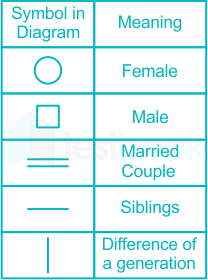
A simple family tree diagram showing different relations.

Code Language
Symbol+-×÷
MeaningA is B's wifeA is B's motherA is B's sonA is B's daughter

Given Expression: M × T - G ÷ H × S + P

S + P: S is the wife of P. 

H × S: H is the son of S.

G ÷ H: G is the daughter of H. (G is female)

T - G: T is the mother of G. 

M × T: M is the son of T.

Family Tree Representation (Relevant Part):

P is the father of H, and H is the father of M.

Therefore, P is the Father's father (Paternal Grandfather) of M..

Hence, the correct answer is "Option 1".

19

Study the given diagram carefully and answer the question. The number in different sections indicate the number of writers who write different types of novels.

What is the total number of writers who write Fiction and Horror novels but not the Thriller novels?

  1. ((a))

    29

  2. ((b))

    40

  3. ((c))

    8

  4. ((d))

    21

Show Answer
Answer: ((c))

8

Given venn diagram is:

Thus, the total number of writers who write Fiction and Horror novels but not the Thriller novels is Fiction ∩ Horror only (excluding Thriller) is the region with 8 writers.

Hence, the correct answer is "Option 3".

20

Seven friends P, Q, R, S, T, U and V are sitting around a circle facing away from the centre. T and U are not the immediate neighbors of R. S is sitting second to the left of V and third to the right of R. P is sitting second to the right of T.

Who is sitting third to the right of P?

  1. ((a))

    U

  2. ((b))

    S

  3. ((c))

    R

  4. ((d))

    Q

Show Answer
Answer: ((a))

U

Given:

Seven friends P, Q, R, S, T, U and V are sitting around a circle facing away from the centre.

S is sitting second to the left of V and third to the right of R. 

T and U are not the immediate neighbors of R.

Thus, U is sitting third to the right of P.

Hence, the correct answer is "Option 1".

Knowledge of ICT (10 questions)

21

While using any documentation tool, the key combination CRTL+X on a keyboard is used for ______.

  1. ((a))

    pasting the copied text/object

  2. ((b))

    moving the selected text/object

  3. ((c))

    cutting the selected text/object

  4. ((d))

    copying the selected text/object

Show Answer
Answer: ((c))

cutting the selected text/object

The correct answer is Option 3: Cutting the selected text/object.

Key Points

  • The key combination CTRL+X is a universal shortcut used in documentation tools and computer applications.
  • This shortcut is primarily used for cutting the selected text or object from its original location.
  • When you use CTRL+X, the selected content is removed from its current location and copied to the clipboard.
  • Once copied to the clipboard, the content can be pasted elsewhere using the CTRL+V command.

Additional Information

  • CTRL+C: Used for copying the selected text or object to the clipboard without removing it from its original location.
  • CTRL+V: Used for pasting the copied or cut content from the clipboard to the desired location.
  • CTRL+Z: Used for undoing the last action performed in the application.
  • CTRL+A: Used for selecting all content within the document or application.
22

Roneeta Sheikh was struggling to connect her Laptop to the Internet using WiFi, somehow she did not get any success. She called the service provider, and she was asked to connect her Laptop using wired medium using ______cable with the internet router till an engineer visits her place to fix the WiFi issue. After the phone call, she forgot the name of the cable, which was suggested over the phone. Now, the service provider's phone is continuously engaged. Can you suggest the name of the most suitable cable out of the following options of cables?

  1. ((a))

    C

  2. ((b))

    Ethernet

  3. ((c))

    USB

  4. ((d))

    HDMI

Show Answer
Answer: ((b))

Ethernet

The correct answer is Ethernet.

Key Points

  • Ethernet cables are the most common and reliable option for wired connections between devices and the internet router.
  • They ensure high-speed and stable internet connectivity, which is particularly useful when WiFi is unavailable or malfunctioning.
  • Ethernet cables are used to create a direct physical connection that bypasses wireless issues.
  • Other cables such as USB or HDMI are not suitable for connecting a laptop to the internet router.

Additional Information

  • USB Cable: USB cables are commonly used for transferring data or charging devices but are not typically used for internet connectivity.
  • HDMI Cable: HDMI cables are designed for transmitting audio and video signals between devices, such as from a laptop to a monitor or TV.
  • C Cable: This option does not refer to a cable type commonly used for internet connectivity.
23

Which of the following is not considered as a good cyber safe practice?

  1. ((a))

    Saving Passwords in a Text File on Desktop

  2. ((b))

    Using 2-factor authentication

  3. ((c))

    Changing Online Account Passwords Regularly

  4. ((d))

    Updating all apps/tools regularly

Show Answer
Answer: ((a))

Saving Passwords in a Text File on Desktop

The correct answer is Saving Passwords in a Text File on Desktop

Key Points

  • Saving passwords in a text file on the desktop is not a safe cyber practice.
  • Such files can be easily accessed by unauthorized users if the system is compromised.
  • It is important to use secure password management tools rather than storing passwords in plain text files.
  • Good cyber safe practices include using two-factor authentication, regularly changing online account passwords, and updating apps/tools regularly to ensure security patches are applied.

Additional Information

  • Two-Factor Authentication (2FA): This adds an extra layer of security by requiring a second form of verification, such as a code sent to your phone or email.
  • Regular Password Updates: Regularly updating passwords reduces the risk of unauthorized access to your accounts in case of data breaches.
  • Software Updates: Keeping apps and tools updated ensures that known vulnerabilities are patched, protecting your system from potential threats.
  • Secure Password Management: Use trusted password managers to store and manage your passwords securely, rather than storing them in unprotected text files.
24

Anvita Deshpande is helping a friend to buy a new smartphone. After seeing the configurations of a few phones, they got confused with what is represented with Megapixel as a unit?

  1. ((a))

    Screen Size

  2. ((b))

    Battery Capacity

  3. ((c))

    Internal Memory

  4. ((d))

    Camera Resolution

Show Answer
Answer: ((d))

Camera Resolution

The correct answer is Camera Resolution.

Key Points

  • Megapixel is a unit used to represent the resolution of a camera.
  • It indicates the number of pixels (millions of pixels) captured by the camera sensor.
  • Higher megapixels generally mean better image clarity and detail, although other factors like lens quality and sensor size also play a significant role.
  • Smartphones with higher megapixel cameras are often preferred for photography enthusiasts.

Additional Information

  • Screen Size: Screen size refers to the physical dimensions of the smartphone display, typically measured diagonally in inches.
  • Battery Capacity: Battery capacity is measured in milliampere-hours (mAh) and indicates how long the battery can last on a full charge.
  • Internal Memory: Internal memory refers to the storage capacity of the phone, typically measured in gigabytes (GB), used for saving apps, files, and other data.
25

Which of the following memory units will be ideally used while buying a hard disk to store large size videos and files from the market?

  1. ((a))

    Kilo Byte

  2. ((b))

    Giga Byte

  3. ((c))

    Mega Byte

  4. ((d))

    Tera Byte

Show Answer
Answer: ((d))

Tera Byte

The correct answer is Tera Byte.

Key Points

  • A hard disk is used to store large files, such as videos, documents, and media.
  • The capacity of a hard disk is typically measured in Gigabytes (GB) or Terabytes (TB), as these units are suitable for handling large amounts of data.
  • Terabyte (TB): 1 TB equals 1024 GB and is ideal for storing large-size videos and files.
  • Smaller units like Kilobytes (KB) or Megabytes (MB) are not suitable for determining hard disk capacity as they represent significantly smaller amounts of data.

Additional Information

  • Kilo Byte: 1 KB equals 1024 bytes. It is used for very small data sizes like text files.
  • Mega Byte: 1 MB equals 1024 KB. It is used for moderately sized files like images and small documents.
  • Giga Byte: 1 GB equals 1024 MB. It is commonly used for medium-sized data storage like software programs, some games, and small videos.
  • Tera Byte: 1 TB equals 1024 GB. It is ideal for storing large files such as HD movies, software backups, and big datasets.
26

Which of the following devices is specially used while playing games on computer for navigating, pointing, selecting and triggering?

  1. ((a))

    Plotter

  2. ((b))

    Barcode Scanner

  3. ((c))

    Mouse

  4. ((d))

    JoyStick

Show Answer
Answer: ((d))

JoyStick

The correct answer is JoyStick.

Key Points

  • A joystick is a pointing device that makes playing video games more interesting.
  • This is because the user is allowed to move the cursor or object anywhere on the screen with the help of a stick.

Additional Information

  • Plotter: A plotter is a printing device used to produce vector graphics, such as technical drawings and architectural blueprints. It is not used for gaming purposes.
  • Barcode Scanner: A barcode scanner is used to read barcodes and is typically used in retail or inventory management, not for gaming.
  • A mouse is a pointing device used to interact with objects displayed on a computer screen.
27

______ is the file extension of an Excel file.

  1. ((a))

    xcl

  2. ((b))

    xlsx

  3. ((c))

    xclx

  4. ((d))

    excel

Show Answer
Answer: ((b))

xlsx

The correct answer is xlsx

Key Points

  • Excel files have specific file extensions that help identify the file format.
  • The most commonly used file extension for modern Excel files is .xlsx, introduced with Microsoft Office 2007 and later versions.
  • The .xlsx format is based on the Open XML standard, which ensures better file compression and improved data recovery.
  • Older versions of Excel (prior to Office 2007) used .xls as their file extension, which is different from the modern .xlsx format.

Additional Information

  • .xcl: This is not a valid file extension for Excel files.
  • .xclx: This is also incorrect and not a valid file extension.
  • .excel: While it may look descriptive, this is not a recognized file extension for Excel files.
  • .xls: This is the older file extension used in Excel versions prior to 2007.
28

Which of the following is formed with 4 Binary digits?

  1. ((a))

    Bit

  2. ((b))

    Kilobit

  3. ((c))

    Nibble

  4. ((d))

    Byte

Show Answer
Answer: ((c))

Nibble

The correct answer is Nibble.

Key Points

  • A Nibble is a unit of digital information in computing and telecommunications.
  • It is formed by 4 binary digits (bits).
  • One Nibble is equivalent to half a Byte (8 bits).
  • Binary digits are the smallest unit of data in computing, and grouping them into 4 bits forms a Nibble.

Additional Information

  • Bit: A bit is the smallest unit of information in computing and represents a binary digit (either 0 or 1).
  • Byte: A Byte is a unit of digital information composed of 8 bits.
  • Kilobit: A Kilobit is a larger unit of digital information and is equal to 1,000 bits.
  • Nibble: Specifically refers to 4 bits grouped together to represent data.
29

Satya Thukral is looking for an open source software/tool, which can help him to make a digital presentation for demonstrating features of a commercial device to his clients. Which of the following will you suggest for the same? 

  1. ((a))

    Writer

  2. ((b))

    PowerPoint

  3. ((c))

    Impress

  4. ((d))

    Calc

Show Answer
Answer: ((c))

Impress

The correct answer is Impress.

Key Points

  • Impress is an open-source software provided by LibreOffice.
  • It is specifically designed for creating digital presentations, making it an excellent choice for Satya Thukral's requirement.
  • Impress provides tools to design slides, add animations, and demonstrate features effectively.
  • It supports multiple file formats, including compatibility with Microsoft PowerPoint files.

Additional Information

  • Writer: Writer is another open-source tool from LibreOffice, but it is designed for word processing, similar to Microsoft Word. It is not used for creating presentations.
  • PowerPoint: PowerPoint is a proprietary software from Microsoft for creating presentations. However, it is not open-source, so it does not meet the requirements of the question.
  • Calc: Calc is an open-source spreadsheet application from LibreOffice, similar to Microsoft Excel. It is not suitable for creating presentations.
30

Which of the following is not an example of an Operating System?

  1. ((a))

    Android

  2. ((b))

    MS Windows

  3. ((c))

    MS Office

  4. ((d))

    Chrome OS

Show Answer
Answer: ((c))

MS Office

The correct answer is MS Office.

Key Points

  • Operating Systems: These are system software that manage computer hardware and software resources and provide services for computer programs. Examples include Android, MS Windows, and Chrome OS.
  • MS Office: Unlike the other options, MS Office is not an operating system. It is a suite of productivity applications that include Word, Excel, PowerPoint, etc.
  • Difference: While operating systems manage the hardware and software of a computer, applications like MS Office run on top of operating systems to perform specific tasks.

Additional Information

  • Android: A mobile operating system developed by Google, primarily used in smartphones and tablets.
  • MS Windows: A widely used operating system developed by Microsoft for computers and laptops.
  • Chrome OS: A lightweight operating system developed by Google, designed for web-based applications and cloud computing.
  • MS Office: A suite of applications used for productivity tasks like document creation, spreadsheets, and presentations. It requires an operating system to function.

Teaching Aptitude (10 questions)

31

A good communicator begins his/her presentation with a :

  1. ((a))

    Audio-Visual Aids

  2. ((b))

    Repetitive phrase

  3. ((c))

    Ice-breaker

  4. ((d))

    Complex question

Show Answer
Answer: ((c))

Ice-breaker

Effective communication in teaching or presentations requires grabbing learners’ attention right at the beginning. A presenter must create a comfortable and engaging atmosphere so that the audience is ready to listen and participate.

Key Points

  • A good communicator often starts with an ice-breaker.
  • This could be a simple activity, a relatable question, or a friendly remark that helps reduce anxiety and builds rapport with the audience.
  • By initiating interaction early, the presenter gains attention, encourages participation, and sets a positive tone for the entire session.

Hint

  • Audio-visual aids enhance clarity later in the session but are not typically used to establish initial rapport.
  • A repetitive phrase may bore or disengage the audience right from the start.
  • A complex question can create confusion rather than encourage early involvement.

Hence**, the correct answer is ice-breaker.**

32

Which of the following is/are not the characteristics of evaluation? 

  1. ((a))

    Evaluation is composite in nature.

  2. ((b))

    Evaluation is objective based process.

  3. ((c))

    Evaluation is testing, measurement and examination.

  4. ((d))

    It presents qualitative as well as quantitative description.

Show Answer
Answer: ((c))

Evaluation is testing, measurement and examination.

Evaluation in education is a systematic process that measures not only the learner’s performance but also the effectiveness of teaching and learning. It focuses on determining how far learning objectives have been achieved. It involves qualitative judgement, interpretation of results, and continuous feedback.

Key Points

  • Evaluation being only testing, measurement and examination does not represent its true nature.
  • Evaluation includes interpretation, decision-making and value-judgement much more than examining or measuring performance.
  • If evaluation were restricted to tests only, important aspects like creativity, attitudes, interests and skills would be ignored.
  • It is a continuous and comprehensive process aimed at improving learning and guiding future actions.
  • So, calling evaluation only testing or examination limits its actual scope and therefore does not match with the real characteristics of evaluation.

Hint

  • Evaluation is composite in nature because it includes varied methods like tests, observations, assignments, and projects together.
  • Evaluation is an objective-based process as it is conducted keeping specific learning outcomes in mind.
  • Evaluation gives both quantitative scores and qualitative descriptions like behavior, problem-solving ability, and participation.

Hence, the correct answer is Evaluation is testing, measurement and examination.

33

A student recites the poem just after teaching, it comes under which of the following level of Teaching?

  1. ((a))

    Reflective level

  2. ((b))

    Primary level

  3. ((c))

    Memory level

  4. ((d))

    Understanding level

Show Answer
Answer: ((c))

Memory level

Levels of teaching describe the depth at which learning takes place. There are mainly three levels: Memory level, Understanding level, and Reflective level. 

Key Points

  • When a student recites a poem immediately after teaching, the learner is only recalling what was just taught.
  • The focus is on rote memory and mechanical repetition rather than interpretation or application.
  • There is no reasoning or explanation involved.
  • This activity therefore clearly falls under the Memory level of teaching, which emphasizes recall, retention and reproduction of learned material.

Hint

  • Reflective level develops critical thinking and problem-solving, which is not involved here.
  • Primary level is not a recognized level of teaching in this context.
  • Understanding level involves meaning-making, explanation and interpretation—greater depth than simple recitation.

Hence, the correct answer is Memory level.

34

Which of the following are not the characteristics of Teacher centered approach?

(A) Knowledge is transmitted from interaction among students and the Teacher.

(B) Concentrates on the right answer.

(C) The focus on learning rather than Teaching.

(D) The students are writing down the dictation given by the Teacher.

Choose the right option:

  1. ((a))

    (B) and (D) only

  2. ((b))

    (C) and (D) only

  3. ((c))

    (A) and (C) only

  4. ((d))

    (A) and (D) only

Show Answer
Answer: ((c))

(A) and (C) only

Teacher-centered approach places the teacher at the center of instruction where the teacher directs learning, presents information, and controls the classroom flow. It values transmission of established knowledge, emphasis on correct answers, and often uses didactic techniques such as lecture and dictation.

Key Points

  • Statement A describes knowledge as transmitted from interaction among students and the teacher, which implies peer interaction and collaborative knowledge construction; this is characteristic of learner-centered approaches rather than teacher-centered instruction.
  • Statement C emphasizes a focus on learning rather than teaching, which shifts priority to student processes, needs, and outcomes instead of teacher delivery; teacher-centered classrooms prioritize teacher presentation and control.
  • Because both statements foreground student agency, interaction, and learning processes, they contradict the central features of teacher-centered pedagogy.
  • Therefore these two statements do not align with the defining elements of a teacher-centered approach.

Hint

  • Statement B concentrates on the right answer, which aligns with teacher-centered emphasis on correctness, standard solutions, and teacher authority in evaluating responses.
  • Statement D, where students write down dictation given by the teacher, reflects passive reception and note-taking typical of teacher-dominated classrooms.

Hence, the correct answer is (A) and (C).

35

Complete the sentence:

If any one of the students comes daily in class without completing the homework you will _______.

  1. ((a))

    insult him/her before the whole class.

  2. ((b))

    try to know the reasons. 

  3. ((c))

    complain to the principal.

  4. ((d))

    complain to the parents.

Show Answer
Answer: ((b))

try to know the reasons. 

In teaching–learning situations, students may struggle to complete homework for various academic or personal reasons. A sensitive and effective teacher first tries to understand the underlying causes and then supports the child.

Key Points

  • Trying to know the reasons helps the teacher understand why a student repeatedly misses homework.
  • It may be due to learning difficulties, lack of guidance at home, emotional problems, or misunderstanding of the task.
  • Once the reason is identified, the teacher can provide help such as extra support, flexible guidance, or peer assistance.
  • This approach promotes trust between student and teacher and encourages positive behavior change.
  • It prevents the child from feeling ashamed or demotivated. It also aligns with inclusive and child-centered education practices in modern pedagogy.

Hint

  • Insulting the student publicly affects self-esteem, creates fear, and destroys confidence, which is not considered a good teaching practice.
  • Complaining to the principal at an early stage shows a lack of responsibility in handling classroom issues.
  • Complaining to parents may be done later if the issue continues, but it should not be the first action without understanding the cause.

Hence, the correct answer is try to know the reasons.

36

A chart is a combination of ______.

  1. ((a))

    lines, dots and graphics

  2. ((b))

    graphics, pictorial and lines

  3. ((c))

    graphics, numerical and pictorial material

  4. ((d))

    graphics, numerical and dots

Show Answer
Answer: ((c))

graphics, numerical and pictorial material

Charts are important visual teaching-learning materials used to present information in a clear, attractive, and organized way. They help learners understand complex data easily through visuals, symbols, and numbers.

Key Points

  • A chart typically contains graphics like shapes, arrows, and bars that visually display information.
  • It also includes numerical material such as figures or data values to show comparison or trends. Along with these, pictorial elements like icons or symbols help learners relate content to real-life objects.
  • This combination makes charts informative and visually engaging. It supports better understanding and communication of data.

Hint

  • Option 1 mentions lines, dots, and graphics, which are only part of chart design but do not represent complete information.
  • Option 2 states graphics, pictorial and lines, but misses the essential numerical information needed to analyze data.
  • Option 4 includes graphics, numerical and dots, but dots alone cannot convey pictorial representation or meaningful symbols.

Hence, the correct answer is graphics, numerical and pictorial material.

37

Which of the following is major virtue of learning ?

  1. ((a))

    Behaviour Modification

  2. ((b))

    Recognition of things

  3. ((c))

    Preparation for Employment

  4. ((d))

    Preparation for Recalling

Show Answer
Answer: ((a))

Behaviour Modification

Learning is a continuous and purposeful process that brings enduring change in behavior, knowledge, skills, and attitudes. In educational psychology, the major purpose of learning is not just memorizing facts but transforming how a learner thinks, acts, and responds in real-life situations.

Key Points

  • Behavior modification refers to a permanent and meaningful change in the learner’s actions and responses as a result of learning experiences.
  • When a student learns new concepts, values, or skills, it influences how they behave in academic and social settings.
  • This aligns directly with the major goal of education shaping thinking and behavior for positive outcomes.

Hint

  • Recognition of things focuses only on memory, not overall improvement.
  • Preparation for employment is only one practical aspect and not the core virtue of learning.
  • Preparation for recalling highlights rote learning which is limited and temporary.

Hence, the correct answer is Behavior Modification.

38

A deductive argument is invalid if:

  1. ((a))

    its premises and conclusions are false.

  2. ((b))

    its premises are all false but conclusions are true.

  3. ((c))

    its premises are all true but conclusions are false.

  4. ((d))

    its premises and conclusions are all true.

Show Answer
Answer: ((c))

its premises are all true but conclusions are false.

Deductive reasoning is a logical process where the conclusion necessarily follows from the given premises. The validity of a deductive argument depends on whether it is impossible for the premises to be true and the conclusion false at the same time.

Key Points

  • A deductive argument is invalid if all its premises are true but the conclusion is false.
  • This situation violates the fundamental requirement of deductive logic: a valid argument cannot have true premises and a false conclusion simultaneously.
  • If this occurs, the reasoning is flawed, showing a breakdown in logical connection between premises and conclusion.
  • This makes the argument logically unsound, even if the premises themselves are true. The essence of deductive reasoning is that truth of premises guarantees truth of the conclusion, which is violated here.

Hint

  • Premises and conclusions both being false does not automatically make an argument invalid; validity depends on logical structure, not truth values.
  • Premises false but conclusion true is possible in valid deductive arguments and does not affect validity.
  • Premises and conclusions all true can still be valid or invalid, depending on logical connection, but this situation alone does not indicate invalidity.

Hence, the correct answer is its premises are all true but conclusions are false.

39

In a classroom, the probability of message reception can be enhanced by :

  1. ((a))

    Exposing the Ignorance of students 

  2. ((b))

    Increasing the information load

  3. ((c))

    Using high decibel audio tools

  4. ((d))

    Establishing a view point

Show Answer
Answer: ((d))

Establishing a view point

Effective communication in the classroom is essential for learning. Probability of message reception refers to how likely students are to understand, retain, and respond to the teacher’s message. It depends on clarity, relevance, and the way information is structured rather than on volume, overload, or humiliation.

Key Points

  • Establishing a viewpoint means presenting information in a clear, structured, and meaningful context.
  • When the teacher organizes ideas logically, highlights key points, and connects content to students’ prior knowledge, the probability of understanding increases.
  • This approach encourages attention, comprehension, and retention. Students can relate the new knowledge to what they already know, which enhances meaningful learning.
  • A clear viewpoint also prevents confusion caused by unrelated or excessive information, making classroom communication more effective.

Hint

  • Exposing the ignorance of students can cause embarrassment and resistance, reducing message reception.
  • Increasing the information load overwhelms students, making it harder to understand key concepts.
  • Using high decibel audio tools may increase hearing but does not ensure comprehension or meaningful reception of the message.

Hence, the correct answer is Establishing a view point.

40

Which of the following is not the characteristics of memory level teaching?

  1. ((a))

    Revising learned material

  2. ((b))

    In this the level of motivation is intrinsic.

  3. ((c))

    Training mental discipline

  4. ((d))

    To get accurate information

Show Answer
Answer: ((b))

In this the level of motivation is intrinsic.

Memory-level teaching is the most basic level of learning where the focus is on recall and retention of information. It emphasizes repetition, memorization, and accuracy rather than deep understanding or critical thinking. This level aims to develop the learner’s ability to remember content correctly and reproduce it when required.

Key Points

  • Memory-level teaching typically involves extrinsic motivation, such as rewards, grades, or teacher approval, rather than intrinsic motivation.
  • Learners are often encouraged to memorize material through drills or repetition, not because they find the content inherently interesting or meaningful.
  • Therefore, stating that the level of motivation is intrinsic does not match the characteristics of memory-level teaching.

Hint

  • Revising learned material aligns with memory-level teaching as repetition strengthens retention.
  • Training mental discipline occurs because consistent recall and practice develop focus and mental rigor.
  • Getting accurate information is a central goal of memory-level teaching to ensure correctness in reproduction.

Hence, the correct answer is In this the level of motivation is intrinsic.

Domain Knowledge (80 questions)

41

In which financial estimation method, 'a minimum amount per head of population is fixed'?

  1. ((a))

    Proportional Method

  2. ((b))

    Method of Detail

  3. ((c))

    Zero Based Budgeting Method

  4. ((d))

    Per Capita Method

Show Answer
Answer: ((d))

Per Capita Method

The Correct answer is the Per Capita Method.

Key Points

  • Per Capita Method-
  • In this method, a minimum amount per head is fixed which is considered essential for providing standard library services.
  • The per capita estimate can be based on the number of literate persons or adults.
  • The UGC Library Committee's (1957) per capita recommendations for university library is - 
  • Rs. 15 per student
  • Rs. 200 per teacher
  • The Kothari Education Commission's (1964) per capita recommendations for university libraries are - ​
  • Rs. 25 per student
  • Rs. 300 per teacher
  • Ranganathan per capita recommendations for university libraries are- ​
  • Rs. 20 per student
  • Rs. 300 per teacher

Additional Information

  • Proportional Method-
  • ​This method presupposes that the adequate finances provided to the libraries are the percentage of the institutional budget that is allocated for library purposes.
  • The University Education Commission's Proportional recommendation for the university library is 6.5% of the university's budget.
  • Ranganathan's Proportional recommendation for the public library is 6% to 10%f of the total library budget.
  • ​Method of Details-
  • ​In this method, all items of expenditure of a library are accounted for while preparing the financial estimates.
  • It has two types- (a) Recurring or Current Expenditure and (b) Non-recurring or Capital Expenditure.
  • ZBB-​
  • It stands for "Zero Based Budgeting".
  • This method of budgeting was developed by Peter Phyrr during the early 1970s.
  • It is an operating, planning, and budgeting process that requires the entire budget request in detail from scratch.
  • It has much in common with PBBS and is opposite to Historical Budgeting.
  • It is an operating, planning, and budgeting process that requires each manager to justify her/his entire budget request in detail from scratch (hence zero-base).
  • It does not take into account what happened in the past but emphasizes current activities.
42

Who among the following created the project 'Automatic Direct Access to Information with Online UDC System (AUDACIOUS)' in 1967-1968 at the American Institute of Physics?

  1. ((a))

    Freeman and Atherton

  2. ((b))

    Buxton and Holder

  3. ((c))

    Rayward and Rigby

  4. ((d))

    Holder and Freeman

Show Answer
Answer: ((a))

Freeman and Atherton

The Correct answer is Freeman and Atherton.

Key Points

  • In 1967–1968, Freeman and Atherton conducted one of the earliest machine-retrieval projects known as the Automatic Direct Access to Information with Online UDC System (AUDACIOUS) at the American Institute of Physics.
  • This interactive system utilized command-driven processes and incorporated the nuclear science sections of the Universal Decimal Classification (UDC) schedules, providing remote direct access to files with English descriptions.
  • AUDACIOUS included 2330 items from Nuclear Science Abstracts, indexed by UDC, as part of a broader initiative.
  • The project encompassed machine-readable UDC files, automatic typesetting, composition of UDC schedules, and a statistical evaluation of classification as a retrieval tool.
  • The outcomes of this project significantly influenced future applications.
  • In the late 1960s and early 1970s, a series of conferences were organized to explore the potential of UDC as a retrieval tool.
43

Visit by one user to a library five times a day is counted as:

  1. ((a))

    Three user visit

  2. ((b))

    Five user visit

  3. ((c))

    Zero user visit

  4. ((d))

    One user visit

Show Answer
Answer: ((d))

One user visit

The Correct answer is ​One user visit

Key Points

  • According to the International Federation of Library Associations and Institutions (IFLA) Library Map of the World Definitions,
  • A physical visit refers to an individual entering the library premises.
  • Each time a person enters the library, it is counted as one visit, regardless of how many times they enter throughout the day.
  • The total number of physical visits made by individuals to the library premises is determined at the end of the year.
  • ​However, According to the RFID gate, it would register as five users having visited the library. The RFID gate features a small display that keeps track of the number of people passing through the gate, accurately counting each entry.

LIBRARY MAP OF THE WORLD Definitions

  • Full-time equivalent (FTE) staff:
  • Full-time equivalent (FTE) staff encompasses all library employees who are compensated for their work, including professional, qualified, project, and assistant staff.
  • Excluded from this count are other staff, such as those involved in security, domestic duties (e.g., cleaners, porters, caretakers), and catering staff, along with volunteers.
  • Volunteers (headcount):
  • ​A volunteer is a person working on library tasks without payment.
  • In counting volunteers, the concept of headcount shall be used. Count the total number of volunteers at the end of the year.
  • Registered users:
  • A registered user is an individual or organization officially enrolled with a library, allowing them access to the library's collection and services, either on-site or remotely.
  • Users can register by request or automatically upon enrolling in the institution.
  • Quantify the total number of registered users (those possessing a library card) by the year's end.
  • Physical visits:
  • Physical visits refer to the presence of an individual entering the library premises.
  • The count is straightforward, with one person entering the library 10 times considered as 10 separate visits.
  • Quantify the total number of physical visits made by individuals to the library premises after the year.
44

Which of the following provides the Green GlassService/Programme?

  1. ((a))

    CILIP

  2. ((b))

    OCLC

  3. ((c))

    Library of Congress

  4. ((d))

    IFLA

Show Answer
Answer: ((b))

OCLC

The Correct answer is ​OCLC.

Key Points

Green Glass:

  • It is a data-driven decision support tool that empowers the library to take local action on its print serials by leveraging collection data from many libraries.
  • It works with major ILSs and helps make decisions for the entire system or specific departments.
  • It is an interactive web-based application of OCLC.
  • GreenGlass supports libraries and groups in making evidence-based decisions regarding the management of print monograph collections​

Additional Information

  • CILIP:
  • It was established in 2002 as a merger of the Library Association (LA, sometimes LAUK) and the Institute of Information Scientists (IIS).
  • Information Professional is CILIP's member magazine for Information, Knowledge, and Library workers in all sectors.
  • Facet Publishing, the commercial publishing and bookselling arm of CILIP.
  • Pen&inc. is CILIP's magazine celebrating diversity in children's books.
  • ALA:
  • ​ALA is the world's oldest and largest library association founded in 1876 with its headquarters in Chicago.
  • ALA Divisions;
  • American Association of School Librarians (AASL)
  • Assn. for Library Service to Children (ALSC)
  • Assn. of College & Research Libraries (ACRL)
  • Public Library Assn. (PLA)
  • Reference & User Services Assn. (RUSA)
  • Young Adult Library Services Assn. (YALSA)
  • IFLA:
  • IFLA was founded in Scotland in 1927 and maintains headquarters at the National Library of the Netherlands in The Hague.
  • IFLA operates six strategic programs:
  • Committee on Standards.
  • Copyright and other Legal Matters (CLM) Advisory Committee.
  • Freedom of Access to Information and Freedom of Expression (FAIFE) Advisory Committee.
  • Library Development Programme (LDP).
  • Strategic Programme on Preservation and Conservation (PAC).
  • UNIMARC Strategic Programme.​
  • OCLC:
  • It was founded in 1967 as the Ohio College Library Center, then became the Online Computer Library Center as it expanded. In 2017, the name was formally changed to OCLC, Inc
  • Products and Services of OCLC:
  • BIBLIOTHECAplus library management system.
  • LBS library management system.
  • EZproxy access and authentication software.
  • GreenGlass
  • SISIS-SunRise library management system
  • Wise
  • CatExpress cataloging service.
  • PiCarta database
  • WorldCat.org global catalog.
45

In the Main Entry of 'Classified Catalogue Code', the Call Number is displayed in the:

  1. ((a))

    Title Section

  2. ((b))

    Note Section

  3. ((c))

    Heading Section

  4. ((d))

    Leading Section

Show Answer
Answer: ((d))

Leading Section

The Correct answer is the Leading Section.

Key Points

  • According to Rule MB0 of CCC, the sections of the main entry of the classified catalog Consist of the following sections:
  • Leading section:
  • The Leading section is to consist of the call number of the document.
  • It is recorded on the leading line from the first vertical.
  • After the class number, the book number is to be written after leaving a double space.
  • The collection number, if any is to be written above the book number.
  • As there is the possibility of a change of call number, it is recorded in pencil.
  • As per Rule ED87, no full stop is given after this section.
  • Heading section:
  • It starts from the second vertical on the next line of the leading line.
  • Continuation of this section if needed will commence at the first vertical.
  • The heading section is where the author's name is recorded.
  • This includes various possibilities such as a single personal author, joint personal authors, corporate author(s), pseudonym(s), collaborator(s), and, in some instances, the title of the document.
  • As per Rule ED51, the Entry element is given in Block letters, and as per Rule ED53, the Secondary element is given in ordinary hand in circular brackets, and the Individualizing element is given in other circular brackets.
  • As per Rule ED86, a full stop is used at the end of the section.
  • The heading can be divided into four components: a) Entry element (surname), b) Secondary element (personal name), c) Individualizing element (years of birth/death), and d) Descriptive element
  • Title section:
  • ​This section will start on the next line from the second vertical.
  • This section is further divided into the following three subsections:
  • Title, subtitle, or explanatory title.
  • Edition statement (Other than the First edition).
  • Collaborator statement.
  • Note Section:
  • ​The note section begins on the next line, starting from the second vertical, and any continuation starts from the first vertical.
  • CCC Rule MF6 outlines six types of notes, but typically, the series note is used, commonly found on the half-title page of the book.
  • According to Rule MF11, a single series note should include
  • (i) the name of the series;
  • (ii) a full stop;
  • (iii) the words 'Ed by' followed by the pure name(s) of the Editor(s) of the series if applicable;
  • (iv) a full stop, and
  • (v) the series number. If the series lacks a serial number, books are given serial numbers based on the accession sequence in the library or by the year of publication.
  • Rule ED83 states that the series note should be enclosed in circular brackets.
  • At the end of each subsection of the series note, a full stop (.) is added.
  • Accession Number:
  • ​As per Rule ED45, the Accession number section is to begin at the First vertical of the bottommost line.
  • As per Rule ED87, no full stop is to be put at the end of the accession number section
  • Tracing:
  • ​It is recorded on the back of the main entry card.
  • The back of the main entry card is to be imagined to be divided into two halves known as the left half and the right half respectively.
  • The right half is again to be divided into three convenient parts, known as the upper part, the middle part, and the lower part.

46

Which of the following is not a Plane of Work according to S.R. Ranganathan?

  1. ((a))

    Written

  2. ((b))

    Notational

  3. ((c))

    Idea

  4. ((d))

    Verbal

Show Answer
Answer: ((a))

Written

The Correct answer is Written.

Key Points

  • According to Ranganathan, the classification process involves three essential planes: the Idea Plane, the Verbal Plane, and the Notational Plane.
  • Idea plane:
  • The Idea Plane holds paramount significance, serving as the primary arena for intellectual work in classification.
  • The key tasks performed here involve selecting the model, defining the subject, determining its scope, and identifying sources of terms and concepts.
  • The foundational classificatory work entails choosing characteristics and establishing the order of their application to generate categories of concepts known as facets and isolates.
  • Ranganathan has given five sets of canon for the work on Idea Plane. They are-
  • canons for characteristics
  • Canons for Succession of Characteristics
  • Canons for Array
  • Canons for Chain
  • Canons for Filiatory Sequence
  • Verbal Plane:
  • The Verbal Plane is a crucial stage in the classification process where standardized names are assigned to concepts organized in arrays and chains during the Idea Plane.
  • It has four canons. They are- 
  • Canon of Context​
  • Canon of Enumeration
  • Canon of Currency
  • Canon of Reticence
  • ​Notational Plane:
  • The Notational Plane, although the final stage in designing a library classification system, represents the most visible aspect of the end product.
  • While some may mistake it for classification itself, it is, in fact, a set of symbols or codes that represent subjects previously conceptualized and named in the Idea and Verbal Planes.
  • It deals with a system of ordinal symbols representing classes in a scheme of library classification.
  • Canon of Homonym and Synonym
  • Canon of Relativity and Uniformity
  • Canon of Hierarchy
  • Canon of Mixed Notation
  • Canon of Faceted Notation
  • Canon of Co-extensiveness
47

'In research, any characteristics that tend to differ from individual to individual' is called:

  1. ((a))

    variables

  2. ((b))

    veracity

  3. ((c))

    value

  4. ((d))

    variance

Show Answer
Answer: ((a))

variables

The Correct answer is variables.

Key Points

  • Variables in research encompass characteristics that vary among individuals and are observed or manipulated by researchers to investigate their relationships with outcomes of interest.
  • Various types of variables include independent, dependent, confounding, mediating, moderator, control, continuous, categorical, discrete, dummy, extraneous, and latent variables.
  • Dependent Variable:
  • The dependent variable is the one that is measured and expected to change in response to experimental manipulations of the independent variable or variables.
  • It represents the presumed effect.
  • Independent Variable:
  • The independent variable is stable and unaffected by other measured variables.
  • It is systematically manipulated by the researcher and serves as the presumed cause in an experiment.

Additional Information

  • Veracity: Veracity refers to the accuracy or truthfulness of something.
  • Value: In the context of research, the term "value" typically refers to the numerical or categorical representation of a variable. While it is an important concept, it doesn't capture the broader idea of characteristics that vary among individuals.
  • Variance:
  • Variance is a statistical term that describes the extent to which values in a set of data differ from the mean (average). While it is related to variability, it's more specific to the spread of values within a particular variable and may not encompass all characteristics that differ among individuals.
48

"Guidance Document: Good Academic Research Practices" is published by _____.

  1. ((a))

    Publication Division, Ministry of Information and Broadcasting

  2. ((b))

    National Book Trust

  3. ((c))

    University Grants Commission

  4. ((d))

    Association of Indian Universities

Show Answer
Answer: ((c))

University Grants Commission

The Correct answer is the University Grants Commission.

Key Points

  • In partnership with Clarivate Web of Science, the UGC has released a guidance document titled "Good Academic Research Practices" (GARP).
  • Aimed at faculty and students in Higher Education Institutions (HEIs), this document serves to enhance awareness about academic integrity.
  • It also provides valuable guidance on best practices, contributing to the improvement of research quality and scholarly publications.

Additional Information

  • UGC:
  • It is a statutory body set up in 1956 by the Government of India.
  • It provides recognition as well as grants to Universities and colleges.
  • Its headquarters is located in New Delhi.
  • Publications of UGC:
  • Indian Higher Education - Quest for Excellence (A Compendium of Flag-Ship Programmes of UGC).
  • Sixty Years of the University Grants Commission.
  • SAKSHAM: Measures for Ensuring the Safety of Women and Programmes for Gender Sensitization on Campuses
  • Reinventing Education For An Inclusive World by Prof. Yash Pal etc.
  • Publication Division, Ministry of Information and Broadcasting:
  • Publications Division is a repository of books and journals highlighting subjects of national importance and India’s rich cultural heritage.
  • Established in 1941, the Publications Division has emerged as a premier publishing house of the Government of India, enriching the national knowledge repository.
  • Some of its Major publications include:
  • Yojana,
  • Kurukshetra
  • Bal Bharati
  • Ajkal
  • Employment News
  • India:2022.
  • NBT:
  • The National Book Trust is an autonomous body under the Department of Higher Education, Under the Ministry of Human Resource Development.
  • It was founded in the year 1957.
  • The objective of the NBT is to encourage the production of good literature in Hindi, English, and other Indian Languages.
  • NBT now functions under the aegis of the Ministry of Education, Govt. of India.​
  • AIU-
  • It stands for the Association of Indian Universities.
  • It is headquartered in Delhi.
  • It was established in 1925 as Inter-University Board.
  • Following are the publications of AIU-
  • AIU Books
  • AIU-US embassy monthly series of special lectures.
  • Indian higher education profile
  • Published articles in higher education
  • University News
  • Universities Handbook
  • AIU Scholarly article series
  • Wednesday E-essay series
49

'Sugamya Pustakalaya' is a collaborative effort of _______.

(A) TCS

(B) Daisy Forum of India

(C) NIEPVD

(D) National Library of India

  1. ((a))

    (B), (C) and (D) are correct

  2. ((b))

    (A), (C) and (D) are correct

  3. ((c))

    (A), (B), (C) are correct

  4. ((d))

    (A), (B) and (D) are correct

Show Answer
Answer: ((c))

(A), (B), (C) are correct

The Correct answer is (A), (B), and (C) are correct.

Key Points

  • Sugamya Pustakalaya:
  • Sugamya Pustakalaya is an online library designed to provide accessible books to individuals with visual impairments, low vision, or any other print disability.
  • Sugamya Pustakalaya (Library) is a collaborative effort of TCS (Tata Consultancy Services), Daisy Forum of India and NIEPVD (National Institute for Empowerment of Persons with Visual Disabilities), Government of India to end the book famine faced by people with print disabilities.
  • Individuals facing challenges such as blindness, weak eyesight, or other disabilities that hinder standard print reading can access books from Sugamya Pustakalaya.
  • The library offers books in various accessible formats, including DAISY audio, DAISY full text, EPUB, Word format (DOC/DOCX), HTML, BRF (Braille-ready files), Text, and RTF.
50

Who among the following is not the Assistant Editor of DDC (23rd edition)?

  1. ((a))

    Rebecca Green

  2. ((b))

    Michael Panzer

  3. ((c))

    J.D. McDonald

  4. ((d))

    Julianne Bell

Show Answer
Answer: ((c))

J.D. McDonald

The Correct answer is ​J.D. McDonald.

Key Points

  • 23rd edition of DDC:
  • It was published in 2011 by the Online Computer Library Center(OCLC).
  • It was edited by 'Joan S. Mitchell'.
  • It was published in 4 Volumes.
  • ​The Detailed information about DDC 23 and its contributors is as :
Author nameRoleType of author
Dewey, MelvilDevised byprimary author
Mitchell, Joan S.Editor in Chiefmain author
Beall, JulianneAssistant Editorsecondary author
Green, RebeccaAssistant Editorsecondary author
Martin, GilesAssistant Editorsecondary author
Panzer, MichaelAssistant Editorsecondary author

Additional Information

  • Michael Panzer, formerly Assistant Editor, was named the 10th Editor-in-Chief of the Dewey Decimal Classification (DDC) system in 2013.
  • Mr. Panzer became the first DDC Editor-in-Chief from outside the United States.
  • OCLC acquired DDC in 1988.
  • DDC version for Windows was published in 1996
  • DDC editorial policy committee was established in 1937.
  • The European DDC user group (EDUG) was established in 2007.
51

Match the following:

List IList II
A.One Nation One SubscriptionI.80/20 rule
B.Pareto PrincipleII.Management by Objectives (MBO)
C.Morgan R. Walker and James E. Kelley Jr.III.Office of Scientific Advisor to the Government of India
D.Peter DruckerIV.The critical path method (CPM)
  1. ((a))

    A - IV, B - I, C - II, D - III

  2. ((b))

    A - III, B - I, C - IV, D - II

  3. ((c))

    A - II, B - III, C - I, D - IV

  4. ((d))

    A - II, B - IV, C - I, D - III

Show Answer
Answer: ((b))

A - III, B - I, C - IV, D - II

The Correct answer is A - III, B - I, C - IV, D - II.

Key Points

  • One Nation One Subscription:​
  • ONOS is an initiative proposed by the Office of Scientific Advisor to the Government of India (GoI), that aims to provide countrywide access to national and international scientific and academic content.
  • It came into force on Apr 1, 2023.
  • This initiative is expected to benefit research and educational institutions including universities, colleges, and research organizations, as well as every citizen of the country through public libraries.
  • ONOS is anticipated to establish national licenses with leading STEM publishers and database producers globally.
  • This initiative aims to facilitate convenient access to high-quality academic information, fostering scientific research and innovation within the country.
  • Pareto Principle:
  • The Pareto principle is also known as the 80/20 rule.
  • it is the law of the vital few, or the principle of factor sparsity, and states that, for many events, roughly 80% of the effects come from 20% of the causes.
  • Management consultant Joseph M. Juran suggested the principle and named it after Italian economist Vilfredo Pareto, who noted the 80/20 connection while at the University of Lausanne in 1896, as published in his first paper, "Cours d'économie politique".
  • Essentially, Pareto showed that approximately 80% of the land in Italy was owned by 20% of the population; Pareto developed the principle by observing that about 20% of the peapods in his garden contained 80% of the peas.
  • In computer science, the Pareto principle can be applied to optimization efforts.
  • ​Morgan R. Walker and James E. Kelley Jr.
  • The Critical Path Method (CPM) was developed in the 1950s by Morgan R. Walker of DuPont and James E. Kelley Jr. of Remington Rand and was first used in missile-defense Construction Projects.
  • It is a step-by-step technique for process planning that defines critical and non-critical tasks to prevent time-frame problems and process bottlenecks.
  • CPM charts are similar to PERT charts and are sometimes known as PERT/CPM.
  • CPM is best utilized for repetitive and non-complex projects when time estimates can be made with some measure of certainty.
  • Peter Drucker:​
  • Peter Drucker coined the term "Management By Objective (MBO) in 1954.
  • He is an Austrian-American management consultant, educator, and author.
  • Drucker also coined the term "Knowledge Worker" in 1959
52

Standard 'IS 1829: Part 2: 2017' is related with:

  1. ((a))

    Information and Documentation

  2. ((b))

    Design of School Library Buildings 

  3. ((c))

    Library Catalogue and Abstract Card 

  4. ((d))

    Library Furniture and Fittings

Show Answer
Answer: ((d))

Library Furniture and Fittings

The Correct answer is Library Furniture and Fittings.

Key Points

  • IS 1829: Part 2 : 2017:
  • IS 1829: Part 2:2017, titled "Library Furniture and Fittings - Specification Part 2 Steel (Second Revision)," outlines the specifications for library furniture and fittings made of steel.

Additional Information Other Standards

  • IS 15339:2003
  • Indian standard 'IS 15339:2003' provides guidelines for services provided by public libraries.
  • IS 15339 (2003): Public Library - Guidelines [MSD 5: Documentation and Information] is reviewed in the year 2018.
  • IS 12940 : 2017:
  • ​IS 12940:2017, reaffirmed in 2022, guides library statistics documentation.
  • ​IS 15996 : 2021:
  • ​IS 15996:2021, which is the first revision of the standard, focuses on information and documentation, specifically library performance indicators.
  • IS 1553 (1989): Design of Library Buildings.
  • IS 7150: 1974 Title: library catalog and abstract card
53

Who coined the phrase 'The best reading, for the largest number at the least cost'?

  1. ((a))

    S.R. Ranganathan

  2. ((b))

    Melvil Dewey

  3. ((c))

    L.R. McColvin

  4. ((d))

    Francis Drury

Show Answer
Answer: ((b))

Melvil Dewey

The Correct answer is Melvil Dewey.

Key Points

  • Dewey’s Principles: Melvil Dewey suggested that in selecting a document the librarian should see that the document is “the best reading for the largest number at the least cost”
  • ​According to this principle, Libraries should select, within their financial resources, the best reading materials that may satisfy the user's needs.

Additional Information

Other Book Selection Principles:

  • Drury’s Principles:
  • ​Drury described his principles in his book, Book Selection, published by ALA in 1930. It is a list of 21 points. The gist of his principles is that the

aim of selection should be “to provide the right book to the right reader at the right time”.

  • The reader is the central theme according to this principle.
  • L R . Mc Colvin Principle:
  • ​He introduced his Demand and supply theory of book selection in his book Theory of Book Selection in Public Libraries first published in 1925.
  • According to him, Books in themselves have no meaning unless they are made serviceable by Demand.
  • H E Haines Principle:
  • His Book Living with Books the art of book selection is the first true textbook aimed at training in book selection for librarians.
  • it was published in 1935.
  • S R Ranganathan principle:
  • The first edition of the Library book selection by S R Ranganathan appeared in 1952.
  • The first three laws of Ranganthan advocated the book selection theory and methods.
  • He also advocated the concept of umbral documents, penumbral documents, and alien documents.
54

Which is the new second law, according to the book 'Reordering Ranganathan: Shifting User Behaviours, Shifting Priorities' by Connaway and Faniel. Dublin: OCLC Research, 2014?

  1. ((a))

    Every person his or her book

  2. ((b))

    Every book its reader

  3. ((c))

    Books are for use

  4. ((d))

    Save the time of the reader

Show Answer
Answer: ((a))

Every person his or her book

The Correct answer is Every person his or her book.

Key Points

  • Reordering Ranganathan: Shifting User Behaviors, Shifting Priorities is a book written by Lynn Silipigni Connaway and Ixchel Fanie and published by OCLC in 2014
  • In this book, they have changed the order of Ranganathan's Five Laws as follows:
  • Save the time of the reader
  • Every Person his or her book
  • Books are for use
  • Every book its reader
  • A library is a growing organism.

Additional Information

  • New Conceptions in the AI Era 
  • AI is for use
  • Every citizen his/her AI
  • Every AI is for citizen usage.
  • AI saves the time of the user.
  • AI Systems are constantly evolving.
  • NEW INSIGHTS AND WIDER INTERPRETATION OF FIVE LAWS:
  • James A. Retting in 1992 conceived a sixth law “Every reader his/her freedom” as applicable only to the type of service such as instruction or provision of information.
  • Michael Gorman has reinterpreted Ranganathan’s laws in the context of today’s library and its likely future, and reformulated them calling them [Gorman’s] “Five New Laws of Librarianship”.
  • ​1) Libraries serve humanity;
  1. Respect all forms by which knowledge is communicated;

  2. Use technology intelligently to enhance service;

  3. Protect free access to knowledge; and

  4. Honour the past and create the future.

  • Kuromen and Pekkarinen Paivi proposed two new laws in their writings.
  • These are 6th Law: “Every reader his library.
  • 7th Law: “Every writer his contribution to the library”
  • ​​Mentor Cana [2003] proposed five laws of the “Software Library.
  • ​1) Software is for use
  1. Every user his / her software (or software for all)

  2. Every software its user

  3. Save the time of the user

  4. A Software Library is a growing organism.

  • Alireza Noruzi A[2004] entitled “Application of Ranganathan’s Five Laws to the Web”.
  • ​1) Web resources are for use.
  1. Every user his / her Web resource.

  2. Every Web resource its user.

  3. Save the time of the user.

  4. The Web is a growing organism.

  • Ranganathan’s five laws: Original vs. new conceptions
Ranganathan’s Original ConceptionNew Conceptions in the Current Environment
First LawBooks are for use.E-books are for reading.Netflix is for watching.The blackboard is for studying.
Second LawEvery person his or her book.Every listener her iTunes.Every artist his Photoshop.Every student her EasyBib.
Third LawEvery book its reader.Every blog its reader.Every Google Map, its traveler.Every digital repository its researcher.
Fourth LawSave the time of the readerSave the time of the listenerSave the time of the traveler.Save the time of the researcher.
Fifth LawA Library is a growing organism
55

'Progressive decrease of the extension and increase of the intension of a Basic Subject or an Isolate Idea' is called:

  1. ((a))

    Fusion

  2. ((b))

    Dissection

  3. ((c))

    Denudation 

  4. ((d))

    Loose Assemblage

Show Answer
Answer: ((c))

Denudation 

The Correct answer is ​Denudation.

Key Points

  • Denudation:
  • ​Denudation' is used to denote fission when we consider one and only one of the subdivisions of an isolate or of a BS, resulting from fission.
  • Prolegomena defined as "Denudation is the progressive decrease of the extension and the increase of the intension (or the depth) of a BS or an isolated idea, even as we scoop out the flesh of a soft-fruit from deeper and deeper layers or as we excavate the well".
  • In the words of J.H. Shera, denudation is "the exposure of a new area of knowledge by erosion or divestment through research or inquiry".
  • Literally, denude means to make bare.
  • Long-drawn and repeated dissection of a single entity becomes denudation.

Additional Information

  • Dissection:
  • The meaning of this term is " separating something into pieces.
  • It cuts a universe of entities into two parts of coordinate status.
  • For example, India is divided into Tamil Nadu, Kerala, etc.
  • Lamination:
  • Lamination means "Layering"
  • For example, we have already an idea but we find out more ideas.

  • Fusion:
  • Fusion represents a developed phase of a loose assemblage.
  • As a loose assemblage transforms into a stable and permanent relationship, its various components become irreversibly interconnected, giving rise to an entirely new subject.
  • This newly formed subject, complete with its unique isolates and literary warrant, is referred to as a fused subject or a subject that has emerged through the process of fusion.


  • Loose Assemblage:​
  • Loose assemblage is assembling together two or more:
  • a) subjects (basic or compound)
  • b) isolate ideas (in one and the same facet, or isolate ideas in one and the same array)
  • Assembling is done to express one or the other possible relations, between the components of the assembly.
56

Which of the following is not a feature of SOUL 3.0?

  1. ((a))

    Supports data exchange through ISO 2709 Standard

  2. ((b))

    Compliant to NCIP 2.0 Protocol

  3. ((c))

    Compliant to MARC 21 bibliographic format

  4. ((d))

    Non-Compliant to International Standard MARC XML

Show Answer
Answer: ((d))

Non-Compliant to International Standard MARC XML

The Correct answer is Non-Compliant to International Standard MARC XML.

Key Points

  • SOUL stands for Software for University Libraries.
  • SOUL 3.0 was released in February 2021.
  • Features of SOUL 3.0
  • ​UNICODE-based multilingual support for Indian and foreign languages;
  • Supports data exchange through ISO-2709 standard
  • Compliant to NCIP 2.0 protocol for RFID and other related applications especially for electronic surveillance and self check-out & check-in
  • Support online copy cataloging from MARC21-supported bibliographic database;
  • Compliant to International Standards such as MARC21, AACR-2, MARCXML
  • Supports cataloging of electronic resources such as e-journals, e-books, virtually any type of material;
  • SOUL is designed for the latest versions of MS-SQL and MySQL (or any other popular RDBMS).
  • Supports authority files of personal name, corporate body, subject headings and series name; Etc.

Additional Information

  • Evolution of SOUL.
  • ​SOUL 1.0 debuted during CALIBER 2000.
  • SOUL 2.0, launched in January 2009, brought significant enhancements.
  • The most recent version, SOUL 3.0, was introduced in February 2021.
57

Arrange the following Acts according to the year of enactment of library legislation.

(i) Manipur Public Libraries Act

(ii) Goa Public Libraries Act

(iii) Karnataka Public Libraries Act

(iv) Rajasthan Public Libraries Act

  1. ((a))

    (iii), (ii), (iv), (i)

  2. ((b))

    (iii), (i), (ii), (iv)

  3. ((c))

    (i), (iii), (iv), (ii)

  4. ((d))

    (i), (iii), (ii), (iv)

Show Answer
Answer: ((b))

(iii), (i), (ii), (iv)

The Correct answer is (iii), (i), (ii), (iv)

Key Points

List of Public Libraries acts in India:

StateYear of EnactmentProvision for library Cess
Tamil Nadu194810 paisa per rupee on property tax (Revised by Govt. in 1992 from 5 to 10)
Andra Pradesh19608 paise per rupee as a surcharge on house tax and property tax collected by local bodies
Karnataka19653% of Land Revenue
Maharashtra​1967No Library Cess
West Bengal1979No Library Cess
Manipur1988No Library Cess
Kerala19895% surcharge on House and Property Tax
Haryana1989Surcharge on House and Property tax as decided by Govt.
Mizoram1993No Library Cess
Goa1993A library cess shall be levied in the form of a surcharge on the Excise Duty on Indian-Made Foreign Liquor (IMFL) as well as a bulk liter of beer at the rate of 0.50p
Gujarat2001No Library Cess
Orissa2001No Library Cess
Uttarakhand2005No Library Cess
Rajasthan2006No Library Cess
Uttar Pradesh2006No Library Cess
Bihar2008No Library Cess
Chhattisgarh2009No Library Cess
Arunachal Pradesh2009No Library Cess
Telangana2015No Library Cess
58

Which of the following is not a type of DBMS?

  1. ((a))

    Notational

  2. ((b))

    Object Oriented

  3. ((c))

    Hierarchical

  4. ((d))

    Relational

Show Answer
Answer: ((a))

Notational

The Correct answer is Notational.

Key Points

  • Notational" is not a type of Database Management System (DBMS).
  • The correct options for types of DBMS include:
  • Object Oriented
  • Hierarchical
  • Relational
  • Relational DBMS (RDBMS):
  • RDBMS is a type of DBMS that stores data in tables, which are related to each other through common fields known as keys.
  • Data is organized into rows and columns in a tabular format.
  • Tables can be related using primary and foreign keys, enabling the establishment of relationships between entities.
  • SQL (Structured Query Language) is commonly used to interact with relational databases.
  • Examples include MySQL, PostgreSQL, Oracle, and Microsoft SQL Server.
  • Hierarchical DBMS:
  • Hierarchical DBMS organizes data in a tree-like structure, where each record has a parent-child relationship with other records.
  • Data is represented in a hierarchy, resembling an inverted tree.
  • Each record (except the root) has a parent record and may have multiple child records.
  • Suitable for representing one-to-many relationships.
  • Examples include IMS (Information Management System).
  • Object-Oriented DBMS (OODBMS):
  • OODBMS is designed to store and manage object-oriented data, where entities are treated as objects with attributes and methods.
  • Data is represented as objects, encapsulating attributes and behaviors.
  • Supports concepts of inheritance, encapsulation, and polymorphism.
  • Well-suited for applications with complex data structures and relationships.

Examples include db4o, ObjectDB.

59

How many copies are to be deposited under the Delivery of Books and Newspapers (Public Libraries) Act?

  1. ((a))

    Two copies of a printed document to all three designated libraries

  2. ((b))

    One copy of a printed document to all two designated libraries

  3. ((c))

    One copy of a printed document to all four designated libraries

  4. ((d))

    One copy of a printed document to all five designated libraries

Show Answer
Answer: ((c))

One copy of a printed document to all four designated libraries

The Correct answer is One copy of a printed document to all four designated libraries.

Key Points

  • Section 3 of the Act mandates publishers of books, newspapers, or serials to submit a copy to the National Library of India in Kolkata and a single copy to each of the three designated public libraries within 30 days of publication.
  • The specified libraries include the Connemara Public Library in Madras (Chennai), the Central Library in Town Hall, Bombay (Mumbai), and the Delhi Public Library. Publishers are responsible for covering all associated delivery costs.

Additional Information The Delivery of Books “and Newspapers” (Public Libraries) Act, 1954;

  • In 1954 Indian parliament passed the Delivery of Books (Public Libraries) Act. According to this Act, the publisher of every book, newspaper, or serial must deliver at his own expense a copy of the book within thirty days from the date of its publication to:
  • National Library at Calcutta (Kolkata),
  • Connemara Public Library, Madras (Chennai),
  • The Central Library, Town Hall, Bombay (Mumbai),
  • Delhi Public Library.
  • ​​It was amended in 1956 and became The Delivery of Books 'and Newspapers (Public Libraries) Act, 1954.
  • The insertions “and Newspapers” provided by the Delivery of Books (Public Libraries) Amendment Act, 1956 include serials as well.
  • Section 4 outlines the procedure for acknowledging the receipt of books or newspapers, while Section 5 stipulates penalties for publishers found in violation of any provision within the act.
  • Penalty: Any publisher who contravenes any provision of this Act. or of any rule made thereunder shall be punishable with a fine which may extend to fifty rupees and, “if the contravention is in respect of a book, shall also be punishable with fine which shall be equivalent to” the value of the book.
60

Who among the following were the editors of 'The Encyclopaedia of Library and Information Science. Fourth Edition (CRC Press)' ?

  1. ((a))

    John Feather and Paul Sturges

  2. ((b))

    William Katz and A.A. Hede

  3. ((c))

    John D. McDonald and Michael Levine -Clark

  4. ((d))

    Michael Levine-Clark and Toni M. Carter

Show Answer
Answer: ((c))

John D. McDonald and Michael Levine -Clark

The Correct answer is John D. McDonald and Michael Levine-Clark.

Key Points

  • Fourth Edition of the Encyclopedia of Library and Information Sciences was Edited by John D. McDonald and Michael Levine-Clark.
  • Encyclopedia of Library and Information Sciences:
  • ​It was first published in 1968-2003 in 73 volumes under the editorship of Allen Kent, Harold Lancour, and Jay E. Daily.
  • The second edition edited by Miriam Drake was published in 2003 in 4 volumes,
  • The third edition edited by Marcia J. Bates and Mary Niles Maack came in 2010 in seven volumes and the fourth edition edited by John D. McDonald and Michael Levine-Clark came in 2017 also in seven volumes.
  • The first edition was strong on both library science and information science. The second edition cut back substantially on information science and related fields
  • The Fourth edition was published in 2017 in Four volumes.​

Additional Information

  • CRC Press:
  • CRC Press, LLC, an American publishing group, specializes in the production of technical books, particularly in the fields of engineering, science, and mathematics.
  • They also cover topics such as business, forensics, and information technology.
  • Currently, CRC Press operates as a division of Taylor & Francis, a subsidiary of Informa.
  • The origins of CRC Press trace back to the establishment of the Chemical Rubber Company (CRC) in 1903 by brothers Arthur, Leo, and Emanuel Friedman in Cleveland, Ohio.
  • Initially, the company focused on selling rubber laboratory aprons, expanding over time to include laboratory equipment for chemists.
61

Which of the following is a key feature of the 'Half-duplex Communication System'?

  1. ((a))

    Both parties can communicate with each, but not simultaneously.

  2. ((b))

    No party can communicate with each other.

  3. ((c))

    Both parties can communicate with each other simultaneously.

  4. ((d))

    Multi-dimensional.

Show Answer
Answer: ((a))

Both parties can communicate with each, but not simultaneously.

The Correct answer is Both parties can communicate with each other, but not simultaneously.

Key Points

  • Half Duplex;
  • ​Half Duplex is a transmission mode applied in computer networks where data flows one way at a time from sender to receiver.
  • In this mode, connected devices can either transmit or receive data, but not both simultaneously.
  • The use of half-duplex is appropriate when simultaneous communication in both directions is unnecessary.
  • Example: Walkie-talkie in which message is sent one at a time and messages are sent in both directions.

Additional Information

  • Full Duplex:
  • ​Full Duplex is the transmission mode employed in computing networks for simultaneous bidirectional information flow between sender and receiver.
  • In this mode, the channel capacity is divided between the two devices, allowing data to travel in both directions.
  • Full Duplex incorporates two simplex channels, each facilitating traffic in opposing directions.
  • This mode is utilized when two-way communication is essential, as seen in a telephone network and messaging applications.
  • Example: Telephone Network in which there is communication between two persons by a telephone line, through which both can talk and listen at the same time.

  • Simplex:
  • Simplex transmission mode refers to a unidirectional flow of information from a sender to a receiver in computing networks.
  • It facilitates one-way communication, allowing data to move solely in one direction.
  • An instance of simplex transmission includes communication from a computer to a keyboard, akin to a radio station operating as a simplex channel.


62

According to S.R. Ranganathan 'Spot Subject' is a :

  1. ((a))

    Subject of small extension and great intension

  2. ((b))

    Subject formed by coupling two or more subjects

  3. ((c))

    Subject of great extension and great intention

  4. ((d))

    Subject of very tiny extension and enormous intension

Show Answer
Answer: ((d))

Subject of very tiny extension and enormous intension

The Correct answer is the Subject of very tiny extension and enormous intension

Key Points

  • According to Ranganathan, A spot subject, in his definition, was a subject with a very tiny extension (scope) and significant intension (meaning) and could often be encapsulated in a single sentence or word.
  • This concept of a spot subject is somewhat similar to the idea of subject-specific keywords.
  • Ranganathan also discussed the idea of a "concept space" where subjects are represented as points, similar to points on a line or plane.
  • He asserted that while the concept of space is finite, the number of specific subjects within it could be infinite.

Additional Information

  • Ranganathan categorized all the subjects in the universe of knowledge into three categories:
  • ​Basic Subjects (BS),
  • ​Primary (BS): Primary basic subjects are the main classes or categories that form the foundation of a classification system.
  • These are the fundamental subjects that encompass broad areas of knowledge.
  • Non-primary (BS): Non-primary basic subjects are subcategories or subdivisions of the primary basic subjects.
  • They represent narrower and more specific areas of knowledge within the broader primary subjects.
  • Compound Subjects:
  • ​Compound subjects are subjects that are virtually infinite in number and are formed by combining a primary basic subject with a specific focus or qualifier.
  • These qualifiers help narrow down and specify the subject further.
  • Complex Subjects:
  • ​Complex subjects are composed of two phases or aspects.
  • They typically involve a primary basic subject combined with another aspect or specialization.
63

Which of the following is the publisher of the Journal 'YOJANA' ?

  1. ((a))

    University Grants Commission

  2. ((b))

    Publication Division, Ministry of Information and Broadcasting, GOI

  3. ((c))

    National Book Trust

  4. ((d))

    Ministry of Education, GOI

Show Answer
Answer: ((b))

Publication Division, Ministry of Information and Broadcasting, GOI

The Correct answer is Publication Division, Ministry of Information and Broadcasting, GOI.

Key Points

  • Publications Division is a repository of books and journals highlighting subjects of national importance and India’s rich cultural heritage.
  • Established in 1941, the Publications Division has emerged as a premier publishing house of the Government of India, enriching the national knowledge repository.
  • Some of its Major publications include:
  • Yojana, the flagship journal of the Division published since 1957.
  • Kurukshetra, published in 1952 in English and Hindi, is a unique monthly journal dedicated to rural development issues.
  • Bal Bharati, the popular children’s monthly in Hindi, has been published regularly since 1948.
  • Ajkal, is a prestigious literary magazine published in 1945 in Hindi and 1942 in Urdu.
  • Employment News is the flagship weekly job journal of the Publications Division, Ministry of Information and Broadcasting. It was launched in 1976
  • India:2022: India 2022, a Reference Annual is a comprehensive digest of national progress in diverse fields, the book deals with all aspects of development from rural to urban, industry to infrastructure, science, and technology to art and culture, from economy to health, defense to education or mass communication.

Additional Information

  • Yojana, a monthly magazine initiated by the Government of India in 1957, addresses socio-economic issues.
  • It is accessible in 13 languages, such as English, Hindi, Urdu, Punjabi, Marathi, Gujarati, Bengali, Assamese, Telugu, Tamil, Kannada, Malayalam, and Odia.
  • The publication delivers thorough examinations of government policies and programs through contributions from various experts, including government think tanks, policy makers, senior authors, and journalists.
  • Yojana is a non-circulating magazine designed exclusively for reference purposes.

64

Which of the following cannot be a variable for measuring user-related characteristics in a library?

  1. ((a))

    Wealth of Users

  2. ((b))

    Reading Pattern

  3. ((c))

    Frequency of Library Visit

  4. ((d))

    Reason for Use

Show Answer
Answer: ((a))

Wealth of Users

The Correct answer is Wealth of Users.

Key Points

  • Wealth of Users" cannot be considered a variable for measuring user-related characteristics in a library.
  • User-related characteristics typically focus on aspects such as reading patterns, the frequency of library visits, and reasons for use, which are more directly related to how individuals engage with library resources and services.
  • Wealth is an economic factor that, while potentially influencing library use indirectly, is not traditionally measured as a direct variable in the context of user-related characteristics within a library setting.

Additional Information

  • Reading Pattern:
  • Reading pattern refers to the way individuals consume or engage with reading materials, including their preferences for genres, formats, or topics.
  • This is a relevant variable for understanding how users interact with library resources, helping libraries tailor their collections to meet the diverse reading preferences of their patrons.
  • Frequency of Library Visits:
  •  This variable measures how often individuals visit the library.
  • It provides insights into user engagement and the library's role in the community.
  • The frequency of library visits is a key user-related characteristic, offering information on the level of utilization and the importance of the library in the lives of its users.
  • Reason for Use:
  • This variable explores the motivations behind individuals using library services, such as academic research, leisure reading, or information seeking.
  • Understanding the reasons for library use helps tailor services to meet diverse user needs, ensuring that the library remains a relevant resource for its community.
65

What is the problem in research?

  1. ((a))

    The topic being investigated

  2. ((b))

    Footnote

  3. ((c))

    Research Technique

  4. ((d))

    Sampling Technique

Show Answer
Answer: ((a))

The topic being investigated

The correct answer is The topic being investigated

Key Points

  • A research problem also called a research issue, is a statement about an area or field of concern that professionals aim to understand and address.
  • The characteristics of a research issue include:
  • Having a clear problem variable
  • Being specific and limited in scope
  • Having a goal
  • Usually being free from ethical constraints
  • Typically generating research questions.

Additional Information

  • The population:
  • In research, the term "population" refers to the entire group of individuals, objects, or events that the researcher is interested in studying and drawing conclusions about.
  • Hypothesis:
  • A hypothesis is a tentative and testable statement that proposes a possible explanation for a particular observation, phenomenon, or scientific question.
  • Types of hypotheses:
  • Null hypothesis
  • Alternative Hypothesis
  • Directional (One-tailed) Hypothesis:
  • Non-Directional (Two-tailed) Hypothesis:
  • Associative Hypothesis:
  • Causal Hypothesis.
  • ​Footnote:
  • In research, a footnote is a reference, explanation, or comment placed at the bottom of a page in a document, article, or research paper.
  • Footnotes are typically used to provide additional information, cite sources, acknowledge sources of data or quotations, offer explanations, or include comments that may be relevant to the main text but are placed separately for clarity.
  • Research Technique:
  • Research techniques refer to the methods, procedures, or approaches employed by researchers to collect, analyze, interpret, and draw conclusions from data in the pursuit of answering research questions or testing hypotheses.
  • These techniques are systematic and organized ways of gathering information and conducting investigations.
  • Sampling Technique:
  • A sampling technique is a method used in research to select a subset of individuals or elements from a larger population for the purpose of making inferences about the entire population.
  • Sampling is essential in research because it is often impractical or impossible to study an entire population due to constraints such as time, cost, and resources.
66

Identify the correct sequence of following cataloging experts as per their date of birth. 

(I) Charles Ammi Cutter

(II) Sir Antonio Genesio Maria Panizzi

(III) S.R. Ranganathan

(IV) Charles Coffin Jewet

  1. ((a))

    (I), (II), (III), (IV)

  2. ((b))

    (II), (IV), (I), (III) 

  3. ((c))

    (IV), (II), (I), (III) 

  4. ((d))

    (II), (IV), (III), (I)

Show Answer
Answer: ((b))

(II), (IV), (I), (III) 

The Correct answer is (II), (IV), (I), (III).

Key Points

  • Sir Antonio Genesio Maria Panizzi:
  • Anthony Panizzi, born on 16 September 1797 in Brescello, Duchy of Modena and Reggio (now part of the province of Reggio Emilia), Italy, was an Italian patriot who later became a naturalized British citizen.
  • Renowned as Sir Antonio Genesio Maria Panizzi, he served as the Principal Librarian (head) of the British Museum from 1856 to 1866.
  • Panizzi held various roles at London University (now University College London), including Assistant Librarian (1831–1837), Keeper of Printed Books (1837–1856), and ultimately Principal Librarian (1856–1866).
  • In recognition of his outstanding contributions as a librarian, Queen Victoria knighted him in 1869, making him a Knight Commander of the Order of the Bath.
  • He Formulated the British Museum Code also known as the Panizzi Code.
  • Charles Coffin Jewett:
  • Born on August 12, 1816, in Lebanon, Maine, Charles Coffin Jewett was an American librarian.
  • In 1848, he assumed the roles of Librarian and Assistant Secretary of the Smithsonian Institution, later becoming the superintendent of the Boston Public Library in 1858.
  • Jewett played a prominent role in library leadership during his career.
  • ​In 1852 C C Jewett published his 39 codes.
  • Charles Ammi Cutter:
  • ​Charles Ammi Cutter was born on March 14, 1837.
  • He was an influential American librarian.
  • During the 1850s and 1860s, he played a key role in re-cataloging the Harvard College library, introducing America's first public card catalog.
  • Joining the Boston Athenaeum in 1868, Cutter transformed its card catalog into an international model.
  • His advocacy for centralized cataloging influenced the standard practices at the Library of Congress.
  • Cutter held leadership roles in various library organizations, both locally and nationally.
  • Notably, he is remembered for the Cutter Expansive Classification.
  • Rules for a Dictionary Catalogue was the first attempt by Charles A. Cutter to set forth the rules in a systematic way or to investigate what might be called the first principles of cataloging.
  • It was first published in 1876 with 205 rules.
  • The second edition was published in 1889, the third in 1891, and the fourth posthumously in 1904 which contained 369 rules.​
  • S.R. Ranganathan-
  • Shiyali Ramamrita Ranganathan was born on 9 August 1892.
  • He was an Indian librarian and mathematician.
  • Recognized as the pioneer of library science, documentation, and information science in India, Ranganathan's impact extends globally due to his foundational ideas in the field.
  • In India, his birthday is commemorated annually as National Librarian Day.
  • He is regarded as the Father of Library Science in India.
  • His most notable contribution to the field of library science is his "Five Laws of Library Science".
  • He is also recognized for his development of a classification scheme widely known as Colon Classification.
67

In which year, was the 'Mobile Library Services' of Delhi Public Library started?

  1. ((a))

    1955

  2. ((b))

    1958

  3. ((c))

    1950

  4. ((d))

    1953

Show Answer
Answer: ((d))

1953

The Correct answer is 1953.

Key Points

  • The Delhi Public Library, established on October 27, 1951, operates as an autonomous organization under the Ministry of Culture, with initial support from UNESCO.
  • Inaugurated by Prime Minister Pt. Jawaharlal Nehru, it holds the distinction of being the busiest public library in South-East Asia.
  • The library network includes a Central and Zonal Library, 3 Branch Libraries, 24 Sub-Branch Libraries, 2 Community Libraries, 10 Resettlement Colonies Libraries, 73 Mobile Service Points, and 24 Deposit Stations across Delhi.
  • Additionally, it provides specialized services such as a Braille library for the visually impaired, a Prison library for Tihar Jail inmates, and mobile library services to areas lacking library facilities.
  • Notably, all main branches feature dedicated sections for children.
  • Special Services:
  • Free Internet Service: The Delhi Public Library offers complimentary public Internet access to members at the Central Library and 11 branch libraries.
  • Free CD/DVD Services: DPL provides free lending of CD/DVD collections at the Central Library and four branch libraries.
  • The collection includes English and Hindi movies, as well as educational and recreational content for children.
  • Children’s Section: Dedicated children’s sections are available at the Central Library and three branch libraries, featuring new books, CD/DVDs, computers, games, and attractive furniture to enhance the existing collections.
  • Mobile Library Services: Initiated in 1953, the Mobile Library service aims to bring library services directly to readers' doorsteps.
  • With four Mobile Vans operating in 73 areas, 4,275 registered members benefit from this service.
  • Braille Library Services: The Braille Department of the library offers specialized Braille services, including transcriptions.
  • The Braille collection comprises 15,699 items, and Braille Mobile Library Services cater to 20 institutions, delivering books to readers by post.
68

Which of the following statements is not correct regarding Library of Congress Subject Headings (LCHS)?

  1. ((a))

    May consist of a single word or a phrase 

  2. ((b))

    First edition was published in 1891.

  3. ((c))

    Most widely used subject vocabulary in the world

  4. ((d))

    First edition was published in part between 1909 to 1914

Show Answer
Answer: ((b))

First edition was published in 1891.

The Correct answer is the First edition was published in 1891.

Key Points

  • The Library of Congress Subject Headings (LCSH) comprises a thesaurus of subject headings.
  • The United States Library of Congress maintains it.
  • It was first published in 1898.
  • It is a controlled vocabulary used in bibliographic records.
  • It has over 270,000 usable headings and over 490,000 headings that are used for cross-referencing.
  • LCSH is used in cataloging.
69

Which of the following is not an output device of a Computer?

  1. ((a))

    Speaker

  2. ((b))

    Monitor

  3. ((c))

    Image Scanner

  4. ((d))

    Printer

Show Answer
Answer: ((c))

Image Scanner

The Correct answer is Image Scanner.

Key Points

  • Image Scanner:
  • An image scanner is an input device used to convert physical documents, photographs, or images into digital format.
  • It captures the content of a physical document and creates a digital representation that can be stored, edited, or reproduced on a computer.
  • Image scanners are commonly used for tasks like document digitization.
  • There are various types of scanners:
  • Drum Scanners
  • Flatbed Scanners
  • Film Scanners
  • Hand Scanners
  • 3D Scanners
  • Desktop Digital Camera Scanners
  • Smartphone Scanners

Additional Information

  • Speaker:
  • Speakers are Output devices that produce sound or audio output from a computer.
  • They receive electronic signals representing sound and convert them into audible sound waves.
  • This allows users to hear music, videos, system sounds, and other audio content from their computers.
  • Monitor:
  • A monitor, also known as a display screen or screen, is an output device that provides visual feedback from a computer.
  • It displays the output of the computer, including text, images, videos, and graphical user interfaces.
  • Monitors come in various types, such as LCD, LED, and CRT.
  • Printer:
  • Printers are output devices that produce hard copies or printed versions of digital documents.
  • They take electronic data from a computer and transfer it onto paper or other print media.
  • Printers are essential for creating physical copies of documents, photos, or any other content.
70

Which of the following are the components of reference service as identified by Samuel Swett Green in 1876?

(A) Instruct the reader on how to use the library and its resources.

(B) Answer readers' questions.

(C) Aid the reader in the selection of good works.

(D) Conduct information literacy programs.

  1. ((a))

    (A), (B) and (C) are correct.

  2. ((b))

    (A), (C) and (D) are correct.

  3. ((c))

    (A), (B) and (D) are correct.

  4. ((d))

    (B), (C) and (D) are correct.

Show Answer
Answer: ((a))

(A), (B) and (C) are correct.

The Correct answer is (A), (B), and (C) are correct.

Key Points

  • The foundational components of reference service, as introduced by Green in 1876, continue to shape the core functions of reference librarians today.
  • These four key functions encompass:
  • Instruct patrons on how to use the library
  • Answers patron queries
  • Aids the patron in selecting resources
  • Promotes the library within the community
  • Instruction:
  • The reference librarian educates patrons on how to effectively use the library.
  • This function emerged as a response to the need for public education, ensuring that community members could access and navigate the library's information resources.
  • Query Response:
  • Reference librarians assist patrons by answering their specific queries.
  • Over time, this role has become synonymous with the image of the reference librarian as an expert helping users find information.
  • Resource Selection Assistance:
  • Beyond factual information, patrons often seek guidance in selecting reading materials.
  • In the early days, librarians directed readers to "good works" emphasizing values like honesty and hard work.
  • This guidance evolved into modern Reader's Advisory services.
  • Community Promotion:
  • Recognizing the importance of demonstrating the library's value to the community, Green emphasized the need for librarians to be visible and integral to the research process.
  • This visibility aimed to garner support by showcasing the library's direct service to users.

Additional Information

  • Essentially the reference service incorporates the following three basic elements: 
  • Information or knowledge base (also known as reference sources)
  • User or client
  • Information professional or librarian (also known as reference librarian)
  • Katz (2002), in his authoritative book titled „Introduction to Reference Work,‟ divides reference sources into two (02) broad categories:
  • Control-Access-Directional Type; and
  • Source Type (Katz, 2002)
71

Which of the following is a Volatile Memory?

  1. ((a))

    RAM

  2. ((b))

    EPROM

  3. ((c))

    ROM

  4. ((d))

    SSD

Show Answer
Answer: ((a))

RAM

The Correct answer is RAM.

Key Points

  • Volatile Memory:
  • Volatile memory is a type of computer memory that requires power to maintain the stored information actively.
  • When power is turned off or lost, the data stored in volatile memory is erased.
  • It contrasts with non-volatile memory, where data can be retained even when the power is turned off.
  • RAM (Random Access Memory):
  • ​RAM is a common form of volatile memory.
  • The computer's operating system uses it to store actively used data and machine code.
  • RAM is crucial for tasks such as running applications and multitasking.
  • Two types of volatile RAM, dynamic and static, have cost, speed, and construction distinctions.
  • Dynamic RAM (DRAM) is popular for its cost-effectiveness. It stores each bit in a separate capacitor within the integrated circuit, requiring only one capacitor and one transistor per bit.
  • This makes DRAM space-efficient and affordable.
  • Static RAM (SRAM) is faster than DRAM but more expensive.
  • Unlike DRAM, SRAM doesn't require continuous electrical refreshes, although it still needs constant current to sustain voltage differences.
  • Each bit in an SRAM chip necessitates a cell of six transistors, compared to DRAM's one capacitor and one transistor per bit.

Additional Information

  • EPROM is an erasable programmable read-only memory.
  • It is a non-volatile memory.
  • It is used to hold both the operating system and the program for the access control panel.
  • The Read-Only Memory (ROM) is non-volatile and retains its information even after the power is turned off.
  • SSD is a solid-state drive and is a type of storage and alternative for hard disk and is a non-volatile memory.
72

'AGRIS' is maintained by _____.

  1. ((a))

    Food and Agriculture Organization of the United Nations

  2. ((b))

    UNESCO

  3. ((c))

    U.S. Department of Agriculture

  4. ((d))

    Danish Agriculture Museum

Show Answer
Answer: ((a))

Food and Agriculture Organization of the United Nations

The Correct answer is the Food and Agriculture Organization of the United Nations.

Key Points AGRIS:

  • The international information system for agricultural science and technology was started in 1974 by the UN's Food and Agriculture Organization (FAO).
  • It became fully operational in 1975 with the first issue of AGRINDEX.
  • The Current Agricultural Research Information System (CARlS) and AGRlS function collectively.
  • WebAGRIS: It covers the current and ongoing agricultural information projects in AGRIS and CARlS and is considered as networking for AGRIS in the future.
  • PubAg is a full-text database on agricultural science.
  • AGRIS 2.0 was released in 2013.
  • AGRIS Application Profile (AP) gives the Guidelines for the Description of Information Objects for the International Information System on Agricultural Sciences and Technology.
  • AGROVOC is a multilingual international agricultural thesaurus. The terms are in English, French, and Spanish
  • In July 1974 India formally decided to participate in the AGRIS program,
  • Every month, the Agricultural Research Information Centre receives from FAO updated machine-readable AGRIS outputs. and AGRIS magnetic tape and AGRINDEX.

Additional Information

  • Food and Agriculture Organization of the United Nations:
  • Established on October 16, 1945, the Food and Agriculture Organization of the United Nations (FAO) is a specialized agency of the United Nations.
  • It plays a pivotal role in coordinating global initiatives to eradicate hunger, enhance nutrition, and bolster food security.
  • The organization's Latin motto, "fiat panis," translates to "let there be bread."
  • UNESCO-​
  • UNESCO stands for United Nations Educational Scientific and Cultural Organization.
  • It is a specialized agency of the UN aimed at promoting world peace and security through international cooperation.
  • It was founded in 1945 and has 193 country members presently and is headquartered in Paris, France.​
  • ​U.S. DEPARTMENT OF AGRICULTURE:
  • Established in 1862, the United States Department of Agriculture (USDA) was officially created by an act of Congress signed into law by President Abraham Lincoln.
  • In one of his last annual messages to Congress, about two and a half years later, Lincoln referred to the USDA as "The People's Department."
  • Back then, nearly half of Americans lived on farms, a significant contrast to the present where only about 2 percent do.
73

"The interpersonal communication between a reference staff member and library user to determine the precise information needs of the user" is called _______.

  1. ((a))

    Reference Question

  2. ((b))

    Reference Service

  3. ((c))

    Reference Interview

  4. ((d))

    Reference Evaluation

Show Answer
Answer: ((c))

Reference Interview

The Correct answer is ​Reference Interview.

Key Points

  • Reference interview:
  • Online Dictionary of Library and Information Science defines a reference interview as “The interpersonal communication that occurs between a reference librarian and a library user to determine the person’s specific information need(s), which may turn out to be different than the reference question initially posed. A reference interview may occur in person, by telephone, or electronically (usually via e-mail) at the request of the user.”
  • The term Reference interview was coined by Margareth Hutchins
  • William Katz described the 3-fold purpose for reference interviews which means being three times as great as many.

Additional Information

  • Reference Question: 
  • A specific query is posed by a library user seeking information or assistance.
  • When library users have inquiries or need assistance, they formulate reference questions to obtain relevant information or guidance.
  • Reference Service:
  • The overall provision of assistance and information by library staff to meet the information needs of users.
  • Reference service encompasses a range of activities and resources aimed at helping library users, including answering reference questions, guiding information retrieval, and providing access to relevant materials.
  • Reference Evaluation:
  • The assessment of reference services, including the quality and effectiveness of assistance provided.
  • Reference evaluation involves analyzing how well reference services meet user needs, considering factors such as response time, accuracy, and user satisfaction. It helps libraries enhance service quality.
74

According to AACR-2, what is a Parallel title?

  1. ((a))

    Title in uppercase

  2. ((b))

    Title in lowercase

  3. ((c))

    A title proper in another language

  4. ((d))

    A condensed title

Show Answer
Answer: ((c))

A title proper in another language

The Correct answer is A title proper in another language.

Key Points

  • AACR2 defines a parallel title as the title proper in another language and/or script, with the understanding that it may not always be a direct one-to-one translation.
  • When recording parallel titles, adhere to AACR2 guidelines (1.1D2) by transcribing the first parallel title and any subsequent ones in English.
  • Follow the order of titles as presented on the item (AACR2 1.1D1).
  • For each transcribed parallel title in the title statement, create a corresponding added entry (246 31). Note that there are specific provisions for certain serials with a title proper in a non-roman script as outlined in AACR2 1.1D2.

  • In Figure ., two titles are given, one in English and one in Irish.  Since the English title is recorded as the title proper, the Irish title is recorded as the parallel title.
75

Which of the following is not an OSI Layer?

  1. ((a))

    Application

  2. ((b))

    Accession

  3. ((c))

    Physical

  4. ((d))

    Data Link

Show Answer
Answer: ((b))

Accession

The Correct answer is Accession.

Key Points

  • The OSI model, developed by the International Organization for Standardization (ISO), serves as a conceptual framework facilitating communication among diverse systems through standardized protocols.
  • In simpler terms, it establishes a common standard for various computer systems to communicate effectively.
  • The OSI Model acts as a universal language for computer networking, dividing a communication system into seven abstract layers, each building upon the one before it.

  • The application layer:
  • ​The application layer is unique in that it directly engages with user data.
  • Software applications such as web browsers and email clients utilize this layer to initiate communications.
  • It's important to note that client software applications themselves are distinct from the application layer.
  • Instead, the application layer manages protocols and data manipulation, enabling software to present meaningful information to the user.
  • Protocols within the application layer encompass HTTP and SMTP, the latter being crucial for facilitating email communications.

  • The presentation layer:
  • ​The Presentation Layer (Layer 6) plays a crucial role in preparing data for the application layer by making it suitable for consumption.
  • Its main functions include translation, encryption, and compression of data.
  • When two devices communicate, they may employ different encoding methods.
  • Layer 6 is tasked with translating incoming data into a format understandable by the application layer of the receiving device.

  • The session layer:
  • ​The Session Layer (Layer 5) is responsible for managing the opening and closing of communication sessions between two devices.
  • It ensures that the session remains open for the duration needed to transfer the exchanged data and promptly closes the session to conserve resources.

  • The Transport Layer:
  • ​The Transport Layer (Layer 4) manages end-to-end communication between devices.
  • It takes data from the session layer, divides it into segments, and sends it to layer 3.
  • On the receiving end, the transport layer reassembles the segments into data consumable by the session layer.
  • This layer is responsible for flow control and error control.
  • Flow control determines an optimal transmission speed, preventing a fast sender from overwhelming a slow receiver.
  • Error control ensures that received data is complete, prompting retransmission if necessary.

  • The network layer:
  • ​The Network Layer (Layer 3) manages data transfer between distinct networks.
  • It breaks up transport layer segments into smaller units called packets on the sender's device and reassembles them on the receiving device.
  • Additionally, the network layer determines the optimal physical path for data to reach its destination, known as routing.
  • Protocols associated with the network layer include IP, Internet Control Message Protocol (ICMP), Internet Group Message Protocol (IGMP), and the IPsec suite.

  • The data link layer:
  • ​The Data Link Layer (Layer 2) is akin to the network layer, but it specifically manages data transfer between two devices within the same network.
  • It takes packets from the network layer and subdivides them into smaller units known as frames.
  • Similar to the network layer, the data link layer oversees flow control and error control for intra-network communication, while the transport layer handles these aspects for inter-network communications.

  • The physical layer:
  • ​The Physical Layer (Layer 1) encompasses the tangible components engaged in data transfer, such as cables and switches.
  • It is responsible for converting data into a bit stream, represented by a sequence of 1s and 0s.
  • Additionally, both devices at the physical layer must establish a consistent signal convention to distinguish between 1s and 0s.

76

Which of the following is not an Operating System?

  1. ((a))

    Microsoft Word

  2. ((b))

    Mac OS

  3. ((c))

    Windows

  4. ((d))

    Linux

Show Answer
Answer: ((a))

Microsoft Word

The Correct answer is ​Microsoft Word.

Key Points

  • Microsoft Word is not an Operating System. The other options—Mac OS, Windows, and Linux—are examples of operating systems.
  • MAC OS:
  • MAC OS is the operating system designed to run on Apple laptops and desktop computers. As Apple grew and strengthened the ecosystem through the years, macOS operating system version history evolved too.
  • Mac OS X 10.0 (Cheetah) March 24, 2001: was the first version, and macOS 13 (Ventura) Fall 2022 is the latest.
  • Linux:
  • Linux is one of the popular versions of the UNIX operating System and it was developed by Linus Torvalds in 1991.
  • It is free to use. Linux was designed considering UNIX compatibility. Its functionality list is quite similar to that of UNIX. Though open source it adheres to standards of UNIX – POSIX and Linux file system standards (FSSTND).
  • Basic Features of Linux
  • Portable (Machine-independent)
  • Open Source
  • Multi-User
  • Multiprogramming
  • hierarchical
  • File System
  • Shell
  • Security
  • Linux Operating System has primarily three components: Kernel, System Library, and System Utility.
  • MS Windows: Developed by Microsoft, MS Windows is one of the most widely used operating systems for personal computers.
  • It provides a graphical user interface (GUI) and supports a wide range of software applications.
  • Microsoft Word:
  • Microsoft Word, commonly referred to as 'Word,' is a prominent word processing software and a flagship product developed by Microsoft.
  • It is an integral component of the Microsoft Office suite and stands as the most widely-used word processor globally, estimated to be running on over a billion devices.
  • Initially introduced in 1983 under the name "Multi-Tool Word," the first version, Word 1.0, was launched in October 1983.
77

Which of the following is not a Microsoft Application?

  1. ((a))

    Share Point

  2. ((b))

    One Note

  3. ((c))

    Outlook

  4. ((d))

    Gmail

Show Answer
Answer: ((d))

Gmail

The Correct answer is Gmail.

Key Points

  • Gmail" is not a Microsoft application. The other options—SharePoint, OneNote, and Outlook—are Microsoft applications.
  • SharePoint:
  • SharePoint is a web-based collaborative platform designed to seamlessly integrate with Microsoft 365.
  • Introduced in 2001, SharePoint primarily functions as a document management and storage system, although its applications extend to information sharing via intranets, internal application development, and business process implementation.
  • SharePoint Foundation: This was a free version with basic features, discontinued in 2016.
  • SharePoint Standard: Microsoft SharePoint Standard is a software product that enhances the capabilities of Microsoft SharePoint Foundation in multiple areas.
  • SharePoint Server: Offered by Microsoft, SharePoint Server grants organizations greater control over the behavior and design of SharePoint.
  • SharePoint Enterprise: Building upon SharePoint Standard, Microsoft SharePoint Enterprise features can be unlocked with an additional license key.
  • OneNote
  • It is a note-taking program for free-form information gathering and multi-user collaboration.
  • OneNote is a product of Microsoft
  • Outlook:
  • Microsoft Outlook is a comprehensive personal information manager software system developed by Microsoft and included in the Microsoft 365 software suites.
  • While widely recognized as a business-oriented email client, Outlook offers a range of features beyond email, encompassing functionalities like calendaring, task management, contact organization, note-taking, journal logging, web browsing, and RSS news aggregation.

Additional Information

  • Gmail:
  • Gmail is a free email service provided by Google.
  • At its launch in 2004, Gmail provided a storage capacity of one gigabyte per user, which was significantly higher than its competitors offered at the time.

Other Microsoft applications:

  • Collaboration platform: Microsoft Teams
  • Word processor: Word
  • Spreadsheet software: Microsoft Excel
  • Presentation software: Microsoft PowerPoint
  • Email and calendar: Microsoft Outlook
  • Note-taking app: Microsoft OneNote
  • Cloud storage service: OneDrive
  • Appointment scheduling app: Microsoft Bookings
  • Video editing app: Clipchamp
  • Web browser: Microsoft Edge
  • Writing assistant: Microsoft Editor
78

'Multiple evaluations of employees which often include assessments from superior(s), peers, and one's self' is called:

  1. ((a))

    Peer-assessments

  2. ((b))

    Negotiated performance appraisal

  3. ((c))

    360-degree feedback

  4. ((d))

    Self-assessments

Show Answer
Answer: ((c))

360-degree feedback

The Correct answer is ​360-degree feedback.

Key Points

  • Performance Appraisals:
  • Performance appraisal" denotes the routine assessment of an employee's job performance and their overall contributions to a company.
  • Referred to by various terms such as annual review, employee appraisal, or performance evaluation, it involves evaluating the employee's skills, accomplishments, and development, or any areas lacking in progress.
  • Types of Performance Appraisals:
  • Self-assessments: Individuals evaluate their own behavior and job performance.
  • This process allows employees to reflect on their skills, achievements, and areas for improvement.
  • Peer assessments: Group members evaluate each other's performance, often utilizing a graphic rating scale.
  • Peer assessments from multiple members, known as crowd-based performance reviews, address issues associated with assessments from a single member.
  • 360-degree feedback: This involves multiple evaluations from various sources, including assessments from superiors, peers, and self-evaluations.
  • Negotiated performance appraisal (NPA): The NPA is an emerging approach facilitating communication between supervisors and subordinates.
  • It involves a facilitator preparing lists of what employees excel at, recent improvements, and areas needing enhancement.
79

Who developed the Model 'POSDCORB'?

  1. ((a))

    Melvil Dewey

  2. ((b))

    Luther Gulick and Lyndall Urwick

  3. ((c))

    H.E. Bliss

  4. ((d))

    Henry Fayol

Show Answer
Answer: ((b))

Luther Gulick and Lyndall Urwick

The Correct answer is Luther Gulick and Lyndall Urwick.

Key Points

  • POSDCORB is a widely recognized management and administrative framework originating from a 1937 paper by Luther Gulick and Lyndall Urwick.
  • The acronym breaks down the key functions of management:
  • P - Planning: Involves crafting a comprehensive roadmap based on expertise and understanding of the task at hand.
  • O - Organizing: Encompasses designing, structuring, space planning, and job allocation, as well as establishing a logical framework for activities, assigning tasks, and coordinating group efforts.
  • S - Staffing: Also referred to as Human Resource Management, it emphasizes the critical role of personnel within an organization, particularly significant in contexts such as libraries.
  • D - Directing: Encompasses providing guidance, instructions, and advice to employees to ensure the accurate and efficient completion of tasks.
  • C - Coordinating: Focuses on integrating and aligning various organizational components to promote seamless operations and prevent redundancy.
  • R - Reporting: Involves keeping all stakeholders informed about completed tasks, ongoing activities, and future initiatives within the organization.
  • B - Budgeting: Refers to the preliminary estimation of an organization's income and expenses over a specific period, forming the basis for financial planning and control.

80

Which of the following is not a part of Maslow's Hierarchy of needs?

  1. ((a))

    Safety

  2. ((b))

    Behaviour

  3. ((c))

    Physiological

  4. ((d))

    Self-actualization

Show Answer
Answer: ((b))

Behaviour

The Correct answer is Behaviour.

Key Points

  • Maslow's Hierarchy of Needs-
  • Moslow introduced five levels of basic needs also known as Maslow's hierarchy of needs through this theory. They are-
  • Physiological Needs- These pertain to basic needs necessary for survival.
  • Security Needs - These needs pertain to safety and security.
  • Social Needs - These needs pertain to the relationship between and among people.
  • Esteems Needs - These needs pertain to power, achievement, and status.
  • Self-actualizing Needs - These needs pertain to a higher sense of satisfaction.
  • Maslow's hierarchy of needs is most often displayed as a pyramid.
  • The lowest levels of the pyramid are made up of the most basic needs while the more complex ones are located at the top.

81

In Colon Classification, the sequence of 'Astronomy, Planets' in Basic Class 'Mathematics' is choosen according to the principle of ________

  1. ((a))

    Right to Left

  2. ((b))

    Away from Position

  3. ((c))

    Periphery to Centre

  4. ((d))

    Left to Right

Show Answer
Answer: ((b))

Away from Position

The Correct answer is Away from Position.

Key Points

  • Principle of Away from Position” as one of the guiding principles applied in this context.
  • The Principle of Away from Position is defined as: If the subjects in an array of subjects or the isolates in an array of isolates can be conveniently taken to start from a certain point and diverge away from it roughly along a line, they may be arranged from the starting point along the diverging line.
  • In the specific question regarding the sequence of 'Astronomy, Planets' in Basic Class 'Mathematics,' the arrangement is chosen according to the "Principle of Away from Position."
  • It means that the sequence is determined based on the divergence away from a specific starting point, which, in this case, aligns with the natural order of the planets in their orbits around the Sun.

Additional Information

  • Ranganathan (Prolegomena, FA2) has formulated the following eight principles for arranging entities of an array in a  helpful way:
  • Principle of Later-in-Time
  • Principle of Later-in-Evolution
  • Principle of Spatial Contiguity
  • Principles for Quantitative Measure
  • Principle of Increasing Complexity
  • Principle of Canonical Sequence
  • Principle of Literary Warrant
  • Principle of Alphabetical Sequence
  • Further to the third principle of Spatial Contiguity, he has given 13 sub-principles to suit a given situation.
  • Principles for Entities along a Vertical Line
  • Principle of Bottom Upwards
  • Principle of Top-Down
  • Principles for Entities along a Horizontal Line
  • Principle of Left to Right
  • Principle of Right to Left
  • Principles for Entities along a Circular Line
  • Principle of Clockwise Direction
  • Principle of Counter-Clockwise Direction
  • Principles for Entities along a Radial Line
  • Principle of Periphery to Centre
  • Principle of Centre to Periphery
  • Principle of Away-from-Position
82

Which among the following is associated with the development of @ Your Library Campaign?

  1. ((a))

    IFLA

  2. ((b))

    OCLC

  3. ((c))

    ALA

  4. ((d))

    CILIP

Show Answer
Answer: ((c))

ALA

The Correct answer is ALA.

Key Points

  • The @ Your Library Campaign is a prolonged initiative of ALA aiming to raise public awareness and advocate for the significance of public, school, academic, and special libraries, along with the roles of librarians in the 21st century.
  • The campaign encompasses various library types, including academic, public, school, and special libraries.
  • While it serves as a national foundation, there are targeted campaigns tailored for specific purposes
  • One specific focus of the campaign is directed towards children and their engagement with libraries.
  • The Kids! @ your library initiative provides a plethora of resources such as promotion tips, sample press materials, downloadable art, and other tools designed to assist local libraries in reaching out to children, their parents, and caregivers.
  • Additionally, there is the @ your library® Toolkit for Academic and Research Libraries, which serves as a comprehensive resource.
83

Which of the following information can be taken from the accession register of a library?

  1. ((a))

    Total number of books in a library

  2. ((b))

    Total number of visitors

  3. ((c))

    Age of the readers

  4. ((d))

    Total number of issued books

Show Answer
Answer: ((a))

Total number of books in a library

The correct answer is the Total number of books in a library.

Key Points

  • A library accession register is a log or record of all the items (books, journals, audio-visual materials, etc.) that a library has acquired or added to its collection over time.
  • The register typically includes information about the title, author, publisher, date of publication, and other relevant details of each item.
  • Each book is assigned a single accession number and accession entry of the resources and Services

book is made only against this assigned number.

  • The standard size of the Accession Register is 16"x 13'.
  • There are 14 columns in an Accession Register.
84

Which of the following administers the ALA's 'John Cotton Dana Public Relations Award"?

  1. ((a))

    Reference and User Services Association

  2. ((b))

    Public Library Association

  3. ((c))

    The Library Leadership and Management Association

  4. ((d))

    Library and Information Technology Association

Show Answer
Answer: ((c))

The Library Leadership and Management Association

The Correct answer is The Library Leadership and Management Association.

Key Points

  • The John Cotton Dana Library Public Relations Award, commonly known as the John Cotton Dana Award, is an annual accolade presented by Core: Leadership, Infrastructure, Futures, a division of the American Library Association (ALA), to recognize outstanding achievements in library public relations.
  • Named after the Progressive Era librarian John Cotton Dana, who advocated for broad library accessibility, this prestigious award has been given since 1946.
  • Sponsored by EBSCO Information Services, the H.W. Wilson Foundation, and the Library Leadership and Management Association (LLAMA), eight winners are bestowed with a $10,000 prize and a plaque.
  • The 2023 John Cotton Dana Award winners are: 
  • Ashtabula County District Library
  • Calgary Public Library
  • Gerber/Hart Library Archives
  • Mesa Public Library
  • Patchogue-Medford Public Library
  • Pioneer Library System
  • San José Public Library
  • University of Colorado Boulder Libraries

Additional InformationLibrary Leadership and Management Association:

  • ​Since its inception in 1957, the Library Leadership and Management Association (LLAMA) has played a pivotal role in driving leadership in the field of library and information science.
  • Responding to the dynamic shifts in technology, economics, politics, and culture, LLAMA empowers library professionals with the necessary resources to cultivate thriving and successful careers in library services.
  • With a focus on promoting exceptional leadership and management practices, LLAMA is dedicated to nurturing individual excellence in both current and aspiring library leaders.
  • LLAMA is guided by a set of core values that underpin its mission of advancing leadership and management excellence:
  • Demonstrating exemplary and innovative service for its members
  • Facilitating leadership development and providing continuous learning opportunities for its members
  • Advocating for sustainable and socially responsible management practices in the field of library and information services
85

Match the following:

List I (Propounder)List II (Thought)
A.Douglas McGregorI.Action Learning
B.Joseph JuranII.Theory X and Theory Y
C.Reginald W. RevansIII.Quality Management
D.Abraham MaslowIV.Hierarchy of needs
  1. ((a))

    A - IV, B - I, C - II, D - III

  2. ((b))

    A - III, B - I, C - IV, D - II

  3. ((c))

    A - II, B - III, C - I, D - IV

  4. ((d))

    A - II, B - IV, C - I, D - III

Show Answer
Answer: ((c))

A - II, B - III, C - I, D - IV

The Correct answer is A - II, B - III, C - I, D - IV.

Key Points

  • Douglas McGregor:
  • In 1960 Douglas McGregor formulated Theory X and Theory Y suggesting two aspects of human behavior at work.
  • One of which is negative and called Theory X.
  • The second one is positive called Theory Y.
  • Theory X presents a pessimistic view of employees' nature and behavior at work, while Theory Y presents an optimistic view of the employees’ nature and behavior at work.
  • Joseph Juran:​
  • The Juran Trilogy, also called the Quality Trilogy, was presented by Dr. Joseph M. Juran in 1986.
  • According to him management for quality is done through three managerial processes - planning, control, and improvement.
  • The underlying concept is that managing quality consists of three universal processes:
  • Quality Planning (Quality by Design)
  • Quality Control (Process Control & Regulator
  • Quality Improvement (Lean Six Sigma)
  • ​ According to Juran 'Quality is fitness for use,
  • He was the first to stress that management, communication, and human resources are key to achieving quality.

  • Reginald W. Revans:
  • Reginald William Revans was a British academic professor, administrator, and management consultant known for pioneering the use of Action Learning.
  • Apart from his contributions to management, he was also a long jumper who represented Britain at the 1928 Summer Olympics in Amsterdam, finishing 32nd in the long jump event.
  • In the 1930 British Empire Games, he secured the silver medal in both the long jump and triple jump competitions.
  • Abraham Maslow:​
  • Moslow introduced five levels of basic needs also known as Maslow's hierarchy of needs through this theory. They are-
  • Physiological Needs- These pertain to basic needs necessary for survival.
  • Security Needs - These needs pertain to safety and security.
  • Social Needs - These needs pertain to the relationship between and among people.
  • Esteems Needs - These needs pertain to power, achievement, and status.
  • Self-actualizing Needs - These needs pertain to a higher sense of satisfaction.
86

Electronic Resources in Medicine (NML- ERMED-India) Consortium is an initiative of _______.

  1. ((a))

    World Health Organization 

  2. ((b))

    National Medical Library, New Delhi 

  3. ((c))

    National Documentation Centre of National Institute of Health and Family Welfare

  4. ((d))

    Directorate General of Health Services, Ministry of Health and Family Welfare, Govt. of India

Show Answer
Answer: ((d))

Directorate General of Health Services, Ministry of Health and Family Welfare, Govt. of India

The Correct answer is Directorate General of Health Services, Ministry of Health and Family Welfare, Govt. of India.

Key Points

  • The Electronic Resources in Medicine (ERMED) Consortium, managed by the National Medical Library in New Delhi, India, is an initiative established in 2008 under the Directorate General of Health Services, Ministry of Health & Family Welfare, Government of India.
  • Currently boasting a membership of 98 institutions, the consortium operates to develop comprehensive electronic information resources in the medical domain.
  • Guided by the Director General of Health Services (DGHS), the ERMED Consortium, headquartered at the National Medical Library, strives to enhance the availability of electronic resources dedicated to medicine.
  • The ultimate goal is to contribute to the efficient delivery of healthcare services across the nation.
  • Directed by Dr. B. Srinivas, the Director of NML, the consortium focuses on providing member institutions with access to the latest medical journals.
  • Presently, it has acquired 242 high-quality online e-journals from leading publishers such as British Medical Journal Publishing, Cambridge University Press, Lippincott Williams & Wilkins, Oxford University Press, and John Wiley.
  • The consortium is committed to continual expansion and updates, welcoming suggestions for relevant and valuable content.
87

Which of the following is not a level of orientation in the workplace as given by Martha Montague Smith?

  1. ((a))

    Survival ethics

  2. ((b))

    Creative ethics

  3. ((c))

    Ideal ethics

  4. ((d))

    Practical working ethics

Show Answer
Answer: ((b))

Creative ethics

The Correct answer is Creative ethics.

Key Points

  • Workplace orientation involves introducing new employees to their job roles, work environments, and areas.
  • The supervisor plays a key role in familiarizing the employee with the organization, covering aspects such as company culture, workspaces, and colleagues.
  • This process enables employees to ask questions and gain comprehensive insights into various facets of the organization.
  • Description of Ethical Orientations Martha Montague Smith.
  • ​Level 5 - Ideal Ethics:
  • At this highest level, individuals or groups align with the loftiest goals and aspirations.
  • This includes adherence to codes, mission statements, and overarching values accepted by society.
  • Level 4 - Practical Working Ethics:
  • Slightly less grand than ideal ethics, practical working ethics align with high aspirations.
  • There is consistency between institutional objectives and personal/professional goals.
  • This level involves flexibility and adaptability, allowing individuals to navigate workplace stresses and changing environments.
  • Level 3 - Pressure Ethics:
  • Internal or external pressures start to strain loyalty to institutional or professional goals.
  • This level involves conflicts between personal and professional values due to factors like potential layoffs or technological changes.
  • Level 2 - Subversive Ethics:
  • In this level, a group may work outside the stated or perceived goals to uphold what they perceive as worthy goals for the profession or institution.
  • This might involve actions contrary to policies, such as ordering materials against unwritten rules or erasing records in response to external threats.
  • Level 1 - Survival Ethics:
  • At the lowest level, individuals isolate themselves when institutional demands conflict with basic requirements for safety, security, or integrity.
  • This may lead to detachment from work, colleagues, and clients.
88

Which of the following is the Oral Method of collecting primary data in research?

  1. ((a))

    Schedule

  2. ((b))

    Questionnaire

  3. ((c))

    Observation

  4. ((d))

    Interview

Show Answer
Answer: ((d))

Interview

The Correct answer is Interview.

Key Points

  • The oral method of collecting primary data in research refers to gathering information directly from individuals through verbal communication.
  • This method involves face-to-face interactions between the researcher and the respondents, where the researcher asks questions, and the respondents provide answers.
  • The primary tools used in the oral method are interviews and discussions.
  • Interviews:
  • Structured Interviews: In structured interviews, the researcher follows a predetermined set of questions in a fixed order.
  • This ensures consistency and facilitates quantitative analysis of the responses.
  • Unstructured Interviews: Unstructured interviews are more open-ended, allowing for a free-flowing conversation.
  • The researcher has a set of general topics but can explore new avenues based on the respondent's answers.
  • Discussions:
  • ​Focus Group Discussions (FGD): FGD involves a small group of participants discussing a specific topic guided by a moderator.
  • It allows for the exploration of diverse perspectives and group dynamics
  • Informal Discussions: Informal discussions involve casual conversations with individuals to gather insights.
  • While less structured, they can provide valuable qualitative data.

 Additional Information

  • Schedule:
  • A schedule serves as the instrument employed for gathering data from respondents during an interview.
  • It encompasses inquiries, statements (designed to solicit opinions), and blank spaces or tables intended for respondents to complete.
  • Questionnaire:
  • Unlike interviews, questionnaires are a written set of questions that respondents fill out themselves.
  • This method is more self-administered, allowing for standardized data collection.
  • It can be distributed on paper or electronically.
  • Observation:
  • Observation involves systematically watching and recording behavior, events, or characteristics in a natural setting.
  • It doesn't involve direct interaction with the subjects but relies on the researcher's ability to observe and document.
89

'A system of rules that allows two or more entities of a communication system to transmit information' is called :

  1. ((a))

    Topology

  2. ((b))

    Flow charting

  3. ((c))

    Communication Protocol

  4. ((d))

    Communication Channel

Show Answer
Answer: ((c))

Communication Protocol

The Correct answer is Communication Protocol.

Key Points

  • Communication Protocol.:
  • A communication protocol is a set of rules that enables two or more entities in a communication system to exchange information using various physical quantities.
  • These protocols define how communication should occur, specifying rules for syntax, semantics, synchronization, and error recovery methods.
  • Protocols can be implemented through hardware, software, or a combination of both.
  • Internet communication protocols are established by the Internet Engineering Task Force (IETF), while the IEEE manages wired and wireless networking, and the International Organization for Standardization (ISO) oversees other types of protocols.

Additional Information

  • Topology:
  • Topology refers to the physical or logical layout or arrangement of elements in a network.
  • It describes how devices or nodes are connected and the structure of the communication pathways.
  • Common network topologies include bus, star, ring, mesh, and hybrid configurations.
  • Flow Charting:
  • ​Flow charting is a visual representation of a process or system using symbols, arrows, and boxes to illustrate the sequence of steps and decision points.
  • It is a diagrammatic representation that helps in understanding, analyzing, and documenting processes or algorithms.
  • Communication Channel:
  • A communication channel is the pathway through which data is transmitted between devices in a communication system.
  • It can be physical, such as cables or airwaves, or logical, such as a specific frequency or protocol.
  • Communication channels facilitate the transfer of information from a sender to a receiver.
90

'Kala Nidhi: A repository of research and reference material' is a division of _____.

  1. ((a))

    National Archives of India

  2. ((b))

    Indira Gandhi National Centre for Arts

  3. ((c))

    National Social Science Documentation Centre

  4. ((d))

    Sahitya Academy

Show Answer
Answer: ((b))

Indira Gandhi National Centre for Arts

The Correct answer is ​Indira Gandhi National Centre for Arts.

Key Points

  • Kala Nidhi serves as a repository for research and reference materials in the Humanities and the Arts.
  • Housed within the Indira Gandhi National Centre for Arts (IGNCA), it boasts an extensive collection encompassing textual, visual, and auditory data.
  • Kala Nidhi plays a crucial role in supporting textual research conducted by Kala Kosha, contextual research on lifestyle studies by Janapada Sampada, and the dissemination of outcomes through Kala Darshana and the Cultural Informatics Laboratory.
  • The Reference Library within Kala Nidhi is a treasure trove of source material covering diverse fields such as Archaeology, Anthropology, Art History, Aesthetics, Crafts, Ethnology, History, Linguistics, Literary Studies, Religion, and Sociology.
  • Kala Nidhi is linked to the ABIA Project, specifically the ABIA South and Southeast Asian Art & Archaeology Index.
  • This initiative aims to establish an annotated bibliographic database, known as the ABIA Index, catering to publishers.
  • The subjects covered include pre and proto-history, historical archaeology, ancient and modern art history, material culture, epigraphy, and numismatics.

Additional Information

Indira Gandhi National Centre for Arts (IGNCA):

  • ​The IGNCA (Indira Gandhi National Centre for the Arts) was inaugurated on November 19, 1985, and its trust was formally constituted and registered in New Delhi on March 24, 1987.
  • The IGNCA premises hold symbolic representations, including five rocks from five major rivers (Sindhu, Ganga, Kaveri, Mahanadi, and Narmada) sculpted into artistic forms.
  • IGNCA (Indira Gandhi National Centre for the Arts) operates through various divisions, each contributing to its diverse activities:
  • Kalanidhi Division: This division encompasses the reference library, information and databank, and cultural archive.
  • Kalakosa Division: It includes area studies and the Gender, Culture, and Civilization network.
  • JanapadaSampda Division: This division focuses on lifestyle studies, multimedia presentations, ethnographic collections, children's world, UNESCO chair, and program activities.
  • Kaldarsana Division: Complementing JanapadaSampda, this division provides a platform for facilitating creative dialogues among cultures, various disciplines, societal levels, and diverse arts.
  • National Archives of India (NAI):
  • ​The National Archives of India (NAI), an attached office under the Ministry of Culture, comprises a Regional Office in Bhopal and Records Centers located in Jaipur, Puducherry, and Bhubaneswar.
  • Originally established in March 1891 as the 'Imperial Record Department' in Calcutta, it was later relocated to New Delhi in 1911 and has been situated in its current building since 1926.
  • National Social Science Documentation Centre:​
  • The National Social Science Documentation Centre (NASSDOC), renamed so in 1985, was established in 1970 by the Indian Council of Social Science Research, New Delhi.
  • NASSDOC is actively participating in UNESCO's Asia Pacific Information Network in Social Sciences (APINESS). it is bringing out the APINESS Newsletter.  NASSDOC is represented in FID and IFLA
  • Sahitya Academy:
  • The Sahitya Akademi was inaugurated by the Government of India on 12 March 1954.
  • The Academy was formally registered as a society on January 7, 1956, under the Societies Registration Act, of 1860.
  • The Sahitya Akademi has established Centers for Translation in Bangalore, Ahmedabad, Kolkata, and Delhi, along with an Archive of Indian Literature in Delhi.
91

Which of the following decade was declared as 'Literacy decade: Education for All' by the 'United Nations'?

  1. ((a))

    2003-2012

  2. ((b))

    2012-2022

  3. ((c))

    1980-1989

  4. ((d))

    1992-2001

Show Answer
Answer: ((a))

2003-2012

The Correct answer is 2003-2012.

Key Points

  • During its fifty-sixth session, the General Assembly proclaimed the period 2003 to 2012 as the Literacy Decade: Education for All
  • its objective is to achieve locally sustainable literate environments by extending literacy to the 860 million illiterate adults and the 113 million children out of school worldwide.
  • The priority attention would be given to the most disadvantaged groups, especially women and girls, ethnic and linguistic minorities, indigenous populations, migrants and refugees, disabled persons, and out-of-school children and youth.

Additional Information Other important Decades:

1995 - 2004Decade for Human Rights Education
1997 - 2006Decade for The Eradication for Poverty
2008 - 2017Second United Nations Decade for the Eradication of Poverty
2018 - 2027Third United Nations Decade for the Eradication of Poverty
2005 - 2014United Nations Decade of Education for Sustainable Development
2019 - 2028Nelson Mandela Decade of Peace
2021 - 2030United Nations Decade on Ecosystem Restoration
2021 - 2030United Nations Decade of Healthy Ageing
2022 - 2032International Decade of Indigenous Languages
92

Which of the following statements is not correct regarding 'Outsourcing'?

  1. ((a))

    Usually refers to moving work domestically

  2. ((b))

    Shifts jobs from an organization to a firm

  3. ((c))

    Contractors who perform work

  4. ((d))

    Contracting always beyond the boundaries of the Country

Show Answer
Answer: ((d))

Contracting always beyond the boundaries of the Country

The Correct answer is Contracting is always beyond the boundaries of the Country.

Key Points

  • Outsourcing involves hiring an external company to handle tasks or produce goods that were traditionally managed internally by a company's own staff.
  • This practice is often adopted by companies to reduce costs
  • Outsourcing does not always involve contracting beyond the boundaries of the country.
  • It can encompass both domestic and international arrangements.
  • One of the primary motivations behind outsourcing is cost reduction
  • Outsourcing often involves the transfer of certain job functions from within the organization to external service providers.
  • Outsourcing can occur both domestically and internationally.
  • Domestic outsourcing refers to contracting services within the same country, while international outsourcing involves hiring external parties located in other countries.
  • Outsourcing relationships are typically governed by contractual agreements.
93

In which year was 'Khuda Bakhsh Oriental Public Library' raised to the status of an Institution of National Importance by an Act of Parliament?

  1. ((a))

    1966

  2. ((b))

    1969

  3. ((c))

    1960

  4. ((d))

    1963

Show Answer
Answer: ((b))

1969

The Correct answer is 1969.

Key Points

  • Khuda Bakhsh Oriental Public Library-
  • The origin of the establishment is back in 1842 as Muhammadiyah Private Library.
  • It is situated in Patna (Bihar).
  • 29th of October in 1891 it was established as Khuda Bakhsh Oriental Public Library by HMJ Sir Khan Bahadur Khuda Baksh and opened to the public.
  • Maulvi Muhammad Baksh Khan, on his death, left a collection of 1500 manuscripts.
  • The Govt. of India declared the Library an Institution of National Importance by an act of Parliament in 1969.
  • The Library is now fully funded by the Ministry of Culture (Govt. of India).
  • It is one of the National Libraries of India.
  • It is an autonomous organization under the Ministry of Culture and is governed by a board with the Government of Bihar as its ex officio chairman.
  • The library is also a designated Manuscript Conservation Centre (MCC) under the National Mission for Manuscript.
  • The Khuda Bakhsh Library houses an exceptional assortment of records related to the Timurid family, often referred to as the "history of the Timurid family." This collection is unparalleled and cannot be found in any other library or museum worldwide
  • Among its treasures, the library possesses a manuscript of Sahih al-Bukhari meticulously transcribed by Shaykh Muhammad ibn Yazdan Bakhsh Bengali in Ekdala, eastern Bengal.
  • This particular manuscript was presented as a gift to the Sultan of Bengal, Alauddin Husain Shah.
94

Standard 'IS 1553: 1989' is related with:

  1. ((a))

    Mobile Library Van

  2. ((b))

    Design of School Library Buildings

  3. ((c))

    Design of Library Buildings

  4. ((d))

    Library Furniture and Fittings

Show Answer
Answer: ((c))

Design of Library Buildings

The correct answer is Design for library buildings.

Key PointsSome Indian Library standards are;

Specifications for wooden shelving}
cabinets (adjustable type) }
IS: 4116(reaffirmed-1998)
Specifications for steel.shelving cabinetsIS: 3312(reaffirmed-1990)
Design of library buildings-recommendations}
relating to its primary elements }
IS: 1553(revised-1989)
Specifications for library furniture} and fittings)Part I Timber IS: 1829(Part I)
-1978 (reaffirmed-1991)
Part ,I1 Steel IS: 1829(Purt I1)
-1977(a/firmed-1998)
Code of practice in library lightingIS: 2672-1966(reaffirmed-1990)
Specification for mobile library vanIS: 2661-1975(reaffirmed-1999)
Guide for preparation of abstracts·(1st rev.)IS: 795-,1976(reaffirmed-1992)
Guide for data elements and record format for Computer-based databases for bibliographic Description of different kinds of documentsIS: 1H70-1985(reaffirmed-1998
95

Section 22 of the Copyright Act, 1957 (India) deals with _______.

  1. ((a))

    Certain acts not to be infringement of Copyright

  2. ((b))

    Penalties

  3. ((c))

    Copyright societies

  4. ((d))

    Term of Copyright in published literary, dramatic, musical and artistic works

Show Answer
Answer: ((d))

Term of Copyright in published literary, dramatic, musical and artistic works

The Correct answer is the Term of Copyright in published literary, dramatic, musical, and artistic works.

Key PointsCopyright Act:

  • India’s copyright law was laid down in the Indian Copyright Act, of 1957.
  • It came into force on the 21st of January, 1958.
  • The Copyright Act of 1957 was the first post-independence copyright legislation in India and the law has been amended six times since 1957.
  • The most recent amendment was in the year 2012, through the Copyright (Amendment) Act 2012.
  • ​Copyright (and related rights) is a right of use given by the law to the creators of literary, dramatic, musical, and artistic works for a specified time.

Some sections of the Copyright Act

SectionDeals with
Section 3Meaning of publication.
Section 4When work not deemed to be published or performed in public.
Section 8Domicile of Corporations.
Section 13Works in which copyright subsists.
Section 15Special provision regarding copyright in designs registered or capable of being registered under the Designs Act, 2000.
Section 17The first owner of the copyright.
Section 20Transmission of copyright in manuscript by testamentary disposition.
Section 21Right of the author to relinquish copyright.
Section 22Term of copyright in published literary, dramatic, musical, and artistic works.
Section 23Term of copyright in anonymous and pseudonymous works.
Section 24Term of copyright in posthumous work.
Section 26Term of copyright in cinematograph films.
Section 27Term of copyright in sound recording.
96

Which of the following is not the Group-I entity in FRBR?

  1. ((a))

    Expression

  2. ((b))

    Manifestation

  3. ((c))

    Work

  4. ((d))

    Title

Show Answer
Answer: ((d))

Title

The Correct answer is ​Title.

Key Points

  • FRBR, which stands for Functional Requirements for Bibliographic Records, is an acronym developed by the International Federation of Library Associations and Institutions (IFLA).
  • IFLA continues to oversee the application of FRBR and advocates for its use in the field. It is a conceptual model for the bibliographic universe, delineating entities, relationships, and attributes (metadata).
  • The model forms the basis for Resource Description and Access (RDA).
  • The FRBR conceptual model defines the bibliographic universe, encompassing various interconnected entities described through attributes or metadata.
  • These entities are categorized into three groups.
  • Group 1 – are the products of intellectual and artistic endeavor named or described in bibliographic records**: work, expression, manifestation, and item.**

  • Group 2 - are the entities responsible for the intellectual or artistic

content, the physical production and dissemination or the custodianship of such products: person and corporate body.

  • Group 3 - are the entities that serve as the subjects of intellectual or artistic endeavor: concept, object, event, place, and any of the Group 1 or Group 2 entities – you can have a work about another work or a work about a person, etc.

Confusion Points

  • Functional Requirements for Bibliographic Records (FRBR), published in 1998.
  • Functional Requirements for Authority Data (FRAD), published in 2009.
  • Functional Requirements for Subject Authority Data (FRSAD), published in 2010.
  • Functional Requirements for Bibliographic Records – Object Oriented (FRBRoo), published in 2016.
  • PRESSOO, version 1.2, published in 2016.
  • IFLA Library Reference Model (IFLA LRM), August 2017 final version, endorsed by the IFLA Professional Committee.
97

Which type of Computer Memory has the capability to hold saved data even if the power is turned off?

  1. ((a))

    Volatile Memory

  2. ((b))

    Non-Volatile Memory

  3. ((c))

    Explicit Memory

  4. ((d))

    Both Volatile and Non-volatile Memory

Show Answer
Answer: ((b))

Non-Volatile Memory

The Correct answer is Non-Volatile Memory.

Key Points

  • Non-Volatile Memory:
  • ​Non-volatile memory retains stored data even when the power is turned off.
  • Unlike volatile memory, it provides persistent storage. Examples of non-volatile memory include ROM (Read-Only Memory), Flash memory, hard drives, and solid-state drives (SSDs).
  • These types of memory are used for long-term storage of data, system files, and applications.
  • The information remains intact even after a power cycle.

Additional Information

  • Volatile Memory:
  • Volatile memory is a type of computer memory that loses its stored information when the power is turned off or lost.
  • RAM (Random Access Memory) is a common example of volatile memory.
  • It is used for temporary storage of data that is actively being processed by the computer.
  • Once the power is cut, the contents of volatile memory are erased, making it unsuitable for long-term storage.

Computer memory can be categorized into primary and secondary memory. Primary memory includes various types:

  • Cache Memory
  • RAM (Random Access Memory)
  • Dynamic RAM (DRAM)
  • Static RAM (SRAM)
  • Double Data Rate SDRAM (DDR SDRAM)
  • Double Data Rate 4 Synchronous Dynamic RAM (DDR4 RAM)
  • Rambus Dynamic RAM (DRDRAM)
  • Read-Only Memory (ROM)
  • Programmable ROM (PROM)
  • Erasable PROM (EPROM)
  • Electrically Erasable PROM (EEPROM)
98

'Minimal, Middling and Maximum' theories of reference service are characterised by _______.

  1. ((a))

    James I Wyer 

  2. ((b))

    Michael Gorman

  3. ((c))

    S.R. Ranganathan

  4. ((d))

    Samuel Rothstein

Show Answer
Answer: ((d))

Samuel Rothstein

The Correct answer is ​Samuel Rothstein.

Key Points

  • Samuel Rothstein categorized Reference services as Minimum, Middling, and Maximum.
  • James Wyer has described three different philosophies of Reference Service which are labeled as "Conservative", "Moderate" and "Liberal".
  • J. James enumerated the new types of reference services as e-mails, web forms, instant messaging, chat, video-conferencing, and MOO/MUD (James, 2002).
  • Ranganathan defines Reference Service as ‘Personal Service to each reader in helping him to find the documents answering his interest at the moment pointedly, exhaustively and expeditiously'.
  • Reference Service is establishing contact between the reader and the book through personal service (Ranganathan, 1961).​

Additional Information

  • Conservative or Minimum:
  • ​Conservative Reference Services approach provides occasional personal assistance to the inexperienced and dazed reader.
  • The reference librarian helps the users in finding resources but does not read or interpret those sources for the user.
  • Moderate or Middling:
  • ​The moderate reference service goes beyond providing mere instruction to actually helping the reader in using the book or finding the document and facts, etc.
  • The reference librarian searches exhaustively to find answers to research and factual questions.
  • Liberal or Maximum:
  • ​It includes the provision of providing complete and reliable information to the readers.
  • In this case, reference librarians take the user's question and conduct the research, find appropriate material, and present it to the user
99

Who among the following was associated with the development of the 'Sense-making Approach' to information-seeking research? 

  1. ((a))

    Brenda Dervin and Nilan

  2. ((b))

    Kuhlthau and T.D. Wilson

  3. ((c))

    K. Williamson and David Ellis 

  4. ((d))

    M. Gross and N.J. Belkin

Show Answer
Answer: ((a))

Brenda Dervin and Nilan

The Correct answer is Brenda Dervin and Nilan.

Key Points

  • Brenda Dervins‟ sense-making theory developed in 1983.
  • Brenda Dervin and Nilan developed the 'Sense-making Approach' to information-seeking research.
  • It comprises conceptual and theoretical foundations, along with a set of interconnected methodologies designed to evaluate how individuals comprehend their surroundings and utilize information and other resources during this sense-making process.
  • The sensemaking model has mainly four constituent elements.
  • A Situation (Experience, background, etc.) in space & time that determines the circumstances in which information problems arise.
  • A Gap (Doubt, ambiguity, etc.) that examines the difference between the contextual situation and the desired situation (e.g. ambiguity).
  • An Outcome (Consequences, impact, etc.) that is the result of the Sense-Making process.
  • A Bridge (Ideas, Thoughts, etc.) indicates the means and the techniques used for closing the gap between the situation and the outcome.
  • The bridge across the gap is constructed using strategies.

Additional Information

  • Kuhlthau and T.D. Wilson: Information Search Process Model.
  • K. Williamson and David Ellis: Pearson’s correlation coefficient
  • M. Gross and N.J. Belkin: Anomalous State of Knowledge (ASK) model
100

'Festival of Libraries 2023' is a part of the ______ of the 'Azadi Ka Amrit Mahotsav'.

  1. ((a))

    Third phase

  2. ((b))

    Fourth phase

  3. ((c))

    First phase

  4. ((d))

    Second phase

Show Answer
Answer: ((d))

Second phase

The Correct answer is the Second phase.

Key Points

  • President of India Smt. Droupadi Murmu inaugurated the unique "Festival of Libraries 2023" organized by M/o Culture to Promote the Development and Digitization of Libraries.
  • Festival of Libraries 2023’, was a two-day event to be held on  5th - 6th August 2023 at Hall No. 5 Pragati Maidan, New Delhi.
  • Addressing media persons, Sh. Arjun Ram Meghwal said, "The Festival of Libraries 2023 celebrates knowledge and imagination.
  • This festival is a part of the second phase of the 'Azadi ka Amrit Mahotsav'
  • The festival will also mark the launch of a special ranking system for libraries across India.
  • Shri Arjun Ram Meghwal unveils the schedule of, “Festival of Libraries” 2023.
  • Noteworthy highlights include
  • the launch of a crowd-sourced Directory of Libraries.
  • the signing of a Tripartite MoU between three prominent libraries: Khuda Baksh Oriental Public Library, Patna; Rampur Raza Library, Rampur; and Maulana Abul Kalam Azad Arabic Persian Research Institute, Tonk, for long-term collaborative events, the commencement of celebration of 250 years of the Rampur Raza library,
  • Launch of the Sassy Library Series.
101

Which of the following is not a key feature of reference sources?

  1. ((a))

    Circulating

  2. ((b))

    Used for Reference

  3. ((c))

    Idiosyncratic Ordering

  4. ((d))

    Non-Circulating

Show Answer
Answer: ((a))

Circulating

The Correct answer is Circulating.

Key Points

  • Circulating" is not a key feature of reference sources.
  • Reference sources are typically non-circulating, meaning they are meant to be used within the library premises and are not available for borrowing.
  • The other options, "Used for Reference" and "Idiosyncratic Ordering," are associated with reference sources, and "Non-Circulating" reflects the common characteristic of reference materials.
  • A reference source serves the purpose of providing concise answers to factual, statistical, and background inquiries or guiding users to additional information sources.
  • These sources, which can take various forms such as books, serials, online databases, or internet resources, are considered standard works designed for locating specific types of information.
  • Despite often being referred to as "reference books," these sources, including dictionaries, encyclopedias, handbooks, yearbooks, almanacs, directories, and biographical/geographical references, are meant for consultation rather than continuous reading.
102

In which year was 'Microsoft Word first released?

  1. ((a))

    1985

  2. ((b))

    1987

  3. ((c))

    1980

  4. ((d))

    1983

Show Answer
Answer: ((d))

1983

The Correct answer is 1983.

Key Points

  • Microsoft Word, commonly referred to as 'Word,' is a prominent word processing software and a flagship product developed by Microsoft.
  • It is an integral component of the Microsoft Office suite and stands as the most widely-used word processor globally, estimated to be running on over a billion devices.
  • Initially introduced in 1983 under the name "Multi-Tool Word," the first version, Word 1.0, was launched in October 1983.
  • The development was led by former Xerox programmers Charles Simonyi and Richard Brodie, who was hired by Microsoft founders Bill Gates and Paul Allen in 1981.
  • The evolution continued with the release of Word 2.0 in 1985, introducing features such as spellcheck and word count.
  • In 1993, Microsoft launched Word 6.0, a version compatible with Macintosh, Windows, and DOS.
  • Notably, Word 6.0 was the final version designed for DOS and the last to be identified by a version number.
  • Subsequent versions adopted a naming convention based on the year of release.
103

Who is the author of the book 'Guide to Reference Material' (Facet Publishing)?

  1. ((a))

    Krishna Kumar

  2. ((b))

    S.R. Ranganathan

  3. ((c))

    William A. Katz

  4. ((d))

    A.J. Walford

Show Answer
Answer: ((d))

A.J. Walford

The Correct answer is A.J. Walford.

Key Points

  • Albert John Walford is the author of the book Guide to Reference Material.
  • The Guide to reference material is an annotated subject bibliography.
  • It was originally published in 1963.
  • The subject arrangement is based on the Universal Decimal Classification.
  • It contains selective and evaluative entries.
  • It guides the enquirer to the best source of reference in each subject area.

Additional Information

  • Books by A J Walford:
  • WalfordS Guide To Reference Material
  • Guide To Reference Material
  • Reviews and Reviewing
  • A Guide To Foreign Language Grammars and Dictionaries
  • Walford's Concise Guide To Reference Material
  • Books by Krishna Kumar:
  • What is Worth Teaching? (1992)
  • Politics of Education in Colonial India (2014)
  • Political Agenda of Education: A Study of Colonialist and
  • Nationalist Ideas (1991)
  • The Child's Language and the Teacher (2004)
  • Theory of Cataloguing (1975)
  • Social Character of Learning (1989)
  • Books By S.R. Ranganathan:
  • The Five Laws of Library Science (1931)
  • Colon Classification (1933)
  • Classified Cataloguing Code (1934)
  • Library Administration (1935)
  • Suggestion for the Organization of the Libraries in India (1946)
  • Classification and Communication (1951)
  • Philosophy of Library Classification (1951)
  • Library Manual (1951)
  • Library Book Selection (1952)
  • Prolegomena to Library Classification (1937)
  • Books by William A. Katz.
  • Introduction to Reference Work (1969)
  • Introduction to Reference Work: Basic Information Sources (1969)
  • Magazines for Libraries: For the General Reader and Public, School, Junior College, and College Libraries (1969)
  • Collection Development (1980)
  • Digital Reference Services (2003)
  • Magazines for Young People: Formerly Magazines for School Libraries (1991)
  • Magazines for Libraries 2019
  • Dahl's History of the Book (1995)
104

Which of the following is not an element of Good Reference Service as asserted by C.D. Hurt in 1994 ?

  1. ((a))

    Knowledge of the Literature

  2. ((b))

    Knowledge of the Sources

  3. ((c))

    Knowledge of the Technology 

  4. ((d))

    Knowledge of the User

Show Answer
Answer: ((c))

Knowledge of the Technology 

The Correct answer is Knowledge of the Technology.

Key Points

  • Knowledge of Technology is not considered an element of Good Reference Service, according to C.D. Hurt in 1994, because traditional reference service focuses more on the librarian's expertise in utilizing information sources and understanding the literature rather than emphasizing technological skills.
  • Elements of Good Reference Service, as asserted by C.D. Hurt in 1994:
  • Knowledge of the Literature: This is a crucial element. Librarians need to be familiar with the literature in their field to effectively guide users to relevant and authoritative sources.
  • Knowledge of the Sources: Librarians must have a comprehensive knowledge of various information sources, including databases, reference books, online catalogs, and other materials available in the library.
  • Knowledge of the User: Understanding the user's needs, preferences, and capabilities is fundamental.
  • Librarians should be able to interact effectively with users, ask relevant questions to identify their information needs, and provide assistance tailored to the user's level of understanding.
105

Notation-07 in Table-1 Standard Subdivisions of DDC (19th edition) represents :

  1. ((a))

    Study and Teaching

  2. ((b))

    Indexes

  3. ((c))

    Philosophy and Theory

  4. ((d))

    Dictionaries

Show Answer
Answer: ((a))

Study and Teaching

The Correct answer is Study and Teaching.

Key Points

  • As per the Dewey Decimal Classification (DDC), Table 1: Standard Subdivisions furnishes a compilation of commonly recurring forms and approaches that can be applied to any subject or discipline.
  • Table 1: Standard subdivisions.
  • -01 Philosophy and Theory
  • -02 Compends
  • -03 Dictionaries
  • -04 Essays
  • -05 Periodicals
  • -06 Societies
  • -07 Study and teaching
  • -08 Polygraphy, collections
  • -09 History​​

Additional Information

  • The tables are provided in Volume I of DDC.
  • The nineteenth edition contains seven tables as the eighteenth edition, with some changes and expansions.
  • Tables in DDC 
  • T1 Standard Subdivisions
  • T2 Geographic Areas, Historical Periods, Biography
  • T3 Subdivisions for the Arts, for Individual Literature, for Specific Literary Forms
  • T3A Subdivisions for Works by or about Individual Authors
  • T3B Subdivisions for Works by or about More than One Author
  • T3C Notation to Be Added Where Instructed in Table 3B,
  • T4 Subdivisions of Individual Languages and Language Families
  • T5 Ethnic and National Groups
  • T6 Languages
  • Tables 1, 2, 5, and 7 can be used as required with any appropriate number from the schedules.
  • The provision of the table of precedence is in Table 1 according to DDC19th.
  • Table 2; Areas.
  • -2 Persons
  • -3 Ancient World
  • -4 Europe
  • -5 Asia
  • -6 Africa
  • -7 North America
  • -8 South America
  • -9 Australia, Pacific, polar regions
  • Table 3: ​Ethnic and language.
  • -1 [North Americans or USA English or Indo-European]
  • -2 British or English
  • -3 Germani
  • -4 French
  • -5 Italian
  • -6 Spanish and Portuguese
  • -7 Ancient Roman or Slavic
  • -8 Greek or Scandinavian
  • -9 Others
  • Table 4: Form divisions
  • -1 Poetry
  • -2 Drama
  • -3 Fiction
  • -4 Essays
  • -5 Speeches
  • -6 Letters
  • -7 Humor
  • -8 Miscellany
  • ​Table 5: Language divisions.
  • -1 Writing
  • -2 Etymology
  • -3 Dictionaries
  • -5 Grammar
  • -6 Prosody
  • -7 Nonstandard forms of the language
  • -8 Usage

Read the following passage and answer the questions

Critical thinking evaluates the validity of propositions. It is the hallmark and the cornerstone of science because science is a community that aims to generate true statements about reality. Only by engaging in an evaluation of statements purporting to be true, weeding out the false ones, and limiting the true ones to their proper contexts. Its centrality to the scientific enterprise can be observed in the privileges accorded to critical thinking in scientific discourse. It usually trumps all other considerations, including tact, when it appears in a venue that considers itself to be scientific.

106

What happens, if critical thinking appears in a venue that considers itself to be scientific?

  1. ((a))

    It looks clever only

  2. ((b))

    It loses

  3. ((c))

    It usually trumps

  4. ((d))

    It does not trumps

Show Answer
Answer: ((c))

It usually trumps

The Correct answer is It usually trumps.

Explanation

Refer to these Lines:

  • It usually trumps all other considerations, including tact, when it appears in a venue that considers itself to be scientific.​
  • In the given passage, it is stated that critical thinking is highly valued in scientific discourse.
  • When critical thinking is present in a setting that identifies itself as scientific, it takes precedence over other factors, even surpassing considerations like tact.
  • This implies that in scientific discussions or forums, the importance of critically evaluating propositions and ensuring their validity is prioritized, sometimes at the expense of being diplomatic or considerate (tactful).
  • The passage suggests that maintaining the integrity of scientific statements and their accuracy is paramount, and critical thinking plays a central role in achieving this goal.
107

How cannot the goals of science be achieved?

  1. ((a))

    Generate false statements about reality 

  2. ((b))

    Provide true statements about reality

  3. ((c))

    Weeding out the false ones

  4. ((d))

    Limiting the true ones to their proper contexts

Show Answer
Answer: ((a))

Generate false statements about reality 

The Correct answer is to Generate false statements about reality.

Explanation

Refer to these lines:

  • Only by engaging in an evaluation of statements purporting to be true, weeding out the false ones, and limiting the true ones to their proper contexts.
  • The goal of science cannot be achieved by "Generate false statements about reality."
  • The essence of scientific inquiry is to provide true statements about reality, engage in critical thinking to weed out false ones, and ensure that true statements are appropriately limited to their relevant contexts.
  • Generating false statements would go against the fundamental objectives of science, which is to understand and explain the reality through accurate and reliable information.
108

Which of the following is a hallmark and the cornerstone of science?

  1. ((a))

    Objectivity

  2. ((b))

    Subjectivity

  3. ((c))

    Plagiarism

  4. ((d))

    Critical thinking

Show Answer
Answer: ((d))

Critical thinking

The Correct answer is Critical thinking.

Explanation

Refer to these Lines:

  • Critical thinking evaluates the validity of propositions. It is the hallmark and the cornerstone of science because science is a community that aims to generate true statements about reality.
  • Critical thinking is a cognitive process that involves actively and systematically analyzing and evaluating information, arguments, or ideas.
  • In the context of science, critical thinking is considered a hallmark and cornerstone because it forms the foundation of scientific inquiry and discovery.
109

Critically thinking refers to:

  1. ((a))

    Biased analysis

  2. ((b))

    Subjective thinking

  3. ((c))

    Analysis of facts and evidences

  4. ((d))

    Application of emotions

Show Answer
Answer: ((c))

Analysis of facts and evidences

The Correct answer is Analysis of facts and evidences.

Explanation

Refer to these Lines:

  • Critical thinking evaluates the validity of propositions. It is the hallmark and the cornerstone of science because science is a community that aims to generate true statements about reality. Only by engaging in an evaluation of statements purporting to be true, weeding out the false ones, and limiting the true ones to their proper contexts.
  • Critical thinking involves the objective and systematic analysis of facts, evidence, or information.
  • It emphasizes evaluating arguments, questioning assumptions, and making informed judgments based on logical reasoning.
  • It is a process that values evidence-based analysis over subjective or biased thinking, fostering a more objective and reliable approach to understanding and solving problems.
110

Centrality to the scientific enterprise can be observed in the:

  1. ((a))

    Privileges accorded to critical thinking in schools only

  2. ((b))

    Privileges accorded to critical thinking in scientific discourses

  3. ((c))

    Privileges accorded to subjective thinking in scientific discourses

  4. ((d))

    Privileges accorded to thinking only

Show Answer
Answer: ((b))

Privileges accorded to critical thinking in scientific discourses

The Correct answer is Privileges accorded to critical thinking in scientific discourses

Explanation

Refer to these Lines:

  • Its centrality to the scientific enterprise can be observed in the privileges accorded to critical thinking in scientific discourse.
  • Critical thinking holds a central position in the scientific enterprise, and its privileges are evident in scientific discourses. It is valued for its role in evaluating the validity of propositions, distinguishing true statements about reality, and maintaining the integrity of scientific inquiry.
111

Which of the following acts as the school's innovative, mediatory, and pedagogical learning center?

  1. ((a))

    School's Library

  2. ((b))

    School's Examination Hall

  3. ((c))

    School's Vehicle Stand

  4. ((d))

    School's Football Ground

Show Answer
Answer: ((a))

School's Library

The Correct answer is the School's Library.

Key Points

  • A school's library serves as a hub for innovative, mediatory, and pedagogical activities.
  • It is a space where students can explore a wide range of books, engage in research, enhance their knowledge, and foster a love for reading.
  • The library is not only a repository of information but also a place for collaborative learning, research projects, and accessing various educational resources.
  • It plays a crucial role in supporting the school's academic curriculum and encouraging independent learning among students.
112

If online courses in library and information science is to be developed, librarians need to be skilled in:

  1. ((a))

    Financial literacy

  2. ((b))

    Digital literacy

  3. ((c))

    LIS disciplines and adapt pedagogy

  4. ((d))

    Personality development

Show Answer
Answer: ((c))

LIS disciplines and adapt pedagogy

The Correct answer is LIS disciplines and adapts pedagogy.

Key Points

  • The key skills required for librarians to develop online courses in library and information science include LIS disciplines and adapts pedagogy.

​LIS Disciplines:

  • Librarians need a deep understanding of Library and Information Science disciplines.
  • This includes knowledge of cataloging, classification, information retrieval, information organization, and other core concepts within the field.
  • Expertise in LIS disciplines ensures that the content developed for online courses is accurate, relevant, and aligns with the foundational principles of the profession.

Adapt Pedagogy: 

  • Online learning requires a different approach to pedagogy compared to traditional classroom settings.
  • Librarians must adapt their teaching methods to suit the online environment.
  • Understanding how to engage students, create interactive learning experiences, and leverage technology for effective teaching is crucial for successful online course development.
113

Which of the following is not favored by the growing availability of printed books? 

  1. ((a))

    Development of Catalogues

  2. ((b))

    Development of printed catalogues only

  3. ((c))

    Larger collections

  4. ((d))

    Appointment of librarians

Show Answer
Answer: ((b))

Development of printed catalogues only

The Correct answer is the Development of printed catalogs only.

Key Points

  • In the context of the growing availability of printed books, relying solely on the development of printed catalogs is not favored due to advancements in technology and changing user preferences.
  • The development of catalogs, especially in a library setting, has evolved beyond traditional printed formats.
  • With the advent of digital technologies, online catalogs, databases, and search tools have become more prevalent and efficient.
  • Libraries today often adopt integrated library systems and online cataloging methods, making information easily accessible to users in digital formats.
  • While the availability of printed books may contribute to larger collections, the modern trend involves embracing digital cataloging methods alongside traditional approaches.

Additional InformationDevelopment of Catalogues:

  • The availability of printed books contributes to the development of cataloging systems.
  • Catalogs help organize and provide access to library collections.
  • Printed books necessitate efficient cataloging for users to locate specific titles.

Larger Collections:

  • The availability of printed books allows libraries to build larger and more diverse collections.
  • Larger collections cater to varied interests, research needs, and academic requirements.
  • More books mean better resource availability for patrons.

Appointment of Librarian:

  • As libraries expand their collections, the need for skilled librarians grows.
  • Librarians manage acquisitions, cataloging, user services, and digital resources.
  • Their expertise ensures efficient utilization of printed and digital materials.
114

Which of the following strongly influences learning and information practices, emphasizing the perspective of students or users?

  1. ((a))

    Behaviourism

  2. ((b))

    Evolutionary theory

  3. ((c))

    Objectivism theories

  4. ((d))

    Constructivist theories

Show Answer
Answer: ((d))

Constructivist theories

The Correct answer is Constructivist theories.

Key Points

  • Constructivist theories assert that learners play an active role in the construction of knowledge through their experiences, prior knowledge, and interactions.
  • These theories emphasize learners' sense-making, collaboration, and the significance of context.
  • In a student-centered approach, constructivism recognizes and values the individual perspectives of learners, fostering exploration and engagement.

Additional Information

  • Behaviorism, focusing on observable behaviors and external stimuli, emphasizes conditioning, reinforcement, and responses to stimuli. However, it doesn't prioritize the internal cognitive processes of learners.
  • Evolutionary theory, explaining species development over time, pertains to biological evolution and adaptation but doesn't directly address learning in educational contexts.
  • Objectivism theories, emphasizing objective reality and absolute truths, advocate for direct instruction and standardized content, but may not fully consider individual learners' perspectives and experiences.
115

Research in the field of social sciences and humanities is not considered at par with natural sciences, because it is:

  1. ((a))

    Predictions cannot be justified in natural sciences

  2. ((b))

    Objectivity can be maintained in humanities

  3. ((c))

    More structured in social sciences

  4. ((d))

    More structured and predictions can be stated in natural sciences

Show Answer
Answer: ((d))

More structured and predictions can be stated in natural sciences

The Correct answer is More structured and predictions can be stated in natural sciences

Key Points

  • The statement "More structured and predictions can be stated in natural sciences" reflects a common perception or stereotype about the differences between natural sciences and social sciences/humanities.

Natural Sciences:

  • Objectives: Natural sciences aim to comprehend the physical world and its natural phenomena. Disciplines like physics, chemistry, biology, and geology are encompassed by this category.
  • Goals: Scientists in the natural sciences strive to unveil the fundamental laws and principles governing the universe. They investigate a spectrum ranging from the behavior of subatomic particles to the formation of galaxies.
  • Approach: Natural sciences adopt stringent scientific methods, including controlled experiments, mathematical models, and empirical evidence.
  • Illustration: Physics delves into fundamental forces and particles, chemistry scrutinizes the composition and interactions of matter, biology focuses on living organisms, and geology examines Earth's history and processes.

Social Sciences:

  • Goals: Social sciences concentrate on the study of human behavior, societies, and interactions. Disciplines like psychology, sociology, anthropology, economics, and political science are part of this domain.
  • Objectives: Social sciences seek to comprehend and elucidate human behavior, social structures, cultural norms, and economic systems.
  • Methodology: While social sciences utilize scientific methods such as surveys and experiments, they also incorporate qualitative methods. These include interpretive approaches and critical analysis.
  • Illustration: Sociology investigates social structures, psychology explores individual behavior, and economics analyzes economic systems.

Humanities:

  • Scope: Humanities encompass academic disciplines exploring facets of human culture, including art, literature, philosophy, and history.
  • Methodology: Humanities emphasize interpretive methods and critical analysis, distinct from the reliance on controlled experiments in natural sciences.
  • Distinctive Features: Humanities strive to comprehend the human experience, historical context, and cultural expressions.
  • Illustration: Literature analysis, art history, and philosophical inquiries are integral components of the humanities.
116

Which of the following part of the National Education Policy 2020 covers the 'Adult Education and Life Long Learning'?

  1. ((a))

    Other Key Areas of Focus

  2. ((b))

    School Education

  3. ((c))

    Higher Education 

  4. ((d))

    Making it Happen

Show Answer
Answer: ((a))

Other Key Areas of Focus

The correct answer is Other Key Areas of Focus.

Key Points Parts of NEP 2020.

Part I. SCHOOL EDUCATION in NEP 2020 (5+3+3+4 Structure):

    1. ECCE Early Childhood Care and Education: The Foundation of Learning
  • Foundational Literacy and Numeracy: An Urgent & Necessary Prerequisite to Learning
  • Curtailing Dropout Rates and Ensuring Universal Access to Education at All Levels
  • Curriculum and Pedagogy in Schools: Learning Should be Holistic, Integrated, Enjoyable, and Engaging
  • Teachers in NEP 2020
  • Equitable and Inclusive Education: Learning for All
  • Efficient Resourcing and Effective Governance through School Complexes/Clusters
  • Standard-setting and Accreditation for School Education

Part II. HIGHER EDUCATION in NEP 2020

  • Quality Universities and Colleges: A New and Forward-looking Vision for India’s Higher Education System
  • Institutional Restructuring and Consolidation
  • Towards a More Holistic and Multidisciplinary Education
  • Optimal Learning Environments and Support for Students
  • Motivated, Energized and Capable Faculty
  • Equity and Inclusion in Higher Education
  • Teacher Education
  • Reimagining Vocational Education
  • Catalysing Quality Academic Research in All Fields through a new National Research Foundation
  • Transforming the Regulatory System of Higher Education
  • Effective Governance and Leadership for Higher Education Institutions

Part III. OTHER KEY AREAS OF FOCUS of NEP-2020

  • Professional Education
  • Adult Education and Lifelong Learning
  • Promotion of Indian Languages, Arts and Culture
  • Technology Use and Integration
  • Online and Digital Education: Ensuring Equitable Use of Technology

Part IV. MAKING IT HAPPEN (NEP2020)

  • Strengthening the Central Advisory Board of Education
  • Financing: Affordable and Quality Education for Al
  • Implementation of NEP 2020
117

Which of the following goal reflects the Global Education Development Agenda?

  1. ((a))

    Sustainable Development Goal 7

  2. ((b))

    Sustainable Development Goal 9

  3. ((c))

    Sustainable Development Goal 4

  4. ((d))

    Sustainable Development Goal 6

Show Answer
Answer: ((c))

Sustainable Development Goal 4

The Correct answer is Sustainable Development Goal 4

Key Points

  • The global education development agenda reflected in Goal 4 (SDG4) of the 2030 Agenda for Sustainable Development, adopted by India in 2015 - seeks to “ensure inclusive and equitable quality education and promote lifelong learning opportunities for all” by 2030.
  • Such a lofty goal will require the entire education system to be reconfigured to support and foster learning so that all of the critical targets and goals (SDGs) of the 2030 Agenda for Sustainable Development can be achieved.​

Additional Information

  • Sustainable Development Goals
  • Goal 1. End poverty in all its forms everywhere
  • Goal 2. End hunger, achieve food security and improved nutrition, and promote sustainable agriculture
  • Goal 3. Ensure healthy lives and promote well-being for all at all ages
  • Goal 4. Ensure inclusive and equitable quality education and promote lifelong learning opportunities for al
  • lGoal 5. Achieve gender equality and empower all women and girls
  • Goal 6. Ensure availability and sustainable management of water and sanitation for all
  • Goal 7. Ensure access to affordable, reliable, sustainable, and modern energy for all
  • Goal 8. Promote sustained, inclusive, and sustainable economic growth, full and productive employment, and decent work for all
  • Goal 9. Build resilient infrastructure, promote inclusive and sustainable industrialization, and foster innovation
  • Goal 10. Reduce inequality within and among countries
  • Goal 11. Make cities and human settlements inclusive, safe, resilient, and sustainable
  • Goal 12. Ensure sustainable consumption and production patternsGoal 13. Take urgent action to combat climate change and its impacts*
  • Goal 14. Conserve and sustainably use the oceans, seas, and marine resources for sustainable development
  • Goal 15. Protect, restore, and promote sustainable use of terrestrial ecosystems, sustainably manage forests, combat desertification, and halt and reverse land degradation and halt biodiversity loss
  • Goal 16. Promote peaceful and inclusive societies for sustainable development, provide access to justice for all, and build effective, accountable, and inclusive institutions at all levels
  • Goal 17. Strengthen the means of implementation and revitalize the global partnership for sustainable development
118

According to NEP 2020, which year is the aim of making all Higher Education Institutions become multidisciplinary institutions?

  1. ((a))

    2035

  2. ((b))

    2040

  3. ((c))

    2025

  4. ((d))

    2030

Show Answer
Answer: ((b))

2040

The Correct answer is 2040.

Key PointsNational Education Policy (NEP) 2020:

  • The National Education Policy (NEP) 2020, which was approved by the Indian government in July 2020, has a number of recommendations for the development of higher education in India.
  • Among these recommendations are:
  • By 2040, all higher education institutions (HEIs) shall aim to become multidisciplinary institutions, each of which will aim to have 3,000 or more students.
  • There shall, by 2030, be at least one large multidisciplinary HEI in or near every district.
  • A multidisciplinary institution is one that offers a wide range of academic programs, from arts and humanities to sciences and engineering.
  • This helps students to develop a broad range of skills and knowledge, which makes them more employable and better prepared for the challenges of the 21st century.
  • The NEP 2020 also recommends that HEIs should aim to have larger student enrolments. This is because India has a large and growing population of young people, and the government wants to ensure that everyone has access to quality higher education.
  • The NEP 2020 is a bold and ambitious plan for the development of higher education in India. If it is implemented successfully, it will have a transformative impact on the lives of millions of Indians.
119

Which of the following is not a fundamental principle of National Education Policy 2020 ?

  1. ((a))

    Full Equity and Inclusion

  2. ((b))

    Emphasis of Theoretical Understanding

  3. ((c))

    Flexibility

  4. ((d))

    Holistic Education

Show Answer
Answer: ((b))

Emphasis of Theoretical Understanding

The Correct answer is an Emphasis on Theoretical Understanding.

Key PointsFundamental principle of National Education Policy 2020:

  • recognizing, identifying, and fostering the unique capabilities of each student, by sensitizing teachers as well as parents to promote each student’s holistic development in both academic and non-academic spheres;
  • according to the highest priority to achieving Foundational Literacy and Numeracy by all students by Grade 3;
  • flexibility, so that learners can choose their learning trajectories and programs, and thereby choose their own paths in life according to their talents and interests
  • no hard separations between arts and sciences, between curricular and extra-curricular activities, between vocational and academic streams, etc. in order to eliminate harmful hierarchies among, and silos between different areas of learning;
  • multidisciplinarity and a holistic education across the sciences, social sciences, arts, humanities, and sports for a multidisciplinary world in order to ensure the unity and integrity of all knowledge;
  • emphasis on conceptual understanding
  • creativity and critical thinking
  • ethics and human & Constitutional values
  • promoting multilingualism and the power of language
120

Part-I of National Education Policy 2020 denotes :

  1. ((a))

    Making it Happen

  2. ((b))

    Higher Education

  3. ((c))

    Other Key Areas of Focus

  4. ((d))

    School Education

Show Answer
Answer: ((d))

School Education

The Correct answer is School Education.

Key PointsParts of NEP 2020.

Part I. SCHOOL EDUCATION in NEP 2020 (5+3+3+4 Structure):

    1. ECCE Early Childhood Care and Education: The Foundation of Learning
  • Foundational Literacy and Numeracy: An Urgent & Necessary Prerequisite to Learning
  • Curtailing Dropout Rates and Ensuring Universal Access to Education at All Levels
  • Curriculum and Pedagogy in Schools: Learning Should be Holistic, Integrated, Enjoyable, and Engaging
  • Teachers in NEP 2020
  • Equitable and Inclusive Education: Learning for All
  • Efficient Resourcing and Effective Governance through School Complexes/Clusters
  • Standard-setting and Accreditation for School Education

Part II. HIGHER EDUCATION in NEP 2020

  • Quality Universities and Colleges: A New and Forward-looking Vision for India’s Higher Education System
  • Institutional Restructuring and Consolidation
  • Towards a More Holistic and Multidisciplinary Education
  • Optimal Learning Environments and Support for Students
  • Motivated, Energized and Capable Faculty
  • Equity and Inclusion in Higher Education
  • Teacher Education
  • Reimagining Vocational Education
  • Catalysing Quality Academic Research in All Fields through a new National Research Foundation
  • Transforming the Regulatory System of Higher Education
  • Effective Governance and Leadership for Higher Education Institutions

Part III. OTHER KEY AREAS OF FOCUS of NEP-2020

  • Professional Education
  • Adult Education and Lifelong Learning
  • Promotion of Indian Languages, Arts and Culture
  • Technology Use and Integration
  • Online and Digital Education: Ensuring Equitable Use of Technology

Part IV. MAKING IT HAPPEN (NEP2020)

  • Strengthening the Central Advisory Board of Education
  • Financing: Affordable and Quality Education for All
  • Implementation of NEP 2020

General English & Hindi (20 questions)

121

Choose the right form of the verb to go with the subject.

When the team arrived, neither the Principal nor the Vice-Principal ______ present in the school.

  1. ((a))

    was

  2. ((b))

    were

  3. ((c))

    is

  4. ((d))

    will be

Show Answer
Answer: ((a))

was

The correct answer is Option 1 i.e 'was'.

Key Points

  • When two singular subjects are connected by "neither...nor", the verb agrees with the subject closest to it.
  • In the given sentence, the subject closest to the verb is "Vice-Principal," which is singular.
  • Therefore, the correct verb form is "was," which is singular and agrees with the singular subject.

Therefore, the correct answer is- Option 1.

Additional Information

  • Were: This verb form is used for plural subjects or in subjunctive mood. In this sentence, it does not fit as both subjects connected by "neither...nor" are singular.
  • Is: This verb form is in the present tense. However, the sentence refers to a past event (when the team arrived).
  • Will be: This verb form is in the future tense, and it does not fit the context of the sentence, which describes a past event.
122

Choose the word opposite in meaning to the given word.

Derisive

  1. ((a))

    exciting

  2. ((b))

    incoming

  3. ((c))

    euphoric

  4. ((d))

    respectful

Show Answer
Answer: ((d))

respectful

The correct answer is: Option 4 (Respectful).

Key Points

  • The word "Derisive" means expressing contempt or ridicule; mocking or scornful. (उपहासपूर्ण)
  • Example: The derisive laughter of the audience made the comedian uneasy.
  • "Respectful" means showing or feeling respect or deference towards someone or something. (आदरपूर्ण)
  • Example: The students listened to the teacher in a respectful manner.
  • As "Derisive" means mocking or ridiculing, the opposite of it is "Respectful," which means showing regard or honor.

Therefore, the correct answer is: Option 4 (Respectful).

Additional Information

Here are the other options explained along with their Hindi meanings and example sentences:

  • Exciting (रोमांचक): Causing great enthusiasm or eagerness.
  • Example: The movie was so exciting that I couldn't take my eyes off the screen.
  • Incoming (आगमन): Arriving or coming in.
  • Example: The incoming train is scheduled to arrive in 5 minutes.
  • Euphoric (आनंदमय): Feeling intense excitement and happiness.
  • Example: She felt euphoric after winning the competition.
123

Choose the right meaning of the underlined idiom.

Many people have developed a habit of sitting on the fence and not-deciding the issue.

  1. ((a))

    to sit on the garden fence

  2. ((b))

    being equidistant from the two sides

  3. ((c))

    supporting both sides at the same time

  4. ((d))

    unwilling or unable to choose between two sides

Show Answer
Answer: ((d))

unwilling or unable to choose between two sides

The correct answer is: Option 4 i.e. unwilling or unable to choose between two sides.

Key Points

  • The idiom "to sit on the fence" refers to being unwilling or unable to make a decision between two opposing options. (फैसला लेने में असमर्थ या अनिच्छुक होना)
  • Example: She was sitting on the fence about whether to accept the job offer or continue her studies.
  • In the context of the sentence, it means that many people hesitate to take a clear stance on issues and prefer to remain neutral.

Therefore, the correct answer is: Option 4.

Additional Information

Here are the other options explained along with their Hindi meanings and example sentences:

  • Option 1: to sit on the garden fence (बगीचे की बाड़ पर बैठना): This is a literal meaning and does not relate to the idiom. It refers to physically sitting on a garden fence.
  • Example: The cat was sitting on the garden fence, watching the birds.
  • Option 2: being equidistant from the two sides (दो पक्षों से समान दूरी पर होना): While this may seem related, it does not capture the essence of the idiom, which implies indecision rather than physical distance.
  • Example: The bridge was equidistant from both towns.
  • Option 3: supporting both sides at the same time (एक समय में दोनों पक्षों का समर्थन करना): This does not align with the meaning of the idiom, as sitting on the fence implies neutrality, not supporting both sides.
  • Example: He was accused of supporting both sides during the argument.
124

In the following sentence, identify the part which contains an error.

besides himself (1) / with anger (2) / On hearing the nasty comment (3) / he was. (4)

  1. ((a))

    1

  2. ((b))

    2

  3. ((c))

    3

  4. ((d))

    4

Show Answer
Answer: ((a))

1

The correct answer is Option 1.


Key Points

  • The phrase "besides himself" is incorrect and should be replaced with "beside himself."
  • The word "beside" means "overcome with" or "very upset," which fits the context of the sentence.
  • The incorrect usage of "besides himself" changes the meaning and makes the sentence grammatically inaccurate.
  • Thus, the error is located in part 1 of the sentence.

Therefore, the correct answer is Option 1.


Correct Sentence: "Beside himself with anger on hearing the nasty comment he was."


Additional Information

  • Part 2: "with anger" – This part of the sentence is grammatically correct and does not require any changes.
  • Part 3: "On hearing the nasty comment" – This part of the sentence is grammatically correct and does not require any changes.
  • Part 4: "he was" – This part of the sentence is grammatically correct and does not require any changes.
125

Rearrange the parts in correct order to make a meaningful sentence.

(a) open before him

(b) he had a number of options

(c) the youngman thought

(d) after completing the Master's

  1. ((a))

    (c) (d) (b) (a)

  2. ((b))

    (b) (a) (c) (d)

  3. ((c))

    (a) (b) (c) (d)

  4. ((d))

    (d) (c) (b) (a)

Show Answer
Answer: ((a))

(c) (d) (b) (a)

The correct answer is Option 1.


Key Points

  • To build a logically sound and grammatically correct sentence, we need to arrange the phrases to establish the subject, the context, and the action.
  • Part (c) is the first part as it introduces the main subject and his primary action:
  • "the youngman thought"
  • Part (d) follows as a dependent time clause that sets the context for what he is thinking about:
  • "after completing the Master's"
  • Part (b) is the third part because it establishes the core realization or the object of his thought:
  • "he had a number of options"
  • Part (a) is the fourth as it concludes the sentence by describing those specific options:
  • "open before him"
  • The correct sequence is (c) (d) (b) (a).


Meaningful sentence after rearrangement:

"The youngman thought after completing the Master's he had a number of options open before him."

126

Identify the correct form of the Tense in the given sentence.

By March, he will have been teaching for twenty years.

  1. ((a))

    Future Perfect

  2. ((b))

    Future Perfect Continuous

  3. ((c))

    Simple Future

  4. ((d))

    Future Continuous

Show Answer
Answer: ((b))

Future Perfect Continuous

The correct answer is Option 2 i.e 'Future Perfect Continuous'.

Key Points

  • The sentence "By March, he will have been teaching for twenty years" is written in Future Perfect Continuous Tense.
  • Future Perfect Continuous Tense is used to indicate an action that will have been continuing for a specific amount of time by a certain point in the future.
  • The structure of this tense is: Subject + will have been + verb (-ing form) + time reference.
  • In this sentence, "he" is the subject, "will have been" is the auxiliary verb, and "teaching" is the verb in its -ing form, with the time reference "for twenty years".

Therefore, the correct answer is- Option 2.

Additional Information

  • Future Perfect: This tense is used to describe an action that will have been completed by a certain point in the future. However, it does not indicate the continuation of an action.
  • Simple Future: This tense is used for actions that will occur in the future but does not indicate duration or completion.
  • Future Continuous: This tense refers to an action that will be ongoing at some point in the future but does not indicate its completion or duration.
127

Choose the word nearest in meaning to the given word.

Naive

  1. ((a))

    loyal

  2. ((b))

    innocent

  3. ((c))

    honest

  4. ((d))

    humble

Show Answer
Answer: ((b))

innocent

The correct answer is: Option 2 (Innocent).

Key Points

  • The word "Naive" refers to someone who is inexperienced or innocent in judgment, often due to a lack of sophistication or worldly knowledge. (अपरिपक्व, भोला)
  • Example: The naive child believed every word the magician said was true.
  • "Innocent" is the word closest in meaning to "Naive". It describes someone who is free from guilt, corruption, or deceit, often implying simplicity or lack of experience. (निर्दोष)
  • Example: The innocent villagers were unaware of the dangers lurking in the forest.
  • Hence, we can conclude that "Naive" is synonymous with "Innocent".

Therefore, the correct answer is: Option 2 (Innocent).

Additional Information

Here are the other options explained along with their Hindi meanings and example sentences:

  • Loyal (वफादार): Showing firm and constant support or allegiance to someone or something.
  • Example: The loyal dog waited for its owner outside the shop for hours.
  • Honest (ईमानदार): Being truthful, sincere, and free from deceit or fraud.
  • Example: The honest shopkeeper returned the extra money to the customer.
  • Humble (विनम्र): Having or showing a modest or low estimate of one's own importance.
  • Example: Despite his success, he remained a humble and down-to-earth person.
128

Choose the option that changes the given sentence from Active Voice to Passive Voice.

The jubilant people welcomed the victorious king.

  1. ((a))

    The victorious king was welcomed.

  2. ((b))

    The victorious king has been welcomed by the jubilant people.

  3. ((c))

    The victorious king had been welcomed by the jubilant people.

  4. ((d))

    The victorious king was welcomed by the jubilant people.

Show Answer
Answer: ((d))

The victorious king was welcomed by the jubilant people.

The correct answer is Option 4.


Key Points

  • Passive voice structure: The object of the active voice sentence becomes the subject of the passive voice sentence.
  • In the active voice, the sentence is: "The jubilant people welcomed the victorious king."
  • To convert to passive voice: Place the object "the victorious king" at the beginning.
  • Change the active verb form "welcomed" to "was welcomed" (past simple passive).
  • Add the preposition "by" followed by the original subject "the jubilant people."

Therefore, the correct answer is Option 4.


Correct Sentence: "The victorious king was welcomed by the jubilant people."


Additional Information

  • Option 1: "The victorious king was welcomed." – Correct structure, but it omits the agent ("by the jubilant people").
  • Option 2: "The victorious king has been welcomed by the jubilant people." – Incorrect tense (present perfect passive).
  • Option 3: "The victorious king had been welcomed by the jubilant people." – Incorrect tense (past perfect passive).
129

Choose the appropriate Article.

All his life he has been playing _____ fool.

  1. ((a))

    an

  2. ((b))

    no article

  3. ((c))

    the

  4. ((d))

    a

Show Answer
Answer: ((b))

no article

The correct answer is Option 2 i.e 'no article'.

Key Points

  • In the given sentence, "All his life he has been playing _____ fool," no article is required before the word "fool" because it refers to an abstract idea or role being played, rather than a specific or countable entity.
  • Articles like "a", "an", or "the" are used to specify or introduce nouns, but in this case, the noun "fool" is part of an idiomatic expression, where no article is typically used.
  • Adding an article in this context would make the sentence grammatically incorrect.

Therefore, the correct answer is- Option 2.

Additional Information

  • Option 1 (an): The article "an" is used before words starting with a vowel sound. However, in this case, it is not appropriate as the noun "fool" does not require an article.
  • Option 3 (the): The article "the" is used to refer to something specific or previously mentioned. Here, the sentence does not imply a specific fool, so "the" is not suitable.
  • Option 4 (a): The article "a" is used before singular countable nouns that are not specific. However, in this idiomatic expression, no article is required.
130

Fill in the blank with the correct option.

I chanced to see a _______ of lions walking through the forest.

  1. ((a))

    shoal

  2. ((b))

    convoy

  3. ((c))

    flock

  4. ((d))

    pride

Show Answer
Answer: ((d))

pride

The correct answer is Option 4 i.e 'pride'.

Key Points

  • A group of lions is commonly referred to as a "pride".
  • Each term for a group of animals is specific to the species, and "pride" is a term unique to lions.
  • Other options like "shoal" refer to fish, "convoy" refers to vehicles, and "flock" refers to birds or sheep.
  • The correct collective noun for lions is "pride," making Option 4 the right choice.

Therefore, the correct answer is- Option 4.

Additional Information

  • Shoal: This term is used to describe a group of fish swimming together.
  • Convoy: This term is typically used for a group of vehicles or ships traveling together.
  • Flock: This term is used for a group of birds or sheep.
  • Pride: This term is specifically used to refer to a group of lions.

निम्नलिखित गद्यांश को ध्यानपूर्वक पढ़कर उसपर आधारित प्रश्नों के सटीक उत्तर दीजिए :

नारी समाज का अत्यंत महत्त्वपूर्ण अंग है। प्राचीनकाल में नारी को अत्यंत सम्मानजनक स्थान प्राप्त था। कहा जाता था कि जहाँ नारी की पूजा की जाती है, वहाँ देवता निवास करते हैं। मध्यकाल में नारी का महत्त्व कुछ कम हो गया। 'यत्र नार्यस्तु पूज्यंते रमंते तत्र देवता' वाले देश में उसको भोग की वस्तु बना दिया गया। तब नारी आर्थिक दृष्टि से स्वतंत्र नहीं थी। वह पराधीन थी अतः उसके अधिकारों में कटौती होती चली गई। समाज में पुरुष वर्ग को उपार्जन का उत्तरदायित्व मिल जाने से एक प्रकार का पूँजीपतित्त्व ही प्राप्त हो गया। उसने नारी को कठिन बंधनों में बाँधकर रखने का हर संभव प्रयास किया।

131

प्राचीनकाल में नारी को स्थान प्राप्त था :

  1. ((a))

    अत्यंत सम्मानजनक

  2. ((b))

    अत्यंत महत्त्वपूर्ण

  3. ((c))

    देवी का

  4. ((d))

    महत्त्वपूर्ण

Show Answer
Answer: ((a))

अत्यंत सम्मानजनक

इसका सही उत्तर "अत्यंत सम्मानजनक" है।

Key Points

गद्यांश के अनुसार,

  • प्राचीनकाल में नारी को अत्यंत सम्मानजनक स्थान प्राप्त था।

Additional Information अन्य विकल्प:

अत्यंत महत्त्वपूर्ण -

  • यह विकल्प भी सही है, लेकिन गद्यांश में 'अत्यंत सम्मानजनक' शब्द का विशेष उल्लेख है।

देवी का -

  • नारी को देवी का स्थान दिया गया था, लेकिन यहाँ 'अत्यंत सम्मानजनक' के संदर्भ में बात की गई है।

महत्त्वपूर्ण -

  • यह शब्द सही दिशा में है, लेकिन 'अत्यंत सम्मानजनक' विशेष पद है।
132

मध्यकाल में नारी का सम्मान कम होने लगा था क्योंकि :

  1. ((a))

    पुरुषवर्ग अहंकारी हो गया

  2. ((b))

    पुरुषवर्ग को उपार्जन का उत्तरदायित्व मिल गया

  3. ((c))

    नारी को सौंदर्य के कारण अहंकार हो गया था

  4. ((d))

    स्त्री पुरुष में बौद्धिकता की दृष्टि से भेद किया जाने लगा

Show Answer
Answer: ((b))

पुरुषवर्ग को उपार्जन का उत्तरदायित्व मिल गया

इसका सही उत्तर "पुरुषवर्ग को उपार्जन का उत्तरदायित्व मिल गया" है।

Key Points

गद्यांश के अनुसार,

  • मध्यकाल में नारी का महत्त्व कम हो गया क्योंकि पुरुषवर्ग को उपार्जन का उत्तरदायित्व मिल गया।
  • इससे समाज में पुरुष वर्ग ने पूँजीपतित्व प्राप्त कर लिया और नारी को कठिन बंधनों में बाँधने का प्रयास किया।

Additional Information अन्य विकल्प:

पुरुषवर्ग अहंकारी हो गया -

  • यह सही कारण नहीं है, गद्यांश में इस बात का उल्लेख नहीं है।

नारी को सौंदर्य के कारण अहंकार हो गया था -

  • यह भी सही उत्तर नहीं है, गद्यांश में इसका उल्लेख नहीं है।

स्त्री पुरुष में बौद्धिकता की दृष्टि से भेद किया जाने लगा -

  • यह भी सही उत्तर नहीं है, गद्यांश में इस कारण का उल्लेख नहीं है।
133

मध्यकाल में नारीः

  1. ((a))

    परतंत्र थी

  2. ((b))

    पूजनीय थी

  3. ((c))

    आर्थिक दृष्टि से स्वतंत्र थी

  4. ((d))

    स्वावलम्बी थी

Show Answer
Answer: ((a))

परतंत्र थी

इसका सही उत्तर "परतंत्र थी" है।

Key Points

गद्यांश के अनुसार,

  • मध्यकाल में नारी आर्थिक दृष्टि से स्वतंत्र नहीं थी और पराधीन थी।
  • इस कारण से नारी पर तंत्र था और उसके अधिकारों में कटौती होती चली गई।

Additional Information अन्य विकल्प:

पूजनीय थी -

  • यह विकल्प प्राचीनकाल के लिए सही है, लेकिन मध्यकाल के संदर्भ में नहीं।

आर्थिक दृष्टि से स्वतंत्र थी -

  • यह गद्यांश के अनुसार सही नहीं है, क्योंकि नारी आर्थिक दृष्टि से स्वतंत्र नहीं थी।

स्वावलम्बी थी -

  • यह भी सही नहीं है, गद्यांश में नारी को स्वावलम्बी मानने का उल्लेख नहीं है।
134

निम्नलिखित में आकाश का पर्यायवाची नहीं हैः

  1. ((a))

    नभ

  2. ((b))

    नीरव

  3. ((c))

    गगन

  4. ((d))

    अंबर

Show Answer
Answer: ((b))

नीरव

उत्तर: option 2) नीरव

स्पष्टीकरण:


विकल्पशब्दअर्थआकाश का पर्यायवाची?
1नभआकाश✅ हाँ
2नीरवशांत/मौननहीं
3गगनआकाश✅ हाँ
4अंबरआकाश✅ हाँ


  • नीरव का अर्थ "शांत", "मौन", "ध्वनिरहित" है (जैसे: नीरव रात्रि)। यह आकाश का पर्यायवाची नहीं है।

निष्कर्ष: नीरव आकाश का पर्यायवाची नहीं है

135

'मान न मान मैं तेरा मेहमान' लोकोक्ति का सटीक अर्थ है :

  1. ((a))

    किसी को अपना करवाने के लिए बाध्य करना

  2. ((b))

    किसी भी कार्य को करने में असमर्थ होना 

  3. ((c))

    बिना बताए किसी के घर पहुँचना

  4. ((d))

    जबरदस्ती किसी के गले पड़ना

Show Answer
Answer: ((d))

जबरदस्ती किसी के गले पड़ना

उत्तर: option 4) जबरदस्ती किसी के गले पड़ना

सटीक अर्थ:

  • "मान न मान मैं तेरा मेहमान" = मैं तुम्हारे घर पर रहूँगा ही, चाहे तुम मानो या न मानो। → बिना अनुमति/आमंत्रण के जबरदस्ती किसी के यहाँ ठहरना या गले पड़ना।
136

निम्नलिखित शब्दों में वर्तनी की दृष्टि से शुद्ध शब्द है :

  1. ((a))

    अनुग्रहीत

  2. ((b))

    अध्ययन 

  3. ((c))

    सामर्थ

  4. ((d))

    हंसमुख

Show Answer
Answer: ((b))

अध्ययन 

उत्तर: option 2) अध्ययन

वर्तनी विश्लेषण:


विकल्पशब्दशुद्ध वर्तनीगलत/शुद्धकारण
1अनुग्रहीतअनुगृहीत❌ गलत'गृ' के बाद 'हृ' आता है → अनुगृहीत
2अध्ययनअध्ययनशुद्धपूर्णतः सही वर्तनी
3सामर्थसामर्थ्य❌ गलतअंत में 'य' लगता है → सामर्थ्य
4हंसमुखहँसमुख❌ गलत'हंस' में हलंत + नुक़्ताहँसमुख
137

निम्नलिखित में व्यक्तिवाचक संज्ञा शब्द है :

  1. ((a))

    महामंडल

  2. ((b))

    पहाड़

  3. ((c))

    नदी

  4. ((d))

    सभी

Show Answer
Answer: ((a))

महामंडल

व्यक्तिवाचक संज्ञा (Proper Noun) वह संज्ञा होती है जो किसी विशेष व्यक्ति, स्थान, वस्तु या संस्था का नाम दर्शाती है और हमेशा बड़े अक्षर (capital letter) से शुरू होती है (हिंदी में सामान्यतः विशेष नामों को पहचानकर)।

विकल्पों का विश्लेषण:

  1. महामंडल → यह एक सामान्य संज्ञा (Common Noun) है, जो किसी संगठन या बड़े समूह को दर्शाती है, लेकिन विशेष नाम नहीं (जैसे "महाराष्ट्र महामंडल" होता तो व्यक्तिवाचक होता)।
  2. पहाड़ → जातिवाचक संज्ञा (Common Noun), सामान्य भौगोलिक वर्ग।
  3. नदी → जातिवाचक संज्ञा, सामान्य जलस्रोत।
  4. सभी → गलत, क्योंकि कोई भी व्यक्तिवाचक नहीं।

सही उत्तर: कोई नहीं (लेकिन दिए विकल्पों में व्यक्तिवाचक संज्ञा अनुपस्थित है)। यदि प्रश्न में त्रुटि हो तो option 1 को कभी-कभी "विशेष संस्था" मानकर चुना जाता है, पर शुद्ध रूप से व्यक्तिवाचक नहीं

138

निम्नलिखित में विलोमार्थी शब्द-युग्म नहीं है :

  1. ((a))

    अमर - मर्त्य

  2. ((b))

    आविर्भाव - तिरोभाव

  3. ((c))

    अस्त - व्यस्त

  4. ((d))

    अल्पज्ञ - बहुज्ञ

Show Answer
Answer: ((c))

अस्त - व्यस्त

विलोमार्थी शब्द-युग्म (Antonyms Pair) वे शब्द होते हैं जो एक-दूसरे के विपरीत अर्थ रखते हों।

विकल्पों का विश्लेषण:

  1. अमर - मर्त्य
  • अमर = जो कभी न मरे (Immortal)
  • मर्त्य = जो मरेगा (Mortal) → विलोम हैं
  1. आविर्भाव - तिरोभाव
  • आविर्भाव = प्रकट होना (Appearance)
  • तिरोभाव = अदृश्य होना (Disappearance) → विलोम हैं
  1. अस्त - व्यस्त
  • अस्त = डूबना/समाप्त होना
  • व्यस्त = busy (परस्पर कोई विरोधी अर्थ नहीं) → विलोम नहीं
  1. अल्पज्ञ - बहुज्ञ
  • अल्पज्ञ = कम ज्ञान वाला
  • बहुज्ञ = बहुत ज्ञान वाला → विलोम हैं

सही उत्तर:

तीन विकल्प सही हैं: 1, 2 और 4 लेकिन प्रश्न में "विलोमार्थी शब्द-युग्म है" → एकल उत्तर अपेक्षित है।

सबसे स्पष्ट एवं प्रचलित विलोम युग्म: option 1) अमर - मर्त्य

139

जिस समास में पहला शब्द प्रधान होता है और जो समूचा शब्द क्रिया-विशेषण अव्यय होता है, उसे कहते हैं : 

  1. ((a))

    अव्ययीभाव समास

  2. ((b))

    बहुब्रीहि समास

  3. ((c))

    तत्पुरुष समास

  4. ((d))

    कर्मधारय समास

Show Answer
Answer: ((a))

अव्ययीभाव समास

अव्ययीभाव समास वह समास है जिसमें:

  • पहला पद प्रधान होता है।
  • समस्त पद (समूचा शब्द) अव्यय (क्रिया-विशेषण) बन जाता है।

उदाहरण:

  • यथाशक्ति (यथा + शक्ति) → "शक्ति के अनुसार" (अव्यय)
  • प्रतिदिन (प्रति + दिन) → "हर दिन" (अव्यय)
  • आजन्म (आ + जन्म) → "जन्म से" (अव्यय)

अन्य विकल्पों का खंडन:

  1. बहुब्रीहि → दोनों पद गौण, तीसरा अर्थ प्रधान (जैसे चंद्रमुख = चंद्र जैसा मुख वाला)
  2. तत्पुरुष → दूसरा पद प्रधान (जैसे राजपुत्र)
  3. कर्मधारय → विशेषण-विशेष्य संबंध (जैसे नीलकमल)
140

निम्नलिखित में व्यंजन संधि वाला शब्द है :

  1. ((a))

    रेखांश

  2. ((b))

    महाशय

  3. ((c))

    सदानंद

  4. ((d))

    महीन्द्र

Show Answer
Answer: ((c))

सदानंद

इसका सही उत्तर सदानंद है।

व्यंजन संधि वह संधि है जिसमें व्यंजन के साथ स्वर या व्यंजन मिलकर नया रूप बनता है। (मुख्य नियम: क, ख, ग आदि + त, थ, द आदि → संयुक्त व्यंजन बनना)

  1. सदानंद → सत् + आनंद 
  • व्यंजन संधि : सत् + आनंद
  • नियम: जब 'त्' के बाद 'आ' आता है, तो 'त्' का 'द' हो जाता है। इस तरह 'सत् + आनंद' मिलकर 'सदानंद' बनता है।

Additional Information विकल्पों का विश्लेषण:

  1. रेखांश → रेखा + अंश
  • विसर्ग संधि: रेखा: + अंश → रेखांश (ा: → ं) → व्यंजन संधि नहीं
  1. महाशय → महा + शय
  • विसर्ग संधि: महाः + शय → महाशय (ाः → श्) → व्यंजन संधि नहीं
  1. महीन्द्र → महि + इन्द्र
  • व्यंजन संधि: मही + इंद्र → महीन्द्र
  • नियम:नियम: जब 'अ' या 'आ' के बाद 'इ' या 'ई' आती है, तो दोनों मिलकर 'ए' (e) हो जाते हैं (आ + इ = ए)।→ व्यंजन संधि नहीं

Regional Hindi (10 questions)

निम्नलिखित गद्यांश को ध्यानपूर्वक पढ़कर उसपर आधारित प्रश्नों के सटीक उत्तर दीजिए।

मनुष्य ज्यों ही समाज में प्रवेश करता है, उसके सुख और दुःख का बहुत सा अंश दूसरे की क्रिया या अवस्था पर अवलंबित हो जाता है। उसके मनोविकारों के प्रवाह तथा जीवन के विस्तार के लिए अधिक क्षेत्र हो जाता है। वह दूसरों के दुःख से दुखी और दूसरों के सुख से सुखी होने लगता है।

141

जीवन के विस्तार के लिए क्षेत्र की व्यापकता हो जाती है :

  1. ((a))

    सामाजिक होते ही

  2. ((b))

    उपदेशक होते ही

  3. ((c))

    शिक्षित होते ही

  4. ((d))

    शिक्षक होते ही

Show Answer
Answer: ((a))

सामाजिक होते ही

इसका सही उत्तर सामाजिक होते ही है।

Key Points

गद्यांश के अनुसार ,

  • मनुष्य ज्यों ही समाज में प्रवेश करता है, उसके सुख और दुःख का बहुत सा अंश दूसरे की क्रिया या अवस्था पर अवलंबित हो जाता है।
  • उसके मनोविकारों के प्रवाह तथा जीवन के विस्तार के लिए अधिक क्षेत्र हो जाता है।
  • वह दूसरों के दुःख से दुखी और दूसरों के सुख से सुखी होने लगता है।

Additional Information अन्य विकल्प:

उपदेशक होते ही -

  • उपदेशक का भूमिका विशेष होती है और वह समाज की व्यापकता से परे हो सकती है।

शिक्षित होते ही -

  • शिक्षा का योगदान समाज में विकास के लिए होता है, परंतु इसका विस्तार सामाजिक संबंधों पर निर्भर होता है।

शिक्षक होते ही -

  • शिक्षक का भूमिका महत्वपूर्ण है, लेकिन वह सामाजिक संपर्क के बिना पूरी नहीं हो सकती।
142

दूसरों के दुःख से दुखी और सुख से सुखी होना

  1. ((a))

    मनोविश्लेषण है

  2. ((b))

    अवसाद ग्रस्त होना है

  3. ((c))

    मनोभावों का संचयन है

  4. ((d))

    मनोविकारों का प्रवाह है

Show Answer
Answer: ((d))

मनोविकारों का प्रवाह है

इसका सही उत्तर मनोविकारों का प्रवाह है।

Key Points

गद्यांश के अनुसार ,

  • मनुष्य ज्यों ही समाज में प्रवेश करता है, उसके सुख और दुःख का बहुत सा अंश दूसरे की क्रिया या अवस्था पर अवलंबित हो जाता है।
  • वह दूसरों के दुःख से दुखी और दूसरों के सुख से सुखी होने लगता है।
  • इसलिए यह मनोविकारों के प्रवाह को दर्शाता है।

Additional Information अन्य विकल्प:

मनोविश्लेषण -

  • यह मानसिक प्रक्रियाओं का विश्लेषण करने का एक तरीका है, परंतु यहाँ पर सिर्फ दूसरों के सुख-दुःख का अनुभव किया जा रहा है।

अवसाद ग्रस्त होना -

  • यह एक मरीज की स्थिति होती है जिसमें वह उदासी और नाकारात्मक विचारों में डूबा रहता है।

मनोभावों का संचयन -

  • यह आदान-प्रदान किए गए भावों का संग्रहण हो सकता है, परंतु यहाँ प्रवाह की बात हो रही है।
143

मनुष्य के सुख-दुःख का अंश कब दूसरे की क्रिया पर अवलंबित हो जाता है ?

  1. ((a))

    ज्यों ही मनुष्य समाज में प्रवेश करता है।

  2. ((b))

    जब समाज के बीच परस्पर आदान-प्रदान होता है।

  3. ((c))

    जब मनुष्य समाज से पृथक होता है।

  4. ((d))

    जब मनुष्य बाकी लोगों से मिलता है।

Show Answer
Answer: ((a))

ज्यों ही मनुष्य समाज में प्रवेश करता है।

इसका सही उत्तर ज्यों ही मनुष्य समाज में प्रवेश करता है

Key Points

गद्यांश के अनुसार ,

  • मनुष्य ज्यों ही समाज में प्रवेश करता है, उसके सुख और दुःख का बहुत सा अंश दूसरे की क्रिया या अवस्था पर अवलंबित हो जाता है।
  • समाज में प्रवेश करने के साथ ही वह दूसरों के दुःख से दुखी और सुख से सुखी होने लगता है।

Additional Information अन्य विकल्प:

जब समाज के बीच परस्पर आदान-प्रदान होता है -

  • यह सही नहीं है क्योंकि आदान-प्रदान समाज में प्रवेश करने के बाद होता है।

जब मनुष्य समाज से पृथक होता है -

  • समाज से अलग रहते हुए सुख-दुःख का असर दूसरों की क्रिया पर नहीं हो सकता।

जब मनुष्य बाकी लोगों से मिलता है -

  • यह समाज में प्रवेश के बाद का हिस्सा है, परंतु यहाँ बात समाज में प्रवेश करने की हो रही है।
144

निम्नलिखित में संधि नियमों की दृष्टि से अशुद्ध शब्द है :

  1. ((a))

    सन्मुख

  2. ((b))

    मनःस्थिति

  3. ((c))

    अनधिकार

  4. ((d))

    दुरवस्था

Show Answer
Answer: ((c))

अनधिकार

संधि नियमों की दृष्टि से अशुद्ध शब्द: option 3) अनधिकार

कारण (विश्लेषण):


विकल्पशब्दविग्रहसंधि प्रकारशुद्ध/अशुद्ध
1सन्मुखसत् + मुखव्यंजन संधि (त् → न्)शुद्ध
2मनःस्थितिमनस् + स्थितिविसर्ग संधि (: → ः)शुद्ध
3अनधिकारअन् + अधिकारव्यंजन संधि (न + अ → ना)अशुद्ध
4दुरवस्थादुस् + अवस्थाविसर्ग संधि (स् → र्)शुद्ध


विस्तृत स्पष्टीकरण (option 3):

  • विग्रह: अन् + अधिकार
  • नियम:
  • "न्" के बाद स्वर (अ, आ, इ आदि) आने पर "न्" → "ना" नहीं होता।
  • बल्कि "न्" → "न" रहता है, और "अ" जुड़ जाता है।
  • शुद्ध रूप: अनधिकार नहीं → अनाधिकार
  • जैसे: सन् + आचारसनाचार, वन् + अरण्यवनरण्य
  • सही संधि: अन् + अधिकार = अनाधिकार

नोट: "अनधिकार" गलत है; सही शब्द "अनाधिकार" है (अनधिकार प्रवेश = अनाधिकार प्रवेश)।

अंतिम उत्तर: option 3) अनधिकार

145

निम्नलिखित में असंगत युग्म है :

1.मनमानातत्पुरुष समास
2.तिरंगाद्विगु समास
3.कृतकार्यअव्ययीभाव समास
4.कनपटाबहुब्रीहि समास
  1. ((a))

    1

  2. ((b))

    2

  3. ((c))

    3

  4. ((d))

    4

Show Answer
Answer: ((c))

3

असंगत युग्म: option 3) कृतकार्य - अव्ययीभाव समास

कारण (विश्लेषण):


क्र.शब्दविग्रहसमास प्रकारसंगत/असंगत
1मनमानामन + मानातत्पुरुष (षष्ठी)संगत
2तिरंगातीन + रंग + आ (समाहार)द्विगुसंगत
3कृतकार्यकृत + कार्यकर्मधारय (या तत्पुरुष)असंगत
4कनपटाकान फटा (जिसका)बहुब्रीहिसंगत


विस्तृत स्पष्टीकरण (option 3):

  • कृतकार्य = कार्य को कृत (संपन्न) करने वाला
  • विग्रह: कृतं कार्य येन → बहुब्रीहि समास
  • या: कृत + कार्यकर्मधारय (विशेषण-विशेष्य)
  • अव्ययीभाव में पहला पद प्रधान और समस्त पद अव्यय होता है (जैसे यथाशक्ति, प्रतिदिन)
  • कृतकार्य न तो पहला पद प्रधान है, न अव्यय → अव्ययीभाव नहीं
146

निम्नलिखित में अशुद्ध वाक्य है:

  1. ((a))

    शहर में भारी भरकम भीड़ जमा थी ।

  2. ((b))

    गाय का ताजा दूध लाओ ।

  3. ((c))

    आप घर जाइए।

  4. ((d))

    तुम अपना काम करो ।

Show Answer
Answer: ((a))

शहर में भारी भरकम भीड़ जमा थी ।

अशुद्ध वाक्य: option 1) शहर में भारी भरकम भीड़ जमा थी।

कारण:

  • "भारी भरकम" = अशुद्ध
  • सही रूप: "भारी-भरकम" (योजक चिह्न के साथ) या "भरकम" अकेले प्रयुक्त होता है।
  • "भारी भरकम" बिना योजक चिह्न के लिखित रूप में अशुद्ध माना जाता है।
  • सही: शहर में भारी-भरकम भीड़ जमा थी।

अन्य विकल्प शुद्ध:

  1. गाय का ताजा दूध लाओ। → शुद्ध
  2. आप घर जाइए। → शुद्ध (आदरसूचक)
  3. तुम अपना काम करो। → शुद्ध
147

निम्नलिखित में स्वर संधि वाला शब्द नहीं है :

  1. ((a))

    कुशासन

  2. ((b))

    रेखांश

  3. ((c))

    परमार्थ

  4. ((d))

    सदानंद

Show Answer
Answer: ((d))

सदानंद

इसका सही उत्तर सदानंद  है।

Key Points

कारण (विश्लेषण):

विकल्पशब्दविग्रहसंधि प्रकारस्वर संधि?
1कुशासनकु + आसनदीर्घ स्वर संधि (उ + आ → ू)हाँ
2रेखांशरेखा + अंशदीर्घ संधि ((आ + अ = आ))हाँ ✓
3परमार्थपरम + अर्थगुण स्वर संधि (अ + अ → आ)हाँ
4सदानंदसत् + आनंदव्यंजन संधि ​ ('त्'+ आ → 'द')नही
148

निम्नलिखित में कमल का पर्यायवाची नहीं है :

  1. ((a))

    मनसिज

  2. ((b))

    सरसिज

  3. ((c))

    उत्पल

  4. ((d))

    कंज

Show Answer
Answer: ((a))

मनसिज

उत्तर: option 1) मनसिज

कारण:

  • कमल के पर्यायवाची: सरसिज, उत्पल, कंज, जलज, पंकज, नीरज, अरविंद, तामरस आदि।
  • विश्लेषण:
  1. मनसिजकामदेव (मन से उत्पन्न) → कमल नहीं
  2. सरसिज → सरोवर में उत्पन्न → कमल
  3. उत्पल → नीला कमल → कमल
  4. कंज → कमल → कमल

अतः सही उत्तर: option 1) मनसिज

149

निम्नलिखित में असंगत विलोमार्थी शब्द-युग्म है :

1.अक्षमसक्षम
2.अमृतविष
3.अस्तव्यस्त
4.अनुरागविराग
  1. ((a))

    1

  2. ((b))

    2

  3. ((c))

    3

  4. ((d))

    4

Show Answer
Answer: ((c))

3

उत्तर: option 3) 3 (अस्त - व्यस्त)


कारण (विश्लेषण):


क्र.युग्मअर्थविलोम?
1अक्षम - सक्षमअक्षम = असमर्थ; सक्षम = समर्थविलोम
2अमृत - विषअमृत = जीवनदायी; विष = मारकविलोम
3अस्त - व्यस्तअस्त = डूबा हुआ/समाप्त; व्यस्त = busyविलोम नहीं
4अनुराग - विरागअनुराग = स्नेह; विराग = वैराग्यविलोम


  • अस्त का सही विलोम उदित या प्रकट है।
  • व्यस्त का अर्थ busy है, जो अस्त से विपरीत नहीं।
150

अनेक शब्दों के लिए एक शब्द के युग्मों में असंगत है :

  1. ((a))

    आज्ञा का पालन करने वाला - आज्ञाकारी

  2. ((b))

    अनुचित बात के लिए आग्रह - दुराग्रह

  3. ((c))

    आकाश को चुमने वाला - गगनचुंबी

  4. ((d))

    अवसर के अनुसार बदल जाने वाला - अवसरानुकूल

Show Answer
Answer: ((d))

अवसर के अनुसार बदल जाने वाला - अवसरानुकूल

उत्तर: option 4) अवसर के अनुसार बदल जाने वाला - अवसरानुकूल

कारण (विश्लेषण):


विकल्पवाक्यांशएक शब्दसंगत?
1आज्ञा का पालन करने वालाआज्ञाकारीसंगत
2अनुचित बात के लिए आग्रहदुराग्रहसंगत
3आकाश को चुमने वालागगनचुंबीसंगत
4अवसर के अनुसार बदल जाने वालाअवसरानुकूलअसंगत


स्पष्टीकरण (option 4):

  • अवसरानुकूल = अवसर के अनुकूल (सही/उपयुक्त)
  • अर्थ: जो अवसर के अनुसार हो (सही समय पर सही काम)
  • वाक्यांश का अर्थ: "बदल जाने वाला" → अवसरवादी (opportunist)
  • जो अवसर देखकर अपना रुख बदल ले
  • सही एक शब्द: अवसरवादी
  • अवसरानुकूल का अर्थ "अवसर के अनुकूल" है, न कि "बदल जाने वाला"

Attempt this paper under real exam conditions

Timed interface, section switching, instant scoring, and question-by-question analytics — free.

Start Timed Attempt