Previous Year Paper

EMRS Lab Attendant Official Paper Held On: 23 Dec, 2023 (Previous Year Paper)

120 questions · 150 minutes · with answers · free

Reasoning Ability (15 questions)

1

In the given continuous pattern series some of the letters are missing. These missing letters are given in that order as one of the four alternatives below the series. Find out the

correct alternative.

CB _ AC _ CA _ BCAC _ _A

  1. ((a))

    CBCBC

  2. ((b))

    CACBC

  3. ((c))

    CBCBA

  4. ((d))

    CCBBC

Show Answer
Answer: ((a))

CBCBC

The logic follows,

CBCA / CBCA / CBCA / CBCA

Hence, the correct answer is "Option 1"

2

Six boys M, N, O, P, Q and R are sitting in a circle facing the centre. 'M' and 'O' are sitting together and also 'P' and 'R' are sitting together. ‘R’ is sitting to the left of 'Q'. There are two boys sitting between 'M' and ‘Q. ‘N’ is sitting left to 'O'. Who is sitting in between 'P' and 'O' ?

  1. ((a))

    N

  2. ((b))

    M

  3. ((c))

    R

  4. ((d))

    Q

Show Answer
Answer: ((b))

M

Given 

Six boys, M, N, O, P, Q and R are sitting in a circle facing the center.

  • 'M' and 'O' are sitting together, and also 'P' and 'R' are sitting together.
  • ‘R’ is sitting to the left of 'Q.'.
  • There are two boys sitting between 'M' and ‘Q.
  • ‘N’ is sitting left to 'O

The Final Arrangement 


M is sitting in between 'P' and 'O' 

Hence, the correct answer is "Option 2"

3

Five girls R, P, S, T and Q are sitting in a row facing towards North but not in the same order. 'P' is sitting to the left of 'R' and 'Q' is sitting to the right of 'T' and left of 'P', 'R' is sitting to the left of 'S. Who is sitting in the middle?

  1. ((a))

    R

  2. ((b))

    Q

  3. ((c))

    P

  4. ((d))

    S

Show Answer
Answer: ((c))

P

**Given :**Five girls R, P, S, T and Q are sitting in a row facing towards North but not in the same order.

  • 'P' is sitting to the left of 'R,' and 'Q' is sitting to the right of 'T' and left of 'P'
  • 'R' is sitting to the left of 'S.

Hence, the correct answer is "Option 3"

4

Samir walks 5 meters towards East. He then turns towards his right and walks 10 meters more. After that he turns right again and walks around 10 meters. Then he takes opposite turn and walks 5 meters. Which direction is he facing now ?

  1. ((a))

    North

  2. ((b))

    East

  3. ((c))

    South

  4. ((d))

    West

Show Answer
Answer: ((b))

East

Hence, the correct answer is "Option 2"

5

If triangle represents men, rectangle represents educated, circle represents employed and square represents married then identify the number that represents the men who are educated and employed but not married.

  1. ((a))

    3

  2. ((b))

    9

  3. ((c))

    5

  4. ((d))

    8

Show Answer
Answer: ((c))

5

The number that represents the men who are educated and employed but not married is in the shaded portion.

Hence, the correct answer is "Option 3"

6

Two statements are given below and they are 6. labelled as Assertion (A) and Reason (R).

Assertion (A) : Organic matter is important for crops.

Reason (R) : Organic matter liberates minerals in the soil.

Select correct answer with the help of code:

  1. ((a))

    Both (A) and (R) are true and (R) is correct explanation of (A).

  2. ((b))

    Both (A) and (R) are true but (R) is not the correct explanation of (A).

  3. ((c))

    (A) is true but (R) is false.

  4. ((d))

    (A) is false but (R) is true.

Show Answer
Answer: ((a))

Both (A) and (R) are true and (R) is correct explanation of (A).

  • Assertion (A): Organic matter is important for crops.
  • This statement is correct.
  • Organic matter plays a significant role in improving crop production and maintaining soil health.
  • It enhances the soil's ability to hold water, reduces erosion, improves soil structure, and acts as a reservoir of nutrients for plants.
  • Reason (R): Organic matter liberates minerals in the soil.
  • This statement is also correct.
  • As microorganisms in the soil decompose organic matter, they convert complex organic molecules into simpler, inorganic (mineral) forms that plants can use.
  • This process, called mineralization, releases essential plant nutrients such as nitrogen, phosphorus, and sulfur over time.

Hence, the correct answer is "Option 1".

7

Given below is a question followed by two statements numbered I and II, each containing some information. Decide which of the statement(s) is / are sufficient to answer the question?

What is the difference in the age of 'F' and 'E' ?

Statement I : 'E' is 10 years younger than 'T'.

Statement II : 'T' is 5 years older than 'F'.

  1. ((a))

    The statement I alone is sufficient to answer the question while the statement II alone is not sufficient to answer the question.

  2. ((b))

    The statement II alone is sufficient to answer the question while the data in statement I alone is not sufficient to answer the question.

  3. ((c))

    Both statements I and II together are necessary to answer the question.

  4. ((d))

    Either the statement I alone or statement II alone is sufficient to answer the question.

Show Answer
Answer: ((c))

Both statements I and II together are necessary to answer the question.

  • Statement I: E is 10 years younger than T.
  • Statement II: T is 5 years older than F.

By combining these statements, we can calculate the age difference between E and F:

  • E is 10 years younger than T (from Statement I).
  • T is 5 years older than F (from Statement II).
  • Therefore, E is 15 years younger than F (10 + 5).
  • We need both statements to establish the relationship between the ages of E, T, and F.

Hence, the correct answer is "Option 3".

8

A statement showing relationship between 18. different elements is given, followed by two conclusions, I and II. Assuming the statement to be true, find out which of the conclusions is / are definitely true.

Statement : F ≥ I < N ≤ G = E < R

Conclusions

I :  E > F

II : R > I

  1. ((a))

    Only conclusion I is true.

  2. ((b))

    Only conclusion II is true.

  3. ((c))

    Both conclusions I and II are true.

  4. ((d))

    Neither conclusion I nor conclusion II is true.

Show Answer
Answer: ((b))

Only conclusion II is true.

Given Statements: F ≥ I < N ≤ G = E < R

Conclusions

I :  E > F - False (Their is no relation establish between E and F. Hence, It is False)

II : R > I - True (I < N ≤ G = E < R, I <R,R>I. Hence, it is True)

Only conclusion II is true.

Hence, the correct answer is "Option 2"

9

Pointing towards a gentleman, Sonia said, "His only daughter is the sister of my Son's father." How is the gentleman related to Sonia ?

  1. ((a))

    Husband

  2. ((b))

    Father-in-law

  3. ((c))

    Brother

  4. ((d))

    Brother-in-law

Show Answer
Answer: ((b))

Father-in-law

Given :

"The sister of my son's father" is the sister of Sonia's husband.

"His only daughter is the sister of my son's father." This means the gentleman's only daughter is the sister of Sonia's husband

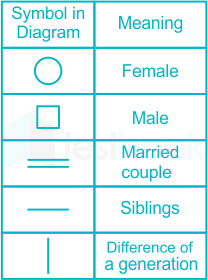
Symbol representation:

Common Diagram 28.01.2020 D3

The family tree diagram is shown below:

Hence, the correct answer is "Option 2"

.

10

R's father is the only son of 'B' and brother of 'P'. 'A' is the daughter of 'B' and sister of 'Q'. How is P related to Q ?

  1. ((a))

    Brother

  2. ((b))

    Niece

  3. ((c))

    Nephew 

  4. ((d))

    Sister

Show Answer
Answer: ((d))

Sister

Symbol representation:

Common Diagram 28.01.2020 D3

The family tree diagram is shown below

1768993389.png (442×89)

Hence, the correct answer is "Option 4"

11

Identify the diagram that best represents the relationship among acids, bases and chemicals.

  1. ((a))

  2. ((b))

  3. ((c))

  4. ((d))

Show Answer
Answer: ((b))

The diagram that best represents the relationship among them acids, bases, and chemicals. is shown below:

Hence, the correct answer is "Option 2 "

12

Six students of class-X A, B, C, D, E and F have different heights. 'D' is shorter than only three students. F is taller than A but shorter than E. A is taller than D. B is not the shortest in the group. Who is the tallest student?

  1. ((a))

    B

  2. ((b))

    A

  3. ((c))

    F

  4. ((d))

    E

Show Answer
Answer: ((d))

E

Given :- 

  • 'D' is shorter than only three students.
  • F is taller than A but shorter than E.
  • A is taller than D.
  • B is not the shortest in the group

Hence, the correct answer is "Option 4"

13

Two statements are given below, followed by two conclusions numbered I and II. Assuming the statements to be true even if they seem to be at variance from commonly known facts, decide which of the given conclusion(s) logically follow (s) from the given statements.

Statements :

  1. Some tables are chairs.. 2. No chair is Almirah.

Conclusions :

I. Some tables are Almirahs.

II. No table is Almirah.

  1. ((a))

    Only conclusion I follows.

  2. ((b))

    Only conclusion II follows.

  3. ((c))

    Both conclusions I and II follow.

  4. ((d))

    Either conclusion I or conclusion II follows.

Show Answer
Answer: ((d))

Either conclusion I or conclusion II follows.

The least possible Venn diagram for the given statements is as shown below :

Conclusions :

I. Some tables are Almirahs. - False (Their is no direction relation between Tables and Almirah as it possible but not definte)

II. No table is Almirah. - False(Their is no direction relation between Tables and Almirah as it possible but not definte)

But this is a Either - Or case.

Conditions of Either-or case:


  1. The elements should be the same in both the statements.
  2. Both the conclusions should be false individually.
  3. One conclusion should be positive and one conclusion should be negative (Complementary pair).


The two complementary pairs are:


  1. All + Some not


2) No + Some

Hence, the correct answer is "Option 4"

14

A girl is facing East. She turns 225° in the anticlockwise direction and then 135° in the clockwise direction. Which direction is she facing now ?

  1. ((a))

    West

  2. ((b))

    North

  3. ((c))

    North-West

  4. ((d))

    North-East

Show Answer
Answer: ((b))

North

A girl is facing east. She turns 135° in clockwise direction. Further she turns another 225° in anticlockwise direction.

F6 Reshma 21-10-2020 Swati D5

Hence, the correct answer is "Option 2 "

15

Select the term that replaces the question mark (?) and complete the given series.

4M3, 607, 8Q13, ?, 12U31, 14W43

  1. ((a))

    10S15

  2. ((b))

    10R21

  3. ((c))

    10S21

  4. ((d))

    8R15

Show Answer
Answer: ((c))

10S21

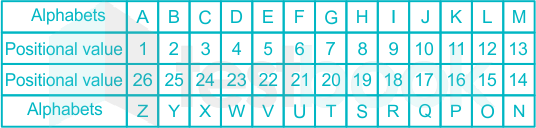
The logic follows, 


Table show alphabet serial number –

alphabet

Hence, the correct answer is "Option 3"

General Awareness (15 questions)

16

Which of the following wildlife sanctuaries was notified as a tiger reserve in October, 2022?

  1. ((a))

    Kamlang Tiger Reserve

  2. ((b))

    Satyamangalam Tiger Reserve

  3. ((c))

    Srivilliputhur Megamalai Tiger Reserve

  4. ((d))

    Ranipur Tiger Reserve

Show Answer
Answer: ((d))

Ranipur Tiger Reserve

The correct answer is Ranipur Tiger Reserve.

Key Points

  • Ranipur Tiger Reserve was notified as a tiger reserve in October 2022, making it the 54th tiger reserve in India.
  • It is located in the Chitrakoot district of Uttar Pradesh, marking the first tiger reserve in the state.
  • The reserve is part of the Ranipur Wildlife Sanctuary, known for its rich biodiversity and diverse wildlife.
  • The sanctuary's terrain includes dry deciduous forests, which provide an ideal habitat for tigers and other wildlife species.
  • This move aims to bolster conservation efforts for Bengal Tigers and strengthen the protection of their habitats across the country.
  • The creation of the tiger reserve is part of India’s commitment to the Global Tiger Recovery Programme and aligns with the National Tiger Conservation Authority (NTCA) guidelines.
  • Hence, the correct answer is Ranipur Tiger Reserve.

Additional Information

  • Overview of Tiger Reserves in India:
  • Tiger reserves are protected areas created under the Project Tiger, launched by the Government of India in 1973.
  • These reserves aim to conserve the Bengal Tiger population and their habitats while promoting biodiversity.
  • India currently has 54 tiger reserves, which collectively account for over 75% of the global tiger population.
  • Significance of Ranipur Wildlife Sanctuary:
  • Ranipur Wildlife Sanctuary is home to a variety of wildlife, including leopards, sloth bears, spotted deer, and reptiles, apart from tigers.
  • It is characterized by dry deciduous forests, which are crucial for the survival of several species.
  • The sanctuary plays a significant role in the ecosystem of the Vindhya mountain range, where it is located.
  • Project Tiger and NTCA:
  • The National Tiger Conservation Authority (NTCA), established in 2005, oversees tiger conservation efforts across India.
  • Project Tiger promotes sustainable tourism, habitat restoration, and anti-poaching measures to protect the tiger population.
  • India’s commitment: With approximately 3,000 tigers, India leads global tiger conservation efforts.

Important Points

  • Key Features of Ranipur Tiger Reserve:
  • The reserve spans an area of approximately 230 square kilometers, encompassing parts of the Ranipur Wildlife Sanctuary.
  • It aims to enhance eco-tourism and provide livelihood opportunities to local communities.
  • Notable Tiger Reserves in India:
  • Jim Corbett National Park: India’s first national park and tiger reserve, established in 1936.
  • Sundarbans Tiger Reserve: Known for its unique mangrove ecosystem and home to the Royal Bengal Tiger.
  • Bandhavgarh Tiger Reserve: Famous for its high tiger density and located in Madhya Pradesh.
17

What is the World Health Organization (WHO) norm regarding the Doctor Population ratio?

  1. ((a))

    1 ∶ 100

  2. ((b))

    1 ∶ 500

  3. ((c))

    1 ∶ 1000

  4. ((d))

    1 ∶ 2000

Show Answer
Answer: ((c))

1 ∶ 1000

The correct answer is 1 ∶ 1000.

Key Points

  • The World Health Organization (WHO) has set a global standard for the Doctor-to-Population ratio to ensure adequate healthcare services.
  • According to the WHO, the ideal Doctor-to-Population ratio should be 1 doctor per 1000 people.
  • This ratio ensures that there are sufficient doctors to cater to the healthcare needs of the population effectively.
  • In countries with a higher ratio (less than 1 doctor per 1000 people), the availability of healthcare professionals is inadequate to meet the needs of the population.
  • Many developing countries, including India, still face challenges in meeting this standard due to a shortage of qualified medical professionals.
  • Improving the Doctor-to-Population ratio is critical for achieving universal health coverage and ensuring equitable access to quality healthcare services for all.
  • The 1:1000 ratio is a benchmark used worldwide to assess the adequacy of healthcare systems.

Additional Information

  • Global Standards:
  • The WHO's 1:1000 Doctor-to-Population ratio is considered a global standard to evaluate healthcare accessibility and efficiency.
  • This ratio is particularly important in addressing healthcare disparities, especially in rural and underserved areas.
  • Challenges in India:
  • India, as of recent reports, has a Doctor-to-Population ratio of approximately 1:1456, which is below the WHO-recommended standard.
  • This shortfall is attributed to factors like limited medical education infrastructure, brain drain, and inequitable distribution of healthcare professionals.
  • Steps to Improve the Ratio:
  • Increased investment in medical education by setting up more medical colleges and increasing the number of seats for medical programs.
  • Encouraging doctors to work in rural and remote areas through incentives and better facilities.
  • Promoting public-private partnerships to enhance healthcare delivery in underserved regions.

Important Points

  • Examples of Countries Meeting the Ratio:
  • Developed nations like the United States, Germany, and Japan generally meet or exceed the 1:1000 Doctor-to-Population ratio.
  • Cuba has one of the best ratios globally, with about 8 doctors per 1000 people, reflecting its strong emphasis on healthcare.
  • Impact of Doctor-Shortage:
  • A shortage of doctors can lead to increased patient loads, longer wait times, and compromised quality of care.
  • It can also exacerbate health disparities, particularly in underprivileged and remote areas.
18

A magnet exerting a force on another magnet is an example of ________.

  1. ((a))

    Contact Force

  2. ((b))

    Non-Contact Force

  3. ((c))

    Electrostatic Force

  4. ((d))

    Gravitational Force

Show Answer
Answer: ((b))

Non-Contact Force

The correct answer is Non-Contact Force.

Key Points

  • Magnetic force is a type of non-contact force. This means that it does not require any physical contact between the magnets to exert a force.
  • Forces like gravitational, electrostatic, and magnetic forces can act at a distance, meaning objects do not need to touch for the force to be exerted. This is the fundamental characteristic of a non-contact force.
  • When a magnet exerts force on another magnet, it is not dependent on direct physical contact but rather on the magnetic field created by the magnets. Hence, the correct answer is Non-Contact Force.
  • Contact forces, such as friction or tension, require physical contact between objects. Since magnets can attract or repel without touching each other, magnetic force is not a contact force.
  • Unlike gravitational or electrostatic forces, which act between objects due to their mass or electric charge, magnetic force specifically arises due to the motion of electric charges within the material creating a magnetic field.

Additional Information

  • Contact Force:
  • Contact forces arise when two objects come into physical contact. Examples include frictional force, tension force, and normal force. These forces act only when objects are in direct physical connection.
  • For example, when you push a table, you are applying a contact force.
  • Non-Contact Force:
  • A non-contact force acts on an object without any physical contact. Examples include gravitational, electrostatic, and magnetic forces.
  • For instance, the Earth's gravitational force pulls objects toward its center without needing direct contact.
  • Magnetic Force:
  • The force between magnets or between a magnet and a magnetic material is known as magnetic force. It is a type of non-contact force.
  • This force is due to the interaction of magnetic fields produced by moving charges or the alignment of magnetic domains in materials like iron, nickel, and cobalt.
  • Examples include the force between the poles of two magnets or the attraction of a magnet to a metallic object like a nail.
  • Electrostatic Force:
  • Electrostatic force is another type of non-contact force. It acts between charged particles or objects and is governed by Coulomb's law.
  • For example, when you rub a balloon on your hair, the balloon becomes charged and can attract small pieces of paper without touching them.
  • Gravitational Force:
  • Gravitational force is the force of attraction between two masses. It is the weakest of the fundamental forces but operates over long distances.
  • For example, the force that keeps planets in orbit around the Sun or objects falling toward the Earth is due to gravity.

Important Points

  • Difference Between Contact and Non-Contact Forces:
  • Contact forces require physical interaction, such as friction, while non-contact forces act through fields (e.g., gravitational, magnetic).
  • Non-contact forces can act over a distance, whereas contact forces act only when objects are in direct contact.
  • Examples of Non-Contact Forces:
  • The Earth's gravity pulling objects downward.
  • Magnets attracting or repelling each other without touching.
  • Electrostatic forces causing charged objects to attract or repel each other.
19

As per the Economic Survey of India 2022-23, the maximum percentage of schools in India have, which of the following facilities according to the 2021-22 statistics?

  1. ((a))

    Girls Toilets

  2. ((b))

    Boys Toilets

  3. ((c))

    Libraries

  4. ((d))

    Computers

Show Answer
Answer: ((a))

Girls Toilets

The correct answer is Girls Toilets.

Key Points

  • The Economic Survey of India 2022-23 provides comprehensive statistics on various aspects of the education sector, including school infrastructure and facilities.
  • As per the survey, the 2021-22 statistics indicate that the maximum percentage of schools in India have facilities for Girls Toilets. This reflects the government's efforts to ensure gender-sensitive infrastructure in schools.
  • The focus on sanitation facilities for girls is aligned with the objectives of the Swachh Bharat Abhiyan and other similar initiatives to promote hygiene and reduce dropout rates among girls.
  • The provision of separate toilets for girls has shown a positive impact on enrollment and retention rates for female students, especially in rural and semi-urban areas.
  • While facilities like Boys Toilets, Libraries, and Computers are essential, the data highlights that Girls Toilets are more prevalent, indicating a targeted approach to addressing gender-specific needs in schools.

Additional Information

  • Importance of Girls Toilets in Schools:
  • The availability of Girls Toilets is a crucial factor in ensuring gender equality in education. It encourages parents to send their daughters to school and reduces the risk of dropouts.
  • Lack of sanitation facilities has historically been a significant barrier to girls' education, particularly in rural areas. Efforts to improve infrastructure directly address this challenge.
  • Other Facilities in Schools:
  • Boys Toilets: While essential, the focus on girls' sanitation facilities has been prioritized due to historical underrepresentation.
  • Libraries: Libraries are critical for promoting reading habits and providing access to educational resources, but their presence is secondary to basic sanitation needs.
  • Computers: The inclusion of computers in schools is essential for digital literacy but is not as widely available as toilets due to higher costs and infrastructure requirements.
  • Government Initiatives:
  • The Swachh Vidyalaya Abhiyan, launched under the Swachh Bharat Mission, aims to provide separate toilets for boys and girls in every school across India.
  • The Rashtriya Madhyamik Shiksha Abhiyan (RMSA) and Samagra Shiksha Abhiyan also focus on improving school infrastructure, including sanitation facilities.

Important Points

  • The emphasis on Girls Toilets aligns with the United Nations Sustainable Development Goal (SDG) 4, which focuses on ensuring inclusive and equitable quality education for all.
  • According to the National Education Policy (NEP) 2020, adequate infrastructure, including sanitation, plays a vital role in improving the quality of education.
  • Increased availability of sanitation facilities has been linked to better health outcomes for students, reducing absenteeism caused by waterborne diseases.
20

Whose decision is considered to be final in case a question arises with regard to the disqualification of a member of the Parliament according to the grounds mentioned in the Constitution?

  1. ((a))

    The President

  2. ((b))

    The Speaker of the Lok Sabha

  3. ((c))

    The Chief Election Commissioner of India

  4. ((d))

    The joint sitting of the Speaker of the Lok Sabha and the Chairman of the Rajya Sabha

Show Answer
Answer: ((a))

The President

The correct answer is The President.

Key Points

  • Article 103 of the Constitution of India states that the President of India has the authority to decide on the disqualification of a member of Parliament based on the grounds mentioned in the Constitution. This decision is final and binding.
  • The President takes this decision after consulting the Election Commission of India. The consultation is mandatory, and the President is bound to act according to the advice of the Election Commission.
  • The grounds for disqualification include holding an office of profit, unsound mind, insolvency, or defection under the Tenth Schedule of the Constitution. These are explicitly mentioned in the Constitution and applicable laws.
  • The decision-making process involves a detailed review of evidence and legal provisions. The Election Commission provides its opinion after due investigation and consideration of all relevant facts.
  • Hence, the correct answer is The President.

Additional Information

  • Role of the President in Disqualification:
  • The President has the exclusive authority to decide on the disqualification of members of Parliament.
  • Such decisions are taken based on the provisions of the Constitution, including Articles 102, 103, and the Tenth Schedule.
  • Role of the Election Commission:
  • The Election Commission plays a crucial role in such matters by conducting an inquiry and submitting its opinion to the President.
  • The President is bound to act in accordance with the advice provided by the Election Commission.
  • Grounds for Disqualification:
  • Grounds for disqualification include office of profit, unsound mind, insolvency, disqualification under any law, or defection as per the Tenth Schedule.
  • The Tenth Schedule specifically deals with disqualification on grounds of defection. It was added by the 52nd Amendment Act of 1985.

Important Points

  • Key Legal Provisions:
  • According to Article 102(1), a person shall be disqualified from being a member of Parliament if they are of unsound mind, an undischarged insolvent, or hold an office of profit under the government.
  • As per the Tenth Schedule, members are disqualified for defection if they voluntarily give up membership of the political party or vote against the party's direction without prior permission.
  • Significant Cases:
  • Kihoto Hollohan vs. Zachillhu (1992): The Supreme Court upheld the validity of the Tenth Schedule and clarified the role of the Speaker and the Election Commission in disqualification cases.
  • In several cases, the President's decision, based on the advice of the Election Commission, has been challenged in courts, but the courts have generally upheld the constitutional provisions.
21

Among the following which planet has the largest number of moons?

  1. ((a))

    Mercury

  2. ((b))

    Venus

  3. ((c))

    Mars

  4. ((d))

    Saturn

Show Answer
Answer: ((d))

Saturn

The correct answer is Saturn.

Key Points

  • Saturn has the largest number of moons among the planets in our solar system. As of October 2023, it has been confirmed that Saturn possesses 145 moons, including both regular and irregular moons.
  • The moons of Saturn vary significantly in size, ranging from small moonlets to large moons like Titan, which is the second-largest moon in the solar system.
  • The largest moon of Saturn, Titan, is unique because it has a dense atmosphere and is larger than the planet Mercury. It is also known for its methane lakes and rivers. Hence, Saturn has the highest number of moons.
  • Other notable moons of Saturn include Enceladus, which has icy plumes erupting from its surface, and Mimas, which is known for its large crater that gives it a resemblance to the Death Star from Star Wars.
  • Saturn's moons are categorized into regular moons, which have circular orbits and are close to the planet, and irregular moons, which have more eccentric orbits and are farther away.
  • Hence, the correct answer is Saturn.

Additional Information

  • Mercury:
  • Mercury has no moons due to its proximity to the Sun, which exerts strong gravitational forces that prevent the formation or retention of natural satellites.
  • It is the smallest planet in the solar system and has a very thin atmosphere, making it highly susceptible to solar wind and heat.
  • Venus:
  • Venus also has no moons, similar to Mercury, due to its proximity to the Sun.
  • Venus is known as Earth’s twin due to its similar size and composition, but it has extreme surface temperatures and a thick atmosphere primarily composed of carbon dioxide.
  • Mars:
  • Mars has two moons, Phobos and Deimos. These moons are small and irregularly shaped, resembling captured asteroids.
  • Phobos, the larger of the two, is slowly spiraling toward Mars and is expected to either crash into the planet or form a ring around it in the next 50 million years.
  • Saturn:
  • Saturn is the second-largest planet in the solar system and is famous for its extensive ring system, which is made up of ice and rock particles.
  • Its moons play a key role in shaping and maintaining its rings, particularly Enceladus and Pan.
  • Saturn's gravitational influence has allowed it to capture many small objects, forming its large number of moons.

Important Points

  • Moons in the Solar System:
  • Jupiter was previously thought to have the highest number of moons, with 95 confirmed moons. However, recent discoveries have placed Saturn in the lead.
  • Earth has only one moon, commonly referred to as the Moon, which plays a significant role in stabilizing the planet’s axial tilt and influencing tides.
  • The moons of the outer planets (Jupiter, Saturn, Uranus, Neptune) are mostly icy and rocky, with some displaying signs of geological activity and potential subsurface oceans.
  • Recent Discoveries:
  • As of 2023, advancements in telescopic technology have led to the discovery of several new moons, particularly around Saturn and Jupiter.
  • These discoveries highlight the dynamic and evolving nature of our understanding of the solar system.
22

Which of the following countries won all gold medals in under - 15 and under - 19 categories in the South Asian Youth Table Tennis Championship - 2023?

  1. ((a))

    Bangladesh

  2. ((b))

    India

  3. ((c))

    Maldives

  4. ((d))

    Sri Lanka

Show Answer
Answer: ((b))

India

The correct answer is India.

Key Points

  • The South Asian Youth Table Tennis Championship - 2023 saw the participation of several nations, including India, Bangladesh, Maldives, Sri Lanka, and others.
  • India emerged as the winner of all gold medals in both the Under-15 and Under-19 categories during this championship.
  • This achievement highlights India's dominance in the sport of table tennis in the South Asian region.
  • The performance of Indian players reflects their skill, preparation, and strong training programs, which have been instrumental in their success at this championship.
  • The tournament served as a platform for young table tennis players to showcase their talent and gain recognition on an international level.

Additional Information

  • About South Asian Youth Table Tennis Championship:
  • This championship is a major event in the region, aimed at promoting table tennis among the youth in South Asia.
  • It provides a platform for young players to compete at an international level and gain exposure to different playing styles and strategies.
  • Participating countries often include India, Bangladesh, Sri Lanka, Maldives, Nepal, Bhutan, and others from the South Asian region.
  • India's Success in Table Tennis:
  • India has consistently performed well in table tennis at both youth and senior levels, thanks to initiatives by organizations like the Table Tennis Federation of India (TTFI).
  • The country has produced several renowned players, including Sharath Kamal, Manika Batra, and others, who have excelled on international platforms.
  • Youth championships like this one play a crucial role in nurturing future table tennis champions for the country.
  • Other Participating Countries:
  • Bangladesh: While Bangladesh has a developing sports infrastructure, it is yet to establish dominance in table tennis.
  • Maldives: The Maldives focuses on water sports due to its geographical location, and table tennis is not a major sport in the country.
  • Sri Lanka: Sri Lanka has a moderate presence in table tennis but lags behind India in terms of performance and resources.

Important Points

  • Training and Infrastructure in India:
  • India's success in table tennis is largely attributed to its state-of-the-art training facilities and the efforts of the Table Tennis Federation of India (TTFI).
  • The country has also been focusing on grassroots development programs to nurture young talent.
  • Role of International Exposure:
  • Regular participation in international tournaments helps Indian players gain valuable experience and improve their game.
  • This exposure has been a key factor in India's growing dominance in the sport.
23

Which of the following pairs of the country and its official currency is/are matched correctly ?

(a)BhutanNgultrum
(b)AustriaEuro
(c)GhanaCedi
(d)ArgentinaReal


Choose the correct answer from the codes below :

  1. ((a))

    Only (a ) and (b)

  2. ((b))

    Only (b)

  3. ((c))

    Only (a), (b) and (c)

  4. ((d))

    Only (b) and (d)

Show Answer
Answer: ((c))

Only (a), (b) and (c)

The correct answer is Only (a), (b), and (c).

Key Points

  • (a) Bhutan - Ngultrum: This statement is correct. The official currency of Bhutan is the Ngultrum (BTN). It is pegged to the Indian Rupee at par, and the Indian Rupee is also widely accepted in Bhutan.
  • (b) Austria - Euro: This statement is also correct. Austria is a member of the European Union (EU) and adopted the Euro (€) as its official currency in 2002. It replaced the Austrian Schilling, which was previously the national currency.
  • (c) Ghana - Cedi: This statement is correct. The official currency of Ghana is the Ghanaian Cedi (GHS). The Cedi has been the currency of Ghana since 1965, and its name is derived from the Akan word for cowry shell, which was used as currency in the past.
  • (d) Argentina - Real: This statement is incorrect. The official currency of Argentina is the Argentine Peso (ARS), not the Real. The Real (BRL) is the official currency of Brazil.
  • Since only (a), (b), and (c) are matched correctly, the correct option is Only (a), (b), and (c).

Additional Information

  • Bhutan - Ngultrum:
  • The Ngultrum (BTN) was introduced in 1974 and is pegged to the Indian Rupee (INR) at a 1:1 exchange rate.
  • The Royal Monetary Authority of Bhutan is responsible for issuing the currency.
  • Austria - Euro:
  • Austria became a member of the European Union in 1995 and officially adopted the Euro in 2002.
  • The Euro (€) is the official currency of 20 out of 27 EU countries, collectively known as the Eurozone.
  • Ghana - Cedi:
  • The Ghanaian Cedi is subdivided into 100 Pesewas.
  • Ghana has undergone several currency redenominations, with the most recent being in 2007, where 1 new Cedi was equal to 10,000 old Cedis.
  • Argentina - Argentine Peso:
  • The Argentine Peso (ARS) is the official currency of Argentina.
  • The Peso has been in use since the early 19th century, with various reforms and iterations of the currency over the years.

Important Points

  • Currency Pegging:
  • Bhutan's currency, the Ngultrum, is pegged to the Indian Rupee, which facilitates trade and economic relations between the two nations.
  • Currency pegging helps stabilize exchange rates and reduce economic uncertainty between trading partners.
  • Euro Adoption:
  • Countries adopting the Euro must meet specific economic and legal convergence criteria, including inflation control and stable exchange rates.
  • The Euro facilitates easier trade and travel among the Eurozone nations.
  • Currency Reforms in Ghana:
  • To stabilize its economy, Ghana has redenominated its currency multiple times, with the most notable event occurring in 2007.
  • Ghana is a developing nation in West Africa, and its economy heavily relies on gold, cocoa, and oil exports.
24

Who among the following is the author of the book 'Poverty and Un-British Rule in India' which offered a criticism of the British Rule in India for its economic impact?

  1. ((a))

    A.O. Hume

  2. ((b))

    Annie Besant

  3. ((c))

    Badruddin Tyabji

  4. ((d))

    Dadabhai Naoroji

Show Answer
Answer: ((d))

Dadabhai Naoroji

The correct answer is Dadabhai Naoroji.

Key Points

  • Dadabhai Naoroji is the author of the book 'Poverty and Un-British Rule in India', which was published in 1901.
  • The book critically analyzed the economic exploitation of India under British colonial rule and argued that British policies were responsible for widespread poverty in India.
  • Naoroji's work introduced the concept of the ‘Drain of Wealth’, which referred to the transfer of India's wealth to Britain during colonial rule. This statement is correct.
  • He highlighted how the colonial administration was using India's resources and wealth for its own benefit, leaving India impoverished.
  • Dadabhai Naoroji was also known as the 'Grand Old Man of India' for his significant contributions to Indian society and his role in the Indian National Movement.
  • He was the first Indian to be elected to the British House of Commons in 1892, where he advocated for Indian self-governance and rights.

Additional Information

  • About Dadabhai Naoroji:
  • Born: 4 September 1825 in Mumbai, India.
  • He was a prominent Parsi intellectual, educator, and social reformer. He played a major role in the early phase of the Indian National Congress and was one of its founding members.
  • ‘Drain of Wealth’ Theory:
  • The theory argued that a significant portion of India’s wealth was being drained to Britain in the form of taxes, salaries of British officials, and profits made by British companies.
  • Naoroji estimated that about 200-300 million pounds were drained annually from India to Britain, which contributed to the widespread poverty in the country.
  • Other Key Contributions:
  • Indian National Congress: He presided over the Indian National Congress sessions three times – in 1886, 1893, and 1906. He supported Swaraj (self-rule) for India.
  • Political Representation: As a member of the British Parliament, he pushed for reforms in India and highlighted the plight of Indians under British rule.
  • Education: He was also an advocate of education and women's rights and worked toward reforming Indian society.

Important Points

  • About the Book 'Poverty and Un-British Rule in India':
  • This book was one of the first and most significant works to systematically analyze the economic impact of British colonial policies on India.
  • It questioned the morality and sustainability of British rule in India, especially their economic policies.
  • Naoroji described how the British were using India’s revenues to fund their own economy and administration, rather than reinvesting it in India’s development.
  • Comparison with Other Options:
  • A.O. Hume: Known as the founder of the Indian National Congress in 1885, but he did not write this book.
  • Annie Besant: A prominent British socialist and the first woman president of the Indian National Congress, but not the author of this book.
  • Badruddin Tyabji: A renowned Indian lawyer and also served as the third president of the Indian National Congress, but not associated with this book.
25

What percentage of the earth's water is fit for human use?

  1. ((a))

    Only 70%

  2. ((b))

    Only 30%

  3. ((c))

    Only 2.7%

  4. ((d))

    Less than 1%

Show Answer
Answer: ((d))

Less than 1%

The correct answer is Less than 1%.

Key Points

  • Earth's water distribution: About 97% of the earth’s water is stored in oceans and is saline, making it unfit for human consumption.
  • Only 3% of the earth’s water is freshwater. However, most of this freshwater is locked in glaciers, ice caps, and underground aquifers, leaving less than 1% accessible for human use.
  • Usable freshwater: The water that is fit for human use includes surface water from rivers, lakes, and groundwater sources. These sources account for less than 1% of the total water available on Earth.
  • The limited availability of usable water highlights the importance of water conservation and sustainable management practices to meet the growing demand for water worldwide.
  • Hence, the correct answer is Less than 1%.

Additional Information

  • Importance of freshwater:
  • Freshwater is essential for drinking, agriculture, sanitation, and industrial activities.
  • It is a renewable resource but its availability is limited by factors like climate change, pollution, and over-extraction.
  • Global freshwater distribution:
  • Glaciers and ice caps: Approximately 68.7% of freshwater is locked in ice caps and glaciers.
  • Groundwater: Around 30.1% of freshwater is stored underground in aquifers.
  • Surface water: Lakes, rivers, and swamps account for only 0.3% of global freshwater.
  • Challenges in water management:
  • Population growth and urbanization are increasing the demand for water, putting stress on freshwater resources.
  • Pollution from industries, agriculture, and domestic activities contaminates water sources, reducing the availability of clean water.
  • Climate change affects water cycles, leading to droughts and floods, which impact water availability.

Important Points

  • Conservation strategies:
  • Promoting practices like rainwater harvesting and efficient irrigation systems can help conserve water.
  • Wastewater treatment: Recycling wastewater for industrial and agricultural use can reduce the pressure on freshwater sources.
  • Global water initiatives:
  • UN-Water: An international organization coordinating efforts to address water-related challenges.
  • Sustainable Development Goal 6: Ensures availability and sustainable management of water and sanitation for all.
26

Which of the following Fundamental Right(s) is/are guaranteed also to the non-citizens by the Indian Constitution?

(a) right to freedom of speech and expression

(b) right to life and personal liberty

(c) right to assemble peacefully and without arms

Choose the correct answer from the codes below :

  1. ((a))

    Only (a)

  2. ((b))

    Only (b)

  3. ((c))

    Only (a) and (c)

  4. ((d))

    Only (a) and (b)

Show Answer
Answer: ((b))

Only (b)

The correct answer is Only (b).

Key Points

  • Fundamental Rights in the Indian Constitution:
  • Fundamental Rights are enshrined in Part III of the Indian Constitution (Articles 12 to 35).
  • These rights are guaranteed to protect the liberty and dignity of individuals and ensure equality in the eyes of the law.
  • Right to Freedom of Speech and Expression (Article 19):
  • Article 19(1)(a) guarantees the right to freedom of speech and expression. This right is, however, specifically available only to the citizens of India.
  • It includes the freedom to express opinions through speech, writing, or any other form of communication. But as this is limited to Indian citizens, statement (a) is incorrect in the context of non-citizens.
  • Right to Life and Personal Liberty (Article 21):
  • Article 21 guarantees the right to life and personal liberty. It states that "No person shall be deprived of his life or personal liberty except according to procedure established by law."
  • This right is available to both citizens and non-citizens of India.
  • It includes protection from arbitrary actions of the state affecting life, liberty, or dignity. Hence, statement (b) is correct.
  • Right to Assemble Peacefully and Without Arms (Article 19):
  • Article 19(1)(b) guarantees the right to assemble peacefully without arms, but this right is specifically meant for Indian citizens only.
  • Non-citizens are not entitled to exercise this right. Hence, statement (c) is incorrect.
  • Summary:
  • Among the given rights, only the Right to Life and Personal Liberty (Article 21) is guaranteed to non-citizens as well. The other rights mentioned—freedom of speech and expression and the right to assemble peacefully without arms—are exclusively for Indian citizens.

Additional Information

  • Important Articles Related to Fundamental Rights:
  • Article 14: Guarantees equality before the law and equal protection of the laws to both citizens and non-citizens.
  • Article 15: Prohibits discrimination on grounds of religion, race, caste, sex, or place of birth, but applies only to citizens.
  • Article 19: Contains six fundamental freedoms, including speech, assembly, and association, which are restricted to citizens only.
  • Article 21: Guarantees the right to life and personal liberty to all persons, regardless of citizenship.
  • Significance of Article 21:
  • It is one of the most important rights and covers a wide range of aspects, such as right to privacy, right to a pollution-free environment, and right to education.
  • This article applies to everyone in India, including foreign nationals, making it fundamental to human rights protection.
  • Relevant Supreme Court Cases:
  • Maneka Gandhi v. Union of India (1978): This case expanded the scope of Article 21 to include the right to live with dignity and personal liberty.
  • Kharak Singh v. State of UP (1962): The court held that Article 21 protects against arbitrary action by the state.
  • Sunil Batra v. Delhi Administration (1980): The case emphasized the right to humane treatment for prisoners under Article 21.
  • Important Points:
  • Fundamental Rights are enforceable by the Supreme Court (Article 32) and the High Courts (Article 226).
  • Some rights are available to all individuals, while others are specific to citizens of India.
  • Non-citizens are also entitled to certain rights, such as Articles 14, 20, 21, and 22, which include equality before the law, protection against arbitrary arrest, and the right to life and personal liberty.
  • Reasonable restrictions can be imposed on fundamental rights, especially those under Article 19.
27

Which of the following fuel has the highest calorific value ?

  1. ((a))

    Petrol

  2. ((b))

    Methane

  3. ((c))

    LPG

  4. ((d))

    Hydrogen

Show Answer
Answer: ((d))

Hydrogen

The correct answer is Hydrogen.

Key Points

  • Calorific value refers to the amount of heat energy released when 1 gram of a fuel is completely burned. It is measured in kilojoules per gram (kJ/g).
  • Hydrogen has the highest calorific value among all fuels listed in the options. Its calorific value is approximately 150 kJ/g, which is significantly higher than other fuels.
  • Petrol, which is commonly used as a fuel for vehicles, has a calorific value of around 47 kJ/g. It is much lower compared to hydrogen.
  • Methane, a primary component of natural gas, has a calorific value of approximately 55 kJ/g. Although it is efficient, it cannot surpass hydrogen.
  • LPG (Liquefied Petroleum Gas), a widely used fuel for domestic and industrial purposes, has a calorific value of approximately 50 kJ/g.
  • The high calorific value of hydrogen makes it an excellent fuel. However, challenges such as storage, transportation, and safety concerns limit its widespread use.
  • Hence, the correct answer is Hydrogen.

Additional Information

  • Hydrogen as a Fuel:
  • Hydrogen is considered a clean and sustainable energy source as it produces only water as a by-product when burned.
  • It is used in fuel cells to produce electricity for vehicles and other applications.
  • Hydrogen is abundant in the universe, but it is not readily available in its pure form and requires processes like electrolysis or steam methane reforming for extraction.
  • Comparison of Other Fuels:
  • Petrol: Widely used in internal combustion engines, it is derived from crude oil and contributes to environmental pollution.
  • Methane: Found in natural gas, it is cleaner than petrol but still contributes to greenhouse gas emissions.
  • LPG: A mixture of propane and butane, LPG is popular for household cooking and heating due to its portability and relatively lower emissions.
  • Challenges of Hydrogen:
  • Storage: Hydrogen is highly flammable and requires specialized storage systems.
  • Cost: The extraction and transportation of hydrogen are currently expensive compared to traditional fuels.
  • Infrastructure: Limited hydrogen refueling infrastructure restricts its widespread adoption in transportation.

Important Points

  • Hydrogen's Environmental Benefits: Unlike fossil fuels, hydrogen combustion does not produce harmful pollutants like carbon dioxide, making it a potential solution for reducing global warming.
  • Applications of Hydrogen: It is used in industries such as space exploration, energy storage, and fuel cell vehicle production.
  • Future Prospects: Governments and organizations worldwide are investing in hydrogen technology to achieve carbon neutrality and reduce dependency on fossil fuels.
28

Which film won the Academy Award for the Best Documentary Short Film at the 95th Academy Awards?

  1. ((a))

    The Elephant Whisperers

  2. ((b))

    An Irish Goodbye

  3. ((c))

    Women Talking

  4. ((d))

    Top Gun

Show Answer
Answer: ((a))

The Elephant Whisperers

The correct answer is The Elephant Whisperers.

Key Points

  • The film The Elephant Whisperers, directed by Kartiki Gonsalves and produced by Guneet Monga, won the Academy Award for Best Documentary Short Film at the 95th Academy Awards, held in March 2023.
  • The documentary is a heartfelt story about a South Indian couple, Boman and Bella, who dedicate their lives to caring for an orphaned baby elephant named Raghu. It showcases the unique bond between humans and animals.
  • This is the first Indian production to win an Academy Award in the Documentary Short Film category, marking a historic moment for Indian cinema.
  • The film highlights themes of environmental conservation, indigenous culture, and the relationship between humans and wildlife.
  • It received critical acclaim for its storytelling, cinematography, and its ability to raise awareness about the need to protect endangered species and their habitats.

Additional Information

  • Academy Awards:
  • The Academy Awards, also known as the Oscars, are among the most prestigious awards in the global film industry, recognizing excellence in cinematic achievements.
  • The Best Documentary Short Film category honors short-form documentaries that bring compelling real-life stories to the screen.
  • About The Elephant Whisperers:
  • Director: Kartiki Gonsalves, an Indian filmmaker known for her work in nature and wildlife documentaries.
  • Producer: Guneet Monga, an acclaimed Indian film producer who has previously worked on films like Period. End of Sentence, which won an Academy Award for Best Documentary Short Subject in 2019.
  • Setting: The documentary is set in the Mudumalai Tiger Reserve, located in Tamil Nadu, India, which is a renowned wildlife sanctuary.
  • Significance: The film emphasizes the importance of preserving the environment, respecting indigenous traditions, and co-existing with nature.
  • Other Nominees:
  • An Irish Goodbye: A British short film about two brothers coming to terms with their mother's death.
  • Women Talking: A feature-length film addressing issues of abuse and resilience in a religious community.
  • Top Gun: Maverick was a blockbuster action film but not nominated in this category.

Important Points

  • The Elephant Whisperers Impact:
  • The documentary has helped bring global attention to the plight of endangered Asian elephants and the efforts of indigenous communities in India to protect them.
  • It serves as a reminder of the importance of sustainable living and the role of human-animal relationships in conservation.
  • Indian Cinema at the Oscars:
  • India has seen increasing recognition at the Oscars, with films like RRR and Slumdog Millionaire receiving awards in various categories.
  • The Elephant Whisperers continues this legacy, showcasing the diversity and depth of Indian storytelling.
29

As per the National Education Policy (NEP) 2020, which age group is covered under the New Pedagogical and Curriculum Structure of School education?

  1. ((a))

    3 to 16 years

  2. ((b))

    3 to 17 years

  3. ((c))

    3 to 18 years

  4. ((d))

    4 to 16 years

Show Answer
Answer: ((c))

3 to 18 years

The correct answer is 3 to 18 years.

Key Points

  • The National Education Policy (NEP) 2020 introduced a new pedagogical and curriculum structure in school education.
  • This structure is known as the 5+3+3+4 system, which corresponds to the developmental stages of a child.
  • The policy covers the age group of 3 to 18 years, aligning with a child’s educational journey from preschool to higher secondary education.
  • 5+3+3+4 structure:
  • Foundational Stage (5 years): Ages 3 to 8 (Pre-primary to Grade 2).
  • Preparatory Stage (3 years): Ages 8 to 11 (Grades 3 to 5).
  • Middle Stage (3 years): Ages 11 to 14 (Grades 6 to 8).
  • Secondary Stage (4 years): Ages 14 to 18 (Grades 9 to 12).
  • The NEP 2020 emphasizes the importance of covering this age range to ensure universal access to quality education for all children in India.
  • The inclusion of children from 3 years onward introduces early childhood care and education (ECCE) as an integral part of the education system.
  • The new structure replaces the earlier 10+2 system, which did not formally include preschool education (ages 3 to 6).

Additional Information

  • Detailed Breakdown of the 5+3+3+4 Structure:
  • Foundational Stage: Covers 5 years of education – 3 years of preschool (ages 3-6) and Grades 1-2. Focuses on play-based and activity-based learning for cognitive and motor skill development.
  • Preparatory Stage: Covers 3 years (Grades 3-5). Introduces subject-oriented learning along with experiential learning techniques.
  • Middle Stage: Covers 3 years (Grades 6-8). Focus on critical thinking, multidisciplinary education, and abstract concepts in subjects like science and mathematics.
  • Secondary Stage: Covers 4 years (Grades 9-12). Provides greater flexibility and choice of subjects, focusing on career readiness and higher-order thinking skills.
  • Key Features of NEP 2020:
  • Emphasizes holistic development through a multidisciplinary approach.
  • Promotes vocational education and internships at the secondary stage.
  • Stresses use of technology in teaching and learning.
  • Focuses on inclusion of children with disabilities and underrepresented groups.
  • NEP 2020 aims to achieve 100% Gross Enrollment Ratio (GER) in preschool to secondary education by 2030.

Important Points

  • Preschool Education:
  • Inclusion of children from 3 years in formal education marks a significant shift in policy.
  • Early childhood care is crucial for developing cognitive, emotional, and social skills.
  • Flexibility in Secondary Education: Students can choose from a range of subjects, including arts, sciences, and vocational courses.
  • Teacher Training: NEP 2020 proposes continuous professional development programs to improve teaching quality.
  • Assessment Reforms: Focus shifts from rote learning to conceptual understanding and critical thinking.
30

Among the following states of India which state has the highest proportion of children in class I to VII who take paid tuition classes (in all rural schools) as per the Annual Status of Education (ASER) 2022 ?

  1. ((a))

    Rajasthan

  2. ((b))

    Kerala

  3. ((c))

    Gujarat

  4. ((d))

    West Bengal

Show Answer
Answer: ((d))

West Bengal

The correct answer is West Bengal.

Key Points

  • Rural School Trends: In rural schools, paid tuitions are often seen as supplementary education, helping children cope with curriculum demands, especially in states like West Bengal (around 73.9%) where academic competition is high.  Hence, the correct answer is West Bengal.

Additional Information

  • About ASER:
  • The survey assesses the foundational skills of children in reading and arithmetic, and includes indicators on school enrollment, infrastructure, and supplementary education like tuitions.
  • State-wise Trends:
  • Kerala: Known for its high literacy rate, Kerala also exhibits a considerable proportion of children taking paid tuitions, but it does not surpass West Bengal as per ASER 2022.
  • Gujarat: Gujarat sees moderate levels of paid tuition reliance, but it does not rank highest among the states mentioned.
  • Reasons for Paid Tuition Classes:
  • In states like West Bengal, a competitive academic environment and cultural emphasis on education drive the demand for such classes.
  • The ASER survey is unique as it is conducted at the household level rather than school premises, ensuring a comprehensive understanding of learning outcomes.
  • Paid tuitions can offer personalized support, especially for students struggling in large classrooms. However, they may also indicate gaps in the school education system.

Language Competency Test (30 questions)

Read the passage given below and answer the questions that follow.

While engaged in the laying of a new railway line, I had a miraculous escape from an awful death. I lived in a small township, but my work lay some twelve miles away, and I had a small tent on the works yet I often went to the town on horseback.

On one occasion, an accident happening to my horse, I got a lift into town, hoping that someone might do me a similar favour on my way back. But this was not to be, and I made up my mind to do the journey on foot, shortening the distance by taking a cut through the hills which would save me about six miles.

To take this shortcut, it was necessary to cross an ostrich 'camp' or farm. To venture across these camps in the breeding season, especially on foot, can be dangerous, for during this time the male birds are extremely ferocious.

31

He generally slept in: 

  1. ((a))

    a train coach 

  2. ((b))

    a staff quarter

  3. ((c))

    a tented accommodation

  4. ((d))

    the waiting room

Show Answer
Answer: ((c))

a tented accommodation

The correct answer is 'Option 3'.


Key Points

  • He generally slept in a tented accommodation.
  • The passage states, "I had a small tent on the works," which clearly indicates that he used a tent as his primary accommodation while working on the railway line.
  • Other options are not supported by the passage.
  • There is no mention of him sleeping in a train coach, staff quarter, or waiting room.

Therefore, the correct answer is Option 3: a tented accommodation.


Additional Information

  • Option 1: a train coach – Incorrect, not mentioned in the passage.
  • Option 2: a staff quarter – Incorrect, not mentioned in the passage.
  • Option 4: the waiting room – Incorrect, not mentioned in the passage.
32

'To venture across an ostrich farm ______'

The underlined word can be correctly replaced with:

  1. ((a))

    dare

  2. ((b))

    go

  3. ((c))

    travel

  4. ((d))

    move

Show Answer
Answer: ((a))

dare

The correct answer is: Option 1 i.e. dare.

Key Points

  • The phrase 'to venture across' means to undertake the risks of going across something, usually implying courage or daring, especially in dangerous or uncertain conditions. (जाने का जोखिम उठाना)
  • Example: He was willing to venture across the river despite the riskier conditions.
  • 'Dare' means to have the courage to do something difficult or dangerous. (साहस करना)
  • Example: He dared to speak up against the injustice.
  • Hence, we can infer that the word which can replace 'venture' is 'dare'.

Therefore, the correct answer is: dare.

Additional Information

Here are the other options explained along with their meanings and example sentences:

  • Go (जाना): To move or travel from one place to another.
  • Example: I will go to the market tomorrow.
  • Travel (यात्रा करना): To make a journey, typically over some distance.
  • Example: He plans to travel to Europe next month.
  • Move (चलना): To change position or location.
  • Example: She asked him to move the chair to the other side of the room.
33

The narrator was working in the railways

  1. ((a))

    a train driver

  2. ((b))

    an engineer

  3. ((c))

    a guard

  4. ((d))

    a ticket collector

Show Answer
Answer: ((b))

an engineer

The correct answer is 'Option 2'.


Key Points

  • The narrator was engaged in the laying of a new railway line.
  • This can be inferred from the passage. The passage mentions that the narrator was engaged in the laying of a new railway line and had to travel to the work site.
  • The job role in the context of laying a new railway line is most likely that of an engineer.
  • Among the given options, an engineer is most directly connected to the task of laying railway lines.

Therefore, the correct answer is Option 2.


Additional Information

  • Option 1: a train driver: Incorrect because the passage mentions laying a railway line, not operating a train.
  • Option 3: a guard: Incorrect because a guard is not directly involved in the construction of railway tracks.
  • Option 4: a ticket collector: Incorrect because a ticket collector's role is not related to the laying of railway lines.
34

Study the following statements.

(A) Male ostriches are ferocious by nature.

(B) To pass through ostrich farms can dangerous.

  1. ((a))

    (A) is an opinion and (B) is a fact.

  2. ((b))

    (B) is an opinion and (A) is a fact.

  3. ((c))

    Both (A) and (B) are true.

  4. ((d))

    Both (A) and (B) are false.

Show Answer
Answer: ((a))

(A) is an opinion and (B) is a fact.

The correct answer is 'Option 1'.


Key Points

  • (A) Male ostriches are ferocious by nature.
  • This is an opinion. The passage specifies that male ostriches are "extremely ferocious" during the breeding season, not by nature at all times.
  • (B) To pass through ostrich farms can be dangerous.
  • This is a fact supported by the passage, which explains that passing through ostrich farms, especially during the breeding season, can be dangerous due to the birds' behavior.

Therefore, the correct answer is Option 1: (A) is an opinion and (B) is a fact.


Additional Information

  • Option 2: Incorrect, as (A) is not a fact according to the passage.
  • Option 3: Incorrect, as both statements are not true in the same sense.
  • Option 4: Incorrect, as both statements are not false.
35

Once he had to travel to the town:

  1. ((a))

    on foot

  2. ((b))

    on horseback

  3. ((c))

    getting a lift

  4. ((d))

    on a local train

Show Answer
Answer: ((c))

getting a lift

The correct answer is 'Option 3'.


Key Points

  • The narrator usually traveled to town on horseback.
  • The passage mentions that the narrator often went to the town on horseback.
  • However, on one occasion, an accident happened to his horse.
  • The narrator got a lift into town on this occasion because his horse was involved in an accident.

Therefore, the correct answer is Option 3.


Additional Information

  • Option 1: on foot: Incorrect because, while he did walk back, he got a lift into town on the occasion described.
  • Option 2: on horseback: Incorrect because on this particular occasion, he got a lift due to the accident with his horse.
  • Option 4: on a local train: Incorrect because there is no mention of a train in the given narration.
36

Complete the sentences given below with the help of options that follow each sentence.

Ram along with Shyam ________ expected to come.

  1. ((a))

    is

  2. ((b))

    are

  3. ((c))

    were

  4. ((d))

    have been

Show Answer
Answer: ((a))

is

The correct answer is Option 1 i.e 'is'.

Key Points

  • The subject of the sentence is "Ram along with Shyam," which is singular because "along with" indicates that Shyam is an additional piece of information and does not affect the singularity of the subject.
  • Singular subjects require singular verbs for proper subject-verb agreement.
  • The verb "is" is singular and correctly agrees with the singular subject "Ram along with Shyam."
  • Words like "along with," "as well as," and "together with" do not change the number of the subject, which determines the verb form.

Therefore, the correct answer is- Option 1.

Additional Information

  • Option 2 (are): "Are" is a plural verb and would not agree with the singular subject "Ram along with Shyam."
  • Option 3 (were): "Were" is past tense and plural, which also does not fit the context or subject-verb agreement of the sentence.
  • Option 4 (have been): "Have been" is plural and would not agree with the singular subject "Ram along with Shyam."
37

Complete the sentences given below with the help of options that follow each sentence.

I ________ the playground to reach the river bank.

  1. ((a))

    cut into

  2. ((b))

    cut away

  3. ((c))

    cut through

  4. ((d))

    cut down

Show Answer
Answer: ((c))

cut through

The correct answer is Option 3 i.e 'cut through'.

Key Points

  • The phrase "cut through" is used to describe moving directly through something, often to save time or take a shorter route.
  • In this sentence, "I cut through the playground to reach the river bank" implies that the speaker crossed the playground to reach the river bank more quickly.
  • None of the other options fit the context:
  • Option 1 (cut into): This phrase generally means to penetrate or slice into something, which doesn't fit the context.
  • Option 2 (cut away): Usually means to remove or eliminate something, again not suitable here.
  • Option 4 (cut down): Refers to reducing or felling something, such as cutting down a tree, and does not suit the sentence.

Therefore, the correct answer is- Option 3.

Additional Information

  • Cut through: This phrase is commonly used to indicate taking a shortcut or passing through an area to reach a destination.
  • Contextual understanding: It is important to choose the phrase that aligns with the meaning of the sentence in order to convey the intended action.
38

Complete the sentences given below with the help of options that follow each sentence.

The new phone _______ the competition.

  1. ((a))

    blows off

  2. ((b))

    blows away

  3. ((c))

    blows over 

  4. ((d))

    blows out

Show Answer
Answer: ((b))

blows away

The correct answer is Option 2 i.e 'blows away'.

Key Points

  • The phrase "blows away" is commonly used to express that something is so impressive or superior that it surpasses expectations or competition.
  • Blows off: This is typically used to describe ignoring or dismissing something, which does not fit the context here.
  • Blows over: This is usually used to describe a situation calming down or being forgotten over time, which again does not fit the sentence.
  • Blows out: Commonly used to describe extinguishing something (like a candle) or something bursting, which is not applicable in this case.

Therefore, the correct answer is- Option 2.

Additional Information

  • Phrase Usage: The phrase "blows away" is often used in informal contexts to indicate that something is extraordinary or far superior to others.
  • Contextual Meaning: In this sentence, it implies that the new phone is so impressive that it outperforms the competition.
39

Complete the sentences given below with the help of options that follow each sentence.

She _______ when I entered the hall.

  1. ((a))

    has sung

  2. ((b))

    is singing

  3. ((c))

    was singing

  4. ((d))

    have sung

Show Answer
Answer: ((c))

was singing

The correct answer is Option 3 i.e 'was singing'.

Key Points

  • The sentence refers to an action that was already in progress at the time another event occurred (when "I entered the hall").
  • Past Continuous Tense: The tense used here is the past continuous tense, which describes actions that were ongoing at a specific moment in the past.
  • The correct form of the verb is "was singing," which follows the subject "She" and indicates that the action was happening at the moment of entry.
  • Other options like "has sung" or "have sung" indicate completed actions, and "is singing" refers to the present tense, which does not fit the context of the sentence.

Therefore, the correct answer is- Option 3.

Additional Information

  • Present Continuous Tense: Indicates an action happening right now, e.g., "She is singing." This does not fit the past context of the sentence.
  • Present Perfect Tense: Indicates an action that has been completed recently, e.g., "She has sung." This does not match the ongoing action in the past.
  • Past Perfect Tense: Indicates an action completed before another action in the past, e.g., "She had sung before I entered the hall." This is different from the context of the sentence.
40

Complete the sentences given below with the help of options that follow each sentence.

Ram is _______ same boy that I liked most.

  1. ((a))

    a

  2. ((b))

    an

  3. ((c))

    the

  4. ((d))

    no article

Show Answer
Answer: ((c))

the

The correct answer is Option 3 i.e 'the'.

Key Points

  • The definite article "the" is used to indicate that the boy being talked about is specific and already known to the speaker and listener.
  • Articles are used to modify nouns and specify whether the noun is general or specific. In this case, "the boy" refers to a specific boy that Ram likes most.
  • "a" and "an" are indefinite articles that refer to any member of a group or category, which would not fit the context of the sentence.
  • Using "no article" would make the sentence grammatically incomplete and unclear.

Therefore, the correct answer is- Option 3.

Additional Information

  • Definite Article: The definite article "the" is used when referring to something specific or already mentioned.
  • Indefinite Articles: "a" and "an" are used for nonspecific nouns. "A" is used before consonant sounds, and "an" is used before vowel sounds.
  • No article: In some cases, nouns do not require an article, but in this sentence, the article "the" is necessary to specify the boy Ram liked most.
41

Which of the underlined parts of the following sentence is incorrect ?

He had hinted (A) that (B) he (C) wants (D) money.

  1. ((a))

    (B)

  2. ((b))

    (C)

  3. ((c))

    (D)

  4. ((d))

    (A)

Show Answer
Answer: ((c))

(D)

The correct answer is Option 3.


Key Points

  • The primary issue in the sentence is the incorrect use of the verb "wants" in part D.
  • The sentence uses the past tense verb "had hinted", so the verb "wants" should also be in the past tense to maintain consistency in tense.
  • The correct verb should be "wanted."
  • Thus, the error is located in part D of the sentence.

Therefore, the correct answer is Option 3.


Correct Sentence: "He had hinted that he wanted money."


Additional Information

  • A: "He had hinted" – This part of the sentence is grammatically correct and does not require any changes.
  • B: "that" – This part of the sentence is also grammatically correct and does not require any changes.
  • C: "he" – This part of the sentence is grammatically correct and does not require any changes.
  • D: "wants money" – The word "wants" is incorrect as the tense should match the past tense of "had hinted" and should be "wanted."
42

Choose the option in which the following words/phrases can be arranged to form a correct sentence.

(A) may live

(B) eat so

(C) we

(D) that we

  1. ((a))

    (B), (D), (A), (C)

  2. ((b))

    (A), (C), (B), (D)

  3. ((c))

    (C), (B), (D), (A) 

  4. ((d))

    (D), (A), (C), (B)

Show Answer
Answer: ((c))

(C), (B), (D), (A) 

The correct answer is Option (3) i.e. we eat so that we may live

Key Points

  • The sentence should start with the subject, which is "we" (part C).
  • It is followed by the verb phrase "eat so" (part B), indicating the action and purpose.
  • Then comes "that we" (part D), linking the cause and effect.
  • Finally, "may live" (part A) completes the sentence, stating the purpose of eating.
  • So, the correct sequence is C-B-D-A, which forms the sentence: We eat so that we may live.

Therefore, the correct answer is Option (3): C-B-D-A.

Additional Information

  • Option 1 (B-D-A-C): This sequence ("eat so that we may live we") is grammatically incorrect and does not form a meaningful sentence.
  • Option 2 (A-C-B-D): This order ("may live we eat so that we") does not convey a logical or grammatically correct sentence.
  • Option 4 (D-A-C-B): This sequence ("that we may live we eat so") is also fragmented and does not create a proper sentence.
43

Choose the option in which the given sentence has been changed into passive voice.

I wrote a letter.

  1. ((a))

    A letter is written by me.

  2. ((b))

    A letter was written by me.

  3. ((c))

    A letter has been written by me. 

  4. ((d))

    A letter had been written by me.

Show Answer
Answer: ((b))

A letter was written by me.

The correct answer is Option 2.


Key Points

  • Passive voice structure: The object of the active voice sentence becomes the subject of the passive voice sentence.
  • In the active voice, the sentence is: "I wrote a letter."
  • To convert to passive voice: Place the object "a letter" at the beginning.
  • Change the active verb form "wrote" to "was written" (past simple passive).
  • Add the preposition "by" followed by the original subject "me."

Therefore, the correct answer is Option 2.


Correct Sentence: "A letter was written by me."


Additional Information

  • Option 1: "A letter is written by me." – Present simple passive, incorrect tense.
  • Option 3: "A letter has been written by me." – Present perfect passive, incorrect tense.
  • Option 4: "A letter had been written by me." – Past perfect passive, incorrect tense.
44

His views do not accord with mine.

Which one of the following words is opposite in meaning to the underlined word?

  1. ((a))

    agree

  2. ((b))

    correspond

  3. ((c))

    clash

  4. ((d))

    coincide

Show Answer
Answer: ((c))

clash

The correct answer is: Option 3 i.e. Clash.

Key Points

  • The word "accord" means to be in agreement or harmony. (मेल खाना)
  • Example: Her testimony accords with the evidence provided by the police.
  • "Clash" refers to a conflict or disagreement between two parties. (टकराव)
  • Example: Their opinions often clash on many important issues.
  • Hence, we can infer that the opposite of 'accord' is 'clash'.

Therefore, the correct answer is: Clash.

Additional Information

Here are the other options explained along with their Hindi meanings and example sentences:

  • Agree (सहमत होना): To have the same opinion or come to an understanding.
  • Example: They both agree on the need for better education policies.
  • Correspond (मिलना-जुलना): To be in agreement, similar, or comparable.
  • Example: His actions correspond with his words.
  • Coincide (समान समय या स्थान पर होना): To occur at the same time or in agreement.
  • Example: Their birthdays coincide with each other.
45

The law will punish whosoever is guilty.

Which of the following words can replace the underlined word?

  1. ((a))

    innocent

  2. ((b))

    culpable

  3. ((c))

    impudent

  4. ((d))

    audacious

Show Answer
Answer: ((b))

culpable

The correct answer is: Option 2 i.e. culpable.

Key Points

  • The word "guilty" means having committed a specified or implied offense or crime. (दोषी)
  • Example: He was found guilty of the crime.
  • "Culpable" means deserving blame or censure; guilty. (दोषी)
  • Example: The court found him culpable for the accident.
  • Hence, we can infer that the word which can replace 'guilty' is 'culpable'.

Therefore, the correct answer is: culpable.

Additional Information

Here are the other options explained along with their Hindi meanings and example sentences:

  • Innocent (निर्दोष): Not guilty of a crime or offense.
  • Example: She was declared innocent by the court.
  • Impudent (ढीठ): Not showing due respect for another person; impertinent.
  • Example: The impudent child spoke back to the teacher.
  • Audacious (साहसी): Showing a willingness to take surprisingly bold risks.
  • Example: His audacious plan surprised everyone.

निम्नलिखित गद्यांश को ध्यानपूर्वक पढ़कर उस पर आधारित प्रश्नों के सटीक उत्तर दीजिए :

भारत में अनेक विदेशी जातियाँ आयीं लेकिन भारतीय संस्कृति ने अपने विकास की प्रक्रिया में इन सभी को आत्मसात कर लिया। भारतीय संस्कृति ने अन्य संस्कृतियों के अच्छे गुणों को आत्मसात करके उन्हें अपने रंग रूप में ढाल लिया । विदेशी संस्कृतियों के अच्छे गुण आज भारतीय संस्कृति के अभिन्न अंग हैं। भारत ने उत्तम विचार, आचार-व्यवहार और सद्गुणों को ग्रहण करके भारतीय संस्कृति में समाविष्ट कर लिया है। भारतीय संस्कृति कालजयी बन चुकी है। अनेकता में एकता भारतीय संस्कृति की विशिष्टता रही है। भारत में संसार के लगभग सभी धर्म मिल जाते हैं।

46

निम्नलिखित में से भारतीय संस्कृति की विशेषता नहीं है :

  1. ((a))

    कालजयी होना

  2. ((b))

    समाविष्ट करना

  3. ((c))

    आत्मसात करना

  4. ((d))

    सद्गुणों का निष्कासन

Show Answer
Answer: ((d))

सद्गुणों का निष्कासन

इस प्रश्न का सही उत्तर "सद्गुणों का निष्कासन" है।

Key Points

गद्यांश के अनुसार ,

  • भारतीय संस्कृति ने अन्य संस्कृतियों के अच्छे गुणों को आत्मसात किया और उन्हें अपने रंग में ढाल लिया,
  • अर्थात भारतीय संस्कृति नकारात्मक और निष्कासन का समर्थन नहीं करती है।
  • इसीलिए, सही उत्तर "सद्गुणों का निष्कासन" है।

Additional Information अन्य विकल्प:

कालजयी होना -

  • भारतीय संस्कृति का समय के साथ विकास और विस्तार होता रहा है, जो इसे कालजयी बनाता है।

समाविष्ट करना -

  • भारतीय संस्कृति ने विभिन्न संस्कृतियों और विचारों को ग्रहण और समाविष्ट किया है।

आत्मसात करना -

  • भारतीय संस्कृति ने हमेशा से अन्य संस्कृतियों के अच्छे गुणों को आत्मसात किया है।
47

भारतीय संस्कृति ने अपने विकास की प्रक्रिया में आत्मसात कर लिया :

  1. ((a))

    प्राचीन ग्रंथों को

  2. ((b))

    विदेशी जातियों को 

  3. ((c))

    वेदों को

  4. ((d))

    परंपराओं को

Show Answer
Answer: ((b))

विदेशी जातियों को 

इसका सही उत्तर "विदेशी जातियों" है।

Key Points

गद्यांश के अनुसार ,

  • भारतीय संस्कृति ने अनेक विदेशी जातियों को आत्मसात करके उन्हें अपने रंग रूप में ढाल लिया,
  • जिससे अन्य संस्कृतियों के अच्छे गुण आज भारतीय संस्कृति का अभिन्न अंग बन गए हैं।
  • इसलिए, सही उत्तर विदेशी जातियों को आत्मसात करना है।

Additional Information अन्य विकल्प:

प्राचीन ग्रंथों -

  • प्राचीन ग्रंथ भारतीय संस्कृति का आधार हैं, इन्हें आत्मसात नहीं करना पड़ा क्योंकि वे भारतीय संस्कृति का अभिन्न हिस्सा थे।

वेदों -

  • वेद भारतीय संस्कृति की मूलभूत ग्रंथ हैं और इनका आत्मसात करना आवश्यक नहीं था क्योंकि वे पहले से ही संस्कृति का हिस्सा थे।

परंपराओं को -

  • परंपराएँ भारतीय संस्कृति की पहचान हैं और इन्हें आत्मसात करने की आवश्यकता नहीं थी क्योंकि वे मौलिक रूप से भारतीय हैं।
48

भारत में विदेशी जातियों के आगमन से क्या हुआ ?

  1. ((a))

    भारतीय संस्कृति में प्राचीनता आ गयी।

  2. ((b))

    भारतीय संस्कृति ने सभी को आत्मसात कर लिया।  

  3. ((c))

    भारतीय जातियों के साथ उनका टकराव हुआ।

  4. ((d))

    विदेशी संस्कृतियाँ ही प्रभावित हुई।

Show Answer
Answer: ((b))

भारतीय संस्कृति ने सभी को आत्मसात कर लिया।  

इसका सही उत्तर "भारतीय संस्कृति ने सभी को आत्मसात कर लिया" है।

Key Points

गद्यांश के अनुसार ,

  • भारत में अनेक विदेशी जातियाँ आयीं लेकिन भारतीय संस्कृति ने अपने विकास की प्रक्रिया में इन सभी को आत्मसात कर लिया,
  • जिससे भारतीय संस्कृति ने अन्य संस्कृतियों के अच्छे गुणों को आत्मसात करके उन्हें अपने रंग रूप में ढाल लिया।
  • इसलिए, सही उत्तर "भारतीय संस्कृति ने सभी को आत्मसात कर लिया" है।

Additional Information अन्य विकल्प:

भारतीय संस्कृति में प्राचीनता आ गयी -

  • विदेशी जातियों के आगमन से भारतीय संस्कृति में केवल परिवर्तन और समृद्धि हुई, प्राचीनता नहीं आयी।

भारतीय जातियों के साथ उनका टकराव हुआ -

  • भारतीय संस्कृति ने टकराव के बजाय आत्मसात करने पर जोर दिया।

विदेशी संस्कृतियाँ ही प्रभावित हुई -

  • भारतीय संस्कृति ने स्वयं को समृद्ध बनाने के लिए विदेशी संस्कृतियों के गुण आत्मसात किए, न कि केवल उन्हें प्रभावित किया।
49

भारतीय संस्कृति के अभिन्न अंग हैं :

  1. ((a))

    विदेशी विचार

  2. ((b))

    विदेशी जातियाँ

  3. ((c))

    विदेशी संस्कृतियों की बुराइयाँ

  4. ((d))

    विदेशी संस्कृतियों के अच्छे गुण

Show Answer
Answer: ((d))

विदेशी संस्कृतियों के अच्छे गुण

इसका सही उत्तर "विदेशी संस्कृतियों के अच्छे गुण" है।

Key Points

गद्यांश के अनुसार ,

  • भारतीय संस्कृति ने विदेशी संस्कृतियों के अच्छे गुणों को आत्मसात करके उन्हें अपने संस्कृति का अभिन्न अंग बना लिया,
  • जिससे भारतीय संस्कृति और अधिक समृद्ध और व्यापक हो गई।
  • इसलिए, सही उत्तर "विदेशी संस्कृतियों के अच्छे गुण" है।

Additional Information अन्य विकल्प:

विदेशी विचार -

  • भारतीय संस्कृति में विदेशी विचारों को स्वीकार किया गया है, लेकिन वे मुख्यतः उसमें समाहित नहीं हुए।

विदेशी जातियाँ -

  • भारतीय संस्कृति में विदेशी जातियाँ मिश्रित हुई हैं, लेकिन मुख्य तत्व विदेशी संस्कृतियों के अच्छे गुण हैं।

विदेशी संस्कृतियों की बुराइयाँ -

  • भारतीय संस्कृति ने अपने विकास में विदेशी संस्कृतियों की बुराइयों को आत्मसात नहीं किया है।
50

भारतीय संस्कृति में समाविष्ट नहीं हुआ :

  1. ((a))

    आचार-व्यवहार

  2. ((b))

    उत्तम विचार

  3. ((c))

    सद्गुण

  4. ((d))

    अराजकता

Show Answer
Answer: ((d))

अराजकता

इसका सही उत्तर ""अराजकता" है।

Key Points

गद्यांश के अनुसार ,

  • भारतीय संस्कृत��� ने सदैव आचार-व्यवहार, उत्तम विचार, और सद्गुणों को आत्मसात किया है,
  • जिसने भारतीय समाज को एक स्थायी और सुसंस्कृत प्रकृति प्रदान की है।
  • अराजकता भारतीय संस्कृति में कभी समाविष्ट नहीं हुई है।

Additional Information अन्य विकल्प:

आचार-व्यवहार -

  • भारतीय संस्कृति में उचित आचार-व्यवहार को अत्यंत महत्व दिया गया है।

उत्तम विचार -

  • उत्तम विचार भारतीय संस्कृति के अभिन्न अंग रहे हैं।

सद्गुण -

  • सद्गुण भारतीय समाज की नींव में शामिल रहे हैं।
51

निम्नलिखित में वर्तनी की दृष्टि से शुद्ध शब्द है :

  1. ((a))

    उज्जवल

  2. ((b))

    उज्‍ज्वल

  3. ((c))

    उज्वल

  4. ((d))

    उजवल

Show Answer
Answer: ((b))

उज्‍ज्वल

वर्तनी की दृष्टि से शुद्ध शब्द है- उज्‍ज्वल

Key Points

  • 'उज्‍ज्वल' का अर्थ - ​प्रकाश ।

Important Points

  • वर्तनी - भाषा के किसी शब्द को को लिखने में प्रयुक्त वर्णों के सही क्रम को वर्तनी कहते हैं।

Additional Information

अशुद्धशुद्ध
​ऊत्थानउत्थान
​तृकोणत्रिकोण
​केबिनेटकैबिनेट
​न्यौछावरन्योछावर
​लछमनलक्ष्मण
जुवतीयुवती
​घनिष्टघनिष्ठ
52

'चारु चंद्र की चंचल किरणें खेल रही थीं जल-थल' प्रस्तुत काव्य पंक्ति में अलंकार है-

  1. ((a))

    यमक

  2. ((b))

    अनुप्रास

  3. ((c))

    उपमा

  4. ((d))

    श्लेष

Show Answer
Answer: ((b))

अनुप्रास

सही उत्तर है - ‘अनुप्रास’।

  • ‘चारू चंद्र की चंचल किरणें, खेल रही हैं जल थल में' इस काव्य - पंक्ति में अनुप्रास अलंकार है।
  • ​जब किसी काव्य को सुंदर बनाने के लिए किसी वर्ण की बार-बार आवृति हो तो वह अनुप्रास अलंकार कहलाता है।

Key Pointsअन्य विकल्प:

  • यमक अलंकार :
  • ​जिस काव्य में समान शब्द के अलग-अलग अर्थों में आवृत्ति हो, वहाँ यमक अलंकार होता है।
  • उदाहरण : तीन बेर खाती थी वह तीन बेर खाती है।
  • यहाँ ‘बेर’ शब्द का दो बार प्रयोग हुआ है। पहली बार  ‘तीन बेरदिन में तीन बार खाने की तरफ संकेत कर रहा है तथा दूसरी बार  ‘तीन बेर’ का मतलब है तीन फल
  • उपमा अलंकार : 
  • किसी प्रस्तुत वस्तु की उसके किसी विशेष गुण, क्रिया, स्वभाव आदि की समानता के आधार पर अन्य अप्रस्तुत से समानता स्थापित की जाए तो उपमा अलंकार होगा।
  • उदाहरण : हरि पद कोमल कमल।
  • उदाहरण में हरि के पैरों कि तुलना कमल के फूल से की गयी है। यहाँ पर हरि के चरणों को कमल के फूल के सामान कोमल बताया गया है।
  • रूपक अलंकार :
  • रूपक साहित्य में एक प्रकार का अर्थालंकार है जिसमें बहुत अधिक साम्य के आधार पर प्रस्तुत में अप्रस्तुत का आरोप करके अर्थात्

उपमेय या उपमान के साधर्म्य का आरोप करके और दोंनों भेदों का अभाव दिखाते हुए उपमेय या उपमान के रूप में ही वर्णन किया जाता है।

इसके सांग रूपक, अभेद रुपक, तद्रूप रूपक, न्यून रूपक, परम्परित रूपक आदि अनेक भेद हैं।

  • उदाहरण : पायो जी मैंने राम रतन धन पायो।
  • उदाहरण में राम रतन को ही धन बता दिया गया है। ‘राम रतन’ - उपमेय पर ‘धन’ - उपमान का आरोप है एवं दोनों में अभिन्नता है। यहां आप देख सकते हैं की उपमान एवं उपमेय में अभिन्नता दर्शायी जा रही है।
53

'अवसर के अनुकूल बदल जाने वाले' के लिए एक शब्द है :

  1. ((a))

    चालाक

  2. ((b))

    अवसरवादी

  3. ((c))

    अवसरानुकूल

  4. ((d))

    लालची

Show Answer
Answer: ((a))

चालाक

'अवसर के अनुकूल बदल जाने वाले' इस वाक्यांश के लिए सार्थक शब्द है- चालाक

Key Points

  • वाक्यांश के लिए उपयुक्त शब्द - अनेक शब्दों के लिए एक शब्द को प्रयुक्त करना ही वाक्यांश के लिए एक शब्द कहलाता है।

Important Pointsअन्य विकल्प -

वाक्यांशशब्द
उपयुक्त अवसर से लाभ उठानेवालाअवसरवादी
अवसर के अनुरूपअवसरानुकूल
लोभी होनालालची

Additional Information

  कुछ महत्वपूर्ण वाक्यांश के लिए एक शब्द -

वाक्यांशशब्द
जहाँ तक सध सकेयथासाध्य
जिसका मन महान होमहामना
जो धर्म या शास्त्र के विरुद्ध होअधर्म
जो चंद्र धारण करता होचन्द्रधारी
दूसरों के दोषों को खोजनाछिद्रान्वेषण
जिसके पाणि में (हाथ) वीणा होवीणापाणि
जो राज्य या राजा से द्रोह करेराजद्रोही
54

निम्नलिखित में व्यंजन संधि वाला शब्द नहीं है :

  1. ((a))

    दिग्गज

  2. ((b))

    दिगंबर

  3. ((c))

    स्वागत

  4. ((d))

    सद्गुण

Show Answer
Answer: ((b))

दिगंबर

व्यंजन संधि वाला शब्द नहीं है- दिगंबर

Key Points

विश्लेषण-


विकल्पशब्दसंधि प्रकारकारण
1दिग्गजव्यंजनदिक् + गज → ग् → ग्ग (द्वित्व)
2दिगंबरनहींदिक् + अंबर → क् → ग (विसर्ग → ग्); विसर्ग संधि
3स्वागतव्यंजनसु + आगत → उ → व (गुण) + आ → आ
4सद्गुणव्यंजनसत् + गुण → त् → द्ग (द्वंद्व)
55

'अपना हाथ जगन्नाथ' लोकोक्ति का निम्नलिखित में से सटीक अर्थ है :

  1. ((a))

    स्वावलंबी होना चाहिए।

  2. ((b))

    खुद में आत्मनिर्भरता होती है।

  3. ((c))

    किसी अन्य का किया काम पसंद नहीं आता है।

  4. ((d))

    अपने हाथ में ही ईश्वर है।

Show Answer
Answer: ((a))

स्वावलंबी होना चाहिए।

सही उत्तर है- स्वावलंबी होना चाहिए।

Key Points

  • लोकोक्ति - अपना हाथ जगन्नाथ, अर्थ- स्वयं का कार्य स्वयं करना अच्छा होता है।
  • वाक्य- ‌‌‌लाला जी ने पहले खाना बनाने के लिए महाराज रखा हुआ था, लेकिन वह अच्छा खाना नहीं बनाता था, ऊपर से सामान चुरा लेता था। अब लालजी स्वयं खाना बना रहे हैं। सच कहावत है, अपना हाथ जगन्नाथ।

Important Points

लोकोक्तिअर्थवाक्य
अकेला चना भाड नही फोड़ सकताअकेला व्यक्ति कुछ भी नहीं कर सकता।मैं जानता हूँ कि ‘अकेला चना भाड़ नहीं फोड़ सकता’ फिर भी जो काम अपने करने का है, वह जरूर करूँगा।
अंधे की लकड़ीबेसहारे का सहारा।राजकुमार पिता की अंधे की लकड़ी है।
अक्ल बड़ी कि भैंसशारीरिक बल से बौद्धिक बल अच्छा होता है।तुम्हारे इस काम को देखकर मुझे अक्ल बड़ी की भैंस वाली कहावत याद आ गई।

Additional Information 

लोकोक्ति परिभाषाउदाहरण
लोकोक्ति का शाब्दिक अर्थ ‘लोक में प्रचलित उक्ति’ है। जब कोई पूर्य कथन किसी प्रसंग विशेष में उद्धृत किया जाता है तो उसे लोकोक्ति कहते हैं।अपनी करनी पर उतरनी अर्थात किए का फल भोगना। वाक्य- एक छोटी सी चोरी के कारण वह आज तक जेल में पश्चचाताप कर रहा है, अपनी करनी पार उतरनी।
56

निम्नलिखित में 'स्त्री' शब्द का पर्यायवाची नहीं है :

  1. ((a))

    दारा

  2. ((b))

    नारी

  3. ((c))

    कांता

  4. ((d))

    कामिनी

Show Answer
Answer: ((a))

दारा

सही उत्तर है- दारा

Key Points

  • 'दारा' का पर्यायवाची पत्नी, भार्या, बीबी, अर्धांगिनी, वामांगिनी, ग्रहणी है।
  • स्त्री के पर्यायवाची शब्द हैं- महिला, नारी, औरत, अबला, रमणी, कामिनी, कान्ता, वनिता, सुंदरी, ललना, वामा, त्रिया और प्रमदा।

Important Points

  • पर्यायवाची शब्द - ऐसे शब्द जिनके अर्थ समान हों, पर्यायवाची शब्द कहलाते हैं।

Additional Informationकुछ अन्य महत्वपूर्ण पर्यायवाची शब्द:-

शब्दपर्यायवाची शब्द
भ्रमर​मधुप, अलि, भौंरा, भृंग, मधुकर, द्विरेफ, मिलिंद।
देवदेवता, अमर, वसु, आदित्य, निर्जर, त्रिदश, गीर्वाण।
हवापवन, वायु, समीर, अनिल, वात, मरुत्, बयार, प्रकंपन।
साँपसर्प, नाग, विषधर, व्याल, भुजंग, उरग, अहि पन्नग।
गृहघर, निकेतन, भवन, आलय, निवास, आवास, निलय।
दानवदैत्य, राक्षस, निशाचर, दनुज, यातुधान, निशिचर।
घोड़ाअश्व, घोटक, तुरंग, तुरग, बाजि, वाजि, सैंधव, हय।
57

'आमरण' में समास है :

  1. ((a))

    अव्ययीभाव

  2. ((b))

    तत्पुरुष

  3. ((c))

    कर्मधारय

  4. ((d))

    द्वन्द्व

Show Answer
Answer: ((a))

अव्ययीभाव

सही उत्तर है - "अव्ययीभाव" l

Key Points

  • 'आमरण' शब्द का समास विग्रह :- मरण तक, मृत्यु तक l
  • आमरण शब्द में 'अव्ययीभाव समास' का प्रयोग है l
  • अन्य विकल्प :-
  • तत्पुरुष - समास का वह रूप जिसमें द्वितीय पद या उत्तर पद प्रधान हो उसे तत्पुरुष समास कहते हैं।
  • द्विगु - यदि किसी सामासिक पद में प्रथम पद संख्यावाचक शब्द हो एवं द्वितीय पद संज्ञा शब्द हो तथा समस्त पद समूह का बोध करवाए तो उसे द्विगु समास कहते हैं।
  • द्वंद्व - समास का वह रूप जिसमें प्रथम और द्वितीय दोनों पद प्रधान होते हैं उसे द्वन्द्व समास कहते हैं।

Additional Information

  • समास का तात्पर्य है 'संक्षिप्तीकरण'। दो या दो से अधिक शब्दों से मिलकर बने हुए एक नवीन एवं सार्थक शब्द को समास कहते हैं।
  • अव्ययीभाव समास - जहाँ प्रथम पद या पूर्व पद प्रधान हो तथा समस्त पद क्रिया विशेषण अव्यय हो उसे अव्ययीभाव समास कहते हैं। यदि किसी सामासिक पद में प्रथम पद उपसर्ग या अव्यय हो तो उसे भी अव्ययीभाव समास ही माना जाता है।
  • उदाहरण :-
  • प्रतिदिन - दिन दिन
  • यथामती - मती के अनुसार
  • आजन्म - जन्म से लेकर
58

निम्नलिखित में अशुद्ध वाक्य है:

  1. ((a))

    लड़कियाँ गीत गा रही थीं।

  2. ((b))

    उसने अनेक पुस्तकें लिखीं।

  3. ((c))

    चार आदमी के लिए खाना बना है।

  4. ((d))

    प्रत्येक देश के प्रतिनिधि आए थे।

Show Answer
Answer: ((c))

चार आदमी के लिए खाना बना है।

अशुद्ध वाक्य है- चार आदमी के लिए खाना बना है।

Key Pointsसही वाक्य होगा-

  • चार आदमियों के लिए खाना बना है।

Important Points

  • वर्तनी - किसी शब्द में आये हुए अक्षरों को मात्राओं सहित कहने या लिखने की रीति को वर्तनी कहते हैं।

Additional Informationवर्तनी संबंधी अशुद्धियाँ - 

अशुद्ध वाक्यशुद्ध वाक्य
मेले में विद्यार्थियों की कई टोलीयाँ थीं।मेले में विद्यार्थियों की कई टोलियाँ थीं।
गुलाम की एक माला खरीद लेना।गुलाब की माला खरीद लेना।
सहित्य और संस्कृती का गहरा संबंध हैं।साहित्य और संस्कृति का गहरा संबंध हैं।
यह आपकी अनाधिकार चेष्टा हैं।यह आपकी अनधिकार चेष्टा हैं।
उसे पैत्रिक संपत्ति में हिस्सा नहीं मिला।उसे पैतृक संपत्ति में हिस्सा नहीं मिला।
59

'हथियार डालना' मुहावरे का सटीक अर्थ है :

  1. ((a))

    पराजय स्वीकार करना

  2. ((b))

    हार जाना

  3. ((c))

    परास्त हो जाना

  4. ((d))

    पराजित कर देना

Show Answer
Answer: ((a))

पराजय स्वीकार करना

'हथियार डाल देना' मुहावरे का सही अर्थ है- पराजय स्वीकार करना

Key Points 

मुहावराअर्थवाक्‍य प्रयोग
हथियार डाल देनापराजय स्वीकार करनादुश्मन सेना का गोला बारूद खत्म हो गया तो सेना ने हथियार डाल दिए

Important Points 

मुहावराअर्थवाक्‍य प्रयोग
धाक जमानाप्रभाव ज़मानाउसके आने से इस स्कूल में अनुशासन की धाक जम गई है।
आनंदित होनाखुश होनाउसने मुझे उपहार दिया, तो मैं बहुत खुश हुआ।

Additional Information

मुहावराउदाहरण
मुहावरा का शाब्दिक अर्थ 'अभ्‍यास' है। मुहावरा शब्‍द अरबी भाषा का शब्‍द है। हिंदी में ऐसे वाक्‍यांशों को मुहावरा कहा जाता है। जो अपने साधारण अर्थ को छोड़कर विशेष अर्थ को व्‍यक्‍त क��ते हैं।अपनी खिचड़ी अलग पकाना-अर्थ- सबसे पृथक् काम करना।
वाक्य प्रयोग-वह अपनी खिचड़ी अलग पकाता है
60

निम्नलिखित में असंगत विलोमार्थी शब्द-युग्म है :

  1. ((a))

    ताप - संताप

  2. ((b))

    पाप - पुण्य

  3. ((c))

    तीव्र - मंद

  4. ((d))

    निंदा - स्तुति

Show Answer
Answer: ((a))

ताप - संताप

असंगत विलोमार्थी शब्द युग्म है- ताप - संताप

  • ताप का विलोम शब्द है- शीत

Key Points

  • विलोम - जो शब्द किसी एक शब्द के विपरीत अर्थ को व्यक्त करते हैं, वे विलोम शब्द कहलाते हैं।

Additional Informationकुछ अन्य महत्वपूर्ण विलोम शब्द -

शब्दविलोम
बहिरंगअंतरंग
मधुरकर्कश
अधीनअनधीन
उन्नतिअवनति
दुराचारीसदाचारी
जंगमस्थावर
प्रत्यक्षपरोक्ष
एकांगीसर्वांगीण
उदयाचलअस्ताचल

Subject Specific Knowledge (60 questions)

61

What is the boiling point of water in degree Celsius ?

  1. ((a))

    0°C

  2. ((b))

    100°C

  3. ((c))

    273°C

  4. ((d))

    373°C

Show Answer
Answer: ((b))

100°C

CONCEPT:

Boiling Point of Water

  • The boiling point of a liquid is the temperature at which its vapor pressure equals the external pressure exerted on the liquid.
  • For water at standard atmospheric pressure (1 atm), the boiling point is 100°C.
  • At higher altitudes, where atmospheric pressure is lower, water boils at a lower temperature.

EXPLANATION:

  • Water boils when its molecules gain enough energy to overcome the atmospheric pressure and change from liquid to vapor.
  • At standard atmospheric pressure (1 atm):
  • Water molecules require energy to overcome the intermolecular forces holding them together in the liquid state.
  • This energy corresponds to a temperature of 100°C.
  • Boiling point varies with pressure:
  • If pressure decreases (e.g., at higher altitudes), boiling occurs at a lower temperature.
  • If pressure increases (e.g., in a pressure cooker), boiling occurs at a higher temperature.

Therefore, the boiling point of water at standard atmospheric pressure is 100°C.

62

For a fire caused by short circuiting of an electric circuit, what should not be done?

  1. ((a))

    Throw water in the area.

  2. ((b))

    Throw dry sand in the area.

  3. ((c))

    Switch off the main electric supply.

  4. ((d))

    Use a fire-extinguisher.

Show Answer
Answer: ((a))

Throw water in the area.

CONCEPT:

Fire Caused by Short Circuiting of an Electric Circuit

  • Fires caused by short circuiting are electrical fires, and they require specific precautions due to the involvement of electricity.
  • Water is a conductor of electricity and can pose a risk of electric shock if thrown on an electrically charged area.
  • Dry sand is a good insulator and can help extinguish the fire by cutting off oxygen supply to the flames.
  • Switching off the main electric supply ensures the circuit is no longer live, reducing the risk of further short circuits or electric shock.
  • Fire extinguishers designed for electrical fires (e.g., Class C fire extinguishers) can safely extinguish the fire without conducting electricity.

EXPLANATION:

  • Throwing water in the area of an electrical fire can be highly dangerous because:
  • Water conducts electricity, and this can result in electric shock or spread the fire further.
  • Water may damage electrical components, complicating the situation.
  • Instead, one should:
  • Switch off the main electric supply to stop the flow of electricity.
  • Use dry sand to smother the fire by cutting off the oxygen supply.
  • Use a fire extinguisher rated for electrical fires to safely extinguish the flames.

Therefore, the correct answer is: Throw water in the area should not be done.

63

Which of the following is an example of a flammable liquid?

  1. ((a))

    Water

  2. ((b))

    Ethanol

  3. ((c))

    Salt solution

  4. ((d))

    Vinegar

Show Answer
Answer: ((b))

Ethanol

CONCEPT:

Flammable Liquids

  • Flammable liquids are liquids that can ignite and burn easily under normal atmospheric conditions.
  • They have a low flash point, meaning they can catch fire at relatively low temperatures.
  • Examples of flammable liquids include alcohols, gasoline, and acetone.
  • Non-flammable liquids like water and salt solution do not ignite under normal conditions because they have extremely high flash points or are not combustible.

EXPLANATION:

  • Water: Not flammable, as it is not combustible and is commonly used to extinguish fires.
  • Ethanol: A flammable liquid commonly used as a fuel and in alcoholic beverages. It has a low flash point and ignites easily.
  • Salt solution: Not flammable, as it is essentially water with dissolved salt, which does not burn.
  • Vinegar: Not flammable, as it is mainly water with acetic acid, which has a very high flash point.
  • Since ethanol is a type of alcohol and has a low flash point, it is classified as a flammable liquid.

Therefore, the correct answer is: Option 2) Ethanol.

64

When KMnO4 reacts with oxalic acid, \(\mathrm{MnO}{4}^{-}\) is reduced to Mn2+ and \(\mathrm{C}{2} \mathrm{O}_{4}^{2-}\) is oxidized to CO2. Hence, 5 mL of 0.02 M KMnO4 is equivalent to :

  1. ((a))

    10 mL of 0.05 M oxalic acid

  2. ((b))

    5 mL of 0.05 M oxalic acid

  3. ((c))

    2.5 mL of 0.2 M oxalic acid

  4. ((d))

    5 mL of 0.1 M oxalic acid

Show Answer
Answer: ((b))

5 mL of 0.05 M oxalic acid

CONCEPT:

Reaction Between KMnO4 and Oxalic Acid

  • When potassium permanganate (KMnO4) reacts with oxalic acid (H2C2O4), -MnO4- is reduced to Mn2+, and oxalate ions (C2O42-) are oxidized to carbon dioxide (CO2).
  • The balanced redox reaction is:

2 MnO4- + 5 C2O42- + 16 H+ → 2 Mn2+ + 10 CO2 + 8 H2O

  • From the balanced equation, 2 moles of MnO4- react with 5 moles of C2O42-, giving a mole ratio of 2:5.

EXPLANATION:

  • Given:
  • Volume of KMnO4 = 5 mL = 0.005 L
  • Molarity of KMnO4 = 0.02 M
  • Moles of KMnO4 used:

Moles = Molarity × Volume (in liters)

= 0.02 × 0.005 = 0.0001 moles

  • From the reaction stoichiometry (2 MnO4- : 5 C2O42-), 2 moles of KMnO4 react with 5 moles of oxalic acid. Hence:

Moles of oxalic acid = (5/2) × Moles of KMnO4

= (5/2) × 0.0001 = 0.00025 moles

  • Volume of oxalic acid required:

Moles = Molarity × Volume (in liters)

Volume = Moles / Molarity

= 0.00025 / 0.05 = 0.005 L = 5 mL

Hence, 5 mL of 0.02 M KMnO4 is equivalent to 5 mL of 0.05 M oxalic acid.

65

Assertion (A) : For preparing sodium hydroxide solution, use borosilicate glass (e.g. Pyrex) free of scratches, chips or breaks.

Reason (R) : If you use a different type of glass, there is a chance the temperature change could cause it to shatter.

  1. ((a))

    Both (A) and (R) are true, and (R) is the correct explanation of (A).

  2. ((b))

    Both (A) and (R) are true, but (R) is not the correct explanation of (A).

  3. ((c))

    (A) is true, but (R) is false.

  4. ((d))

    (A) is false, but (R) is true.

Show Answer
Answer: ((a))

Both (A) and (R) are true, and (R) is the correct explanation of (A).

CONCEPT:

Glassware and Chemical Reactions

  • Borosilicate glass (e.g., Pyrex) is a type of glass that has a very low coefficient of thermal expansion, meaning it can withstand significant temperature changes without cracking or shattering.
  • Other types of glass, such as soda-lime glass, are more prone to thermal shock and breakage when exposed to rapid temperature changes.
  • In chemical preparations, particularly with solutions like sodium hydroxide (NaOH), safety is essential to avoid accidents caused by breaking glassware.
  • Additionally, scratched, chipped, or broken glassware can weaken the structure, making it more prone to failure under thermal or mechanical stress.

EXPLANATION:

  • The assertion (A) states that borosilicate glass free of scratches, chips, or breaks should be used to prepare a sodium hydroxide solution. This is true because borosilicate glass is resistant to thermal shock and chemical reactions.
  • The reason (R) explains that using a different type of glass may result in shattering due to temperature changes. This is also true, as soda-lime glass, for example, is less resistant to thermal expansion and may crack or break under rapid temperature fluctuations.
  • In this case, the reason (R) is the correct explanation of the assertion (A) because the thermal stability of borosilicate glass is the primary reason for its use in chemical preparations like sodium hydroxide solutions.

Both (A) and (R) are true, and (R) is the correct explanation of (A).

66

A plane mirror is arranged horizontally. A ray of light is incident on its centre from a fixed source at an angle of 45°. The mirror is rotated about its centre anticlockwise by 10°. The reflected ray is rotated ______ by _______.

  1. ((a))

    clockwise, 10°

  2. ((b))

    clockwise, 20°

  3. ((c))

    anti-clockwise, 10°

  4. ((d))

    anti-clockwise, 20°

Show Answer
Answer: ((d))

anti-clockwise, 20°

CONCEPT:

Reflection of light from a plane mirror

  • When a ray of light is incident on a plane mirror, the angle of incidence (i) is equal to the angle of reflection (r).
  • If the mirror is rotated by an angle θ, the reflected ray rotates by twice that angle (2θ).
  • This property arises because both the incident ray and the reflected ray maintain symmetry around the normal to the mirror's surface.

EXPLANATION:

  • In the given scenario:
  • The ray of light is initially incident at an angle of 45° on the plane mirror.
  • The mirror is then rotated anticlockwise by 10° about its center.
  • According to the concept of reflection:
  • When the mirror rotates anticlockwise by an angle θ = 10°, the reflected ray rotates by twice this angle.
  • Thus, the reflected ray rotates by 2 × 10° = 20°.
  • Since the mirror is rotated anticlockwise, the reflected ray also rotates in the same direction (anticlockwise).

Therefore, the reflected ray is rotated anticlockwise by 20°.

67

A sharp image of a distant object is obtained on a screen by using a convex lens. To determine the focal length of the lens, you need to measure the distance between the:

  1. ((a))

    lens and object.

  2. ((b))

    lens and screen. 

  3. ((c))

    object and screen.

  4. ((d))

    both (2) and (3).

Show Answer
Answer: ((b))

lens and screen. 

CONCEPT:

Focal Length of a Convex Lens

  • The focal length of a convex lens is the distance from the lens to its focal point, where parallel rays of light converge after passing through the lens.
  • To calculate the focal length, we can use the lens formula:

1/f = 1/v - 1/u

where:

  • f is the focal length.
  • v is the image distance (distance between the lens and the screen).
  • u is the object distance (distance between the lens and the object).
  • When a sharp image of a distant object is obtained, the distance between the lens and the screen corresponds to the focal length of the lens (v = f).

EXPLANATION:

  • As the object is distant, the rays coming from it are effectively parallel, and the image is formed at the focal point of the lens.
  • Thus, the focal length is equal to the distance between the lens and the screen.

Therefore, the correct answer is Lens and screen.

68

Chlorophyll is a naturally occurring chelate compound in which the central metal atom is :

  1. ((a))

    copper

  2. ((b))

    magnesium

  3. ((c))

    iron

  4. ((d))

    calcium

Show Answer
Answer: ((b))

magnesium

CONCEPT:

Chlorophyll Structure

  • Chlorophyll is a pigment primarily responsible for photosynthesis in plants.
  • It is a chelate compound, meaning it forms a complex structure where a central metal atom is bonded to surrounding molecules or ions.
  • The central metal atom in chlorophyll is magnesium (Mg).
  • The structure allows chlorophyll to absorb light, particularly in the red and blue wavelengths, and convert it into chemical energy.

EXPLANATION:

  • Chlorophyll molecules consist of a porphyrin ring structure with a central metal ion.
  • In chlorophyll, the central metal ion is magnesium (Mg), which plays a critical role in capturing light energy during photosynthesis.
  • Other options like copper, iron, and calcium are incorrect because they are not the central metal in chlorophyll. These metals are involved in other biological processes but do not serve as the central ion in chlorophyll.
  • Magnesium's presence in chlorophyll is essential for the molecule's ability to absorb light efficiently and contribute to the photosynthetic process.

Therefore, the correct answer is Magnesium.

69

What is the standard unit of mass?

  1. ((a))

    Kilogram

  2. ((b))

    Litre

  3. ((c))

    Metre

  4. ((d))

    Second

Show Answer
Answer: ((a))

Kilogram

CONCEPT:

Standard Unit of Mass

  • The standard unit of mass in the International System of Units (SI) is the kilogram (kg).
  • It is defined based on the Planck constant, which is a fundamental constant in physics.
  • The kilogram was redefined in 2019 using the Planck constant, replacing the previous definition based on a physical object (the International Prototype of the Kilogram).

EXPLANATION:

  • Mass is a measure of the amount of matter in an object.
  • Kilogram - Correct. It is the SI unit of mass.
  • Litre - Incorrect. Litre is a unit of volume, not mass.
  • Metre - Incorrect. Metre is a unit of length.
  • Second - Incorrect. Second is a unit of time.
  • Thus, the standard unit of mass is the kilogram (kg).

Therefore, the correct answer is Kilogram.

70

Potassium permanganate is used for purifying drinking water, because :

  1. ((a))

    it is a sterilizing agent.

  2. ((b))

    it dissolves the impurities of water.

  3. ((c))

    it is a reducing agent.

  4. ((d))

    it is an oxidizing agent.

Show Answer
Answer: ((d))

it is an oxidizing agent.

CONCEPT:

Oxidizing Agent

  • An oxidizing agent is a substance that has the ability to oxidize other substances by accepting their electrons.
  • Potassium permanganate (KMnO4) is a strong oxidizing agent due to the presence of the Mn7+ ion, which has a high oxidation state and can easily gain electrons to reduce itself.
  • When added to water, KMnO4 reacts with organic and inorganic impurities, oxidizing them, and thereby purifying the water.

EXPLANATION:

  • Potassium permanganate (KMnO4) is used to purify drinking water because it acts as a strong oxidizing agent.
  • It oxidizes organic and inorganic impurities in the water, such as bacteria, algae, and other harmful substances, making the water safe for consumption.
  • It does not work as a reducing agent because its primary function is to donate oxygen for oxidation processes.
  • It does not dissolve impurities but instead reacts chemically with them to neutralize harmful substances.

Therefore, the correct answer is it is an oxidizing agent.

71

What is the function of a stopwatch in a physics experiment ?

  1. ((a))

    To measure temperature.

  2. ((b))

    To determine volume.

  3. ((c))

    To record time intervals.

  4. ((d))

    To analyze data patterns.

Show Answer
Answer: ((c))

To record time intervals.

CONCEPT:

Stopwatch and its use in Physics Experiments

  • A stopwatch is a device used to measure time intervals accurately. It is commonly used in experiments and activities that require precise timing.
  • In physics experiments, measuring time intervals accurately is crucial for determining rates of change, calculating speeds, and verifying laws such as motion equations and oscillatory behavior.

EXPLANATION:

  • The primary function of a stopwatch in a physics experiment is to record time intervals. This is essential in experiments involving:
  • Measuring the time taken for an object to fall under gravity.
  • Determining the period of a pendulum or oscillating spring.
  • Measuring reaction times or the duration of an event.
  • It is not used to measure temperature (Option 1) or volume (Option 2), as those measurements require specialized instruments like thermometers or measuring cylinders.
  • While stopwatches contribute to analyzing data patterns (Option 4), their primary purpose is to measure and record time intervals accurately.

Correct Answer: Option 3 - To record time intervals.

72

The main buffer system of the human blood is:

  1. ((a))

    \(\mathrm{H}{2} \mathrm{CO}{3}-\mathrm{HCO}_{3}^{-}\)

  2. ((b))

    \(\mathrm{H}{2} \mathrm{CO}{3}-\mathrm{CO}_{3}^{2-}\)

  3. ((c))

    CH3COOH-CH3COO-

  4. ((d))

    NH2CONH2-NH2CONH+

Show Answer
Answer: ((a))

\(\mathrm{H}{2} \mathrm{CO}{3}-\mathrm{HCO}_{3}^{-}\)

CONCEPT:

Buffer Systems in Human Blood

  • A buffer system is a solution that resists changes in pH when acids or bases are added to it. It typically consists of a weak acid and its conjugate base or a weak base and its conjugate acid.
  • The primary buffer system in human blood is the bicarbonate buffer system, which is essential for maintaining the pH balance of blood.

EXPLANATION:

  • The bicarbonate buffer system involves the following equilibrium:

H2CO3 ⇌ HCO3- + H+

  • Here, carbonic acid (H2CO3) acts as the weak acid and bicarbonate (HCO3-) acts as its conjugate base.
  • This equilibrium helps to neutralize excess acids (H+) or bases (OH-) added to the blood, thus maintaining the pH around 7.4.
  • Other options like H2CO3-CO23-, CH3COOH-CH3COO-, and NH2CONH2-NH2CONH+ are not primary buffer systems in human blood.

Therefore, the main buffer system of the human blood is H2CO3-HCO3-.

73

What are the essential safety requirements of a science laboratory?

(A) Eye-wash station.

(B) Proper storage space for chemicals.

(C) At least two entrance / exit gates.

(D) Electrical sockets near the sink.

<br>
  1. ((a))

    (B) and (C) only

  2. ((b))

    (A) and (B) only

  3. ((c))

    (A), (B) and (C) only

  4. ((d))

    (A), (C) and (D) only

Show Answer
Answer: ((c))

(A), (B) and (C) only

CONCEPT:

Essential Safety Requirements of a Science Laboratory

  • A science laboratory should prioritize safety measures to prevent accidents and ensure the safety of individuals working within it.
  • The following are considered essential safety requirements:
  • Eye-wash station: This is crucial for immediate response in case of chemical splashes or exposure to harmful substances.
  • Proper storage space for chemicals: Chemicals should be stored in designated, safe spaces to prevent accidental spills, reactions, or contamination.
  • At least two entrance/exit gates: Having multiple exits ensures a safe evacuation during emergencies like fires or chemical spills.

EXPLANATION:

  • (A) Eye-wash station: Essential for safety in case of exposure to harmful chemicals.
  • (B) Proper storage space for chemicals: Necessary to ensure safe handling and storage of potentially dangerous substances.
  • (C) At least two entrance/exit gates: Important for safe evacuation during emergencies.
  • (D) Electrical sockets near the sink: While convenient for some lab activities, it is not essential and could pose safety risks due to proximity to water.
  • Therefore, the correct answer is (A), (B), and (C) only

Hence, the essential safety requirements of a science laboratory are an eye-wash station, proper storage space for chemicals, and at least two entrance/exit gates.

74

An ammeter has 20 divisions between Mark 0 and Mark 2 on its scale. The least count of the ammeter is:

  1. ((a))

    0.02 A

  2. ((b))

    0.01 A

  3. ((c))

    0.2 A

  4. ((d))

    0.1 A

Show Answer
Answer: ((d))

0.1 A

CONCEPT:

Least Count of an Ammeter

  • The least count of an ammeter refers to the smallest value of current that can be measured by the ammeter.
  • It is calculated using the formula:

Least Count = (Range of the Scale) / (Number of Divisions)

EXPLANATION:

  • In the given problem:
  • The range of the ammeter scale between Mark 0 and Mark 2 is 2 A.
  • The number of divisions on the scale between Mark 0 and Mark 2 is 20.
  • Using the formula for least count:
  • Least Count = Range / Number of Divisions
  • Least Count = 2 A / 20
  • Least Count = 0.1 A

Therefore, the least count of the ammeter is 0.1 A.

75

In fireworks, the green flame is produced because of :

  1. ((a))

    sodium

  2. ((b))

    barium

  3. ((c))

    mercury 

  4. ((d))

    potassium

Show Answer
Answer: ((b))

barium

CONCEPT:

Green Flame in Fireworks

  • Fireworks produce various colors due to the presence of specific metal salts, which emit characteristic colors when burned.
  • The green flame is primarily due to the presence of barium compounds.
  • Barium salts, such as barium nitrate or barium chlorate, are used in pyrotechnics to produce vibrant green flames when ignited.
  • This is due to the excitation of barium ions, which emit green light upon returning to their ground state.

EXPLANATION:

  • In fireworks, the color is produced by the energy released when metal salts are heated and their electrons are excited.
  • Barium compounds are specifically chosen for green flames because they emit light in the green wavelength range (approximately 500–570 nm).
  • Other metals like sodium produce yellow flames, potassium produces violet flames, and mercury does not produce a noticeable green flame.
  • Thus, barium is responsible for the green color in fireworks.

Therefore, the correct option is: Option 2) Barium.

76

When an iron nail gets rusted, iron oxide is formed:

  1. ((a))

    without any change in the weight of the nail.

  2. ((b))

    with decrease in the weight of the nail.

  3. ((c))

    with increase in the weight of the nail.

  4. ((d))

    without any change in colour or weight of the nail.

Show Answer
Answer: ((c))

with increase in the weight of the nail.

CONCEPT:

Rusting of Iron

  • Rusting is a chemical process where iron reacts with oxygen and water to form iron oxide (Fe2O3.xH2O).
  • This is an example of corrosion where iron undergoes oxidation.
  • The rust formed contains hydrated iron oxide, which has a greater mass than the original iron due to the addition of oxygen and water molecules.

EXPLANATION:

  • When an iron nail gets rusted:
  • Iron (Fe) reacts with oxygen (O2) from the air and water (H2O) to form rust, which is a hydrated iron oxide (Fe2O3.xH2O).
  • During this process, oxygen from the air combines with iron, and the mass of the nail increases because oxygen atoms are added to the iron atoms.

The weight of the nail increases because rust is heavier than the original iron due to the added oxygen and water molecules.

77

Which laboratory apparatus is used for measuring volume of liquids?

  1. ((a))

    Beaker

  2. ((b))

    Graduated cylinder

  3. ((c))

    Test tube

  4. ((d))

    Bunsen burner

Show Answer
Answer: ((b))

Graduated cylinder

CONCEPT:

Measuring Volume of Liquids

  • In a laboratory, it is essential to use precise tools for measuring the volume of liquids to ensure accurate results in experiments.
  • Various laboratory apparatus are designed for specific purposes, including measuring liquid volume. Among these, the graduated cylinder is the most suitable for accurate measurements.
  • Other tools like beakers or test tubes may hold liquids but are not designed for precise volume measurement.

EXPLANATION:

  • The graduated cylinder is specifically marked with measurement lines, allowing for precise and consistent readings of liquid volumes.
  • Beakers, while commonly used for mixing or holding liquids, generally have markings that are approximate and not accurate for precise volume measurement.
  • Test tubes are used for small-scale reactions and mixing but lack proper volume markings.
  • A Bunsen burner is a heat source used for heating substances, and it is not related to measuring liquid volume.

Therefore, the correct answer is: Graduated cylinder.

78

What are soaps ?

  1. ((a))

    Salts of silicates.

  2. ((b))

    Mixtures of glycerol and alcohols.

  3. ((c))

    Sodium or potassium salts of heavier fatty acids.

  4. ((d))

    Esters of heavy fatty acids.

Show Answer
Answer: ((c))

Sodium or potassium salts of heavier fatty acids.

CONCEPT:

Soaps

  • Soaps are cleaning agents that are used for washing and cleaning purposes.
  • Chemically, soaps are sodium or potassium salts of higher fatty acids such as palmitic acid, stearic acid, or oleic acid.
  • They are produced by the saponification process, in which fats or oils (triglycerides) are treated with a strong base like sodium hydroxide (NaOH) or potassium hydroxide (KOH).
  • The reaction produces soap and glycerol as by-products.

EXPLANATION:

  • "Salts of silicates" is incorrect because silicates are not involved in soap production.
  • "Mixtures of glycerol and alcohols" is incorrect because soaps are not made from such mixtures.
  • "Sodium or potassium salts of heavier fatty acids" is correct because this matches the chemical composition of soaps.
  • "Esters of heavy fatty acids" is incorrect as esters are not soaps but are compounds formed by the reaction of alcohols and acids.

Therefore, the correct answer is Sodium or potassium salts of heavier fatty acids.

79

Which of the following statements best explains why only sulphuric acid is commonly used in redox reactions, while HCI and HNO3 are not preferred ?

  1. ((a))

    Sulphuric acid is a strong reducing agent, making it ideal for redox reactions.

  2. ((b))

    HCl and HNO3 are not suitable for redox reactions due to their weak acid properties.

  3. ((c))

    Sulphuric acid acts as both an j oxidizing and reducing agent, providing versatility in redox reactions.

  4. ((d))

    HCI and HNO3 are highly reactive acids that may interfere with the desired redox reaction.

Show Answer
Answer: ((d))

HCI and HNO3 are highly reactive acids that may interfere with the desired redox reaction.

CONCEPT:

Usage of Acids in Redox Reactions

  • Acids are commonly used in redox reactions to provide H+ ions and maintain the reaction medium.
  • Different acids have unique chemical properties that can influence their suitability in redox reactions.
  • Sulphuric acid is preferred because it is a strong acid and does not interfere with the redox processes.

EXPLANATION:

  • Sulphuric acid:
  • Sulphuric acid is a strong acid and provides H+ ions without introducing additional reactive species that could alter the redox reaction.
  • It does not act as an oxidizing or reducing agent under normal conditions, making it chemically stable for redox reactions.
  • Hydrochloric acid (HCl):
  • HCl is reactive and can interfere with redox reactions by reacting with certain compounds.
  • It may introduce chloride ions (Cl-) that can participate in side reactions, making it less suitable.
  • Nitric acid (HNO3):
  • HNO3 is a strong oxidizing agent and can itself participate in oxidation processes, potentially disrupting the desired redox reaction.
  • Its oxidizing nature makes it less versatile for controlled redox reactions.
  • Thus, sulphuric acid is preferred as it is chemically stable and does not interfere with the reaction, unlike HCl and HNO3.

So, the correct answer is  HCl and HNO3 are highly reactive acids that may interfere with the desired redox reaction.

80

What are the duties of a lab attendant?

(A) To assist the teacher with experiments.

(B) To maintain the lab equipment and supplies.

(C) To provide safety training to the students.

Choose the correct answer :

  1. ((a))

    (B) only

  2. ((b))

    (A) and (B) only

  3. ((c))

    (A) and (C) only

  4. ((d))

    (A), (B) and (C)

Show Answer
Answer: ((b))

(A) and (B) only

CONCEPT:

Duties of a Lab Attendant

  • A lab attendant plays a vital role in maintaining the functionality and safety of the laboratory.
  • The duties of a lab attendant include assisting with experiments, maintaining lab equipment, and ensuring the lab is well-stocked with supplies.
  • They may also provide support in ensuring safety protocols are followed, but detailed safety training is typically conducted by specialized personnel or educators.

EXPLANATION:

  • Option (A): Assisting the teacher with experiments is a fundamental duty of a lab attendant, as they help in preparing and managing the setup for experiments.
  • Option (B): Maintaining lab equipment and supplies is essential for the smooth functioning of the laboratory and is a standard responsibility of a lab attendant.
  • Option (C): Providing safety training to students is generally not a core responsibility of lab attendants. This task is usually handled by educators or safety officers.

So, the correct answer is (A) and (B) only

81

The rate at which a solid dissolves cannot be increased by :

  1. ((a))

    Pulverizing or grinding up the solid to increase the surface area of the solid in contact with the liquid.

  2. ((b))

    Heating the solvent to increase the rate of solution because the molecules of both the solvent and the solute will move faster.

  3. ((c))

    Stirring vigorously.

  4. ((d))

    Adding more of the solid.

Show Answer
Answer: ((d))

Adding more of the solid.

CONCEPT:

The rate at which a solid dissolves in a liquid

  • The rate of dissolution of a solid in a liquid depends on factors such as surface area, temperature, stirring, and the amount of solid already present in the liquid.
  • Key factors that can increase the rate of dissolution include:
  • Increasing surface area: Pulverizing or grinding the solid increases the surface area available for interaction with the solvent, which enhances the rate of dissolution.
  • Heating the solvent: Higher temperatures increase the kinetic energy of the solvent molecules, which accelerates the dissolution process.
  • Stirring: Vigorous stirring brings fresh solvent into contact with the solid, speeding up the process.
  • However, adding more of the solid does not increase the rate of dissolution; it simply increases the quantity of solid available, which may saturate the solution if the solubility limit is reached.

EXPLANATION:

  • Pulverizing or grinding up the solid increases the surface area, which increases the rate of dissolution.
  • Heating the solvent increases the rate of dissolution by speeding up molecular motion.
  • Stirring vigorously increases the rate of dissolution by ensuring constant contact between the solid and solvent.
  • Adding more of the solid does not increase the rate of dissolution. Instead, it might saturate the solution if the solubility limit is exceeded.

Therefore, the correct answer is Adding more of the solid.

82

What does the term "pH" mean ?

  1. ((a))

    Electrical conductivity

  2. ((b))

    Temperature

  3. ((c))

    Acidity or alkalinity

  4. ((d))

    Optical density

Show Answer
Answer: ((c))

Acidity or alkalinity

Here is the HTML code based on your input, explaining the concept of pH and its meaning:

CONCEPT:

pH (Potential of Hydrogen)

  • The term "pH" refers to the measure of the acidity or alkalinity of a solution.
  • It is a logarithmic scale that indicates the concentration of hydrogen ions (H+) in a solution.
  • The pH scale ranges from 0 to 14:
  • pH < 7: Acidic solution (higher concentration of H+ ions).
  • pH = 7: Neutral solution (equal concentration of H+ and OH- ions).
  • pH > 7: Basic (alkaline) solution (higher concentration of OH- ions).

EXPLANATION:

  • The pH value is calculated using the formula:

pH = -log[H+]

  • Where [H+] is the molar concentration of hydrogen ions in the solution.
  • For example:
  • If [H+] = 1 × 10⁻⁷ M, then:
  • pH = -log(1 × 10⁻⁷) = 7
  • This indicates the solution is neutral.

Therefore, the term "pH" means the measure of acidity or alkalinity of a solution.

83

Fires caused by burning of oil cannot be extinguished with water. Why is this so?

  1. ((a))

    Because oil will dissolve in water and keep on burning.

  2. ((b))

    Because reaction between oil and water releases enough heat to provide the ignition temperature of oil.

  3. ((c))

    Because oil, being insoluble in water and lighter than it, will float on water and continue burning.

  4. ((d))

    Because the ignition temperature of oil is very low and it will keep burning even when water is poured on it.

Show Answer
Answer: ((c))

Because oil, being insoluble in water and lighter than it, will float on water and continue burning.

CONCEPT:

Why oil fires cannot be extinguished with water

  • Oil is insoluble in water and lighter than water.

  • Since oil remains exposed to air, it continues to burn.

EXPLANATION:

  • Fires caused by burning oil cannot be extinguished with water because:
  • Oil does not dissolve in water and has a lower density compared to water, causing it to float.
  • Pouring water onto an oil fire spreads the oil across the water's surface, increasing the area exposed to air and allowing the fire to continue burning.
  • The effective method to extinguish an oil fire is by cutting off the supply of oxygen using fire suppressants like foam or dry chemical extinguishers.

Therefore, the correct answer is Because oil, being insoluble in water and lighter than it, will float on water and continue burning.

84

Which of the following acids (A-D) along with its appropriate salt should be used to prepare a buffer with a pH of 4.5 ?

  1. ((a))

    A, Ka = 1 × 10-3

  2. ((b))

    B, Ka = 2.9 × 10-4

  3. ((c))

    C, Ka = 1.8 × 10-5

  4. ((d))

    D, Ka = 2.3 × 10⁻⁹

Show Answer
Answer: ((c))

C, Ka = 1.8 × 10-5

CONCEPT:

Buffer and Henderson-Hasselbalch Equation

  • A buffer solution is a solution that resists changes in pH when small amounts of acid or base are added to it.
  • Buffers are typically made from a weak acid and its conjugate base (or a weak base and its conjugate acid).
  • The pH of a buffer solution can be calculated using the Henderson-Hasselbalch equation:

pH = pKa + log10([A-] / [HA])

where:

  • pH is the desired pH of the buffer solution.
  • pKa is the negative logarithm of the acid dissociation constant (Ka) of the weak acid.
  • [A-] is the concentration of the conjugate base.
  • [HA] is the concentration of the weak acid.

EXPLANATION:

  • The desired pH of the buffer solution is 4.5.
  • To prepare a buffer, the acid used must have a pKa value close to the desired pH. This ensures that the ratio of [A-] / [HA] is close to 1, making the buffer effective.
  • The pKa value can be calculated from the acid dissociation constant (Ka) using the formula:

pKa = -log10(Ka)

  • Ka = 1 × 10⁻³, pKa = -log(1 × 10⁻³) = 3
  • Ka = 2.9 × 10⁻⁴, pKa = -log(2.9 × 10⁻⁴) ≈ 3.54
  • Ka = 1.8 × 10⁻⁵, pKa = -log(1.8 × 10⁻⁵) ≈ 4.74
  • Ka = 2.3 × 10⁻⁹, pKa = -log(2.3 × 10⁻⁹) ≈ 8.64
  • The pKa value closest to the desired pH (4.5) is 4.74, which corresponds to Option 3 (C).

Therefore, the appropriate acid to prepare a buffer with a pH of 4.5 is Ka = 1.8 × 10⁻⁵.

85

Which of the following is an example of a chemical reaction ?

  1. ((a))

    Boiling water

  2. ((b))

    Dissolving sugar in water

  3. ((c))

    Burning wood

  4. ((d))

    Crushing a can

Show Answer
Answer: ((c))

Burning wood

CONCEPT:

Chemical Reaction:

  • A chemical reaction is a process in which one or more substances (reactants) are converted to one or more different substances (products) by breaking and forming chemical bonds.
  • During a chemical reaction, there is a change in the chemical composition of the substances involved, and it is often accompanied by energy changes like heat, light, or gas production.

EXPLANATION:

    1. Boiling water: This is a physical change where water changes its state from liquid to gas, but no new substance is formed. Hence, it is not a chemical reaction.
    1. Dissolving sugar in water: This is a physical change where sugar dissolves in water, but no new substance is formed. Hence, it is not a chemical reaction.
    1. Burning wood: This is a chemical reaction where wood reacts with oxygen to produce new substances like carbon dioxide, water vapor, and ash, along with the release of energy in the form of heat and light. Hence, this is a chemical reaction.
    1. Crushing a can: This is a physical change where the shape of the can changes, but no new substance is formed. Hence, it is not a chemical reaction.

Therefore, the correct answer is Burning wood, as it involves a chemical reaction that produces new substances.

86

A sample of concentrated H2SO4 is 95% H2SO4 by weight and its density is 1.8 g/mL. How many ml. of this acid are required to prepare 1 L of a 1N solution of this acid?

  1. ((a))

    14.3 mL

  2. ((b))

    28.7 mL

  3. ((c))

    35.7 mL

  4. ((d))

    57.3 mL

Show Answer
Answer: ((b))

28.7 mL

CONCEPT:

Normality and Dilution Principle

  • Normality (N) is defined as the gram equivalent weight of solute per liter of solution.
  • The formula for normality is:

N = (Weight of solute × Basicity or n-factor) / (Molar mass of solute × Volume of solution in liters)

  • For dilution, the equation N1V1 = N2V2 is used, where:
  • N1 and V1 are the normality and volume of the concentrated solution.
  • N2 and V2 are the normality and volume of the diluted solution.
  • In the case of sulfuric acid (H2SO4), the basicity (n-factor) is 2 because it can donate 2 H+ ions.

EXPLANATION:

  • Step 1: Calculate the normality (N1) of the concentrated acid.
  • Mass of H2SO4 in 1 mL of concentrated acid = 1.8 g/mL × 0.95 = 1.71 g/mL
  • Molar mass of H2SO4 = 98 g/mol
  • Normality (N1) = (1.71 g × 2) / 98 g/mol = 0.035 N/mL
  • Converting to N/L (multiply by 1000 mL/L): N1 = 35.7 N
  • Step 2: Use the dilution equation (N1V1 = N2V2):
  • N1 = 35.7 N (concentrated solution)
  • V1 = ? (volume of concentrated acid needed)
  • N2 = 1 N (diluted solution)
  • V2 = 1 L = 1000 mL
  • Substitute values: 35.7 × V1 = 1 × 1000
  • V1 = 1000 / 35.7 ≈ 28.0 mL

Therefore, approximately 28.7 mL of the concentrated H2SO4 solution is required to prepare 1 L of 1N solution.

87

Which substance is correctly matched with its storage container ?

  1. ((a))

    Organic solvents, metal

  2. ((b))

    Acids, metal

  3. ((c))

    Hydrofluoric acid, glass

  4. ((d))

    Bromine, dark coloured glass

Show Answer
Answer: ((d))

Bromine, dark coloured glass

CONCEPT:

Proper Storage of Chemicals

  • Chemicals must be stored in containers that are compatible with their physical and chemical properties to ensure safety and prevent reactions.
  • Different types of chemicals require specific storage containers based on their corrosive nature, reactivity, or sensitivity to light.

EXPLANATION:

  • Organic solvents should not be stored in metal containers as they can react with the metal or lead to contamination. This is incorrect.
  • Acids should not be stored in metal containers because acids react with metals, causing corrosion and release of hydrogen gas. This is incorrect.
  • Hydrofluoric acid should not be stored in glass containers as it reacts with silica present in glass, leading to container degradation. This is incorrect.
  • Bromine is highly reactive and sensitive to light. It is correctly stored in dark-colored glass containers to prevent light-induced reactions. This is correct.

The correct answer is Bromine, dark-colored glass.

88

Which of these is a primary standard oxidizing agent in a redox titration ?

  1. ((a))

    K2Cr2O7

  2. ((b))

    Mohr's salt

  3. ((c))

    KMnO4

  4. ((d))

    Oxalic acid

Show Answer
Answer: ((c))

KMnO4

CONCEPT:

Primary Standard Oxidizing Agent

  • A primary standard oxidizing agent is a substance that has a stable composition, high purity, and is used as a reference in redox titrations.
  • It must not react with atmospheric moisture or CO2, ensuring its stability for accurate and reliable measurements.
  • Potassium permanganate (KMnO4) is widely used as a primary standard oxidizing agent due to its ability to undergo a well-defined reduction reaction.

EXPLANATION:

  • K2Cr2O7 (Potassium dichromate) is a secondary standard and requires standardization before use.
  • Mohr's salt is a reducing agent, not an oxidizing agent.
  • KMnO4 (Potassium permanganate) is a primary standard oxidizing agent because it is stable, highly pure, and reacts in a predictable manner.
  • Oxalic acid is a reducing agent and cannot act as an oxidizing agent.

Therefore, the correct answer is KMnO4.

89

What is the process of separating a mixture of liquids into its individual components by using the differences in boiling points called?

  1. ((a))

    Distillation

  2. ((b))

    Decantation

  3. ((c))

    Filtration

  4. ((d))

    Evaporation

Show Answer
Answer: ((a))

Distillation

CONCEPT:

Distillation

  • Distillation is a method used to separate mixtures of liquids based on differences in their boiling points.
  • When a liquid mixture is heated, the component with the lower boiling point vaporizes first.
  • The vapor is then condensed back into a liquid state and collected separately.
  • This process allows for the separation of individual components of the liquid mixture.

EXPLANATION:

  • The process described is the separation of liquids based on their boiling points.
  • Distillation: Correct answer, as it involves separating components by boiling and condensing.
  • Decantation: Incorrect, as it involves separating liquids from solids or immiscible liquids without boiling.
  • Filtration: Incorrect, as it involves separating solids from liquids using a filter.
  • Evaporation: Incorrect, as it involves removing a liquid by turning it into vapor without condensing it.

Therefore, the correct answer is Distillation.

90

What is the purpose of a bio-safety cabinet ?

  1. ((a))

    To provide a safe place to work with biological agents.

  2. ((b))

    To remove fumes from the air.

  3. ((c))

    To provide a place to store biological agents.

  4. ((d))

    To conduct experiments requiring high temperature.

Show Answer
Answer: ((a))

To provide a safe place to work with biological agents.

CONCEPT:

Bio-Safety Cabinet

  • A bio-safety cabinet is a ventilated, enclosed workspace designed to protect the user, the environment, and the experiment from exposure to biohazardous materials.
  • It ensures safety when working with infectious agents or biological samples.
  • Bio-safety cabinets use HEPA filters to trap microorganisms, preventing their escape into the environment.

EXPLANATION:

  • The primary purpose of a bio-safety cabinet is to provide a safe place to work with biological agents.
  • It does not function to remove fumes from the air (option 2), store biological agents (option 3), or conduct experiments requiring high temperature (option 4).
  • The design of the cabinet minimizes the risk of contamination to the samples and exposure to hazardous materials.

Therefore, the correct answer is To provide a safe place to work with biological agents.

91

What should not be done if a student accidentally inhales SO2 gas ?

  1. ((a))

    The victim should be taken at once to an open area.

  2. ((b))

    Let the student breathe deeply.

  3. ((c))

    Let the student inhale ammonia vapours.

  4. ((d))

    The student should be given fruit juice or lemon juice to drink.

Show Answer
Answer: ((b))

Let the student breathe deeply.

CONCEPT:

Safety Measures for SO2 Gas Inhalation

  • SO2 (sulfur dioxide) is a toxic gas that can cause irritation to the respiratory system, including the throat, lungs, and nose.
  • Immediate actions are necessary to prevent further exposure and reduce the effects of inhalation.
  • Some actions can worsen the condition and should be strictly avoided.

EXPLANATION:

  • If a student accidentally inhales SO2 gas:
  • Correct actions: The victim should be taken at once to an open area for fresh air to reduce exposure to the gas.
  • Encourage the student to breathe slowly and avoid panic.
  • Provide fruit juice or lemon juice to drink, as it can help neutralize the acidic effects of SO2.
  • Incorrect actions:
  • Do not let the student breathe deeply, as this can increase the amount of gas inhaled into the lungs, worsening the effects.
  • Do not let the student inhale ammonia vapors, as this can react with SO2 and create additional harmful byproducts.

Therefore, the action that should not be done is: Let the student breathe deeply.

92

What is the chemical symbol for sodium ?

  1. ((a))

    Na

  2. ((b))

    So

  3. ((c))

    N

  4. ((d))

    K

Show Answer
Answer: ((a))

Na

CONCEPT:

Chemical Symbol for Elements

  • Each chemical element is assigned a unique one- or two-letter symbol by the International Union of Pure and Applied Chemistry (IUPAC).
  • The symbol for an element is often derived from its English or Latin name.
  • For example, the chemical symbol for Sodium is Na, which comes from its Latin name Natrium.

EXPLANATION:

  • Na - This is the correct symbol for sodium, derived from its Latin name Natrium.
  • So - This is incorrect as it is not assigned to any element.
  • N - This is incorrect because it is the symbol for Nitrogen.
  • K - This is incorrect because it is the symbol for Potassium, derived from its Latin name Kalium.

So, the correct Answer: Option 1) Na

93

What is the SI unit of electric current ?

  1. ((a))

    Volt

  2. ((b))

    Ampere

  3. ((c))

    Watt

  4. ((d))

    Ohm

Show Answer
Answer: ((b))

Ampere

CONCEPT:

SI Unit of Electric Current

  • The SI (International System of Units) unit of electric current is the ampere (symbol: A).
  • Electric current is defined as the flow of electric charge through a conductor.
  • One ampere is equal to one coulomb of charge passing through a point in a conductor in one second.
  • It is named after André-Marie Ampère, a French physicist and mathematician who contributed significantly to the study of electromagnetism.

EXPLANATION:

  • Volt - The volt is the SI unit of electric potential, not electric current.
  • Ampere - Correct! Ampere is the SI unit of electric current.
  • Watt - Watt is the SI unit of power, not electric current.
  • Ohm - Ohm is the SI unit of resistance, not electric current.
  • Based on the above analysis, the correct answer is Ampere.

Therefore, the SI unit of electric current is the ampere (A).

94

What should a lab attendant do if they spill a chemical?

  1. ((a))

    Immediately clean up the spill

  2. ((b))

    Report the spill to the lab technician / teacher incharge

  3. ((c))

    Both (1) and (2)

  4. ((d))

    None of the above

Show Answer
Answer: ((c))

Both (1) and (2)

CONCEPT:

Handling Chemical Spills in a Lab

  • In the event of a chemical spill, lab safety protocols must be strictly adhered to in order to prevent harm to individuals and damage to equipment.
  • The key steps include:
  • Notifying the appropriate authority (lab technician or teacher in charge) to assess the situation and provide guidance.
  • Ensuring that the spill is cleaned up properly using the correct procedures and materials to avoid further risks.
  • It is crucial to never attempt to handle a chemical spill without proper knowledge or without informing the responsible authority, as this could lead to serious safety risks.

EXPLANATION:

  • When a chemical spill occurs:
  • The lab attendant should first report the incident to the lab technician or teacher in charge. This ensures that the appropriate response can be taken based on the nature of the chemical.
  • After reporting, the attendant can assist in cleaning up the spill under supervision, following the specific protocols for the type of chemical spilled.
  • Option 3 is the correct answer: Both (1) and (2), as it combines the immediate action of reporting the spill and the responsibility of cleaning it up safely.

Therefore, the correct answer is Both (1) and (2).

95

Which gas is used during photosynthesis?

  1. ((a))

    Carbon dioxide

  2. ((b))

    Oxygen

  3. ((c))

    Nitrogen

  4. ((d))

    Methane

Show Answer
Answer: ((a))

Carbon dioxide

CONCEPT:

Photosynthesis

  • Photosynthesis is the process by which plants, algae, and some bacteria use sunlight to produce food in the form of glucose.
  • This process occurs in the chloroplasts of cells, specifically within the thylakoid membranes.
  • The key reactants in photosynthesis are carbon dioxide (CO2) and water (H2O), and the products are glucose (C6H12O6) and oxygen (O2).
  • The overall chemical equation for photosynthesis is:

6CO2 + 6H2O + sunlight → C6H12O6 + 6O2

EXPLANATION:

  • During photosynthesis, plants take in carbon dioxide (CO2) from the atmosphere through small openings in their leaves called stomata.
  • Carbon dioxide is then used as a source of carbon to produce glucose during the Calvin cycle, which is part of the light-independent reactions of photosynthesis.
  • Oxygen (O2) is not consumed in photosynthesis; instead, it is released as a byproduct during the light-dependent reactions when water molecules are split (photolysis).
  • Other gases like nitrogen (N2) and methane (CH4) do not play a role in photosynthesis.

Therefore, the gas used during photosynthesis is carbon dioxide (CO2).

96

What does the term "flammable" mean?

  1. ((a))

    Easily broken down by heat. 

  2. ((b))

    Capable of conducting electricity.

  3. ((c))

    Producing a strong odour.

  4. ((d))

    Capable of catching fire.

Show Answer
Answer: ((d))

Capable of catching fire.

The correct answer is option (4).

CONCEPT:

Flammability

  • The term "flammable" refers to the ability of a material to catch fire easily when exposed to heat, spark, or flame.
  • Flammability is an important property to consider in safety and hazard management, especially in industrial, domestic, and laboratory environments.
  • Materials classified as flammable have low ignition points and can burn rapidly, posing a fire hazard.

EXPLANATION:

  • ("Easily broken down by heat") is incorrect because it describes thermal decomposition, not flammability.
  • ("Capable of conducting electricity") is incorrect as it refers to electrical conductivity, not fire-related properties.
  • ("Producing a strong odour") is incorrect because it does not relate to the ability to catch fire.
  • ("Capable of catching fire") is the correct answer as it accurately defines the meaning of "flammable."

Therefore, the term "flammable" means capable of catching fire.

97

Which instrument is used to measure the mass of an object ?

  1. ((a))

    Graduated cylinder

  2. ((b))

    Thermometer

  3. ((c))

    Balance

  4. ((d))

    Bunsen burner

Show Answer
Answer: ((c))

Balance

CONCEPT:

Instrument Used to Measure Mass

  • A balance is an instrument specifically designed to measure the mass of an object.
  • Mass refers to the amount of matter in an object, and it is typically expressed in units such as grams (g) or kilograms (kg).
  • There are different types of balances used for measuring mass, such as:
  • Digital balances, which provide precise mass measurements electronically.
  • Analytical balances, used for highly accurate measurements in laboratories.
  • Triple beam balances, commonly used in educational settings.

EXPLANATION:

  • Graduated cylinder: Used to measure the volume of liquids, not mass.
  • Thermometer: Used to measure temperature, not mass.
  • Balance: Designed to measure mass accurately; this is the correct answer.
  • Bunsen burner: Used for heating substances, not measuring mass.

Therefore, the appropriate instrument for measuring mass is the balance.

98

What is the most common type of fire extinguisher used in the laboratory?

  1. ((a))

    Water

  2. ((b))

    Foam

  3. ((c))

    Carbon dioxide

  4. ((d))

    Dry powder

Show Answer
Answer: ((c))

Carbon dioxide

CONCEPT:

Fire Extinguishers in Laboratories

  • Laboratories often contain chemicals and electrical equipment that pose specific fire risks.
  • The type of fire extinguisher used depends on the class of fire expected in the environment:
  • Class A: Fires involving combustibles like paper or wood.
  • Class B: Fires involving flammable liquids like solvents or oils.
  • Class C: Fires involving electrical equipment.
  • For laboratories, the most common fire extinguisher is the Carbon Dioxide (CO2) extinguisher.

EXPLANATION:

  • Carbon dioxide fire extinguishers are preferred in laboratories for the following reasons:
  • They are effective against Class B (flammable liquid) and Class C (electrical) fires, which are common in labs.
  • CO2 extinguishers work by displacing oxygen and stopping the combustion process.
  • Unlike water or foam extinguishers, CO2 does not leave a residue, making it suitable for delicate equipment and chemicals.
  • While dry powder extinguishers can also be used for Class B and C fires, they leave a powdery residue that may damage lab equipment.

Therefore, the most common type of fire extinguisher used in laboratories is the Carbon Dioxide (CO2) extinguisher.

99

Sodium metal is kept under:

  1. ((a))

    Petrol

  2. ((b))

    Alcohol

  3. ((c))

    Water

  4. ((d))

    Kerosene

Show Answer
Answer: ((d))

Kerosene

CONCEPT:

Storage of Sodium Metal

  • Sodium is a highly reactive alkali metal that reacts vigorously with water, producing hydrogen gas and heat. This reaction can be explosive.
  • Because of its high reactivity, sodium cannot be exposed to water, moisture, or air, as it can oxidize or ignite spontaneously.
  • Sodium is typically stored in substances that do not react with it, such as kerosene or mineral oil.

EXPLANATION:

  • Petrol: Although petrol is a liquid, it is volatile and flammable, and it is not commonly used for storing reactive metals like sodium.
  • Alcohol: Alcohol reacts with sodium, releasing hydrogen gas, and is therefore not suitable for storage.
  • Water: Sodium reacts violently with water, producing heat and hydrogen gas, which can lead to an explosion.
  • Kerosene: Kerosene is non-reactive with sodium and provides a safe environment for its storage, preventing exposure to air and moisture.
  • Hence, sodium is kept under kerosene for safe storage.

Therefore, the correct answer is Kerosene.

100

Which lab equipment is used to hold test tubes during heating ?

  1. ((a))

    Pair of tongs

  2. ((b))

    Tripod stand

  3. ((c))

    Clamp

  4. ((d))

    Holder

Show Answer
Answer: ((d))

Holder

CONCEPT:

Lab Equipment for Holding Test Tubes During Heating

  • When heating test tubes, it is essential to use equipment that ensures safety and stability.
  • A test tube holder is specifically designed for this purpose, as it securely grips the test tube and allows safe handling while heating.
  • Other equipment like tongs or clamp may be used for handling or supporting larger apparatus, but they are not ideal for holding test tubes during heating.

EXPLANATION:

  • The test tube holder is a small, spring-loaded tool that can securely clamp onto the test tube.
  • This prevents direct contact with the hot test tube and minimizes the risk of accidents.

Additional Information

  • Pair of tongs: These are used to hold larger items like crucibles or beakers, not test tubes.
  • Tripod stand: It is used to hold equipment over a flame, but it does not directly hold test tubes.
  • Clamp: It attaches equipment to a stand but is not ideal for holding test tubes during heating.
101

What is the pH value of a neutral solution ?

  1. ((a))

    7

  2. ((b))

    10

  3. ((c))

    1

  4. ((d))

    14

Show Answer
Answer: ((a))

7

EXPLANATION:

pH of a Neutral Solution

  • The pH of a solution is a measure of its hydrogen ion concentration. It is calculated using the formula:

pH = -log[H+]

  • A neutral solution, such as pure water, has an equal concentration of hydrogen ions (H+) and hydroxide ions (OH-).
  • At 25°C (room temperature), the ionization of water produces a concentration of H+ and OH- ions of 1 × 10⁻⁷ mol/L.
  • Substituting this value into the pH formula:

pH = -log(1 × 10⁻⁷)

pH = 7

  • A neutral solution has equal concentrations of H+ and OH-, which results in a pH of 7.
  • Solutions with a pH less than 7 are acidic, while those with a pH greater than 7 are basic.

Therefore, the pH value of a neutral solution is 7.

102

What is the correct way to prepare 100 ml of ~ 1.0 M hydrochloric acid solution (MM = 36.5 g/mol)?

  1. ((a))

    Weigh 36.5g of HCl and dissolve it in 100 mL of distilled water.

  2. ((b))

    Add 8.3mL of conc. HCI (~12 M) to 100 mL of distilled water.

  3. ((c))

    Add 8.3 mL of conc. HCI (~12 M) to ~ 50 mL of distilled water, stir and make up the volume to 100 mL with distilled water.

  4. ((d))

    Add 91.7 mL of distilled water to 8.3 mL of conc. HCI.

Show Answer
Answer: ((c))

Add 8.3 mL of conc. HCI (~12 M) to ~ 50 mL of distilled water, stir and make up the volume to 100 mL with distilled water.

CONCEPT:

Preparation of a dilute acid solution

  • Hydrochloric acid (HCl) is a strong acid, and its concentrated solution (~12 M) can be diluted to prepare a desired molarity solution.
  • The molarity equation is used to determine the volume of concentrated acid required to prepare the desired dilute solution:

M1V1 = M2V2

  • M1: Molarity of the concentrated solution (12 M)
  • V1: Volume of the concentrated solution to be used (to be calculated)
  • M2: Molarity of the dilute solution (1.0 M)
  • V2: Volume of the dilute solution (100 mL = 0.1 L)
  • Rearranging the equation to calculate V1:

V1 = (M2V2) / M1

V1 = (1.0 × 0.1) / 12

V1 = 0.0083 L = 8.3 mL

  • To ensure safe dilution of acids, concentrated acid should always be added to water, not the other way around.

EXPLANATION:

  • The correct procedure to prepare 100 mL of ~1.0 M hydrochloric acid solution is:
  • Add 8.3 mL of concentrated HCl (~12 M) to ~50 mL of distilled water.
  • Stir the solution thoroughly to ensure proper mixing.
  • Make up the final volume to 100 mL with distilled water.
  • This method ensures safety and accuracy while preparing the solution..

Therefore, the correct answer is Add 8.3 mL of conc. HCl (~12 M) to ~50 mL of distilled water, stir and make up the volume to 100 mL with distilled water.

103

What is the purpose of a fume hood ?

(A) To provide a safe place to work with chemicals.

(B) To remove fumes from the air.

(C) To provide a place to store chemicals.

(D) To conduct experiments requiring high temperature.

  1. ((a))

    (A) and (B) only

  2. ((b))

    (A) and (C) only

  3. ((c))

    (B) and (D) only

  4. ((d))

    (A), (B) and (D) only

Show Answer
Answer: ((a))

(A) and (B) only

CONCEPT:

Purpose of a Fume Hood

  • A fume hood is a ventilated enclosure designed to limit exposure to hazardous fumes, vapors, and dust.
  • It helps protect users by providing a safe environment to work with chemicals and removes harmful fumes from the air.
  • Fume hoods are commonly used in laboratories for experiments involving volatile substances or toxic chemicals.

EXPLANATION:

  • The primary purposes of a fume hood are as follows:
  • (A) To provide a safe place to work with chemicals, ensuring the user is protected from direct exposure to hazardous substances.
  • (B) To remove fumes from the air by using ventilation systems that filter and expel harmful vapors.

Additional Information

  • (C) Fume hoods are not designed for storing chemicals; storage cabinets are used for this purpose.
  • (D) Fume hoods are not specifically designed for conducting high-temperature experiments; they are designed for chemical safety and ventilation.

Therefore, the correct options are (A) and (B) only.

104

Which of the following is an example of a corrosive substance ?

  1. ((a))

    Sugar 

  2. ((b))

    Salt

  3. ((c))

    Hydrochloric acid

  4. ((d))

    Water

Show Answer
Answer: ((c))

Hydrochloric acid

CONCEPT:

Corrosive Substance

  • A corrosive substance is a material that can cause damage or destruction to other materials through chemical reactions, typically via oxidation or the breakdown of bonds.
  • Corrosive substances often damage living tissue or other surfaces they come into contact with.
  • Examples of corrosive substances include strong acids, strong bases, and some oxidizing agents.

EXPLANATION:

  • Sugar: Sugar is a neutral organic compound and is not corrosive.
  • Salt: Salt (sodium chloride) is generally not corrosive under normal conditions, although it can contribute to corrosion when dissolved in water (e.g., saltwater).
  • Hydrochloric acid: Hydrochloric acid (HCl) is a strong acid and is highly corrosive. It can react with metals, living tissue, and other materials, causing damage or destruction.
  • Water: Water is neutral and not corrosive under standard conditions.

Hydrochloric acid stands out as the correct answer because it is a strong acid that can cause chemical burns and corrode various materials.

Therefore, the correct answer is Hydrochloric acid.

105

You need to prepare 40 mL of a 0.15 M glucose solution by taking some of a 0.80 M stock solution and diluting it to 40 mL. What volume of the stock solution do you need?

  1. ((a))

    5.3 mL

  2. ((b))

    6.0 mL

  3. ((c))

    7.5 mL

  4. ((d))

    12 M

Show Answer
Answer: ((b))

6.0 mL

CONCEPT:

Solution Dilution Formula

C1V1 = C2V2

  • When diluting a stock solution, the relationship between the concentrations and volumes of the solutions is given by the dilution equation:
  • Where:
  • C1 is the concentration of the stock solution.
  • V1 is the volume of the stock solution needed.
  • C2 is the concentration of the diluted solution.
  • V2 is the volume of the diluted solution.

EXPLANATION:

  • Given:
  • C1 = 0.80 M
  • C2 = 0.15 M
  • V2 = 40 mL
  • Using the dilution equation:

C1V1 = C2V2

0.80 × V1 = 0.15 × 40

V1 = (0.15 × 40) / 0.80

V1 = 6.0 mL

Therefore, the volume of the stock solution needed is 6.0 mL.

106

Which of the following titrations is possible using phenolphthalein as an indicator?

  1. ((a))

    Acetic acid with pyridine

  2. ((b))

    Oxalic acid With NaOH

  3. ((c))

    Hydrochloric acid with aniline

  4. ((d))

    Sulphuric acid with aqueous ammonia

Show Answer
Answer: ((b))

Oxalic acid With NaOH

CONCEPT:

Phenolphthalein as an Indicator

  • Phenolphthalein is a pH indicator that changes color in the pH range of approximately 8.2 to 10.
  • In acidic solutions (pH < 8.2), it remains colorless, while in basic solutions (pH > 10), it turns pink.
  • Phenolphthalein is suitable for titrations where the equivalence point lies within its pH range, such as titrations of strong acids with strong bases or weak acids with strong bases.

EXPLANATION:

  1. Acetic acid with pyridine: Both acetic acid (a weak acid) and pyridine (a weak base) are involved. The equivalence point will not fall in the pH range of phenolphthalein, so this is not suitable.
  2. Oxalic acid with NaOH: Oxalic acid is a weak acid, and NaOH is a strong base. The equivalence point will fall in the pH range of phenolphthalein, making this titration suitable.
  3. Hydrochloric acid with aniline: Hydrochloric acid is a strong acid, and aniline is a weak base. The equivalence point will not fall in the pH range of phenolphthalein, so this is not suitable.
  4. Sulphuric acid with aqueous ammonia: Sulphuric acid is a strong acid, and aqueous ammonia is a weak base. The equivalence point will not fall in the pH range of phenolphthalein, so this is not suitable.

So, the correct answer is The only suitable titration is Oxalic acid with NaOH (Option 2).

107

When ice converts into water: 

  1. ((a))

    temperature is increased

  2. ((b))

    heat is absorbed

  3. ((c))

    heat is released

  4. ((d))

    temperature is decreased

Show Answer
Answer: ((b))

heat is absorbed

CONCEPT:

When ice converts into water

  • Phase change involves a transition from solid (ice) to liquid (water).
  • During this process, the temperature remains constant at the melting point while energy is absorbed.
  • This absorbed energy is called the latent heat of fusion, which is required to overcome the intermolecular forces holding the ice molecules together.

EXPLANATION:

  • When ice converts into water:
  • The temperature remains constant during the phase change, meaning it does not increase or decrease.
  • Heat energy is absorbed by the ice to break the hydrogen bonds between the water molecules in the solid state.
  • This absorbed heat energy does not increase the temperature but facilitates the transformation from solid to liquid.

Additional Information

  • ("Temperature is decreased") is wrong since temperature does not decrease during the process.
  • ("Heat is released") is wrong because heat is absorbed, not released.
  • ("Temperature is increased") is wrong since temperature remains constant.

Therefore, the correct answer is Option 2: Heat is absorbed.

108

Which of the following laboratory safety equipments is used to extinguish small fires?

  1. ((a))

    Safety goggles

  2. ((b))

    Fire extinguisher

  3. ((c))

    Laboratory apron 

  4. ((d))

    Blanket 

Show Answer
Answer: ((b))

Fire extinguisher

CONCEPT:

Laboratory Safety Equipment to Extinguish Small Fires

  • Laboratory safety equipment is crucial for ensuring safety in scientific environments.
  • Different tools serve specific purposes, such as protecting the user, preventing accidents, or controlling emergencies.
  • For extinguishing small fires, the most effective equipment is a fire extinguisher.

EXPLANATION:

  • In the context of laboratory safety:
  • Safety goggles: Protect the eyes from chemicals, splashes, or flying debris but do not extinguish fires.
  • Laboratory apron: Provides protection to the body against spills but is not designed for fire control.
  • Fire extinguisher: Specifically designed to extinguish small fires in the laboratory. It uses various extinguishing agents (like carbon dioxide, foam, or dry powder) to suppress flames effectively.
  • Blanket: Fire blankets can smother flames by cutting off oxygen, but they are generally used for small fires on a person or surface, not as the primary equipment for fire control.
  • Among the given options, the fire extinguisher is the most appropriate and effective tool for extinguishing small fires in a laboratory setting.

Therefore, the correct answer is Option 2: Fire extinguisher.

109

What is the approximate normality of dilute acids in a science laboratory?

  1. ((a))

    1N

  2. ((b))

    2N

  3. ((c))

    4N

  4. ((d))

    8N

Show Answer
Answer: ((a))

1N

CONCEPT:

Normality of Dilute Acids

  • Normality is a measure of concentration that is expressed in terms of equivalent weight of solute per liter of solution.
  • In a science laboratory, dilute acids are commonly used for experiments. These acids typically have a lower concentration to ensure safety and accuracy.
  • The approximate normality of dilute acids used in laboratories is often 1N.
  • It is important to dilute acids carefully to achieve the desired normality for specific experiments.

EXPLANATION:

  • Normality depends on the equivalent weight, which is calculated using the formula:

Equivalent weight = Molar mass / Basicity (for acids)

  • Dilute acids such as hydrochloric acid (HCl) or sulfuric acid (H2SO4) are commonly used in laboratories.
  • For example:
  • 1N HCl solution means there is 1 equivalent of HCl per liter of solution.
  • Similarly, a 1N H2SO4 solution contains 1 equivalent of H2SO4 per liter.
  • Laboratory experiments require dilute acids to ensure safety, and 1N is a standard concentration for general use.

Therefore, the approximate normality of dilute acids in a science laboratory is 1N.

110

For burns caused by steam or hot water, the affected part should be washed with:

  1. ((a))

    cold running water

  2. ((b))

    ice

  3. ((c))

    dilute NaHCO3

  4. ((d))

    dilute acetic acid

Show Answer
Answer: ((a))

cold running water

CONCEPT:

First Aid for Burns

  • Burns caused by steam or hot water are considered thermal burns, which damage the skin due to high temperature.
  • Immediate first aid is crucial to prevent further damage and reduce pain.
  • The most effective initial treatment involves cooling the burn to halt the thermal injury process and alleviate pain.

EXPLANATION:

  • For burns caused by steam or hot water:
  • Washing the affected part with cold running water is recommended.
  • Cold water helps cool the burn, minimizes swelling, and provides relief from pain.

Additional Information

  • Ice: Not advised because it can cause further damage to the tissue by overcooling.
  • Dilute NaHCO3: Not helpful for thermal burns.
  • Dilute acetic acid: Not appropriate for burns treatment.

Therefore, the correct answer is Cold running water.

111

What is the purpose of using a control group in a biology experiment ?

  1. ((a))

    To provide a basis for comparison.

  2. ((b))

    To represent a larger population.

  3. ((c))

    To test multiple variables simultaneously.

  4. ((d))

    To ensure safety during the experiment.

Show Answer
Answer: ((a))

To provide a basis for comparison.

CONCEPT:

Control Group in Biology Experiments

  • A control group is an essential part of a scientific experiment used to provide a baseline for comparison.
  • It is a group where the independent variable being tested is not applied, allowing researchers to isolate the effects of the variable under study.
  • By comparing the experimental group to the control group, scientists can determine if the observed changes are due to the experimental treatment or other factors.

EXPLANATION:

  • When conducting a biology experiment, the purpose of the control group is:
  • To provide a basis for comparison, helping to identify the effect of the independent variable.
  • For example, if testing the effect of a fertilizer on plant growth, the control group would consist of plants not receiving the fertilizer. This allows researchers to compare the growth of fertilized plants against those that were not fertilized.
  • Other options such as "representing a larger population," "testing multiple variables simultaneously," or "ensuring safety during the experiment" do not accurately describe the purpose of a control group.

Therefore, the correct answer is To provide a basis for comparison.

112

When sodium bicarbonate powder is added to acetic acid, a gas evolves. Which one of the following statements is NOT true for this gas ?

  1. ((a))

    It turns lime water milky.

  2. ((b))

    It extinguishes a burning splinter.

  3. ((c))

    It dissolves in a solution of sodium hydroxide.

  4. ((d))

    It turns acidified potassium dichromate solution green.

Show Answer
Answer: ((d))

It turns acidified potassium dichromate solution green.

CONCEPT:

Reaction Between Sodium Bicarbonate and Acetic Acid

  • When sodium bicarbonate (NaHCO3) reacts with acetic acid (CH3COOH), carbon dioxide gas (CO2) is evolved.
  • The reaction is as follows:

NaHCO3 + CH3COOH → CH3COONa + H2O + CO2(gas)

  • Carbon dioxide (CO2) has distinct properties that can be observed during the reaction.

EXPLANATION:

  • Properties of the evolved gas (CO2):
  • It turns lime water milky: CO2 reacts with calcium hydroxide (Ca(OH)2) in lime water to form calcium carbonate (CaCO3), which is insoluble and appears as a milky suspension.
  • It extinguishes a burning splinter: CO2 is a non-supporter of combustion and extinguishes flames.
  • It dissolves in a solution of sodium hydroxide: CO2 reacts with NaOH to form sodium carbonate (Na2CO3) or sodium bicarbonate (NaHCO3), depending on the concentration of NaOH.
  • It does NOT turn acidified potassium dichromate solution green: CO2 is chemically inert and does not reduce potassium dichromate (K2Cr2O7), unlike reducing agents such as sulfur dioxide (SO2).

The statement "It turns acidified potassium dichromate solution green" is NOT true for the gas evolved when sodium bicarbonate reacts with acetic acid.

113

Which of the following is not a safety precaution in a laboratory ? 

  1. ((a))

    Wearing gloves

  2. ((b))

    Wearing safety.goggles

  3. ((c))

    Wearing a lab coat

  4. ((d))

    Eating and drinking in the lab

Show Answer
Answer: ((d))

Eating and drinking in the lab

CONCEPT:

Safety Precautions in a Laboratory

  • Laboratory safety precautions are essential to prevent accidents and ensure a safe working environment.
  • Some common safety measures include:
  • Wearing appropriate personal protective equipment (PPE) like gloves, safety goggles, and lab coats.
  • Keeping food and drinks out of the laboratory to avoid contamination and prevent accidents.
  • Following proper procedures for handling chemicals and equipment.
  • Ignoring safety protocols can lead to serious accidents, contamination, or harm to oneself or others.

EXPLANATION:

  1. Wearing gloves is a necessary safety precaution to protect hands from harmful substances.
  2. Wearing safety goggles is essential to protect the eyes from chemical splashes or debris.
  3. Wearing a lab coat is crucial to protect clothing and skin from spills and splashes.
  4. Eating and drinking in the lab is strictly prohibited as it can lead to contamination and exposure to hazardous substances.
  • Therefore, the correct answer is Option 4: Eating and drinking in the lab, as it is not a safety precaution but rather a dangerous practice.

So, the correct answer is Avoid eating and drinking in the lab to maintain a safe and contamination-free working environment.

114

Washing soda is the common name for: 

  1. ((a))

    Sodium carbonate

  2. ((b))

    Calcium bicarbonate

  3. ((c))

    Sodium bicarbonate

  4. ((d))

    Calcium carbonate

Show Answer
Answer: ((a))

Sodium carbonate

CONCEPT:

Washing Soda (Sodium Carbonate)

  • Washing soda is the common name for sodium carbonate (Na2CO3).
  • It is a white, crystalline powder that is highly soluble in water and forms a strong alkaline solution.
  • It is widely used in cleaning agents, water treatment, and as a buffering agent in chemical reactions.

EXPLANATION:

  • Among these, sodium carbonate (Na2CO3) is commonly known as washing soda.
  • It is different from sodium bicarbonate (NaHCO3), which is commonly known as baking soda.
  • The other options, such as calcium bicarbonate and calcium carbonate, do not have the properties of washing soda.

Therefore, the correct answer is Sodium carbonate.

115

Aqueous solutions of the sulphate salts of three metals X, Y and Z are kept in three separate beakers. It is found that X reacts with both YSO4 and ZSO4 solutions, whereas Z reacts only with YSO4 solution. Which of the following is the correct order of reactivity of the three metals?

  1. ((a))

    Y > Z > X

  2. ((b))

    X > Z > Y

  3. ((c))

    X > Y > Z

  4. ((d))

    Z > Y > X

Show Answer
Answer: ((b))

X > Z > Y

CONCEPT:

Reactivity Series of Metals

  • The reactivity series is an arrangement of metals in the order of their ability to displace other metals from their compounds.
  • A metal higher in the series can displace metals lower in the series from their salt solutions.

EXPLANATION:

  • Metal X reacts with both YSO4 and ZSO4 solutions, indicating that X is more reactive than both Y and Z.
  • Metal Z reacts only with YSO4 solution, but not with XSO4, indicating that Z is less reactive than X but more reactive than Y.
  • Metal Y does not react with any solution, indicating that Y is the least reactive of the three metals.

Thus, the correct order of reactivity is X > Z > Y

116

Assertion (A) : For preparing sulphuric acid solution, always add the acid to water very slowly while stirring vigorously.

Reason (R) : A great amount of heat is liberated when sulphuric acid is added to water.

  1. ((a))

    Both (A) and (R) are true, and (R) is the correct explanation of (A).

  2. ((b))

    Both (A) and (R) are true, but (R) is not the correct explanation of (A).

  3. ((c))

    (A) is true, but (R) is false.

  4. ((d))

    (A) is false, but (R) is true.

Show Answer
Answer: ((a))

Both (A) and (R) are true, and (R) is the correct explanation of (A).

CONCEPT:

Handling Sulphuric Acid Safely

  • Sulphuric acid (H2SO4) is a highly exothermic substance when mixed with water.
  • Mixing sulphuric acid with water results in the release of a large amount of heat, which can cause splattering or boiling if not handled carefully.
  • To ensure safety, the acid should always be added to water slowly while stirring, as this helps to dissipate the heat evenly and prevents accidents.

EXPLANATION:

  • Assertion (A): For preparing sulphuric acid solution, always add the acid to water very slowly while stirring vigorously.
  • Reason (R): A great amount of heat is liberated when sulphuric acid is added to water.
  • Both the assertion and the reason are true. When water is added to sulphuric acid, the heat generated can cause the liquid to splash and lead to burns or accidents. Adding acid to water slowly allows the heat to dissipate safely.
  • The reason (R) correctly explains why the assertion (A) is necessary.

Option 1) Both (A) and (R) are true, and (R) is the correct explanation of (A).

117

Which gas is the most abundant in the Earth's atmosphere?

  1. ((a))

    Oxygen

  2. ((b))

    Nitrogen

  3. ((c))

    Carbon dioxide

  4. ((d))

    Argon

Show Answer
Answer: ((b))

Nitrogen

CONCEPT:

Composition of Earth's Atmosphere

  • The Earth's atmosphere is composed of a mixture of gases that are held by Earth's gravity.
  • The most abundant gas in the atmosphere is nitrogen, followed by oxygen, argon, carbon dioxide, and trace amounts of other gases.
  • These gases play vital roles in supporting life on Earth and in regulating the planet's climate.

EXPLANATION:

  • The Earth's atmosphere contains approximately:
  • 78% Nitrogen (N2)
  • 21% Oxygen (O2)
  • 0.93% Argon (Ar)
  • 0.04% Carbon Dioxide (CO2)
  • Trace amounts of other gases such as neon, helium, methane, and hydrogen
  • Nitrogen is the most abundant gas, making up the majority of the atmosphere. It is a stable, non-reactive gas that plays an important role in the nitrogen cycle, which supports plant and animal life.
  • Oxygen is the second most abundant gas and is essential for respiration in humans and animals.

Therefore, the most abundant gas in the Earth's atmosphere is Nitrogen.

118

Soda water contains :

  1. ((a))

    Citric acid

  2. ((b))

    Sulphuric acid

  3. ((c))

    Carbon dioxide

  4. ((d))

    Nitrous acid

Show Answer
Answer: ((c))

Carbon dioxide

CONCEPT:

Soda Water and Carbon Dioxide

  • Soda water, also known as carbonated water, is water in which carbon dioxide gas (CO2) has been dissolved under pressure.
  • The carbon dioxide reacts with water to form carbonic acid (H2CO3), which gives soda water its characteristic fizz and slightly acidic taste.

EXPLANATION:

  • Carbon dioxide (CO2) is the correct answer because:
  • Citric acid is not a component of soda water; it is found in citrus fruits.
  • Sulphuric acid is a strong, corrosive acid and is not present in soda water.
  • Nitrous acid is unstable and also not a component of soda water.
  • When carbon dioxide is dissolved in water under pressure, it forms soda water, which is the primary reason for its fizziness.

Therefore, the correct answer is Carbon dioxide.

Read the following passage and answer the questions:

A solution of hydrochloric acid with a concentration of approximately 0.1 mol dm⁻³ was prepared. Before any class could use this solution for an experiment, a technician standardized the hydrochloric acid solution with sodium carbonate. The technician dissolved 1.06 grams of anhydrous sodium carbonate in water to make a 100 mL solution. A 100 mL portion of the sodium carbonate solution was transferred to a conical flask. Three drops of an indicator were added, and the solution was titrated with the hydrochloric acid.

119

What is a possible titre value of the titration ?

  1. ((a))

    10.6 mL

  2. ((b))

    9.5 mL

  3. ((c))

    15.2 mL

  4. ((d))

    21.1 mL

Show Answer
Answer: ((a))

10.6 mL

CONCEPT:

Titration and Titre Value

  • Titration is a laboratory technique used to determine the concentration of a solution by reacting it with a solution of known concentration.
  • The titre value is the volume of titrant (solution of known concentration) required to completely react with the analyte (solution of unknown concentration).
  • The exact titre value depends on the stoichiometry of the reaction, the concentration of the solutions, and the endpoint determination.

EXPLANATION:

  • Option 1 (10.6 mL): This could be a realistic titre value for a small-scale titration.
  • Option 2 (9.5 mL): This could also be a possible titre value, depending on the setup and concentrations.
  • Option 3 (15.2 mL): This value might indicate a higher concentration of the analyte or a larger volume of the analyte solution being titrated.
  • Option 4 (21.1 mL): This value might indicate a significantly higher volume or concentration of the analyte solution.
  • The most likely titre value depends on the context of the titration, but typically values like 10.6 mL or 9.5 mL are more common for standard titrations in a laboratory setting.

Therefore, a possible titre value for the titration is 10.6 mL.

120

Which of the following combinations of indicator and colour change is correct?

  1. ((a))

    Methyl orange, orange to yellow

  2. ((b))

    Phenolphthalein, pink to colourless

  3. ((c))

    Methyl orange, yellow to pink

  4. ((d))

    Phenolphthalein, colourless to pink

Show Answer
Answer: ((b))

Phenolphthalein, pink to colourless

CONCEPT:

Indicators and Colour Changes

  • An indicator is a substance that changes color when added to a solution, indicating whether the solution is acidic, basic, or neutral.
  • Different indicators change color in different pH ranges, making them useful for identifying the nature of the solution.
  • For example:
  • Methyl orange changes from red to yellow in the pH range of 3.1 to 4.4. In acidic solutions, it is red, and in basic solutions, it is yellow.
  • Phenolphthalein changes from colorless to pink in the pH range of 8.2 to 10.0. It is colorless in acidic solutions and pink in basic solutions.

EXPLANATION:

  • Methyl orange, orange to yellow - This is incorrect because methyl orange changes from red to yellow, not orange to yellow.
  • Phenolphthalein, pink to colourless - This is correct because phenolphthalein is pink in basic solutions and becomes colorless in acidic solutions.
  • Methyl orange, yellow to pink - This is incorrect because methyl orange does not turn pink; it changes from red to yellow.
  • Phenolphthalein, colourless to pink - This is also correct because phenolphthalein changes from colorless in acidic solutions to pink in basic solutions. However, this is not the change mentioned in the question.
  • From the options, the combination Phenolphthalein, pink to colourless is the correct answer as per the given data row.

Therefore, the correct answer is Phenolphthalein, pink to colourless.

Attempt this paper under real exam conditions

Timed interface, section switching, instant scoring, and question-by-question analytics — free.

Start Timed Attempt