Official Paper

DSSSB PRT Official Paper (Held On: 17 Feb, 2026 Shift 3) (Previous Year Paper)

200 questions · 120 minutes · with answers · free

General Intelligence and Reasoning Ability (20 questions)

1

Based on the English alphabetical order, three of the following four letter-cluster pairs are alike in a certain way and thus form a group. Which is the one that does not belong to that group?

(Note: The odd one out is not based on the number of consonants/vowels or their position in the letter cluster.)

  1. ((a))

    DE - FI

  2. ((b))

    PQ - RU

  3. ((c))

    VW - XZ

  4. ((d))

    IJ - KN

Show Answer
Answer: ((c))

VW - XZ

The logic followed here is based on the positional values of the letters in the English alphabetical order.
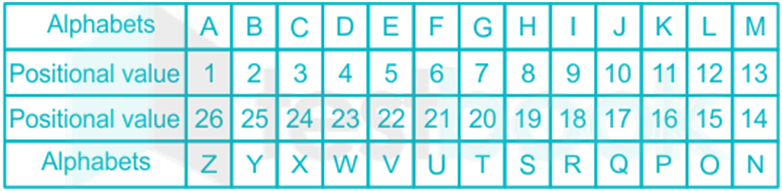
626a871a13e02eef2fcd3cd5 16564998081491

Logic: (1st letter + 2 = 3rd letter) and (2nd letter + 4 = 4th letter).

Option 1) DE - FI,

Option 2) PQ - RU,

Option 3) VW - XZ,

This pair does not follow the rule.

Option 4) IJ - KN,

Therefore, the letter-cluster pair that is different from the others is VW - XZ.

Hence, the correct answer is 'Option 3'.
2

L is the mother of E. E is the sister of M. O is the father of N. N is the husband of M. How is O related to L?

  1. ((a))

    Daughter's husband's father

  2. ((b))

    Daughter's husband's brother

  3. ((c))

    Daughter's husband

  4. ((d))

    Daughter's father

Show Answer
Answer: ((a))

Daughter's husband's father

Given:

  • L is the mother of E.
  • E is the sister of M.
  • O is the father of N.
  • N is the husband of M.

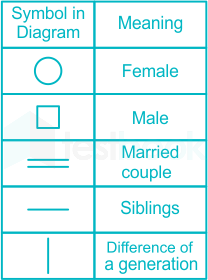
The Family Tree Diagram,

Therefore, O is the father of N, and N is the husband of L's daughter (M). So, O is L's Daughter's husband's father.

Hence, the correct answer is 'Option 1'.

3

Refer to the given letter series and answer the question that follows. Counting to be done from left to right only.

(Left) B K C A L Q R V G T N J E N E J W Y C G R L A M I U (Right)

How many such consonants are there, each of which is immediately preceded by a consonant and also immediately followed by a vowel?

  1. ((a))

    Two

  2. ((b))

    None

  3. ((c))

    Three

  4. ((d))

    One

Show Answer
Answer: ((c))

Three

Given (Left) B K C A L Q R V G T N J E N E J W Y C G R L A M I U (Right)

The required pattern is: Consonant → Consonant → Vowel

(Left) B K C A L Q R V G T N J E N E J W Y C G R L A M I U (Right)

There are exactly three such consonants.

  • KCA
  • NJE
  • RLA

Hence, the correct answer is "option 3"

4

1003 is related to 274 following a certain logic. Following the same logic, 987 is related to 258. To which of the following is 1105 related to, following the same logic?

(NOTE : Operations should be performed on the whole numbers, without breaking down the numbers into its constituent digits.

E.g. 13 – Operations on 13 such as adding /subtracting /multiplying etc. to 13 can be performed. Breaking down 13 into 1 and 3 and then performing mathematical operations on 1 and 3 is not allowed.)

  1. ((a))

    307

  2. ((b))

    365

  3. ((c))

    376

  4. ((d))

    367

Show Answer
Answer: ((c))

376

The logic followed here is:

Logic: Second Number = First Number − 729

For the first pair 1003 : 274

⇒ 1003 − 729 = 274

For the second pair 987 : 258

⇒ 987 − 729 = 258

Applying the same logic to the third pair

1105 : ?

⇒ 1105 − 729 = 376

Hence, the correct answer is "Option 3".

5

Seven boxes, F, I, L, T, E, R and S, are kept one over the other but not necessarily in the same order. Only R is kept above E. Only two boxes are kept between E and T. Only I is kept below L. F is not kept immediately above T. How many boxes are kept between S and I?

  1. ((a))

    One

  2. ((b))

    Two

  3. ((c))

    Four

  4. ((d))

    Three

Show Answer
Answer: ((b))

Two

Given: Seven boxes, F, I, L, T, E, R and S, are kept one over the other but not necessarily in the same order

  1. Only R is kept above E.
  2. Only two boxes are kept between E and T.
  3. Only I is kept below L.
  4. F is not kept immediately above T.

Final Arrangement:

7R
6E
5F
4S
3T
2L
1I

Thus, there are two boxes (T and L) kept between S and I.

Hence, the correct answer is 'Option 2'.

6

Refer to the following letter series and answer the question that follows. Counting to be done from left to right only.

<br>

(Left) E D U J Y H B V G T I O J U E D S A I B C A D E Y I O L B S M C (Right)

<br>

How many such vowel are there each of which is immediately preceded by a consonant and also immediately followed by a consonant?

  1. ((a))

    None

  2. ((b))

    Three

  3. ((c))

    One

  4. ((d))

    Two

Show Answer
Answer: ((b))

Three

Given : (Left) E D U J Y H B V G T I O J U E D S A I B C A D E Y I O L B S M C (Right)

Required Pattern: Consonant → Vowel → Consonant

(Left) E D U J Y H B V G T I O J U E D S A I B C A D E Y I O L B S M C (Right)

The three occurrences satisfying the condition are:

  • D U J
  • C A D
  • D E Y

Therefore, there are three such vowels in the given series.

Hence, the correct answer is "Option 2."

7

In the following triads, each group of letters is related to the subsequent one following a certain logic. Select from the given options, the one which follows the same logic.

AMID - MIAD - DIMA

EAST - ASET - TSAE

  1. ((a))

    FROM - ROFM - ROMF

  2. ((b))

    OPEN - OEPN - NEPO

  3. ((c))

    VAST - AVST - TASV

  4. ((d))

    WEAR - EAWR - RAEW

Show Answer
Answer: ((d))

WEAR - EAWR - RAEW

The logic followed here is based on the positional rearrangement of letters in each word within the triads.

Analysis of the given triads:

1. AMID − MIAD − DIMA

EAST − ASET − TSAE

<br>


Applying the same logic to the correct option

WEAR − EAWR − RAEW

Hence, the correct answer is "Option 4"

8

Based on the English alphabetical order, three of the following four letter-cluster pairs are alike in a certain way and thus form a group. Which is the one that DOES NOT belong to that group?

(Note: The odd one out is not based on the number of consonants/vowels or their position in the letter-cluster.)

  1. ((a))

    AN - GS

  2. ((b))

    TC - ZH

  3. ((c))

    YR - EV

  4. ((d))

    UP - AU

Show Answer
Answer: ((c))

YR - EV

The logic followed here is:

626a871a13e02eef2fcd3cd5 16564998081491

Option 1) AN - GS

Option 2) TC - ZH

Option 4) UP - AU

Option 3) YR - EV

Therefore, the letter-cluster pair that is different from the others is YR - EV.

Hence, the correct answer is 'Option 3'.

9

The position(s) of how many letters will remain unchanged if each letter in the word PRAYING is arranged in the English alphabetical order?

  1. ((a))

    One

  2. ((b))

    Three

  3. ((c))

    Zero

  4. ((d))

    Two

Show Answer
Answer: ((c))

Zero

The logic followed here is:

626a871a13e02eef2fcd3cd5 16564998081491

Given Word: PRAYING

Original OrderPRAYING
Alphabetical OrderAGINPRY


Therefore, the number of letters whose positions remain unchanged is Zero.

Hence, the correct answer is "option 3"

10

What will come in the place of ‘?’ in the following equation, if ‘+’ and ‘÷’ are interchanged and ‘-’ and ‘×’ are interchanged?

<br>

46 + 2 × 4 - 6 ÷ 20 = ?

  1. ((a))

    19

  2. ((b))

    23

  3. ((c))

    17

  4. ((d))

    27

Show Answer
Answer: ((a))

19

BODMAS Rule:

Sign Interchange:

Original Sign+÷×
New Sign÷+×


Given equation: 46 + 2 × 4 − 6 ÷ 20 = ?

After interchanging the signs, using the BODMAS rule the equation becomes:

= 46 ÷ 2 − 4 × 6 + 20

= 23 − 4 × 6 + 20

= 23 + 20 − 24

= 43 − 24

= 19

Hence, the correct answer is "option 1"

11

S, U, B, M, E, R and G are sitting around a circular table facing the centre of the table. B sits to the immediate left of M. U sits to the immediate left of E. E sits second to the left of G. R sits third to the left of M. Who sits fourth to the right of S?

  1. ((a))

    M

  2. ((b))

    G

  3. ((c))

    B

  4. ((d))

    E

Show Answer
Answer: ((b))

G

Given : S, U, B, M, E, R and G are sitting around a circular table facing the centre of the table.

  1. B sits to the immediate left of M.
  2. U sits to the immediate left of E.
  3. E sits second to the left of G.
  4. R sits third to the left of M.

The final arrangement is, 

G sits fourth to the right of S

Hence, the correct answer is G.

12

In a certain code language, ‘LEAP’ is coded as ‘9875’ and ‘LEAD’ is coded as ‘3897’. What is the code for ‘D’ in the given code language?

  1. ((a))

    5

  2. ((b))

    9

  3. ((c))

    8

  4. ((d))

    3

Show Answer
Answer: ((d))

3

The logic followed here is ,

The code for ‘D’ is 3.

Hence, the correct answer is "option 4"

13

What will come in place of the question mark (?) in the following equation if ‘+’ and ‘−’ are interchanged and ‘×’ and ‘÷’ are interchanged?

<br>

424 ÷ 2 + 966 × 3 − 23 = ?

  1. ((a))

    545

  2. ((b))

    645

  3. ((c))

    649

  4. ((d))

    549

Show Answer
Answer: ((d))

549

The logic followed here is,

BODMAS Rule:

Given Equation: 424 ÷ 2 + 966 × 3 − 23 = ?

Signs to be interchanged:

Original Sign+×÷
New Sign+÷×

After interchanging the signs,and using the BODMAS rule the new equation becomes:

= 424 × 2 − 966 ÷ 3 + 23

= 848 - 322 + 23

= 848 + 23 - 322  

= 871 − 32

= 549.

Hence, the correct answer is "option 4"

14

Each of H, U, S, B, A, N and D has an exam on a different day of a week starting from Monday and ending on Sunday of the same week. Only three people have exams between B and H. Only three people have exams between A and S. D has an exam on some day before U and on some day after N. Only S has an exam after H. How many people have exam(s) after A?

  1. ((a))

    Two

  2. ((b))

    Four

  3. ((c))

    Three

  4. ((d))

    One

Show Answer
Answer: ((b))

Four

Given: Seven people (H, U, S, B, A, N, D) have exams from Monday to Sunday.

  1. Only three people have exams between B and H.
  2. Only three people have exams between A and S.
  3. D has an exam on some day before U and on some day after N.
  4. Only S has an exam after H

The Final Arrangement is,


DayPerson
MondayN
TuesdayB
WednesdayA
ThursdayD
FridayU
SaturdayH
SundayS

The total number of people after A is 4.

Hence, the correct answer is "Option 2".

15

Select the option in which the given figure is embedded (rotation is NOT allowed).

<br>

  1. ((a))

  2. ((b))

  3. ((c))

  4. ((d))

Show Answer
Answer: ((a))

The logic followed here is here, 

The question figure is perfectly embedded in option 1.


Hence, the correct answer is "option 1".

16

Each of A, B, C, D, I, J and K has an exam on a different day of a week starting from Monday and ending on Sunday of the same week. Only three people have exams between C and I. Only three people have exams between J and D. B has exam on some day before K and on some day after A. Only D has exam after I. How many people have exams after J?

  1. ((a))

    Two

  2. ((b))

    One

  3. ((c))

    Four

  4. ((d))

    Three

Show Answer
Answer: ((c))

Four

Given: Each of A, B, C, D, I, J and K has an exam on a different day of a week starting from Monday and ending on Sunday of the same week.

  1. Only three people have exams between C and I.
  2. Only three people have exams between J and D.
  3. B has exam on some day before K and on some day after A.
  4. Only D has exam after I

Final Arrangement:

DayPerson
MondayA
TuesdayC
WednesdayJ
ThursdayB
FridayK
SaturdayI
SundayD

There are 4 (Four) people who have exams after J.

Hence, the correct answer is "Four".

17

If the water source is placed along X-Y, as shown in the figure, which of the given options  will be the water reflection of the given figure?

  1. ((a))

  2. ((b))

  3. ((c))

  4. ((d))

Show Answer
Answer: ((a))

The water image of the given figure,

Hence, the correct answer is "option 1"

18

What should come in place of the question mark (?) in the given series?

14, 23, 32, 41, 50, ?

  1. ((a))

    57

  2. ((b))

    63

  3. ((c))

    61

  4. ((d))

    59

Show Answer
Answer: ((d))

59

The logic followed here is:

Pattern:

  • 14 + 9 = 23
  • 23 + 9 = 32
  • 32 + 9 = 41
  • 41 + 9 = 50
  • 50 + 9 = 59

Thus, the missing term in the series is 59.

Hence, the correct answer is 'Option 4'.

19

The position(s) of how many letters will remain unchanged if each letter in the word FRIEND is arranged in the English alphabetical order?

  1. ((a))

    Three

  2. ((b))

    None

  3. ((c))

    Two

  4. ((d))

    One

Show Answer
Answer: ((d))

One

The logic followed here is:

626a871a13e02eef2fcd3cd5 16564998081491

Given WordFRIEND
Alphabetical OrderDEFINR
  • From the above table, it is clear that only the position of the letter N remains unchanged when the letters are arranged alphabetically.
  • Therefore, the number of letters that remain unchanged is one.

Hence, the correct answer is option 4

20

What should come in place of ? in the given series based on the English alphabetical order?

<br>

SWUN XBZS CGEX HLJC ?

  1. ((a))

    MHYU

  2. ((b))

    MOHQ

  3. ((c))

    MQSW

  4. ((d))

    MQOH

Show Answer
Answer: ((d))

MQOH

The logic followed here is:

626a871a13e02eef2fcd3cd5 16564998081491


The next word in the series is MQOH.

Hence, the correct answer is "option 4"

General Awareness (20 questions)

21

The Union Budget 2025-2026 of India was presented by:

  1. ((a))

    Nirmala Sitharaman

  2. ((b))

    Amit Shah

  3. ((c))

    Rajnath Singh

  4. ((d))

    Piyush Goyal

Show Answer
Answer: ((a))

Nirmala Sitharaman

The correct answer is Nirmala Sitharaman.

Key Points

  • The Union Budget of India for the financial year 2025-2026 was presented by Nirmala Sitharaman, who serves as the Union Minister of Finance and Corporate Affairs.
  • Following the established parliamentary tradition, the budget was tabled in the Lok Sabha on February 1, 2025.
  • With the presentation of this budget, Nirmala Sitharaman achieved the milestone of presenting seven consecutive Union Budgets (including one interim budget in 2024), surpassing the record previously held by Morarji Desai.
  • The budget for 2025-2026 focuses on the roadmap for Viksit Bharat @ 2047, prioritizing sustainable economic growth, infrastructure development, and technological advancement.
  • Under Article 112 of the Constitution of India, the central government is mandated to present the Annual Financial Statement, which outlines estimated receipts and expenditures.

 Additional Information

  • Other notable cabinet ministers:
  • Amit Shah: He currently holds the portfolio of the Union Minister of Home Affairs and the Minister of Cooperation.
  • Rajnath Singh: He serves as the Union Minister of Defence and has previously held the Home Ministry portfolio.
  • Piyush Goyal: He is the Minister of Commerce and Industry. Although he presented the Interim Budget in 2019 while holding temporary charge of the Finance Ministry, he did not present the 2025-2026 budget.
  • The Union Budget is divided into two parts: the Revenue Budget and the Capital Budget, ensuring a comprehensive overview of the nations financial health.
22

The Kailasha monument at Ellora (near Aurangabad, Maharastra), viewed as a grand specimen of Rashtrakuta artistry, was erected under the patronage of which of the following kings?

  1. ((a))

    Krishna I

  2. ((b))

    Krishna II

  3. ((c))

    Indra Varma

  4. ((d))

    Vikramaditya

Show Answer
Answer: ((a))

Krishna I

The correct answer is Krishna I.

Key Points

  • The Kailasha temple, also known as Cave 16 at Ellora, is a colossal structure dedicated to Lord Shiva and is widely considered the pinnacle of Rashtrakuta architecture.
  • It was constructed under the patronage of King Krishna I (reigned approximately 756 to 774 CE), who was a powerful ruler of the Rashtrakuta Dynasty.
  • The monument is famous for being monolithic, meaning it was carved from a single, massive basalt cliff, starting from the top and working downwards to the base.
  • The temple design is heavily influenced by the Dravidian style, featuring a multi-storeyed Vimana (tower), a large courtyard, and intricate sculptures depicting scenes from the Ramayana and Mahabharata.
  • Engineering estimates suggest that over 200,000 tonnes of rock were excavated over several decades to create this masterwork, which was intended to symbolize Mount Kailash.

 Additional Information

  • Rashtrakuta Dynasty:
  • The dynasty was founded by Dantidurga, who overthrew the Chalukyas of Badami. Krishna I, his uncle, succeeded him and expanded the empire across central and southern India.
  • The Rashtrakutas were great patrons of art and literature, supporting various religious traditions including Hinduism, Buddhism, and Jainism.
  • Ellora Caves:
  • Located in the Sambhaji Nagar (formerly Aurangabad) district of Maharashtra, Ellora is a UNESCO World Heritage Site.
  • The site comprises 34 caves: 12 Buddhist, 17 Hindu, and 5 Jain, showcasing the religious harmony and cultural synthesis of ancient India.
  • Context of Other Options:
  • Krishna II: He was a later Rashtrakuta king (grandson of Krishna I) known for his long reign and military engagements with the Eastern Chalukyas, but he is not the patron of the main Kailasha monument.
  • Vikramaditya: This name refers to several rulers, most notably from the Western Chalukya or Gupta dynasties. While Vikramaditya II of the Chalukyas built temples in Pattadakal that influenced the Kailasha temple's design, he was not its patron.
23

Match List I with List II

List I (Industry) List II (Location)

A. Visveswaraya Iron and Steel Plant I. Hirakud
B. Indian Aluminium Company Ltd. II. Sindri
C. Fertiliser Corporation of India Ltd. III. Pimpri
D. Hindustan Antibiotics Ltd. IV. Bhadravati

  1. ((a))

    A - II, B - IV, C - I, D - III

  2. ((b))

    A - IV, B - I, C - II, D - III

  3. ((c))

    A - IV, B - II, C - I, D - III

  4. ((d))

    A - I, B - II, C - III, D - IV

Show Answer
Answer: ((b))

A - IV, B - I, C - II, D - III

The correct answer is A - IV, B - I, C - II, D - III.

Key Points

  • Visveswaraya Iron and Steel Plant (VISL) is located in Bhadravati, Karnataka. Originally established as the Mysore Iron Works in 1923 by Sir M. Visveswaraya, it became a unit of the Steel Authority of India Limited (SAIL) in 1989. It is renowned for producing high-quality alloy and special steels. Hence, A matches with IV.
  • The Indian Aluminium Company Ltd. (INDAL), which later merged with Hindalco Industries, commissioned its primary aluminium smelter at Hirakud, Odisha, in 1959. The plant benefits from the hydroelectric power generated by the Hirakud Dam on the Mahanadi River, which is critical for energy-intensive aluminium smelting. Hence, B matches with I.
  • The Fertiliser Corporation of India Ltd. (FCI) established its landmark unit at Sindri, Jharkhand. Commissioned in 1951, it was the first major public sector fertilizer plant in India, playing a pivotal role in the country's Green Revolution by manufacturing Ammonium Sulphate. Hence, C matches with II.
  • Hindustan Antibiotics Ltd. (HAL) is headquartered in Pimpri, Pune. Founded in 1954 with technical assistance from WHO and UNICEF, it was the first public sector company in India to manufacture Penicillin and other essential life-saving drugs. Hence, D matches with III.

 Additional Information

  • Industrial Importance of Locations:
  • Bhadravati: Known as the industrial capital of Shimoga, it also houses the Mysore Paper Mills.
  • Hirakud: Apart from aluminium, the region is a hub for thermal power and heavy engineering industries.
  • Sindri: Historically significant as the 'Fertilizer City', it was chosen due to its proximity to coalfields in the Damodar Valley.
  • Pimpri: Part of the Pune industrial belt, it is now one of the largest automobile and manufacturing hubs in Asia.
24

Electric and magnetic fields are regarded as-------

  1. ((a))

    Scalar quantities because they have only magnitude

  2. ((b))

    Independent phenomena with no relation

  3. ((c))

    Vector quantities because they have both magnitude and direction

  4. ((d))

    Non-physical entities without measurable effects

Show Answer
Answer: ((c))

Vector quantities because they have both magnitude and direction

The correct answer is Vector quantities because they have both magnitude and direction.

Key Points

  • A vector quantity is a physical quantity that is completely specified by both a magnitude (numerical value with unit) and a direction.
  • The Electric Field (E \vec{E} ) at a point is defined as the electrostatic force per unit positive charge. Its direction is the same as the direction of the force exerted on a positive test charge placed at that point.
  • The Magnetic Field (B \vec{B} ) is a region around a magnetic material or a moving electric charge within which the force of magnetism acts. It has a specific direction at every point, typically indicated by the way a north pole of a compass needle points.
  • Both electric and magnetic fields obey the principle of superposition, meaning the resultant field at any point is the vector sum of the individual fields produced by various sources.
  • Since these fields cannot be fully described without mentioning which way they point (outward, inward, clockwise, etc.) in three-dimensional space, they are classified as vector quantities.

Additional Information

  • Scalar Quantities: Unlike vectors, scalars like Electric Potential, Energy, and Charge only have magnitude and no specific spatial direction.
  • SI Units: The SI unit for the Electric Field is Newtons per Coulomb (N/C) or Volts per meter (V/m), while the SI unit for the Magnetic Field is the Tesla (T).
  • Lorentz Force: The vector nature of these fields is fundamental to the Lorentz Force equation, F=q(E+v×B) \vec{F} = q(\vec{E} + \vec{v} \times \vec{B}) , where the cross product (× \times ) specifically requires vector inputs.
  • Field Lines: These fields are visually represented using field lines, where the tangent to the line at any point gives the direction of the field at that point.
25

Who among the following was the founder of Chalukya's dynasty?

  1. ((a))

    Kirtivarman I

  2. ((b))

    Vikramaditya I

  3. ((c))

    Rajendra II

  4. ((d))

    Pulakeshin I

Show Answer
Answer: ((d))

Pulakeshin I

The correct answer is Pulakeshin I.

Key Points

  • Pulakeshin I is historically recognized as the real founder and the first sovereign ruler of the Chalukya dynasty, specifically the Badami Chalukyas (Vatapi Chalukyas).
  • He established his independent kingdom by fortifying the hill of Vatapi (modern-day Badami in the Bagalkot district of Karnataka) around 540 CE and making it his capital.
  • To proclaim his supreme sovereignty and independence from the Kadambas, he performed significant Vedic rituals, including the Ashvamedha (horse sacrifice), Hiranyagarbha, and Agishtoma.
  • He assumed grand imperial titles such as Satyashraya (the refuge of truth), Ranavikrama (the valorous in war), and Shri Prithvi-vallabha (the favorite of the Goddess of Fortune and Earth).
  • While records mention his ancestors Jayasimha and Ranaraga, they are believed to have been feudatory chiefs; the dynasty achieved true imperial status only under Pulakeshin I.

 Additional Information

  • Kirtivarman I
  • He was the son and successor of Pulakeshin I.
  • He is credited with the territorial expansion of the kingdom by defeating the Kadambas of Banavasi and the Mauryas of Konkan.
  • Vikramaditya I
  • A later ruler of the Badami Chalukyas and the son of Pulakeshin II.
  • He is famous for restoring the prestige of the dynasty after the Pallava occupation of Vatapi and capturing the Pallava capital, Kanchi.
  • Rajendra II
  • He was a powerful monarch of the Medieval Chola dynasty, not the Chalukya dynasty.
  • He is renowned for his victory in the Battle of Koppam against the Western Chalukyas and his coronation on the battlefield.
26

Which peace agreement, signed on 26 October 2025, aimed to settle the border dispute between two Southeast Asian nations?

  1. ((a))

    Minsk Peace Protocol

  2. ((b))

    Kuala Lumpur Peace Accord

  3. ((c))

    Kyoto Peace Protocol

  4. ((d))

    Schengen Peace Agreement

Show Answer
Answer: ((b))

Kuala Lumpur Peace Accord

The correct answer is Kuala Lumpur Peace Accord.

Key Points

  • The Kuala Lumpur Peace Accord was officially signed on 26 October 2025, representing a historic milestone in Southeast Asian diplomacy aimed at resolving complex territorial sovereignty and border delimitation issues.
  • The agreement was designed to settle long-standing maritime boundary disputes and overlapping claims in resource-rich zones, fostering a spirit of regional stability and economic integration within the ASEAN framework.
  • Key provisions of the accord included the establishment of Joint Development Areas (JDAs) for the equitable sharing of natural resources, such as oil and natural gas, found along the contested borders.
  • The negotiations leading to the Kuala Lumpur Peace Accord were facilitated by international mediators and adhered strictly to the principles laid out in the United Nations Convention on the Law of the Sea (UNCLOS).
  • By signing this accord, the involved Southeast Asian nations committed to peaceful dispute resolution mechanisms, effectively reducing the risk of naval confrontations and enhancing maritime security in the region.

 Additional Information

  • Minsk Peace Protocol
  • This refers to a series of international agreements, specifically Minsk I (2014) and Minsk II (2015), which sought to end the war in the Donbas region of Ukraine.
  • It involved the Trilateral Contact Group consisting of Ukraine, Russia, and the OSCE, and is unrelated to Southeast Asian border disputes.
  • Kyoto Peace Protocol
  • Commonly referred to as the Kyoto Protocol, this was an international treaty adopted in 1997 in Kyoto, Japan.
  • Its primary objective was the reduction of greenhouse gas emissions to combat global warming, rather than settling geopolitical borders.
  • Schengen Peace Agreement
  • The Schengen Agreement, signed in 1985, led to the creation of the Schengen Area in Europe.
  • Its main function is the abolition of internal border checks among European countries to facilitate free movement of people, not the resolution of territorial disputes.
27

Which of the following buildings in Fatehpur Sikri is a fine example of ancient Indian architecture?

  1. ((a))

    Dash Mahal

  2. ((b))

    Raja Mahal

  3. ((c))

    Jodha Bai Palace

  4. ((d))

    Hawa Mahal

Show Answer
Answer: ((c))

Jodha Bai Palace

The correct answer is Jodha Bai Palace.

Key Points

  • Jodha Bai Palace is the largest and most significant residential structure in the Fatehpur Sikri complex, commissioned by the Mughal Emperor Akbar in the late 16th century.
  • The building is considered a masterpiece of syncretic architecture, as it heavily incorporates ancient Indian architectural elements from Hindu and Jain traditions.
  • Architecturally, the palace utilizes the Trabeate (post-and-lintel) system rather than the Arcuate (arched) system, which is a hallmark of indigenous Indian craftsmanship.
  • The interior is decorated with traditional motifs such as the Lotus, Swan, Srivatsa mark, and Ghant-mala (bell and chain), all of which are rooted in ancient temple architecture.
  • Structural features like Chhatris (canopied pavilions), Jharokhas (overhanging balconies), and ornate carved brackets demonstrate the influence of Gujarati and Rajasthani styles.
  • Therefore, Jodha Bai Palace is the correct answer as it represents the fusion of medieval Mughal needs with ancient Indian architectural principles.

 Additional Information

  • Fatehpur Sikri:
  • Founded in 1569 by Akbar, it served as the capital of the Mughal Empire from 1571 to 1585 and was declared a UNESCO World Heritage Site in 1986.
  • The city was built to honor the Sufi saint Sheikh Salim Chishti, whose tomb is located within the Jama Masjid courtyard.
  • Hawa Mahal:
  • A prominent palace in Jaipur, Rajasthan, built in 1799 by Maharaja Sawai Pratap Singh; it is not located in the Fatehpur Sikri complex.
  • Raja Mahal:
  • Often refers to the 16th-century palace built by the Bundela Rajput kings in Orchha, Madhya Pradesh, known for its grand towers and murals.
28

The Khelo India Para Games 2025 took place in _______.

  1. ((a))

    Lucknow

  2. ((b))

    Bengaluru

  3. ((c))

    New Delhi

  4. ((d))

    Jaipur

Show Answer
Answer: ((c))

New Delhi

The correct answer is New Delhi.

Key Points

  • The Khelo India Para Games 2025 represents the second edition of this massive sporting event, designed specifically to promote inclusivity and provide a national platform for divyang athletes.
  • New Delhi was designated as the host city to utilize the existing international-standard infrastructure, including the Indira Gandhi Stadium complex, which is equipped with specialized accessibility features for para-athletes.
  • The event is a flagship initiative of the Ministry of Youth Affairs and Sports, aiming to identify and nurture talent for global competitions such as the Paralympic Games and Asian Para Games.
  • The games include various disciplines such as para-athletics, para-badminton, para-powerlifting, para-table tennis, and para-archery, drawing participants from across all States and Union Territories of India.

 Additional Information

  • Khelo India Programme:
  • Introduced in 2018, this central sector scheme focuses on building a strong sports ecosystem in India.
  • The Para Games were added to the Khelo India calendar to ensure that differently-abled sportspersons receive the same level of support, funding, and recognition as their able-bodied counterparts.
  • Lucknow:
  • While a major sports hub in Uttar Pradesh, it hosted the Khelo India University Games in 2023 but is not the venue for the 2025 Para Games.
  • Bengaluru:
  • Known for the Sports Authority of India (SAI) Netaji Subhas Southern Centre, it frequently hosts training camps for Olympic athletes but was not selected as the primary host for this specific edition.
  • Jaipur:
  • The capital of Rajasthan has produced several high-profile para-shooters like Avani Lekhara, yet the central organization of the 2025 Para Games remains consolidated in the national capital.
29

Which of the following is the main objective of the PM SVANidhi scheme?

  1. ((a))

    To provide free education to street vendors' children

  2. ((b))

    To provide financial support to street vendors for their business growth

  3. ((c))

    To provide accommodation support to shelterless people

  4. ((d))

    To provide support to Old Age Persons

Show Answer
Answer: ((b))

To provide financial support to street vendors for their business growth

The correct answer is To provide financial support to street vendors for their business growth.

Key Points

  • The PM SVANidhi (PM Street Vendor’s AtmaNirbhar Nidhi) scheme was launched by the Ministry of Housing and Urban Affairs on June 1, 2020, to provide affordable working capital loans to street vendors.
  • Its core objective is to offer a collateral-free loan of up to ₹10,000 to help street vendors restart their livelihoods which were adversely impacted by the COVID-19 pandemic and subsequent lockdowns.
  • The scheme targets urban street vendors, including those from peri-urban and rural areas, who were engaged in vending operations on or before March 24, 2020.
  • It promotes financial discipline by offering an interest subsidy of 7% per annum on timely or early repayment, which is credited directly to the beneficiary's bank account via Direct Benefit Transfer (DBT).
  • The scheme also encourages digital transactions by providing monthly cashback incentives, thereby integrating street vendors into the formal digital economy and improving their credit profile.

 Additional Information

  • Implementation and Lending:
  • The Small Industries Development Bank of India (SIDBI) acts as the implementation partner. Lending institutions include Scheduled Commercial Banks, Regional Rural Banks, Small Finance Banks, Cooperative Banks, and Non-Banking Financial Companies (NBFCs).
  • Loan Tranches:
  • Vendors are eligible for a second loan tranche of up to ₹20,000 and a third tranche of up to ₹50,000 upon the successful and timely repayment of the preceding loans, facilitating business expansion.
  • SVANidhi se Samriddhi:
  • An additional component launched to map the socio-economic profile of PM SVANidhi beneficiaries and their families to link them to various central welfare schemes such as PM Jan Dhan Yojana and PM Suraksha Bima Yojana.
30

The concept of rural development includes the provision of basic services such as sanitation, water and electricity. What is the main objective of the Swachh Bharat Mission (Gramin)?

  1. ((a))

    Open defecation free villages

  2. ((b))

    Providing irrigation

  3. ((c))

    Providing gas connections

  4. ((d))

    Rural electrification

Show Answer
Answer: ((a))

Open defecation free villages

The correct answer is Open defecation free villages.

Key Points

  • The Swachh Bharat Mission (Gramin) or SBM-G was launched on 2nd October 2014 by the Government of India to accelerate efforts to achieve universal sanitation coverage and focus on safe sanitation.
  • The primary objective of the mission was to make rural India Open Defecation Free (ODF) by 2nd October 2019, as a tribute to the 150th birth anniversary of Mahatma Gandhi.
  • It aimed to improve the general quality of life in rural areas by promoting cleanliness, hygiene, and eliminating the practice of open defecation through the construction of Individual Household Latrines (IHHL) and Community Sanitary Complexes.
  • The program utilized a demand-driven approach, emphasizing behavioral change through Information, Education, and Communication (IEC) strategies to ensure sustainable usage of toilets.
  • Following the successful declaration of all villages as ODF in 2019, Phase II of SBM-G was launched (2020-21 to 2024-25) to focus on ODF Plus, which includes ODF sustainability and Solid and Liquid Waste Management (SLWM).

 Additional Information

  • Providing irrigation:
  • This is the core objective of the Pradhan Mantri Krishi Sinchayee Yojana (PMKSY), which aims to enhance physical access to water on farms and expand the cultivable area under assured irrigation.
  • Providing gas connections:
  • The Pradhan Mantri Ujjwala Yojana (PMUY) was launched in 2016 specifically to provide LPG (Liquefied Petroleum Gas) connections to women from Below Poverty Line (BPL) households to replace unhealthy cooking fuels.
  • Rural electrification:
  • This is addressed through schemes like the Deen Dayal Upadhyaya Gram Jyoti Yojana (DDUGJY) and the Saubhagya Scheme (Pradhan Mantri Sahaj Bijli Har Ghar Yojana), focusing on 100 percent electrification of all rural households.
31

Which of the following indices does the Government of India employ to assess the employment situation in the country?

  1. ((a))

    Consumer Price Index (CPI)

  2. ((b))

    Gini Coefficient

  3. ((c))

    Human Development Index (HDI)

  4. ((d))

    Worker Population Ratio (WPR)

Show Answer
Answer: ((d))

Worker Population Ratio (WPR)

The correct answer is Worker Population Ratio (WPR).

Key Points

  • The Worker Population Ratio (WPR) is defined as the percentage of employed persons in the total population, serving as a primary indicator to assess the employment situation in India.
  • It is calculated using the formula: (Total number of workers / Total population) × 100.
  • The National Statistical Office (NSO), under the Ministry of Statistics and Programme Implementation (MoSPI), is responsible for collecting and releasing this data.
  • Data for WPR is disseminated through the Periodic Labour Force Survey (PLFS), which was launched in April 2017 to provide more frequent labor force statistics.
  • A high WPR signifies that a substantial part of the population is actively engaged in economic activities, contributing to the production of goods and services.
  • The index provides insights into the demand for labor and the capacity of the economy to generate employment opportunities for its citizens.

 Additional Information

  • Consumer Price Index (CPI):
  • It measures the weighted average of prices of a basket of consumer goods and services, such as transportation, food, and medical care.
  • In India, it is used by the Reserve Bank of India (RBI) as the key indicator for measuring Inflation and formulating Monetary Policy.
  • Gini Coefficient:
  • A statistical measure used to represent the income distribution of a nation’s residents.
  • It ranges from 0 to 1, where 0 represents perfect equality and 1 represents perfect inequality.
  • Human Development Index (HDI):
  • A composite statistic developed by the United Nations Development Programme (UNDP) to rank countries by level of human development.
  • It considers three main dimensions: Life expectancy (Health), Expected/Mean years of schooling (Education), and Gross National Income per capita (Standard of living).
32

Which of the following is NOT a colligative property?

  1. ((a))

    Relative lowering of vapour pressure

  2. ((b))

    Elevation of freezing point

  3. ((c))

    Boiling point elevation

  4. ((d))

    Freezing point depression

Show Answer
Answer: ((b))

Elevation of freezing point

CONCEPT:

Colligative properties are the properties of a dilute solution that depend only on the total number of solute particles (molecules or ions) present in the solution, regardless of their nature. There are four primary colligative properties:

  • Relative lowering of vapour pressure
  • Elevation of boiling point
  • Depression of freezing point
  • Osmotic pressure

EXPLANATION:

  • Relative lowering of vapour pressure: When a non-volatile solute is added to a solvent, the vapour pressure of the solution becomes lower than that of the pure solvent. The ratio of this decrease to the vapour pressure of the pure solvent is a colligative property.
  • Elevation of boiling point: Adding a solute decreases the vapour pressure, which means a higher temperature is required for the vapour pressure to equal the atmospheric pressure. Thus, the boiling point of the solution increases (elevates).
  • Depression of freezing point: The presence of solute particles prevents the solvent molecules from easily forming a solid crystal lattice. As a result, the freezing point of the solution is lower than that of the pure solvent.
  • Elevation of freezing point: This is not a colligative property. In fact, the freezing point of a solvent always decreases (depresses) upon the addition of a non-volatile solute; it is never elevated under standard conditions for a solution.

Therefore, the property that is NOT a colligative property is Elevation of freezing point.

33

Which of the following statements is correct about the relationship of the State Council of Ministers with the Governor?

  1. ((a))

    They advise the Governor on governmental affairs.

  2. ((b))

    They assist the Governor in drafting state laws.

  3. ((c))

    They supervise the Governor’s actions.

  4. ((d))

    They hold office at the pleasure of the Governor.

Show Answer
Answer: ((a))

They advise the Governor on governmental affairs.

The correct answer is They advise the Governor on governmental affairs.

Key Points

  • The primary relationship between the State Council of Ministers and the Governor is established under Article 163 of the Indian Constitution, which states that there shall be a Council of Ministers with the Chief Minister at the head to aid and advise the Governor in the exercise of his functions.
  • This advisory role covers the broad spectrum of governmental affairs, including administrative decisions and legislative proposals, ensuring that the Governor, as the nominal executive head, acts according to the will of the elected representatives.
  • While the Council provides advice, Article 163 also specifies that the Governor may exercise certain functions in his discretion; however, for all other matters, the advice of the Council is generally binding in a parliamentary democracy.
  • Under Article 164, the Chief Minister is appointed by the Governor, and other ministers are appointed by the Governor on the advice of the Chief Minister, further cementing the advisory nature of their relationship.
  • The Council of Ministers acts as the real executive, and their advice is the mechanism through which the State Government operates in the name of the Governor.

 Additional Information

  • They hold office at the pleasure of the Governor:
  • This is a constitutional fact under Article 164(1), which states that ministers hold office during the pleasure of the Governor.
  • However, this 'pleasure' is not arbitrary; as per constitutional conventions and the S.R. Bommai case, the Governor cannot dismiss a Council that enjoys a majority in the Legislative Assembly.
  • This clause primarily relates to the tenure of the ministers rather than the daily functional relationship of governance.
  • They assist the Governor in drafting state laws:
  • This is conceptually incorrect as the drafting of laws is a function of the Legislature (Vidhan Sabha and Vidhan Parishad).
  • While the Council of Ministers (Executive) initiates Government Bills and determines the legislative agenda, the formal drafting and enactment process is a legislative function.
  • They supervise the Governor’s actions:
  • The Council does not 'supervise' the Governor; rather, the Governor acts as a Constitutional sentinel.
  • The relationship is one of cooperation and advice, where the Governor has the right to be informed of all cabinet decisions under Article 167.
34

Dadabhai Naoroji developed an economic explanation that became a key Indian argument against British domination; this idea is known as which of the following?

  1. ((a))

    Wealth-Export hypothesis

  2. ((b))

    Imperial Drain concept

  3. ((c))

    Drain-of-Wealth theory

  4. ((d))

    Economic Drain thesis

Show Answer
Answer: ((c))

Drain-of-Wealth theory

The correct answer is Drain-of-Wealth theory.

Key Points

  • The Drain-of-Wealth theory was conceptualized by Dadabhai Naoroji to describe the systematic transfer of India's resources and capital to Britain without any equivalent return.
  • Naoroji first presented this economic critique in 1867 in his paper titled 'England's Debt to India', argued before the East India Association in London.
  • The concept was later expanded in his seminal book, 'Poverty and Un-British Rule in India', published in 1901, where he meticulously documented how colonial policies were impoverishing the subcontinent.
  • He argued that this economic drain prevented the accumulation of domestic capital, which was necessary for India's industrial growth, leading to recurring famines and mass poverty.
  • The Indian National Congress officially endorsed this theory at its Calcutta Session in 1896, marking it as a foundational pillar of the Indian nationalist movement against British economic imperialism.

 Additional Information

  • Dadabhai Naoroji:
  • Known as the Grand Old Man of India, he was a teacher, cotton trader, and a founding member of the Indian National Congress.
  • In 1892, he became the first Indian to be elected as a Member of Parliament in the British House of Commons representing Central Finsbury.
  • Mechanisms of the Drain:
  • Home Charges: These included salaries, pensions, and administrative expenses of the India Office in London, paid entirely from Indian revenues.
  • Interest on Public Debt: India was forced to pay interest on loans taken for railway expansion and military expeditions conducted by the British Empire outside India.
  • Private Remittances: The savings and profits earned by British officials, merchants, and planters were regularly sent back to Britain, further depleting the Indian treasury.
35

Which Article of the Indian Constitution says that , there shall be a Minister in charge of tribal welfare in the States of Chhattisgarh, Jharkhand, Madhya Pradesh and Orissa?

  1. ((a))

    Article 164

  2. ((b))

    Article 170

  3. ((c))

    Article 168

  4. ((d))

    Article 166

Show Answer
Answer: ((a))

Article 164

The correct answer is Article 164.

Key Points

  • Article 164 of the Indian Constitution outlines various provisions regarding the Council of Ministers in states, including their appointment, salary, and responsibilities.
  • The proviso to Article 164(1) specifically mandates that there shall be a Minister in charge of tribal welfare in the states of Chhattisgarh, Jharkhand, Madhya Pradesh, and Odisha.
  • This minister may additionally hold portfolios for the welfare of Scheduled Castes and backward classes or any other relevant administrative work.
  • The requirement for a specialized tribal welfare minister ensures that the interests of significant tribal populations in these states are represented at the highest executive level.
  • The 94th Constitutional Amendment Act, 2006 updated this provision to include the newly formed states of Chhattisgarh and Jharkhand, while removing the state of Bihar from the list.

 Additional Information

  • Article 170:
  • Relates to the Composition of the Legislative Assemblies in the states.
  • It specifies that each assembly shall have a maximum of 500 members and a minimum of 60 members, directly elected from territorial constituencies.
  • Article 168:
  • Provides for the Constitution of Legislatures in States.
  • It establishes that every state legislature consists of the Governor and one or two Houses (Legislative Assembly and, in some states, a Legislative Council).
  • Article 166:
  • Deals with the Conduct of business of the Government of a State.
  • It mandates that all executive actions of the State Government shall be expressed to be taken in the name of the Governor.
36

Which Indian shooter secured her second individual gold medal in the women's 25 m standard pistol event at the ISSF Junior World Championship in 2024?

  1. ((a))

    Apurvi Chandela

  2. ((b))

    Heena Sidhu

  3. ((c))

    Divanshi

  4. ((d))

    Manu Bhaker

Show Answer
Answer: ((c))

Divanshi

The correct answer is Divanshi.

Key Points

  • Divanshi emerged as a star performer at the ISSF Junior World Championship 2024, which was hosted in Lima, Peru.
  • She secured her second individual gold medal of the competition by winning the women's 25m standard pistol event, finishing with a score of 564.
  • Prior to this victory, she had already clinched her first individual gold medal in the women's 25m pistol event at the same championship.
  • Her performance in the 25m standard pistol led an Indian sweep of the medals, where she was followed by Parisha Gupta (Silver) and Khushi Kapoor (Bronze).
  • These individual successes were pivotal in India topping the overall medal tally at the 2024 Junior World Championships, reflecting the country's depth in junior shooting talent.

 Additional Information

  • Manu Bhaker:
  • A high-profile Indian shooter who made history by winning two Bronze medals at the Paris 2024 Olympics.
  • She has won numerous gold medals at the ISSF World Cup, Commonwealth Games, and Youth Olympics in both 10m Air Pistol and 25m Pistol categories.
  • Apurvi Chandela:
  • An elite Indian Rifle shooter who specialized in the 10m air rifle event and reached the World Number 1 ranking in 2019.
  • She is a recipient of the Arjuna Award and won the gold medal at the 2014 Commonwealth Games in Glasgow.
  • Heena Sidhu:
  • The first Indian pistol shooter to be ranked World Number 1 by the International Shooting Sport Federation (ISSF) in 2014.
  • She was the first Indian to win a gold medal in an ISSF World Cup Final (2013) in the 10m Air Pistol event.
37

A population pyramid is used to show:

  1. ((a))

    Age and sex structure of the population

  2. ((b))

    Urban-rural migration patterns

  3. ((c))

    Distribution of agricultural land

  4. ((d))

    Population density of countries

Show Answer
Answer: ((a))

Age and sex structure of the population

The correct answer is Age and sex structure of the population.

Key Points

  • A population pyramid, also referred to as an age-sex pyramid, is a graphical illustration that represents the distribution of various age groups within a specific population.
  • The vertical axis (Y-axis) displays age cohorts, typically in five-year intervals (e.g., 0-4, 5-9, 10-14), while the horizontal axis (X-axis) represents the total number or percentage of males (usually on the left) and females (usually on the right).
  • It serves as a visual tool to analyze demographic trends, including fertility rates, mortality rates, and life expectancy, providing a snapshot of the historical and future growth potential of a nation.
  • The structure effectively identifies the dependency ratio, highlighting the balance between the working-age population (typically 15 to 64 years) and the dependent population (children under 15 and seniors over 65).

 Additional Information

  • The shape of the pyramid provides insights into the economic development stage of a country:
  • Expansive Pyramids: Feature a wide base and narrow peak, indicating high birth rates and high death rates, characteristic of developing countries with rapid growth.
  • Constrictive Pyramids: Narrower at the bottom, reflecting declining birth rates and an aging population, common in highly industrialized nations.
  • Stationary Pyramids: Maintain a relatively rectangular shape, suggesting stable population growth with balanced birth and death rates.
  • Policy Planning: Governments utilize these pyramids to allocate resources for maternal health, primary education, vocational training, and pension systems based on which age bracket is dominant.
  • Demographic Dividend: A bulge in the middle section suggests a large labor force, which can lead to rapid economic growth if the country provides sufficient employment and training.
38

Which of the following sculptures is a famous example of Harappan bronze art?

  1. ((a))

    Bull Seal

  2. ((b))

    Bearded Priest

  3. ((c))

    Dancing Girl

  4. ((d))

    Mother Goddess

Show Answer
Answer: ((c))

Dancing Girl

The correct answer is Dancing Girl.

Key Points

  • The Dancing Girl is a world-renowned bronze statuette created approximately in 2500 BCE, serving as a primary specimen of the Indus Valley Civilization's artistic excellence.
  • It was discovered in 1926 by the British archaeologist Ernest Mackay in the HR area of Mohenjo-daro, a major urban center of the Harappan culture.
  • The sculpture is approximately 10.5 centimeters tall and was manufactured using the Lost Wax Casting (Cire Perdue) technique, indicating an advanced understanding of metallurgy and bronze alloying.
  • The figure is depicted in a standing position with her right hand on her hip and her left arm, which is heavily laden with 24 bangles, resting on her thigh.
  • This artifact is significant because it provides evidence of the Harappan people's mastery over metal casting and their sophisticated sense of aesthetic expression and fashion.

 Additional Information

  • Bearded Priest:
  • This is a famous steatite (soapstone) sculpture rather than bronze, found at Mohenjo-daro, depicting a male figure with a trefoil-patterned shawl.
  • Bull Seal:
  • Harappan seals, such as the Humped Bull seal, were primarily carved from steatite or made of terracotta and were used for trade and administrative purposes.
  • Mother Goddess:
  • These are typically terracotta figurines characterized by elaborate fan-shaped headgear and were likely used for religious or fertility worship.
  • Lost Wax Process:
  • This ancient method involved coating a wax model with clay, heating it to remove the wax, and then pouring molten metal into the hollow cavity to create a solid sculpture.
39

In which of the following years did NABARD initiate the pilot project for linking 500 groups in India?

  1. ((a))

    1990

  2. ((b))

    1992

  3. ((c))

    1995

  4. ((d))

    2000

Show Answer
Answer: ((b))

1992

The correct answer is 1992.

Key Points

  • In February 1992, the National Bank for Agriculture and Rural Development (NABARD) launched the pilot project for the Self-Help Group (SHG) Bank Linkage Programme.
  • The primary mandate of this pilot project was to establish a formal credit channel by linking 500 SHGs with the mainstream banking system to promote microfinance and financial inclusion.
  • The program was initiated following the recommendations of the S.K. Kalia Committee, which recognized the efficacy of informal groups in delivering credit to the rural poor.
  • The success of this pilot phase led the Reserve Bank of India (RBI) to issue guidelines in 1996, mainstreaming SHG lending as a priority sector activity for commercial banks.
  • This initiative is historically significant as it evolved into the world's largest community-based microfinance project, empowering millions of rural women through thrift and credit services.

 Additional Information

  • 1995:
  • The Rural Infrastructure Development Fund (RIDF) was established within NABARD during the 1995-96 fiscal year.
  • It focuses on providing low-cost capital to state governments for completing irrigation, road, and bridge projects in rural areas.
  • 1990:
  • This period marked the conceptualization stage where NABARD, in collaboration with various Non-Governmental Organizations (NGOs), conducted field studies to validate the group-lending model.
  • 2000:
  • In the Union Budget of 2000-01, the Microfinance Development Fund (MFDF) was created with a corpus of 100 crore rupees to scale up the SHG-Bank Linkage movement across India.
  • This period also saw the expansion of Kisan Credit Cards (KCC), another flagship scheme of NABARD introduced in 1998.
40

What was the title of the National Conference organised on Human Rights Day 2025?

  1. ((a))

    Human Rights 75: Public Services and Dignity for All

  2. ((b))

    Dignity, Freedom and Justice for All

  3. ((c))

    Equality and Inclusion

  4. ((d))

    Ensuring Everyday Essentials: Public Services and Dignity for All

Show Answer
Answer: ((d))

Ensuring Everyday Essentials: Public Services and Dignity for All

The correct answer is Ensuring Everyday Essentials: Public Services and Dignity for All.

Key Points

  • The National Conference on Human Rights Day 2025 was organized by the National Human Rights Commission (NHRC) of India to commemorate the anniversary of the Universal Declaration of Human Rights (UDHR).
  • The specific title for the 2025 conference, Ensuring Everyday Essentials: Public Services and Dignity for All, was chosen to emphasize the transition from theoretical rights to the practical delivery of basic amenities.
  • The conference focused on the intersection of governance and human rights, highlighting that access to clean water, sanitation, healthcare, and education is fundamental to maintaining human dignity.
  • Discussions during the event underscored the role of State authorities and local bodies in ensuring that marginalized sections of society receive uninterrupted access to essential public services without discrimination.
  • The event served as a platform for policymakers, legal experts, and civil society to evaluate the progress of welfare schemes and their impact on the lived reality of citizens.

 Additional Information

  • Human Rights Day:
  • Celebrated globally on December 10 every year, marking the day the United Nations General Assembly adopted the UDHR in 1948.
  • The year 2025 marked the 77th anniversary of this landmark document.
  • National Human Rights Commission (NHRC):
  • Established on October 12, 1993, under the Protection of Human Rights Act (PHRA).
  • It serves as the 'watchdog of human rights' in India, dealing with violations related to life, liberty, equality, and dignity.
  • The commission is headquartered in New Delhi and consists of a Chairperson (who has been a Chief Justice of India or a Judge of the Supreme Court) and other members.
  • Other Related Themes:
  • Dignity, Freedom, and Justice for All was the global theme used by the United Nations for the 75th Anniversary of the UDHR in 2023.
  • Themes such as Equality and Inclusion are frequently adopted as core pillars for various human rights campaigns to address systemic barriers and promote social justice.

Arithmetical and Numerical Ability (20 questions)

41

A man sold two articles for ₹1,200 each. On one he gained 25% and on the other he lost 25%. What is his total profit or loss?

  1. ((a))

    Loss of ₹80

  2. ((b))

    Neither profit nor loss

  3. ((c))

    Loss of ₹160

  4. ((d))

    Profit of ₹80

Show Answer
Answer: ((c))

Loss of ₹160

Shortcut Trick

When the Selling Price (SP) of two articles is the same, and one is sold at x% gain and the other at x% loss, there is always a total loss.

Net Loss % = x2 ÷ 100 = 252 ÷ 100 = 6.25%

Total SP = 1,200 + 1,200 = ₹2,400

Since Net Loss = 6.25% = 1/16, it means CP = 16 units, Loss = 1 unit → SP = 15 units.

15 units = ₹2,400 ⇒ 1 unit (Loss) = 2,400 ÷ 15 = ₹160.

∴ The correct answer is ₹160.

Alternate Method

Given:

SP of first article = ₹1,200, Gain% = 25%

SP of second article = ₹1,200, Loss% = 25%

Calculations:

⇒ Cost Price of 1st article (CP1) = SP × [100 ÷ (100 + Gain%)]

⇒ CP1 = 1,200 × [100 ÷ 125] = 1,200 × (4/5) = ₹960

⇒ Cost Price of 2nd article (CP2) = SP × [100 ÷ (100 − Loss%)]

⇒ CP2 = 1,200 × [100 ÷ 75] = 1,200 × (4/3) = ₹1,600

⇒ Total CP = 960 + 1,600 = ₹2,560

⇒ Total SP = 1,200 + 1,200 = ₹2,400

⇒ Total Loss = Total CP − Total SP = 2,560 − 2,400 = ₹160

∴ The correct answer is ₹160.

Additional Information

Case: SP same and x% profit / y% loss

If percentages are different, use the formula: Net % = [100(x − y) − 2xy] ÷ (200 + x − y).

Direct Loss Amount Formula

When x% gain and x% loss with same SP, Total Loss = (Total SP × x2) ÷ (1002 − x2).

CP same, same gain/loss %

If the Cost Price of two articles is the same, and one is sold at x% profit and another at x% loss, there is neither profit nor loss.

42

A metal pipe is 42 cm long. The inner diameter of its cross-section is 6 cm. The outer diameter is 6.4 cm. Its inner curved surface area is:
( Use π=227 \pi = \frac{22}{7} )

  1. ((a))

    968 cm2

  2. ((b))

    892 cm2

  3. ((c))

    792 cm2

  4. ((d))

    528 cm2

Show Answer
Answer: ((c))

792 cm2

Shortcut Trick

The inner curved surface area of a pipe is given by the formula: π × d × h

Given inner diameter (d) = 6 cm and length (h) = 42 cm.

Area = (22/7) × 6 × 42

Area = 22 × 6 × 6 = 792 cm2.

∴ The correct answer is 792 cm2.

Alternate Method

Given:

Length of the metal pipe (h) = 42 cm

Inner diameter = 6 cm

Outer diameter = 6.4 cm

Formula Used:

Inner Curved Surface Area (CSA) = 2 × π × r × h

Where r is the inner radius (diameter ÷ 2).

Calculations:

⇒ Inner radius (r) = 6 ÷ 2 = 3 cm

⇒ Inner CSA = 2 × (22/7) × 3 × 42

⇒ Inner CSA = 2 × 22 × 3 × (42 ÷ 7)

⇒ Inner CSA = 44 × 3 × 6

⇒ Inner CSA = 132 × 6

⇒ Inner CSA = 792 cm2

∴ The correct answer is 792 cm2.

Additional Information

Outer Curved Surface Area

It is the area of the external side of the pipe, calculated as 2 × π × R × h, where R is the outer radius.

Total Surface Area of Hollow Pipe

TSA = Inner CSA + Outer CSA + 2 × Area of base rings = 2πh(R + r) + 2π(R2 − r2).

Volume of Metal in Pipe

The volume of the material used to make the pipe is π × h × (R2 − r2).

43

The sides of a rectangular field are 198 m and 175 m long. Its area is equal to the area of a circular field. What is the perimeter (in m) of the circular field?
(Take π=227 \pi = \frac{22}{7} )

  1. ((a))

    660

  2. ((b))

    667

  3. ((c))

    654

  4. ((d))

    658

Show Answer
Answer: ((a))

660

Shortcut Trick

Equate Area of rectangle and circle: πr2 = Length × Width

(22/7) × r2 = 198 × 175

r2 = (198 × 175 × 7) ÷ 22 ⇒ r2 = 9 × 175 × 7 = 11025

Radius (r) = √11025 = 105 m

Perimeter (Circumference) = 2 × (22/7) × 105 = 660 m

∴ The correct answer is 660 m.

Alternate Method

Given:

Length (L) of rectangular field = 198 m

Width (W) of rectangular field = 175 m

Area of circle = Area of rectangle

Formula Used:

Area of Rectangle = L × W

Area of Circle = πr2

Perimeter (Circumference) = 2πr

Calculations:

Area of rectangular field = 198 × 175 = 34650 m2

Area of circular field = (22/7) × r2 = 34650

⇒ r2 = (34650 × 7) ÷ 22

⇒ r2 = 1575 × 7 = 11025

⇒ r = √11025 = 105 m

Perimeter (Circumference) = 2 × (22/7) × 105

Perimeter = 44 × 15 = 660 m

∴ The correct answer is 660 m.

Additional Information

Circle Properties

The Area is πr2 and the Circumference (Perimeter) is 2πr or πd, where d is the Diameter.

Rectangle Properties

The Area is Length × Width and the Perimeter is 2(Length + Width).

Radius from Area

If Area (A) is known, the Radius r = √(A/π).

Unit Conversion

Ensure all dimensions are in the same unit (meters in this case) before equating Areas or Perimeters.

44

Given that 220.32 = x, 220.89 = y and xz = y8, then the value of z is close to:

  1. ((a))

    25.69

  2. ((b))

    24.31

  3. ((c))

    22.25

  4. ((d))

    21.02

Show Answer
Answer: ((c))

22.25

Given:

x = 220.32

y = 220.89

xz = y8

Formula used:

(am)n = am × n

Calculations:

Substitute values of x and y in the given equation:

(220.32)z = (220.89)8

⇒ 220.32 × z = 220.89 × 8

⇒ 220.32z = 227.12

On comparing the powers because the bases are equal:

⇒ 0.32z = 7.12

⇒ z = 7.12 ÷ 0.32

⇒ z = 712 ÷ 32

⇒ z = 22.25

∴ The correct answer is option (3).

45

The following line graph shows the number of students who joined a famous school in the academic years 2016, 2017, 2018, 2019 and 2020.

Find the approximate percentage increase in the  number of students from the year 2018 to 2019.

<br>

  1. ((a))

    21%

  2. ((b))

    75%

  3. ((c))

    66.6%

  4. ((d))

    31.5%

Show Answer
Answer: ((d))

31.5%

Given:

Academic YearNumber of Students
2016120
2017210
2018190
2019250
2020320

Formula Used:

Percentage Increase = [(Value in Final Year − Value in Initial Year) ÷ Value in Initial Year] × 100

Calculation:

From the given data in the line graph,

Number of students who joined the school in the academic year 2018 = 190

Number of students who joined the school in the academic year 2019 = 250

⇒ Increase in the number of students from 2018 to 2019 = 250 − 190 = 60

Percentage increase = (60 ÷ 190) × 100

Percentage increase = (6 ÷ 19) × 100

Percentage increase = 600 ÷ 19

Percentage increase ≈ 31.578%

⇒ Rounding to the nearest value provided in the options, the approximate percentage increase is 31.5%.

∴ The correct answer is 31.5%.

46

A boat can travel at a speed of 21 km/hr in still water. If the speed of the stream is 3 km/hr, find the time taken by the boat to go 48 km downstream.

  1. ((a))

    2 hours

  2. ((b))

    2 hours 20 minutes

  3. ((c))

    3 hours 10 minutes

  4. ((d))

    3 hours

Show Answer
Answer: ((a))

2 hours

Shortcut Trick

Downstream Speed = Speed of boat + Speed of stream = 21 + 3 = 24 km/hr.

Time taken = Total distance ÷ Downstream speed = 48 ÷ 24 = 2 hr.

∴ The correct answer is 2 hr.

Alternate Method

Given:

Speed of the boat in still water (u) = 21 km/hr

Speed of the stream (v) = 3 km/hr

Total distance (D) = 48 km

Formula Used:

Downstream Speed (Sd) = u + v

Time taken (T) = Distance (D) ÷ Speed (Sd)

Calculations:

⇒ Downstream speed (Sd) = 21 + 3 = 24 km/hr

⇒ Time taken = 48 ÷ 24

⇒ Time taken = 2 hours

∴ The correct answer is 2 hr.

Additional Information

Upstream Speed

The net speed of a boat moving against the stream: Su = Speed of boat − Speed of stream.

Speed in Still Water

Calculated from downstream and upstream speeds: u = (Downstream speed + Upstream speed) ÷ 2.

Speed of Stream (Current)

Calculated as: v = (Downstream speed − Upstream speed) ÷ 2.

47

Find the diameter of a sphere whose surface area is 81π 81\pi cm2.

  1. ((a))

    8 cm

  2. ((b))

    9 cm

  3. ((c))

    10 cm

  4. ((d))

    11 cm

Show Answer
Answer: ((b))

9 cm

Shortcut Trick

The Surface Area (S) of a sphere can be expressed directly in terms of its diameter (d) as S = πd2.

Given, Surface Area = 81π cm2.

⇒ π × d2 = 81π

⇒ d2 = 81

⇒ d = √81 = 9 cm.

∴ The correct answer is 9 cm.

Alternate Method

Given: Surface Area of the sphere = 81π cm2.

Formula Used: Surface Area of sphere = 4πr2, where r is the radius and Diameter (d) = 2r.

⇒ 4πr2 = 81π

⇒ 4r2 = 81

⇒ r2 = 81 ÷ 4

⇒ r = √(81 ÷ 4)

⇒ r = 9 ÷ 2 = 4.5 cm

Diameter (d) = 2 × r

⇒ d = 2 × 4.5 = 9 cm

∴ The correct answer is 9 cm.

Additional Information

Volume of a Sphere

The volume of a sphere is the capacity it can hold, calculated as V = (4/3)πr3.

Surface Area of a Hemisphere

The Curved Surface Area (CSA) is 2πr2 and the Total Surface Area (TSA) is 3πr2.

Radius vs Diameter

The radius is half the diameter. For any sphere, d = 2r.

48

The average weight of a family of five members whose weights are 40 kg, 49 kg, 57 kg, 77 kg and 36 kg is:

  1. ((a))

    50.8 kg

  2. ((b))

    51.8 kg

  3. ((c))

    52.8 kg

  4. ((d))

    53.8 kg

Show Answer
Answer: ((b))

51.8 kg

Shortcut Trick

Assume a base value (Assumed Mean) of 50 kg.

Find deviations: (40−50), (49−50), (57−50), (77−50), (36−50) → −10, −1, +7, +27, −14.

Net deviation = −10 − 1 + 7 + 27 − 14 = +9.

Average deviation = 9 ÷ 5 = 1.8.

Final Average = Assumed Mean + Average deviation = 50 + 1.8 = 51.8 kg.

∴ The correct answer is 51.8 kg.

Alternate Method

Given:

Weights of 5 family members: 40 kg, 49 kg, 57 kg, 77 kg, and 36 kg.

Number of members (n) = 5.

Formula Used:

Average = (Sum of all observations) ÷ (Total number of observations)

Calculations:

⇒ Sum of weights = 40 + 49 + 57 + 77 + 36

⇒ Sum of weights = 259 kg

⇒ Average weight = 259 ÷ 5

⇒ Average weight = 51.8 kg

∴ The correct answer is 51.8 kg.

Additional Information

Arithmetic Mean

The arithmetic mean or average is the central value of a set of numbers, calculated by dividing the total sum by the count of numbers.

Property of Deviations

The sum of deviations of all observations from their arithmetic mean is always zero.

Effect of Change in Observations

If each observation is increased or decreased by a constant value 'k', the new average will also increase or decrease by 'k'.

49

Pipe A can fill a tank in 45 minutes, while pipe B takes an hour to fill it up. Pipe A is opened first and starts filling the tank. After 18 minutes, pipe B is also opened. How many more minutes (rounded off to the next minute) are required to fill the tank completely?

  1. ((a))

    16 minutes

  2. ((b))

    12 minutes

  3. ((c))

    18 minutes

  4. ((d))

    10 minutes

Show Answer
Answer: ((a))

16 minutes

Shortcut Trick

Let Total Work (LCM of 45 and 60) = 180 units.

Efficiency: A = 180 ÷ 45 = 4; B = 180 ÷ 60 = 3.

Work done by Pipe A in 18 min = 18 × 4 = 72 units.

Remaining work = 180 − 72 = 108 units.

Additional time for both = 108 ÷ (4 + 3) = 15.42... min → 16 min (rounded to next min).

∴ The correct answer is 16 min.

Alternate Method

Given:

Time taken by Pipe A = 45 min

Time taken by Pipe B = 1 hr = 60 min

Pipe A works alone for 18 min.

PersonTime (min)Total WorkEfficiency
Pipe A451804
Pipe B603

Calculations:

⇒ Total capacity of the tank = 180 units.

⇒ Work done by Pipe A in 18 minutes = 18 × 4 = 72 units.

⇒ Remaining tank capacity = 180 − 72 = 108 units.

Combined efficiency of A and B = 4 + 3 = 7 units/min.

⇒ Time required for both pipes to fill the remaining part = 108 ÷ 7 = 15.428... minutes.

⇒ Rounding off to the next minute, we get 16 minutes.

∴ The correct answer is 16 min.

Additional Information

Efficiency and Time Relation

Efficiency is inversely proportional to time. If Pipe A is twice as efficient as Pipe B, it will take half the time to fill the same tank.

Total Work Concept

Total Work = Efficiency × Time. In Pipes and Cisterns, total work is often assumed as the LCM of individual times to simplify calculations.

Inlet and Outlet Pipes

Inlet pipes have positive efficiency (filling), while outlet pipes (leaks) have negative efficiency (emptying) in calculations.

50

The selling price of 25 books is equal to the cost price of 27 books. Find the loss or gain percentage.

  1. ((a))

    1002% loss\frac{100}{2}\%\text{ loss}

  2. ((b))

    1002% gain\frac{100}{2}\%\text{ gain}

  3. ((c))

    8% loss

  4. ((d))

    8% gain

Show Answer
Answer: ((d))

8% gain

Shortcut Trick

When the Selling Price of 'x' items equals the Cost Price of 'y' items:

Gain/Loss % = ((Items with CP − Items with SP) ÷ Items with SP) × 100

Here, Items with CP = 27 and Items with SP = 25.

Gain % = ((27 − 25) ÷ 25) × 100 = (2 ÷ 25) × 100 = 8%.

∴ The correct answer is 8% gain.

Alternate Method

Given: Selling Price (SP) of 25 books = Cost Price (CP) of 27 books.

Let the Cost Price (CP) of 1 book be ₹1.

Cost Price (CP) of 27 books = ₹27.

Selling Price (SP) of 25 books = ₹27 (Given).

Cost Price (CP) of 25 books = ₹25.

Now, we calculate the Gain on 25 books:

Gain = SP of 25 books − CP of 25 books

Gain = ₹27 − ₹25 = ₹2.

The Gain Percentage is calculated on the Cost Price:

Gain % = (Gain ÷ CP) × 100

Gain % = (2 ÷ 25) × 100

Gain % = 2 × 4 = 8%.

∴ The correct answer is 8% gain.

Additional Information

Profit and Loss Basic Formulas

Profit = SP − CP (when SP > CP). Loss = CP − SP (when CP > SP). Both percentages are calculated on CP.

Quantity Based Shortcut

If CP of m articles = SP of n articles, then Profit/Loss % = ((m − n) ÷ n) × 100. Positive result indicates Gain, negative indicates Loss.

Effective Gain with Discounts

If a trader uses faulty weights of g grams instead of 1 kg, Gain % = ((1000 − g) ÷ g) × 100.

51

The HCF and the LCM of two numbers are 18 and 360, respectively. If one of the numbers is 90, find the other one.

  1. ((a))

    45

  2. ((b))

    100

  3. ((c))

    5

  4. ((d))

    72

Show Answer
Answer: ((d))

72

Shortcut Trick

Apply the direct property: Product of two numbers = HCF × LCM

Let the second number be x.

90 × x = 18 × 360

x = (18 × 360) ÷ 90 = 18 × 4

x = 72

∴ The correct answer is 72.

Alternate Method

Given:

HCF of two numbers = 18

LCM of two numbers = 360

One number (a) = 90

Formula Used:

First Number × Second Number = HCF × LCM

Calculations:

⇒ 90 × Second Number = 18 × 360

⇒ Second Number = (18 × 360) ÷ 90

⇒ Second Number = 6480 ÷ 90

⇒ Second Number = 72

∴ The correct answer is 72.

Additional Information

Fundamental Property of HCF and LCM

For any two positive integers a and b, the product of the numbers is always equal to the product of their Highest Common Factor and Least Common Multiple: a × b = HCF(a, b) × LCM(a, b).

HCF (Highest Common Factor)

It is the largest positive integer that divides each of the integers without leaving a remainder. It is also known as GCD (Greatest Common Divisor).

LCM (Least Common Multiple)

It is the smallest positive integer that is divisible by both a and b.

Co-prime Numbers

Two numbers are called co-prime if their HCF is 1. For co-prime numbers, the LCM is simply the product of the two numbers.

52

Find the simple interest (in ₹) on ₹3500 as a sum borrowed at 7% per year rate of interest for 6 years.1433

  1. ((a))

    1470

  2. ((b))

    1410

  3. ((c))

    1430

  4. ((d))

    1510

Show Answer
Answer: ((a))

1470

Shortcut Trick

Total interest percentage for 6 years = Rate × Time

Effective SI % = 7% × 6 = 42%

Simple Interest = 42% of ₹3500

Interest = 42 × 35 = 1470

∴ The correct answer is ₹1470.

Alternate Method

Given:

Principal (P) = ₹3500

Rate of Interest (R) = 7% per annum

Time (T) = 6 years

Formula Used:

Simple Interest (SI) = (P × R × T) ÷ 100

Calculations:

⇒ SI = (3500 × 7 × 6) ÷ 100

⇒ SI = 35 × 7 × 6

⇒ SI = 35 × 42

⇒ SI = ₹1470

∴ The correct answer is ₹1470.

Additional Information

Total Amount Formula

The total amount (A) to be paid back after the time period is the sum of the Principal and Simple Interest: A = P + SI.

Finding Other Variables

From the SI formula, we can derive: P = (SI × 100) ÷ (R × T), R = (SI × 100) ÷ (P × T), and T = (SI × 100) ÷ (P × R).

Nature of Simple Interest

Simple Interest remains constant for every year if the principal and rate remain unchanged, unlike Compound Interest where interest is calculated on the accumulated amount.

53

An article is marked at ₹1,620 by a shopkeeper. He offers a discount of 10% on the marked price and still earns a profit of 20% on the cost price. Find the cost price of the article.

  1. ((a))

    ₹1,278

  2. ((b))

    ₹1,215

  3. ((c))

    ₹1,251

  4. ((d))

    ₹1,198

Show Answer
Answer: ((b))

₹1,215

Shortcut Trick

Apply the direct ratio formula: CP/MP = (100 − Discount%)/(100 + Profit%)

Given Marked Price (MP) = ₹1,620, Discount = 10%, Profit = 20%

CP/1620 = (100 − 10)/(100 + 20) = 90/120 = 3/4

CP = 1620 × (3/4) = 405 × 3 = 1215

∴ The correct answer is ₹1,215.

Alternate Method

Given:

Marked Price (MP) of the article = ₹1,620

Discount percentage = 10%

Profit percentage = 20%

Formula Used:

Selling Price (SP) = Marked Price × (100 − Discount%)/100

Cost Price (CP) = Selling Price × 100/(100 + Profit%)

Calculations:

Selling Price (SP) = 1620 × (100 − 10)/100

⇒ SP = 1620 × 90/100

⇒ SP = 162 × 9 = ₹1,458

Cost Price (CP) = 1458 × 100/(100 + 20)

⇒ CP = 1458 × 100/120

⇒ CP = 1458 × 5/6

⇒ CP = 243 × 5

⇒ CP = ₹1,215

∴ The correct answer is ₹1,215.

Additional Information

Relation between CP and MP

The most efficient way to solve mark-up and discount problems is using the ratio CP/MP = (100 − D%)/(100 + P%).

Markup Percentage

Markup % = [(MP − CP)/CP] × 100. In this case, Markup = 1620 − 1215 = 405, so Markup % = (405/1215) × 100 = 33.33%.

Successive Discounts

If two successive discounts d1 and d2 are given, the single equivalent discount is (d1 + d2 − d1d2/100)%.

54

David invested ₹57,500 in a bank. In two years how much compound interest (in ₹) will he get, considering annual compounding, if the rate of interest for the first year was 4% per annum and the rate for the second year was 3% per annum more than the first year?

  1. ((a))

    6,136

  2. ((b))

    6,736

  3. ((c))

    6,286

  4. ((d))

    6,486

Show Answer
Answer: ((d))

6,486

Shortcut Trick

Net effective rate for successive Interest Rates = R1 + R2 + (R1 × R2) ÷ 100

Given: R1 = 4% and R2 = 4% + 3% = 7%

Net Rate = 4 + 7 + (4 × 7) ÷ 100 = 11 + 0.28 = 11.28%

Total Compound Interest = 57,500 × 11.28% = 575 × 11.28 = 6,486

∴ The correct answer is 6,486.

Alternate Method

Given:

Principal (P) = ₹57,500

Rate for 1st year (R1) = 4%

Rate for 2nd year (R2) = 4% + 3% = 7%

Step-by-step Calculation:

⇒ Interest for the 1st year = Principal × R1 ÷ 100

⇒ Interest1 = 57,500 × 4 ÷ 100 = ₹2,300

⇒ Amount after the 1st year (A1) = Principal + Interest1

⇒ A1 = 57,500 + 2,300 = ₹59,800

⇒ Interest for the 2nd year = A1 × R2 ÷ 100

⇒ Interest2 = 59,800 × 7 ÷ 100 = ₹4,186

⇒ Total Compound Interest = Interest1 + Interest2

⇒ Total CI = 2,300 + 4,186 = 6,486

∴ The correct answer is 6,486.

Additional Information

Variable Interest Rate CI Formula

When rates differ each year, Amount (A) = P × (1 + R1/100) × (1 + R2/100) ... × (1 + Rn/100).

Successive Percentage Method

For two years, the total interest percentage is R1 + R2 + (R1R2)/100. This is the fastest way to solve for 2-year compounding.

Difference between CI and SI

The difference between CI and SI for the first year is always zero (when compounding annually), as both are calculated on the same principal.

55

In what ratio must a grocer mix two varieties of pulses costing ₹105 and ₹120 per kg, respectively, to get a mixture worth ₹106.50 kg?

  1. ((a))

    5 : 1

  2. ((b))

    7 : 1

  3. ((c))

    9 : 1

  4. ((d))

    1 : 5

Show Answer
Answer: ((c))

9 : 1

Shortcut Trick

Using the Alligation Method to find the mixing ratio of two pulses.

Ratio = (Cost of Dearer − Mean Price) : (Mean Price − Cost of Cheaper)

Ratio = (120 − 106.50) : (106.50 − 105)

Ratio = 13.50 : 1.50 = 135 : 15 = 9 : 1

∴ The correct answer is 9 : 1.

Alternate Method

Given:

Cost of Variety 1 (C1) = ₹105 per kg

Cost of Variety 2 (C2) = ₹120 per kg

Desired Mean Price (M) = ₹106.50 per kg

Formula Used:

Quantity of Cheaper / Quantity of Dearer = (CP of Dearer − Mean Price) / (Mean Price − CP of Cheaper)

Calculations:

⇒ Ratio = (120 − 106.50) / (106.50 − 105)

⇒ Ratio = 13.50 / 1.50

⇒ Ratio = 135 / 15

⇒ Ratio = 9 / 1

∴ The correct answer is 9 : 1.

Additional Information

Rule of Alligation

It is a rule that enables us to find the ratio in which two or more ingredients at the given price must be mixed to produce a mixture of a specified price.

Mean Price (M)

The cost price of a unit quantity of the mixture is called the mean price. It always lies between the cost prices of the cheaper and dearer ingredients.

Weighted Average Formula

The mean price M can also be calculated as M = (n1C1 + n2C2) / (n1 + n2), where n represents the quantities and C represents the costs.

56

By how much is 30% of 80 greater than 20% of 50?5756

  1. ((a))

    11

  2. ((b))

    9

  3. ((c))

    16

  4. ((d))

    14

Show Answer
Answer: ((d))

14

Shortcut Trick

Calculate the 30% of 80 directly by multiplying the tens digits: 3 × 8 = 24.

Calculate the 20% of 50 similarly: 2 × 5 = 10.

Find the difference: 24 − 10 = 14.

∴ The correct answer is 14.

Alternate Method

Given: First value is 30% of 80 and the second value is 20% of 50.

Formula Used: Percentage value = (Percentage / 100) × Base Value

⇒ First Number = (30 / 100) × 80

⇒ First Number = 3 × 8 = 24

⇒ Second Number = (20 / 100) × 50

⇒ Second Number = 2 × 5 = 10

⇒ Difference = 24 − 10

⇒ Difference = 14

∴ The correct answer is 14.

Additional Information

Percentage Calculation

To find x% of y, the general formula is (x × y) / 100. This can also be written as y% of x.

Decimal Conversion

A percentage can be converted to a decimal by dividing by 100 (e.g., 30% = 0.30). Multiplying the decimal by the total gives the value.

Percentage Change

Percentage change is calculated as [ (Difference) / (Original Value) ] × 100.

57

A car travels from city A to B. It covers the first 30% of the total distance at 40 km/h, the next 40% at 60 km/h, and the remaining distance at a speed which is 20% more than the average speed of the entire journey. If the total distance is 250 km, find the average speed (in km/h, and rounded off to the nearest integer) of the car for the whole journey.

  1. ((a))

    52

  2. ((b))

    51

  3. ((c))

    54

  4. ((d))

    53

Show Answer
Answer: ((d))

53

Shortcut Trick

Let the average speed be V km/h. Speed for the last segment = 1.2V.

Total time ratio: (0.3 ÷ 40) + (0.4 ÷ 60) + (0.3 ÷ 1.2V) = 1 ÷ V

⇒ (3 ÷ 400 + 4 ÷ 600) + 1 ÷ 4V = 1 ÷ V

⇒ (9 + 8) ÷ 1200 = 1 ÷ V − 1 ÷ 4V = 3 ÷ 4V

⇒ 17 ÷ 1200 = 3 ÷ 4V ⇒ V = (1200 × 3) ÷ (4 × 17) = 900 ÷ 17 ≈ 52.94 km/h.

∴ The correct answer is 53 km/h.

Alternate Method

Given:

Total Distance = 250 km

Segment 1: Distance = 30% of 250 = 75 km | Speed = 40 km/h

Segment 2: Distance = 40% of 250 = 100 km | Speed = 60 km/h

Segment 3: Distance = 30% of 250 = 75 km | Speed = 1.2 × Average Speed (V)

Formula Used:

Average Speed (V) = Total Distance ÷ Total Time

Calculations:

⇒ Time for segment 1 (t1) = 75 ÷ 40 = 1.875 hr

⇒ Time for segment 2 (t2) = 100 ÷ 60 = 5 ÷ 3 hr ≈ 1.667 hr

⇒ Time for segment 3 (t3) = 75 ÷ 1.2V = 62.5 ÷ V hr

⇒ V = 250 ÷ (1.875 + 5/3 + 62.5/V)

⇒ V(1.875 + 1.666...) + V(62.5/V) = 250

⇒ V × (15/8 + 5/3) + 62.5 = 250

⇒ V × (45 + 40) ÷ 24 = 250 − 62.5 = 187.5

⇒ V × 85 ÷ 24 = 187.5

⇒ V = (187.5 × 24) ÷ 85 = 4500 ÷ 85

⇒ V = 900 ÷ 17 ≈ 52.941 km/h

Rounding off to the nearest integer, we get V = 53 km/h.

∴ The correct answer is 53 km/h.

Additional Information

General Average Speed Formula

Average Speed = (Total Distance) ÷ (Total Time taken for all parts of the journey).

Average Speed for Equal Distances

If a journey is divided into two equal distances with speeds x and y, the Average Speed = 2xy ÷ (x + y).

Unit Conversion

To convert km/h to m/s, multiply by 5 ÷ 18. To convert m/s to km/h, multiply by 18 ÷ 5.

58

X and Y are partners in a business. X puts ₹85,737 and Y puts ₹57,158. X receives 8% of the profit for managing the business and the rest is divided in proportion to their capital. What does X get out of a profit of ₹37,875?5113

  1. ((a))

    ₹23,892

  2. ((b))

    ₹23,937

  3. ((c))

    ₹23,889

  4. ((d))

    ₹23,979

Show Answer
Answer: ((b))

₹23,937

Shortcut Trick

Capital Ratio X : Y = 85,737 : 57,158 = 3 : 2.

Management Fee for X = 8% of ₹37,875 = ₹3,030.

Remaining Profit = 92% of ₹37,875 = ₹34,845.

X's share in remaining profit = 3/5 × 34,845 = ₹20,907.

Total amount X receives = ₹3,030 + ₹20,907 = ₹23,937.

∴ The correct answer is ₹23,937.

Alternate Method

Given:

Investment of X = ₹85,737

Investment of Y = ₹57,158

Total Profit = ₹37,875

Management Fee = 8% of Total Profit

Calculations:

⇒ Ratio of Capitals (X : Y) = 85,737 : 57,158

⇒ Dividing both by 28,579 → X : Y = 3 : 2

⇒ Management allowance for X = 8% × 37,875 = (8/100) × 37,875 = ₹3,030

⇒ Remaining profit = 37,875 − 3,030 = ₹34,845

⇒ X’s share from remaining profit = (3 / (3+2)) × 34,845

⇒ X’s share = (3/5) × 34,845 = 3 × 6,969 = ₹20,907

⇒ Total amount X gets = Management Fee + Ratio Share

⇒ Total for X = 3,030 + 20,907 = ₹23,937

∴ The correct answer is ₹23,937.

Additional Information

Partnership Profit Distribution

Profit is distributed based on the product of Capital and Time. If time is constant, Profit Ratio = Capital Ratio.

Working vs. Sleeping Partner

A working partner receives a management fee or salary before the remaining profit is divided according to investment ratios.

Ratio Simplification

To simplify large numbers, find the HCF of the investments to determine the basic ratio parts.

59

If x3y : xy :: xy ∶ a, then which of the options below gives the value of a?

  1. ((a))

    y2x2\frac{\text{y}^2}{\text{x}^2}

  2. ((b))

    yx2\frac{\text{y}}{\text{x}^2}

  3. ((c))

    y2x\frac{\text{y}^2}{\text{x}}

  4. ((d))

    yx\frac{\text{y}}{\text{x}}

Show Answer
Answer: ((d))

yx\frac{\text{y}}{\text{x}}

Shortcut Trick

In a continued proportion A : B :: B : C, the value of the third proportional C is given by B2 ÷ A.

Identify terms: A = x3y and B = xy. We need to find C = a.

∴ a = (xy)2 ÷ (x3y)

∴ a = (x2y2) ÷ (x3y) = y/x

∴ The correct answer is y/x.

Alternate Method

Given:

The proportion is x3y : xy :: xy : a.

Formula Used:

For any proportion A : B :: C : D, the Product of Extremes is equal to the Product of Means (A × D = B × C).

Calculations:

⇒ (x3y) × a = (xy) × (xy)

⇒ x3y × a = x2y2

⇒ a = (x2y2) ÷ (x3y)

⇒ a = (x2 ÷ x3) × (y2 ÷ y)

⇒ a = (1/x) × y

⇒ a = y/x

∴ The correct answer is y/x.

Additional Information

Fourth Proportional

In a proportion a : b :: c : d, the term d is the fourth proportional, calculated as d = (b × c) ÷ a.

Third Proportional

When three quantities a, b, and c are in continued proportion (a : b :: b : c), then c is the third proportional, where c = b2 ÷ a.

Mean Proportional

The mean proportional between two numbers a and b is √(ab).

Properties of Proportion

Key properties include Invertendo (b:a = d:c), Alternando (a:c = b:d), and Componendo-Dividendo.

60

1204 सैनिकों के गैरिसन के पास 24 दिनों का राशन है। यदि गैरिसन में सैनिकों की संख्या बढ़ाकर 2064 कर दी जाए, तो राशन कितने समय (दिनों में) तक चलेगा?

  1. ((a))

    13

  2. ((b))

    15

  3. ((c))

    16

  4. ((d))

    14

Show Answer
Answer: ((d))

14

Shortcut Trick

व्युत्क्रमानुपाती संबंध (Inverse Proportion) का प्रयोग करें: M1D1 = M2D2

यहाँ 1204 × 24 = 2064 × D2

D2 = 28896 ÷ 2064 = 14

∴ The correct answer is 14 days.

Alternate Method

दिया गया है:

सैनिकों की प्रारंभिक संख्या (M1) = 1204

राशन के प्रारंभिक दिन (D1) = 24

सैनिकों की नई संख्या (M2) = 2064

प्रयुक्त सूत्र:

जब कुल कार्य (या कुल राशन) समान हो: M1 × D1 = M2 × D2

गणना:

⇒ 1204 × 24 = 2064 × D2

⇒ D2 = (1204 × 24) ÷ 2064

⇒ D2 = 28896 ÷ 2064

⇒ D2 = 14

∴ The correct answer is 14 days.

Additional Information

व्युत्क्रमानुपाती नियम (Inverse Proportion)

यदि काम करने वालों की संख्या बढ़ती है, तो उसी काम को पूरा करने में लगने वाला समय घट जाता है। सूत्र: M × D = स्थिरांक।

मिश्र समानुपात (Compound Proportion)

यदि कार्य के घंटे (H) और कार्य की मात्रा (W) भी दी गई हो, तो (M1D1H1) / W1 = (M2D2H2) / W2 का उपयोग किया जाता है।

प्रति व्यक्ति राशन की खपत

यदि प्रति व्यक्ति खपत अलग-अलग दी गई हो, तो उसे व्यक्तियों की संख्या के साथ गुणा (M × D × C) किया जाता है।

English Language and Comprehension (20 questions)

61

Choose the misspelt word in the sentence.

The new intern was extremly knowledgeable, despite his young age.

  1. ((a))

    knowledgeable

  2. ((b))

    young

  3. ((c))

    intern

  4. ((d))

    extremly

Show Answer
Answer: ((d))

extremly

The correct answer is: extremly.

Key Points

  • The word 'extremly' is the misspelt word in the given sentence. The correct spelling is 'extremely', which means to a very great degree or very much. (अत्यधिक)
  • Example: The project was extremely challenging, but the team managed to complete it on time.
  • 'Extremely' is an adverb used to emphasize the intensity of an adjective or another adverb. It is formed by adding the suffix '-ly' to the base word 'extreme'. (अत्यंत)
  • Example: It is extremely important to follow the safety guidelines while working in the lab.
  • Hence, we can infer that the misspelt word among the options is 'extremly'.

Therefore, the correct answer is- extremly.

Additional Information

Here are the other options explained along with their Hindi meanings and example sentences:

  • Knowledgeable (जानकार): Having or showing a great deal of information or understanding about a particular subject.
  • Example: She is highly knowledgeable about ancient history and architecture.
  • Young (युवा): Being in the early stage of life, growth, or development.
  • Example: The young entrepreneur started his first company at the age of eighteen.
  • Intern (प्रशिक्षु): A student or trainee who works in an organization, sometimes without pay, in order to gain work experience or satisfy requirements for a qualification.
  • Example: As an intern at the hospital, he learned how to handle emergency situations.
62

Complete the following sentence by selecting the most appropriate option.

Do you mean Charlie Chaplin, ________ actor?

  1. ((a))

    the

  2. ((b))

    that

  3. ((c))

    a

  4. ((d))

    an

Show Answer
Answer: ((a))

the

The correct answer is 'the'.


Key Points

  • The definite article 'the' is used to refer to specific or particular nouns.
  • In the given sentence, the speaker is referring to a specific, well-known individual, Charlie Chaplin.
  • When a noun (like 'actor') is used as an appositive to identify or describe a specific famous person already mentioned by name, the definite article 'the' is required to emphasize their unique identity.
  • Therefore, the word 'the' correctly completes the sentence.

Therefore, the correct answer is Option 1.


Complete Sentence: "Do you mean Charlie Chaplin, the actor?"


Additional Information

  • Option 2: 'that' is a demonstrative adjective and is grammatically less appropriate than the definite article in this specific appositive construction.
  • Option 3: 'a' is an indefinite article used for non-specific items; it would imply he is just one of many actors, which contradicts the specific naming of a famous person.
  • Option 4: 'an' is also an indefinite article used before vowel sounds. While 'actor' starts with a vowel, the indefinite nature makes it incorrect for identifying a specific person like Charlie Chaplin.
63

Rearrange the following segments to form a coherent statement.

(P) but by taking a rickshaw,
(Q) she missed the morning bus,
(R) showing her punctuality
(S) she managed to reach school on time,

  1. ((a))

    PQRS

  2. ((b))

    QPSR

  3. ((c))

    RSPQ

  4. ((d))

    PRSQ

Show Answer
Answer: ((b))

QPSR

The correct answer is QPSR.

Key Points

  • Segment Q (she missed the morning bus,) functions as the primary independent clause that establishes the initial context. It identifies the subject and the predicament, which is the logical starting point for the narrative sequence. Hence, statement Q is correct.
  • Segment P (but by taking a rickshaw,) introduces an adversative conjunction 'but' to signal a contrast or a shift in the situation. The following prepositional phrase 'by taking a rickshaw' describes the instrumental method used to overcome the previous problem. Hence, statement P is correct.
  • Segment S (she managed to reach school on time,) provides the resolution of the sentence. This clause naturally follows the action in segment P, showing the successful outcome of the subject's effort to reach her destination despite the initial delay. Hence, statement S is correct.
  • Segment R (showing her punctuality) acts as a participial phrase that modifies the preceding main clause. It serves as a concluding observation that characterizes the subject's behavioral trait based on the actions described in the earlier segments. Hence, statement R is correct.

 Additional Information

  • Logical Sentence Structuring:
  • Narrative Coherence: Coherent statements often follow a Problem-Action-Result structure. Here, missing the bus (problem), taking a rickshaw (action), and arriving on time (result) create a logical chronological flow.
  • Conjunction Usage: The coordinating conjunction 'but' is used to connect two contrasting ideas. It bridges the negative event of missing a bus with the positive resolution of reaching on time.
  • Grammatical Modifiers: Present participle phrases (like 'showing...') are frequently placed at the end of sentences to provide supplementary information or a resultant attribute concerning the main subject.
64

Choose the correctly spelled word that replaces the misspelled word in the sentence below.

The principal addressed the issue of indisipline firmly during the assembly.

  1. ((a))

    principle

  2. ((b))

    indiscipline

  3. ((c))

    adressed

  4. ((d))

    asembly

Show Answer
Answer: ((b))

indiscipline

The correct answer is indiscipline.

Key Points

  • The word indiscipline is the correct spelling of the misspelled term indisipline found in the provided sentence.
  • Etymologically, the term is derived from the negative prefix in- (meaning 'not' or 'lack of') and the Latin root disciplina (meaning 'instruction' or 'knowledge'). It specifically refers to a lack of control or the refusal to obey rules and authority.
  • In English orthography, the sequence -sc- is a common digraph found in words like discipline, science, and scented; the error in the sentence occurs because the letter c was omitted.
  • Contextually, the sentence describes a head of a school (principal) dealing with behavioral issues, making indiscipline the most appropriate noun to describe the subject of the address.

 Additional Information

  • Analysis of other terms:
  • principle: This is a homophone of principal. It refers to a fundamental truth, doctrine, or moral law. While spelled correctly as a word, it does not replace the misspelled word in the sentence.
  • adressed: This is an incorrect spelling of the verb addressed. In English, the verb address (meaning to speak to or deal with) requires a double d and a double s.
  • asembly: This is an incorrect spelling of the noun assembly. A correct spelling requires a double s (assembly) to refer to a formal gathering or congregation of people.
65

Choose the option that can be substituted for the expression: fear of food.

  1. ((a))

    Mysophobia

  2. ((b))

    Cynophobia

  3. ((c))

    Phonophobia

  4. ((d))

    Cibophobia

Show Answer
Answer: ((d))

Cibophobia

The correct answer is Cibophobia.

Key Points

  • Cibophobia is defined as the pathological or irrational fear of food. The term originates from the Latin word 'cibus', meaning food, and the Greek word 'phobos', meaning fear.
  • Unlike eating disorders like anorexia, which are driven by body image concerns, cibophobia is a specific phobia where the individual fears the food items themselves, often due to concerns about contamination, food poisoning, or expiration dates.
  • Individuals with this condition often avoid highly perishable items such as meat, dairy, or seafood. They may also develop an obsession with ingredient labels or cooking temperatures to ensure the food is safe.
  • This phobia can lead to significant nutritional deficiencies and social isolation, as eating in public or communal settings becomes a source of intense anxiety.

 Additional Information

  • Mysophobia:
  • It is the extreme fear of germs, bacteria, dirt, and contamination.
  • The term was first introduced by Dr. William Hammond in 1879 when describing a case of Obsessive-Compulsive Disorder (OCD) manifested through excessive handwashing.
  • Cynophobia:
  • This is the clinical fear of dogs. It is categorized as a zoophobia (fear of animals).
  • It is one of the most common animal phobias and usually develops during childhood after a traumatic encounter with a canine.
  • Phonophobia:
  • It is the fear of sound or loud noises. This is not a hearing disorder but a psychological phobia.
  • Sufferers may fear sudden, unexpected noises like firecrackers or balloons popping, which can trigger panic attacks.
66

Replace the highlighted word segment with the appropriate one-word substitute.

With a home library containing over five thousand volumes, it was clear that the professor was an/a individual who has a great love for books.

  1. ((a))

    bibliophile

  2. ((b))

    horticulturist

  3. ((c))

    stoic

  4. ((d))

    pedestrian

Show Answer
Answer: ((a))

bibliophile

The correct answer is: Bibliophile.

Key Points

  • The phrase 'individual who has a great love for books' describes a person who enjoys reading, collecting, and possessing books. (वह व्यक्ति जिसे पुस्तकों से बहुत अधिक प्रेम हो)
  • Example: With shelves reaching the ceiling in every room, it was obvious he was an individual who has a great love for books.
  • 'Bibliophile' is the one-word substitute for a person who collects or has a great love of books. (पुस्तक प्रेमी)
  • Example: As a dedicated bibliophile, she was thrilled to find a rare first edition at the local estate sale.
  • Hence, the highlighted segment can be appropriately replaced by the term 'bibliophile'.

Therefore, the correct answer is- Bibliophile.

Additional Information

Here are the other options explained along with their Hindi meanings and example sentences:

  • Horticulturist (बागवानी विशेषज्ञ): An expert in the science and art of growing fruits, vegetables, flowers, or ornamental plants.
  • Example: The horticulturist advised the community on which plants would thrive in the local climate.
  • Stoic (सहनशील/वैराग्यवादी): A person who can endure pain or hardship without showing their feelings or complaining.
  • Example: Despite the grueling nature of the marathon, he remained stoic and focused on the finish line.
  • Pedestrian (पैदल यात्री): A person walking rather than traveling in a vehicle.
  • Example: The city installed a new signal to ensure pedestrian safety at the busy intersection.
67

Choose the correct option to complete the sentence.

When you look at ______ stars in ______ sky, do you ever wonder about life elsewhere?

  1. ((a))

    the, a

  2. ((b))

    a, a

  3. ((c))

    an, the

  4. ((d))

    the, the

Show Answer
Answer: ((d))

the, the

The correct answer is 'the, the'.


Key Points

  • The definite article 'the' is used before nouns that are unique, specific, or have been previously mentioned.
  • In the first blank, 'the' is used with 'stars' because it refers to the specific celestial bodies visible to the observer in the context of the sentence.
  • In the second blank, 'the' is used with 'sky' because the sky is considered a unique entity (there is only one sky surrounding the Earth).
  • Common examples of this rule include: the sun, the moon, the earth, and the universe.

Therefore, the correct answer is Option 4.


Complete Sentence: 'When you look at the stars in the sky, do you ever wonder about life elsewhere?'


Additional Information

  • Indefinite Articles (a/an): Used for non-specific, singular countable nouns. Since 'stars' is plural, 'a' or 'an' cannot be used.
  • Zero Article: Sometimes used for general statements, but when referring to physical entities like the sky or stars in a descriptive sense, the definite article is preferred.
68

Select the option that is the most appropriate antonym of the underlined word in the given sentence.

The town experienced a rapid proliferation of new businesses.

  1. ((a))

    extension

  2. ((b))

    accession

  3. ((c))

    distension

  4. ((d))

    depletion

Show Answer
Answer: ((d))

depletion

The correct answer is: depletion.

Key Points

  • The word 'proliferation' means a rapid increase in the number or amount of something. (तेजी से वृद्धि)
  • Example: The proliferation of digital technology has completely transformed the modern workplace.
  • 'Depletion' refers to the reduction in the number or quantity of something; it involves the exhaustion of resources or supplies. (रिक्तीकरण)
  • Example: The depletion of natural resources like groundwater is a major global concern for future generations.
  • Hence, we can infer that the opposite of 'proliferation' is 'depletion'.

Therefore, the correct answer is: depletion.

Additional Information

Here are the other options explained along with their Hindi meanings and example sentences:

  • Extension (विस्तार): A part that is added to something to enlarge or prolong it.
  • Example: The company requested an extension for the submission of the final report.
  • Accession (पद-ग्रहण): The attainment or acquisition of a position of rank or power.
  • Example: The historical archives documented the king's accession to the throne in detail.
  • Distension (फैलाव): The state of being swollen or stretched, often due to internal pressure.
  • Example: Severe abdominal distension can be a symptom of various underlying medical conditions.
69

After the floodwaters receded, the relief teams prioritized restoring clean water and sanitation to prevent outbreaks, distributing emergency rations to isolated households, and coordinating shelter for displaced families, while assessing infrastructure damage for long-term rebuilding.

  1. ((a))

    ADCBE

  2. ((b))

    ABCDE

  3. ((c))

    ADECB

  4. ((d))

    AECBD

Show Answer
Answer: ((b))

ABCDE

The correct answer is ABCDE.

Key Points

  • The sentence follows a logical chronological progression of disaster management, starting with the immediate aftermath when floodwaters receded. Hence, the introductory clause is correctly placed.
  • Segment A focuses on restoring clean water and sanitation, which is the primary medical priority to prevent the spread of waterborne diseases like cholera after a flood. Hence, statement A is correct.
  • Segment B transitions to the next vital need, food security, by distributing emergency rations to isolated households that lack access to supplies. Hence, statement B is correct.
  • Segment C completes the list of immediate survival needs by coordinating shelter for displaced families, maintaining parallelism with the previous gerund phrases. Hence, statement C is correct.
  • Segment D introduces a simultaneous administrative action using the conjunction while, focusing on the technical assessment of physical assets. Hence, statement D is correct.
  • Segment E provides the necessary teleological purpose for the assessment, linking the current damage evaluation to the future goal of long-term rebuilding. Hence, statement E is correct.

 Additional Information

  • Humanitarian Relief Priorities:
  • WASH (Water, Sanitation, and Hygiene): In flood scenarios, contamination of groundwater is common; thus, water purification and waste management are prioritized to halt pathogen transmission.
  • Logistics and Rations: Relief teams often use geospatial mapping to identify isolated clusters and deliver non-perishable food items.
  • Infrastructure Assessment: This involves civil engineers checking the load-bearing capacity of bridges and pavement integrity of highways before heavy reconstruction equipment can be deployed.
  • Disaster Recovery Framework: The transition from relief (short-term) to reconstruction (long-term) requires a systematic Post-Disaster Needs Assessment (PDNA) to ensure resilience against future climate events.
70

Select the option that is the most appropriate antonym of the highlighted word in the given sentence.
They believed in an eternal friendship that would last forever.

  1. ((a))

    perpetual

  2. ((b))

    immortal

  3. ((c))

    temporary

  4. ((d))

    enduring

Show Answer
Answer: ((c))

temporary

The correct answer is: temporary.

Key Points

  • The word eternal means lasting or existing forever; without end or beginning and often used to describe something that is permanent. (अनंत)
  • Example: The poet wrote about the eternal beauty of the mountains.
  • Temporary refers to something that lasts for only a limited period of time and is not permanent; it is the direct opposite of something that is everlasting. (अस्थायी)
  • Example: They found a temporary solution to the leak until the plumber arrived.
  • Hence, we can infer that the opposite of eternal is temporary.

Therefore, the correct answer is: temporary.

Additional Information

Here are the other options explained along with their Hindi meanings and example sentences:

  • Perpetual (निरंतर): Never ending or changing; occurring so frequently as to seem ceaseless.
  • Example: The perpetual noise of the traffic made it difficult to concentrate.
  • Immortal (अमर): Living forever; never dying or decaying.
  • Example: In the stories, the gods are immortal and do not age.
  • Enduring (स्थायी): Lasting over a long period of time; durable or persistent.
  • Example: The treaty created an enduring peace between the two nations.
71

Choose the option that best completes the sentence using an appropriate adverb.
She typed the report ______ to meet the submission deadline.

  1. ((a))

    quickly

  2. ((b))

    neatly

  3. ((c))

    accurately

  4. ((d))

    efficiently

Show Answer
Answer: ((a))

quickly

The correct answer is 'quickly'.


Key Points

  • The word quickly is an adverb of manner that describes an action performed at a high speed or in a short time.
  • The phrase to meet the submission deadline indicates that time was a critical factor and the task needed to be completed fast.
  • Among the given options, quickly is the most appropriate adverb to address the urgency implied by a deadline.

Therefore, the correct answer is Option 1.


Complete Sentence: 'She typed the report quickly to meet the submission deadline.'


Additional Information

  • Option 2: Neatly refers to the cleanliness or organized appearance of the work.
  • Option 3: Accurately refers to performing the task correctly and without errors.
  • Option 4: Efficiently refers to working in a way that achieves maximum productivity with minimum wasted effort.
72

Substitute the underlined part of the following sentence by choosing the correct proverb.
If you want something done, speak up! After all, the loudest complainer gets the attention.

  1. ((a))

    the squeaky wheel gets the grease

  2. ((b))

    every cloud has a silver lining

  3. ((c))

    the pen is mightier than the sword

  4. ((d))

    the early bird catches the worm

Show Answer
Answer: ((a))

the squeaky wheel gets the grease

The correct answer is: the squeaky wheel gets the grease.

Key Points

  • The phrase 'the loudest complainer gets the attention' means that people who complain the most or make their needs known loudly are the ones who receive help or service. (सबसे अधिक शिकायत करने वाले को ही ध्यान या सहायता मिलती है)
  • Example: In a busy restaurant, the customer who keeps calling the waiter is served first; truly, the loudest complainer gets the attention.
  • 'The squeaky wheel gets the grease' is a proverb which implies that the most noticeable problems or the people who make the most noise are the ones most likely to get attention or be fixed. (जो पहिया आवाज़ करता है, उसे ही तेल मिलता है)
  • Example: I had to keep calling customer service for a week before they resolved my issue; it is a classic case of the squeaky wheel gets the grease.
  • Hence, we can infer that the proverb 'the squeaky wheel gets the grease' is the best substitute for the underlined part.

Therefore, the correct answer is: the squeaky wheel gets the grease.

Additional Information

Here are the other options explained along with their Hindi meanings and example sentences:

  • Every cloud has a silver lining (निराशा में भी आशा की किरण होती है): This means that every difficult or unpleasant situation has some positive aspect or potential for good.
  • Example: Although she failed the exam, it made her realize she wanted to study a different subject; every cloud has a silver lining.
  • The pen is mightier than the sword (कलम की शक्ति तलवार से बड़ी होती है): This proverb suggests that writing and communication are more effective tools for change than physical force or violence.
  • Example: The author's books changed the laws of the country, showing that the pen is mightier than the sword.
  • The early bird catches the worm (जो जल्दी शुरुआत करता है वही सफल होता है): This means that someone who arrives early or acts promptly will have the best chance of success.
  • Example: If you want to get the best seats for the concert, you should buy them now because the early bird catches the worm.
73

After a lot of discussion, they finally decided to _________ the hatchet and end their differences.

  1. ((a))

    settle

  2. ((b))

    resolve

  3. ((c))

    fix

  4. ((d))

    bury

Show Answer
Answer: ((d))

bury

The correct answer is 'bury'.


Key Points

  • The phrase 'bury the hatchet' is a well-known English idiom.
  • It means to make peace, end a quarrel, or settle a conflict. (पुरानी दुश्मनी भुला देना)
  • The sentence mentions ending their differences after a discussion, which perfectly fits the context of this idiomatic expression.
  • Idioms use specific words that cannot usually be replaced by synonyms; therefore, 'bury' is the only word that completes the fixed expression 'bury the hatchet'.

Therefore, the correct answer is 'Option 4'.

Complete Sentence: After a lot of discussion, they finally decided to bury the hatchet and end their differences.

Additional Information

  • Settle: Means to reach an agreement or resolve a dispute (e.g., settle a score), but it does not collocate with 'hatchet'.
  • Resolve: To find a solution to a problem or contentious matter.
  • Fix: To repair something that is broken or damaged.
74

The organisation ensures equal opportunities for all employees _______ their background or experience level.

  1. ((a))

    regardless of

  2. ((b))

    in spite of

  3. ((c))

    because of

  4. ((d))

    instead of

Show Answer
Answer: ((a))

regardless of

The correct answer is 'regardless of'.


Key Points

  • The phrase 'regardless of' is a prepositional phrase that means 'without regard to' or 'notwithstanding'.
  • In the context of workplace policies, it is the standard idiom used to indicate that equal opportunities are provided to everyone without being influenced by factors such as background, experience, race, or gender.
  • The sentence implies a policy of inclusivity where every employee is treated the same way.
  • Options 2, 3, and 4 do not convey the intended meaning of a neutral, fair policy.

Therefore, the correct answer is Option 1.


Complete Sentence: 'The organisation ensures equal opportunities for all employees regardless of their background or experience level.'


Additional Information

  • Option 2: 'in spite of' is used to show a contrast or when something happens despite a hindrance (e.g., We went out in spite of the rain).
  • Option 3: 'because of' is used to indicate a reason or cause for something.
  • Option 4: 'instead of' is used to suggest an alternative or substitution.
75

She studied diligently for weeks, _______ she still felt unprepared on the day of the exam.

  1. ((a))

    and

  2. ((b))

    so

  3. ((c))

    but

  4. ((d))

    yet

Show Answer
Answer: ((c))

but

The correct answer is 'but'.


Key Points

  • The word "but" is a coordinating conjunction used to introduce a statement that contrasts with or contradicts what has been mentioned before.
  • In this sentence, there is a contrast between the positive action ("studied diligently") and the negative feeling ("felt unprepared").
  • The use of the word "still" in the second clause further emphasizes the unexpected nature of the feeling, making "but" the most appropriate logical connector.

Therefore, the correct answer is Option 3.


Complete Sentence: "She studied diligently for weeks, but she still felt unprepared on the day of the exam."


Additional Information

  • Option 1: "and" is used for addition or to connect similar ideas, which does not fit the contrast here.
  • Option 2: "so" is used to show a result or consequence. Feeling unprepared is not the logical result of studying hard.
  • Option 4: "yet" is also a conjunction for contrast, but "but" is the standard choice provided in the official answer key for this grammatical structure.

Water security has emerged as a critical global concern as growing populations, climate change and unsustainable consumption place increasing pressure on freshwater resources. Many regions now face recurring shortages due to over-extraction of groundwater, inefficient irrigation practices and pollution of rivers and lakes. These challenges threaten not only drinking water supplies but also food production, public health and economic stability. Sustainable resource management seeks to address these risks by balancing present needs with long-term availability. Strategies such as rainwater harvesting, watershed protection and the reuse of treated wastewater can significantly improve resilience. Equally important is improving governance. Effective water management requires transparent policies, coordination across sectors and the involvement of local communities, who often possess valuable knowledge about regional water systems. Technology also plays a growing role. Data-driven monitoring, efficient irrigation systems and early-warning tools for droughts and floods help optimise water use and reduce waste. However, technology alone cannot ensure water security. Without behavioural change and equitable access, improvements may benefit only a few. Ensuring water security therefore depends on integrating environmental sustainability, social equity and responsible management to safeguard this vital resource for future generations.

76

What is the main aim of sustainable resource management?

  1. ((a))

    Over-extraction of groundwater

  2. ((b))

    Balancing present and future needs

  3. ((c))

    Increase in urban sanitation systems

  4. ((d))

    Centralising water ownership and distribution

Show Answer
Answer: ((b))

Balancing present and future needs

The correct answer is Option 2.


Key Points

  • The passage states that sustainable resource management is a method used to mitigate risks associated with water security and unsustainable consumption.
  • It explicitly defines the aim of this management style as balancing present needs with long-term availability.
  • This approach ensures that freshwater resources remain accessible for future generations while meeting the current requirements for drinking water, food production, and public health.
  • Thus, Option 2 directly aligns with the primary objective provided in the text.

Therefore, the correct answer is Option 2.


Correct Sentence: 'Sustainable resource management seeks to address these risks by balancing present needs with long-term availability.'


Additional Information

  • Option 1: 'Over-extraction of groundwater' – The passage identifies this as a cause of recurring shortages and a challenge to be overcome, rather than a goal of sustainable management.
  • Option 3: 'Increase in urban sanitation systems' – While improved sanitation is related to water management, the text does not cite it as the central aim of sustainable resource management.
  • Option 4: 'Centralising water ownership and distribution' – The text emphasizes effective governance, transparent policies, and the involvement of local communities, which implies a more inclusive and decentralized framework than a purely centralized one.
77

Which technological tool supports water management?

  1. ((a))

    Traditional irrigation channels

  2. ((b))

    Data-driven monitoring

  3. ((c))

    Seasonal migration patterns

  4. ((d))

    Market forecasting tools

Show Answer
Answer: ((b))

Data-driven monitoring

The correct answer is Data-driven monitoring.


Key Points

  • The passage explicitly discusses the growing role of technology in addressing water security and resource management.
  • According to the text, specific technological tools include data-driven monitoring, efficient irrigation systems, and early-warning tools for droughts and floods.
  • These tools are designed to optimise water use and reduce waste, making data-driven monitoring the correct technological tool listed in the options.
  • The passage emphasizes that while technology is helpful, it must be combined with social equity and behavioural change to be fully effective.

Therefore, the correct answer is Data-driven monitoring.


Additional Information

  • Traditional irrigation channels – While the passage mentions irrigation, it focuses on efficient irrigation systems as a modern technological improvement rather than traditional methods.
  • Seasonal migration patterns – This concept is not mentioned in the text as a strategy or tool for water management.
  • Market forecasting tools – The passage focuses on environmental sustainability and governance rather than economic market forecasting.
78

What inference can be drawn about water access?

  1. ((a))

    It requires privatisation.

  2. ((b))

    It improves automatically.

  3. ((c))

    It must be equitable.

  4. ((d))

    It depends only on rainfall.

Show Answer
Answer: ((c))

It must be equitable.

The correct answer is Option 3.


Key Points

  • The passage highlights that while technology is a helpful tool, it is not enough on its own to ensure water security.
  • It explicitly states that without behavioural change and equitable access, improvements in water management may only benefit a limited few.
  • This suggests that for water resources to be managed effectively for the whole population, the distribution and availability must be fair and inclusive.
  • Therefore, the most logical inference is that water access must be equitable to achieve long-term security.

Therefore, the correct answer is Option 3.


Key Quote: 'Without behavioural change and equitable access, improvements may benefit only a few.'


Additional Information

  • Option 1: The text mentions effective governance and local community involvement, which leans towards public and social responsibility rather than privatisation.
  • Option 2: The requirement for sustainable resource management, rainwater harvesting, and watershed protection indicates that water access does not improve automatically.
  • Option 4: While the passage mentions climate change, it also discusses groundwater, wastewater reuse, and governance, showing that access depends on many factors, not only on rainfall.
79

Identify the central theme of the passage:

  1. ((a))

    Sustainable management is essential for water security.

  2. ((b))

    Climate change affects only rainfall.

  3. ((c))

    Technology alone can solve water problems.

  4. ((d))

    Water scarcity is unavoidable because governance is ineffective.

Show Answer
Answer: ((a))

Sustainable management is essential for water security.

The correct answer is Sustainable management is essential for water security.

Key Points

  • The passage highlights water security as a critical global concern and argues that sustainable resource management is the primary method to address risks by balancing present needs with long-term availability. Hence, statement 1 is correct.
  • While the text identifies climate change as a pressure on freshwater resources, it describes its impact broadly on water security rather than limiting its effects strictly to rainfall patterns. Hence, statement 2 is incorrect.
  • The author explicitly states that technology alone cannot ensure water security and must be coupled with behavioural change and social equity to be effective for the whole society. Hence, statement 3 is incorrect.
  • The passage does not describe water scarcity as unavoidable; instead, it provides various strategies like rainwater harvesting and watershed protection to mitigate it through integrated management. Hence, statement 4 is incorrect.

 Additional Information

  • Sustainable Resource Management:
  • Focuses on the circular economy of water, including the reuse of treated wastewater.
  • Aligns with the United Nations Sustainable Development Goal 6 (SDG 6), which aims for clean water and sanitation for all by 2030.
  • Involves Integrated Water Resources Management (IWRM), a framework for coordinating water, land, and related resources.
  • Governance and Community:
  • Transparent policies and sectoral coordination are vital for reducing inefficient irrigation.
  • Local communities are key stakeholders as they possess indigenous knowledge essential for managing regional watersheds.
  • Technological Tools:
  • Includes data-driven monitoring and early-warning tools for disaster management like droughts and floods.
80

Identify the tone of the passage:

  1. ((a))

    Emotional

  2. ((b))

    Narrative

  3. ((c))

    Sarcastic

  4. ((d))

    Analytical

Show Answer
Answer: ((d))

Analytical

The correct answer is Analytical.

Key Points

  • An Analytical tone is characterized by a logical, objective, and systematic examination of a subject. The author breaks down the complex issue of water security into its causes (such as population growth and climate change), its impacts (on public health and food production), and potential solutions. Hence, the tone is Analytical.
  • The passage evaluates various methods like sustainable resource management, governance, and technology. It does not just present facts but analyzes how these elements interact—for instance, noting that technology alone is insufficient without social equity and behavioural change. Hence, the passage reflects an analytical approach.
  • The Emotional option is incorrect because the passage maintains a neutral, fact-based stance without using language intended to evoke strong personal feelings, bias, or dramatic appeal. Hence, the tone is not Emotional.
  • The Narrative option is incorrect because the text does not follow a story arc, characters, or a chronological sequence of events; it is expository and structural in nature. Hence, the tone is not Narrative.
  • The Sarcastic option is incorrect as there is no evidence of irony, mockery, or humor used to criticize the subject matter or stakeholders. Hence, the tone is not Sarcastic.

 Additional Information

  • Sustainable Resource Management
  • It seeks to ensure that freshwater resources are available for future generations while meeting current needs.
  • The text emphasizes that effective governance requires transparent policies and the involvement of local communities, providing a comprehensive view of the problem.
  • Key technological tools mentioned include data-driven monitoring and efficient irrigation systems, which are analyzed as part of a broader strategy for resource optimization.
  • The final inference of the passage is that water access must be equitable to truly achieve security, reinforcing the analytical depth of the writing.

Hindi Language and Comprehension (20 questions)

81

'चिड़िया के ये बच्चे -----------------------------हैं'। उपयुक्त विशेषण चुनकर वाक्य पूर्ण करें।

  1. ((a))

    उड़ते

  2. ((b))

    बैठे

  3. ((c))

    नन्हें

  4. ((d))

    चुगते

Show Answer
Answer: ((c))

नन्हें

सही उत्तर है- नन्हें

Key Points

  • दिए गए वाक्य के लिए नन्हें सबसे उपयुक्त विशेषण है क्योंकि यह चिड़िया के बच्चों के आकार या अवस्था (गुण) की विशेषता बता रहा है।
  • विशेषण वह शब्द होते हैं जो किसी संज्ञा या सर्वनाम की विशेषता (गुण, दोष, संख्या, परिमाण आदि) बताते हैं। यहाँ 'बच्चे' विशेष्य है जिसकी विशेषता 'नन्हें' शब्द से प्रकट हो रही है।
  • अन्य उदाहरण: नन्हा पौधा, नन्ही चींटी।

अन्य विकल्प -

शब्द/विकल्पविग्रह/अर्थभेद/प्रकार
उड़तेआकाश में उड़ने की क्रियाक्रिया / कृदंत
बैठेएक स्थान पर विराजमान होनाक्रिया / अवस्था
चुगतेदाना खाने की क्रियाक्रिया

Important Points 
 विशेषण के भेद-

  1. गुणवाचक विशेषण (जैसे- नन्हा, सुंदर, काला)
  2. परिमाणवाचक विशेषण (जैसे- दो किलो, थोड़ा)
  3. संख्यावाचक विशेषण (जैसे- चार, कुछ, दस)
  4. सार्वनामिक विशेषण (जैसे- वह आदमी, यह घर)

Additional Information

प्रकार/भेदपरिभाषाउदाहरण
गुणवाचक विशेषणजो शब्द संज्ञा या सर्वनाम के गुण, दोष, रूप, रंग, आकार आदि का बोध कराते हैं।छोटा बच्चा लाल पतंग
82

निम्नलिखित वाक्य के रिक्त स्थान में उचित कारक चिह्न का प्रयोग करें -

'छत सामान रख दो।'

  1. ((a))

    ने

  2. ((b))

    के लिए

  3. ((c))

    से

  4. ((d))

    पर

Show Answer
Answer: ((d))

पर

इसका सही उत्तर 'पर' है।

Key Points

वाक्य के अनुसार:

  • रिक्त स्थान के लिए सही कारक चिह्न 'पर' है। पूर्ण वाक्य होगा - 'छत पर सामान रख दो।'
  • यहाँ 'पर' अधिकरण कारक का विभक्ति चिह्न (परसर्ग) है।
  • अधिकरण कारक: संज्ञा के जिस रूप से क्रिया के आधार, स्थान या समय का बोध होता है, उसे अधिकरण कारक कहते हैं।
  • इस वाक्य में 'छत' वह स्थान या आधार है जहाँ सामान रखने की क्रिया हो रही है। इसलिए, 'पर' सही उत्तर है।

Additional Informationअन्य विकल्पों का विवरण:

ने:

  • यह कर्ता कारक का चिह्न है। इसका प्रयोग क्रिया करने वाले के साथ होता है (जैसे - राम ने खाना खाया)। यह यहाँ अनुपयुक्त है।

के लिए:

  • यह संप्रदान कारक का चिह्न है। इसका प्रयोग तब किया जाता है जब क्रिया किसी के लिए की जाती है (जैसे - वह फल के लिए गया)।

से:

  • यह करण कारक (साधन के अर्थ में) या अपादान कारक (अलग होने के अर्थ में) का चिह्न है। छत से सामान गिर गया (अपादान) हो सकता है, लेकिन 'रख दो' क्रिया के साथ आधार की आवश्यकता है।
83

निम्नलिखित विकल्पों में से रेखांकित शब्द का विलोम पहचानिए।
'शिक्षा ही वह माध्यम है जिसके द्वारा व्यक्ति अपने जीवन का नहीं बल्कि पूरे समाज का उत्थान कर सकता है।'

  1. ((a))

    साकार

  2. ((b))

    गोचर

  3. ((c))

    अनिष्ट

  4. ((d))

    पतन

Show Answer
Answer: ((d))

पतन

उत्थान का सही उत्तर है: पतन

Key Points

  • 'उत्थान' शब्द का समानार्थी शब्द 'उन्नति' या 'प्रगति' है।
  • 'उत्थान' शब्द का सही विलोम शब्द 'पतन' होगा।
  • 'उत्थान' शब्द का अर्थ है — ऊपर उठना, उन्नति या विकास की प्रक्रिया
  • 'पतन' शब्द का अर्थ — नीचे गिरना, अवनति या गिरावट
  • विलोम - जो शब्द किसी शब्द का विपरीत अर्थ प्रकट करते हैं, उन्हें विलोम या विपरीतार्थक शब्द कहा जाता है।

अन्य विकल्प-

शब्दविलोम
साकारनिराकार
गोचरअगोचर
अनिष्टइष्ट

Additional Information कुछ अन्य महत्वपूर्ण विलोम शब्द -

शब्दविलोम
आयातनिर्यात
उर्वरऊसर
कटुमधुर
गहराउथला
तिमिरप्रकाश
प्रत्यक्षपरोक्ष
भूषणदूषण
मूकवाचाल
रक्षकभक्षक
शयनजागरण
84

बड़ी मिन्नतों के बाद उसने अपना मौन तोड़ा।
वाक्य में प्रयुक्त मौन शब्द का पर्यायवाची क्या है?

  1. ((a))

    पल्लव

  2. ((b))

    दीप्ति

  3. ((c))

    वसुंधरा

  4. ((d))

    निस्तब्ध

Show Answer
Answer: ((d))

निस्तब्ध

दिए गए वाक्य में मौन का पर्यायवाची है: निस्तब्ध

Key Points

  • 'मौन' शब्द का सही पर्यायवाची शब्द- 'निस्तब्ध' होगा।
  • 'मौन' के अन्य प्रमुख पर्यायवाची शब्द - निस्तब्ध, चुप्पी, शांत, मूक, खामोश, नि:शब्द, अवाक, मुनित्व, तूष्णीं, अभाषी
  • पर्यायवाची - ऐसे शब्द जिनके अर्थ समान हों, पर्यायवाची शब्द कहलाते हैं। इन्हें 'समानार्थी' शब्द भी कहा जाता है।

अन्य विकल्प-

शब्दपर्यायवाची शब्द
पल्लवकिसलय, पर्ण, कोपल, पत्ती, पात, पत्र, नवपल्लव, कोंपल।
दीप्तिआभा, कान्ति, प्रकाश, चमक, ज्योति, प्रभा, द्युति, सुषमा।
वसुंधरापृथ्वी, धरती, वसुधा, अचला, भूमि, धरा, मेदिनी, इला, क्षिति।

Additional Information कुछ महत्वपूर्ण पर्यायवाची शब्द -

शब्दपर्यायवाची शब्द
अग्निआग, पावक, अनल, वह्रि, कृशानु, वैश्वानर, ध्रूमकेतु।
कमलजलज, पंकज, सरोज, राजीव, अरविंद, वारिज, शतदल, पद्म।
जलनीर, तोय, सलिल, उदक, वारि, अंबु, पय, जीवन।
आकाशनभ, गगन, अंबर, व्योम, शून्य, अनंत, अंतरिक्ष, अभ्र।
राजानृप, भूपति, नरपति, महीप, नरेश, राव, सम्राट, भूप।
वृक्षतरु, द्रुम, पादप, विटप, पेड़, अगम, गाछ, शाखी।
शत्रुरिपु, दुश्मन, अरि, बैरी, विपक्षी, अमित्र, अराति।
संसारजग, जगत्, दुनिया, विश्व, भव, लोक, जहान।
85

दिए गए वाक्य में उचित प्रेरणार्थक क्रिया शब्द का चयन करके रिक्त स्थान की पूर्ति करें -

अधिकारियों ने नगरपालिका से सड़कों की मरम्मत के लिए कर्मचारियों को सामग्री -------------।

  1. ((a))

    दिलवाई

  2. ((b))

    बनवाई

  3. ((c))

    करवायी

  4. ((d))

    सुझाई

Show Answer
Answer: ((a))

दिलवाई

इसका सही उत्तर 'दिलवाई' है।

Key Points

वाक्य के अनुसार:

  • रिक्त स्थान के लिए सबसे उपयुक्त शब्द 'दिलवाई' है। पूर्ण वाक्य: अधिकारियों ने नगरपालिका से सड़कों की मरम्मत के लिए कर्मचारियों को सामग्री दिलवाई
  • जब कर्ता स्वयं कार्य न करके किसी दूसरे को कार्य करने के लिए प्रेरित करता है या किसी के माध्यम से कार्य करवाता है, तो उसे प्रेरणार्थक क्रिया कहते हैं।
  • यहाँ 'देना' मूल क्रिया है, जिसका प्रथम प्रेरणार्थक 'दिलाना' और द्वितीय प्रेरणार्थक 'दिलवाना' होता है। वाक्य के संदर्भ में अधिकारियों ने नगरपालिका के माध्यम से सामग्री उपलब्ध कराई, इसलिए 'दिलवाई' सही विकल्प है।

Additional Information अन्य विकल्प:

बनवाई -

  • यह 'बनाना' क्रिया का प्रेरणार्थक रूप है। यह निर्माण के संदर्भ में उपयोग होता है (जैसे: अधिकारियों ने सड़क बनवाई), लेकिन सामग्री के साथ यह सटीक नहीं बैठता।

करवायी -

  • यह 'करना' क्रिया का प्रेरणार्थक रूप है। यदि वाक्य में 'मरम्मत' के बाद रिक्त स्थान होता (जैसे: मरम्मत करवायी), तो यह सही होता, किन्तु सामग्री के बाद इसका प्रयोग अनुचित है।

सुझाई -

  • इसका अर्थ 'सुझाव देना' या विचार प्रस्तुत करना होता है। यह वाक्य के क्रियात्मक प्रवाह और 'नगरपालिका से सामग्री...' वाले संदर्भ में उपयुक्त नहीं है।
86

दिये गये वाक्य के किस भाग में त्रुटि है?
साहित्यकार की लेखनी की परिक्षा पाठकों की संवेदनाओं को प्रभावित करने की क्षमता से होती है।

  1. ((a))

    लेखनी की परिक्षा

  2. ((b))

    प्रभावित करने की क्षमता से होती है।

  3. ((c))

    साहित्यकार की

  4. ((d))

    पाठकों की संवेदनाओं को

Show Answer
Answer: ((a))

लेखनी की परिक्षा

दिए गए वाक्य में त्रुटिपूर्ण भाग का शुद्ध रूप है- लेखनी की परीक्षा

Key Points

  • वाक्य के भाग 'लेखनी की परिक्षा' में वर्तनी संबंधी अशुद्धि है। यहाँ 'परिक्षा' शब्द गलत लिखा गया है, इसका शुद्ध वर्तनी रूप 'परीक्षा' होता है।
  • वाक्य शुद्धि का तात्पर्य वाक्य को व्याकरण के नियमों और शब्दों की शुद्ध वर्तनी के अनुसार लिखने से है। एक सार्थक वाक्य में शब्दों का शुद्ध रूप और सही स्थान पर होना अनिवार्य है।
  • उदाहरण 1: 'उसकी आध्यात्मिक (शुद्ध वर्तनी) उन्नति हुई।'
  • उदाहरण 2: 'हमें उज्ज्वल (शुद्ध वर्तनी) भविष्य की कामना करनी चाहिए।'

अन्य विकल्प -

विकल्पविग्रह/अर्थअशुद्धि का प्रकार
प्रभावित करने की क्षमता से होती है।यह भाग व्याकरण और क्रिया की दृष्टि से पूर्णतः शुद्ध है।कोई त्रुटि नहीं
साहित्यकार कीइसमें संबंध कारक का प्रयोग उचित रूप में किया गया है।कोई त्रुटि नहीं
पाठकों की संवेदनाओं कोयहाँ बहुवचन और कारक चिह्नों का प्रयोग सटीक है।कोई त्रुटि नहीं

Important Pointsवाक्य अशुद्धि के मुख्य भेद-

  1. वर्तनी संबंधी अशुद्धि
  2. शब्द-चयन संबंधी अशुद्धि
  3. कारक संबंधी अशुद्धि
  4. लिंग और वचन संबंधी अशुद्धि
  5. पुनरुक्ति संबंधी अशुद्धि

Additional Information

प्रकार/भेदपरिभाषाउदाहरण
वर्तनी संबंधी अशुद्धिजब वाक्य में शब्दों को अशुद्ध वर्णों या मात्राओं के साथ लिखा जाता है।कवियत्री = कवयित्री श्रृंगार = शृंगार
शब्द-चयन संबंधी अशुद्धिवाक्य में संदर्भ के अनुसार अनुचित शब्द का चुनाव करना।आकाश में झंडा खेल रहा है = आकाश में झंडा फहरा रहा है वह बहुत विद्वान महिला है = वह बहुत विदुषी महिला है
87

निम्नलिखित वाक्य में रेखांकित शब्द के पर्यायवाची शब्द का चयन दिए गए विकल्पों में से कीजिए-
पानी बीच ‘मीन’ पियासी।

  1. ((a))

    विभावरी

  2. ((b))

    शायक

  3. ((c))

    शिखी

  4. ((d))

    मत्स्य

Show Answer
Answer: ((d))

मत्स्य

वाक्य में रेखांकित शब्द मीन का सही पर्यायवाची शब्द मत्स्य है।

Key Points

  • 'मीन' शब्द का पर्यायवाची शब्द 'मत्स्य' होगा।
  • 'मीन' के अन्य प्रमुख पर्यायवाची शब्द - मछली, झष, जलजीवन, सफरी, अंडभव, विसार, शफरी, झख, जलतोरि, पाठीन।
  • पर्यायवाची - वे शब्द जिनका अर्थ समान होता है, उन्हें पर्यायवाची शब्द या समानार्थी शब्द कहते हैं।
  • वाक्य का अर्थ: पानी के बीच में रहते हुए भी मछली प्यासी है (यह कबीर दास जी की एक प्रसिद्ध पंक्ति है)।

अन्य विकल्प-

शब्दपर्यायवाची शब्द
विभावरीरात्रि, निशा, रजनी, शर्वरी, रात, यामिनी, तमी, त्रियामा, क्षणदा।
शायकबाण, तीर, शर, विशिख, सिलीमुख, नराच, अनी, इषु।
शिखीमोर, मयूर, केकी, नीलकंठ, शिखंडी, सारंग, ध्वजी, कलापी।

Additional Information कुछ महत्वपूर्ण पर्यायवाची शब्द -

शब्दपर्यायवाची शब्द
अमृतसुधा, सोम, पीयूष, अमिय, सुरभोग, मधु।
अश्वघोड़ा, हय, बाजी, तुरंग, घोटक, सैंधव।
आकाशनभ, गगन, व्योम, अम्बर, अनन्त, शून्य।
इच्छाअभिलाषा, चाह, कामना, लालसा, मनोरथ, ईप्सा।
कमलजलज, पंकज, सरोज, राजीव, अरविन्द, पद्म।
गंगाभागीरथी, मंदाकिनी, सुरसरि, देवनदी, जाह्नवी।
जंगलवन, कानन, विपिन, अरण्य, कान्तार, अटवी।
तलवारअसि, खड्ग, कृपाण, चन्द्रहास, करवाल, शमशीर।
88

दिए गए वाक्य के रिक्त स्थान में मूल क्रिया-विशेषण शब्द का प्रयोग करें -
'रीमा आज कार्यालय से चली गयी।

  1. ((a))

    काफी

  2. ((b))

    ठीक

  3. ((c))

    अचानक

  4. ((d))

    हरेक

Show Answer
Answer: ((c))

अचानक

दिए गए वाक्य के रिक्त स्थान के लिए सही शब्द अचानक है। पूर्ण वाक्य: 'रीमा आज अचानक कार्यालय से चली गयी।'

Key Points

  • 'रीमा आज अचानक कार्यालय से चली गयी' वाक्य में 'अचानक' शब्द मूल क्रिया-विशेषण है। यह शब्द क्रिया (चली गयी) के होने के आकस्मिक ढंग या रीति को सूचित कर रहा है।
  • मूल क्रिया-विशेषण: वे क्रिया-विशेषण जो किसी दूसरे शब्द के मेल से नहीं बनते, बल्कि स्वतंत्र होते हैं, उन्हें मूल क्रिया-विशेषण कहते हैं।
  • जैसे- अचानक, ठीक, दूर, फिर, नहीं, सदा, सहसा, कल, आज, प्रायः आदि।
  • उदाहरण - वह सहसा बोल पड़ा।

Important Pointsअर्थ के आधार पर क्रिया-विशेषण के भेद-

  • स्थानवाचक क्रिया-विशेषण
  • कालवाचक क्रिया-विशेषण
  • परिमाणवाचक क्रिया-विशेषण
  • रीतिवाचक क्रिया-विशेषण

Additional Information

क्रियाविशेषणपरिभाषाउदाहरण
कालवाचकजो शब्द क्रिया के होने के समय का बोध कराते हैं।अभी, परसों, निरंतर। (वह अभी आया है।)
स्थानवाचकजो शब्द क्रिया के होने के स्थान या दिशा का बोध कराते हैं।भीतर, बाहर, यहाँ, वहाँ। (तुम अन्दर जाओ।)
परिमाणवाचकजो शब्द क्रिया की मात्रा या परिमाण का बोध कराते हैं।कम, बहुत, पर्याप्त, थोड़ा। (वह बहुत बोलता है।)
89

उपयुक्त 'कारक' चिह्न का चयन कर रिक्त स्थान की पूर्ति कीजिए।
'रणधीर..........................मार पड़ी है।'

  1. ((a))

    ने

  2. ((b))

    को

  3. ((c))

    का

  4. ((d))

    में

Show Answer
Answer: ((b))

को

इसका सही उत्तर 'को' है।

Key Points

कारक और विभक्ति के अनुसार:

  • दिए गए वाक्य 'रणधीर को मार पड़ी है' में रिक्त स्थान के लिए 'को' सबसे उपयुक्त कारक चिह्न है।
  • यहाँ 'मार पड़ना' एक ऐसी क्रिया है जिसका प्रभाव या अनुभव रणधीर पर हो रहा है। हिंदी व्याकरण में अनुभवकर्ता (Experiencer) के साथ अक्सर 'को' विभक्ति का प्रयोग किया जाता है।
  • पूर्ण वाक्य: 'रणधीर को मार पड़ी है।'
  • इसलिए, सही उत्तर को है।

Additional Information अन्य विकल्पों का विश्लेषण:

ने (कर्ता कारक) -

  • इसका प्रयोग प्रायः सकर्मक क्रिया के साथ भूतकाल में किया जाता है (जैसे: रणधीर ने खाना खाया)। 'मार पड़ी' के साथ 'ने' का प्रयोग व्याकरणिक रूप से अशुद्ध है।

का (संबंध कारक) -

  • यह दो पदों के बीच संबंध स्थापित करता है (जैसे: रणधीर का घर)। यहाँ यह क्रिया के साथ जुड़कर कोई सार्थक अर्थ नहीं देता।

में (अधिकरण कारक) -

  • यह क्रिया के आधार, स्थान या समय का बोध कराता है (जैसे: कमरे में)। 'रणधीर में मार पड़ी' कहना अर्थहीन है।
90

निम्नलिखित वाक्य में से वर्तनी त्रुटि की पहचान कर वाक्य को शुद्ध कीजिए।
'सास्त्रीजी, अपने सादगीपूर्ण जीवन और दृढ़ राष्ट्रभक्ति से देशवासियों के हृदय में अमिट स्थान बना चूके हैं।'

  1. ((a))

    दृढ़

  2. ((b))

    सादगीपूर्ण

  3. ((c))

    सास्त्रीजी

  4. ((d))

    राष्ट्रभक्ति

Show Answer
Answer: ((c))

सास्त्रीजी

दिए गए वाक्य में वर्तनी संबंधी त्रुटि वाला शब्द और शुद्ध वाक्य का रूप है- सास्त्रीजी (शुद्ध रूप: शास्त्रीजी)

Key Points

  • वाक्य का शुद्ध रूप: 'शास्त्रीजी, अपने सादगीपूर्ण जीवन और दृढ़ राष्ट्रभक्ति से देशवासियों के हृदय में अमिट स्थान बना चुके हैं।'
  • दिए गए वाक्य में 'सास्त्रीजी' शब्द की वर्तनी अशुद्ध है। इसमें 'स' के स्थान पर 'श' का प्रयोग होना चाहिए, जिससे सही शब्द 'शास्त्रीजी' बनेगा। साथ ही 'चूके' के स्थान पर 'चुके' का प्रयोग व्याकरणिक दृष्टि से उचित है।
  • वाक्य शुद्धि का अर्थ है वाक्य को व्याकरण के नियमों (जैसे- वर्तनी, लिंग, वचन, कारक आदि) के अनुसार शुद्ध करना ताकि अर्थ स्पष्ट हो सके।
  • उदाहरण 1: 'अतिथी' (अशुद्ध) - 'अतिथि' (शुद्ध)।
  • उदाहरण 2: 'प्रदर्शिनी' (अशुद्ध) - 'प्रदर्शनी' (शुद्ध)।

अन्य विकल्प -

विकल्पविग्रह/अर्थअशुद्धि का प्रकार
दृढ़यह शब्द व्याकरण और वर्तनी की दृष्टि से शुद्ध है। इसका अर्थ 'मजबूत' होता है।कोई अशुद्धि नहीं
सादगीपूर्णयह शब्द वर्तनी की दृष्टि से शुद्ध है। इसका अर्थ 'सरलता से भरा' होता है।कोई अशुद्धि नहीं
राष्ट्रभक्तियह शब्द वर्तनी की दृष्टि से शुद्ध है। इसका अर्थ 'देश के प्रति भक्ति' है।कोई अशुद्धि नहीं

Important Pointsवाक्य अशुद्धि के मुख्य भेद-

  1. वर्तनी संबंधी अशुद्धि: शब्दों के वर्णों को गलत लिखने पर होने वाली त्रुटि।
  2. मात्रा संबंधी अशुद्धि: स्वरों की छोटी या बड़ी मात्राओं का गलत प्रयोग।
  3. लिंग संबंधी अशुद्धि: कर्ता के अनुसार क्रिया का लिंग सही न होना।
  4. वचन संबंधी अशुद्धि: एकवचन और बहुवचन का अनुचित प्रयोग।
  5. पदक्रम संबंधी अशुद्धि: वाक्य में शब्दों का सही स्थान पर न होना।

Additional Information

प्रकार/भेदपरिभाषाउदाहरण
वर्तनी दोषजब शब्द के वर्णों या अक्षरों को लिखने में त्रुटि की जाती है।कवित्री = कवयित्री आगामी = आगामी
मात्रा दोषस्वर की ह्रस्व या दीर्घ मात्रा का गलत स्थान पर प्रयोग।श्रीमति = श्रीमती मुनी = मुनि

अतः सही उत्तर विकल्प 3 (सास्त्रीजी) है।

91

नीचे एक वाक्य के खंडों को अव्यवस्थित क्रम में लिखा गया है। उस विकल्प का चयन करिए जो वाक्य का सही क्रम बताता हो-
(a) और साहित्य के साथ
(b) गहरा सम्बन्ध है
(c) बहुत ही घनिष्ठ एवं
(d) राष्ट्रीयता का भाषा

  1. ((a))

    b,c,d,a

  2. ((b))

    d,a,c,b

  3. ((c))

    c,b,a,d

  4. ((d))

    a,d,c,b

Show Answer
Answer: ((b))

d,a,c,b

सही उत्तर है- d,a,c,b

Key Points

  • विकल्प 'd,a,c,b' सही अनुक्रम है क्योंकि यह एक व्याकरणिक रूप से सार्थक वाक्य बनाता है: 'राष्ट्रीयता का भाषा और साहित्य के साथ बहुत ही घनिष्ठ एवं गहरा सम्बन्ध है।'
  • हिंदी व्याकरण में एक सार्थक वाक्य बनाने के लिए शब्दों का एक निश्चित पदक्रम (Word Order) होना आवश्यक है, जिसमें सामान्यतः पहले कर्ता, फिर कर्म और अंत में क्रिया आती है।
  • यहाँ 'राष्ट्रीयता का भाषा' मुख्य विषय के रूप में कार्य कर रहा है, जिसके बाद पूरक शब्द और अंत में 'सम्बन्ध है' (क्रिया/विधेय) का प्रयोग हुआ है।
  • पदक्रम के अन्य उदाहरण:
  1. मोहन पुस्तक पढ़ता है। (सही पदक्रम)
  2. है पढ़ता पुस्तक मोहन। (गलत पदक्रम)

अन्य विकल्प -

विकल्प क्रमवाक्य संरचनास्थिति
b,c,d,aगहरा सम्बन्ध है बहुत ही घनिष्ठ एवं राष्ट्रीयता का...अशुद्ध (क्रिया से आरंभ)
c,b,a,dबहुत ही घनिष्ठ एवं गहरा सम्बन्ध है...अशुद्ध (विशेषण से आरंभ)
a,d,c,bऔर साहित्य के साथ राष्ट्रीयता का भाषा...अशुद्ध (समुच्चयबोधक से आरंभ)

Important Points 
 वाक्य संरचना के मुख्य घटक-

  1. उद्देश्य (Subject): जिसके बारे में कुछ कहा जाए।
  2. विधेय (Predicate): उद्देश्य के बारे में जो कुछ कहा जाए।
  3. पदक्रम: वाक्य में पदों का तर्कसंगत और व्याकरणिक स्थान।

Additional Information

परिभाषाविवरणउदाहरण
वाक्यभावों और विचारों को प्रकट करने वाले सार्थक शब्द-समूह को वाक्य कहते हैं।बच्चे = मैदान में खेलते हैं। साहित्य = समाज का दर्पण है।
92

निम्नलिखित वाक्य में रेखांकित शब्द के विलोम शब्द का चयन दिए गए विकल्पों में से कीजिए-
‘तिरस्कृत’ को गले लगाना महानता है।

  1. ((a))

    उत्प्रेरित

  2. ((b))

    निन्द्य

  3. ((c))

    विस्मृत

  4. ((d))

    पुरस्कृत

Show Answer
Answer: ((d))

पुरस्कृत

तिरस्कृत का सही उत्तर है: पुरस्कृत

Key Points

  • 'तिरस्कृत' शब्द का समानार्थी शब्द 'उपेक्षित' या 'अपमानित' है।
  • 'तिरस्कृत' शब्द का सही विलोम शब्द 'पुरस्कृत' होगा।
  • 'तिरस्कृत' शब्द का अर्थ है — जिसका अनादर या अपमान किया गया हो
  • 'पुरस्कृत' शब्द का अर्थ — जिसे इनाम या सम्मान दिया गया हो
  • विलोम - जो शब्द किसी शब्द के उल्टे या विपरीत अर्थ का बोध कराते हैं, उन्हें विलोम शब्द कहा जाता है।

अन्य विकल्प-

शब्दविलोम
उत्प्रेरितअनुत्प्रेरित
निन्द्यवन्द्य/स्तुत्य
विस्मृतस्मृत

Additional Information कुछ अन्य महत्वपूर्ण विलोम शब्द -

शब्दविलोम
प्रत्यक्षपरोक्ष
उत्थानपतन
मूकवाचाल
वरदानअभिशाप
जड़चेतन
उर्वरऊसर
संक्षेपविस्तार
अनुरागविराग
अवनतिउन्नति
सूक्ष्मस्थूल
93

‘’जिसके हस्ताक्षर नीचे अंकित हैं’’ वाक्यांश के लिए निम्न में से कौनसा सार्थक शब्द है?

  1. ((a))

    लेखक

  2. ((b))

    प्रस्तावक

  3. ((c))

    अधोहस्ताक्षरकर्ता

  4. ((d))

    साक्षी

Show Answer
Answer: ((c))

अधोहस्ताक्षरकर्ता

‘जिसके हस्ताक्षर नीचे अंकित हैं’ वाक्यांश के लिए सार्थक शब्द है - अधोहस्ताक्षरकर्ता

Key Points

  • ‘जिसके हस्ताक्षर नीचे अंकित हैं’ वाक्यांश के लिए एक सार्थक शब्द ‘अधोहस्ताक्षरकर्ता’ है।
  • ‘अधोहस्ताक्षरकर्ता’ का अर्थ होता है — वह व्यक्ति जिसने किसी प्रलेख या पत्र के नीचे अपने हस्ताक्षर किए हों। यहाँ ‘अधो’ का अर्थ ‘नीचे’ और ‘हस्ताक्षरकर्ता’ का अर्थ ‘हस्ताक्षर करने वाला’ है।
  • हिंदी व्याकरण में जब अनेक शब्दों या एक पूरे वाक्यांश के स्थान पर किसी एक प्रभावशाली शब्द का प्रयोग किया जाता है, तो उसे ‘वाक्यांश के लिए एक शब्द’ कहा जाता है।
  • इसका प्रयोग भाषा में संक्षिप्तता, स्पष्टता और भावगांभीर्य लाने के लिए किया जाता है।

अन्य विकल्प-

वाक्यांशशब्द
किसी पुस्तक या लेख की रचना करने वालालेखक
किसी विचार या योजना को सामने रखने वालाप्रस्तावक
वह व्यक्ति जो किसी घटना या तथ्य का प्रमाण देसाक्षी

Additional Information

कुछ महत्वपूर्ण वाक्यांश के लिए एक शब्द -

वाक्यांशएक शब्द
जो उपकार को नहीं मानताकृतघ्न
जिसका कोई शत्रु न जन्मा होअजातशत्रु
जो सब कुछ जानता होसर्वज्ञ
जो शरण में आया होशरणागत
आकाश में विचरण करने वालानभचर
जो पहले कभी न हुआ होअभूतपूर्व
जो मापा न जा सकेअपरिमेय
पंद्रह दिन में एक बार होने वालापाक्षिक
जिसकी तुलना न की जा सकेअतुलनीय
94

दिये गये वाक्य के किस भाग में त्रुटि है?

कृषि विज्ञान प्रदर्शिनी में किसानों को नई तकनीक और उपकरणों के बारे में जानकारी दी गई।

  1. ((a))

    नई तकनीक और उपकरणों के बारे में

  2. ((b))

    कृषि विज्ञान प्रदर्शिनी में

  3. ((c))

    जानकारी दी गई।

  4. ((d))

    किसानों को

Show Answer
Answer: ((b))

कृषि विज्ञान प्रदर्शिनी में

दिए गए वाक्य में अशुद्ध भाग का सही उत्तर है- कृषि विज्ञान प्रदर्शिनी में

Key Points

  • दिए गए वाक्य के भाग 'कृषि विज्ञान प्रदर्शिनी में' में त्रुटि है क्योंकि यहाँ 'प्रदर्शिनी' शब्द की वर्तनी अशुद्ध है। इसका शुद्ध रूप 'प्रदर्शनी' होता है। शुद्ध वाक्य: 'कृषि विज्ञान प्रदर्शनी में किसानों को नई तकनीक और उपकरणों के बारे में जानकारी दी गई।'
  • वाक्य शुद्धि का अर्थ है वाक्य को व्याकरण के नियमों, सही वर्तनी, उचित लिंग, वचन और पदक्रम के अनुसार व्यवस्थित करना। किसी भी शब्द की वर्तनी अशुद्ध होने पर पूरा वाक्य अशुद्ध माना जाता है।
  • उदाहरण 1: 'उसका स्वास्थ्य ठीक नहीं है।' (यहाँ 'स्वास्थ्य' की वर्तनी शुद्ध है)।
  • उदाहरण 2: 'हमें आशीर्वाद दीजिए।' (यहाँ 'आशीर्वाद' की वर्तनी शुद्ध है)।

अन्य विकल्प -

विकल्पविग्रह/अर्थअशुद्धि का प्रकार
नई तकनीक और उपकरणों के बारे मेंयह वाक्यांश व्याकरणिक और वर्तनी की दृष्टि से पूर्णतः शुद्ध है।शुद्ध वाक्य खंड
जानकारी दी गई।वाक्य की क्रिया और काल का प्रयोग सटीक है।शुद्ध वाक्य खंड
किसानों कोवाक्य में कारक चिह्न 'को' का प्रयोग उचित है।शुद्ध वाक्य खंड

Important Pointsवाक्य अशुद्धि के मुख्य भेद-

  1. वर्तनी संबंधी अशुद्धि
  2. संज्ञा संबंधी अशुद्धि
  3. लिंग संबंधी अशुद्धि
  4. वचन संबंधी अशुद्धि
  5. कारक संबंधी अशुद्धि

Additional Information

प्रकार/भेदपरिभाषाउदाहरण
वर्तनी संबंधी अशुद्धिजब वाक्य में प्रयुक्त किसी शब्द के अक्षरों या मात्राओं में त्रुटि होती है।उज्वल = उज्ज्वल कवियित्री = कवयित्री
कारक संबंधी अशुद्धिवाक्य में कारक चिह्नों का गलत या अनावश्यक प्रयोग।वह छत पर से गिरा = वह छत से गिरा राम ने पुस्तक को पढ़ा = राम ने पुस्तक पढ़ी
95

निम्न में से वाक्य में रेखांकित शब्द का विलोम शब्द कौन-सा है ?
'तुलसीदास राम से अनुरक्त हैं।'

  1. ((a))

    अनुपालन

  2. ((b))

    अनुशासित

  3. ((c))

    विषाक्त

  4. ((d))

    विरक्त

Show Answer
Answer: ((d))

विरक्त

'अनुरक्त' का सही उत्तर है: 'विरक्त'

Key Points

  • वाक्य में दिए गए शब्द 'अनुरक्त' का सही विलोम 'विरक्त' है।
  • 'अनुरक्त' शब्द का समानार्थी शब्द 'आसक्त' या 'श्रद्धालु' है।
  • 'अनुरक्त' शब्द का अर्थ है — किसी के प्रति प्रेम, भक्ति या गहरे लगाव में डूबा होना।
  • 'विरक्त' शब्द का अर्थ है — जिसे संसार या किसी वस्तु से लगाव न रह गया हो अथवा जो उदासीन हो गया हो।
  • विलोम शब्द - जो शब्द परस्पर विपरीत अर्थ का बोध कराते हैं, उन्हें विलोम या विपरीतार्थक शब्द कहते हैं।
  • अतः, दिए गए वाक्य के संदर्भ में सही विलोम विकल्प 4 है।

अन्य विकल्प-

शब्दविलोम
अनुपालनउल्लंघन
अनुशासितअनुशासनहीन
विषाक्तअमृतमय/निर्विष

Additional Information कुछ अन्य महत्वपूर्ण विलोम शब्द -

शब्दविलोम
सुलभदुर्लभ
स्थावरजंगम
उत्कर्षअपकर्ष
प्रत्यक्षपरोक्ष
संयोगवियोग
सगुणनिर्गुण
मौखिकलिखित
सनाथअनाथ
वरदानअभिशाप
संक्षेपविस्तार

वर्धमान महावीर का जन्म ज्ञात्रि क्षत्रिय कुल में कुन्दग्राम नामक वैशाली के उपनगर में हुआ था । उनके पिता सिद्धार्थ एक धनधान्य-संपन्न मुखिया थे और उनकी माता त्रिशला वैशाली के लिच्छवि राजकुमार चेटक की बहन थीं। वर्धमान का विवाह उसकी चचेरी बहन यशोदा से हुआ था। यशोदा के गर्भ से उनकी एक पुत्री का जन्म हुआ था, जो उनके भतीजे जमाली से ब्याही गयी थी। महावीर ने तीस वर्ष की उम्र में अपना घर छोड़ दिया और वे केवल वर्षा ऋतु में विश्राम करते हुए एक संन्यासी के रूप में बारह साल तक भ्रमण करते रहे। तेरहवें साल में कठोर तपस्या और सतत साधना के उपरान्त उन्होंने ज्रिम्भिका ग्राम के निकट रिजुपालिका नदी के तट पर एक साल वृछ के नीचे कैवल्य अथवा पूर्ण ज्ञान की प्राप्ति की। उन्होंने अपने जीवन के शेष बत्तीस साल जैन धर्म के प्रचार में और मगध तथा अंग में सन्यासियों को जैन संप्रदाय में संगठित करने में बिता दिये। लेकिन परवर्ती काल में जैन धर्म को गुजरात और राजस्थान में, उत्तर भारत के कुछ भागों में तथा मैसूर में अनुकूल वातावरण मिल गया।

96

गद्यांश के लिए उपयुक्त शीर्षक का चयन कीजिए।

  1. ((a))

    वर्धमान महावीर

  2. ((b))

    गौतम बुद्ध

  3. ((c))

    रैदास

  4. ((d))

    गुरुगोविंद सिंह

Show Answer
Answer: ((a))

वर्धमान महावीर

इसका सही उत्तर 'वर्धमान महावीर' है।

Key Points

गद्यांश के अनुसार,

  • गद्यांश की शुरुआत ही वर्धमान महावीर के जन्म, उनके ज्ञात्रि क्षत्रिय कुल और उनके माता-पिता के परिचय से होती है।
  • इसमें महावीर के जीवन के महत्वपूर्ण पड़ावों जैसे विवाह, गृह त्याग (30 वर्ष की आयु में), 12 वर्षों का भ्रमण और कठोर तपस्या का विस्तृत वर्णन है।
  • गद्यांश मुख्य रूप से उनके द्वारा कैवल्य (पूर्ण ज्ञान) प्राप्त करने और उसके बाद 32 वर्षों तक जैन धर्म के प्रचार-प्रसार पर केंद्रित है।
  • चूँकि पूरा पाठ महावीर स्वामी के जीवन और जैन धर्म की स्थापना के इर्द-गिर्द घूमता है, इसलिए 'वर्धमान महावीर' ही इसका सबसे उपयुक्त शीर्षक है।

Additional Information अन्य विकल्पों का विश्लेषण:

गौतम बुद्ध -

  • गौतम बुद्ध बौद्ध धर्म के प्रवर्तक थे। गद्यांश में उनके जीवन की घटनाओं का कोई उल्लेख नहीं है।

रैदास -

  • रैदास भक्ति काल के एक प्रमुख संत और कवि थे, जिनका संबंध इस ऐतिहासिक वृत्तांत से नहीं है।

गुरुगोविंद सिंह -

  • गुरुगोविंद सिंह सिखों के दसवें गुरु थे। गद्यांश में जैन धर्म की चर्चा है, सिख धर्म की नहीं।

वर्धमान महावीर का जन्म ज्ञात्रि क्षत्रिय कुल में कुन्दग्राम नामक वैशाली के उपनगर में हुआ था । उनके पिता सिद्धार्थ एक धनधान्य-संपन्न म���खिया थे और उनकी माता त्रिशला वैशाली के लिच्छवि राजकुमार चेटक की बहन थीं। वर्धमान का विवाह उसकी चचेरी बहन यशोदा से हुआ था। यशोदा के गर्भ से उनकी एक पुत्री का जन्म हुआ था, जो उनके भतीजे जमाली से ब्याही गयी थी। महावीर ने तीस वर्ष की उम्र में अपना घर छोड़ दिया और वे केवल वर्षा ऋतु में विश्राम करते हुए एक संन्यासी के रूप में बारह साल तक भ्रमण करते रहे। तेरहवें साल में कठोर तपस्या और सतत साधना के उपरान्त उन्होंने ज्रिम्भिका ग्राम के निकट रिजुपालिका नदी के तट पर एक साल वृछ के नीचे कैवल्य अथवा पूर्ण ज्ञान की प्राप्ति की। उन्होंने अपने जीवन के शेष बत्तीस साल जैन धर्म के प्रचार में और मगध तथा अंग में सन्यासियों को जैन संप्रदाय में संगठित करने में बिता दिये। लेकिन परवर्ती काल में जैन धर्म को गुजरात और राजस्थान में, उत्तर भारत के कुछ भागों में तथा मैसूर में अनुकूल वातावरण मिल गया।

97

निम्न में से महावीर का जन्म किस कुल में हुआ था ?

  1. ((a))

    वैश्य कुल

  2. ((b))

    अवर्ण कुल

  3. ((c))

    ब्राहमण कुल

  4. ((d))

    क्षत्रिय कुल

Show Answer
Answer: ((d))

क्षत्रिय कुल

इसका सही उत्तर 'क्षत्रिय कुल' है।

Key Points

गद्यांश के अनुसार,

  • गद्यांश की पहली पंक्ति में स्पष्ट रूप से उल्लेख किया गया है कि वर्धमान महावीर का जन्म ज्ञात्रि क्षत्रिय कुल में हुआ था।
  • उनका जन्म कुन्दग्राम नामक स्थान पर हुआ था, जो प्राचीन नगर वैशाली का एक उपनगर था।
  • उनके पिता का नाम सिद्धार्थ था, जो एक धनधान्य-संपन्न मुखिया थे।
  • इसलिए, महावीर का संबंध क्षत्रिय कुल से था।

Additional Information अन्य महत्वपूर्ण तथ्य:

माता त्रिशला -

  • महावीर की माता त्रिशला वैशाली के लिच्छवि राजकुमार चेटक की बहन थीं।

पारिवारिक जीवन -

  • वर्धमान का विवाह उनकी चचेरी बहन यशोदा से हुआ था और उनकी एक पुत्री भी थी।

ज्ञान की प्राप्ति -

  • महावीर ने तीस वर्ष की आयु में गृह त्याग किया और बारह वर्षों की कठोर तपस्या के बाद कैवल्य (पूर्ण ज्ञान) प्राप्त किया।

जैन धर्म का प्रसार -

  • उन्होंने अपने जीवन के अंतिम बत्तीस वर्ष जैन धर्म के प्रचार-प्रसार और संन्यासियों को संगठित करने में समर्पित कर दिए।
98

निम्न में से महावीर की माता त्रिशला किसकी बहन थीं?

  1. ((a))

    विष्णु गुप्त की

  2. ((b))

    चेटक की

  3. ((c))

    चेखव की

  4. ((d))

    धनञ्जय की

Show Answer
Answer: ((b))

चेटक की

इसका सही उत्तर 'चेटक की' है।

Key Points

गद्यांश के अनुसार,

  • वर्धमान महावीर की माता का नाम त्रिशला था।
  • वे वैशाली के लिच्छवि राजकुमार चेटक की बहन थीं।
  • महावीर का जन्म ज्ञात्रि क्षत्रिय कुल में कुन्दग्राम (वैशाली) में हुआ था, जो प्राचीन नगर वैशाली का एक उपनगर था।
  • उनके पिता सिद्धार्थ एक धनधान्य-संपन्न मुखिया थे।
  • इसलिए, गद्यांश के आधार पर महावीर की माता चेटक की बहन थीं।

Additional Information अन्य महत्वपूर्ण तथ्य:

विष्णु गुप्त:

  • यह चाणक्य का वास्तविक नाम है, जो मौर्य सम्राट चंद्रगुप्त मौर्य के गुरु और प्रधानमंत्री थे। इनका संबंध जैन धर्म के इस वृत्तांत से नहीं है।

यशोदा:

  • यह महावीर की पत्नी का नाम था। गद्यांश के अनुसार, वर्धमान का विवाह उनकी चचेरी बहन यशोदा से हुआ था।

जमाली:

  • यह महावीर की पुत्री के पति (दामाद) थे और उनके पहले शिष्य भी बने।

कैवल्य की प्राप्ति:

  • महावीर ने 30 वर्ष की आयु में गृह त्याग किया और 12 वर्ष की कठिन तपस्या के बाद रिजुपालिका नदी के तट पर कैवल्य (पूर्ण ज्ञान) प्राप्त किया।
99

निम्न में से गद्यांश में प्रयुक्त ‘भ्रमण’ शब्द का अर्थ कौन-सा है ?

  1. ((a))

    घमंड

  2. ((b))

    घमाशान

  3. ((c))

    घूमना

  4. ((d))

    घनघोर

Show Answer
Answer: ((c))

घूमना

इसका सही उत्तर 'घूमना' है।

Key Points

गद्यांश के अनुसार,

  • वर्धमान महावीर ने तीस वर्ष की आयु में अपना घर छोड़ दिया था और वे एक संन्यासी के रूप में बारह वर्षों तक भ्रमण करते रहे।
  • गद्यांश के संदर्भ में, 'भ्रमण' का तात्पर्य एक स्थान से दूसरे स्थान पर जाने या विचरने से है।
  • इसलिए, 'भ्रमण' शब्द का सही अर्थ 'घूमना' है।

Additional Information अन्य विकल्पों का अर्थ:

घमंड -

  • इसका अर्थ अहंकार, गर्व या अभिमान होता है।

घमासान -

  • इसका अर्थ भीषण, भयानक या बहुत तीव्र (प्रायः युद्ध या संघर्ष के लिए प्रयुक्त) होता है।

घनघोर -

  • इसका अर्थ बहुत घना, गहरा या बहुत अधिक (जैसे घनघोर वर्षा या जंगल) होता है।
100

निम्न में से गद्यांश में प्रयुक्त शब्द ‘कठोर’ का विलोम शब्द कौन-सा होगा ?

  1. ((a))

    कोमल

  2. ((b))

    कमल

  3. ((c))

    दोयम

  4. ((d))

    सरल

Show Answer
Answer: ((a))

कोमल

कठोर का सही उत्तर है: कोमल

Key Points

  • 'कठोर' शब्द का समानार्थी शब्द 'सख्त' या 'कड़ा' है।
  • 'कठोर' शब्द का विलोम शब्द 'कोमल' होगा।
  • 'कठोर' शब्द का अर्थ है — जो बहुत सख्त हो या निष्ठुर
  • 'कोमल' शब्द का अर्थ — जो मृदु, नरम या सुकुमार हो।
  • विलोम - जो शब्द किसी एक शब्द के विपरीत अर्थ को व्यक्त करते हैं, वे विलोम शब्द कहलाते हैं।

अन्य विकल्प-

शब्दविलोम
कमल(एक संज्ञा/पुष्प)
दोयमअव्वल
सरलकठिन

Additional Information कुछ अन्य महत्वपूर्ण विलोम शब्द -

शब्दविलोम
आदानप्रदान
उत्कर्षअपकर्ष
आयातनिर्यात
जंगमस्थावर
प्रत्यक्षपरोक्ष
नूतनपुरातन
मौनमुखर
वरदानअभिशाप
सज्जनदुर्जन
संक्षेपविस्तार

Discipline1 (20 questions)

101

Which of the following options best describes the concept of personality?

  1. ((a))

    The physical appearance of an individual

  2. ((b))

    Unique behavioural patterns

  3. ((c))

    Only emotional traits of a person

  4. ((d))

    Temporary mood changes

Show Answer
Answer: ((b))

Unique behavioural patterns

The correct answer is Unique behavioural patterns.

Key Points

  • Personality is the dynamic and organized set of characteristics possessed by an individual that uniquely influences their cognitions, motivations, and behaviours in various situations.
  • The concept is derived from the Latin word persona, which means a mask; however, in modern psychology, it refers to the enduring internal traits rather than just an external facade.
  • It represents the total quality of an individual's behaviour, including their habits, attitudes, interests, and mannerisms that remain relatively stable over time.
  • The uniqueness of personality implies that no two individuals possess the exact same combination of psychological dispositions and behavioural tendencies, making it the primary factor in individual differences.
  • Psychologists like Gordon Allport defined it as the psychophysical system that determines an individual's unique adjustment to their environment.

 Additional Information

  • Physical Appearance:
  • Refers to outward biological features such as height, weight, and facial structure.
  • While it contributes to the social stimulus value of a person, it does not encompass the internal psychological structure that defines personality.
  • Emotional Traits:
  • Consists of specific components like temperament, affect, and emotional stability.
  • Although crucial, focusing only on emotions excludes intellectual capacities and social behaviours, making it an incomplete definition of the whole person.
  • Temporary Mood Changes:
  • These are transient affective states that fluctuate based on short-term environmental triggers.
  • Personality is distinguished by consistency and long-term stability, whereas moods are fleeting and do not define an individual's fundamental nature.
  • The Big Five Factors:
  • Modern personality theory utilizes the OCEAN model, which includes Openness, Conscientiousness, Extraversion, Agreeableness, and Neuroticism to map unique behavioural patterns.
102

In the context of contemporary Indian society, how does the hierarchical caste system typically influence social mobility for individuals from marginalized backgrounds?

  1. ((a))

    It creates equal opportunities for all individuals

  2. ((b))

    It makes professional achievement the only criterion

  3. ((c))

    It often limits opportunities for upward mobility

  4. ((d))

    It encourages cross-caste marriages widely

Show Answer
Answer: ((c))

It often limits opportunities for upward mobility

The correct answer is It often limits opportunities for upward mobility.

Key Points

  • The caste system is a form of social stratification characterized by hereditary transmission, meaning an individual’s social status is determined at birth and remains largely fixed throughout their life.
  • For individuals from marginalized backgrounds (such as Scheduled Castes and Scheduled Tribes), the system creates structural barriers to social mobility by restricting access to social capital, which includes influential networks and professional mentorship.
  • Historical deprivation of land ownership and wealth accumulation means that marginalized groups often lack the financial resources necessary to access high-quality private education or entrepreneurial opportunities, reinforcing a cycle of economic stagnation.
  • Even in contemporary settings, caste-based discrimination and unconscious bias in hiring practices within the private sector often favor candidates from dominant castes, limiting the professional growth of qualified individuals from lower social strata.
  • The persistence of social stigma and traditional expectations regarding caste-based occupations continue to exert pressure on individuals, making it difficult to break away from ancestral roles despite the processes of urbanization and secularization.

 Additional Information

  • Caste Endogamy: This refers to the practice of marrying only within one’s own caste group. It is a primary mechanism for maintaining the purity and boundaries of the caste hierarchy, effectively preventing the social integration that might otherwise foster mobility.
  • Meritocracy vs. Privilege: While modern society emphasizes professional achievement, the definition of 'merit' often fails to account for the disproportionate advantages (such as elite schooling and inherited wealth) enjoyed by dominant castes, making true competition unequal.
  • Constitutional Protections: To counter these limitations, the Indian Constitution provides for Affirmative Action through Articles 15 and 16, ensuring Reservations in government jobs and educational institutions to promote the representation of marginalized communities.
  • Sanskritization: A term coined by M.N. Srinivas, it describes a process where lower castes attempt upward mobility by adopting the customs, rituals, and lifestyle of a dominant or 'twice-born' caste, though this rarely results in a change of structural status.
103

Peace education primarily seeks to promote:

  1. ((a))

    Focus only on military training

  2. ((b))

    Promote understanding and conflict resolution

  3. ((c))

    Teach students to compete aggressively

  4. ((d))

    Encourage social divisions

Show Answer
Answer: ((b))

Promote understanding and conflict resolution

The correct answer is Promote understanding and conflict resolution.

Key Points

  • Peace education is a pedagogical process designed to cultivate the knowledge, skills, attitudes, and values necessary to bring about behavior changes that enable individuals to prevent conflict and violence. Hence, promoting understanding and conflict resolution is the primary objective.
  • It focuses on teaching non-violent communication, active listening, and empathy, which are essential for resolving differences in a constructive manner. Hence, the focus on conflict resolution is central to its curriculum.
  • The initiative aims to build a culture of peace by addressing the root causes of social injustice and promoting human rights and global citizenship. Hence, this aligns with the goal of fostering mutual understanding.
  • By integrating critical thinking and emotional intelligence, it empowers students to challenge prejudices and stereotypes that lead to social friction. Hence, the promotion of social harmony is a direct outcome of this educational approach.

 Additional Information

  • Military Training:
  • Focuses on strategic defense, tactical combat, and physical conditioning for national security purposes.
  • It is fundamentally different from peace education, which prioritizes disarmament and diplomatic dialogue over force.
  • Aggressive Competition:
  • This approach prioritizes individualistic gains and superiority over others, which can exacerbate hostility.
  • Peace education conversely advocates for cooperation and collaborative problem-solving.
  • Social Divisions:
  • Encouraging fragmentation based on caste, creed, or religion leads to structural violence.
  • Peace education actively seeks to dismantle these barriers through multicultural education and inclusive practices.
  • International Framework:
  • The UNESCO Constitution famously states that 'since wars begin in the minds of men, it is in the minds of men that the defenses of peace must be constructed'.
  • This foundational principle guides the implementation of peace education globally to ensure sustainable development.
104

Which factor involves the impact of shared beliefs, customs, and traditions on personality?

  1. ((a))

    Cultural factors

  2. ((b))

    Genetic factors

  3. ((c))

    Social factors

  4. ((d))

    Economic factors

Show Answer
Answer: ((a))

Cultural factors

The correct answer is Cultural factors.

Key Points

  • Cultural factors refer to the set of shared beliefs, customs, traditions, and values that are transmitted from one generation to the next within a specific society or group.
  • Culture acts as a primary determinant of personality by defining the social norms and behavioral expectations that individuals must follow to be accepted by their community.
  • According to cross-cultural psychology, societies are often categorized into Individualistic (prioritizing personal goals) or Collectivistic (emphasizing group harmony), each fostering distinct personality traits such as independence or interdependence.
  • The process of enculturation allows individuals to internalize these cultural elements, which subsequently shapes their self-concept, emotional regulation, and moral reasoning.
  • Specific child-rearing practices within a culture, such as the emphasis on obedience or autonomy, directly influence the development of long-term personality archetypes.

 Additional Information

  • Genetic Factors:
  • Involve the biological inheritance and DNA passed from parents to offspring.
  • Influence the fundamental temperament and biological predispositions, with studies suggesting nearly 50% of personality variance is linked to heredity.
  • Social Factors:
  • Focus on the influence of primary groups like family and peer groups.
  • Emphasize the socialization process where direct interaction and modeling shape an individual's role in society.
  • Economic Factors:
  • Relate to the socio-economic status (SES) and availability of financial resources.
  • Impact stress levels and opportunity structures, which can influence traits like resilience and self-efficacy.
105

A child refrains from cheating on a test primarily because they fear being caught and punished by the teacher. Which characteristic of moral development does this behavior best illustrate?

  1. ((a))

    Following conscience in the post-conventional stage

  2. ((b))

    Desire to gain approval in the conventional stage

  3. ((c))

    Obedience to avoid punishment in the pre-conventional stage

  4. ((d))

    Respect for rules in the conventional stage

Show Answer
Answer: ((c))

Obedience to avoid punishment in the pre-conventional stage

The correct answer is Obedience to avoid punishment in the pre-conventional stage.

Key Points

  • Lawrence Kohlberg proposed the Theory of Moral Development, which suggests that moral reasoning proceeds through a series of three levels and six stages. The behavior described in the question aligns with Stage 1 of this theory.
  • The Pre-conventional level is the earliest period of moral development, typically found in children, where morality is externally controlled. Rules are followed primarily to avoid negative consequences rather than due to internal belief.
  • In the Obedience and Punishment Orientation (Stage 1), the physical consequences of an action determine its goodness or badness. A child refrains from cheating because the fear of being caught and the resulting punishment by the teacher are the primary motivators. Hence, the behavior illustrates obedience to avoid punishment in the pre-conventional stage.
  • At this stage, the child does not yet understand the ethical implications of cheating or the importance of academic integrity; their focus remains strictly on self-interest and the avoidance of painful sanctions. Hence, the statement regarding Stage 1 characteristics is correct.

 Additional Information

  • Conventional Level: Morality is centered on social rules and expectations.
  • Desire to gain approval: Occurs in Stage 3 (Good Interpersonal Relationships), where children act to be seen as a good boy or nice girl.
  • Respect for rules: Occurs in Stage 4 (Maintaining Social Order), where the focus is on maintaining the functional stability of society and following laws because they are laws.
  • Post-conventional Level: Morality is defined by abstract principles and values.
  • Following conscience: Found in Stage 6 (Universal Ethical Principles), where an individual follows internalized ethical standards even if they conflict with laws or social norms.
  • Stages Summary:
  • Stage 1: Punishment and Obedience.
  • Stage 2: Individualism and Exchange.
  • Stage 3: Interpersonal Concordance.
  • Stage 4: Law and Order.
  • Stage 5: Social Contract.
  • Stage 6: Universal Ethical Principles.
106

Schemas in Piaget’s theory are:

  1. ((a))

    Organized ways understanding experience

  2. ((b))

    Temporary rules used randomly

  3. ((c))

    External objects shaping behaviour

  4. ((d))

    Inborn actions without changes

Show Answer
Answer: ((a))

Organized ways understanding experience

The correct answer is Organized ways understanding experience.

Key Points

  • Jean Piaget, a Swiss psychologist, defined schemas as the basic building blocks of intelligent behavior, which function as mental models or organized patterns of thought.
  • These structures allow individuals to represent, organize, and interpret their environment, effectively acting as a filing system for understanding experience.
  • Schemas are not static; they are dynamic units of knowledge that evolve as a child grows and interacts with the world, moving from simple physical reflexes to complex abstract mental operations.
  • Through the process of adaptation, children create a cohesive link between their internal cognitive structures and the external world, ensuring that new information is processed systematically.

 Additional Information

  • Core Components of Cognitive Development:
  • Assimilation: The cognitive process of fitting new information into pre-existing schemas without changing the underlying mental structure.
  • Accommodation: The process of modifying or creating new schemas when new information or experiences cannot be explained by existing ones.
  • Equilibration: The force that drives development by seeking a balance between assimilation and accommodation to resolve cognitive conflicts.
  • Piagets Stages of Development:
  • Sensorimotor Stage: Birth to 2 years, where schemas are primarily based on sensory perceptions and motor activities.
  • Preoperational Stage: 2 to 7 years, characterized by the development of symbolic thought and language.
  • Concrete Operational Stage: 7 to 11 years, where logical schemas about concrete objects begin to form.
  • Formal Operational Stage: 12 years and up, involving abstract reasoning and hypothetical schemas.
107

A teenager begins to mimic the language and dress style of a famous celebrity seen frequently on television. This behavior is most closely associated with which means of socialization?

  1. ((a))

    Formal education

  2. ((b))

    Imitation via media

  3. ((c))

    Peer acceptance

  4. ((d))

    Religious teaching

Show Answer
Answer: ((b))

Imitation via media

The correct answer is Imitation via media.

Key Points

  • Socialization is the lifelong process through which individuals internalize the values, beliefs, and norms of a given society and learn to function as its members. Mass media, including television, the internet, and films, serves as a powerful secondary agent of socialization.
  • The behavior of a teenager mimicking a celebrity is a classic example of Observational Learning or Social Learning Theory, a concept developed by psychologist Albert Bandura. This theory suggests that people learn new behaviors by observing others, known as models.
  • In the digital age, Imitation via media occurs when viewers adopt the language, fashion, and lifestyle of role models they see on screen. Because celebrities are often portrayed as successful or attractive, they exert a strong influence on the identity formation of adolescents.
  • This specific scenario highlights how symbolic models (individuals observed through media rather than direct personal contact) can shape behavior, attitudes, and consumption patterns in contemporary society.

 Additional Information

  • Other primary and secondary agents of socialization include:
  • Formal education: This involves structured learning within schools and colleges. It focuses on the manifest curriculum (academic subjects) and the hidden curriculum (social rules, punctuality, and authority).
  • Peer acceptance: This refers to the influence of a peer group, consisting of individuals of similar age and social status. While peers influence style, the source of influence in the question is specifically a television celebrity.
  • Religious teaching: Religious institutions act as agents of socialization by imparting moral values, traditions, and spiritual doctrines that guide an individual's ethical framework.
  • Family: Considered the primary agent of socialization, the family is the first group to provide a child with emotional support, language, and initial social identity.
108

What is the goal of national integration aimed at inspiring among individuals?

  1. ((a))

    Encouraging communal interests

  2. ((b))

    Placing loyalty to the nation above group loyalty

  3. ((c))

    Promoting one's regional identity

  4. ((d))

    Focusing solely on individual welfare

Show Answer
Answer: ((b))

Placing loyalty to the nation above group loyalty

The correct answer is देश के प्रति निष्ठा को समूह निष्ठा से ऊपर रखना.

मुख्य बिंदु

  • राष्ट्रीय एकता एक मनोवैज्ञानिक और शैक्षिक प्रक्रिया है जिसका उद्देश्य लोगों के बीच एकता, एकजुटता और सद्भाव की भावना विकसित करना है।
  • इसका मुख्य लक्ष्य व्यक्तियों को अपनी संकीर्ण वफादारियों, जैसे कि जाति, धर्म, भाषा या क्षेत्र, से ऊपर उठकर राष्ट्र के प्रति निष्ठा को प्राथमिकता देने के लिए प्रेरित करना है।
  • यह प्रक्रिया एक साझा राष्ट्रीय पहचान विकसित करने में मदद करती है, जो देश की अखंडता और संप्रभुता की रक्षा के लिए अनिवार्य है।
  • विविधता में एकता को बढ़ावा देना राष्ट्रीय एकता का एक प्रमुख आधार है, जिससे विभिन्न समूहों के बीच आंतरिक संघर्षों को कम किया जा सके और एक मजबूत राष्ट्र का निर्माण किया जा सके।

 अतिरिक्त जानकारी

  • राष्ट्रीय एकता के मार्ग में प्रमुख चुनौतियाँ:
  • सांप्रदायिकता: अपने धर्म को राष्ट्र से ऊपर मानना राष्ट्रीय एकता के लिए सबसे बड़ा खतरा है।
  • क्षेत्रवाद: राष्ट्रीय हितों की तुलना में अपने विशेष क्षेत्र या राज्य के हितों को अधिक महत्व देना।
  • जातिवाद: सामाजिक स्तरीकरण जो व्यापक राष्ट्रीय सहयोग में बाधा डालता है।
  • राष्ट्रीय एकता परिषद (NIC):
  • इसकी स्थापना 1961 में भारत के पहले प्रधानमंत्री जवाहरलाल नेहरू द्वारा की गई थी।
  • इसका उद्देश्य सांप्रदायिकता, जातिवाद और क्षेत्रवाद जैसी समस्याओं का समाधान करना है।
  • महत्व: राष्ट्रीय एकता देश के आर्थिक विकास, सामाजिक स्थिरता और बाहरी आक्रमणों के खिलाफ सामूहिक रक्षा के लिए अत्यंत महत्वपूर्ण है।
109

What principle should vocational curriculum follow to avoid gender stereotypes?

  1. ((a))

    Caste purity standards

  2. ((b))

    Class-based skill use

  3. ((c))

    Freedom from gender roles

  4. ((d))

    Domestic roles for stability

Show Answer
Answer: ((c))

Freedom from gender roles

The correct answer is Freedom from gender roles.

Key Points

  • Gender stereotyping in education refers to the practice of assigning specific roles, subjects, or career paths to students based on traditional societal expectations of masculinity and femininity.
  • A vocational curriculum designed to avoid these stereotypes must promote gender neutrality, ensuring that student choices are guided by individual aptitude and interest rather than biological sex.
  • The principle of freedom from gender roles encourages the breaking of the glass ceiling and traditional barriers, allowing girls to pursue STEM or mechanical trades and boys to pursue care-giving or creative arts without social stigma.
  • Inclusive education aligns with the National Education Policy (NEP) 2020, which emphasizes equity and inclusion as the cornerstone of all educational decisions to ensure every citizen has the opportunity to dream and thrive.
  • By removing gender-coded expectations, schools can foster an environment of social justice and economic empowerment, preparing a diverse workforce for a modern economy.

 Additional Information

  • Caste purity standards:
  • These are discriminatory practices rooted in the varna system that promote social exclusion and are strictly prohibited under Article 15 and Article 17 of the Indian Constitution.
  • Class-based skill use:
  • This concept suggests that vocational training should be limited by a person's socio-economic status, which reinforces income inequality and prevents upward social mobility.
  • Domestic roles for stability:
  • This ideology often targets women to maintain patriarchal structures, restricting their participation in the formal labor market and limiting their role to the private, unpaid domestic sphere.
110

Prioritizing Proximodistal development, which task sequence is best?

  1. ((a))

    Sitting up, then neck control

  2. ((b))

    Drawing circles, then painting

  3. ((c))

    Crawling, then standing

  4. ((d))

    Throwing large ball, then writing

Show Answer
Answer: ((d))

Throwing large ball, then writing

The correct answer is Throwing large ball, then writing.

Key Points

  • The Proximodistal Principle of development describes the physical and motor progression from the center of the body (proximal) towards the outer extremities (distal).
  • According to this pattern, children first gain control over their torso and shoulders, followed by their arms, wrists, and finally their fingers and toes.
  • Throwing a large ball is a gross motor skill that primarily utilizes the large muscles of the shoulders and arms, which are closer to the body’s midline.
  • Writing is a fine motor skill that requires the precise coordination of the small muscles in the fingers and hand, representing the furthest (distal) point of limb development.
  • Therefore, the sequence of throwing a large ball before writing aligns perfectly with the biological growth trajectory where proximal control is established before distal dexterity.

 Additional Information

  • Cephalocaudal Principle:
  • This principle states that development proceeds from the head (cephalo) to the tail/feet (caudal).
  • It explains why an infant gains neck control and the ability to hold their head steady before they develop the core strength to sit up or the leg strength to walk.
  • Motor Skill Classification:
  • Gross Motor Skills: Involve large muscle movements such as crawling, running, and jumping. These usually emerge as the foundation for physical activity.
  • Fine Motor Skills: Involve smaller, more delicate movements like painting, drawing circles, or using a needle, which require higher levels of neurological maturation.
  • Integration and Differentiation:
  • Development moves from general to specific responses. A child initially uses their whole hand to grasp an object (palmar grasp) before advancing to using the thumb and forefinger (pincer grasp).
111

At what stage do children begin to show concern for a crying friend and start understanding concepts like "mine" and "yours"?

  1. ((a))

    6 months old

  2. ((b))

    12 months old

  3. ((c))

    3 years old

  4. ((d))

    5 years old

Show Answer
Answer: ((c))

3 years old

The correct answer is 3 years old.

Key Points

  • At 3 years old, children reach a pivotal stage in social-emotional development where they begin to shift from an egocentric worldview to recognizing the feelings of others.
  • The development of empathy becomes evident as children start to show genuine concern for peers; for example, they may offer a toy or a hug to a crying friend as a form of comfort.
  • Cognitively, this age marks the acquisition of possessive pronouns, where children begin to use language to define boundaries of ownership, distinguishing clearly between what is mine and what is yours.
  • This period is often associated with the transition from parallel play to associative play, where interaction with peers increases and the concept of turn-taking begins to emerge, albeit inconsistently.
  • According to developmental milestones outlined by organizations like the CDC, a 36-month-old child can typically identify their own gender, state their age, and show a wide range of emotions, including prosocial behaviors toward distressed companions.

 Additional Information

  • 6 months old:
  • Infants at this stage focus on sensory-motor coordination and forming a secure attachment with primary caregivers.
  • They lack the cognitive structures required to process abstract social concepts like property rights or complex emotional states of others.
  • 12 months old:
  • Development is centered on object permanence, basic joint attention, and the emergence of first words.
  • While they may interact with peers, their behavior is largely driven by exploratory impulses rather than an understanding of interpersonal boundaries.
  • 5 years old:
  • Children at this age have a more sophisticated Theory of Mind, allowing them to understand that others have different perspectives and beliefs.
  • By age 5, the concepts of sharing and cooperation are well-integrated into their social play, representing a more advanced level of the foundations laid at age 3.
112

Which of the following best describes the nature of Indian society?

  1. ((a))

    Diverse and pluralistic

  2. ((b))

    Homogeneous and isolated

  3. ((c))

    Uniform and monolithic

  4. ((d))

    Single-culture and multi-class

Show Answer
Answer: ((a))

Diverse and pluralistic

The correct answer is Diverse and pluralistic.

Key Points

  • Indian society is defined by its immense diversity, which spans across religious, linguistic, ethnic, and cultural dimensions, often encapsulated by the phrase Unity in Diversity.
  • Pluralism in the Indian context refers to the coexistence of multiple social groups who maintain their distinct identities while contributing to a unified national identity, a structure supported by the Constitution of India.
  • Linguistically, India is one of the most diverse nations globally, recognizing 22 official languages under the Eighth Schedule, while the People’s Linguistic Survey of India has identified over 780 languages and thousands of dialects.
  • The religious landscape is equally broad, as India is the birthplace of four major world religions—Hinduism, Buddhism, Jainism, and Sikhism—and serves as home to significant populations of Muslims, Christians, Parsis, and Jews.
  • Secularism in India, unlike the Western concept of separation, involves equal respect for all religions (Sarva Dharma Sambhava), as reflected in Articles 25 to 28 of the Constitution, which guarantee the freedom of religion.
  • From a sociological perspective, the caste system (Varna and Jati), tribal identities (over 700 Scheduled Tribes), and regional variations in food, dress, and festivals further reinforce this pluralistic fabric.

 Additional Information

  • Homogeneous and isolated:
  • Homogeneous societies are those where the population shares uniform ethnic, linguistic, and cultural traits, which is the direct opposite of India’s heterogeneous makeup.
  • Isolated implies a lack of external interaction; however, India has historically been a crossroad of civilizations due to ancient trade routes like the Silk Road and maritime links.
  • Uniform and monolithic:
  • Uniformity suggests a standardized social structure without variation, while monolithic describes a society that is singular and rigid. Indian society is instead multifaceted and dynamic.
  • Single-culture and multi-class:
  • While India definitely possesses multiple social classes, it is multi-cultural rather than single-culture, characterized by the amalgamation of various traditions over millennia, often called a syncretic culture.
113

A school analyses learner needs, sets objectives, designs aligned learning activities, and evaluates outcomes. Which curriculum approach is this?

  1. ((a))

    Managerial approach led by school manager

  2. ((b))

    Content-centered approach focusing on material

  3. ((c))

    Behavioural approach with pre-set goals and objectives

  4. ((d))

    Learner-centered approach prioritizing interests

Show Answer
Answer: ((c))

Behavioural approach with pre-set goals and objectives

The correct answer is Behavioural approach with pre-set goals and objectives.

Key Points

  • The Behavioural Approach to curriculum development is a highly structured and logical framework that views curriculum as a blueprint for achieving specific, measurable changes in student behaviour.
  • It is heavily influenced by the Tyler Model (Basic Principles of Curriculum and Instruction), which posits that the educational process must begin with the identification of clear objectives derived from learner needs and contemporary life.
  • The sequence of analysing needs, setting objectives, designing activities, and evaluating outcomes follows a Technical-Rational path, ensuring that every instructional component is aligned with the final goal.
  • In this approach, Evaluation serves as the final check to determine whether the pre-set goals have been met, making the curriculum an objective-driven system rather than an exploratory one.
  • The primary focus is on Accountability and Efficiency, where the teacher acts as a manager of instruction to ensure students reach the defined terminal behaviours.

 Additional Information

  • Managerial Approach:
  • Focuses on the Administrative aspects where school managers and principals act as Curriculum Leaders.
  • Prioritizes the organizational structure, resource allocation, and the supervision of staff to implement the curriculum effectively.
  • Learner-centered Approach:
  • Rooted in Humanistic Psychology and the philosophy of Progressivism (e.g., John Dewey).
  • Prioritizes the interests, spontaneous needs, and psychological development of the individual child over rigid, pre-determined academic goals.
  • Content-centered Approach:
  • Emphasizes the Subject Matter and the mastery of a specific body of knowledge.
  • The Academic Disciplines dictate the structure of the curriculum, often following the internal logic of fields like Mathematics, History, or Science.
114

Which of the following best reflects the responsibility of local authorities under RTE-2009 regarding admission of out-of-school children?

  1. ((a))

    Delegating responsibilities solely to state governments

  2. ((b))

    Charging admission fees for all applicants within their jurisdiction

  3. ((c))

    Identifying and enrolling all children within their jurisdiction

  4. ((d))

    Restricting admissions to children with prior schooling

Show Answer
Answer: ((c))

Identifying and enrolling all children within their jurisdiction

The correct answer is Identifying and enrolling all children within their jurisdiction.

Key Points

  • Under the Right of Children to Free and Compulsory Education (RTE) Act, 2009, local authorities are legally mandated to ensure that every child residing within their area receives elementary education from class 1 to 8.
  • Section 9 of the Act outlines the specific duties of local authorities, which include maintaining a comprehensive record of all children up to the age of 14 years through regular household surveys.
  • The primary responsibility regarding out-of-school children involves identifying those who have never been enrolled or have dropped out and ensuring their compulsory admission and attendance.
  • Local authorities must ensure that children from disadvantaged groups and weaker sections are not discriminated against and are provided equal access to schooling facilities.
  • The Act specifies that it is the duty of the local authority to ensure the completion of elementary education by every child in their jurisdiction.

 Additional Information

  • Age-Appropriate Admission:
  • If a child above 6 years of age has not been admitted to any school, they must be admitted to a class appropriate to their age.
  • To facilitate this, local authorities are responsible for providing Special Training or bridge courses to help these children reach the required academic level.
  • Infrastructure and Mapping:
  • Authorities must undertake school mapping to ensure a school is available within a walking distance of 1 km for primary and 3 km for upper primary levels.
  • They are also responsible for monitoring the functioning of schools and ensuring the availability of teaching staff and infrastructure.
  • Prohibitions:
  • The Act strictly prohibits capitation fees and screening procedures during the admission process, ensuring that no child is denied entry due to lack of documents or financial status.
115

Personality is best described as:

  1. ((a))

    Inborn patterns of temperament alone

  2. ((b))

    Temporary emotional states within an individual

  3. ((c))

    Relatively stable traits guiding behaviour

  4. ((d))

    Moral and ethical judgements about behaviour

Show Answer
Answer: ((c))

Relatively stable traits guiding behaviour

The correct answer is Relatively stable traits guiding behaviour.

Key Points

  • Personality is the dynamic organization of psychological systems that create an individual's characteristic patterns of behavior, thoughts, and feelings.
  • The term relatively stable signifies that while human behavior can vary, core personality traits show significant consistency over time and across diverse environments, a phenomenon known as rank-order stability.
  • These traits act as internal predispositions that guide how a person perceives, reacts to, and interacts with their social and physical world.
  • Psychologists like Gordon Allport and Raymond Cattell emphasized that traits are the building blocks of personality, providing the predictability necessary for social functioning.
  • Research on the Five-Factor Model (Big Five) provides scientific evidence that traits like Conscientiousness and Extraversion are measurable, enduring, and influenced by both genetics (approx. 50% heritability) and environmental factors.

 Additional Information

  • Inborn patterns of temperament:
  • Temperament refers to the biological and genetic foundation of personality observable in early infancy, including emotional reactivity and self-regulation.
  • While it forms the base, personality is a broader construct that incorporates socialized habits, cognitive schemas, and acquired values over a lifetime.
  • Temporary emotional states:
  • In psychology, the State-Trait distinction is vital; States are fleeting conditions like situational anxiety or mood swings triggered by external events.
  • Traits represent the long-term tendency to experience those states, such as a person having a trait of neuroticism frequently entering a state of anxiety.
  • Moral and ethical judgements:
  • This relates specifically to Character, which is the evaluative aspect of an individual's behavior based on social virtues and normative ethics.
  • While personality is descriptive (identifying how one behaves), character is prescriptive (judging whether behavior is right or wrong).
116

Which factor is NOT responsible for the continued existence of the caste system in Indian society?

  1. ((a))

    Family upbringing enforcing endogamy and traditions

  2. ((b))

    Religious beliefs in karma and purity-pollution concepts

  3. ((c))

    Equal opportunities for economic success across castes

  4. ((d))

    Economic networks providing jobs within caste groups

Show Answer
Answer: ((c))

Equal opportunities for economic success across castes

The correct answer is Equal opportunities for economic success across castes.

Key Points

  • The Caste System in India is a rigid social hierarchy maintained by hereditary transmission, lifestyle choices, and social exclusion.
  • Endogamy and Socialization: Traditional family upbringing emphasizes Endogamy, which is the practice of marrying within one's own social group. This prevents the intermixing of different castes and preserves the distinct identity and status of each group across generations.
  • Religious Justification: The system is deeply rooted in ideological concepts such as Karma (the law of cause and effect) and Purity-Pollution. These beliefs suggest that a person's social standing is a result of their past life's deeds, making the hierarchy appear natural and divinely ordained.
  • Economic Networks: Caste often functions as a source of Social Capital. Informal networks within caste groups provide members with access to credit, job opportunities, and business contacts, thereby giving the community a modern functional utility that ensures its continued existence.
  • Equal Economic Opportunity: This factor is NOT responsible for sustaining the caste system; rather, it is a tool for its dissolution. The system thrives on Structural Inequality and restricted access to resources. If every individual, regardless of their birth, had equal access to economic success, the material foundations of the caste hierarchy would be dismantled.

 Additional Information

  • Constitutional Provisions:
  • Article 15: Prohibits the State from discriminating against any citizen on grounds only of religion, race, Caste, sex, or place of birth.
  • Article 17: Explicitly abolished Untouchability and forbade its practice in any form, targeting the core 'purity-pollution' logic of the caste system.
  • Sanskritization: A term coined by M.N. Srinivas to describe the process where lower castes adopt the rituals and beliefs of higher castes to claim a higher social status, which illustrates the persistent influence of the hierarchy.
  • Jajmani System: Historically, this was an economic system where different castes were linked in a traditional exchange of goods and services, reinforcing Interdependence within the caste framework.
117

University Education Commission suggested that school education should:

  1. ((a))

    Avoid vocational components to make strong in theory subjects

  2. ((b))

    Separate students strictly into academic and vocational tracks

  3. ((c))

    Prepare only those who wish to enter university

  4. ((d))

    Serve both students going to university and those entering work

Show Answer
Answer: ((d))

Serve both students going to university and those entering work

The correct answer is Serve both students going to university and those entering work.

Key Points

  • The University Education Commission, established in 1948 and chaired by Dr. Sarvepalli Radhakrishnan, was the first significant attempt to overhaul the education system in independent India.
  • While the primary focus was on Higher Education, the commission recognized that Secondary Education serves as the foundation and must be a self-contained stage rather than just a preparation for University.
  • The commission suggested that school education should cater to two groups: students intending to pursue higher studies and those who would conclude their formal education to enter the job market.
  • It recommended the introduction of vocational components and diversified courses to provide practical skills, ensuring that students leaving school are equipped for economic productivity and social responsibility.
  • By advocating for a balanced curriculum, the commission aimed to reduce the pressure on universities by diverting students into various vocations and technical professions after completing their school education.

 Additional Information

  • Dr. Sarvepalli Radhakrishnan:
  • A distinguished philosopher and academic who served as the first Vice President and later the second President of India; his birthday is celebrated as Teachers' Day.
  • Under his guidance, the Radhakrishnan Commission laid the groundwork for the University Grants Commission (UGC), which was formally established in 1953.
  • Core Recommendations:
  • Rural Universities: The commission strongly advocated for the development of Rural Universities based on the model of Santiniketan to uplift rural India.
  • Medium of Instruction: It proposed that the medium of instruction at the higher level should transition to regional languages while emphasizing the continued study of English for international knowledge.
  • Integrated Education: It emphasized General Education, Liberal Education, and Occupational Education to ensure the holistic development of a student’s personality and character.
118

What quality does peace and international understanding strengthen for democratic citizenship?

  1. ((a))

    Standardizing global culture

  2. ((b))

    Enhancing national competition

  3. ((c))

    Focus on material riches

  4. ((d))

    Strengthening respect for human rights

Show Answer
Answer: ((d))

Strengthening respect for human rights

The correct answer is Strengthening respect for human rights.

Key Points

  • Democratic citizenship is built upon the foundation of individual dignity, equality, and the rule of law, all of which are encapsulated in the framework of human rights.
  • Peace and international understanding serve as essential catalysts for democratic values by promoting global solidarity and the recognition that rights are universal and inalienable across all borders.
  • Education for international understanding encourages citizens to develop empathy and tolerance, which are critical for protecting the rights of minorities and marginalized groups within a diverse democracy.
  • When individuals understand global interdependency, they prioritize peaceful conflict resolution and diplomacy, ensuring that the civil liberties of people worldwide are not compromised by aggression or systemic violence.
  • By strengthening the respect for human rights, international understanding empowers citizens to hold national and international institutions accountable to the Universal Declaration of Human Rights.

 Additional Information

  • Standardizing global culture:
  • This refers to cultural homogenization, which often contradicts democratic values like pluralism and the preservation of indigenous identities.
  • Enhancing national competition:
  • While economic competition exists, democratic citizenship in an international context focuses on cooperation and collective security rather than zero-sum rivalries.
  • Focus on material riches:
  • Democratic citizenship emphasizes ethical responsibilities, social justice, and civic participation over the mere accumulation of financial wealth or material gain.
  • Global Citizenship:
  • This concept involves moving beyond narrow nationalism toward a broader identity that respects international legal frameworks and humanitarian principles.
119

What is the required representation of parents in the School Management Committee as per the RTE Act?

  1. ((a))

    75% representation from parent members.

  2. ((b))

    50% representation from parent members.

  3. ((c))

    25% representation from parent members.

  4. ((d))

    100% representation from parent members.

Show Answer
Answer: ((a))

75% representation from parent members.

The correct answer is 75% representation from parent members.

Key Points

  • According to Section 21 of the Right of Children to Free and Compulsory Education (RTE) Act, 2009, schools (other than unaided minority institutions) are required to constitute a School Management Committee (SMC).
  • The Act specifically mandates that three-fourths, which constitutes 75%, of the members of the SMC shall be from amongst parents or guardians of children admitted in such schools.
  • This high percentage of parental representation is intended to empower the community and ensure that the primary stakeholders have a decisive voice in the governance and functioning of the school.
  • Within this 75% parental quota, proportionate representation must be given to the parents or guardians of children belonging to disadvantaged groups and weaker sections.

 Additional Information

  • The remaining 25% of the SMC membership consists of the following:
  • Elected members of the Local Authority.
  • Teachers from the school, elected by the teachers themselves.
  • Local Educationists or children from the school as designated by the state rules.
  • Gender Reservation: The RTE Act mandates that at least 50% of the total members of the School Management Committee must be women.
  • Core Functions: The SMC is responsible for monitoring the working of the school, preparing the School Development Plan, and overseeing the utilization of grants provided by the Government or any other source.
  • The SMC serves as a bridge between the community and the school, ensuring transparency and accountability in the education system.
120

A teenager posits that in the event of human colonisation of Mars, a new legislation would be required to safeguard its environment. This statement most accurately reflects which cognitive ability?

  1. ((a))

    Abstract and hypothetical reasoning

  2. ((b))

    Egocentric speech

  3. ((c))

    Preoperational symbolic function

  4. ((d))

    Object permanence

Show Answer
Answer: ((a))

Abstract and hypothetical reasoning

The correct answer is Abstract and hypothetical reasoning.

Key Points

  • The scenario described reflects the Formal Operational Stage of cognitive development, which typically emerges during adolescence (around age 11 or 12 and onwards).
  • Abstract reasoning is the capacity to think about objects, principles, and ideas that are not physically present, such as environmental ethics or legislative frameworks for a future Martian colony.
  • Hypothetical reasoning allows a teenager to go beyond the here and now to consider what-if possibilities and deduce potential consequences or requirements of those situations.
  • This stage is characterized by hypothetico-deductive reasoning, where individuals can generate hypotheses about a problem and systematically determine the best path to a solution without relying on concrete props.

 Additional Information

  • Jean Piaget's Stages of Development:
  • Sensorimotor Stage (Birth to 2 years): Infants build an understanding of the world through senses; the primary milestone is Object permanence, the realization that objects exist even when hidden.
  • Preoperational Stage (2 to 7 years): Children use Symbolic function to represent objects with words or images but display Egocentrism, believing others see the world exactly as they do.
  • Concrete Operational Stage (7 to 11 years): Logical thinking develops but is limited to concrete, physical information and observable events.
  • Formal Operational Stage (11 years and above): Adolescents develop the ability to think logically about abstract propositions and test hypotheses systematically.

Discipline2 (20 questions)

121

Which of the following best describes experiential learning?

  1. ((a))

    Learning by rote memorization

  2. ((b))

    Learning only from textbooks

  3. ((c))

    Learning by listening to lectures

  4. ((d))

    Learning through direct experience and reflection

Show Answer
Answer: ((d))

Learning through direct experience and reflection

The correct answer is Learning through direct experience and reflection.

Key Points

  • Experiential learning is a holistic educational philosophy where knowledge is created through the transformation of experience, rather than just the transmission of information.
  • The process is fundamentally grounded in direct experience, where learners interact with their environment or a specific task to gain first-hand knowledge.
  • A critical component of this method is reflection; without looking back at the action and analyzing the results, the learner cannot effectively internalize the new insights.
  • Unlike traditional methods, it promotes active engagement and requires the learner to take initiative, make decisions, and be accountable for the results of their actions.
  • It bridges the gap between abstract theory and practical application, ensuring that students understand how concepts function in real-world scenarios.
  • This pedagogy often leads to higher retention rates because it involves sensory and emotional engagement along with cognitive processing.

 Additional Information

  • David Kolb:
  • Developed the Experiential Learning Model (ELM) in 1984, which features a four-stage cycle: Concrete Experience, Reflective Observation, Abstract Conceptualization, and Active Experimentation.
  • Rote Memorization:
  • A technique based on mechanical repetition that focuses on the ability to recall data without necessarily understanding the underlying logic or context.
  • Didactic Learning:
  • Traditional instructional styles like lectures and textbook-only learning, where the instructor is the primary source of knowledge and the student is a passive recipient.
  • Reflection-on-Action:
  • A term popularized by Donald Schön, emphasizing the importance of thinking back on what we have done to discover how our knowing-in-action contributed to an unexpected outcome.
122

According to Auguste Comte, what does the term 'sociology' primarily refer to?

  1. ((a))

    Application of economic method in studying society and individual

  2. ((b))

    Application of political method in studying society and individual

  3. ((c))

    Application of scientific method in studying society and individual

  4. ((d))

    Application of artistic method in studying society and individual

Show Answer
Answer: ((c))

Application of scientific method in studying society and individual

The correct answer is Application of scientific method in studying society and individual.

Key Points

  • Auguste Comte, a French philosopher known as the father of sociology, coined the term Sociology in 1838 to describe a new science that would study society using empirical methods.
  • He established the school of Positivism, which asserts that authentic knowledge is based on natural phenomena and their properties as verified by the scientific method.
  • Comte argued that just as gravity governs the physical world, there are social laws that govern human behavior and social structures, which can be discovered through observation, experimentation, and comparison.
  • He originally referred to this field as social physics, emphasizing his intent to apply the same rigor and methodology used in hard sciences like Physics and Biology to the study of the individual and society.
  • The primary goal was to move social inquiry away from abstract theological or metaphysical speculation and toward objective, data-driven analysis.

 Additional Information

  • Law of Three Stages: Comte proposed that every society passes through three evolutionary stages:
  • Theological Stage: Where phenomena are explained by supernatural or divine intervention.
  • Metaphysical Stage: Where abstract philosophical forces and ideas replace gods.
  • Positive/Scientific Stage: Where human beings seek invariant laws through empirical observation and scientific reasoning.
  • Hierarchy of Sciences: Comte categorized sciences by their complexity, placing Sociology at the top of the pyramid as the most complex science, built upon the foundations of Mathematics, Astronomy, Physics, Chemistry, and Biology.
  • Social Statics and Dynamics: He further divided the study into Social Statics (the study of social stability and order) and Social Dynamics (the study of social change and progress).
123

A teacher wants to introduce a mindfulness approach to help students manage exam-related stress. She begins each class with a brief activity where students close their eyes, focus on their breath, and silently notice any bodily sensations without reacting. Which mindfulness component is most directly being engaged in this scenario?

  1. ((a))

    Attention is being engaged as students focus on their breath and bodily sensations.

  2. ((b))

    Striving is being engaged as students focus on their breath and bodily sensations.

  3. ((c))

    Intention is being engaged as students focus on their breath and bodily sensations.

  4. ((d))

    Judgment is being engaged as students focus on their breath and bodily sensations.

Show Answer
Answer: ((a))

Attention is being engaged as students focus on their breath and bodily sensations.

The correct answer is Attention is being engaged as students focus on their breath and bodily sensations.

Key Points

  • Mindfulness is formally defined by Jon Kabat-Zinn as the awareness that arises through paying attention, on purpose, in the present moment, and non-judgmentally.
  • The act of focusing on the breath serves as an anchor, which is the foundational exercise of Attention Regulation. This involves the self-regulation of focus so it remains on the immediate experience.
  • By noticing bodily sensations, students are practicing interoceptive awareness, which requires the active engagement of the brain's attentional networks to detect internal stimuli.
  • The instruction to observe without reacting facilitates a sustained attention span, preventing the mind from wandering into distractions or ruminative thoughts about exam stress.
  • This specific component focuses on the biological and cognitive capacity to direct mental energy toward a single point of reference while maintaining meta-awareness of the present state.

 Additional Information

  • Intention:
  • It represents the motivation or the personal vision behind the practice.
  • In this context, the intention is to manage exam-related stress, but the activity itself is the execution of attention.
  • Non-Striving:
  • A core pillar of mindfulness where the practitioner does not try to achieve a specific state or result.
  • The option mentioning striving is actually the opposite of a mindfulness component, as striving implies effortful attachment to an outcome.
  • Non-Judgment:
  • This involves assuming the role of an impartial observer without labeling experiences as good or bad.
  • While the scenario mentions not reacting, the primary mechanism of focusing is a direct function of the attentional faculty.
124

Why should a lesson plan include specific activities for both introduction and conclusion of a lesson?

  1. ((a))

    To manage student attendance on priority basis

  2. ((b))

    To frame learning and reinforce key concepts

  3. ((c))

    To reduce teacher's burden and talk time

  4. ((d))

    To maximize homework assignments

Show Answer
Answer: ((b))

To frame learning and reinforce key concepts

The correct answer is To frame learning and reinforce key concepts.

Key Points

  • The Introduction of a lesson is designed to frame learning by establishing an Anticipatory Set. This captures student attention, provides a clear context for the new material, and activates prior knowledge, which is essential for cognitive anchoring.
  • By clearly stating Learning Objectives at the start, teachers create a mental roadmap for students, helping them organize and categorize new information effectively as it is presented.
  • The Conclusion or lesson closure is critical to reinforce key concepts. It allows the teacher to synthesize the main points and clarify any lingering misconceptions, ensuring the instructional goals are met.
  • Concluding activities leverage the Recency Effect, a psychological principle suggesting that learners best remember the information presented at the end of a sequence, thereby facilitating long-term retention.
  • Specific activities for both phases provide structure, ensuring the lesson has a logical flow from hook to consolidation, rather than ending abruptly.

 Additional Information

  • Gagne's Nine Events of Instruction:
  • Gaining Attention: The primary function of a lesson introduction to ensure students are ready to receive information.
  • Informing Learners of Objectives: Helps students focus their efforts on the intended educational outcomes.
  • Enhancing Retention and Transfer: The final event, typically achieved through a summary or conclusion, helping students apply knowledge in different contexts.
  • Pedagogical Strategies:
  • Scaffolding: Introductory activities often provide the support needed to bridge the gap between what a student knows and what they are about to learn.
  • Formative Assessment: Both introductions and conclusions serve as opportunities for teachers to gauge student readiness and understanding through checks for understanding.
  • Metacognition: Closures encourage students to reflect on their own learning process, a key component of self-regulated learning.
125

Which of the following activities can be done in teaching fiction in the class?

(1) Visualization (2) Suggestion (3) Rewrite (4) Prediction

  1. ((a))

    Only (2)

  2. ((b))

    Only (1)

  3. ((c))

    (1), (2), (3) and (4)

  4. ((d))

    Only (3)

Show Answer
Answer: ((c))

(1), (2), (3) and (4)

The correct answer is (1), (2), (3) and (4).

Key Points

  • Visualization is a powerful cognitive strategy where students create mental images of the characters, settings, and events described in the text. It bridges the gap between abstract words and concrete understanding, significantly enhancing reading comprehension. Hence, statement 1 is correct.
  • Suggestion involves students offering alternative interpretations or ideas regarding the plot and character development. This activity fosters critical thinking and allows learners to engage with the thematic elements of the story on a personal level. Hence, statement 2 is correct.
  • Rewrite is a creative writing exercise where students are encouraged to modify the narrative, such as changing the ending or the point of view. This process helps students understand authorial craft and the impact of different literary perspectives. Hence, statement 3 is correct.
  • Prediction requires students to use textual evidence and foreshadowing to hypothesize about future events in the story. It keeps students actively engaged and develops their ability to make logical inferences during the reading process. Hence, statement 4 is correct.

 Additional Information

  • Teaching fiction in the classroom aims to achieve goals beyond simple literacy, including:
  • Empathy Development: By analyzing character motivations and conflicts, students learn to understand diverse human experiences and social dynamics.
  • Aesthetic Appreciation: Students learn to recognize figurative language, metaphors, and symbolism, appreciating the beauty of the language used by the author.
  • Narrative Competence: Activities like rewriting or predicting help students grasp the structural components of storytelling, such as exposition, climax, and resolution.
  • Language Acquisition: Engaging with fiction exposes students to rich vocabulary and varied sentence structures in a meaningful context.
126

Young children acquire their first language primarily through continuous exposure, meaningful interaction, and participation in everyday home communication. This process is termed:

  1. ((a))

    Natural language acquisition

  2. ((b))

    Structured grammar instruction

  3. ((c))

    Formal language learning

  4. ((d))

    Controlled vocabulary training

Show Answer
Answer: ((a))

Natural language acquisition

The correct answer is Natural language acquisition.

Key Points

  • Natural language acquisition is a subconscious process that occurs during early childhood where a child develops proficiency in their native language without formal instruction.
  • The process relies heavily on continuous exposure to linguistic stimuli within the child's immediate environment, primarily through parents, siblings, and caregivers.
  • Unlike formal learning, acquisition is driven by meaningful interaction and the functional need to communicate thoughts, desires, and emotions in everyday home communication.
  • According to Stephen Krashen's Theory, acquisition is a 'natural' way of picking up a language, similar to how children learn to walk, focusing on the message rather than the grammatical form.
  • This stage is often associated with the Critical Period Hypothesis, suggesting that the brain is uniquely predisposed to absorb language structures effortlessly during the first few years of life.
  • It involves the Language Acquisition Device (LAD), a theoretical mental capacity proposed by Noam Chomsky, which enables infants to derive the underlying rules of a language from the speech they hear.

 Additional Information

  • Formal language learning:
  • Takes place in a structured classroom environment where the language is treated as a subject of study.
  • Focuses on the conscious knowledge of rules, such as verb conjugations and syntax patterns.
  • Structured grammar instruction:
  • A methodology where linguistic rules are explicitly taught and practiced through drills and exercises.
  • Aims for grammatical accuracy rather than natural conversational fluency.
  • Controlled vocabulary training:
  • A technique often used in pedagogy to limit the number of new words introduced to a learner to ensure mastery before moving to complex texts.
127

A group member who consistently encourages quieter members to participate demonstrates which positive group pattern?

  1. ((a))

    Withdrawal

  2. ((b))

    Inclusiveness

  3. ((c))

    Competition

  4. ((d))

    Confrontation

Show Answer
Answer: ((b))

Inclusiveness

The correct answer is Inclusiveness.

Key Points

  • Inclusiveness in a group setting is a positive group pattern characterized by deliberate actions taken to ensure all members, regardless of their personality or status, are integrated into the discussion.
  • The act of encouraging quieter members to participate is a form of facilitation that promotes equity and ensures that the group benefits from diverse perspectives rather than just the most vocal individuals.
  • This behavior helps build psychological safety, a condition where members feel safe to take risks and express thoughts without fear of judgment or exclusion.
  • By actively inviting input, an inclusive member helps mitigate social loafing and groupthink, leading to more robust decision-making processes and higher team cohesion.

 Additional Information

  • Withdrawal:
  • This is a negative group pattern where an individual physically or mentally disengages from the group activities.
  • It is often a response to conflict, boredom, or feeling undervalued, which directly hinders group productivity.
  • Competition:
  • This involves members working against each other to achieve individual status or recognition rather than collective goals.
  • It often creates a win-lose dynamic that can destroy trust and collaboration within the team.
  • Confrontation:
  • This refers to a direct, often aggressive, challenge to others' ideas, behaviors, or roles.
  • While it can be used for conflict resolution, it focuses on clash rather than the supportive integration of members.
128

In a classroom where students participate in role-play based on a story’s characters, which literacy skills are primarily being developed through this activity?

  1. ((a))

    Physical coordination and athletic skills are improved.

  2. ((b))

    Scientific observation and classification abilities are enhanced.

  3. ((c))

    Numerical reasoning and calculation skills are practiced.

  4. ((d))

    Speaking, listening, and empathy skills are strengthened.

Show Answer
Answer: ((d))

Speaking, listening, and empathy skills are strengthened.

The correct answer is Speaking, listening, and empathy skills are strengthened..

Key Points

  • Role-play is an active learning strategy where students step into the roles of characters from a text, which requires them to use verbal language to express character motivations and plot points.
  • The process of Speaking as a character helps students practice pronunciation, intonation, and vocabulary usage, which are fundamental components of oral literacy.
  • To maintain the flow of the role-play, students must engage in active listening to react appropriately to their peers, thereby sharpening their auditory processing and comprehension skills.
  • By identifying with a character's emotional state and perspective, students develop Empathy, an essential socio-emotional skill that enhances their ability to interpret narrative nuances and complex themes in literature.

 Additional Information

  • Literacy Skills in Role-Play:
  • Cognitive Engagement: Role-play stimulates critical thinking as students must analyze a character's background to perform their role authentically.
  • Narrative Structure: Students gain a practical understanding of plot development, conflict, and climax by physically and verbally enacting the story sequences.
  • Communicative Competence: This activity fosters fluency and helps students overcome communication apprehension by providing a safe, imaginative environment for practice.
  • Contextual Learning: Unlike rote memorization, role-play places language in a meaningful context, which aids in the long-term retention of linguistic concepts and story details.
129

How does journal writing foster critical thinking in the process of self-understanding?

  1. ((a))

    By describing daily events without questioning them.

  2. ((b))

    By focusing only on future goals without reflection.

  3. ((c))

    By copying journal entries from peers.

  4. ((d))

    By encouraging analysis of one’s beliefs and decisions.

Show Answer
Answer: ((d))

By encouraging analysis of one’s beliefs and decisions.

The correct answer is By encouraging analysis of one’s beliefs and decisions..

Key Points

  • Critical thinking is defined as the intellectually disciplined process of actively conceptualizing, applying, analyzing, and evaluating information gathered from observation or experience. Journal writing serves as a primary vehicle for this process by requiring the externalization of internal thoughts.
  • Through the act of writing, an individual moves beyond mere descriptive narration of events to analytical inquiry. This involves dissecting the logic behind their actions and the validity of their underlying beliefs, which is essential for self-correction and intellectual growth.
  • The process of self-understanding is deepened when a person investigates the assumptions they hold. Journaling allows for a retrospective analysis where one can identify cognitive biases and emotional triggers that influenced past decision-making.
  • By documenting and then reviewing personal philosophies and decisional frameworks, journaling fosters metacognitive awareness. This awareness enables individuals to evaluate whether their current behavioral patterns align with their core values, thereby enhancing critical self-reflection.

 Additional Information

  • Metacognition:
  • Often described as thinking about thinking, it is a key component of critical thinking.
  • Journaling acts as a scaffold for metacognitive development by making the thinking process visible and subject to scrutiny.
  • Reflective Practice:
  • A concept pioneered by John Dewey and expanded by Donald Schön, it emphasizes that learning from experience requires deliberate reflection.
  • The Reflective Cycle involves description, feelings, evaluation, analysis, and an action plan, all of which are facilitated through systematic journaling.
  • Cognitive Benefits:
  • Writing enhances information processing and helps in synthesizing complex ideas.
  • It supports self-regulation, allowing individuals to manage cognitive dissonance by working through conflicting beliefs and values on paper.
130

What does Piaget's concept of 'conservation' refer to?

  1. ((a))

    Understanding that quantity remains the same despite changes in shape or appearance

  2. ((b))

    Ability to count objects correctly

  3. ((c))

    Linking numbers to objects

  4. ((d))

    Performing complex calculations

Show Answer
Answer: ((a))

Understanding that quantity remains the same despite changes in shape or appearance

The correct answer is Understanding that quantity remains the same despite changes in shape or appearance.

Key Points

  • Conservation is a fundamental concept in Jean Piaget's theory of cognitive development, representing the logical thinking ability to recognize that the quantity, mass, or volume of an object remains constant regardless of its physical configuration or container.
  • This cognitive milestone is typically achieved during the Concrete Operational Stage, which occurs between the ages of 7 and 11 years.
  • The development of conservation indicates that a child has moved past centration, the tendency to focus on only one perceptual dimension, and has developed decentration, allowing them to consider multiple aspects of a situation simultaneously.
  • A crucial requirement for conservation is reversibility, the mental capacity to understand that an action can be undone to return to the original state, such as imagining water being poured back from a tall, thin glass into its original wide container.
  • Piaget categorized different types of conservation that children master at different ages, a phenomenon known as horizontal décalage; for instance, conservation of number is usually mastered before conservation of volume or weight.

 Additional Information

  • Stages of Cognitive Development:
  • Sensorimotor Stage (0-2 years): Infants learn through sensory experiences and motor activities, with the primary achievement being object permanence.
  • Pre-operational Stage (2-7 years): Children engage in symbolic thought and egocentrism but fail conservation tasks due to irreversibility and visual dominance.
  • Formal Operational Stage (11 years and above): Adolescents develop abstract reasoning, hypothetical-deductive logic, and the ability to perform complex calculations and systematic problem-solving.
  • Cognitive Limitations:
  • Egocentrism: The inability of a child in the pre-operational stage to distinguish between their own perspective and that of another person.
  • Transductive Reasoning: A type of logic where a child makes errors by linking two specific events that occur close together in time, even if there is no causal relationship.
131

Which key characteristic is shared by all cultural icons according to the stricter parameters of iconicity?

  1. ((a))

    They are always images.

  2. ((b))

    They are always associated with historical events.

  3. ((c))

    They rely exclusively on aural symbolism.

  4. ((d))

    They must be unique to individuals.

Show Answer
Answer: ((a))

They are always images.

The correct answer is They are always images..

Key Points

  • The term icon originates from the Greek word eikon, which literally translates to image, portrait, or likeness. In the context of iconicity, a sign is considered iconic only if it bears a physical or visual resemblance to the object it represents.
  • According to the stricter parameters established in cultural sociology and semiotics, a cultural icon must possess an aesthetic surface. This requires the icon to be a visual representation that can be perceived by the senses, allowing it to move from a mere concept to a material reality.
  • While symbols can be abstract or purely linguistic, icons rely on the principle of mimesis. This necessitates that the cultural icon manifests as a graphic or visual entity (an image) to facilitate immediate collective recognition and emotional engagement across a society.
  • In social theory, icons function as material anchors for social meaning. For an entity to achieve this status under strict definitions, it must be tangible or visible, serving as a pictorial shorthand for complex cultural values or historical narratives.

 Additional Information

  • Theoretical Frameworks of Iconicity:
  • Charles Sanders Peirce: A founder of semiotics who distinguished the Icon (signification by likeness) from the Index (signification by causal connection) and the Symbol (signification by convention).
  • Jeffrey C. Alexander: A sociologist who argued that cultural icons are unique because they combine moral depth with a powerful sensory/visual surface, making them 'icons' in the literal sense of visual idols.
  • Collective Representation: A concept by Emile Durkheim suggesting that societies use totems or images to visualize and reinforce shared social consciousness.
  • Visual Culture: The study of how images (rather than just text) shape identity, power dynamics, and cultural memory in modern societies.
132

Why is it important to use multiple sources when assessing early literacy development in children?

  1. ((a))

    It eliminates the need for teacher input

  2. ((b))

    It captures diverse skills and reduces bias

  3. ((c))

    It ensures that only the highest scores are recorded

  4. ((d))

    It makes assessment faster and easier

Show Answer
Answer: ((b))

It captures diverse skills and reduces bias

The correct answer is It captures diverse skills and reduces bias.

Key Points

  • Early literacy is a multidimensional construct that includes phonological awareness, oral language development, alphabet knowledge, and print concepts. Utilizing multiple sources ensures that each of these distinct domains is accurately evaluated, as a single test rarely covers the full spectrum of literacy skills.
  • Relying on a single assessment can lead to measurement error due to situational factors like a child's health or mood. By collecting data through direct observation, portfolios, and standardized screenings, educators achieve triangulation, which increases the reliability and validity of the findings.
  • Multiple sources are essential for reducing assessment bias. Children from diverse cultural or linguistic backgrounds may express literacy knowledge differently; varied assessment formats allow them to demonstrate competence through multiple modalities.
  • This comprehensive approach supports evidence-based instruction by identifying specific developmental trajectories. It ensures that the assessment reflects the whole child rather than a narrow performance metric, aligning with National Association for the Education of Young Children (NAEYC) standards.

 Additional Information

  • Formative Assessment:
  • This involves continuous monitoring of student progress through low-stakes methods like anecdotal records. It provides immediate feedback to teachers to adjust literacy interventions.
  • Authentic Assessment:
  • This refers to evaluating skills within real-world contexts, such as observing a child interpreting signs or engaging in shared reading. It offers higher ecological validity than isolated skill tests.
  • Parental Involvement:
  • Parents provide critical qualitative data regarding a child's home literacy environment, which serves as a vital supplementary source for understanding a child's emergent literacy habits.
133

Observation is often undervalued because:

  1. ((a))

    Teachers receive special incentives only for teaching observation

  2. ((b))

    Most professions do not require developed observational abilities

  3. ((c))

    Modern education emphasises reading and writing over perceptual skills

  4. ((d))

    Observation is considered too difficult for students to learn in classrooms

Show Answer
Answer: ((c))

Modern education emphasises reading and writing over perceptual skills

The correct answer is Modern education emphasises reading and writing over perceptual skills.

Key Points

  • Modern education systems are primarily built around the development of literacy and numeracy, where the ability to process written information and symbolic data is prioritized over direct sensory experience.
  • The academic curriculum often treats observation as an innate or secondary ability rather than a formal perceptual skill that requires rigorous training and evaluation.
  • Standardized assessment models rely heavily on reading comprehension and written expression, which incentivizes educators to focus on these areas to ensure student success in competitive examinations.
  • There is a historical shift toward abstract reasoning and conceptual learning in classrooms, which frequently bypasses the empirical stage of learning through direct physical observation of the environment.
  • The institutional framework of schooling values quantifiable outputs; because observational skills are qualitative and subjective to measure, they are often sidelined in favor of more easily graded clerical and linguistic skills.

 Additional Information

  • Perceptual Skills:
  • These involve the neurological process of organizing and interpreting sensory stimuli to understand one's surroundings.
  • Key components include visual discrimination, spatial awareness, and pattern recognition, which are foundational for scientific inquiry and artistic expression.
  • In pedagogy, these skills are considered part of active learning, helping students connect theoretical knowledge with real-world applications.
  • Scientific Method and Observation:
  • Observation is the fundamental first step of the Scientific Method, essential for data collection and hypothesis formulation.
  • The undervaluation of this skill in modern schooling can lead to a gap in critical thinking, as students may struggle to identify nuances in physical phenomena without textual guidance.
  • Role of Technology:
  • The rise of digital learning has further shifted the focus from first-hand observation to screen-based interaction, where information is pre-filtered and mediated rather than discovered through direct inquiry.
134

The monitorial system is an early form of peer tutoring where:

  1. ((a))

    Teachers teach only one class at a time

  2. ((b))

    Bright students teach lessons to other students

  3. ((c))

    Parents supervise classroom activities

  4. ((d))

    Teachers teach only small classes

Show Answer
Answer: ((b))

Bright students teach lessons to other students

The correct answer is Bright students teach lessons to other students.

Key Points

  • The Monitorial System, also famously known as the Madras System or Lancasterian System, is an educational method that gained prominence during the late 18th and early 19th centuries.
  • It is fundamentally based on peer tutoring, where the teacher instructs a small group of bright students or advanced pupils, who then act as monitors to teach the lessons to the rest of the class.
  • The primary role of the schoolmaster in this system shifts from direct instruction to supervision and management of the monitors, ensuring that the standardized curriculum is followed.
  • This pedagogical approach was designed to facilitate mass education with minimal financial resources, allowing a single teacher to oversee the learning of hundreds of students simultaneously.
  • The system emphasized rote learning, repetitive drills, and a strict hierarchical structure within the classroom to maintain discipline and efficiency.

 Additional Information

  • Historical Origins:
  • Andrew Bell: An Anglican clergyman who developed the Madras System in 1789 after observing older children teaching younger ones at the Egmore Male Orphan Asylum in India.
  • Joseph Lancaster: A British educator who adapted and popularized a similar version in London around 1798, focusing on pauper education.
  • System Characteristics:
  • Cost-Effectiveness: It drastically reduced the cost of schooling by eliminating the need for multiple salaried teachers.
  • Student-to-Teacher Ratio: The system was known for handling massive ratios, sometimes exceeding 500:1 or even 1000:1.
  • Efficiency: It utilized standardized manuals and specific classroom layouts to ensure that every student was engaged in a task at all times.
  • Impact and Legacy:
  • While it was eventually replaced by the professionalization of teaching and the simultaneous instruction model, it laid the groundwork for universal primary education in England and the United States.
135

Which term best describes being conscious of thoughts and feelings during class activities?

  1. ((a))

    Discipline

  2. ((b))

    Self-awareness

  3. ((c))

    Repetition

  4. ((d))

    Competition

Show Answer
Answer: ((b))

Self-awareness

The correct answer is Self-awareness.

Key Points

  • Self-awareness is defined as the capacity for introspection and the ability to recognize oneself as an individual separate from the environment and other individuals.
  • In a classroom setting, it involves a learner being consciously aware of their internal states, including their stream of thoughts and emotional responses to educational stimuli.
  • This term is a primary component of Social and Emotional Learning (SEL), which helps students identify their strengths, weaknesses, and emotional triggers to improve self-regulation.
  • From a metacognitive perspective, self-awareness allows students to monitor their own understanding during activities, helping them recognize when they are confused or focused.
  • Scientific frameworks, such as those by Daniel Goleman, categorize this as a fundamental element of Emotional Intelligence, essential for personal growth and academic success.

 Additional Information

  • Discipline
  • Refers to the practice of training individuals to follow rules or codes of behavior, often involving external authority and classroom management techniques.
  • It focuses more on outward conduct and adherence to institutional norms rather than internal consciousness of feelings.
  • Repetition
  • A learning strategy based on the recurrence of an action or information to strengthen neural pathways and improve memory retention.
  • While effective for rote learning, it does not necessarily involve an active consciousness of one’s emotional state.
  • Competition
  • A scenario where students strive against one another to achieve a goal or higher performance rank.
  • It is often driven by extrinsic motivation and social comparison rather than internal self-reflection.
136

How does the maxim 'Whole to Part' suggest presenting educational material?

  1. ((a))

    Begin with specific statements

  2. ((b))

    Start with the complete scenario

  3. ((c))

    Prioritize direct experiences

  4. ((d))

    Focus on partitioning complex knowledge

Show Answer
Answer: ((b))

Start with the complete scenario

The correct answer is Start with the complete scenario.

Key Points

  • The pedagogical maxim Whole to Part is fundamentally based on Gestalt psychology, which asserts that the human mind tends to perceive an integrated whole before analyzing its individual constituent parts.
  • According to this principle, a teacher should initially present a complete scenario, a broad overview, or a holistic picture of the subject matter to provide students with contextual understanding.
  • By starting with the comprehensive concept, learners can grasp the interrelationships between various elements, making the educational material more meaningful and easier to organize mentally.
  • Once the overarching framework is established, the lesson is systematically broken down into smaller, manageable units or specific details for deeper examination and analytical study.
  • This approach prevents cognitive fragmentation, ensuring that students do not get lost in isolated facts without understanding how they contribute to the primary objective of the lesson.

 Additional Information

  • Foundations of Gestalt Theory:
  • Psychologists such as Max Wertheimer, Wolfgang Köhler, and Kurt Koffka pioneered this theory, emphasizing that the perceptual whole is different from the sum of its parts.
  • Comparison with Other Maxims:
  • Part to Whole: Unlike the whole-to-part approach, this inductive method begins with specific statements or individual facts and gradually builds up to a general conclusion.
  • Empirical to Rational: This maxim suggests starting instruction with direct experiences and sensory observations (empirical) before moving toward logical reasoning and abstract theories (rational).
  • Analysis to Synthesis: Analysis involves partitioning complex knowledge into its elements to understand its structure, while synthesis involves recombining those elements to form a unified understanding.
  • Practical Examples:
  • In Geography, a teacher may show the entire globe or a national map before focusing on specific topographical features or individual states.
  • In Literature, students might read a complete poem to understand its central theme before dissecting individual stanzas or literary devices.
137

Understanding how family, school, and media influence behaviour best illustrates sociology’s study of:

  1. ((a))

    Social norms

  2. ((b))

    Social institutions

  3. ((c))

    Social values

  4. ((d))

    Social relationships

Show Answer
Answer: ((b))

Social institutions

The correct answer is Social institutions.

Key Points

  • Social institutions are established and enduring patterns of social relationships that organize social life and meet the basic functional needs of a society. They provide the framework within which individuals interact and behave.
  • The Family is considered the primary social institution. It is the first agent of socialization, where an individual learns basic behavioral patterns, language, and initial social roles.
  • Education, represented by Schools, is a formal institution designed to transmit cultural heritage, specialized skills, and societal values to new generations, significantly shaping their social and professional conduct.
  • Mass Media has emerged as a critical modern institution that influences behavior by disseminating information, shaping public opinion, and providing role models that individuals often emulate in their daily lives.
  • Sociology studies these entities to understand how social structures influence human agency and how institutionalized practices maintain social order and stability across generations.

 Additional Information

  • Social norms
  • These are the specific unspoken rules or expectations that govern behavior in particular situations, often enforced through social sanctions.
  • While institutions like schools teach norms, the norms themselves are the standards rather than the organizational structures.
  • Social values
  • These are abstract, broad standards that define what is considered desirable, good, or proper within a culture (e.g., freedom, equality).
  • Institutions are built upon and serve to protect and promote these underlying values.
  • Social relationships
  • This term refers to the interaction and connections between two or more individuals or groups.
  • While family and school involve relationships, the question emphasizes the structural influence of these entities as organized systems.
138

A teacher aims to foster critical thinking and language skills in an early literacy classroom. Which classroom practice best utilizes literature to achieve both these goals simultaneously?

  1. ((a))

    Repeating rhymes aloud as a class

  2. ((b))

    Drawing illustrations for favorite story scenes

  3. ((c))

    Having students copy sentences from storybooks

  4. ((d))

    Facilitating group discussions on characters’ decisions in stories

Show Answer
Answer: ((d))

Facilitating group discussions on characters’ decisions in stories

The correct answer is Facilitating group discussions on characters’ decisions in stories.

Key Points

  • Engaging students in discussions about character motivations and decisions fosters critical thinking by requiring them to analyze cause-and-effect relationships and evaluate moral or logical choices.
  • This practice promotes language development as students must utilize expressive vocabulary, construct complex sentences, and practice oral fluency to convey their perspectives to peers.
  • By moving beyond literal comprehension, teachers encourage children to make inferences and predictions, which are essential components of higher-order thinking skills (HOTS) in early literacy.
  • Group discussions facilitate collaborative learning, where students learn to listen actively, synthesize different viewpoints, and refine their argumentative skills in a social context.
  • This approach transforms literature from a passive reading experience into an interactive inquiry, helping students develop a deeper cognitive connection to the text.

 Additional Information

  • Theoretical Frameworks:
  • Social Constructivism: Based on Lev Vygotsky’s theory, learning occurs through social interaction, where language serves as the primary tool for cognitive development.
  • Bloom’s Taxonomy: Discussion shifts students from basic Recall to the Analysis and Evaluation levels, strengthening their intellectual maturity.
  • Comparison with Other Practices:
  • Phonological Awareness: While repeating rhymes helps with sound recognition, it does not challenge the analytical faculties of the brain.
  • Mechanical Transcription: Copying sentences focuses on orthography and fine motor skills but lacks the semantic depth required for critical thinking.
  • Visual Literacy: Drawing illustrations supports visualization but does not require the syntactic complexity or verbal reasoning produced during a debate or discussion.
139

Identify the option that most accurately reflects a nuanced application of maxims in classroom instruction.

  1. ((a))

    Introducing topics unpredictably strengthens learners’ independent reasoning

  2. ((b))

    Sequencing ideas ensures learners integrate concepts with conceptual continuity

  3. ((c))

    Presenting content uniformly allows learners to adapt without structured guidance

  4. ((d))

    Minimizing links between lessons promotes broader focus during instruction

Show Answer
Answer: ((b))

Sequencing ideas ensures learners integrate concepts with conceptual continuity

The correct answer is Sequencing ideas ensures learners integrate concepts with conceptual continuity.

Key Points

  • Maxims of teaching are fundamental principles that serve as guidelines for educators to create effective learning environments. They bridge the gap between pedagogical theory and classroom practice.
  • Sequencing ideas involves the systematic arrangement of instructional content. This follows the logical sequence of moving from the Known to the Unknown and from Simple to Complex, ensuring that students are not overwhelmed by disjointed facts.
  • Conceptual continuity refers to the logical flow of information where each new lesson builds upon the foundation of the previous one. This linkage is essential for schema construction, allowing learners to organize information into meaningful mental structures.
  • Effective sequencing reduces intrinsic cognitive load by presenting information in manageable chunks. According to Cognitive Load Theory, when learners see the progression of ideas, they can more easily undergo assimilation and accommodation of new knowledge.
  • A nuanced application of these maxims ensures scaffolding, where the instructor provides necessary support during the early stages of learning, leading to greater retention and the ability to apply concepts in diverse contexts.

 Additional Information

  • Pedagogical Maxims:
  • Concrete to Abstract: This maxim suggests that instruction should begin with tangible, physical objects before moving to theoretical or symbolic representations.
  • Whole to Part: Based on Gestalt psychology, this principle emphasizes introducing the overarching concept first so that learners understand how individual components fit into the larger picture.
  • Analysis to Synthesis: Teachers first break down a complex problem into smaller parts (analysis) and then help students combine those parts to form a coherent understanding (synthesis).
  • Psychological to Logical: Initial teaching should align with the learner s interests and mental readiness (psychological) before transitioning to the formal structure of the subject matter (logical).
140

A teacher wants to foster a love for reading and improve language skills in her classroom. Which classroom practice aligns best with the role of literature in language learning?

  1. ((a))

    Encouraging students to read stories and discuss characters, themes, and ideas aloud.

  2. ((b))

    Assigning students to memorize long lists of vocabulary words without context.

  3. ((c))

    Focusing exclusively on grammar exercises and sentence correction drills.

  4. ((d))

    Using only textbooks for reading comprehension without creative or imaginative texts.

Show Answer
Answer: ((a))

Encouraging students to read stories and discuss characters, themes, and ideas aloud.

The correct answer is Encouraging students to read stories and discuss characters, themes, and ideas aloud.

Key Points

  • Literature acts as a powerful medium for language acquisition by providing contextualized vocabulary and complex syntax within an engaging narrative framework, rather than isolated fragments.
  • The process of reading stories encourages both extrinsic and intrinsic motivation, which are critical factors in sustaining long-term literacy development and holistic language proficiency.
  • Discussing themes and ideas aloud facilitates social interaction, adhering to Vygotsky's Social Development Theory, where higher-order cognitive functions are developed through collaborative dialogue and peer interaction.
  • This classroom practice helps students develop interpretive skills, allowing them to decode nuanced meanings, metaphorical language, and cultural references that are essential for deep comprehension.
  • By focusing on character analysis, students engage in empathy-building and critical thinking, which bridges the gap between literal decoding and evaluative reading.

 Additional Information

  • Vocabulary Memorization:
  • This technique often fails in language learning because it lacks semantic mapping; students may learn a word's definition but struggle to apply it correctly in diverse communicative contexts.
  • Grammar and Sentence Drills:
  • These focus heavily on linguistic form over functional use, which can lead to students being able to identify errors in isolation while remaining unable to produce fluent, natural speech.
  • Textbook-Centric Instruction:
  • Over-reliance on standardized textbooks restricts exposure to authentic literature, which is necessary for developing the aesthetic and recreational appreciation of a language.

Discipline3 (20 questions)

141

Which play type best encourages social negotiation and conflict resolution skills among peers?

  1. ((a))

    Cooperative play

  2. ((b))

    Parallel play

  3. ((c))

    Solitary play

  4. ((d))

    Associative play

Show Answer
Answer: ((a))

Cooperative play

The correct answer is Cooperative play.

Key Points

  • Cooperative play is the highest level of social play identified by sociologist Mildred Parten, typically emerging between the ages of 4 and 6 years.
  • Unlike other forms of play, it involves a structured group where children work together toward a common goal, such as building a complex fort, playing a team sport, or engaging in dramatic role-play.
  • This play type necessitates social negotiation because children must discuss and agree upon rules, assign specific roles, and manage the distribution of resources or toys to achieve their collective objective.
  • It serves as a critical training ground for conflict resolution; when disagreements arise over the direction of the play or role assignments, children must use communication, persuasion, and empathy to resolve issues and prevent the game from ending.
  • Through this interaction, peers learn the importance of group loyalty and the division of labor, which are essential prosocial behaviors for later life.

 Additional Information

  • Solitary play:
  • Commonly seen in infancy and early toddlerhood.
  • The child plays alone with their own toys, showing no interest in the activities of children nearby.
  • Parallel play:
  • Observed frequently in toddlers.
  • Children play with similar toys side-by-side but do not attempt to influence or interact with one another.
  • Associative play:
  • Usually develops around age 3 to 4.
  • Children interact by sharing materials and conversing, but their play remains uncoordinated without a formal unified goal or team structure.
142

In which of the following teaching methods does a student find out everything for himself through complete self-activity or self-learning?

  1. ((a))

    Lecture method

  2. ((b))

    Inductive method

  3. ((c))

    Deductive method

  4. ((d))

    Heuristic method

Show Answer
Answer: ((d))

Heuristic method

The correct answer is Heuristic method.

Key Points

  • The Heuristic method is a student-centered pedagogical strategy where learners are placed in the role of an independent investigator or discoverer.
  • The term originates from the Greek word 'Heuriskein', which means 'I find out' or 'to discover'. It emphasizes that students should not be passive recipients of facts but active seekers of knowledge.
  • Developed by Professor Henry Edward Armstrong, this method advocates for complete self-learning and self-activity. The student is presented with a problem and must use observation, experimentation, and logical reasoning to find a solution.
  • The primary objective of this method is the development of a scientific attitude and a spirit of inquiry. It shifts the focus from 'what to think' to 'how to think'.
  • The teacher acts merely as a facilitator or guide, providing a supportive environment and minimal hints only when absolutely necessary, ensuring the student leads the discovery process.

 Additional Information

  • Lecture method:
  • This is a teacher-centric approach where the instructor delivers information through verbal explanation. Students typically remain passive listeners, making it less effective for developing problem-solving skills.
  • Inductive method:
  • This approach involves reasoning from specific observations to general principles. It starts with concrete examples and leads the student to formulate a general rule or law.
  • Deductive method:
  • This method follows a top-down approach where learning starts with a general rule or formula and applies it to specific examples to verify its validity. It is commonly used in teaching mathematics and grammar.
143

Which aspect helps educators develop a vision for education?

  1. ((a))

    Appearance

  2. ((b))

    Knowledge

  3. ((c))

    Skills

  4. ((d))

    Values

Show Answer
Answer: ((d))

Values

The correct answer is Values.

Key Points

  • Values serve as the internal compass and foundational beliefs that guide an educator's long-term objectives and philosophical approach toward teaching.
  • Developing a vision for education requires an educator to define the ultimate purpose of learning, which is rooted in deep-seated principles such as social justice, empathy, equity, and integrity.
  • While knowledge and skills provide the technical means to teach, it is an educator's value system that determines the direction and the moral framework of the educational environment.
  • A vision is essentially a reflection of what one considers important for the future of learners and society; therefore, it is value-laden rather than purely technical or administrative.
  • Ethical leadership in education stems from the ability to align institutional goals with core values, ensuring that the vision inspires both students and the community.

 Additional Information

  • Knowledge:
  • Refers to the subject matter expertise and theoretical understanding of pedagogical theories.
  • It serves as the content of instruction but does not inherently define the ideological vision of an educator.
  • Skills:
  • Includes practical competencies like classroom management, lesson planning, and the ability to use educational technology.
  • Skills are the tools used to implement a vision, but they do not create the vision itself.
  • Educational Vision:
  • A conceptualized future state that an educator strives to create, often focusing on holistic development and student empowerment.
  • It acts as a strategic roadmap for curriculum design and student interaction.
144

How do alternative schools fundamentally differ from traditional schools based on their core beliefs?

  1. ((a))

    They believe all students are of value and need to find positive qualities.

  2. ((b))

    They focus on academic excellence of children as a core objective.

  3. ((c))

    They require all students to study at the same rate with same syllabus.

  4. ((d))

    They do not allow flexible programs for learners from diverse context.

Show Answer
Answer: ((a))

They believe all students are of value and need to find positive qualities.

The correct answer is They believe all students are of value and need to find positive qualities..

Key Points

  • Alternative schools are primarily grounded in the philosophy of Holistic Education, which posits that every student possesses inherent worth and unique potential that goes beyond standardized test scores.
  • The core belief system emphasizes the socio-emotional development of the child, ensuring that finding and nurturing positive qualities is the central aim of the educational experience.
  • Pioneering educators such as Maria Montessori and Rudolf Steiner (founder of Waldorf Education) established that learning environments must respect individual dignity to foster deep, meaningful engagement.
  • From the perspective of Educational Psychology, these schools prioritize self-actualization and the development of a positive self-concept, which research shows are critical for intrinsic motivation and lifelong learning.
  • Unlike traditional models that may marginalize students based on academic rank, alternative schools view every learner as a valuable contributor to their community, focusing on character building and personal growth.

 Additional Information

  • Traditional Schooling Constraints:
  • Traditional education often follows the Prussian factory model, which was historically designed for mass instruction, uniformity, and conformity to industrial standards.
  • These systems usually emphasize Summative Assessments and require all students to progress at the same rate using a fixed syllabus, which can fail to accommodate diverse learning needs.
  • Pedagogical Flexibility:
  • Alternative schools implement Differentiated Instruction and Individualized Education Plans (IEPs) to support Neurodiverse learners and various Learning Styles.
  • They offer flexible programs that adapt to the specific socio-cultural and cognitive contexts of students, promoting educational equity and inclusive excellence.
145

A teacher pairs the sound of a bell with lunchtime in a classroom. Over time, students begin to feel hungry when the bell rings, even without seeing lunch. This is an example of which learning process, and what is the role of the bell?

  1. ((a))

    Classical conditioning; the bell is the conditioned stimulus

  2. ((b))

    Trial and error learning; the bell is a reinforcement

  3. ((c))

    Trial and error learning; the bell is the unconditioned stimulus

  4. ((d))

    Classical conditioning; the bell is the unconditioned stimulus

Show Answer
Answer: ((a))

Classical conditioning; the bell is the conditioned stimulus

The correct answer is Classical conditioning; the bell is the conditioned stimulus.

Key Points

  • The scenario describes Classical Conditioning, a learning process first identified by the Russian physiologist Ivan Pavlov. This theory posits that learning occurs through the association of a neutral stimulus with a potent stimulus to elicit a learned response.
  • In this classroom example, lunchtime (food) acts as the Unconditioned Stimulus (UCS) because it naturally and automatically triggers a hunger response without prior learning.
  • The bell is initially a Neutral Stimulus (NS) as it does not inherently cause hunger; however, when consistently paired with the arrival of food, it becomes the Conditioned Stimulus (CS).
  • The feeling of hunger that arises specifically in response to the bell sound is the Conditioned Response (CR), showing that the students have been conditioned to anticipate food.
  • Since the behavior is an involuntary physiological response triggered by an environmental cue, it perfectly aligns with the principles of Respondent Conditioning.

 Additional Information

  • Classical Conditioning:
  • Founded on the concept of S-R (Stimulus-Response) association.
  • Key elements include Acquisition (the initial stage of learning), Extinction (gradual weakening of the CR), and Spontaneous Recovery.
  • It explains involuntary emotional and physiological reactions.
  • Trial and Error Learning:
  • Associated with Edward Thorndike and his experiments using Puzzle Boxes.
  • Operates on the Law of Effect, where success reinforces the connection between a stimulus and a voluntary response.
  • It involves active exploration and random attempts by the learner rather than passive association of stimuli.
  • Unconditioned Stimulus (UCS):
  • A stimulus that unconditionally, naturally, and automatically triggers a response (e.g., smell of food leading to salivation).
146

The linguistic attitude that strictly demands consistent spelling, adherence to predetermined rules, and precise usage is labeled as:

  1. ((a))

    Interpretive

  2. ((b))

    Functional

  3. ((c))

    Contextual

  4. ((d))

    Prescriptive

Show Answer
Answer: ((d))

Prescriptive

The correct answer is Prescriptive.

Key Points

  • Prescriptive linguistics, often referred to as Prescriptivism, is an approach that establishes specific rules for language usage, dictating how a language 'should' or 'must' be used rather than how it is actually used.
  • This attitude strictly demands consistent spelling, proper syntax, and standardized grammar, viewing deviations from these established norms as errors, corruption, or 'incorrect' usage.
  • It relies on authoritative sources such as dictionaries, style guides, and academic grammars to maintain a perceived purity and clarity within a language, often to facilitate formal communication.
  • The primary objective is standardization, ensuring that all speakers and writers adhere to a predetermined set of rules to minimize ambiguity and maintain a high level of linguistic decorum.

 Additional Information

  • Linguistic Perspectives:
  • Descriptive Linguistics: This is the scientific study of language as it is actually spoken or written by people in real-world settings, without making value judgments about correctness.
  • Functional Linguistics: This approach analyzes language as a system of communication, focusing on the functions and purposes that linguistic structures serve in social interaction.
  • Contextual Usage: Refers to the variation of language based on the social environment, audience, and medium, where rules may shift depending on the situation (e.g., formal vs. informal).
  • Standard English: A specific variety of the language that has undergone codification and is typically the focus of prescriptive rules in education and government.
147

According to Piaget, at which developmental stage does children understand numbers through concrete objects?

  1. ((a))

    Preoperational stage

  2. ((b))

    Sensorimotor stage

  3. ((c))

    Formal operational stage

  4. ((d))

    Concrete operations stage

Show Answer
Answer: ((d))

Concrete operations stage

The correct answer is Concrete operations stage.

Key Points

  • The Concrete operations stage is the third stage in Jean Piaget's theory of cognitive development, typically occurring between the ages of 7 and 11 years.
  • During this period, children begin to think logically about concrete events and objects, transitioning away from the egocentric and intuitive thinking of earlier years.
  • A primary characteristic of this stage is the mastery of Conservation, which allows a child to understand that the quantity or number of items remains the same despite changes in their physical arrangement or appearance.
  • Children learn to understand mathematical concepts and numbers primarily through the manipulation of concrete objects, such as using fingers, blocks, or beads to solve arithmetic problems.
  • This stage is also marked by the development of Reversibility, the mental capacity to understand that actions or numerical operations can be undone (for example, knowing that 4 + 2 = 6 implies 6 − 2 = 4).
  • The ability to perform Seriation (arranging items in order) and Classification (grouping items based on shared properties) becomes significantly refined, aiding in their understanding of number systems and hierarchies.

 Additional Information

  • Sensorimotor stage:
  • Spans from birth to 2 years.
  • Focuses on sensory perceptions and motor activities to learn about the environment.
  • The key achievement is Object Permanence, realizing objects exist even when hidden.
  • Preoperational stage:
  • Spans from 2 to 7 years.
  • Involves symbolic thought and language development but logic is pre-logical.
  • Defined by Centration and Animism, where children struggle with logical number conservation.
  • Formal operational stage:
  • Spans from 11 years into adulthood.
  • Characterized by abstract reasoning and the ability to think about hypothetical scenarios.
  • Logic is no longer dependent on physical or concrete objects for problem-solving.
148

Which example best illustrates how family socialization can shape gendered roles in Indian households?

  1. ((a))

    Parents enrolling all children in mixed-gender sports and coding clubs

  2. ((b))

    A family discussing gender stereotypes and challenging them together

  3. ((c))

    Assigning boys more outdoor chores while girls do caregiving tasks at home

  4. ((d))

    Parents encouraging all children to rotate chores and make joint decisions

Show Answer
Answer: ((c))

Assigning boys more outdoor chores while girls do caregiving tasks at home

The correct answer is Assigning boys more outdoor chores while girls do caregiving tasks at home.

Key Points

  • Socialization is the lifelong process through which individuals learn the values, norms, and expectations of their society, with the family serving as the primary agent of this process.
  • In many Indian households, socialization is deeply gendered, meaning that boys and girls are taught different behaviors and responsibilities based on their biological sex.
  • Assigning outdoor chores like grocery shopping or banking to boys reinforces the public-private divide, associating masculinity with the external world, economic activity, and physical agency.
  • Conversely, delegating caregiving tasks, such as looking after siblings or elderly relatives and managing domestic work, to girls internalizes the notion that women are naturally suited for the private sphere and nurturing roles.
  • This differential treatment within the family unit acts as a foundational step in shaping gendered roles, as children observe and perform these tasks, leading to the normalization of gender inequality and stereotypes from a young age.

 Additional Information

  • Gender Socialization Factors:
  • Patriarchal Structures: Indian social systems often prioritize male dominance, which is sustained through the sexual division of labor within households.
  • Impact on Education and Career: When girls are burdened with domestic labor early on, it often impacts their educational attainment and limits their future career aspirations compared to boys.
  • Gender Neutrality: Practices such as rotating chores, mixed-gender sports, and joint decision-making (as seen in the other options) are methods of egalitarian socialization intended to dismantle traditional gender biases rather than reinforce them.
  • Hidden Curriculum: Beyond explicit chores, socialization also occurs through clothing, toy preferences (e.g., dolls for girls vs. cars for boys), and the language used by parents to describe emotional expressions in children.
149

During a planning session, a school founder proposes rotating leadership roles among staff and making decisions through group consensus. How does this administrative structure align with the alternatives in education described in the context?

  1. ((a))

    It prioritizes administrative efficiency over collaboration

  2. ((b))

    It fosters collective ownership and avoids rigid hierarchies

  3. ((c))

    It ensures faster decision-making through top-down authority

  4. ((d))

    It emphasizes teacher-centric control over student choices

Show Answer
Answer: ((b))

It fosters collective ownership and avoids rigid hierarchies

The correct answer is It fosters collective ownership and avoids rigid hierarchies.

Key Points

  • The proposal to rotate leadership roles ensures that power is not concentrated in a single individual or a permanent bureaucratic office, which is a fundamental characteristic of horizontal organizational structures.
  • Making decisions through group consensus shifts the school's governance from a top-down model to a participatory democracy, where the voices of all staff members are equally weighted.
  • This administrative framework aligns with alternative education philosophies, such as those found in Democratic Schools (e.g., Summerhill or Sudbury Valley), which emphasize equality and shared responsibility.
  • By involving staff in every level of planning, the school cultivates collective ownership, making educators feel personally invested in the institutional vision and operational success.
  • The absence of rigid hierarchies allows for greater flexibility and adaptability, enabling the school to respond more effectively to the unique needs of its community compared to traditional, centralized systems.

 Additional Information

  • Top-Down Authority:
  • Common in traditional industrial-age school models, where a Principal or Director exercises unilateral control over administrative and pedagogical decisions.
  • While often associated with administrative efficiency and speed, it can lead to teacher burnout and a lack of creative autonomy among staff.
  • Teacher-Centric Control:
  • In some contexts, this refers to a model where teachers hold absolute authority over the learning environment, which may sometimes conflict with student-centered alternatives that prioritize learner agency.
  • Collaborative Leadership:
  • Studies in educational management suggest that distributed leadership improves morale and enhances the professional development of the entire faculty by treating every teacher as a leader-contributor.
150

A student tries several methods to solve a difficult mathematics problem. After making repeated mistakes, he finally finds the correct solution and uses the same method in similar problems later. This learning best illustrates:

  1. ((a))

    Trial-and-error learning

  2. ((b))

    Rote memorization

  3. ((c))

    Observational learning

  4. ((d))

    Insight learning

Show Answer
Answer: ((a))

Trial-and-error learning

The correct answer is Trial-and-error learning.

Key Points

  • Trial-and-error learning is a theory of learning developed by the American psychologist Edward Lee Thorndike, emphasizing that learning occurs through a series of attempts and failures.
  • It involves a process of random exploration where the learner tries multiple responses to a stimulus, gradually eliminating unsuccessful actions and retaining those that lead to a reward or solution.
  • The scenario described, where a student makes repeated mistakes before finding the correct method, perfectly illustrates the Law of Effect, stating that responses followed by satisfaction are more likely to be repeated.
  • The student's ability to apply the successful method to similar problems later demonstrates the Law of Exercise, where the connection between the problem (stimulus) and the correct solution (response) is strengthened through repetition.
  • This type of learning is incremental rather than sudden, requiring persistence and the gradual stamping in of correct bonds and stamping out of incorrect ones.

 Additional Information

  • Insight learning:
  • Associated with Wolfgang Kohler and Gestalt psychology, it refers to a sudden realization or an 'Aha!' moment where the solution to a problem becomes clear without repetitive trials.
  • It involves a cognitive restructuring of the problem where the learner understands the relationship between different parts of the situation.
  • Observational learning:
  • Proposed by Albert Bandura in his Social Learning Theory, this learning happens by watching and modeling the behavior of others.
  • It requires four essential processes: attention, retention, motor reproduction, and motivation.
  • Rote memorization:
  • This is a learning technique based on mechanical repetition and habit formation, often without a deep understanding of the underlying concepts.
  • It is primarily used for recalling facts, dates, and formulas rather than solving complex, novel problems through strategy.
151

Listening and reading vocabulary mainly contribute to the development of:

  1. ((a))

    Written vocabulary

  2. ((b))

    Active vocabulary

  3. ((c))

    Spoken vocabulary

  4. ((d))

    Passive vocabulary

Show Answer
Answer: ((d))

Passive vocabulary

The correct answer is Passive vocabulary.

Key Points

  • Passive vocabulary consists of words that learners understand when they encounter them in text or speech but do not use in their own production.
  • Listening and reading are classified as receptive skills because they involve receiving and processing information from an external source.
  • When individuals engage in reading or listening, they are exposed to a wide variety of lexical items and contextual clues that help build a mental database of recognizable words.
  • Because these activities focus on comprehension rather than expression, the vocabulary gained is stored in the receptive memory, thereby primarily increasing the size of one's passive vocabulary.
  • Statistical data in applied linguistics indicates that a person's passive vocabulary is typically much larger than their active vocabulary, often containing words that are formal, technical, or literary in nature.

 Additional Information

  • Active Vocabulary:
  • Refers to the words that an individual can recall and use correctly in speaking and writing.
  • These are productive skills where the learner must actively retrieve words from memory to encode a message.
  • Words often move from the passive to the active category through frequent practice, repetition, and contextual usage.
  • Receptive vs. Productive Lexicon:
  • The receptive lexicon (passive) is built through input (listening and reading).
  • The productive lexicon (active) is demonstrated through output (speaking and writing).
  • A lexical gap usually exists between what a learner understands and what they can actually produce.
152

A teacher observes that some students feel anxious during math lessons and are reluctant to participate. She introduces math games and collaborative activities to make lessons more enjoyable. Which objective is the teacher primarily targeting?

  1. ((a))

    Enhancing computational accuracy

  2. ((b))

    Promoting advanced algebraic concepts

  3. ((c))

    Development of interest and positive attitude

  4. ((d))

    Strengthening measurement skills

Show Answer
Answer: ((c))

Development of interest and positive attitude

The correct answer is Development of interest and positive attitude.

Key Points

  • The teacher is addressing Math Anxiety and student reluctance, which are issues rooted in the Affective Domain of learning rather than the cognitive domain. By focusing on enjoyable lessons, the primary goal is to improve the students' emotional connection with the subject.
  • The use of Math Games creates a non-threatening environment where the pressure of formal testing and repetitive drills is removed. This helps in building a positive attitude by associating mathematics with play and success.
  • Collaborative Activities leverage social learning to reduce individual stress. Working in groups allows students to share their mathematical reasoning and overcome the fear of making mistakes, which is a major contributor to math phobia.
  • Engagement through games targets Intrinsic Motivation. When students find joy in the process of learning, they develop a long-term interest in the subject, which is essential for sustained academic participation and mathematical literacy.
  • According to the National Curriculum Framework (NCF) 2005, one of the major goals of mathematics education is to make children see mathematics as something to talk about, to communicate, and to enjoy, rather than something to fear.

 Additional Information

  • Conceptual Breakdown of Educational Objectives:
  • Affective Domain: Includes objectives that deal with emotions, feelings, values, appreciations, enthusiams, and attitudes. The teacher's intervention directly targets this domain to foster a conducive learning climate.
  • Cognitive Domain: Includes objectives like Computational Accuracy and Algebraic Concepts. While games can eventually improve these, the immediate purpose of making a lesson 'enjoyable' for 'anxious' students is attitudinal, not technical.
  • Skill-Based Objectives: Items like Strengthening measurement skills refer to specific Psychomotor or cognitive competencies. These are secondary to the prerequisite of having a student who is willing to participate and learn without fear.
  • Pedagogical Strategies:
  • Play-way Method: A student-centered approach that emphasizes learning through activity-based experiences.
  • Peer Tutoring: A benefit of collaborative activities where students help each other, further reducing the Anxiety Index in the classroom.
153

Which of the following is a significant factor that shapes gendered roles in Indian society?

  1. ((a))

    Media images

  2. ((b))

    Natural differences

  3. ((c))

    School uniforms

  4. ((d))

    Family expectations and traditions

Show Answer
Answer: ((d))

Family expectations and traditions

The correct answer is Family expectations and traditions.

Key Points

  • The family serves as the primary unit of socialization in Indian society, where individuals first learn the norms, values, and behaviors associated with their gender.
  • From early childhood, family expectations dictate the division of labor, where domestic responsibilities are often assigned to females while males are encouraged toward breadwinning roles.
  • Traditions and cultural practices, such as patrilocality and inheritance patterns, reinforce the status and roles of different genders within the household structure.
  • The concept of familial honor and Sanskara often exerts pressure on individuals to conform to traditional gender identities to maintain social standing and lineage continuity.
  • Social scientists argue that while external factors exist, the intergenerational transmission of gender roles within the home is the most persistent factor in shaping gendered identities.

 Additional Information

  • Media images:
  • While mass media and advertisements influence public perception, they generally reflect and amplify the pre-existing stereotypes rooted in familial and societal structures.
  • Natural differences:
  • Sociology distinguishes between sex (biological) and gender (social). Modern social science posits that gender roles are social constructs rather than inevitable results of biological traits.
  • Socialization Process:
  • Primary Socialization occurs within the family during infancy and childhood.
  • Secondary Socialization involves institutions like schools, peer groups, and the workplace, which further solidify the roles initially taught by the family.
  • Patriarchy:
  • In many Indian households, the patriarchal system grants decision-making power to the eldest male, further embedding gender hierarchies into the fabric of daily tradition.
154

Which statement best describes parallel play in children's development?

  1. ((a))

    Children interact socially but without organized structure or goals.

  2. ((b))

    Children play independently without any contact with other children.

  3. ((c))

    Children play alongside each other using similar toys but without interaction.

  4. ((d))

    Children work together toward a common goal with shared materials.

Show Answer
Answer: ((c))

Children play alongside each other using similar toys but without interaction.

The correct answer is Children play alongside each other using similar toys but without interaction.

Key Points

  • Parallel play is a fundamental stage of social development in children, first identified by sociologist Mildred Parten in 1932 as part of her Six Stages of Play theory.
  • It is most commonly observed in toddlers between the ages of 2 and 3 years, acting as a developmental bridge between solitary play and more complex social interactions.
  • In this stage, children occupy the same physical space and may use identical or similar toys, such as playing with blocks in the same sandbox, yet they maintain their own independent play goals.
  • Despite the lack of direct verbal communication or active cooperation, children in parallel play are highly observant of their peers, often mimicking the actions and behaviors they see.
  • This form of play is essential for developing social maturity, as it allows children to feel comfortable in the presence of others while practicing motor skills and spatial awareness without the pressure of negotiation.

 Additional Information

  • Other stages in Parten’s Social Stages of Play include:
  • Solitary Play: Typical in infants and young toddlers, where the child plays alone with toys that are different from those used by children within speaking distance.
  • Associative Play: A stage where children begin to interact socially by sharing materials and talking, but their play remains unorganized without a common group goal.
  • Cooperative Play: The most advanced stage where children work together toward a common goal, adopt specific roles, and follow established rules (e.g., organized sports or complex make-believe games).
  • Onlooker Play: Occurs when a child watches others play but does not engage in the activity, though they may engage in conversation or ask questions about the play.
155

Which sentence correctly uses subject-verb agreement?

  1. ((a))

    The dogs runs in the park every morning.

  2. ((b))

    The dogs run in the park every morning.

  3. ((c))

    The dog are running in the park every morning.

  4. ((d))

    The dog run in the park every morning.

Show Answer
Answer: ((b))

The dogs run in the park every morning.

The correct answer is The dogs run in the park every morning..

Key Points

  • Subject-Verb Agreement is a fundamental grammatical rule stating that a verb must agree in number with its subject. A singular subject requires a singular verb, while a plural subject requires a plural verb.
  • In the sentence 'The dogs run in the park every morning', the subject is dogs. Since 'dogs' refers to more than one animal, it is classified as a plural noun.
  • According to the rules of the Simple Present Tense, when the subject is third-person plural (like 'dogs' or 'they'), the base form of the verb (run) is used without adding any suffix like '-s' or '-es'.
  • The phrase every morning indicates a habitual action or a routine, which correctly justifies the use of the Present Indefinite (Simple Present) tense in this context.

 Additional Information

  • Singular vs. Plural Verb Forms:
  • For Third-Person Singular subjects (e.g., 'the dog', 'he', 'she', 'it'), the verb typically takes an -s or -es ending (e.g., 'The dog runs').
  • For Plural Subjects (e.g., 'the dogs', 'they') and the pronouns 'I', 'you', and 'we', the verb remains in its base form (e.g., 'The dogs run').
  • Analysis of Incorrect Options:
  • 'The dogs runs': This is incorrect because it pairs a plural subject (dogs) with a singular verb (runs).
  • 'The dog are running': This is incorrect because the singular subject (dog) requires the singular auxiliary verb is, whereas are is used for plural subjects.
  • 'The dog run': This is incorrect because the singular subject (dog) requires the singular verb form runs in the present tense.
156

Which psychological attitude is most important for a good facilitator to create a supportive classroom environment?

  1. ((a))

    Strictness

  2. ((b))

    Empathy

  3. ((c))

    Patience

  4. ((d))

    Competitiveness

Show Answer
Answer: ((b))

Empathy

The correct answer is Empathy.

Key Points

  • Empathy is defined as the psychological ability to understand and share the feelings, perspectives, and experiences of another individual. In a pedagogical context, it is the cornerstone of building a supportive classroom environment.
  • According to the Humanistic Theory proposed by Carl Rogers, empathy is one of the three essential qualities (along with congruence and unconditional positive regard) that a facilitator must possess to promote significant learning.
  • An empathetic facilitator can sense a student's confusion or anxiety and adjust their teaching style accordingly, which fosters a sense of psychological safety and belongingness among learners.
  • This attitude encourages open communication and reduces the power distance between the teacher and the student, allowing for more effective socio-emotional development and academic engagement.
  • By validating students' emotions and individual struggles, empathy helps in creating a non-judgmental space where students feel confident to take risks, ask questions, and learn from their mistakes.

 Additional Information

  • Other psychological attitudes mentioned in the options include:
  • Strictness: This refers to a rigid adherence to rules and authoritarian discipline. While it may ensure order, it often creates a climate of fear, which can inhibit student participation and stifle creative expression.
  • Patience: This involves the capacity to tolerate delays, frustration, or slow progress without becoming annoyed. While patience is a vital trait for educators, it is a reactive quality, whereas empathy is a proactive interpersonal bridge that connects the facilitator to the learner's internal world.
  • Competitiveness: This attitude emphasizes outperforming others and achieving individual dominance. In a classroom, excessive competitiveness can lead to stress, social isolation of lower achievers, and a breakdown of collaborative learning, making the environment less supportive.
157

Which of the following is the main personal quality required for an effective facilitator in problem-based learning?

  1. ((a))

    Advanced computer skills

  2. ((b))

    Experience in textbook writing

  3. ((c))

    Content knowledge and competence

  4. ((d))

    Strict adherence to traditional methods

Show Answer
Answer: ((c))

Content knowledge and competence

The correct answer is Content knowledge and competence.

Key Points

  • Problem-Based Learning (PBL) is a student-centered pedagogy where learners develop critical thinking and problem-solving skills by engaging with complex, real-world problems.
  • A facilitator in a PBL environment acts as a guide rather than a traditional lecturer; therefore, content knowledge and competence are vital to effectively monitor the depth of inquiry and ensure students stay aligned with learning objectives.
  • Deep subject matter expertise allows the facilitator to identify conceptual misconceptions in real-time and utilize Socratic questioning to lead students toward self-correction without providing direct solutions.
  • Competence involves the ability to balance subject expertise with process facilitation, ensuring that the collaborative learning process remains productive and that students utilize evidence-based reasoning.
  • Research suggests that facilitators with high content competence are better equipped to provide relevant scaffolding, which is the temporary support provided to students as they develop new intellectual capabilities.

 Additional Information

  • Role of the PBL Facilitator:
  • Metacognitive Coaching: Encouraging students to reflect on their thinking processes and learning strategies.
  • Group Dynamics Management: Ensuring equitable participation and fostering a safe learning environment for sharing diverse perspectives.
  • Contrasting Traditional Methods:
  • Traditional Teaching: Relies on didactic instruction and teacher-centered approaches, which are secondary in PBL to autonomous inquiry.
  • Technical Skills: While computer skills may support information retrieval, they do not replace the intellectual guidance provided by a competent subject expert.
158

In an Indian English classroom, students are encouraged to code-switch between Hindi and English when explaining grammar patterns. This practice best exemplifies which strategy from the context?

  1. ((a))

    Drill-based memorization for error-free performance

  2. ((b))

    Focusing exclusively on formal written English

  3. ((c))

    Strict correction to eliminate Indianisms

  4. ((d))

    Multilingual scaffolding to support meaning-making

Show Answer
Answer: ((d))

Multilingual scaffolding to support meaning-making

The correct answer is Multilingual scaffolding to support meaning-making.

Key Points

  • Code-switching is the linguistic phenomenon where a speaker alternates between two or more languages (in this case, Hindi and English) within a single conversation or instructional context to improve clarity.
  • The term scaffolding, rooted in Lev Vygotsky’s Sociocultural Theory, refers to the temporary support provided by an educator that enables students to perform tasks or understand concepts they cannot yet master independently.
  • By allowing students to use their Mother Tongue (L1) to decode the structural complexities of a Second Language (L2), the teacher facilitates meaning-making, which prioritizes conceptual comprehension over rote memorization.
  • This pedagogical strategy is highly effective in Indian English classrooms, as it bridges the gap between the students' existing linguistic knowledge and the target language, fostering a more inclusive learning environment.
  • According to the National Curriculum Framework (NCF), multilingualism is viewed as a resource and a cognitive asset rather than an obstacle in language acquisition.

 Additional Information

  • Translanguaging:
  • This concept goes beyond code-switching, suggesting that multilingual learners have one integrated linguistic system from which they select features to communicate effectively.
  • The National Education Policy (NEP) 2020 strongly advocates for multilingualism in schools to enhance the cognitive development and cultural identity of Indian students.
  • Critical Concepts in Language Pedagogy:
  • Affective Filter: A psychological barrier (like anxiety or lack of confidence) that can be lowered when students are permitted to use their native language, thereby aiding acquisition.
  • Drill-based memorization: A Behaviorist approach that focuses on repetition and habit formation, often criticized for failing to promote genuine communicative competence.
  • Indianisms: Specific variations of English influenced by Indian native languages; modern pedagogy often moves away from strict correction of these to encourage fluency and expressive confidence.
159

What does school culture primarily influence?

  1. ((a))

    Behaviour

  2. ((b))

    Attendance

  3. ((c))

    Infrastructure

  4. ((d))

    Curriculum

Show Answer
Answer: ((a))

Behaviour

The correct answer is Behaviour.

Key Points

  • School culture refers to the collective values, beliefs, norms, and traditions that define the social and psychological environment of an educational institution.
  • It serves as the primary determinant of behaviour because it establishes the unwritten rules and social expectations that guide how students, teachers, and staff interact.
  • A positive culture promotes prosocial behaviour, including collaboration, mutual respect, and self-discipline, which are essential for a healthy learning environment.
  • Sociologists and educators, such as Deal and Peterson, emphasize that culture shapes the affective domain of individuals, directly influencing their attitudes and daily conduct within the school premises.
  • By creating a sense of identity and belonging, school culture minimizes behavioral issues and fosters an atmosphere where ethical conduct and academic integrity are prioritized.

 Additional Information

  • Attendance:
  • While a supportive culture can improve student motivation and reduce absenteeism, attendance is often considered a secondary outcome rather than a direct conceptual pillar of culture.
  • Infrastructure:
  • This pertains to the physical facilities such as classrooms, laboratories, and technology. While culture influences how these spaces are treated, infrastructure itself is a tangible resource, not a behavioral influence.
  • Curriculum:
  • Refers to the syllabus and academic content prescribed by educational boards. While the hidden curriculum (implicit values) is part of culture, the formal curriculum is a structured pedagogical plan.
  • Key Components of Culture:
  • Shared Vision: Aligning all stakeholders toward common educational goals.
  • Professionalism: The standard of work ethics maintained by the teaching staff.
  • Inclusivity: Ensuring the social climate respects diversity and individual differences.
160

Why is the practice of ending cheating during examinations and stopping teachers from taking tuitions considered a milestone?

  1. ((a))

    It allows schools to restructure schedules and classroom time more flexibly

  2. ((b))

    It reduces the need for additional teacher training or instructional support

  3. ((c))

    It aims to improve teaching skills and educational quality

  4. ((d))

    It decreases the number of students

Show Answer
Answer: ((c))

It aims to improve teaching skills and educational quality

The correct answer is It aims to improve teaching skills and educational quality.

Key Points

  • Ending the practice of cheating during examinations is fundamental to ensuring that academic assessments are a true reflection of a student's cognitive development and subject mastery, rather than a measure of successful malpractice.
  • The restriction on teachers taking private tuitions addresses a significant conflict of interest; it ensures that educators prioritize their primary instructional duties within the school, thereby improving the overall classroom environment.
  • By eliminating shortcuts like cheating and supplementary paid coaching, the education system forces an improvement in pedagogical techniques, requiring teachers to adopt more effective learning strategies to meet student needs.
  • This reform is considered a milestone because it shifts the focus from rote memorization to conceptual understanding, which is a core objective of modern educational frameworks like the National Education Policy 2020 (NEP 2020).
  • The practice promotes meritocracy and educational equity, ensuring that students who cannot afford private coaching are not at a disadvantage compared to their peers, thereby upholding the spirit of the Right to Education (RTE) Act.

 Additional Information

  • Regulatory Framework:
  • Section 28 of the RTE Act, 2009 specifically prohibits teachers from engaging in private tuition activities to maintain the sanctity of formal education.
  • The Anti-Copying Act in various Indian states (like Uttar Pradesh and Uttarakhand) provides legal teeth to curb examination malpractice, aiming to protect the credibility of certifications.
  • Impact on Educational Quality:
  • Teaching Skills: Educators are encouraged to undergo Continuous Professional Development (CPD) to handle diverse classroom needs without the crutch of outside tuitions.
  • Student Outcomes: A focus on integrity and quality teaching leads to better long-term employability and skill acquisition for the workforce.
  • Institutional Accountability: Schools become more accountable for student results when the 'tuition culture' is discouraged, leading to better resource allocation and infrastructure use.

Discipline4 (20 questions)

161

During lesson planning, a teacher checks the textbook for accuracy of facts and appropriateness of illustrations. What does this activity represent?

  1. ((a))

    Systematic analysis of textbook content

  2. ((b))

    Effective organisation of classroom activities

  3. ((c))

    Continuous evaluation of student learning

  4. ((d))

    Deliberate memorisation of subject facts

Show Answer
Answer: ((a))

Systematic analysis of textbook content

The correct answer is Systematic analysis of textbook content.

Key Points

  • Systematic analysis of textbook content is a critical pre-instructional activity where a teacher methodically evaluates the learning material to ensure it meets academic standards and learning objectives.
  • Checking for the accuracy of facts is vital to prevent the dissemination of misinformation; it involves cross-referencing textbook data with primary sources or updated scientific research to maintain instructional validity.
  • Evaluating the appropriateness of illustrations ensures that visual aids are aligned with the cognitive developmental stage of the learners, as per Jean Piaget's stages of cognitive development, and are free from cultural or gender biases.
  • This process is an integral part of Pedagogical Analysis, which helps teachers transform subject matter into a format that is easily understandable and logically sequenced for students.
  • According to the National Curriculum Framework (NCF) 2005, textbooks are not the sole authority but a tool; therefore, content analysis allows teachers to supplement or correct information to ensure constructivist learning.

 Additional Information

  • Effective organisation of classroom activities:
  • Refers to the management of the physical and social environment, including seating arrangements, time management, and the transition between different learning tasks.
  • Continuous evaluation of student learning:
  • Relates to Formative Assessment and Continuous and Comprehensive Evaluation (CCE), which are ongoing processes used to identify learning gaps and provide feedback to students during the instructional period.
  • Deliberate memorisation of subject facts:
  • Often associated with Rote Learning, this approach is discouraged in modern competency-based education which prioritizes critical thinking over the mechanical recall of information.
  • Instructional Material Evaluation:
  • Teachers often use a checklist approach or rubrics to analyze textbooks for readability, lexical density, and the presence of formative questions.
162

Which skill is most restricted by the Grammar Translation Method (GTM)?

  1. ((a))

    Reading and writing

  2. ((b))

    Grammar analysis

  3. ((c))

    Vocabulary development

  4. ((d))

    Speaking and listening

Show Answer
Answer: ((d))

Speaking and listening

The correct answer is Speaking and listening.

Key Points

  • The Grammar Translation Method (GTM), also known as the Classical Method, is a traditional pedagogical approach where the target language is learned through the deductive study of its grammatical rules and the translation of literary texts.
  • In this method, Speaking and listening are the most restricted skills because the primary medium of instruction is the learner's mother tongue, providing almost no opportunity for students to hear or produce the target language orally.
  • The curriculum focuses almost exclusively on reading and writing, aiming to help students appreciate foreign literature and develop mental discipline, rather than achieving communicative competence.
  • Since there are no oral-aural drills, role-plays, or interactive activities, learners often struggle with pronunciation, intonation, and spontaneous verbal communication.
  • The teacher acts as the central authority who dictates rules and checks translations, creating a text-dependent environment where phonetic training and listening comprehension are entirely neglected.

 Additional Information

  • Grammar Analysis:
  • In GTM, grammar is taught deductively, meaning rules are presented first and practiced through translation exercises, emphasizing prescriptive accuracy over functional usage.
  • Vocabulary Development:
  • Vocabulary acquisition in GTM is limited to bilingual word lists and rote memorization of dictionary equivalents, often without any meaningful context.
  • Reading and Writing:
  • These are considered major skills in GTM; students spend significant time translating complex sentences and analyzing syntactic structures of classical texts.
  • Historical Context:
  • Originating in the late 18th and 19th centuries for teaching Latin and Greek, GTM was later adapted for modern languages, leading to its heavy emphasis on literacy over oral fluency.
163

A teacher following the GTM mandates that students memorize lengthy bilingual vocabulary lists and translate complex literary passages from their mother tongue (L1) to the target language (L2) in a rigid, literal manner. Which core objective of modern language pedagogy is fundamentally excluded by this GTM practice?

  1. ((a))

    Stressing vocabulary memorization.

  2. ((b))

    Focusing on grammatical structure.

  3. ((c))

    Promoting spontaneous oral fluency.

  4. ((d))

    Utilizing receptive reading skills.

Show Answer
Answer: ((c))

Promoting spontaneous oral fluency.

The correct answer is Promoting spontaneous oral fluency.

Key Points

  • The Grammar Translation Method (GTM), also known as the Classical Method, is a traditional pedagogical approach where the primary focus is on reading and writing skills, leaving the development of listening and speaking largely ignored.
  • In a GTM classroom, the mother tongue (L1) serves as the medium of instruction, and the learning process revolves around the deductive study of grammatical rules and the translation of literary texts into the target language (L2).
  • Modern language pedagogy, particularly Communicative Language Teaching (CLT), prioritizes communicative competence, which requires students to interact dynamically and use language for real-world communication.
  • The practice of literal translation and bilingual vocabulary memorization encourages a mental process of decoding rather than thinking in the target language, which directly hinders the development of spontaneous oral fluency.
  • Because GTM lacks aural-oral training and does not provide opportunities for naturalistic interaction, students often struggle to produce speech outside of pre-rehearsed or translated structures, making oral fluency the most significant exclusion.

 Additional Information

  • Characteristics of Grammar Translation Method (GTM):
  • Vocabulary: Taught through isolated word lists and bilingual dictionaries, focusing on the written form.
  • Grammar: Taught through the explanation of complex rules followed by translation exercises.
  • Reading Skills: Students develop strong receptive reading skills by analyzing difficult classical literature.
  • Concepts in Modern Pedagogy:
  • Fluency over Accuracy: Modern methods often encourage students to speak even if they make mistakes, aiming to build confidence and speech flow.
  • Target Language Immersion: Unlike GTM, modern approaches minimize the use of L1 to maximize exposure to authentic L2 input.
  • Interactive Tasks: Includes role-plays, debates, and information-gap activities which are absent in the rigid translation framework.
164

How does justice in society differ from equality?

  1. ((a))

    Justice ignores individual needs, equality does not

  2. ((b))

    Justice is fairness; equality is sameness

  3. ((c))

    Justice is for punishment, equality for rights

  4. ((d))

    Justice is a legal term, equality is a social goal

Show Answer
Answer: ((b))

Justice is fairness; equality is sameness

The correct answer is Justice is fairness; equality is sameness.

Key Points

  • Justice is deeply rooted in the principle of Fairness (often referred to as Equity), which involves recognizing that individuals have different circumstances and allocating the exact resources and opportunities needed to reach an equal outcome. It seeks to correct systemic barriers and socio-economic disparities.
  • Equality is defined as Sameness or Uniformity, where every individual is granted the same status, rights, and resources regardless of their starting point or specific needs. While equality provides everyone with the same 'box' to stand on, it does not account for the fact that some people are naturally or socially positioned lower than others.
  • The distinction is vital in Social Philosophy; while equality focuses on procedural consistency, justice focuses on substantive results. For instance, giving every student the same textbook is equality, but providing a braille textbook to a visually impaired student is an act of justice.
  • In the framework of Distributive Justice, fairness necessitates that the distribution of benefits and burdens in society should be based on merit, need, or contribution, rather than simple mathematical equality.

 Additional Information

  • John Rawls and the Theory of Justice:
  • Rawls proposed the Veil of Ignorance, a thought experiment where individuals design a society without knowing their own place in it, leading them to choose fairness to protect the least advantaged.
  • His Difference Principle dictates that social and economic inequalities should be arranged so that they are to the greatest benefit of the most vulnerable members of society.
  • Legal vs. Social Perspectives:
  • Legal Equality: Refers to the Rule of Law, where all citizens are subject to the same judicial processes (sameness before the law).
  • Social Justice: A broader concept that advocates for the fair distribution of wealth, opportunities, and privileges, often requiring Affirmative Action to achieve true fairness.
  • Retributive vs. Restorative Justice:
  • Retributive Justice focuses on proportionate punishment for crimes committed.
  • Restorative Justice emphasizes repairing the harm caused by criminal behavior through reconciliation and rehabilitation.
165

A school district has implemented a policy that allocates extracurricular resources equally among schools, regardless of the socioeconomic status of their students. Which approach to equality and justice does this policy most likely reflect?

  1. ((a))

    Formal equality in resource allocation

  2. ((b))

    Procedural fairness in decision making

  3. ((c))

    Compensatory justice for marginalized students

  4. ((d))

    Equity-based redistribution for low-income schools

Show Answer
Answer: ((a))

Formal equality in resource allocation

The correct answer is Formal equality in resource allocation.

Key Points

  • Formal equality, also known as equality of treatment, is the principle that all individuals or institutions should be governed by the same rules and receive the same resources, regardless of their specific needs or historical disadvantages.
  • The school district's policy of equal resource allocation reflects this approach by distributing extracurricular funds and equipment as identical units to every school within the system.
  • By acting regardless of socioeconomic status (SES), the policy adopts a status-blind or neutral stance, which is a hallmark of the liberal tradition of formal justice.
  • This approach ensures horizontal equity, where entities in the same category (schools) are treated exactly the same by the governing authority without considering external variables.
  • In educational policy, this method is often contrasted with substantive equality, as it prioritizes mathematical consistency in distribution over the individual needs of marginalized communities.

 Additional Information

  • Equity-based redistribution:
  • This approach focuses on outcomes and substantive equality by providing more resources to schools with low-income students to level the playing field.
  • It recognizes that schools in wealthier areas often benefit from private donations and community wealth, requiring the state to intervene with progressive funding.
  • Compensatory justice:
  • This principle involves rectifying past injustices or systemic hardships through affirmative action or targeted remedial support.
  • It aims to bridge the opportunity gap by acknowledging that certain groups require extra assistance to achieve a position of competitive parity.
  • Procedural fairness:
  • This concept pertains to the transparency and impartiality of the decision-making process itself.
  • It ensures that the rules of the game are followed consistently and that all stakeholders have a voice, regardless of the final quantity of resources allocated.
166

When measuring school effectiveness, which combination of indicators would most accurately reflect both academic success and a positive school culture?

  1. ((a))

    Number of extracurricular activities offered to all students

  2. ((b))

    Teacher workload stats plus budget allocation reports data

  3. ((c))

    Only standardized test scores for measuring school performance

  4. ((d))

    Student achievement data plus stakeholder views on school climate

Show Answer
Answer: ((d))

Student achievement data plus stakeholder views on school climate

The correct answer is Student achievement data plus stakeholder views on school climate.

Key Points

  • School effectiveness is a multidimensional construct that cannot be captured by a single metric; it requires evaluating both quantitative academic outcomes and qualitative environmental factors.
  • Student achievement data serves as the benchmark for academic success, encompassing formative assessments, standardized test scores, and longitudinal learning growth.
  • Stakeholder views, collected through surveys and interviews with students, parents, and staff, offer a direct measure of the school climate, reflecting perceptions of safety, mutual respect, and support systems.
  • Combining these indicators provides a balanced scorecard approach, ensuring that high academic standards are achieved within a nurturing and inclusive environment, which is the hallmark of a positive school culture.
  • This holistic measurement helps school administrators identify if academic gains are sustainable or if they are occurring at the expense of student well-being and teacher morale.

 Additional Information

  • Standardized test scores:
  • These are objective measures used for state-level accountability and benchmarking.
  • Relying exclusively on these scores often leads to teaching to the test and neglects socio-emotional learning and critical thinking skills.
  • School Climate:
  • Defined as the collective personality of a school, it includes interpersonal relationships, social norms, and organizational structures.
  • A robust school culture is statistically linked to lower absenteeism and higher graduation rates.
  • Resource Allocation and Workload:
  • Metrics like budget allocation and teacher workload are input indicators rather than outcome indicators.
  • While they influence the operational efficiency, they do not directly reflect the qualitative impact on student success or cultural health.
167

Which feature makes a textbook pedagogically effective?

  1. ((a))

    Emphasis on authoritative explanations without learner engagement

  2. ((b))

    Dense factual content presented in continuous narrative form

  3. ((c))

    Exclusive focus on summative assessment questions

  4. ((d))

    Inclusion of activities, questions, and multiple perspectives

Show Answer
Answer: ((d))

Inclusion of activities, questions, and multiple perspectives

The correct answer is Inclusion of activities, questions, and multiple perspectives.

Key Points

  • A textbook is considered pedagogically effective when it transforms from a static information source into an interactive learning tool that promotes active learner participation.
  • The inclusion of activities facilitates Experiential Learning, allowing students to construct their own knowledge through discovery and exploration rather than passive reception.
  • Integrating thought-provoking questions throughout the text encourages Critical Thinking and Metacognition, helping students monitor their own understanding and engage in Inquiry-based Learning.
  • Presenting multiple perspectives is a core principle of Inclusive Education and the Constructivist Approach, as it teaches students to respect diversity, challenge biases, and understand that knowledge is often multi-dimensional.
  • The National Curriculum Framework (NCF) 2005 highlights that textbooks should move away from Rote Memorization and provide opportunities for children to link school knowledge with their daily lives outside the classroom.

 Additional Information

  • Student-Centered Pedagogy:
  • Contrasts with Authoritative Explanations, which create a Teacher-Centered environment where the learner's voice is marginalized.
  • Focuses on the Cognitive Development of the child by providing scaffolding through relatable examples and hands-on tasks.
  • Cognitive Load Theory:
  • Suggests that dense factual content in narrative form can overwhelm a learner's working memory, making it difficult to process and retain core concepts.
  • Effective textbooks use chunking and visual aids to distribute the information load more effectively.
  • Assessment Paradigms:
  • Summative Assessment: Evaluates student learning at the end of an instructional unit (e.g., final exams), which alone does not support the learning process.
  • Formative Assessment: Integrated questions and activities act as Assessment for Learning, providing continuous feedback to both the teacher and the student.
168

Which material is classified as a teaching-learning material (TLM)?

  1. ((a))

    Bell

  2. ((b))

    Pointer

  3. ((c))

    Textbook

  4. ((d))

    Register

Show Answer
Answer: ((c))

Textbook

The correct answer is Textbook.

Key Points

  • Teaching-Learning Materials (TLMs), also known as Instructional Aids, are a collection of resources including animate and inanimate objects and human and non-human resources that a teacher uses to facilitate effective learning.
  • A Textbook is categorized as a core Visual TLM. It is a systematically organized publication containing theoretical knowledge, illustrations, and exercises designed for a specific curriculum and grade level.
  • The primary objective of a textbook is to provide a structured framework for the teaching process, ensuring that both teachers and students follow a logical progression of concepts.
  • It serves as a pedagogical tool that helps in standardizing the information delivered across different classrooms, making it an indispensable part of formal education.
  • Effective TLMs like textbooks assist in making abstract concepts more concrete, sustaining learner interest, and providing a reliable source for revision and self-study.

 Additional Information

  • Administrative and Management Tools: Certain items found in a school environment serve organizational purposes rather than instructional ones.
  • Bell: This is an administrative utility used for time management. Its function is to signal the beginning or end of periods and breaks, not to deliver educational content.
  • Register: This is a record-keeping document used by the school administration to track student attendance, progress, or teacher logs. It is not designed to facilitate the cognitive learning process.
  • Pointer: While used during teaching, a pointer is a supportive classroom equipment. It is a physical or electronic tool used to direct attention to specific details on a map or board but does not contain instructional material itself.
169

Which characteristic is central to the Grammar Translation Method of teaching English?

  1. ((a))

    Encouraging experiential, task-based learning

  2. ((b))

    Emphasizing grammar–translation practice

  3. ((c))

    Integrating digital tools as the primary medium

  4. ((d))

    Focusing only on spoken fluency

Show Answer
Answer: ((b))

Emphasizing grammar–translation practice

The correct answer is Emphasizing grammar-translation practice.

Key Points

  • The Grammar Translation Method (GTM), also known as the Classical Method, was the dominant way of teaching foreign languages from the 1840s to the 1940s, focusing heavily on reading and writing skills.
  • A fundamental characteristic of this method is the deductive teaching of grammar, where teachers present rules first, and students later apply those rules through rigorous translation practice between the target language and the native language.
  • The primary goal of GTM is to enable students to read classical literature and develop mental discipline; therefore, vocabulary is typically taught through isolated bilingual word lists rather than in a communicative context.
  • In this approach, the mother tongue serves as the medium of instruction, and there is almost no emphasis on spoken fluency or listening comprehension, as the classroom focus is strictly on the written word and grammatical accuracy.
  • Success in this method is measured by the student's ability to achieve high translation accuracy, ensuring that every grammatical nuance of the original text is preserved in the translation.

 Additional Information

  • Experiential and Task-based Learning:
  • This modern approach, known as Task-Based Language Teaching (TBLT), prioritizes meaningful communication and student interaction over the rote memorization of grammar rules.
  • Unlike GTM, it uses the target language as the primary vehicle for completing specific real-world tasks.
  • Spoken Fluency:
  • This is the core focus of the Direct Method and Communicative Language Teaching (CLT), which were developed to address the inability of GTM-trained students to communicate effectively in speech.
  • Digital Tools:
  • Primary integration of digital media is a feature of Computer-Assisted Language Learning (CALL), whereas GTM relies on traditional textbooks and dictionaries.
170

A school leader wants to ensure equitable resource distribution among classrooms. What is the most effective administrative leadership practice in this scenario?

  1. ((a))

    Providing resources only to high-performing classes

  2. ((b))

    Delegating all resource decisions to department heads

  3. ((c))

    Implementing a transparent resource allocation policy

  4. ((d))

    Distributing supplies equally as per-teacher quotas

Show Answer
Answer: ((c))

Implementing a transparent resource allocation policy

The correct answer is Implementing a transparent resource allocation policy.

Key Points

  • Transparency in Administrative Leadership ensures that the criteria for resource distribution are clear, objective, and accessible to all stakeholders, which builds organizational trust and accountability.
  • A formal resource allocation policy facilitates Distributive Justice, allowing a school leader to prioritize needs-based requirements, such as Special Education services or STEM laboratory equipment, over arbitrary distributions.
  • According to Organizational Justice Theory, the perception of Procedural Fairness (the process of making decisions) is critical in preventing staff turnover and maintaining high faculty morale in educational settings.
  • Transparent policies serve as a mechanism to mitigate implicit bias and favoritism, ensuring that material assets are deployed as strategic investments to optimize Student Learning Outcomes (SLO) across diverse classroom settings.
  • Effective Resource Management requires data-driven metrics to evaluate classroom requirements, ensuring that Title I funds or internal grants are utilized to bridge the achievement gap.

 Additional Information

  • Equity vs. Equality:
  • Equity involves distributing resources based on specific needs to provide equal opportunity for success, whereas Equality involves giving every unit the exact same amount regardless of their socio-economic or pedagogical baseline.
  • Administrative Frameworks:
  • Performance-based Allocation: Often leads to the Matthew Effect in education, where already high-achieving classrooms gain more resources while struggling ones fall further behind.
  • Standardized Quotas: Utilizing per-teacher quotas ignores critical variables such as class size, student demographics, and subject-specific material costs, leading to inefficient resource utilization.
  • Delegated Decision-making: While decentralization to department heads can offer local expertise, without a transparency policy, it often results in inconsistency and departmental silos.
171

How does pedagogical leadership fundamentally differ from traditional instructional leadership in shaping a school’s learning culture?

  1. ((a))

    It focuses on values, community involvement, and the purpose of learning

  2. ((b))

    It focuses mainly on improving standardized test results

  3. ((c))

    It prioritizes administrative compliance over teaching innovation

  4. ((d))

    It strictly follows prescribed teaching methods for classroom delivery

Show Answer
Answer: ((a))

It focuses on values, community involvement, and the purpose of learning

The correct answer is It focuses on values, community involvement, and the purpose of learning.

Key Points

  • Pedagogical leadership represents a paradigm shift from traditional management to a holistic approach that nurtures the school as a learning organization. Unlike instructional leadership, which centers on the mechanics of teaching, it prioritizes the foundational values and ethical dimensions of the educational process.
  • It emphasizes community involvement, viewing the school not as an isolated institution but as a social hub. By engaging parents, local stakeholders, and educators in a shared vision, it creates a collaborative learning culture that supports diverse student needs.
  • A core differentiator is the focus on the purpose of learning. While traditional models may prioritize efficiency, pedagogical leadership encourages critical inquiry and reflective practice, ensuring that teaching strategies align with the broader goal of developing well-rounded individuals.
  • It promotes distributed leadership, where the responsibility for school improvement is shared. This fosters an environment of trust and autonomy, allowing teachers to innovate rather than merely adhering to top-down directives.

 Additional Information

  • Instructional Leadership:
  • Primarily focuses on classroom delivery, curriculum monitoring, and teacher supervision to meet specific academic targets.
  • Often associated with standardized test results and quantitative performance metrics, which can sometimes lead to a compliance-driven culture.
  • In this model, the principal or head is seen as the primary expert who directs teaching methods and ensures administrative compliance.
  • Learning Culture:
  • Refers to the collective beliefs and norms within a school that prioritize continuous growth and professional development.
  • Under pedagogical leadership, the learning culture is sustained through dialogue, mutual respect, and a focus on student well-being over prescribed teaching delivery.
172

Which concept is central to environmental studies?

  1. ((a))

    Sustainability

  2. ((b))

    Botany

  3. ((c))

    Geometry

  4. ((d))

    Meteorology

Show Answer
Answer: ((a))

Sustainability

Concept:

Environmental Studies is an interdisciplinary academic field that investigates the interaction between humans and the environment. The primary goal of this field is to understand environmental issues and develop solutions to ensure the long-term health of the planet. The core philosophy guiding these solutions is the ability to maintain ecological balance and resource availability for future generations.

Given

  • Field of study: Environmental Studies
  • Key terms to evaluate: Sustainability, Botany, Geometry, and Meteorology.

Calculation

To identify the central concept, we evaluate the relevance of each term to the broad scope of environmental studies:

  • Botany: This is the scientific study of plants. While it is a component of environmental science, it is a specific biological discipline rather than the overarching central concept.
  • Geometry: This is a branch of mathematics concerned with shapes and properties of space. It is not central to the study of the environment.
  • Meteorology: This is the study of the atmosphere and weather patterns. Like botany, it is a specialized sub-field but not the core unifying principle of environmental studies.
  • Sustainability: This refers to the practice of using resources in a way that meets current needs without compromising the needs of the future. It serves as the unifying theme and the ultimate objective of environmental studies, making it the central concept.

Therefore, by comparing the breadth and intent of all terms, it is determined that the foundational principle of the entire field is the preservation of life and resources through sustainable practices.

Final Answer: Sustainability

173

A teacher organizes an activity where students compare types of housing materials (Science/Physics) used in local villages with the socio-economic status of the residents (Social Science). This instructional design primarily applies the approach of:

  1. ((a))

    Integrated content analysis

  2. ((b))

    Disciplinary content segmentation

  3. ((c))

    Abstract concept simplification

  4. ((d))

    Process skills specialization

Show Answer
Answer: ((a))

Integrated content analysis

The correct answer is Integrated content analysis.

Key Points

  • Integrated content analysis is a pedagogical approach that synthesizes information and methodologies from different academic disciplines to investigate a central theme or real-world problem.
  • In this instructional design, the teacher bridges Science/Physics, which focuses on the physical properties and durability of housing materials, with Social Science, which examines economic status and social stratification.
  • By linking the choice of building materials (e.g., thatch, mud, or concrete) to the socio-economic status of villagers, students develop a holistic understanding of how physical environment and human systems interact.
  • This approach moves beyond rote learning by encouraging students to apply analytical thinking to observe how scientific availability and cost-effectiveness are dictated by societal factors.
  • It promotes interdisciplinary learning, which is a core component of modern educational frameworks like the National Curriculum Framework (NCF), aiming to break down the silos between traditionally separate subjects.

 Additional Information

  • Disciplinary content segmentation:
  • Refers to the traditional practice of teaching subjects in isolation without acknowledging the overlap between fields like history, science, or geography.
  • It prevents students from seeing the interconnectedness of global issues.
  • Process skills specialization:
  • Focuses primarily on mastering specific scientific methods such as observation, measurement, inference, and classification.
  • While these skills are used in the activity, the primary design is the integration of content rather than just specialized skill drills.
  • Abstract concept simplification:
  • A teaching strategy used to make complex theories more accessible to students by using analogies or simpler models.
  • This activity deals with concrete observations of materials and social status rather than simplifying high-level theoretical abstractions.
174

How does multimedia technology impact class efficiency in English teaching?

  1. ((a))

    It restricts the flow of information and makes class monotonous.

  2. ((b))

    It focuses only on teacher instruction and reduces interactivity.

  3. ((c))

    It enriches teaching content and makes the best use of class time.

  4. ((d))

    It reduces opportunities for student participation in learning.

Show Answer
Answer: ((c))

It enriches teaching content and makes the best use of class time.

The correct answer is It enriches teaching content and makes the best use of class time.

Key Points

  • Multimedia technology integrates diverse elements such as audio, video, graphics, and animation, which provides a multi-sensory learning experience for students. This variety helps in catering to different learning styles, ensuring that linguistic concepts are reinforced through both visual and auditory channels.
  • It significantly enriches teaching content by allowing teachers to incorporate authentic materials, such as English news broadcasts, movies, and cultural documentaries, which are often unavailable in standard printed textbooks. This exposure helps students understand contextual usage and idiomatic expressions more effectively.
  • By utilizing pre-prepared digital presentations and interactive software, teachers can save substantial amounts of time that would otherwise be spent on manual blackboard writing. This streamlined approach ensures the optimal utilization of class time, allowing for more student-teacher interaction and practical language exercises.
  • The high-speed retrieval of digital resources enables a higher density of information to be delivered within a single session. This improves instructional efficiency by maintaining a dynamic lesson pace and keeping students engaged through vivid imagery and real-time feedback mechanisms.

 Additional Information

  • The role of Computer-Assisted Language Learning (CALL):
  • Interactivity: Modern multimedia tools are designed to increase student participation through gamified learning and digital quizzes, contradicting the idea that it reduces participation.
  • Pedagogical Shift: Multimedia facilitates a shift from teacher-centered to student-centered classrooms, where the teacher acts as a facilitator rather than just a lecturer.
  • Retention Rates: Cognitive studies suggest that visual aids combined with verbal instruction lead to higher long-term retention of vocabulary and grammatical structures compared to monotonous lectures.
  • Accessibility: It allows for the differentiation of instruction, enabling teachers to provide additional resources for struggling learners while challenging advanced students simultaneously.
175

Which strategy best evaluates higher-order thinking through open-ended questions?

  1. ((a))

    Peer review method

  2. ((b))

    Rubric-based assessment

  3. ((c))

    Closed-ended grading

  4. ((d))

    Automated scoring

Show Answer
Answer: ((b))

Rubric-based assessment

The correct answer is Rubric-based assessment.

Key Points

  • Rubric-based assessment is a scoring tool that defines specific performance criteria and levels of proficiency, making it ideal for evaluating complex, subjective responses.
  • Higher-order thinking (HOT) skills, according to Bloom's Taxonomy, include analysis, evaluation, and creation, which require students to go beyond simple memorization.
  • Open-ended questions provide the necessary platform for students to demonstrate these skills; however, they require a standardized framework like a rubric to ensure grading is objective and consistent.
  • A well-constructed rubric breaks down qualitative aspects of a response, such as logical coherence, evidence-based reasoning, and critical synthesis, into measurable components.
  • This strategy provides formative feedback to learners, helping them identify specific areas where their argumentation or problem-solving logic needs refinement.

 Additional Information

  • Peer review method:
  • Involves students evaluating the work of their colleagues based on predefined benchmarks.
  • While it promotes collaborative learning and metacognition, it may lack the evaluative precision required for formal assessment of higher-order cognitive tasks.
  • Closed-ended grading:
  • Refers to assessments with limited response options, such as Multiple Choice Questions (MCQs) or True/False statements.
  • These are primarily used to measure lower-order thinking skills like factual recall and comprehension.
  • Automated scoring:
  • Uses algorithms or artificial intelligence to grade responses based on keywords, grammar, or predefined patterns.
  • It often struggles to capture the creative depth, nuanced perspective, and contextual relevance found in high-level open-ended responses.
176

Which of the following best summarizes the objectives of language teaching-learning in schools?

  1. ((a))

    Prioritize memorization of literary texts and rules of language and structure

  2. ((b))

    Train students exclusively for academic writing and exams

  3. ((c))

    Develop listening, reading, writing, speaking, creativity, and understanding

  4. ((d))

    Focus only on grammar, vocabulary, and reading comprehension

Show Answer
Answer: ((c))

Develop listening, reading, writing, speaking, creativity, and understanding

The correct answer is Develop listening, reading, writing, speaking, creativity, and understanding.

Key Points

  • Language teaching-learning aims at the holistic development of receptive skills (listening and reading) and productive skills (speaking and writing), collectively known as LSRW.
  • The integration of these four skills ensures that a learner can decode information effectively and encode their thoughts into clear, coherent expressions in various socio-linguistic contexts.
  • Fostering Creativity is a vital objective, as it encourages students to use language for imaginative purposes, narrative construction, and personal expression beyond repetitive exercises.
  • Understanding (or Comprehension) is the core of language acquisition, involving the ability to interpret literal and implied meanings, recognize tone, and synthesize information.
  • As per pedagogical standards, language is not just a subject but a medium for cognitive-academic development, enabling students to explore other disciplines through Content and Language Integrated Learning (CLIL).
  • The ultimate goal is to achieve Communicative Competence, where the learner masters the rules of grammar while also knowing when, where, and with whom to use specific language forms.

 Additional Information

  • The importance of balanced language objectives:
  • Memorization and Rules: Focus on rote learning and Grammar-Translation methods often leads to a lack of fluency and inhibits the natural use of language in real-life situations.
  • Academic Focus: While Academic Writing is essential, limiting language education to exams neglects the interpersonal communication skills required for daily interaction.
  • National Curriculum Framework (NCF) 2005: This framework highlights that language education should be multilingual and child-centered, prioritizing the child's ability to construct knowledge.
  • Metalinguistic Awareness: Quality language instruction helps students develop the ability to reflect on language itself, enhancing their analytical thinking and problem-solving capabilities.
  • Literary Texts: While literature is a tool, the objective is to use it for developing critical appreciation and empathy rather than just memorizing lines for assessments.
177

Which aspect of Social Studies enables students to understand social issues by drawing upon concepts from history, geography, economics, and civics?

  1. ((a))

    Its focus on inquiry-based learning

  2. ((b))

    Its interdisciplinary nature

  3. ((c))

    Its emphasis on civic responsibility

  4. ((d))

    Its role in national integration

Show Answer
Answer: ((b))

Its interdisciplinary nature

The correct answer is Its interdisciplinary nature.

Key Points

  • The interdisciplinary nature of Social Studies refers to its unique ability to integrate knowledge and methodologies from multiple academic fields to provide a comprehensive understanding of human society and relationships.
  • By utilizing History, students gain insights into the chronological development and past events that have shaped modern social issues, helping them understand the root causes of contemporary challenges.
  • The inclusion of Geography allows learners to examine how physical environments, climates, and spatial distributions influence human behavior and resource management.
  • Integrating Economics provides a lens to analyze resource allocation, trade, markets, and the financial structures that drive societal progress and inequality.
  • Incorporating Civics (Political Science) enables students to understand governance, legal frameworks, citizenship, and the power structures that regulate social interactions.
  • This thematic and integrated approach ensures that students do not see subjects in isolation but rather as interconnected pieces of a single social reality, fostering critical thinking and complex problem-solving skills.

 Additional Information

  • Inquiry-based learning:
  • Focuses on the student’s active participation by formulating questions and conducting investigations to build analytical skills.
  • National Curriculum Framework (NCF) 2005:
  • Highlights that Social Science teaching should be aimed at developing a relevant conceptual understanding of the world rather than just focusing on textbook information.
  • Recommends an integrated approach at the primary level, merging science and social science into Environmental Studies (EVS).
  • National Integration:
  • The goal of fostering a sense of unity, shared identity, and patriotism among citizens of a diverse nation like India.
  • Civic Responsibility:
  • The social force that binds individuals to their community and encourages participation in democratic processes and social welfare.
178

The primary-level Environmental Studies (EVS) curriculum mainly aims to:

  1. ((a))

    Promote detailed study of environmental laws and policies

  2. ((b))

    Prepare learners for advanced environmental science courses

  3. ((c))

    Develop awareness of the child’s immediate environment

  4. ((d))

    Emphasise factual memorisation of ecological terminology

Show Answer
Answer: ((c))

Develop awareness of the child’s immediate environment

The correct answer is Develop awareness of the child’s immediate environment.

Key Points

  • At the primary level (Classes III-V), the core objective of Environmental Studies (EVS) is to enable children to explore their physical, social, and cultural surroundings to build a foundational understanding of the world.
  • The National Curriculum Framework (NCF) 2005 emphasizes that EVS should be an integrated subject that connects classroom learning with the child’s life outside the school, fostering curiosity and sensitization towards the environment.
  • The curriculum focuses on developing basic cognitive skills such as observation, identification, classification, and drawing inferences through hands-on activities and interaction with the immediate environment.
  • By engaging with local contexts, EVS helps children recognize the interdependence of living and non-living things, promoting a sense of environmental conservation and social responsibility from an early age.

 Additional Information

  • Thematic Approach:
  • EVS is organized around six main themes: Family and Friends, Food, Shelter, Water, Travel, and Things We Make and Do. This structure ensures that learning is contextual and relevant to a child’s daily experiences.
  • Rejection of Rote Learning:
  • Pedagogical guidelines under the National Education Policy (NEP) 2020 and NCF 2005 strictly discourage factual memorisation and ecological terminology at the primary level, prioritizing experiential learning instead.
  • Complexity of Other Options:
  • Environmental laws and policies involve legal and administrative concepts that are too complex for the cognitive developmental stage of primary students.
  • Advanced environmental science courses are part of specialized secondary or higher education, whereas primary EVS is intended for holistic awareness rather than narrow professional preparation.
179

During a micro-teaching session, Ms. Rao begins her lesson by relating a new vocabulary word to a recent festival celebrated in the community, asking students how they felt during that event. Which micro-teaching skill is she primarily demonstrating in this scenario?

  1. ((a))

    Skill of Introducing a Lesson

  2. ((b))

    Skill of Reinforcement

  3. ((c))

    Skill of Stimulus Variation

  4. ((d))

    Skill of Explanation

Show Answer
Answer: ((a))

Skill of Introducing a Lesson

The correct answer is Skill of Introducing a Lesson.

Key Points

  • The Skill of Introducing a Lesson, also known as Set Induction, is the primary micro-teaching skill used to prepare students mentally and emotionally for a new topic.
  • It involves critical components such as Arousing Interest, Gaining Attention, and Linking with Previous Knowledge to ensure a smooth transition from known to unknown concepts.
  • By relating a new vocabulary word to a community festival, Ms. Rao is using a sociocultural bridge to make the abstract word concrete and relevant to the students' lived experiences.
  • Asking students how they felt during the event utilizes emotional scaffolding, which is a recognized technique in Pedagogy to increase student engagement and mental readiness.
  • Effective lesson introduction sets the cognitive stage for learning, reducing learning anxiety and increasing the retention of the new information provided during the session.

 Additional Information

  • Skill of Reinforcement:
  • Focuses on the use of positive stimuli (praise, tokens) or negative stimuli to strengthen desirable learning behaviors.
  • Commonly divided into Verbal Reinforcement (e.g., saying 'Excellent') and Non-Verbal Reinforcement (e.g., smiling or nodding).
  • Skill of Stimulus Variation:
  • Aims to sustain student attention by varying the teacher’s physical movements, gestures, or sensory focus during delivery.
  • Includes techniques like voice modulation, pausing, and switching between different media or interaction styles.
  • Skill of Explanation:
  • Involves the logical and fluent presentation of facts, concepts, or principles to ensure clear comprehension by the learners.
  • Relies on clarifying links, using appropriate examples, and avoiding irrelevant statements to maintain the flow of information.
180

Which of the following best illustrates the significance of integrating environmental studies with other subjects in the elementary curriculum?

  1. ((a))

    It helps students see real-world connections across disciplines

  2. ((b))

    Covering EVS concepts after finishing all other subjects

  3. ((c))

    Restricting EVS activities to indoor classroom exercises

  4. ((d))

    Teaching EVS only as a separate subject

Show Answer
Answer: ((a))

It helps students see real-world connections across disciplines

The correct answer is It helps students see real-world connections across disciplines.

Key Points

  • The integration of Environmental Studies (EVS) at the elementary level is rooted in the principle of Holistic Learning, where children perceive their surroundings as a unified whole rather than fragmented into separate domains like Physics, History, or Geography.
  • According to the National Curriculum Framework (NCF) 2005, EVS for Classes III to V is designed to synthesize insights from Science, Social Science, and Environmental Education, helping students develop a 360-degree understanding of their Physical, Biological, and Socio-Cultural environment.
  • By linking EVS with other subjects, educators facilitate Contextual Learning, which allows learners to apply classroom theories to Real-World Scenarios, such as understanding the impact of Climate Change on local agriculture or the role of Community Resources in water conservation.
  • In the earliest grades (Classes I and II), EVS is not taught as a standalone textbook subject but is integrated through Language and Mathematics, ensuring that literacy and numeracy skills are developed using Environmental Contexts.
  • This multidisciplinary approach promotes Critical Thinking and Problem-Solving Skills by encouraging students to explore the Interdependence of human beings and the natural world across various academic lenses.

 Additional Information

  • Thematic Approach in EVS:
  • The curriculum is organized around six key themes: Family and Friends, Food, Shelter, Water, Travel, and Things We Make and Do.
  • These themes break the traditional Subject Boundaries and allow for a more natural flow of information that matches a child's cognitive development.
  • Limitations of Isolated Teaching:
  • Teaching EVS only as a Separate Subject or restricting it to Indoor Exercises ignores the Experiential Learning aspect, which is vital for understanding Biodiversity and Ecology.
  • Postponing EVS concepts until other subjects are finished reduces the subject's importance and prevents the development of Environmentally Sensitive attitudes from an early age.

Discipline5 (20 questions)

181

Which of the following statements best describes the nature of science?

  1. ((a))

    Science only deals with abstract concepts and not real-world phenomena.

  2. ((b))

    Science is a systematic process of learning through observation, experimentation, and reasoning.

  3. ((c))

    Science is purely theoretical and does not require practical activities or observation.

  4. ((d))

    Science is only a collection of facts and theories that students memorize.

Show Answer
Answer: ((b))

Science is a systematic process of learning through observation, experimentation, and reasoning.

The correct answer is Science is a systematic process of learning through observation, experimentation, and reasoning..

Key Points

  • Science is defined as a systematic enterprise that builds and organizes knowledge in the form of testable explanations and predictions about the universe.
  • The core of scientific inquiry is Observation, which involves using the five senses or specialized instruments to gather data about natural phenomena.
  • Experimentation is a vital component where variables are controlled and manipulated to test a Hypothesis, allowing scientists to establish cause-and-effect relationships.
  • The process relies heavily on Reasoning, involving both Inductive Logic (forming generalizations from specific data) and Deductive Logic (applying general laws to predict specific outcomes).
  • Unlike a static body of knowledge, the nature of science is Dynamic and Self-Correcting, meaning theories are constantly updated or replaced as new evidence emerges.

 Additional Information

  • Characteristics of Scientific Knowledge:
  • Empirical Evidence: Scientific claims must be supported by data that can be verified by others through independent testing.
  • Objectivity: The practice of science aims to minimize personal bias and Subjectivity to ensure findings are based on facts rather than opinions.
  • Falsifiability: A concept introduced by Karl Popper, stating that for a theory to be scientific, it must be possible to prove it wrong through observation or experiment.
  • Inquiry-Based Learning: Science is not merely about memorizing facts; it is a pedagogical approach where students develop Critical Thinking skills by asking questions and solving problems.
  • Scope: While it deals with real-world phenomena, science also employs Mathematical Modeling to explain complex systems, refuting the idea that it is purely abstract or purely theoretical.
182

How does mathematics validate truth?

  1. ((a))

    By relying on logical reasoning

  2. ((b))

    By ignoring systematic study

  3. ((c))

    By only using experiments

  4. ((d))

    By focusing only on daily life examples

Show Answer
Answer: ((a))

By relying on logical reasoning

The correct answer is By relying on logical reasoning.

Key Points

  • Mathematics is fundamentally defined as the science of logical reasoning, where truths are established through a rigorous process of derivation from known facts.
  • Unlike empirical sciences that may rely on observation or trial and error, mathematical validation requires a formal proof. This ensures that a conclusion is universally true and consistent within its own system.
  • The process of validation starts with Axioms (self-evident truths) and Postulates. By applying deductive logic, mathematicians transition from these basic premises to complex theorems.
  • Mathematical truth is objective and absolute. Once a statement is logically proven, it remains true across different time periods and cultures, provided the underlying logical framework remains unchanged.
  • It involves a systematic study of patterns, structures, and relationships. This systematic approach allows for precision and removes the subjectivity often found in other forms of inquiry.

 Additional Information

  • Components of Mathematical Validation:
  • Deductive Reasoning: This is the core method of mathematics. It is the process of reasoning from one or more statements to reach a logically certain conclusion.
  • Inductive Reasoning: While used to form conjectures or identify patterns based on specific examples, induction in mathematics must eventually be validated by a formal mathematical induction proof.
  • Abstract Thinking: Mathematics deals with abstract entities (numbers, sets, functions). Validating truth in this realm requires high-level cognitive processing rather than physical manipulation.
  • Consistency and Non-Contradiction: For a mathematical truth to be valid, it must not contradict any previously established laws of mathematics. A single contradiction can invalidate an entire logical structure.
  • Universal Language: Mathematics uses a specific symbolic language that eliminates the ambiguity of natural languages, allowing for clear communication and verification of truths globally.
  • Role of Logic: Logic serves as the grammar of mathematics. Without logical constraints, the discipline would lose its ability to provide definitive answers and predictable results.
183

If a group creates their own math riddles and shares them, what learning approach are they using?

  1. ((a))

    They are practicing silent memorization.

  2. ((b))

    They are copying from a textbook.

  3. ((c))

    They are applying creativity through play.

  4. ((d))

    They are ignoring group activities.

Show Answer
Answer: ((c))

They are applying creativity through play.

The correct answer is They are applying creativity through play..

Key Points

  • Creating math riddles involves Higher-Order Thinking Skills (HOTS), specifically the Create level in Bloom's Taxonomy, where students must synthesize their mathematical knowledge to form new, challenging puzzles.
  • The act of sharing these riddles transforms a solitary subject like mathematics into a social learning experience, fostering peer-to-peer engagement and communication.
  • This approach is rooted in constructivism, a theory suggesting that learners build their own understanding by actively engaging with materials and concepts rather than passively receiving information.
  • By turning math into a riddle or game, students utilize playful learning, which significantly increases intrinsic motivation and helps in better retention of concepts.
  • The process requires divergent thinking, as students must look at mathematical facts from different perspectives to hide the answer within a creative prompt.

 Additional Information

  • Silent Memorization:
  • This is a form of rote learning characterized by repetitive mental rehearsal.
  • It lacks critical analysis and does not involve the collaborative or innovative aspects seen in riddle creation.
  • Copying from a textbook:
  • A passive learning method that focuses on mechanical reproduction of data.
  • It provides no opportunity for originality or conceptual application.
  • Active Learning Strategies:
  • These include problem-based learning and collaborative projects that require students to apply theory to practical or fun scenarios.
  • Math anxiety is often reduced when play-based strategies are integrated into the curriculum, as the pressure of formal testing is replaced by the joy of discovery.
184

What is the primary reason for using teaching aids in language classes?

  1. ((a))

    To eliminate the need for textbooks

  2. ((b))

    To focus solely on vocabulary

  3. ((c))

    To enhance learners’ learning process

  4. ((d))

    To replace traditional teaching methods

Show Answer
Answer: ((c))

To enhance learners’ learning process

The correct answer is To enhance learners’ learning process.

Key Points

  • Teaching Aids, also known as Instructional Materials, are supplementary tools used by educators to make the teaching-learning process more effective, interactive, and meaningful.
  • The primary objective of using these aids is to enhance the learning process by catering to diverse learning styles, including visual, auditory, and kinesthetic learners.
  • In language classes, aids such as flashcards, charts, and multimedia clips help in clarifying abstract linguistic concepts, vocabulary, and grammatical structures that might be difficult to grasp through text alone.
  • Scientific studies in educational psychology, specifically the Cone of Experience by Edgar Dale, suggest that learners retain about 10% of what they read, but nearly 50% of what they see and hear, highlighting the efficiency of audio-visual aids in boosting retention.
  • By reducing the dependence on rote memorization, teaching aids foster active participation and maintain student motivation throughout the lesson.

 Additional Information

  • Classification of Instructional Aids:
  • Visual Aids: These include blackboards, bulletin boards, maps, and specimens which help in creating a mental image of the information.
  • Audio Aids: Tools like gramophones, tape recorders, and language laboratories are crucial for improving listening comprehension and pronunciation.
  • Audio-Visual Aids: High-tech tools such as LCD projectors, educational television, and documentaries provide a comprehensive sensory experience.
  • Relationship with Traditional Methods:
  • Teaching aids are designed to complement rather than replace textbooks or traditional methods; they serve as a bridge between theoretical knowledge and practical understanding.
  • They allow for individualized instruction, helping teachers address the specific needs of students with different cognitive speeds and backgrounds.
185

Formative assessment techniques primarily utilize what feedback mechanism distinguishing it from summative judgment?​

  1. ((a))

    Descriptive elicitation guiding instructional adjustments

  2. ((b))

    Standardized comparison against population benchmarks

  3. ((c))

    Numerical scoring ranking peer performance levels

  4. ((d))

    Final certification verifying endpoint mastery achieved

Show Answer
Answer: ((a))

Descriptive elicitation guiding instructional adjustments

The correct answer is Descriptive elicitation guiding instructional adjustments.

Key Points

  • Formative assessment is a pedagogical process conducted during instruction to provide ongoing feedback that can be used by instructors to improve their teaching and by students to improve their learning.
  • The feedback mechanism utilized is descriptive feedback, which focuses on providing qualitative information about a student’s performance relative to learning goals, rather than just providing a score.
  • It relies on eliciting evidence of student understanding through various techniques like questioning, peer-assessment, and self-reflection to identify learning gaps.
  • The primary objective is instructional adjustment, where the teacher modifies pedagogical strategies in real-time based on the evidence collected to ensure all students reach the desired level of mastery.
  • This approach is often termed Assessment for Learning (AfL), distinguishing it from summative assessments which act as a final evaluation of what has been learned.

 Additional Information

  • Standardized comparison against population benchmarks:
  • Commonly refers to Norm-Referenced Assessments.
  • Designed to rank students against a norm group or large population, typically used for administrative or placement purposes.
  • Numerical scoring ranking peer performance levels:
  • Focuses on Summative Evaluation and competition.
  • Prioritizes quantitative data and relative standing over the specific qualitative steps needed for individual improvement.
  • Final certification verifying endpoint mastery achieved:
  • This describes Summative Judgment or Assessment of Learning.
  • It is conducted at the conclusion of a functional unit or course to determine if a student has met the terminal objectives for certification or grading.
186

What intervention does the educational reform advocate for learning failures caused by lack of diverse materials (e.g., Braille) and rigid teaching styles?

  1. ((a))

    Segregated instruction

  2. ((b))

    Social Model intervention

  3. ((c))

    Individualized curriculum

  4. ((d))

    A medicalized solution

Show Answer
Answer: ((b))

Social Model intervention

The correct answer is Social Model intervention.

Key Points

  • The Social Model of Disability posits that disability is caused by the way society and environments are organized, rather than by an individual's physical or mental impairment.
  • Educational reform based on this model shifts the focus from the 'deficits' of the learner to the barriers within the education system, such as rigid teaching styles and the lack of diverse materials like Braille or audio formats.
  • A Social Model intervention seeks to transform the school environment, curriculum, and pedagogy to ensure they are inherently flexible and accessible to all students from the outset.
  • By addressing systemic failures rather than individual 'weaknesses', this intervention promotes inclusive education, ensuring that students are not penalized for the system's inability to provide necessary assistive technologies.
  • This approach advocates for Universal Design for Learning (UDL), which encourages multiple means of representation, engagement, and expression to prevent learning failures before they occur.

 Additional Information

  • A Medicalized Solution:
  • Focuses on the biological or psychological pathology of the student.
  • Aims to 'fix' or 'rehabilitate' the individual to make them fit into an unmodified mainstream system.
  • Often leads to labeling and focuses on what the student cannot do rather than systemic accessibility.
  • Segregated Instruction:
  • Involves teaching students with disabilities in separate environments or 'special schools'.
  • Historically used to isolate learners, it often limits social integration and access to the general curriculum.
  • Individualized Curriculum:
  • Refers to tailored plans like the Individualized Education Program (IEP).
  • While beneficial, it can sometimes be an isolated measure that does not necessarily force a reform of the general teaching methodology for the entire classroom.
187

A teacher integrates pattern recognition and symbolic representation in lessons on sequences. What cognitive benefit does this approach offer according to the educational importance of mathematics?

  1. ((a))

    Limitation of creativity in problem-solving

  2. ((b))

    Cultivation of mental discipline and lateral thinking

  3. ((c))

    Improvement of recall speed only

  4. ((d))

    Reduction of cognitive load through routine

Show Answer
Answer: ((b))

Cultivation of mental discipline and lateral thinking

The correct answer is Cultivation of mental discipline and lateral thinking.

Key Points

  • Pattern Recognition is the cognitive ability to identify regularities, trends, and rules within a set of data, which forms the basis of logical reasoning and inductive thinking.
  • Symbolic Representation involves the use of mathematical symbols and variables to express complex relationships, enabling students to move from concrete observations to abstract generalizations.
  • Integrating these two elements fosters mental discipline, as it requires the learner to follow rigorous logical steps and maintain a structured thought process to reach a conclusion.
  • This approach promotes lateral thinking by encouraging students to look at sequences from multiple perspectives, allowing them to find creative solutions that go beyond simple rote memorization or linear algorithms.

 Additional Information

  • Mental Discipline in Mathematics:
  • It helps in training the brain to perform deductive reasoning and enhances the ability to concentrate on multi-step problems.
  • It is considered a foundational objective of mathematics education, aiming to sharpen the intellect and improve clarity of thought.
  • Lateral Thinking:
  • A term popularized by Edward de Bono, it refers to solving problems through an indirect and creative approach.
  • In mathematics, it involves cognitive flexibility, where a learner can switch between different strategies, such as visual mapping and algebraic computation.
  • Cognitive Impact of Sequences:
  • Sequences serve as a bridge to Algebra, helping students understand the concept of functions and constants.
  • They improve metacognitive skills, as students must constantly evaluate and verify the validity of the patterns they identify.
188

A school committee is developing guidelines to foster gender inclusion through curriculum and classroom processes. Which policy recommendation would be most effective in challenging the subtle reproduction of gender bias in daily teaching practices?

  1. ((a))

    Integrating regular teacher training session on recognizing and addressing implicit gender bias

  2. ((b))

    Organizing extracurricular activities strictly along gender lines for administrative convenience

  3. ((c))

    Increasing the number of female authors in the reading list of every subject in the classroom

  4. ((d))

    Mandating the use of gender-neutral uniforms for all without addressing classroom interactions

Show Answer
Answer: ((a))

Integrating regular teacher training session on recognizing and addressing implicit gender bias

The correct answer is Integrating regular teacher training session on recognizing and addressing implicit gender bias.

Key Points

  • Implicit gender bias refers to the unconscious stereotypes and associations that educators may hold, which unintentionally influence their expectations, instructional strategies, and evaluations of students. Hence, statement 1 is correct.
  • Challenging the subtle reproduction of bias requires focusing on the hidden curriculum, which encompasses the unofficial lessons, values, and perspectives that students learn through the school culture and daily teaching practices. Hence, statement 1 is correct.
  • Regular training sessions empower teachers to engage in reflective practice, allowing them to identify biased behaviors such as giving more wait-time to male students or using gendered language like 'boys are naturally better at logic.' Hence, statement 1 is correct.
  • By addressing classroom processes, teachers can ensure equitable participation and create an environment where gender does not dictate the quality or quantity of academic support provided. Hence, statement 1 is correct.

 Additional Information

  • Analysis of non-effective strategies:
  • Gender Segregation: Organizing activities strictly along gender lines (Option 2) actively reinforces the gender binary and restricts students from developing cross-gender social competencies.
  • Curricular Representation: Increasing female authors (Option 3) is a necessary step for gender-responsive content, but it does not address the interpersonal dynamics and subtle interactions that occur between the teacher and students.
  • Gender-Neutral Uniforms: While mandating unisex attire (Option 4) promotes a sense of structural equality, it is a superficial measure that fails to mitigate deep-seated pedagogical biases within the classroom interaction.
  • Key concepts in Gender Inclusion:
  • Gender Socialization: The process by which children learn social expectations, often facilitated by the school environment.
  • Equity vs. Equality: Equity involves providing specific support (like training) to reach a fair outcome, whereas Equality provides the same resources to everyone regardless of existing biases.
189

A teacher often assigns leadership roles to boys and supportive tasks to girls. This classroom practice :

  1. ((a))

    Reinforces gender stereotypes

  2. ((b))

    Supports inclusive decision-making

  3. ((c))

    Promotes equality

  4. ((d))

    Encourages democratic participation

Show Answer
Answer: ((a))

Reinforces gender stereotypes

The correct answer is Reinforces gender stereotypes.

Key Points

  • The practice of assigning leadership roles exclusively to boys and supportive tasks to girls is a clear manifestation of Gender Bias within the educational setting.
  • Gender Stereotypes are preconceived notions or generalized beliefs about the roles, characteristics, and attributes that should be performed by or associated with men and women.
  • By delegating authority to boys and auxiliary work to girls, the teacher validates traditional social hierarchies and reinforces the harmful idea that certain skills are tied to a specific biological sex.
  • This classroom behavior promotes Gender Socialization, which can restrict a child's self-concept and career aspirations by making them believe they are only suited for specific types of work based on their gender identity.
  • Such actions directly contradict the goals of Gender Sensitivity and Progressive Pedagogy, which aim to provide an Equitable Environment where every student can explore all roles regardless of their gender.

 Additional Information

  • Analysis of Related Concepts:
  • Gender Equality: This refers to the state in which rights, responsibilities, and opportunities do not depend on whether individuals are born male or female. The teacher’s practice is an act of Gender Inequality.
  • Inclusive Decision-making: This involves the participation of all diverse groups in the choice-making process. By pre-assigning roles based on gender, the teacher creates an Exclusionary atmosphere.
  • Democratic Participation: In a Democratic Classroom, all students have an equal opportunity to lead and serve. Stereotyping creates a Hierarchy that undermines the principles of Fairness and Justice.
  • Hidden Curriculum: This refers to the unintended lessons students learn in school. Biased role assignment is part of a Negative Hidden Curriculum that teaches students to accept Social Stratification.
  • Stereotype Threat: This is a psychological phenomenon where students feel at risk of confirming negative stereotypes about their social group, which can lead to Academic Underperformance and reduced Engagement.
190

Which classroom scenario reflects the social construction of femininity?

  1. ((a))

    Boys given leadership

  2. ((b))

    Mixed-gender sports

  3. ((c))

    Girls praised for quietness

  4. ((d))

    Encouraged open debate

Show Answer
Answer: ((c))

Girls praised for quietness

The correct answer is Girls praised for quietness.

Key Points

  • The social construction of femininity refers to the process by which society defines and enforces specific behaviors, traits, and roles as 'natural' or 'appropriate' for females.
  • In the classroom, praising girls for being quiet or docile reinforces the gender stereotype that femininity is synonymous with passivity and submission.
  • This interaction is a form of gender socialization, where educators implicitly reward students for conforming to traditional gender norms, thereby shaping their self-identity.
  • Such practices are often part of the hidden curriculum, which teaches social hierarchies and gendered expectations alongside formal academic subjects.
  • By encouraging silence in girls while potentially allowing more assertiveness in boys, schools contribute to the ongoing construction of gender inequality.

 Additional Information

  • Social Constructionism:
  • This theory posits that gender is not a biological fact but a social concept created through cultural scripts and repetitive performances.
  • Institutions like schools, media, and family act as agents of socialization that perpetuate these constructed roles.
  • Gender Bias in Education:
  • Research in the sociology of education indicates that teachers often provide more active feedback to boys, whereas girls receive praise for neatness and conformity.
  • This bias can lead to a self-fulfilling prophecy, where girls may hesitate to engage in open debate or take on leadership roles due to the fear of deviating from feminine expectations.
  • Promoting gender-neutral environments or mixed-gender sports helps challenge these constructions by focusing on individual merit rather than stereotypical traits.
191

Which of the following best illustrates the social construction of femininity in schools?

  1. ((a))

    Assigning science projects to all students regardless of gender

  2. ((b))

    Encouraging girls to participate more in arts than in sports

  3. ((c))

    Allowing students to choose any extracurricular activity

  4. ((d))

    Providing equal opportunities in all subjects

Show Answer
Answer: ((b))

Encouraging girls to participate more in arts than in sports

The correct answer is Encouraging girls to participate more in arts than in sports.

Key Points

  • The social construction of femininity involves the processes through which schools and society define specific roles, behaviors, and interests as 'natural' for girls, often based on traditional gender stereotypes.
  • Assigning science projects to all students regardless of gender promotes gender neutrality and academic equality, as it assumes that scientific aptitude is not determined by sex. Hence, statement 1 is incorrect.
  • Encouraging girls to prioritize arts over sports illustrates the social construction of femininity by reinforcing the idea that girls should be graceful and creative rather than physically competitive or strong. Hence, statement 2 is correct.
  • Allowing students to choose any extracurricular activity supports individual agency and personal autonomy, which actively works to dismantle rigid social constructions of gender. Hence, statement 3 is incorrect.
  • Providing equal opportunities across all subjects is a fundamental principle of educational equity aimed at ensuring that gender does not limit a student's access to knowledge or resources. Hence, statement 4 is incorrect.

 Additional Information

  • Gender Socialization in Schools:
  • Hidden Curriculum: Refers to the unofficial lessons that students learn regarding gender roles through teacher expectations, peer interactions, and school culture.
  • Stereotype Threat: This occurs when students feel at risk of conforming to negative stereotypes about their social group, such as the idea that girls are less capable in STEM fields.
  • Institutional Bias: Schools may inadvertently perpetuate patriarchal norms if they segregate activities or provide gendered career counseling.
  • Pedagogical Impact: When educators challenge these constructions through inclusive education, they help foster an environment where students can develop diverse skills unhindered by societal labels.
192

During an English lesson, a teacher plays a recorded story for the students and then asks them to answer questions about the plot. This approach is most closely associated with which category of teaching aids?

  1. ((a))

    Digital aids

  2. ((b))

    Auditory aids

  3. ((c))

    Visual aids

  4. ((d))

    Tactile/Kinesthetic aids

Show Answer
Answer: ((b))

Auditory aids

The correct answer is Auditory aids.

Key Points

  • Teaching aids are instructional materials used by teachers to help students understand conceptual information more easily and effectively.
  • Auditory aids are tools that rely on the sense of hearing. They include resources such as radio broadcasts, audio tapes, podcasts, and recorded stories or speeches.
  • In this scenario, the use of a recorded story requires students to process information through their ears to understand the plot, character development, and narrative structure.
  • These aids are particularly beneficial in language learning as they expose students to correct pronunciation, intonation, stress, and rhythm of the target language.
  • By answering questions based on what they heard, students develop their listening comprehension and retention abilities, which are core components of auditory-based pedagogy.

 Additional Information

  • Visual Aids:
  • Focus on the sense of sight to convey information.
  • Common examples include blackboards, charts, maps, flashcards, and pictures.
  • They help in spatial understanding and memory retention through imagery.
  • Tactile/Kinesthetic Aids:
  • Engage the senses of touch and physical movement.
  • Include 3D models, manipulatives, sand trays, and laboratory apparatus.
  • These are essential for experiential learning and students who learn best by 'doing'.
  • Digital Aids:
  • Represent a broad category of technology-driven tools.
  • Include smartboards, educational apps, simulations, and online platforms.
  • While a recording can be a digital file, the specific pedagogical category for sound-only material remains auditory.
193

Which of the following activities is commonly organized by science and eco-clubs in schools?

  1. ((a))

    Organizing inter-school sports competitions

  2. ((b))

    Holding language and literature debates

  3. ((c))

    Conducting experiments and awareness programs

  4. ((d))

    Planning annual cultural festivals

Show Answer
Answer: ((c))

Conducting experiments and awareness programs

The correct answer is Conducting experiments and awareness programs.

Key Points

  • Science Clubs are designed to bridge the gap between theoretical classroom learning and practical application by engaging students in scientific inquiry, hands-on experiments, and innovation workshops.
  • The primary objective of an Eco-club (also known as Green Clubs) is to sensitize students toward environmental conservation and sustainable practices through active participation in awareness programs.
  • Under initiatives like the National Green Corps (NGC) program, these clubs organize activities such as tree plantation drives, waste management workshops, and rallies to celebrate World Environment Day and Earth Day.
  • Scientific activities often include model making, nature trails, and water testing experiments, which help in developing a scientific temper as encouraged by Article 51A(h) of the Indian Constitution.
  • These clubs serve as a platform for non-formal education, encouraging students to solve local environmental issues and explore STEM (Science, Technology, Engineering, and Mathematics) fields through peer learning.

 Additional Information

  • Other specialized school bodies handle the remaining activities:
  • Sports Department: Responsible for Inter-school sports competitions, focusing on physical education, athleticism, and team sports like football, cricket, and athletics.
  • Literary Clubs: These groups organize language and literature debates, creative writing workshops, and poetry recitations to enhance linguistic proficiency and communication skills.
  • Cultural Committees: Tasked with planning annual cultural festivals (Annual Days), which showcase performing arts such as classical dance, drama, and vocal music.
  • Paryavaran Mitra: A nationwide initiative that partners with school Eco-clubs to promote environmental leadership among students through 'Action-based' learning modules.
194

Which of the following is a disadvantage of a science kit?

  1. ((a))

    It makes learning more effective for students

  2. ((b))

    It may require frequent replacement of small components

  3. ((c))

    It consistently improves the clarity of scientific explanations

  4. ((d))

    It always offers hands-on learning opportunities for students

Show Answer
Answer: ((b))

It may require frequent replacement of small components

The correct answer is It may require frequent replacement of small components.

Key Points

  • Science kits are specialized collections of materials and equipment designed to help students conduct scientific experiments; however, their primary drawback is the fragility and size of the included parts.
  • These kits often contain miniaturized apparatus, such as small lenses, magnets, droppers, and specific plastic connectors, which are highly susceptible to wear and tear or accidental loss during student handling.
  • The maintenance overhead for educators is high, as they must perform regular inventory audits to ensure all minute components are returned and functional for subsequent classroom sessions.
  • Unlike standard laboratory equipment that can often be replaced with generic alternatives, kit components are frequently proprietary, making it expensive or difficult to find compatible replacements without purchasing a whole new set.
  • The depletion of consumable items within the kit, such as chemical indicators or specialized papers, requires a consistent budgetary allocation for replenishment, which can be a financial strain for some schools.

 Additional Information

  • Pedagogical Benefits:
  • Experiential Learning: Kits provide essential hands-on learning opportunities, allowing students to engage in kinesthetic learning which significantly improves the retention of scientific facts.
  • Conceptual Clarity: By translating abstract theories into physical demonstrations, these kits help in achieving a higher degree of clarity in scientific explanations.
  • Student Motivation: The use of interactive kits makes science education more engaging and effective, fostering a natural curiosity and interest in STEM fields.
  • Contextual Usage:
  • Portability: They are ideal for schools that lack a permanent laboratory, providing a mobile solution for performing standardized experiments.
  • Inquiry-Based Instruction: Kits encourage students to follow the scientific method by observing, measuring, and concluding based on physical evidence.
195

How are individual differences among students perceived in inclusive education?

  1. ((a))

    As problems needing strict correction and control

  2. ((b))

    As a source of richness and diversity for learning

  3. ((c))

    As reasons to separate students into groups

  4. ((d))

    As obstacles preventing efficient classroom management

Show Answer
Answer: ((b))

As a source of richness and diversity for learning

The correct answer is As a source of richness and diversity for learning.

Key Points

  • Inclusive Education is a progressive pedagogical approach rooted in the Salamanca Statement (1994), which asserts that every child has a fundamental right to education and must be given the opportunity to achieve and maintain an acceptable level of learning.
  • In this framework, individual differences among students—including variations in cognitive abilities, cultural backgrounds, and learning styles—are not viewed as deficits or obstacles; instead, they are celebrated as a source of richness that enhances the collective learning experience.
  • This perspective shifts the educational paradigm from the Medical Model (which seeks to fix the child) to the Social Model, where the learning environment and curriculum are adapted to support the heterogeneity of the classroom.
  • By valuing diversity, inclusive education fosters a supportive ecosystem where students develop social empathy, tolerance, and collaborative skills, preparing them for a diverse global society.
  • The use of Universal Design for Learning (UDL) allows educators to leverage these differences to provide multiple pathways for engagement and representation, ensuring that equity is maintained for all learners.

 Additional Information

  • Core Concepts of Inclusive Education:
  • Universal Design for Learning (UDL): A framework to improve and optimize teaching and learning for all people based on scientific insights into how humans learn.
  • Peer Tutoring and Collaboration: Strategies where diverse learners work together, allowing students to learn from their peers unique strengths and perspectives.
  • Right to Education Act (RTE) 2009: In the Indian context, this act reinforces the mandate for inclusive environments, ensuring that children with disabilities are educated alongside their peers in mainstream schools.
  • Holistic Development: Focuses on the social, emotional, and academic growth of every student rather than just standardized test scores.
196

When science is understood as knowledge that must be verifiable, testable, and reproducible, it emphasises its:

  1. ((a))

    Subjective orientation

  2. ((b))

    Reliance on authoritative claims

  3. ((c))

    Emphasis on rote memorisation

  4. ((d))

    Empirical foundation

Show Answer
Answer: ((d))

Empirical foundation

The correct answer is Empirical foundation.

Key Points

  • An empirical foundation refers to the fundamental scientific principle that knowledge must be derived from sensory experience, direct observation, and experimental data.
  • Verifiability ensures that scientific claims are not based on faith but can be substantiated through systematic evidence that others can check for accuracy.
  • Testability allows for the formulation of a hypothesis that can be supported or refuted through empirical testing, often aligned with the principle of falsifiability proposed by Karl Popper.
  • Reproducibility (or replicability) is the ability of an independent researcher to achieve the same results using the same experimental procedures, which confirms the reliability of the scientific findings.
  • These three criteria differentiate science from pseudoscience and metaphysics, ensuring that scientific theories remain objective and grounded in physical reality.

 Additional Information

  • Empiricism:
  • Originates from the Greek word empeiria, meaning experience.
  • Promoted by philosophers like John Locke and Francis Bacon, who argued that the mind is a tabula rasa (blank slate) at birth, filled by experience.
  • Contrast with other options:
  • Subjective orientation: Refers to personal perspectives or biases; science rejects this in favor of intersubjective testability and objectivity.
  • Reliance on authoritative claims: Scientific inquiry follows the Royal Society motto Nullius in verba (take nobody's word for it), prioritizing evidence over the status of the speaker.
  • Rote memorisation: A pedagogical approach based on repetition; it contradicts the inquiry-based and analytical nature of scientific exploration.
197

In an Indian classroom with students from various linguistic backgrounds, which instructional strategy most effectively promotes inclusive participation and minimizes inequality of learning opportunities?

  1. ((a))

    Limiting activities to monolingual approaches

  2. ((b))

    Assigning tasks by language proficiency

  3. ((c))

    Using flexible grouping for collaborative projects

  4. ((d))

    Focusing on individual academic performance

Show Answer
Answer: ((c))

Using flexible grouping for collaborative projects

The correct answer is Using flexible grouping for collaborative projects.

Key Points

  • Flexible grouping is a dynamic instructional strategy where students are organized into small groups that change frequently based on the learning objective, student interests, or specific collaborative tasks.
  • In the context of the Indian classroom, which is characterized by vast linguistic diversity, this approach facilitates peer-to-peer learning and allows students to act as linguistic resources for one another.
  • By engaging in collaborative projects, students are encouraged to use translanguaging practices, where they draw upon their full linguistic repertoire to solve problems, thereby promoting inclusive participation.
  • This strategy effectively minimizes inequality of learning opportunities by ensuring that students are not marginalized or isolated based on their primary language or proficiency levels in the medium of instruction.
  • Research in educational psychology suggests that heterogeneous grouping enhances social cohesion and cognitive development more effectively than static, ability-based segregation.

 Additional Information

  • Monolingual Approaches:
  • These restrict communication to a single language, which can lead to alienation and academic lag for students whose home language differs from the school language.
  • It contradicts the National Education Policy (NEP) 2020, which emphasizes multilingualism as a cognitive advantage.
  • Language Proficiency Segregation:
  • Grouping strictly by proficiency can create a hierarchical classroom environment, limiting the exposure of lower-proficiency students to rich linguistic models.
  • Inclusion and Equity:
  • Inclusive education involves modifying teaching methods to accommodate individual differences, ensuring every child feels valued and capable of achieving learning outcomes.
  • The National Curriculum Framework (NCF) 2005 advocates for a social constructivist approach where knowledge is built through social interaction and dialogue.
198

Which of the following assessment techniques is most appropriate for evaluating higher-order cognitive skills?

  1. ((a))

    Checklists

  2. ((b))

    Essay questions

  3. ((c))

    Observation

  4. ((d))

    Oral questioning

Show Answer
Answer: ((b))

Essay questions

The correct answer is Essay questions.

Key Points

  • Higher-order cognitive skills (HOCS) involve the top tiers of Bloom's Taxonomy, which include Analysis, Evaluation, and Synthesis (or Creation).
  • Essay questions serve as an open-ended assessment tool that requires students to retrieve, organize, and integrate their knowledge to construct a coherent response.
  • This method is uniquely suited for evaluating critical thinking because it forces learners to provide evidence-based arguments and demonstrate their logic and reasoning processes rather than simple fact recognition.
  • By using essays, educators can assess a student's ability to synthesize information from various sources, apply concepts to new situations, and perform a comparative analysis of different theories or viewpoints.
  • The flexibility of the essay format allows for the measurement of complex learning outcomes that cannot be captured through objective-type tests like multiple-choice questions or simple checklists.

 Additional Information

  • Checklists
  • These are diagnostic tools used to monitor the presence or absence of specific traits, steps, or behaviors.
  • While efficient for procedural tasks or behavioral monitoring, they primarily focus on Lower-order cognitive skills (LOCS) such as Knowledge and Comprehension.
  • Observation
  • This technique involves the systematic recording of a student's performance or affective behavior in real-time settings.
  • It is highly effective for assessing psychomotor skills and interpersonal dynamics but is less direct in measuring internal cognitive synthesis than a written essay.
  • Oral questioning
  • Used primarily in formative assessment, this method provides immediate feedback and checks for verbal fluency and spontaneous recall.
  • Although it can be used to probe deeper, it often lacks the structural complexity and comprehensive reflection time required for the highest levels of academic synthesis found in formal essay writing.
199

A school wants to ensure CwSN can participate fully in classroom activities. Which combination of actions best supports this goal?

  1. ((a))

    Assigning more homework, using one teaching style, and removing group work

  2. ((b))

    Reducing the curriculum content, limiting technology use, and having no support staff

  3. ((c))

    Ignoring special needs, using only written assessments, and keeping standard seating

  4. ((d))

    Adjusting lesson formats, providing accessible materials, and allowing accommodations

Show Answer
Answer: ((d))

Adjusting lesson formats, providing accessible materials, and allowing accommodations

The correct answer is Adjusting lesson formats, providing accessible materials, and allowing accommodations.

Key Points

  • The core philosophy of Inclusive Education is that schools must adapt their environment and pedagogy to meet the diverse needs of all learners, especially Children with Special Needs (CwSN).
  • Adjusting lesson formats refers to Differentiated Instruction, which ensures that teaching methods cater to various learning styles—visual, auditory, and kinesthetic—allowing students with different cognitive or physical abilities to grasp the same concepts.
  • Providing accessible materials removes physical and sensory barriers to learning. This includes resources such as Braille, large print, audiobooks, or digital text compatible with screen readers, as mandated by the Rights of Persons with Disabilities (RPwD) Act, 2016.
  • Allowing accommodations involves providing 'Reasonable Accommodation' as defined by the United Nations Convention on the Rights of Persons with Disabilities (UNCRPD). This includes extended time for assessments, preferential seating, or scribe assistance to ensure equity.
  • Implementing these actions fosters a Least Restrictive Environment (LRE), where CwSN can participate alongside their peers with maximum engagement and minimum isolation.

 Additional Information

  • Universal Design for Learning (UDL):
  • A framework used to design instructional goals, methods, and materials that can be customized and adjusted for individual needs.
  • It focuses on Multiple Means of Representation, Engagement, and Expression.
  • Assistive Technology (AT):
  • Includes specialized hardware and software like speech-to-text tools, joystick mice, or hearing loops that enhance the functional capabilities of students with disabilities.
  • Individualized Education Program (IEP):
  • A structured plan that outlines specific learning objectives and support services tailored to the unique requirements of a student with a disability.
200

Which of the following activities is an example of recreational mathematics in the classroom?

  1. ((a))

    Memorizing multiplication tables

  2. ((b))

    Playing number-based puzzles

  3. ((c))

    Listening to teacher explanations

  4. ((d))

    Solving structured word problems

Show Answer
Answer: ((b))

Playing number-based puzzles

The correct answer is Playing number-based puzzles.

Key Points

  • Recreational mathematics refers to mathematical activities that are pursued for entertainment, enjoyment, and curiosity rather than for purely professional or formal academic requirements.
  • Playing number-based puzzles, such as Sudoku, KenKen, or Magic Squares, serves as a primary example because it transforms mathematical operations into a game-like challenge.
  • These activities encourage active engagement and allow students to explore logical reasoning and pattern recognition in a low-stress environment, which significantly helps in reducing math anxiety.
  • While traditional methods focus on procedural fluency, recreational math emphasizes divergent thinking and discovery, fostering a positive attitude toward the subject through intrinsic motivation.
  • Integrating such puzzles in a classroom setting helps students view mathematics as a creative and dynamic field rather than a collection of rigid rules and formulas.

 Additional Information

  • Comparison with other classroom activities:
  • Memorizing multiplication tables: This is categorized as rote learning or drill-and-practice, focusing on memory recall and automaticity rather than recreational exploration.
  • Listening to teacher explanations: This is a form of passive learning or direct instruction, which is essential for concept delivery but lacks the participatory play element of recreational math.
  • Solving structured word problems: These are typically formal assessments or curriculum-based exercises designed to test specific application skills within a rigid framework.
  • Benefits of recreational math:
  • Enhances cognitive development by stimulating the brain areas responsible for strategic planning.
  • Builds perseverance as students learn to attempt multiple strategies to solve a single puzzle.
  • Applicable across various age groups to demonstrate the beauty and symmetry of numbers.

Attempt this paper under real exam conditions

Timed interface, section switching, instant scoring, and question-by-question analytics — free.

Start Timed Attempt