Official Paper

DSSSB PRT Official Paper 14 Nov 2019 Shift 1 (Previous Year Paper)

200 questions · 120 minutes · with answers · free

Mental Ability (20 questions)

1

Six boys J, K, L, M, N, and P are sitting around a circular table facing towards the centre. J is second to the left of P. N is the immediate neighbour of P and J. K is second to the right of N. L is to the immediate to the left of M. Who is third to the left of N?

  1. ((a))

    L

  2. ((b))

    K

  3. ((c))

    M

  4. ((d))

    P

Show Answer
Answer: ((a))

L

Six boys J, K, L, M, N, and P are sitting around a circular table facing towards the centre. 

i) J is second to the left of P.

ii) N is the immediate neighbour of P and J. (This means N is sitting between P and J)

iii) K is second to the right of N.

iv) L is to the immediate to the left of M.

The arrangement will be:
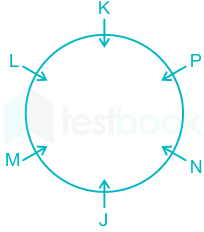
Thus we can say L is third to the left of N.

Hence, the correct answer is "L".

2

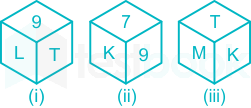
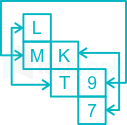
By folding the given paper, which of the following cube can be made? 

  1. ((a))

    Both I and III

  2. ((b))

    Only I

  3. ((c))

    Both II and III

  4. ((d))

    Only III

Show Answer
Answer: ((d))

Only III

NumberOpposite
LT
M9
K7


Note: Two opposite faces are never seen together or adjacent to each other:

In Figure, I:- L and T are opposite faces but here they are seen together which is wrong. Thus this cube cannot be made.

In Figure II:- K and 7 are opposite faces but here they are seen together which is wrong. Thus this cube cannot be made.

In Figures III:- None of the opposite faces are seen together nor they are adjacent to each other.

Thus Figures III can be formed by folding the dice.

Hence, the correct answer is "Only III". 

Additional Information

  • Dices are of two types :
  1. Standard Dice

  2. Non-Standard Dice.
  • Dice has:-
  1. faces = 6
  2. sides = 12
  3. corners = 8
  • Two opposite faces never seen together.
  • Adjacent faces are never opposite to each other.
3

Height of 8 boys B1, B2, B3, B4, B5, B6, B7, and B8 are compared. Height of B3 will be the least or maximum. Height of B4 is more than B6. Height of B8 is less than only 3 boys. Height of B2 is more than B1 but less than B8. Height of B2 is less than B3. B5 and B7 are taller than B8 but shorter than B3. If the height of B4 is less than B1, then which of the following sequence of their heights may be correct?

  1. ((a))

    B3 > B7 = B5 > B8 > B2 > B4 > B1 > B6

  2. ((b))

    B3 > B5 > B7 > B8 > B2 > B6 > B1 > B4

  3. ((c))

    B3 > B5 = B7 > B8 > B2 > B1 > B4 > B6

  4. ((d))

    B3 > B7 > B5 > B2 > B8 > B1 > B4 > B6

Show Answer
Answer: ((c))

B3 > B5 = B7 > B8 > B2 > B1 > B4 > B6

The logic followed is:

Height of 8 boys B1, B2, B3, B4, B5, B6, B7, and B8 are compared.

i) Height of B4 is more than B6.

B4 > B6 equation i)

ii) Height of B8 is less than only 3 boys.

iii) Height of B2 is more than B1 but less than B8.

B8 > B2 > B1 equation ii)

iv)  If the height of B4 is less than B1

B1 > B4 equation iii)

v) B5 and B7 are taller than B8 but shorter than B3.

From the equation i) and iii) we can say,

B6 is the smallest of all. Thus we can conclude from the given statement i.e the height of B3 will be the least or maximum. As B6 is the smallest, it is only possible B3 is the maximum in height.

Thus the final arrangement is:

B3 > B5 = B7 > B8 > B2 > B1 > B4 > B6 

Hence, the correct answer is "Option 3".

4

Minute hand of a clock is firstly rotated by 194° in clockwise direction. Then, it is rotated by 263° in anticlockwise direction. Now, it is rotated by 342° in anticlockwise direction. It is finally rotated by 612° in clockwise direction. Now, minute hand is facing towards south direction. In which direction it was facing initially?

  1. ((a))

    South east 

  2. ((b))

    North east 

  3. ((c))

    South west 

  4. ((d))

    North west 

Show Answer
Answer: ((d))

North west 

As per the given information;

Clockwise Direction = 194° + 612° = 806° 

Anticlockwise Direction = 263° + 342° = 605° 

Difference = 806° - 605° = 201° (Clockwise)

Hence, the minute is in the North West direction initially.

5

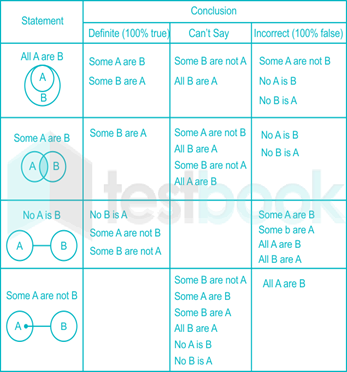
In the following question below are given some statements followed by some conclusions based on those statements. Taking the given statements to be true even if they seem to be at variance from commonly known facts. Read all the conclusions and then decide which of the given conclusion logically follows the given statements. 

Statements:

I. All pink are blue.

II. Some blue are red.

Conclusions:

I. Some red are pink.

II. No red is blue.

  1. ((a))

     Only conclusion I follows

  2. ((b))

    Both conclusion I and II follow

  3. ((c))

    Only conclusion II follows 

  4. ((d))

    Neither conclusion I and II follows 

Show Answer
Answer: ((d))

Neither conclusion I and II follows 

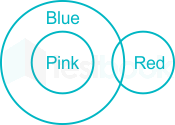
The least possible Venn diagram for the given statements is as below:

Conclusions: 

1. Some red are pink → False (It is possible but not definite). 2. No red is blue → False (As some Blue are Red, then some Red are Blue will also be a definite conclusion).

Hence, the correct answer is "Neither conclusion I and II follows".

Additional Information

6

In the following question below are given some statements followed by some conclusions based on those statements. Taking the given statements to be true even if they seem to be at variance from commonly known facts. Read all the conclusions and then decide which of the given conclusion logically follows the given statements.

Statements:

I. Some A are K.

II. Some M are K.

III. No M is J.

Conclusions:

I. Some J are not M.

II. Some M are A.

III. No K is A.

  1. ((a))

    Only conclusion I follows 

  2. ((b))

    Both conclusion I and III follows 

  3. ((c))

    Neither conclusion I, II and III follows

  4. ((d))

    Both conclusion I and II follows 

Show Answer
Answer: ((a))

Only conclusion I follows 

The least possible Venn diagram for the given statements is as below:

Conclusions: 

1. Some J are not M → True (As no M is J then some J are not M will also be a definite conclusion). 2. Some M are A → False (It is possible but not definite). 3.  No K is A → False (As some A is K then some K is A also a definite conclusion).

Hence, the correct answer is "Only conclusion I follows ".

Additional Information

7

A series is given with one term missing. Select the correct alternative from the given ones that will complete the series.

PRAT, ULHC, ZFOL, EZVU, ?

  1. ((a))

    KTDD

  2. ((b))

    JTDE

  3. ((c))

    LTCD

  4. ((d))

    JTCD

Show Answer
Answer: ((d))

JTCD

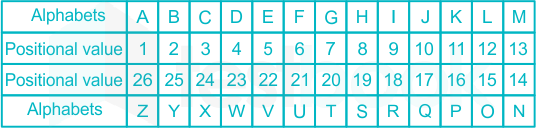
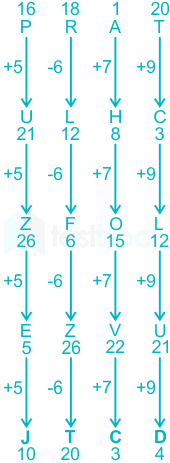
The pattern followed is:

Hence, the correct answer is "JTCD".

8

In the following question, select the related words from the given alternatives.

Bat : Cricket :: Ball : ?

  1. ((a))

    Chess

  2. ((b))

    Skating

  3. ((c))

    Swimming

  4. ((d))

    Football

Show Answer
Answer: ((d))

Football

Cricket is played with a bat. Football is another sports played with a ball.

9

A series is given with one term wrong. Select that wrong term from the given alternatives.

68, 32, 102, 136, 238, 374

  1. ((a))

    102

  2. ((b))

    32

  3. ((c))

    238

  4. ((d))

    68

Show Answer
Answer: ((b))

32

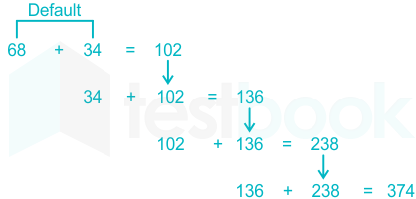
The pattern followed is:

The given series is a Fibonacci series.

To complete the Fibonacci series 32 must be replaced by 34.

Thus the wrong term is 32. Instead of 32 there should be 34.

Hence, the correct answer is "Option 2".

10

Point R is 10 km to the south of point J. Point R is 14 km to the east of point S. Point S is 12 km to the north of point K. Point P is 7 km to the east of point K. In which direction is point J from point P?

  1. ((a))

     North west

  2. ((b))

    South west

  3. ((c))

    South east

  4. ((d))

    North east

Show Answer
Answer: ((d))

North east

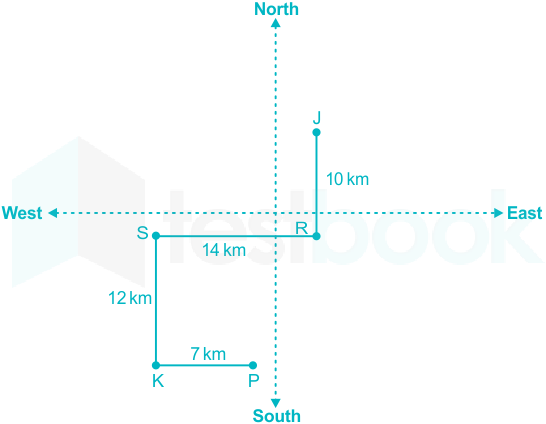
According to the information given in the question, we can draw the following diagram.

Thus point J is in a Northeast direction from point P.

Mistake PointsHere in the question it is asked:

  • In which direction is point J from point P means J direction w.rt to P which is Northeast
  • Here in the question it is not asked In which direction is point P from point J.

Hence, the correct answer is "Northeast".

11

In the following question, select the odd letter/letters from the given alternatives. 

  1. ((a))

    TWZ 

  2. ((b))

    FIL

  3. ((c))

    RUX

  4. ((d))

    LPS

Show Answer
Answer: ((d))

LPS

The logic follows here is:

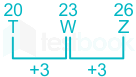
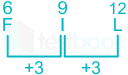
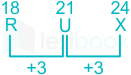
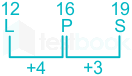
The cluster follows the pattern of +3, +3 except for option (4) which follows the pattern of +4, +3.  

Option 1 → 

Option 2 → 

Option 3 → 

Option 4 → 

Thus we can see LPS doesn't follow the pattern of +3, +3.

Hence, the correct answer is "LPS".

12

Identify the diagram that best represents the relationship among the given classes.

Alphabet, Word, Number

  1. ((a))

  2. ((b))

  3. ((c))

  4. ((d))

Show Answer
Answer: ((c))

The least possible Venn diagram for the given set of words is:

Hence, the correct answer is Option 3.

13

In the following question, select the related letter pair from the given alternatives.

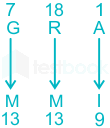
GRA : MMI :: ?

  1. ((a))

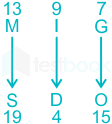
    MIG : SDO

  2. ((b))

    LAT : RUB 

  3. ((c))

    RUB : XQJ 

  4. ((d))

    FRO : UMN

Show Answer
Answer: ((a))

MIG : SDO

The pattern followed is:

Similarly,

Hence, the correct answer is "MIG : SDO".

14

From the given answer figures, select the one in which the question figure is hidden/embedded.

  1. ((a))

  2. ((b))

  3. ((c))

  4. ((d))

Show Answer
Answer: ((c))

The embedded part of this image is:

Hence, Option (3) is the correct answer.

15

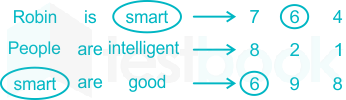
In a certain code language, ‘Robin is smart’ is written as ‘7 6 4’, ‘People are intelligent’ is written as ‘8 2 1’, ‘Smart are good’ is written as ‘6 9 8’. What can be the code for ‘is’ in that code language?

  1. ((a))

    4

  2. ((b))

    9

  3. ((c))

    8

  4. ((d))

    2

Show Answer
Answer: ((a))

4

The logic followed is:

Thus code for "is" can be either 7 or 4 but in option (7 is not mentioned.) This means we left with only 4.

Thus the code for "is" is 4.

Hence, the correct answer is "4".

16

Six persons G, H, R, T, U, and V like any one car among C1, C2, C3, C4, C5, and C6. None of them likes the same car. T likes C3. V and G don’t like C1 and C2. R likes either C6 or C2. H doesn’t like C5. U likes either C2 or C6. Which of the following pair can represent the cars of U and V respectively? 

  1. ((a))

    C2, C5 

  2. ((b))

    C6, C1

  3. ((c))

    C3, C4 

  4. ((d))

    C1, C5

Show Answer
Answer: ((a))

C2, C5 

Six persons: G, H, R, T, U, and V.

Six Cars: C1, C2, C3, C4, C5, and C6.

1) T likes C3.

PersonsCars
G
H
R
TC3
U
V

2) V and G don’t like C1 and C2.

PersonsCars
GC1/C2
H
R
TC3
U
VC1/C2

3) R likes either C6 or C2.

PersonsCars
GC1/C2
H
RC6/C2
TC3
U
VC1/C2

4) H doesn’t like C5.

  1. U likes either C2 or C6.
PersonsCars
GC1
HC5
RC6/C2
TC3
UC2/C6
VC1

As G and R do not like C1.

So, H likes C1 and G and V either likes C4 or C5

PersonsCars
GC4/C5
HC1
RC6/C2
TC3
UC2/C6
VC4/C5

Possible cases are;

U likes either C2 or C6 and V likes either C4 or C5.

  1. C2, C4

2) C2, C5

  1. C6, C4

  2. C6, C5

Hence, option (1) is the correct answer.

17

In the following question, select the related number from the given alternatives.

12 : 140 :: 29 : ?

  1. ((a))

    839

  2. ((b))

    957

  3. ((c))

    837

  4. ((d))

    845

Show Answer
Answer: ((c))

837

The logic followed is:

second number = (first number)2 - 4

140 = 122 - 4

140 = 144 - 4

140 = 140

Similarly,

? = 292 - 4

? = 841 - 4

? = 837

Hence, the correct answer is "837".

18

A series is given with one term missing. Select the correct alternative from the given ones that will complete the series.

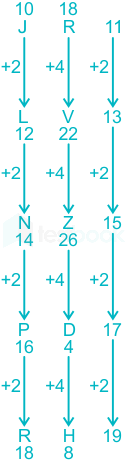
JR11, LV13, NZ15, ?, RH19

  1. ((a))

    PC17

  2. ((b))

    OC16

  3. ((c))

    PD17

  4. ((d))

    QD18

Show Answer
Answer: ((c))

PD17

The pattern followed is:

Hence, the correct answer is "PD17".

19

In the following question, select the figure which can be placed at the sign of question mark (?) from the given alternatives. 

  1. ((a))

  2. ((b))

  3. ((c))

  4. ((d))

Show Answer
Answer: ((b))

In each step bottom figure moved to top.

Step 1:

Step 2:


Step 3:


Step 4:


The correct figure is;


Hence, option (2) is the correct answer.

20

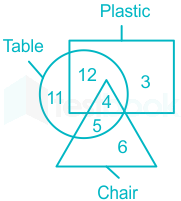
How many plastic are table?

  1. ((a))

    12

  2. ((b))

    15

  3. ((c))

    16

  4. ((d))

    19

Show Answer
Answer: ((c))

16

The logic followed here is:

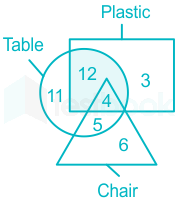
Plastic who is table shows through the shaded area in the diagram below:

Plastic are table = 12 + 4 = 16

Hence, "16" is the correct answer.

Mistake PointsPlastic who are Tables Covers the Plastic and Table including all parts.

If the questions asked that Only plastic who are Table then you have to count only these two parts.

General Awareness (20 questions)

21

In which Indian state are the Chapchar Kut, Mim Kut and Talfwang Kut festivals celebrated?

  1. ((a))

    Mizoram

  2. ((b))

    Manipur

  3. ((c))

    Sikkim

  4. ((d))

    Meghalaya

Show Answer
Answer: ((a))

Mizoram

The correct answer is Mizoram.

  • In Mizoram, the Chapchar Kut, Mim Kut, and Talfwang Kut festivals are celebrated.

Key Points

  • Mizoram is one of the most beautiful places in India and tourist-friendly states out of the seven sister states.
  • Many of the festivals in Mizoram have attracted a lot of foreign tourists who want to indulge themselves in the culture and festivity of Mizoram.
  • The three of the most important festivals in Mizoram.
  • These festivals happen throughout the year during various seasons.


Chapchar Kut Festival, Mizoram- The Chapchar Kut Festival is one of the major festivals in Mizoram. - This vibrant and colorful festival is special in Mizoram for the fact that it signifies the welcome of the Spring season in the state. - In Aizawl, which is the capital of Mizoram, the Chapchar festival also transforms the festival into a giant carnival. - The tribal and the agro people celebrate the culture of Mizoram in full glory. - Chapchar is also considered as the harvest festival of Mizoram.
Mim Kut Festival- Mim Kut is regarded as the oldest festival of the Mizoram. - It was a ceremony organized for the dead. - Feasting is a part of it but there is hardly any fun and gaiety in it. - Mim means maize or corn. It is observed after the maize or corn is ripe. - It was held in memory of the deceased.
Pawl Kut Festival, Mizoram- The Pawl Kut is a festival of Mizoram held in December in India. - Pawl means "Straw" hence pawl kut means a straw harvest festival. - It is typically celebrated in December for two days after harvest and an important festival. - It is one of the main festivals of the people of Mizoram, being a post-harvest festival.
22

Which country won Copa America 2019?

  1. ((a))

    Brazil

  2. ((b))

    Peru

  3. ((c))

    Chile

  4. ((d))

    USA

Show Answer
Answer: ((a))

Brazil

The correct answer is Brazil.

  • Brazil won Copa America 2019.

Key Points

  • Host nation Brazil won their ninth title by defeating Peru 3–1 in the final.
  • Argentina took third place by beating Chile 2–1 in the third-place match.
  • Copa América, (Spanish: America Cup) formerly (until 1975) South American Championship of Nations, quadrennial South American football (soccer) tournament that is the continent’s premier competition in that sport.
  • The Copa América is the world’s oldest international football tournament.
  • The event was first held in 1916 in honor of the 100th anniversary of Argentina’s independence with Uruguay winning the inaugural title.
  • It took place every one to four years before it adopted its current quadrennial format in 2007.


  • The Copa America is governed by the Confederacion Sudamericana de Futbol (commonly known as CONMEBOL).
  • The tournament’s field consists of the 10 national teams that are members of CONMEBOL.
  • Argentina, Bolivia, Brazil, Chile, Colombia, Ecuador, Paraguay, Peru, Uruguay, and Venezuela.
  • Plus two additional national teams are invited to participate in the event.
YearWinnerRunner-Up
1916UruguayArgentina
2019BrazilPeru
2021ArgentinaBrazil
23

Rulers of which of the following dynasty were known as Lords of the Dakshinapatha? 

  1. ((a))

    Pandyas

  2. ((b))

    Satavahanas

  3. ((c))

    Cheras

  4. ((d))

    Cholas

Show Answer
Answer: ((b))

Satavahanas

The correct answer is Satavahanas.

  • The Satavahana rulers were known as lords of the Dakshinapatha.

Key Points

  • Gautamiputra Shri Satakarni and other Satavahana rulers were known as lords of the Dakshinapatha.
  • Dakshinapatha was the route leading to the south, which was also used as a name for the entire southern region.
  • To control the coasts, he sent his army to the eastern, western, and southern coasts.
  • The Sunga dynasty came to an end around 73 BCE when their ruler Devabhuti was killed by Vasudeva Kanva.
  • The Kanva dynasty then ruled over Magadha for about 45 years.
  • Around this time, another powerful dynasty, the Satavahanas came to power in the Deccan area.
  • The term “Satvahana” originated from the Prakrit which means ” driven by seven” which is an implication of the Sun God’s chariot that is driven by seven horses as per Hindu mythology.
  • The Satavahanas (natives) succeeded the Mauryas in Deccan and Central India.​

Additional Information

  • The Satavahanas are considered identical to the Andhras mentioned in the Puranas, but neither the name Andhra appears in the Satavahana inscriptions nor do the Puranas mention the Satavahanas.
  • According to some Puranas, the Andhras ruled for 300 years and this period is assigned to the rule of the Satavahana dynasty, with their capital at Pratishthana (modern Paithan) on the Godavari in Aurangabad district.
  • The Satavahana kingdom majorly comprised present Andhra Pradesh, Maharashtra, and Telangana.
  • At times, their rule also included parts of Gujarat, Karnataka as well as Madhya Pradesh.
  • The kingdom had different capitals at different times.
  • Two of the capitals were Amaravati and Pratishthana (Paithan).
  • Simuka was the founder of the Satavahana Dynasty.
  • The coin legends were in Prakrit.
  • Some reverse coin legends are in Tamil, Telugu, and Kannada also.
  • The Chola Empire was founded by Vijayalaya.
  • Uthiyan Cheral Athan is generally considered the earliest known ruler of the Chera family from the Tamil texts (and the possible hero of the lost first decad of Pathitrupattu).
  • Uthiyan Cheral was also known as "Vanavaramban" (Purananuru).
24

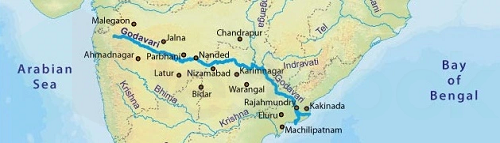
Indravati river is a tributary of ______.

  1. ((a))

    Godavari river 

  2. ((b))

    Ganga river

  3. ((c))

    Cauvery river 

  4. ((d))

    Krishna river 

Show Answer
Answer: ((a))

Godavari river 

The correct answer is Godavari river.

Key Points

  • Godavari:
  • It originates from the Tribakeshwar in Nashik district of Maharashtra.
  • It drains into the Bay of Bengal.
  • It flows through the states of Maharashtra, Odisha, Chhattisgarh, Telangana, Andhra Pradesh.
  • Tributaries:
  • Left bank: Banganga, Kadva, Shivana, Purna, Kadam, Pranahita, Indravati, Taliperu, Sabari, Dharna.
  • Right bank: Nasardi, Pravara, Sindphana, Manjira, Manair, Kinnerasani.


Additional Information

RiverMajor tributary
Yamuna riverChambal, Betwa, Ken, Sind, etc
Godavari riverManjira, Indravati, Purna, Sabari, etc
Kaveri RiverShimsha, Hemavati, Akravati, Bhavani, etc
Narmada riverTawa river, Sher, Shakkar, etc
25

A firm that produces highly substitute goods can adopt which one of the following pricing strategies?

  1. ((a))

    Transfer Pricing

  2. ((b))

    Going Rate Pricing

  3. ((c))

    Product Bundling

  4. ((d))

    Full Cost Pricing

Show Answer
Answer: ((b))

Going Rate Pricing

The correct answer is Going Rate Pricing.

  • A firm that Produces highly substitute goods can adopt Going Rate Pricing Strategies.

Key Points

Transfer PricingThe prices used between traders, usually company treating their own subsidiaries as separate entities use transfer pricing to trade goods between their units.
Going Rate PricingThis means following the leader or whatever is going on in the market, it is suitable for homogeneous products.
Product BundlingIn this method, the company bundles multiple products and offers the bundle at a price.
Full cost pricingUnder full pricing, direct material, labor, and overhead costs are added up along with administrative and selling expenses, and prices are fixed after adding a particular margin percentage to the total cost.
26

Who procures wheat, paddy, and coarse grains in different states with the help of state government agencies to provide support prices to the farmers?

  1. ((a))

    NAFED

  2. ((b))

    NABARD

  3. ((c))

    Food Corporation of India

  4. ((d))

    FSSAI

Show Answer
Answer: ((c))

Food Corporation of India

The correct answer is Food Corporation of India.

  • Food Corporation of India procures wheat, paddy, and coarse grains in different states with the help of state government agencies to provide support prices to the farmers.

Key Points

  • Food Corporation of India (FCI) is a Public Sector Undertaking, under the Department of Food & Public Distribution, Ministry of Consumer Affairs, Food and Public Distribution.
  • FCI is a statutory body set up in 1965 under the Food Corporations Act 1964.
  • It was established against the backdrop of a major shortage of grains, especially wheat.
  • Simultaneously, Commission for Agricultural Costs and Prices (CACP) was created in 1965 to recommend remunerative prices to farmers.
  • It has primary duty to undertake purchase, store, move/transport, distribute and sell food grains and other foodstuffs.


  • Objectives of FCI:
  • To provide remunerative prices to farmers.
  • To help in transforming the crisis management-oriented food security into a stable security system to ensure availability, accessibility, and affordability of food grains to all people at all times so that no one, nowhere, and at no time should go hungry.
  • Ensuring food security of the nation by maintaining a satisfactory level of operational buffer stocks of food grains. Distribution of food grains throughout the country for Public Distribution System.
  • Effective Price Support Operations for safeguarding the interest of farmers.
  • Founder: Government of India
  • **Founded:**14 January 1965
  • Headquarters: New Delhi

Additional Information

  • National Bank for Agriculture and Rural Development (NABARD)​ is an apex regulatory body for the overall regulation and licensing of regional rural banks and apex cooperative banks in India.
  • Founded: 12 July 1982
  • Headquarters: Mumbai
  • Chairperson: Harsh Kumar Bhanwala
  • Food Safety and Standards Authority of India (FSSAI) is a statutory body established under the Ministry of Health & Family Welfare, Government of India.
  • Founded: August 2011
  • Headquarters: New Delhi
27

The book ‘New Delhi Conspiracy’ is written by ______.

  1. ((a))

    Meenakshi Lekhi

  2. ((b))

    Pranab Mukherjee

  3. ((c))

    Ramchandra Guha 

  4. ((d))

    Amish Tripathi 

Show Answer
Answer: ((a))

Meenakshi Lekhi

The correct answer is Meenakshi Lekhi.

Key Points

  • Meenakshi Lekhi is a politician from the Bhartiya Janata Party (BJP) and she's also its national spokesperson.
  • She is currently the Member of Parliament from the New Delhi constituency and the Chairperson of the Privilege Committee of the Lok Sabha, the lower house of the parliament.
  • She was the author of the New Delhi Conspiracy.

Additional Information

Books and authors:

Pranab Mukherjee- The Coalition Years - The Turbulent Years: 1980 - 1996 - The Dramatic Decade: The Indira Gandhi Years - Thoughts and Reflections - Beyond survival -
Ramchandra Guha- India After Gandhi - Gandhi Before India - A corner of a foreign field - The Unquiet Woods - Environmentalism: A Global History
Amish Tripathi- The Immortals of Meluha - The Secret of the Nagas - The Oath of the Vayuputras - Scion of Ikshvaku - Sita - Warrior of Mithila - Raavan: Enemy of Aryavarta - Legend of Suheldev: The King Who Saved India
28

Balaghat mines in Madhya Pradesh, Khetri mines in Rajasthan, and Singhbhum district of Jharkhand are the major producers of ______.

  1. ((a))

    Copper

  2. ((b))

    Manganese

  3. ((c))

    Bauxite

  4. ((d))

    Iron

Show Answer
Answer: ((a))

Copper

The correct answer is Copper.

  • Balaghat mines in Madhya Pradesh, Khetri mines in Rajasthan, and Singhbhum district of Jharkhand are the major producers of Copper.

Key Points

  • The mines in India that produce 52% of India's Copper are Balaghat mines in Madhya Pradesh.
  • The two leading copper production states of India are
  • 52% of India's copper is produced in the Balaghat mine in Madhya Pradesh
  • Another leading producing of copper is the Singbhum district of Jharkhand.
  • Also, the Khetri mines in Rajasthan are the popular copper mines of India.

Additional Information

  • Madhya Pradesh, the leading manganese ore producing State, accounted for 33% of the total production in 2018-19, which is followed by Maharashtra (27%) and Odisha (16%)
  • By States, Odisha alone accounts for 51% of the country's resources of bauxite followed by Andhra Pradesh (16%), Gujarat (9%), Jharkhand (6%), Maharashtra (5%), and Madhya Pradesh & Chhattisgarh (4% each).
  • Major bauxite resources are concentrated in the East Coast bauxite deposits in Odisha and Andhra Pradesh.
  • In the financial year 2019, the eastern state of Odisha was the leading producer of iron ore in India.
29

Which social reformer argued that the untouchables were the real carriers of the original Tamil and Dravidian culture?

  1. ((a))

    Ghasidas

  2. ((b))

    Jyotirao Phule

  3. ((c))

    EV Ramasamy Naicker

  4. ((d))

    Dr. BR Ambedkar

Show Answer
Answer: ((c))

EV Ramasamy Naicker

The correct answer is EV Ramasamy Naicker.

  • EV Ramasamy Naicker was a social reformer who argued that the untouchables were the real carriers of the original Tamil and Dravidian culture.

Key Points

  • E V Ramasamy (1879-1973), popularly known as EVR, is hailed as ‘Periyar’ by his followers.
  • He was a demagogue who used the social evils which were then prevalent or perceived, as a capital for his propaganda.
  • He was neither a rationalist nor a humanist. He was anti-Hindu and pro-British.
  • By equating him to Bhimrao Ramji Ambedkar, many are doing a great disservice to the memory of Ambedkar, who was a great nation builder and a patriot.

Additional Information

  • Ghasidas is also known as Guru Ghasidas, was Guru of the Satnampanth in the early 19th century.
  • It was Guru Ghasidas who decided to start treating everyone the same in a deep forested part of Chhattisgarh, India.
  • Jyotirao Govindrao Phule was an Indian social activist, thinker, anti-caste social reformer, and writer from Maharashtra.
  • His work extended to many fields, including the eradication of untouchability and the caste system and for his efforts in educating women and exploited caste people.
  • Bhimrao Ramji Ambedkar, venerated as Babasaheb, was an Indian jurist, economist, politician, and social reformer.
  • Who inspired the Dalit Buddhist movement and campaigned against social discrimination towards the untouchables
30

Vijay Hazare Trophy is associated with which of the following sport?

  1. ((a))

    Hockey

  2. ((b))

    Football 

  3. ((c))

    Cricket 

  4. ((d))

    Kabbadi

Show Answer
Answer: ((c))

Cricket 

The correct answer is Cricket.

Key Points

  • Vijay Hazare Trophy is also known as the Ranji One Day Trophy.
  • It was started in 2002-03 as a limited-overs cricket domestic competition involving state teams from the Ranji Trophy plates.
  • It is named after the famous Indian cricketer Vijay Hazare.

Additional Information

SportsCups or trophies
Football- Rovers Cup - Bandodkar Trophy - Merdeka Cup - Confederation Cup - DCM Trophy - Durand Cup - B.C. Raj Trophy(National Championship) - FIFA World cup - Jules Rimet Trophy - Indian Super League - Kalinga Cup - Santosh Trophy - IFA Shield - Scissor Cup - Subroto Cup - Sir Ashutosh Mukherjee Trophy - Todd Memorial Trophy - Vittal Trophy - UEFA Champions League.
Cricket- Ashes Cup - Asia Cup - C.K Naidu Trophy - Cooch Behar Trophy - Deodhar Trophy - Duleep Trophy - Gavaskar Border Trophy - G.D Birla Trophy - ICC World Cup - Irani Trophy - Jawaharlal Nehru Cup - Rani Jhansi Trophy - Ranji Trophy - Rohinton Baria Trophy - Rothmans Cup - Sahara Cup - Sharjah Cup - Singer Cup - Titan Cup - Vijay Hazare Trophy - Vijay Marchent Trophy - Wisden Trophy - Wills Trophy.
Badminton- Amrit Diwan Cup - Asia Cup - Chaddha Cup - European Cup - Harilela Cup - Ibrahim Rahimatullah cup - Challenger Cup - Konica Cup - Sophia Cup - Kitiakara Cup - Malaysian Open - Thomas Cup (Men) and Uber Cup(Women)
Hockey- Agha Khan Cup - Maharaja Ranjit Singh Gold Cup - Dhyanchand Trophy - Sultan Azlan Shah Cup - Wales Trophy - Stanley Cup - Sindhia Gold Cup - Wellington Cup.
31

Ghoomar is the regional dance form of which Indian state? 

  1. ((a))

    Haryana

  2. ((b))

    Rajasthan

  3. ((c))

    Uttar Pradesh 

  4. ((d))

    Punjab

Show Answer
Answer: ((b))

Rajasthan

The correct answer is Rajasthan.

Key Points

  • Ghoomar is a traditional folk dance of the Bhil tribe performed to worship Goddess Sarasvati which was later embraced by other Rajasthani communities.
  • Ghoomar became popular in the Indian state of Rajasthan during the reigns of Rajput kings and is typically performed by women during gatherings.
  • Other Folk Dance from Rajasthan are:
  • Chakri, Ganagor, Jhulan Leela, Jhuma, Suisini, Ghapal, and Kalbeliya.

​​

Additional Information

  • List of the Folks Dances from the Different States:-
StateFolk Dance
Andhra PradeshKuchipudi, Vilasini Natyam, Andhra Natyam, Bhamakalpam, Veeranatyam, Dappu, Tappeta Gullu, Lambadi, Dhimsa, Kolattam, Butta Bommalu.
AssamBihu, Bichhua, Natpuja, Maharas, Kaligopal, Bagurumba, Naga dance, Khel Gopal, Tabal Chongli, Canoe, Jhumura Hobjanai
BiharJata-Jatin, Bakho-Bakhain, Panwariya, Sama Chakwa, Bidesia.
GujaratGarba, Dandiya Ras, Tippani Juriun.
Himachal PradeshJhora, Jhali, Chharhi, Dhaman, Chhapeli, Mahasu, Nati, Dangi.
ChhattisgarhGaur Maria, Panthi, Raut Nacha, Pandwani, Vedamati, Kapalik, Bharthari Charit, Chandaini.
JharkhandAlkap, Karma Munda, Agni, Jhumar, Janani Jhumar, Mardana Jhumar, Paika, Phagua,Hunta Dance, Mundari Dance, Sarhul, Barao, Jhitka, Danga, Domkach, Ghora Naach.
ManipurDol Cholam, Thang-Ta, Lai Haraoba, Pung Cholom, Khamba Thaibi, Nupa Dance, Raslila, Khubak Ishii, Lou  Sha.
Madhya PradeshJawara, Matki, Aada, Khada Nach, Phulpati, Grida Dance, Selalarki, Selabhadoni, Maanch.
32

Scientists of which university have developed a new material called ‘black gold’ which can absorb light and carbon dioxide? 

  1. ((a))

    Tata Institute of Fundamental Research (TIFR)

  2. ((b))

    IIT Kharaghpur 

  3. ((c))

    IIT Madras

  4. ((d))

    IISC Bangalore

Show Answer
Answer: ((a))

Tata Institute of Fundamental Research (TIFR)

The correct answer is the Tata Institute of Fundamental Research (TIFR).

  • Scientists of Tata Institute of Fundamental Research (TIFR) university have developed a new material called ‘black gold’ which can absorb light and carbon dioxide.

Key Points

  • Tata Institute of Fundamental Research is a public deemed research university located in Mumbai, India that is dedicated to basic research in mathematics and the sciences.
  • It is a Deemed University and works under the umbrella of the Department of Atomic Energy of the Government of India.
  • Indian Scientists from the Tata Institute of Fundamental Research (TIFR), Mumbai have developed a new material called 'black gold'.
  • They rearranged the size and gaps of gold nanoparticles to develop the new material.
  • It can absorb light and carbon dioxide.
  • It can be used for applications that range from harvesting solar energy to desalinating seawater.
  • It was published in Chemical Science, a scientific journal published by the Royal Society of Chemistry.

Additional Information

  • Indian Institute of Technology Kharagpur is a public technical and research university established by the government of India in Kharagpur, West Bengal, India.
  • Established in 1951, the institute is the first of the IITs to be established and is recognized as an Institute of National Importance.
  • ​Indian Institute of Technology Madras is a public technical and research university located in Chennai, Tamil Nadu, India.
  • As one of the Indian Institutes of Technology, it is recognized as an Institute of National Importance.
  • The Indian Institute of Science is a public, deemed, research university for higher education and research in science, engineering, design, and management.
  • It is located in Bangalore, in the Indian state of Karnataka.
33

The President can remove the chairman of the Union Public Service Commission from the office under which of the following circumstances?

I. If he is adjudged an insolvent.

II. If he engages, during his term of office, in any paid employment outside the duties of his office.

  1. ((a))

    Only II 

  2. ((b))

    Only I 

  3. ((c))

    Neither I nor II

  4. ((d))

    Both I and II

Show Answer
Answer: ((d))

Both I and II

The correct answer is 

Key Points

  • Removal of the chairman of the Union Public Service Commission by the President:
  • ​Removed on the grounds of insolvent bankruptcy, paid employment, infirmity of mind.
  • President can also remove him on the grounds for his misbehaviour.
  • If he engaged in any paid employment outside the duties of his office during his term of office.
  • However, in this case, the President has to refer the matter to the Supreme Court for an enquiry.
  • If the Supreme Court upholds the cause President can remove him.
  • The advice tendered by the Supreme Court in this regard is binding on the President.
  • During the course of an enquiry by the Supreme Court, the President can suspend the chairman or the member of UPSC.


  • Union Public Service Commission (UPSC):
  • Part XIV
  • Article 315: Public Service Commissions for Union and states.
  • Article 316: Recruitment and conditions of service of persons serving the Union or a state
  • UPSC is a central recruiting agency. It is an independent constitutional body.
  • Apart from UPSC, Constitution provides provisions for the State Public Service Commission and Joint State Public Service Commission.
34

The defect of vision in human beings in which the power of accommodation of the eye decreases with aging and the near point gradually recedes away is known as ______. 

  1. ((a))

    Hypermetropia 

  2. ((b))

    Cataract

  3. ((c))

    Myopia

  4. ((d))

    Presbyopia 

Show Answer
Answer: ((d))

Presbyopia 

The correct answer is Presbyopia.

  • The defect of vision in human beings in which the power of accommodation of the eye decreases with aging and the near point gradually recedes away is known as Presbyopia.

Key Points

  • Presbyopia:
  • ​The power of accommodation of the eye usually decreases with aging.
  • For most people, the near point gradually recedes away.
  • They find it difficult to see nearby objects comfortably and distinctly without corrective eyeglasses.
  • This defect is called Presbyopia. It arises due to the gradual weakening of the ciliary muscles and diminishing flexibility of the eye lens.
  • Sometimes, a person may suffer from both myopia and hypermetropia.
  • Such people often require bifocal lenses.

Additional Information

  • Hypermetropia:
  • Long-sightedness, also known as hypermetropia or hyperopia is a common vision disorder.
  • It results from the overall power of the eye not being strong enough, or the length of the eye being too short.
  • A surgical correction is a treatment option for hypermetropia, including laser eye surgery and clear lens exchange.
  • This defect can be corrected by using a convex lens of appropriate power.
  • Myopia:
  • ​Nearsightedness (myopia) is a common vision condition in which you can see objects near to you clearly, but objects farther away are blurry.
  • It occurs when the shape of your eye causes light rays to bend (refract) incorrectly, focusing images in front of your retina instead of on your retina.
  • Cataract:
  • ​A cataract is a clouding of the normally clear lens of your eye.
  • For people who have cataracts, seeing through cloudy lenses is a bit like looking through a frosty or fogged-up window.
  • The main symptom is blurry vision.
35

Which type of soils are reclaimed by applying Gypsum?

  1. ((a))

    Saline Soil

  2. ((b))

    Alkali Soil

  3. ((c))

    Red Soil

  4. ((d))

    Alluvial Soil

Show Answer
Answer: ((b))

Alkali Soil

The correct answer is Alkali Soil.

  • Alkali Soil is reclaimed by applying Gypsum.

Key Points

  • Alkali soils are also called black soils.
  • Alkali or Alkaline, soils are clay soils with high pH, a poor soil structure, and a low infiltration capacity.
  • Often they have a hard calcareous layer at 0.5 - 1 meter depth.
  • They are reclaimed by applying Gypsum.
  • The Base Exchange capacity of black soil is quite high.
  • These are found in Gujarat, Rajasthan, Uttar Pradesh, Andhra Pradesh, Maharashtra, Madhya Pradesh, and Chennai.

Additional Information   

  • Saline soils are called white alkali soils.
  • Saline soil is a term used to describe excessive levels of soluble salts in the soil water (soil solution).
  • High enough to negatively affect plant growth, resulting in reduced crop yields and even plant death under severe conditions
  • Red soil is a type of soil that develops in a warm, temperate, moist climate under deciduous or mixed forest, having thin organic and organic-mineral layers black brown leached layer resting on an illuvium red layer.
  • They are named after their rich red color, which is due to their high iron content.
  • The alluvium is loose clay, silt, sand, or gravel that has been deposited by running water in a stream bed, on a floodplain, in an alluvial fan or beach, or in similar settings.
  • The alluvium is also sometimes called the alluvial deposit.
  • The alluvium is typically geologically young and is not consolidated into solid rock
36

Which of the following statement(s) regarding the use of bleaching powder is/are correct?

I. It is used as an oxidizing agent in chemical industries.

II. It is used for disinfecting drinking water to make it free of germs.

  1. ((a))

    Neither I nor II

  2. ((b))

    Only I 

  3. ((c))

    Both I and II

  4. ((d))

    Only II 

Show Answer
Answer: ((c))

Both I and II

The correct answer is Both I and II.

  • Both statements regarding the use of bleaching powder are correct.

Key Points

  • Bleaching powder is a pale yellowish powder existing with a strong smell of chlorine.
  • It is soluble in water but due to the presence of impurities, we never observe a clear solution.
  • Its chemical formula is Ca(OCl2) with its chemical name as Calcium hypochlorite.
  • Bleaching powder (CaOCl2 ​) has many uses and some of them are as follows:
  • It is used in bleaching dirty clothes in launder, as a bleaching agent in cotton and linen in the textile industry.
  • Due to the evolution of nascent oxygen.
  • It is used as an oxidizing agent in the chemical industries.
  • It can be used as a disinfectant which can be used for disinfecting water to make it potable.
37

During the reign of Samudragupta, the meaning of Sandhi-Vigrahika was _______.

  1. ((a))

    Chief Justice Officer

  2. ((b))

    Chief Banker

  3. ((c))

    Merchant Convoy Leader

  4. ((d))

    Minister of War and Peace

Show Answer
Answer: ((d))

Minister of War and Peace

The correct answer is Minister of War and Peace.

  • During the reign of Samudragupta, the meaning of Sandhi-Vigrahika was Minister of War and Peace.

Key Points

  • In Ancient India, the Gupta Dynasty was founded by Sri Gupta.
  • Samudragupta was a famous ruler of a dynasty known as the Guptas.
  • We know about Samudragupta from a long inscription actually a poem in Sanskrit, composed by his court poet Harisena.
  • This was inscribed on the Ashokan pillar at Allahabad.
  • This inscription is of the special kind known as prashasti, a Sanskrit word, meaning ‘in praise of.
  • The poet praised the king in glowing terms as a warrior, as a king who won victories in battle, who was learned, and the best of poets.
  • He is also described as equal to the gods.
  • Important Facts about Samudragupta 
  • He was the real Maharajadhiraja.
  • He was a great patron of art and was titled ‘Kaviraj’ for his love for poems.
  • His period of rule was called the Swarn Yug (Golden Age) of India.
  • After conquering the territories, Samudragupta celebrated by performing the Asvamedha (horse sacrifice).
  • He issued coins with the legend “restorer of the Asvamedha”.
  • It is because of his military achievements that Samudragupta was hailed as the ‘Indian Napoleon’.
38

Which of the following constitutional provision has not been borrowed from Irish constitution by Indian constitution? 

  1. ((a))

    Post of Vice-President 

  2. ((b))

    Directive principles of state policy 

  3. ((c))

    Nomination of members to Rajya Sabha 

  4. ((d))

    Method of election of President 

Show Answer
Answer: ((a))

Post of Vice-President 

The correct answer is Post of Vice-President.

Key Points

  • Post of Vice-President is borrowed from US Constitution.
  • The "Method of Election of the president" and procedure of "Members nomination to the Rajya Sabha by the President" from the Irish Constitution (Ireland).
  • It is true that our constitution had borrowed some features from the world constitution but drafted them according to the Historical prospect, Geographical variety, Cultural and traditional aspects of India.
  • The purpose of DPSPs is to secure social, economic, political justice, and dignity & welfare of the individual.
  • Dr. B. R. Ambedkar defined these principles as ‘Novel Features’ of the Constitution.
  • The DPSPs and the Fundamental Rights comprise the outlook of the Constitution.

Additional Information

  • Provision taken from US Constitution is
  1. ​Fundamental Rights
  2. Independence of Judiciary
  3. Judicial review
  4. Impeachment of President
  5. Post of Vice-President
  6. Removal of Judges of Supreme Court and High Courts.
39

Pines and Cycas belong to ______.

  1. ((a))

    Angiosperm

  2. ((b))

    Thallophyta

  3. ((c))

    Bryophyta

  4. ((d))

    Gymnosperm

Show Answer
Answer: ((d))

Gymnosperm

The correct answer is Gymnosperm.

Key Points

  • The gymnosperms (Gymnos: naked, Sperma: seeds) are planted in which the ovules are not enclosed by any ovary wall and remain exposed, both before and after fertilization.
  • Gymnosperms include medium-sized trees or tall trees and shrubs.
  • Gymnosperms are mainly classified into two groups:
  • Cycadophyta (Lower gymnosperm)
  • Coniferophyta (Higher gymnosperm)
  • Cycas, Pinus and Ginkgo are examples of Gymnosperm.

Additional Information

  • Thallophyta
  • The plant body is not differentiated from roots, stems, and leaves.
  • They are commonly called algae.
  • Bryophyta
  • These are small terrestrial plants.
  • They show differentiation in the body design, with stem, leaf-like structures, and root-like structures.
  • ​​Angiosperms
  • Angiosperms are seed-bearing plants. Seeds develop inside tissues that get modified to form the fruit of the plant.
40

Who was awarded United Nation’s Equator Prize for 2019 for their outstanding effort for nature-based solution to climate change and sustainable development?

  1. ((a))

    Deccan Development Society (DDS)

  2. ((b))

    Modi Foundation

  3. ((c))

    Vasudha Foundation 

  4. ((d))

    National Wildlife Federation

Show Answer
Answer: ((a))

Deccan Development Society (DDS)

The correct answer is the Deccan Development Society (DDS).

  • Deccan Development Society (DDS) was awarded United Nation’s Equator Prize for 2019 for their outstanding effort for nature-based solutions to climate change and sustainable development.

Key Points

  • The women farmers, the majority of them are Dalits, have been building their own seed banks and growing millets in the predominantly rain-fed villages of Sangareddy district.
  • To mark the achievement, the DDS is felicitating six women for their contribution to the ecology and innovations in rainfed millet cultivation.
  • The six women farmers are
  • Maisanagari Ratnamma, Begari Tuljamma, Chilkapalli Ansuyamma, Nagwar Sunandamma, Yerrolla Kanakamma, and Nadimidoddi Anjamma.
  • “This year, a total of 847 nominations have been received by the UN from 127 countries.
  • Of them, only 20 were given this prestigious award,” said PV Satheesh, Director, DDS.

Additional Information

  • The National Wildlife Federation is the United States' largest private, nonprofit conservation education and advocacy organization, with over six million members and supporters, and 51 state and territorial affiliated organizations
  • ​Headquarters: Reston, Virginia, United States
  • Founder: Ding Darling
  • Founded: February 1936
  • The United Nations is an intergovernmental organization aiming to maintain international peace and security, develop friendly relations among nations, achieve international cooperation, and be a center for harmonizing the actions of nations.
  • ​Headquarters: New York
  • Founded: 24 October 1945
  • Secretary general: António Guterres

Arithmetic Ability (20 questions)

41

5 men can complete a work in 40 days and 6 women can complete the same work in 30 days. In how many days 20 men and 18 women can complete the same work? 

  1. ((a))

    12 days

  2. ((b))

    10 days

  3. ((c))

    5 days 

  4. ((d))

    15 days 

Show Answer
Answer: ((c))

5 days 

Given:

5 men can complete a work in 40 days

6 women can complete the same work in 30 days

Concept:

(Men1 × Days1 × Hours1)/W1 = (Men2 × Days2 × Hours2)/W2

Calculation:

Let be assume 20 men and 18 women can complete the work in X days

⇒ The efficiency of men = 1/(5 × 40) = 1/200

⇒ The efficiency of women = 1/(6 × 30) = 1/180

⇒ (20X/200) + (18X/180) = 1

⇒ X/10 + X/10 = 1

⇒ (X + X)/10 = 1

⇒ 2X = 10

⇒ X = 5

∴ The required result will be 5.

42

15% of the total votes are declared invalid votes. Three candidates P, Q, and R contested the election. P, Q, and R received 45%, 30%, and 25% votes respectively of the total valid votes. If the total number of votes is 1600, then R received how many votes less than P?

  1. ((a))

    292

  2. ((b))

    168

  3. ((c))

    272

  4. ((d))

    192

Show Answer
Answer: ((c))

272

Given:

The total number of votes is 1600

The 15% of total votes are invalid

Concept:

Percentage of gain marks = {(The gain marks)/(The total number of marks)} × 100

Calculation:

⇒ The total number of votes = 1600

⇒ The total number of valid votes = (100 - 15)/100  × (1600) = (85/100) × 1600 = 16 × 85 = 1360

⇒ The candidate P reciecved the votes = (45/100) × 1360 = 612

⇒ The candidate R received the votes = (25/100) × 1360 = 340

⇒ The R received less than votes from P = 612 - 340 = 272

∴ The required result will be 272.

43

A man has Rs 240 in coins of 1-rupee, 2-rupees and 5-rupees. The number of coins of each denomination is equal. What is the total number of coins he has?

  1. ((a))

    30

  2. ((b))

    90

  3. ((c))

    60

  4. ((d))

    120

Show Answer
Answer: ((b))

90

Given:

The total rupees is Rs. 240

Concept:

The total rupees = (Number of coins) × (The value of the coin)

Calculation:

Let be assume each number of the coin is x

⇒ 240 = x + 2x + 5x

⇒ 8x = 240

⇒ x = 240/8 = 30

⇒ The total number of coin = 3 × 30 = 90

∴ The required result will be 90.

44

What is the value of (82×512)2/5÷(116)2(8^2 \times 512)^{2/5} \div \left( \frac{1}{16} \right)^{-2}

  1. ((a))

    8

  2. ((b))

    1/8

  3. ((c))

    4

  4. ((d))

    1/4

Show Answer
Answer: ((d))

1/4

(82×512)2/5÷(116)2(8^2 \times 512)^{2/5} \div \left( \frac{1}{16} \right)^{-2}

(82×83)2/5÷(16)2(8^2 \times 8^3)^{2/5} \div \left({16} \right)^{2}

(82+3)2/5÷(16)2(8^{2+3})^{2/5} \div \left({16} \right)^{2}

(85)2/5÷(16)2(8^5)^{2/5} \div \left({16} \right)^{2}

\()

6416×16 \frac{64}{16 \times 16}

14 \frac{1}{4}

45

Which one among √12 + √3, √11 + 2, √5 + √10 and 1 + √14 is the largest?

  1. ((a))

     √12 + √3 

  2. ((b))

    √5 + √10 

  3. ((c))

    √11 + 2 

  4. ((d))

    1 + √14

Show Answer
Answer: ((b))

√5 + √10 

Given:

√12 + √3, √11 + 2, √5 + √10 and 1 + √14

Concept:

If A is greater than B then A > B

Calculation:

⇒ √12 + √3 = 3.46 + 1.73 = 5.19

⇒ √11 + 2 = 3.31 + 2 = 5.31

⇒ √5 + √10 = 2.23 + 3.16 = 5.39

⇒ 1 + √14 = 1 + 3.74 = 4.74

⇒ (√5 + √10) > (√11 + 2) > (√12 + √3) > (1 + √14)

∴ The required result will be (√5 + √10).

46

If 87N4 is divisible by 8, then what is the value of N? 

  1. ((a))

    4

  2. ((b))

    2

  3. ((c))

    6

  4. ((d))

    5

Show Answer
Answer: ((a))

4

Given:

The given expression is 87N4

Concept:

A number is divisible by 8 if the last 3 digits of the number are divisible by 8

Calculation:

⇒ 87N4

⇒ The possible value of N = 0, 4, 8

⇒ If we will put the value of N then the given number will be divisible by 8

∴ The required result will be 4.

47

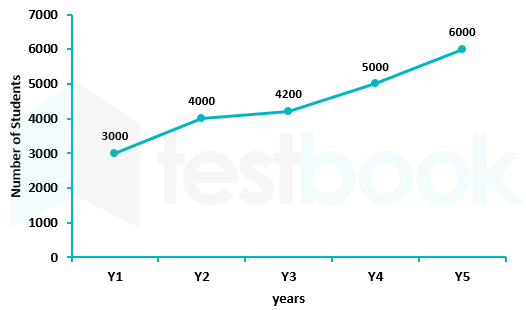
The graph given below shows the number of students appeared in an examination in five years.

What is the ratio of total number of students appeared in year Y1 and Y3 to total number of students appeared in all the five years together?

  1. ((a))

    9 : 28

  2. ((b))

    28 : 9

  3. ((c))

    36 : 111

  4. ((d))

    111 : 36

Show Answer
Answer: ((c))

36 : 111

Given data :

Number of studentsyears
3000Y1
4000Y2
4200Y3
5000Y4
6000Y5


ratio of total number of students appeared in year Y1 and Y3 = (3000 + 4200)

7200

total number of students appeared in all the five years together = (3000 + 4000 + 4200 + 5000 + 6000)

22200

according to the question:

Required ratio = 7200 : 22200

36 : 111

48

After 9 years, how much simple interest (in Rs) will be received on a sum of Rs 14000 at the rate of 14% per annum? 

  1. ((a))

    19460

  2. ((b))

    18140

  3. ((c))

    18120

  4. ((d))

    17640

Show Answer
Answer: ((d))

17640

Given:

The sum is 14000 and time is 9 year

The rate is 14%

Concept:

Simple interest = (Principle × Rate × Time)/100

Calculation:

⇒ The simple interest = (14000 × 14 × 9)/100 = 140 × 14 × 9 = 1960 × 9 = 17640

∴ The required result will be 17640.

49

Diameter of wheel of a cycle is 21 cm. The cyclist takes 150 minutes to reach a destination at a speed of 72.6 km/hr. How many revolutions will the wheel make during the journey? 

  1. ((a))

    270500

  2. ((b))

    275000

  3. ((c))

    270000

  4. ((d))

    250700

Show Answer
Answer: ((b))

275000

Given:

The diameter of the wheel of a cycle is 21 cm or 0.21 m

The speed of cyclist is 72.6 km/h

The time taken by the cyclist to complete the journey is 150 minutes or 9000 seconds

Concept:

The circumference of the wheel = 2 × π × (The radius of the circle)

Distance = Speed × Time

Calculation:

⇒ The total distance covered by cyclists = 9000 × 72.6 × (5/18) = 500 × 72.6 × 5 = 2500 × 72.6 = 181500 m

⇒ The cyclist can cover the distance in one round of wheel = 2 × (22/7) × (The radius of the wheel)

⇒ 2 × (22/7) × (0.21/2) = 44 × (3/200) = 0.66 m

⇒ The total rounds taken by cyclist = 181500/0.66 = 275000

∴ The required result will be 275000.

50

Raman calculates profit/loss on the selling price. Raman suffered a loss of 16.66% on selling an article. Rajat earned a profit of 50% on selling an article. The selling price of both articles is Rs 1200. The cost price of Raman’s is what percentage of the cost price of Rajat’s article? 

  1. ((a))

    275 percent 

  2. ((b))

    175 percent

  3. ((c))

    225 percent 

  4. ((d))

    150 percent

Show Answer
Answer: ((b))

175 percent

Given:

Loss of Raman = 16.66%

Profit of Rajat = 50%

The selling price of both articles = Rs 1200

Formula Used:

Profit% = (SP - CP)/CP × 100

Loss% = (CP - SP)/CP × 100

where CP → Cost Price, SP → Selling Price

Calculations:

Cost Price of Raman be "A"

16.66% = (A - 1200)/1200 × 100 (Base will be 1200 Since Raman calculates profit/loss on selling price)

A = 1400

Cost Price of Rajat be "B"

50% = (1200 - B)/B × 100

B = 800

Required Percentage = (Cost price of Raman’s/cost price of Rajat’s article) × 100 

= (1400/800) × 100

= 175%

51

What will be the average of first 14 positive odd numbers?

  1. ((a))

    18

  2. ((b))

    16

  3. ((c))

    14

  4. ((d))

    15

Show Answer
Answer: ((c))

14

Given:

The first 14 positive odd number

Concept:

The sum of first n positive odd number = n × n = n2

The average = (The sum of all numbers)/(The total numbers)

Calculation:

⇒ The sum of first positive odd number = 14 × 14 = 196

⇒ The average of the numbers = 196/14 = 14

∴ The required result will be 14.

52

How many two digit numbers are there which are not divisible by 5?

  1. ((a))

    70

  2. ((b))

    68

  3. ((c))

    72

  4. ((d))

    75

Show Answer
Answer: ((c))

72

Given:

Two-digit numbers

Concept:

Nth term of arithmetic progression = First term + (Number of term - 1) × Common difference

Calculation:

Let be assume the first term is 10 and the last term is 95 which is divisible by 5 and the common difference is 5 and the total term is n

⇒ The number two-digit numbers is divisible by 5 

⇒ 95 = 10 + (n - 1) × 5

⇒ n = 18, So 18 numbers of two-digit is divisible by 5

⇒ The total two-digit number = 90

⇒ The two-digit number which is not divisible by 5 = 90 - 18 = 72

∴ The required result will be 72.

53

A man travelled a certain distance by train at the rate of 30 km/hr and walked back at the rate of 3 km/hr. If the whole journey took 22 hours, then what was the total distance covered by men? 

  1. ((a))

    100 km 

  2. ((b))

    120 km

  3. ((c))

    50 km 

  4. ((d))

    70 km

Show Answer
Answer: ((b))

120 km

Given:

The speed of man is 30 km/h and 3 km/h respectively

Concept:

Distance = Speed × Time

Calculation:

Let be assume the distance is D

⇒ D/30 + D/3 = 22

⇒ D + 10D = 30 × 22

⇒ 11D = 30 × 22

⇒ D = 30 × 2 = 60

Total distance = 60×2

⇒ 120

∴ The required result will be 120.

54

The table given below shows the number of factory outlets opened by a company in different cities.

Citynumber of factory outlets
C140
C256
C366
C472
C576
C685


The difference between the number of factory outlets in C1 city and C5 city is what percent of the number of factory outlets in C6 city?

  1. ((a))

    42.35 %

  2. ((b))

    46.35 %

  3. ((c))

    54.35 %

  4. ((d))

    50.35 %

Show Answer
Answer: ((a))

42.35 %

Given data :

Number of factory outletcity
40C1
56C2
66C3
72C4
76C5
85C6


difference between the number of factory outlets in C5 city and C1 = (76 - 40)

36

the number of factory outlets in C6 city = 85

according to the question,

Required percentage = (36/85) × 100

⇒ 0.4235 × 100

⇒ 42.35 %

55

Rahul and Raman started a business by investing Rs 9,000 and Rs 6,000 respectively. After 4 months, Rahul left the business and Mohan joined the business by investing Rs 15,000. At the end of the year, there was a profit of Rs 57,000. What will be the share of Mohan in the profit? 

  1. ((a))

    Rs 38000

  2. ((b))

    Rs 44000

  3. ((c))

    Rs 30000

  4. ((d))

    Rs 32000 

Show Answer
Answer: ((c))

Rs 30000

Shortcut Trick

Profit Ratio = (9 × 4) : (6 × 12) : (15 × 8)

Ratio (Rahul : Raman : Mohan) = 36 : 72 : 120 = 3 : 6 : 10

Total Ratio parts = 3 + 6 + 10 = 19

19 units → Rs 57,000

Mohan share (10 units) = (57,000 ÷ 19) × 10 = 30,000

∴ The correct answer is Rs 30000.

Alternate Method

Given:

Rahul investment = Rs 9,000 for 4 months

Raman investment = Rs 6,000 for 12 months

Mohan investment = Rs 15,000 for 8 months (12 − 4 = 8)

Total Profit = Rs 57,000

Formula Used:

Profit Share Ratio = (Capital1 × Time1) : (Capital2 × Time2) : (Capital3 × Time3)

Partnership Investment Distribution (Capital × Time)

9k × 4m Rahul

6k × 12m Raman

15k × 8m Mohan

Calculations:

⇒ Ratio of Profit = (9000 × 4) : (6000 × 12) : (15000 × 8)

⇒ Ratio of Profit = 36000 : 72000 : 120000

⇒ Dividing each term by 12000:

⇒ Ratio = 3 : 6 : 10

⇒ Total ratio parts = 3 + 6 + 10 = 19

⇒ 19 units = 57,000

⇒ 1 unit = 57000 ÷ 19 = 3,000

⇒ Mohan's share = 10 × 3,000 = 30,000

∴ The correct answer is Rs 30000.

Additional Information

Capital and Time Relationship

Profit is directly proportional to both capital and time. If time is equal for all, profit ratio equals capital ratio.

Compound Partnership

When partners invest for different time periods, it is called a compound partnership. Use Profit1 : Profit2 = C1T1 : C2T2.

Investment Calculation

Capital = Profit ÷ Time. This is used to find the investment when profit and time ratios are given.

56

The sum of the present ages of a father and his son is 110 years. 5 years ago their respective ages were in the ratio of 7 : 3. After 20 years what will be the ratio of ages of father and son? 

  1. ((a))

    2 : 1 

  2. ((b))

    3 : 2 

  3. ((c))

    11 : 5 

  4. ((d))

    19 : 11

Show Answer
Answer: ((d))

19 : 11

Given:

The present age of the father and his son is 110

The ratio of age of father and son 5 years ago is 7 : 3

Concept:

If the sum of the age of A and B is X then the age of A is (X - B) and age of B is (X - A)

Calculation:

Let be assume the present age of father is F and the present age of son is S

⇒ F + S = 110  ..... (1)

⇒ (F - 5)/(S - 5) = 7/3 ..... (2)

⇒ By equation (1) and (2)

⇒ (F - 5)/(110 - F - 5) = 7/3

⇒ F = 75 and S = 35

⇒ Ratio of the age of father and son after 20 year = (75 + 20)/(35 + 20) = 95/55 = 19/11

∴ The required result will be 19/11.

57

A rectangle is made using a wire. The length and breadth of a rectangle are in the ratio 4 : 3 and its area is 3888 cm2. If the same wire is bent into the shape of a semicircle, what will be the area of ​​the semicircle?

  1. ((a))

    2123 cm2

  2. ((b))

    3431 cm2

  3. ((c))

    3773 cm2

  4. ((d))

    3351 cm2

Show Answer
Answer: ((c))

3773 cm2

Given:

Area of rectangle = 3888 cm2

Ratio of length and breadth of a rectangle = 4 : 3

Concept Used:

Perimeter of Rectangle = Perimeter of Semicircle

Formulae Used:

Area of Rectangle = Length × Breadth

Area of Semicircle = π(Radius)2/2

Perimeter of Semicircle = (π + 2)Radius

Perimeter of Rectangle = 2(Length + Breadth)

Calculations:

Let the length of the rectangle be 4x and breadth be 3x

So, According to question

3888 = 4x × 3x = 12x2

x2 = 3888/12 = 324

x = 18

Length = 72, breadth = 54

Perimeter of Rectangle = 2(72 + 54) = 252 cm

252 = (π + 2)Radius

Radius = 49

Area of Semicircle = π(49)2/2

Area of Semicircle = 3773 cm2

58

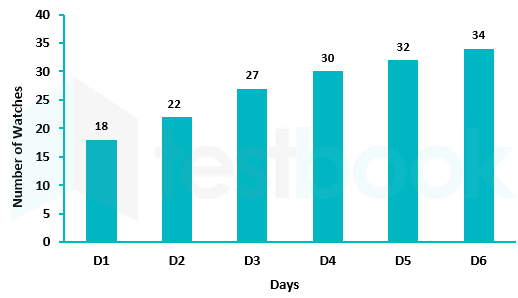
The bar diagram below shows the number of watches repaired by a mechanic on different days of the week.

If D3 and D5 represent the total number of watches repaired in a day by E and D1 and D4 represent the total number of repairs in the day by F, then E is what percent of F?

  1. ((a))

    152.91% 

  2. ((b))

    122.91% 

  3. ((c))

    132.91% 

  4. ((d))

    142.91% 

Show Answer
Answer: ((b))

122.91% 

Given: 

Number of wathces repaired D1 = 18

Number of wathces repaired D3 = 27

Number of wathces repaired D4 = 30

Number of wathces repaired D5 = 32

Calculation:

According to the question,

E, D3 and D5 represent the total number of watches repaired in a day,

Then, total watches repaired by E = D3 + D5 = 27 + 32 = 59

Again,

F, D1 and D4 represent the total number of repairs in the day, 

Then, total watches repaired by F =  D1 + D4 = 18 + 30 = 48

Required Percentage = (59/48) × 100 = 122.91%

∴ E is 122.91% of F

59

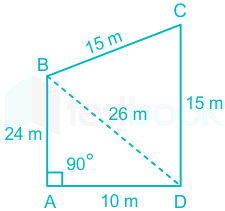
Two sides of a plot are 24 m and 10 m and the angle between them is a proper right angle. The other two sides of the plot are 15 meters each and the other three angles are not right angles. What is the area of ​​the plot?

  1. ((a))

    (160 + 24√7) m2

  2. ((b))

    (120 + 26√14) m2

  3. ((c))

    (180 + 28√3) m2

  4. ((d))

    (150 + 34√7) m2

Show Answer
Answer: ((b))

(120 + 26√14) m2

Given:

Sides of the plot = 24 m, 10m, 15 m and 15 m

Angle between two sides = 90

Formulae used:

Pythagoras Theorem

 (Hypotenuse)2 = (Perpendicular)2 + (Base)2

Herons’ Formulae 

Area of Triangle = s(sa)(sb)(sc) √ {s\left( {s - a} \right)\left( {s - b} \right)\left( {s - c} \right)}

Where "s" is semi perimeter = (a + b + c)/2

Calculation:

Cosidering ABCD as the plot,

AB = 24 m

AD = 10 m

BC = CD = 15 m

Area of plot = Area of ∆ABD + Area of ∆BCD

Area of ∆ABD = 24 × 10/2 = 120 m2

Area of ∆BCD will be calculated using Heron's formulae

s = (15 + 15 + 26)/2 = 28

Area of ∆BCD = 28(2815)(2815)(2826) √ {28\left( {28 - 15} \right)\left( {28 - 15} \right)\left( {28 - 26} \right)}

Area of ∆BCD = 28(13)(13)(2) √ {28\left( {13} \right)\left( {13} \right)\left( {2} \right)}  = 26√14 m2

Area of plot = (120 + 26√14) m2

60

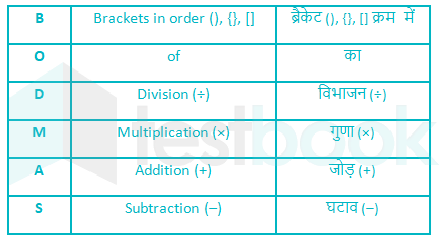
If A=5+67×2÷5+8÷103A = \frac{5+6-7 \times 2 \div 5 + 8 \div10}{3} and B=8+52×3+8+33B = \frac{8+5-2\times 3 + 8+ 3}{3} then what will be the value of A + B ?

  1. ((a))

    8

  2. ((b))

    9

  3. ((c))

    5

  4. ((d))

    10

Show Answer
Answer: ((b))

9

Given:

A=5+67×2÷5+8÷103A = \frac{5+6-7 \times 2 \div 5 + 8 \div10}{3}

B=8+56+8+33B = \frac{8+5-6 + 8+ 3}{3}

Concept used:

Calculation:

Calculating

A=5+67×2÷5+8÷103A = \frac{5+6-7 \times 2 \div 5 + 8 \div10}{3}

A=5+6145+453A = \frac{5+6-\frac{14}{5} + \frac{4}{5}}{3}

A=5+165+453A = \frac{5+\frac{16}{5} + \frac{4}{5}}{3}

A=93A = \frac{9}{3} = 3

and

B=8+56+8+33B = \frac{8+5-6 + 8+ 3}{3}

B=81+8+33B = \frac{8-1 + 8+ 3}{3}

B=7+8+33B = \frac{7 + 8+ 3}{3}

B=183B = \frac{18}{3} = 6

So,

A + B = 9

General Hindi (20 questions)

61

दिए गए रिक्त स्थान में उचित मुहावरे का अर्थ ज्ञात कीजिए।

आज कार स��� टक्कर हो गई लेकिन हम ______।

  1. ((a))

     बाल-बाल बच गए

  2. ((b))

    स्वर्ग सिधार गए

  3. ((c))

    काम तमाम कर दिया 

  4. ((d))

    कतई नहीं बचे

Show Answer
Answer: ((a))

 बाल-बाल बच गए

इसका सही उत्तर विकल्प 1 होगा, अन्य विकल्प सही नहीं हैं।

  • बाल - बाल बच जाना मुहावरे का उचित अर्थ ‘मुश्किल से बचना’ है।

वाक्य प्रयोग- विमान दुर्घटना में सभी यात्री बाल-बाल बच गए।

अन्य विकल्प:

अर्थमुहावरावाक्य प्रयोग
मृत्यु को प्राप्त होनास्वर्ग सिधार जानाशिवाजी महाराज सन 1680 में स्वर्ग सिधार गये।
मार डालनाकाम तमाम कर देनाभारत की सेना ने जैसे ही आतंकवादी को देखा तो वही उसका काम तमाम कर दिया।


Additional Information

‘मुहावरे’ का अर्थ बोलचाल की भाषा में सांकेतिक रूप से किसी भाव को प्रकट करना होता है। जैसे- आँखों का तारा

62

दिए गए वाक्यों में शुद्ध वाक्य ज्ञात कीजिए।

  1. ((a))

    दौड़ में रमेश का स्थान पाँचवा रहा

  2. ((b))

    दौड़ में रमेश ने स्थान पर पाँचवा रहा

  3. ((c))

    दौड़ में रमेश का स्थानं पाँचवां रहा

  4. ((d))

    रमेश ने दौड़ में पाँचवी स्थान हासिल किया

Show Answer
Answer: ((a))

दौड़ में रमेश का स्थान पाँचवा रहा

दौड़ में रमेश का स्थान पाँचवा रहा - यह वाक्य कारक की दृष्टि से शुद्ध वाक्य है, इसमें 'का' परसर्ग सम्बन्ध कारक की तरफ इंगित करता है। 

Key Points

अन्य विकल्प:

  • दौड़ में रमेश ने स्थान पर पाँचवा रहा - इस वाक्य में 'ने' परसर्ग कर्ता की ओर इंगित करता है।
  • दौड़ में रमेश का स्थानं पाँचवां रहा - इस वाक्य में स्थानं शब्द अशुद्ध लिखा हुआ है।
  • रमेश ने दौड़ में पाँचवी स्थान हासिल किया - इस वाक्य में लिंग अशुद्धि है।

Additional Information

कारक- संज्ञा या सर्वनाम का क्रिया से सम्बन्ध जिस रूप से जाना जाता है, उसे कारक कहते हैं। हिंदी में जिनकी संख्या आठ मानी गई है, जो निम्नलिखित हैं:-

कारकचिह्नअर्थ
कर्तानेकाम करने वाला
कर्मकोजिस पर काम का प्रभाव पड़ रहा हो
करणसेजिसके द्वारा कर्ता काम करे
संप्रदानको, के लिएजिसके लिए क्रिया की जाए
अपादानसे (अलग होना)जिससे अलगाव हो
संबंधका, की, के, न, नी, ने, रा, री, रेअन्य पदों से संबंध
अधिकरणमें, परक्रिया का आधार
संबोधनहे, अरेकिसी को पुकारना, बुलाना आदि
63

दिए गए मुहावरे का अर्थ ज्ञात कीजिए।

गुण गाना

  1. ((a))

    हरा देना

  2. ((b))

    ​भारी पड़ना

  3. ((c))

    मना करना

  4. ((d))

    तारीफ करना

Show Answer
Answer: ((d))

तारीफ करना

दिये गए मुहावरे का उचित अर्थ विकल्प 4 होगा। अन्य विकल्प सही नहीं हैं।

मुहावराअर्थवाक्य प्रयोग
गुण गानातारीफ़ करनामीरा तो जब देखो तब अपनी बेटी के गुण गाती रहती है।

Additional Information

अन्य विकल्प:

मुहावराअर्थवाक्य प्रयोग
दांत खट्टे करनाहरा देनामहाराणा प्रताप ने दुशमनों के अनेक बार दांत खटे किए है।
भारी पड़नाअपेक्षाकृत प्रबल होनाभाला फेंक में नीरज चोपड़ा सब पर भारी पड गये।
ठेंगा दिखा देनामना करनासरकार ने बेरोजगारों को नौकरी के मामले में ठेंगा दिखा दिया।


Important Points

‘मुहावरे’ का अर्थ बोलचाल की भाषा में सांकेतिक रूप से किसी भाव को प्रकट करना होता है। जैसे- आँखों से गिरना, आकाश से बातें करना

64

दिए गए वाक्य में सर्वनाम ज्ञात कीजिए।

वह अपने पिताजी के साथ स्कूल जाती है।

  1. ((a))

    अपने

  2. ((b))

    वह

  3. ((c))

    स्कूल

  4. ((d))

    के साथ

Show Answer
Answer: ((b))

वह

दिए गये वाक्य में 'वह' शब्द सर्वनाम का बोध कराता है। 

स्कूल याने विद्यालय 

के साथ - सम्बन्ध का बोध कराता है।  

Key Points

'वह’ शब्द ‘पुरूषवाचक सर्वनाम’ का उदाहरण है। 

सर्वनामपरिभाषाउदाहरण
पुरुषवाचक (व्यक्तिवाचक)जिस सर्वनाम का प्रयोग वक्ता द्वारा स्वयं के लिए या अन्य व्यक्ति के लिए किया जाता है।मैं, हम, मुझे, तू, तुम, तुझे, तुम्हारा, वह, वे, उसने

Additional Information

सर्वनामपरिभाषाउदाहरण
सम्बन्धवाचकजिन सर्वनाम शब्दों का प्रयोग किसी वस्तु या व्यक्ति का सम्बन्��� बताने के लिए किया जाए वे शब्द सम्बन्धवाचक सर्वनाम कहलाते हैं।जो-सो, जैसा-वैसा
निजवाचकजहाँ स्वयं के लिए 'आप, अपना, अपने आप' शब्दों का प्रयोग हो।अपने आप, स्वतः, अपना, अपने
निश्चयवाचकजो सर्वनाम शब्द किसी व्यक्ति, वस्तु आदि का निश्चयपूर्वक बोध कराते हैं वे निश्चयवाचक सर्वनाम कहलाते हैं।यह, वह
65

दिए गए शब्द का विलोम ज्ञात कीजिए।

लोभी

  1. ((a))

    अलोभी

  2. ((b))

    निर्लोभी

  3. ((c))

    निर्बल

  4. ((d))

    विलोभी

Show Answer
Answer: ((b))

निर्लोभी

लोभी का विलोम शब्द 'निर्लोभी' होता है। 

Key Points

  • ‘लोभी’ शब्द का उचित विलोम शब्द ‘निर्लोभी’ होगा।
  • ‘लोभी’ विशेषण शब्द है जिसका अर्थ ‘लालची’ है और ‘निर्लोभी’ का अर्थ ‘जिसे किसी प्रकार का लोभ न हो।’ होगा।


अन्य विकल्प:

शब्दविलोम
निर्बलसबल
अलोभीलोभी
<br>

Additional Information

शब्दपरिभाषाउदाहरण
विलोम/ विपरीतार्थक'विलोम' शब्द का अर्थ है-उल्टा या विपरीत। अत: किसी शब्द का उल्टा अर्थ व्यक्त करने वाला शब्द विलोमार्थक या विपरीतार्थक शब्द कहलाते हैं।राग-द्वेष सामिष-निरामिष व्यष्टि-समष्टि आकाश-पाताल

Confusion Points

  • लोभी का विलोम निर्लोभी होता है।
  • अलोभी ऐसा शब्द लोभी के विलोम के लिए होता नही है।
66

दिए गए वाक्य में उचित स्थान पर विराम चिह्न ज्ञात कीजिए।

हाय _____ मैं तो कहीं का नहीं रहा ____

  1. ((a))

  2. ((b))

    ! ।

  3. ((c))

    ! ,

  4. ((d))

    , ,

Show Answer
Answer: ((b))

! ।

हाय _____ मैं तो कहीं का नहीं रहा ____ यहाँ पर पहले रिक्त स्थान में विस्मयादिबोधक चिन्ह और अंत में विराम चिन्ह आएगा।

Key Points

विराम चिन्ह – भाषा के लिखित रूप में विशेष स्थानों पर रुकने का संकेत करने वाले चिन्हों को विराम चिन्ह कहते हैं।

विराम चिन्ह का नामपरिभाषाउदाहरण
पूर्ण विराम चिन्ह (।)जहाँ एक बात पूरी हो जाये या वाक्य समाप्त हो जाये वहाँ पूर्ण विराम ( । ) चिन्ह लगाया जाता है।बाजार खुल गया।
अर्द्ध विराम चिन्ह (;)जहाँ अल्प विराम से कुछ अधिक ठहरते हैं तथा पूर्ण विराम से कम ठहरते हैं, वहाँ अर्द्ध विराम का चिन्ह ( ; ) लगाया जाता है।मुख्य अतिथि आ गए हैं; वह शीघ्र चले जाएंगे।
अल्प विराम चिन्ह (,)वाक्य में जहाँ थोड़ा रुकना हो या अधिक वस्तुओं, व्यक्तियों आदि को अलग करना हो वहाँ अल्प विराम (,) चिन्ह का प्रयोग किया जाता है।राकेश, मोहन, शीतल और पंकज ने यह चित्र बनाया है।
प्रश्नवाचक चिन्ह (?)बातचीत के दौरान जब किसी से कोई बात पूछी जाती है अथवा कोई प्रश्न पूछा जाता है, तब वाक्य के अंत में प्रश्नसूचक-चिन्ह का प्रयोग किया जाता है।तुम्हारी माताजी का नाम क्या है ?
विस्मयादिबोधक चिन्ह (!)इसका प्रयोग हर्ष, विवाद, विस्मय, घृणा, आश्रर्य, करुणा, भय, संबोधन इत्यादि का बोध कराने के लिए इस चिन्ह का प्रयोग किया जाता है।वाह! कितना सुंदर दृश्य है।
लाघव चिन्ह (०)किसी बड़े तथा प्रसिद्ध शब्द को संक्षेप में लिखने के लिए उस शब्द का पहला अक्षर लिखकर उसके आगे शून्य (०) लगा देते हैं। यह शून्य ही लाघव-चिन्ह कहलाता है।डॉक्टर – डॉ०, प्रोफेसर – प्रो०
67

दिए गए वाक्यों में से कर्तुवाच्य वाक्य ज्ञात कीजिए।

  1. ((a))

    दीपक से रोया नहीं जाता।

  2. ((b))

    दीपक रोता नहीं हैं।

  3. ((c))

    दीपक के द्वारा रोया नहीं जाता।

  4. ((d))

    दीपक से उसके द्वारा नहीं रोया जाता।

Show Answer
Answer: ((b))

दीपक रोता नहीं हैं।

'दीपक रोता नहीं हैं।' इस वाक्य में कर्ता की प्रधानता का बोध होता है। अतः विकल्प 2 'दीपक रोता नहीं हैं' सही विकल्प है।

Key Points

  • वाच्य: क्रिया का वह रूपांतरण है जिसके द्वारा यह पता चलता है कि वाक्य में कर्ता, कर्म या भाव में से किसकी प्रधानता है।
  • वाच्य के तीन भेद है।
  • कर्तु वाच्य
  • कर्म वाच्य
  • भाव वाच्य


    कर्तु वाच्य:

  • क्रिया के उस रूपांतरण को कर्तु वाच्य कहते है, जिससे वाक्य में कर्ता की प्रधानता का बोध होता है। यह वाच्य सकर्मक और अकर्मक दोनो से बनता है।
  • जैसे: आज हम यही रुकेगे।
  • प्रश्नपत्र बनाया गया यह वाक्य कर्मवाच्य का उदाहरण है।

Confusion Points

  • पहलवान से दौडा नहीं जाता। इस वाच्य में प्रायः नकारात्मक वाक्य होते हैं। भाववाच्य में अकर्मक क्रिया का प्रयोग होता है।
68

दिए गए वाक्यांश के लिए सार्थक शब्द ज्ञात कीजिए।

जो आंखो के सामने हो

  1. ((a))

    अलौकिक

  2. ((b))

    अप्रत्यक्ष

  3. ((c))

    प्रत्यक्ष

  4. ((d))

    लौकिक 

Show Answer
Answer: ((c))

प्रत्यक्ष

इसका सही उत्तर विकल्प 3 ‘प्रत्यक्ष’ होगा ।

Key Points

‘जो आंखो के सामने हो' - वाक्यांश के लिए एक शब्द ‘प्रत्यक्ष’ होता है।

अन्य विकल्प:

एक शब्दवाक्यांश
अप्रत्यक्षजो आँखों के सामने न हो
अलौकिकजो लोक में न मिलता हो
लौकिकलोक सम्बन्धी

Additional Information

वाक्यांश- भाषा को सुंदर, आकर्षक और प्रभावशाली बनाने के लिए अनेक शब्दों के स्थान पर एक शब्द का प्रयोग किया जाता है तो वह वाक्यांश के लिए एक शब्द कहलाता है।

69

दिए गए शब्द की संधि ज्ञात कीजिए।

अच् + अन्त

  1. ((a))

    अजत

  2. ((b))

    अजन्त

  3. ((c))

    अचंत

  4. ((d))

    अचित

Show Answer
Answer: ((b))

अजन्त

दिए गए विकल्पों में उचित उत्तर विकल्प 2 ‘अजन्त’ है। अन्य विकल्प अनुचित उत्तर हैं।

Key Points

  • ‘अजन्त’ शब्द का उचित संधि-विच्छेद ‘अच् + अन्त’। यह व्यंजन संधि का उदाहरण है।
  • जब किसी वर्ग के पहले वर्ण क्, च्, ट्, त्, प् का मिलन किसी वर्ग के तीसरे या चौथे वर्ण से या य्, र्, ल्, व्, ह से या किसी स्वर से हो जाये तो क् को ग्, च् को ज्, ट् को ड्, त् को द्, और प् को ब् में बदल दिया जाता है।
  • अगर स्वर मिलता है तो जो स्वर की मात्रा होगी वो हलन्त वर्ण में लग जाएगी लेकिन अगर व्यंजन का मिलन होता है तो वे हलन्त ही रहेंगे।

Additional Information

संधि - दो शब्दों के मेल से जो विकार (परिवर्तन) होता है उसे संधि कहते हैं। संधि के तीन प्रकार हैं - 1. स्वर, 2. व्यंजन और 3. विसर्ग,
संधिपरिभाषा
स्वरस्वर वर्ण के साथ स्वर वर्ण के मेल से विकार उत्पन्न होता है। जैसे - विद्या + अर्थी = विद्यार्थी; महा + ईश = महेश।
व्यंजनएक व्यंजन से दूसरे व्यंजन या स्वर के मेल से विकार उत्पन्न होता है। जैसे - अहम् + कार = अहंकार; उत् + लास = उल्लास।
विसर्गविसर्ग के साथ स्वर या व्यंजन के मेल से विकार उत्पन्न होता है। जैसे - दुः + आत्मा = दुरात्मा; निः + कपट = निष्कपट।
70

दिए गए शब्दों में से शुद्ध वर्तनी ज्ञात कीजिए।

  1. ((a))

    सवास्थ्य

  2. ((b))

    स्वास्थ

  3. ((c))

    स्वास्थ्य

  4. ((d))

    स्बास्थ्य

Show Answer
Answer: ((c))

स्वास्थ्य

दिए गए विकल्पों में स्वास्थ्य शब्द की वर्तनी शुद्ध है। अत: सही विकल्प 3 ‘स्वास्थ्य’ है। अन्य सभी शब्दों की वर्तनी त्रुटि पूर्ण हैं।

स्वास्थ्य का अर्थ - नीरोगता और आरोग्य होता है।

Key Points

अन्य प्रमुख शुद्ध वर्तनी:

शुद्ध वर्तनीअशुद्ध वर्तनीअर्थ
भानुभानूसूर्य
पत्नीपत्निभार्या
दुरवस्थादुरावस्थादुर्दशा


Additional Information

वर्तनीलिखने की रीति को वर्तनी कहते हैं। ‘वर्तनी’ शब्द का अर्थ उच्चारित होने वाले शब्द के लेखन  में प्रयोग होने वाले लिपि चिह्नों के व्यवस्थित रूप को वर्तनी कहा जाता है।
71

दिए गए वाक्य में किस प्रकार का पुरुष है ज्ञात कीजिए।

आपके आने से मुझे बहुत खुशी हुई।

  1. ((a))

    अन्य पुरुष

  2. ((b))

    प्रथम पुरुष

  3. ((c))

    मध्यम पुरुष

  4. ((d))

    उत्तम पुरुष

Show Answer
Answer: ((d))

उत्तम पुरुष

दिए गये वाक्य में 'मुझे' उत्तम पुरुष सर्वनाम का उदाहरण है। अतः 'मुझे' सही विकल्प है,अन्य सभी विकल्प असंगत है।

Key Points

  • संज्ञा के स्थान पर प्रयुक्त होने वाले शब्दो को 'सर्वनाम' कहते है।
  • जैसे: मै, हम, तुम, हम।
  • पुरुषवाचक सर्वनाम: जो पुरुषो (पुरुष या स्त्री) के नाम के बदले आते है, उन्हें पुरुषवाचक सर्वनाम कहते है।
  • पुरुषवाचक सर्वनाम तीन प्रकार के होते है।


अन्य विकल्प:

उत्तम पुरुषमै, हम, मैंने, हमको, मेरा, हमारा, मुझे, मुझको
मध्यम पुरुषतू, तुम, तुमने, तुझे, तूने, तुमको, आपने, आपको
अन्य पुरुषवह,उसको  यह, वे, ये, उन, उनको, उनसे, इन्हें, उन्हें, इससे,
72

दिए गए शब्द का पर्यायवाची ज्ञात कीजिए।

मीन

  1. ((a))

    नारी

  2. ((b))

    अबला

  3. ((c))

    हेम

  4. ((d))

    मत्स्य

Show Answer
Answer: ((d))

मत्स्य

उपरोक्त विकल्पों में 'मीन' का पर्यायवाची शब्द 'मत्स्य' है। अत: विकल्प मत्स्य इसका सही उत्तर है। 

मीन के पर्यायवाची शब्द - मत्स्य, जलजीवन, शफरी, मकर, मछली

Key Points

अन्य विकल्प:

शब्दपर्यायवाची
नारीमहिला, रमणी, कामिनी, कान्ता, सुंदरी, औरत, वनिता, स्त्री, अबला
अबलानारी, महिला, रमणी, कामिनी, कान्ता, सुंदरी, औरत, वनिता, स्त्री
हेमकुंदन, तपनीय, महारजत, सोना, स्वर्ण, कंचन, कनक

Additional Information

विशेष:

शब्दपरिभाषाउदाहरण
पर्यायवाचीएक ही अर्थ में प्रयुक्त होने वाले शब्द जो बनावट में भले ही अलग हों, पर्यायवाची या समानार्थी शब्द कहलाते हैं।आग-अनल, पावक, दहन। हवा-समीर, अनिल, वायु।
73

दिए गए वाक्य में उचित स्थान पर विराम चिह्न ज्ञात कीजिए।

दादा जी मुझे खेल प्रतियोगिता के लिए चुन लिया गया हैं

  1. ((a))

    ! ,

  2. ((b))

    , ,

  3. ((c))

    , ?

  4. ((d))

    , ।

Show Answer
Answer: ((d))

, ।

दादा जी मुझे खेल प्रतियोगिता के लिए चुन लिया गया हैं - इस वाक्य में दादाजी शब्द के बाद अल्पविराम (,) और वाक्य के अंत में पूर्ण विराम (।) आएगा। 

Key Points

विराम चिन्ह – भाषा के लिखित रूप में विशेष स्थानों पर रुकने का संकेत करने वाले चिन्हों को विराम चिन्ह कहते हैं।

विराम चिन्ह का नामपरिभाषाउदाहरण
पूर्ण विराम चिन्ह (।)जहाँ एक बात पूरी हो जाये या वाक्य समाप्त हो जाये वहाँ पूर्ण विराम ( । ) चिन्ह लगाया जाता है।बाजार खुल गया।
अर्द्ध विराम चिन्ह (;)जहाँ अल्प विराम से कुछ अधिक ठहरते हैं तथा पूर्ण विराम से कम ठहरते हैं, वहाँ अर्द्ध विराम का चिन्ह ( ; ) लगाया जाता है।मुख्य अतिथि आ गए हैं; वह शीघ्र चले जाएंगे।
अल्प विराम चिन्ह (,)वाक्य में जहाँ थोड़ा रुकना हो या अधिक वस्तुओं, व्यक्तियों आदि को अलग करना हो वहाँ अल्प विराम (,) चिन्ह का प्रयोग किया जाता है।राकेश, मोहन, शीतल और पंकज ने यह चित्र बनाया है।
प्रश्नवाचक चिन्ह (?)बातचीत के दौरान जब किसी से कोई बात पूछी जाती है अथवा कोई प्रश्न पूछा जाता है, तब वाक्य के अंत में प्रश्नसूचक-चिन्ह का प्रयोग किया जाता है।तुम्हारी माताजी का नाम क्या है ?
विस्मयादिबोधक चिन्ह (!)इसका प्रयोग हर्ष, विवाद, विस्मय, घृणा, आश्रर्य, करुणा, भय, संबोधन इत्यादि का बोध कराने के लिए इस चिन्ह का प्रयोग किया जाता है।वाह! कितना सुंदर दृश्य है।
लाघव चिन्ह (०)किसी बड़े तथा प्रसिद्ध शब्द को संक्षेप में लिखने के लिए उस शब्द का पहला अक्षर लिखकर उसके आगे शून्य (०) लगा देते हैं। यह शून्य ही लाघव-चिन्ह कहलाता है।डॉक्टर – डॉ०, प्रोफेसर – प्रो०
74

दिए गए शब्द का समास ज्ञात कीजिए।

कनकलता

  1. ((a))

    कर्मधारय समास 

  2. ((b))

    द्वंद्व समास 

  3. ((c))

    तत्पुरुष समास 

  4. ((d))

    द्विगु समास

Show Answer
Answer: ((a))

कर्मधारय समास 

दिए गए विकल्पों में सही उत्तर विकल्प 1 ‘कर्मधारय समास’ है। अन्य विकल्प इसके अनुचित उत्तर हैं।

उपर्युक्त विकल्पों में ‘कनकलता’ शब्द ‘कर्मधारय समास’ का उदाहरण है। इसका समास विग्रह है ‘कनक की सी लता’

Key Points

कर्मधारय समासपहला पद विशेषण और दूसरा पद विशेष्य होता है अथवा इसके पूर्वपद और उत्तर पद में उपमान और उपमेय का संबंध होता है।कमल के समान चरण = चरणकमल नव है जो युवक  = नवयुवक
<br>

Additional Information

 अन्य विकल्प:

तत्पुरुष समासजिस समास में प्रथम पद गौण और उत्तर पद की प्रधानता होती है और समास करते वक्त बीच की विभक्ति का लोप हो जाता है।यश को प्राप्त  – यशप्राप्त
द्वंद्व समासजिस समास में पूर्वपद और उत्तरपद दोनों ही प्रधान हों अर्थात् अर्थ की दृष्टि से दोनों का स्वतन्त्र अस्तित्व हो और उनके मध्य संयोजक शब्द का लोप हो तो द्वन्द्व समास कहलाता है;माता-पिता = माता और पिता
द्विगु समासजिस समास में पूर्वपद (पहला पद) संख्यावाचक विशेषण हो।चार राहों का समूह = चौराहा
75

दिए गए वाक्यों में से मिश्र वाक्य ज्ञात कीजिए।

  1. ((a))

    वह पुस्तक कहाँ हैं और मेज पर रखी थी।

  2. ((b))

    वह पुस्तक भी कहाँ हैं?

  3. ((c))

    वह पुस्तक कहाँ हैं जो कल मेज पर रखी थी।

  4. ((d))

    वह पुस्तक कहाँ है।

Show Answer
Answer: ((c))

वह पुस्तक कहाँ हैं जो कल मेज पर रखी थी।

वह पुस्तक कहाँ हैं जो कल मेज पर रखी थी। - यह वाक्य मिश्र वाक्य का उदाहरण है।

Key Points 

अन्य विकल्पों का विश्लेषण:

  • वह पुस्तक कहाँ है। - यह वाक्य सरल वाक्य का उदाहरण है।
  • वह पुस्तक कहाँ हैं और मेज पर रखी थी। - यह वाक्य संयुक्त वाक्य का उदाहरण है।

Additional Information

सरल वाक्यऐसे वाक्य जिनमें एक ही क्रिया एवं एक ही कर्ता होता है या जिस वाक्य में एक ही उद्देश्य एवं एक ही विधेय होता है, वे वाक्य सरल वाक्य कहलाते हैं। इसमें कर्ता एक से अधिक हो सकते हैं लेकिन मुख्य क्रिया एक ही होगी।मैं वहाँ नहीं गया।
मिश्र वाक्यजिस वाक्य में एक से अधिक वाक्य मिले हों, किन्तु एक प्रधान उपवाक्य तथा शेष आश्रित उपवाक्य हों, मिश्रित वाक्य कहलाता है।मैं खाना खा चुका, तब वह आया।
संयुक्त वाक्यजिस वाक्य में दो या दो से अधिक उपवाक्य मिले हों, परन्तु सभी वाक्य प्रधान हो तो ऐसे वाक्य को संयुक्त वाक्य कहते है।मैंने खाना खाया और घूमने निकल गया।

एक गद्यांश दिया गया है। गद्यांश को ध्यानपूर्वक पढ़ें तथा प्रत्येक प्रश्न के चार विकल्पों में से सही विकल्प चुने।

किसी भी स्वतंत्र राष्ट्र की अपनी एक भाषा होती है जो उसका गौरव होती है। राष्ट्रीय एकता और राष्ट्र के स्थायित्व के लिए राष्ट्रभाषा अनिवार्य रूप से होनी चाहिए जो किसी भी राष्ट्र के लिये सर्वोपरि होती है। स्वतंत्रता के बाद भारत की संविधान सभा ने 14 सितम्बर 1949 को हिंदीभाषा को भारत संघ की राजभाषा के रूप में मान्यता दी थी। किसी भी भाषा को राष्ट्रभाषा बनने के लिए उसमें सर्वव्यापकता, प्रचुर साहित्य रचना, बनावट की दृष्टि से सरलता और वैज्ञानिकता, सब प्रकार के भावों को प्रकट करने का सामर्थ्य आदि गुण होने अनिवार्य होते हैं। यह सभी गुण हिंदी भाषा में है। हिन्दी जनसंपर्क का सरल व सुगम साधन है। आजादी के बाद जब संपूर्ण राष्ट्र को एक सूत्र में बाँध कर रखने की आवश्यकता महसूस हुई तो ये उत्तरदायित्व हिंदी को दिया गया। तभी 14 सितम्बर 1949 को हिंदी को राजभाषा के पद पर आसीन किया गया। आज हिंदी भाषा को अपने ही घर में, अपने ही देश में श्वास लेने में कठिनाई हो रही है। हम हिंदी में लिखना नहीं चाहते, पढ़ना नहीं चाहते, बोलना नहीं चाहते। महात्मा गाँधी का कथन - 'राष्ट्रभाषा के बिना देश गूंगा है।' अथवा श्री कमलापति त्रिपाठी का कथन - 'हिंदी भारतीय सं��्कृति की आत्मा है।' विश्व में हिंदी भाषा नें अपनी पहचान बनाने के लिए हमारे विचारों की सुदृढ़ नींव रखी। रामचरितमानस, सूरदास के पद, भगवद्गीता आदि अनेक महान ग्रंथ जिनकी प्रशंसा करते पूरा विश्व नहीं थकता, उनके आनंद में सब आनंदित होना चाहते हैं। यहाँ पर एक विशेष ध्यान देने योग्य तथ्य यह है कि हिंदी का अर्थ सिर्फ खड़ी बोली से नहीं है। हिंदी परिवार में इसके जितने रूप हैं वे सब हिंदी ही है। भाषा हमारे विचारों के आदान-प्रदान का एक सशक्त माध्यम है। हजारी प्रसाद द्विवेदी जी ने कहा है- मनुष्य ही बड़ी चीज़ है और भाषा उसी की सेवा के लिए है। वहीं कबीर दास जी ने भाषा को 'बहता नीर' कहा है। यदि दोनों विद्वानों के कथन को मिलाकर देखा जाए तो हिंदी भाषा बहता नीर बन कर मनुष्य की सेवा कर रही है।

76

हिंदी भाषा को भारत संघ की कौन-सी भाषा के रूप में मान्यता दी गई थी

  1. ((a))

    संघभाषा

  2. ((b))

    विरोधी भाषा

  3. ((c))

    संपर्क भाषा

  4. ((d))

    राजभाषा

Show Answer
Answer: ((d))

राजभाषा

हिन्दी भाषा को भारत संघ की 'राजभाषा' के रूप में मान्यता दी गई थी।

राजभाषा - संघ की राजभाषा हिंदी और लिपि देवनागरी है । संघ के शासकीय प्रयोजनों के लिए प्रयोग होने वाले अंकों का रूप भारतीय अंकों का अंतराष्ट्रीय रूप है {संविधान का अनुच्छेद 343 (1)}।

Key Points

अन्य विकल्प:

  • संपर्क भाषा - भाषी वर्गों के बीच संप्रेषण (communication) के लिए जिस भाषा का प्रयोग किया जाता है, वह सम्पर्क भाषा कहलाती हैं
  • संघ भाषा - जिस राज्य या संघ में रहते हो, वहाँ की भाषा।
  • विरोधी भाषा - किसी के विरुद्ध बोली जाने वाली भाषा।

एक गद्यांश दिया गया है। गद्यांश को ध्यानपूर्वक पढ़ें तथा प्रत्येक प्रश्न के चार विकल्पों में से सही विकल्प चुने।

किसी भी स्वतंत्र राष्ट्र की अपनी एक भाषा होती है जो उसका गौरव होती है। राष्ट्रीय एकता और राष्ट्र के स्थायित्व के लिए राष्ट्रभाषा अनिवार्य रूप से होनी चाहिए जो किसी भी राष्ट्र के लिये सर्वोपरि होती है। स्वतंत्रता के बाद भारत की संविधान सभा ने 14 सितम्बर 1949 को हिंदीभाषा को भारत संघ की राजभाषा के रूप में मान्यता दी थी। किसी भी भाषा को राष्ट्रभाषा बनने के लिए उसमें सर्वव्यापकता, प्रचुर साहित्य रचना, बनावट की दृष्टि से सरलता और वैज्ञानिकता, सब प्रकार के भावों को प्रकट करने का सामर्थ्य आदि गुण होने अनिवार्य होते हैं। यह सभी गुण हिंदी भाषा में है। हिन्दी जनसंपर्क का सरल व सुगम साधन है। आजादी के बाद जब संपूर्ण राष्ट्र को एक सूत्र में बाँध कर रखने की आवश्यकता महसूस हुई तो ये उत्तरदायित्व हिंदी को दिया गया। तभी 14 सितम्बर 1949 को हिंदी को राजभाषा के पद पर आसीन किया गया। आज हिंदी भाषा को अपने ही घर में, अपने ही देश में श्वास लेने में कठिनाई हो रही है। हम हिंदी में लिखना नहीं चाहते, पढ़ना नहीं चाहते, बोलना नहीं चाहते। महात्मा गाँधी का कथन - 'राष्ट्रभाषा के बिना देश गूंगा है।' अथवा श्री कमलापति त्रिपाठी का कथन - 'हिंदी भारतीय संस्कृति की आत्मा है।' विश्व में हिंदी भाषा नें अपनी पहचान बनाने के लिए हमारे विचारों की सुदृढ़ नींव रखी। रामचरितमानस, सूरदास के पद, भगवद्गीता आदि अनेक महान ग्रंथ जिनकी प्रशंसा करते पूरा विश्व नहीं थकता, उनके आनंद में सब आनंदित होना चाहते हैं। यहाँ पर एक विशेष ध्यान देने योग्य तथ्य यह है कि हिंदी का अर्थ सिर्फ खड़ी बोली से नहीं है। हिंदी परिवार में इसके जितने रूप हैं वे सब हिंदी ही है। भाषा हमारे विचारों के आदान-प्रदान का एक सशक्त माध्यम है। हजारी प्रसाद द्विवेदी जी ने कहा है- मनुष्य ही बड़ी चीज़ है और भाषा उसी की सेवा के लिए है। वहीं कबीर दास जी ने भाषा को 'बहता नीर' कहा है। यदि दोनों विद्वानों के कथन को मिलाकर देखा जाए तो हिंदी भाषा बहता नीर बन कर मनुष्य की सेवा कर रही है।

77

हिंदी भाषा को विचारों के आदान-प्रदान करने का कैसा माध्यम माना जाता है?

  1. ((a))

    सुशोभत 

  2. ((b))

    सशक्त

  3. ((c))

    कमज़ोर

  4. ((d))

    शक्तिहीन

Show Answer
Answer: ((b))

सशक्त

हिन्दी भारत के अधिकाँश लोगो द्वारा पढी और बोले जाने वाली भाषा है, अतः वह विचारों के आदान - प्रदान का 'सशक्त' माध्यम है। 

सशक्त - शक्ति के साथ की जाने वाली गतिविधि। 

Key Points

अन्य विकल्प:

  • कमजोर - अभाव दर्शाने वाली गतिविधि।
  • शक्तिहीन - शक्ति का अभाव होना।
  • सुशोभित - जो सुन्दर दिखाई दे।
78

कौन-सी भाषा में सभी गुण माने गए हैं?

  1. ((a))

    अवधी

  2. ((b))

    बंगाल

  3. ((c))

    खड़ी

  4. ((d))

    हिंदी

Show Answer
Answer: ((d))

हिंदी

हिन्दी भाषा में सभी गुण माने गये है 

हिन्दी भाषा भारत की राजभाषा है, और भारत के सभी लोगो को जोड़े रखने का कार्य करती है 

Key Points

अन्य विकल्प:

  • अवधी - अवध क्षेत्र की भाषा अवधी कहलाती है, जो हिन्दी की एक उपभाषा है। अवधी का प्राचीन साहित्य बड़ा संपन्न है। इसमें भक्ति काव्य और प्रेमाख्यान काव्य दोनों का विकास हुआ।
  • खडी - खड़ी बोली वह भाषा है जो मोटे तौर पर आज की मानक हिन्दी का एक पूर्वरूप है। भाषाविज्ञान की दृष्टि से इसे आदर्श (स्टैंडर्ड) हिन्दी, उर्दू तथा हिन्दुस्तानी की आधार स्वरूप बोली होने का गौरव प्राप्त है। खड़ी बोली से एक तात्पर्य उस बोली से है जिसपर ब्रजभाषा या अवधी आदि की छाप न हो।
  • ​बंगाल - यह बांग्लादेश के समीप भारत का एक प्रदेश है, जिसकी राजधानी कोलकाता है।
79

उपर्युक्त गध्यांश का उपयुक्त शीर्षक क्या होगा?

  1. ((a))

    अवधी भाषा का महत्त्व 

  2. ((b))

    राजभाषा-हिंदी का महत्त्व 

  3. ((c))

    संघ भाषा का महत्त्व 

  4. ((d))

    अंग्रेजी भाषा का महत्त्व 

Show Answer
Answer: ((b))

राजभाषा-हिंदी का महत्त्व 

इस गद्यांश में 'राजभाषा हिन्दी का महत्त्व' इस विषय पर बल दिया है, अतः विकल्प 2 सही उत्तर है।

राजभाषा हिन्दी का महत्व - जो प्रशासकीय कार्यो में काम आने वाली भाषा हो। 

Key Points

अन्य विकल्प:

  • अवधी भाषा का महत्व - अवध क्षेत्र की भाषा।
  • अंग्रेज़ी भाषा का महत्व - अंग्रेज लोगो द्ववारा बोली जाने वाली भाषा।
  • संघ भाषा का महत्व - संघ (राज्य) के द्वारा प्रयुक्त होने वाली भाषा।
80

स्वतंत्रता के बाद संविधान सभा ने हिंदी भाषा को कब मान्यता दी थी?

  1. ((a))

    15 सितम्बर 1950

  2. ((b))

    19 सितम्बर 1949

  3. ((c))

    11 सितम्बर 1948

  4. ((d))

    14 सितम्बर 1949

Show Answer
Answer: ((d))

14 सितम्बर 1949

स्वतंत्रता के बाद संविधान सभा ने हिंदी भाषा को 14 सितम्बर 1949 को मान्यता दी थी। अन्य विकल्प असंगत है।

Key Points

गद्यांश में आया हुआ उल्लेख:

  • स्वतंत्रता के बाद भारत की संविधान सभा ने 14 सितम्बर 1949 को हिंदीभाषा को भारत संघ की राजभाषा के रूप में मान्यता दी थी।

General English (20 questions)

81

Find the part of the given sentence that has an error in it. If there is no error, choose ‘No error’.

The editor (1)/ gave him the deadline (2)/ for finish the work (3)/ No error (4)

  1. ((a))

    The editor

  2. ((b))

    No error 

  3. ((c))

    for finish the work 

  4. ((d))

    gave him the deadline

Show Answer
Answer: ((c))

for finish the work 

The correct answer is 'for finish the work ', i.e. the error lies in this part of the sentence.

Key Points

  • The error lies in the incorrect usage of the preposition 'for'.
  • 'for' needs to be replaced with 'to'.
  • When there are two verbs in a sentence, the second verb is used with the preposition 'to'.
  • Example: He wants to go home.
  • Thus, the correct answer is option 3.
<br>

Therefore, the  correct sentence is: 'The editor gave him the deadline to finish the work.'

82

Rearrange the parts of the sentence in correct order.

P: shortage of a

Q: are facing

R: natural fodder

S: sunderban tigers

  1. ((a))

    QSRP

  2. ((b))

    PQRS

  3. ((c))

    SQPR

  4. ((d))

    SQRP

Show Answer
Answer: ((c))

SQPR

The correct answer is 'SQPR'.

Key Points

  • Statement S will be the first in sequence as it is introducing the subject of the sentence i.e. 'Sunderban tigers'.
  • Statement Q will follow Statement S as it connects the subject i.e. 'sunderban tigers' with its linking verb 'are'.
  • Statement P will follow statement Q as it the problem that the 'sunderban tigers' are facing.
  • Statement R will be the last part.
<br>

Therefore, the correct sequence is SQPR

  • Sequence**:**
  • S: sunderban tigers
  • Q: are facing
  • P: shortage of a
  • R: natural fodder
83

Improve the bracketed part of the sentence. If there is No improvement, choose 'No improvement'.

The lady (died) before she reached the hospital.

  1. ((a))

    No improvement 

  2. ((b))

    die

  3. ((c))

    dying

  4. ((d))

    had died

Show Answer
Answer: ((d))

had died

The correct answer is 'had died'.

Key Points

  • The error lies in the incorrect usage of the verb 'died'.
  • 'Died' needs to be replaced with 'had died'.
  • The given sentence is an example of the past perfect tense.
  • Past perfect tense: The past perfect, also called the pluperfect, is a verb tense used to talk about actions that were completed before some point in the past because of this it is called past of past.
  • Structure:
  • Subject + had + the third form of verb.
  • Example: Paul tried to hide the vase because he had broken it.
  • Thus, from above we can conclude that the correct answer is option 4.
<br>

Therefore, the correct sentence is: 'The lady had died before she reached the hospital.'

84

Choose the word that can substitute the given sentence.

Who behaves without moral principles

  1. ((a))

    Lunatic

  2. ((b))

    Stoic

  3. ((c))

    Polyglot

  4. ((d))

    Immoral

Show Answer
Answer: ((d))

Immoral

The correct answer is 'Immoral'.

Key Points

  • Immoral: applies to one who acts contrary to or does not obey or conform to standards of morality.
  • Example: It’s immoral to be rich while people are starving and homeless.
  • Thus, the correct answer is option 4.

Additional Information

  • Let's explore the other options:


Group of wordsOne word substitution
someone who behaves in a crazy or very stupid wayLunatic
someone who does not show their emotions and does not complain when bad things happen to themStoic
speaking or using many languagesPolyglot
85

Find the part of the given sentence that has an error in it. If there is no error, choose ‘No error’.

This news is (1) / too good (2) / to be true (3) / No error (4)

  1. ((a))

    No error 

  2. ((b))

    too good 

  3. ((c))

    to be true 

  4. ((d))

    This news is 

Show Answer
Answer: ((a))

No error 

The correct answer is 'No error'.

Key Points

  • There is no error in the given statement or we can say that this statement is grammatically and contextually correct.
  • In the part, A of the sentence the usage of the verb 'is' is correct as the subject i.e. 'news' is a collective noun and collective nouns are generally treated as singular which means they take singular verb after them.
  • 'Too good to be true': This clause is in the structure: too+ adjective+to-infinitive and is therefore correct.
  • Thus, this question requires no improvement.

Additional Information

  • Collective noun: A collective noun is a word or phrase that refers to a group of people or things as one entity.
86

In the given question, four words are given out of which one word is correctly spelt. Choose the correctly spelt word.

  1. ((a))

    Hieght

  2. ((b))

    Feiry

  3. ((c))

    Conscience

  4. ((d))

    Existance

Show Answer
Answer: ((c))

Conscience

The correctly spelt word is 'Conscience'.

Key Points

  • Conscience: the part of your mind that tells you whether what you are doing is morally right or wrong.
  • Example: Well, at least I can face them all with a clear conscience (=the knowledge that you have done nothing wrong).
  • Thus, we can conclude the correct answer is option 3.
  • Let's explore the correct spelling of other options:
  • Height: the topmost point of anything
  • Fiery: consisting of fire or burning strongly and brightly.
  • Existence: The fact or state of living or having objective reality.
87

A sentence has been given with a blank to be filled with an appropriate word. Choose the correct alternative.

The origin of ice-cream dates back ________ nearly half-a-century.

  1. ((a))

    at

  2. ((b))

    from

  3. ((c))

    into

  4. ((d))

    to

Show Answer
Answer: ((d))

to

The correct answer is 'to'.

Key Points

  • Date back to: It is an idiom which means to have been made in or to have come into being in (a certain time in the past).
  • Example: They found jewelry dating back to the 1700s.
  • Thus, 'to' will be used in the blank.
<br>

Therefore, the correct sentence is: 'The origin of ice-cream dates back to nearly half-a-century.'

88

Choose the word that is same in meaning to the given word.

Forgo

  1. ((a))

    Beautiful

  2. ((b))

    Wane

  3. ((c))

    Avoid

  4. ((d))

    Rise

Show Answer
Answer: ((c))

Avoid

The correct answer is 'Avoid'.

Key Points

  • Let's explore the meaning of the marked word and the given word.
  • Forgo: to not do or have something pleasant or enjoyable.
  • Example: I had to forgo lunch.
  • Avoid: to stay away from someone or something, or not use something.
  • Example: Everyone seemed to be avoiding Nick.
  • From above, we can refer that the correct answer is option 3.

Additional Information

  • Let's explore other options:


WordMeaningExample
Beautifulextremely attractive to look atShe was even more beautiful than I had remembered.
Wanebecome gradually less strong or less importantThe group’s influence had begun to wane by this time.
Riseto increase in number, amount, or valueThe research budget rose from £175,000 in 1999 to £22.5 million in 2001.
89

Improve the bracketed part of the sentence. If there is No improvement, choose 'No improvement'.

This property belongs to (Kansals).

  1. ((a))

    Kansal’s

  2. ((b))

    No improvement 

  3. ((c))

    Kansals’ 

  4. ((d))

    Kansal 

Show Answer
Answer: ((b))

No improvement 

The correct answer is 'No improvement'.

Key Points

  • There is no error in the given statement.
  • Here, 'Kansals' is a proper noun as it specifies the family name.
  • 'Belongs to' has been used to indicate possession.  
  • For eg  - The money belongs to him.  

                The house belongs not just to her, but to her husband as well.

  • Therefore, based on the above points, the correct answer is Option 2.
90

In the following question, out of the given four alternatives, select the alternative which best expresses the meaning of the Idiom/Phrase.

Apple of someone’s eye

  1. ((a))

    Someone loved very much

  2. ((b))

    A poor plan

  3. ((c))

    In disorder

  4. ((d))

    An important day 

Show Answer
Answer: ((a))

Someone loved very much

The correct answer is 'Someone loved very much'.

Key Points

  • Apple of someone's eye: It is an idiomatic phrase that means a favourite, a particular preference, or a loved one; the object of somebody's affections.(किसी की आँख का तारा, पसंदीदा)
  • Example: He has five kids, but his only daughter is clearly the apple of his eye.
  • Thus, the correct answer is option 1.
91

A sentence has been given with a blank to be filled with an appropriate word. Choose the correct alternative.

She ________ her portrait in the main hall.

  1. ((a))

    hanged

  2. ((b))

    hung

  3. ((c))

    had hunged 

  4. ((d))

    hang 

Show Answer
Answer: ((b))

hung

The correct answer is 'hung'.

Key Points

  • If we look at the context of the sentence, it is clear that the sentence is in the simple past tense.
  • Simple past tense: It is defined as the action started in past, finished in past, and has no relation with the present.
  • Structure:
  • Subject+ the second form of verb.
  • Example: He played tennis.
  • Thus, 'hung' will be used in the blank.
<br>

Therefore, the correct answer is: 'She hung her portrait in the main hall.

  • There can be confusion between 'hung' and 'hanged' as both have 'hang' as their first form.
  • The difference is in the meaning, we use “hanged” as the past tense of “hang” when discussing an execution or suicide. For all other meanings of “hang,” we use “hung” as the past tense form.
  • Thus, 'hung' will be used in the blank.
92

Choose the word that means the same as the given word.

Apathy

  1. ((a))

    Apex

  2. ((b))

    Lethargy

  3. ((c))

    Yell

  4. ((d))

    Disgust

Show Answer
Answer: ((b))

Lethargy

The correct answer is 'Lethargy'.

Key Points

  • Let's explore the meaning of the marked word and the given word.
  • Apathy: lack of interest, enthusiasm, or concern.
  • Example: The campaign failed because of public apathy.
  • Lethargy: a lack of energy and enthusiasm.
  • Example: Symptoms include loss of appetite, lethargy, and vomiting.
  • From above, we can refer that the correct answer is option 2.

Additional Information

  • Let's explore other options:


WordMeaningExample
Apexthe highest point or most successful part of somethingHe reached the apex of his career during that period.
Yellto shout or say something very loudly, especially because you are frightened, angry, or excited‘Help me!’ she yelled hysterically.
Disgusta strong feeling of dislike, annoyance, or disapprovalJoan looked at him with disgust.
93

In the given question, four words are given out of which one word is correctly spelt. Choose the correctly spelt word.

  1. ((a))

    Argewment

  2. ((b))

    Arguement

  3. ((c))

    Argument

  4. ((d))

    Arguemant

Show Answer
Answer: ((c))

Argument

The correctly spelt word is 'Argument'.

Key Points

  • Argument: a situation in which two or more people disagree, often angrily.
  • Example: She had a big argument with her husband.
  • Thus, we can say that the correct answer is option 3.
94

Rearrange the parts of the sentence in correct order.

P: There is a

Q: type of chess

R: with short

S: time limits

  1. ((a))

    SQRP

  2. ((b))

    RSQP

  3. ((c))

    SRQP

  4. ((d))

    PQRS

Show Answer
Answer: ((d))

PQRS

The correct answer is 'PQRS'.

Key Points

  • Statement P will be the first in sequence as it is introducing the subject of the sentence i.e. 'There'.
  • Statement Q will follow Statement P as it connects the demonstrative pronoun 'there' with its noun 'chess'.
  • Statement R will follow statement Q as it states what is the type of chess it is.
  • Statement R will be the last part.
<br>

Therefore, the correct sequence is PQRS

  • Sequence**:**
  • P: There is a
  • Q: type of chess
  • R: with short
  • S: time limits
95

In the following question, out of the given four alternatives, select the alternative which best expresses the meaning of the Idiom/Phrase.

Burn the midnight oil

  1. ((a))

    To earn money to live 

  2. ((b))

    To keep quite 

  3. ((c))

    Reduce the power of something

  4. ((d))

    Read or work late into the night

Show Answer
Answer: ((d))

Read or work late into the night

The correct answer is 'Read or work late into the night.'

Key Points

  • Burn the midnight oil: It is an idiomatic phrase that means to work or study until late at night. (यह एक मुहावरा है जिसका अर्थ है देर रात तक काम करना या पढ़ाई करना)
  • Example: Lawmakers were burning the midnight oil last night, as the debate continued.
  • Therefore, the correct answer is option 4.

Comprehension: Read the following information carefully and answer the given questions.

By the mid 19th century, mass production of paper patterns, the emergence of the home sewing machine and the convenience of mail order catalogues brought fashionable clothing into the American home. By the early 20th century, home economists working in extension and outreach programmes taught women how to use paper patterns to improve the fit and efficiency of new garments as well as how to update the existing ones. Teachers of home economics traditionally made home sewing a critical part of their curriculum, emphasising self sufficiency and resourcefulness for young women. However, with the increasing availability of mass produced clothing in catalogues and department stores, more and more women preferred buying garments to making them. As a result, home economists shifted their attention to consumer education. Through field study, analysis and research, they became experts on the purchase and preservation of ready-to-wear clothing for the family, offering budgeting instruction targeted at adolescent girls. Modern home sewing made it possible for American women to transcend their economic differences and geographic locations with clothing that increasingly standardised. The democratisation of fashion continued through the 20th century as the ready-to-wear market expanded and home sewing became more of a pastime than necessity.

96

Which of the following is the main focus of the passage?

  1. ((a))

    Historical shifts in home sewing from the mid 19th century through the 20th century

  2. ((b))

    Modernisation of home sewing

  3. ((c))

    Changing role of home economists as a result of changes in the world

  4. ((d))

    Impact of ready-to-wear and mass-produced fashion on home home sewing

Show Answer
Answer: ((c))

Changing role of home economists as a result of changes in the world

The correct answer is 'Changing role of home economists as a result of changes in the world'.

Key Points

  • The passage as in whole focuses on the changing role of home economists as a result of changes in the world.
  • Other options focus on more specific ideas of the passage.
  • Thus, the correct answer is option 3.
97

Which of the following is true with reference to democratisation? 

  1. ((a))

    Altering or modifying in a beneficial way.

  2. ((b))

    Gradually becoming acceptable for an entire nation. 

  3. ((c))

    Transitioning to a more democratic political regime. 

  4. ((d))

    Becoming widely available to a populace.

Show Answer
Answer: ((d))

Becoming widely available to a populace.

The correct answer is 'Becoming widely available to a populace.'

Key Points

  • Let's refer to the following lines of the passage:
  • The democratisation of fashion continued through the 20th century as the ready-to-wear market expanded and home sewing became more of a pastime than necessity.
  • From the above we can refer that the correct answer is option 4, as if the market is expanded then things will be available to a large range of people.
98

Which of the following means the same as efficiency?

  1. ((a))

    Inability

  2. ((b))

    Ineptness

  3. ((c))

    Adequacy

  4. ((d))

    Idleness

Show Answer
Answer: ((c))

Adequacy

The correct answer is 'Adequacy'.

Key Points

  • Let's explore the meaning of the marked word and the given word.
  • Efficiency: the quality of doing something well and effectively, without wasting time, money, or energy.
  • Example: The company is taking steps to improve efficiency and reduce costs.
  • Adequacy: the fact of being enough or satisfactory for a particular purpose.
  • Example: The adequacy of public healthcare has been brought into question.
  • From above, we can refer that the correct answer is option 3.

Additional Information

  • Let's explore other options:
WordMeaningExample
Inabilitythe fact of being unable to do somethingAlcoholism can result in an inability to cope.
Ineptnesshaving or showing no skill; clumsy.His ineptness as a public official made him the laughingstock of the whole town.
Idlenesslaziness; indolenceHe was punished for his idleness at school
99

According to the passage the advent of mail order catalogues altered the role of home economists because ________. 

  1. ((a))

    Their focus shifted to instruction on budgeting, buying and preserving clothing

  2. ((b))

    Women ceased Sewing, so home economists had to teach other subjects

  3. ((c))

    Home economists had to compete with the ready - to - wear market place

  4. ((d))

    Mass produced clothing rendered their jobs obsolete

Show Answer
Answer: ((a))

Their focus shifted to instruction on budgeting, buying and preserving clothing

The correct answer is 'Their focus shifted to instruction on budgeting, buying and preserving clothing'

Key Points

  • Let's refer to the following lines of the passage:
  • However, with the increasing availability of mass produced clothing in catalogues and department stores, more and more women preferred buying garments to making them. As a result, home economists shifted their attention to consumer education. Through field study, analysis and research, they became experts on the purchase and preservation of ready-to-wear clothing for the family, offering budgeting instruction targeted at adolescent girls.
  • Thus, from above we can refer that the correct answer is option 1.
100

Which of the following is not related to a decline in home sewing?

  1. ((a))

    Curriculum changes in home economics courses

  2. ((b))

    Mail order catalogues 

  3. ((c))

    Changing fashion trends

  4. ((d))

    The availability of apparel in retail outlets

Show Answer
Answer: ((c))

Changing fashion trends

The correct answer is 'Changing fashion trends'.

Key Points

  • Let's refer to the following lines of the passage: 
  • By the mid 19th century, mass production of paper patterns, the emergence of the home sewing machine and the convenience of mail order catalogues brought fashionable clothing into the American home.
  • However, with the increasing availability of mass produced clothing in catalogues and department stores, more and more women preferred buying garments to making them. As a result, home economists shifted their attention to consumer education.
  • Thus, from above we can refer that the correct answer is option 3.

Discipline 1 (20 questions)

101

Which of the following is the highest function of education?

  1. ((a))

    To create a specialist individual who is concerned with only his field

  2. ((b))

    To create an individual who is a efficient technician

  3. ((c))

    To create integrated individual who is capable of dealing with life as a whole

  4. ((d))

    To create an individual who is good enough to score marks

Show Answer
Answer: ((c))

To create integrated individual who is capable of dealing with life as a whole

The word education comes from the Latin word "Educare" which means to mold or to train.

  • It is more concerned with the upbringing of a child to give him knowledge, skills, morals, values, by enriching his personality and by helping him in holistic development.

Key Points 

The function of education:

  • In every country, the main objective of education is to develop such an educational system that provides opportunities to develop talents and skills which are needed throughout their life, to its citizens.
  • The highest function of education is to bring about an integrated individual who is capable of dealing with life as a whole.
  • Its other function is to create new rules by altering the old rules which were promoting the orthodox thinking of the society.
  • The right kind of education consists in understanding the child as he is without imposing upon him being an ideal of what we think he should be.

Hint

  • Education does not emphasize scoring more as it gives more focus to the development of character and personality by developing all the attributes of a human being.
  • Instead of creating an individual who is more concerned with his field only or to making him, an efficient technician is not the highest aim of education, but it more focuses on making the individual capable of living independently.

Hence, we conclude that the highest function of education is to bring about an integrated individual who is capable of dealing with life as a whole.

102

Which of the following is NOT a type of question?

  1. ((a))

    Consequences Questions

  2. ((b))

    Sensitive Questions

  3. ((c))

    Provocative Questions

  4. ((d))

    Divergent Questions

Show Answer
Answer: ((b))

Sensitive Questions

Questions refer to a problem or difficulty that needs to be solved by thinking and recalling the concept.

  • It is constructed to gather qualitative and quantitative data from the students. It may be close or open-ended questions.
  • Teachers and researchers have developed a number of types of questions, which can be used to foster creativity.

Key Points

The different types of questions asked by the teacher are explained below:

Redefining Questions- In this type of question, children are asked to redefine an object, animal, person, or event. - These questions develop a new perspective and children learn to be aware of unusual characteristics and look beyond the obvious. - For example, Why is a fountain pen like a tap.
Consequences questions- These questions pose situations or events that might not have happened or will never happen. - Such questions make the children imagine and write the consequences of such an event takes place. - For example, Suppose the petrol supply on earth vanishes all of a sudden.
Hypothetical questions- In this type of question, students have to go beyond the available data (their learning) and synthesize them with their personality characteristics. - For example, If you were the manager of a bank?
Provocative questions- The children may be taught a passage or they may be asked to go through a passage and proactive questions may be put. - They help the children to imagine and go beyond the information provided in the passage. - For example, What would have Gandhiji done had he lived today?
Questions seeking new relationships- Sometimes these questions look to be funny or crazy and may lead to frustration on the part of the students, but they will enjoy later. - For example, Is a month a mile?
Divergent questions- These questions require the students to break from the fixed pattern of one question one answer and develop many relevant responses. - The cost or time need not be an inhibiting factor in such relevant responses. - For example,  A town hidden beneath the mud has been found. What might have been the reasons as to why the town might have gone underground?
Challenging assumptions questions- These questions help children develop a functional understanding of the world. - The assumptions are being questioned which have been accepted for a long time. - These exercise the mind and children develop a new perspective. - For example, Why questions like why should we respect our parents?
Future problem-solving questions- These questions require the students to design and redesign which involve a good deal of innovation. - They make the students look differently at things and make them think in different ways. - For example, a machine to dig the tunnel without disturbing the traffic on the road.

 ​**Hence, we conclude that '**Sensitive questions' are not the type of Questions.

103

Which articles of Indian Constitution constitute the right to equality?

  1. ((a))

    Article 12 to 16

  2. ((b))

    Article 14 to 18

  3. ((c))

    Article 10 to 14

  4. ((d))

    Article 18 to 22

Show Answer
Answer: ((b))

Article 14 to 18

Fundamental Rights and Education: The original Constitution (1950) had seven Fundamental Rights. But after the passage of the 44th Amendment in 1978, there are now six Fundamental Rights. This Amendment deleted the seventh fundamental right, viz., right to property (Art. 31) from the list of Fundamental Rights. Six Fundamental Rights:

  • Right to Equality (Articles 14 to 18)
  • Right to freedom (Articles 19 to 22)
  • Right against Exploitation (Article 23 and 24)
  • Right to Freedom of Religion (Article 25)
  • Cultural and Educational Rights: Articles 29 and 30 are about cultural and educational rights.
  • Right to Constitutional Remedies (Article 32)

Hence, we conclude that Article 14 to 18 of Indian Constitution constitute the Right to Equality.

104

Which of the following is NOT a correct pair of skill category – skill?

  1. ((a))

    Emotional – Coping with stress

  2. ((b))

    Thinking – Empathy

  3. ((c))

    Thinking – Problem solving

  4. ((d))

    Social – Self awareness

Show Answer
Answer: ((b))

Thinking – Empathy

Life skills are put to use in specific situations. Opportunities have to be provided for developing these life skills among the learners. The process is as important as the content. Life skill can influence the way we feel about ourselves and the way others perceive us. There are ten core skills which are broadly divided into three general categories i.e. Thinking skills, Social skills and Emotional skills.

  • Thinking Skills:
  • ​Creative thinking: Creative thinking helps us respond adaptively and flexibly in our everyday life situation. It is about looking beyond our direct experience, exploring available alternatives and the various consequences of our actions or non-action. Creative thinking is a novel way of seeking of doing things that is characteristic of four components- fluency, flexibility, originality and elaboration.
  • Critical thinking: It enables us to analyze information and experience objectively and assess the factors that influence that way we think and act.
  • Decision making: It helps to deal constructively with decisions about our lives.
  • Problem-solving: These skills empower us not only to control our problem, but can turn them to opportunities.
  • Social Skills: 
  • ​Self Awareness: It is the ability to understand our strengths, weaknesses, values, outlook character, our needs, desires, aspirations, ourselves, feelings e.g. I like myself even though I am imperfect.
  • Effective communication: It is the ability to express, both verbally and nonverbally, in ways that are culturally acceptable.
  • Interpersonal relationship skills: It helps relate with people in a positive way. It also means being able to make and maintain friendly relationships, which can be of great importance to our mental and social well being. It may also mean being able to end relationships constructively.
  • Empathy is the ability to be sensitive to another person’s solution, as in the case of AIDS sufferers, or people with mental illnesses, who may be stigmatized and ostracized by the very people they depend upon for support.
  • Emotional Skills: 
  • ​Coping with emotions: It involves recognizing emotions within us and others, being aware of how emotions influence behaviour and being able to respond to emotions appropriately.
  • Coping with stress: It means recognizing the sources of stress in our lives, recognizing how this affects us, and acting in ways that help us control our levels of stress, by changing our environment or lifestyle and learning how to relax.

Hence, we conclude that Thinking-Empathy is not the correct pair, instead Social-Empathy is correct.

105

_____ is the first school where children start their initial learning.

  1. ((a))

    Family

  2. ((b))

    Primary school

  3. ((c))

    Play school

  4. ((d))

    Society

Show Answer
Answer: ((a))

Family

Society is a ‘web of relationship’ and these relations are fundamental for understanding human behaviour and different institutions of society.

Key Points

 Different forms of relations in family, community and society are:

  • Within the family, there are relations like mother, father, son, daughter, husband, wife, brother, sister which we put under primary relations.
  • Also, family is the first school where children start their initial learning.
  • uncle, aunt, nephew, niece are called secondary relatives.
  • There are also tertiary relatives like friends, neighbourhood relations and many other similar relations.

Hence, we conclude that family is the first school where children start their initial learning.

106

The role of ______ is to teach children to behave in accordance with the expectations of their age.

  1. ((a))

    values

  2. ((b))

    critical thinking

  3. ((c))

    motivation

  4. ((d))

    discipline

Show Answer
Answer: ((d))

discipline

Disciplining is society’s way of teaching children the moral behavior approved by the social group.

  • Its goal is to let the children know what is right and what is disapproved and to motivate them to behave in accordance with these standards.

Key Points

  • The role of discipline is to teach children to behave in accordance with the expectations of their age.
  • Throughout babyhood, babies begin to make correct specific responses to specific situations at home as well as in the neighborhood.

Three types of disciplines are used. They are the following:

Authoritarian discipline- It goes with the saying “to spare the rod means spoiling the child.” - Here, parents, caretakers, teachers, etc. establish rules and tell the children that they are expected to adhere to them. - No attempts are made to explain why these rules are made and why the children adhere to them. - If children fail to adhere to them, they are punished.
The permissive discipline- It developed as a revolt against the authoritarian discipline many adults had been subjected to during their childhood. - The philosophy here is that children would learn from the consequences of their acts how to behave in the socially approved way. - Consequently, children were not taught rules, they were not punished for willful breaking of rules, nor were they rewarded for behaving in a socially approved way.
Democratic discipline- These primarily emphasize the rights of the child to know why rules are made and to have an opportunity to express their opinion. - Children understand and abide by them. Here, punishment is made to fit the crime, in the sense that the punishment is related to the misdeed. - Similarly, rewards are given in the form of praise and social recognition.

Hence, we conclude that the role of discipline is to teach children to behave in accordance with the expectations of their age.

107

For classes first to fifth, if there are between 61 to 90 students admitted in a class, then how many teachers are required according to Right to Education Act, 2009?

  1. ((a))

    5

  2. ((b))

    2

  3. ((c))

    4

  4. ((d))

    3

Show Answer
Answer: ((d))

3

RTE 2009 (The Right of Children Free and Compulsory Education Act or The Right to Education Act): The government on August 4, 2009, enacted RTE which gave provision to offer free education to children from 6 to 14 years. While children with special abilities were offered free eduction from 6 to 18 years.

The government envisaged the pupil-teacher ratio (PTR) for various classes for different class 

From class I to V

  • Two teachers for up to sixty admitted children
  • Three teachers for 61-90 children
  • Four teachers for 91-120 children
  • Five teachers for 121-200 children
  • One headteacher, other than the five teachers, if the number of admitted children exceeds 150 and the PTR (excluding Head Teacher) shall not exceed forty if the number of admitted children is above 200.

Hence, it is concluded that for classes first to fifth, if there are between 61 to 90 students admitted in a class, then three teachers are required according to the Right to Education Act, 2009.

108

Which of the following factors indirectly influence the education process and the overall development of society?

I. Historicity of society

II. Geographical context

III. Nature of state

  1. ((a))

    I and III

  2. ((b))

    II and III

  3. ((c))

    I, II and III

  4. ((d))

    I and II

Show Answer
Answer: ((c))

I, II and III

Society plays a significant role in the development of the education system. The role of socio-cultural factors, political conditions and economic milieu determines the nature of educational institutions, its objectives and curriculum development. Apart from these three factors the historicity of society, geographical context and other complexities indirectly influences the education process and overall development of society. Despite these influences, the differences in ability and family background the children should be equally deserving of respect, equally worth of membership in the school community and equally entitled to develop their unique potential. The Influence of Society to Education Process:

  • Socio-cultural influence: Education of any society has direct correlations with its socio-cultural factors. The process of education evolved in its social structure, social norms and values system. For example, school is one such creation of human society to transfer the existing cultural content from one generation to next generation. In an informal setting, socialization is a process through which community.
  • Economic aspects: Equality of opportunity is a core value of democracy and Indian constitutional provision of education. Yet it has become increasingly clear that equalization of opportunity is exceedingly difficult to achieve in present economic condition. The economic process creating more and more as well widening the gap between rich and poor.
  • Political conditions and its influence: The nature of state, political parties, its ideology and policy directs the nature of education system and its policy in society. Democratic states profess ideals of democratic education development; however, inherent inequality is the weakness of these states. Indian democracy could not achieve the goal of a common school system. All democratic societies fail to provide education for all, particularly the deprive and marginalized sections could not have equal access to education owing to differential status.

Hence, we conclude that all the above points influence education.

109

Which of the following Acts require the state to provide free and compulsory education to all children in the age group of 6 – 14 years?

  1. ((a))

    Compulsory Education Act

  2. ((b))

    Education Act

  3. ((c))

    Right of Children to Free Education Act

  4. ((d))

    Right of Children to Free and Compulsory Education Act, (RTE)

Show Answer
Answer: ((d))

Right of Children to Free and Compulsory Education Act, (RTE)

RTE 2009 (The Right of Children to Free and Compulsory Education Act or The Right to Education Act): The government on August 4, 2009, enacted and on April 1, 2010, brought into effect  RTE which gave provision:

  • The right of children to free and compulsory education till completion of elementary education in a neighbourhood school.
  • It clarifies that ‘compulsory education’ means the obligation of the appropriate government to provide free elementary education and ensure compulsory admission, attendance and completion of elementary education to every child in the six to fourteen age group. ‘Free’ means that no child shall be liable to pay any kind of fee or charges or expenses which may prevent him or her from pursuing and completing elementary education.
  • For children in 6-14 age group it prohibits (i) physical punishment and mental harassment, (ii) screening procedures for admission, (iii) capitation fees, (iv) private tuition by teachers, and (v) running of schools without recognition.
  • It makes provisions for a non-admitted child to be admitted to an age-appropriate class.
  • It specifies the duties and responsibilities of appropriate Governments, local authority and parents in providing free and compulsory education and sharing of financial and other responsibilities between the Central and State Governments.
  • It lays down the norms and standards relating to, inter alia, Pupil Teacher Ratios (PTRs) buildings and infrastructure, school working days, teacher working hours.
  • It provides for rational deployment of teachers by ensuring that the specified pupil-teacher ratio is maintained for each school, rather than just as an average for the State or District or Block, thus ensuring that there is practically no urban-rural imbalance in teacher postings. It also prohibits deployment of teachers for non-educational work, other than decennial census, elections to local authority, state legislatures, parliament, and disaster relief.
  • It provides for appointment of appropriately trained teachers, i.e. teachers with the requisite training and academic qualifications.
  • It provides for following penalties: a) for charging capitation fee: fine up to 10 times the capitation fee charged; b) for resorting to screening during admission: Rs 25,000 for first contravention Rs. 50,000 for each subsequent contravention; and c) for running a school without recognition: fine up to Rs one lakh and in case of continuing contravention Rs 10,000 for each day during which the contravention continues.
  • It provides for the development of curriculum in consonance with the values enshrined in the Constitution and which would ensure the all-round development of the child, building on the child’s knowledge, potentiality and talent and making the child free from fear, trauma and anxiety through a system of child-friendly and child-centred learning.
  • It provides for protection and monitoring of the child’s right to free and compulsory education and redressal of grievances by the National and State Commissions for Protection of Child Rights, which shall have the powers of a civil court.
  • All private schools have to admit 25 per cent children from disadvantaged groups from their neighbourhoods for free education, which can be extended if the number is not filled up with the customary one km radius-every year in the class in which they induct new children.

Hence, we conclude that the above statement is about RTE.

110

 ______ refers to the rules, procedures and norms of production, distribution, consumption as well as working system and patterns.

  1. ((a))

    Economic institutions

  2. ((b))

    Religious institutions

  3. ((c))

    Social institutions

  4. ((d))

    Political institutions

Show Answer
Answer: ((a))

Economic institutions

Social institution refers to a set of norms applied to various aspects of human behaviour regulated by well established, easily recognized and relatively stable norms for smooth functioning of society and social relations. There are some important institutions like family, education, religion, economy, polity which play different roles following the norms and values of one particular society.

  • Economy institution refers to the rules, procedures and norms of production, distribution, consumption as well as working system and patterns. Economic activities and needs are very of any society irrespective of its stages of development. Karl Marx considered economy as the basic structure of any society on which other institutions are dependent.
  • Family is the first school where children start their initial learning. The role of teacher played mother and other members of the family. Even in the formal school system, different roles like teacher, pupil and parents are members of society and always carry their cultural baggage and values of the same society.
  • Religion is also one universal institution that exists from primitive to post-modern society. French sociologist Emile Durkheim defined religion as a unified system of beliefs and practices related to sacred things. Except Karl Marx, there is consensus that religion is a functional role in society.
  • Education: The process of education takes place in every society. However, its forms may from one society to another society. There are two common functions of education in every society. The first universal function of education is to socialize the members of society and transmit the culture to the next generation. The second is to fulfil society’s needs pertaining to human resource.
  • Polity: Each society has some or other system of rules. Political institutions are defined as a system of control through their organizations and legal or legitimate use of force. According to T. B. Bottomore, polity is mainly concern with the division of power and authority in society.

 Hence, we conclude that the above statement is about economic institution.

111

Which of the following is/are activities that can be used to foster creativity among children?

I. Invention

II. Multiple uses

III. Alliteration

IV. Rote learning

  1. ((a))

    I, III and IV

  2. ((b))

    II, III and IV

  3. ((c))

    I, II, III and IV

  4. ((d))

    I, II and III 

Show Answer
Answer: ((d))

I, II and III 

Creativity is an ability to be innovative, unusual, to be different from others or equals. It is an ability to give novel responses, new answers and establish new relationships. Following activities have been taken from various sources and these can be used to foster creativity among children.

Key Points They are the following:

  • Alliteration: Children can be asked to list the words with the same letter and make sentences out of them. Ex:- Central, College, Coffee, Club.
  • Multiple uses: Children may be asked to list the usual and unusual uses of newspaper, empty refill, etc.
  • Invention: Children can be asked to think of a new dish, and asked to list the materials required, process of preparation, and approximately tell the taste, as well as the new name for it.

Hence, we conclude that rote learning is not an activity that can be used to foster creativity among children.

112

Which of the following has the goal of letting the children know what is right and what is disapproved and motivating them to behave in accordance with the students?

  1. ((a))

    Attitude

  2. ((b))

    Creativity

  3. ((c))

    Discipline

  4. ((d))

    Motivation

Show Answer
Answer: ((c))

Discipline

Disciplining is society’s way of teaching children the moral behaviour approved by the social group. Its goal is to let the children know what is right and what is disapproved and to motivate them to behave in accordance with these standards.

The role of discipline is to teach children to behave in accordance with the expectations of their age. Throughout babyhood, babies begin to make correct specific responses to specific situations at home as well as in the neighbourhood. Three types of disciplines are used. They are the following:

  • Authoritarian discipline goes with the saying “to spare the rod means spoiling the child.” Here, parents, caretakers, teachers etc. establish rules and tell the children that they are expected to adhere to them. No attempts are made to explain why these rules are made and why the children adhere to them. If children fail to adhere to them, they are punished.
  • Permissive discipline developed as a revolt against the authoritarian discipline many adults had been subjected to during their childhood. The philosophy here is that children would learn from the consequences of their acts how to behave in a socially approved way. Consequently, children were not taught rules, they were not punished for willful breaking of rules, nor were they rewarded for behaving in a socially approved way.
  • Democratic discipline: These primarily emphasize the rights of the child to know why rules are made and to have an opportunity to express their opinion. Children understand and abide by them. Here, punishment is made to fit the crime, in the sense that the punishment is related to the misdeed. Similarly, rewards are given in the form of praise and social recognition.

Hence, we conclude that goal of discipline is to let the children know what is right and what is disapproved and to motivate them to behave in accordance with these standards.

113

Which of the following pair is correctly matched?

I. Learning – Organism actually does

II. Performance – Organisms is capable of doing

  1. ((a))

    Only II

  2. ((b))

    Only I

  3. ((c))

    Both I and II

  4. ((d))

    Neither I nor II

Show Answer
Answer: ((d))

Neither I nor II

Learning is the process of acquiring new or modifying existing knowledge, behaviours, skills. After learning, one is capable of doing. When the organism begins to work, it is called performance.

Characteristics of learning:

  • Learning is transferable.
  • Learning requires interaction.
  • Learning is a lifelong process.
  • It can be observed directly.
  • It can be retained through practice.
  • Learning is the growth of organisms.
  • Learning is a goal-directed process.
  • Learning is a relatively permanent change in behaviour.
  • Learning is the relationship between stimulus and response.

Hence, we conclude that all the above points are characteristics of learning.

114

Which of the following has been used as a means of evolving bureaucratic, centralized governance of education by Britishers?

I. Textbooks

II. Written examinations

  1. ((a))

    Only II

  2. ((b))

    Neither I nor II

  3. ((c))

    Both I and II

  4. ((d))

    Only I

Show Answer
Answer: ((c))

Both I and II

The British took a keen interest in introducing the English language in India. They had many reasons for doing so. Educating Indians in the English language was a part of their strategy.

  • The Indians would be ready to work as clerks on low wages while for the same work the British would demand much higher wages.
  • This would reduce the expenditure on administration. It was also expected to create a class of Indians who were loyal to the British and were not able to relate to other Indians.
  • This class of Indians would be taught to appreciate the culture and opinion of the British.
  • In addition, they would also help to increase the market for British goods.
  • They wanted to use education as a means to strengthen their political authority in the country.
  • They assumed that a few educated Indians would spread English culture to the masses and that they would be able to rule through this class of educated Indians.
  • The British gave jobs to only those Indians who knew English thereby compelling many Indians to go in for English education.
  • Education soon became a monopoly of the rich and the city dwellers.
  • Colonial policy used textbooks, written examinations to evolve a bureaucratic, centralized governance of education.

Hence, we conclude that Colonial policy used textbooks, written examinations to evolve a bureaucratic, centralized governance of education.

115

Which of the following is/are projective technique(s) under methods of assessing personality?

I. Social-drama

II. Parent’s views

III Cloud picture test

IV. Blacky picture test

  1. ((a))

    I, II, III and IV

  2. ((b))

    I, III and IV

  3. ((c))

    I, II and III

  4. ((d))

    II, III and IV

Show Answer
Answer: ((b))

I, III and IV

Methods of assessment are broadly classified as Objective methods, Subjective methods and Projective methods.

  • Firstly, methods and techniques are also categorized as standardized and non-standardized. There are self-reporting methods in which the person to be assessed, reports about himself. Such methods include autobiography, interviews, questionnaires, etc. and personal inventory.
  • Secondly, there are rating techniques in which assessment is done on the basis of what others say about an individual. Such methods include all types of rating scales, biographies, case history, etc.
  • Thirdly, we use behavioural measures in which the actual behaviour of the individual in real-life situations is observed.
  • Fourthly, there are projective techniques that use the reactions of the person to imaginative situations involving fantasy.
  • Lastly, there are machines and technical instruments with which we can assess some personality variables.

Note the following diagram:

Hence, from the above diagram, we conclude that given above are projective techniques.

116

According to John Dewey, the ultimate objective of school and schooling process is to ____________.

I. faster the growth of social progress

II. expansion of democracy

  1. ((a))

    Only I

  2. ((b))

    Both I and II

  3. ((c))

    Neither I nor II

  4. ((d))

    Only II

Show Answer
Answer: ((b))

Both I and II

Education is seen as the foundation of society which brings economic wealth, social prosperity and political stability. It is a major aspect of the development of any modern society and most significant indicator of overall development of any region. 

Key Points

  • Emile Durkheim emphasised the role of the education system in the preservation of society and culture.
  • Particularly, it is very important in complex societies where families and other primary groups are not fully equipped to prepare the young for adulthood that is expected by a larger society.
  • John Dewey wrote extensively on this theme and his two contributions are very appropriate here, The School and Society (1899), Democracy and Education (1916).
  • He argues that school is a miniature and reflection of society rather individual.
  • The ultimate objective of school and schooling process is to foster the growth of social progress and expansion of democracy.

Hence, we conclude that as per Dewey, the ultimate objective of school and schooling process is to foster the growth of social progress and expansion of democracy.

117

Which of the following is NOT a characteristic of personality?

  1. ((a))

    Personality is self-consciousness

  2. ((b))

    Personality is product of heredity only

  3. ((c))

    Personality is always striving for certain ends

  4. ((d))

    Personality is continually adjusting itself to environment

Show Answer
Answer: ((b))

Personality is product of heredity only

Personality is all that a person is. It is the totality of one’s behaviour towards one’s own self as well as others. It spreads over the subconscious and unconscious behaviour of the person.

  • It is a system that has both psychological and physical aspects, which interact between themselves.
  • The interacting factors include at the physiological level are the endocrine system and the various glands in the system.
  • As for the interacting factors in the psychological aspects these include, traits, emotions, intellect, temperament, character, and motives.
  • Personality is a joint product of heredity and environment as all the inborn traits, instincts, potentials, and IQ of an individual depend on the heredity while all the mental and social traits depend on the environment.

Hint

  • Personality includes everything about the person, his/her physical, emotional, social, mental, and spiritual make-up.
  • It refers to the different aspects of a person's character such as his/her interest, behaviour, cognition, etc.

Hence, "Personality is a product of heredity only" is not the characteristic of personality.

118

Which of the following is NOT one of the reasons why perception is important for the developing child?

  1. ((a))

    Acquisition of knowledge

  2. ((b))

    Memory

  3. ((c))

    Hand-eye-coordination

  4. ((d))

    Rationalisation of child’s views

Show Answer
Answer: ((d))

Rationalisation of child’s views

Perception has been recognized as highly important for a wide range of factors associated with child development. In addition, the ability to know where we are in time and space is essential for children to be able to reach out and pick things up. Further reasons why perception is important for the developing child include the following:

  • Socialization
  • Acquisition of knowledge
  • Acquisition of language
  • Emotional response
  • Memory
  • Self-preservation
  • Hand-eye co-ordination
  • Sense of self-awareness

Hence, we conclude that 'rationalisation of a child’s views' is not one of the reasons why perception is important for the developing child.

119

Which of the following words is/are used by application skills?

I. To solve

II. To examine

III. To illustrate

IV. To experiment

  1. ((a))

    I, II, III and IV

  2. ((b))

    II, III and IV

  3. ((c))

    I, II and III

  4. ((d))

    I, III and IV

Show Answer
Answer: ((a))

I, II, III and IV

According to Blooms Taxonomy, different types of questions require us to use different kinds or levels of thinking. Knowledge, comprehension, and application are more concrete thinking skills. Analysis, synthesis, and evaluation require more abstraction and are known as critical thinking skills.

  • To test one’s Knowledge skill, use words and phrases such as: how many, when, where, list, define, tell, describe, identify, etc., which will draw out factual answers and test child’s recall and recognition skills.
  • To find out Comprehension skill, use words such as: describe, explain, estimate, predict, identify, and differentiate, etc., to encourage your child to translate, interpret, and extrapolate.
  • To test Application skills, use words such as: demonstrate, apply, illustrate, show, solve, examine, classify, and experiment, etc., to encourage your child to apply knowledge to situations that are new and unfamiliar.
  • For Analysing skills use words and phrases such as: what are the differences, analyze, explain, compare, separate, classify, arrange, etc., to encourage your child to break information down into parts.
  • To test Synthesis skills, use words and phrases such as: combine, rearrange, substitute, create, design, invent, what if, etc., to encourage your child to combine elements into a pattern that’s new.
  • To check Evaluation skills use words such as: assess, decide, measure, select, explain, conclude, compare, and summarize etc., to encourage your child to make judgements according to a set of criteria.

So, we can say that all words are used by application skills.

120

Which of the following type of discipline is developed as a revolt against the authoritarian discipline which many adults had been subjected to during their childhood?

  1. ((a))

    Motivational discipline

  2. ((b))

    Authoritarian discipline

  3. ((c))

    Democratic discipline

  4. ((d))

    Permissive discipline

Show Answer
Answer: ((d))

Permissive discipline

Disciplining is society’s way of teaching children the moral behaviour approved by the social group. Its goal is to let the children know what is right and what is disapproved and to motivate them to behave in accordance with these standards.

The role of discipline is to teach children to behave in accordance with the expectations of their age. Throughout babyhood, babies begin to make correct specific responses to specific situations at home as well as in the neighbourhood. Three types of disciplines are used. They are the following:

  • Authoritarian discipline goes with the saying “to spare the rod means spoiling the child.” Here, parents, caretakers, teachers etc. establish rules and tell the children that they are expected to adhere to them. No attempts are made to explain why these rules are made and why the children adhere to them. If children fail to adhere to them, they are punished.
  • Permissive discipline developed as a revolt against the authoritarian discipline many adults had been subjected to during their childhood. The philosophy here is that children would learn from the consequences of their acts how to behave in a socially approved way. Consequently, children were not taught rules, they were not punished for willful breaking of rules, nor were they rewarded for behaving in a socially approved way.
  • Democratic discipline: These primarily emphasize the rights of the child to know why rules are made and to have an opportunity to express their opinion. Children understand and abide by them. Here, punishment is made to fit the crime, in the sense that the punishment is related to the misdeed. Similarly, rewards are given in the form of praise and social recognition.

Hence, we conclude that Permissive discipline is developed as a revolt against the authoritarian discipline which many adults had been subjected to during their childhood.

Discipline 2 (20 questions)

121

Which of the following is/are characteristics of a teacher-centred approach of teaching?

I. Teacher concentrates on right answer

II. Teacher is mostly concerned with the completion of the course content

III. The focus is on learning than teaching

  1. ((a))

    I and II

  2. ((b))

    I and III

  3. ((c))

    I, II and III

  4. ((d))

    II and III

Show Answer
Answer: ((a))

I and II

Teacher centred approach refers to the active involvement of the teacher while the learners passively listen to the teacher. The needs and interests of individual students are overlooked. Students’ participation in the learning activities are dictated by the teacher. 

Key Points

Some key points related to it: 

  • Teacher concentrates on right answer.
  • The focus is on teaching rather than learning.
  • Teacher is mostly concerned with the completion of the course content
  • The teacher expects absolute obedience from the students, hence, students are not active learners.
  • Little or no scope for questioning, debates and sharing of ideas.
  • Suitable for teaching a large number of students at the same time.
  • Suitable for teaching historical facts to students in the higher classes.
  • Imposing facts on children makes them lose interest in the teaching-learning process.

Hence, I and II are characteristics of a teacher-centred approach.

Hint 

  • The focus is on learning than teaching is the characteristic of the student-centred approach which always emphasizes providing ample opportunities to the children to foster their own strategy of learning and ways of thinking to perform a task or classroom activities.
122

In Demonstration method of teaching, during demonstration, a student gets opportunities for ______.

I. Observation

II. Note making

III. Questioning

IV. Drawing

  1. ((a))

    II, III and IV

  2. ((b))

    I, II, III and IV

  3. ((c))

    I, III and IV

  4. ((d))

     I, II and III

Show Answer
Answer: ((b))

I, II, III and IV

The demonstration method of teaching is a teaching method where the teacher demonstrates a process or procedure to the students. The students then have the opportunity to observe the demonstration, take notes, ask questions, and draw diagrams.

Key Points

  • Observation is the process of watching and paying attention to something. In the context of the demonstration method, observation allows students to see how the process or procedure is done. This is important because it helps students to understand the steps involved in the process and how they relate to each other.
  • Note making is the process of writing down important information. In the context of the demonstration method, note making allows students to record the steps involved in the process or procedure. This is important because it helps students to remember the information and refer back to it later.
  • Questioning is the process of asking questions to get more information. In the context of the demonstration method, questioning allows students to clarify their understanding of the process or procedure. This is important because it helps students to fill in any gaps in their understanding and to make sure that they have a clear grasp of the material.
  • Drawing is the process of creating a visual representation of something. In the context of the demonstration method, drawing allows students to create a visual representation of the process or procedure. This is important because it helps students to understand the process or procedure in a different way and to remember it better.

Therefore, during a demonstration, a student gets opportunities for observation, note making, questioning, and drawing.

123

A number is written in the form of p/q where p and q have 1 as the only common factor with q > 0. This number is said to be the standard form of which of the following?

I. Irrational number

II. Rational number

  1. ((a))

    Both I and II

  2. ((b))

    Neither I nor II

  3. ((c))

    Only I

  4. ((d))

    Only II

Show Answer
Answer: ((d))

Only II

There are different sets of numbers. Two of them are rational and irrational numbers:

  • Rational numbers: It is the set of numbers that can be expressed in the form of pq{p \over q}, where p and q have only one common factor (that is 1), and q  0. For example 232 \over 3
  • Irrational numbers: It is the set of numbers that can not be expressed in the form of pq{p \over q}. For example √3.

Hence, we conclude that the above statement is about rational numbers.

124

Which of the following type of school environment will not make education more effective and will not be conducive to learning?

  1. ((a))

    The teaching-learning materials are properly stored and are available in plenty to children

  2. ((b))

    The teacher is friendly and understanding

  3. ((c))

    The classroom are spacious with adequate space for free movement

  4. ((d))

    The light and ventilation in the classroom is not adequate

Show Answer
Answer: ((d))

The light and ventilation in the classroom is not adequate

The classroom environment should be such that each and every child feels comfortable, joyful, and feel encouraged to use his/ her potential optimally for learning. For creating an enabling learning environment, what you need is to look for reasonably comfortable physical conditions in your classroom.

Key Points

  • Physical Environment of the Classroom: A good classroom is like a home away from home for both the teacher and the students. It should thus be safe, secured, attractive and functional, keeping in mind the grade, age appropriateness, the type of classroom activities the teacher and students will perform etc. A classroom environment communicates a bit good about what the classroom is like. The physical atmosphere of a classroom speaks about the nature of students and teacher of the class. The physical environment of a classroom has two major components: the physical conditions and the material resources available in the classroom.
  • Physical conditions of classroom:  The classroom needs to be a part of a pucca building without any leakage in the roof. The walls and floor should be properly plastered without any edges that can cause injury to children. The room is to be well-ventilated, and sufficiently lighted with large doors and windows facilitating cross ventilation which would make the environment of the room comfortable and pleasant for children. There should be sufficient space available in the classroom for conducting any group work.
  • Management of TLM: When you are engaged in the management of the classroom teaching-learning process, you need quite a large number of materials like boards (black or white) to write, display boards, materials/furniture for sitting, and storing along with the teaching-learning materials (TLM).  Their placement, storage, and use in the classroom both by you and your students constitute an essential part of the physical environment of the classroom.
  • Humane relationship in the classroom: It is observed that the students in their class have good relationship among each other and with teachers, and most students perform better in the subjects taught by such teachers than in other subjects.

Hence, we conclude that poor ventilation in the classroom will not make education more effective and will not be conducive to learning.

125

The language found in literature is different from the ordinary usage of the language. How can we differentiate between the two?

I. By studying the forms of language used in literature

II. By analyzing the word formation and sentence structure in literature

III. By studying the synonyms and simile used in literature and the language used ordinarily

  1. ((a))

    I and II

  2. ((b))

    I, II and III

  3. ((c))

    I and III

  4. ((d))

    II and III

Show Answer
Answer: ((b))

I, II and III

There are two ways of looking at language. Ordinary people recognise language only as a means of communication. Linguists generally look at language as a pairing of a grammar and a dictionary. These two ways of looking at language restrict the versatility of language and its usage. These perspectives conclude that speakers of a given language come later than dictionaries and grammars that exist in a given language. Note that:

  • Language is perfect in all its styles.
  • Understanding someone else’s speech by hearing it, understanding one’s own speech having said it and even reading something.
  • But the style of language that comes to us through literature is really fascinating.
  • It’s always a challenge for a linguist to be able to analyse a specific style of language used in a poem, story, drama or novels etc.
  • Effective analysis of language at the level of sound, word formation, sentence structure as it is used stylistically in literature in its various forms can help us to know-how is the language of ordinary usage different from the language of literature.

Hence, we conclude that language and literature can be differentiated on the basis of the above point.

126

For group discussions, a teacher needs to provide pupils with training and support. Which technique she should adopt to achieve this?

I. She needs to provide the kind of collaborative activities that promote active involvement of all pupils.

II. She needs to model the way she wants pupils to interact with each other.

  1. ((a))

    Both I and II

  2. ((b))

    Only II

  3. ((c))

    Neither I nor II

  4. ((d))

    Only I

Show Answer
Answer: ((a))

Both I and II

Discussion method: Discussion takes place whenever there is a difference of opinion concerning the situation. It involves an interchange of questions and ideas among the students/peers.

Key Points

Purpose of Discussion method: The purpose of the discussion is to encourage an exchange of ideas and viewpoints. 

  • Discussion methods may be superior to lectures or reading for the retention of information.
  • This method has been found to be superior in building attitudes that are important in shaping behavior patterns. It should be noted that a teacher can include 4-6 students for small group teaching to enable discussions.

Important Points

There is a need to provide pupils with training and support for group discussion. For this you need to:

  • model the way you want pupils to interact with each other
  • elicit ground rules for talking in pupils’ own words
  • provide the kind of collaborative activities that promote the active involvement of all pupils.

Hence, we can conclude that both the statement are correct regarding the discussion method.

127

What are the roles of speakers of a language?

I. They help the linguists in preparing grammar and dictionaries

II. They tend to form the basis of a language by practising and propagating it

III. They only focus on speaking and not on writing

  1. ((a))

    II and III

  2. ((b))

    I and II

  3. ((c))

    I, II and III

  4. ((d))

    I and III

Show Answer
Answer: ((b))

I and II

We use language to communicate our thoughts and ideas among our friends and acquaintances. It is this facility that is said to distinguish humans from animals. But we rarely reflect on this superior ability that we possess - the basis of our humanness. Normally, when we say we know a language, it implies that we can speak to and be understood by people who know that language. This means that we are able to produce certain sounds, which are mutually interpretable as having a certain meaning. There is no language without a speaker.

  • Language-communication and human needs are unquestionably linked. Human beings have various needs individual, social, economic, political and cultural -and it is to fulfil these that man needs language.
  • Speakers of a language help the linguists in preparing grammar and dictionaries. They tend to form the basis of a language by practising and propagating it.
  • Language is a purely human and non-instinctive method of communicating ideas, emotions and desires by means of voluntarily produced symbols.
  • Language is the institution whereby humans communicate and interact with each other by means of habitually used oral - auditory arbitrary symbols.
  • Even, dictionaries are prepared according to the need of speakers.

Thus, it is clear that both the given statements are correct in the context of the speaker of a language.

128

Which of the following is NOT an Audio aid used by a teacher in classroom?

  1. ((a))

    Models

  2. ((b))

    Cassette

  3. ((c))

    Radio broadcasts 

  4. ((d))

    CD player

Show Answer
Answer: ((a))

Models

Teaching-learning materials (TLMs) also known as instructional aids, facilitate a teacher in achieving the learning objectives formulated by her/him prior to teaching-learning activities start. 

Key Points Characteristics of Good TLM:

One of the ways of categorization of TLMs is based on the audio and visual effects produced by the materials. Accordingly, there are three types of TLMs:

  • Audio Aids: The materials or devices which call upon the auditory senses and thus help the individuals to learn through listening e.g. Radio broadcasts, Cassette and CD player.
  • Visual Aids: The aids which call upon the visual senses and thus help the learners to learn through viewing. The important and under this head are Blackboard, Charts, Pictures, Graphs, Models, Film strips, Slides, puppet, flashcards, games etc.
  • Audio-Visual Aids: The devices which require the auditory as well as visual senses and helping the students to learn through listening as well as viewing. Examples of such aids are television, films and computer-assisted instruction.

Hence, we can say that model is not an audio aid.

129

 ______ is considered as appropriate for creating social atmosphere in the classroom where the children are facilitated to have enough scope to interact with each other.

  1. ((a))

    Small Group Learning Strategy

  2. ((b))

    Large Group Learning Strategy

  3. ((c))

    Medium Group Learning Strategy

  4. ((d))

    Very Large Group Learning Strategy

Show Answer
Answer: ((a))

Small Group Learning Strategy

Carl Rogers considered learning to be essentially social in nature and educating children in a social environment make them good future citizens. Such a social atmosphere can be created in the classroom when the children are facilitated to have enough scope to interact with each other. Group learning, especially small group learning strategy, is considered as appropriate for this purpose. Note that:

  • A progressive increase in the use of group-learning methods in classroom learning activities has been observed since the late 1980s and 1990s.
  • During this interactive process, meanings are shared and information is exchanged.
  • The classroom, then, becomes a social arena for increasing one’s knowledge.
  • By comparing their understanding with that of others and by examining their knowledge against other’s knowledge, students develop a new understanding.
  • For example, while solving problems cooperatively, the students interact with others; they debate, reason out, infer and conclude in the process of solving the problem.
130

Which activities are encouraged by a teacher in the constructivist classroom?

I. Experimentation

II. Project work

III. Field trips

IV. Visuals

V. Class discussion

  1. ((a))

    II, III, IV and V

  2. ((b))

    I, III, IV and V

  3. ((c))

    I, II, III and V

  4. ((d))

    I, II, III, IV and V

Show Answer
Answer: ((d))

I, II, III, IV and V

Constructivists believe that meaning learning takes place when learners discover principles, concepts, and facts for themselves. 

Key PointsCharacteristics of the Social constructivist approach:

  • It emphasizes collaboration with others for learning.
  • It ensures the active involvement of learners and promotes peer tutoring.
  • It involves experimentation, project work, field trips, visuals, and class discussions.
  • It allows learners to foster their own strategy of learning to perform an activity.
  • It views learners as makers of meaning and creators of knowledge through social interaction.

Hence, we can conclude that all the above activities are encouraged by a teacher in the constructivist classroom.

131

In Cooperative learning method, for student achievement to improve considerably, which characteristics should be present in every group?

I. Success is not reliant on each individual’s learning

II. Students are looking towards a group goal or recognition

  1. ((a))

    Only II

  2. ((b))

    Only I

  3. ((c))

    Both I and II

  4. ((d))

    Neither I nor II

Show Answer
Answer: ((a))

Only II

Cooperative learning is a successful teaching strategy in which small teams, each with students of different levels of ability, use a variety of learning activities to improve their understanding of a subject. Each member of a team is responsible not only for learning what is taught but also for helping teammates learn, thus creating an atmosphere of achievement. Students work through the assignment until all group members successfully understand and complete it. There are five basic and essential elements of cooperative learning (Brown & Ciuffetelli Parker, 2009):

  • Positive Interdependence: Each group member’s efforts are required and indispensable for group success. Each group member has a unique contribution to make to the joint effort because of his or her resources and/ or role and task responsibilities.
  • Face-to-Face Interaction: The teacher has to tell how to do the work and has to check for their understanding by discussing the concepts learnt. There is also a need to connect the new learning with the past learning.
  • Individual & Group Accountability: The teacher has to keep the size of the group small as the smaller the size of the group, the greater the individual accountability may be. It is also necessary that the students are tested orally by asking them to present their learning. When the class gets some doubts the whole group should be prepared to explain to the class the rationale underlying the answer.
  • Inter-personal &Small-Group Skills: Social skills like Leadership, Decisionmaking, Trust-building, Communication and Conflict-management skills must be developed among the students.
  • Group Processing: Group members discuss how well they are achieving their goals and maintaining effective working relationships. They also describe what actions of the members are helpful and not helpful. This helps in reflecting on the behaviours which help them either to continue or to change. Also, students looks towards a group goal or recognition.

Hence, we conclude that in cooperative learning, students looks towards a group goal or recognition.

132

What is/are the benefits of Collaborative learning?

I. Students learn to work with diverse types of people

II. Students learn to relate to their peers and other learners as they work together in group enterprises

III. Students take more ownership of their material and think critically about related issues when they work as a team

  1. ((a))

    I and II

  2. ((b))

     I and III

  3. ((c))

    II and III

  4. ((d))

     I, II and III

Show Answer
Answer: ((d))

 I, II and III

Collaborative learning refers to methodologies and environments in which learners engage in a common task where each individual finds out and is accountable to each other. This method allows face-to-face conversation and discussions using the computers also (like online forums, chat rooms etc.). Methods for examining collaborative learning processes hence include conversation analysis and statistical discourse analysis. Benefits of Collaborative Learning:

  • Celebration of diversity: Students learn to work with all types of people. During small-group interactions, they find many opportunities to reflect upon and reply to the diverse responses fellow students bring to the questions raised. Small groups also allow students to add their perspectives to an issue based on their differences. Such exchange inevitably helps students to better understand other cultures and points of view.
  • Acknowledgement of individual differences: When questions are raised, different students will have a variety of responses. Each of these can help the group to create a product that reflects a wide range of perspectives and is thus more complete and comprehensive.
  • Interpersonal development: Students learn to relate to their peers and other learners as they work together in group enterprises. This can be especially helpful for students who have difficulty with social skills. They can benefit from structured interactions with others.
  • Actively involving students in learning: Each member has opportunities to contribute in small groups. Students take more ownership of their material and think critically about related issues when they work as a team.
  • More opportunities for personal feedback: Because there are more exchanges among students in small groups, students receive more personal feedback about their ideas and responses. This feedback is often not possible in large-group instruction, in which one or two students exchange ideas and the rest of the class listens.

Hence, we conclude that all are the benefits of collaborative learning.

133

In learning centred approach to learning, according to Weimer, the content facilitates students to _________.

I. build an appreciation for the value of content

II. practice using inquiry or ways of thinking in the discipline

III. develop a way to learn through content and make meaning out of content

  1. ((a))

    II and III

  2. ((b))

    I, II and III

  3. ((c))

    I and II

  4. ((d))

    I and III

Show Answer
Answer: ((b))

I, II and III

According to Weimer (2002), there are five practices that need to change to achieve learning centred teaching:

  • The functions of content: In addition to building a knowledge base, the content facilitates students to practice using inquiry or ways of thinking in the discipline, learn to solve real problems, understand the function of the content, why it is learned, build content/discipline-specific learning methodologies, build an appreciation for the value of content, help students develop a way to learn through the content and make meaning out of the content.
  • The role of the teacher: The teacher creates an environment that- fosters students learning, accommodates different learning styles, motivates students to accept responsibility for learning, explicitly aligns objectives, teaching methods and assessment consistently, utilizes multiple teaching techniques appropriate for student learning goals, designs activities in which students interact with the material, the teacher and each other, inspires and encourages student ownership of learning.
  • The responsibility for learning: Although the responsibility of learning is shared between the teacher and the students, it is expected that the students take the overall responsibility for learning and assessment. As a consequence, students develop learning skills for further learning, become self-directed lifelong learners, can and do assess their own learning, become proficient at self-assessment, become proficient with all information literacy skills.
  • The processes and purposes of evaluation: Assessment in learning-centred education is more holistic and integrated with learning. It comprises of- integrated assessment, formative assessment with constructive feedback, peer and self-assessment, multiple opportunities to learn and demonstrate mastery, students encouraged to justify their answers, students and teachers agree on feedback timeframes, authentic assessment is used throughout.
  • The balance of power: It is the students, more than the teacher, who has the control over their own learning. Therefore, the teacher needs to make deliberate efforts to empower the students to assume control over their learning. Students are encouraged to explore additional content, to express alternative perspectives whenever appropriate, use of mastery or contract grading, assignments are open-ended, students take advantage of opportunities to learn.
134

Which of the following statements is true?

  1. ((a))

    English is the national language of India

  2. ((b))

    According to Official Language Act, English is the permanent “associate official language” of India

  3. ((c))

    To protect multilingualism, Indian constitution adopted English as the official language of India

  4. ((d))

    All the Indian states are bound to adopt “Hindi” as their state language

Show Answer
Answer: ((b))

According to Official Language Act, English is the permanent “associate official language” of India

English as "associate official language": Post-independence, the adoption of an official language for the Indian Republic was a highly debated issue during the framing of the Indian Constitution which came into effect on 26 January 1950.  In the Constituent Assembly, Hindi was voted as the official language by a single vote. However, it added that English would continue to be used as an associate official language for 15 years. Also:

  • Efforts by the Indian Government to make Hindi the sole official language after 1965 were not acceptable to many non-Hindi Indian states, who wanted the continued use of English.
  • The Constitution did not declare Hindi as the national language and rather accorded Hindi the status of official language along with English (Article 343).
  • Official Languages Act, 1963 was passed and now Hindi is one of the 22 scheduled languages contained in the eighth schedule of the constitution.
  • In India, English plays a basic role. The British Colonial administration employed it and encouraged its use as it wanted to an elite, "Indian in blood and colour, but English in taste, in opinion, in morals and intellect" (T.B.Macaulay).
  • In a country in which sixteen national languages (Assamese, Bengali, English, Gujarati, Hindi, Kannada, Kashmiri, Malayalam, Marathi, Oriya, Punjabi, Sanskrit, Sindhi, Tamil, Telugu, and Urdu) and 1,652 dialects coexist, Hindi, spoken by one-third of the population, is the official language and English is defined as the "associate official language"
  • The Education Commission (1964-1966) suggested a new language policy for school education and recommended another version of three language formula. The recommended three-language formula includes
  • mother tongue or regional language
  • official language of the union (i.e., Hindi) or associated official language (i.e., English) as long as it had that status
  • any modern Indian or foreign language not covered in (1) or (2).

Hence, we conclude that English is accorded the status of associate official language at the national level in India.

135

______ method of teaching is also known as ‘Inquiry method’.

  1. ((a))

    Inductive and Deductive method

  2. ((b))

    Discovery method

  3. ((c))

    Problem solving method

  4. ((d))

    Lecture method

Show Answer
Answer: ((b))

Discovery method

Discovery learning is a method of inquiry-based instruction. Jerome Bruner is often credited with originating discovery learning in the 1960s. He argues that “practice in discovery for oneself teaches one to acquire information in a way that makes that information more readily viable in problem-solving”. Discovery learning takes place in a problem-solving situation where the student draws on his/her own experience and prior knowledge. Ways to improve discovery learning:

  • You should not tell your students what they ought to know. Always pose a problem before them or consider any issue to encourage students to identify problems.
  • You should measure the success of your lesson in terms of the changes in the inquiry behaviour of your students like the frequency with which they ask questions, the increase in relevance of questions, conviction in challenging opinions of other students, teachers and textbooks, the relevance and clarity of their challenges, the willingness to modify or change their position when data warrants it, increase in tolerance for diverse answers, increase in their skill in observing, classifying, generalizing etc.; their ability to apply generalizations, attitudes and information to novel situations.
  • You should encourage "student-student" interaction more than "student-teacher" interaction.
  • Your basic mode of interaction with the students should be questioning, using both convergent (single/fixed correct answer) or divergent (multiple correct answers) questions. But the latter is more preferred as it encourages inquiry and acts as a means to engage young minds to probe unsuspected possibilities.
  • Your lessons should develop from the responses of the students and not from a previously determined, so-called, logical structure. The ‘content’ of your lesson plan should be the responses of the students. Therefore, do not get frustrated by their ‘wrong answers’, false starts, or irrelevant directions.
  • Your main goal of teaching for inquiry is to engage students in those activities which promote the process of defining, questioning, observing, classifying, generalizing, verifying and applying. The outcome of these processes is ‘knowledge’.

Hence, we conclude that the discovery method of teaching is also known as the ‘Inquiry method’.

136

According to Kolb’s model, in which learning style, students choose to work in groups, to listen with an open mind and to receive personal feedback?

  1. ((a))

    Assimilating

  2. ((b))

    Diverging

  3. ((c))

    Accommodating

  4. ((d))

    Converging

Show Answer
Answer: ((b))

Diverging

Kolb's Learning Styles: There are different models of learning styles. One most accepted model is that of David Kolb’s which is based on experiential learning. According to Kolb’s model, there are four major types of learning styles depending on the two approaches toward grasping experience viz. Concrete Experience(CE) and Abstract Conceptualization(AC), as well as two related approaches toward transforming experience viz. Reflective Observation(RO) and Active Experimentation(AO). These four learning styles are: 

  • Diverging (feeling and watching - CE/RO): Learners with the diverging style is sensitive and are able to look at things from different (divergent) perspectives. They prefer to watch rather than do, tending to gather information and use imagination to solve problems. They choose to work in groups, to listen with an open mind, and to receive personal feedback, hence it is the most cognitive approach.
  • Assimilating (watching and thinking - AC/RO): Learners with an assimilating learning style are less focused on people and more interested in ideas and abstract concepts. They are more attracted to logically sound theories than approaches based on practical value. They prefer readings, lectures, exploring analytical models, and having time to think things through.
  • Converging (doing and thinking - AC/AE): Learners with a converging learning style can solve problems and will use their learning to find solutions to practical issues. They prefer technical tasks and are less concerned with people and interpersonal aspects. They can solve problems and make decisions by finding solutions to questions and problems. They like to experiment with new ideas, to simulate, and to work with practical applications.
  • Accommodating (doing and feeling - CE/AE): The accommodating learning style is ‘hands-on’ and relies on intuition rather than logic. These learners use other people’s analysis and prefer to take a practical, experiential approach. They are attracted to new challenges and experiences, and to carrying out plans. They prefer to work in teams to complete tasks. They set targets and actively work in the field trying different ways to achieve an objective. Learning style is influenced by learning situations, experiences, and motivation and may be regarded as a link between the personality and cognitive behaviour of the learner.

Hence, we conclude that the above statement is about divergence.

137

Which of the following statements is not true regarding the characteristics of an effective educator?

  1. ((a))

    Must not let student make him their ideal

  2. ((b))

    Must free himself from books and laboratories

  3. ((c))

    Must not let students be engulfed in their own self enclosing pursuit

  4. ((d))

    Must look the success of his students as own success

Show Answer
Answer: ((d))

Must look the success of his students as own success

Teaching is a skillful application of knowledge and experiences to facilitate learning.

  • The qualities of a teacher for teaching effectively include teacher behavior, teacher knowledge regarding the subject matter, teacher beliefs, and teachers' dedication towards improving their students.

Key Points

Essential qualities of a good teacher:

  • Good motivational skill is essential to motivate students towards learning.
  • Strong communication skill is also important for the overall management of the teaching-learning process and maintaining the teaching-learning environment.
  • Setting a good example for others by making the teaching-learning process.
  • A good teacher is always a good listener to all the problems and ideas of students.
  • He must free himself from the books and laboratories and should explore new techniques of teaching by searching for the content in other contexts of life i.e., his surroundings.
  • He must not let students make him their ideal instead he should encourage the students to search for their ideals in the most prominent personalities of the society.
  • He must not let students be engulfed in their own self enclosing pursuit but he should let students actively construct their own conceptual knowledge by exploring their surrounding environment under the guidance of their teacher.

Hint​ 

  • He must not look at the success of his students as his own success instead a good teacher must always see his success in the success of his teaching methodologies.
  • He should feel his success when his students learn effectively from his teaching strategies and all the students are able to share their concerns with their teacher.

​Thus, it is concluded that a teacher must look at the success of his students as his own success is not true about the right kind of educator.

138

According to Bandura, which of the following processes are involved in Observational learning?

I. Attention process

II. Retention process

III. Motivational process

IV. Motor reproduction process

  1. ((a))

    I, III and IV

  2. ((b))

    I, II, III and IV

  3. ((c))

    II, III and IV

  4. ((d))

    I, II and III

Show Answer
Answer: ((b))

I, II, III and IV

Albert Bandura proposed 'Social Learning Theory' which states the fact that learning takes place by observing behaviours and imitating what others do. His theory was based on observation of other’s behaviour to situations and then using them as a guide by the learner.

  • His theory also explains that human behaviour is an interaction that is continuous and reciprocal with the influences through cognitive, behavioural, and environmental sources.
  • Bandura emphasized that Observation and Modeling of other human behaviour, emotions, and attitudes helps a lot in learning. There are many ‘models’ one can observe. For example, behaving in a good manner before students.

The following are the Modeling Processes:

  • Attention: When a child urges to learn something, he pays attention to the model to observe or to imitate.
  • Retention: It is the process of recalling the learned activity for later use.
  • Reproduction: As the name suggests, reproduction is the process of reproducing the action that is learned.
  • Motivation: If the action succeeds, the child is motivated to do the action again.

Hence, we conclude that by presenting the right behaviour is the most important for the training of right behaviour in students.

139

What is the relevance of Behaviour modification approach in classroom teaching?

I. Repetition without reinforcement does not enhance learning

II. Punishment is not very effective for eliminating undesirable behaviour

  1. ((a))

    Both I and II

  2. ((b))

    Only I

  3. ((c))

    Neither I nor II

  4. ((d))

    Only II

Show Answer
Answer: ((a))

Both I and II

Behaviour means different for different persons. Some are of the belief that behaviour is sum total of all the personality traits or characteristics that an individual possesses, while some others believe behaviour to be the observable actions that an individual demonstrates. The behaviour modification approach to teaching is based on the second belief. When we change or modify the observable behaviour of a child, we are directly or indirectly trying to help the child to learn. Relevance of Behaviour modification approach:

  • Repetition is important for learning follows from all theories of behaviour modification.
  • Repetition without reinforcement does not enhance learning.
  • Variations in presenting the reinforcers help modification of behaviour.
  • Punishment is not very effective for eliminating undesirable behaviour
  • Interest in work and in improvement is conducive to learning.

Hence, both statements are true in the context of the behaviour modification approach.

140

What a child perceives is largely a function of his ______.

I. previous experiences

II. assumptions

III. purposes

  1. ((a))

    I, II and III

  2. ((b))

    Only I

  3. ((c))

    II and III

  4. ((d))

    Only III

Show Answer
Answer: ((a))

I, II and III

“Learning is a relatively permanent change in personality (including cognitive, affective, attitudinal, motivational, behavioural, and experiential) and reflects a change in performance usually brought about by practice although it may arise from insight or other factors, including memory.” (Sahakian, 1976). Children learn by:

  • Learning as Meaning Making: Perception of an individual can be understood from the way he/she acts. When it is raining, some people will run for the shelter while others will enjoy walking in it. Although, there is no disagreement on ‘It is raining’, their actions indicate differences in their perceptions, and the meanings they make of the incident. Thus different people perceive different things about the same situation. But more than that, we assign different meanings to what we perceive. What we perceive is largely a function of our previous experiences, our assumptions and our purposes (needs). We do not change our perceptions until and unless we are frustrated in our attempts to do something based on them.
  • Imitation: Much of human learning is a function of imitating and observing the behaviour and action of others and these are also the main processes through which children acquire new experiences and behaviour. Imitation is copying or reproducing others’ actions or behaviours.
  • Observation: Learning from observation is a common and natural method of human learning. Observational learning (also known as vicarious learning, social learning, or modelling) is a type of learning that occurs as a function of observing, retaining and replicating novel behaviour executed by others.
  • Trial and Error:  Perfection in riding the bicycle is not achieved through one trial. The child makes many attempts to acquire mastery over the skill. At the initial stage, he/ she make errors and gradually the errors are minimized. The child makes a number of attempts for a particular task or problem and finds his/ her attempts ultimately rewarding.
  • Participation/Doing: Learning by doing or through participation is considered an effective means for meaningful learning. Doing gives the real experience of solving real-life problems. It is a way of combining thinking and reasoning with the practical act of manipulating objects for solving a problem. Undoubtedly it promotes self-learning and self-assessment which are the ultimate goal of the learning process.
  • Learning Through Discovery/Inquiry: Discovery learning is a method of inquiry-based instruction. Jerome Bruner is often credited with originating discovery learning in the 1960s. He argues that “practice in discovery for oneself teaches one to acquire information in a way that makes that information more readily viable in problem-solving”. Discovery learning takes place in a problem-solving situation where the student draws on his/her own experience and prior knowledge. It is a method of instruction through which students interact with their environment by exploring and manipulating objects and performing experiments.
  • Problem-solving: It is a process of overcoming difficulties that appear to interfere with the attainment of a goal.

Hence, we conclude that what we perceive is largely a function of our previous experiences, our assumptions and our purposes (needs).

Discipline 3 (20 questions)

141

Choose the word that can substitute the given sentence.

An examination of a dead body

  1. ((a))

    despotism

  2. ((b))

    autopsy

  3. ((c))

    fiancee

  4. ((d))

    oligarchy

Show Answer
Answer: ((b))

autopsy

Note the meaning of the following words:

  • Autopsy: An examination of a dead body
  • Despotism: Government by a singular authority, either a single person or tight-knit group, which rules  with absolute power, especially in a cruel and oppressive way
  • Fiancee: A woman who is engaged to be married
  • Oligarchy: A government run by only a few, often the wealthy

Hence, we conclude that Autopsy means an examination of a dead body.

142

According to the discussion, division in the natural numbers is the reverse process of ______.

I. Addition

II. multiplication

  1. ((a))

    Both I and II

  2. ((b))

    Neither I nor II

  3. ((c))

    Only I

  4. ((d))

    Only II

Show Answer
Answer: ((d))

Only II

Following are the process of calculation in mathematics:

  • Addition: It is the process of combining two numbers to make a single unit. For example,2 + 4 = 6
  • Subtraction: Opposite of addition, it is the process of removal of one entity from another. For example, 4 - 2 = 2
  • Multiplication: It is the process of increasing or reducing a number to a certain number of times.
  • Divison: It is reverse multiplication. For example, 2 × 3 = 6, we will say that 2 = 636\over 3 = 2 or 3 = 626\over2

Hence, division in natural numbers is the reverse process of multiplication.

143

Find the part of the given sentence that has an error in it. If there is no error, choose ‘No error’. Time have destroyed (1)/ all his works (2)/ as well as his statue (3)/ No error (4)

  1. ((a))

    Time have destroyed

  2. ((b))

    all his works

  3. ((c))

    as well as his statue

  4. ((d))

    No error 

Show Answer
Answer: ((a))

Time have destroyed

Subject-Verb Agreement: It states that the verb should be in accordance with the subject. It means that if the subject is singular, the verb should be singular, and if the subject is plural, the verb should be plural.

Tense of a sentence defines when the action (main verb) takes place. It is categorized in three forms: Past, Present & Future. Each tense is further divided into Simple (Indefinite), Continuous, Perfect, Perfect Continuous.

Present Indefinite Tense: This tense is used when one wants to represent regular action, true events, and universal facts. In this, the base form of the verb is used. The structure of the sentence is given below:

Note: V1, V2, V3 are respectively the first, second, third form of the verb.

  • Affirmative: Sub + V1 (+ s/es/ies) + obj
  • Negative: Sub + do/does + V1 + Obj
  • Interrogative: Ques word + do/does + Sub + V1 + Obj
  • ‘s/es/ies’ are appended in affirmatives when the subject is singular.
  • From above, we understand that the subject (Time) is singular and the sentence is affirmative, therefore, ‘has’ (singular verb) should be used in place of 'have' (plural verb).

Hence, we conclude that ‘has’ is the correct usage.

144

Sooraj gave two statement about him i.e “I am good at algebra” and “I am a poor swimmer” Bandura consider such judgements made by Sooraj as ______.

I. self-efficacy appraisals

II. self-evaluative standards

  1. ((a))

    Both I and II

  2. ((b))

    Only I

  3. ((c))

    Neither I nor II 

  4. ((d))

    Only II

Show Answer
Answer: ((b))

Only I

Self-efficacy refers to our belief about what we are capable of achieving. In other words, it refers to the perceived competencies of a person. They determine how we interact with our environment and other people. High self-efficacy children solve problems more quickly than those who had low self-efficacy beliefs. According to Bandura self-efficacy beliefs have the power of four major influences as given below:

  • Cognitive: It refers to the effect on thought patterns. Self-efficacy influences the evaluation of capability and preparation to make an attempt.
  • Motivational: It influences how long we will keep trying.
  • Affective: It deals with stress, anxiety, and feeling of control.
  • Selection: It includes choosing challenging activities.

Hence, we conclude that the above situation is of self-efficacy principles.

145

 In programmed instruction of ______, materials are largely physical. She thought young children find such physical activities more natural.

  1. ((a))

    B.F Skinner

  2. ((b))

    George Polya

  3. ((c))

    Maria Montessori

  4. ((d))

    Carol Gilligan

Show Answer
Answer: ((c))

Maria Montessori

Maria Montessori:

  • The Montessori Method of education, developed by Dr. Maria Montessori, is a child-centred educational approach based on scientific observations of children from birth to adulthood.
  • In her programmed instruction, materials are largely physical. She thought young children find such physical activities more natural.
  • Dr Montessori’s Method has been time tested, with over 100 years of success in diverse cultures throughout the world.
  • It is a view of the child as one who is naturally eager for knowledge and capable of initiating learning in a supportive, thoughtfully prepared learning environment.
  • It is an approach that values the human spirit and the development of the whole child—physical, social, emotional, cognitive.

Hence, in Montessori programmed instruction, materials are largely physical. She thought young children find such physical activities more natural.

146

Choose the word that is opposite in meaning to the given word.

Bright

  1. ((a))

    easy

  2. ((b))

    collect

  3. ((c))

    vivid

  4. ((d))

    dull

Show Answer
Answer: ((d))

dull

Antonym/ Opposite

The word that is opposite in meaning to another. Antonyms refer to contrasts in word meaning, particularly in adjectives though also in nouns and verbs, E.g. hot-cold, young-old, male-female, alive-dead, buy-sell. 

WordsAntonym
DullBright, active, intelligent
EasyAmbiguous, complicated, difficult
CollectDisperse, divide, scatter
VividBland, boring, cloudy


Synonym/ Same

Synonym refers to the sameness of meaning by means of different words within a language. E.g., the word 'laryngitis' and 'sore throat' have the same denotative meaning, although they differ in their context of use, the former used in a more technical sense than the latter. Similarly, the words 'steed' and 'charger' in a more poetic way represent the meaning of the word 'horse'. 

WordsSynonym
DullBoring, dim, dumb
EasyClear, effortless, obvious
CollectAmass, assemble, compile
VividAnimated, bright, brilliant
147

Choose the word that is opposite in meaning to the given word.

Authentic

  1. ((a))

    revive

  2. ((b))

    false

  3. ((c))

    power

  4. ((d))

    expand

Show Answer
Answer: ((b))

false

Antonym/ Opposite

The word that is opposite in meaning to another. Antonyms refer to contrasts in word meaning, particularly in adjectives though also in nouns and verbs, E.g. hot-cold, young-old, male-female, alive-dead, buy-sell. 

WordsAntonym
FalseAuthentic, true, genuine
ReviveBore, break, damage
PowerAid, allow, assist
ExpandClose, compress, decrease


Synonym/ Same

Synonym refers to the sameness of meaning by means of different words within a language. E.g., the word 'laryngitis' and 'sore throat' have the same denotative meaning, although they differ in their context of use, the former used in a more technical sense than the latter. Similarly, the words 'steed' and 'charger' in a more poetic way represent the meaning of the word 'horse'. 

WordsSynonym
FalseMisleading, wrong
ReviveRenovate, arouse, encourage
PowerCapability, capacity
ExpandBolster, broaden
148

The numbers that are found to have been constructed to measure different parts of a complete object are known as ______.

  1. ((a))

    Fractional numbers

  2. ((b))

    Irrational numbers

  3. ((c))

    Natural numbers

  4. ((d))

    Imaginary number

Show Answer
Answer: ((a))

Fractional numbers

There are different sets of numbers. Two of them are rational and irrational numbers:

  • Rational numbers: It is the set of numbers that can be expressed in the form of pq{p \over q}. For example 232 \over 3. A rational number can be classified into:
  • Fractional Numbers: The numbers that are found to have been constructed to measure different parts of a complete object are known as fractional numbers. For example, 131 \over 3 means out of three marks, a student scores one.
  • Natural Numbers: 1, 2, 3..... up to infinity are natural numbers.
  • Whole Numbers: 0, 1, 2, 3..... up to infinity are whole numbers.
  • Integers: 0, ±1, ±2, ±3...... up to ± infinity are integers.
  • Irrational numbers: It is the set of numbers that can not be expressed in the form of pq{p \over q}. For example √3.
  • Imaginary Numbers: Those numbers which are written in a + ib form, where i = √-1.

Hence, we conclude that the above statement is about fractional numbers.

149

(a + b) + c = a + (b + c) = a + b + c The given expression represents which property of addition in natural and whole number?

  1. ((a))

    Associative property

  2. ((b))

    Commutative property

  3. ((c))

    Additive identity in whole numbers

  4. ((d))

    Closure property

Show Answer
Answer: ((a))

Associative property

Addition: When two collections of similar objects are put together, the total of them is called addition.

Properties of addition in natural and whole numbers:

  • Closure property: Sum of two natural/whole numbers is also a natural/ whole number.
  • Commutative Property: p + q = q + p where p and q are any two natural/ whole numbers.
  • Associative property: (p + q) + r = p + (q + r) = p + q + r . This property provides the process for adding 3 (or more) natural/whole numbers.
  • Additive Identity in Whole Numbers: In the set of whole numbers, 4 + 0 = 0 + 4 = 4. Similarly, p + 0 = 0 + p = p (where p is any whole number). Hence, 0 is called the additive identity of the whole numbers.
150

Choose the word that means the same as the given word.

Anxious

  1. ((a))

    confined

  2. ((b))

    scared

  3. ((c))

    dauntless

  4. ((d))

    tender

Show Answer
Answer: ((b))

scared

Here the correct answer is Scared.

Key PointsLet's look at the meaning of the given words:-

Anxious - feeling or showing worry, nervousness, or unease about something with an uncertain outcome.

Scared - fearful; frightened.

Confined - (of a space) restricted in area or volume; cramped.

Dauntless - showing fearlessness and determination.

Tender - showing gentleness, kindness, and affection.

Synonym/ Same - Synonym refers to the sameness of meaning by means of different words within a language. E.g., the word 'laryngitis' and 'sore throat' have the same denotative meaning, although they differ in their context of use, the former used in a more technical sense than the latter. Similarly, the words 'steed' and 'charger' in a more poetic way represent the meaning of the word 'horse'. 

WordsSynonym
AnxiousScared, afraid, apprehensive
ConfinedCircumscribed, cramped, imprisoned
DauntlessBrave, daring, aweless


Antonym/ Opposite

The word that is opposite in meaning to another. Antonyms refer to contrasts in word meaning, particularly in adjectives though also in nouns and verbs, E.g. hot-cold, young-old, male-female, alive-dead, buy-sell. 

WordsAntonym
AnxiousBold, brave, calm
ConfinedFree, healthy, well
ScaredBold, brave, cool
DauntlessAfraid, daunted, discouraged
151

______ is the product of the lowest powers of each of the prime factors that commonly occurs in both the number.

I. Highest common factor

II. Least common multiple

  1. ((a))

    Both I and II

  2. ((b))

    Only II

  3. ((c))

    Only I

  4. ((d))

    Neither I nor II

Show Answer
Answer: ((c))

Only I

Highest Common Factor is the product of the lowest powers of each of the prime factors that commonly occurs in both the numbers. For example: 

12 = 2 × 2 × 3 = 22 × 31

18 = 2 × 3 × 3 = 21 × 32

Hence, HCF of 12 and 18 is 21 × 31 = 6. Here, the lowest power of 2 and 3 is considered.

Lowest Common Multiple is the product of the maximum number of each prime factor that occurs in either of the numbers. For example:

12 = 2 × 2 × 3 = 22 × 31

18 = 2 × 3 × 3 = 21 × 32

Hence, LCM of 12 and 18 is 22 × 32 = 36. Here, the highest power of 2 and 3 is considered.

152
  • r and – r are ______ inverse of each other.
  1. ((a))

    Divisible

  2. ((b))

    Multiplicative

  3. ((c))

    Additive

  4. ((d))

    Subtractive

Show Answer
Answer: ((c))

Additive

Some important definitions:

  • Additive Inverse: A number when added with another number gives 0 as sum is called the additive inverse of a number. Suppose, r is a number, its additive inverse will be -r
  • Multiplicative Inverse: A number when multiplied with another number gives 1 as a result, then it is called multiplicative inverse. If x is a number, 1x1 \over x is its multiplicative inverse.

Hence, + r and – r are additive inverse of each other.

153

In the following question, out of the given four alternatives, select the alternative which best expresses the meaning of the Idiom/Phrase.

Show up

  1. ((a))

    gather in

  2. ((b))

    represent

  3. ((c))

    appear

  4. ((d))

    begin to lose

Show Answer
Answer: ((c))

appear

Show up: To appear, arrive or attend, especially suddenly or erratically.

Example: No matter how many copiesI throw away, more copies always show up.

Hence, we conclude that 'show up' means 'to appear'.

154

In which of the following numeral system, one is indicated by a dot and five is indicated by a bar.

I. Roman system

II. Babylonian system

III. Mayan system

  1. ((a))

    I, II and III

  2. ((b))

    Only III

  3. ((c))

    Only I

  4. ((d))

    Only II

Show Answer
Answer: ((b))

Only III

In our day to day life we need to quantify several things that we use or come across like members in the family, students in the class/school. For counting objects, expressing the different quantities, measuring length, weight, volume, expressing time etc numbers are essential. Numbers have been so intimately associated with our life that we cannot think of anything without them.  Different systems of numbers were developed in different ancient civilizations

  • Roman Numbers: I, II, III etc
  • India’s Contribution: The present decimal system i.e. the numbers based on ten digits i.e.,0, 1, 2, 3, 4, 5, 6, 7, 8, and 9 was designed basically by Indians and it was carried by Arabic people to their country and subsequently to western world. Thus, this system of numeration is named as Hindu-Arabic Numerals.
  • Mayan System: See the figure below:

  • Babylonian System:

Hence, we conclude that the above statement is about Mayan System.

155

Which of the following is/are the geometric figures with the line of symmetry?

I. Rectangle

II. Isosceles triangle

  1. ((a))

    Neither I nor II

  2. ((b))

    Only I

  3. ((c))

    Only II

  4. ((d))

    Both I and II

Show Answer
Answer: ((d))

Both I and II

Lines of symmetry are imaginary lines that passes through the centre of the shape or object and divides it into identical halves.

  • When a geometric figure is folded about a line of symmetry, the two halves match up.
  • A line of symmetry must either match two vertices on one side of the line with two vertices on the other or it must pass through two of the vertices and then the other two vertices pair up when folded over the line.
  • The figures with the line of symmetry are rectangle, square, circle, isosceles and equilateral triangle.
  • For example, in the given figure, it can be seen that a square has 4 lines of symmetry.


156

Which of the following is the initial step/stage of experiential learning cycle?

  1. ((a))

    Generalizing

  2. ((b))

    Experiencing

  3. ((c))

    Processing

  4. ((d))

    Publishing

Show Answer
Answer: ((b))

Experiencing

Experiential Learning is an approach to learning in which participants engage in an activity, reflect on the activity critically, and obtain useful insight and learning. Learning which is developed experientially is “owned” by the learner and becomes an effective and integral aspect of behavioural change. Skill development occurs through Experiential Learning.

Key Points

The Experiential Learning Cycle includes four sequential steps or stages. The steps are as follows:

  • Experiencing: This is the initial stage of the cycle. Almost any activity that involves self-assessment or interpersonal interaction may be used as the “doing” part of experiential learning.
  • Publishing: After participants have experienced an activity, they are ready to share or publish what they observed and how they felt during that experience.
  • Processing: This is the pivotal step in the experiential learning cycle. This step, referred to as the group dynamics stage, includes a systematic examination of shared experiences by the members of the group.
  • Generalizing: In this stage, the members of the group begin to focus on their awareness of situations in their personal or work lives that are similar to those they experienced in the group.

Hence, we conclude that Experiencing is the initial step in the experiential learning cycle.

157

Which of the following digit will have the same place value at any place of a number?

  1. ((a))

    1

  2. ((b))

    0

  3. ((c))

    3

  4. ((d))

    2

Show Answer
Answer: ((b))

0

Concept used:

In mathematics, digits can be read in two ways, one is place value and the other is face value. Note that:

  • Place Value: It is the position of the digit. For example, in the digit 789, 9 is at the unit place, 8 is at the ten's place and 7 is at the 100's place. It means that we can write 789 = 700 + 80 + 9.
  • Face Value: It is the actual value in a digit. For example in the above example, the face value of 7 is 7, that of 8 is 8 and that of 9 is 9.

Note that: The digits in the unit place have unitary value i.e. in 26, the number in the unit place is 6 and its value is also 6. The digit in the tenth place i.e. 2 in the number 26 has the place value of two tens (i.e. 20) instead of the face value of 2. There is one digit that has the same place value irrespective of the place it occupies in the number., and that number is zero.

Hence, we conclude that 0 will have the same place value at any place of a number.

158

In the following question, out of the given four alternatives, select the alternative which best expresses the meaning of the Idiom/Phrase.

Apple-pie order

  1. ((a))

    perfectly neat and tidy

  2. ((b))

    to suddenly understand a problem

  3. ((c))

    as it seems to be from the fact

  4. ((d))

    to protest strongly

Show Answer
Answer: ((a))

perfectly neat and tidy

Apple-pie order: perfectly neat and tidy

Example: Everything in the classroom was in apple-pie order.

Hence, we conclude that apple-pie order means perfectly neat and tidy.

159

A sentence has been given with a blank to be filled with an appropriate word. Choose the correct alternative.

You ______ not show disrespect to your elders.

  1. ((a))

    may

  2. ((b))

    might

  3. ((c))

    must

  4. ((d))

    shall

Show Answer
Answer: ((c))

must

The correct answer is option 3) i.e. 'You must not show disrespect to your elders.'

Modal verbs are those verbs that describe moods. Moods refer to wish or an intent in a sentence. There a several modal verbs: will, shall, would, should, can, could, may, might, must, ought to.

Must: It is used when there is certainty or obligation. For example, 'He must be on outing today since today is his birthday', 'You must not show disrespect to your elders.'

ModalFunction
MightLess possibility, conditional sentence
CanGreater probability, ability
CouldPast ability, probability, request
ShallFuture, intention, supposition
ShouldAdvice
WillFuture, prediction, spontaneous decision
WouldWish, polite request, a habit of past
MayModerate possibility, permission, doubt.
160

The concept of ______ was very important for Kohlberg because it enabled him to explain the direction of his stage sequence.

  1. ((a))

    cross-cultural university

  2. ((b))

    invariant sequence

  3. ((c))

    structured wholes

  4. ((d))

    hierarchic integration

Show Answer
Answer: ((d))

hierarchic integration

At the heart of Kohlberg's theory is the concept of "stages". Stages refer to the structure of reasoning and imply the following characteristics:

  • Qualitative differences: Each stage of Kohlberg is different from one another.
  • Structured wholes: It is organized systems of thought. This means that individuals are consistent in their level of moral judgement.
  • Invariant sequence: Under all conditions except trauma, movement is always forward, never backward. Individuals never skip stages, and movement is always to the next stage. This is true in all cultures.
  • Hierarchical integrations: Kohlberg meant that people do not lose the insights gained at earlier stages but integrate them into new, broader frameworks. Thinking at a higher stage includes or comprehends within it lower-stage thinking. There is a tendency to function at or prefer the highest available stage. The concept of hierarchic integration was very important for Kohlberg because it enabled him to explain the direction of his stage sequence.
  • Universal Sequence: Kohlberg believes that the stage sequence is universal; it is the same in all cultures.

Hence, we conclude that the above statement is about Hierarchical Integrations.

Discipline 4 (20 questions)

161

What does ‘Encourage pupils to build up their own word sets as an alternative to a picture dictionary’ called?

  1. ((a))

    Word families

  2. ((b))

    Picture dictionaries

  3. ((c))

    Vocabulary

  4. ((d))

    Collages

Show Answer
Answer: ((a))

Word families

The basic goals of teaching a new language include the growth of their pupils' vocabulary. They will also acknowledge that learning vocabulary is a rather more complex process than it might first appear. 

Key Points

To know a word in a target language means the ability to:

  • recognise it in its spoken or written form
  • recall it whenever needed
  • pronounce it while speaking
  • in an acceptable manner
  • use it in the appropriate grammatical form
  • spell it correctly while writing and use it at the appropriate level of formality while speaking and writing.

It can be improved by using various objects so that student remember their name, guessing from the context, encouraging pupils to build up their own word sets as an alternative to a picture dictionary (that is making word families), sorting, using synonyms and antonyms, knowing the etymology of a word. It is interesting to know that even creative activities like drawing can help in building vocabulary because a learner will have to know the 'word' that he has drawn.

Hence, we conclude that the above activity is called 'word family'.

162

Which of the following speaking activities is used for free communication?

I. Look, listen and repeat

II. Dramatisation

  1. ((a))

    Only I

  2. ((b))

    Neither I nor II

  3. ((c))

    Only II

  4. ((d))

    Both I and II

Show Answer
Answer: ((d))

Both I and II

Communication involves sharing of an idea, thought, feeling or information with others, which includes thinking, dreaming, speaking, arguing and so on. For communication to be complete and effective it has to achieve the desired objectives as intended by the communicator. 

Children can be provided with an environment where they are ready for free communication (communication without any barrier):

  • Listening and singing poem, repeating poem.
  • Discussion through looking at pictures.
  • Storytelling
  • Dramatisation

Hence, we conclude that all the above activities are used for free communication.

163

Which of the following is NOT a technology resource in teaching – learning for EVS?

  1. ((a))

    Mobile phones

  2. ((b))

    Computers

  3. ((c))

    Camera

  4. ((d))

    Television

Show Answer
Answer: ((d))

Television

Technology Resources: Today a number of technologies are available to support the teacher in the process of teaching-learning. Oxford Advanced Learner’s Dictionary defines ‘Technology' as “Scientific knowledge used in practical ways in Industry”.

  • The younger generation is good at using technology. Technological gadgets attract children. In the teaching-learning of EVS technology can be used in a creative and meaningful manner.

Key Points

Listed below are some examples:

  • Mobile Phones: It can be used to record natural sounds like animal and bird calls. A stopwatch facility can be used for capturing time-bound natural events, like sun-rise and sun-set, etc. GPS (Global Positioning System) be used to enhance map-making and map-reading skills.
  • Computer: Multi-media facility can be used for video presentations on environment-related topics. Internet facility is an easily accessible resource for information generation, research as well as exchange and communication with other schools, communities or groups. Animations can help children to understand abstract environmental phenomena, like ‘inside our earth’; ‘movements and processes inside plant body’, ‘Life undersea’, etc. Programmes like Microsoft Office can be used for recording and retrieval of data, making graphs, etc.
  • Camera: To record natural activities of birds, insects, animals and use it during your sessions with children. The camera is of course most used during field visits, treks and tours, etc. The camera can be very useful for recording students’ activities and use it with them during a feedback session/ assessment process.

Hence, we conclude that television is not a technology resource for teaching-learning of EVS.

164

Which of the following is not an instrument of our learning?

  1. ((a))

    Playing with language

  2. ((b))

    Word is enough

  3. ((c))

    Routine

  4. ((d))

    Diversity in class

Show Answer
Answer: ((b))

Word is enough

Learning is the acquisition of new behaviour or the strengthening or weakening of old behaviour as a result of experience. It represents progressive changes in behaviour. It also involves the acquisition of knowledge, habits, and attitude. The following instruments can help in learning something:

  • Playing with language helps in building vocabulary, framing sentences.
  • Through routine, a person learns to manage time.
  • Diversity helps to learn about different cultures and values.
  • Learning words are also a type of learning but this not the sole concept of learning.

Hence, we conclude that all the above are instruments of learning.

165

What could be reason to ask questions from listeners in story-based lessons?

I. To focus pupil’s attention.

II. To make them feel bad in case they have no knowledge about the topic.

  1. ((a))

    Neither I nor II

  2. ((b))

    Only I

  3. ((c))

    Both I and II

  4. ((d))

    Only II

Show Answer
Answer: ((b))

Only I

Listening and telling stories helps children in learning language in primary classes. Listening to stories is of interest to children and also enhances their creativity. Often it is seen that children mould the stories they have heard as per their wishes while telling it to their friends. Through this children not only learn the meaning of the words but also develop an understanding of various incidents and this facilitates in enhancing their imagination. Another way in which stories are beneficial is that it enhances the ability of children to estimate. For example, whenever children are listening to a story, they are curious to know about what happens next.

  • Discussing a story after listening to it, is a little difficult task but if the teacher is prepared with its objective then it can become a useful medium.
  • Most of the teachers feel that after telling the story, it is their right to ask the children, about the lesson they have learnt from it.
  • Telling stories to children is as important as listening to stories from them.
  • This helps the children in developing their ability to express themselves, makes them curious, and motivates them to learn.
  • Instead of asking the children to repeat the story told by the teacher, it is more beneficial to ask them to tell any story that they like because it develops language skills, brings their attention to the teacher. It will also let teachers know what a student knows already.
  • While responding to the personality and the character of the story, the child includes her experiences in it.
  • Every child in the classroom should be given the freedom that she can talk about anything regarding the story, can even exaggerate it through her imagination.

Hence, we conclude that both the reason to ask questions from listeners in story-based lessons is to focus pupil’s attention.

166

Which of the following methods of teaching-learning of EVS encourages children to explore their environments and encourages them to use, think and establish connections?

  1. ((a))

    Creative Expression Method

  2. ((b))

    Project Method

  3. ((c))

    Observation Method

  4. ((d))

    Group Discussion Method

Show Answer
Answer: ((c))

Observation Method

Human beings constantly observe physical or social events occurring around them. It is the process of observation which gave some of the great scientists to the world. Observing things around, analysing them and drawing learnings from such observations is at the core of ‘constructing and re-constructing knowledge’ based on ones experiences. 

Key Points Advantages of observation method:

  • Encourage children to explore their environment
  • Develops observation skills
  • Encourage students to see, think, and establish connections
  • The students are able to infer similarities and the differences
  • The acquired knowledge is from real and concrete situations and objects
  • Satisfies and develops curiosity of the students

Hence, we conclude that all the above points are advantages of observation method.

167

Speech bubbles can be useful for ______.

I. simple dialogues

II. setting the scene

  1. ((a))

    Neither I nor II

  2. ((b))

    Only I

  3. ((c))

    Only II

  4. ((d))

    Both I and II

Show Answer
Answer: ((d))

Both I and II

Speech bubble: They are generally used in comics to inform the readers what a character wants to say. A general figure of a speech bubble is given below:

Some key points related to it:

  • A balloon indicates thoughts/words spoken aloud.
  • The balloon that conveys only thoughts (not spoken) are known as a thought bubble.
  • They are useful for both simple dialogues and setting a scene.

Hence, we conclude that speech bubbles can be used for both simple dialogues and setting a scene.

168

Which of the following is a part of Interactive Role?

  1. ((a))

    To create an atmosphere of mutual trust and respect

  2. ((b))

    To encourage active reflection to develop greater understanding and self-awareness

  3. ((c))

    To value diversity

  4. ((d))

    To provide opportunities for self direction and choice

Show Answer
Answer: ((b))

To encourage active reflection to develop greater understanding and self-awareness

To create a successful education, good classroom management will be so much needed, because by applying this, a teacher can control, organize, assess, and prompt a class well. Based on the fact that the role of a teacher in managing the classroom is needed by the teachers. Role of teacher: 

  • The teacher involves students at every stage of the teaching-learning process and uses interactive styles (like prompting children to use different strategies or encouraging active reflection to develop greater understanding and self-awareness) of communication to facilitate his/her learning potential.
  • A teacher has to be a role model for children to imitate and follow. His/her personality develops to reach towards a humanistic behaviour (behavioural role).
  • As a school teacher, you will have a role to be the fulcrum of the school-based planning process (procedural role) as envisaged in the RTE Act and lead the group to the desired objectives of development.
  • Physical activity can be conducted, for example, they can be taken to the laboratory, or art/craft can be promoted.
  • You may give interest inventories listing a large number of activities and may ask to rank these from most to least preferred.
  • Teacher observation may help, the teacher may also watch for attentiveness during the classroom lesson.
  • Discussing the students' interests at home with their parents.
  • The teacher will be that of a friend, facilitator, guide, or intervener who should be able to create a conducive learning environment for every child through planned activities.
  • The learning experiences must be planned and organized taking these into account.
  • Direct experiences, the interaction between teachers and students, and interaction between students among themselves are important for this process.
  • The teacher should adjust time and allow slower students more time to complete their assignments.

Hence, we conclude that the above statement is about interactive role.

169

What comes under ‘writing at the sentence level’ writing activity?

I. Captions for pictures

II. Menus/shopping lists

  1. ((a))

    Both I and II

  2. ((b))

    Neither I nor II

  3. ((c))

     Only I

  4. ((d))

     Only II

Show Answer
Answer: ((c))

 Only I

The purpose of writing is to express oneself, to provide information, to persuade, or to create a literary work. It also aims to expresses or reflects on his or her own life and experiences.

  • 'Writing at word level' is a learning activity to develop children's vocabulary, handwriting and spelling.
  • Activities like classifying words into word families, crosswords, picture labelling and word puzzles comes under it.
  • It is associated with a child's literary development by using printed materials/worksheets with written clues to the meaning of the words, to help the students to find out the word in the given worksheet.
  • In these activities, sometimes words are replaced with spaces and the student has to fill the spaces with a suitable word in order to find a meaningful word to substitute the sentence.
  • 'Writing at sentence level' is an activity which allows students to make meaningful sentences. For example, writing captions on pictures is one such activity.
170

Which of the following principles is/are adopted by the special session on children of the United Nations General Assembly in May 2002?

I. Educate every child

II. Nourishment for all children

III. Protect children from war

IV. Leave no child out

  1. ((a))

    I, II, III and IV

  2. ((b))

    I, III and IV

  3. ((c))

    II, III and IV

  4. ((d))

    I, II and III 

Show Answer
Answer: ((b))

I, III and IV

The United Nations is an international organization founded in 1945.  It is currently made up of 193 Member States.  The mission and work of the United Nations are guided by the purposes and principles contained in its founding Charter. The special session on children of the United Nation General Assembly in May 2002 provided an opportunity to world leaders to formally adopt principles together with a series of supporting action to make a world safe for children. The ten principles are:

  • Leave no child out
  • Put children first
  • Care for every child
  • Fight HIV/AIDS
  • Stop harming and exploiting children
  • Listen to children
  • Educate every child
  • Protect children from war
  • Protect the earth for children
  • Fight poverty: invest in children

Hence, we conclude that the following principles were adopted by the special session on children of the United Nations General Assembly in May 2002.

I. Educate every child

III. Protect children from war

IV. Leave no child out

Additional Information

The link between children and the environment has been recognised in many international declaration and agreements over the past decade. To mention a few of those are: 

  • Convention on the Rights of the Child (1989): To combat disease and malnutrition including within the framework of primary health care.
  • Plan of Action for Implementing the Work Declaration the Survival Protection and Development of Children (1990): To improve the environment by combating disease and malnutrition and promoting education.
  • The Habitat Agenda (1990): The needs of children and youth, particularly with regard to their living environment have to be taken fully into account.
  • Declaration of the Environment Leaders of the Eight on children’s Environmental Health (1997): Children face significant threats to health from an array of environmental hazards. They are particularly vulnerable to pollution Prevention of exposure is the single most effective means of protecting children against environmental threats.
  • G8 Environment Ministers Communiqué (2001): Development policies and implementation of action to provide children with a safe environment, including during pre-natal and post-natal development towards the highest attainable level of health.
  • The Berlin Commitment for Children of Europe and Central Asia (2001): Protect all children, irrespective of the social and economic conditions, they live in from environmental threats; create child-respecting urban and rural environments which enable all children to have access to a range of play and informal learning opportunities both at home and within their local communities.
171

Which of the following activities can enhance cooperative learning in an EVS class?

  1. ((a))

    Asking the students to collect different kinds of leaves and paste them in their notebooks

  2. ((b))

    Asking the students to think of the recent travel that the students have undertaken and to discuss it with other students in the class

  3. ((c))

    Asking the students to individually visit a post office with their parents and observe the work that is happening there

  4. ((d))

    Asking the students to read from their textbooks

Show Answer
Answer: ((b))

Asking the students to think of the recent travel that the students have undertaken and to discuss it with other students in the class

The cooperative learning model was developed to achieve at least three important instructional goals: academic achievement, acceptance of diversity and social skill development (through teamwork).

  • This is a specific small group approach that incorporates democratic processes, individual accountability, equal opportunity and group rewards.
  • A number of types of cooperative learning activities and models are frequently used in today’s classroom such as student teams achievement divisions, jigsaw and group investigation.
  • It can be enhanced by asking the students to think of the recent travel that the students have undertaken and to discuss it with other students in the class.

All cooperative learning lessons, however, have the following key features:

  • Students work in groups to master academic materials
  • Groups are heterogeneous consisting of high, average and low achievers
  • Whenever possible teams include a mix of racial, cultural and gender of students
  • Reward systems are group-oriented rather than individually oriented.

Hence, we conclude that cooperative learning can be enhanced by asking the students to think of the recent travel that the students have undertaken and to discuss it with other students in the class.

172

What is the aim of teaching English?

  1. ((a))

    Creation of multilingualism which can enrich all our languages

  2. ((b))

    As it does not stand alone

  3. ((c))

    Since it must be seen in relation to other subjects

  4. ((d))

    As it is spoken in America

Show Answer
Answer: ((a))

Creation of multilingualism which can enrich all our languages

English in India is seen as a global language that became a necessary part of the education system. 

  • The English language teaching situation within and across the school systems presents a mixed picture in terms of the exposure of children to the language in and outside school, i.e. the availability of English in a language acquisition environment.

Key Points 

Aims of teaching English:

  • The teaching of English is concerned with the acquisition and development of the four-fold skills of- Listening, Speaking, Reading, and Writing. So, while teaching English, the teacher must pay emphasis on the development of these four skills.
  • English needs to find its place along with other Indian languages in different states, where children’s other languages strengthen English teaching and learning as the teacher can teach English in relation with other regional languages to foster multilingualism.
  • And in ‘English medium’ schools, where other Indian languages need to be enhanced to reduce the perceived hegemony of English.
  • Basically, the teaching of English aims to create multilingualism that will support other languages which can enrich all our languages.
  • For example, the teacher can ask the children different words or terms for a specific thing or object and can provide the English term for the same. In this way, children will not only learn English but also get to know about different languages.
  • Such as we say "cap" in English, "topi" in Hindi, and "cape" in french language.

Hence, the aim of English teaching is the creation of multilingualism which can enrich all our languages.

173

Which of the following is NOT a theme included in the EVS syllabus for class III to V?

  1. ((a))

    Water

  2. ((b))

    Shelter

  3. ((c))

    Travel

  4. ((d))

    Wealth

Show Answer
Answer: ((d))

Wealth

The syllabus of EVS has been developed within a child-centered perspective of themes that provide a common interface of issues in social studies, sciences, and environmental education.

 Key PointsThe syllabus for Classes III-V is woven around six common themes given below; the predominant theme on Family and Friends encompasses four sub-themes:

  • Family and Friends:
  • Relationships
  • Work and Play
  • Animals
  • Plants
  • Food
  • Shelter
  • Water
  • Travel
  • Things We Make and Do

The syllabus web moves outward over the three years; it gradually extends the child’s understanding of her world, beginning from the immediate ‘self ’ to include her family, the neighborhood, the locality, and also the country. Thus by the time the child reaches Class V, she is able to see her ‘self ’ in the larger context – as part of a community, the country, and also, more tacitly, as located in this world. 

Hence, we conclude that Wealth is not a theme included in the EVS syllabus for class III to V.

Additional Information

  • ‘Plants’ and ‘Animals’ have consciously been included under the theme of ‘Family and Friends' to highlight how humans share a close relationship with them and to also provide a holistic and integrated scientific and social perspective of studying them.
  • The theme ‘Family and Friends’, especially through its two sub-themes Relationships and Work and Play, allows children to look at their own body as part of their ‘self’ in a more contextual and connected manner.
174

According to whom, our ancestors became capable of tool use when they came down from the trees and began living on level ground?

  1. ((a))

    George Polya

  2. ((b))

    Friedrich Engels

  3. ((c))

    John B Watson

  4. ((d))

    N.J. Fine

Show Answer
Answer: ((b))

Friedrich Engels

A German philosopher, social scientist, journalist and businessman, Friedrich Engels is famous for his work with Karl Marx.

  • According to Friedrich Engels, the theory of historical materialism was discovered by Karl Marx, but Marx thought it was Friedrich Engels who had conceived Historical Materialism the materialist formulation of history independently.
  • As per Engels, our ancestors became capable of tool use when they came down from the trees and began living on level ground.
  • In Engels’ view, the theory of historical materialism takes a special view of history.
  • In this view, Engels seeks the final cause and the spirit behind historical events.
  • Both Karl Marx and Friedrich Engels stress the scientific nature of their views of history.
  • In the German Ideology (1845-6) Marx and Engels assert that their views of history are based on observation and an exact description of actual conditions.

Hence, we conclude that the above statement is said by Friedrich Engels.

175

Pupils can be taught to ask themselves questions about their learning in order to reflect on the content and process is called ______.

  1. ((a))

    self assessment

  2. ((b))

    comparing

  3. ((c))

    hypothesising

  4. ((d))

    self questioning

Show Answer
Answer: ((d))

self questioning

Learning strategies refer to the various approaches, processes, and actions that the learner applies to learn a concept. These are the learner’s own way of organizing and using specific sets of skills to achieve expected learning outcomes.

Key Points

  • Pupils can be taught to ask themselves questions about their learning in order to reflect on the content and process is called self-questioning.
  • In self-questioning, pupils ask questions to themselves about their learning in order to reflect on the content and process.
  • It helps children in learning by allowing them to introspect themselves and identify their weaknesses and strengths.

Hence, we conclude that the above statement is about self-questioning.

Additional Information

  • Self-assessment is becoming a central aspect of student-centered assessment processes in education. Self-assessment, where students assess themselves, can encourage students to take greater responsibility for their learning.
  • Hypothesis is the crucial aspect of thinking that refers to an explanation based on prior knowledge. It is an assumption that is based on known facts but has not yet been proved.
176

What do you mean by ‘establish ground rules’? 

  1. ((a))

    To ensure that children work together on a computer and tell them that they take turns 

  2. ((b))

    To make sure that you are familiar with the website

  3. ((c))

    Asking children to complete a gap-fill

  4. ((d))

    To ensure that children respect the hardware and software

Show Answer
Answer: ((d))

To ensure that children respect the hardware and software

Ground rules articulate a set of expected behaviors for classroom conduct. They can be set by the instructor or created by the students themselves (some people believe that students adhere more to ground rules they have played a role in creating).

Key Points

Sample Ground Rules during the computer classroom:

  • To ensure that children respect the hardware and software.
  • Listen actively and attentively.
  • Ask for clarification if you are confused.
  • Do not interrupt one another.
  • Challenge one another, but do so respectfully.
  • Critique ideas, not people.
  • Avoid put-downs (even humorous ones).
  • Take responsibility for the quality of the discussion.
  • Build on one another’s comments; work toward shared understanding.
  • Always have your book/readings in front of you.
  • Do not monopolize discussion.
  • Speak from your own experience, without generalizing.
  • If you are offended by anything said during the discussion, acknowledge it immediately.

Rest other options i.e  1,2 and 3 are not correct in reference to establishing ground rules.

177

Which of the following is not correct about ‘stories’?

  1. ((a))

    Storybooks add variety and provide a springboard for creating complete units of work

  2. ((b))

    Storybooks allow the teacher to use an acquisition-based methodology

  3. ((c))

    Listening to stories help children become aware of rhythm, intonation etc

  4. ((d))

    Storybooks makes learning least meaningful for each child

Show Answer
Answer: ((d))

Storybooks makes learning least meaningful for each child

Narration/Storytelling: It is a skill wherein the narrator communicates to the listeners through oral and non-verbal gestures. This withholds the attention of the listeners. In fact, it is an art in itself which aims at presenting to the students through the medium of speech which is clear, vivid and interesting, with an ordered sequence of events in such a way that the students are able to reconstruct these happenings and they live in their imagination through experiences recounted. Note that:

  • They can make students almost visualize the events and the personalities concerned.
  • Storybooks add variety and provide a springboard for creating complete units of work.
  • Storybooks allow the teacher to use an acquisition-based methodology.
  • Listening to stories help children become aware of rhythm, intonation etc.
  • Storybooks make learning more meaningful for each child since it allows children to think.
  • To keep the listener on track, the narrator asks simple questions in between, which require to be answered in one or two words.
  • This would arouse the interest of children and provide them scope for imaginative understanding and thorough enjoyment.
  • Storytelling can be relied upon by the teacher as the best companion for developing traits of character such as charity, piety, truthfulness, velour, etc. among students.

Hence, we conclude that Storybooks make learning more meaningful not least meaninful for each child.

178

What does the development of metacognitive awareness includes?

I. Nature of the learning task.

II. Knowing about oneself as a learner

  1. ((a))

    Neither I nor II

  2. ((b))

    Only I

  3. ((c))

    ​Only II

  4. ((d))

    Both I and II

Show Answer
Answer: ((c))

​Only II

The Knowledge dimensions can be defined as follows: 

  • Metacognitive Knowledge is the awareness of one’s own cognition and particular cognitive processes. It is strategic or reflective knowledge about how to go about solving problems, cognitive tasks, including contextual and conditional knowledge and knowledge of self.
  • Factual Knowledge is knowledge that is basic to specific disciplines. This dimension refers to essential facts, terminology, details or elements students must know or be familiar with in order to understand a discipline or solve a problem in it. Ex. Oxygen is represented by O2.
  • Conceptual Knowledge is knowledge of classifications, principles, generalizations, theories, models, or structures pertinent to a particular disciplinary area. Ex: Concept of gravity.
  • Procedural Knowledge refers to information or knowledge that helps students to do something specific to a discipline, subject, and area of study. It also refers to methods of inquiry, very specific or finite skills, algorithms, techniques, and particular methodologies. Ex: Dissecting the flower to study the internal parts of a flower.

Hence, we conclude that the above statement is about metacognitive awareness.

179

What is included in stage 1 of productive computer session?

I. Contextualize work

II. Explain the purpose of the task

  1. ((a))

    Only I

  2. ((b))

    Both I and II

  3. ((c))

    Neither I nor II

  4. ((d))

    Only II

Show Answer
Answer: ((b))

Both I and II

Integrating Information and Communication Technology (ICT): ICT is broadly defined as a process of using any ICT tools (including information resources on the web, multimedia programs in CD-ROMs) to enhance student learning. In the classroom, it is a challenging task for any teacher today. Operational knowledge of ICT alone cannot help you to use ICT in the classroom. You must have the fundamental ideas about the systematic ways (how and when) to integrate ICT in the classroom. 

Stages of ICT (use of computer session):

  • Stage 1: Before the computer/tablet/mobile session: At the first stage, teachers and students need to discover ICT tools and their general functions and uses. It includes activities like contextualizing work and explaining the purpose of the task.
  • Stage 2: During the computer/tablet/mobile session: The second stage involves learning how to use ICT tools and beginning to make use of them in different disciplines. This involves the use of general as well as particular applications of ICT, and it is linked with the applying stage in the ICT development model.
  • Stage 3: The computer/tablet/mobile session: In the third stage, there is an understanding of how and when to use ICT tools to achieve a particular purpose, such as in completing a given project. This stage implies the ability to recognize situations where ICT will be helpful, choosing the most appropriate tools for a particular task, and using these tools in combination to solve real problems. This is linked with the infusing stage in the ICT development model.
  • Stage 4: After the computer/tablet/mobile session: The fourth stage is when the learning situation is transformed through the use of ICT. This is a new way of approaching teaching and learning situations with specialized ICT tools, and it is linked with the transforming stage in the ICT development model.

Hence, we conclude that the above activities are included in the stage 1 of the productive computer session.

180

Which is the third level in story-based methodology other than plan and do?

  1. ((a))

    Read

  2. ((b))

    Review

  3. ((c))

    Rewrite

  4. ((d))

    Reassure

Show Answer
Answer: ((b))

Review

A review is an evaluation of a publication, service or company. In addition to a critical evaluation, the review’s author may assign the work a rating to indicate its relative merit. It is the third level after planning and writing.

  • Reviews are mostly summaries of articles, books, movies, etc.
  • Setting up homework is one of the aspects of review.
  • In a review, the reviewer criticize or praise the works of someone, hence it is also said critical evaluation.
  • It is necessary to help people have prior knowledge of something.
  • Generally, it is written for a specific group of people.

Hence, we conclude that review is the third level in a story-based methodology other than plan and do.

Discipline 5 (20 questions)

181

On which of the following points should a teacher rigorously focus on while planning a lesson?

I. Framing the learning objective

II. Selecting the teaching-learning strategy

III. Selecting teaching learning activities and learning experiences

  1. ((a))

    I and III

  2. ((b))

    II and III

  3. ((c))

    I and II

  4. ((d))

    I, II and III

Show Answer
Answer: ((d))

I, II and III

The Lesson Plan refers to the outline of the lesson prepared by the teacher to bring forward the lesson in a coherent way. It starts with introductory questions to activate the learner's previous knowledge and connects the new knowledge with the previous one. While planning the lesson you need to rigorously focus on the following points:

  • Framing the learning objectives: An objective is a statement of purpose for the whole lesson. It specifies what students will be able to do by the end of the lesson. The statement must use a verb that states the action to be taken to show accomplishment. The objective decides the total lesson.
  • Selecting the teaching-learning strategy: An effective teaching strategy will decrease your classroom management problems and will increase the involvement of your students in the teaching-learning process. It will definitely result in a good learning environment.
  • Selecting teaching-learning activities/learning experiences: Selecting teaching-learning activities for science relates directly to the objectives and the identified scientific concepts involved. It also provides the basis for assessment.

Hence, we conclude that While planning the lesson, a teacher needs to rigorously focus on the above-mentioned points.

182

Which of the following statement(s) is/are correct?

I. product of two positive numbers = Sum of their highest common factor and least common multiple

II. Product of two positive numbers = Product of their highest common factor and least common multiple

  1. ((a))

    Only II

  2. ((b))

    Neither I nor II

  3. ((c))

    Both I and II

  4. ((d))

    Only I

Show Answer
Answer: ((a))

Only II

Highest Common Factor is the product of the lowest powers of each of the prime factors that commonly occurs in both the numbers. For example: 

12 = 2 × 2 × 3 = 22 × 31

18 = 2 × 3 × 3 = 21 × 32

Hence, HCF of 12 and 18 is 21 × 31 = 6. Here, the lowest power of 2 and 3 is considered.

Lowest Common Multiple is the product of the maximum number of each prime factor that occurs in either of the numbers. For example:

12 = 2 × 2 × 3 = 22 × 31

18 = 2 × 3 × 3 = 21 × 32

Hence, LCM of 12 and 18 is 22 × 32 = 36. Here, the lowest power of 2 and 3 is considered.

It should be noted: Product of two positive numbers = Product of their highest common factor and least common multiple. For example,

12 × 18 = 36 × 6 = 216.

Hence, we conclude that Product of two positive numbers = Product of their highest common factor and least common multiple.

183

Which of the following is/are the advantages of using discovery approach to teaching science in the classroom?

I. Students enjoy learning because they themselves discover knowledge.

II. There is constant interaction between content, teacher and the students resulting in the development of information processing abilities of the students.

  1. ((a))

    Only II

  2. ((b))

    Neither I nor II

  3. ((c))

    Only I

  4. ((d))

    Both I and II

Show Answer
Answer: ((d))

Both I and II

The discovery approach is a type of teaching that encourages students to take a more active role in their learning process by answering a series of questions or solving problems designed to introduce a general concept. Since the students are involved in the teaching-learning process this method has certain advantages which are given below:

  • Students enjoy learning because they themselves discover knowledge.
  • There is always constant interaction between content, teacher and the students. This results into development of information processing abilities of the students.
  • Process of teaching is more important than product of teaching. This creates interest among the students with respect to the subject of study. All the time the students may not be able to generate rule and put it in verbal form. In the beginning of discovery lesson, the teacher should help in developing rule. As students exposed to such lessons they will learn to generate rules very easily.
  • Ability to analyze, organize knowledge in attacking problems is developed because students are actively involved in all the learning experiences created by the teacher.

Hence, we conclude that all the above points are advantages of discovery approach.

184

The middle value of the data when arranged in ascending or descending order is called as ______.

  1. ((a))

    Product of the observations

  2. ((b))

    Median

  3. ((c))

    Mean

  4. ((d))

    Mode

Show Answer
Answer: ((b))

Median

Measures of central tendency provide us with a summary that describes some central or middle point of the data. There are five important measures of central tendency, viz., i) arithmetic mean, ii) median, iii) mode, iv) geometric mean, and v) harmonic mean. Out of these the last two measures, viz., geometric mean and harmonic mean, have very specific uses and thus less frequently used.

Note:

  • Median is that positional value of the variable which divides the distribution into two equal parts, one part comprises all values greater than or equal to the median value and the other comprises all values less than or equal to it.
  • The median is the “middle” element when the data set is arranged in order of magnitude.
  • Since the median is determined by the position of different values, it remains unaffected if, say, the size of the largest value increases.
  • When you have a skewed distribution (the data points cluster more toward one side of the scale than the other, as a result, the curve is not symmetrical), the median is a better measure of central tendency than the mean.
  • The median can be easily computed by sorting the data from smallest to largest and finding out the middle value.
  • Using the formula, 2Mean = 3Median - Mode, median can help in the calculation of other statistical values.

Hence, the above statement is about the median.

185

Which of the following is true about collaborative assessment?

I. Focuses abilities, strengths and needs

II. Focus only on assessment approach

  1. ((a))

    Only I

  2. ((b))

    Both I and II

  3. ((c))

    Neither I nor II

  4. ((d))

    Only II

Show Answer
Answer: ((a))

Only I

Assessment: The term 'assessment' usually refers to the process of allotting a quantitative value to students' achievements. Assessment is carried out objectively only when we know what is to be assessed. 

Collaborative Assessment takes place when a group of learners assesses some aspects of their learning together. It focuses on abilities, strengths and needs of a learner.

Assessment should be an open process. Three aspects of assessment are:

  • First, information about the assessment process should be available to those affected by it, the students.
  • Second, teachers should be active participants in all phases of the assessment process.
  • Finally, the assessment process should be open to scrutiny and modification.

Hence, we conclude that collaborative assessment focuses on abilities, strengths and needs.

186

Which of the following statement is correct about RHS congruence of triangles?

  1. ((a))

    If two angles of one triangle are congruent to the corresponding angles of the other triangle and the sides included between them are congruent, then two triangles are congruent

  2. ((b))

    If the hypotenuse and one side of one triangle are respectively congruent to the hypotenuse and the corresponding side of the other triangle, then two right-angled triangles are congruent

  3. ((c))

    If two sides of one triangle are congruent to the corresponding sides of other triangle and the angles include between them are congruent, then two triangles are congruent

  4. ((d))

    If three sides of one triangle are congruent to the corresponding sides of the other triangle, then two triangles are congruent

Show Answer
Answer: ((b))

If the hypotenuse and one side of one triangle are respectively congruent to the hypotenuse and the corresponding side of the other triangle, then two right-angled triangles are congruent

Congruence of triangles: Two triangles are said to be congruent if their all sides and angles are equal corresponding to the other triangle’s all sides and angles. There are four ways in which a triangle can be proved or said congruent.

  • Right- Hand Side (RHS) Rule: It states that if in two right-angled triangles, the length of the hypotenuse and one of the sides of one triangle is equal to the length of the hypotenuse and one of the sides of another triangle, the triangle is said to be congruent.
  • SSS (Side-Side-Side) Rule: It is when we are given that all the three sides of one triangle are equal to three sides of another triangle correspondingly.
  • SAS (Side-Angle-Side) Rule: It states that two sides and the angle included between those sides of one triangle are equal to two sides and the angle included between them of the other triangle.
  • ASA (Angle-Side-Angle) Rule: If the two angles and one side between them of one triangle is equal to the corresponding angles and side, the triangle is said to be congruent.
  • AAS (Angle-Angle-Side) Rule: It states that if two consecutive angles and one adjacent side of a triangle is equal to two consecutive angles and one adjacent side of another triangle.
187

Which of the following techniques can be used to introduce new vocabulary?

I. Translating

II. Eliciting

  1. ((a))

    Only II

  2. ((b))

    Neither I nor II

  3. ((c))

    Only I

  4. ((d))

    Both I and II

Show Answer
Answer: ((d))

Both I and II

The basic goals of teaching a new language include the growth of their pupils' vocabulary. They will also acknowledge that learning vocabulary is a rather more complex process than it might first appear. To know a word in a target language means the ability to:

  • recognise it in its spoken or written form
  • recall it whenever needed
  • pronounce it while speaking
  • in an acceptable manner
  • use it in the appropriate grammatical form
  • spell it correctly while writing and use it at the appropriate level of formality while speaking and writing.

It can be improved by using various objects so that student remember their name, referring illustration in the textbook, reading new and different text, guessing from the context (eliciting), letting them translate words of their regional language to the target language, sorting, using synonyms and antonyms, knowing the etymology of a word.

Hence, we conclude that both the techniques can be used to introduce new vocabulary.

188

Which of the following statement(s) is/are correct regarding the nature of social science?

I. Social science are advance level studies of human society.

II. Social Science contribute to the social utility and advancement of knowledge.

III. Social Sciences are those aspects of knowledge which have direct bearing on man’s activities in different socio-cultural fields.

  1. ((a))

    Only III

  2. ((b))

    Both I and II

  3. ((c))

    I, II and III

  4. ((d))

    Both I and III

Show Answer
Answer: ((c))

I, II and III

Social sciences are the body of knowledge and thought pertaining to human affairs as distinguished from sticks, stones, stars, and physical objects.

Key Points The following points may characterize the nature of social sciences

  • Direct bearing on human activity: Social sciences are those aspects of knowledge that have a direct bearing on man’s activities in different sociocultural fields.
  • Advance studies of human society: Social sciences are advance level studies of human society, and they are generally taught at a higher education level.
  • Find out truths about human relationships: Social sciences seek to find out truths about human relationships which ultimately contribute to the social utility and advancement of knowledge.

Hence, we conclude that all the above points are correct regarding the nature of social science.

189

Guba and Lincoln (1981) suggest that the evaluation generates five kinds of information. Which of the following is that kind of information?

I. Information about values

II. Information about standard to merit

III. Information about relevant issues

  1. ((a))

    I, II and III 

  2. ((b))

    I and III

  3. ((c))

    I and II

  4. ((d))

    II and III

Show Answer
Answer: ((a))

I, II and III 

Every child is unique and he/she learns differently from others. His/her learning mathematics does not take place only in the school or classroom. He/she learns mathematical concepts from the immediate environment. For example: while purchasing articles from the market the child uses the mathematical calculations in his/ her own way. Similarly, the community is the storehouse of a variety of mathematical knowledge and the child learns those in an informal way.


Different kinds of literature on assessment suggest that a wide range of information should be collected regarding the assessment objects.

Guba and Lincoln (1981) suggest that the evaluation generates five kinds of information:

  • descriptive information regarding the evaluation objectives
  • information about relevant issues
  • information responsive to concerns of relevant audiences (here the parents and the teachers)
  • information about values
  • information about standards to merits

Hence, we conclude that all the above are kinds of information.

190

Which of the following statements regarding unit plan in the teaching-learning process is correct?

I. It is an outline of the program of action after determining the subunits

II. It is a detailed plan which consists of intended learning outcomes, teaching - learning strategies and activities and assessment tools for learning outcome

  1. ((a))

    Only I

  2. ((b))

    Only II

  3. ((c))

    Both I and II

  4. ((d))

    Neither I nor II

Show Answer
Answer: ((c))

Both I and II

Planning is preparing a sequence of action steps to achieve some specific goal. If you do it effectively, you can reduce much the necessary time and effort of achieving the goal. In disciplinary terms, planning is referred to as a ‘management technique.’ A plan is like a map. When following a plan, you can always see how much you have progressed towards your goal and how far you are from your destination. Knowing where you are is essential for making good decisions on where to go or what to do next.

Key Points

  • Year Plan: It is an outline of many units of the whole curriculum and also the time required to realize the curriculum. The syllabus is divided into a number of units and then the time is allocated to each unit which involves teaching, revision and assessment. It is the program of action of curriculum. In the very beginning of the year, your first task is to plan for the whole year by considering the units to be covered in a subject and the number of periods available for each unit in the whole year. You need to analyze the content and plan for teaching-learning, revising and testing. You also have to consider the holidays and vacations when you allot the time for each unit.
  • Unit Plan: The unit is an outline of the program of action after determining the subunits. It is a detailed plan which consists of intended learning outcomes, teaching-learning strategies and activities and assessment tool for the learning outcomes. A detailed analysis of the unit and its sub-units is required while preparing the unit plan.
  • Lesson Plan: A lesson plan is for a particular period and may be of 30/40 minutes as per your school schedule. It is a very detailed and specific plan consisting of intended learning outcomes, description of teaching-learning strategies and activities and actual tool for assessment of the learning outcomes.

Hence, we conclude that both statements are correct about the unit plan.

191

Which of the following is the MOST appropriate critical question a teacher can ask while teaching the topic of ‘People and Environment’?

  1. ((a))

    Define environment.

  2. ((b))

    Are people affected by their environment?

  3. ((c))

    What are the features of environment?

  4. ((d))

    How will the earth be if there are no forests at all?

Show Answer
Answer: ((d))

How will the earth be if there are no forests at all?

Critical pedagogy is a teaching approach which attempts to help students question and challenge domination, beliefs and practices that dominate. It helps students to achieve critical consciousness. As reflected in NCF (2005), critical pedagogy provides an opportunity to reflect critically on issues in terms of their political, social, economic and moral aspects. It entails the acceptance of multiple views on social issues and a commitment to democratic forms of interaction. Suggested steps to be followed are illustrated below:

  • Topic: People and Environment
  • Teaching Points: Reasons for increased deforestation, Effects of deforestation, Ways of protecting forests
  • Issue involved: Increased deforestation
  • Question: Should we go for increased deforestation?
  • Differing viewpoints:
  • ​For: Urbanization, Industrialization, Increase food production
  • Against: Increased pollution, Depletion of groundwater, Imbalance in nature, Environmental degradation
  • Critical questions to be discussed: What has made us go for deforestation?; How can we meet the needs of a growing population without deforestation?; How will the earth be if there are no forests at all?; How does deforestation affect human beings?

Hence, we conclude that the most appropriate critical question a teacher can ask while teaching the topic of ‘People and Environment’ is "How will the earth be if there are no forests at all?"

192

Which of the following statement regarding discovery approach to teaching science is/are correct?

I. Some cues in the form of learning material are presented by the teacher to the students.

II. The students using inductive thinking are expected to discover the concept or rule.

  1. ((a))

    Only II

  2. ((b))

    Both I and II

  3. ((c))

    Only I

  4. ((d))

    Neither I nor II

Show Answer
Answer: ((b))

Both I and II

Note some important teaching methods:

  • In Discovery Approach some cues in the form of a learning material is presented by the teacher to the students and using Inductive thinking, the students are expected to discover the concept or the generalization/rule. Therefore the teaching-learning process is partially controlled by the teacher and students also involved to a great extent.
  • In Expository Approach all the cues provided by the teacher while teaching, the deductive thinking wherein abstract content is differentiated by the teacher giving appropriate examples to the students. Teaching Learning process is totally controlled by the teacher.
  • In Inquiry Approach, the students are given a problem or a discrepant event. The students will ask the teacher questions to collect the data and they through interaction find out a satisfactory solution to a given problem or explanation to the given discrepant event. In this approach, the teaching-learning process is totally controlled by the students.

Hence, we conclude that both the above statements are true about discovery approach.

193

Which of the following source/sources is/are included in Archaeological sources of history?

I. Pottery

II. Inscriptions on rocks

III. Terracotta figures

IV. Religious Literature

  1. ((a))

    II, III and IV

  2. ((b))

    I, II and IV

  3. ((c))

    I, III and IV

  4. ((d))

    I, II, and III

Show Answer
Answer: ((d))

I, II, and III

Sources are important for the reconstruction of the past. Any remnant of the past can serve the purpose of a source.

They can be classified under the following main categories: i) Literary, ii) Archaeological, iii) Foreign Accounts

Literary Sources- Most of the early Indian literature contains much that deals with religion, theology, cosmology, cosmogony, magic, ritual, prayers and mythology. - There are problems associated with dating these texts since their period of composition and compilation differ by a wide margin. - As their subject matter is theology or religion, it is difficult to understand them historically. - The Vedas, Upanishads, Brahamanas, Shastra literature, Epics and Puranas etc. deal broadly with non-secular themes. - Hence, it is clear that Religious Literature will come under Literary Source and not the Archaeological sources of history.
Archaeological Source- Archaeology is a branch of knowledge that studies material culture to understand the past. It has a close relation to history. \ - Sculptures, pottery remains, bone fragments, house remains, temple remnants, coins, seals, inscriptions, floral remains like charred grains, ancient pollen and spores etc. constitute material culture that forms the subject matter of archaeology. - It is the archaeological evidence that has permitted us to study the prehistoric period. - For example, the history of the Indo-Greeks has been reconstructed solely on the basis of coins. - From the above points it is clear that - Pottery, Inscriptions on rocks and Terracotta figures will fall under the category of Archaeological Sources.
Foreign Accounts- Many travellers came to India as pilgrims, traders, settlers, soldiers, and ambassadors. - They have left behind accounts of places they visited and things they saw. - If studied with due caution, these accounts give a lot of valuable information. - The Greek writers mention Sandrokottas who is said to have met Alexander as a young man. - Seleucus’s envoy, Megasthenes, wrote the Indica, an account of his stay at the court of Chandragupta Maurya where he was the Greek ambassador.
194

Which of the following is true about inclusive education?

I. Changing the existing environment

II. Differentiated teaching methods being used

  1. ((a))

    Only II

  2. ((b))

    Neither I nor II

  3. ((c))

    Only I

  4. ((d))

    Both I and II

Show Answer
Answer: ((d))

Both I and II

Inclusive education: It refers to an education system that accommodates all children regardless of their physical, intellectual, social, emotional, linguistic or other conditions.

Inclusive Education:

  • lets change in the existing environment to suit learners' needs. Also, different teaching methods are used for different ability of students.
  • acknowledges that all children can learn (does not merely focus on students with special needs).
  • acknowledges and respects differences in children: age, gender, ethnicity, language, disability, HIV and TB status etc.
  • enables education structures, systems, and methodologies to meet the needs of all children.
  • is part of a broader strategy to promote an inclusive society.
  • is a dynamic process that is continually evolving.
  • seeks to maximize the potential of all students.
  • is a continuous process, not an achieved state or product.
  • is the shift in service from the care of disabled children to their education and personal development.

Hence, both points are correct in the context of inclusive education.

195

Which of the following science teaching method is most suitable for small children who cannot discover truths for themselves?

I. Deductive reference

II. Inductive reference

  1. ((a))

    Both I and II

  2. ((b))

    Neither I nor II

  3. ((c))

    Only I

  4. ((d))

    Only II

Show Answer
Answer: ((d))

Only II

Confusion Points According to the official DSSSB answer key, option 3 is correct. However, according to us and authentic sources, the correct answer should be option 4.

Key PointsInductive-Deductive Method: It is perhaps the oldest and the most basic method of teaching as well as learning. This is a combination of two methods of induction and deduction.

  • Deductive method: Here the learner proceeds from general to particular, abstract to concrete, and formula to examples. This method is all about applying the established rules and formulae. The deductive approach of teaching follows the steps given below for effective teaching:
  • Clear recognition of the problem
  • Search for a tentative hypothesis
  • Formulating of a tentative hypothesis/Choosing the relevant formula for the solution.
  • Solving the problem.
  • Verification of the results
  • Inductive Method: Induction is the form of reasoning in which a general law or principle is derived from a study of particular objects or specific processes.
  • It can be used for small children who can not discover the truth for themselves since they require examples to conclude a fact or theory.
  • It is based on the logic that if something is true for a particular case and is further true for a reasonably adequate number of cases, then it is true for all such cases.
  • It helps the learner in developing the ability to reason by observing common elements in similar instances and arriving at the generalized statement or rule.

Hence, we conclude that the inductive method can be used for small children who can not discover the truth for themselves.

196

Cost price of a pen is Rs 4. If pen is sold at a profit of 150%, then what will be the selling price of pen?

  1. ((a))

    Rs 6

  2. ((b))

    Rs 10

  3. ((c))

    Rs 12

  4. ((d))

    Rs 8

Show Answer
Answer: ((b))

Rs 10

Concept: Selling Price = (100+percentage of profit)100(100+percentage\ of\ profit)\over100 × Cost Price

Given: Cost Price = 4 Rs.

Profit = 150%

Solution:

SP = 100+150100100+150\over100 × 4 = 10 Rs

Hence, we conclude that the selling price of the pen is 10 Rs.

Smart trick:

Cost price = Rs. 4

If Profit is 100% then, Selling price = 4 + 4 = Rs. 8

Now that profit is 150%, means 100 + 50%

∴ Selling price of the pen = 4 + 4 + 2 = Rs. 10

197

What will be the compound interest on a sum of Rs. 1000 at the annual rate of 10% for 2 years?

  1. ((a))

    Rs. 200

  2. ((b))

    Rs. 220

  3. ((c))

    Rs. 210

  4. ((d))

    Rs. 190

Show Answer
Answer: ((c))

Rs. 210

Concept: Compound Interest = Amount - Principle

where Amount = P(1 + R/100)n

Solution:

Given: Principle = 1000

Rate = 10%

Time = 2 years

Using the above formula, we get,

CI = 1000(1 + 10/100)2 - 1000

10000(121/100) - 1000

1210 - 1000 = 210

Hence, we conclude that the compound interest is 210.

198

Which of the following is/are feature(s) of a learner-centered social science class?

I. Creating space for exploration into social issues

II. Respect for multiple views

III. Use of multilingualism

  1. ((a))

    Only I

  2. ((b))

    Both I and II

  3. ((c))

    I, II and III

  4. ((d))

    Only II

Show Answer
Answer: ((c))

I, II and III

A teacher teaching Social Sciences has the responsibility of making the class interesting. This is possible when the learners participate actively in the teaching-learning process. General features which are expected to be in a social sciences class are discussed below:

  • Creating space for exploration into social issues: One of the objectives of teaching social sciences is to make the children sensitive to the problems and challenges of the society. Unless the teacher relates the lesson to local issues, children may not understand the issues of their society. Therefore, you are required to create opportunities in social sciences class to explore social issues.
  • Use of multilingualism: In an ordinary sense, using more than two languages is known as multilingualism. In a school system, in a country like ours, where we have thousands of dialects, there are chances of mother tongue of the child being different from the language used for instruction. In such schools, to help the learners to understand the concepts without the barrier of language, a teacher can use the mother tongue of the child. It is not a literal translation of whatever is taught in the class for the larger group of children, but occasionally, explaining the meaning of the terms in the language of the child.
  • Respect for multiple views: India is a democratic country and citizens have the freedom to express their views. It becomes the duty of the listeners to respect their views. This value has to be cultivated in the school by creating a learning environment.
  • Using learners experiences: Every learner is a member of the society and interacts actively with her/his environment. Learners’ experiences are good resources for teaching. Using learners experiences gives learners an opportunity to the learner to express as well as participate in classroom processes.

Thus, option 3 is correct.

199

Which of the following approaches adopted by social scientist in understanding political science focuses on formal apparatus of politics – government, institutions, constitutions and states?

  1. ((a))

    Philosophical Approach

  2. ((b))

    Legal - institutional Approach

  3. ((c))

    Psychological Approach

  4. ((d))

    Behavioural Approach

Show Answer
Answer: ((b))

Legal - institutional Approach

‘Social and political life’ is an integration of political science, economics and sociology though Political sciences, economics and sociology are three independent liberal sciences/disciplines having their own approaches to learning and understanding the contents.

To understand political science, one of the approaches is Legal-institutional approach

  • This approach focuses on the formal apparatus of politics – government, institutions, constitutions and states.
  • According to this approach, ‘a description and analysis of legal rules and conventions governing the operation and relationships between formal institutions, based on the readily accessible official sources and records, will provide valuable insight to make general conclusions about political activity’.
  • The functioning of Central and State Governments of India and the constitutional relationships and functioning among them can best be studied through this approach.
  • This approach is criticized as static or lifeless, since it stresses the character of government at one fixed moment and neglects the fact that politics is an activity or a process.
  • This approach fails to study underdeveloped and backward communities which don’t have formal institutions and political behaviour.
  • This approach fails to study international politics since international politics mostly lacks formal institutions and is characterized by violence.

Hence, we conclude that the given statement is about legal institutional approach.

200

 ______ is knowledge of classification, principles, models or structures pertinent to a particular disciplinary area.

  1. ((a))

    Procedural knowledge

  2. ((b))

    Metacognitive knowledge

  3. ((c))

    Conceptual knowledge

  4. ((d))

    Factual knowledge

Show Answer
Answer: ((c))

Conceptual knowledge

The Knowledge dimensions can be defined as follows: 

  • Factual Knowledge is knowledge that is basic to specific disciplines. This dimension refers to essential facts, terminology, details or elements students must know or be familiar with in order to understand a discipline or solve a problem in it. Ex. Oxygen is represented by O2.
  • Conceptual Knowledge is knowledge of classifications, principles, generalizations, theories, models, or structures pertinent to a particular disciplinary area. Ex: Concept of gravity.
  • Procedural Knowledge refers to information or knowledge that helps students to do something specific to a discipline, subject, and area of study. It also refers to methods of inquiry, very specific or finite skills, algorithms, techniques, and particular methodologies. Ex: Dissecting the flower to study the internal parts of a flower.
  • Metacognitive Knowledge is the awareness of one’s own cognition and particular cognitive processes. It is strategic or reflective knowledge about how to go about solving problems, cognitive tasks, to include contextual and conditional knowledge and knowledge of self.

Hence, we conclude that the above statement is about conceptual knowledge.

Attempt this paper under real exam conditions

Timed interface, section switching, instant scoring, and question-by-question analytics — free.

Start Timed Attempt