Official Paper

DSSSB PRT Official Paper 11 Nov 2018 Shift 1 (Previous Year Paper)

200 questions · 120 minutes · with answers · free

Mental Ability (20 questions)

1

You have got a new manager. How will you behave?

  1. ((a))

    Will be detached / neutral.

  2. ((b))

    Will warmly welcome him.

  3. ((c))

    There will be adjustment problems because you are still loyal to your old manager.

  4. ((d))

    Will please him because he will help in future.

Show Answer
Answer: ((b))

Will warmly welcome him.

As per the statement we have got a new manager and how to behave is asked.

For actions:

Option 1: Will be detached / neutral.

False. We will not be neutral with the new manager as this indicates we are arrogant in nature.

Option 2: Will warmly welcome him.

True. This will be motivating the manager and the manager will be having a positive attitude towards new colleagues.

Option 3: There will be adjustment problems because you are still loyal to your old manager.

False. Being loyal doesn't mean that we can't work with the new manager.

Option 4: Will please him because he will help in future.

False. The new manager might have negative thoughts regarding us as we are pleasing him without any reason. 

Therefore, the correct answer is **"**Will warmly welcome him".
2

Find the anomaly.

  1. ((a))

    Nest

  2. ((b))

    Catling

  3. ((c))

    Hive

  4. ((d))

    Den

Show Answer
Answer: ((b))

Catling

The logic followed is:

Logic: The name of the dwelling place of animals or birds is written.

Option 1: Nest: Place where birds live.

It is the dwelling place.

Option 2: Catling: Catling is the baby of a cat or kitten.

It is not the dwelling place.

Option 3: Hive: Home of honey bees.

It is the dwelling place.

Option 4: Den: Where dogs(mammals) live. 

It is the dwelling place.

Thus except for option 2, all the other options are dwelling place of either animal or bird.

Therefore, the correct answer is "Catling".
3

Introducing Meera, Kumar said, “Her mother is the only daughter of my mother-in-law”. How is Kumar related to Meera?

  1. ((a))

    Son

  2. ((b))

    Brother

  3. ((c))

    Uncle

  4. ((d))

    Father

Show Answer
Answer: ((d))

Father

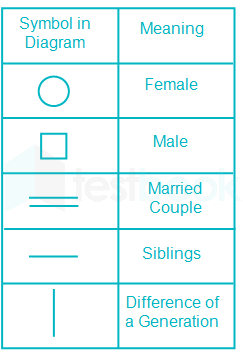
By using the symbols in the table given below, we can draw the following family tree:

As per the condition, the family tree for the question will be:

As it can be clearly seen from the family tree that Kumar is the father of Meera.

Therefore, the correct answer is "Father".

4

Find the missing term for the following.

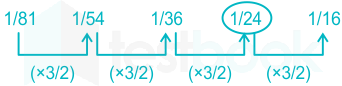
1/81, 1/54, 1/36, ?, 1/16

  1. ((a))

    1/28

  2. ((b))

    1/32

  3. ((c))

    1/26

  4. ((d))

    1/24

Show Answer
Answer: ((d))

1/24

The pattern followed is:

Logic: Each number is multiplied by (3/2) to get the next number.


Therefore, the correct answer is "1/24".

5

Mukesh goes 35 m North, takes a right turn and walks 15 m, then again takes a right turn and walks 50 m. How many minimum meters is he away from his original place?

  1. ((a))

    25 m

  2. ((b))

    21 m

  3. ((c))

    30 m

  4. ((d))

    50 m

Show Answer
Answer: ((b))

21 m

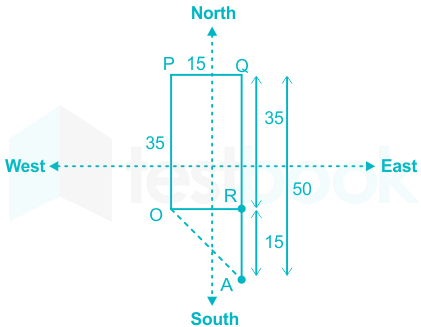
​As per the given conditions the path tracked by Mukesh is as follows:

Now, the shortest distance between starting and ending point has to be found i.e. (OA).

In triangle OAR by applying Pythagoras theorem.

H2=P2+B2H^2 = P^2 + B^2

OA2=OR2+RA2OA^2 = OR^2 + RA^2

OA2=152+152OA^2 = 15^2 + 15^2

OA2=225+225OA^2 = 225 +225

OA=450OA = \sqrt450

OA=21.21OA = 21.21

OA = 21 (approx).

Therefore, the correct answer is "21".

6

One evening before sunset, Guna and Bala were talking to each other face to face. If Bala's shadow was falling exactly on his right, then in which direction was Guna's face?

  1. ((a))

    East

  2. ((b))

    North

  3. ((c))

    South

  4. ((d))

    West

Show Answer
Answer: ((c))

South

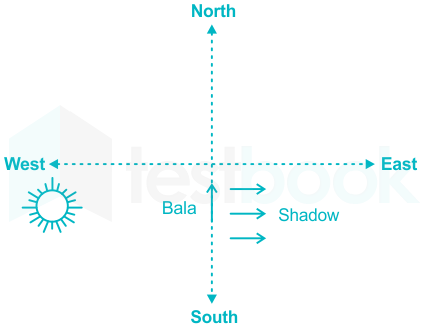
Concept: When it's sunset the shadow is formed towards the east direction.

As per the question, It is sunset, and Bala's shadow falling on his right.

It is only possible when he is facing the north direction.

Also, Guna is exactly the opposite of Bala.


Hence, "Guna" must be facing "South".

Therefore, the correct answer is "South".

7

Suja's age last year was equal to the square of a number and next year will be the cube of a number. If again Suja's age is to be equal to one's cube, how long will she have to wait?

  1. ((a))

    40 years

  2. ((b))

    35 years

  3. ((c))

    38 years

  4. ((d))

    41 years

Show Answer
Answer: ((c))

38 years

According to the question Suja's age, last year was square of a number.

Let, her previous year's age be:  "x2x^2".

So, her present age will be: "x2+1x^2 + 1 ".

Next year her age will be a cube of a number.

Therefore, next year age will be: "x2+2x^2 + 2"

Let the cube be " y3y^3".

Therefore, y3y^3 = x2+2x^2 + 2

Taking x = 1; y = 3 (not a cube of any number) .

Again x = 2 ; y = 6 (not a cube of any number).

Now taking x = 3 ; y = 11 (not a cube of any number).

Again x = 4 ; y = 18 (not a cube of any number).

Taking x = 5 ; y = 27 (its a cube of 3).

Therefore, x = 5 ; y = 27. 

Her previous year's age will be "25" years.

Present age will be 25 + 1 = "**26"**years.

Again suja's age is equal to a cube.

So, her age will be "64" years. (64 is the cube of 4).

So, she needs to wait for 6426=3864 - 26 = 38  years.

Therefore, the correct answer is "38 years".

8

Girls of a class stand in a single row. A girl is 20th in the order from both the ends. How many total girls are there in the class?

  1. ((a))

    38

  2. ((b))

    39

  3. ((c))

    40

  4. ((d))

    37

Show Answer
Answer: ((b))

39

Logic: As per the question. The girl is 20th from both sides.

It means she is in the middle position.

Hence, the total number of students will be 

19 + 19 + 1 = 39.

Therefore, the correct answer is "39".

9

If 16th December 2002 was Friday then what day was 21st December 2004?

  1. ((a))

    Friday

  2. ((b))

    Saturday

  3. ((c))

    Wednesday

  4. ((d))

    Sunday

Show Answer
Answer: ((b))

Saturday

The total number of odd days from 16th December 2002 to 16 December 2004 are:

YearTypeOdd days
2003ordinary1
2004leap2

Total odd days = 3.

So, the day on 16th December 2004 will be, Friday + 3 Days = Monday. 

As 16th December 2004 is Monday then add 5 more days to get day on 21st December 2004.

Monday + 5days = Saturday.

Hence, 21st December 2004 is Saturday.

Therefore, the correct answer is "Saturday".

Additional Information Months and their odd days.

MonthOdd days
January3
February0/1
March3
April2
May3
June2
July3
August3
September2
October3
November2
December3

The month with 31 days has "3" odd days.

The month with 30 days has "2" odd days.

February for leap year contains "1" odd day.

February without leap year contains "0" odd days.

10

You are given two statements and two conclusions. Choose the correct comment about the conclusions from the options given below.

Statement:

All women are mothers.

All mothers are sisters

Conclusion:

I. All women are sisters.

II. Some women are sisters.

  1. ((a))

    Both I and II follow.

  2. ((b))

    Either conclusion I or II follows.

  3. ((c))

    Only conclusion II follows.

  4. ((d))

    Only conclusion I follows.

Show Answer
Answer: ((a))

Both I and II follow.

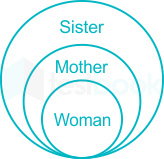
The least possible Venn diagram for the given question will be:

Conclusion:

I. All women are sisters.

True. As all portion of women is a part of sisters.

II. Some women are sisters.

True. As all portion of women is a part of sisters thus some part of women are sister will be also a definite statement.

Therefore, the correct answer is "Both I and II follow".

Additional Information

Suppose for an Example: All A are B.

If we go from In to Out means from A to B then cases with All and some will be true like All A are B and Some A are B.

But if we go Out to In then only cases with Some will be true and All will be can't say like Some B are A will be true but All B are A will be can't say.

11

Find the water image of the following word.

orange

  1. ((a))

  2. ((b))

  3. ((c))

  4. ((d))

Show Answer
Answer: ((c))

The water image for "orange" will be:

Therefore the correct answer is "option 3".

Additional Information


12

Choose the same type of pair for the following.

4/5 : 41 :: ___ : ___

  1. ((a))

    6/10 : 255

  2. ((b))

    8/5 : 144

  3. ((c))

    2/3 : 25

  4. ((d))

    7/9 : 130

Show Answer
Answer: ((d))

7/9 : 130

The logic followed is:

Logic: Sum of square of both numerator and denominator should be checked.

For 4/5.

NumberSquare
416
525

16+25=4116 + 25 = 41

Option 1: For 6/10.

NumberSquare
636
10100

36+100=13636 + 100 = 136

It is false.

Option 2: For 8/5.

NumberSquare
864
525

64 + 25 = 89

It is False.

Option 3: For 2/3.

NumberSquare
24
39

4 + 9 = 13.

It is false.

Option 4: For 7/9.

NumberSquare
749
981

49 + 81 = 130

It is true.

Therefore, the correct answer is "7/9": 130

Additional Information

Sometimes cubes of numbers can also be asked. So, cubes up to 10 should be remembered.

NumberCube
11
28
327
464
5125
6216
7343
8512
9729
101000
13

The question below consists of a question and two statements. Choose the most appropriate option from the following.

Question:

In which year was Bina born?

Statement:

I. Bina is 25 years younger than her father at present.

II. Born in 1964, Bina's daughter is 35 years younger than Bina's father.

  1. ((a))

    The data in statement II alone are sufficient.

  2. ((b))

    The data in statement I alone are sufficient.

  3. ((c))

    The data given in both statements I and II together are not sufficient.

  4. ((d))

    The data given in both statements I and II together are necessary.

Show Answer
Answer: ((d))

The data given in both statements I and II together are necessary.

As per the statement:

I. Bina is 25 years younger than her father at present.

Let the birth year of Bina's father be "x".

The BIrth year of Bina will be "x + 25".

II. Born in 1964, Bina's daughter is 35 years younger than Bina's father.

As Bina's daughter is 35 years younger than Bina's father.

Therfore, birth year of father will be**:** 

1964 - 35 = 1929.

Hence, "x = 1929".

Therefore, the birth year of Bina will be:

1929 + 25 = 1954.

As it can be seen that both statement are required to obtain the correct birth year of Bina.

Therefore, the correct answer is "The data given in both statements I and II together are necessary".

14

Which of the following diagrams correctly represents "Charminar, Hyderabad, India"?

  1. ((a))

  2. ((b))

  3. ((c))

  4. ((d))

Show Answer
Answer: ((d))

Logic: "Charminar, historic monument located at the heart of Hyderabad, and Hyderabad is the capital of Telangana state which comes in "India".

So, the relation should be:

Therefore, the correct answer is "Option 4".

15

Shilpa weights more than Anita but not as much as Rosa. Anita weighs more than Jeeva. Kanaga's weight is more than Shilpa but less than Rosa's weight. Whose weight is the most?

  1. ((a))

    Kanaga

  2. ((b))

    Rosa

  3. ((c))

    Shilpa

  4. ((d))

    Anita

Show Answer
Answer: ((b))

Rosa

As per the question,

i) Shilpa's weight is more than Anita's but less than Rosa's.

Rosa> Shilpa > Anita.

ii) Anita's weight is more than Jeeva's.

Rosa> Shilpa > Anita > Jeeva.

iii) Kanaga's weight is more than Shilpa's but less than Rosa's.

Hence, Kanaga's weight is between Shilpa and Rosa.

Rosa> Kanaga > Shilpa > Anita > Jeeva.

This is the final arrangement.

As it can be seen the weight of "Rosa" is highest.

Therefore, the correct answer is "Rosa".

16

Select the option that is related to the third word in the same way as the second word is related to the first word.

Wind Velocity : Wind :: Cyclometer ​: ___

  1. ((a))

    Current

  2. ((b))

    Speed

  3. ((c))

    Tension

  4. ((d))

    Length

Show Answer
Answer: ((b))

Speed

Logic: Device and its use is taken as an analogy.

DeviceUses
Wind VelocityWind
AmmeterCurrent
CyclometerSpeed
Belt tensionTension
RulerLength

Cyclometer: A device mounted over cycles in order to calculate speed.

Therefore, the correct answer is**"Speed".**

17

If RUBA is coded as 7965 and HEALTH is coded as 805218, then find the code for BHARATH.

  1. ((a))

    6857618

  2. ((b))

    6857918

  3. ((c))

    6857518

  4. ((d))

    6859518

Show Answer
Answer: ((c))

6857518

Logic: Digits are taken as code for Letters at the respective positions.

For "RUBA":

For "HEALTH":

Hence, 

For "BHARAT" 

Therefore, the correct answer is "6857518".

Additional InformationSometimes, a letter's numerical position is also taken as code.

18

Find the number of triangles from the following figure.

  1. ((a))

    12

  2. ((b))

    16

  3. ((c))

    15

  4. ((d))

    18

Show Answer
Answer: ((c))

15

The triangles in the given figure are shown below:

Therefore, the correct answer will be "15".

19

What will come in place of question mark (?) in the following?

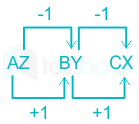
AZBYCX
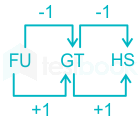
FUGTHS
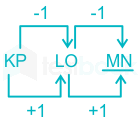
KPLO?
  1. ((a))

    JN

  2. ((b))

    MN

  3. ((c))

    ON

  4. ((d))

    NM

Show Answer
Answer: ((b))

MN

Logic: In each row following logic is followed:

For

AZBYCX

For 

FUGTHS

Similarly, For 

KPLO..

<br>

Therefore, the correct answer is "MN".

Additional Information

Shortcut to remember the reverse positional letters.

20

If the first half of the letters of the English alphabet are written in reverse order, which letter will be 22nd from your right?

  1. ((a))

    F

  2. ((b))

    H

  3. ((c))

    J

  4. ((d))

    I

Show Answer
Answer: ((d))

I

Logic: There are 26 alphabets. After being written first half in reverse order it will become.

Original order before interchanging the last half alphabets:

A B C D E F G H I J K L M N O P Q R S T U V W X Y Z.

After being written first half in reverse order it will become.

M L K J I H G F E D C B A N O P Q R S T U V W X Y Z.

Now, 22th from the right side will be: 

As it is clear that "I" is 22th from the right position.

Therefore, the correct answer is "I".

Additional Information

Shortcut to remember the reverse positional letters

General Awareness (20 questions)

21

On which river is the Salal Project situated?

  1. ((a))

    Sutlej

  2. ((b))

    Jhelum

  3. ((c))

    Ravi

  4. ((d))

    Chenab

Show Answer
Answer: ((d))

Chenab

The correct answer is Chenab.

Key Points

  • Salal Dam also known as Salal Hydroelectric Power Station, is a run-of-the-river hydropower project on the Chenab River.

  • It is located in the Reasi district of the Union Territory of Jammu & Kashmir.

  • Salal power station is a run-of-the-river scheme with an installed capacity of 690 MW.

  • It was the first hydropower project built by India in Jammu and Kashmir under the Indus Water Treaty regime. 

Additional Information

Some other important Dams in Jammu and Kashmir:

DamRiver
Baglihar DamChenab
Dulhasti DamChenab
Nimoo Bazgo DamIndus
22

Hepatitis is a disease of ______ caused by _____.

  1. ((a))

    Liver, virus

  2. ((b))

    Kidney, virus

  3. ((c))

    Liver, bacteria

  4. ((d))

    Tuberculosis, bacteria

Show Answer
Answer: ((a))

Liver, virus

The correct answer is Liver, virus.

Key Points

  • There are 5 unique hepatitis viruses that are identified by the letters A, B, C, D, and E.
  • Commonly all  5 viruses are related to liver disease, they vary in important ways.
  • Hepatitis A virus (HAV) and Hepatitis E virus (HEV) are most often transmitted through the consumption of contaminated water or food.
  • Hepatitis B virus (HBV) is transmitted through exposure to infective blood, semen, and other body fluids.
  • Hepatitis C virus (HCV) is mostly transmitted through exposure to infective blood.
23

The United Nations Organization was established on _______.

  1. ((a))

    24 October 1945

  2. ((b))

    24 October 1946

  3. ((c))

    24 October 1944

  4. ((d))

    24 October 1947

Show Answer
Answer: ((a))

24 October 1945

The correct answer is 24 October 1945.

Key Points 

  • United Nations:
  • The UNO was formed on 24 October 1945.
  • It was founded in San Francisco, USA.
  • The headquarters were shifted to New York in 1946.
  • At present, 193 countries are members of the UN.
  • South Sudan is the latest and the 193rd member to join the UN in 2011.
  • The UN Charter came into force on October 24, 1945, when the Governments of China, France, the UK, the Soviet Union, and the USA, and a majority of other counties had ratified it.

Additional Information

  • The headquarters of the  International Court of Justice is in Hague, Netherlands.
  • The headquarters of the International Labour Organization is in Geneva, Switzerland.
  • The headquarters of the United Nations Educational, Scientific and Cultural Organization is in Paris, France.
24

Which pair does not match with respect to the parts of the constitution and their description?

  1. ((a))

    Part : X Finance, Property, Contracts and Suits

  2. ((b))

    Part : VI States

  3. ((c))

    Part : V Union

  4. ((d))

    PART : VIII Union Territories

Show Answer
Answer: ((a))

Part : X Finance, Property, Contracts and Suits

The correct answer is Part: X Finance, Property, Contracts, and Suits.

Key Points

  • The Scheduled and Tribal Areas is the subject in Part-X of the Indian Constitution. 
  • Part-X of the Indian Constitution contains the article-244 & 244 (a).
  • Article-244:- Administration of Scheduled Areas and Tribal Areas.
  • Article-244 (a):- Formation of an autonomous State comprising certain tribal areas in Assam and creation of local Legislature or Council of Ministers or both therefore
  • However, the provisions of the 5th Schedule of the Indian Constitution refer to the management and control of the scheduled areas and scheduled tribes in any state other than the states of Assam, Meghalaya, Tripura, and Mizoram.

Additional Information

The Constitution of India is grouped into 25 parts which are as follows:-  

PartArticleRelated to
Part I1 to 4Union and its territory.
Part II5 to 11Citizenship.
Part III12 to 35Fundamental Rights.
Part IV36 to 51Directive Principles of State Policy.
Part IVA51AFundamental Duties.
Part V52 to 151The Union.
Part VI152 to 237The States.
Part VII238The Part-B States in the Indian Union.
Part VIII239 to 242The Union Territories.
Part IX243 to 243OThe Panchayats.
Part IXA243P to 243ZGMunicipalities.
Part IXB243ZH to 243ZTThe Co-operative Societies.
Part X244 to 244AThe Scheduled and Tribal Areas.
Part XI245 to 263Relations between the Union and the States.
Part XII264 to 300AFinance, Property, Contracts, and Suits.
Part XIII301 to 307Trade and Commerce within the territory of India.
Part XIV308 to 323Services under the Union, the States.
Part XIVA323A to 323 BTribunals.
Part XV324 to 329AElections.
Part XVI330 to 342Special Provisions relating to certain classes.
Part XVII343 to 351Language.
Part XVIII352 to 360Emergency Provisions.
Part XIX361 to 367Miscellaneous.
Part XX368Amendment of the Constitution.
Part XXI369 to 392Temporary, Transitional, and special provisions.
Part XXII393 to 395Short title, date of commencement, etc.
25

The South Asian Association for Regional Cooperation (SAARC) was established with the signing of the SAARC Charter in ______ on _____.

  1. ((a))

    Colombo, 8 March 1985

  2. ((b))

    Delhi, 9 January 1985

  3. ((c))

    Dhaka, 8 December 1985

  4. ((d))

    Kathmandu, 8 February 1985

Show Answer
Answer: ((c))

Dhaka, 8 December 1985

The correct answer is 8 December.

Key Points

  • The South Asian Association for Regional Cooperation (SAARC) Charter Day is observed every year on 8th December.
  • On this day  in 1985, SAARC Charter was adopted in Dhaka, during the first summit of the group.
  • 2021 marks the 37th anniversary of the regional group.
  • The aim of SAARC members is to promote stability, peace and progress in the region.
  • SAARC has organized 18 summits since 1985.

Additional Information

  • The Charter was signed by the leaders of eight South Asian nations- Bangladesh, Bhutan, Afghanistan, Maldives, Nepal, India, Pakistan, and Sri Lanka.
  • SAARC is currently focusing on regional cooperation in all fields of development activity that impact the livelihood of people.
  • These specialised bodies promote regional cooperation by SAARC members in various fields:
  • South Asian University - New Delhi
  • SAARC Regional Standards Organization - Dhaka
  • SAARC Development Fund - Thimphu
  • SAARC Arbitration Council- Islamabad
  • Apart from these specialised bodies, SAARC regional centres also promote regional cooperation such as:
  • The SAARC Agriculture Centre in Dhaka.
  • The Cultural Centre of the group in Colombo.
  • The SAARC Energy Centre in Islamabad.
  • The SAARC Tuberculosis & HIV/AIDS Centre in Kathmandu.
26

Recently, whose name has been recommended for the Rajiv Gandhi Khel Ratna Award for the year 2018?

  1. ((a))

    Virat Kohli and Mirabai Chanu

  2. ((b))

    Virat Kohli and P.V. Sindhu

  3. ((c))

    Mirabai Chanu and MS Dhoni

  4. ((d))

    PV Sindhu and Hima Das

Show Answer
Answer: ((a))

Virat Kohli and Mirabai Chanu

The correct answer is Virat Kohli and Mirabai Chanu.

Key Points

  • India men’s cricket team captain Virat Kohli and weightlifter Mirabai Chanu were conferred with the Rajiv Gandhi Khel Ratna Award by President Ram Nath Kovind at the Rashtrapati Bhavan in 2018.
  • Virat Kohli is the third cricketer to be awarded the Khel Ratna after Sachin Tendulkar (1997) and MS Dhoni (2007).
  • Chanu is the third weightlifter to win the prize after Karnam Malleswari (1995) and Nameirakpam Kunjarani (1996).
  • Rajiv Gandhi Khel Ratna Award is the highest sports honor of India and is awarded annually by the Ministry of Youth Affairs and Sports.
  • Rajiv Gandhi Khel Ratna Award consists of a medallion, a certificate, and a cash prize of Rs 25 lakhs.
  • This is given every year for outstanding contributions to sports over a period of four years.
27

Who was the first Indian astronaut to go to space?

  1. ((a))

    Kalpana Sharma

  2. ((b))

    Rakesh Sharma

  3. ((c))

    Kalpana Chawla

  4. ((d))

    Rajesh Sharma

Show Answer
Answer: ((b))

Rakesh Sharma

The correct answer is Rakesh Sharma.

  • Rakesh Sharma is an Indian military pilot and cosmonaut.
  • He was the first Indian citizen to go into space.
  • In 1984, he became the first Indian citizen to enter space.
  • He went to space as a part of a joint program between the ISRO and the Soviet Intercosmos space program.
  • He was a part of the Soviet rocket Soyuz T-11 launched from Baikonur Cosmodrome in Kazakh Soviet Socialist Republic.
<br>

Additional Information

  • He was the 139th cosmonaut to be in space in the world.
  • On the 3rd April 1984, SqnLdr >Rakesh Sharma became the first Indian to orbit in space.
  • He went to space as a part of a joint program between the Indian Space Research Organisation (ISRO) and the Soviet Intercosmos space program.
  • The IAF officer flew aboard a Soyuz T11 spacecraft.
  • He spent 7 days, 21 hours, and 40 minutes aboard the Salyut 7 orbital station along with two Soviet astronauts, Yury Malyshev and Gennadi.
  • His work in space was focused on areas of biomedicine and remote sensing.
  • When the then PM of India, Indira Gandhi asked Sharma how does India look from outer space, Sharma said "Saare Jahaan se Achcha".
  • Rakesh Sharma is also the first Indian to have been conferred with the 'Hero of Soviet Union' award. He was also awarded the Ashok Chakra.
  • ​Yuri Gagarin - the first man to enter space.
28

Which of the following activities of Bal Gangadhar Tilak has been found to be true?

  1. ((a))

    In 1909, Tilak was again imprisoned for two years for protecting the revolutionaries in the case of the Nashik conspiracy.

  2. ((b))

    In 1897, Tilak was imprisoned for eighteen months for spreading discontent against the rule.

  3. ((c))

    In 1895, Tilak Lay promoted a festival dedicated to the worship of Lord Ganapati.

  4. ((d))

    In 1893, Tilak popularized the Shivaji Festival.

Show Answer
Answer: ((b))

In 1897, Tilak was imprisoned for eighteen months for spreading discontent against the rule.

The correct answer is In 1897, Tilak was imprisoned for eighteen months for spreading discontent against the rule.

Key Points

  • Lokmanya Bal Gangadhar Tilak, whose real name was Keshav Gangadhar Tilak, was born 165 years ago on July 23.

He was a freedom warrior, social thinker, philosopher, and educator who was instrumental in India’s Independence effort.

He was popularly known as the 'Father of Swaraj'.

He established the Deccan Education Society in 1884 to impart nationalist principles to young people.

Important PointsIn 1890, Tilak became a member of the Indian National Congress. He was opposed to its moderate stance, especially in the battle for self-government. At the moment, he was one of the most prominent revolutionaries.

  • The bubonic plague spread from Bombay to Pune in late 1896, and by January 1897, it had reached epidemic proportions.
  • Forced entry into private homes, an inspection of residents, relocation to hospitals and segregated camps, removal and destruction of personal belongings, and prohibiting patients from entering or leaving the city were among the harsh steps used to deal with the emergency.
  • The outbreak had been brought under control by the end of May. They were generally seen as acts of injustice and dictatorship.
  • Tilak took up the cause by publishing provocative articles in his newspaper Kesari, citing the Hindu scripture Bhagavad Gita to claim that no one should be held responsible for killing an oppressor without expecting a reward.
  • The Chapekar brothers and their associates then shot and killed Commissioner Rand and another British officer, Lt. Ayerst, on June 22, 1897.
  • Tilak was charged with murder incitement and received an 18-month sentence. He was respected as a martyr and a national hero when he was released from jail in modern-day Mumbai.
  • After this, he declared "Swaraj is my birthright, and I shall have it."
29

Which city in South India is known as the Shrimp Capital of India?

  1. ((a))

    Kurnool

  2. ((b))

    Srikakulam

  3. ((c))

    Madurai

  4. ((d))

    Nellore

Show Answer
Answer: ((d))

Nellore

The correct answer is Nellore.

Key Points

  • Nellore district, officially Sri Potti Sriramulu Nellore district, is one of the thirteen districts in the Indian state of Andhra Pradesh. According to the 2011 Census, the district's population was 2,966,082, of which 29.07% was urban. Its administrative headquarters are located in Nellore city. Located in the Coastal Andhra region, the district is bordered by the Bay of Bengal to the east, Kadapa district to the west, Prakasam district to the north, and Chittoor district and Thiruvallur district of Tamil Nadu to the south.
  • The island of Sriharikota, the site where most Indian spacecraft are launched, is located in the Nellore district.

Important Points

  • The official name of Nellore was changed to Sri Potti Sriramulu Nellore District (SPSR Nellore) on 4 June 2008, in honor of the Indian revolutionary Potti Sri Ramulu, who died fasting in an attempt to achieve the formation of a separate state for the Telugu people, which would later become Andhra Pradesh.
  • Cultured shrimp farming had started a decade ago.
  • Nellore was the area where companies had invested the most.
  • The investment paid off.
  • Nellore has the best and has the most of cultured shrimp farming in India.
  • This is why it is called the Shrimp capital of India.

Additional Information https://www.indiastatdistricts.com/andhrapradesh/sripottisriramulunellore-district

30

KD Jadhav's name is written in golden letters in the sports history of India because:

  1. ((a))

    All the options given

  2. ((b))

    He won a medal in the 1952 Helsinki Olympic Games.

  3. ((c))

    He was the first individual Olympic medalist from independent India.

  4. ((d))

    He won a bronze medal in wrestling.

Show Answer
Answer: ((a))

All the options given

The correct answer is All the options given.

Key Points

  • KD Jadhav was Independent India's first Individual Olympic medalist.
  • He won a Bronze medal in the 1952 Helsinki (Finland) Olympics in Wrestling.
  • Independent India's first Olympic medal was a gold medal won by the Indian Hockey Team in the 1952 Helsinki Olympics.

 Important PointsKD Jadhav: The First Individual Olympic Medallist of India 

  • Winning a medal at the world’s biggest showpiece event “The Olympics” is always a dream of every athlete. Athletes toil for years to give their best at the grandest stage in their respective events. Be it a team or an individual event, Indian athletes have made the nation proud from time to time with their riveting performances. India won its first gold medal as a team in hockey at the Olympics back in 1928 and post-Independence in 1948 as an independent nation.  But what made the country proud was when Khashaba Dadasaheb Jadhav bagged the first individual medal for India in the form of a bronze in wrestling at the 1952 Helsinki Summer Olympics.
  • Popularly known as the “pocket dynamo”, KD Jadhav wrote his name in the history books as undoubtedly the face of modern Indian wrestling. His glory at the Helsinki Olympics revived wrestling commonly known as “Kushti” in parts of Haryana. Till now India has won five medals in the wrestling event at the Olympics comprising 4 bronze medals and one silver medal. Though KD Jadhav’s success at the 1952 Olympics was eclipsed by the Indian Hockey team by winning gold, yet his achievement set up a milestone in the history of Indian sports.


Glory at the Olympics


  • Jadhav’s first feel of the big stage was at the 1948 London Olympics. His journey was funded by the Maharaja of Kolhapur. During his stay in London, he was trained by Rees Gardner, a former lightweight World champion from the United States. It was Gardner’s guidance that saw Jadhav finish sixth in the flyweight section, despite being unfamiliar with wrestling on the mat. He stunned the audience by defeating the Australian wrestler Bert Harris in the first few minutes of the bout. He went on to defeat Billy Jernigan of the US, but lost to Mansour Raeisi of Iran, to be eliminated from the Games.
  • “You grow more when you learn from your mistakes”, this is what KD Jadhav did to achieve success. The next Olympics were 4 years away and the veteran made the best use of this time. He trained harder and that too on the mat in order to be familiar with the conditions. A problem that rose for Jadhav was finance. To deal with it, Jadhav pleaded to the Chief Minister of Bombay at Morarji Desai. But all he received was a cold snub. Jadhav didn’t lose hope and wrote to the President of the Indian Olympic Association at that time Yadivandra Singh. Yadivandra arranged a bout for KD against Niranjan Das, and KD again with his talent and skills knocked out Niranjan thus earning him a ticket to the 1952 Olympics.
  • It was all worth it. In the 1952 Helsinki Olympics, Jadhav stunned the audience by defeating opponent after opponent with ease in the first 5 rounds of bantamweight freestyle wrestling. In the sixth round, the adept was asked to fight Soviet Union’s Rashid Mammadbeyov. As per the rules, a rest of at least 30 minutes were required between bouts, but no Indian official was available to press his case. As a result, a tired Jadhav failed to inspire and Mammadbeyov cashed in on the chance to reach the final. Defeating the wrestlers from Canada, Mexico, and Germany, he won the bronze medal on 23 July 1952 at the age of 27 thereby creating history by becoming Independent India’s first individual medal winner. Although India’s hockey team bagged a gold at the Helsinki games, Jadhav and his prestigious bronze medal was the primary attraction of India’s contingent that returned home after the Olympics.

hence all the options are correct.

31

CartoSat - 2F was successfully launched in January 2018, is _______.

  1. ((a))

    Earth Observation Satellite

  2. ((b))

    Used for agricultural applications and facilitates higher education

  3. ((c))

    Communication and meteorological satellites

  4. ((d))

    An Indian satellite used for communication

Show Answer
Answer: ((a))

Earth Observation Satellite

The correct answer is Earth Observation Satellite.

Key Points

  • PSLV-C40/ Cartosat-2 Series Satellite Mission was launched on Jan 12, 2018.
  • 30 co-passenger satellites with Cartosat-2 Series were lifted off.
  • These co-passenger satellites have one microsatellite and one nanosatellite.
  • This satellite was launched from Satish Dhawan Space Centre, Sriharikota. ​

Additional Information

  • Cartosat-2 Series Satellite is the primary satellite carried by PSLV-C40.
  • This remote sensing satellite is similar in configuration to earlier satellites in the series and is intended to augment data services to the users.
  • The imagery sent by satellite will be useful for cartographic applications, urban and rural applications, coastal land use and regulation.
32

Ashok Mehta Committee (1977) was related to ____.

  1. ((a))

    Judiciary Reforms

  2. ((b))

    Centre-State Relations

  3. ((c))

    Panchayati Raj System

  4. ((d))

    Reservation Policy

Show Answer
Answer: ((c))

Panchayati Raj System

The correct answer is Panchayti Raj Committee.

 Additional Information

  • Ashok Mehta Committee was constituted by Janta Party in December 1977.
  • The main motto of this committee was to review the Panchayati Raj system in India.

Key Points

  • Panchayati Raj was first implemented in India on 2nd October 1959 in Nagore district of Rajasthan.
  • Panchayati Raj involves people in Decision making and mitigates the government's work pressure.
  • Ashok Mehta was constituted under the chairmanship of Ashok Mehta.
  • Later on, by the 73rd Amendment of the Indian Constitution Panchayat was given constitutional status.
  • It was added in the XI Schedule of the Indian Constitution.
33

GST has replaced the taxes currently levied and collected by the Centre. Which tax was not collected by the Center before GST?

  1. ((a))

    Purchase tax

  2. ((b))

    Excise Duty (Pharmaceuticals and Cosmetics)

  3. ((c))

    Service tax

  4. ((d))

    Central Excise Duty

Show Answer
Answer: ((a))

Purchase tax

The correct answer is Purchase Tax.

  • GST stands for Goods and Services Tax.
  • GST was implemented in India on 1st July, 2017.

Additional Information

  • GST is a single domestic Indirect Tax.
  • It is based on One Nation One Tax.
  • There are 4 types of GST:-
  • IGST
  • SGST
  • CGST
  • UTGST
  • Atal Bihari Vajpayee government introduced GST in India.
  • There is a simple formula to calculate GST:- a simple formula arises: GST Amount = (Original Cost*GST Rate Percentage) / 100Net Price = Original Cost + GST Amount
  • France was the first country in the world to introduce GST.
  • Assam was the first state in India to accept GST.
34

Which of the following is not a major functional area related to the structure of the cell?

  1. ((a))

    Nucleus

  2. ((b))

    Cytoplasm

  3. ((c))

    Plasma membrane

  4. ((d))

    Angstrom

Show Answer
Answer: ((d))

Angstrom

The correct answer is Angstrom.

 Angstrom is a measuring unit. It is used to measure length or very small distances. 

<br>

Key Points

  1. Nucleus is the controlling section of Cell. It regulates the function of a cell. 
  2. It contains the hereditary information. 
  3. It is called brain of the cell. 

 Additional Information

  • Cytoplasm is a jelly like substance which is found in cell.
  • It is found between Nucleus and Cell membrane.
  • It gives shape and forms structure of cell.
  • Plasma membrane is also called Cell membrane.
  • It works as an entrance for the materials to enter the cell.
35

Which statement regarding the impeachment of the President of India is incorrect?

  1. ((a))

    Allegations of corruption and criminal activity may form the basis of the impeachment process.

  2. ((b))

    When a charge is so presented in either House of Parliament, the other House shall inquire into the charge or cause the charge to be inquired into.

  3. ((c))

    Article 61 deals with the process of impeachment.

  4. ((d))

    The impeachment motion can be introduced in either house of the Parliament.

Show Answer
Answer: ((a))

Allegations of corruption and criminal activity may form the basis of the impeachment process.

The correct answer is Allegations of corruption and criminal activity may form the basis of the impeachment process.

 Additional Information

  • President is the Head of the State.
  • No criminal proceedings can be initiated against him.

Key Points

  1. Impeachment process against President is mentioned in Article 61
  2. Impeachment can be initiated in either of the house of Parliament.  3.  If President violates the constitution, then Impeachment can be initiated against him.
  3. 14 days notice is sent to President of India.
  4. Impeachment process must be passed with two thirds majority of both the houses.
36

Arrange the following tribal groups of India in order of population dominance from largest to smallest.

  1. ((a))

    Bhil, Santhal, Gond

  2. ((b))

    Santhal, Bhil, Gond

  3. ((c))

    Bhil, Gond, Santhal

  4. ((d))

    Gond, Santhal, Bhil

Show Answer
Answer: ((c))

Bhil, Gond, Santhal

The Correct Answer is Bhil, Gond, Santhal

Key Points

  • Tribe: A tribe is a social division in a traditional society consisting of families linked by social, economic, religious, or blood ties, with a common culture and dialect.
  • The most commonly known tribes of India are Bhils (or Bheels), Gonds, Santhal, Munda, Khasi, Garo, Angami, Bhutia, Chenchu, Kodaba, and the Great Andamanese Tribes.
  • Of all these tribes, the Bhil tribal group, as per the 2011 census, is the largest tribe in India.
  • It constitutes a staggering 38% of the country’s total scheduled tribal population.
  • The Gond tribe is second only to the Bhils in terms of population size, called the second-largest tribe of India.
  • The Gond constitutes a major percentage (35.6%) of the country’s total tribal population.

Additional Information 

  • Most Famous Tribal Groups
  • Bhils Tribe: The Bhils are a tribe found mostly in the mountain ranges of Udaipur and in some districts of Rajasthan.
  • The Bhils are the largest tribe in India.
  • Popularly known as the Bowmen of Rajasthan.
  • They speak the Bhili language.
  • Gonds Tribe: Found in the Chhindwara district of Madhya Pradesh and in parts of Maharashtra, Orissa, and Andhra Pradesh.
  • They are known for their valour and speak many Indian languages including the Dravidian Gondi language.
  • Agriculture is their main occupation.
  • Keslapur Jathra and Madai are their festivals.
  • Santhal Tribes: The Santhal tribes are a major tribe of West Bengal.
  • First tribe to offer resistance to the British during the 1855 Santhal rebellion which resulted in the creation of a separate Santhal Paragans district.
  • They depend on agriculture and livestock for their living and are great hunters.
  • Santhals follow the Sarna religion.
  • In addition to traditional festivals like Karam and Sahrai, Santhali dance and music are major attractions.
37

The Indian National Congress did not form a government in ______ after the 1937 provincial election.

  1. ((a))

    Odisha

  2. ((b))

    Madras

  3. ((c))

    Bengal

  4. ((d))

    Central Provinces

Show Answer
Answer: ((c))

Bengal

The Correct Answer is Bengal.

Key Points

  • In the 1937 elections, the Indian National Congress emerged in power in eight of the provinces - the three exceptions being Bengal, Punjab, and Sindh.
  • It formed MInistries in 8 out of the 11 provinces.
  • In Assam, it had won 33 out of 108 seats and though it was the single largest party it was not in a position to form a Ministry.
  • In Punjab, the Muslim League with Unionist Party formed a coalition government.
  • In Bengal, the Muslim League formed a coalition government with Krishak Praja Party under Fazlul Haq.
  • Congress remained in office for more than two years.
  • Under this tenure, Tenancy acts were passed in United Provinces and Bihar, to protect the tenants from the moneylenders.

Additional Information

  • In 1937, the Congress Government in Bombay appointed a Textile Inquiry Committee which recommended a wage increase for labor.
  • In November 1938, the Congress Government in Bombay introduced the “Industrial Disputes Act”.
  • Rise of Separatism: In 1937, after the Provincial elections, Congress had refused to make coalition Governments with the Muslim league.
  • There was one more reason for the press for a separate Muslim nation.
  • It was the Wardha Scheme of Education, which led the Muslim League to champion the cause of Pakistan.
38

Taxation of corporate income was introduced in the Indian economy with the Income Tax Act of _____.

  1. ((a))

    1922

  2. ((b))

    1961

  3. ((c))

    1854

  4. ((d))

    1860

Show Answer
Answer: ((d))

1860

The Correct Answer is 1860.

Key Points 

  • A corporate tax, also called corporation tax or company tax, is a direct tax imposed on the income or capital of corporations or analogous legal entities.
  • British rule in India became established during the 19th century.
  • After the Mutiny of 1857, the British government faced an acute financial crisis.
  • To fill the treasury, the first Income-tax Act was introduced in February 1860 by Sir James Wilson (British India's first finance minister).
39

The proclamation of emergency in a state under Article 356 can continue beyond one year if

  1. ((a))

    The High Court of the State certifies that the law and order situation in the State is very critical.

  2. ((b))

    Election Commission certifies that it is difficult to hold elections for the Legislative Assemblies

  3. ((c))

    The governor of the state certifies that the law and order situation in the state is not under control.

  4. ((d))

    President is satisfied about the dire situation in the state through an independent inquiry

Show Answer
Answer: ((b))

Election Commission certifies that it is difficult to hold elections for the Legislative Assemblies

The Correct Answer is Option 2.

Key Points

  • Article 356 of the Constitution empowers the central government to impose its direct rule over any state, known as the President’s Rule.
  • This clause states that the president's rule can only be prolonged for more than a year every six months if the following criteria are met: Throughout all of India, or in every region of the state, there is already a national emergency. Elections cannot be held in the state, according to the Election Commission. Hence option 2 is correct
  • This is also called a ‘State Emergency’.
  • Or if a state government is unable to function according to Constitutional provisions, the Union government can take direct control of the state machinery.
  • It is imposed for an initial period of six months
  • It can last for a maximum period of three years with repeated parliamentary approval every six months.
  • The 42nd amendment act of 1976 extended the initial time duration of President Rule from 6 months to 1 year.​

 Additional Information

  • Types of emergency: National Emergency; Financial Emergency; State Emergency (President’s Rule in States).
  • A proclamation of the president’s rule may be revoked by the president at any time by a subsequent proclamation.
  • Such a proclamation does not require parliamentary approval.
40

In 1994, which organization issued a commemorative medal to commemorate the 125th anniversary of the birth of Mahatma Gandhi, India's "Father of the Nation" and world advocate of non-violence, peace and tolerance?

  1. ((a))

    UNESCO

  2. ((b))

    Reserve Bank of India

  3. ((c))

    UNICEF

  4. ((d))

    Mahatma Gandhi Peace Foundation

Show Answer
Answer: ((a))

UNESCO

The Correct Answer is UNESCO.

Key Points 

  • In 1994, UNESCO issued a commemorative medal marking the 125th anniversary of the birth of Mahatma Gandhi, India's ' Father of the Nation ' and the world's advocate of non - violence, peace, and tolerance.
  • The medal bears a portrait of Gandhi engraved by the **French artist Pierre - Yves Trémois.**​

Additional Information 

  • The year 1995 marked the fiftieth anniversary of UNESCO.
  • It was chosen as the United Nations Year for Tolerance.​
  • Mahatma Gandhi, by name of Mohandas Karamchand Gandhi, (born October 2, 1869, Porbandar, India—died January 30, 1948, Delhi).
  • He was an Indian lawyer, politician, social activist, and writer who became the leader of the nationalist movement against the British rule of India.
  • He came to be considered the father of India.
  • He was known for his non-violence protest and was a leading figure of freedom movements.

Important Points

Major movements of Mahatma Gandhi are as follows:

  • Champaran Satyagraha (1917): At Champaran, Mahatma Gandhi adopted the approach of the civil disobedience movement and launched demonstrations and strikes against the landlords.
  • Khilafat Movement (1919): Khilafat movement was started by the Ali brothers to show the protest against unjust done with Turkey after the First World War.
  • Non-Cooperation Movement (1920): Non-Cooperation movement was launched in 1920 by Mahatma Gandhi due to the Jallianwala Bagh Massacre.
  • Civil-Disobedience Movement (1930): Mahatma Gandhi in March 1930 addressed the nation in a newspaper, Young India, and expressed his willingness to suspend the movement if his eleven demands get accepted by the government.
  • Quit India Movement (1942): Mahatma Gandhi launches the Quit India movement on 8 August 1942 during the Second World War to drive British rule out of India.

Arithmetic Ability (20 questions)

41

Two vessels A and B contain spirit and water in the ratio 3 : 8 and 6 : 5. In what ratio should their ingredients be mixed to obtain a solution of spirit and water in the ratio 5 : 6?

  1. ((a))

    1 : 2

  2. ((b))

    6 : 7

  3. ((c))

    2 : 3

  4. ((d))

    4 : 5

Show Answer
Answer: ((a))

1 : 2

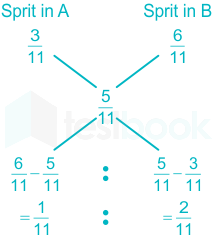
Given:

A and B contain spirit and water in the ratio 3 : 8 and 6 : 5 respectively

Calculation:

∴ Required ratio = (1/11) : (2/11) = 1 : 2

Alternate Method

Let the total quantity in A be 11x and in B be 11y, which is to be mixed

According to the question:

(3x + 6y)/(8x + 5y) = 5/6

⇒ 18x + 36y = 40x + 25y

⇒ 22x = 11y

⇒ x/y = 1/2

∴ They should be mixed in the ratio 1 : 2

42

A, B and C alone can complete a piece of work in 20 days, 30 days and 60 days respectively. They started the work together but A and B both left 5 days before the scheduled completion of the work. In how many days, C alone will complete the remaining work ?

  1. ((a))

    30

  2. ((b))

    20

  3. ((c))

    25

  4. ((d))

    32

Show Answer
Answer: ((a))

30

Given:

A can complete the work in 20 days

B can complete the work in 30 days

C can complete the work in 60 days

All 3 started working together and A and B left the work 5 days before the scheduled completion of the work

Formula used:

The efficiency of a person is inverse of the time taken

Calculation:

Per day efficiencies of A, B, and C respectively are 1/20, 1/30, 1/60

Per day efficiencies of all working together = 1/20 + 1/30 + 1/60 = 1/10

Hence, they can complete the work together in 10 days

A and B left 5 days before the completion of the work, which means half of the work remaining for C

C needs 60/2 days to complete it.

∴ C will take 30 days to complete the remaining work alone

43

What is the digit in the unit place of (24)21 - (46)24 + (23)4?

  1. ((a))

    6

  2. ((b))

    5

  3. ((c))

    9

  4. ((d))

    1

Show Answer
Answer: ((c))

9

Concept:

The unit digit of power of a number repeats itself every 4th time

Calculation:

2421 - 4624 + 234

⇒ (24)(5 × 4) + 1 - (46)(6 × 4) + (23)4

⇒ Unit digit will be determined by unit digit of (241 - 464 + 234

⇒ Unit digit of 241 = 4

⇒ Unit digit of 464 = 6

⇒ Unit digit of 234 = 1

Hence, unit digit will be (4 - 6 + 1) = - 1

Since unit digit can not be negative, we will add 10 to it because these numbers are in decimal form.

∴ Unit digit of (24)21 - (46)24 + (23)4 = - 1 + 10 = 9

44

By selling 12 articles a person loses the selling price of 3 articles. What is his loss percentage?

  1. ((a))

    503%\frac{50}{3} \%

  2. ((b))

    30%

  3. ((c))

    25%

  4. ((d))

    20%

Show Answer
Answer: ((d))

20%

Given:

When a person sells 12 articles, he incurs a loss equal to the selling price(SP) of 3 articles

Formula used:

Loss = CP - SP

Loss% = (Loss/CP) × 100

CP = Cost price

Calculation:

Let the SP of 1 article = s

Total SP = 12s

⇒ Loss = 3s

Let the CP of 1 article = c

Total CP = 12c

⇒ 3s = 12c - 12s

⇒ 5s = 4c

⇒ s/c = 4/5

⇒ For every 5 units of CP, the person loses 1 unit of CP

Loss% = (1/5) × 100 = 20

∴ Loss = 20%

45

A train travels at a speed of 75 km/h without a halt and at a speed of 66 km/h with a halt. How many minutes does the train stop on an average per hour?

  1. ((a))

    7.2

  2. ((b))

    5.8

  3. ((c))

    6.8

  4. ((d))

    6.2

Show Answer
Answer: ((a))

7.2

Given:

The train's speed is 75 km/h without a halt and 66 km/h with a halt

Formula used:

Speed = distance/time

Calculation:

Let the distance be 1650 km(LCM of 75 and 66)

Time without halt = 1650/75 = 22 hours

Time with halt = 1650/66 = 25 hours

Difference in time 3 hours = 180 minutes

∴ Average halt per hour = 180/25 = 7.2 min/hr

46

The value of a machine depreciates every year at the rate of 15% per annum. If the present price of the machine is ₹ 18,000, then what is the percentage decrease in its value at the end of 2 years?

  1. ((a))

    27.75%

  2. ((b))

    32.75%

  3. ((c))

    45%

  4. ((d))

    36.25%

Show Answer
Answer: ((a))

27.75%

Given:

The value of the machine depreciates at the rate of 15% per annum

Present value of the machine = Rs. 18000

Calculation:

The value of the machine after two years(V)= 18000(85/100)(85/100)

V = 18000(0.7225)

∴ Percentage decrease in its value after 2 years = (1 - 0.7225) × 100 = 27.75%

47

6 cubes, each of edge 2 cm are joined end to end to form a cuboid. What is percentage decrease in surface area? (correct to one decimal place)

  1. ((a))

    27.8%

  2. ((b))

    32.4%

  3. ((c))

    28.6%

  4. ((d))

    36.6%

Show Answer
Answer: ((a))

27.8%

Given:

6 cubes are joined edge to edge to form a cuboid

Length of the side of the cube = 2 cm

Formula used:

SA of a cube = 6a2

SA of a cuboid = 2(lb + bh + hl)

SA = Surface area

a = side of the cube

l = length of the cuboid; b = breadth of the cuboid; h = height of the cuboid

Calculation:

Let the side of the cube = a

SA of 8 cubes = 6 × 6a2 = 36a2

Length of the cuboid = 6a

Breadth of the cuboid = a

Height of the cuboid = a

SA of the cuboid = 2(6a2 + 6a2 + a2) = 26a2

Decrease in SA = 36a2 - 26a2 = 10a2

∴ % decrease in Surface Area = (10a2/36a2) × 100 = 27.8%

48

(1.98)3 + (0.02)3 + 1.98 × 0.12 is

equal to which of the following?

  1. ((a))

    4

  2. ((b))

    6

  3. ((c))

    8

  4. ((d))

    16

Show Answer
Answer: ((c))

8

Formula used:

(a + b)3 = a3 + b3 + 3ab(a + b)

Calculation:

(1.98)3 + (0.02)3 + 1.98 × 0.12

= (1.98)3 + (0.02)3 + 3(2)(1.98 × 0.02)

= (1.98)3 + (0.02)3 + 3(1.98 × 0.02)(1.98 + 0.02)

= (1.98 + 0.02)3 = 23

∴ (1.98)3 + (0.02)3 + 1.98 × 0.12 = 8

49

An article is sold at a certain price. Selling it at 5/7 of that price the seller gains 10%. What is his profit percentage on the original price?

  1. ((a))

    54%

  2. ((b))

    46%

  3. ((c))

    24%

  4. ((d))

    35%

Show Answer
Answer: ((a))

54%

Given:

By selling the article at 5/7 of the original selling price(SP), the seller gains 10%

Formula used:

Gain = SP - CP

Gain% = (Gain/CP) × 100

CP = Cost price

Calculation:

Let the original SP be x and CP of the article be y

⇒ 5x/7 is the new SP

Gain at new SP = 0.1y; (10% of CP)

⇒ 0.1y = 5x/7 - y

⇒ 1.1y = 5x/7

⇒ x/y = 77/50

⇒ SP/CP = 77/50

⇒ Gain when article will be sold at original SP = 77 - 50 = 27 units

Gain% = (27/50) × 100 = 54

∴ Profit when sold at original price = 54%

50

The greatest common factor of two numbers is 14 and their sum is 294. How many such pairs of numbers are possible?

  1. ((a))

    6

  2. ((b))

    9

  3. ((c))

    5

  4. ((d))

    2

Show Answer
Answer: ((a))

6

Given:

HCF of two numbers = 14

Sum of the numbers = 294

Concept:

Co prime numbers are those numbers that have only 1 as their common factor 

Calculation:

Since 14 is the HCF of the numbers

Hence, numbers can be written in the form of 14x and 14y; where x and y are natural numbers and co-prime to each other

⇒ 14x + 14y = 294

⇒ x + y = 21

The pairs possible following the condition of co-prime:

(1, 20), (2, 19), (4, 17), (5, 16), (8, 13), (10, 11)

∴ Total 6 such pairs are possible

51

What will be the value of 0.03+0.09+0.6230.0\overline{3} + 0.\overline{09} + 0.6 \overline{23}?

  1. ((a))

    0.740.\overline{74}

  2. ((b))

    0.7470.\overline{747}

  3. ((c))

    0.6740.6\overline{74}

  4. ((d))

    0.7040.7\overline{04}

Show Answer
Answer: ((a))

0.740.\overline{74}

Calculation:

Let x = 0.030.0\overline{3}

⇒ 10x = 0.30.\overline{3}     ----eq.1

⇒ 100x = 3.33.\overline{3}     ----eq.2

By subtracting eq.1 from eq.2:

90x = 3

⇒ x = 1/30

Let y = 0.090.\overline{09}     ----eq.3

⇒ 100y = 9.099.\overline{09}     ----eq.4

By subtracting eq.3 from eq.4:

99y = 9

⇒ y = 1/11

Let z = 0.6230.6 \overline{23}

⇒ 10z = 6.236. \overline{23}     ----eq.5

⇒ 1000z = 623.23623. \overline{23}     ----eq.6

By subtracting eq.5 from eq.6

990z = 617

⇒ z = 617/990

0.03+0.09+0.6230.0\overline{3} + 0.\overline{09} + 0.6 \overline{23} = x + y + z

= (1/30) + (1/11) + (617/990) = 74/99

∴ 0.03+0.09+0.6230.0\overline{3} + 0.\overline{09} + 0.6 \overline{23} = 0.740.\overline{74}

52

The average weight of 40 students and 2 teachers is 41 kg. The average weight is reduced by 1.5 kg when teachers are excluded. What is the average weight of the teachers?

  1. ((a))

    70

  2. ((b))

    71

  3. ((c))

    71.5

  4. ((d))

    69.5

Show Answer
Answer: ((b))

71

Given:

The average weight of 40 students and 2 teachers = 41 kg

Average weight decreases by 1.5 kg when teachers are excluded 

Formula used:

Average of n numbers = Sum of all the numbers/n

Calculation:

Total weight of students and teachers = 41 × 42 = 1722

Total weight when teachers are excluded = 40 × 39.5 = 1580

⇒ Total age of teachers = 1722 - 1580 = 142

⇒ Average age of teachers = 142/2 = 71 kg

53

If 12 men working 8 hours a day earn ₹1,03,680 in 24 days, then how much money will 16 men working 6 hours a day earn in 20 days?

  1. ((a))

    ₹ 90,240

  2. ((b))

    ₹ 86,400

  3. ((c))

    ₹ 80,640

  4. ((d))

    ₹ 92,160

Show Answer
Answer: ((b))

₹ 86,400

Given:

​12 men earn Rs. 103680 working 8 hours a day in 24 days

Formula used:

(m1 × d1 × h1)/w1 = (m2 × d2 × h2)/w2

m = number of men

d = number of days

h = number of hours

w = work

Calculation:

According to the question:

(12 × 24 × 8)/103680 = (16 × 20 × 6)/w2

⇒ 6/103680 = 5/w2

⇒ w2 = 86400

∴ 16 men working 6 hours a day for 20 days will earn Rs. 86400

54

The diagonal of a rectangle is 15√5 cm and its perimeter is 90 cm. How many square centimeters is the area of ​​the rectangle?

  1. ((a))

    281.25

  2. ((b))

    675

  3. ((c))

    562.5

  4. ((d))

    450

Show Answer
Answer: ((d))

450

Given:

Diagonal of the rectangle = 15√5 cm

Perimeter of the rectangle = 90 cm

Formula used:

Perimeter of a rectangle = 2(l + b)

Area of a rectangle = lb

Length of the diagonal of a rectangle = √l2 + b2

(x + y)2 = x2 + y2 + 2xy

Calculation:

90 = 2(l + b)

⇒ l + b = 45

√l2 + b2 = 15√5

⇒ l2 + b2 = 1125

(l + b)2 = l2 + b2 + 2lb

⇒ 452 = 1125 + 2lb

⇒ lb = 450

∴ Area of the rectangle = 450 cm2

55

A boat can go 30 km upstream and 50 km downstream in 8 hours. If the speed of the stream is 2.5 kmph, then what is the speed of the boat in still water in kmph?

  1. ((a))

    10

  2. ((b))

    12

  3. ((c))

    6

  4. ((d))

    8

Show Answer
Answer: ((a))

10

Given:

Speed of stream(w) = 2.5 kmph

The boat can travel 30 km upstream and 50 km downstream in total 8 hours

Formula used:

Speed = distance/time

Upstream speed = b - w

Downstream speed = b + w

b = speed of boat in still water

Calculation:

According to the question:

30/(b - 2.5) + 50/(b + 2.5) = 8     ----eq.1

⇒ 4b2 - 25 = 15b + 37.5 + 25b - 62.5

⇒ 4b2 = 40b

⇒ b = 10

∴ Speed of the boat in still water = 10 kmph

56

What is the sum of the digits of the least number that should be added to 94832 so that it becomes a perfect square?

  1. ((a))

    7

  2. ((b))

    5

  3. ((c))

    8

  4. ((d))

    6

Show Answer
Answer: ((b))

5

Calculation:

Given number = 94832

302 = 900; 312 = 961

⇒ 94832 is somewhere between 3002 and 3102

Checking for 3052 = 93025, started from 305 because 948 is in the second half between 900 and 961

Checking for 3062 = 93636

Checking for 3072 = 94249

Checking for 3082 = 94864

So, 94864 - 94832 = 32

Hence, 32 should be added to make it a perfect square.

∴ Sum of digits = 3 + 2 = 5

57

A sum of ₹ 35,040 is divided among A, B and C in such a way that 6 times A's share, 7 times B's share and 8 times C's share are equal. What is A's share?

  1. ((a))

    ₹ 12,480

  2. ((b))

    ₹ 13,440

  3. ((c))

    ₹ 11,520

  4. ((d))

    ₹ 10,080

Show Answer
Answer: ((b))

₹ 13,440

Given:

Rs. 35040 is divided among A, B and C

6A = 7B = 8C

Calculation:

6A = 7B = 8C

⇒ Divide all by 168(LCM of 6, 7, 8)

⇒ A/28 = B/24 = C/21

⇒ A : B : C = 28 : 24 : 21

A's share = 28 units out of total 28 + 24 + 21 = 73 units

∴ Share of A = (28/73) × 35040 = Rs. 13440

58

In an examination 72% of the students passed in Mathematics and 68% of the students passed in Science. 18% of the students failed in both the subjects, then how many students passed in both the subjects?

  1. ((a))

    42%

  2. ((b))

    64%

  3. ((c))

    48%

  4. ((d))

    58%

Show Answer
Answer: ((d))

58%

Given: 

Students passed in mathematics and science respectively = 72% and 68%

Students failed in both subjects = 18%

Formula used:

n(A ∪ B) = n(A) + n(B) - n(A ∩ B)

Calculation:

Let A be the students who passed in mathematics and B be the students who passed in science

n(A) = 72

n(B) = 68

Total students = 100%

n(A ∪ B) = 100 - 18 = 82%

n(A ∪ B) = n(A) + n(B) - n(A ∩ B)

⇒ 82 = 72 + 68 - n(A ∩ B)

⇒ n(A ∩ B) = 58%

∴ Students who passed in both subject = 58%

Alternate Method

By Venn diagram

M represents mathematics and S represents science

The following table gives the marks obtained by students in the given class intervals. Read the table and answer the questions.

Class Interval0-1010-2020-3030-4040-5050-6060-7070-80
No. of student2428364446X2010
59

If value of x is taken as 32 and the Pie-chart is drawn, what will be the central angle of the sector representing the median class ?

  1. ((a))

    64

  2. ((b))

    65

  3. ((c))

    66

  4. ((d))

    62

Show Answer
Answer: ((c))

66

Given:

Class Interval0-1010-2020-3030-4040-5050-6060-7070-80
No. of student2428364446X2010


x = 32

Concept:

The median of data is the centermost number of the data when arranged in ascending order

Calculation:

Total number of students = 24 + 28 + 36 + 44 + 46 + x (which is 32) + 20 + 10 = 240

Hence, the centermost number(marks) will be in 30-40 interval as it is having the 119th, 120th and 121st numbers when arranged in ascending order

The total measure of the angle of the pie chart = 360º

∴ Central angle of pie chart for 30-40 interval = (44/240) × 360 = 66º

60

If mean marks of the students is 37.64, what is the value of x ?

  1. ((a))

    42

  2. ((b))

    44

  3. ((c))

    45

  4. ((d))

    40

Show Answer
Answer: ((a))

42

Given:

Class Interval0-1010-2020-3030-4040-5050-6060-7070-80
No. of student2428364446X2010


Mean marks of the students = 37.64

Concept:

Mean is the average of a data

Calculation:

Total number of students = 24 + 28 + 36 + 44 + 46 + x + 20 + 10 = 208 + x

We have to take middle number of an interval to calculate total of that interval.

Total marks = (24 × 5) + (28 × 15) + (36 × 25) + (44 × 35) + (46 × 45) + (x × 55) + (20 × 65) + (10 × 75) = 7100 + 55x

Mean = (7100 + 55x)/(208 + x)

⇒ 37.64(208 + x) = 7100 + 55x

⇒ 7829.12 + 37.64x = 7100 + 55x

⇒ 17.36x = 729.12

∴ x = 42

General Hindi (20 questions)

नीचे दिये गए गद्यांश को पढ़कर पूछे गये प्रश्नों के उत्तर दीजिए।

छायावादी काल में ऐतिहासिक नाटक लिखने की धूम रही। जयशंकर प्रसाद के अतिरिक्त हरिकृष्ण प्रेमी, गोविंद बल्लभ पंत, सेठ गोविंद दास आदि ने ऐतिहासिक नाटक लिखे। 'उग्र' ने महात्मा ईसा नामक साहसपूर्ण नाटक लिखा। सामाजिक समस्याओं पर नाटक लिखने वालों में लक्ष्मीनारायण मिश्र, उपेंद्रनाथ अश्क तथा भुवनेश्वर प्रमुख हैं। डॉ. रामकुमार वर्मा ने ऐतिहासिक और सामाजिक दोनों प्रकार के नाटक लिखे। इसी समय एकांकियों का भी प्रचलन हुआ और रेडियो नाटक का भी। प्रसाद जी के नाटकों का क्षेत्र प्राचीन हिन्दूकाल है और प्रेमी जी का मुस्लिमकाल।

61

प्रसाद जी के नाटकों का क्षेत्र ____ काल है।

  1. ((a))

    वर्तमान

  2. ((b))

    प्राचीन हिन्‍दू

  3. ((c))

    अँग्रेजी

  4. ((d))

    मुस्लिम

Show Answer
Answer: ((b))

प्राचीन हिन्‍दू

उपर्युक्त विकल्पों में से विकल्प "प्राचीन हिन्दू" सही है तथा अन्य विकल्प असंगत है।

Key Points

  • उपर्युक्त गद्यांश के अनुसार प्रसाद जी के नाटकों का क्षेत्र प्राचीन हिंदू काल है।
  • गद्यांश से
  • "प्रसाद जी के नाटकों का क्षेत्र प्राची हिंदू काल है और प्रेमी जी का मुस्लिम काल है।"

Additional Information

  • प्राचीन
  • विशेषण
  • पुराना।
  • पूरब का।
  • प्राचीन का समानार्थी शब्द
  • पुरातन, पुराना।
  • प्राचीन का विलोम
  • नवीन
62

निम्‍न में से कौन सामाजिक नाटक लिखने वालों में प्रमुख है?

  1. ((a))

    सेठ गोविन्द दास

  2. ((b))

    उपेद्रनाथ अश्क

  3. ((c))

    गोविन्द वल्लभ पंत

  4. ((d))

    हरिकृष्ण प्रेमी

Show Answer
Answer: ((b))

उपेद्रनाथ अश्क

उपर्युक्त विकल्पों में से विकल्प "उपेन्द्रनाथ अश्क़" सही है तथा अन्य विकल्प असंगत है।

Key Points

  • उपर्युक्त गद्यांश के अनुसार उपेंद्रनाथ अश्क सामाजिक नाटक लिखने वालों में प्रमुख हैं।
  • गद्यांश से
  • "सामाजिक समस्याओं पर नाटक लिखने वालों में लक्ष्मी नारायण मिश्र, उपेंद्रनाथ अश्क तथा भुवनेश्वर प्रमुख हैं।"

Additional Information

  • सामाजिक
  • विशेषण
  • समाज का
  • समाज से संबंधित।
  • सामाजिक
  • समाज + इक (प्रत्यय)
63

छायावादी काल में कैसे नाटकों की प्रधानता रही?

  1. ((a))

    ऐतिहासिक

  2. ((b))

    राजनीतिक

  3. ((c))

    काल्पनिक

  4. ((d))

    सामाजिक

Show Answer
Answer: ((a))

ऐतिहासिक

उपर्युक्त विकल्पों में से विकल्प "ऐतिहासिक" सही है तथा अन्य विकल्प असंगत है।

Key Points

  • उपर्युक्त गद्यांश के अनुसार छायावादी काल में ऐतिहासिक नाटकों की प्रधानता रही।
  • गद्यांश से
  • "छायावादी काल में ऐतिहासिक नाटक लिखने की धूम रही।"

Additional Information

  • छायावाद हिंदी साहित्य के रोमांटिक उत्थान की काव्य-धारा है।
  • मुकुटधर पाण्डेय ने श्री शारदा पत्रिका में एक निबंध प्रकाशित किया जिस निबंध में उन्होंने छायावाद शब्द का प्रथम प्रयोग किया।
  • कृति प्रेम, नारी प्रेम, मानवीकरण, सांस्कृतिक जागरण, कल्पना की प्रधानता आदि छायावादी काव्य की प्रमुख विशेषताएं हैं।
64

महात्‍मा ईसा नाटक किसने लिखा?

  1. ((a))

    हरिकृष्ण प्रेमी

  2. ((b))

    रामकुमार वर्मा

  3. ((c))

    जयशंकर प्रसाद

  4. ((d))

    उग्र

Show Answer
Answer: ((d))

उग्र

उपर्युक्त विकल्पों में से विकल्प "उग्र" सही है तथा अन्य विकल्प असंगत है।

Key Points

  • उपर्युक्त गद्यांश के अनुसार महात्मा ईसा नाटक "उग्र" ने लिखा है।
  • गद्यांश से
  • "उग्र ने महात्मा ऐसा नामक साहस पूर्ण नाटक लिखा है।"

Additional Information

  • "उग्र" का पूरा नाम पांडे बेचैन शर्मा उग्र है।
  • नाटक
  • पुल्लिंग
  • साहित्य
  • रंगमंच पर अभिनय की जा सकने योग्य रचना।
  • अभिनय, ड्रामा।
65

निम्न में से कौन ऐतिहासिक नाटक लिखने वालों में प्रमुख हैं?

  1. ((a))

    भुवनेश्वर

  2. ((b))

    उपेंद्रनाथ अश्क

  3. ((c))

    जयशंकर प्रसाद

  4. ((d))

    लक्ष्मीनारायण मिश्र

Show Answer
Answer: ((c))

जयशंकर प्रसाद

उपर्युक्त विकल्पों में से विकल्प "जयशंकर प्रसाद" सही है तथा अन्य विकल्प असंगत है।

Key Points

  • ऐतिहासिक नाटक लिखने वालों में प्रमुख जयशंकर प्रसाद हैं।
  • "जयशंकर प्रसाद के अतिरिक्त हरि कृष्ण प्रेमी गोविंद बल्लभ पंत सेठ गोविंद दास आदि ने ऐतिहासिक नाटक लिखे हैं।"

Additional Information

  • ऐतिहासिक
  • विशेषण
  • इतिहास से संबंध रखनेवाला।
  • ऐतिहासिक
  • इतिहास + इक (प्रत्यय)
66

सीधा किस प्रकार का विशेषण है ?

  1. ((a))

    सार्वनामिक

  2. ((b))

    परिमाण वाचक

  3. ((c))

    गुणवाचक

  4. ((d))

    संख्यावाचक

Show Answer
Answer: ((c))

गुणवाचक

इसका सही उत्तर विकल्प 3 ‘गुणवाचक विशेषण’ होगा। अन्य विकल्प सही उत्तर नहीं हैं।

Key Points

  • ' सीधा’ शब्द ‘गुणवाचक विशेषण’ है।
विशेषणपरिभाषाउदाहरण
गुणवाचक विशेषणवे शब्द जो संज्ञा या सर्वनाम के गुण, धर्म, स्वाभाव आदि का बोध कराये।बलशाली, पुराण, नया, मोटा, दुर्बल, पठारी आदि।
<br>

अन्य विकल्प:

विशेषणपरिभाषाउदाहरण
संख्यावाचक विशेषणऐसे शब्द जो संज्ञा या सर्वनाम की संख्या का बोध कराते हैं।दो, तीनों, चार गुना, प्रत्येक आदि।
परिमाणवाचक विशेषणऐसे शब्द जो संज्ञा या सर्वनाम की मात्रा का बोध कराते हैं।चार किलो, एक मीटर, दो लीटर, थोड़ा, बहुत आदि।
सार्वनामिक विशेषणवे सर्वनाम शब्द जो संज्ञा से पहले आयें और विशेषण की तरह उस संज्ञा शब्द की विशेषता बताएं।यह लड़की वही है जिसने मेरा पेन लिया था।
व्यक्तिवाचक विशेषणऐसे शब्द जो संज्ञा के भेद व्यक्तिवाचक संज्ञा से बने होते हैं एवं विशेषण शब्दों की रचना करते हैं।मुझे भारतीय खाना बहुत पसंद है।

Additional Information 

विशेषण जो शब्द संज्ञा या सर्वनाम शब्दों की विशेषता बताते हैं। उन्हें विशेषण कहा जाता है। विशेषण  के मुख्यतः आठ भेद हैं –
विशेषणपरिभाषाउदाहरण
गुणवाचक विशेषणवे शब्द जो संज्ञा या सर्वनाम के गुण, धर्म, स्वाभाव आदि का बोध कराये।बलशाली, पुराण, नया, तीक्ष्ण, कमजोर, मोटा, दुर्बल, पठारी आदि।
संख्यावाचक विशेषणऐसे शब्द जो संज्ञा या सर्वनाम की संख्या का बोध कराते हैं।दो, तीनों, चार गुना, प्रत्येक आदि।
परिमाणवाचक विशेषणऐसे शब्द जो संज्ञा या सर्वनाम की मात्रा का बोध कराते हैं।चार किलो, एक मीटर, दो लीटर, थोड़ा, बहुत आदि।
सार्वनामिक विशेषणवे सर्वनाम शब्द जो संज्ञा से पहले आयें और विशेषण की तरह उस संज्ञा शब्द की विशेषता बताएं।यह लड़की वही है जिसने मेरा पेन लिया था।
व्यक्तिवाचक विशेषणऐसे शब्द जो संज्ञा के भेद व्यक्तिवाचक संज्ञा से बने होते हैं एवं विशेषण शब्दों की रचना करते हैं।मुझे भारतीय खाना बहुत पसंद है।
प्रश्नवाचक विशेषणऐसे शब्द जिनका संज्ञा या सर्वनाम में जानने के लिए प्रयोग होता है।यह व्यक्ति कौन है ?
तुलनाबोधक विशेषणजब वस्तुओं के गुण - दोष की तुलना आपस में की जाये।वह राधा से भी ज्यादा सुरीला गाती है।
सम्बन्धवाचक विशेषणविशेषण शब्दों का प्रयोग करके किसी एक वस्तु या व्यक्ति का सम्बन्ध दूसरी वस्तु या व्यक्ति के साथ दर्शाया जाये।घर की बाहरी दीवार ख़राब हो रही है।
67

'आलसी' का विलोम क्‍या होगा ?

  1. ((a))

    श्रमिक

  2. ((b))

    भाग्यवादी

  3. ((c))

    लाचार

  4. ((d))

    कर्मठ

Show Answer
Answer: ((d))

कर्मठ

उपर्युक्त विकल्पों में 'कर्मठ' सही उत्तर है। अन्य सभी विकल्प सही उत्तर नही हैं।

Key Points

  • आलसी  शब्द का अर्थ है - निकम्मा और सुस्त।
  • कर्मठ शब्द का अर्थ है - जो बराबर और अच्छी तरह सब या बहुत काम करता रहता हो।

अन्य विकल्प  -

शब्दविलोम
श्रमिकमालिक
भाग्यवादीअभागवादी

Additional Information 

शब्दपरिभाषाउदाहरण
विलोम/विपरीतार्थकविपरीत (उल्टा) अर्थ बताने वाले शब्दों को विलोम शब्द कहते हैं।रात-दिन धरती-आकाश
68

निम्‍नलिखित में से कौन सा वाक्य शुद्ध है?

  1. ((a))

    शीघ्र चलो कि ट्रेन छूट जायेगी।

  2. ((b))

    आपने अच्छा किया कि मुझे सूचना दे दी।

  3. ((c))

    जहाँ मनुष्य विवश है उसी प्रकार असमर्थ भी है।

  4. ((d))

    बूढे क्‍या जवान, सब प्रसन्‍न हैं।

Show Answer
Answer: ((b))

आपने अच्छा किया कि मुझे सूचना दे दी।

उपर्युक्त विकल्पों में से विकल्प "आपने अच्छा किया कि मुझे सूचना दे दी।" सही है तथा अन्य विकल्प असंगत है।

Key Points

  • "आपने अच्छा किया कि मुझे सूचना दे दी।" वाक्य शुद्ध वाक्य है।
  • उपर्युक्त वाक्य मिश्र वाक्य है।
  • मिश्र वाक्य
  • ऐसे वाक्य जिनमें सरल वाक्य के साथ साथ कोई भी दूसरा उपवाक्य शामिल हो, उन वाक्य को मिश्र वाक्य कहा जाता है।
  • मिश्र वाक्य का निर्माण एक से अधिक साधारण वाक्य से होता है, जिनमें एक प्रधान वाक्य होता है और दूसरा वाक्य आश्रित होता है और इसी वजह से मिश्र वाक्य की पहचान भी होती है।

अन्‍य व‍िकल्‍प-

  • अशुद्ध वाक्‍य- शीघ्र चलो कि ट्रेन छूट जायेगी। (इस वाक्‍य में कि शब्‍द का प्रयोग सही नहीं क‍िया गया है।)
  • शुद्ध वाक्‍य- शीघ्र चलो अन्यथा ट्रेन छूट जाएगी।
  • अशुद्ध वाक्‍य- जहाँ मनुष्य विवश है उसी प्रकार असमर्थ भी है। वाक्‍य में अनावश्‍यक शब्‍द भी का प्रयोग क‍िया गया है।
  • शुद्ध वाक्‍य- जहॉं मनुष्‍य व‍िवश है उसी प्रकार असमर्थ है।
  • अशुद्ध वाक्‍य- बूढे क्‍या जवान, सब प्रसन्‍न हैं। वाक्‍य मे बूढे शब्‍द की वर्तनी में त्रुटि है।
  • शुद्ध वाक्‍य- बूढ़े क्‍या जवान, सब प्रसन्‍न हैं।


Additional Information

  • मिश्र वाक्य के निर्माण में प्रधान वाक्य और आश्रित उपवाक्य को जोड़ने के लिए बहुत सारे संयोजक अव्यय का प्रयोग होता है।
  • जैसे
  • आपस में, कि, जो, क्योंकि, जितना, उतना, जैसा, वैसा, जब, तब, जहाँ, वहाँ, जिधर, उधर, यद्यपि, यदि, अगर, तो इत्यादि।
69

निम्‍नलिखित में कौन - सा शब्द देशज है?

  1. ((a))

    जूता

  2. ((b))

    कैम्‍प

  3. ((c))

    आईना

  4. ((d))

    आदमी

Show Answer
Answer: ((a))

जूता

दिए गए विकल्पों में ‘जूता’ शब्द देशज है।

जूता का अर्थ है - पैरों की रक्षा के लिए कपड़े, चमड़े आदि का बना पैरों का पहनावा। अतिरिक्त विकल्पों के प्रकार भिन्न हैं।

Key Points

देशज शब्दऐसे शब्द जो देश की अन्य या क्षेत्रीय भाषा से हिंदी में सम्मिलित हुए ।जैसे – थैला, लोटा, टाँग, पगड़ी आदि।

अन्य विकल्प

कैम्‍पअंग्रेजी शब्द
आईनाफारसी शब्द
आदमीअरबी  शब्द

Additional Information 

शब्दपरिभाषाउदाहरण
तत्सम शब्दऐसे शब्द जिन्हें बिना किसी परिवर्तन के संस्कृत से हिन्दी में शामिल कर लिया गए हों।जैसे - आम्र, उष्ट्र, ऐश्वर्य, षष्ठी आदि।
तद्भव शब्दऐसे शब्द जो संस्कृत से हिंदी में आने पर उनका रूप बदल गया।जैसे - आग, खीर, छत आदि।
देशज शब्दऐसे शब्द जो देश की अन्य या क्षेत्रीय भाषा से हिंदी में सम्मिलित हुए ।जैसे – थैला, लोटा, टाँग, पगड़ी आदि।
विदेशज/ आगत/ विदेशी शब्दअन्य देश की भाषा से आये हुए शब्द जो हिंदी भाषा में सम्मिलित हुए। इन विदेशी भाषाओं में मुख्यतः अरबी, फारसी, तुर्की, उर्दू, अंग्रेजी व पुर्तगाली शामिल हैं।जैसे - अदालत, ऑफिसर, बुखार, हज़म आदि।
संकर शब्दहिंदी में वे शब्द जो अलग-अलग भाषाओं के शब्दों को मिलाकर बनाए गए हैं, संकर शब्द कहलाते हैं।जैसे - उप-बोली, भोजन-घर, छायादार, फलदार इत्यादि।
70

निम्‍न में से कौन सा शब्द 'नौका' का पर्यायवाची नहीं है?

  1. ((a))

    तरिणी

  2. ((b))

    तरी

  3. ((c))

    पतंग

  4. ((d))

    तनया

Show Answer
Answer: ((d))

तनया

दिए गए विकल्पों में सही उत्तर विकल्प 4 ‘तनया’ होगा। अन्य विकल्प इसके असंगत उत्तर होंगे। 

Key Points 

  • दिए गए विकल्पों में 'तनया' शब्द 'नौका' का उचित पर्यायवाची शब्द नहीं है।
  • नौका के अन्य पर्यायवाची शब्द हैं - नाव, तरिणी, जलयान, जलपात्र, तरी, बेड़ा, डोंगी, तरी, पतंग
  • तनया शब्द के पर्यायवाची शब्द हैं - लड़की, नन्दिनी, दुहिता, कन्या, पुत्री, बेटी, आत्मजा, तनुजा, सुता।

Additional Information

शब्दपरिभाषाउदाहरण
पर्यायवाची/ समानार्थीएक ही अर्थ में प्रयुक्त होने वाले शब्द जो बनावट में भले ही अलग हों, पर्यायवाची या समानार्थी शब्द कहलाते हैं।आग-अनल, पावक, दहन। हवा-समीर, अनिल, वायु।
71

निम्नलिखित में से कौन सा शब्द स्‍त्रीलिंग है?

  1. ((a))

    सन्‍तुलन

  2. ((b))

    संसद

  3. ((c))

    सन्‍दूक

  4. ((d))

    सन्‍देह

Show Answer
Answer: ((b))

संसद

'संसद' शब्द स्त्रीलिंग है। 

जैसे- संसद हमारे देश की प्राचीन धरोहर है।

Key Points

अन्य विकल्प 

  • संतुलन, सन्दूक और संदेह शब्द पुल्लिंग के उदाहरण है।

Additional Information

लिंग- संज्ञा के जिस रूप से व्यक्ति, वस्तु, की नर या मादा रूप में पहचान हो वह लिंग कहलाता है। जैसे- लड़का, लड़की आदि। लिंग दो प्रकार के होते हैं- स्त्रीलिंग और पुल्लिंग, परंतु संस्कृत में तीसरे प्रकार का भी लिंग होता है- नपुंसक लिंग।
लिंग के भेदपरिभाषाउदाहरण
स्त्रीलिंगजिन शब्दों से स्त्री जाति का बोध हो उसे स्त्रीलिंग कहते हैं।नदी, माता, लड़की
पुल्लिंगजिन शब्दों से पुरुष जाति का बोध हो उसे पुल्लिंग कहते हैं।पिता, राजा, घोड़ा
72

'प्रत्‍यक्ष' में कौन सा समास है?

  1. ((a))

    द्वंद्व

  2. ((b))

    तत्‍पुरूष

  3. ((c))

    अव्‍ययीभाव

  4. ((d))

    द्विगु

Show Answer
Answer: ((c))

अव्‍ययीभाव

दिए गए विकल्पों में से ‘प्रत्यक्ष’ में ‘अव्ययीभाव समास’ होगा। अन्य विकल्प अनुचित उत्तर हैं। 

Key Points

स्पष्टीकरण: 

‘प्रत्यक्ष’ अर्थात आँखों के सामने। यहाँ अव्ययीभाव समास है।  

अव्ययीभाव समासजिसका पहला पद अव्यय होता है और उसका अर्थ प्रधान होता है। (उसमें कोई परिवर्तन नहीं किया जा सकता)यथाशक्ति - शक्ति के अनुसार

Additional Information

अन्य विकल्प:

तत्पुरुष समासजिस समास में प्रथम पद गौण और उत्तर पद की प्रधानता होती है और समास करते वक्त बीच की विभक्ति का लोप हो जाता है।विद्यालय - विद्या का आलय राजदूत - राजा का दूत
द्वंद्व समासजिस समास में दोनों पद प्रधान हों तथा विग्रह करने पर उनके बीच ‘तथा’, ‘या’, ‘अथवा’, ‘एवं’, ‘और’ का प्रयोग होता है ।पाप-पुण्य- पाप और पुण्य
द्विगु समासजिस समास में पूर्वपद (पहला पद) संख्यावाचक विशेषण हो।दो पहरों का समूह = दोपहर, तीनों लोकों का समाहार = त्रिलोक।
73

दिए गए शब्द में उपसर्ग ज्ञात कीजिए।

सन्मुख

  1. ((a))

  2. ((b))

    सम्

  3. ((c))

  4. ((d))

    मुख

Show Answer
Answer: ((b))

सम्

सही उत्तर  विकल्प 2 ‘सम्’ है।

Key Points

  • सन्मुख में 'सम्' उपसर्ग का प्रयोग होता है।
  • सम् + मुख = सन्मुख
  • ‘सम’ उपसर्ग से बनने वाले अन्य शब्द -  संभव, संतोष, संस्कार आदि।
  • ‘सम’ का अर्थ – उत्तम, पूर्ण, साथ
शब्दपरिभाषाउदाहरण
उपसर्गऐसे शब्दांश जो किसी शब्द के पूर्व जुड़कर उसके अर्थ में परिवर्तन कर देते हैं।प्रति + क्षण = प्रतिक्षण सम् + गम = संगम
74

'उन्मत्त' का संधि विच्छेद ______ होगा।

  1. ((a))

    उत् + मत

  2. ((b))

    उत् + मत्त

  3. ((c))

    उन् + मत्त

  4. ((d))

    उन + मत

Show Answer
Answer: ((b))

उत् + मत्त

उन्मत्त' का संधि विच्छेद 'उत् + मत्त' होता है।

Key Points

  • उन्मत्त' का संधि विच्छेद 'उत् + मत्त' होगा।
  • दो व्यंजनों अथवा व्यंजन-स्वर के परस्पर मिलने से व्यंजन संधि होती है।
  • व्यंजन ध्वनि के निकट स्वर या व्यंजन आने से व्यंजन में जो परिवर्तन होता है, उसे व्यंजन संधि कहते हैं।
  • उदाहरण–
  • उत् + नति = उन्नति

Additional Information

संधि - दो शब्दों के मेल से जो विकार (परिवर्तन) होता है उसे संधि कहते हैं। संधि के तीन प्रकार हैं - 1. स्वर, 2. व्यंजन और 3. विसर्ग,
संधिपरिभाषाउदाहरण
स्वरस्वर वर्ण के साथ स्वर वर्ण के मेल से विकार उत्पन्न होता है।विद्या + अर्थी = विद्यार्थी महा + ईश = महेश
व्यंजनएक व्यंजन से दूसरे व्यंजन या स्वर के मेल से विकार उत्पन्न होता है।अहम् + कार = अहंकार उत् + लास = उल्लास
विसर्गविसर्ग के साथ स्वर या व्यंजन के मेल से विकार उत्पन्न होता है।दुः + आत्मा = दुरात्मा निः + कपट = निष्कपट
75

'आसीन' में प्रत्यय क्या है?

  1. ((a))

    सीन

  2. ((b))

  3. ((c))

    ईन

  4. ((d))

Show Answer
Answer: ((c))

ईन

दिए गए विकल्पों में सही उत्तर विकल्प 3 ‘ईन’ है। अन्य विकल्प इसके अनुचित उत्तर हैं।

Key Points

  • आसीन अर्थात पद पर बैठा हुआ।
  • यह भाववाचक तद्धित प्रत्यय का उदाहरण है।
  • संज्ञा के अंत आ, आयंध, आई, आन, आयत, आरा, आवट, ई, एरा, औती, त, ती, पन, पा, स इत्यादि तद्धित प्रत्यय लगाकर भाववाचक तद्धितांत संज्ञाएं बनाई जाती हैं।

Additional Information

परिभाषाउदाहरण
प्रत्ययप्रत्यय किसी भी सार्थक मूल शब्द के पश्चात् जोड़े जाने वाले वे अविकारी शब्दांश हैं, जो शब्द के अन्त में जुड़कर उसके अर्थ में या भाव में परिवर्तन कर देते हैंपढ़ + आई = पढ़ाई, सुंदर + ता = सुंदरता
76

निम्‍न में से 'जो कुछ न जानता हो' के लिए एक शब्‍द कौन सा होगा ?

  1. ((a))

    सर्वज्ञ

  2. ((b))

    भिज्ञ

  3. ((c))

    अज्ञ

  4. ((d))

    विज्ञ

Show Answer
Answer: ((c))

अज्ञ

दिए गए विकल्पों में से सही उत्तर विकल्प 3 ‘अज्ञ’ है। अन्य विकल्प इसके गलत उत्तर हैं।

Key Points 

‘जो कुछ न जानता हो’ को 'अज्ञ' कहा जाता है।

अन्य विकल्प:​

वाक्यांशएक शब्द
जो सब कुछ जानता होसर्वज्ञ
पढ़ा - लिखा समझदारविज्ञ

Additional Information 

वाक्यांशभाषा को सुंदर, आकर्षक और प्रभावशाली बनाने के लिए अनेक शब्दों के स्थान पर एक शब्द का प्रयोग किया जाता है तो वह वाक्यांश के लिए एक शब्द कहलाता है।
77

निम्नलिखित में वर्तनी की दृष्टि से शुद्ध शब्द कौन सा है?

  1. ((a))

    द्रविभुत

  2. ((b))

    द्रवीभूत

  3. ((c))

    द्रवीभुत

  4. ((d))

    द्रविभूत

Show Answer
Answer: ((b))

द्रवीभूत

दिए गए विकल्पों में ‘द्रवीभूत’ शब्द की वर्तनी शुद्ध है। अत: सही विकल्प 2 ‘द्रवीभूत’ है। अन्य सभी शब्दों की वर्तनी त्रुटि पूर्ण हैं।                 

Key Points 

  • ‘द्रवीभूत’ का अर्थ ‘पिघला हुआ, द्रव रूप में आया हुआ, तरलित' होता है।

Additional Information 

वर्तनी- लिखने की रीति को वर्तनी कहते हैं। ‘वर्तनी’ शब्द का अर्थ उच्चारित होने वाले शब्द के लेखन  में प्रयोग होने वाले लिपि चिह्नों के व्यवस्थित रूप को वर्तनी कहा जाता है।
78

निम्‍नलिखित में तद्भव शब्द कौन सा है?

  1. ((a))

    षष्‍ठ

  2. ((b))

    छत्र

  3. ((c))

    छाता

  4. ((d))

    छाया

Show Answer
Answer: ((c))

छाता

दिए गए विकल्पों में सही उत्तर विकल्प 3 ‘छाता’ है। अन्य विकल्प अनुचित उत्तर होंगे।

Key Points

स्पष्टीकरण: 

उपर्युक्त शब्दों में ‘छाता’ तद्भव शब्द है। इसलिए ‘छाता’ इसका सही उत्तर है। इसका तत्सम शब्द ‘छत्र’ होगा। अन्य विकल्प इसके असंगत उत्तर हैं।

छाता - वर्षा या धूप से बचने के लिए कपड़े आदि का बना हुआ एक आच्छादन। 

अन्य विकल्प:

तत्समतद्भव
षष्ठछठा
छत्रछाता
छायाछाँह

Additional Information

विशेष:

शब्दपरिभाषाउदाहरण
तत्समऐसे शब्द जो संस्कृत से ज्यों के त्यों लिए गए, तत्सम होते हैं।कूप, उष्ट्र, पंचम आदि
तद्भवसंस्कृत से हिंदी में आने पर जिन शब्दों का रूप बदल गया हो, तद्भव कहलाते हैं।आग, काम, पाँच आदि
79

'बहव' किस प्रकार की संज्ञा है?

  1. ((a))

    पदार्थवाचक

  2. ((b))

    व्‍यक्तिवाचक

  3. ((c))

    जातिवाचक

  4. ((d))

    भाववाचक

Show Answer
Answer: ((d))

भाववाचक

दिए गए विकल्पों में से ​'भाववाचक' संज्ञा सही उत्तर है। अन्य विकल्प असंगत है।

Key Points 

  • जिस वाक्य में किसी धातु, द्रव या पदार्थ को छू नहीं सकते हैं; केवल अनुभव कर सकते हैं। वे वाक्य भाववाचक संज्ञा के अंतर्गत आते हैं।
  • दोस्ती शब्द से दोस्त होने के भाव का बोध हो रहा है। अतः दोस्ती एक भाववाचक संज्ञा है।
भाववाचक संज्ञाजो शब्द किसी चीज़ या पदार्थ की अवस्था, दशा या भाव का बोध कराते हैं, उन शब्दों को भाववाचक संज्ञा कहते हैं। जैसे- बचपन, बुढ़ापा, मोटापा, मिठास आदि।

Important Points

संज्ञापरिभाषाउदाहरण
द्रव्यवाचक संज्ञाजो शब्द किसी धातु या द्रव्य का बोध करते हैं, द्रव्यवाचक संज्ञा कहलाते हैं।जैसे- कोयला, पानी, तेल, घी आदि।
समुदायवाचक संज्ञाजिन संज्ञा शब्दों से किसी भी व्यक्ति या वस्तु के समूह का बोध होता है, उन शब्दों को समूहवाचक या समुदायवाचक संज्ञा कहते हैं।जैसे- भीड़, पुस्तकालय, झुंड, सेना आदि।
व्यक्तिवाचक संज्ञाजो शब्द केवल एक व्यक्ति, वस्तु या स्थान का बोध कराते हैं उन शब्दों को व्यक्तिवाचक संज्ञा कहते हैं।जैसे- भारत, चीन (स्थान), किताब, साइकिल (वस्तु), सुरेश,रमेश,महात्मा गाँधी (व्यक्ति) आदि।


Additional Information

संज्ञाकिसी जाति, द्रव्य, गुण, भाव, व्यक्ति, स्थान और क्रिया आदि के नाम को संज���ञा कहते हैं। जैसे - पशु (जाति), सुंदरता (गुण), व्यथा (भाव), मोहन (व्यक्ति), दिल्ली (स्थान), मारना (क्रिया)।
80

निम्नलिखित में तत्सम शब्द कौन सा है?

  1. ((a))

    दीपक

  2. ((b))

    दाहिना

  3. ((c))

    दामाद

  4. ((d))

    दीवाली

Show Answer
Answer: ((a))

दीपक

दिए गए विकल्पों में सही उत्तर विकल्प 1 'दीपक’  होगा। अन्य विकल्प इसके अनुचित उत्तर हैं। 

Key Points 

  • दिए गए शब्दों में 'दीपक' शब्द तत्सम है जिसका तद्भव रूप 'दीया' होगा।
  • ऐसे शब्द जो संस्कृत से ज्यों के त्यों लिए गए, तत्सम होते हैं।
  • अन्य सभी शब्द तद्भव हैं।

अन्य विकल्प: 

तद्भवतत्सम
दाहिनादक्षिण
दामादजामाता
दीवालीदीपावली

Additional Information 

तत्समऐसे शब्द जो संस्कृत से ज्यों के त्यों लिए गए, तत्सम होते हैं।कूप, उष्ट्र, पंचम आदि
अर्द्ध तत्समऐसे शब्द जो संस्कृत से थोड़ा परिवर्तित होकर हिंदी में आए हैं।कार्य से कारज, धैर्य से धीरज आदि
तद्भवसंस्कृत से हिंदी में आने पर जिन शब्दों का रूप बदल गया हो, तद्भव कहलाते हैं।आग, काम, पाँच आदि

General English (20 questions)

81

Fill in the blank

The man at your local coffee shop has never left the country but speaks as though he has lived in London all his life! His British accent is an _____.

  1. ((a))

    abrasion

  2. ((b))

    affirmation

  3. ((c))

    affectation

  4. ((d))

    accumulation

Show Answer
Answer: ((c))

affectation

The correct answer is 'affectation'.

Key Points

  • Affectation: behavior, speech, or writing that is artificial and designed to impress.
  • Example: It is the affectation of a man who measures every word for effect.
  • Thus, from above, we can conclude that 'affectation' will be used in the blank.

Therefore, the correct sentence is: The man at your local coffee shop has never left the country but speaks as though he has lived in London all his life! His British accent is an affectation. 

Additional Information

  • Let's explore other options:
  • abrasion: the process of scraping or wearing something away.
  • Example: The metal is resistant to abrasion.
  • affirmation: the action or process of affirming something or being affirmed.
  • Example: He nodded in affirmation.
  • accumulation: the acquisition or gradual gathering of something.
  • Example: The accumulation of wealth.
82

Fill in the blank.

You might ____________  your ability to sing well to the thousands of rupees your parents spent for music lessons.

  1. ((a))

    impute

  2. ((b))

    incorporate

  3. ((c))

    utilise

  4. ((d))

    propagate

Show Answer
Answer: ((a))

impute

The correct answer is 'impute'.

Key Points

  • impute: to credit or ascribe (something) to a person or a cause.
  • Example: I impute your success to nepotism.
  • Thus, from above, we can conclude that 'impute' will be used in the blank.

Therefore, the correct sentence is: You might impute your ability to sing well to the thousands of rupees your parents spent for music lessons.

Additional Information 

  • Let's explore other options:
  • incorporate: take in or contain (something) as part of a whole; include.
  • Example: He has incorporated in his proposals a number of measures.
  • utilise: make practical and effective use of.
  • Example: Vitamin C helps your body utilise the iron present in your diet
  • propagate: spread and promote (an idea, theory, etc.) widely.
  • Example: The government have tried to propagate the belief that this is a just war.
83

What is the ANTONYM of Strait ?

  1. ((a))

    Wide

  2. ((b))

    Situation

  3. ((c))

    Pass

  4. ((d))

    Narrow

Show Answer
Answer: ((a))

Wide

The correct answer is 'Wide'.

Key Points

  • Strait: (of a place) of limited spatial capacity; narrow or cramped.
  • Example: The road was so strait that a handful of men might have defended it.
  • Wide: of great or more than average width.
  • Example: It is a wide road
  • Thus, from above we can conclude that the correct answer is option 1.

Additional Information  

  • Let's explore the options:
  • Situation: a set of circumstances in which one finds oneself; a state of affairs.
  • Pass: move or cause to move in a specified direction.
  • Narrow: limited in extent, amount, or scope; restricted.
84

What is the ANTONYM of Moot?

  1. ((a))

    Incontestable

  2. ((b))

    Controversial

  3. ((c))

    Irrelevant

  4. ((d))

    Unsettled

Show Answer
Answer: ((a))

Incontestable

The correct answer is 'Incontestable'.

Key Points

  • Moot: subject to debate, dispute, or uncertainty.
  • Example: Whether they had been successful or not was a moot point.
  • Incontestable: not able to be disputed.
  • Example: But there are companies that issue policies incontestable after the date of issue.
  • Thus, from above we can conclude that the correct answer is option 1.

Additional Information 

  • Let's explore the options:
  • Controversial: giving rise or likely to give rise to public disagreement.
  • Irrelevant: not connected with or relevant to something.
  • Unsettled: liable to change; unpredictable.
85

What is the SYNONYM of Metaphysics?

  1. ((a))

    Disbelief

  2. ((b))

    Scepticism

  3. ((c))

    Pluralism

  4. ((d))

    Ontology

Show Answer
Answer: ((d))

Ontology

The correct answer is 'Ontology'.

Key Points

  • Metaphysics: the branch of philosophy that deals with the first principles of things, including abstract concepts such as being, knowing, substance, cause, identity, time, and space.
  • Example: They would regard the question of the initial conditions for the universe as belonging to the realm of metaphysics or religion.
  • Ontology: the branch of metaphysics dealing with the nature of being.
  • Example: What's new about our ontology is that it is created automatically from large datasets.
  • Thus, from above we can conclude that the correct answer is option 4.

Additional Information 

  • Let's explore the options:
  • Disbelief: inability or refusal to accept that something is true or real.
  • Scepticism: a skeptical attitude; doubt as to the truth of something.
  • Pluralism: a condition or system in which two or more states, groups, principles, sources of authority, etc., coexist.
86

What is the ANTONYM of Probate?

  1. ((a))

    Validate

  2. ((b))

    Formalise

  3. ((c))

    Contradict

  4. ((d))

    Corroborate

Show Answer
Answer: ((c))

Contradict

The correct answer is 'Contradict'.

Key Points

  • Probate:  establish the validity of.
  • Example: the house has been valued for probate.
  • Contradict: deny the truth of (a statement) by asserting the opposite.
  • Example: the survey appears to contradict the industry's claims.
  • Thus, from above we can conclude that the correct answer is option 1.

Additional Information 

  • Let's explore the options:
  • Validate: check or prove the validity or accuracy of (something).
  • Formalise: give (something) legal or formal status.
  • Corroborate: confirm or give support to (a statement, theory, or finding).
87

Fill in the blank.

If an employee strays from procedure for his own interests, his superiors may______ him from his position.

  1. ((a))

    diverge

  2. ((b))

    debilitate

  3. ((c))

    dither

  4. ((d))

    divest

Show Answer
Answer: ((d))

divest

The correct answer is 'divest'.

Key Points

  • divest : deprive (someone) of power, rights, or possessions.
  • Example: Men are unlikely to be divested of power without a struggle
  • Thus, from above, we can conclude that 'divest' will be used in the blank.

Therefore, the correct sentence is: If an employee strays from procedure for his own interests, his superiors may divest him from his position.

Additional Information  

  • Let's explore other options:
  • debilitate: make (someone) weak and infirm.
  • Example: Chemotherapy exhausted and debilitated him.
  • diverge: (of a road, route, or line) separate from another route, especially a main one, and go in a different direction.
  • Example: They walked along the road together until they reached the village, but then their paths diverged.
  • dither: be indecisive.
  • Example: Stop dithering and choose which one you want!
88

What does the colour ‘Sable’ indicate ?

  1. ((a))

    Beige

  2. ((b))

    Black

  3. ((c))

    Violet

  4. ((d))

    Blue

Show Answer
Answer: ((b))

Black

The correct answer is 'Black'.

Key Points

  • Sable: a dark brown or black colour.
  • Example: The usual colours range from light grey through intermediate shadings to sable and black.
  • Thus, from above we can conclude that the correct answer is option 2.
89

Sharma said that the turbidity in the segments of the river in India could be because of construction debris flowing downstream.

What does the word turbidity mean in the above sentence?

  1. ((a))

    Murkiness

  2. ((b))

    Instability

  3. ((c))

    Directionless

  4. ((d))

    Nippiness

Show Answer
Answer: ((a))

Murkiness

The correct answer is 'Murkiness'.

Key Points 

  • Turbidity: the quality of being cloudy, opaque, or thick with suspended matter.
  • Example: The water is clouded by turbidity.
  • Murkiness: dark and dirty or difficult to see through.
  • Example: The river was brown and murky after the storm.
  • Thus, from above we can conclude that the correct answer is option 1.

Additional Information 

  • Let's explore the options:
  • Instability: lack of stability; the state of being unstable.
  • Directionless: lacking in general aim or purpose.
  • Nippiness: able to move quickly; nimble.
90

Identify the sentence that is set a third person plural form.

  1. ((a))

    Krishna knew Draupadi was in trouble

  2. ((b))

    "I am leaving!" she yelled

  3. ((c))

    Radha watched a movie last night.

  4. ((d))

    They were very tired

Show Answer
Answer: ((d))

They were very tired

The correct answer is 'They were very tired'.

Key Points

  • Third Person: the form of a verb or pronoun that is used about another person you are speaking about or writing about.
  • Let's explore options:
  • The sentence in option 1 has the third person singular form, as the person is talking about another person.
  • The sentence in option 2 has the first person singular form it means the form of a verb or pronoun that is used when people are speaking or writing about themselves.
  • The sentence in option 3 has the first person singular form it means the form of a verb or pronoun that is used when people are speaking or writing about themselves and is in simple past tense.
  • The sentence in option 4 has the third person plural form as the plural pronoun and verb i.e. 'they' and 'were' is used in the sentence.
  • Thus, from above, we can conclude that the correct answer is option 4.
91

What is the SYNONYM of Tenure?

  1. ((a))

    Wane

  2. ((b))

    Relegate

  3. ((c))

    Delegate

  4. ((d))

    Incumbency

Show Answer
Answer: ((d))

Incumbency

The correct answer is 'Incumbency'.

Key Points

  • Tenure: the holding of an office.
  • Example: His tenure of the premiership would be threatened.
  • Incumbency: the holding of an office or the period during which one is held.
  • Example: During his incumbency, he established an epidemic warning system.
  • Thus, from above we can conclude that the correct answer is option 4.

Additional Information 

  • Let's explore the options:
  • Wane: (of a state or feeling) decrease in vigour or extent; become weaker.
  • Relegate: assign an inferior rank or position to.
  • Delegate: a person sent or authorized to represent others, in particular an elected representative sent to a conference.
92

Choose the correct sentence.

  1. ((a))

    The car an truck is in the backyard.

  2. ((b))

    This sentence is incorrect.

  3. ((c))

    We are going to there house.

  4. ((d))

    The work have to be done by Monday.

Show Answer
Answer: ((b))

This sentence is incorrect.

The correct answer is 'This sentence is incorrect'.

Key Points

  • Let's explore options:
  • In option 1, Two nouns are connected with an article 'an' which is incorrect.
  • Option 2 is grammatically and contextually correct as the subject of the sentence is singular and the verb is also singular.
  • In option 3, 'there' needs to be replaced with 'their', because 'there' means in, at, or to that place or position.whereas 'their' means  belonging to or associated with the people or things previously mentioned or easily identified.
  • In option 4, 'have' needs to be replaced with 'has' because the subject of the sentence is singular, i.e. 'work' and will require a singular verb.
  • Thus, from above, we can conclude that the correct answer is option 2.
93

Choose the correct sentence.

  1. ((a))

    We are learning English.

  2. ((b))

    I have too cats

  3. ((c))

    I went now

  4. ((d))

    You chair is brown

Show Answer
Answer: ((a))

We are learning English.

The correct answer is 'We are learning English.'

Key Points

  • Let's explore options:
  • Option 1 is grammatically and contextually correct. The subject of the sentence, i.e. 'we' is plural and a plural verb is used with it.
  • In option 2, 'too' needs to be replaced with 'two', 'too' means in addition; also whereas 'two' means equivalent to the sum of one and one; one less than three; 2
  • In option 3, the usage of 'went' is incorrect as it shows the action happened in past tense but the keyword 'now' shows that the action is happening in present.
  • In option 4, the usage of pronoun 'you' is incorrect as it is used for person or people, but the sentence is referring to the possession of someone i.e. someone's chair and to show it 'your' should be used in the place of 'you'.
  • Thus, from above, we can conclude that the correct answer is option 1.
94

What should the ending punctuation mark be for the sentence below?

Hey! Can you hear me

  1. ((a))
  2. ((b))

    !

  3. ((c))

    "

  4. ((d))

    ?

Show Answer
Answer: ((d))

?

The correct answer is '?'.

Key Points

  • The given sentence has an interrogative structure. An interrogative sentence asks a question; it helps us to seek clarifications, clear confusions and ask an explanation etc and therefore, a question mark (?) is always placed at the end of the sentence.
  • An interrogative sentence can also form with the help of a modal verb such as 'can', 'could', 'should', etc. 
  • Example: What are you doing?
  • Example: Can you give me a glass of water?
  • So, '?' is the correct punctuation mark that should end the given sentence.

Therefore, the correct answer is option 4).

Complete sentence: Hey! Can you hear me*?*

Additional Information 

  • We use the full stop ( . ) at the end of a sentence.
  • Example: I like to dance.
  • Quotation marks (")Quotation marks are punctuation marks used in pairs to set off speech, a quotation, a phrase or a word.
  • Example: "Open the Door".
  • The sign of exclamation (!) is usually used after an exclamation or interjection. It is intended to indicate strong feelings and convey emotion, as well as to indicate shouting or high volume.
  • Example: We won!
95

What is the SYNONYM of Suppliant?

  1. ((a))

    Demanding

  2. ((b))

    Pleading

  3. ((c))

    Lackadaisical

  4. ((d))

    Half hearted

Show Answer
Answer: ((b))

Pleading

The correct answer is 'Pleading'.

Key Points

  • Suppliant: making or expressing a plea, especially to someone in power or authority.
  • Example: Their faces were wary and suppliant
  • Pleading: make an emotional appeal.
  • Example: He ignored her pleading.
  • Thus, from above we can conclude that the correct answer is option 2.

Additional Information 

  • Let's explore the options:
  • Demanding: (of a task) requiring much skill or effort.
  • Lackadaisical: lacking enthusiasm and determination; carelessly lazy.
  • Half-hearted: without enthusiasm or energy.

Read the following passage and answer the questions given after it.

Govindappa Venkataswamy (1 October 1918 - 7 July 2006) was an Indian ophthalmologist who dedicated his life to eliminate needless blindness. He was the founder and former chairman of Aravind Eye Hospitals, the largest provider of eye care in the world. He is best known for developing a high quality, high volume, low-cost service delivery model that has restored sight to millions of people. Since inception, Aravind Eye Care System (a registered non-profit organisation) has seen over 55 million patients, and performed over 6.8 million surgeries. Over 50% of the organisation's patients pay either nothing or highly subsidised rates. Its scale and self sustainability prompted a 1993 Harvard Business Case Study on the Aravind model.

Born on October Ist in 1918 in Tamil Nadu, India, Govindappa Venkataswamy was the eldest of five children in a farming family. He walked two kilometers to school each day and his early lessons were written in sand from the riverbed. There were no doctors in his village, and by the age of 10 he had lost three cousins due to some complications. The untimely deaths spurred his decision to become a doctor. As a young man, he followed the teachings of Mahatma Gandhi, Swami Vivekananda and Sri Aurobindo. In 1944. Venkataswamy received his medical degree from Stanley Medical College in Madras, graduating second in his class. In 1951 he qualified with an MS in Ophthalmology at Government Ophthalmic Hospital, Madras. Immediately after receiving his medical degree, Venkataswamy served as a physician with the Indian Army for three years.

Venkataswamy was permanently crippled by rheumatoid arthritis at age 30. He trained as an ophthalmologist. In 1956, he was appointed as the head of the Department of Ophthalmology at the Government Madurai Medical College and eye surgeon at the Government Erskine Hospital in Madura. He personally performed over 1,00,000 eye surgeries. As a government servant he helped develop and pioneer the concept of eye camps and received a Padma Shri from the Government of India in 1973.

In 1992, Venkataswamy and partners of Aravind founded Aurolab, an internationally certified manufacturing facility that brought the price of the intraocular lens down to one-tenth of international prices, making it affordable for developing countries. Today, Aurolab manufactures ophthalmic pharmaceuticals, instruments and equipment, in addition to intraocular lenses, and exports to 160 countries worldwide. Venkataswamy pioneered mobile eye camps with the government, and later implemented this practice at Aravind. Teams of doctors and nurses from Aravind regularly visit rural villages where they conduct 'eye camps’ that screen patients for vision impairments. Those requiring glasses receive them on site. Patients requiring surgery are brought back to an Aravind hospital, where they receive surgery, room and board, return transport and a follow up visit at no charge. Each year Aravind hosts over 2,500 camps, averaging 40 camps every week with 500 community partners.

96

Which of the following indicates that the economic condition of Govindappa Venkataswamy was NOT very good?

  1. ((a))

    His early lessons were written on the river sand.

  2. ((b))

    He was the eldest of five children.

  3. ((c))

    He was born in a farming family.

  4. ((d))

    He walked two kilometers to school.

Show Answer
Answer: ((a))

His early lessons were written on the river sand.

The correct answer is 'His early lessons were written on the river sand.'

Key Points

  • Let's refer to the following lines of the passage:
  • Born on October Ist in 1918 in Tamil Nadu, India, Govindappa Venkataswamy was the eldest of five children in a farming family. He walked two kilometers to school each day and his early lessons were written in sand from the riverbed.
  • From the above-given options only option 1 indicated the economic condition of Govindappa Venkataswamy was not very good.
97

Which of the following happened first in Venkatasamy’s life?

  1. ((a))

    He qualified for MS in Ophthalmology

  2. ((b))

    He was stricken by rheumatoid arthritis and was crippled permanently.

  3. ((c))

    He served for three years in the Indian Army

  4. ((d))

    He became the Head of Department of Ophthalmology at Government Madurai Medical College

Show Answer
Answer: ((c))

He served for three years in the Indian Army

The correct answer is 'He served for three years in the Indian Army'.

Key Points

  • Let's take a look at  chronological events:
  • In 1944. Venkataswamy received his medical degree from Stanley Medical College in Madras, graduating second in his class.
  • Immediately after receiving his medical degree, Venkataswamy served as a physician with the Indian Army for three years.
  • In 1951 he qualified with an MS in Ophthalmology at Government Ophthalmic Hospital, Madras.
  • Venkataswamy was permanently crippled by rheumatoid arthritis at age 30.
  • He trained as an ophthalmologist. In 1956, he was appointed as the head of the Department of Ophthalmology at the Government Madurai Medical College and eye surgeon at the Government Erskine Hospital in Madurai.
  • Thus, from above we can refer that the correct answer is option 3.
98

From which place did Venkataswamy obtain his MS in Ophthalmology?

  1. ((a))

    Government Medical College, Madurai

  2. ((b))

    Government Ophthalmic Hospital, Madras

  3. ((c))

    Government Erskine Hospital, Madura

  4. ((d))

    Stanley Medical College, Madras

Show Answer
Answer: ((b))

Government Ophthalmic Hospital, Madras

The correct answer is 'Government Ophthalmic Hospital, Madras'.

Key Points

  • Let's refer to the following lines of the passage:
  • Venkataswamy received his medical degree from Stanley Medical College in Madras, graduating second in his class. In 1951 he qualified with an MS in Ophthalmology at Government Ophthalmic Hospital, Madras.
  • Thus, from above we can refer that the correct answer is option 2.
99

This passage is ______ passage.

  1. ((a))

    a narrative

  2. ((b))

    an argumentative

  3. ((c))

    a literary

  4. ((d))

    a biographical

Show Answer
Answer: ((d))

a biographical

The correct answer is 'a biographical'.

Key Points

  • If we look at the passage, the whole passage gives an account of the story of Govindappa Venkataswamy and his work in the field of ophthalmology.
  • Thus, it is a biographical passage.
  • Biography: an account of someone's life written by someone else.
  • Therefore, the correct answer is option 4.

Complete sentence: This passage is a biographical passage. 

Important Points

  • Ophthalmology: the branch of medicine concerned with the study and treatment of disorders and diseases of the eye.

Additional Information

  • Let's explore other options:
  • Narrative: The narrative passage often includes the elements necessary for the development of a story. For example: main character, supporting character, events. Therefore, the narrative paragraph often requires the writer.
  • Argumentative: An argumentative passage is a piece of academic writing that presents a claim its author must prove.
  • Literary: It contains a portion or section of a written work; a paragraph, verse, etc.: a passage of Scripture. a phrase or other division of a musical work, fine arts, etc.
100

Which statement is NOT true according to the passage?

  1. ((a))

    He founded Aurolab to bring down the price of the intraocular lens down to one-tenth of international prices.

  2. ((b))

    Venkataswamy pioneered mobile eye camps with the government, and later implemented this practice at Aravind.

  3. ((c))

    He founded Aravind Eye Hospitals, the largest provider of eye care in the world.

  4. ((d))

    Venkatasamy personally performed over 100,000 eye surgeries

Show Answer
Answer: ((a))

He founded Aurolab to bring down the price of the intraocular lens down to one-tenth of international prices.

The correct answer is 'He founded Aurolab to bring down the price of the intraocular lens down to one-tenth of international prices.'

Key Points

  • Let's refer to the following lines of the passage:
  • In 1992, Venkataswamy and partners of Aravind founded Aurolab, an internationally certified manufacturing facility that brought the price of the intraocular lens down to one-tenth of international prices, making it affordable for developing countries.
  • Venkataswamy pioneered mobile eye camps with the government, and later implemented this practice at Aravind.
  • He was the founder and former chairman of Aravind Eye Hospitals, the largest provider of eye care in the world.
  • He personally performed over 1,00,000 eye surgeries.
  • From above we can infer that the correct answer is option 1 because Venkataswamy didn't pioneer Aurolab with an intention of bringing down the price, he founded it to help people.
  • Thus, from above we can say that the correct answer is option 1.

Discipline 1 (20 questions)

101

Riya, a class 3 student, was playing flash cards with vocabulary, listening and reading stories. What kind of intelligence is she displaying?

  1. ((a))

    Linguistic intelligence

  2. ((b))

    General intelligence

  3. ((c))

    Interpersonal intelligence

  4. ((d))

    Logical intelligence

Show Answer
Answer: ((a))

Linguistic intelligence

There are many theories related to intelligence. These theories are propounded by eminent psychologists to provide a framework to understand different aspects of intelligence. 

  • The theory of Multiple Intelligence which consists of seven different kinds of intelligence is propounded by an American psychologist 'Howard Gardner'.

Important Points

The theory of Multiple Intelligence emphasizes that:

  • intelligence is of several kinds rather than dominated by a general factor.
  • intelligence can't be tied to a single domain as each individual has his/her own abilities.
  • how cultures shape the potential of the human using Intelligence as a multi-dimensional set of complex abilities.

Key Points

Types of intelligence suggested by Howard Gardner in this theory:

Linguistic Intelligence- It includes the use of language. This area has to do with words, vocabulary, and verbal language. - Writers, poets, lawyers, and speakers are among those that Howard Gardner sees as having high linguistic intelligence. - For example, Riya is playing flashcards with vocabulary, listening, and reading stories. - While playing Riya is using language and language skills which is a part of linguistic intelligence.
Logical-mathematical Intelligence- This intelligence consists of the capacity to analyze problems logically, carry out mathematical operations. - This intelligence includes scientists, physicists, mathematicians, logicians, engineers, doctors, economists, and philosophers.
Musical Intelligence- This intelligence involves skill in the composition, and appreciation of musical patterns. This area has to do with sensitivity to sounds, rhythms, tones, and music. - It includes instrumentalists, singers, conductors, disc-jockeys, orators, writers, and composers.
Bodily-kinesthetic Intelligence- It is the ability to use mental abilities to coordinate bodily movements. Individuals with this type of intelligence are generally good at physical activities such as sports or dance. - This intelligence includes athletes, dancers,  actors, surgeons, doctors, builders, police officers, and soldiers.
Spatial Intelligence- This area deals with spatial judgment and the ability to visualize with the mind’s eye. - This intelligence includes pilots or navigators, sculptors, architects, or championship chess players.
Interpersonal Intelligence- This intelligence is concerned with the capacity to understand the intentions and desires of other people. It allows people to work effectively with others. - Educators, religious and political leaders, and counselors all need a well-developed interpersonal intelligence.
Intrapersonal Intelligence- This area has to do with introspective and self-reflective capacities. People with intrapersonal intelligence are intuitive and typically introverted. - This intelligence includes philosophers, psychologists, theologians, lawyers, and writers.

Hence, it is concluded that Riya is displaying linguistic intelligence.

102

Who among the following was more interested in social dialogue in teaching?

  1. ((a))

    Piaget

  2. ((b))

    Chomsky

  3. ((c))

    Gardner

  4. ((d))

    Vygotsky

Show Answer
Answer: ((d))

Vygotsky

Social Constructivism was developed by the Soviet psychologist Lev Vygotsky. Vygotsky, although himself a cognitivist, believed that it was not possible to separate learning from its social context.

Key Points 

Vygotsky’s main interest was in the study of language development.

  • Learning for him occurred through social dialogue which took place between the teacher and the learners, between the learners themselves and between the learner and the text.
  • Vygotsky believed that learners made sense of new knowledge through internal or instrumental dialogue.
  • Thus learning was interacting in a social setting as well as reconstructing ideas in one’s own mind and sharing them with others. The language was used by the learner to organize thought, to learn as well as to communicate and share experiences.
  • In other words, language enabled a child to imagine, create, manipulate and use new ideas and share them with other people. Parents and teachers provided learners with new vocabulary in terms of words, phrases and chunks along with the structures of language.

Thus from the above-mentioned points, it is clear that Vygotsky was more interested in social dialogue in teaching.

Additional Information

  • Some of the major tenets developed by Vygotsky was the Zone of Proximal Development and the Level of Actual Development. The area in which an individual’s optimum learning can occur is called the Zone of Proximal Development.
103

Who proposed the multidimensional theory of intelligence?

  1. ((a))

    J. P. Guilford

  2. ((b))

    E. L. Thorndike

  3. ((c))

    Charles Spearman

  4. ((d))

    Howard Gardner

Show Answer
Answer: ((d))

Howard Gardner

The 'Multidimensional Intelligence Theory' or 'Theory of Multiple Intelligence' was propounded by an American psychologist 'Howard Gardner' in his book 'Frames of Mind'.

 Key Points This theory describes eight different kinds of intelligence and emphasizes that:

  • intelligence is of several kinds.
  • intelligence can't be tied to a single domain.
  • each individual has his/her own unique abilities.
  • intelligence is not dominated by a general factor.

Hence, it could be concluded that Howard Gardner was the propounder of the 'Multidimensional Intelligence Theory'.

Important Points

Types of intelligence suggested by Howard Gardner in this theory: 

Additional Information

PsychologistTheoryMain Idea
Charles SpearmanTwo Factor TheorySpearman's two-factor theory proposes that intelligence has two components: general intelligence ("g") and specific ability ("s").
E. L. ThorndikeTrial and Error TheoryLearning is the result of associations forming between stimulus and responses.
J. P. Guilford3D Model of IntelligenceAn individual's performance on an intelligence test can be traced back to the underlying mental abilities.
104

A child who excels in maths may not do well in civics. What contradicts this observation?

  1. ((a))

    Two factor theory of intelligence

  2. ((b))

    Single factor theory of intelligence

  3. ((c))

    Three factor theory of intelligence

  4. ((d))

    Multidimensional theory of intelligence

Show Answer
Answer: ((b))

Single factor theory of intelligence

A child who excels in maths may not do well in civics. The single-factor theory of intelligence contradicts this observation.

Key Points

Intelligence has been a controversial topic throughout psychology's history. Despite the substantial interest in the subject, there is still considerable disagreement about what components make up intelligence.

  • The term "intelligence quotient," or IQ, was first coined in the early 20th century by a German psychologist named William Stern.
  • Psychologist Alfred Binet developed the very first intelligence tests to help the French government identify schoolchildren who needed extra academic assistance.
  • Binet was the first to introduce the concept of mental age or a set of abilities that children of a certain age possess.

Important Points

Alfred Binet’s One/Uni factor theory:

  1. He was the first psychologist to formalize the concept of intelligence in terms of mental operations.
  2. This theory arose from his interest in differentiating more intelligent from less intelligent individuals.
  3. He conceptualized intelligence as consisting of one similar set of abilities that can be used for solving any problem in an individual’s environment.
  4. Thus his theory is called Uni or One factor of Intelligence.
  5. This theory came to be disputed when psychologists started analyzing data of individuals, which was collected using Binet’s test.

This theory states intelligence as consisting of one similar set of abilities that can be used for solving any problem in an individual’s environment. This contradicts the observation(A child who excels in maths may not do well in civics).

Additional InformationCharles Spearman’s two-factor theory (1927)

  • Spearman proposed a two-factor theory of intelligence employing a statistical method called factor analysis.
  • He showed that intelligence consisted of a general factor ( g-factor ) and some specific factors ( s-factors ).
  • The g-factor includes mental operations which are primary and common to all performances.
  • In addition to the g-factor, he said that there are also many specific abilities. These are contained in what he called the s factor. Excellent singers, architects, scientists, and athletes may be high on g-factor but in addition to this, they have specific abilities which allow them to excel in their respective domains.

Sternberg’s Triarchic Theory of Intelligence or Three-factor theory of intelligence:

Robert Sternberg (1985) proposed the Triarchic theory of intelligence. He defined intelligence as “the ability to adapt, to shape and to select the environment to accomplish one’s goals and those of one’s society and culture”. According to his theory there are three types of intelligence:

  • Componential intelligence
  • Experiential intelligence
  • Contextual intelligence

**The **theory of multiple intelligences: proposes the differentiation of human intelligence into specific “modalities of intelligence”, rather than defining intelligence as a single, general ability. The theory has been criticized by mainstream psychology for its lack of empirical evidence, and its dependence on subjective judgment.

105

Roopa, a class 6 student, likes to read storybooks. She has read most of the books in her class and is a favorite of her teachers. The student is:

  1. ((a))

    Wants to see her parents happy

  2. ((b))

    Intrinsically motivated

  3. ((c))

    Externally motivated

  4. ((d))

    Wants to get good marks

Show Answer
Answer: ((b))

Intrinsically motivated

"Motivation" refers to the factors that move or activate the behavior of people toward a goal. It plays a significant role in students learning and development.

For example, when we see a student working diligently on every duty assigned to him or her, hence we infer that the individual has a motive to achieve. According to Skinner, "motivation is the superhighway to learning".

Key Points

Motivation is of two types:

  • Intrinsic (internal) motivation- It is an internal force of motive within an individual that drives him or her to act in a certain way. It can develop a feeling of self-confidence and competence in a person.
  • A student who is intrinsically motivated may complete a task because it brings him or her pleasure or enjoyment.
  • For example, Roopa, a class 6 student, likes to read story books. She has read the most books in her class and is a favorite of her teachers. She likes to read because she is intrinsically motivated to read.
  • Extrinsic (external) motivation- It is a type of motivation that comes from outside sources. It is the external or environmental causes that initiate an individual's behavior. And individual behavior is driven toward a goal by incentive or reinforcement. For example- A student who studied diligently for the exam in order to achieve a higher grade. 
  • Extrinsic rewards should be used with caution because they have the potential of decreasing intrinsic behavior.
  • It may encourage a student to actively participate in a task in which he or she has no interest.

Hence, we can conclude that option 2 is correct.

106

What does the Play Way method develop in students?

  1. ((a))

    Cognitive only

  2. ((b))

    Physical development only

  3. ((c))

    Emotional development only

  4. ((d))

    Cognitive, Emotional and Physical development

Show Answer
Answer: ((d))

Cognitive, Emotional and Physical development

The play-way method is mostly “Activity-based” or “Hands-on Experience” learning. Children step out of their home and familiar surroundings to learn among different people, who include their peers and teachers.

  • Play way method is first originated by 'H. Caldwell Cook' and later popularized by 'Friedrich Froebel' in the world.

Key PointsPrinciples of Play-way method

  • A practical approach helps in easy learning for the child.   The complete atmosphere of freedom is conducive to learning.
  • The customized method designed and adopted should suit the needs of the child.
  • Learning methods used should be related to real-life rather than books.
  • This method provides a plethora of opportunities for the child to express themselves.

Important PointsAdvantages of play-way method -

  • It turns entire learning into a fun element by involving play in it, which helps in the physical development of the child.
  • It develops the feeling of satisfaction among children.
  • Every child is given equal exposure and ample opportunities for learning and participation.
  • Along with knowledge, it inculcates various cognitive skills in a child.
  • It helps children to connect with peers and teachers easily, increases emotional development.
  • It facilitates overall and holistic development.

Hence, play- way method develops  Cognitive, Emotional, and Physical development in children.

107

Who popularized 'teaching machines' in classrooms?

  1. ((a))

    Thorndike

  2. ((b))

    Skinner

  3. ((c))

    Maria Montessori

  4. ((d))

    Piaget

Show Answer
Answer: ((b))

Skinner

Teaching Machine— a physical, mechanical device that administered multiple-choice questions, and only moved onto the next question when the student answered correctly.

Key PointsB.F.Skinner was an American psychologist, behaviorist, and author. He propagated his own theory of learning.  

  • Pressey (1926) developed a teaching machine. This machine provided an automatic scoring device to the learners for immediate feedback. So, this was the first step towards the formulation of systematic learning. Subsequently, the theory of B. F. Skinner (1953) on operant conditioning, whose main contribution was that human behavior could be shaped, opened a new chapter in the development of programmed learning materials.
  • Skinner in the 1950's introduced a concept of "teaching machine" that differed from Pressey's in some ways. ―The teaching machine is composed of mainly a program, which is a system of combined teaching and test items that carries the student gradually through the material to be learned.
  • The "machine" is composed of a fill-in-the-blank method on either a workbook or in a computer.
  • If the subject is correct, he/she gets reinforcement and moves on to the next question.
  • If the answer is incorrect, the subject studies the correct answer to increase the chance of getting reinforced next time.
  • Teaching machines did not allow students to proceed with their tasks unless they understood the materials.
  • The machines helped students to give the correct answer by "a logical presentation of material" (Skinner on Programmed Instruction) and by "hinting, prompting, suggesting, and so on, derived from an analysis of verbal behavior" (Skinner, 1958) ."A teaching machine or auto instructional device is a piece of apparatus designed to be operated by an individual student."

Important Points

  • This apparatus has the following features:
  • There is a device for displaying the question or problem on the machine.
  • The student in response must do something overtly about the problem such as writing an answer or pushing a button to indicate the answer.
  • The student is informed by the machines through some device whether his answer is correct or incorrect and sometimes, why he is right or wrong.
  • The whole idea behind this was to teach classroom subjects such as maths, spelling, etc. using a mechanical device that would also surpass the usual classroom experience.

Therefore, teaching machines were popularized by Skinner on the  idea of creating a system of teaching based on individual needs and behavioral psychology principles.

108

Which of the following is the science of effective teaching?

  1. ((a))

    Adult education system

  2. ((b))

    Psychology

  3. ((c))

    Sociology

  4. ((d))

    Pedagogy

Show Answer
Answer: ((d))

Pedagogy

Effective teaching can be defined in many ways including teacher behavior (warmth, civility, clarity), teacher knowledge (of subject matter, of students), teacher beliefs, and so forth. Effective teaching is the ability to improve student achievement as shown by research.

Key Points

Adult education system- Adult education, more accurately defined, begins where vocational education leaves off. - Adult education offers some, who were not privileged, a last chance to learn. - Adult education is also regarded as the provision of largely, non-vocational education for people who have left school and are not formally registered for a college and university course leading to certification.
Psychology- Psychology is the science of mind and behavior. - The mental or behavioral characteristics of an individual or group. - The study of mind and behavior in relation to a particular field of knowledge or activity.
Sociology- Sociology is the study of human social relationships and institutions. - Sociologists emphasize the careful gathering and analysis of evidence about social life to develop and enrich our understanding of key social processes.
Pedagogy- Pedagogy is the art or science of teaching and educational methods. - The science of effective teaching. - The method and practice of teaching, especially as an academic subject or theoretical concept.

Thus, from the explanation, it is clear that pedagogy is the art and science of effective teaching.

109

The three major domains of human development are:

  1. ((a))

    physical, cognitive and psychosocial

  2. ((b))

    cognitive, emotional and social

  3. ((c))

    physical, emotional and spiritual

  4. ((d))

    cognitive, spiritual and emotional

Show Answer
Answer: ((a))

physical, cognitive and psychosocial

Confusion Points As per the DSSSB official answer key, the correct answer is option 1. However, according to the authentic resources, the correct answer should be option 2, cognitive, emotional, and social.

Key Points Development refers to an increase in structure for better and enhanced functioning of organs. It is a product of the interaction of hereditary and environment.

The major domains of development such as physical, cognitive, psychosocial, and emotional are developed in an integrated and holistic process.

Let's understand in Brief:

Physical development- It refers to the physical changes that occur in humans throughout life. - It includes growth and changes in the body, brain,  motor skills, health, and wellness.
Cognitive development- It refers to the development of the ability to reason, think, perceive and solve a problem. - It involves the development of faculties that support learning, language, thinking, reasoning, and creativity.
Psychosocial development- Psychosocial development is just a fancy phrase that refers to how a person's individual needs (psycho) mesh with the needs or demands of society (social). According to Erikson, a person passes through eight developmental stages that build on each other. At each stage, we face a crisis
Emotional development- It refers to the development of the ability to control and manage one's own emotions as well as of others. - It involves the development of emotions, emotional maturity, and emotional intelligence.

Hence, it could be concluded that human development is divided into domains such as physical, cognitive, emotional, and psychosocial. Therefore, option 1 is correct.

110

According to Piaget's Cognitive Development Theory, a child is capable of logical thinking in the _______ period.

  1. ((a))

    concrete operational

  2. ((b))

    pre-operational

  3. ((c))

    sensory motor

  4. ((d))

    formal operational

Show Answer
Answer: ((a))

concrete operational

Jean Piaget, a Swiss psychologist, has made a systematic study of cognitive development in his theory that is categorized in four stages. 

  • He observed his children and their process of making sense of the world around them and developed a model of how the mind processes new information encountered.

According to Piaget’s Cognitive Development Theory:

  • Cognitive development takes place at different rates at different stages of development.
  • Cognition develops through the interaction between the child and the environment.
  • Piaget’s theory focuses not only on understanding how children acquire knowledge but also on understanding the nature of the child’s intelligence.

Important Points

Stages of Piaget's Cognitive Development Theory:

StageDevelopment
Sensorimotor (0 to 2 years)- In this stage, infants progressively construct an understanding of the world by using their senses along with physical interactions with objects. - The development of object permanence is one of the most important accomplishments of this stage.
Pre-operational (2 to 7 years)- Children develop memory, curiosity, and imagination. - They are also able to understand things symbolically (playing house, having a tea party). - Thinking is egocentric and doesn’t consider others’ viewpoints.
Concrete Operational (7 to 12 years)- Ability to distinguish between their own thoughts and the thoughts of others - Children can classify objects by their number, mass, etc. - Ability to think logically about objects and events
Formal Operational Period- The child develops abstract thinking and begins to think about abstract propositions as in this period: - mental capabilities develop to the maximum level. - metacognition and problem-solving skills develop in children. - children understand the world through abstract & scientific thinking. - children become capable of hypothetical and deductive reasoning.

Hence, we can conclude that According to Piaget's Cognitive Development Theory, a child is capable of logical thinking in concrete operational period.

111

What is meant by personality?

  1. ((a))

    All aspects about a person

  2. ((b))

    Physical, mental and social aspects

  3. ((c))

    Physical, emotional and social aspects

  4. ((d))

    Physical and mental aspects

Show Answer
Answer: ((a))

All aspects about a person

The word “personality” has been derived from the Latin word “persona” which means a mask worn by an actor while performing a character on the stage. 

  • According to Allport (1961) personality is the “dynamic organization within the individual of those psycho-physical systems that determine his unique adjustment to his environment” It means that personality “resides” within the individual and these systems are woven into an organization.

Key Points

Characteristics of Personality: These are some features that reflect the personality of an individual.

  • Psychophysical systems: Personality is a system that has both psychological and physical aspects. This system is composed of interacting elements and the main elements of the system are traits, emotions, intellect, temperament, character, and motives.
  • Dynamic organization: It signifies that different elements of the psychological system are independent but function in an interlocking manner and are subject to change. However, this change can take place over a period of time in a gradual manner.
  • Unique adjustment to the environment: Every person is characterized by a dynamic organization of psychological traits that makes his adjustment. The reason for this is that experiences of every person are unique therefore their reaction to the environment is also unique.
  • Development of personality structure: Personality development is the natural quality of a growing organism. The path is from simple to increasingly complex factors and situations an individual has to pass by.
  • Consciousness: Personality is conscious in that it develops out of our interaction with the environment. This interaction results in the formation of the concept of self.

Hence, we can conclude that the Personality of an individual includes all aspects of a person.

112

If all animals have 4 legs and if a table also has 4 legs, then the table is also an animal. What is this type of argument called?

  1. ((a))

    Inductive reasoning

  2. ((b))

    Analogical reasoning

  3. ((c))

    Hypothetical reasoning

  4. ((d))

    Deductive reasoning

Show Answer
Answer: ((d))

Deductive reasoning

An argument has one or more premises but only one conclusion. Each premise and the conclusions are truth-bearers or truth candidates, each capable of being either true or false (but not both).

Key Points

Inductive reasoning- Inductive reasoning, or inductive logic, is a type of reasoning that involves drawing a general conclusion from a set of specific observations. - Bottom-up logic, because it involves widening specific premises out into broader generalizations. - As an example: In the summer, there are mangoes. Therefore, summer will bring mangoes.
Analogical reasoning- Analogical reasoning is a kind of reasoning that is based on finding a common relational system between two situations, exemplars, or domains. - When such a common system can be found, then what is known about one situation can be used to infer new information about the other.
Hypothetical reasoning- Hypothetical Reasoning provides evidence against a hypothesis by testing its logical consequences. - In other words: Hypothetical reasoning is a problem-solving approach that explores several different alternative solutions in parallel to determine which approach or series of steps best solves a particular problem.
Deductive reasoning- The form of logical reasoning in which a conclusion is shown to follow necessarily from a sequence of premises, the first of which stands for a self-evident truth (see axiom) or agreed-upon data. - It is when you take two true statements, or premises, to form a conclusion. For example, A is equal to B. B is also equal to C. Given those two statements, you can conclude A is equal to C using deductive reasoning.

Thus, If all animals have 4 legs and if a table also has 4 legs, then the table is also an animal, is a deductive argument.

113

In human beings, the direction of development is:

  1. ((a))

    Distal - proxomo

  2. ((b))

    Caudal to cephalo

  3. ((c))

    Cephalo to caudal

  4. ((d))

    Only cephalo

Show Answer
Answer: ((c))

Cephalo to caudal

Development, which is continuous change is a phenomenon that is observed both in terms of quality and quantity. Principles of Human Development defines in what way a person will develop. 

Important Points

There are many principles of development, one of which is the Principle of Sequentiality as described below:

Principle of Sequentiality: It states that every individual although exhibiting the difference in change, follows the same sequence of change.

  • The Cephalocaudal tendency exhibits that the development proceeds in the longitudinal direction i.e. from head to foot. That is the reason why the child first gains control overhead before s/he starts walking.
  • Proximodistal tendency proceeds from near to the distant and from parts of the body near the center develop first then the extremities. Therefore the child in the earlier stage of development exercises on the fundamental muscles rather than the smaller muscles or fine motor skills.

Hence, from the above-given options, Cephalo to caudal is most appropriate. Thus, option 3 is correct.

114

Mr. Sajid the Social Studies teacher gave an assignment to his students - 'How to avoid traffic jams in the city?' The teacher wanted to promote _______ thinking.

  1. ((a))

    both convergent and divergent

  2. ((b))

    convergent

  3. ((c))

    divergent

  4. ((d))

    intelligent

Show Answer
Answer: ((c))

divergent

Thinking is a cognitive behavior in which ideas, images, mental representations, or other hypothetical elements of thought are experienced or manipulated. In this sense, thinking includes imagining, remembering, problem-solving, daydreaming, free association, concept formation, and many other processes.

Key Points

Convergent Thinking- Convergent thinking occurs when the solution to a problem can be deduced by applying established rules and logical reasoning. - This type of reasoning involves solving a problem within the context of known information and narrowing down the solution based on logical inference. - Example - Multiple-choice tests, quizzes, standardized tests, and spelling tests require students to use convergent thinking.
Divergent Thinking- Divergent thinking refers to a way of solving problems by more than one approach. It is a creative process that includes out-of-the-box thinking. - It refers to an act of working with open-ended questions using creativity and ingenuity. - It is a process that includes brainstorming, imagination, and out-of-the-box thinking in it.
Intelligence- The ability to learn or understand or to deal with new or trying situations. - The skilled use of reason and the ability to apply knowledge to manipulate one's environment or to think abstractly as measured by objective criteria (such as tests).

Therefore, when a teacher asks an open-ended question like 'How to avoid traffic jams in the city, here the teacher wanted to promote divergent thinking.

115

Who developed the theory of trial and error teaching?

  1. ((a))

    E. L. Thorndike

  2. ((b))

    Kolb

  3. ((c))

    Howard Gardener

  4. ((d))

    William E. Herrmann

Show Answer
Answer: ((a))

E. L. Thorndike

E. L. Thorndike, an American psychologist, is known as the founder of modern educational psychology.

Key Points

  • Thorndike propounded 'Trial and Error Theory' which represents that learning is the result of associations forming between stimulus and responses.
  • "Mistakes teach individual" statement is based on 'Trial and Error Theory'.

Hence, it becomes clear that Trail and error theory of learning was formulated by Thorndike.

Additional Information

Thorndike's Experiment

  • Thorndike formulated his theory, base on his experiments conducted on his cat in the puzzle box.
  • The door of the box could be opened by pulling the strings inside the box. A fish was kept outside.
  • The cat was tried to come out of the box by squeezing, jumping, biting, etc.
  • As the experiment was repeated several times the wrong movements decreased and in the end, the cat was able to open the door in a single trail.

Based on Trial and Error Learning Theory, Thorndike gave three primary laws of Learning:

  • Law of readiness: It refers to the degree of eagerness and inquisitiveness to learn something new.
  • Law of exercise: It is based on practice and drills to learn something for a long period.
  • Law of effect: It is based on motivation and reinforcement to make the learning experience pleasant for learners.
116

What does divergent thinking tests?

  1. ((a))

    Intelligence

  2. ((b))

    Uniqueness of an individual

  3. ((c))

    Single correct answer

  4. ((d))

    Memory

Show Answer
Answer: ((b))

Uniqueness of an individual

Thinking is cognitive behavior in which ideas, images, mental representations, and other such hypothetical elements of thought are experienced or manipulated. Thinking is both a covert and a symbolic process that allows us to form psychological associations and create models.

Key Points

Divergent Thinking -

  • The goal of divergent thinking is to generate many different ideas about a topic in a short period of time.
  • Divergent thinking is defined here as a learning strategy that encourages students to come up with many different solutions to a problem.
  • It involves breaking a topic down into its various component parts in order to gain insight into the various aspects of the topic.
  • Divergent thinking typically occurs in a spontaneous, free-flowing manner, such that the ideas are generated in a random, unorganized fashion.
  • Following divergent thinking, the ideas and information will be organized using convergent thinking; i.e., putting the various ideas back together in some organized, structured way.
  • To begin brainstorming potential topics, it is often helpful to engage in self-analysis and topic analysis, which brings out the uniqueness of the individual.

Hint

  • Testing intelligence, single correct answers, and memory are all features of convergent thinking.

Hence, Divergent thinking tests promote the uniqueness of an individual.

117

According to Piaget's cognitive development theory the approximate age for Pre Operational stage is:

  1. ((a))

    7-12 years

  2. ((b))

    2-7 years

  3. ((c))

    12-14 years

  4. ((d))

    0-2 years

Show Answer
Answer: ((b))

2-7 years

According to Jean Piaget's theory of cognitive development, children's intellect develops through time. A child's cognitive growth entails not only the acquisition of knowledge but also the creation or construction of a mental model of the world.

Key Points 

According to Piaget's thesis, everyone goes through four phases of cognitive development. A person's thinking grows more polished and advanced as they go through the phases. These are -

  • This pre-operational period lasts until the age of seven and begins around the age of two. Children think in symbols at this age, but they do not yet perform cognitive operations.
  • According to Piaget's cognitive development theory, the approximate age for Pre Operational stage is 2 - 7 years
  • During this pre-operational stage, the child's thinking is pre, which means "before." This implies that the youngster is unable to reason, convert, mix, or separate thoughts.

Additional Information


Other Three Stages of Piaget's Cognitive Development Theory:

StageDevelopment
Sensorimotor (0 to 2 years)- In this stage, infants progressively construct an understanding of the world by using their senses along with physical interactions with objects. - The development of object permanence is one of the most important accomplishments of this stage.
Pre-operational (2 to 7 years)- Children develop memory, curiosity, and imagination. - They are also able to understand things symbolically (playing house, having a tea party). - Thinking is egocentric and doesn’t consider other’s viewpoints.
Concrete Operational (7 to 12 years)- Ability to distinguish between their own thoughts and the thoughts of others - Children can classify objects by their number, mass, etc. - Ability to think logically about objects and events

Hence the approximate age for the preoperational stage, according to Piaget's cognitive development hypothesis, is 2 to 7 years.

118

The right of children to free and compulsory education act has come into force from:

  1. ((a))

    April 2009

  2. ((b))

    June 2009

  3. ((c))

    April 2010

  4. ((d))

    June 2010

Show Answer
Answer: ((c))

April 2010

Key Points

Article 21-A and the RTE Act came into effect on 1 April 2010. 

  • The Constitution 86th Amendment Act, 2002 inserted Article 21A in the Constitution of India to provide free and compulsory education of all children in the age group of six to fourteen years as a Fundamental Right.
  • The title of the RTE Act incorporates the words ‘free and compulsory.
  • ‘Free education means that no child, other than a child who has been admitted by his or her parents to a school which is not supported by the appropriate Government, shall be liable to pay any kind of fee or charges or expenses which may prevent him or her from pursuing and completing elementary education.
  • ‘Compulsory education’ casts an obligation on the appropriate Government and local authorities to provide and ensure admission, attendance, and completion of elementary education by all children in the 6-14 age group.

Important Points 

  • The RTE Act provides for the: 
  • ​Right of children to free and compulsory education till completion of elementary education in a neighbourhood school.
  • It clarifies that ‘compulsory education’ means the obligation of the appropriate government to provide free elementary education and ensure compulsory admission, attendance, and completion of elementary education to every child in the 6 to 14 age group.
  • ‘Free’ means that no child shall be liable to pay any kind of fee or charges or expenses which may prevent him or her from pursuing and completing elementary education.
  • It specifies the duties and responsibilities of appropriate Governments, local authorities, and parents in providing free and compulsory education, and sharing financial and other responsibilities between the Central and State Governments.
  • It provides for the appointment of appropriately trained teachers, i.e. teachers with the requisite entry and academic qualifications.
119

Which of the following is also called 'Heuristic method'?

  1. ((a))

    Search method

  2. ((b))

    Project method

  3. ((c))

    Troubleshooting method

  4. ((d))

    Lecture method

Show Answer
Answer: ((c))

Troubleshooting method

The word "heuristic" comes from the Greek word "heurisco" which means "to find out" or to "discover".

Key Points

  • Mr. H.E. Armstrong introduced the Heuristic method. Actually, he was dissatisfied with the current condition of science education. He stated that science could not be taught or studied through textbooks.
  • The heuristic method refers to determining the best solution to the problem rapidly, efficiently, and effectively.
  • It aids in the acquisition of knowledge through self-study, self-learning, research, and exploration.
  • It also helps in the development of the scientific mindset.
  • It is a problem-solving method that motivates students to learn through investigation and research.
  • It helps the students in solving their problems on their own by self-exploration which makes it a troubleshooting method.

Hence, it is clear that the heuristic method is also known as the troubleshooting method.

Confusion Points 

  • Lecture method- It is helpful for the introduction of a new lesson. This method aids in the development of cognitive as well as affective domains. It emphasizes the importance of presentation. This approach can be used to teach any subject in the school.
  • Project method- In this method children are assigned a project and based on their previous experiences they come up with a solution to the problem. It is built on a dual learning concept. Children learn how to solve real-life problems through this method.
120

In NEP 2020, School education in India can be broadly classified into how many stages?

  1. ((a))

    Two

  2. ((b))

    Five

  3. ((c))

    Four

  4. ((d))

    Three

Show Answer
Answer: ((c))

Four

The main purpose of school education is to provide for the fullest possible development of each learner for living morally, creatively, and productively in a democratic society.

Key PointsIndia's new National Education Policy (NEP) 2020 replaced the 10+2 schooling system in India with a new 5+3+3+4 system.

  • Foundational Stage (in two parts, that is, 3 years of Anganwadi/pre-school + 2 years in primary school in Grades 1-2; both together covering ages 3-8), Preparatory Stage (Grades 3-5, covering ages 8-11),
  • Middle Stage (Grades 6-8, covering ages 11-14), and
  • Secondary Stage (Grades 9-12 in two phases, i.e., 9 and 10 in the first and 11 and 12 in the second, covering ages 14-18).

Therefore, School education in India can be broadly classified into four stages.

Discipline 2 (20 questions)

121

What is Zero Curriculum?

  1. ((a))

    Curriculum which has zero objectives.

  2. ((b))

    Curriculum that students do not learn.

  3. ((c))

    Curriculum that uses void methods.

  4. ((d))

    Curriculum that teachers do not teach.

Show Answer
Answer: ((d))

Curriculum that teachers do not teach.

Zero Curriculum (also known as Null Curriculum/Excluded Curriculum).

Important Points

  • The Null Curriculum is that which is not taught. Sometimes the teacher ignores some content or skill, deliberately or unknowingly.
  • A teacher may consider some ideas unimportant and ignore them. Similarly, teachers may avoid detailed descriptions of some topic for one or another reason, for example, evolution in Biology.
  • Sometimes also, the learner fails to learn certain knowledge, skills, or attitude for various reasons.

When a topic is never taught:

  • "too unimportant..."
  • "too controversial..."
  • "too inappropriate..."
  • "not worth the time..."
  • "not essential..."

Additional Information Curriculum: In education, a curriculum is broadly defined as the totality of student experiences that occur in the educational process. 

Some types of curriculum: 

  • Subject-based curriculum: A subject-based curriculum is one that is divided into different subjects like maths or history. Each subject is distinct and there is little focus on making cross-curricular links.
  • Learner-based curriculum: Learner-centered curriculum focus primarily on individual students' learning. This design emphasizes individual development. This approach is to organize the curriculum on the basis of LEARNER’S Needs and Interests
  • Activity/experienced-based curriculum: When course material is taught in the form of an activity or hands-on project, the curriculum is considered activity-based. Each activity or project in an activity-based curriculum serves as the means for students to learn concepts and skills.
  • Over/explicit/written curriculum: The Written Curriculum is a practicable plan as it is the result of a compromise between the ideals recommended by the experts and the real situations suggested by the teachers, pupils, and parents.
  • Hidden/implicit/convert/silent/invisible curriculum: The hidden curriculum is all those things that we teach in schools that aren’t written down in syllabus documents.
  • Null curriculum: The Null Curriculum is that which is not taught. Sometimes the teacher ignores some content or skill, deliberately or unknowingly. A teacher may consider some ideas unimportant and ignore them.
  • Emergent curriculum: Emergent curriculum is based on the premise that children are most successful at learning when curriculum experiences account for their interests, strengths, needs, and lived realities.

Hence, the right answer to this question is a curriculum that teachers do not teach is Zero curriculum.

122

What are the determinants of the curriculum?

  1. ((a))

    Objectives, Methodology, Evaluation

  2. ((b))

    Basic Needs, Social Aspects, Cultural Factors

  3. ((c))

    Structure, Development, Implementation

  4. ((d))

    to make any needed props

Show Answer
Answer: ((b))

Basic Needs, Social Aspects, Cultural Factors

The term curriculum refers to the lessons and academic content taught in a school or in a specific course or program.

Key Points DETERMINANTS OF CURRICULUM -

  • Philosophical determinants of the curriculum -
  • It aims at the all-around development of the individual.
  • It is based on the philosophy of the nation.
  • It reflects the ideals and aspirations of the people.
  • The philosophical foundations of education are Child-centeredness (Naturalistic philosophy) Need-centeredness (Pragmatic philosophy) Activity-centeredness (project and basic curriculum).
  • Sociological determinants of the curriculum - 
  • Core values and needs of the Indian society Changing values of the people.
  • Demands of the modern society good family, and ways of life.
  • The democratic temper of the society's Faith, beliefs, and attitudes of the people.
  • Psychological determinants of the curriculum -
  • Knowledge of the nature of the learner and learning process and the condition facilitating optimum learning.
  • Knowledge of growth and development Intelligence, development capacities.
  • Curriculum to be child-centered, learning experiences should be provided in accordance with the mental development of the learner. Interests of the learner.
  • Scientific:
  • To achieve complete development of an individual & to prepare for complete living i.e. human activities in 5 categories: self-preservation, self-protection, promote human pregnancy & its protection, social & political protection & last proper utilization of leisure time.
  • Political:
  • To develop democratic values of social justice, equity, socialism, rights & duties.

Therefore, Basic Needs, Social Aspects, and Cultural Factors all are determinants of the curriculum.

123

What are the objectives of Contemporary Indian Society?

  1. ((a))

    To develop the spirit of social and national integration.

  2. ((b))

    Developing skills and values for international education.

  3. ((c))

    Increase in value education and modernization for social and national integration.

  4. ((d))

    Increasing productivity and acceleration of the process of modernization.

Show Answer
Answer: ((c))

Increase in value education and modernization for social and national integration.

Education and culture are intimately and integrally connected.  The cultural pattern of a society depends upon its educational pattern. Education influences the culture of a society by inculcating new ideas and attitudes among the people. 

Key PointsKothari Commission Report, 1966 mentioned that "The destiny of India is now being shaped in her classrooms. This, we believe, is no mere rhetoric. In a world based on science and technology, it is education that determines the level of prosperity, welfare, and security of the people.”

Role of education in modern India:

  • The role of Education in Indian Society is very important when it comes to national integration and development.
  • Education plays an important role in the modernization of Indian Society. Training and education should be able to generate the following outcome in our society:
  1. To keep up with new developments in the knowledge change and the curriculum shifts.
  2. Changing the way teachers teach students by adopting the latest methods and pedagogy.
  3. Modernization for social and national integration.
  4. Emphasize vocational subjects, Science education, and Research.
  5. Establishment of major universities across the country.
  6. Increase in value education.


Therefore, the main objectives of contemporary Indian Society are to increase in value education and modernization for social and national integration.

124

The quasi-permanent absence of the learning group is throughout the length of the learning process so that people are usually taught as individuals and not in groups, with the possibility of occasional meetings is the main characteristic of _______.

  1. ((a))

    Web based learning

  2. ((b))

    Online education

  3. ((c))

    Virtual learning

  4. ((d))

    Open and distance learning

Show Answer
Answer: ((d))

Open and distance learning

The quasi-permanent absence of teacher and learner throughout the length of the learning process (this distinguishes it from conventional face-to-face education). 

Key Points

Web-based learning- Web-based learning is often called online learning or e-learning because it includes online course content. - Discussion forums via email, videoconferencing, and live lectures (video streaming) are all possible through the web. - Web-based courses may also provide static pages such as printed course materials.
Online education- An online classroom is an environment created through the use of a learning management system that allows students and teachers to connect. - Either synchronously (real-time, with teacher and students meeting at the same time or asynchronously with the interaction between teacher and students occurring intermittently with a time.
Virtual learning- A virtual learning environment (VLE) in educational technology is a web-based platform for the digital aspects of courses of study, usually within educational institutions.
Open and distance learning- The influence of an educational organization both in the planning and preparation of learning materials and in the provision of student support services (this distinguishes it from private study and teach-yourself programs). - The use of technical media—print, audio, video, or computer—to unite teacher and learner and carry the content of the course. - The provision of two-way communication so that the student may benefit from or even initiate dialogue (this distinguishes it from other uses of technology in education). - The quasi-permanent absence of the learning group throughout the length of the learning process so that people are usually taught as individuals and not in groups, with the possibility of occasional meetings for both didactic and socialization purposes.

Therefore, the quasi-permanent absence of the learning group is throughout the length of the learning process so that people are usually taught as individuals and not in groups, with the possibility of occasional meetings being the main characteristic of open and distance learning.

125

Which of the following methods does a child use to solve a math puzzle?

  1. ((a))

    Optimization Method

  2. ((b))

    Classical Optimization Method

  3. ((c))

    Active Optimization Method

  4. ((d))

    Trial and Error Method

Show Answer
Answer: ((d))

Trial and Error Method

Learning methods are any activity deliberately undertaken, or resources provided, to help the learning process at the individual, team, or organizational level.

Key Points

Optimization Method- Optimization methods are used in many areas of study to find solutions that maximize or minimize some study parameters, - Such as minimizing costs in the production of a good or service, maximizing profits, minimizing raw material in the development of a good, or maximizing production. - Example - solving profit and loss.
Classical Optimization Method- The classical methods of optimization are useful in finding the optimum solution of continuous and differentiable functions. - These methods are analytical and make use of the techniques of differential calculus in locating the optimum points.
Active Optimization Method- The active methods of optimization are useful in finding the active optimum solution. - Methods that can be described as active-set methods include: - Successive linear programming (SLP) - Sequential linear-quadratic programming (SLQP)
Trial and Error Method- Trial and error is a problem-solving method in which multiple attempts are made to reach a solution. - It is a basic method of learning that essentially all organisms use to learn new behaviors. - Trial and error are trying a method, observing if it works and if it doesn't try a new method. - When testing concepts, ideas, solving new problems in the real world one cannot avoid making mistakes, or falling flat sometimes e.g puzzles, heuristic methods of teaching.

Hence, the trial and error method a child uses to solve a math puzzle, a child makes many attempts to solve a problem.

126

Equalisation of Education Opportunities, Identification of Talents, Work-Experience and National Service and Science Education and Research are the recommendations given by:

  1. ((a))

    NPE

  2. ((b))

    Kothari commission

  3. ((c))

    NCF

  4. ((d))

    Education Commission

Show Answer
Answer: ((a))

NPE

The aim of the education committee is to formulate the general principles and guidelines for the development of education from the primary level to the highest and advise the government on a standardized national pattern of education in India.

Key PointsRecommendation by different commissions:

NPE- The NPE '86 recommends that institutions of national importance like UGC, NCERT, NIEPA, AICTE, ICAR, IMC, etc. will be strengthened to enable them to give shape to the national system of education and to cope with the emerging demands of the nation. NPE recommends: - Equalization of Education Opportunities. - Identification of Talents. - Work-Experience and National Service. - Science Education and Research.
Kothari commission- The Kothari Commission recommended promoting regional languages, Sanskrit as well as international languages, preferably English. - The Kothari Commission recommended providing favorable and adequate service conditions for teachers and providing them with the necessary freedom to conduct and publish those findings.
NCFThe NCF 2005 has recommended these guiding principles for curricular development- - Connecting knowledge to life outside school, - Ensuring that learning shifts from rote methods, - Enriching curriculum so that it goes beyond textbooks, - Making examinations more flexible and integrating them with classroom life.

Thus, Equalisation of Education Opportunities, Identification of Talents, Work-Experience, and National Service and Science Education and Research are the recommendations given by NPE.

127

Which term is generally used to describe the method and practice of education of students with particular learning difficulties, mental health issues, specific disabilities (physical or developmental)?

  1. ((a))

    Integrated education

  2. ((b))

    Education for the disabled

  3. ((c))

    Inclusive education

  4. ((d))

    Special education

Show Answer
Answer: ((d))

Special education

Learning can be defined as a process of behaviour modification through experiences, exercise, and efforts.

  • Sometimes, the learning process can be hampered/slowed down due to various factors along with difficulties of children including mental health issues, and various types of disabilities including physical or developmental.
  • Therefore, to remove the difficulties in their formal education, they need special education provisions for a better learning experience to realize their full potential.

Important Points

  • Special education/ special needs education refers to the education of children who differ socially, mentally, or physically from the average to such an extent that they require modifications of usual school practices.
  • Special education serves children with emotional, behavioural, or cognitive impairments or with intellectual, hearing, vision, speech, or learning disabilities; gifted children with advanced academic abilities; and children with orthopaedic or neurological impairments.
  • Hence, it is clear that Special education is the term generally used to describe the method and practice of education of students with particular learning difficulties, mental health issues, and specific disabilities (physical or developmental).

Additional Information

  1. Integrated learning is to teach problem-solving using real-life skills by integrating different sets of curriculums or dimensions. The main focus is to utilize prior knowledge and experiences of the students to support and acquire new knowledge and experiences.
  2. Inclusive education can be defined as a system of education wherein students with special needs along with non-special needs students are provided education in the same classrooms, in the same schools.
128

What is the main objective of social curriculum?

  1. ((a))

    Socialization among students

  2. ((b))

    Meeting social needs

  3. ((c))

    Bring change in society

  4. ((d))

    Teaching social science

Show Answer
Answer: ((a))

Socialization among students

The social curriculum is a means to teach students how to interact and empathize with one another. It is how to ensure students feel good about themselves and their relationships. When students learn a social curriculum they are socially aware and emotionally intelligent.

Key Points Objectives of Social Curriculum -

  • Development of good citizenship: The study of the subject Social Sciences should essentially contribute in helping the youngsters for growing and developing into effective and efficient citizens of their country.
  • Development of social character: The study of Social Sciences should help in the proper development of sociability and social character among growing children.
  • Intellectual and mental development: Study of Social Sciences should be made to contribute to the proper intellectual and mental development of the children.
  • Development of the right type of behavior and conduct: Good conduct and morality are the prime needs of the time.
  • Developing the ability to adjust to one’s environment: Adjustment with one’s physical and social environment is quite essential for personal or social welfare and progress.
  • Development of the feelings of cooperation and interdependence: Mutual cooperation, love, trust, and interdependence are the basic pillars of our social life.
  • Development of healthy habits and right attitudes: The teaching of Social Sciences in our schools also aims for the development of desirable habits, interests, and attitudes among the children.

Hence, from the above points, it is clear that the main objective of the social curriculum is to socialize among the students.

129

How do we get intranet?

  1. ((a))

    via WAN

  2. ((b))

    via Broadband

  3. ((c))

    via MAN

  4. ((d))

    via LAN

Show Answer
Answer: ((d))

via LAN

An intranet is a private network contained within an enterprise that is used to share company information and computing resources among employees with full security. 

Key PointsIntranets encourage communication within an organization. They let employees easily access important information, links, applications, forms, and databases of company records.

Workings of intranet:

  • A secure and reliable intranet requires a web server that manages requests for data hosted on the server.
  • The web server finds requested files and delivers them to the appropriate user.
  • A content management system should also be set up to control the creation, publication, and management of intranet content.
  • Many interlinked local area networks (LANs), as well as leased lines connecting to wide area network resources, help us to connect with the intranet.
  • The intranet's web server uses TCP/IP, HTTP, and other internet protocols for sharing of information or data.

Hence, we can conclude that one can get access to the intranet via LAN.

130

What is the full form of PWD?

  1. ((a))

    Persons With Disabilities

  2. ((b))

    Persons Without Disabilities

  3. ((c))

    People With Differences

  4. ((d))

    People With Deformities

Show Answer
Answer: ((a))

Persons With Disabilities

PWD stands for "person with a disability" i.e. A person who has long-term physical, mental, intellectual, or sensory impairments that prevent him from participating fully and effectively in society.

Key Points

  • Disability is a broad term that encompasses impairments, activity limitations, and participation limitations.
  • An impairment is an issue with a person's physical function or structure.
  • Activity limitation is a problem with a person's ability to do a task or action.which leads to parcticipation limitation in society.

Hence, PWD stands for a person with a disability.

131

Who emphasizes the importance of multiplicity and fluidity of options at the senior secondary level, discouraging the entrenched tendency to place children in fixed streams, and limiting opportunities of children, especially from the rural areas?

  1. ((a))

    NCERT

  2. ((b))

    CBSE

  3. ((c))

    NCF

  4. ((d))

    NPE

Show Answer
Answer: ((c))

NCF

The National Curriculum Framework 2005 (NCF 2005) is the fourth National Curriculum Framework published in 2005 by the National Council of Educational Research and Training (NCERT) in India. Its predecessors were published in 1975, 1988, 2000.

Key Points NCF primarily focused on –

  • Learning without any pressure so that learning turns into a joyful experience, moving away from textbooks as a basis for examination, and reducing stress – suggested significant changes in the pattern of the syllabus.
  • The NCF emphasizes the importance of multiplicity and fluidity x of options at the senior secondary level, discouraging the entrenched tendency to place children in fixed streams, and limiting opportunities of children, especially from rural areas.
  • To form a sense of self-reliance and individual dignity, which would be the basis of social relations, and develop a sense of unity and non-violence across society
  • To come up with a child-centered approach to learning, promote universal enrollment and retention up to age 14.
  • To instill the feeling of unity, democracy, and oneness in students.
  • P. Naik has described quality, quantity, and equality as the three pillars of the education system in India
  • With reference to social context, the recently published curriculum ensures that all schools are provided with a standard framework irrespective of sex, religion, creed, and caste be it rural or urban children.

Thus, NCF emphasizes the importance of abundance and fluidity of choices at the senior secondary level, discouraging deeply ingrained tendencies of placing children in fixed curricular streams and limiting opportunities, especially among children from rural areas.

132

Shortage of female teachers, lack of proper physical facilities, the reluctance of female teachers to serve in rural areas, financial difficulties, and transportation problems are all these major problems in the education of which students?

  1. ((a))

    Girl students

  2. ((b))

    Rural students

  3. ((c))

    Disabled students

  4. ((d))

    Tribal students

Show Answer
Answer: ((a))

Girl students

A barrier is something such as a fence or wall that is put in place to prevent people from moving easily from one area to another.  A barrier in education is a problem that prevents the smooth working of the education system.

Key Points

Girl students- Every day, girls face barriers to education caused by poverty, cultural norms, and practices, poor infrastructure, violence, and fragility. - In some places, schools do not meet the safety, hygiene, or sanitation needs of girls. - Lack of female teachers.
Rural students- Rural communities face challenges related to demographic changes, workforce development, capital access, infrastructure, health, land use, and environment and community preservation.
Disabled students- The misuse of funding, poor assessments, limited training for teachers, and poor collaboration between schools and caregivers. - Students with disabilities struggle to gain access to special education services due to eligibility barriers.
Tribal studentsTribal students face: - Lack of interest in education among parents. - Poverty. - Lack of interest in education among children. - Language barriers.

Hence, the Shortage of female teachers, lack of proper physical facilities, the reluctance of female teachers to serve in rural areas, financial difficulties, and transportation problems are all these major problems in the education of girls education.

133

Which course is applicable for primary level?

  1. ((a))

    Academic

  2. ((b))

    General academic

  3. ((c))

    Professional

  4. ((d))

    Commercial

Show Answer
Answer: ((b))

General academic

Key Points

  • Primary education is typically the first stage of formal education, coming after preschool/kindergarten and before secondary school. Primary education takes place in primary school, elementary school, or first and middle school depending on the location.
  • General academic education is designed to develop learners’ general knowledge, skills, and competencies and literacy and numeracy skills, often to lay the foundation for lifelong learning.

Hence, General academic courses are applicable for primary-level students, as academic, professional, and commercial courses are meant for higher-level students.

134

What is any loss or abnormality of a psychological, physical, or anatomical structure or function, according to the World Health Organization?

  1. ((a))

    Impairment

  2. ((b))

    Disability

  3. ((c))

    Mental health

  4. ((d))

    Handicap

Show Answer
Answer: ((a))

Impairment

World Health Organization (WHO) defined health as ‘‘a state of complete physical, mental and social wellbeing and not merely the absence of disease or infirmity’’.

Key Points According to WHO:

Impairment- Any temporary or permanent loss or abnormality of a psychological, physical, or anatomical structure or function. - An impairment is a disturbance affecting functions that are essentially mental (memory, consciousness) or sensory, internal organs (heart, kidney), the head, the trunk, or the limbs.
Disability- A restriction or inability to perform an activity in the manner or within the range considered normal for a human being, mostly resulting from the impairment.
Handicap- This is the result of an impairment or disability that limits or prevents the fulfilment of one or several roles regarded as normal, depending on age, sex, and social and cultural factors.


Thus, according to WHO,  any loss or abnormality of a psychological, physical, or anatomical structure or function is called an impairment.

135

What are the hurdles in implementing ICT in schools?

  1. ((a))

    Technology

  2. ((b))

    Qualification of teachers

  3. ((c))

    Infrastructure

  4. ((d))

    Students' attention

Show Answer
Answer: ((c))

Infrastructure

Information and Communication Technology (ICT) in education is the mode of education that uses information and communications technology to support, enhance, and optimize the delivery of information.

Key Points

  • Limited accessibility and network connection - Several research studies indicate that lack of access to resources, including home access, is a complex challenge that prevents teachers from integrating new technologies into education.
  • School with limited technical support and infrastructure. - Without both good technical support in the classroom and whole‐school resources, teachers cannot be expected to overcome the obstacles preventing them from using ICT.
  • Lack of effective training - The challenge most frequently referred to in the literature is the lack of effective training.
  • Limited time Several recent studies indicate that many teachers have competence and confidence -  in using computers in the classroom, but they still make little use of technologies because they lack time.
  • Lack of teachers’ competency- Another challenge directly related to teacher confidence is teachers’ competence in integrating ICT into pedagogical practice.

Therefore, it is clear from above that Infrastructure can play a hurdle in implementing ICT in schools.

136

What approach is important in today's diverse, standards-based classroom to meet the needs of culturally different populations of students?

  1. ((a))

    Miscellaneous instructions

  2. ((b))

    Multicultural instruction

  3. ((c))

    Personal instruction

  4. ((d))

    Multilingual instruction

Show Answer
Answer: ((b))

Multicultural instruction

TEACHING APPROACH is a set of principles, beliefs, or ideas about the nature of learning which is translated into the classroom. An approach is a way of looking at teaching and learning. 

Key Points

Miscellaneous instructions- The following type of instructions does not fit in any categories.
Multicultural instruction- Multicultural education is an educational philosophy that focuses on celebrating cultural differences while also recognizing the importance of challenging all forms of discrimination based on race, gender, age, religion, ability, or sexual orientation. - Any classroom where teachers incorporated the histories, texts, values, beliefs, and perspectives of people from different cultural backgrounds.
Personal instruction- Individualized instruction refers to educators using specific strategies, resources, and assessments that cater to the needs of learners in their class. - This process ensures that students are given guidance and flexibility in their learning process, enhancing their academic growth along the way.
Multilingual instruction- Multilingual education typically refers to "first-language-first" education, that is, schooling which begins in the mother tongue and transitions to additional languages.

Therefore, the Multicultural approach is important in today's diverse, standards-based classroom to meet the needs of culturally different populations of students.

137

According to Thorndike, pleasurable experiences have a lasting effect on learning. The method emphasizes the role of reward and punishment in the learning process. What is this method called?

  1. ((a))

    Method of practice

  2. ((b))

    Method of reaction

  3. ((c))

    Method of influence

  4. ((d))

    Method of preparation

Show Answer
Answer: ((c))

Method of influence

Edward Thorndike was an influential psychologist who is often referred to as the founder of modern educational psychology. He was perhaps best-known for his famous puzzle box experiments with cats which led to the development of his law of effect.

Key Points

Method of practice- According to Thorndike learning takes place by trial and error. - “Learning by a selection of the successful variant,” accordingly when no ready-made solution to a problem is available to the learner, he adopts the method of trial and error. He first, tries one solution.
Method of reaction- That response immediately followed by satisfaction will be more likely to recur.
Method of influence- The method of influence principle developed by Edward Thorndike suggested that: "responses that produce a satisfying effect in a particular situation become more likely to occur again in that situation, and responses that produce a discomforting effect become less likely to occur again in that situation.
Method of preparation- Readiness means a preparation of action.

Thus, according to Thorndike, pleasurable experiences have a lasting effect on learning. The method emphasizes the role of reward and punishment in the learning process as a method of influence.

138

The process of strengthening the capacity of the education system to reach all learners is called:

  1. ((a))

    Inclusive Education

  2. ((b))

    Integrated Education

  3. ((c))

    Need-based Education

  4. ((d))

    Skill based Education

Show Answer
Answer: ((a))

Inclusive Education

The education sector or education system is a group of institutions (ministries of education, local educational authorities, teacher training institutions, schools, universities, etc.) whose primary purpose is to provide education to children and young people in educational settings.

Key Points

Inclusive Education- Inclusive education means all children in the same classrooms, in the same schools. - It means real learning opportunities for groups who have traditionally been excluded – not only children with disabilities but speakers of minority languages too, education for all learners. - Inclusive systems require changes at all levels of society. - Inclusive education is the most effective way to give all children a fair chance to go to school, learn and develop the skills they need to thrive.
Integrated Education- Integrated Education is the educational program in which exceptional children attend classes with normal children on either a part or full-time basis. - It is the placement of disabled children in ordinary schools with some specialized educational help and services.
Need-based Education- A needs-based model is based on the concept that students receive appropriate services, not just the services for which they qualify. - This approach recognizes that students have different needs and that such needs can and do change over time.
Skill-based Education- Skill-based education is considered to be a vocational skill that is obtained through short-term training or courses not part of the formal education sector and which provides employment in informal sectors.

Hence, the process of strengthening the capacity of the education system to reach all learners is called Inclusive education.

139

What is the ability to understand existing gender differences and issues and to incorporate these into strategies and actions?

  1. ((a))

    Gender sensitivity

  2. ((b))

    Gender equality

  3. ((c))

    Gender equivalence

  4. ((d))

    Gender parity

Show Answer
Answer: ((a))

Gender sensitivity

"Gender" refers to the socially constructed qualities of women, men, girls, and boys. This covers the standards, behaviors, and roles that come with being a woman, man, girl, or boy as well as interpersonal interactions.

Key Points

  • Gender sensitivity- It is defined as the behavior that avoids discrimination by recognizing and appreciating the differences that exist between men and women.
  • It promotes equality for both men and women both and reduces the barrier caused due to discrimination and gender bias.
  • Gender equality- When people of all gender have equal rights, duties, and opportunities, it is referred to as gender equality. Gender equality protects women and girls from abuse. It can be used interchangeably with gender equivalence.
  • Gender parity is a statistical term that describes the proportion of men and women or boys or girls in a population.

Hence, the ability to understand existing gender differences and issues and to incorporate these into strategies and actions is known as gender sensitivity.

Additional Information

  • Importance of gender sensitization in learning:
  • It aims at supporting equally the learning of female and male students.
  • It educates children to rely on unique personality features rather than assumptions and generalizations.
140

The big step of setting up cantors in rural areas for continuing education has been taken to promote:

  1. ((a))

    women's education

  2. ((b))

    free and compulsory education

  3. ((c))

    adult education

  4. ((d))

    distance education

Show Answer
Answer: ((c))

adult education

Education is defined as the process of gaining knowledge. An example of education is attending college and studying. noun. (uncountable) The process or art of imparting knowledge, skill, and judgment. 

Key Points Adult education -

  • 'Adult education' has been variously defined by different people and institutions.
  • It is more useful for us to have a look at a few definitions quoted and analyzed by Lakshmi Reddy from different viewpoints. According to him, some have defined it as education that starts at a particular stage or level of education.
  • According to Lindeman (1961) adult education, more accurately defined, begins where vocational education leaves off.
  • Adult education offers some, who were not privileged, a last chance to learn. Some feel a need for training in basic skills of learning so they enroll in learning, reading, writing, and arithmetic.
  • If we examine this definition we will find the following essential elements that characterize it.

i) It is post-vocational education.

ii) It is education for the deprived classes.

iii) It is training in basic skills of learning i. e. literacy.

  • Setting cantors in rural areas is a big step for continuing education i.e Adult education.

Thus, the big step of setting up cantors in rural areas for continuing education has been taken to promote adult education.

Discipline 3 (20 questions)

141

Each _______ is a product of a particular society and culture.

  1. ((a))

    Country

  2. ((b))

    Nation

  3. ((c))

    State

  4. ((d))

    Language

Show Answer
Answer: ((d))

Language

Different societies have different cultures. Culture represents the beliefs and practices of a group, while society represents the people who share those beliefs and practices.

Key Points

  • Culture refers to the set of beliefs, practices, learned behavior, and moral values that are passed on, from one generation to another.
  • Society means an interdependent group of people who live together in a particular region and are associated with one another.
  • A distinguishing aspect of human communication is that it is symbolic. In order to convey meaning, language uses arbitrary signs to stand for concepts. 
  • Through language, humans are able to share beliefs, worries, perceptions, expectations, experiences, and knowledge.
  • These are the building blocks of communicating culture.
  • Societal norms and cultural practices impact the ways of communication and each language is a product of a particular society and culture.
  • Like by looking at how people speak to each other, we can conclude certain things about their culture and society.

Hence, from the above explanation, it is clear that each language is a product of a particular society and culture.

142

What is the main use of ICT?

  1. ((a))

    Communicating through technology

  2. ((b))

    Using communication and technology

  3. ((c))

    Receiving information for communication through technology

  4. ((d))

    Sharing information through technology

Show Answer
Answer: ((c))

Receiving information for communication through technology

ICT (Information and communication technology) is a term that is used for all communication technologies like the Internet, wireless networks,  cell phones, software, computers, video conferencing, social networking, and other media applications and services.

Key Points

Uses of ICT in the learning process:

  • The primary goal of ICT is to assist students in becoming proficient and confident users who can apply their basic knowledge and abilities in their daily lives.
  • Its goal is to provide students with the necessary social skills to collaborate with other ICT students for a more fruitful learning experience. It also improves social understanding by facilitating good communication amongst the students. Hence, receiving information for communication through technology.
  • It also intends to make important information available to the students through the Internet.
  • The main use of ICT is receiving information for communication through technology that encourages children to learn. Technology helps children study more effectively. They become enthralled by technological tools and inspired to learn more efficiently in the classroom or at home.

Hence, it is clear that option 3 is correct.

143

Which is a pictorial representation of language?

  1. ((a))

    Oral

  2. ((b))

    To hear

  3. ((c))

    To read

  4. ((d))

    To write

Show Answer
Answer: ((d))

To write

"Language" is a means of expressing one's ideas, emotions, and feelings. Language is a human communication system that employs a variety of signals including speech, sounds, gestures, and written symbols.

Key Points

  • Writing is a visual representation of verbal communication that is based on a script and a set of rules that governs its use.
  • While both writing and speech are effective at delivering messages but writing stands out as trustworthy means of storing and transmitting knowledge.
  • Writing relies on the fact that it does not fade rapidly as speech does. So, we consider writing as a pictorial representation of language.
  • Writing systems necessitate a shared understanding of the meaning underlying the characters that make up a script among writers and readers.

Hence, we conclude that pictorial representation of language is to write.

144

Which of the following is an application skill in mathematics?

  1. ((a))

    To provide clarity about fundamental concepts and processes of mathematics.

  2. ((b))

    To develop habits like regularity, practice, moderation, self-reliance, and hard work.

  3. ((c))

    Using concepts and processes in daily life

  4. ((d))

    To develop interest and confidence in the students for Mathematics.

Show Answer
Answer: ((c))

Using concepts and processes in daily life

Whatever may be the subject, any teaching-learning is organized keeping in

view the aims that are broad and comprehensive in nature.

The aims are achievable through the realization of objectives that are narrow and specific.

Key Points

  • Teaching-learning of mathematics also takes account of well-defined objectives.
  • Developing mathematical knowledge, understanding various mathematical terms, widening appreciation towards Mathematics, and expanding skills of applying the acquired knowledge in everyday activities are some of them.
  • Application means the ability to be used. Hence, using concepts and processes in daily life is an application skill of mathematics.

Additional Information

The followings are the general objectives (not application skills) of teaching Mathematics :

  • To provide clarity about fundamental concepts and processes of mathematics.
  • To develop habits like regularity, practice, moderation, self-reliance and hard work.
  • To develop interest and confidence in the students for Mathematics.

Hence, we can conclude that Using concepts and processes in daily life is an application skill in mathematics.

145

What is this approach called when a simple pre-dispatch of the subject is given and further knowledge is imparted in the following years?

  1. ((a))

    Linear approach

  2. ((b))

    Focused approach

  3. ((c))

    Educational approach

  4. ((d))

    Current approach

Show Answer
Answer: ((b))

Focused approach

The approach is a set of principles, beliefs, or ideas about the nature of learning which is translated into the classroom. An approach is a way of looking at teaching and learning. 

Key Points

Linear approach- Linear learning and instruction are derived from the notion that students learn uniformly and dissimilarly. - Although this method provides a strong structure for concentration on an academic task, it assumes that students learn at the same speed and in the same way.
Focused approach- Focused instruction believed that knowledge should be given pre-dispatch of the subject is given and further knowledge is imparted in the following years. - Any planned or incidental instructional activity that is intended to induce language learners to pay attention to linguistic form.
Educational approach- The educational approach is based on a set of assumptions about the relationship between knowledge and behavior that by increasing knowledge, there will be a change in attitudes which may lead to changed behavior.
Current approach- The current approach is an important aspect of teaching and learning. - It determines the activities of teachers and students along with the quality of the teaching process.


Hence, a focused approach is a simple pre-dispatch of the subject is given and further knowledge is imparted in the following years.

146

Where are phrases like 'pin drop silence', 'change of heart', 'each and every' found?

  1. ((a))

    American English

  2. ((b))

    Indian English

  3. ((c))

    Australian English

  4. ((d))

    Indigenous English

Show Answer
Answer: ((b))

Indian English

The English language is an Indo-European language in the West-German language, group. Modern English is widely considered to be the lingua franca of the world and is the standard language in a wide variety of fields, including computer coding, international business, and higher education.

Key Points 

American English- American English (AmE) is the dialect of the English language used mostly in the United States of America. - Example of American English phrases - Spill the tea, Go Dutch, Monday-morning quarterback.
Indian English- Indian English is speech or writing in English that shows the influence of the languages and culture of India. - The phrases like 'pin drop silence', 'change of heart', 'each and every' are used most commonly in Indian English.
Australian English- Australian English follows British spelling very closely but many common words are spelled differently in American English. - Despite being spelled differently, the meaning of the word is the same. Australian and American English have different ways of spelling certain words, such as those ending with 'yse' or 'ise'.
Indigenous English- Indigenous English exists naturally or has always lived in a place. - The Navajos are among the indigenous people of North America.


Therefore, phrases like 'pin drop silence', 'change of heart', 'each and every' is found in Indian English.

147

What is known as receptive skill in language learning?

  1. ((a))

    Speaking and writing

  2. ((b))

    Listening and speaking

  3. ((c))

    Read and write

  4. ((d))

    Listen and read

Show Answer
Answer: ((d))

Listen and read

Language Learning Skills: To attain proficiency in a language, various philosophers came up with the idea of language learning skills which were adopted by various committees. It is a set of skills that helps teachers teach and learners learn a language. 

  • Listening Skill: It is a prerequisite to learning all the other skills in the language. It is a process of deriving the meaning out of what is spoken. It involves receiving the sounds of a language, processing sounds into words, deriving the meaning of those words, and comprehension.
  • Speaking Skill: It is more complex than the listening skill. It involves being aware of the grammatical and lexical resources of a language, the correct pronunciation, ability to convey lucidly, etc.
  • Reading Skill: It is an active skill that determines academic success. Reading includes perception, recognition, association, understanding, organization, and finding meaning.
  • Writing Skill: It is a conscious and planned activity. It refers to the writer’s linguistic ability in making use of the mechanics of writing.

Key Points

  • Acquiring a new language comprises four skills. They are listening, speaking, reading, and writing (LSRW). The two former skills are known as oracy and the remaining two are known as literacy; both oracy and literacy form lingual. Within these four skills, listening and reading are used as channels for receiving information. Thus these two skills are called receptive skills.
  • The remaining two skills, speaking and writing, are used as channels for sending information, subsequently, these two skills are labelled productive skills.

Hence, we can conclude that listening and reading are receptive skills.

148

Which of the following is considered as the objective of language understanding?

  1. ((a))

    Use vocabulary

  2. ((b))

    Explain the statement

  3. ((c))

    State the central theme in your own words

  4. ((d))

    Read effectively

Show Answer
Answer: ((c))

State the central theme in your own words

A language is a structured system of communication used by humans. Languages can be based on speech and gesture (spoken language), sign, or writing. 

Key Points Objectives of language understanding -

  • The aim of language is to understand the different roles of language.
  • Familiarizing students with the nature of language and encouraging them to state the central theme in their own words.
  • To enable the students to understand the need and importance of the language.
  • To enable the students to know the basic characteristics and functions of the language.
  • To enable the student-teachers to develop linguistic skills among their pupils.

Hint

  • ​Reading effectively and using vocabulary or explaining the statement are the general objectives of language learning. But when someone is stating the central theme of a given concept in their own words, it shows that they understood the language well.


Thus, among all the given options, option 3 is correct.

149

Which of the following is not a part of communication?

  1. ((a))

    Definition

  2. ((b))

    Message

  3. ((c))

    Recipient

  4. ((d))

    Sender

Show Answer
Answer: ((a))

Definition

Communication is the act or process of using words, sounds, signs, or behaviors to express or exchange information or to express your ideas, thoughts, feelings, etc., to someone else human communication nonverbal communication.

Key points 

  • The communication process is the guide toward realizing effective communication. It is through the communication process that the sharing of a common meaning between the sender and the receiver takes place.
  • The communication process is made up of four key components. Those components include-
  • Message
  • Medium of transmission
  • Decoding
  • Feedback.
  • There are also two other factors in the process, and those two factors are present in the form of the Sender and the recipient.
  • The communication process begins with the sender who sends the message and ends with the receiver.


Thus, it is clear that the definition is not a part of the communication process.

150

Assessment helps teachers to:

  1. ((a))

    Grade students.

  2. ((b))

    Develop competition among high achievers.

  3. ((c))

    To plan their teaching strategies.

  4. ((d))

    Please parents.

Show Answer
Answer: ((c))

To plan their teaching strategies.

Assessment is the systematic basis for making inferences about the learning and development of students. 

Key Points

  • Assessment informs students, teachers, and parents of students' achievement at a certain point in order to celebrate success, plan interventions, and support continued progress.
  • Assessment is a key component of learning because it helps students learn. When students are able to see how they are doing in a class, they are able to determine whether or not they understand the course material.
  • Assessment can also help motivate students. If students know they are doing poorly, they may begin to work harder.
  • Just as assessment helps students, assessment helps teachers to plan their teaching strategies. Frequent assessment allows teachers to see if their teaching has been effective.
  • The assessment also allows teachers to ensure students learn what they need to know in order to meet the course's learning objectives.

Thus, it is clear that assessment helps teachers to plan their teaching strategies.

151

What is meant by knowledge explosion?

  1. ((a))

    Development of such human societies where quality knowledge is available in sufficient quantity to the majority of human beings.

  2. ((b))

    Use of technology to gain knowledge

  3. ((c))

    Availability of knowledge everywhere

  4. ((d))

    Excessive use of knowledge in education

Show Answer
Answer: ((b))

Use of technology to gain knowledge

Knowledge is the fact or condition of knowing something with familiarity gained through experience or association, it is acquaintance with or understanding of science, art, or technique. 

Key Points

  • In the 20th century, the world is facing the problem of “population explosion” and “knowledge explosion”, which implies that more information is to be gained and more people are to be taught.
  • Educational systems all over the world are changing rapidly due to the knowledge explosion.
  • The knowledge explosion is gaining knowledge through technology, and the amount of knowledge gained is abundant.
  • So the present education should be readjusted and reshaped in keeping pace with different factors emerging today. This would lead the learners as lifelong learners.


Thus, it is clear that the knowledge explosion includes the use of technology to gain knowledge.

152

What is a language acquisition?

  1. ((a))

    Language is learned consciously.

  2. ((b))

    Language is subconsciously learned.

  3. ((c))

    Learning the rules of the language.

  4. ((d))

    Formal learning of the language.

Show Answer
Answer: ((b))

Language is subconsciously learned.

Language is a symbolic, rule-governed system, shared by a group of people to express their thoughts and feelings. In a child, language development takes place through language acquisition and language learning.​

Key Points

Language acquisition: 

  • The children possess full linguistic capabilities at least in one language that can be their dialect, mother tongue, or their rural language.
  • It refers to the subconscious process of learning a native or second language because of the innate capacity of the human brain.
  • It is a natural process whereby children acquire language by observing and repeating what they hear in their native environment.
  • Language acquisition does not require any formal instruction, children acquire the language without being taught.
  • The children pick up or acquired a language more effectively in natural settings provided to them.

Hence, it is concluded that the acquisition of language means language is subconsciously learned.

Additional Information 

Language learning:

  • It refers to the result of deliberate and conscious effort in a formal/tutorial environment, for a better understanding of foundational skills of language learning.
  • In language learning, children should move from simple to complex rules to be proficient in all aspects of language skills.
  • It is effectively done by providing comprehensible inputs to make the learners actively involved in real communication.
  • It refers to have a basic knowledge of grammatical rules and their use in communication.
153

How can we develop listening skills in students?

  1. ((a))

    Read a book aloud

  2. ((b))

    Telling stories

  3. ((c))

    To give auditory exercises

  4. ((d))

    Watching movies and listening to dialogues

Show Answer
Answer: ((c))

To give auditory exercises

Listening skills are the ability to accurately receive and interpret messages in the communication process.

Key Points

  • Listening is key to all effective communication. Without the ability to listen effectively, messages are easily misunderstood. As a result, communication breaks down and the sender of the message can easily become frustrated or irritated.

Ways to develop listening skills in students:

  • Breaking the skill into identifiable components for students and then helping them practise, role play, make posters and dramatise scenarios.
  • Use positive reinforcement to help with this and/or reward students for using the skill appropriately.
  • Give them auditory exercises. Use the ‘counselling’ skill of rephrasing or restating what students say to enhance your own listening.
  • Find out about their interests, hobbies, music and sport, families etc. Students will listen more to teachers they feel are interested in them and know them.
  • Listening to students can give you insight into their state of mind.
  • You could use this as an orientation to the lesson e.g in Maths, everyone thinks of the highest number they have seen today or as an emotional check-in e.g.use a colour to describe how you are feeling.
  • Talk Less - As a general rule, kids can effectively listen for about half their age in minutes.


Hence, it is concluded that giving students auditory exercises is a good way to develop listening skills in students.

154

How do children learn a language other than the mother tongue?

  1. ((a))

    Formal education

  2. ((b))

    Peer group influence

  3. ((c))

    Learning in class

  4. ((d))

    Learning at home

Show Answer
Answer: ((b))

Peer group influence

Language learning is an active process that begins at birth and continues throughout life. Students learn the language as they use it to communicate their thoughts, feelings, and experiences, establish relationships with family members and friends.

Key Points

  • The duration of time a student is able to devote to learning a language has a direct and positive correlation to cognitive development.
  • Research shows that learning a second language boosts problem-solving, critical thinking, and listening skills, in addition to improving memory, concentration, and the ability to multitask.
  • Children proficient in other languages also show signs of enhanced creativity and mental flexibility and learn more when they learn with the peer group.
  • During the age of childhood, they tend to spend most of their time with their peer groups which influences their learning of a second language.

Hint​ 

  • The children learn in class with their peer group in the school in the form of formal education.
  • Learning a second language at home includes family members which influence the learning of the language of a child to a very short period of time and once a child is admitted to school then he joins his peer group.

Therefore, Peer groups influence children to learn a language other than the mother tongue.

155

Which of the following is not applicable for internet security of students?

  1. ((a))

    Antivirus software

  2. ((b))

    Strong password

  3. ((c))

    Child lock system

  4. ((d))

    Internet pack

Show Answer
Answer: ((d))

Internet pack

Internet security is a specific aspect of broader concepts such as cybersecurity and computer security, being focused on the specific threats and vulnerabilities of online access and use of the internet.

Key PointsComponents of internet security for students:

  • Network security is important for home networks as well as in schools.
  • Most homes with high-speed internet connections have one or more wireless routers, which could be exploited if not properly secured.
  • Antivirus software is used to prevent, scan, detect and delete viruses from a computer.
  • Child lock systems are features or software that allow you to monitor and restrict what a person does online. There are a wide variety of programs that do such things as block and filter websites and content, record their activities, limit their time online, and view their browsing history and communications.
  • Strong passwords are important for students as they describe a password that is difficult to detect by both humans and computer programs, effectively protecting data from unauthorized access.

Hint

  • Internet pack is a kind of service that helps the users to assess the internet and to get benefit from it.

From the above examples, we can conclude that the internet pack is not applicable to the internet security of students.

156

What are the disadvantages of using technology?

  1. ((a))

    It creates a physical barrier

  2. ((b))

    It requires more space

  3. ((c))

    It distracts students from studying

  4. ((d))

    It creates mental barrier

Show Answer
Answer: ((a))

It creates a physical barrier

The definition of technology is using science or knowledge to put it into practical use to solve problems or invent useful tools.

Key Points

  • Computers and the Internet - The ability to perform basic thinking processes much faster enables business, science, and commerce to proceed much more efficiently.

Disadvantages of using technology:

  • Relationships and Social Skills Issues - Kids are using mobile devices more and more, and they can become addicted to this, and not spend enough time with their family and/or friends.
  • They create a physical barrier - They are more likely to be virtually connected with friends, sharing photos, and texting online than actually meeting them in person.
  • Health Problems - The overuse of mobile devices can be harmful to children’s health. The more they use mobile devices, the less physical activities they do. The problem is that playing games online is combined with snacking, substituting the balanced alimentation.
  • Browsing Online Can Be Dangerous - While browsing online we often face harmful things such as phishing, virus, and other dangers disguised as advertising.
  • Mobile Device Overuse Reduce Sleep Quality.


Thus, the major disadvantage of using technology is that it creates a physical barrier.

157

What do we see in a traditional teacher-guided classroom?

  1. ((a))

    Children's expressions are not heard.

  2. ((b))

    Passive education is being given.

  3. ((c))

    Children speak only to answer the questions of the teacher.

  4. ((d))

    Children take the initiative.

Show Answer
Answer: ((b))

Passive education is being given.

A traditional classroom is where a teacher moderates and regulates the flow of information and knowledge. 

Key PointsCharacteristics of the traditional teacher-guided classroom:

  • traditional classroom is where a teacher moderates and regulates the flow of information and knowledge.
  • Students are expected to continue developing their knowledge of a subject outside of school through homework exercises.
  • They mainly remain passive and the teacher uses one-sided methods of teaching in which only the teacher plays the central role.
  • Here, students’ main resource is their instructor who only teaches them face-to-face and passive education is being given.
  • It includes scheduled lectures, activities, and fixed locations.

Hint 

  • In the traditional teacher-guided classrooms, children's expressions are not given enough importance but still, the teacher listens to their expressions.
  • Children speak whenever they are asked or they feel that they should put their thoughts ahead.
  • Children do not take initiative but the teacher takes the initiative and leads them.

Thus, we often see the passive behavior of students in a traditional teacher-guided classroom.

158

If you have a regional language medium student in your class, how would you motivate him or her to learn a new language?

  1. ((a))

    Ask peers to help him learn the new language.

  2. ((b))

    Translation method will be used.

  3. ((c))

    Will provide language books.

  4. ((d))

    Will allow him to converse in his language.

Show Answer
Answer: ((a))

Ask peers to help him learn the new language.

A regional language is a language spoken in an area of a sovereign state, whether it be a small area, a federated state or province, or some wider area.

Key Points Ways to adjust students in the new classroom:

  • Make it a team effort - If you’re choosing between a few schools, talk with your student about what each one has to offer.
  • Keep a positive focus - As the first day draws near, begin talking to your child about her expectations, hopes, and fears for the upcoming school year.
  • Encourage school involvement - Though you don’t want your teenager to become over-committed, it’s important to encourage participation in one or two activities that particularly interest him.
  • Ask peers to help students with adjusting - Peers can make new students adjust, and learn languages if they are still comfortable in their regional language.


Hence, to motivate a regional language medium student in your class, to learn a new language the teacher should ask peers to help him learn the new language.

159

Who said that mathematics is a way of inculcating the habit of reasoning in the mind?

  1. ((a))

    Aryabhata

  2. ((b))

    Aristotle

  3. ((c))

    Kant

  4. ((d))

    Locke

Show Answer
Answer: ((d))

Locke

Mathematics is the science that deals with the logic of form, quantity, and disposition. Mathematics includes the study of topics such as quantity (number theory), structure (algebra), space (geometry), and change (mathematical analysis).

Key PointsAccording to Locke 'Mathematics is a way of inculcating the habit of reasoning in mind.'

  • Mathematics is based on logical reasoning.
  • This logic helps us to come to a conclusion or to prove a statement. The reasoning may be of two types
  • (a) inductive reasoning–based on observation and experience of individual cases to arrive at a generalized conclusion
  • (b) deductive reasoning–where generalization is made on the basis of predetermined aims or postulates. Laws of deductive logic are the basis of valid reasoning.

Thus, Locke said that mathematics is a way of inculcating the habit of reasoning in the mind.

160

What is the medium to convey the message?

  1. ((a))

    Sight, hearing, touch, taste, smell: any of the above to send a message

  2. ((b))

    The process of using symbols to express a thought or feeling

  3. ((c))

    Verbal or non-verbal symbols

  4. ((d))

    Response to message

Show Answer
Answer: ((a))

Sight, hearing, touch, taste, smell: any of the above to send a message

The correct answer is: Sight, hearing, touch, taste, smell: any of the above to send a message.

In communication, the medium refers to the channel or sensory path through which a message is transmitted from sender to receiver. Human beings use their five senses—sight, hearing, touch, taste, and smell—to perceive and interpret messages. Depending on the context, any of these senses can act as the medium for effective message delivery.

Key Points

  • Definition of Medium:
  • The sensory channel used to convey a message from sender to receiver.
  • It determines how effectively the message is perceived and understood.
  • Five Sensory Mediums:
  • Sight (Visual): Reading text, watching gestures, images, or videos.
  • Hearing (Auditory): Listening to spoken words, music, or sounds.
  • Touch (Tactile): Braille for the visually impaired, handshakes, or physical textures.
  • Taste: Communication in culinary experiences (e.g., flavors conveying cultural meaning).
  • Smell (Olfactory): Scents used in branding (perfumes, food aroma as communication cues).
  • Role in Communication:
  • The chosen medium affects the clarity, speed, and impact of the message.
  • Different contexts require different sensory channels for effectiveness.

Additional Information

  • Other Types of Communication Mediums:
  • Verbal Medium: Spoken or written words.
  • Non-verbal Medium: Body language, facial expressions, gestures.
  • Digital Medium: Emails, social media, video conferencing.
  • Effective Medium Selection:
  • Depends on the nature of the message, audience, and context.
  • For example, a visual demonstration is more effective in teaching than spoken instructions alone.
  • Communication Models:
  • Shannon-Weaver and Berlo’s SMCR models highlight the medium as a critical link in the communication process.

Discipline 4 (20 questions)

161

What qualities should a teacher studying social science in school have?

  1. ((a))

    Be free from prejudice, have an active social conscience, possess the ability, and be an expert in the method.

  2. ((b))

    Be highly qualified, knowledgeable and have sufficient knowledge of history and geography.

  3. ((c))

    Have a comprehensive understanding of family, community, state, nation and the world.

  4. ((d))

    His training should include economics, political and cultural development.

Show Answer
Answer: ((a))

Be free from prejudice, have an active social conscience, possess the ability, and be an expert in the method.

Social science examines the relationships between individuals and societies, as well as the development and operation of societies, rather than studying the physical world.

Key PointsQualities of a social science teacher:

  • Well-equipped in Human Qualities: The EVS teacher should, first of all, possess good human qualities that inspire his students to be good and responsible citizens of society. He should be friendly, free from prejudice, possess an active social conscience, and be highly cultured.
  • Well-equipped in Academic Qualifications: Highly qualified, very well-informed, have sufficient knowledge of his subject matter. His training should include a deep study of his subject matter so that he can have a broad understanding of his concerned teaching area.
  • An Expert in the Methodology of Teaching: He must be able to arouse interest, stimulate questions, encourage inquiry, promote deep thinking.
  • A Scientist and an Artist: He must behave like a scientist i.e., free from prejudice, non-biased, interpret values, etc. And as an artist i.e., his culture should be wide in literature, arts & humanities.
  • Broad outlook with understanding: He must have a refreshing outlook on life and should always have an open mind.
  • A Person Who Grows Professionally: A teacher should not limit his growth but he should keep learning new skills so that he can grow professionally.


Hence, from the above explanation, we can conclude that a social science teacher should be free from prejudice, have an active social conscience, possess the ability, and be an expert in the method.

162

According to Selman social perspective takes its form in which age group?

  1. ((a))

    7-12 years

  2. ((b))

    10-15 years

  3. ((c))

    3-9 years

  4. ((d))

    14-adult

Show Answer
Answer: ((d))

14-adult

Robert Selman gave children scenarios along with questions that required them to take the perspective of others. Based on their answers, he developed a stage theory to explain the way in which children develop their ability to take different perspectives. 

Key PointsRobert Selman's stages of perspective-taking can be understood as follows:

Level 0: Undifferentiated perspective-taking (3 to 6 years):

  • Children recognize that self and others can have different thoughts and feelings, but they frequently confuse the two.

Level 1: Social perspective information taking (4 to 9 years): 

  • Children understand that different perspectives can occur because people have access to different information.

Level 2: Self-reflective perspective-taking (7 to 12 years):

  • Children can step into "another person's shoes", and view their own thoughts, feelings, and behaviors from the other person's perspective and know that others can do the same.

Level 3: Third-party perspective-taking (10 to 15 years): 

  • Children can step outside a two-person situation and imagine how the self and others are viewed from the point of view of a third, impartial party.

Level 4: Societal perspective-taking (14 years to adult):

  • The individual understands that third-party perspective-taking can be influenced by one or more systems of larger societal values. At this level, the social perspective of an individual develops.


Thus, it is clear that according to Selman social perspective is developed from age 14 to adulthood.

163

What purpose can be served by storytelling?

  1. ((a))

    Coordinating performance with other thematic areas

  2. ((b))

    Develop sensory abilities

  3. ((c))

    Expressing orally using simple intonation and intonation, vowels, consonants, syllables, and slurred voices

  4. ((d))

    Improve basic understanding of the subject matter

Show Answer
Answer: ((b))

Develop sensory abilities

When a teacher tells a story, he is actively engaging with a listener and using different tones and gestures to communicate a plot. Storytelling always involves a storyteller and a listener, and the whole dance revolves around language. This is a key reason why storytelling can be a useful tool to support a toddler’s speech and language development.

Key Points

  • Telling and listening to stories provide a bridge between the oral language skills of early childhood and the more formal language of print.
  • When a teacher tells stories to the students it develops sensory abilities among them. As the students will be able to listen to it, can sensitize the situation of the characters of the story, and will be able to imagine the whole scenario in their minds.
  • It will develop the ability to sensitize, criticize, imagine, empathize, sympathize, etc. which eventually develop their sensory abilities.

Thus, it is clear that option 2 is correct.

Hint

  • Storytelling does not improve basic understanding of the subject matter as it is not necessary that stories can be related to all the major concepts and not all the students are capable of understanding their hidden meanings.
  • The ability to tell stories using a high pitch voice, slurred voices, and intonations should be possessed by the teacher who is going to tell stories to students so that they can understand them better.
  • Storytelling does not include performance but merely includes a narration of imaginative or real incidents. But a good teacher can relate it to several thematic areas.
164

Which of the following objectives can be served by gardening?

  1. ((a))

    Objectives based on knowledge and understanding

  2. ((b))

    Knowledge, understanding, application and skill based objective

  3. ((c))

    Application and Skill Based Objectives

  4. ((d))

    Approach based objective

Show Answer
Answer: ((b))

Knowledge, understanding, application and skill based objective

Learning objectives can be identified as the goals that should be achieved by a student at the end of a lesson. The objectives of a lesson describe the knowledge and skills teachers want their students to learn from the lesson. Having a clear learning objective assists the facilitator or teacher in the basic course design. It helps with the creation of an assessment. Furthermore, assessing students help the teacher to realize whether teaching methods should be adjusted or not.

 Key Points

  • Gardens can serve as living laboratories in which students see, understand, and gain firsthand learning experiences.
  • When students engage in hands-on gardening lessons, they show an increase in positive attitudes towards content material and learning.
  • Knowledge, understanding, application, and skill-based objectives can be served by gardening.

Knowledge objective:

  • Gardens can provide students an opportunity to become aware of the basic physical characteristics of plants, what helps or hinders their growth, and their response to stimuli and environmental growing conditions throughout the season.

Understanding objective:

  • While doing gardening, students will be able to compare and analyze the growth of different types of plants.

Application Objective:

  • ​Students can maintain a science journal to record observations, collect data, and keep records and drawings of the garden. By inferring conclusions they can apply their learnings in different contexts.

Skill objective:

Students become skilled caretakers of plants. They become experts at nurturing and protecting vegetation.

Hence, it is clear that option 2 is correct.

165

Which is included in the school curriculum through a combination of subjects such as history, geography, cultural studies, economics, political science, sociology, psychology, anthropology, etc.?

  1. ((a))

    Earth study

  2. ((b))

    Environmental study

  3. ((c))

    Social study

  4. ((d))

    Human study

Show Answer
Answer: ((c))

Social study

Key Points

  • Social studies is a single and composite instructional area that draws its contents from many social sciences subjects like history, geography, political science, economics, cultural studies, sociology,  psychology, anthropology, etc.
  • Social studies don’t combine social science subjects in an unrelated way rather it meaningfully integrates them for the purpose of helping the learners understand a woman’s relationship with the society or environment in which she lives.
  • Developing competencies relating to healthy social living is the main aim of social studies learning. Social studies are concerned with the practical aspects of society.

Hence, it is clear that social study is the correct option.

Additional Information

  • Earth study: It is made of many branches of knowledge concerning all aspects of the Earth system. T
  • Environmental study: It is a multidisciplinary academic field that systematically studies human interaction with the environment.
  • Human study: It studies the philosophical, biological, social, and cultural aspects of human life. Also called, Human science, it aims to expand our understanding of the human world through a broad interdisciplinary approach.
166

What is the best strategy a teacher should use to teach environmental science in the classroom?

  1. ((a))

    Thinking-coupling exchange technique

  2. ((b))

    High-level thinking

  3. ((c))

    Activity based education

  4. ((d))

    Inquiry based approach

Show Answer
Answer: ((c))

Activity based education

Every class contains children with a diverse range of abilities and personalities. As each student has varied skills, some students learn more quickly than others. Due to this disparity, it is difficult for teachers to execute strategies that benefit the entire class.

  • As a result, a teacher must devise effective teaching methods to address the unique needs of each student in the class.

Key Points

Teaching strategy: The methods approached by the teacher for delivering course material in a way that keeps students engaged and allows them to practice different skill sets.

  • Activity-based method: In this method, new things can be learned through hands-on activities. It is the best technique for the development of cognitive, affective, and psychomotor domains.
  • Environmental science is taught at the primary level in the form of EVS which integrates social studies, science, and social science.
  • At the primary level, children more by doing activities as they feel more engaged and learn by gaining their own experiences about a concept.

Thus, activity-based methods are the best to use by a teacher to teach environmental science in the classroom.

Hint

  • The teaching strategy which provokes students to have high-level thinking is not suitable for primary level students. It includes concept connection, visualization, problem solving, idea generation, etc. which primary level students are not able to handle with ease.
  • The inquiry-based approach encourages the student to think practically and become an independent learner. But it could be challenging for primary level students.
167

Read the statements I and II given below and choose the correct option:

Statement I: In the method of analysis, we go from the unknown to the known.

Statement II: In the synthesis method, we move from known to unknown.

  1. ((a))

    The first statement is true.

  2. ((b))

    Both the statements are true.

  3. ((c))

    Both the statements are wrong.

  4. ((d))

    The second statement is true.

Show Answer
Answer: ((b))

Both the statements are true.

The teaching method is a way to put theory into practice. It generally describes the pedagogy of children, general principles, and management strategies that are to be used through the whole teaching-learning process.

Key Points

Analytic method: 

  • The word analysis here means "breaking up".  In the method of analysis, we go from the unknown to the known.
  • We break down the unknown problem into simpler parts and see how they can be recombined to obtain the solution.
  • After breaking down the problem we will start with what is to be found out. Then think of the further steps which may connect the unknown with the known and find out the desired result.
  • In the method of analysis, the process involves breaking down a complex problem or situation into its constituent parts or elements to understand and explain how they function.

Synthesis method:

  • The word synthesis means to "combine". In the synthesis method, we move from known to unknown.
  • We will start with something that we know already and connect it with the unknown part of the statements. Hence it proceeds from known to unknown and it is opposite to the analytic method.
  • In the synthesis method, we combine or integrate different elements or pieces of information to create something new or to understand the unknown.

Hence, we can conclude that both the given statements are true.

168

What sports are played in the Olympics?

  1. ((a))

    Cricket, Wrestling and Weightlifting, Horse Riding

  2. ((b))

    Boxing, Badminton, Hockey, Judo, Shooting

  3. ((c))

    Football, Swimming, Table Tennis, Polo

  4. ((d))

    Basketball, Chess, Relay Race, Marathon

Show Answer
Answer: ((b))

Boxing, Badminton, Hockey, Judo, Shooting

169

Developing an awareness of human well-being in the context of the social and natural environment by exploring the important aspects of the socio-natural environment and the key objectives of which teaching students to understand the various aspects?

  1. ((a))

    Environmental study

  2. ((b))

    Environmental education

  3. ((c))

    Environmental impact study

  4. ((d))

    Environmental engineering

Show Answer
Answer: ((a))

Environmental study

 Key PointsOne of the key objectives of EVS is to:

  • Expose children to the actual world they live in.
  • Explore and connect with their natural and human-made/social surroundings.
  • Develop their own insights into the functioning of several things or understand human processes in their environment (Socio-natural environment).
  • Overall, the key objectives of the environmental study are to develop an awareness of human well-being in the context of the social and natural environment by exploring the important aspects of the socio-natural environment.

​Hence, we can conclude that option 1 is correct.

 Hint

Environmental education- It allows individuals to explore environmental issues, engage in problem-solving, and take action to improve the environment.
Environmental engineering- Environmental engineers apply their broad understanding of engineering and the sciences, such as chemistry, biology, soil science, and more, to improve human and ecological health.
Environmental impact study/assessment- It aims to determine the potential environmental, social, and health effects of a proposed development so that those who make the decisions in developing the project and in authorizing the project are informed about the likely consequences of their decisions.
170

What are the major barriers to implementing environmental education?

a. Shortage of Qualified Trained Environmental Teacher

b. rigorous expertise

c. shortage of teachers

d. inter-disciplinary nature

  1. ((a))

    a, b, and c

  2. ((b))

    b, c, and d

  3. ((c))

    a, c, and d

  4. ((d))

    a, b, and d

Show Answer
Answer: ((d))

a, b, and d

Environmental education includes the study of the environment and its attributes. It provides an approach towards understanding the environment and the impact of human life on it.

Key Points

Barriers in implementing environmental education:

  • Shortage of qualified trained environmental teachers: This is a problem that arises due to lack of resources, as a teacher is a key to the successful implementation of environmental education in the classroom he should be well trained.
  • There should be qualified trained environmental teachers so that they can effectively implement and use all the teaching strategies leading to the enhancement and development of children.
  • Rigorous expertise: It is always a barrier in implementing environmental education in the classroom as one teacher can learn skills easily but to achieve rigorous expertise in one's subject is quite difficult. Not everyone is capable of handling child pedagogy along with having expertise in one's subject matter.
  • Interdisciplinary nature: Interdisciplinary studies are when two or more academic disciplines are combined into one activity. For example, EVS combines science, geography, history, political science, etc. It provides a direct connection for students between the study of science and the world around them.

Hence, we can conclude that options (a), (b), and (d) are the major barriers to implementing environmental education.

Confusion Points

  • Shortage of teachers can be fulfilled but a shortage of qualified trained teachers is not easy to be fulfilled.
171

How can we teach art in the classroom?

  1. ((a))

    Providing various activities and games that are related to them and their real-life experiences.

  2. ((b))

    Providing art forms that they can imitate.

  3. ((c))

    To give examples of different art forms.

  4. ((d))

    Showing Videos of performing arts.

Show Answer
Answer: ((a))

Providing various activities and games that are related to them and their real-life experiences.

Art Education is a primary pathway to learning, a journey of discovery of the meaning of teaching for aesthetic experience. Art is an expression of ideas created by human imagination, skill, and invention.

  • It is a very important aspect of school education as it helps in developing the overall personality of a child.
  • It helps the students to perform better in academics and to develop their thinking potential.

Key Points

  • Art is a valuable tool for children because it allows them to communicate their thoughts and emotions even before they can read a write.
  • Real-life examples are natural and are capable of engaging them for a long since they are often relevant and related to students' lives directly or indirectly.
  • So, to teach art, the teacher should provide various activities and games that are related to them and their real-life experiences.
  • For example, the teacher can ask the children to make such objects that they use or see in their real life-like water jug, butterfly, kites, etc.
  • They should be encouraged to draw or to use their innovativeness to create things like a hut from waste materials.

Hint

  • ​Providing art forms that they can imitate, giving examples of different art forms, and showing videos of performing arts will not be much effective as children learn more when they are engaged in doing an activity by themselves.

Hence we conclude that we can teach art by providing various activities and games that are related to them and their real-life experiences.

172

Which of the following helps rejected children imitate positive social behavior?

  1. ((a))

    Coaching

  2. ((b))

    To scold

  3. ((c))

    Modelling

  4. ((d))

    To reinforce positive social behavior

Show Answer
Answer: ((c))

Modelling

A rejected child is one who is rejected or disliked by his peers or friends. Rejected children are often aggressive or anxious.

  • Parents who do not give their children attention, time, affection, companionship, supervision, discipline, religion, etc. are depriving them of a cozy and secure home.
  • This rejection results in attention-seeking behavior, hostility to family members' frustrations, anxieties, or extreme independence.

Key Points

The technique of modeling is introduced by Albert Bandura.

  • Bandura (1986) says that the environment also reinforces modeling, whereas contemporary learning theory proposes that both reinforcement and punishment have an indirect effect on learning.
  • People are more likely to follow the behaviors modeled by someone with whom they can identify. The more perceived commonalities and/or emotional attachments between the observer and the model, the more likely the observer will learn from the model. This term is known as Modelling.
  • A friendly attitude can be displayed through videotape, other children, or puppets in the classroom to the students to ensure that they're modeling a positive example.
  • While imitating positive behavior like sharing food with others, respecting elders, greeting everyone, etc. The rejected child will learn positive social behavior and will try to socialize with others in a good manner.

Hint

  • To reinforce positive social behavior is not much effective as it is not necessary that they will repeat such behavior more frequently.
  • Coaching also will not help much as children should not be bound to imitate something instead they should be encouraged to follow positive social behavior on their own.
  • Scolding is never a good option as it may make the child anxious, envious, or depressed.

Hence, it is clear that modeling helps rejected children imitate positive social behavior.

173

Who gave the following recommendation?

'Health and physical education should continue to be compulsory subjects from the primary to the secondary stages.'

  1. ((a))

    NKC

  2. ((b))

    NCF 2000

  3. ((c))

    NPE 1986

  4. ((d))

    NCF 2005

Show Answer
Answer: ((d))

NCF 2005

The National Curriculum Framework 2005 (NCF 2005) is the fourth National Curriculum Framework published in 2005 by the National Council of Educational Research and Training (NCERT) in India. Its predecessors were published in 1975, 1988, 2000.

Key PointsThis NCF 2005, draws attention to four other curricular areas: work, the arts and heritage crafts, health and physical education, and peace. 

  • It also recommended that health and physical education should continue to be compulsory subjects from the primary to the secondary stages.
  • It is widely acknowledged that health is influenced by biological,  social,  economic,  cultural, and political forces.
  • Access to basic needs like food, safe drinking water supply, housing, sanitation, and health services influences the health status of a population, and these are reflected through mortality and nutritional indicators.
  • Health is a critical input for the overall development of the child, and it influences enrolment, retention, and school completion rates significantly.
  • This curriculum area adopts a holistic definition of health within which physical education and yoga contribute to the physical, social, emotional, and mental development of a child.


Thus, it is clear that the NCF 2005, gave the recommendation 'Health and physical education should continue to be compulsory subjects from the primary to the secondary stages.'

174

What are children who are rarely selected positively or negatively in the peer-accepted aspect called?

  1. ((a))

    Neglected children

  2. ((b))

    Controversial children

  3. ((c))

    Popular children

  4. ((d))

    Rejected children

Show Answer
Answer: ((a))

Neglected children

Peer acceptance refers to the degree to which children are liked versus disliked by their peers and included versus excluded from participation in the peer group. 

Key Points 

Neglected children- Neglect is the failure to provide for or meet a child's basic physical, emotional, educational, and medical needs. - Parents or caregivers may leave a child in the care of a person who is known to be abusive, or they may leave a young child unattended. There are many forms of neglect. - They are rarely selected positively or negatively by their peers. It means that their peers very rarely accept them.
Controversial children- Controversial children, combining characteristics of popular and rejected profiles, are very liked by some peers, but actively disliked by others. - They are visible, active, assertive, and extremely sociable, often perceived as leaders. - They are positively or negatively accepted by their peers.
Popular children- Popular children are children or adolescents who are well-liked and/or admired by their peers. - They are positively accepted by their peers.
Rejected children- A "rejected child" is a child who is left out and disliked by his or her peers. - They are negatively accepted by their peers.


Thus, neglected children are rarely selected positively or negatively in the peer-accepted.

175

Should teachers take into account issues of population, legislation, resources, food and nutrition conservation, pollution concerns while teaching?

  1. ((a))

    Ecology

  2. ((b))

    EVS

  3. ((c))

    Social study

  4. ((d))

    Ecosystem

Show Answer
Answer: ((b))

EVS

The science of Environment studies (EVS) is a multi-disciplinary science because it comprises various branches of studies like chemistry, physics, medical science, life science, agriculture, public health, sanitary engineering, etc. 

Key PointsThe scope of EVS includes:

  • What is Surrounded? 
  • The EVS teacher should teach about the surrounding environment including non-living and living objects.
  • By what Surrounded?
  • The physical attributes are the answer to this question, which becomes the environment.
  • In fact, the concern of all education is the environment of man. However, man cannot exist or be understood in isolation from the other forms of life and from plant life.
  • Hence, environment refers to the sum total of conditions, which surround points in space and time. Like, population, legislation, resources, food and nutrition conservation, pollution.
  • The scope of the term Environment has been changing and widening with the passage of time.
  • In the primitive age, the environment consisted of only physical aspects of the planted earth's land, air, and water as biological communities. As time passed on man extended his environment through his social, economic, and political functions.
  • Where Surrounded?
  • The answer to this question. It is in nature that the physical components of the plant earth, viz land, air, water, etc., support and affect life in the biosphere.


Hence, through teaching EVS a teacher takes into account issues of population, legislation, resources, food and nutrition conservation, pollution concerns while teaching.

176

When a teacher asks students to draw a triangle, what value does she try to inculcate?

  1. ((a))

    Cleanliness

  2. ((b))

    Gender equality

  3. ((c))

    Punctuality

  4. ((d))

    Humbleness

Show Answer
Answer: ((a))

Cleanliness

Drawing geometric figures develop the motor skills of the students and improve their hand-eye coordination.

Key Points 

Cleanliness- Cleanliness is a step that leads us towards godliness. - It is a good habit as it keeps our body, mind, and everything clean around us. - Drawing figures like triangle develop cleanliness. As students will draw, erase, re-draw until the desired figure comes out.
Gender equalityGender equality in class can be developed by- - Being Reflective and Be Objective. - Use gender-neutral language. - Avoid stereotyping children. - Self-regulate your interaction with the children.
Punctuality- Punctuality in school life and time management is key to success in academics. - Understanding the importance of time and punctuality makes it easier to achieve success in today's competitive world.
Humbleness- Humbleness is a willingness to see themselves accurately and appreciate the feedback. - Errors and mistakes provide feedback on one's own actions.


Therefore, by telling the students to draw a triangle, the teacher is inculcating the value of cleanliness.

177

Read the statement given below and choose the correct option:

Statement: All arts are good arts. There is nothing like mediator art.

  1. ((a))

    This statement is partially true.

  2. ((b))

    This statement is wrong.

  3. ((c))

    This statement is true.

  4. ((d))

    This statement is partially wrong.

Show Answer
Answer: ((c))

This statement is true.

Art includes a highly diverse range of human activities engaged in creating visual, auditory, or performed artifacts and artworks that express the author's imaginative or technical skill, and are intended to be appreciated for their beauty or emotional power.

Key PointsImportance of art:

  • Art is a creative work of a human being and each art shows individual differences.
  • Art is a form of expressing oneself and resides in the quality of doing; the process is not magic
  • Art is an act of making something visually entertaining and is an activity that manifests beauty.
  • Art is not mastery, but an ideal way of doing things and not a thing.
  • Every type of art is good whether it is visual, auditory, or performed artworks.
  • Every art is unique and there is nothing like mediator art.
  • Art is the most intense mode of individualism that the world has known, discovery and development of elementary principles of nature into beautiful forms suitable for human use.


Hence, from the above explanations, it is clear that both statements are true.

178

The overall nature of the environment and the interrelationships that exist between natural and human habitation can be taught to students through implementation activities, such as -

  1. ((a))

    All the options given

  2. ((b))

    Water Bodies, Available Resources

  3. ((c))

    Conservation and Preservation, Importance of Environmental Impact

  4. ((d))

    Disaster Management, Pollution

Show Answer
Answer: ((a))

All the options given

The environment is all the physical, chemical, and biological factors external to a person, and all the related behaviors.

Key Points

The overall nature of the environment and the interrelationships that exist between natural and human habitation can be taught to students through: ​

  • Giving students ideas about the availability of the resources and giving them tasks to explore different water bodies and other components.
  • Making them aware of environmental conservation and preservation that protects wildlife and promotes biodiversity. Maintaining a healthy and functional ecosystem helps prevent the extinction of certain animal species.
  • The importance of environmental impact assessment is to promote a safe environment, sound, and sustainable development, by measuring environmental impact likely to be caused by projects.
  • They also can spread awareness of the precautions to be taken at times of disasters.
  • Students can change their own consumption patterns. They can recycle more and waste less and reduce pollution.


Hence, all of the above are the ways a student can be taught about, the overall nature of the environment and the interrelationships that exist between natural and human habitation. Thus, option 1 is correct.

179

Growth spurts are prominent in the hands and legs of early adolescents due to _______ development.

  1. ((a))

    Proximal

  2. ((b))

    Reversed cephalocaudal

  3. ((c))

    Cephalocaudal

  4. ((d))

    Cephalo

Show Answer
Answer: ((b))

Reversed cephalocaudal

Principle of growth:

  • There are three principles of growth and development: the cephalo-caudal principle, the proximo-distal principle, and the ortho-genetic principle.
  • These predictable patterns of growth and development allow us to predict how and when most children will develop certain characteristics.
  • While these universal principles exist and we can predict that certain growth and development will take place during certain periods, it is also important to recognize that individual differences in rates of development are normal.

Key Points

  • The teenage years are also called adolescence. This is a time for growth spurts and puberty changes (sexual maturation). A teen may grow several inches in several months, followed by a time of very slow growth. Then they may have another growth spurt.
  • In boys, the growth spurt starts with the hands and feet. They grow first, followed by the arms, legs, and torso.
  • Since here hands feet are growing earlier to the arms or torso, which is opposite to the cephalocaudal development.
  • So, it is an example of reverse cephalocaudal development. Proximo means the centre of the body and cephalon means related to head or skull.

Additional Information 

  • Cephalocaudal: The cephalocaudal principle states that development proceeds from top to bottom. According to this principle, a child will gain physical control of their head first. After this, physical control will move down to the arms and lastly to the legs.
  • Proximodistal: The proximodistal principle states that development proceeds from the centre of the body outward. With this principle, the trunk of the body grows before the extremities of the arms and legs. Development of the ability to use various parts of the body also follows the proximodistal principle.
  • Proximo: Near to the centre of the body.
  • Cephalo: Related to head and skull.

Hence, Growth spurts are prominent in the hands and legs of early adolescents due to reversed cephalocaudal development.

180

What is the meaning of the word 'environment'?

  1. ((a))

    Living Organisms

  2. ((b))

    Around or hereabouts

  3. ((c))

    Interrelationship between organisms

  4. ((d))

    Atmospheric conditions

Show Answer
Answer: ((b))

Around or hereabouts

The environment is the natural world, as a whole or in a particular geographical area, especially as affected by human activity.

Key Points

  • All the physical surroundings on Earth are called the environment.
  • The environment includes everything living and everything nonliving.
  • People, animals, plants, and all other living things rely on the nonliving parts of the environment to survive.
  • It can be living (biotic) or non-living (abiotic) things.
  • It includes physical, chemical, and other natural forces and in the environment, there are different interactions between animals, plants, soil, water, and other living and non-living things.

Hence, it is clear that the word 'environment' means Around or hereabouts, all things that surround us.

Discipline 5 (20 questions)

181

What can be dangerous for students on the school premises?

  1. ((a))

    Less ventilated classrooms

  2. ((b))

    Unhealthy foods

  3. ((c))

    Satisfactory hygiene

  4. ((d))

    Broken furniture

Show Answer
Answer: ((b))

Unhealthy foods

School premises means any school property and any location where any school activities may take place.

Key PointsDangers for students on the school premises -

  • Slippery floor.
  • Tripping hazards.
  • Unprotected electrical wires.
  • Unhealthy foods.
  • An overly large or small step.
  • Vehicles and traffic.
  • Strangers or intruders.
  • Sunlight, humidity, and heat.

Thus, Unhealthy foods can be dangerous for students on the school premises, as health is the primary factor for a student well being.

Hint

  • Less ventilated classrooms, Broken furniture could also be a dangerous but the most correct option is unhealthy food.
182

Whose participation is necessary to create a healthy physical environment in the school?

  1. ((a))

    Teachers, students and society

  2. ((b))

    School administrators, parents, students and health experts

  3. ((c))

    Community leader

  4. ((d))

    Health minister

Show Answer
Answer: ((b))

School administrators, parents, students and health experts

The physical environment is where individuals live, learn, work, and play. People interact with their physical environment through the air they breathe, the water they drink.

Key PointsPhysical environment conducive to learning aims to minimize the distractions that can take their mind away from learning.

  • This makes it compulsory to ensure that nothing as such is kept in the classroom that need not be there or that cannot come to aid the learning process of the kids in any possible way.
  • Stakeholders for creating a healthy physical environment in school 
  • Anyone who is invested in the welfare and success of a school and its students.
  • Administrators, teachers, staff members, students, health experts, parents, families, community members, local business leaders, and elected officials such as school board members, city.

Therefore, School administrators, parents, students, and health experts' participation is necessary to create a healthy physical environment in the school.

183

The primary responsibility of a primary school teacher is to communicate effectively, so that -

a. Informing the difficulties and problems of the school management about management-related issues.

b. To build an effective and reliable bond with parents.

c. To create a two-way medium between the school and home.

d. With families about school programs and student progress.

  1. ((a))

    All are true

  2. ((b))

    a, c, and d are true

  3. ((c))

    b, c, and d are true

  4. ((d))

    a, b, and c are true

Show Answer
Answer: ((c))

b, c, and d are true

Primary education, also called elementary education, is for children in kindergarten through sixth grade. Primary education provides students with a basic understanding of various subjects as well as the skills they will use throughout their lives. 

Key PointsResponsibilities of primary school teacher to communicate effectively -

  • Communicating with Students - Communication skills are most vital for interactions with students because the act of teaching itself requires them.
  • Create a safe learning environment with supportive relationships - A bridge between home and school, make a two-way medium.
  • Active listening - The ‘listening’ component of communication should not be overlooked. There should be effective communication between the school and student progress.
  • Feedback - Feedback is also an important component of communication in the classroom. There have been many studies focusing on feedback in recent years.
  • Communicating with Parents - As a teacher, you will also need to communicate effectively with parents and make a bond. This could take place through a variety of mediums, including phone calls, emails, and in-person meetings.

Hence, from above it is clear that the primary responsibility of a primary school teacher is to communicate effectively includes, including building effective communication with the parents and making sure that there is a continuous bridge between school programs and students' progress.

184

As the school's decision-maker, which SMC should vote or stand in the election of parent managers and make suggestions about what the school is doing and how it should be run?

  1. ((a))

    School Principal

  2. ((b))

    Teacher

  3. ((c))

    Parents

  4. ((d))

    Student

Show Answer
Answer: ((c))

Parents

Parents are the primary stakeholders in their children's education. They have a vested interest in ensuring that the school provides a high-quality education that meets their children's needs.

Key Points

  • Parents bring diverse perspectives and experiences to the table, which can enrich the decision-making process.
  • Parents vote for and can stand as candidates in elections for parent managers.
  • This democratic process ensures that parent representatives in the SMC genuinely reflect the community’s preferences and concerns.
  • Parents’ ability to vote or stand in elections for parent managers and make suggestions about school operations helps create a more responsive and accountable educational environment.
  • Parents in the SMC can advocate for improvements and changes that directly benefit students.
  • They can hold the school accountable for its performance and ensure that it remains focused on student-centered goals.

Hence, we can conclude that the correct answer is Parents.

185

Why are popular antisocial children commonly given such names?

  1. ((a))

    To show academic and social ability

  2. ((b))

    Sensitive with counterparts

  3. ((c))

    Athletic and physically fit

  4. ((d))

    Challenging the rights of adults

Show Answer
Answer: ((d))

Challenging the rights of adults

A diverse group of children is made up of children that are very different from each other. An example of diversity is a classroom full of students from many different cultural backgrounds. 

Key Points

Social children- Social development refers to the process by which a child learns to interact with others around them. - A social child is comfortable with interacting with peers. - A social child takes active participation in activities.
Anti-social children- Anti-social children have behaviors that are actions that harm or lack consideration for the well-being of others. - It has also been defined as any type of conduct that violates the basic rights of another person and any behavior that is considered to be disruptive to others in society. - This type of conduct often means your child is showing signs of antisocial behavior.

Hence, anti-social popular antisocial children are commonly given such names because they challenge the rights of the adults.

186

Under thematic work education, students should be given productive working conditions, which should be taken from which field?

  1. ((a))

    Socio-political scenario

  2. ((b))

    Health and hygiene, recreation and community service

  3. ((c))

    Health and hygiene, Society and community

  4. ((d))

    Social conditions and life situations

Show Answer
Answer: ((b))

Health and hygiene, recreation and community service

Work Education comprises activities consisting of services, foods, and community development in various areas of human needs.

Key Points Components of thematic work education that promotes productive work condition -

  • Relationship in school and community service – In the whole school program work education is probably one such subject that brings the school closer to the society effectively- work education takes care of each condition of the cultural and social background of the community.
  • **Development of necessary life skills–**The real and ideal responsibility of education is to prepare children to face the challenges of life.
  • Good health and hygiene - Health refers to a person's physical, emotional, and psychological well-being. Hygiene refers to good practices that prevent disease and lead to good health, especially cleanliness, proper disposal of wastewater, and drinking water supply and good health helps in work.
  • Recreation - Recreational activities are often done for enjoyment, amusement, or pleasure and are considered to be "fun", which improves working conditions.

Hence,under thematic work education, students should be given productive working conditions, which should be taken from Health and hygiene, recreation, and community service.

187

Which competencies to be developed should include knowledge, understanding, practical skills and values through need-based life activities?

  1. ((a))

    Work experience

  2. ((b))

    Soft skills

  3. ((c))

    Field work

  4. ((d))

    Life skills

Show Answer
Answer: ((a))

Work experience

Needs-based means that your professional development program is built around your specific needs that are required in day-to-day life.

Key Points

Work experienceThe work experience competency includes skills like - Knowledge. - Understanding and Self-reliance. - Interpersonal skills. - Problem-solving skills. - Practical skills. - Self-confidence and self-esteem.
Soft skillsSoft skills competency includes - - Critical thinking, problem-solving, public speaking, professional writing, teamwork, digital literacy, leadership, professional attitude, work ethic, career management, and intercultural fluency.
Fieldwork- Fieldwork is the gathering of information about something in a real, natural environment.
Life skillsLife skill competencies include - - Make informed decisions, solve problems, think critically and creatively, communicate effectively, build healthy relationships, empathize with others, and cope with and manage their lives in a healthy.

Hence, Work experience competency to be developed should include knowledge, understanding, practical skills, and values through need-based life activities.

188

The most important feature of which is its non-mechanical nature, which means that children will learn while working with their hands?

  1. ((a))

    Practical

  2. ((b))

    Project method

  3. ((c))

    Work education

  4. ((d))

    Activity based learning

Show Answer
Answer: ((c))

Work education

Learning While Working is structuring work with the education and providing the focus and direction needed to use the knowledge acquired from the classroom in actual work.

Key Points

Practical- Practical learning is a task in which students observe and do things by themselves. - It can be different from reading and listening for students. It helps children get hands-on experience in the learning activities. - Students should be given the freedom of learning in real-life situations.
Project method- The project method is an educational enterprise in which children solve a practical problem over a period of several days or weeks. - It may involve building a rocket, designing a playground, or publishing a class newspaper.
Work education- Work Education is a distinct curricular area for providing children with opportunities for participation in social and economic activities inside and outside the classroom while working with their hands. - Which would enable them to understand scientific principles and procedures involved in different types of work.
Activity-based learning- Activity-based learning is the process of learning by practically doing. - As opposed to asking the learners to simply listen and memorize, activity-based learning encourages students to actively participate in their own learning experience through practically engaging in activities such as independent investigators.

Hence, work education is non-mechanical in nature, which means that children will learn while working with their hands.

189

In India, School Management Committees (SMC) were written into policy through

  1. ((a))

    Right to Free and Compulsory Education (RTE), Act 2009

  2. ((b))

    UNESCO, 2014

  3. ((c))

    School Development Plan (SDP)

  4. ((d))

    National Curriculum Framework

Show Answer
Answer: ((a))

Right to Free and Compulsory Education (RTE), Act 2009

School Management Committee or “SMC” means a committee formed by each beneficiary to manage school affairs, develop SIPs, and manage School Grants.

Key Points

  • When the Right to Free and Compulsory Education Act, 2009 (RTE Act) mandated the formation of School Management Committees (SMC) in every government-funded school, it was to encourage community and more particularly, parental involvement. School Management Committee (SMC) comprises mainly of parents.
  • This committee is made up of nine members in each basic school with various representatives from the Municipal Directorate of Education, Head of school, Unit committee, PTA, Chief of the town, Teaching staff, Old Students Association, and other co-opted members.

Thus, In India, School Management Committees (SMC) were written into policy through the Right to Free and Compulsory Education (RTE), Act 2009.

190

What are the risk factors for students in rural areas?

  1. ((a))

    Contact with lead

  2. ((b))

    Solid fuel indoor smoke

  3. ((c))

    Air pollution, unsafe water and sanitation

  4. ((d))

    Climate change

Show Answer
Answer: ((c))

Air pollution, unsafe water and sanitation

Risk factors are something that increases the chance of developing a disease. Some examples of risk factors for cancer are age, a family history of certain cancers, use of tobacco products, being exposed to radiation or certain chemicals.

**Key PointsThe risk factors for students in rural areas -**​

  • poverty
  • illiteracy
  • unemployment
  • pollution
  • homelessness
  • crime
  • social evils
  • lower living standards
  • lack of facilities, services
  • unsafe water
  • sanitation

Thus, the risk factors for students in rural areas are Air pollution, unsafe water, and sanitation.

191

School management demands a primary teacher to be effective in:

  1. ((a))

    Effective instruction

  2. ((b))

    Constructive feedback

  3. ((c))

    All the options given

  4. ((d))

    Self-discipline

Show Answer
Answer: ((c))

All the options given

School management refers to all the managerial activities to the day-to-day functioning of the educational institutions also refers to the theory and practice of the organization and administration of existing educational establishments and systems.

Key Points School management demands a primary teacher to be effective in:

  • Critical thinking. With strong critical thinking skills, teachers are able to consider the best interests of the students while also working within their institution's goals and standards.
  • Patience and Self-discipline
  • Communication.
  • Organization.
  • Imaginative thinking and effective instruction.
  • Leadership.
  • Teamwork and constructive feedback.
  • Time management.

Therefore, from the above explanation, it is clear that effective instruction, constructive feedback, and self-discipline all are important in the school management demands of a primary teacher.

192

What include seminars, workshops, conferences, classes, exhibitions, etc designed to develop and improve the abilities and knowledge of teachers?

  1. ((a))

    Continuing education program

  2. ((b))

    Adult education program

  3. ((c))

    In-service teacher training

  4. ((d))

    Pre-service teacher training

Show Answer
Answer: ((c))

In-service teacher training

Teacher education or teacher training refers to the policies, procedures, and provisions designed to equip (prospective) teachers with the knowledge, attitudes, behaviors, and skills they require to perform their tasks effectively in the classroom, school, and wider community.

Key PointsAbilities and knowledge of teachers can be improved with -

Continuing education program- For continuing education program focuses on professional reading and research. Curricular planning. - Peer support eg coaching or mentoring. - Classroom visits/observation.
Adult education program- Adult education programs create useful and relevant learning experiences based on the age group and interests of your learners. - Facilitate exploration. - Build community and integrate social media.
In-service teacher training- In-service teacher training can be improved by formal settings include conferences, courses, seminars, retreats, and workshops. - Informal opportunities for teacher professional development include independent research or investigation, peer learning initiatives or even just chatting with a colleague in the staff room.
Pre-service teacher training- To improve pre-service teacher training, these included questioning skills, listening skills, and the ability to recognize differences in the classroom and differentiate learning accordingly.

Therefore, In-service teacher training includes seminars, workshops, conferences, classes, exhibitions, etc designed to develop and improve the abilities and knowledge of teachers.

193

What is the best way to give health education to students?

  1. ((a))

    Children can be taught that they can teach their younger siblings to take care of their health.

  2. ((b))

    Giving health projects

  3. ((c))

    Doctor's interview

  4. ((d))

    To go to the hospital

Show Answer
Answer: ((a))

Children can be taught that they can teach their younger siblings to take care of their health.

Health education is a type of education designed for individuals or the public at large to gain the knowledge, skills, value, and attitudes necessary to promote, maintain, improve, and restore their, or another person's, health.

Key Points

Children can be taught that they can teach their younger siblings to take care of their health.- This way the students can learn by doing. - By teaching their siblings they have the responsibility of their learning. - More accountability. - Using eduction on themselves to demonstrate.
Giving health projects- By giving projects, students get to explore their curiosities, ask questions and form a new love for learning.
Doctor's interview- Doctors' interview is less costly than other processes of communication. - It is a very simple, prompt, and low-cost method of communication. Increasing knowledge. - Any interview increases the knowledge of both the interviewer and the interviewee.
To go to the hospital- Field visits can help students in experiencing healthcare. - Less help in learning more in experiencing.

Hence, all ways are very apt for educating children about health but the best way is to make children accountable for their learning by teaching children that they can teach their younger siblings to take care of their health.

194

What is a Healthy Physical School Environment?

  1. ((a))

    School campus in good location

  2. ((b))

    School campus without danger

  3. ((c))

    School campus with good infrastructure

  4. ((d))

    School campus with good sanitation facilities

Show Answer
Answer: ((b))

School campus without danger

School environment or school climate is another factor that affects motivation in education. The school environment refers to different norms and regulations that determine the overall climate in the school.

Key PointsHealthy Physical School Environment includes -

  • A positive school environment makes students feel safe and secure, meets their basic needs such as daily meals, and provides an optimal environment for them to build healthy social relationships.
  • Provision of safe and sufficient water, sanitation, and shelter from the elements are basic necessities for a healthy physical learning environment.
  • Equally important is the protection from biological, physical, and chemical risks that can threaten children's health.
  • Facilities in good condition, including low noise levels, cleanliness, access to clean air and water, and absence of overcrowding are not only conducive to learning but essential for student and staff overall health and well-being.

Therefore, for a Healthy Physical School Environment, it is basic to have a school campus without danger.

195

What is anorexia nervosa?

  1. ((a))

    Nervous system blockage

  2. ((b))

    Sleep disorder

  3. ((c))

    Eating disorder

  4. ((d))

    Physical disability

Show Answer
Answer: ((c))

Eating disorder

A disorder could be defined as a set of problems, which result in causing significant difficulty, distress, impairment, and/or suffering in a person's daily life.

Key Points

  • Anorexia-Nervosa often simply called anorexia is an eating disorder characterized by abnormally low body weight, an intense fear of gaining weight, and a distorted perception of weight.
  • People with anorexia place a high value on controlling their weight and shape, using extreme efforts that tend to significantly interfere with their lives.
  • To prevent weight gain or to continue losing weight, people with anorexia usually severely restrict the amount of food they eat.
  • They may control calorie intake by vomiting after eating or by misusing laxatives, diet aids, diuretics, or enemas.
  • Anorexia isn't really about food. It's an extremely unhealthy and sometimes life-threatening way to try to cope with emotional problems.

Hence, it is clear that anorexia nervosa is an eating disorder.

196

Research has shown a student has a positive effect on several indicators of achievement, including; Higher grade and examiner scores, enrollment in higher-level programs, lower drop-out rates, and 

  1. ((a))

    Past performance of students

  2. ((b))

    Teacher's education

  3. ((c))

    Pressure of counterparts

  4. ((d))

    Parental involvement

Show Answer
Answer: ((d))

Parental involvement

Student achievement is the measurement of the amount of academic content a student learns in a given time frame. Student achievement refers to the extent to which a learner has attained their short or long-term educational goals.

Key Points Factors contributing to a positive effect on student's achievement  -

  • Class and Curriculum Structure - When students sense or see that classes follow a structure, and the curriculum and class materials have been prepared beforehand, it provides them with a greater sense of security.
  • Teacher Behavior and Personality - If a student has a negative emotion such as fear or disliking towards their teacher, that can negatively affect their attitude toward the subject as a whole.
  • Teaching Methods - Students are more likely to retain their motivation in education if educators use different teaching methods.
  • Parental Habits and Involvement - Quite a few parental habits can indirectly affect the motivation of children, intrinsic motivation in particular. These include: showing interest in the child’s learning material,
  • inquiring about their day,
  • actively listening,
  • helping with specific tasks or skills taught at school,
  • attending parent meetings,
  • encouraging children t complete homework or study for a test.
  • Peer Relationships - As children grow older, the influence peers have upon them increases as well.
  • Learning Environment -  A positive school environment makes students feel safe and secure, meets their basic needs such as daily meals, and provides an optimal environment for them to build healthy social relationships.

Hence, parental involvement has a student has a positive effect on several indicators of achievement, including; Higher grade and examiner scores, enrollment in higher-level programs, and lower drop-out rate.

197

A more positive attitude of parents towards school can be derived from enriched _______.

  1. ((a))

    economic background

  2. ((b))

    cultural heritage

  3. ((c))

    customs and traditions

  4. ((d))

    school-community partnership

Show Answer
Answer: ((d))

school-community partnership

Parent engagement in schools contributes to positive student outcomes, including improved child and student achievement, decreased disciplinary issues, improved parent-teacher and teacher-student relationships, and improved school environment.

Key Points

When parents are more positive towards school -

  • When schools, parents, families, and communities work together to support learning, students tend to earn higher grades, attend school more regularly, stay in school longer, and enroll in higher-level programs.
  • They enhance partnerships between schools and community groups offer a clear benefit - opportunities by providing students with resources, experiences, and environments they would not otherwise have.
  • Family-school-community partnerships are a shared responsibility and reciprocal process whereby schools and other community agencies and organizations engage families in meaningful and culturally appropriate ways, and families take initiative to actively support their children's development and learning.
  • A school community partnership is a term that is used to describe the nature of the association between schools and communities.

Thus, a more positive attitude of parents towards school can be derived from enriching school-community partnerships.

198

Why do we need environmental protection for children?

  1. ((a))

    Children are more mischievous and can harm themselves.

  2. ((b))

    Children may be more vulnerable than adults to the adverse health effects of chemical, physical and biological hazards.

  3. ((c))

    Children do not understand the dangers of the environment.

  4. ((d))

    It is the duty of the school to provide security.

Show Answer
Answer: ((b))

Children may be more vulnerable than adults to the adverse health effects of chemical, physical and biological hazards.

Environmental protection refers to any activity to maintain or restore the quality of the environment by preventing the emission of pollutants or reducing the presence of polluting substances in the environment.

Key Points Need of environmental protection for children - 

  • The importance of preserving and protecting the beauty of nature isn't just about the trees and birds, but it is also paramount to human survival.
  • Teaching children that they can make a difference will help to raise a generation of adults who are more aware and environmentally conscious than the generation before them.
  • Ensure sustainable and equitable use of resources without degrading the environment or risking health or safety.
  • Awareness of the key aim of environmental protection is to prevent the degradation of the natural environment which is affected by increasing population, technology, and overconsumption, all of which have created a negative impact on the environment and continue to put humans and animals at risk.

Therefore, the aim of environmental protection is to make sure that children are aware since they are more vulnerable than adults to the adverse health effects of chemical, physical and biological hazards.

199

The direct involvement of primary school teachers in school management process is expected in following ways EXCEPT:

  1. ((a))

    Policy making

  2. ((b))

    Course management

  3. ((c))

    Admission and enrollment

  4. ((d))

    Communication and collaboration

Show Answer
Answer: ((a))

Policy making

School management is a process of leading the school towards development through not only the optimum use of the human resources, physical sources, principles and concepts that help in achieving all the objectives of the school but also the proper coordination and adjustment among all of them.

Key Points Role of primary teachers in school management -

  • Create A Culture Of Caring - Effective classroom management is rooted in a culture of caring. Teachers set the tone for the classroom.
  • Course management - If the classroom climate encourages participation and risk-taking, students are more likely to become involved in the learning process.
  • Communication, collaboration, and Establishing Rules - Teachers should begin the year with clear expectations of classroom behavior. If students are aware of what is and aren’t acceptable, they are more likely to be positive contributors in the classroom.
  • Maintain Accountability - Providing accountability strategies is critical to classroom management. Teachers should have a system for evaluating behavior. Monitoring behavior on a regular basis will aid in long-term success.
  • Manage Problems - Teachers should determine the cause of troubling behavior before attempting to correct it. Reflecting upon the factors influencing a problem will provide a framework for intervention.
  • Admission and enrollment of the students.

Hence, Policymaking doesn't require the direct involvement of the primary school teacher in school management according to NCERT.

200

A teacher has designed activities for students to develop their self-understanding. Which of the following can be an exception to them?

  1. ((a))

    Time management

  2. ((b))

    Making friends

  3. ((c))

    Identifying feelings

  4. ((d))

    Express feelings

Show Answer
Answer: ((a))

Time management

Learning activities, as the name suggests, are activities designed or deployed by the teacher to bring about, or create the conditions for learning. Some learning activities stimulate experiential learning, self-understanding, conceptual thinking, while still others prompt students to engage in analytical discussion.

Key PointsA person's self-concept is their understanding of who they are and what makes them unique.

  • This can include the physical self, the social self, the competent self, and the inner, or psychological, self.
  • Meanwhile, a person's self-understanding is about knowing what motivates his or her actions.

Activities for students to develop self-understanding can lead to -

  • Positive Awareness - Identifying and expressing feelings.
  • Discuss the Thoughts-Actions-Feelings Circle.
  • Keep an Emotion Journal.
  • Establish and work toward goals.
  • Use their strengths.
  • Communicating with their peers.

Therefore, from above it is clear that the teacher has designed activities for students to develop their self-understanding, where time management is an exception.

Attempt this paper under real exam conditions

Timed interface, section switching, instant scoring, and question-by-question analytics — free.

Start Timed Attempt