Official Paper

DSSSB NDMC PRT 25 March 2022 shift 2 (Previous Year Paper)

200 questions · 120 minutes · with answers · free

Mental Ability (20 questions)

1

Six boys B1, B2, B3, B4, B5 and B6 have six different phones P1, P2, P3, P4, P5 and P6 (not necessarily in the same order). B3 has P6. B1 does not have P3 or P4. B4 does not have P2, P3 or P5. B6 has P1. B5 does not have P3 or P5. Which phone does B2 have?

  1. ((a))

    P3

  2. ((b))

    P5

  3. ((c))

    P4

  4. ((d))

    P2

Show Answer
Answer: ((a))

P3

Step 1.  B3 has P6. And B6 has P1.

BoysPhone
B1
B2
B3P6
B4
B5
B6P1

Step 2.  B4 does not have P2, P3 or P5 and P6 and P1 is already taken by B3 and B6 respectively. So, B4 has P4. 

BoysPhone
B1
B2
B3P6
B4P4
B5
B6P1

Step 3.  B5 does not have P3 or P5. Then B5 has P2

BoysPhone
B1
B2
B3P6
B4P4
B5P2
B6P1

Step 4.  B1 does not have P3 or P4. Then B1 has P5 and B2 has P3.

BoysPhone
B1P5
B2P3
B3P6
B4P4
B5P2
B6P1

Hence, the correct answer is P3.

2

Tarun walks 10 meters from point A towards north and reaches at point B. He takes a left turn and walks 15m and reaches point C. He again takes a left turn and walks 20 meters and reaches at point D. He takes a right turn and walks 15m and reaches point E. He again takes a right turn and walks 25 meters and reaches at point F. Which of the following statement is correct?

I. Point B is to the south-east of point F.

II. Point F is to the north-west of point A.

  1. ((a))

    Only II

  2. ((b))

    Both I and II

  3. ((c))

    Neither I nor II

  4. ((d))

    Only I

Show Answer
Answer: ((b))

Both I and II

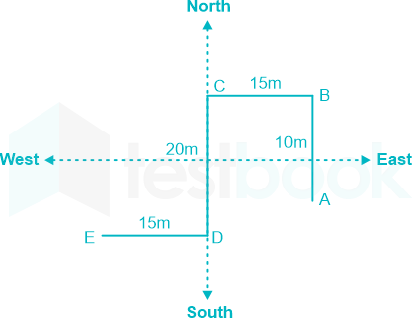
Direction chart-

Direction and Distance MCQ [Free PDF] - Objective Question Answer for  Direction and Distance Quiz - Download Now!

Step 1:- Tarun walks 10 meters from point A towards north and reaches at point B. He takes a left turn and walks 15m and reaches point C. 


Step 2:-  He again takes a left turn and walks 20 meters and reaches at point D.


Direction and Distance MCQ [Free PDF] - Objective Question Answer for  Direction and Distance Quiz - Download Now!

Step 3:-  He takes a right turn and walks 15m and reaches point E. 


Step 4:- He again takes a right turn and walks 25 meters and reaches at point F.


I. Point B is to the south-east of point F.✅

It is clear from the above diagram that Point B is to the south-east of point F.

Hence, the given statement is correct.

II. Point F is to the north-west of point A.✅

It is clear from the above diagram that Point F is to the north-west of point A.

Hence, the given statement is correct.

Hence, the correct answer is Both I and II.

3

In a specific code language, 'VIOLENT' is written as 'ZMSHIRX'. What is the code for 'CORDIAL' in this code language?

  1. ((a))

    GSUZMFP

  2. ((b))

    GSVZMEP

  3. ((c))

    GSVZNEP

  4. ((d))

    GSUZNEP

Show Answer
Answer: ((b))

GSVZMEP

The positional value of alphabets are :-

Alphabet Series MCQ [Free PDF] - Objective Question Answer for Alphabet  Series Quiz - Download Now!

Logic - (Letter + 4)(Middle letter - 4)

In VIOLENT -

Similarly,

Hence, the correct answer is GSVZMEP.

4

In the question given below, four letter pairs are given. The letter to the left of (-) is related to an argument/rule/relation to the letter given on the right side of (-). The three are the same on the basis of the same one argument/rule/relation. Select odd one from the given alternatives.

  1. ((a))

    JZ - KY

  2. ((b))

    CF - BE

  3. ((c))

    NP - MO

  4. ((d))

    XQ - WP

Show Answer
Answer: ((a))

JZ - KY

The positional value of alphabets are :-

Alphabet Series MCQ [Free PDF] - Objective Question Answer for Alphabet  Series Quiz - Download Now!

Logic -  (First letter - 1) (Second letter - 1)

Option 1:- JZ - KY❌

J + 1 = K

Z  - 1 = Y

Here 1 is added instead of -1.

Hence, the given option is incorrect. 

Option 2:- CF - BE✅

C - 1 = B

F - 1 = E

this option follow the logic.

Hence, the given option is correct.

Option 3:- NP - MO✅

N - 1 = M

P - 1 = O

this option follow the logic.

Hence, the given option is correct.

Option 4:- XQ - WP✅

X - 1 = W

Q - 1 = P

this option follow the logic.

Hence, the given option is correct.

Hence, the correct answer is JZ - KY.

5

Based on the given Venn diagram, which of the following statement(s) is/are correct?

I. The number of apples which are mangoes is 81.

II. The number of bananas which are apples is 100.

  1. ((a))

    Only I

  2. ((b))

    Neither I nor II

  3. ((c))

    Only II

  4. ((d))

    Both I and II

Show Answer
Answer: ((c))

Only II

I. The number of apples which are mangoes is 81.❌

The number of apples which are mangoes is shown by colored portion -

= 81 + 36 = 117

Which is not equal to 81.

Hence, the given statement is incorrect. 

II. The number of bananas which are apples is 100.✅

The number of bananas which are apples are shown by coloured portion -

= 36 + 64 = 100

<br>

Hence, the given statement is correct. 

Hence, the correct answer is Only II.

6

P is facing south. He rotates 135 degrees in anti-clockwise direction. Then, it rotates 120 degrees in the clockwise direction. In which direction is he facing now?

  1. ((a))

    south-west

  2. ((b))

    north-east

  3. ((c))

    north-west

  4. ((d))

    south-east

Show Answer
Answer: ((d))

south-east

The direction chart is -

Direction and Distance MCQ [Free PDF] - Objective Question Answer for  Direction and Distance Quiz - Download Now!

Step 1:- P is facing south. He rotates 135 degrees in anti-clockwise direction.


Step 2:- Then, it rotates 120 degrees in the clockwise direction.


Here, P is facing in south-east direction.

Hence, the correct answer is south-east.

7

In the following question, select the related letter pair from the given alternatives.

MAV : PEA :: ?

  1. ((a))

    ADX : DHB

  2. ((b))

    RCT : UFY

  3. ((c))

    PFE : SJJ

  4. ((d))

    NQS : QVX

Show Answer
Answer: ((c))

PFE : SJJ

The positional value of alphabets are

Alphabet Series MCQ [Free PDF] - Objective Question Answer for Alphabet  Series Quiz - Download Now!

Logic - (First letter + 3)(Second letter + 4)(Third letter + 5)

In  M  A  V : P  E  A  :-

M + 3 = P

A + 4 = E

V + 5 = A

The same logic followed on option 3,

P + 3 = S

F + 4 = J

E + 5 = J

Hence, the correct answer is  PFE : SJJ.

8

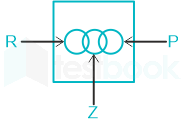
The two figures given on the left side of (::) are related to some logic/rule/relation. From the given alternatives, select the missing figure based on the same logic/rule/relation to the right of (::).

  1. ((a))

  2. ((b))

  3. ((c))

  4. ((d))

Show Answer
Answer: ((d))

The logic followed here is:- Double the image and remove the circle between them.

The missing figure based on the same logic is -


Hence, the correct answer is option 4.

9

Eight persons A, B, C, D, E, F, G and H are sitting around a circular table facing the center (not necessarily in the same order). Three persons sit between G and H. Two persons sit between B and G. Two persons sit between C and E. A sits to the immediate left of D. H is not the neighbor of D. E sits fourth to the right of B. Which of the following statement is correct?

I. G sits immediate left of F.

II. Two persons sit between D and F.

  1. ((a))

    Only II

  2. ((b))

    Neither I nor II

  3. ((c))

    Both I and II

  4. ((d))

    Only I

Show Answer
Answer: ((c))

Both I and II

Step 1:- A sits to the immediate left of D.

Step2:-  H is not the neighbor of D and three persons sit between G and H

Step3:- Two persons sit between B and G and E sits fourth to the right of B.

Step4:-  Two persons sit between C and E

I. G sits immediate left of F. ✅

Here, by diagram it is clear that G sits immediate left of F.

II. Two persons sit between D and F. ✅

E and G sit between D and F. Hence this statement is correct.

Hence, the correct answer is Both I and II.

10

In the question below are given some statements followed by some conclusions based on those statements. Take the given statements to be true even if they seem to be at variance from commonly known facts. Read all the conclusions and then decide which of the given conclusions logically follows from the given statements.

Statement:

I. All P is C.

II. Some C are D.

III. All D are N.

Conclusion:

I. Some N is C.

II. Some P are N.

III. Some D are P.

  1. ((a))

    All conclusions follow.

  2. ((b))

    Only conclusion I follows.

  3. ((c))

    Only conclusion III follows.

  4. ((d))

    Only conclusion II follows.

Show Answer
Answer: ((b))

Only conclusion I follows.

The venn diagram representation is -

Conclusion:

I. Some N is C.✅

Some C are D and  all D are N.

Hence, some N is C.

II. Some P are N.❌

There is no direct relation between P and N.

Hence, this conclusion does not follow.

III. Some D are P.❌

There is no direct relation between D and P.

Hence, this conclusion does not follow.

Hence, the correct answer is Only conclusion I follows.

11

A series is given with one term missing. Choose the correct option from the given ones that will complete the series.

AL, YP, WT, UX, SB, ?

  1. ((a))

    RF

  2. ((b))

    QE

  3. ((c))

    PF

  4. ((d))

    QF

Show Answer
Answer: ((d))

QF

The positional value of alphabets are -

Alphabet Series MCQ [Free PDF] - Objective Question Answer for Alphabet  Series Quiz - Download Now!

Logic - (First letter - 2)(Second letter + 4)

Hence, the correct answer is QF.

12

In the following question, select the related word from the given alternatives.

School : Teacher :: Hospital : ?

  1. ((a))

    Doctor

  2. ((b))

    Knife

  3. ((c))

    Needle

  4. ((d))

    Lawyer

Show Answer
Answer: ((a))

Doctor

The relation is between  profession and the place where the profession is practiced.

A teacher imparts education in school.

Similarly, Doctor treated patient in hospital.

Hence, the correct answer is Doctor.

13

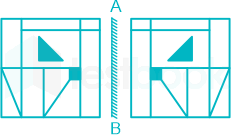
If a mirror is placed on the line AB, then which of the given answer figures will be the correct image of the question figure?

  1. ((a))

  2. ((b))

  3. ((c))

  4. ((d))

Show Answer
Answer: ((d))

The correct mirror image of the given image:-

Hence, the correct answer is option 4.

14

In the question below are given some statements followed by some conclusions based on those statements. Take the given statements to be true even if they seem to be at variance from commonly known facts. Read all the conclusions and then decide which of the given conclusions logically follows from the given statements.

Statement:

I. Some R is Z.

II. Some Z is P.

Conclusion:

I. Some P is R.

II. Some R are not P.

  1. ((a))

    None of the conclusions follow.

  2. ((b))

    Only conclusion II follows.

  3. ((c))

    Only conclusion I follows.

  4. ((d))

    Both conclusions I and II follow.

Show Answer
Answer: ((a))

None of the conclusions follow.

The correct venn diagram representation is:-

Conclusion:

I. Some P is R.❌

Here, no relation between P and R is given.

Hence, this conclusion does not follow the statement.

II. Some R are not P.❌

Here, no relation between P and R is given.

Hence, this conclusion does not follow the statement.

Hence, the correct answer is None of the conclusions follow.

Mistake Points

Conclusion with "Some" and "some not" relation do not make complimentary pairs. That's why the given conclusions do not follow Either -  Or case.

15

Six persons A, B, C, D, E, and F have off on six different days of the same week from Monday to Saturday (not necessarily in the same order). No two persons have the same day off. Two persons have a holiday between D and F. Two persons have a holiday between A and E. C's off is immediately after A's off. D's off is on Friday. Which of the following statement is correct?

I. A's off day is on Wednesday. 

II. One person has a holiday between A and B.

  1. ((a))

    Only I

  2. ((b))

    Both I and II

  3. ((c))

    Neither I nor II

  4. ((d))

    Only II

Show Answer
Answer: ((b))

Both I and II

Step 1:- D's off is on Friday and two persons have a holiday between D and F.

DayPerson
Monday
TuesdayF
Wednesday
Thursday
FridayD
Saturday

Step 2:-  C's off is immediately after A's off.

DayPerson
Monday
TuesdayF
WednesdayA
ThursdayC
FridayD
Saturday

Step 3:- Two persons have a holiday between A and E.

DayPerson
MondayB
TuesdayF
WednesdayA
ThursdayC
FridayD
SaturdayE

I. A's off day is on Wednesday.✅

With the help of above table A having off on Wednesday.

II. One person has a holiday between A and B.✅

F having a holiday between A and B.

Hence, the given statement is correct.

Hence, the correct answer is Both I and II.

16

Write the following words according to the order that appears in the dictionary.

  1. Vaccillating
  2. Vacationing
  3. Vaccination
  4. Vacuumising
  5. Vacillatory
  1. ((a))

    23154

  2. ((b))

    21354

  3. ((c))

    23145

  4. ((d))

    21345

Show Answer
Answer: ((b))

21354

Order in which they appear in the dictionary are;

1.Vacationing

2.Vaccillating

3.Vaccination

4.Vacillatory

5.Vacuumising

Hence, the correct answer is 21354.

Additional Information1. First of all, check the common letter in all.

  1. Arrange them according to the alphabet which come first.
  2. When common letters are arranged, then go for the rest.
17

How many red are neither blue nor green?


  1. ((a))

    41

  2. ((b))

    35

  3. ((c))

    16

  4. ((d))

    26

Show Answer
Answer: ((a))

41

The red which are neither blue nor green are shown by coloured portion which is equal to 41


Hence, the correct answer is 41.

18

In the following question, select the odd group of numbers from the given alternatives.

  1. ((a))

    (47, 95, 191)

  2. ((b))

    (31, 63, 127)

  3. ((c))

    (67, 135, 272)

  4. ((d))

    (54, 109, 219)

Show Answer
Answer: ((c))

(67, 135, 272)

Logic - Ist number +  (Ist number + 1) = Second number

Third number = 2nd number + (2nd number + 1)

Option 1:- (47, 95, 191)✅

47 + 48 = 95

95 + 96 = 191

Option 2:- (31, 63, 127)✅

31 + 32 = 63

63 + 64 = 127

Option 3:- (67, 135, 272)❌

67 + 68 = 135

135 + 136 = 271

but here 272 is given instead of 271.

Hence, this option is incorrect.

Option 4:- (54, 109, 219)✅

54 + 55 = 109

109 + 110 = 219

Hence, the correct answer is (67, 135, 272).

19

Which answer figure will it appear after folding and opening the paper as shown in the question figures below?


  1. ((a))

  2. ((b))

  3. ((c))

  4. ((d))

Show Answer
Answer: ((b))

By open the figure step by step:-

Step 1:-

Step 2:-

Hence, the correct answer is option 2.

20

A series is given in which one term is wrong. Choose the wrong term from the given alternatives.

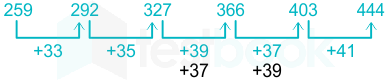
259, 292, 327, 366, 403, 444

  1. ((a))

    403

  2. ((b))

    444

  3. ((c))

    366

  4. ((d))

    327

Show Answer
Answer: ((c))

366

The wrong term from the given alternatives is -


Here, we have to add 37 in 327 instead of 39.

Hence, the wrong term is 366.

General Awareness (20 questions)

21

Which of the following statement is not correct?

  1. ((a))

    The mass of an object is a measure of its inertia.

  2. ((b))

    Force S. I. The unit is kg m/s2.

  3. ((c))

    Action and reaction forces always act on the same object.

  4. ((d))

    The total momentum is conserved in an isolated system.

Show Answer
Answer: ((c))

Action and reaction forces always act on the same object.

The correct answer is Action and reaction forces always act on the same object.

Key Points

  • Action and reaction forces does not always act on the same object.
  • ​The Third Law of Motion states that for every action (force) in nature there is an equal and opposite reaction.
  • If object A exerts a force on object B, object B also exerts an equal and opposite force on object A.

Additional Information

  • The mass of an object is a measure of its inertia.
  • Law of inertia states that an object will continue to be either in a state of motion or in a state of rest unless an external force acts on it.
  • ​The more an object's inertia, the greater its mass.
  • The greater force would be required to change its position.
  • Force is any action that tends to maintain or alter the motion of a body or to distort it.
  • It is equal to the product of the mass and its acceleration.
  • The S.I. unit is kg m/s2.
  • kg m/s2 is also known as Newton.
  • The total momentum is conserved in an isolated system.
  • The conservation of momentum states that the amount of momentum remains constant.
  • Momentum is neither created nor destroyed, but only changed through the action of forces as described by Newton's laws of motion.
  • The momentum of an isolated system remains conserved when the external force on the system is zero.
22

'Gochi' festival is celebrated in which state of India?

  1. ((a))

    Uttar Pradesh

  2. ((b))

    Rajasthan

  3. ((c))

    Himachal Pradesh

  4. ((d))

    Punjab

Show Answer
Answer: ((c))

Himachal Pradesh

The correct answer is Himachal Pradesh.

Key Points

  • 'Gochi' festival is celebrated in Himachal Pradesh.
  • ​It is also called Gotsi.
  • Gochi is celebrated in the Chandra and Bhaga valleys by families which have had a boy child in the preceding year.
  • The festival is usually celebrated during the month of February every year.
  • In this festival, token marriages of children below the age of six are also performed.
  • A special cake is prepared and placed on a large plate and carried by four men to the village shrine.
  • The priest makes a prayer to the God with a bow and arrow.
  • The cake is then broken down to appease the deity.
  • The entire festival is accompanied by the beats of drums known as Lohar.
23

On the basis of the number of cotyledons in the seed, the class Agiosperms is divided into _______ parts.

  1. ((a))

    3

  2. ((b))

    2

  3. ((c))

    4

  4. ((d))

    5

Show Answer
Answer: ((b))

2

The correct answer is 2.

Key Points

  • On the basis of the number of cotyledons in the seed, the class Angiosperms is divided into two parts. 
  • ​If the seed has one cotyledon they are called monocots and if the seed has two cotyledons they are called dicots.
  • Angiosperms
  • **Angiosperms are plants that produce flowers and bear their seeds in fruits.**​
  • These are vascular plants with stems, roots, and leaves.
  • These make up the majority of all plants on earth.
  • They can grow in various habitats as trees, herbs, shrubs, and bushes.
  • Cotyledon
  • ​It is a seed leaf within the embryo of a seed.
  • It is the first and the tender leaf that emerges when the seed germinates.
24

Which sport is related to Magnus Carlsen?

  1. ((a))

    Chess

  2. ((b))

    Volleyball

  3. ((c))

    Cricket

  4. ((d))

    Badminton

Show Answer
Answer: ((a))

Chess

The correct answer is Chess.

Key Points

  • Magnus Carlsen is related to Chess.
  • Magnus Carlsen
  • He is a Norwegian chess grandmaster.
  • He is also a three-time World Rapid Chess Champion and five-time World Blitz Chess Champion.
  • He has held the No. 1 position in the FIDE world chess rankings since 1 July 2011.
  • He became World Chess Champion in 2013 by defeating Viswanathan Anand.
  • In 2010, at 19, he reached No. 1 in the FIDE world rankings, the youngest person ever to do so.
25

Bara Imambara is located in which state of India?

  1. ((a))

    Uttar Pradesh

  2. ((b))

    Maharashtra

  3. ((c))

    Rajasthan

  4. ((d))

    Tamil Nadu

Show Answer
Answer: ((a))

Uttar Pradesh

The correct answer is Uttar Pradesh.

Key Points

  • Bara Imambara is located in Uttar Pradesh.
  • Bara means big, and an Imambara is a shrine built by Shia Muslims for the purpose of Azadari.
  • ​It was built by Asaf-ud-Daula, Nawab of Lucknow, in 1784.
  • Construction of the Imambara was completed in 1791
  • It is also called the Asafi Imambara.
  • The complex also includes the large Asfi mosque, the Bhulbhulayah (the labyrinth), and Bowli, a step well with running water.
  • The central hall of Bara Imambara is said to be the largest arched hall in the world.
  • Two imposing gateways lead to the main hall.
  • The architecture of the complex reflects the maturation of ornamented Mughal design, namely the Badshahi Mosque.
26

Which of the following statement is correct?

I. Labrador ocean currents are cold water currents.

II. Where warm and cold currents meet, foggy weather is formed.

  1. ((a))

    I only

  2. ((b))

    Both I and II

  3. ((c))

    Neither I nor II

  4. ((d))

    II only

Show Answer
Answer: ((b))

Both I and II

The correct answer is Both I and II.

Key Points

  • Ocean currents are divided on the basis of temperature into warm currents and cold currents.
  • Those currents that flow from the Equator towards the poles are warmer than the surrounding water and so they are called warm currents.
  • When the warm and the cold currents meet, dense fog is created. This is because the air above the warm currents is warm which contains water vapor.
  • When this warm current meets the cold current, the air above the cold current, causes the water vapor of the warm current to condense into tiny particles which form fog.
  • Example - Gulf Stream, Kuroshio current, Norwegian current, Equatorial currents, North Atlantic Drift, East Australian current, etc.
  • The ocean currents that flow from the polar areas towards the Equator are cooler compared to the surrounding water, so they are called cold currents.
  • Example - West Wind Drift, Humboldt (Peru) current, Labrador current, East Greenland current, West Australian current, Oyashio current, etc.
  • Labrador current
  • The Labrador Current is a cold current in the North Atlantic Ocean which flows from the Arctic Ocean south along the coast of Labrador and passes around Newfoundland, continuing south along the east coast of Nova Scotia.
27

The Market Stabilization Scheme was launched by the RBI in _______.

  1. ((a))

    2003

  2. ((b))

    2005

  3. ((c))

    2004

  4. ((d))

    2006

Show Answer
Answer: ((c))

2004

The correct answer is 2004.

Key Points

  • The Market Stabilization Scheme was launched by the RBI in 2004.
  • Market Stabilization Scheme 
  • ​It is a monetary policy intervention by the RBI to withdraw excess liquidity (or money supply) by selling government securities in the economy.
  • It is used to withdraw excess liquidity or money from the system by selling government bonds.
  • The issued securities are government bonds and they are called Market Stabilisation Bonds (MSBs).
  • To carry out the MSS, the government lends its bonds or securities (MSBs) to the RBI.
  • The money obtained under MSS should be kept with the RBI. It should not be transferred to the government.
  • For the issue of MSS, there is a MoU between the government and the RBI about the total limit of MSBs to be issued by the RBI during a year.
28

The SI unit of electric potential difference is ______.

  1. ((a))

    Ampere

  2. ((b))

    Voltage

  3. ((c))

    Coulomb

  4. ((d))

    Ohm

Show Answer
Answer: ((b))

Voltage

The correct answer is Voltage.

Key Points

  • The SI unit of electric potential difference is Voltage.
  • The electric potential difference is the work done per unit charge to move a unit charge from one point to another in an electric field.
  • In simpler terms, the electric potential difference or voltage of a battery is the potential energy difference across its terminals for every Coulomb of charge.
  • Voltage is the pressure from an electrical circuit's power source that pushes charged electrons (current) through a conducting loop, enabling them to do work such as illuminating a light.

Additional Information

  • Ampere is defined as the unit of electric current that is equal to the flow of one Coulomb per second.
  • It is the SI unit of electric current.
  • A coulomb (C) is the amount of electricity that a 1-ampere (A) current carries in one second (s).
  • It is the SI unit of electric charge.
  • Ohm is used to measure the electrical resistance of a material or an electrical device.
  • ​It is the SI unit of electrical resistance.
29

The first session of the Constituent Assembly was held on _______.

  1. ((a))

    9 December 1945

  2. ((b))

    26 November 1946

  3. ((c))

    9 December 1946

  4. ((d))

    26 January 1946

Show Answer
Answer: ((c))

9 December 1946

The correct answer is 9 December 1946.

Key Points

  • The first session of the Constituent Assembly was held on 9 December 1946.
  • The Constituent Assembly met for the first time in New Delhi on 9 December 1946 in the Constitution Hall which is now known as the Central Hall of Parliament House.
  • The Constituent Assembly took two years, eleven months, and seventeen days to complete the drafting of the Constitution.
  • As to its composition, members were chosen by indirect election by the members of the Provincial Legislative Assemblies, according to the scheme recommended by the Cabinet Mission.

Additional Information

  • The Constituent Assembly was formed on the recommendation of the Cabinet Mission which visited India in 1946.
  • Mr. Sachchidanand Sinha was elected provisional Chairman of the Assembly.
  • Later, Dr Rajendra Prasad was elected as the President of the Assembly.
  • On 13 December 1946, Pandit Jawaharlal Nehru moved the Objectives Resolution.
  • One of the important committees of the Constituent assembly was Drafting Committee.
  • Members of drafting committee- ​
  • Alladi Krishnaswami Ayyar
  • N. Gopalaswami
  • B.R. Ambedkar (Chairman)
  • K.M Munshi
  • Mohammad Saadulla
  • B.L. Mitter
  • D.P. Khaitan
30

Which of the following is also known as 'Golden Fibre'?

  1. ((a))

    Maize

  2. ((b))

    Millets

  3. ((c))

    Cotton

  4. ((d))

    Jute

Show Answer
Answer: ((d))

Jute

The correct answer is Jute.

Key Points

  • Jute is also known as 'Golden Fibre'.
  • ​It is known so because of its shiny brown colour.
  • It is soft, shiny and long fibre with a silky texture.
  • Jute fibre
  • Jute fibre is obtained only from the stem of the jute plants.
  • It is mainly grown in the rainy season.
  • It primarily grows in regions having alluvial soil which is found in the delta regions of the Ganges and Brahmaputra rivers.
  • In India, jute is basically grown in the states of Bihar, West Bengal and Assam.
  • The jute plant is about 3 meters in height and bears yellow flowers in a few months.
  • During this time, the liquid skin moves out to separate the fibre and this process is known as retting.
  • It is often used to manufacture gunny bags, mats, ropes, yams, carpets, and other artifacts.
  • National Jute Board, Ministry of Textiles, acts as the apex body for the promotion of the products in India and abroad.
31

The book Meghdoot was written by _______.

  1. ((a))

    Panini

  2. ((b))

    Kalidas

  3. ((c))

    Kalhana 

  4. ((d))

    Surdas

Show Answer
Answer: ((b))

Kalidas

The correct answer is Kalidas.

Key Points

  • The book Meghdoot was written by Kalidas.
  • Meghdoot is a lyric love poem in some 115 verses.
  • It describes how a yakṣa (or nature spirit), who had been banished by his master to a remote region for a year, asked a cloud to take a message of love to his wife.
  • The work is divided into two parts, Purva-megha and Uttara-megha.
  • It is written in Sanskrit literature.
  • In 1813, the poem was first translated into English by Horace Hayman Wilson.

Important Points

  • Kalidasa was a classical Sanskrit author.
  • His plays and poetry are primarily based on the Vedas, the Ramayana, the Mahabharata and the Puranas.
  • He is known as ‘Prince of Indian Poets’ and ‘Indian Shakespeare’.
  • He was one of the Nine Jewels or Navaratnas in the court of Chandragupta II.
  • The three Sanskrit Plays of Kalidas are Vikramorvasiyam, Malavikagnimitram, and Abhijnanashakuntalam.
  • Ashtadhyayi is written by Panini.
  • Rajatarangini is written by Kalhana.
  • Surdas compositions glorified and captured his devotion towards lord Krishna.
  • His literary works comprise Sur Saravali, Sahitya Lahari, and Sur Sagar.
32

In which year did Vasco da Gama come to India?

  1. ((a))

    1470

  2. ((b))

    1445

  3. ((c))

    1498

  4. ((d))

    1450

Show Answer
Answer: ((c))

1498

The correct answer is 1498.

Key Points

  • In 1498, Vasco Da Gama came to India.
  • ​He was the first European (from Portugal) to sail Africa and discover a new sea route from Europe to India.
  • He arrived at Calicut on 27 May 1498.
  • He reached India by sea via the "Cape of Good Hope".
  • He was received by the local ruler Zamorin and was given him special order to establish trade links.
  • He stayed for three months and he returned with a vessel laden with a huge amount of precious goods which was sold in the European market at 60 times the total cost of his trip.
33

Which part of the Indian Constitution deals with the prohibition of employment of children in factories etc.?

  1. ((a))

    Article 24

  2. ((b))

    Article 21

  3. ((c))

    Article 17

  4. ((d))

    Article 20

Show Answer
Answer: ((a))

Article 24

The correct answer is Article 24.

Key Points

  • Article 24
  • N​o child below the age of fourteen years shall be employed to work in any factory or mine or engaged in any other hazardous employment.

Important Points

  • Article 21
  • No person shall be deprived of his life or personal liberty except according to procedure established by law.
  • Article 20
  • ​No person shall be convicted of any offence except for violation of a law in force at the time of the commission of the Act charged as an offence, nor be subjected to a penalty greater than that which might have been inflicted under the law in force at the time of the commission of the offence.
  • No person shall be prosecuted and punished for the same offence more than once.
  • No person accused of any offence shall be compelled to be a witness against himself.​​
  • Article 17
  • ​"Untouchability" is abolished and its practice in any form is forbidden.
  • The enforcement of any disability arising out of "Untouchability" shall be an offence punishable in accordance with law.
34

The highest peak of the Eastern Ghats is _______.

  1. ((a))

    Doddabetta

  2. ((b))

    Khangchendzonga 

  3. ((c))

    Mahendragiri

  4. ((d))

    Anamudi

Show Answer
Answer: ((c))

Mahendragiri

The correct answer is Mahendragiri.

Key Points

  • The highest peak of the Eastern Ghats is Mahendragiri.
  • ​The Eastern Ghats run from northern Odisha through Andhra Pradesh to Tamil Nadu in the south passing some parts of Karnataka.
  • Mahedragiri Mountain stands at a height of 1501 meters.
  • It is a prime geographical landmark in the Gajapati district of Odisha.
  • Javadi Hills, Palconda range, Nallamala hills, Mahendragiri hills are some of the important hills of Eastern Ghats.

Additional Information

  • Doddabetta is the highest mountain in the Nilgiri Mountains with a height of approximately 2637 m.
  • Kanchenjunga is the highest peak in India and it is situated in Sikkim. Its height is about 8,586 meters.
  • Anamudi Peak is the highest mountain peak in the Western Ghats. Its 2695 m in height.
35

Which of the following statement is correct?

I. Prarthana Samaj was established in 1867.

II. Aligarh Muslim University was founded by Maulana Abul Kalam Azad.

  1. ((a))

    Neither I nor II

  2. ((b))

    II only

  3. ((c))

    Both I and II

  4. ((d))

    I only

Show Answer
Answer: ((d))

I only

The correct answer is I only.

Key Points

  • Prarthana Samaj was established in 1867.
  • It was established on 31 March 1867 in Bombay.
  • It was founded by Atmaram Pandurang.
  • This Samaj was greatly influenced by the Brahmo Samaj and the Arya Samaj.
  • The main aim of the society-
  • promulgation of theistic worship and social reform
  • opposition to the caste system
  • the introduction of widow remarriage
  • the encouragement of female education
  • the abolition of child marriage
  • Important members of the Samaj - Mahadev Govind Ranade, Sanskrit scholar Sir Ramakrishna Gopal Bhandarkar, and political leader Sir Narayan Chandavarkar, etc.

Additional Information

  • Atmaram Pandurang
  • He was an Indian physician and social reformer.
  • He was a theistic reformer who opposed many Hindu traditions including child marriage.
  • He believed and openly supported the idea that the minimum age for marriage of girls should be 20.
  • He was one of the two Indian co-founders (the other being Sakharam Arjun) of the Bombay Natural History Society.
  • Syed Ahmad Khan established Aligarh Muslim University
  • Aligarh Muslim University was established in 1875 by Sir Syed Ahmad Khan as Mohammedan Anglo-Oriental College.
  • It was renamed in 1920 as the Aligarh Muslim University.
  • It is located in the city of Aligarh and offers more than 300 courses in both modern and traditional branches of education.
36

Rajaraja I was the ruler of the ______ dynasty.

  1. ((a))

    Chandela

  2. ((b))

    Chola 

  3. ((c))

    Chalukyas

  4. ((d))

    Pallava

Show Answer
Answer: ((b))

Chola 

The correct answer is Chola.

Key Points

  • Rajaraja I was the ruler of the Chola dynasty.
  • ​​The Chola Empire of the South emerged in the ​9th century AD (850-1279 AD).
  • The founder of Chola Dynasty - Vijayalaya. Vijayalaya captured Tanjore in 850 AD.
  • The greatest Chola ruler was Rajaraja (985-1014 AD) and Rajendra I (1014-1044 AD).
  • Rajaraja built Brihadeshwara temple / Rajarajeshwara temple (attributed to Shiva) at Tanjore.
  • During his reign, the texts of the Tamil poets Appar, Sambandar and Sundarar were collected and edited into one compilation called Thirumurai.
  • He was succeeded by his son Rajendra Chola I.

Additional Information

  • Chandela Dynasty was established by "Nannuk" in 831 AD and its capital was Khajuraho.
  • The Chandela dynasty ruled the Jejakabhukti region (Bundelkhand in present-day Madhya Pradesh and Uttar Pradesh).
  • The Chandela ruler Vidyadhar (1017-1029 AD) built the famous "Kandariya Mahadev Temple".
  • ​Pulakeshin I established the Chalukya dynasty in 543.
  • Pulakeshin I took Vatapi (modern Badami in Bagalkot district, Karnataka) under his control and made it his capital.
  • They ruled over an empire that comprised the entire state of Karnataka and most of Andhra Pradesh in the Deccan.
  • Simhavishnu was the founder of the Pallava Dynasty.
  • The Pallava kings were great patrons of art and architecture and this society was based on Aryan culture.
  • Some of the best examples of Pallava art and architecture are the Kailasanathar Temple at Kanchipuram, the Shore Temple, and the Pancha Rathasof Mahabalipuram.
37

Which of the following statement is correct?

I. The relationship between the quantity of a commodity chosen by a consumer and the price of that commodity is called the demand curve.

II. If a consumer's demand for a good is in the same direction as the consumer's income, then the consumer's demand for that good is positively related to its price.

  1. ((a))

    Neither I nor II

  2. ((b))

    I only

  3. ((c))

    II only

  4. ((d))

    Both I and II

Show Answer
Answer: ((b))

I only

The correct answer is I only.

Key Points

  • The relationship between the quantity of a commodity chosen by a consumer and the price of that commodity is called the demand curve.
  • Demand curve is a graphic presentation of various quantities of a commodity that a consumer is willing to buy at different prices of the same commodity, while holding constant prices of other related commodities and income of the consumer.
  • The downward sloping demand curve shows that at lower prices, the individual is willing to buy more of commodity.
  • However at higher prices, the indivdual is willing to buy less of commodity x.
  • Therefore, there is a negative relationship between price of a commodity and quantity demanded which is referred to as the Law of Demand.
  • The law of diminishing marginal utility states that each successive unit of a commodity provides lower marginal utility.
  • If a consumer's demand for a good moves in the same direction as the consumer's income, the consumer's demand for that good must be inversely related to the price of the good.
  • It is called Law of demand.
  • The law of demand is a fundamental principle in macroeconomics. It is used together with the law of supply to determine the efficient allocation of resources in an economy and find the optimal price and quantity of goods.
  • The law of demand states that other factors being constant (cetris peribus), price and quantity demand of any good and service are inversely related to each other. When the price of a product increases, the demand for the same product will fall.
38

The number of players in each volleyball team is ______.

  1. ((a))

    7

  2. ((b))

    5

  3. ((c))

    6

  4. ((d))

    8

Show Answer
Answer: ((c))

6

The correct answer is 6.

Key Points

  • The number of players in each volleyball team is six
  • ​Before the start of the game 3 players from each team stand in their court just behind the attack line and the remaining three at the back.
  • Each team tries to score points by grounding a ball on the other team's court under organized rules.
  • It has been a part of the official program of the Summer Olympic Games since Tokyo 1964.

Additional Information

  • The India men's national volleyball team represents India in international volleyball competitions.
  • It is managed by the Volleyball Federation of India and is currently sponsored by Sahara India Pariwar and Asics.
  • List of other games and number of players-
  • Badminton – 2 in Singles & 4 in Doubles
  • Football – 2 teams of 11 players each
  • Kho-Kho – 2 teams of 9 players each
  • Netball – 2 teams of 7 players each
  • Rugby/Football – 2 teams of 15 each
  • Table Tennis – 2 in Singles & 4 in Doubles
  • Water Polo – 2 teams of 7 players each
39

Who among the following has not been awarded the Nobel Prize 2020 for Physics?

  1. ((a))

    Jennifer A. Dodna

  2. ((b))

    Roger Penrose

  3. ((c))

    Audrey M. Gage

  4. ((d))

    Reinhard Genzel

Show Answer
Answer: ((a))

Jennifer A. Dodna

The correct answer is Jennifer A. Dodna.

Key Points

  • Jennifer A. Dodna has not been awarded the Nobel Prize 2020 for Physics.
  • ​She received the Nobel Prize in Chemistry 2020.
  • She received it “for the development of a method for genome editing”.
  • The life processes of organisms are controlled by genes made up of sections of DNA.
  • In 2012, Jennifer Doudna and Emmanuelle Charpentier developed a method for high-precision genome editing.
  • They used the immune system of a bacterium, which disables viruses by cutting their DNA up with a type of genetic scissors.

Additional Information

  • The Nobel Prize in Physics 2020 was divided, one half awarded to Roger Penrose "for the discovery that black hole formation is a robust prediction of the general theory of relativity", the other half jointly to Reinhard Genzel and Andrea Ghez "for the discovery of a supermassive compact object at the centre of our galaxy"
40

'INDRA NAVY' is a naval exercise between _______ and ________.

  1. ((a))

    India, Australia

  2. ((b))

    India, Russia

  3. ((c))

    India, Bangladesh

  4. ((d))

    India, France

Show Answer
Answer: ((b))

India, Russia

The correct answer is India, Russia.

Key Points

  • 'INDRA NAVY' is a naval exercise between India and Russia.
  • It is a biennial bilateral maritime exercise.
  • The exercies was initiated in 2003.
  • INDRA NAVY epitomises the long-term strategic relationship between the two navies.
  • The 12th edition of exercise INDRA NAVY was held in the Baltic Sea from 28 to 29 July 2021.
  • This exercise was undertaken as part of the visit of INS Tabar to St Petersburg, Russia to participate in the 325th Navy Day celebrations of the Russian Navy.
  • The primary aim was to further consolidate inter-operability built up by the two Navies over the years and also to enhance understanding and procedures for multi-faceted maritime operations.
  • It included wide-ranging and diverse activities across the spectrum of maritime operations.

Arithmetic Ability (20 questions)

41

The line graph given below shows the cost price of 5 articles.

What is the average price of all the 5 articles?

  1. ((a))

    320

  2. ((b))

    310

  3. ((c))

    280

  4. ((d))

    300

Show Answer
Answer: ((b))

310

Given:

Cast Price of A1 = 200

Cast Price of A2 = 400

Cast Price of A3 = 150

Cast Price of A4 = 350

Cast Price of A5 = 450

Formula Used:

Average = sum of all observations/total number of observations

Calculation:

Average = sum of all observations/total number of observations

⇒ (200 + 400 + 150 + 350 + 450)/5 = 1550/5 = 310

∴ Average price of articles is 310

42

Which digit is at unit place in 5578 × 2535 × 3372?

  1. ((a))

    6

  2. ((b))

    5

  3. ((c))

    4

  4. ((d))

    0

Show Answer
Answer: ((b))

5

Given:

⇒ 5578 × 2535 × 3372

Formula Used:

Any Power of 5 always returns unit digit 5.

Unit digit of 3 is cyclic after four times, So Divide the power of three by 4 if remainder   RemainderPowerUnitDigit 131=3 232=9 333=7 034=1 35=3Repeated \begin{matrix} &Remainder &Power & &Unit Digit\ &1 &3^1 &= &3 \ &2 &3^2 &= &9 \ &3 &3^3 &= &7 \ &0 &3^4 &= &1 \ & &3^5 &= &3 \rightarrow Repeated \end{matrix}

Calculation:

⇒ 5578 × 2535 × 3372

When a odd number is multiplied by 5 then unit digit always be 5

So, Unit Digit of 5578 × 2535 × 3372 is 5.

43

Diagonal of a square is 26√2 cm. What is the area of ​​this square?

  1. ((a))

    676 cm2

  2. ((b))

    169 cm2

  3. ((c))

    338 cm2

  4. ((d))

    576 cm2

Show Answer
Answer: ((a))

676 cm2

Given:

Diagonal of a square = 26√2 cm

Formula Used:

Diagonal of square = a√2

Area of square = a2

Calculation:

Diagonal of square = a√2 = 26√2

a = 26

∴ Area of square = a2 = 262 = 676 cm2

44

In what ratio should tea of Rs. 90 per kg be mixed with tea of Rs. 120 per kg so that there is a profit of 20% on selling this mixture at Rs. 132 per kg?

  1. ((a))

    1 ∶ 2

  2. ((b))

    1 ∶ 3

  3. ((c))

    1 ∶ 4

  4. ((d))

    2 ∶ 3

Show Answer
Answer: ((a))

1 ∶ 2

Given:

The price of first type of tea = 90 Rs/kg

The price of first type of tea = 120 Rs/kg 

Formula Used:

CP = SP/(100 + profit) × 100

Calculation:

Selling price of tea = Rs.132 

Cost price of mixture = SP/(100 + profit) × 100

⇒ 132/(100 + 20) × 100 = 11/10 × 100 = 11 × 10 = 110

Hence, both types of teas should be mixed in the ratio of 1 : 2.

45

If the radius of a sphere is increased by 30 percent, then its volume will increase by how much percent?

  1. ((a))

    119.7 percent

  2. ((b))

    90 percent

  3. ((c))

    120 percent

  4. ((d))

    125.5 percent

Show Answer
Answer: ((a))

119.7 percent

r3Given:

Increase in radius = 30%

Formula Used:

Volume of sphere = 4/3πr3

So Vr3V\propto r^3

Calculation:

Fraction value of 30% = 30/100 = 3/10

r → 10 : 13

V → 103 : 133 = 1000 : 2197

Increment in volume = (2197 - 1000)/1000 × 100%

⇒ 1197/1000 × 100% = 1197/10% = 119.7%


So, the volume of sphere will increase 119.7%.

46

The simple interest of 2 years on a sum of Rs. 2400 is Rs. 288. What is the annual rate of interest?

  1. ((a))

    6 percent

  2. ((b))

    8 percent

  3. ((c))

    4 percent

  4. ((d))

    5 percent

Show Answer
Answer: ((a))

6 percent

Given:

P = Rs 2400 

T = 2 years

SI = Rs. 288 

Formula Used:

SI = PRT/100

Calculation:

SI = PRT/100

⇒ 288 = 2400 × R% × 2/100 

⇒ 288 = 2400 × R% × 2/100

⇒ R% = 288/*(24 × 2) = 6%

So, Annual rate of interest is 6%.

47

Solid sugars are made by melting a solid cylinder. The radius of the cylinder is twice the radius of cone. The height of the cylinder is five times the height of cone. How many will you become?

  1. ((a))

    60

  2. ((b))

    45

  3. ((c))

    65

  4. ((d))

    50

Show Answer
Answer: ((a))

60

r2Given:

Radius of cylinder(R) = 2 × radius of cone(r)

Height of cylinder(H) = 5 × height of cone(h)

Formula Used:

Volume of cylinder = n × volume of cone

πR2H = n × 1/3πr2h

Calculation:

We know that,

πR2H = n × 1/3πr2h

According to question,

R = 2r

H = 5h

π × (2r)2 × 5h = n × 1/3πr2h

n = 3 × (π × 4r2 × 5h)/(πr2h)

⇒ 3 × 4 × 5 = 60

48

M is 25 per cent more than N. N is how much percent less than M?

  1. ((a))

    15 percent

  2. ((b))

    25 percent

  3. ((c))

    25.5 percent

  4. ((d))

    20 percent

Show Answer
Answer: ((d))

20 percent

Given:

M is 25% more than N.

Concept Used:

If A is R% more than b,

Then B is [R/(100 + R) × 100]% less than A less than A.

Calculation:

N = [R/(100 + R) × 100]% 

⇒ [25/(100 + 25) × 100]% 

⇒ [25/125  × 100]% 

⇒ 1/5  × 100]%  = 20%

N;is;20%;less;than;M.\therefore \mathbf{ N ;is ;20\%; less ;than; M}.

49

The penalty figure below shows the price and discount of the goods.

Selling price = Marked Price - discount

J1 = Average selling price of goods P, Q, R and S.

J2 = The total difference between the price of the quantity and the selling price of all the 7 articles.

What is the value of (J2 - J1)?

  1. ((a))

    1250

  2. ((b))

    1390

  3. ((c))

    1150

  4. ((d))

    1050

Show Answer
Answer: ((c))

1150

Given:

GoodsMarked PriceDiscountSelling Price
P600100500
Q400200200
R800300500
S1000400600
T700200500
U500300200
V900100800


  • J1 = Average Selling Price (P, Q, R, S),
  • J2 = The total difference between the price of the quantity and the selling price of all the 7 articles.

Formula Used:

Average = sum of all observation/total number of observations

Calculation:

J1 = (P + Q + R + S)/4 = (500 + 200 + 500 + 600)/4 = 1800/4 = 450

J2 = The total difference between the price of the quantity and the selling price of all the 7 articles

⇒ 100 + 200 + 300 + 400 + 200 + 300 + 100 = 1600

J2 - J1 = 1600 - 450 = 1150


So, the value of J2 - J1 = 1150.

50

Table 3 below shows the number of cars sold by different companies.

Carcompany
PQR
C14025180
C2201520
C3806045
C410512070
C53516080

Which of the following statements is correct?

The number of car C1 sold by P is 160 percent of the number of cars C1 sold by Q.

The average number of cars C3, C4 and C5 sold by R is 65.

The sum of the number of all cars sold by Q is 380.

  1. ((a))

    Both II and III

  2. ((b))

    Both I and III

  3. ((c))

    Both I and II

  4. ((d))

    I, II and III

Show Answer
Answer: ((d))

I, II and III

Given:

  • The number of car C1 sold by P is 160 percent of the number of cars C1 sold by Q.
  • The average number of cars C3, C4 and C5 sold by R is 65.
  • The sum of the number of all cars sold by Q is 380.

Formula Used:

Average = sum of all observations/total number of observations

Calculation:

1)The number of car C1 sold by P is 160 percent of the number of cars C1 sold by Q

Number of cars C1 sold by P = 40

Number of cars C1 sold by Q = 25

% of C1 cars sold by P with respect to Q = 40/25 × 100 = 160

So, case 1 is absolutely correct.

2)The average number of cars C3, C4 and C5 sold by R is 65

Average = sum of all observations/total number of observations

⇒ (C3 + C4 + C5)/3 = (45 + 70 + 80)/3 = 195/3 = 65

So, case 2 is also absolutely correct.

  1. ​The sum of the number of all cars sold by Q is 380

The sum of the numbers of all cars sold by Q = 25 + 15 + 60 + 120 + 160 = 380​

So, case 3 is also correct.

Hence, all three cases are correct.

51

The diameter of a cycle wheel is 4.2 cm. Is. A cyclist takes 90 minutes to reach a destination at the speed of 23.1 km/hr. How many revolutions will the wheel make during the journey?​

  1. ((a))

    226500

  2. ((b))

    172500

  3. ((c))

    316400

  4. ((d))

    262500

Show Answer
Answer: ((d))

262500

Given:

Diameter of cycle wheel = 4.2 cm

Speed = 23.1 kmph

Time = 90 minutes

Formula Used:

Speed = distance/Time

Circumference of circle = 2πr

Number of rounds = total distance covered by wheel/distance covered in a single round

Calculation:

Total distance covered by wheel = speed × time

⇒ 23.1 × 90/60 = 23.1 × 1.5 = 34.65 km

Distance covered in a single round = 2πr = 2 × 22/7 × 2.1

⇒ 13.2

Number of rounds = Total distance covered by wheel/distance covered in a single round = (34.65 × 1000 × 100 cm)/13.2 cm

⇒ 262500

So, 262500 revolutions will the wheel make during the journey.

52

Vijay sells an article at a profit of 20%. If both the cost price and the selling price are reduced by Rs 20, then the profit becomes 30%. What is the initial purchase price?

  1. ((a))

    Rs 75

  2. ((b))

    Rs 80

  3. ((c))

    Rs 60

  4. ((d))

    Rs 100

Show Answer
Answer: ((c))

Rs 60

Given:

Initial Profit = 20%

Reduce in CP and SP = Rs 20 

Final Profit = 30%

Formula Used:

Profit% = profit/CP × 100

Calculation:

Let Initial CP = Rs. x

Initial SP = x × 120/100 = Rs. 6x/5

Initial Profit = 6x/5 - x = x/5

Final CP = Rs (x - 20)

Final SP = 6x/5 - 20

Final profit = x/5 

Final Profit % = (x/5)/(x - 20) × 100%

⇒ 30% = x/5(x - 20) × 100%

⇒ 30 = x/(x - 20) × 20

⇒ 3/2 = x/(x - 20)

⇒ 3x - 60 = 2x

x = 60

So, Initial Cast Price is  Rs. 60

53

If a = 611\sqrt {6 - \sqrt {11 } }  and b = 6+11\sqrt {6 +\sqrt {11 } }  then what is the value of (b - a).

  1. ((a))

    2\sqrt 2

  2. ((b))

    3\sqrt 3

  3. ((c))

    22\sqrt 22

  4. ((d))

    6\sqrt 6

Show Answer
Answer: ((a))

2\sqrt 2

Given:

a = 611\sqrt {6 - \sqrt {11 } }  

b = 6+11\sqrt {6 +\sqrt {11 } }  

Formula Used:

(a - b)2 = a2 + b2 - 2ab

Calculation:

a2 = 6 - √11

b2 = 6 + √11

⇒ 2ab = 2 × √(6 -√11) × √(6 + √11) = 2 × √(36 - 11) = 2 × √25 = 2 × 5 = 10

⇒ (b - a)2 = a2 + b2 - 2ab = 6 + √11 + 6 - √11 - 10 = 12 - 10 = 2

(b - a) = √2

So, 2√2 is the correct answer.

54

The speed of a bike is 39.6 km/hr. How much time will the bike take to cover a distance of 330 metres?

  1. ((a))

    30 sec

  2. ((b))

    36 sec

  3. ((c))

    20 sec

  4. ((d))

    24 sec

Show Answer
Answer: ((a))

30 sec

Given:

Speed of bike = 39.6 kmph

Distance = 330 m =0.33 km

Formula Used:

Speed = distance/ time

Calculation:

Time = distance/ speed = 0.33/39.6 hours = 33/3960 hours = 1/120 hours = 1/120 × 60 × 60 seconds = 30 sec

∴ The bike take 30 sec to cover a distance of 330 metres.

55

What is the simplified value of 65+43\frac{6}{{5 + 4\sqrt 3 }} ?

  1. ((a))

    2452525\frac{{24\sqrt 5 - 25}}{{25}}

  2. ((b))

    1532423\frac{{15\sqrt 3 - 24}}{{23}}

  3. ((c))

    1331527\frac{{13\sqrt 3 - 15}}{{27}}

  4. ((d))

    2433023\frac{{24\sqrt 3 - 30}}{{23}}

Show Answer
Answer: ((d))

2433023\frac{{24\sqrt 3 - 30}}{{23}}

Given:

65+43\frac{6}{{5 + 4√ 3 }}

Solution:

65+43\frac{6}{{5 + 4√ 3 }} = 6/(5 + 4√3) × (5 - 4√3)/(5 - 4√3) 

⇒ 6(5 - 4√3)/(25 - 16 × 3) = (30 - 24√3)/-23 = (24√3 - 30)/23

∴ 65+43\frac{6}{{5 + 4√ 3 }} = (24√3 - 30)/23

56

What is the value of (24 ÷ 8 × 5) – (8 × 3 ÷ 2)? 

  1. ((a))

    3

  2. ((b))

    1.5

  3. ((c))

    9

  4. ((d))

    2

Show Answer
Answer: ((a))

3

Given:

(24 ÷ 8 × 5) – (8 × 3 ÷ 2)

Concept Used:

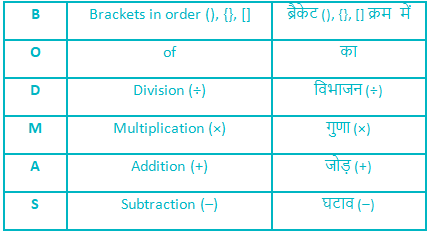
We have to follow the BODMAS rule→

C:\Users\Testbook\Desktop\dasdsasfdertet5342423.PNG

Calculation:

(24 ÷ 8 × 5) – (8 × 3 ÷ 2)

⇒ (3 × 5) - (8 × 3/2)

⇒ 15 - (4 × 3) = 15 - 12 = 3

So, (24 ÷ 8 × 5) – (8 × 3 ÷ 2) = 3 is correct answer.

57

Amar, Ritesh and Karan start a partnership. They invest Rs.10000, Rs.24000 and Rs.16000 respectively. Amar, Ritesh and Karan live in partnership for 2 months, 6 months and 8 months respectively. If the total profit is Rs 146000, then what is the combined share of Amar and Karan in the profit?

  1. ((a))

    Rs 74000

  2. ((b))

    Rs 72000

  3. ((c))

    Rs 84000

  4. ((d))

    Rs 64000

Show Answer
Answer: ((a))

Rs 74000

Given:

Investment of Amar = 10000 Rs. for 2 months

Investment of Ritesh = 24000 Rs. for 6 months

Investment of Karan = 16000 Rs. for 8 months

Formula Used:

If any amount M is divided in a:b:c then,

I part = M × a/(a + b + c)

II part = M × b/(a + b + c)

III part = M × c/(a + b + c)

Calculation:

Ratio of share of Amar, Ritesh and Karan 

⇒ 10000 × 2 : 24000 × 6 : 16000 × 8

⇒ 10 : 12 × 6 : 8 × 8

⇒ 5 : 36 : 32

∴Combined share of Aman and Karan = 146000 × (32 + 5)/73 = 2000 × 37 = 74000

58

The average of 13 numbers is 22. If each number is multiplied by 3, what will be the new average?

  1. ((a))

    66

  2. ((b))

    44

  3. ((c))

    48

  4. ((d))

    68

Show Answer
Answer: ((a))

66

Shortcut Trick

If each number in a given set is multiplied by a certain constant, the new average is simply the old average multiplied by the same constant.

New Average = Old Average × Constant

New Average = 22 × 3 = 66

∴ The correct answer is 66.

Alternate Method

Given:

Average of 13 numbers = 22

Constant multiplier for each number = 3

Formula Used:

Average = Sum of all observations ÷ Total number of observations

Property of Averages

Original Average:

22

Each number × 3

New Average:

66 (i.e. 22 × 3)

Calculations:

⇒ Sum of the original 13 numbers = Average × Total numbers

⇒ Original Sum = 22 × 13 = 286

⇒ When each individual number is multiplied by 3, the total sum is also multiplied by 3.

⇒ New Sum = Original Sum × 3

⇒ New Sum = 286 × 3 = 858

⇒ New Average = New Sum ÷ Total numbers

⇒ New Average = 858 ÷ 13 = 66

∴ The correct answer is 66.

Additional Information

Addition and Subtraction Property

If a constant value 'k' is added to or subtracted from each observation in a dataset, the new average becomes (Old Average + k) or (Old Average − k).

Multiplication and Division Property

If each observation is multiplied or divided by a non-zero constant 'k', the new average becomes (Old Average × k) or (Old Average ÷ k).

Combined Average

If group 1 has n1 items with average A1 and group 2 has n2 items with average A2, the Combined Average = (n1A1 + n2A2) ÷ (n1 + n2).

59

P and Q together can complete a piece of work in 10 days. Q and R together can complete the same work in 15 days. If P, Q and R all work together, then the same work is completed in 7.5 days. How many days will P and R together take to complete the same work?​

  1. ((a))

    7 Days

  2. ((b))

    10 Days

  3. ((c))

    15 Days

  4. ((d))

    5 Days

Show Answer
Answer: ((b))

10 Days

Given:

P + Q can complete a work in 10 days 

Q + R can complete same work in 15 days

P + Q + R can complete it in 7.5 days

Formula Used:

If A finish a work in D days then 

per day work of A = 1/D

Calculation:

Per day work of P + Q = 1/10

Per day work of Q + R = 1/15

Per day work of P + Q + R = 2/15

Per day work of P = (P + Q + R) - (Q + R) = 2/15 - 1/15 = 1/15

Per day work of R = (P + Q + R) - (P + Q) = 2/15 - 1/10 = (4 -3)/30 = 1/30

Per day work of P + R = 1/15 + 1/30 = 230 + /30 = 1/10

So, P and R can complete the same work in 10 days.

60

If a number 5872Y is exactly divisible by 9, then what is the value of Y?

  1. ((a))

    4

  2. ((b))

    8

  3. ((c))

    5

  4. ((d))

    9

Show Answer
Answer: ((c))

5

Given:

Given number is 5872Y.

Concept Used:

Divisibility rule of 9→

A number is divisible by 9 only when sum of all its digits is also divisible by 9.

Calculation:

Sum of digits of 5872Y = 5 + 8 + 7 + 2 + Y = 22 + Y

Now check the options,

4 → It returns 26 that is not divisible by 9.

8 → It returns 30 that is not divisible by 9.

9 → It returns 31 that is not divisible by 9.

5 → It returns 27 that is absolutely divisible by 9.

∴ Y = 5 is correct answer.

General Hindi (20 questions)

61

दिए गए शब्दो की सधि विच्छेद ज्ञात कीजिए।

इतस्ततः

  1. ((a))

    इति + स्ततः

  2. ((b))

    इतः + ततः

  3. ((c))

    इता + सतः

  4. ((d))

    इतः + स्त

Show Answer
Answer: ((b))

इतः + ततः

'इतस्ततः' का सही संधि विच्छेद इतः + ततः है।

  • सन्धि विच्छेद - इतः + ततः
  • नियम - ' ः' + 'प्रथम/द्वितीय वर्गीय व्यंजन' अथवा 'उष्म व्यंजन' = स् + 'प्रथम/द्वितीय वर्गीय व्यंजन' अथवा 'उष्म व्यंजन'
  • इस संधि में विसर्ग का स् में परिवर्तन हो जाता है।
  • उदाहरण -  इतः + ततः = इतस्ततः
  • 'इतस्ततः' का सन्धिविच्छेद 'इतः + ततः' होता है। जिससे स्पष्ट होता है कि 'इतः' के पश्चात् आये विसर्ग में परिवर्तन हुआ है। जो विसर्ग सन्धि के लक्षण से युक्त है।
62

निम्नलिखित प्रश्न में, दिए गए चार विकल्पो में से, उस विकल्प का चयन करें जो दिए गए मुहावरे के अर्थ को सर्वश्रेष्ठ रूप से व्यक्त करता है।

कंधा लगाना

  1. ((a))

    सहारा देना

  2. ((b))

    मुसीबत मोल लेना

  3. ((c))

    कहे अनुसार करना

  4. ((d))

    मुसीबत को दूर करना

Show Answer
Answer: ((a))

सहारा देना

'कंधा लगाना’ मुहावरे का अर्थ 'मुसीबत को दूर करना' है। अतः विकल्प 4 सही है।

Key Points 

  • 'कंधा लगाना’ मुहावरे का अर्थ 'मुसीबत को दूर करना' है।
  • वाक्य प्रयोग -  चार आदमी कंधा लगा दें तो किसी भी व्यक्ति की बड़ी से बड़ी मुसीबत को दूर किया जा सकता है।

Additional Information

  • इज्जत मिट्टी में मिलाना 
  • अर्थ – प्रतिष्ठा खत्म करना।
  • वाक्य प्रयोग – रामू की शराब की आदत ने उसके परिवार की इज्जत मिट्टी में मिला दी हैं।
  • आ बैल मुझे मार 
  • अर्थ – मुसीबत मोल लेना।
  • वाक्य प्रयोग – आपको अच्छी तरह पता था इस काम में केवल धन की हानि ही होनी थी फिर भी बात न मानकर आ बैल मुझे मार वाली बात कर ली। अब भरो हरजाना उसका।
  • पहाड़ टूट पड़ना  
  • अर्थ - बहुत बड़ी आपत्ति आना।
  • वाक्य प्रयोग - पिता के देहांत का दुखद समाचार सुनकर रमेश पर मानो पहाड़ टूट पड़ा हो।
मुहावरा परिभाषाउदाहरण
मुहावरा का शाब्दिक अर्थ ‘अभ्यास’ है। मुहावरा शब्द अरबी भाषा का शब्द है। हिन्दी में ऐसे वाक्यांशों को मुहावरा कहा जाता है, जो अपने साधारण अर्थ को छोड़कर  विशेष अर्थ को व्यक्त करते हैं।अंक भरना- स्नेह से लिपटा लेना वाक्य-माँ ने स्नेह से अपने पुत्र को अंक में भर लिया।
63

निम्नलिखित वाक्यो में से मिश्र वाक्य ज्ञात कीजिए।

  1. ((a))

    अभिमीत और अभिषेक खेल रहे हैं।

  2. ((b))

    अभिमीत, अभिषेक दोनो खेल रहे हैं।

  3. ((c))

    अभिमीत के साथ अभिषेक खेल रहा है।

  4. ((d))

    अभिमीत खेल रहा है क्योंकि उसके साथ अभिषेक भी है।

Show Answer
Answer: ((d))

अभिमीत खेल रहा है क्योंकि उसके साथ अभिषेक भी है।

अभिमीत खेल रहा है क्योंकि उसके साथ अभिषेक भी है।​ शेष विकल्प असंगत हैं। अतः सही विकल्प 4 है।

Key Points 

  • 'अभिमीत खेल रहा है क्योंकि उसके साथ अभिषेक भी है।' मिश्र वाक्‍य है क्योंकि इसमें एक प्रधान और एक आश्रित वाक्य है।
  • मिश्र वाक्य में एक से अधिक वाक्य मिले हों, किन्तु एक प्रधान उपवाक्य तथा शेष आश्रित उपवाक्य होते हैं।
  • उपरोक्त वाक्य 'क्योंकि' की उपस्थिती मिश्र वाक्य होने की पुष्टि करती है।
<br>

अन्य विकल्प–

  1. अभिमीत और अभिषेक खेल रहे हैं। - सरल वाक्य
  2. अभिमीत, अभिषेक दोनो खेल रहे हैं।- सरल वाक्य
  3. अभिमीत के साथ अभिषेक खेल रहा है। - सरल वाक्य

Additional Information 

वाक्यपरिभाषाउदाहरण
सरलऐसे वाक्य जिनमें एक ही क्रिया एवं एक ही कर्ता होता है या जिस वाक्य में एक ही उद्देश्य एवं एक ही विधेय होता है, वे वाक्य सरल वाक्य कहलाते हैं। इसमें कर्ता एक से अधिक हो सकते हैं लेकिन मुख्य क्रिया एक ही होगी।राकेश पढ़ता है। कमला और विमला मंदिर जाती हैं।
संयुक्तजिस वाक्य में दो या दो से अधिक उपवाक्य मिले हों, परन्तु सभी वाक्य प्रधान हो तो ऐसे वाक्य को संयुक्त वाक्य कहते है।वह सुबह आगरा गया और शाम को लौट आया।
मिश्रजिस वाक्य में एक से अधिक वाक्य मिले हों, किन्तु एक प्रधान उपवाक्य तथा शेष आश्रित उपवाक्य हों, मिश्रित वाक्य कहलाता है।वह औरत जो पार्क में बैठी हैं मेरी मौसी हैं।
64

दिए गए शब्द युग्म का सही शब्द युग्म ज्ञात कीजिए।

मनुज : मनोज

  1. ((a))

    मनुष्य : कामदेव

  2. ((b))

    आनंद : रत्न

  3. ((c))

    बादल : यज्ञ

  4. ((d))

    जड़ : मस्त

Show Answer
Answer: ((a))

मनुष्य : कामदेव

दिए गये विकल्पों में मनुज : मनोज का सही शब्द युग्म 'मनुष्य : कामदेव' होगा।

  • मनुज का अर्थ मनुष्य होता है।
  • मनोज का अर्थ कामदेव होता है।

Key Points अन्य विकल्प:

  • मणि - मणी : रत्न - साँप
  • मेघ - मेध : बादल - यज्ञ
  • मूल - मूल्य : जड़ - कीमत

Additional Information

अन्य शब्द युग्म

  • अंस-अंश:- कंधा-हिस्सा
  • अँगना-अंगना:- घर का आँगन-स्त्री
  • अन्न-अन्य:- अनाज-दूसरा
  • अनिल-अनल:- हवा-आग
  • अम्बु-अम्ब:- जल- माता, आम
65

दिए गए शब्द का पर्यायवाची शब्द ज्ञात कीजिए।

विष

  1. ((a))

    अनिल

  2. ((b))

    गरल

  3. ((c))

    पवन

  4. ((d))

    हवा

Show Answer
Answer: ((b))

गरल

उपरोक्त विकल्पों में 'विष ' का पर्यायवाची शब्द गरल है। अत: विकल्प गरल इसका सही उत्तर है। अन्य विकल्प असंगत हैं।

अन्य विकल्प:

  • अनिल, पवन, हवा पर्यायवाची शब्द युग्म है।
  • हवा के अन्य पर्यायवाची शब्द हैं - समीर, वात, मारुत, पवमान, प्रभंजन, प्रवात, समीरण, मातरिश्वा, बयार।

विशेष:

शब्दपरिभाषाउदाहरण
पर्यायवाचीएक ही अर्थ में प्रयुक्त होने वाले शब्द जो बनावट में भले ही अलग हों, पर्यायवाची या समानार्थी शब्द कहलाते हैं।आग-अनल, पावक, दहन। हवा-समीर, अनिल, वायु।
66

निम्नलिखित शब्दो में से स्त्रीलिंग ज्ञात कीजिए।

  1. ((a))

    गैंडा

  2. ((b))

    दरवाजा

  3. ((c))

    दीवार

  4. ((d))

    परदा

Show Answer
Answer: ((c))

दीवार

'दीवार' शब्द स्त्रीलिंग है।  हम व्यवहार में अक्सर कहते है कि 'दीवार गिर गयी है।' - इस वाक्य के प्रयोग से भी लिंग का बोध हो जाता है। 

  • गैंडा, दरवाजा, परदा यह तीनो शब्द पुल्लिंग में प्रयोग किये जाते है।
  • गैंडा बड़ा जानवर है।
  • दरवाजा टूट गया है।
  • परदा फट गया है।

Key Points

परिभाषा
जिस संज्ञा शब्द से यह पता चलता है कि वह पुरुष जाति का है या स्त्री जाति का, उसे लिंग कहते हैं। हिंदी में इसके दो भेद हैं -
पुल्लिंगजिन संज्ञा शब्दों से पुरुष जाति का पता चलता है,पुल्लिंग होते हैं।लड़का, आदमी, मकान आदि।
स्त्रीलिंगजिन संज्ञा शब्दों से स्त्री जाति का पता चलता है, स्त्रीलिंग होते हैं।लड़की, गाय, आदत आदि।
67

दिए गए शब्द का उपसर्ग ज्ञात कीजिए।

अधोमुखी

  1. ((a))

    अध

  2. ((b))

    अतः

  3. ((c))

    अधः

  4. ((d))

    अधो

Show Answer
Answer: ((c))

अधः

‘अधोमुखी’ शब्द ‘अध:’ उपसर्ग से बना है। अत: सही उत्तर विकल्प 3 ‘अध:’ है।

Key Points 

  • ‘अध:’ उपसर्ग से बनने वाले अन्य शब्द - अधोमुखी, अधोलिखित, अधःपतन आदि।
  • ‘अध’ का अर्थ – नीचे
  • अधः उपसर्ग के समान प्रयुक्त होने वाला संस्कृत का अव्यय (उपसर्गवत्) है।

Additional Information

शब्दपरिभाषाउदाहरण
उपसर्गऐसे शब्दांश जो किसी शब्द के पूर्व जुड़कर उसके अर्थ में परिवर्तन कर देते हैं।प्रति + क्षण = प्रतिक्षण सम् + गम = संगम
68

दिए गए वाक्य में उपयुक्त विराम चिह्न का चयन कीजिए।

रुको रुको वह क्या कह रही है।

  1. ((a))

    '' ''

  2. ((b))

    ,,

  3. ((c))

    ;

  4. ((d))

    ,

Show Answer
Answer: ((d))

,

सही उत्तर अल्प विराम चिह्न ( , ) है। रुको रुको, वह क्या कह रही है।

विराम चिह्न: विराम चिह्न का अर्थ है  ठहराव, विश्राम, रुकना। अर्थात वाक्य लिखते समय विराम को प्रकट करने के लिए लगाए जाने वाले चिह्न को विराम चिह्न कहते हैं।

  • अल्प विराम चिह्न ( , )-
  • वाक्य में जहाँ थोड़ा रुकना हो या अधिक वस्तुओं, व्यक्तियों आदि को अलग करना हो वहाँ अल्प विराम (,) चिन्ह का प्रयोग किया जाता है।
  • उदाहरण-
  • सुनील, जरा इधर आना।
  • सवेरा हुआ, चिड़िया चहचहाने लगी।
  • रुको रुको, वह क्या कह रही है।

Key Points

 अन्य विकल्पों का विश्लेषण:

  • विवरण चिह्न/आदेश/सूचना चिह्न ( :- ) - इसे विवरण चिन्ह के नाम से भी जाना जाता है। इसे (:-) से प्रदर्शित करते है। इस चिन्ह का प्रयोग तब करते है जब वाक्यांशों के विषयों में कोई निर्देश देना हो। उदाहरण-
  • वचन के दो भेद होते है:-
  • पुनरुक्ति सूचक चिह्न ( ,, ) - पुनरुक्ति सूचक चिह्न का प्रयोग ऊपर लिखे किसी वाक्य या वाक्यांश को दोबारा लिखने के श्रम से बचने के लिए करते हैं। उदाहरण-

राम के पास आम की संख्या = 5

रेखा ,,    ,,     ,,    ,,    ,,     = 3

  • अर्द्ध विराम (;) - अर्द्ध विराम को (;) चिह्न से प्रदर्शित करते है। जिस स्थान पर अल्प विराम की अपेक्षा थोड़े अधिक समय के लिए ठहराव की स्थिति उत्पन्न हो जाये, वहां अर्द्ध विराम का प्रयोग करते है। उदाहरण-
  • सूर्यास्त हो चुका है; चारो तरफ घना अँधेरा छा जायेगा

अतः निष्कर्ष निकलता है कि रुको रुको, वह क्या कह रही है। के लिए उपयुक्त विराम चिह्न अल्प विराम चिह्न ( , ) है।

Additional Information  

हिंदी में प्रचलित प्रमुख विराम चिह्न निम्नलिखित है:–

(1) अल्प विराम ( , )

(2) अर्द्ध विराम ( ; )

(3) पूर्ण विराम ( । )

(4) उप विराम  [ : ]

(5) विस्मयादिबोधक चिह्न ( ! )

(6) प्रश्नवाचक चिह्न  ( ? )

(7) कोष्ठक ( () )

(8) योजक चिह्न  ( - )

(9) अवतरण चिह्न या उद्धरणचिह्न  ( ''... '' )

(10) लाघव चिह्न) ( o )

(11) आदेश चिह्न/सूचना ( :- )

(12) रेखांकन चिह्न (_)

(13) लोप चिह्न (...)

69

दिए गए शब्द युग्म का सही शब्द युग्म ज्ञात कीजिए।

बान : बाण

  1. ((a))

    रग : अक्षर

  2. ((b))

    आदत : तीर

  3. ((c))

    बहुत : मुख

  4. ((d))

    रास्ता : हिस्सा

Show Answer
Answer: ((b))

आदत : तीर

दिए गये विकल्पों में बान : बाण का सही शब्द युग्म 'आदत : तीर' होगा।

  • बान का अर्थ आदत होता है।
  • बाण का अर्थ तीर होता है।

Key Pointsअन्य विकल्प:

  • बदन - वदन : शरीर - मुख
  • अंस - अंश : कंधा - हिस्सा
  • पथ - पथ्य : रास्ता - रोगी का भोजन
70

दिए गए वाक्य की वृत्ति ज्ञात कीजिए।

एक गिलास पानी देना।

  1. ((a))

    आज्ञार्थक

  2. ((b))

    निश्चियार्थक

  3. ((c))

    बाध्यता सूचक

  4. ((d))

    सकेतार्थक

Show Answer
Answer: ((a))

आज्ञार्थक

दिए गए विकल्पों में से सही उत्तर विकल्प 1 ‘आज्ञार्थक’ है। अन्य विकल्प इसके गलत उत्तर हैं। 

Key Points 

  • 'एक गिलास पानी देना।' यह आज्ञार्थक वाक्य है।
  • वह वाक्य जिसके द्वारा किसी प्रकार की आज्ञा दी जाती है या प्रार्थना किया जाता है, वह आज्ञार्थक वाक्य है।
  • शब्दों के सार्थक समूह को वाक्य अर्थात् वाक्य शब्द–समूह का वह सार्थक विन्यास होता है, जिससे उसके अर्थ एवं भाव की पूर्ण एवं सुस्पष्ट अभिव्यक्ति होती है।

Additional Information 

वाक्य के भेद: क्रिया, अर्थ तथा रचना के आधार पर वाक्यों के निम्न भेद प्रभेद किये जाते हैं-  

  1. क्रिया की दृष्टि से: क्रिया के आधार पर वाक्य तीन प्रकार के होते हैं।
  2. अर्थ के आधार पर: अर्थ के आधार पर वाक्य 8 प्रकार के होते हैं।
  3. रचना के आधार पर: रचना के आधार पर वाक्य तीन प्रकार के होते हैं।

अर्थ के आधार पर आठ प्रकार के वाक्य होते हैं-

    1. विधानवाचक वाक्य - वह वाक्य जिससे किसी प्रकार की जानकारी प्राप्त होती है, वह विधानवाचक वाक्य कहलाता है।
  • उदाहरण -भारत एक देश है।
    1. निषेधवाचक वाक्य : जिन वाक्यों से कार्य न होने का भाव प्रकट होता है, उन्हें निषेधवाचक वाक्य कहते हैं।
  • उदाहरण - मैंने दूध नहीं पिया।
    1. प्रश्नवाचक वाक्य - वह वाक्य जिसके द्वारा किसी प्रकार प्रश्न किया जाता है, वह प्रश्नवाचक वाक्य कहलाता है।
  • उदाहरण - भारत क्या है?
    1. आज्ञावाचक/आज्ञार्थक वाक्य - वह वाक्य जिसके द्वारा किसी प्रकार की आज्ञा दी जाती है या प्रार्थना किया जाता है, वह आज्ञावाचक वाक्य कहलाता हैं।
  • उदाहरण - बैठो।
    1. विस्मयादिबोधक वाक्य - वह वाक्य जिससे किसी प्रकार की गहरी अनुभूति का प्रदर्शन किया जाता है, वह विस्मयादिबोधक वाक्य कहलाता हैं।
  • उदाहरण - अहा! कितना सुन्दर उपवन है।
    1. इच्छावाचक वाक्य - जिन वाक्यों में किसी इच्छा, आकांक्षा या आशीर्वाद का बोध होता है, उन्हें इच्छावाचक वाक्य कहते हैं। उदाहरण- भगवान तुम्हे दीर्घायु करे।
    1. संकेतवाचक वाक्य- जिन वाक्यों में किसी संकेत का बोध होता है, उन्हें संकेतवाचक वाक्य कहते हैं।
  • उदाहरण- राम का मकान उधर है।
    1. संदेहवाचक वाक्य - जिन वाक्यों में संदेह का बोध होता है, उन्हें संदेहवाचक वाक्य कहते हैं।
  • उदाहरण- क्या वह यहाँ आ गया ?
71

निम्नलिखित वाक्यो में से सरल वाक्य ज्ञात कीजिए।

  1. ((a))

    नेहा रात-भर पढ़ती है, क्योकि वह परीक्षा में सफल होना चाहती है।

  2. ((b))

    नेहा रात-भर परीक्षा में सफल होने के लिए पढ़ती है।

  3. ((c))

    रात-भर नेहा इसलिए पढ़ती है कि वह परीक्षा में सफल हो जाए।

  4. ((d))

    नेहा रात-भर पढ़ती है जिससे परीक्षा में सफल हो सके।

Show Answer
Answer: ((b))

नेहा रात-भर परीक्षा में सफल होने के लिए पढ़ती है।

सही उत्तर विकल्प 2 है- 'नेहा रात-भर परीक्षा में सफल होने के लिए पढ़ती है।​​​' 

  • '**नेहा रात-भर परीक्षा में सफल होने के लिए पढ़ती है।**​' वाक्य सरल वाक्य है।
  • सरल वाक्य: ऐसा वाक्य जिसमे एक ही क्रिया एवं एक ही कर्ता होता है या जिस वाक्य में एक ही उद्देश्य एवं एक ही विधेय होता है, वे वाक्य सरल वाक्य कहलाते हैं। सरल वाक्य को साधारण वाक्य भी कहा जाता है।
  • जैसे- नेहा रात-भर परीक्षा में सफल होने के लिए पढ़ती है। वर्षा होते ही मोर नाचने लगे। इन वाक्यों में एक-एक उद्देश्य अर्थात कर्ता और विधेय अर्थात क्रिया है। अतः ये साधारण या सरल वाक्य हैं।

Key Points अन्य विकल्पों का विश्लेषण: 

वाक्यप्रकार
नेहा रात-भर पढ़ती है जिससे परीक्षा में सफल हो ��के।मिश्र वाक्य
नेहा रात-भर पढ़ती है, क्योकि वह परीक्षा में सफल होना चाहती है।मिश्र वाक्य
रात-भर नेहा इसलिए पढ़ती है कि वह परीक्षा में सफल हो जाए।मिश्र वाक्य

Additional Information 

  • वाक्य: शब्दों का ऐसा समूह जिसका जिसका कोई भाव/अर्थ प्रकट होता है, वाक्य कहलाता है।
  • जैसे - राम खाना खाता है।
  • ​रचना की दृष्टि से वाक्य के तीन प्रमुख भेद किये जाते हैं:
वाक्यदो या दो से अधिक शब्दों के सार्थक समूह को कहते हैं। मुख्य रूप से इसके तीन प्रकार माने गए हैं -
परिभाषाउदाहरण
सरलऐसे वाक्य जिनमें एक ही क्रिया एवं एक ही कर्ता होता है या जिस वाक्य में एक ही उद्देश्य एवं एक ही विधेय होता है, वे वाक्य सरल वाक्य कहलाते हैं। इसमें कर्ता एक से अधिक हो सकते हैं लेकिन मुख्य क्रिया एक ही होगी।राकेश पढ़ता है। कमला और विमला मंदिर जाती हैं।
संयुक्तजिस वाक्य में दो या दो से अधिक उपवाक्य मिले हों, परन्तु सभी वाक्य प्रधान हो तो ऐसे वाक्य को संयुक्त वाक्य कहते है। संयोजक शब्द जैसे: और, एवं, फिर, या,अथवा, परंतु, इसलिए, तथा, तो, नहीं तो, भी, किंतु।वह सुबह आगरा गया और शाम को लौट आया।
मिश्रजिस वाक्य में एक से अधिक वाक्य मिले हों, किन्तु एक प्रधान उपवाक्य तथा शेष आश्रित उपवाक्य हों, मिश्रित वाक्य कहलाता है। मिश्र वाक्य के निर्माण में संयोजक अव्यय जैसे: आपस में, कि, जो, क्योंकि, जितना, उतना, जैसा, वैसा, जब, तब, जहाँ, वहाँ, जिधर, उधर, यद्यपि, यदि, अगर, तो इत्यादि।वह औरत जो पार्क में बैठी हैं मेरी मौसी हैं।
72

निम्नलिखित प्रश्न में, दिए गए चार विकल्पो में से, उस विकल्प का चयन करें जो दिए गए मुहावरे के अर्थ को सर्वश्रेष्ठ रूप से व्यक्त करता है।

पत्थर में दूब जमना

  1. ((a))

    काम बिगड़ जाना

  2. ((b))

    सफलता मिलना

  3. ((c))

    हानि पहुँचाना

  4. ((d))

    असम्भव बात होना

Show Answer
Answer: ((d))

असम्भव बात होना

'पत्थर में दूब जमना’ मुहावरे का सही अर्थ है, 'असम्भव बात होना'। अन्य विकल्प असंगत हैं।

Key Points 

स्पष्टीकरण:-

मुहावरेअर्थवाक्य प्रयोग
पत्थर में दूब जमनाअसम्भव बात होनारवि जैसे लापरवाह छात्र का परीक्षा में उत्तीर्ण होना पत्थर में दूब जमना होगा।

अन्य विकल्प:-

मुहावरेअर्थवाक्य प्रयोग
अंधे के हाथ बटेर लगनाअपात्र को सफलता मिल जानासुधीर कम्प्यूटर नहीं जानता, फिर भी उसके पिता ने उसे नया कम्प्यूटर दिला दिया। ये तो वही बात हुई कि 'अंधे के हाथ बटेर लगना'।
खेल बिगड़ जानाकाम बिगड़ जानाअगर पिताजी ने साथ नहीं दिया तो हमारा सारा खेल बिगड़ जाएगा।
चूना लगानाहानि पहुँचानाउसने मुझे रिश्तेदारी का हवाला दिया और मैं पिघल गया। बेबात में उसने मुझे सौ रुपये का चूना लगा दिया।

Additional Information 

 मुहावरा का शाब्दिक अर्थ ‘अभ्यास’ है। मुहावरा शब्द अरबी भाषा का शब्द है। हिन्दी में ऐसे वाक्यांशों को मुहावरा कहा जाता है, जो अपने साधारण अर्थ को छोड़कर  विशेष अर्थ को व्यक्त करते हैं।

73

निम्नलिखित वाक्याश के लिए उचित शब्द का चयन कीजिए।

जो किसी विषय की विशेष जानकारी रखता हो

  1. ((a))

    वैध

  2. ((b))

    विषयासत्क

  3. ((c))

    वैज्ञानिक

  4. ((d))

    विशेषज्ञ

Show Answer
Answer: ((d))

विशेषज्ञ

सही उत्तर 'विशेषज्ञ' है।

'जो किसी विषय की विशेष जानकारी रखता हो' - वाक्यांश के लिए सार्थक शब्द 'विशेषज्ञ' है।

Key Points 

अन्य विकल्प:

शब्दवाक्यांश
वैधजो कार्य विधि के अनुरूप हो।
विषयासत्कजो सांसारिक भोगविलास में लिप्त हो।
वैज्ञानिकविज्ञान से संबंध रखने वाला।

Additional Information 

वाक्यांश- भाषा को सुंदर, आकर्षक और प्रभावशाली बनाने के लिए अनेक शब्दों के स्थान पर एक शब्द का प्रयोग किया जाता है तो वह वाक्यांश के लिए एक शब्द कहलाता है।

74

निम्नलिखित में से कौन-सा शब्द विदेशज शब्द है?

  1. ((a))

    रेडियो

  2. ((b))

    पगड़ी

  3. ((c))

    कर्राटा

  4. ((d))

    सर-सर

Show Answer
Answer: ((a))

रेडियो

उपर्युक्त विकल्पों में से 'रेडियो' एक विदेशज शब्द हैं। रेडियो एक अंग्रेजी शब्द है। 

स्पष्टीकरण

  • विदेशी शब्द :- विदेशी भाषाओं से हिंदी भाषा में आये शब्दों को 'विदेशी' शब्द' कहते है। जैसे- अदालत, ऑफिसर, बुखार, हज़म, रेडियो आदि।
  • देशज शब्द :- ऐसे शब्द जो देश की अन्य या क्षेत्रीय भाषा से हिंदी में सम्मिलित हुए । जैसे- थैला, लोटा, टाँग, पगड़ी आदि।
75

दिए गए वाक्य में उपयुक्त विराम चिह्न का चयन कीजिए।

मोहन बैंगलोर चला गया आप बेफिक्र रहें।

  1. ((a))

    ...

  2. ((b))

    .

  3. ((c))

    ;

  4. ((d))

Show Answer
Answer: ((c))

;

सही उत्तर अल्प विराम चिह्न (;) है।

विराम चिह्न: विराम चिह्न का अर्थ है  ठहराव, विश्राम, रुकना। अर्थात वाक्य लिखते समय विराम को प्रकट करने के लिए लगाए जाने वाले चिह्न को विराम चिह्न कहते हैं।

  • अर्द्ध विराम (;) - अर्द्ध विराम को (;) चिह्न से प्रदर्शित करते है। जिस स्थान पर अल्प विराम की अपेक्षा थोड़े अधिक समय के लिए ठहराव की स्थिति उत्पन्न हो जाये, वहां अर्द्ध विराम का प्रयोग करते है। उदाहरण-
  • कई सप्ताह से वर्षा होती ही जारी है; अर्थात् फसल नष्ट होकर रहेगी।
  • सूर्यास्त हो चुका है; चारो तरफ घना अँधेरा छा जायेगा।
  • मोहन बैंगलोर चला गया; आप बेफिक्र रहें।

Key Points अन्य विकल्पों का विश्लेषण:

  • लोप चिह्न (...) - जिस वाक्य को लिखते समय किसी शब्द या वाक्य का लोप हो जाता है या करना पड़ता है वहाँ इस चिह्न का प्रयोग किया जाता है। उदाहरण-
  • ​गाँधीजी ने कहा, ''परीक्षा की घड़ी आ गई है .... हम करेंगे या मरेंगे'' ।
  • लाघव चिह्न (o) - किसी शब्द जो बड़ा हो या प्रसिद्ध हो या फिर किसी कंपनी, संस्थान, किसी प्रद्ध व्यक्ति का नाम आदि को संक्षेप में लिखने के लिए उसका पहला अक्षर लिखकर उसके बाद लाघव चिन्ह (o या .) का प्रयोग किया जाता है। आजकल (.) का इस्तेमाल प्रमुखता से किया जाता है। उदाहरण-
  • एम. एम. फरुखी, डॉ. रोहित, प्रो. नीलम सिंह
  • योजक चिह्न ( - ) - दो शब्दों में परस्पर संबंध स्पष्ट करने के लिए तथा उन्हें जोड़कर लिखने के लिए योजक-चिन्ह का प्रयोग किया जाता है।  उदाहरण-
  • मैं दिन–रात यही सोचता रहा।
  • एक दुबला-पतला व्यक्ति द्वार पर खड़ा है।

Additional Information 

हिंदी में प्रचलित प्रमुख विराम चिह्न निम्नलिखित है:–

(1) अल्प विराम ( , )

(2) अर्द्ध विराम ( ; )

(3) पूर्ण विराम ( । )

(4) उप विराम  [ : ]

(5) विस्मयादिबोधक चिह्न ( ! )

(6) प्रश्नवाचक चिह्न  ( ? )

(7) कोष्ठक ( () )

(8) योजक चिह्न  ( - )

(9) अवतरण चिह्न या उद्धरणचिह्न  ( ''... '' )

(10) लाघव चिह्न ( o )

(11) आदेश चिह्न/सूचना ( :- )

(12) रेखांकन चिह्न (_)

(13) लोप चिह्न (...)

एक गद्याश दिया गया है। गद्याश के आधार पर पाँच प्रश्न दिए गए हैं। गद्याश को ध्यानपूर्वक पढ़ें तथा प्रत्येक प्रश्न में चार विकल्पो में से सही विकल्प चुने।

समाज के लिए समानता का अधिकार बहुत महत्वपूर्ण है। इस अधिकार का उद्देश्य कानून का शासन स्थापित करना है जहाँ पर कानून के समक्ष सभी नागरिको के साथ समानता का व्यवहार किया जाता है। भारत में सभी लोगो को कानून का समान संरक्षण तथा कानून के समक्ष समानता उपलब्ध कराने के लिए पांच प्रावधान (अनुच्छेद 14-18) किये गये हैं। यह धर्म, नस्ल, जाति, लिंग या जन्म स्थान के आधार पर किसी भेदभाव पर रोक लगाता है। संविधान यह सुनिश्चित करता है कि सभी नागरिक कानून के समक्ष समान होंगे। इसका तात्पर्य यह है कि देश के कानूनों द्वारा सभी को समान संरक्षण मिलेगा। कोई भी कानून से ऊपर नही है। इसका अर्थ है कि यदि दो व्यक्ति एक प्रकार का अपराध करते हैं तो उन्हें बिना किसी भेदभाव के समान दण्ड मिलेगा। राज्य धर्म, नस्ल, जाति, लिंग या जन्म स्थान के आधार पर किसी के साथ भेदभाव नही करेगा। यह सामाजिक समानता के लिए आवश्यक है। भारत के प्रत्येक नागरिक की दुकान, जलपान गृह, मनोरंजन के सार्वजनिक स्थानों तक समान पहुंच होगी तथा वह कुओं, तालाबों अथवा सड़कों का प्रयोग बिना किसी भेदभाव के कर सकता है। हालांकि राज्य द्वारा महिलाओं और बच्चों के लिए विशेष प्रावधान व छूट की व्यवस्था की जा सकती है। सार्वजनिक रोजगार के मामलों में राज्य के द्वारा किसी के साथ कोई भेदभाव नही किया जायेगा। सभी नागरिक आवेदन कर सकते हैं तथा राज्य के कर्मचारी बन सकते हैं। वरीयता तथा योग्यता के आधार पर रोजगार उपलब्ध होंगे।

76

संविधान के अनुसार यह कानून क्या सुनिश्चित करता है?

  1. ((a))

    विचार-विमर्श की समस्या

  2. ((b))

    दण्ड

  3. ((c))

    सार्वजानिक स्थानों पर भेदभाव

  4. ((d))

    समान संरक्षण

Show Answer
Answer: ((d))

समान संरक्षण

संविधान के अनुसार यह कानून समान संरक्षण सुनिश्चित करता है।

  • गद्याश के अनुसार:-
  • यह धर्म, नस्ल, जाति, लिंग या जन्म स्थान के आधार पर किसी भेदभाव पर रोक लगाता है।
  • संविधान यह सुनिश्चित करता है कि सभी नागरिक कानून के समक्ष समान होंगे।
  • इसका तात्पर्य यह है कि देश के कानूनों द्वारा सभी को समान संरक्षण मिलेगा।  ​

Key Points

  • संरक्षण -  बचाव, रक्षा, सुरक्षा, प्रतिरक्षा, हिफाजत, रखवाली
  • विलोम शब्द - 'अरक्षण'

Additional Informationविमर्श:-

  • अर्थ: परामर्श, राय, सलाह, विचार, जाँच, परख।

दण्ड:-

  • अर्थ: डंडा, सोंटा, लाठी, छड़ी, जुर्माना, सजा। 
  • विलोम शब्द - 'क्षमा'
77

किस आधार पर रोजगार उपलब्ध होते है?

  1. ((a))

    नागरिक

  2. ((b))

    धर्म

  3. ((c))

    योग्यता

  4. ((d))

    आवेदन

Show Answer
Answer: ((c))

योग्यता

योग्यता आधार पर रोजगार उपलब्ध होते है।

  • गद्याश के अनुसार:-
  • ​सार्वजनिक रोजगार के मामलों में राज्य के द्वारा किसी के साथ कोई भेदभाव नही किया जायेगा।
  • सभी नागरिक आवेदन कर सकते हैं तथा राज्य के कर्मचारी बन सकते हैं।
  • वरीयता तथा योग्यता के आधार पर रोजगार उपलब्ध होंगे।

Key Points

  • योग्यता - क्षमता, औकात, बुद्धिमानी, शिक्षा।
  • विलोम शब्द - 'अयोग्यता'

Additional Informationआवेदन:- 

  • अर्थ: प्रार्थना, याचना, निवेदन।

एक गद्याश दिया गया है। गद्याश के आधार पर पाँच प्रश्न दिए गए हैं। गद्याश को ध्यानपूर्वक पढ़ें तथा प्रत्येक प्रश्न में चार विकल्पो में से सही विकल्प चु���े।

समाज के लिए समानता का अधिकार बहुत महत्वपूर्ण है। इस अधिकार का उद्देश्य कानून का शासन स्थापित करना है जहाँ पर कानून के समक्ष सभी नागरिको के साथ समानता का व्यवहार किया जाता है। भारत में सभी लोगो को कानून का समान संरक्षण तथा कानून के समक्ष समानता उपलब्ध कराने के लिए पांच प्रावधान (अनुच्छेद 14-18) किये गये हैं। यह धर्म, नस्ल, जाति, लिंग या जन्म स्थान के आधार पर किसी भेदभाव पर रोक लगाता है। संविधान यह सुनिश्चित करता है कि सभी नागरिक कानून के समक्ष समान होंगे। इसका तात्पर्य यह है कि देश के कानूनों द्वारा सभी को समान संरक्षण मिलेगा। कोई भी कानून से ऊपर नही है। इसका अर्थ है कि यदि दो व्यक्ति एक प्रकार का अपराध करते हैं तो उन्हें बिना किसी भेदभाव के समान दण्ड मिलेगा। राज्य धर्म, नस्ल, जाति, लिंग या जन्म स्थान के आधार पर किसी के साथ भेदभाव नही करेगा। यह सामाजिक समानता के लिए आवश्यक है। भारत के प्रत्येक नागरिक की दुकान, जलपान गृह, मनोरंजन के सार्वजनिक स्थानों तक समान पहुंच होगी तथा वह कुओं, तालाबों अथवा सड़कों का प्रयोग बिना किसी भेदभाव के कर सकता है। हालांकि राज्य द्वारा महिलाओं और बच्चों के लिए विशेष प्रावधान व छूट की व्यवस्था की जा सकती है। सार्वजनिक रोजगार के मामलों में राज्य के द्वारा किसी के साथ कोई भेदभाव नही किया जायेगा। सभी नागरिक आवेदन कर सकते हैं तथा राज्य के कर्मचारी बन सकते हैं। वरीयता तथा योग्यता के आधार पर रोजगार उपलब्ध होंगे।

78

राज्यों द्वारा महिलाओं व बच्चों को कौन सी व्यवस्था प्रदान की जाती है?

  1. ((a))

    मनोरंजन

  2. ((b))

    नागरिकता

  3. ((c))

    जलपान ग्रह

  4. ((d))

    विशेष प्रावधान व छूट

Show Answer
Answer: ((d))

विशेष प्रावधान व छूट

राज्यों द्वारा महिलाओं व बच्चों को विशेष प्रावधान व छूट व्यवस्था प्रदान की जाती है।

  • गद्याश के अनुसार:-
  • ​हालांकि राज्य द्वारा महिलाओं और बच्चों के लिए विशेष प्रावधान व छूट की व्यवस्था की जा सकती है।
  • सार्वजनिक रोजगार के मामलों में राज्य के द्वारा किसी के साथ कोई भेदभाव नही किया जायेगा।

Key Points

  • प्रावधान - किसी कानून के साथ कोई शर्त रख देने का कार्य, उपबंध, (प्रॉविज़न)।

Additional Informationग्रह:- 

  • अर्थ: घर, सदन, गेह, भवन, धाम, निकेतन, नक्षत्र, तारक, सितारा, पिंड।

नागरिकता:-

  • अर्थ: नागरिक होने पर प्राप्त अधिकार।
79

उपर्युक्त गद्यांश का उपयुक्त शीर्षक क्या होगा?

  1. ((a))

    नारी व पुरुष में भेदभाव

  2. ((b))

    जन्म स्थान के आधार पर भेदभाव

  3. ((c))

    समानता का अधिकार

  4. ((d))

    विरोधी की समस्या

Show Answer
Answer: ((c))

समानता का अधिकार

उपर्युक्त गद्यांश का उपयुक्त शीर्षक होगा - 'समानता का अधिकार'

  • गद्याश के अनुसार:-
  • हर व्यक्ति के समानता के अधिकार का वर्णन किया गया है, चाहे किसी भी ​राज्य धर्म, नस्ल, जाति, लिंग या जन्म स्थान का हो, उसके आधार पर किसी के साथ भेदभाव नही होगा।

Key Points

  • समानता - समान होने का भाव, समरूप, सादृश्य।
  • विलोम शब्द - 'असमानता'

Additional Informationनारी:- 

  • अर्थ: महिला, रमणी, कामिनी, कान्ता, सुंदरी, औरत, वनिता, स्त्री, अबला।

पुरुष:-

  • अर्थ: मनुज, मनुष्य, मानव, नर, मर्त्य, जन,आदमी।

विरोधी:-

  • अर्थ: विपक्षी, शत्रु, वैरी, विरुद्ध, विपरीत, प्रतिस्पर्धी।
  • विलोम शब्द - 'समर्थक'

एक गद्याश दिया गया है। गद्याश के आधार पर पाँच प्रश्न दिए गए हैं। गद्याश को ध्यानपूर्वक पढ़ें तथा प्रत्येक प्रश्न में चार विकल्पो में से सही विकल्प चुने।

समाज के लिए समानता का अधिकार बहुत महत्वपूर्ण है। इस अधिकार का उद्देश्य कानून का शासन स्थापित करना है जहाँ पर कानून के समक्ष सभी नागरिको के साथ समानता का व्यवहार किया जाता है। भारत में सभी लोगो को कानून का समान संरक्षण तथा कानून के समक्ष समानता उपलब्ध कराने के लिए पांच प्रावधान (अनुच्छेद 14-18) किये गये हैं। यह धर्म, नस्ल, जाति, लिंग या जन्म स्थान के आधार पर किसी भेदभाव पर रोक लगाता है। संविधान यह सुनिश्चित करता है कि सभी नागरिक कानून के समक्ष समान होंगे। इसका तात्पर्य यह है कि देश के कानूनों द्वारा सभी को समान संरक्षण मिलेगा। कोई भी कानून से ऊपर नही है। इसका अर्थ है कि यदि दो व्यक्ति एक प्रकार का अपराध करते हैं तो उन्हें बिना किसी भेदभाव के समान दण्ड मिलेगा। राज्य धर्म, नस्ल, जाति, लिंग या जन्म स्थान के आधार पर किसी के साथ भेदभाव नही करेगा। यह सामाजिक समानता के लिए आवश्यक है। भारत के प्रत्येक नागरिक की दुकान, जलपान गृह, मनोरंजन के सार्वजनिक स्थानों तक समान पहुंच होगी तथा वह कुओं, तालाबों अथवा सड़कों का प्रयोग बिना किसी भेदभाव के कर सकता है। हालांकि राज्य द्वारा महिलाओं और बच्चों के लिए विशेष प्रावधान व छूट की व्यवस्था की जा ��कती है। सार्वजनिक रोजगार के मामलों में राज्य के द्वारा किसी के साथ कोई भेदभाव नही किया जायेगा। सभी नागरिक आवेदन कर सकते हैं तथा राज्य के कर्मचारी बन सकते हैं। वरीयता तथा योग्यता के आधार पर रोजगार उपलब्ध होंगे।

80

समाज के लिये कौन-सा अधिकार महत्त्वपूर्ण माना गया है?

  1. ((a))

    समानता

  2. ((b))

    जाति सम्बन्धित भेद-भाव

  3. ((c))

    शासन स्थापित

  4. ((d))

    भेदभाव

Show Answer
Answer: ((a))

समानता

समाज के लिये समानता अधिकार महत्त्वपूर्ण माना गया है। 

  • गद्याश के अनुसार:-
  • यदि दो व्यक्ति एक प्रकार का अपराध करते हैं तो उन्हें बिना किसी भेदभाव के समान दण्ड मिलेगा।
  • राज्य धर्म, नस्ल, जाति, लिंग या जन्म स्थान के आधार पर किसी के साथ भेदभाव नही करेगा। यह सामाजिक समानता के लिए आवश्यक है।

Key Pointsसमानता - 

  • अर्थ: समान होने का भाव, समरूप, सादृश्य।
  • विलोम शब्द - 'असमानता'

General English (20 questions)

81

Select the most appropriate option to substitute the underlined segment in the given sentence. If no substitution is required, select 'No improvement' as your answer.

He is very much thankful.

  1. ((a))

    very thankful

  2. ((b))

    very much thanks

  3. ((c))

    very many thanks

  4. ((d))

    No improvement

Show Answer
Answer: ((a))

very thankful

The correct answer is option (1) very thankful.

Key Points

  • The word very much thankful superfluously exaggerate the feeling of expressing gratitude.
  • The sentence may be corrected simply by removing 'much' from the sentence.

Thus, the underlines segment may be substituted with the option (1) very thankful.

Hence the correct sentence would be: -

  • He is very thankful.
82

In the given question, four words are given out of which one word is correctly spelt. Choose the correctly spelt word.

  1. ((a))

    Forfette

  2. ((b))

    Forfiet

  3. ((c))

    Forfeit

  4. ((d))

    Forfiett

Show Answer
Answer: ((c))

Forfeit

The correct answer is option (3) “Forfeit”

Key Points

  • The word ‘Forfeit’ means ‘something to which the ownership is lost as for commission of a crime / misdeed / defeat or breach of contract.'
  • All spellings in other given options do not constitute any word.

Thus, the correctly spelt word is option (3) “Forfeit”

 Additional Information

  • The synonyms of the word 'Forfeit' are fine, penalty, damage and relinquishment.
  • Example of 'Forfeit' in a sentence: -

Those who came late, forfeited their chance to compete.

83

Choose the word that can substitute the given sentence.

A person having the same name as another

  1. ((a))

    Pseudonym

  2. ((b))

    Sculptor

  3. ((c))

    Posthumous

  4. ((d))

    Namesake

Show Answer
Answer: ((d))

Namesake

The correct answer is option (4) 'Namesake'.

 Key Points

  • Let us explore all options: -
  • Pseudonym means a fictitious name used by an author to conceal his/her identity.
  • Sculptor means one who practice the art of sculpture.
  • Posthumous means arising, occurring or continuing after one's death.
  • Namesake means a person having same name as another.

*Therefore, the correct answer is '*Namesake.'

84

Find the part of the given sentence that has an error in it. If there is no error, choose 'No error'.

The accelerated flow of goods, services and skills are(1)/ one of the principal reasons for the (2)/ most rapid reduction of global poverty in history (3)/. No error (4)

  1. ((a))

    3

  2. ((b))

    2

  3. ((c))

    4

  4. ((d))

    1

Show Answer
Answer: ((d))

1

The correct answer is part-1 "The accelerated flow of goods, services and skills are"

Key Points

  • In the first part of the sentence, let's identify the subject.
  • "Goods, services and skills" are not the subject here whereas, "The accelerated flow" is the subject, which is singular.
  • Hence, 'is' the singular of the Present Tense of the verb 'be' is qualified to be used with this subject**.**

Thus, the error part of the sentence is option (4) part 1, i.e., "The accelerated flow of goods, services and skills are."

The errorless sentence will be: -

  • The accelerated flow of goods, services and skills is one of the principal reasons for the most rapid reduction of global poverty in history.
85

Choose the word that means the same as the given word.

Stubborn

  1. ((a))

    Obese

  2. ((b))

    Observant

  3. ((c))

    Obtrusive

  4. ((d))

    Obstinate

Show Answer
Answer: ((d))

Obstinate

The correct answer is option (4) 'Obstinate'.

Key Points

  • Stubborn means ‘fixed or set in terms of opinion, difficult to manage or shape to work (सख्त, जिद्दी, हठी, अड़ियल).
  • Example: 'Robin is very stubborn, you can't persuade him move even an inch.'
  • Marked option Obstinate means ‘firmly adhered to purpose or opinion (हठीला, जिद्दी, दुःसाध्य).
  • Example: 'While some people may face legitimate obstacles, others are just obstinate.'
  • The word 'Obstinate' means the same as the given word 'Stubborn'.

Therefore, the correct answer is Obstinate.

 Additional Information

  • The meanings of other options are: -
  • Obese – Very fat, overweight (स्थूलकाय, मोटा)
  • Observant – Quick to notice, perceive, watching at (चौकस, सावधान, ध्यान रखने वाला)
  • Obtrusive – Protuding, projecting, showing disposition to obtrude (बाधक, तंग करने वाला)
86

A sentence has been given with a blank to be filled with an appropriate word. Choose the correct alternative.

Either Vimla or Kamla _______ the cake.

  1. ((a))

    make

  2. ((b))

    eat

  3. ((c))

    bake

  4. ((d))

    bakes

Show Answer
Answer: ((d))

bakes

The correct answer is option (4) bakes.

Key Points

  • In the subject of the sentence 'Either' and 'or' have been used as determiner.
  • The determiner indicates that only one of two persons, either Vimla or Kamla processes the cake.
  • Hence, it has to be treated as singular subject.
  • As the tense used is Present Indefinite, the verb(1st) + s/es needs to be used.
  • In all the options, option (4) 'bakes' only qualifies with the mentioned condition.

Thus, the appropriate word to be filled in the blank is option (4) 'bakes' and the sentence: -

Either Vimla or Kamla bakes the cake.

87

In the following question, out of the given four alternatives, select the alternative which best expresses the meaning of the Idiom/Phrase.

To grease somebody's palm

  1. ((a))

    To flatter somebody

  2. ((b))

    To gain profit

  3. ((c))

    To cheat someone

  4. ((d))

    To bribe

Show Answer
Answer: ((d))

To bribe

The correct answer is "To bribe".

Key Points

  • Here, the idiom given in the question means “to bribe, to pay off corruptly."
  • For example: “If you want to get out of the jail, grease warden's palm and the guards will let you escape.”

Thus, the meaning of phrase “To grease somebody's palm” is best expressed by alternative “to bribe.”

 Additional Information

  • Other idioms: -     
  • Palm Off- Pass of something spurious as genuine.
  • In the palm of one's hand- Under complete control.
88

A sentence has been given with a blank to be filled with an appropriate word. Choose the correct alternative.

I felt _______ about not being able to help her.

  1. ((a))

    awful

  2. ((b))

    calm

  3. ((c))

    sorrow

  4. ((d))

    tranquil

Show Answer
Answer: ((a))

awful

The correct answer is option (1) Awful.

Key Points

  • The sentence requires a word that denotes the feeling of facing constraint and unable to help someone.
  • Let us explore our options: - 
  • Calm: Still, without excitement, this feeling cannot be associated with the situation.
  • Tranquil: Peaceful, free from emotions, again the feeling cannot be associated with the situation.
  • Sorrow: Grief, sadness for a loss, affection, this word is some relevant with the situation but not qualified one.
  • Awful: Bad, unpleasant, dreadful, terrible, word which is both relevant and qualified for the given situation.

Thus, the appropriate word for the blank space is 'Awful'.

89

Choose the word that is opposite in meaning to the given word.

Aforethought

  1. ((a))

    Impetuous

  2. ((b))

    Foresighted

  3. ((c))

    Protract

  4. ((d))

    Provident

Show Answer
Answer: ((a))

Impetuous

The correct answer is option (1) “Impetuous”

 Key Points

  • Aforethought means 'thought of previously, premediated (पूर्वविचारित, पहले से सोचा हुआ)'.
  • Example'It was not heat of the moment, the murder was clearly aforethought.'
  • Overt means 'of sudden action, rush, impulsive (अविवेक, तेजी,जल्दबाजी).
  • Example'Impetuous actions denotes reflexivity of body according to the mind'.

Thus, option 1 "Impetuous" is the word opposite in meaning to the given word.

 Additional Information

  • Foresighted means looking forward by knowledge or insight (दूरदर्शी).
  • Protract means drawing out, lengthen (लंबा करना, खींचना, बढ़ाना).
  • Provident means providing care for the future, economic (परिणामदर्शी, मितव्ययी).
90

Rearrange the parts of the sentence in correct order.

P: Our friends may change over time.

Q: Songs are the most faithful of friends.

R: They are never cross, peevish, or unwilling to converse.

S: But our songs are always patiently waiting to talk to us.

  1. ((a))

    PRQS

  2. ((b))

    QRSP

  3. ((c))

    QSPR

  4. ((d))

    QPSR

Show Answer
Answer: ((d))

QPSR

The correct answer is option (4) “QPSR

Key Points

  • The para opens with a short description of songs. Which is "Songs are the most faithful of friends".
  • The next part needs to be telling us more about friends and relate with the opening sentence, which is “Our friends may change over time.”
  • The next sentence i.e. “but our songs are always patiently waiting to talk to us” completes the preceding part.
  • The next sentence continues to explain songs as they are friends, "They are never cross, peevish, or unwilling to converse".

Therefore, the correct sequence of the jumble para would be QPSR: -

Songs are the most faithful of friends. Our friends may change over time. But our songs are always patiently waiting to talk to us. They are never cross, peevish, or unwilling to converse."

91

In the following question, out of the given four alternatives, select the alternative which best expresses the meaning of the Idiom/Phrase.

With bad grace

  1. ((a))

    To pray for death

  2. ((b))

    To ignore

  3. ((c))

    In a rude manner

  4. ((d))

    To threaten

Show Answer
Answer: ((c))

In a rude manner

The correct answer is option (3) "In a rude manner".

 Key Points

  • Here, the phrase given in the question means “unwillingly or in a resentful manner"
  • For example: “When the match was tied, natives sighed with bad grace for penalty shoot-out.”

Thus, the meaning of phrase “with bad grace” is best expressed by alternative “in a rude manner.”

 Additional Information

  • other phrase of grace: -     
  • with good grace- Gratefully, cordially, cheerfully
92

Rearrange the parts of the sentence in correct order.

It was a large

P: Square mahogany box

Q: To open the lids at the top

R: Well polished and there was a

S: Handle you had to wind

  1. ((a))

    PRSQ

  2. ((b))

    RPSQ

  3. ((c))

    PQRS

  4. ((d))

    PSQR

Show Answer
Answer: ((a))

PRSQ

The correct answer is option (1) “PRSQ

 Key Points

  • The opening part contains adjective large which refers to next part "Square Mahogany box".
  • The next part "Well polished and there was a" is in logical sequence as it mentions the condition of the box.
  • The previous part ended up with 'there was a' which has to be followed by living/non-living object rather than a preposition. This object is the handle in 'Handle you have to wind'.
  • Further, It will be followed by the only remaining part of the sentence.

Therefore, the correct order of the parts of sentence after rearrangement would be PRSQ: -

“It was a large square mahogany box, well-polished and there was a handle you have to wind to open the lids at the top.

93

Select the most appropriate option to substitute the underlined segment in the given sentence. If no substitution is required, select 'No improvement' as your answer.

His dislike for her has being increased significantly lately.

  1. ((a))

    dislike with her has being increasing

  2. ((b))

    dislike for her has been increasing

  3. ((c))

    No improvement

  4. ((d))

    dislike to her has been increasing

Show Answer
Answer: ((b))

dislike for her has been increasing

The correct answer is 'dislike for her has been increasing'.


<br>

Key Points

  • The sentence is: "His dislike for her has being increased significantly lately."
  • The underlined segment 'dislike for her has being increased' contains a grammatical error.
  • The correct phrase should be 'dislike for her has been increasing' to indicate an ongoing increase in his dislike.

Therefore, the correct answer is- 'Option 2'.


Additional Information

  • Option 1 'dislike with her has being increasing' is incorrect due to inappropriate preposition 'with' and incorrect usage of 'being'.
  • Option 3 'No improvement' is not applicable as an improvement is needed in the given sentence.
  • Option 4 'dislike to her has been increasing' is incorrect due its improper usage of preposition 'to'.
94

Find the part of the given sentence that has an error in it. If there is no error, choose 'No error'.

Being a rainy day (1)/ Shiv decided to stay at (2)/ his friend's place (3)/.No error (4)

  1. ((a))

    2

  2. ((b))

    3

  3. ((c))

    4

  4. ((d))

    1

Show Answer
Answer: ((d))

1

The correct answer is option (4) part -1 "Being a rainy day".

Key Points

  • If we start the sentence with being, it means that the subject 'Shiv' is rainy.
  • So, if the day is rainy not the subject, then we have to start the sentence with it.
  • Hence, the correct composition would be "It being a rainy day".

Thus, the error part of the sentence is part -1 'Being a rainy day'.

The errorless sentence will be: -

"It being a rainy day, Shiv decided to stay at his friend's place.

95

In the given question, four words are given out of which one word is correctly spelt.

Choose the correctly spelt word.

  1. ((a))

    Turquoise

  2. ((b))

    Tarquise

  3. ((c))

    Turqoise

  4. ((d))

    Turquois

Show Answer
Answer: ((a))

Turquoise

The correct answer is option (1) “Turquoise”

 Key Points

  • ‘Turquoise’ is a ‘bluish green or greenish blue opaque mineral or gemstone.'
  • All spellings in other given options do not constitute any word.

Thus, the correctly spelt word is option (1) “Turquoise”

 Additional Information

  • Some other gemstones spellings are: -
  • Amethyst
  • Tourmaline
  • Sapphire

Read the following information carefully and answer the given questions.

Albert Einstein, German-born physicist who developed the special and general theories of relativity and won the Nobel Prize for Physics in 1921 for his explanation of the photoelectric effect. Einstein is generally considered the most influential physicist of the 20th century. Einstein's parents were secular, middle-class Jews. His father, Hermann Einstein, was originally a featherbed salesman and later ran an electrochemical factory with moderate success. His mother, the former Pauline Koch, ran the family household. He had one sister, Maria, born two years after Albert.

Einstein would write that two "wonders" deeply affected his early years. The first was his encounter with a compass at age of five. He was mystified that invisible forces could deflect the needle. This would lead to a lifelong fascination with invisible forces. The second wonder came at age 12 when he discovered a book of geometry, which he devoured, calling it his "sacred little geometry book."

Einstein became deeply religious at age 12, even composing several songs in praise of God and chanting religious songs on the way to school. This began to change, however, after he read science books that contradicted his religious beliefs. This challenge to established authority left a deep and lasting impression. At the Luitpold Gymnasium, Einstein often felt out of place and victimized by a Prussian-style educational system that seemed to stifle originality and creativity. One teacher even told him that he would never amount to anything. Einstein's education was disrupted by his father's repeated failures at business. In 1894, after his company failed to get an important contract to electrify the city of Munich, Hermann Einstein moved to Milan to work with a relative. Einstein was left at a boarding house in Munich and expected to finish his education. Alone, miserable, and repelled by the looming prospect of military duty when he turned 16, Einstein ran away six months later and landed on the doorstep of his surprised parents. His parents realized the enormous problems that he faced as a school dropout and draft dodger with no employable skills. His prospects did not look promising.

Fortunately, Einstein later got admission to Eidgenössische Polytechnische Schule in Zurich. Einstein would recall that his years in Zürich were some of the happiest years of his life.

96

What contradicted Einstein's religious beliefs?

  1. ((a))

    His fathers' work tragedy

  2. ((b))

    Book of geometry

  3. ((c))

    Science books

  4. ((d))

    Prussian-style educational system

Show Answer
Answer: ((c))

Science books

The correct answer is option (3) Science books.

Key Points

  • In the third paragraph, it is elaborated that Einstein became deeply religious at the age of 12.
  • According to the paragraph, the religiousness of Einstein began to change when he read science books.
  • These science books contradicted his religious beliefs.

Thus, Option (3) Science books contradicted Einstein's religious beliefs.

97

At what age, Einstein had an encounter with a compass?

  1. ((a))

    20 years

  2. ((b))

    16 years

  3. ((c))

    12 years

  4. ((d))

    5 years

Show Answer
Answer: ((d))

5 years

The correct answer is option (4) 5 years.

Key Points

  • In the third paragraph, it is illustrated that two wonders affected the early years of Einstein.
  • According to the paragraph, the first wonder was the encounter with the compass.
  • The para mentions that the encounter with compass was at the age of 'Five'.

Thus, Einstein had an encounter with a compass at Option (4) 5 years of age.

98

What is the synonym of the word-'devoured' as used in the passage?

  1. ((a))

    Absorbed

  2. ((b))

    Build

  3. ((c))

    Replaced

  4. ((d))

    Raised

Show Answer
Answer: ((a))

Absorbed

The correct answer is option (1) 'Absorbed'.

Key Points

  • Devoured in this para means ‘consuming ravenously, voraciously (निगलना, चाव से पढ़ना).
  • Example: 'I devour myself in the mission games on most holidays'.
  • Marked option Absorbed means ‘deeply involved, interested (मगन, लीन, मशगूल).
  • Example: 'Rohit absorbed all the comic books he has taken yesterday.'
  • The word 'Absorbed' means the same as the given word 'Devoured'.

Therefore, the correct answer is Absorbed.

99

All the given statements are correct EXCEPT:

  1. ((a))

    Einstein ran away from a school he was first admitted to after first six months.

  2. ((b))

    Before Einstein acquired 16 years of age, he was left at a boarding house in Zurich to complete his school.

  3. ((c))

    In 1894, Einstein's education was disrupted because of his father's repeated failures at business.

  4. ((d))

    Einstein was two years older than her sister.

Show Answer
Answer: ((b))

Before Einstein acquired 16 years of age, he was left at a boarding house in Zurich to complete his school.

The correct answer is option (2) Before Einstein acquired 16 years of age, he was left at a boarding house in Zurich to complete his school.

Key Points

  • The paragraph illustrates the following facts clearly: -
  • ​Einstein ran away from his school in Munich 6 months after he was admitted. So, statement in option (1) is correct.
  • Before Einstein acquired 16 years of age, he was left at a boarding house in Munich (Not Zurich) to complete his School. So, the statement in option (2) is incorrect.
  • In 1894, Einstein's education was disrupted because of his father's repeated failures at his business. So, statement in option (3) is also correct.
  • Einstein had one sister Maria, Who was born two years after Albert. So, the statement in option (4) is also correct.

Thus, All the statements in options are correct except option (2) Before Einstein acquired 16 years of age, he was left at a boarding house in Zurich to complete his school.

100

The passage mainly talks about:

  1. ((a))

    Einstein's interest in science

  2. ((b))

    Einstein's childhood struggles

  3. ((c))

    Einstein's miseries in childhood

  4. ((d))

    Graduation year of Einstein

Show Answer
Answer: ((b))

Einstein's childhood struggles

The correct answer is option (2) Einstein's childhood struggles.​

Key Points

  • This passage talks about Childhood part of Einstein's life. So, option (1) is wrong.
  • The passage nowhere mentions the Graduate year of Einstein. So, option (4) is wrong as well.
  • Now, as the passage is about the childhood of Einstein. Einstein's childhood was eventful, not with miseries but with the struggles and constraints. So, option (2) 'Einstein's childhood struggles' become the correct and qualified answer.

Thus, the passage mainly talks about option (2) Einstein's childhood struggles.

Discipline 1 (20 questions)

101

Hartshorne conducted a study with older infants using a task that involved learning to press a lever to move a model train. Which of the following statements about the results of this study is not correct?

I. Nine months old children remember their previous learning for six weeks.

II. Eighteen-month-old children remember their previous learning for fourteen weeks.

  1. ((a))

    Neither I nor II

  2. ((b))

    Only II

  3. ((c))

    Both I and II

  4. ((d))

    Only I

Show Answer
Answer: ((a))

Neither I nor II

The correct answer is 1)Neither I nor II.

Key Points

  • Hartshorne's study found that older infants, specifically those between 6 and 18 months of age, could retain learned information for extended periods. The retention period was found to increase with age, with 6-month-olds remembering their previous learning for 2 weeks, 9-month-olds for 6 weeks, and 18-month-olds for 14 weeks.
  • Therefore, both statements I and II are correct. Nine-month-old children do remember their previous learning for six weeks, and eighteen-month-old children do remember their previous learning for fourteen weeks.
  • Hartshorne's research has significant implications for our understanding of infant memory development and its potential for long-term retention. It suggests that older infants are capable of forming and retaining complex memories that extend beyond immediate experiences.
102

In the context of pre-operational logic, who developed the Three Mountain Task?

  1. ((a))

    Kerry

  2. ((b))

    Gottlieb

  3. ((c))

    Piaget

  4. ((d))

    Shrud

Show Answer
Answer: ((c))

Piaget

Piaget is considered the main proponent of cognitive development.

Key Points He categorized the cognitive development of children into four stages based on certain achievement levels.

  • Sensorimotor stage- It is categorized by the development of senses and motor skills.
  • Preoperational stage- This stage is characterized by the development of false logic also known as preoperational logic.
  • The three mountain task is one devised to study the cognitive and spatial ability of preoperational children.
  • It was developed by Jean Piaget and Bärbel Inhelder in the 1940s to study children's ability to coordinate spatial perspectives.
  • In the task, a child faced a display of three model mountains while a researcher placed a doll at different viewpoints of the display.
  • The children displayed egocentrism while understanding the different viewpoints.
  • From this experiment, he concluded that young children lack perspective-taking abilities.
  • Concrete Operational Stage- It is characterized by the development of concrete logic and the development of perspective-taking abilities.
  • Formal Operational Stage- The child reaches the peak of cognitive development and is able to think abstractly and logically.

Hence, we conclude that the three mountain task was developed by Piaget.

103

Which of the following statements is correct, with reference to a single-parent family?

I. Children in single-parent households perform better socially and educationally than children in two-parent families.

II. In single-parent families, children are more on their own. They have more responsibility in the household.

  1. ((a))

    Both I and II

  2. ((b))

    Neither I nor II

  3. ((c))

    Only II

  4. ((d))

    Only I

Show Answer
Answer: ((c))

Only II

Single Parent family refers to a family in which only a single parent is involved in bringing up the child. It's either the mother or the father who is involved in the parenting.

Key PointsThe concept of a single-parent family is growing nowadays.

  • Since children are brought up by only one parent, they lack the care and support of mother and father both.
  • In single-parent families, children are more on their own. They have more responsibility in the household as the responsibilities are not shared.
  • Children in a single-parent family are not socialized much as they lack the opportunity of being with a complete family set-up.
  • They lack might cooperative as well as collaborative skills, especially during their childhood due to less interaction with people.

​Hence, we conclude that only statement II is true with reference to a single-parent family.

104

Which of the following statements is correct, with reference to brain development?

I. The average weight of a newborn's brain is 450 grams.

II. In the first week of fetal development, the brain has reached its adult size.

  1. ((a))

    Both I and II

  2. ((b))

    Neither I nor II

  3. ((c))

    Only I

  4. ((d))

    Only II

Show Answer
Answer: ((c))

Only I

Brain development is very crucial in the early years of a child's life. In the first years of a child's life, their brain development will create the foundations for all learning and development later in life.

Key Points

  • The average weight of a newborn's brain is 450 grams. At birth, the average baby’s brain is about a quarter of the size of the average adult brain.
  • It doubles in size in the first year.
  • By age 3, it grows to about 80% of adult size and 90% – nearly fully grown – by age 5.
  • By 3 years of age, a child's brain has around 1,000 trillion brain connections (synapses).
  • Significant 'wiring' of the brain occurs in the first years of a child's life and your baby's brain is developing as a result of the experiences and relationships they are exposed to each day.
  • In the first 9 months, a baby's brain is forming connections between what they see, hear, taste and feel.

Hence, we conclude that only I is true with respect to brain development.

105

Which one of the following statements is true about the "reaching and grasping" being an important aspect of development in infancy?

I. Piaget thought that the movement of the hand and the sight are initially independent.

II. Bower notes that infants with congenital blindness go through a period of "arm bonding."

  1. ((a))

    Neither I nor II

  2. ((b))

    Both I and II

  3. ((c))

    Only II

  4. ((d))

    Only I

Show Answer
Answer: ((b))

Both I and II

Infancy refers to the first year or the early period of a child's development in which the child grows rapidly after birth. The  "reaching and grasping" is an important aspect of the motor development of the child.

Key Points

  • Piaget believed that the movement of the hand and the sight are initially independent.
  • Gesell argued that motor development takes place in a fixed order and within a specific time frame. Thus, he concluded that motor development follows a genetic plan which gets unfolded.
  • Later studies demonstrated that the sequence of developmental milestones is not fixed and may not be completed due to heredity.
  • The universal milestones including reaching an object, crawling, walking, etc. are learned through adaptation, wherein infants modulate their movement patterns in order to fit the task by exploring and selecting various possible solutions and eventually fine-tuning them to accomplish it.
  • Bower notes that infants with congenital blindness go through a period of "arm bonding."

Hence we conclude that both I and II statements are true "reaching and grasping" is an important aspect of development in infancy.

106

In how many weeks, the first postural reflex is to be observed?

  1. ((a))

    24

  2. ((b))

    28

  3. ((c))

    20

  4. ((d))

    32

Show Answer
Answer: ((b))

28

Reflex is an involuntary response to a stimulus under certain conditions that involve the use of the spinal cord to form a reflex arc by the path covered by the stimulus and the response.

Key Points

  • The postural reflex controls the posture of the body.
  • They are responsible for the subconscious maintenance of the body’s posture when movement and position are altered and they ensure that the body remains upright and aligned.
  • They help to maintain the balance and upright position of the body.
  • It is the effects of gravity on the body which trigger their response and so these reflexes do not begin to develop until after the baby is born.
  • They are observed after 28 weeks of the birth of the child.
  • There are two types of postural reflexes- the static reflexes and the statokinetic reflexes.

​Hence,  we conclude that the first postural reflex is to be observed after 28 weeks of the child's birth.

107

Which of the following motor development of the baby is correctly matched with their month?

I. Raises the head when prone - 2nd month

II. Rolls from side to side - 5th month

  1. ((a))

    Both I and II

  2. ((b))

    Neither I nor II

  3. ((c))

    Only I

  4. ((d))

    Only II

Show Answer
Answer: ((a))

Both I and II

The development of a baby is a slow and gradual process that includes certain developmental milestones.

Key Points

The milestones of motor development are -

  • One month - Eyes can follow (track) an object towards the middle (midline) or start at the midline to either side and tightly grasp objects placed in the child’s hands.
  • Two months - Raises the head when prone. Eyes can follow (track) an object to right and left sides, past the midline, and can briefly hold small toys placed in the child’s hands.
  • Three months- Infant is able to look at an object and will attempt to reach for that object.
  • Four months - Touches fingers together and begins reaching with both hands at the same time.
  • Five months - Rolls from side to side and is able to reach and grasp a small toy using both hands and touches or bangs an object on a table or hard surface.

Hence,  we conclude that Both I and II are correctly matched milestones of motor development and age.

108

_______ is the first stage in self-concept development, in which the child correctly labels himself and begins to classify others accurately as male or female.

  1. ((a))

    Gender identity

  2. ((b))

    National identity

  3. ((c))

    Cultural identity

  4. ((d))

    Religious identity

Show Answer
Answer: ((a))

Gender identity

Self-concept is the self-knowledge we have about ourselves in various aspects such as physical characteristics, social roles, personality traits, interests, and skills. It is a multidimensional concept.

Key Points

Stages of self-development-

  • Sexuality and gender identity: Children learn how their bodies work and look and what it means to be a boy or a girl and they learn how boys and girls have to behave differently. He correctly labels himself and begins to classify others accurately as male or female.
  • Cultural Identity - Children relate to their particular cultural norms as they grow up and follow the cultural norms of the society they are part of.
  • Religious identity - Children could understand the concept of religion only after a certain age when they have identified themselves as belonging to a particular gender and culture.
  • National identity - It is formed when the child has attained the formal operational stage of intellectual development and has surpassed all the other stages of identity formation.

​Hence, we conclude that Gender identity is the first stage in self-concept development, in which the child correctly labels himself and begins to classify others accurately as male or female.

109

which of the following statements is correct, with reference to infant auditory-visual coordination?

I. When the child hears a sound, the eyes will be re-oriented as if the visual object is being searched for at its source.

II. Butterworth and Castillo found in their study that the newborn looked at the source of the sound.

  1. ((a))

    Only I

  2. ((b))

    Neither I nor II

  3. ((c))

    Both I and II

  4. ((d))

    Only II

Show Answer
Answer: ((c))

Both I and II

Auditory-visual coordination refers to the coordination between the activities of the eyes with respect to the sounds received by the child.

Key Points

  • From the time of birth, babies respond to sound. This is evident from the fact that they turn their head toward the direction of the sound source
  • When the child hears a sound, the eyes will be re-oriented as if the visual object is being searched for at its source.
  • They can hear only moderated sounds.
  • Different levels of sounds have different effects on the child. Loud noises distress the babies and they get startled and begin to cry. Soft sounds soothe them.
  • Butterworth and Castillo found in their study that human newborns make eye movements that are spatially coordinated with the locus of a sound
  • They are most responsive to the human voice as compared to any other sound and are said to respond more to high-pitched voices (female) compared to low-pitched voices (male).

Hence, we conclude that both I and II are correct with reference to infant auditory-visual coordination.

110

In the context of the study of infant cognition, who was the pioneer of the visual preference method?

  1. ((a))

    Robert Fatz

  2. ((b))

    Gibson

  3. ((c))

    Balajan

  4. ((d))

    Smith

Show Answer
Answer: ((a))

Robert Fatz

Perceptual development refers to analyzing and interpreting the happenings in our external environment. Stimulation from the environment evokes sensory experiences which promote the growth and development of the brain.

Key Points

  • Visual Preference method - It is based on an organism's preference to visual stimulation over any other.
  • It was proposed by Robert Fatz.
  • The research on infants’ visual attention has provided insights into the early development of visual recognition memory and other cognitive processes.
  • The preference for a novel stimulus is commonly interpreted to indicate the infant’s recognition of the familiar stimulus.
  • The results of this research have revealed that encoding, storage, and retrieval processes in preverbal children could be examined through their visual attention to stimuli;
  • It tells us that very young infants could recognize faces, patterns, and forms seen previously; and many of the processes and variables that were known to affect recognition memory in older children and adults.

Hence we conclude that Robert Fatz was the pioneer of the visual preference method in the study of infant cognition.

111

Into how many stages has Piaget divided the symbolic game?

  1. ((a))

    Two

  2. ((b))

    Five

  3. ((c))

    Four

  4. ((d))

    Three

Show Answer
Answer: ((a))

Two

Jean Piaget is one of the eminent proponents of Cognitive development in children. His theory is based on the cognitive development that takes place in children in four stages.

Key Points According to Piaget, the second stage known as the preoperational stage is characterized by symbolic thought.

  • Symbolic games refer to the imaginative games that children play in which symbols or objects are used to represent other objects or people.
  • Piaget categorized symbolic play into two categories- Imaginative and Role Play.
  • Imaginative games -They can be as simple as using a block as a phone. More complex symbolic play includes role-playing. Also known as pretend play in which children pretend to be someone else and act like them. It includes the use of dramatics. Examples of pretend play are: being superheroes and playing ‘mummies and daddies.
  • **Role Play -**Children can move beyond concrete thinking and can use their imagination to expand their play.

​Hence,  we conclude that Piaget has categorized symbolic games into two stages.

112

Which of the following statements is correct, with reference to problem solving?

I. Fabricus used a route planning task in which children were asked to design a route that would allow them to retrieve a specified set of poses without backtracking.

II. Gouwen and Rogoff attempted to explain the problem-solving ability by using a balance beam.

  1. ((a))

    Only I

  2. ((b))

    Only II

  3. ((c))

    Neither I nor II

  4. ((d))

    Both I and II

Show Answer
Answer: ((a))

Only I

The thought process involved in a person’s effort to remove obstacles in the way to achieve the goal state is called problem-solving. Such a process is involved critical thinking in taking many important decisions in life as well as in solving simple routine problems.

Key Points

  • Fabricus studied the early development of fundamental problem-solving skills in children.
  • He used a route planning task in which children were asked to design a route that would allow them to retrieve a specified set of poses without backtracking.
  • Children were tested on several tasks unlike counting or searching.
  • Piaget and Inhelder attempted to explain their problem-solving ability by using a balance beam.
  • It illustrates children's understanding of weight-distance relationships.

Hence we conclude that Only I is correct, with reference to problem-solving.

Additional Information Problem solving is a mental process and is part of the larger problem process that includes problem finding and problem shaping.

The stages of Problem solving include -

  • The initial state: How the starting conditions are defined.
  • The Operators: Moves or operations to move from one state to another.
  • Intermediate Problem States: Any states that are generated by applying an operator to a state on the way to the final goal.
  • The goal state: How the final state or goal conditions are described.
113

Understanding their own impulses helps children ________.

I. Guide one's own behavior in social situations

II. talking about feelings

  1. ((a))

    Neither I nor II

  2. ((b))

    Only II

  3. ((c))

    Both I and II

  4. ((d))

    Only I

Show Answer
Answer: ((c))

Both I and II

Understanding their own impulses is an essential part of the social and emotional development of children.

Key Points

  • Kids who don't understand their emotions are more likely to be impulsive.
  • For example - A child who can't say, "I'm angry" may hit to show she's upset. Or a child who can't verbalize, "I feel sad," may throw herself to the floor and scream.
  • It's normal for young children to be physically impulsive. Hitting, jumping off furniture, or running in the grocery store are common impulse control problems.
  • These impulses are controlled with age as the child starts understanding his/her own behavior.
  • So we can say that Understanding their own impulses will help children guide their own behavior and talk about their feelings.

Hence,  we conclude that both I and II are correct.

114

Which of the following initiate the process of birth?

I. Fetus pituitary

II. adrenal system

  1. ((a))

    Neither I nor II

  2. ((b))

    Only II

  3. ((c))

    Only I

  4. ((d))

    Both I and II

Show Answer
Answer: ((d))

Both I and II

Reproduction is the process through which new organisms are formed from already-existing organisms. 

 Key Points

After the fertilization of male and female gametes, certain chemicals are responsible for the development of the zygote for the further formation of the baby.

  • The fetal hypothalamus-pituitary-adrenal (HPA) axis is at the center of mechanisms controlling fetal readiness for birth, survival after birth, and, in several species, determination of the timing of birth.
  • The hypothalamus, pituitary, and adrenal glands are dynamic endocrine organs during fetal development that initiate the process of birth.
  • The adrenal system exhibits remarkable transformation in size, morphology, and function during the prenatal and neonatal periods.

Hence,  we conclude that both the Fetal Pituitary and adrenal system initiate the process of birth.

115

Who has written the book The Moral Judgment of the Child?

  1. ((a))

    Piaget

  2. ((b))

    Parry

  3. ((c))

    Selmen

  4. ((d))

    Rubin

Show Answer
Answer: ((a))

Piaget

Moral Judgement refers to the ability of the child to define the actions as morally correct or not.

Key Points

  • Piaget studied moral development in children as well the development of their cognitive skills.
  • He wrote a book named The Moral Judgment of the Child.
  • The Moral Judgement of the Child traces children's moral thinking from preschool to adolescence
  • It analyzes their concepts of lying, cheating, adult authority, punishment, and responsibility and offers important insights into how they learn -- or fail to learn -- the difference between right and wrong.
  • Based on his research on child's moral thinking, Piaget categorized their morality into 
  • Moral Realism - Young children who believe rules to be fixed possess moral realism
  • Moral Relativism - Children after a certain age understand that the rules are made by society and can be altered based on the needs and the situation.

Hence we conclude that Piaget has written the book The Moral Judgment of the Child.

116

Which of the following statements is correct, with reference to altruism?

I. It is the heart of socially oriented behavior.

II. It is behavior that aims to help others out of intrinsic interest and without the expectation of external reward.

  1. ((a))

    Both I and II

  2. ((b))

    Only II

  3. ((c))

    Neither I nor II

  4. ((d))

    Only I

Show Answer
Answer: ((a))

Both I and II

Altruism is generally defined as any form of the voluntary act intended to favor another without expectation of reward.

Key Points

  • Altruism is a kind of selfless help, which is based on a pure desire to help others.
  • It is the heart of socially oriented behavior.
  • It is behavior that aims to help others out of intrinsic interest and without the expectation of external reward.
  • For instance, people donating money to Tsunami relief funds may not always be selfless.
  • It is a specific kind of motivation to benefit another without consciously considering one’s own self-interest.

Hence,  we conclude that **both I and II are correct with reference to altruism.**​

117

Which of the following statements is correct, with reference to sports?

I. Belsky and Most have found that, somewhere between the ages of 12 and 18 months, children begin to play with objects in a symbolic way.

II. Slade observed the children playing alone and with their mother at home.

III. O'Connell and Bretherton compared children's responses to mother's suggestions during play between 20 and 28 months of age.

  1. ((a))

    II and III

  2. ((b))

    I and II

  3. ((c))

    I and III

  4. ((d))

    I, II and III

Show Answer
Answer: ((d))

I, II and III

Sports and play are two interchangeable terms used when it comes to child's play. When the child reaches a particular stage, he starts getting involved in sports guided by rules.

 Key PointsPiaget and Mildred Parten are the major proponents who described child play. We have other psychologists who discovered different patterns of child play.

  • Belsky and Most have found that children at the age of 12-18 months start getting involved in symbolic play. Piaget also talked about the role of symbolic thinking in child play.
  • O'Connell and Bretherton compared children's responses to mothers' suggestions during play between 20 and 28 months of age.
  • Slade observed the children playing alone and with their mother at home.

​Hence,  we conclude that I, II, and III are correct with reference to children's sports.

118

In Piaget's theory, the limits of thinking in the pre-operational stage are best illustrated by the performance of children in _______.

  1. ((a))

    Revolution works

  2. ((b))

    Position tasks

  3. ((c))

    Construction works

  4. ((d))

    Conservation works

Show Answer
Answer: ((d))

Conservation works

The preoperational stage is the second stage of Piaget's theory. This stage spreads from two years to seven years.

Key Points The preoperational stage is characterized by -

  • Lack of conservation - The children at this stage do not understand that even if there is a change in the appearance of the object, its characteristics remain the same. They only focus on one dimension/aspect at one time.
  • Piaget gave certain conservation tasks to children of different ages and found that children at the preoperational stage fail to conserve different quantities.
  • Lack of decentration - Children are unable to decentre or consider more than one aspect at the same time.
  • Irreversible thought - Not able to reverse a pattern or something.
  • Egocentrism - Children do not consider the viewpoint of others.

Hence,  we conclude that In Piaget's theory, the limits of thinking in the pre-operational stage are best illustrated by the performance of children in Conservation works.

119

____________ refers to the existence of more than one level of government in a country.

  1. ((a))

    Secularism

  2. ((b))

    Federalism

  3. ((c))

    full sovereign

  4. ((d))

    Monarchical

Show Answer
Answer: ((b))

Federalism

Federalism is a system of government in which power is divided between different levels of the government.

Key Points

  • Generally, an overarching national government is responsible for broader governance of larger territorial areas, while the smaller subdivisions, states, and cities govern the issues of local concern.
  • Both the national government and the smaller political subdivisions have the power to make laws and both have a certain level of autonomy from each other.
  • In India the Division of powers is between the center and states – there are three lists as-
  • Union List
  • State List
  • Concurrent List

Hence,  we conclude that Federalism refers to the existence of more than one level of government in a country. 

Additional Information

  • Secularism - Refers to the idea that the state must be free from religion or any kind of religious bias.
  • Full Sovereign - It refers to a system of government where all the powers reside in the hands of an individual, group, or people.
  • Monarchical - It refers to a system where the government is ruled by a king or a ruler.
120

Which of the following pairs is correctly matched, with reference to Bomerid's model?

I. Authoritarian Parents - Values Control and Unquestionable Obedience

II. Permissive parents - Values a child's personality but also emphasizes social constraints

  1. ((a))

    Both I and II

  2. ((b))

    Neither I nor II

  3. ((c))

    Only II

  4. ((d))

    Only I

Show Answer
Answer: ((d))

Only I

Bomerid's model typically categorizes parenting styles into different categories based on how parents interact with their children.

Key Points 

  • I. Authoritarian Parents - Values Control and Unquestionable Obedience: Authoritarian parents are characterized by high control and low warmth.
  • They emphasize obedience and conformity to rules without much room for negotiation or explanation. This description aligns with authoritarian parenting.
  • II. Permissive parents - Value a child's personality but also emphasize social constraints: Permissive parents are characterized by low control and high warmth.
  • They are nurturing and responsive to their children's needs but have few demands and rules. They allow considerable freedom and do not emphasize strict social constraints.

Hence, we can conclude that only statement I is the correct answer.

Discipline 2 (20 questions)

121

Which of the following statements about Article 15 of the Indian Constitution is correct?

I. The State shall not discriminate against any citizen on the basis of religion, origin, caste, sex, place of birth, or any of them.

II. People should ban the use of public wells.

III. Special privileges should be given to people on the basis of their class.

  1. ((a))

    I and II

  2. ((b))

    II and III

  3. ((c))

    I and II

  4. ((d))

    Only I

Show Answer
Answer: ((d))

Only I

Indian Constitution is the longest of all the written constitutions. It was prepared by a representative body, known as the Constituent Assembly.  The Constitution came into effect on 26 January 1950 and since then we celebrate this day as Republic Day every year. 

Key Points Fundamental Rights are ordinary rights that are not protected and guaranteed by the Constitution of the country. It can be changed only by amending the Constitution whereas the legislature is empowered to change ordinary laws by an ordinary process of law-making. It cannot be violated by any organ of the government. In case Fundamental Rights are violated, the judiciary has the power and responsibility to protect them. 

 Prohibition of Discrimination (Article 15):

  • It provides that no discrimination can be made against a citizen on the grounds of race, religion, caste, sex, or place of birth.
  • This Fundamental Right is necessary to bring about social equality.
  • Every citizen of India has equal access to shops, restaurants, places of public entertainment, or in the use of wells, tanks, or roads without any discrimination.
  • The State can make special provisions or concessions for women and children

Thus, it is concluded that Article 15 of the Indian Constitution is correct the State shall not discriminate against any citizen on the basis of religion, origin, caste, sex, place of birth, or any of them and people should ban the use of public wells.

Additional Information Originally, seven Fundamental Rights were enshrined in Part III of the Indian Constitution. These included the Right to Property which was removed from the list of Fundamental Rights by the 44th Constitutional Amendment. Now there are only six Fundamental Rights. 

Other Fundamental Rights are:

  • Right to Equality (Article 14-18).
  • Right to Freedom (Article 19-22).
  • Right against Exploitation (Article 23-24).
  • Right to Freedom of Religion (Article 25-28).
  • Cultural and Educational Rights (Article 29-30).
  • Right to Constitutional Remedies (Article 32).
122

Arrange the given steps involved in the Demonstration Method of Teaching in the correct sequence and select the correct combination.

A. Introduction

B. Blackboard use

C. Collection of concepts

D. Planning

E. Demonstration

  1. ((a))

    DAEBC

  2. ((b))

    BECDA

  3. ((c))

    CDABE

  4. ((d))

    ADECB

Show Answer
Answer: ((a))

DAEBC

Demonstration means 'to show.' In the demonstration method, the teacher only shows or illustrates certain phenomena, concepts, or principles. Demonstrations provide concrete experiences to students.

Key Points Demonstration method is a teacher-centered method. The students observe the demonstration shown by the teacher and some of them participate in answering the questions asked by the teacher and drawing conclusions. The steps involved in  the Demonstration Method of Teaching are:

Planning- Ensure whether the lesson is suitable for this method. - Collect necessary tools, equipment, and materials for demonstration.
Introduction- Motivate the students to arouse interest in observing the experiment keenly and to accept new concepts after the demonstration. - Introduce the lesson as a ‘problem’ or an issue, so that the students understand the importance of the lesson.
Demonstration- Keep the curiosity of the students alive during the demonstration. - Take care to ensure that the students are able to follow the demonstration. - Relate the demonstration to the life experiences of the students.
Blackboard usage- Write the objectives clearly on the blackboard to make the students understand the significance of the demonstration method. - Ask the students to write the key points, draw the diagram, and finally the results in their notebooks.
Collection of concepts- Collect the relevant concepts regarding teaching.

Thus, it is concluded that DAEBC is the correct sequence.

123

The seating arrangement of the students may differ from one activity to another. Which of the following seating arrangement is used for group competition?

I. Semicircular arrangement

II. Perfect circular arrangement

  1. ((a))

    Only I

  2. ((b))

    Only II

  3. ((c))

    Neither I nor II

  4. ((d))

    Both I and II

Show Answer
Answer: ((a))

Only I

The sitting arrangement of students may vary from one activity to another. Sometimes, it is designing an activity for the whole class, for small groups, and also at times for individual students. To make a positive environment for learning in your classroom make sure that all necessary items are in place before the students enter the class.

Key Points Sitting arrangement for Group Competition:

Sometimes some activities are conducted that require competition among the groups. The competition among groups requires a sitting arrangement where students of one group sit in a semi-circle and face-to-face with those in the competing group.

  • Sitting in a semicircle helps the members of the group to have a close discussion with each other.
  • The teacher can act as the anchor or the judge for the competition and take a middle position indicated by the dotted line in the figure.
  • One group asks questions and other group members discuss among themselves and answer and vice versa.
  • For effective learning of each child, only one type of sitting arrangement should not be followed.
  • It helps to stimulate thinking in a new way.
  • It encourages teamwork and allows students to improve their speaking and listening skills.
  • Competition in groups will enable you to confidently express your opinion while also being able to respect the views of others.

Thus, it is concluded that the seating arrangement of the students may differ from one activity to another. Semi-circular arrangements are used for group competitions.

124

Which one of the following is not included in Chapter VII of the Right of Children to Free and Compulsory Education Act, 2009?

I. Redressal of complaints

II. Power to issue direction

III. Student-teacher ratio

  1. ((a))

    Only I

  2. ((b))

    I and II

  3. ((c))

    II and III

  4. ((d))

    I and III

Show Answer
Answer: ((d))

I and III

The Right of Children to Free and Compulsory Education (RTE) Act 2009, along with Article 21A inserted in the Fundamental Rights of the Constitution of India has become operational from 1st April 2010.  The Act is a justiciable legal framework that will provide for children’s right to an education of reasonable quality.

Key Points

Chapter VII of the Right of Children to Free and Compulsory Education Act, 2009 includes:

  1. Power to issue directions.
  2. The previous sanction for prosecution.
  3. Protection of action taken in good faith.
  4. Power of appropriate Government to make rules.
  5. Power of Central Government to remove difficulties

Thus, it is concluded that the redressal of complaints and the student-teacher ratio are not included in Chapter VII of the Right of Children to Free and Compulsory Education Act, 2009.

125

Which one of the following is the role of the teacher in the formation of the knowledge of the student?

I. To provide authentic work.

II. To encourage them to ask intelligent questions.

III. Promoting specific practice.

  1. ((a))

    I and II

  2. ((b))

    I, II and III

  3. ((c))

    Only III

  4. ((d))

    Only I

Show Answer
Answer: ((b))

I, II and III

Teachers are the implementors of education. They have diverse functions in learner's life and overall society and they act as a role model, influencers,s and nation builder.

Key Points  Teachers are those who motivate students to do better in every aspect of life and help them to achieve goals. Teachers are the ultimate role models in a student's life. The role of the teacher in the formation of the knowledge of the student is:

  • Give primacy to students' understanding, requirements, needs, experiences, etc.
  • Evaluate the strengths and weaknesses of students and guide them.
  • To provide authentic work and promote the specific practice.
  • Focusing on how well the students understand a particular topic and motivating them to learn.
  • Motivate students to learn and should work according to their interests to achieve their true potential.
  • Promote problem-solving reasoning skills.
  • To encourage them to ask intelligent questions.
  • Create a learning environment to foster the development of children.
  • Encourage children to think logically.
  • Provide ample opportunities to children to make them learn at their own pace.

Thus, it is concluded that the role of the teacher in the formation of the knowledge of the student is to provide authentic work, encourage them to ask intelligent questions, and promote the specific practice.

126

Which chapter of the Persons with Disabilities Act, of 1995 ensures that every child with disabilities is entitled to free education up to the age of 18 years?

  1. ((a))

    Chapter IV

  2. ((b))

    Chapter VI

  3. ((c))

    Chapter VII

  4. ((d))

    Chapter V

Show Answer
Answer: ((d))

Chapter V

The Persons with Disabilities Act, of 1995 has come into enforcement on February 7, 1996. This law is an important landmark and is a significant step in the direction to ensure equal opportunities for people with disabilities and their full participation in nation-building.

Key Points The Persons with Disabilities Act provides for both preventive and promotional aspects of rehabilitation like education, employment, vocational training, reservation, research and manpower development, creation of a barrier-free environment, rehabilitation of persons with disability, etc. The Act contains 14 chapters and 74 clauses.

Chapter V Education:

The appropriate Government and the local authority shall:

  • The Central and State Governments and local authorities shall ensure that every child with a disability has access to free and adequate education till the age of 18.
  • Endeavor to promote the integration of students with disabilities in normal schools.
  • Promote the setting up of special schools in the Government and private sector for those in need of special education, in such a manner that children with disabilities living in any part of the country have access to such schools.
  • Endeavor to equip the special schools for children with disabilities with vocational training facilities.

Thus, it is concluded that the Chapter V of the Persons with Disabilities Act, of 1995 ensures that every child with disabilities is entitled to free education up to the age of 18 years.

127

Which of the following is correctly matched?

I. Maria Montessori - Theory and Practice of the Casa di Bambini

II. John Dewey - Establishment of an elementary-level laboratory school in Chicago

  1. ((a))

     Both I and II

  2. ((b))

     Neither I nor II

  3. ((c))

    Only II

  4. ((d))

    Only I

Show Answer
Answer: ((a))

 Both I and II

Maria Montessori was basically an Italian doctor. She was a renowned child educator, who studied the development and education of children through the scientific methods of observation, experimentation, and research. John Dewey is a great philosopher, educationist, and thinker of the modern age. His concept of education is based on the philosophy of pragmatism. 

Key Points  Montessori opened the first “Casa di Bambini" (The children's house).  Montessori’s school served as an extended home for the children, and they spent the entire day there, including the main, midday meal.

  • Montessori designed a structured environment in which children could choose freely from a number of developmentally appropriate activities.
  • The environment of Casa di Bambini is specially adapted to children in that they could grow and develop in keeping with their individual sense of responsibility.
  • This method focuses on adapting the child's learning environment to his development level.
  • Children learn at their own pace and liking.
  • Learning by doing is the main principle.

The establishment of an elementary-level laboratory school in Chicago by John Dewey in 1896. It was known as the laboratory school.

  • Dewey considers experience as the central concept of education. The child learns through experience
  • His school is a social institution and it develops the child’s social consciousness and enables him to make use of his capacities and powers for school purposes.
  • Dewey considers knowledge gains through inquiry, reflective thinking, experimentation, and fact-finding.
  • There is no ultimate truth of knowledge. More and more scientific inquiry gives birth to new knowledge

Thus, it is concluded that Both I and II are correctly matched.

128

In which year was the first war of Indian independence fought?

  1. ((a))

     1857

  2. ((b))

     1858

  3. ((c))

     1859

  4. ((d))

     1860

Show Answer
Answer: ((a))

 1857

The Indian Rebellion of 1857 also known as the First War of Indian Independence started on May 10, 1857, at Meerut. It was the first major and large-scale rebellion against the East India Company rule, although not the first revolt against the Company.

Key Points  The main reason for this first war of Indian independence was the ruthless exploitation of the Indian people by the British. This event occurred in 1857 not as a result of any single event, but as a culmination of many happenings over time.

  • The Company's army recruited a large number of Hindu and Muslim sepoys as native soldiers. There were nearly 300,000 sepoys in the army and the British were about 50,000. There was a huge difference.
  • The forces were divided into three presidencies. When compared to Madras Army and Bombay Army, the Bengal Army recruited higher castes like Rajputs and Brahmins.
  • The selection was not based on physical fitness, willingness, courage, and strength instead, it was more on a caste basis.
  • The policy of recruiting higher caste Brahmins in the army, thus causing misunderstanding and rift within the sepoys.
  • The rumor was that the British were converting Hindus and Muslims to Christianity.
  • It has been said that the spark to start the mutiny was over the issue of rifle cartridges which it was rumored were made from pig/cow fat.
  • To use the ammunition one had to use teeth to bite and tear away the wrappings. This went against the sentiments of both the Hindus and Muslims.

Thus, it is concluded that in 1857 the first war of Indian independence was fought.

129

A teacher can integrate curriculum concepts into any familiar game and motivate students to play that game in the classroom. Which of the following benefits would this method of teaching provide?

  1. ((a))

     It will help them to complete difficult tasks in future

  2. ((b))

    This will establish control over the students

  3. ((c))

     Concentration will be more but there will be no fatigue

  4. ((d))

    It will impede bodily function

Show Answer
Answer: ((c))

 Concentration will be more but there will be no fatigue

The teaching method is a way to put theory into practice with the help of principles, pedagogy, and management strategies.

Key Points An integrated curriculum implies learning that is synthesized across traditional subject areas and learning experiences that are designed to be mutually reinforcing. This approach develops the child’s ability to transfer their learning to other settings. 

A teacher can integrate curriculum concepts into any familiar game and motivate students to play that game in the classroom. The benefit of this method of teaching is:

  • Experiences to develop children’s attitudes, skills, and knowledge and to help them make connections across the curriculum.
  • Activities that provide for a range of abilities.
  • Activities that are both teacher-initiated and directed and child-initiated and directed.
  • Concentration will be more but there will be no fatigue.
  • Whole class, small group, and individual experiences.
  • Opportunities for critical and creative thinking.
  • Teacher, peer, and self-assessment.
  • Opportunities to experience learning as a meaningful whole

Thus, it is concluded that the teacher can integrate curriculum concepts into any familiar game and motivate students to play that game in the classroom. Concentration will be more but there will be no fatigue will benefit this teaching method.

130

When one is faced with a difficult problem, or for which he does not have a ready-made solution, he will engage in a variety of reactions until one response produces a satisfactory effect. This type of learning is called _______.

  1. ((a))

     Search learning

  2. ((b))

     Observational learning

  3. ((c))

     Trial and error learning

  4. ((d))

     Imitation learning

Show Answer
Answer: ((c))

 Trial and error learning

Learning can be considered as the relatively permanent modification of behavior; acquisition of habits, knowledge, and attitude necessary to meet the demands of life;  the relatively permanent change in personality.

Key Points  The theory of trial and error learning was developed by the American psychologist E.L. Thorndike as early as 1913 through a series of experiments conducted on different animals, mostly on cats.

  • One of his famous experiments to illustrate the method of trial and error learning involved placing a hungry cat inside a cage and dangling a fish outside the cage.
  • The cat had to press a lever and come out from the cage to grab the fish.
  • In the initial attempts, the cat made several unnecessary movements before pressing the cage lever.
  • In subsequent trials, the random movements were gradually reduced and finally, the cat could directly approach the lever, pressed it, and escaped the cage.

Thus, it is concluded that when one is faced with a complex problem, or for which he does not have a ready-made solution, he will engage in various reactions until one response produces a good effect. This type of learning is called Trial and error learning.

Additional Information

Observational learningObservational learning depends on the existence of an appropriate model in one’s environment. That is, the child picks up behavior while the appropriate model is performing an activity.
Imitation learningImitation is the act of copying the behaviors of others. Children learn by imitating at early childhood age.
131

You must have observed that in a class some students learn faster while others learn slowly. In fact, the pace of learning varies from person to person.' Which feature of the learning process does the given statement represent?

  1. ((a))

    Learning is a continuous process

  2. ((b))

    Learning is individualistic

  3. ((c))

    Learning is goal directed

  4. ((d))

    Learning is well thought out

Show Answer
Answer: ((b))

Learning is individualistic

Learning means a relatively permanent change in behavior that occurs as a result of experience with the environment. 

Key PointsFeatures of the learning process:

  • Learning is individualistic:  In a class, there are some students who learn more quickly while others learn slowly. In fact, the pace of learning differs from person to person.
  • Learning is a continuous process: From childhood every human being tries to change his/her behavior, thinking, attitude, interest, etc. continuously to fit himself/ herself into the ever-changing conditions of life.
  • Learning is goal-directed: Every human being aspires to achieve some goals in his/her life. These goals may be achieved through learning. If there is no goal to achieve, then there would be no necessity for learning.
  • Learning is an active process: One has to perform some activity, may be physical or mental or both to learn something. The mind has to remain active to acquire new experiences; otherwise, no learning can take place.
  • Learning is transferable: Learning in one situation can be used to solve problems in another situation. Learning mathematics, science, social science, and language helps the child to perform different activities in their real life

Thus, it is concluded that the above-mentioned statement of the learning process related to learning is individualistic.

132

Which of the following statements represent the term 'gender difference'?

I. Household work is considered to be the work of women.

II. Any work outside the house is considered for boys.

  1. ((a))

    Only II

  2. ((b))

    Only I

  3. ((c))

     Neither I nor II

  4. ((d))

     Both I and II

Show Answer
Answer: ((d))

 Both I and II

Gender impacts attitudes, roles, responsibilities, and behavior patterns of boys and girls, men and women in all societies.

Key PointsGender differences are culturally influenced and socially constructed. There is a lot of difference in gender roles and expectations across cultures

  • Women in many parts of our country are generally expected to wear sarees and grow long hair.
  • Children learn to categorize themselves by gender very early in life. A part of this learning is to display their ‘manly’ qualities and ‘womanly’ qualities.
  • Boys learn to manipulate their physical and social environment through physical strength or other skills, while girls learn to present themselves as objects to be viewed.
  • Household work is considered to be the work of women while any work outside the house is considered for boys.
  • Children monitor their own and others’ gendered behavior and model themselves along the established patterns they see in significant others.
  • Gender-segregated activities create the belief that gender differences are essential to the nature of males and females.
  • Gender differences get strengthened through our practices, beliefs, and institutions as society and culture place different values on males and females.
  • The gender differences between boys and girls have largely learned behavior that is an outcome of socialization and enculturing.

Thus, it is concluded that both statements represent the term gender difference.

133

Which of the following statements is correct?

I. Gender is a socio-cultural construct.

II. Gender is systemic.

III. Sex is hierarchical.

  1. ((a))

    I and III

  2. ((b))

    I and II

  3. ((c))

    I, II and III

  4. ((d))

    Only III

Show Answer
Answer: ((b))

I and II

Gender impacts attitudes, roles, responsibilities, and behavior patterns of boys and girls, men and women in all societies.

Key Points The personality of males and females that emerges out of these social conditions is what we call gender. Thus, gender refers to those attributes, roles, and functions expected of men and women in a given society. Gender changes from time to time and from culture to culture.

  • Gender is not a biological category but is acted out by the individuals in society.
  • Gender is understood as socially constructed against the category of sex, which is a biological construction.
  • Individuals have been divided into females and males depending on their biological characteristics.
  • Gender is multidimensional in nature. One dimension is gender identity which means an individual’s identity as male or female.
  • Another dimension is gender role- females or males are performing or acting in a certain manner that is socially or culturally appropriate.
  • The third dimension is sexual orientation which means attraction to members of one’s own and other genders.
  • Gender is a learned behavior therefore it can be named gender socialization.
  • Gender socialization is a process in which individuals learn certain gender norms and behavior and identity.
  • Gender is society made, variable and systematic.
  • Gender is hierarchical and changeable.

Thus, it is concluded that gender is a sociocultural construct and gender is systemic.

Additional Information

  • Sex of the person indicates a boy or girl, a male or female, a man or woman. This distinction is based on the natural differences that exist in the body of males and females. These differences are biological and do not generally change. It is a biological construct, nature-made, constant, Individual, non-hierarchical, and cannot be changed.
134

With reference to inclusive education, which of the following statements is correct?

I. It shows that all children irrespective of their strengths and weaknesses will be part of mainstream education.

II. It is clear that the education policy in India has gradually focused more on children and adults with special needs.

  1. ((a))

    Only।

  2. ((b))

    Neither I nor II

  3. ((c))

    Both I and II  

  4. ((d))

    Only II

Show Answer
Answer: ((c))

Both I and II  

Education is not only a fundamental right but has also been declared as one of the human rights. This clearly means that every child has the basic right to education.  The Right of Children to Free and Compulsory Education Act (RTE Act 2009) is one of the very recent steps towards achieving the goal.

Key Points  Inclusive Education is an approach to educating all children who are at risk for neglect in the education system. It expects that all learners learn together through access to common educational provisions. Inclusion is all about effective learning by all children.  

  • It can help to break the cycle of poverty and exclusion.
  • It shows that all children irrespective of their strengths and weaknesses will be part of mainstream education.
  • It encourages children to stay with their families and communities.
  • The school atmosphere can improve to the benefit of all the learners.
  • The practice can help overcome discrimination which is widespread in every sphere of society.
  • Students with specific challenges make gains in physical, cognitive, and social development and motor skills.
  • It is clear that the education policy in India has gradually focused more on children and adults with special needs.
  • It is based on the social model of equality of opportunity.
  • It promotes wider inclusion of individuals for the development of the nation

Thus, it is concluded that the above-mentioned statements are correct with reference to inclusive education.

135

In which of the following women got the right to vote in 1928?

  1. ((a))

     United States of America

  2. ((b))

     United Kingdom

  3. ((c))

     India

  4. ((d))

     France 

Show Answer
Answer: ((b))

 United Kingdom

The right of the people to vote and elect their representatives is called a franchise. The word franchise is derived from the French word ‘franc’ which means ‘free’. It means free exercise of the right to choose one’s representatives.

Key Points Adult franchise means that the right to vote should be given to all adult citizens without discrimination of caste, class, color, religion, or sex. It is based on equality which is a basic principle of democracy. It demands that the right to vote should be equally available to all.

  • In 1918 the Representation of the People Act granted some women the right to vote in parliamentary elections; the Equal Franchise Act of 1928 gave men and women equal voting rights for the first time.
  • In the United Kingdom, women got the right to vote in 1928.
  • In 1918, Britain granted franchises to a limited number of women.
  • It was decided that while all adult men, 21 years of age and above would have the right to vote, women only above the age of 30 years could possess the right to vote.
  • This discrimination was removed only in 1928.

Thus, it is concluded that in the United Kingdom women got the right to vote in 1928.

136

With reference to the motor reproduction process of observational learning, which one of the following statements is correct?

I. A person must have a basic need for the action to be performed by him.

II. Practice a sequence of repeated actions.

  1. ((a))

    Only II

  2. ((b))

      Neither I nor II

  3. ((c))

      Both I and II

  4. ((d))

      Only I

Show Answer
Answer: ((c))

  Both I and II

Learning may be defined as a relatively durable change in behaviour due to experience. The key feature of learning is experience. Any change in behaviour in the absence of practice or experience does not qualify as learning. 

Key Points Social responses are learned as a result of observing the behaviours of others. Such learning is referred to as modelling or observational learning. It is a part of everyday life.

  • Observational learning depends on the existence of an appropriate model in one’s environment.
  • A person must have a basic need for the action to be performed by him.
  • The child picks up behaviour while the appropriate model is performing an activity.
  • Observational learning is a complex process, far more complex than mere imitation.
  • Children acquire information and learn skills through observational learning but do not put it to immediate use.
  • It is a practice of a sequence of repeated actions.
  • To develop new responses through observation.

Thus, it is concluded that the above-mentioned statements are correct with reference to the motor reproduction process of observational learning.

137

Which statement is correct about the Indian Parliament?

I. It was made after 1947.

II. The elections to the Parliament are held in the same manner as the State Legislature.

III. The parliament comes under the judiciary.

  1. ((a))

      I and III

  2. ((b))

      Only I

  3. ((c))

      I and II

  4. ((d))

     II and III

Show Answer
Answer: ((c))

  I and II

In a parliamentary form of government, the Parliament is the most important organ. It is the people who elect their representatives to be members of the Parliament and these representatives legislate and control the executive on behalf of the people. 

Key Points The Parliament has two Houses–Rajya Sabha and Lok Sabha. Rajya Sabha is the upper House and represents the States of India while the Lok Sabha is the lower House.  The President is an integral part of the Parliament though he is not a member of either House.

  • Indian Parliament was created after 1947.
  • The Indian Parliament is an expression of the faith that the people of India have in the principles of democracy.
  • The Parliament in our system has immense powers because it is the representative of the people.
  • Elections to the Parliament are held in a similar manner as they are for the state legislature.
  • The Lok Sabha is usually elected once every five years.
  • The country is divided into numerous constituencies.
  • Each of these constituencies elects one person to the Parliament.
  • The candidates who contest elections usually belong to different political parties.
  • The Parliament which is made up of all representatives together, controls and guides the government.

Thus, it is concluded that the Indian Parliament was made after 1947 and the elections to the Parliament are held in the same manner as the State Legislature.

138

In which of the following ways can students be grouped in group learning?

I. Grouping by choice.

II. Grouping by capacity.

III. Grouping by interest.

  1. ((a))

    I and II

  2. ((b))

    II and III

  3. ((c))

    I, II and III

  4. ((d))

    Only I

Show Answer
Answer: ((c))

I, II and III

A group may be considered as an entity but at the same time, it is imperative to study the individual experience of its members as well as the size of group activities. A group is a social unit with its own norms, roles, powers, and emotional relationships.

Key Points Group learning allows freedom to the students to interact freely and establish intimate contact with their teachers on the one hand and with peers on the other. This approach is used to achieve an extremely wide range of educational objectives, especially higher-cognitive objectives.

Grouping of students can be mainly of four types: grouping by ability, grouping by interest, grouping by choice, and random grouping.

Grouping by ability (Homogenous grouping)- Ability grouping is a method in which teachers look at the ability of each student individually and place him/her in a group with other students possessing the same ability. - It gives the students an opportunity to put their ideas forward and with a combined effort, come up with an appropriate solution as per their ability levels.
Grouping by interest- The advantage of this method of grouping is that students having the same interest can work better together. - They can learn from each other, thereby improving their skills/ performance.
Grouping by choice- The advantage of this type of grouping is that here the students can work more effectively in a collaborative way as they have chosen their own group partners. - Having been given the freedom of choice, this kind of grouping is basically characterized by better understanding and even better teamwork.
Random grouping (Heterogenous grouping)- Grouping students randomly can help prevent students from labeling other students as slow or advanced. - The advantage of this type of grouping is that both slow and advanced students interact with each other and learn.

Thus, it is concluded that  I, II and III is the correct option.

139

What are the benefits of inclusive education?

I. Enhancing personal principles.

II. Careful classroom environment.

  1. ((a))

     Only II 

  2. ((b))

    Only I

  3. ((c))

     Neither I nor II

  4. ((d))

    Both I and II

Show Answer
Answer: ((d))

Both I and II

In inclusive education children with disability and so many other groups of children who are at risk for education are full-time members of the general education classroom. The system has to be adapted itself to the needs and requirements of the children by supporting them with adapted curriculum, materials, and instructional practices.

Key Points Inclusive education is a process through which the participation of all children, including those with special needs, increases in the school. It ensures the holistic development of each child by promoting diversity in teaching and adapting the teaching approaches to support. The benefits of inclusive education are:

  • Ensure the children's right to equal educational opportunities in regular schools.
  • Enhancing personal principles and a caring classroom environment.
  • Maximize the educational potential of each child.
  • Involves children actively in their own learning.
  • Provide a wide range of learning and teaching programs that encourage all children to participate.
  • Sensitize children and teachers to ensure that there is no discrimination.
  • Set the goals for children in the classroom according to their abilities and interests.
  • Children with special needs are valued.
  • Ensure the mobilization and involvement of all stakeholders like parents, community, and voluntary groups to implement inclusion

Thus, it is concluded that the benefits of inclusive education are enhancing personal principles and a caring classroom environment.

140

By which statement did many developing countries begin to reform their policies to encourage the inclusion of disabled students in mainstream schools?

  1. ((a))

      Salamaca Statement, 1994

  2. ((b))

      Agola Statement, 1994

  3. ((c))

      Haiti Statement, 1994

  4. ((d))

      Mozambique Statement, 1994

Show Answer
Answer: ((a))

  Salamaca Statement, 1994

In June 1994 representatives of 94 governments and 25 international bodies formed the world conference on special needs education which is held in Salamanca, Spain. 

Key Points Salamanca's statement reaffirmed a commitment to education for all and recognized the necessity and urgency of providing education for children, youth, and adults with special educational needs within the regular education system.

  • The guiding principle that informs this framework is that schools should accommodate all learners regardless of their physical, intellectual, social, emotional, linguistic, or other conditions.
  • This should include disabled and gifted learners, street and working learners, learners from remote and nomadic populations, learners from linguistic, ethnic, or cultural minorities, and learners from other disadvantaged or marginalized areas or groups.
  • Every child has a fundamental right to education and must be given the opportunity to achieve and maintain an acceptable level of learning.
  • Many developing countries have begun to reform their policies to encourage the inclusion of disabled students in mainstream schools.
  • Those with special educational needs must have access to regular schools and should accommodate them within a child-centered pedagogy capable of meeting these needs.
  • The education system should be designed and educational programs implemented to take into account the wide diversity of these characteristics and needs.

Thus, it is concluded that the Salamanca statement is that by which many developing countries have begun to reform their policies to encourage the inclusion of disabled students in mainstream schools.

Discipline 3 (20 questions)

141

In which age group is a child able to understand the grammar of not only one language but 2 to 3 languages?

  1. ((a))

      6 years to 7 years

  2. ((b))

      9 years to 10 years

  3. ((c))

      3 years to 4 years

  4. ((d))

      6 months to 1 year

Show Answer
Answer: ((c))

  3 years to 4 years

Language is associated with the identity of an individual.   Language really has got a special relationship with society. It is a medium that maintains and moderates class hierarchy too.

Key Points Children learn the languages spoken by their neighbors, friends, family, and the environment. The capacity to learn a language is not restricted to the fact that we can learn only one language. Everyone has the capacity to acquire various aspects of language use at various levels and learn multiple languages. In fact, multilingualism is constitutive of being human.

  • Every child knows in his mind that every language has nouns, verbs, adjectives, adverbs, punctuations, subjects, objects, etc.
  • A child learns the languages spoken in his community by the time he is three or four.
  • Language formation is done in a rule-bound manner at every stage.
  • In spite of having universal grammar, the child learns the language that he hears from his environment.
  • A child is 3-4 years old, the child is able to comprehend the grammar of not only one but 2-3 languages.
  • A 4-year-old child is fully proficient in her language in that she knows the basic grammar and vocabulary and all the rules to put sounds into words and words into sentences.
  • Human beings are born with an innate ability to acquire language and all children come to school with this innate ability.

Thus, it is concluded that the 3 years to 4 years age group is a child able to understand the grammar of not only one language but 2 to 3 languages.

142

In every field of physics, mathematics plays an important role in explaining various phenomena such as _______?

I. Passenger

II. Sound

III. Chemical reactions

IV. Light

  1. ((a))

    II and IV

  2. ((b))

    I, II, III and IV

  3. ((c))

    II, III and IV

  4. ((d))

    I,II and III

Show Answer
Answer: ((b))

I, II, III and IV

Mathematics pervades all aspects of our lives. Any person, he/she may be a farmer, daily laborer, artisan, teacher or scientist uses the principles of mathematics in his/ her day-to-day activities in different situations. Thus mathematics holds a key position in our life. 

Key Points Mathematics and science share the closest relationship. There is no branch of science that does not use mathematics.  Most of the concepts have evolved from experimentation or observation but have been established as scientific theories by the use of mathematical interpretations. ​

  • In every field of physical science, like mechanics, light, sound, and chemical reactions, mathematics plays a vital role in explaining these phenomena.
  • Ascertaining the rate of growth of various species of plants and animals, the arrangement of leaves in different plants and trees, the rate of heartbeat, and measuring blood pressure, etc. are a few examples of the use of mathematics in biological science.
  • It is difficult to enlist all the areas of science where mathematical knowledge is required to understand the concepts.
  • In fact, there is hardly any area in all branches of science where mathematics is not needed.

Thus, it is concluded that the in every field of physics, mathematics plays an important role in explaining various phenomena such as sound, chemical reactions, and light.

143

Social _______ are seen primarily in the way we use language.

I. Difference

II. stratification

  1. ((a))

      Both I and II

  2. ((b))

      Only II

  3. ((c))

    Only I

  4. ((d))

      Neither I nor II

Show Answer
Answer: ((a))

  Both I and II

Language is nothing but a source of communication, a medium of conveying our ideas to one another. Language is a set of human habits, the purpose of which is to give expression to thoughts and feelings. From birth to death, all our activities are regulated by language. 

Key Points  In all societies people differ from each other on the basis of their age, sex, and personal characteristics. Apart from the natural differences, human beings are also differentiated according to socially approved criteria**. A social stratification is a particular form of social inequality.**

  • Social stratification is a system by which people rank categories of people in a hierarchy. The term stratification deals with the different strata that exist in society. It has to do with the division of society into strata.
  • Social difference and stratification are seen primarily in the way we use language.
  • Social stratification is social inequality and it manifests itself through many forms such as differential allocation of income, status, privileges, opportunities for various social utilities, etc and educational achievement is very important in all these aspects.
  • The relationship between language and social stratification is very complex.
  • The part played by variations within a language in differentiating social and occupational groups in a society
  • Languages and variations within languages play both a unifying and a diversifying role in human society as a whole.

Thus, it is concluded that social difference and stratification are seen primarily in the way we use language.

144

_______ is an electronic device that takes data and then processes, outputs (results), and stores the output.

  1. ((a))

      Computer

  2. ((b))

      Cable satellite

  3. ((c))

      Telephone

  4. ((d))

      DVD

Show Answer
Answer: ((a))

  Computer

Computers have greatly influenced the lifestyles of the common man like in the office, home, shopping center, library, theatre, etc. It enables one to access bank accounts from home, shop online, and quickly communicate with people around the world by e-mail and the Internet, Nowadays, it has become an indispensable tool in everybody’s life.

Key Points  A computer is an electronic device that accepts data as input and performs a specified sequence of operations (Process) as per the set of instructions (known as a program) to generate desired output as information.

  • A computer is a device that transforms data into meaningful information.
  • Data can be anything like marks obtained by you in various subjects. It can also be the name, age, sex, weight, height, etc. of all the students in a class.
  • A computer can accept data, store data, process data as desired, retrieve the stored data as and when required, and print the result in the desired format.
  • The major characteristics of a computer are high speed, accuracy, diligence, versatility, and storage.
  • The computer performs basically five major operations or functions irrespective of their size and make.
Input- It is the process of entering data and programs into the computer system
Control Unit (CU)- The process of input, output, processing and storage is performed under the supervision of a unit called the Control Unit. - It decides when to start receiving data, when to stop it, where to store data, etc. It takes care of the step-by-step processing of all operations inside the computer.
Memory Unit- The computer is used to store data and instructions.
Arithmetic Logic Unit (ALU)- The major operations performed by the ALU are addition, subtraction, multiplication, division, logic, and comparison.
Output- This is the process of producing results from the data for getting useful information.

Thus, it is concluded that the computer is an electronic device that takes data and then processes, outputs (results), and stores the output.

145

Problem-solving skills include which of the following skills?

I. Overview

II. Experiment

III. Assessment

  1. ((a))

      Only III

  2. ((b))

      II and III

  3. ((c))

    I, II and III

  4. ((d))

    I and II

Show Answer
Answer: ((c))

I, II and III

Problem-solving is part and parcel of our daily life. Every day we solve a number of problems ranging from simple to complex. Some problems take little time whereas some take much time to solve.

Key Points Problem-solving is directed thinking focused on dealing with a specific problem. It becomes necessary when an individual wants to reach a goal but that goal is not easily available. It is a state in which there are some obstacles to reaching the goal.

Problem-solving abilities are the skills that allow individuals to efficiently and effectively find solutions to issues. These skills include the following:

  • Active listening.
  • Analysis.
  • Experiment.
  • Research.
  • Overview and assessment.
  • Creativity.
  • Communication.
  • Time management and decision making.
  • Team building.
  • Use of analogies.

Thus, it is concluded that problem-solving skills include overview, experiment, and assessment skills.

146

Which of the following statements about writing is correct?

I. Copying, tracing, and making letter shapes is the practice of writing by hand.

II. Finding letters for computer work is a matter of developing and recognizing keyboard skills.

  1. ((a))

      Both I and II

  2. ((b))

    Only II

  3. ((c))

      Neither I nor II

  4. ((d))

    Only I

Show Answer
Answer: ((a))

  Both I and II

Writing refers to the act of making symbols and marks on a surface that can be understood by another person. While learning to write, the two functions of language- ‘communication’ and ‘expression’ are very important. 

Key Points  Writing involves the use of multiple abilities at the same time. For writing, one firstly needs to develop a good set of fine motor skills which allow one to hold a pencil or a pen to make deliberate marks. After this, one needs to learn to use symbols to represent speech and then needs to acquire the skill of using language to communicate with others through writing.  

  • Writing aims at meaningful expression and communication.
  • Achievement of sentence writing is helped by practicing writing letters and then words again and again.
  • Copying, tracing, and making letter shapes is the practice of writing by hand.
  • Children have a unique ability to write before coming to school.
  • The legibility of the child’s writing is important, and the meaningfulness of what she has written is even more important.
  • Finding letters for computer work is a matter of developing and recognizing keyboard skills.
  • Children can be helped to develop good handwriting by developing some of the basics essential for writing, such as fine motor skills, visual perception, trunk control, pencil grasp, and stability of the shoulder through various exercises.

Thus, it is concluded that both statements are correct about writing.

147

From NCERT Environmental Studies Textbooks, you will find the presentation of material in which there is a balance between _______.

I. Rural and Urban Development

II. Gender Equality and Sensitization

III. Religions

  1. ((a))

      II and III

  2. ((b))

      Only III

  3. ((c))

      I, II and III

  4. ((d))

    Only II

Show Answer
Answer: ((d))

Only II

EVS based on the NCF 2005 is designed to provide an integrated perspective that draws upon insights from sciences, social sciences, and environmental education. It is important to be acquainted with the organization of the syllabus in order to better understand and use the textbooks.

Key Points The National Council of Educational Research and Training (NCERT) has been working to remove gender disparities especially to remove gender stereotypes and gender biases in textbooks. 

  • The gender-sensitive curriculum should be introduced from school onwards.
  • There is a balance of material between Gender equality and sensitization in Environmental studies textbooks.
  • Gender equality is not only a fundamental human right but is a necessary foundation for a peaceful and sustainable world.
  • Gender sensitization is defined as a set of attitudes and values about the proper role of women and men in the family or society.
  • Removal of biases and addressing inequalities are not simple tasks, they are complex and challenging.
  • The gender-based stereotyping in society is the most common way of portraying gender inequality.
  • The teacher should help students to reflect on their personal value systems and perceptions of gender issues.
  • Changes in curriculum and classroom organization through participation and representation of girls and women will help in creating a gender-sensitive environment.
  • Equality can be modeled through planning and performing activities together.

Thus, it is concluded that in the NCERT Environmental Studies Textbooks, you will find the presentation of material in which there is a balance between Gender Equality and Sensitization.

148

Through which Constitutional Amendment Act, the Nepali language was included in the 8th Schedule of the Indian Constitution?

  1. ((a))

      74th Constitutional Amendment Act 1992

  2. ((b))

      73rd Constitutional Amendment Act 1992

  3. ((c))

      72nd Constitutional Amendment Act 1992

  4. ((d))

      71st Constitutional Amendment Act 1992

Show Answer
Answer: ((d))

  71st Constitutional Amendment Act 1992

The Constitution of India is the supreme law of the land. It lays down the framework defining fundamental political principles, establishes the structure, procedures, powers, and duties of government, and spells out the fundamental rights, directive principles, and duties of the citizens. 

Key Points Constitutional provisions relating to Eighth Schedule:

  • The Constitutional provisions relating to the Eighth Schedule occur in articles 344(1) and 351 of the Constitution.
  • Article 344(1): It provides for the constitution of a Commission by the President on the expiration of five years from the commencement of the Constitution.
  • Article 351: It provides for the spread of the Hindi language to develop it so that it may serve as a medium of expression for all the elements of the composite culture of India
  • The Eighth Schedule to the Constitution consists of the following 22 languages.
  • Konkani, Manipuri, and Nepali were included in 1992 by the 71st Amendment of the constitution.
  • The act amends the 8th schedule of the constitution to include Konkani, Manipuri, and Nepali languages in the 8th schedule of the constitution.

Thus, it is concluded that the 71st Constitutional Amendment Act 1992  Nepali language was included in the 8th Schedule of the Indian Constitution.

Additional Information

72nd Constitutional Amendment Act 1992To make temporary provision for the determination of the number of seats reserved for the Scheduled Tribes in the State Assembly of Tripura, until the re-adjustment of seats is made on the basis of the first census after the year 2000 under article 170 of the Constitution.
73rd Constitutional Amendment Act 1992To ensure direct election to all seats in Panchayats; to reserve seats for SCs and STs in proportion to their population, and for reservation of not less than one-third of the seats in Panchayats for women.
74th Constitutional Amendment Act 1992It was made to ensure direct election to all seats in Nagarpalikas and Municipalities.
149

Which of the following pairs is correctly matched with respect to language?

I. Formal Context - Family, Friends, and Neighborhood

II. Informal Natural Context - Schools, Teachers, and Materials

  1. ((a))

    Only I

  2. ((b))

      Neither I nor II

  3. ((c))

      Both I and II

  4. ((d))

    Only II

Show Answer
Answer: ((b))

  Neither I nor II

Language is constitutive of being human. It is a marker of a speaker’s identity. It defines the relationship among the members of a society and encodes the social hierarchies. Language is a medium that nullifies distance.

Key Points  A child not only acquires linguistic competence but also communicative competence to be able to use language appropriately in different contexts. All children are born with an innate endowment for language acquisition.

  • Any person never becomes fully proficient in any language because there is always more to learn, new words, new expressions, etc.
  • It is important to understand the nature of the context in which a given language is being learned.
  • There can be two contexts: informal and formal.
  • The informal context is the natural context of the family, friends, and neighborhood in which all children normally learn their languages.
  • Children learn the languages spoken by their neighbors, friends, family, and the environment.
  • Children are exposed to several languages at a young age in a natural environment, they easily learn all of those without any support systems.
  • Parents generally treat the ‘errors’ of their children with a sense of joy and affection.
  • In the formal context, we obtain all kinds of support systems including schools, teachers, materials, new methods of teaching, radio, TV, CD player, and a language lab.
  • Children only need a caring environment and some language input.
  • When children learn a language they not only learn the language in its correct form, but they also learn the way a given language is used in society.
  • All children are competent in their own languages before they come to school and it is of utmost importance that teachers and the education system as a whole recognize this enormous potential of children.

Thus, it is concluded that both pairs are not correctly matched.

150

Acting silently without speaking is also known as _______.

  1. ((a))

      singing

  2. ((b))

    miming

  3. ((c))

    shouting

  4. ((d))

     listening

Show Answer
Answer: ((b))

miming

Silent Acting is an art form also known as mime where the actor performs silently without uttering even a single word or sound.

  • One of the most popular mime acts is the one where the mime copies another person's actions in a comical manner. The origin of this art form can be traced back to Roman and greek cultures.

Key Points

  • Out of the options provided, Singing and shouting involve speaking, and listening is not a form of expressing oneself, rather it focuses on gathering audio inputs from the world, The only option that matches the act of mime is miming.

Hence, it is concluded that acting silently without speaking is also known as miming.

151

Which curriculum organization recommended teaching science as a part of environmental studies at the primary stage?

  1. ((a))

      Gandhiji's Basic Training

  2. ((b))

     National Curriculum for Primary and Secondary Education - A Framework, 1988

  3. ((c))

      National Curriculum Framework for School Education, 2000

  4. ((d))

      National Policy on Education, 1986

Show Answer
Answer: ((b))

 National Curriculum for Primary and Secondary Education - A Framework, 1988

National Curriculum for Elementary and Secondary Education - A Framework, 1988 whose twofold objectives were to facilitate curricular changes and institutional reforms.

Key Points The National Policy on Education, 1986, and National Curriculum Framework, 1988 also have the same approach for the teaching of environmental studies at the primary stage.

  • Contemporary research on how children learn to make sense of the world around them and how pedagogy in primary school can enable them to develop scientific abilities and understanding in consonance with social and environmental concerns has further supported this integrated structure.
  • Its major recommendations were government interventions pertaining to schools, teachers, and local education authorities, child-centered teaching, orientation and training of teachers, and examination reforms.

Thus, it is concluded that the National Curriculum for Primary and Secondary Education - A Framework, 1988 recommended teaching science as a part of environmental studies at the primary stage.

Additional Information

National Curriculum Framework for School Education, 2000It has recommended that Environmental studies be taught as an integrated course for the entire primary stage instead of in two distinct parts devoted to science and social studies from class 2nd to 5th.
National Policy on Education, 1986It focuses on a child-centered approach and it focuses on equal opportunity for children for all.
152

In N.C.F. 2005, it is clearly stated that teaching at the elementary level should be _______.

I. learner Centered

II. teacher-centered

  1. ((a))

      Neither I nor II

  2. ((b))

    Only I

  3. ((c))

    Only II

  4. ((d))

      Both I and II

Show Answer
Answer: ((b))

Only I

Any National Education System is based on the common curriculum framework designed keeping in view the national needs and requirements. The children also must understand how to learn and construct their own knowledge so that learning becomes wholesome, creative, and enjoyable. 

Key Points The NCF 2005 is critical of the perception of the child as a passive receiver of knowledge and emphasizes that the child can be made an active participant in the construction of knowledge by encouraging children to ask questions relate what they are learning in school to things happening outside, encouraging them to answer from their own experiences and in their own words rather than by memorizing. 

In N.C.F. 2005, it is clearly stated that teaching at the elementary level should be:

  • To train children to locate and comprehend relationships between the natural, social and cultural environment.
  • To develop an understanding based on observation and illustration, drawn from lived experiences and physical, biological, social, and cultural aspects of life rather than abstraction.
  • To create cognitive capacity and resourcefulness to make the child curious about social phenomena, starting with the family and moving on to wider spaces.
  • It is learner-centered and the child is a passive receiver of knowledge.
  • To engage the child in exploratory and hands-on activities to acquire basic cognitive and psychomotor skills through observation, classification, inference, etc.
  • Connecting knowledge to life outside the school.
  • Ensuring that learning is shifted away from rote methods.
  • Enriching the curriculum to provide for the overall development of children rather than remain textbook centric.
  • Making examinations more flexible and integrated into classroom life.
  • Nurturing an overriding identity informed by caring concerns within the democratic polity of the country.

Thus, it is concluded that in the N.C.F. 2005, it is clearly stated that teaching at the elementary level should be learner-centered.

153

Information Technology refers to the ________.

I. Information Collection Hardware

II. information collection software

  1. ((a))

    Only I

  2. ((b))

    Both I and II

  3. ((c))

    Neither I nor II

  4. ((d))

    Only II

Show Answer
Answer: ((b))

Both I and II

Technology has been defined as "systematic knowledge and action, usually of industrial processes but applicable to any recurrent activity". In providing tools and techniques for action, technology at once adds to and draws from a knowledge base in which theory and practice interact and compact.

Key Points  Information technology is a recent and comprehensive term, which describes the whole range of processes for the generation, storage, transmission, retrieval, and processing of information. It means the use of hardware, software, services, and supporting information to manage and deliver information using voice, data, and video. Components of Information technology are:

Computer Hardware- Physical equipment is used for input, output, and processing. - The hardware structure depends upon the type and size of the organization. - It consists of an input and an output device, an operating system, a processor, and media devices.
Computer Software- The programs/ application program is used to control and coordinate the hardware components. - It is used for analyzing and processing the data. - Software is classified into system software; application software; procedures.
Databases- Data are the raw facts and figures that are unorganized that are later processed to generate information - Data are managed using a Database management system. - Database software is used for efficient access to required data, and to manage knowledge bases.
Network- Networks resources refer to the telecommunication networks like the intranet, extranet, and the internet. - It consists of physical devices such as network cards, routers, hubs, and cables and software such as operating systems, web servers, data servers, and application servers. - It includes communication media and Network Support.
Human Resources- It is associated with the manpower required to run and manage the system. - People are the end user of the information system, end-users use information produced for their own purpose, and the main purpose of the information system is to benefit the end user.

Thus, it is concluded that Information Technology refers to the Information Collection Hardware and Information collection software.

154

Which of the following are the major objectives of Mathematics?

I. Developing the powers of thinking and reasoning.

II. To solve mathematical problems of daily life.

III. Preparing the child for higher education.

  1. ((a))

    I, II and III

  2. ((b))

    I and II

  3. ((c))

    II and III

  4. ((d))

    Only II

Show Answer
Answer: ((a))

I, II and III

Mathematics has always been praised for its usefulness and significance in life. It plays a key role in deciding how individuals deal with various problems in life.

Key Points  Mathematics is a science that involves dealing with numbers, different kinds of calculations, measurement of shapes and structures, organization and interpretation of data, and establishing relationships among variables, etc. The major objectives of Mathematics are:

  • Acquire knowledge of facts, concepts, theories, laws, principles, and proofs of Mathematics.
  • Develop the ability to communicate mathematical ideas with precision and accuracy.
  • Developing the powers of thinking and reasoning.
  • Develop a most inert and positive attitude towards Mathematics.
  • Apply mathematical knowledge to solve real-life problems.
  • Develop the skill to use algorithms in problems solving.
  • To solve mathematical problems of daily life.
  • Appreciate the contributions of mathematicians.
  • Preparing the child for higher education.
  • Develop mastery of algebraic skills, drawing skills, deducing interpretations, finding patterns, making connections, analyzing, organizing data, reasoning, critical thinking, etc.

Thus, it is concluded that the major objectives of Mathematics are developing the powers of thinking and reasoning, solving mathematical problems of daily life, and preparing the child for higher education.

155

How many consonants are there in Hindi language?

  1. ((a))

    22

  2. ((b))

    44

  3. ((c))

    11

  4. ((d))

    33

Show Answer
Answer: ((d))

33

Every language has its own sound system. But the sound system is such that it is finite and every language has sounds that are found in the finite system of sound structures of the world.

Key Points  Hindi is one of the most extensively spoken languages in the world. It belongs to the Indo-Aryan division of the Indo-European family of languages. According to Article 343 of the constitution, Hindi written in Devnagari script is the official language of India.

  • Devnagiri Script is based on the ancient Brahmi script.
  • The Hindi language has been strongly influenced by Sanskrit.
  • Hindi is also classified as consonants and vowels. The official Hindi alphabet has 46 letters divided into 11 vowels and 35 consonants.
  • On the other hand**, the traditional Hindi alphabet has 46 letters including 13 vowels and 33 consonants.**
  • Words formed by different letters are connected by this line.
  • Hindi was adopted as the official language of the Union of India on the 14th of September 1949.
  • Apart from Hindi, there are other languages like Marathi, Nepali, Bhojpuri, Rajasthani, etc which use the Devanagari script.

Thus, it is concluded that there are 33 consonants in the Hindi language.

156

Which one of the following combinations is not correct about Piaget's stages of cognitive development?

  1. ((a))

    Formal Operation - No Language and No Idea

  2. ((b))

    Concrete Operations - Understanding Numbers

  3. ((c))

    sensory dynamic - no idea of the reality of an object

  4. ((d))

    Pre-operational - Unable to save

Show Answer
Answer: ((a))

Formal Operation - No Language and No Idea

Cognitive development refers to the way children learn and process information. It includes improvement in attention, perception, language, thinking, memory, and reasoning.

Key Points According to Piaget’s cognitive developmental theory, our thoughts and reasoning are part of adaptation. Cognitive development follows a definite sequence of stages. Piaget described four major stages of cognitive development: The sensorimotor stage (Birth- 2 years), the Pre-operational stage (2-7 years), the Concrete operational stage (7-11 years), and the Formal operational stage (11+ years).

Sensorimotor Stage- Make sense of the world through their senses – touching, tasting, listening, seeing, and sensing. - They are able to do more complex physical actions like crawling, moving bodies, and babbling. - They gradually become capable of engaging in goal-directed activities by the end of this stage. - No idea of the reality of an object
Pre-Operational Stage- Children develop memory, curiosity, and imagination. - Thinking is egocentric. - In this stage, infants acquire the ability to form mental images of objects and events.
Concrete-Operational Stage- Children develop logical thinking but they still apply logic to hypothetical situations. - Ability to distinguish between their thoughts and the thoughts of others. - Understand numbers.
Formal Operational Stage- Children develop logic through abstract thinking. - Deductive reasoning comes from specific to general. - Teens begin to think more about moral, philosophical, ethical, social, and political issues. - Age of divergent, convergent, and creative thinking.

Thus, it is concluded that the formal operation is no Language and no Idea is not correct about Piaget's stages of cognitive development.

157

Which of the following combination is NOT correct?

I. Operant conditioning - Ivan Pavlov

II. Classical conditioning - B.F skinner

  1. ((a))

    Both I and II

  2. ((b))

    Only II

  3. ((c))

    Only I

  4. ((d))

    Neither I nor II

Show Answer
Answer: ((a))

Both I and II

In classical conditioning, a connection or association between a stimulus and a response is established. In operant conditioning, reinforcement is dependent on the response of the organism. 

Key Points  Classical conditioning gets its name from the experiments of Ivan P Pavlov. It is also sometimes called respondent conditioning or Pavlovian conditioning.

  • Pavlov observed that just prior to being fed, his laboratory dogs secreted saliva from their mouth.
  • In his first experiment, Pavlov served the dogs food, and at the same time or a little after a bell was rung.
  • His experiment was concerned with the salivary response of the dog.
  • He realized that the salivary response had been learned by the dog.
  • The sound of the bell had come to substitute for the originally effective stimulus of food so that the bell alone was able to make the dogs’ saliva flow.
  • He was interested in studying stimulus-response relationships.

B.F. Skinner's operant behavior is the voluntary behavior of an organism. In operant conditioning, reinforcement is dependent on the response of the organism. Since the response is instrumental in getting the reinforcement, it is also known as instrumental conditioning or learning. A central concept of operant learning is reinforcement.

  • He developed an experimental chamber (called Skinner Box) and placed a rat inside it.
  • The chamber included a lever attached to the front wall.
  • After some time, the rat accidentally presses the lever, and a pellet of food drops automatically onto the plate and the rat eats it.
  • After some activity, it again presses the lever and gets a reward.
  • Gradually the random activity changes to more specific activity around the lever.
  • Finally, the rat learns that pressing the lever results in dropping the food, a satisfying outcome.
  • The response (pressing the lever) is reinforced and the behavior is acquired or learned.

Thus, it is concluded that the Operant conditioning given by Ivan Pavlov and Classical conditioning by B.F skinner is not correct.

158

Which of the following is correct about the stages of language acquisition?

I. Papa (father) - state of one word

II. I am singing - long narration

III. Give the ball (to ask for something) - two-word stage

  1. ((a))

    I, II and ।II

  2. ((b))

    II and III

  3. ((c))

    Only I

  4. ((d))

    Only II

Show Answer
Answer: ((a))

I, II and ।II

Language is the main means of human communication, the way in which most information is exchanged. Language is a system of symbols and rules that is used for meaningful communication.  A language uses symbols, which are sounds, gestures, or written characters that represent objects, actions, events, and ideas.

Key Points  Language acquisition is one of the central topics in cognitive science. Language is the main vehicle by which we know about other people’s thoughts, and the two must be intimately related. The stages of language acquisition are:

Cooing- It comprises of vowel sounds mostly. - Cooing is the infant’s oral expression that explores the production of vowel sounds.
Babbling- It comprises consonant as well as vowel sounds; to most people’s ears, the babbling of infants growing up among speakers from different language groups sounds very similar. - At the babbling stage, deaf Language Acquisition infants no longer vocalize.
Stage of one word- These utterances are limited in both the vowels and the consonants they utilize. - Eventually, the infant utters his or her first word. It is followed shortly by one or two more. - The infant uses these one-word utterances — termed holophrases — to convey intentions, desires, and demands. - Usually, the words are nouns describing familiar objects that the child observes (for example; car, book, ball, baby, toy, nose) or wants (e.g. mama, papa, milk, cookie).
Two-word stage- Gradually, between 1.5 to 2.5 years of age, children start combining single words to produce two-word utterances. - These early syntactical communications seem more like telegrams than conversations. - The articles, prepositions, and other functional morphemes are usually left out. - Linguists refer to these early utterances with rudimentary syntax as telegraphic speech. e.g. “want juice”, doggie bite”, “mommy sit”, Give the ball (to ask for something).
Long narration- Vocabulary expands rapidly. - By age of 5 years, most children also can understand and produce quite complex and uncommon sentence constructions. - By age of 10 years, children’s language is fundamentally the same as that of adults. - Example: I am singing.

Thus, it is concluded that the above-mentioned stages of language acquisition are correct.

159

Which of the following pair is correctly matched with respect to the computer?

I. Storage – Displaying operations like arithmetic operations

II. Processing - The process of permanently saving data

III. Control - Control all operations

  1. ((a))

    I, II and III

  2. ((b))

    Only III

  3. ((c))

    Only I

  4. ((d))

    Only II

Show Answer
Answer: ((b))

Only III

The computer can also be defined in terms of the functions it can perform. A computer can accept data, store data, process data as desired, retrieve the stored data as and when required, and print the result in the desired format. 

Key Points  The complex procedure that transforms raw input data into useful information for output is called processing. To perform this transformation, the computer uses a central processing unit. The processor is the brain of the computer, the part that interprets and carries out instructions. Every CPU has three basic parts:  Control Unit (CU);  Arithmetic Logic Unit (ALU); Memory Unit.

  • The process of input, output, processing, and storage is performed under the supervision of a unit called the Control Unit.
  • The Control Unit (CU) is a component of the CPU that controls all the operations of the processor.
  • It decides when to start receiving data, when to stop it, where to store data, etc.
  • It takes care of the step-by-step processing of all operations inside the computer.
  • The control unit manages all the computer resources and coordinates all the computer’s activities.
  • It contains the basic instructions (called firmware) for the execution of programs.
  • The instruction set, built into the circuitry of the control unit, is a list of all the operations that the CPU can perform.
  • In fact, the control unit can be thought of as a traffic cop, directing the flow of data around the CPU and around the computer.

Thus, it is concluded that the control is control of all operations is correctly matched with respect to the computer.

160

For what reasons is the teaching-learning process in mathematics at the primary stage not attractive?

I. There is an emphasis on teaching but not on learning.

II. The learning of school mathematics becomes monotonous, boring, distasteful, and conservative.

  1. ((a))

    Both I and II

  2. ((b))

    Neither I Nor II

  3. ((c))

    Only II

  4. ((d))

    Only I

Show Answer
Answer: ((a))

Both I and II

Mathematics is one of the few subjects that have practical, cultural, and disciplinary value. It has the potential to range across all three values, but due to an inappropriate teaching-learning process, its potential is not being utilized to its optimum level. To make mathematics an instrument of all three values, it must be taught in an engaging, interesting, and interactive manner.

 Key PointsAccording to National Curriculum Framework-2005, the main goal of Mathematics education in school is the mathematization of the child’s thought process. It relies on logic, reasoning, problem-solving, creativity, and a mathematical way of thinking. 

 The teaching-learning process in mathematics at the primary stage:

  • It starts from ‘home learning’ established in the child before he/she comes to school and it is based on understanding.
  • It puts great emphasis on the child’s own methods of calculating and solving problems and rejects the previous practice of heavy emphasis on standard written algorithms.
  • It is rooted in real experience across the whole curriculum.
  • Mathematics is brought out of the child’s everyday situations.
  • There is an emphasis on teaching but not on learning is not an attractive method for teaching mathematics at the primary stage.
  • The main tool for children and teachers to employ in the mastery of mathematics concepts is language, not pencil and paper exercises from textbooks.
  • The child is encouraged to talk about what he/she is doing.
  • The learning of school mathematics becomes monotonous, boring, distasteful, and conservative is the reason of teaching-learning process in mathematics at the primary stage is not attractive.
  • Errors are accepted as an essential part of the mathematics learning process.

Thus, it is concluded that the teaching-learning process in mathematics at the primary stage is not attractive because there is an emphasis on teaching but not on learning and the learning of school mathematics becomes monotonous, boring, distasteful, and conservative.

Discipline 4 (20 questions)

161

Harlock suggested different periods within the adolescent period. Which of the following periods is correctly matched with the average age?

I. Pre-Adolescence - 10 to 12 years

II. Early teenager - 13 to 16 years

III. Late adolescence - 17 to 21 years

  1. ((a))

    II and III

  2. ((b))

    I, II and III

  3. ((c))

    Only I

  4. ((d))

    Only II

Show Answer
Answer: ((b))

I, II and III

Adolescence is the period of development between childhood and adulthood. It is a crucial period of life between childhood and adulthood during which an individual experiences a range of emotions, very confident about certain things and unsure about others.

Key Points  Adolescence is the timing and pace of changes that may vary among individuals, these are marked by physical, emotional, social, and cognitive changes. This period is marked by the rapid and significant physical and psychological transformation of the child-like the maturation of the sex organs and increase in the height and weight. 

Pre-Adolescence (10 to 12 years)- Children experience considerable physical growth and increased sexual interest. - Girls may start their period around age 12. - Body changes can cause both curiosity and anxiety. - Thinking may be egocentric, and children this age may be self-conscious about their appearance.
Early Teenager (13 to 16 years)- Less time is spent with family and more time is spent with friends. - Teens become more self-involved, appearances are important, and peer pressure can peak at this stage. - Children may start to set long-term goals and become interested in the meaning of life and moral reasoning.
Late Adolescence (17 to 21 years)- This phase usually encompasses less physical development and more cognitive development. - They have a stronger sense of identity and individuality and can identify their own values. - They also experience increased independence, emotional stability, and stability in friendships.

Thus, it is concluded that the above-mentioned period is correctly matched with the average age. Harlock suggested different periods within the adolescent period.

162

Which of the following steps should be taken by the school authorities for a proper drainage system?

I. Routine repair of pipelines to avoid water logging.

II. The walls in the classrooms should be painted with bright colors to give more lighting effects.

III. Regular cleaning of the drains by the local bodies to avoid blockage.

  1. ((a))

    I and III

  2. ((b))

    II and III

  3. ((c))

    I, II and III

  4. ((d))

    Only III

Show Answer
Answer: ((a))

I and III

School is an important and basic unit of society. A good school with a healthful environment is the foundation on which society is based. In the school environment child, learns to eat, play, share and care make new friends. He becomes familiar with eating habits, food, cleanliness, hygiene, and so many other things.

Key PointsProper drainage system is the need in every school to keep the environment healthy and clean. If the drainage system is not well maintained, mosquitoes will breed freely in dirty and clogged water and there will be common diseases like malaria, dengue, etc. It will increase absenteeism. The school authorities and teachers have a separate role to play, to make the school environment healthy.

The following steps should be taken by School Authorities:

  1. Covering the drains so that there are no causalities.
  2. Regular cleaning of drains by local bodies to avoid blockage.
  3. Regular use of disinfectants pesticides and insecticides to avoid the breeding of insects.
  4. Regular repair of the pipelines to avoid water clogging.
  5. No child should play near the uncovered drain to avoid casualties.
  6. No child should throw any object (ball, stones, plastic bags, and handkerchief) into the drain to avoid blockage.
  7. No child should play with dirty clogged water in rural areas where there are fewer facilities teachers have to be more careful.

Thus, it is concluded that the routine repair of pipelines to avoid water logging and regular cleaning of the drains by the local bodies to avoid blockage are the steps taken by the school authorities for the proper drainage system.

163

What is the role of school officials in terms of clean toilets and urinals?

I. Appropriate locking system (bolt and handle).

II. The toilet block must be cleaned twice a day.

III. Toilets and urinals should not be physical challenged friendly.

IV. The sanitation facility should not contaminate the groundwater.

  1. ((a))

    I, II and III

  2. ((b))

    I, III and IV

  3. ((c))

    I, II and  IV

  4. ((d))

    I, II, III and IV

Show Answer
Answer: ((c))

I, II and  IV

A good school with a healthful environment is the foundation on which society is based. The aim of education is to give a healthy environment to children. This is possible only when the teacher is aware of a healthy environment by giving knowledge about food, a balanced diet, hygiene, protection from common diseases, the concept and significance of good posture, and healthy habits. 

Key Points  Schools are the centers to make children learn about the importance of hygiene. Necessary sanitation facilities should be made available in schools.

The role of School Authorities are:

  • Separate toilet blocks for girls in Co-Ed schools.
  • Children must feel safe when visiting the facility without having the risk of harassment, or attack by animals like snakes in rural areas.
  • Proper locking system (bolts and handles).
  • Supervised by an attendant in case of pre-primary and girl children.
  • Sanitation facilities should not contaminate groundwater.
  • The toilet block should be cleaned twice a day.
  • Toilets and urinals should be physically challenged friendly, having low-level handrails and ramps.
  • Lighting and ventilation should be proper, the water supply should be adequate, and monitoring regular use of toilet cleaners.
  • Toilet and urinal etiquette should be taught by the teachers regularly.

Thus, it is concluded that the appropriate locking system (bolt and handle), and the toilet block must be cleaned twice a day, and the sanitation facility should not contaminate the groundwater.

164

Which one of the following statements is true regarding art-making?

I. It helps in the development of the brain.

II. It reduces the aesthetic sensibilities of the student.

  1. ((a))

    Only I

  2. ((b))

    Neither I Nor II

  3. ((c))

    Both I and II

  4. ((d))

    Only II

Show Answer
Answer: ((a))

Only I

Art is an expression of ideas created by human imagination, skill, and invention. Art is a mental and physical activity where creation and expression are significant.

Key Points Art is expressed through sensory perceptions (touch, see, hear, smell, and taste) in an appealing way. It is the expression of an individual in a certain way that attracts the senses of other individuals. 

  • Art-making helps to better memory, enhance understanding, and an ability to communicate symbolically.
  • It can enhance a student’s drive to succeed and the ability to take on new challenges.
  • It has been linked to advanced cognitive development in children.
  • It allows the children to develop their own free expression of what they are and how they feel.
  • It allows them to learn in a more creative way than structured lessons.
  • It helps in the development of the brain.
  • It enhances the level of self-analysis, self-esteem, and also self-discipline.
  • It develops practical aptitude and facilitates thinking.
  • It is a wonderful tool to channel energies into positive expression.
  • It creates opportunities for positive educational encounters leading to a passion for learning.

Thus, it is concluded that it helps in the development of the brain is true regarding art-making.

165

The curricular activities have educational value. What are those values?

I. Improvements in language and expression through debate and oral frequency.

II. Dramatization gives strength to the teaching of history.

III. Projects offer direct learning opportunities.

  1. ((a))

    I and II

  2. ((b))

    II and III

  3. ((c))

    Only III

  4. ((d))

    I, II and III

Show Answer
Answer: ((d))

I, II and III

Co-curricular activities are an essential part of school education. The round development of the child cannot be achieved without these activities. Values like social physical, cultural and ethical are inculcated through co-curricular activities. 

Key PointsEducational value is the activities help in providing practical and hands-on experience to the theoretical concepts studied in the classroom. Co-curricular activities help children in the construction of knowledge.

List of co-curricular activities in various subjects in school that can be easily organized:

SubjectType of activities
HistoryExcursions, drama.
CivicsPanchayat, elections, self-government, mock parliament.
GeographyField trips, excursions.
BiologyExcursions, nature trips, visits to museums, laboratory work, and science fairs.
PhysicsExcursions, nature trips, visits to museums, laboratory work, and science fairs.
ChemistryExcursions, nature trips, visits to museums, laboratory work, and science fairs.
LanguageDebate, discussions, the school magazine.

Thus, it is concluded that the curricular activities have educational value. Those values are improvements in language and expression through debate and oral frequency, dramatization gives strength to the teaching of history, and projects offer direct learning opportunities.

166

The onset of puberty refers to physical changes such as accelerated growth. In girls, the growth spurt starts around _______.

  1. ((a))

    12-14 years

  2. ((b))

    10-12 years

  3. ((c))

    8-10 years

  4. ((d))

    15-16 years

Show Answer
Answer: ((b))

10-12 years

Human life completes its journey through various stages, one of the most vital stages in adolescence. Adolescence is the transition period from childhood to adulthood and plays a decisive role in forming prosocial/antisocial adults. All of us undergo this stage, which is full of excitement and poses many challenges.

Key Points  Adolescence is a period of transition when the individual changes- physically and psychologically-from a child to an adult. The period between childhood and adulthood is called adolescence. WHO defined adolescents as people within the age group of 10-19 years. 

  • A boy or girl enters adolescence as a child and emerges as a man or woman, expected to be ready to assume an adult role in society.
  • The onset of puberty refers to physical changes such as accelerated growth.
  • The period around 10 or 12 years of age is the onset of puberty which usually lasts for 2 years.
  • There is a spurt in physical growth and appearance of sex characteristics.
  • The first sign of puberty in girls is menstruation and in boys, nocturnal emission (ejaculation of semen during sleep).
  • The overall sequence of physical and sexual growth and maturity are comparable for boys and girls, girls attain their adult height, weight, and ability to bear children, two years earlier than boys.

Thus, it is concluded that the onset of puberty refers to physical changes such as accelerated growth. In girls, the growth spurt starts around 10-12 years.

167

"Creation is calling that existence which previously had no form or characteristic". By which famous person is this statement quoted?

  1. ((a))

    Herbert reed

  2. ((b))

    Mark Leckie

  3. ((c))

    Sarah shez

  4. ((d))

    Dyke blair

Show Answer
Answer: ((a))

Herbert reed

Herbert Reed was an English art historian, poet, literary critic, and philosopher, best known for numerous books on art, which included influential volumes on the role of art in education.

Key Points  Herbert Reed quoted Creation as calling that existence which previously had no form or characteristic.

  • Creation is the ability to develop new ideas and discover new ways of looking at problems and opportunities.
  • It is the ability to apply creative solutions to problems and opportunities in order to enhance people’s lives or enrich society.
  • It is an ability to be innovative, unusual, to be different from others or equals.
  • It is an ability to give new answers and establish new relationships.
  • All acquired knowledge to solve a problem in an innovative manner or to create something never before seen or known.
  • It is about seeing and communicating the extraordinary in the simplest, everyday things.
  • It is goal-directed thinking which is unusual, novel, and useful.

Thus, it is concluded that the "Creation is calling that existence which previously had no form or characteristic" quoted by Herbert Reed.

168

Which of the following is a contemporary subject of the visual arts?

I. Photography, computer art

II. video movie

  1. ((a))

    Only I

  2. ((b))

    Neither I nor II

  3. ((c))

    Both I and II

  4. ((d))

    only II

Show Answer
Answer: ((c))

Both I and II

Art is an expression of ideas created by human imagination, skill, and invention. Visual art expands man's capacity to understand the world because of its potential to communicate. It creates social awareness.

Key Points  Traditionally the visual arts were believed to include drawing, painting, sculpture, and architecture. But along with this many more arts have joined the framework of visual arts, as the trend today is to see and believe through visual language and communication.

  • An artist uses paper, canvas, clay, metal, paint, etc. which can be molded or transformed to create some physical or art object.
  • Design (in jewelry, pottery, weaving, fabrics, etc., and design applied to more practical fields such as commercial graphics and home furnishings).
  • Contemporary topics include photography, video, film, design, computer art, etc.)
  • To show any concept in an interesting way if you present it using the elements of visual arts you will communicate better.
  • In the present world, everything depends on visual impact.
  • To sell any product, an advertisement is necessary with relevant visuals or pictures or with video clippings.
  • It can be created using photography or videography in the framework of design.
  • So in the present-day context, apart from drawing, painting, sculpture, and architecture, advertisement, photography, videography, film, television and all other arts associated with them fall into the category of visual arts.

Thus, it is concluded that photography, computer art, and video movie is a contemporary subject of the visual arts.

169

All types of Circle are defined in Bronfenbrenner's Ecology theory except ________.

  1. ((a))

    phenomenon circle

  2. ((b))

    social circle

  3. ((c))

    middle circle

  4. ((d))

    small circle

Show Answer
Answer: ((b))

social circle

Ecology has been defined as the study of the relationship of biological forms with the physical environment. The ecological perspective takes into consideration the interaction of an individual with his/her physical and sociocultural context.

Key Points  In Bronfenbrenner’s view, the developing individual, with their given genetic makeup and biological characteristics is rooted in a series of environment or ecological systems. It helps to interact with one another and with the individual to influence and impact development. These influences may be bidirectional or reciprocal in operation. 

Bronfenbrenner's Ecology theory includes:

Microsystem- This is the regular, everyday environment of an individual and comprises of home, significant caregivers, friends, and teachers who influence the child. - The child is not passive in the process and is actively constructing the outer world for all the others.
Mesosystem- This connects the various levels of the microsystem. - It connects children to parents, students to teachers, friends to friends, peers to peers, and employees to bosses. - This level entails validating all the connections between the stakeholders.
Exosystem- This is about the influence of the indirect environment. - Societal institutions like schools, places of worship, local governments, communities, and local media forces.
Macrosystem- This contextual field represents the larger cultural forces that influence the individual, society, community, government, etc.
Chronosystem- It involves how different significant historical events impact the individual and all the other levels or systems in the model. - It captures immediate changes, changes during the lifetime, and historical changes across generations.

Thus, it is concluded that all types of Circle are defined in Bronfenbrenner's Ecology theory except social circle.

170

How many players are there in a football team except the goalkeeper?

  1. ((a))

    10

  2. ((b))

    11

  3. ((c))

    8

  4. ((d))

    9

Show Answer
Answer: ((a))

10

Sports offer the chance to learn ‘what teamwork’ is, beginning with getting to know people well over time. They offer skill building, ethic development, and the benefit of regular exercise. Through sports, children do learn how to win and lose graciously and handle disappointments.

Key Points Football is the world’s favorite sport played in almost every country. Modern football was developed in England. Football in India has been a popular sport introduced in the nineteenth century by the British army, from the capital of Calcutta. 

  • A match is played by two teams.
  • Each team shall consist of not more than 11 players during the match, one of whom shall act as goalkeeper.
  • A match may not start if either team consists of fewer than seven players.
  • The game is named football because it is played by our feet to pass the ball, and the use of hands is considered a foul.
  • The International Football Association Board formulates rules that the players follow.
  • The team winning the toss chooses the side to attack while the losing team gets the kick-off.
  • In the second half, the team that won the toss gets the kick-off.
  • The match lasts two equal periods of 45 minutes, unless otherwise mutually agreed between the referee and the two teams.

Thus, it is concluded that there are 10 players in a football team except for the goalkeeper.

171

According to Kurt Levin, a teenager is a _______ between two worlds.

  1. ((a))

    extraordinary person

  2. ((b))

    frontier person 

  3. ((c))

    Social person

  4. ((d))

    psychological person

Show Answer
Answer: ((b))

frontier person 

Kurt Lewin was a prominent figure who had a major contribution to broadening Gestalt psychology. Lewin believed that education has an important role to play in extending the living space of a child which is otherwise limited (both spatially and temporally). 

Key Points  According to Kurt Levin, a teenager is a frontier person between two worlds. Adolescence is a period of life during which peers play a pivotal role in decision-making. 

  • Adolescents face the difficult period of transitioning from a child to an adult group,
  • It is a period of transition from childhood to adulthood in which adolescents must change their group membership because he/she doesn’t belong to the child group and neither to the adult group completely, as a consequence the behavior of an adolescent reflects this uncertainty.
  • Social locomotion states that adolescence causes a change in the position of an individual.
  • Every stage has its own challenges.
  • According to Lewin, there are also cultural differences in adolescent behavior that may be caused by differences in social class, ideologies, and attitudes.
  • Adolescence will contribute to the growth of uncertain behaviors.
  • Every action made will be challenging, as the individual is unaware of the result.

Thus, it is concluded that according to Kurt Levin, a teenager is a frontier person between two worlds.

172

What factors affect diet?

I. Climatic factors, health status, and growth.

II. Eating habits and social practices.

  1. ((a))

    Only I

  2. ((b))

    Only II

  3. ((c))

    Both I and II

  4. ((d))

    Neither I nor II

Show Answer
Answer: ((c))

Both I and II

Diet is the total amount of food taken by individuals or any other organisms for their survival. Usually, diet is referred to as a ‘blend of specific nutritional food’ taken by a person for good health or weight management. 

Key Points  Diet is the sum of the food consumed by us for our survival. It refers to the use of a specific intake of nutrition for health or weight management. Proper and timely intake of it is essential because it contains substances that perform important functions in our body.

The factor that affects diet are:

  • The quantity of nutrients depends upon the age of a person.
  • Nutritional requirements vary with gender. Whole grains, seasonal fruits, green leafy vegetables, and dairy products are healthy for both genders.
  • Energy and nutrient requirements vary with physical activity.
  • Physiological conditions like infancy, childhood, adolescence, pregnancy and lactation impose high demands on food and nutrients due to higher rates of growth and development.
  • Climatic factors, health status and growth, and eating habits and social practices.
  • Nutritional needs are influenced by the type and level of activity of a person performs.
  • The quality and quantity of diet depend upon the climatic conditions.

Thus, it is concluded that Climatic factors, health status and growth, and eating habits and social practices are the factors that affect diet.

173

What are the aims and objectives of yoga education?

I. It enables the students to keep good fitness.

II. It enables the students to maintain emotional stability.

III. It integrates ethical and spiritual values.

  1. ((a))

    Only III

  2. ((b))

    I, II and ।II

  3. ((c))

    Only I

  4. ((d))

    II and III

Show Answer
Answer: ((b))

I, II and ।II

Yoga is an ancient spiritual science that seeks to bring the mind, body, and spirit in balance. The word 'Yoga' is derived from the Sanskrit root 'Yuj' which means to attach, join, harness or yoke. It helps to build inner strength that helps children to succeed in life. Yogic activities energize the body, giving it vitality and improving an individual's capacity.

Key Points Yoga education helps students with self-discipline and self-control, leading to an immense amount of awareness, concentration, and a higher level of consciousness. The aims and objectives of Yoga Education are to enable students: 

  • To have good fitness.
  • To practice mental health.
  • It integrates moral and spiritual values.
  • It enables the students to maintain emotional stability
  • It helps to attain a higher level of consciousness for oneself and the surroundings.
  • It enables the students to keep good fitness.
  • It possesses emotional stability.
  • It integrates ethical and spiritual values.
  • To learn to handle oneself well in all life situations.
  • To learn techniques for gaining good health.
  • To encourage a positive and healthy lifestyle for better physical, mental and emotional health of children.

All these objectives could be dealt with in an integrated manner to attain overall wellness.​

Thus, it is concluded that the aims and objectives of yoga education it enables the students to keep good fitness, it enables the students to maintain emotional stability and it integrates ethical and spiritual values.

174

According to Kate, the emergence of adolescence as a period distinct from childhood and adulthood can be attributed to the consequences of which of the following events?

I. Compulsory Education in the US.

II. Industrialisation.

  1. ((a))

    Only I

  2. ((b))

    Both I and II

  3. ((c))

    Neither I nor II

  4. ((d))

    Only II

Show Answer
Answer: ((b))

Both I and II

Adolescence is a period of transition when the individual changes- physically and psychologically-from a child to an adult. It is a period when rapid physiological and psychological changes demand new social roles to take place. It is the period when the child moves from dependency to autonomy.

Key Points Adolescence represents one of the greatest periods of crisis. In fact, it is the stage of stress, strain, and storm. It brings many ambiguities in life. During this phase one really does not know where he or she stands. It is believed that this uncertainty about one’s role causes many conflicts.

  • Adolescence as a period distinct from childhood and adulthood can be attributed to a consequence of two events: compulsory education in America and industrialization.
  • The late nineteenth and early twentieth century witnessed a deep interest in this stage of life among psychologists, educationists, and reformers, who began developing behavior norms for adolescents.
  • The Industrial Revolution was important in constructing the concept of ‘adolescence’.
  • The Industrial Revolution, and the mass manufacturing economy that it spawned, largely destroyed the old craft ethic of thoughtfulness and personal involvement.

Thus, it is concluded that according to Kate, the emergence of adolescence as a period distinct from childhood and adulthood can be attributed to the consequences of Compulsory Education in the US and Industrialisation.

175

Which science subjects study the life of animals and plants?

  1. ((a))

    Biological science

  2. ((b))

    Physical science

  3. ((c))

    Mathematical science

  4. ((d))

    Social science

Show Answer
Answer: ((a))

Biological science

Science as a discipline has its unique perspective. It is not limited to observation, experimentation, and analysis only; rather it is a way of life. It is an expanding body of knowledge through the process of inquiry. It is actually an integral part of our daily life.

Key Points Biological science is the study of animals and plants. Biological science is not merely a correlational science but also an experimental discipline, that deals with different tools and techniques.

  • Both plants and animals are dependent on each other for different things.
  • Animals are dependent on plants for their food, shelter, and air.
  • Plants depend on animals and birds to transfer pollen, which is called pollination.
  • Both plants and animals balance the amount of oxygen and carbon dioxide in the air.
  • Plants and animals have played an important role in human life for as long as humans have existed.
  • Humans have used plants and animals for food, labor, tools, and companionship over countless generations
  • All animals have important roles in the ecosystem.
  • Both plants and animals are an inseparable part of this animated world.
  • Plants and animals are dependent on one another; together, they keep a balance in nature

Thus, it is concluded that Biological science is the study of animals and plants.

Additional Information 

Physical ScienceIt is a fundamental science because it deals with such basic features of the world as time, space, motion matte, electricity, light, and radiation.
Mathematical ScienceIt is a subject that finds application in every walk of our life. It helps the learner in acquiring decision-making ability through its applications to real life both in familiar and unfamiliar situations.
Social scienceSocial Sciences study the concepts or issues like culture, tradition, lifestyles, places, environment, power and authority, governance, economy, civic sense, etc. which have social implications.
176

Poor health can impair learning for many reasons. Which of the following are those causes?

I. Less learning capacity is spent in school every day.

II. Low daily attendance

  1. ((a))

    Both I and II

  2. ((b))

    Only II

  3. ((c))

    Only I

  4. ((d))

    Neither I nor II

Show Answer
Answer: ((a))

Both I and II

Health is not merely the condition of being free from illness, injury or pain, it is your overall state of wellness on all levels of your being: physical, social, emotional, mental, and spiritual. 

Key Points  Good child health is important not only for children and families now but also for good health later in adulthood. Health and education are important factors for the development of a child and need to be addressed exhaustively. 

Poor health can impair learning for many reasons. The causes are:

  • Poverty, lack of knowledge and information, low-income levels, lack of access to basic services, or poor environments, is a major causes of poor health status.
  • Poor health may reduce learning for a variety of reasons, including fewer years enrolled, lower daily attendance, and less interest in studies.
  • Poor health leads to lower levels of schooling since poor health in childhood is linked to poor health in adulthood.
  • Increased education directly improves health.
  • Poor health and nutritional status of children is a barrier to attendance and educational attainment and therefore plays a crucial role in enrollment, retention, and completion of school education.

Thus, it is concluded that poor health can impair learning for many reasons. The causes are less learning capacity spent in school every day and low daily attendance.

177

What are the components of social study?

I. Your housing condition.

II. Positive interaction with your community (i.e. volunteer work).

III. You have a caring and healthy relationship in your life.

  1. ((a))

    I and II

  2. ((b))

    I and III

  3. ((c))

    I, II and III

  4. ((d))

    Only II

Show Answer
Answer: ((c))

I, II and III

Social studies are concerned with man and his interaction with his social and physical environment; they deal with human relationships. Social studies are concerned with the human study in relation to the socio-cultural environment.

Key Points Social studies have evolved from social sciences as an instructional area in order to be taught at the school level for promoting healthy social/ democratic living among learners. It establishes the relationship between the present, past, and future. Some components of the social study include: 

  • The caring and healthy relationships you have in your life.
  • Your social network, such as what clubs and/or organizations you belong to.
  • Your level of safety.
  • Your housing situation.
  • Your level of interdependence, and if you are willing to accept and give help to other people.
  • Positive interactions with your community (i.e. volunteer work).
  • Your acceptance of diversity. This means accepting people regardless of their ethnicity, gender, sexual orientation, ability, or religion.

It should help children in learning how to communicate so they can be understood, how to deal with peer pressure in a realistic way, build confidence and trust themselves.

Thus, it is concluded that the components of social study are your housing condition, positive interaction with your community (i.e. volunteer work) and you have a caring and healthy relationship in your life.

178

The Revised Framework for Adolescent Education in India was developed in 2003-04, which of the following dimensions was not present in the General Framework of 1993-96?

  1. ((a))

    HIV/AIDS prevention

  2. ((b))

    prevention of Intoxicating drink

  3. ((c))

    grow healthy

  4. ((d))

    Development of Life-Skills Education

Show Answer
Answer: ((d))

Development of Life-Skills Education

Adolescence Education has been conceptualized as an educational response to the need for support, encouragement, clarifications, and information that adolescents often express in order to make sense of their rapidly changing world. 

Key Points  The Revised Framework defined Adolescence Education as “an educational intervention to help learners acquire accurate and adequate knowledge about reproductive and sexual health with a focus on the process of growing up during adolescence, in its biological, psychological, socio-cultural and moral dimensions”

The Revised Framework for Adolescent Education in India was developed in 2003-04, the dimensions present in the General Framework, 1993-96 are:

  • The broad objectives of enhancing knowledge, and inculcating healthy attitudes and responsible behaviors include HIV/AIDS and substance abuse.
  • It should recognize and respond to the reality that adolescents are heterogenous: there is diversity in terms of urban, rural, caste, class, religion, region, cultural beliefs, disability, and sexual orientation.
  • Prevention of intoxicating drinks and growing healthy.
  • It should enable adolescents to understand and negotiate to exist and constantly change lived realities.
  • It aims to provide young people with accurate, age-appropriate, and culturally relevant information; promote healthy attitudes and develop skills to enable them to respond to real-life situations effectively.
  • The program should enable adolescents to articulate their issues and know their rights, counter shame and fear, build up self-esteem and self-confidence, and develop the ability to take on responsibility for themselves, and the society around them.
  • It should enable and actively help learners to develop critical thinking, attitudes, and knowledge, along with life skills.

Thus, it is concluded the Revised Framework for Adolescent Education in India was developed in 2003-04, Development of Life-Skills Education is not the dimension present in the General Framework of 1993-96.

179

Which one of the following factors is provoking identity deprivation for Indian teenagers?

I. Breaking of the traditional values.

II. lack of adult support

III. Rapid change in socio-cultural experiences of adolescents.

  1. ((a))

    I and II

  2. ((b))

    Only I

  3. ((c))

    I, II and III

  4. ((d))

    II and III

Show Answer
Answer: ((c))

I, II and III

The teenager is known to be a period of exploratory self-analysis and self-evaluation ideally culminating in the establishment of a cohesive and integrative sense of self or identity. The search for identity, during the teenage period, is very much affected by the social world: peers, parents, schools, and neighborhoods.  

Key Points Teenagers focus on identity as their understanding that childhood is ending and the adult phase of their life is about to begin. The period teenage not only brings physical change but psychological changes that make the child a qualitatively different person. 

 Factors provoking identity deprivation for Indian teenagers are:

  • Identity achievement during teenagers serves as a basis for our adult expectations.
  • As individuals enter early adulthood they use their current understanding of whom they are to develop a lifespan construct that serves as the link between the identity developed in teenage and the adult self.
  • The breaking of traditional values, lack of adult support, and rapid change in the socio-cultural experiences of adolescents.
  • An identity crisis is a term in an epigenetic and social psychological theory in which an individual loses a sense of personal sameness and historical continuity.
  • Identity is a new way of thinking about oneself that emerges during teenage.
  • Identity involves a sense of self-unity, accompanied by a feeling that the self has continuity over time.

Thus, it is concluded that the breaking of traditional values, lack of adult support, and rapid change in the socio-cultural experiences of adolescents are the factors that are provoking identity deprivation for Indian teenagers.

180

What is not the advantage of sports and games?

  1. ((a))

    enhance mental health 

  2. ((b))

    reduce stamina 

  3. ((c))

    creates a sense of involved work

  4. ((d))

    stress relieving

Show Answer
Answer: ((b))

reduce stamina 

Sports and games are very important to us. They keep us healthy and fit and change the routine or monotony of daily life. They provide not only physical exercise but also great entertainment.

Key Points Sports and games are important for youth because it helps in their physical and mental growth apart from building character and good values. It is extracurricular in schools and colleges. The advantages of sports and games are:

  • Playing and participating in sports and games keep a person physically fit and fine.
  • It promotes blood circulation and keeps the entire body active and healthy.
  • It enhances the mental health of an individual.
  • It facilitates mental and physical growth and provides a lot of opportunities for learning- mutual coordination, apt decision, cooperation, and collaboration.
  • Sports and games improve the stamina of the person.
  • It creates a sense of involved work.
  • This helps a person to work for a longer period of time without getting tired.
  • It helps to relieve stress levels and keep the heart in good condition.
  • Sports and games enlist teamwork.
  • It helps to relax the mind and keep the body and mind fresh and forward-looking.
  • It helps to build nationalism and a spirit of unity and integrity for the nation.

Thus, it is concluded that reduced stamina is not an advantage of sports and games.

Discipline 5 (20 questions)

181

At what level does Sarva Shiksha Abhiyan form the structure?

I. Villages and Blocks

II. Clusters and Schools

  1. ((a))

    Neither I nor II

  2. ((b))

    Only II

  3. ((c))

    Both I and II

  4. ((d))

    Only I

Show Answer
Answer: ((c))

Both I and II

Sarva Shiksha Abhiyan (SSA) is the government’s flagship program to provide universal access to elementary education for children 6- 14 years of age going. There is also another goal to bridge social, regional, and gender gaps, with the active participation of the community in the management of schools.

Key Points Sarva Shiksha Abhiyan is an effort to universalize elementary education through the community-owner ship of the school system. The SSA program is also an attempt to provide an opportunity for improving human capabilities to the poorest children, through the provision of community-owned quality education in a mission mode. 

  • It is a program with a clear time frame for achieving the aims and objectives of the universalization of elementary education.
  • It is a response to the demand for quality basic education all over the country.
  • It is an opportunity for promoting social justice through basic education.
  • The capacity of existing teachers is being strengthened by extensive training, grants for developing teaching-learning materials, and strengthening of the academic support structure at a cluster, block, and district level.
  • The program seeks to open new schools in those habitations which do not have schooling facilities and strengthen existing school infrastructure through the provision of additional classrooms, toilets, drinking water, maintenance grant, and school improvement grants.
  • It is an effort to actively involve Panchayati Raj Institutions, School Management Committees, village Education Committees, Village Education Committees, Parent-teachers associations, and local-level people in the education of children.

Thus, it is concluded that the Villages, Blocks, Clusters, and Schools of Sarva Shiksha Abhiyan form the structure.

182

Physical labor is necessary for _______.

I. Physical health

II. mental health

  1. ((a))

    Neither I nor II

  2. ((b))

    Only I

  3. ((c))

    Only II

  4. ((d))

    Both I and II

Show Answer
Answer: ((d))

Both I and II

Health is often used to refer to a state of the physical, mental, social, and spiritual well-being of the individual. Thus, mental health is one of the components of the broad concept of health. It is a state of maintaining harmony or balance between the needs, desires, aspirations, and attitudes of the individual with respect to the prevailing conditions in the external environment.

Key Points Physical labor is connected with our mental and physical health. Due to little physical labor, we become sickly and lethargic.

  • Physical activity is a great way to keep you physically healthy as well as improve your mental well-being.
  • Mental and physical health is fundamentally linked.
  • Working on your physical fitness and health will not only add years to your life, it can also improve your mood and help prevent mental illness.
  • Being physically active can improve your brain health, help to manage weight, and improve your ability to do everyday activities.
  • People who are healthy and active feel more energetic throughout the day, sleep better, feel more relaxed, and think more positively about themselves and life in general.
  • When you are in good physical health you are energetic and alert; have good appetite; have sound sleep.
  • If you have good mental health, you shall have  control over your emotions; balanced feelings, desires, ambitions and ideas; ability to accept the realities of life and face them; confidence in your abilities.

Thus, it is concluded that physical labor is necessary for physical health and mental health.

183

With reference to Karnataka community participation in education, which of the following statements is correct?

I. Association is running Kindergarten without any financial assistance.

II. Associations made up of women are playing an active role in the enrollment of children in primary schools.

  1. ((a))

    Only I

  2. ((b))

    Both I and II

  3. ((c))

    Only II

  4. ((d))

    Neither I nor II

Show Answer
Answer: ((b))

Both I and II

Education is fundamental for achieving full human potential, developing an equitable and just society, and promoting national development. 

Key Points The state government of Karnataka provided much impetus to the idea of community participation in the light of new political development towards strengthening Panchayat Raj institutions in the State of Karnataka. The state government realized the importance of community participation to achieve the goal of universalizing education

  • The initiatives taken by the State government of Karnataka are a unique effort in the country to involve primary stakeholders - parents, teachers, children, and elected representatives of the local body to play a prominent role in the overall governance of school education.
  • Association is running Kindergarten without any financial assistance.
  • To follow up on the enrollment and attendance of children at primary schools, anganwadis, and informal education centers.
  • Associations made up of women are playing an active role in the enrollment of children in primary schools.
  • To identify out-of-school children and dropouts and to initiate measures to mainstream them to regular schools.
  • Organize sports, health, and other child development camps and program.

Thus, it is concluded that both statements are correct with reference to Karnataka community participation in education.

184

What are the essential factors for the success of work education?

I. Unproductive aptitude

II. Co-operating mindset

III. Broadmindedness

  1. ((a))

    I, II and III

  2. ((b))

    I and II

  3. ((c))

    Only I

  4. ((d))

    II and III

Show Answer
Answer: ((d))

II and III

The essential attribute of work education is its manual character, which means that the children are supposed to work with their hands and thereby develop a sense of dignity of labor and stamina for hard work. It should help develop knowledge, understanding, attitudes, personal-social qualities, and skills related to the world of work. Social or community service for the welfare and development of the community or society at large was also considered an essential component of work education. 

Key Points Work Education establishes coordination between the hand and brain.  It is an essential and significant factor in the learning process. It is visible in the form of useful services and productive work for the community. It is based on the principle of learning by doing. It develops the abilities of students according to different stages of education. It helps in the development of personality. The essential factors for the success of work education are:

  • Broadmindedness.
  • The dignity of labor and positive attitude.
  • Productive aptitude.
  • Co-operating mindset.
  • A positive relationship between community and school.
  • Feelings of co-operation.
  • Imaginative and creative aptitude.

Thus, it is concluded that the essential factors for the success of work education are productive aptitude, co-operating mindset, and broadmindedness.

185

Which of the following objectives are involved in the implementation of work education?

I. To develop competence and aptitude.

II. Increase understanding.

  1. ((a))

    Neither I nor II

  2. ((b))

    Both I and II

  3. ((c))

    Only I

  4. ((d))

    Only II

Show Answer
Answer: ((b))

Both I and II

Work education is considered purposeful and meaningful physical labor, which is organized as the inherent part of the educational process. It emphasizes including knowledge, understanding, and practical skills in educational activities. 

Key Points  Work education develops skills like problem-solving, critical thinking, and decision-making. Invites partnership of teachers teaching all the subjects. It develops the abilities of students according to different stages of education. It helps in the development of personality. 

 Objectives involved in the implementation of work education are:

  • It develops regular habits and positive attitudes to fulfill the basic needs of its body.
  • To sensitize and bring awareness towards their ambiance and develops an understanding of the interrelation of humanity and the environment.
  • It helps to increase understanding.
  • Develops understanding and feeling of pride towards the importance of physical work and labor.
  • To develop competence and aptitude.
  • It helps in developing socially desirable values.
  • To nurture the qualities of self-expression and creativity.
  • It nurtures the ability to appreciate the feelings of conservation of local and national cultural legacy.
  • It helps in initiating feelings of leadership and leadership skill.
  • It provides experiences so that leadership can be developed and nurtured through easy activities.
  • The real and ideal responsibility of education is to prepare children to face the challenges of life.
  • It helps in developing necessary life skills like problem-solving, decision-making, creative thinking, critical thinking, empathy, and effective communication and enables children to face the demands and challenges of daily life effectively.

Thus, it is concluded that developing competence and aptitude and increasing understanding are the objectives involved in the implementation of work education.

186

With reference to the role of teachers, which of the following statements is correct?

I. A teacher plays an important role in the school system.

II. A teacher is responsible for the educational activities in the school.

  1. ((a))

    Neither I nor II

  2. ((b))

    Only I

  3. ((c))

    Both I and II

  4. ((d))

    Only II

Show Answer
Answer: ((c))

Both I and II

Teaching is viewed as a comprehensive process, and there has been a tremendous change in the way of understanding teaching and a teacher's roles. The responsibility of a teacher is to ensure that the goals of education are attained. 

Key PointsTeacher is a leader who guides the class, school, and community as well. He/she should have leadership skills to lead the way toward development. It is also an important role of an effective teacher. Role of the teacher are:

  • A teacher organizes the educational activities of the classroom as well as the school.
  • Teacher helps students to reach their maximum potential in life.
  • Teachers help the child to make the right choices with respect to courses and careers.
  • A teacher is responsible for the educational activities in the school.
  • Teachers also work on building the capacity in the children to find solutions to their problems both academic as well personal.
  • A teacher plays an important role in the school system.
  • The teacher guides the child to solve his/her own problem and does not give readymade answers.
  • The teacher is a producer of Knowledge when he does research at the school level in the form of action research and the particular problem when solved leads to the introduction of new methods.

Thus, it is concluded that both statement are correct with reference to the role of teachers.

187

What do we mean by the 'right kind of education?'

I. Awakening of intelligence.

II. Promoting an integrated life.

  1. ((a))

    Neither I nor II

  2. ((b))

    Only I

  3. ((c))

    Only II

  4. ((d))

    Both I and II 

Show Answer
Answer: ((d))

Both I and II 

Education in the true sense is helping the individual to be mature and free, to flower greatly in love and goodness. That is what we should be interested in, and not in shaping the child according to some idealistic pattern.

Key Points The right kind of education consists in understanding the child as he is without imposing upon him an ideal of what we think he should be.

  • The aim of education is to help the growing soul draw out its best.
  • The right kind of education is awakening intelligence and promoting an integrated life.
  • The educational process must emphasize on "from near to the far, from that is to that which shall be".
  • It stimulates the spiritual, intellectual, and physical facilities of the children.
  • Students should be inculcated with desirable values of culture and a good educational system.
  • It provides all who want to learn access to resources at any time in their lives.
  • The right kind of education will encourage thoughtfulness and consideration for others without any fear or threats.
  • To make it possible for all who want to share knowledge to find those who want to learn from them.
  • It creates opportunities for those who want to present an issue to the public to make their arguments known.
  • Right education is the cultivation of freedom and intelligence.

Thus, it is concluded that the right kind of education is awakening intelligence and promoting an integrated life.

188

______ was implemented as one of India's major programs for the universalization of elementary education.

I. Sarva Shiksha Abhiyan

II. parent-teacher association

  1. ((a))

    Only I

  2. ((b))

    Only II

  3. ((c))

    Both I and II

  4. ((d))

    Neither I nor II

Show Answer
Answer: ((a))

Only I

Sarva Shiksha Abhiyan (SSA) is the government’s flagship program to provide universal access to elementary education for children 6- 14 years of age going.

Key Points  The Sarva Shiksha Abhiyan is to provide useful and relevant elementary education for all children in the 6 to 14 age group by 2010. There is also another goal to bridge social, regional, and gender gaps, with the active participation of the community in the management of schools.

  • It aims to bridge gender differences and gaps between different social categories.
  • It also aims at improving enrolment, retention, and the quality of education to enable children to achieve grade-appropriate levels of learning.
  • It is a program with a clear time frame for achieving the aims and objectives of the universalization of elementary education.
  • It is a response to the demand for quality basic education all over the country.
  • It is an opportunity for promoting social justice through basic education.
  • It involves autonomous councils and other grass root level structures in the management of elementary education.
  • It is an opportunity for states to develop their own vision of elementary education.

Thus, it is concluded that the Sarva Shiksha Abhiyan was implemented as one of India's major programs for the universalization of elementary education.

189

An educational institution is heavily influenced by _______.

I. Culture

II. Climate

  1. ((a))

    Only II

  2. ((b))

    Both I and II

  3. ((c))

    Neither I nor II

  4. ((d))

    Only I

Show Answer
Answer: ((b))

Both I and II

Educational institutions are mainly known for their quality of performance, for the academic achievement of the students, and for the overall quality of the organizational environment. The centrality of social purpose in education has a great deal to do with the ways in which an educational institution is managed and its functions are organized and performed.

Key Points  Teaching and learning are the primary functions and activities in educational institutions. These institutions are heavily influenced by culture and climate.

  • School culture and climate were among the top influences in affecting improved student achievement.
  • Culture is the sum total of the accumulated experiences and achievements of previous generations inherited by succeeding generations as members of society.
  • Education is not only a means of passing on cultural beliefs and ideas but it is also shaped by cultural beliefs since it is a product of culture.
  • The system of education thus changes along with changes in culture.
  • School climate is the heart and soul of the school and the essence of the school that draws teachers and students to love the school and to want to be a part of it.
  • The culture and climate of the school affect student achievement.
  • Comparisons between school climate and student achievement can help the school to focus students' efforts to improve student achievement.
  • Strong school cultures have better-motivated teachers.
  • Improving student performance should focus on improving the school’s culture by getting the relationships right between themselves, their teachers, students, and parents.

Thus, it is concluded that an educational institution is heavily influenced by culture and climate.

190

"Knowledge acquired through experience is far superior and manifold more useful than bookish knowledge". This statement has been quoted by whom?

  1. ((a))

    Jawaharlal Nehru 

  2. ((b))

    Mahatma Gandhi 

  3. ((c))

    Subash Chandr Bose 

  4. ((d))

    Bhagat Singh 

Show Answer
Answer: ((b))

Mahatma Gandhi 

Knowledge is an amalgam or collection of some facts, information gathered through training,learning, memorizing, practicing or practical understanding. It is our beliefs but these beliefs must be real or true and properly justifed.

Key Points  Mahatma Gandhi quoted Knowledge acquired through experience is far superior and manifold more useful than bookish knowledge.

  • Knowledge gained from experience requires more time and effort, and it is easy to remember.
  • Experience is important and it comes from learning by experiencing.
  • Knowledge gained through reason and reflection is the best because it allows us to comprehend our experience and thus to learn better and faster.
  • Books should be used as a way to stimulate one’s own thoughts.
  • Knowledge leads validation and rationalization.
  • Knowledge is experience or information that can be communicated or shared.
  • knowledge and experience are mutually complimentary but learning process must seek to understand experience.
  • It is fluid mix of framed experience, values, contextual information and insight.

Thus, it is considered that "Knowledge acquired through experience is far superior and manifold more useful than bookish knowledge" quoted by Mahatma Gandhi.

191

With reference to the contribution of the community to education, which of the following statements is correct?

I. Providing financial assistance.

II. Academic and administrative support.

III. setting the course.

  1. ((a))

    I and III

  2. ((b))

    I, II and III

  3. ((c))

    I and II

  4. ((d))

    II and III

Show Answer
Answer: ((c))

I and II

Community involvement can be assessed in terms of the active involvement of individuals, local leaders, institutions, and organizations to provide support. The community includes all the members of the families in the immediate neighborhood, community workers, and personnel working in various institutions.

Key Points  The progressive involvement of the community would be reflected in increased mobilization and utilization of local resources, and enhanced contribution and participation by the individuals and beneficiaries.

The contribution of the community to education are:

  • Supply of food materials, like grains and pulses. These may be procured at the time of harvesting.
  • Local vegetables, especially green leafy and yellow vegetables.
  • Local fruits.
  • Providing financial assistance.
  • Academic and administrative support
  • Waste material from households or from artisans e.g., empty plastic boxes, cartons, beads, old toys, pieces of cloth, wool, old newspapers, magazines, pieces of wood, potter’s clay, and so on.
  • Remember to keep a record of any cash received as well as its use carefully.

Thus, it is concluded that providing financial assistance and academic and administrative support is correct with reference to the contribution of the community to education.

192

Which commission observed that teachers are the single most important element of the school system?

  1. ((a))

    National Knowledge Commission

  2. ((b))

    University Education Commission

  3. ((c))

    Secondary Education Commission

  4. ((d))

    The Education Commission

Show Answer
Answer: ((a))

National Knowledge Commission

National Knowledge Commission (NKC) was constituted in June 2005 by Prime Minister Dr. Manmohan Singh, under the Chairmanship of Mr. Sam Pitroda, to prepare a blueprint for reform of our knowledge-related institutions and infrastructure which would enable India to meet the challenges of the future.

Key Points The National Knowledge Commission (NKC) has observed that teachers are the single most important element of the school system. A teacher functions within the broad framework of the school education system responding to the broader social, economic, and political changes taking place in the society at large and the community at hand.

Some of its recommendations are:

  • The need for central legislation affirming the Right to Education.
  • The legislation should also lay down minimum standards of quality in school education and for it to be effective, the responsibility of the Government at different levels must be recognized and made justifiable.
  • The teaching of English as a language should be introduced, along with the first language (either mother tongue or the regional language) of the child, starting from Class I.
  • NKC has also focused on the need to reform the pedagogy of English language teaching, and the use of all available media to supplement traditional teaching methods.
  • Changes in the school system would encourage decentralization, local autonomy in the management of schools, and flexibility in the disbursal of funds.
  • To improve quality and generate accountability, improving school infrastructure and revamping school inspection with a greater role for local stakeholders and greater transparency in the system.
  • Information and Communication Technology (ICT) to be made more accessible to teachers, students, and the administration.
  • The need for reforms in the curriculum and examination systems by moving away from rote learning to a critical understanding of concepts and finally improvement in faculty.
  • NKC suggested that the primary responsibility for school education is on the state Governments, and, therefore, States needed to be consulted for policy formulation.
  • It also recommends both pre-service and in-service teacher education programs be subject to the same regulations, authority, and inadequate monitoring of the training provided by private organizations.

Thus, it is concluded that the National Knowledge Commission observed that teachers are the single most important element of the school system.     

Additional Information University Commission: A new Commission was appointed in 1902 to examine the condition and prospects of the universities established in the British Raj. The Commission recommended the reorganization of the university.

193

Which of the following activities can be organized in the school?

I. Programs related to cleaning activities

II. Conducting interviews of artisans

III. Organizing health campaigns

IV. Making government policies

  1. ((a))

    I, II, III and IV

  2. ((b))

    I, II and III

  3. ((c))

    I and II

  4. ((d))

    II, III and IV

Show Answer
Answer: ((b))

I, II and III

A school is a place designated for teaching and learning in a group. The people engaged in this activity are teachers, school staff, and students. Students learn under the supervision of teachers.

Key Points  School plays a crucial role in providing such holistic education which strengthens respect for human rights and ensures fundamental freedoms to children. The education imparted in the school should be directed to achieve the full development of the human personality. Activities that can be organized in the school are:

  • Songs, stories, dramatization, activities for cognitive development and creative activities, organized games, science experiences, field trips, and cultural programs.
  • Literary activities include activities like debates, elocution, recitation, writing for magazines, etc. These activities help in developing language ability in students.
  • The programs related to cleaning activities, conducting interviews of artisans, and organizing health campaigns
  • Physical activities like games and athletics besides physical exercise develop cognitive and affective abilities as well as qualities like leadership, self-confidence, perseverance, analysis, evaluation, or judgment.
  • Cultural activities contribute towards the attainment of a group feeling i.e. belongingness to a larger community.
  • Social activities provide scope for the exercise of social skills within the school.
  • Civic Activities are those activities that are essential as they specifically focus on the development of civic sense and citizenship orientation in students.

Thus, it is concluded that the programs related to cleaning activities, conducting interviews of artisans, and organizing health campaigns are the activities that can be organized in the school.

194

In India, what is a community project?

I. The community identifies and utilizes available resources and plans accordingly.

II. Important decisions are usually taken by the ministers of the parliament in the Rajya Sabha.

  1. ((a))

    Both I and II

  2. ((b))

    Only I

  3. ((c))

    Only II

  4. ((d))

    Neither I nor II

Show Answer
Answer: ((b))

Only I

The community project focuses on community and service, encouraging students to explore their rights and responsibility to implement service as action in the community.

Key Points The community project gives students an opportunity to develop an awareness of needs in various communities and address those needs through service learning. A community project is a community that identifies and utilizes available resources and plans accordingly.

  • It engages in a sustained, in-depth inquiry leading to service as action in the community.
  • It generates creative new insights and develops deeper understandings through in-depth investigation.
  • Identification of community resources and discussing a strategy to use these resources involving the various community members ensured community participation and ownership.
  • It helps to demonstrate the skills, attitudes, and knowledge required to complete a project over an extended period of time.
  • It communicates effectively in a variety of situations.
  • It demonstrates responsible action through, or as a result of learning.
  • Better-performing children were identified as resources to introduce peer learning.

Thus, it is concluded that in India, a community project is a community that identifies and utilizes available resources and plans accordingly.

195

Which of the following is a characteristic of management?

I. Defining objectives, goals, and outcomes.

II. Setting policy and strategy.

  1. ((a))

    Neither I nor II

  2. ((b))

    Only I

  3. ((c))

    Only II

  4. ((d))

    Both I and II

Show Answer
Answer: ((d))

Both I and II

Management refers to using men, money, machines, material, and processes through proper direction, coordination, and integration of several activities to produce desired results and attain predetermined goals.

Key Points

 Management consists of various activities classified into various functions like planning, organizing, staffing, directing, and controlling. It defines objectives, goals, and outcomes and sets policy and strategy.

The characteristics of management are:

  • Management is universal: It means that management is required for every type of organization. It may be a business organization or social or political. It may be a small firm or a large one
  • Management is goal-directed: Every organization is created to achieve certain goals. The success of management is determined by the extent to which these goals are achieved.
  • Management is a continuous process: Management is an ongoing process. It continues as long as the organization exists.
  • Management is an integrating process: All the functions, activities, processes, and operations are intermixed among themselves. It is the task of management to bring them together and proceed in a coordinated manner to achieve the desired result.
  • Management is multi-disciplinary: Management of an organization requires wide knowledge about various disciplines as it covers the handling of man, machine, and material and looking after production, distribution, accounting, and many other functions.
  • Management is a social process: The most important aspect of management is handling people organized in work groups. This involves developing and motivating people at work and taking care of their satisfaction as social beings.

Thus, it is concluded that defining objectives, goals, and outcomes and setting policy and strategy are the characteristic of management.

196

Which one of the following statements is correct with respect to the various roles of a teacher?

I. Teacher acts as a school-community bridge.

II. The teacher also acts as the head of administration in his district.

  1. ((a))

    Only II

  2. ((b))

    Only I

  3. ((c))

    Neither I nor II

  4. ((d))

    Both I and II

Show Answer
Answer: ((b))

Only I

Teaching is viewed as a comprehensive process, and there has been a tremendous change in the way of understanding teaching and a teacher's roles. It includes all the activities organized by a teacher to bring about learning, be it inside or outside a classroom, with or without the presence of the teacher.

Key PointsTeacher has to play diverse roles like a planner, facilitator, co-creator of knowledge, leader in the classroom and outside the classroom, manager, and counselor. Role of the teacher:

  • The teacher acts as a School-community bridge. School is a subsystem of the community in which it is located. It cannot be isolated from the community.
  • The school will depend on the community for its resources and the community will be benefited from the school for its development and vibrancy.
  • The teacher also acts as an agent of Social Change. This is the role that begins from school to the community and society at large.
  • The teacher is the agent who translates these social goals into the classrooms of India and prepares the next generation for the vision of the nation.
  • Teacher a leader who guides the class, school, and community as well. He/she should have leadership skills to lead the way toward development.
  • The teacher is a producer of Knowledge when he does research at the school level in the form of action research and the particular problem when solved leads to the introduction of new methods.

Thus, it is concluded that the teacher acts as a school-community bridge is correct with respect to the various roles of a teacher.

197

Which of the following is the instruction of leadership?

I. Adoption of the model led to the participation of teachers in management decisions.

II. The head teacher was popularly viewed as the source of educational expertise.

  1. ((a))

    Only II

  2. ((b))

    Neither I nor II

  3. ((c))

    Only I

  4. ((d))

    Both I and II

Show Answer
Answer: ((d))

Both I and II

Leadership is the ability to persuade and motivate others to work in the desired way to achieve a goal. Thus, a person who is able to influence others and make them follow his instructions is called a leader. 

Key Points Leadership is the process, which influences people and inspires them to accomplish organizational objectives willingly. The primary purpose of leadership is to get the willing cooperation of the workgroup in pursuit of the goals. 

  • It is most commonly associated with school principals who manage curriculums, budgeting, and scheduling and are responsible for the success of each student in their schools.
  • It involves the practice of planning, evaluation, coordination, and improvement of teaching and learning.
  • To make learning in the desired manner, proper instructions and guidance are necessary.
  • The adoption of the model led to the participation of teachers in management decisions.
  • The head teacher was popularly viewed as the source of educational expertise
  • It is essential in the functioning of any organization and its importance and benefits are varied.
  • It improves the performance of the learners.
  • Leaders can motivate their followers to work and thereby increase their performance level.

Thus, it is concluded that the adoption of the model led to the participation of teachers in management decisions and the head teacher was popularly viewed as the source of educational expertise are the instruction of leadership.

198

To understand ourselves we must be aware of our relationship with _______.

I. People

II. thought

III. Nature

  1. ((a))

    Only II

  2. ((b))

    I, II and III

  3. ((c))

    II and III

  4. ((d))

    Only III

Show Answer
Answer: ((b))

I, II and III

Self is the focus of our everyday behavior and all of us do have a set of perceptions and beliefs about ourselves. This kind of self-concept plays important role in motivating us and organizing our behaviors.

Key Points Self-awareness includes recognition of our personality, our strengths, and weaknesses, and our likes and dislikes. Thus it is a skill that would help an individual of being aware of one’s capabilities, thoughts, behavior, mannerism, tastes, aptitude, dreams, strengths, and weaknesses.

  • When we interact with people we tend to establish relationships, communicate, understand others' feelings, emotions and existence, and try to be useful to others and ourselves.
  • To understand ourselves we must be aware of our relationship with people, thoughts, and nature.
  • These activities require certain skills that would enable individuals to effectively execute their duties of them as social beings.
  • Understanding is a skill that would help an individual of being aware of one’s capabilities, thoughts, behavior, mannerism, tastes, aptitude, dreams, strengths, and weaknesses.
  • It includes our recognition of ourselves, our character, strengths, weaknesses, desires, and dislikes.
  • It can help us to recognize when we are stressed or feel under pressure.
  • It is often a prerequisite for effective communication, interpersonal relationship, and developing empathy for others.
  • Cultural self-awareness is a process of recognizing personal biases and sensitivity to one's personal heritage and embracing others' cultural heritage.
  • Physical self-awareness is awareness of one’s own body, existence, and acceptance of the same.

Thus, it is concluded that to understand ourselves we must be aware of our relationship with people, thoughts, and nature.

199

Which of the following pair is correctly matched?

  1. ((a))

    Regular cleaning - to avoid blockage

  2. ((b))

    Plumbing repair - to prevent breeding of insects

  3. ((c))

    Use Disinfectant - to Avoid Emergencies

  4. ((d))

    Covered drain - to avoid blockage

Show Answer
Answer: ((a))

Regular cleaning - to avoid blockage

A proper drainage system is a need in everywhere to keep the environment healthy and clean. If the drainage system is not well maintained, mosquitoes will breed freely in dirty and clogged water and there will be common diseases like malaria, dengue, etc.

Key Points Following steps should be taken by Authorities:

  • Covering the drains so that there are no causalities.
  • Regular cleaning of drains by local bodies to avoid blockage.
  • Regular repair of the pipelines to avoid water clogging.
  • Regular use of disinfectants pesticides and insecticides to avoid the breeding of insects.
  • No child should play near the uncovered drain to avoid casualties.
  • No child should throw any object (ball, stones, plastic bags, and handkerchief) into the drain to avoid blockage.
  • No child should play with dirty clogged water.

To overcome this situation coordinated and combined efforts of school authorities, local governing bodies, parents, teachers, and students.

Thus, it is concluded that regular cleaning to avoid blockage is correctly matched.

200

The parent-teacher associations ensure ________.

I. Community Ownership

II. Community involvement in education

  1. ((a))

    Neither I nor II

  2. ((b))

    Only II

  3. ((c))

    Both I and II

  4. ((d))

    Only I

Show Answer
Answer: ((c))

Both I and II

The community can be defined by characteristics that the members share, such as culture, language, tradition, law, geography, class, and race. Community involvement in education can be understood properly by examining the existing community structures and their functions in education. 

Key Points Community being the main stakeholder of education should be given ownership in education and thereby leads to belongingness which enhances community involvement in the planning, implementation, and monitoring of education programs**. The parent-teacher associations ensure Community Ownership and Community involvement in education.**

  • Parents and teachers communicate regularly and clearly.
  • They share information important to students’ success.
  • Teachers inform families about learning objectives, school programs, and pupils’ performance.
  • The parents are actively involved in the cultural programs, and sports events organized by the school.
  • Teachers encourage parents' involvement.
  • Teachers who are ready to guide and advise parents:
  • Teachers are also ready to talk about ways in which parents can monitor their children’s progress and check on their homework.
  • Parents and guardians who share their skills and knowledge with schools.
  • If the community is engaged with the parent it would lead to better performance of pupils.

Thus, it is concluded that parent-teacher associations ensure Community Ownership and Community involvement in education.

Attempt this paper under real exam conditions

Timed interface, section switching, instant scoring, and question-by-question analytics — free.

Start Timed Attempt