Official Paper

DSSSB NDMC PRT 24 March 2022 shift 2 (Previous Year Paper)

200 questions · 120 minutes · with answers · free

Mental Ability (20 questions)

1

Raman walks 25 meters towards South. He takes a left turn and walks 40 metres. He takes a left turn and walks 60 metres. He takes a right turn and walks 20 metres. He takes a right turn and walks 35 metres. Finally he takes a left turn and walks 19 metres. Which of the following statement is correct?

I. The starting point is 79 metres west of the ending point.

II. After the fourth turn, Raman will face south.

  1. ((a))

    Only II

  2. ((b))

    Only I

  3. ((c))

    Neither I nor II

  4. ((d))

    Both I and II

Show Answer
Answer: ((d))

Both I and II

Direction chart:-

Direction and Distance MCQ [Free PDF] - Objective Question Answer for  Direction and Distance Quiz - Download Now!

Step 1- Let Raman start from A and walks 25 meters towards South.

Step 2-  He takes a left turn and walks 40 metres.

Step 3- He takes a left turn and walks 60 metres.

Step 4-  He takes a right turn and walks 20 metres.

Step 5-   He takes a right turn and walks 35 metres.

Step 6-  Finally he takes a left turn and walks 19 metres.

Statements:-

I. The starting point is 79 metres west of the ending point.✅

The starting point is A and ending point is G.

AG = AO + OF + FG

AG = 40 + 20 + 19 

AG = 79

Hence, the given statement is correct.

II. After the fourth turn, Raman will face south.✅

Here, we see that after fouth turn Raman will face south.

Hence, the given statement is correct.

Hence, the correct answer is Both I and II.

2

Six persons P1, P2, P3, P4, P5 and P6 have different salaries. The salary of P2 is more than the salary of P4 and P6. P1's salary is less than P3's salary. P4's salary is more than P5's salary. P2's salary is less than P1's salary. P5's salary is more than P6's salary. Who has the fourth lowest salary?

  1. ((a))

    P2

  2. ((b))

    P4

  3. ((c))

    P1

  4. ((d))

    P5

Show Answer
Answer: ((a))

P2

Step 1-   P4's salary is more than P5's.

P4>P5

Step 2-  P5's salary is more than P6's salary.

P4>P5>P6

Step 3- The salary of P2 is more than the salary of P4 and P6.

P2>P4>P5>P6

Step 4- P2's salary is less than P1's salary.

P1>P2>P4>P5>P6

Step 5-   P1's salary is less than P3's salary. 

P3>P1>P2>P4>P5>P6

P2 has the fourth lowest salary.

Hence, the correct answer is P2.

3

A series is given in which one term is wrong. Choose the wrong term from the given alternatives.

5, 17, 37, 65, 99, 145

  1. ((a))

    99

  2. ((b))

    37

  3. ((c))

    65

  4. ((d))

    145

Show Answer
Answer: ((a))

99

The logic used in this question is:-

Here, 6 is added in 28 to get to get 34 which is add with 65 to get 99. But we have to add

8 as per logic.

Hence, the wrong term is 99.

4

In the following question, select the related word pair from the given alternatives.

Paper : Pulp :: : ?

  1. ((a))

    Furniture : Brick

  2. ((b))

    Gold : Jewelry

  3. ((c))

    Leather : Shoes

  4. ((d))

    Metal: Ore

Show Answer
Answer: ((d))

Metal: Ore

Pulp is basic raw material used in production of paper. Similarly, the basic raw material

of metal are ore.

Hence, the correct answer is Metal: Ore.

5

In a certain code language, 'he is bad' is written as '& # ,isyoubadgirliswrittenas©', 'is you bad girl' is written as '© + #', 'girl is going' is written as '# © *'. What is the code for 'you going' in this code language?

  1. ((a))

    +

  2. ((b))
    • $
  3. ((c))

    + ©

  4. ((d))
Show Answer
Answer: ((d))

Let get the code of given words:-

WordCode
you+
going*

Hence, the correct answer is * +.

6

In the question below are given some statements followed by some conclusions based on those statements. Take the given statements to be true even if they seem to be at variance from commonly known facts. Read all the conclusions and then decide which of the given conclusions logically follows from the given statements.

Statement:

I. All P is S.

II. All P are Q.

Conclusion:

I. Some Q are S.

II. All S are Q.

  1. ((a))

    Only conclusion II follows.

  2. ((b))

    None of the conclusions follow.

  3. ((c))

    Only conclusion I follows.

  4. ((d))

    Both conclusions I and II follow.

Show Answer
Answer: ((c))

Only conclusion I follows.

The venn diagram representation of given statement is -

Conclusion:

I. Some Q are S.✅

The portion of Q which is P, is also S.

Hence, Some Q are S. 

II. All S are Q.❌

Some S are Q is possible but all S are Q is not possible.

Hence, the given statement is incorrect.

Hence, the correct answer is Only conclusion I follows.

7

Eight girls A, B, C, D, E, F, G and H are sitting in a row facing north (not necessarily in the same order). Four girls sit between D and H. Two girls sit between H and B. G sits third to the left of A. E is the neighbor of D. F sits third to the right of C. B sits immediate left of A. Which of the following statement is correct?

I. C and E sit at the extreme ends.

II. Two girls sit between B and C.

  1. ((a))

    Only I

  2. ((b))

    Both I and II

  3. ((c))

    Only II

  4. ((d))

    Neither I nor II

Show Answer
Answer: ((a))

Only I

Step 1. Four girls sit between D and H. 

Step 2. Two girls sit between H and B

Step 3. B sits immediate left of A.

Step 4.  G sits third to the left of A. E is the neighbor of D

Step 5. F sits third to the right of C.


Statements:-

I. C and E sit at the extreme ends.✅

Here, we clearly see that C and E are at extreme ends.

Hence, the given statement is correct.

II. Two girls sit between B and C.❌

There are 3 girls sitting between B and C.

Hence, the correct answer is Only I.

8

How many nights are days, but there are no rivers?

  1. ((a))

    112

  2. ((b))

    28

  3. ((c))

    35

  4. ((d))

    119

Show Answer
Answer: ((b))

28

The number of nights that are days, but there are no river is shown by coloured portion in the given diagram -

Hence, the correct answer is 28.

9

In the question below are given some statements followed by some conclusions based on those statements. Take the given statements to be true even if they seem to be at variance from commonly known facts. Read all the conclusions and then decide which of the given conclusions logically follows from the given statements.

Statement:

I. Some A are D.

II. All A are F.

III. Some F are G.

Conclusion:

I. Some A is G.

II. Some D are F.

III. Some G are D.

  1. ((a))

    Only conclusion III follows.

  2. ((b))

    None of the conclusions follow.

  3. ((c))

    Only conclusion I follows.

  4. ((d))

    Only conclusion II follows..

Show Answer
Answer: ((d))

Only conclusion II follows..

The correct venn diagram representation is:-

Conclusion:

I. Some A is G.❌

Here, no direct relation between A and G is given.

Hence, the given statement is incorrect.

II. Some D are F.✅

Some A are D and all A are F. So, Some D are F.

Hence, this statement is correct.

III. Some G are D.❌

Here, no direct relation between D and G is given.

Hence, the given statement is incorrect.

Hence, the correct answer is Only conclusion II follows.

10

If a mirror is placed on the line AB, then which of the given answer figures will be the correct image of the question figure?

  1. ((a))

  2. ((b))

  3. ((c))

  4. ((d))

Show Answer
Answer: ((a))

If a mirror is placed along MN line, then, we will get the following mirror image-

Hence, the correct answer is option 1.

11

Raman and Naman start walking in opposite direction from point A. Raman walks 4 km and Naman walks 5 km. Raman takes a right turn and walks 6 km. While Naman takes a left turn and walks 6 km. What is the distance between Raman and Naman now?

  1. ((a))

    12 km

  2. ((b))

    23 km

  3. ((c))

    9 km

  4. ((d))

    5 km

Show Answer
Answer: ((c))

9 km

Step 1. Raman and Naman start walking in opposite direction from point A. Raman walks 4 km and Naman walks 5 km.


Step 2.  Raman takes a right turn and walks 6 km. While Naman takes a left turn and walks 6 km.  

The distance between Raman and Naman is equal to DE =  BC = 5km + 4km = 9km

Hence, the correct answer is 9km.

12

Based on the given Venn diagram, which of the following statement(s) is/are correct?

I. The number of metals which are both brick and wall is 9.

II. The number of the wall which is not a brick is 129.

  1. ((a))

    Neither I nor II

  2. ((b))

    Both I and II

  3. ((c))

    Only I

  4. ((d))

    Only II

Show Answer
Answer: ((c))

Only I

I. The number of metals which are both brick and wall is 9.

Here, the coloured portion show the number of metals which are both brick and wall

Hence, the given statement is correct.

II. The number of the wall which is not a brick is 129.

The number of the wall which is not a brick is 41 + 27 = 68

Hence, the given statement is incorrect.

Hence, the correct answer is Only I.

13

A series is given with one term missing. Choose the correct option from the given ones that will complete the series.

Z49, D90, H131, L172, P213, ?

  1. ((a))

    S254

  2. ((b))

    T244

  3. ((c))

    S244

  4. ((d))

    T254

Show Answer
Answer: ((d))

T254

The positional value alphabets are:-

Alphabet Series MCQ [Free PDF] - Objective Question Answer for Alphabet  Series Quiz - Download Now!

Logic - (Letter + 4) 

(First number + 41) = Second number


Hence, the correct answer is T254.

14

In the following question, select the odd word from the given alternatives.

  1. ((a))

    Square

  2. ((b))

    Rectangle

  3. ((c))

    Circle

  4. ((d))

    Trapezium

Show Answer
Answer: ((c))

Circle

Square, rectangle and trapezium have edges and vertices as well as Square, rectangle and trapezium have 4 sides whereas a circle has neither edges nor vertices and does not have 4 sides.

Hence, the odd one is circle.

15

If a mirror is placed on the line AB, then which of the given answer figures will be the correct image of the question figure?

  1. ((a))

  2. ((b))

  3. ((c))

  4. ((d))

Show Answer
Answer: ((a))

The mirror Image of given figure are-

Hence, the correct answer is Option1.

16

Seven persons A, B, C, D, E, F, and G live on seven different floors of the same building (not necessarily in the same order). The ground floor is numbered 1, the floor above it is numbered 2, and so on. Two persons live between A and D. A lives above D. One person lives between B and G. Two persons live between G and F. C lives above E but not immediately above E. B lives on the third floor. Who lives on the sixth floor?

  1. ((a))

    A

  2. ((b))

    G

  3. ((c))

    E

  4. ((d))

    C

Show Answer
Answer: ((d))

C

Step 1:- B lives on the third floor

FloorPerson
7
6
5
4
3B
2
1

Step 2:- One person lives between B and G. Here, two cases are possible:

Case I:- G is below B. 

FloorPerson
7
6
5
4
3B
2
1G

Case II:- G is above B. 

FloorPerson
7
6
5G
4
3B
2
1

Step 3:- Two persons live between G and F.

Case I:- 

FloorPerson
7
6
5
4F
3B
2
1G

Case II:- 

FloorPerson
7
6
5G
4
3B
2F
1

Step 4:-Two persons live between A and D. A lives above D

Case I:- 

FloorPerson
7
6
5A
4F
3B
2D
1G

Case II:- 

FloorPerson
7A
6
5G
4D
3B
2F
1

Step 5:-C lives above E but not immediately above E. Here, case I is not possible because if we put C above E then C will be immediately above E.

FloorPerson
7A
6C
5G
4D
3B
2F
1E

Here, we observe that C lives on the sixth floor.

Hence, the correct answer is C.

17

In the following question, select the odd set of numbers from the given alternatives.

  1. ((a))

    (131, 255, 403)

  2. ((b))

    (29, 153, 299)

  3. ((c))

    (73, 197, 345)

  4. ((d))

    (67, 191, 339) 

Show Answer
Answer: ((b))

(29, 153, 299)

The logic used in this question is:-

Logic - (First number - Second number) = 124

(Second number - Third number) = 148

Option 1:- (131, 255, 403)✅

131 - 255 = 124

403 - 255 = 148

Option 2:- (29, 153, 299)❌

153 - 29 = 124

299 - 153 = 146

Here, we get 146 instead of 148.

Option 3:- (73, 197, 345)✅

197 - 73 = 124

345 - 197 = 148

Option 4:- (67, 191, 339) ✅

191 - 67 = 124

339 - 191 = 148

Hence, the correct answer is (29, 153, 299).

18

In the following question, select the odd one out from the given alternatives.

  1. ((a))

    Z27D

  2. ((b))

    U28G

  3. ((c))

    R21C

  4. ((d))

    H28T

Show Answer
Answer: ((a))

Z27D

The positional value of alphabets are :-

Alphabet Series MCQ [Free PDF] - Objective Question Answer for Alphabet  Series Quiz - Download Now!

Logic - Add the positional value of letter = number

Option 1:- Z27D❌

Z = 26

D = 4

26 + 4 = 30 ≠27

Hence, this option is incorrect.

option 2:-U28G✅

U = 21

G = 7

21 + 7 = 28

option 3:- R21C✅

R = 18

C = 3

18 + 3 = 21

option 4:- H28T✅

H = 8

T = 20

20 + 8 = 28

Hence, the correct answer is option 1.

19

A series is given in which one term is wrong. Choose the wrong term from the given alternatives.

ZCM, EIT, JOA, OUH, TAP, YGV

  1. ((a))

    EIT

  2. ((b))

    YGV

  3. ((c))

    OUH

  4. ((d))

    TAP

Show Answer
Answer: ((d))

TAP

The positional value of alphabets are:-

Alphabet Series MCQ [Free PDF] - Objective Question Answer for Alphabet  Series Quiz - Download Now!

The logic used in this question is :-

Logic - (First letter + 5)(Second letter + 6)(Third letter + 7)

Here, to get P we have added 8 in H instead of 7.

Hence, TAP is the wrong term.

20

In the following question, a set of letters is given. By what logic/rule/relationship does the letters of each group belong to the letters of the same group. Select one set of letters from the given alternatives following the same logic/rule/relation.

(EP, FR, GT)

  1. ((a))

    (AF, BH, CJ)

  2. ((b))

    (ZC, AE, BF)

  3. ((c))

    (QS, RU, SX)

  4. ((d))

    (JL, KM, LO) 

Show Answer
Answer: ((a))

(AF, BH, CJ)

The positional value of alphabets are:-

Alphabet Series MCQ [Free PDF] - Objective Question Answer for Alphabet  Series Quiz - Download Now!

The logic used in this question is :-

Logic - (First letter + 1)  (Second letter + 2)

In (EP, FR, GT)

First letter-

E + 1 = F

F + 1 = G

Second letter,

P + 2 = R

R + 2 = T

The same logic followed in option 1:-

(AF, BH, CJ)

First letter-

A + 1 = B

B + 1 = C

Second letter,

F + 2 = H

H + 2 = J

Hence, the correct answer is (AF, BH, CJ).

General Awareness (20 questions)

21

The color of the new Rs 2000 note in the Mahatma Gandhi (New) series is ______.

  1. ((a))

    Green

  2. ((b))

    Stone Gray

  3. ((c))

    Magenta

  4. ((d))

    Red

Show Answer
Answer: ((c))

Magenta

The correct answer is Magenta.

Key Points

  • The color of the new Rs 2000 note in the Mahatma Gandhi (New) series is Magenta
  • ​The base color of the newly designed banknotes in Rs. 2000 denomination was issued by the Reserve Bank of India as part of the Mahatma Gandhi (New) series.
  • The image of Mangalyaan is present on the reverse side of the 2000 Rupee note of Indian Currency.

Additional Information

  • Other notes of Indian Currency-
DenominationImage on noteColor
INR 5TractorGreen-Orange
INR 10Sun Temple, KonarkChocolate Brown
INR 20Ellora CavesGreenish Yellow
INR 50HampiFluorescent blue
INR 100Rani ki VavLavendar
INR 200Sanchi StupaBright Yellow
INR 500Red FortStone Grey
22

The average height of the Inner Himalayas is ______.

  1. ((a))

    4000 meters

  2. ((b))

    6000 meters

  3. ((c))

    5000 meters

  4. ((d))

    8000 meters

Show Answer
Answer: ((b))

6000 meters

The correct answer is 6000 meters.

Key Points

  • The average height of the Inner Himalayas is 6000 meters.
  • Greater Himalayas
  • It is also called as Inner Himalayas or Himadri.
  • It is the most continuous range consisting of the loftiest peaks.
  • The average height of these peaks is 6,000 metres.
  • It contains all prominent Himalayan peaks.
  • The core of this part of the Himalayas is composed of granite.
  • It is perennially snowbound, and a number of glaciers descend from this range.

Important Points

  • Himachal or Lesser Himalayas
  • This range lies to the south of the Himadri and forms the most rugged mountain system.
  • The ranges are mainly composed of highly compressed and altered rocks.
  • The altitude varies between 3,700 and 4,500 metres and the average width is of 50 Km.
  • Pir Panjal, the Dhaula Dhar and the Mahabharat ranges are important ranges in the Himalayas.
  • This range consists of the famous valley of Kashmir, the Kangra and the Kullu Valley in Himachal Pradesh.
  • This region is well-known for its hill stations.
  • Shivalik Range
  • It is the outermost range of the Himalayas.
  • They extend over a width of 10-50 Km and have an altitude varying between 900 and 1100 metres.
  • The longitudinal valley lying between lesser Himalayas and the Shiwaliks is known as Duns.
  • Dehra Dun, Kotli Dun and Patli Dun are some of the well-known Duns
23

Which one of the following is the correct combination of Schedule - Subject in the Constitution of India?

I. First Schedule - States

II. Eighth Schedule - Language

  1. ((a))

    Only I

  2. ((b))

    Only II

  3. ((c))

    Neither I nor II

  4. ((d))

    Both I and II

Show Answer
Answer: ((d))

Both I and II

The correct answer is Both I and II.

Key Points

  • India’s constitution had 395 articles in 22 parts and 8 schedules at the time of commencement.
  • Now the Constitution of India has 448 articles in 25 parts, 12 schedules.
  • The 12 schedules are as under-
ScheduleDescription
FirstList of States & Union Territories
SecondSalary of President, Governors, Chief Judges, Judges of High Court and Supreme Court, Comptroller and Auditor General.
ThirdForms of Oaths and affirmations
FourthAllocate seats for each state of India in Rajya Sabha
FifthAdministration and control of scheduled areas and tribes.
SixthProvisions for the administration of Tribal Area in Assam, Meghalaya, Tripura, Mizoram & Arunachal Pradesh
SeventhGives allocation of powers and functions between Union & States. It contains 3 lists Union List, States, Concurrent List
EighthList of 22 languages of India recognized by Constitution
NinthIt contains acts & orders related to land tenure, land tax, railways, and industries.
TenthIt contains provisions of disqualification of grounds of defection.
EleventhIt contains provisions of Panchayati Raj.
TwelfthIt contains provisions of Municipal Corporation.
24

Manika Batra is related to which sport?

  1. ((a))

    Table tennis

  2. ((b))

    Cricket

  3. ((c))

    Tennis

  4. ((d))

    Football

Show Answer
Answer: ((a))

Table tennis

The correct answer is Table tennis.

Key Points

  • Manika Batra is related to Table Tennis.
  • Manika Batra
  • She hails from delhi, India.
  • In 2011, she won the silver medal in the under-21 category of the Chile Open.
  • She won three medals at the 2015 Commonwealth Table Tennis Championships.
  • She won three gold medals at the 2016 South Asian Games.
  • Batra and Mouma Das won India's maiden silver medal in the women's doubles category at the 2018 Commonwealth Games.
  • At the 2020 Summer Olympics, Batra reached the third round of the women's singles event, becoming the first Indian paddler to reach the third round at the Olympics in a singles event.
  • Awards won by her-
  • 2020 – Major Dhyan Chand Khel Ratna, highest sporting honour of India
  • 2018 – Arjuna Award, second-highest sporting honour of India
25

Which of the following state will host the Khelo India Youth Games 2021 (to be played in February 2022)?

  1. ((a))

    Haryana

  2. ((b))

    Goa

  3. ((c))

    Manipur

  4. ((d))

    Odisha

Show Answer
Answer: ((a))

Haryana

The correct answer is Haryana.

Key Points

  • Haryana  will host the Khelo India Youth Games 2021 (to be played in February 2022.
  • The winner of the Khelo India Youth Games 2021, was the Host state, Haryana.
  • They won 52 gold, 39 silver and 46 bronze medals on the final day.
  • The total number of medals won by Haryana is 137.
  • Haryana surpassed the last year’s winning state Maharashtra in the last surge.
  • Maharashtra bagged the second position this year and won 45 gold medals, 40 Silver medals and 40 bronze medals.
  • The total number of medals was 125.
  • Lastly, Karnataka bagged the third position in KIYG by winning 22 gold, 17 silver and 28 bronze medals, which in total is 67 medals.

Additional Information About Khelo India youth Games

  • The first edition of khelo India youth Games was inaugurated on 31 January 2018 by Prime minister Narendra Modi.
  • In 2019, khelo India school games were renamed to khelo India youth Games.
  • The khelo India youth Games was started with the goals of making young students participate in various sports events and encouraging them to play.
  • Khelo India youth Games 2022, will be commenced in six different states Maharashtra, Assam,Madhya Pradesh, Dadra and Nagra Haveli, Daman and diu and Meghalaya.
  • The participants of the khelo India youth Games will be given 5 lacks per year for their sportsmanship development.
  • It is a two week last ng sports event in which more than 8000 players are going to participate and show their game.
26

Nizam-ul-Mulk Asaf Jah was the founder of the ______ state.

  1. ((a))

    Awadh

  2. ((b))

    Delhi

  3. ((c))

    Hyderabad

  4. ((d))

    Bengal

Show Answer
Answer: ((c))

Hyderabad

The correct answer is Hyderabad.

Key Points

  • Nizam-ul-Mulk Asaf Jah was the founder of Hyderabad state. 
  • ​Hyderabad was founded as an independent state by Nizam-ul-Mulk Asaf Jah or Chin-Qulich Khan (birth name) in 1724 AD.
  • Nizam-ul-Mulk Asaf Jah ​
  • He was one of the most powerful members of the court of the Mughal Emperor Farrukh Siyar.
  • He was entrusted first with the governorship of Awadh, and later given charge of the Deccan.
  • He was appointed as the Subedar of Hyderabad by Mughal emperor Muhammad Shah.
  • Before Asaf Jah, Mubriz Khan, the Mughal Subedar of Deccan, was also acting as an autonomous ruler.
  • However, in 1724, Mubriz Khan was defeated by Nizam-ul-Mulk Asaf Jah in the Battle of Shakr Kheda.
  • After this battle, Asaf Jah established an independent Asaf Jah dynasty in Hyderabad.
27

Which of the following statement is correct?

I. A terrestrial part which is surrounded by sea on three sides is called a peninsula.

II. Anaimudi is the highest peak of the Eastern Ghats.

  1. ((a))

    Both I and II

  2. ((b))

    Neither I nor II

  3. ((c))

    Only I

  4. ((d))

    Only II

Show Answer
Answer: ((c))

Only I

The correct answer is Only I.

Key Points

  • A terrestrial part which is surrounded by sea on three sides is called a peninsula
  • ​Peninsula can be small and large in size.
  • Peninsulas are found on every continent.
  • In Europe, the nations of Portugal and Spain make up the Iberian Peninsula.
  • The so-called Horn of Africa, which juts into the Arabian Sea on central Africas east coast, is a huge peninsula.
  • The largest peninsula in the world is the Arabian Peninsula
  • The Southern India is a Peninsula shape of an inverted triangle bounded by the Arabian Sea on the west and the Bay of Bengal on the east along with the Indian Ocean in the south.
  • The highest peak in the Eastern Ghats is Jindhagada Peak.
  • It has an elevation of 1,690 metres.
  • It is located in the Araku Valley of Andhra Pradesh.
  • Anamudi is a mountain located in the Ernakulam and Idukki districts of the Indian state of Kerala.
  • It is the highest peak in the Western Ghats.
  • It lies on the border of Idukki district and Ernakulam district.
28

Which of the following is not a fundamental right mentioned in the Indian Constitution?

  1. ((a))

    Right of property

  2. ((b))

    Right against exploitation

  3. ((c))

    Right to freedom

  4. ((d))

    Right to equality

Show Answer
Answer: ((a))

Right of property

The correct answer is Right of property.

Key Points

  • The Constitution of India provides for six Fundamental Rights
  • Right to equality (Articles 14–18)
  • Right to freedom (Articles 19–22)
  • Right against exploitation (Articles 23–24)
  • Right to freedom of religion (Articles 25–28)
  • Cultural and educational rights (Articles 29–30)
  • Right to constitutional remedies (Article 32)
  • Originally the constitution also included the Right to property (Article 31).
  • However, it was deleted from the list of Fundamental Rights by the 44th Amendment Act, 1978.
  • It is made a legal right under Article 300-A in Part XII of the Constitution.
29

Privatization through sale of equity by public sector enterprises to the general public is called ______.

  1. ((a))

    Liberalization

  2. ((b))

    Disinvestment

  3. ((c))

    Globalization

  4. ((d))

    Investment

Show Answer
Answer: ((b))

Disinvestment

The correct answer is Disinvestment.

Key Points

  • Privatization through sale of equity by public sector enterprises to the general public is called Disinvestment.
  • Disinvestment
  • It means the sale or liquidation of assets by the government, usually Central and state public sector enterprises, projects, or other fixed assets. ​
  • Government receipts which either (i) create liabilities (e.g. borrowing) or (ii) reduce assets (e.g. disinvestment) are called capital receipts.
  • Thus, when govt. raises funds either by incurring liability or by disposing of its assets, it is called a capital receipt.
  • The government undertakes disinvestment to reduce the fiscal burden on the exchequer, or to raise money for meeting specific needs, such as to bridge the revenue shortfall from other regular sources.
  • Strategic disinvestment is the transfer of the ownership and control of a public sector entity to some other entity (mostly to a private sector entity).
  • The Disinvestment Commission defines strategic sale as the sale of a substantial portion of the Government shareholding of a CPSE of up to 50%, or such higher percentage as the competent authority may determine, along with transfer of management control.
  • The Department of Investment and Public Asset Management (DIPAM) under the Ministry of Finance is the nodal department for the strategic stake sale in the Public Sector Undertakings (PSUs).
30

The headquarter of IUCN is located in ______.

  1. ((a))

    Nairobi

  2. ((b))

    Paris

  3. ((c))

    Gland

  4. ((d))

    Vienna

Show Answer
Answer: ((c))

Gland

The correct answer is Gland.

Key Points

  • The headquarters of IUCN is located in Gland, Switzerland.
  • IUCN is a network of environmental organizations founded as the International Union for the Protection of Nature.
  • It promotes nature conservation and the ecologically sustainable use of natural resources.
  • It changed its name to the International Union for Conservation of Nature and Natural Resources (IUCN) in 1956.
  • The IUCN is composed of both government and civil society organizations which harness the experience, resources.
  • It maintains the IUCN Red List of Threatened Species, which was established in 1964.
  • It also played a fundamental role in the creation of key international conventions, including the Ramsar Convention on Wetlands (1971), the World Heritage Convention (1972), the Convention on International Trade in Endangered Species, (1974), and the Convention on Biological Diversity (1992), UNFCCC, etc.
  • The IUCN was granted official observer status at the United Nations General Assembly in 1999.
  • The IUCN’s activities are organized into several theme-based programs ranging from business and biodiversity to forest preservation to water and wetlands conservation, climate change, conservation, and poverty reduction, etc.
31

Who among the following has been selected as the external auditor for OPCW in April 2021?

  1. ((a))

    Pragati Singh

  2. ((b))

    G.C. Murmu

  3. ((c))

    Mr. Manoj Kumar

  4. ((d))

    Ratneesh Mahajan

Show Answer
Answer: ((b))

G.C. Murmu

The correct answer is G.C. Murmu.

Key Points

  • G.C. Murmu was selected as the external auditor for OPCW in April 2021.
  • ​He had been the auditor of the OPCW for a three-year term starting in 2021.
  • The appointment was made through an election process at the OPCW Conference.
  • G C Murmu is India's Comptroller and Auditor General (CAG)​.
  • ​He is also the chairman of the United Nations Panel of External Auditors and the Asian Organization of Supreme Audit Institutions.
  • He was the Inaugural Lieutenant Governor of the Union Territory of Jammu and Kashmir till 6 August 2020.
  • OPCW stands for Organisation for the Prohibition of Chemical Weapons.
  • It is the implementing body of the Chemical Weapons Convention (CWC), which entered into force in 1997.
  • The organisation promotes and verifies the adherence to the Chemical Weapons Convention, which prohibits the use of chemical weapons and requires their destruction.
  • It was awarded the 2013 Nobel Peace Prize "for its extensive efforts to eliminate chemical weapons".
  • Headquarters: The Hague.
32

The melting point of chloroform is ________. 

  1. ((a))

    309 K

  2. ((b))

    409 K

  3. ((c))

    509 K

  4. ((d))

    209 K

Show Answer
Answer: ((d))

209 K

The correct answer is 209 K.

Key Points

  • Chloroform is an organic chemical compound initially employed as an ideal anesthetic.
  • It was first prepared in 1831.
  • Odour: Ether-like
  • Solubility: Insoluble in water
1Chemical formulaCHCl3
2Density1.49 g/cm³
3Molecular Weight/ Molar Mass119.38 g/mol
4Boiling Point61.2 °C
5Melting Point-63.5 °C (209K)
6Covalently-Bonded Unit1
7Complexity8
33

In which of the following archaeological sites 'port' was found?

  1. ((a))

    Mohenjodaro

  2. ((b))

    Kalibanga

  3. ((c))

    Lothal

  4. ((d))

    Harappa

Show Answer
Answer: ((c))

Lothal

The correct answer is Lothal.

Key Points

  • In Lothal, archaeological sites 'port' was found.
  • Lothal
  • Lothal is located between the Sabarmati river and its tributary Bhogavo, in the Saurashtra region.
  • Archaeologist S.R. Rao led teams who discovered a number of Harappan sites, including the port city of Lothal in 1954-63.
  • Features of Lothal:
  • Evidence of double burial.
  • Remains of Rice Husk.
  • Evidence of terracotta figurine of a horse.
  • Dockyard.
  • Terracotta model of a ship.

Important Points

  • Kalibangan is a part of the ancient Indus Valley Civilization, located in the present Hanumangarh district.
  • Features of Kalibangan
  • Evidence of furrowed land.
  • Evidence of wooden furrow.
  • Evidence of seven fire altars.
  • Plowed field surface.
  • Harappa was an Indus civilization urban center. It lies in Punjab Province, Pakistan, on an old bed of the River Ravi.
  • Mohenjodaro is located off the right (west) bank of the lower Indus river in Larkana District, Sindh, Pakistan.
  • Features of Mohenjodaro
  • Great bath.
  • Great granary.
  • Assembly hall.
  • Steatite image of a bearded man.
  • Seal of Pashupati
34

Which of the following statement is correct?

I. Converting kitchen waste into compost through worms or red earthworms is called vermicomposting.

II. It is not possible to convert plastics into less harmful substances by composting.

  1. ((a))

    Only II

  2. ((b))

    Only I

  3. ((c))

    Neither I nor II

  4. ((d))

    Both I and II

Show Answer
Answer: ((d))

Both I and II

The correct answer is Both I and II.

Key Points

  • Vermicomposting:
  • Earthworms naturally turn garbage with rigid structures into compost through a process called vermicomposting.
  • It is an environmentally friendly process.
  • Compost created through this procedure is used as a natural fertilizer to promote plant development.
  • It promotes suppression of significant horticultural plant pests and diseases in greenhouse and field soils.
  • Earthworms belong to the **phylum Annelida, subclass Oligochaeta.**​
  • By way of composting, plastics cannot be changed into less damaging chemicals.
  • The biodegradable plastics designed to dissolve in water or soil might not dissolve in a compost bin.
  • Due to the variety of soil and water conditions, particularly in coastal locations, it can be difficult to standardize the conditions that these goods need to degrade.​
35

“Lotiya” is the regional music of which state?

  1. ((a))

    Uttar Pradesh

  2. ((b))

    Chhattisgarh

  3. ((c))

    Goa

  4. ((d))

    Rajasthan

Show Answer
Answer: ((d))

Rajasthan

The correct answer is Rajasthan.

Key Points

  • The Rajasthani folk music known as lotia is sung by the peasants while they toil in the fields.
  • According to the Hindi calendar, it is typically sung at the Lotia festival in the Chaitra month.

Women carry water-filled lotas and kalash from ponds and wells.

  • They return home after covering them in flowers.
  • Another regional form of music from Rajasthan is pankhida.
  • The Rajasthani peasants sing and converse while playing the algoza and the manjira as they labor in the fields.

Additional Information

StateRegional Music
Uttar PradeshAlha, Hori, Sohar, Rasiya Geet, Kajri
ChhattisgarhPandavani
GoaMando.
36

Zaskar is a tributary of ______.

  1. ((a))

    Indus

  2. ((b))

    Brahmaputra

  3. ((c))

    Godavari

  4. ((d))

    Krishna

Show Answer
Answer: ((a))

Indus

The correct answer is Indus.

Key Points

  • The Indus River's first major tributary is the Zanskar River.
  • It only flows within Indian Ladakh.
  • It rises in the Great Himalayan Range's northeast and drains the Himalayas and the Zanskar Range in the Zanskar area.
  • Near Nimo, it runs northeast to join the Indus River.
  • Jhelum, Chenab, Ravi, Beas and Satluj are Indus's other tributaries.

Additional Information

RiverTributary
BrahmaputraLohit, the Dibang, the Subansiri, the Jiabharali, the Dhansiri, the Manas, the Torsa, the Sankosh, the Teesta, Burhidihing, the Desang, the Dikhow, the Dhansiri and the Kopili
GodavariPravara, Manjira, Maner,Purna, Pranhita, Indravathi and Sabari.
KrishnaGhataprabha, the Malaprabha, the Bhima, the Tungabhadra and the Musi
37

Which of the following statement is correct?

I. Nadir Shah attacked Delhi in 1739.

II. Ahmad Shah Abdali was an Afghan ruler.

  1. ((a))

    Both I and II

  2. ((b))

    Neither I nor II

  3. ((c))

    Only I

  4. ((d))

    Only II

Show Answer
Answer: ((a))

Both I and II

The correct answer is Both I and II.

Key Points

  • ​Emperor Nader Shah invaded Delhi in March 1739.
  • He was the founder of Iran's Afsharid dynasty.
  • On February 24, 1739, the Battle of Karnal took place.
  • Nader Shah's conquest of India was a resounding success for him.
  • Within three hours, Nader's men routed Muhammad Shah's army, opening the door for the Iranian takeover of Delhi.
  • 110 miles north of Delhi, India, in the Indian state of Haryana, the battle took place close to Karnal.
  • Ahmad Shah Abdali:
  • He was responsible for starting the Durrani Empire.
  • He is credited for founding the contemporary Afghanistan.
  • Ahmad Shah was crowned King of the Afghans in July 1747 in Kandahar, where he established his capital.
  • Near Kirka Sharif in Kandahar's city center is the tomb of Ahmad Shah Durrani.
38

Which of the following elements has the maximum atomic radius?

  1. ((a))

    Rb

  2. ((b))

    Na

  3. ((c))

    Li

  4. ((d))

    Cs

Show Answer
Answer: ((d))

Cs

The correct answer is Cs.

Key Points

  • The total distance from an atom's nucleus to its outermost electron orbital is typically defined as the atomic radius.
  • Caesium is a chemical element with the symbol Cs and atomic number 55.
  • With a melting temperature of 28.5 °C, it is a delicate, silvery-golden alkali metal.
  • Only five elemental metals, including this one, are liquid at or close to room temperature.
  • Rubidium and potassium have similar chemical and physical properties to caesium.
  • It is pyrophoric and reacts with water even at −116 °C .
  • With a Pauling scale value of 0.79, it has the lowest electronegative potential of all the elements.
  • Caesium-133 is the only stable isotope of it.
  • The main source of caesium extraction is pollucite.
  • The element is known to have 40 isotopes.
  • Cesium radius is 343 pm.

Additional Information

ElementsAtomic radius
Rubidium, Rb303 pm
Sodium, Na227 pm
Lithium, Li182 pm
39

Which is the correct combination of Monument – State?

  1. ((a))

    Bahai Temple – Himachal Pradesh

  2. ((b))

    Mehrangarh Fort – Rajasthan

  3. ((c))

    Gingee Fort – Karnataka

  4. ((d))

    Victoria Memorial – Punjab

Show Answer
Answer: ((b))

Mehrangarh Fort – Rajasthan

The correct answer is Mehrangarh Fort – Rajasthan.

Key Points

  • The 1,200-acre Mehrangarh Fort is located in Jodhpur, Rajasthan, India.
  • The complex is perched 122 meters above the surrounding plain on a hilltop.
  • It was built by Rajput king Rao Jodha sometime around 1459.
  • There are seven gates, which include Jai Pol, built by Maharaja Man Singh to commemorate his victories over the Jaipur and Bikaner armies in 1806.
  • The **Fattehpol honors Maharaja Ajit Singh'**s triumph over the Mughals.
  • The World Sacred Spirit Festival and Rajasthan International Folk Festival are two of the significant festivals taking place here.

Additional Information

MonumentState
Bahai TempleDelhi
Gingee FortTamil Nadu
Victoria MemorialWest Bengal
40

Who among the following is also known as the 'Birdman of India'?

  1. ((a))

    Ashutosh Mukherjee

  2. ((b))

    Dr. Salim Ali

  3. ((c))

    C.F. Andrews

  4. ((d))

    Dr. Shrikrishna Singh

Show Answer
Answer: ((b))

Dr. Salim Ali

The correct answer is Dr. Salim Ali.

Key Points

  • Dr. Salim Ali (12 November 1896 – 20 June 1987) was an Indian ornithologist and naturalist.
  • He was referred to as the "Birdman of India."
  • Salim Ali was the first Indian to carry out comprehensive bird surveys around the country.
  • He also penned several books on birds that helped ornithology gain popularity in India.
  • After 1947, he was instrumental in founding the Bombay Natural History Society.
  • He preserved the Silent Valley National Park and established the Bharatpur Bird Sanctuary (Keoladeo National Park).
  • He co-authored the illustrious 10 volume Handbook of the Birds of India and Pakistan with Sidney Dillon Ripley.
  • In 1958, he received the Padma Bhushan, and in 1976, he received the **Padma Vibhushan. **​

Additional Information

  • Ashutosh Mukherjee (29 June 1864 – 25 May 1924):
  • He was an active educator, lawyer, barrister, and mathematician from Bengal.
  • He was the first student at Calcutta University to receive a dual degree.
  • He was responsible for the foundation of the Bengal Technical Institute in 1906.
  • C.F. Andrews  (12 February 1871 – 5 April 1940):
  • He was a campaigner for Indian independence as well as an Anglican priest, Christian missionary, educator, and social reformer.
  • Gandhi referred to C. F. Andrews as "Christ's Faithful Apostle."
  • Gandhi and his students at St. Stephen's College in Delhi gave him the name Deenabandhu, which means "Friend of the Poor," in recognition of his efforts to the Indian independence cause.
  • Dr. Shrikrishna Singh (21 October 1887 – 31 January 1961):
  • He was the first chief minister of the Indian state of Bihar.
  • He was known as Bihar Kesari for his lionlike roars when he rose to address the masses.

Arithmetic Ability (20 questions)

41

In a party hall, there are people in blue and red dresses. The ratio of the number of males in blue dress to the number of females in red dress is 4 : 7. The ratio of the number of males in red dress to the number of females in blue dress is 3 : 2. If the ratio of the number of people in blue to the number of people in red color is 106 : 176, then what is the ratio of the number of males to the number of females?

  1. ((a))

    132 ∶ 91

  2. ((b))

    112 ∶ 125

  3. ((c))

    125 ∶ 157

  4. ((d))

    125 ∶ 149

Show Answer
Answer: ((c))

125 ∶ 157

Given:

The ratio of the number of males in blue dress to the number of females in red dress = 4 : 7

The ratio of the number of males in red dress to the number of females in blue dress = 3 : 2

The ratio of the number of people in blue to the number of people in red color is 106 : 176

Calculation:

Let,

Males in blue dress : Females in red dress = 4x : 7x

Males in red dress : females in blue dress = 3y : 2y

⇒ (4x + 2y)/(7x + 3y) = 106/176

⇒ (4x + 2y) × 176 = (7x + 3y) × 106

⇒ 704x + 352y = 742x + 318y

⇒ 742x - 704x = 352y - 318y

⇒ 38x = 34y

x:y = 17:19

No. of males = 4x + 3y

⇒ 4 × 17 + 19 × 3

⇒ 68 + 57 = 125

No. of males = 7x + 2y

⇒ 7 × 17 + 19 × 2

⇒ 119 + 38

⇒ 157

No. of males : No. of females =  125 : 157

42

If a number 9871Y is exactly divisible by 9, then what can be the value of Y?

  1. ((a))

    3

  2. ((b))

    4

  3. ((c))

    5

  4. ((d))

    2

Show Answer
Answer: ((d))

2

Given:

9871Y

Concept used:

Divisibility by 9 - The sum of digits of a number must be divisible by 9.

Calculations:

⇒ 9 + 8 + 7 + 1 + Y = 25 + Y

So, the minimum possible value of 'Y' for it to be divisible by 9 is 2

⇒ = 25 + 2 = 27

Hence, The value of Y is 2.

43

Rs. 70000 is divided among P, Q and R such that P's share is 2/5th of the total share of Q and R, and Q's share is 3/7th of the total share of P and R. What is the share of R?

  1. ((a))

    Rs. 9000

  2. ((b))

    Rs. 39000

  3. ((c))

    Rs. 19000

  4. ((d))

    Rs. 29000

Show Answer
Answer: ((d))

Rs. 29000

Given:

P's share = 2/5(Q + R)'s share

Q's share = 3/7(P + R)'s share

P + Q + R = 70000

Calculation:

P = 2/5(Q + R)

P : Q + R = 2 : 5 ...(1)

Q = 3/7(P+R)

Q : P + R = 3 : 7  ..(2)

Multiply (1) by 10 and (2) by 7,

(1) × 10 ⇒ P : Q + R = 20 : 50

(2) × 7 ⇒ Q : P + R = 21 : 49

Let P, Q, Q + R and P + R be 20a, 21a, 50a and 49a.

If P = 20a,

P + R = 49a then, 

R = 49a - 20a = 29a

If Q = 21a,

⇒ Q + R = 50a then, 

R = 50a - 21a = 29a

It satisfies the ratio.

Then, P, Q nd R be 20a, 21a and 29a respectively.

P + Q + R = 70000

⇒ 20 + 21a + 29a = 70000

⇒ 70a = 70000

a = 1000

R = 29a

R = 29 × 1000

R = 29000

44

Radius of solid sphere is 14 cm. 6 times of the volume of this sphere is equal to the volume of solid cone. If the radius of base of cone is 28 cm, then what will be the height of this cone?

  1. ((a))

    63 cm

  2. ((b))

    21 cm

  3. ((c))

    84 cm

  4. ((d))

    42 cm

Show Answer
Answer: ((c))

84 cm

Given:

Radius of solid sphere = 14 cm

Radius of base of cone = 28 cm

Volume of solid cone = 6 × volume of the sphere

Formula used:

Volume of solid cone = ⅓ 𝜋r2h

Volume of the sphere = 4/3 π r³ ,where r = radius.

Calculation:

Let the height of the cone be h.

Volume of solid cone = 6 × volume of the sphere

⅓ 𝜋r 2h = 6 × 4/3 π r³

⇒ 1/3 × 22/7 × 28 × 28 × h = 6 × (4/3 × 22/7 × 143)

⇒ 1/3 × 22 × 4 × 28 × h = 6 × (4/3 × 22 × 14× 2)

h = 6 × (14 × 14 × 2)/28

h = (6 × 14 × 28)/28

h = 84 cm.

45

Selling price of an article is Rs. 1452 and discount of 12 percent is offered. What is the marked price of the article?

  1. ((a))

    Rs. 1780

  2. ((b))

    Rs. 1600

  3. ((c))

    Rs. 1700

  4. ((d))

    Rs. 1650

Show Answer
Answer: ((d))

Rs. 1650

Given:

Selling price of an article = Rs. 1452

Discount =12%

Formula used:

M.P = (S.P/100 - d) × 100 ,where  M.P = Marked Price and D = discount%

Calculation:

M.P = (1452/100 - 12) × 100

M.P = 1452/88 × 100

M.P = 16.5 × 100

M.P = 1650

46

If (x - 3) is a factor of the equation (x + 4xp - 3p) , then what is the value of p

  1. ((a))

    1

  2. ((b))

    0

  3. ((c))

    2

  4. ((d))
    • 1
Show Answer
Answer: ((d))
  • 1

Given: 

(x - 3) is a factor of the equation (x2  + 4xp - 3p)

Concept Used:

 Since, x - 3 is a factor of equation (x2  + 4xp - 3p) ,

Then we can put x = 3 in that equation

Calculation:

By putting the value  x = 3 in that equation (x2  + 4xp - 3p)  we get,

32 + 4 × 3p - 3p = 0

⇒ 9 + 12p - 3p = 0

⇒ 9 + 9p = 0

⇒ 9p = - 9

⇒ p = - 1

∴ The value of p is - 1

47

A train crosses a pole in 17 seconds and a platform of length 440 metre in 37 seconds. What is the speed of train?

  1. ((a))

    32 m/s

  2. ((b))

    24 m/s

  3. ((c))

    28 m/s

  4. ((d))

    22 m/s

Show Answer
Answer: ((d))

22 m/s

Given:

A train crossing a pole in = 17 sec

The length of platform = 440 m

Time taken to cross the platform = 37 sec

Concept used:

The distance covered by train to cross a pole is equal to the length of the train.

Formula used:

D = S × T ,where D = Distance, S = Speed and t = time.

Calculation:

Let the length of the train  be L metre.

L = S × 17 ..(1)

Now, the train covers L + 440 m in 37 seconds.

L + 440 = S × 37 ..(2)

Putting the (1) in (2)

S × 17 + 440 = S × 37

⇒ 20S = 440

S = 22 m/s.

48

The pie chart given below shows the number of fridges sold by different companies. The total number of fridges sold by all these 6 companies is 7200. The number of fridges sold by a particular company is shown as degrees with respect to the total number of fridges sold by all these 6 companies.

<br>

J1 = Average number of fridges sold by R, S and T.

J2 = Sum of average number of fridges sold by P and Q and average number of fridges sold by S and U.

What is the value of (J2 - J1)?

  1. ((a))

    650

  2. ((b))

    675

  3. ((c))

    450

  4. ((d))

    750

Show Answer
Answer: ((d))

750

Solution:

1% = 7200/360 = 20 Fridges

J1 = Average(R, S,T) = [20 x (140 + 15 + 25)]/3 = [20 x 180]/3 = 20 x 60 = 1200

J2 = Average(P, Q) + Average(S, U) = 10 x [80 + 70 + 15 + 30] = 10 x 195 = 1950

J2 - J1 = 1950 - 1200= 750

Hence, the correct option is 4.

49

What is the area of a regular hexagon of side 6 cm?

  1. ((a))

    108√3 cm2

  2. ((b))

    64√3 cm2

  3. ((c))

    54√3 cm2

  4. ((d))

    72√3 cm2

Show Answer
Answer: ((c))

54√3 cm2

Side of regular hexagon (a) = 6 cm

As we know,

Area of regular hexagon = 6 × (√3/4) a2

Area of regular hexagon = 6 × (√3/4) × 6 × 6 = 54√3 cm2

50

What should be subtracted from 120 so that the number obtained will become equal to 50 percent of 70?

  1. ((a))

    94

  2. ((b))

    65

  3. ((c))

    75

  4. ((d))

    85

Show Answer
Answer: ((d))

85

Calculation:

Let the number to be subtracted be x.

120 - x = 50% of 70

120 - x = 1/2 of 70

120 - x = 35

x = 85

51

A person can cover a distance of y km in 10 hours. He increases his speed by 10 m/s and covers the same distance in 4 hours. Which of the following statement(s) is/are correct?

I. The value of y is 240.

II Original speed of the person is 24 km/hr.

  1. ((a))

    Neither I nor II

  2. ((b))

    Both I and II

  3. ((c))

    Only II

  4. ((d))

    Only I

Show Answer
Answer: ((b))

Both I and II

Formula used:

D = S × t

where, D = distance , S = speed and t = time.

If the value of y is 240 km then

Calculation:

S = D/t

S = 240/10

S = 24km/hr

If speed increases by 10 m/s of 10 × 18/5 = 36km/hr

Distance covered in 4 hours = (24 + 36) × 4 = 240 km

So, both the option are correct.

52

If a number is divided by 5, leaving a remainder of 2, then what will be the remainder when the square of the same number is divided by 5?

  1. ((a))

    3

  2. ((b))

    4

  3. ((c))

    2

  4. ((d))

    1

Show Answer
Answer: ((b))

4

Concept used:

Dividend = Quotient × Divisor + Remainder

Calculation:

Let the number be n.

n = 5 × Q + 2

n2 = (5 × Q + 2)2

⇒ n2 = 25Q2 + 20Q + 4

On n2 ÷ 5 = 5(5Q2 + 4Q) + 4

∴ The required remainder is 4.

 Shortcut Trick

<br>

Let the number be 7, as when this number divides by 5 leaves the remainder 2.

Now, the square of the number is 49, when it is divided by 5, it leaves the remainder 4.

53

The population of a district is 150000. 60 percent of the population is educated. Out of the population, 75000 are females. If 80 percent of the females are literate, then how many males are literate?

  1. ((a))

    75000

  2. ((b))

    30000

  3. ((c))

    50000

  4. ((d))

    60000

Show Answer
Answer: ((b))

30000

Given:

The population of a district = 150000

The per cent of educated population = 60%

The no.of females = 75000

The per cent of educated females = 80%

Calculation:

The no.of educated population = 60% of 150000

The no.of educated population = 90000

The no.of  educated females = 80% of 75000 

The no.of  educated females = 60000

The no.of literate males in the population = The no.of educated population - The no.of  educated females

The no.of literate males in the population = 90000 - 60000

The no.of literate males in the population = 30000

54

Rohan made a loss of 12% by selling his cycle for Rs.7744. If he sells it for Rs.9000, what will be the profit percent?

  1. ((a))

    6.66 percent

  2. ((b))

    2.27 percent

  3. ((c))

    3.33 percent

  4. ((d))

    2.5 percent

Show Answer
Answer: ((b))

2.27 percent

Given:

Seeling price of the cycle = 7744

Loss% = 12%

Second selling price = 9000

Formula used:

C.P = (S.P/100 - loss%) × 100

Calculation:

C.P = (7744/100 - 12) × 100

C.P = 7744/88 × 100

C.P = 8800

Now if S.P = 9000

Profit = S.P - C.P

Profit = 9000 - 8800 = 200

Profit% = Profit/C.P × 100

Profit% = 200/8800 × 100

Profit% = 2.27%

55

What is the value of 88  ÷  8 + 5 – 9 ÷ 3 × 2?

  1. ((a))

    11

  2. ((b))

    8

  3. ((c))

    12

  4. ((d))

    10

Show Answer
Answer: ((d))

10

Concept:

BODMAS rule

Calculation:

First division takes place,

⇒ 88 ÷ 8 + 5 – 9 ÷ 3 × 2

⇒ 11 + 5 - 3 × 2

Then multiply,

⇒ 11 + 5 - 6

Then addition,

⇒ 16 - 6

Then subtraction,

⇒ 10

56

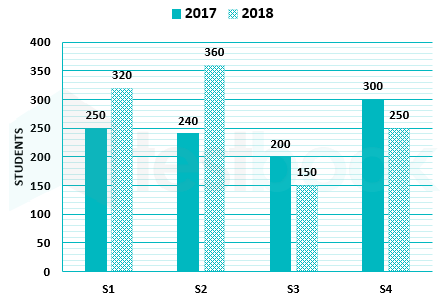
The given bar graph represents the number of students admitted in four schools (S1, S2, S3, S4) during two consecutive years 2017 and 2018.

What percentage is the average admission of schools S3 and S4 in 2018 of the average admission of schools S1 and S2 in 2017?

  1. ((a))

    82.00%

  2. ((b))

    81.00%

  3. ((c))

    81.63%

  4. ((d))

    82.63%

Show Answer
Answer: ((c))

81.63%

Given:

Number of students admitted in school S3 in 2018 = 150

Number of students admitted in school S4 in 2018 = 250

Number of students admitted in school S1 in 2017 = 250

Number of students admitted in school S2 in 2017 = 240

Formula:

x as a percentage of y = (x/y) × 100 

Calculation:

Average admission in school S3 and S4 in 2018 = (150 + 250)/2 = 400/2 = 200

Average admission in school S1 and S2 in 2017 = (250 + 240)/2 = 490/2 = 245

∴ Required percentage = (200/245) × 100 = 81.63%

57

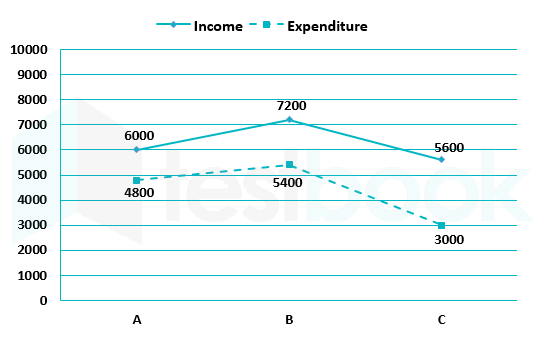
Study the following bar graph carefully to answer the given question. The graph shows the monthly income and expenditure of three persons A, B and C.

<br>

Note: Savings = Income – Expenditure

The difference between the savings of A and C is what percentage less than that of savings of B?

  1. ((a))

    1629%16\dfrac{2}{9}\%

  2. ((b))

    2229%22\dfrac{2}{9}\%

  3. ((c))

    3313%33\dfrac{1}{3}\%

  4. ((d))

    25%

Show Answer
Answer: ((b))

2229%22\dfrac{2}{9}\%

Given:

Expenditure of A = Rs. 4800

Income of A = Rs. 6000

Expenditure of B = Rs. 5400

Income of B = Rs. 7200

Expenditure of C = Rs. 3000

Income of C = Rs. 5600

Calculation:

According to the note;

Savings of A = Income – Expenditure

⇒ Rs. 6000 - Rs. 4800 = Rs. 1200

Savings of B = Income – Expenditure

⇒ Rs. 7200 - Rs. 5400 = Rs. 1800

Savings of C = Income – Expenditure

⇒ Rs. 5600 - Rs. 3000 = Rs. 2600

The difference between the savings of A and C = Rs. 2600 - 1200 = Rs. 1400

Required % = [(1800 - 1400) × 100]/1800

⇒ 400/18 = 200/9 = 2229%22\dfrac{2}{9}\%

∴ The required percentage is 2229%22\dfrac{2}{9}\%.

58

Some boys can do a piece of work in 46 days. Had there been 26 more boys, the work could have been completed in 26 days less. What was the number of boys in the beginning?

  1. ((a))

    10

  2. ((b))

    18

  3. ((c))

    17

  4. ((d))

    20

Show Answer
Answer: ((d))

20

Formula used:

No. of boys × days = Total work done

Calculation:

Let the number of boys be x.

Total work = x × 46

If 26 more boys start to work and the time taken is 46 - 26 = 20 days then,

⇒ 46 × x = (x + 26) × 20

⇒ 46x - 20x = 26 × 20

⇒ 26x = 520

x = 520/26

x = 20 boys.

59

An amount of Rs 10000 is invested in a scheme with simple interest. The rate of interest in this scheme is 20 percent per annum. For how many months has the amount been invested, if interest is received at Rs.4000?

  1. ((a))

    28 months

  2. ((b))

    30 months

  3. ((c))

    18 months

  4. ((d))

    24 months

Show Answer
Answer: ((d))

24 months

Given:

Principle = 10000

Rate% = 20

Interest = 4000

Formula used:

Interest = (Principle × rate × time)/100

Calculation:

⇒ 4000 = (10000 × 20 × time)/100

Time = (4000 × 100)/20 × 10000

Time = 2 years or 24 months.

60

What is the digit at units place in the product (653 × 308 × 402 × 413)?

  1. ((a))

    4

  2. ((b))

    3

  3. ((c))

    2

  4. ((d))

    8

Show Answer
Answer: ((a))

4

Unit’s digit in the product = Unit digit in the product of all unit values

⇒ 3 × 8 × 2 × 3 = 24 × 6 = 144

∴ Unit’s digit in the product = 4

General Hindi (20 questions)

61

निम्नलिखित प्रश्न में, दिए गए चार विकल्पों में से, उस विकल्प का चयन करें जो दिए गए मुहावरे के अर्थ को सर्वश्रेष्ठ रूप से व्यक्त करता है।

घोड़े पर चढ़े आना

  1. ((a))

    असंभव-सा कार्य करना

  2. ((b))

    बहुत बड़ी आपत्ति आना

  3. ((c))

    उतावली में आना

  4. ((d))

    मन ही मन खुश होना

Show Answer
Answer: ((c))

उतावली में आना

'घोड़े पर चढ़े आना’ मुहावरे का अर्थ 'उतावली में आना' है। अतः विकल्प 3 सही है।

Key Points 

  • 'घोड़े पर चढ़े आना’ मुहावरे का अर्थ 'उतावली में आना' है।
  • वाक्य प्रयोग - अरे मित्र, तुम तो सदैव घोड़े पर चढ़े आते हो, जरा हमारे पास भी बैठो।

Additional Information

  • अंग-अंग फूले न समाना
  • अर्थ – अत्यधिक प्रसन्न होना।
  • वाक्य प्रयोग – क्रिकेट मैच जीतने पर कप्तान रंजीत का अंग-अंग फूले न समा रहा था।
  • हथेली पर सरसों उगाना  
  • अर्थ – असंभव-सा कार्य करना।
  • वाक्य प्रयोग – श्री राकेश शर्मा ने अंतरिक्ष यात्रा कर हथेली पर सरसों उगा दिया।
  • पहाड़ टूट पड़ना  
  • अर्थ - बहुत बड़ी आपत्ति आना।
  • वाक्य प्रयोग - पिता के देहांत का दुखद समाचार सुनकर रमेश पर मानो पहाड़ टूट पड़ा हो।
मुहावरा परिभाषाउदाहरण
मुहावरा का शाब्दिक अर्थ ‘अभ्यास’ है। मुहावरा शब्द अरबी भाषा का शब्द है। हिन्दी में ऐसे वाक्यांशों को मुहावरा कहा जाता है, जो अपने साधारण अर्थ को छोड़कर  विशेष अर्थ को व्यक्त करते हैं।अंक भरना- स्नेह से लिपटा लेना वाक्य-माँ ने स्नेह से अपने पुत्र को अंक में भर लिया।
62

दिए गए वाक्य का पुरूष ज्ञात कीजिए।

तुम कल कहाँ थे?

  1. ((a))

    उत्तम

  2. ((b))

    मध्यम

  3. ((c))

    प्रथम

  4. ((d))

    अन्य पुरूष

Show Answer
Answer: ((b))

मध्यम

'तुम कल कहाँ थे?' यह मध्यम पुरूष का वाक्य है। अतः विकल्प 2 सही है।

Key Points

  • उत्तम पुरूष - मैं कल यहाँ आया था।
  • मध्यम पुरूष - तुम कल कहाँ थे?
  • अन्य पुरूष - वे कल कहाँ थे?

Additional Information 

सर्वनाम - संज्ञा के स्थान पर प्रयुक्त होने वाले शब्दों को सर्वनाम कहते हैं। जैसे - मैं, वह, वे, उन्हें, अपने तुम, हम आदि। हिंदी में मूलतः सर्वनामों की संख्या 11 है – मैं, तू, आप, यह, वह, जो, सो, कौन, कोई, क्या और कुछ।
पुरुषवाचक सर्वनामपरिभाषाउदाहरण
उत्तम पुरुषजिन शब्दों का प्रयोग बोलने वाला खुद के लिए करता है।मैं, मेरा, मेरे, मेरी, मुझे, मुझको, हम, हमें, हमको, हमारा, हमारे, हमारी आदि।
मध्यम पुरुष��िन शब्दों का प्रयोग सुनने वाले के लिए किया जाता है।तू, तुझे, तुझको, तेरा, तेरे, तेरी, तुम, तुम्हे, तुमको, तुम्हारा, तुम्हारे, तुम्हारी, आप आदि।
अन्य पुरुषजिन शब्दों का प्रयोग किसी तीसरे व्यक्ति के बारे में बात करने के लिए होता है।यह, वह, ये, वे आदि।
63

निम्नलिखित वाक्यों में से मिश्र वाक्य ज्ञात कीजिए।

  1. ((a))

    रूबी घर गई फिर भी काम में नहीं लगी।

  2. ((b))

    रूबी घर जाकर भी काम में नहीं लगी।

  3. ((c))

    यद्यपि रूबी घर गई तथापि काम में नहीं लगी।

  4. ((d))

    रूबी घर गई और काम में नहीं लगी।

Show Answer
Answer: ((c))

यद्यपि रूबी घर गई तथापि काम में नहीं लगी।

यद्यपि रूबी घर गई तथापि काम में नहीं लगी। मिश्र वाक्य का उदाहरण है, शेष विकल्प असंगत हैं। अतः विकल्प 3 सही है।

Key Points 

  • 'यद्यपि रूबी घर गई तथापि काम में नहीं लगी।' मिश्र वाक्‍य है क्योंकि इसमें एक प्रधान और एक आश्रित वाक्य है।
  • मिश्र वाक्य में एक से अधिक वाक्य मिले हों, किन्तु एक प्रधान उपवाक्य तथा शेष आश्रित उपवाक्य होते हैं।
<br>

अन्य विकल्प–

  • रूबी घर जाकर भी काम में नहीं लगी। - सरल वाक्य
  • रूबी घर गई फिर भी काम में नहीं लगी।​- संयुक्त वाक्य
  • रूबी घर गई और काम में नहीं लगी।  - संयुक्त वाक्य

Additional Information 

वाक्यपरिभाषाउदाहरण
सरलऐसे वाक्य जिनमें एक ही क्रिया एवं एक ही कर्ता होता है या जिस वाक्य में एक ही उद्देश्य एवं एक ही विधेय होता है, वे वाक्य सरल वाक्य कहलाते हैं। इसमें कर्ता एक से अधिक हो सकते हैं लेकिन मुख्य क्रिया एक ही होगी।राकेश पढ़ता है। कमला और विमला मंदिर जाती हैं।
संयुक्तजिस वाक्य में दो या दो से अधिक उपवाक्य मिले हों, परन्तु सभी वाक्य प्रधान हो तो ऐसे वाक्य को संयुक्त वाक्य कहते है।वह सुबह आगरा गया और शाम को लौट आया।
मिश्रजिस वाक्य में एक से अधिक वाक्य मिले हों, किन्तु एक प्रधान उपवाक्य तथा शेष आश्रित उपवाक्य हों, मिश्रित वाक्य कहलाता है।वह औरत जो पार्क में बैठी हैं मेरी मौसी हैं।
64

निम्नलिखित वाक्यांश के लिए उचित शब्द का चयन कीजिए।

मन को मोह लेने वाला

  1. ((a))

    मनोनीत

  2. ((b))

    मनमौजि

  3. ((c))

    मनसा

  4. ((d))

    मनमोहक

Show Answer
Answer: ((d))

मनमोहक

सही उत्तर 'मनमोहक' हैं।

'मन को मोह लेने वाला ' - वाक्यांश के लिए सार्थक शब्द 'मनमोहक' है।

Key Points

अन्य विकल्प:

शब्दवाक्यांश
मनोनीतजिसका किसी काम या पद के लिए नाम लिखा गया हो।
मनमौजिजिसके लिए कोई अंकुश या रुकावट न हो।
मनसामन में दबी रहनेवाली तीव्र कामना।

Additional Information

वाक्यांश- भाषा को सुंदर, आकर्षक और प्रभावशाली बनाने के लिए अनेक शब्दों के स्थान पर एक शब्द का प्रयोग किया जाता है तो वह वाक्यांश के लिए एक शब्द कहलाता है।

65

दिए गए वाक्य का काल ज्ञात कीजिए।

गाय घास चर कर चली गयी।

  1. ((a))

    वर्तमान

  2. ((b))

    भविष्य काल

  3. ((c))

    भूतकाल

  4. ((d))

    प्राचीन काल

Show Answer
Answer: ((c))

भूतकाल

दिए गए विकल्पों में सही उत्तर विकल्प 3 'भूतकाल' है। अन्य विकल्प गलत हैं।

Key Points 

  • "गाय घास चर कर चली गयी।" वाक्य का भूतकाल का वाक्य है।
  • भूतकाल वह समय होता है जो बीत चूका होता है इसके अतरिक्त अन्य सभी विकल्प गलत है क्योंकि  भूतकाल प्रायः निरूपित करने के लिए वाक्य के अंत में था, थी, थे, या, ई, ए, या है, आ है, ए है, ई है आदि शब्द आते है ।

Additional Information 

  • काल तीन प्रकार के होते है
वर्तमान कालजो समय चल रहा है, वह वर्तमान काल होता है इसे पहचानने का आसान तरीका यह है कि वाक्य केअंत में है हूँ हो हैं आदि होता है ।
भूतकालजो समय बीत चुका है , वह भूतकाल होता है। हिन्दी वाक्य के अंत में अगर था थी थे आदि होता है तो वह वाक्य भूतकाल का होता है  ।
भविष्य कालऐसे वाक्य जिनसे भविष्य की घटनाओं का पता चलता है वह वाक्य भविष्य  काल का होता है । हिन्दी वाक्य के अंत में गा गे गी होता है तो वह वाक्य भविष्य काल का होता है
66

दिए गए शब्द की भाववाचक संज्ञा ज्ञात कीजिए।

सर्व

  1. ((a))

    सर्वे

  2. ((b))

    सर्वस्व

  3. ((c))

    सर्वो

  4. ((d))

    सर्वत्र

Show Answer
Answer: ((b))

सर्वस्व

सही उत्तर 'सर्वस्व' है।

  • उपर्युक्त विकल्पों में ‘सर्वस्व​’ भाववाचक संज्ञा है।
  • जिन संज्ञा शब्दोँ से किसी व्यक्ति, वस्तु और स्थान के गुण, दोष, भाव, दशा, व्यापार आदि का बोध होता है, उन्हेँ भाववाचक संज्ञा कहते हैँ।
  • जैसे– सर्वस्व, सत्य, बचपन, बुढ़ापा, सफलता, मिठास, मित्रता, हरियाली, मुस्कुराहट, लघुता, प्रभुता, वीरता, चूक, लड़कपन, जवानी, ठगी, डर आदि।
  • सर्वस्व सर्व सर्वनाम से बनी भाववाचक संज्ञा है।

Key Points 

अन्य विकल्पों का विश्लेषण

शब्दविचार
सर्वेजातिवाचक संज्ञा
सर्वोव्यक्तिवाचक संज्ञा
सर्वत्रक्रिया विशेषण

Additional Information 

संज्ञा- किसी जाति, द्रव्य, गुण, भाव, व्यक्ति, स्थान और क्रिया आदि के नाम को संज्ञा कहते हैं। जैसे- पशु (जाति), सुंदरता (गुण), व्यथा (भाव), मोहन (व्यक्ति), दिल्ली (स्थान)। यह पाँच प्रकार की होती है-
संज्ञापरिभाषाउदाहरण
व्यक्तिवाचक संज्ञाजिन शब्दों से किसी विशेष व्यक्ति, स्थान अथवा वस्तु के नाम का बोध हो, उसे व्यक्तिवाचक संज्ञा कहते हैं।जयपुर, दिल्ली, भारत आदि।
जातिवाचक संज्ञाजिस शब्द से किसी प्राणी या वस्तु की समस्त जाति का बोध होता है, उन शब्दों को जातिवाचक संज्ञा कहते हैं।घोड़ा, फूल, मनुष्य आदि।
समूहवाचक संज्ञाजब किसी संज्ञा शब्द से व्यक्ति या वस्तु के समूह का बोध होता है, तब उसे समूहवाचक संज्ञा कहते हैं।परिवार, कक्षा, सेना आदि।
द्रव्यवाचक संज्ञाजब किसी संज्ञा शब्द से किसी द्रव्य का बोध हो, तो उसे द्रव्यवाचक संज्ञा कहते हैं।तेल, घी, दाल आदि।
भाववाचक संज्ञाजिस संज्ञा शब्द से पदार्थों की अवस्था, गुण-दोष, भाव या दशा, धर्म आदि का बोध हो, उसे भाववाचक संज्ञा कहते हैं।बुढ़ापा, मिठास, बचपन आदि।
67

दिए गए शब्द का विलोम शब्द ज्ञात कीजिए।

​सामिष

  1. ((a))

    व्यास

  2. ((b))

    आमिष

  3. ((c))

    वामिष

  4. ((d))

    निरामिष

Show Answer
Answer: ((d))

निरामिष

उपर्युक्त विकल्पों में से विकल्प 4 ‘निरामिष’ सही उत्तर है। अन्य विकल्प असंगत हैं।

Key Points 

  • 'सामिष' का सही विलोम शब्द 'निरामिष' है।
  • सामिष​ और आमिष का अर्थ –  मांस से युक्त।
  • निरामिष​ का अर्थ – मांसरहित। (जो माँस नही खाता)

अन्य विकल्प - 

शब्दविलोम
व्याससमास
आमिष और सामिषनिरामिष
विषादहर्ष

Additional Information 

शब्दपरिभाषाउदाहरण
विलोम/विपरीतार्थकविपरीत (उल्टा) अर्थ बताने वाले शब्दों को विलोम शब्द कहते हैं।रात-दिन धरती-आकाश
68

दिए गए वाक्य में उपयुक्त विराम चिह्न का चयन कीजिए।

हम आकाश का वर्णन करते हैं पृथ्वी का वर्णन करते हैं पर कीचड़ का वर्णन कभी किसी ने किया है

  1. ((a))

    , ?

  2. ((b))

  3. ((c))

    ; !

  4. ((d))

    ^ ।

Show Answer
Answer: ((a))

, ?

सही उत्तर विकल्प 1 , ? है। हम आकाश का वर्णन करते हैं**,** पृथ्वी का वर्णन करते हैं पर कीचड़ का वर्णन कभी किसी ने किया है**?**

विराम चिह्न: विराम चिह्न का अर्थ है  ठहराव, विश्राम, रुकना। अर्थात वाक्य लिखते समय विराम को प्रकट करने के लिए लगाए जाने वाले चिह्न को विराम चिह्न कहते हैं।

  • अल्प विराम चिह्न ( , )-  वाक्य में जहाँ थोड़ा रुकना हो या अधिक वस्तुओं, व्यक्तियों आदि को अलग करना हो वहाँ अल्प विराम (,) चिन्ह का प्रयोग किया जाता है।
  • उदाहरण-
  • सुनील, जरा इधर आना।
  • राकेश, मोहन, शीतल और पंकज ने यह चित्र बनाया है।
  • प्रश्नवाचक चिह्न  ( ? ) - जब किसी वाक्य में प्रश्नात्मक भाव हो, उसके अन्त में प्रश्नवाचक चिह्न (?) लगाया जाता है। उदाहरण-
  • क्या तुम जानते हो कि प्रधानमंत्री आज विदेश जा रहे हैं?

Key Points अन्य विकल्पों का विश्लेषण:

  • विस्मयादिबोधक चिह्न (!) - ऐसे शब्द जो वाक्य में आश्चर्य, हर्ष, शोक, घृणा आदि भाव व्यक्त करने के लिए प्रयुक्त हों, वे विस्मयादिबोधक कहलाते हैं। ऐसे शब्दों के साथ विस्मयादिबोधक चिन्ह (!) का प्रयोग किया जाता है। उदाहरण-
  • छि! वह बहुत गन्दा लड़का है।
  • उप विराम​ चिह्न( : ) - जहाँ पर किसी वस्तु या विषय के बारे में बताया जाए तो वहां पर उप विराम चिन्ह (:) का प्रयोग किया जाता है। उदाहरण-
  • विज्ञान: वरदान या अभिशाप
  • अर्द्ध विराम (;) - अर्द्ध विराम को (;) चिह्न से प्रदर्शित करते है। जिस स्थान पर अल्प विराम की अपेक्षा थोड़े अधिक समय के लिए ठहराव की स्थिति उत्पन्न हो जाये, वहां अर्द्ध विराम का प्रयोग करते है। उदाहरण-
  • सूर्यास्त हो चुका है; चारो तरफ घना अँधेरा छा जायेगा

अतः निष्कर्ष निकलता है कि हम आकाश का वर्णन करते हैं, पृथ्वी का वर्णन करते हैं पर कीचड़ का वर्णन कभी किसी ने किया है? के लिए उपयुक्त विराम चिह्न अल्प विराम चिह्न ( , ) व प्रश्नवाचक चिह्न  ( ? ) है।

Additional Information 

हिंदी में प्रचलित प्रमुख विराम चिह्न निम्नलिखित है:–

(1) अल्प विराम ( , )

(2) अर्द्ध विराम ( ; )

(3) पूर्ण विराम ( । )

(4) उप विराम  [ : ]

(5) विस्मयादिबोधक चिह्न ( ! )

(6) प्रश्नवाचक चिह्न  ( ? )

(7) कोष्ठक ( () )

(8) योजक चिह्न  ( - )

(9) अवतरण चिह्न या उद्धरणचिह्न  ( ''... '' )

(10) लाघव चिह्न) ( o )

(11) आदेश चिह्न/सूचना ( :- )

(12) रेखांकन चिह्न (_)

(13) लोप चिह्न (...)

69

दिए गए वाक्य में उपयुक्त विराम चिह्न का चयन कीजिए।

मोहन पुस्तक पढ़ रहा है

  1. ((a))

  2. ((b))

    !

  3. ((c))

    ?

  4. ((d))

    “ ”

Show Answer
Answer: ((a))

सही उत्तर पूर्ण विराम  ( । ) है। मोहन पुस्तक पढ़ रहा है**।** वाक्य में प्रयुक्त विराम चिह्न पूर्ण विराम  ( । ) है।

विराम चिह्न: विराम चिह्न का अर्थ है  ठहराव, विश्राम, रुकना। अर्थात वाक्य लिखते समय विराम को प्रकट करने के लिए लगाए जाने वाले चिह्न को विराम चिह्न कहते हैं।

  • पूर्ण विराम  ( । ) - किसी वाक्य के अंत में पूर्ण विराम चिन्ह लगाने का अर्थ होता है कि वह वाक्य खत्म हो गया है। पूर्ण विराम (।) का प्रयोग प्रश्नसूचक और विस्मयादि सूचक वाक्यों को छोड़कर बाकि सभी प्रकार के वाक्यों के अंत में किया जाता है।
  • उदाहरण-
  • बाजार खुल गया।
  • मोहन पुस्तक पढ़ रहा है।

Key Points अन्य विकल्पों का विश्लेषण:

  • विस्मयादिबोधक चिह्न (!) - ऐसे शब्द जो वाक्य में आश्चर्य, हर्ष, शोक, घृणा आदि भाव व्यक्त करने के लिए प्रयुक्त हों, वे विस्मयादिबोधक कहलाते हैं। ऐसे शब्दों के साथ विस्मयादिबोधक चिन्ह (!) का प्रयोग किया जाता है। उदाहरण-
  • छि! वह बहुत गन्दा लड़का है।
  • प्रश्नवाचक चिह्न  ( ? ) - जब किसी वाक्य में प्रश्नात्मक भाव हो, उसके अन्त में प्रश्नवाचक चिह्न (?) लगाया जाता है। उदाहरण-
  • क्या तुम जानते हो कि प्रधानमंत्री आज विदेश जा रहे हैं?
  • अवतरण चिह्न या उद्धरणचिह्न  ( ''... '' ) - किसी और के द्वारा लिखे या कहे गए वाक्य या शब्दों को ज्यों-का-त्यों लिखने के लिए अवतरण चिह्न या उद्धरण चिन्ह (“ ....”) का प्रयोग किया जाता है।
  • किसी भी कथन को ज्यों का त्यों उद्धरित करने हेतु “दुहरा” पर यदि कोई शब्द या वाक्यांश ही उद्धरित करते हैं तो ‘इकहरा’ चिह्न का प्रयोग किया जाता है।

अतः निष्कर्ष निकलता है कि मोहन पुस्तक पढ़ रहा है। के लिए उपयुक्त विराम चिह्न पूर्ण विराम  ( । ) है।

Additional Information 

हिंदी में प्रचलित प्रमुख विराम चिह्न निम्नलिखित है:–

(1) अल्प विराम ( , )

(2) अर्द्ध विराम ( ; )

(3) पूर्ण विराम ( । )

(4) उप विराम  [ : ]

(5) विस्मयादिबोधक चिह्न ( ! )

(6) प्रश्नवाचक चिह्न  ( ? )

(7) कोष्ठक ( () )

(8) योजक चिह्न  ( - )

(9) अवतरण चिह्न या उद्धरणचिह्न  ( ''... '' )

(10) लाघव चिह्न) ( o )

(11) आदेश चिह्न/सूचना ( :- )

(12) रेखांकन चिह्न (_)

(13) लोप चिह्न (...)

70

निम्नलिखित वाक्यों में से सरल वाक्य ज्ञात कीजिए।

  1. ((a))

    जब सुमिता ने पानी पीया, तब वह चली गई।

  2. ((b))

    सुमिता पानी पीकर चली गई।

  3. ((c))

    सुमिता ने पानी पीया और चली गई।

  4. ((d))

    जैसे ही सुमिता ने पानी पीया और वह चली गई।

Show Answer
Answer: ((b))

सुमिता पानी पीकर चली गई।

सही उत्तर विकल्प 2 है- '**सुमिता पानी पीकर चली गई।**​​' 

  • 'सुमिता पानी पीकर चली गई।​' वाक्य सरल वाक्य है।
  • सरल वाक्य: ऐसा वाक्य जिसमे एक ही क्रिया एवं एक ही कर्ता होता है या जिस वाक्य में एक ही उद्देश्य एवं एक ही विधेय होता है, वे वाक्य सरल वाक्य कहलाते हैं। सरल वाक्य को साधारण वाक्य भी कहा जाता है।
  • जैसे- बिजली चमकती है। सुमिता पानी पीकर चली गई। इन वाक्यों में एक-एक उद्देश्य अर्थात कर्ता और विधेय अर्थात क्रिया है। अतः ये साधारण या सरल वाक्य हैं।

Key Points 

अन्य विकल्पों का विश्लेषण: 

वाक्यप्रकार
जब सुमिता ने पानी पीया, तब वह चली गई।संयुक्त वाक्य
जैसे ही सुमिता ने पानी पीया और वह चली गई।संयुक्त वाक्य
सुमिता ने पानी पीया और चली गई।संयुक्त वाक्य

Additional Information 

  • वाक्य: शब्दों का ऐसा समूह जिसका जिसका कोई भाव/अर्थ प्रकट होता है, वाक्य कहलाता है।
  • जैसे - राम खाना खाता है।
  • ​रचना की दृष्टि से वाक्य के तीन प्रमुख भेद किये जाते हैं:
वाक्यदो या दो से अधिक शब्दों के सार्थक समूह को कहते हैं। मुख्य रूप से इसके तीन प्रकार माने गए हैं -
परिभाषाउदाहरण
सरलऐसे वाक्य जिनमें एक ही क्रिया एवं एक ही कर्ता होता है या जिस वाक्य में एक ही उद्देश्य एवं एक ही विधेय होता है, वे वाक्य सरल वाक्य कहलाते हैं। इसमें कर्ता एक से अधिक हो सकते हैं लेकिन मुख्य क्रिया एक ही होगी।राकेश पढ़ता है। कमला और विमला मंदिर जाती हैं।
संयुक्तजिस वाक्य में दो या दो से अधिक उपवाक्य मिले हों, परन्तु सभी वाक्य प्रधान हो तो ऐसे वाक्य को संयुक्त वाक्य कहते है। संयोजक शब्द जैसे: और, एवं, फिर, या,अथवा, परंतु, इसलिए, तथा, तो, नहीं तो, भी, किंतु।वह सुबह आगरा गया और शाम को लौट आया।
मिश्रजिस वाक्य में एक से अधिक वाक्य मिले हों, किन्तु एक प्रधान उपवाक्य तथा शेष आश्रित उपवाक्य हों, मिश्रित वाक्य कहलाता है। मिश्र वाक्य के निर्माण में संयोजक अव्यय जैसे: आपस में, कि, जो, क्योंकि, जितना, उतना, जैसा, वैसा, जब, तब, जहाँ, वहाँ, जिधर, उधर, यद्यपि, यदि, अगर, तो इत्यादि।वह औरत जो पार्क में बैठी हैं मेरी मौसी हैं।
71

दिए गए शब्दों में शुद्ध वर्तनी का चयन कीजिए।

  1. ((a))

    आहार

  2. ((b))

    अहर

  3. ((c))

    आहर

  4. ((d))

    अहार

Show Answer
Answer: ((a))

आहार

इसका सही उत्तर विकल्प 1 ‘आहार’ है। अन्य विकल्प त्रुटिपूर्ण हैं।

Key Points 

स्पष्टीकरण:

  • उपर्युक्त तीन विकल्पों में वर्तनीगत त्रुटि है। शुद्ध शब्द ‘आहार’ है जिसका अर्थ है भोजन। जिसका विलोम शब्द निराहार होगा।
  • आहार पुल्लिंग शब्द है।

Additional Information

वर्तनीलिखने की रीति को वर्तनी कहते हैं। ‘वर्तनी’ शब्द का अर्थ ‘पीछे चलना’ है। अर्थात उच्चारित होने वाले शब्द के लेखन में प्रयोग होने वाले लिपि चिह्नों के व्यवस्थित रूप को वर्तनी कहा जाता है।
72

निम्नलिखित प्रश्न में, दिए गए चार विकल्पों में से, उस विकल्प का चयन करें जो दिए गए मुहावरे के अर्थ को सर्वश्रेष्ठ रूप से व्यक्त करता है।

खीसें निपोरना

  1. ((a))

    कड़ी मेहनत करना

  2. ((b))

    भला-बुरा कहना

  3. ((c))

    गिड़गिड़ाकर माफी माँगना

  4. ((d))

    दर-दर भटकना

Show Answer
Answer: ((c))

गिड़गिड़ाकर माफी माँगना

'खीसें निपोरना’ मुहावरे का अर्थ 'गिड़गिड़ाकर माफी माँगना' है। अतः विकल्प 3 सही है।

Key Points 

  • 'खीसें निपोरना’ मुहावरे का अर्थ 'गिड़गिड़ाकर माफी माँगना' है।
  • वाक्य प्रयोग - अदालत ने मुज़रिम को दस साल की सजा सुनाई तो वह सजा कम करने के लिए खीसें निपोरने (गिड़गिड़ाकर माफी माँगना) लगा।

Additional Information 

  • जमीन आसमान एक करना
  • अर्थ – कड़ी मेहनत करना।
  • वाक्य प्रयोग – मोदी जी ने 2019 का चुनाव जीतने के लिए जमीन आसमान एक कर दिया।
  • खरी-खोटी सुनाना 
  • अर्थ – भला-बुरा कहना।
  • वाक्य प्रयोग – मोहन द्वारा राम का कहना न मानने पर उसने मोहन को खूब खरी-खोटी सुनाई।
  • खाक छानना 
  • अर्थ - दर-दर भटकना।
  • वाक्य प्रयोग - कल मेरी मेले के अंदर चप्पल गुम हो गई थी उनकी तलास के लिए खाक छानता हुआ घूमता रहा और अंत मे जाकर मिली।
मुहावरा परिभाषाउदाहरण
मुहावरा का शाब्दिक अर्थ ‘अभ्यास’ है। मुहावरा शब्द अरबी भाषा का शब्द है। हिन्दी में ऐसे वाक्यांशों को मुहावरा कहा जाता है, जो अपने साधारण अर्थ को छोड़कर  विशेष अर्थ को व्यक्त करते हैं।अंक भरना- स्नेह से लिपटा लेना वाक्य-माँ ने स्नेह से अपने पुत्र को अंक में भर लिया।
73

दिए गए शब्दों में शुद्ध वर्तनी का चयन कीजिए।

  1. ((a))

    अस्प्रस्यता

  2. ((b))

    अस्पृष्यता

  3. ((c))

    अस्प्रश्यता

  4. ((d))

    अस्पृश्यता

Show Answer
Answer: ((d))

अस्पृश्यता

इसका सही उत्तर विकल्प 4 ‘अस्पृश्यता’ है। अन्य विकल्प त्रुटिपूर्ण हैं।

Key Points  

स्पष्टीकरण:

उपर्युक्त तीन विकल्पों में वर्तनीगत त्रुटि है। शुद्ध शब्द ‘अस्पृश्यता’ है जिसका अर्थ है छुआछूत, अछूतापन, जिसका विलोम शब्द स्पृश्य होगा।

Additional Information

वर्तनीलिखने की रीति को वर्तनी कहते हैं। ‘वर्तनी’ शब्द का अर्थ ‘पीछे चलना’ है। अर्थात उच्चारित होने वाले शब्द के लेखन में प्रयोग होने वाले लिपि चिह्नों के व्यवस्थित रूप को वर्तनी कहा जाता है।
74

दिए गए शब्दों का सही तत्सम-तद्भव ज्ञात कीजिए।

  1. ((a))

    घट-घड़ा

  2. ((b))

    घट-घाट

  3. ((c))

    घट-घटा

  4. ((d))

    घठ-घी

Show Answer
Answer: ((a))

घट-घड़ा

दिए गये विकल्पों मे से 'घट-घड़ा' यह तत्सम - तद्भव शब्द का युग्म सही है।

  • घट शब्द से घड़ा शब्द बना है।

Key Points

अन्य विकल्प:

तद्भवतत्‍सम
घाटघट्ट
घीघृत
उल्लूउलूक
कौनकः


  • घटा अनेकार्थी शब्द है।

Additional Information 

शब्दपरिभाषाउदाहरण
तत्सम शब्दऐसे शब्द जो संस्कृत से ज्यों - के - त्यों ले लिए गए हैं।आम्र, उष्ट्र, ऐश्वर्य, षष्ठी आदि।
अर्द्धतत्सम शब्दऐसे शब्द जो संस्कृत से थोड़ा परिवर्तित होकर हिंदी में आये हैं।कार्य से कारज, धैर्य से धीरज आदि।
तद्भव शब्दऐसे शब्द जो संस्कृत से हिंदी में आने पर उनका रूप बदल गया।आग, खीर, छत आदि।
देशज शब्दऐसे शब्द जो देश की अन्य या क्षेत्रीय भाषा से हिंदी में सम्मिलित हुए।थैला, लोटा, टाँग, पगड़ी आदि।
विदेशज/आगत/विदेशी शब्दअन्य देश की भाषा से आये हुए शब्द जो हिंदी भाषा में सम्मिलित हुए। इन विदेशी भाषाओं में मुख्यतः अरबी, फारसी, तुर्की, उर्दू, अंग्रेजी व पुर्तगाली शामिल है।अदालत, ऑफिसर, बुखार, हज़म आदि।
75

दिए गए शब्द का प्रत्यय ज्ञात कीजिए।

डिबिया

  1. ((a))

    बि

  2. ((b))

    इया

  3. ((c))

    अया

  4. ((d))

    डि

Show Answer
Answer: ((b))

इया

सही उत्तर 'इया' है।

प्रत्यय - वे शब्द हैं जो दूसरे शब्दों के अन्त में जुड़कर, अपनी प्रकृति के अनुसार, शब्द के अर्थ में परिवर्तन कर देते हैं। 

  • "डिबिया" में इया प्रत्यय होता है। डिबिया = डिब्बा + इया
  • डिबिया का अर्थ- छोटा डिब्बा।

Hint 

  • कई बार प्रत्यय लगने पर मूलशब्द के आदि, मध्य या अन्त में प्रयुक्त स्वरों में परिवर्तन हो जाता है।
  • जैसे- डिब्बा + इया, रानी + वास = रनिवास, फूल + वाड़ी = फुलवाड़ी

अतः निष्कर्ष निकलता है कि "डिबिया" में इया प्रत्यय लगा है।

एक गद्यांश दिया गया है। गद्यांश केआधार पर पाँच प्रश्न दिए गए हैं। गद्यांश को ध्यानपूर्वक पढ़ें तथा प्रत्येक प्रश्न के चार विकल्पो में से सही विकल्प चुने।

किसी भी राष्ट्र की राष्ट्रभाषा वह होती है, जिसे उसमें रहने वालेअधिकांश नागरिक बोलते, समझतेऔर व्यवहार में लाते हैं। इसके साथ-साथ उस देश की अपनी राष्ट्रभाषा का होना भी अत्यंत आवश्यक होता है। भारत में हिंदी ही एकमात्र ऐसी भाषा है जिसे लेह-लद्दाख से लक्षदीप और अरुणाचल प्रदेश से जैसलमेर तक सभी लोग बोलते हैं। इसलिए हिंदी भारत की राष्ट्रभाषा है।

हिंदी को राष्ट्रभाषा का गौरव दिलाने में स्वतंत्रता सेनानियों नेअहम्भूमिका निभाई है। वस्तुतः हिंदी द्वारा ही स्वतंत्रता का संघर्ष लड़ा गया। इसके माध्यम से ही सभी नेता और क्रांतिकारी विचारों का आदान-प्रदान करते थे। हिंदी के लिए गौरव का विषय यह रहा कि इसे राष्ट्रभाषा का स्थान अहिंदीभाषियों ने दिलाया। महात्मा गाँधी, सुभाषचंद्र बोस, लोकमान्य तिलक आदि अहिंदीभाषी थे। उन्होंने स्वतंत्रता आंदोलन में हिंदी भाषा का ही प्रयोग किया। सामाजिक कुरीतियों से छुटकारा दिलाने के लिए जिन महापुरुषों ने महत्वपूर्ण भूमिका निभाई उनमें स्वामी विवेकानंद और स्वामी दयानंद प्रमुख थे। दोनों ने सामाजिक कुरीतियों को दूर करके जिस भाषा द्वारा भारत को नया आध्यात्मिक चिंतन दिया वह हिंदी ही थी। महात्मा गाँधी ने तो यहाँ तक कहा था- 'अंग्रेज़ी कभी राष्ट्रभाषा नहीं बन सकती।

जो स्थान हिंदी को प्राप्त है, वह किसी दूसरी भाषा को नहीं मिल सकता।' पंडित जवाहरलाल नेहरू ने 16 मई सन् 1931 को स��ठ गोविंददास को लिखा था- हिंदी ने अब पूर्णतः राष्ट्रभाषा की भूमिका ले ली है। नेता जी सुभाषचंद्र बोस ने 20 सितंबर 1928 को कहा था, 'यदि हमने तन, मन और धन से प्रयत्न किया तो वह दिन दूर नहीं जब भारत स्वाधीन होगा और उसकी राष्ट्रभाषा हिंदी होगी।'

76

जवाहरलाल नेहरू ने कब लिखा कि ”हिंदी ने अब पूर्णतः राष्ट्रभाषा की भूमिका ले ली है”।

  1. ((a))

    16 मई सन् 1931

  2. ((b))

    20 सितंबर 1928

  3. ((c))

    16 मई सन् 1932

  4. ((d))

    16 जून सन् 1931

Show Answer
Answer: ((a))

16 मई सन् 1931

जवाहरलाल नेहरू ने 16 मई सन् 1931 लिखा कि ”हिंदी ने अब पूर्णतः राष्ट्रभाषा की भूमिका ले ली है”।

  • गद्यांश के अनुसार:-
  • जो स्थान हिंदी को प्राप्त है, वह किसी दूसरी भाषा को नहीं मिल सकता।'
  • पंडित जवाहरलाल नेहरू ने 16 मई सन् 1931 को सेठ गोविंददास को लिखा था- हिंदी ने अब पूर्णतः राष्ट्रभाषा की भूमिका ले ली है।

Key Pointsजवाहरलाल नेहरू:-

  • जवाहरलाल नेहरू (नवम्बर 14, 1889 - मई 27, 1964) भारत के प्रथम प्रधानमन्त्री थे और स्वतन्त्रता के पूर्व और पश्चात् की भारतीय राजनीति में केन्द्रीय व्यक्तित्व थे।
  • महात्मा गांधी के संरक्षण में, वे भारतीय स्वतन्त्रता आन्दोलन के सर्वोच्च नेता के रूप में
  • उभरे और उन्होंने 1947 में भारत के एक स्वतन्त्र राष्ट्र के रूप में स्थापना से लेकर 1964 तक अपने निधन तक, भारत का शासन किया।
  • वे आधुनिक भारतीय राष्ट्र-राज्य - एक सम्प्रभु, समाजवादी, धर्मनिरपेक्ष, और लोकतान्त्रिक गणतन्त्र - के वास्तुकार माने जाते हैं।
  • कश्मीरी पण्डित समुदाय के साथ उनके मूल की वजह से वे पण्डित नेहरू भी बुलाए जाते थे, जबकि भारतीय बच्चे उन्हें चाचा नेहरू के रूप में जानते हैं।

एक गद्यांश दिया गया है। गद्यांश केआधार पर पाँच प्रश्न दिए गए हैं। गद्यांश को ध्यानपूर्वक पढ़ें तथा प्रत्येक प्रश्न के चार विकल्पो में से सही विकल्प चुने।

किसी भी राष्ट्र की राष्ट्रभाषा वह होती है, जिसे उसमें रहने वालेअधिकांश नागरिक बोलते, समझतेऔर व्यवहार में लाते हैं। इसके साथ-साथ उस देश की अपनी राष्ट्रभाषा का होना भी अत्यंत आवश्यक होता है। भारत में हिंदी ही एकमात्र ऐसी भाषा है जिसे लेह-लद्दाख से लक्षदीप और अरुणाचल प्रदेश से जैसलमेर तक सभी लोग बोलते हैं। इसलिए हिंदी भारत की राष्ट्रभाषा है।

हिंदी को राष्ट्रभाषा का गौरव दिलाने में स्वतंत्रता सेनानियों नेअहम्भूमिका निभाई है। वस्तुतः हिंदी द्वारा ही स्वतंत्रता का संघर्ष लड़ा गया। इसके माध्यम से ही सभी नेता और क्रांतिकारी विचारों का आदान-प्रदान करते थे। हिंदी के लिए गौरव का विषय यह रहा कि इसे राष्ट्रभाषा का स्थान अहिंदीभाषियों ने दिलाया। महात्मा गाँधी, सुभाषचंद्र बोस, लोकमान्य तिलक आदि अहिंदीभाषी थे। उन्होंने स्वतंत्रता आंदोलन में हिंदी भाषा का ही प्रयोग किया। सामाजिक कुरीतियों से छुटकारा दिलाने के लिए जि��� महापुरुषों ने महत्वपूर्ण भूमिका निभाई उनमें स्वामी विवेकानंद और स्वामी दयानंद प्रमुख थे। दोनों ने सामाजिक कुरीतियों को दूर करके जिस भाषा द्वारा भारत को नया आध्यात्मिक चिंतन दिया वह हिंदी ही थी। महात्मा गाँधी ने तो यहाँ तक कहा था- 'अंग्रेज़ी कभी राष्ट्रभाषा नहीं बन सकती।

जो स्थान हिंदी को प्राप्त है, वह किसी दूसरी भाषा को नहीं मिल सकता।' पंडित जवाहरलाल नेहरू ने 16 मई सन् 1931 को सेठ गोविंददास को लिखा था- हिंदी ने अब पूर्णतः राष्ट्रभाषा की भूमिका ले ली है। नेता जी सुभाषचंद्र बोस ने 20 सितंबर 1928 को कहा था, 'यदि हमने तन, मन और धन से प्रयत्न किया तो वह दिन दूर नहीं जब भारत स्वाधीन होगा और उसकी राष्ट्रभाषा हिंदी होगी।'

77

स्वतंत्रता आंदोलन में किस भाषा का प्रयोग किया।

  1. ((a))

    उर्दू

  2. ((b))

    हिन्दी

  3. ((c))

    संस्कृत

  4. ((d))

    अंग्रेजी

Show Answer
Answer: ((b))

हिन्दी

स्वतंत्रता आंदोलन में भाषा का प्रयोग किया - 'हिन्दी'

  • गद्यांश के अनुसार:-
  • ​महात्मा गाँधी, सुभाषचंद्र बोस, लोकमान्य तिलक आदि अहिंदीभाषी थे। उन्होंने स्वतंत्रता आंदोलन में हिंदी भाषा का ही प्रयोग किया।

Key Points

  • हिन्दी या हिंदी जिसके मानकीकृत रूप को मानक हिंदी कहा जाता है, विश्व की एक प्रमुख भाषा है एवं भारत की एक राजभाषा है।
  • केन्द्रीय स्तर पर भारत में सह-आधिकारिक भाषा अंग्रेजी है। यह हिन्दुस्तानी भाषा की एक मानकीकृत रूप है
  • जिसमें संस्कृत के तत्सम तथा तद्भव शब्दों का प्रयोग अधिक है और अरबी-फ़ारसी शब्द कम हैं।
  • हिन्दी संवैधानिक रूप से भारत की राजभाषा और भारत की सबसे अधिक बोली और समझी जाने वाली भाषा है।
  • हिन्दी भारत की राष्ट्रभाषा नहीं है क्योंकि भारत के संविधान में किसी भी भाषा को ऐसा दर्जा नहीं दिया गया है।
  • एथनोलॉग के अनुसार हिन्दी विश्व की तीसरी सबसे अधिक बोली जाने वाली भाषा है।
  • विश्व आर्थिक मंच की गणना के अनुसार यह विश्व की दस शक्तिशाली भाषाओं में से एक है।

Additional Informationउर्दू:-

  • भाषा विज्ञान के आधार पर हिंदी और उर्दू एक ही भाषा है। नस्तालीक़ लिपि में लिखी गई हिंदी भाषा को उर्दू कहा जाता है।
  • उर्दू का स्वतन्त्र व्याकरण नहीं है। उर्दू भाषा हिन्द आर्य भाषा है। उर्दू भाषा हिन्दुस्तानी भाषा की एक मानकीकृत रूप मानी जाती है।
  • उर्दू में संस्कृत के तत्सम शब्द न्यून हैं और अरबी-फ़ारसी और संस्कृत से तद्भव शब्द अधिक हैं। ये मुख्यतः दक्षिण एशिया में बोली जाती है।
  • यह भारत की शासकीय भाषाओं में से एक है तथा पाकिस्तान की राष्ट्रभाषा है। इस के अतिरिक्त भारत के राज्य जम्मू और कश्मीर की मुख्य प्रशासनिक भाषा है।
  • साथ ही तेलंगाना, दिल्ली, बिहार और उत्तर प्रदेश की अतिरिक्त शासकीय भाषा है।

संस्कृत:-

  • संस्कृत (संस्कृतम्) भारतीय उपमहाद्वीप की एक भाषा है। संस्कृत एक हिंद-आर्य भाषा है जो हिंद-यूरोपीय भाषा परिवार की एक शाखा है।
  • आधुनिक भारतीय भाषाएँ जैसे, हिंदी, बांग्ला, मराठी, सिन्धी, पंजाबी, नेपाली, आदि इसी से उत्पन्न हुई हैं।
  • इन सभी भाषाओं में यूरोपीय बंजारों की रोमानी भाषा भी शामिल है। संस्कृत में वैदिक धर्म से संबंधित लगभग सभी धर्मग्रंथ लिखे गए हैं।
  • बौद्ध धर्म (विशेषकर महायान) तथा जैन मत के भी कई महत्त्वपूर्ण ग्रंथ संस्कृत में लिखे गए हैं।
  • आज भी हिंदू धर्म के अधिकतर यज्ञ और पूजा संस्कृत में ही होती हैं। संस्कृत आमतौर पर कई पुरानी इंडो-आर्यन किस्मों को जोड़ती है।

अंग्रेज़ी:-

  • अंग्रेज़ी भाषा (अंग्रेज़ी: English) हिन्द-यूरोपीय भाषा-परिवार में आती है और इस दृष्टि से हिन्दी, उर्दू, फ़ारसी आदि के साथ इसका दूर का संबंध बनता है।
  • ये इस परिवार की जर्मनिक शाखा में रखी जाती है। इसे दुनिया की सर्वप्रथम अंतर्राष्ट्रीय भाषा माना जाता है।
  • यह दुनिया के कई देशों की मुख्य राजभाषा है और आज के दौर में कई देशों में (मुख्यतः भूतपूर्व ब्रिटिश उपनिवेशों में)
  • विज्ञान, कंप्यूटर, साहित्य, राजनीति और उच्च शिक्षा की भी मुख्य भाषा है। अंग्रेज़ी भाषा रोमन लिपि में लिखी जाती है।

एक गद्यांश दिया गया है। गद्यांश केआधार पर पाँच प्रश्न दिए गए हैं। गद्यांश को ध्यानपूर्वक पढ़ें तथा प्रत्येक प्रश्न के चार विकल्पो में से सही विकल्प चुने।

किसी भी राष्ट्र की राष्ट्रभाषा वह होती है, जिसे उसमें रहने वालेअधिकांश नागरिक बोलते, समझतेऔर व्यवहार में लाते हैं। इसके साथ-साथ उस देश की अपनी राष्ट्रभाषा का होना भी अत्यंत आवश्यक होता है। भारत में हिंदी ही एकमात्र ऐसी भाषा है जिसे लेह-लद्दाख से लक्षदीप और अरुणाचल प्रदेश से जैसलमेर तक सभी लोग बोलते हैं। इसलिए हिंदी भारत की राष्ट्रभाषा है।

हिंदी को राष्ट्रभाषा का गौरव दिलाने में स्वतंत्रता सेनानियों नेअहम्भूमिका निभाई है। वस्तुतः हिंदी द्वारा ही स्वतंत्रता का संघर्ष लड़ा गया। इसके माध्यम से ही सभी नेता और क्रांतिकारी विचारों का आदान-प्रदान करते थे। हिंदी के लिए गौरव का विषय यह रहा कि इसे राष्ट्रभाषा का स्थान अहिंदीभाषियों ने दिलाया। महात्मा गाँधी, सुभाषचंद्र बोस, लोकमान्य तिलक आदि अहिंदीभाषी थे। उन्होंने स्वतंत्रता आंदोलन में हिंदी भाषा का ही प्रयोग किया। सामाजिक कुरीतियों से छुटकारा दिलाने के लिए जिन महापुरुषों ने महत्वपूर्ण भूमिका निभाई उनमें स्वामी विवेकानंद और स्वामी दयानंद प्रमुख थे। दोनों ने सामाजिक कुरीतियों को दूर करके जिस भाषा द्वारा भारत को नया आध्यात्मिक चिंतन दिया वह हिंदी ही थी। महात्मा गाँधी ने तो यहाँ तक कहा था- 'अंग्रेज़ी कभी राष्ट्रभाषा नहीं बन सकती।

जो स्थान हिंदी को प्राप्त है, वह किसी दूसरी भाषा को नहीं मिल सकता।' पंडित जवाहरलाल नेहरू ने 16 मई सन् 1931 को सेठ गोविंददास को लिखा था- हिंदी ने अब पूर्णतः राष्ट्रभाषा की भूमिका ले ली है। नेता जी सुभाषचंद्र बोस ने 20 सितंबर 1928 को कहा था, 'यदि हमने तन, मन और धन से प्रयत्न किया तो वह दिन दूर नहीं जब भारत स्वाधीन होगा और उसकी राष्ट्रभाषा हिंदी होगी।'

78

उपर्युक्त गद्यांश का शीर्षक होगा- 

  1. ((a))

    राष्ट्रभाषा हिन्दी

  2. ((b))

    हिन्दी

  3. ((c))

    भारतमाता

  4. ((d))

    लोगों की भाषा

Show Answer
Answer: ((a))

राष्ट्रभाषा हिन्दी

उपर्युक्त गद्यांश का शीर्षक होगा**- 'राष्ट्रभाषा हिन्दी'**

  • गद्यांश के अनुसार:-
  • ​भारत में हिंदी ही एकमात्र ऐसी भाषा है जिसे लेह-लद्दाख से लक्षदीप और अरुणाचल प्रदेश से जैसलमेर तक सभी लोग बोलते हैं। इसलिए हिंदी भारत की राष्ट्रभाषा है।

Key Pointsभाषा:-

  • भाषा वह साधन है, जिसके द्वारा मनुष्य बोलकर, सुनकर, लिखकरपढ़कर अपने मन के भावों या विचारों का आदान-प्रदान करता है।

राष्ट्रभाषा:-

  • भारतीय संविधान में भारत की कोई राष्ट्र भाषा नहीं है। सरकार ने 22 भाषाओं को आधिकारिक भाषा के रूप में जगह दी है।
  • जिसमें केन्द्र सरकार या राज्य सरकार अपने जगह के अनुसार किसी भी भाषा को आधिकारिक भाषा के रूप में चुन सकती है।
  • केन्द्र सरकार ने अपने कार्यों के लिए हिन्दी और रोमन भाषा को आधिकारिक भाषा के रूप में जगह दी है।
  • इसके अलावा अलग अलग राज्यों में स्थानीय भाषा के अनुसार भी अलग अलग आधिकारिक भाषाओं को चुना गया है।
  • फिलहाल 22 आधिकारिक भाषाओं में -
  • असमी, उर्दू, कन्नड़, कश्मीरी, कोंकणी, मैथिली, मलयालम, मणिपुरी, मराठी, नेपाली, ओडिया, पंजाबी,
  • संस्कृत, संतली, सिंधी, तमिल, तेलुगू, बोड़ो, डोगरी, बंगाली और गुजराती है।

हिन्दी:-

  • हिन्दी या हिंदी जिसके मानकीकृत रूप को मानक हिंदी कहा जाता है, विश्व की एक प्रमुख भाषा है एवं भारत की एक राजभाषा है।
  • केन्द्रीय स्तर पर भारत में सह-आधिकारिक भाषा अंग्रेजी है। यह हिन्दुस्तानी भाषा की एक मानकीकृत रूप है
  • जिसमें संस्कृत के तत्सम तथा तद्भव शब्दों का प्रयोग अधिक है और अरबी-फ़ारसी शब्द कम हैं।
  • हिन्दी संवैधानिक रूप से भारत की राजभाषा और भारत की सबसे अधिक बोली और समझी जाने वाली भाषा है।
  • हिन्दी भारत की राष्ट्रभाषा नहीं है क्योंकि भारत के संविधान में किसी भी भाषा को ऐसा दर्जा नहीं दिया गया है।
  • एथनोलॉग के अनुसार हिन्दी विश्व की तीसरी सबसे अधिक बोली जाने वाली भाषा है।
  • विश्व आर्थिक मंच की गणना के अनुसार यह विश्व की दस शक्तिशाली भाषाओं में से एक है।
79

“अंग्रेज़ी कभी राष्ट्रभाषा नहीं बन सकती” किसने कहा?

  1. ((a))

    जवाहरलाल नेहरू

  2. ((b))

    सुभाषचंद्र बोस

  3. ((c))

    स्वामी विवेकानंद

  4. ((d))

    महात्मा गाँधी

Show Answer
Answer: ((d))

महात्मा गाँधी

“अंग्रेज़ी कभी राष्ट्रभाषा नहीं बन सकती” कहा - 'महात्मा गाँधी'

  • गद्यांश के अनुसार:-
  • महात्मा गाँधी ने तो यहाँ तक कहा था- 'अंग्रेज़ी कभी राष्ट्रभाषा नहीं बन सकती।
  • जो स्थान हिंदी को प्राप्त है, वह किसी दूसरी भाषा को नहीं मिल सकता।

Key Points

  • मोहनदास करमचन्द गांधी (जन्म: 2 अक्टूबर 1869 - निधन: 30 जनवरी 1948) जिन्हें महात्मा गांधी के नाम से भी जाना जाता है,
  • भारत एवं भारतीय स्वतन्त्रता आन्दोलन के एक प्रमुख राजनैतिक एवं आध्यात्मिक नेता थे।
  • वे सत्याग्रह (व्यापक सविनय अवज्ञा) के माध्यम से अत्याचार के प्रतिकार के अग्रणी नेता थे,
  • उनकी इस अवधारणा की नींव सम्पूर्ण अहिंसा के सिद्धान्त पर रखी गयी थी
  • जिसने भारत को भारतीय स्वतन्त्रता संग्राम दिलाकर पूरे विश्व में जनता के नागरिक अधिकारों एवं स्वतन्त्रता के प्रति आन्दोलन के लिये प्रेरित किया।
  • उन्हें संसार में साधारण जनता महात्मा गांधी के नाम से जानती है। संस्कृत भाषा में महात्मा अथवा महान आत्मा एक सम्मान सूचक शब्द है।
  • गांधी को महात्मा के नाम से सबसे पहले 1915 में राजवैद्य जीवराम कालिदास ने संबोधित किया था।

Additional Informationजवाहरलाल नेहरू:-

  • जवाहरलाल नेहरू (नवम्बर 14, 1889 - मई 27, 1964) भारत के प्रथम प्रधानमन्त्री थे और स्वतन्त्रता के पूर्व और पश्चात् की भारतीय राजनीति में केन्द्रीय व्यक्तित्व थे।
  • महात्मा गांधी के संरक्षण में, वे भारतीय स्वतन्त्रता आन्दोलन के सर्वोच्च नेता के रूप में
  • उभरे और उन्होंने 1947 में भारत के एक स्वतन्त्र राष्ट्र के रूप में स्थापना से लेकर 1964 तक अपने निधन तक, भारत का शासन किया।
  • वे आधुनिक भारतीय राष्ट्र-राज्य - एक सम्प्रभु, समाजवादी, धर्मनिरपेक्ष, और लोकतान्त्रिक गणतन्त्र - के वास्तुकार माने जाते हैं।
  • कश्मीरी पण्डित समुदाय के साथ उनके मूल की वजह से वे पण्डित नेहरू भी बुलाए जाते थे, जबकि भारतीय बच्चे उन्हें चाचा नेहरू के रूप में जानते हैं।

सुभाष चन्द्र बोस:-

  • सुभाष चन्द्र बोस (23 जनवरी 1897 - 18 अगस्त 1945) भारत के स्वतन्त्रता संग्राम के अग्रणी तथा सबसे बड़े नेता थे।
  • द्वितीय विश्वयुद्ध के दौरान, अंग्रेज़ों के खिलाफ लड़ने के लिए, उन्होंने जापान के सहयोग से आज़ाद हिन्द फ़ौज का गठन किया था।
  • उनके द्वारा दिया गया जय हिन्द का नारा भारत का राष्ट्रीय नारा बन गया है।
  • "तुम मुझे खून दो मैं तुम्हे आजादी दूंगा" का नारा भी उनका था जो उस समय अत्यधिक प्रचलन में आया।
  • भारतवासी उन्हें नेता जी के नाम से सम्बोधित करते हैं।

स्वामी विवेकानंद:-

  • स्वामी विवेकानन्द (जन्म: 12 जनवरी 1863 - मृत्यु: 4 जुलाई 1902) वेदान्त के विख्यात और प्रभावशाली आध्यात्मिक गुरु थे।
  • उनका वास्तविक नाम नरेन्द्र नाथ दत्त था। उन्होंने अमेरिका स्थित शिकागो में सन् 1893 में आयोजित विश्व धर्म महासभा में भारत की ओर से सनातन धर्म का प्रतिनिधित्व किया था।
  • भारत का आध्यात्मिकता से परिपूर्ण वेदान्त दर्शन अमेरिका और यूरोप के हर एक देश में स्वामी विवेकानन्द की वक्तृता के कारण ही पहुँचा।
  • उन्होंने रामकृष्ण मिशन की स्थापना की थी जो आज भी अपना काम कर रहा है। वे रामकृष्ण परमहंस के सुयोग्य शिष्य थे।
  • उन्हें बोलने के लिए 2 मिनट का समय दिया गया था, किन्तु उन्हें प्रमुख रूप से उनके भाषण का आरम्भ "मेरे अमेरिकी बहनों एवं भाइयों" के साथ करने के लिये जाना जाता है।
  • उनके संबोधन के इस प्रथम वाक्य ने सबका दिल जीत लिया था।
80

किसने कहा “यदि हमने तन, मन और धन से प्रयत्न किया तो वह दिन दूर नहीं जब भारत स्वाधीन होगा और उसकी राष्ट्रभाषा हिंदी होगी”?

  1. ((a))

    स्वामी विवेकानंद

  2. ((b))

    सुभाषचंद्र बोस

  3. ((c))

    महात्मा गाँधी

  4. ((d))

    जवाहरलाल नेहरू

Show Answer
Answer: ((b))

सुभाषचंद्र बोस

सुभाषचंद्र बोस कहा “यदि हमने तन, मन और धन से प्रयत्न किया तो वह दिन दूर नहीं जब भारत स्वाधीन होगा और उसकी राष्ट्रभाषा हिंदी होगी”।

  • गद्यांश के अनुसार:-
  • ​नेता जी सुभाषचंद्र बोस ने 20 सितंबर 1928 को कहा था, 'यदि हमने तन, मन और धन से प्रयत्न किया तो वह दिन दूर नहीं जब भारत स्वाधीन होगा और उसकी राष्ट्रभाषा हिंदी होगी।'

Key Points

  • सुभाष चन्द्र बोस (23 जनवरी 1897 - 18 अगस्त 1945) भारत के स्वतन्त्रता संग्राम के अग्रणी तथा सबसे बड़े नेता थे।
  • द्वितीय विश्वयुद्ध के दौरान, अंग्रेज़ों के खिलाफ लड़ने के लिए, उन्होंने जापान के सहयोग से आज़ाद हिन्द फ़ौज का गठन किया था।
  • उनके द्वारा दिया गया जय हिन्द का नारा भारत का राष्ट्रीय नारा बन गया है।
  • "तुम मुझे खून दो मैं तुम्हे आजादी दूंगा" का नारा भी उनका था जो उस समय अत्यधिक प्रचलन में आया।
  • भारतवासी उन्हें नेता जी के नाम से सम्बोधित करते हैं।

Additional Informationस्वामी विवेकानंद:-

  • स्वामी विवेकानन्द (जन्म: 12 जनवरी 1863 - मृत्यु: 4 जुलाई 1902) वेदान्त के विख्यात और प्रभावशाली आध्यात्मिक गुरु थे।
  • उनका वास्तविक नाम नरेन्द्र नाथ दत्त था। उन्होंने अमेरिका स्थित शिकागो में सन् 1893 में आयोजित विश्व धर्म महासभा में भारत की ओर से सनातन धर्म का प्रतिनिधित्व किया था।
  • भारत का आध्यात्मिकता से परिपूर्ण वेदान्त दर्शन अमेरिका और यूरोप के हर एक देश में स्वामी विवेकानन्द की वक्तृता के कारण ही पहुँचा।
  • उन्होंने रामकृष्ण मिशन की स्थापना की थी जो आज भी अपना काम कर रहा है। वे रामकृष्ण परमहंस के सुयोग्य शिष्य थे। उन्हें 2 मिनट का समय दिया गया था
  • किन्तु उन्हें प्रमुख रूप से उनके भाषण का आरम्भ "मेरे अमेरिकी बहनों एवं भाइयों" के साथ करने के लिये जाना जाता है।
  • उनके संबोधन के इस प्रथम वाक्य ने सबका दिल जीत लिया था।

महात्मा गाँधी:-

  • मोहनदास करमचन्द गांधी (जन्म: 2 अक्टूबर 1869 - निधन: 30 जनवरी 1948) जिन्हें महात्मा गांधी के नाम से भी जाना जाता है,
  • भारत एवं भारतीय स्वतन्त्रता आन्दोलन के एक प्रमुख राजनैतिक एवं आध्यात्मिक नेता थे।
  • वे सत्याग्रह (व्यापक सविनय अवज्ञा) के माध्यम से अत्याचार के प्रतिकार के अग्रणी नेता थे,
  • उनकी इस अवधारणा की नींव सम्पूर्ण अहिंसा के सिद्धान्त पर रखी गयी थी
  • जिसने भारत को भारतीय स्वतन्त्रता संग्राम दिलाकर पूरे विश्व में जनता के नागरिक अधिकारों एवं स्वतन्त्रता के प्रति आन्दोलन के लिये प्रेरित किया।
  • उन्हें संसार में साधारण जनता महात्मा गांधी के नाम से जानती है। संस्कृत भाषा में महात्मा अथवा महान आत्मा एक सम्मान सूचक शब्द है।
  • गांधी को महात्मा के नाम से सबसे पहले 1915 में राजवैद्य जीवराम कालिदास ने संबोधित किया था।

जवाहरलाल नेहरू:-

  • जवाहरलाल नेहरू (नवम्बर 14, 1889 - मई 27, 1964) भारत के प्रथम प्रधानमन्त्री थे और स्वतन्त्रता के पूर्व और पश्चात् की भारतीय राजनीति में केन्द्रीय व्यक्तित्व थे।
  • महात्मा गांधी के संरक्षण में, वे भारतीय स्वतन्त्रता आन्दोलन के सर्वोच्च नेता के रूप में
  • उभरे और उन्होंने 1947 में भारत के एक स्वतन्त्र राष्ट्र के रूप में स्थापना से लेकर 1964 तक अपने निधन तक, भारत का शासन किया।
  • वे आधुनिक भारतीय राष्ट्र-राज्य - एक सम्प्रभु, समाजवादी, धर्मनिरपेक्ष, और लोकतान्त्रिक गणतन्त्र - के वास्तुकार माने जाते हैं।
  • कश्मीरी पण्डित समुदाय के साथ उनके मूल की वजह से वे पण्डित नेहरू भी बुलाए जाते थे, जबकि भारतीय बच्चे उन्हें चाचा नेहरू के रूप में जानते हैं।

General English (20 questions)

81

Choose the word that can substitute the given sentence.

Chemistry in ancient times

  1. ((a))

    Abysmal

  2. ((b))

    Alchemy

  3. ((c))

    Taxonomy

  4. ((d))

    Palaeology

Show Answer
Answer: ((b))

Alchemy

The correct answer is 'Alchemy'.

Key Points

  • Let's find out the meaning of the given words:
  • Abysmal: extremely poor or bad (अत्यंत गरीब या बुरा)
  • Alchemy: a form of chemistry in the Middle Ages which involved trying to discover how to change ordinary metals into gold (प्राचीनकालिक रसायनशास्‍त्र जिसमें साधारण धातुओं को सोने में बदलने की विधि की खोज की जाती थी)
  • Taxonomy: the scientific process of arranging things into groups (वस्‍तुओं का वर्गीकरण करने की वैज्ञानिक प्रक्रिया)
  • Palaeology: he branch of anthropology that studies prehistoric people and their cultures (नृविज्ञान की वह शाखा जो प्रागैतिहासिक लोगों और उनकी संस्कृतियों का अध्ययन करती है)
  • Thus, the word that can substitute the given sentence is 'Alchemy'.
<br>

Hence, the correct answer is option (2).

82

In the given question, four words are given out of which one word is correctly spelt. Choose the correctly spelt word.

  1. ((a))

    Ventriloquist

  2. ((b))

    Vantrilloquist

  3. ((c))

    Ventrilloquist

  4. ((d))

    Vantriloquist

Show Answer
Answer: ((a))

Ventriloquist

The correct answer is 'Ventriloquist'.

Key Points

  • The word 'Ventriloquist' means a person, especially an entertainer, who can make their voice appear to come from somewhere else, typically a dummy of a person or animal (एक व्यक्ति, विशेष रूप से एक मनोरंजनकर्ता, जो अपनी आवाज कहीं और से आ सकता है, आमतौर पर किसी व्यक्ति या जानवर की डमी)
  • Thus, the correctly spelt word is 'Ventriloquist'.
<br>

Hence, the correct answer is option (1).

83

Rearrange the parts of the sentence in correct order.

Here the rocks

P: So smooth that in places they

Q: Resemble rolls of silk

R: By Ice and water

S: Are carved and polished

  1. ((a))

    QRPS

  2. ((b))

    PQRS

  3. ((c))

    SRPQ

  4. ((d))

    QSRP

Show Answer
Answer: ((c))

SRPQ

The correct answer is 'SRPQ'.

Key Points

  • The subject of the given sentence is 'The rocks'.
  • Part S will be the first part as the verb 'are' is used for the subject i.e., 'the rocks'.
  • Part R will be the second part as it implies that the rocks are carved and polished by Ice and water.
  • Part P will be the third part as it states that the rocks are carved and polished by ice and water very smoothly.
  • Part Q will be the last part as it states that the rocks are carved and polished so smooth that they resemble rolls of silk.
  • Correct sequence: Here the rocks are carved and polished by ice and water so smooth that in places they resemble rolls of silk.
<br>

Hence, the correct answer is option (3).

84

Find the part of the given sentence that has an error in it. If there is no error, choose ‘No error’.

It will be ludicrous not (1)/ to acknowledge the real threats (2)/ the world is facing right now (3)/. No error (4)

  1. ((a))

    2

  2. ((b))

    3

  3. ((c))

    4

  4. ((d))

    1

Show Answer
Answer: ((c))

4

The correct answer is '4'.

Key Points

  • The given sentence is in the future continuous tense.
  • The future continuous tense is used to show a future action that takes place over a period of time.
  • Structure of the future continuous tense: Subject + will +be + base form of the verb + the rest of the sentence.
  • Example - They will be enjoying the weather.
  • In the given sentence, the verb 'acknowledge' is in the base form.
  • Thus, the sentence contains no error.
<br>

Hence, the correct answer is option (3).

85

A sentence has been given with a blank to be filled with an appropriate word. Choose the correct alternative.

The jury ______ deciding how they want to judge.

  1. ((a))

    are

  2. ((b))

    will

  3. ((c))

    has

  4. ((d))

    was

Show Answer
Answer: ((a))

are

The correct answer is 'are'.

Key Points

  • The word 'jury' is a collective noun.
  • A collective noun treated as a single unit is used as Singular.
  • Example - The committee has agreed to the proposal.
  • A collective noun treated as separate individuals is used as Plural.
  • Example - The army have continued fighting bravely.
  • In the given sentence, the jury has been deciding how they want to judge and thus, each individual of the jury is considered separately.
  • Therefore, the verb used will be plural i.e., 'are'.
<br>

Hence, the correct answer is option (1).

86

In the following question, out of the given four alternatives, select the alternative which best expresses the meaning of the Idiom/Phrase.

Lion hearted

  1. ((a))

    Emotional

  2. ((b))

    Cunning

  3. ((c))

    Fearful

  4. ((d))

    Brave

Show Answer
Answer: ((d))

Brave

The correct answer is 'Brave'.

Key Points

  • The idiom 'Lion hearted' means brave and determined (बहादुर और दृढ़ निश्चयी)
  • Example - He has always been a private man but has real leadership qualities and will make a lion-hearted captain.
  • Thus, the meaning of the given Idiom is 'Brave'.
<br>

Hence, the correct answer is option (4).

Additional Information

  • Cunning: having or showing skill in achieving one's ends by deceit or evasion (छल या चोरी से किसी के सिरों को प्राप्त करने में कौशल होना या दिखाना)
  • Example - He had used cunning to get what he wanted.
87

Rearrange the parts of the sentence in correct order.

P: A page can have multiple lines.

Q: A page is better measure of length of a book.

R: This is with respect to a line.

S: It is important to differentiate a line from a page.

  1. ((a))

    SPQR

  2. ((b))

    SRPQ

  3. ((c))

    QRPS

  4. ((d))

    RQPS

Show Answer
Answer: ((a))

SPQR

The correct answer is 'SPQR'.

Key Points

  • Sentence S is the subject of the passage, thus it must be the first sentence.
  • Sentence P, stating that a page can have multiple lines, builds on the concept introduced by S and hence should come second.
  • Sentence Q follows suit, logically expanding the topic towards a page being a better measure of length of a book.
  • Sentence R, which says "This is with respect to a line.", serves as a fitting conclusion, bringing the focus back to 'lines' from the discussion of 'pages'
  • In this sequence, S introduces the concept of differentiating between a line and a page. P then dwells into the composition of how a page can have multiple lines. Q expands on the importance of a page as a measure of length of a book. Finally, R concludes the discussion by returning to the topic of a line.
  • Hence, the correct answer is Option 1 "SPQR".
88

 In the given question, four words are given out of which one word is correctly spelt. Choose the correctly spelt word.

  1. ((a))

    Solemn

  2. ((b))

    Sollemnn

  3. ((c))

    Sollemn

  4. ((d))

    Solem

Show Answer
Answer: ((a))

Solemn

The correct answer is 'Solemn'.

Key Points

  • The word 'Solemn' means formal and dignified (औपचारिक और प्रतिष्ठित)
  • Example - He spoke in a solemn and thoughtful manner.
  • Thus, the correctly spelt word is 'Solemn'.
<br>

Hence, the correct answer is option (1).

89

Select the most appropriate option to substitute the underlined segment in the given sentence. If no substitution is required, select ‘No improvement’ as your answer.

He called to help if nobody came.

  1. ((a))

    for help if

  2. ((b))

    No improvement

  3. ((c))

    for help when

  4. ((d))

    to help untill

Show Answer
Answer: ((c))

for help when

The correct answer is 'for help when'.

Key Points

  • The preposition 'for' is used to talk about a purpose or a reason for something.
  • Example - I’m going for some breakfast.
  • In the given sentence, the preposition 'for' is used to imply that he called for the purpose of helping him.
  • We use when to refer to the time of a future situation or condition that we are certain of and We use if to introduce a possible or unreal situation or condition.
  • Example - When I'm older, I'd love to be a dancer.
  • In the given sentence, 'when' will be used to imply that he was certain that nobody came and that's why he called him for help.
  • Thus, the phrase 'to help if' should be replaced by 'for help when'.
<br>

Hence, the correct answer is option (3).

90

Find the part of the given sentence that has an error in it. If there is no error, choose ‘No error’.

She said that (1)/ she had never (2)/ tried that chocolate (3)/. No error (4)

  1. ((a))

    4

  2. ((b))

    3

  3. ((c))

    2

  4. ((d))

    1

Show Answer
Answer: ((a))

4

The correct answer is '4'.

Key Points

  • The given sentence is in Indirect speech.
  • The indirect speech a report on what someone else said or wrote without using that person's exact words.
  • We use reporting verb like 'tell', 'say', 'ask' and 'that' to introduce the reported speech.
  • The given indirect speech is in the past perfect tense.
  • Structure of the past perfect tense: Subject + had + V3 + Object.
  • Example - He said to me that they had played football.
  • In the given sentence, the third form of the verb 'try' is used after 'had'.
  • Thus, the sentence contains no error.
<br>

Hence, the correct answer is option (1).

91

Select the most appropriate option to substitute the underlined segment in the given sentence. If no substitution is required, select ‘No improvement’ as your answer.

I have not been given the documents by Ramesh.

  1. ((a))

    have nor been given the documents via

  2. ((b))

    have not been given the documents through

  3. ((c))

    No improvement

  4. ((d))

    has not been gave the documents by

Show Answer
Answer: ((c))

No improvement

The correct answer is 'No improvement'.

Key Points

  • The given sentence is in the Present Perfect Continuous tense.
  • The Present Perfect Continuous tense is used to describe the action that started in the past and is continuing at the present time.
  • Structure of the Present Perfect Continuous tense in negative form:  Subject + Has/Have + not + been + present participle + Object.
  • Example - He has not been feeling well.
  • The sentence contains no error as it follows the structure of the Present Perfect Continuous tense.
  • Thus, no substitution is required.
<br>

Hence, the correct answer is option (3).

92

In the following question, out of the given four alternatives, select the alternative which best expresses the meaning of the Idiom/Phrase.

To have hollow legs

  1. ((a))

    Not fond of travelling

  2. ((b))

    To have a large appetite

  3. ((c))

    To lose weight

  4. ((d))

    To deny one’s mistake

Show Answer
Answer: ((b))

To have a large appetite

The correct answer is 'To have a large appetite'.

Key Points

  • The idiom 'To have hollow legs' means have the ability or capacity to consume an unusually large amount of food or drink (असामान्य रूप से बड़ी मात्रा में भोजन या पेय का उपभोग करने की क्षमता)
  • Example - I just have hollow legs and should order more food.
  • Thus, the meaning of the given idiom is 'To have a large appetite'.
<br>

Hence, the correct answer is option (2).

93

Choose the word that is opposite in meaning to the given word.

Begrime

  1. ((a))

    Doubling

  2. ((b))

    Clean

  3. ((c))

    Crank

  4. ((d))

    Bedaubing

Show Answer
Answer: ((b))

Clean

The correct answer is 'Clean'.

Key Points

  • The word 'Begrime' means blacken with ingrained dirt (जमी हुई गंदगी से काला करना)
  • Example - The smoke of industry begrimes buildings.
  • The word 'Clean' means free from dirt, marks, or stains (गंदगी, निशान या दाग से मुक्त)
  • Example - The room was spotlessly clean.
  • Thus, the word that is opposite in meaning to the word 'Begrime' is 'clean'.
<br>

Hence, the correct answer is option (2).

Additional Information

  • Let's explore the meaning of the given words:
  • Crank: to cause to start (शुरू करने का कारण)
  • Example - The starter motor struggled to crank the engine.
  • Bedaubing: to cover something very roughly with something sticky or dirty (किसी चीज को बहुत मोटे तौर पर किसी चिपचिपी या गंदी चीज से ढकना)
  • Example - The child's face was bedaubed with chocolate.
94

Choose the word that means the same as the given word.

Censure

  1. ((a))

    Rebuke

  2. ((b))

    Heed

  3. ((c))

    Push

  4. ((d))

    Instruct

Show Answer
Answer: ((a))

Rebuke

The correct answer is 'Rebuke'.

Key Points

  • The word 'Censure' means the formal expression of severe disapproval (गंभीर अस्वीकृति की औपचारिक अभिव्यक्ति)
  • Example - Two MPs were singled out for censure.
  • The word 'Rebuke' means an expression of sharp disapproval or criticism (तीव्र अस्वीकृति या आलोचना की अभिव्यक्ति)
  • Example - She had rebuked him for drinking too much.
  • Thus, the word that means the same as the word 'Censure' is 'Rebuke'.
<br>

Hence, the correct answer is option (1).

Additional Information

  • Heed: careful attention (सावधानी से ध्यान देना)
  • Example - He should have heeded the warnings.
95

A sentence has been given with a blank to be filled with an appropriate word. Choose the correct alternative.

The room in hotel was so ________ that I have to shift to another hotel.

  1. ((a))

    pact

  2. ((b))

    thin

  3. ((c))

    adequate

  4. ((d))

    compact

Show Answer
Answer: ((d))

compact

The correct answer is 'compact'.

Key Points

  • The word 'compact' means something that is a small and having a dense structure or parts or units closely packed or joined (कुछ ऐसा जो छोटा हो और घनी संरचना या भागों या इकाइयों को बारीकी से पैक या जुड़ा हुआ हो)
  • Example - The cabin was compact but perfectly adequate.
  • The word 'compact' is used in the sentence to imply that the room in hotel was very small and that's why he has to shift to another hotel.
  • Thus, the correct alternative to fill in the blank is 'compact'.
<br>

Hence, the correct answer is option (4).

Read the following information carefully and answer the given questions.

The glass artist Sam Herman, who has died aged 84, was an important contributor to the British craft renaissance of the 1960s and 70s. Studio ceramics (ceramics designed and made by the same person) had been established as a new art form in Britain since the 20s but it was not until the mid-60s that Herman brought the technology to work with hot glass in studio to the UK from the US, enabling individual creative engagement with this dangerous but alluring medium. His mature work was characterised by powerful flowing forms with occasional figurative references and by vibrant colour and iridescent effects. Herman appeared to work in an unpremeditated fashion, following his instincts, responding above all to the ductility of the medium. At the University of Wisconsin at Madison (1962-65) Herman had majored in sculpture under Leo Steppat and, more importantly, had taken glass courses with Harvey Littleton, a potter whose father had been head of research at the great Corning glass works, in upstate New York. But Littleton himself had seen small family-run workshops in Murano, Italy, and was attracted by the neoprimitive inter-war glass made by the French painter Maurice Marinot. With the technical help of Dominick Labino he set about creating a small tank furnace that made it possible for hot glass to be worked outside the factory environment. Herman arrived from Wisconsin on a Fulbright scholarship in 1965 to study cold glass techniques at Edinburgh College of Art, becoming an ambassador for hot glass made in studio. He organised a show of work by his fellow students and tutors from Wisconsin that toured from Edinburgh to Stourbridge College of Art, in the West Midlands, and to the Royal College of Art in London.

There it was seen by the head of the ceramics and glass department at the college, David Queensberry, who immediately recognised the potential of direct engagement with hot glass and invited Herman to become a research fellow. In 1966 Herman built a small tank furnace at the college and in 1967 became tutor in charge of a reconfigured glass department. The first degree show at the RCA that included student-made hot glass – by Pauline Solven, John Cook and Asa Brandt – took place in 1968.

96

Which word can replace the word ‘alluring’ meaningfully in the passage?

  1. ((a))

    Ponderous

  2. ((b))

    Abominable

  3. ((c))

    Repelling

  4. ((d))

    Enchanting

Show Answer
Answer: ((d))

Enchanting

The correct answer is 'Enchanting'.

Key Points

  • The word 'alluring' means attractive and exciting in a way that is not easy to understand or explain (रहस्‍यमय ढंग से लुभावना व मोहक)
  • Example - She was wearing a most alluring dress at Sam's dinner party.
  • The word 'enchanting' means very nice or pleasant; attractive (मुग्‍ध करने वाला; मोहक, आकर्षक)
  • Example - She's an absolutely enchanting child.
  • Thus, the word that can replace the word 'alluring' meaningfully is 'enchanting'.
<br>

Hence, the correct answer is option (4).

Additional Information

  • Ponderous: slow and awkward because of being very heavy or large (बहुत भारी या बड़ा होने के कारण धीमा और अजीब)
  • Example - He had a slow and ponderous manner.
  • Abominable: very bad; shocking (बहुत बुरा; घिनौना)
  • Example - It was an abominable crime.
  • Repelling: to make somebody feel disgusted (वितृष्‍ण या घृणा पैदा कर देना)
  • Example - The dirt and smell repelled her.
97

According to the passage, all statements are correct EXCEPT:

  1. ((a))

    Before mid-60s there was no technology to work with hot glass in studio in the UK.

  2. ((b))

    Harvey Littleton’s father was the head of research at the great Corning glass works in New York.

  3. ((c))

    In 1966, Herman became tutor in charge of a reconfigured glass department.

  4. ((d))

    Occasional figurative references were seen in the work of Herman.

Show Answer
Answer: ((c))

In 1966, Herman became tutor in charge of a reconfigured glass department.

The correct answer is 'In 1966, Herman became tutor in charge of a reconfigured glass department.'

Key Points

  • Refers to the line from the passage: In 1966 Herman built a small tank furnace at the college and in 1967 became tutor in charge of a reconfigured glass department.
  • It is evident from the above line that Herman became tutor in charge of a reconfigured glass department in 1967 not in 1966.
  • Thus, the only incorrect statement is 'In 1966, Herman became tutor in charge of a reconfigured glass department.'
<br>

Hence, the correct answer is option (3).

98

Identify the correct statement about Sam Herman from the following.

I. He was a glass artist.

II. He studied sculpture at University of Wisconsin at Madison.

III. He arrived at Edinburgh College of Art to study cold glass techniques.

  1. ((a))

    I, II and III

  2. ((b))

    I and II

  3. ((c))

    Only III

  4. ((d))

    II and III

Show Answer
Answer: ((a))

I, II and III

The correct answer is 'I, II and III'.

Key Points

  • Refers to the following line from the passage: The glass artist Sam Herman, who has died aged 84, was an important contributor to the British craft renaissance of the 1960s and 70s.
  • It is evident from the above line that Sam Herman was a glass artist.
  • Refer to the following line from the passage: At the University of Wisconsin at Madison (1962-65) Herman had majored in sculpture under Leo Steppat and, more importantly, had taken glass courses with Harvey Littleton, a potter whose father had been head of research at the great Corning glass works, in upstate New York.
  • it is evident from the above line that Sam Herman studied sculpture at University of Wisconsin at Madison.
  • Refer to the following line from the passage: Herman arrived from Wisconsin on a Fulbright scholarship in 1965 to study cold glass techniques at Edinburgh College of Art, becoming an ambassador for hot glass made in studio.
  • It is evident from the above line that Sam Herman arrived at Edinburgh College of Art to study cold glass techniques.
  • Thus, all the statements are correct.
<br>

Hence, the correct answer is option (1).

99

Who invited Herman to become a research fellow?

  1. ((a))

    Harvey Littleton

  2. ((b))

    David Queensberry

  3. ((c))

    John Cook

  4. ((d))

    Maurice Marinot

Show Answer
Answer: ((b))

David Queensberry

The correct answer is 'David Queensberry'.

Key Points

  • Refer to the following line from the passage: David Queensberry, who immediately recognised the potential of direct engagement with hot glass and invited Herman to become a research fellow.
  • It is evident from the above line that it was David Queensberry, who invited Herman to become a research fellow.
  • Thus, the correct answer is 'David Queensberry'.
<br>

Hence, the correct answer is option (2).

100

As per the given information, which of the following pairs is incorrect?

  1. ((a))

    Dominick Labino - Technician

  2. ((b))

    Maurice Marinot - French painter

  3. ((c))

    Harvey Littleton - Potter

  4. ((d))

    Asa Brandt - Head of Fashion Department

Show Answer
Answer: ((d))

Asa Brandt - Head of Fashion Department

The correct answer is 'Asa Brandt - Head of Fashion Department'.

Key Points

  • Refer to the following line from the passage: The first degree show at the RCA that included student-made hot glass – by Pauline Solven, John Cook and Asa Brandt – took place in 1968.
  • It is evident from the above line that Asa Brandt wasn't the head of Fashion Department. she was one of the students that made the hot glass.
  • Thus, the only incorrect pair is 'Asa Brandt - Head of Fashion Department'.
<br>

Hence, the correct answer is option (4).

Discipline 1 (20 questions)

101

What is the pre-operational phase with reference to Piaget's approach?

I. It is the second major stage of cognitive development.

II. At this stage children become more sophisticated in the use of symbolic ideas but are not able to use logic.

  1. ((a))

    Only I

  2. ((b))

    Both I and II

  3. ((c))

    Only II

  4. ((d))

    Neither I nor II

Show Answer
Answer: ((b))

Both I and II

Jean Piaget revolutionized the study of cognitive development in children with the help of his theory of cognitive development which tries to unify how biology and experience shape cognitive development.

Key Points

 Piaget identified four stages in the cognitive development process from infancy to adolescence -

  • Sensorimotor Stage (birth to 2 years )- infants organize their world by means of their senses and the physical actions they take on it.
  • Preoperational Stage (2 to 7 years) -This stage is characterized by the use of symbolic thought and transductive reasoning. They are not capable of using logical explanations.
  • Concrete Operational Stage ( 7 to 11 years )- is considered a significant turning point in the cognitive development of children. Concrete operational reasoning is much more logical, flexible, and organized than sensorimotor or preoperational thought.
  • Formal Operational Stage ( 11 years and above )- The ability to work on abstract concepts and operations begins around the age of 11 years. It is characterized by hypothetico-deductive reasoning rather than trial and error.

Hence we conclude that the Preoperational Stage is the second stage of Piaget's cognitive development theory which includes the use of symbolic ideas but is not able to use logic.

102

Which of the following statements is correct in the context of minor illness?

I. Mild illness usually lasts a few days and is rarely severe enough to require a doctor's attention.

II. Coughing, sobbing, and runny nose are a part of childhood.

  1. ((a))

    Neither I nor II

  2. ((b))

    Only II

  3. ((c))

    Both I and II

  4. ((d))

    Only I

Show Answer
Answer: ((c))

Both I and II

Illness is the state of poor physical or mental health of an individual. It is characterized by disease or sickness.

Key Points

Illness is characterized into two -

  • Minor Illness - It includes mild illness that usually lasts for a short duration of time and can be cured without a doctor's attention.
  • ​For example - Coughing, sobbing, and runny nose are common minor illnesses.
  • It does not impact the health of an individual in the long run.
  • Coughing, sobbing, and runny nose is one of the most common symptoms of childhood Minor illness. All of them can sound awful, but usually aren't a sign of a serious condition.
  • ​Major Illness - It includes illness or health issues that last for a longer period of time and impacts the life of an individual in the long run.
  • ​For example - diseases such as AIDs, Diabetes, etc.​

​​Hence we conclude that both statements I and II are correct in the context of minor illness.

103

Which of the following is NOT correct?

I. Art therapy is the therapeutic approach that allows a child to express distressing feelings without words.

II. Drug therapy is the administration of drugs to treat emotional disorders.

  1. ((a))

    Only II

  2. ((b))

    Both I and II

  3. ((c))

    Only I

  4. ((d))

    Neither I nor II

Show Answer
Answer: ((d))

Neither I nor II

Therapy refers to the medical treatment of a physical or mental health issue that aims to improve the condition of an individual.

Key Points Based on its procedure and the health condition to be treated, therapy can be classified into various types-

  • Art therapy - It includes the use of various art forms to treat patients. It is usually used to treat people suffering from psychological issues.
  • The role of the image and the process of art making are the key factors in art therapy.
  • It is administered to adults.
  • ​It aims to assist the patient to resolve internal conflicts and gain greater self-awareness through the development and exploration of the relationship between the individual and therapist, and the issues which arise in therapy.
  • Drug therapy ​- It involves the administration of drugs or medicines for the treatment of an individual.
  • It is usually used to treat patients having physical health issues such as diabetes, HIV infection, etc.

Hence we conclude that Neither I nor II is correct.

104

In the context of psychosocial development, which of the following identity positions did Marcia find?

I. Foreclosure

II. Moratorium

  1. ((a))

    Only II

  2. ((b))

    Both I and II

  3. ((c))

    Only I

  4. ((d))

    Neither I nor II

Show Answer
Answer: ((b))

Both I and II

Identity is a new way of thinking about oneself that emerges during adolescence. It involves a sense of self-unity, accompanied by a feeling that the self has continuity over time.

Key Points James Marcia developed a framework for thinking about identity in terms of four identity statuses-

  • Identity Foreclosure: These people have made commitments to an occupational future, but have not experienced an identity crisis. They have conformed to the expectations of others concerning their future.
  • Identity Diffusion: They have not made a commitment, and may or may not have experienced an identity crisis. He or she appears to have given up any attempt to make the commitments needed for developing a clear sense of identity as Marcia defines the term.
  • Identity Moratorium: Individuals in moratorium are actively exploring alternative commitments, but have not yet made a decision. They are experiencing an identity crisis, but appear to be moving forward toward identity formation, and making commitments.
  • Identity Achievement: The individual has experienced an identity crisis and has made commitments necessary for building a sense of identity as described above.

Hence we conclude that Foreclosure and Moratorium are the identity statuses given by James Marcia in the context of psychosocial development.

105

Which of the following pair is correctly matched?

I. Stress - Response to physical or psychological demands.

II. Stressors - stress - Creating experiences.

  1. ((a))

    Neither I nor II

  2. ((b))

    Only I

  3. ((c))

    Both I and II

  4. ((d))

    Only II

Show Answer
Answer: ((c))

Both I and II

The term stress has been derived from ‘stringere’ which is a Latin word that means ‘to draw tight’ but today it has become a very commonly used term in every context whether school, workplace, day-to-day life, and so on.

Key Points

  • Stress - The origins of stress can mainly be traced to the physical sciences.
  • The initial conceptualization of stress mainly focused on stress as an external stimulus as a response to physical or psychological demands.
  • Later it came to be described as a response of an individual to certain disturbances.
  • It is a particular relationship between the person and the environment that is appraised by the person as taxing or exceeding his/ her resources and endangering his/ her well-being.
  • Stressors- It refers to a situation, event, person, or anything that leads to the stress response.
  • They can also be described as varied external and internal stimuli that may lead to stress.
  • Stressors can be categorized into physical, psychological, environmental, social, and life events.
  • Stressors could range from adjusting to change to financial issues and problems.

Hence we conclude that Both I and II are correctly matched.

106

In the context of cognitive progress, which of the following statements describes the classification?

I. It helps children to think logically.

II. It includes sophisticated capabilities such as serialization, transitive inference, and class inclusion.

III. Transitive inference is the ability to understand the relationship between a class as a whole and its parts.

  1. ((a))

    I, II and III

  2. ((b))

    II and III

  3. ((c))

    I and II

  4. ((d))

    I and III

Show Answer
Answer: ((c))

I and II

Cognition refers to the mental processes through which we acquire information and try to understand it.

They are those mental processes using which, we acquire information from the world and understand it.

Key Points

  • Classification refers to a mental process that is developed during the concrete-operational stage of Piaget's theory of cognitive development.
  • Children become aware of classification hierarchies and relationships between general and specific categories.
  • It includes sophisticated capabilities such as serialization, transitive inference, and class inclusion and helps children to think logically.
  • Transitive inference - Transitive Inference is a form of deductive reasoning that typically involves physical relationships between objects or individuals.​

Hence we conclude that only I and II describes classification in the context of cognitive progress.

107

With reference to brain and reflex behavior, which of the following statements is correct?

I. About two weeks after conception, the brain gradually develops from a long hollow tube into a spherical mass of cells.

II. The cerebellum grows most rapidly during the first year of life.

  1. ((a))

    Only I

  2. ((b))

    Only II

  3. ((c))

    Both I and II

  4. ((d))

    Neither I nor II

Show Answer
Answer: ((c))

Both I and II

The brain and reflex behavior of an individual is an essential part of the nervous system that controls and coordinates the functioning of our bodies.

Key Points

  • About two weeks after conception, the brain gradually develops from a long hollow tube into a spherical mass of cells.
  • The cerebellum grows most rapidly during the first year of life.
  • The newborn brain is 36% the size of the adult brain.
  • Within the first postnatal year, the brain grows to approximately 70% of its adult size.
  • This growth is due to a rapid increase in the neuropil (axons, dendrites, and synapses) and glial cells.
  • Remodeling and myelination of neural circuits extend throughout adolescence.

Hence we conclude that both I and II are correct with reference to the brain and reflex action in children.

108

What is neonatal jaundice?

I. In many newborns, this condition is due to the immaturity of the liver and is evidenced by the yellow appearance.

II. It can damage the brain if not treated immediately.

  1. ((a))

    Neither I nor II

  2. ((b))

    Only II

  3. ((c))

    Only I

  4. ((d))

    Both I and II

Show Answer
Answer: ((d))

Both I and II

Jaundice is a yellow discoloration of the skin and eyes caused by hyperbilirubinemia and elevated serum bilirubin concentration.

Key Points

  • Jaundice during the neonatal period is caused by the lysis of red blood cells.
  • In many newborns, this condition is due to the immaturity of the liver and is evidenced by the yellow appearance. It can damage the brain if not treated immediately.
  • More than half of all neonates become visibly jaundiced in the first week of life.
  • Physiological jaundice typically appears between 24 to 72 hours of age and reaches it.
  • Pathological jaundice is recognized by jaundice appearing within 24 hours of age if the palms or soles are yellow, or by the persistence of jaundice beyond 2 weeks of age.


Hence we conclude that **both I and II are correct about neonatal jaundice.**​

109

Which of the following statements best describes the problems of seeing and hearing in children?

I. About 13 percent of children under the age of 18 are estimated to be blind or visually impaired.

II. By age 3, children can concentrate better.

  1. ((a))

    Only I

  2. ((b))

    Only II

  3. ((c))

    Both I and II

  4. ((d))

    Neither I nor II

Show Answer
Answer: ((a))

Only I

Seeing and hearing problems refer to when the child is not able to hear and see properly.

Key Points

  • About 13 percent of children under the age of 18 are estimated to be blind or visually impaired. These can be caused by a lot of factors such as genetics, developmental defect, or an accident.
  • Children are very sensitive, so they develop problems with hearing and seeing very easily. So special care must be taken.
  • Children at the age of 3 lack the skill of concentration as they are at the pre-operational stage of development which is characterized by a lack of concentration, reasoning, and abstract thinking.

Hence we conclude that about 13 percent of children under the age of 18 are estimated to be blind or visually impaired.

110

According to Marcia, which of the following identity conditions is correctly matched?

I. Identity achievement - Characterized by an absence of commitment and a lack of serious consideration of alternatives.

II. Moratorium – A person is currently considering options and is moving towards commitment.

III. Foreclosure - A person who hasn't spent time considering alternatives is committing to other people's plans for his or her life.

  1. ((a))

    I and II

  2. ((b))

    I, II and III

  3. ((c))

    II and III

  4. ((d))

    I and III

Show Answer
Answer: ((c))

II and III

Identity is a new way of thinking about oneself that emerges during adolescence.

It involves a sense of self-unity, accompanied by a feeling that the self has continuity over time.

Key Points 

James Marcia developed a framework for thinking about identity in terms of four identity statuses-

  • Identity Foreclosure: These people have made commitments to an occupational future, but have not experienced an identity crisis. They have conformed to the expectations of others concerning their future.
  • Identity Diffusion: They have not made a commitment, and may or may not have experienced an identity crisis. He or she appears to have given up any attempt to make the commitments needed for developing a clear sense of identity as Marcia defines the term.
  • Identity Moratorium: Individuals in moratorium are actively exploring alternative commitments, but have not yet made a decision. They are experiencing an identity crisis, but appear to be moving forward toward identity formation, and making commitments.
  • Identity Achievement: The individual has experienced an identity crisis and has made commitments necessary for building a sense of identity as described above.

Hence we conclude that only II and III are correctly matched with respect to James Marcia's Identity status.

111

________ is a long-term respiratory illness characterized by sudden attacks of coughing, wheezing, and difficulty breathing.

  1. ((a))

    Asthma

  2. ((b))

    COPD

  3. ((c))

    GERD

  4. ((d))

    Whooping cough

Show Answer
Answer: ((a))

Asthma

Respiratory illness involves the condition when breathing becomes difficult and the person becomes anxious. Some respiratory diseases may be fatal, especially in children.

Key Points Some common respiratory illnesses include -

  • Asthma- It is a long-term respiratory illness characterized by sudden attacks of coughing, wheezing, and difficulty breathing.
  • It is caused by exposure to changes in temperature, infections, or allergic reactions.
  • In asthma, the air passages are inflamed which means that the airways are red and swollen.
  • During the asthmatic attack, the lining of the passages swells causing the airways to narrow and thus reducing the flow of air in and out of the lungs.
  • Whooping cough- It is a communicable respiratory infection caused by microorganisms that causes serious conditions in children.
  • COPD - Chronic bronchitis or emphysema, is a disease of the elderly caused by smoking in males, and exposure to cooking fuels in females, especially in rural areas.

Hence we conclude that Asthma is a long-term respiratory illness characterized by sudden attacks of coughing, wheezing, and difficulty breathing.

Additional Information

  • GERD-Gastroesophageal Reflux disease takes place due to the entry of gastric contents into the esophagus. It is a very common and challenging disease of the upper GUT in the elderly.
112

In terms of motor skills, what is gentleness?

  1. ((a))

    Used for broken car handle

  2. ((b))

    Preference for using a particular hand

  3. ((c))

    To use to hold the bus handle

  4. ((d))

    Using kindness to help someone

Show Answer
Answer: ((b))

Preference for using a particular hand

Motor skills include activities that involve the use of muscles such as walking, holding, etc.

The development of motor skills takes place during the infancy and early childhood period.

Key Points

  • Gross motor skills include the use of big muscles such as muscles of the arm and hand.
  • Fine motor skills include the use of small muscles such as the muscles of the finger, toe, etc.
  • It is due to the development of those particular muscles that the child gets involved in certain activities such as scribbling, etc.
  • It starts showing Gentleness which means that Preference for using a particular hand.​

Hence we conclude that in terms of motor skills, Gentleness refers to the Preference for using a particular hand.

113

What is social phobia?

  1. ((a))

    Avoidance or extreme fear of social situations

  2. ((b))

    Extreme fear of flying

  3. ((c))

    Extreme fear of heights

  4. ((d))

    Extreme fear of thunder and light

Show Answer
Answer: ((a))

Avoidance or extreme fear of social situations

A phobia is a persistent and disproportionate fear of a specific object or situation that presents little or no actual danger to a person."

Key Points

  • Social phobia is a persistent, irrational fear generally linked to the presence of other people that can be extremely debilitating
  • It is a fear of social situations in which a person is afraid of acting in a humiliating or embarrassing way when he/she is exposed to the scrutiny of others.
  • It may be specific to a situation such as fear of public speaking or generalized as in fear of many different social interactions.
  • It was described as a fear of performance situations and did not include fears of less formal situations such as casual conversations.

Hence we conclude that social phobia includes avoidance or extreme fear of social situations.

Additional Information

  • Aerophobia - It includes an extreme fear of flying usually in an airplane during the take-off and landing.
  • Acrophobia - It includes an extreme fear of heights.
  • Astraphobia - It is an extreme fear of thunder and lightning and is more common in children.
114

What is the central executive with respect to memory?

I. In Badgley's model, the element of working memory controls the processing of information.

II. Strategies harnessing working memory through conscious repetition.

  1. ((a))

    Neither I nor II

  2. ((b))

    Both I and II

  3. ((c))

    Only I

  4. ((d))

    Only II

Show Answer
Answer: ((c))

Only I

Baddeley defined working memory as “a limited-capacity system for temporary storage and manipulation of information for complex tasks such as comprehension, learning, and reasoning”.

Key PointsBaddeley’s model of Working Memory (WM) consists of four components:

  • Central executive- It works as an executive in our working memory that coordinates and regulates cognitive operation between sub-ordinate systems namely, phonological loop, visuospatial, and episodic buffer.
  • Phonological loop- It is responsible for storing verbal and auditory information. The information stored in the phonological loop will decay within 2 seconds unless it is not rehearsed.
  • Visuospatial sketchpad - It keeps visual and spatial information stored. For instance, the mental picture that comes up in your mind while listening to a story or solving a puzzle involves using your visuospatial sketchpad.
  • Episodic buffer - It is responsible for combining information from the phonological loop, visuospatial, and long-term memory for generating a unitary episodic representation of information.

Hence we conclude that the central executive in Badgley's model is the element of working memory that controls the processing of information.

115

With reference to children's theory of mind, which of the following statements is correct?

I. It is the awareness and understanding of mental processes.

II. Brazelton was the first scholar to investigate this theory.

  1. ((a))

    Both I and II

  2. ((b))

    Neither I nor II

  3. ((c))

    Only I

  4. ((d))

    Only II

Show Answer
Answer: ((c))

Only I

Children's theory of mind also referred to as the cognitive theory involves how the child's mind works and processes information.

Key Points

  • It gives us an insight, awareness, and understanding of mental processes that take place in a child.
  • Jean Piaget is a major proponent of this theory as he gave the theory of the cognitive development of children.
  • His theory consists of four stages that describe the cognitive changes that take place in the child from birth to 11,12 years of age.
  • He has described the mental achievements at each stage of his cognitive development theory.​

Hence we conclude that only statement I is correct.

Additional InformationPiaget’s theory proposes that Cognitive Development universally follows a pattern of four stages.

  • Sensorimotor stage: Children during the initial part of this stage, primarily make sense of the world through their senses – touching, tasting, listening, seeing, and sensing and their behavior include more reflexes or natural responses like sucking and crying.
  • Preoperational stage: This is the stage that prepares for operational thinking. Children learn to name and identify objects even when they don’t and they become capable of symbolic actions.
  • Concrete operational stage: Children become capable of decentring and reversing actions mentally. They can apply the conservation principle.
  • Formal operational stage: They gradually become capable of abstract thinking and their thought is no longer tied only to concrete things rather they can think and engage with symbols (like numbers).
116

What is the Wechsler Intelligence Scale of Children?

I. Individual intelligence test for school children.

II. It gives verbal and performance scores as well as combined scores

  1. ((a))

    Only I

  2. ((b))

    Neither I nor II

  3. ((c))

    Only II

  4. ((d))

    Both I and II

Show Answer
Answer: ((d))

Both I and II

Intelligence is the global capacity of an individual to act purposefully, to think rationally, and to deal effectively with his environment

Key Points

  • Wechsler defined intelligence as being a person's capacity to understand and cope with his or her environment.
  • He developed his own scale to measure intelligence in school children based on four categories that represent different areas of intellectual functioning:
  • Verbal Comprehension- consists of three core subtests including Similarities, Vocabulary, and Comprehension as well as two supplementary subtests that include Information and Word Reasoning.
  • Perceptual Reasoning - consists of three core subtests, including Block Design, Picture Concepts, and Matrix Reasoning as well as one supplementary subtest called Picture Completion.
  • Working Memory- consists of two core subtests including Digit Span and Letter-Number Sequencing as well as one supplementary subtest entitled Arithmetic.
  • Processing Speed - consists of two core subtests including coding and Symbol Search as well as one supplementary subtest entitled Cancellation.

Hence we conclude that both I and II are true about the Wechsler Intelligence Scale of Children.

117

Which of the following protective factors can help children and adolescents cope with stress and contribute to potency?

I. Good Family Relations

II. Cognitive Function

  1. ((a))

    Only I

  2. ((b))

    Only II

  3. ((c))

    Both I and II

  4. ((d))

    Neither I nor II

Show Answer
Answer: ((c))

Both I and II

Stress can be defined as “Any physical or psychological event that is perceived as a threat to physical or emotional well-being. It has been very common among children and adolescents nowadays.

Key Points The protective factors include the management of stress to help them cope with stress and contribute to potency -

  • Good Family Relations - Parents and family are great support for the adolescent in crisis- be it a failure, a relationship problem, or any other concern
  • Cognitive Function - The child must be made to understand the situation based on their cognitive level.
  • Counseling - It is the most important intervention for the management of stress in adolescents. But the process of counseling adolescents is very fragile and should be handled with utmost tact and care.

Hence we conclude that both I and II are protective factors that can help children and adolescents cope with stress and contribute to the potency.

Additional Information

Managing or coping with stress involves recognizing the sources of stress, how it affects it, and finding ways to master or control it.

The ways to manage stress in adolescence include -

  • Positive thinking- It improves our ability to process information efficiently and enhances self-esteem. It inculcates optimism, giving us a sense that we are controlling our environment.
  • Self-acceptance - Accepting ourselves as we are – is the secret of high self-esteem.
  • Yoga and meditation - They provide mind control and hence, the harmony between body and mind.
118

Which of the following theories of development is correct?

I. Cephalocaudal principle - Development proceeds from bottom to top.

II. Proximodistal principle - Growth and motor development proceed outward from the center of the body.

  1. ((a))

    Both I and II

  2. ((b))

    Only I

  3. ((c))

    Neither I nor II

  4. ((d))

    Only II

Show Answer
Answer: ((d))

Only II

Development refers to qualitative changes taking place simultaneously with quantitative changes of growth. It may be defined as a progressive series of orderly, coherent changes.

Key PointsThere are certain principles of development -

  • Cephalocaudal principle - It states that development always proceeds from head to toe (top to bottom).
  • Proximodistal principle - It states that growth and motor development spreads outward from the central axis of the body.
  • Continuity principle - It states that development is continuous.
  • Individual differences - There are individual differences in the rate of development.
  • Development is the product of heredity and environment.

Hence, the correct answer is only II.

119

In the context of emotional disorders, what is childhood depression?

I. Mood disorders are characterized by such symptoms as a feeling of long friendships and fatigue.

II. Anxiety resulting from repetitive, intrusive thoughts, images, or ritual behaviors.

  1. ((a))

    Only I

  2. ((b))

    Only II

  3. ((c))

    Neither I nor II

  4. ((d))

    Both I and II

Show Answer
Answer: ((a))

Only I

Childhood depression refers to consistent sadness, low self-esteem, and mood swings among children.

Key Points

  • If sadness and mood swings become persistent, and disruptive and interfere with social activities, interests, schoolwork, and family life, it may indicate that the child is suffering from the medical condition depression.
  • It includes Mood disorders characterized by such symptoms as a feeling of long friendships and fatigue.
  • The primary symptoms of depression revolve around sadness, a feeling of hopelessness, and mood changes and may include:
  • Irritability or anger
  • Continuous feelings of sadness, hopelessness
  • Social withdrawal
  • Increased sensitivity to rejection

Hence we conclude that Only I is correct about depression in children.

120

According to Erikson,  ______ is a coherent concept of self, made up of goals, values, and beliefs to which a person is firmly committed.

  1. ((a))

    Ups and Downs

  2. ((b))

    Change

  3. ((c))

    Identity

  4. ((d))

    Amendment

Show Answer
Answer: ((c))

Identity

Erikson is a social psychologist known for his theory of psychosocial development. His theory is also known as the life-span development theory which describes the life cycle of humans.

Key Points

  • His theory consists of eight stages and each stage is characterized by an accomplishment or a crisis that needs to be fulfilled to attain the goals of the next stage.
  • The stage of Identity versus role confusion starts with the attainment of maturity when a child enters adolescence and is characterized by the formation of an identity.
  • According to Erikson Identity is a coherent concept of self, made up of goals, values, and beliefs to which a person is firmly committed.
  • Nonfulfilemnt of accomplishments results in a feeling of dissatisfaction among people that might develop into a crisis.​

Hence we conclude that Identity according to Erikson is a coherent concept of self, made up of goals, values, and beliefs to which a person is firmly committed.

Discipline 2 (20 questions)

121

Which learning style are the following statements referring to?

The learner relies on intuition rather than logic. Do they set goals and work actively in the field trying different methods to achieve an objective?

  1. ((a))

    Friendly style

  2. ((b))

    Acquisitive style

  3. ((c))

    Circulation style

  4. ((d))

    Divergence style

Show Answer
Answer: ((d))

Divergence style

Learning styles represent those characteristics that determine and characterize a person's preferred approach to learning and its use in problem-solving.  Different learners display different preferences in terms of their learning styles.

Key Points

Based on Kolb's Experiential Learning Theory, the statements provided align more closely with the "Divergence style" of learning.

According to Kolb, there are four learning styles:

  • Convergent style: Emphasizes logic and abstract conceptualization. Learners with this style prefer to analyze and synthesize information to find a single, correct answer.
  • Divergence style: Focuses on intuition and concrete experiences. Learners with this style tend to be imaginative and prefer to explore multiple perspectives and possibilities before arriving at conclusions.
  • Assimilation style: Emphasizes logical and abstract conceptualization. Learners with this style prefer to organize and structure information in a logical manner, making connections and integrating new knowledge into existing frameworks.
  • Accommodation style: Focuses on concrete experiences and active experimentation. Learners with this style prefer to engage in hands-on activities, experiment with different approaches, and adapt their learning based on feedback and outcomes.

Based on the given descriptions, the statements about relying on intuition rather than logic and actively trying different methods align more closely with the "Divergence style" of learning.

122

Which of the following statements are correct about the provisions of equality in the Constitution?

I. Every person is equal in the eyes of law.

II. Everyone has access to public places.

  1. ((a))

    Only I

  2. ((b))

    Only II

  3. ((c))

    Neither I nor II

  4. ((d))

    Both I and II

Show Answer
Answer: ((d))

Both I and II

Right to Equality means that all citizens enjoy equal privileges and opportunities. It protects the citizens against any discrimination by the State on the basis of religion, caste, race, sex, or place of birth.

Key PointsThe purpose of the right to equality is to establish the rule of law where all citizens should be treated equally before the law. It has five provisions (Articles 14-18) to provide for equality before the law or for the protection of law to all persons in India and also to prohibit discrimination on the grounds of religion, race, caste, sex, or place of birth.

The provisions of equality in the Constitution are:

  • The Constitution guarantees that all citizens will be equal before the law. It means that everyone will be equally protected by the laws of the country.
  • The State cannot discriminate against a citizen on the basis of religion, race, caste, sex, or place of birth. This is necessary to bring about social equality.
  • The State cannot discriminate against anyone in the matter of public employment.
  • Everyone has access to public places.
  • There is a special provision for the reservation of posts for citizens belonging to Scheduled Castes, Scheduled Tribes, and Other Backward Classes (OBCs).
  • Practicing untouchability in any form has been made a punishable offense under the law.

Thus, it is concluded that every person is equal in the eyes of law and everyone has access to public places are correct about the provisions of equality in the Constitution.

123

Whenever a teacher threatens the punishment of failure, he is using ________.

I. Positive reinforcement.

II. Negative reinforcement.

  1. ((a))

    Only I

  2. ((b))

    Only II

  3. ((c))

    Both I and II

  4. ((d))

    Neither I nor II

Show Answer
Answer: ((b))

Only II

Reinforcement refers to the action which is used to increase the occurrence of acceptable behavior. It is defined as an effect that increases the probability of a response.

Key Points Reinforcement is any operation or action that increases the rate of response. There are two types of reinforcement: Positive and negative. Whenever a teacher threatens the punishment of failure, he is using Negative reinforcement.

  • It involves the removal of aversive stimulus to reinforce the target behavior.
  • A response or behavior is strengthened by stopping, removing, or avoiding a negative outcome or aversive stimulus.
  • Learning can take place if undesirable consequences are avoided because of an action taken.
  • It can be used for children with special needs.
  • Negative reinforcement is not a punishment, it is an increase in the probability of behavior on the other hand punishment is a decrease.

Thus, it is concluded that whenever a teacher threatens the punishment of failure, he is using Negative reinforcement.

Additional Information Positive Reinforcement: A behavior that is associated with positive consequences or desirable outcomes in the past will increase the chance of the behavior occurring again.

124

Salend defines special education as a specialty of ________.

I. Special Instructions

II. Goal-directed instruction

  1. ((a))

    Only I

  2. ((b))

    Both I and II

  3. ((c))

    Neither I nor II

  4. ((d))

    Only II

Show Answer
Answer: ((b))

Both I and II

Special Education is a term that refers to educational provisions for children with special needs, emerging due to physical, mental, and emotional challenges. Therefore, they have Special Educational Needs (SEN).

Key Points  Salend defines special education as a specialty of Special Instruction and Goal-directed instruction.

  • It means specially designed instruction for children with challenges in all settings such as classrooms, homes, workplaces, public places, the street, rehabilitation homes, etc.
  • There are children who may have unusual difficulty in walking, playing, talking, seeing, and hearing, in interacting socially, or in doing what one may consider usual.
  • Children’s Special Educational Needs (SEN) are met through certain methodologies of special education.
  • It is not segregated or exclusive education of students with disabilities.
  • It is an approach that facilitates their learning and allows them to participate in different activities that they may not have had access to on account of their inability to go to school.
  • Children with special needs do not have to always study in a separate institution.
  • The educators/teachers who provide special education are called Special Educators.
  • The school makes suitable adjustments and modifications in its curriculum, teaching methods, and physical setup to facilitate its education.

Thus, it is concluded that Salend defines special education as a specialty of special instruction and goal-directed instruction.

125

Which of the following is a teacher-generated cause of discipline?

I. Indifference towards the problems of the students.

II. Poor teaching.

III. Discriminatory treatment.

  1. ((a))

    II and III

  2. ((b))

    Only I

  3. ((c))

    I, II and III

  4. ((d))

    I and II

Show Answer
Answer: ((c))

I, II and III

Discipline mainly denotes self-discipline which is a process whereby a student comes to regulate his/her own behavior to fit in with his own purposes or the needs of others.

 Key Points Discipline is regarded as a code of conduct binding both the teacher and the students in a relationship of mutual respect, not as rules and punishment in case of a break. Teacher-generated causes of discipline are:

  • In many rural schools, a large number of students remain absent from school without any genuine reason. When they come to school after a gap, they do not understand the lesson and this leads to disturbances in the classroom.
  • When the students cannot understand what is going on in the classroom and create disturbances that lead to indiscipline in the classroom.
  • Mocking and cutting jokes at the cost of others loudly is a tactic adopted by some students to channel their own failure which may lead to scuffling, shouting, and crying in the class.
  • Making provocative gestures, manhandling, threatening, quarreling, and fighting with others is typical behavior that disrupts the normal activities of the class.
  • Many a time a few students do not deliberately obey teachers’, words/ instructions. This disobedience on the part of students leads to indiscipline.
  • Discriminatory treatment among students leads to indiscipline in the classroom.
  • In certain situations, a student directly challenges to teacher’s authority and/or competence thus showing open defiance to discipline rules.
  • Indifference to do any task or failure to complete any work leads to unruly behavior.
  • When a student has not tried to do the task in time or the task is beyond his/her ability or he/she tries to outwit the teacher, he/she resorts to, cheating. Cheating is a very common behavior adopted by many students.

Thus, it is concluded that indifference toward the problems of the students; poor teaching; discriminatory treatment is a teacher-generated causes of discipline.

126

In which country the term inclusive special education has been used to describe the special education system?

  1. ((a))

    Afghanistan

  2. ((b))

    Finland

  3. ((c))

    Nepal

  4. ((d))

    China

Show Answer
Answer: ((b))

Finland

Inclusive education is a process that increases the participation of all children, including those with special needs, in school. The education system will make suitable modifications to suit the needs of children. 

Key Points  Finland is the country the term inclusive special education has been used to describe the special education system. It ensures the holistic development of each child by promoting diversity in teaching and adapting the teaching approaches to support.

  • Research shows that learning together has benefits for children with and without special needs.
  • To implement inclusive education of children with special needs (aged 3-15) in regular schools by means of sensory, motor, and cognitive exercises that enable the students to concentrate better.
  • It improves students’ self-confidence and monitoring of their own behavior.
  • Provide a wide range of learning and teaching programs that encourage all children to participate, learn and experience success.
  • Sensitize children and teachers to ensure that there is no discrimination.
  • Ensure the children's right to equal educational opportunities in regular schools.

Thus, it is concluded that Finland is the country the term inclusive special education has been used to describe the special education system.

127

Which approach to learning is called Self-Regulatory Learning (SRL)?

  1. ((a))

    Personal learning

  2. ((b))

    Group learning

  3. ((c))

    Social learning

  4. ((d))

    Community learning

Show Answer
Answer: ((a))

Personal learning

Self-regulation is an important metacognitive process that a learner uses when he/she is engaged in self-regulated learning. It refers to the degree to which students are active and responsible participants in their own learning process.

Key Points Personal learning approach to learning is called Self-Regulatory Learning (SRL). Key Processes in Self-regulated Learning Kitsantas and Dabbagh have provided the following key processes in self-regulation. 

  • Goal setting:  It refers to deciding and specifying intended actions as well as intended learning outcomes of a learning task. The learning goals may be long-term in nature or short-term in nature such as many teachers formulate learning objectives for their teaching-learning tasks.
  • Task strategies: Once the goals of learning a task are decided, the next step is to formulate strategies for the learning task. The strategies include planning, designing, and implementing the learning.
  • Self-monitoring: It means that the learner observes and ensures he/she is on the right track. Monitoring needs to be done as per the learning goals decided.
  • Self-evaluation: It comprises assessing the learning performance against the criteria or standards prescribed for the successful completion of the learning task and making a value judgment on the assessment.
  • Adaptive help-seeking: This involves seeking the help of the experts whenever the learner deems it so as well as identifying effective sources of help.

Thus, it is concluded Personal learning approach to learning is called Self-Regulatory Learning (SRL).

128

Which of the following role of a teacher is similar to the roles and responsibilities of a manager in an organization?

I. To give priority to maintaining discipline in the classroom.

II. Providing feedback to the students about their performance.

  1. ((a))

    Only I

  2. ((b))

    Both I and II

  3. ((c))

    Neither I nor II

  4. ((d))

    Only II

Show Answer
Answer: ((b))

Both I and II

In the context of classroom management, the teacher’s role is essentially that of a facilitator or manager. We know that a manager has to take decisions, control the situations, and be resourceful to change decisions for the better functioning of the organization.

Key Points The teacher plays various roles in a classroom, but most of these roles relate to that of a classroom manager. Effective teaching and learning cannot take place in a poorly managed classroom. The role of the teacher as a manager are:

  • For effective classroom performance, the teacher has to plan meticulously the learning activities, provision of material, sitting arrangements, and assessment strategies in advance.
  • The teacher must ensure to provide a learning-friendly environment in the classroom.
  • Like a manager, the teacher must take good care of the physical comfort and security of the students.
  • Like a manager who ensures everyone in a team gets the work done, the teacher must ensure that every child in the class realizes the right to participation, the right to organize, and the right to information.
  • The teacher has to behave in a friendly manner in the classroom with students, like a manager having a friendly approach to customers.
  • Giving assignments, monitoring the progress of activities, evaluating the performance, and providing feedback to students irrespective of their quality of performance will certainly add to a gradual increment in their learning.
  • A good manager always encourages people to their performance.
  • Like the manager of any organization giving priority to maintaining discipline in the system, the teacher should ensure discipline in the classroom.

Thus, it is concluded that to give priority to maintaining discipline in the classroom and providing feedback to the students about their performance the role of a teacher is similar to the roles and responsibilities of a manager in an organization.

129

The given seating arrangement is effective for which type of activity in the school?

The students sitting in the semi-circle are sitting facing the other group of students sitting in the semi-circle and the teacher takes the middle position.

  1. ((a))

    Group competition

  2. ((b))

    Telling stories and poems

  3. ((c))

    Solving Problems on the board

  4. ((d))

    Demonstration of an experiment

Show Answer
Answer: ((a))

Group competition

The seating arrangement is guided according to the activities of the students in the classroom. To make a positive environment for learning in your classroom make sure that all necessary items are in place before the students enter the class.

Key Points When two or more persons interact, we say that a group has come into existence the reasons for interaction among persons and forming social relationships. The given seating arrangement is effective for group competition in the school. 

  • It helps to stimulate thinking in a new way.
  • It encourages teamwork and allows students to improve their speaking and listening skills.
  • Competition in groups will enable you to confidently express your opinion while also being able to respect the views of others.
  • It also allows people from different cultural and socioeconomic backgrounds to communicate with one another and share ideas.
  • It helps in the expansion of knowledge.
  • It also improves confidence levels.
  • It is an effective tool in problem-solving, decision-making, and personality assessment.
  • Helps in understanding strengths and weaknesses.
  • True personality is revealed and qualities of leadership are enhanced.

Thus, it is concluded that the given seating arrangement is effective for group competition in the school.

130

How many chapters are there in the Right of Children to Free and Compulsory Education Act, 2009?

  1. ((a))

    Eight

  2. ((b))

    Seven

  3. ((c))

    Five

  4. ((d))

    Six

Show Answer
Answer: ((b))

Seven

The Right of Children to Free and Compulsory Education (RTE) Act 2009 represents the legislation envisaged under Article 21A.  

  • The terms ‘compulsory education’ makes it obligatory for the appropriate government to provide and ensure that children take admitted, attend school, and complete elementary schooling.
  • ‘Free education means that any child admitted to the school will not be required to pay any kind of fee or expenses that may prevent them from pursuing and completing elementary education.

Key Points   The RTE Act 2009, along with Article 21A inserted in the Fundamental Rights of the Constitution of India has become operational from 1st April 2010. There are seven chapters are there in the Right of Children to Free and Compulsory Education Act, of 2009. 

Chapter 1Preliminary - Short title, extent, and commencement. - Definitions.
Chapter 2Right to free and compulsory Education - Right of child to free and compulsory education. - Special provisions for children not admitted to, or who have not completed, elementary education. - Right of transfer to another school.
Chapter 3Duties of appropriate government, local authority, and parents. - Duty of appropriate Government and local authority to establish a school. - Sharing of financial and other responsibilities. - Duties of appropriate Government. - Duties of a local authority.
Chapter 4Responsibilities of school and teachers. - The extent of the school’s responsibility for free and compulsory education. - No capitation fee or screening procedure for admission. - Proof of age for admission. - No denial of admission.
Chapter 5Curriculum and completion of elementary education - Curriculum and evaluation procedure. - Examination and completion certificate.
Chapter 6Protection of a right of children. - Monitoring of child’s right to education. - Redressal of grievances. - Constitution of National Advisory Council. - Constitution of State Advisory Council.
Chapter 7Miscellaneous. - Power to issue directions. - The previous sanction for prosecution. - Protection of action taken in good faith.

Thus, it is concluded that there are seven chapters are there in the Right of Children to Free and Compulsory Education Act, of 2009.

131

Which of the following statements are correct regarding the cooperative learning model?

I. Students work in groups to master the educational material.

II. Reward systems tend to be individual-oriented rather than group-oriented.

  1. ((a))

    Both I and II

  2. ((b))

    Only II

  3. ((c))

    Only I

  4. ((d))

    Neither I nor II

Show Answer
Answer: ((c))

Only I

Cooperative learning can help promote tolerance, acceptance, and empathy by working together in a group.

Key Points Cooperative learning involves more than one child working together to achieve a shared learning goal or task. It is a means of grouping children into small mixed-ability learning teams.

  • Children in the group then work among themselves and help one another to complete the task.
  • Children work in small groups and cooperate with each other to learn the task also.
  • There are several benefits of cooperative learning strategies for children with special needs.
  • Children articulate their thoughts more freely.
  • Receive confirming and constructive feedback.
  • Engage in questioning techniques.
  • Enjoy enhanced interpersonal relationships with other children.
  • Students work in groups to master the educational material.
  • Develop self-esteem better and enhance self-management skills.
  • Use a team approach to solve problems while maintaining individual accountability.
  • Clarify their ideas through stimulated critical thinking.
  • Observe and learn problem-solving techniques from peers.

Thus, it is concluded that Students working in groups to master the educational material is correct regarding the cooperative learning model.

132

In the Panchayati Raj system, ward members and village panchayat are elected by _______.

  1. ((a))

    District Magistrate

  2. ((b))

    Secretary of Gram Sabha

  3. ((c))

    Panchayat President

  4. ((d))

    Gram sabha members

Show Answer
Answer: ((d))

Gram sabha members

The system of rural Local Government is known as the ‘Panchayati Raj System’ and includes Village Panchayat (Gram Panchayat), Panchayat or Block Samiti, and Zila Parishad. 

Key Points The founding fathers of the Constitution made provisions for the Panchayati Raj system under the Directive Principles of State policy. In the Panchayati Raj system, ward members and village panchayat are elected by Gram Sabha members.

  • Village panchayat also called gram panchayat is the grass root institution of the Panchayati Raj System
  • . At the village level, there is a Gram Panchayat having a chairperson known as Gram Pradhan or Sarpanch (Mukhia), a Vice-Chairman, and some panches.
  • The village panchayat or gram panchayat is the Executive of the Gram Sabha.
  • All members of each Gram Sabha are voters who elect the members of the Gram Panchayat by a secret ballot.
  • In most States, a Village Panchyat has 5 to 9 members, and 1/3 of seats are reserved for women. Provision of reservations for SCs and STs is also there.

Thus, it is concluded that in the Panchayati Raj system, ward members and village panchayat are elected by Gram Sabha members.

Additional Information

  • The Balwant Rai Mehta Committee recommended the establishment of a three-tier Panchyati Raj system: Gram Panchayats at the village level, Panchayat Samiti at the block level, and Zila Parishad at the District level.
  • However, it was the 73rd Constitutional Amendment of 1992 that provided the present shape to the Panchyati Raj System.
133

When were the Scheduled Castes and Scheduled Tribes (Prevention of Atrocities) Act enacted?

  1. ((a))

    1988

  2. ((b))

    1989

  3. ((c))

    1980

  4. ((d))

    1990

Show Answer
Answer: ((b))

1989

The Scheduled Castes and Tribes have emerged as one of the most progressive communities of Indian society due to their educational, economic, and social empowerment. 

Key Points

The Scheduled Castes and Scheduled Tribes (Prevention of Atrocities) Act, 1989 (Act) has prevented a wide range of offenses against the Scheduled Castes and Tribes. 

  • This Act may be called the Scheduled Castes and the Scheduled Tribes (Prevention of Atrocities) Act, 1989. It came into force on 30 January 1990.
  • But the rules for the Act were notified on March 31, 1995.
  • The Scheduled Castes and Scheduled Tribes (Prevention of Atrocities) Act is popularly known as POA, the SC/ST Act, the Prevention of Atrocities Act, or simply the Atrocities Act.
  • It extends to the whole of India except the States of Jammu and Kashmir.
  • These special courts (established under the Act) work to protect the rights and privileges of the victims and assist them in receiving relief.
  • According to the SC/ST Act, protection is provided for social disabilities.

 Thus, it is concluded that the Scheduled Castes and Scheduled Tribes (Prevention of Atrocities) Act was enacted in 1989.

134

Which of the following statements about the challenge of democracy is correct?

I. Countries can be described as fully democratic.

II. There are always communities and individuals trying to expand the idea of democracy.

  1. ((a))

    Both I and II

  2. ((b))

    Only II

  3. ((c))

    Neither I nor II

  4. ((d))

    Only I

Show Answer
Answer: ((b))

Only II

President of the United States of America, Abraham Lincoln said, “Democracy is a government of the people, for the people, and by the people.” It means democracy is not limited to just a process of election, but also fulfilling the social and economic aspirations of the people.


Key Points

  The term ‘democracy’ comes from the Greek word demokratia which means “rule of the people”. It was coined from two words: demos which means “people” and Kratos which refers to “power”. That is, in a democracy the power rests with the people. Challenges of democracy are:

  • There have been free and fair periodic elections for all political offices from the panchayats to the President.
  • There have been smooth transfers of political power from one political party or set of political parties to others, both at national and state levels.
  • There are always communities and individuals trying to expand the idea of democracy.
  • In many democratic countries, the political leaders, and officers, tend to be corrupt, dishonest, and inefficient.
  • Poverty is considered the greatest bane of democracy. It is, in fact, the root cause of all kinds of deprivations and inequalities.
  • The challenge of expansion involves applying the basic principle of democratic government across all religions, different social groups, and various institution
  • The Indian democracy faces serious challenges also from casteism, communalism, and religious fundamentalism. They weaken the functioning and stability of the democratic system.

Thus, it is concluded that there are always communities and individuals trying to expand the idea of democracy are the challenge of democracy is correct.

135

In which of the following texts it is written that women are not worthy of freedom in old literature?

  1. ((a))

    Ramayana

  2. ((b))

    Mahabharata

  3. ((c))

    Rigveda

  4. ((d))

    Manusmriti

Show Answer
Answer: ((d))

Manusmriti

Mnausmiriti is a popular name for the work which is officially known as Manva-dharma-shastra.

Key Points

 Manusmiriti is usually translated as a code of Manubut it literally means a reflection of Manu. In the old literature, women are not worthy of freedom, in Manusmriti scripture is written.  

  • Manusmiriti upheld the view that a woman does not deserve freedom at any point of time in her life (Na Stree Swatantramarhati).
  • Manu's view was that a woman in her childhood is dependent on her father, in her youth on her husband, and in her old age on her son.
  • This view was not just a theoretical idea but also a practice followed in the society of that period.
  • The Manu also said that "where women are respected, there the God's delight."

Thus, it is concluded that in the old literature, women are not worthy of freedom, in Manusmriti scripture is written.

Additional Information 

Ramayana- Valmiki is recognized as an author of a Sanskrit Ramayana. - It consists of 24,000 shlokas and seven kandas.
Mahabharta- Mahabharata was written by Ved Vyas in Sanskrit. - It is the longest version and consists of 1,00,000 shlokas or over 2,00,000 individual verse lines.
Rigveda- It is divided into 10 madalas. - The oldest and most important Veda contains knowledge of chemistry and medical science.
136

The book 'Democracy and Education' is written by _______.

  1. ((a))

    Maria Montessori

  2. ((b))

    Mahatma Gandhi

  3. ((c))

    Rabindranath Tagore

  4. ((d))

    John Dewey

Show Answer
Answer: ((d))

John Dewey

Democracy is that way of life in which every member of the society has a say not only in the Government but also in the administration and working of the society. 

Key Points John Dewey was an influential philosopher, psychologist, and educational think. He published his book Democracy and Education: An Introduction to the Philosophy of Education in 1916.

  • Dewey thought that education must be the mirror of the democratic way of life.
  • Even the school administration should be based on democratic principles.
  • He also did not believe that the teachers are incompetent and inefficient and should not be vested with powers.
  • According to Dewey, such a view was not only uncharitable but also undemocratic.
  • He did not believe that the child’s mind should act according to pressure.
  • He believes in providing equal opportunity to all and “means freeing intelligence for independent effectiveness, the emancipation of the mind as an individual organism to do its own work”.
  • He thought that a democratic system of education should aim at the development of the personality of the child which is moral and self-directing.
  • Dewey has laid down the methods also that should be employed to give the child opportunity for all these things.

Thus, it is concluded that The book 'Democracy and Education is written by John Dewey.

137

The given lines can be read in the book 'The Unschooled Mind'. Which of the following psychologist is the author of this book?

'We must place ourselves inside the heads of our students and try to understand as far as possible the sources and strengths of their perceptions'

  1. ((a))

    Martin Buber

  2. ((b))

    Howard Gardner

  3. ((c))

    John Ruskin

  4. ((d))

    Thomas Henry Huxley

Show Answer
Answer: ((b))

Howard Gardner

Howard Gardner is an American cognitive psychologist and author. He is best known for his theory of multiple intelligences.

Key Points  "We must place ourselves inside the heads of our students and try to understand as far as possible the sources and strengths of their perceptions." The given lines can be read in the book: The Unschooled Mind: How Children Think and How Schools Should Teach. The author of the book is Howard Gardner.

  • The book is divided into three sections - the first describes the development of a child from birth to five years.
  • The second describes traditional school environments that five-year-olds all over the world have to enter.
  • In the 'third part, Gardner proposes some creative ways in which education can change, taking into account how children think and what we would like them to be capable of after twelve years of schooling.
  • He also introduces the idea that mental growth and development are not a uniform and regulated process.
  • He spends most time developing his own theory of child development.
  • He describes this as a gap between what passes for understanding, and genuine understanding.
  • He is also of the belief that development is inherently modular in nature.

Thus, it is concluded that the above-mentioned lines can be read in the book 'The Unschooled Mind ' author of the book is Howard Gardner.

138

With reference to the usefulness of the competency-based approach, which of the following statements is correct?

  1. ((a))

    The learning environment is equally conducive in all schools to adapt to orientations.

  2. ((b))

    Teaching-learning process is enjoyable and interesting.

  3. ((c))

    Teacher efficiency is not a concern.

  4. ((d))

    Students have to learn the same subject over and over again.

Show Answer
Answer: ((b))

Teaching-learning process is enjoyable and interesting.

Competency is the essential skill, knowledge, attitude, and behavior required for the effective performance of a real-world task or activity. Competencies are essential skills that one needs to be a successful learner. 

Key Points  Competency is a skill performed to a specific standard under specific conditions. Competency refers to some specific essential skill, knowledge, attitude, and behavior that one can achieve.

The usefulness of the competency-based approach:

  • It keeps learners away from rote memorization.
  • What the students learn today cannot be forgotten tomorrow as competencies are achieved by the students at the level of mastery under your guidance.
  • The usefulness of the competency-based approach makes the Teaching-learning process enjoyable and interesting.
  • The assessments of competencies are directly linked with the objectives of the learning experience and are expected to be continuous and competence-based.
  • The assessment results can be used for further improvement of the students.
  • Remedial coaching is helpful for low achievers and an enrichment program is for high achievers.
  • It aims at the mastery of skills by each individual it caters to the learning needs of all categories of students.
  • Suitable activities like storytelling, role-playing, dialogue, practice riddle, wordplay, magic, quiz, and puzzle help the students to achieve the competencies in learner-friendly ways.
  • The teaching-learning process is joyful and interesting in this approach.
  • It can have different standards or levels depending on the characteristic levels of the learner.

Thus, it is concluded that the usefulness of a competency-based approach makes the Teaching-learning process enjoyable and interesting.

139

________ is defined as the possible number of babies in every 1000 children who fail to survive within the first year of birth.

  1. ((a))

    Infant mortality rate

  2. ((b))

    Proportional mortality

  3. ((c))

    Maternal mortality rate

  4. ((d))

    Cause-specific mortality

Show Answer
Answer: ((a))

Infant mortality rate

Children are the future of the nation. It is important that all children grow into healthy, positive-minded, educated adults who contribute meaningfully to national development. A nation progresses when its citizens are healthy, educated, economically independent, and contribute to national growth. 

Key Points  Child mortality refers to the total number of child deaths under the age of five years per 1000 live births.  The infant mortality rate is defined as the possible number of babies in every 1000 children who fail to survive within the first year of birth.

  • Infant mortality is the death of young children under the age of one year.
  • This death toll is measured by the infant mortality rate (IMR), i.e the number of deaths of children under one year of age per 1000 live births.
  • A high proportion of the increased risk for death among infants born to women living in poverty reflects an excess of postneonatal deaths.
  • Many environmental factors contribute to infant mortality such as the mother's level of education, environmental conditions, etc

Thus, it is concluded that the Infant mortality rate is defined as the possible number of babies in every 1000 children who fail to survive within the first year of birth.

Additional Information 

Proportional mortalityIt is sometimes useful to know what proportion of total death is due to a particular disease or a cause.
Maternal mortality rateIt refers to death that occurs due to complications during pregnancy and childbirth. If a woman is pregnant or dies within 42 days of termination of pregnancy, it is also referred to as maternal mortality
Cause-specific mortalityIt is the number of deaths from a specified cause per 100,000 person-years at risk.
140

Which of the following statements about the causes of the Revolt of 1857 is correct?

I. Religious interference.

II. Racial arrogance.

III. Equal pay.

  1. ((a))

    I and III

  2. ((b))

    I and II

  3. ((c))

    Only I

  4. ((d))

    II and III

Show Answer
Answer: ((b))

I and II

The Revolt of 1857 was a big challenge to British authority. It was led by the sepoys and supported by the common people. The main aim of the rebels was to drive the British out of India. 

Key Points  The revolt of 1857 started on 10th May when the Company’s Indian soldiers at Meerut rebelled called the Sepoy Mutiny by the British, it is now recognized as the First War of Independence against the British rulers. Economic, political, social, religious, and military causes were responsible for the Revolt of 1857. The greased cartridges incident was the immediate cause of the revolt.

  • British wanted to acquire land and collect as much wealth for England as they could.
  • Another important cause of the Revolt was the disruption of the traditional Indian economy and its subordination to the British economy.
  • The British considered that they belonged to a superior race and used to humiliate the Indians.
  • The British were not very sensitive to the feelings of the vast mass of Indian people. Social reforms against sati, female infanticide, widow re-marriage, and education of women, made many people unhappy.
  • Religious interference and Racial arrogance are the causes of the Revolt of 1857.
  • The Doctrine of Lapse was another major cause of the revolt. This doctrine allowed the British to annex any native state whose ruler died without a male heir.
  • The British policy of discrimination against Indians was another important factor that led to the revolt.
  • The policy of introducing western education and culture led to a feeling of alienation among the people.
  • The economic policies of the British also contributed to the outbreak of the revolt.
  • The tax policies and other measures adopted by the British led to economic hardship for the people, which made them resentful of British rule.

Thus, it is concluded that Religious interference and Racial arrogance are the causes of the Revolt of 1857 is correct.

Discipline 3 (20 questions)

141

In terms of drawing games that listen and draw, it helps.

I. Everyone has to work together.

II. Children have to listen.

  1. ((a))

    Only I

  2. ((b))

    Neither I nor II

  3. ((c))

    Both I and II

  4. ((d))

    Only II

Show Answer
Answer: ((c))

Both I and II

Games are an essential part of a child's development. They provide various experiences through the senses and physical exposure.

Key Points

  • The games such as the draw and listen are games in which students have to listen to what is being said and draw.
  • It helps the students work together as one of them speaks and the other listens.
  • It helps develop their listening skills.
  • It also develops the creativity of the child while they draw what is told.

Hence we conclude that the drawing games of listening and drawing help students to work together and listen.

142

Environmental studies at the primary stage should have some salient features. Which of the following is not that characteristic?

  1. ((a))

    It should not arouse natural curiosity.

  2. ((b))

    It should enable the child to adopt an eco-friendly lifestyle.

  3. ((c))

    A child's age, mental level, aptitude, interest, and abilities should be the main criteria for selecting activities.

  4. ((d))

    It should develop the desired skills in children.

Show Answer
Answer: ((a))

It should not arouse natural curiosity.

Environmental studies is an integrated subject area that draws upon insights from sciences, social studies, and environmental education (protection and conservation). It is aimed at developing in children a holistic or integrated perspective of the environment where he/she lives in.

Key PointsThe salient features of Environmental Studies at the primary stage include -

  • It should enable the child to adopt an eco-friendly lifestyle.
  • A child's age, mental level, aptitude, interest, and abilities should be the main criteria for selecting activities.
  • It should develop the desired skills in children.
  • It should arouse the natural curiosity of the students.
  • The teaching-learning of EVS is visualized as including children’s interaction with real-life situations through actual engagement, and reflections on a day to day activities.

Hence we conclude that EVS doesn't arouse the curiosity of the students and is not a salient feature of Environmental Studies at the primary stage.

143

Which of the following process is involved in problem-solving?

I. Reference

II. comparison

III. Observation

  1. ((a))

    I, II and III

  2. ((b))

    I and II

  3. ((c))

    II and III

  4. ((d))

    only II

Show Answer
Answer: ((a))

I, II and III

Problem-solving or problem-based learning is a method aimed to help the students in arriving at a solution or alternative solutions for a given problem.

Key Points Problem-based learning focuses on an identified environmental issue or a problem and usually involved several steps:

  • Identify**, Observe,** understand and describe the problem.
  • Define the problem: the children may need to research/gather information that is related to the identified problem.
  • Fact-finding: If required, undertake the necessary fieldwork, survey, experiment, discussion, or even a project.
  • Analyze the Problem: Gather data, compare and interpret it and discuss to arrive at a solution/alternative solution/s.
  • Discuss possible strategy for action: The next step is to develop an action plan to solve the problem.
  • Evaluate the Results: After a solution has been reached, it is important to evaluate the results to determine if it is effective in solving the given problem.

Hence we conclude that Reference, comparison, and Observation are the steps of problem-solving.

144

________ is the ability to arrange similar objects in a certain order.

  1. ((a))

    Imitation

  2. ((b))

    Height

  3. ((c))

    Serialization

  4. ((d))

    Expulsion

Show Answer
Answer: ((c))

Serialization

Piaget believed that children in middle childhood master hierarchical classification which is the ability to simultaneously sort things into general and more specific groups, using different types of comparisons.

Key PointsChildren develop hierarchical classification abilities between the ages of 7 and 10 that include - 

Seriation- Seriation involves the ability to put things in order based on quantity or magnitude.

  • When we count numbers in order, we are demonstrating our ability to seriate, because numbers represent in abstract or generic form, specific quantities of things.
  • Piaget tested children's seriation by showing that they could arrange sticks of different lengths into order from the smallest to the largest.
  • Seriation is a fundamental ability, without which children cannot progress in math and science.

Imitation - It is the ability to repeat actions by observing others. It is usually exhibited by children that help them learn new behavior.​

Hence we conclude that **seriation is the ability to arrange similar objects in a certain order.**​​

145

What are the salient features of a teacher-centered approach?

I. The source of knowledge is the teacher.

II. Active teachers pass on information to passive students

  1. ((a))

    Neither I nor II

  2. ((b))

    Only I

  3. ((c))

    Only II

  4. ((d))

    Both I and II

Show Answer
Answer: ((d))

Both I and II

In a teacher-centered approach, the teacher is in full control of the class. She is either conducting the activities or directing students to perform the activities. Everything in the class depends on the teacher and the students have little say in any matter.

Key Points

The salient features of a teacher-centered approach -

  • The source of knowledge is the teacher.
  • The teacher knows all that a learner is required to know.
  • The teacher can transmit bits of knowledge and skills to the children.
  • The processes of memorizing and recalling from memory are the two key processes of this approach.
  • Paulo Friere, the great educational thinker designated this process as “Banking Education”.

Hence we conclude that in a teacher-centric education, the teacher is the source of knowledge who passes information to passive students.

146

Field trip visits may require a class period to consolidate learning. Which of the following might be included in such a session?

I. Writing or drawing about the journey.

II. Question-answer session.

III. Discussions.

  1. ((a))

    I, II and III

  2. ((b))

    Only II

  3. ((c))

    I and III

  4. ((d))

    Only III

Show Answer
Answer: ((a))

I, II and III

Field trips are trips that schools offer to enhance or supplement the educational experience of students. 

Key Points

  • It includes events or activities where students leave the school grounds for the purposes of curriculum-related study (part of the classroom experience) or outdoor education.
  • They are designed to enhance the educational experience for all students and provide the students with an opportunity to learn outside the classroom.
  • It is followed by writing or drawing about the journey, a Question-answer session, and Discussions based on the theme of the trip.
  • The most successful field trips are the result of collaboration and team planning among school administrators, teachers, school nurses, other school staff, parents, and students.
  • Examples of field trips include a day trip to the museum, nature center, science laboratory, etc., overnight trips or longer trips for educational programs (such as Nature’s Classroom), and trips requiring special considerations, such as remote locations, near water or swimming facilities, involving animals, or adventure trails.

Hence we conclude that a field trip consists of writing or drawing about the journey, a Question-answer session, and Discussions based on the theme of the trip.

147

What is a teacher-centered approach?

I. Everything in the class depends on the teacher.

II. Students speak very little in any case.

  1. ((a))

    Only I

  2. ((b))

    Both I and II

  3. ((c))

    Neither I nor II

  4. ((d))

    Only II

Show Answer
Answer: ((b))

Both I and II

In teacher-centered classrooms, control is of primary importance, and “authority is transmitted hierarchically”  and the teacher exerts control over the students.

Key Points

  • Everything in the class depends on the teacher.
  • Students speak very little in any case.
  • Teachers exert their control through a system of clearly defined rules, routines, and punishments that are mandated rather than developed with the students.
  • In teacher-centered classrooms, teachers may rely on extrinsic motivation to influence student behavior.
  • Teachers identify the rules necessary for an orderly classroom and time is set aside for the teaching of these rules during the first several days of school.
  • The completion of a task is seen as a prerequisite for obtaining something desirable, such as social rewards (e.g. praise), activity rewards (e.g. free time, computer time), and tangible rewards (e.g. candy and stickers).


Hence we conclude that in a teacher-centered classroom, everything in the class depends on the teacher and the students speak very little in any case.

148

Which of the following are the broad and narrow objectives of mathematics education?

I. Customization

II. Use of heuristics.

III. Approximation and Presumption

IV. Representation

  1. ((a))

    II and III

  2. ((b))

    I, II, III and IV

  3. ((c))

    I, II and IV

  4. ((d))

    II, III and IV

Show Answer
Answer: ((b))

I, II, III and IV

The National Curriculum Framework 2005, defines the aims of learning mathematics as broad and narrow aims.

Key Points

  • According to NCF 2005 "Developing children's abilities for mathematization is the main goal of mathematics education."
  • The narrow aim of school mathematics is to develop 'useful' capabilities." Here mathematization refers to developing a child's abilities.
  • The goal of mathematics education in school is the mathematization of the child’s thought processes. Mathematization refers to the ability to regard something mathematically i.e., logically.


Hence we conclude that the narrow and broader aims include Customization, use of heuristics,  Approximation, Presumption, and Representation.

Additional Information The narrow aim

  • Turning out employable adults who will contribute to social and economic development.
  • Building numeracy in children a. numbers and operations on them b. measurement of quantities c. fractions d. percentages and ratios.

The higher aim -

  • The role that mathematics plays is mostly about thinking.
  • Clarity of thought and pursuing assumptions to logical conclusions are crucial to mathematics.
  • The kind of thinking one learns in mathematics is an ability to handle abstractions.
  • Developing the right attitude for problem-solving and tackling all problems in a systematic manner.
149

Which of the following is a variation of the English language?

I. British English

II. Australian English

  1. ((a))

    Neither I nor II

  2. ((b))

    Both I and II

  3. ((c))

    Only II

  4. ((d))

    Only I

Show Answer
Answer: ((b))

Both I and II

English is clarified as a Germanic language, and it began in what is now the British Isles. After years of development, the English language has many varieties in different parts of the world.

 Key Points

  • English emerged from a small group of the population.
  • After years of development, the English language has many varieties in different parts of the world.
  • Different varieties differ in accent, vocabulary, grammar, discourse, and sociolinguistics, and have their respective characteristics in pronunciation, tone, intonation, spelling, and so on.
  • There are different varieties of the English Language based on the region they are used–
  • British English
  • Australian English
  • American English.​

​Hence we can say that British English and Australian English are the variations of English language.

150

If children are given an opportunity to interact with the teacher, which of the following can result?

  1. ((a))

    They will get used to writing more

  2. ((b))

    They will be able to express their feelings and thoughts

  3. ((c))

    They will be lazy

  4. ((d))

    They will specialize in a sport

Show Answer
Answer: ((b))

They will be able to express their feelings and thoughts

Teacher-student Interaction has an impression on classroom management and affects learning and growth.

 Key Points

  • If children are given an opportunity to interact with the teacher, they will be able to express their feelings and thoughts.
  • According to the developmental perspective, the establishment of a positive teacher-student relationship aids a student’s cognitive, social and emotional growth and enhances their mental well-being.
  • The teacher-student relationships impact productively on a student’s self-esteem and enhance their skills.
  • Student-Teacher interactions are vital for the event of the student's academic self-concept and enhancing their enthusiasm and success.
  • Teachers who have positive interaction with their students create classroom environments more helpful to learning and meet students’ developmental, emotional, and academic needs.

Hence we conclude that If children are given an opportunity to interact with the teacher, they will be able to express their feelings and thoughts.

151

Which of the following subject structure is correct in Hindi?

  1. ((a))

    Action+ Subject

  2. ((b))

    Subject + Action + Verb

  3. ((c))

    Verb + Action

  4. ((d))

    Subject + Verb

Show Answer
Answer: ((b))

Subject + Action + Verb

The arrangement of elements such as the subject-verb and object in a sentence is called subject structure.

Key Points

  • Each language follows a different pattern of subject structure.
  • Subject refers to the person or object about which the sentence is all.
  • The verb refers to the actions that are described.
  • The Subject structure of the Hindi language consists of Subject + Action + Verb.
  • ​for example - मैं खा रहा हूँ
  • In this example -   मैं is the subject, खा is the action and रहा हूँ is the verb.
  • The Subject structure of the English Language is Subject + Verb.​

Hence we can say that the Subject structure of the Hindi language consists of Subject + Action + Verb.

152

Which of the following sound is involved in the process of cooing or gooing?

I.uuuu

II. EEE

  1. ((a))

    Neither I nor II

  2. ((b))

    Only I

  3. ((c))

    Both I and II

  4. ((d))

    Only II

Show Answer
Answer: ((c))

Both I and II

Language acquisition is the process whereby children achieve fluent control of their native language.

Children learn a language because they possess an inborn capacity that permits them to acquire a language as a normal maturational process. 

Key Points The stages in children‟s first language acquisition include :

  • Cooing (0-6 months) -  cooing is the vowel-like sound responding to human sounds more definitely. For example, producing vowel-like sounds [u] and [o].
  • Babbling stage (6-8 months)- Babbling is the sounds that infants produce as consonant-vowel combinations such as [ma-ma-ma] or [da-da-da] and [ba-ba-ba] or [na-na-na].
  • The holophrastic stage (9-18 months) is the children‟s first single word which represents a sentence. Children use one word to express a particular emotional state.
  • The two-word stage (18-24 months) is the mini sentences with simple semantic relations.

Hence we conclude that the sounds uuuu and eee are involved in the process of cooing**.**

153

Which of the following is a characteristic of a subject-centered approach?

I. The learning needs of these students should be met through textbooks.

II. Teachers are mainly concerned with completing the course material.

  1. ((a))

    Only II

  2. ((b))

    Neither I nor II

  3. ((c))

    Both I and II

  4. ((d))

    Only I

Show Answer
Answer: ((c))

Both I and II

In the subject-centered approach, the focus is on the delivery of the subject contents by the teacher for students to acquire i.e. importance is laid on topics/concepts included in the subject, around which all the teaching and learning activities revolve.

Key PointsThe characteristic of a subject-centered approach includes:

  • The learning needs of these students should be met through textbooks. This is characteristic because the textbook often serves as the primary authority and source of knowledge in this model, defining the curriculum and the expected learning outcomes.
  • Teachers are mainly concerned with completing the course material. This is also characteristic because the core goal is often to cover the required syllabus or content within the allotted time, emphasizing content delivery over pedagogical flexibility or deep student understanding.

Hence we conclude that Both I and II are characteristics of a subject-centered approach.

154

Find a2 × a2 = ?; Explanation: The law of indices shows that  am × an = am + n. Here a2 × a10 = a2 + 10 = a12. What method of teaching and learning mathematics does this scenario represent?

I. Inductive

II. Deductive

  1. ((a))

    Neither I nor II

  2. ((b))

    Only I

  3. ((c))

    Only II

  4. ((d))

    Both I and II

Show Answer
Answer: ((c))

Only II

School mathematics is often taught as a set of prescribed procedures, without helping children really understand numbers and the ways they behave. 

Key Points

 There are different methods of teaching mathematics-

  • Deductive method - Deduction is the process by which a particular fact is derived from some general known truth.
  • In the deductive method of teaching learner proceeds from general to particular, abstract to concrete, and from formula to examples.
  • Here a pre-established rule or formula is given to the learners and they are asked to solve the related problems by using that formula.
  • For example - Find a2 × a2 = ?; Explanation: The law of indices shows that  am × an = am + n. Here a2 × a10 = a2 + 10 = a12.
  • In this method, the learner has to perform only calculations or simplify the substituted known values in the given formula to get the solution to the problem.
  • Inductive Method:- Inductive Method is based on the principle of induction which means to establish a universal truth by showing that if it is true for a particular case and is further true for a reasonably adequate number of cases then it is true for all such cases.
  • It leads us from known to unknown, particular to general or example to a general rule, and from concrete to abstract.

Hence we conclude that the given scenario represents the Deductive method.

155

With reference to mental abilities, which of the following types of intelligence is correctly matched?

I. Linguistic - Makes it possible for the individual to visualize, transform and use spatial information.

II. Logic Mathematics - Allows individuals to use abstract mathematical relationships.

III. Inter-personal - Provides individuals with the ability to reflect on others and themselves.

  1. ((a))

    I, II and III

  2. ((b))

    II and III

  3. ((c))

    I and III

  4. ((d))

    I and II

Show Answer
Answer: ((b))

II and III

Intelligence is the ability to learn from experience and to adapt to shape, and select environments.

Key Points Howard Gardener proposed that there are different types of abilities present n individuals which he called intelligence-

  • Linguistic Intelligence- This intelligence involves the knowledge which comes through language; through reading, writing, and speaking.
  • It involves understanding the order and meaning of words in both speech and writing and how to properly use the language.
  • Mathematical-Logical Intelligence- This intelligence uses numbers, math, and logic to find and understand the various patterns that occur in our lives: thought patterns, number patterns, visual patterns, color patterns, and so on.
  • Visual-Spatial Intelligence- represents the knowledge that occurs through the shapes, images, patterns, designs, and textures we see with our external eyes.
  • Intrapersonal Intelligence - It involves our awareness of the inner world of the self, emotions, values, beliefs, and our various quests for genuine spirituality.
  • Interpersonal- It Provides individuals with the ability to reflect on others and themselves. It helps us to develop a whole range of social skills that are needed for effective person-to-person communication and relating.
  • Bodily-Kinesthetic Intelligence - It involves the use of body movements to perform different functions. It is possessed by a sportsperson.


Hence we conclude that Logical-mathematical and Inter-personal Intelligence are correctly matched.

156

By which of the following can a listener understand a dialogue?

I. Based on words of dialogue

II. Based on your prior knowledge

  1. ((a))

    Only II

  2. ((b))

    Only I

  3. ((c))

    Neither I nor II

  4. ((d))

    Both I and II

Show Answer
Answer: ((d))

Both I and II

A dialogue is a set of sentences used by an individual to express himself. Dialogue involves a two-way conversation that consists of a speaker and a listener.

Key Points

 To understand a dialogue, a listener needs -

  • To Pay attention to the dialogue.
  • To interpret the words based on the dialogue.
  • To use his/her prior experiences for the interpretation of the words of the dialogue.
  • Using prior experiences would help the listener understand the context of the dialogue.

Hence we conclude that a listener can understand a dialogue Based on words of dialogue and Based on prior knowledge.

157

What different methods can teachers use to help children remember new things all the time?

I. Estimate

II. Classification

III. Retribution

  1. ((a))

    II and III

  2. ((b))

    I and II

  3. ((c))

    I, II and III

  4. ((d))

    I and III

Show Answer
Answer: ((b))

I and II

Memory is the capacity to retain information in the mind and use that information for various purposes. Remembering is a part of memory.

Key Points

The different methods can teachers use to help children remember new things all the time -

  • Estimating
  • Classification
  • Association
  • Engaging in concrete activities
  • Organizing the information
  • Creating visual cues

Hence we conclude that estimation and classification are different methods to help children remember new things all the time.

158

What is the place value of 3 and the face value of 2 in 320?

  1. ((a))

    300, 2

  2. ((b))

    200, 30

  3. ((c))

    200, 3

  4. ((d))

    300, 20

Show Answer
Answer: ((a))

300, 2

Mathematical Numbers are a combination of various digits arranged in a particular number that denotes a particular value.

 Key PointsA number consists of -

  • Place value - It is the value depicted by a digit in a number based on its position in the number.
  • For example - the place value of 3 ​in 320 is 300 as it is the 100th place.
  • Face Value - It is the actual value of the digit. It does not change with the position of the digit.
  • For example - the face value of 2 in 320 is 2 only.​

Hence we can say that the place value of 3 and the face value of 2 in 320 is 300, 2 respectively.

159

Which of the following pair is correctly matched with their component of the computer?

I. Input devices - keyboard, mouse, ROM

II. Storage Device - ROM, CD-R, CD-RW

  1. ((a))

    Neither I nor II

  2. ((b))

    Both I and II

  3. ((c))

    Only I

  4. ((d))

    Only II

Show Answer
Answer: ((d))

Only II

A computer consists of different parts that work together to perform all the tasks.

 Key Points

The different parts of the computer consist of the -

  • Input devices - These consist of  Keyboard, Mouse, Scanner, etc.
  • Storage Device - ROM, CD-R, CD-RW, CD, DVD, Pen/Flash drive, SSD, etc
  • Central processing Unit - It consists of the Memory Unit, the Control Unit, and the Arithmetic & Logical Unit.
  • Output Devices - These consists of the monitor, printer etc.

Hence we conclude that only the storage devices are correctly matched with their component parts.

160

In an environmental studies class, small group discussion can be arranged on which of the following topics?

I. Is circus cruelty to animals?

II. Should the school canteen sell fast food?

III. Roads or Parks: What does our city need most?

  1. ((a))

    I and II

  2. ((b))

    II and III

  3. ((c))

    I, II and III

  4. ((d))

    Only II

Show Answer
Answer: ((c))

I, II and III

group discussion is an activity in which a group of people shares and discuss their views and opinions about a certain topic.

Key Points

  • It helps in the socialization of children.
  • It develops communication, expression, creative thinking, and social skills among children.
  • It develops their awareness related to the different topics of environmental studies.
  • In an environmental studies class, small group discussions can be arranged on the topics​
  • Is circus cruelty to animals?
  • Should the school canteen sell fast food?
  • Roads or Parks: What does our city need most?

Hence we conclude that small group discussions can be arranged on all the given topics as they are a part of the environmental studies curriculum.

Discipline 4 (20 questions)

161

What steps should be taken to avoid falling in school?

I. Ramps for children with special needs.

II. Volunteers should be appointed during the lunch break.

III. Stairs should have small steps.

  1. ((a))

    Only I

  2. ((b))

    Only III

  3. ((c))

    I, II and III

  4. ((d))

    II and III

Show Answer
Answer: ((c))

I, II and III

The environment itself becomes a barrier for some people in accomplishing various activities. In the case of many persons with disabilities, it is the environment and not the disability that prevents access to certain areas and comes in the way of their moving around freely in them. Thus, schools should take some steps in order to make a barrier-free environment. 

Key Points

Steps should be taken to avoid falling in school: 

  • The approach or pathway leading to the building must be usable by all disabled persons – its surface should be smooth and level, whether cemented or of mud.
  • The pathway and approach should be wide enough to enable the use of a wheelchair.
  • Ramps are an excellent way of enabling wheelchair users to go to different floor levels, especially when there is no lift inside the building.
  • l If the entrance to a building has stairs, then a part of the stairs can be covered with a ramp, also the stairs should have small steps.
  • There should be a handrail all along the staircase to provide support.
  • Volunteers should be appointed during the lunch break to help children with disabilities.

​Hence, we can conclude that I, II, and III are correct.

162

Puberty refers to the physical changes that occur during ________.

I. Early part of adolescence.

II. Childhood.

  1. ((a))

    Both I and II

  2. ((b))

    Only II

  3. ((c))

    Only I

  4. ((d))

    Neither I nor II

Show Answer
Answer: ((c))

Only I

Puberty is the period of life when a child is transformed into an adult man or woman. It starts from the onset of the growth spurt of puberty and goes on till sexual and mental maturation is completed.

Key Points

  • Puberty is only a small part of the larger process of adolescence. It is the time when a boy and a girl become physically capable of having children.
  • Puberty is the time when external and internal physical changes in sex organs occur due to the secretion of reproductive hormones.
  • It is the beginning of adolescence, a period of tremendous changes in the body, emotions, attitude, values, intellect, and relationships. This is the transition from the world of the child that gives way to the world of the adult.
  • Puberty happens to all individuals- boys and girls. In girls, it may start at the age of 9 or 10 and in boys, it may begin around 12 or 13 years, although there is variation in the age from one person to the other.

Hence, we can conclude that option 3 (Only I) is correct.

163

The Guardians and Wards Act (GAWA), 1890, provides guardianship status to that part, which ceases to exist after the child attains the age of ________ years.

  1. ((a))

    21

  2. ((b))

    18

  3. ((c))

    15

  4. ((d))

    25

Show Answer
Answer: ((a))

21

The Guardians and Wards Act (GAWA), 1890 is a law that has been put into effect with the goal of amending and consolidating the law pertaining to guardians and wards.

Key Points The Guardians and Wards Act (GAWA), 1890:  

  • The Act of 1890 adopted a uniform age for all purposes of appointing a guardian. This was achieved by adopting, by reference, the definition of "minor", as given in the Majority Act, of 1875.
  • The age as given in that Act was 18 years. Once a guardian was appointed, the age of majority was extended to 21 years. The latter result was achieved by amending the Indian Majority Act, 1875-an amendment effected by the Act of 1890

Thus by all these references, we can conclude that The Guardians and Wards Act (GAWA), 1890, provides guardianship status to that part, which ceases to exist after the child attains the age of 21 years.

164

Which of the following statement is correct?

I. Sports have to be selected on the basis of available resources.

II. The weather should be taken into account when choosing sports.

  1. ((a))

    Both I and II

  2. ((b))

    Only I

  3. ((c))

    Only II

  4. ((d))

    Neither I nor II

Show Answer
Answer: ((a))

Both I and II

Playing sports can maintain a physical and mental balance. A person who is involved in sports constantly has a great development in the physical and mental growth.

Key Points  Sports can build an individual's confidence and improve their personality. Sports and games are an essential part of growth among children.

  • Sports teach teamwork and problem-solving skills.
  • It helps to reduce pressure and stress with sports.
  • It helps not only in physical growth but also facilitates mental and social growth.
  • It improves your mood and concentration.
  • Sport reduces stress and depression.
  • Sports have to be selected on the basis of available resources.
  • Choose a sport that you understand and are passionate about.
  • The weather should be taken into account when choosing sports.
  • Consider your goals and objectives.
  • Different sports may require different tools, facilities, or equipment.
  • It increases stamina and helps to improve mental health.

Thus, it is concluded that above mentioned both statements are correct.

165

A living organism interacts with various components of the environment. Most of these interactions are very complex. Which of the following combinations is correct regarding the types of these interactions?

I. Interaction between the natural environment and socio-cultural environment - water cycle, rocks.

II. Interaction between various living organisms - food chain, food web.

III. Interaction between living components of the natural environment - deforestation.

  1. ((a))

    I and III

  2. ((b))

    I, II and III

  3. ((c))

    II and III

  4. ((d))

    Only II

Show Answer
Answer: ((d))

Only II

The correct answer is: Only II.

Key Points

  • Interaction between the natural environment and socio-cultural environment - water cycle, rocks. This description does not align well with the examples. The water cycle and rocks are aspects of the natural environment, not interactions between the natural and socio-cultural environment.
  • Interaction between various living organisms - food chain, food web. This is correct. Food chains and food webs illustrate the interactions between different living organisms.
  • Interaction between living components of the natural environment - deforestation. This is incorrect as deforestation is primarily an action carried out by humans (a socio-cultural influence), not an interaction between living components of the natural environment.
166

Which of the following statements are correct regarding cognitive and intellectual development in adolescents?

I. The gains in cognitive abilities are tremendous between the ages of 8 and 12.

II. The information processing approach attempts to explain the cognitive strategy by which the human brain processes information.

  1. ((a))

    Only I

  2. ((b))

    Both I and II

  3. ((c))

    Only II

  4. ((d))

    Neither I nor II

Show Answer
Answer: ((c))

Only II

Adolescence is the period of development from childhood to adulthood. It is the period when the child moves from dependency to autonomy. It is a period demanding significant adjustment to the physical and social changes which distinguish childhood behavior from adult behavior. 

Key Points Cognitive and intellectual aspects of human beings refer to the processing of information through mental faculties. Mental development normally refers to the series of changes in cognitive development. It includes intelligence, thinking, imagination, and other aspects of the human mind. 

  • Cognitive development is a process of mental activities Introduction through which an individual develops their mental framework to understand the surrounding.
  • The cognitive process enables the learners of this age group to deal with many social, emotional, and vocational problems.
  • The information processing approach attempts to explain the cognitive strategy by which the human brain processes information.
  • Cognitive growth during adolescence involves not only adding more facts to one's storehouse of knowledge but also qualitative increases in intellectual abilities with more complicated problems in daily life.
  • Intellectual development takes place during adolescence.
  • The adolescent becomes able to think in more abstract and logical terms.
  • The quality of thinking in terms of great ideals also emerges during the period.
  • Capacity to combine several factors and find a solution to a problem.
  • Ability to see what effect one factor will have on other factors.

Thus, it is concluded that the information processing approach attempts to explain the cognitive strategy by which the human brain processes information correctly regarding cognitive and intellectual development in adolescents.

167

Which of the following statements are correct regarding Rasa?

I. Bharata Muni outlined the eight rasas or states of emotions.

II. The main meaning of Karuna Rasa is sorrow.

III. Lakshmanagupta proposed Neshant Rasa

  1. ((a))

    I and III

  2. ((b))

    II and III

  3. ((c))

    I, II and III

  4. ((d))

    I and II

Show Answer
Answer: ((d))

I and II

Rasa is about the senses of humans, which creates emotions in the mind with the help of Natya. The concept of Rasa is not only about Natya but it includes dance, music, cinema, and literature. 

Rasa signifies aesthetic pleasure or the thrill of joy invariably accompanying a skillful enactment of a play, rendered highly appealing through excellent poetry, music, and action.

Key Points

  • Bharata Muni wrote Natyashastra a treatise on classical theatre. It has immensely influenced dance, music, and literary traditions in India.
  • He outlined the eight Rasas in the Natyashastra an ancient Sanskrit text of dramatic theory and other performance arts. These rasas comprise the components of aesthetic experience.
  • The meaning of Srinagar Rasa is erotic.
  • The meaning of Hasya Rasa is comic
  • The meaning of Karuna Rasa is sorrow.
  • The meaning of Rudra Rasa is furious.
  • The meaning of Veer Rasa is heroic.
  • The meaning of Bhayanaka Rasa is terrible.
  • The meaning of Vibhasata Rasa is odious.
  • The meaning of Adbhut Rasa is marvelous.
  • The ninth Rasa, Shānta (Peace), is often credited to scholars like Udbhata or Abhinavagupta, prominent figures in Sanskrit poetics.

Thus, it is concluded that Bharata Muni outlined the eight rasa or states of emotions and the main meaning of Karuna Rasa is sorrow.

168

Which one of the following pairs is correctly matched with respect to evaluation?

I. Continuous Assessment - Final Grade at the End of the Session

II. Comprehensive Evaluation - Regularity of Evaluation

  1. ((a))

    Both I and II

  2. ((b))

    Neither I nor II

  3. ((c))

    Only I

  4. ((d))

    Only II

Show Answer
Answer: ((b))

Neither I nor II

The aim of education is the all-round development of children. Keeping this in mind, the Central Board of Secondary Education (CBSE) introduced Continuous and Comprehensive Evaluation for Secondary classes. Continuous and Comprehensive Evaluation is often referred to as 'CCE'.

Key Points

  • Continuous assessment-
  • The literal meaning of continuous is continuous. Thus, a continuous evaluation is a continuous process. In this, the child is assessed on a continuous and regular basis, which continues throughout the year, both formally and informally.
  • Continuous assessment and classroom teaching process both go hand in hand. In this, not only subject-based but co-curricular activities are also assessed regularly.
  • Comprehensive assessment-
  • Comprehensive means the development of all the skills of the child including physical, mental, social, moral, and emotional development which are necessary to become a good citizen. The development of these qualities is slow and sufficient time is required to bring about the desired change.
  • A comprehensive assessment is done at the end of the session.
  • A comprehensive assessment can also be done through observation, discussion, interviews, etc.

Hence, it can be concluded that neither pair I nor II is correctly matched with respect to evaluation. Therefore, a continuous evaluation is done regularly and at the end of the comprehensive assessment session.

Additional InformationObjectives of CCE:

  • Emphasis on continuity and regularity of evaluation.
  • To assess both scholastic and co-scholastic aspects of a child's growth.
  • Emphasizing thought processes and not stress on memory.
  • Record learning methods to make necessary improvements.
  • To make assessment an integral part of learning through diagnostic and remedial teaching.
  • To produce learners with maximum skills.
169

With reference to the subordinate perspective of social science, which of the following statements is correct?

I. The subordinate school of thought does not glorify the British Empire and its educational policies.

II. The subordinate perspective is a response to the hegemonic power of elite groups from below.

  1. ((a))

    Neither I nor II

  2. ((b))

    Both I and II

  3. ((c))

    Only I

  4. ((d))

    Only II

Show Answer
Answer: ((d))

Only II

Statement II is correct.

  • The subordinate perspective is a theoretical approach in social science that focuses on the experiences and perspectives of marginalized and oppressed groups.
  • It is a response to the hegemonic power of elite groups and seeks to challenge and subvert dominant narratives that perpetuate inequality and marginalization.

Additional Information

  • Statement I is not necessarily true for all proponents of the subordinate perspective.
  • While many scholars in this school of thought critique the British Empire and its policies, others may have different focuses or critiques.
  • The subordinate perspective is not a monolithic approach, and scholars within this framework may have diverse perspectives and critiques of power structures.
170

Sufi is a performing art of ________.

  1. ((a))

    Classical dance

  2. ((b))

    Regional music

  3. ((c))

    Classical music

  4. ((d))

    Hypocrisy

Show Answer
Answer: ((b))

Regional music

The performative art forms are those forms of art where an artist uses his/her body as a medium of expression; they are through voice or gesture or facial expression. 

Key PointsSufi Art: ​

  • Sufi is a performing art of regional music.
  • It refers to the devotional music of the Sufis, inspired by the works of Sufi poets like Amir Khusrow, and Khwaja Ghulam Farid.
  • Sufi music, which is derived from the mystic school of Islam, aims to connect listeners with the Divine.
  • Qawwali is the best-known form of Sufi music.
  • Originally, Qawwalis were sung in praise of God. In India Qawwali was brought from Persia around the thirteenth century and Sufis enlisted its services to spread their message.
  • Amir Khusro (1254-1325) a Sufi and an innovator contributed to the evolution of Qawwali. It is a mode of singing rather than a form of composition.

Hence, we can conclude that Sufi is a performing art of regional music.

171

Each round of boxing is of ________ minutes (excluding interval time).

  1. ((a))

    5

  2. ((b))

    2

  3. ((c))

    3

  4. ((d))

    4

Show Answer
Answer: ((c))

3

A 'round' is the amount of time that two opposing boxers actively battle against one another without taking a break unless there are special circumstances (such as a low blow or if a boxer's gumshield comes out of his mouth).

  • The event's master of ceremonies will make a formal announcement before the bell rings to signify the beginning of each round. It will ring again to signal the conclusion of each round.

Key PointsBoxing: 

  • The typical duration of a round in boxing is 3 minutes.
  • A professional boxing match generally consists of 4 to 12 rounds.
  • 1 minute is scheduled in between each round for rest.
  • This estimate includes fights that ended early, due to knockout or injury.
  • The average length of a boxing match is about 5.9 rounds, with each round being 3 minutes long. This means the average match would be 17.7 minutes in length, not counting breaks between rounds, which are one minute each. This estimate includes fights that ended early, due to knockout or injury. If we don't consider fights that end early, then the average boxing match is 9.7 rounds or 29.1 minutes in length.

Hence, we can conclude that each round of boxing is of 3 minutes (excluding interval time).

172

Which of the following statements are correct regarding the physical changes that take place during adolescence?

I. These changes are triggered by the hypothalamus and endocrine glands.

II. In adolescence, there is an increase in the level of hormones associated with the problem of acne.

  1. ((a))

    Both I and II

  2. ((b))

    Only II

  3. ((c))

    Only I

  4. ((d))

    Neither I nor II

Show Answer
Answer: ((a))

Both I and II

Adolescence is that stage of rapid physiological growth when reproductive functions and primary sex organs mature, and when the secondary sex characteristics appear.

Key Points  Adolescence is the period of transition between childhood to adulthood. It is a period when rapid physiological changes and demands for new social roles take place. Adolescence is considered to start with the onset of puberty. Puberty is defined as a period of transformation from a stage of reproductive immaturity to a stage of full reproductive competence.

  • Adolescence is the period in the life span of a person when he or she assumes the ability for reproduction. The sign of puberty in girls is menstruation. There is no such definite change in the boys to mark puberty.
  • A variety of bodily changes do appear including the growth of long bones of arms and legs, the appearance of pubic hair, and the appearance of facial hair.
  • The boys also experience nocturnal emissions or ejaculation of semen during sleep.
  • The physical changes that take place during adolescence and these changes are triggered by the hypothalamus and endocrine glands.
  • The stage of puberty brings in a number of physical and physiological changes.
  • In adolescence, there is an increase in the level of hormones associated with the problem of acne.
  • The genetic factors that interact with socio-economic status, health, nutrition, and emotional level shape the pattern of growth and development during adolescence.
  • On average a girl reaches puberty at the age of 13 and boys approximately one year later that is 14 years of age.
  • Due to rapid physiological changes taking place in an adolescent, a consciousness and increased interest in one’s own body develops.

Thus, it is concluded that the above-mentioned statements are correct regarding the physical changes that take place during adolescence.

173

Name the education commission which recommended to provide training for democracy.

  1. ((a))

    Revised National Policy (1992)

  2. ((b))

    National Policy on Education (1986)

  3. ((c))

    University Education Commission (1948-49)

  4. ((d))

    Education Commission of India (1964-66)

Show Answer
Answer: ((c))

University Education Commission (1948-49)

University Education Commission (1948-49) was the first Commission on education after Independence. Its major emphasis was on higher education but it also touched upon the issues related to school education. 

Key PointsUniversity Education Commission (1948-49):  

  • The Commission was appointed under the chairmanship of Dr. S. Radhakrishan, a great visionary of the modern era.
  • The Radhakrishnan Commission on University Education defined the vital tasks of higher education. The goals of the university should be to produce able citizens who can take up national responsibilities successfully in various fields.
  • The University Education Commission laid great stress on the introduction of general education throughout the school.
  • According to UEC  (1948-49) aims of Education: 
  • To teach the meaning of life.
  • To acquire wisdom in order to awaken the intrinsic capacity to live a soul's life.
  • To familiarize oneself with the social theory that will regulate all of our institutions: educational, economic, and political.
  • To train for democracy.
  • To practice for personal growth.
  • To cultivate particular values, such as fearlessness of thought, moral courage, and integrity of purpose.
  • To become familiar with cultural heritage so that it might be revived.
  • To help people understand that learning is a lifelong process.
  • To increase one's grasp of both the past and the present.
  • To deliver professional and vocational training.

Hence, we can conclude that University Education Commission (1948-49) recommended providing training for democracy.

Additional Information

Revised National Policy (1992):- The 1986 National Policy on Education was modified in 1992 by the P. V. Narasimha Rao government. - The main objective of the National Policy of Education of 1986 and Programme of Action, of 1992 was to establish a national system of education that implies that all students irrespective of caste, creed, sex, and religion have access to education of comparable quality.
National Policy on Education (1986):- It was adopted by the parliament in May 1986. - The National System envisaged a common educational structure i.e. 10+2+3 It gives importance to Early childhood care and education. - It focuses on Equal opportunity for all children. Minimum levels of learning for each stage of education. Removal of women's illiteracy. - It focuses on a child-centered approach. - It is revised in
Education Commission of India (1964-66):- This commission has given 23 recommendations. - The commission, under the chairmanship of Daulat Singh Kothari, was the sixth commission in India post-independence and the first commission with comprehensive terms of reference on education. - The four main themes of the commission were: - Increase in Productivity - Promoting social and National Integration - Education and Modernization - Developing social, moral, and spiritual values
174

Why is a mid-day meal better than a 'ration of the day'?

I. Mid-day meal encourages children to go to school on their own without much excuse or persuasion from their parents.

II. The midday meal also makes it easier to keep students in school even after the lunch break.

  1. ((a))

    Both I and II

  2. ((b))

    Only II

  3. ((c))

    Only I

  4. ((d))

    Neither I nor II

Show Answer
Answer: ((a))

Both I and II

The midday meal scheme was launched in 1995 by former Prime Minister P.V. Narsimha Rao to provide children in government schools with a free cooked meal with a minimum energy content.

 Key Points  Midday Meal scheme is a school program in India designed to make the nutritional standing of school-age children better.

  • It provides cooked meals to every child within the age group of six to fourteen years studying in classes I to VIII who enrolls and attends the school.
  • The supply of one supplementary meal is the main purpose of this scheme.
  • It was initiated with the main view of increasing enrollment, attendance, and retention rates in schools by providing hot-cooked meals.
  • It encourages children to go to school on their own without much excuse or persuasion from their parents.
  • It encourages children who belong to disadvantaged sections to attend school regularly.
  • It helps in concentrating on their classroom activities.
  • The midday meal also makes it easier to keep students in school even after the lunch break.
  • It is designed to better the nutritional value of school children.
  • It found that midday meals leave a long-lasting impact.
  • Children of mid-day meal scheme beneficiaries show better growth.

Thus, it is concluded that the above-mentioned statements are correct.

175

What factors control intramural?

I. Geography

II. Climate

III. Available time

  1. ((a))

    Only II

  2. ((b))

    I, II and III

  3. ((c))

    II and III

  4. ((d))

    Only III

Show Answer
Answer: ((b))

I, II and III

The word ‘Intramural’ is a combination of two Latin words Intra and Mural’ where Intra means ‘Inside’ and Mural means within the wall’. Thus Intramural means the competition within the walls of the institutions.

 Key Points Intramurals are common and an integral part of educational organizations and communities, where teams are made and competitions are conducted for engaging children and youth for deriving various types of benefits for the participants. Factors that control intramural are:

  • The planning of intramural starts from the needs, conditions, and interests.
  • The planning of intramural activities should consider the facilities available like grounds and play fields, types of equipment and their condition, etc.
  • To organize any type of activities funds are required to provide medals, trophies, Kits arrangements, refreshments, etc.
  • The activities of intramural should have maximum participation of students; moreover, they should develop interest among students.
  • Geographical conditions and climate also play a vital role.
  • Intramural Activities should be guided and supervised by teachers. Teachers should motivate students to the active participate of students.
  • Availability of time controls the factors of intramural.
  • In Intramural activities, social and moral values should be inculcated among students.

Thus, it is concluded that geography, climate, and available time are the factors that control intramural.

176

Adolescence ends between the ages of ________.

  1. ((a))

    21 to 25 years

  2. ((b))

    18 to 21 years

  3. ((c))

    10 to 12 years

  4. ((d))

    16 to 18 years

Show Answer
Answer: ((b))

18 to 21 years

Childhood refers to the period of the human lifespan, ranging from birth to puberty. It consists of many developmental stages and 'adolescence' is one of them.

Confusion PointsThe question asked about the ending years of adolescence

The correct answer is option 2. If we think logically 19 years of age anyway lies between 18-21 years. 

Secondly, this is a general question. You will get different age bars in the authentic sources. Hence, the given option is the most appropriate one.

Key Points

  • Adolescence comes from the Latin word 'Adolescere' which means 'to grow to become mature'.
  • It is a stage that lies between the age of '12 to 18 years and ends between the age of 18-21 years.
  • Adolescence is the transitional stage of childhood and adulthood when a child develops physically and psychologically into an adult.
  • Some of the changes are externally visible and some are internal. These changes are normal and natural and are due to the release of various hormones in both boys and girls.
  • Adolescents change in gestures and manners too as it is a stage of storm and stress.
  • In this stage, children are in conflict with their parents, are moody, and tend to spend more time with their peers.
  • Adolescents grow quickly in terms of their physical, cognitive, and psychological development.

Hence, from the above-mentioned points, we can conclude that adolescence ends between the ages of 18 to 21 years.

177

Maturity refers to a condition in which a person develops in which of the following aspects?

I. Spiritually

II. Socially

III. Emotionally

  1. ((a))

    I and II

  2. ((b))

    II and III

  3. ((c))

    I, II and III

  4. ((d))

    Only I

Show Answer
Answer: ((c))

I, II and III

Maturation refers to the unfolding or gradual opening-up of traits or potentials present in an individual because of genetic inheritance. It is the net result of what one possesses genetically. Maturation occurs due to the genetic raw material which an individual has.

Key Points Maturity refers to the age or stage of life when a person is considered to be fully developed physically, emotionally, socially, and intellectually. The rate of attaining maturity will differ from person to person.

  • Maturity is attained by an individual when they are engaging in the socially defined roles of adults in society such as economic independence, marrying, parenting, and others.
  • It refers to the practice in which a person responds to a situation with age-appropriate behavior.
  • The way a person thinks and feels about themselves and others is key to their emotional development.
  • The transition from childhood to adolescence involves a number of biological changes such as growth spurt, hormonal changes, and sexual maturation that come with puberty.
  • Children and adolescents are on the path of social development by imbibing new ideas, and values and learning new skills.
  • They receive these learning experiences from their caregivers and others in the microsystem.
  • The social development of adults is linked with the social roles they have to perform in society.
  • The basis of spirituality is discovering a sense of meaningfulness in life. It is that innermost part that allows gaining strength and hope.

Thus, it is concluded that maturity refers to a condition in which a person develops Spiritual; Social; Emotional aspects.

178

Which subject can bring in the students a sense of familiarity with the whole world?

I. World History

II. World Geography

  1. ((a))

    Only II

  2. ((b))

    Only I

  3. ((c))

    Both I and II

  4. ((d))

    Neither I nor II

Show Answer
Answer: ((c))

Both I and II

Social Science aims to understand all aspects of society as well as find solutions to deal with social problems. It helps us to acquire a capacity to make connections between various subjects. Some important branches of Social Science are Economics, History, Archaeology, Geography, Political Science, and Sociology.

Key Points World History and World Geography subject can bring in the students a sense of familiarity with the whole world.

  • History is concerned with different events that have happened in different parts of the world at different times.
  • The teaching of history at this stage mainly acquaints the students with the contemporary history of India as well as significant developments in other parts of the world in contemporary times.
  • Geography is related to different places and space-related issues like environment, atmosphere, resources, nature, temperature, transport and communication, etc.
  • The teaching of geography at this stage mainly acquaints learners with the natural, economic, and developmental geography of India and the world.
  • The teaching of world history and world geography will develop an intimate understanding of the country.
  • Social sciences have the potential to create favorable attitudes in the minds of the learners for a better world order where people face the challenges before humanity together and have concerns for all other people.
  • World history contains enough lessons for the present generation to appreciate the importance of international peace, cooperation, understanding, mutual respect, shared feelings, and collective efforts.

Thus, it is concluded that world history and world geography subject can bring the students a sense of familiarity with the whole world.

179

Living soil invites endless questions among the children in the school gardens, which of the following are questions?

I. How did those roots get there?

II. What will happen to the insects if the garden is filled with water?

  1. ((a))

    Neither I nor II

  2. ((b))

    OnlyII

  3. ((c))

    Only I

  4. ((d))

    Both I and II

Show Answer
Answer: ((d))

Both I and II

Soil is defined as the upper layer of the earth composed of loose surface material. It is a mixture of many substances including an endless variety of minerals, remnants of plants and animals, water, and air. Soil is an essential segment of our ecosystem, as it is an anchorage for plants and a source of nutrients.

Key PointsSoil is the end product of continuing interaction between the parent material, local climate, plant and animal organisms, and elevation of the land. Since each element varies over space, soils also differ from place to place. Living soil invites endless questions among the children in the school gardens that include:

 How did those roots get there?

  • The root system is the growing downward portion of the plant axis.
  • When a seed germinates, the radicle is the first organ to come out of it.
  • It also plays another vital role in absorbing water and mineral salts from the soil and transporting them upwards.

What will happen to the insects if the garden is filled with water?

  • Insects can walk on water because of a phenomenon called surface tension. This is essentially a property of water that allows it to resist an external force.
  • Some insects have a coating made of keratin, which allows the water to just slide off.

These questions will be helpful in understanding the students' critical thinking. Students will get the exposure to think out of the box. These questions can be helpful to initiate a discussion and brainstorming activity in the classroom where each and every student will be engaged in the teaching-learning process.

Thus, it is concluded that the above-mentioned questions are correct regarding living soil invites endless questions among the children in the school gardens.

180

Which one of the following pairs of 'Country-right to vote' is correct?

I. India - 18 years

II. Austria - 16 years old

  1. ((a))

    Only II

  2. ((b))

    Only I

  3. ((c))

    Neither I nor II

  4. ((d))

    Both I and II

Show Answer
Answer: ((d))

Both I and II

Key Points'Country-right to vote', Statement I: India - 18 years

  • As per the Election Commission of India, citizens are eligible to become voters under the following conditions:
  • Every citizen who is 18 years old on the qualifying date (January 1 of the year in case) unless disqualified, is eligible to be enrolled.
  • Enrollment only at ordinary places of residence.
  • Enrollment only at one place.
  • Overseas Indian deemed to be ordinarily resident at the address given in passport.
  • Service voters deemed to ordinarily resident at their home address.
  • Voting in India is a legal right, given by the Representation of People Act, 1950.

'Country-right to vote', Statement II. Austria - 16 years old

  • In Austria, a person must be aged 16 or over on election day and registered in the register of EU voters in an Austrian municipality as of the cut-off date.
  • Austria became the first nation to allow 16-year-olds to vote in national elections in 2007.

Hence, we can conclude that both I and II are correct.

Discipline 5 (20 questions)

181

Which of the following statements are correct regarding fees?

I. In a government-aided school, the grant-in-aid is given by the government or on a deficit basis.

II. The fees in unaided private schools are always less than in government-aided schools.

  1. ((a))

    Only II

  2. ((b))

    Both I and II

  3. ((c))

    Neither I nor II

  4. ((d))

    Only I

Show Answer
Answer: ((d))

Only I

Government-aided schools should have uniformity in charging various fees. It means a school in receipt of regular annual recurring aid from the Central or State Government.

Key Points  The Grant-in-aid system was first introduced in 1859 and one of its basic objects which still holds good was to promote voluntary effort and reliance.

  • Grant-in-aid is a system of financial assistance given to all private educational institutions which agree to submit to inspection by the government and rules prescribed for grant-in-aid.
  • In the year 1852- 53, it was Wood’s Despatch that proposed the sanction of grant-in-aid to voluntary organizations and private bodies, to establish new schools.
  • The principles adopted for sanctioning the grants-in-aid are both the ‘proportionate grant’ system and the ‘deficit formula’.
  • According to the proportionate grant system, a certain proportion of the total expenditure incurred is made available to the institutions.
  • The deficit grant is based on the differences between the total approved expenditure and the total resources of the institution.
  • The assistance was given by the government in cash or kind with certain specific conditions.
  • These do not include such grants from the government which cannot be measured reasonably.

Thus, it is concluded that in a government-aided school, the grant-in-aid given by the government or on a deficit basis is correct regarding fees.

182

Mother-Beti Mela is a community initiative celebrated in which state?

  1. ((a))

    Madhya Pradesh

  2. ((b))

    Uttar Pradesh

  3. ((c))

    Andra Pradesh

  4. ((d))

    Kerala

Show Answer
Answer: ((a))

Madhya Pradesh

Mother Beti Mela is the awareness program on "Save the Girl Child". During this, the mothers were given information regarding awareness about the importance of girls' education.

Key Points Mother Beti Mela is a novel initiative for uprooting practices like child marriages. This initiative has been taken under Beti Bachao Abhiyan for women's empowerment. Mother-Beti Mela is a community initiative celebrated in Madhya Pradesh.

  • It is also celebrated in Uttaranchal and Gujarat.
  • Maa Beti Melas are being held regularly at developmental block and educational sectors.
  • It is invariably addressed by peoples' representatives, especially women and officers of district administration.
  • Mothers and daughters are informed as to how they can play an important role in preventing social malpractices like child marriages and female foeticide.
  • Efforts are made to create awareness among girl and boy students through mini-dramas, and speeches.
  • The initiative aims at motivating people to encourage their daughters to pursue higher education.

Thus, it is concluded that Mother Beti Mela is a community initiative celebrated in Madhya Pradesh.

183

Which of the following statements about teacher work is correct?

I. The teacher influences the value idea of the member of the school system.

II. He inspires parents, students, and colleagues.

  1. ((a))

    Both I and II

  2. ((b))

    Only II

  3. ((c))

    Only I

  4. ((d))

    Neither I nor II

Show Answer
Answer: ((a))

Both I and II

A teacher is one who plays diverse roles like an innovator, action researcher, planner, manager, content provider, facilitator, leader, etc. 

Key Points  A teacher is the implementor of education. His role is to create an atmosphere of learning where children can realize their true potential and can construct knowledge. Teacher work is:

  • Teachers evaluate the strengths and weaknesses of the students and give them guidance for better performance.
  • He motivates the students to do better in every domain and helps them achieve life goals.
  • The teacher influences the value idea of the member of the school system.
  • Give primacy to children's understanding, experiences, requirements, etc.
  • A great teacher is always supportive and compassionate towards his students and appreciates their achievements.
  • He inspires parents, students, and colleagues.
  • Focusing on how well the students have understood a particular topic.
  • Motivate students to learn and should work according to their interests to achieve the desired positions.

Thus, it is concluded that the teacher influences the value idea of the member of the school system and he inspires parents, students, and colleagues is the correct statements about teacher work.

184

Which one of the following factors of work education is correct?

I. It establishes hand and brain coordination

II. It is essential in the learning process

  1. ((a))

    Only I

  2. ((b))

    Neither I nor II

  3. ((c))

    Both I and II

  4. ((d))

    Only II

Show Answer
Answer: ((c))

Both I and II

The main objective of education is to develop such an educational system that provides opportunities to develop talents and skills which are needed throughout their life, to its citizens. It is compulsory to determine that physical labor should be associated with education i.e. work education should be made an inseparable part of education.

Key Points  Work education is considered purposeful and meaningful physical labor, which is organized as the inherent part of the educational process. It emphasizes knowledge, understanding, and practical skills in educational activities. The concept of work education can be understood better through the following factors:

  • Socially useful physical labor is inherent in educational activities.
  • Is based on the needs, interests, and capabilities of students.
  • Develops abilities of students according to different stages of education.
  • Helps in the development of personality
  • It is an essential and significant factor in the learning process.
  • It is visible in the form of useful services and productive work for the community.
  • It establishes coordination between the hand and the brain.
  • It is associated as an essential factor with all the aspects of education in the multilevel education system.
  • It is based on the principle of learning by doing.
  • Develops skills like problem-solving, critical thinking, and decision-making.
  • Provides opportunities for experiencing conditions related to community services.

Thus, it is concluded that it establishes hand and brain coordination and it is essential in the learning process the factors of work education.

185

What are the reasons for informing students and parents about their progress?

I. To tell about the needs and behavior of achievements

II. To maximize fear

III. To discourage both student and parent

IV. To help them plan their future

  1. ((a))

    II and III

  2. ((b))

    I and II

  3. ((c))

    I, II, III and IV

  4. ((d))

    I

Show Answer
Answer: ((d))

I

Each individual student has some potential abilities or skills which need to be nurtured carefully. Teachers have the responsibility to help each and every student perform to the best of her/his ability.

Key Points Giving parents and students information about their educational performance leads to improved learning outcomes. The reasons for informing students and parents about their progress:

  • Providing parents with clear, actionable guidance on how to be more involved in their child’s academics has improved learning outcomes for their children.
  • Student learning often increases with parental involvement.
  • To tell about the needs and behavior of achievements.
  • Providing parents with information about their child’s performance helps to increase learning.
  • It is not only the teacher but also the parents and educational administrators who are interested to find out what the students have achieved in different subjects and co-curricular areas.

Thus, it is concluded that telling about the needs and behavior of achievements is the reason for informing students and parents about their progress.

186

Name the person who said, “Leadership is ultimately about creating a way for people to contribute to making something extraordinary happen”.

  1. ((a))

    Ken Ogbonnea

  2. ((b))

    Alan keith

  3. ((c))

    Abraham Lincoln

  4. ((d))

    Nelson Mandela

Show Answer
Answer: ((b))

Alan keith

Leadership may be defined as a process of influencing group activities towards certain goals. Thus, the leader is a person in a group who is capable of influencing the group to work willingly. He guides and directs other people and provides purpose and direction to their efforts.  

Key Points  Alan Keith stated that  “Leadership is ultimately about creating a way for people to contribute to making something extraordinary happen”.

  • Leadership naturally implies the existence of a leader and followers as well as their mutual interaction.
  • It involves interpersonal relations, which sustains the followers accepting the leader's guidance for the accomplishment of specified goals.
  • The socio-cultural tradition and politico-economic situation are some of the important determinants of leadership.
  • It is the ability to influence others to achieve certain goals.
  • A good leader can significantly influence the behavior, attitude, and performance of the followers.

Thus, it is concluded that “Leadership is ultimately about creating a way for people to contribute to making something extraordinary happen” is given by Alan Keith.

187

Which pranayama is all about imitating the sound of the sea sound or waves?

  1. ((a))

    Kapalbhati Pranayama

  2. ((b))

    Shitali Pranayama

  3. ((c))

    Ujjayi Pranayama

  4. ((d))

    Dirgaya pranayama

Show Answer
Answer: ((c))

Ujjayi Pranayama

The word Pranayam has two Sanskrit roots - ‘Prana’ and ‘Ayam’. “Prana” means vital energy and life force. “Ayam” means stretching, extension or expansion, or control. Thus, we can say that the word Pranayam means extension or expansion of Prana or ‘breath control’ to extend and overcome one’s normal limitation of Prana.

Key Points  Pranayam is one of the important vital components of yog that directly or indirectly affects the proper functioning of different systems of the body.  Ujjayi Pranayama is all about imitating the sound of the sea sound or waves. 

  • Ujjayi means the ocean and this Pranayam is about mimicking the oceanic sound or the sound of the waves.
  • In Ujjayi breathing, both inhalation and exhalation are through the nose.
  • It is a diaphragmatic breath that fills the lower belly first, then the lower rib cage, the upper chest, and the throat.
  • The opening between the vocal cords is contracted/ narrowed, creating a rushing or hissing sound.
  • This audible breathing has been linked to ocean waves or the snoring of a baby.

 Benefits of Ujjayi Pranayama:

  1. It soothes the nervous system and calms the mind.
  2. It is beneficial for insomnia and hyperthyroid problems.
  3. It relieves mental tension, stress, and anxiety.
  4. It has a tranquilizing effect.

Thus, it is concluded that Ujjayi Pranayama is all about imitating the sound of the sea sound or waves.

Kapalbhati PranayamaIt energizes nerves, gains control over mental strength, and detoxifies the skin.
Shitali PranayamaThe name ‘Sheetal’ suggests cool, calm, and soothing, this Pranayam also helps us to achieve the same in practice.
Dirgaya pranayamaPromotes effective breathing, helps to calm down the body and mind, improves concentration, and supports mental health.
188

What are the benefits of Dhanurasana?

I. It gives new energy to the throat

II. It cures tumors.

III. It relieves gastric troubles

  1. ((a))

    Only I

  2. ((b))

    I, II and III

  3. ((c))

    I and II

  4. ((d))

    Only II

Show Answer
Answer: ((b))

I, II and III

Asana means to sit. Asana is a stable and comfortable posture. The word Asana is generally used for a mat also. But in Yog, Asana is meant for posture which has a more important place in Yog Practices. 

Key Points  Dhanurasana resembles the bow. This pose has the same energy and tension that is felt in the archer's bow which bends and he draws the string back.

  • The spine is fully and evenly stretched between the legs and arms which have to work with equal strength
  • . It is also like the graceful shape of a bridge, the arms and legs being the four pillars supporting the structure.
  • This asana makes the body soft and flexible.
  • It is good for the eyes also.
  • It gives new energy to the throat and helps to cure tumors
  • It relieves gastric troubles.
  • This asana helps in reducing fat from the stomach and hips.
  • It helps to alleviate stress, anxiety, and fatigue.
  • It can also help in reducing the symptoms of depression by controlling the level of the cortisol hormone.

Thus, it is concluded that the benefits of Dhanurasana it gives new energy to the throat; cures tumors; it relieves gastric troubles.

189

A standing start is made in all middle-distance races except the ________ meter race.

  1. ((a))

    5000

  2. ((b))

    800

  3. ((c))

    3000

  4. ((d))

    1500

Show Answer
Answer: ((b))

800

Running events that come under athletics are classified into three groups based on distance, namely short-distance, middle-distance, and long-distance running.

Key Points  The standing start is used in medium-distance and long-distance races. Middle-distance running events are track races longer than sprints, up to 3000 meters. 

  • Standing start is called so because this start is taken being in a standing position.
  • Middle-distance running events are usually longer than sprints.
  • In these events, the athlete has to run over a fixed distance in the shortest possible time.
  • This type of running requires endurance and pace.
  • Middle distances took place in the Ancient Olympic Games and were revived in the middle of the 19th century.
  • For middle-distance running the athlete needs both speed and stamina.
  • The middle-distance runner must apply his effort correctly throughout the race; this can be achieved only by a knowledge of pace and tactics.

Thus, it is concluded that a standing start is made in all middle-distance races except the 800-meter race.

190

Manual labor done in any direction towards production for self or for a social cause is considered as _________.

  1. ((a))

    Work

  2. ((b))

    Free time

  3. ((c))

    Prevent

  4. ((d))

    Rest

Show Answer
Answer: ((a))

Work

Labour implies the human effort through physical and mental exertions in the production of goods and services. People who provide labor are known as human resources. Production activities require both skilled and unskilled labor. 

Key Points  Manual labor or manual work is physical work done by humans. It is most literally work done with the hands.  Manual labor done in any direction towards production for self or for a social cause is considered work.

  • It is done in any direction towards the production for oneself or societal cause and is considered as ‘work’.
  • Some of the activities related to labor are related to the fulfillment of our needs, while others are related to our physical and mental health.
  • Some activities are related to administration and organization in our social and economic life.
  • Work means those activities related to physical labor which fulfill our responsibilities towards self, society, and other people.
  • The working class or laboring class comprises those engaged in manual-labor occupations or industrial work, who are remunerated as wages or salaried contracts.
  • Working-class occupations include blue-collar jobs and most pink-collar jobs.
  • Members of the working class rely exclusively upon earnings from wage labor.

Thus, it is concluded that manual labor done in any direction towards production for self or for a social cause is considered work.

191

With reference to fear, which of the following statements is correct?

I. It cannot be eliminated through discipline, sublimation or any other act of will.

II. It dulls the mind and heart so that we are not conscious of the full importance of life.

  1. ((a))

    Only II

  2. ((b))

    Neither I nor II

  3. ((c))

    Both I and II

  4. ((d))

    Only I

Show Answer
Answer: ((c))

Both I and II

We develop a number of emotions while dealing with different persons and objects in the environment. They can be negative emotions like fear and anxiety or positive emotions like pleasure and love. 

Key Points  Fear is caused by situations that are perceived as physically threatening. The situations that produce fear change with age.

  • During early childhood, we are afraid of strange objects and persons, loss of support, darkness and devils, etc.
  • During adolescence, fears are mostly social in nature (e.g. fear of authority, parental criticism, peer rejection, fear of failure).
  • Maturation and personal experiences contribute to the development of fear.
  • Children learn emotional reactions by imitating their parents, and other family members.
  • Fear cannot be eliminated through discipline, sublimation, or through any other act of will.
  • Fear causes have to be searched out and understood.
  • This needs patience and awareness in which there is no judgment of any kind.
  • Fear can also be developed through conditioning.
  • Fear dulls the mind and heart so that we are not alert to the whole significance of life.
  • When fears become very strong, they are called phobias. They are unfounded fears.

Thus, it is concluded that the above-mentioned statements are correct with reference to fear.

192

Which of the following activities are examples of social science concepts?

I. Carpentry

II. Clay pots

III. Transportation

  1. ((a))

    II and III

  2. ((b))

    I and II

  3. ((c))

    I, II and III

  4. ((d))

    I and III

Show Answer
Answer: ((c))

I, II and III

Social sciences comprise a branch of knowledge that basically studies human society or human relationships. Social sciences study the social behaviour of human life.

Key Points  Some people work in offices, some in courts some people do business. The method adopts for earning a living is an occupation. Occupation is divided into 3 sectors: primary; secondary; tertiary.

  • The secondary sector includes industries that process, transform and assemble raw materials into products.
  • This sector is dependent on the primary sector.
  • Examples of the secondary sector are brick making; masonry; carpentry; clay pots; basket weaving; etc.
  • The tertiary sector provides goods and services to people in exchange for payment.
  • Examples of the tertiary sectors are transportation; communication; healthcare; entertainment; etc.

Thus, it is concluded that carpentry, clay pots, and transportation are examples of social science concepts.

Additional Information  Primary Sector: It consists of those activities concerned with the direct extraction of materials from nature. Examples of the primary sector are agriculture; fishing; mining; etc.

193

Which one of the following is a 'corpus fund' given by an individual or family for a good social purpose?

I. Endowment Fund

II. Salary

  1. ((a))

    Neither I nor II

  2. ((b))

    Only II

  3. ((c))

    Only I

  4. ((d))

    Both I and II

Show Answer
Answer: ((c))

Only I

A Corpus Fund meaning can be referred to as a capital fund; an amount kept aside for an organization/entity to operate, exist and maintain itself. These funds are not meant to be utilized for the attainment of any objectives and are accrued through voluntary contributions. 

Key Points  The endowment is a ‘corpus fund’ endowed by an individual or family or trust/society for a special purpose or general purpose.

  • The idea behind such endowment is ‘charity’ to an institution for a good social cause.
  • In the Indian context, educational institutions – schools, and colleges have also received ‘endowment’.
  • This has been good practice for creating ‘endowments’.
  • An institution from this endowment fund receives a regular income from interest for meeting the expenditure of a ‘specific purpose’ item.
  • Say for example, ‘merit-cum-means scholarship’ or say maintenance of school building (general purpose).
  • But now the income from the endowment has been declining.
  • Families are now establishing their own institutions.

Thus, it is concluded that Endowment Fund and salary is 'corpus fund' given by an individual or family for a good social purpose.

194

Which of the following statements is correct with respect to Mother's Club?

  1. ((a))

    Discuss matters related to education

  2. ((b))

    Old people gathering

  3. ((c))

    A party club

  4. ((d))

    It's a health club for orphans

Show Answer
Answer: ((a))

Discuss matters related to education

A mother plays a very important role in the life of a child which goes as the child grows. 

Key Points The Mothers’ Club is a local community project involving mothers from lower socioeconomic backgrounds.

  • There, the group participates in projects that strengthen their ability to care for their families, earn an income and provide better futures for their children.
  • Mothers’ Club members are introduced to various income-generating activities and skills enhancement sessions.
  • They also discuss matters related to education.
  • To foster a positive learning environment and community in which children and families will continue to thrive.
  • Mom's Club is an opportunity for us to come together and support one another and our community through social events.
  • They are usually trained as a group and are encouraged to practice what they learn at home, so they can supplement their family income.

Thus, it is concluded that discussing matters related to education is correct with respect to Mother's Club.

195

Which of the following is not a function of the School Management Committee?

I. To supervise construction activities.

II. To make education policies of the nation.

III. To monitor the development of children in various subjects.

  1. ((a))

    I, II and III

  2. ((b))

    only II

  3. ((c))

    only I

  4. ((d))

    I and III

Show Answer
Answer: ((b))

only II

Management is an important aspect of education. We need to manage our schools in a better way if we wish to give elementary education to all children.

Key Points  As per the provision of the RTE Act, the School Management Committee shall be constituted mainly of parents of children and their strength shall be 75%. Some of the important functions of the committee will be as follows-

  • Monitor that the teachers are not burdened with non-academic duties.
  • In addition to normal duties, the teachers are required to maintain a file containing the cumulative record of every child.
  • Monitor the working of the school.
  • To supervise construction activities.
  • Prepare and recommend a school development plan.
  • Monitor the utilization of grants received from the appropriate government.
  • Ensures regularity and punctuality of teachers.
  • Monitors that teachers are not overburdened by non-academic work.
  • Ensures enrolment, attendance, and retention of all the children from the neighborhood in the school.
  • To monitor the development of children in various subjects.
  • Monitors the identification and enrolment facilities.
  • Monitor implementation of mid-day meals.

Thus, it is concluded that making education policies for the nation is not a function of the School Management Committee.

196

With reference to knowledge, which of the following statements is correct?

I. Knowledge can be compared with intelligence, knowledge is intelligence, and intelligence is marketable.

II. Wisdom is infinite, it consists of knowledge and mode of action.

  1. ((a))

    Neither I nor II

  2. ((b))

    Only II

  3. ((c))

    Both I and II

  4. ((d))

    Only I

Show Answer
Answer: ((c))

Both I and II

Knowledge means the information gathered through training, learning, memorizing, practicing, or practical understanding. It is our beliefs but these beliefs must be real or true and properly justified.

Key Points

  • Statement I incorrectly equates knowledge with intelligence and suggests that intelligence is marketable, which is not a standard or accepted definition in educational theory. Knowledge and intelligence are related but distinct constructs, where intelligence involves cognitive abilities and problem-solving, while knowledge is the content acquired. The claim oversimplifies the relationship between these concepts and does not reflect established theoretical frameworks.
  • Statement II is aligned with the accepted understanding that wisdom includes both knowledge and the ability to apply it appropriately. It highlights that wisdom is not limited or fixed but involves thoughtful action guided by experience and insight. The idea that wisdom consists of knowledge and mode of action reflects how individuals use what they know in practical and meaningful ways. This makes the statement conceptually accurate in relation to educational and psychological perspectives on higher-order thinking.

Hence, the correct answer is 'only Statement II is correct'.

197

Which commission felt the need for major changes in the educational nature of education?

  1. ((a))

    Secondary Education Commission (1952-53)

  2. ((b))

    University Education Commission (1948-49)

  3. ((c))

    Education Commission (1964-66)

  4. ((d))

    National Knowledge Commission (2009)

Show Answer
Answer: ((c))

Education Commission (1964-66)

The Indian Education system (1964-66) was set up under the Chairmanship of Dr. D. S. Kothari to formulate a coherent education policy for India. The Commission was most comprehensive in nature, it reviewed almost all aspects of the education system without limiting itself to any one particular aspect.

Key Points  The Indian Education Commission (1964-66) felt that there was a need for an educational revolution – an internal transformation to relate education to the life, needs, and aspirations of the nation.

  • It recommended strengthening social and national integration and cultivating social, moral, and spiritual values as goals of education.
  • Education was intended to increase productivity, develop social and national unity, consolidate democracy, modernize the country and develop social, moral, and spiritual values.
  • The Commission emphasized the need for alternative channels of education to eradicate illiteracy.
  • Expansion of educational facilities broadly on the basis of manpower needs with an emphasis on equalization of education opportunities.
  • Internal transformation so as to relate it to the life needs and aspirations of the nation.
  • Qualitative improvement so that the standards achieved are adequate and become internationally comparable; a

Thus, it is concluded that the Education Commission (1964-66)  felt the need for major changes in the educational nature of education.

Additional Information 

Secondary Education Commission (1952-53)The major recommendations of the Commission were: - installation of higher secondary systems and diversified courses. - three language formulas and emphasis on education and vocational guidance.
University education commission (1948-49)- It was the first Commission on education after Independence. - The Commission was appointed under the chairmanship of Dr. S. Radhakrishan.
National Knowledge Commission (2009)- It was constituted in June 2005 by Prime Minister Dr. Manmohan Singh, under the Chairmanship of Mr. Sam Pitroda. - To prepare a blueprint for reform of our knowledge-related institutions and infrastructure which would enable India to meet the challenges of the future.
198

______ shields our thoughts and feelings from a tender age.

I. Opinion

II. Legacy

  1. ((a))

    Only I

  2. ((b))

    Neither I nor II

  3. ((c))

    Both I and II

  4. ((d))

    Only II

Show Answer
Answer: ((c))

Both I and II

Childhood is a beautiful phase of life for most of us. It is a period associated with play, fantasy, and innocence. It is the crucial phase in life and involves important aspects of growth and development which are critical for the entire life span.

Key Points  The field of child development is concerned with the changes in the behavior of children over time. Opinion and legacy shield our thoughts and feelings from a tender age.

  • During this period children show a fast change in social relationships.
  • They use social comparison to distinguish themselves from others.
  • A child begins to weigh self-worth and increasingly compares himself/herself with peers.
  • Children are now able to understand emotions of pride and shame and can experience more than one emotion in a given situation.
  • They can suppress or conceal emotions more effectively and use self-acquired strategies to cope.
  • They start making judgments at this age that impact moral development.
  • This helps the move towards the achievement of an identity.
  • A prevalent problem among children of this age group is of bullying.
  • The child begins to see his or her own strengths and limitations.

Thus, it is concluded that opinion and legacy shield our thoughts and feelings from a tender age.

199

Which of the following statements are correct regarding education?

I. Education is part of the Concurrent List.

II. Both the central and state governments make laws for educational institutions.

  1. ((a))

    Neither I nor II

  2. ((b))

    Only II

  3. ((c))

    Only I

  4. ((d))

    Both I and II

Show Answer
Answer: ((d))

Both I and II

The word "Education" is derived from the Latin words "Educare" and "Educere". Educare refers to "to bring up" or "to nourish", whereas the word 'educere" means "to bring forth."

‘Education’ falls at present as per the constitutional provision, under the concurrent list. This means that both the Central and State governments make laws and control educational services and educational institutions.

  • To run these institutions, both the Central and State governments provide funds.
  • Government institutions are funded and controlled by the government.
  • Government-aided educational institutions are provided with grant-in-aid as per grants-in-aid rules.
  • These days, a large number of schools and colleges are coming up which are known as self-financing institutions.
  • These educational institutions are known as private un-aided institutions.
  • These institutions are established by private bodies/ organizations/ trusts/ societies/business houses
  • . The government is encouraging the establishment of such institutions.

Thus, it is concluded that the above-mentioned statement is correct regarding education.

200

Name the person who presented the comprehensive Indian description and explanation of leadership.

I. Burns

II. Watson

III. Roast

  1. ((a))

    I and III

  2. ((b))

    I, II and III

  3. ((c))

    I and II

  4. ((d))

    II and III

Show Answer
Answer: ((c))

I and II

Leadership is defined as the ability to influence others to achieve certain goals. A good leader can significantly influence the behavior, attitude, and performance of the followers. 

Key Points

The two main types of leadership that Burns presents in this book are transactional and transformational leadership.

  • While presenting these leadership dimensions, Burns also refers to other important factors in leadership, such as power, morals, influence, change, and conflict.
  • With leadership, both burns and Watson presented the Indian description of leadership and its types.

Thus, it is concluded that Burns and Watson presented a comprehensive Indian description and explanation of leadership.

Attempt this paper under real exam conditions

Timed interface, section switching, instant scoring, and question-by-question analytics — free.

Start Timed Attempt