Official Paper

DSSSB NDMC PRT 23 March 2022 shift 3 (Previous Year Paper)

200 questions · 120 minutes · with answers · free

Mental Ability (20 questions)

1

There are six women W1, W2, W3, W4, W5 and W6 of different ages. The age of W5 is more than the age of W2. The age of W3 is less than the age of W2. Only one female is older than W4. W3 is not the youngest one. The age of W1 is more than the age of W5. Who is the third oldest person?

  1. ((a))

    W6

  2. ((b))

    W3

  3. ((c))

    W2

  4. ((d))

    W5

Show Answer
Answer: ((d))

W5

Step 1 The age of W5 is more than the age of W2.

W5>W2

Step 2 The age of W3 is less than the age of W2.

W5>W2>W3

Step 3 The age of W1 is more than the age of W5.

W1>W5>W2>W3

Step 4 Only one female is older than W4. 

W1>W4>W5>W2>W3

Step 5 W3 is not the youngest one. Here only W6 is left. Hence W6 is the oldest one.

W1>W4>W5>W2>W3>W6.

Hence, W5 is the third oldest person.

Hence, the correct answer is W5.
2

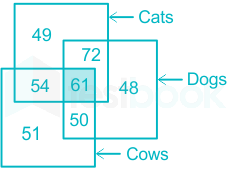
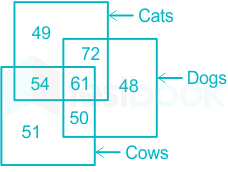
How many dogs are both cats and cows?

  1. ((a))

    48

  2. ((b))

    111

  3. ((c))

    183

  4. ((d))

    61

Show Answer
Answer: ((d))

61

Here, coloured portion shows dogs that are both cats and cows

Hence, the correct answer is 61.

3

In the following question, a set of letters is given. The letters of each group are related by some logic/rule/relationship with the letters of the same group. Select one set of letters from the given alternatives which follows the same logic/rule/relation.

(SF, NB, IX)

  1. ((a))

    (VY, QU, LR)

  2. ((b))

    (CU, WQ, SM)

  3. ((c))

    (MT, HP, CJ)

  4. ((d))

    (LG, GC, BY)

Show Answer
Answer: ((d))

(LG, GC, BY)

The positional value of given alphabets are:-

Alphabet Series MCQ [Free PDF] - Objective Question Answer for Alphabet  Series Quiz - Download Now!

Logic:- (First letter - 5) (Second letter - 4)

The same logic followed in option 4:-

Hence, the correct answer is (LG, GC, BY).

4

In the question below are given some statements followed by some conclusions based on those statements. Take the given statements to be true even if they seem to be at variance from commonly known facts. Read all the conclusions and then decide which of the given conclusions logically follows from the given statements.

Statement:

I. All D are T.

II. No D is N.

Conclusion:

I. Some N are not T.

II. Some T are not N.

  1. ((a))

    Both conclusions I and II follows

  2. ((b))

    Only conclusion I follows

  3. ((c))

    Only conclusion II follows

  4. ((d))

    none of the conclusions follow

Show Answer
Answer: ((c))

Only conclusion II follows

The correct venn diagram representation is-

I. Some N are not T.❌

Here, no direct relation between N and T is given.

Hence, this statement is incorrect.

II. Some T are not N.✅

The portion of D in T is definitely not N.

Hence, this statement is correct.

Hence, the correct answer is Only conclusion II follows.

5

A series is given in which one term is wrong. Choose the wrong term from the given alternatives.

NF, QI, TL, WP, ZR, CU

  1. ((a))

    CU

  2. ((b))

    TL

  3. ((c))

    WP

  4. ((d))

    ZR

Show Answer
Answer: ((c))

WP

The positional value of alphabets are-

Alphabet Series MCQ [Free PDF] - Objective Question Answer for Alphabet  Series Quiz - Download Now!

Logic - (First letter + 3) (Second letter + 3)

<br>

Here, in L we add 4 instead of 3. So, the wrong term is WP.

Hence, the correct answer is WP.

6

A team of seven members is to be selected from five boys B1, B2, B3, B4, and B5, and five girls G1, G2, G3, G4, and G5. With G3 either G1 or B4 is to be selected. B2 and G3 are to be selected together. G4 and B3 cannot be selected together. Neither B4 nor B5 can be selected with G4. Neither B5 nor G5 can be selected with B1. Which of the following members can be elected?

  1. ((a))

    B1, B2, B3, B4, G3, G4, G5

  2. ((b))

    B2, B3, B4, B5, G2, G3, G5

  3. ((c))

    B1, B2, B3, B4, G2, G3, G5

  4. ((d))

    B2, B3, B4, B5, G1, G2, G3

Show Answer
Answer: ((b))

B2, B3, B4, B5, G2, G3, G5

The conditions to make a team of seven members is:-

1. With G3 either G1 or B4 is to be selected. 2.  B2 and G3 are to be selected together. 3. G4 and B3 cannot be selected together. 4. Neither B4 nor B5 can be selected with G4. 5.  Neither B5 nor G5 can be selected with B1.

Option 1 - B1, B2, B3, B4, G3, G4, G5❌ 

Here, G4 and B3 cannot be selected together. 

Hence this option is incorrect.

Option 2 - B2, B3, B4, B5, G2, G3, G5.✅

This option fulfills all the conditions.

Hence this option is correct.

Option 3 - B1, B2, B3, B4, G2, G3, G5❌ 

Here, Neither B5 nor G5 can be selected with B1.

Hence this option is incorrect.

Option 4 - B2, B3, B4, B5, G1, G2, G3❌ 

With G3 either G1 or B4 is to be selected. But here both G1 and B4 are selected.

Hence this option is incorrect.

Hence, the correct answer is  B2, B3, B4, B5, G2, G3, G5.

7

Sachin is facing west. He turns 80 degrees in the clockwise direction. He turns 140 degree in anti-clockwise direction. He turns 270° in anti-clockwise direction. He turns 45 degrees in the clockwise direction. Which of the following statement is correct?

I. If he finally turns 15 degrees in the clockwise direction, he will face north.

II. If he finally turns 85 degrees in the anti-clockwise direction, he will be facing south-west.

  1. ((a))

    Only II

  2. ((b))

    Only I

  3. ((c))

    Both I and II

  4. ((d))

    neither I nor II

Show Answer
Answer: ((c))

Both I and II

Direction chart-

Direction and Distance MCQ [Free PDF] - Objective Question Answer for  Direction and Distance Quiz - Download Now!

Step1:- Sachin is facing west. He turns 80 degrees in the clockwise direction.

Step2:-  He turns 140 degree in anti-clockwise direction.

Step3:-  He turns 270° in anti-clockwise direction. 

Step4:- He turns 45 degrees in the clockwise direction.

I. If he finally turns 15 degrees in the clockwise direction, he will face north.✅

This statement is correct.

II. If he finally turns 85 degrees in the anti-clockwise direction, he will be facing south-west.✅

Hence, the correct answer is Both I and II.

8

In the following question, select the odd set of numbers from the given alternatives.

  1. ((a))

    (72, 144, 432)

  2. ((b))

    (23, 46, 138)

  3. ((c))

    (43, 86, 258)

  4. ((d))

    (68, 144, 408)

Show Answer
Answer: ((d))

(68, 144, 408)

Logic - First number x 2 = Second number

Second number x 3 = Third number

Option 1 - (72, 144, 432) ✅

72 x 2 = 144

144 x 3 = 432

Option 2 -  (23, 46, 138)✅

23 x 2 = 46

46 x 3 = 138

Option 3 - (43, 86, 258)✅

43 x 2 = 86

86 x 3 = 258

Option 4 - (68, 144, 408)❌

68 x 2 = 136

Here 136 is answer but instead of 136, 144 is given. So, this option is incorrect.

Hence, the correct answer is (68, 144, 408).

9

In the following question, select the odd figure out from the given alternatives.

  1. ((a))

  2. ((b))

  3. ((c))

  4. ((d))

Show Answer
Answer: ((a))

Explanation:- Here, A figure contain same type of figure within it. But in option 1 the same logic is not being followed.

Hence, the correct answer is option 1.

10

A series is given in which one term is wrong. Choose the wrong term from the given alternatives.

2, 3, 6, 18, 108, 1844

  1. ((a))

    1844

  2. ((b))

    108

  3. ((c))

    20

  4. ((d))

    6

Show Answer
Answer: ((a))

1844

The logic used in this question is:-

If we multiply 18 in 108 we get 1944. But in given series we get 1844 which is incorrect.

Hence, the correct answer is 1844.

11

In the question below are given some statements followed by some conclusions based on those statements. Take the given statements to be true even if they seem to be at variance from commonly known facts. Read all the conclusions and then decide which of the given conclusions logically follows from the given statements.

Statement:

I. Some B are E.

II. Some E are G.

III. No E is F.

Conclusion:

I. Some B are not F.

II. Some G are not F.

III. Some F are not B.

  1. ((a))

    Both conclusions I and II follow

  2. ((b))

    Both conclusions I and III follow

  3. ((c))

    Both conclusion II and III follow

  4. ((d))

    all conclusions follow

Show Answer
Answer: ((a))

Both conclusions I and II follow

The venn diagram representation are -

Conclusion:

I. Some B are not F.✅

The portion of E under B is definitely not F.

Hence, the given statement is correct.

II. Some G are not F.✅

The portion of E under G is definitely not F.

Hence, the given statement is correct.

III. Some F are not B.❌

We do not have information about B and F.

Hence, this statement is incorrect.

Hence, the correct answer is Both conclusions I and II follow.

12

A girl walks 5 km towards east. She takes a right turn and walks 4 km. She again takes a right turn and walks 8 km. How far is he now from the starting point?

  1. ((a))

    3 km

  2. ((b))

    10 km

  3. ((c))

    8 km

  4. ((d))

    5  km

Show Answer
Answer: ((d))

5  km

The direction chart is given below:-

Direction and Distance MCQ [Free PDF] - Objective Question Answer for  Direction and Distance Quiz - Download Now!

Step 1:-  A girl walks 5 km towards east.

Step 2:-She takes a right turn and walks 4 km.

Step 3:-She again takes a right turn and walks 8 km.

By using pythagoras theorem in triangle ABC-

(AB)2 =(BC)2 + (AC)2

(AB)2 = (3)2  +  (4)2

(AB)2 = 9 + 16 =25

AB = 5KM

Hence, the correct answer is 5km.

13

Based on the given Venn diagram, which of the following statement(s) is/are correct?

I. The total number of elephant is 183.

II. The number of horses which are neither rats nor elephants is 52.

  1. ((a))

    Only II

  2. ((b))

    Both I and II

  3. ((c))

    Neither I nor II

  4. ((d))

    Only I

Show Answer
Answer: ((b))

Both I and II

Statement 1:- The total number of elephant is shown by coloured portion-

Here, the total number of elephants are - 41 + 43 + 51 + 48 = 183

Hence, this statement is correct.

Statement 2:- II. The number of horses which are neither rats nor elephants are:-

Hence, this statement is correct.

Hence, the correct answer is Both I and II.

14

Seven persons P, Q, R, S, T, U and V are sitting around a circular table facing the center (not necessarily in the same order). T sits third to the right of R. V sits third to the right of Q. One person sits between P and T. P is not the neighbor of S. U sits third to the left of P. Who sits second to the left of S?

  1. ((a))

    R

  2. ((b))

    V

  3. ((c))

    P

  4. ((d))

    Q

Show Answer
Answer: ((b))

V

Step 1:-  T sits third to the right of R.

Step 2:- One person sits between P and T. U sits third to the left of P. 

There are 2 possibilities:-

Case 1.

Case 2. 

Step 3:-  V sits third to the right of Q.  P is not the neighbor of S.

Here case 2 is not possible because P is not the neighbor of S. 

Here, V sit second to the left of S.

Hence, the correct answer is V.

15

In a certain code language, 'You are good' is written as '@ $ #', 'Good boys like you' is written as '& * @ #', 'I and you go' is written as '© < + @ '. What is the code for 'boys are like' in that code language?

  1. ((a))
    • $ +
  2. ((b))

    $ & #

  3. ((c))

    & $ @

  4. ((d))
    • & $
Show Answer
Answer: ((d))
  • & $

Here, the code for  'boys are like' are -

WordCode
Boys& / *
are$
like& / *

Hence, the code for  'boys are like' are * & $.

16

In the following question, select the related word from the given alternatives.

Criminal : Jail :: soldier : ?

  1. ((a))

    mental asylum

  2. ((b))

    Stable

  3. ((c))

    barrack

  4. ((d))

    Palace

Show Answer
Answer: ((c))

barrack

Explanation:- We know that criminal live in jail . Similarly, soldier live in barrack. 

Hence, the correct answer is barrack.

17

In the following question, select the odd word from the given alternatives.

  1. ((a))

    Elephant

  2. ((b))

    Horse

  3. ((c))

    Fox

  4. ((d))

    Deer

Show Answer
Answer: ((c))

Fox

Explanation:- Here, Elephant, horse and deer are herbivores whereas Fox is omnivores as they are expert hunters, catching rabbits, rodents, birds, frogs and earthworms as well as eating carrion and  they dine on berries and fruit too.

Hence, the correct answer is Fox.

18

A series is given with one term missing. Choose the correct option from the given alternatives that will complete the series.

LT121, PP169, TL289, XH361, BD529, ?

  1. ((a))

    EZ625

  2. ((b))

    FZ841

  3. ((c))

    FZ625

  4. ((d))

    FA841

Show Answer
Answer: ((b))

FZ841

The positional value of alphabets are :-

Alphabet Series MCQ [Free PDF] - Objective Question Answer for Alphabet  Series Quiz - Download Now!

Logic - (First letter + 4) (Second letter - 4) (prime number starting from 11)2


Hence, the correct answer is FZ841.

19

If a mirror is placed on the line AB, then which of the given answer figures will be the correct image of the question figure?

  1. ((a))

  2. ((b))

  3. ((c))

  4. ((d))

Show Answer
Answer: ((b))

The mirror image of the given figure placed on the line AB is -

Hence, the correct answer is option 2.

20

Select the option which is related to the third figure in the same way as the second figure is related to the first figure.

  1. ((a))

  2. ((b))

  3. ((c))

  4. ((d))

Show Answer
Answer: ((a))

Logic - Here, we get figure second when we flip figure first vertically. 

Hence, the correct answer is option 1.

General Awareness (20 questions)

21

Which of the following is the correct combination of Provisions - Sources in the Indian Constitution?

I. Amendment of the Constitution - Constitution of South Africa

II. Emergency Powers of the President - Constitution of Germany

  1. ((a))

    Only II

  2. ((b))

    Only I

  3. ((c))

    Both I and II

  4. ((d))

    Neither I nor II

Show Answer
Answer: ((c))

Both I and II

The correct answer is Both I and II.

Key Points

  • Indian Constitution came into existence on 26th November 1949.
  • The Constituent Assembly of India drafted the constitution considering features of constitutions of the other countries as well as from the Government of India Act 1935.
  • There are various sources of Indian constitution for some features of it are borrowed.
  • Amendment of the Constitution,Election of members of Rajya Sabha- Constitution of South Africa
  • Emergency Powers of the President, Suspension of Fundamental Rights during an emergency - Constitution of Germany

 Additional Information

CountriesFeatures Taken
UKParliamentary government Rule of Law Legislative procedure Single Citizenship Cabinet system Prerogative writs Parliamentary privileges Bicameralism
USAFundamental rights Independence of judiciary Judicial review Impeachment of the president Removal of Supreme Court and High Court judges Post of vice-president
IrelandDirective Principles of State Policy Nomination of members to Rajya Sabha Method of election of the president
22

Golconda Fort is located in which state of India?

  1. ((a))

    Rajasthan

  2. ((b))

    Tamil Nadu

  3. ((c))

    Telangana

  4. ((d))

    Karnataka

Show Answer
Answer: ((c))

Telangana

The correct answer is Telangana.

Key Points

  • Golconda Fort is located in Telangana.
  • Golconda Fort is located in the western part of Hyderabad city and is about 9 km from the Hussain Sagar Lake.
  • It was originally known as Mankal, and built on a hilltop in the year 1143.
  • It was originally a mud fort under the reign of Rajah of Warangal.
  • Later it was fortified between 14th and 17th centuries by the Bahmani Sultans and then the ruling Qutub Shahi dynasty.
  • Golconda was the principal capital of the Qutub Shahi kings.
  • The inner fort contains ruins of palaces, mosques and a hill top pavilion, which rises about 130 meters high and gives a bird’s eye view of other buildings..
23

Which organization has launched a new technology 'Swastik' to disinfect water using natural oils?

  1. ((a))

    SII

  2. ((b))

    CSIR - NCL

  3. ((c))

    MyLab

  4. ((d))

    AIIMS

Show Answer
Answer: ((b))

CSIR - NCL

The correct answer is CSIR - NCL.

Key Points

  • CSIR - NCL has launched a new technology 'Swastik' to disinfect water using natural oils.
  • The CSIR-National Chemical Laboratory (CSIR-NCL), Pune has come up with a new technique for disinfecting water by using natural oils
  • The technology boils liquid as a result of pressure reduction or cavitation.
  • It makes use of natural oils with antimicrobial properties to disinfect water.
  • The other techniques to disinfect water makes use of chemical such as chlorination which include the formation of harmful or carcinogenic by-products.
  • Therefore, the ‘SWASTIIK’ technology is safe to disinfect water.
  • The technology was developed by Scientist Dr V.M. Bhandari and his group at CSIR-NCL Pune.
24

Who among the following has been awarded the Nobel Prize 2020 for Medicine?

  1. ((a))

    Michael Houghton

  2. ((b))

    Jennifer A. Doudna

  3. ((c))

    Roger Penrose

  4. ((d))

    Andre M. Gage

Show Answer
Answer: ((a))

Michael Houghton

The correct answer is Michael Houghton.

Key Points

  • Michael Houghton has been awarded the Nobel Prize 2020 for Medicine.
  • The 2020 Nobel Prize in Physiology or Medicine is awarded to Harvey J. Alter, Michael Houghton and Charles M. Rice for the discovery of Hepatitis C virus.
  • Hepatitis, from the Greek names for liver and inflammation, is a disease characterized by poor appetite, vomiting, fatigue and jaundice – yellow discoloration of the skin and eyes. Chronic hepatitis leads to liver damage, which may progress to cirrhosis and liver cancer.
  • This pioneering work has paved the way for the development of screening methods that have dramatically reduced the risk of acquiring hepatitis from contaminated blood and has led to the development of effective antiviral drugs that have improved the lives of millions of people.

Additional Information

Nobel Prize

  • The Nobel Prize is considered the most prestigious prize in the world.
  • This prize is given in the 6 fields’ i.e, Physics, Chemistry, Medicine, Literature, Economics, and Peace Prize. These prizes were commenced in 1901.
25

Which of the following statement is not correct?

I. Outsourcing is one of the important consequences of globalization.

II. WTO was established in 1995 as a successor organization to GATT.

  1. ((a))

    Neither I nor II

  2. ((b))

    Only I

  3. ((c))

    Only II

  4. ((d))

    Both I and II

Show Answer
Answer: ((a))

Neither I nor II

The correct answer is Neither I nor II.

Key Points

  • Both the statements are correct.
  • Outsourcing is one of the important consequences of globalization.
  • WTO was established in 1995 as a successor organization to GATT.
  • Outsourcing is the business practice of hiring a party outside a company to perform services or create goods that were traditionally performed in-house by the company's own employees and staff.
  • Globalization is the sharing and trading of concepts, ideas, people, products and services, and goods from one country to another.
  • Outsourcing is the consequence of an increasingly globalized market and the gradual interdependence of economies, cultures, and populations. Outsourcing would not exist without globalization. And globalization would not exist without outsourcing**: The two go hand in hand.**

Additional Information WTO 

  • The WTO started functioning on 1 January 1995.
  • The Uruguay Round and it led to the formulation of the World Trade Organization (WTO).
  • The WTO has 164 members and 23 observer governments.
  • Afghanistan became the 164th member in July 2016.
  • Geneva, Switzerland, where the WTO headquarters is located.
  • On 15th February 2021, Ngozi Okonjo-Iweala was appointed as the WTO Director-General.
  • She is the first woman chief of the WTO.
  • She is also the first African to hold the office of WTO as its director-general.
26

In which state is the largest brackish water lake of India located?

  1. ((a))

    West Bengal

  2. ((b))

    Karnataka

  3. ((c))

    Odisha

  4. ((d))

    Rajasthan

Show Answer
Answer: ((c))

Odisha

The correct answer is Odisha.

Key Points

  • Odisha state has the largest brackish water lake of India.
  • Chilika Lake is located in the state of Odisha in eastern India.
  • It is situated at the mouth of the Bay of Bengal and is the largest brackish water lake in Asia.
  • Chilika is officially designated as a Ramsar site which refers to a wetland of international importance.
  • The Wildlife (Protection) Act of 1972 provides protection to the lake's migrating birds, and the area of the lake that contains important habitat has been designated as a sanctuary for the birds.
  • The 2011 Coastal Regulation Zone Notification officially governs the lake.
27

Who among the following was the flag bearer of India at the opening ceremony of Tokyo Olympics 2020 (to be played in 2021)?

  1. ((a))

    Meera Bai Chanu

  2. ((b))

    Mary Kom

  3. ((c))

    Monica Batra

  4. ((d))

    Bajrang Punia

Show Answer
Answer: ((b))

Mary Kom

The correct answer is Mary Kom.

Key Points

  • Mary Kom was the flag bearer of India at the opening ceremony of Tokyo Olympics 2020 (to be played in 2021).
  • Boxer M. C. Mary Kom and men's hockey team skipper Manpreet Singh will be India's flag bearers at opening ceremony of Tokyo Olympics, the Indian Olympic Association (IOA).
  • Wrestler Bajrang Punia will be the flag bearer at closing ceremony on July 8.
  • The first Indian to carry the national flag at the opening ceremony of the Games was 400m sprinter Purma Banerjee at the 1920 Olympics in Antwerp, Belgium.

Additional Information Olympics 

  • The Olympic Games are an athletic festival that originated in ancient Greece and were revived in the late 19th century. They are the world’s foremost sports competition and include athletes from all over the world.
  • The Olympics were revived in the late 19th century, with the first modern Games being held in Greece is 1896.
28

If the weight of an object on the Moon is 60N, what would be the weight of that object on the surface of the Earth?

  1. ((a))

    300 N

  2. ((b))

    15 N

  3. ((c))

    360 N

  4. ((d))

    10 N

Show Answer
Answer: ((c))

360 N

The correct answer is 360 N.

Key Points

  • The weight of the object on the surface of the earth will be 360 N.
  • Given that Weight of the object on the moon surface (We) = 60 N
  • Using the concept Weight of the object on the earth (Wm)=6∗ Wm=6∗60=360N
  • An object weighs 360 N when measured on the surface of the earth.
  • Its weight on the surface of the Moon will be 60 N.

Additional Information

  • The weight of an object on Earth and the Moon is different because Earth's gravity is much great than the Moon's gravity.
  • Newton's law says that F=mg, where F is the weight and M is the mass, and G, is the acceleration due to gravity but since the gravity on Moon is much less than Earth.
  • The weight of an object will be Different.
  • The formula that links mass and the gravitational field strength is: gravity force = mass × gravitational field strength (g)
  • This is when: gravity force is measured in newtons (N) mass is measured in kilograms (kg) gravitational field strength (g) is measured in newtons per kilogram (N/kg).
29

Which of the following statement is correct?

I. All India Muslim League supported the partition of Bengal.

II. Lala Lajpat Rai was an active member of Aryasmaj.

  1. ((a))

    Both I and II

  2. ((b))

    Only I

  3. ((c))

    Only II

  4. ((d))

    Neither I nor II

Show Answer
Answer: ((a))

Both I and II

The correct answer is Both I and II.

Key Points 

  • Both statements are true.
  • All India Muslim League supported the partition of Bengal.
  • There was widespread political unrest in the province after Curzon announced the partition.
  • Rabindranath Tagore composed the famous song ‘Amar Sonar Bangla’ which later became the national anthem of Bangladesh.
  • The Indian National Congress protested this move to separate the province on communal lines.
  • Many Muslims from the Bengali Muslim community welcomed this move since they thought that it would advance their educational, economic and political interests if they became the majority in the new province.
  • This was also seen as an opportunity for Muslims to develop in education and improve their standard of living.

Additional Information

Lala Lajpat Rai was an active member of Aryasmaj.

  • The Arya Samaj participated in the Non-Cooperation Movement against the British.
  • They opened schools and colleges in India and gave Indian patriots like Lala Lajpat Rai, Sardar Ajit Singh, Shradhanand, Bhai Parmanand and Lala Hardyal.
30

Which of the following statement is correct?

I. Insoluble salt is obtained by precipitation reaction.

II. Addition of oxygen or loss of hydrogen is called oxidation.

  1. ((a))

    Only I

  2. ((b))

    Both I and II

  3. ((c))

    Only II

  4. ((d))

    Neither I nor II

Show Answer
Answer: ((b))

Both I and II

The correct answer is Both I and II.

Key Points Insoluble salt is obtained by precipitation reaction.

  • Precipitation produces insoluble salts.
  • Precipitation is the type of chemical reaction that takes place in an aqueous solution when two ions bond together to form an insoluble salt (precipitate).
  • AgNO3 (aq) + KCl (aq) → AgCl (s) + KNO3 (aq)

 The addition of oxygen or loss of hydrogen is called oxidation.

  • Oxidation is the process of the addition of oxygen and the removal of hydrogen.
  • The atom or the molecule which undergoes oxidation loses one or more electrons.
  • Example of oxidation
  • When Hydrogen sulfide reacts with Chlorine, Sulphur and Hydrogen chloride are formed.
31

In which year Tipu Sultan became the ruler of Mysore?

  1. ((a))

    1792

  2. ((b))

    1772

  3. ((c))

    1762

  4. ((d))

    1782

Show Answer
Answer: ((d))

1782

The correct answer is 1782.

Key Points

  • In the year 1782 Tipu Sultan became the ruler of Mysore.
  • Dashing British hopes of a chaotic transition of power, Tipu Sultan became the ruler of Mysore on December 22, 1782.
  • Tipu’s father, Hyder Ali, who served as a military officer at the Mysore kingdom, became the most powerful person in Mysore by 1761.
  • The Second Anglo-Mysore War dragged on through 1783 and into the early part of 1784.
  • The British eventually accepted defeat, and signed the Treaty of Mangalore in March 1784.

Additional Information Anglo-Mysore War

  • The Anglo-Mysore Wars was a series of four military confrontations in India between the British and the rulers of Mysore.
  • First Anglo-Mysore War (1767-69)-Treaty of Madras. .
  • Second Anglo-Mysore War (1780-84)-Treaty of Mangalore (March, 1784)
  • Third Anglo-Mysore War (1790-92)-Treaty of Seringapatam, 1792
  • Fourth Anglo-Mysore War (1799)-Tipu Sultan died in the war and all his treasures were confiscated by the British.
32

The Constitution of India has ______ Fundamental Rights and ______ Fundamental Duties.

  1. ((a))

    7, 11

  2. ((b))

    6, 11

  3. ((c))

    5, 11

  4. ((d))

    6, 9

Show Answer
Answer: ((b))

6, 11

The correct answer is 6, 11.

Key Points

The Constitution of India has 6 Fundamental Rights and 11 Fundamental Duties.

Fundamental Rights

  • Fundamental rights are the basic human rights enshrined in the Constitution of India which are guaranteed to all citizens.
  • They are applied without discrimination on the basis of race, religion, gender, etc.
  • Significantly, fundamental rights are enforceable by the courts, subject to certain conditions.
  • There are six fundamental rights of Indian Constitution along with the constitutional articles related to them are mentioned below:
  • Right to Equality (Article 14-18)
  • Right to Freedom (Article 19-22)
  • Right against Exploitation (Article 23-24)
  • Right to Freedom of Religion (Article 25-28)
  • Cultural and Educational Rights (Article 29-30)
  • Right to Constitutional Remedies (Article 32)

Fundamental Duties.

  • 42nd Amendment Act of 1976 added 10 Fundamental Duties to the Indian Constitution.
  • 86th Amendment Act 2002 later added 11th Fundamental Duty to the list.
  • Swaran Singh Committee in 1976 recommended Fundamental Duties, the necessity of which was felt during the internal emergency of 1975-77.
  • The Fundamental Duties are dealt with Article 51A under Part-IV A of the Indian Constitution.
33

Which pair of Festival - State is not correct?

  1. ((a))

    Wangala - Meghalaya

  2. ((b))

    Bhumchu - Sikkim

  3. ((c))

    Onam - Kerala

  4. ((d))

    Saganawa - Assam

Show Answer
Answer: ((d))

Saganawa - Assam

The correct answer is Saganawa - Assam.

Key Points

  • One of the most famous and biggest festivals of Sikkim.
  • Saga Dawa is celebrated with great enthusiasm and fervour every year.
  • The festival is the most significant and sacred for the followers of Mahayana Buddhism.
  • Who on this auspicious occasion commemorates Lord Buddha’s birth, his attainment of enlightenment and salvation from this corporeal world.

Additional Information

FestivalsState
Wangala - MeghalayaMeghalaya
BhumchuSikkim
OnamKerala
34

Who is the author of the book "Unhappy India"?

  1. ((a))

    Mahatma Gandhi

  2. ((b))

    Lala Lajpat Rai

  3. ((c))

    Maulana Abul Kalam Azad

  4. ((d))

    Veer Savarkar

Show Answer
Answer: ((b))

Lala Lajpat Rai

The correct answer is Lala Lajpat Rai

Key Points

  • Lala Lajpat Rai  is the author of the book "Unhappy India".
  • Lala Lajpat Rai is also known as Punjab Kesri.
  • He initiated the foundation of Punjab National Bank.
  • He was badly injured in police lathi-charge on the activists, who were protesting the arrival of Simon Commission, and died a few days later due to the injuries.

Additional Information Ohters books by Lala Lajpat Rai

  • He also authored the following published books.
  • The Story of My Deportation, 1908 Arya Samaj, 1915.
  • The United States of America: A Hindu’s Impression, 1916.
  • Unhappy India, 1928. England's Debt to India, 1917.
35

Manpreet Singh is related to which sport?

  1. ((a))

    Volleyball

  2. ((b))

    Cricket

  3. ((c))

    Hockey

  4. ((d))

    Football

Show Answer
Answer: ((c))

Hockey

The correct answer is Hockey

Key Points

  • Manpreet Singh is related to Hockey.
  • Manpreet Singh is one of India’s best field hockey players and the captain of the Indian men’s hockey team.
  • In 2018, he was given the Arjuna Award, the highest honour bestowed given to a sportsperson by the Indian government.
  • In 2019, he was named the best men’s player at the FIH Player of the Year Awards.
  • At Tokyo 2020, he led India to a bronze medal, ending a wait of 41 years for an Olympic medla in hockey.
  • Later in 2021, he was awarded the Khel Ratna, the highest honour given to sportspersons in India.
36

Which of the following statement is not correct?

I. Generally, warm ocean currents originate near the equator and flow towards the poles.

II. Gulfstreams are cold water currents.

  1. ((a))

    Both I and II

  2. ((b))

    Only I

  3. ((c))

    Only II

  4. ((d))

    Neither I nor II

Show Answer
Answer: ((c))

Only II

The correct answer is Only II.

Key Points Generally, warm ocean currents originate near the equator and flow towards the poles.

  • Ocean currents are streams of water flowing continuosly over the ocean surface in fixed directions.
  • Most of the warm ocean currents originate near the equator.
  • The warm ocean currents originate near the equator and move towards the poles.
  • The cold currents carry water from polar or higher latitudes to tropical or lower latitudes.
  • Warm ocean currents flow away from the equatorial region on the western side of ocean basins.
  • The Gulf Stream in the North Atlantic and the Kuroshio Current in the North Pacific are examples of warm currents.

Additional Information 

37

Vertebrata are divided into _____ classes.

  1. ((a))

    4

  2. ((b))

    6

  3. ((c))

    2

  4. ((d))

    3

Show Answer
Answer: ((b))

6

The correct answer is 6.

Key Points

  • Vertebrata are divided into 6 classes.
  • Vertebrates are animals that possess a vertebral column and/or notochord at any point in their lives.
  • Vertebrate features:
  • A stiff rod running through the length of the animal
  • Humans and all other vertebrates possess a notochord as an embryo and it eventually develops into the vertebral column.
  • A bundle of nerves run above the vertebral column and the alimentary canal exists below it.
  • The mouth is present at the anterior portion of the animals or right below it.
  • The alimentary canal ends in the anus, which opens to the exterior.
  • The tail extends after the anus.
  • What are the 6 vertebrate classes -Humans, birds, mammals, reptiles, amphibians, and fish are all vertebrates.
38

Buddha attained enlightenment in _____.

  1. ((a))

    Kushinara

  2. ((b))

    Bodh Gaya

  3. ((c))

    Sarnath

  4. ((d))

    Pavapur

Show Answer
Answer: ((b))

Bodh Gaya

The correct answer is Bodh Gaya.

Key Points

  • Buddha attained enlightenment in Bodh Gaya.
  • It is located in Bihar.
  • The day Gautam Buddha attained enlightenment is celebrated as Buddha Purnima.
  • The exact date of is based on the Asian lunisolar calendars and is primarily celebrated in Baisakh month.

Additional Information

PlaceImportance
KushinagarBuddhists believe Gautama Buddha attained parinirvana.
SarnathGautama Buddha first taught the Dharma, and where the Buddhist Sangha came into existence
Pavapura holy site for Jains located in the Nalanda district of Bihar state in Eastern India
39

Which one of the following is an important social indicator to measure the extent of equality between men and women in a society, at a given point of time?

  1. ((a))

    Migration

  2. ((b))

    Literacy rate

  3. ((c))

    Sex Ratio

  4. ((d))

    Health

Show Answer
Answer: ((c))

Sex Ratio

The correct answer is Sex Ratio.

Key Points

  • The sex Ratio is an important social indicator to measure the extent of equality between men and women in society, at a given point of time.
  • The sex ratio is defined as the number of females per 1000 males in the population.
  • In the 2011 Population Census, it was revealed that the population ratio in India is 940 females per 1000 males.
  • Although many states have a sex ratio of less than one some states like Kerala have a sex ratio of 1058 females for every 1000 males, Whereas Delhi has a sex ratio of 821 females for every 1000 males.
  • Thus, it shows the grim scenario regarding female foeticide in India.

Additional Information

MigrationMigration is a process of moving, either across an international border or within a country, encompassing any kind of movement of people, regardless of the causes.
Literacy rateThe literacy rate is defined by the percentage of the population of a given age group that can read and write.
40

The interest rate at which the Reserve Bank absorbs liquidity from banks under the Liquidity Adjustment Facility (LAF), on an overnight basis, against the collateral of eligible government securities, is called _____.

  1. ((a))

    Marginal Permanent Facility

  2. ((b))

    Bank Rate

  3. ((c))

    Repo Rate

  4. ((d))

    Reverse Repo Rate

Show Answer
Answer: ((d))

Reverse Repo Rate

The correct answer is Reverse Repo Rate.

Key Points

  • The interest rate at which the Reserve Bank absorbs liquidity from banks under the Liquidity Adjustment Facility (LAF), on an overnight basis, against the collateral of eligible government securities, is called Reverse Repo Rate.
  • The reverse repo rate is the rate at which banks earn interest when they park surplus funds with the RBI.
  • The repo rate helps control inflation, and the reverse repo rate increases liquidity.
  • The repo rate set by the RBI is always higher than the reverse repo rate.

Additional Information

Marginal Permanent Facility- MSF is used as an emergency tool by the banks to obtain liquidity at the Marginal Standing Facility or MSF rate. - By using the Marginal Standing Facility or MSF, the concerned banks borrow money from the central bank which is done by pledging the government securities at a rate higher than the repo rate. - This will help the banks to obtain quick money in the period of 24 hours.
Bank Rate- Bank rate is the rate charged by the central bank for lending funds to commercial banks
Repo Rate- The repo rate is the rate at which the RBI lends money to all commercial banks.

Arithmetic Ability (20 questions)

41

If P = 25X and Q = 20X, then P is what percent more than Q?

  1. ((a))

    40 percent

  2. ((b))

    10 percent

  3. ((c))

    25 percent

  4. ((d))

    35 percent

Show Answer
Answer: ((c))

25 percent

Given:

P = 25X

Q = 20X

Formula used:

P% = (P - Q)/Q  x 100

Solution:

P = (25X - 20X)/20X x 100

P = 5/20 x 100 = 25% more than Q

Hence, the correct option is 3.

42

A principal amount of Rs 20000 is invested for 6 years at simple interest. If the rate of interest is 10% per annum, then what will be the amount after 6 years?

  1. ((a))

    Rs. 40000

  2. ((b))

    Rs. 32000

  3. ((c))

    Rs. 24000

  4. ((d))

    Rs. 28000

Show Answer
Answer: ((b))

Rs. 32000

Given:

P = Rs. 20,000

T = 6 years

R = 10%

Formula used:

SI = (P x R x T)/100

A = SI + P

here, 

A = Amount

SI = Simple Interest

P = Principle

R = Rate

T = Time

Solution:

Let's put the values given, in the formula to find the value of SI;

SI = 20000 x 10 x 6/100

SI = 12000

A = 12000 + 20000 = Rs. 32000

Hence, the correct option is 2.

43

If a number 9257Y is exactly divisible by 8, then what is the value of Y?

  1. ((a))

    5

  2. ((b))

    4

  3. ((c))

    2

  4. ((d))

    6

Show Answer
Answer: ((d))

6

Concept used:

A number is divisible by 8 if the last 3 digits are divisible by 8.

Solution:

57Y/8 = 0

8 x 70 = 560

8 x 71  = 568

8 x 72 = 576

8 x 73 = 584

Y = 6

Hence, the correct option is 4.

44

The bar figure given below shows the number of working days of a company in 5 different years.

What is the average of the number of working days over all the years?

  1. ((a))

    360

  2. ((b))

    240

  3. ((c))

    320

  4. ((d))

    340

Show Answer
Answer: ((b))

240

Solution:

Total working days = 100 + 250 + 350 + 300 + 200 = 1200 days

Average working days = 1200/5 = 240 days

Hence, the correct option is 2.

45

The sum of the length and breadth of a cuboid is 70 cm. The height of the cuboid is 15 cm. If the height is half of the breadth, then what is the total surface area of ​​the cuboid?

  1. ((a))

    4800 cm2

  2. ((b))

    4500 cm2

  3. ((c))

    5400 cm2

  4. ((d))

    6000 cm2

Show Answer
Answer: ((b))

4500 cm2

Given:

L + B = 70 cm

H = 15 cm

H = 1/2 B

Formula used:

TSA(Cuboid) = 2 x (LB + BH + HL)

L = Length

B = Breadth

H = Height

TSA = Total Surface Area

Solution:

1/2B = 15

B = 30 cm

L = 70 - 30 = 40 cm

TSA = 2 x [(40)(30) + (30)(15) + (15)(40)]

TSA = 2 x [1200 + 450 + 600]

TSA = 2 x 2250

TSA = 4500 cm2 

Hence, the correct option is 2.

46

What is the value of 13+4+14+5+15+6+16+7\frac{1}{{\sqrt 3 + \sqrt 4 }} + \frac{1}{{\sqrt 4 + \sqrt 5 }} + \frac{1}{{\sqrt 5 + \sqrt 6 }} + \frac{1}{{\sqrt 6 + \sqrt 7 }} .

  1. ((a))

    85\sqrt 8 - \sqrt 5

  2. ((b))

    37\sqrt 3 - \sqrt 7

  3. ((c))

    65\sqrt 6 - \sqrt 5

  4. ((d))

    73\sqrt 7 - \sqrt 3

Show Answer
Answer: ((d))

73\sqrt 7 - \sqrt 3

Formula used:

(a - b)(a + b) = a2 - b2 

Solution:

Rationalizing the denominator,

    34(3+4)×(34)+45(4+5)×(45)+565+6)×(56)+676+7)×(67)     34+45+56+671     73\implies \frac{\sqrt 3 - \sqrt 4}{{(\sqrt 3 + \sqrt 4) \times (\sqrt 3 - \sqrt 4) }} + \frac{\sqrt 4 - \sqrt 5}{{(\sqrt 4 + \sqrt 5) \times(\sqrt 4 - \sqrt 5) }} + \frac{\sqrt 5 - \sqrt 6 }{{\sqrt 5 + \sqrt 6 ) \times(\sqrt 5 -\sqrt 6 )}} + \frac{\sqrt 6 - \sqrt 7}{{\sqrt 6 + \sqrt 7) \times (\sqrt 6 - \sqrt 7) }} \ \implies \frac{\sqrt 3 - \sqrt 4 + \sqrt 4 - \sqrt 5 + \sqrt 5 - \sqrt 6 + \sqrt 6 - \sqrt 7 }{-1}\ \implies \sqrt7 - \sqrt3

Hence, the correct option is 4.

47

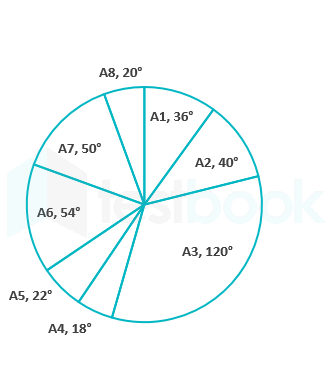
The pie chart given below shows the demand for 8 different commodities. The total demand of all the 8 articles is 36000. The demand for a specific commodity is represented as a degree with respect to the aggregate demand for all these 8 goods.

J1 = Average of demand of goods A2, A3, A4 and A8.

J2 = The difference between the demand for good A7 and A1.

What is the value of (J1 - J2)?

  1. ((a))

    3350

  2. ((b))

    3550

  3. ((c))

    3250

  4. ((d))

    4550

Show Answer
Answer: ((b))

3550

Given:

360° = 36000

Solution:

1° = 100

J1 = 100 x (40 + 120 + 18 + 20)/4 = 25 x 198 = 4950

J2 = 100 x (50 - 36) = 100 x 14 = 1400

J1 - J2 = 4950 - 1400 = 3550

Hence, the correct option is 2.

48

A boat covers a distance of 2 km upstream and 4 km downstream in 120 minutes. It covers a distance of 4 km upstream and 6 km downstream in 210 minutes. What is the speed of the boat in still water?

  1. ((a))

    2

  2. ((b))

    1

  3. ((c))

    4

  4. ((d))

    3

Show Answer
Answer: ((d))

3

Shortcut Trick

Convert time to hours: 120 min = 2 h and 210 min = 3.5 h.

By doubling the first scenario to match upstream distance: 4 km upstream + 8 km downstream = 4 h.

Compare with scenario 2: (4 km up + 8 km down) − (4 km up + 6 km down) = 4 h − 3.5 h.

This gives 2 km downstream = 0.5 h ⇒ Downstream speed = 2 ÷ 0.5 = 4 kmph.

Substituting back: 2/U + 4/4 = 2 ⇒ Upstream speed (U) = 2 kmph.

Speed in still water = (Downstream + Upstream) ÷ 2 = (4 + 2) ÷ 2 = 3 kmph.

∴ The correct answer is 3 kmph.

Alternate Method

Given:

Case 1: 2 km upstream and 4 km downstream in 120 min (2 hours).

Case 2: 4 km upstream and 6 km downstream in 210 min (3.5 hours).

Formula Used:

Time = Distance ÷ Speed

Let upstream speed be x kmph and downstream speed be y kmph.

Calculations:

⇒ 2/x + 4/y = 2 −−− (i)

⇒ 4/x + 6/y = 3.5 −−− (ii)

Multiply equation (i) by 2:

⇒ 4/x + 8/y = 4 −−− (iii)

Subtracting equation (ii) from equation (iii):

⇒ (4/x + 8/y) − (4/x + 6/y) = 4 − 3.5

⇒ 2/y = 0.5 ⇒ y = 4 kmph (Downstream speed)

Substitute y = 4 in equation (i):

⇒ 2/x + 4/4 = 2

⇒ 2/x + 1 = 2 ⇒ 2/x = 1 ⇒ x = 2 kmph (Upstream speed)

Speed of boat in still water (u) = (y + x) ÷ 2

⇒ u = (4 + 2) ÷ 2 = 6 ÷ 2 = 3 kmph.

∴ The correct answer is 3 kmph.

Additional Information

Still Water Speed

The speed of the boat when the water is stationary: u = (Downstream Speed + Upstream Speed) ÷ 2.

Stream Speed

The speed at which the river water flows: v = (Downstream Speed − Upstream Speed) ÷ 2.

Upstream and Downstream

Upstream = Boat Speed − Stream Speed; Downstream = Boat Speed + Stream Speed.

49

A and B entered into a partnership and invested Rs. 4000 and Rs. 5000 respectively in the business. After 4 months, Z also joins the business with an investment of Rs. 8000. After one year, they made a profit of Rs. 3655 What is B's share of profit?

  1. ((a))

    Rs. 1275

  2. ((b))

    Rs. 1165

  3. ((c))

    Rs. 1516

  4. ((d))

    Rs. 1360

Show Answer
Answer: ((a))

Rs. 1275

Given:

ABZ
12 x 400012 x 5000(12 - 4) x 8000
3655

Concept used:

Profit is directly proportional to investment.

Solution:

Investment(A : B : Z) = 12 : 15 : 16

12 + 15 + 16 = 43

43 = 3655

15 = ?

Profit of B = 15 x 3655/43 = Rs. 1275

Hence, the correct option is 1.

50

The average of 34 numbers is 53. If we subtract one number 'L' from each number, the average becomes 35. What is the value of L?

  1. ((a))

    17

  2. ((b))

    18

  3. ((c))

    15

  4. ((d))

    19

Show Answer
Answer: ((b))

18

Given:

S/34 = 53

(S - 34L)/34 = 35

S = Sum of 34 numbers

Solution:

S = 34 x 53

S/34 - L = 35

53 - L = 35

L = 53 - 35 = 18

Hence, the correct option is 2.

51

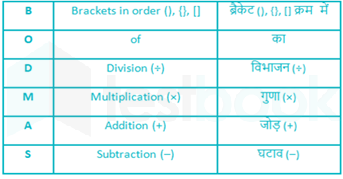
What is the value of 98 ÷  4 × 2 + 5 – 6 × 2?

  1. ((a))

    36

  2. ((b))

    12

  3. ((c))

    54

  4. ((d))

    42

Show Answer
Answer: ((d))

42

Concept used:

Solution:

= 98 ÷  4 × 2 + 5 – 6 × 2

= 24.5 x 2 + 5 - 6 x 2

= 49 + 5 - 12

= 54 - 12

= 42

Hence, the correct option is 4.

52

What is the digit in the unit place in 5896 × 5625 × 8928?

  1. ((a))

    2

  2. ((b))

    5

  3. ((c))

    6

  4. ((d))

    4

Show Answer
Answer: ((c))

6

Solution:

Last digit of 58 = 8

81 = 8

82 = 64

83 = 512

84 = 4096

85 = 32768

58's unit place will repeat after 4, 96/4 = 0

5896 has unit digit = 6

56 has unit digit = 6

61 = 6

62 = 36

5625 will have it's unit digit = 6

For 89,

91 = 9

92 = 81

93 = 729

28/2 = 0

8928 will have unit digit = 1

Now,  5896 × 5625 × 8928 = 6 x 6 x 1 = 36

The unit place is 6.

Hence, the correct option is 3.

53

Rahul goes at a speed of 60 m/s. How many minutes will he take to cover a distance of 4200 metres?

  1. ((a))

    5/4 Minute

  2. ((b))

    7/6 Minute

  3. ((c))

    4/3 Minute

  4. ((d))

    5/3 Minute

Show Answer
Answer: ((b))

7/6 Minute

Given:

Speed = 60 m/s

Distance = 4200 m

Formula used:

Speed = Distance/Time

1 minute = 60 seconds

Solution:

Time = 4200/(60 x 60) = 42/36 = 7/6 minutes

Hence, the correct option is 2.

54

The graph given below shows the number of students playing different sports in two schools.

Which of the following statement is correct?

I. The average of the number of students playing G1 in S1 and S2 is 50.

II. The ratio of the number of students playing G3 in S1 to the number of students playing G3 in S2 is 2 ∶ 1.

  1. ((a))

    Only II

  2. ((b))

    Only I

  3. ((c))

    Both I and II

  4. ((d))

    Neither I nor II

Show Answer
Answer: ((c))

Both I and II

Solution:

The average of the number of students playing G1 in S1 and S2 = (40 + 60)/2 = 50

The ratio of the number of students playing G3 in S1 to the number of students playing G3 in S2 = 30 : 15 = 2 : 1

Hence, the correct option is 3.

55

A and B can do a piece of work in 5 days and 20 days respectively. They work alternately for one day and A works on the first day. In how many days will the whole work be completed?

  1. ((a))

    8 Days

  2. ((b))

    12 Days

  3. ((c))

    10 Days

  4. ((d))

    7 Days

Show Answer
Answer: ((a))

8 Days

Given:

A = 5 days

B = 20 days

Solution:

Work done by A in 1 day = 1/5

Work done by B in 1 day = 1/20

Total work done in 2 days = (1/5 + 1/20) = 1/4

Total days required to complete the work = 2 x 4 = 8 days

Hence, the correct option is 1.

56

84 liters of a mixture of milk and water contains 30 percent milk. How much more milk should be added to make the percentage of water in the mixture 60 percent?

  1. ((a))

    10 liters

  2. ((b))

    12.5 liters

  3. ((c))

    14 liters

  4. ((d))

    15 liters

Show Answer
Answer: ((c))

14 liters

Given:

84L = 30% milk

Solution:

Milk : Water = 3 : 7

To get 4 : 6

Let, M = Milk to be added

84(0.3) + M = 0.4(84 + M)

0.6M = 8.4

M = 14 L

Hence, the correct option is 3.

57

A shopkeeper sells a table at a loss of 50%. Had he sold the table for Rs 120 more, he would have made a loss of 30 percent. To make a profit of 40 percent, what should be the selling price of the table?

  1. ((a))

    Rs. 840

  2. ((b))

    Rs. 720

  3. ((c))

    Rs. 800

  4. ((d))

    Rs. 750

Show Answer
Answer: ((a))

Rs. 840

Given:

Loss% = 50%

If SP = SP + 120, Lss% = 30%

Formula used:

Profit % = (Profit/Cost Price) x 100

Profit = SP - CP

CP = Cost price

SP = Selling price

Solution:

⇒ 120 = (50 - 30)%

⇒ 1% = 120/20 = Rs. 6 

CP = 100 x 6 = Rs. 600

To get a Profit of 40%, it must be sold at,

⇒ 0.4 = SP/600 - 1

SP = 600 x 1.4 = Rs.840

Hence, the correct option is 1.

58

Which of the following statements is correct?

I. Square root of 5 + 2 √6 is √2 + √3.

II. if 15+414=x+y\sqrt {15 + 4\sqrt {14} } = \sqrt x + \sqrt y   then x + y = 15 and is xy = 50.

  1. ((a))

    Neither I nor II

  2. ((b))

    Only I

  3. ((c))

    Only II

  4. ((d))

    Both I and II

Show Answer
Answer: ((b))

Only I

Formula used:

(a + b)2 = a2 + 2ab + b2 

Solution:

I. (√2 + √3)2 = 2 + 3 + 2√6 = 5 + 2√6

Statement I is correct.

II. x + y = 15

x = 15 - y

(15 - y)y = 50

y2 -15y + 50 = 0

y = 15±1524(50)2{15 \pm √{-15^2-4(50)} \over 2}   = 5 or 10

x = 5 or 10

By considering all the cases

√x + √y = √5 + √10 or 2√5 or 2√10

None of the value matches with the value given in statement II.

So, Statement II is wrong.

Hence, the correct option is 2.

59

The circumference of a circle is 220 cm. What is the area of this circle?

  1. ((a))

    1925 cm2

  2. ((b))

    7700 cm2

  3. ((c))

    3850 cm2

  4. ((d))

    5775 cm2

Show Answer
Answer: ((c))

3850 cm2

Given:

Circumference  = 220 cm

Formula used:

Area of circle = 22/7 x r x r

Circumference of circle = 2 x 22/7 x r 

r = radius

Solution:

⇒ 2 x 22/7 x r = 220

r = 5 x 7 = 35 cm

Area = 22/7 x 35 x 35 = 3850 cm2 

Hence, the correct option is 3.

60

What number should be added to each of 8, 35, 7 and 31 so that the resulting numbers become a proportion?

  1. ((a))

    2

  2. ((b))

    3

  3. ((c))

    1

  4. ((d))

    5

Show Answer
Answer: ((c))

1

Solution:

Let, m = number to be added

⇒ (8 + m)/(35 + m) = (7 + m)/(31 + m)

To avoid, a lengthy calculation, let's take m = 1

⇒ 9/36 = 8/32

⇒ 1/4 = 1/4

m = 1, satisfies the equation.

Hence, the correct option is 3.

General Hindi (20 questions)

61

निम्नलिखित प्रश्न में, दिए गए चार विकल्पों में से, उस विकल्प का चयन करें जो दिए गए मुहावरे के अर्थ को सर्वश्रेष्ठ रूप से व्यक्त करता है।

ईंट तक बिकवा देना

  1. ((a))

    पागल होना

  2. ((b))

    कृपा की प्रार्थना करना

  3. ((c))

    सर्वस्व नष्ट करना

  4. ((d))

    जोश में आना

Show Answer
Answer: ((c))

सर्वस्व नष्ट करना

ईंट तक बिकवा देना’ मुहावरे का सही अर्थ है – सर्वस्व नष्ट करना। अन्य विकल्प असंगत हैं। अतः सही विकल्प 3 ‘सर्वस्व नष्ट करना’ है।

स्पष्टीकरण:-

मुहावरेअर्थवाक्य प्रयोग
ईंट तक बिकवा देनासर्वस्व नष्ट करनातुम मेरी ईंट तक बिकवा दो पर मुझे अपने सामने झुका ‌‌‌नही सकते हो।

अन्य विकल्प:-

मुहावरेअर्थवाक्य प्रयोग
खून खौलनाजोश में आनानिर्दोष को पिटते देखकर मेरा खून खौल उठा।
त्राहि-त्राहि करनाविपत्ति या कठिनाई के समय रक्षा, कृपा या शरण के लिए प्रार्थना करनाआग लगने पर बच्चे का उपाय न देखकर लोग त्राहि-त्राहि करने लगे।
अक्ल का अन्धामहामूर्ख होनामुझे तो लगता है कि, रवि तुम अक्ल के अंधे हो। कितना भी तुम्हें बताओ, तुम्हारी समझ में ही नहीं

Additional Information

मुहावरा परिभाषाउदाहरण
मुहावरा का शाब्दिक अर्थ ‘अभ्यास’ है। मुहावरा शब्द अरबी भाषा का शब्द है। हिन्दी में ऐसे वाक्यांशों को मुहावरा कहा जाता है, जो अपने साधारण अर्थ को छोड़कर  विशेष अर्थ को व्यक्त करते हैं।अंक भरना- स्नेह से लिपटा लेना वाक्य-माँ ने स्नेह से अपने पुत्र को अंक में भर लिया।
62

दिए गए शब्दों में शुद्ध वर्तनी का चयन कीजिए।

  1. ((a))

    नकद

  2. ((b))

    नगद

  3. ((c))

    नागद

  4. ((d))

    नाकद

Show Answer
Answer: ((a))

नकद

इसका सही उत्तर विकल्प 1 ‘नकद’ है। अन्य विकल्प त्रुटिपूर्ण हैं।

Mistake Points

  • शुद्ध शब्द ‘नकद’ है
  • सामान्य  बोलचाल में हम नगद शब्द का प्रयोग करते हैं जो कि गलत है।

Key Points 

स्पष्टीकरण:

उपर्युक्त तीन विकल्पों में वर्तनीगत त्रुटि है। शुद्ध शब्द ‘नकद’ है जिसका अर्थ है वह धन जो रुपया-पैसा, सिक्का आदि के रूप में हो।

Additional Information

वर्तनीलिखने की रीति को वर्तनी कहते हैं। ‘वर्तनी’ शब्द का अर्थ ‘पीछे चलना’ है। अर्थात उच्चारित होने वाले शब्द के लेखन में प्रयोग होने वाले लिपि चिह्नों के व्यवस्थित रूप को वर्तनी कहा जाता है।
63

निम्नलिखित वाक्यों में से संयुक्त वाक्य ज्ञात कीजिए।

  1. ((a))

    वह पढ़ता भी है और नौकरी भी करता है।

  2. ((b))

    वह पढ़ने के लिए नौकरी करता है।

  3. ((c))

    यदि वह नौकरी करता है, तो साथ में पढ़ता भी है।

  4. ((d))

    वह पढ़ने के अलावा नौकरी भी करता है।

Show Answer
Answer: ((a))

वह पढ़ता भी है और नौकरी भी करता है।

सही उत्तर है, '**वह पढ़ता भी है और नौकरी भी करता है।**​' 

  • '**वह पढ़ता भी है और नौकरी भी करता है।**​', वाक्य संयुक्त वाक्य है।
  • उपरोक्त वाक्य में दो साधारण वाक्य एक योजक शब्द ‘और’ की सहायता से जुड़कर संयुक्त वाक्य बना रहे हैं।
  • जिस वाक्य में दो या दो से अधिक उपवाक्य मिले हों, परन्तु सभी वाक्य प्रधान हो तो ऐसे वाक्य को संयुक्त वाक्य कहते है।

Key Points अन्य विकल्पों का विश्लेषण: 

वाक्यप्रकार
वह पढ़ने के लिए नौकरी करता है।सरल वाक्य
यदि वह नौकरी करता है, तो साथ में पढ़ता भी है।मिश्र वाक्य
वह पढ़ने के अलावा नौकरी भी करता है।मिश्र वाक्य

Additional Information 

  • ​रचना की दृष्टि से वाक्य के तीन प्रमुख भेद किये जाते हैं:
वाक्यदो या दो से अधिक शब्दों के सार्थक समूह को कहते हैं। मुख्य रूप से इसके तीन प्रकार माने गए हैं -
परिभाषाउदाहरण
सरलऐसे वाक्य जिनमें एक ही क्रिया एवं एक ही कर्ता होता है या जिस वाक्य में एक ही उद्देश्य एवं एक ही विधेय होता है, वे वाक्य सरल वाक्य कहलाते हैं। इसमें कर्ता एक से अधिक हो सकते हैं लेकिन मुख्य क्रिया एक ही होगी।राकेश पढ़ता है। कमला और विमला मंदिर जाती हैं।
संयुक्तजिस वाक्य में दो या दो से अधिक उपवाक्य मिले हों, परन्तु सभी वाक्य प्रधान हो तो ऐसे वाक्य को संयुक्त वाक्य कहते है। संयोजक शब्द जैसे: और, एवं, फिर, या,अथवा, परंतु, इसलिए, तथा, तो, नहीं तो, भी, किंतु।वह सुबह आगरा गया और शाम को लौट आया।
मिश्रजिस वाक्य में एक से अधिक वाक्य मिले हों, किन्तु एक प्रधान उपवाक्य तथा शेष आश्रित उपवाक्य हों, मिश्रित वाक्य कहलाता है। मिश्र वाक्य के निर्माण में संयोजक अव्यय जैसे: आपस में, कि, जो, क्योंकि, जितना, उतना, जैसा, वैसा, जब, तब, जहाँ, वहाँ, जिधर, उधर, यद्यपि, यदि, अगर, तो इत्यादि।वह औरत जो पार्क में बैठी हैं मेरी मौसी हैं।
64

दिए गए वाक्य में उपयुक्त विराम चिह्न का चयन कीजिए।

सुनील जरा इधर आना।

  1. ((a))

    !

  2. ((b))

    :

  3. ((c))

    ,

  4. ((d))

    ;

Show Answer
Answer: ((c))

,

सही उत्तर अल्प विराम चिह्न ( , ) है।

विराम चिह्न: विराम चिह्न का अर्थ है  ठहराव, विश्राम, रुकना। अर्थात वाक्य लिखते समय विराम को प्रकट करने के लिए लगाए जाने वाले चिह्न को विराम चिह्न कहते हैं।

  • अल्प विराम चिह्न ( , )-
  • वाक्य में जहाँ थोड़ा रुकना हो या अधिक वस्तुओं, व्यक्तियों आदि को अलग करना हो वहाँ अल्प विराम (,) चिन्ह का प्रयोग किया जाता है।
  • उदाहरण-
  • सुनील**,** जरा इधर आना।
  • राकेश, मोहन, शीतल और पंकज ने यह चित्र बनाया है।

Key Points अन्य विकल्पों का विश्लेषण:

  • विस्मयादिबोधक चिह्न (!) - ऐसे शब्द जो वाक्य में आश्चर्य, हर्ष, शोक, घृणा आदि भाव व्यक्त करने के लिए प्रयुक्त हों, वे विस्मयादिबोधक कहलाते हैं। ऐसे शब्दों के साथ विस्मयादिबोधक चिन्ह (!) का प्रयोग किया जाता है। उदाहरण-
  • छि! वह बहुत गन्दा लड़का है।
  • उप विराम​ चिह्न( : ) - जहाँ पर किसी वस्तु या विषय के बारे में बताया जाए तो वहां पर उप विराम चिन्ह (:) का प्रयोग किया जाता है। उदाहरण-
  • विज्ञान**:** वरदान या अभिशाप
  • अर्द्ध विराम (;) - अर्द्ध विराम को (;) चिह्न से प्रदर्शित करते है। जिस स्थान पर अल्प विराम की अपेक्षा थोड़े अधिक समय के लिए ठहराव की स्थिति उत्पन्न हो जाये, वहां अर्द्ध विराम का प्रयोग करते है। उदाहरण-
  • सूर्यास्त हो चुका है; चारो तरफ घना अँधेरा छा जायेगा

अतः निष्कर्ष निकलता है कि सुनील, जरा इधर आना।​ के लिए उपयुक्त विराम चिह्न अल्प विराम चिह्न ( , ) है।

Additional Information 

हिंदी में प्रचलित प्रमुख विराम चिह्न निम्नलिखित है:–

(1) अल्प विराम ( , )

(2) अर्द्ध विराम ( ; )

(3) पूर्ण विराम ( । )

(4) उप विराम  [ : ]

(5) विस्मयादिबोधक चिह्न ( ! )

(6) प्रश्नवाचक चिह्न  ( ? )

(7) कोष्ठक ( () )

(8) योजक चिह्न  ( - )

(9) अवतरण चिह्न या उद्धरणचिह्न  ( ''... '' )

(10) लाघव चिह्न) ( o )

(11) आदेश चिह्न/सूचना ( :- )

(12) रेखांकन चिह्न (_)

(13) लोप चिह्न (...)

65

दिए गए वाक्य में उपयुक्त शब्द का चयन करके रिक्त स्थान की पूर्ति कीजिए।

सभ्यता की दौड़ में संवेदनशील जैसे मनोवेगों का साथ ___छूट जाता है।

  1. ((a))

    सर्वथा

  2. ((b))

    क्योंकि

  3. ((c))

    ही

  4. ((d))

    स्वतः

Show Answer
Answer: ((d))

स्वतः

वाक्य रचना एवं अर्थ की दृष्टि से व्याकरण सम्मत संपूर्ण वाक्य होगा - सभ्यता की दौड़ में संवेदनशील जैसे मनोवेगों का साथ स्वतः छूट जाता है। अतः सही विकल्प स्वतः हैI

अन्य विकल्प

इस सन्दर्भ में सर्वथा, ही दोनों ही शब्द अर्थ बोधक प्रतीत नहीं होतेI
यहाँ क्योंकि शब्द वाक्य की सार्थकता को कम कर रहे हैं।
66

दिए गए रिक्त स्थान में उचित सर्वनाम छाँटकर लिखिए।

______बड़े-बूढ़ो का आदर करना चाहिए।

  1. ((a))

    हमें

  2. ((b))

    तुझे

  3. ((c))

    हमारा

  4. ((d))

    मुझे

Show Answer
Answer: ((a))

हमें

सही उत्तर 'हमें' है।

Key Points

  • रिक्त स्थान के लिए उचित सर्वनाम हमें है।
  • अतः सही वाक्य है: हमें बड़े-बूढ़ो का आदर करना चाहिए।
सर्वनाम - संज्ञा के स्थान पर प्रयुक्त होने वाले शब्दों को सर्वनाम कहते हैं। जैसे - मैं, वह, वे, उन्हें, अपने, तुम, हम आदि। सर्वनाम के छः भेद हैं – निश्चयवाचक, पुरुषवाचक (व्यक्तिवाचक), निजवाचक, प्रश्नवाचक सर्वनाम, अनिश्चयवाचक, संबंधवाचक

सर्वनाम के भेद:

सर्वनामपरिभाषाउदाहरण
पुरुषवाचक (व्यक्तिवाचक)जिस सर्वनाम का प्रयोग वक्ता द्वारा स्वयं के लिए या अन्य व्यक्ति के लिए किया जाता है।मैं, हम, हमें मुझे, तू, तुम, तुझे, तुम्हारा, वह, वे, उसने
निजवाचकजहाँ स्वयं के लिए 'आप, अपना, अपने आप' शब्दों का प्रयोग हो।अपने आप, स्वतः
प्रश्नवाचक सर्वनामजो सर्वनाम शब्द संज्ञा के स्थान पर आकर वाक्य को प्रश्वाचक बनाते हैं।क्या, कौन
67

दिए गए शब्द युग्म का सही शब्द युग्म ज्ञात कीजिए।

उत्पात : उत्पाद

  1. ((a))

    उपद्रव : उत्पन्न वस्तु

  2. ((b))

    अंश : उतारना

  3. ((c))

    प्रथम : उपद्रव

  4. ((d))

    अंश : वस्तु

Show Answer
Answer: ((a))

उपद्रव : उत्पन्न वस्तु

दिए गये विकल्पों में उत्पात : उत्पाद का सही शब्द युग्म 'उपद्रव : उत्पन्न वस्तु' होगा।

  • उत्पात के समानार्थी शब्द : उपद्रव, बखेड़ा, हुल्लड़, दंगा-फ़साद, हंगामा, टंटा, ऊधम, अशुभ, अमंगल, विघ्न।
  • उत्पाद के समानार्थी शब्द : उपज, उत्पत्ति, प्रोडक्ट, वस्तु, माल, चीज़, रुपया-पैसा, धन-संपत्ति, माल।

Key Points अन्य विकल्प:

  • अंश​ - भाग, हिस्सा।
  • प्रथम - आद्य।

Additional Information 

समश्रुत शब्दकुछ शब्द ऐसे होते हैं जिनमें स्वर, मात्रा अथवा व्यंजन में थोड़ा-सा अन्तर होता है। वे बोलचाल में लगभग एक जैसे लगते हैं, परन्तु उनके अर्थ में भिन्नता होती है। ऐसे शब्द 'समश्रुत/श्रुतिसम भिन्नार्थक शब्द' कहलाते हैं।
उदाहरणजैसे- घन और धन दोनों के उच्चारण में कोई खास अन्तर महसूस नहीं होता परन्तु अर्थ में भिन्नता है। घन-बादल, धन-सम्पत्ति
68

दिए गए शब्दों का सही तत्सम-तद्भव ज्ञात कीजिए।

  1. ((a))

    इयत-इस

  2. ((b))

    इयत-इति

  3. ((c))

    इयत-इधर

  4. ((d))

    इयत-इतना

Show Answer
Answer: ((d))

इयत-इतना

दिए गये विकल्पों मे से 'इयत-इतना' यह तत्सम - तद्भव शब्द का युग्म सही है।

Key Points

<br>

अन्य विकल्प:

तद्भवतत्‍सम
इसएतस्य
अंतइति
उल्लूउलूक
कौनकः


Additional Information

शब्दपरिभाषाउदाहरण
तत्सम शब्दऐसे शब्द जो संस्कृत से ज्यों - के - त्यों ले लिए गए हैं।आम्र, उष्ट्र, ऐश्वर्य, षष्ठी आदि।
अर्द्धतत्सम शब्दऐसे शब्द जो संस्कृत से थोड़ा परिवर्तित होकर हिंदी में आये हैं।कार्य से कारज, धैर्य से धीरज आदि।
तद्भव शब्दऐसे शब्द जो संस्कृत से हिंदी में आने पर उनका रूप बदल गया।आग, खीर, छत आदि।
देशज शब्दऐसे शब्द जो देश की अन्य या क्षेत्रीय भाषा से हिंदी में सम्मिलित हुए।थैला, लोटा, टाँग, पगड़ी आदि।
विदेशज/आगत/विदेशी शब्दअन्य देश की भाषा से आये हुए शब्द जो हिंदी भाषा में सम्मिलित हुए। इन विदेशी भाषाओं में मुख्यतः अरबी, फारसी, तुर्की, उर्दू, अंग्रेजी व पुर्तगाली शामिल है।अदालत, ऑफिसर, बुखार, हज़म आदि।
69

दिए गए शब्द युग्म का सही शब्द युग्म ज्ञात कीजिए।

लक्ष्य ∶ लक्ष

  1. ((a))

    उद्देश्य ∶ लाख

  2. ((b))

    उद्येश्य ∶ पारा

  3. ((c))

    उद्येश्य ∶ लूट

  4. ((d))

    झगड़ा ∶ शव

Show Answer
Answer: ((a))

उद्देश्य ∶ लाख

दिए गये विकल्पों में लक्ष्य ∶ लक्ष का सही शब्द युग्म 'उद्देश्य ∶ लाख' होगा।

  • लक्ष्य का अर्थ : उद्देश्य।
  • लक्ष का अर्थ : लाख, सौ हज़ार।

Key Pointsअन्य विकल्प:

  • अंश​ - भाग, हिस्सा।
  • प्रथम - आद्य।

Additional Information 

समश्रुत शब्दकुछ शब्द ऐसे होते हैं जिनमें स्वर, मात्रा अथवा व्यंजन में थोड़ा-सा अन्तर होता है। वे बोलचाल में लगभग एक जैसे लगते हैं, परन्तु उनके अर्थ में भिन्नता होती है। ऐसे शब्द 'समश्रुत/श्रुतिसम भिन्नार्थक शब्द' कहलाते हैं।
उदाहरणजैसे- घन और धन दोनों के उच्चारण में कोई खास अन्तर महसूस नहीं होता परन्तु अर्थ में भिन्नता है। घन-बादल, धन-सम्पत्ति
70

निम्नलिखित प्रश्न में, दिए गए चार विकल्पों में से, उस विकल्प का चयन करें जो दिए गए मुहावरे के अर्थ को सर्वश्रेष्ठ रूप से व्यक्त करता है।

निन्यानबे के फेर में पड़ना

  1. ((a))

    धन कमाने में लगा रहना

  2. ((b))

    मूर्खता के कार्य कर बैठना

  3. ((c))

    परिवार झंझटों में फंसे रहना

  4. ((d))

    चक्कर में आ जाना

Show Answer
Answer: ((a))

धन कमाने में लगा रहना

निन्यानबे के फेर में पड़गा ,मुहावरे का सही अर्थ है,धन कमाने में लगा रहना। 

Key Points

  • आजकल जो लोग निन्यानबे के फेर में पड़े है, वे सुखी नहीं हैं।

Additional Information 

अक्ल पर पत्थर पड़ना-मूर्खता के कार्य कर बैठना।वाक्य-प्रयोग- जब व्यक्ति का बुरा समय आता है तो उसकी अक्ल पर पत्थर पड़ जाते हैं।
अँगारे बरसना—अत्यधिक गर्मी पड़ना।युद्ध के मैदान में हमारे सैनिकों ने अंगारों पर पैर रखकर विजय प्राप्त की।
अँगूठी का नगीना-अत्यधिक सम्मानित व्यक्ति अथवा वस्तु।अकबर के नवरत्नों में बीरबल तो जैसे अंगूठी का नगीना थे।
अम्बर के तारे गिनना-नींद न आना।तुम्हारे वियोग में मैं रातभर अम्बर के तारे गिनता रहा।
अपना उल्लू सीधा करना-अपना काम निकालना।कुछ लोग अपना उल्लू सीधा करने के लिए दूसरों को हानि पहुँचाने से भी नहीं चूकते।
71

दिए गए शब्द का स्त्रीलिंग ज्ञात कीजिए।

लाला

  1. ((a))

    लालाइन

  2. ((b))

    लाली

  3. ((c))

    ललाइन

  4. ((d))

    लल्ली

Show Answer
Answer: ((c))

ललाइन

दिए गए सभी विकल्पों में सही उत्तर 'ललाइन' है। 

Key Points 

  • उपर्युक्त विकल्पों में से ‘लाला' का स्त्रीलिंग शब्द 'ललाइन' होगा।
  • लाला : कायस्थ, खत्री आदि जातियों का सूचक शब्द, जो पुरुषो के लिए प्रयुक्त किया जाता है।
  • ललाइन : कायस्थ जाति की स्त्रियों के लिए प्रयुक्त शब्द; लाला की पत्नी।

Additional Information 

परिभाषा
जिस संज्ञा शब्द से यह पता चलता है कि वह पुरुष जाति का है या स्त्री जाति का, उसे लिंग कहते हैं। हिंदी में इसके दो भेद हैं-
पुल्लिंगजिन संज्ञा शब्दों से पुरुष जाति का पता चलता है,पुल्लिंग होते हैं।लड़का, आदमी, मकान आदि।
स्त्��ीलिंगजिन संज्ञा शब्दों से स्त्री जाति का पता चलता है, स्त्रीलिंग होते हैं।लड़की, गाय, आदत आदि।
72

दिए गए वाक्य का पक्ष ज्ञात कीजिए।

मधु इंजीनियर है।

  1. ((a))

    नित्य पक्ष

  2. ((b))

    पूर्ण पक्ष

  3. ((c))

    अपूर्ण पक्ष

  4. ((d))

    स्थित्यामक पक्ष

Show Answer
Answer: ((d))

स्थित्यामक पक्ष

मधु इंजीनियर है। - यह वाक्य स्थित्यात्मक पक्ष का उदाहरण है। 

  • स्थित्यात्मक पक्ष - इसमें क्रिया की स्थिति या अवस्था का बोध होता है। यह किसी व्यक्ति या वस्तु की स्थायी स्थिति का वर्णन करता है।
  • उदा. मधु इंजीनियर है, वह अध्यापक है।

Key Points 

अन्य विकल्प:

वाक्य-भेदपरिभाषाउदहारण
प्रगतिद्योतक पक्षइसमें क्रिया की निरंतर प्रगति का बोध होता है।जैसे: अनीता प्रतिदिन बढ़ती जा रही है।
आरम्भ द्योतक पक्षइस पक्ष में क्रिया के आरम्भ होने की स्थिति का बोध होता हैअब मोहन खेलने लगा है।
नित्यताद्योतक पक्षइस पक्ष के अंतर्गत क्रिया के आद्यंत का निश्चय नही हो पाता अर्थात् क्रिया सदैव एक समान बनी रहती हैसूर्य के बाद ही चंद्रमा का उदय होता है।
73

निम्नलिखित वाक्यों में से मिश्र वाक्य ज्ञात कीजिए।

  1. ((a))

    उनका सम्मान कोई नहीं करता इसलिए वह झूठ बोलते हैं।

  2. ((b))

    जो झूठे व्यक्ति होते हैं उनका कोई भी सम्मान नहीं करता है।

  3. ((c))

    उन व्यक्तियों का कोई सम्मान नहीं करता अतः वह झूठ बोलते हैं।

  4. ((d))

    झूठे व्यक्ति का कोई भी सम्मान नहीं करता है।

Show Answer
Answer: ((b))

जो झूठे व्यक्ति होते हैं उनका कोई भी सम्मान नहीं करता है।

सही उत्तर है, '**जो झूठे व्यक्ति होते हैं उनका कोई भी सम्मान नहीं करता है।**​' 

  • '**जो झूठे व्यक्ति होते हैं उनका कोई भी सम्मान नहीं करता है।**​', वाक्य मिश्र वाक्य है।
  • उपरोक्त वाक्य ‘जो​’ की उपस्थिती मिश्र वाक्य होने की पुष्टि करती है।
  • जिस वाक्य में एक से अधिक वाक्य मिले हों, किन्तु एक प्रधान उपवाक्य तथा शेष आश्रित उपवाक्य हों, मिश्रित वाक्य कहलाता है।

Key Points  अन्य विकल्पों का विश्लेषण: 

वाक्यप्रकार
झूठे व्यक्ति का कोई भी सम्मान नहीं करता है।सरल वाक्य
उनका सम्मान कोई नहीं करता इसलिए वह झूठ बोलते हैं।संयुक्त वाक्य
उन व्यक्तियों का कोई सम्मान नहीं करता अतः वह झूठ बोलते हैं।संयुक्त वाक्य

Additional Information 

  • ​रचना की दृष्टि से वाक्य के तीन प्र��ुख भेद किये जाते हैं:
वाक्यदो या दो से अधिक शब्दों के सार्थक समूह को कहते हैं। मुख्य रूप से इसके तीन प्रकार माने गए हैं -
परिभाषाउदाहरण
सरलऐसे वाक्य जिनमें एक ही क्रिया एवं एक ही कर्ता होता है या जिस वाक्य में एक ही उद्देश्य एवं एक ही विधेय होता है, वे वाक्य सरल वाक्य कहलाते हैं। इसमें कर्ता एक से अधिक हो सकते हैं लेकिन मुख्य क्रिया एक ही होगी।राकेश पढ़ता है। कमला और विमला मंदिर जाती हैं।
संयुक्तजिस वाक्य में दो या दो से अधिक उपवाक्य मिले हों, परन्तु सभी वाक्य प्रधान हो तो ऐसे वाक्य को संयुक्त वाक्य कहते है। संयोजक शब्द जैसे: और, एवं, फिर, या,अथवा, परंतु, इसलिए, तथा, तो, नहीं तो, भी, किंतु।वह सुबह आगरा गया और शाम को लौट आया।
मिश्रजिस वाक्य में एक से अधिक वाक्य मिले हों, किन्तु एक प्रधान उपवाक्य तथा शेष आश्रित उपवाक्य हों, मिश्रित वाक्य कहलाता है। मिश्र वाक्य के निर्माण में संयोजक अव्यय जैसे: आपस में, कि, जो, क्योंकि, जितना, उतना, जैसा, वैसा, जब, तब, जहाँ, वहाँ, जिधर, उधर, यद्यपि, यदि, अगर, तो इत्यादि।वह औरत जो पार्क में बैठी हैं मेरी मौसी हैं।
74

दिए गए वाक्य में संबंधबोधक अव्यय ज्ञात कीजिए।

गाड़ी तेजी से आकर स्टेशन पर रूक गयी

  1. ((a))

    तेजी से

  2. ((b))

    आकर

  3. ((c))

    पर रूक

  4. ((d))

    गाड़ी

Show Answer
Answer: ((a))

तेजी से

दिए गए विकल्पों में सही उत्तर विकल्प 1 ‘तेजी से' है। अन्य विकल्प इसके अनुचित उत्तर हैं।

Key Points 

अव्यय- ऐसे शब्द जिनमें लिंग, वचन, पुरुष, कारक आदि के कारण कोई विकार नहीं आता, अव्यय कहलाते हैं।

संबंधबोधक अव्यय- वे शब्द जो संज्ञा, सर्वनाम शब्दों को अन्य संज्ञा, सर्वनाम शब्दों के साथ सम्बन्ध का बोध कराते हैं।

Hint

  • कुछ कालवाचक और स्थानवाचक क्रियाओं का प्रयोग संबंधबोधक के रूप में होता है। जब इनका प्रयोग संज्ञा या सर्वनाम के साथ होता है, तो ये संबंधबोधक होते हैं लेकिन जब इनके द्वारा क्रिया की विशेषता प्रकट होती है, तो ये क्रिया विशेषण होते हैं।
  • उपरोक्त वाक्य में तेजी से अव्यय संज्ञा (गाड़ी) के साथ जुड़कर स्टेशन पर रूकने से संबंधित है, अतः इसे यहाँ संबंधबोधक अव्यय कहेंगे।

Additional Information 

अव्ययपरिभाषाउदाहरण
क्रिया-विशेषण अव्ययजिन शब्दों से क्रिया की विशेषता का पता चले।वह धीरे-धीरे खाता है।
सम्बन्धबोधक अव्ययवे शब्द जो संज्ञा, सर्वनाम शब्दों को अन्य संज्ञा, सर्वनाम शब्दों के साथ सम्बन्ध का बोध कराते हैं।मंदिर के पास नदी है।
विस्मयादिबोधक अव्ययजिन वाक्यों में घृणा, हर्ष, शोक, आश्चर्य के भाव प्रकट और विस्मयादि बोधक (!) चिह्न का प्रयोग हो।वाह! तुमने तो कमाल कर दिया।
समुच्चयबोधक अव्ययदो शब्दों या वाक्यों को जोड़ने वाले संयोजक शब्द को समुच्चयबोधक अव्यय कहते हैं।राधा और मीरा खेल रही हैं।
75

दिए गए वाक्य में उपयुक्त विराम चिह्न का चयन कीजिए।

कई सप्ताह से वर्षा होती ही जारी है अर्थात् फसल नष्ट होकर रहेगी।

  1. ((a))

    :

  2. ((b))

    :-

  3. ((c))

    ^

  4. ((d))

    ;

Show Answer
Answer: ((d))

;

सही उत्तर अल्प विराम चिह्न (;) है।

विराम चिह्न: विराम चिह्न का अर्थ है  ठहराव, विश्राम, रुकना। अर्थात वाक्य लिखते समय विराम को प्रकट करने के लिए लगाए जाने वाले चिह्न को विराम चिह्न कहते हैं।

  • अर्द्ध विराम (;) - अर्द्ध विराम को (;) चिह्न से प्रदर्शित करते है। जिस स्थान पर अल्प विराम की अपेक्षा थोड़े अधिक समय के लिए ठहराव की स्थिति उत्पन्न हो जाये, वहां अर्द्ध विराम का प्रयोग करते है। उदाहरण-
  • कई सप्ताह से वर्षा होती ही जारी है ; अर्थात् फसल नष्ट होकर रहेगी।
  • सूर्यास्त हो चुका है; चारो तरफ घना अँधेरा छा जायेगा।

Key Points अन्य विकल्पों का विश्लेषण:

  • आदेश चिह्न/सूचना ( :- ) - इसे विवरण चिन्ह के नाम से भी जाना जाता है। इसे (:-) से प्रदर्शित करते है। इस चिन्ह का प्रयोग तब करते है जब वाक्यांशों के विषयों में कोई निर्देश देना हो। उदाहरण-
  • वचन के दो भेद होते है:-
  • उप विराम​ चिह्न( : ) - जहाँ पर किसी वस्तु या विषय के बारे में बताया जाए तो वहां पर उप विराम चिन्ह (:) का प्रयोग किया जाता है। उदाहरण-
  • विज्ञान: वरदान या अभिशाप

अतः निष्कर्ष निकलता है कि कई सप्ताह से वर्षा होती ही जारी है ; अर्थात् फसल नष्ट होकर रहेगी। वाक्य के लिए उपयुक्त विराम चिह्न अर्द्ध विराम (;) है।

Additional Information

हिंदी में प्रचलित प्रमुख विराम चिह्न निम्नलिखित है:–

(1) अल्प विराम ( , )

(2) अर्द्ध विराम ( ; )

(3) पूर्ण विराम ( । )

(4) उप विराम  [ : ]

(5) विस्मयादिबोधक चिह्न ( ! )

(6) प्रश्नवाचक चिह्न  ( ? )

(7) कोष्ठक ( () )

(8) योजक चिह्न  ( - )

(9) अवतरण चिह्न या उद्धरणचिह्न  ( ''... '' )

(10) लाघव चिह्न) ( o )

(11) आदेश चिह्न/सूचना ( :- )

(12) रेखांकन चिह्न (_)

(13) लोप चिह्न (...)

एक गद्यांश दिया गया है। गद्यांश के आधार पर पाँच प्रश्न दिए गए हैं। गद्यांश को ध्यानपूर्वक पढ़ें तथा प्रत्येक प्रश्न के चार विकल्पो में से सही विकल्प चुने।

मानक भाषा, वह भाषा होती है, जिसका मानकीकरण किया गया हो। हिन्दी की अनेक बोलियाँ व उपबोलियाँ हैं, जिनमें खड़ी बोली को मानक हिन्दी नाम दिया। गया है। इसी खड़ी बोली से हिन्दी में शिक्षा का प्रचार-प्रसार होता है। इस खड़ी बोली के अन्तर्गत अन्य क्षेत्रीय बोलियाँ समाविष्ट नहीं हैं। सम्पूर्ण देश में भाषा में एकरूपता व उसे अनुशासित रखने के लिए मानक भाषा की आवश्यकता पड़ती है। मानक का अर्थ होता है-परिनिष्ठित, आदर्श या श्रेष्ठ । भाषा के जिस रूप का व्यवहार शिक्षा, प्रशासनिक कार्यों, सामाजिक-सांस्कृतिक रूप से उसमें उपस्थित विविध विषमताओं को दूर करके उसमें साम्यता लाकर एकरूप में किया जाता है, वही भाषा का मानक रूप होता है। किसी क्षेत्र की स्थानीय या आँचलिक बोली का शब्द-भण्डार सीमित होता है तथा उसका कोई नियमित व्याकरण भी नहीं होता, जिसके कारण इसे अधिकारिक या व्यावहारिक भाषा का माध्यम नहीं बनाया जा सकता। इसलिए ऐसी बोली विशिष्ट भौगोलिक, राजनीतिक, प्रशासनिक, सांस्कृतिक, सामाजिक आदि कारणों से अपना एक व्याकरणिक रूप विकसित कर लेती है, जोकि पत्राचार, शिक्षा, व्यापार, प्रशासन आदि में लिखित रूप में प्रयोग होने लगता है। इस प्रकार वह बोली एक मानक भाषा बन जाती है। भाषा प्रयोग की दृष्टि से यह बोली व्यापक हो जाती है और एक आदर्श, परिनिष्ठितता को प्राप्त कर लेती है। इसकी एक मानक शब्दावली का जन्म हो जाता है, जिससे यह मानक भाषा शुद्ध व परिमार्जित हो जाती है।

भाषा का मानकीकरण एक बहुत ही महत्त्वपूर्ण और अत्यावश्यक प्रक्रिया है। उदाहरण के लिए, क्षेत्रीय भाषा के स्तर पर 'चाबी' को अनेक नामों से पुकारा जाता है, जैसे-कुंजी, खोलनी, चाभी आदि, लेकिन यह आवश्यक नहीं कि पूरे हिन्दी प्रदेश में 'चाबी' को खोलनी या कुंजी कहा जाए और सभी को समझ आ जाए। इसलिए इस शब्द के यदि एक मानक रूप 'चाबी' को स्वीकृत किया जाए तो पूरा हिन्दी प्रदेश इसके प्रयोग को समझ जाएगा। इस प्रकार स्पष्ट है कि भाषा का मानकीकरण एक अनिवार्य प्रक्रिया होती है। एक आदर्श या मानक भाषा अपने आप में जीवन्त, स्वायत्त और ऐतिहासिक होती है।

76

समाविष्ट' शब्द का विलोम बताइए।

  1. ((a))

    समर्पित

  2. ((b))

    अर्पित

  3. ((c))

    समान रूप

  4. ((d))

    अनुग्रहीत

Show Answer
Answer: ((a))

समर्पित

'समाविष्ट' शब्द का विलोम है - 'अनुग्रहीत'

  • अर्थ : जिसका समावेश हो चुका हो या कर दिया गया हो, समाहित, मिलाया हुआ।

Key Pointsसमर्पित:-

  • अर्थ: जो समर्पण किया गया हो, आदरपूर्वक सौंपा गया, अर्पित, स्थापित।
  • विलोम शब्द - 'असमर्पित'

समान:-

  • अर्थ: सदृश, तुल्य, एक–सा, साधारण।
  • विलोम शब्द - ​**'असमान**'

एक गद्यांश दिया गया है। गद्यांश के आधार पर पाँच प्रश्न दिए गए हैं। गद्यांश को ध्यानपूर्वक पढ़ें तथा प्रत्येक प्रश्न के चार विकल्पो में से सही विकल्प चुने।

मानक भाषा, वह भाषा होती है, जिसका मानकीकरण किया गया हो। हिन्दी की अनेक बोलियाँ व उपबोलियाँ हैं, जिनमें खड़ी बोली को मानक हिन्दी नाम दिया। गया है। इसी खड़ी बोली से हिन्दी में शिक्षा का प्रचार-प्रसार होता है। इस खड़ी बोली के अन्तर्गत अन्य क्षेत्रीय बोलियाँ समाविष्ट नहीं हैं। सम्पूर्ण देश में भाषा में एकरूपता व उसे अनुशासित रखने के लिए मानक भाषा की आवश्यकता पड़ती है। मानक का अर्थ होता है-परिनिष्ठित, आदर्श या श्रेष्ठ । भाषा के जिस रूप का व्यवहार शिक्षा, प्रशासनिक कार्यों, सामाजिक-सांस्कृतिक रूप से उसमें उपस्थित विविध विषमताओं को दूर करके उसमें साम्यता लाकर एकरूप में किया जाता है, वही भाषा का मानक रूप होता है। किसी क्षेत्र की स्थानीय या आँचलिक बोली का शब्द-भण्डार सीमित होता है तथा उसका कोई नियमित व्याकरण भी नहीं होता, जिसके कारण इसे अधिकारिक या व्यावहारिक भाषा का माध्यम नहीं बनाया जा सकता। इसलिए ऐसी बोली विशिष्ट भौगोलिक, राजनीतिक, प्रशासनिक, सांस्कृतिक, सामाजिक आदि कारणों से अपना एक व्याकरणिक रूप विकसित कर लेती है, जोकि पत्राचार, शिक्षा, व्यापार, प्रशासन आदि में लिखित रूप में प्रयोग होने लगता है। इस प्रकार वह बोली एक मानक भाषा बन जाती है। भाषा प्रयोग की दृष्टि से यह बोली व्यापक हो जाती है और एक आदर्श, परिनिष्ठितता को प्राप्त कर लेती है। इसकी एक मानक शब्दावली का जन्म हो जाता है, जिससे यह मानक भाषा शुद्ध व परिमार्जित हो जाती है।

भाषा का मानकीकरण एक बहुत ही महत्त्वपूर्ण और अत्यावश्यक प्रक्रिया है। उदाहरण के लिए, क्षेत्रीय भाषा के स्तर पर 'चाबी' को अनेक नामों से पुकारा जाता है, जैसे-कुंजी, खोलनी, चाभी आदि, लेकिन यह आवश्यक नहीं कि पूरे हिन्दी प्रदेश में 'चाबी' को खोलनी या कुंजी कहा जाए और सभी को समझ आ जाए। इसलिए इस शब्द के यदि एक मानक रूप 'चाबी' को स्वीकृत किया जाए तो पूरा हिन्दी प्रदेश इसके प्रयोग को समझ जाएगा। इस प्रकार स्पष्ट है कि भाषा का मानकीकरण एक अनिवार्य प्रक्रिया होती है। एक आदर्श या मानक भाषा अपने आप में जीवन्त, स्वायत्त और ऐतिहासिक होती है।

77

'परिमार्जित' शब्द का अर्थ क्या है?

  1. ((a))

    अनर्थ

  2. ((b))

    परिनिष्ठित

  3. ((c))

    साहित्यिक त्रुटियों को दूर

  4. ((d))

    सरल

Show Answer
Answer: ((c))

साहित्यिक त्रुटियों को दूर

'परिमार्जित' शब्द का अर्थ है - 'साहित्यिक त्रुटियों को दूर'

  • 'परिमार्जित' शब्द के अन्य अर्थ है - धोया या माँजा हुआ, साफ किया हुआ।
  • विलोम शब्द - 'अपरिमार्जित'

Key Pointsअनर्थ:-

  • अर्थ: उपकार के विपरीत काम या अनुचित या बुरा काम।
  • विलोम शब्द - ​**'अर्थ'**

परिनिष्ठित:-

  • अर्थ: जो पूरा या सम्पन्न किया जा चुका हो, निपटाया हुआ।
  • विलोम शब्द - 'अपरिनिष्ठित'

सरल:-

  • अर्थ: आसान, सादा, सुगम, सहज, सुलभ, सहल, सीधा, ऋजु, भोला।
  • विलोम शब्द - ​ 'कठिन'

एक गद्यांश दिया गया है। गद्यांश के आधार पर पाँच प्रश्न दिए गए हैं। गद्यांश को ध्यानपूर्वक पढ़ें तथा प्रत्येक प्रश्न के चार विकल्पो में से सही विकल्प चुने।

मानक भाषा, वह भाषा होती है, जिसका मानकीकरण किया गया हो। हिन्दी की अनेक बोलियाँ व उपबोलियाँ हैं, जिनमें खड़ी बोली को मानक हिन्दी नाम दिया। गया है। इसी खड़ी बोली से हिन्दी में शिक्षा का प्रचार-प्रसार होता है। इस खड़ी बोली के अन्तर्गत अन्य क्षेत्रीय बोलियाँ समाविष्ट नहीं हैं। सम्पूर्ण देश में भाषा में एकरूपता व उसे अनुशासित रखने के लिए मानक भाषा की आवश्यकता पड़ती है। मानक का अर्थ होता है-परिनिष्ठित, आदर्श या श्रेष्ठ । भाषा के जिस रूप का व्यवहार शिक्षा, प्रशासनिक कार्यों, सामाजिक-सांस्कृतिक रूप से उसमें उपस्थित विविध विषमताओं को दूर करके उसमें साम्यता लाकर एकरूप में किया जाता है, वही भाषा का मानक रूप होता है। किसी क्षेत्र की स्थानीय या आँचलिक बोली का शब्द-भण्डार सीमित होता है तथा उसका कोई नियमित व्याकरण भी नहीं ���ोता, जिसके कारण इसे अधिकारिक या व्यावहारिक भाषा का माध्यम नहीं बनाया जा सकता। इसलिए ऐसी बोली विशिष्ट भौगोलिक, राजनीतिक, प्रशासनिक, सांस्कृतिक, सामाजिक आदि कारणों से अपना एक व्याकरणिक रूप विकसित कर लेती है, जोकि पत्राचार, शिक्षा, व्यापार, प्रशासन आदि में लिखित रूप में प्रयोग होने लगता है। इस प्रकार वह बोली एक मानक भाषा बन जाती है। भाषा प्रयोग की दृष्टि से यह बोली व्यापक हो जाती है और एक आदर्श, परिनिष्ठितता को प्राप्त कर लेती है। इसकी एक मानक शब्दावली का जन्म हो जाता है, जिससे यह मानक भाषा शुद्ध व परिमार्जित हो जाती है।

भाषा का मानकीकरण एक बहुत ही महत्त्वपूर्ण और अत्यावश्यक प्रक्रिया है। उदाहरण के लिए, क्षेत्रीय भाषा के स्तर पर 'चाबी' को अनेक नामों से पुकारा जाता है, जैसे-कुंजी, खोलनी, चाभी आदि, लेकिन यह आवश्यक नहीं कि पूरे हिन्दी प्रदेश में 'चाबी' को खोलनी या कुंजी कहा जाए और सभी को समझ आ जाए। इसलिए इस शब्द के यदि एक मानक रूप 'चाबी' को स्वीकृत किया जाए तो पूरा हिन्दी प्रदेश इसके प्रयोग को समझ जाएगा। इस प्रकार स्पष्ट है कि भाषा का मानकीकरण एक अनिवार्य प्रक्रिया होती है। एक आदर्श या मानक भाषा अपने आप में जीवन्त, स्वायत्त और ऐतिहासिक होती है।

78

'मानक' शब्द का पर्याय क्या होगा?

  1. ((a))

    ठीक

  2. ((b))

    प्रामाणिक

  3. ((c))

    तिरस्कार

  4. ((d))

    अच्छा

Show Answer
Answer: ((b))

प्रामाणिक

'मानक' शब्द का पर्याय होगा - 'प्रामाणिक'

  • मानक का अन्य पर्यायवाची - प्रतिमान, आदर्श, प्रतिरूप, नमूना।
  • विलोम शब्द - 'अमानक'

Key Pointsतिरस्कार:-

  • अर्थ: अपमान, उपेक्षा, अनादर, फटकार, डाँट, अवज्ञा, उपहास, खिल्ली, निरादर, अवहेलना। 
  • विलोम शब्द - ​**'पुरस्कार, स्वागत'**

अच्छा:-

  • अर्थ: बढ़िया, बेहतर, भला, चोखा, उत्तम।
  • विलोम शब्द - ​​**'बुरा'**

एक गद्यांश दिया गया है। गद्यांश के आधार पर पाँच प्रश्न दिए गए हैं। गद्यांश को ध्यानपूर्वक पढ़ें तथा प्रत्येक प्रश्न के चार विकल्पो में से सही विकल्प चुने।

मानक भाषा, वह भाषा होती है, जिसका मानकीकरण किया गया हो। हिन्दी की अनेक बोलियाँ व उपबोलियाँ हैं, जिनमें खड़ी बोली को मानक हिन्दी नाम दिया। गया है। इसी खड़ी बोली से हिन्दी में शिक्षा का प्रचार-प्रसार होता है। इस खड़ी बोली के अन्तर्गत अन्य क्षेत्रीय बोलियाँ समाविष्ट नहीं हैं। सम्पूर्ण देश में भाषा में एकरूपता व उसे अनुशासित रखने के लिए मानक भाषा की आवश्यकता पड़ती है। मानक का अर्थ होता है-परिनिष्ठित, आदर्श या श्रेष्ठ । भाषा के जिस रूप का व्यवहार शिक्षा, प्रशासनिक कार्यों, सामाजिक-सांस्कृतिक रूप से उसमें उपस्थित विविध विषमताओं को दूर करके उसमें साम्यता लाकर एकरूप में किया जाता है, वही भाषा का मानक रूप होता है। किसी क्षेत्र की स्थानीय या आँचलिक बोली का शब्द-भण्डार सीमित होता है तथा उसका कोई नियमित व्याकरण भी नहीं होता, जिसके कारण इसे अधिकारिक या व्यावहारिक भाषा का माध्यम नहीं बनाया जा सकता। इसलिए ऐसी बोली विशिष्ट भौगोलिक, राजनीतिक, प्रशासनिक, सांस्कृतिक, सामाजिक आदि कारणों से अपना एक व्याकरणिक रूप विकसित कर लेती है, जोकि पत्राचार, शिक्षा, व्यापार, प्रशासन आदि में लिखित रूप में प्रयोग होने लगता है। इस प्रकार वह बोली एक मानक भाषा बन जाती है। भाषा प्रयोग की दृष्टि से यह बोली व्यापक हो जाती है और एक आदर्श, परिनिष्ठितता को प्राप्त कर लेती है। इसकी एक मानक शब्दावली का जन्म हो जाता है, जिससे यह मानक भाषा शुद्ध व परिमार्जित हो जाती है।

भाषा का मानकीकरण एक बहुत ही महत्त्वपूर्ण और अत्यावश्यक प्रक्रिया है। उदाहरण के लिए, क्षेत्रीय भा��ा के स्तर पर 'चाबी' को अनेक नामों से पुकारा जाता है, जैसे-कुंजी, खोलनी, चाभी आदि, लेकिन यह आवश्यक नहीं कि पूरे हिन्दी प्रदेश में 'चाबी' को खोलनी या कुंजी कहा जाए और सभी को समझ आ जाए। इसलिए इस शब्द के यदि एक मानक रूप 'चाबी' को स्वीकृत किया जाए तो पूरा हिन्दी प्रदेश इसके प्रयोग को समझ जाएगा। इस प्रकार स्पष्ट है कि भाषा का मानकीकरण एक अनिवार्य प्रक्रिया होती है। एक आदर्श या मानक भाषा अपने आप में जीवन्त, स्वायत्त और ऐतिहासिक होती है।

79

उपर्युक्त गद्यांश का शीर्षक होगा -

  1. ((a))

    राष्ट्र भाषा

  2. ((b))

    राज भाषा

  3. ((c))

    मानक भाषा

  4. ((d))

    खड़ी भाषा

Show Answer
Answer: ((c))

मानक भाषा

उपर्युक्त गद्यांश का शीर्षक होगा - 'मानक भाषा'

  • गद्यांश के अनुसार:-
  • मानक भाषा के स्वरूप का वर्णन करते हुआ उसके महत्व को बताया गया है।

Key Points

  • ​मानक भाषा:-
  • किसी भाषा की वह भाषा प्रयुक्ति या भाषिका होती है जो किसी समुदाय, राज्य या राष्ट्र में सम्पर्क भाषा का दर्जा रखे और लोक-संवाद में प्रयोग हो।
  • इन भाषाओं को अक्सर एक मानकीकरण की प्रक्रिया से गुज़ारकर मानक बना दिया जाता है,
  • जिसमें उनके लिये औपचारिक व्याकरण, शब्दकोशों और अन्य भाषावैज्ञानिक कृतियों का गठन व प्रकाशन किया जाता है।
  • कोई मानक भाषा बहुकेन्द्रीय (pluricentric) या एककेन्द्रीय (monocentric) हो सकती है।
  • अरबी, अंग्रेज़ी, फ़ारसी, जर्मन और फ़्रान्सीसी जैसी भाषाएँ बहुकेन्द्रीय हैं, यानि उनके एक से अधिक मानक रूप हैं।
  • इनके विपरीत रूसी, इतालवी और जापानी जैसी कई भाषाएँ एककेन्द्रीय हैं।


Additional Informationराष्ट्र भाषा:-

  • भारतीय संविधान में भारत की कोई राष्ट्र भाषा नहीं है। सरकार ने 22 भाषाओं को आधिकारिक भाषा के रूप में जगह दी है।
  • जिसमें केन्द्र सरकार या राज्य सरकार अपने जगह के अनुसार किसी भी भाषा को आधिकारिक भाषा के रूप में चुन सकती है।
  • केन्द्र सरकार ने अपने कार्यों के लिए हिन्दी और रोमन भाषा को आधिकारिक भाषा के रूप में जगह दी है।
  • इसके अलावा अलग अलग राज्यों में स्थानीय भाषा के अनुसार भी अलग अलग आधिकारिक भाषाओं को चुना गया है।
  • फिलहाल 22 आधिकारिक भाषाओं में असमी, उर्दू, कन्नड़, कश्मीरी, कोंकणी, मैथिली, मलयालम, मणिपुरी, मराठी, नेपाली, ओडिया, पंजाबी, संस्कृत, संतली, सिंधी, तमिल, तेलुगू, बोड़ो, डोगरी, बंगाली और गुजराती है।
  • वर्तमान में सभी 22 भाषाओं को आधिकारिक भाषा का दर्जा प्राप्त है।
  • 2010 में गुजरात उच्च न्यायालय ने भी सभी भाषाओं को समान अधिकार के साथ रखने की बात की थी,
  • हालांकि न्यायालयों और कई स्थानों में केवल अंग्रेजी भाषा को ही जगह दिया गया है।

भाषा:-

  • भाषा वह साधन है, जिसके द्वारा मनुष्य बोलकर, सुनकर, लिखकर या पढ़कर अपने मन के भावों या विचारों को दूसरो के समक्ष प्रकट करता है।
80

बोली मानक भाषा कब बन जाती है?

  1. ((a))

    व्यावहारिक रूप में प्रयोग होने लगे

  2. ((b))

    सांकेतिक रूप में प्रयोग होने लगे

  3. ((c))

    लिखित रूप में प्रयोग होने लगे

  4. ((d))

    वैश्विक स्तर पर प्रयोग होने लगे

Show Answer
Answer: ((c))

लिखित रूप में प्रयोग होने लगे

बोली मानक भाषा बन जाती है - 'लिखित रूप में प्रयोग होने लगे'

  • गद्यांश के अनुसार:-
  • किसी क्षेत्र की स्थानीय या आँचलिक बोली का शब्द-भण्डार सीमित होता है तथा उसका कोई नियमित व्याकरण भी नहीं होता,
  • जिसके कारण इसे अधिकारिक या व्यावहारिक भाषा का माध्यम नहीं बनाया जा सकता।
  • इसलिए ऐसी बोली विशिष्ट भौगोलिक, राजनीतिक, प्रशासनिक, सांस्कृतिक, सामाजिक आदि कारणों से अपना एक व्याकरणिक रूप विकसित कर लेती है,
  • जोकि पत्राचार, शिक्षा, व्यापार, प्रशासन आदि में लिखित रूप में प्रयोग होने लगता है।

Key Pointsव्यावहारिक:- 

  • अर्थ: व्यवहार के योग्य, व्यवहार्य, कारोबार संबंधी, (प्रोफ़ेशनल)।

सांकेतिक:-

  • अर्थ: संकेत रूप में होनेवाला, संकेत संबंधी।

वैश्विक:-

  • अर्थ: विश्व संबंधी या विश्वव्यापी।

General English (20 questions)

81

Choose the word that means the same as the given word.

Abuse

  1. ((a))

    Ablution

  2. ((b))

    Omen

  3. ((c))

    Oppression

  4. ((d))

    Aspersion

Show Answer
Answer: ((d))

Aspersion

The correct answer is “Aspersion”.

Key Points

  • Abuse means ‘speaking insultingly / harshly / unjustly (दुर्व्यवहार करना या दुर्वचन कहना).
  • Example: 'Don't abuse the system'
  • Marked option Aspersion means ‘Using damaging / derogatory remark (निंदा, आक्षेप अथवा लांछन).
  • Example: 'In the 19th century any reference to female sexuality was considered a vile aspersion.'
  • The word 'Aspersion' means the same as the given word 'Abuse'.

Therefore, the correct answer is Option 4.


Additional Information

  • The meanings of other options are: -
  • Ablution – The act of washing yourself clean. (अपमार्जन जल)
  • Omen – Anything happening portending a good/bad circumstance in future (शकुन चिन्ह)
  • Oppression – Exercise of authority/power in cruel manner (अत्याचार या उत्पीड़न)
  • Other Synonyms of Abuse – Misconduct, Wrongdoing, Mishandling, Debasement
82

 In the given question, four words are given out of which one word is correctly spelt. Choose the correctly spelt word.

  1. ((a))

    Masuese

  2. ((b))

    Masseusse

  3. ((c))

    Maseuess

  4. ((d))

    Masseuse

Show Answer
Answer: ((d))

Masseuse

The correct option is "Masseuse"

Key Points 

  • The French origin word ‘Masseuse’ means ‘A woman who provide massage as profession or occupation’.
  • All spellings in other options do not constitute any word of English language.


Thus, the correct spelling is “Masseuse”

Additional Information 

Masseur – A man who provide massage as profession/occupation.

83

In the following question, out of the given four alternatives, select the alternative which best expresses the meaning of the Idiom/Phrase.

Give loose rein to

  1. ((a))

    To give one complete freedom

  2. ((b))

    Avoiding someone frequently

  3. ((c))

    Giving the largest share of something

  4. ((d))

    To lie about something

Show Answer
Answer: ((a))

To give one complete freedom

The correct answer is "to give complete freedom".

Key Points

  • Here, the idiom given in the question means “To give one complete freedom to do what one chooses.” Rein here refers to the reins of a horse.
  • For example: “You may not believe that my father has given me loose rein to run his business. I am Planning to buy a new car next month.”

Thus, the meaning of idiom “Give loose rein to” is best expressed by alternative “To give complete freedom.”

Additional Information

  • Other Idioms with similar meaning are: -     
  • Allow free rein to
  • Give free rein to
  • Other Idiom with opposite meaning: -
  • Keep a tight rein - 'To control something or someone firmly.'
84

Choose the word that is opposite in meaning to the given word.

Debauch

  1. ((a))

    Vital

  2. ((b))

    Elevate

  3. ((c))

    Taint

  4. ((d))

    Evolve

Show Answer
Answer: ((b))

Elevate

The correct answer is option “Elevate”

Key Points

  • The meaning of the given word 'Debauch' is ‘down to hell, degrade, corrupt, pervert, subvert or pollute (नीचे लाना, उतारना या भ्रष्ट होना)’.
  • Example: 'Young people debauch their character with wine and women'.
  • The meaning of the word Elevate means to Raise, to go upward, to improve, to upgrade (ऊंचा करना, बुलंद करना या ऊंचा उठाना).
  • Example: 'Kindhearted souls elevate themselves towards salvation'.

Thus, option 2 "Elevate" is the correct opposite meaning to the given word.

 Additional Information

  • Meaning of other options: -
  • Vital – Important, Significant
  • Taint – Ruin, Contaminate, dirty
  • Evolve – develop gradually, emit

Confusion Points

  • Students may get confused with apparently similar meaning of the words ‘Evolve’ and ‘Elevate’, but: -
  • Evolve means to undergo evolution.
  • Elevate means raising to a higher position
  • Debauch means dropping to a lower position or value.
85

Rearrange the parts of the sentence in correct order.

All of this musical activity

P: On the west of our country

Q: Took place in a little known port

R: Where my father taught English

S: To the young princes

  1. ((a))

    RPSQ

  2. ((b))

    QRSP

  3. ((c))

    QPRS

  4. ((d))

    QRPS

Show Answer
Answer: ((c))

QPRS

The correct answer is “QPRS

Key Points

  • The opening sentence is indicating about some musical activity taking place somewhere.
  • The next part should be telling us the location of the activity, which is “Took place in a little known port.”
  • The preposition ‘on’ related previous part with its location i.e. “On the west of our country”
  • Rest of the two parts has a logical sequence of word 'teaching' followed by preposition 'to' attached with direct recipient (the young princess). So, part “Where my father taught English” will be followed by “To the young princess”.


Therefore, the correct sequence of the jumble would be: -

“All of this musical activity Took place in a little known port on The West of Our Country Where my father taught English to the young princes

86

In the following question, out of the given four alternatives, select the alternative which best expresses the meaning of the Idiom/Phrase.

Green eyed

  1. ((a))

    A rare thing

  2. ((b))

    An animal that has green eyes

  3. ((c))

    To feel angry

  4. ((d))

    Jealous

Show Answer
Answer: ((d))

Jealous

The correct answer is 'Jealous'.

Key Points

  • Green eyed is an idiom which  means feeling angry or sad because you want to be like somebody else or because you want what somebody else has. (किसी के प्रति ईर्ष्यालु क्‍योंकि आप उसके समान होना चाहते हैं या जो उसके पास है वह आप भी चाहते हैं)
  • ​For example- Mr. Modi is green eyed of Keju, because of his win in the election.

Therefore, the correct answer is 'Option 4'.

87

In the given question, four words are given out of which one word is correctly spelt. Choose the correctly spelt word.

  1. ((a))

    Mirorred

  2. ((b))

    Mirrorred

  3. ((c))

    Mirored

  4. ((d))

    Mirrored

Show Answer
Answer: ((d))

Mirrored

The correct answer is 'Mirrored'.

Key Points

  • Mirrored is a verb which means to show an image of somebody/something on the surface as mirror. (दर्पण, जल आदि में व्‍यक्ति या वस्‍तु का प्रतिबिंब दिखना)
  • ​For example-  The tiger saw himself mirrored in the river.

​Therefore, the correct answer is 'Option 4'.

88

Select the most appropriate option to substitute the underlined segment in the given sentence. If no substitution is required, select ‘No improvement’ as your answer.

He would has seized on a offer which was given to him.

  1. ((a))

    would has seized upon the

  2. ((b))

    No improvement

  3. ((c))

    would have seized upon the

  4. ((d))

    will has seized upon a

Show Answer
Answer: ((c))

would have seized upon the

The correct answer is 'Would have seized upon the'.

Key Points

  • We use would have as the past tense form of will have.
  • For example- Students would have completed the classwork which was given to them.
  • Seize on or upon something means to suddenly show a lot of interest in something, especially because you can use it to your advantage.​
  • The correct sentence will be- He would have seized upon a offer which was given to him.

Therefore, the correct answer is 'Option 3'.

89

A sentence has been given with a blank to be filled with an appropriate word. Choose the correct alternative.

It was a ______ debate between political parties.

  1. ((a))

    fierce

  2. ((b))

    roast

  3. ((c))

    sinless

  4. ((d))

    consent

Show Answer
Answer: ((a))

fierce

The correct answer is 'Fierce'.

Key Points

  • The given sentence is of Past tense.
  • Fierce is an adjective which means angry, aggressive and frightening. (आक्रामक और डरावना)
  • For example- Rana Sangha was a fierce warrior.
  • ​From the above sentence, fierce is the appropriate fill up.
  • The correct sentence will be- It was a fierce debate between political parties.

Therefore, the correct answer is 'Option 1'.

Additional Information 

  • Roast means to cook or be cooked in an oven or over a fire.(भूनना)
  • Sinless means free from sin. (गुनाहों के बिना)
  • Consent means to agree to something. (किसी बात से सहमत होना)
90

Find the part of the given sentence that has an error in it. If there is no error, choose ‘No error’.

They climbed above (1)/ the hill to see (2)/ the mesmerizing view (3)/. No error (4)

  1. ((a))

    3

  2. ((b))

    4

  3. ((c))

    2

  4. ((d))

    1

Show Answer
Answer: ((d))

1

The correct answer is '1'.

Key Points

  • The given sentence is of Past Indefinite tense.
  • Climb up is a phrasal verb which means to go up, or to go towards the top of something. (ऊपर चढ़ना)
  • For example- It is very difficult to climb up the Mount Everest.
  • So, Climbed up will be used instead of Climbed above.

Therefore, the correct answer is 'Option 4'.

91

A sentence has been given with a blank to be filled with an appropriate word. Choose the correct alternative.

The list of products ______ lying on the table.

  1. ((a))

    have

  2. ((b))

    is

  3. ((c))

    are

  4. ((d))

    were

Show Answer
Answer: ((b))

is

The correct answer is 'Is'.

Key Points

  • Auxiliary verb is always used according to subject.
  • In the given sentence, according to subject the list of verb will be used singular.
  • In the given sentence, Verb 1st form + ing (lying) is given.
  • So, the given sentence is of Continuous or Progressive tense of Present or Past.
  • The correct sentence will be- The list of products is lying on the table.

Therefore, the correct answer is 'Option 2'. 

Additional Information

  • The structure used in the Present continuous tense is-
  • Subject + Is/are/am +Verb 1st form + ing + Object.
  • The structure used in the Past continuous tense is-
  • Subject + was/were + Verb 1st form + ing + Object.
  • The structure used in Present Perfect tense is-
  • Subject + has/have + Verb 3rd form + Object.
92

Find the part of the given sentence that has an error in it. If there is no error, choose ‘No error’.

One of the most graphic (1)/ demonstrations were the (2)/ 2008 financial crisis (3)/. No error (4)

  1. ((a))

    4

  2. ((b))

    2

  3. ((c))

    1

  4. ((d))

    3

Show Answer
Answer: ((b))

2

The correct answer is '2'.

Key Points

  • After some words as somebody of, nobody of, everybody of, anybody of, anyone of, one of etc. noun or pronoun will be plural and verb will be singular.
  • For example- 1.One of the students have done his work. (Incorrect)

                                           2.One of the students has done his work. (Correct)

  • In the given, we have to use was in place of were according to the grammar rule.
  • The correct sentence will be- One of the most graphic demonstrations was the 2008 financial crisis.

Therefore, the correct answer is 'Option 2'.

93

Select the most appropriate option to substitute the underlined segment in the given sentence. If no substitution is required, select ‘No improvement’ as your answer.

Me and my friends are going for shopping.

  1. ((a))

     My friends and I

  2. ((b))

    My friends and me

  3. ((c))

    I and my friends

  4. ((d))

    No improvement

Show Answer
Answer: ((a))

 My friends and I

The correct answer is: My friends and I.

Key Points

  • The order of pronouns in case of singular: Second person> Third person> First person (In a case of positive effect).
  • For example: You (second person), he (third person) and I (first person) are going to Vegas.
  • Hence, the sentence needs improvement and option 3) gets eliminated.
  • The pronoun which takes action or is the doer is called Subjective Pronoun. 'I' is a subjective pronoun while 'me' is an objective pronoun.
  • In this question, the persons who take the action ('going for shopping') should be subjective. Hence, 'I' is the appropriate pronoun that must be used. Hence, option 2) gets eliminated.

Therefore, the correct answer is: My friends and I are going for shopping.

Additional Information

  • The pronoun which takes action or is the doer is called Subjective Pronoun.
  • Some of the subjective pronouns are:
  • I
  • He
  • She
  • We
  • You
  • They
  • For example: I am cooking. (Here, ‘I’ is doing the action)
  • The pronoun which is the receiver of the action, is called Objective Pronoun.
  • Some of the objective pronouns are:
  • Me
  • Him
  • Her
  • Us
  • You
  • Them
  • For example: She gave me a pen. (Here, ‘She’ is the Subjective Pronoun because it is the doer of the action. ‘Me’ is the Objective Pronoun because it is the receiver of the action.)
94

Choose the word that can substitute the given sentence.

One who does not care for art and literature

  1. ((a))

    Misanthrope

  2. ((b))

    Curator

  3. ((c))

    Snob

  4. ((d))

    Philistine

Show Answer
Answer: ((d))

Philistine

The correct answer is 'Philistine'

Key Points

  • Philistine is a noun which means a person who does not like, understand or enjoy the beauty of art, literature, music, etc. (कला, साहित्य, संगीत आदि के सौंदर्य को न समझनेवाला; संस्कारशून्य व्यक्ति; अशिक्षित मनुष्य)
  • ​For example- Certainly, Roshan is not philistine, but a artist himself.

Therefore, the correct answer is 'Option 4'.

Additional Information

  • Misanthrope means a person who hates mankind. (मनुष्य से घृणा करनेवाला)
  • Curator means a person whose job is to look after the things that are kept in a museum. (संग्रहालय का अध्यक्ष)
  • Snob means a person who thinks he/she is better than somebody of a lower social class and who admires people who have a high social position. (घमंडी,वर्गदंभी; जो सामाजिक स्‍तर में छोटों से अपने को बड़ा समझे और बड़ों की तारीफ़ करे)
95

Rearrange the parts of the sentence in correct order.

P: Skillful speakers get at the outset a number of ‘yes’ responses.

Q: They thereby steer their listeners towards an affirmative direction.

S: It is like the movements of a billiard ball.

R: Propel it in one direction and it takes some force to deflect it.

  1. ((a))

    PQRS

  2. ((b))

    SRPQ

  3. ((c))

    PQSR

  4. ((d))

    PRQS

Show Answer
Answer: ((c))

PQSR

The correct answer is 'PQSR'.

Key Points

  • The given question is an example of Para Jumble.
  • We know that the first statement of para jumbled is usually independent general statement, a universal fact, introduction or starting of an incident etc.
  • P will be the first statement because it is the introductory line from the above line.
  • Q will be the second statement because subject they are used for skilful speakers.
  • S will be the third statement because subject it is used here for affirmative directions.
  • R will be the fourth statement lastly.

Therefore, the correct statement is 'Option 3'.

The correct sequence is- Skillful speakers get at the outset a number of 'yes' responses. They thereby steer their listeners towards an affirmative direction. It is like the movements of a billiard ball. Propel it in one direction and it takes some force to deflect it.

Read the following information carefully and answer the given questions.

Once again, Finland has ranked first in the UN’s 2020 World Happiness Report, and, as always, it will have come as a surprise to some people. However, in spite of the not-so-favorable weather conditions, the country still tops the rankings. Finland may not be the biggest or the most powerful nation in the world, but it has plenty to offer that other countries don’t. Finland has long been praised by a multitude of international bodies for its extensive welfare benefits, low levels of corruption, well-functioning democracy, and its instilled sense of freedom and autonomy. Its progressive taxation and wealth distribution has allowed for a flourishing universal healthcare system, and, staggeringly, more than 80% of Finns trust their police force, which is far more than many other countries can claim.

Finland has long been punching above its weight within the global economy, too, giving the world global brands. The country is famous for being one of the first countries to push the flat working model, which exemplifies the Finnish approach to how businesses should be run, as well as how employees should be treated in the workplace. The flat working model is one in which there are few - or sometimes even zero - hierarchal levels between management and staff. Typically there is less supervision of employees and the structure aims to promote increased involvement with organizational decision-making, enabling open communication between all departments and teams within a business. As a result, this often leads to a significant increase in workplace productivity, team-cohesion, and has helped Finland pioneer agile working, whereby organizations empower its workforces to work, where when and how they choose, offering maximum flexibility and low constraints, something many European countries have only recently started to implement. Agile working has been championed in Finland for well over decade, and this has played a significant role in the wellbeing of Finnish citizens because overall happiness is inextricably linked with the perceived joy one gets from their job, and whether they can find a healthy work-life balance. Finland, like many other Nordic countries, excels in this area.

96

What can be the suitable title for the given passage?

  1. ((a))

    Achievement of Finland

  2. ((b))

    The Most Powerful Nation

  3. ((c))

    UN’s 2020 World Happiness Report

  4. ((d))

    What Makes Finland The Happiest Country In The World?

Show Answer
Answer: ((d))

What Makes Finland The Happiest Country In The World?

The correct answer is What makes Finland The happiest Country in The World.

Key Points

  • Title is always the central idea of the passage.
  • The passage starting line is about the Finland and its rank in World happiness Index.
  • The whole passage is talking about the Finland and the reason behind its happiness.
  • So, the suitable title of the passage from the above option is 'What makes Finland the Happiest Country in The World ?

Therefore, the correct answer is 'Option 4'

Read the following information carefully and answer the given questions.

Once again, Finland has ranked first in the UN’s 2020 World Happiness Report, and, as always, it will have come as a surprise to some people. However, in spite of the not-so-favorable weather conditions, the country still tops the rankings. Finland may not be the biggest or the most powerful nation in the world, but it has plenty to offer that other countries don’t. Finland has long been praised by a multitude of international bodies for its extensive welfare benefits, low levels of corruption, well-functioning democracy, and its instilled sense of freedom and autonomy. Its progressive taxation and wealth distribution has allowed for a flourishing universal healthcare system, and, staggeringly, more than 80% of Finns trust their police force, which is far more than many other countries can claim.

Finland has long been punching above its weight within the global economy, too, giving the world global brands. The country is famous for being one of the first countries to push the flat working model, which exemplifies the Finnish approach to how businesses should be run, as well as how employees should be treated in the workplace. The flat working model is one in which there are few - or sometimes even zero - hierarchal levels between management and staff. Typically there is less supervision of employees and the structure aims to promote increased involvement with organizational decision-making, enabling open communication between all departments and teams within a business. As a result, this often leads to a significant increase in workplace productivity, team-cohesion, and has helped Finland pioneer agile working, whereby organizations empower its workforces to work, where when and how they choose, offering maximum flexibility and low constraints, something many European countries have only recently started to implement. Agile working has been championed in Finland for well over decade, and this has played a significant role in the wellbeing of Finnish citizens because overall happiness is inextricably linked with the perceived joy one gets from their job, and whether they can find a healthy work-life balance. Finland, like many other Nordic countries, excels in this area.

97

Which of the following aspects does the passage mention that Finland excels in, similar to many other Nordic countries?

  1. ((a))

    Sense of autonomy

  2. ((b))

    Wealth Distribution

  3. ((c))

    Healthy work-life balance

  4. ((d))

    Global economy

  5. ((e))

    None of the above

Show Answer
Answer: ((c))

Healthy work-life balance

The correct answer is 'Healthy work-life balance.'

Key Points

  • Finland is better than Nordic countries and many European countries is mentioned in last paragraph of the passage.
  • In the last two lines of passage, Finland is better than Nordic countries in healthy work life balance is also mentioned.

Therefore, the correct answer is 'Option 3'.

98

According to the given passage, all the statements are correct EXCEPT:

  1. ((a))

    The weather conditions of Finland are not so favourable.

  2. ((b))

    More than 80% of Finns trust their police force.

  3. ((c))

    Finland is one of the first countries to push the flat working model.

  4. ((d))

    Progressive taxation has played a significant role in the wellbeing of Finnish citizens.

Show Answer
Answer: ((d))

Progressive taxation has played a significant role in the wellbeing of Finnish citizens.

The correct answer is 'Progressive taxation has played a significant role in the wellbeing of Finnish citizens.'

Key Points

  • The weather conditions of Finland are not so favourable, this line is mentioned in the first line of first paragraph of the passage.
  • More than 80% of Finns trust their police force, this line is mentioned in the last line of first paragraph of the passage.
  • Finland is one of the first countries to push the flat working model, this line is mentioned in the first line of second paragraph of the passage.
  • Progressive taxation has played a significant role in the wellbeing of Finnish citizens, this line is not correct according to the passage.

Therefore, the correct answer is 'Option 4'.

99

Which of the following has not been mentioned as one of the reasons for International bodies to praise Finland?

  1. ((a))

    Workplace productivity

  2. ((b))

    Low levels of corruption

  3. ((c))

    Well-functioning democracy

  4. ((d))

    Welfare Benefits

Show Answer
Answer: ((a))

Workplace productivity

The correct answer is 'Workplace productivity'.

Key Points

  • Finland has long been praised by a multitude of international bodies for its extensive welfare benefits, low levels of corruption, well-functioning democracy, and its instilled sense of freedom and autonomy.
  • This line is mentioned in the first paragraph of the passage.
  • Workplace Productivity is not one of the reasons for international bodies to praise Finland.

Therefore, the correct answer is 'Option 1'.

100

What is the antonym of the word-‘promote’ as used in the passage?

  1. ((a))

    Uphold

  2. ((b))

    Advocate

  3. ((c))

    Claim

  4. ((d))

    Dissuade

Show Answer
Answer: ((d))

Dissuade

The correct answer is 'Dissuade'.

Key Points

  • Promote is a verb which means to encourage something, to help something to happen or develop.(किसी बात को प्रोत्‍साहित करना; किसी बात के होने या बढ़ने में सहायता करना)
  • For example- We should promote extra-curricular activities in school.
  • ​From the above options, the Dissuade is the antonym of Promote.
  • Dissuade is a verb which means to persuade somebody not to do something. (किसी को कोई काम करने से रोकना)
  • ​For example- He used every endeavor possible to dissuade them from entering.

Therefore, the correct answer is 'Option 4'.

Additional Information

  • Uphold means to support a decision, etc. especially when other people are against it. (किसी निर्णय आदि का समर्थन करना; विशेषतः उसका विरोध होने पर)
  • Advocate means to recommend or say that you support a particular plan or action. (किसी योजना या कार्रवाही का समर्थन करना )
  • Claim means to say that something is true, without having any proof. (बिना प्रमाण प्रस्‍तुत किए सत्‍यता का दावा करना)

Discipline 1 (20 questions)

101

With reference to Piaget's stages of moral development, which of the following pairs is correctly matched?

I. Premoral - 0 to 5 years

II. Moral Realism - 5 to 10 years

  1. ((a))

    Only II

  2. ((b))

    Both I and II

  3. ((c))

    Only I

  4. ((d))

    Neither I nor II

Show Answer
Answer: ((b))

Both I and II

Piaget is a swiss psychologist who was more interested in knowing what children think. He conceptualizes moral development as a constructivist process, whereby the interplay of action and thought builds moral concepts.

Key Points

  • Piaget found that children’s ideas regarding rules, moral judgments, and punishment tended to change as they get older.
  • He gave two stages of moral development.
  • Moral Realism/ Heteronomous Reality(5 and 10 years): Younger children’s thinking is based on the results of their actions and the way these actions affect them. A behavior is judged as either good or bad only in terms of consequences.
  • Moral relativism/Autonomous morality (10yrs and above): They realize that rules are socially agreed-upon guidelines that are designed to benefit all the group members and are adjustable.
  • ​Piaget described that children below the age of 5 do not possess any kind of morality and called it Pre Moral.

Hence both  I and II are correct with reference to Piaget's stages of moral development. Option 2 is the correct answer.

102

Which of the following combination of motor skills in childhood is correct?

I. 3 years of age - able to jump up to a distance of 15 to 24 inches.

II. 4 years of age - able to jump up to a distance of 24 to 33 inches.

  1. ((a))

    Both I and II

  2. ((b))

    Neither I nor II

  3. ((c))

    Only I

  4. ((d))

    Only II

Show Answer
Answer: ((a))

Both I and II

Motor skills involve specific movements of the body's muscles to perform certain tasks that include walking, running, or riding a bike. The motor skills are developed as a result of a series of changes.

Key Points The development of motor skills in a child follows the given pattern:

  • Birth to 2 year
  • Uses arms to swing or "bat" at objects
  • Watches hands move and bring them to the mouth
  • Holds own hands together and reaches for toys using both arms
  • Develops pincer grasp (using index finger and thumb to grasp objects) and feeds themselves.
  • Clap hands​
  • Age 3
  • Folds a piece of paper in half
  • Draws a circle after being shown an example
  • jump up to a distance of 15 to 24 inches.
  • Age 4
  • Gets dressed and undressed without help
  • Touches the tip of each finger to the thumb
  • jump up to a distance of 24 to 33 inches.

 Hence both  I and II are motor skills in children. Option 1 is the correct answer.

103

With reference to the development of attachment, which of the following statements is correct?

I. Bowlby elaborated his theory of attachment as an alternative to the Freudian approach.

II. The strange situation test devised by Mary Ainsworth measures attachment in infants.

III. In the Ainsworth study, they observed that only 20 percent of infants were classified as safe.

  1. ((a))

    I and II

  2. ((b))

    II and III

  3. ((c))

    I, II and III

  4. ((d))

    I and III

Show Answer
Answer: ((a))

I and II

Attachment theory focuses on relationships and bonds (particularly long-term) between people, including those between a parent and child and between romantic partners.

Psychologists John Bowlby and Mary Ainsworth studied attachment as a "lasting psychological connectedness between human beings."

Key Points


  • Bowlby studied the anxiety and distress that children experience when separated from their primary caregivers.
  • Bowlby elaborated his theory of attachment as an alternative to the Freudian approach.
  • Mary Ainsworth expanded greatly upon Bowlby's "strange situation" study and revealed the profound effects of attachment on behavior in infants.
  • Ainsworth described three major styles of attachment based on her research :
  • secure attachment,
  • ambivalent-insecure attachment, and
  • avoidant-insecure attachment
  • ​A fourth attachment style called disorganized-insecure attachment was added later on by Solomon.​

Hence I and II are true about attachment theories. Option 1 is the correct answer.

Additional InformationThe Stages of Attachment are :

  • Pre-Attachment Stage : (birth to 3 months) infants do not show any particular attachment to a specific caregiver.
  • Indiscriminate Attachment : ( 6 to 7 months)  infants begin to show preferences for primary and secondary caregivers and develop trust that the caregiver will respond to their needs. ​
  • Discriminate Attachment: (7 to 11 months)  infants show a strong attachment and preference for one specific individual. They will protest when separated from the primary attachment figure (separation anxiety), and begin to display anxiety around strangers (stranger anxiety).
  • Multiple Attachments : (9 months of age)  children begin to form strong emotional bonds with other caregivers beyond the primary attachment figure. This often includes a second parent, older siblings, and grandparents.
104

Why do some children have more illness or injuries than others?

I. Parental smoking is an important preventable cause of childhood illness and death.

II. The child of a family with higher socioeconomic status has a higher risk of illness and injury.

  1. ((a))

    Both I and II

  2. ((b))

    Neither I nor II

  3. ((c))

    Only II

  4. ((d))

    Only I

Show Answer
Answer: ((d))

Only I

Illness and Injury are the factors that are intertwined with the health of a child and depend on environmental factors such as proper nutrition and care provided to the child during childhood.

Key Points

  • Parental smoking is an important preventable cause of childhood illness and death. Smoking exposes the growing child to harmful smoke which impacts the child's health negatively.
  • A higher socioeconomic status provides the child with better health facilities that result in fewer chances of illness and injuries to the children.
  • Also, the prenatal environment plays an important role in the health of the child as it is the stage when the child is developed from a single to a complete human. Thus it is advised to take special care during the pre-natal stage.

Hence only  I tell the reason for illness and injury during childhood. Option 4 is the correct solution.

105

 Piaget classified early childhood (2-7 years) period as ______.

  1. ((a))

    formal operational

  2. ((b))

    sensorimotor

  3. ((c))

    Pre operational

  4. ((d))

    concrete operational

Show Answer
Answer: ((c))

Pre operational

Cognitive development involves areas such as problem-solving, moral understanding, and conceptual understanding; language acquisition; social, personality, and emotional development, and self-concept and identity formation.

Jean Piaget studied cognitive development among children of different age groups in different developmental stages, According to Piaget, development is based on Physical environment and Biological abilities, he ignores social Aspects. he categorized it into different developmental stages. These stages are-

  • Sensory-motor stage (0 to 2 years)
  • Pre-operational stage (2 to 6 years)
  • Concrete operational stage (6 to 11 years)
  • Formal Operational stage (11+ years to adolescence).​

Key PointsStages of cognitive development 

 Piaget concerned the cognitive development in terms of stages. Piaget’s stages are age-specific and marked by important characteristics of thought processes. The stages are:

StageAgeCharacteristics
SensorimotorBirth to 18-20 monthsDeferred imitation, object permanence, motor activity without the use of symbols, exploration through senses, Emergence of goal 
directed behavior.
Preoperational2 to 7 years oldAnimism, Irreversible thinking, inability to conserve, language development, intelligence is both egocentric and intuitive, Perceptual reasoning, Imaginary play, and Centration.
Concrete Operational7 to 11 yearsInductive reasoning still struggles with abstract ideas, reversible thinking, and the development of logical thought, less egocentric.
Formal Operational11 to adulthoodDeductive reasoning, use of symbols to relate to abstract concepts, Verbal hypothesis, and Idealistic thinking.

Thus by all these references, we can consider that the preoperational stage is from 2 to 7 years and early childhood also starts from 2 years and ends at 6-7 years. So the pre-operational stage is equivalent to early childhood.

106

With reference to cognitive progress during early childhood, which of the following progressions is correctly matched with their importance?

I. Understanding of cause and effect - Children understand that events have causes.

II. Empathy - Children can count quantities and deal with them.

  1. ((a))

    Neither I nor II

  2. ((b))

    Both I and II

  3. ((c))

    Only II

  4. ((d))

    Only I

Show Answer
Answer: ((d))

Only I

Cognitive processes include mental processes such as thinking, knowing, remembering, judging, and problem-solving. 

According to Piaget, children progress from a series of stages accompanied by different developmental changes in the cognitive processes.

Key Points

  • Understanding of cause and effect - Children understand that events have causes.
  • Conservation - It is the ability to deal with different dimensions of quantities.
  • Decentration - the ability to pay attention to multiple attributes of an object or situation rather than being locked into attending to only a single attribute.
  • Empathy is not a cognitive process, rather it is an emotional concept that refers to the ability to understand others' feelings and emotions.

Hence Only I am correctly matched with its importance. Hence option 4 is the correct answer.

Important Points Piaget's stages are:

  • Sensorimotor stage: Birth to 2 years -  The infant learns about the world through their senses and through their actions moving around and exploring their environment.
  • Preoperational stage: Ages 2 to 7 - During this stage, young children can think about things symbolically such as a word or an object. A child’s thinking is dominated by how the world looks, not how the world is.
  • Concrete operational stage: Ages 7 to 11 - During this stage, children begin to think logically about concrete events. Children begin to understand the concept of conservation; understanding that, although things may change in appearance, certain properties remain the same.
  • Formal operational stage: Ages 12 and up - During this stage, adolescents can deal with abstract ideas and can deal with hypothetical problems with many possible solutions.
107

With reference to the embryonic stage, which of the following statements is correct?

I. It is the last stage of prenatal development.

II. The fetal period is the period of danger for German measles (rubella).

  1. ((a))

    Both I and II

  2. ((b))

    Only II

  3. ((c))

    Neither I nor II

  4. ((d))

    Only I

Show Answer
Answer: ((b))

Only II

After conception, begins a period of dramatic change known as the embryonic stage that runs from the 5th through the 10th week of pregnancy. During this stage, the heart begins to beat and organs form and begin to function. 

Key Points

  • It is the second stage of Pre-Natal Development.
  • It is followed by the development and functioning of the different organs of the body.
  • It is a most critical period and is the period of danger for German measles (rubella).
  • The process of prenatal development occurs in three main stages.
  • Germinal stage: The first two weeks after conception are known as the germinal stage.
  • Embryonic period: the third through the eighth week is known as the embryonic period, and
  • Fetal period: the time from the ninth week until birth is known as the fetal period.

Hence only  II is correct about the embryonic stage. Option 2 is the correct answer.

Important Points

The Embryonic Stage has the following features : 

  • It Starts in the second week after fertilization.
  • During this stage, the embryo starts to develop distinct cell layers, form the nervous system, make blood cells, and form many organs.
  • By the end of the embryonic stage, most organs have started to form, although they will continue to develop and grow in the next stage.
108

______ is used to assess the basic physical condition of the newborn baby immediately after birth.

  1. ((a))

    Apgar Scale

  2. ((b))

    Brazelton Scale

  3. ((c))

    Ordinal Scale

  4. ((d))

    Nominal Scale

Show Answer
Answer: ((a))

Apgar Scale

The basic physical condition of a newborn baby is assessed through a Test called the Apgar test to check a baby's heart rate, muscle tone, and other signs to see if extra medical care or emergency care is needed.

Key Points

In the test, five things are used to check a baby's health. These are:

  • Appearance (skin color)
  • Pulse (heart rate)
  • Grimace response (reflexes)
  • Activity (muscle tone)
  • Respiration (breathing rate and effort)

 Hence, we can conclude that option 1 is the correct answer.

Additional Information

  • The Brazelton Scale assesses the quality of the baby's tone, activity level, and reflexes.
  • The ordinal scale reports the ranking and ordering of the data without actually establishing the degree of variation between them.
  • A nominal scale is a measurement scale, in which numbers serve as “tags” or “labels” only, to identify or classify an object.
109

With reference to developmental psychology, which of the following pairs is correctly matched?

I. Longitudinal study - Its research design explores changes in similar individuals over a specific period of time.

II. Cross-sectional studies - Its research design is to study individuals of different ages at the same time.

  1. ((a))

    Neither I nor II

  2. ((b))

    Both I and II

  3. ((c))

    Only II

  4. ((d))

    Only I

Show Answer
Answer: ((b))

Both I and II

Developmental psychology is a scientific approach that aims to explain growth, change, and consistency throughout the lifespan of an individual. It includes thinking, feeling, and behavior change throughout a person’s life.

Key Points

  • It studies a wide range of theoretical areas, such as biological, social, emotional, and cognitive processes.
  • It consists of empirical studies obtained through Longitudinal and Cross-sectional studies.
  • Longitudinal study - Its research design explores changes in similar individuals over a specific period of time.
  • Cross-sectional studies - Its research design is to study individuals of different ages at the same time.
  • The goals of developmental psychology are to describe, explain, and optimize development.​

Hence Both I and II are correctly matched with reference to developmental psychology.

Important Points Features of longitudinal vs cross-sectional studies:

LongitudinalCross-sectional
It tracks changes over time and establishes causality.It provides a snapshot of a population and identifies associations.
it is more complex and expensive.It is simpler and less costly.
Multiple points at one time.One point at a time.
Tracks individual changes and development.Analyzes prevalence and differences between groups.
110

What are the benefits of having a double earner lifestyle?

I. Another source of income increases the economic status of the family.

II. It makes women more independent.

III. It reduces the pressure on men to be a provider.

  1. ((a))

    I and III

  2. ((b))

    I and II

  3. ((c))

    I, II and III

  4. ((d))

    II and III

Show Answer
Answer: ((c))

I, II and III

Double-earner couples are those in which both partners contribute to the financial support of their household through their work outside the home. 

Key Points A dual-earner family has a number of benefits:

  • It acts as another source of income and increases the economic status of the family.
  • It makes women more independent.
  • It reduces the pressure on men to be a provider.
  • It leads to the financial independence of both the male and female individuals in a relationship, thus reducing exploitation that takes place due to financial dependence.
  • It empowers women.

Hence I, II, and III are the benefits of double-earner families.

111

With reference to the pattern of love, which of the following types is correct?

I. Choice - Passion and commitment are present.

II. Empty love - commitment is the only factor present.

  1. ((a))

    Both I and II

  2. ((b))

    Neither I nor II

  3. ((c))

    Only I

  4. ((d))

    Only II

Show Answer
Answer: ((d))

Only II

A pattern of Love refers to a limiting belief in love that you unconsciously feel “as true” love. It originates in your childhood, in the way you received love from your parents, but also in the way you felt your parents’ partnership model.

Key Points

  • Psychologist Robert Sternberg's theory describes types of love based on three different scales: intimacy, passion, and commitment.
  • Intimacy: It involves feelings of closeness, connectedness, and bondedness.
  • Passion: It involves feelings and desires that lead to physical attraction, romance, and sexual consummation.
  • Decision/commitment: It involves feelings that lead a person to remain with someone and move toward shared goals.
  • There are seven types of love according to Robert Sternberg:
  • Friendship - Components: Liking
  • Infatuation - Components: Passion
  • Empty Love -Components: Commitment
  • Romantic Love - Components: Intimacy and Passion
  • Companionate Love - Components: Liking and Intimacy
  • Fatuous Love - Components: Commitment and Passion
  • Consummate Love -Components: Intimacy, Passion, and Commitment.

​Hence Only II is correct. Option 4 is the correct answer.

112

With reference to marriage, which of the following statements is correct?

I. Polygamy- Marriage with one partner is the norm in most of the developed societies.

II. Monogamy - Marriage of one man to more than one woman at a time.

III. Polyandry - Marriage of one woman to more than one man at a time.

  1. ((a))

    II and III

  2. ((b))

    Only III

  3. ((c))

    Only I

  4. ((d))

    I and II

Show Answer
Answer: ((b))

Only III

Marriage is one of the universal social institutions established and nourished by human society connected to the institution of the family.

According to Gillin and Gillin, "Marriage is a socially approved way of establishing a family of procreation."

Key Points

The main types of marriages are:

  • Polygamy -It is a form of marriage in which one man married more than one woman at a given time.
  • Polyandry- Polyandry is the marriage of one woman to several men.
  • Monogamy -Monogamy is a form of marriage in which one man marries a woman. It is the most common form of marriage found in societies around the world.​

Hence Only III is correct about marriage. Option 2 is the correct answer.

113

According to Gardner, which of the following intelligence is correct?

I. Linguistic is the ability to use and understand the nuances of words and meaning.

II. Body kinesthetic is the ability to move with precision.

III. Endemic, have the ability to differentiate species.

  1. ((a))

    I and III

  2. ((b))

    II and III

  3. ((c))

    I and II

  4. ((d))

    I, II and III

Show Answer
Answer: ((c))

I and II

Gardner's Multiple Intelligence Theory challenged the notion of intelligence as a single entity with eight categories of intelligence.

Key Points

  • Visual-Spatial Intelligence- people with strong visual-spatial intelligence are able to work with or manipulate objects, lines, angles, materials, and more.
  • Verbal-Linguistic Intelligence - People with verbal-linguistic intelligence are inclined to understand languages, grammatical structures, and speech patterns.
  • Logical-mathematical intelligence: It refers to the strong ability to solve problems with logical steps, equations, and/or critical thought.
  • Musical intelligence It means that an individual understands pitch, rhythm, tone, patterns, and composition.
  • Bodily-kinesthetic intelligence refers to one's ability to use his or her body to accomplish physical feats, create products, or express ideas/emotions.
  • Interpersonal - individuals with high interpersonal intelligence are characterised by their sensitivity to others' moods, feelings, temperaments, motivations, and ability to cooperate.
  • Intrapersonal  - This refers to having a deep understanding of the self; what one's strengths or weaknesses are, what makes one unique, and being able to predict one's own reactions or emotions.
  • Naturalistic- the individual who is readily able to recognize flora and fauna, make other consequential distinctions in the natural world, and use this ability productively.

Hence I and II are correctly matched. Option 3 is the correct answer.

114

In the Yarrow, Rubenstein and Pedersen study, what are the behavioral differences between parents with their young male child and with the young female child?

I. Girls received more varied and more intense stimuli.

II. Boys experienced greater compatibility and stability in interactions with caregivers.

  1. ((a))

    Both I and II

  2. ((b))

    Only I

  3. ((c))

    Neither I nor II

  4. ((d))

    Only II

Show Answer
Answer: ((c))

Neither I nor II

Yarrow, Rubenstein, and Pedersen in the book Infant and environment: early cognitive and motivational development emphasizes the behavioral differences between parents with their young male child and with a young female child.

Key Points

  • Boys received more varied and more intense stimuli.
  • Girls experienced greater compatibility and stability in interactions with caregivers.​
  • The book Infant and the environment by Yarrow, Rubenstein, and Pedersen represent a relatively new trend in the field of research in infant development.
  • They depart from traditional approaches in significant ways, and pioneer directions in the study of the influences of the environment upon infants and in the modes of assessing these influences.
  • It demonstrates methodologies that may have broad application, but, as yet, are short on major substantive findings regarding infant development.
  • Yarrow presents the relationship between the environment and psychological functioning in a group of 41 six-month-old infants to devise a reliable and theoretically-based instrument for the assessment of psychological development in children.
  • It represents important advances in the methodology of child behavior and development.

 Hence neither  I nor II is correct. Option 3 is the correct answer

115

How many stages did Kohlberg outline in the development of gender identity?

  1. ((a))

    Three

  2. ((b))

    Two

  3. ((c))

    Four

  4. ((d))

    Five

Show Answer
Answer: ((a))

Three

Lawrence Kohlberg contends that children's ideas about gender development are in a stage-like manner. 

Key Points

Kohlberg identified three stages in gender development.


  • Gender Identity - It develops at about 2 years of age. It is when the child recognizes they are male or female and other people are as well.​
  • Gender Stability - This stage happens at about 4 years of age. It denotes the child now understands that their gender is fixed and will be male/female when they're older.
  • Gender Constancy-

 This happens between 5 and 7 years and is the stage when the child understands that cosmetic changes will not alter sex. For example, a girl wearing jeans is still female.​

​Hence, we can conclude that option 1 is the correct answer.

116

In which syndrome, a pattern of physical and mental abnormalities was found in infants due to excessive drinking of the mother during pregnancy?

  1. ((a))

    Duplication Syndrome

  2. ((b))

    Agenesis Syndrome

  3. ((c))

    Fetal Alcohol Syndrome

  4. ((d))

    Chiasmal Syndrome

Show Answer
Answer: ((c))

Fetal Alcohol Syndrome

Fetal anomalies refer to unusual or unexpected conditions in a baby’s development during pregnancy also known as congenital anomalies or birth defects.

Key Points

  • Fetal Alcohol Syndrome - It is a pattern of physical and mental abnormalities found in infants due to excessive drinking of the mother during pregnancy.
  • Duplication Syndrome: It is a condition that can cause a variety of neurological and behavioral problems as well as other abnormalities.
  • Agenesis Syndrome: It is a birth defect in the brain in which a bundle of nerves connecting the left and right sides of the brain, is either missing or partially missing.
  • Chiasmal Syndrome: It causes an optic neuropathy that may be associated with reversible visual loss often immediately following surgical decompression.

Hence, option 3 is the correct answer.

Important Points

There are two general categories of fetal anomalies:

  • Structural anomalies: These affect the developing baby’s body parts, such as its heart, lungs, kidneys, limbs, or facial features. Heart defects, missing toes, cleft lip, and spina bifida are examples of structural birth defects.
  • Functional anomalies: These affect how a body part or body system works, such as the brain, nervous system, or sensory perception. Examples: seizures, blindness, developmental disabilities, muscular dystrophy, and Down syndrome.

Some fetal abnormalities may affect both the baby’s structure and function.

117

With reference to the moral development of children, which of the following pairs is correctly matched?

I. Ethical actions - those that are done intentionally and which result in negative consequences for other people.

II. Socio-traditional issues - deals with uniformity in the regulation of social conduct.

  1. ((a))

    Neither I nor II

  2. ((b))

    Only II

  3. ((c))

    Only I

  4. ((d))

    Both I and II

Show Answer
Answer: ((b))

Only II

Moral Development means learning to spot differences between right and wrong, proper and improper. It is a theory that focuses on how children develop morality and moral reasoning.

Key Points

  • It emphasizes ethical as well as sociocultural issues.
  • If a person is acting ethically, they are acting morally and with good intentions.
  • The consequences of those actions are generally positive; however, if a person acts unethically, they can cause severe problems that affect society.
  • For example, an unethical action could be lying to someone or doing something illegal for personal gain. In these cases, there are often negative consequences for both parties involved.
  • Socio-traditional issues - deals with uniformity in the regulation of social conduct.

Hence, we can conclude that option II is correct.

<br>

Important PointsKohlberg's theory consists of six stages of Moral Development:

  • Level 1. Preconventional Morality
  • ​Stage 1 (Obedience and Punishment)- People at this stage see rules as fixed and absolute.
  • Stage 2 (Individualism and Exchange)- children account for individual points of view and judge actions based on how they serve individual needs.
  • Level 2. Conventional Morality
  • ​Stage 3 (Developing Good Interpersonal Relationships): Often referred to as the "good boy-good girl" orientation, this stage of the interpersonal relationship of moral development is focused on living up to social expectations and roles.
  • Stage 4 (Maintaining Social Order): This stage is focused on ensuring that social order is maintained.
  • Level 3. Postconventional Morality
  • ​Stage 5 (Social Contract and Individual Rights): The ideas of a social contract and individual rights cause people in the next stage to begin to account for the differing values, opinions, and beliefs of other people.
  • Stage 6 (Universal Principles): Kohlberg’s final level of moral reasoning is based on universal ethical principles and abstract reasoning.
118

According to Piaget, which of the following types of reasoning is correct?

I. Inductive reasoning - children use it in the concrete operational stage.

II. Deductive reasoning - does not develop until adolescence.

  1. ((a))

    Neither I nor II

  2. ((b))

    Only I

  3. ((c))

    Both I and II

  4. ((d))

    Only II

Show Answer
Answer: ((c))

Both I and II

According to Piaget, reasoning ability refers to the ability of an individual to understand and logically work through concepts and problems expressed in words.

Key Points

  • Deductive reasoning: is a basic form of reasoning that starts out with a general statement, or hypothesis, and examines the possibilities to reach a specific, logical conclusion.
  • It is developed at the formal operations stage.
  • It goes from general to specific.
  • It begins with a theory, supports it with observation, and eventually arrives at a confirmation
  • ​Inductive reasoning: It involves forming general theories from specific observations.
  • It is used by children in the concrete operational stage.
  • Observing something happen repeatedly and concluding that it will happen again, in the same way, is an example of inductive reasoning.
  • Also referred to as “cause-and-effect reasoning".​

Hence, we can conclude that Both I and II are correct.

Additional Information

  • ​According to Piaget- until around age 6, children lack a clear understanding of how two things with different outward appearances might actually be the same.
  • Younger children tend to focus on only one feature of a problem at a time called centration.
  • Children tend to have a single perspective of objects and situations called egocentrism.
119

Name the disorder which involves profound failure in social, linguistic and imaginative development.

  1. ((a))

    Psychosis

  2. ((b))

    Autism

  3. ((c))

    Anxiety Disorder

  4. ((d))

    Bipolar Disorder

Show Answer
Answer: ((b))

Autism

A disorder is a disturbance in physical or mental health or functions. It may be caused by genetic factors, disease, or trauma.

Key Points Different disorders include :

  • Autism-It involves a profound failure in social, linguistic, and imaginative development. Signs of autism are:​
  • not responding to their name.
  • avoiding eye contact.
  • not smiling when you smile at them.
  • getting very upset if they do not like a certain taste, smell, or sound.
  • repetitive movements, such as flapping their hands, flicking their fingers, or rocking their body.
  • Psychosis- It includes disruptive thoughts and perceptions such as delusions (false beliefs) and hallucinations (seeing or hearing things that others do not see or hear).
  • Anxiety Disorder- It includes a cluster of mental disorders characterized by significant and uncontrollable feelings of anxiety and fear.
  • Bipolar Disorder - It causes extreme mood swings that include emotional highs (mania or hypomania) and lows (depression).

Hence, we can conclude that option 2 is the correct answer.

120

With reference to smiling and social recognition, which of the following statements are correct?

I. From week 6 onwards, babies smile at voices, especially the familiar voice of their mother.

II. The view of the ethologist, Ahrens, suggests that smiles in infants begin with the eyes as a "releasing stimulus".

III. Babies born blind will smile at the touch or voice of their mother.

  1. ((a))

    I and III

  2. ((b))

    II and III

  3. ((c))

    I, II and III

  4. ((d))

    I and II

Show Answer
Answer: ((c))

I, II and III

Babies are born with facial and object recognition skills that sharpen over the course of several months.

Key Points

With reference to smiling and social recognition :

  • Babies smile at voices, especially the familiar voice of their mother, from week 6 onwards.
  • The view of the ethologist, Ahrens, suggests that smiles in infants begin with the eyes as a "releasing stimulus".
  • Babies born blind will smile at the touch or voice of their mother.
  • Studies have shown that even newborns, with their eyesight limited to about 12 inches, prefer to look at familiar faces.

Hence I, II, and III are correct. Option 3 is the correct answer.

Discipline 2 (20 questions)

121

In many parts of the country, women are generally expected to wear sarees and grow long hair. This statement shows that gender differences are ___.

I. Culturally Influenced

II. Created by Society

  1. ((a))

    Neither I nor II

  2. ((b))

    Both I and II

  3. ((c))

    Only I

  4. ((d))

    Only II

Show Answer
Answer: ((b))

Both I and II

Gender refers to the attributes, roles, and functions expected of men and women in a given society that changes from time to time and from culture to culture.

Key Points

  • In many parts of the country, women are generally expected to wear saris and grow long hair. This is a gender identity of women that are created by society and culturally Influenced.
  • Society thinks that certain types of work are meant to be done by males only and certain others by females.
  • Society generally expects girls to be soft, well-mannered, mild, and obedient and boys are expected to be bold, aggressive, strong, and so on.
  • Gender differences are culturally influenced and socially constructed. This is why we see a lot of differences in gender roles and expectations across cultures.
  • Gender differences get strengthened through our practices, beliefs, and institutions as society and culture place different values on males and females.

Hence both I and II are correct with respect to gender. Option 2 is the correct solution.

122

No one imitates everyone else. Which of the following can become a role model for a child to imitate?

I. Legends of history and mythology.

II. Popular comics characters.

  1. ((a))

    Only II

  2. ((b))

    Only I

  3. ((c))

    Neither I nor II

  4. ((d))

    Both I and II 

Show Answer
Answer: ((d))

Both I and II 

Children as they grow and socialize believe in role models. They adopt the characteristics of their role model by imitating them.

Key Points

  • The role models chosen by adolescents are famous personalities such as Legends of history and mythology, Popular comic characters.
  • It also includes famous actors, cricketers, or any person they have met in real life.
  • The role models might change with the change in the child's interest with respect to his growing age, such as role models during adolescence might be different from childhood role models.

Hence, we can conclude that Both I and II are true. Option 4 is the correct answer.

Important Points

  • Social learning theory, proposed by Albert Bandura, emphasizes the importance of observing, modeling, and imitating the behaviors, attitudes, and emotional reactions of others.
  • It considers how both environmental and cognitive factors interact to influence human learning and behavior.
  • He gave the famous Bobo Doll experiment to show the influence of others in social learning.
123

Which of the following physiologist did pioneering work on classical conditioning?

  1. ((a))

    Albert Bandura

  2. ((b))

    B.F. Skinner

  3. ((c))

    Wilhelm Wundt

  4. ((d))

    Ivan Pavlov

Show Answer
Answer: ((d))

Ivan Pavlov

Classical conditioning respondent conditioning is learning through association.

It refers to linking two stimuli to produce a new learned response in a person or animal.

Key Points

  • It was discovered by Ivan Pavlov, a Russian physiologist.
  • It involves pairing a neutral stimulus with an unconditioned stimulus.
  • It triggers an unconditioned response such that a neutral stimulus will become a conditioned stimulus triggering a conditioned response similar to the original unconditioned response.
  • The unconditioned stimulus (UCS) produces an unconditioned response (UCR) in an organism.
  • A stimulus that produces no response (i.e., neutral) is associated with the unconditioned stimulus at which point it now becomes known as the conditioned stimulus.
  • After Conditioning the conditioned stimulus (CS) has been associated with the unconditioned stimulus (UCS) to create a new conditioned response (CR).

 Ivan Pavlov is the pioneer of classical conditioning. So, option 4 is the correct answer.

124

When was the Right of Children to Free and Compulsory Education Act enacted in India?

  1. ((a))

    26 August 2011

  2. ((b))

    26 August 2009

  3. ((c))

    26 August 2012

  4. ((d))

    26 August 2010

Show Answer
Answer: ((b))

26 August 2009

The  Right of Children to Free and Compulsory Education Act talks about imparting free and compulsory education to all children of India in the 6 to 14 age group.

Key Points

  • The enactment of the Right of Children to Free and Compulsory Education (RTE) Act in 2009 was a milestone decision for the children of our country.
  • The bill was approved by the cabinet on 2 July 2009. Rajya Sabha passed the bill on 20 July 2009 and the Lok Sabha on 4 August 2009. It received Presidential assent and was notified as law on 26 August 2009 as The Children's Right to Free and Compulsory Education Act. The law came into effect in the whole of India except the state of Jammu and Kashmir from 1 April 2010.
  • It is stated as per the 86th Constitution Amendment Act via Article 21A.
  • It provides free and compulsory education to all children of India in the 6 to 14 age group.
  • It states that no child shall be held back, expelled, or required to pass a board examination until the completion of elementary education.
  • It states that the government schools shall provide free education to all the children and the schools will be managed by School Management Committees (SMC).
  • Private schools shall admit at least 25% of the children in their schools without any fee.
  • The National Commission for Elementary Education shall be constituted to monitor all aspects of elementary education including quality.

Hence, option 2 is the correct answer.

125

Jean-Jacques Rousseau distinguished the four 'stages of man' in the format of the book 'Emile'. Which of the following is correctly matched?

I. Age of Nature  - 0 to 12 years

II. Age of Force - 15 to 20 years

III. Age of Knowledge - 20 to 25 years

  1. ((a))

    I, II and III

  2. ((b))

    Only I

  3. ((c))

    II and III

  4. ((d))

    I and II

Show Answer
Answer: ((a))

I, II and III

Jean-Jacques Rousseau, one of the most important social and political philosophers of modern times, wrote a book on education that described the way he would educate an imaginary boy, Emile.

 Key Points

  • He distinguished the four 'stages of man' in the format of the book 'Emile'.
  • Age of Nature  - 0 to 12 years
  • Age of Force - 15 to 20 years
  • Age of Knowledge - 20 to 25 years
  • According to him “A child born, lives and dies in a state of slavery. At the time of birth, he is stitched in swaddling clothes and at the time of death he is nailed in a coffin, and as long as he preserves the human form he is fettered by our institutions”.
  • He claims**, “Observe nature and follow the route which she traces for you. She is ever exciting children to activity; she hardens the constitution by trials of every sort; she teaches at an early hour what suffering and pain are.”**​

Hence I, II and III are the stages of man according to Jean-Jacques Rousseau.

126

To adopt a learner-centred approach, it is necessary for a student to understand which of the following aspects?

I. Home and Cultural Background

II. Health and physical development

III. Mental abilities

  1. ((a))

    I and II

  2. ((b))

    I, II and III

  3. ((c))

    Only I

  4. ((d))

    II and III

Show Answer
Answer: ((b))

I, II and III

The learner is at the center of all activities in a learner-centered approach. The teacher plays the role of a facilitator of the learning process and an organizer of the learning situation.

Key Points

  • To adopt a learner-centered approach, it is essential to understand various aspects of a student, and the learner in your class, such as :
  • Home and Cultural Background
  • Health and physical development
  • Mental abilities
  • Learning style
  • Motivation
  • Personality
  • ​Gardener’s analysis of specific mental abilities suggests that learners have different kinds of abilities and potentials and accordingly you have to select diverse learning tasks to develop these abilities.

Hence, we can conclude that I, II, and, III are aspects that the teacher must be aware of to implement the learner-centered approach. Option 2 is the correct solution.

Important Points In a learner-centered approach, a teacher has the following three critical roles to play:

  • Observer and diagnostician of the learner to estimate and diagnose strengths, weaknesses, learning needs, and learning dispositions. This helps in shaping and providing appropriate learning environments and learning activities for the learners.
  • Provider of the environment for learning: to diagnose the various learning needs of the learners, it becomes the primary duty to plan a learning environment that is conducive so that each learner finds enough scope and opportunity to fulfill his/ her needs.
  • Facilitator of learning: to look out for occasions to help the learners while they are engaged in learning.
127

Which of the following does not create indiscipline in the class?

  1. ((a))

    Students participate in sports activities

  2. ((b))

    Students talking among themselves during lectures

  3. ((c))

    Making inflammatory gestures of students

  4. ((d))

    Students coming late to class

Show Answer
Answer: ((a))

Students participate in sports activities

Discipline is defined as the practice of teaching others to obey norms and rules through the use of punishment to rectify undesirable behaviours. A teacher uses discipline in the classroom to ensure that the daily schedule is followed, the rules are upheld, and the students are in a secure learning environment. Maintaining classroom discipline is a skill that teachers must master in order to promote learning. Learning cannot take place without discipline.

Key Points

Causes of indiscipline in the classroom:

  • Favoritism: Teachers who favour some children in their instruction and classroom management may be the root of indiscipline. The other children might see this as evidence that there are no restrictions and that anything is permitted.
  • The rules are not being upheld: When a student commits an infraction but is not disciplined for it, the student continues to commit offenses.
  • Lack of Communication: When there is a lack of communication among the teachers regarding the clarification of rules. for example, if a student is coming late to class and the teacher avoids this and does not clarify to him/her the rule that he/she should come to class on time.
  • Relationship between teacher and students: Any learning process depends on the relationship between the two parties. Indiscipline will manifest itself if this relationship breaks down.
  • Lack of teacher attention: When teachers don't pay attention to the class this will lead to students talking among themselves.

On the other hand, sports or games involve a certain level of tactical, physical, and mental discipline. Children acquire discipline through sports in many different ways, such as following the rules, listening to the instructor, exercising restraint, etc.

Hence, we can conclude that students participating in sports activities does not create indiscipline in the class.

128

With reference to the Civil Rights Act of 1964, which of the following statements is correct?

I. It prohibited discrimination on the basis of race.

II. It said schools would be opened for African-American students.

III. African Americans will be compensated for their sufferings.

  1. ((a))

    Only I

  2. ((b))

    I and III

  3. ((c))

    II and III

  4. ((d))

    I and II

Show Answer
Answer: ((d))

I and II

Key Points

  • The Civil Rights Act of 1964 prohibits discrimination on the basis of race, color, religion, sex, or national origin. Provisions of this civil rights act forbade discrimination on the basis of sex, as well as, race in hiring, promoting, and firing.
  • The Act prohibited discrimination in federally sponsored programs and public accommodations. Additionally, it improved the implementation of voting rights and school desegregation.
  • This Act secured African Americans equal access to restaurants, transportation, schools, and other public facilities.
  • It established a federal Community Relations Service to help local communities with civil rights issues and the Equal Employment Opportunity Commission to promote equitable hiring practices.

Hence, we can conclude that with reference to the Civil Rights Act of 1964, statements I and II are correct.

129

With reference to Costa and Macrae's five factor model, which one of the following factors is not correctly matched with their characteristics?

I. Neuroticism - Anxiety and depression.

II. Conscientious - methodical and dutiful.

  1. ((a))

    Both I and II 

  2. ((b))

    Only I

  3. ((c))

    Only II

  4. ((d))

    Neither I nor II

Show Answer
Answer: ((d))

Neither I nor II

Key Points

McCrae and Costa’s Big-five Factor Theory: 

McCrae and Costa believed that all human personality traits can be reduced to five factors only: Openness to experience, Conscientiousness, Extraversion, Agreeableness, and Neuroticism. Acronym as OCEAN, these factors or dimensions were the results of factor analysis (a statistical procedure) of Cattell’s original list by McCrae and Costa.​

The five factors:

1. Openness to experience:- These people adore innovation and novelty. They are intellectually curious and like the arts. They have an independent mind and favour trying new things to doing the same old things all the time.
2. Conscientiousness:- These individuals are more goal-oriented, self-controlled, diligent, trustworthy, and competent. They favour planned activities over impulsive behaviour.
3. Extraversion:- This dimension represents sociability in a person, active versus inactive tendencies, Higher frequency, and intensity of extraverted behaviours, and the extent to which a person is reserved, sober, talkative, person-oriented, and interpersonally attracted.
4. Agreeableness:- Individuals with high agreeableness scores have a propensity for cooperation and compassion. These people are typically dependable and helpful.
5. Neuroticism:- These are persons who worry, feel uneasy, and are self-pitying. People that have low neuroticism levels, however, are confident in themselves.

Hence, we can conclude that with reference to Costa and Macrae's five-factor model, neither I nor II is correctly matched with their characteristics.

130

Which of the following pairs of types of TLM – Material is Correct?

I. Projected aid – Magic Lantern

II. Experiential aid – Photographs

III. Non-projected aid – Field trip

  1. ((a))

    I, II and III

  2. ((b))

    Only I

  3. ((c))

    II and III

  4. ((d))

    I and II

Show Answer
Answer: ((b))

Only I

TLM (teaching-learning material) is an abbreviation for instructional material. It is any material that a teacher uses to make their teaching more comprehensive and effective in the classroom. TLMs are based on the audio and visual effects produced by the materials. Accordingly, there are three types of TLMs: Audio, Visual and Audio-Visual.

1. Audio aids:- Materials or devices that stimulate the auditory senses and thus assist individuals in learning through listening, such as radio broadcasts, cassettes, and CD players.
2. Visual aids:- The aids use the visual senses to help learners learn through viewing. The important and under this heading are blackboards, charts, pictures, graphs, models, film strips, slides, and so on.
3. Audio-Visual aids:- The devices require both the auditory and visual senses and assist students in learning through both listening and viewing. Television, films, and computer-assisted instruction are examples of such aids.

Key PointsAnother way of categorizing TLMs is based on projected, non- projected, or experiential.

1. Projected aids:- Movies, epidiascope, the magic lantern, micro-projectors and projection with overhead projectors, and LCD projectors are examples of projected aids.
2. Non-Projected aids:- Chalkboard felt board, bulletin board, photographs, posters, maps, charts, globes, specimens, and textbook illustrations, come under non-projected aids.
3. Experiential Aids:- Field trips, educational tours, visit to important institutions and industries, observing experiments, demonstrations and natural phenomena are a few examples of experiential aids

Hence, we can conclude that Only I types of TLM – Material is Correct.

131

Which commission highlighted the importance of educating children with disabilities during the post-independence period?

  1. ((a))

    National Knowledge Commission, 2009

  2. ((b))

    University Education Commission, 1949

  3. ((c))

    Secondary Education Commission, 1953

  4. ((d))

    Kothari Commission, 1966

Show Answer
Answer: ((d))

Kothari Commission, 1966

A disability is any physical or mental condition (impairment) that makes it harder for the person with the condition to do certain activities (activity limitation) and engage in social interactions with others (participation restrictions).

Key Points

The Government of India established the Education Commission or The Kothari Commission on 14th July 1964, under the chairmanship of Dr. Daulat Singh Kothari. The Kothari Commission was India's sixth post-independence commission, but it was the first to be tasked with comprehensively dealing with the country's education sector.

Recommendations of Kothari Commission:

  • The commission advocated a common school system (CSS), providing free education to all, without discrimination on the basis of caste, creed, or status.
  • Provision of Free and Compulsory Education for children aged 6 to 14 years.
  • It suggested the restructuring of education into a uniform pattern of 10+2+3.
  • The Kothari Commission focused on girls' education, education of backward classes, education of tribal people, and education of children with disabilities.
  • The commission adopted a three-language formula. It intended to promote Hindi, English, and a regional language in states where Hindi was not spoken.

Hence, we can conclude that Kothari Commission, 1966 highlighted the importance of educating children with disabilities during the post-independence period.

Additional Information

1. National Knowledge Commission, 2009:- National Knowledge Commission (NKC) was constituted in June 2005 by prime minister Dr. Manmohan Singh, under the Chairmanship of Mr. Sam Pitroda, to prepare a blueprint for reform of our knowledge-related institutions and infrastructure which would enable India to meet the challenges of the future - The National Knowledge Commission has submitted recommendations on areas such as the Right to Education, libraries, language, translation, portals, and knowledge networks.
2. University Education Commission, 1949:- University Education Commission (1948-49) was the first Commission on education after Independence. Its major emphasis was on higher education but it also touched upon the issues related to school education. - The Commission was appointed under the chairmanship of Dr. S. Radhakrishan.
3. Secondary Education Commission, 1953:- Secondary Education Commission, 1953 was appointed under the chairmanship of Dr. Lakshamanaswami Mudaliyar in 1952 to address the issues related to school education. - The Commission introduced the policy of developing a three-year national system of secondary education (after eight years of elementary education). - The major recommendations of the Commission were: - Installation of the higher secondary system - Diversified courses - Three language formula - Emphasis on education and vocational guidance - Improvement in methods of teaching, textbooks and system of examination - Improvement in building and equipment.
132

Who led the struggle against apartheid in South Africa along with the African National Congress?

  1. ((a))

    Kwame Nkramahi

  2. ((b))

    John Mills

  3. ((c))

    Gamal Nasser

  4. ((d))

    Nelson Mandela

Show Answer
Answer: ((d))

Nelson Mandela

Key Points

"Nelson Rolihlahla Mandela", a South African anti-apartheid campaigner who served over South Africa from 1994 to 1999, was born on July 8, 1918, and passed away on December 5, 2013. He was the first black president in the country and the first elected in a fully representative democratic election.

  • Apartheid divided South Africa's people into four distinct racial groups: white (including Afrikaners, who speak a Germanic language called Afrikaans), black, colored, and Indian.
  • Based on these racial classifications, strict residential, economic, and social segregation was mandated.
  • Voting in national elections wasn't open to non-whites. People all throughout the world, especially those who support racial justice and equality, have found inspiration in Mandela.
  • The African National Congress and Mandela were the leaders of the resistance to apartheid in South Africa.
  • The ANC's new "Nelson Mandela" leadership guided the group toward a nonviolent direct action strategy that included strikes, boycotts, and other forms of civil disobedience. This was referred to as the "Defiance Campaign." He was influenced by the nonviolent strategy of Mahatma Gandhi.

Hence, we can conclude that "Nelson Mandela" led the struggle against apartheid in South Africa along with the African National Congress.

133

______ are the sources of gender discrimination.

I. Education, Textbooks, Curriculum and Teachers

II. Laws and Rules

  1. ((a))

    Only I

  2. ((b))

    Only II

  3. ((c))

    Neither I nor II

  4. ((d))

    Both I and II 

Show Answer
Answer: ((d))

Both I and II 

Gender discrimination refers to the unfair or unfavorable treatment of a person or a group of people based on their gender. Gender discrimination is discrimination or unequal treatment on the basis of sex.

Key PointsDiscrimination can be direct and indirect.

  • Direct discrimination occurs when gender is used as an explicit reason for discriminating. For example, a teacher wants to select a class monitor. Here, a teacher may think that it is better to have a boy as a class monitor and select a boy rather than a girl. This is direct discrimination.
  • Indirect discrimination occurs when there are provisions and practices which put girls and women at a disadvantage. For example, if an employer gets new chairs for only the male workers, it is indirect gender discrimination.

Sources and forms of Gender Discrimination: Gender discrimination can originate from several sources.

  • It begins with Family and parents
  • Educational opportunities
  • Nutrition, Health, and Leisure
  • Laws and rules
  • Appointment, promotion, placement
  • Division of labor inside the house
  • Education, Textbooks, Curriculum, and teachers
  • Property, Resources, and Control over resources
  • Government policies

Hence, we can conclude that both I and II  are sources of gender discrimination.

134

In which international conference the goals of 'Education for all' were set?

  1. ((a))

    48th World Science Fiction Conference, 1990

  2. ((b))

    Helsinki Summit, 1990

  3. ((c))

    London Summit, 1990

  4. ((d))

    Jometin World Conference, 1990

Show Answer
Answer: ((d))

Jometin World Conference, 1990

Key Points

World Conference on Education for All

  • The World Bank organized a conference on the Universalization of Elementary Education (UEE) at Jomtien, Thailand in 1990. It was the turning point in the history of education.
  • The conference was organized to promote elementary education in countries where a large number of children were out of school and adults illiterate. Asia (especially, South Asia - India, Pakistan, Bangladesh, Nepal, Sri Lanka, Maldives, and Bhutan) had the largest mass of out-of-school children and also illiterates.
  • It included the following goals:
  • Ensure universal access to learning
  • To focus on equity in education
  • To emphasize increased learning outcomes
  • To broaden the means and the scope of basic education
  • To enhance the environment for learning
  • To strengthen and maximize partnerships by 2000.

Hence, we can conclude that at Jometin World Conference, 1990 the goals of 'Education for all' were set. 

Additional Information

  • Keeping in mind the pouring in of external assistance from various international organizations, it was critical for the government of India and governments of various states, and international aid organizations to improve coordination. As a result, the government of India launched the District Primary Education Programme (DPEP) as a broad overall umbrella of international aid programmes in primary education in the country.
135

What is inclusion in the context of education?

I. Educational Approach

II. philosophy

  1. ((a))

    Both I and II 

  2. ((b))

    Only I

  3. ((c))

    Only II

  4. ((d))

    Neither I nor II

Show Answer
Answer: ((a))

Both I and II 

Key Points

  • In the context of education, inclusion refers to the integration of children with varying needs into mainstream schools.
  • Children with disabilities face learning challenges as a result of social, emotional, and academic issues. As a result, inclusion encompasses much more than just placing children with special needs and mental health issues in regular classrooms.
  • The inclusion of students with special needs is based on the philosophy of equality, sharing, participation, and the worth and dignity of individuals.
  • This inclusive educational approach is grounded in the idea that, given the right environment, instruction, and resources, every child can learn and develop to their full potential.
  • It also recognizes the interdependence of a child's social, emotional, and physical development with their academic development, and the fact that these potentials cannot be developed independently of one another.

​Hence, we can conclude that both I and II are included in the context of education.

Additional Information

  • The principle of inclusive education was adopted at the “World Conference on Special Needs Education: Access and Quality” (Salamanca, Spain 1994)
  • In December 1974, the government launched the Integrated Education for Disabled Children (IEDC) programme. It was a centrally sponsored programme designed to help special needs students (CWSN) succeed and stay in school by giving them educational opportunities in regular classrooms.
136

Which one of the following pairs of "event-year" with reference to India is correct?

I. First War of Independence - 1856

II. Swadeshi Movement - 1905

III. First session of Indian National Congress - 1885

  1. ((a))

    I and III

  2. ((b))

    II and III

  3. ((c))

    I and II

  4. ((d))

    Only I

Show Answer
Answer: ((b))

II and III

Key Points

Swadeshi Movement: 

  • The Swadeshi movement, which was started in 1905 as a form of protest against the division of Bengal, quickly gained ground nationwide. It was a historic event in Indian history.
  • The self-sufficiency movement known as the Swadeshi was a component of the Indian independence struggle and contributed in the growth of Indian nationalism.
  • On August 7, 1905, the Swadeshi movement was formally launched from Town Hall in Calcutta with the goal of reducing imports and promoting native manufacturing. It was referred to as the soul of swaraj by Mahatma Gandhi (self-rule).
  • In this movement, Swadeshi leaders urge Indians to boycott foreign goods, government services, courts, schools, and colleges in favor of promoting Swadeshi products and promoting national education by establishing national institutions of higher learning. As a result, it was not only a political but also an economic movement.
  • The Swadeshi Movement was enormously successful. Many leaders, including Bal Gangadhar Tilak, Lala Lajpat Rai, Bipin Chandra Pal, and Aurobindo Ghosh, were imprisoned or deported.
  • The emphasis on self-reliance, or Atmashakti, was a key component of the Swadeshi movement (According to Rabindra Nath Tagore). Several exclusive Indian industrial ventures were established, including Bengal Chemical Swadeshi Stores (founded by Acharya PC Ray), Lakshmi Cotton Mills, Mohini Mills, and National Tannery.

The first session of the Indian National Congress:

  • The establishment of the Indian National Congress (INC) in 1885 was a historic event in modern Indian history. In 1885, Allan Octavian Hume founded the Indian National Congress.
  • The Indian National Congress held its first session in Bombay, at the ‘Gokuldas Tejpal Sanskrit Pathshala' from December 28 to December 31, 1885, under the chairmanship of W.C. Bannerjee, at the initiative of retired Civil Service officer Allan Octavian Hume.

Hence, we can conclude that both II and III  "event-year" with reference to India is correct.

137

All the given factors, except _______ create the situation of multi-grade in schools.

  1. ((a))

    Delay in appointment of teachers

  2. ((b))

    Reduction in the number of classes required in schools.

  3. ((c))

    Running special intervention programs in the school

  4. ((d))

    Lack of proper communication system in urban schools

Show Answer
Answer: ((d))

Lack of proper communication system in urban schools

Multi-grade teaching refers to teaching students of different grades in a single classroom by the same teacher. It consists of children of different grades/levels, age groups, and ability levels.

Key Points

Multi-grade teaching situation is created due to the following factors:-

  • Delay in appointment of teachers.
  • Reduction in the number of classes required in schools.
  • Running special intervention programs in the school results in merging the classes as the teachers get involved with other activities.
  • Shortage of teachers in the schools.
  • Engagement of teachers in community programs and other official work.

Thus, it is concluded that the lack of a proper communication system in urban schools is not a factor responsible for a multi-grade classroom.

138

Which one of the following statements is not correct regarding the Revolt of 1857?

I. It was known as the Second War of Independence.

II. It was started on 13th May 1857.

III. This rebellion started in Meerut.

  1. ((a))

    I and III

  2. ((b))

    I and II

  3. ((c))

    II and III

  4. ((d))

    Only I

Show Answer
Answer: ((b))

I and II

The revolt of 1857 forms one of the most important events in the history of the struggle of the Indian people for liberation from British rule that shook the foundations of the British empire in India and at some points it seemed as though the British rule would end for all time to come.

Key Points Some important facts about the revolt of 1857 are :

  • It was known as the First War of Independence.
  • It was started on 10th May 1857.
  • This rebellion started in Meerut.
  • It is also known as Sepoy Mutiny.
  • It took place due to the emergence of rage among Indians due to several factors including social, economic, military, and political causes.
  • It was not a successful revolt but emerged a feeling of unity and patriotism among Indians to fight against the Britishers.

Hence, it is concluded that option 2 is the correct answer. 

Additional Information There were many historical movements during the Revolt of 1857 that are important when we talk about our Independence struggle.

  • Mangal Pandey–Known for his bravery, he refused to use cartridges greased with cow or pig fat creating an uproar among the soldiers and leading to injuring the British generals.
  • Rani of Jhansi’s – Rani Laxmibai also known as Jhansi ki Rani refused the East India Company to annex Jhansi. She fought alone against the Britishers to prevent her Jhansi from Britishers.
139

In what year did American women get the right to vote?

  1. ((a))

    1930

  2. ((b))

    1920

  3. ((c))

    1910

  4. ((d))

    1940

Show Answer
Answer: ((b))

1920

The right to vote also known as Universal Adult suffrage was established in the United States in 1920 through the 19th amendment.

Key Points

  • The demand for women's suffrage began to gather strength in the 1840s, emerging from the broader movement for women's rights.
  • The first national suffrage organizations were established in 1869 when two competing organizations were formed.
  • The National women's party was formed in 1916 that focused on the rights of women.
  • According to the National Archives, the 19th Amendment was ratified in 1920, officially giving women the right to vote for the first time in American history.

Thus, it is concluded that American women get the right to vote in 1920.

140

Project Integrated Education for Children with Disabilities (PIED) was launched by which organization?

  1. ((a))

    N.C.E.R.T. and UNICEF

  2. ((b))

    C.B.S.E. and UNICEF

  3. ((c))

    UNICEF and U.G.L.

  4. ((d))

    U.G.C. and N.C.E.R.T.

Show Answer
Answer: ((a))

N.C.E.R.T. and UNICEF

Project Integrated Education for Children with Disabilities (PIED) is an approach to strengthen the Integrated Education plan. 

  • It has adopted a "Composite Area Approach" that converted all regular schools within a specified area, referred to as a block, into integrated schools.

Key Points

  • It was launched by N.C.E.R.T. and UNICEF in 1987 under the Ministry of Human Resource Development.
  • It focuses on teacher training programs to prepare them for imparting quality inclusive education.
  • The teacher training program, available to teachers in each selected block, followed a three-level training approach:
  • a five-day orientation course for all the teachers in the regular schools,
  • a six-week intensive training course for 10 percent of the teachers,
  • a one-year multi-category training program for eight to ten regular school teachers.
  • As a result, more specially-abled students got enrolled in the normal schools.

Hence, we conclude that Project Integrated Education for Children with Disabilities (PIED) was launched by N.C.E.R.T. and UNICEF.

Discipline 3 (20 questions)

141

In the school garden, a teacher was teaching the lesson of 'seed'. What should be the teacher's assessment goals?

I. Students will plant carrot seeds.

II. Students will use the senses to compare the color, size, and texture of different types of seeds.

III. Students will make a collage using the seeds.

  1. ((a))

    I and II

  2. ((b))

    I, II and III

  3. ((c))

    Only III

  4. ((d))

    only I

Show Answer
Answer: ((b))

I, II and III

Assessment is the systematic collection, review, and use of information about educational programs to improve student learning and is concerned with the collective impact of a program on student learning.

Key Points Assessment goals are the broad learning outcomes and concepts (what you want students to learn) expressed in general terms (e.g., oral and written communication skills, problem-solving skills, etc.).

The Assessment goals while teaching the topic seeds include -

  • Students will plant carrot seeds. This will help students be aware of the sowing process.
  • Students will use their senses to compare the color, size, and texture of different types of seeds. This will improve the student's senses.
  • Students will make a collage using the seeds. Students will be involved in an art-integrated activity.
  • Students will be able to understand the process of germination.
  • Students will be able to recognize the seeds of carrots.

Hence we conclude that the assessment goals while teaching the topic seeds include all three statements. So, I, II, and III are the assessment goals of the lesson Seeds.

142

Which part of the constitution has provisions for language?

  1. ((a))

    17

  2. ((b))

    14

  3. ((c))

    16

  4. ((d))

    15

Show Answer
Answer: ((a))

17

India is a country with vast linguistic diversity. India is called a multilingual country because of this linguistic diversity. It is an integral part of the Indian temperament.

Key Points

  • More than 1600 languages are spoken in India and these languages belong to four different language families.
  • Considering, ‘language’ an important area of concern for the country, the constitution makers of India laid down constitutional provisions for language in Part 17 of the constitution.
  • Article 343 - States that Hindi written in Devnagari script is the official language of India and English is the associate official language.
  • Article 345 - It asked each state to legally adopt one or more languages spoken in their state along with Hindi as their official language.
  • Article 351 - States that the union must promote the spread of Hindi and develop Hindi as the medium of expression.

Hence we conclude that part 17 of the constitution has provisions for language.

Additional Information

  • Part 14 - Part XIV is a compilation of laws pertaining to the constitution of India as a country and the union of states that it is made of.
  • Part 16 - It gives Special Provisions Relating To Certain Classes.
  • Part 15 - It consists of articles related to elections conducted in India.
143

Which of the following are the activities that most organisms do to survive?

I. They breathe in air

II. they drink water

III. they get rid of the waste

IV. they eat food

  1. ((a))

    I, II and IIII

  2. ((b))

    I, II, III and IV

  3. ((c))

    I, II and IV

  4. ((d))

    II, III and IV

Show Answer
Answer: ((b))

I, II, III and IV

All organisms need to carry out certain activities or processes that are for their survival. These processes are called life processes. 

Key Points The activities that most organisms do to survive are -

  • They breathe in air - This process is called breathing.
  • They drink water - This process is called hydration.
  • They get rid of the waste - This process is called excretion.
  • They eat food - This process is called nutrition.

Hence we conclude that all I, II, III, and IV  the activities that most organisms do to survive.

Additional Information The other processes carried out by organisms for their survival include - 

  • Control and coordination - This is the control and coordination of the functioning of the different activities carried out by all organisms.
  • Respiration - It is the process of exchange of gases such as taking in oxygen and releasing out carbon dioxide gas.
  • Circulation - It is the circulation of substances such as food, water, gases, and waste material from one part of the body to other parts.
144

In first language, at what stages of language acquisition do children make mistakes due to more and less generalizations?

  1. ((a))

    two-word step

  2. ((b))

    one-word step

  3. ((c))

    Mumble

  4. ((d))

    long pronunciation

Show Answer
Answer: ((b))

one-word step

Language acquisition refers to a cognitive grasp of the underlying structures.

It takes place when a learner understands a grammatical rule while using the language, usually informally, without being told about the rules, or without attention being drawn to them.

Key Points

Humans progress through the following stages in producing language:

  • Cooing- It comprises of vowel sounds mostly. Cooing is the infant’s oral expression that explores the production of vowel sounds.
  • Babbling- It comprises consonant as well as vowel sounds; to most people’s ears, the babbling of infants growing up among speakers from different language groups sounds very similar.
  • One-word utterances- the infant utters his or her first word. It is followed shortly by one or two more. At this stage, children make mistakes due to more and fewer generalizations.
  • Two-word utterances - children start combining single words to produce two-word utterances. Thus begin an understanding of syntax.

Hence, we conclude that at the one-word stage of language acquisition children make mistakes due to more and fewer generalizations.

145

Which of the following statements defines the Arithmetic Logic Unit (ALU)?

I. Determines the order in which computer programs and instructions are executed.

II. The brain of the computer system.

III. Processing of data and instructions.

  1. ((a))

    I and II

  2. ((b))

    only III

  3. ((c))

    I, II and III

  4. ((d))

    II and III

Show Answer
Answer: ((b))

only III

The Arithmetic-Logic-Unit (ALU) of a computer system is the place where the actual execution of the program instructions takes place during the processing operation.

Key Points

  • ALU is responsible for the processing of data and instructions.
  • It is one of the main parts of the CPU.
  • The control unit determines the order in which computer programs and instructions are executed.
  • CPU is the brain of the computer system.​

Hence, we conclude that the Arithmetic Logic Unit (ALU) processes data ad instructions.

Additional Information

Every modern computer system consists of three basic sections:

  • Input Device - Input Devices such as Keyboard, Mouse, or Scanner are used to enter input (data or/and instructions), directly into the computer.
  • Processor (or CPU)- The CPU is like the human brain; it has a memory and just like there is a faculty in the brain that regulates the functioning of all parts of the body; it has a control unit (CU), which controls the entire operation of a computer including its input and output devices.:
  • Control Unit (CU)
  • Arithmetic-Logic Unit (ALU)
  • Memory Unit
  • Output Device - (Visual Display Unit (Monitor/Screen), Printer, etc.)
146

Suman is teaching class II students and she is teaching on the topic 'Food from plants and animals'. What questions should she ask the students?

I. What food do we take from animals?

II. Which parts of the plant do you eat?

  1. ((a))

    only I

  2. ((b))

    Neither I nor II

  3. ((c))

    II only

  4. ((d))

    Both I and II

Show Answer
Answer: ((d))

Both I and II

Food is one such topic that the student is already aware of before starting formal schooling as it is an essential part of everyone's life.

Food is one of the themes of the EVS curriculum which consists of several subthemes.

Key Points As students already have so much previous knowledge of the concept of food. Certain questions can be asked them on the topic - 

  • What food do we take from animals?
  • Which parts of the plant do you eat?
  • Which food can be eaten raw and which food is cooked before eating?
  • Why do we need food?
  • Why do we cook food before eating?

Hence we conclude that while teaching the topic 'Food from plants and animals, Suman can ask questions mentioned in Both I and II.

Additional Information

The sub-themes included in the concept of food are 

  • ‘cooking’,
  • ‘eating in the family’
  • how food is grown,
  • what different plants give us food
  • how does food reach us?
  • who grows food/
  • the hardships farmers face,
  • while staying grounded in the reality of our own pangs of hunger or the plight of people who do not get food.
  • ‘when food gets spoilt’
  • our mouth - tastes and even digest food
147

In EVS curriculum, fuel is covered under the major theme 'Travel'. What aspects of fuel can be taught in an integrated manner?

I. Role of fossil fuels in electricity generation.

II. Purposes of use of petrol and diesel.

III. means of travel.

  1. ((a))

    I and II

  2. ((b))

    I and III

  3. ((c))

    II and III

  4. ((d))

    I, II and III

Show Answer
Answer: ((c))

II and III

The theme ‘Travel’ was developed to help the child on the journey of ideas, of expanding social and physical spaces, into newer and unfamiliar terrains of often mind-boggling and no less fascinating diversity. 

Key Points Fuel is a sub-theme under the major theme  'Travel' that can be taught in an integrated manner.

  • Purposes of use of petrol and diesel.
  • means of travel.
  • Vehicles
  • The wheel and its invention
  • Emergence of vehicles
  • Fuel and its types
  • Different types of fuel

Hence we conclude that statements II and III are the aspects of fuel that can be taught in an integrated manner.​

148

With reference to words and phrases, which of the following statements is correct?

I. Children acquiring words and phrases while listening.

II. As he becomes familiar with the phrases, he is unconsciously learning about word order.

  1. ((a))

    Neither I nor II

  2. ((b))

    II only

  3. ((c))

    only I

  4. ((d))

    Both I and II

Show Answer
Answer: ((d))

Both I and II

Human language development represents a unique kind of abstraction, which is basic to cognition.

Learning the first language is something every child does successfully, in a matter of a few years and without the need for formal lessons.

 Key Points

People seem to acquire their primary language in pretty much the same sequence and in just about the same way.

  • Children acquire words and phrases while listening.
  • As the child becomes familiar with the phrases, he is unconsciously learning about word order.
  • Infants are initially able to distinguish among all possible phonetic contrasts.
  • Over time we lose the ability to distinguish nonnative contrasts in favor of those used in our native language environment.
  • Within the first few years of life, humans seem to progress through the following stages in producing language.

Hence we conclude that both I and II are correct with reference to words and phrases.

Additional Information

Language acquisition takes place in stages - 

  • Cooing - It comprises of vowel sounds mostly. Cooing is the infant’s oral expression that explores the production of vowel sounds.
  • Babbling - It comprises consonant as well as vowel sounds. The babbling of infants growing up among speakers from different language groups sounds very similar.
  • One-word utterances- these utterances are limited in both the vowels and the consonants they utilize. Eventually, the infant utters his or her first word. It is followed shortly by one or two more.
  • Two-word utterances and telegraphic speech- Gradually, between 1.5 to 2.5 years of age, children start combining single words to produce two-word utterances.
149

With reference to first language, which of the following are the stages of language acquisition?

I. babbling

II. one word step

III. long pronunciation

  1. ((a))

    II and III

  2. ((b))

    only III

  3. ((c))

    I, II and III

  4. ((d))

    only II

Show Answer
Answer: ((c))

I, II and III

Language acquisition refers to a cognitive grasp of the underlying structures.

It takes place when a learner understands a grammatical rule while using the language, usually informally, without being told about the rules, or without attention being drawn to them.

Key Points 

Humans progress through the following stages in producing language:

  • Cooing- It comprises of vowel sounds mostly. Cooing is the infant’s oral expression that explores the production of vowel sounds.
  • Babbling- It comprises consonant as well as vowel sounds; to most people’s ears, the babbling of infants growing up among speakers from different language groups sounds very similar.
  • One-word utterances- the infant utters his or her first word. It is followed shortly by one or two more. At this stage, children make mistakes due to more and fewer generalizations.
  • Two-word utterances or long pronunciation- children start combining single words to produce two-word utterances. Thus begin an understanding of syntax.

Hence we conclude that I, II, and III are the stages of language acquisition.

150

Which of the following are problems in the teaching and learning of mathematics?

I. Poor estimation method

II. inadequate teaching material

III. disappointing curriculum

  1. ((a))

    II and III

  2. ((b))

    only I

  3. ((c))

    only II

  4. ((d))

    I, II and III

Show Answer
Answer: ((d))

I, II and III

Mathematics deals with the application of arbitrary rules in an arbitrary situation that may or may not have significance in the world outside. It is a network of logical relationships.

Key Points The problems in teaching and learning mathematics include -

  • Poor estimation method
  • inadequate teaching material
  • disappointing curriculum
  • lack of motivation
  • lack of instructional method
  • Poor connection with the real world
  • Fear of failure among students
  • Inadequate assessment methods

Hence we conclude that statements I, II, and III are problems in the teaching and learning of mathematics.

Additional Information Current trends in the teaching of mathematics -

  • Creation of a learning environment that is stimulating, interactive, and enlightening for the learners.
  • Stimulating the learners to participate actively in the teaching-learning process.
  • Following constructivist strategies such as -
  • Inductive Approach - It is based on the process of induction i.e. reasoning from specific facts to general principles.
  • Deductive approach- It is based on deduction. It is just the opposite of the inductive approach. It proceeds from abstract to concrete, from the general rule to particular or specific instances, and from formula to examples, from unknown to known.
  • Analytic Approach- In this method, a problem is analyzed into smaller/simpler problems. All the related facts are analyzed to seek help in proceeding to the known conclusion.
  • Synthetic Approach - Synthesis refers to a combination of two or more entities that together form something new. In this method, we move from known to unknown and from hypothesis to conclusion. It is just the opposite of the analytic method.
151

Which of the following languages belongs to the Dravidian family?

I. Kannada

II. Malayalam

  1. ((a))

    Both I and II

  2. ((b))

    II only

  3. ((c))

    only I

  4. ((d))

    Neither I nor II

Show Answer
Answer: ((a))

Both I and II

India is called a multilingual country because of its linguistic diversity. 

More than 1600 languages are spoken in India and these languages belong to four different language families.

Key Points There are four language families in India:

  • Indo Aryan - It consists of Hindi, Urdu, Bengali, Assamese, Sanskrit, Punjabi, Gujrati, Marathi, Konkani, Nepali, Oriya, Kashmiri, etc.
  • Dravidian - It consists of Tamil, Telugu, Kannada, Malayalam, Kurukh, etc.
  • Tibeto-Burman- It consists of Manipuri, Angami, Bodo, Garo, Tripuri, Tangsa, Mizo
  • Austro-Asian/ Munda- It consists of Munda, Mundari, Ho, Santhali, Savara, etc.

Hence we conclude that both I and II are languages that belong to the Dravidian family.

152

How can learning maths not be enjoyable?

  1. ((a))

    impose adult views on students as it does not restrict the child's creative expression

  2. ((b))

    Organize maths quiz, debate, seminar etc.

  3. ((c))

    Use a variety of materials such as flash cards, stones, sticks, objects and pictures

  4. ((d))

    Collection of photographs of great mathematicians

Show Answer
Answer: ((a))

impose adult views on students as it does not restrict the child's creative expression

Mathematics has always been praised for its usefulness and significance in life. But, at the same time learner find it hard to understand how functions.

Key Points

To make mathematics learning meaningful, a constructivist approach is adopted that says -

  • Piaget and Vygotsky were strong proponents of constructivism who opined that knowledge is constructed by the learner.
  • Organize maths, quizzes debates, seminars, etc.
  • Use a variety of materials such as flashcards stones, sticks, objects, and pictures.
  • Collection of photographs of great mathematicians.
  • Constructivist sees how learners learn on their own when learners are presented with stimuli.
  • Learners must encounter a situation that he/she is not able to understand using existing knowledge, thereby producing dissatisfaction in the learner.
  • The learner must come across some knowledge, which is intelligible to him/her and seems plausible.
  • The new knowledge help learner to understand some new situations which were beyond his/her reach earlier.

Hence we conclude that imposing adult views on students does not make learning meaningful as it restricts the child's creative expression.

Additional Information

Current trends in the teaching of mathematics -

  • Creation of a learning environment that is stimulating, interactive, and enlightening for the learners.
  • Stimulating the learners to participate actively in the teaching-learning process.
  • Following constructivist strategies such as -
  • Inductive Approach - It is based on the process of induction i.e. reasoning from specific facts to general principles.
  • Deductive approach- It is based on deduction. It is just the opposite of the inductive approach. It proceeds from abstract to concrete, from the general rule to particular or specific instances, and from formula to examples, from unknown to known.
  • Analytic Approach- In this method, a problem is analyzed into smaller/simpler problems. All the related facts are analyzed to seek help in proceeding to the known conclusion.
  • Synthetic Approach - Synthesis refers to a combination of two or more entities that together form something new. In this method, we move from known to unknown and from hypothesis to conclusion. It is just the opposite of the analytic method.
153

In which script Hindi is written?

  1. ((a))

    Devanagari

  2. ((b))

    brahmi

  3. ((c))

    Kanji

  4. ((d))

    Kharosthi

Show Answer
Answer: ((a))

Devanagari

Hindi is the language that is spoken in ‘Hind’ or India. Its ancient names ‘Hindu’ and ‘hindvii’ carry the same significance.

Hindi- Hindi is not influenced by other dialects of Hindi. It also does not contain any words in Sanskrit, Arabic, and Farsi.

Key Points

  • Hindi written in Devnagari script is the official language of India and English is the associate official language according to article 343 of the Indian Constitution.
  • Article 351of the Indian Constitution states that the union must promote the spread of Hindi and develop Hindi as the medium of expression.
  • Article 345 asked each state to legally adopt one or more languages spoken in their state along with Hindi as their official language.
  • The Constituent Assembly adopted Hindi as the official language of the Indian union on 14 September 1949.
  • Hindi is not only the official language of the central government but also the official language of various state governments.
  • In states where the official language is Hindi, most of the administrative work is done in Hindi.

Hence we conclude that Hindi is written in the Devnagiri script.

154

Which Article of the Indian Constitution states that the Union should promote the spread of Hindi and develop Hindi as a medium of expression?

  1. ((a))

    Article 350

  2. ((b))

    Article 353

  3. ((c))

    Article 351

  4. ((d))

    Article 352

Show Answer
Answer: ((c))

Article 351

India is called a multilingual country because of its linguistic diversity. 

More than 1600 languages are spoken in India and these languages belong to four different language families.

Key Points

  • Keeping in mind the multilingual picture of India, the constitution makers did not give place to only one or two languages but to many languages of India.
  • According to Article 343 of the constitution, Hindi written in Devnagari script is the official language of India and English is the associate official language.
  • Article 351of the Indian Constitution states that the union must promote the spread of Hindi and develop Hindi as the medium of expression**.**
  • Article 345 asked each state to legally adopt one or more languages spoken in their state along with Hindi as their official language.

Hence we conclude that article 351 states that the Union should promote the spread of Hindi and develop Hindi as a medium of expression. Option 3 is the correct solution.

Additional Information

  • Languages mentioned in the 8th schedule of the Indian Constitution are called Scheduled Languages.
  • 14 languages were named in this schedule in 1950.
  • These languages were - Assamese, Bengali, Gujarati, Hindi, Kannada, Kashmiri, Malayalam, Marathi, Oriya, Punjabi, Sanskrit, Tamil, Telugu, and Urdu.
  • Sindhi was included in this list through the 21st amendment to the constitution.
  • Konkani, Manipuri, and Nepali were included through the 71st constitutional amendment (1992), and Boro, Santhali, Maithili, and Dogri were included through the 92nd amendment (2003).
  • At present a total of 22 languages are listed in the constitution as scheduled languages.
155

______ is the process of entering data and programs into a computer system.

  1. ((a))

    Input

  2. ((b))

    storage

  3. ((c))

    Production

  4. ((d))

    Program

Show Answer
Answer: ((a))

Input

A computer system consists of a number of components, which are fabricated using semiconductor materials.

Key Points

  • A computer system should have a processor to perform computations as per the instructions, a memory for data storage/instructions, Input/Output units to input the data and instruction and output the results, and a data path to transfer data.
  • Input is the process of entering data and programs into a computer system.
  • Storage - A large amount of data is stored on a computer using various types of storage media. The storage media are distinguished by their relative speed, capacity, and resilience to failure.
  • CPU - It is responsible for executing a sequence of instructions, which are part of a computer program. A computer program along with the data is stored in the main memory of a computer system.

Hence we conclude that Input is the process of entering data and programs into a computer system. Option 1 is the correct solution.

Additional Information

Every modern computer system consists of three basic sections:

  • Input Device - Input Devices such as Keyboard, Mouse, or Scanner are used to enter input (data or/and instructions), directly into the computer.
  • Processor (or CPU)- The CPU is like the human brain; it has a memory and just like there is a faculty in the brain that regulates the functioning of all parts of the body; it has a control unit (CU), which controls the entire operation of a computer including its input and output devices.:
  • Control Unit (CU)
  • Arithmetic-Logic Unit (ALU)
  • Memory Unit
  • Output Device - (Visual Display Unit (Monitor/Screen), Printer, etc.)
156

With reference to information and communication infrastructure, which of the following pairs is correctly matched?

I. Physical Telecommunication System - Cable, Satellite

II. Services using physical telecommunication system - postal, broadcasting

  1. ((a))

    Both I and II

  2. ((b))

    only I

  3. ((c))

    Neither I nor II

  4. ((d))

    II only

Show Answer
Answer: ((b))

only I

‘Information and Communication(s) Technology’ (ICT) is about the use of technology in information processing and communication. It deals with the use of electronic computers and computer software to convert, store, protect, process, transmit, and retrieve information.

Key Points

  • A physical telecommunication system refers to the infrastructure that enables communication. Examples include cables, satellites, optical fibers, towersPair I is correctly matched.
  • Services that use physical telecommunication systems include telephone, internet, broadcastingPostal services do not use telecommunication systems; they rely on physical delivery. Since postal is incorrectly included, Pair II is not correct.​

Hence we conclude that only I is correctly matched. Option 2 is the correct solution.

157

In humans, which of the following body parts are adopted for speech?

I. Lips

II. lungs

III. nose

  1. ((a))

    Only III

  2. ((b))

    I and II

  3. ((c))

    II only

  4. ((d))

    I, II and III

Show Answer
Answer: ((d))

I, II and III

Speech is one of the essential human activities that are a part of our life. It is a means through which humans exchange their ideas and emotions.

Key Points For the production of speech and sound, different body parts are involved -

  • Lips
  • Lungs
  • Nose
  • Tongue
  • Teeth
  • Jaw

Hence we conclude that lips, lungs, and nose are adopted for the production of speech. So, I, II, and III are correct.

Additional InformationOther essential components for the production of speech include -

  • Exposure to sounds
  • Attention to different speech sounds and language structures such as words, sentences, grammar, etc.
  • Practice producing sounds.
158

Vygotsky says that a child progresses through three stages in the development of language functions. Which of the following are those steps?

I. Social Speech

II. Egocentric speech

III. External speech

  1. ((a))

    only II

  2. ((b))

    only III

  3. ((c))

    I and II

  4. ((d))

    I, II and III

Show Answer
Answer: ((d))

I, II and III

Vygotsky believed that cognitive skills and patterns of thinking are not determined by innate factors but are the product of the interaction between the individual and the socio-cultural institution where the individual grows up.

Key Points Vygotsky says that a child progresses through three stages in the development of language functions- 

  • Egocentric speech or private speech - It is the speech used by the child to regulate his own behaviour and activities.
  • Social Speech or external speech  - It is the speech used by a child to interact with the people around them.
  • Inner speech - It is exhibited by adults to reflect upon their own actions.

Hence we conclude that I, II, and III are the stages of language development according to Vygotsky.

Additional Information One important tenet in Vygotsky’s theory is the “zone of proximal development”.

  • The zone of proximal development is the difference between a child’s capacity to solve problems on his/her own and his/her capacity to solve them with assistance.
  • The actual developmental level refers to all the functions and activities that a child can perform on his/her own independently, without the help of anyone else.
  • The zone of proximal development includes all the functions and activities that a child can perform only with assistance from someone else. This person who helps the child could be any adult or even a peer.
  • Vygotsky’s zone of proximal development has implications for language teachers. One of them is that the social environment of the learner plays a role in determining how the child will learn how to think because his thought and language are interconnected.
159

There are many ways to connect math knowledge to life outside of school. Which of the following represents the given statement?

Ramesh scored two fours, two sixes and one run in a cricket match. He can calculate his total score using multiplication.

  1. ((a))

    market

  2. ((b))

    Playground

  3. ((c))

    design making

  4. ((d))

    festival

Show Answer
Answer: ((b))

Playground

Mathematics has always been praised for its usefulness and significance in life. But, at the same time learner find it hard to understand how functions.

 Key Points

  • To make mathematics learning meaningful, a constructivist approach is adopted.
  • Real-life situations can be used to teach the concepts of mathematics.
  • Constructivist sees how learners learn on their own when learners are presented with stimuli.
  • Knowledge from the playground can be used - for example, incidences of cricket matches can be used for teaching mathematical operations such as addition, subtraction, multiplication, and division.

Hence we conclude that playground knowledge can be used to connect math knowledge to life outside of school. Option 2 is the correct solution.

Additional Information

  • Piaget and Vygotsky were strong proponents of constructivism who opined that knowledge is constructed by the learner.
  • Organize maths, quizzes debates, seminars, etc.
  • Use a variety of materials such as flashcards stones, sticks, objects, and pictures.
  • Collection of photographs of great mathematicians.
  • The learner must encounter a situation that he/she is not able to understand using existing knowledge, thereby producing dissatisfaction in the learner.
  • The learner must come across some knowledge, which is intelligible to him/her and seems plausible.
  • The new knowledge help learner to understand some new situations which were beyond his/her reach earlier.
160

Which of the following is an example of the interaction between biotic and abiotic components in the environment?

I. Plants use sunlight, soil, air, and water to grow.

II. Animals use leaves, branches, trees, or soil for shelter and other organisms for food.

III. Fish use gills to obtain the necessary oxygen from the water.

  1. ((a))

    I and II

  2. ((b))

    I and III

  3. ((c))

    I, II and III

  4. ((d))

    only II

Show Answer
Answer: ((c))

I, II and III

The environmental components are classified into categories on the basis of certain factors. 

Key Points The two components of the environment are classified as -

  • Biotic components - It includes living components such as plants and animals.
  • Abiotic Components - These include non-living components such as the soil, water, shelter, etc.
  • The biotic and abiotic factors interact with each other.
  • Plants use sunlight, soil, air, and water to grow.
  • Animals use leaves, branches, trees, or soil for shelter and other organisms for food.
  • Fish use gills to obtain the necessary oxygen from the water.

Hence we conclude that I, II, and III are an example of the interaction between biotic and abiotic components in the environment.

Discipline 4 (20 questions)

161

Which of the following is a non-communicable disease?

  1. ((a))

    Smallpox

  2. ((b))

    Blood pressure

  3. ((c))

    Mumps

  4. ((d))

    Measles

Show Answer
Answer: ((b))

Blood pressure

The disease is a condition of pain where the body's regular functions are compromised. Communicable diseases and non-communicable diseases are the two categories of diseases.

Key Points

Non-communicable diseases are:

  • Caused by a particular circumstance, such as a breakdown of a crucial organ or a food shortage.
  • Do not spread by touch between individuals.
  • Only the affected person is concerned about the sickness.

Hence, Blood Pressure is a non-communicable disease.

Additional Information

 Communicable diseases are:

  • A condition brought on by some biological agents or pathogens, such as bacteria, viruses, protozoans, and helminths
  • Spread between individuals by touch, water, air, food, etc.
  • Due to their connection to community health, illnesses are a concern for society.
162

What is the purpose of learning social science at the primary school level?

I. To acquaint the student with their geographical social and cultural environment.

II. To help the student to be antisocial in society.

  1. ((a))

    Only I

  2. ((b))

    Both I and II

  3. ((c))

    Neither I nor II

  4. ((d))

    Only II

Show Answer
Answer: ((a))

Only I

One of the scientific disciplines, social science is concerned with examining how societies function and how people interact within them.

Key Points Social science is an important topic since:

  • It helps students become moral and responsible citizens. They are encouraged to comprehend the country's historical, social, political, economic, and geographic circumstances and how they connect to them.
  • The social science curriculum and study materials are focused on India which adds to our understanding of how human society and the environment have changed through time.
  • India is a wonderful resource because of its people as well as its natural riches, development, cultural legacy, and social structure.
  • It also discusses the idea of a state, the constitution, and the problems and difficulties facing the nation.

Hence, the purpose of learning social science at the primary school level is to acquaint the student with their geographical social, and cultural environment.

163

Which term is used to refer to a person who has not yet been considered an adult according to the law?

  1. ((a))

    Child

  2. ((b))

    Adult

  3. ((c))

    Young 

  4. ((d))

    Teenager

Show Answer
Answer: ((a))

Child

In legal and educational contexts, individuals are classified based on age to determine their rights, responsibilities, and level of protection. The law uses specific terms to clearly distinguish between those who are fully responsible for their actions and those who still require care, guidance, and legal protection.

Key Points

  • A Child refers to a person who has not yet attained the age of adulthood as defined by law. Such individuals are considered legally dependent and are provided special protection under various laws.
  • They are not held fully accountable for legal decisions in the same way as adults. The term is widely used in legal documents, educational policies, and child protection acts.
  • It ensures that individuals below a certain age are safeguarded in matters of education, labor, and justice.

Hint

  • An adult refers to a person who has reached the legal age of maturity and is fully responsible under the law, so it does not fit the condition.
  • The term young is a general and informal expression that does not have a specific legal meaning.
  • Teenager refers to individuals aged between thirteen and nineteen years, but it is not a formal legal category in most laws.

Hence**, the correct answer is child.**

164

The first country to introduce population education in the school system is _______.

  1. ((a))

    Australia

  2. ((b))

    India

  3. ((c))

    Russia

  4. ((d))

    Canada

Show Answer
Answer: ((b))

India

Population education is the study of issues related to population, such as migration, mortality, and fertility.

Key Points

  • UNESCO states that Population Education is an educational program that started in the country India and India became the first country to introduce population education in the school system.
  • Population education in the school system provides for a study of population situations in the family, the community, the nation, and the globe, with the objective of developing in the students rational and responsible attitudes and behavior toward the situation.
  • Its major goal is to increase population situation awareness, education, and positive attitude to assure a better living both now and in the future.

Hence, the first country to introduce population education in the school system in India.

165

Some health-related programs are covered through the provision of certain health services. Which of the following is not one of them?

I. Free medicine

II. Eye test

III. Nutrition counseling

  1. ((a))

    Only I

  2. ((b))

    II and III

  3. ((c))

    Neither I nor II neither III

  4. ((d))

    I, II and III

Show Answer
Answer: ((a))

Only I

Health is "a condition of total physical, mental, and social well-being and not only the absence of sickness," according to the World Health Organization (WHO). It denotes the appropriate operation of the body and the intellect.

Key Points

Free Eye Test:

  • Making eye care treatments accessible to those who would otherwise go unmet is the industry's common strategy for eradicating preventable blindness.
  • There is a need for an all-encompassing strategy that addresses the socio-economic as well as the medical reasons for preventable blindness.
  • The availability of services has improved significantly, yet preventable blindness is still a major public health concern in many poor nations.

Nutrition Counseling:

  • The Government of India has recognized the Centre for Nutrition and Dietetics Studies (CNDS), which was established under the auspices of IGMPI, as a non-profit organization (under The Societies Registration Act, 1860).
  • The Center is dedicated to promoting a healthy diet and nutrition, which are essential for the well-being of society as a whole.

Free Medicines:

  • India does not yet have a free medication program.

Hence, Free medicine is not covered under the provision of certain health services.

166

What are the underlying principles of the organization of physical education activities?

I. Students should not be divided into various groups.

II. A plan should be drawn up for sports activities.

III. Keeping in mind the needs of boys and girls, games and sports have to be organized.

  1. ((a))

    Only II

  2. ((b))

    Only I

  3. ((c))

    II and III

  4. ((d))

    I, II and III

Show Answer
Answer: ((c))

II and III

With the aid of physical exercises, physical education helps students enhance their performance in the classroom. 

Key Points

  • Physical activities may include simple walking and may be used as a kind of exercise, as can jogging, running, sprinting, hopping, leaping, climbing, throwing, pushing, pulling, and kicking, among other things.
  • Physical training refers to a planned ( Keeping in mind the needs of boys and girls, games and sports have to be organized), methodical, and scientific process of preparing a sportsperson or athlete for superior performance.
  • It enhances certain athletic abilities including strategies, methods, and capabilities.

Hence, a plan should be drawn up for sports activities while keeping in mind the needs of boys and girls, games and sports have to be organized.

Additional Information

  • Physical activity without education is like having a body without a spirit.  There is no debate on the need of giving physical education and various exercise options a proper place in the overall educational system.
  • Physical education is the starting point for all human education lessons. Physical education is sometimes referred to as movement education since movement is the sole source of life.
  • A growing child's physical growth is based on and strongly tied to their mental, intellectual, emotional, and social development.
  • A physically healthy person has a balanced personality that is intelligent, emotionally steady, and socially skilled.
167

Which one of the following works is related to the principles of social science?

I. Kautilya's 'Arthashastra'

II. Vishnu Sharma's Panchatantra

  1. ((a))

    Only II

  2. ((b))

    Both I and II

  3. ((c))

    Neither I nor II

  4. ((d))

    Only I

Show Answer
Answer: ((b))

Both I and II

Social science is an important topic since it helps students become moral and responsible citizens. They are encouraged to comprehend the country's historical, social, political, economic, and geographic circumstances and how they connect to them. 

Key Points

The Panchatantra represents significant stories about animal customs.

  • The Panchatantra was allegedly written by Vishnu Sharma and presented as a Niti sastra, according to Indian mythology. Sastra is regarded as a book on political science and ethical behavior, and niti sastra is essential to "the judicious conduct of life."
  • As a result, it mixes the customs of folk stories with the knowledge of political science, which appears to be rather scientific, but it does it in a way that creates some appealing fables that impart lessons for living life to the fullest.

The first work on general government matters is called Arthashastra. 

  • The book, which has been called a masterpiece, covers a wide variety of subjects, including statecraft and problems with public administration that touch on politics, economics, and administration.

Hence, both Kautilya's 'Arthashastra' and Vishnu Sharma's Panchatantra works are related to the principles of social science.

168

The age at which a person ceases to be a child varies under various laws in India. Which of the following is correctly matched?

I. The Protection of Women from Domestic Violence Act, 2005 - defines a child below 18 years of age.

II. Child Labor Act, 1986 - A person is a child when he is less than 10 years of age.

  1. ((a))

    Only II

  2. ((b))

    Both I and II

  3. ((c))

    Neither I nor II

  4. ((d))

    Only I

Show Answer
Answer: ((d))

Only I

Childhood is the period of a child's life when the student's memory consciousness develops.

 Key Points

Childhood may be divided into four sub-stages:

  1. Infanthood (birth to two years)
  2. early childhood (two to six years)
  3. middle childhood (six to eleven years)
  4. adolescence /teenager (12 to 19 years)

According to the Child Labor (Prohibition and Regulation) Act of 1986, a child is anybody under the age of 14, and The Protection of Women from Domestic Violence Act, 2005  defines a child below 18 years of age.

Hence, the correctly matched option is the Protection of Women from Domestic Violence Act, 2005 - which defines a child below 18 years of age.

169

Which curriculum can provide the means to bridge the context of different subjects in logical, child-centered, and meaningful ways?

  1. ((a))

    Art-integrated

  2. ((b))

    Visual-integrated

  3. ((c))

    Science-integrated

  4. ((d))

    Game-integrated

Show Answer
Answer: ((a))

Art-integrated

A curriculum may be thought of as a learning strategy that makes assumptions about how society views education. It also has a clear framework that enables the planners' vision to be turned into lessons for the learner. 

Key PointsAn inclusive learning environment is provided for all learners through their individual access points through art integrated learning (AIL), a framework for experiential learning. Students participate in artistic endeavors while studying in a setting where art is integrated.

Learning via the arts promotes:

  • Children should strive for processes instead of a single, predetermined goal, according to research.
  • Academic knowledge may be learned experientially to promote holistic learning.
  • Inter-relationships.
  • Expressiveness with freedom and the chance for introspection growth of several fields.
  • The chance for kids from all social backgrounds to communicate on a single shared platform.
  • Active involvement of every youngster.
  • The development of social skills by exposing kids to teamwork.
  • Emotional openness and steadiness.
  • Respect for variety and assurance in cultural diversity.
  • Experimentation, observation, and developing a scientific mindset
  • Appreciation for national and cultural heritage as well as aesthetic sensibilities.

Hence, an Art-integrated curriculum can provide the means to bridge the context of different subjects in logical, child-centered, and meaningful ways.

Additional Information

  1. **Visual-integrated-**Through music, theatre, and the visual arts, the curriculum helps kids to explore and express thoughts, feelings, and experiences. From junior babies to sixth grade, children can take a visual arts course. Drawing is one of the six strands of the curriculum.
  2. Science-integrated- The course subject integrates the fundamentals of introductory physics, chemistry, biology (genetics and biochemistry), and computer science. It is underlined throughout how important mathematics is as a universal language of science.
  3. **Game-integrated-**A teaching strategy known as a game-based curriculum harnesses the influence of games to specify and support learning objectives. Through instructional games with characteristics like engagement, quick rewards, and healthy competition, a game-based curriculum achieves this. All of this is done to keep kids' interest in learning as they play.
170

The curriculum of E.V.S. is designed around ten core competencies and these competencies should be acquired by all children at the primary level. Which of the following is not one of those competencies?

  1. ((a))

    Developing an awareness of one's own well-being in the context of the social and natural environment

  2. ((b))

    To understand and understand the relationship between man and his environment

  3. ((c))

    Understanding, analyzing and common but simple and easily observable socio-economic conditions and problems and seeking solutions that are not feasible

  4. ((d))

    Observing and examining some common characteristics of inanimate objects

Show Answer
Answer: ((c))

Understanding, analyzing and common but simple and easily observable socio-economic conditions and problems and seeking solutions that are not feasible

EVS is a topic that focuses on encouraging children's natural environment interests.

Key Points The primary stage of EVS is envisioned as an integrated subject. It goes beyond focusing on only one issue.

The following objectives are pursued by the primary stage EVS curriculum requirement:

  • It should be appropriate for the learners' cognitive level.
  • It ought to encourage kids to explore their surroundings.
  • It needs to offer chances for learning in a genuine environment.
  • It ought to instill in them a concern for the environment.
  • It ought to offer youngsters real-world learning experiences.
  • It needs to encourage students to acquire ways to produce knowledge.
  • EVS is a topic that primarily focuses on preparing students for professional careers by increasing their environmental awareness.

Hence, it becomes clear that "Understanding, analyzing and common but simple and easily observable socio-economic conditions and problems and seeking solutions that are not feasible" is not an objective of the EVS curriculum.

171

_______ is the basic posture of the human body.

I. Stand

II. Sit

III. Lying down

  1. ((a))

    I, II and III

  2. ((b))

    I and III

  3. ((c))

    Only II

  4. ((d))

    II and III

Show Answer
Answer: ((a))

I, II and III

Posture is the position that someone holds while standing, sitting, and lying. It is dynamic and changes according to the activities of the person. 

Key Points Good posture helps to maintain the balance of the body in a proper manner while standing, sitting, walking, lying, and doing any other work.

  • The first impression of a person who how he walks and stands and sits.
  • Correct posture involves a proper way to stand, sit, lie and walk so that there is less strain on muscles while moving or doing any sort of work.
  • The whole body weight falls on both the feet and the entire body is in vertical form.
  • Good posture helps to keep bones and joints in the correct position.
  • When we have good posture the muscles surrounding the spine are well-balanced.
  • Good posture helps to increase the energy level, less fatigue on the shoulders and neck, reduce lower back pain, etc.

Thus, it is concluded that standing, sitting, and lying down is the basic posture of the human body.

172

In which art form does the artist use his body, appearance, and facial expressions?

  1. ((a))

    3d Printing

  2. ((b))

    Digital Art

  3. ((c))

    Performing Art

  4. ((d))

    Non-performing Art

Show Answer
Answer: ((c))

Performing Art

Art is a way of expressing your ideas, feelings, and thoughts through different ways like dancing, writing, painting, drama, etc. 

  • Art can be defined as a wide range of activities of humans and a product of those activities.
  • There are various art forms like digital art, fine arts, and performing art.

Key Points Performing Arts is the art that is performed and the skills required for this art are acting, singing, and dancing.

  • In this art, the form artist uses his body, appearance, and facial expressions while doing his performance.
  • People in this field are called performers.
  • It requires art and skills to do a performance in front of the public.
  • Artists use their bodies, voice, and skills to convey artistic expression such as dance, singing, etc.
  • It is the art to express opinions, feelings, and emotions by the means of their performance through dance, speech, and music.
  • Performing art is basically skills-based.
  • A common example of performing arts is dancing, singing, and acting.
  • Other examples of this art form are drama, music, magic, theater, etc.

Thus, it is concluded that performing art is the art form in that artists use their body, appearance, and facial expressions.

Additional Information

3D Printing- This art form has three dimensions. - It includes sculptures, and paintings.
Digital Art- Art that is made digitally. - It is also called computer art or new media art. - It is made with the help of an animation, photographs, videos, etc.
Non-Performing Art- This type of art form is not expressed through movements or facial expressions. - It is expressed through paintings and sculptures.
173

Which of the following statements is correct with respect to Hockey?

I. The game is played for 60 minutes in which there are 4 quarters of 15 minutes each.

II. Each team consists of 12 players.

  1. ((a))

    Both I and II

  2. ((b))

    Neither I nor II

  3. ((c))

    Only II

  4. ((d))

    Only I

Show Answer
Answer: ((d))

Only I

The word hockey originated from the French word Hoquet which means shepherd’s crook.

  • India’s first hockey club was formed in the city of Kolkata.
  • The Indian Hockey Federation was formed in 1925 which gave a chance to all players to play and prove themselves.

Key Points Hockey is an outdoor sport that is played with great zeal and enthusiasm. This game has many rules that need to be followed by each team.

  • It consists of eleven players on each team which includes 10 field players and one goalkeeper.
  • The duration of the match is 60 minutes and there are 4 quarters of 15 minutes each.
  • Before 2019 duration of the match was 70 minutes and there were two 35-minute halves.
  • Hockey is played with a ball and a shaped curved stick.
  • Their aim is to score maximum goals for winning the game.
  • Hockey teaches us the value of teamwork and cooperation.
  • It requires dedication and hard work from every team member to make a successful hockey team.
  • Each team member must co-operate, trust, and respect each other.

Thus, it is concluded that hockey is played for 60 minutes in which there are 4 quarters of 15 minutes each.

Additional Information

  • International Hockey Federation headquarters is located in Switzerland.
  • A list of trophies and cups associated with hockey is the Agha Khan cup, Dhyan Chand Trophy, Indira Gold cup, Nehru trophy, etc.
174

Which of the following pair is not correctly matched?

  1. ((a))

    Negative thinking - Unhealthy Habit

  2. ((b))

    Clean Approach - Healthy Habit

  3. ((c))

    Negligence - Unhealthy Habit

  4. ((d))

    Discipline – Unhealthy Habit

Show Answer
Answer: ((d))

Discipline – Unhealthy Habit

Habit is the routine that we do on regular basis, some things we do consciously and some unconsciously. 

  • According to Garrett, "Habit is the name of the behavior that occurs automatically due to repeated repetition".

Key Points Habit is a usual way of behaving that person does regularly and in a repetitive way. Some habits are healthy and some are unhealthy which affects the person.

Unhealthy habit- These types of habits are not good for the person. - Negative thinking and negligence are unhealthy habits. - Negative thinking leads to depression. stress, low self-esteem, and anxiety. - An endless cycle of negative thoughts gives negative results. - Negligence means not giving enough or proper attention to something. - Negligence can cause personal damage and stress to a person.
Healthy habit- These types of habits make the life of a person good and well maintained. - A clean approach and discipline are healthy habits. - Cleanliness helps to build a person physically and mentally strong and healthy. - Discipline is one of the important habits that make your life well maintained and gives positive results.

Thus, it is concluded that discipline is not an unhealthy habit.

175

Which of the following are guidelines for the practice of meditation?

I. Select a peaceful, quiet, and peaceful place for the practice of meditation.

II. Allow your eyes to close gently so that inner awareness of yourself can enter.

  1. ((a))

    Only I

  2. ((b))

    Both I and II

  3. ((c))

    Neither I nor II

  4. ((d))

    Only II

Show Answer
Answer: ((b))

Both I and II

Meditation is an act that remains calm and silent for a long period of time. It is an act of relaxing the body and training your mind to become more attentive, aware, and calm.

  • It is an act to sit quietly and find a stable state of mind.
  • It can give a deep state of relaxation and reduces stress.

Key Points Meditation helps to develop make you alert, and conscious, and increase your willpower.

Guidelines for the practice of meditation:

  • Select a peaceful, quiet, and peaceful place for the practice of meditation.
  • Take a deep breath and allow your lungs to fill up as you inhale and then slowly exhale through your nose, allowing your shoulders to drop. Repeat this 4-5 times.
  • Allow your eyes to close gently so that inner awareness of yourself can enter.
  • Start scanning your body. Start it by focusing on your feet and moving up to the top of your head and feeling the sensation.
  • Aware of any thoughts coming into your mind.
  • Gently open your eyes after this exercise.

Thus, it is concluded that above mentioned are the guidelines for the practice of meditation.

Additional Information Benefits of meditation:

  • It helps to reduce stress and controls anxiety.
  • It enhances self-awareness.
  • Helps to reduce negative thoughts.
  • It increases imagination power and creativeness.
  • It increases patience and tolerance level.
176

With reference to the cognitive development of adolescents, which of the following statements is correct?

I. Teenagers consider several possible ways to solve the problem.

II. Adolescents develop egocentrism that includes an imaginary audience and a personal fable.

  1. ((a))

    Neither I nor II

  2. ((b))

    Only I

  3. ((c))

    Both I and II

  4. ((d))

    Only II

Show Answer
Answer: ((c))

Both I and II

Jean Piaget was a Swiss psychologist who contributes to the understanding of children’s cognitive development.

  • Jean Piaget's theory of cognitive development means that children go through different stages of learning.
  • In Piaget's Formal operational stage, teenagers learn to solve various problems.

​ 

Key PointsFormal Operational Stage(11-15 years)

  • It is the last stage of development that increase the ability to use logic and understand abstract ideas.
  • They think about all things in a more systematic way and become more logical and efficient.
  • Children became capable of seeing more than one possible way to solve the same problem.
  • They think more scientifically and logically about the world around them.
  • Adolescents develop egocentrism that includes an imaginary audience and a personal fable.
  • They can do mathematical calculations and think more creatively and logically.
  • They start examining their own thoughts and feelings and thinking more about society.

Thus, it is concluded that above mentioned both statements are correct for cognitive development.

Sensori-Motor Stage- This is the first stage of cognitive development. - Includes birth to 2 years. - cognitive abilities develop like self-recognition and object permanence.
Pre-Operational Stage- It includes 2-7 years. - Children think about things symbolically. - Memory and imagination power develops.
Concrete Operational Stage- It includes 7-11 years. - More logical about concrete events. - Students realize that they have their own thoughts and feelings unique.
177

The physiological changes that take place during adolescence are triggered and controlled by ______.

I. Hypothalamus

II. Endocrine glands

  1. ((a))

    Only II

  2. ((b))

    Neither I nor II

  3. ((c))

    Only I

  4. ((d))

    Both I and II

Show Answer
Answer: ((d))

Both I and II

Adolescence is defined as the period of life when the body of a child goes under various changes which lead to reproductive maturity.

  • During adolescence, the human body goes through several changes. This change marks the onset of puberty.

Key Points The physiological changes that take place during adolescence are triggered and controlled by the hypothalamus and endocrine glands.

  • Adolescence (10-19 years) is the phase between childhood and adulthood.
  • At that time child grows physically, cognitively, and emotionally into an adult. The body size grows rapidly and reproductive organs become fully functional.
  • Many physiological changes come in the body during this period which is controlled by the hypothalamus and endocrine glands.
  • Puberty's trigger lies in a small part of the brain called the hypothalamus.
  • Hypothalamus is the gland that secretes gonadotropin-releasing hormone.
  • The function of the hypothalamus is to maintain's body internal balance which is called homeostasis.
  • Endocrine glands help to control mood, growth, and development.
  • Endocrine glands release hormones into the bloodstream.
  • These glands regulate how much each hormone is released.

Thus, it is concluded that the physiological changes that take place during adolescence are triggered and controlled by the hypothalamus and endocrine glands.

178

Who has called adolescence as a period of identity crisis?

  1. ((a))

    Jean Piaget

  2. ((b))

    Alison Davis

  3. ((c))

    Robert Selman

  4. ((d))

    Erik Erikson

Show Answer
Answer: ((d))

Erik Erikson

Adolescence is defined as the period of life when the body of a child goes under various changes which lead to reproductive maturity.

Key Points Erik Erikson's stages of Psychosocial development is introduced in 1950. The person experiences positive or negative outcomes of their personality.

  • He called adolescence a period of an identity crisis. He is famous for his identity crisis phrase.

Erik Erikson's Psychosocial Development theory has eight stages of personality development:

Stage 1 Trust vs. Mistrust- Occurs between birth to 18 months of age. - It is an infancy period. - An important event during this stage is feeding. - Develops a sense of trust that caregivers give. - Lack of trust leads to mistrust.
Stage 2  Autonomy vs. Shame and doubt- Occurs between 18 months to 3 years. - An important event in this stage is toilet training. - This is the 'me do it stage'. - Sense of personal control and sense of independence.
Stage 3 Initiative vs. Guilt- Occurs between 3 to 5 years. - It is pre-school age. - An important event is an exploration. - Children who are successful during this stage are able to lead others. - Unsuccessful develops the feeling of guilt.
Stage 4 Industry vs. inferiority- Occurs between 5 to 11 years. - It is school age. - An important event in school. - Success leads to a sense of competence. - Failure leads to inferiority.
Stage 5 Identity vs. role confusion- Occurs between 12 to 18 years. - It is an adolescent period. - An important event is social relationships. - Adolescents who are successful have strong identities. - Failure leads to confusion of role and identity crisis.
Stage 6 Intimacy vs. isolation- Occurs between 19 to 40 years. - It is a young adulthood period. - an important event is a love and relationship. - Success leads to a strong relationship. - Failure leads to isolation and loneliness.
Stage 7 Generativity vs. stagnation- Occurs between 40 to 65 years of age. - An important event is a parenthood and work. - Generativity leads to finding your life's work and helping others. - Stagnation includes a lack of activity and growth.
Stage 8 Integrity vs. despair- Occurs from 60 years to the end of life. - An important event is a reflection on life. - Success is when they achieved their goals and found the happiness which leads to a feeling of integrity. - Despair leads to regrets over things not done before.

Thus, it is concluded that Erik Erikson called adolescence a period of an identity crisis.

179

A model school health program includes various components in the curriculum to provide healthy living and good citizenship to the children. Which of the following are those components?

I. Physical Education

II. Nutrition service

III. Family and community involvement in schools

IV. Secure the physical environment

  1. ((a))

    I, II, III and IV

  2. ((b))

    III and IV

  3. ((c))

    I, III and IV

  4. ((d))

    II and IV

Show Answer
Answer: ((a))

I, II, III and IV

The curriculum is derived from the Latin word currere which means to run away.

  • According to Crow and Crow, "The curriculum includes all the learners' experience in or outside school that is included in a program which has been devised to help him developmentally, emotionally, socially, spiritually and morally”.

Key Points

For healthy living curriculum is designed in such a way that enables children and youth to enhance their health and develop to their fullest. A model school health program includes various components in the curriculum to provide healthy living and good citizenship to the children are:

Physical Education- It is that which helps to bring an improvement in the performance of a child with the help of physical activities. - A well-planned physical education program helps students to learn various things and helps to make them physically, mentally, and emotionally strong.
Nutrition service- School-based nutrition service helps to improve the health and well-being of the children.
Family and community involvement in schools- Families and school staff help to improve the learning of students.
Secure physical environment- A physical school environment includes a healthy and safe for students and teachers.
Healthy and safe school environment- Provide them with a healthy and safe environment in schools. - Factors that affect the environment of schools are physical factors and psychological factors.
Health promotion for school staff- To improve their health statuses such as regular assessment, and health education.

Thus, it is concluded that a model school health program includes the above-mentioned components in the curriculum to provide healthy living and good citizenship to the children.

180

Which of the following statements about folk arts is correct?

I. It is the latest art form that originated in the 21st century and is common in every country.

II. Wall painting, rangoli making, and kolam making are the activities of folk arts.

  1. ((a))

    Only I

  2. ((b))

    Both I and II

  3. ((c))

    Neither I nor II

  4. ((d))

    Only II

Show Answer
Answer: ((d))

Only II

Folk art is to represent the cultural life of the community through paintings, dance, and rangoli making. It is made by individuals whose skills convey the ideas of the community. 

Key Points Folk art is basically influenced by local factors and there are a lot of variations in the art of regions. It is very simple and full of simplicity. It includes:

  • Wall Painting is tribal art that is mainly created by tribal peoples from the North Sahyadri range in Maharashtra. It is comprised of divine idols.
  • Rangoli making is an art of decoration drawn at the entrance of the gate. It brings good luck and prosperity.
  • Kolam making is a geometrical drawing comprised of straight lines, curves, and loops. In Tamil Nadu and Kerela, it is drawn.
  • Madhubani folk art is the art form of Bihar.
  • Jhoti Chita is a traditional Odia art form.
  • Warli art is of Maharastra.

Thus, it is concluded that wall painting, rangoli making, and kolam making are the activities of folk arts.

Discipline 5 (20 questions)

181

Which of the following statement is correct?

I. Modern education in the development of intelligence presents more and more theories and facts without understanding the whole process of human existence.

II. Ignorance is the lack of knowledge of one's own ways and this ignorance cannot be removed by superficial activities.

  1. ((a))

    Only I

  2. ((b))

    Both I and II

  3. ((c))

    Neither I nor II

  4. ((d))

    Only II

Show Answer
Answer: ((b))

Both I and II

Modern education is the latest education process that is taught in schools. This is more learner-centered, subject-specific, and provides skill-based knowledge.

Superficial activities mean disapproval of something and not giving more time and effort to deal with or understand it.

Key Points Modern education in the development of intelligence presents more and more theories and facts without understanding the whole process of human existence

  • Modern education teaches the skills that need in today's world that as skills of science and technology, medical science, etc along with various facts and theories.
  • Due to this learners sometimes feel isolated.
  • It presents more and more theories and facts without understanding the whole concept due to this there is a lack of social interaction, and it is more expensive.

Ignorance is the lack of knowledge of one's own ways and this ignorance cannot be removed by superficial activities.

  • Ignorance is the lack of knowledge and facts. It is the most neglected topic of social life.
  • Ignorance is simply the absence or distortion of true knowledge.
  • It is not removed by superficial activities. Because anything done with the surface of something is called superficial activities.

Thus, it is concluded that above mentioned both options are correct.

182

Which of the following statement is correct?

I. When parents and the community are involved in the development of the curriculum, the same curriculum becomes easy and interesting.

II. Community and parent involvement help in creating curriculum and learning materials that reflect the daily lives of children in society.

  1. ((a))

    Only I

  2. ((b))

    Only II

  3. ((c))

    Both I and II

  4. ((d))

    Neither I nor II

Show Answer
Answer: ((c))

Both I and II

The curriculum is derived from the Latin word currere which means to run away.

  • According to Crow and Crow, "The curriculum includes all the learners' experience in or outside school that is included in a program which has been devised to help him developmentally, emotionally, socially, spiritually and morally”.

Key Points Benefits of parents and community in the curriculum are:

  • When parents and the community are involved in the development of the curriculum, the same curriculum becomes easy and interesting.
  • When there is communication between parents and teachers, the rate of students absent in class decreases.
  • The performance of students in academics is increasing.
  • It helps to improve and regulate the behavior of children in the classroom.
  • Community and parent involvement helps in creating curriculum and learning materials that reflect the daily lives of children in society.
  • A good connection with the school lets parents understands the curriculum better.
  • Parents' involvement leads to the success of the students.
  • It helps to increase the confidence of students.
  • Community participation in the curriculum helps to identify the problems and address them.
  • Participation in the community leads to ensuring sustainability and helps to promote the education of girls.

Thus, it is concluded that both statements are correct.

183

With reference to community participation, which of the following statements is correct?

I. Community campaign brings a negative change in educational activities.

II. Community campaigns bring children to school.

  1. ((a))

    Only II

  2. ((b))

    Both I and II

  3. ((c))

    Neither I nor II

  4. ((d))

    Only I

Show Answer
Answer: ((a))

Only II

The word community is derived from the Latin words com means together and munis means serve. Hence, Community means to serve together.

  • A community is a group of people who live in a particular place with their culture, ideas, values, etc.

Key Points Community campaigns help to bring children to school. It includes:

  • Aware parents and children of the importance of education for the progress of the individual.
  • Emphasis on the education of girls. Aware them to let your daughters go to school.
  • Campaign aware communities, not on the importance of education but also aware of its availability and accessibility.
  • It is important to make people aware of the schemes of the government on how to access free and quality education and scholarships.
  • Prioritize the safety and protection of the girls.
  • Aware parents about education are most important and it can be easily availed without any unwanted burden.
  • Community campaign helps to bring children into the schools.
  • Awareness about education increases admission to schools.

Thus, it is concluded that community campaigns bring children to school.

184

Which one of the following statements is correct in the context of work education?

I. Assessment is concerned with the thoughts, attitudes, behavior, expectation and understanding of the individual.

II. Evaluation deals with changes in behavior, which can be recorded and measured.

  1. ((a))

    Only II

  2. ((b))

    Neither I nor II

  3. ((c))

    Both I and II

  4. ((d))

    Only I

Show Answer
Answer: ((b))

Neither I nor II

Work education includes knowledge, various life skills, observation, and moral values through basic activities of life.

  • Work education can be provided through a well-developed, and structured program.
  • Concept of Work Education National curricular framework for school education as developed by the NCERT (2000) has given a new term work education instead of work experience.

Key Points Assessment and Evaluation in the context of work Education:

Assessment- Assessment is related to the changes in behavior, which can be recorded and measured. - In assessment, certain factors check from time to time. - It is both qualitative and quantitative. - Its scope is narrower than the evaluation. - Its nature is diagnostic. - It is process oriented.
Evaluation- Evaluation relates to all the thoughts of a person, attitude, behavior, expectations, and understanding. - In evaluation, the assessment makes as the basis on different factors at different times. - Evaluation is qualitative, and quantitative, and includes judgment also. - Evaluation is wider in scope. - Its nature is judgemental. - It is product oriented.

Thus, it is concluded that the above-mentioned statements are not true.

185

What is the role of the community in the context of work education?

  1. ((a))

    Demoralize scientific principles

  2. ((b))

    Monitoring the educational process

  3. ((c))

    Limit critical thinking

  4. ((d))

    Creating a spiritual atmosphere

Show Answer
Answer: ((b))

Monitoring the educational process

A community is a group of people who live in a particular place with their culture, ideas, values, etc.

  • The word community is derived from the Latin words com means together and munis means serve. Hence, Community means to serve together.

Key Points 

Work education includes knowledge, various life skills, observation, and moral values through basic activities of life.

  • Work education can be provided through a well-developed, and structured program.
  • Concept of Work Education National curricular framework for school education as developed by the NCERT (2000) has given a new term work education instead of work experience.

Role of community in the context of work education:

  • The child should be sent to school regularly.
  • Enhance their partnership in monitoring the educational process of the school.
  • May give suggestions in selecting activities related to work education.
  • To co-operate in the exhibition of activities.
  • Active participation in assessing and evaluating the students.
  • May present their opinion about deciding need and time for work education in the timetable.
  • May contribute actively to founding a lab for work education.
  • Work education can be made effective by inviting the participation of the community.
  • The school should be a part of society and not a separate institute, Therefore, the school will have to open its gates to society.

 Thus, it is concluded that monitoring the educational process is the role of the community in the context of work education.

186

Why is community mobilization important?

I. To reach out to the weakest.

II. To increase the effectiveness and efficiency of interventions.

  1. ((a))

    Only I

  2. ((b))

    Neither I nor II

  3. ((c))

    Both I and II

  4. ((d))

    Only II

Show Answer
Answer: ((c))

Both I and II

Community mobilization refers to efforts to bring together individuals and groups in collaborative efforts or coalitions for common action aimed at community development.

Key Points

Community mobilization is important due to the following factors -

  • To reach out to the weakest of the people who are deprived of basic facilities.
  • To increase the effectiveness and efficiency of interventions.
  • To raise awareness about diseases and combat the pandemic.
  • Community mobilization is important because it can even move the hearts of governments.

Hence we conclude that community mobilization is important to reach out to the weakest and increase the effectiveness and efficiency of interventions.

Additional Information Ways to mobilize communities-

  • Using participatory methods for community assessments.
  • Holding community meetings to plan and review projects.
  • Training and supporting peer educators.
187

Which campaign was implemented as India's flagship program for universalization of elementary education?

  1. ((a))

    Pradhan Mantri Annadata Income Protection Mission

  2. ((b))

    Pradhan Mantri Safe Motherhood Mission

  3. ((c))

    Cleanliness Mission

  4. ((d))

    Sarva Shiksha Abhiyan

Show Answer
Answer: ((d))

Sarva Shiksha Abhiyan

Universalization of Elementary Education refers to the efforts of the government to ensure completion of elementary education for the children of age group 6 to 14 years under the RTE act 2009.

Key Points

  • The Sarva Shiksha Abhiyan (SSA) is the latest effort of the Government of India to universalize elementary education in a mission mode.
  • It was launched in 2001.
  • It aims to provide useful quality education to all children in the age group 6- 14 years.
  • SSA recognizes the need for special efforts to bring out-of-school girls to school.

Hence we can say that Sarv Shiksha Abhiyan was implemented as India's flagship program for the universalization of elementary education.

188

Which of the following process refers to the exchange of ideas, facts, opinions, information and understanding?

  1. ((a))

    Post

  2. ((b))

    Situation

  3. ((c))

    Ambition

  4. ((d))

    Communications

Show Answer
Answer: ((d))

Communications

The exchange of information and ideas is a most common feature of human beings and it is an essential element to survive in a society.

Key Points

  • The exchange of ideas, facts, opinions, information, and understanding is called communication.
  • Communication can take place-
  • Verbally
  • Through writing
  • Symbolically
  • It is an essential element to transfer knowledge and information and preserve it for generations.

Hence we conclude that communication s the process of exchange of ideas, facts, opinions, information, and understanding.

189

Which of the following is a characteristic of leadership?

I. Involve people fully in a great project.

II. Define objectives, goals and outcomes.

  1. ((a))

    Only II

  2. ((b))

    Both I and II

  3. ((c))

    Neither I nor II

  4. ((d))

    Only I

Show Answer
Answer: ((b))

Both I and II

Leadership may be defined as a process of influencing group activities towards certain goals.

It is the activity of influencing people to strive willingly for group objectives".

Key Points The characteristic of leadership include -

  • It is a continuous process whereby the leader influences, guides and directs the behaviors of others.
  • Leadership involves people fully in a great project.
  • It defines objectives, goals, and outcomes.
  • It guides and directs other people and provides purpose and direction to their efforts.

Hence we conclude that the characteristics of Leadership include involving people fully in a great project and defining objectives, goals, and outcomes.

Additional Information

There are a number of theories that provide explanations regarding various aspects of the leadership phenomenon-

  • Trait Theory - It determines the traits of a leader as physically strong and well-built, intelligent, honest, and mentally mature.
  • Behavioral Theories: These are based on the belief that leaders can be identified by reference to their behavior in relation to their followers.
  • Situational Theories: In the situational theories of leadership the success of leadership depends upon the situation in which the leader operates.
190

Who is the greatest teacher of man in different situations in life?

  1. ((a))

    Future plans

  2. ((b))

    Objects

  3. ((c))

    Laziness

  4. ((d))

    Productive work

Show Answer
Answer: ((d))

Productive work

A teacher is one who guides, facilitates, and shows the correct path to an individual.

Key Points

  • Guidance and learning do not always come from individuals referred to as teachers.
  • Sometimes we learn from our experiences and different situation that we face in our lives.
  • These situations teach us lifelong lessons and act as great teachers.

These situations that teach us lessons of life and act as the greatest teacher are referred to as productive work.

Additional Information Qualities of a great teacher -

  • Teachers must be firmly rooted in their subject knowledge.
  • Teachers must provide clear presentations and explanations to students.
  • The teacher must be warm and friendly, inspire and instill positive attitudes and a love for learning in their students.
191

With reference to community, which of the following statements is correct?

  1. ((a))

    Isolated Mountain dweller

  2. ((b))

    Different persons connected by common cause

  3. ((c))

    A lonely resident lives in a barren land

  4. ((d))

    Surviving survivor of an island

Show Answer
Answer: ((b))

Different persons connected by common cause

A community is wherever the members of any group, small or large, live together in such a way that they share, not only share a particular interest but the basic condition of common life."

Key Points

 A community can be seen to have the following characteristics:

  • Human Scale: Communities have individuals engaging in face-to-face interactions to fulfill the common cause.
  • Identity and Belonging: There is a feeling of belonging and acceptance of each so that one feels a part of the community or a member of a community.
  • Culture: A community has a specific culture that is reproduced and continuously shaped by the members of the community, through its social structures, economic systems, and power relations.

Hence we conclude that a community consists of different persons connected by a common cause.

Additional Information  Community is seen as

  • Shared physical space or geographic community
  • Community-based on shared interest or identity or functional community
192

________ has no place in the right kind of education.

I. Conformity

II. Obedience

  1. ((a))

    Neither I nor II

  2. ((b))

    Only I

  3. ((c))

    Both I and II

  4. ((d))

    Only II

Show Answer
Answer: ((c))

Both I and II

Education aims at providing a learner or a child a nourishing environment to bring out and develop the latent potentiality hidden inside him. 

Key Points The right kind of education involves -

  • Education as a Spiritual Pursuit - It is education whose role is to bring out the divinity already existing in man and help him to realize himself as well as lead him to achieve salvation.
  • Education: Development of Innate Human Potentialities.
  • Education; Social Orientation of the Human Being - education is a means to achieve larger societal goals as it is a sub-system of the macro societal system.
  • The right kind of education liberates human beings from conformity and rigidity of thoughts.

Hence we can say that the terms conformity and obedience are not included in the right kind of education.

Additional Information "Education" is derived from the Latin words "Educare" and "educere". Educare refers to "to bring up or "to nourish", whereas the word 'educere" means "to bring forth" or "to draG out".

193

With reference to community, which of the following pairs is not correct?

  1. ((a))

    PTA Meeting: composed in schools of rural and urban environment

  2. ((b))

    Home Tour: In metropolitan cities, teachers visit the student's village

  3. ((c))

    Mother's Club: Mother participates in the meeting

  4. ((d))

    PTM : Give continuous progress of students to their parents

Show Answer
Answer: ((b))

Home Tour: In metropolitan cities, teachers visit the student's village

Right to Education Act, 2009 envisages very clearly the immense importance of a community in the schooling process.

Key Points

  • Meaningful participation of all types of stakeholders like Panchayati Raj institutions, School Management Committees, Parent Teacher Associations, etc. is defined in RTE Act, 2009.
  • PTA Meeting - It refers to the meeting between the members of the Parent Teacher Association and the teachers to discuss the progress of the school.
  • Mother's Club: The mother participates in the meeting to discuss issues related to students learning.
  • PTM - It refers to Parents teacher meetings where the teacher shares continuous feedback from the students with their parents.
  • Home tour - In rural areas, teachers visit the student's village if the parents are unable to meet the teacher.​

​Hence we conclude that **the idea of a home tour is practiced in rural areas and not in metropolitan cities as it is not possible in metropolitan cities for the teacher to visit the child's home.**​

194

SSA Which of the following community participation is correctly matched under the pair?

I. Mother Conference - Himachal Pradesh

II. Haat Bazaar - Kerala

III. Pravesh Utsav Mela - Bihar

IV. Literacy Campaign - Gujarat

  1. ((a))

    II and III

  2. ((b))

    I, II and IV

  3. ((c))

    II, III and IV

  4. ((d))

    I and IV

Show Answer
Answer: ((d))

I and IV

The Interface between school and community plays a vital role in developing each other.

Community participation is an important component for making planning, administering, and executing the whole schooling process.

Key Points The different community participation programs include -

  • Mother Conference - Himachal Pradesh
  • Literacy Campaign - Gujarat
  • Pravesh Utsav Mela - Uttar Pradesh
  • Haat BazaarBihar/Jharkhand

​Hence, we conclude that only 1 and 4 are correctly matched in relation to the community participation programs.

195

In which of the following cases first aid in the form of ammonium carbonate or ground onion should be provided for inhalation?

  1. ((a))

    bleeding

  2. ((b))

    minor cuts

  3. ((c))

    Burn

  4. ((d))

    fainting

Show Answer
Answer: ((d))

fainting

First aid is the care and assistance which is given to a person in need /victim/ casualty immediately in a situation where he/she has met an accident, fall, or any other problem, which requires immediate attention.

Key Points First aid provided during some emergencies includes -

  • Fainting -ammonium carbonate or ground onion should be provided for inhalation.
  • Bleeding - Controlling bleeding with pressure and dressing using a clean cloth after sterilizing the wound.
  • Minor cuts - Wash the wound with clean water.
  • Burn - Stop the burning and remove the person from burning and immediately take him to the hospital.​

Hence we conclude that ammonium carbonate and onion are provided for inhalation as a first aim of fainting.

196

Which of the following statement is correct?

I. The aim of education is not to develop the right relationship between the individuals but between the individual and the society.

II. The right kind of education will encourage thoughtfulness and consideration for others without temptation or any kind of intimidation.

  1. ((a))

    Only I

  2. ((b))

    Only II

  3. ((c))

    Neither I nor II

  4. ((d))

    Both I and II

Show Answer
Answer: ((b))

Only II

Education aims at providing a learner or a child a nourishing environment to bring out and develop the latent potentiality hidden inside him.

Key Points The right kind of education involves -

  • Education as a Spiritual Pursuit - It is education whose role is to bring out the divinity already existing in man and help him to realize himself as well as lead him to achieve salvation.
  • Education; Social Orientation of the Human Being - It aims to develop the right relationship between individuals and between the individual and society.
  • The right kind of education will encourage thoughtfulness and consideration for others without temptation or any kind of intimidation.
  • The right kind of education liberates human beings from conformity and rigidity of thoughts.​

Hence we can say that only statement  II is correct about education.

197

Which of the following are the salient features of the RTE Act 2009?

I. Makes education as a fundamental right of every child in the age group of 1 to 18 years.

II. Private schools have to give at least 25 percent admission to poor children in their schools.

  1. ((a))

    Neither I nor II

  2. ((b))

    Both I and II

  3. ((c))

    Only I

  4. ((d))

    Only II

Show Answer
Answer: ((d))

Only II

The Right of Children to Free and Compulsory Education (RTE) Act 2009 aims at the universalization of elementary education.

Key Points  The salient features of the RTE Act 2009 -

  • Every child from the age of six to 14 years shall have a right to free and compulsory education in a neighborhood school till the completion of elementary education.
  • Private schools have to give at least 25 percent of admission to poor children in their schools.
  • No child shall be failed or expelled from school up to class VIII (corresponds to the age group 6-14).
  • Banning corporal punishment, no detention policy, continuous and comprehensive evaluation, making schools and classrooms truly inclusive, and so on.
  • It provides for the appointment of appropriately trained teachers, i.e. teachers with the requisite training and academic qualifications.

Hence we can say that Private schools have to give at least 25 percent of admission to poor children in their schools is a special provision of the RTE Act 2009.

198

________ is a capacity building process through which community individuals, groups or organizations participate for their development.

  1. ((a))

    Element materialization

  2. ((b))

    Community differences

  3. ((c))

    community mobilization

  4. ((d))

    Personal modernization

Show Answer
Answer: ((c))

community mobilization

Community refers to a group of people belonging to the same group or sharing the same interests.

Key Points

  • A capacity-building process through which community individuals, groups, or organizations participate in their development is called Community Mobilization.
  • It brings together individuals and groups in collaborative efforts or coalitions for common action aimed at community development.
  • It is conducted to -
  • To reach out to the weakest of the people who are deprived of basic facilities.
  • To increase the effectiveness and efficiency of interventions.
  • To raise awareness about diseases and combat the pandemic.

Hence we conclude that community mobilization is a capacity-building process through which community individuals, groups, or organizations participate in their development.

Additional Information  Ways to mobilize communities-

  • Using participatory methods for community assessments.
  • Holding community meetings to plan and review projects.
  • Training and supporting peer educators.
199

Which of the following is a transformational act of leadership?

I. Ability to Demotivate

II. The ability to strengthen one's selfishness

  1. ((a))

    Only II

  2. ((b))

    Both I and II

  3. ((c))

    Only I

  4. ((d))

    Neither I nor II

Show Answer
Answer: ((d))

Neither I nor II

Leadership may be defined as a process of influencing group activities towards certain goals.

It is the activity of influencing people to strive willingly for group objectives".

Key Points The transformational acts of leadership include -

  • Motivating, Influencing, guiding, and directing the behaviors of others.
  • Ability to strengthen the interests of the whole group and not just of an individual.
  • Involving people fully in a great project.
  • Defining objectives, goals, and outcomes.
  • Guiding and directing other people and providing purpose and direction to their efforts.

Hence we conclude that Neither I nor II is a transformational act of leadership.

Additional Information 

There are a number of theories that provide explanations regarding various aspects of the leadership phenomenon-

  • Trait Theory - It determines the traits of a leader as physically strong and well-built, intelligent, honest, and mentally mature.
  • Behavioral Theories: These are based on the belief that leaders can be identified by reference to their behavior in relation to their followers.
  • Situational Theories: In the situational theories of leadership the success of leadership depends upon the situation in which the leader operates.
200

With reference to community participation in Rajasthan, which of the following statements are correct?

I. The community monitors the regular attendance of the children.

II. In Bhuteda, two teachers have been removed for their irregularities.

III. The Child Marking Register has been prepared by the parents in each Gram Panchayat.

  1. ((a))

    II and III

  2. ((b))

    I and II

  3. ((c))

    I, II and III

  4. ((d))

    I and III

Show Answer
Answer: ((b))

I and II

The community mobilization program also known as Lok Jumbish was implemented in Rajasthan.

Key Points

  • The project is implemented by Lok Jumbish Parishad which is a registered society.
  • The basic objective of the Lok Jumbish Project was to achieve education for all by 2020 in Rajasthan through people's participation and mobilization.
  • Under this program, the community monitors the regular attendance of the children.
  • In Bhuteda, two teachers have been removed for their irregularities.
  • The Child Marking Register has been prepared by the teachers in each Gram Panchayat.

Hence we conclude that only I and II are correct with reference to community mobilization in Rajasthan.

Additional Information

As an impact of the Lok Jumbish Project, the village community is involved in taking the responsibility for all educational activities of the village school.

Attempt this paper under real exam conditions

Timed interface, section switching, instant scoring, and question-by-question analytics — free.

Start Timed Attempt