Official Paper

DSSSB DOE PRT 27 March 2022 shift 3 (Previous Year Paper)

200 questions · 120 minutes · with answers · free

Mental Ability (20 questions)

1

If '+' means '×', '-' means '÷', '÷' means '-' and '×' means '+', then find which one is correct?

  1. ((a))

    121 - 11 + 4 ÷ 6 × 9 = 47

  2. ((b))

    121 ÷ 11 × 4 + 6 - 9 = 36

  3. ((c))

    121 + 11 - 4 × 6 ÷ 9 = 44

  4. ((d))

    121 × 11 + 4 ÷ 6 - 9 = 38

Show Answer
Answer: ((a))

121 - 11 + 4 ÷ 6 × 9 = 47

According to the given information:-

SymbolMeaning
+x
-÷
÷-
x+

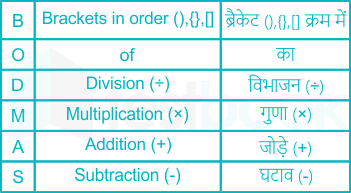
The BODMAS rule used in the given question is 

![Solved] What will come in the place of the question mark '?'](https://storage.googleapis.com/tb-img/production/22/04/Bracket%20in%20order.png)

121 - 11 + 4 ÷ 6 × 9 = 47

The given equation will be written as 

=121 ÷ 11 x 4 - 6 + 9

=11 x 4 - 6 + 9

=44 - 6 + 9 

=47

Hence LHS = RHS

Hence, the correct answer is Option 1.

2

If 'BRANCH' is coded as '12-14-16-18-20-22' and 'STARE' is coded as '24-28-16-14-26', then How would you code 'TRACE'?

  1. ((a))

    28-14-18-20-26

  2. ((b))

    28-15-16-20-27

  3. ((c))

    28-14-16-20-26

  4. ((d))

    28-14-16-21-26

Show Answer
Answer: ((c))

28-14-16-20-26

The code as per is question is -

Step1:-

LetterCode
B12
R14
A16
N18
C20
H22

Step2:-

LetterCode
S24
T28
A16
R14
E26

Similarly, the code of TRACE is-

LetterCode
T28
R14
A16
C20
E26

Hence, the code for TRACE is 28-14-16-20-26.

Hence, the correct answer is 28-14-16-20-26.

3

Six friends Arif, Altaf, Jagat, Karun, Nitin and Neha are sitting in a row facing north. Altaf, Jagat and Arif are sitting 2nd, 3rd and 4th from the left. Karun sits at the extreme end. Neha has to sit at the extreme end but she cannot sit at the extreme left end. At which place is Nitin sitting on the right?

  1. ((a))

    4

  2. ((b))

    1

  3. ((c))

    2

  4. ((d))

    3

Show Answer
Answer: ((c))

2

The direction chart is given below-

Direction and Distance MCQ [Free PDF] - Objective Question Answer for  Direction and Distance Quiz - Download Now!

Step1:-  Altaf, Jagat and Arif are sitting 2nd, 3rd and 4th from the left. 

Step2:-  Neha has to sit at the extreme end but she cannot sit at the extreme left end. Karun sits at the extreme end.

Here, Nitin sit second from right.

Hence, the correct answer is second.

4

Sudarshan starts from the public library to reach point 'X'. To do this, he walks 4 km towards South, then he takes a left turn and walks 4 km and reaches his destination. In which direction is he from the library?

  1. ((a))

    Southwest

  2. ((b))

    Southeast

  3. ((c))

    Northeast

  4. ((d))

    Northwest

Show Answer
Answer: ((b))

Southeast

The direction chart is given below-

Direction and Distance MCQ [Free PDF] - Objective Question Answer for  Direction and Distance Quiz - Download Now!

Step1:- Sudarshan starts from the public library to reach point 'X'. To do this, he walks 4 km towards South, 

Step2:- Then he takes a left turn and walks 4 km and reaches his destination.

He is in south-east direction from library.

Hence, the correct answer is south-east.

5

In this question, three statements are given followed by two conclusions numbered I and II. Assuming that all the information in the statement is true, analyze the two conclusions together and decide whether either of the statements logically and definitely follows.

Statement I: All soaps are conditioners.

Statement II: No conditioner is powder.

Statement III: Some medicines are powders.

Conclusion I: Some soap are powder.

Conclusion II: Some medicines are conditioners.

  1. ((a))

    Only I follow

  2. ((b))

    Only II follows

  3. ((c))

    Neither I nor II follows

  4. ((d))

    Both I and II follow

Show Answer
Answer: ((c))

Neither I nor II follows

The venn diagram representation of the given statements are-

Conclusion I: Some soap are powder.❌

All soaps are conditioners and no conditioners are powder.

Hence, the given conclusion does not follow.

Conclusion II: Some medicines are conditioners.❌

No relation between medicines and conditioners.

Hence, the given conclusion does not follow.

Hence, the correct answer is Neither I nor II follows.

6

The figure given below follows the series sequence. Select the correct option from the list of answer figures, which should come to the right of the question figures, if the sequence is to be continued:

  1. ((a))

    Image A

  2. ((b))

    Image C

  3. ((c))

    Image D

  4. ((d))

    Image B

Show Answer
Answer: ((b))

Image C

The next figure which continued the question figure is according the given conditions -

  1. In second figure the word get exchange their place as in figure1.

  1. In third figure, the letter exchange their position as given in figure shown below:-

  1. Now, the same logic followed in upcoming figure.

So, the answer figure is -

Hence, the correct answer is option2.

7

Select the option that is related to the third term in the same way as the second term is related to the first term.

Writer : Novel :: Director : ?

  1. ((a))

    Trade Fair

  2. ((b))

    Film

  3. ((c))

    College

  4. ((d))

    Hotel

Show Answer
Answer: ((b))

Film

A writer writes a novel. Similarly, a director directs a film.

Hence, the correct answer is Film.

8

Three of the given options are alike in a certain way. However, one option is not like the other three. Select the option which is different from the others.

  1. ((a))

    Rubber

  2. ((b))

    Ruler

  3. ((c))

    Pen

  4. ((d))

    Power bank

Show Answer
Answer: ((d))

Power bank

Rubber, ruler and pen are found on stationary whereas powerbank is and electronic gadget and found at electronic shop.

Hence, one option is not like the other three are powerbank.

Hence, the correct answer is Powerbank.

9

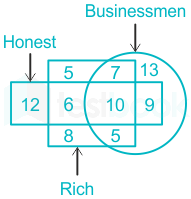
In the following diagram, the square stands for 'rich', the rectangle stands for 'honest' and the circle stands for 'businessmen'. The numbers in different sections are the number of persons in those sections.

How many rich businessmen are NOT honest?

  1. ((a))

    10

  2. ((b))

    12

  3. ((c))

    15

  4. ((d))

    17

Show Answer
Answer: ((b))

12

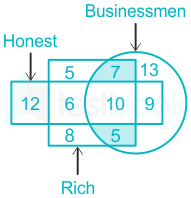
The region in dark represents that these are Rich Businessmen but not Honest.

Therefore, total number = 7 + 5 = 12

Hence, the correct answer is "Option (2)".

10

Madhavan starts walking 17 m towards East, from his acting class. Then he turned to his right and walked 27 m and again turned to his right and walked 17 m. Finally, he turned to his left and walked 27 m and reached his destination. How far is he from acting class?

  1. ((a))

    44 m

  2. ((b))

    54 m

  3. ((c))

    88 m

  4. ((d))

    34 m

Show Answer
Answer: ((b))

54 m

The direction chart is given below-

Direction and Distance MCQ [Free PDF] - Objective Question Answer for  Direction and Distance Quiz - Download Now!

Step1:- Madhavan starts walking 17 m towards East, from his acting class.

Step2:- Then he turned to his right and walked 27 m.

Step3:-  Again turned to his right and walked 17 m.

Step4:-  Finally, he turned to his left and walked 27 m and reached his destination.

The total distance between acting class and destination is

27 + 27 = 54

Hence, the correct answer is 54.

11

Alka and Adhir are siblings. Arun is the husband of Alka and Ankita is the wife of Adhir. Ahilya is the mother of Adhir. Ananya is the only daughter of Arun. How is Ananya related to Ahilya?

  1. ((a))

    Ananya is Ahilya's sister

  2. ((b))

    Ananya is the daughter of Ahilya

  3. ((c))

    Ananya is Ahilya's niece

  4. ((d))

    Ananya is the granddaughter of Ahilya

Show Answer
Answer: ((d))

Ananya is the granddaughter of Ahilya

The symbols used in family tree are -

Blood Relations MCQ [Free PDF] - Objective Question Answer for Blood  Relations Quiz - Download Now!

Let's draw family tree as per question:-

Hence, the correct answer is Ananya is the granddaughter of Ahilya.

12

In this question, three statements are given followed by two conclusions numbered I and II. Assuming that all the information in the statement is true, analyze the two conclusions together and decide whether either of the statements logically and definitely follows.

Statement I: Some dancers are good swimmers.

Statement II: All good swimmers are athletics.

Statement III: No athletics is singer.

Conclusion I: Some dancers are athletic.

Conclusion II: Some singers are good swimmers.

  1. ((a))

    Only I follow

  2. ((b))

    Only II follows

  3. ((c))

    Both I and II follow

  4. ((d))

    Neither I nor II follows

Show Answer
Answer: ((a))

Only I follow

The correct venn diagram representation of given statements are -

Conclusion I: Some dancers are athletic.✅

Here, some dancers are good swimmers and all good swimmers are Athletics. So, some dancers are athletic.

Hence, the given conclusion follows the statements.

Conclusion II: Some singers are good swimmers.❌

No singer are athletics and all good swimmers are athletics.

Hence, no singers are good swimmers.

Hence, the given conclusion does not follow.

Hence, the correct answer is only I follow.

13

Find out the wrong letter set in the series.

DIG, EHH, FGI, GHJ, HEK

  1. ((a))

    GHJ

  2. ((b))

    FGI

  3. ((c))

    EHH

  4. ((d))

    HEK

Show Answer
Answer: ((a))

GHJ

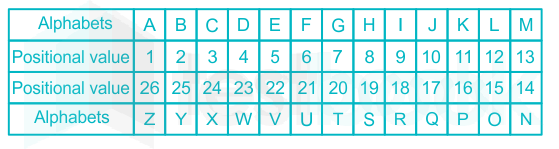
The positional value of alphabets are-

![Solved] Which letter will be 10th to the right of the 5th lette](https://storage.googleapis.com/tb-img/production/21/11/alphabet.png)

Logic - (First letter + 1)(Second letter - 1)(Third letter + 1)

<br>

In G we add 1 instead of -1 to get H.

Hence, GHJ are the wrong letter set in the given series.

Hence, the correct answer is GHJ.

14

Arrange the following in a logical and meaningful sequence.

  1. Appear for the exam on the given date and time.
  2. Fill the application form and attach photograph wherever required. Attach your age proof and address proof.
  3. On passing the exam, Learner's License will be sent to the permanent address.
  4. Visit your nearest RTO office and submit the application form.
  5. Ask the RTO officials to schedule your Learner's License exam on a particular date and time.
  1. ((a))

    2, 4, 5, 3, 1

  2. ((b))

    2, 4, 5, 1, 3

  3. ((c))

    2, 5, 3, 1, 4

  4. ((d))

    1, 3, 4, 2, 5

Show Answer
Answer: ((b))

2, 4, 5, 1, 3

The steps in completion to get learner's license are as follows:

1.Fill the application form and attach photograph wherever required. Attach your age proof and address proof.

2. Visit your nearest RTO office and submit the application form. 3. Ask the RTO officials to schedule your Learner's License exam on a particular date and time. 4. Appear for the exam on the given date and time. 5. On passing the exam, Learner's License will be sent to the permanent address.

Hence, the meaning order is 2, 4, 5, 1, 3.

15

Select the option that is related to the third term in the same way as the second term is related to the first term.

DHXI : HLVG : : PJZG : ?

  1. ((a))

    THAX

  2. ((b))

    JFEX

  3. ((c))

    TNXE

  4. ((d))

    JNAH

Show Answer
Answer: ((c))

TNXE

The positional value of alphabets are-

![Solved] Which letter will be 10th to the right of the 5th lette](https://storage.googleapis.com/tb-img/production/21/11/alphabet.png)

In DHXI : HLVG -

<br>

Similarly -

<br>

Hence, the correct answer is TNXE.

16

The letters of a meaningful word have been jumbled and numbered. You have to form the word and select the option which gives the correct sequence of the letters indicated by the numbers to form the word.

​E-1, L-4, B-3, D-7, R-2, U-5, A-9

  1. ((a))

    7529341

  2. ((b))

    7529134

  3. ((c))

    7523941

  4. ((d))

    7259341

Show Answer
Answer: ((a))

7529341

By checking the option,

Option 1:- 7529341

LetterCode
D7
U5
R2
A9
B3
L4
E1

 Here, Durable means able to exist for a long time without significant deterioration in quality or value.

Hence, the correct answer is Durable.

17

Select the option that is related to the third figure in the same way as the second figure is related to the first figure.

  1. ((a))

  2. ((b))

  3. ((c))

  4. ((d))

Show Answer
Answer: ((a))

The pattern followed here is:

  • All the figures and signs are rotated 90º clockwise direction.

Similarly,

Hence, the correct answer is "Option 1".

18

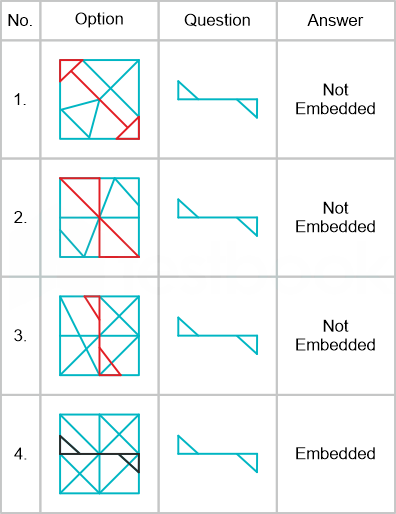
Select the option figure in which the given figure is embedded (rotation is NOT allowed).

  1. ((a))

  2. ((b))

  3. ((c))

  4. ((d))

Show Answer
Answer: ((d))

The option figure in which image is embedded is:


Hence, the correct answer is Option 4.

19

Select the option figure in which the given figure is embedded (rotation is NOT allowed).

  1. ((a))

  2. ((b))

  3. ((c))

  4. ((d))

Show Answer
Answer: ((b))

The option figure in which image is embedded is:

Hence, the correct answer is Option 2.

20

Find the missing number in the series :

1017, 1019, 1022, 1027, 1034, 1045, ?

  1. ((a))

    1053

  2. ((b))

    1058

  3. ((c))

    1049

  4. ((d))

    1047

Show Answer
Answer: ((b))

1058

Logic = Add consecutive prime number starting with 2.

<br>

Hence, the correct answer is 1058.

General Awareness (20 questions)

21

Who was appointed as the head coach of the Indian women's cricket team in August 2021?

  1. ((a))

    Voorkari Raman

  2. ((b))

    Ramakrishnan Sridhar

  3. ((c))

    Ramesh Powar

  4. ((d))

    Bharat Arun

Show Answer
Answer: ((c))

Ramesh Powar

Ramesh Powar was appointed as the head coach of the Indian women's cricket team in August 2021.

Key Points

  • Ramesh Powar was appointed as the head coach of the Indian women's cricket team in August 2021.
  • He had previously served as the head coach of the team from 2017 to 2019.
  • He was reappointed after WV Raman's contract expired in July 2021.
  • Powar's first assignment as the head coach was the 2021 Women's Cricket World Cup, where India finished as runners-up.
  • He has also led the team to victory in the 2022 Women's Tri-Nation Series and the 2022 Women's Asia Cup.
  • Powar is a former cricketer himself, and he played for Mumbai and India A.
  • He is a qualified Level-A coach by the BCCI.
22

According to IMF, World Economic Outlook (April 2021), what is the rank of India with respect to GDP per capita (unweighted list) out of total 194 economies?

  1. ((a))

    136

  2. ((b))

    144

  3. ((c))

    152

  4. ((d))

    149

Show Answer
Answer: ((b))

144

According to IMF, World Economic Outlook (April 2021), 144 is the rank of India with respect to GDP per capita (unweighted list) out of total 194 economies.

Key Points

  • According to the IMF World Economic Outlook (April 2021), India's GDP per capita (nominal) in 2021 is projected to be $2,191 at current prices.
  • This gives India a rank of 144 out of 194 economies in terms of GDP per capita.
  • India's GDP per capita is relatively low compared to other countries in the world.
  • This is due to a number of factors, including the country's large population and its relatively low levels of productivity.
  • However, India's economy is growing rapidly, and it is expected that GDP per capita will continue to improve in the years to come.
23

Which of the following is the parent range of the Saramati Mountains?

  1. ((a))

    Hindu Kush range

  2. ((b))

    Karakoram Range

  3. ((c))

    Purvanchal ranges

  4. ((d))

    Himalayan mountain range

Show Answer
Answer: ((c))

Purvanchal ranges

Purvanchal ranges is the parent range of the Saramati Mountains.

Key Points

  • The Purvanchal Range is a sub-mountain range of the Himalayas, and it is the parent range of the Saramati Mountains.
  • The Saramati Mountains are located in the northeastern part of India, and they are the highest mountains in the state of Nagaland.
  • The highest peak in the Saramati Mountains is Mount Saramati, which is 3,841 meters (12,602 feet) tall.
  • Mount Saramati is a sacred mountain to the Naga people, and it is often referred to as the "Crown of Nagaland."
  • The Purvanchal Range is a long and complex mountain range, and it extends through several Indian states, including Assam, Nagaland, Manipur, Mizoram, and Tripura.
  • The range is also home to several other important mountains, including Mount Tempu, Mount Iso, and Mount Japfu.
  • The Purvanchal Range is a beautiful and rugged mountain range, and it is a popular destination for hikers, climbers, and nature lovers.
  • The range is also home to a diverse range of flora and fauna, including several endangered species.
24

At which of the following places is the deepest point of the Indian Ocean located?

  1. ((a))

    Dordrecht deep

  2. ((b))

    Java Trench

  3. ((c))

    Makran Trench

  4. ((d))

    Diamantia trench

Show Answer
Answer: ((b))

Java Trench

At Java Trench the deepest point of the Indian Ocean located.

Key Points

  • The deepest point of the Indian Ocean is the Sunda Deep, which is located in the Java Trench.
  • The Sunda Deep is 7,187 meters (23,576 feet) deep, and it is located about 300 kilometers (190 miles) south of the island of Java in Indonesia.
  • The Java Trench is a long, narrow trench that is about 4,000 kilometers (2,500 miles) long and 200 kilometers (120 miles) wide.
  • It is located on the boundary between the Indo-Australian Plate and the Eurasian Plate.
  • The trench is formed by the subduction of the Indo-Australian Plate under the Eurasian Plate.
  • The Sunda Deep is a very deep and remote location, and it is not easily accessible.
  • However, in 2019, a team of scientists led by Victor Vescovo made the first crewed descent to the bottom of the Sunda Deep.
  • They used a submersible called the DSV Limiting Factor to reach the bottom of the trench.
25

The Karnataka Ganakala Parishad is an annual convention dedicated to ___________ music.

  1. ((a))

    Soul song

  2. ((b))

    Planting

  3. ((c))

    Karnataka

  4. ((d))

    Pandavani

Show Answer
Answer: ((c))

Karnataka

The Karnataka Ganakala Parishad is an annual convention dedicated to Karnataka music.

 Key Points

  • The Karnataka Ganakala Parishat (KGKP) is an annual conference of Carnatic music held in February.
  • The first conference was conducted in the year 1970 under the presidency of Vidwan B.S. Raja Iyengar.
  • Over several days (16 days in 2020), lecture demonstrations are given in the mornings, and four musical performances are given every afternoon and evening.
  • The KGKP is a non-profit organization founded and led by Carnatic classical musicians.
  • Its mission is to promote and propagate the rich musical heritage of Karnataka.
  • The organization has been instrumental in organizing numerous concerts and lecture demonstrations across the state, and in conferring the titles of "Ganakalabhushana" and "Ganakalashree" to two deserving artists every year.
  • The KGKP is a valuable resource for Carnatic music lovers in Karnataka.
  • It provides a platform for talented artists to showcase their skills, and it helps to keep the tradition of Carnatic music alive and vibrant.
  • Here are some of the things that make the Karnataka Ganakala Parishat a unique and special event:
  • ​The conference is held in a different city every year, which helps to promote Carnatic music in different parts of the state.
  • The conference features a wide variety of musical performances, from traditional Carnatic music to fusion genres.
  • The conference also includes lecture demonstrations by leading Carnatic musicians, which provide insights into the art form.
  • The conference is a great opportunity to meet other Carnatic music lovers and to learn about the rich musical heritage of Karnataka.
26

Which Chalukya king assumed the title of "Abhinava Siddharaja"?

  1. ((a))

    Kumarpal

  2. ((b))

    Mulraj I

  3. ((c))

    Jayasimha (Jayasimha) Siddharaj

  4. ((d))

    Bheem II

Show Answer
Answer: ((d))

Bheem II

Bheem II the Chalukya king assumed the title of "Abhinava Siddharaja".

Key Points

  • Bhima II, the Chaulukya king of Gujarat, assumed the title of "Abhinava Siddhartha".
  • The title means "New Victorious King" in Sanskrit.
  • It was a reference to his predecessor, Siddharaja Jayasimha II, who was one of the most powerful and successful rulers in Chaulukya's history.
  • Bhima II used the title to assert his authority and legitimacy as the new king and to demonstrate his ambition to emulate the achievements of Siddharaja Jayasimha II.
  • The title "Abhinava Siddharaja" was not the only title that Bhima II assumed.
  • He also used the titles "Saptama Chakravarti" (Seventh Universal Emperor) and "Bala Narayana" (Young Narayana).
  • These titles were all intended to convey Bhima II's power, prestige, and piety.
  • Bhima II was a successful ruler, and he ruled Gujarat for over 60 years.
  • He was a patron of the arts and sciences, and he built many temples and other religious structures.
  • He was also a skilled military leader, and he successfully defended Gujarat from invasions by the Ghurids and other enemies.
  • Bhima II's reign was a golden age for the Chaulukya dynasty.
  • He was a wise and just ruler, and he helped to make Gujarat one of the most prosperous and powerful kingdoms in India.
27

Which of the following is the largest coral reef system in the world?

  1. ((a))

    New Caledonia Reef

  2. ((b))

    The great Barrier Reef

  3. ((c))

    Florida Reef

  4. ((d))

    Red sea coral Reef

Show Answer
Answer: ((b))

The great Barrier Reef

The Great Barrier Reef is the largest coral reef system in the world.

 Key Points

  • The Great Barrier Reef is the world's largest coral reef system, composed of over 2,900 individual reefs and 900 islands stretching for over 2,300 kilometres over an area of approximately 344,400 square kilometres.
  • It is located off the east coast of the Queensland mainland, Australia.
  • The Great Barrier Reef is home to an incredible diversity of life, including over 1,500 species of fish, 400 species of coral, 134 species of sharks and rays, and 6 species of marine turtles.
  • It is also a major tourist destination, attracting over 2 million visitors each year.
  • However, the Great Barrier Reef is facing a number of threats, including climate change, pollution, and overfishing.
  • These threats have caused the reef to lose over half of its coral cover in the past 30 years.
  • There are a number of things that can be done to help protect the Great Barrier Reef, including reducing greenhouse gas emissions, reducing pollution, and sustainable fishing practices.
  • It is important to act now to protect this amazing natural wonder for future generations.
28

According to which style of Indian art are the Bamiyan Buddha sculptures carved?

  1. ((a))

    Gandhara style

  2. ((b))

    Amravati style

  3. ((c))

    Mathura style

  4. ((d))

    Sarnath Style

Show Answer
Answer: ((a))

Gandhara style

According to the Gandhara style of Indian art are the Bamiyan Buddha sculptures carved.

 Key Points

  • The Bamiyan Buddha sculptures were carved in the Gandhara style of Indian art.
  • Gandhara art is a fusion of Greco-Roman and Indian artistic styles, and it is characterized by its naturalistic depiction of the Buddha, as well as its use of Hellenistic elements such as drapery and hairstyles.
  • The Bamiyan Buddhas are some of the most famous examples of Gandhara art, and they are considered to be masterpieces of Buddhist sculpture.
  • The Gandhara style of art developed in the region of Gandhara, which is located in what is now northwestern Pakistan and eastern Afghanistan.
  • The region was a crossroads of cultures, and it was home to a large number of Greek and Roman merchants and soldiers.
  • These foreigners brought their own artistic styles with them, and they influenced the development of Gandharan art.
  • The Bamiyan Buddhas were carved in the 6th and 7th centuries CE, during the height of the Gandhara style.
  • The larger of the two Buddhas, the Western Buddha, is 55 meters (180 feet) tall, and the smaller, the Eastern Buddha, is 38 meters (125 feet) tall.
  • Both Buddhas are carved into the side of a cliff, and they are surrounded by a complex of caves and monasteries.
  • The Bamiyan Buddhas were destroyed by the Taliban in 2001, but they have been recreated digitally.
  • These digital recreations allow people to see the Buddhas as they once were, and they help to preserve the memory of this important cultural heritage.
29

Which of the following Indo-Bactrian rulers laid the foundation of the Euthydemid Empire in India?

  1. ((a))

    Antiochus III

  2. ((b))

    Euthydemus II

  3. ((c))

    Pantaleon

  4. ((d))

    Demetrius I

Show Answer
Answer: ((d))

Demetrius I

Demetrius I laid the foundation of the Euthydemid Empire in India.

Key Points

  • Demetrius I was a Greco-Bactrian king who reigned from c. 200 to 167 BC.
  • He was the son of Euthydemus I, the founder of the Euthydemid dynasty.
  • Demetrius I is best known for his conquests in India, where he established a number of Greek kingdoms.
  • These kingdoms, collectively known as the Indo-Greek Empire, lasted for over two centuries and had a significant impact on Indian culture.
  • Demetrius I was a skilled military leader and a charismatic ruler.
  • He was able to unite the Greco-Bactrian Kingdom and expand its borders.
  • He was also a patron of the arts and sciences, and his reign saw a flowering of Greek culture in India.
  • The Euthydemid Empire was eventually overthrown by the Indo-Scythians, but its legacy lives on.
  • The Indo-Greeks were important intermediaries between Greek and Indian cultures, and their influence can still be seen in Indian art, architecture, and religion.
  • Here are some of the achievements of Demetrius I:
  • He conquered extensive areas in what is now southern Afghanistan, Iran, Pakistan, and India.
  • He founded a number of Greek kingdoms in India, collectively known as the Indo-Greek Empire.
  • He was a patron of the arts and sciences.
  • His reign saw a flowering of Greek culture in India.
  • Demetrius I was a significant figure in the history of the Greco-Bactrian Kingdom and the Indo-Greek Empire.
  • His achievements helped to shape the course of history in both Central Asia and India.
30

Who coached the Indian women's hockey team for the 2021 Tokyo Olympics?

  1. ((a))

    Sord Marzen

  2. ((b))

    Graham Reid

  3. ((c))

    Joaquim Carvalho

  4. ((d))

    Leo Pinto

Show Answer
Answer: ((a))

Sord Marzen

Sord Marzen coached the Indian women's hockey team for the 2021 Tokyo Olympics.

Key Points

  • Sord Maržen was the head coach of the Indian women's hockey team for the 2021 Tokyo Olympics.
  • He is a former Slovenian international hockey player who played as a defender.
  • He has also coached the Slovenian national team and the Dutch national team.
  • After the Tokyo Olympics, Maržen stepped down as the head coach of the Indian team.
  • He was replaced by Janneke Schopman, a former Dutch international hockey player who played as a midfielder.
  • Schopman is currently the head coach of the Indian team for the 2022 Commonwealth Games.
31

Bhikhari Thakur was an influential folk artist associated with the culture of which of the following states?

  1. ((a))

    West Bengal

  2. ((b))

    Rajasthan

  3. ((c))

    Maharashtra

  4. ((d))

    Bihar

Show Answer
Answer: ((d))

Bihar

Bhikhari Thakur was an influential folk artist associated with the culture of Bihar.

Key Points

  • Bhikhari Thakur (1887-1971) was an immensely influential folk artist and playwright closely associated with the culture of Bihar, India.
  • He is widely regarded as the "Shakespeare of Bhojpuri" for his significant contributions to the Bhojpuri folk theatre.
  • Born in a small village named Kutubpur in Bihar's Saran district, Bhikhari Thakur had humble beginnings.
  • He was born into a family of traditional folk performers, and from an early age, he was exposed to the world of folk arts and storytelling.
  • Drawing from his observations of rural life and society, he created compelling theatrical performances that resonated with the common people.
  • Bhikhari Thakur's plays were known for their humorous and satirical commentary on social issues, customs, and traditions prevalent in rural Bihar.
  • He highlighted the struggles and aspirations of the common people and often used his art as a medium to address social problems and advocate for positive change.
  • Some of his most famous plays include "Bidesiya," "Bidesia," "Gehu, Ganna aur Gun," and "Kanyadan," among others.
  • "Bidesiya" is perhaps his most renowned play, which revolves around the theme of migration and portrays the emotional struggles faced by migrant workers leaving their homes in search of livelihood.
  • Throughout his life, Bhikhari Thakur performed and travelled extensively, spreading the essence of Bhojpuri folk culture and gaining popularity among the masses.
  • His contributions to the folk theatre of Bihar have left an indelible mark on the region's cultural heritage, making him a revered figure in the history of Bihari performing arts.
32

On which date the national flag was adopted by the Constituent Assembly?

  1. ((a))

    26 June 1947

  2. ((b))

    22 June 1947

  3. ((c))

    26 July 1947

  4. ((d))

    22 July 1947

Show Answer
Answer: ((d))

22 July 1947

On 22 July 1947, the national flag was adopted by the Constituent Assembly.

 Key Points

  • The National Flag of India was adopted by the Constituent Assembly on 22 July 1947, a few days before India's independence from the British on 15 August 1947.
  • The flag is a horizontal tricolour of India in saffron, white and green; with the Ashoka Chakra, a 24-spoke wheel, in navy blue at its centre.
  • The flag was designed by Pingali Venkayya, who was a freedom fighter and social reformer.
  • The colours of the flag have symbolic meanings:
  • Saffron represents courage and sacrifice.
  • White denotes peace and truth.
  • Green symbolizes faith and chivalry.
  • The Ashoka Chakra, which is at the centre of the flag, is a wheel with 24 spokes.
  • It represents the Dharma Chakra, or the wheel of law, which was a symbol of the Mauryan Empire.
  • The Dharma Chakra is a reminder of the importance of justice and good governance in India.
  • The National Flag of India is a symbol of our nation's unity and pride.
  • It is a reminder of our freedom struggle and our commitment to democracy and secularism.
  • We should all be proud to fly the National Flag and uphold its values.
33

Which of the following chemical compound is found if fruits and vegetables turn brown when exposed to air?

  1. ((a))

    Citric Acid

  2. ((b))

    Malic Acid

  3. ((c))

    Oxidase

  4. ((d))

    Base

Show Answer
Answer: ((c))

Oxidase

Oxidase the chemical compound is found if fruits and vegetables turn brown when exposed to air.

 Key Points

  • The chemical compound that causes fruits and vegetables to turn brown when exposed to air is polyphenol oxidase (PPO).
  • PPO is an enzyme that is found in most fruits and vegetables, and it catalyzes the oxidation of phenolic compounds.
  • This oxidation reaction produces quinones, which are unstable compounds that can react with each other to form melanin.
  • Melanin is the brown pigment that gives skin, hair, and eyes their colour.
  • When a fruit or vegetable is cut, the PPO enzyme is released from the cells and comes into contact with oxygen.
  • This triggers the oxidation reaction, and the fruit or vegetable begins to turn brown.
  • The browning reaction can be slowed down by storing the fruit or vegetable in an airtight container, or by treating it with a chemical that inhibits the activity of PPO.
  • Here are some other ways to prevent enzymatic browning:
  • ​​Sulfiting: 
  • Sulfites are a common food additive that can inhibit the activity of PPO.
  • However, sulfites can also cause allergic reactions in some people, so they should be used with caution.
  • Ascorbic acid:
  • Ascorbic acid, also known as vitamin C, can also inhibit the activity of PPO.
  • Ascorbic acid is often added to fruits and vegetables that are canned or frozen to prevent them from browning.
  • Citric acid:
  • Citric acid is another acid that can inhibit the activity of PPO.
  • It is often used in salad dressings and other foods to prevent browning.
  • By understanding the causes of enzymatic browning, we can take steps to prevent it and keep our fruits and vegetables looking fresh.
34

Who among the following became the first Indian woman to win two medals in the Olympics?

  1. ((a))

    P. T. Usha

  2. ((b))

    Deepika Kumari

  3. ((c))

    M.C. Mary Kom

  4. ((d))

    P.V. Sindu

Show Answer
Answer: ((d))

P.V. Sindu

P.V. Sindhu became the first Indian woman to win two medals in the Olympics.

Key Points

  • P.V. Sindhu is an Indian badminton player who won the silver medal in the women's singles event at the 2016 Rio Olympics.
  • She then went on to win the bronze medal in the same event at the 2020 Tokyo Olympics, becoming the first Indian woman to win two Olympic medals.
  • Sindhu is a national hero in India, and her achievements have inspired many young people to take up badminton.
  • She is a role model for women and girls everywhere, and her success shows that anything is possible if you set your mind to it.
  • Here are some of her other achievements:
  • ​She is the first Indian to win a gold medal at the BWF World Championships.
  • She is the only Indian to have won medals at all four major badminton tournaments: the Olympics, the World Championships, the World Cup, and the Asian Games.
  • She is the most decorated Indian badminton player in history.
  • Sindhu is a truly inspirational figure, and her success is a testament to her hard work and dedication.
  • She is an inspiration to us all, and we can all learn from her example.
35

Apollo Hospitals partnered with which of the following bank to launch "HealthyLife Program"?

  1. ((a))

    HDFC Bank

  2. ((b))

    State Bank of India

  3. ((c))

    Punjab National Bank

  4. ((d))

    Axis Bank

Show Answer
Answer: ((a))

HDFC Bank

Apollo Hospitals partnered with HDFC Bank to launch "HealthyLife Program".

Key Points

  • HDFC Bank and Apollo Hospitals partnered in October 2020 to launch the HealthyLife Programme, a holistic healthcare solution that makes healthy living accessible and affordable on Apollo's digital platform, Apollo 24|7.
  • The programme is exclusively available for HDFC Bank customers and includes a variety of benefits, such as:
  • 24/7 access to emergency Apollo Doctor at no cost on Apollo 24|7
  • Choice of payment options for treatments at all Apollo Hospitals
  • Ease of finance for treatments, up to ₹40 lakh
  • Comprehensive health check-up
  • No-cost EMI on credit or debit cards
  • Discount on medicines at Apollo Pharmacies
  • The HealthyLife Programme is a great example of how technology can be used to improve access to healthcare.
  • By partnering with HDFC Bank, Apollo Hospitals has made it possible for millions of people to have access to world-class healthcare at an affordable price.
36

Which of the following marine animal does not belong to the Crustacea family?

  1. ((a))

    Urchin

  2. ((b))

    Shrimp

  3. ((c))

    Crab 

  4. ((d))

    Barnacle

Show Answer
Answer: ((a))

Urchin

Urchin marine animal does not belong to the Crustacea family.

 Key Points

  • Urchins are not crustaceans.
  • They belong to the phylum Echinodermata, which also includes starfish, sea cucumbers, and sand dollars.
  • Crustaceans, on the other hand, belong to the phylum Arthropoda, which also includes insects, spiders, and crabs.
  • Here are some of the key differences between urchins and crustaceans:
  • ​Urchins have radial symmetry, meaning their body parts are arranged in a circular pattern. Crustaceans, on the other hand, have bilateral symmetry, meaning their body parts are arranged on either side of a central line.
  • Urchins have a water vascular system, which helps them move and capture food. Crustaceans have a muscular exoskeleton that helps them move.
  • Urchins have a hard, spiny shell. Crustaceans have a hard exoskeleton that is made up of plates.
  • So, while urchins and crustaceans may look similar, they are actually very different animals.
37

Who among the following designed the flag of India?

  1. ((a))

    Pingali Venkayya

  2. ((b))

    Subramanya Shiva

  3. ((c))

    Mahatma Gandhi

  4. ((d))

    B. R. Ambedkar

Show Answer
Answer: ((a))

Pingali Venkayya

Pingali Venkayya designed the flag of India.

Key Points

  • Pingali Venkayya was an Indian freedom fighter and a Gandhian.
  • He was the designer of the flag on which the Indian National Flag was based.
  • He was also a lecturer, author, geologist, educationalist, agriculturist, and polyglot.
  • Venkayya designed the flag in 1921 and presented it to Mahatma Gandhi during the latter's visit to Vijayawada.
  • Venkayya's first draft of the flag was in red and green — the red representing Hindus and the green the Muslims living in the country.
  • On Gandhi's suggestion, Venkayya added a white stripe to represent all other denominations and religions present in India.
  • Since 1921, Venkayya's flag has been used informally at all Congress meetings.
  • The flag was adopted in its present form during a meeting of the Constituent Assembly on July 22, 1947.
  • The flag of India is a horizontal tricolour of saffron, white, and green, with the Ashok Chakra at the centre.
  • The saffron colour represents courage and sacrifice, the white colour represents peace and purity, and the green colour represents faith and prosperity.
  • The Ashok Chakra is a 24-spoked wheel that represents the wheel of law and order.
  • The flag of India is a symbol of national pride and unity.
  • It is flown at all government buildings and at important events.
  • It is also flown by citizens at their homes and businesses.
  • The flag is a reminder of the sacrifices that have been made for India's independence and the hope for a better future.
38

Which of the following works cannot be attributed to Khushwant Singh?

  1. ((a))

    Imaginary homelands (1991)

  2. ((b))

    The Good, The Bad and The Ridiculous (2013)

  3. ((c))

    Delhi : A novel (1990)

  4. ((d))

    The company of women (1999)

Show Answer
Answer: ((a))

Imaginary homelands (1991)

Imaginary Homelands (1991) cannot be attributed to Khushwant Singh.

Key Points

  • Imaginary Homelands (1991) was written by Salman Rushdie, not Khushwant Singh.
  • Rushdie is a British Indian novelist and essayist, while Singh was an Indian author, journalist, and politician.
  • The two authors have very different writing styles and interests, so it is unlikely that they would have written the same book.
  • In addition, there is no record of Singh ever writing a book called Imaginary Homelands.
  • The book was published by Granta Books in 1991, and it is a collection of essays by Rushdie.
  • The essays explore themes of migration, identity, and culture.
39

Which of the following hill ranges forms the eastern base of the triangular Satpura range?

  1. ((a))

    Shivalik Hills

  2. ((b))

    Bailadila Hills

  3. ((c))

    Maikal Hills

  4. ((d))

    Barabar Hills

Show Answer
Answer: ((c))

Maikal Hills

Maikal Hills ranges forms the eastern base of the triangular Satpura range.

Key Points

  • The Maikal Hills are a mountain range in Madhya Pradesh and Chhattisgarh, India.
  • They run in a north-south direction and form the eastern base of the triangular Satpura Range.
  • The Maikala Range is about 250 miles (400 kilometers) long and 50 miles (80 kilometers) wide.
  • The highest peak in the Maikala Range is Dhawadhar, which is 3,660 feet (1,113 meters) tall.
  • The Maikala Range is made up of laterite-capped, flat-topped plateaus.
  • The laterite is a type of soil that is rich in iron and aluminum.
  • It is a very hard and durable soil, which is why the plateaus in the Maikala Range are so flat.
  • The Maikala Range is home to a variety of plants and animals.
  • Some of the common plants in the range include sal, teak, bamboo, and sandalwood.
  • The animals that live in the Maikala Range include tigers, leopards, elephants, gaur, and sloth bears.
  • The Maikala Range is an important watershed.
  • The rivers that originate in the range, such as the Narmada and the Son, provide water for irrigation and drinking water for millions of people.
  • The range is also a popular destination for tourists, who come to enjoy the scenery, the wildlife, and the many waterfalls.
40

An order from a higher court to a lower court, tribunal or public authority to execute an act falling within its duty is called ________.

  1. ((a))

    Mandate Writ

  2. ((b))

    Prohibition Writ

  3. ((c))

    Habeas corpus Writ

  4. ((d))

    Certiorari Writ

Show Answer
Answer: ((a))

Mandate Writ

An order from a higher court to a lower court, tribunal or public authority to execute an act falling within its duty is called Mandate Writ.

Key Points

  • A mandate writ is a court order that compels a lower court, tribunal, or public authority to perform a specific act that is within its power and duty to do.
  • The writ is usually issued when the lower court or authority has failed to act, or has acted improperly.
  • The mandate writ is one of the three most common types of prerogative writs, along with the writ of certiorari and the writ of prohibition.
  • Prerogative writs are a type of court order that is issued by a higher court to a lower court or authority in order to protect the rights of individuals or to ensure that the law is being followed.
  • The mandate writ is named after the Latin word "mandatum," which means "command."
  • The writ is also sometimes referred to as the writ of mandamus.
  • The mandate writ can be used to compel a lower court or authority to do any of the following:
  • ​Issue a decision or order
  • Conduct a hearing
  • Produce documents
  • Take other action that is within its power and duty to do
  • The mandate writ is a powerful tool that can be used to ensure that the law is being followed and that the rights of individuals are being protected.
  • However, the writ is also a discretionary remedy, which means that the court may not issue the writ even if the lower court or authority has acted improperly.

Arithmetic Ability (20 questions)

41

The given expression (13.94 × 13.94 + 13.94 × Y + 0.06 × 0.06) will be a perfect square for Y equal to ___.

  1. ((a))

    0.12

  2. ((b))

    0.10

  3. ((c))

    0.06

  4. ((d))

    0.14

Show Answer
Answer: ((a))

0.12

Given

⇒ 13.94 × 13.94 + 13.94 × Y + 0.06 × 0.06

Formula 

⇒ (a + b)2 = a2 + b2 + 2ab

Solution

The given expression is in the form of  (a + b)2

where, a = 13.94 and b = 0.06.

⇒ 2ab = 13.94 × Y

⇒ y = 2b = 2 × 0.06

⇒ y = 0.12

The correct option is 1.

42

Find a single equivalent discount of 40%, 30% and 25%.

  1. ((a))

    68.5%

  2. ((b))

    48.5%

  3. ((c))

    58.5%

  4. ((d))

    78.5%

Show Answer
Answer: ((a))

68.5%

Given

d1 = 40%

d2 = 30%

d3 = 25%

Formula

S.P = (100 - d1)/100 × (100 - d2)/100 × (100 - d3)/100 × M.P

where, S.P = Selling price and  M.P = Market price

Solution

Let the M.P be 100

⇒ (100 - 40)/100 × (100 - 30)/100 × (100 - 25)/100 × M.P

⇒ 60/100  × 70/100 × 75/100 × 100

⇒ 315000/10000

⇒ 31.5%

The single equivalent discount = M.P - S.P

⇒ 100 - 31.5%

⇒ 68.5%

43

Find the average of first 15 odd natural numbers.

  1. ((a))

    14

  2. ((b))

    15

  3. ((c))

    15.5

  4. ((d))

    14.5

Show Answer
Answer: ((b))

15

Given

First 15 odd natural numbers.

Concept used

Total = No.of entities × Average

The sum of first n natural numbers = n2

Solution

We know that the sum of first n natural numbers = n2

Then, the average of the first n natural numbers = n2/n = n

⇒ n = 15

The correct option is 2.

44

If 1.225 × 10k = 0.001225, the value of k is_________________.

  1. ((a))

    -5

  2. ((b))

    -3

  3. ((c))

    -2

  4. ((d))

    -4

Show Answer
Answer: ((b))

-3

Given

⇒ 1.225 × 10k = 0.001225

Solution

⇒ 1.225 × 10k = 0.001225

⇒ 10k = 0.001225/1.225

⇒ 10k = (1225 × 10-6)/(1225 × 10-3)

⇒ 10k = 10-3

Equating the powers, since base are is same:

k = -3

The correct option is 2.

45

(0.9 + 0.09 + 0.009 + 0.0009 + 0.00009 + 0.000009) × 1000000 = ?

  1. ((a))

    999900

  2. ((b))

    999999

  3. ((c))

    9999999

  4. ((d))

    999990

Show Answer
Answer: ((b))

999999

Calculations: 

0.9 + 0.09 + 0.009 + 0.0009 + 0.00009 + 0.000009 = 0.999999

Then let's multiply by 1,000,000:

0.999999 × 1,000,000 = 999999

Hence, The Correct option is 2.

46

The surface area of a sphere whose radius is equal to 10.5 cm is ______.

  1. ((a))

    441π sq cm

  2. ((b))

    110.25 sq cm

  3. ((c))

    44.1 sq cm

  4. ((d))

    110.25π sq cm

Show Answer
Answer: ((a))

441π sq cm

Concept use :

The surface area of a sphere is 4πr².

Given:

the radius, r = 10.5 cm,

Surface area = 4π(10.5 cm)²

This simplifies to:

= 4π(110.25 cm²)

= 441π cm².

So the surface area of the sphere is 441π square cm.

Hence, option 1) 441π sq cm is the correct answer.

47

A and B together can do a piece of work in 40 days. A, after working for 24 days, B completes the remaining work alone in 54 days. In how many days B alone can complete the whole work?

  1. ((a))

    45 days

  2. ((b))

    55 days

  3. ((c))

    65 days

  4. ((d))

    75 days

Show Answer
Answer: ((d))

75 days

The LCM method is frequently used in time, speed, and work problems.

Let's denote the efficiency of A by 'a' and that of B by 'b'.

let's denote the work performed as a multiple of the LCM of 40 and 24 which is 120.

In the given scenario, A and B together can complete the work in 40 days,

hence the combined efficiency of A and B is 120/40 = 3 units of work/day.

Given :

A worked for 24 days, A would have completed 24 × (A's efficiency) worth of work.

After A stopped,

B worked alone for another 54 days to complete the remaining work.

Hence, the work done by B equals to 54 × (B's efficiency).

Since, together, A and B completed the total work, we can form the below equation.

24a + 54b = 120

And we know that A and B together can do 3 units of work a day, so:

a + b = 3

We now have two equations that we can solve simultaneously to find 'a' and 'b'.

But we are interested in how long it will take B to complete the work alone.

Substituting a = 3-b in the first equation, we get:

24 × (3-b) + 54b = 120

72 - 24b + 54b = 120

30b = 48

b = 48 / 30 = 1.6

Then we calculate the time it will take for B to complete all the work alone:

Total work / B's efficiency = 120 units / 1.6 units/day = 75 days

Therefore, B alone can finish the work in 75 days.

So, the correct answer is option 4) 75 days.

48

The ratio of the prices of the two products was 23 ∶ 16. After two years when the price of the second product is increased by 10% and that of the first by Rs.477, the ratio of prices becomes 20 ∶ 11. First find the price of the product.

  1. ((a))

    Rs 849

  2. ((b))

    Rs 1218

  3. ((c))

    Rs 1219

  4. ((d))

    Rs 848

Show Answer
Answer: ((c))

Rs 1219

Given:

Initial ratio of prices: 23:16

Price increase: first product by Rs.477 and second product by 10%

Solution:

 Let's consider the initial price of the first product as 23x and the second product as 16x.

After the increase, the price of first product becomes (23x + 477) and second product becomes (16x1.1)

Therefore, the new ratio is (23x + 477) / (16x1.1) = 20/11

Using cross multiplication, we can form the equation: ⇒ 11 × (23x + 477) = 20 × (16x × 1.1)

⇒ 253x + 5257 = 352x ⇒ 352x - 253x = 5257

⇒ 99x = 5257 ⇒ x = 5257 / 99 ⇒ x = 53

Hence, the initial price of the first product is 23x = 23 ×  53 = Rs.1219.

49

Three numbers are in the ratio 2 ∶ 5 ∶ 7 and their  HCF is 14. The numbers are _________.

  1. ((a))

    7, 35, 49

  2. ((b))

    2, 10, 70

  3. ((c))

    28, 70, 98

  4. ((d))

    5, 25, 125

Show Answer
Answer: ((c))

28, 70, 98

Given

Three numbers are in the ratio = 2 ∶ 5 ∶ 7

HCF = 14

Concept

HCF: The HCF (Highest Common Factor) of two or more numbers is the highest number among all the common factors of the given numbers.

Solution

Since 14 is the highest common factor of the given 3 numbers,

the numbers will be:

⇒ 2 × 14: 5 × 14: 7 × 14

⇒ 28: 70: 98

50

A jogger is running at a speed of 18 km/hr. In how much time will he cover the path 600 meters long?

  1. ((a))

    3 minutes

  2. ((b))

    1 minutes

  3. ((c))

    2 minutes

  4. ((d))

    1.5 minutes

Show Answer
Answer: ((c))

2 minutes

Given

Distance = 600 m

Speed = 18 km/hr

Formula 

Distance = speed × time

Solution

The speed of jogger in m/s = 18 × 5/18 = 5 m/s

Time = 600/5

⇒ 120 seconds or 2 minutes

The correct option is 3.

51

The number of conical bottles of radius 5 cm and height 27 cm to empty the liquid from a cylindrical bottle of radius 1.5 m and height 5 m is _________.

  1. ((a))

    70000

  2. ((b))

    10000

  3. ((c))

    50000

  4. ((d))

    12000

Show Answer
Answer: ((c))

50000

Given

Radius of cone = 5 cm

Height of cone = 27 cm

Radius of cylinder = 1.5 m

Height of cylinder = 5 m

Formula

Volume of cone = ⅓ 𝜋r2

Volume of cylinder = 𝜋r2h 

Solution

Let the number of conical bottles = n

n × ⅓ 𝜋r2h = 𝜋r2h

⇒ n × ⅓ × 𝜋 × 52 ×  27 = 𝜋 × 1502 ×  500

⇒ n = (150 × 150 ×  500)/(9 × 25)

⇒ n = 50000

52

What is the largest number which exactly divides 7735, 15912 and 21879?

  1. ((a))

    221

  2. ((b))

    136

  3. ((c))

    153

  4. ((d))

    117

Show Answer
Answer: ((a))

221

Given

The largest number exactly divides 7735, 15912 and 21879.

Concept used

The largest number which divides the number = The multiple of the difference between the numbers.

Solution

The difference between 7735 and 15912 = 8177

The difference between 21879 and 15912 = 5967

No the difference between  8177 and 5967 = 2210

Hence, 221 will be the largest number to divide the given number.

The correct option is 1

53

If p ∶ q = 1225 ∶ 49, then pq+qp\sqrt{\frac{p}{q}} + \sqrt{\frac{q}{p}}  is

  1. ((a))

    16/5

  2. ((b))

    13/5

  3. ((c))

    12/5

  4. ((d))

    26/5

Show Answer
Answer: ((d))

26/5

Calculation:

pq+qp\sqrt{\frac{p}{q}} + \sqrt{\frac{q}{p}}

⇒ 122549+491225\sqrt{\frac{1225}{49}} + \sqrt{\frac{49}{1225}}

⇒ 357+735\frac{35}{7}+\frac{7}{35}

⇒ 5+155+\frac{1}{5}

⇒ 26/5

∴ The correct answer is option (4).

54

A man goes from A to B at a speed of 27 kmph and comes back to A at a speed of 36 kmph. Find his average speed for the whole journey?

  1. ((a))

    27.86 kmph

  2. ((b))

    30 kmph

  3. ((c))

    30.86 kmph

  4. ((d))

    32 kmph

Show Answer
Answer: ((c))

30.86 kmph

Given

A man goes from A to B at a speed = 27 km/h 

Comes back to A at a speed = 36 km/h.

Formula used

The average speed = 2xy/(x + y)

Solution

Let the two speeds be x and y

i.e x = 27 km/hr and y = 36 km/hr

⇒ 2xy/(x + y)

⇒ (2 × 27 × 36)/(36 + 27) 

⇒ 216/7 = 30.86 km/hr

The correct option is 3.

55

Find the compound interest on Rs 25000 at 8% per annum for 2 years, where the interest is compounded annually.

  1. ((a))

    4160 rupees

  2. ((b))

    4000 rupees

  3. ((c))

    4200 rupees

  4. ((d))

    4260 rupees

Show Answer
Answer: ((a))

4160 rupees

Shortcut Trick

Effective rate for 2 years at 8% = 8 + 8 + (8 × 8) ÷ 100 = 16.64%

Compound Interest = 16.64% of ₹25000

CI = 25000 × (16.64 ÷ 100) = 250 × 16.64

CI = ₹4160

∴ The correct answer is 4160 rupees.

Alternate Method

Given:

Principal (P) = ₹25000

Rate (R) = 8% per annum

Time (n) = 2 years

Formula Used:

Amount (A) = P × (1 + R/100)n

Compound Interest (CI) = A − P

Calculations:

⇒ A = 25000 × (1 + 8/100)2

⇒ A = 25000 × (108/100) × (108/100)

⇒ A = 25000 × (27/25) × (27/25)

⇒ A = 40 × 27 × 27

⇒ A = 40 × 729 = ₹29160

⇒ CI = 29160 − 25000

⇒ CI = ₹4160

∴ The correct answer is 4160 rupees.

Additional Information

Successive Percentage Method

For 2 years, the effective CI rate is x + y + (xy/100) where x and y are rates for the first and second year.

Difference between CI and SI

For 2 years, the difference is P × (R/100)2. For 3 years, it is P × (R/100)2 × (3 + R/100).

Compounding Half-Yearly

When interest is compounded half-yearly, the rate is halved (R/2) and the time is doubled (2n).

56

If 3X × X + 3Y × Y = 10XY, then what is the ratio of X to Y?

  1. ((a))

    2 ∶ 3 or 3 ∶ 2

  2. ((b))

    1 ∶ 4 or 4 ∶ 1

  3. ((c))

    3 ∶ 4 or 4 ∶ 3

  4. ((d))

    1 ∶ 3 or 3 ∶ 1

Show Answer
Answer: ((d))

1 ∶ 3 or 3 ∶ 1

Given

3X × X + 3Y × Y = 10XY

Solution

⇒ 3X × X + 3Y × Y = 10XY

⇒ 3X2 + 3Y2 = 10XY

⇒ 3X2 + 3Y2 - 10XY = 0

⇒ 3X2 - 9XY + 3Y2 - XY = 0

⇒ 3X(X - 3Y) - Y(X - 3Y) = 0

⇒ (3X - Y) × (X - 3Y) = 0

⇒ X: Y = 1: 3 or X: Y = 3: 1

The correct option is 4.

57

There are 250 students in the final examination of class XII, 20% students are failed. How many students passed in class XII?

  1. ((a))

    230

  2. ((b))

    200

  3. ((c))

    210

  4. ((d))

    220

Show Answer
Answer: ((b))

200

Given

The no. of students in the final examination of class XII = 250

The per cent of students failed = 20%

Concept used

100% - failed percentage  = students passed(%) in class XII

Solution

Let the total number of students in the class = 100%

Then, the student who passed = 100% - 20% = 80%

⇒ 80% of 250 = 200

The correct option is 2.

58

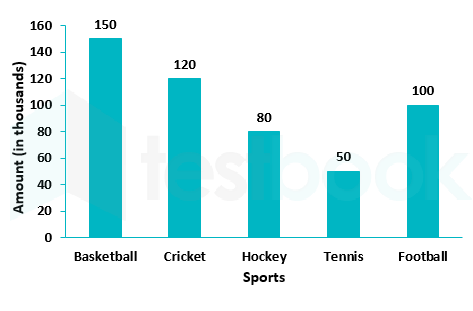
The following bar graph shows the amount of money spent on various sports by a school administration in a particular year. The amount spent on Hockey and Football is what percent of the amount spent on Basketball and Tennis?

  1. ((a))

    90%

  2. ((b))

    20%

  3. ((c))

    50%

  4. ((d))

    70%

Show Answer
Answer: ((a))

90%

Calculation:

According to the question:

The amount spent on Hockey and Football = 80 + 100 = 180

The amount spent on Basketball and Tennis = 150 + 50 = 200

Required % = 180/200 × 100 = 90%.

∴ Option 1 is the correct answer.

59

The given pie chart shows the total sales by different mobile companies in the year 2017.

If the total sales in the year 2017 were 5000 crores, then the sales made by Vivo company was ________ crores.

  1. ((a))

    300

  2. ((b))

    250

  3. ((c))

    350

  4. ((d))

    2000

Show Answer
Answer: ((a))

300

Calculation:

Total sales in the year = Rs. 5000 crores

Total sales by Vivo company = 6%

Now,

⇒ (6% of 5000)

⇒ (6/100 × 5000)

⇒ 300 crores

∴ The sales made by Vivo company is 300 crores.

60

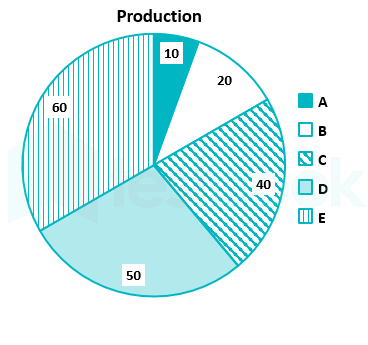
A company, A, B, C, D, and E manufactures 5 types of products as shown in the above pie diagram. If the company manufactures a total of 1440 articles, then how many articles of product B are produced by the company?

  1. ((a))

    180

  2. ((b))

    160

  3. ((c))

    140

  4. ((d))

    150

Show Answer
Answer: ((b))

160

Given:

A company, A, B, C, D, and E, manufactures 5 types of products and the company manufactures a total of 1440 articles.

Calculation:

According to the question,

A + B + C + D + E = 1440 articles

(10 + 20 + 40 + 50 + 60) = 1440 articles

180 unit = 1440 articles

1 unit = 8 articles

Production of goods by company B = 20 × 8 = 160

∴ Option (2) is the correct answer.

General Hindi (20 questions)

61

निम्नलिखित प्रश्न में, चार विकल्पों में से, उस विकल्प का चयन करें जो दी गई मुहावरे का सही अर्थ वाला विकल्प है।

तिलांजलि देना

  1. ((a))

    खूब प्रभाव होना

  2. ((b))

    त्याग देना

  3. ((c))

    तितर-बितर होना

  4. ((d))

    समर्पित होना

Show Answer
Answer: ((b))

त्याग देना

उपर्युक्त विकल्पों में से विकल्प "त्याग देना" सही है तथा अन्य विकल्प असंगत है।

Key Points

  • तिलांजलि देना मुहावरे का अर्थ त्याग कर देना होता है।
  • वाक्य प्रयोग
  • झूठ को तिलांजलि दिये बिना उद्धार सम्भव नहीं है।

​अन्य विकल्प :

मुहावराअर्थ
तूती बोलनाप्रभाव होना
तीन तेरह होनातितर-बितर होना
कलेजा निकालकर रख देनासब कुछ समर्पित कर देना

Additional Information 

  • मुहावरा शब्द एक अरबी शब्द है जिसका अर्थ होता है–अभ्यास करना।
  • मुहावरे वाक्य के अंश होते हैं। मुहावरों से सामान्य अर्थ नहीं बल्कि, विशेष अर्थ निकलता है।
62

निम्नलिखित प्रश्न में, चार विकल्पों में से, उस विकल्प का चयन करें जो दिए गए लोकोक्ति का सही अर्थ वाला विकल्प है।

गुरु कीजै जान, पानी पीवै छान

  1. ((a))

    बिना प्रयत्न के लाभ

  2. ((b))

    झूठा दिखावा

  3. ((c))

    अच्छी तरह समझ-बूझकर काम करना

  4. ((d))

    अवसर का लाभ

Show Answer
Answer: ((c))

अच्छी तरह समझ-बूझकर काम करना

'गुरू कीजै जान, पानी पीवै छान' कहावत का अर्थ हैः कोई भी चीज़ अच्छी तरह जाँच कर लेनी चाहिए।

Key Points 

  • कहावत - 'गुरू कीजै जान, पानी पीवै छान'
  • अर्थ - कोई भी चीज़ अच्छी तरह जाँच कर लेनी चाहिए।
  • वाक्य - देखो, जल्दबाजी में कोई काम न कर बैठना, बुजुर्गों ने ठीक ही कहा है– गुरु कीजै जान, पानी पीवै छान।

अन्य विकल्प :

मुहावराअर्थ
अंधे के हाथ बटेर लगनाबिना प्रयत्न के लाभ
घर में नहीं दाने बुढ़िया चली भुनानेझूठा दिखावा करना
बहती गंगा में हाथ धोनाअवसर का लाभ उठाना


Additional Information 

  • जिस पद समूह में अनुभव की कोई बात सुंदर, प्रभावशाली और चमत्कारिक ढंग से कही जाती है, उसे कहावत कहते हैं।
63

निम्नलिखित प्रश्न में, चार विकल्पों में से, उस सही विकल्प का चयन करें जो दिए गए शब्द-युग्म के सही अर्थ का उचित विकल्प हो।

विभात-विभाति

  1. ((a))

    रचनेवाला-कानून

  2. ((b))

    प्रभात-शोभा

  3. ((c))

    रचनेवाला-शोभा

  4. ((d))

    कानून-शोभा

Show Answer
Answer: ((b))

प्रभात-शोभा

बल-वल इसका सही उत्तर विकल्प 2 प्रभात-शोभा​​ है। अन्य विकल्प इसके अनुचित हैं।

Key Points 

  • विभात का अर्थ – प्रभात
  • विभाति का अर्थ – शोभा

अन्य विकल्प :

विधायक-विधेयक : रचनेवाला-कानून

Additional Information 

समश्रुत शब्दकुछ शब्द ऐसे होते हैं जिनमें स्वर, मात्रा अथवा व्यंजन में थोड़ा-सा अन्तर होता है। वे बोलचाल में लगभग एक जैसे लगते हैं, परन्तु उनके अर्थ में भिन्नता होती है। ऐसे शब्द 'समश्रुत/श्रुतिसम भिन्नार्थक शब्द' कहलाते हैं।
उदाहरणजैसे- घन और धन दोनों के उच्चारण में कोई खास अन्तर महसूस नहीं होता परन्तु अर्थ में भिन्नता है। घन-बादल, धन-सम्पत्ति
64

निम्नलिखित प्रश्न में, चार विकल्पों में से, उस विकल्प का चयन करें जो दिए गए वाक्य के लिए वृत्ति के भेद का सबसे अच्छा विकल्प है।

उसने अपना काम ख़त्म कर दिया होगा।

  1. ((a))

    सम्भावनार्थ

  2. ((b))

    संदेहार्थ

  3. ((c))

    निश्चयार्थ

  4. ((d))

    विध्यर्थ

Show Answer
Answer: ((b))

संदेहार्थ

दिए गए विकल्पों में सही उत्तर विकल्प 2 'संदेहार्थक​' है। अन्य विकल्प इसके अनुचित उत्तर हैं।

  • 'उसने अपना काम ख़त्म कर दिया होगा।'- वाक्य में क्रिया की 'संदेहार्थक' वृत्ति है।
  • जहां क्रिया के होने में अनिश्चय की स्थिति बनी रहे, वहाँ संदेहार्थक क्रिया वृत्ति है।

Key Points

क्रिया की वृत्ति- क्रिया किसी न किसी अर्थ, भाव, दशा, संकेत या अभिप्राय को प्रकट करती है और जब क्रिया का रूप के कहने का अर्थ या प्रयोजन का संकेत देता है तो इसे क्रिया की वृत्ति कहा जाता है।
आज्ञार्थकइस क्रिया में आदेश या निवेदन दोनों ही आते हैं।आप यहाँ बैठें।
इच्छार्थकइसमें इच्छा या अपेक्षा का भाव प्रमुख होता है।मैं मीठा खाना चाहता हूँ।
संदेहार्थकजहां क्रिया के होने में अनिश्चय की स्थिति बनी रहे।कल बारिश हो सकती है।
संकेतार्थकइस क्रिया में कार्य के साथ करण को जोड़ा जाता है।दवा खाओगे तो ठीक हो जाओगे।
निश्चयार्थकजिसमें क्रिया में निश्चित रूप से कुछ कहा गया हो।सुबह पाँच बजे उठ जाऊंगा।
प्रश्नार्थकजिसमें क्रिया किसी प्रश्न के साथ आती हो।आप क्या खाएंगे?
निषेधार्थकजिसमें क्रिया किसी चीज को मना करती नज़र आये।कोई ऐसा नहीं करता।
65

निम्नलिखित प्रश्न में, चार विकल्पों में से, उस विकल्प का चयन करें जो सही वाक्य भेद का विकल्प हो।

जल्दी तैयार हो जाओ, नहीं तो बस चली जाएगी।

  1. ((a))

    मिश्र वाक्य

  2. ((b))

    सरल वाक्य

  3. ((c))

    संकेतवाचक वाक्य

  4. ((d))

    संयुक्त वाक्य

Show Answer
Answer: ((d))

संयुक्त वाक्य

सही उत्तर 'जल्दी तैयार हो जाओ, नहीं तो बस चली जाएगी।' है।

  • 'जल्दी तैयार हो जाओ, नहीं तो बस चली जाएगी।', वाक्य संयुक्त वाक्य है।
  • जिस वाक्य में दो या दो से अधिक उपवाक्य मिले हों, परन्तु सभी वाक्य प्रधान हो तो ऐसे वाक्य को संयुक्त वाक्य कहते है।

Additional Information 

  • वाक्य: शब्दों का ऐसा समूह जिसका जिसका कोई भाव/अर्थ प्रकट होता है, वाक्य कहलाता है।
  • जैसे - राम खाना खाता है।
  • ​रचना की दृष्टि से वाक्य के तीन प्रमुख भेद किये जाते हैं:
वाक्यदो या दो से अधिक शब्दों के सार्थक समूह को कहते हैं। मुख्य रूप से इसके तीन प्रकार माने गए हैं -
परिभाषाउदाहरण
सरलऐसे वाक्य जिनमें एक ही क्रिया एवं एक ही कर्ता होता है या जिस वाक्य में एक ही उद्देश्य एवं एक ही विधेय होता है, वे वाक्य सरल वाक्य कहलाते हैं। इसमें कर्ता एक से अधिक हो सकते हैं लेकिन मुख्य क्रिया एक ही होगी।राकेश पढ़ता है। कमला और विमला मंदिर जाती हैं।
संयुक्तजिस वाक्य में दो या दो से अधिक उपवाक्य मिले हों, परन्तु सभी वाक्य प्रधान हो तो ऐसे वाक्य को संयुक्त वाक्य कहते है। संयोजक शब्द जैसे: और, एवं, फिर, या,अथवा, परंतु, इसलिए, तथा, तो, नहीं तो, भी, किंतु।वह सुबह आगरा गया और शाम को लौट आया।
मिश्रजिस वाक्य में एक से अधिक वाक्य मिले हों, किन्तु एक प्रधान उपवाक्य तथा शेष आश्रित उपवाक्य हों, मिश्रित वाक्य कहलाता है। मिश्र वाक्य के निर्माण में संयोजक अव्यय जैसे: आपस में, कि, जो, क्योंकि, जितना, उतना, जैसा, वैसा, जब, तब, जहाँ, वहाँ, जिधर, उधर, यद्यपि, यदि, अगर, तो इत्यादि।वह औरत जो पार्क में बैठी हैं मेरी मौसी हैं।
66

निम्नलिखित प्रश्न में, चार विकल्पों में से, उस विकल्प का चयन करें जो देशज शब्द का सही विकल्प हो।

  1. ((a))

    सराय

  2. ((b))

    आमदनी 

  3. ((c))

    खचाखच

  4. ((d))

    ख़राब

Show Answer
Answer: ((c))

खचाखच

सही उत्तर 'खचाखच' है। 

Key Points 

  • किसी जगह पर निर्धारित मात्रा या आवश्यकता से अधिक व्यक्ति या सामान का होना।
  • जैसे—बस या रेलगाड़ी में यात्री खचाखच भरे थे।

अन्य विकल्प :

सरायतुर्की शब्द
आमदनीफारसी शब्द
ख़राबअरबी शब्द


Additional Information 

  • देशज शब्द - वे शब्द जिनकी उत्पत्ति के मूल का पता न हो परन्तु वे प्रचलन में हों।
  • ऐसे शब्द देशज शब्द कहलाते हैं।
  • ये शब्द आम तौर पर क्षेत्रीय भाषा में प्रयोग किये जाते हैं। जैसे - लोटा, कटोरा, डोंगा आदि।
  • विदेशज शब्द - अन्य देश की भाषा से आए हुए शब्द जो हिंदी भाषा में सम्मिलित हुए उन्हें विदेशज शब्द कहते हैं।
  • इन विद���शी भाषाओं में मुख्यतः अरबी, फारसी, तुर्की, उर्दू, अंग्रेजी व पुर्तगाली शामिल हैं।
67

निम्न विकल्पों में से उस विकल्प का चयन कीजिए जो शुद्ध वाक्य का सही विकल्प है।

  1. ((a))

    विनम्रता के बिना स्वतंत्रता पर कोई अर्थ नहीं।

  2. ((b))

    विनम्रता से बिना स्वतंत्रता का कोई अर्थ नहीं।

  3. ((c))

    विनम्रता के बिना स्वतंत्रता का कोई अर्थ नहीं।

  4. ((d))

    विनम्रता के बिना स्वतंत्रता का सब अर्थ है।

Show Answer
Answer: ((c))

विनम्रता के बिना स्वतंत्रता का कोई अर्थ नहीं।

दिए गए विकल्पों में से विकल्प 3 'विनम्रता के बिना स्वतंत्रता का कोई अर्थ नहीं।' सही है। अन्य विकल्प इसके लिए उचित नही हैं।

Key Points 

  • दिए गए विकल्पों में से शुद्ध वाक्य का सबसे अच्छा विकल्प है  'विनम्रता के बिना स्वतंत्रता का कोई अर्थ नहीं।'
  • अन्य विकल्पों में शब्द क्रम एवं व्याकरणिक दोष है।

Additional Information 

वाक्य सम्प्रेषण की सबसे महत्वपूर्ण और सार्थक इकाई होती है। अतः वाक्यगत अशुद्धियाँ को शुद्ध रूप में लिखना सम्प्रेषण को अधिक सरल बनाता है। वाक्य में, संज्ञा, सर्वनाम, लिंग, वचन, क्रिया-विशेषण, क्रिया, विशेषण आदि संबंधी अशुद्धियाँ  हो सकती हैं।

68

निम्नलिखित प्रश्न में, चार विकल्पों में से, उस सही विकल्प का चयन करें जो दिए गए शब्द के सही अर्थ का उचित विकल्प हो।

दुष्ट

  1. ((a))

    विबुध

  2. ((b))

    भृत्य

  3. ((c))

    चाप

  4. ((d))

    वंचक

Show Answer
Answer: ((d))

वंचक

दुष्ट का उचित अर्थ 'वंचक' होता है।

दुष्ट के अन्य शब्द - जादूषित, सदोष।

वंचक का अर्थ - धूर्त और धोखा देनेवाला व्यक्ति।

Key Pointsअन्य विकल्प:

  • विबुध का अर्थ - पंडित, बुद्धिमान्।
  • भृत्य का अर्थ - अनुचर।
  • चाप का अर्थ - पैरों की आहट।
69

निम्नलिखित प्रश्न में, चार विकल्पों में से, उस विकल्प का चयन करें जो विराम चिह्न युक्त वाक्य का सही विकल्प हो।

  1. ((a))

    अध्यापक चिल्लाते हुए निकल जाओ कक्षा से अभी।

  2. ((b))

    अध्यापक (चिल्लाते हुए) "निकल जाओ कक्षा से अभी।"

  3. ((c))

    अध्यापक- चिल्लाते हुए निकल जाओ कक्षा से अभी।

  4. ((d))

    अध्यापक चिल्लाते हुए- निकल जाओ कक्षा से अभी।

Show Answer
Answer: ((b))

अध्यापक (चिल्लाते हुए) "निकल जाओ कक्षा से अभी।"

दिए गए विकल्पों में से सही उत्तर विकल्प 2 अध्यापक (चिल्लाते हुए) "निकल जाओ कक्षा से अभी।" है। इस वाक्य में विराम चिह्नों का उचित प्रयोग किया गया है। अन्य विकल्प इसके गलत उत्तर हैं। 

Key Points 

  • दिए गए विकल्पों में से सही विराम चिह्न युक्त वाक्य है - अध्यापक (चिल्लाते हुए) "निकल जाओ कक्षा से अभी।"
  • हिन्दी भाषा में किसी ओर व्यक्ति के द्वारा कहे वाक्य या शब्दों को ज्यों-का-त्यों रखने में इस चिह्न (" ") का प्रयोग किया जाता है।
  • उपरोक्त वाक्य में अध्यापक के कहे कथन को ज्यों का त्यों रखना है अतः इस वाक्य में  उद्धरण चिन्ह का प्रयोग उचित है।

Additional Information 

विराम चिह्न: विराम चिह्न का अर्थ है  ठहराव, विश्राम, रुकना। अर्थात वाक्य लिखते समय विराम को प्रकट करने के लिए लगाए जाने वाले चिह्न को विराम चिह्न कहते हैं। हिंदी में प्रचलित प्रमुख विराम चिह्न निम्नलिखित है:–
(1) अल्प विराम ( , ) (2) अर्द्ध विराम ( ; ) (3) पूर्ण विराम ( । ) (4) उप विराम [ : ] (5) विस्मयादिबोधक चिह्न ( ! ) (6) प्रश्नवाचक चिह्न ( ? ) (7) कोष्ठक ( () )(8) योजक चिह्न ( - ) (9) अवतरण चिह्न या उद्धरणचिह्न ( ''... '' ) (10) लाघव चिह्न ( o ) (11) आदेश चिह्न/सूचना ( :- ) (12) रेखांकन चिह्न (_) (13) लोप चिह्न (...)
70

निम्नलिखित प्रश्न में, चार विकल्पों में से, उस विकल्प का चयन करें जो शुद्ध शब्द का सही विकल्प है。

  1. ((a))

    वीहंगम

  2. ((b))

    शूची

  3. ((c))

    परिचायक

  4. ((d))

    ग्रिहीनी

Show Answer
Answer: ((c))

परिचायक

दिये गए विकल्पों में विकल्प 3 ‘परिचायक’ शुद्ध शब्द है, अन्य विकल्प अशुद्ध हैं।

Key Points 

  • परिचायक शब्द का अर्थ : परिचय करानेवाला।
  • पर्यायवाची : सूचक, बोधक, ज्ञापक, सूचक।
  • वाक्य प्रयोग- यह पुस्तक ईश्वर - प्राप्ति और पूर्व के आध्यात्मिक ज्ञान को प्राप्त करने की विधियों का परिचायक है।

अन्य विकल्प :

शब्दशुद्ध शब्द
वीहंगमविहंगम
शूचीशुचि
ग्रिहीनीगृहिणी

Additional Information 

वर्तनीलिखने की रीति को वर्तनी कहते हैं。 ‘वर्तनी’ शब्द का अर्थ उच्चारित होने वाले शब्द के लेखन में प्रयोग होने वाले लिपि चिह्नों के व्यवस्थित रूप को वर्तनी कहा जाता है。
71

निम्नलिखित प्रश्न में, चार विकल्पों में से, उस विकल्प का चयन करें जो दिए गए वाक्य ​के काल का सही विकल्प हो।

माँ ने खाना खा लिया होगा।

  1. ((a))

    संदिग्ध भूतकाल

  2. ((b))

    संदिग्ध वर्तमानकाल

  3. ((c))

    अपूर्ण भूतकाल

  4. ((d))

    संभाव्य भविष्यकाल

Show Answer
Answer: ((a))

संदिग्ध भूतकाल

सही उत्तर है - "संदिग्ध भूतकाल" l

Key Points 

  • "माँ ने खाना खा लिया होगा।" - प्रस्तुत वाक्य में काल का "संदिग्ध भूतकाल" भेद है l यह लिया होगा शब्द से स्पष्ट होता है l
  • क्रिया का वह रूप जिससे भूतकाल का बोध होता हो किन्तु कार्य के होने में संदेह हो। ऐसे काल को संदिग्ध भूतकाल कहते हैं l
  • "बच्चा आया होगा" - यह संदिग्ध भूतकाल का उदाहरण है ।

अन्य विकल्पों का विश्लेषण :-

  • अपूर्ण भूतकाल:- क्रिया के जिस रूप से कार्य का होना बीते समय में प्रकट हो, पर पूरा होना प्रकट न हो वहाँ अपूर्ण भूतकाल कहते है ।
  • जैसे- 'मोहन विद्यालय जा रहा है'
  • संदिग्ध वर्तमानकाल:- जिससे क्रिया के होने में सन्देह प्रकट हो, पर उसकी वर्तमानकाल में सन्देह न हो। उसे संदिग्ध वर्तमानकाल कहते हैं।  
  • जैसे- 'माँ खाना बना रही होगी।
  • संभाव्य भविष्यकाल:- क्रिया के जिस रूप से उसके भविष्य में होने की संभावना का पता चलता है, वहाँ संभाव्य भविष्यतकाल होता है।
  • जैसे- शायद काल राम आ जाए।
72

निम्नलिखित प्रश्न में, चार विकल्पों में से, उस विकल्प का चयन करें जो दी गई मुहावरे का सही अर्थ वाला विकल्प हैI

ज़बानी जमा खर्च करना

  1. ((a))

    कड़वी बात सुनकर रह जाना

  2. ((b))

    बहुत कम बोलना

  3. ((c))

    केवल बात करना, कुछ काम न करना

  4. ((d))

    ह्रदय कठोर करना

Show Answer
Answer: ((c))

केवल बात करना, कुछ काम न करना

उपर्युक्त विकल्पों में से विकल्प "केवल बात करना, कुछ काम न करना" सही है तथा अन्य विकल्प असंगत है।

Key Points 

  • ज़बानी जमा खर्च करना मुहावरे का अर्थ केवल बात करना, कुछ काम न करना होता है।
  • वाक्य प्रयोग
  • सरकार द्वारा गरीबों के लिये निकाली गई योजनाएं केवल जबानी जमा-ख़र्च होती हैं।

​अन्य विकल्प :

मुहावराअर्थ
जहर का घूँट पीनाकड़वी बात सुनकर रह जाना
नपा तुला बोलनाबहुत कम बोलना
दिल पत्थर कर लेनाह्रदय कठोर करना

Additional Information  

  • मुहावरा शब्द एक अरबी शब्द है जिसका अर्थ होता है–अभ्यास करना।
  • मुहावरे वाक्य के अंश होते हैं। मुहावरों से सामान्य अर्थ नहीं बल्कि, विशेष अर्थ निकलता है।
73

निम्नलिखित प्रश्न में, चार विकल्पों में से, उस विकल्प का चयन करें जो अव्यय के भेद का सही विकल्प होI

शिखा सुंदर लिखती हैI

  1. ((a))

    विस्मयादिबोधक अव्यय

  2. ((b))

    समुच्चयबोधक अव्यय

  3. ((c))

    संबंधबोधक अव्यय

  4. ((d))

    क्रिया-विशेषण अव्यय

Show Answer
Answer: ((d))

क्रिया-विशेषण अव्यय

‘शिखा सुंदर लिखती हैI’ इस वाक्य में ‘बहुत’ शब्द से घबराहट की मात्र के ओर इंगित कर रहा है, इसलिए इसका उपयुक्त उत्तर विकल्प 4 ‘क्रिया-विशेषण अव्यय’ है। अन्य विकल्प इसके गलत उत्तर हैं।

Key Points

  • सुंदर लिखने (क्रिया) की विशेषता बता रहा है। अतः इस वाक्य में क्रिया-विशेषण अव्यय है।

Additional Information 

शब्दपरिभाषाउदाहरण
क्रियाविशेषण  अव्ययव"वे अव्यय/ अविकारी शब्द जो क्रिया की विशेषता बतलाते हैं"।1. धीरे-धीरे 2. जल्दी-जल्दी 3. वहाँ, वहाँ


शब्दपरिभाषापरिभाषा
समानाधिकरण समुच्चयबोधक अव्यय"वैसे समुच्चय बोधक शब्द जो दो समान वाक्यों को जोड़ने वाला हो, तो मुख्य वाक्यों को जोड़ने वाला हो ऐसे शब्द को समानाधिकरण समुच्चयबोधक कहते हैं"|1. एवं 2. तथा 3. और
विस्मयादिबोधक अव्यय"जिन वाक्यों में आश्चर्य, हर्ष, शोक, घृणा करना, आदि के भाव आते हो, तो उन वाक्यों को विस्मयादिबोधक वाक्य कहते हैं"।1. अरे वहां! चले जाओ नहीं तो मार खाओगे। 2. हाय! यह क्या हुआ। 3. हाय! अब तुम यहां से कैसे जाओगे।
व्यधिकरण समुच्चयबोधक अव्यय"ऐसे शब्द जो किसी वाक्य के प्रधान और आश्रित उपवाक्यों को परस्पर्जोड़ने का काम करर्ते हैं, वे शब्द व्यधिकरण समुच्चयबोधक कहलाते हैं"।1. इसलिए 2. यद्यपि 3. तथापि
74

निम्नलिखित प्रश्न में, चार विकल्पों में से, उस विकल्प का चयन करें जो कोष्ठक में दिए गए शब्द के अनुसार विशेषण के भेद वाला विकल्प हो।

थाली में (बहुत) खाना बचा है।

  1. ((a))

    निश्चित संख्यावाचक

  2. ((b))

    अनिश्चित परिमाणवाचक

  3. ((c))

    निश्चित परिमाणवाचक

  4. ((d))

    अनिश्चित संख्यावाचक

Show Answer
Answer: ((b))

अनिश्चित परिमाणवाचक

दिए गए विकल्पों में अनिश्चित परिमाणवाचक सही उत्तर है। अन्य विकल्प असंगत हैं।

Key Points

जहाँ पर वस्तु की नाप -तौल का निश्चित ज्ञान न हो उसे अनिश्चित परिमाणवाचक विशेषण कहते हैं। जैसे : थोड़ा पानी, कुछ आटा, मेले में बहुत आदमी है, बहुत दूध  आदि।

Additional Information

सर्वनामपरिभाषा
निश्चित संख्यावाचकऐसे विशेषण जो हमें किसी भी वस्तु, व्यक्ति (संज्ञा) एं सर्वनाम का निश्चित बोध कराएं, वे निश्चित संख्यावाचक विशेषण कहलाते हैं।
अनिश्चित संख्यावाचकऐसे विशेषण जो हमें किसी संज्ञा या सर्वनाम का निश्चित बोध नहीं करा पाते एवं उनमें अनिश्चितता बनी रहती है, ऐसे विशेषण शब्द अनिश्चित संख्यावाचक विशेषण कहलाते हैं।
निश्चित परिमाणवाचकवो विशेषण शब्द जो हमें किसी वस्तु की निश्चित मात्रा या परिमाण का बोध कराते हैं, वे निश्चित परिमाणबोधक विशेषण कहलाते हैं।
अनिश्चित परिमाणवाचकवो विशेषण शब्द जो हमें किसी संज्ञा य सर्वनाम की अनिश्चित मात्रा या परिमाण का बोध कराते हैं, वे शब्द अनिश्चित परिमाणबोधक विशेषण कहलाते हैं।
75

निम्नलिखित प्रश्न में, चार विकल्पों में से, उस विकल्प का चयन करें जो भाववाचक संज्ञा का सही विकल्प नहीं है।

  1. ((a))

    देव

  2. ((b))

    बुद्धिमान

  3. ((c))

    बुढ़ापा

  4. ((d))

    भिडंत

Show Answer
Answer: ((a))

देव

भाववाचक संज्ञा- जिस संज्ञा शब्द से पदार्थों की अवस्था, गुण-दोष, धर्म आदि का बोध हो उसे भाववाचक संज्ञा कहते हैं. जैसे – मिठास, खटास, धर्म, थकावट, जवानी, बुढ़ापा, मोटापा, मित्रता, सुन्दरता, बचपन, परायापन, अपनापन, बुढ़ापा, प्यास, भूख, मानवता, मुस्कुराहट, नीचता, क्रोध, चढाई, उचाई, चोरी, बुद्धिमान, भिडंत आदि। 

Key Points

  • बुद्धिमान- यह गुणबोधक संज्ञा बुद्धि से बना है।
  • बुढ़ापा- बुढ़ापा अवस्‍था बोधक संज्ञा है, जो जातिवाचक संज्ञा बुढ़ा से बना है।
  • भिडंत- भिडंत भाववाचक संज्ञा है, जिसकी उत्पत्ति भिड़ना क्रिया से हुई है।
  • देव एक जातिवाचक संज्ञा है, इसका भाववाचक रूप देवता या देवत्व है।

अतः निष्कर्ष निकलता है कि देव भाववाचक संज्ञा का सही विकल्प नहीं है।

नीचे दिए गये गद्यांश को ध्यानपूर्वक पढ़े और चार विकल्पों में से प्रत्येक प्रश्न का सर्वोत्तम उत्तर चुनें।

संस्कृतियों के निर्माण में एक सीमा तक देश और जाति का योगदान रहता है। संस्कृति मूल उपादान तो प्रायः सभी सुसंस्कृत और सभ्य देशों में एक सीमा तक समान रहते हैं, किंतु बाह्य उपादानों में अंतर अवश्य आता है। राष्ट्रीय या जातीय संस्कृति का सबसे बड़ा योगदान यही है कि वह हमें अपने राष्ट्र की परंपरा से संतृप्त बनाती है, अपनी रीति-नीति की संपदा से विच्छिन्न नहीं होने देती। आज युग में राष्ट्रीय एवं जातीय संस्कृतियों के मिलन के अवसर अति सुलभ हो गए हैं। कुछ ऐसे विदेशी प्रभाव हमारे देश पर पड़ रहे हैं, जिनके आतंक ने हमें स्वयं अपनी संस्कृति के प्रति संशयालु बना दिया है। हमारी आस्था डिगने लगी है। यह हमारी वैचारिक दुर्बलता का फल है।

76

राष्ट्रीय या जातीय संस्कृति का सबसे बड़ा योगदान क्या है?

  1. ((a))

    कि यह अपने रीति-रिवाजों से दूर नहीं होने देती

  2. ((b))

    कि यह अपने रीति-रिवाजों से दूर कर देती है

  3. ((c))

    कि यह हमें सुसंस्कृत नहीं होने देती

  4. ((d))

    कि यह हमें राष्ट्र की परंपरा से दूर कर देती है

Show Answer
Answer: ((a))

कि यह अपने रीति-रिवाजों से दूर नहीं होने देती

राष्ट्रीय या जातीय संस्कृति का सबसे बड़ा योगदान है - 'कि यह अपने रीति-रिवाजों से दूर नहीं होने देती'

  • गद्यांश के अनुसार:-
  • राष्ट्रीय या जातीय संस्कृति का सबसे बड़ा योगदान यही है कि वह हमें अपने राष्ट्र की परंपरा से संतृप्त बनाती है,
  • अपनी रीति-नीति की संपदा से विच्छिन्न नहीं होने देती। आज युग में राष्ट्रीय एवं जातीय संस्कृतियों के मिलन के अवसर अति सुलभ हो गए हैं। ​

Key Points

  • रीति-रिवाज - ऐसी परंपराएँ या संस्कार जो पीढ़ी दर पीढ़ी मानव जातियों में चली आ रही हों।

Additional Informationसुसंस्कृत:- 

  • अर्थ: जिसका आचरण शिष्टतापूर्ण और संस्कृति के अनुरूप हो, सुंदर संस्कारयुक्त।

परंपरा:-

  • अर्थ: चला आता हुआ क्रम, अटूट सिलसिला।

राष्ट्र:-

  • अर्थ: देश, राज्य, नेशन, जन्मभूमि।
77

इस अनुच्छेद का कोई उपयुक्त शीर्षक-

  1. ((a))

    बाह्य उपादान

  2. ((b))

    संस्कृति का प्रभाव

  3. ((c))

    जातीय संस्कृति

  4. ((d))

    आस्था की कमी

Show Answer
Answer: ((b))

संस्कृति का प्रभाव

इस अनुच्छेद का कोई उपयुक्त शीर्षक- 'संस्कृति का प्रभाव'

  • गद्यांश के अनुसार:-
  • संस्कृति का निर्माण तथा मानव ​जीवन में उसके पड़ने वाले प्रभावों का वर्णन किया गया है।

Key Points

  • संस्कृति - संस्कृत रूप देने की क्रिया, परिष्कृति संस्कार।

Additional Informationबाह्य:-

  • अर्थ: बाहरी, बाहर का, किसी प्रकार के क्षेत्र।

उपादान:-

  • अर्थ: वह सामग्री जिससे कोई अन्य वस्तु तैयार हो।

आस्था:-

  • अर्थ: किसी विषय-वस्तु के प्रति विश्वास का भाव, धार्मिक विश्वास, निष्ठा।
78

अपनी संस्कृति के प्रति संशयालु होना या आस्था में कमी होने का क्या कारण है?

  1. ((a))

    बाह्य उपादानों में अंतर

  2. ((b))

    राष्ट्रीय एवं जातीय संस्कृतियों

  3. ((c))

    वैचारिक दुर्बलता

  4. ((d))

    वैचारिक सबलता

Show Answer
Answer: ((c))

वैचारिक दुर्बलता

अपनी संस्कृति के प्रति संशयालु होना या आस्था में कमी होने का कारण है - 'वैचारिक दुर्बलता'

  • गद्यांश के अनुसार:-
  • ​कुछ ऐसे विदेशी प्रभाव हमारे देश पर पड़ रहे हैं, जिनके आतंक ने हमें स्वयं अपनी संस्कृति के प्रति संशयालु बना दिया है।
  • हमारी आस्था डिगने लगी है। यह हमारी वैचारिक दुर्बलता का फल है।

Key Points

  • वैचारिक - विचार से संबंध रखने वाला।
  • दुर्बलता - दुर्बल होने की अवस्था या भाव, कमज़ोरी, दुबलापन।

Additional Informationसंशयालु:-

  • अर्थ: बात-बात में संशय या सन्देह करने वाला।

बाह्य:-

  • अर्थ: बाहरी, बाहर का, किसी प्रकार के क्षेत्र।

उपादान:-

  • अर्थ: वह सामग्री जिससे कोई अन्य वस्तु तैयार हो।

संस्कृति:-

  • अर्थ: संस्कृत रूप देने की क्रिया, परिष्कृति संस्कार।

सबलता:-

  • अर्थ: ताकतवर होने की अवस्था या भाव।
79

अनुच्छेद के अनुसार संस्कृतियों के निर्माण में किसका योगदान रहा है?

  1. ((a))

    विदेशों का

  2. ((b))

    देश और जाति का

  3. ((c))

    राष्ट्र की सम्पदा का

  4. ((d))

    देशों की सीमा का

Show Answer
Answer: ((b))

देश और जाति का

अनुच्छेद के अनुसार संस्कृतियों के निर्माण में देश और जाति का योगदान रहा है।

  • गद्यांश के अनुसार:-
  • ​संस्कृतियों के निर्माण में एक सीमा तक देश और जाति का योगदान रहता है।
  • संस्कृति मूल उपादान तो प्रायः सभी सुसंस्कृत और सभ्य देशों में एक सीमा तक समान रहते हैं, किंतु बाहय उपादानों में अंतर अवश्य आता है।

Key Points

  • देश - वतन, मुल्क, राष्ट्र, प्रांत, प्रदेश, राज्य।
  • जाति - वंश, कुल।

Additional Informationसम्पदा:- 

  • अर्थ: दौलत, धन, संपत्ति, खज़ाना, ऐश्वर्य, वैभव।

सीमा:-

  • अर्थ: किसी क्षेत्र अथवा स्थान के चारों ओर के विस्तार की अंतिम रेखा, परिधि, हद।
80

इनमें से कौन-सा 'सुलभ' का विलोम शब्द है?

  1. ((a))

    दुर्लभ

  2. ((b))

    अधीन

  3. ((c))

    सस्ता

  4. ((d))

    आसान

Show Answer
Answer: ((a))

दुर्लभ

'सुलभ' का विलोम शब्द है - 'दुर्लभ'

  • सुलभ - जो आसानी से उपलब्ध हो।
  • दुर्लभ - जिसको प्राप्त करना कठिन हो।

Key Pointsअधीन:- 

  • अर्थ: ​जो किसी के अधिकार शासन या वश में हो।
  • विलोम शब्द - 'अनधीन, स्वाधीन'
  • अर्थ: जो किसी के अधीन न हो, स्वतंत्र, आज़ाद।

सस्ता:-

  • अर्थ: जिसका मूल्य अपेक्षाकृत कम हो।
  • विलोम शब्द - 'महँगा'
  • अर्थ: जिसका मूल्य उचित या साधारण से अधिक हो।

आसान:-

  • अर्थ: सरल, सहज, सुकर, जो कठिन न हो।
  • विलोम शब्द - ​​'मुश्किल, कठिन'
  • अर्थ: जो सरलता या सुगमता से न किया जा सके।

General English (20 questions)

81

The sentence below has been divided into three parts. Select the part of the sentence that has an error. If the sentence has no error, select the option 'No Error'.

This mainly effects the ankles,/ knees and feet, but may also/ involve the eyes and even the heart.

  1. ((a))

    This mainly effects the ankles,

  2. ((b))

    No Error

  3. ((c))

    knees and feet, but may also

  4. ((d))

    involve the eyes and even the heart.

Show Answer
Answer: ((a))

This mainly effects the ankles,

The correct answer is 'This mainly effects the ankles'.

 Key Points

  • In the given sentence, the use of word**'effects' is incorrect in this context.**
  • Verb 'affects' should be used in place of noun 'effects' .
  • Verb 'affects' means to produce an effect upon, or to have an effect upon whileNoun 'effects' means a  change when something is done.
  • The whole world was affected by the Covid 19 virus in the year 2020.
  • Using medicines when we are  sick have no side effects.
  • Therefore, effectsshould be replaced by affects.

Hence, the correct answer is Option 1.

82

Select the most appropriate meaning of the given idiom/phrase

A damp squib

  1. ((a))

    Someone with a good memory

  2. ((b))

    Someone that has a lot of work to do; they are busy, like a bee

  3. ((c))

    A situation or event which is much less impressive than expected

  4. ((d))

    Cherishing someone or something; being fond of another

Show Answer
Answer: ((c))

A situation or event which is much less impressive than expected

The correct answer is 'A situation or event which is much less impressive than expected.'

Key Points

  • 'A damp squib' means a situation or event which is much less impressive, popular ,exciting or failing to express than expected.
  • For example, Bharat jodo yatra by the Congress leader Rahul Gandhi proved to be a damp squib after the Gujarat election results.
  • So, the correct meaning of the Idiom 'A damp squib' is something that is disappointing and unimpressive.
  • Hence, the correct answer is Option 3.
83

Some parts of a sentence have been jumbled up, and labelled P, Q, R and S. Select the option that gives the correct sequence in which these parts can be rearranged to form a meaningful and grammatically correct sentence.

And there are

P. need for a specifically

Q. cases that appear

R. a number of

S. to obviate the 

partisan approach.

  1. ((a))

    PRSQ

  2. ((b))

    QPRS

  3. ((c))

    RQSP

  4. ((d))

    PSRQ

Show Answer
Answer: ((c))

RQSP

The correct answer is 'RQSP'.

Key Points

  • While arranging the parts of the sentence, we have to find some grammatical or contextual relationships between them. So let's find them out.
  • By reading the sentences, we can get an idea that the paragraph is talking about removing the problems or difficulty of  a strong adherence or loyalty to a particular political party.
  • Sentence R takes the introductory place as it gives an exact idea of a number of cases i.e a number of  examples.
  • Sentence Q follows the sentence R. We can deduce that by the use of plural verb 'cases' after the expression 'a number of'. So it takes the second place.
  • Sentence S actually calls for the removal of problems, as there is the need for it. So it will be the third sentence.
  • Sentence P will conclude the paragraph as it calls the for the removal of  difficulties or problems for a need of specifically partisan approach i.e adherence to a particular political party or something.
  • So, the passage in the correct order is:'And there are a number of cases that appear to obviate the need for a specifically partisan approach'.
84

Select the word that is opposite in meaning (ANTONYM) to the word given below

elusive

  1. ((a))

    stable

  2. ((b))

    slippery

  3. ((c))

    puzzling

  4. ((d))

    volatile

Show Answer
Answer: ((a))

stable

The correct answer is "Stable"

85

Fill in the blank with the most appropriate choice

The art of death has never been so _____________, so entertaining as in these superb north Italian monumental cemeteries.

  1. ((a))

    censured

  2. ((b))

    chronological

  3. ((c))

    caustic

  4. ((d))

    compelling

Show Answer
Answer: ((d))

compelling

The correct answer is 'compelling'

Key Points

  • Although we use 'compelling' to force someone to do something, but in this sentence 'compelling' means very interesting, exciting and attractive.
  • Among the closely related words. 'Compelling' seems to be the best option because it means attractive here.
  • For example-  We were spellbound by the compelling beauty of the Chamoli valley located in the heart of the Himalayas.
  • Compelling is an adjective.


Additional Information

  • Censured ⇒  is a verb which means to Condemn, Castigate, Chastise someone.
  • Chronological⇒ is an adjective which means Sequential, Consecutive, Serial etc.
  • Caustic⇒  is an adjective which means Abrasive, Corrosive, Mordant etc.
86

Select the word segment that substitutes (replaces) the bracketed word segment correctly and completes the sentence meaningfully. Select the option 'no correction required' if the sentence is correct as given.

Indeed, (so slushy is the ad until it's conclusion, it could) be for any lifestyle product.

  1. ((a))

    No correction required

  2. ((b))

    so slushy is the ad until it's conclusion, it should

  3. ((c))

    so slushy is the ad until its conclusion, it could

  4. ((d))

    so slushy is the ad until it's conclusion it would

Show Answer
Answer: ((c))

so slushy is the ad until its conclusion, it could

The correct solution is 'so slushy is the ad until its conclusion'. 

Key Points

  • In the given sentence in the question, the bracketed part 'so slushy is the ad until it's conclusion, it could' contains an error.
  • This is because in this sentence, the word 'it's' is used.
  • It's is a short form if 'it is' which would make the sentence 'Indeed, so slushy is the ad until it is conclusion, it could be for any lifestyle product.' which is grammatically wrong.
  • We need to use its which means 'of or relating to it or itself especially as possessor, agent, or object of an action' instead of 'it's'
  • The correct sentence would thus be 'Indeed, so slushy is the ad until its conclusion, it could be for any lifestyle product'
  • Hence, the correct answer is Option 3.
87

Four words are given, out of which only one word is spelt incorrectly. Choose the incorrectly spelt word.

  1. ((a))

    tractable

  2. ((b))

    spurious

  3. ((c))

    vebrose

  4. ((d))

    sycophant

Show Answer
Answer: ((c))

vebrose

The correct solution is 'vebrose'. 

Key Points

  • The incorrectly spelt word from the given options is 'vebrose'
  • The correct spelling of the word would be 'verbose' which means 'containing more words than necessary'
  • It can be used in a sentence in the following way:
  • His verbose novel was cut into half by the editor.
  • All the other given options are correctly spelt word which means the following:
  • Option 1, 'tractable' means capable of being easily led, taught, or controlled .
  • Option 2, 'spurious' means outwardly similar or corresponding to something without having its genuine qualities.
  • Option 4, 'sycophant' means a servile self-seeking flatterer.
  • Hence. the correct answer is Option 3.
88

The question below consist of a set of labelled (P, Q, R, S) sentences. Out of four options given, select the most logical order of the sentences which form a paragraph.

The explosion of T20 cricket on the Indian subcontinent paved the way for the formation of the Indian Premier League (IPL) in 2008.

P. He subsequently led the team to two consecutive titles (2010, 2011).

Q. The Super Kings franchise earned a two-season suspension from the IRL in 2016 for its role in a match-fixing scandal, and Dhoni then joined the Rising Pune Supergiant.

R. In 2018 he returned to the Chennai Super Kings, and that year the team won the IPL championship.

S. In the league’s inaugural season, Dhoni signed with the Chennai Super Kings for $1.5 million, which at the time was the largest contract in the IPL.

Dhoni’s life was the subject of the hit Bollywood film M.S. Dhoni: The Untold Story (2016).

  1. ((a))

    RQPS

  2. ((b))

    SPQR

  3. ((c))

    SRQP

  4. ((d))

    PQRS

Show Answer
Answer: ((b))

SPQR

The correct solution is 'SPQR'.

Key Points

  • While rearranging jumbled sentences, we need to analyze each option carefully, finding a common theme and rearrange them accordingly.
  • In the given question, we have the static sentence at the beginning, 'The explosion of T20 cricket on the Indian subcontinent paved the way for the formation of the Indian Premier League (IPL) in 2008.'.
  • Next comes Option S, 'In the league’s inaugural season, Dhoni signed with the Chennai Super Kings for $1.5 million, which at the time was the largest contract in the IPL.' as this sentence talks about the first ever IPL and Dhoni.
  • This is then followed by Option P, 'He subsequently led the team to two consecutive titles (2010, 2011)' as it continues to talk about Dhoni who was mentioned in the previous sentence.
  • Option Q, 'The Super Kings franchise earned a two-season suspension from the IRL in 2016 for its role in a match-fixing scandal, and Dhoni then joined the Rising Pune Supergiant' comes next as it mentions Dhoni's transfer from his first IPL team.
  • Then, Option R. 'In 2018 he returned to the Chennai Super Kings, and that year the team won the IPL championship.' comes next as it mentions his return to his original  team.
  • The passage then end with a static sentence given in the question, 'Dhoni’s life was the subject of the hit Bollywood film M.S. Dhoni: The Untold Story (2016).'
  • hence, the correct answer is Option 2.
89

Select the most appropriate 'one word ' for the expressions given below

One who can use either hand with ease

  1. ((a))

    Isobar

  2. ((b))

    Fastidious

  3. ((c))

    Ambidextrous

  4. ((d))

    Hamlet

Show Answer
Answer: ((c))

Ambidextrous

The correct solution is 'Ambidextrous'.

Key Points

  • The given expression in the question 'One who can use either hand with ease' is the meaning of the word ambidextrous. 
  • Example: Maya is ambidextrous and can easily complete her handwriting homework
  • The other options are incorrect as they mean:
  • Option 1, 'isobar' means 'an imaginary line or a line on a map or chart connecting or marking places of equal barometric pressure'
  • Option 2, 'fastidious' means 'showing or demanding excessive delicacy or care'
  • Option 4, Hamlet' means 'a small village'.
  • Hence, the correct solution is Option 3.
90

Select the word that is similar in meaning (SYNONYM) to the word given below

voracious

  1. ((a))

    satiable

  2. ((b))

    ambiguous

  3. ((c))

    quenched

  4. ((d))

    avid

Show Answer
Answer: ((d))

avid

The correct solution is 'avid'

Key Points

  • The meaning of the given word in the question 'voracious' is 'excessively eager​'.
  • in order to find the synonym of the word, let us look at the meaning of the options given:
  • Option 1. 'satiable' means 'capable of being appeased or satisfied'
  • Option 2, 'ambiguous' means 'doubtful or uncertain especially from obscurity or indistinctness'.
  • Option 3, 'quenched' means 'to put out, extinguish'.
  • Option 4, 'avid' means 'very eager and enthusiastic'
  • ​The meaning similar to the word 'voracious' would then be 'avid'.
  • Hence, the correct answer is Option 4.
91

Select the word segment that substitutes (replaces) the bracketed word segment correctly and completes the sentence meaningfully. Select the option 'no correction required' if the sentence is correct as given.

The letter is written in an apologetic tone, apparently (because the return of the books are overdue).

  1. ((a))

    as returning of the books are overdued

  2. ((b))

    No correction required

  3. ((c))

    as returning the books is overdued

  4. ((d))

    because the return of the books is overdue

Show Answer
Answer: ((d))

because the return of the books is overdue

The correct solution is 'because the return of the books is overdue'. 

Key Points

  • In the given sentence, the bracketed part 'because the return of the books are overdue' contains an error.
  • This is because, in subject verb agreement, collective nouns are followed by a singular verb.
  • In the given sentence above, the noun 'books' here is used as a collective noun because the sentence inferred that these books are taken from one place by one person making it a collective noun.
  • So the use of the verb 'are' in the question would be wrong and instead we should use the singular verb 'is'.
  • The sentence would become, 'The letter is written in an apologetic tone, apparently because the return of the books is overdue.
  • Hence, the correct answer is Option 4.
92

Select the most appropriate idiom/phrase of the given meaning

A person should not make plans based on assumptions because things may not turn out how they expect.

  1. ((a))

    Don’t count your chickens before they hatch

  2. ((b))

    Don’t look a gift horse in the mouth

  3. ((c))

    Drawing a blank

  4. ((d))

    Down to the Wire

Show Answer
Answer: ((a))

Don’t count your chickens before they hatch

The correct solution is 'Don't count your chickens before they hatch'

Key Points

  • An idiom is a group of words established by usage as having a meaning not deducible from those of the individual words.
  • The given expression in the question 'A person should not make plans based on assumptions because things may not turn out how they expect.' is an expression of the idiom 'Don’t count your chickens before they hatch'.
  • the meanings of the other idioms given in the options are: 
  • Option 2, 'Don’t look a gift horse in the mouth' means 'finding fault with something that has been received as a gift or favour'.
  • Option 3, 'Drawing a blank' means ' to fail to get an answer or a result or be unsuccessful'.
  • Option 4, 'Down to the Wire' is  'used to denote a situation whose outcome is not decided until the very last minute'
  • Hence, the correct answer is Option 1.
93

Fill in the blank with the most appropriate choice

The water supply had been ______________ with chemicals from the soil.

  1. ((a))

    condoned

  2. ((b))

    confounded

  3. ((c))

    adulterated

  4. ((d))

    advocated

Show Answer
Answer: ((c))

adulterated

The correct answer is 'adulterated'. 

Key Points

  • In the given question above, we have to fill in the blank with a word from the options so that the sentence can make sense.
  • Let us look at the meaning of the options:
  • Option 1, 'condoned' means approve or sanction (something), especially with reluctance.
  • Option 2, 'confounded' is used for emphasis, especially to express anger or annoyance.
  • Option 3, 'adulterated' means render (something) poorer in quality by adding another substance.
  • Option 4, 'advocated' means publicly recommend or support.
  • Since, the sentence talks about water supply in relation with chemicals from the soil, the most appropriate word would be 'adulterated'.
  • The sentence would become, "The water supply had been adulterated with chemicals from the soil".
  • Hence, the correct solution is Option 3.
94

The sentence below has been divided into three parts. Select the part of the sentence that has an error. If the sentence has no error, select the option 'No Error'.

May said that, the southbound dragonflies/ appear to take advantage of tailwinds generated/ by cold fronts blowing from the north.

  1. ((a))

    May said that, the southbound dragonflies

  2. ((b))

    No Error

  3. ((c))

    by cold fronts blowing from the north.

  4. ((d))

    appear to take advantage of tailwinds generated

Show Answer
Answer: ((a))

May said that, the southbound dragonflies

The correct solution is 'May said that, the southbound dragonflies'.

Key Points

  • In the given sentence above, the first sections 'May said that, the southbound dragonflies' contains an error.
  • The sentence given in the question is an indirect speech and is showing what 'May' said about the dragonflies.
  • While converting a sentence from a direct speech to an indirect speech, we do not need to put any punctuation between the reporting verb and the reported speech.
  • For example, the given sentence in its direct speech would be:
  • May said, "The southbound dragonflies appear to take advantage of tailwinds generated by cold fronts blowing from the north".
  • When we convert this into an indirect speech, it would become:
  • May said that the southbound dragonflies appear to take advantage of tailwinds generated by cold fronts blowing from the north.
  • We do not need to put a comma (,) after the word 'that' in the indirect speech.
  • Hence, the correct answer is Option 1.
95

Choose the correctly spelled word.

  1. ((a))

    obstinate

  2. ((b))

    obstanate

  3. ((c))

    obstenate

  4. ((d))

    obstanete

Show Answer
Answer: ((a))

obstinate

The correct solution is 'obstinate'.

Key Points

  • The correct spelling amongst the given words is 'obstinate'.
  • The word obstinate means 'stubbornly refusing to change one's opinion or chosen course of action, despite attempts to persuade one to do so.'
  • it can be used in a sentence in the following way:
  • He can be obstinate in doing what he wants.
  • The other options:
  • obstanate
  • obstenate
  • obstanete
  • They are all incorrect spellings of the word 'obstinate'.
  • Hence, the correct answer is Option 1.

Read the passage carefully and choose the best answer to each question out of the four alternatives

Many people with high IQ scores fail to become successful due to lack of motivation, laziness, or short attention span. In contrast, some people with low IQ succeed with greater personal dedication, systematic effort, and motivation. One can eliminate the disadvantage that comes with a low IQ score by choosing the right career path. For example, one might have special talents for a particular sport while failing to perform as well as the others academically. This can be justified with greater motivation and dedication. Individuals will have greater motivation in pursuing careers they are skilled. They will like it more and put more effort in it. One of the best ways parents can help is to help their children discover themselves and their skills.

96

It is stated in the passage that people having low IQ _____________.

  1. ((a))

    are forced to have greater personal dedication, systematic effort, and motivation to compete on the same level as people with high IQ.

  2. ((b))

    fail to be successful.

  3. ((c))

    can also be as successful as people with high IQ by having greater personal dedication, systematic effort, and motivation.

  4. ((d))

    are on average are more successful than people with High IQ.

Show Answer
Answer: ((c))

can also be as successful as people with high IQ by having greater personal dedication, systematic effort, and motivation.

The correct solution is 'can also be as successful as people with high IQ by having greater personal dedication, systematic effort, and motivation'.

Key Points

  • The answer to this question can be directly found from the second sentence of the passage 'In contrast, some people with low IQ succeed with greater personal dedication, systematic effort, and motivation.'
  • Here the sentence mentions irony of how people with low IQ can become successful.
  • Hence, the correct solution is Option 3.
97

According to the passage, how can one eliminate the disadvantage of having low IQ?

  1. ((a))

    By working hard on areas where they lack.

  2. ((b))

    By discovering and working on new skills constantly.

  3. ((c))

    By having high self-esteem and self-awareness.

  4. ((d))

    By choosing the right career path.

Show Answer
Answer: ((d))

By choosing the right career path.

The correct solution is 'by choosing the right career path'

Key Points

  • The answer to this question can be directly found from the third sentence of the passage, 'One can eliminate the disadvantage that comes with a low IQ score by choosing the right career path'.
  • Here the sentence mentions one of the way to overcome the disadvantage of having low IQ.
  • Hence. the correct answer is Option 4.
98

According to the passage, which of the following option is incorrect? Choose one option.

  1. ((a))

    Individuals will have greater self-awareness in pursuing careers they are skilled.

  2. ((b))

    Many people with high IQ scores fail to become successful due to lack of motivation, laziness, or short attention span.

  3. ((c))

    Parents can help their children discover skills they naturally shine at, in turn leading to a better career path.

  4. ((d))

    With greater personal dedication, systematic effort, and motivation, people with low IQ can also find success in life.

Show Answer
Answer: ((a))

Individuals will have greater self-awareness in pursuing careers they are skilled.

The correct solution is 'Individuals will have greater self-awareness in pursuing careers they are skilled'. 

Key Points

  • The correct answer to this question can be found from the second last sentence, ' Individuals will have greater motivation in pursuing careers they are skilled.'
  • Here the sentence mentions that 'individuals will have greater motivation' and not 'self awareness'.
  • So the sentence in Option 1, 'Individuals will have greater self-awareness in pursuing careers they are skilled' is incorrect. 
  • Option 2 is a correct statement as found in the first sentence of the passage, 'Many people with high IQ scores fail to become successful due to lack of motivation, laziness, or short attention span'
  • Option 3, is a correct statement as found in the last sentence, ' One of the best ways parents can help is to help their children discover themselves and their skills.'
  • Option 4, is also a correct statement as found in the second sentence, 'In contrast, some people with low IQ succeed with greater personal dedication, systematic effort, and motivation.'
  • Hence the correct answer is Option 1.
99

How can one find motivation in what they are doing?

  1. ((a))

    By pursuing fields and careers in which they are skilled.

  2. ((b))

    By having a disciplined approach towards their career.

  3. ((c))

    By having good influences in life who can show them a better path.

  4. ((d))

    By going through an aptitude test.

Show Answer
Answer: ((a))

By pursuing fields and careers in which they are skilled.

The correct solution is 'By pursuing fields and careers in which they are skilled'. 

Key Points

  • The answer to this question can be inferred from the second last sentence of the passage, 'Individuals will have greater motivation in pursuing careers they are skilled'.
  • Here the author mentions that even people with low IQ can be successful when they choose s right path and will get a greater motivation when they do something they are skilled at.
  • Hence, the correct answer is Option 1.
100

According to the passage, which of the following is not a reason of why people with high IQ fail to become successful?

  1. ((a))

    Laziness

  2. ((b))

    Short attention span

  3. ((c))

    Lack of Motivation

  4. ((d))

    High self-esteem

Show Answer
Answer: ((d))

High self-esteem

The correct solution is 'High self esteem'. 

Key Points

  • The correct answer to this question can be found from the first sentence of the passage, 'Many people with high IQ scores fail to become successful due to lack of motivation, laziness, or short attention span'.
  • Here the author mentions reasons why people with high IQ are unsuccessful namely:
  • lack of motivation.
  • laziness
  • short attention span.
  • There is no mention of high self esteem an the sentence.
  • Hence the correct answer is Option 4.

Discipline 1 (20 questions)

101

Under which element of cognitive learning verbs such as action, relation, conclusion and paraphrase are used?

  1. ((a))

    Knowledge

  2. ((b))

    Evaluation

  3. ((c))

    Application

  4. ((d))

    Understanding

Show Answer
Answer: ((d))

Understanding

Benjamin Bloom (1956) developed a taxonomy to differentiate the levels of complexity of learning. He classified learning into three domains: Cognitive domain, Affective domain, and Psychomotor domain. 

Key Points

The cognitive domain pertains to intellectual knowledge, skills, and abilities. There are six levels of learning proposed in Bloom's taxonomy based on increasing levels of complexity.

  • Remembering: Retrieving, recognizing, and recalling relevant knowledge from long long-term memory.
  • Understanding: Constructing meaning from oral, written, and graphic messages through interpreting, exemplifying, relating, paraphrasing, classifying, summarizing, inferring, comparing, and explaining.
  • Applying: Carrying out or using a procedure through executing, or implementing.
  • Analyzing: Breaking material into constituent parts, and determining how these parts relate to one another and to an overall structure, or purpose through differentiating, organizing, and attributing.
  • Evaluating: Making judgments based on criteria and standards through checking and critiquing.
  • Creating: Putting elements together to form a coherent or functional whole; recognizing elements into a new pattern of structure through generating, planning, or producing.

Hence, we conclude that verbs such as action, relation, conclusion, and paraphrase are used under the understanding element of cognitive learning.

102

During which stage of cognitive development, the child is able to overcome his 'egocentric' way of thinking?

  1. ((a))

    The Formal Operational Stage

  2. ((b))

    The Pre-Operational Stage

  3. ((c))

    The Concrete-Operational Stage

  4. ((d))

    The Sensory-Motor Stage

Show Answer
Answer: ((c))

The Concrete-Operational Stage

According to the Swiss psychologist Piaget, as the child grows older, his work area increases, so does his intelligence. He clarified, that at first the child learns through simple concepts, but as the child grows up, he starts accepting the most difficult concepts.

Key PointsThe Concrete-Operational Stage:

  • This stage spans from seven years to eleven years.
  • The mastery of conservation marks the beginning of the stage of concrete operations.
  • During the Concrete-Operational Stage of cognitive development, the child is able to overcome his 'egocentric' way of thinking.
  • Children at this stage think more like adults than like younger children at earlier stages.
  • They gain understanding of relational terms and seriation.
  • They come to understand reversibility-the fact that physical changes can be undone by a reversal of the original action.
  • They also begin to use concepts in describing and thinking about the physical world.
  • Children in this stage begin to engage in logical thinking.

Hence, we can conclude that during the Concrete-Operational Stage of cognitive development, the child is able to overcome his 'egocentric' way of thinking.

103

Which psychologist has given greater emphasis on the role of language in cognitive development?

  1. ((a))

    Vygotsky

  2. ((b))

    Ericsson

  3. ((c))

    Freud

  4. ((d))

    Piaget

Show Answer
Answer: ((a))

Vygotsky

'Lev Vygotsky', a Soviet psychologist, has propounded the "Socio-cultural Theory". This theory implies the idea that social interaction plays a crucial role in the development of a learner's cognitive ability. 

  • His theory emphasizes that children learn through interaction and collaboration with skilled and knowledgeable people.

Key Points

Vygotsky's view on Language:

  • Lev Vygotsky emphasized that the acquisition of speech is the major activity in cognitive development.
  • He believed by acquiring language, the child modifies its higher mental functions.
  • Vygotsky stresses the impact of language on cognitive development. According to him, children speak to themselves for self-guidance.

Important Points 

In his "Socio-cultural Theory", Vygotsky also proposed three stages of language that a child progresses while developing language functions. These stages are:

Social speechIt refers to external communication to talk with other people.
Private speechIt refers to internal communication by which children direct themselves. It is a mechanism to turn shared knowledge into personal knowledge.
Inner speechIt arose when private speech goes underground and is transformed into silent inner speech.


Hence, it could be concluded that Lev Vygotsky has given greater emphasis on the role of language in cognitive development.

Hint

  • Piaget: Thought precedes Language or determines it. Egocentric speech is of no use. Cognitive development is independent of language.
104

A child is shown two beakers with equal amounts of water, then the liquid from one beaker is poured into a narrow tall glass, the child thinks that now both the vessels contain different amounts of liquid, they are not the same. Which principle is mentioned in the above scenario?

  1. ((a))

    Tangible

  2. ((b))

    Conservation

  3. ((c))

    Abstract

  4. ((d))

    Transconductivity

Show Answer
Answer: ((b))

Conservation

"Jean Piaget", a Swiss psychologist, is famous for his work on child development. He made a systematic study of cognitive development in his theory that is categorized in four stages.

Key Points

  • 'Preoperational period' lasts around 2 to 6 or 7 years of age.
  • In this stage, the child assumes that other people feel, see, and hear exactly the same as the child does.
  • In this stage, the child faces problems with the concept of conservation. Due to the lack of conservation, the child can't understand that a thing remains the same even if it changes in shape or appearance.
  • For example, 
  • Rinku (5 years) and her teacher Suman are working on an activity. Suman shows Rinku two identical glasses both have equal amount of water.
  • Suman asks: Rinku, do these glasses have same amount of water or one has more?
  • Rinku: They have same water!
  • Suman transfers the water from one beaker into a taller glass, and from the other beaker to the broader glass infront of Rinku.
  • Suman: Now tell, do these glasses have same amount of water or one has more?
  • Rinku selects the tall one and says: This has more!
  • Suman: Why?
  • Rinku touches the level at which the water is in taller glass: See, it is more.
  • This task is based on the principle of Conservation. This principle says that even if there is a change in the appearance of the object, its characteristics remain the same.
  • Rinku doesn’t seem to have this concept. She is unable to see that broadness might set off or compensate the height. Rinku is only focussing on the height of the water level. That is, she can only focus on one dimension/aspect at one time.

Hence, it is clear that the principle of conservation is mentioned in the above scenario.

105

Which of the following is a tool or set of activities that helps a learner to successfully complete a task in the zone of proximal development?

  1. ((a))

    Schema

  2. ((b))

    Assimilation

  3. ((c))

    Scaffolding

  4. ((d))

    Accommodation

Show Answer
Answer: ((c))

Scaffolding

Lev Vygotsky, a Russian psychologist and a contemporary of Jean Piaget proposed a theory of cognitive development known as the ‘Socio-Cultural Theory’. The Zone of Proximal Development is the key feature of Vygotsky’s theory.

Key Points

  • Zone of proximal development is the difference between the present level of development attained without anyone’s assistance and the potential level of development which can be attained under the guidance of more knowledgeable others (MKO).
  • However, the level of provided knowledge should be appropriate according to the child’s comprehensive ability.
  • Scaffolding: Vygotsky used this term to describe social and instructional support (a tool or set of activities that helps to successfully complete a task) provided by MKO to students to learn new concepts and skills. Once the skill is learned by the student, the instructional support is withdrawn.

Hence, we conclude that scaffolding is a tool or set of activities that helps a learner to successfully complete a task.

Additional Information

  • Schemas: Schemas are categories of knowledge that help us to interpret and understand the world.
  • Assimilation: The process of taking in new information into our previously existing schemas is known as assimilation.
  • Accommodation involves altering existing schemas, or ideas, as a result of new information or new experiences. New schemas may also be developed during this process.
106

A person attempting to master the skill of driving a motor vehicle must be aware of the various parts of a vehicle that are directly involved in the process of driving. These aspects of learning include:

  1. ((a))

    psychomotor domain

  2. ((b))

    affective domain

  3. ((c))

    cognitive domain

  4. ((d))

    listening skills

Show Answer
Answer: ((c))

cognitive domain

The desirable outcome of learning experiences - the way individuals act, think, or feel as a result of participating in some instructional activities - can be classified into three domains, viz. Cognitive, Affective, and Psychomotor. 

Key Points

  • Cognitive domain The word "cognitive" arises from cognition which means 'to know' and knowing is an integral part of seeking knowledge.
  • Learning processes in the cognitive domain are associated with those mental operations which are used to manipulate information from the environment.
  • Thus the cognitive domain involves a number of activities varying from exposure to information to its organization or processing in the learner's mind.
  • This information can include visual forms which would involve seeing, or it could be verbal i.e., hearing/listening.
  • For example, knowing about the various parts of the vehicle to master the skill of driving.

​Hence, we conclude that the correct answer is **"**cognitive domain".​

Additional Information

  • Psychomotor domain- This domain pertains to the manipulative or psychomotor skills of educational competency. Face-to-face teaching within the overall framework of distance teaching can ensure learning of this kind. For example, driving can be learned more effectively under the direct supervision of an instructor.
  • Affective domain- This is related to the attitudinal domain of educational objectives. Learning in the affective domain pertains to changes in interests, attitudes, and values, and to the development of appreciation and adequate adjustment needed for effective learning.
107

During which stage of cognitive development, the child achieves reversibility?

  1. ((a))

    The Concrete-Operational Stage

  2. ((b))

    The Formal Operational Stage

  3. ((c))

    The Sensory-Motor Stage

  4. ((d))

    The Pre-Operational Stage

Show Answer
Answer: ((a))

The Concrete-Operational Stage

Piaget’s theory proposes that Cognitive Development universally follows a pattern of four stages. As a person progresses to higher stages, her/his thinking becomes more refined and evolved. The first three stages span from birth to about eleven years; that is mainly during early to late childhood. The fourth stage is the highest stage of cognitive development and is primarily located from pre-adolescence age till adulthood.

Key PointsThe Concrete-Operational Stage:

  • This stage spans from seven years to eleven years.
  • During the Concrete-Operational Stage of cognitive development, the child achieves reversibility.
  • In this phase, children become capable of decentring and reversing actions mentally. Therefore, they can apply the conservation principle.
  • Now, they will be able to understand that the amount of water in the taller and flatter vessels could be equal even if it is at a higher level in terms of height in the taller vessels.
  • During this time, children gain a better understanding of mental operations.
  • They begin thinking logically about concrete events but have difficulty understanding abstract or hypothetical concepts.

Hence, we can conclude that during the Concrete-Operational Stage of cognitive development, the child achieves reversibility.

108

At what stage of cognitive development is the child unable to obey the law of conservatism?

  1. ((a))

    Pre-operational stage

  2. ((b))

    Concrete operational stage

  3. ((c))

    Sensory motor stage

  4. ((d))

    Abstract operational stage

Show Answer
Answer: ((a))

Pre-operational stage

"Jean Piaget", a Swiss psychologist, is famous for his work on child development. He made a systematic study of cognitive development in his theory that is categorized in four stages.

Key Points 

  • 'Preoperational period' lasts around 2 to 6 or 7 years of age.
  • In this stage, the child assumes that other people feel, see, and hear exactly the same as the child does.
  • It refers to the child's inability to infer the perspective of other people or to see a situation from other's point of view.
  • In this stage, the child faces problems with the irreversibility of thought, the concept of conservation, and struggles with the idea of centration.
  • Due to lack of conservation, the child can't understand that a thing remains the same even if it changes in shape or appearance.
  • Due to the Centration in thought, the child can focus his attention only on one aspect of the situation at a time and cannot reverse the direction of his thought.
  • Due to irreversibility, the child can't understand that things that have been changed can be returned to their original state.

Hence, it could be concluded that at the Pre-operational stage, the child is unable to obey the law of conservatism.

Additional Information 

Piaget’s Four Stages of Cognitive Development:

Stages of DevelopmentCharacteristics
Sensorimotor (birth to 2 yr)- Experiences the world through senses and actions (looking, hearing, touching, mouthing, and grasping) - Cognitive development begins with the baby's use of senses and movements - Develops object permanence
Concrete-Operational (7-12 yr)- Perform concrete arithmetic operations - Achieves conservation of number (age-6), mass (age-7), and weight (age-9) - Develops operational thought
Formal Operational (12 yr and above)- Potential for more mature moral reasoning - Becomes concerned with hypothetical, future, and ideological problems - Develops abstract concepts.
109

Which of the following is not an element of cognitive learning?

  1. ((a))

    Thinking

  2. ((b))

    Conceiving

  3. ((c))

    Understanding

  4. ((d))

    Perception

Show Answer
Answer: ((d))

Perception

Cognitive learning plays a vital role in an individual's life by providing a direction to his/ her mental and intellectual development. It influences an individual's behavior. Cognitive learning is based on the process of cognition, a psychological construct. It comprises four basic units such as schema, symbol, concept, and rule.

Key Points

  • Cognitive learning includes learning objectives that deal with the 'recall' or 'recognition' of knowledge and the development of intellectual abilities and skills.
  • A number of psychologists have used the term cognition to refer to intellectual behaviors in which the underlying characteristics are of abstract nature.
  • Broadly, cognition is understood as a general concept embracing all forms of knowing.
  • Cognitive learning has its origin in the term cognition, which refers to a broad spectrum of activities, such as thinking, conceiving, reasoning, knowing, understanding, establishing relationships etc.

Hence, we can conclude that perception is not an element of cognitive learning.

Additional Information

  • Perception is the process of selecting, organizing, and interpreting information from our senses.
110

Which of the following is not a stage in Piaget's theory of cognitive development?

  1. ((a))

    The Formal Operational Stage

  2. ((b))

    The Latency stage

  3. ((c))

    The Concrete-Operational Stage

  4. ((d))

    The Sensory-Motor Stage

Show Answer
Answer: ((b))

The Latency stage

Piaget’s stage theory describes the cognitive development in children. Cognitive development involves changes in cognitive processes and abilities. In Piaget’s view, early cognitive development involves processes based upon actions and later progresses into changes in mental operations.

Key PointsStages of cognitive development:

  • Sensory motor stage: The first stage is the sensorimotor stage which lasts from birth to about two years old. The infant uses his or her senses and motor abilities to understand the world, beginning with reflexes and ending with complex combinations of sensorimotor skills.
  • Preoperational stage: The preoperational stage lasts from about two to about seven years old. Now that the child has mental representations and is able to pretend, it is a short step to the use of symbols.
  • Concrete operations stage: The concrete operational stage begins around age seven and continues until approximately age twelve. During this time, children gain a better understanding of mental operations.
  • Formal operational stage: The formal operational stage begins at approximate age twelve to and lasts into adulthood. During this time, people develop the ability to think about abstract concepts, deductive reasoning, and systematic planning.

Hence, we can conclude that the Latency stage is not a stage in Piaget's theory of cognitive development.

111

During which stage of cognitive development, does the child undergo transductive reasoning?

  1. ((a))

    Sensory motor stage

  2. ((b))

    Abstract operational stage

  3. ((c))

    Concrete operational stage

  4. ((d))

    Pre-operational stage

Show Answer
Answer: ((d))

Pre-operational stage

"Jean Piaget", a Swiss psychologist, is famous for his work on child development. He made a systematic study of cognitive development in his theory that is categorized in four stages.

Key Points 

  • 'Preoperational period' lasts around 2 to 6 or 7 years of age.
  • In this stage, the child assumes that other people feel, see, and hear exactly the same as the child does.
  • It refers to the child's inability to infer the perspective of other people or to see a situation from other's point of view.
  • Pre-operational thinking tends to involve ‘transductive reasoning’. The preoperational child reasons from one specific to another specific event, as opposed to inductive and deductive reasoning.
  • That is, in other words, the child cannot think from particular to general or general to particular. Like for instance the child knows that all birds therefore the child will be unable to conclude that therefore all birds have feathers.

Hence, it could be concluded that during the Pre-operational stage, children undergo transductive reasoning.

Additional Information 

Piaget’s Four Stages of Cognitive Development:

Stages of DevelopmentCharacteristics
Sensorimotor (birth to 2 yr)- Experiences the world through senses and actions (looking, hearing, touching, mouthing, and grasping) - Develops object permanence
Concrete-Operational (7-12 yr)- Perform concrete arithmetic operations - Achieves conservation of number (age-6), mass (age-7), and weight (age-9) - Develops operational thought
Formal Operational (12 yr and above)- Potential for more mature moral reasoning - Becomes concerned with hypothetical, future, and ideological problems - Develops abstract concepts.
112

Non discursive communication is a part of:

  1. ((a))

    Learning domain

  2. ((b))

    Psychomotor domain

  3. ((c))

    Cognitive domain

  4. ((d))

    Affective domain

Show Answer
Answer: ((b))

Psychomotor domain

Human behavior has a dynamic quality, i.e. it keeps changing in response to various stimuli it receives from the environment. From infancy, we are continually learning new skills, gaining information about the environment around us, and developing certain beliefs and attitudes. These, in a way, form the domains or areas of learning.

Key Points

  • Non-discursive communication is communication through bodily movements ranging from facial expressions through sophisticated choreographics. Examples include: body postures, gestures, and facial expressions efficiently executed in skilled dance movement and choreographics. Harrow, A.J. (1972).

Psychomotor domain: This domain pertains to the manipulative or psychomotor skills which can be developed under the supervision or guidance of an expert or skilled person. For example, the skill of driving a car can be acquired effectively under the direct supervision of a skilled instructor. Non discursive communication is a part of psychomotor domain. Learning psychomotor skills has three characteristics. They are:

  • ​Responsive chain: Learning of skills involves a chain of motor responses i.e. one muscular movement leads to another muscular movement.
  • Coordination: The coordination of perception and motor acts is essential in skill learning. For example, a person who learns the skill of driving a car has to coordinate the movements of various parts of his body.
  • Response patterns: Skill learning involves the organization of stimulus and response patterns. For example, a child with mastery of riding a bicycle commits minimum errors while riding a bicycle.

​Hence, we can conclude that nondiscursive communication is a part of the psychomotor domain.

113

Imagine that a student has just mastered basic addition. At this point, basic subtraction may enter their __________________, which means they have the ability to learn subtraction and will likely be able to master it with guidance and support.

  1. ((a))

    Scaffolding

  2. ((b))

    Zone of Proximal Development

  3. ((c))

    Accommodation

  4. ((d))

    Schema

Show Answer
Answer: ((b))

Zone of Proximal Development

'Lev Vygotsky', a Soviet psychologist, has propounded the "Socio-cultural Theory". This theory implies the idea that social interaction plays a crucial role in the development of learner's cognitive ability. 

Key Points 

  • Vygotsky has proposed the concept of 'Zone of Proximal Development (ZPD)' in his theory which refers to the difference between what a learner can do on his/her own and what he/she can do with someone's help.
  • Zone of proximal development is the difference between the present level of development attained without anyone’s assistance and the potential level of development which can be attained under the guidance of more knowledgeable others (MKO).
  • However, the level of provided knowledge should be appropriate according to the child’s comprehensive ability.
  • For example, Imagine that a student has just mastered basic addition. At this point, basic subtraction may enter their Zone of Proximal Development, which means they have the ability to learn subtraction and will likely be able to master it with guidance and support.

Hence it could be concluded 'zone of Proximal Development' is the correct answer in the context of the question.

Additional Information 

  • Scaffolding refers to providing prompts and cues to children according to their individual needs.
  • Schema can be defined as a set of linked mental representations of the world, which we use both to understand and to respond to situations.
  • Accommodation occurs when a person must change existing schemes to respond to a new situation. For example, the baby modifies the way it sucks to include sucking on a new toy.
114

According to Vygotsky, which of the following is an important primary source of cognitive development?

  1. ((a))

    School

  2. ((b))

    Family

  3. ((c))

    Peer

  4. ((d))

    Siblings

Show Answer
Answer: ((b))

Family

Vygotsky was a Russian psychologist, who propounded the socio-cultural theory, which is also known as the Zone of Proximal Development (ZPD).

Key Points

  • According to Vygotsky, proper guidance or direction is needed to make students learn or develop and students get this guidance from society and culture.
  • According to this theory of Vygotsky, the development of the child is done by society.
  • According to Vygotsky, children make their cognitive development after getting guidelines from society and they do this process of development based on imitation.
  • According to Vygotsky, Family is an important primary source of cognitive development.
  • School, peers, and siblings are the secondary source of cognitive development.

Hence, we can conclude that according to Vygotsky, Family is an important primary source of cognitive development.

115

The students of a class actively participate in the class discussions and express their views. Which of the following domains is active in this scenario?

  1. ((a))

    Affective domain

  2. ((b))

    Learning domain

  3. ((c))

    Cognitive domain

  4. ((d))

    Mind: Motivational (Psychomotor) domain

Show Answer
Answer: ((a))

Affective domain

The desirable outcome of learning experiences - the way individuals act, think, or feel as a result of participating in some instructional activities - can be classified into three domains, viz. Cognitive, Affective, and Psychomotor.

Key Points

Affective domain:

  • This is related to the attitudinal domain of educational objectives.
  • Learning in the affective domain pertains to changes in interests, attitudes, and values, and to the development of appreciation and adequate adjustment needed for effective learning.
  • The focus of affective growth is on students' attitudes, interests, and personal development.
  • Evaluating the development of the students in this domain is a challenging task for the teacher.
  • The teacher can make use of projects, group discussions (allowing children to express themselves), and debates for this purpose.

Hence, we conclude that the affective domain is active in the above-mentioned scenario. 

Additional Information

  • Psychomotor domain- This domain pertains to the manipulative or psychomotor skills of educational competency. Face-to-face teaching within the overall framework of distance teaching can ensure learning of this kind.
  • Cognitive domain- The word "cognitive" arises from cognition which means 'to know' and knowing is an integral part of seeking knowledge.
116

During which stage of cognitive development, the child engages in symbolic play?

  1. ((a))

    The Sensory-Motor Stage

  2. ((b))

    The Pre-Operational Stage

  3. ((c))

    The Concrete-Operational Stage

  4. ((d))

    The Formal Operational Stage

Show Answer
Answer: ((b))

The Pre-Operational Stage

Piaget tried to provide a satisfactory explanation of the development of thinking in individuals through the successive stages of cognitive development. In Piaget’s view Adaptation underlies cognitive development. Adaptation is the process of building mental representations of the world through direct interaction with it.

Key PointsThe Pre-Operational Stage:

  • The period of this stage is 2 to 7 years.
  • In this stage, infants acquire the ability to form mental images of objects and events.
  • During the Pre-Operational Stage of cognitive development, the child engages in symbolic play.
  • Though their thought processes are more advanced than in the previous stage, they are limited by egocentrism: they have difficulty understanding that others may perceive the world differently than they do.
  • They lack seriation- the ability to arrange objects in order along some dimension.

Hence, we can conclude that during the Pre-Operational Stage of cognitive development the child engages in symbolic play.

Additional Information

StagePeriod
Sensorimotor0 – 2 years of age
Pre-operational2 – 7 years
Concrete operational7 – 11 or 12 years
Formal operational11or 12 – 14 or 15 years
117

A teacher allots assigned assignments to the students which should be done in groups of 4. Which type of learning is highlighted in the above statement?

  1. ((a))

    Reverse Learning

  2. ((b))

    Traditional Learning

  3. ((c))

    Collaborative Learning

  4. ((d))

    Blended Systems Learning

Show Answer
Answer: ((c))

Collaborative Learning

Collaboration means ‘to work jointly with others, especially in an intellectual endeavor’. It means ‘association, ‘teamwork’, ‘joint effort’ or ‘partnership’.

  • Collaborative learning strategy is a learning method in which children work together on an assignment.

 Key Points

  • Collaborative learning is a teaching-learning technique, which creates an environment where the learners work in collaboration with other learners to achieve a common learning goal.
  • Collaborative learning is considered an umbrella term for a variety of educational approaches involving a joint intellectual effort by students, or students and teachers together.
  • In this method, children can produce a small part of a larger assignment individually and then assemble the final work together, as a team. Each child is free to work as per individual learning style.
  • For example- Alloting assignments to the students which should be done in groups.
  • In collaborative learning, children are individually accountable for their work and also for the work of the group as a whole, where both the end products are assessed.

Hence, we conclude that collaborative learning is highlighted in the above statement.

Additional Information

  • Blended learning integrates traditional classroom teaching with technology-mediated instructions.
  • Synchronous learning, often called as traditional learning or classroom teaching and learning, where instructors monitor or teach and all students are present.
118

Which of the following is not one of the four fundamental units of cognition?

  1. ((a))

    Concept

  2. ((b))

    Symbols

  3. ((c))

    Value

  4. ((d))

    Schema

Show Answer
Answer: ((c))

Value

Cognition is the activity of knowing: the acquisition, organization, and use of knowledge. All our mental abilities - perceiving, remembering, and reasoning, are organized into a complex system, the overall functioning of which is termed as cognition.

Key Points

There are four basic units of cognition. These units are schema, symbols, concepts, and rules.

  • Schema refers to the stored conceptualizations of experiences, the ways of organizing prior sensory events. They are necessarily not pictorial representations or images, nor are they tied to language. A schema in the simplest form refers to the idea of something.
  • A symbol generally refers to a thing it represents, signifies, or indicates other than itself. For example, the word 'God' refers to the concept of God. A symbol enables an individual viewer to get a mental picture of all the characteristics and features of the object, which the symbol represents
  • A concept refers to a general idea or meaning usually expressed by a word, symbol, sign, or attribute. The concept is formed by means of a combination of several elements, characteristics, or features of the objects concerned, which are gathered through different sources and stored in the forms of experiences.
  • A rule or a principle is established when there is a need for finding out the relationship between two or more concepts.

Hence, we conclude that value is not one of the four fundamental units of cognition.

119

At what stage of cognitive development, does the child become ego-centric?

  1. ((a))

    Sensory motor stage

  2. ((b))

    Abstract operational stage

  3. ((c))

    Pre-operational stage

  4. ((d))

    Concrete operational stage

Show Answer
Answer: ((c))

Pre-operational stage

"Jean Piaget", a Swiss psychologist, is famous for his work on child development. He made a systematic study of cognitive development in his theory that is categorized in four stages.

Key Points 

  • The child becomes ego-centric at the 'preoperational period' which lasts around 2 to 6 or 7 years of age.
  • In this stage, the child assumes that other people feel, see, and hear exactly the same as the child does.
  • It refers to the child's inability to infer the perspective of other people or to see a situation from other's point of view.

Characteristics of the preoperational period:

  • Egocentrism takes place.
  • Begin to think symbolically.
  • Develops the skills of language acquisition.
  • Faces problems with the concept of conservation.
  • Begin to use words and pictures to represent objects.
  • Struggles with the idea of centration and irreversibility.
  • Learns to compare objects through external characteristics.

Hence, it could be concluded that the child becomes ego-centric at the 'pre-operational period'.

120

Which of the following is not an element of Vygotsky's social culture theory?

  1. ((a))

    Social interaction

  2. ((b))

    Culture

  3. ((c))

    Conservation

  4. ((d))

    Language

Show Answer
Answer: ((c))

Conservation

Lev Vygotsky', a Soviet psychologist, has propounded the "Socio-cultural Theory". This theory implies the idea that social interaction plays a crucial role in the development of learners' cognitive abilities. 

Key Points Social interaction, language, and culture are the basis of Lev Vygotsky's views on development.​

Role of social interaction:

  • According to Vygotsky, children learn through social interaction. So, a language teacher should plan to work in pairs and groups to keep children in touch with their peers.
  • According to Vygotsky, the child is a part of the social situation, and the relation of the child to the environment and the environment to the child occurs through the experience and activity of the child himself.

Role of culture:

  • Lev Vygotsky's social-cultural perspective of learning emphasizes the importance of cultural tools in the learning process.
  • Culture plays a significant role in human intellectual development and how humans perceive the world. Learning takes place through the interaction between the child and culture.

Role of language: 

  • Lev Vygotsky stresses the impact of language on cognitive development. According to him, children speak to themselves for self-guidance.
  • He emphasized that the acquisition of speech is the major activity in cognitive development.

Hence, we conclude that Conservation is not an element of Vygotsky's social culture theory.

Additional Information

  • Conservation refers to the idea that a quantity remains the same despite changes in appearance. If you show a child four marbles in a row, then spread them out, the preoperational child will focus on the spread, and tend to believe that there are now more marbles than before.

Discipline 2 (20 questions)

121

Which of the following is not a program by Sarva Shiksha Abhiyan?

  1. ((a))

    Operation Blackboard

  2. ((b))

    Setting up School Management Committees

  3. ((c))

    District Primary Education

  4. ((d))

    Lok Jumbish

Show Answer
Answer: ((b))

Setting up School Management Committees

The Sarva Shiksha Abhiyan is conceived as an “umbrella programme” which subsumes all the ongoing projects, programmes and schemes aimed at developing basic education. A convergent approach will, it is expected, help overcome the problems of coordination between intra- and inter-sectoral programme initiatives and at the same time facilitate effective planning, implementation, monitoring and evaluation of Education For All programmes. 

Key PointsProgram under Sarva Shiksha Abhiyan:

  • Operation Blackboard: The Operation Blackboard (OB) scheme has unique features that recommended well-defined steps for the improvement of facilities in primary schools aiming at making it a pleasant place for children and encouraging teachers to adopt child-centred, activity- based teaching-learning strategies.
  • District Primary Education: The District Primary Education Programme (DPEP), launched in 1994, is a major initiative to achieve the universalization of primary education. The DPEP adopts a holistic approach to universalize access, improve retention and learning achievements and reduce gender and regional disparities and disparities among socially disadvantaged groups.
  • Lok Jumbish: The centrally sponsored Lok Jumbish Project meaning 'people's movement' for education for all is a project aimed at the development of elementary education in Rajasthan. It is a joint initiative by the Government of Rajasthan in cooperation with local NGOs.

Hence, we can conclude that setting up School Management Committees is not a program by Sarva Shiksha Abhiyan.

122

What types of knowledge can be efficiently expressed, documented and shared?

  1. ((a))

    Explicit knowledge

  2. ((b))

    Previous knowledge

  3. ((c))

    Back knowledge

  4. ((d))

    Tacit knowledge

Show Answer
Answer: ((a))

Explicit knowledge

Knowledge is information that changes something or somebody—either by becoming grounds for actions or by making an individual (or an institution) capable of different or more effective action”. 

Key Points

There are two kinds of knowledge- explicit knowledge and tacit knowledge. 

  • Explicit knowledge can be expressed in words and numbers and shared in the form of data, scientific formulae, specifications, manuals, etc. 
  • This kind of knowledge can be readily transmitted across individuals formally and systematically.
  • Tacit knowledge is highly personal and hard to formalize, making it difficult to communicate or share with others.
  • Subjective insights, intuitions, and hunches fall into this category of knowledge.

Hence, we conclude that explicit knowledge can be efficiently expressed, documented, and shared. 

Additional Information

  • Previous knowledge refers to the knowledge and educational context that a learner possesses before encountering new information.
123

Which of the following is not a characteristic of patriarchy?

  1. ((a))

    Women are considered weak.

  2. ((b))

    Men are decision makers.

  3. ((c))

    Inheritance is only for women.

  4. ((d))

    Male dominance

Show Answer
Answer: ((c))

Inheritance is only for women.

Patriarchy, from the ancient Greek word patriarches, is a society where power is held by and passed down through the elder males.

Key PointsGiven below are the features of patriarchy:

  • Male dominance: In a patriarchal system, men make all decisions at both the personal as well as societal levels. Inheritance is only for men.
  • Protecting the authority of men: Patriarchal societies, such as India’s, work towards safeguarding the interests of the patriarch (the male head of the family).
  • Discrimination against women: Because of male dominance and the consequent protection of the authority of men, women are naturally subordinate to men and are hence discriminated against. Women are considered weak and inferior to men.
  • Traditional beliefs and stereotypes regarding women's roles in society: It perpetuates the myth that education is of no help to the girl and her primary job will be to look after the household work, get married early, have children, and then raise them. Such beliefs and stereotypes are also reflected in the family post-marriage.

Hence, we conclude that 'Inheritance is only for women' is not a characteristic of patriarchy.

124

To what type of knowledge are music and art related?

  1. ((a))

    Previous knowledge

  2. ((b))

    Experiential knowledge

  3. ((c))

    Explicit knowledge

  4. ((d))

    Tacit knowledge

Show Answer
Answer: ((d))

Tacit knowledge

“Knowledge is information that changes something or somebody—either by becoming grounds for actions or by making an individual (or an institution) capable of different or more effective action”. 

Key Points 

There are two kinds of knowledge - explicit knowledge and tacit knowledge. 

  • Explicit knowledge can be expressed in words and numbers and shared in the form of data, scientific formulae, specifications, manuals, etc. 
  • This kind of knowledge can be readily transmitted across individuals formally and systematically.
  • Tacit knowledge is highly personal and hard to formalize, making it difficult to communicate or share with others.
  • It is the knowledge of a person that s/he gathers by virtue of his/her understanding, experience, experimentation, observation, etc., and utilizes it according to the need.
  • Subjective insights, intuitions, and hunches fall into this category of knowledge.
  • Difficult to verbalize, such tacit knowledge is deeply rooted in an individual’s actions and experience, as well as in the ideals, values, or emotions he or she embraces.
  • For example, knowledge of music and art.

Hence, we conclude that the knowledge of music and art is related to tacit knowledge.

Additional Information

  • Previous knowledge refers to the knowledge and educational context that a learner possesses before encountering new information.
125

Which of the following is a learned behavior or acquired identity?

  1. ((a))

    Biological age

  2. ((b))

    Gender

  3. ((c))

    Matriarchy

  4. ((d))

    Patriarchy

Show Answer
Answer: ((b))

Gender

Gender is a multifaceted reality that is culturally constructed and socially determined by society.

Key Points

  • Gender portrays culturally and socially constructed roles, responsibilities, privileges, relations, and expectations of women and men. Because these are socially constructed, they can change over time and differ from one place to another.
  • Gender refers to those attributes, roles, and functions expected of men and women in a given society.
  • Gender refers to behavioral differences between males and females that are culturally based and socially learned.

Hence, we conclude that gender is a learned behavior or acquired identity.

Additional Information

  • Patriarchy, from the ancient Greek word patriarches, is a society where power is held by and passed down through the elder males.
  • Matriarchy is a form of social organization wherein inheritance and ancestry are traced through the female line.
126

The three forms of language: social speech, private speech and silent inner speech are given by?

  1. ((a))

    Erickson

  2. ((b))

    Freud

  3. ((c))

    Vygotsky

  4. ((d))

    Piaget

Show Answer
Answer: ((c))

Vygotsky

Lev Vygotsky was a Russian psychologist and a social constructivist. He has propounded 'Socio-cultural Theory' which emphasizes the role of social interaction in cognitive development.

  • Lev Vygotsky emphasized that the acquisition of speech is the major activity in cognitive development.

Key Points 

In his "Socio-cultural Theory", Vygotsky also proposed the three stages of language that a child progresses while developing cognitively. These stages are:

Social speechIt refers to external communication to talk with other people.
Private speechIt refers to internal communication by which children direct themselves. It is a mechanism to turn shared knowledge into personal knowledge.
Inner speechIt arose when private speech goes underground and is transformed into silent inner speech.


Hence, it becomes clear that the three forms of language: social speech, private speech, and silent inner speech are given by Vygotsky.

Additional Information

  • Piaget: Thought precedes Language or determines it. Egocentric speech is of no use. Cognitive development is independent of language.
  • Erik Erikson, a developmental psychologist has proposed 'Theory of Psychosocial Development', in which he has covered human personality development in a series of eight stages that take place from infancy to late adulthood.
  • Sigmund Freud, the propounder of 'Psychoanalytic Theory of Personality Development' has devised psychoanalytic therapy for which he has designed some techniques for dwelling out the repressed unconscious feelings of individuals.
127

A child touches a bonfire and the heat burns his hand. The next time he comes near the bonfire, he will not touch it. What type of knowledge is highlighted in the above scenario?

  1. ((a))

    Empirical Knowledge

  2. ((b))

    Previous knowledge

  3. ((c))

    Explicit knowledge

  4. ((d))

    Tacit knowledge

Show Answer
Answer: ((a))

Empirical Knowledge

Empiricism addresses the principle that knowledge arises from experience and evidence gathered specifically using the senses.

Key Points

  • Empiricism, which derives its name from the Greek word empeiria, which means experience, was developed in Britain during the second part of the 17th century.
  • Human knowledge only comes from sense perception or personal experience.
  • Empiricism nowadays, in its broadest definition, refers to a method of study and experimental learning that favors a posteriori reasoning above pure deductive reasoning.
  • Empirical knowledge comes from experience and is picked up when the senses make touch with the outside world.
  • For example- A child touches a bonfire and the heat burns his hand. The next time he comes near the bonfire, he will not touch it.

 Hence, we conclude that the correct answer is empirical knowledge.

Additional Information 

  • Explicit knowledge can be expressed in words and numbers and shared in the form of data, scientific formulae, specifications, manuals, etc.
  • Tacit knowledge is highly personal and hard to formalize, making it difficult to communicate or share with others.
  • Previous knowledge refers to the knowledge and educational context that a learner possesses before encountering new information.
128

What do you understand by practical testing in curriculum development?

  1. ((a))

    short-term effort designed to program

  2. ((b))

    program blueprint

  3. ((c))

    The goals and objectives of the program

  4. ((d))

    detailed research of the program

Show Answer
Answer: ((d))

detailed research of the program

Curriculum development is a systematic approach to making relevant curricula for all programs and courses. It is an evolutionary process before the curriculum is finalized.

Key Points The stages of curriculum development are as follows-

  • Identifying the specific objectives- setting specific objectives as broad parameters for making all further decisions regarding content selection, time allocation, assignment of credits, etc.
  • Planning the curriculum - includes Writing outlines, Specification of scope, Content sequence, Selection of teaching-learning strategies, and Identification of reading and reference material.
  • Validation- Evaluation by expert bodies
  • Practical testing - It includes detailed research of the program such as Determining optimal conditions of program use, study links with other classrooms, and Institutional operations.

Hence we conclude that practical testing in curriculum development includes detailed research of the program.

129

What process allows children with special needs to enter a certain standard classroom when they show the ability to adjust with the rest of their peers?

  1. ((a))

    Integrated

  2. ((b))

    Included

  3. ((c))

    Traditional

  4. ((d))

    Mainstream

Show Answer
Answer: ((d))

Mainstream

Children with special needs include children who need assistance in their learning process due to physical or psychological factors. It includes children with physical or mental disabilities and also children having learning difficulties.

Key Points

  • To impart effective education to children with special needs, they must be included in the process of mainstream education rather than special schools to make them adjust and accept the social world around them.
  • Appropriate methods must be adopted for curriculum adjustment and modification, classroom management, resources both human (such as the use of a child to child methods), and teaching /learning aids and appliances used.
  • Integrated learning involves approaching learning from a holistic perspective, it encourages development in all areas.
  • Traditional process refers to the conventional method of teaching when the teacher is used to deliver a lecture and the students have to memorize the contents taught by the teacher.

Hence we conclude that mainstreaming is the process that allows children with special needs to enter a certain standard classroom when they show the ability to adjust with the rest of their peers.

130

Which of the following is not an element of curriculum?

  1. ((a))

    Subject matter

  2. ((b))

    Learning experience

  3. ((c))

    Good marks

  4. ((d))

    Goal

Show Answer
Answer: ((c))

Good marks

Curriculum is the sum total of student activities which the school sponsors for the purpose of achieving its objectives”. It facilitates the planning of instruction by teachers. 

Key Points A curriculum includes the following elements -

  • Learning outcomes /Goal of education - It includes the purpose for which the course is designed. For example - At a particular instructional level the learner, on the successful completion of the course, will be able to display and use purposefully all the four language skills commensurate with that level.
  • Subject matter - It includes all the activities that an educational institution can organize include not only the classroom activities but also the social, cultural, and playground activities conducted under the direction of an educational institution.
  • Planned Learning Experiences- These include all the experiences of learning that a student receives during the course of action to unfold the abilities of the individual.


Hence we conclude that Good marks are not an element of the curriculum.

131

Before starting her lesson plan on 'environment', a teacher asks students what they see around them when they come to school. The teacher is trying:

  1. ((a))

    Clear knowledge check

  2. ((b))

    etrospect

  3. ((c))

    Implicit (Tacit) Knowledge Key Check

  4. ((d))

    Prior knowledge check

Show Answer
Answer: ((d))

Prior knowledge check

A lesson plan outlines in detail the various steps that the teacher proposes to undertake in his or her class. It is a proposition in advance that establishes a linkage between the why what and how of teaching in one period.

Key Points The steps followed in a lesson plan are-

  • Introduction - This prepares the child's mind to receive new knowledge. It involves testing the previous knowledge of the child by asking questions related to concepts they already know and arousing their curiosity.
  • Presentation - The actual lesson begins and both teacher and students participate. Different teaching aids are used to make the lesson more effective.
  • Association - new ideas or knowledge be associated with daily life situations by comparisons and relations.
  • Application -  the knowledge gained is applied to certain real-life situations.
  • Recapitulation - Recapitulation can be done by giving a short objective type test problem-solving method to the class.

Hence we conclude that the teacher is checking the prior knowledge of the child by asking what they see around them when they come to school, before starting her lesson plan on 'environment'.

132

The following methods are a part of which type of education?

(a) - visits to museums or to scientific and other fairs and exhibits, etc.;

(b) - listening to radio broadcasting

  1. ((a))

    Informal education

  2. ((b))

    Formal education

  3. ((c))

    Non-formal education

  4. ((d))

    Traditional education

Show Answer
Answer: ((a))

Informal education

The word ‘education’ is derived from the Latin word ‘educare’ which means ‘to bring up’ or ‘to draw out or ‘to mould’. Education is a process through which ‘the best’ in him/her is drawn out and his/her hidden potentialities are unfolded.

Key Points

  • Informal education: All the experiences gained by a child which can be used by him / her during lifetime are part of education. In a broad sense, education is a life-long process. While school provides education during fixed hours, the community and the media also function as sources of education. The education provided by the family, community, or media is called informal education. Visits to museums or to scientific and other fairs and exhibits, etc.; listening to radio broadcasting are example of informal education.

Additional Information​ 

  • Formal education: Formal education is imparted by an institution or agency specially established for this purpose. Such an institution has its own structure. For example, a school is an agency for formal education.
  • Non-formal education: Non-formal education has emerged as an alternative system of education. A large number of children in India are not in a position to go to school. Therefore, the need for an alternative system of education was felt and non-formal education was organized to provide the facility of education to all the children who are not the part of a formal system of education for whatever reason.

Hence, we can conclude that visits to museums or to scientific and other fairs and exhibits, etc.; listening to radio broadcasting are the example of informal education.

133

At what age, does a child develop silent inner speech?

  1. ((a))

    5 year

  2. ((b))

    8 year

  3. ((c))

    10 year

  4. ((d))

    7 year

Show Answer
Answer: ((d))

7 year

Vygotsky is known for his theory on the development of language in which he talked about different types of speech.

Key Points

  • Private Speech - It develops at the age of two. According to Vygotsky, speech is not just used for social communication, but also to solve tasks. Children’s use of language for self-regulation is called private speech. Children use it to plan, monitor, and guide their own behavior.
  • Silent Inner Speech - The private speech gets internalized when the child enters 7 years and is termed inner speech. It is used by the child to regulate his or her own behavior and actions. It is not used for communication.
  • Social Speech - It is the speech used to communicate with others and is developed slowly as language development proceeds in a child.

Hence we can say that **a child develops silent inner speech at the age of 7.**​

134

What is the motto of Sarva Shiksha Abhiyan?

  1. ((a))

    Education for all low income groups

  2. ((b))

    Education for minorities

  3. ((c))

    For a rich mood, a healthy meal

  4. ((d))

    Education for all

Show Answer
Answer: ((d))

Education for all

The Sarva Shiksha Abhiyan (SSA) is the newest effort of the Government of India to universalize elementary education in a mission mode. It was launched in 2001.

 Key Points

  • Literally meaning Education for All Campaign, the SSA aims to provide useful quality education to all children in the age group 6- 14 years by the year 2010.
  • The SSA is expected to cover the entire country with a focus on the educational needs of girls, SC, St, and other children in difficult 1 circumstances.
  • It states that all children in the 6-14 age group completed five years of primary education by 2007 and eight years of schooling by 2010.
  • It focuses on elementary education of satisfactory quality with an emphasis on education.

Hence we conclude that the motto of Sarva Shiksha Abhiyan is Education for all.

135

Which of the following cannot be the cause of "marginalisation" of a class?

  1. ((a))

    Poverty

  2. ((b))

    Exclusion

  3. ((c))

    Displacement

  4. ((d))

    Inclusion

Show Answer
Answer: ((d))

Inclusion

Marginalization describes the overt actions or tendencies of human societies, where people who they perceive to be undesirable, or without useful function are excluded, i.e., marginalized.

Key Points

  • marginalization can be caused due to a lot of factors such as poverty, caste, gender, etc.
  • Marginalization caused due to poverty is called the "marginalization" of a class.
  • It includes the exclusion of a group of people specifically referring to the poor people.
  • The opposite of exclusion is inclusion which refers to including all individuals irrespective of caste, class, and gender together.
  • It deprives people of the marginalized class of education and a good life due to their poor status.​

Hence we conclude that inclusion cannot be the cause of the "marginalization" of a class.

136

What is the full form of SSA which was launched in 2000-2001?

  1. ((a))

    Sarva Sukhi Abhiyan

  2. ((b))

    Sarva Shreshth Abhiyan

  3. ((c))

    Sarva Shakti Abhiyan

  4. ((d))

    Sarva Shiksha Abhiyan

Show Answer
Answer: ((d))

Sarva Shiksha Abhiyan

SSA stands for Sarva Shiksha Abhiyan was launched in 2000-2001 to universalize elementary education.  In order to signify the nation's priority for elementary education, a National Sarva Shiksha Abhiyan Mission was established.

Key PointGoals of the Sarva Shiksha Abhiyan (SSA) -

  • All children in the 6-14 age group in school/EGS center bridge course by 2003.
  • All children in the 6-14 age group completed five years of primary education by 2007 All children in the 6-14 age group completed eight years of schooling by 2010.
  • Bridging all gender and social category gaps at the primary stage by 2007 and at the elementary education level by 2010.
  • The SSA recognizes the need for special efforts to bring out-of-school girls to school.

Hence we conclude that the full form of SSA is Sarva Shiksha Abhiyan.

137

Classification of children with diverse needs includes sensory dimensions/types, which of the following is not a part of sensory dimension?

  1. ((a))

    Physically handicapped

  2. ((b))

    Hearing

  3. ((c))

    Brilliant

  4. ((d))

    Sight

Show Answer
Answer: ((c))

Brilliant

Children with diverse needs mean that each one requires a different environmental stimulus for the stimulation of their abilities and talents.

Key Points

  • Children may have different needs based on the sensory dimension. It means that the child is sensitive to the stimulation of a particular sense such as hearing, sight, smell, or touch.
  • A physically handicapped child might require some help to overcome his/her disability and learn. So the teacher needs to cater to him differently. A physical handicap may involve a handicap in the sensory organ of an individual such as deafness or loss of vision.
  • Some children may have different needs based on his/her intellect. For example, a brilliant child and a mentally retarded child will require a different environment for the development of their abilities.

Hence we conclude that being brilliant does not include a sensory dimension rather it is the intellectual dimension.

138

Brainstorming, structuring and conceptualizing and learning objectively are some of the elements which include:

  1. ((a))

    Project based learning approach

  2. ((b))

    Collaborative learning

  3. ((c))

    Problem based approach

  4. ((d))

    Clear instructions

Show Answer
Answer: ((c))

Problem based approach

Problem Based Approach is a student-centered approach in which students learn about a subject through the experience of solving an open-ended problem.

Key Points

  • The problem-based approach is focused on the student’s reflection and reasoning to construct their own learning.
  • The processes involved are brainstorming, structuring and hypothesizing, learning objectives, independent study, and synthesis.
  • It is identifying what the child already knows, what they need to know, and how and where to access new information that may lead to the resolution of the problem.
  • The role of the teacher in this approach is to facilitate learning by supporting, guiding, and monitoring the learning process.

Hence we conclude that Brainstorming, structuring and conceptualizing, and learning objectively is some of the elements of the Problem-based approach.

Additional Information

  • Project-Based Learning Approach - It is a pedagogy that includes meaningful inclusion because each of its project design elements and teaching practices is geared towards creating a kind of engagement and dynamic learning environment.
  • **Explicit Instruction/Clear Instructions-**It focuses on critical content by analyzing the skills, strategies, vocabulary, and concepts that students would develop, and then lessons are sequentially and logically arranged for an effective teaching-learning process.
  • Collaborative Learning - It includes a group of students working together on a certain problem or project and learning together. It helps the students learn in a group and attain social skills.
139

"Correspondence learning”, “distance learning” and “open systems”, are a part of:

  1. ((a))

    Informal education

  2. ((b))

    Traditional education

  3. ((c))

    Non-formal education

  4. ((d))

    Formal education

Show Answer
Answer: ((c))

Non-formal education

The word "Education" is derived from the Latin words "Educare" and "educere". Educare refers to "to bring up or "to nourish", whereas the word 'educere" means "to bring forth" or "to drag out". 

Key Points  Non-formal education is an organized system of education that includes a centralized body for operating the system, programs offered to a variety of clientele groups, curriculum and its transaction process, evaluation, and certification. This type of education is provided through the distance education system. Distance Education, Open and Distance Learning, Online Education, etc. provide non-formal education. The non-formal education system is also called an alternative system of education. 

  • In a Non-formal education system, there is flexibility in terms of time schedule, classes, duration of the program, examinations, etc.
  • This in spirit fulfills the objectives of lifelong and continuous education.
  • Non-formal education has certain goals and objectives of the programs.
  • It offers learners learning experiences that it intends to provide to them.
  • The non-formal education system is flexible in terms of completing an academic program.
  • Curriculums and courses of study are formulated keeping in view the learning needs of the learners.
  • The non-formal education curriculum is mostly customized and individualized as it caters to the needs of out-of-school children as well as the persons who are already in different professions.
  • The teaching-learning process is generally learner-oriented and flexible in nature.
  • Assessment of learning outcomes is also carried out in non-formal education system
  • No need for regular classes, even the courses can be offered through the distance education system.
  • There is flexibility in the duration of the program and its completion.

Thus, it is concluded that "Correspondence learning”, “distance learning” and “open systems”, are a part of Non-formal education.

Additional Information 

Informal educationIt is that which is not structured, not systematically organized, and not deliberately planned.
Traditional educationThe main motive of traditional education is to transmit to the next generation the values, skilled manners, and social practices need to survive.
Formal educationIt refers to structured education that runs from primary school to university and included specialized programs for vocational, technical, and professional training.
140

Which of the following strategies is not useful for providing lesson plans to a child who has hearing impairment?

  1. ((a))

    Using the braille method

  2. ((b))

    Reading Articles, Books with pictures

  3. ((c))

    Sign language

  4. ((d))

    View an activity

Show Answer
Answer: ((a))

Using the braille method

The Students with disability have problems with their ears, eyes, legs, in hands. so for such students in the class teacher uses different teaching techniques and lesson plans.

Key Points There are some important points related to hearing impairments students in the teaching process.

  • The teacher uses visual teaching-learning material in the teaching process for hearing impairments.
  • To see any activity or any process related to the topic of the syllabus for hearing impairments.
  • For such students, Sign Language plays a very important role to understand approximately all activities.
  • The representation of topics with Chars and modals helps to understand such students.
  • Reading Books is a good way of understanding any concepts directly. Those books which have more pictures related to concepts are very suitable for such students.

So in this way we can say that option first using the Braille method does not useful to provide a lesson plan for a child who has a hearing impairment.

Hint

  • In option first Braille Method is suitable for those students who are disabled with their eyes. So this method is not important for hearing impairment students.

Discipline 3 (20 questions)

141

The zone of proximal development is the distance between a child's ability to learn and the actual learning to take place. Which psychologist believed in this concept?

  1. ((a))

    Vygotsky

  2. ((b))

    Piaget

  3. ((c))

    Chamsky

  4. ((d))

    B. F. Skinner

Show Answer
Answer: ((a))

Vygotsky

In the field of psychology, the name Vygotsky is very famous. He was a great social constructivist. He gave the theory of the Socio-Cultural Development of Children. 

Key PointsVygotsky considers that there are three major things in this process- ZPD, MKO, and Scaffolding.

  • ZPD- It means Zone of Proximal Development. The zone of proximal development is the distance between a child's ability to learn and the actual learning to take place. The area in which the learner wants to learn any new thing.
  • MKO- It means More Knowlegible to Others. The person who has the knowledge of that area which the learner wants to learn.
  • Scaffolding-  The process of helping the students to learn new things that they want to learn.

So in this way, we can say that The zone of proximal development is the distance between a child's ability to learn and the actual learning to take place. Vygotsky believed in this concept.

Hint

  • The second option the Jean Piaget who gave Cognitive Development theory.
  • in the third option, Chomsky gave the theory of Language Aquation.
  • In the Fourth option, B.F Skinner gave the concept of Reinforcement.
142

Which psychologist gave the theory of Language Acquisition Device?

  1. ((a))

    B.F. Skinner

  2. ((b))

    Chomsky

  3. ((c))

    Vygotsky

  4. ((d))

    Piaget

Show Answer
Answer: ((b))

Chomsky

The understanding of language acquisition began with an idea that was very different from the behaviorist view of language as conditioned learning. Language is the main vehicle by which we know about other people’s thoughts, and the two must be intimately related.  According to Noam Chomsky, human beings have an inborn capacity to acquire language, by means of which they can generate infinite utterances. 

Key Points   Noam Chomsky was known as the father of modern linguistics and has made a crucial contribution to the field of linguistics. He proposed the theory of the Language Acquisition Device (LAD). His theory is based on the idea that all children are born with an innate ability to learn any human language. According to Noam Chomsky: 

  • A child is born with the ability to learn the language and they have LAD that generates grammar rules and helps to develop languages.
  • The human brain is ready for language, in the sense that when children are exposed to speech, certain general principles for discovering or structuring language automatically begin to operate. This is called the Language Acquisition Device (LAD).
  • It works at a subconscious level and includes knowledge about the nature and structure of human language, which may be universal.
  • With its help, the learner makes a hypothesis about language and tests it with the input that they receive.
  • Some of the important aspects of language acquisition are that it takes place over a period of time in which the language develops not through imitation but through an internal process of rule-making by the learner.
  • Children's language development follows a similar pattern across cultures.
  • It enables a child to acquire and produce language.

Thus, it is concluded that the theory of the Language Acquisition Device is given by Chomsky.

Additional Information 

B.F. SkinnerHe believed that children learn from imitation and reinforcement.
VygotskyAccording to him, "the most important part of language learning is social interaction."
PiagetHe argued that child has to understand a concept before they can verbalize the particular language which expresses that concept.
143

For teaching addition at the primary level, the teacher will adopt the following techniques:

  1. ((a))

    will pick up solid objects in his vicinity eg chalk and explain the concept

  2. ((b))

    Will read formulas from textbook

  3. ((c))

    will solve the questions on the black board

  4. ((d))

    Asks students to research couples at home

Show Answer
Answer: ((a))

will pick up solid objects in his vicinity eg chalk and explain the concept

In the field of education, teaching methods and techniques are used differently according to the level of class. There are some methods that are not suitable for primary class for example- The lecture method.

Key Points  There are some important points related to teaching Addition at the primary level in school by which teachers can not teach this concept.

  • At this level, teachers can not teach through lectures and speeches because their minds are not prepared at this age level.
  • At the primary level, the teacher can not show the process of adding on the blackboard. This process is only for the upper primary level. By which primary-level students can not understand the concept and process.
  • At the primary level, teachers can not teach by reading formulas from books because abstract thinking is not developed at that age period.
  • Students, at the primary level, are not prepared for self-research because in mind reasoning thinking is not developed in their minds.

 So in this way we can say that for teaching addition at the primary level, the teacher will adopt the technique just like he will pick up solid objects in his vicinity eg chalk, and explain the concept.

Hint

  • Teachers should use any object or any teaching learning material related to concepts to understand that students can understand the concepts easily.
144

In which state Dogri language is spoken?

  1. ((a))

    Arunachal Pradesh

  2. ((b))

    Assam

  3. ((c))

    Jammu and Kashmir

  4. ((d))

    Daman and Diu

Show Answer
Answer: ((c))

Jammu and Kashmir

Language is the medium of communicating with others. By language, any person can understand others' feelings, emotions, and other conversations.

  • In the country of India, there are many types of languages in all states and many things are different in different states.

Key Points  In Jammu and Kashmir, there are some important points related to this state.

  • This state is situated in the north side of India which you can see on the map of India easily.
  • The language Dogri is spoken by people in this state.
  • Kashmiri Apple is very famous in India of this states.
  • This state name is mostly in news due to the borderline between Pakistan and this state.
  • This state is divided into three parts Jammu, Kashmir, and Laddakh.
  • The summertime capital of this state is Shree Nagar, and the wintertime capital is Jammu-Tavi.

In this way, we can say that the Dogri language is spoken in Jammu and Kashmir.

145

In this type of reading passage, students learn to read by actually reading rather than examining texts by studying vocabulary, grammar, and phrases.

  1. ((a))

    Extensive reading

  2. ((b))

    Silent reading

  3. ((c))

    Loud reading

  4. ((d))

    Intensive reading

Show Answer
Answer: ((a))

Extensive reading

Reading is a process whereby a reader brings meaning to and gets meaning from print. This implies that readers bring their experiences as well as their emotions into play in order to derive meaning from the text. Reading may be defined as a multifaceted and layered process in which a reader by actively interacting with the text, tries to decide what has been encoded by the writer/author. In this process, the learner establishes meaningful communication with the writer. Thus reading is an interactive process. It is purposeful, selective, and text-based. 

Key Points  In extensive types of reading passages, students learn to read by actually reading rather than examining texts by studying vocabulary, grammar, and phrases. Extensive reading involves reading in quantity for one’s own enjoyment.

  • It provides the students with an excellent opportunity to increase their reading speed, and develop reading interests and reading habits.
  • Extensive reading is normally carried out by the students on their own, outside the classroom
  • It complements the learning that takes place in the classroom as it provides valuable reinforcement of language already presented in the classroom.
  • Students read a lot and read often.
  • There is a wide variety of text types and topics to choose from.
  • Students choose what to read.
  • Reading is individual and silent.
  • Speed is faster, not deliberate and slow.
  • The teacher explains the goals and procedures clearly, then monitors and guides the students.

Thus, it is concluded that extensive reading is the reading of passages, students learn to read by actually reading rather than examining texts by studying vocabulary, grammar, and phrases.

Additional Information

Silent readingThe chief aim of silent reading is the absorption of the idea in the passage. It is a method of concentrating on the significant idea or ideas of the passage.
Loud readingReading aloud is a very effective means of teaching and improving the skills of pronunciation, enunciation, intonation, and reading with expression.
Intensive readingThe aim of intensive reading is to arrive at a detailed and thorough understanding of the text. It involves the learners working through the short passage and examining it closely and in detail.
146

Interviews and focused group discussions come under which type of assessment technique?

  1. ((a))

    Reflective journal

  2. ((b))

    Assignments

  3. ((c))

    Self report techniques

  4. ((d))

    Concept tests

Show Answer
Answer: ((c))

Self report techniques

Assessment tools are the techniques used for determining a student's academic talent and aptitude in a subject. They assist students in identifying methods for strengthening their academic fluency and improving their learning experience.

 Key PointsSelf-report techniques are data-gathering tools where respondents provide information about themselves. These techniques are widely used to assess various traits or attitudes possessed by individuals. There are various self-reporting techniques such as interviews, diaries, focus group discussions, questionnaires, reflective journals, etc. 

  • Interview: An interview is a data collection method through which an interviewer asks questions to an interviewee on a particular topic. It can be semi-structured or structured and may use different media (e.g., phone, e-mail, and in-person). Interviewing is considered an interpersonal encounter. Establishing rapport is an important element in interviewing.
  • Focus group discussion: It is a systematically planned discussion led by the teacher who acts as a moderator to collect detailed information on a particular topic. In focus-group discussion, a moderator leads the discussion with a small group of individuals to analyze in detail the thinking and feeling of the group members about a topic. It is called a ‘focus group’ because the moderator keeps the individuals in the group focused on a particular topic taken for discussion.

Hence, we conclude that interviews and focus group discussions come under self-report techniques.

Additional Information

  • Concept tests are informal and short tests, conducted by teachers to evaluate students’ understanding of key concepts. These tests can be used to assess students’ previous knowledge about a concept or after the instruction.
  • Assignments are teacher-assigned tasks that students are expected to complete during or after school hours and enable teachers to assess the understanding of students.
  • A reflective journal is a tool where students can reflect on and write about their progress in learning.
147

Which of the following is not a MOOC platform?

  1. ((a))

    Udacity

  2. ((b))

    Coursera

  3. ((c))

    Zoom

  4. ((d))

    Google primer

Show Answer
Answer: ((c))

Zoom

MOOC  means Massive Open Online Course. It is the platform where any learner can learn any things that he wants to learn in online mode. This is the Distance education online program.  

Important Points  Characteristics of MOOC platform-

  • This program is free for all learners who want to learn anything and any syllabus.
  • Those learners who can not afford higher education can complete it through this platform.
  • The name of such platforms is for example Udacity, Coursera, Google Primer, etc.
  • In this system, there is no need of going to school and coaching because this is available in every home.
  • It can be made useful by connecting internet.

In this way, we can say that Zoom is not a MOOC platform.

Hint

  • Zoom is not MOOC Plateform it is only a good medium for connecting two or more persons with online video mode.
148

Teachers teach a topic in class and ask students to use ICT to work on an assignment or project and submit it online. Which type of learning is highlighted in the above statement?

  1. ((a))

    Distributed learning

  2. ((b))

    Blended System Education

  3. ((c))

    Reverse learning

  4. ((d))

    Traditional learning

Show Answer
Answer: ((b))

Blended System Education

The Blended System Education is the system in which any student learns any concept by offline and online mode.

Key Points There are some important points related to Blended System education.

  • This education system has both facilities for offline and online learning.
  • In this system of education, the half syllabus teaches in offline mode with proper classes. The other half part of the syllabus teaches online mode with proper visual effects and activity.
  • Teachers teach a topic in class and ask students to use ICT to work on an assignment or project and submit it online.
  • In this system, students are prepared for online work activities which are very important for the modern age. This system is very beneficial for those students who do not have an interest in online learning.

In this way, we can say that option 2 is correct as In Blended System Education, Teachers teach a topic in class and ask students to use ICT to work on an assignment or project and submit it online.  ​

149

Which of the following is a free learning management platform that combines classroom content, secure communication, and assessment with social media savvy? Students and parents can get quick answers to questions as well as stay updated on class assignments and events through the student planner and discussion threads.

  1. ((a))

    Edmodo

  2. ((b))

    Zoom

  3. ((c))

    Duo Lingo

  4. ((d))

    Sciences 360

Show Answer
Answer: ((a))

Edmodo

The founder of this Edmodo platform was Nick Borg. This is fully like an online school, students give their online attendance, and ask any question by teachers in online mode.

Key Points  There are some important points related to this platform.

  • This Edmodo Platform is fully free to all learners and parents that want to learn something.
  • This platform manages all activities and formalities of schools, and the problems of students, and parents.
  • This platform provides all assessments and activities in online mode to teach new things.
  • Students can get the answers by asking questions easily.
  • Students' planners managed all updations in an online school.

In this way, we can say that Edmodo is a free learning management platform that combines classroom content, secure communication, and assessment with social media savvy. Students and parents can get quick answers to questions as well as stay updated on class assignments and events through the student planner and discussion threads.

150

Which of the following is not a key to a joyful mathematics experience?

  1. ((a))

    Rote memorization

  2. ((b))

    Solving the problem

  3. ((c))

    Presenting the problem

  4. ((d))

    Serialized logic

Show Answer
Answer: ((a))

Rote memorization

Mathematics is a science that involves dealing with numbers, different kinds of calculations, measurement of shapes and structures, organization and interpretation of data, establishing relationships among variables, etc.

Key Points 

  • Rote memorization and rote learning in mathematics can help learners in getting good marks on exams but they won't be able to perform the computational process of mathematics well and also the learners will not be able to use mathematical knowledge in practical life.
  • Solving the problem, and motivating the students towards learning.
  • Presenting the problem and solving the problem with different methods with the help of teachers, and friends is also a joyful activity for the learners.

​So in this way, we can say that Rote Memorisation is not key to a joyful mathematics experience.

151

How many scheduled languages ​​are listed in the Eighth Schedule of the Indian Constitution?

  1. ((a))

    21 languages

  2. ((b))

    24 languages

  3. ((c))

    22 languages

  4. ((d))

    23 languages

Show Answer
Answer: ((c))

22 languages

Language is very important to communicate with others to share thoughts and feelings. For India, there are some rules and regulations in our constitution to use.

Key Points  There are some important points related Eighth Schedule of the Indian Constitution.

  • In starting, there are some 14 languages that are added to Indian Languages.
  • After some time Sindhi, Konkani, Manipuri, and Nepali languages are added so the total number of Indian languages was 18 at that time.
  • After some time 4 other languages are also included the names are Bodo, Dogri, Maithili, and Santhali.
  • Now Total Indian Languages are 22 in the Eighth Schedule of the Constitution of India.
  • In Article 343, some other important things are included related to the language of India.

In this way, we can say that 22 scheduled languages ​​are listed in the Eighth Schedule of the Indian Constitution.

152

Which of the following is not an app for testing/gaming/quizzing?

  1. ((a))

    kahoot

  2. ((b))

    gynzy

  3. ((c))

    mastery connect

  4. ((d))

    swayam

Show Answer
Answer: ((d))

swayam

SWAYAM (Study Webs of Active Learning for Young Aspiring Minds) is based on the concept of MOOCs (Massive Open Online Courses) that offers courses in various fields like humanities, social science, etc. It is a program initiated by the Government of India and designed to achieve the three cardinal principles of Education Policy that is access, equity, and quality. 

Key Points  SWAYAM is an indigenous developed IT platform that is initiated by the Government of India, which is instrumental for self-actualization providing opportunities for lifelong learning. It was launched on 9 July 2017.

  • The objective of this effort is to take the best teaching and learning resources to all, including the most disadvantaged.
  • It seeks to bridge the digital divide for students who have hitherto remained untouched by the digital revolution and have not been able to join the mainstream of the knowledge economy.
  • It provides high-quality education on various subjects that include from 9 to 12th and undergraduate and post-graduation courses are also included.
  • It aims to provide free high-quality e-content to all colleges and universities free of cost.
  • All the courses are interactive and prepared by the best teachers in the country.
  • The courses hosted on SWAYAM are in 4 quadrants – (1) video lectures, (2) specially prepared reading material that can be downloaded/printed (3) self-assessment tests through tests and quizzes, and (4) an online discussion forum for clearing doubts.

Thus, it is concluded that swayam  is not an app for testing/gaming/quizzing

153

Which of the following is the subsidiary official language of our country?

  1. ((a))

    Devanagari

  2. ((b))

    Hindi

  3. ((c))

    Sanskrit

  4. ((d))

    English

Show Answer
Answer: ((d))

English

Language is constitutive of being human. It is a marker of a speaker’s identity. Language defines the relationship among the members of a society and encodes the social hierarchies

Key Points  There are some important points related Language of India.

  • The Language of the Union will be Hindi and Script will be Devnagri in India according to the constitution.
  • Till 15 years the English Language will be used for official work and activities.
  • The subsidiary official language of our country is English.
  • The Education at Primary Level will be in the mother Tounge.

So in this way, we can say that The subsidiary official language of our country is English.

154

Which of the following is not a characteristic of mathematics?

  1. ((a))

    Its knowledge remains same everywhere and at all times throughout the universe.

  2. ((b))

    It involves turning abstract concepts into tangible ones.

  3. ((c))

    Math is an art.

  4. ((d))

    It has its own language.

Show Answer
Answer: ((c))

Math is an art.

Mathematics is a science that involves dealing with numbers, different kinds of calculations, measurement of shapes and structures, organization and interpretation of data and establishing relationships among variables, etc. 

Key PointsCharacteristics of mathematics-

  • It is the study of patterns, numbers, geometrical objects, data, etc.
  • It has its own distinctive language, grammatical features, and language structures that make Mathematics texts more precise, authoritative, and technical.
  • Its knowledge remains the same everywhere and at all times throughout the universe.
  • Even while mathematics calls for creativity, it cannot be considered an art because the result is always definite.
  • Mathematical ideas grow from concrete to abstract (turning abstract concepts into tangible ones), from particular to general, and their knowledge is conceptual as well procedural.

Hence, we conclude that 'Math is an art' is not a characteristic of mathematics.

155

Which of the following is an aural input?

  1. ((a))

    Reading skills

  2. ((b))

    Listening skills

  3. ((c))

    Speaking skills

  4. ((d))

    Writing skills

Show Answer
Answer: ((b))

Listening skills

Learning a language involves the four basic foundational skills of language which are listening-speaking-reading-writing. These four processes are integrated with each other.

Key Points 

  • Listening is the most important skill to promote active communication. It is the ability to accurately Identify the sounds of speech to interpret messages for meaningful communication.
  • Listening is an aural input and experience as listening depends upon sounds and is related to ear and hearing. Under listening activity, sounds are recognized and meanings are deduced from them.
  • It is a prerequisite to learning all the other skills in the language. It is a process of deriving the meaning out of what is spoken. It is a process of decoding the sounds that one hears in a linear fashion, starting from the smallest meaningful units to complete texts.

Hence, it could be concluded that Listening skill is an aural input.

Additional Information 

  • Speaking: This is the second step (oral input) which we acquire usually by observing and imitating. It is productive in nature and requires action in nature.
  • Writing: It is the last and the most challenging step since it requires a lot of effort like reviewing, editing, etc. It is also productive in nature and requires action in nature.
156

Which psychologist believed that children learn language through operant adaptation?

  1. ((a))

    Chomsky

  2. ((b))

    Vygotsky

  3. ((c))

    B. F. skinner

  4. ((d))

    Piaget

Show Answer
Answer: ((c))

B. F. skinner

B. F. Skinner (1904 - 1990) was an American psychologist. His experiments on operant conditioning won him worldwide fame. Skinner defined operant conditioning as the process of learning that elicits operant behavior.

Key Points

  • Skinner proposes two kinds of responses − elicited and emitted.
  • Responses elicited by known stimuli he calls respondents; responses emitted without direct reference to known stimuli he calls operants.
  • The operant is postulated as more significant in human learning than the respondent. These responses are called so because they operate on the environment.
  • Skinner suggested that a child imitates the language of its parents or caregivers.
  • Successful attempts are rewarded because an adult who recognizes a word spoken by a child will praise the child and/or give it what it is asking for.
  • The linguistic input was key — a model for imitation to be either negatively or positively reinforced. Successful utterances are therefore reinforced while unsuccessful ones are forgotten.

Hence, we conclude that BF Skinner believed that children learn language through operant adaptation.

Hint

  • Vygotsky emphasizes that children learn through interaction and collaboration with skilled and knowledgeable people.
  • Noam Chomsky has proposed 'language acquisition theory' that is primarily related with language development.
  • Piaget states that children use both assimilation and accommodation to learn the language.
157

Piaget believes that children build mental structures in their minds. What are they called?

  1. ((a))

    Accommodation

  2. ((b))

    Schema

  3. ((c))

    Code

  4. ((d))

    Assimilation

Show Answer
Answer: ((b))

Schema

Jean Piaget, a swiss psychologist, is famous for his work on child development. He made a systematic study of cognitive development in his theory that is categorized in four stages.

Key Points 

  • According to Piaget, the mind has different mental structures, called Schema, which help in the adaptation of experiences.
  • Piaget used 'Schemas' for 'Organised packets of information stored in long-term memory' as according to Piaget:
  • schemas are mental representations of how information is organized and interpreted.
  • schemas refer to a small packet of information that is used to organize and store information.
  • schemas are specific psychological structures, constructed in organized ways to make sense of experience.

Hence, it could be concluded that Piaget believes that children build mental structures in their minds which are called Schema.

Additional Information Other key Concepts of Piaget's Theory:

  • Accommodation: It is the modification of an existing schema to suit the new experience.
  • Assimilation: It is the addition of a new concept or experience into an already existing schema.
  • Equilibration: It refers to the process to find a balance between existing schemas and new information.
158

Which of the following is not an advantage of ICT tools?

  1. ((a))

    Direct classroom learning

  2. ((b))

    Cost efficient

  3. ((c))

    Reliance on technology

  4. ((d))

    Teaching gets better with audio-visual aids.

Show Answer
Answer: ((c))

Reliance on technology

Information and communication technology (ICT) refers to the use of electronic technology to send save, create, display, share or exchange information. Radio, television, video, DVD, satellite systems, computers, etc. are included in the ICT technologies.

  • The tools of ICT are not a single technology but a combination of hardware, software, multimedia, and delivery systems. It may be in the form of audio, visual, and audio-visual.

Key Point

Advantages of ICT Tools:

  • Cost efficient - ICT tools are cost efficient as sending an email is cheaper than phone calls. ICT has also helped to automate business practices, thus restructuring businesses to make them exceptionally cost-effective. ICT tools make availability of free e-contents.
  • ICT as Auido-Visual aid - A teacher can use ICT tools as teaching aids to stimulate the interest of students in learning. For example, a teacher who is going to introduce adjectives to class Ist students. He can use graphics, visual presentation, and audio-visual aids to make classroom learning interesting.
  • Direct classroom learning: ICT tools are used in direct classroom learning as these tools shift the learning from solitary learning to learning with others. It makes learning more active in nature as there is direct interaction of the learner with ICT tools. It places the learner at the center and encourages collaborative learning in the classroom.

Hint

  • Reliance on technology: Errors can be caused by over-reliance on and trust in technology’s proper function. Technology can occasionally malfunction, misdirect users, or give incorrect information or recommendations that result in users changing a previously correct decision or following a pathway that leads to error. Over-reliance on technology can result in serious consequences.

Hence, it is clear that reliance on technology is not an advantage of ICT tools.

159

A class teacher presents her lesson plan on the topic 'Resource' and gives MCQ based question paper for the students to solve. What type of technique is used for the assessment here?

  1. ((a))

    Assignments

  2. ((b))

    Reflective journal

  3. ((c))

    Self report technology

  4. ((d))

    Concept test

Show Answer
Answer: ((d))

Concept test

Assessment tools are the techniques used for determining a student's academic talent and aptitude in a subject. They assist students in identifying methods for strengthening their academic fluency and improving their learning experience.

Key Points

  • Concept tests are informal and short tests conducted by teachers to evaluate students’ understanding of key concepts.
  • These tests can be used to assess students’ previous knowledge about a concept or after the instruction.
  • In this technique, class time is divided between short lectures and conceptual multiple-choice questions.
  • In the concept test, the understanding of students about the basic concepts is evaluated.
  • For example- a teacher gives an MCQ-based question paper for the students to solve during a lesson.
  • These questions are framed to assess students’ understanding of the principal concepts in the content.

Hence, it is clear that here, the concept test technique is used for assessment.

Additional Information

  • Self-report techniques are data-gathering tools where respondents provide information about themselves. There are various self-reporting techniques such as interviews, diaries, questionnaires, reflective journals, etc.
  • Assignments are teacher-assigned tasks that students are expected to complete during or after school hours and enable teachers to assess students’ understanding.
  • A reflective journal is a tool where students can reflect on and write about their progress in learning. They can write their achievements and difficulties in learning.
160

Which of the following tools of ICT can not help in developing literacy?

  1. ((a))

    Word processors

  2. ((b))

    Games

  3. ((c))

    Web searching

  4. ((d))

    Blog

Show Answer
Answer: ((b))

Games

The tools of ICT are not a single technology but a combination of hardware, software, multimedia, and delivery systems. It may be in the form of audio, visual and audio-visual. It has great potential to facilitate the acquisition of knowledge and the development of proper understanding in the students.

Key PointsTools of ICT that help in developing literacy:

  • Word processors: With the emergence of the computer as a medium for teaching and learning, the word processor has extended its potential and possibilities in assisting language learning. Moreover, the word processor provides new applications which encourage individual expression and consistent community development. Thus, educators attempted to improve students' independent use of the word processor as well as students' computer-based communication and interaction skills. The word processor is a computer software application used for entering, editing, and formatting text-based documents. It is the most useful type of all computer program.
  • Web searching: A web search engine is software that is designed to search for information on the World Wide Web which is needed by the user. Like reading, writing, and arithmetic, web literacy is both a competency and an activity. You don’t just learn ‘about’ reading: you learn to read and comprehend. You don’t just learn ‘about’ arithmetic: you learn to count and calculate. Likewise, you don’t just learn ‘about’ the web: you learn, for instance, how to search to expand the frontiers of your knowledge. Or you learn a new skill. Or how to share your own work online.
  • Blog: A blog is a personal website that contains content organized like a journal or a diary. Each entry is dated, and the entries are displayed on the web page in reverse chronological order so that the most recent entry is posted at the top. Blogging motivates students to tackle writing, supports storytelling, allows collaboration, supports the development of visual literacy, and promotes quality writing. Teachers use blogs in literacy lessons as it means that students will have the knowledge that they are writing for an authentic audience and therefore, will work on their writing more than when the teacher is the only reader.

Hence, it is clear that game is a tool of ICT that can not help in developing literacy.

Discipline 4 (20 questions)

161

Which of the following is not a type of Yoga?

  1. ((a))

    Gyan yoga

  2. ((b))

    Raja yoga

  3. ((c))

    Brahmayoga

  4. ((d))

    Hathayoga

Show Answer
Answer: ((c))

Brahmayoga

Yoga means the uniting of the finite with the infinite, the insignificant with the great, man with God, desire with Divine Wish, and selfishness with selflessness.

  • Yoga is a science of living. It needs to be incorporated into daily life.  It works on the physical, mental, emotional, social, and spiritual levels of human beings. Yoga helps in improving the quality of life.

Key Points

Types of Yoga:

  • Hatha yoga is an ancient spiritual yogic practice. The word 'Hatha' is composed of two syllables 'Ha' and 'Tha' which denote the 'Pingala' and the 'Ida', the vital and the mental, the solar and the lunar energies in the human system. It is the science of creating harmony between these two energies within us so as to help us to achieve a higher consciousness in life.
  • Raja yoga is the royal path of yoga consisting of eight steps. The first steps, Yama and Niyama, are the moral foundations for the yoga practice followed by Asana, Pranayama, sense withdrawal, concentration, and culminating with meditation and Samadhi. Raja yoga is about controlling the mind and the thought waves in the mind.
  • Gyan yoga, commonly referred to as gyan marga, is a method for truly understanding oneself. In the pursuit of spiritual knowledge, it is the skill of achieving unity with the Divine.

Hence, we conclude that Brahmayoga is not a type of yoga.

162

In the period of social science, the teacher makes groups of random students and asks them to role-play a scene from 'The partition of 1947'. The students prepare their role play and perform the same. The objective of this activity is

  1. ((a))

    To get good scores in formative assessment

  2. ((b))

    To improve the interpersonal skills

  3. ((c))

    To get good scores in summative assessments

  4. ((d))

    To help them do good on the annual day

Show Answer
Answer: ((b))

To improve the interpersonal skills

Social Sciences constitute a broad field of knowledge and deal with human beings in relation to their social behavior. Social Sciences study the concepts or issues like culture, tradition, lifestyles, places, environment, power and authority, governance, economy, civic sense, etc. which have social implications. 

Key Points In the period of social science, the teacher makes groups of random students and asks them to role-play a scene from 'The Partition of 1947'. The students prepare their role play and perform the same. Role-play is a technique that allows students to explore realistic situations by interacting with other people in a managed way in order to develop experience and trial different strategies in a supported environment. The objective of this activity is to:

  • It is a creative process in which a child uses the mind and body free from externally imposed goals.
  • Play provides an opportunity to explore, experiment, and experience in non-threatening ways.
  • It helps to develop interpersonal skills. These are the skills we use every day when we communicate and interact with other people, both individually and in groups.
  • It helps to develop skills in leadership, social interaction, and group discussions and it helps to improve speaking and listening.
  • It develops the ability to observe and analyze situations.
  • It enables students to engage in meaningful talk and prepares them for real situations.

Thus, it is concluded that in the period of social science, the teacher makes groups of random students and asks them to role-play a scene from 'The partition of 1947'. The students prepare their role play and perform the same. The objective of this activity is to improve interpersonal skills.

163

A teacher gives students a topic of 'domestic violence' and asks them to draw physical pictures in groups without much thought. What does this type of activity come under?

  1. ((a))

    Image Theatre

  2. ((b))

    Drama Theatre

  3. ((c))

    Forum Theatre

  4. ((d))

    Invisible Theatre

Show Answer
Answer: ((a))

Image Theatre

Educational drama is defined as “drama in which there is no external audience, no prepared script, and in which the teacher frequently takes on roles with students”.

  • Educational drama utilizes skills across a range of dramatic activities, everything from teacher-in-role to normal theatrical conventions of audience and spectator.

Key Points

Theatre of the Oppressed (TO) is based on the vision of Paulo Freire and his landmark work on education, Pedagogy of the Oppressed. Theatre of the Oppressed (TO) is about analyzing and questioning as opposed to accepting and giving answers. It is also about using the body to ‘act’ rather than just talk, discuss, or debate. The techniques used in Theatre of the Oppressed (TO) include:

  • Image Theatre: In this technique, participants are given an idea or theme and in response, they create with their bodies, a shape, and a statue. Participants are expected to respond quickly without thinking much. The Image Theatre can be with individuals, in pairs or in small groups. Participants discover a lot about themselves through Image Theatre.

For example:

  • Let the students sit in a circle. Students are given a theme by the teacher and they create physical images. Let the theme be ‘saying no to drugs’. Students have to make physical images quickly, without pre-thought.
  • Students are then invited to move into the center of the circle and remake their image. Other students can also add in their still images. This forms an abstract group image that can be brought alive through thought tracking or by adding sound or movement.

Hence, it is clear that the above-mentioned type of activity comes under Image Theater.

Additional Information

  • Forum Theatre: It is an interactive theatre which helps a community to explore multiple strategies in response to a problem presented on stage.
  • Invisible Theatre: This technique is performed in a public place. The objective is to unsettle passive social relations and initiate critical dialogue among the spectators, who never realize that they are a part of a play.
164

The teacher decides to play a game with the students where each of them will pick up a random paper containing the social status they have to give their opinion on the same. The teacher does such an activity:

  1. ((a))

    to enrich simulation learning

  2. ((b))

    to do summative assessment

  3. ((c))

    to improve social skills

  4. ((d))

    for entertainment purpose only

Show Answer
Answer: ((c))

to improve social skills

Social development refers to the development of those abilities that enable the individual to behave according to the expectations of his family and society. It is concerned with the child's relationships with people and his ways of interacting with them. 

Key PointsWays to improve social skills-

  • Communicate (interact) with the child at every possible opportunity.
  • Students who are given classroom responsibilities have the chance to show initiative, cooperation, and leadership.
  • Large and small group activities can help kids learn social skills like accountability, goal-setting, and collaboration in addition to the academic advantages.
  • Providing opportunities for social interaction and letting children express their views will help in developing social skills in the children.
  • Allowing kids to take part in extracurricular activities will help them develop their social skills.

Hence, we conclude that the above-mentioned activity will improve social skills.

Additional Information

  • Summative Assessment, commonly known as  "Assessment of Learning" is a type of assessment that measures, certifies, and reports the level of students' learning by assessing them at the end of the term.
  • Simulation learning requires the use of models, the model represents the key characteristics or behaviors of the selected system or process, whereas the simulation represents the evolution of the model over time.
165

Which of the following is part of the biotic component of an ecosystem?

  1. ((a))

    Wind

  2. ((b))

    Soil

  3. ((c))

    Animal

  4. ((d))

    Water

Show Answer
Answer: ((c))

Animal

The term ‘ecosystem’ was coined by A.G. Tansley in 1935. An ecosystem is a functional unit of nature encompassing complex interaction between its biotic (living) and abiotic (non-living) components. 

Key PointsComponents of an ecosystem: They are broadly grouped into:- (a) Abiotic and (b) Biotic components.

  • Abiotic: Abiotic components are the non-living physical and chemical factors in the environment of an ecosystem. It includes water, wind, soil, various gases, minerals, sunlight, temperature, etc.
  • Biotic: Biotic components are the organisms that include plants, animals, and microorganisms in an ecosystem. The biological or biotic components of an ecosystem interact in an abiotic background and include:
  • Producers – They are also called autotrophs. These mainly include green plants that can make food from simple inorganic materials.
  • Consumers – These are also called heterotrophs. These organisms cannot manufacture their own food. They obtain energy and nutrients by feeding on other organisms.
  • Decomposers – Also known as saprotrophs. They are mostly microscopic and heterotrophic in nature. These organisms obtain their energy and nutrients by degrading dead organic matter.

Hence, we conclude that animal is a part of the biotic component of an ecosystem.

166

How can a teacher help students develop healthy eating habits?

  1. ((a))

    Teaching the same through textbook

  2. ((b))

    Asking them to pay the fine for not completing the lunch

  3. ((c))

    Practicing gardening activities

  4. ((d))

    Complaining to parents

Show Answer
Answer: ((c))

Practicing gardening activities

The activity of cultivating and developing plants is known as gardening. For children, gardening is a fun and healthful exercise.

Key Points 

  • Gardening helps to foster fine and gross motor skills, communication, sensory stimulation, and imagination.
  • It also increases awareness about the environment and inculcates a sense of responsibility.
  • Growing their own food teaches children new skills as well as scientific and nature lessons.
  • It also helps students to develop healthy eating habits as through gardening they come to know about different types of foods and their benefits.
  • Children can participate in many engaging activities, like planting, mulching, weeding, and cooking.

Hence, we conclude that a teacher helps students develop healthy eating habits by practicing gardening activities.

167

Which of the following skill subject is offered in the middle school?

  1. ((a))

    Food production

  2. ((b))

    Health care

  3. ((c))

    Agriculture

  4. ((d))

    Coding

Show Answer
Answer: ((d))

Coding

Middle school children come in the age group of 11 to 13 years old. Between these age groups, kids grow in different ways and at their own pace. It is difficult to categorize this age group. One reason is that kids in middle school are in the transition from childhood to adulthood.

Key Points  The CBSE has decided to offer students the flexibility of making a vocational choice of a short-duration module of 12 hours for each module. In this way, they will be able to spend relevant time periods pursuing this choice as per the convenience of school, while benefitting from access to courses that are broader based. The main objective of these modules is to develop a readiness for understanding and appreciating the various skills and their application in our lives. The coding skill subject is offered in middle school. Importance of coding in school:

  • It helps to develop logical thinking and fosters creativity.
  • It improves problem-solving skills
  • Coding teaches you how to think.
  • It trains the brain to think deeply, identify the troubles, and break things up, then put the pieces together with a solution.
  • It helps to work smartly and effectively.
  • Every phone app, website, computer program, and even many kitchen appliances rely on coding to work.
  • Coding is important for students because it helps to increase confidence.
  • It empowers students with applicable skills such as creativity, problem-solving, and persistence.

Thus, it is concluded that the coding skill subject is offered in middle school.

Additional Information The following Skill Modules are being offered for students:

  • Artificial Intelligence
  • Beauty & Wellness
  • Design Thinking
  • Financial Literacy
  • Handicrafts
  • Information Technology
  • Mass Media
  • Travel & Tourism
168

Which of the following is not a pedagogical approach to Mathematics?

  1. ((a))

    Reflective

  2. ((b))

    Collaborative

  3. ((c))

    Pragmatism

  4. ((d))

    Constructivist

Show Answer
Answer: ((c))

Pragmatism

Mathematics is a science that involves dealing with numbers, different kinds of calculations, measurement of shapes and structures, organization and interpretation of data and establishing relationships among variables, etc.

Key Points

Pedagogical approaches to mathematics-

  • Constructivist approach- It believes that learning occurs as an internal cognitive activity wherein learners construct knowledge (models) from their classroom experience.
  • Collaborative approach places a lot of focus on collaborative learning, which is the idea that students cooperate to better understand the material they have been given.
  • Reflective approach places a lot of emphasis on examining what the instructor and students are doing in the classroom. It promotes considering teaching methods and coming up with strategies to enhance them in an effort to make learning processes more efficient for a group of students.

Hence, we conclude that pragmatism is not a pedagogical approach to mathematics.

Hint

  • According to pragmatism, knowledge based on experience is true, genuine, and worthy of acquisition. Since the phenomena are constantly changing, so knowledge and truth must change accordingly.
169

In the micro-teaching cycle, how many minutes does the teaching last?

  1. ((a))

    7 minutes

  2. ((b))

    10 minutes

  3. ((c))

    6 minutes

  4. ((d))

    5 minutes

Show Answer
Answer: ((c))

6 minutes

Micro-teaching is defined as teaching in miniature where it is scaled down in size of the class time and task with focus on a specific teaching skill.

  • The concept of micro-teaching is a training concept that can be applied at various pre-service and in-service stages in the professional development of teachers.
  • Microteaching sessions involve one student teacher, the class instructor (or school supervisor who provides feedback to the student-teacher), and a small group of peers.
  • These sessions allow student teachers to practice and polish their teaching techniques in a simulated environment before putting them into practice with students.

Key Points 

  • Standard time duration of a micro-teaching cycle is:
  • Teaching - 6 minutes
  • Feedback  - 6 minutes
  • Re-planing - 12 minutes
  • Re-teaching - 6 minutes
  • Re-feedback - 6 minutes
  • Total - 36 minutes

Hence, it could be concluded that in the micro-teaching cycle, the teaching lasts for 6 minutes.

170

The National Curriculum Framework 2005 advocated five basic principles of teaching social science, which one of the following is not a part of it?

  1. ((a))

    Ensuring that learning is shifted to rote

  2. ((b))

    Enriching Curriculum for Holistic Development

  3. ((c))

    Making exams more flexible

  4. ((d))

    Connecting knowledge to the outside world

Show Answer
Answer: ((a))

Ensuring that learning is shifted to rote

The National curriculum framework (NCF) 2005, is India's 4th national curriculum framework, which was released in 2005 by the National Council of Educational Research and Training(NCERT). Its predecessors were released in 1975, 1988, and 2000, respectively.

  • It serves as a guideline for syllabus, textbooks, and teaching practices for schools in India.

Key Points 

  • The NCF attempted to implement many of the good ideas that have been articulated in the past by various commissions to make it an inclusive and meaningful experience for children.
  • The NCF is based on five guiding principles for teaching social science-
  • Connecting knowledge to life outside the school.
  • Ensuring that learning shifts away from rote methods.
  • Enriching the curriculum so that it goes beyond textbooks.
  • Making examinations more flexible.
  • Fostering an overriding identity based on caring concerns within the nation's democratic political system.

Hence, we can claim that "ensuring that learning is shifted to rote" is not one of the five basic principles of teaching social science.

Hint

  • NCF 2005 focuses on encouraging children to answer from their own experiences and in their own words rather than by memorizing.
171

Forum Theatre is coordinated by an ‘anchor’ who is called as?

  1. ((a))

    Clown

  2. ((b))

    thief

  3. ((c))

    Host

  4. ((d))

    Joker

Show Answer
Answer: ((d))

Joker

Forum Theatre uses theatre to achieve social aims. It is a form of theatre that encourages audience interaction and explores different options for dealing with a problem or issue. It is often used by socially excluded and disempowered groups. 

Key Points  Forum theatre begins with a short performance, either rehearsed or improvised, which contains demonstrations of social or political problems. Forum Theater is one of the major techniques within Theatre of the Oppressed that allows spectators to collaborate in the experience by becoming ‘spect-actors’. Through a moderator or Joker and a group of actively engaged spectators the Forum Theatre embodies dialogues, exchanges, learning, teaching, and pleasure.

  • Forum Theatre also known as Boal's Theatre, 'Theatre of the Oppressed' or 'Theatre for Development is an interactive theatre form invented in the early 1970s by Augusto Boal.
  • The presentations include one person who acts as the ‘joker’, a facilitator for the forum theatre session.
  • The audience is shown a short play in which a central character encounters a form of oppression or obstacle that they are unable to overcome.
  • The subject matter will usually be something of immediate importance to the audience, often based on a shared life experience.
  • When the play has been performed members of the audience can take to the stage and suggest alternative options for how the protagonist could have acted.
  • In this way, the event can be used to rehearse for an imminent occasion, or to uncover and analyze alternatives in any situation, past, present, or future.
  • The actors explore the results of these choices with the audience creating a kind of theatrical debate, in which experiences and ideas are rehearsed and shared, generating both solidarity and a sense of empowerment.

Thus, it is concluded that Forum Theatre is coordinated by an ‘anchor’ who is called a Joker.

172

Who among the following theater is used to achieve social objectives?

  1. ((a))

    Invisible Theatre

  2. ((b))

    Image Theatre

  3. ((c))

    Forum Theatre

  4. ((d))

    Visual Theatre

Show Answer
Answer: ((c))

Forum Theatre

Educational drama is defined as “drama in which there is no external audience, no prepared script, and in which the teacher frequently takes on roles with students”.

  • Educational drama utilizes skills across a range of dramatic activities, everything from teacher-in-role to normal theatrical conventions of audience and spectator.

Key Points 

Forum Theatre:

  • It is an interactive theatre that helps a community to explore multiple strategies in response to a problem presented on stage.
  • Forum Theatre poses a problem, not a solution. Spectators are invited to participate in the performance – not through suggestions, advice or discussion but by replacing one of the actors in the play, and then acting on the stage in his place.
  • Forum Theatre helps to achieve social objectives as it provides an opportunity to people to try out strategies that they may not get an opportunity to try in real life. Forum Theatre is coordinated by an ‘anchor’ who is called a ‘Joker’.
  • In Forum Theatre, a group identifies an oppressive problem that it shares in common (e.g., discrimination of students on the basis of their socio-economic status in an educational institution) and creates a play to show how that problem actually occurs.
  • The play is constructed around one main character, or protagonist, who encounters this problem in the persons of one or more antagonists (oppressors) who oppose or block that character’s legitimate desires for greater empowerment in his or her life (e.g., equal opportunities for learning, freedom from discrimination, etc.).
  • These blocks may be active resistance or mere indifference, yet the effect on the protagonist is the same. The tension in the play builds through several escalating conflicts between the protagonist and the antagonists and then deliberately ends with no improvement in the situation.

Hence, it is clear that Forum Theater is used to achieve social objectives.

Additional Information

  • Image Theatre: In this technique, participants are given an idea or theme and in response, they create with their bodies, a shape, and a statue.
  • Invisible Theatre: This technique is performed in a public place. The objective is to unsettle passive social relations and initiate critical dialogue among the spectators, who never realize that they are a part of a play.
173

Study of relationship between biotic and abiotic components of environment is called as?

  1. ((a))

    Biology

  2. ((b))

    Botany

  3. ((c))

    Ecology

  4. ((d))

    Zoology

Show Answer
Answer: ((c))

Ecology

The environment can be described as the natural world of land, water, air, plants, and animals that exist around us. It forms the basis of our existence and development. The term environment originated from the French word environ or environner meaning around, round-about, to surround, or to encompass.

Key Points 

  ‘Ecology may be defined as the scientific study of the relationship of living organisms with each other and with their environment.’ The emphasis is on relationships between organisms and the components of the environment namely abiotic (non-living) and biotic (living).

  • The term ecology was first coined in 1869 by the German biologist Ernst Haeckel.
  • It has been derived from two Greek words, ‘Oikos’, meaning home or estate, and ‘logos’ meaning study.
  • Ecology not only deals with the study of the relationship of individual organisms with their environment, but also with the study of populations, communities, ecosystems, biomes, and the biosphere as a whole.
  • Environmental factors are biotic and abiotic and are important in all ecosystems.
  • Abiotic components are the non-living physical and chemical factors in the environment of an ecosystem.
  • Biotic components are organisms that include plants, animals, and microorganisms in an ecosystem.

Thus, it is concluded that the study of the relationship between biotic and abiotic environmental components is called ecology.

Additional Information

BiologyBiology is the scientific study of living organisms, including their structure, function, growth, evolution, and interactions with the environment.
BotanyIt is a scientific study of plants.
ZoologyIt is a scientific study of animals.
174

In which class a child identifies basic 3D-shapes such as cuboid, cylinder, cone and sphere by their names?

  1. ((a))

    Class III

  2. ((b))

    Class IV

  3. ((c))

    Class II

  4. ((d))

    Class I

Show Answer
Answer: ((c))

Class II

Learning outcomes describe the knowledge or skills a student should have attained by the end of a particular time period as a result of various assignments, courses, classes, or programs.

 Key Points

Class I 

  • Observes, extends, and creates patterns of shapes and numbers. For example, the arrangement of shapes/ objects/ numbers, etc.

Class II

  • Describes basic 3D and 2D shapes with their observable characteristics-
  • Identifies basic 3D shapes such as cuboids, cylinders, cones, and spheres by their names.
  • Distinguishes between straight and curved lines.
  • Draws/ represents straight lines in various orientations (vertical, horizontal, slant).

Class III

  • Acquires understanding of 2D shapes-
  • Identifies and makes 2D shapes by paper folding, paper cutting on the dot grid, using straight lines, etc.
  • Describes 2D shapes by the number of sides, corners, and diagonals.
  • Fills a given region leaving no gaps using a tile of a given shape.

Class IV

  • Acquires understanding of shapes around her/him
  • Identifies the center, radius, and diameter of the circle.
  • Finds out shapes that can be used for tiling.
  • Makes cubes/cuboids using the given nets.

Hence, we conclude that the correct answer is Class II.

175

Through which of the following activities can students practice scientific inquiry and higher order thinking?

  1. ((a))

    Gardening

  2. ((b))

    Yoga

  3. ((c))

    Physical exercise

  4. ((d))

    Play

Show Answer
Answer: ((a))

Gardening

Gardening is a natural progression from academic work. The goal is to get children outside and away from their books.

Key Points

  • It is a purposeful as well as recreational activity. Children can sow seeds and watch them grow into plants and trees.
  • Apart from giving pleasure, the various tasks of gardening can help to foster fine and gross motor skills, communication, sensory stimulation, and imagination.
  • It also increases his awareness of the environment and inculcates a sense of responsibility.
  • it helps in developing scientific inquiry and higher-order thinking.
  • Gardening is enjoyed by most of the children, and a few adaptations and modifications in the skill or tools can help them to develop the skill further.

Hence, we conclude that the correct answer is gardening.

Additional Information

  • Play refers to any activity that a child finds amusing.
  • Yoga is primarily a spiritual practice that focuses on achieving harmony between the body and mind. It is based on a very delicate science.
176

In order to sensitize the students towards 'Swachh Bharat Abhiyan', which of the following method will a teacher adopt?

  1. ((a))

    Essay writing competition

  2. ((b))

    Policy reading

  3. ((c))

    Poster making competition

  4. ((d))

    Classroom cleaning

Show Answer
Answer: ((c))

Poster making competition

A poster is designed to make a public announcement of a special idea. It usually includes an illustration with a brief caption. A poster may contain a written message, diagram, map, picture, or cartoon.

Key PointsImportance of poster-making competitions-

  • Poster competitions help in raising awareness among children.
  • It offers straightforward, colorful, and visually appealing ways to communicate community issues and events. For example- Poster making on  'Swachh Bharat Abhiyan'.
  • It tries to engage the community's interest in a topic, expose community problems, and increase awareness of a topic in a way that is appealing to all people.
  • These competitions improve students' ability to observe, respond to ideas, be aware of, and be concerned about global issues.
  • Young minds are inspired to be imaginative and creative by these arts and crafts activities.

Hence, we conclude that in order to sensitize the students towards 'Swachh Bharat Abhiyan', the "poster-making competition" method should be adopted by a teacher.

Additional Information

  • Essay writing refers to a short piece of writing that presents the writer's viewpoint or narrative.
  • Policy reading will not sensitize the students towards search Bharat Abhiyan as it will not involve children actively in the learning process.
  • Classroom cleaning reduces the transmission of pathogens. It also aids in avoiding offensive odours that could linger all day.
177

Which of the following is not an aspect of social science?

  1. ((a))

    Psychology

  2. ((b))

    Geography

  3. ((c))

    Anthropology

  4. ((d))

    Sociology

Show Answer
Answer: ((a))

Psychology

Social Sciences constitute a broad field of knowledge and deal with human beings in relation to their social behavior.

Key Points 

  • Social Sciences study the concepts or issues like culture, tradition, lifestyles, places and environment, power and authority, governance, economy, civic sense, etc. which have social implications.
  • It studies human beings in relation to their social system and institutions.
  • It includes the disciplines like history, geography, political science, economics, sociology, anthropology, culture studies, public administration, etc.
  • Social sciences aim at making a sensitive, reflective, and informed human being.
  • It helps to understand the social, cultural, and economic forces and dynamics that affect society from time to time.

Hence, we conclude that psychology is not an aspect of social science.

Additional Information

  • The term ‘Psychology’ is derived from two Greek words; Psyche means “soul or breath” and Logos means “knowledge or study”. Psychology has been defined as ‘a science of behaviour.’
178

EVS is taught as a separate subject from which class?

  1. ((a))

    Class III

  2. ((b))

    Class IV

  3. ((c))

    Class II

  4. ((d))

    Class I

Show Answer
Answer: ((a))

Class III

EVS, at the primary stage, is an integrated subject area that draws upon insights from sciences (physical, chemical, and biological), social studies (history, geography, political science, sociology, etc.), and environmental education (protection and conservation). 

Key Points

  • EVS has organized around three broad principles – Learning about the environment, Learning through the environment, and Learning for the environment.
  • The learning situations/experiences of EVS help children to explore and connect with their natural and human-made surroundings.
  • EVS is not thought at a very primary level (Classes 1 and 2) but the concepts which are important to know at that stage of life are taught through language, mathematics, and poems.
  • It is taught as a separate subject from class III and deals with the study of our environment (physical, biological, and socio-cultural) with an emphasis on its preservation and conservation.

Hence, we conclude that EVS is taught as a separate subject from Class III.

179

To develop critical thinking in the students, the teacher introduces the topic of plastic bag usage. In which of the following ways can a child develop his critical thinking?

  1. ((a))

    Workshop

  2. ((b))

    Textbook reading

  3. ((c))

    Seminar

  4. ((d))

    Debate

Show Answer
Answer: ((d))

Debate

Critical thinking is a process that challenges an individual to use reflective, reasonable, rational thinking to gather, interpret, and evaluate information in order to derive a judgment.

Key Points

  • In order to display critical thinking, students need to develop skills in interpreting, analyzing, reasoning, and evaluating.
  • Students who develop critical thinking skills are able to achieve better marks, become less dependent on teachers and textbooks, create knowledge and evaluate, challenge, and change the structures in society.
  • The teachers should pose questions to students, get the range of their answers, scrutinize them, and have a debate in the class. Such a debate would sharpen the students' thinking.
  • Using debates in the classroom can help students understand essential critical thinking and presentation skills.
  • Debate has the capability to deeply engage students in relevant learning and to inspire students to be deep thinkers.

Hence, we conclude that by participating in debate a child can develop critical thinking.

Additional Information

  • A workshop is defined as assembled group of individuals who share a common interest or problem. It is a method used to explore and identify the solutions to a problem.
  • Seminar is a process of first reading out the prepared thesis followed by a discussion on the same. As speaking is the main activity in the seminar, speakers are the active members in the seminar.
180

The class teacher changes the participants of the students in a certain class every month. This will help improve the following:

  1. ((a))

    School policy

  2. ((b))

    Social Skills

  3. ((c))

    Code of Conduct

  4. ((d))

    Interpersonal skills

Show Answer
Answer: ((b))

Social Skills

Social development refers to the development of those abilities that enable the individual to behave according to the expectations of his family and society. It is concerned with the child's relationships with people and his ways of interacting with them. 

Key PointsWays to improve social skills-

  • Communicate (interact) with the child at every possible opportunity.
  • Students who are given classroom responsibilities have the chance to show initiative, cooperation, and leadership.
  • Large and small group activities can help children learn social skills like accountability, goal-setting, and collaboration in addition to the academic advantages.
  • Providing opportunities for social interaction and letting children express their views will help in developing social skills in the children.
  • Allowing children to take part in extracurricular activities will help them to develop their social skills.

Hence, we conclude that Social Skill is the correct answer.

Additional Information

  • A code of conduct is a set of guidelines detailing the standards, obligations, and correct conduct of a person, group, or organization.
  • Interpersonal skills are the skills required to effectively communicate, interact, and work with individuals and groups.

Discipline 5 (20 questions)

181

Which of the following state deals with facts and not emotions or feelings?

  1. ((a))

    Child ego state

  2. ((b))

    Parent ego state

  3. ((c))

    Infant ego state

  4. ((d))

    Adult ego state

Show Answer
Answer: ((d))

Adult ego state

The ego is involved with the workings of the real world. It operates on the reality principle. It is the conscious, and rational part of the personality that regulates thoughts and behaviors. It teaches the person to balance the demands of the external world and the needs of the person.

Key Points   An ego state is a holistic set of consistent and coherent patterns of being, deciding, thinking, feeling, and behaving, which can be experienced internally, and expressed externally by an individual. It is basically something that we think and feel at a given point in time and is reflected in how we relate to ourselves and to other people.  According to transactional analysis, our personality is made up of basically three ego states - the Parent Ego State, the Adult Ego State, and the Child Ego State. 

Adult Ego state:

  • The Adult ego state behaviors are about collecting, analyzing, and evaluating information and making sense and balanced judgments about things.
  • The adult ego state deals with facts and not feelings and emotions.
  • It responds to the feelings and emotions of its natural child ego state and the opinion and beliefs of the parent ego state, by thinking before speaking.
  • The Adult ego state is about trying to understand why it is that we respond or behave in a particular way and make a conscious choice.
  • The typical adult behaviors are being calm, rational, analytical, unemotional, logical, and reasonable.
  • The typical words used are Why? When? Where? What? How? Who? Does it make sense? Is it accurate and so on? It checks on reality before making conclusions and responses.

Thus, it is concluded the adult ego state deals with facts and not emotions or feelings.

Additional Information

Parent ego stateThe parent ego state is that part of the personality that has been borrowed from our parents or from those who took their place, and from parental and authoritarian figures in our daily lives.
Child ego stateThe Child's ego state is the repository of feelings and emotions. The Child's ego state is the recording of internal events or the responses of the little person to what they see and hear.
182

Which of the following is not essential for the success of work education?

  1. ((a))

    Broadness

  2. ((b))

    Dignity of labor

  3. ((c))

    The spirit of cooperation

  4. ((d))

    Egocentrism

Show Answer
Answer: ((d))

Egocentrism

Work education is considered purposeful and meaningful physical labor, which is organized as the inherent part of the educational process. It is deemed as the production of meaningful material and community service, in which the children share the experience of contentment and pleasure

 Key PointsFactors essential for the success of work education-

  • Broadmindedness- The teacher should be broad-minded and try to develop the thinking among the students that no task is big or small.
  • Dignity of labor and positive aptitude- A very significant objective of education is to develop feelings of respect for workers and dignity of labor in students.
  • Positive relationship between community and school-  Positive relationship should be there between the school and community as it will be difficult to provide work education without the involvement of the community.
  • Spirit of cooperation - There should be a feeling of cooperation between students so that they can learn together in groups.

Hence, we conclude that egocentrism is not essential for the success of work education.

Hint

  • Egocentrism is the incapacity of a person to understand that other people may have views or opinions that differ from their own.
183

Which one of the following is not a step in the learning process of education?

  1. ((a))

    Planning activities

  2. ((b))

    Activate the plan

  3. ((c))

    Setting objectives

  4. ((d))

    Follow the plan

Show Answer
Answer: ((d))

Follow the plan

The learning process of education is concerned about experience acquisition, retention of experiences, and experience development in a step-by-step manner.

Key PointsSteps in the learning process of education:

  • Setting objectives: The objectives of teaching a particular lesson should be stated as per the competency to be developed amongst children. Generally, teachers state only the general and specific objectives of the lesson.
  • Planning activities: Setting objectives is followed by planning for the attainment of the objectives and the methods and strategies used to attain them. Perfect planning is a symbol of progress in school or college.
  • Activate the plan: It includes the practical implementation of the plan. It refers to presenting the concept using concrete objects for a quality experience.

Hence, it is clear that 'Following the plan' is not a step in the learning process of education.

184

Which of the following is not a principle of School Management Committee?

  1. ((a))

    Collective leadership theory

  2. ((b))

    Deductive thinking theory

  3. ((c))

    Community theory

  4. ((d))

    Accountability principle

Show Answer
Answer: ((b))

Deductive thinking theory

A school (other than specifically mentioned in the act) must have a School Management Committee made up of teachers, parents or guardians of students enrolled in the school, and elected local authority members.

  • School Management Committee plays a pivotal role in school governance to enhance the quality of education offered. In bringing together representatives of different stakeholders, it lays the groundwork for broadened and shared decision-making.

Key PointsPrinciple of School Management Committee:

  • Collective Leadership Theory: Collective leadership framework was co-constructed with teachers, school leaders, state department leaders, and researchers from the Center for Teaching Quality. Each school identifies a CLI Team to lead the process in their school. Ideally, schools interested in applying can identify teacher leaders currently serving in hybrid leadership roles.
  • Community Theory: School Management Committee (SMC) is a form of community interaction and involvement in school functioning. SMC works towards enhancing parents' community participation in school functioning and provides mechanisms for more effective management at the school level. The main goal of SMC is to envisage the role of the community in the planning, managing, and administering the school and schooling process.
  • Accountability principle: SSchool Management Committees, as mandated by the Right to Education Act (RTE) 2009, have a critical role to play in ensuring accountability in the education system to empower the parents to monitor school functioning. It ensures system accountability and transparency through social auditing.

Hence, it is clear that 'deductive thinking theory' is not a principle of School Management Committee.

185

 Erikson claims that adolescents may feel uncomfortable about their bodies for a while until they can adapt and “grow into” the changes. Success in this stage will lead to the virtue of

  1. ((a))

    fidelity

  2. ((b))

    hope

  3. ((c))

    will

  4. ((d))

    purpose

Show Answer
Answer: ((a))

fidelity

Erik Erikson’s theory of psychosocial development is one of the best-known theories of personality in psychology. Erikson’s theory describes the impact of social experience across the whole lifespan. He organized life into eight stages that extend from birth to death (many developmental theories only cover childhood). 

Key Points  Erikson organized life into eight stages that extend from birth to death (many developmental theories only cover childhood). These are:

 Identity vs. Role Confusion:

  • During adolescence (age 12 to 18 yrs), the transition from childhood to adulthood is most important.
  • Children are becoming more independent, and begin to look at the future in terms of careers, relationships, families, housing, etc.
  • This is a major stage in development where the child has to learn the roles he will occupy as an adult.
  • Erikson suggests that two identities are involved: the sexual and the occupational.
  • During this stage the body image of the adolescent changes.
  • Erikson claims that adolescents may feel uncomfortable about their bodies for a while until they can adapt and “grow into” the changes.
  • Success in this stage will lead to the virtue of fidelity.
  • Fidelity involves being able to commit one's self to others on the basis of accepting others, even when there may be ideological differences. During this period, they explore possibilities and begin to form their own identity based on the outcome of their explorations.
  • Failure to establish a sense of identity within society can lead to role confusion.
  • Role confusion involves the individual not being sure about themselves or their place in society.
  • In response to role confusion or identity crisis, an adolescent may begin to experiment with different lifestyles.

Thus, it is concluded that Erikson claims that adolescents may feel uncomfortable about their bodies for a while until they can adapt and “grow into” the changes. Success in this stage will lead to the virtue of fidelity.

Additional Information Other stages:

Infants to 18 monthsTrust vs Mistrust
18 months to 3 yearsAutonomy vs Shame/Doubt
3 to 5 yearsInitiative vs Guilt
5 to 13 yearsIndustry vs Inferiority
13 to 21 yearsIdentity vs Confusion
21 to 39 yearsIntimacy vs Isolation
40 to 65 yearsGenerativity vs Stagnation
65 and olderIntegrity vs Despair
186

Hump is related to which of the following postural deformities?

  1. ((a))

    Side-spine

  2. ((b))

    Rounded upper back

  3. ((c))

    Hollow back

  4. ((d))

    Breaking knee

Show Answer
Answer: ((b))

Rounded upper back

Bad posture can cause discomfort, pain and even disability, which are termed as postural deformities.

<br>

Key Points

  • "Humpback" or "do wager's hump", is also known as kyphosis i.e. a posterior rounding of the thoracic spine (upper back).
  • While a certain degree of kyphosis is considered normal, curvatures greater than 45 degrees are believed to be excessive and require additional evaluation as to the cause.
  • Kyphosis is identified as Postural if the client can voluntarily hyperextend the spine to correct the curvature and if there is no X-ray evidence of structural change.
  • Kyphosis is common in metabolic disorders such as osteoporosis and osteomalacia, but it can also accompany neuromuscular diseases such as cerebral palsy and muscular dystrophy.
  • Treatment
  • Kyphosis is most often treated with bracing or corsets to straighten the spine.
  • Exercises to strengthen muscles and ligaments may also be encouraged.

Hence, we conclude that the hump is related to rounded upper back.

187

What causes malaria?

  1. ((a))

    Vibrio bacteria

  2. ((b))

    Plasmodium

  3. ((c))

    Fungus

  4. ((d))

    Aedes

Show Answer
Answer: ((b))

Plasmodium

188

Psychosexual theory is given by?

  1. ((a))

    Vygotsky

  2. ((b))

    Ericsson

  3. ((c))

    Sigmund freud

  4. ((d))

    Piaget

Show Answer
Answer: ((c))

Sigmund freud

Psychosexual Theory of Development:

  • Freud believed that personality gets well established during childhood, largely before the age of five years.
  • He proposed five stages of psychosexual development which include oral stage, anal stage, phallic stage, latency stage, and genital stage.

Key Points 

Psychosexual Stages of DevelopmentCharacteristics
Oral stage (Birth to 18 months)Over-gratification or under-gratification may lead to the fixation that results in the development of overeating behavior, drinking, or smoking in adulthood.
Anal stage (18 months to three years)Too harsh or too lenient toilet training may cause fixation that results in the development of either being messy, lesser self-control but generous, or being tidy, orderly but mean.
Phallic stage (Three to five years)The successful resolution of these two complexes develops a mature sexual identity. - Oedipus complex: Boy's sense of affection for his mother. - Electra complex: Girl's sense of affection for his father.
Latency stage (Six to twelve years)The sexual energy during this stage is channelized towards educational, sports, and social activities. This leads to no or little interest in the opposite gender.
Genital stage (Thirteen years to adulthood)Successful completion of previous stages will help in developing a mature intimate relationship with the opposite sex.


Hence, it could be concluded that the Psychosexual theory is given by Sigmund Freud.

189

Which of the following is the stage where part of the personality is adopted from our parents or people who have taken their place, and in our daily lives from parents and authoritarian person?

  1. ((a))

    Infant ego state

  2. ((b))

    Adult ego state

  3. ((c))

    Parent ego state

  4. ((d))

    Child ego state

Show Answer
Answer: ((c))

Parent ego state

The term 'ego state' means a state of the 'ego' or 'I'. Thus, the 'I' is central. An ego state is a holistic set of consistent and coherent patterns of being, deciding, thinking, feeling, and behaving, which can be experienced internally, and expressed externally by an individual. 

Key PointsAccording to transactional analysis, our personality is made up of basically three ego states - the Parent Ego State, the Adult Ego State, and the Child Ego State.

  • Parent Ego State: The parent ego state is that part of the personality which has been borrowed from our parents or from those who took their place, and from parental and authoritarian figures in our daily lives. This collection of attitudes, feelings and behaviors copied from any and all significant parent figures becomes the parent ego state.
  • Adult ego state: Behaviors are about collecting, analyzing, and evaluating information and making sense and balanced judgments about things. The adult ego state deals with facts and not feelings and emotions.
  • Child ego state is the repository of feelings and emotions. Everyone carries within his/her brain and nervous system permanent recordings of the way he/she experienced the world, the way he/she felt about the world, and the way he/she adapted to it.

Hence, we conclude that the "parent ego state" is correct in the context of the question.

190

In the early stages of life, what happens if the baby is not given continuity of care by the primary caregiver?

  1. ((a))

    Mistrust

  2. ((b))

    Loyalty

  3. ((c))

    Hope

  4. ((d))

    Aggression

Show Answer
Answer: ((a))

Mistrust

Erik Erikson has a significant contribution to the theories of personality development. He proposed the psychosocial development theory which tries to explain the development of personality which takes place through a series of eight stages since childhood.

Key Points

Trust vs. Mistrust (Infants, 0 to 1 year):

  • In this stage, the role of the caregiver is most important.
  • If behavior and care provided to the child by the primary caregiver are consistent, predictable, and reliable then the child will develop a sense of trust.
  • This sense of trust will be carried over by the child throughout his life and make him perceive this world as a secure place and other people trustworthy who will always be there to help him.
  • On the other hand, the inability of parents or primary caregivers in providing a secure environment and consistent love then it will lead to mistrust.
  • According to Erikson, successful completion of this stage will develop the virtue of hope in the growing child.

Hence, we conclude that if the baby is not given the continuity of care by the primary caregiver he will develop mistrust.

191

According to Erikson's theory, the child inhibits skills such as getting dressed, playing with toys. What psychosocial crisis does the child go through at this stage?

  1. ((a))

    Self-incrimination in the face of initiative

  2. ((b))

    Trust vs mistrust

  3. ((c))

    Industry vs inferiority

  4. ((d))

     Autonomy vs Shame

Show Answer
Answer: ((d))

 Autonomy vs Shame

Erik Erikson has a significant contribution to the theories of personality development. He proposed the psychosocial development theory which tries to explain the development of personality which takes place through a series of eight stages since childhood.

Key Points

Autonomy vs. Shame & Doubt (Toddlers, 2 to 3 years):

  • This stage is the anal-muscular stage of early childhood. This is an important period of “hold and let go”.
  • As children gain control over eliminative functions and motor abilities, they begin to explore their surroundings.
  • If parents and caregivers encourage self-sufficient behavior, toddlers develop a sense of autonomy which is a sense of being able to handle many problems on their own {For example developing control over the choice of food, toys, or clothing).
  • But if caregivers demand too much too soon, and refuse to let children perform tasks of which they are capable, children may instead develop shame and doubt about their ability to handle problems.
  • If a child gets a proper, positive balance of autonomy the person will develop the virtue of willpower, or else, the maladaptive tendency of impulsivity and the malignant tendency of compulsion will develop.
  • Success in this stage will lead to the virtue of will.

Hence, we conclude that the correct answer is autonomy vs shame.

Additional Information

  • Trust vs. Mistrust (Infants, 0 to 1 year) - In this stage, the role of the caregiver is most important. If the care provided to the child by the primary caregiver is consistent, predictable, and reliable then the child will develop a sense of trust, and if not the child will develop mistrust.
  • Industry vs. inferiority (6 to 11 years) - It is a stage in which children learn the pleasure of applying themselves to tasks.

Children become curious and more competent in all areas. They want to be productive with all the required facilities.

192

Supervision and monitoring of finance and management is done by:

  1. ((a))

    SMC

  2. ((b))

    PTA

  3. ((c))

    Committee members

  4. ((d))

    Principal and vice principal

Show Answer
Answer: ((a))

SMC

The School Management Committee is an important part of the RTE Act of 2009 and plays a significant role in accomplishing RTE's goals. With the involvement of parents and teachers, it has incredible potential to improve the present education system.

 Key PointsKey Functions Of SMC:

  • Making the School Development Plan(SDP) as per the RTE guidelines/norms.
  • Supervising and supporting the implementation of SDP.
  • Supervising/monitoring finance, management, and academic progress.
  • Ensuring regular attendance and punctuality of teachers.
  • Sanctioning restricted and casual leave to primary, and upper primary headmasters.
  • Auction of all useless equipment, furniture and the money to be given to the school education fund.
  • Regular auctioning of crops grown in the school lands and giving the money to the School Education Fund.
  • Organizing programs for mobilizing enrollment and bridge courses for bringing children back to school, etc.

Hence, we conclude that supervision and monitoring of finance and management are done by SMC.

Additional Information

  • Parent-Teacher Association, commonly known as PTA, is a school-based organization with the aim to ensure effective and cooperative learning with the involvement of parents, teachers, and staff of the school.
193

Which of the following is a non-communicable disease?

  1. ((a))

    Tuberculosis

  2. ((b))

    Chicken pocks

  3. ((c))

    Measles

  4. ((d))

    Cancer

Show Answer
Answer: ((d))

Cancer

194

What causes pertussis?

  1. ((a))

    Malaria

  2. ((b))

    Chicken pocks

  3. ((c))

    Dengue

  4. ((d))

    Whooping cough

Show Answer
Answer: ((d))

Whooping cough

195

Which of the following is non-bacterial disease?

  1. ((a))

    Pneumonia

  2. ((b))

    Syphilis

  3. ((c))

    Tuberculosis

  4. ((d))

    Influenza

Show Answer
Answer: ((d))

Influenza

Influenza is a non-bacterial disease caused by the influenza virus. Unlike bacterial infections, which result from bacterial pathogens, influenza is a viral respiratory illness that spreads through droplets when an infected person coughs, sneezes, or talks. It primarily affects the nose, throat, and sometimes the lungs, leading to symptoms like fever, cough, sore throat, body aches, and fatigue. While bacterial infections require antibiotics for treatment, influenza is managed through antiviral medications and preventive measures like vaccination. It is highly contagious and can lead to complications if not treated promptly.

196

How can we prevent infectious disease?

  1. ((a))

    Proper hygiene

  2. ((b))

    Close contact with another person

  3. ((c))

    Touching other people's food

  4. ((d))

    Handshake

Show Answer
Answer: ((a))

Proper hygiene

197

Which of the following is not a relevant area for the selection of activities for work education?

  1. ((a))

    Residence

  2. ((b))

    Health-science

  3. ((c))

    Entrepreneurship

  4. ((d))

    Nutrition

Show Answer
Answer: ((c))

Entrepreneurship

Work education is considered purposeful and meaningful physical labor, which is organized as the inherent part of the educational process. It is deemed as the production of meaningful material and community service, in which the children share the experience of contentment and pleasure. 

Key Points

  • Mainly six areas were suggested from which the productive physical labor should be adopted–
  • Health and health science,
  • Food and nutrition,
  • Residence,
  • Dresses,
  • Cultural and entertainment and
  • Community work and social services.
  • It is clear that essential life skills are developed in students through work education. Hence, the basis of the syllabus for work education should have been or should be around daily life.
  • All these six areas are necessary factors in the life of an individual, therefore the syllabus of work education cannot be different from these areas.
  • It is important that the syllabus of work education should be related to the condition of the surrounding.

Hence, we conclude that entrepreneurship is not a relevant area for the selection of activities for work education.

198

In which of the following National Education Policy the concept of socially useful productive work was introduced?

  1. ((a))

    NEP 1986

  2. ((b))

    NEP 2005

  3. ((c))

    NEP 2000

  4. ((d))

    Kothari Commission

Show Answer
Answer: ((a))

NEP 1986

The National Policy on Education 1986, put forward a 10+2+3 pattern of education for the country, with 10 years of a common curriculum for all.

 Key Points

  • It recommended the bifurcation of the secondary stage of school education into vocational and academic streams.
  • National Education Policy 1986 accepted the concept of Socially Useful Productive Work (SUPW) and deemed it as purposeful, meaningful physical work.
  • It was recommended that it should be considered an important factor at all levels of education which should be provided as, well organized and systematic program.
  • The work-oriented education is offered at the elementary level under one of the various nomenclatures, e.g. work experience/work education/life-oriented education/craft education/socially useful productive work.

Hence, we conclude that NEP 1986 introduced the concept of socially useful productive work.

199

Subjects such as arithmetic, science, environment, history, geography and civics should be taught through carpentry, masonry, farming, printing and other productive work. This ideology was given by:

  1. ((a))

    Mahatma Gandhi

  2. ((b))

    Jawaharlal Nehru

  3. ((c))

    B. R. ambedkar

  4. ((d))

    Rabindranath Tagore

Show Answer
Answer: ((a))

Mahatma Gandhi

Mahatma Gandhi, the father of modern India, is one of the greatest teachers of mankind. According to him**,** education means 'an all-round drawing out of the best in the child's and man's body, mind and spirit'. Hence, he believed in the total development of the human personality through education.

Key Points

  • In his view, vocational efficiency, cultural, spiritual, and character development are the aims of education.
  • In order to promote vocational efficiency, Gandhiji laid emphasis on economic activities in his educational system.
  • Thus, he emphasized craft-centered education, which included training of both the mind and the body. For example, subjects such as arithmetic, science, environment, etc. should be taught through carpentry, missionary, farming, and other productive work.
  • "True education", he emphasizes, "must stimulate spiritual, intellectual, and physical facilities of the children".
  • By introducing craft, he tried to remove the gap between manual and intellectual labor, the educated and uneducated mass, and promote the dignity of labor, social solidarity, and national integration.

Hence, we conclude that the above ideology was given by Mahatma Gandhi.

Additional Information

  • Rabindranath Tagore is a world-famous poet and is popularly known as "Gurudev", the respected teacher. He was awarded the Nobel prize for his book "Geetanjali".
200

A teacher organizes a game for the students called 'Blindfolding' in which one student is blindfolded and the other will give verbal instructions to reach the destination. This game will help :

  1. ((a))

    Develop interpersonal skills

  2. ((b))

    Develop numerical skills

  3. ((c))

    Develop social skills

  4. ((d))

    For student development

Show Answer
Answer: ((c))

Develop social skills

A game is an organized form of play that is typically done for enjoyment  

Key Points

  • "Blindfolding" or "Aankh Micholi" is a traditional outdoor game that kids enjoy playing.
  • One child while being blindfolded with a piece of fabric follows the verbal instructions of another child to reach the destination.
  • Sensory skills and awareness are developed while playing this game.
  • They support children in developing active listening skills, sensory exploration, and healthy social interaction.
  • The blindfolded child must evaluate the physical environment based on the noises they hear.

Hence, we conclude that this game will help in developing social skills.

Attempt this paper under real exam conditions

Timed interface, section switching, instant scoring, and question-by-question analytics — free.

Start Timed Attempt