Official Paper

DSSSB DOE PRT 16 March 2022 shift 3 (Previous Year Paper)

200 questions · 120 minutes · with answers · free

Mental Ability (20 questions)

1

A series is given, out of which one term is wrong. Choose the wrong term from the given alternatives.

QY, XR, EK, LD, SX, ZP

  1. ((a))

    XR

  2. ((b))

    LD

  3. ((c))

    ZP

  4. ((d))

    SX

Show Answer
Answer: ((d))

SX

The position of the letter according to the English alphabet series:

Let's find the trick used in this question:-

Trick:- (First letter + 7)(Second letter - 7)

Hence, the wrong term is SX.

2

Write the following words in the order they appear in the dictionary.

  1. Paleobiology
  2. Pacifistically
  3. Paleoecology
  4. Pantomimically
  5. Palletization
  1. ((a))

    23154

  2. ((b))

    21354

  3. ((c))

    21345

  4. ((d))

    23145

Show Answer
Answer: ((b))

21354

According to the sequence in the dictionary:

The correct order of the given words is :

1. Pacifistically 2. Paleobiology 3. Paleoecology 4. Palletization 5. Pantomimically 

Hence, the correct answer is 21354.

Additional Information1. First of all, check the common letter in all.

  1. Arrange them according to the alphabet which come first.   
  2. When common letters are arranged, then go for the rest.
3

In the question below are given some statements followed by some conclusions based on those statements. Take the given statements to be true even if they seem to be at variance from commonly known facts. Read all the conclusions and then decide which of the given conclusions logically follows from the given statements.

Statement:

I. Some G are S.

II. No G is T.

Conclusion:

I. Some T are not G.

II. Some S are not T.

  1. ((a))

    Only conclusions ॥ follows

  2. ((b))

    Both conclusions I and II follow

  3. ((c))

    Only conclusions I follows

  4. ((d))

    None of the conclusions follows

Show Answer
Answer: ((b))

Both conclusions I and II follow

Let's draw venn diagram of the given question:-

Conclusion I:- Some T are not G.

Here, No G is T then it is obvious that Some T are not G.

Conclusion II:- Some S are not T.

Here, the portion of S which is G is definetly not T .

Hence, the correct answer is Both conclusions I and II follow.

4

Aman starts walking towards west. He turns right. He turns left at an angle of 45 degrees. In which direction is he looking now?

  1. ((a))

    East

  2. ((b))

    North-West

  3. ((c))

    West

  4. ((d))

    North-East

Show Answer
Answer: ((b))

North-West

The following diagram shows the direction:-

Direction and Distance MCQ [Free PDF] - Objective Question Answer for  Direction and Distance Quiz - Download Now!

Let's solve this question step by step

Step I:-  Aman starts walking towards west.

Suppose Aman start from A.

A

Step II:- He turns right

Step III:- He turns left at an angle of 45 degrees.

Now, Aman faces toward North-West diresction.

Hence, the correct answer is North-West.

5

In the following question, select the related letter pair from the given alternatives.

EPF : JVM :: ?

  1. ((a))

    JEC : OKK

  2. ((b))

    GTS : LZZ

  3. ((c))

    MQL : RXS

  4. ((d))

    CND : HTJ

Show Answer
Answer: ((b))

GTS : LZZ

The positional value of alphabets are:-

Alphabet Series MCQ [Free PDF] - Objective Question Answer for Alphabet  Series Quiz - Download Now!

Let's find out the trick used in this question:-

Trick:- (First letter+5)(Second letter+6)(third letter+7)

By observing the given option, we see that the same logic followed in GTS : LZZ

Hence, the correct answer is GTS : LZZ.

6

In the following question, select the odd set of numbers from the given alternatives.

  1. ((a))

    (281, 562, 1124)

  2. ((b))

    (294, 588, 1786)

  3. ((c))

    (158, 316, 632)

  4. ((d))

    (143, 286, 572)

Show Answer
Answer: ((b))

(294, 588, 1786)

Let's find out the trick

Trick:- (First number x 2) = Second number

Second number x 2 = Third number

Option 1:- 281 x 2 = 562

562 x 2 = 1124

Option 2:-  294 x 2 = 588

588 x 2 = 1176

The trick is not followed in option 2.

Hence, the correct answer is (294, 588, 1786).

7

Six women P, Q, R, S, T, and U like six different fruits F1, F2, F3, F4, F5, and F6 (not necessarily in the same order). P doesn't like F1, F2, F3, or F5. S doesn't like F5. T likes F4. U does not like F1 or F5. Q likes either F2 or F6. Who likes F6?

  1. ((a))

    U

  2. ((b))

    P

  3. ((c))

    Q

  4. ((d))

    R

Show Answer
Answer: ((b))

P

Step I:-  T likes F4

WomenFruits
P
Q
R
S
TF4
U

 Step II:- P does not like F1, F2, F3, or F5, and T like F4.

WomenFruits
PF6
Q
R
SF4
T
U

Step III:- Q likes either F2 or F6. But F6 is like P.

WomenFruits
PF6
QF2
R
S
TF4
U

Step IV:- U does not like F1 or F5. Hence only F3 is left.

WomenFruits
PF6
QF2
R
S
TF4
UF3

Step V:- S doesn't like F5.

WomenFruits
PF6
QF2
RF5
SF1
TF4
UF3

Hence, the correct answer is P.

8

Which answer figure will complete the pattern in the question figure?

  1. ((a))

  2. ((b))

  3. ((c))

  4. ((d))

Show Answer
Answer: ((a))

The figure that complete the pattern in the question figure is:


Hence, the correct answer is option 1.

9

Seven persons A, B, C, D, E, F and G sit in a row facing north (not necessarily in the same order). F sits third to the right of B. D sits to the immediate left of B. D is not a neighbour of G. A sits second to the left of E. One person sits between C and D. Which of the following statements is correct?

I. F sits second to the left of G.

II. D sits at the extreme left end.

  1. ((a))

    Only II

  2. ((b))

    I and II both

  3. ((c))

    Neither I Nor II

  4. ((d))

    Only I

Show Answer
Answer: ((b))

I and II both

As per the given information,

Step I:- F sits third to the right of B. D sits to the immediate left of B.

Here, three possible arrangement are drawn.

<br>

<br>

Step II:-  One person sits between C and D. D is not a neighbour of G.

<br>

<br>

Step III:- A sits second to the left of E.

<br>

Now, by seeing the final diagram

Statement I:- F sits second to the left of G.

Statement II:- D sits at the extreme left end.

Hence, the correct answer is I and II both.

10

In the following question, select the odd letters/letters from the given alternatives.

  1. ((a))

    EW

  2. ((b))

    JQ

  3. ((c))

    AZ

  4. ((d))

    HS

Show Answer
Answer: ((a))

EW

The trick used in the given question is:

Second letter is opposite of First letter.

Follow the given table to find out opposite letter. 

Option 1:- EW, here the opposite letter of E is V not W.

Hence, the odd term is EW.

11

If a mirror is placed on the line AB, then which of the answer figures is the right image of the given figure?

  1. ((a))

  2. ((b))

  3. ((c))

  4. ((d))

Show Answer
Answer: ((d))

The correct image for the question figure is given below:-

Hence, the correct answer is option 4.

12

In the following question, a set of letters is given. To what logic/rule/relation is the letters of each group related to the letters of the same group. From the given alternatives, select a group of letters that follows the same logic/rule/relationship.

(CM, DN, EO)

  1. ((a))

    (QE, RF, SG)

  2. ((b))

    (ZL, AM, BO)

  3. ((c))

    (PA, QB, RD)

  4. ((d))

    (FU, EV, DW)

Show Answer
Answer: ((a))

(QE, RF, SG)

The numerical value of alphabets are shown in given table,

The logic used in this question is :

Logic - (first letter +1)(Second letter + 1)

The same logic followed in option 1.

Hence, the correct answer is (QE, RF, SG).

13

In a certain code language, 'SMILING' is coded as '9342416', 'HENCE' is coded as '85175'.

What is the code for 'MINE' in this code language?

  1. ((a))

    3415

  2. ((b))

    9415

  3. ((c))

    3425

  4. ((d))

    3615

Show Answer
Answer: ((a))

3415

Given:-

SMILING - 9342416

LetterSMILNG
Code934216

HENCE - 85175

LetterHENC
Code8517

Similarly, code for MINE is

LetterMINE
Code3415

Hence, the correct answer is 3415.

14

In the question below are given some statements followed by some conclusions based on those statements. Take the given statements to be true even if they seem to be at variance from commonly known facts. Read all the conclusions and then decide which of the given conclusions logically follows from the given statements.

Statement:

I. Some T are P.

II. No P is S.

III. Some G are S.

Conclusion:

I. Some G are not P.

II. Some S are not T.

III. Some T are not S.

  1. ((a))

    All conclusions follow

  2. ((b))

    Both conclusions I and III follow

  3. ((c))

    Both conclusions II and III follow

  4. ((d))

    Both conclusions I and II follow

Show Answer
Answer: ((b))

Both conclusions I and III follow

Let's solve this question by using venn diagram:-

Conclusion I:- Some G are not P.

Here, the portion which is a part of S is not being a part of P.

Hence, this statement is correct.

Conclusion II:- Some S are not T.❌

It is not clearly mention in statement that Some S are not T.

Conclusion III:-Some T are not S.

Here, the portion which is a part of P is not being a part of S.

Hence, this statement is correct.

Hence, the correct answer is Both conclusions I and III follow.

15

In the following question two positions of a dice are given. Which number will be on the face opposite to the one containing the number 3?

  1. ((a))

    5

  2. ((b))

    1

  3. ((c))

    6

  4. ((d))

    4

Show Answer
Answer: ((a))

5

In case of the same number on both the dices, we can consider the other numbers from either the clockwise direction or anti-clockwise direction, to find the numbers that are opposite to each other.

In this case, 1 is common in both the dices, so considering the numbers in the clockwise direction from 1, we get the numbers as,

1 - 4 - 5 in the first dice, and

1 - 2 - 3 in the second dice.

Now comparing both the dice we find that, 4 is opposite to 2, 5 is opposite to 3.

Hence, the correct answer is 5.

16

How many students are girls?

  1. ((a))

    104

  2. ((b))

    72

  3. ((c))

    32

  4. ((d))

    115

Show Answer
Answer: ((a))

104

Let's solve this question by using the Venn diagram:-

The coloured portion shows students that are girls, which is equal to = 104

Hence, the correct answer is 104.

17

If 'A $ B' means 'A is brother of B', 'A # B' means 'A is sister of B', 'A @ B' means 'A is husband of B', 'A & B' means 'A is mother of B', 'A % B' means 'A is father of B', 'A * B' means 'A is son of B'.

Which of the following expression represents R as wife of S?

  1. ((a))

    R @ S # Q $ P # T

  2. ((b))

    S # T @ P & Q & R

  3. ((c))

    T # Q & S % P * R

  4. ((d))

    P $ Q * R % S @ T

Show Answer
Answer: ((c))

T # Q & S % P * R

Now, using the given notation we can draw family tree:-

According to the given information:-

A is
Symbol$#@&%*
MeaningBrotherSisterHusbandMotherFatherSon
of B

Now, let's check every option:-

Option 1:- R @ S # Q $ P # T  ❌

Here, R is husband of S.

Hence, this option is worng.

Option 2:- S # T @ P & Q & R  ❌

Here, gender of R is not specify.

Hence, this option is worng.

Option 3:- T # Q & S % P * R  

Here, in Option 3 we see R as wife of S. 

Hence, the correct answer is Option 3.

18

On the basis of the given Venn diagram, which of the following statement(s) is/are correct?

I. The number of the paper which is neither shoe nor glass is 73. 

II The number of shoes which are not glass is 66.

  1. ((a))

    Only II

  2. ((b))

    Only I

  3. ((c))

    Both I and II

  4. ((d))

    Neither I nor II

Show Answer
Answer: ((c))

Both I and II

According to given information:-

Statement I:- The number of the paper which is neither shoes nor glass is 73. 

Explanation:- The coloured portion shows  paper which is neither shoe nor glass, which is equal to 52 + 21 = 73. C 

Hence, statement I is correct.

Statement II:-  The number of shoes which are not glass is 66. 

Explanation:- The coloured portion shows the number of shoes which are not glass, which is equal to  44 + 22 =66

Hence, statement II is correct.

Hence, the correct answer is Both I and II.

19

In the following question, find the missing number from the given series.

6, 35, 144, 435, 872, ?

  1. ((a))

    1746

  2. ((b))

    1744

  3. ((c))

    872

  4. ((d))

    873

Show Answer
Answer: ((d))

873

The pattern followed here is:-

Here,? = 872 x 1 + 1 = 873.

Hence, the correct answer is 873.

20

Suraj walks 35m towards South. He takes a left turn and walks 19 metres. He again takes a left turn and walks 18 metres. He takes a right turn and walks 21 metres. He takes a left turn and walks 32 metres. Finally, he takes a left turn and walks 32 metres. How far and in which direction is the starting point from the end point?

  1. ((a))

    19 m, North-East

  2. ((b))

    19 m, South-West

  3. ((c))

    17 m, South-West

  4. ((d))

    17 m, North-East

Show Answer
Answer: ((c))

17 m, South-West

The direction and distance diagram as per given information is:-

Direction and Distance MCQ [Free PDF] - Objective Question Answer for  Direction and Distance Quiz - Download Now!

Step I:- Suraj walks 35m towards South.

Step II:- He takes a left turn and walks 19 metres.

Step III:- He again takes a left turn and walks 18 metres.

Step IV:-  He takes a right turn and walks 21 metres.

Step V:- He takes a left turn and walks 32 metres.

Step VI:- Finally, he takes a left turn and walks 32 metres.

From the above figure it is clear that starting point is in South-West direction from the end point.

The straight distance between starting point and ending point is OE.

By applying Pythagoras theorem in triangle OEG 

(OE)2 = (EG)2 + (GO)2 

(OE)2 = (8)2 + (15)2 = 64 + 225

(OE)2  = 64 + 225 = 289

OE = 17m.

Hence, the correct answer is 17 m, South-West.

General Awareness (20 questions)

21

Who among the following has been awarded Padma Vibhushan in the field of arts in 2021?

  1. ((a))

    Mr. B. B. Lal

  2. ((b))

    Mr. Narendra Singh Kapani

  3. ((c))

    Mr. Sudarshan Sahu

  4. ((d))

    Dr. Belle Monappa Hegde

Show Answer
Answer: ((c))

Mr. Sudarshan Sahu

The correct answer is Mr. Sudarshan Sahu.

 Sudarshan Sahu is a famous sculptor from Odisha. He specializes in molding mythological stories into sand sculptures. The exhibition of his works of art is famous in the country and abroad.

Key Points

  • In the year 2021, 119 Vibhutis were honored with the Padma Award.
  • Padma Vibhushan - 7,
  • Padma Bhushan - 10,
  • Padmashree-102
  • List of Padma Vibhushan winners in 2021
SNPadma Vibhushan winnerRelated Field
1Shinzo Abe (Japan)Public Service
2SP Balasubramaniam (Tamil Nadu)Arts,
3Dr. Belle Monappa Hegde (Tamil Nadu)Medical
4Narinder Singh Kapani (USA)Science and Technology
5Maulana Waheeduddin Khan ( Delhi)Spirituality
6Bibi Lal (Delhi)Archaeology
7Sudarshan Sahu (Odisha)Arts
22

Who was the founder of the Khudai Khidmatgar party?

  1. ((a))

    Jawaharlal Nehru

  2. ((b))

    Chakraborty Rajagopalachari

  3. ((c))

    Khan Abdul Ghaffar Khan

  4. ((d))

    Sardar Vallabhbhai Patel

Show Answer
Answer: ((c))

Khan Abdul Ghaffar Khan

The correct answer is Khan Abdul Ghaffar Khan.

Key Points

  • Khan Abdul Ghaffar Khan started the Khudai Khidmatgar (Servant of God) movement in the year 1929.
  • It is also called the Red Kurti Movement.
  • This movement was inspired by Gandhiji's non-violent movement.
  • The Khudai Khidmatgars opposed the partition of India.

Important Points

  • Khan Abdul Ghaffar Khan
  • Abdul Ghaffar Khan, popularly known as Frontier Gandhi, is also known as Bacha Khan and Badshah Khan.
  • A friend of Mahatma Gandhi named him Frontier Gandhi.
  • In the year 1987, the Government of India honored him with the country's highest civilian honor 'Bharat Ratna'.
  • ​Jawaharlal Nehru
  • Jawaharlal Nehru, the first Prime Minister of India, took oath on 15 August 1947.
  • Nehru served as prime minister for 17 consecutive years
  • Books: The Discovery of India, Glimpses of World History.
  • Chakravarti Rajagopalachari
  • He is also known by the name Rajaji.
  • He was the second Governor-General of independent India and the first Indian Governor General.
  • He was the Chief Minister of Madras Province from 10 April 1952 to 13 April 1954.
  • Sardar Patel
  • He was a freedom fighter of India and the first Deputy Prime minister and Home Minister of independent India.
23

Who among the following has won the 'Whitley Award' in 2021?

  1. ((a))

    Abdullahi Hussain Ali

  2. ((b))

    Nuklu Phom

  3. ((c))

    Jose Sarsola

  4. ((d))

    Medha Patkar

Show Answer
Answer: ((b))

Nuklu Phom

The correct answer is Nuklu Phom.

Key Points

  • 'Whitley Award 2021'
  • On May 12, 2021, it was announced confer on 6 persons including renowned environmentalist Nuklu Phom of Nagaland.
  • Nuklu Phom is building 'Biodiversity Peace Corridors'.
  • He is the only Indian to receive this award.
  • Whitley Award
  • It is also known as 'Green Oscar'.
  • £40,000 prize money is awarded to the winners.
  • The Whitley Prize was established in 1993 by Edward Whitley, with the first award given in 1994.
24

Which of the following statement is correct?

I. Vardhaman Mahavira was the 23rd Tirthankara of Jainism.

II. Buddha taught that karma has no effect on our lives.

  1. ((a))

    Only II

  2. ((b))

    Both I and II

  3. ((c))

    Only।

  4. ((d))

    Nor। neither II

Show Answer
Answer: ((d))

Nor। neither II

The correct answer is Nor। neither II.

Key Points

  • Mahavira 
  • Vardhaman Mahavira was the 24th Jain Tirthankara in the tradition of Lord Rishabhanatha, the originator of Jainism.
  • He was born on Chaitra Shukla Teras to Kshatriya King Siddhartha and Queen Trishala of the Ikshvaku dynasty in Kundalpur of the Vaishali Republic.
  • The 23rd Jain Tirthankara was Parshvanatha.
  • Mahatma Buddha
  • Gautam Buddha was the founder of Buddhism.
  • Gautam Buddha was born in Lumbini, Nepal, near Kapilvastu, the then capital of Shakya Republic between 563 BC.
  • He gave his teachings in the Pali language of the common people.
  • According to the Buddha, the results of our actions, whether good or bad, affect our present life as well as the afterlife.
25

Which of the following statement is correct?

I. Securities transaction tax is a type of direct tax.

II. Value-added tax is a type of indirect tax.

  1. ((a))

    Both I and II

  2. ((b))

    Only II

  3. ((c))

    Neither I nor II

  4. ((d))

    Only I

Show Answer
Answer: ((a))

Both I and II

The correct answer is Both I and II.

Key Points

  • Direct taxes
  • It includes taxes that cannot be transferred to another person, for example, income tax is paid directly by an individual to the government.
  • Ex: Income Tax, Corporate Tax, Wealth Tax, Estate Tax, Gift Tax, Fringe Benefits Tax, Securities transaction tax.
  • Indirect tax
  • It is another type of tax that can be shifted to another person.
  • Excise Duty, Sales Tax, Customs Duty, Entertainment Tax, Service Tax, Value added tax.
26

Who has won the Formula 1 Austrian Grand Prix 2021?

  1. ((a))

    lando norris

  2. ((b))

    Lewis Hamilton

  3. ((c))

    Max Verstappen

  4. ((d))

    Valtteri Bottas

Show Answer
Answer: ((c))

Max Verstappen

The correct answer is Max Verstappen.

Key Points

  • Red Bull's Max Verstappen wins the Austrian Grand Prix at the Red Bull Ring
  • The 2021 F1 Grand Prix won by Max Verstappen
  • United States Grand Prix
  • dutch Grand Prix
  • Belgian Grand Prix
  • Austrian Grand Prix
  • Styrian Grand Prix
  • French grand Prix
  • Monaco Grand Prix
  • Emilia Romagna Grand Prix

 Important Points

SNF1 DriverNationality
1Lando NorrisUnited Kingdom
2Lewis HamiltonUnited Kingdom
3Max VerstappenNetherlands
4Valtteri BottasFinland
27

Which of the following is the most ductile metal?

  1. ((a))

    Gold

  2. ((b))

    Copper

  3. ((c))

    Silver

  4. ((d))

    Iron

Show Answer
Answer: ((a))

Gold

The correct answer is Gold.

Key Points

  • Metals are lustrous, elastic, and malleable.
  • Metals are good conductors of heat and electricity
  • Tensile is the ability of a metal to be drawn in wire form.
  • Gold is the most ductile metal.
  • A wire of about 2 km in length can be drawn from one gram of Gold.
  • The metal which is neither ductile nor malleable is zinc.
  • Mercury and gallium are found in a liquid state at room temperature.
  • Silver is the most conductive metal.
28

Which pair of Regional music - the state is correct?

  1. ((a))

    Powada - Rajasthan

  2. ((b))

    Kajri - Maharashtra

  3. ((c))

    Ammanaivari - Karnataka

  4. ((d))

    Burrakatha - Andhra Pradesh

Show Answer
Answer: ((d))

Burrakatha - Andhra Pradesh

The correct answer is Burrakatha - Andhra Pradesh.

Key Points

  • Burrakatha
  • It is an incredible, oral storytelling technique in the Katha tradition, performed in villages of Andhra Pradesh.
  • "Burra" is referred to a musical string instrument like a tambura, with a hollow shell while "Katha" means story.

Important Points

SNRegional musicState
1PowadaMaharashtra
2KajriUttar Pradesh
3AmmanaivariTamil Nadu
29

Which of the following states is the largest producer of Manganese in India?

  1. ((a))

    Andhra Pradesh

  2. ((b))

    Odisha

  3. ((c))

    Bihar

  4. ((d))

    Rajasthan

Show Answer
Answer: ((b))

Odisha

The correct answer is Odisha.

Key Points

  • The production of manganese ore at 2.70 million tonnes in 2021-22 decreased by about 0.27% compared to that in the previous year.
  • MOIL continued to be the largest producer of manganese ore with a share of 45.79% of the total production in 2021-22 followed by, Sandur Manganese & Iron Ores Ltd (10.58%), Tata Steel (10.45%).
  • Of the total production of manganese ore in 2021-22, Madhya Pradesh contributed 31.50%, Maharashtra 27.14%, Odisha contributed 19.01%, Karnataka 14.10%, Andhra Pradesh 7.57%.
  • According to the given option: Odisha is the correct answer.
  • Madhya Pradesh is the leading producing State of manganese ore accounting for 33% of total production.

Additional Information

  • India's manganese reserves are also counted among the largest manganese reserves in the world.
  • In India, Kalahandi, Keonjhar, Dhenkanal in Odisha, Nagpur and Bhandara districts in Maharashtra, Balaghat, Chhindwara in Madhya Pradesh, Sadarhalli, Shimoga in Karnataka are major manganese-producing areas.
  • China is the largest producer of manganese in the world. China produces about 37% of the world's manganese.
30

The size of the new 2000 rupee note of the Mahatma Gandhi (New) series is _______.

  1. ((a))

    66 mm x 150 mm

  2. ((b))

    66 mm x 146 mm

  3. ((c))

    66 mm x 142 mm

  4. ((d))

    66 mm x 166 mm

Show Answer
Answer: ((d))

66 mm x 166 mm

The correct answer is 66 mm x 166 mm.

Key Points

SNIndian RupeeSizeSymbol on Note
1₹1063mm x 123mmSun Temple
2₹2063mm x 129mmEllora Caves
3₹5066mm x 135mmStone Chariot of Hampi
4₹10066mm x 142mmRani ki Vav
5₹20066mm x 146mm.Sanchi Stupa
6₹50066mm x 150mm.Red Fort
7₹200066mm x 166mmMangalyan
31

_______ of the Indian Constitution deals with Fundamental Rights.

  1. ((a))

    Part IV

  2. ((b))

    Part ।

  3. ((c))

    Part ।II

  4. ((d))

    Part ।I

Show Answer
Answer: ((c))

Part ।II

The correct answer is Part III.

Key Points

  • Part III of the Constitution (up to Articles 12-35) deals with fundamental rights.
  • Part III of the Constitution has been called the 'Magna Carta of India'.
  • Fundamental Rights: The Constitution of India provides six fundamental rights:
SNfundamental rightsRelated Articles
1Right to EqualityArticles 14-18
2Right to FreedomArticles 19-22
3Right against ExploitationArticles 23-24
4Right to freedom of religionArticles 25-28
5Right to Culture and EducationArticles 29-30
6Right to Constitutional RemediesArticle 32


Important Points

SNPartsRelated Subject
1Part-IUnion and its territories
2Part-IICitizenship
3Part-IIIFundamental Rights
4Part-IVDirective elements of State Policy
32

Which one of the following is not a freshwater lake?

  1. ((a))

    Bhimtal Lake

  2. ((b))

    Nainital Lake

  3. ((c))

    Sambhar Lake

  4. ((d))

    Dal Lake

Show Answer
Answer: ((c))

Sambhar Lake

The correct answer is Sambhar Lake.

Key Points

  • Chilka Lake is the largest brackish water lake.
  • Sambhar Lake is the largest brackish water lake in Rajasthan and the second largest in the country (the first being Chilka Lake, Odisha).
  • Sambhar lake receives water from five rivers:-
  • Medha River
  • Mantha River
  • Khari River
  • Khandela River
  • Rupangarh River

Important Points

SNLakeState
1Bhimtal LakeUttrakhand
2Nainital LakeUttrakhand
3Sambhar LakeRajasthan
4Dal LakeJammu Kashmir
33

Agra Fort was built by ________ .

  1. ((a))

    Shahjahan

  2. ((b))

    Humayun

  3. ((c))

    Babar

  4. ((d))

    Akbar

Show Answer
Answer: ((d))

Akbar

The correct answer is Akbar.

Important Points

  • Agra Fort 
  • It is located on the right bank of the Yamuna River in the historical city of Agra in Uttar Pradesh.
  • This grand structure was built by the Mughal emperor Akbar in the year 1573.
  • The structure displays the architectural grandeur of the Mughal dynasty in India.
  • The fort complex was assigned a UNESCO World Heritage Site in 1983.
  • Akbar period architecture
  • Buland Darwaza
  • Tomb of Shesh Salim Chishti
  • Panch Mahal
  • Palace of Jodhabai or Mariam-uz-Zamani
  • Ibadatkhana
  • Pachisi Aangan
  • Hiran Minar
34

Which of the following statements is correct?

I. The Ninth Schedule was added to the Indian Constitution by the first amendment.

II. The Supreme Court is the custodian of the fundamental rights of the Indian Constitution.

  1. ((a))

    Both I and II

  2. ((b))

    ।I only

  3. ((c))

    Nor। neither II

  4. ((d))

    । only

Show Answer
Answer: ((a))

Both I and II

The correct answer is Both I and II.

Key Points

  • The Ninth Schedule covers central and state laws that cannot be challenged in court and were added by the Constitution (First Amendment) Act, of 1951.
  • According to Article 32, the Supreme Court is the guardian/protector of fundamental rights.
  • This article was called the soul of the Constitution by Dr. Ambedkar.
  • Hence both statements are correct.

Important Points

  • There are 12 schedules in the Indian Constitution.
  • Originally there were only 8 schedules in the constitution.
  • Later the Ninth, Tenth, Eleventh, and Twelfth Schedules were added by the First, 52nd, 73rd, and 74th Constitutional Amendment Acts respectively.
35

The headquarter of Amnesty International is located in _______.

  1. ((a))

    Rome

  2. ((b))

    Paris

  3. ((c))

    Brussels

  4. ((d))

    London

Show Answer
Answer: ((d))

London

The correct answer is London.

Important Points

  • Amnesty International is a non-governmental organization focused on human rights.
  • It was founded by Peter Benson in July 1961.
  • It is headquartered in London, United Kingdom.
  • It was awarded the Nobel Peace Prize in the year 1977 for 'defending human dignity against atrocities'
  • It was also awarded by United Nations Human Rights Prize in the field of human rights in the year 1978.
36

Trophy / Cup - Which game pair is correct?

I. Aga Khan Cup - Hockey

II. Vizzy Trophy - Cricket

  1. ((a))

    Nor I neither II

  2. ((b))

    Both I and II

  3. ((c))

    II only

  4. ((d))

    । only

Show Answer
Answer: ((b))

Both I and II

The correct answer is Both I and II.

Key Points 

SNSportTrophies
1CricketC. K. Naidu Trophy, Deodhar Trophy, Duleep Trophy, Irani Trophy, Ranji Trophy, Sheesh Mahal Trophy, Vijay Merchant Trophy, Vizzy Trophy
2HockeyAgha Khan Cup, Beighton Cup, Dhyan Chand Trophy, Kuppuswamy, Naidu Trophy, Lady Ratan Tata Trophy, Indira Gold Cup, Murugappa Gold Cup, Nehru Trophy
3FootballDurand Cup, Federation Cup, Kalinga Cup, Merdeka Cup, Rovers Cup, Santosh Trophy (National Football), Subroto Cup
4BadmintonNarang Cup, Amrit Diwan Cup, Chadha Cup, Thomas Cup, Uber Cup (Women)
5Lawn TennisBarna Bellack Cup, Davis Cup, Grand Prix, Jaylaxmi Cup (Women's), Rajendra Prasad Cup, Ramanujan Trophy
6PoloEzra Cup, Maharaj Prithi Singh Baria Cup, Prithi Singh Cup, Radha Mohan Cup
37

Which pair of natural source - acid is correct?

I. Tamarind - oxalic acid

II. Yogurt - lactic acid

  1. ((a))

    Nor I neither II

  2. ((b))

    II Only

  3. ((c))

    Both I and II

  4. ((d))

    । Only

Show Answer
Answer: ((b))

II Only

The correct answer is II Only.

Key Points List of Acid and Natural Resources:

SNAcidNatural Resource
1Acetic acidVinegar
2Malic AcidApple
3Tartaric AcidGrapes
4citric acidCitrus fruit
5Lactic acidMilk and Yogurt
6Benzoic acidberries
7Formic AcidScorpion and Ant
8Citric acidLemon
9Nitric acidAlum
10Sulfuric acidGreen Vitriol
38

Which of the following statements is/are correct?

I. Mass vapor is obtained in the air by evaporation and transpiration.

II. Water circulation between the oceans and the water bodies is called the water cycle.

  1. ((a))

    Both I and II

  2. ((b))

    Neither I nor II

  3. ((c))

    । only

  4. ((d))

    ।I only

Show Answer
Answer: ((a))

Both I and II

The correct answer is Both I and II.

Key Points

  • Water cycle.
  • The water cycle refers to the cyclical flow of water between the Earth's lithosphere, hydrosphere, and atmosphere.
  • Water travels in a cycle from the ocean to the land and from the land to the ocean.
  • It also involves the exchange of water between organisms from different sources of water.
  • Evapotranspiration
  • The process in which water changes into a gaseous state due to temperature is called evaporation
  • Evapotranspiration also includes transpiration, which is the water movement from the soil to the atmosphere via plants.
  • Hence both statements are correct.
39

Which pair of Festivals - states are correct?

I. Losoong- Assam

II. Hornbill - Nagaland

  1. ((a))

    । only

  2. ((b))

    Both I and II

  3. ((c))

    II only

  4. ((d))

    Neither I nor II

Show Answer
Answer: ((c))

II only

The correct answer is II only.

Key Points

  • The Losoong Festival is one of the most prominent events in Sikkim, a state in North East India.
  • The Sikkimese New Year begins with Losoong, which is celebrated with tremendous enthusiasm and zeal throughout the province.
  • The event takes place at the end of the harvesting season, providing much-needed joy and excitement for all of the farmers who have worked hard all year.
  • Losoong festival was formerly restricted to the Bhutia people; however, it gradually extended to the Lepchas, and it is today celebrated by other minor tribes from Sikkim, Darjeeling, and Nepal.
  • Cham dances performed by the Buddhist Monks are this festival’s main attraction.
  • Hornbill festival is a famous festival celebrated in Nagaland.
  • Hornbill Festival is held at Naga village.
  • It is held every year from 1st December to 10th December,
  • The festival is named after the hornbill bird.
  • All tribes of Nagaland state are taking part in this festival.
  • It is also called the "festival of festivals".
  • Hornbill Festival was celebrated for the first time in 2000.

Additional Information

  • Northeast State and Important Festival
SNNortheast stateFestival
1ManipurSangai Festival Lai Haraoba, Shirui Lily
2TripuraKharchi Festival
3MizoramChapcharkut, Mim Kut,
4Nagaland, Hornbill Festival, Tokhu Emong Festival
5Arunachal PradeshTawang Festival, Pakka Pakka Hornbill, Losar Festival
6MeghalayaNongkarm Dance, Khasi Dance Festival
7SikkimLoosong, Pang Lhobsal
40

Based on the 2011 census, which of the following statements are correct?

I. About half of India's population resides in only five states.

II. Only Bangladesh and Japan have more population density than India.

  1. ((a))

    Both I and II

  2. ((b))

    । only

  3. ((c))

    ।I only

  4. ((d))

    Neither I nor II

Show Answer
Answer: ((b))

। only

The correct answer is । only.

Key Points

  • Nearly half (48.84 percent) of India's population resides in the five states of Uttar Pradesh, Maharashtra, Bihar, West Bengal, and Andhra Pradesh.
  • The population density of India in 2011 was 382 persons per sq km.

Arithmetic Ability (20 questions)

41

If I walk at 7/4 of my normal speed, I reach my office 15 minutes earlier. How much time do I usually take to reach the office?

  1. ((a))

    27 minutes

  2. ((b))

    50 minutes

  3. ((c))

    42 minutes

  4. ((d))

    35 minutes

Show Answer
Answer: ((d))

35 minutes

Given:

7/4 s = d/(t - 15)

Formula used:

Speed = Distance/Time

Solution:

Let, s = Normal speed

d = distance 

t = time taken in minutes

s = d/t

d = s x t   ------(1)

d = 7/4 s x (t - 15)   --------(2)

Equating the above 2 equations

st = 7/4 s x (t - 15)

⇒ 4t = 7t - 105

t = 105/3 = 35 minutes

Hence, the correct option is 4.

42

18 boys and 24 men can complete a piece of work in 24 days. Each boy takes thrice the time taken by a man to complete the work. In how many days will 24 men complete the same work?

  1. ((a))

    60 days

  2. ((b))

    45 days

  3. ((c))

    30 days

  4. ((d))

    15 days

Show Answer
Answer: ((c))

30 days

Given:

18B + 24M = 24 days

B = 3M

Formula used:

Time = 1/Efficiency

Solution:

Let, m = number of days required to complete work by 1 Man

Work done by 18 boys = 18/3m

Work done by 24 men = 24/m 

⇒ 18/3m + 24/m = 1/24

(18 + 72) x 24 = 3m

m = 30 x 24 days

The number of days required by 24 men to complete the work = (30 x 24)/24 = 30 days.

Hence, the correct option is 3.

43

The graph given below shows the production of tea by two companies in 5 years.

Which of the following statement is correct?

I. The production of tea by C1 in the year Y1 is 900 percent more than the production of tea by C1 in the year Y2.

II. The average production of tea by C2 in all the 5 years is 760.

  1. ((a))

    Only ।I

  2. ((b))

    Neither I Nor II

  3. ((c))

    Only ।

  4. ((d))

    Both I and II

Show Answer
Answer: ((d))

Both I and II

Solution:

Production by C1 in Y1 = 1000

Production of C1 in Y2 = 100

⇒  Production of C1 in Y1 = (1000 - 100)/100 x 100 = 900% more than Y2

Average production of tea by C2 = (600+ 700 + 900 + 1100 + 500)/5 = 3800/5 = 760

Both statements are correct.

Hence, the correct option is 4.

44

A train starts from point H towards K at 6:30 pm with a speed of 90 km/h. Another train starts from point K towards point H at 7:30 pm with a speed of 72 km/h. Both the trains meet at point J at 11:30 PM. What is the ratio of distance HJ and KJ?

  1. ((a))

    25 : 16

  2. ((b))

    31 : 19

  3. ((c))

    16 : 9

  4. ((d))

    36 : 25

Show Answer
Answer: ((a))

25 : 16

Given:

H to K = 6:30 pm at 90 km/h

K to H = 7:30 pm at 72 km/h

J = 11:30 pm

Formula used:

Speed = Distance/Time

Solution:

The time between 6:30 pm and 11:30 pm = 5 hours

Distance between HJ = 90 x 5 = 450 km

The time between 7:30 pm and 11:30 pm = 4 hours

Distance between KJ = 72 x 4 = 288 km

Ratio of Distance HJ & KJ = 450 : 288 = 25 : 16

Hence, the correct option is 1.

45

If a=8+6a = \sqrt 8 + \sqrt 6  and b=86b = \sqrt 8 - \sqrt 6 , then what is the value of 2a2 - 5ab + 2b?

  1. ((a))

    46

  2. ((b))

    36

  3. ((c))

    48

  4. ((d))

    54

Show Answer
Answer: ((a))

46

Given:

a = √8 + √6

b = √8 - √6  

Formula used:

(a + b)2 = a2 + b2 + 2ab

(a + b)(a - b) = a2 - b2 

Solution:

a= 8 + 6 + 2√(8 × 6)  = 14 + 8√3 

b= 8 + 6 - 2√(8 × 6) = 14 - 8√3

ab = 8 - 6 = 2

2a- 5ab + 2b=  2(14 + 8√3) - 5(2) + 2(14 - 8√3)

2a- 5ab + 2b = 28 - 10 + 28 = 46

Hence, the correct option is 1.

46

If a number 9725Y is completely divisible by 8, then what is the value of Y?

  1. ((a))

    4

  2. ((b))

    5

  3. ((c))

    6

  4. ((d))

    2

Show Answer
Answer: ((c))

6

Concept used:

A number is divisible by 8 if the last 3 digits are divisible by 8.

Solution:

Last three digits = 25Y

8 x 30 = 240

8 x 31 = 248

8 x 32 = 256

8 x 33 = 264

if Y = 6, 9725Y is divisible by 8.

Hence, the correct option is 3.

47

If the least common of 15 and 40 is (7m + 1), then what is the value of m?

  1. ((a))

    12

  2. ((b))

    14

  3. ((c))

    15

  4. ((d))

    17

Show Answer
Answer: ((d))

17

Given:

LCM(15, 40) = (7m + 1)

Concept used:

LCM = Lowest Common Factor

It is the product of the greatest power of each prime factor, involved in the numbers.

Solution:

15 = 3 x 5

40 = 2 x 2 x 2 x 5

LCM(15, 40) = 2 x 2 x 2 x 3 x 5 = 120

7m + 1 = 120

7m = 119

m = 119/7

m = 17

Hence, the correct option is 4.

48

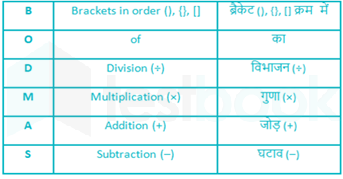
What is the value of 96 ÷ 4 + 5 × 3 + 8 × 2?

  1. ((a))

    55

  2. ((b))

    53

  3. ((c))

    54

  4. ((d))

    50

Show Answer
Answer: ((a))

55

Concept used:

Solution:

= 96 ÷ 4 + 5 × 3 + 8 × 2

= 24 + 5 x 3 + 8 x 2

= 24 + 15 + 16

= 55

Hence, the correct option is 1.

49

Three boxes first, second and third whose capacities are 78 kg, 117 kg and 273 kg respectively are completely filled with three types of wheat A1, B1 and C1 respectively. All the three boxes are emptied and after mixing all the three types of wheat well, the mixture is again filled in all the three boxes. What is the quantity of wheat containing A1 in the third box?

  1. ((a))

    25.5 kg

  2. ((b))

    30 kg

  3. ((c))

    45.5 kg

  4. ((d))

    60 kg

Show Answer
Answer: ((c))

45.5 kg

Given:

A1 = 78 kg

B1 = 117 kg

C1 = 273 kg

Solution:

Ratio = 78 : 117 : 273 = 2 : 3 : 7

Total = 2 + 3 + 7 = 12

Quantity of A1 in 3rd box = 78 × (7/12) = 45.5 kg

Hence, the correct option is 3.

50

Simple interest on a sum for 4 years is equal to 20 percent of the principal. In how many years will the simple interest become equal to the principal?

  1. ((a))

    30 years

  2. ((b))

    21 years

  3. ((c))

    20 years

  4. ((d))

    24 years

Show Answer
Answer: ((c))

20 years

Given:

Time = 4 years

SI = 20% of Principle = 0.2P

Formula used:

SI = (P x R x T)/100

here, 

SI = Simple Interest

P = Principle

R = Rate

T = Time

Solution:

Let's put the values given, in the formula to find the value of R;

⇒ 0.2P = 4PR/100

R = 20/4 = 5%

Now, SI = P

P = P x 5 x T/100

T = 100/5 = 20 years

Hence, the correct option is 3.

51

Raman bought 100 tables (all at same cost price). He sold 40 tables at a profit of 20 percent, 20 tables at a profit of 10 percent and the rest at the cost price. Had he sold all at a profit of 12 per cent, he would have gained Rs. 248 more. What is the cost price of each table?

  1. ((a))

    Rs. 148

  2. ((b))

    Rs. 136

  3. ((c))

    Rs. 130

  4. ((d))

    Rs. 124

Show Answer
Answer: ((d))

Rs. 124

Given:

Total = 100 tables

40 Tables = 20% Profit

20 Tables = 10% Profit

40 Tables = Cost Price

100 Tables = 12 % Profit = Rs. 248 more

Formula used:

Profit % = (Profit/Cost Price) x 100

Profit = SP - CP

CP = Cost price

SP = Selling price

Solution:

Selling price for 40 tables = 40 x 1.2 = 48

Selling price for 20 tables = 20 x 1.1 = 22

Selling price for 40 tables = 40

Total = 48 + 22 + 40 = 110

The selling price of 100 tables with 12% profit = 100 x 1.12 = 112

Difference = 112 - 110 = 2 units = Rs. 248

1 unit = Rs. 124.

The cost price of 1 table = Rs. 124.

Hence, the correct option is 4.

52

The selling price of a car is Rs. 12950. If the car is sold at a discount of 30%, then what will be the marked price of the car?

  1. ((a))

    Rs. 18500

  2. ((b))

    Rs. 18000

  3. ((c))

    Rs. 19700

  4. ((d))

    Rs. 19000

Show Answer
Answer: ((a))

Rs. 18500

Given:

SP = Rs. 12950

D = 30%

Formula used:

Discount% = [(MP - SP)/MP] x 100

MP = Marked Price

SP = Selling price

Solution:

⇒ 30% = [(MP - 12950)/MP] x 100

⇒ 0.3MP = MP - 12950

MP = 12950/0.7

MP = Rs.18500

Hence, the correct option is 1.

53

The perimeter of a rectangle is 268 cm. If the difference between its length and breadth is 34 cm, then what is the area of this rectangle?

  1. ((a))

    2800 cm2

  2. ((b))

    4900 cm2

  3. ((c))

    3500 cm2

  4. ((d))

    4200 cm2

Show Answer
Answer: ((d))

4200 cm2

Given:

P = 268 cm

L - B = 34 cm

Formula used:

Perimeter of rectangle = 2 x (L + B)

Area of rectangle = L x B

L = Length

B = Breadth

Solution:

L = 34 + B

2 x (34 + B + B) = 268

34 + 2B = 134

B = 100/2 = 50 cm

L = 50 + 34 = 84 cm

Area = 50 x 84 = 4200 cm2 

Hence, the correct option is 4.

54

The radius of the base of a cylinder is 14 cm and its height is 30 cm. The volume of this cylinder is equal to the volume of a cuboid. The sum of the length and breadth of a cuboid is 72 cm and the difference between the length and breadth is 16 cm. What is the height of this cuboid?

  1. ((a))

    12 cm

  2. ((b))

    15 cm

  3. ((c))

    18 cm

  4. ((d))

    9 cm

Show Answer
Answer: ((b))

15 cm

Given:

R = 14 cm

H = 30 cm

Volume(Cylinder = Cuboid)

L + B = 72 cm

L - B = 16 cm

Formula used:

Volume(Cylinder) = 22/7 x R x R x H

Volume(Cuboid) = L x B x H

L = Length, B = Breadth, H = Height,  R = Radius

Solution:

L = 72 - B

⇒ 72 - B - B = 16

2B = 72 - 16 = 56

B = 28 cm

L = 72 - 28 = 44 cm

⇒ 22/7 x 14 x 14 x 30 = 28 x 44 x H

H = 15 cm

Hence, the correct option is 2.

55

P, Q and R are partners in a company. In any one year P gets 1/6th of profit, Q gets 1/7th of profit and R gets Rs. 36250. How much amount will P get as profit?

  1. ((a))

    Rs. 8750

  2. ((b))

    Rs. 7550

  3. ((c))

    Rs. 7500

  4. ((d))

    Rs. 8350

Show Answer
Answer: ((a))

Rs. 8750

Given:

P = 1/6 Profit

Q = 1/7 Profit

R =  Rs. 36250

Solution:

⇒ 1/6 + 1/7 + R = 1

⇒ 7 + 6 + 42R = 42

⇒ 42R = 42 - 13 = 29

R = 29/42

⇒ 29/42 = 36250

⇒ 1 = ?

Total Profit = 36250 x 42/29 = 52500

Profit of P = 52500/6 = Rs. 8750

Hence, the correct option is 1.

56

The pie chart given below shows the number of fridges sold by different companies. The total number of fridges sold by all these 6 companies is 7200. The number of fridges sold by a particular company is shown as degrees with respect to the total number of fridges sold by all these 6 companies.

<br>

J1 = Average number of fridges sold by R, S and T.

J2 = Sum of average number of fridges sold by P and Q and average number of fridges sold by S and U.

What is the value of (J2 - J1)?

  1. ((a))

    650

  2. ((b))

    675

  3. ((c))

    450

  4. ((d))

    750

Show Answer
Answer: ((d))

750

Solution:

1% = 7200/360 = 20 Fridges

J1 = Average(R, S,T) = [20 x (140 + 15 + 25)]/3 = [20 x 180]/3 = 20 x 60 = 1200

J2 = Average(P, Q) + Average(S, U) = 10 x [80 + 70 + 15 + 30] = 10 x 195 = 1950

J2 - J1 = 1950 - 1200= 750

Hence, the correct option is 4.

57

X is 20 times of Y. Y is what percent less than X?

  1. ((a))

    94 percent

  2. ((b))

    90 percent

  3. ((c))

    95 percent

  4. ((d))

    92 percent

Show Answer
Answer: ((c))

95 percent

Given:

X = 20 x Y

Solution:

X = 20Y

Y = 1/20 X

Y = 100 - (1/20) x 100

Y = 100 - 5 = 95% less than X

Hence, the correct option is 3.

58

In (98)68 × (55)62 × (27)91, which digit is in the unit place?

  1. ((a))

    0

  2. ((b))

    6

  3. ((c))

    2

  4. ((d))

    5

Show Answer
Answer: ((a))

0

Solution:

In the given number, 98 is divisible by 2.

55 is divisible by 5

5 x 2 = 10

Therefore, the last digit or the unit place will always be 0.

Hence, the correct option is 1.

59

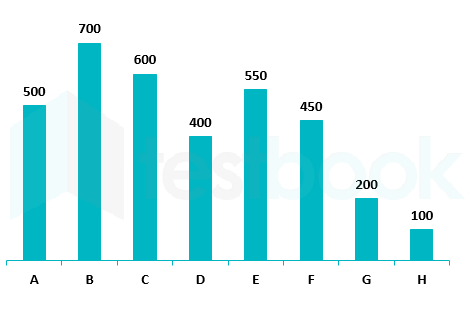
The bar diagram given below shows the salary of 8 employees of a company.

<br>

What is the ratio of A's salary to H's salary?

  1. ((a))

    5 : 1

  2. ((b))

    5 : 2

  3. ((c))

    2 : 1

  4. ((d))

    3 : 1

Show Answer
Answer: ((a))

5 : 1

Solution:

A's salary = 500

H's salary = 100

Ratio = A  : H = 500 : 100 = 5 : 1

Hence, the correct option is 1.

60

If the population of a city increases by 10% in the first year and decreases by less than 20% in the second year, what will be the net percentage change in the population after 2 years?

  1. ((a))

    10 percent more

  2. ((b))

    12 percent more

  3. ((c))

    10 percent less

  4. ((d))

    12 percent less

Show Answer
Answer: ((d))

12 percent less

Given:

1st year = 10% increase

2nd year = 20% decrease

Solution:

Let, the population be 100

1st year = 100 + 10 = 110

2nd year = 110 - 22 = 88

Net change = 100 - 88 = 12% less

Hence, the correct option is 4.

General Hindi (20 questions)

61

निम्नलिखित वाक्यों में से संयुक्त वाक्य ज्ञात कीजिए।

  1. ((a))

    तुम नहीं जानते कि वह कौन है?

  2. ((b))

    वह तुम्हें नहीं जानता और तुम कौन हो?

  3. ((c))

    जो तुम्हें जानता है, वह कौन है ?

  4. ((d))

    तुम कौन हो क्योंकि वह तुम्हें नहीं जानता है।

Show Answer
Answer: ((b))

वह तुम्हें नहीं जानता और तुम कौन हो?

सही उत्तर 'वह तुम्हें नहीं जानता और तुम कौन हो?' है।

  • 'वह तुम्हें नहीं जानता और तुम कौन हो?', वाक्य संयुक्त वाक्य है।
  • उपरोक्त वाक्य में दो साधारण वाक्य एक योजक शब्द ‘और’ की सहायता से जुड़कर संयुक्त वाक्य बना रहे हैं।
  • जिस वाक्य में दो या दो से अधिक उपवाक्य मिले हों, परन्तु सभी वाक्य प्रधान हो तो ऐसे वाक्य को संयुक्त वाक्य कहते है।

Key Points

अन्य विकल्पों का विश्लेषण: 

वाक्यप्रकार
तुम नहीं जानते कि वह कौन है?मिश्र वाक्य
जो तुम्हें जानता है, वह कौन है ?मिश्र वाक्य
तुम कौन हो क्योंकि वह तुम्हें नहीं जानता है।मिश्र वाक्य

Additional Information

  • वाक्य: शब्दों का ऐसा समूह जिसका जिसका कोई भाव/अर्थ प्रकट होता है,वाक्य कहलाता है।
  • जैसे - राम खाना खाता है।
  • ​रचना की दृष्टि से वाक्य के तीन प्रमुख भेद किये जाते हैं:
वाक्यदो या दो से अधिक शब्दों के सार्थक समूह को कहते हैं। मुख्य रूप से इसके तीन प्रकार माने गए हैं -
परिभाषाउदाहरण
सरलऐसे वाक्य जिनमें एक ही क्रिया एवं एक ही कर्ता होता है या जिस वाक्य में एक ही उद्देश्य एवं एक ही विधेय होता है, वे वाक्य सरल वाक्य कहलाते हैं। इसमें कर्ता एक से अधिक हो सकते हैं लेकिन मुख्य क्रिया एक ही होगी।राकेश पढ़ता है। कमला और विमला मंदिर जाती हैं।
संयुक्तजिस वाक्य में दो या दो से अधिक उपवाक्य मिले हों, परन्तु सभी वाक्य प्रधान हो तो ऐसे वाक्य को संयुक्त वाक्य कहते है। संयोजक अभियोग के रूप में बहुत सारे शब्द जैसे: और, एवं, फिर, या, अथवा, परंतु, इसलिए, तथा, तो, नहीं तो, भी, किंतु इत्यादि शब्दों का प्रयोग होता है।वह सुबह आगरा गया और शाम को लौट आया।
मिश्रजिस वाक्य में एक से अधिक वाक्य मिले हों, किन्तु एक प्रधान उपवाक्य तथा शेष आश्रित उपवाक्य हों, मिश्रित वाक्य कहलाता है। जैसे: आपस में, कि, जो, क्योंकि, जितना, उतना, जैसा, वैसा, जब, तब, जहाँ, वहाँ, जिधर, उधर, यद्यपि, यदि, अगर, तो इत्यादि।वह औरत जो पार्क में बैठी हैं मेरी मौसी हैं।
62

दिए गए शब्दों का समास ज्ञात कीजिए।

यथाशक्ति

  1. ((a))

    कर्मधारय समास

  2. ((b))

    अव्ययीभाव समास

  3. ((c))

    द्विगु समास

  4. ((d))

    बहुब्रीहि समास

Show Answer
Answer: ((b))

अव्ययीभाव समास

सही उत्तर 'अव्ययीभाव समास' है।

  • दिए गए विकल्पों में से 'यथाशक्ति' अव्ययीभाव समास का उदाहरण है।
  • यथाशक्ति का समास विग्रह - शक्ति के अनुसार
  • यथाशक्ति शब्द में पहला पद प्रधान है।
  • जिस समास में पहला पद प्रधान हो और समस्त शब्द अव्यय का काम करे, वह अव्ययीभाव समास कहलाता है।

Key Points

  • समास-समास से तात्पर्य 'संक्षिप्तीकरण' से है। जब दो या दो से अधिक शब्दों के योग से जो छोटा शब्द बने उसे समास कहते हैं।
  • समास के माध्यम से कम शब्दों में अधिक अर्थ प्रकट किया जाता है।
  • समास के छःप्रकार हैं-
समास का नामपरिभाषाउदाहरण
तत्पुरुष समासजिस समास में उत्तरपद प्रधान हो तथा समास करने के उपरांत विभक्ति (कारक चिन्ह) का लोप हो।धर्म का ग्रन्थ = धर्मग्रन्थ, तुलसीदास द्वारा कृत = तुलसीदासकृत।
बहुव्रीहि समासजिस समास में दोनों पद प्रधान नहीं होते हैं और दोनों पद मिलकर किसी अन्य विशेष अर्थ की ओर संकेत कर रहे होते हैं।जो महान वीर है = महावीर अर्थात हनुमान, तीन आँखों वाला = त्रिलोचन अर्थात शिव।
कर्म��ारय समासजिस समास के दोनों शब्दों के बीच विशेषण-विशेष्य अथवा उपमान-उपमेय का सम्बन्ध हो, पहचान: विग्रह करने पर दोनों पद के मध्य में 'है जो', 'के समान' आदि आते हैं।कमल के समान नयन = कमलनयन, महान है जो देव = महादेव।
द्विगु समासजिस समास में पूर्वपद (पहला पद) संख्यावाचक विशेषण हो।दो पहरों का समूह = दोपहर, तीनों लोकों का समाहार = त्रिलोक।
अव्ययीभाव समासजिस समास में पहला पद प्रधान हो और समस्त शब्द अव्यय का काम करे।प्रति + दिन = प्रतिदिन, एक + एक = एकाएक
द्वंद्व समासद्वन्द्व समास में समस्तपद के दोनों पद प्रधान हों या दोनों पद सामान हों एवं दोंनों पदों को मिलाते समय "और, अथवा, या, एवं" आदि योजक लुप्त हो जाएँ, वह समास द्वंद्व समास कहलाता है।माता- पिता = माता और पिता, हाँ- न = हाँ या न
63

दिए गए वाक्य में उपयुक्त विराम चिह्न का चयन कीजिए ।

चलो, चलते हैं। मैंने कहा।

  1. ((a))

    ;

  2. ((b))

    '' ''

  3. ((c))

    ...

  4. ((d))

    ,,

Show Answer
Answer: ((b))

'' ''

सही उत्तर 'अवतरण चिन्ह ('' '')' है।

  • दिए गए वाक्य में 'अवतरण चिन्ह ('' '')' विराम चिह्न का प्रयोग होगा।
  • शुद्ध वाक्य: "चलो, चलते हैं।" मैंने कहा।
  • किसी वाक्य में किसी खास शब्द पर जोर देने के लिए अवतरण या उद्धरण चिन्ह ('' '') का प्रयोग किया जाता है।

Key Points

विराम चिन्ह – भाषा के लिखित रूप में विशेष स्थानों पर रुकने का संकेत करने वाले चिन्हों को विराम चिन्ह कहते हैं। विराम चिन्ह के भेद –
विराम चिन्ह का नामउदाहरणविराम  - चिन्ह
पूर्ण विरामबाजार खुल गया।
अर्द्ध विराम चिन्हमुख्य अतिथि आ गए हैं; वह शीघ्र चले जाएंगे।;
अल्प विराम चिह्नराकेश, मोहन, शीतल और पंकज ने यह चित्र बनाया है।,
प्रश्न सूचक चिन्हतुम्हारी माताजी का नाम क्या है ??
विस्मय सूचक या आश्चर्य चिह्नवाह ! कितना सुंदर दृश्य है।!
संयोजक या योजक चिन्हमैं दिन–रात यही सोचता रहा।-
निर्देशक चिन्हश्री जितेंद्र जी ने कहा _ सत्य के मार्ग पर चलना चाहिए।_
अवतरण चिन्ह या उद्धरण चिन्हगांधी जी ने कहाँ था "अहिंसा परम धर्म है”‘….’ “…”
कोष्ठक चिन्हदशहरे के दिन दशानन (रावण) का दहन किया जाता है।[ {()} ]
उप विराम (अपूर्ण विराम)विज्ञान: वरदान या अभिशाप:
विवरण चिन्हनिम्नलिखित प्रश्नों का उत्तर दीजिये :-:-
लाघव चिन्हडॉक्टर – डॉ०, प्रोफेसर – प्रो०
हंसपद या त्रुटिपूरक चिन्हआगरा राम कल ^  जायेगा।^
लोप चिन्हमैं पास तो आ जाऊँगा…… लेकिन साथ नहीं चलूँगा।……
दीर्घ उच्चारण चिन्हS
तुल्यता सूचक चिन्ह4 + 4 = 8=
समाप्ति सूचक चिन्ह- , o
64

निम्नलिखित प्रश्न में, दिए गए चार विकल्पों में से, उस विकल्प का चयन करें जो दिए गए मुहावरे के अर्थ को सर्वश्रेष्ठ रूप से व्यक्त करता है।

जबानी जमा खर्च करना

  1. ((a))

    बहुत ज्ञान होना

  2. ((b))

    जमापूँजी समाप्त होना

  3. ((c))

    केवल बात और कुछ नहीं

  4. ((d))

    बिना बात की बात करना

Show Answer
Answer: ((c))

केवल बात और कुछ नहीं

सही उत्तर 'केवल बात और कुछ नहीं' हैं।

  • “जबानी जमा खर्च करना”, मुहावरे का अर्थ 'केवल बात और कुछ नहीं**'** हैं।
  • वाक्य प्रयोग-  मित्र, अब जबानी जमा-खर्च करने से कुछ नहीं होगा। कुछ ठोस कार्यवाही करो।

Key Points

मुहावरा परिभाषाउदाहरण
मुहावरा का शाब्दिक अर्थ ‘अभ्यास’ है। मुहावरा शब्द अरबी भाषा का शब्द है। हिन्दी में ऐसे वाक्यांशों को मुहावरा कहा जाता है, जो अपने साधारण अर्थ को छोड़कर  विशेष अर्थ को व्यक्त करते हैं।अंक भरना- स्नेह से लिपटा लेना **वाक्य-**माँ ने स्नेह से अपने पुत्र को अंक में भर लिया।
65

निम्नलिखित प्रश्न में, दिए गए चार विकल्पों में से, उस विकल्प का चयन करें जो दिए गए मुहावरे के अर्थ को सर्वश्रेष्ठ रूप से व्यक्त करता है।

ईमान बगल में दबाना

  1. ((a))

    अड़चन दूर करना

  2. ((b))

    धोखा देना

  3. ((c))

    बेईमानी करना

  4. ((d))

    याद रखना

Show Answer
Answer: ((c))

बेईमानी करना

सही उत्तर 'बेईमानी करना' हैं।

  • “ईमान बगल में दबाना”, मुहावरे का अर्थ 'बेईमानी करना' हैं।
  • वाक्य प्रयोग-  व्यापारी से हेराफेरी करके उसने अपना ईमान बगल में दबा दिया।।

Key Points

मुहावरा परिभाषाउदाहरण
मुहावरा का शाब्दिक अर्थ ‘अभ्यास’ है। मुहावरा शब्द अरबी भाषा का शब्द है। हिन्दी में ऐसे वाक्यांशों को मुहावरा कहा जाता है, जो अपने साधारण अर्थ को छोड़कर  विशेष अर्थ को व्यक्त करते हैं।अंक भरना- स्नेह से लिपटा लेना वाक्य-माँ ने स्नेह से अपने पुत्र को अंक में भर लिया।
66

निम्नलिखित वाक्य में रेखांकित भाग का वाक्यांश के लिए उचित शब्द का चयन कीजिए।

अपनी इच्छानुसार आचरण करने वाला

  1. ((a))

    सत्यवादी

  2. ((b))

    सदाचारी

  3. ((c))

    वर्णनतीत

  4. ((d))

    स्वेच्छाचारी

Show Answer
Answer: ((d))

स्वेच्छाचारी

सही उत्तर 'स्वेच्छाचारी' हैं।

'अपनी इच्छानुसार आचरण करने वाला' - वाक्यांश के लिए सार्थक शब्द 'स्वेच्छाचारी' है।

Key Points

अन्य विकल्प:

शब्दवाक्यांश
सत्यवादीसत्य बोलने वाला
सदाचारीजिसका आचरण अच्छा हो
वर्णनतीतजो वर्णन के बाहर हो

Additional Information

वाक्यांश- भाषा को सुंदर, आकर्षक और प्रभावशाली बनाने के लिए अनेक शब्दों के स्थान पर एक शब्द का प्रयोग किया जाता है तो वह वाक्यांश के लिए एक शब्द कहलाता है।

67

दिए गए शब्द युग्म का सही शब्द युग्म ज्ञात कीजिए।

अशोच : अशुचि

  1. ((a))

    बिना सोच के : अपवित्र

  2. ((b))

    स्थान : अशुद्ध

  3. ((c))

    असत्य : बिना सोच के

  4. ((d))

    बिना जड़वाला : असत्य

Show Answer
Answer: ((a))

बिना सोच के : अपवित्र

सही उत्तर 'बिना सोच के : अपवित्र' है।

  • दिए गए विकल्पों में 'अशोच : अशुचि' शब्द-युग्म का सही अर्थ 'बिना सोच के : अपवित्र' है।

Key Points

शब्दअर्थ
स्थानअवस्थान
असत्यअसत
  • समानोच्चारित शब्द: कुछ शब्द ऐसे होते हैं जिनमें स्वर, मात्रा अथवा व्यंजन में थोड़ा-सा अन्तर होता है। वे बोलचाल में लगभग एक जैसे लगते हैं, परन्तु उनके अर्थ में भिन्नता होती है। ऐसे शब्द 'समश्रुत/समानोच्चारित /श्रुतिसम भिन्नार्थक शब्द' कहलाते हैं।
  • जैसे- घन और धन दोनों के उच्चारण में कोई खास अन्तर महसूस नहीं होता परन्तु अर्थ में भिन्नता है।
  • घन-बादल=धन-सम्पत्ति
68

दिए गए वाक्य में उचित परसर्ग का चयन करके, रिक्त स्थान की पूर्ति कीजिए।

रावण _______ सीता _______ अपहरण कर लिया था।

  1. ((a))

    का, ने

  2. ((b))

    ने, का

  3. ((c))

    ने, की

  4. ((d))

    को, ने

Show Answer
Answer: ((b))

ने, का

सही उत्तर 'ने, का' है।

  • दिए गए वाक्य में उचित परसर्ग 'ने, का' है।
  • पूर्ण वाक्य: रावण ने सीता का अपहरण कर लिया था।
  • अन्य दिए गए सभी परसर्ग अर्थहीन वाक्य बनाते है।

Key Points

  • परसर्ग - ये वे अक्षर हैं जो किसी शब्द के बाद आते हैं और कोई विशेषता लाते हैं।
  • जैसे - का, की, रे, ने, द्वारा, से आदि।
69

निम्नलिखित वाक्यों में से सरल वाक्य ज्ञात कीजिए।

  1. ((a))

    वह व्यक्ति दूसरे व्यक्ति को भी अपने जैसा समझता है।

  2. ((b))

    जो व्यक्ति जैसा होता है वह दूसरों को भी वैसा ही समझता है।

  3. ((c))

    वह व्यक्ति ऐसा होता है इसलिए दूसरों को भी अपने जैसा समझता है।

  4. ((d))

    वह व्यक्ति दूसरों को भी अपनी तरह समझता है।

Show Answer
Answer: ((d))

वह व्यक्ति दूसरों को भी अपनी तरह समझता है।

सही उत्तर 'वह व्यक्ति दूसरों को भी अपनी तरह समझता है।' है।

  • 'वह व्यक्ति दूसरों को भी अपनी तरह समझता है।' वाक्य सरल वाक्य है।
  • उपरोक्त वाक्य में एक ही क्रिया एवं एक ही कर्ता हैं। इसलिए यह सरल वाक्य है।

Key Points

अन्य विकल्पों का विश्लेषण: 

वाक्यप्रकार
वह व्यक्ति दूसरे व्यक्ति को भी अपने जैसा समझता है।मिश्र वाक्य
जो व्यक्ति जैसा होता है वह दूसरों को भी वैसा ही समझता है।मिश्र वाक्य
वह व्यक्ति ऐसा होता है इसलिए दूसरों को भी अपने जैसा समझता है।संयुक्त वाक्य

Additional Information

  • वाक्य: शब्दों का ऐसा समूह जिसका जिसका कोई भाव/अर्थ प्रकट होता है,वाक्य कहलाता है।
  • जैसे - राम खाना खाता है।
  • ​रचना की दृष्टि से वाक्य के तीन प्रमुख भेद किये जाते हैं:
वाक्यदो या दो से अधिक शब्दों के सार्थक समूह को कहते हैं। मुख्य रूप से इसके तीन प्रकार माने गए हैं -
परिभाषाउदाहरण
सरलऐसे वाक्य जिनमें एक ही क्रिया एवं एक ही कर्ता होता है या जिस वाक्य में एक ही उद्देश्य एवं एक ही विधेय होता है, वे वाक्य सरल वाक्य कहलाते हैं। इसमें कर्ता एक से अधिक हो सकते हैं लेकिन मुख्य क्रिया एक ही होगी।राकेश पढ़ता है। कमला और विमला मंदिर जाती हैं।
संयुक्तजिस वाक्य में दो या दो से अधिक उपवाक्य मिले हों, परन्तु सभी वाक्य प्रधान हो तो ऐसे वाक्य को संयुक्त वाक्य कहते है। संयोजक अभियोग के रूप में बहुत सारे शब्द जैसे: और, एवं, फिर, या, अथवा, परंतु, इसलिए, तथा, तो, नहीं तो, भी, किंतु इत्यादि शब्दों का प्रयोग होता है।वह सुबह आगरा गया और शाम को लौट आया।
मिश्रजिस वाक्य में एक से अधिक वाक्य मिले हों, किन्तु एक प्रधान उपवाक्य तथा शेष आश्रित उपवाक्य हों, मिश्रित वाक्य कहलाता है। जैसे: आपस में, कि, जो, क्योंकि, जितना, उतना, जैसा, वैसा, जब, तब, जहाँ, वहाँ, जिधर, उधर, यद्यपि, यदि, अगर, तो इत्यादि।वह औरत जो पार्क में बैठी हैं मेरी मौसी हैं।
70

दिए गए वाक्य में उपयुक्त विराम चिह्न का चयन कीजिए ।

आज एमए परीक्षा के नतीजे आ गए हैं।

  1. ((a))

    '' ''

  2. ((b))

  3. ((c))

    ;

  4. ((d))

    ()

Show Answer
Answer: ((b))

सही उत्तर 'लाघव चिन्ह (.)' है।

  • दिए गए वाक्य में 'लाघव चिन्ह (.)' विराम चिह्न का प्रयोग होगा।
  • शुद्ध वाक्य: आज एम.ए. परीक्षा के नतीजे आ गए हैं।
  • हिंदी भाषा में किसी शब्द को संक्षिप्त रूप से लिखने के लिए लाघव चिन्ह का प्रयोग किया जाता है l
  • जैसे- कृ०प०उ०= कृपया पृष्ठ उलटिए।
  • प०न०नि०=पटना नगर निगम।
  • पं० = पंडित।

Key Points

विराम चिन्ह – भाषा के लिखित रूप में विशेष स्थानों पर रुकने का संकेत करने वाले चिन्हों को विराम चिन्ह कहते हैं। विराम चिन्ह के भेद –
विराम चिन्ह का नामउदाहरणविराम  - चिन्ह
पूर्ण विरामबाजार खुल गया।
अर्द्ध विराम चिन्हमुख्य अतिथि आ गए हैं; वह शीघ्र चले जाएंगे।;
अल्प विराम चिह्नराकेश, मोहन, शीतल और पंकज ने यह चित्र बनाया है।,
प्रश्न सूचक चिन्हतुम्हारी माताजी का नाम क्या है ??
विस्मय सूचक या आश्चर्य चिह्नवाह ! कितना सुंदर दृश्य है।!
संयोजक या योजक चिन्हमैं दिन–रात यही सोचता रहा।-
निर्देशक चिन्हश्री जितेंद्र जी ने कहा _ सत्य के मार्ग पर चलना चाहिए।_
अवतरण चिन्ह या उद्धरण चिन्हगांधी जी ने कहाँ था "अहिंसा परम धर्म है”‘….’ “…”
कोष्ठक चिन्हदशहरे के दिन दशानन (रावण) का दहन किया जाता है।[ {()} ]
उप विराम (अपूर्ण विराम)विज्ञान: वरदान या अभिशाप:
विवरण चिन्हनिम्नलिखित प्रश्नों का उत्तर दीजिये :-:-
पुनरुक्ति सूचक चिन्ह„ „
लाघव चिन्हडॉक्टर – डॉ०, प्रोफेसर – प्रो०
हंसपद या त्रुटिपूरक चिन्हआगरा राम कल ^  जायेगा।^
लोप चिन्हमैं पास तो आ जाऊँगा…… लेकिन साथ नहीं चलूँगा।……
दीर्घ उच्चारण चिन्हS
तुल्यता सूचक चिन्ह4 + 4 = 8=
समाप्ति सूचक चिन्ह- , o
71

निम्नलिखित में से वर्तमान काल की पहचान क्या है?

  1. ((a))

    कार्य होना होता है

  2. ((b))

    कार्य होने की संभावना होती है

  3. ((c))

    कार्य हो चुका होता है

  4. ((d))

    कार्य चल रहा होता है

Show Answer
Answer: ((d))

कार्य चल रहा होता है

सही उत्तर 'कार्य चल रहा होता है' है।

  • वर्तमान काल में "कार्य चल रहा होता है" यही इस काल का मुख्य पहचान है।
  • क्रिया के जिस रूप से वर्तमान में चल रहे समय का पता चले, उसे वर्तमान काल कहते है।
  • सामान्य वर्तमान काल के वाक्यों के अंत में ता है, ती है, ते है, ता हूँ, ती हूँ आदि आते हैं है।

Key Points अन्य विकल्पों का विश्लेषण:​

वाक्यकालपरिभाषा
कार्य होना होता हैसंदिग्ध वर्तमान कालक्रिया के जिस रूप से वर्तमान काल क्रिया के होने या करने पर शक हो।
कार्य होने की संभावना होती हैसंभाव्य भविष्य कालक्रिया के जिस रूप से आगे कार्य होने या करने की संभावना का पता चले।
कार्य हो चुका होता हैपूर्ण भूतकालक्रिया के जिस रूप से यह पता चलता है की कार्य निश्चित किये गये समय से पहले ही पूरा हो चूका था।

Additional Information

काल- क्रिया के जिस रूप से किसी कार्य के करने या होने का समय पता चले, वह काल कहलाता है। उदाहरण- हैं, थे, होंगी आदि। काल तीन प्रकार के होते है-
कालपरिभाषाउदाहरण
वर्तमानकालक्रिया के जिस रूप से वर्तमान में चल रहे समय का पता चले, उसे वर्तमान काल कहते है। वर्तमान काल के पाँच भेद होते है- (i) सामान्य वर्तमानकाल (ii) अपूर्ण वर्तमानकाल (iii) पूर्ण वर्तमानकाल (iv) संदिग्ध वर्तमानकाल (v) तत्कालिक वर्तमानकाल (vi) संभाव्य वर्तमानकालवह तेज आवाज में गाना सुन रहा है। मेरा मन चाय पीने का कर रहा है।
भूतकालक्रिया के जिस रूप से बीते हुए समय का पता चले, उसे भूतकाल कहते है। भूतकाल के छह भेद होते है- (i) सामान्य भूतकाल (ii) आसन भूतकाल (iii) पूर्ण भूतकाल (iv) अपूर्ण भूतकाल (v) संदिग्ध भूतकाल (vi) हेतुहेतुमद् भूतमैंने पूरा खाना खा लिया था। हेमंत को घर छोड़ दिया था।
भविष्यतकालक्रिया के जिस रूप से भविष्य में होने वाली क्रिया का पता चले उसे भविष्यतकाल की क्रिया कहते है।वह सब उठा ले जाएगा। कल उसका बोरिया-बिस्तर यहाँ से उठ जाएगा।
72

दिए गए वाक्य में विशेषण ज्ञात कीजिए।

थोड़ी सी नमकीन खरीद लाओ।

  1. ((a))

    निश्चित परिमाणवाचक

  2. ((b))

    अनिश्चित परिमाणवाचक

  3. ((c))

    गुणवाचक विशेषण

  4. ((d))

    सार्वनामिक विशेषण

Show Answer
Answer: ((b))

अनिश्चित परिमाणवाचक

सही उत्तर 'अनिश्चित परिमाणवाचक' है।

  • दिए गए वाक्य, "थोड़ी सी नमकीन खरीद लाओ।" में 'अनिश्चित परिमाणवाचक' विशेषण है।
  • "थोड़ी सी नमकीन खरीद लाओ।"  इस वाक्य में 'थोड़ी' शब्द का प्रयोग हुआ है, इसलिए यहां अनिश्चित परिमाणवाचक विशेषण है।

Key Points

  • विशेषण: जो शब्द संज्ञा या सर्वनाम शब्द की विशेषता बताते है उन्हें विशेषण कहते है।
  • परिमाणवाचक विशेषण दो प्रकार के होते है"
  • अनिश्चित परिमाणवाचक : जो विशेषण शब्द किसी वस्तु की निश्चित मात्रा अथवा माप-तौल का बोध नहीं कराते हैं, वे अनिश्चित परिमाणवाचक विशेषण कहलाते है।
  • जैसे – थोड़ी जगह, बहुत पानी, कुछ फल, ज़रा सा रस आदि।
  • निश्चित परिमाणवाचक : जो विशेषण शब्द किसी वस्तु की निश्चित मात्रा अथवा माप-तौल का बोध कराते हैं, वे निश्चित परिमाणवाचक विशेषण कहलाते है।
  • जैसे – दो सेर घी

Additional Information

विशेषण के प्रकार -

विशेषणपरिभाषाउदाहरण
गुणवाचक विशेषणवे विशेषण शब्द जो संज्ञा या सर्वनाम शब्द के गुण-दोष, रूप-रंग, आकार, स्वाद, दशा, अवस्था, स्थान आदि की विशेषता प्रकट करते हैं, गुणवाचक विशेषण कहलाते है।जैसे- वह एक अच्छा आदमी है। उसका चेहरा गोल है। भूखे पेट भजन नहीं होता।
संख्यावाचक विशेषणवे विशेषण शब्द जो संज्ञा अथवा सर्वनाम की संख्या का बोध कराते हैं, संख्यावाचक विशेषण कहलाते हैं।जैसे- 'पाँच' घोड़े दौड़ते हैं।
सात विद्यार्थी पढ़ते हैं।
परिमाणवाचक विशेषणजिन विशेषण शब्दों से किसी वस्तु के माप-तौल संबंधी विशेषता का बोध होता है, वे परिमाणवाचक विशेषण कहलाते हैं।जैसे- मुझे थोड़ा दूध चाहिए चुल्लूभर पानी में डूब मरो।
संकेतवाचक या सार्वनामिक विशेषणजो शब्द संज्ञा या सर्वनाम की ओर संकेत करते हैजैसे- वह गाय दूध देती है।
यह पुस्तक मेरी है।
व्यक्तिवाचक विशेषणजिन विशेषण शब्दों की रचना व्यक्तिवाचक संज्ञा से होती है, उन्हें व्यक्तिवाचक विशेषण कहते है।जैसे- इलाहाबाद से इलाहाबादी
जयपुर से जयपुरी
बनारस से बनारसी
संबंधवाचक विशेषणजो विशेषण किसी वस्तु की विशेषताएँ दूसरी वस्तु के संबंध में बताता है, उन्हें संबंधवाचक विशेषण कहते हैं।जैसे- जंगी जहाज व्यापारी बेड़ा।
73

दिए गए वाक्य में उपयुक्त शब्द का चयन करके रिक्त स्थान की पूर्ति कीजिए।

न्यायालय ने अपराधी की मुक्ति का _______ दिया।

  1. ((a))

    निर्णय

  2. ((b))

    निदेश

  3. ((c))

    आदेश

  4. ((d))

    निषेध

Show Answer
Answer: ((c))

आदेश

सही उत्तर 'आदेश' है।

  • दिए गए वाक्य में उपयुक्त शब्द 'आदेश' है।
  • पूर्ण वाक्य: न्यायालय ने अपराधी की मुक्ति का आदेश दिया।

Key Points अन्य विकल्पों का विश्लेषण:​

  • एक अपराधी के सम्बन्ध में न्यायालय केवल आदेश दे सकता है, बाकि सभी शब्द त्रुटिपूर्ण वाक्य का निर्माण करते है।
74

दिए गए शब्द का प्रत्यय ज्ञात कीजिए।

मनौती

  1. ((a))

    ऐत

  2. ((b))

    ती

  3. ((c))

    नोती

  4. ((d))

    औती

Show Answer
Answer: ((d))

औती

सही उत्तर 'औती' है।

  • 'मनौती' में 'औती' प्रत्यय और 'मान' मूल शब्द है।
  • मनौती का अर्थ: किसी कामना की पूर्ति के लिए किसी देवता की पूजा का संकल्प।
  • वाक्य प्रयोग:परीक्षा में प्रथम आने की मैने मनौती मानी थी।
  • औती प्रत्यय के उदाहरण:
  • बपौती= बाप + औती
  • चुनौती=चुन + औती
  • फिरौती=फिर + औती
  • कटौती= काट + औती
  • कठौती= कठ + औती

Key Points

  • प्रत्यय: शब्द के उपरांत जिस शब्द का प्रयोग किया जाता है वह प्रत्यय है।
  • जैसे  - ता, औना, अन, अत-  श्रो + ता = श्रोता
  • उपसर्ग​:शब्दों तथा धातुओं के पूर्व में संयुक्त हो नये सार्थक शब्दों का निर्माण करने वाले शब्दों को उपसर्ग कहते हैं।
  • उपसर्गों से निर्मित शब्द -
उपसर्गनिर्मित शब्द
प्रप्रहार
विविहार
संसंहार
आहार
परिपरिहार, पर्यन्त
75

दिए गए शब्द युग्म क��� सही शब्द युग्म ज्ञात कीजिए।

संग:संघ

  1. ((a))

    साथ:साथ

  2. ((b))

    समूह:स्थान

  3. ((c))

    समूह:समिति

  4. ((d))

    साथ:समिति

Show Answer
Answer: ((d))

साथ:समिति

सही उत्तर 'साथ:समिति' है।

  • दिए गए विकल्पों में 'साथ : समिति', 'संग : संघ' शब्द युग्म का सही शब्द युग्म है।
  • 'संग' का अर्थ होता है साथ और 'समिति' का अर्थ होता है संघ।

Key Points

अन्य विकल्प:

  • संघ का अर्थ होता है: समूह और 'समिति
  • स्थल का अर्थ होता है: स्थान

Additional Information

  • समानोच्चारित शब्द: कुछ शब्द ऐसे होते हैं जिनमें स्वर, मात्रा अथवा व्यंजन में थोड़ा-सा अन्तर होता है। वे बोलचाल में लगभग एक जैसे लगते हैं, परन्तु उनके अर्थ में भिन्नता होती है। ऐसे शब्द 'समश्रुत/समानोच्चारित /श्रुतिसम भिन्नार्थक शब्द' कहलाते हैं।
  • जैसे- घन और धन दोनों के उच्चारण में कोई खास अन्तर महसूस नहीं होता परन्तु अर्थ में भिन्नता है।
  • घन-बादल=धन-सम्पत्ति

एक गद्यांश दिया गया है। गद्यांश के आधार पर पाँच प्रश्न दिए गए हैं। गद्यांश को ध्यानपूर्वक पढ़ें तथा प्रत्येक प्रश्न के चार विकल्पो में से सही विकल्प चुने।

आधुनिक भारतीय नारी एक साथ दो भूमिकाएं निभा रही है। वह एक ओर घर-गृहस्थी संभालकर पारिवारिक उत्तरदायित्वों का निर्वाह कर रही है, वहीं दूसरी ओर नौकरी तथा अन्य व्यवसायों के माध्यम से धनोपार्जन कर रही है। इस कारणवश उस पर दोहरे दायित्व आ गए हैं। वे आज इन दोनों स्थितियों के मध्य अत्यधिक संघर्षशील हो गई हैं। उसकी इस संघर्ष-शक्ति के कारण समाज विकास के मार्ग पर तेज़ी से अग्रसर हो रहा है।

पहले नारी का स्थान घर की चारदीवारी तक सीमित था। समाज पुरुष प्रधान था। पुरुष और नारी के कार्यों का स्पष्ट विभाजन था। पुरुष धन कमाता था। नारी पारिवारिक उत्तरदायित्वों का पालन करती थी। वह आर्थिक रूप से पूर्णतया पुरुष पर आश्रित थी। इसलिए उसे पुरुष के समान नहीं समझा जाता था। उसे 'भोग्या' की संज्ञा दी गई थी।

उसके चारों ओर मर्यादाओं का चक्रव्यूह रच दिया जाता था। उसे त्याग की मूर्ति कहकर त्याग की अपेक्षाएँ की जाती थीं। विदेशी आक्रमणकारी लूट-मार करते थे। वे नारियों पर विशेष रूप से अत्याचार करते थे। उन्हें लूट का माल समझकर बाँटा जाता था। इसी कारणवश नारी को परदे में रखने का प्रथा का प्रचलन हुआ वैदिक युग में यह स्थिति नहीं थी । तब नारी को पुरुष से बढ़कर सम्मान मिलता था। नारी की शिक्षा पर बल दिया जाता था। वेदों की अनेक ऋचाएँ नारियों द्वारा ही लिखी गई हैं। उस समय गार्गी जैसी विदुषी नारियाँ पुरुषों के साथ शास्त्रार्थ करती थीं । याज्ञवल्क्य ऋषि की पत्नी मैत्रेयी सीता की शिक्षिका थीं। समय के परिवर्तन के साथ-साथ नारी की सामाजिक स्थिति में भी परिवर्तन होता चला गया। स्वतंत्रता के पश्चात् नारी-शिक्षा पर विशेष बल दिया।

76

भारतीय नारी एक साथ कितनी भूमिका निभा रही है?

  1. ((a))

    5

  2. ((b))

    2

  3. ((c))

    3

  4. ((d))

    4

Show Answer
Answer: ((b))

2

भारतीय नारी एक साथ 2 भूमिका निभा रही है।

  • गद्यांश के अनुसार:-
  • आधुनिक भारतीय नारी एक साथ दो भूमिकाएं निभा रही है। वह एक ओर घर-गृहस्थी संभालकर पारिवारिक उत्तरदायित्वों का निर्वाह कर रही है, वहीं दूसरी ओर नौकरी तथा अन्य व्यवसायों के माध्यम से धनोपार्जन कर रही है। 

Key Pointsनारी:- 

  • अर्थ: महिला, रमणी, कामिनी, कान्ता, सुंदरी, औरत, वनिता, स्त्री।
77

कौन-से काल में नारी को पुरुष से बढ़कर सम्मान मिलता था।

  1. ((a))

    ऋग्वैदिक

  2. ((b))

    वैदिक

  3. ((c))

    सामवेद

  4. ((d))

    आधुनिक

Show Answer
Answer: ((b))

वैदिक

वैदिक काल में नारी को पुरुष से बढ़कर सम्मान मिलता था।

  • गद्यांश के अनुसार:-
  • ​वैदिक युग में नारी को परदे में रखने का प्रथा का प्रचलन नहीं थी। तब नारी को पुरुष से बढ़कर सम्मान मिलता था। नारी की शिक्षा पर बल दिया जाता था।

Key Points

  • वैदिक काल प्राचीन भारतीय संस्कृति का एक काल खंड है, उस दौरान वेदों की रचना हुई थी
  • हड़प्पा संस्कृति के पतन के बाद भारत में एक नई सभ्यता का आविर्भाव हुआ
  • इस सभ्यता की जानकारी के स्रोत वेदों के आधार पर इसे वैदिक सभ्यता का नाम दिया गया

Additional Informationऋग्वैदिक:-

  • सनातन धर्म का सबसे आरम्भिक स्रोत है।
  • इसमें 10 मण्डल, 1028 सूक्त और वर्तमान में 10,600 मन्त्र हैं, मन्त्र संख्या के विषय में विद्वानों में कुछ मतभेद है।
  • मन्त्रों में देवताओं की स्तुति की गयी है। इसमें देवताओं का यज्ञ में आह्वान करने के लिये मन्त्र हैं। यही सर्वप्रथम वेद है।
  • ऋग्वेद को इतिहासकार हिन्द-यूरोपीय भाषा-परिवार की अभी तक उपलब्ध पहली रचनाओं में एक मानते हैं।
  • यह संसार के उन सर्वप्रथम ग्रन्थों में से एक है जिसकी किसी रूप में मान्यता आज तक समाज में बनी हुई है। यह सनातन धर्म का प्रमुख ग्रन्थ है।

सामवेद:-

  • सामवेद गीत-संगीत प्रधान है। प्राचीन आर्यों द्वारा साम-गान किया जाता था।
  • सामवेद चारों वेदों में आकार की दृष्टि से सबसे छोटा है और इसके1874 मन्त्रों मे से 99 को छोड़ कर सभी ऋगवेद के हैं।
  • केवल 17 मन्त्र अथर्ववेद और यजुर्वेद के पाये जाते हैं।
  • फ़िर भी इसकी प्रतिष्ठा सर्वाधिक है, जिसका एक कारण गीता में कृष्ण द्वारा वेदानां सामवेदोऽस्मि कहना भी है।

आधुनिक:-

  • अर्थ: अर्वाचीन, अप्राचीन, वर्तमान, नूतन, नूतनकालीन, वर्तमानकालीन, आजकल का।
  • विलोम शब्द- 'प्राचीन'
78

नारी को कौन-सी संज्ञा दी गई थी?

  1. ((a))

    शिक्षिका

  2. ((b))

    देवी

  3. ((c))

    भोग्या

  4. ((d))

    माँ

Show Answer
Answer: ((c))

भोग्या

नारी को भोग्या संज्ञा दी गई थी।

  • गद्यांश के अनुसार:-
  • नारी को पारिवारिक उत्तरदायित्वों का पालन करना तथा आर्थिक रूप से पूर्णतया पुरुष पर आश्रित थी। इसलिए उसे पुरुष के समान नहीं समझा जाता था। उसे 'भोग्या' की संज्ञा दी गई थी।​

Key Points

  • भोग्या- काम में लाने योग्य।

Additional Informationशिक्षिका:- 

  • अर्थ: अध्यापिका, गुरुआनी, मास्टरनी, प्रशिक्षिका, उस्तादनी।

देवी:-

  • अर्थ: देवता की पत्नी, देवपत्नी, दुर्गा, पटरानी।

माँ:-

  • अर्थ: मैया, माई, अम्मा, अम्मी,  जन्मदात्री, माता, जनयित्री, जननी, मम्मी, अम्बिका।
79

उपर्युक्त गद्यांश का शीर्षक होगा-

  1. ((a))

    नारी की शिक्षा

  2. ((b))

    नारी का विरोध

  3. ((c))

    नारी की स्थिति

  4. ((d))

    नारी सशक्तीकरण

Show Answer
Answer: ((d))

नारी सशक्तीकरण

उपर्युक्त गद्यांश का शीर्षक होगा- नारी सशक्तीकरण

  • गद्यांश के अनुसार:-
  • नारी के संघर्षों का वर्णन करते हुआ नारी के जीवन को सशक्त बनाने पर बल दिया गया है।

Key Points

  • नारी- महिला, रमणी, कामिनी, कान्ता, सुंदरी, औरत, वनिता, स्त्री।
  • सशक्तीकरण-
  • किसी व्यक्ति, समुदाय या संगठन की आर्थिक, राजनीतिक, सामाजिक, शैक्षिक, लैंगिक, या आध्यात्मिक शक्ति में सुधार को सशक्तिकरण कहा जाता है।

Additional Informationविरोध:-

  • अर्थ: अनबन, मतभेद, वैमनस्य, असहमति, झगड़ा, तकरार, विवाद, बखेड़ा, टंटा।
  • विलोम शब्द - 'समर्थन, सहमत'

स्थिति:-

  • अर्थ: दशा, हालत,अवस्था, नियति, प्रकृति, स्वभाव।
80

नारी कौन-से उत्तरदायित्वों का पालन करती थी?

  1. ((a))

    बाहरी

  2. ((b))

    सामाजिक

  3. ((c))

    आंतरिक

  4. ((d))

    पारिवारिक

Show Answer
Answer: ((d))

पारिवारिक

नारी पारिवारिक उत्तरदायित्वों का पालन करती थी।

  • गद्यांश के अनुसार:-
  • ​नारी पारिवारिक उत्तरदायित्वों का पालन करती थी। वह आर्थिक रूप से पूर्णतया पुरुष पर आश्रित थी।

Key Points

  • पारिवारिक = परिवार + इक 
  • 'परिवार' मूल शब्द और 'इक' प्रत्यय
  • अर्थ: परिवार से संबंध रखनेवाला।
  • विशेषण शब्द

Additional Informationसामाजिक:-

  • समाज + इक = सामाजिक
  • 'समाज' मूल शब्द और 'इक' प्रत्यय
  • अर्थ: समाज से संबंध रखने वाला
  • विलोम शब्द- 'असामाजिक'
  • विशेषण शब्द

आंतरिक:-

  • अंतर +इक = आंतरिक
  • 'अंतर' मूल शब्द और 'इक' प्रत्यय
  • अर्थ: भीतरी बातों से संबंधित, अंतरंग।
  • विलोम शब्द- 'बाह्य'
  • विशेषण शब्द

General English (20 questions)

81

In the following question, out of the given four alternatives, select the alternative which best expresses the meaning of the Idiom/Phrase.

Lock, stock and barrel

  1. ((a))

    Successfully

  2. ((b))

    Banker

  3. ((c))

    Completely

  4. ((d))

    Unhealthy

Show Answer
Answer: ((c))

Completely

The correct answer is 'Completely'.

Key Points

  • The idiom lock, stock and barrel means including everything or completely. (पूरी तरह से)
  • ​For example- Mumbai Indians is owned lock, stock and barrel by Mukesh Ambani.

​​Therefore, the correct answer is 'Option 3'. 

Additional Information

  • Successfully means in a way that accomplishes a desired aim or result.(सफलतापूर्वक)
  • Banker means a person who owns or has an important job in a bank. (बैंक का स्‍वामी,बैंक-अधिकारी)
  • Unhealthy means likely to cause illness or poor health. (रोग उत्‍पन्‍न कर सकने वाला या अस्‍वास्‍थ्‍यकर)
82

Find the part of the given sentence that has an error in it. If there is no error, choose 'No error'.

New tactic be adopted by misinformation (1)/warriors is to post feel-good stories that (2)/people will be wanting to share (3)/.No error (4)

  1. ((a))

    2

  2. ((b))

    3

  3. ((c))

    1

  4. ((d))

    4

Show Answer
Answer: ((c))

1

The correct answer is '1'.

Key Points

  • Being can be followed by a past participle.
  • The structure being + adjective is used to talk about actions and behavior.
  • This structure is used in the passive forms of present and past continuous tenses..
  • For example- 1.Soniya is doing her home work.(Active form)                                            2. Her home work is being done by Soniya.(Passive form)
  • The sentence will be- New tactic being adopted by misinformation warriors is to post feel-good stories that people will be wanting to share.

​​Therefore, the correct answer is 'Option 3'. 

Additional Information

  • Voice is the term used to describe whether a verb is active or passive.
  • Some basic rules of voice are-
  • Identify the (S+V+O) Subject, Verb and object in the active voice to convert to passive voice.
  • Interchange the object and subject with each other, i.e. object of the active sentence become the subject of the passive sentence.
  • In Passive voice, verb 3rd form is always used
83

A sentence has been given with a blank to be filled with an appropriate word. Choose the correct alternative.

If I _______ a pilot, I would have conquered the world.

  1. ((a))

    were

  2. ((b))

    become

  3. ((c))

    is

  4. ((d))

    was

Show Answer
Answer: ((a))

were

The correct answer is 'Were'.

Key Points

  • The given sentence is called conditional sentence.
  • This sentence is related to imaginary condition.
  • In these sentence structure will be used-
  • If + Subject + Were, Subject + would + have + verb 3rd form.
  • So, the sentence will be- If I were a pilot, I would have conquered the world.

Therefore, the correct answer is 'Option 1'.

Additional Information

  • The general formula of conditional sentences are-
  • If + Simple Present, Simple Future
  • If + Simple Past, Subject + Would + Verb 1st form
  • If + Past Perfect, Subject + Would + Have + Verb 3rd form
84

Find the part of the given sentence that has an error in it. If there is no error, choose 'No error'.

Neither you (1)/nor I are going (2)/ to the function(3)/ No error (4)

  1. ((a))

    3

  2. ((b))

    4

  3. ((c))

    2

  4. ((d))

    1

Show Answer
Answer: ((c))

2

The correct answer is '2'.

Key Points

  • If two subjects are joined by Neither...... Nor, Either....or, Not only.....But also etc. the verb will be used according to the nearest subject.
  • For example- Neither you nor I will visit the church.
  • In the above sentence, 'Shall' will be used according to nearest subject i.e. 'I'.
  • The correct sentence will be - Neither you nor I shall  visit the church.
  • In the given sentence, Am will be used according to the nearest subject 'I' in place of 'are'.
  • So, the correct sentence will be- Neither you nor I am going to the function.

Therefore, the correct answer is 'Option 3'.

Additional Information

  • The error in the above sentence is based on the Subject Verb Agreement.
  • When verb is used according to person and number in the sentence, this is called Subject Verb Agreement.
  • Some basic rules of Subject Verb Agreement are-
  • If the subject is singular, the verb must be singular too.
  • If the subject is plural, the verb must also be plural.
85

Select the most appropriate option to substitute the underlined segment in the given sentence. If no substitution is required, select 'No improvement' as your answer.

The work must be completing to him.

  1. ((a))

    completed by

  2. ((b))

    completed to

  3. ((c))

    completed onto

  4. ((d))

    No improvement

Show Answer
Answer: ((a))

completed by

The correct answer is 'Completed by'.

Key Points

  • Must is a modal verb which is used to express obligation or duty.
  • Must + be + Verb 3rd form + by  is used in  Passive Voice.
  • So, the sentence will be -The work must be completed by him.

Therefore, the correct answer is 'Option 1'.

Additional Information

  • Voice is the term used to describe whether a verb is active or passive.
  • Some basic rules of voice are-
  • Identify the (S+V+O) Subject, Verb and object in the active voice to convert to passive voice.
  • Interchange the object and subject with each other, i.e. object of the active sentence become the subject of the passive sentence.
  • In Passive voice, verb 3rd form is always used.
86

Choose the word that means the same as the given word.

Prevalent

  1. ((a))

    Ambivalent

  2. ((b))

    Confident

  3. ((c))

    Widespread

  4. ((d))

    Fraudulent

Show Answer
Answer: ((c))

Widespread

The correct answer is 'Widespread'.

Key Points

  • Prevalent is an adjective which means most common in a particular place at a particular time.(स्‍थान-विशेष में समय-विशेष पर सर्वाधिक प्रचलित)
  • ​For example- Cheating in exams was prevalent in many colleges of rural areas.
  • ​From the above options, widespread is similar in meaning of prevalent.
  • ​Widespread is an adjective which means diffused, prevalent etc. (बड़े पैमाने पर)
  • For example-  The reason of deaths was the widespread of corona virus in 2020.

Therefore, the correct answer is 'Option 3'.

Additional Information

  • Ambivalent means having or showing a mixture of feelings or opinions about something or somebody. (मिश्रित या मिली-जुली भावनाओं से युक्त)
  • Confident means feeling or showing that you are sure about your own abilities, opinions, etc. (स्‍वयं की योग्‍यताओं, विचारों पर विश्‍वस्‍त)
  • Fraudulent means done in order to cheat somebody. (किसी को धोखा देने के लिए किया गया)
87

In the following question, out of the given four alternatives, select the alternative which best expresses the meaning of the Idiom/Phrase.

To keep the ball rolling

  1. ((a))

    To meet someone frequently

  2. ((b))

    To continue work

  3. ((c))

    To surrender

  4. ((d))

    To scold someone regularly

Show Answer
Answer: ((b))

To continue work

The correct answer is 'To continue work'.

Key Points

  • The idiom To keep the ball rolling means to maintain the continuity of any activity. (कोई काम लगातार करते रहना) 
  • ​For example- To keep the ball rolling is the key to success.

​​Therefore, the correct answer is 'Option 2'.

88

Rearrange the parts of the sentence in correct order.

P: Telephone firms are cutting down there prices to compete and grab their share of the market.

Q: Yet the cable guys control two thirds of the market.

R: Cable net connections are expensive.

S: This is because there is a growing demand for high speed internet access.

  1. ((a))

    RQSP

  2. ((b))

    PRQS

  3. ((c))

    PQSR

  4. ((d))

    RSQP

Show Answer
Answer: ((a))

RQSP

The correct answer is ' RQSP'.

Key Points

  • The given question is an example of Para Jumble.
  • We know that the first statement of para jumbled is usually independent general statement, a universal fact, introduction or starting of an incident etc.
  • The sentence R is the first statement because it is an introductory sentence and it talks about the cable net connection.
  • The sentence Q is the second statement because it is connected with previous sentence and talks about the rates of cable net connections.
  • The sentence S is the third statement because it is also connected with previous sentence and it talks about the reason why cable net connections are expensive.
  • The sentence P is the fourth statement lastly.

Therefore, the correct answer is 'Option 1'.

 The correct sequence- Cable net connection are expensive. Yet the cable guys control two thirds of the market. This is because there is a growing demand for high speed internet access. Telephone firms are cutting down there prices to compete and grab their share of the market.

89

A sentence has been given with a blank to be filled with an appropriate word. Choose the correct alternative.

As we get older, our muscles start to become _______

  1. ((a))

    flexible

  2. ((b))

    stiffer

  3. ((c))

    limp

  4. ((d))

    soft

Show Answer
Answer: ((b))

stiffer

The correct answer is 'Stiffer'.

Key Points

  • The word stiff is an adjective which means not easy to move ( body parts). (जो आसानी से मुड़ न सकें)
  • The word stiffer is comparative form of stiff.​
  • From the above options, the most appropriate fill up is stiffer.
  • So, the sentence will be- As we get older, our muscles start to become stiffer.

Therefore, the correct answer is 'Option 2'.

Additional Information

  • ​Flexible means able to bend or move easily without breaking. (लचीला, लचकदार)
  • Limp means walk with difficulty because you have hurt your leg or foot.(चोट के कारण लँगड़ाकर चलना, लँगड़ाना)
  • Soft means not hard or firm. (नरम, मुलायम)
90

In the given question, four words are given out of which one word is correctly spelt. Choose the correctly spelt word.

  1. ((a))

    Attendance

  2. ((b))

    Attandacne

  3. ((c))

    Attendence

  4. ((d))

    Atandence

Show Answer
Answer: ((a))

Attendance

The correct answer is 'Attendance'.

Key Points

  • Attendance is a noun which means being present somewhere.(उपस्थिति, हाज़िरी)
  • ​For example- Now, biometric system of attendance has been introduced in all government offices.

​​​Therefore, the correct answer is 'Option 1'.

91

Choose the word that is opposite in meaning to the given word.

Consternation

  1. ((a))

    Tranquility

  2. ((b))

    Agony

  3. ((c))

    Despair

  4. ((d))

    Desire

Show Answer
Answer: ((a))

Tranquility

The correct answer is 'Tranquility'.

Key Points

  • Consternation is a noun which means terror, panic, fright etc. (आतंक)
  • For example- The decision of CAA caused  consternation in various states.
  • From the above options, Tranquility is appropriate opposite of Consternation.
  • Tranquility is a noun which means peace, serenity, calm etc. (शांति)
  • For example- I wanted nothing from life but tranquility.

Therefore, the correct answer is 'Option 1'.

Additional Information

  • Agony means great pain or suffering. (तीव्र वेदना, तेज़ पीड़ा, व्‍यथा, कष्‍ट)
  • Despair means the state of having lost all hope. (पूर्ण निराशा)
  • Desire means the feeling of wanting something very much. ( तीव्र इच्‍छा)
92

In the given question, four words are given out of which one word is correctly spelt. Choose the correctly spelt word.

  1. ((a))

    Fidget

  2. ((b))

    Fudgit

  3. ((c))

    Figit

  4. ((d))

    Fidgit

Show Answer
Answer: ((a))

Fidget

The correct answer is 'Fidget'.

Key Points

  • Fidget is a verb which means to keep moving your body, hands or feet because you are nervous, bored, excited, etc.(बेचैनी, ऊब, उत्तेजना आदि के कारण हिलते डुलते रहना)
  • ​For example- He fidgeted continuously in the seat before his interview.

Therefore, the correct answer is 'Option 1'.

93

Choose the word that can substitute the given sentence.

The belief that God pervades nature

  1. ((a))

    Heresy

  2. ((b))

    Pantheism

  3. ((c))

    Polytheism

  4. ((d))

    Congregation

Show Answer
Answer: ((b))

Pantheism

The correct answer is 'Pantheism'.

Key Points

  • Pantheism is a noun which means the belief that God exists in all natural things, (समस्त प्रकृति में ईश्वर के अस्तित्व का विश्वास)
  • For example- ​Every religious person must know the meaning of Pantheism.

Therefore, the correct answer is 'Option 2'.

Additional Information

  • Heresy means misbelief, pietism, schism etc. (विधर्म)
  • Polytheism means the belief in or worship of more than one god.(बहुदेववाद)
  • Congregation means the group of people who attend a particular church. (लोगों का समूह जो किसी विशेष चर्च में जाते हैं)
94

Select the most appropriate option to substitute the underlined segment in the given sentence. If no substitution is required, select 'No improvement' as your answer.

He had been addicted to gamble for past 5 years.

  1. ((a))

    had been addicted into gamble since

  2. ((b))

    No improvement

  3. ((c))

    had been addicted to gambling for

  4. ((d))

    has been addicted towards gambling since

Show Answer
Answer: ((c))

had been addicted to gambling for

The correct answer is 'Had been addicted to gambling for'

Key Points

  • The given sentence is of Past Perfect Tense in Passive form.
  • In Past Perfect Tense, Subject+ had + been + Verb 3rd form + Object.
  • After some phrases as accustomed to, averse to, with a view to, owing to, given to, taken to, Gerund or Verb 1st form + Ing  is used.
  • In the given sentence, phrase addicted to is given.
  • So, we will use gambling instead of gamble.
  • The sentence will be- He had been addicted to gambling for past 5 years.
  • Therefore, the correct answer is 'Option 3'.
95

Rearrange the parts of the sentence in correct order.

But there are some

P: While others say that

Q: Traditionally Bhagirathi is Ganga

R: Who assert that geographically

S: Alaknanda is the true Ganga

  1. ((a))

    RQPS

  2. ((b))

    PSRQ

  3. ((c))

    PQRS

  4. ((d))

    RSPQ

Show Answer
Answer: ((d))

RSPQ

The correct answer is 'RSPQ'

Key Points

  • The given question is an example of Para Jumble.
  • The sentence is starting with But there are some-
  • The first sentence will be who assert that geographically because it give general information of the river.
  • The second sentence will be Alaknanda is the true Ganga because it is the common name of ganga  according to the context.
  • The third sentence will be while others say that because it talks about the other person who consider other name of the river.
  • The fourth sentence will be Traditionally Bhagirathi is Ganga because it is tradition name of river considered by others.

Therefore, the correct answer is 'Option 4'. 

The correct sequence is- But there are some who assert that geographically Alaknanda is true Ganga while others say that traditionally Bhagirathi is Ganga.

Read the following information carefully and answer the given questions.

In June 2015, Prime Minister Narendra Modi launched two programmes to direct urban growth: the Atal Mission for Rejuvenation and Urban Transformation (AMRUT), which covers 500 cities; and the Smart City Mission, which covers 100.

The objective of the Smart City Mission is to harness technology and data to improve infrastructure and services in cities. It aims to create replicable models that can inspire other cities to become "smart". The policies it promotes range from innovative ideas such as smart meters for energy and water, intelligent traffic-management systems, e-governance and citizen services, to more established solutions such as waste-to-compost or waste-to-energy, recycling, and reduction of waste.

Often, India's cities fail to integrate environment and social sustainability into their planning and resource management. This is due in part to a lack of demand for environmentally friendly products and services, or a poor assessment of this demand on the part of the authorities. The Smart City Mission aims to bridge the gap by providing innovative (but as yet unspecified) means for increased interaction among citizens and local governments, among other groups. It calls for new greenfield projects around cities, for inclusive development, and for "area-based development", which involves targeting specific areas of the city for transformation based on their specific needs, through redevelopment schemes or through retrofitting amenities that were not installed when the areas were first constructed.

Whereas the Smart City Mission seeks innovative means to enhance network efficiencies, the AMRUT mission is responsible for increasing penetration of city-wide services. Its focus is on water supply, sewage networks, storm-water drainage, transport, and green spaces.

Previously, the Ministry of Urban Development (MOUD) had to give project-by-project approval to disburse funds, but now the MOUD approves State Annual Action Plans. This is intended to increase cooperation between the central government and the states. It remains to be seen whether bottom-up initiatives to enhance network efficiency will create conditions for better cooperation across departments and levels of government, or whether such cooperation is a prerequisite for enhancing these network efficiencies.

96

What is the synonym of the word- 'harness' as used in the passage?

  1. ((a))

    Ignore

  2. ((b))

    Resurrect

  3. ((c))

    Misuse

  4. ((d))

    Utilize

Show Answer
Answer: ((d))

Utilize

The correct answer is 'Utilize'.

Key Points

  • Harness means to control the energy of something in order to produce power or to achieve something.(कुछ प्राप्‍त करने के लिए किसी की ऊर्जा का व्‍यवस्थित प्रयोग करना)
  • For example- We should harness our natural resources in a good way.
  • Utilize is the appropriate synonyms  of Harness from the above options.
  • Utilize means to make use of something. (किसी वस्‍तु को काम में लाना, (का) उपयोग करना)
  • For example- I have completely utilized my internet today.

Therefore, the correct answer is 'Option 4'.

Additional Information

  • Ignore means to pay no attention to somebody or something.(व्‍यक्ति या वस्‍तु पर कोई ध्यान न देना)
  • Resurrect means to bring back something that has not been used or has not existed for a long time(लंबे समय तक अनुपयुक्त या अनुपस्थिति वस्‍तु का)
  • Misuse to use something in the wrong way or for the wrong purpose. (किसी वस्‍तु का दुरुपयोग करना)
97

What is the antonym of the word- 'enhance' as used in the passage?

  1. ((a))

    Intensify

  2. ((b))

    Disjoin

  3. ((c))

    Deprive

  4. ((d))

    Amend

Show Answer
Answer: ((c))

Deprive

The correct answer is 'Deprive'.

Key Points

  • Enhance means to improve something or to make something look better. (किसी वस्‍तु में सुधार लाना) 
  • ​For example- We have to enhance our education system to become a developed country.
  • ​In the above options, the appropriate antonyms of Enhance is Deprive.
  • Deprive means to prevent somebody/something from having something.(किसी को किसी से वंचित करना)
  • For example- In some countries, women are deprived of their rights or freedom.

Additional Information

  • Intensify means to become or to make something greater or stronger. (प्रबल या उग्रतर हो जाना या कर देना)
  • Disjoin means separate or disunite. (अलग कर देना)
  • Amend means to change something slightly in order to make it better. (बेहतर बनाने के लिए ज़रा-सा सुधारना,संशोधित करना)
98

The AMRUT mission does not focus on:

  1. ((a))

    Social sustainability

  2. ((b))

    Green spaces

  3. ((c))

    Transport

  4. ((d))

    Sewage Networks

Show Answer
Answer: ((a))

Social sustainability

The correct answer is 'Social sustainability'.

Key Points

  • The whole passage is based on the government scheme i.e. AMRUT MISSION.
  • According to this scheme, cities will convert into smart cities.
  • Smart cities will consist green space, good transport, proper sewage networks etc.
  • These all are mentioned in fourth paragraph of the passage.
  • There is no mention of social sustainability in the passage.

Therefore, the correct answer is 'Option 1'.

99

Identify the correct statement from the following.

I. The Smart City Mission seeks innovative means to enhance network efficiencies.

II. The Smart City Mission, covers 100 cities.

III. Smart meters for energy and water is one of the policies Smart city mission promotes.

  1. ((a))

    I, II and III

  2. ((b))

    I and III

  3. ((c))

    II and III

  4. ((d))

    Only I

Show Answer
Answer: ((a))

I, II and III

The correct answer is 'I, II and III'.

Key Points

  • The first statement, the Smart City Mission seeks innovative means to enhance network efficiencies is given in the third line of fourth paragraph of the passage.
  • The second statement, the smart city mission covers 100 cities is given in the first paragraph of the passage.
  • The third statement, smart meters for energy and water is one of the policies Smart city mission promotes is given in the second line of second paragraph of the passage.
  • So, all three statement given above are correct.

Therefore, the correct answer is 'Option 1'.

100

The main purpose of the passage is to:

  1. ((a))

    Criticise the functioning of central body in launching schemes.

  2. ((b))

    Explain the efficiency of both Smart city mission.

  3. ((c))

    Promote the schemes launched by the Indian government.

  4. ((d))

    Understand the objective of Smart city mission and AMRUT mission.

Show Answer
Answer: ((d))

Understand the objective of Smart city mission and AMRUT mission.

The correct answer is 'Understand the objective of Smart city mission and AMRUT mission.'

Key Points

  • The whole passage is based on the government scheme for urban development i.e. AMRUT MISSION.
  • According to this passage, this scheme is launched by the Prime Minister.
  • In the starting line of the passage, main purpose of passage is clear.

Therefore, the correct answer is 'Option 4'

Discipline 1 (20 questions)

101

In the context of mutual regulation, what is the still-face paradigm?

I. It is a research method used to measure interpersonal regulation in infants aged 2 to 9 months.

II. It follows a normal face-to-face interaction.

  1. ((a))

    Both I and ।I

  2. ((b))

    Neither । nor II

  3. ((c))

    Only ।

  4. ((d))

    Only II

Show Answer
Answer: ((a))

Both I and ।I

The still-face paradigm was developed by Dr Ed Tronick in the 1970s.

Key Points

  • Still-face paradigm is a research method used to measure interpersonal regulation in infants aged 2 to 9 months.
  • Still-face paradigm is powerful research that shows an individual's need for connection.
  • It involves a baby and parent sitting facing each other.
  • It follows a normal face-to-face interaction.
  • It develops interpersonal interaction.

Hence, we can conclude that the context of mutual regulation, is a research method used to measure interpersonal regulation in infants aged 2 to 9 months and  It follows a normal face-to-face interaction both statements are correct.

102

_______ is a type of learning in which familiarity with a stimulus reduces, slows or stops a response.

  1. ((a))

    Habituation

  2. ((b))

    Rationalization

  3. ((c))

    Experimentation

  4. ((d))

    Indemnification

Show Answer
Answer: ((a))

Habituation

"Learning" is defined as the process of developing new understanding, information, actions, skills, values, attitudes, and preferences.

Key PointsHabituation: 

  • Habituation is a form of non-associative learning.
  • Habituation is a reduction or slowing down in reaction to stimuli following repeated presentations.
  • Habituation is one of the most basic and widespread types of learning.
  • It enables people to tune out distracting stimuli and concentrate on what actually needs their whole attention.
  • For example, if a person is studying and the television playing in the background. TV may initially be a distraction, but habituation allows the person to ultimately tune out the noise and concentrate on what the person is trying to learn.

Hence, we can conclude that "Habituation" is a type of learning in which familiarity with a stimulus reduces, slows, or stops a response.

Additional Information

Rationalization:- Rationalization is the act or process of attributing one's behaviors, opinions, etc. to reasons that appear reasonable and valid but are actually unrelated to the real, potentially unconscious, and frequently less flattering ones.
Experimentation:- Experimentation is the act of carrying out a scientific procedure, particularly in a lab, to ascertain the truth.
Indemnification:- Giving someone protection or security against potential losses or damages, or making restitution for costs incurred via damages, is known as indemnification.
103

In the context of attachment, what is strange situation?

  1. ((a))

    Dance technique

  2. ((b))

    Learning technique

  3. ((c))

    Political technique

  4. ((d))

    Laboratory technique

Show Answer
Answer: ((d))

Laboratory technique

"Mary Ainsworth" developed the Strange Situation in the 1970s as a structured approach for observing attachment security in children within the context of caregiver relationships. It applies to infants between nine and 18 months old. 

Key Points

In the context of attachment, a strange situation is: 

  • The Strange Situation is a semi-structured laboratory approach.
  • It enables us to recognize newborns who successfully use a primary caregiver as a secure basis without requiring extensive home monitoring.
  • The strange situation offers an empirical method for determining if a baby is adept at using a certain adult as a safe basis outside of the laboratory.
  • In this Strange Situation approach, the child is watched playing for 21 minutes as caretakers and strangers come into and go out of the room, simulating the flow of familiar and unfamiliar presence in most children's lives. The level of stress in the circumstance varies, and the child's reactions are observed.

Hence, we can conclude that in the context of attachment, the Laboratory technique is a strange situation.

Additional Information

  • According to Ainsworth (1970), there are three basic attachment styles: secure (type B), avoidant (type A), and insecure ambivalent/resistant (type C). She came to the conclusion that early contacts with the mother were the cause of distinct attachment patterns.
  • Later, the term "disorganized" was used to describe a fourth attachment type by "Main, & Solomon" 1990.
104

In Piagetian Approach, what is concrete operation?

I. It is the third stage of Piagetian cognitive development.

II. During this, children develop logical thinking but not abstract thinking.

  1. ((a))

    Neither I nor II

  2. ((b))

    Only II

  3. ((c))

    Only I

  4. ((d))

    Both I and II

Show Answer
Answer: ((d))

Both I and II

Piaget proposed the "Theory of cognitive development". Piaget believed that development is a discontinuous process. For him, like physical development, cognitive development also occurs in stages with each stage being qualitatively different from the other. According to Piaget, there are four stages of cognitive development. One of them is "Concrete operational". 

Key PointsConcrete Operational Stage:

  • It is the third stage in Piaget's cognitive development theory.
  • This stage spans from seven years to eleven years. That is middle school years.
  • Children develop logical thinking but they still find difficulty in applying logic to hypothetical situations.
  • No abstract thinking develops at this stage.
  • They come to understand reversibility, the fact that physical changes can be undone by a reversal of the original action.
  • A child now can arrange objects in a serial order depending on the object’s defining features. This is called seriation.

Hence, we can conclude that in Piagetian Approach, both I and II are concrete operations. 

Additional Information

Sensory motor stage:- This stage spans from birth to two years. - At this stage, the child has reflex actions such as sucking and grasping. - Gradually, a child also develops object permanence. - As a child grows, they can also imitate a person who is not present in the immediate environment. This is called ‘deferred imitation.’
Pre-Operational stage:- This stage spans from 2-7 years. - In this stage, infants acquire the ability to form mental images of objects and events. - Children tend to be egocentric as they fail to recognize another person’s perspective.
Formal operational stage:- This stage spans from 12-18 years. - At this stage, the child develops the ability to think about abstract concepts. - At this stage, children can solve problems using hypothetico-deductive reasoning rather than trial and error.
105

Which memory is the ability to distinguish a familiar visual scene from unfamiliar ones when both are shown at the same time?

  1. ((a))

    Visual cognition memory

  2. ((b))

    Resonant memory

  3. ((c))

    Active memory

  4. ((d))

    Autobiographical memory

Show Answer
Answer: ((a))

Visual cognition memory

According to Sternberg Memory is how we draw on our past experiences to use this information in the present. Memory has three main stages- acquisition, retention, and retrieval.

Key Points

Visual cognition memory:

  • The momentary image formed on the retina even after a stimulus or learning material has been removed from the subject is called visual cognition memory.
  • Through visual cognition memory, we can retrieve the mental image of objects, people, places, or any natural thing from our mind.
  • When an individual has to memorize information or any facts visual cognition memory is helpful to link the information to pictures.
  • Visual cognition memory is the ability to distinguish a familiar visual scene from an unfamiliar one when both are shown at the same time.
  • This type of memory contains some characteristics of our senses related to visual experiences.​

Additional Information

  • Active memory: Active memory can be considered a benchmark of consciousness. This type of memory is responsible for processing and storing of information needed for immediate use. Activation comes through retrieval.​
  • Autobiographical memory: Autobiographical memory is the memory of own past events or personal experiences. Our autobiographical memory is generally accurate but sometimes it is also influenced by the constructive nature of memory.
  • Resonant memory: Resonant memory is used to retrieve information instantly. This type of memory can find multiple pieces of information as fast as a single piece of information.

Hence, we can conclude that Visual cognition memory is the ability to distinguish a familiar visual scene from an unfamiliar one when both are shown at the same time

106

_______ is the tendency of each of the brain's hemispheres to have specialized functions.

  1. ((a))

    Lateralization

  2. ((b))

    Synchronization

  3. ((c))

    Circularization

  4. ((d))

    Acclimatization

Show Answer
Answer: ((a))

Lateralization

Key Points

Lateralization: 

  • The human brain is divided into two hemispheres: left and right. They are both connected via the corpus callosum, a group of nerve fibers at the center of the brain.
  • Lateralization of brain function refers to the idea that some mental functions are primarily specialized to one side or the other.
  • The tendency for some cognitive or neurological processes to be specialized to one or both sides of the brain is known as lateralization of brain function.
  • Lateralization of brain function is the belief that different regions of the brain perform different functions. For example, it is thought that separate parts of the brain are in charge of directing language, forming memories, and making movements. If a specific part of the brain becomes damaged, the function connected with that area will also be impaired. It stands in contrast to the holistic theory of the brain, which states that the processing of thought and action involves all areas of the brain.

Hence, we can conclude that Lateralization is the tendency of each of the brain's hemispheres to have specialized functions.

Additional Information

Synchronization:- The operation or activity of two or more things at the same time or rate is referred to as synchronization.
Circularization:- The act or process of forming something into a circular form is known as circularization.
Acclimatization:- Acclimatization refers to the process by which a particular organism adapts to a change in its environment (such as a change in altitude, temperature, humidity, etc.), enabling it to maintain fitness under a variety of environmental conditions.
107

In terms of physical development in childhood, what is obesity?

I. Extremely overweight with respect to age, sex, height and body mass index.

II. It is defined as having a body mass index at or above the 95th percentile of the growth curve in childhood for children of the same age and sex.

  1. ((a))

    Both I and ।I

  2. ((b))

    Neither । nor II

  3. ((c))

    Only ।

  4. ((d))

    Only ।I

Show Answer
Answer: ((a))

Both I and ।I

Obesity can be defined as an excessive amount of body fat, which increases the risk of medical illness and premature death.

Key PointsBody mass index (BMI) is a simple index of weight for height that is commonly used to classify overweight and obesity in adults. It is defined as a person's weight in kilograms divided by the square of his height in meters.

Obesity in terms of physical development in childhood:

  • Excess body fat.
  • Extremely overweight concerning age, sex, height, and body mass index.
  • Inability to perform daily simple activities.
  • The early arrival of puberty.
  • Shortness of breath.
  • Obesity is defined as having a body mass index at or above the 95th percentile of the growth curve in childhood for children of the same age and sex.
  • Fatigue can range from mild to extreme.
  • Flat feet and dislocated hips.
  • Early exertion on any physical activity.
  • Feeling tired after any physical activity.
  • Increased sweating.

Additional Information

 BMI for age weight status categories and the corresponding percentiles are in the following table:

Weight Status CategoryPercentile Range
Obesity95th percentile or grater
Overweight85th to less than 95th percentile
Healthy Weight5th percentile to less than 85th percentile
UnderweightLess than 5th percentile


Hence, we can conclude that Extremely overweight concerning age, sex, height, and body mass index is defined as having a body mass index at or above the 95th percentile of the growth curve in childhood for children of the same age and sex are the symptoms of obesity.

108

Which of the following is correct about Meconium?

I. It is Fetal waste matter.

II. It is excreted during the first few days after birth.

  1. ((a))

    Neither I nor II

  2. ((b))

    Only I

  3. ((c))

    Both I and II

  4. ((d))

    Only II

Show Answer
Answer: ((c))

Both I and II

Key Points

Meconium:

  • Meconium is the first stool or waste material produced by infants after birth.​
  • Meconium is made up of substances ingested by the infant while in the uterus, including intestinal epithelial cells, lanugo, mucus, amniotic fluid, bile, and water.
  • Meconium is viscous and sticky like tar, with a very dark olive green color and is almost odourless.
  • The meconium will pass through the baby's system within the first few days after birth.

Hence, we can conclude that both I and II are correct about Meconium.

109

In what type of attachment does an infant become anxious before the primary caregiver leaves and become very upset when she leaves and both seeks and resists contact when she returns?

  1. ((a))

    Secure attachment

  2. ((b))

    Disorganized distracted attachment

  3. ((c))

    Ambivalent attachment

  4. ((d))

    Avoidant attachment

Show Answer
Answer: ((c))

Ambivalent attachment

Attachment means an affectional bond or tie between an individual child and individual person. These bonds are based on the child's needs for safety, security and protection. The biological aim of the bond is survival and the psychological aim of the bond is security.

Key PointsBowlby believed that there are four distinguishing characteristics of attachment. Children develop different styles of attachment based on experiences and interactions with their caregivers. Four different attachment styles have been identified in children.

Ambivalent attachment: 

  • Children who have a resistant (ambivalent) attachment pattern are thought to maintain proximity to their caregiver by ‘up-regulating’ their attachment behaviour:
  • When they are separated from a caregiver, they may become very distressed and may be angry, and resist contact when the caregiver returns, and not quickly calmed when comfort is offered.
  • These children are less confident in terms of exploring their environment and may be wary of strangers.

Additional Information

Secure attachment: 

  • ​Children who are securely attached generally become visibly upset when their caregivers leave and are happy when they leave.

​Avoidant attachment:

  • ​Children with avoidant attachment tend to avoid parents and caregivers.
  • These children might not reject attention from parents but neither do they seek their contact.

Disorganized distracted attachment:

  • ​Children with disorganized attachment show a lack of clear attachment behavior.
  • These children are described as displaying dazed behavior, sometimes seeming either confused or apprehensive in the presence of caregivers.

​​Hence, we can conclude that in ambivalent attachment an infant becomes anxious before the primary caregiver leaves and become very upset when she leaves, and both seek and resists contact when she returns.

110

According to Gross Motor Skills, at what age can a child make a running jump of 28 to 36 inches?

  1. ((a))

    5 years

  2. ((b))

    4 years

  3. ((c))

    2 years

  4. ((d))

    3 years

Show Answer
Answer: ((a))

5 years

Key PointsMotor development is usually classified into ‘gross motor’ and ‘fine motor’ categories.

Gross motor development refers to control over large muscle groups that enable the child to get around, e.g. crawling, standing, and walking. They usually involve the limbs or the whole body. Gross motor development is rapid during early childhood. Learning to jump is a common developmental milestone in children, usually occurring around the age of three.

21-24 Months:- At this age, children jump off with both feet in the air. They can jump at least 3 inches forward.
24-30 Months:- During these months, the children can jump with both feet from the bottom step landing.
30-36 Months:- At this age, they can now jump over low-hanging objects and barriers. A child can balance on one foot for about 2-3 seconds.
3 Years:- They can make a forward jump minimum of 26 inches using only their two feet for take-off and landing. Child can hop on one foot 2-5 times
4 Years:- Around the age of four, they begin hopping on one foot at least 3-5 times.
5 years:- They begin to jump and turn 180 degrees in the air. They start jumping rope. A child is able to make a running jump of 28 to 36 inches.

Hence, we can conclude that according to Gross Motor Skills, at 5 years of age child can make a running jump of 28 to 36 inches

Additional Information

Fine motor development- Fine motor development refers to control over smaller muscle movements e.g. grasping, pinching, etc. - Fine motor skills are necessary to engage in smaller, more precise movements, generally using the hands and fingers. - Fine motor skills are different than gross motor skills which require less precision to perform daily tasks.
111

With reference to the natural pattern, which of the following pairs is not correctly matched?

I. Easy Children - Children with irritable temperament, irregular biological rhythms and rapid emotional reactions.

II. Difficult Children - Children with a generally happy disposition, regular biological rhythms and readiness to accept new experiences.

  1. ((a))

    Neither । nor II

  2. ((b))

    Only ।I

  3. ((c))

    Only ।

  4. ((d))

    Both I and II

Show Answer
Answer: ((d))

Both I and II

A child's temperament is represented by his collective behavioral characteristics. A child's temperament helps to predict their personality.

Key Points

There are three major types of child temperament:

The easy or flexible child: 

  • The easy or flexible children are about 40% of most groups of children.
  • Easy or flexible children tend to be happy, regular in sleeping and eating habits, and ready to accept new experiences.
  • The easy children are adaptable, approachable, and generally in a positive mood.
  • This type of child are easily toilet trained, learns to sleep through the night.

Difficult children: 

  • The difficult children are about 10% of most groups of children.
  • Difficult children have irritable temperaments, irregular biological rhythms, and rapid emotional reactions.
  • This type of child is hard to get to sleep through the night.
  • This type of child cried loudly at anything.
  • Slow to warm up the child:
  • Slow to warm up children are about 15% of most groups of children.
  • This type of child is often called shy.
  • This type of child is inactive, show mild reactions, usually has a negative mood, and can adjust slowly to a new environment.

Hence, we can conclude that both statements Easy Children - Children with irritable temperament, irregular biological rhythms, and rapid emotional reactions, and Difficult Children - Children with a generally happy disposition, regular biological rhythms, and readiness to accept new experiences are not correctly matched.

112

With reference to child development and types of anxiety, which one of the following statements is correct?

I. Bizarre anxiety is an alertness to strange people and places, shown by some infants during the second half of the first year.

II. Dissociative anxiety is the distress displayed by an infant when a familiar caregiver leaves.

  1. ((a))

    Only II

  2. ((b))

    Only ।

  3. ((c))

    Neither । nor II

  4. ((d))

    Both I and II

Show Answer
Answer: ((d))

Both I and II

The term anxiety is mainly defined as vague, diffuse, and a very unpleasant feeling of fear and apprehension. The individual shows a combination of the symptoms like rapid heart rate, shortness of breath, sleeplessness, and tremors.

Key Points

  • Bizarre anxiety: It is a type of anxiety in which an infant becomes alert or cautious toward unfamiliar people and places. It commonly develops during the second half of the first year of life. This response reflects the child’s growing ability to differentiate familiar and unfamiliar people or surroundings.
  • Dissociative anxiety:  It refers to the distress or anxiety shown when a familiar caregiver leaves the infant. The infant may cry, become restless, or try to follow the caregiver. It is closely related to the commonly used concept of separation anxiety.

Hence, both I and II are correct.

113

Which of the following statement is correct about small-for-date infants?

I. Infants whose birth weight is less than of 90 percent of all babies of the same gestational age.

II. Their small size is generally the result of inadequate prenatal nutrition.

  1. ((a))

    Both I and II

  2. ((b))

    Only II

  3. ((c))

    Neither I nor II

  4. ((d))

    Only I

Show Answer
Answer: ((d))

Only I

Key Points


The correct statement about small-for-date infants is option 4) Only I.

  • Small-for-date infants refer to infants whose birth weight is less than that of 90 percent of all babies of the same gestational age. This means that their weight is lower than the majority of infants who were in the womb for the same length of time.
  • The statement in option II, which suggests that their small size is generally the result of inadequate prenatal nutrition, is not entirely accurate. While inadequate prenatal nutrition can contribute to low birth weight, it is not the only factor. There can be various reasons for a baby to be small for their gestational age, including genetic factors, certain medical conditions, placental problems, or complications during pregnancy.

Hence, option 4 is correct; Only I

114

What is the permanence of an object according to Piaget?

I. It is the understanding that a person or thing exists even when it is out of sight.

II. It develops gradually during the sensory-motor stage.

  1. ((a))

    Both I and II

  2. ((b))

    Only II

  3. ((c))

    Neither । nor II

  4. ((d))

    Only ।

Show Answer
Answer: ((a))

Both I and II

Piaget's theory describes the cognitive development in children. Cognitive development involves changes in cognitive processes and abilities. According to Piaget, early cognitive development processes are based upon actions and later progress into changes in mental processes.

Key Points

Piaget concerned the cognitive development in terms of four stages.

  • Sensory Motor Stage
  • Preoperational Stage
  • Concrete operational stage
  • Formal operational stage

Object permanence refers to the understanding that an object still exists even when it is out of sight.

  • Object permanence comes under the sensory-motor stage. It is the major cognitive ability under this stage.
  • The sensory motor stage lasts from birth to about two years old.
  • Object permanence develops gradually during 8 to 12 months.
  • At 8 to 12 months, infants can search for hidden objects.

Additional Information

Six substages of sensory-motor development:

SubstageAgeCharacteristics
Simple reflexesBirth to 1 monthCoordination of sensation and action through reflexive behavior.
First habit and primary circular reactions1 to 4 monthsAdaptation of reflexes to environment
Secondary circular reactions4 to 8 monthsInfants become more object-oriented, repetition of actions that make interesting events last
Co-ordination of secondary circular reactions8 to 12 monthsAction schema applied, eye-hand coordination, object permanence
Tertiary circular reactions12 to 18 monthsIntrigued by various properties of the object, international discovery to explore the environment
Internalization of schemes18 to 24 monthsUse of mental activity to help with exploration

Hence, we can conclude that both sentences it is the understanding that a person or thing exists even when it is out of sight and it develops gradually during the sensory-motor stage are correct in the sense of object permanence.

115

_______ is the systematic process of providing services to help families meet young children's development needs.

  1. ((a))

    Early intervention

  2. ((b))

    Family system intervention

  3. ((c))

    Crisis intervention

  4. ((d))

    Simple intervention

Show Answer
Answer: ((a))

Early intervention

Development refers to functional or nonorganic changes and is usually qualitative in nature (e.g., development of intelligence). A child's development can be defined as the sequence of changes that occur in the physical, linguistic, thought, and emotional aspects of the brain in a child from the moment of birth until the beginning of adulthood.

Key PointsEarly intervention:

  • Early intervention refers to planned and organized efforts to enhance the development of children.
  • It helps to address the developmental delays and can make a crucial difference in the children’s life.
  • Early intervention means doing things as early as possible to work on the child’s developmental, health, and support needs.
  • Early intervention implies providing appropriate stimulation and carrying out individualized educational and therapeutic activities with the child with a disability, as well as providing necessary support and guidance to the family.
  • Early intervention services give specialized support to children and families in the early years, generally from birth until the child turns five. It is hoped that these services, provided early, will address any delays in development.

​Hence, we can conclude that "Early intervention" is the systematic process of providing services to help families meet young children's development needs.

Additional Information

Advantages of Early interventions:

  • Improve children’s developmental, social and educational gains.
  • Reduce feelings of isolation, stress, and frustration that families may experience.
  • Help alleviate and reduce behavioural issues by using positive behaviour strategies and interventions.
  • Help children with disabilities grow up to become productive, independent individuals.
  • Reduce the future costs of special education, rehabilitation, and healthcare needs.
116

In the context of cognitive development, which of the following describe horizontal decalage?

I. It is a Piaget's term for inability to transfer learning about one type of conservation to other type.

II. Causes a child to master different types of conservation tasks at different ages.

  1. ((a))

    Only II

  2. ((b))

    Both I and II

  3. ((c))

    Only I

  4. ((d))

    Neither I nor II

Show Answer
Answer: ((b))

Both I and II

Cognitive development refers to the way children learn and process information. It includes improvement in attention, perception, language, thinking, memory, and reasoning. In a general sense, cognitive development is the process in which cognition (thinking) develops. 

Key PointsHorizontal decalage:

  • Developmental scientist Jean Piaget used the phrases horizontal and vertical decalage to define the four stages of his theory of cognitive development: sensorimotor, preoperational, concrete operations, and formal operations. According to Piaget, horizontal and vertical decalage often take place during the concrete operations stage of development.
  • Piaget (1958) called the developmental lag in conservation abilities "Horizontal decalage".
  • "Edouard Claparede", a Swiss neurologist and child psychologist, coined the term "decalage" for the first time in psychology in 1917 when he discussed consciousness.
  • Horizontal decalage is the sequential mastery of concepts within a single developmental stage. When children had mastered the concepts of identity, reversibility, and reciprocity, they can conserve along any physical dimension.
  • The term horizontal decalage is often used to describe a child's capacity to complete various conservation chores. This idea acknowledges that each child will not necessarily function at the same level in all of their potential performance areas. "Concepts and schemas develop through operation on and manipulation of objects in a specific manner," according to this theory.

Hence, we can conclude that in the context of cognitive development, both I and II describe horizontal decalage. 

Additional InformationVertical decalage: Vertical decalage describes a child using the same cognitive function at various developmental stages. In this way, when a child gets older, certain cognitive abilities, like seriation activities, get better.

117

Which of the following development of the sensory-motor stage is correctly matched?

I. Object permanence – depends on the use of symbols, starting in the sixth substage (18-24 months)

II. Classification—depends on representational thinking, which develops during the sixth substage (18–24 months)

  1. ((a))

    Neither । nor II

  2. ((b))

    Only II

  3. ((c))

    Both I and ॥

  4. ((d))

    Only ।

Show Answer
Answer: ((a))

Neither । nor II

The answer is 1) Neither I nor II.

Key Points

Object permanence is the understanding that objects continue to exist even when they are out of sight. This ability develops during the fourth substage of the sensorimotor stage, which is typically between 08 and 12 months of age. Symbolic thinking is the ability to use symbols to represent objects or ideas. This ability develops during the sixth substage of the sensorimotor stage, which is typically between 18 and 24 months of age.

So, statement I is incorrect because object permanence develops in the 3rd substage, not the sixth substage.

Statement II is also incorrect because classification does not depend on representational thinking. Classification is the ability to group objects together based on their shared properties. This ability develops in the fourth substage of the sensorimotor stage, which is typically between 08 and 12 months of age.

Therefore, neither statement I nor statement II is correctly matched with the development of the sensorimotor stage.

Here is a table that summarizes the development of object permanence and representational thinking during the sensorimotor stage:

  • 0-1 month - Reflexes
  • 1-4 months - Primary circular reactions
  • 4-8 months - Secondary circular reactions
  • 8-12 months - Coordination of secondary schemes
  • 12-18 months - Tertiary circular reactions
  • 18-24 months - Beginning of representational thinking
118

Which of the following factors are responsible for low birth weight baby?

I. Poor nutrition, inadequate antenatal care, smoking, exposure to stress.

II. Good socioeconomic factors, such as an educated family.

III. Pre-pregnancy medical factors, such as not having children or having more than four.

  1. ((a))

    I, II and III

  2. ((b))

    I and  III

  3. ((c))

    II and  III

  4. ((d))

    I and  II

Show Answer
Answer: ((b))

I and  III

A neonate whose weight is less than 2500gm at birth irrespective of gestational age is a low birth weight baby.

Key Points

  • Causes of low birth baby:
  • Low maternal weight, teenage, pregnancy, multiple pregnancies.
  • Poor nutrition, inadequate antenatal care, smoking, and exposure to stress.
  • Hypertension, Toxemia, and Anemia are also responsible for low birth babies.
  • Pre-pregnancy medical factors, such as not having children or having more than four.
  • Tobacco and drug abuse are also a factor in low birth rates.
  • Pre-mature birth and fetal growth restriction are the most common cause of low birth rates.
  • Chronic health conditions.

Additional Information

  • Characteristics of low birth baby:
  • The Head is large in proportion to the body.
  • The chest is small and has weak thorax muscles.
  • Poor development of lung tissue and weak respiratory system.
  • The retina of the eye is immature.
  • Ears are soft and flat as they are devoid of cartilage.

Hence, we can conclude that poor nutrition, inadequate antenatal care, smoking, exposure to stress, and Pre-pregnancy medical factors, such as not having children or having more than four are the right statements.

119

According to William James sense of self, which of the following pairs is correctly matched?

I. I Self-what a person objectively knows about himself or herself.

II. Me Self-the subjective entity that seeks to know about itself.

  1. ((a))

    Neither I nor II

  2. ((b))

    Both I and II

  3. ((c))

    Only I

  4. ((d))

    Only II

Show Answer
Answer: ((a))

Neither I nor II

The self-concept is a collection of diverse information. It constitutes a central aspect of psychological functioning. However, its definition has been approached from many angles. Close scrutiny of these views indicates that the self is a subject as well as an object. The self as a subject includes the person’s experience of self as thinker, feeler, and actor. Thus, when I feel anger or think about the idea of freedom, it is “I” – the self as subject. On the other hand, the self as the object is the other person’s view of the self or “me”.

Key PointsSelf is experienced at different levels, William James, who started a serious study of Self talked about material self, social self, and spiritual self

William James' "sense of self"  

  • James proposed a theory about the components of the self, which he divided into "Me self" and "I self" categories.
  • The "Me self" is a distinct individual to whom a person refers when discussing their personal experiences.
  • The "I self" is the part of the self that is aware of who they are and what they have accomplished in their lives.
  • For example, in the statement "I know it was me who ate the chocolate," the "Me" is the empirical self, the one who acts, whereas the "I" is the self capable of thinking and reflecting (Cooper, 1992).
  • William James identified three components of the Me Self. These are:
  • The material self (tangible objects or possessions we accumulate for ourselves)
  • The social self (how we interact and portray ourselves within various groups, situations, or people)
  • The spiritual self (e.g., internal dispositions).

Hence, we can conclude that according to William James' sense of self, neither I nor II is correctly matched. 

Additional Information

  • James defined psychology as the conscience of the mental life because he believed that consciousness is what allows the mental life to exist.
  • "The Principles of Psychology" book was written by James.
  • William James was the founder of "Functionalism" a school of psychology.
120

What is infant mortality rate?

I. Proportion of children born alive who die within the first year.

II. The total number of deaths of senior citizens during a year.

  1. ((a))

    Both I and II

  2. ((b))

    Neither । nor II

  3. ((c))

    Only ।I

  4. ((d))

    Only ।

Show Answer
Answer: ((d))

Only ।

The infant mortality rate is considered a sensitive index of health status and living standards people.

Key Points

  • The infant mortality rate is the ratio of infants death registered in a given year to the total number of live birth usually expressed as a rate per 1000 live births.
  • The infant mortality rate is the proportion of children born alive who die within the first year.
  • Infant mortality is the highest when compared with any other age group.
  • Major determinates of mortality include poverty, poor nutrition, illiteracy, poor sanitation, lifestyle factors, and pollution.
  • The infant mortality rate in India is 30 per 1000 live births in 2019.
  • In 2015 Infant mortality rate was 37 per 1000 live births.
  • The infant mortality rate in India is very high in comparison to developed countries.

Hence, we can conclude that the infant mortality rate is the proportion of children born alive who die within the first year.

Discipline 2 (20 questions)

121

_______ is the result of a series of experiments with rats and pigeons  designed elaborately by B. F. Skinner.

I. Operational conditioning

II. classical conditioning

  1. ((a))

    Both I and II

  2. ((b))

    Only ।

  3. ((c))

    Only  II

  4. ((d))

    Neither । nor II

Show Answer
Answer: ((b))

Only ।

B.F. Skinner was an American psychologist. He was a professor of Psychology at Harvard University. Skinner's research was based on behaviorism.

Key Points

B.F. Skinner is considered the most influential psychologist advocating the role of operant conditioning in learning.

  • He developed an experimental chamber to study the learning process in rats and pigeons.
  • The chamber included a lever attached to the front wall.
  • Pressing the lever the response to be learned.
  • The hungry rat is placed in the chamber and it starts doing the random activity.
  • The rat accidentally presses the lever and a pellet of food drops automatically.
  • Gradually the random activity changes to a more specific activity around the lever.
  • Finally, the rat learns that pressing the lever results in the dropping of food, a  satisfying output.
  • The pressing of the lever by the rat is instrumental in getting food and that is why this type of learning is called instrumental learning.
  • It is also called operant conditioning because the behavior of rats or any organism is a kind of operation on the environment.

Hence, we can conclude that Operational conditioning is the result of a series of experiments with rats and pigeons designed elaborately by b. F. Skinner.

122

Which of the following is a cause of learning disability?

I. Learning disabilities often run in the family.

II. Accident after birth.

III. Problems during pregnancy and birth.

  1. ((a))

    I and ।I

  2. ((b))

    I and III

  3. ((c))

    I, II and  III

  4. ((d))

    II and III

Show Answer
Answer: ((c))

I, II and  III

Learning disability refers to a heterogeneous group of disorders manifested in terms of difficulty in the acquisition of learning, reading, writing, speaking, and mathematical activities.

Key Points

  • Causes of learning disability:
  • Learning disabilities may often run in family.
  • Problem during pregnancy and birth.
  • Accident after birth.
  • Psychological trauma
  • Physical trauma
  • Inappropriate environment
  • Suffering from any mental problem
  • Lack of motivation
  • Non-cooperation of school
  • Lack of transfer learning
  • Types of learning disability:
  • Dyslexia
  • Dyscalculia
  • Dysgraphia
  • Dyspraxia
  • Aphasia

Hence, we can conclude that Learning disabilities often run in the family, accidents after birth, and problems during pregnancy and birth all are causes of learning disabilities.

123

Which of the following pairs of 'Aspects of Personality development-Exemplars of co-curricular activity' is correct?

I. Development of outlook - Visit to aquarium

II. Social development - Morning assembly

III. Civic development - Running of cooperative store in school

  1. ((a))

    I and II

  2. ((b))

    Only III

  3. ((c))

    II and III

  4. ((d))

    I, II and III

Show Answer
Answer: ((d))

I, II and III

Personality is derived from the Latin word, ‘Persona’ which derives its roots from ‘per’ (through) and ‘sonare’ (to sound). Personality development refers to the process by which a person's unique thought patterns and behaviors emerge over time. Many factors influence personality, we are influenced by a variety of factors, including our genetics, our environment, how we were raised, and societal influences. 

Key Points

  • Co-curricular activity is an activity that falls outside the regular academic curriculum but is still considered part of the school curriculum.
  • Co-curricular activities promote the development of various aspects of the mind and personality, such as intellectual development, emotional development, social development, moral development, and aesthetic development.
  • Participating in co-curricular activities outside the boundaries of textbooks such as attending morning assemblies, visit to aquarium or science centers, and running a cooperative store in school, provide students with opportunities to explore interests and hobbies, as well as develop time management and multitasking skills effectively.
  • As a result of visiting an aquarium, students are able to develop a broad perspective on the world.
  • The participation of children in morning assemblies plays a vital role in the development of their social skills.
  • The running of a cooperative store at school is beneficial to the civic development of children.
  • The development of students' overall personalities is the primary goal of co-curricular activities.

Hence, we can conclude that the I, II, and III pairs of 'Aspects of Personality development-Exemplars of co-curricular activity are correct.

124

"Inclusion as a concept and value is now recognized as complex with multiple meanings" Who has said?

  1. ((a))

    Norwich

  2. ((b))

    Armstrong

  3. ((c))

    Cooper

  4. ((d))

    Jaicob

Show Answer
Answer: ((a))

Norwich

Inclusion refers remodeling and enriching the general education system, making it more comprehensive, supporting and responsive to the needs of all children.

Key Points

  • Inclusive education ensures that children with special needs are taught in regular school with their age and grade peers with support services provided within the school systems.
  • Norwich said that Inclusion as a concept and value is now recognized as complex with multiple meanings.

**​Hence, we can conclude that Inclusion as a concept and value is now recognized as complex with multiple meanings is said by Norwich.**​

Additional Information 

  • Benefits of inclusive education:
  • Ensure the children right to equal educational opportunities in regular school.
  • Provide opportunities for interaction that would not be otherwise possible in segregated settings.
  • Maximize educational potential of each child
  • Provide wide range of learning and teaching programmes that encourage all children to participate in learning.
  • Children with special needs are valued.
125

Who was the last king of Nepal before democracy came?

  1. ((a))

    Raja Gyatso

  2. ((b))

    Raja Gyanendra

  3. ((c))

    Raja Jaichander 

  4. ((d))

    Raja Padma 

Show Answer
Answer: ((b))

Raja Gyanendra

Nepal witnessed an extraordinary popular movement in April 2006. The movement was aimed at restoring democracy. In 2008 the monarchy was abolished and Nepal became a federal democratic republic.

Key Points

  • King Raja Gyanendra was the last king of Nepal before democracy came.
  • King Raja Gyanendra ruled over Nepal from 2001 to 2008.
  • King Raja Gyanendra was not prepared to accept the democratic rule.
  • King took advantage of the weakness and unpopularity of the democratically elected government.
  • In the movement in 2006, the numbers of protesters reached between three and five lakhs and they served an ultimatum to the king.
  • In 2008 the monarchy was abolished.
  • In 2015 it adopted a new constitution.

​Hence, we can conclude that Raja Gyanendra was the last king of Nepal before democracy came.

126

In the context of gender discrimination, what is the materialistic theory?

  1. ((a))

    These use intercultural data on the status of women and men to explain gender inequality.

  2. ((b))

    This theory is an important branch of the study of evolutionary biology.

  3. ((c))

    These are revolutionary developments involving electronic communication and computer science.

  4. ((d))

    These consist of facts about the will of the human mind and the course of human history.

Show Answer
Answer: ((a))

These use intercultural data on the status of women and men to explain gender inequality.

Gender discrimination refers to disparity between individuals due to gender. When men and women do not get equal opportunities to participate in all social, political, economical and educational activities are called gender discrimination.

Key Points

  • Materialistic theory:
  • ​Materialistic theory is the most forceful explanations gender inequality.
  • Materialistic theory use cross-cultural data on the status of women and men to explain gender inequality.
  • Materialistic theory argue that gender inequality is an outcome of how women and men are tried to economic structure of society.
  • This theory stress on the control and distribution of valued resources as key facts that puts men in an advantageous position.
  • According to this theory the subordinate of women is not a result of her biology but of social relation.

Hence, we conclude that materialistic theory use intercultural data on the status of women and men to explain gender inequality.

127

You want to select a student leader for your class. You as a teacher may think that it is better to have a boy as the class leader and choose a boy instead of a girl. What kind of discrimination does this statement represent?

I. Indirect discrimination

II. Direct discrimination

  1. ((a))

    Only ।

  2. ((b))

    Only  II

  3. ((c))

    Both I and II

  4. ((d))

    Neither । nor II

Show Answer
Answer: ((b))

Only  II

Gender discrimination means discrimination based on an individual's gender or sex which more often affects girls and women. The basic classification of individuals is based on biological differences.

Key Points

  • Direct discrimination: Direct discrimination occurs when an individual is treated less favorably than another person because of biological differences.
  • Ex: You want to select a student leader for your class. You select a boy as the class leader instead of girl.
  • Indirect discrimination: Indirect discrimination refers to an individual being unfairly because of a rule or practice that would appear to be neutral.
  • Ex: Employer refuses to allow employees to wear any head covering in the workplace.

Hence, we can conclude that 'You want to select a student leader for your class. You as a teacher may think that it is better to have a boy as the class leader and choose a boy instead of a girl' is the example of direct discrimination.

128

A teacher asks all the students to bring some flowers including hibiscus to understand the different parts of the flower. This type of teaching-learning material comes under the category of _______.

I. Real Object Teaching Learning Material

II. ready-made teaching-learning material

  1. ((a))

    Only II

  2. ((b))

    Neither । nor II

  3. ((c))

    Only ।

  4. ((d))

    Both I and II

Show Answer
Answer: ((c))

Only ।

The material used by the teacher to explain any subject matter during the teaching process is called teaching learning material. Teaching learning materials are needed for effective learning. With the use of appropriate materials, one can learn at his convenience with total control over his pace of learning.

 Key Points

Realia: In the given case, the teacher is using real-life objects so this type of teaching-learning material comes under the category of Real object teaching-learning material. These learning materials are also known as Realia.

  • The term realia refers to three-dimensional objects from real life such as coins, tools, fruits, flowers, etc.
  • Teaching with the help of Realia creates a lot of interest among the students as they are always fascinated by real things than created ones.
  • While teaching parts of flowers a teacher can use some flowers to provide them with real experience.
  • Real object teaching learning materials encourage classroom interaction and help in meeting individual differences.

Hence, we can conclude that a teacher asks all the students to bring some flowers including hibiscus to understand the different parts of the flower. This type of teaching-learning material comes under the category of real Object Teaching Learning Material.

129

All the given features are correct except _______ of mono-grade teaching.

  1. ((a))

    One teacher for multiple classes

  2. ((b))

    Collaboration and interaction

  3. ((c))

    One class for each grade

  4. ((d))

    Experience sharing is limited

Show Answer
Answer: ((a))

One teacher for multiple classes

While managing teaching-learning activities in a mono-grade situation a teacher observes that each student demonstrates his individual identity quite differently from others in terms of mental ability, interest, personality, rate of learning, etc.

Key Points

Features of mono grade class:

  • One teacher for one class
  • One classroom for each grade
  • Co-operation and interaction between children
  • The variety of experiences of children is limited within their group
  • Teacher dependency syndrome develops
  • Mostly the situation is formal
  • The classroom situation is likely to be teacher dominated
  • There is the belief that three levels of students are in a class that is above average and below average.
  • No scope for friendship between higher and lower age children
  • More emphasis on level-wise grouping
  • There is bound to remain present in the class at all times.
  • Mono grade is structured learning.

Hence, we can conclude that one teacher for multiple classes is not a feature of mono-grade teaching.

130

What are the measures to implement inclusive education?

I. A school-based support team should develop strategies for the entire school to meet the needs of learners with special educational needs.

II. Bringing special children into the mainstream requires adjustments that schools already have to accomplish.

  1. ((a))

    Neither । nor II

  2. ((b))

    Both I and II

  3. ((c))

    Only ।

  4. ((d))

    Only II

Show Answer
Answer: ((b))

Both I and II

Inclusive education is a process that increases the participation of all children, including those with special needs, in school.

Key Points

 The measures to implement inclusive education:

  • Ensure the children's right to equal educational opportunities in regular schools.
  • A school-based support team should develop strategies for the entire school to meet the needs of learners with special educational needs.
  • Maximize the educational potential of each child.
  • Bringing special children into the mainstream requires adjustments that schools already have to accomplish.
  • Provide a wide range of learning and teaching programs that encourage all children to participate, learn and experience success.
  • Set the goals for the children in the classroom according to their ability and interest.
  • Children with special needs are valued.

Hence, we can conclude that a school-based support team should develop strategies for the entire school to meet the needs of learners with special educational needs, and bringing special children into the mainstream requires adjustments that schools already have to accomplish both are the measures to implement inclusive education.

131

Who had a learning disability and became the greatest mind of the 20th century?

  1. ((a))

    Charles Darwin 

  2. ((b))

    Marie Curie

  3. ((c))

    Michael Faraday

  4. ((d))

    Albert Einstein

Show Answer
Answer: ((d))

Albert Einstein

Albert Einstein was a German-born physicist. Albert Einstein explained the phenomenon of the Photoelectric effect. In 1921 he was awarded the Nobel prize in the study of the Photoelectric effect.

Key Points

  • Albert Einstein had a learning disability like dyslexia.
  • In his early life, Albert Einstein was a late talker.
  • He didn't start speaking comfortably in his early life.
  • Albert Einstein had a learning disability and became the greatest mind of the 20th century.
  • Albert Einstein revolutionized modern physics and quantum with the famous theory of relativity and the photoelectric effect.
  • He is also famous for the mass-energy equivalence formula.

Hence, we can conclude that Albert Einstein had a learning disability and became the greatest mind of the 20th century.

132

Which learning approach keeps the learner away from rote memorization?

I. Subject - centered approach

II. Competency based approach

  1. ((a))

    Only II

  2. ((b))

    Neither I nor II

  3. ((c))

    Only I

  4. ((d))

    Both I and II

Show Answer
Answer: ((a))

Only II

Learner or child-centered approach means planning and transacting curriculum in the classroom in a way that allows for flexibility in pace and style of learning keeping in mind that children in a classroom are widely different. This is also known as the child-centered approach. 

Key PointsThe correct answer is 1) Only II.

  • Competency-based approach is focused on developing specific skills or competencies in learners. This approach emphasizes the application and demonstration of learned competencies in real-world scenarios, moving away from rote memorization and instead promoting a deeper understanding of concepts.
  • On the other hand, a subject-centered approach is largely focused around the content of the subject itself. It tends to focus on the mastery of subject content which can sometimes lead to a greater emphasis on rote memorization, especially if not complemented with activities and assessments that require higher-order thinking skills.
133

In the context of gender development, what is gender-schema theory?

I. The theory has been proposed by Sandra Bem.

II. In this theory, children socialize themselves in their gender roles by developing a mentally organized network of information.

  1. ((a))

    Both I and ।I

  2. ((b))

    Only ।

  3. ((c))

    Neither । nor II

  4. ((d))

    Only II

Show Answer
Answer: ((a))

Both I and ।I

Gender schema theory was proposed by Sandra Bem in 1981. Bem described the influence of sex typing in influencing the development of gendered notions among children through gender-based schematic processing.

Key Points

  • Gender schema theory is an amalgamation of the cognitive development theory and social learning theory.
  • Gender schemas represent a mental network of information about gender and guide how people process, interpret and organize gender-related information.
  • Gender schema theory emphasizes how gender schema aids thinking and understanding and facilitates people in becoming gender-typed.
  • According to Bem people can be classified as gender schematic and gender aschematic.
  • People who have well-developed gender schema and who often rely on gender as a dimension for organizing and interpreting the world are called gender schemas.
  • People who do not have a well-developed gender schema and who do not rely on the dimension of gender to facilitate their understanding of the world are referred to as gender aschematic.

​Hence, we can conclude that In the context of gender development gender-schema theory has been proposed by Sandra Bem In this theory, children socialize themselves in their gender roles by developing a mentally organized network of information both statements are right.

134

What is autonomy versus shame and doubt in the context of autonomy?

I. This is Erikson's first stage in psychosocial development.

II. In this, children achieve a balance between self-assertion and control by others.

  1. ((a))

    Neither । nor II

  2. ((b))

    Both I and ।

  3. ((c))

    Only ।

  4. ((d))

    Only II

Show Answer
Answer: ((d))

Only II

Erick Erickson proposed a theory of psychosocial development. Erickson's theory consists of eight stages of development. Each stage involves certain developmental tasks that are psychosocial in nature and has a certain optimal time as well.

Key Points

The eight stages of development:

  • Trust vs mistrust: The time period of this stage is 0 to 1 year. In this stage, children develop a sense of trust when caregivers provide reliable care and affection. A lack of this will lead to mistrust.
  • Autonomy vs shame and doubt: The time period of this stage is 2 to 3 years. In this stage, children need to develop a sense of personal control over physical skills and a sense of independence. Success leads to feelings of autonomy and failure leads to feelings of shame and doubt.
  • The attitudes of autonomy vs. shame and doubt are formed during the same period in which toilet learning takes place. This fundamental exercise in self-assertion and control is associated with the child's drive to become independent and to express this independence by achieving a balance between them.
  • Initiative vs guilt: The time period of this stage is 4 to 6 years. In this stage, children need to begin asserting control and power over the environment. Success leads to a sense of purpose and failure leads to guilt.
  • Industry vs Inferiority: The time period of this stage is 7 to 12 years. In this stage, children need to cope with new social demands. Success leads to a sense of competence and failure results in feelings of inferiority.
  • Identity vs role confusion: The time period of this stage is 12 to 18 years. In this stage, teens need to develop a sense of self and personal identity. Success leads to an ability to stay true to yourself and failure leads to role confusion.
  • Intimacy vs isolation: The time period of this stage is 18 to 40 years. In this stage, young adults need to form an intimate, loving relationship with others. Success leads to strong relationships and failure leads to loneliness and isolation.
  • Generativity vs Stagnation: The time period of this stage is 40 to 65 years. In this stage, people discover a sense of contributing to the world. Success leads to the feeling of usefulness and failure leads to stagnation.
  • Ego identity vs despair: The time period of this stage is 65year to death. In this stage older adults need to look back on life and feel a sense of fulfillment. Success at this stage leads to feelings of wisdom and failure leads to feelings of regret.

Hence, we can conclude that children achieve a balance between self-assertion and control by others in the context of autonomy vs shame and doubt.

135

Article 15 of the Indian Constitution prohibits discrimination on the basis of _______.

I. Place of Birth

II. Religion

  1. ((a))

    Only ।

  2. ((b))

    Only ।I

  3. ((c))

    Both I and II

  4. ((d))

    Neither । nor II

Show Answer
Answer: ((c))

Both I and II

The right, which are enshrined in the constitution are called  fundamental rights. These rights ensure the fullest physical, mental and moral development of every citizens. Fundamental rights are enumerated in part 3 from article 14 to 32.

 Key Points

  • Article-15:
  • ​​​Article-15 assures that the state shall not discriminate against any citizen on grounds only of religion, race, caste, sex and place of birth.

Hence, we can conclude that Article 15 of the Indian Constitution prohibits discrimination on the basis of place of birth and religion.

Important Points

  • There are six fundamental rights in Indian constitution:
  • ​Right to equality (Article 14 to 18)
  • Right to freedom (Article 19 to 22)
  • Right against exploitation (Article 23 and 24)
  • Right to freedom of religion (Article 25 to 28)
  • Cultural and educational right (Article 29 and 30)
  • Right to constitutional Remedies (Article 32 to 35)
136

On which principle learning through search/probe method is not based?

  1. ((a))

    The principle of moving from the unknown to the known

  2. ((b))

    Theory of logical thinking

  3. ((c))

    Alternative finding theory

  4. ((d))

    Principle of activities

Show Answer
Answer: ((a))

The principle of moving from the unknown to the known

Search/probe learning is an important component involved in constructing knowledge. Jerome Bruner is often credited with originating the concept of discovery/search learning in 1960.

Key Points

  • In the opinion of Bruner  " Practice in discovery for oneself teaches on to acquire information in a way that makes that information more readily viable in problem solving."
  • It is a method of instruction through which student interact with their environment by exploring and manipulating objects and performing experiments.
  • According to search learning, information or knowledge is most effectively gained by personal discovery and that the goal of education should be intellectual development.
  • In this approach the students are actively involved to find out rules.
  • Search method is based on the following principle:
  • Principle of activity
  • Principle of logical thinking
  • Principle of searching for alternatives
  • Principle of purposeful experiences
  • Principle of proceeding from known to unknown

Hence, we can conclude that search/probe method is not based on the principle of moving from the unknown to the known.

137

A Gram Panchayat does not have _______.

  1. ((a))

    Panchayat President

  2. ((b))

    Block officer

  3. ((c))

    Ward members

  4. ((d))

    Secretary

Show Answer
Answer: ((b))

Block officer

Panchayati Raj system is a decentralized three-tier structure of rural local self government in India. Three levels of Panchayati raj:

  • Village panchayat at the village level
  • Block Samiti at the block level
  • Zila Parishad at the district level

Key Points

Gram Panchayat:

  • Gram panchayat is the self government at the village level.
  • It is the executive organ of Gram sabha.
  • Its member's strength varies from 15 to 30.
  • The members of the panchayat hold office for 5 years.
  • Every village panchayat has an elected president, a vice president, and a panchayat secretary.
  • Gram panchayat keeps a register of births and deaths in its area of jurisdiction.
  • Each village is divided into 7 to 11 wards.
  • From each ward, one person is elected as a member of the gram panchayat.
  • Gram panchayat takes steps for the growth of agriculture by distributing seeds that the government provides.

Hence, we can conclude that a Gram Panchayat does not have a block officer.

138

Which of the following statements about the Scheduled Castes and Scheduled Tribes Act of India is not correct?

I. It was passed in 1990.

II. It was formulated in response to demands made by Dalits and others that the government should take seriously the daily abuse and humiliation that Dalits and Tribal groups are facing.

III. It recognizes crimes against Dalit and Tribal women.

  1. ((a))

    I and III

  2. ((b))

    I and II

  3. ((c))

    only।

  4. ((d))

    II and III

Show Answer
Answer: ((c))

only।

Scheduled castes and scheduled tribes act of India was passed in 1989. This act is also known as the prevention of Atrocities. This act came into force in 1990.

Key Points

  • Schedules caste and schedules tribes act to prevent the commission of offenses of atrocities against the members of SC and ST.
  • It was formulated in response to demands made by Dalits and others that the government should take seriously the daily abuse and humiliation that Dalits and tribal groups are facing.
  • This act gives special rights and protection to the victims.
  • This act recognizes crimes against Dalit and Tribal women.
  • There is a provision of punishment for a minimum of one year and can extend up to the punishment provided for that offense.
  • There is a provision for immediate arrest in the event of 3 cases being registered.

Hence, we can conclude that SC and ST act was passed in 1990 is not correct in the context of the Scheduled Castes and Scheduled Tribes Act of India.

139

Which of the following pairings of Union - Founder Year is correct?

I. Bengal British Indian Society-1890

II. Poona Public Assembly-1830

  1. ((a))

    Neither I nor II

  2. ((b))

    Only II

  3. ((c))

    Both I and II

  4. ((d))

    Only I

Show Answer
Answer: ((a))

Neither I nor II

Poona Public Assembly was founded by Mahadev Govind Ranade on 2nd April 1870 and Bthe engal British Indian Society was founded in Calcutta in 1843.

Key Points

  • Bengal British Indian Society: It was founded in 1843 and it encourages Bengali education. This organization demanded the upliftment and rights of all classes of people.
  • Poona Public Assembly Poona Public Assembly: It was founded in 1870 and was formed to mediate between the government and the public. Bhavanrao Sriniwas Rao was the first president of this organization.

​Hence, we can conclude that Bengal British Indian Society-1890 and Poona Public Assembly-1830 are both parings of Union-Founder is not correct.

140

Which one of the following statements is correct about the School Management Committee under the Right of Children to Free and Compulsory Education Act, 2009?

I. To monitor the functioning of the school.

II. Preparation of school development plan.

III. To amend any decision taken by the Directorate of Education.

  1. ((a))

    only I

  2. ((b))

    II and III

  3. ((c))

    I and III

  4. ((d))

    I and II

Show Answer
Answer: ((d))

I and II

Right of children to free and compulsory act - "The state shall provide free and compulsory education to all children of the age of six to fourteen years in such manner as the state may by law determine."

Key PointsFunctions of School Management Committee under the right of children to Free and Compulsory Education Act 2009:

  • Monitor the functioning of the school.
  • Monitor the enrolment and attendance of all children from the neighborhood.
  • Preparation of school development plan.
  • Monitor the identification and enrolment of disabled children, and ensure that they are provided with facilities and materials till the completion of elementary education.
  • Monitor the implementation of the Mid-Day Meal and other government school schemes.
  • Prepare and recommend a school development plan.
  • Monitor the utilization of grants from the government and other sources.

Hence, we can conclude that monitoring the functioning of the school and preparing the school development plan are the correct statements about the School Management Committee under the Right of Children to Free and Compulsory Education Act, 2009.

Discipline 3 (20 questions)

141

What is the role of Teacher in learner-centered approach?

I. Teacher must watch the behaviour and activities of learners in and out of the classroom.

II. Teacher always need to look out for occasions to help the learners while they are engaged in learning.

  1. ((a))

    Neither I nor II

  2. ((b))

    Only II

  3. ((c))

    Both I and II

  4. ((d))

    Only I

Show Answer
Answer: ((c))

Both I and II

In this approach, the ‘learner’ or ‘child’ and not the ‘teacher’ is the main focus of the educational programme. It emphasizes ‘learning’ rather than ‘teaching’. The overall goal of education, according to this approach is the round development of the child and not only that of acquiring knowledge. 

Key PointsRole of Teacher in learner-centred approach: 

  • The teacher plays the role of a friend, facilitator, guide, or intervener who should be able to create a conducive learning environment for every child through planned activities.
  • It is the teacher's responsibility to monitor the behavior and activities of the learners in and out of the classroom.
  • Teacher engages students through learning activities and helps teachers need to look at students achieve learning objectives.
  • Teachers need to look for opportunities to help learners during their learning process.
  • Develop students' ability to think critically so they will be able to explore topics independently and form their own opinions.
  • In a learner-centered approach, the teacher's role is to give feedback that is both particular and appropriate for the student's current understanding.

Hence, we can conclude that both I and II are the role of the Teacher in a learner-centered approach.

142

With which other branches of knowledge, mathematics is related?

I. Literature

II. Geography

III. Science

  1. ((a))

    Only I

  2. ((b))

    I, II and III

  3. ((c))

    I and II

  4. ((d))

    II and III

Show Answer
Answer: ((b))

I, II and III

According to A. N. Whitehead "mathematics is thought moving in the sphere of complete abstraction from any particular instance of what is talking about."

Key Points Mathematics is related to Literature, geography, and science.

  • Mathematics and literature:
  • Mathematics motivates children to learn literature in new and exciting ways.
  • It encourages students to think and learn logically.
  • Literature connects math to real life.
  • Through poems, students can learn concepts in a very simple and fun way.
  • Mathematics and Geography:
  • There is a close relationship between Mathematics and Geography.
  • Longitude and latitude can calculate through mathematics in geography.
  • We can calculate the length, width, and height of rivers, and mountains through mathematics.
  • Mathematics and Science:
  • Mathematics and Science are closely related to each other.
  • Mathematics is used to show the relationship between different functions and properties in Science.
  • We can calculate the distance between stars and planets through Mathematics.

Hence, we can conclude that mathematics is related to literature, geography, and science.

143

With reference to phonetics, which of the following statements is correct?

I. Sounds like kh, gh, ch, jh are not available in English.

II. Sounds like th, dh, bh are available in english.

  1. ((a))

    Only I

  2. ((b))

    Neither I nor II

  3. ((c))

    Only II

  4. ((d))

    Both I and II

Show Answer
Answer: ((a))

Only I

Phonetics is the study of speech sounds. Phonetics is concerned with the description and classification of these sounds on the basis of how they are produced by our vocal organs, how they are perceived by our hearing mechanism, and how they are transmitted in the air.

Key Points

  • We can divide all speech sounds into two broad categories- Vowels and consonants.
  • In English, the total number of sounds is 44 of which 19 vowel sounds and 25 consonant sounds.
  • English phonetic chart:

Hence, we can conclude that Sounds like kh, gh, ch, jh, th, dh, bh are not available in English.

144

How can a teacher help children in learning English?

I. React to the meaning of what they are trying to say.

II. Encourage them by showing that what they are saying is more important than your correction.

  1. ((a))

    Both I and II

  2. ((b))

    Only I

  3. ((c))

    Only II

  4. ((d))

    Neither I nor II

Show Answer
Answer: ((a))

Both I and II

Learning English in schools for students become difficult unless they develop a habit of talking in English with their fellow friends and teachers. Communicating in English help students to naturally acquire the rules of grammar without traditionally studying them by text book.

Key Points

  • Teacher can react to the meaning of what students are trying to say and encourage them if they are saying in appropriate manner and correct them if they are saying it in a wrong manner and have developed misconceptions.
  • The role of teacher should be just a facilitator who facilitates the students whenever there is a need and let them speak freely in English without any fear of committing mistakes.
  • Teacher should concentrate more on participation of students than their mistakes. Fearless communication of students in English develops only when they try and commit mistakes, later on learn from the mistakes.
  • Teacher should never make student speed embarrassed because of mistakes in their speech but he should give more chances for the students to try in more without any fear of embarrassment caused if they speak anything wrong.

Hence a teacher can help children in learning English by reacting to the meaning of what they are trying to say and encourage them by showing that what they are saying is more important than his correction.

145

One clear implication of _______ concept of school as home is that the inhabitants of school constitute a family.

  1. ((a))

    Maria Montessori

  2. ((b))

    Mahatma Gandhi

  3. ((c))

    Ana Julia Haywood Cooper

  4. ((d))

    Rabindranath Tagore

Show Answer
Answer: ((a))

Maria Montessori

The Montessori Method founded by Maria Montessori is an approach to preschool education. It has had a profound influence on the lives of young children all over the world. It is intended to support the natural development of children in a well-prepared environment.

Key Points

  • One clear implication of Maria Montessori's concept of school as the home is that the inhabitants of the school constitute a family.
  • It stated that children in school should be treated as a family member.
  • He/she should be treated with love and affection so that a good environment for learning is created.

At present, ECCE services in India are made available through public, private, and non-governmental organizations. The Government of India has made significant contributions to improving the accessibility and quality of education provided to young children. 

Additional Information

  • The writings of great Indian educational thinkers such as Mahatma Gandhi, Rabindranath Tagore, and Zakir Hussain have also drawn attention to the care and education of children during the formative years of life.
  • They opined that education to children must be imparted in their mother tongue and should be closely connected to their social and cultural environment and the community in which children and their families live.
146

According to Vygotsky, which of the following stage in developing language is correctly matched with age related to it?

I. Social speech - Before 3 or 4 years

II. Inner speech - 3-7 years

III. Egocentric speech - Above 7 years

  1. ((a))

    II and III

  2. ((b))

    Only I

  3. ((c))

    I and III

  4. ((d))

    Only III

Show Answer
Answer: ((b))

Only I

Lev Vygotsky, the famous Russian psychologist, adds two elements in his theory of cognitive development. He stresses the impact of culture and language on cognitive development. According to him, without culture, our intellectual functioning is limited to apelike, elementary mental functions. 

Key Points

Further, Vygotsky states that a child progresses through three stages in developing language functions:-

  • Social (External) Speech (before age 3 or 4 years), is used largely to control others or to express simple concepts.
  • Egocentric Speech (3 – 7 years) is mostly talking about self and is usually spoken out loud. It has a role in controlling and directing the child’s own behavior.
  • Inner Speech (above 7 years) is marked by unspoken verbalizations that control thought and behavior.

Hence, we can conclude that Social speech - Before 3 or 4 years is correctly matched.

147

What is the full form of the ICARE model in the context of information communication technology (ICT)?

  1. ((a))

    Inverse; Connect; Activity; Refrect and Expend

  2. ((b))

    Invert; Copy; Activity; Reflect and Extent

  3. ((c))

    Introduction; Connect; Activity; Reflect and Extend

  4. ((d))

    Input; Connect; Activity; Reflect and Expend

Show Answer
Answer: ((c))

Introduction; Connect; Activity; Reflect and Extend

ICT integration is broadly defined as a process of using any ICT tools (including information resources on the web, and multimedia programs on CD-ROMs) to enhance student learning. It is more of a process rather than a product. 

Key Points

There are different models available for integrating ICT in the classroom. Many instructional design models are available to help teachers to integrate ICT in the classroom.

The ICARE model. (Introduction; Connect; Activity; Reflect and Extend)

The key components of this model 

  • Problem Statement: The systematic model starts with a problem statement, which describes the major problems or issues to be addressed in a topic.
  • Learning Objectives: Learning objectives specify the intended learning outcomes at the end of the topic.
  • Technology Required: In order to address the above-stated problem and to achieve the learning objectives, we need to carefully compare all possible technologies that can be used for learning this topic.
  • The rationale for using the Technology: Technology should be used not because it is available or it has been shown effective in some cases. It should be used to enable the process and enhance learning as well as make clarity the topic.
  • Strategies for Implementation: After determining what technology is needed and why we need to decide how to incorporate the selected technology into the learning of the topic effectively and meaningfully.
  • Reflection and Further Suggestion:  The reflections can focus on the appropriateness of the technology used, strengths and weaknesses of the technology, and possible improvement.

Hence the full form of the ICARE model in the context of information communication technology (ICT) is Introduction; Connect; Activity; Reflect and Extend.

148

According to Weimar, which of the following practices need to be changed to achieve learning-centred teaching?

I. Functions of the material.

II. Role of teacher.

III. Evaluation process and objectives.

  1. ((a))

    I and।I

  2. ((b))

    I, II and III

  3. ((c))

    II and III

  4. ((d))

    Only।

Show Answer
Answer: ((b))

I, II and III

Weimar always gave importance to a learner-centered approach. According to him the learner and the learning process should be given importance and the teacher should just facilitate the learner whenever required.

Key Points

  • The student should be given the full scope and freedom to explore and construct authentic knowledge.
  • Functions of the material should be decided according to the topic which is going to be taught to the students and also the cognitive abilities of the students.
  • The role of the teacher should be a good facilitator to the students whenever required and the teacher should consider mistakes made by the student as a source of information about their misconceptions.
  • The evaluation process and objectives should also be changed and decided in such a manner where the objective fits the cognitive abilities of students moreover evaluation process should be holistic and evaluate every aspect of development equally.

Hence according to Weimer functions of the material, the role of the teacher, and evaluation process and objectives should be changed to achieve learning-centered teaching.

149

Why does listening and making involve children is a more creative process?

I. Children have to make decisions.

II. More time to think and comment.

  1. ((a))

    Neither I nor II

  2. ((b))

    Only।

  3. ((c))

    Both I and II

  4. ((d))

    Only।I

Show Answer
Answer: ((c))

Both I and II

An interest in participating in teaching learning activities will be developed in the students only when the teacher reacts to them and involves them in all the teaching-learning practices.

Key Points

  • Listening to the children and reacting to their words and making students involved in the whole process is a more creative process because children have to make decisions regarding their participation in the teaching-learning process. A student can confidently come forward and participate in the teaching-learning process whether it be a group activity or an assignment given by the teacher only when he decides that he is confident enough to do it.
  • And also it is the responsibility of the teacher to comment on the work of students in such a way that the students realize their mistakes and at the same time, they do not feel discouraged and stop participating in the teaching-learning process for so this takes more time to think and comment for the teacher.

Hence listening to and making involved children is a more creative process because children have to make decisions and have more time to think and comment.

150

The phrase 'do the needful' is part of which type of English language?

  1. ((a))

    Indian English

  2. ((b))

    Australian English

  3. ((c))

    Singaporean English

  4. ((d))

    American English

Show Answer
Answer: ((a))

Indian English

English is considered to be one of the biggest global languages which are spoken all over the world. 

Key Points

  • English is spoken in different accents depending on the country. The pronunciation and grammar of many words will be changing in English in every particular country.
  • Indian English is different from the English which is spoken all over the world, it's accent is also different from the English which is spoken in other countries, it has some specifications and changes which are related to Indian culture and people.
  • The phrase "do the needful" is also a part of the Indian English language.
  • This phrase has the flavor of Indian English which can be noticed by the words and sentence formation.

​Hence The phrase 'do the needful' is part of the Indian English language.

Additional Information

Australian EnglishAustralian English is a non-rhotic dialect. From most dialects of English, it is distinguished primarily by its vowel phonology.
Singaporean EnglishSingapore English is mainly influenced by British English it has  Conditional Clauses without a Subordinating Conjunction.
American EnglishAmerican English is the dialect of the English language used mostly in the United States of America. It is conservative in its phonology.
151

________ is simultaneous conversation among the group of people in the form of text, picture and sound.

  1. ((a))

    Information tools

  2. ((b))

    Communicative tool

  3. ((c))

    Situating tools

  4. ((d))

    Constructive tools

Show Answer
Answer: ((b))

Communicative tool

Communication plays an important role in daily life because without communication one cannot express his views or thoughts to another person so that his need would be fulfilled.

Key Points

  • Listening and speaking are the two processes that simultaneously take place during the communication the speaker would be speaking and the other one would be listening.
  • A communicative tool is a simultaneous conversation among a group of people in the form of text, picture, and sound.
  • Without a communicative tool, the information cannot be passed from one person to other people so that humans fulfill their purpose.
  • The information may be in the form of text, picture, and sound and it depends upon the type of matter the speaker wants to convey to other individuals or groups of people.

Hence Communicative tool is a simultaneous conversation among a group of people in the form of text, picture, and sound.

Additional Information

Information toolsThese are the tools through which information regarding various topics is obtained.
Situating toolsThese situate learners in an environment where they may experience the learning context or environment or happenings.
Constructive toolsThese tools help students construct authentic knowledge based on their previous experiences.
152

_______ helps in discovering that which hemisphere of brain controls speech.

  1. ((a))

    Accessibility Test

  2. ((b))

    Black Box Test

  3. ((c))

    Dichotic Listening Test

  4. ((d))

    Integration Test

Show Answer
Answer: ((c))

Dichotic Listening Test

Dichotic Listening Test helps in discovering which hemisphere of the brain controls speech. 

Key Points

  • Initially, the dichotic listening test was used to investigate the phenomenon of selective attention. Since it is a non-invasive test, it is quite popular among neuroscientists for studying cerebral lateralization.
  • In this method, using earphones, participants are presented with two different auditory stimuli to the right and left ears simultaneously. Simultaneously presented different pairs of digits in both ears of participants and asked them to report all of the digits.
  • He found that majority of the participants were able to reproduce digits correctly presented to their right ear than the left ear.
  • Thus, suggesting that for the majority of participants their left hemisphere was specialized for language.

Hence, we can conclude that the Dichotic Listening Test helps in discovering which hemisphere of the brain controls speech.

153

Which of the following combination of objective mathematics learning and its behavioral specification is NOT correct?

  1. ((a))

    Comprehension – Represent a given data diagrammatically

  2. ((b))

    Skills – Uses geometrical instrument correctly

  3. ((c))

    Application – Makes Predictions and verifies them

  4. ((d))

    Knowledge – Recognizes facts, relations, definitions and formulae

Show Answer
Answer: ((a))

Comprehension – Represent a given data diagrammatically

Learning is defined as the process of constructing knowledge through various means. The milestones children are expected to teach after learning a specific concept are termed learning objectives. Some of them are knowledge, understanding, application, etc.

Key Points

  • Knowledge:- Knowledge involves recall or recognition of specific elements in the subject area. Data, facts, and concepts of principles are memorized at this level of learning.
  • Comprehension:- Information is not useful unless it is understood, at the comprehension level those mental operations which help in understanding the facts, concepts, and principles are included.
  • Skills:- Skills are nothing but specific talents which are displayed when the situation occurs. Most often skills are associated with some tools or instruments, as given above using geometrical instruments correctly is possible if they have that skill.
  • Application:- Information becomes meaning full when it is applied to new situations here in the application the mental operations involve the use of concepts principles are theories in a real situation. As given above making Predictions and verifying them and also representing a given data diagrammatically come under this.

Hence, we can conclude that Comprehension – Representing a given data diagrammatically is not matched correctly.

154

Which of the following is the relevance of behaviour modification approach?

I. Repetition without reinforcement does not enhance learning.

II. Punishment is not very effective for eliminating undesirable behaviour.

  1. ((a))

    Only I

  2. ((b))

    Only II

  3. ((c))

    Neither I nor II

  4. ((d))

    Both I and II

Show Answer
Answer: ((d))

Both I and II

One of the important objectives of learning is behaviour modification many educational personalities say that the exit behaviour - entry behaviour is the amount of learning which has taken place.

Key Points

A reinforcement schedule refers to a set of rules which is used to increase the occurrence of acceptable behaviour. 

  • Repetition without reinforcement does not enhance learning correct because reinforcement plays an important role in the learning process. Whether it be an encouragement or award given by the teacher or parents acts as a reinforcement to motivate the children to consistently learn and perform.
  • Many times punishment is given to eliminate the undesirable behaviour of children but punishment is not very effective for this process because it may increase the undesirable behaviour of children and make a negative impact on their minds. The solution for this is to make the students themselves realise the effects of that undesirable behaviour on their own life in a friendly manner.

Hence both the statements repetition without reinforcement does not enhance learning and punishment is not very effective for eliminating and desirable behaviour are correct regarding the behaviour modification approach.

155

Kabir, Dadu and Raidas are related to which literature?

  1. ((a))

    Sufi literature

  2. ((b))

    Awadhi literature

  3. ((c))

    Bhojpuri literature

  4. ((d))

    Braj literature

Show Answer
Answer: ((a))

Sufi literature

Sufis were Muslim mystics. They rejected outward religiosity and emphasized love and devotion to God and compassion towards all fellow human beings. 

Key Points

  • Kabir believed in a formless Supreme God and preached that the only path to salvation was through bhakti or devotion. Kabir drew his followers from among both Hindus and Muslims.
  • This tradition also included saints like Dadu Dayal, Ravidas, and Mirabai.
  • The Sufi masters held their assemblies in their khanqahs or hospices. Devotees of all descriptions including members of the royalty and nobility, and ordinary people flocked to these khanqahs.

Hence, we can conclude that  Kabir, Dadu, and Raidas are related to Sufi literature.

156

________ is the Piaget's first stage of cognitive development.

  1. ((a))

    Sensorimotor

  2. ((b))

    Concrete operations

  3. ((c))

    Pre-operational

  4. ((d))

    Formal operations

Show Answer
Answer: ((a))

Sensorimotor

Piaget (1896 – 1980) was born in Switzerland. He was a student of biology, and also had a keen interest in psychology and philosophy. He suggested the four stages of cognitive development. 

Key Points

  • Sensorimotor stage: This stage spans from birth to two years. As the name of the stage suggests, children during the initial part of this stage, primarily make sense of the world through their senses touching, tasting, listening, seeing, and sensing.
  • Preoperational stage: This stage spreads from two years to seven years. It is crucial for elementary school teachers to understand this stage as the child starts attending school during the later part of this stage.
  • Concrete operational stage: This stage spans from seven years to eleven years. That is middle school years. In this phase, children become capable of decentring and reversing actions mentally.
  • Formal operational stage: This stage starts from around eleven years and goes on till adulthood. This is the age when the child is in late elementary classes. In this phase as the name suggests children are able to engage in operational thinking.

Hence, we can conclude that Sensorimotor is Piaget's first stage of cognitive development.

157

Which of the following pair is correctly matched in the context of learning process?

I. Individual learning - Group work strategy

II. Group learning and teaching - Activities in individualized learning

  1. ((a))

    Only I

  2. ((b))

    Neither I nor II

  3. ((c))

    Both I and II

  4. ((d))

    Only II

Show Answer
Answer: ((b))

Neither I nor II

Learning is a vast process in which students go through many learning strategies. Two of those strategies which are often followed in the classroom are individual and group learning strategies, these are different from each other but equally important.

Key Points

  • Individual teaching and learning are carried out to meet the specific learning needs of each student. It helps to accommodate the diversity of students.
  • Individualization strategies comprise varying the time resources and materials available to the students for learning, the learning activities, and the objectives. Technology can also be a valuable tool for individualized instruction.
  • Here every student will be single and no group will be created.
  • Two or more people interacting for longer than a few minutes constitute a group.
  • Here two or more students will be made into a group according to their abilities and need for the activity going to be conducted and allowed to work in a group.
  • Every individual contributes to the group in his way, here the processes like information sharing and exchange of opinions take place.

Hence, we can conclude that both Individual learning - Group work strategy and Group learning and teaching - activities in individualized learning are matched wrongly.

158

What should be assessed in mathematics?

I. Further trends in mathematics.

II. mathematical reasoning.

III. Mathematical conversation.

  1. ((a))

    only।II

  2. ((b))

    I, II and III

  3. ((c))

    II and ।II

  4. ((d))

    only II

Show Answer
Answer: ((b))

I, II and III

Assessment in mathematics is not about just assessing the concepts given in the textbook. Students should be assessed for all those aspects which help them apply the mathematics knowledge in real life. 

Key Points

  • Further trends in mathematics:- This is because the world is changing rapidly and every day new trends are being added, if students are not made aware of those new trends they would lag in the subject in the future.
  • Mathematical reasoning:- Mathematics is that skill of mathematics where the student understands and analyzes the problem and draws various hypotheses accordingly. Then finally arrive at the solution, this skill also should be assessed as a part of the mathematics assessment.
  • **Mathematical conversation:-**This is a skill that is often needed to solve many problems in mathematics. If students don't know this skill they may get stuck at some point in the process of problem-solving.

Hence all further trends in mathematics, mathematical reasoning, and mathematical conversation should be assessed in mathematics.

159

Which of the following are learner assessment techniques in mathematics?

I. Project

II Portfolio

III. Exhibition Participation

  1. ((a))

    I and ।I

  2. ((b))

    II and।II

  3. ((c))

    I, II and III

  4. ((d))

    only।

Show Answer
Answer: ((c))

I, II and III

Assessment is an integral part of the teaching-learning process as it is a prime tool for monitoring the progress and shaping learning.

Key PointsAssessment in Mathematics refers to the process of identifying, gathering, and interpreting information about a learner's mathematical learning. Assessment techniques in mathematics:

Project: 

  • A project is a motivating problem, the solution which requires thought and collection of data, and its completion results in the production of something of value to the learners.
  • The project enables learners to conduct real inquiry in an interdisciplinary manner. It promotes problem-solving in Mathematics and connects it to real-life applications.
  • Projects in mathematics provide an opportunity to observe, collect data analyze, organize and interpret data and draw generalizations.

Portfolio:

  • ​The portfolio is a collection of learners' work. It can be designed to represent many things about children's mathematics learning experiences.
  • It compiles academic work and other forms of educational evidence assembled to evaluate the curriculum quality, learning progress, academic achievement, etc.
  • It provides a means for managing and evaluating multiple assessments for each learner.

Exhibition Participation:

  • Students can know the different concepts in multiple ways through exhibition participation.
  • Through the exhibition, participation teachers can assess children's abilities to communicate mathematically, apply Mathematics concepts and skills, solve problems and work with others
  • It realizes the need for new approaches to teaching and learning.

Hence, we can conclude that project, portfolio, and exhibition participation are learner assessment techniques in mathematics.

160

Which one of the following statements is correct with respect to language grammar?

I. In Hindi the verb is placed at the end of the sentence.

II. In English the verb is placed in the middle of the sentence.

  1. ((a))

    only।I

  2. ((b))

    Neither I nor II

  3. ((c))

    Both I and II

  4. ((d))

    only।

Show Answer
Answer: ((c))

Both I and II

Grammar is defined as a theory of language. According to modern linguistics, grammar is a device that specifies the infinite set of well-formed sentences and assigns to each of them one or more structural descriptions.

Key Points

A sentence is an ordered string of words in which the verb agrees with the subject and which expresses a complete thought.

  • A complete sentence must include a noun and a verb in each language.
  • A complete sentence must include the subject and predicate in each language.
  • But each language has its own grammatical structure.
  • In Hindi, the verb is placed at the end of the sentence.
  • The basic structure of Hindi language:
  • Subject+ Object+ Verb
  • In English, the verb is placed in the middle of the sentence.
  • The basic structure of the English language:
  • Subject+ Verb+ Object

Hence, we can conclude that in Hindi the verb is placed at the end of the sentence, and in English the verb is placed in the middle of the sentence both statements are correct.

Discipline 4 (20 questions)

161

Which of the following statements are correct with respect to Bharatanatyam?

I. There are total 108 Karanas in Bharatnatyam.

II. The standardized version of Bharatanatyam was developed by Chinnayaya, Ponnayya, Vadivelu and Sivanandam.

  1. ((a))

    only।

  2. ((b))

    Both I and II

  3. ((c))

    Neither I nor II

  4. ((d))

    only।I

Show Answer
Answer: ((b))

Both I and II

Bharatanatyam is derived from the three syllables meaning BHAVA (expression), RAGA (music), TALA (rhythm), and Natyam means dramatic art.

Key Points

  • Bharatnatyam is the one of oldest dances from South India.
  • Bharatnatyam is related to Tamilnadu.
  • Bharatnatyam is designed as a votive offering to be placed at the feet of the Lord.
  • It is intended as a solo presentation but may occasionally have more than one dancer.
  • There are total 108 Karanas in Bharatnatyam.
  • The standardized version of Bharatanatyam was developed by Chinnayaya, Ponnayya, Vadivelu, and Sivanandam.
  • Technically Bharatnatyam has a judicious blend of both nritta and nritya.
  • The basic and fundamental of nritya is the adavu.
  • There are about 18 such basic advaus, each having within itself sub varieties.

​Hence, we can conclude that there are total 108 Karanas in Bharatnatyam and the standardized version of Bharatanatyam was developed by Chinnayaya, Ponnayya, Vadivelu, and Sivanandam both statements are correct with respect to Bharatanatyam.

162

Pattachitra Lok is an example of which type of art?

  1. ((a))

    visual arts

  2. ((b))

    abstract art

  3. ((c))

    sculpture Art

  4. ((d))

    graffiti

Show Answer
Answer: ((a))

visual arts

Art is considered one of the important parts of human activities. Art is the mental and physical activity where creation and expression are significant. The word "Art" is referred to a creative expression such as music, dance, theater, literature, painting, sculpture, printmaking, and architecture.

Key Points

  • The Pattachitra of Orissa depicts stories from the famous poem, the Geet Govind, and devotional stanzas by ancient poets and writers.
  • The pat was earlier made as a temple offering.
  • Stories are drawn in sections on palm leaves as etchings or as paintings on paper and silk.
  • Deep red, ochre, black, and rich blue colors from minerals, shells, and organic are used in these paintings.
  • Modern developments have encouraged them to paint on wooden boxes, picture frames, etc for contemporary use.

Hence, we can conclude that Pattachitra Lok is an example of visual art.

Important Points

  • Visual arts: In this type of art, an artist uses paper, canvas, clay, metal, paint, etc which can be molded or transformed to create some physical or art object.
163

Which of the following combination is correct?

I. What is the definition of rational number? - Knowledge Based Objective Type Questions

II. Find the sum of the measures of the angles of a quadrilateral, using the property of a triangle with reference to the sum of the measures of its angles. - Application Based Questions

  1. ((a))

    Only II

  2. ((b))

    Only।

  3. ((c))

    Both I and II

  4. ((d))

    Neither I nor II

Show Answer
Answer: ((c))

Both I and II

Questions are an aid in the learning process and hence questioning skill is one of the important teaching skills required to be developed to conduct a classroom session successfully as a teacher.

Key Points

Knowledge-Based Objective Type Questions: Knowledge-based objective type questions are characterized by their total objectivity and unambiguity in scoring. It has one and only one correct response. Full marks are given for the correct response, which is unique, and no mark is given for an incorrect response.

  • ​What is the definition of a rational number? This type of question is an example of knowledge-based objective-type questions.

​Application Based Questions: An application-based type question refers to the question which demands the application of the concepts learned by students. This type of question checks the deep knowledge of students about concepts.

  • Find the sum of the measures of the angles of a quadrilateral, using the property of a triangle concerning the sum of the measures of its angles. This type of question is an example of application-based questions.

​​Hence, we can conclude that What is the definition of a rational number? - Knowledge-Based Objective Type Questions and find the sum of the measures of the angles of a quadrilateral, using the property of a triangle concerning the sum of the measures of its angles.  - Application Based Questions both combinations are correct.

164

Which fundamental right of the Indian Constitution is directly related to children?

  1. ((a))

    Article 14

  2. ((b))

    Article 18

  3. ((c))

    Article 27

  4. ((d))

    Article 24

Show Answer
Answer: ((d))

Article 24

Fundamental rights are essential human rights that are offered to every citizen irrespective of caste, race, creed, place of birth, religion or gender.

Key Points

  • Article 24 is directly related to children.
  • The Indian constitution guaranteed the right against exploitation in Articles 23 and 24.
  • Article 23 prohibits traffic in human beings and beggars and other similar forms of forced labor.
  • According to article 24, no child below the age of fourteen shall be employed in the factory, mine, or hazardous occupations.

​Hence, we can conclude that Article-24 is directly related to children.

Additional Information

  • There are six fundamental rights in the Indian constitution:
  • Right to equality (Article 14 to 18)
  • Right to freedom(Article 19 to 22)
  • Right against exploitation(Article 23 and 24)
  • Right to freedom of religion(Article 25 to 28)
  • Cultural and educational right (Article 29 and 30)
  • Right to constitutional remedies(Article 32)
165

Allow students to go outside and observe different birds and identify different basic characteristics of a bird. What are those basic characteristics of a bird?

I. Color

II. Eyes

III. Neck

IV. Beak

  1. ((a))

    II and IV

  2. ((b))

    I, II and।II

  3. ((c))

    I, II, III and IV

  4. ((d))

    II, III and IV

Show Answer
Answer: ((c))

I, II, III and IV

Observation is a way of gathering data by watching behavior, events, or nothing physical characteristics in their natural settings.

Key Points

  • Observation can be either direct or indirect.
  • Indirect observation is when you watch the result of interaction, processes, or behaviors as they occur.
  • Direct observation is when you watch interactions, processes, or behaviors as they occur.
  • When a teacher allows students to go outside and observe different birds and identify different basic characteristics of a bird is an example of direct observation.
  • When students observe a bird they notice its basic characteristics of the bird.
  • Basic characteristics of the bird:
  • Color
  • Eyes
  • Neck
  • Beak
  • Every bird has a specific characteristic by which students identify them.

Hence, we can conclude that color, eyes, neck, and beak are the basic characteristics of a bird.

166

"Different team members may be given the responsibility of collecting various items such as pebbles, fallen leaves, items made of rubber, etc., but then the whole group should be responsible for keeping the collection in order." This statement represents which principle of cooperative learning in environmental studies?

I. Same location interaction.

II. Positive Interdependence.

III. Individual accountability.

  1. ((a))

    Only II

  2. ((b))

    Only III

  3. ((c))

    None of the above

  4. ((d))

    Only।

Show Answer
Answer: ((b))

Only III

Cooperative learning is a set of teaching strategies used to help learners meet specific learning and interpersonal goals in structured groups.

Key Points

Individual accountability:

  • In cooperative learning, it is the group that wins recognition. However, this does not mean that individual members can afford to be lethargic.
  • Each team member is responsible for mastering the content, as each student has to be assessed individually.
  • Group performance and individual performance in a group are always interdependent, therefore it is imperative to enhance the performance level of each member of the group.
  • "Different team members may be given the responsibility of collecting various items such as pebbles, fallen leaves, items made of rubber, etc., but then the whole group should be responsible for keeping the collection in order." This statement represents individual accountability of cooperative learning in Environmental studies.

​Hence, we can conclude that "Different team members may be given the responsibility of collecting various items such as pebbles, fallen leaves, items made of rubber, etc., but then the whole group should be responsible for keeping the collection in order." This statement represents individual accountability of cooperative learning in Environmental studies.

167

According to the theory of yoga, what is its ultimate aim?

I. To unfold our hidden qualities.

II. Awakening our dormant faculties.

  1. ((a))

    Only II

  2. ((b))

    Only I

  3. ((c))

    Both I and II

  4. ((d))

    Neither I nor II

Show Answer
Answer: ((c))

Both I and II

Yoga is the Universal, Eternal, and All-Encompassing principle, the most effective spiritual science, which is based on valid and authoritative knowledge of the Vedas. Yoga is both the means and the end, in it is embedded in the well-being of the entire human race.

Key Points

  • Yoga helps students with self-discipline and self-control, leading to an immense amount of awareness, concentration, and a higher level of consciousness.
  • It is a medium to bring harmony between mind and body.
  • It further helps in emotion regulation.
  • It helps to unfold our hidden qualities.
  • It can help in the prevention of diseases by strengthening the immune system of our body.
  • It helps in awakening our dormant faculties.
  • Yogic practices reduce anxiety, and insecurity and improve overall mental health.

Hence, we can conclude that according to yoga theory, its ultimate aims are to unfold our hidden qualities and awaken our dormant faculties.

168

What is developed in the personality of the students through team sports and competitive sports?

I. Sociability.

II. Team spirit.

III. The courage of self-sacrifice.

  1. ((a))

    Only III

  2. ((b))

    II and।II

  3. ((c))

    I, II and III

  4. ((d))

    I and II

Show Answer
Answer: ((c))

I, II and III

Sports is important for the youth as it helps in their physical and mental growth apart from building the character and good values. Sports is an extra curricular in school and college.

Key Points

  • Role of team sports and competitive sports in student's life:
  • Playing and participating in the sports and games keep a person physically fit and fine.
  • Team sports and competitive sports helps the student in sociability.
  • It also promote mental health of an individual.
  • It helps in team spirit among the students.
  • It relaxes the mind and keeps the body and mind fresh and forward looking.
  • It develops the courage of self-sacrifice among students.
  • It helps students to work for a longer period of time without getting tired.

Hence, we can conclude that sociability, team spirit and the courage of self-sacrifice are developed developed in the personality of the students through team sports and competitive sports.

169

Which of the following statement is correct regarding school gardens?

I. The clouds, rain and sun, the seasonal cycle, the soil and its myriad organisms, the insects, birds, reptiles that visit the garden teach about place.

II. School gardens can provide children with direct experiences with nonhuman life cycles and systems such as growth and decay, living soil systems etc.

  1. ((a))

    Neither I nor II

  2. ((b))

    Only I

  3. ((c))

    Only II

  4. ((d))

    Both I and II

Show Answer
Answer: ((d))

Both I and II

School environment refers to the part of a student's school surrounding with which a student interact on a regular basis.

Key Points

  • Benefits of School garden in student's life:
  • The garden develops teamwork and social skills between peers.
  • Students tend to learn more and better when they are actively involved in the learning process.
  • The clouds, rain and sun, the seasonal cycle, the soil and its myriad organisms, the insects, birds, reptiles that visit the garden teach about place.
  • Garden helps teachers and students get hands on with curriculum.
  • School gardens can provide children with direct experiences with nonhuman life cycles and systems such as growth and decay, living soil systems etc.
  • School gardens provide an immersive location for students to explore.
  • It provides a claiming environment for learning.
  • School garden improves students achievement , well being and behavior.

Hence, we can conclude that the clouds, rain and sun, the seasonal cycle, the soil and its myriad organisms, the insects, birds, reptiles that visit the garden teach about place and school gardens can provide children with direct experiences with nonhuman life cycles and systems such as growth and decay, living soil systems etc both statements are correct regarding school gardens.

170

'Yogic practices provides speed, strength, stamina and flexibility.' This given statement represents which of the following?

  1. ((a))

    Emotional development through yogic practices

  2. ((b))

    Physical development through yogic practices

  3. ((c))

    Spiritual development through yogic practices

  4. ((d))

    Mental development through yogic practices

Show Answer
Answer: ((b))

Physical development through yogic practices

Yoga is the Universal, Eternal and All-Encompassing principle, the most effective spiritual science, which is based on valid and authoritative knowledge or Vedas. Yoga is both the means and the end, in it is embedded the well-being of the entire human race.

Key Points

  • Physical development through yogic practices: Regular practice of yoga helps in smooth functioning of the body which cause efficient performance of an individual. Yogic practices provide speed, strength, stamina, flexibility and a great neuro-muscular combination. It improves the body's overall and physical psychological capacities.​
  • Emotional development through yogic practices: Regular practice of yoga helps an individual to develop emotional stability. Expression of feelings such as anger, love, hate, happiness, pain are the basic instincts of an individual but to express these feelings in a right manner at an appropriate time is crucial.
  • Spiritual development through yogic practices: Yogic practices such as Padmasana, Siddhasana and Pranayama are very useful for sipritual development that brings peace in life.
  • Mental development through yogic practices: Yoga asans and meditation help an individual to develop various mental faculties and hence improve mental capabilities such as attention, concentration, arousal, decisiveness, memory etc.

​Hence, we can conclude that 'Yogic practices provides speed, strength, stamina and flexibility.' This given statement represents Physical development through yogic practices.

171

According to the theorist Bakken, adolescence is a ________ as a whole.

  1. ((a))

    political incident

  2. ((b))

    philosophical incident

  3. ((c))

    social incident

  4. ((d))

    cultural incident

Show Answer
Answer: ((c))

social incident

Adolescence is the phase when very rapid changes take place both physically as well as psychologically. The literal meaning of adolescence is 'to grow up'. This means accomplishing a number of development tasks.

Key Points

  • According to the theorist Bakken, adolescence is a social incident as a whole.
  • In adolescence there are the changes which is not observable as physical but definitely the behavior of adolescents changes due to social changes happening in their body and mind.
  • These changes are as follows:
  • Conflict with family over control.
  • Development of abstract thinking
  • Attraction towards opposite gender
  • Relationships tend to be oriented from parents to peers.

Hence, we can conclude that according to the theorist Bakken, adolescence is a social incident as a whole.

172

In environmental studies, which one of the following is not a phase of the project method of the activity stage?

  1. ((a))

    Reflecting on Experience Documentation Learning

  2. ((b))

    Areas of action, identification of target groups, administration of equipment, instructions for data collection

  3. ((c))

    Performing various activities and tasks in the correct sequence

  4. ((d))

    Identifying the sources and equipment for the project

Show Answer
Answer: ((a))

Reflecting on Experience Documentation Learning

The project method of teaching is one of the modern methods of teaching in which the curriculum content is considered from the child's point of view and is related to his needs and interest in the context of real life situations.

Key Points

Steps involved in a project method:

  • Choosing and purposing: Choosing and purposing step is purposeful and has definite educational value. In this step, students identified the sources and equipment for the project.
  • Planning: Planning is concerned with working our detailed procedure of doing the project. It requires areas of action, identification of target groups, administration of equipment, and instructions for data collection.
  • Execution: This is a very important step of project method. In this step students performed various activities and tasks in the correct sequence.
  • Recording: It is very important and essential to maintain a complete record of project work from its proposal to completion.
  • Evaluation: Evaluation of the whole project work experience needs to be done against preset standards. The standards should be worked out by the teacher along with the students.

​Hence, we can conclude that reflecting on Experience Documentation Learning is not a phase of the project method of the activity stage in environmental studies.

173

A teacher was giving a lesson on the topic 'Man-made and natural things, living and non-living things (things around us)'. What would be the learning objectives related to this subject?

।. Students will be able to define and give examples of man-made and natural things.

II. Students will differentiate between living and non-living things.

III. Students can describe the characteristics of living and non-living things.

  1. ((a))

    II and ।II

  2. ((b))

    I, II and III

  3. ((c))

    I and II

  4. ((d))

    only III

Show Answer
Answer: ((b))

I, II and III

Natural things include living things and some nonliving things. Things like humans, animals, and plants that have life are known as living things. Things like water, mud, and stones are non-living things because they do not have life. The things that are made by humans are known as Man-made things such as houses, cars, roads etc.

Key Points

The learning objectives related to Man-made and natural things, living and non-living things:

  • ​Students will be able in to classify Man-made and natural things.
  • Students will be able to define and give examples of man-made and natural things.
  • Students can describe similarities between man-made and natural things.
  • Students will differentiate between living and non-living things.
  • Students can describe the characteristics of living and non-living things.
  • Students will be able to give examples of living and non-living things.

​​Hence, we can conclude that students will be able to define and give examples of man-made and natural things, students will differentiate between living and non-living things and students can describe the characteristics of living and non-living things are the learning objectives related to Man-made and natural things, living and non-living things.

174

Which of the following pair is correctly matched in the context of Indian music?

I. Shruti - Audible sound

II. Saptak - Group of seven swara

  1. ((a))

    Neither I nor II

  2. ((b))

    Only I

  3. ((c))

    Both I and II

  4. ((d))

    Only II

Show Answer
Answer: ((c))

Both I and II

Music is as old in the history of civilization as human speech. Music plays a significant role in the religious, social and artistic lives of human beings. It is an indispensable part of the activities of man's everyday life.

Key Points

  • Shruti:  A Shruti is a note of minute pitch that a refined and trained ear can distinguish. It is the smallest audible difference of pitch. The octave is divided into 22 intervals of the unequal pitch. In ancient music, the 22 shrutis were distributed over all the seven svara. Shruti is that audible sound that is free from resonance.
  • Saptak: Saptak is a group of seven svara. The seven svara are shadja (sa), rishabha(ri), gaandhara (ga), madhyama|(ma), panchama (pa), dhaivata(dha), nishaada (ni).

Hence, we can conclude that shruti-audible sound and saptak-group of seven swara are correctly matched in the context of Indian music.

175

What forces influenced the curriculum of the social sciences?

I. Thoughts and Ideologies

II. movement and revolution

  1. ((a))

    Neither I nor II

  2. ((b))

    only।

  3. ((c))

    only।I

  4. ((d))

    Both I and II

Show Answer
Answer: ((d))

Both I and II

Social sciences constitute a broad field of knowledge and deal with human beings in relation to their social behavior. Social sciences study the concepts or issues like culture, tradition, lifestyle, places and environment, power and authority, governance, economy, civic sense, etc.

Key Points

The curriculum of social science is influenced by:

  • Thoughts and Ideologies
  • Nature of the society
  • Movement and revolution
  • Impact of the political condition
  • Effect of economic condition
  • Influences of the religious condition
  • Influences of social attitude
  • Impact of social changes

​​Hence, we can conclude that thoughts, and Ideologies and movements, and revolution influenced the curriculum of the social sciences.

176

What instruments are used for environmental studies?

I. Checklist

II. Rating scale

III. Score Card

IV. Worksheet

  1. ((a))

    Only IV

  2. ((b))

    II, III and IV

  3. ((c))

    I and IV

  4. ((d))

    I, II, III and IV

Show Answer
Answer: ((d))

I, II, III and IV

Environmental studies can be defined as the study of the physical, chemical, and biological world that surrounds us as well as the complex social and cultural conditions affecting an individual or community.

Key Points

  • Rating scale: A rating scale is a very useful device in environmental studies in assessing quality especially when quality is difficult to measure objectively in the programs of extension and development.
  • Checklist: Checklists are means for quick recording of the aspects of behaviors, activities, and resources. A checklist is a tool of evaluation by which we can categorically assess the presence or absence of desired activity, character, or behavior. Checklists are most useful in environmental studies to evaluate skills that are acquired from planned teaching-learning activities.
  • Scorecard: Scorecard is very helpful to check student progress. It helps in finding out slow learners in environmental studies. It also helps in diagnosing difficulties in children.
  • Worksheet: The worksheet helps students in exploring multiple ideas and concepts. It is also very helpful in environmental studies. Students can collect new information in worksheets. Worksheets can also be used to understand students' progress, the outcome of learning, and previous knowledge.

Hence, we can conclude that checklists, rating scales, scorecards, and worksheets are used for environmental studies.

177

Who is credited for writing the first comprehensive history of India?

  1. ((a))

    William Jones

  2. ((b))

    H. G. Wales

  3. ((c))

    James Mill

  4. ((d))

    Charles Mason

Show Answer
Answer: ((c))

James Mill

History is the scientific study of the past happening in all their aspects, in the life of a social group, in the life of the present happening.

Key Points

  • James Mill is credited for writing the first comprehensive history of India.
  • He was a Scottish historian economist, political theorist, and philosopher.
  • The book was first published in 1817.

Hence, we can conclude that  James Mill is credited for writing the first comprehensive history of India.

178

How do social science subjects strengthen national integration?

I. Teaching of National History and National Geography will develop a deeper understanding about the country.

II. It can sensitize the learners to the importance of unity.

  1. ((a))

    Only।

  2. ((b))

    Both I and II

  3. ((c))

    Neither I nor II

  4. ((d))

    Only।I

Show Answer
Answer: ((b))

Both I and II

National integration as a socio-psychological and educational process through which a feeling of unity and harmony develops in the hearts of the people and a sense of common citizenship or a feeling of loyalty to the nation is fostered among them.

Key Points

  • Social science can teach about the value symbols of national identity and unity.
  • Teaching National History and National Geography will develop a deeper understanding of the country.
  • The teaching of social science will develop an intimate understanding of the country.
  • It can sensitize the learners to the importance of unity.
  • Social science can impart a historical perspective to the issue.
  • Social science promotes students to discuss national integration.

Hence, we can conclude that teaching National History and National Geography will develop a deeper understanding of the country and it can sensitize the learners to the importance of unity both statements are correct in the context of national integration.

179

The Child Labor Act, 1986 prohibits employment of children below the age of ________ in hazardous or hazardous occupations.

  1. ((a))

    17 years

  2. ((b))

    15 years

  3. ((c))

    16 years

  4. ((d))

    14 years

Show Answer
Answer: ((d))

14 years

The Child Labor Act, of 1986 prohibits the employment of children under 14 in hazardous or hazardous occupations. 

Key Points

"child" means a person who has not completed his fourteenth year of age or such age as may be specified in the right of Children to Free and Compulsory Education Act, 2009 (35 of 2009), whichever is more.

  • Nothing is wrong if a child helps his family or family enterprise, other than any hazardous occupations or processes set forth in the Schedule, after school hours or during vacations.
  • It is also acceptable if he works as an artist in the audio-visual entertainment industry, including an advertisement, films, television serials, or any such other entertainment or sports activities except the circus, subject to such

conditions and safety measures, as may be prescribed.

Hence the Child Labor Act, of 1986 prohibits the employment of children below the age of 14 in hazardous or hazardous occupations.

180

The onset and progression of puberty is influenced by many factors. Which of the following is not a factor?

  1. ((a))

    Presence of permanent disease

  2. ((b))

    Happy life events

  3. ((c))

    Nutrition and diet

  4. ((d))

    Socio-economic location

Show Answer
Answer: ((b))

Happy life events

Adolescence is a crucial period of life between childhood and adulthood during which an individual experiences a range of emotions, very confident about certain things and unsure about others. Physical development during adolescence begins with puberty which means the beginning of sexual maturity.

 Key Points

  • The presence of a permanent disease is one of the factors which influences the progression of puberty because if a child is suffering from a permanent disease his physical development and the changes which happen during puberty may stop or progress in a very slow manner.
  • Nutrition and diet also play an important role because physical development mainly depends on nutrition and diet, many parts of the body require nutrients that are found in specific foods if the food which is rich in nutrients such as carbohydrates proteins, and fats is not given then the progression of puberty effects.
  • The socio-economic location also becomes an important factor because the economic status of a child decides the food he eats, the shelter he lives in, and the mental state of child. If these are affected then automatically it will also show the effect on the onset and progression of puberty.
  • Happy life events cannot be considered as a factor that influences the progression of puberty because happy life events will come in everyone's life and these do not show any effect on puberty.

Hence Presence of permanent disease, nutrition and diet, and socioeconomic location are the factors that influence the progression of puberty.

Discipline 5 (20 questions)

181

Why the community participation in education is useful?

I. To reduce the mobilization of the financial, human and material resources.

II. Community participation will keep the teachers alert and responsive.

III. It is an important instrument to stimulate initiative.

  1. ((a))

    I and III

  2. ((b))

    I and II

  3. ((c))

    I, II and III

  4. ((d))

    II and III

Show Answer
Answer: ((d))

II and III

Community is one of the important and essential resources which contributes to the teaching-learning process, communities should be included often in the teaching-learning process through many activities and programs.

Key Points

  • Community participation will keep the teachers alert and responsive because if there is nobody to question the teachers they may take that as an advantage and neglect their duties but if the people from the community often visit the school to check the progress of the teaching-learning process and also the development of school it makes the teachers alert and responsive.
  • Community is also an important instrument to stimulate initiative because if the community encourages and gives confidence many programs can initiate in the school with the help of the community and the teachers will also feel motivated to do so.

Hence, we can conclude that community participation in education is useful to keep the teachers alert and responsive and stimulate initiative.

182

Name the policy that accepted the concept of socially useful productive work (SUPW) for the first time.

  1. ((a))

    National Education Policy 2020

  2. ((b))

    National Education Policy 1992

  3. ((c))

    National Education Policy 1986

  4. ((d))

    National Education Policy 2004

Show Answer
Answer: ((c))

National Education Policy 1986

Socially Useful Productive Work (SUPW) is a "purposive productive work and services related to the needs of the child and the community, which will be proved meaningful to the learner. 

Key Points

  • National Education Policy 1986 accepted the concept of Socially Useful Productive Work (SUPW) and deemed it as purposeful, meaningful physical work.
  • The purpose of demarcating a distinct curricular area as Socially Useful Productive Work is to emphasize the principle that education should be work-centered.
  • This curricular area aims to provide children with opportunities of participating in social and economic activities inside and outside the classroom, enabling them to understand scientific principles and processes involved in different types of

work and in the setting in which they are found in the physical and social environment.

Hence, we can conclude that NPE 1986 accepted the concept of socially useful productive work (SUPW) for the first time.

183

What are the potential benefits of nutritious midday meals?

I. Preventing classroom hunger

II. Fostering social equality

III. Enhancing gender equity

  1. ((a))

    I, II and III

  2. ((b))

    Only II

  3. ((c))

    II and III

  4. ((d))

    I and II

Show Answer
Answer: ((a))

I, II and III

The mid-day meal Programme (MDM) is also called the school lunch or school meal program. As the name indicates, the children attending elementary sections of schools are the chief beneficiaries. The supply of one supplementary meal is the main purpose of this program.  

Key Points

 Potential benefits of nutritious midday meals

  • Preventing classroom hunger:- Many, especially in rural areas, come to school partly hungry and some even on an empty stomach, trekking long distances. They will, therefore, hardly be able to concentrate on their studies and benefit from the education, which is being provided at great cost to the exchequer.
  • Mid-day meal program also fosters social equality as everyone in the school will be served the same food without any differences in their social status, and every child will be served the same food which is cooked in the school.
  • Gender equity will also be followed in the mid-day meals program as there will be no difference for boys and girls like giving more nutritious food and heavy meals for boys and giving low-calorie food for girls which is generally done in many homes which leads to gender discrimination.

Hence, we can conclude that preventing classroom hunger, and fostering social and gender equality are the potential benefits of the mid-day meal program.

184

Which one of the following is a tool to implement the Right of Children to Free and Compulsory Education Act 2009?

  1. ((a))

    Education for all campaign

  2. ((b))

    Nutrition campaign

  3. ((c))

    Prime Minister's Safe Motherhood Campaign

  4. ((d))

    Clean India Movement

Show Answer
Answer: ((a))

Education for all campaign

Right to education – The state shall provide free and compulsory education to all children of the age of six to fourteen years in such manner as the state may by law determine”. 

Key Points

  • The Right of Children to Free and Compulsory Education (RTE) Act 2009 represents the legislation envisaged under Article 21A. This means that every child has a right to full time elementary education of satisfactory and equitable quality.
  • Free education’ means that any child admitted to the school will not be required to pay any kind of fee or expenses (tuition fee, uniform, books, study material) that may prevent them from pursuing and completing elementary education.
  • Education for all campaign is a tool to implement the Right of Children to Free and Compulsory Education Act 2009 because it highlights the need and importance of education in life.

​Education for all campaign is a tool to implement the Right of Children to Free and Compulsory Education Act 2009.

185

Which of the following pair is correctly matched?

I. Rights of Passage: Adolescence in America, 1790 to the Present - Joseph Kate

II. Children of the Great Depression - Glen Elder

  1. ((a))

    Only II

  2. ((b))

    Both I and II

  3. ((c))

    Only ।

  4. ((d))

    Neither I nor II

Show Answer
Answer: ((b))

Both I and II

Children of the Great Depression is the work of Glen Elder

Rights of Passage: Adolescence in America, 1790 to the Present is the work of Joseph Kate.

Key Points

  • Using a combined historical, social, and psychological approach, Elder assesses the influence of the economic crisis on the life course of his subjects over two generations.
  • In this one, Joseph Kate highlights and explains the period of adolescence in America from 1790. Here he tells about the rules and regularities to be followed which were laid by the American government.

​Hence both Rights of Passage Adolescence in America, 1790 to the Present - Joseph Kate and Children of the Great Depression - Glen Elder are matched correctly.

186

How do activities related to work education help in acquiring knowledge about mathematics?

I. Knowledge and understanding of numbers.

II. Calculating the cost of an item after it is made.

III. Introduction to concepts like interest, principal amount.

  1. ((a))

    I, II and III

  2. ((b))

    II and ।II

  3. ((c))

    Only ।I

  4. ((d))

    I and ।I

Show Answer
Answer: ((a))

I, II and III

Work education is considered purposeful and meaningful physical labor, which is organized as the inherent part of the educational process. Work education emphasizes including knowledge, understanding, and practical skills in educational activities. 

Key Points

  • Work education helps in knowledge and understanding of numbers because it is directly related to money and earning moreover it teaches skills like problem-solving, critical thinking, and decision making.
  • Calculating the cost of an item after it is made can be clearly understood by the student if he is taught work education because work education explains all the financial aspects and the process of calculating the cost of an item by adding all the expenses that took place to make that item.
  • Work education can also be helpful to introduce the concepts like interest, and principle amount because work is directly related to earning and leading daily life, so here principal and interest are the some of financial aspects which are often used by people in daily life to earn money.

Hence work education helps in acquiring knowledge of understanding numbers, calculating the cost of an item after it is made and concepts like interest, and principal amount.

187

In Kohlberg's theory of moral reasoning, stage 5 ethics defines which of the following?

I. What is morally right is determined by the values agreed upon by society including individual rights.

II. Laws are no longer seen as static but relative.

  1. ((a))

    Only II

  2. ((b))

    Neither । nor II

  3. ((c))

    Both I and II

  4. ((d))

    Only ।

Show Answer
Answer: ((c))

Both I and II

In simplest terms, moral development is a sense of right and wrong. Moral behavior entails acting in a morally right manner. Moral reasoning refers to weighing options as right or

wrong. This is based on whether or not we can understand multiple perspectives related to the problem.

 Key Points

  • Kohlberg divided his theory into three levels and again those each level into two stages.
  • Stage Five: Actions that are consistent with the community’s well fare are viewed as “good”. Actions that do not abide by the laws of the community are

viewed as “bad”.

  • What is morally right is determined by the values agreed upon by society including individual rights.
  • Laws are no longer seen as static but relative.

Hence both the statements "What is morally right is determined by the values agreed upon by the society including individual rights" and "Laws are no longer seen as static but relative" stage 5 of Kohlberg.

Additional Information

Stage1Moral judgment is based on obedience and punishment. Actions that demonstrate obedience to authority and allow the individual to avoid
punishment is viewed as “good”.
Stage 2Actions that satisfy the individual’s needs are viewed as “good” while those which do not, are viewed as “bad”.
Stage 3Actions that are approved of by others are viewed as “good” and those which are disapproved of are labeled as “bad”.
Stage 4Actions through which an individual “does his or her duty” or which shows respect for law and authority are viewed as “good”. Actions that violate this sense of duty are viewed as “bad”.
Stage 6Actions that are consistent with an individual’s self-chosen standards of justice are viewed as “good. Actions that are not consistent with such standards
are viewed as “bad”.
188

A true artist is beyond _______.

I. own vanity.

II. ambition.

  1. ((a))

    Both I and II

  2. ((b))

    Neither । nor II

  3. ((c))

    Only ।

  4. ((d))

    Only II

Show Answer
Answer: ((a))

Both I and II

Art is a special form that is admired by everyone. A man who learns and performs the art is known as an artist, an artist more than his work is known for his passion and how crazy is he with the form of art his learning. 

Key Points

  • A true artist is beyond their vanity because their vanity is nothing but inflated pride in oneself or one's appearance, a true artist full of passion does not care about their vanity are pride but shows his true passion by giving the full contribution to the art form he has been following and bring that art form into a completed and holistic stage where he could show his feelings and opinions through that art form to the society.
  • A true artist is beyond his ambition because art is the most admired thing by the artist, a true artist whether he reaches his ambition or not but never leaves the passion for the art form he has and keeps on working on the art form irrespective of the challenges he faces for his ambition.

Hence, we can conclude that a true artist is beyond vanity and ambition.

189

Which of the following pairs are correctly matched with respect to function?

I. Mental function - Brain is more active.

II. Bodily functions - Organs are more active

  1. ((a))

    Only II

  2. ((b))

    Only ।

  3. ((c))

    Both I and II

  4. ((d))

    Neither I nor II

Show Answer
Answer: ((c))

Both I and II

Human body is made by many parts. Each part of the body has it's functions and those body parts play an important role to perform specific tasks related to them. 

Key Points

Mental function is totally related to the brain and here brain is more active and contributes to mental growth and intellectual development where skills like problem-solving critical thinking and hypothesis which are related to the brain take place.

  • Observing and restoring the processes which are unknown takes place generally in the brain where the total activity will be done only by the brain and no other body part is involved.
  • On the other hand in bodily functions, the organs of the body are more active in performing some or the other tasks.
  • All the organs in the body are useful to perform specific tasks, for example, hands are useful to hold something or to carry something in the same way legs are also useful to walk or kick here in bodily functions more activity is done by the various organs of the body than brain.

Hence, we can conclude that both pairs "Mental function - Brain is more active" and "Bodily functions - Organs are more active" are correctly matched.

190

In schools, morning meetings provide scope for co-scholastic activities such as ________.

I. recitation

II. extraordinary speech

III. conducting a quiz

  1. ((a))

    I and III

  2. ((b))

    Only ।

  3. ((c))

    I, II and III

  4. ((d))

    Only II

Show Answer
Answer: ((c))

I, II and III

Co-scholastic activities also need to be given the same importance as scholastic activities because one of the objectives given by NCF 2005 is the holistic development of children which is impossible if co-scholastic activities are neglected. 

Key Points

  • Morning prayer improves recitation because here in morning prayer many prayers, poems are being recited by the children, hence the ability of recitation develops in the children if the regularly attend the morning prayer.
  • Many children have stage fear and they cannot speak in front of many people, morning prayers provide opportunities for children to hold mike on the stage and speak fearlessly where the ability to speak extraordinarily develops in the students due to morning prayer.
  • Morning prayer is not only meant for making announcements to the students and reciting some prayers but it is also important to conduct some the special activities like conducting a quiz or a drama which would increase the curiosity and interest of the children hence morning prayer is also helpful to the conduct such special activities.

Hence In schools, morning meetings provide scope for co-scholastic activities such as recitation, extraordinary speech, and conducting a quiz.

191

Which of the following are components of fitness?

I.  Endurance

II. Strength

III. Motion

IV. Muscle coordination

  1. ((a))

    III and IV

  2. ((b))

    I, III and IV

  3. ((c))

    II and III

  4. ((d))

    I, II, III and IV

Show Answer
Answer: ((d))

I, II, III and IV

If an individual is not suffering from any perceptible disease, then he is considered physically fit. Physical fitness, therefore, needs to be appreciated in full measure. The common perception of physical fitness is the absence of an ailment. 

Key Points

  • Coordination is the ability to use the senses together

with body parts during movement. Muscle coordination refers to using muscles of different parts of a body to complete a specific task.

  • Strength is normally understood as the ability of the

muscle or group of muscles of an individual to exert force against resistance. It is very important to be strong to maintain physical fitness.

  • Motion is nothing but moving from one place to another whether it be the whole body or parts of the body, the motion also keeps humans physically fit.
  • Endurance is to resist all the fatigues and remain active for a long period.

Hence, we can conclude that all endurance, strength, motion, and muscle coordination are components of fitness.

192

What are the benefits of grouping?

I. Team spirit is developed

II. Introvert behaviour increases

III. Co-operation increases

  1. ((a))

    I and III

  2. ((b))

    I, II and III

  3. ((c))

    II and III

  4. ((d))

    I and II

Show Answer
Answer: ((a))

I and III

When the activity at some stage in a lesson calls for discussion or active collaboration among a group of students, several such groups are formed and each is given a relevant task to work on. This is called grouping.

 Key Points

  • Team spirit is developed as every student in a group usually contributes to the group according to his ability. All the members of a group collectively work to achieve a single goal where team spirit is developed and many more abilities like helping each other and leadership development. If any student is not able to achieve his task or is confused, immediately the other student in the team tries to help and solve his problem which shows team spirit.
  • Co-operation also increases in the group because every student not only works individually but also all the students co-operate with one another to complete the task which is given for their group. If any problem occurs all the students cooperatively discuss and solve the problem accordingly.
  • On the other hand, introvert behavior decreases in the group as the student who is always feared to speak in front of the teacher may open up and share his views with his friends when he is in the group so introvert behavior decreases when any student is included in the group with his fellow students.

Hence, we can conclude that team spirit and cooperation are the benefits of grouping.

193

In the context of revolution, which of the following statement is correct?

I. Bloody revolution can never solve our problems.

II. A profound inward revolution which alters all our values can create a different environment.

  1. ((a))

    Only II

  2. ((b))

    Only I

  3. ((c))

    Neither I nor II

  4. ((d))

    Both I and II

Show Answer
Answer: ((d))

Both I and II

A revolution is a tumultuous and transformative event that attempts to change a nation, a region or society, and in some cases even the world. Common people often go for revolution if their rights are violated. 

Key Points

  • The statement "bloody revolution can never solve our problems" is correct because the revolution which involves a lot of violence and damaging public properties and causes fear in the minds of people will never solve our problems because here asking for our rights by causing violence to innocent people has no meaning to fight for our rights.
  • The statement "a profound in water revolution which alters all over values can create a different environment" is true because the revolution does not necessarily mean that violence should be created in the society but it means the change in the states of mind and alteration in the values of the people so that a different and healthy environment can be created in the society or country.

Hence both the statements "Bloody revolution can never solve our problems" and "A profound inward revolution which alters all our values can create a different environment" are factual.

194

Which of the following pair is correctly matched?

I. We want our students to develop into adults who react quickly and decisively - affective sphere

II. We want our students to demonstrate qualities such as sportsmanship and teamwork - the cognitive area

  1. ((a))

    Only II

  2. ((b))

    Only ।

  3. ((c))

    Both I and II

  4. ((d))

    Neither I nor II

Show Answer
Answer: ((d))

Neither I nor II

Learning may be defined as a relatively permanent change in behavior. This change could be due to instruction, experiences, study, and practice. These internal changes are not visible but can be seen in behavior and performance.

Key Points

Learning can be divided into three domains. 

  • Cognitive – In teaching cognitive learning the physical educator or instructor is concerned with increasing an individual’s knowledge, enhancing problem-solving abilities, clarifying understandings, and developing and identifying concepts. They also deal with developing the reasoning level, evaluation, and critical thinking of the individual.
  • Affective – In this domain, the physical educator is concerned with attitude, appreciation, and values. Through his/her teaching, the physical educator develops a proper and positive attitude towards physical activity and sports. Teachers may also focus on developing the values such as sportsmanship, teamwork, dedication, sportsmanship, fellowship, and leadership.
  • Psychomotor – In teaching, psychomotor learning is concerned with the acquisition and refinement of motor skills. A teacher has to focus on the acquisition of the skills that include both fundamental motor skills as well as specific skills in various sports activities, keeping in mind the physical condition, age, and learning stage of the individual.

Hence, a statement I is true for the cognitive domain, and statement II is true for the affective domain.

195

An individual gains various developments by the involvement in the physical education activities. The statement given below represents the lack of which development? 'A child may be a far better football player than his peers, but unless he learns to pass the ball sometimes, his team probably will not be the champions'.

  1. ((a))

    Spiritual development

  2. ((b))

    Physical development

  3. ((c))

    Mental and emotional development

  4. ((d))

    Social development

Show Answer
Answer: ((d))

Social development

”Personality” can be defined as a dynamic and organized set of characteristics possessed by a person that uniquely influences his or her cognitions, motivations, and behaviors in various situations. It is the collection of characteristic thoughts, feelings, and behaviors that are associated with a person.

Personality Development means enhancing and grooming one’s outer and inner self to bring about a positive change to his life. 

Important Points

  • Many sports are centered on the idea of teamwork. A child may be a far better football player than his peers, but unless he learns to pass the ball sometimes, his team probably will not be the champions.
  • Conversely, a youngster who is not a star player can learn that dedicated playing and assisting teammates can take a team to victory. Often a team whose players are of average skill but above average teamwork will beat those who are the other way around. This is often the case off the court as well.

Key Points

Each individual has a distinct persona that can be developed, polished and refined. This process includes boosting one’s confidence, improving communication and language speaking abilities, widening one's scope of knowledge, developing certain hobbies or skills, learning fine etiquette and manners, adding style and grace to the way one looks, talks, and walks, and overall imbibing oneself with positivity, liveliness, and peace.

  • Physical Development: Physical health can be defined as an essential part of the overall health of an individual, which includes everything from physical fitness to overall wellness. Good physical health means every external part of our body functions properly as it is commonly supposed to function.
  • Spiritual Development: Spirituality is unique to each individual. Your “spirit” usually refers to the deepest part of you, the part that lets you make meaning of your world. The basis of spirituality is discovering a sense of meaningfulness in your life and coming to know that you have a purpose to fulfill.
  • Mental Development: Mental health is a state of well-being in which the individual realizes his or her abilities; can cope with the everyday stresses of life; can work productively and fruitfully and can contribute to his or her community.
  • Social Development: Social well-being is a very important part of creating and maintaining a balanced and healthy lifestyle. Students may become so overwhelmed with the school that they might neglect this part of their well-being.

Hence, the above statement shows the lack of social development.

196

Which of the following statement is correct?

I. Personal enlightenment affects a large group of people, but only when one is eager for results.

II. If one thinks in terms of profit and effect, true transformation of oneself is not possible.

  1. ((a))

    Neither I nor II

  2. ((b))

    Only ।

  3. ((c))

    Only ।I

  4. ((d))

    Both I and II

Show Answer
Answer: ((d))

Both I and II

Enlightenment is regarded as the harbinger of the modern world at an intellectual level.

  • Its emphasis on rational thinking and the individual paved the way for breaking away from traditional and religious dogmas and superstitions.
  • Enlightenment thinkers derived from the earlier intellectual movements in science, rationalism, and empiricism to put forward their own ideas about nature and society.

Key Points​

  • Both statements reflect certain perspectives on personal enlightenment and transformation.
  • Statement I suggests that personal enlightenment can have a ripple effect and positively impact a large group of people. However, it also highlights the importance of being eager for results, implying that one needs to actively seek personal growth and transformation for it to extend to others.
  • Statement II implies that if one's thinking is solely focused on profit and external outcomes, true transformation of oneself is not possible. It suggests that genuine personal transformation requires a deeper focus on inner growth and self-improvement, rather than solely external gains or effects.

Therefore, the correct answer is: Both I and II

197

Which of the following statements are correct with respect to economic sectors?

I. In India, majority of the people belong to the tertiary sector.

II. Agriculture is an example of a tertiary sector.

  1. ((a))

    Both I and II

  2. ((b))

    Only II

  3. ((c))

    Neither I nor II

  4. ((d))

    Only ।

Show Answer
Answer: ((c))

Neither I nor II

To earn livelihood people pursue different types of activities based on their education, skill, family tradition, etc.

Different sectors of the economy are classified, such as

(i) primary sector,

(ii) secondary sector and

(iii) tertiary sector.

Key Points

Primary Sector: The primary sector of our economy includes the following.

  • (i) Agriculture and allied activities
  • (ii) Fishery
  • (iii) Forestry
  • (iv) Mining and Quarrying
  • Around 50% of the working population falls under the category of Agriculture.

Secondary Sector: This sector includes the following production activities

  • (a) Manufacturing
  • (b) Construction
  • (c) Gas, water, and electricity supply

Tertiary Sector: People are also engaged in tertiary sector activities which are different. This sector is called the service sector where the following services are provided.

  • (i) Trade, Hotels, and Restaurants
  • (ii) Transport, Storage, and Communication
  • (iii) Financial services such as Banking, Insurance, etc.
  • (iv) Real estate and Business services
  • (v) Public Administration
  • (vi) Others services.

Hence, neither the I nor II statement is correct.

198

In volleyball game, _______ is a point score on an unreturned serve.

  1. ((a))

    spike

  2. ((b))

    dig

  3. ((c))

    smash

  4. ((d))

    ace

Show Answer
Answer: ((d))

ace

Volleyball is played by two teams on a playing court divided by a net. It is one of the most successful, popular, competitive and recreational sports in the world. The game of volleyball originally called Mintonette was invented in 1895 by William G. Morgon. 

Key Points

Terminology related to Volley Ball -

  • Ace: A point score on an unreturned serve
  • Antennae: Two antennae made of fiberglass are fixed on the net to mark the boundaries that the ball must cross between them
  • Rotation: The position of the player keeps rotating within their court as the play progresses
  • Smash: An attacking shot hit with force.
  • Dig: A save made near the floor on a hard-hit ball usually with the forearms or with the heel of one hand
  • Spike: A defensive shot that takes the ball over the net
  • Time out: A legal interruption to the game at the request of a team coach

Hence, we can conclude that the ace is the correct answer.

199

Rajiv Gandhi Scheme for Empowerment of Adolescent Girls - SABLA has offered a package of services consisting of _______.

I. nutrition and health education.

II. life Skills Education.

III. access to public services.

  1. ((a))

    I and III

  2. ((b))

    I, II and III

  3. ((c))

    I and II

  4. ((d))

    Only ।

Show Answer
Answer: ((b))

I, II and III

The Rajiv Gandhi Scheme for Empowerment of Adolescent Girls-Sabla is an initiative launched in 2012 that targets adolescent girls.

 Key Points

  1. The scheme offers a package of benefits to at-risk girls between the ages of 10 and 19.
  2. It is being offered initially as a pilot program in 200 districts.
  3. The program offers a variety of services to help young women become self-reliant, including nutritional supplementation and education, health education and public services, and life skills and vocational training.

Hence, we can conclude that all the above are correct.

200

Which of the following statement is correct in the context of village education committees (VECs)?

I. Monitoring of enrollment, attendance, retention and enhancement of learning.

II. To sanction restricted casual leave.

III. It maintains stock registers and cash book.

  1. ((a))

    I and III

  2. ((b))

    II and III

  3. ((c))

    I and II

  4. ((d))

    I, II and III

Show Answer
Answer: ((a))

I and III

The various government reports and policies started advocating for an education system that is more responsive and accountable to the community. Therefore, community participation became a major agenda of discussion in the country in the mid-1980s when decentralization began to be recognized as an important component of educational reform and change processes.

 Key Points

Village Education Committees are given the important role of identifying dropouts and left out children. Based on the survey done by the VECs, a school register is prepared. The school register gives the number of out-of-school children and then the schooling facility is given to them.

Village School Committees have the following major functions to perform-

  • Organization of activities like enrollment drive, awareness general campaign, children fair, Maa-Beti Mela, and Kishori Mela to generate community awareness towards elementary education.
  • VEC plays a major role in construction activities. It undertakes the purchase of materials as well as supervises the work.
  • Regular monitoring of enrollment, attendance, retention, and enhancement of learning achievement levels of children.
  • It maintains stock registers and cash books. It also supervises the allocation of the maintenance grant as per the needs and priorities of the school.
  • Checking the attendance of students and absenteeism of teachers.
  • Maintenance of school building.
  • Preparation and implementation of habitation/school level annual work plan called micro plan under SSA every year to the achieve goal of Universalisation of elementary education (UEE).
  • Motivation to the community to donate cash/kind/labor for the all-round development of the school.

Hence, I and III are correct statements.

Attempt this paper under real exam conditions

Timed interface, section switching, instant scoring, and question-by-question analytics — free.

Start Timed Attempt