Previous Year Paper

DSSSB Junior Secretariat Assistant Official paper (Held on: 3 April 2022 Shift 2 ) (Previous Year Paper)

200 questions · 120 minutes · with answers · free

Mental Ability 1 (20 questions)

1

Rakesh started from his office and walked 15 km towards the south. Then he turned to his left and walked 15 km. From there he took a right turn and walked 15 km. In which direction is he facing now? 

  1. ((a))

    East

  2. ((b))

    South

  3. ((c))

    West

  4. ((d))

    North 

Show Answer
Answer: ((b))

South

Drawing the diagram according to the given information,

  1. walked 15 km towards the south.
  2. Then he turned to his left and walked 15 km.
  3. From there he took a right turn and walked 15 km

  • So, Rakesh is in the "South" direction now.

Hence, “South” is the correct answer.

2

{(15.98 ÷ 3.98) × 6 - 2.19 + 8.02} ÷ 15.02 = ? 

  1. ((a))

    11

  2. ((b))

    8

  3. ((c))

    2

  4. ((d))

    15

Show Answer
Answer: ((c))

2

Given:

{(15.98 ÷ 3.98) × 6 - 2.19 + 8.02} ÷ 15.02 = ? 

Taking round figure

{(16 ÷ 4) × 6 - 2 + 8} ÷ 15

= {4 × 6 - 2 + 8} ÷ 15

= {24 - 2 + 8} ÷ 15

= (32 - 2) ÷ 15

= 30 ÷ 15

= 2

Hence, “2” is the correct answer.

3

In a certain code language, 'Humans cut forests' is coded as 145, 'Forests give oxygen' is coded as 213 and 'Forests give wood also' is coded as 8317. How will 'Oxygen' be coded in that language?

  1. ((a))

    2

  2. ((b))

    1

  3. ((c))

    5

  4. ((d))

    4

Show Answer
Answer: ((a))

2

According to the given information

From the figure it can be concluded that:

The code for "forests" is "1".

The code for "give" is "3".

Therefore, from statement II

‘oxygen’ is coded as "2".

Hence, '2’ is the correct answer.

4

Refer to the given letter, number, symbol string and answer the following question. 

T © 6 G ¥ B 7 C 6 ≠ 3 H 9 $ 4 P Ʊ 7 U ∑ @ E % L 8 ≤ 2 K 

Five terms have been given, out of which four are alike in some manner with respect to their position in the given string and one is different. Select the one that is different 

(A) G © T 6

(B) 9 3 ≠ H

(C) 2 8 L ≤

(D) U Ʊ 7 P

(E) 4 9 H $

  1. ((a))

    A

  2. ((b))

    D

  3. ((c))

    E

  4. ((d))

Show Answer
Answer: ((b))

D

Given Options:

(A) G © T 6

Given: T © 6 G ¥ B 7 C 6 ≠ 3 H 9 $ 4 P Ʊ 7 U ∑ @ E % L 8 ≤ 2 K 

(B) 9 3 ≠ H

Given: T © 6 G ¥ B 7 C 6 ≠ 3 H 9 $ 4 P Ʊ 7 U ∑ @ E % L 8 ≤ 2 K 

(C) 2 8 L ≤

Given: T © 6 G ¥ B 7 C 6 ≠ 3 H 9 $ 4 P Ʊ 7 U ∑ @ E % **L **8 ≤ 2 K 

(D) U Ʊ 7 P

Given: T © 6 G ¥ B 7 C 6 ≠ 3 H 9 $ 4 P Ʊ 7 U ∑ @ E % L 8 ≤ 2 K 

(E) 4 9 H $

Given: T © 6 G ¥ B 7 C 6 ≠ 3 H 9 $ 4 P Ʊ 7 U ∑ @ E % L 8 ≤ 2 K 

Hence, "D" is the different one.

5

'J  × H' means 'J is brother of H'

'J + H' means 'J is father of H'

'J ÷ H' means 'J is daughter of H'

'J - H' means 'J is the wife of H'

If S ÷ X + W + T, then which of the following statements is correct?

  1. ((a))

    S is mother of T

  2. ((b))

    S is daughter of T

  3. ((c))

    S is sister of T's father

  4. ((d))

    T is sister of S's father

Show Answer
Answer: ((c))

S is sister of T's father

Family Chart:

माता 

Given:

'J  × H' means 'J is brother of H'

'J + H' means 'J is father of H'

'J ÷ H' means 'J is daughter of H'

'J - H' means 'J is the wife of H'

Let us first decode the given symbols and then draw a family tree.

J is
Symbol×+÷-
MeaningBrotherFatherDaughterWife
of H

Now break the code ‘S ÷ X + W + T’

1) S ÷ X

‘S ÷ X’ means 'S is daughter of X'.

2) X + W

'X + W' means 'X is father of W'.

3) W + T

'W + T' means 'W is father of T'.

Now, check all the options

1)  S is mother of T → False (S is the aunty of T)

2)  S is daughter of T→ False (S is the aunty of T)

3)  S is sister of T's father → True (T’s father is W and S is the sister of W)

4)  T is sister of S's father → False (S father is x and X is the grandfather of T)

Hence, “S is sister of T's father ” is the correct answer.

6

Select the option in which the letter-clusters share the same relationship as that shared by the given pair of letter-clusters. 

CHE : NSP

  1. ((a))

    NPS : DFI 

  2. ((b))

    PUR : UZW 

  3. ((c))

    OTQ : FJH 

  4. ((d))

    BFD : MQQ

Show Answer
Answer: ((b))

PUR : UZW 

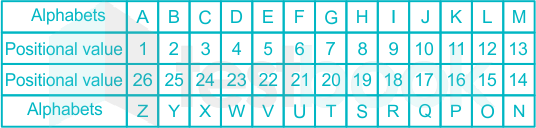
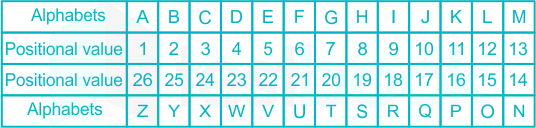
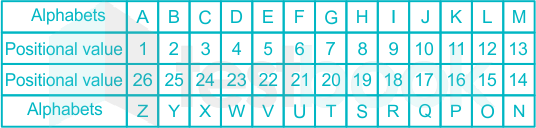
The table is alphabets place value:

Given:

Similarly,

Option(2)

Hence, "Option (2)" is the correct answer.

7

B's mother is the only daughter of F. C is the son of F and D. G is the son of C and E. F is the father of B’s mother. How is D related to G?

  1. ((a))

    Father’s sister

  2. ((b))

    Mother’s mother

  3. ((c))

    Father’s mother

  4. ((d))

    Mother’s sister

Show Answer
Answer: ((c))

Father’s mother

  1. B's mother is the only daughter of F.

  1. C is the son of F and D.

  1. G is the son of C and E.

  1. F is father of B's ​​mother.

Hence, D is the "Father’s mother" of G.

8

Seher rode her bicycle in the north direction. She turned left and rode for 7 km. She again turned left and rode for 5 km, after which she realised that she was 7 km towards west from her starting point. How many kimometres did she ride northwards from her starting point?

  1. ((a))

    12 km 

  2. ((b))

    5 km 

  3. ((c))

    7 km 

  4. ((d))

    3 km 

Show Answer
Answer: ((b))

5 km 

Drawing the diagram according to the given information,

  • Seher rode her bicycle in the north direction.
  • She turned left and rode for 7 km.
  • She again turned left and rode for 5 km.
  • Finally she was 7 km towards west from her starting point.


Hence, “5 km” is the correct answer.

9

How many such pairs of letters are there in the word NECTAR (both in the forward and backward directions) which have as many letters between them as there as there are in the English alphabetical order?

  1. ((a))

    One

  2. ((b))

    Three

  3. ((c))

    Two

  4. ((d))

    Zero 

Show Answer
Answer: ((c))

Two

The Place value Table:

Two pairs of word which have as many letters between them as there are in the English alphabetical order

Hence, "Two" is the correct answer.

10

The mean marks obtained by a class of 50 students are 75. The mean marks of half of the student is found to be 55. The mean marks of the remaining students are 

  1. ((a))

    95

  2. ((b))

    90

  3. ((c))

    100

  4. ((d))

    96

Show Answer
Answer: ((a))

95

Mean marks = Total marks of all students ÷ total students

So,

Total marks of all students = Mean marks × total students

Given:

1) Mean marks obtained by a class of 50 students are 75.

Total marks of all students = Mean marks × total students

= 75 × 50

= 3750

2) The mean marks of half (25) of the student are found to be 55.

Total marks of all students = Mean marks × total students

= 55 × 25

= 1375

3) Remaining 25 students total marks.

Total marks of reaming 25 students = Total marks of all students - Total marks of 25 students

= 3750 - 1375

= 2375

So,

4) The mean of the remaining 25 students

The mean of remaining 25 students = Total marks gain remaining 25 students ÷ 25

= 2375 ÷ 25

= 95

Hence, the mean of remaining students is ‘95’.

11

A statement is given followed by two conclusions. Find which conclusion(s) is/are true based on the given statement. 

Statement :

P < R < A = D ≠ E = F 

Conclusions :

I. D > R

II. P < D

  1. ((a))

    Neither I nor II

  2. ((b))

    Both I and II 

  3. ((c))

    Only II

  4. ((d))

    Only I 

Show Answer
Answer: ((b))

Both I and II 

The given statement is: P < R < A = D ≠ E = F 

Conclusions:

I. D > R → True (as R < A = D given; as R < A and A = D so D > R true)

II. P < D → True (as P < R < A = D; given as R < D and P < R so P < D true)

Hence, the correct answer is “Both I and II”.

12

In a certain code language, UNWILLINGNESS is written as FMDROORMTMVHH. How will PROCRSTINATION be written in that language? 

  1. ((a))

    MLRGZMRGIXLIK 

  2. ((b))

    KILXIHGRMZGRLM 

  3. ((c))

    NORZOMLIKGFDCA

  4. ((d))

    ACDFGKILMOZRON 

Show Answer
Answer: ((b))

KILXIHGRMZGRLM 

The table is alphabets place value:

The pattern followed here is:

UNWILLINGNESS is written as FMDROORMTMVHH

Similarly,

'PROCRSTINATION' = ?

Hence, 'PROCRSTINATION' is coded as "KILXIHGRMZGRLM".

Additional Information 

13

Select the option that is related to the third number in the same way as the second number is related to the first number and the sixth number is related to the fifth number. 

17 ∶ 292 ∶∶ 21 ∶ ? ∶∶ 15 ∶ 228

  1. ((a))

    364

  2. ((b))

    444

  3. ((c))

    308

  4. ((d))

    396 

Show Answer
Answer: ((b))

444

The pattern followed here is:

(1st number)2 + 3 = 2nd number

Now follow the steps:

17 ∶ 292 

= 172 + 3

= 289 + 3

= 292 = 2nd number

And,

15 ∶ 228 

= 152 + 3

= 225 + 3

= 228 = 2nd number

Similarly,

21  ?

= 212 + 3

= 441 + 3

= 444 = 2nd number

Hence, "444" is correct answer.

14

Select the option that is related to the third number in the same way as the second number is related to the first number and the sixth number is related to the fifth number. 

87 ∶ 126 ∶∶ 93 ∶ ? ∶∶ 117 ∶ 156

  1. ((a))

    132

  2. ((b))

    128

  3. ((c))

    141

  4. ((d))

    152

Show Answer
Answer: ((a))

132

The pattern followed here is:

1st number + 39 = 2nd number

Now follow the steps:

87 ∶ 126 

= 87 + 39

= 126 = 2nd number

And,

117 ∶ 156

= 117 + 39

= 156 = 2nd number

Similarly,

93  ?

= 93 + 39

= 132 = 2nd number

Hence, "132" is correct answer.

15

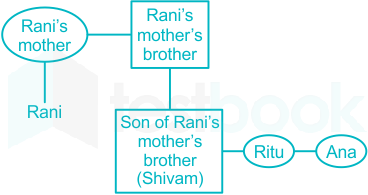
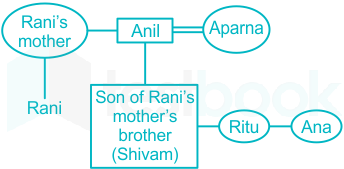
Shivam is the son of the brother of Rani's mother. Anil is married to Aparna, who is Ana's mother. Ritu and Ana are the sisters of Shivam. How is Rani related to Ritu?

  1. ((a))

    Sister

  2. ((b))

    Mother

  3. ((c))

    cousin

  4. ((d))

    sister in law

Show Answer
Answer: ((c))

cousin

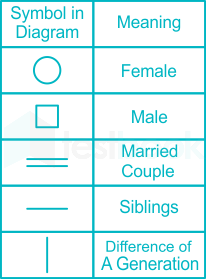
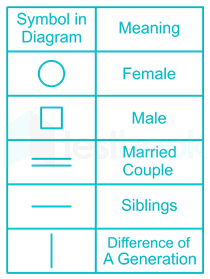
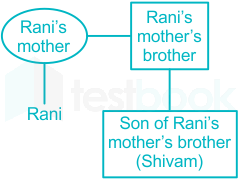
Preparing the family tree using the following symbols,

Given:

  1. Shivam is the son of the brother of Rani's mother.

  1. Ritu and Ana are the sisters of Shivam.

  1. Anil is married to Aparna, who is Ana's mother.

This Means Ana’s father is the brother of rani’s mother.

Hence, Rani is the "Cousin" of Ritu.

16

If 'M' means 3, '×' means '-', '÷' means '+' and '-' means '÷', select the number from among the given options that can replace the question mark (?) in the following equation. 

9 - M ÷ ? × 1 = 2

  1. ((a))

    6

  2. ((b))

    0

  3. ((c))

    4

  4. ((d))

    1

Show Answer
Answer: ((b))

0

Decoding the information, 

SignM×÷-
Means3-+÷

Given:

9 - M ÷ ? × 1 = 2

Let the question mark be z.

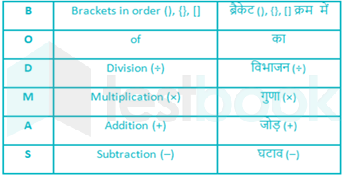
After replacing the signs from left to right and using the BODMAS rule,

=> 9 ÷ 3 + z - 1 = 2

=> 9 ÷ 3 + z - 1 = 2

=> 3 + z – 1 = 2

=>2 + z = 2

=> z = 2 - 2

=> z = 0

Hence, “0” is the correct answer.

17

Select the option in which the letter-clusters share the same relationship as that shared by the given pair of letter-clusters. 

AGM - FLR

  1. ((a))

    DJP - LRX

  2. ((b))

    MSX - BGH 

  3. ((c))

    MSV - DHJ 

  4. ((d))

    BKP - DGL 

Show Answer
Answer: ((a))

DJP - LRX

The table is alphabets place value:

Given:

Similarly,

Option(1)

Hence, "Option (1)" is the correct answer.

18

Read the given statement and conclusions carefully. Assuming that the information given in the statements is true, even if it appears to be at variance with commonly known facts, decide which of the given conclusions is true based on the given statement : 

Statement : P ≥ Q = Z ≤ S = M > N

Conclusions :

I. P ≥ Z 

II. P < S

  1. ((a))

    Both I and II are true 

  2. ((b))

    Neither I nor II is true 

  3. ((c))

    Only I is true 

  4. ((d))

    Only II is true 

Show Answer
Answer: ((c))

Only I is true 

The given statement is: P ≥ Q = Z ≤ S = M > N 

Conclusions:

I. P ≥ Z → True (as P ≥ Q = Z given; as P ≥ Q and Q = Z so P ≥ Z true).

II. P < S → False (as P ≥ Q = Z ≤ S gives either P ≤ S or P ≥ S and no definite relation between P and S can be determined).

Hence, the correct answer is “Only I is true”.

19

In the word VISION, if each vowel is replaced by the previous letter and each consonant is replaced with the next letter as per the English alphabet, then how many consonants will be there in the newly formed word? 

  1. ((a))

    4

  2. ((b))

    3

  3. ((c))

    5

  4. ((d))

    2

Show Answer
Answer: ((c))

5

Given word: “VISION”

According to the English alphabet series and its positional value:

Each vowel is replaced by the previous letter and then new word is:

“V H S H N N”

Each consonant is replaced with the next letter and then new word is:

W H T H N O

Total number of consonant is “5” (W, H, T, H, N)

Hence, total “5” consonants will be there in the newly formed word.

20

If + means -, - means ÷, ÷ means ×, and × means +, then which value can replace question mark (?) in the following euqation? 

91 - 13 ÷ 16 + 67 × 32 = ?

  1. ((a))

    79

  2. ((b))

    67

  3. ((c))

    77

  4. ((d))

    71

Show Answer
Answer: ((c))

77

Decoding the information, 

Sign+-÷×
Represents-÷×+

Given:

91 - 13 ÷ 16 + 67 × 32 = ?

After replacing the signs from left to right and using the BODMAS rule,

After replacing signs: 91 ÷ 13 × 16 - 67 + 32

91 ÷ 13 × 16 - 67 + 32

7 × 16 - 67 + 32

112 – 67 + 32

144 – 67

= 77

Hence, “77” is the correct answer.

Mental Ability 2 (20 questions)

21

Four figures have been given, out of which three are alike in some manner and one is different. Select the one that is different. 

  1. ((a))

  2. ((b))

  3. ((c))

  4. ((d))

Show Answer
Answer: ((b))

Now check all the options as compared with Option (1)

Note:- only the figure changes its position in a clockwise direction, not the figure rotates its own position.

Hence, "Option (2)" is a different one

22

Select the alphanumeric-cluster from among the given options that can replace the question mark (?) in the following series. 

ZX24, YW36, XV48, ?, VT72

  1. ((a))

    YW64

  2. ((b))

    WV64

  3. ((c))

    WU60

  4. ((d))

    XU60

Show Answer
Answer: ((c))

WU60

The table is alphabets place value:

The pattern followed here is:


Hence, 'WU60' is the correct answer.

23

Select the option in which the given figure is embedded (rotation is NOT allowed).

  1. ((a))

  2. ((b))

  3. ((c))

  4. ((d))

Show Answer
Answer: ((d))

Given figure:

Important Points 

  • The image must not be rotated.

Hence, option (4) is the correct answer.

24

In a class of 36 students, the number of girls is double the number of boys. The rank of Mayank's sister Kavyanshi is 12th from the top and the rank of 7 girls is higher than Kavyanshi. Find the number of girls whose ranks are lower than Kavyanshi. 

  1. ((a))

    15

  2. ((b))

    16

  3. ((c))

    17

  4. ((d))

    18

Show Answer
Answer: ((b))

16

Let,

The number of boys is = B

The number of girls is = G

Given:

1) In a class of 36 students, the number of girls is double the number of boys.

=> B + G = 36 ----------- (i)

=> G = 2B ----------- (ii)

From eq. (ii) putting the value of G in eq. (i)

=> 2B + B = 36

=> 3B = 36

=> B = 12

Putting the value of B in eq. (ii)

=> G = 2B = 2 × 12 = 24

=> G = 24

We know that,

2) The rank of Mayank's sister Kavyanshi is 12th from the top and the rank of 7 girls is higher than Kavyanshi.

=> Total number of girls = Girls whose ranks are upper than Kavyanshi + Girls whose ranks are lower than Kavyanshi + 1(Kavyanshi)

=> Girls whose ranks are lower than Kavyanshi = Total number of girls - Girls whose ranks are upper than Kavyanshi – 1

=> Girls whose ranks are lower than Kavyanshi = 24 – 7 – 1 = 24 – 8 = 16

Hence**, “16”** number of girls whose ranks are lower than Kavyanshi.

25

Select the figure from among the given options that can replace the question mark (?) in the following series. 

  1. ((a))

  2. ((b))

  3. ((c))

  4. ((d))

Show Answer
Answer: ((b))

The pattern followed here is:

  1. Figure 1st to 3rd one sign increase in the figure.

  2. Figure 2nd to 4th one sign increase in the figure.

  3. Figure 3rd to 5th one sign increase in the figure.

Final series is

Hence, ‘option 2’ is the correct answer.

26

Four letter-clusters have been given, out of which three are alike in some manner and one is different. Select the letter-cluster that is different. 

  1. ((a))

    QUT

  2. ((b))

    SWU

  3. ((c))

    CGE

  4. ((d))

    JNL 

Show Answer
Answer: ((a))

QUT

Table show alphabet serial number –

The pattern followed is,

All follow the same pattern, except 'QUT’.

Hence, “QUT” is the odd one.

27

Select the number from among the given options that can replace the question mark (?) in the following series. 

83, 74, ?, 47, 29

  1. ((a))

    68

  2. ((b))

    62

  3. ((c))

    64

  4. ((d))

    66

Show Answer
Answer: ((b))

62

The pattern followed here is:

Hence, '62' is the correct answer.

28

Select the number from among the given options that can replace the question mark (?) in the following series. 

41, 51, 77, 127, ?

  1. ((a))

    209

  2. ((b))

    216

  3. ((c))

    202

  4. ((d))

    213

Show Answer
Answer: ((a))

209

The pattern followed here is:

Hence, '209' is the correct answer.

29

Select the term that will come next in the following series. 

1 B 3 D 5, 7 H 9 J 11, 15 P 17 R 19, _ _ _ _ _ _

  1. ((a))

    8 H 9 V 13

  2. ((b))

    17 D 5 F 23 

  3. ((c))

    15 T 17 R 19 

  4. ((d))

    19 T 21 V 23 

Show Answer
Answer: ((d))

19 T 21 V 23 

The table is alphabets place value:

The logic is here is:

1 B 3 D 5, 7 H 9 J 11, 15 P 17 R 19

Similarly,

In option (3)

19 T 21 V 23 

Hence, "Option (4)" is the correct answer.

30

The sequence of folding a piece of paper and the manner in which the folded paper has been cut is shown in the following figures. How would this paper look when unfolded?

  1. ((a))

  2. ((b))

  3. ((c))

  4. ((d))

Show Answer
Answer: ((c))

The image obtained when the paper is unfolded is,

Hence, option 3 is the correct answer.

31

In a row of 83 students, Krishna and Swati stand 23rd from the left and 36th from the right, respectively. How many students are standing between Krishna and Swati?

  1. ((a))

    20

  2. ((b))

    22

  3. ((c))

    25

  4. ((d))

    24 

Show Answer
Answer: ((d))

24 

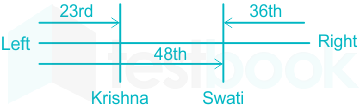
1)  In a row of 83 students, Krishna and Swati stand 23rd from the left and 36th from the right.

=> The number of students in the row = Swati position from the left + Swati position from the right - 1

=> Swati position from the left = The number of boys in the row - Swati position from the right + 1

=> Swati position from the left = 83 – 36 + 1 = 84 – 36 = 48

2) Krishan and Swati position from the left.

=> Students between Krishna and Swati = Swati position from the left - Krishna position from the left - 1

=> Students between Krishna and Swati = 48 - 23 – 1 = 48 – 24 = 24

Hence, total “24” students in the row.

32

Select the figure from among the given options that can replace the question mark (?) in the following series. 

  1. ((a))

  2. ((b))

  3. ((c))

  4. ((d))

Show Answer
Answer: ((d))

The figure that will replace the question mark (?) in the following figure series is shown below:

  • The upper right side figure shifted to the lower left side and flip vertically.
  • The lower left side figure is removed.
  • The new figure is added in place of the upper right side figure.

Final series is

Hence, ‘option 4’ is the correct answer.

33

Select the alphanumeric-cluster from among the given options that can replace the question mark (?) in the following series. 

D(-16)B, G(-10)E, J(-5)H, ?, P(2)N

  1. ((a))

    M(-1)K

  2. ((b))

    M(0)K

  3. ((c))

    N(1)L

  4. ((d))

    M(1)K

Show Answer
Answer: ((a))

M(-1)K

The table is alphabets place value:

The pattern followed here is:


Hence, 'M(-1)K' is the correct answer.

34

Four letter-clusters have been given, out of which three are alike in some manner and one is different. Select the one that is different. 

  1. ((a))

    EIO

  2. ((b))

    UIE

  3. ((c))

    IOU

  4. ((d))

    AEI

Show Answer
Answer: ((b))

UIE

The logic is here:

Total 5 Vowels in alphabets series: A, E, I, O, U

Now check all the options

1)  EIO → Ascending Order

2)  UIE → Descending order

3)  IOU → Ascending Order

4)  AEI → Ascending Order

Hence, “Option (2)”  is a different one.

35

Select the option that is related to Figure C in the same way as Figure B is related to Figure A. 

  1. ((a))

  2. ((b))

  3. ((c))

  4. ((d))

Show Answer
Answer: ((d))

The pattern followed here is:

  • The upper side figure flip vertically.

Similarly,

  • The upper side figure flip vertically.

Hence, 'Option (4)' is the correct answer.

36

Seven different coloured boxes, red, yellow, green, blue, magenta, purple, and orange, are kept one above the other but not necessarily in the same order. There are only four boxes between the yellow box and the blue box. The red box is just below the blue box and just above the purple box. The green box is kept at the bottom-most position. 

What is the colour of the box that is at the topmost position?

  1. ((a))

    Orange 

  2. ((b))

    Yellow 

  3. ((c))

    Magneta

  4. ((d))

    Blue 

Show Answer
Answer: ((d))

Blue 

Given:

  1. There are only four boxes between the yellow box and the blue box.
Case ICase II
BlueYellow
YellowBlue


  1. The red box is just below the blue box and just above the purple box.
Case ICase II
BlueYellow
Red
Purple
YellowBlue
Red
Purple


  • But case II is not possible because only seven boxes are available.
  1. The green box is kept at the bottom-most position.
Blue
Red
Purple
Yellow
Green


  • Only Magenta and Orange Colour are only left so the final arrangement is:
Blue
Red
Purple
Magenta / Orange
Magenta / Orange
Yellow
Green


Hence, “Blue” is the colour of the box that is at the topmost position.

37

Rad the given statements and conclusions carefully. Assuming that the information given in the statements is true, even if it appears to be at variance with commonly known facts, decide which of the given conclusions logically follow(s) from the statements. 

Statements :

All walls are windows.

All windows are not floors.

Conclusions :

I. Some floors are walls. 

II. All walls are not floors.

  1. ((a))

    Only conclusion II follows 

  2. ((b))

    Only conclusion I follows 

  3. ((c))

    Both the conclusions follow 

  4. ((d))

    Neither conclusion I nor II follows 

Show Answer
Answer: ((a))

Only conclusion II follows 

Statements:

  • All walls are windows.
  • All windows are not floors.

The least possible diagram for the given statements is as follows

  • Conclusions:

I. Some floors are walls → False (Because all walls are windows and no window is floor so  some floors are walls it is not possible)  

II. All walls are not floors → True (Because all walls are windows and no window is floor so definitely all walls are not floors )  

Hence, “Only conclusion II follows".

38

HIF is related to MNK in a certain way based on the English alphabetical order.  In the same way, RSP is related to WXU. To which of the following is JKH related, following the same logic? 

  1. ((a))

    OPN

  2. ((b))

    NOM

  3. ((c))

    OPM

  4. ((d))

    OPL

Show Answer
Answer: ((c))

OPM

The table is alphabets place value:

The pattern followed here is:

HIF is related to MNK

And,

RSP is related to WXU

Similarly,

Hence, 'JKH' is coded as "OPM".

In the following figure, the circle represents Technicians, the rectangle represents Uneducated and the triangle represents Self-employed.

39

Find out the Technicians who are Uneducated but NOT Self-employed. 

  1. ((a))

    D and E 

  2. ((b))

    E

  3. ((c))

    J and H 

  4. ((d))

Show Answer
Answer: ((b))

E

The shaded part represents Self-employed who are neither Technicians nor Uneducated.

The letter representing S the Technicians who are Uneducated but NOT Self-employed = E

Hence, ‘E’ is the correct answer.

40

Find out the Self-employed who are neither Technicians nor Uneducated. 

  1. ((a))

    C

  2. ((b))

    J

  3. ((c))

    E

  4. ((d))

    F

Show Answer
Answer: ((d))

F

The shaded part represents Self-employed who are neither Technicians nor Uneducated.


The letter representing Self-employed who are neither Technicians nor Uneducated  = F

Hence, ‘F’ is the correct answer.

General Awareness 1 (20 questions)

41

Which of the following is vector quantity?

  1. ((a))

    Momentum

  2. ((b))

    Speed

  3. ((c))

    Distance

  4. ((d))

    Temperature

Show Answer
Answer: ((a))

Momentum

The correct answer is Momentum.

Key Points

  • Vector quantities refer to the physical quantities characterized by the presence of both magnitudes as well as direction.
  • For example, displacement, force, torque, momentum, acceleration, velocity, etc.
  • Momentum is a property of a moving body that the body has by virtue of its mass and motion and that is equal to the product of the body's mass and velocity.
  • Isaac Newton's second law of motion states that the time rate of change of momentum is equal to the force acting on the particle.

Additional Information

  • Speed:
  • Speed is the distance of a moving object in a given amount of time. Speed is also the distance covered by an object per unit time.
  • Speed is a scalar quantity. SI unit of Speed is meter per second.
  • Distance:
  • Distance is a numerical measurement of how far apart objects or points are.
  • Distance is a scalar quantity as it does not include any direction in its representation. SI unit of distance is a meter.
  • Temperature:
  • Temperature is a physical quantity that expresses how hot matter is, or as a measure of the average kinetic energy per atom or molecule in the system.
  • Temperature is measured with a thermometer.
  • The most common scales are the Celsius scale (formerly called "centigrade", denoted as °C), the Fahrenheit scale (denoted as °F), and the Kelvin scale (denoted as K).
42

Which of the following is the main cause of winter rain in the north-western Indian region?

  1. ((a))

    Eastern disturbance 

  2. ((b))

    Southern disturbance 

  3. ((c))

    Western disturbance 

  4. ((d))

    Northern disturbance 

Show Answer
Answer: ((c))

Western disturbance 

The correct answer is Western Disturbance

Key Points

  • The winter rains caused by Western Disturbance in the North-Western Plain of India gradually decreases from West to East as they gradually lost their effectiveness.
  • Western Disturbance originates in the Mediterranean Sea as extratropical cyclones. A high-pressure area over Ukraine and neighborhood consolidates, causing the intrusion of cold air from Polar Regions towards an area of relatively warmer air with high moisture region.
  • This generates favorable conditions for cyclogenesis in the upper atmosphere, which promotes the formation of an east-direction moving extratropical depression.
  • They gradually travel across the middle-east from Iran, Afghanistan, and Pakistan to enter India.

Additional Information

  • Western Disturbances:
  • It plays important role in bringing moderate to heavy rain in low-lying areas and heavy snow to mountainous areas of the Indian Subcontinent.
  • This disturbance is usually associated with a cloudy sky, higher night temperatures, and unusual rain.
  • This precipitation has great importance in agriculture, particularly for the Rabi crops, for example - Wheat.
  • However excessive precipitation due to this disturbance can cause crop damage, landslides, floods, and avalanches.
  • Over the Indo-Gangetic plains, it occasionally brings cold wave conditions and dense fog.
  • These conditions remain stable until disturbed by another western disturbance.
  • When western disturbances move across northwest India before the onset of the monsoon, a temporary advancement of the monsoon current appears over the region.
43

Who among the following was the first Indian para paddler to win a medal (Silver) at the Tokyo Paralympics 2020?

  1. ((a))

    Avni Lekhara

  2. ((b))

    Suhas Yathiraji

  3. ((c))

    Nishad Kumar

  4. ((d))

    Bhavinaben Patel

Show Answer
Answer: ((d))

Bhavinaben Patel

The correct answer is Bhavinaben Patel

Key Points

  • Bhavinaben Patel is an Indian parathlete and table tennis player from Mehsana, Gujarat.
  • She won a silver medal in Class 4 Table tennis at the 2020 Summer Paralympics in Tokyo.
  • Tokyo 2020 Paralympic Games, was an international multi-sport parasports event held from 24 August to 5 September 2021 in Tokyo, Japan.
  • There were the 16th Summer Paralympic Games as organized by the International Paralympic Committee.

Additional Information

  • Avani Lekhara:
  • Avani Lekhara is an Indian Paralympian and rifle shooter. She belongs to Rajasthan.
  • She won a Gold Medal in 10m air rifle standing and a Bronze Medal in 50m rifle 3 positions at Tokyo 2020 Paralympics.
  • She is also the first Indian woman to win multiple medals in a single Paralympic Games.
  • Suhas Lalinakere Yathiraj:
  • Suhas Lalinakere Yathiraj is an Indian professional Para-Badminton player currently ranked world No.2 in Men's Singles.
  • He is a silver medalist in the SL-4 category in Tokyo Paralympics 2021.
  • He is the only IAS officer in India to win a Paralympic medal and an Arjuna Award.
  • Nishad Kumar:
  • Nishad Kumar is an Indian Paralympian and high jumper.
  • He made his maiden Paralympic Games appearance in 2020 Tokyo representing India and went on to claim a silver medal in the men's high jump T47 category with a new Asian record of 2.06m.
44

Elelakkaradi, Kadarkali, Kurumbarkali are all tribal dances associated with which of the following states? 

  1. ((a))

    Assam 

  2. ((b))

    Kerala 

  3. ((c))

    Karnataka 

  4. ((d))

    Manipur 

Show Answer
Answer: ((b))

Kerala 

The correct answer is Kerala

Key Points

  • ​Elelakkaradi:
  • Elelakkaradi is a tribal dance that is common in districts like Palakkad situated in Kerala state, India.
  • This is a whole community dance that is performed by women, men & children. The theme of Elelakkaradi is related to the fight of people against bears.
  • The instrument used in Elelakkaradi is the drum. In Elelakkaradi, a mood of heroism is created by the participants.
  • ​Kathakali: 
  • Kathakali is the most well-known dance drama from Kerela.
  • The word Kathakali literally means "Story-Play". It is known for its large, elaborate makeup and costumes.
  • Kurumbarkali:​
  • Kurumbarkali dance performance is conducted by the Kurumba tribe on marriage occasions.
  • The relatives of the bride and bride groom perform this dance before marriage while the bride and the groom perform it after marriage.

Additional Information

  • Assam - Bihu
  • Bihu is the most popular folk dance in Assam.
  • Bihu dances are performed by young boys and girls during the Bihu festivities which represent youthful passion, reproductive urge, and joy.
  • Karnataka - Dollu Kunitha
  • Dollu Kunitha is a traditional dance form in Karnataka.
  • Dollu Kunithâ is high on energy and is performed all over the state during major festivals and celebrations.
  • Manipur - Raas Leela
  • The Manipuri Dance also referred to as the Manipuri Raas Leela, is one of the eight major Indian classical dance forms, originating from the state of Manipur.
  • The dance form is imbued with the devotional themes of Madhura Raas of Radha-Krishna and is characterized by gentle eyes and soft peaceful body movements.
45

A separate region of the brain, located behind the medulla oblongata and the pons, is called the:

  1. ((a))

    sternum 

  2. ((b))

    synapse 

  3. ((c))

    cerebellum 

  4. ((d))

    vomer 

Show Answer
Answer: ((c))

cerebellum 

The correct answer is Cerebellum

Key Points

  • The cerebellum (“little brain”) is a structure that is located at the back of the brain, underlying the occipital and temporal lobes of the cerebral cortex.
  • It is located behind the medulla oblongata and the pons.
  • Although the cerebellum accounts for approximately 10% of the brain's volume, it contains over 50% of the total number of neurons in the brain.
  • In humans, the cerebellum plays an important role in motor control.
  • It may also be involved in some cognitive functions such as attention and language as well as emotional control such as regulating fear and pleasure responses.
  • Cerebellar damage produces disorders in fine movement, equilibrium, posture, and motor learning in humans.

Additional Information

  • Sternum:
  • The sternum is a partially T-shaped vertical bone that forms the anterior portion of the chest wall centrally.
  • The sternum is divided anatomically into three segments: manubrium, body, and xiphoid process.
  • The sternum connects the ribs via the costal cartilages forming the anterior rib cage.
  • Synapses: 
  • Synapses are part of the circuit that connects sensory organs, like those that detect pain or touch, in the peripheral nervous system to the brain.
  • Synapses connect neurons in the brain to neurons in the rest of the body and from those neurons to the muscles.
  • A synaptic connection between a neuron and a muscle cell is called a neuromuscular junction.
  • Vomer:
  • The vomer is a small, thin, plow-shaped, midline bone that occupies and divides the nasal cavity.
  • The main function of the vomer is to form the nasal septum together with the perpendicular plate of the ethmoid bone and the nasal septal cartilage.
46

Who among the following musicians is related to Flute?

  1. ((a))

    Sultan Khan

  2. ((b))

    Hari Prasad Chaurasia

  3. ((c))

    Ravi Shankar

  4. ((d))

    Sandeep Das

Show Answer
Answer: ((b))

Hari Prasad Chaurasia

The correct answer is Hari Prasad Chaurasia.

Key Points

  • Hariprasad Chaurasia is an Indian music director and classical flautist, who plays the flute, in the Hindustani classical tradition.
  • The 2013 documentary film Bansuri Guru features the life and legacy of Chaurasia.
  • He was awarded  Padma Vibhushan in 2000.
  • Official Biography 'Breath of Gold' by Sathya Saran- 2019.
  • The flute is a family of classical music instruments in the woodwind group. Unlike woodwind instruments with reeds, a flute is an aerophone or reedless wind instrument that produces its sound from the flow of air across an opening.

Additional Information

  • Sultan Khan: 
  • Ustad Sultan Khan was an Indian sarangi player and classical vocalist belonging to Sikar Gharana.
  • He was one of the founding members of the Indian fusion group Tabla Beat Science, with Zakir Hussain and Bill Laswell.
  • He was awarded the Padma Bhushan, India's third highest civilian honour, in 2010.
  • Ravi Shankar:
  • Ravi Shankar was an Indian sitarist and composer.
  • A sitar, he became the world's best-known exponent of North Indian classical music in the second half of the 20th century.
  • Shankar was awarded India's highest civilian honour, the Bharat Ratna, in 1999.
  • Sandeep Das:
  • Sandeep Das is an Indian Tabla player and composer currently based in Boston, MA.
  • His collaboration with Yo-Yo Ma for The Silk Road Ensemble - Sing Me Home - won the Grammy award for Best World Music Album at the 59th Grammy Awards, 2017.
47

Where is the Mahabodhi Temple located? 

  1. ((a))

    Sanchi 

  2. ((b))

    Ellora

  3. ((c))

    Bodh Gaya 

  4. ((d))

    Patna 

Show Answer
Answer: ((c))

Bodh Gaya 

The correct answer is Bodh Gaya

Key Points

  • The Mahabodhi Temple (literally: "Great Awakening Temple") a UNESCO World Heritage Site, is an ancient, but much rebuilt and restored, a Buddhist temple in Bodh Gaya, marking the location where the Buddha is said to have attained enlightenment.
  • The site contains a descendant of the Bodhi Tree under which Buddha gained enlightenment, and has been a major pilgrimage destination for Buddhists.
  • The temple complex includes two large straight-sided shikhara towers, the largest over 55 metres (180 feet) high.
  • This is a stylistic feature that has continued in Jain and Hindu temples to the present day, and influenced Buddhist architecture in other countries, in forms like the pagoda.

Additional Information

Sanchi:

  • Sanchi is a Buddhist complex, famous for its Great Stupa, on a hilltop at Sanchi Town in Raisen District of the State of Madhya Pradesh.
  • The Great Stupa at Sanchi is one of the oldest stone structures in India and an important monument of Indian Architecture.
  • It was originally commissioned by the Mauryan emperor Ashoka the Great in the 3rd century BCE.
  • Sanchi Stupa is depicted on the reverse side of the Indian currency note of ₹200 to signify its importance to Indian cultural heritage.

Ellora:

  • Ellora is a UNESCO World Heritage Site located in the Sambhaji Nagar district of Maharashtra, India.
  • It is one of the largest rock-cut Hindu temple cave complexes in the world, with artwork dating from the period 600–1000 CE.
  • Cave 16 features the largest single monolithic rock excavation in the world, the Kailash temple, a chariot-shaped monument dedicated to the god Shiva.

Patna:

  • Once the capital of the mighty Mauryan emperor Ashoka, Kusumpura (as Patna was then called), transformed into Pushpapura, followed by Pataliputra and Azeemabad to finally become Patna.
  • Buddhist, Hindu, and Jain pilgrimage centres of Vaishali, Rajgir, Nalanda, Bodh Gaya, and Pawapuri are nearby and Patna City is a sacred city for Sikhs as the tenth Sikh Guru, Guru Gobind Singh was born here.
48

Radhe Shyam Barle was awarded Padma Shri in 2021 for promoting which of the following states' Panthi folk dance? 

  1. ((a))

    Jharkhand 

  2. ((b))

    Uttar Pradesh 

  3. ((c))

    Chhattisgarh 

  4. ((d))

    Madhya Pradesh 

Show Answer
Answer: ((c))

Chhattisgarh 

The correct answer is Chhattisgarh

Key Points

  • Radhe Shyam Barle is a Panthi folk dancer and artist.
  • Barle has made his contribution to promoting and disseminating the messages of Baba Guru Ghasidas through Panthi, a folk dance form in Chhattisgarh.
  • Panthi dance is one of the important dance forms in the Chhattisgarh State of India.
  • This Indian folk dance is basically a prominent ritual of the Satnami community of Chhattisgarh.
  • The dance is very expressive in its depiction and is performed to the accompaniment of melodious songs.

Additional Information

Paika - Jharkhand

  • Paika is one of the very famous dance forms of Jharkhand.
  • In fact, it is a dance form where martial arts are mixed with some other dance steps. This is why the dance form is only performed by the male members of society.

Charkula - Uttar Pradesh

  • Charkula is a dance performed in the Braj region of Uttar Pradesh.
  • In this dance, veiled women balancing large multi-tiered circular wooden pyramids on their heads dance to songs about Krishna.
  • Each pyramid has 108 lighted oil lamps arranged in a spiral. It is specially performed on the third day after Holi.

Jawara - Madhya Pradesh

  • Jawara dance is a popular folk dance of Madhya Pradesh. It is mainly famous in the Bundelkhand region among the peasant community.
  • People from rural areas come together to share happiness after reaping a good harvest.
49

Who among the following set a New National Record of 88.07 Metres Javelin throw in the Indian Grand Prix held in March 2021 at Patiala? 

  1. ((a))

    Shivpal Singh 

  2. ((b))

    Davinder Singh Kang 

  3. ((c))

    Neeraj Chopra 

  4. ((d))

    Devendra Jhajaria 

Show Answer
Answer: ((c))

Neeraj Chopra 

The correct answer is Neeraj Chopra

Key Points

  • Neeraj Chopra is an Indian track and field athlete who is the reigning Olympic champion and world championship silver medalist in the javelin throw.
  • He is the first Asian athlete to win an Olympic gold medal in the men's javelin throw.
  • He set a New National Record of 88.07 Metres Javelin throw in the Indian Grand Prix held in March 2021 at Patiala prior to the Olympics.
  • The javelin throw is a track and field event where the javelin, a spear about 2.5 m in length, is thrown.
  • The javelin thrower gains momentum by running within a predetermined area. Javelin throwing is an event of both the men's decathlon and the women's heptathlon.

Additional Information 

  • Shivpal Singh:
  • Shivpal Singh is an Indian javelin thrower and a Senior Non-Commissioned Officer (SNCO) in Indian Air Force.
  • He finished eighth at the 2018 Asian Games and won the silver medal at the 2019 Asian Championships.
  • Davinder Singh Kang:
  • Davinder Singh Kang is an Indian track and field athlete who competes in the javelin throw event.
  • Kang won the bronze medal at the 2017 Asian Athletics Championships with a throw of 83.29m.
  • Devendra Jhajharia:
  • Devendra Jhajharia is an Indian Paralympic javelin thrower competing in F46 events.
  • He is the first Indian Paralympics player to win two gold medals at the Paralympics.
  • He becomes India's most decorated Paralympic player by winning his third medal, a silver at the 2020 Summer Paralympics in Tokyo.

Important Points

  • Neeraj Chopra's Olympic gold medal-winning throw of 87.58 m at Tokyo 2020 is 2.36m short of his personal best.
50

Which of the following is a correct formula?

  1. ((a))

    Personal Income (PI) ≡ NI - Undistributed profits - Net interest payments made by households - Corporate tax + Transfer payments to the households from the government and firms 

  2. ((b))

    Personal Income (PI) ≡ NI - Undistributed profits - Net interest payments made by households + Transfer payments to be households from the government and firms

  3. ((c))

    Personal Income (PI) ≡ NI + Undistributed profits - Net interest payments made by households - Corporate tax + Transfer payments to the households from the government and firms

  4. ((d))

    Personal Income (PI) ≡ NI - Undistributed profits - Net interest payments made by households - Corporate tax - Transfer payments to the households from the government and firms

Show Answer
Answer: ((a))

Personal Income (PI) ≡ NI - Undistributed profits - Net interest payments made by households - Corporate tax + Transfer payments to the households from the government and firms 

The correct answer is Option 1, i.e.,

Personal Income (PI) = NI - Undistributed profits - Net interest payments made by households - Corporate tax + Transfer payments to the households from the government and firms.

Key Points

Personal Income:

  • From the National Income (NI), which is earned by the firms and government enterprises, a part of the profit is not distributed among the factors of production. This is called Undistributed Profits (UP).
  • We have to deduct UP from NI to arrive at Pl since UP does not accrue to the households.
  • Similarly, Corporate Tax, which is imposed on the earnings made by the firms, will also have to be deducted from the NI, since it does not accrue to the households.
  • On the other hand, the households do receive interest payments from private firms or the government on past loans advanced by them.
  • And households may have to pay interests to the firms and the government as well, in case they had borrowed money from either.
  • So we have to deduct the net interests paid by the households to the firms and government.
  • The households receive transfer payments from the government and firms (pensions, scholarships, prizes, for example) which have to be added to calculate the Personal Income of the households.

Additional Information

  • Personal Disposable Income:
  • When direct taxes are subtracted from personal income, then it is called disposable personal income (DPI).
  • Disposable personal income (DPI) = [Personal income] - [Direct Taxes]
51

Who became the first Indian Prime Minister to chair a meeting of the United Nations Security Council in virtual mode?

  1. ((a))

    Atal Bihari Vajpayee 

  2. ((b))

    Manmohan Singh 

  3. ((c))

    Rajiv Gandhi 

  4. ((d))

    Narendra Modi 

Show Answer
Answer: ((d))

Narendra Modi 

The correct answer is Narendra Modi.

Key Points

  • Indian Prime Minister Narendra Modi became the first Indian PM to head the United Nations Security Council (UNSC) meeting.
  • The meeting was held through video-conferencing and was attended by two presidents, of Russia and Kenya, two prime ministers, of India and Vietnam, and 10 ministers, seven of whom were foreign ministers -- a high level of participation for a UNSC meeting.

United Nations Security Council (UNSC) ​

  • Established in 1945.
  • One of the five principal organs of the United Nations.
  • It is the only UN body with the authority to issue binding resolutions to member states.
  • The most important function of the UNSC is maintaining peace and security at the international level.
  • A total of 15 members are there in the Council, out of which 5 are permanent and 10 are not permanent.
  • The five permanent members include China, France, the Russian Federation, the United Kingdom, and the United States.
  • India is one of the 10 non-permanent members.
  • The First Session of the UN Council was held in London on 17th January 1947.

Narendra Modi:

  • Narendra Modi is an Indian politician serving as the 14th and current prime minister of India since 2014.
  • He was the chief minister of Gujarat from 2001 to 2014 and is the Member of Parliament from Varanasi.
  • He is the first prime minister to have been born after India's independence in 1947 and the second prime minister not belonging to the Indian National Congress.
  • He is also the longest serving prime minister from a non-Congress party.

Additional Information

Atal Bihari Vajpayee:

  • Atal Bihari Vajpayee was an Indian politician and diplomat who served three terms as the prime minister of India, first for a term of 13 days in 1996, then for a period of 13 months from 1998 to 1999, followed by a full term from 1999 to 2004.
  • Vajpayee was one of the co-founders and a senior leader of the Bhartiya Janata Party.
  • He was the first Indian prime minister not of the Indian National Congress to serve a full term in office.

Dr. Manmohan Singh:

  • Manmohan Singh is an Indian economist and statesman who was the 13th prime minister of India from 2004 to 2014.
  • He was the first Sikh prime minister of India.
  • During the 1970s and 1980s, he held several key posts in the Government of India, such as Chief Economic Advisor (1972–1976), governor of the Reserve Bank (1982–1985) and head of the Planning Commission (1985–1987). He also served as Finance Minister in 1991.

Rajiv Gandhi: 

  • Rajiv Gandhi was an Indian politician who served as the sixth prime minister of India from 1984 to 1989.
  • He became the youngest Indian Prime minister at the age of 40.
52

Approximately how far is the Sun from the Earth?

  1. ((a))

    160 million km 

  2. ((b))

    180 million km 

  3. ((c))

    170 million km 

  4. ((d))

    150 million km 

Show Answer
Answer: ((d))

150 million km 

The correct answer is 150 Million km.

Key Points

  • The astronomical unit (AU) is a unit of length, roughly the distance from Earth to the Sun and equal to 150 million kilometers (93 million miles) or 8.3 light minutes.
  • The actual distance from Earth to the Sun varies by about 3% as Earth orbits the Sun, from a maximum (aphelion) to a minimum (perihelion)
  • The astronomical unit is used primarily for measuring distances within the Solar System or around other stars.

Additional Information

  • The Solar System is the gravitationally bound system of the Sun and the objects that orbit it.
  • The four inner system planets—Mercury, Venus, Earth, and Mars—are terrestrial planets, being composed primarily of rock and metal.
  • The four giant planets of the outer system are substantially larger and more massive than the terrestrials. The two largest, Jupiter and Saturn, are gas giants, being composed mainly of hydrogen and helium; the next two, Uranus and Neptune, are ice giants, being composed mostly of volatile substances with relatively high melting points.
  • All eight planets have nearly circular orbits that lie near the plane of Earth's orbit, called the ecliptic.
53

Where does a Western Disturbance originate? 

  1. ((a))

    Mediterranean Sea 

  2. ((b))

    Arabian Sea 

  3. ((c))

    Pacific Ocean 

  4. ((d))

    Atlantic Ocean 

Show Answer
Answer: ((a))

Mediterranean Sea 

The correct answer is Mediterranean Sea.

Key Points

  • Western Disturbances:
  • The western cyclonic disturbances are weather phenomena of the winter months brought in by the westerly flow from the Mediterranean region.
  • Western Disturbances develop in the mid-latitude region (north of the Tropic of Cancer), not in the tropical region, therefore they are called mid-latitude storms or extra-tropical storms.
  • A high-pressure area over Ukraine and the neighbourhood consolidates, causing the intrusion of cold air from Polar Regions towards an area of relatively warmer air with high moisture.
  • This generates favourable conditions for cyclogenesis in the upper atmosphere, which promotes the formation of an eastward-moving extratropical depression.
  • They gradually travel across the middle-east from Iran, Afghanistan, and Pakistan to enter the Indian sub-continent.

Additional Information 

  • Impact of Western disturbance:
  • Western disturbances play an important role in bringing moderate to heavy rain in low-lying areas and heavy snow to mountainous areas of the Indian Subcontinent.
  • This disturbance is usually associated with a cloudy sky, higher night temperatures, and unusual rain.
  • Precipitation during the winter season has great importance in agriculture particularly for rabi crops including wheat, which is one of the most important Indian crops.
  • Weak western disturbances are associated with crop failure and water problems across north India.
54

In which year was the National Institute of Kathak established as the Constituent Unit of Sangeet Natak Academy? 

  1. ((a))

    1951

  2. ((b))

    1964

  3. ((c))

    1953

  4. ((d))

    1952

Show Answer
Answer: ((b))

1964

The correct answer is 1964.

Key Points

  • National Institute of Kathak Dance, also known as Kathak Kendra.
  • It was Established in 1964 (the institution became a part of the Sangeet Natak Akademi).
  • It is the premier dance institution for the Indian classical dance form of Kathak, and a unit of the Sangeet Natak Akademi, India's National Academy of Music, Dance and Drama, situated in New Delhi.
  • The institution is primarily dedicated to Kathak, though it also offers courses in Hindustani classical music (Vocal) and Pakhawaj and Tabla.
  • Kathak Kendra was originally established as the Kathak wing of the Shriram Bharatiya Kala Kendra, in 1955, through the efforts of Nirmala Joshi, the first secretary of the Sangeet Natak Akademi.
  • Here Pandit Shambhu Maharaj, celebrated Guru of the Lucknow Gharana (school) of Kathak, was head of the department.
  • Shambhu Maharaj received the highest award of the Sangeet Natak Akademi, the Sangeet Natak Akademi Fellowship in 1967.
  • Birju Maharaj a Kathak dancer was his nephew.

Additional Information

Sangeet Natak Akademi

  • The Sangeet Natak Akademi is constituted of three main units. The two of these units are dance teaching Institutes, as given below.
  1. Jawaharlal Nehru Manipur Dance Academy, called JNMDA located in Imphal.
  2. Kathak Kendra is located in Delhi.
  • The President of India appoints the chairman of this Akademi.
  • The term of office for the chairman is of 5 years.
  • The duties, responsibilities, and functions of Sangeet Natak Akademi have been described in the Academy’s Memorandum of Association.
  • This memorandum was adopted on 11 September 1961.
55

Which solution is used to test the presence of starch in food?

  1. ((a))

    Iodine solution 

  2. ((b))

    Ammonium chloride 

  3. ((c))

    Copper sulphate solution 

  4. ((d))

    Chlorine solution 

Show Answer
Answer: ((a))

Iodine solution 

The correct answer is Iodine solution 

Key Points

  • The chemical test for starch is done by adding the iodine solution and the change in colour to blue or black results in the presence of starch.
  • The iodine which is the liquid that is used for the test is used to detect the presence of carbohydrates and thus the presence of starch.
  • Starch is produced within the green leaves of plants, they act as reserve food materials in the plants.
  • Food such as corn, wheat, rice, potatoes, etc. contains starch. In humans, starch is broken down into sugar molecules and supplies energy.

Additional Information

  • Starch is the organic substance that is produced by the plants, it is granular and white.
  • In a chemical test, iodine is used to determine the presence of starch with the help of a potato.
  • In plant tissue, it diffuses from one cell to another and nourishes it.
  • The disintegration of the starch is done with the help of various enzymes and water which converts the starch into monomer glucose units.
  • Ammonium chloride: It is used as a systemic acidifying agent in the treatment of severe metabolic alkalosis, in oral acid loading tests to diagnose distal renal tubular acidosis, and to maintain the urine at an acid pH in the treatment of some urinary-tract disorders.
  • Copper sulphate: It is used to test blood for anaemia. The blood is tested by dropping it into a solution of copper sulfate of known specific gravity – blood that contains sufficient haemoglobin sinks rapidly due to its density, whereas blood that does not sink or sinks slowly has an insufficient amount of haemoglobin.
  • Chlorine solution: Colorimeters typically detect chlorine in the range of 0 to 5 parts per million (ppm). Test for chlorine in water inline is based on the amperometric method. In this method, chlorine is measured by a sensor probe containing the electrolyte potassium chloride (KCl).
56

What types of rocks are formed when magma (molten rock) cools and crystallizes?

  1. ((a))

    Sedimentary Rocks

  2. ((b))

    Igneous Rocks

  3. ((c))

    Metamorphic Rock

  4. ((d))

    Geomorphic Rocks

Show Answer
Answer: ((b))

Igneous Rocks

The correct answer is Igneous Rocks

Key Points

  • Igneous Rocks are formed by crystallization from a liquid or magma.
  • Magma is a mixture of liquid rock, crystals, and gas with a wide range of chemical compositions, temperatures, and properties of a liquid.
  • There are two types of Igneous rocks based on their mode of occurrence:
  1. Volcanic or extrusive igneous rocks form when the magma cools and crystallizes on the surface of the Earth
  2. Intrusive or plutonic igneous rocks wherein the magma crystallizes at depth in the Earth.
  • Extrusive igneous rocks
  • As lava cools very rapidly on coming out of the hot interior of the earth, the mineral crystals forming these rocks are very fine.
  • These rocks are also called volcanic rocks. Basalt is a very common example of such rocks.
  • These rocks are found in volcanic areas.
  • Deccan plateau's regur soil in India is a formation of lava.
  • Intrusive igneous rocks
  • The rate of cooling below the earth's surface is very slow, which gives rise to the formation of large crystals in the rocks.
  • Deep-seated intrusive rocks are termed plutonic rocks and shallow-depth intrusive rocks are termed as hypabyssal. Granite is a common example of intrusive rocks.

Additional Information

  • Sedimentary rocks:
  • Sedimentary rocks are types of rock that are formed by the accumulation or deposition of mineral or organic particles at Earth's surface, followed by cementation.
  • Metamorphic rocks:
  • Metamorphic rocks arise from the transformation of existing rock into new types of rock in a process called metamorphism.
57

What does the china rose indicator turn basic solutions to? 

  1. ((a))

    Green 

  2. ((b))

    Purple 

  3. ((c))

    Pink

  4. ((d))

    Red 

Show Answer
Answer: ((a))

Green 

The correct answer is Green

Key Points

  • China rose is an indicator which is derived from the Hibiscus plant.
  • China's rose is a natural indicator.
  • It turns an Acidic solution into dark pink/magenta colour.
  • It turns a Basic solution into a Green colour.

Additional Information

  • Acid-Base indicators (also known as pH indicators) are substances which change colour with pH.
  • Weak acids and bases are indicators. All indicators are weak acids.
  • Three common indicators are litmus, phenolphthalein and methyl orange.
58

Which state has India's first International Institute of Advanced Virology, the first phase of which was inaugurated in October 2020?

  1. ((a))

    Odisha 

  2. ((b))

    Kerala 

  3. ((c))

    Gujarat 

  4. ((d))

    Karnatak 

Show Answer
Answer: ((b))

Kerala 

The correct answer is Kerala

Key Points

  • The International Institute of Advanced Virology has been established by the Government of Kerala.
  • It is established in the wake of the 2018 Nipah virus outbreak in Kerala.
  • It is situated in Thiruvananthapuram and is also affiliated with the Global Virus Network.

Additional Information

  • Virology is the scientific discipline concerned with the study of the biology of viruses and viral diseases, including the distribution, biochemistry, physiology, molecular biology, ecology, evolution and clinical aspects of viruses.
  • Martinus Beijerinck is often called the Father of Virology.
  • The National Institute of Virology in Pune is an Indian virology research institute and part of the Indian Council of Medical Research (ICMR).
  • It has been designated as a WHO H5 reference laboratory for the SE Asia region.
59

The distance unit _______ is defined as the length of the side adjacent to the vertex occupied by a star whose parallax angle is one arc second. 

  1. ((a))

    Angstrom 

  2. ((b))

    Parsec 

  3. ((c))

    Fermi

  4. ((d))

    Light year 

Show Answer
Answer: ((b))

Parsec 

The correct answer is Parsec

Key Points

  • The parsec is a unit of length used to measure the large distances to astronomical objects outside the Solar System.
  • Parsec is obtained by the use of parallax and trigonometry and is defined as the distance at which 1 au subtends an angle of one arcsecond.
  • Thus, the distance unit Parsec is defined as the length of the side adjacent to the vertex occupied by a star whose parallax angle is one arc second.
  • The nearest star, Proxima Centauri, is about 1.3 parsecs (4.2 light-years) from the Sun.
  • It is roughly equivalent to 3.26 light-years or 206,000 astronomical units, or 30.9 trillion kilometers (19.2 trillion miles).

Additional Information

  • Angstrom:
  • An angstrom is a metric unit of length equal to 10⁻¹⁰ m.
  • The angstrom is often used in the natural sciences and technology to express sizes of atoms, molecules, microscopic biological structures, lengths of chemical bonds, arrangement of atoms in crystals and wavelengths of electromagnetic radiation.
  • Fermi:
  • Fermi or Femtometer is an SI unit of length equal to 10-15 metres, which means a quadrillionth of one metre.
  • It is a typical length-scale of nuclear physics.
  • Light year:
  • A light year is a distance travelled by light moving in a vacuum in the course of one year.
  • A light-year is a distance a beam of light travels in a single Earth year, which equates to approximately 6 trillion miles (9.7 trillion kilometres)
60

Sodium is kept in which of the following oils?

  1. ((a))

    Mustard oil 

  2. ((b))

    Palm oil 

  3. ((c))

    Coconut oil 

  4. ((d))

    Kerosene 

Show Answer
Answer: ((d))

Kerosene 

The correct answer is Kerosene

Key Points

  • Sodium is a chemical element with the symbol Na and atomic number 11. It is a soft, silvery-white, highly reactive metal.
  • Sodium is a highly reactive metal and reacts vigorously with the oxygen, carbon dioxide and moisture present in the air such that it may even cause a fire.
  • To prevent this explosive reaction, Sodium is kept immersed in kerosene because Sodium doesn't react with kerosene.

Additional Information

  • Mustard oil:
  • Mustard oil can mean either the pressed oil used for cooking, or a pungent essential oil also known as the volatile oil of mustard.
  • Pure mustard oil and mustard essential oil may help reduce inflammation and pain, slow cancer cell growth, block microbial growth, and enhance hair and skin health.
  • Palm oil: 
  • Palm oil is an edible vegetable oil derived from the mesocarp of the fruit of the oil palms.
  • The oil is used in food manufacturing, beauty products, and as biofuel.
  • Coconut oil:
  • Coconut oil is an edible oil derived from the wick, meat, and milk of coconut palm fruit.
  • It's full of fatty acids that the body needs and may help improve cognitive function, metabolism, and hair and skin health.

General Awareness 2 (20 questions)

61

In which of the following sessions did the split in the Indian National Congress occur?

  1. ((a))

    Lahore Session, 1929

  2. ((b))

    Lucknow Session, 1916

  3. ((c))

    Surat Session, 1907

  4. ((d))

    Calcutta Session, 1928 

Show Answer
Answer: ((c))

Surat Session, 1907

The correct answer is Surat Session, 1907.

Key Points

  • The Surat Split was the splitting of the (INC) Indian National Congress into two groups - the Moderates and Radicals - at the Surat session in 1907.
  • Early nationalists believed in the policy of settlement of minor issues with the government by deliberations. But the extremists believed in agitation, strikes, and boycotts. Assertive Nationalists led by Lokmanya Tilak agitated against the Early Nationalists.
  • In 1907, the extremists wanted either Tilak or Lajpat Rai to be president, so when Rasbehari Ghose was announced as president, the extremist resorted to violence.
  • The difference in opinion led to a Split in Congress and was termed as Surat Split.

Additional Information

  • Lahore Session,1929: The Indian National Congress, on 19 December 1929, passed the historic ‘Purna Swaraj’ – (total independence) resolution – at its Lahore session.
  • A public declaration was made on 26 January 1930 – a day which the Congress Party urged Indians to celebrate as ‘Independence Day.
  • Lucknow Session,1916: The Lucknow Pact was an agreement reached between the Indian National Congress and the Muslim League at a joint session of both the parties held in Lucknow in December 1916.
  • Through the pact, the two parties agreed to allow representation to religious minorities in the provincial legislatures.
  • Calcutta Session, 1928: In December 1928, in the Congress Session held in Calcutta, Mahatma Gandhi proposed a resolution that called for the British to grant dominion status to India within two years.
  • This session was presided over by Motilal Nehru.
62

Which of the following Indian union territories has the smallest land area?

  1. ((a))

    Delhi 

  2. ((b))

    Lakshadweep 

  3. ((c))

    Puducherry 

  4. ((d))

    Chandigarh 

Show Answer
Answer: ((b))

Lakshadweep 

The correct answer is Lakshadweep

Key Points

  • Lakshadweep is the smallest union territory of India.
  • It consists of 36 islands with an area of 32 sq km.
  • It's made up of 12 atolls, three reefs, five submerged banks and ten inhabited islands.
  • Lakshadweep is formerly known as Laccadive Islands.
  • The name Lakshadweep in Malayalam and Sanskrit means 'a hundred thousand islands'.
  • Kavaratti is the capital of Lakshadweep.
  • Minicoy is the second-largest and southernmost island and Andrott Island is the largest of the group.
  • Minicoy is separated from the rest of the Lakshadweep by a Nine-degree channel.
  • The eight-degree channel separates the Lakshadweep group from the Maldives.

Additional Information

  • Delhi:
  • Delhi officially the National Capital Territory (NCT) of Delhi, is a city and a union territory of India containing New Delhi, the capital of India.
  • Delhi's urban agglomeration, which includes the satellite cities of Ghaziabad, Faridabad, Gurgaon and Noida in an area known as the National Capital Region (NCR), has an estimated population of over 28 million, making it the largest metropolitan area in India and the second-largest in the world (after Tokyo).
  • Delhi has an area of 1,483 sq. km. Its maximum length is 51.90 km and its greatest width is 48.48 km.
  • Puducherry:
  • Puducherry is a union territory of India, consisting of four small geographically unconnected districts.
  • It was formed out of four territories of former French India, namely Pondichéry (Pondicherry; now Puducherry), Karikal (Karaikal), Mahé and Yangon (Yanam).
  • The Puducherry (Region) spread over an area of 294 sq. Km.
  • Chandigarh:
  • Chandigarh, the dream city of India's first Prime Minister, Sh. Jawahar Lal Nehru was planned by the famous French architect Le Corbusier. Picturesquely located at the foothills of Shivaliks, it is known as one of the best experiments in urban planning and modern architecture in the twentieth century in India.
  • It has a total area of about 114 sq. km.
63

Which of the following is the ancestral language from which the languages originated?

  1. ((a))

    Perilanguage

  2. ((b))

    Prelanguage

  3. ((c))

    Paralanguage

  4. ((d))

    Protolanguage

Show Answer
Answer: ((d))

Protolanguage

The correct answer is Proto language

Key Points

  • Proto-language is a postulated ancestral language from which a number of attested languages are believed to have descended by evolution, forming a language family.
  • Proto-languages are usually unattested, or in some cases only partially attested.
  • They are reconstructed by way of the comparative method.

Additional Information

  • Paralanguage
  • Paralanguage, also known as vocalists, is a component of meta-communication that may modify meaning, give nuanced meaning, or convey emotion, by using techniques such as prosody, pitch, volume, intonation, etc.
  • It is sometimes defined as relating to nonphonemic properties only.
  • Pre-language:
  • Pre-language skills are the ways in which we communicate without using words.
  • These include things such as gestures, facial expressions, imitation, joint attention and eye contact.
64

In which Article of the Constitution is it mentioned that it shall be the duty of every citizen of India to safeguard public property and to abjure violence?

  1. ((a))

    51 A (i) 

  2. ((b))

    51 A (k)

  3. ((c))

    51 A (a)

  4. ((d))

    51 A (g) 

Show Answer
Answer: ((a))

51 A (i) 

The correct answer is 51 A (i)

Under Fundamental Duties, point no. 9 i.e. (i) mentions that "it shall be the duty of every citizen of India to safeguard public property and to abjure violence".

Key Points

  • The Fundamental Duties are dealt with in Article 51A under Part-IV A of the Indian Constitution.
  • This article will mention in detail the 11 Fundamental Duties and their importance in India.
  • 42nd Amendment Act of 1976 added 10 Fundamental Duties to the Indian Constitution.
  • 86th Amendment Act 2002 later added the 11th Fundamental Duty to the list.
  • Swaran Singh Committee in 1976 recommended Fundamental Duties, the necessity of which was felt during the internal emergency of 1975-77.​

Additional Information

  • Article 51 A (k) is to provide opportunities for education by the parent the guardian, to his child, or a ward between the age of 6-14 years as the case may be.
  • It was added by the 86th Constitutional Amendment Act.
  • Article 51 A (a) is to abide by the Constitution and respect its ideals and institutions, the National Flag and the National Anthem.
  • Article 51 A (g) is to protect and improve the natural environment including forests, lakes, rivers and wild life, and to have compassion for living creatures.
65

To which of the following is Comptroller and Auditor General (CAG) responsible? 

  1. ((a))

    Public Accounts Committee

  2. ((b))

    Finance Commission 

  3. ((c))

    Parliament 

  4. ((d))

    President 

Show Answer
Answer: ((c))

Parliament 

The correct answer is Parliament 

Key Points

  • Comptroller and Auditor-General of India
  • Article 148 broadly deals with the CAG appointment, oath, and conditions of service.
  • Article 149 deals with the Duties and Powers of the Comptroller and Auditor-General of India.
  • Comptroller and Auditor General of India is the apex authority responsible for external and internal audits of the expenses of the National and state governments. It is popularly known as the CAG of India. In this article, we will discuss in brief about the office of the CAG and its functions.
  • Role of CAG:
  • The role of this office is to uphold the provisions of the Indian Constitution and laws enacted by the Parliament in the field of financial administration.
  • The accountability of the executive (i.e., the council of ministers) to the Parliament in the sphere of financial administration is secured through CAG reports.
  • The reports of the Comptroller and Auditor-General of India relating to the accounts of the Union shall be submitted to the president, who shall cause them to be laid before each House of Parliament.
  • The reports of the Comptroller and Auditor-General of India relating to the accounts of a State shall be submitted to the Governor of the State, who shall cause them to be laid before the Legislature of the State.

Important Points

  • The Constitution of India visualizes this office to be Comptroller as well as Auditor General.
  • The CAG submits three audit reports to the President:
  1. Audit Report on Appropriation Accounts
  2. Audit Report on Finance Accounts
  3. Audit Report on Public Undertakings
  • The Comptroller and Auditor General is appointed by the President of India and can be removed from office only in the manner and on the grounds that a Judge of the Supreme Court is removed.
  • Articles 148, 149, 150, and 151 of the Constitution of India describe the functions and powers of this office.
  • Shri V. Narahari Rao was the first Comptroller and Auditor General of India.
  • CAG does not audit the Reserve Bank of India (RBI). CAG conducts audits of other financial sector regulators like SEBI, IRDA, and PFRDA but does not conduct performance audits.

Additional Information

  • Public Accounts Committee:
  • Public Accounts Committee was introduced in 1921 after its first mention in the Government of India Act, 1919 also called Montford Reforms.
  • PAC is one of the parliamentary committees that examine the annual audit reports of CAG, which the President lays before the Parliament of India.
  • The Public Accounts Committee examines public expenditure
  • Finance Commission:
  • Finance Commission is a constitutional body for the purpose of allocation of certain revenue resources between the Union and the State Governments.
  • It was established under Article 280 of the Indian Constitution by the Indian President.
  • It was created to define the financial relations between the Centre and the states. It was formed in 1951.
  • President:
  • The Indian President is the head of the state.
  • He is the first citizen of India and is a symbol of the solidarity, unity, and integrity of the nation.
  • He is a part of the Union Executive, provisions of which are dealt with in Articles 52-78 including articles related to the President (Article 52-62).
66

Uparika were _______.

  1. ((a))

    Governor

  2. ((b))

    landlord

  3. ((c))

    tax collector

  4. ((d))

    military administrator

Show Answer
Answer: ((a))

Governor

The correct answer is Governor

Key Points

  • Uparikas was the name of provincial governors in the Gupta empire.
  • The king maintained a deep contact with the provincial administration by a group of officials called Kumaramatyas and Ayuktas.
  • Bhuktis was the name of Provinces in the Gupta Empire.

 Additional Information

  • The Gupta Empire was divided into provinces known as deshas or bhuktis.
  • Provinces were also divided into Vishayas and placed under the control of Vishayapatis.
  • It was divided into 26 provinces which were styled as Bhukti, Pradesha, and Bhoga.
  • The village administration was overseen by the village headman. Unlike the Mauryan period, the administration in the Gupta period appears to have been managed from the ground up.
67

When was the Tata Iron and Steel Company formed? 

  1. ((a))

    1908

  2. ((b))

    1905 

  3. ((c))

    1907

  4. ((d))

    1906 

Show Answer
Answer: ((c))

1907

The correct answer is 1907.

Key Points

  • On 26 August 1907, Tata Iron and Steel Company was established at Jamshedpur, Jharkhand.
  • The founder of this company is Jamsetji Tata and established by Dorabji Tata.
  • Its headquartered in Mumbai, Maharashtra.
  • It is a subsidiary of the Tata Group.
  • It is formerly known as Tata Iron and Steel Company Limited (TISCO).
  • The company changed its name from TISCO to Tata Steel Ltd. in 2005.
  • It is one of the top steel-producing companies in the world after SAIL with an annual crude steel capacity of around 34 million tonnes per annum.
  • Tata Steel Limited operates in about 26 countries with its key operations in India, the Netherlands, and the United Kingdom.
68

If the equilibrium level of output is less than the full employment level, it is known as:

  1. ((a))

    aggregate demand 

  2. ((b))

    effective demand 

  3. ((c))

    deficient demand 

  4. ((d))

    excess demand 

Show Answer
Answer: ((c))

deficient demand 

The correct answer is Deficient Demand

 Key Points

  • Deficient demand refers to a situation wherein aggregate demand in the economy falls short of the aggregate supply of goods and services at full employment.
  • As a result, resources of the economy remain partly utilised indicating under-employment.
  • A persistent fall in deficient demand leads to a state of depression in the economy.

Additional Information

  • Aggregate demand (AD) or domestic final demand (DFD) is the total demand for final goods and services in an economy at a given time.  It specifies the amount of goods and services that will be purchased at all possible price levels.
  • Effective demand (ED) in a market is the demand for a product or service which occurs when purchasers are constrained in a different market. The concept of effective supply parallels the concept of effective demand.
  • Excess demand is a phenomenon where the demand for goods and services exceeds that which the firms can produce.
  • Excess Demand occurs when the Price of a good is lower than the Equilibrium Price, meaning more consumers will want to buy the good than suppliers are willing to sell.
69

In which year did the Indian Parliament pass the Citizenship Act?

  1. ((a))

    1955

  2. ((b))

    1985

  3. ((c))

    1975

  4. ((d))

    1965

Show Answer
Answer: ((a))

1955

The correct answer is 1955.

Key Points

  • Indian nationality law details the conditions by which a person holds Indian nationality.
  • The two primary pieces of legislation governing these requirements are the Constitution of India and the Citizenship Act, 1955.
  • Under Article 11 of the Indian Constitution, Parliament has the power to regulate the right of citizenship by law. Accordingly, the parliament passed the Citizenship act of 1955 to provide for the acquisition and determination of Indian Citizenship.

Additional Information

  • The Constitution of India provides for single citizenship for the whole of India.
  • Entry 17, List 1 under the Seventh Schedule speaks about Citizenship, naturalization, and aliens. Thus, Parliament has exclusive power to legislate with respect to citizenship.
  • The Citizenship Act, 1955 was amended 6 times in 1986, 1992, 2003, 2005, 2015 and 2019.
  • The purpose of the Citizenship Amendment Act, 2019 is to give Indian citizenship to illegal migrants of 6 communities i.e. Hindu, Sikh, Buddhist, Christian, Parsi, and Jain) who belong to Bangladesh, Pakistan, and Afghanistan.
70

Which of the following are the three major Chalcolithic sites of Rajasthan?

  1. ((a))

    Mehrgarh, Bhilwara and Patan

  2. ((b))

    Ganeshwar, Ahar and Balathal

  3. ((c))

    Gulistan, Kanatal and Hathgarh

  4. ((d))

    Ganeshwar, Anahilpura and Baharistan

Show Answer
Answer: ((b))

Ganeshwar, Ahar and Balathal

The correct answer is Ganeshwar, Ahar and Balathal

Key Points

  • Ganeshwar is located near the copper mines of the Sikar-Jhunjhunu area of the Khetri copper belt in Rajasthan.
  • With its microliths and other stone tools, much of Ganeshwar culture can be considered a pre-Harappan Chalcolithic culture that contributed to the making of the mature Harappan culture.
  • The copper was obtained in the nearby Aravalli Range.
  • The Ahar culture, also known as the Banas culture is a Chalcolithic archaeological culture on the banks of the Ahar River of southeastern Rajasthan state in India.
  • It lasted from 3000 to 1500 BCE, contemporary and adjacent to the Indus Valley civilization.
  • Balathal is an archaeological site located in Vallabhnagar tehsil of Udaipur district of Rajasthan state in western India.
  • The site was discovered by V. N. Misra during a survey in 1962-63.
  • This ancient site was occupied during two cultural periods: the Chalcolithic and the Early Historic.
  • Excavation at Balathal revealed a Chalcolithic period stretching from 3000 to 1500 BC and an Early Historic period dated to 5-3 century BC.

Additional Information

  • Patan was the capital of Gujarat's Chavda and Chalukya dynasties in medieval times.
  • It was established by Vanraj Chavada, a Chavda king.
  • Mehrangarh Fort covers an area of 1,200 acres in Jodhpur, Rajasthan, India.
  • The complex is located on a hilltop around 122 metres above the surrounding plain and was constructed circa 1459 by Rajput ruler Rao Jodha.
  • A series of forts, originally built by Ranjit Singh, the ruler of the Sikh Empire, were consolidated.
  • Two of the forts were Fort Lockhart (on the Samana Range of the Hindu Kush mountains), and Fort Gulistan (Sulaiman Range), situated a few miles apart.
71

SGSY (Swarna Jayanti Gram Swarozgar Yojana) is being implemented since ______ as a major anti-poverty scheme for the rural poor in India

  1. ((a))

    1999

  2. ((b))

    2012

  3. ((c))

    2005

  4. ((d))

    1995 

Show Answer
Answer: ((a))

1999

The correct answer is 1999.

Key Points

  • Swarna Jayanti Gram Swarozgar Yojana was launched on April 1, 1999.
  • Objective: to bring every assisted family above the poverty line within three years by providing them income generating assets through a mix of bank credit and Government subsidy.

Additional Information 

  • The following schemes were merged to form it -
  • Integrated rural development programme (IRDP)
  • Training of rural youth for self employment (TRYSEM)
  • Development of Woman And Children In Rural Areas (DWCRA)
  • the Ganga Kalyan Yojna (GKY)
  • the million wells scheme (MWS)
72

The Virupaksha temple of Hampi was dedicated to Lord _______.

  1. ((a))

    Brahma 

  2. ((b))

    Indra 

  3. ((c))

    Vishnu 

  4. ((d))

    Shiva 

Show Answer
Answer: ((d))

Shiva 

The correct answer is Shiva.

Key Points

  • Virupaksha Temple is located in Hampi in the Vijayanagara district of Karnataka.
  • It is part of the Group of Monuments at Hampi, designated as a UNESCO World Heritage Site.
  • The temple is dedicated to Lord Virupaksha, a form of Shiva.

Additional Information

  • The Brahma Temple at Pushkar, Rajasthan is one of the very few existing temples dedicated to the Hindu creator-god Brahma in India and remains the most prominent among them.
  • Among a few temples dedicated to Lord Indra, the Hindu god of rain, there is a famous Indra temple situated in Waghadi in Maharashtra.
  • Angkor Wat is a temple complex in Cambodia and is the largest religious monument in the world.
  • Breaking from the Shaiva tradition of previous kings, Angkor Wat was dedicated to Vishnu, the Hindu preserver-god, for the Khmer Empire.
  • About the Vijayanagara Empire
  • The Vijayanagara Empire, also called the Karnata Kingdom, was based in the Deccan Plateau region of South India.
  • It was established in 1336 by the brothers Harihara I and Bukka Raya I of the Sangama dynasty.
  • The founders were members of a pastoralist cowherd community that claimed Yadava lineage.
73

How many members from the Indian states were required to be sent to the Federal Assembly under the Act of 1935?

  1. ((a))

    100

  2. ((b))

    175

  3. ((c))

    150

  4. ((d))

    125

Show Answer
Answer: ((d))

125

The correct answer is 125.

Key Points

  • Under the Government of India Act of 1935,
  • The Upper House of the Federal Legislature, the Council of State, would consist of 260 members.
  • ​156 (60%) elected from British India
  • 104 (40%) nominated by the rulers of the princely states.
  • The Lower House, the Federal Assembly, would consist of 375 members.
  • 250 (67%) elected by the Legislative Assemblies of the British Indian provinces
  • 125 (33%) nominated by the rulers of the princely states.

Additional Information

  • Salient Features of the Government of India Act 1935 were as follows -
  • Abolition of provincial dyarchy and introduction of dyarchy at centre.
  • Abolition of Indian Council and introduction of an advisory body in its place.
  • Provision for an All India Federation with British India territories and princely states.
74

The Coromandel Coast receives most of its rainfall in October-November from ________.

  1. ((a))

    South-West Monsoon Winds

  2. ((b))

    North-East Monsoon Winds

  3. ((c))

    North-West Monsoon Winds

  4. ((d))

    South-East Monsoon Winds

Show Answer
Answer: ((b))

North-East Monsoon Winds

The correct answer is ​North-East Monsoon Winds.

Key Points

  • North-East monsoon enters India from northeast direction and can also be called the winter monsoon.
  • In this type of monsoon, the wind blows from land to sea.
  • Rainfall is experienced in the southern part of India.

Additional Information

  • The period June to September is referred to as the 'Southwest Monsoon' period.
  • Southwest Monsoon period is the principal rainy season for the Indian subcontinent.​​
75

Which of the following items is included in the capital receipts of the Indian Budget?

  1. ((a))

    Commercial revenue 

  2. ((b))

    Interest received 

  3. ((c))

    Issuance of treasury bills 

  4. ((d))

    Dividends and profits 

Show Answer
Answer: ((c))

Issuance of treasury bills 

The correct answer is Issuance of treasury bills.

Key Points

  • Capital receipts are receipts that create liabilities or reduce financial assets.
  • Loans from the general public, foreign governments and the Reserve Bank of India form a crucial part of capital receipts.
  • Issuing treasury bills raises liabilities, thus is a part of capital receipts.

Additional Information

  • Commercial revenue, interest received, and dividend and profits form a part of the Revenue budget i.e. government earnings or assets.
  • On the other hand, Issuance of treasury bill is to raise money which the government will be liable to pay back.
76

Which of the following Committees is related to Fundamental Duties of the Citizens? 

  1. ((a))

    Verma Committee

  2. ((b))

    Bimal Jalan Committee 

  3. ((c))

    Uday Kotak Committee 

  4. ((d))

    Santhalan Committee 

Show Answer
Answer: ((a))

Verma Committee

The correct answer is Verma Committee.

Key Points

  • Verma Committee
  • The committee was constituted in 1999.
  • It recommends some of the legal provisions for enforcement of Fundamental Duties for  Prevention of insults to National Honor, laws which penalize for promoting enmity, the protection of civil rights act, and the wildlife protection act of 1972.
  • Fundamental Duties
  • On the recommendation of the Swaran Singh Committee, 11 Fundamental Duties were added to the Indian Constitution.
  • Article 51A deals with the Fundamental duties in Indian Constitution.
  • The Fundamental Duties in Indian Constitution were added by the 42nd Constitutional Amendment Act 1976.
  • The fundamental duties in the constitution are inspired by the constitution of the erstwhile USSR.
  • Fundamental duties are confined to Indian citizens only and not justiciable in nature.

Additional Information

  • The Bimal Jalan Committee was set up in November 2018 to recommend the appropriate Economic Capital Framework for the Reserve Bank of India.
  • It has recommended the transfer of excess capital from the central bank to the government.
  • The Uday Kotak Committee was constituted in 2017  to find ways to improve standards concerning corporate governance of listed companies in India.
  • The Santhanam Committee or the Committee on Prevention of Corruption was set up in 1962 to prevent and detect misappropriation or maladministration in government departments.
77

The National Commission to review the working of the Constitution was set up by the Government in the year: 

  1. ((a))

    2008

  2. ((b))

    2002

  3. ((c))

    2005

  4. ((d))

    2000

Show Answer
Answer: ((d))

2000

The correct answer is 2000.

Key Points

  • The National Commission to review the working of the Constitution (NCRWC) was set up on 22 February 2000.
  • It is also known as Justice Manepalli Narayana Rao Venkatachaliah Commission.
  • Objective: to suggest possible amendments to the Constitution of India.

Additional Information

  • There are three ways in which the Constitution can be amended:
  • Amendment by simple majority of the Parliament.
  • Amendment by special majority of the Parliament.
  • Amendment by special majority of the Parliament and the ratification of at least half of the state legislatures.
78

As per its annual report of 2019, Reserve Bank of India named the sate of ______ as having the lowest poverty of India at nearly 5%. 

  1. ((a))

    Kerala 

  2. ((b))

    Punjab 

  3. ((c))

    Maharashtra 

  4. ((d))

    Goa 

Show Answer
Answer: ((d))

Goa 

The correct answer is Goa.

Key Points

  • Goa has the lowest percentage of the population living under poverty at 5.09%.
  • This is a harsh contrast to the all-India percentage of 21.92%.

Additional Information

  • Kerala has 7.05% of its population living under poverty.
  • It ranks 2nd.
  • Punjab has 8.23% of its population living under poverty.
  • It ranks 5th.​
  • Maharashtra has 17.35% of its population living under poverty.
  • It ranks 13th.​
79

The Self-Employment Scheme for Rehabilitation of Manual Scavengers (SRMS) was introduced in:

  1. ((a))

    2007

  2. ((b))

    2005

  3. ((c))

    2001

  4. ((d))

    2003 

Show Answer
Answer: ((a))

2007

The correct answer is 2007.

Key Points

  • The Self-Employment Scheme for Rehabilitation of Manual Scavengers (SRMS) was introduced in January, 2007.
  • Objective: to rehabilitate the remaining manual scavengers and their dependents in alternative occupations by March, 2009.

Additional Information

  • The scheme has the following benefits -
  • One Time Cash Assistance of Rs. 40,000/- to one identified manual scavenger in the family.
  • Skill Development Training of manual scavengers and their dependents up to two years with stipend of Rs 3,000/- per month during the training period.
  • Capital Subsidy up to Rs 5.00 lakh for those who availed loans for Self Employment Projects including sanitation related projects.
  • Health insurance under Ayushman Bharat, Pradhan Mantri Jan Arogya Yojana (AB-PMJAY) to the families of all the identified manual scavengers.
  • In 2014, the Supreme Court ordered the government to identify all those who died in sewage work since 1993 and provide Rs 10 lakh each as compensation to their families.
80

Which of the following cities does NOT have an international airport?

  1. ((a))

    Udaipur

  2. ((b))

    Calicut 

  3. ((c))

    Kochi 

  4. ((d))

    Srinagar 

Show Answer
Answer: ((a))

Udaipur

The correct answer is Udaipur.

Key Points

  • Maharana Pratap Airport is a domestic airport serving Udaipur, Rajasthan.
  • Rajasthan has 6 domestic airports and 1 international airport - Jaipur International Airport in the city of Jaipur, Rajasthan.

Additional Information

  • Calicut International Airport, also known as Karipur Airport or Kozhikode Airport, is an international airport located in Karipur, Malappuram district of Kerala.
  • Cochin International Airport is an International airport serving the city of Kochi, in the state of Kerala.
  • Sheikh ul-Alam International Airport also known as Srinagar Airport and Budgam Airbase is an international airport serving Srinagar, the summer capital of Jammu and Kashmir.

Arithmetic Ability 1 (20 questions)

81

If a cube with a 34334\sqrt3  cm diagonal is melted, then how tall will the height of the cuboid be, if the length of the cuboid is equal to arm of the cube and the width of the cuboid is 17 cm?

  1. ((a))

    34 cm 

  2. ((b))

    17 cm 

  3. ((c))

    68 cm 

  4. ((d))

    136 cm 

Show Answer
Answer: ((c))

68 cm 

Given:

Diagonal of cube (d) = 343cm34\sqrt{3} cm

Length of cuboid (l) = edge of cube (a)

Width of cuboid (b) = 17 cm.

Formula used:

Diagonal (d) of a cube = x=b±b24ac2ax = {-b \pm \sqrt{b^2-4ac} \over 2a}

a3a\sqrt{3}

Volume of a cube = a3.  

Volume of a cuboid = lbh

where

l = length of cuboid

b = breadth of cuboid

h = height of cuboid

Calculation:

We first find the edge of cube as:

a3=343a\sqrt{3} = 34\sqrt{3}

a = 34 cm.

Thus length of the cuboid

l = a = 34 cm.

As the cube is melted to form the cuboid we must have

Volume of cube = Volume of cuboid

a3 = lbh

(34)3 = 34 × 17 × h

h = (34)3 / (34 × 17)

h = 34 × 2

h = 68 cm.

∴ The height of the cuboid will be 68 cm.

82

0.090.\overline {09}  is equal to:

  1. ((a))

    91009\over 100

  2. ((b))

    1111\over 11

  3. ((c))

    192019 \over 20

  4. ((d))

    9109\over 10

Show Answer
Answer: ((b))

1111\over 11

Given:

We have to find the value of 0.090.\overline {09}

Concept used:

We try to remove the bar to find the value of a non-terminating repeating number like the one given in the question.

Calculation:

Let us assume x=0.09x = 0.\overline {09} .

Then x can be written as

x = 0.0909090909.........and so on.       ....(1)

Then multiplying 100 on both sides

100x = 9.09090909.......and so on.        ....(2)

Now, 

100x - x = 9.0909090..... - 0.0909090......

99x = 9

x = 1 / 11.

∴ The value of  0.09=1110.\overline {09} = \dfrac {1}{11} .

83

If , x=abab...33x=\sqrt[3]{a\sqrt{b\sqrt[3]{a\sqrt{b...\infty}}}} , then x is equal to:

  1. ((a))

    a2b4\sqrt[4]{{{a^2}b}}

  2. ((b))

    a2b5\sqrt[5]{{{a^2}b}}

  3. ((c))

    a2b3\sqrt[3]{{{a^2}b}}

  4. ((d))

    a2b\sqrt{{{a^2}b}}

Show Answer
Answer: ((b))

a2b5\sqrt[5]{{{a^2}b}}

Given:

x=abab...33x=\sqrt[3]{a\sqrt{b\sqrt[3]{a\sqrt{b...\infty}}}}

Concept used:

In such questions we find something common from both sides of the equation, then solve the question.

Calculation:

We can rewrite x as

x=abx3x=\sqrt[3]{a\sqrt{bx}}

Cubing both sides of the equation,

x3=abxx^3 = a\sqrt{bx}

Squaring both sides of the equation,

x6=a2bxx^6 = a^2bx

x5=a2bx^5 = a^2b

x=a2b5x = \sqrt[5]{a^2b}

∴ The value of x is a2b5\sqrt[5]{a^2b}

84

(9)0.28 × (9)0.02 × (3)0.4    is equal to:

  1. ((a))

    1

  2. ((b))

    9

  3. ((c))

    3

  4. ((d))

    81

Show Answer
Answer: ((c))

3

Given:

We have to find the value of (9)0.28 × (9)0.02 × (3)0.4 .

Formula used: 

For a number 'a' and powers m and n we have

am × an = am+n .  

For number b and powers x and y,

(bx)y = bxy .      

Calculation:

We first convert all exponents to 3,

= (32)0.28 × (32)0.02 × (3)0.40     

= (30.56) × (30.04) × (30.40)      

= 30.56 + 0.04 + 0.40    

= 31   

= 3.

∴ The value of the expression is 3.

85

The average score of a batsman in 16 innings is 36. In the next innings, he scores 70 runs. What will be his new average?

  1. ((a))

    106 

  2. ((b))

    38

  3. ((c))

    35

  4. ((d))

    53

Show Answer
Answer: ((b))

38

Given:

Average score of batsman in 16 innings = 36.

Score of batman in 17th innings = 70.

Formula used:

Average score of a batsman = Sum of runs / Number of innings.

Calculation:

Average score of batsman in 16 innings = Sum of runs / Number of innings

36 = Sum of runs / 16

Sum of runs = 16 × 36

Sum of runs = 576

Sum of runs after the 17th innings = 576 + 70 = 646.

Average score of batsman after 17th innings

= Sum of runs after 17th innings / Number of innings

= 646 / 17

= 38.

∴ His new average will be 38.

86

If the height of a cylinder is increased by 14% and the radius of its base is decreased by 5%, then by what per cent will its curved surface area change?

  1. ((a))

    19.7% decrease 

  2. ((b))

    8.3% increase 

  3. ((c))

    8.3% decrease 

  4. ((d))

    19.7% increase 

Show Answer
Answer: ((b))

8.3% increase 

Given:

Height of cylinder increased by = 14%.

Decrease in radius of base of cylinder = 5%.

Formula used:

Curved Surface Area (CSA) of cylinder = 2πrh

where 

r = radius of cylinder.

h = height of cylinder.

Calculation:

Let initial radius and height of cylinder be r and h.

CSA of cylinder,

CSA = 2πrh 

New height of cylinder (h')

h' = h + 14% of h

h=h+14100×hh' = h + \dfrac{14}{100} \times h

h=h+7h50h' = h + \dfrac{7h}{50}

h' = (50 + 7)h / 50

h' = 57h / 50.

New radius of base of cylinder:

r' = r - 5% of r

r=r5100×rr' = r - \dfrac{5}{100} \times r

r=rr20r' = r - \dfrac {r}{20}

r' = (20 - 1)r / 20

r' = 19r / 20.

New CSA of cylinder

CSA' = 2 × π × r' × h' 

CSA=2π×19r20×57h50CSA' = 2 \pi \times \dfrac{19r}{20} \times \dfrac{57h}{50}    

CSA' = 2166πrh / 1000.

CSA' = 2.166πrh.

Change in CSA

= 2.166πrh - 2πrh

= 0.166πrh.

Increase in CSA

changeoriginal×100\dfrac{change}{original} \times 100

0.166πrh2πrh×100\dfrac{0.166 \pi r h}{2 \pi rh} \times 100

= 16.6 / 2

= 8.3%.

∴ There will be 8.3% increase in curved surface area.

87

A copper sphere of radius 3 cm is hammered and moulded into a wire of diameter 0.2 cm. What is the length of the wire? 

  1. ((a))

    72 m 

  2. ((b))

    36 m 

  3. ((c))

    24 m 

  4. ((d))

    48 m 

Show Answer
Answer: ((b))

36 m 

Given:

Radius of sphere (r) = 3 cm.

Diameter of cylinder (d') = 0.2 cm.

Formula used:

Volume of sphere = (4 / 3)πr3 .

where 

r = radius of sphere.

Volume of cylinder = πr'2h'.  

where

r' = radius of cylinder.

h' = height of cylinder.

Calculation:

Radius of cylinder (r') = d' / 2 = 0.2 / 2 = 0.1 cm.

As the copper sphere is molded into a wire we must have

Volume of sphere = Volume of cylinder

(4 / 3)πr3 = πr'2h'  

43r3=r2h\dfrac{4}{3} r^3 = r'^2 h'

h=4r33r2h' = \dfrac{4r^3}{3r'^2}

h=4(3)33(0.1)2h' = \dfrac{4(3)^3}{3(0.1)^2}

h' = (4 × 27) / (3 × 0.1 × 0.1)

h' = (108 × 10 × 10) / 3

h' = 3600 cm

h' = 36 m 

which is the length of the wire.

∴ Length of the wire is 36 m.

88

The average of 18 numbers is 24. If each number is multiplied by 3, then the new average is:

  1. ((a))

    24

  2. ((b))

    72

  3. ((c))

    8

  4. ((d))

    27

Show Answer
Answer: ((b))

72

Given:

Average of 18 numbers = 24.

Concept used:

When each entity of an average is multiplied by any number the new average gets multiplied by the same number.

Calculation:

As each number is multiplied by 3, from above concept we get

New average = 24 × 3 = 72.

∴ New average is 72.

89

Rs 3,250 was invested at the rate of 60% interest for a year, but the interest was compounded every 4 months. What was the amount payable on maturity? 

  1. ((a))

    5666

  2. ((b))

    5636

  3. ((c))

    5616

  4. ((d))

    5626 

Show Answer
Answer: ((c))

5616

Given:

Principal (P) = Rs 3250.

Rate percent per annum (R) = 60%.

The interest was compounded every 4 months.

Formula used:

Amount in compound interest (A)

A = P(1 + R / 100)T    

where

P = principal.

R = rate percent per annum.

T = time.

As the interest is compounded every 4 months the rate percent will get (1 / 3) of rate percent per annum and time will become 3 times.

Calculation:

The rate and time when interest is compounded every 4 months we get

R' = R / 3 = 60 / 3 = 20%.

T' = 3 × T = 3 × 1 =  3 years.

Amount payable is calculated as:

A = P(1 + R' / 100)T'    

A=3250(1+20100)3A = 3250 \left(1 + \dfrac{20}{100}\right)^3

A=3250(1+15)3A = 3250 \left(1 + \dfrac{1}{5}\right)^3

A=3250(65)3A = 3250 \left(\dfrac{6}{5}\right)^3

A = (3250 × 216) / 125.

A = 5616.

∴ Amount payable is Rs. 5616.

90

When 0.24 is written in the simplest fractional form, the sum of the numerator and the denominator is:

  1. ((a))

    31

  2. ((b))

    45

  3. ((c))

    114

  4. ((d))

    135 

Show Answer
Answer: ((a))

31

Given:

We have to write 0.24 in simplest form.

Concept used:

To convert any number in simplest form we divide the numerator and denominator by the same number until they have no other common factors except 1.

Calculation:

We can write 0.24 as

⇒ 0.24

⇒ 24/100

To convert this in simplest form we divide the numerator and denominator by the same number until they have no other common factors except 1.

⇒ 24/100

⇒ 12/50

⇒ 6/25

This is the simplest form.

Sum of numerator and denominator = 6 + 25 = 31

∴ Sum of numerator and denominator is 31.

91

The radii of two cylinders are in the ratio 7 ∶ 3 and their heights are in the ratio 2 ∶ 3. The ratio of their volumes is:

  1. ((a))

    289828\over 98

  2. ((b))

    982798\over 27

  3. ((c))

    282728\over 27

  4. ((d))

    485448\over 54

Show Answer
Answer: ((b))

982798\over 27

Given:

Radii of two cylinders are in the ratio (r : r') = 7 : 3.

Height of two cylinders are in the ratio (h : h') = 2 : 3.

Formula used:

Volume of cylinder (V) = πr2h.

where

r = radius of cylinder

h = height of cylinder.

Calculation:

Ratio of volume of cylinders:

VV=πr2hπr2h2\dfrac{V}{V'} = \dfrac{\pi r^2h}{\pi r'^2 h'^2}

VV=(7)2×(2)(3)2×(3)\dfrac{V}{V'} = \dfrac{(7)^2 \times (2)}{(3)^2 \times (3)}

VV=49×29×3\dfrac{V}{V'} = \dfrac{49 \times 2}{9 \times 3}

VV=9827\dfrac{V}{V'} = \dfrac{98}{27} .

∴ The ratio of their volumes is 9827.\dfrac{98}{27}.

92

A person spends 20% of his salary on rent, 35% on food, 25% on other expenses. If he saves Rs. 480, find his salary. 

  1. ((a))

    Rs. 2,400

  2. ((b))

    Rs. 2,000

  3. ((c))

    Rs. 2,800

  4. ((d))

    Rs. 3,600

Show Answer
Answer: ((a))

Rs. 2,400

Given:

Percent of salary spent on rent = 20%.

Percent of salary spent on food = 35%.

Percent of salary spent on other expenses = 25%.

Savings of the person = Rs. 480.

Formula used:

Salary = Expenditure + Savings

Calculation:

Let the salary of the person be Rs. x.

Total expenditure on rent, food and other expenses by the person 

= 20% + 35% + 25%

= 80% of x.

Salary = Expenditure + Savings

x=80100×x+Savingsx = \dfrac{80}{100} \times x + Savings

Savings=x4x5Savings = x - \dfrac{4x}{5}

Savings = x / 5.

Now,

Savings = 480

x / 5 = 480

x = 480 × 5

x = 2400.

∴ The salary of the person is Rs. 2400.

93

Arrange the fractions 1819,2124,3342\frac{{18}}{{19}},\frac{{21}}{{24}},\frac{{33}}{{42}} and 576257\over 62 in ascending order.

  1. ((a))

    3342<2124<1819<5762\frac{{33}}{{42}} < \frac{{21}}{{24}} < \frac{{18}}{{19}} < \frac{{57}}{{62}}

  2. ((b))

    3342<2124<5762<1819\frac{{33}}{{42}} < \frac{{21}}{{24}} < \frac{{57}}{{62}} < \frac{{18}}{{19}}

  3. ((c))

    1819<2124<5762<3342\frac{{18}}{{19}} < \frac{{21}}{{24}} < \frac{{57}}{{62}} < \frac{{33}}{{42}}

  4. ((d))

    2124<3342<5762<1819\frac{{21}}{{24}} < \frac{{33}}{{42}} < \frac{{57}}{{62}} < \frac{{18}}{{19}}

Show Answer
Answer: ((b))

3342<2124<5762<1819\frac{{33}}{{42}} < \frac{{21}}{{24}} < \frac{{57}}{{62}} < \frac{{18}}{{19}}

Given:

We have to arrange the given fractions in ascending order

1819,2124,3342,5762\dfrac{{18}}{{19}},\dfrac{{21}}{{24}},\dfrac{{33}}{{42}}, \dfrac{57}{62}

Concept used:

To arrange fractions in ascending order we make their denominators same and then compare them.

Calculation:

We first find the LCM of 19, 24, 42 and 62 as:

19 = 19 × 1

24 = 2 × 2 × 2 × 3

42 = 2 × 3 × 7

62 = 2 × 31

LCM = 2 × 2 × 2 × 3 × 7 × 19 × 31 = 98952.

Now we make the denominator of each fraction same equal to the LCM,

18×520898952,21×412398952,33×235698952,57×159698952\dfrac{{18 \times 5208}}{{98952}},\dfrac{{21 \times 4123}}{{98952}},\dfrac{{33 \times 2356}}{{98952}}, \dfrac{57 \times 1596}{98952}

9374498952,8658398952,7774898952,9097298952\dfrac{{93744}}{{98952}},\dfrac{{86583}}{{98952}},\dfrac{{77748}}{{98952}}, \dfrac{90972}{98952}

From above terms we arrange them in ascending order as

7774898952<8658398952<9097298952<9374498952\dfrac{{77748}}{{98952}} < \dfrac{{86583}}{{98952}} < \dfrac{{90972}}{{98952}} < \dfrac{93744}{98952}

Changing them into original fractions:

3342<2124<5762<1819\dfrac{{33}}{{42}} < \dfrac{{21}}{{24}} < \dfrac{{57}}{{62}} < \dfrac{{18}}{{19}} .

∴ The ascending order is 3342<2124<5762<1819\dfrac{{33}}{{42}} < \dfrac{{21}}{{24}} < \dfrac{{57}}{{62}} < \dfrac{{18}}{{19}} .

Alternate Method Given:

We have to arrange the given fractions in ascending order

1819,2124,3342,5762\dfrac{{18}}{{19}},\dfrac{{21}}{{24}},\dfrac{{33}}{{42}}, \dfrac{57}{62}

Concept used:

Reduce fractions in the simplest form then find the decimal values of fractions and compare them.

Calculation:

Reducing each fraction to its lowest term we get

1819,78,1114,5762\dfrac{{18}}{{19}},\dfrac{{7}}{{8}},\dfrac{{11}}{{14}}, \dfrac{57}{62}

Finding the decimal values of each fraction we get:

18 / 19 = 0.947.

7 / 8 = 0.875.

11 / 14 = 0.785.

57 / 62 = 0.919.

As 0.785 < 0.875 < 0.919 < 0.947, thus we get

3342<2124<5762<1819\dfrac{{33}}{{42}} < \dfrac{{21}}{{24}} < \dfrac{{57}}{{62}} < \dfrac{{18}}{{19}} .

∴ The ascending order is 3342<2124<5762<1819\dfrac{{33}}{{42}} < \dfrac{{21}}{{24}} < \dfrac{{57}}{{62}} < \dfrac{{18}}{{19}} .

94

Which of the following schemes has the maximum discount percentage?

I. Two successive discounts of 20% and 10% 

II. Two successive discounts of 8% and 22%

III. Two successive discounts of 18% and 12%

IV. Two successive discounts of 9% and 21%

  1. ((a))

    IV

  2. ((b))

    III

  3. ((c))

    II

  4. ((d))

    I

Show Answer
Answer: ((c))

II

Given:

A retailer offers four discount schemes.

Scheme I,

Two successive discounts of 20% and 10%.

Scheme II,

A discount of 8% followed by a discount of 22%.

Scheme III,

Successive discounts of 18% and 12%.

Scheme IV,

Successive discounts of 9% and 21%.

Formula used:

Successive discount of a and b is

Net Discount=a+ba×b100\text{Net Discount}= a + b - \dfrac {a \times b}{100}

Calculation:

For scheme I,

Net Discount=20+1020×10100\text{Net Discount}= 20 + 10 - \dfrac {20 \times 10}{100}

Net Discount = 30 - 2

Net Discount = 28%.

For scheme II,

Net Discount=8+228×22100\text{Net Discount}= 8 + 22 - \dfrac {8 \times 22}{100}

Net Discount = 30 - 1.76

Net Discount = 28.24%.

For scheme III,

Net Discount=18+1218×12100\text{Net Discount}= 18 + 12 - \dfrac {18 \times 12}{100}

Net Discount = 30 - 2.16

Net Discount = 27.84%.

For scheme IV,

Net Discount=9+219×21100\text{Net Discount}= 9 + 21 - \dfrac {9 \times 21}{100}

Net Discount = 30 - 1.89

Net Discount = 28.11%.

∴ Scheme II has the maximum discount percentage.

95

A person ran 37 km in the first week, an average of 34 km in the next 4 weeks, and 66 and 48 km each in last 2 weeks. How many kilometres as per week did he run on an average?

  1. ((a))

    51 km

  2. ((b))

    31 km 

  3. ((c))

    49 km 

  4. ((d))

    41 km 

Show Answer
Answer: ((d))

41 km 

Given:

Average distance ran by the person in 1st week = 37 km. 

Average distance ran by the person in next 4 weeks = 34 km. 

Average distance ran by the person in second last week = 66 km. 

Average distance ran by the person in last week = 48 km. 

Formula used:

If w times 'a' is repeated, x times 'b' is repeated, y times 'c' is repeated and z times 'd' is repeated then:

Weighted average = (wa + xb + yc + zd) / (w + x + y + z)

Calculation:

Using the above formula, the average distance ran by the person each week is:

Weighted average = (wa + xb + yc + zd) / (w + x + y + z)

Putting w = 1, x = 4, y = 1, z = 1, a = 37, b = 34, c = 66, d = 48, we get

Weighted average 

1(37)+4(34)+1(66)+1(48)1+4+1+1\dfrac{1(37) + 4(34) + 1(66) + 1(48)}{1 + 4 + 1 + 1}

37+136+66+481+4+1+1\dfrac{37 + 136+ 66 + 48}{1 + 4 + 1 + 1}

= 287 / 7

= 41.

∴ The person ran 41 km per week on an average.

96

Evaluate the following: 

\(2 + \left[ {\frac{3}{2} - 1 \div \left{ {2 - 1 \div \left( {1 - \frac{3}{4}} \right)} \right}} \right] + 1 \)

  1. ((a))

    5125\frac{1}{2}

  2. ((b))

    4

  3. ((c))

    6

  4. ((d))

    5

Show Answer
Answer: ((d))

5

Given:

We have to evaluate

\(2 + \left[ {\frac{3}{2} - 1 \div \left{ {2 - 1 \div \left( {1 - \frac{3}{4}} \right)} \right}} \right] + 1 \)

Concept used:

Follow VBODMAS rule to solve this question, as per the order given below:

Step - 1: Parts of an equation enclosed in 'Vinculum Bar' must be solved first.

Step - 2: Parts of an equation enclosed in 'Brackets' must be solved second, and following BODMAS rule in the bracket.

Step - 3: Any mathematical 'Of' or 'Exponent' must be solved next.

Step - 4: Next, the parts of the equation that contain 'Division' and 'Multiplication' are calculated.

Step - 5: Last but not the least, the parts of the equation that contain 'Addition' and 'Subtraction' should be calculated.

Calculation:

\(2 + \left[ {\dfrac{3}{2} - 1 \div \left{ {2 - 1 \div \left( {\dfrac{4 - 3}{4}} \right)} \right}} \right] + 1 \)

\(2 + \left[ {\dfrac{3}{2} - 1 \div \left{ {2 - 1 \div \left( {\dfrac{1}{4}} \right)} \right}} \right] + 1 \)

\(2 + \left[ {\dfrac{3}{2} - 1 \div \left{ {2 - \dfrac{1}{\dfrac{1}{4}}} \right}} \right] + 1 \)

\(2 + \left[ {\dfrac{3}{2} - 1 \div \left{ {2 - 4} \right}} \right] + 1 \)

2+[321÷(2)]+12 + \left[ {\dfrac{3}{2} - 1 \div (-2)} \right] + 1

2+[3212]+12 + \left[ {\dfrac{3}{2} - \dfrac{1}{-2}} \right] + 1

2+[3+12]+12 + \left[ {\dfrac{3+1}{2}} \right] + 1

2+[42]+12 + \left[ {\dfrac{4}{2}} \right] + 1

= 2 + 2 + 1

= 5.

∴ The value of the expression is 5.

97

Solve the cryptarithms 

8A5 +94A1A33\dfrac{\begin{matrix}8A5 \ + 94A \end{matrix}}{1A33}

  1. ((a))

    A = 5 

  2. ((b))

    A = 3 

  3. ((c))

    A = 0 

  4. ((d))

    A = 8 

Show Answer
Answer: ((d))

A = 8 

Given:

8A5 +94A1A33\dfrac{\begin{matrix}8A5 \ +94A \end{matrix}}{1A33}

Concept used:

In Cryptarithms, we can find the values of letters in place of digits by using hit and trial method or by forming equations.

Calculation:

From the question,

5+A35 + A \ne 3

Thus, we can assume

5 + A = 13

A = 13 - 5

A = 8.

Putting A = 8 in the question we see that it satisfies all the positions as:

5 + 8 = 13.

1 carries over and we get,

1 + 8 + 4 = 13.

1 carries over and we get,

1 + 8 + 9 = 18.

∴ A = 8.

98

A sum of money put at compound interest amount in 2 years to Rs. 500 and in 3 years to Rs. 600. The rate of interest per annum is:

  1. ((a))

    25%

  2. ((b))

    10%

  3. ((c))

    15%

  4. ((d))

    20%

Show Answer
Answer: ((d))

20%

Given:

Amount in 2 years (A) = Rs. 500.

Amount in 3 years (A') = Rs. 600.

Formula used:

Amount in compound interest (A)

A = P(1 + R / 100)T     

where

P = principal.

R = rate percent per annum.

T = time.

Calculation:

Amount in 2 years:

A = P(1 + R / 100)T     

A = P(1 + R / 100)2          .....(1)

Amount in 3 years:

A' = P(1 + R / 100)T     

A' = P(1 + R / 100)3        ......(2)

Dividing (1) and (2),

500600=P(1+R100)2P(1+R100)3\dfrac {500}{600} = \dfrac{P\left(1+\dfrac{R}{100}\right)^2}{P\left(1+\dfrac{R}{100}\right)^3}

56=11+R100\dfrac{5}{6} = \dfrac{1}{1 + \dfrac{R}{100}}

56=100100+R\dfrac{5}{6} = \dfrac{100}{100 + R}

5 × (100 + R) = 6 × 100

500 + 5R = 600

5R = 100

R = 20%.

∴ The rate of interest per annum is 20%.

99

Amit bought a TV at 15% discount on the list price. If he had brought it at 20% discount, he would have saved Rs. 1,000. At what price did he buy the TV? 

  1. ((a))

    Rs. 16,000

  2. ((b))

    Rs. 18,000

  3. ((c))

    Rs. 15,000

  4. ((d))

    Rs. 17,000

Show Answer
Answer: ((d))

Rs. 17,000

Given:

Discount at which Amit bought the TV = 15%.

Discount at which Amit would have saved Rs. 1000 = 20%.

Formula used:

For Marked Price (M.P.),

Discount% = (discount / M.P.) × 100 

Calculation:

Let the list price or marked price (M.P.) of the TV be Rs. x.

Discount at which Amit bought the TV

Discount% = (discount1 / M.P.) × 100 

15=discount1x×10015 = \dfrac{discount_1}{x} \times 100

15100=discount1x\dfrac{15}{100} = \dfrac{discount_1}{x}

discount1 = 3x / 20.

Discount at which Amit would have saved Rs. 1000:

Discount% = (discount2 / M.P.) × 100 

20=discount2x×10020 = \dfrac{discount_2}{x} \times 100   

20100=discount2x\dfrac{20}{100} = \dfrac{discount_2}{x}

discount2 = x / 5.

Given that he would have saved Rs 1000 in second scheme:

discount2 - discount1 = 1000

x53x20=1000\dfrac {x}{5} - \dfrac{3x}{20} = 1000

(4x - 3x) / 20 = 1000

x = 20000.

The price at which Amit bought the TV:

= 20000 - 15% of 20000

2000015100×2000020000 - \dfrac{15}{100} \times 20000

= 20000 - 15 × 200

= 20000 - 3000

= 17000.

∴ The price at which Amit bought the TV is Rs. 17000.

100

What is the lateral surface area of a cube of edge 8 cm? 

  1. ((a))

    32 cm2

  2. ((b))

    128 cm2

  3. ((c))

    64 cm2

  4. ((d))

    256 cm2

Show Answer
Answer: ((d))

256 cm2

Given:

Edge of cube (a) = 8 cm.

Formula used:

Lateral surface area (LSA) of a cube = 4a2.

where

a = edge of cube.

Calculation:

Using above formula,

LSA = 4a2.

LSA = 4 × (8)2

LSA = 4 × 64

LSA = 256 cm2.

∴ Lateral surface area of the cube is 256 cm2.

Arithmetic Ability 2 (20 questions)

101

The race track in a sports complex is 800 m in circumference. Ravi and his wife start from the the same point and walk in opposite directions at 3 km/h and 2 km/h, respectively. They will meet for the first time in:

  1. ((a))

    9.6 min 

  2. ((b))

    7.6 min 

  3. ((c))

    8.6 min 

  4. ((d))

    9 min 

Show Answer
Answer: ((a))

9.6 min 

Given:

Total distance travelled (d) = Circumference of circle = 800m.

Speed of Ravi (s) = 3 km/h

Speed of Ravi's wife (s') = 2 km/h

Formula used:

Speed (s) = distance (d) / time (t)

To convert speed from km/h into m/s:

Speed in km/h × (5 / 18) = speed in m/s.

Calculation:

Time after which Ravi and his wife will meet for the first time

Speed = distance / time

s+s=dts + s' = \dfrac{d}{t}

(2+3)×518=800t(2 + 3) \times \dfrac {5}{18} = \dfrac{800}{t}

2518=800t\dfrac {25}{18} = \dfrac{800}{t}

t = 800 × 18 / 25

t = 32 × 18

t = 576 seconds

t = 576 / 60

t = 9.6 min.

∴ They will meet after 9.6 minutes.

102

A bookshelf is sold for Rs. 24,500 cash or for Rs. 17,000 cash down payment together with Rs. 9,000 to be paid after one month. The rate of interest charged in the instalment scheme is:

  1. ((a))

    2

  2. ((b))

    1.8

  3. ((c))

    2.4

  4. ((d))

    2.5 

Show Answer
Answer: ((c))

2.4

Given:

Total cash for the bookshelf = Rs. 24500.

Down payment = Rs. 17000.

Amount paid after one month = Rs. 9000.

Formula used:

Amount in simple interest,

Amount = P + S.I.

Simple interest (S.I.)

S.I.= P × R × T

where 

P = principal

R = rate of interest

T = time.

Calculation:

Principal after one month = 24500 - 17000 = Rs. 7500.

Amount paid after one month = Rs. 9000.

Simple interest charged on Rs. 7500,

A = P + S.I.

9000 = 7500 + S.I.

S.I. = 9000 - 7500

S.I. = Rs. 1500.

Thus, we get the rate of interest as:

S.I. = P × R × T

1500 = 7500 × R × (1 / 12)

R = 1500 × 12 / 7500

R = 12 / 5

R = 2.4.

∴ The rate of interest charged in the instalment scheme is 2.4.

103

In an election involving two candidates, 54 votes were declared invalid. The winning candidate a secured 52% and won by 112 votes. The total number of votes polled was:

  1. ((a))

    2383

  2. ((b))

    2,518

  3. ((c))

    2,450

  4. ((d))

    2,854

Show Answer
Answer: ((d))

2,854

Given:

Number of votes declared invalid = 54.

Percentage of votes secured by winning candidate = 52%

Number of votes by which winning candidate won the election = 112.

Concept used:

Total number of votes in an election = 100% valid votes.

If one member gets x% votes the other one gets (100-x)% votes.

Total number of votes = Valid votes + Invalid votes

Calculation:

Let the total number of valid votes polled be x.

Percentage of votes secured by the losing candidate = 100 - 52 = 48%.

Difference in number of votes of winning and losing candidate 

(52% - 48%) of x = 112

4% of x = 112

4x / 100 = 112

x = 112 × 100 / 4

x = 112 × 25

x = 2800.

Total number of votes =  Valid votes + invalid votes

Total number of votes = 2800 + 54

Total number of votes = 2854.

∴ Total number of votes polled was 2854.

104

Raju and Sanjay had 25% and 45% rupees more than Ajay, respectively. What is the ratio Raju and Sanjay's money? 

  1. ((a))

    5 ∶ 29 

  2. ((b))

    25 ∶ 9 

  3. ((c))

    25 ∶ 29 

  4. ((d))

    5 ∶ 9 

Show Answer
Answer: ((c))

25 ∶ 29 

Given:

Percentage of money Raju has more than Ajay = 25%

Percentage of money Sanjay has more than Ajay = 45%

Formula used:

If x is y% more than z then

x = z + y% of z

Calculation:

Let the amount of money Ajay has be Rs. x.

Amount of money Raju has is

Raju = Ajay + 25% of Ajay

Raju=x+25100×xRaju = x + \dfrac{25}{100} \times x

Raju = 125x / 100

Amount of money Sanjay has

Sanjay = Ajay + 45% of Ajay

Sanjay=x+45100×xSanjay = x + \dfrac{45}{100} \times x

Sanjay = 145x / 100.

Ratio of money with Raju and Sanjay

Raju : Sanjay

125x100:145x100\dfrac{125x}{100} : \dfrac{145x}{100}

= 25 : 29.

∴ Ratio of money of Raju and Sanjay is 25 : 29.

105

The salary of a man has increased by 10%. If he now gets Rs. 4,400, then his salary (in Rs.) before the increase was: 

  1. ((a))

    4000

  2. ((b))

    3000

  3. ((c))

    1,000

  4. ((d))

    3500

Show Answer
Answer: ((a))

4000

Given:

Increase in salary of man = 10%.

New salary = Rs. 4400

Concept used:

Given value of an entity is p, for x% increase in an entity we use

p' = p + x% of p

where p' is the new value of entity.

Calculation:

Let the original salary of man be x.

Then the new salary of the man after 10% increase will be:

x' = x + 10% of x

4400=x+10100×x4400 = x + \dfrac{10}{100} \times x

4400=x+110×x4400 = x + \dfrac{1}{10} \times x

4400 = 11x / 10

x = 44000 / 11

x = 4000.

∴ His salary before the increase was Rs. 4000.

106

A policeman on bike starts chasing a thief who is 337.5 m ahead of the policeman. If the speed of the thief is 9 km/h and the speed of the policeman is 36 km/h, find the time taken by the policeman to catch the thief. 

  1. ((a))

    55 seconds 

  2. ((b))

    50 seconds 

  3. ((c))

    40 seconds 

  4. ((d))

    45 seconds 

Show Answer
Answer: ((d))

45 seconds 

Given:

Distance between the policeman and the thief (d) = 337.5m

Speed of thief (s) = 9 km/h.

Speed of policeman (s') = 36 km/h.

Formula used:

Relative speed = distance (d) / time (t)

For two entities moving in same direction with speeds s and s'

Relative speed = s - s' or s' - s

whichever gives positive value.

For converting speed in km/h to m/s we use

Speed in km/h × (5 / 18) = speed in m/s.

Calculation:

Using the above formulae, the time in which the policeman will catch the thief is

Relative speed = distance / time

ss=dts' - s = \dfrac{d}{t}

(369)×518=337.5t(36 - 9) \times \dfrac{5}{18} = \dfrac{337.5}{t}

t = (337.5 × 18) / 135

t = (337.5 × 6) / 45

t = 45 seconds.

∴ Time taken by policeman to catch the thief is 45 seconds.

107

A alone can complete a work in 9 days more than (A + B) together and B alone can complete a work in 36 days more than (A + B) together. In how many days can A and B together complete the work?

  1. ((a))

    15 days 

  2. ((b))

    21 days 

  3. ((c))

    12 days 

  4. ((d))

    18 days 

Show Answer
Answer: ((d))

18 days 

Given:

Time in which A alone can do the work = 9 days more than time in which (A + B) together do the work.

Time in which B alone can do the work = 36 days more than time in which (A + B) together do the work. 

Formula used:

If time taken by (X + Y) together to do a work is x and y days more than time taken by X alone and Y alone to do the work then

Time taken by X and Y to do the work = xy\sqrt{xy}  .

Calculation:

From above formula putting x = 9  and  y = 36 we get

Time in which A and B together do the work

xy\sqrt{xy}

9×36\sqrt{9 \times 36}

= 3 × 6

= 18 days.

∴ A and B together will complete the work in 18 days.

108

Vikas borrowed Rs. 6,450 at 5% simple interest repayable in four equal instalments. What will be the annual instalment payable by him?

  1. ((a))

    Rs. 2,100

  2. ((b))

    Rs. 2,000

  3. ((c))

    Rs. 1,800

  4. ((d))

    Rs. 2,200 

Show Answer
Answer: ((c))

Rs. 1,800

Given:

Amount borrowed by Vikas (P) = Rs. 6450.

Rate of interest (R)= 5%.

Number of instalments (T) = 4 years.

Formula used:

The value of each instalment in simple interest is calculated as:

Instalment=100×A(100×T)+(R×T×(T1)2)Instalment = \dfrac{100 \times A}{(100\times T) + (R \times T \times \dfrac {(T-1)}{2})}

where

A = Amount

R = Rate percent per annum

T = Time.

Amount in Simple interest (S.I.)

A = P + (P × R × T / 100)

where

P = Principal.

Calculation:

We calculate the amount as

A = P + (P × R × T / 100)

A = 6450 + (6450 × 5 × 4 / 100)

A = 6450 + 1290

A = Rs. 7740.

Thus, value of each instalment will be:

Instalment=100×A(100×T)+(R×T×(T1)2)Instalment = \dfrac{100 \times A}{(100\times T) + (R \times T \times \dfrac {(T-1)}{2})}

Instalment=100×7740(100×4)+(5×4×(41)2)Instalment = \dfrac{100 \times 7740}{(100\times 4) + (5 \times 4 \times \dfrac {(4-1)}{2})}

Instalment=774000(400)+(20×32)Instalment = \dfrac{774000}{(400) + (20 \times \dfrac {3}{2})}

Instalment = 774000 /.430

Instalment = 1800.

∴Annual instalment payable by him is Rs. 1800.

109

A number 'Ω' is directly proportional to cube of x and inversely proportional to fourth power of y. The value of 'Ω' is 68 when x is 4 and y is 2. What will be the value of 'Ω' when x is 9 and y is 3? 

  1. ((a))

    169

  2. ((b))

    153

  3. ((c))

    144

  4. ((d))

    81

Show Answer
Answer: ((b))

153

Given:

Ω is directly proportional to cube of x.

Ω is inversely proportional to fourth power of y.

Concept used:

In such questions we assume a proportionality constant k and find its value to determine the answer.

Calculation:

Let the proportionality constant be k then we have:

Ω = kx3 / y4

When x = 4 and y = 2 we have Ω = 68 thus

68 = k(4)3 / 24 

68 = 64k / 16

68 = 4k

k = 68 / 4

k = 17.

Thus we have the relation:

Ω = 17x3 / y4 

When x = 9 and y = 3 we have

Ω  = 17(9)3 / 34 

Ω = 17(729) / 81

Ω = 17(9)

Ω = 153.

∴ The value of Ω is 153.

110

If a train runs at 40 km/h, it reaches its destination late by 11 minutes. But, if it runs at 50 km/h, it is late by 5 minutes only. The correct time for the train to complete its journey is:

  1. ((a))

    21 min 

  2. ((b))

    19 min 

  3. ((c))

    20 min 

  4. ((d))

    18 min 

Show Answer
Answer: ((b))

19 min 

Given:

Initial speed of train (s) = 40 km/h

Time by which it arrives late when travelling at 40km/h (t) = 11 minutes.

New speed of train (s') = 50 km/h

Time by which it arrives late when travelling at 50km/h (t') = 5 minutes.

Formula used:

Speed = distance / time.

Calculation:

Let the distance travelled by the train be d km.

From the given conditions we form the equation,

d40d50=(115)min\dfrac{d}{40} - \dfrac{d}{50} = (11 - 5) min

d×54200=660d \times \dfrac{5 - 4}{200} = \dfrac{6}{60}

d×1200=110d \times \dfrac{1}{200} = \dfrac{1}{10}

d = 200 / 10

d = 20 km.

Let the time taken by train when travelling at 50 km/h be t hours.

Speed = distance / time

50 = 20 /  t

t = 20 / 50

t = 0.4 hour = 0.4 × 60 = 24 min.

As the train is still 5 mins late when travelling at 50 km/h, the correct time would be

Correct time = 24 - 5 = 19 min.

∴ The correct time would be 19 min.

111

If 45% of 1500 + 35% of 1700 = x% of 3175, find the value of x. 

  1. ((a))

    35

  2. ((b))

    45

  3. ((c))

    30

  4. ((d))

    40

Show Answer
Answer: ((d))

40

Given:

45% of 1500 + 35% of 1700 = x% of 3175

Formula used:

a% of b = (a / 100) × b.

Calculation:

Simplifying,

45% of 1500 + 35% of 1700 = x% of 3175

45100×1500+35100×1700=x100×3175\dfrac{45}{100} \times 1500 + \dfrac{35}{100} \times 1700 = \dfrac{x}{100} \times 3175  

45 × 15 + 35 × 17 = x × 31.75

675 + 595 = 31.75x

1270 = 31.75x

x = 1270 / 31.75

x = 40.

∴The value of x is 40.

112

16 men can finish a piece of work in 8 days, while 20 women can finish it in 16 days. 12 men and 10 women work at it continuously for 6 days. In how many days can 10 women finish the remaining work? 

  1. ((a))

    12 days

  2. ((b))

    8 days

  3. ((c))

    10 days 

  4. ((d))

    6 days 

Show Answer
Answer: ((b))

8 days

Given:

Number of days in which 16 men finish the work = 8 days.

Number of days in which 20 women finish the work = 16 days.

Formula used:

(Men / women / children) × number of days = men days / women days / children days.

Calculation:

When 16 men finish finish the work in 8 days,

16 men × 8 = 128 men days.   ...... (1)

When 20 women finish finish the work in 16 days,

20 women × 16 days = 320 women days ........ (2)

As the work is same, equating (1) and (2),

128 men days = 320 women days.

1 men = 320 / 128 women

1 men = 40 / 16 women

1 men = 2.5 women

Work done by 12 men and 10 women in 6 days

= (12 men + 10 women) × 6 days 

= (12 × 2.5 women + 10 women) × 6 days

= 40 women × 6 days

= 240 women days.

Remaining work = 320 women days - 240 women days = 80 women days.

Time taken by 10 women to finish the remaining work

10 women × number of days = 80 women days

number of days = 80 / 10

number of days = 8 days.

∴ 10 women can finish the remaining the work in 8 days.

113

P varies inversely as Q and Q varies inversely as R. In a particular case P = 1/10, Q = 30 and R = 1/60. What will be the value of P, when R = 10? 

  1. ((a))

    60

  2. ((b))

    1301\over 30

  3. ((c))

    40

  4. ((d))

    1601\over60

Show Answer
Answer: ((a))

60

Given:

P is inversely proportional to Q or

Pα1QP \alpha \dfrac{1}{Q}

Q is inversely proportional to R or

Qα1RQ \alpha \dfrac{1}{R}

For a particular case, 

When P = 1 / 10, Q = 30 and R = 1 / 60.

Concept used:

In direct and inverse proportions we assume a constant k and find its value to know the relation between the variables.

Calculation:

Assume a constant k such that

P =  k / Q.

Also assume a constant m, such that

Q = m / R.

When P = 1 / 10 then Q = 30, we have

P =  k / Q.

110=k30\dfrac{1}{10} = \dfrac{k}{30}

k = 30 / 10

k = 3.

Also when Q = 30, R = 1 / 60 thus,

Q = m / R.

30=m16030 = \dfrac{m}{\dfrac{1}{60}}

30 = 60m

m = 1/ 2.

Thus we have the relations.

P = 3 / Q ..... (1)

Q=12RQ = \dfrac{\dfrac{1}{2}}{R}

Q = 1 / 2R ...... (2)

Now, when R = 10,

Q = 1 / 2R

Q = 1 / 2(10)

Q = 1 / 20.

When Q = 1 / 20,

P = 3 / Q

P=3120P = \dfrac{3}{\dfrac{1}{20}}

P = 3 × 20

P = 60.

∴ When R = 10 then P = 60.

114

If a person purchases 2 dozen apples for Rs. 360 and sells at the rate of 10 for Rs. 180, then what is his profit/loss percent?

  1. ((a))

    20% profit 

  2. ((b))

    20% loss 

  3. ((c))

    15% profit 

  4. ((d))

    15% loss 

Show Answer
Answer: ((a))

20% profit 

Given:

Person purchases 2 dozen (24) apples for price = Rs. 360.

Sells 10 apples at the price = Rs. 180.

Formula used:

Let C.P. = Cost price and S.P. = Selling price, then

Profit% = [(S.P. – C.P.) / C.P.] × 100

Calculation:

C.P. of 24 apples = Rs. 360.

C.P. of 1 apple = 360 / 24 = Rs. 15.

C.P. of 10 apples = 15 × 10 = Rs. 150.

S.P. of 10 apples = Rs. 180.

Thus profit% of the person

Profit%

= [(S.P. – C.P.) / C.P.] × 100

180150150×100\dfrac{180 - 150}{150} \times 100

= 3000 / 150

= 20%.

∴ His profit percent is 20%.

115

Rakesh sold a watch to Shyam at 30% gain, Shyam sold it to Mohan at a loss of 20%. If Mohan bought it for Rs. 1,040 then at what price and Rakesh purchased? 

  1. ((a))

    Rs. 1,010

  2. ((b))

    Rs. 1,030

  3. ((c))

    Rs. 1,000

  4. ((d))

    Rs. 1,020

Show Answer
Answer: ((c))

Rs. 1,000

Given:

Profit at which Rakesh sold the watch to Shyam = 30% gain.

Loss at which Shyam sold it to Mohan = 20% loss.

Cost price (C.P.) for Mohan = Rs. 1040.

Formula used:

Let C.P. = Cost price and S.P. = Selling price, then

Profit% = [(S.P. – C.P.) / C.P.] × 100

Loss% = [(C.P. – S.P.) / C.P.] × 100

Calculation:

Let the C.P. of Rakesh be Rs. x.

S.P. of Rakesh is calculated as:

Profit% = [(S.P. – C.P.) / C.P.] × 100

30=(S.P.xx)×10030 = \left(\dfrac{S.P. - x}{x}\right) \times 100

30100=(S.P.xx)\dfrac{30}{100} = \left(\dfrac{S.P. - x}{x}\right)

30x = 100 × (S.P. - x)

30x = 100 × S.P. - 100x

130x = 100 × S.P.

S.P. = 130x / 100

S.P. = 13x / 10.

This will become the C.P. of Mohan.

S.P. of Mohan is calculated as:

Loss% = [(C.P. – S.P.) / C.P.] × 100

20=(13x10S.P.13x10)×10020 = \left(\dfrac{\dfrac{13x}{10} - S.P.}{\dfrac{13x}{10}}\right) \times 100

20100=(13x10(S.P.)1013x10)\dfrac{20}{100}= \left(\dfrac{\dfrac{13x - 10(S.P.)}{10}}{\dfrac{13x}{10}}\right)

15=(13x10(S.P.)13x)\dfrac{1}{5}= \left(\dfrac{13x - 10(S.P.)}{13x}\right)

13x = 5 × (13x - 10(S.P.)

13x = 65x - 50(S.P.)

S.P. = 52x / 50.

S.P. = 26x / 25.

This will become the C.P. of Mohan.

But C.P. of Mohan = Rs. 1040 thus,

26x / 25 = 1040

x = 1040 × 25 / 26

x = 40 × 25

x = 1000.

∴ Mohan bought it at Rs. 1000.

116

A goods train travels 80 km in 70 minutes. If the speed remains the same, how far can it travel in 7 hours?

  1. ((a))

    484 km 

  2. ((b))

    480 km 

  3. ((c))

    482 km 

  4. ((d))

    486 km 

Show Answer
Answer: ((b))

480 km 

Given:

Distance travelled by goods train (d) = 80 km.

Time taken (t) = 70 minutes = (70 / 60) hours = 7/6 hours.

Formula used:

Speed = distance (d) / time taken (t)

Calculation:

Speed of the train is

Speed = distance (d) / time taken (t)

Speed=8076Speed = \dfrac{80}{\dfrac{7}{6}}

Speed = 80 × 6 / 7

Speed = (480 / 7) km/h.

Distance travelled by the train in 7 hours:

Speed = distance / time taken

4807=distance7\dfrac{480}{7} = \dfrac{distance}{7}

distance = 480 km.

∴ Distance travelled by the train is 480 km.

117

A sum of money is sufficient to pay A's wages for 15 days and B's wages for 20 days. The same money is sufficient to pay the wages of both for:

  1. ((a))

    8478\frac{4}{7} days

  2. ((b))

    6476\frac{4}{7} days

  3. ((c))

    5475\frac{4}{7} days

  4. ((d))

    7477\frac{4}{7} days

Show Answer
Answer: ((a))

8478\frac{4}{7} days

Given:

Time for which the sum of money is sufficient to pay A's wages = 15 days.

Time for which the sum of money is sufficient to pay B's wages = 20 days.

Concept used:

If a sum of money is sufficient to pay M's wage for X days, part of wage paid by the sum of money in 1 day = 1 / x.

Calculation:

Part of A's wage paid by the sum of money in 1 day = 1 / 15.

Part of B's wage paid by the sum of money in 1 day = 1 / 20.

Sum of part of A's wage and B's wage paid by the sum of money in 1 day

=115+120= \dfrac{1}{15} + \dfrac{1}{20}

=4+360= \dfrac{4 + 3}{60}

= 7 / 60.

Time for which the sum of money is sufficient to pay A's wage and B's wage is:

= 60 / 7

847days.8 \frac{4}{7} days.

∴ Same money is sufficient to pay the wages of both for 8478 \frac{4}{7} days.

118

A machine was showing the weight of the rice bag as 12% less than the original weight. 1440 gm more rice was added, and the bag is weighed on another machine which shows a gain of 4% original weight. The original weight of the bag is:

  1. ((a))

    8 kg 

  2. ((b))

    15 kg 

  3. ((c))

    9 kg 

  4. ((d))

    10 kg 

Show Answer
Answer: ((c))

9 kg 

Given:

Weight recorded by 1st machine = 12% less than original.

Quantity of rice added = 1440 gm

Weight recorded by 2nd machine = 4% more than original.

Formula used:

Given value of an entity is p, for x% increase in an entity we use

p' = p + x% of p

where p' is the new value of entity

Calculation:

Let the original weight of the bag of rice be x grams.

Weight recorded by 1st machine 

= x - 12% of x

x12100×xx - \dfrac{12}{100} \times x

= (100x - 12x) / 100

= 88x / 100.

Weight recorded by the 2nd machine

= x + 4% of x

x+4100×xx + \dfrac{4}{100} \times x

= (100x + 4x) / 100

= 104x / 100.

The difference between these weights recorded should be 1440 gm,

104x10088x100=1440\dfrac{104x}{100} - \dfrac{88x}{100} = 1440

104x88x=1440×100104x - 88x = 1440 \times 100

16x = 144000

x = 144000 / 16

x = 9000 gm = 9kg.

∴ The original weight of the bag of rice is 9 kg.

The following graph shows the ratio of the amount of imports by a company to the amount of exports from that company over the period from 2002 to 2009. 

119

Which year has the highest percentage increase/decrease in the ratio of imports to exports as compared to the preceding year?

  1. ((a))

    2005

  2. ((b))

    2007

  3. ((c))

    2003

  4. ((d))

    2009

Show Answer
Answer: ((a))

2005

Given:

Graph which shows the ratio of the amount of imports by a company to the amount of exports from that company over the period from 2002 to 2009.

Formula used:

Percentage increase/decrease in a quantity is found by:

ChangeOriginal×100\dfrac{Change}{Original} \times 100

Calculation:

Ratio of amount of imports to exports by the company in 2002 = 0.5

Ratio of amount of imports to exports by the company in 2003 = 0.75

Ratio of amount of imports to exports by the company in 2004 = 0.45

Ratio of amount of imports to exports by the company in 2005 = 0.95

Ratio of amount of imports to exports by the company in 2006 = 0.85

Ratio of amount of imports to exports by the company in 2007 = 1.05

Ratio of amount of imports to exports by the company in 2008 = 0.65

Ratio of amount of imports to exports by the company in 2009 = 1.1

Percentage increase/decrease in amount of imports to exports of the company in 2003 to preceding year is:

ChangeOriginal×100\dfrac{Change}{Original} \times 100

Ratio in 2003Ratio in 2002Ratio in 2002×100\dfrac{\text{Ratio in }2003 - \text {Ratio in }2002}{\text {Ratio in }2002} \times 100

0.750.50.5×100\dfrac{0.75 - 0.5}{0.5} \times 100

0.250.5×100\dfrac{0.25}{0.5} \times 100

12×100\dfrac{1}{2}\times 100

= 50% increase.

Percentage increase/decrease in amount of imports to exports of the company in 2004 to preceding year is:

ChangeOriginal×100\dfrac{Change}{Original} \times 100

Ratio in 2004Ratio in 2003Ratio in 2003×100\dfrac{\text{Ratio in }2004 - \text {Ratio in }2003}{\text {Ratio in }2003} \times 100

0.450.750.75×100\dfrac{0.45 - 0.75}{0.75} \times 100

0.30.75×100\dfrac{-0.3}{0.75} \times 100

= -3000 / 75

= 40% decrease.

Percentage increase/decrease in amount of imports to exports of the company in 2005 to preceding year is:

ChangeOriginal×100\dfrac{Change}{Original} \times 100

Ratio in 2005Ratio in 2004Ratio in 2004×100\dfrac{\text{Ratio in }2005 - \text {Ratio in }2004}{\text {Ratio in }2004} \times 100

0.950.450.45×100\dfrac{0.95 - 0.45}{0.45} \times 100

0.50.45×100\dfrac{0.5}{0.45} \times 100

= 5000 / 45

111111111 \frac{1}{11}% increase.

Percentage increase/decrease in amount of imports to exports of the company in 2006 to preceding year is:

ChangeOriginal×100\dfrac{Change}{Original} \times 100

Ratio in 2006Ratio in 2005Ratio in 2005×100\dfrac{\text{Ratio in }2006 - \text {Ratio in }2005}{\text {Ratio in }2005} \times 100

0.850.950.95×100\dfrac{0.85 - 0.95}{0.95} \times 100

= -1000 / 95

10101910 \frac{10}{19}% decrease.

Percentage increase/decrease in amount of imports to exports of the company in 2007 to preceding year is:

ChangeOriginal×100\dfrac{Change}{Original} \times 100

Ratio in 2007Ratio in 2006Ratio in 2006×100\dfrac{\text{Ratio in }2007 - \text {Ratio in }2006}{\text {Ratio in }2006} \times 100

1.050.850.85×100\dfrac{1.05 - 0.85}{0.85} \times 100

= 2000 / 85

2061720 \frac{6}{17} % increase.

Percentage increase/decrease in amount of imports to exports of the company in 2008 to preceding year is:

ChangeOriginal×100\dfrac{Change}{Original} \times 100

Ratio in 2008Ratio in 2007Ratio in 2007×100\dfrac{\text{Ratio in }2008 - \text {Ratio in }2007}{\text {Ratio in }2007} \times 100

0.651.051.05×100\dfrac{0.65 - 1.05}{1.05} \times 100

= -4000 / 105

= -800 / 21

30172130 \frac{17}{21} % decrease.

Percentage increase/decrease in amount of imports to exports of the company in 2009 to preceding year is:

ChangeOriginal×100\dfrac{Change}{Original} \times 100

Ratio in 2009Ratio in 2008Ratio in 2008×100\dfrac{\text{Ratio in }2009 - \text {Ratio in }2008}{\text {Ratio in }2008} \times 100

1.10.650.65×100\dfrac{1.1 - 0.65}{0.65} \times 100

= 4500 / 65

= 900 / 13

60121360 \frac{12}{13}% increase.

∴ 2005 has the highest percentage increase/decrease in the ratio of imports to exports as compared to the preceding year.

120

If the imports in 2006 were Rs. 170 crores and the total exports in the years 2006 and 2007 together were Rs. 340 crores, then the imports in 2007 were:

  1. ((a))

    Rs. 137 crores

  2. ((b))

    Rs. 167 crores 

  3. ((c))

    Rs. 147 crores 

  4. ((d))

    Rs. 158 crores 

Show Answer
Answer: ((c))

Rs. 147 crores 

Given: 

Imports in 2006 =  Rs. 170 crores.

Total exports in 2006 and 2007 = Rs. 340 crores.

Concept used:

If A is the value of the ratio of imports and exports

A = imports / exports.

Calculation:

Ratio of amount of imports to exports by the company in 2006

0.85 = imports / exports

0.85 = 170 / exports

exports = Rs. 200 crores.

As sum of exports in 2006 and 2007,

Exports in 2006 + exports in 2007 = 340

exports in 2007 = 340 - 200

exports in 2007 = 140.

Ratio of amount of imports to exports by the company in 2007

1.05 = import / export

1.05 = import / 140

import = 140 × 1.05

import = 147 crores.

∴ Imports in 2007 were Rs. 147 crores.

General English 1 (20 questions)

121

Identify the option that makes the given sentence grammatically correct. 

My grandmother gave me sweetly mangoes to eat.

  1. ((a))

    My grandmother gave me sweet mangoes to eat. 

  2. ((b))

    My grandmother gave me sweet mangoes to eaten. 

  3. ((c))

    My grandmother give sweetly mangoes to eat. 

  4. ((d))

    My grandmother given sweetly mangoes to eat. 

Show Answer
Answer: ((a))

My grandmother gave me sweet mangoes to eat. 

The correct answer is 'My grandmother gave me sweetly mangoes to eat'.

Key Points

  • The given sentence is grammatically incorrect.
  • Here, 'sweet' should be used instead of 'sweetly'.
  • Adjectives are used to qualify or provide more information about nouns. An adjective is a word that describes the traits, qualities, or the number of a noun.
  • On the other hand, an adverb is a word or phrase that modifies or qualifies an adjective, verb, or other adverb or a word group, expressing a relation of place, time, circumstance, manner, cause, degree, etc.
  • Sweetly is an adverb.
  • In the given sentence 'mangoes' is a noun, so we should use the adjective 'sweet'.
  • It means 'containing, or tasting as if it contains, a lot of sugar'. 
  • Example: Children usually like sweet things.
  • Thus, the correct answer is Option 1.

Correct Sentence: My grandmother gave me sweet mangoes to eat.

122

Select the most appropriate synonym of the underlined word.

This is the only shop that sells genuine pearls to its customers.

  1. ((a))

    Authentic 

  2. ((b))

    Pastoral 

  3. ((c))

    Artificial 

  4. ((d))

    Squalid 

Show Answer
Answer: ((a))

Authentic 

The correct answer is 'Authentic'.

Key Points

  • The most appropriate synonym of the given word 'Genuine' is 'Authentic'.
  • Genuine: real; true. (वास्‍तविक; असली)
  • Example: He thought that he had bought a genuine Rolex watch but it was a cheap fake.
  • Authentic: that you know is real or genuine. (प्रामाणिक, असली)
  • Example: an authentic painting...

Correct Answer: Authentic.

Additional Information

  • Let's look at the meaning of other words:
  • Pastoral: (of land) used for the keeping or grazing of sheep or cattle. (भूमि जो भेड़ या मवेशियों को रखने या चरने के लिए इस्तेमाल की जाती है)
  • Artificial: not genuine or natural but made by people. (मानव द्वारा बनाया गया, न कि प्राकृतिक; कृत्रिम, नक़ली; अप्राकृतिक)
  • Squalid: very dirty, untidy, and unpleasant. (बहुत गंदा; मैला-कुचैला और घिनौना)
123

Select the most appropriate option to fill in the blank. 

_____ beauty of Cleopatra was well known.

  1. ((a))

    Its 

  2. ((b))

  3. ((c))

    The 

  4. ((d))

    For 

Show Answer
Answer: ((c))

The 

The correct answer is 'The'.

Key Points

  • The most appropriate word for the given blank is 'The'.
  • The given sentence is referring to a specific subject that is 'beauty of Cleopatra.
  • Example: The dog that bit me ran away.
  • Hence, we have to use the definite article 'the' here.
  • Thus, the correct answer is Option 3.

Correct Sentence: The beauty of Cleopatra was well known.

124

Select the grammatically correct form of the given sentence from the following options. 

He continued the conversation even nothing had happened.

  1. ((a))

    He continued the conversation though nothing had happened. 

  2. ((b))

    He continued the conversation in as much as nothing had happened. 

  3. ((c))

    He continued the conversation as if nothing had happened. 

  4. ((d))

    He continued the conversation and nothing had happened. 

Show Answer
Answer: ((c))

He continued the conversation as if nothing had happened. 

The correct answer is 'He continued the conversation as if nothing had happened.'

Key Points

  • The given sentence is grammatically incorrect.
  • Here, 'as if' should be used instead of 'even'.
  • We know that 'as if' is 'used to describe how a situation seems to be'. (यह वर्णन करने के लिए प्रयोग किया जाता है कि स्थिति कैसी प्रतीत होती है)
  • Example: She looked as if she'd had some bad news.
  • Thus, the correct answer is Option 3.

Correct Sentence: He continued the conversation as if nothing had happened.

125

Select the most appropriate meaning of the given proverb. 

The early bird catches the worm.

  1. ((a))

    An individual who starts to work later than others achieves success. 

  2. ((b))

    An individual who starts to work earlier than others achieves success. 

  3. ((c))

    An individual who does not start working achieves success. 

  4. ((d))

    An individual who starts to work at any time achieves success. 

Show Answer
Answer: ((b))

An individual who starts to work earlier than others achieves success. 

The correct answer is 'An individual who starts to work earlier than others achieves success.'

Key Points

  • The most appropriate meaning of the given proverb 'The early bird catches the worm' is 'An individual who starts to work earlier than others achieves success.'
  • The early bird gets the worm is a proverb that emphasizes the importance of starting something early to maximize the potential outcome.'
  • Thus, the correct answer is Option 2.

Correct Answer: An individual who starts to work earlier than others achieves success.

126

Select the option that correctly rectifies the error in the given sentence. 

It is a golden situation. Grab it before it is gone.

  1. ((a))

    It is a golden setting. Grab it before it is gone. 

  2. ((b))

    It is a golden case. Grab it before it is gone. 

  3. ((c))

    It is a golden opportunity. Grab it before it is gone. 

  4. ((d))

    It is golden possibility. Grab it before it is gone. 

Show Answer
Answer: ((c))

It is a golden opportunity. Grab it before it is gone. 

The correct answer is 'It is a golden opportunity. Grab it before it is gone.'

Key Points

  • The most appropriate answer is 'It is a golden opportunity. Grab it before it is gone.'
  • In the given sentence 'golden' should be followed by 'opportunity'.
  • Because 'golden opportunity' is an idiomatic expression.
  • It means 'an excellent chance to do or get something (कुछ करने या पाने का शानदार मौका)'.
  • Example: They have had a golden opportunity to give us export-led growth
  • Thus, the correct answer is Option 3.

Correct Sentence: It is a golden opportunity. Grab it before it is gone.

127

Select the option that gives the most appropriate meaning of the underlined word. 

Jogging around a park can help you reduce your weight more than walking around it.

  1. ((a))

    Running at a slow pace 

  2. ((b))

    Staying still 

  3. ((c))

    Jumping high 

  4. ((d))

    Walking at a slow pace 

Show Answer
Answer: ((a))

Running at a slow pace 

The correct answer is 'Running at a slow pace'.

Key Points

  • The most appropriate meaning of the given word 'Jogging' is 'Running at a slow pace'.
  • Jogging: to run slowly, especially as a form of exercise. (धीरे-धीरे दौड़ना, विशेषतः व्‍यायाम के रूप में)
  • Example: I go jogging fairly regularly.
  • Thus, the correct answer is Option 1.

Correct Answer: Running at a slow pace.

128

Select the most appropriate option that can substitute the underlined segment in the given sentence. 

The Atacama Desert is the drier nonpolar place in the world.

  1. ((a))

    most dry 

  2. ((b))

    drying 

  3. ((c))

    the driest

  4. ((d))

    dry 

Show Answer
Answer: ((c))

the driest

The correct answer is 'the driest'.

Key Points

  • The most appropriate answer for the underlined segment is 'the driest'.
  • We know that the definite article 'the' should be followed by the superlative degree.
  • Hence, the use of the comparative degree here is grammatically incorrect.
  • Example: Mahika is the oldest girl in our institution.
  • Thus, the correct answer is Option 3.

Correct Sentence: The Atacama Desert is the driest nonpolar place in the world.

129

Select the most appropriate punctuation marks to fill in the blanks. 

We know ______ however ______ that he was the minister's son.

  1. ((a))

    hyphen, comma 

  2. ((b))

    comma, comma 

  3. ((c))

    semi-colon, comma 

  4. ((d))

    comma, semi-colon 

Show Answer
Answer: ((b))

comma, comma 

The correct answer is 'comma, comma'.

Key Points

  • The correct answer punctuation mark for the given blanks is 'comma, comma'.
  • An interrupter is a word, phrase, or clause that disturbs the flow of the sentence.
  • Interrupters should be set off with commas to signal the break in the sentence.
  • Informally, interrupters can also be set off with dashes or parentheses.
  • Example: A bird in the hand*, as they say,** is worth two in the bush.*
  • In the given sentence 'however' is an interrupter.
  • Thus, the correct answer is Option 2.

Correct Sentence: We know*, however,** that he was the minister's son.*

130

Identify the option that rearranges the given jumbled words and correctly fills in the blank. 

The volunteers______ of the train accident. 

attempted / victims / to / the / rescue

  1. ((a))

    attempted to rescue the victims 

  2. ((b))

    to rescue the victims attempted 

  3. ((c))

    rescue the victims attempted to 

  4. ((d))

    the victims attempted to rescue 

Show Answer
Answer: ((a))

attempted to rescue the victims 

The correct answer is 'attempted to rescue the victims'.

Key Points

  • The most appropriate answer for the given blank is 'attempted to rescue the victims'.
  • In the given sentence, 'the volunteers' is the subject.
  • It should be followed by a verb. Thus, 'attempted' should be used first.
  • We know that 'attempted' is an intransitive verb. Hence, it must have an object.
  • Thus, 'to rescue the victims' should be used afterward.
  • Hence, the correct answer is Option 1.

Correct Sentence: The volunteers attempted to rescue the victims of the train accident.

131

Select the most appropriate set of words and punctuation marks to fill in the blank. 

He said, "Who is _______"

  1. ((a))

    there!

  2. ((b))

    there?

  3. ((c))

    there'

  4. ((d))

    there;

Show Answer
Answer: ((b))

there?

The correct answer is 'there?'.

Key Points

  • The most appropriate answer for the given blank is 'there?'.
  • The reported verb starts with the 'wh-word' 'who'.
  • Hence, a question mark should be used.

Correct Sentence: He said, "Who is there?"

132

Identify the grammatical error in the following sentence. 

Peter thinks that politics is quite interest.

  1. ((a))

    politics 

  2. ((b))

    that

  3. ((c))

    interest 

  4. ((d))

    quite 

Show Answer
Answer: ((c))

interest 

The erroneous word is 'interest'.

Key Points

  • The given sentence is grammatically incorrect.
  • Here, 'interesting' should be used instead of 'interest'.
  • Remember that 'interested' describes a person who has a feeling of wanting to learn more about something, and 'interesting' describes the thing that makes someone feel that way.
  • You feel 'interested' in something because that thing is 'interesting'.
  • Also, 'quite' is an adverb and it is modifying the adjective 'interesting'.
  • Thus, the correct answer is Option 3.

Correct Sentence: Peter thinks that politics is quite interesting.

133

Select the grammatically correct form of the given sentence from the following options.

In my opinion, safest food on earth is a food made by my mom.

  1. ((a))

    In my opinion, the safest food on an earth is the food made by by mom. 

  2. ((b))

    In my opinion, the safest food on the earth is food made by my mom. 

  3. ((c))

    In my opinion, safest food on earth is an food made by my mom. 

  4. ((d))

    In my opinion, the safest food on earth is a food made by my mom. 

Show Answer
Answer: ((b))

In my opinion, the safest food on the earth is food made by my mom. 

The correct answer is 'In my opinion, the safest food on the earth is food made by my mom.'

Key Points

  • The given sentence is grammatically incorrect.
  • Here, 'the safest' and 'food' should be used instead of 'safest' and 'a food'.
  • We know that a superlative degree should be preceded by the definite article 'the'.
  • And 'food' is an uncountable noun in the given context. Thus, the use of the infinite article 'a' is grammatically incorrect.
  • Hence, the correct answer is Option 2.

Correct Sentence: In my opinion, the safest food on the earth is food made by my mom.

134

Direction: Select the most appropriate ANTONYM of the underlined word. 

The train arrived at the deserted station slowly.

  1. ((a))

    despised 

  2. ((b))

    decorated

  3. ((c))

    departed 

  4. ((d))

    descended 

Show Answer
Answer: ((c))

departed 

The correct answer is 'departed'.

Key Points

  • The most appropriate antonym of the given word 'arrived' is 'departed'.
  • Arrived: to reach the place to which you were travelling. [(किसी स्‍थान पर) यात्रा करके पहुँचना]
  • Example: We arrived home at about midnight.
  • Departed: to leave a place, usually at the beginning of a journey. [(कहीं से, कहीं के लिए) प्रस्‍थान करना, रवाना होना]
  • Example: The next train to the airport departs from platform number 2.

Correct Answer: Departed.

Additional Information

  • Let's look at the meaning of other words:
  • Despised: to hate somebody/something very much. [(किसी से) अत्‍यधिक घृणा करना]
  • Decorated: to add something in order to make a thing more attractive to look at. [(किसी वस्‍तु को किसी अन्‍य वस्‍तु से) सजाना-सँवारना]
  • Descended: to go down to a lower place; to go down something. (नीचे आना; उत���ना)
135

In the given sentence, four words have been underlined and are given as options. Select the option that contains an error.

Being able to identify signs of compulsive exercise early may help you stop the cycle before it has reaches the level of addiction.

  1. ((a))

    Compulsive 

  2. ((b))

    Being able

  3. ((c))

    may help

  4. ((d))

    has reaches 

Show Answer
Answer: ((d))

has reaches 

The erroneous part is 'has reaches'.

Key Points

  • The given sentence is grammatically incorrect.
  • Here, 'has reached' should be used instead of 'has reaches'.
  • We know that the structure of the 'present perfect tense' is 'has/have + past participle'.
  • Thus, the correct answer is Option 4.

Correct Sentence: Being able to identify signs of compulsive exercise early may help you stop the cycle before it has reached the level of addiction.

136

The positive form of the word 'widest' is:

  1. ((a))

    most wide 

  2. ((b))

    wider 

  3. ((c))

    width 

  4. ((d))

    wide 

Show Answer
Answer: ((d))

wide 

The correct answer is 'wide'.

Key Points

  • The correct form is 'wide'.
  • We know that the positive form of the word 'widest' is 'wide'.
  • Let's look at all the forms of the degree of 'wide':
  • Wide: positive form.
  • Wider: comparative form.
  • Widest: superlative form.
  • Thus, the correct answer is Option 4.

Correct Answer: wide.

137

Read the sentence carefully and select the most appropriate proverb that will fit the given situation. 

John's expensive watch stopped working within ten days. He should have been careful before buying it.

  1. ((a))

    Absence makes the heart grow fonder. 

  2. ((b))

    All's well that ends well. 

  3. ((c))

    All that glitters is not gold. 

  4. ((d))

    Actions speak louder than words. 

Show Answer
Answer: ((c))

All that glitters is not gold. 

The correct answer is 'All that glitters is not gold.'

Key Points

  • The most appropriate proverb that fits the given situation is 'All that glitters is not gold.'
  • It means 'the attractive external appearance of something is not a reliable indication of its true nature'. (किसी चीज का आकर्षक बाहरी रूप उसके वास्तविक स्वरूप का विश्वसनीय संकेत नहीं है)
  • The given sentence says that 'John's' watch stopped working within days he bought it.
  • So before buying anything we should be careful.
  • Thus, the correct answer is Option 3.

Correct Answer: All that glitters is not gold.

138

Select the most appropriate option to fill in the blanks. 

_____ faster we go, ______ quicker we reach.

  1. ((a))

    The, the 

  2. ((b))

    The, a 

  3. ((c))

    A, the 

  4. ((d))

    A, a 

Show Answer
Answer: ((a))

The, the 

The correct answer is 'The, the'.

Key Points

  • The most appropriate article to fill the given blank is 'The, the'.
  • Comparison and contrast are expressed by the use of the…the… with comparative adjectives in parallel clauses.
  • This structure is used to show a proportionate increase or decrease.
  • The Structure of these kinds of sentences is: the + comparative adjective + clause + the + comparative adjective + clause.
  • Example: The higher you climb, the colder it gets.
  • Thus, the correct answer is Option 1.

Correct Sentence: The faster we go, the quicker we reach.

139

Select the most appropriate option to fill in the blank. 

The instructions were given by a lady superior _______ us in this field.

  1. ((a))

    to 

  2. ((b))

    about

  3. ((c))

    in

  4. ((d))

    by

Show Answer
Answer: ((a))

to 

The correct answer is 'to'.

Key Points

  • The most appropriate preposition for the given blank is 'to'.
  • The adjectives inferior, superior, senior, junior, prior, etc. take the preposition 'to', not 'than'.
  • Example: This model is technically superior to its competitors.
  • Thus, the correct answer is Option 1.

Correct Sentence: The instructions were given by a lady superior to us in this field.

140

Identify the option that arranges the degrees of comparison for the given word in correct sequence. 

Popular

  1. ((a))

    Popular - more popular - much popular 

  2. ((b))

    Popular - much popular - most popular 

  3. ((c))

    Popular - most popular - more popular 

  4. ((d))

    Popular - more popular - most popular 

Show Answer
Answer: ((d))

Popular - more popular - most popular 

The correct answer is 'Popular - more popular - most popular'.

Key Points

  • ​The three degrees of adjectives are positive, comparative, and superlative.
  • The comparative and superlative degrees are used to compare two or more subjects or objects.
  • In the given sentence let us see all the forms of the degree.
  • Popular: Positive Degree.
  • More Popular: Comparative Degree.
  • Most Popular: Superlative Degree.
  • Thus, the correct answer is Option 4.

Correct Answer: Popular - more popular - most popular.

General English 2 (20 questions)

141

Parts of a sentence are given below in jumbled order. Arrange the parts in the right order to form a meaningful sentence. 

(P) then you definitely 

(Q) Pinky said, "If you cannot 

(R) do not deserve me at my best"

(S) accept me at my worst

  1. ((a))

    RQPS

  2. ((b))

    PSRQ

  3. ((c))

    PRQS

  4. ((d))

    QSPR 

Show Answer
Answer: ((d))

QSPR 

The correct answer is 'QSPR'.

Key Points

  • Part Q will be the first sentence in the given jumbled order because it is the starting of a situation.
  • The subject is 'Pinky'.
  • And the given sentence is an example of direct speech.
  • After Part Q, Part S will be used because 'cannot' is followed by the base form of the verb (main verb).
  • Now, if we see the options, we can conclude that Option 4 has the correct sequence.
  • Thus, the correct answer is Option 4. 

Correct Sequence: Pinky said, "If you cannot accept me at my worst then you definitely do not deserve me at my best"

142

Select the most appropriate option to fill in the blank. 

I like to be at parties only ______.

  1. ((a))

    occasionally 

  2. ((b))

    occassionaly 

  3. ((c))

    ocassionally 

  4. ((d))

    occassionally 

Show Answer
Answer: ((a))

occasionally 

The correct answer is 'occasionally'.

Key Points

  • The most appropriate word for the given blank is 'occasionally'.
  • It means 'at infrequent or irregular intervals; now and then.' (कभी-कभी, प्रसंगवश)
  • Example: We see each other occasionally.
  • In the given sentence 'occasionally' is the correctly spelled word.
  • The word 'occasionally' is an adverb.
  • Thus, the correct answer is Option 1.

Correct Sentence: I like to be at parties only occasionally.

143

Parts of a sentence are given below in jumbled order. Identify the option that arranges the parts in the correct order to form a meaningful sentence 

(a) artefacts

(b) close to ancient

(c) intriguing as one

(d) gets to work 

(e) can be highly 

(f) jobs in museums

  1. ((a))

    adbefc

  2. ((b))

    ecfbda

  3. ((c))

    dbcaef

  4. ((d))

    fecdba

Show Answer
Answer: ((d))

fecdba

The correct answer is 'fecdba'.

Key Points

  • Part f will come because it is an introductory part that tells us about 'jobs in museums'.
  • Afterward, Part e will be used because after a subject a helping verb should be used.
  • Part c will next sentence because it is connected with the previous part.
  • Thus, if we see the options now we can find out that the correct answer is Option 4.

Correct Sentence: Jobs in museums can be highly intriguing as one gets to work close to ancient artefacts.

144

Identify the option that rearranges the given jumbled words and correctly fills in the blank. 

The credit of _____ Mary Wollstonecraft Shelley. 

to / editing / and publishing / the posthumous / PB Shelley / works of / goes

  1. ((a))

    editing and publishing the posthumous works of PB Shelley goes to 

  2. ((b))

    the posthumous works of PB Shelley goes to editing and publishing 

  3. ((c))

    works of PB Shelley goes the posthumous to editing and publishing 

  4. ((d))

    and publishing editing the posthumous works of PB Shelley goes to 

Show Answer
Answer: ((a))

editing and publishing the posthumous works of PB Shelley goes to 

The correct answer is 'editing and publishing the posthumous works of PB Shelley goes to'.

Key Points

  • The most appropriate rearrangement is Option 1.
  • We know that after a preposition, the gerund form of the verb is used.
  • Only option 1 starts with a gerund.

Correct Rearrangement: The credit of editing and publishing the posthumous work of PB Shelley goes to Mary Wollstonecraft Shelley.

145

Select the option that expresses the following sentence in simple past tense. 

I do not like to eat anything sweet.

  1. ((a))

    I did not like to eat anything sweet. 

  2. ((b))

    I did not liked to eat anything sweet.

  3. ((c))

    I do not like to ate anything sweet.

  4. ((d))

    I do not liked to eat anything sweet. 

Show Answer
Answer: ((a))

I did not like to eat anything sweet. 

The correct answer is 'I did not like to eat anything sweet.'

Key Points

  • The past form of 'do' is 'did'.
  • We know that 'did' is followed by the base form of the verb that is 'like'.
  • Thus, Option 1 fulfills all the conditions.

Correct Sentence: I did not like to eat anything sweet.

146

Select the most appropriate option to fill in the blank. 

My building has been under ______ for 3 years.

  1. ((a))

    rennovation 

  2. ((b))

    rennovetion 

  3. ((c))

    renowation 

  4. ((d))

    renovation 

Show Answer
Answer: ((d))

renovation 

The correct answer is 'renovation'.

Key Points

  • The most appropriate word for the given blank is 'renovation'.
  • If someone renovates an old building, they repair and improve it and get it back into good condition.
  • The correct spelling of the word 'renovation' means 'the action of renovating a building (नवीकरण, मरम्‍मत)'.
  • Example: The house is in need of complete renovation.
  • Thus, the correct answer is Option 4.

Correct Sentence: My building has been under renovation for 3 years.

147

Select the option that can be used as a one-word substitute for the given group of words.

The person who takes care of and keeps a museum

  1. ((a))

    Creator 

  2. ((b))

    Caretaker

  3. ((c))

    Curator 

  4. ((d))

    Choreographer 

Show Answer
Answer: ((c))

Curator 

The correct answer is 'Curator'.

Key Points

  • The most appropriate word for the given group of words is 'Curator'.
  • It means 'a person whose job is to look after the things that are kept in a museum'. (संग्रहाध्यक्ष; संग्रहालय का अध्यक्ष)
  • Example: He's the curator of Prints at the Metropolitan.
  • Thus, the correct answer is Option 3.

Correct Answer: Curator.

Additional Information

  • Let's look at the meaning of other words:
  • Creator: a person who makes or produces something new. (सृजनकर्ता)
  • Caretaker: a person whose job is to look after a large building, for example, a school or a block of flats. (किसी विशाल भवन की देखभाल की ज़िम्मेदारी वाला व्‍यक्ति; रखवाला)
  • Choreographer: a person who composes the sequence of steps and moves for a performance of dance. (एक व्यक्ति जो नृत्य के प्रदर्शन के लिए कदमों और चालों के अनुक्रम की रचना करता है।)
148

The following sentence has been split into four segments. Identify the segment that contains a grammatical error. 

The President / was came there / yesterday to inaugurate / the college premises.

  1. ((a))

    yesterday to inaugurate 

  2. ((b))

    The President 

  3. ((c))

    the college premises 

  4. ((d))

    was came there 

Show Answer
Answer: ((d))

was came there 

The erroneous part is 'was came there'.

Key Points

  • The given sentence is grammatically incorrect.
  • Here, 'came there' should be used instead of 'was came there'.
  • The given sentence is in the simple past tense.
  • The adverbs of the simple past tense are 'yesterday, last year, ago, in 2006, etc'.
  • ​Example: I saw him last week.
  • Thus, the correct answer is Option 4.

Correct Sentence: The President came there yesterday to inaugurate the college premises.

149

Parts of a sentence are given in jumbled order. Arrange the parts in the correct order to form a meaningful sentence. 

A. Although child care services can be arranged or requested, 

B. Love and commitment to their children 

C. For their proper psychological development

D. Ultimately, the parent must give guidance,

  1. ((a))

    CDBA

  2. ((b))

    ADBC

  3. ((c))

    ACDB

  4. ((d))

    CABD 

Show Answer
Answer: ((b))

ADBC

The correct answer is 'ADBC'.

Key Points

  • The given question is an example of a Sentence Jumble.
  • We know that the first statement of a sentence jumbled question is usually an independent general statement, a noun, a universal fact, starting of an incident, or it starts with 'most' or 'once'.
  • Sentence A will be the first part because it is an independent general statement that tells us about child care services.
  • Sentence D will be the next part because it is connected with the previous part that tells us about child care services and this sentence tells us it ultimately depends upon the parents.
  • Sentence B will be the next part because it is connected with Sentence D.
  • Lastly, Sentence C will be used.
  • Thus, the correct sequence is:
  • A: Although child care services can be arranged or requested,
  • D: Ultimately, the parent must give guidance,
  • B: Love and commitment to their children
  • C: For their proper psychological development

Correct Sequence: Although child care services can be arranged or requested, ultimately, the parent must give guidance, love and commitment to their children for their proper psychological development.

150

The following sentence has been split into four segments. Identify the segment that contains a grammatical error. 

After she had / had her brunch, / she had went / to work.

  1. ((a))

    to work 

  2. ((b))

    After she had 

  3. ((c))

    she had went 

  4. ((d))

    had her brunch, 

Show Answer
Answer: ((c))

she had went 

The erroneous part is 'she had went'.

Key Points

  • The given sentence is grammatically incorrect.
  • Here, 'she went' should be used instead of 'she had went'.
  • If two incidents happen one after another we use perfect tense in the first incident and indefinite tense in the second incident.
  • In the given case past perfect tense 'had' will be used in the first situation, afterward simple past tense 'went' will be used.
  • In the given sentence, "had" is an auxiliary verb, and the second "had" is the main verb.
  • Thus, the correct answer is Option 3.

Correct Sentence: After she had had her brunch, she went to work. 

Additional Information

  • There are two main concepts of "after"-
  • The timing of two related past activities is expressed with past tense verbs in both the main clause and the clause that complements (completes, follows) the preposition "after".
  • Example- We watched a movie (2nd) after he arrived. (1st)
  • A contrast in the timing of the two events may be expressed with a past tense verb in the main clause and a past perfect verb in the clause that complements after.
  • Example- We watched a movie (2nd) after he had arrived. (1st)

Read the given passage and answer the questions that follow.

Saffron has the reputation of being the most expensive spice in the world. The ancient Greeks and Romans used saffron as perfume, and saffron is mentioned in the Chinese materia medica from the 1550s. Today, the herb is also used as a cooking spice and a clothing dye. It's now an essential part of some Eastern, Middle Eastern, and European dishes, such as the French bouillabaisse, Spanish paella, Moroccan tagines and many more dishes. Saffron, however, is costly and its costliness has to do with its harvesting process. Only a small amount of each saffron flower is used, and all harvesting must be done by hand.

Saffron is believed to be native to the Mediterranean, Asia Minor and Iran, although Spain, France and Italy are also now primary cultivators of the spice. The spice we think of when we hear 'saffron' is actually only a small part of the plant itself. Saffron (Crocus sativus) is a purple flower. What we use for that distinctive yellow colour, sweet-herb smell and bitter taste is actually the stigma (plural stigmata)-the pollen-germinating part-at the end of the red pistil, the female sex organ of the plant. 

There are only three stigmata in each saffron flower. Once the stigmata and their red pistils have been separated from the plant, they are dried to preserve their colour and flavour. Since such a small part of the flower is used, it takes 75,000 saffron flowers to make one pound of saffron spice. The small amount of saffron spice per plant, along with the fact that harvesting must be done manually, leads to saffron being majorly expensive.

151

Saffron is used as a clothing dye because: 

  1. ((a))

    the stigmata of the flower produce a unique yellow colour. 

  2. ((b))

    the petals of the flower create a distinctive purple colour. 

  3. ((c))

    the red pistil of the flower produces an extraordinary red colour. 

  4. ((d))

    the leaves of the flowers produce a typical green colour.

Show Answer
Answer: ((a))

the stigmata of the flower produce a unique yellow colour. 

Here the correct answer is The stigmata of the flower produce a unique yellow colour.

Key Points

  • Let's look at the 4th line of the 2nd paragraphWhat we use for that distinctive yellow colour, sweet-herb smell and bitter taste is actually the stigma (plural stigmata)-the pollen-germinating part at the end of the red pistil, the female sex organ of the plant.
  • It means that we use the stigma of the Saffron flower for the distinctive yellow colour, sweet-herb smell, and bitter taste.
  • Thus, it is clear that saffron is used as a clothing dye because the stigmata of the flower produce a unique yellow colour.
  • Therefore, the correct answer is Option 1.
152

Select the most appropriate ANTONYM of the given word. 

Distinctive

  1. ((a))

    Unique 

  2. ((b))

    Ordinary 

  3. ((c))

    Distinguishing 

  4. ((d))

    Exclusive 

Show Answer
Answer: ((b))

Ordinary 

The correct answer is 'Ordinary'.

Key Points

  • The most appropriate antonym of the given word 'Distinctive' is 'Ordinary'.
  • Distinctive: clearly different from others and therefore easy to recognize. (सबसे स्‍पष्‍टतया अलग और सरलता से पहचान में आने वाला, भेदकारी)
  • Example: The soldiers were wearing their distinctive red berets.
  • Ordinary: normal; not unusual or different from others. (साधारण; अन्‍यों से असामान्‍य या अलग नहीं, अन्‍यों के समान)
  • Example: It’s interesting to see how ordinary people live in other countries.

Correct Answer: Ordinary.

Additional Information

  • Let's look at the meaning of other words:
  • Unique: not like anything else; being the only one of its type. (जिसके समान दूसरा नहीं, अनन्‍य, अद्वितीय, बेजोड़; अपनी तरह का अकेला, एकल)
  • Distinguishing: to recognize the difference between two things or people. (दो वस्‍तुओं या व्‍यक्तियों में अंतर पहचानना)
  • Exclusive: only to be used by or given to one person, group, etc.; not to be shared. (केवल एक व्‍यक्ति, समूह आदि के उपयोग के लिए; अन्‍य के लिए नहीं, अनन्‍य)
153

Select the most appropriate title for the given passage. 

  1. ((a))

    Traditional and Modern Usages of Saffron 

  2. ((b))

    Saffron: The Most Expensive Handpicked Spice 

  3. ((c))

    Manual Harvesting of Saffron in the Mediterranean and Iran 

  4. ((d))

    Saffron Extracts: Health Benefits and Side Effects

Show Answer
Answer: ((b))

Saffron: The Most Expensive Handpicked Spice 

The correct answer is 'Saffron: The Most Expensive Handpicked Spice'.

Key Points

  • As we talked about earlier the most appropriate title of the given passage is 'Saffron: The World's Most Expensive Spice'.
  • By far, the most valuable spice in the world today is saffron.
  • The dried stigmas of the saffron crocus plant can be purchased as saffron threads.
  • A kilo of saffron costs, depending on the quality, 3,000-140,00 Euros.
  • The given passage talks about Saffron.
  • It tells us where and how it is produced.
  • Thus, the correct answer is Option 2.

Correct Answer: Saffron: The Most Expensive Handpicked Spice.

154

The stigmata of the Crocus sativus flower, which was earlier used as a herb and perfume, was later termed as a spice because:

  1. ((a))

    it is used as a clothing dye in Iran, Greece and Rome 

  2. ((b))

    it is mentioned in a Chinese treatise called materia medica 

  3. ((c))

    it is separated and dried manually in Span, France and Italy 

  4. ((d))

    it influenced the cuisines of French, Spain and Morocco 

Show Answer
Answer: ((d))

it influenced the cuisines of French, Spain and Morocco 

The correct answer is 'it influenced the cuisines of French, Spain and Morocco'.

Key Points

  • The most appropriate title for the given passage is 'Saffron: The World's Most Expensive Spice'.
  • The second line of the first passage is: "Today, the herb is also used as a cooking spice and a clothing dye. It's now an essential part of some Eastern, Middle Eastern, and European dishes, such as the French bouillabaisse, Spanish paella, Moroccan tagines and many more dishes...".
  • This line tells us earlier the stigmata were used as a herb and perfume later we started using it as a spice.
  • Thus, the correct answer is Option 4.

Correct Answer: it influenced the cuisines of French, Spain and Morocco.

155

The tone of the author in the passage is:

  1. ((a))

    judgmental 

  2. ((b))

    sarcastic 

  3. ((c))

    analytical 

  4. ((d))

    informative 

Show Answer
Answer: ((d))

informative 

The correct answer is 'informative'.

Key Points

  • The most appropriate title for the given passage is 'Saffron: The World's Most Expensive Spice'.
  • An informative tone seeks to inform the reader about a particular topic or subject.
  • Educational materials often feature an informative tone.
  • Thus, the correct answer is Option 4.

Correct Answer: informative.

Additional Information

    1. Judgmental tone refers to a tone that is critical and disapproving. It is often used to express a negative opinion or to pass a harsh judgment on someone or something. This tone can be conveyed through the use of words that are harsh, critical, or condescending. It can also be conveyed through the use of a sarcastic or mocking tone.
    1. Sarcastic tone refers to a tone that is mocking or ironic. It is often used to express a humorous or satirical point of view. This tone can be conveyed through the use of words that are exaggerated, ironic, or mocking. It can also be conveyed through the use of a tone that is exaggerated or overly dramatic.
    1. Analytical tone refers to a tone that is objective and logical. It is often used to express a reasoned and thoughtful point of view. This tone can be conveyed through the use of words that are precise, logical, and analytical. It can also be conveyed through the use of a tone that is calm and measured.
    1. Informative tone refers to a tone that is factual and informative. It is often used to convey information or to provide an explanation. This tone can be conveyed through the use of words that are clear, concise, and informative. It can also be conveyed through the use of a tone that is neutral and objective.

Read the given passage and answer the questions that follow.

During the day, while Ibbotson dealt with some office work that had been sent out to him, I took a rifle and went off to see if I could get a shot at the leopard. Tracking on the hard and pine-needle covered ground was not possible, so I made for the shoulder of the hill beyond which the villagers had told us there was heavy jungle. Here I found the ground very difficult to negotiate, for, in addition to dense scrub jungle through which it was not possible to penetrate, there was a series of rock cliffs on which it was impossible for a human being to find foothold. In this area there was a surprisingly large head of game, and on the paths that intersected it I found the tracks of kakar, ghooral, pig and a solitary sarao. Of the leopard - except for a few old scratch-marks - I found no trace. 

The gin-trap that had been sent off from Rudraprayag the previous day arrived while we were having lunch, and in the early evening we took it down to the glade and, after setting it, poisoned the kill with cyanide. I had no experience of poisons, nor had Ibbotson, but in a conversation with a doctor friend before leaving Nainital I had mentioned that the Government wanted me to try every means to kill the man-eater, and that there was little use in my trying poison, as the records showed that the leopard throve on it. I told him what poison had hitherto been tried, and he then recommended my using cyanide, which was the best poison for the cat family. I had passed this information on to Ibbotson, and a few days previously a supply had arrived, with capsules with which to use it. We inserted a few of these capsules in the kills at the places where the leopard had eaten.

156

Which word in the passage means 'cross at a point'?

  1. ((a))

    Recommend 

  2. ((b))

    Intersect 

  3. ((c))

    Negotiate 

  4. ((d))

    Penetrate 

Show Answer
Answer: ((b))

Intersect 

The correct answer is 'Intersect'.

Key Points

  • The most appropriate title of the given passage is 'The Trials and Tribulations of a Hunter'.
  • The word 'cross at a point' means 'intersect'.
  • Intersect: (used about roads, lines, etc.) to meet or cross each other. [(सड़कों, रेखाओं, आदि का) एक दूसरे से मिलना या एक दूसरे को काटना]
  • Example: The lines intersect at right angles.
  • Thus, the correct answer is Option 2.

Correct Answer: Intersect.

157

Select the most appropriate title for the passage from the following options. 

  1. ((a))

    The Intelligent Leopard of Rudraprayag 

  2. ((b))

    The Usage of Poison 

  3. ((c))

    Ethics of Hunting 

  4. ((d))

    The Trials and Tribulations of a Hunter 

Show Answer
Answer: ((d))

The Trials and Tribulations of a Hunter 

The correct answer is 'The Trials and Tribulations of a Hunter'.

Key Points

  • The correct answer is 'The Trials and Tribulations of a Hunter'.
  • The passage talks about the difficulties and sufferings faced by the hunters during the course of hunting a man-eater leopard.
  • Trials mean a person, experience, or situation that tests a person's endurance or forbearance.
  • For Example - The trials and tribulations of married life.
  • Tribulation means a cause of great trouble or suffering.
  • For Example - The tribulations of being a megastar.
  • Thus, the correct answer is Option 4.
158

Select the ANTONYM of the word 'penetrate'. 

  1. ((a))

    Seep

  2. ((b))

    Infiltrate 

  3. ((c))

    Invade

  4. ((d))

    Exit 

Show Answer
Answer: ((d))

Exit 

The correct answer is 'Exit'.

Key Points

  • The most appropriate antonym of the given word 'Penetrate' is 'Exit'.
  • Penetrate: to go through or into something, especially when this is difficult. (किसी वस्‍तु में, विशेषतः कठिनाई से, भीतर जाना; भेदना; घुसना)
  • Example: The knife penetrated ten centimeters into his chest.
  • Exit: a door or way out of a public building or vehicle. (सार्वजनिक भवन या वाहन से बाहर निकलने का दरवाज़ा या मार्ग; निकास द्वार या निकास-मार्ग)
  • Example: The emergency exit is at the back of the bus.

Correct Answer: Exit.

Additional Information

  • Let's look at the meaning of other words:
  • Seep: (used about a liquid) to flow very slowly through something. [(द्रव का) रिसना (किसी वस्‍तु के अंदर धीरे-धीरे जाना)]
  • Infiltrate: to enter an organization, etc. secretly so that you can find out what it is doing. [गुपचुप तरीक़े से किसी संगठन में घुस जाना (उसके बारे में जानकारी के लिए), घुसपैठ करना]
  • Invade: to enter a country with an army in order to attack and take control of it. (किसी देश पर आक्रमण कर उस पर अधिकार करने के लिए सेना का उसमें प्रवेश करना, किसी देश पर आक्रमण करना)
159

Select the correct synonym of the word 'negotiate'.

  1. ((a))

    Contend 

  2. ((b))

    Ignore 

  3. ((c))

    Handle 

  4. ((d))

    Confuse 

Show Answer
Answer: ((c))

Handle 

The correct answer is 'Handle'.

Key Points

  • The most appropriate synonym of the given word 'Negotiate' is 'Handle'.
  • Negotiate: to decide or agree on something by talking about it. (बातचीत द्वारा किसी निर्णय पर पहुँचना या समझौता करना)
  • Example: to negotiate an agreement/a deal/a settlement...
  • Handle: to deal with or to control somebody/something. (किसी काम को निपटाना या नियंत्रित करना)
  • Example: This port handles 100 million tons of cargo each year.

Correct Answer: Handle.

Additional Information

  • Let's look at the meaning of other words:
  • Contend: compete with others in a struggle to achieve (something). ((कुछ) हासिल करने के संघर्ष में दूसरों के साथ प्रतिस्पर्धा करना)
  • Ignore: refuse to take notice of or acknowledge; disregard intentionally. (नज़रअंदाज़ करना)
  • Confuse: to make somebody unable to think clearly or to know what to do. (उलझन में डाल देना; गड़बड़ा या चकरा देना; सोच-विचार में दुविधा पैदा करना)
160

How did the narrator plan to capture the leopard?

  1. ((a))

    By inserting cyanide capsules inside the gin-trap which would in turn poison the leopard. 

  2. ((b))

    By inserting cyanide inside the animal that the leopard had eaten partially, thereby, poisoning the leopard when he would come to finish his meal. 

  3. ((c))

    By inserting cyanide capsules inside the leopard when he would come near the gin-trap. 

  4. ((d))

    By inserting cyanide capsules inside the cat which would be kept inside the gin-trap. 

Show Answer
Answer: ((b))

By inserting cyanide inside the animal that the leopard had eaten partially, thereby, poisoning the leopard when he would come to finish his meal. 

Here the correct answer is 'By inserting cyanide inside the animal that the leopard had eaten partially, thereby, poisoning the leopard when he would come to finish his meal.' 

Key Points

  • Let's look at the last line of the passage - "We inserted a few of these capsules in the kills at the places where the leopard had eaten."
  • The above line means that the hunter inserted a few capsules of cyanide in the animal that the leopard had hunted and partially eaten so that when the leopard returns to finish his meal, he is poisoned and thereby, killed.
  • Kills mean an act of killing, especially of one animal by another.
  • For Example - A lion has made a kill.
  • Thus, the correct answer is Option 2.

General Hindi 1 (20 questions)

161

'चन्दन की चुटकी भली, गाड़ी भरा न काठ' लोकोक्ति का अर्थ क्या है?

  1. ((a))

    पास की चीज दिखाई न पड़ना 

  2. ((b))

    हराम की कमाई बेकार जाती है 

  3. ((c))

    हर हल में मेरा ही लाभ

  4. ((d))

    उत्तम वस्तु थोड़ी भी अच्छी 

Show Answer
Answer: ((d))

उत्तम वस्तु थोड़ी भी अच्छी 

दिए गए विकल्प में से विकल्प 4 "उत्तम वस्तु थोड़ी भी अच्छी" सही है। अन्य विकल्प सही नहीं है। 

Key Points

  • 'चन्दन की चुटकी भली, गाड़ी भरा न काठ' लोकोक्ति का अर्थ:- 'उत्तम वस्तु थोड़ी भी अच्छी' होगा।
  • चंदन एक उत्तम वस्तु है और चुटकी का अर्थ हुआ थोड़ी मात्रा यानि इस लोकोक्ति का अर्थ है किसी उत्तम वस्तु की थोड़ी मात्रा भी अच्छी है, अनउपयोगी और निष्क्रिय वस्तु की अधिक मात्रा से और विकल्प 4 यही है इसलिए विकल्प 4 दिए गए लोकोक्ति के लिए सर्वाधिक उपर्युक्त है।

वाक्य में प्रयोग:-

  • जब तुम गांव से शहर में पढ़ने आए थे तब तो बड़े सरल थे परन्तु अन्य शैतान विद्यार्थियों के साथ रहकर तुम भी वैसे ही हो गये। सच है - चंदन की चुटकी भली, गाड़ी भरा न काठ

Additional Information

  • अर्थ को पूरी तरह स्पष्ट करने वाले वाक्य लोकोक्ति कहलाते है, इसका उपयोग गांवों में भाषा को रोचक बनाने के लिए किया जाता था।
  • जैसे:-
  • अंधा क्या चाहें बस दो आँख
162

रिक्त स्थान के लिए सही विकल्प का चयन करें।

मधु की _______ पर पानी पड़ गया।

  1. ((a))

    कुछ 

  2. ((b))

    आशाओं 

  3. ((c))

    आज 

  4. ((d))

    सुंदर 

Show Answer
Answer: ((b))

आशाओं 

दिए गए विकल्पों में से विकल्प 2 "आशाओं" सही है। अन्य विकल्प सही भाव नहीं उत्पन्न करते है। 

Key Points

  • दिए गए विकल्पों में से विकल्प 2 आशाओं आने पर ही वाक्य अर्थ स्पष्ट हो पाता है इसीलिए आशाओ ही सही उत्तर होगा जो रिक्त स्थान में आएगा।
  • सम्पूर्ण वाक्य:-
  • मधु की आशाओं पर पानी पड़ गया। रिक्त स्थान के लिए सही विकल्प है।

Additional Information

  • आशा का अर्थ उम्मीद, भरोसा होता है।
  • आशा का विलोम : निराशा।
163

विराम चिन्ह की दृष्टि से शुद्ध वाक्य का चयन कीजिए--

  1. ((a))

    संतान को माता, पिता की आज्ञा का पालन करना चाहिए।

  2. ((b))

    संतान को, माता - पिता की आज्ञा का पालन करना चाहिए।

  3. ((c))

    संतान को माता - पिता की आज्ञा का पालन करना चाहिए।

  4. ((d))

    संतान को माता, पिता की आज्ञा का पालन करना चाहिए

Show Answer
Answer: ((c))

संतान को माता - पिता की आज्ञा का पालन करना चाहिए।

दिए गए विकल्पों में से विकल्प 3 "संतान को माता - पिता की आज्ञा का पालन करना चाहिए।" सही है क्योंकि यह विराम चिन्ह की दृष्टि से बिल्कुल शुद्ध है अन्य विकल्पो में विराम चिन्ह की दृष्टि से त्रुटि है।

Key Points

  • स्पष्टीकरण:
  • "संतान को माता - पिता की आज्ञा का पालन करना चाहिए।" विराम चिन्ह की दृष्टि से शुद्ध वाक्य है।
  • तत्पुरुष और द्वंद समास दोनों पदों के बीच में संयोजक चिन्ह का उपयोग होता है।
  • जैसे:- गीता- संगीता, माता-पिता , खरा-खोटा
  • और पूर्ण होने के बाद पूर्ण विराम जिसका उपयोग, संतान को माता - पिता की आज्ञा का पालन करना चाहिए, में अच्छी तरह से किया गया है इसीलिए विकल्प 3 सही है।

Additional Information

विराम चिन्ह – भाषा के लिखित रूप में विशेष स्थानों पर रुकने का संकेत करने वाले चिन्हों को विराम चिन्ह कहते हैं। विराम चिन्ह के भेद –
विराम चिन्ह का नामउदाहरणविराम - चिन्ह
पूर्ण विरामबाजार खुल गया।
अर्द्ध विराम चिन्हमुख्य अतिथि आ गए हैं; वह शीघ्र चले जाएंगे।;
अल्प विराम चिह्नराकेश, मोहन, शीतल और पंकज ने यह चित्र बनाया है।,
प्रश्न सूचक चिन्हतुम्हारी माताजी का नाम क्या है ??
विस्मय सूचक या आश्चर्य चिह्नवाह ! कितना सुंदर दृश्य है।!
संयोजक या योजक चिन्हमैं दिन–रात य��ी सोचता रहा।-
निर्देशक चिन्हश्री जितेंद्र जी ने कहा _ सत्य के मार्ग पर चलना चाहिए।_
अवतरण चिन्ह या उद्धरण चिन्हगांधी जी ने कहाँ था "अहिंसा परम धर्म है”‘….’ “…”
कोष्ठक चिन्हदशहरे के दिन दशानन (रावण) का दहन किया जाता है।[ {()} ]
उप विराम (अपूर्ण विराम)विज्ञान: वरदान या अभिशाप:
विवरण चिन्हनिम्नलिखित प्रश्नों का उत्तर दीजिये :-:-
पुनरुक्ति सूचक चिन्ह„ „
लाघव चिन्हडॉक्टर – डॉ०, प्रोफेसर – प्रो०
हंसपद या त्रुटिपूरक चिन्हआगरा राम कल ^ जायेगा।^
लोप चिन्हमैं पास तो आ जाऊँगा…… लेकिन साथ नहीं चलूँगा।……
दीर्घ उच्चारण चिन्हS
तुल्यता सूचक चिन्ह4 + 4 = 8=
समाप्ति सूचक चिन्ह- , o
164

रिक्त स्थान के लिए सही विकल्प का चयन करें।

यह मार्ग श्रीनगर ________।

  1. ((a))

    आता है।

  2. ((b))

    जाता है।

  3. ((c))

    जाती है।

  4. ((d))

    दौड़ता है।

Show Answer
Answer: ((b))

जाता है।

दिए गए विकल्पों में से विकल्प 2 "जाता है" सही है। अन्य विकल्प सही नही है।

Key Points

स्पष्टीकरण:

  • मार्ग पुल्लिंग शब्द है इसीलिए इसके साथ पुल्लिंग शब्द "जाता है" का उपयोग करना उचित होगा।
  • "आता है" वाक्य के भाव को स्पष्ट नही कर पा रहा है इसीलिए विकल्प 2 बिल्कुल सही है।

Additional Information

  • पुल्लिंग: पुरुष जाति
  • पहचान:-
  • देश का नाम, धातु के नाम, समूह वाचक आदि।
  • स्त्रीलिंग: स्त्री जाति
  • पहचान:-
  • नदियों के नाम, लिपियों, भाषाओँ और बोलियों के नाम
165

सभी लोग खिड़की से बाहर देख रहे हैं। रेखांकित शब्द है -

  1. ((a))

    देशज 

  2. ((b))

    विदेशी 

  3. ((c))

    योगरूढ़ 

  4. ((d))

    तत्सम 

Show Answer
Answer: ((a))

देशज 

दिए गए विकल्पों में विकल्प 1 "खिड़की" सही है। अन्य विकल्प सही नही है।

Key Points

  • सभी लोग खिड़की से बाहर देख रहे हैं। रेखांकित शब्द खिड़की देशज शब्द है।
  • ऐसे शब्द जो आम तौर पर क्षेत्रीय भाषा में प्रयोग किये जाते हैं देशज कहलाते है।
  • जैसे:-
  • लोटा, कटोरा, डोंगा, डिबिया, खिचड़ी, खिड़की, पगड़ी और खिड़की आम तौर क्षेत्रीय भाषा में प्रयोग में आती है इसीलिए विकल्प 1 बिल्कुल सही है।

Additional Information

  • विदेशी भाषा से आये शब्द विदेशी शब्द है।
  • जैसे: कमीना, पैमाना
  • तत्सम शब्द:- जो शब्द संस्कृत भाषा से लिए गए है।
  • जैसे: आम्र, अग्नि
  • योगरूढ़:- जो शब्द अपने अर्थ से अलग अर्थ देते है।
  • जैसे:- लम्बोदर
166

निन्मलिखित में से कौन-सा वाक्य भूतकाल का सर्वाधिक उपयुक्त उदाहरण है- 

  1. ((a))

    दिवाकर स्कूटर खरीदेगा।

  2. ((b))

    दिवाकर ने स्कूटर ख़रीदा था।

  3. ((c))

    संभवतः दिवाकर स्कूटर खरीदने जाएगा।

  4. ((d))

    दिवाकर स्कूटर खरीद रहा है।

Show Answer
Answer: ((b))

दिवाकर ने स्कूटर ख़रीदा था।

दिए गए विकल्पों में से विकल्प 2 "दिवाकर ने स्कूटर ख़रीदा था।" सही है। अन्य विकल्प सही नही है।

Key Points

स्पष्टीकरण :

  • दिए विकल्पों में विकल्प 2 "दीवाकर ने स्कूटर ख़रीदा था।" में ही लगा हुआ है इसीलिए यही सही होगा।
  • भूतकाल वाक्य:- ऐसे वाक्य होते है जो बीती हुई घटना को बताते है और इनके वाक्य के अन्य मे था, थी, थे होता है।

अन्य विकल्प:- 

  • दिवाकर स्कूटर खरीदेगा। - सामान्य भविष्यत् काल
  • संभवतः दिवाकर स्कूटर खरीदने जाएगा। - सम्भाव्य भविष्यत् काल
  • दिवाकर स्कूटर खरीद रहा है। - सामान्य वर्तमान काल

<br>

Additional Information

  • वर्तमान काल:- वाक्य के अंत मे है, हूँ।
  • जैसे: वह जा रहा है।
  • भविष्य काल:- वाक्य के अंत मे गा, गे, गी।
  • जैसे: वह कल आएगा।
  • दीवाकर, सूरज का पर्यायवाची है।
167

संभव है, वह पत्र ______। भविष्य काल की दृष्टि से रिक्त स्थान के लिए उचित शब्द है-

  1. ((a))

    लिख चुका हो 

  2. ((b))

    लिखे 

  3. ((c))

    लिखता हो 

  4. ((d))

    लिख रहा हो 

Show Answer
Answer: ((b))

लिखे 

दिए गए विकल्पों मे से विकल्प 2 "लिखे" सही होगा। अन्य विकल्प सही नही होगा।

<br>

Key Points

स्पष्टीकरण:-

  • "संभव है, वह पत्र ______।" भविष्य काल की दृष्टि से रिक्त स्थान के लिए उचित शब्द "लिखे" होगा।
  • इस वाक्य मे कोई सम्भावना बताते हुए बता रहा है कि संभव हैं कि वह पत्र लिखेगा या फिर लिखे इसीलिए विकल्प 2 बिल्कुल सही हैं।
  • भविष्य काल:-
  • जिस क्रिया के द्वार किसी कार्य का आने में वाले समय में होने की संभावना बतायी जाती है उसे भविष्य काल कहा जाता है। इस काल में कार्य कुछ समय बाद शुरू होता है।
  • भविष्य काल के भेद:-
  1. सामान्य भविष्यत् काल
  2. संभाव्य भविष्यत् काल
  3. हेतुहेतुमद भविष्यत् काल

Additional Information

  • वर्तमान काल:-
  • मैं चलता हूँ.
  • भूतकाल:-
  • मै चलता था
  • भविष्यकाल:-
  • मै चलूँगा
  • संभव:- मुमकिन, कल्पनीय, अनुमानित।
  • संभव विलोम:- असंभव
168

'जब तक हम गरीब हैं बलहीन हैं तब तक हमारा कल्याण नहीं होगा' इस वाक्य में विराम चिन्हों का प्रयोग कर वाक्य पूर्ण कीजिए।

  1. ((a))

    जब तक हम गरीब हैं बलहीन हैं, तब तक हमारा कल्याण नहीं होगा

  2. ((b))

    जब तक हम गरीब हैं; बलहीन हैं; तब तक हमारा, कल्याण नहीं होगा

  3. ((c))

    जब तक हम गरीब हैं; बलहीन हैं; तब तक हमारा कल्याण नहीं होगा

  4. ((d))

    जब तक हम गरीब हैं, बलहीन हैं, तब तक हमारा कल्याण नहीं होगा

Show Answer
Answer: ((d))

जब तक हम गरीब हैं, बलहीन हैं, तब तक हमारा कल्याण नहीं होगा

दिए गए विकल्पों मे से विकल्प 3 "जब तक हम गरीब हैं; बलहीन हैं; तब तक हमारा कल्याण नहीं होगा।" सही है। अन्य विकल्प सही नही है।

Key Points

  • हम जानते है कि अल्प विराम का प्रयोग वाक्य मे शब्दों को अलग करने के लिए किया जाता है और पूर्ण विराम का उपयोग वाक्य को पूरा होने पर करते है इसीलिए जब तक हम गरीब हैं के बाद, अल्प विराम ��लहीन है के बाद, अल्प विराम और वाक्य पूरा होने पर पूर्ण विराम होगा इसीलिए विकल्प 3 सही होगा।
  • "जब तक हम गरीब हैं; बलहीन हैं; तब तक हमारा कल्याण नहीं होगा।" इस वाक्य में विराम चिन्हों का प्रयोग किया गया है।

Additional Information

  • विराम चिन्ह की परिभाषा:- वाक्य लिखते समय विराम को प्रकट करने के लिए प्रयोग किए जाने वाले विभिन्न चिन्हो को विराम चिन्ह कहते हैं।
  • हिंदी भाषा में विराम शब्द का अर्थ है - विश्राम या ठेहराव।ये प्रकार के होते हैं।
  • इनमें से कुछ प्रमुख विराम चिन्ह इस प्रकार है-
पूर्ण विराम(।)
निर्देशक चिन्ह(-)
विस्मयादिबोधक चिह्न(!)
‘प्रश्नसूचक चिन्ह(?)
अल्प विराम(,)
अवतरण चिह्न(”…”)


  • सही  विराम चिन्ह के प्रयोग के साथ सही उसे उचित जगह पर लगाना भी जरूरी है। गलत जगह लगाए गए विराम चिन्ह से कई बार अर्थ का अनर्थ हो जाता है।
  • उदाहरण के लिए वाक्य:-
  • रमा दिनभर खेलो, मत पढ़ो।
  • रमा दिनभर खेलो मत, पढ़ो।
  • इस एक ही वाक्य में दो अलग-अलग जगहों पर लगाए गए विराम चिन्हों से पूरे वाक्य का मतलब ही बदल गया।
  • उचित विराम चिन्ह का प्रयोग यदि ना किया जाए तो वाक्य अटपटे एवं अजीब सुनाई देंगे या अजीब तरीके से लिखे व पढ़े जाएंगे।
169

'कल माता जी आ रहे हैं' अशुद्ध वाक्य का शुद्ध रूप बताइये। 

  1. ((a))

    कल माता जी को आने है।

  2. ((b))

    कल माता जी आएंगे।

  3. ((c))

    कल माता जी को आना है।

  4. ((d))

    कल माता जी आ रही हैं।

Show Answer
Answer: ((d))

कल माता जी आ रही हैं।

दिए गए विकल्पों से विकल्प 4 "कल माता जी आ रही हैं" सही हैं। अन्य विकल्प सही नही हैं।

Key Points

  • दिए गए वाक्य मे कर्ता (माता जी) एक स्त्री हैं इसीलिए वाक्य की बनावट और क्रिया भी उसी प्रकार की होनी चाहिए।
  • इसीलिए वाक्य ऐसा होना चाहिए, ”कल माता जी आ रही हैं” इसीलिए विकल्प 4 सही होगा।

Additional Information

  • पुलिंग:- जिन संज्ञा शब्दों से पुरूष जाति का बोध होता हो, उसे पुलिंग कहते है।
  • जैसे-
  • सजीव- राजा, घोड़ा, बन्दर, लड़का इत्यादि।
  • नि���्जीव पदार्थ:- मकान, फूल, नाटक, लोहा
  • स्त्रीलिंग:- जिस संज्ञा शब्द से स्त्री जाति का बोध होता हो,उसे स्त्रीलिंग कहते है।
  • जैसे-
  • सजीव- माता, रानी,लड़की
  • निर्जीव पदार्थ- सूई, कुर्सी
170

निम्न में से क्रम की दृष्टि से कौन सा वाक्य शुद्ध है? 

  1. ((a))

    खेल रहे हैं मेरा पुत्र और पुत्री 

  2. ((b))

    मेरा पुत्री और पुत्र खेल रहे हैं 

  3. ((c))

    मेरा पुत्र और पुत्री खेल रहे हैं 

  4. ((d))

    पुत्र और पुत्री मेरा खेल रहे हैं 

Show Answer
Answer: ((c))

मेरा पुत्र और पुत्री खेल रहे हैं 

दिए गए विकल्पों मे से विकल्प 3 "मेरा पुत्र और पुत्री खेल रहे हैं" सही है। अन्य विकल्प सही नही हैं।

Key Points

  • हिंदी  में पहले कर्ता, फिर कर्म तथा अन्त में क्रिया आती है।
  • इसीलिए पहले मेरा पुत्र और पुत्री आएगा फिर खेल और फिर रहे हैं।
  • इसीलिए क्रम की दृष्टि से "मेरा पुत्र और पुत्री खेल रहे हैं" विकल्प 3 सही होगा।

Additional Information

  • यदि क्रिया अकर्मक है तो वाक्य में पहले कर्ता फिर क्रिया आती है।
  • जैसे- बालिका रोती है।
171

'जो बहुत बढ़-चढ़कर कहा गया हो' वाक्य के लिए सार्थक शब्द है-

  1. ((a))

    उपयुक्त 

  2. ((b))

    उत्सुक 

  3. ((c))

    अत्युक्त 

  4. ((d))

    उपर्युक्त 

Show Answer
Answer: ((c))

अत्युक्त 

सही उत्तर है - "अत्युक्त" l

Key Points

  • 'जो बहुत बढ़-चढ़कर कहा गया हो' वाक्यांश के लिए सार्थक शब्द है - अत्युक्त l
  • अत्युक्त शब्द के पर्यायवाची है - अतिशयोक्ति, अतिकथन, अतिरंजन l

अन्य विकल्पों का विश्लेषण :-

  • उपयुक्त:- जो सबसे उचित हो l
  • उपर्युक्त:- जो ऊपर कहा गया हो l
  • उत्सुक:- जो अत्यधिक उत्साहित हो l

Additional Information

  • जब किसी वाक्य में प्रयुक्त या स्वतन्त्र किसी वाक्यांश के लिए किसी एक शब्द का प्रयोग किया जाता है, जो उस वाक्यांश के अर्थ को पूरी तरह सिद्ध करता हो, अर्थात अनेक शब्दों के लिए एक शब्द को प्रयुक्त करना ही वाक्यांश के लिए एक शब्द कहलाता है।
  • कुछ अन्य वाक्यांशों के लिए एक शब्द :-
जो इंद्रियों द्वारा न जाना जा सकेअगोचर
जिसका भाषा द्वारा वर्णन असंभव होअनिर्वचनीय
जिस स्त्री का पति मर चुका होविधवा
172

'आत्मा अमर है।' - वाक्य में 'काल' का कौन-सा भेद है- 

  1. ((a))

    संदिग्ध वर्तमान काल 

  2. ((b))

    अपूर्ण वर्तमान काल 

  3. ((c))

    सामान्य वर्तमान काल 

  4. ((d))

    आसन्न वर्तमान काल 

Show Answer
Answer: ((c))

सामान्य वर्तमान काल 

सही उत्तर है - "सामान्य वर्तमान काल" l

Key Points

  • आत्मा अमर है - इस वाक्य में सामान्य वर्तमान काल का भेद है l
  • जिस क्रिया से क्रिया के सामान्य रूप का वर्तमान में होने का पता चलता है, उसे सामान्य वर्तमान काल कहते हैं।
  • जिन वाक्यों के अंत में ता है, ती है, ते है, ता हूँ, ती हूँ आदि आते हैं, उसे सामान्य वर्तमान काल कहते है।
  • आत्मा अमर है एक साधारण सत्य है इसलिए यहां सामान्य वर्तमान काल का प्रयोग है l

अन्य विकल्पों का विश्लेषण:-

  • जिस क्रिया में वर्तमान समय में पूर्ण होने में संदेह हो वह संदिग्ध वर्तमान काल कहलाता है।
  • क्रिया के जिस रूप से कार्य के लगातार होने का पता चलता है, उसे अपूर्ण वर्तमान काल कहते है।
  • क्रिया के जिस रुप से पता चले - कार्य भूत काल में शुरू होकर वर्तमान काल में भी निरंतर चल रहा है, उसे आसन्न वर्तमान काल कहते हैं l

 Additional Information

  • सामान्य वर्तमान काल के उदाहरण:- ऋषि मुनि माला जपते हैं l
  • संदिग्ध वर्तमान काल:- ऋषि मुनि माला जप रहे होंगे l
  • अपूर्ण वर्तमान काल:- ऋषि मुनि माला जप रहे हैं l
  • आसन्न वर्तमान काल:- कल रात्रि से ऋषि मुनि माला जप रहे हैं l

Important Points

  • सार्वभौमिक सत्य या सदैव जगजाहिर तथ्यों को दर्शाने के लिए आमतौर पर सामान्य वर्तमान काल का ही प्रयोग किया जाता है l क्योंकि इन शब्दों में कोई ऐसी क्रियाएं हो रही होती है जो सदैव वर्तमान से भूतकाल की ओर चलती जा रही होती है l

उदाहरण:-

  • सूर्य चमकता है l
  • सूरज पूर्व दिशा से निकलता है l
  • परिवर्तन समय का नियम है l
  • यह तीनों वाक्य सामान्य वर्तमान काल के उदाहरण है l
173

दिए गए वाक्य का शुद्ध रूप होगा-- 

सीमा ने नौकर बुलाया।

  1. ((a))

    सीमा ने नौकर का बुलाया।

  2. ((b))

    सीमा ने नौकर से बुलाया।

  3. ((c))

    सीमा ने नौकर की बुलाया।

  4. ((d))

    सीमा ने नौकर को बुलाया।

Show Answer
Answer: ((d))

सीमा ने नौकर को बुलाया।

सही उत्तर है - "सीमा ने नौकर को बुलाया" l

Key Points

  • सीमा ने नौकर बुलाया। - इस शब्द में कारक संबंधी और शब्द संरचना संबंधी त्रुटि है l
  • यहां "को" शब्द की कमी है जिसके बिना वाक्य अधूरा और अटपटा लग रहा है l
  • संपूर्ण वाक्य:-
  • सीमा ने नौकर को बुलाया l
  • "को" कर्म कारक का उदाहरण है जो बताता है कि कर्ता ने कर्म को किस प्रकार किया है यह कौन सा कर्म है, किस संदर्भ में है, जिसे कर्ता कर रहा है l

अन्य विकल्पों का विश्लेषण :-

  • सीमा ने नौकर का बुलाया।, सीमा ने नौकर की बुलाया।, सीमा ने नौकर से बुलाया। - यह तीनों वाक्य कारक की दृष्टि से तथा वाक्य संरचना की दृष्टि से सही नहीं है l

Additional Information

  • "का और की" - का, के, की, संबंध कारक है जो वाक्य में वस्तुओं का, व्यक्तियों का संबंध आपस में बताते हैं l
  • "से" अपादान कारक का उदाहरण है जो वाक्य के किसी अंश को दूसरों से अलग करता है l से का उपयोग अलगाव दिखाने के लिए किया जाता है l
  • कर्म कारक से बने वाक्य:-
  • सीता ने गीता को थप्पड़ मारा l
  • संबंध कारक से बने वाक्य:-
  • विष्णु का कुत्ता बीमार है l
  • अपादान कारक वाले वाक्य:-
  • चंद्रमा सूर्य से काफी दूर है l
174

डाकू ने गाँव लूट लिया।

इस वाक्य को बहुवचन में शुद्ध करके लिखने से होगा -

  1. ((a))

    डाकुओं ने गाँव लूट लिए।

  2. ((b))

    डाकुओं ने गाँव लूट लिया।

  3. ((c))

    डाकुओं ने गाँव लूट ली।

  4. ((d))

    डाकूओं ने गाँव लूट लिया।

Show Answer
Answer: ((b))

डाकुओं ने गाँव लूट लिया।

सही उत्तर है - "डाकुओं ने गाँव लूट लिया।

Key Points

  • "डाकू ने गाँव लूट लिया।" - एकवचन वाक्य है l इसका बहुवचन वाक्य है - डाकुओं ने गाँव लूट लिया l
  • डाकू शब्द का बहुवचन यहां डाकुओं हो जाएगा l
  • गाँव एक ऐसा शब्द है जो बहुवचन में परिवर्तित होने पर भी गाँव रहता है l
  • जब हम एकवचन से बहुवचन में शब्दों को बदलते हैं तो हम केवल उन्हीं शब्दों के वचन बदलते हैं जो बहुवचन में परिवर्तित हो सके l
  • इसलिए सही वाक्य इस प्रकार बना l

अन्य विकल्पों का विश्लेषण :-

  • डाकुओं ने गाँव लूट लिए। - यहां पर वचन संबंधी त्रुटि है l
  • डाकुओं ने गाँव लूट ली। - यहां पर लिंग संबंधी त्रुटि है l
  • डाकूओं ने गाँव लूट लिया। - यहां पर वर्तनी संबंधी त्रुटि है l

Additional Information

  • कुछ अन्य वचन संबंधी अशुद्ध वाक्य :-
  • दस लड़की पढ़ रही हैं।
  • मां ने आज दस रोटी पकाई l
  • शुद्ध रूप:-
  • दस लड़कियां पढ़ रही हैं l
  • मां ने आज दस रोटियां पकाई l
175

किस वाक्य में 'अध' उपसर्ग का गलत प्रयोग हुआ है?

  1. ((a))

    बाग में गुलाब अधखिले हैं।

  2. ((b))

    अधपका खाना स्वादिस्ट नहीं होता।

  3. ((c))

    अधजला आदमी मर गया।

  4. ((d))

    आदर्श अध्यापक का आदर होता है।

Show Answer
Answer: ((d))

आदर्श अध्यापक का आदर होता है।

सही उत्तर है - "आदर्श अध्यापक का आदर होता है।"

Key Points

  • आदर्श अध्यापक का आदर होता है। - यहां अध्यापक शब्द में "अध" उपसर्ग का प्रयोग गलत हुआ है l
  • "अध" उपसर्ग का अर्थ है - आधा l
  • अध्यापक शब्द में अध उपसर्ग का प्रयोग नहीं हुआ है l
  • अध्यापक शब्द में "अधि" उपसर्ग का प्रयोग हुआ है;
  • जिसका अर्थ है - मुख्य या प्रधान l
  • यहां मूल शब्द यापक है जिसका अर्थ है प्रदान करना l

अन्य विकल्पों का विश्लेषण :-

  • अधखिले = आधे खिले हुए l
  • अधपका = आधा पका हुआ l
  • अधजला = आधा जला हुआ l
  • इन तीनों शब्दों में अध उपसर्ग का प्रयोग हुआ है l

Additional Information

  • उपसर्ग ऐसे शब्दांश जो किसी शब्द के पूर्व जुड़ कर उसके अर्थ में परिवर्तन कर देते हैं या उसके अर्थ में विशेषता ला देते हैं।
  • उप (समीप) + सर्ग (सृष्टि करना) का अर्थ है - किसी शब्द के समीप आ कर नया शब्द बनाना।
  • उदाहरण:-
  • प्र + हार = प्रहार,
  • 'हार' शब्द का अर्थ है पराजय।
  • अध उपसर्ग से बने शब्द:-
  • अधमरा, अधनंगा, अधकच्चा, अधपागल l
  • अधि उपसर्ग से बने शब्द:-
  • अधिकार, अधिपति, अधिनायक।
176

निम्नलिखित में से पुल्लिंग शब्द है- 

  1. ((a))

    भात 

  2. ((b))

    बात 

  3. ((c))

    रात 

  4. ((d))

    लात 

Show Answer
Answer: ((a))

भात 

सही उत्तर है - "भात" l

Key Points

  • भात एक पुल्लिंग शब्द है जिसका अर्थ है - उबला चावल, ब्याह की एक रस्म जिसमें वर का पिता कन्या के पिता के घर जाकर कच्ची रसोई खाता है।
  • भात का अधिक प्रचलित अर्थ चावल ही है l
  • इस प्रकार यह एक पुल्लिंग शब्द है जिसका स्त्रीलिंग शब्द हिंदी भाषा में उपलब्ध नहीं है l

अन्य विकल्पों का विश्लेषण:-

  • बात, रात, लात - यह तीनों शब्द स्त्रीलिंग शब्द है l
  • जिन संज्ञा शब्दों से पुरूष जाति का बोध होता है, उसे पुल्लिंग कहते है।
  • जो संज्ञा शब्द स्त्री जाति का बोध कराए, उसे स्त्रीलिंग कहते हैं।

Additional Information

  • जिन शब्दों का लिंग ज्ञात करने में दिक्कत हो, उनका वाक्य प्रयोग कर के लिंग ज्ञात किया जा सकता है l
  • ऊपर दिए गए सभी विकल्पों का वाक्य प्रयोग :-
  • मुझे थोड़ा सा भात और दो l
  • रोहन ने मुझसे कहा कि उसे मुझसे कुछ जरूरी बात करनी है l
  • रात बहुत हो गई है चलो अब सो जाओ l
  • आज सुबह दूध निकालते वक्त भैंस ने ग्वाले को जोर की लात मारी l
  • कुछ पुल्लिंग शब्द:-
  • लड़का, आदमी, घोड़ा, शेर, बकरा, राजा, कुत्ता, पेड़, सिंह, बैल, घर l
  • कुछ स्त्रीलिंग शब्द:- 
  • माता, रानी, घोड़ी, कुतिया, बंदरिया, हंसिनी, लड़की, बकरी, जूँ l
177

अन्यपुरुष सर्वनाम से वाक्य पूर्ण कीजिए।

______ लोग गाँव चले गए।

  1. ((a))

    वे 

  2. ((b))

    वह 

  3. ((c))

    हम 

  4. ((d))

    आप 

Show Answer
Answer: ((a))

वे 

सही उत्तर है - "वे" l

Key Points

  • संपूर्ण वाक्य:-
  • वे लोग गाँव चले गए।
  • "वे" एक अन्य पुरुष सर्वनाम है, जो बहुवचन या एक से अधिक लोगों को दर्शाने के लिए उपयोग किया जाता है l
  • यहां पर लोग शब्द है इसलिए वे का इस्तेमाल किया गया है l
  • अन्य पुरुष वह होता है जिस तीसरे आदमी के बारे में श्रोता और वक्ता बात करते है।
  • जैसे – यह, वह, इन्हें, उन्हें, इसे, उसे, ये, वे, इसने, उसने, इसका, उसका l

अन्य विकल्पों का विश्लेषण:-

  • "हम" प्रथम पुरुष सर्वनाम का उदाहरण है l
  • प्रथम पुरुष सर्वनाम वाक्य:-
  • मैं आज दिल्ली जाऊंगा l
  • "आप" मध्यम पुरुष सर्वनाम का उदाहरण है l
  • मध्यम पुरुष सर्वनाम वाक्य:-
  • तुम्हें क्या लगता है कि मैं पागल हूं?
  • "वह" अन्य पुरुष सर्वनाम का उदाहरण है जो एक व्यक्ति या वस्तु को दर्शाने के लिए उपयुक्त है l
  • अन्य पुरुष सर्वनाम वाक्य:-
  • वह घर, जो वहां पहाड़ी पर बना है, मेरी नानी का है l

Additional Information

  • वह शब्द जिनका प्रयोग संज्ञा के स्थान पर किया जाता है अर्थात् संज्ञा के बारे में बुलाने के लिए या संज्ञा के बारे में बताने के लिए संज्ञा की जगह पर जिन शब्दों का प्रयोग किया जाता हैं, उन्हें सर्वनाम कहा जाता है।
  • उदाहरण:-
  • मैं, तुम, हम, वह, उसके आदि।
  • सर्वनाम के भेद:-
  1. पुरुषवाचक सर्वनाम
  2. निश्चयवाचक सर्वनाम
  3. अनिश्चयवाचक सर्वनाम
  4. प्रश्नवाचक सर्वनाम
  5. संबंधवाचक सर्वनाम
  6. निजवाचक सर्वनाम
178

डंडा का तत्सम शब्द है 

  1. ((a))

    दंडी 

  2. ((b))

    डंका 

  3. ((c))

    दंड 

  4. ((d))

    दंडा 

Show Answer
Answer: ((c))

दंड 

सही उत्तर है - "दंड" l अन्य विकल्प अनुचित है l

Key Points

  • डंडा का तत्सम शब्द है - दंड l
  • डंडा तद्भव रूप है l
  • तत्सम शब्दों में समय और परिस्थितियों के कारण कुछ परिवर्तन होने से जो शब्द बने हैं उन्हें तद्भव कहते हैं।
  • तद्भव का शाब्दिक अर्थ है – उससे बने (तत् + भव = उससे उत्पन्न), अर्थात जो उससे (संस्कृत से) उत्पन्न हुए हैं।
  • यहाँ पर तत् शब्द भी संस्कृत भाषा की ओर इंगित करता है।
  • तत्सम शब्द ऐसे शब्द है जो संस्कृत से हुबहू हिंदी भाषा में लिए गए हैं l

अन्य विकल्पों का विश्लेषण :-

  • डंका तद्भव शब्द है जिसका तत्सम रूप था - दंष l
  • दंडा, दंडी इन शब्दों का कोई अर्थ नहीं है l

Additional Information

  • कुछ अन्य तत्सम व तद्भव शब्द:-
तत्समतद्भव
किंपुनःक्यों
एकलअकेला
खण्डगृहखंडहर
179

मैं परीक्षा में फेल हो गया तो लोग क्या कहेंगे, इसमें कौन सा कारक है? 

  1. ((a))

    सम्प्रदान 

  2. ((b))

    अधिकरण 

  3. ((c))

    संबोधन 

  4. ((d))

    अपादान 

Show Answer
Answer: ((b))

अधिकरण 

सही उत्तर है - "अधिकरण कारक" l

Key Points

  • मैं परीक्षा में फेल हो गया तो लोग क्या कहेंगे - यहां "में" अधिकरण कारक का उदाहरण है l
  • जिस शब्द से क्रिया के आधार का बोध हो, उसे अधिकरण कारक कहते हैं।
  • इसके विभक्ति-चिह्न 'में', 'पर' हैं।
  • अधिकरण कारक में अधिकरण का अर्थ होता है - आधार या आश्रय दिए गए वाक्य में 'में' का प्रयोग परीक्षा तथा फेल शब्द के बीच में आधार स्थापित करता है l

अन्य विकल्पों का विश्लेषण :-

  • सम्प्रदान कारक -
  • जिसके लिए कोई क्रिया की जाती हैं या किसी को कुछ दिया जाता है, तो उसे सम्प्रदान कारक कहते है।
  • संबोधन कारक -
  • ऐसे शब्द जिनके माध्यम से संज्ञा और सर्वनाम के रूप में किसी को बुलाने, पुकारने और बोलने का बोध कराया जाता है।
  • अपादान कारक -
  • ऐसे शब्द जिनके माध्यम से संज्ञा व सर्वनाम के किसी रूप से दो वस्तुओं का अलग-अलग बोध होता हो, उनको अपादान कारक कहा जाता है।

Additional Information

  • अधिकरण कारक से बना एक वाक्य:-
  • पानी में मछली रहती है। – इस वाक्य में 'पानी में' अधिकरण कारक है, क्योंकि यह मछली के आधार पानी का बोध करा रहा है।
  • संप्रदान कारक - इसका विभक्ति चिह्न 'के लिए' है l
  • वाक्य - मम्मी राहुल के लिए खाना लेकर आओ।
  • संबोधन कारक - संबोधन कारक में हे, अरे, अजी विभक्ति चिन्ह का प्रयोग होता है।
  • वाक्य - अरे रमेश! यह तुम क्या कर रहे हो!
  • अपादान कारक - इसका विभक्ति-चिह्न 'से' है।
  • वाक्य - सेब पेड़ से नीचे गिर गया l
180

रोहन तो किताब का कीड़ा हो गया है। - वाक्य में प्रयुक्त मुहावरे का अर्थ है -

  1. ((a))

    बहुत कम पढ़ना 

  2. ((b))

    परीक्षा के समय पढ़ना

  3. ((c))

    बहुत अधिक पढ़ना 

  4. ((d))

    कक्षा में सबसे अधिक पढ़ना 

Show Answer
Answer: ((c))

बहुत अधिक पढ़ना 

सही उत्तर है - "बहुत अधिक पढ़ना" l

Key Points

  • रोहन तो किताब का कीड़ा हो गया है। - वाक्य में प्रयुक्त मुहावरे का अर्थ है - बहुत अधिक पढ़ना l
  • जो व्यक्ति दिन भर किताबों में व्यस्त रहता है उसे किताबी कीड़ा कहा जाता है l

अन्य विकल्पों का विश्लेषण :-

  • कक्षा में सबसे अधिक पढ़ना, परीक्षा के समय पढ़ना, बहुत कम पढ़ना - यह तीनों दिए गए मुहावरे के सही अर्थ नहीं है l
  • मुहावरों का अर्थ शाब्दिक ना होकर घुमावदार होता है l

Additional Information

  • ऐसे सुगठित शब्द समूह जिनसे लक्षणाजन्य और कभी कभी व्यंजनाजन्य कुछ विशिष्ट अर्थ निकलता है मुहावरा कहलाते हैं।
  • ये शब्द समूह कई बार व्यंग्यात्मक भी हो सकते है। मुहावरे किसी भाषा को जीवंत, रंगीन और सरस बना देती है।
  • मुहावरे लोक जीवन में बहुत महत्व रखते हैं तथा उन्हें कई बार कहावत भी कहा जाता है l
  • कुछ अन्य मुहावरे और उनके अर्थ :-
अँगारे सिर पर धरनाविपत्ति मोल लेना
अँगूठी का नगीनाअत्यधिक सम्मानित व्यक्ति अथवा वस्तु
मन मोह लेनासक्त या मुग्ध कर लेना

General Hindi 2 (20 questions)

181

शकुनी ने ______ क्रीड़ा में महारत हासिल कर रखी थी। रिक्त स्थान के लिए सर्वाधिक उपयुक्त शब्द है - 

  1. ((a))

    द्यूत 

  2. ((b))

    द्रूत 

  3. ((c))

    द्रुत 

  4. ((d))

    दूत 

Show Answer
Answer: ((a))

द्यूत 

दिए गए विकल्पों में से विकल्प 1 "द्युत" सही है। अन्य विकल्प अनुचित है।

Key Points

  • **"**शकुनी ने द्युत क्रीड़ा में महारत हासिल कर रखी थी।" रिक्त स्थान के लिए सर्वाधिक उपयुक्त शब्द **"**द्युत" है।
  • द्युत का अर्थ होता है जुआ और असल में शकुनि को जुए में ही महारथ हासिल थी।
  • दूत का अर्थ सन्देश पहुंचाने वाला होता है।
  • द्रुत का अर्थ शीघ्र होता है।

Additional Information

  • जुआ का पर्यायवाची:-
  • जुआठ, जूआ, जूड़, माची, युग, सिमल,अक्षद्यूत
182

निम्नलिखित में से कौन-सा 'बहुब्रीहि समास' से संबंधित विकल्प नहीं है? 

  1. ((a))

    धड़ाधड़ 

  2. ((b))

    बड़बोला 

  3. ((c))

    इस समास में दोनों पदों में कोई प्रधान नहीं होता है।

  4. ((d))

    पतझड़ 

Show Answer
Answer: ((a))

धड़ाधड़ 

दिए गए विकल्पों में से विकल्प 1 ”धड़ाधड़" सही है। अन्य विकल्प सही नही है।

Key Points

स्पष्टीकरण:

  • धड़ाधड़ में अव्ययीभाव समास है क्योंकि इस समास में पहला या पूर्वपद अव्यय  है और दूसरा पद संज्ञा है।
  • अन्य सभी विकल्प बड़बोला, पतझड़ में बहुव्रीहि समास है क्योंकि इसमें दोनों पद में कोई पद प्रधान नहीं होता है। तथा दोनों पद मिलकर किसी तीसरे पद की ओर संकेत करते हैं, इसीलिए धड़धड़ सही विकल्प है।

Additional Information

  • समास का अर्थ:- संक्षिप्तीकरण
  • जैसे:- सूर्य + पुत्र = सूर्य का पुत्र
  • अव्ययीभाव समास:-
  • यथाशक्ति – शक्ति के अनुसार
  • तत्पुरुष समास:-
  • चिड़ियाघर
  • कर्मधारय समास:-
  • अधमरा
  • द्विगु समास:-
  • नवरात्रि
  • द्वंद समास:-
  • माता-पिता
183

'वध्वागमन' में कौन-सी संधि है? 

  1. ((a))

    वृद्धि संधि 

  2. ((b))

    अयादि संधि 

  3. ((c))

    गुण संधि 

  4. ((d))

    यण संधि 

Show Answer
Answer: ((d))

यण संधि 

दिए गए विकल्पों में से विकल्प 4 **"यण सन्धि "**सही है। अन्य विकल्प सही नही है।

Key Points

स्पष्टीकरण:

  • वधू + आगमन = वध्वागमन यानि ऊ + आ = व
  • और यण सन्धि की  परिभाषा के अनुशार यहाँ  के साथ आ स्वर आया है  और वह 'व्' बन गया है, इसीलिए यह यण सन्धि है।

Additional Information

  • वृद्ध सन्धि:- जब अ, आ के बाद (ए, ऐ) आए तो ' ऐ' बनता है और जब अ, आ के बाद (ओ, औ) आए तो 'औ' बनता है।
  • जैसे:- सदा + एव = सदैव
  • जब 'ए', 'ऐ', 'ओ' और 'औ' के साथ कोई अन्य स्वर हो तो 'ए' का 'अय्', 'ऐ' का 'आय्', 'ओ' का 'अव्' और 'औ' का 'आव्' बन जाता है, आयदि सन्धि कहलाता है।
  • जैसे:- श्री + अन : श्रवण
  • जब संधि करते समय अ, आ के बाद इ, ई हो तो “ए” बनता है। जब अ, आ के बाद उ, ऊ आए तो ओ बनता है। जब अ, आ के बाद ऋ आए तो अर बनता है।
  • जैसे:- महा + इंद्र = महेंद्र
184

इनमें से 'अतएव' का सही संधि विच्छेद क्या है? 

  1. ((a))

    अतो + एव 

  2. ((b))

    अतः + एव 

  3. ((c))

    अतः + ऐव 

  4. ((d))

    आते + एव 

Show Answer
Answer: ((b))

अतः + एव 

दिए गए विकल्पों मे से विकल्प 2 सही है। अन्य विकल्प सही नही है।

Key Points

  • 'अतएव' का सही संधि विच्छेद "अतः + एव" है।
  • अतएव विसर्ग सन्धि है क्योंकि विसर्ग और ए का मेल हो रहा है।
  • अतएव = अतः + एव

<br>

Additional Information

दीर्घ संधि:-

  • जब दो शब्दों की संधि करते समय (अ, आ) के साथ (अ, आ) हो तो ‘आ‘ बनता है, जब (इ, ई) के साथ (इ, ई) हो तो ‘ई‘ बनता है, जब (उ, ऊ) के साथ (उ, ऊ) हो तो ‘ऊ‘ बनता है। उसे दीर्घ संधि कहलाती है।

उदाहरण-

  • विद्या + अभ्यास = विद्याभ्यास (आ + अ = आ)
  • कवि + ईश्वर = कवीश्वर (इ + ई = ई)
  • वधु + उत्सव = वधूत्सव (उ + उ = ऊ)

यण् संधि:-

  • जब संधि करते समय (इ, ई) के साथ कोई अन्य स्वर हो तो ‘य‘ बन जाता है, जब (उ, ऊ) के साथ कोई अन्य स्वर हो तो ‘व‘ बन जाता है, जब (ऋ) के साथ कोई अन्य स्वर हो तो ‘र'  बन जाता है। उसे यण् संधि कहलाती है।

उदाहरण-

  • अधि + अयन = अध्ययन (इ + अ = य)
  • अनु + एषण = अन्वेषण (उ + ए = व)
  • पितृ + आज्ञा = पित्राज्ञा (ऋ + आ = र)

गुण संधि:-

  • जब संधि करते समय (अ, आ) के साथ (इ, ई) हो तो ‘ए‘ बनता है, जब (अ, आ) के साथ (उ, ऊ) हो तो ‘ओ‘ बनता है, जब (अ, आ) के साथ (ऋ) हो तो ‘अर्‘ बनता है तो यह गुण संधि कहलाती है।

उदाहरण-

  • महा + ईश = महेश (आ + ई = ए)
  • ज्ञान + उपदेश = ज्ञानोपदेश (अ + उ = ओ)
  • देव + ऋषि = देवर्षि (अ + ऋ = अर्)
185

निम्नलिखित में से 'गेह' का पर्यायवाची शब्द नहीं है? 

  1. ((a))

    बेशर 

  2. ((b))

    भवन 

  3. ((c))

    निकेतन 

  4. ((d))

    आयतन 

Show Answer
Answer: ((a))

बेशर 

दिए गए विकल्पों में "बेशर" शब्द गेह का पर्यायवाची नही है।

Mistake Points

  • गेह यानी घर इसलिए भवन, निकेतन, आयतन यह सब गेह के पर्यायवाची है।
  • लेकिन बेशर गेह का पर्यायवाची बेशर नही होता है, क्योंकि बेशर का अर्थ गधा या मूर्ख होता है। इसीलिए इन सब विकल्पों में केवल बेशर ही घर का पर्यायवाची नही है।

Key Points

स्पष्टीकरण :

  • गेह का पर्यायवाची :
  • भवन, धाम, निकेतन, निवास, आलय, गृह, घर, आयतन, सदन

Additional Information

  • बेशर का विलोम : बुद्धिमान
  • समानार्थक शब्दों को पर्यायवाची शब्द कहते हैं।
  • अग्नि – अनल,दहन, आग, पावक, ज्वाला, अदभुत।
  • अनुपम – अपूर्व, अद्वितीय, अदभुत, अनोखा।
  • अमृत – सोम, सुधा, पीयूष, मधु, अमिय।
186

'अज' शब्द से अर्थ नहीं हैं- 

  1. ((a))

    बकरा 

  2. ((b))

    नदी 

  3. ((c))

    अजन्मा 

  4. ((d))

    ब्रह्मा 

Show Answer
Answer: ((b))

नदी 

दिए गए विकल्पों में से विकल्प 2 ”नदी" सही है। अन्य विकल्प अनुचित है।

Key Points

  • अज के एक से अधिक अर्थ –
  • ब्रह्मा, बकरा, दशरथ का पिता, अजन्मा
  • लेकिन अज का अर्थ नदी नही होता है इसीलिए  विकल्प 2 सही होगा।
  • अजन्मा:- जिसने योनि से जन्म न लिया हो।
  • उदाहरण:-
  • देवकी के अजन्मे बालकों के विषय में भविष्यवाणी हुई थी।
  • पर्यायवाची:-
  • अज, अजन, अजन्म, अजात, अनन्यभव, अनागत, अनुत्पन्न, अनुद्भूत, अप्रादुर्भूत, अयोनि

Additional Information

  • ऐसे शब्द, जिनके अनेक अर्थ होते है, अनेकार्थी शब्द कहलाते है।
  • जैसे:- नष्ट न होने वाला, वर्ण, ईश्वर, शिव।
187

निम्नलिखित में से कौन सा एक विलोम युग्म सही है? 

  1. ((a))

    जंगम - भाटा 

  2. ((b))

    उपरि - सौम्य 

  3. ((c))

    उत्कर्ष - अपकर्ष 

  4. ((d))

    गत - दोष

Show Answer
Answer: ((c))

उत्कर्ष - अपकर्ष 

दिए गए विकल्पों में से विकल्प 3 "उत्कर्ष - अपकर्ष" सही है। अन्य विकल्प सही नही है।

Key Points

  • उत्कर्ष का विलोम अपकर्ष होता है।
  • जंगम का विलोम:- स्थावर होता है भाटा नहीं।
  • उपरि का विलोम:- अधः होता है सौम्य नहीं।
  • गत का विलोम:- आगत, आगामी होता है दोष नहीं।
  • इसीलिए विकल्प 3 बिल्कुल सही है।

Additional Information

  • किसी शब्द का उल्टा अर्थ बताने वाले शब्द को विपरीतार्थक या विलोम शब्द कहते है।
  • जैसे – सुख – दुःख
  • जंगम का अर्थ : चलयमान
  • उपरि का अर्थ : ऊपरी
  • गत का अर्थ : बीता हुआ
  • उत्कर्ष का अर्थ : उन्नति
188

निम्नलिखित में से कौन सा युग्म अशुद्ध है? 

  1. ((a))

    वासन-बर्तन 

  2. ((b))

    त्रि-लोक 

  3. ((c))

    जैसा-तैसा 

  4. ((d))

    घर-द्वार 

Show Answer
Answer: ((b))

त्रि-लोक 

दिए गए विकल्पों मे से विकल्प 2 "त्रि-लोक" सही है। अन्य विकल्प अनुचित हैं।

Key Points

स्पष्टीकरण :

  • त्रि-लोक के शुरुआत में संख्या आया है, इसीलिए यह द्विगु समास का उदाहरण है।
  • अन्य विकल्प द्वन्द्व समास हैं क्योंकि सबमे पूर्व और उत्तर पद दोनों प्रधान है और शब्द के बीच (-) लगा हुआ है इसीलिए विकल्प 2 त्रिलोक अलग है।

Additional Information

  • द्विगु समास की परिभाषा:-
  • वह समास जिसमें पहला पद संख्यावाचक विशेषण हो और अन्य सभी पद किसी समूह या किसी समाहार का बोध करवाते हो, उन वाक्यों को द्विगु समास कहा जाता है।
  • द्विगु समास के उदाहरण:-
  • दोपहर : दो पहरों का समाहार
  • शताब्दी : सौ सालों का समूह
  • पंचतंत्र : पांच तंत्रों का समाहार
  • द्वन्द्व समास:-
  • समास का वह रूप जिसमें प्रथम और द्वितीय दोनों पद प्रधान होते हैं उसे द्वन्द्व समास कहते हैं।
  • जैसे:
  • आजकल (आज और कल),
  • अच्छा-बुरा (अच्छा या बुरा, अच्छा और बुरा),
  • आगा-पीछा, नीचे-ऊपर, दूध-रोटी इत्यादि।
  • पदों के अर्थ की प्रधानता के आधार पर द्वन्द्व समास में दोनों पद प्रधान होते हैं।
189

मोह से जनित प्रेम को ______ कहते हैं। रिक्त स्थान की पूर्ति के लिए सर्वाधिक उपयुक्त एकार्थी शब्द है - 

  1. ((a))

    मोह-माया 

  2. ((b))

    स्नेह 

  3. ((c))

    आसक्ति 

  4. ((d))

    लगाव 

Show Answer
Answer: ((c))

आसक्ति 

दिए गए विकल्प में से विकल्प 3 "आसक्ति" सही है। अन्य विकल्प सही नही है।

Key Points

  • मोह से जिस प्रेम का जन्म होता है, आसक्ति कहलाता है।
  • "मोह से जनित प्रेम को ______ कहते हैं।" रिक्त स्थान की पूर्ति के लिए सर्वाधिक उपयुक्त एकार्थी शब्द "आसक्ति" है।
  • आसक्ति का अर्थ है:-
  • ​किसी वस्तु के प्रति विशेष रुचि होना।
  • स्नेह:-
  • बड़े लोगों का छोटे के प्रति अनुराग
  • मोह-माया:-
  • सांसारिक आकर्षण; ममता।
  • लगाव:-
  • संबंध, वास्ता।

Additional Information

  • आसक्ति का विलोम शब्द विरक्ति होता है।
  • प्रेम में शृंगार रस होता है यह दो प्रकार का होता है।
  1. संयोग शृंगार
  2. वियोग शृंगार
  • 'शृंगार रस' का स्थायी भाव:-
  • रति
190

पहले शब्द के अन्त में व्यंजन हो और दूसरे शब्द के आदि में व्यंजन हो चाहे स्वर इसमें जो मेल होता है उसे किस संधि की संज्ञा दी जाती है? 

  1. ((a))

    विसर्ग संधि 

  2. ((b))

    स्वर संधि 

  3. ((c))

    व्यंजन संधि 

  4. ((d))

    दीर्घ संधि 

Show Answer
Answer: ((c))

व्यंजन संधि 

दिए गए विकल्पों में से विकल्प 3 "व्यंजन सन्धि" सही है। अन्य विकल्प गलत है।

Key Points

  • दिया गया है पहले शब्द का अंत में व्यंजन हो और दुसरे शब्द का पहला अक्षर व्यंजन हो, तो हमें पता है हमेशा पहले शब्द का अंत वाला अक्षर और दुसरे शब्द का पहला अक्षर ही मिलते है तो दीं गयी शर्त के अनुसार व्यंजन और व्यंजन का मेल होता है तो वह व्यंजन सन्धि होगा।

Additional Information

  • विसर्ग सन्धि:- विसर्ग के साथ स्वर या व्यंजन के मेल से जो परिवर्तन होता है।
  • जैसे:- नि: + चय = निश्चय
  • स्वर सन्धि:- स्वर का स्वर के साथ मेल के बाद परिवर्तन स्वर सन्धि होता है। 
  • जैसे:- मुनि + ईश = मुनीश
  • दीर्घ संधि:- दीर्घ अ, आ, इ, ई, उ, ऊ और ऋ के बाद ह्रस्व या दीर्घ अ, आ, इ, ई, उ, ऊ और ऋ स्वर आ जाएँ तो दोनों मिलकर दीर्घ आ, ई, ऊ और ऋ हो जाते हैं। इस मेल से बनने वाली संधि को दीर्घ स्वर संधि कहते हैं।
  • जैसे:- विद्या + आलय = विद्यालय ।

सौंदर्य किसे कहते हैं? प्रकृति, मानव जीवन तथा ललित कलाओं के आनंददायक गुण का नाम सौंदर्य है। इस स्थापना पर आपत्ति है यह की जाती है कि कला में कुरूप और सुंदर को भी स्थान मिलता है; दुखांत नाटक देखकर हमें वास्तव में दुख होता है, साहित्य में बीभत्स का भी चित्रण होता है, उसे सुंदर कैसे कहा जा सकता है? इस आपत्ति का उत्तर यह है कि कला में कुरूप और असुंदर विवादी स्वरों के समान हैं जो राग के रूप में निखारते हैं। बीभत्स का चित्रण देखकर हम उससे प्रेम नहीं करने लगते, हम उस कला से प्रेम करते हैं जो हमें बीभत्स से घृणा करना सिखाती है। बीभत्स से घृणा करना सुंदर कार्य है या असुंदर? जिसे हम कुरूप, असुंदर और बीभत्स कहते हैं, कला में उसकी परिणति सौन्दर्य में होती है।

191

जिसे हम कुरूप, असुंदर और बीभत्स कहते हैं, कला में उसकी परिणिति किसमें होती है? 

  1. ((a))

    प्रकृति में 

  2. ((b))

    आनंद में 

  3. ((c))

    प्रयोग में 

  4. ((d))

    सौंदर्य में 

Show Answer
Answer: ((d))

सौंदर्य में 

दिए गए विकल्पों में से विकल्प 1 "सौंदर्य में" सही है। अन्य विकल्प गलत है।

Key Points

स्पष्टीकरण:-

  • गद्यांश को पढ़ने से पता चलता है कि  जिसको हम कुरूप, असुन्दर, बीभत्स कहते है, असल में उसकी परिणीति सौंदर्य में होती है।
  • सौंदर्य:- सुंदरता, रमणीयता, खूबसूरती।
  • सौंदर्य का विलोम:- कुरूपता।

Additional Information

  • साहित्य के नौ रसों में से सातवाँ रस जो रक्त, मांस, हड्डी, चर्बी, मृत शरीर आदि जैसे घृणित पदार्थ देखकर या उनका वर्णन सुनकर मन में होने वाली अरुचि, ग्लानि एवं घृणा से उत्पन्न होता है।
  • "वीभत्स रस का सबसे अच्छा उदाहरण युद्धस्थल के दृश्य के वर्णन में मिलता है"
  • पर्याय: वीभत्स रस
192

कला में कुरूप और असुंदर की तुलना किससे की गयी है? 

  1. ((a))

    सौंदर्य से 

  2. ((b))

    बीभत्स चित्रण से 

  3. ((c))

    सुंदरता से 

  4. ((d))

    विवादी स्वरों से 

Show Answer
Answer: ((d))

विवादी स्वरों से 

दिए गए विकल्पों में से विकल्प 4 "विवादी स्वरों से" सही है। अन्य विकल्प गलत है।

Key Points

  • दिए गए गद्यांश के अनुसार कला में कुरूप और असुंदरता की तुलना विवादी स्वरों से की गयी है इसीलिए विकल्प विकल्प 4 सही होगा।
  • कला का शब्दिक अर्थ हैं, जो सुन्दर यानि जो आनंद प्रदान करती हो अथवा जिसके द्वारा सुन्दरता आती हैं, वही कला हैं।
  • कला से तात्पर्य रेखा आकृति, रंग, ताल तथा शब्द,
  • जैसे:- रेखाचित्र, रंजनकला, मूर्तिकला, नृत्य, संगीत, कविता एवं साहित्य के रूप में मानव की प्रवृत्तियों का बाहारी अभिव्यक्ति हैं।
  • कला:- चित्र, नाट्य

<br>

Additional Information

  • इस आपत्ति का उत्तर यह है कि कला में कुरूप और असुंदर विवादी स्वरों के समान हैं जो राग के रूप में निखारते हैं। बीभत्स का चित्रण देखकर हम उससे प्रेम नहीं करने लगते, हम उस कला से प्रेम करते हैं जो हमें बीभत्स से घृणा करना सिखाती है।
  • सुंदर का पर्यायवाची शब्द –
  • ख़ूबसूरती, सौंदर्य, मनोहरता, मुग्धता, सौष्ठव, उत्तमता, सुरूपता, ख़ूबसूरती, सुघड़ाई, कुशलता, ख़ूबसूरती, हुनरमंदी, निपुणता, रमणीयता, मनोरमता, मंजिमा, मनोहरता, चारुता, मनोहरता।
193

प्रकृति, मानव जीवन तथा ललित कलाओं के आनंददायक गुण का नाम क्या है? 

  1. ((a))

    प्रेम 

  2. ((b))

    सौंदर्य 

  3. ((c))

    भलाई 

  4. ((d))

    क्षमा 

Show Answer
Answer: ((b))

सौंदर्य 

दिए गए विकल्पों में से विकल्प 2 "सौंदर्य" सही है। अन्य विकल्प गलत है।

Key Points

  • दिए गए गद्यांश से यह बात साफ हो जाती है कि प्रकृति, मानव और ललित कालाओं के आनंददायक गुण को सौंदर्य कहते है।
  • ललित कला वह कला है जो कलाकार एवं दर्शक के अन्तर्मन को स्पर्श कर मन उहे मुग्ध कर देती है।
  • सौंदर्य:- सुंदरता, खूबसूरती
  • भलाई:- अच्छा, नेक।
  • क्षमा:- माफ़ी

Additional Information

  • प्रकृति के अर्थ:-
  • किसी पदार्थ या प्राणी का वह विशिष्ट भौतिक सारभूत तथा सहज और स्वाभाविक गुण या तत्त्व जो उसके स्वरूप के मूल में होता है और जिसमें कभी कोई परिवर्तन या विकार नहीं होता।
  • 'विकृति' प्रकृति का विपर्याय है।
  • मानवजीवन का उद्देश्य ज्ञान की प्राप्ति करना होता है। सतगुरू की शरण में आने से मानव जीवन ज्ञान रूपी प्रकाश से भर जाता है। सतगुरू से ज्ञान की दीक्षा प्राप्त कर मनुष्य का जीवन आनंदमय हो जाता है।
194

किस स्थापना पर आपत्ति की जाती है? 

  1. ((a))

    राष्ट्र को 

  2. ((b))

    कला में कुरूप और सुंदर को भी स्थान मिलने की 

  3. ((c))

    स्थान को 

  4. ((d))

    ललित कलाओं को 

Show Answer
Answer: ((b))

कला में कुरूप और सुंदर को भी स्थान मिलने की 

दिए गए विकल्प में विकल्प 2 "कला में कुरूप और सुंदर को भी स्थान मिलने की" सही है। अन्य विकल्प गलत है।

Key Points

स्पष्टीकरण :

  • दिए गए गद्यांश को पढ़ने से यह बात चलती है कि कला मे करूप और सुन्दर को भी स्थान मिलने से आपत्ति की जाती है, इसीलिए विकल्प 2 बिल्कुल सही है।
  • कुरूप पर्यायवाची शब्द**:-**
  • बदसूरत
  • आपत्ति पर्यायवाची शब्द**:-** 
  • विरोध
  • आपत्ति का विलोम:-:
  • सहमति

Additional Information

  • प्रकृति, मानव जीवन तथा ललित कलाओं के आनंददायक गुण का नाम सौंदर्य है। इस स्थापना पर आपत्ति है यह की जाती है कि कला में कुरूप और सुंदर को भी स्थान मिलता है; दुखांत नाटक देखकर हमें वास्तव में दुख होता है, साहित्य में बीभत्स का भी चित्रण होता है, उसे सुंदर कैसे कहा जा सकता है?
  • राष्ट्र की परिभाषा:-
  • 'राष्ट्र' शब्द लैटिन भाषा के शब्द 'नेशन' से बना है। इस शब्द की उत्पत्ति 'नेशियो' से हुई है जिसका अर्थ होता है 'पैदा होना'। इस अर्थ में राष्ट्र का मतलब स्वयं शासन करने वाली जाति से है जिनकी पैदाइश एक ही नस्ल से है।
  • राष्ट्र ऐसे लोगों का समूह है जो जाति, धर्म, भाषा, रीति-रिवाज, इतिहास आदि की साझ कारण आपस में जुड़े हुए है, जिनका साँझा सभ्याचार है, जिनके अंदर मनोवैज्ञानिक सद्भाव की भावना विकसित हुई है।
195

प्रस्तुत गद्यांश का शीर्षक क्या है? 

  1. ((a))

    कला और सौंदर्य 

  2. ((b))

    दुःख और सुख 

  3. ((c))

    आशा और निराशा 

  4. ((d))

    कुरूप और असुंदर 

Show Answer
Answer: ((a))

कला और सौंदर्य 

दिए गए विकल्पों में विकल्प 1 "कला और सौंदर्य" सही है। अन्य विकल्प सही नही है।

Key Points

स्पष्टीकरण:-

  • दिए गए गद्यांश में कला और सौंदर्य की बात की गई है इसीलिए इसका शीर्षक भी कला और सौंदर्य है।

अन्य विकल्प:-

  • दुःख और सुख एक दूसरे के विलोम शब्द हैं।
  • आशा और निराशा एक दूसरे के विलोम शब्द हैं।
  • कुरूप और असुंदर एक दूसरे के पर्यायवाची शब्द हैं।

Additional Information

  • शीर्षक किसी भी रचना का जरुरी भाग होता है जो ऊपर लिखा जाता है, जिससे पाठक को विषयवस्तु का सामान्य एवं आकर्षक बोध हो जाता है।
  • कला का शब्दिक अर्थ हैं, जो सुन्दर यानि जो आनंद प्रदान करती हो अथवा जिसके द्वारा सुन्दरता आती हैं, वही कला हैं।
  • कला से तात्पर्य रेखा आकृति, रंग, ताल तथा शब्द,
  • जैसे:- रेखाचित्र, रंजनकला, मूर्तिकला, नृत्य, संगीत, कविता एवं साहित्य के रूप में मानव की प्रवृत्तियों का बाहारी अभिव्यक्ति हैं।

सत्य अपना पूरा मूल्य चाहता है। इसके साथ समझौता नहीं हो सकता। साहित्य के चरम सत्य को पाने के लिए भी उसका पूरा-पूरा मूल्य चुकाना ही समीचीन है। जो लोग पद-पद पर सहज और सीधे साधनों की दुहाई दिया करते हैं, शायद किसी बड़े लक्ष्य की बात नहीं सोचते। मनुष्य को उसके उच्चतर लक्ष्य तक पहुँचाने के लिए उसके प्रतिदिन के व्यवहार में आने वाली वृत्तियों के साथ सुलह करने से काम नहीं चलेगा। कठोर संयम और त्याग द्वारा ही उसे बड़ा बनाया जा सकेगा। जो बात एक क्षेत्र में सत्य है। वह सभी क्षेत्रों में सत्य ह��-साहित्य में, भाषा में, आचार-विचार में, सर्वत्र। भाषा को ही लीजिए। मनुष्य अपने आहार और निद्रा के साधनों को जुटाने के लिए जिस भाषा का व्यवहार करता है वह उसकी अनायास लब्ध भाषा है, परंतु यदि उसे इस धरातल से ऊपर उठाना है तो उससे से काम नहीं चलेगा। सहज भाषा आवश्यक है। पर सहज भाषा का मतलब है सहेज को महान बनाने वाली भाषा, रास्तेमें बटोरकर संग्रह की हुई भाषा नहीं।

196

सहज भाषा का मतलब क्या है? 

  1. ((a))

    सहेज को महान बनाने वाली भाषा 

  2. ((b))

    आम आदमी की भाषा 

  3. ((c))

    बोलचाल की भाषा 

  4. ((d))

    पढ़े लिखे लोगों की भाषा 

Show Answer
Answer: ((a))

सहेज को महान बनाने वाली भाषा 

दिए गए विकल्पों मे से विकल्प 1 "सहेज को महान महान बनाने वाली भाषा" सही है। अन्य विकल्प अनुचित हैं।

Key Points

स्पष्टीकरण :

  • प्रस्तुत गद्यांश को पढ़ने से यह बात साफ हो जाती है कि सहज भाषा का मतलब सहेज को महान बनाने वाली भाषा होती है ये न कि केवल रास्ते मे मिली कोई भाषा सजो कर रख लें।
  • सहज का अर्थ:-
  • प्राकृतिक रूप से बिना कठिनाई के, सरल; सुगम; स्वाभाविक।
  • सहज का विलोम:-
  • असहज
  • सहज का वाक्य:-
  • वह इतना सहज और आसान था कि वह ख़ुद उस पर चमत्कृत - सा हो गया।

Additional Information

  • सहज का शाब्दिक अर्थ है -
  • 'एक साथ उत्पन्न' या 'बिना परिश्रम के प्राकृतिक रूप से उत्पन्न' है यह शब्द भारतीय तथा तिब्बती बौद्ध दर्शन में महत्वपूर्ण है।
  • बोलचाल की भाषा यह सब मौखिक अभिव्यक्ति है जो एक भाषा के वक्ताओं के बीच अनौपचारिक संदर्भ के भीतर प्रतिदिन दी जाती है। 
  • सामान्य शब्दों में, "बोलचाल" शब्द का अर्थ "वार्तालाप" है, इसलिए "बोलचाल की भाषा" शब्द का अर्थ रोजमर्रा की बातचीत के भावों से है।

सत्य अपना पूरा मूल्य चाहता है। इसके साथ समझौता नहीं हो सकता। साहित्य के चरम सत्य को पाने के लिए भी उसका पूरा-पूरा मूल्य चुकाना ही समीचीन है। जो लोग पद-पद पर सहज और सीधे साधनों की दुहाई दिया करते हैं, शायद किसी बड़े लक्ष्य की बात नहीं सोचते। मनुष्य को उसके उच्चतर लक्ष्य तक पहुँचाने के लिए उसके प्रतिदिन के व्यवहार में आने वाली वृत्तियों के साथ सुलह करने से काम नहीं चलेगा। कठोर संयम और त्याग द्वारा ही उसे बड़ा बनाया जा सकेगा। जो बात एक क्षेत्र में सत्य है। वह सभी क्षेत्रों में सत्य है-साहित्य में, भाषा में, आचार-विचार में, सर्वत्र। भाषा को ही लीजिए। मनुष्य अपने आहार और निद्रा के साधनों को जुटाने के लिए जिस भाषा का व्यवहार करता है वह उसकी अनायास लब्ध भाषा है, परंतु यदि उसे इस धरातल से ऊपर उठाना है तो उससे से काम नहीं चलेगा। सहज भाषा आवश्यक है। पर सहज भाषा का मतलब है सहेज को महान बनाने वाली भाषा, रास्तेमें बटोरकर संग्रह की हुई भाषा नहीं।

197

सत्य क्या चाहता है? 

  1. ((a))

    अधिक धन 

  2. ((b))

    सबका स्नेह 

  3. ((c))

    पूरा मूल्य 

  4. ((d))

    परोपकार की भावना 

Show Answer
Answer: ((c))

पूरा मूल्य 

दिए गए विकल्पों मे से विकल्प 3 "पूरा मूल्य" सही है। अन्य विकल्प उचित नही है।

Key Points

  • दिए गए गद्यांश के पहले वाक्य मे यह बताया गया कि सत्य अपना पूरा मूल्य चाहता है इसलिए विकल्प 3 पूरा मूल्य सही होगा।
  • सत्य:- वास्तविक, सच
  • सत्य का विलोम:- असत्य
  • परोपकार की भावना लोक-कल्याण की भावना होती है 'परोपकार' का अर्थ है दूसरों पर उपकार। दूसरों पर उपकार का तात्पर्य दूसरों की भलाई के लिये कार्य करना। इस भलाई के कार्य में अपना कोई निजी स्वार्थ नही हो।

Additional Information

  • सत्य की पहचान:-
  • सत्य की यही पहचान है के अगर इंसान सच्चा है तो उसे किसी के सामने झुकने की ज़रूरत नही पड़ती उसका सिर हमेशा उठा रहता है और सच्चा इंसान कभी किसी से डरता नही है और न ही किसी पर रॉब जमात है।
  • सत्य के सिद्धांत:-
  • सत्य दो प्रकार का होता है-
  1. एक व्यवहारिक सत्य
  2. दूसरा वास्तविक।
  • व्यवहारिक सत्य का अर्थ है जैसा देखा, जैसा सुना और जैसा अनुभव किया, उसको वैसा ही बोलना सत्य कहलाता है।
  • व्यवहारिक सत्य में हो सकता है, जो एक के लिए सत्य है, वो दूसरे के लिए असत्य हो। वैसे तो हर व्यक्ति अपने मुताबिक अपना सत्य बना लेता है।
198

उपर्युक्त गद्यांश का शीर्षक क्या है? 

  1. ((a))

    साहित्य और भाषा 

  2. ((b))

    आहार और निद्

  3. ((c))

    सत्य की उपयोगिता 

  4. ((d))

    संयम और त्याग 

Show Answer
Answer: ((a))

साहित्य और भाषा 

विकल्प 2 "साहित्य और भाषा" सही है।

Key Points

स्पष्टीकरण:-

  • जिसके बारे मे पूरे गद्यांश मे बात की गई हो वह शब्द या शब्द समूह शीर्षक कहलाता है, इस गद्यांश मे साहित्य और भाषा की बात की जा रही है इसीलिए इसका शीर्षक साहित्य और भाषा होगा।
  • साहित्य : ज्ञान और अनुभव के संचित कोष।
  • भाषा : मन के भावो और विचारों को आदान - प्रदान करने का जरिया।
  • आहार : भोजन

Additional Information

  • सत्य का शाब्दिक अर्थ होता है सते हितम् यानि सभी का कल्याण। इस कल्याण की भावना को हृदय में बसाकर ही व्यक्ति सत्य बोल सकता है।
  • एक सत्यवादी व्यक्ति की पहचान यह है कि वह वर्तमान, भत अथवा भविष्य के विषय में विचार किये बिना अपनी बात पर दृढ़ रहता है।
  • मानव जीवन में सत्य का बहुत महत्व होता है क्योंकि सत्य ही वह माध्यम है, जिसके द्वारा हम किसी व्यक्ति पर विश्वास कर पाते हैं। सत्य ही वह कारण है जिसके द्वारा इस संसार में मानवता बची हुई है।
  • संयम के पर्यायवाची शब्द:-
  • इंद्रिय-निग्रह, बाँधना, नियंत्रण, परहेज, उद्योग, बंधन, प्रयत्न, ज़हादत, निग्रह, दोहरा, यमज, यमक, जुड़वाँ, अधिकार, नियंत्रण।
  • त्याग का अर्थ:-
  • जब कोई दूसरों की सेवा नि:स्वार्थ भाव से करता है और इस तरह की सेवा के बदले में पाने की कुछ भी इच्छा नहीं रखता है, तो यही सच्ची सेवा है। दूसरे की भलाई के उद्देश्य से जब कोई कुछ छोड़ने के लिए तैयार हो जाता है, तो उसे त्याग कहते हैं।
199

पद-पद का अर्थ क्या है? 

  1. ((a))

    बहुत दूर 

  2. ((b))

    कदम-कदम 

  3. ((c))

    आस-पास 

  4. ((d))

    बहुत समीप 

Show Answer
Answer: ((b))

कदम-कदम 

दिए गए विकल्पों मे से विकल्प 2 "कदम-कदम" सही है। अन्य विकल्प सही नही हैं।

Key Points

  • दिए गए गद्यांश के अनुसार पद-पद का अर्थ कदम-कदम होता है इसीलिए विकल्प 2 बिल्कुल भी सही है।
  • पद के​ पर्यायवाची:-
  • पैर, चरण-चिह्न, कदम, स्थान, कोष्ठ, पदवी, आधार।
  • पद का विलोम:-
  • कपाल

Additional Information

  • बहुत दूर, बहुत समीप एक दूसरे के विलोम शब्द हैं।
200

मनुष्य अपने आहार और निद्रा के साधनों को जुटाने के लिए जिस भाषा का व्यवहार करता है? उसे क्या कहते हैं? 

  1. ((a))

    लोकभाषा 

  2. ((b))

    संपर्क भाषा 

  3. ((c))

    क्षेत्रीय भाषा 

  4. ((d))

    अनायास लब्ध भाषा 

Show Answer
Answer: ((d))

अनायास लब्ध भाषा 

दिए गए विकल्पों मे से विकल्प 4 "अनायास लब्ध भाषा" सही है। अन्य विकल्प बिल्कुल भी सही नही है।

Key Points

  • दिए गए गद्यांश से पता चलता है कि मनुष्य प्रतिदिन की जिंदगी मे जरुरी साधनों को जुटाने मे जिस भाषा का उपयोग करता है उसे अनायास लब्ध भाषा कहते है इसीलिए विकल्प 4 सही होगा।
  • अनायास लब्ध भाषा यानि जो प्राकृतिक रूप से सीखी हो।
  • लोकभाषा:-
  • सामान्य लोगों की बोलचाल की सहज भाषा।
  • संपर्क भाषा:-
  • संपर्क भाषा दो या दो से अधिक भाषा-भाषियों के बीच सेतु का कार्य करती है।
  • क्षेत्रीय भाषा:-
  • क्षेत्र की भाषा।

Additional Information

  • अनायास का अर्थ 'अकस्मात',  'बिना प्रयास के है।
  • अनायास का पर्यायवाची शब्द:-
  • अनायास, अकारण, बेवजह, बेकार, बेमतलब, बेबात, बेसबब, यों ही, बिना कारण।

Attempt this paper under real exam conditions

Timed interface, section switching, instant scoring, and question-by-question analytics — free.

Start Timed Attempt