Official Paper

DSSSB Junior Secretariat Assistant Official paper (Held on: 3 April 2022 Shift 1 ) (Previous Year Paper)

200 questions · 120 minutes · with answers · free

Mental Ability 1 (20 questions)

1

Select the option that is related to the third number in the same way as the second number is related to the first number and the sixth number is related to the fifth number.

576 : 22 :: 324 : ? :: 225 : 13

  1. ((a))

    19

  2. ((b))

    12

  3. ((c))

    18

  4. ((d))

    16

Show Answer
Answer: ((d))

16

The logic followed here is :-

Logic: First number1/2 - 2 = Second number.

In 576 : 22

= 5761/2 - 2

= 24 - 2

= 22

and

In 225 : 13

= 2251/2 - 2

= 15 - 2 

= 13

Similarly,

In  324 : ?

= 3241/2 - 2

= 18 - 2

= 16

Hence, the correct answer is "16".

2

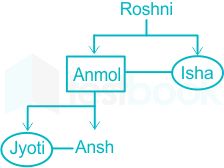
Isha is Roshni's daughter. Jyoti is Ansh's sister. Anmol is Ansh's father. Kajal is the daughter-in-law of Roshni. Isha is Jyoti's aunt/aunt. Roshni is Yash's maternal grandmother. If Roshni has only two children, then how is Anmol related to Yash?

  1. ((a))

    brother-in-law

  2. ((b))

    uncle

  3. ((c))

    maternal uncle

  4. ((d))

    Brother

Show Answer
Answer: ((c))

maternal uncle

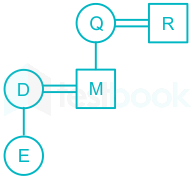
Family chart :-

Family Tree :-

1) Jyoti is Ansh's sister and Anmol is Ansh's father.

2) Isha is Jyoti's aunt and Isha is Roshni's daughter.

3) Kajal is the daughter-in-law of Roshni and Roshni is Yash's maternal grandmother.

∴ Here, Anmol is 'maternal uncle' of Yash.

Hence, the correct answer is "maternal uncle".

3

In a certain code language, EXPAND is written as XPNEDA. How will WEALTH be written in that language?

  1. ((a))

    WTLHEA

  2. ((b))

    HTLAEW

  3. ((c))

    AEHLTW

  4. ((d))

    TWLHEA

Show Answer
Answer: ((a))

WTLHEA

The logic followed here is:

EXPAND is written as XPNEDA.

Similarly,

WEALTH will be written as :

Hence, the correct answer is "WTLHEA".

4

36 - 2(19.75 + 12 ÷ 4.02 × 3.05 - 22) + 20 = ?

  1. ((a))

    18

  2. ((b))

    6

  3. ((c))

    24

  4. ((d))

    12

Show Answer
Answer: ((b))

6

The logic followed here is :-

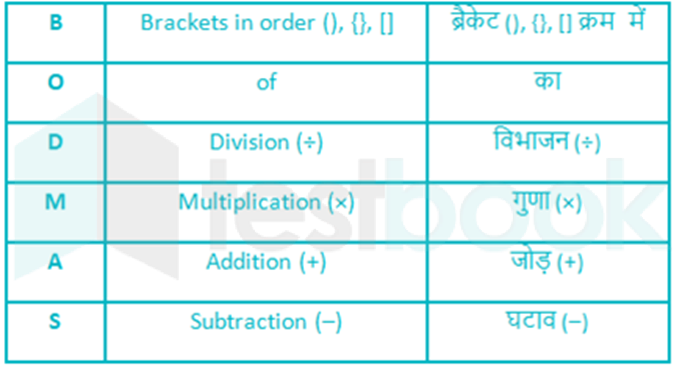
By using BODMAS RULE :

Calculation :

36 - 2(19.75 + 12 ÷ 4.02 × 3.05 - 22) + 20 = ?

⇒ 36 - 2(20 + 12 ÷ 4 × 3 - 4) + 20 = ?

⇒ 36 - 2(20 + 3 × 3 - 4) + 20 = ?

⇒ 36 - 2(20 + 9 - 4) + 20 = ?

⇒ 36 - 2**(29** - 4) + 20 = ?

⇒ 36 - 2(25) + 20 = ?

⇒ 36 - 50 + 20 = ?

56 - 50 = ?

⇒ 6 = ?

∴ Here, the value of '?' is 6.

Hence, the correct answer is "6".

5

Nihal said that his mother is the only daughter of Nikhil's mother. How is Nikhil related to Nihal?

  1. ((a))

    Son

  2. ((b))

    mother's brother

  3. ((c))

    father

  4. ((d))

    Brother

Show Answer
Answer: ((b))

mother's brother

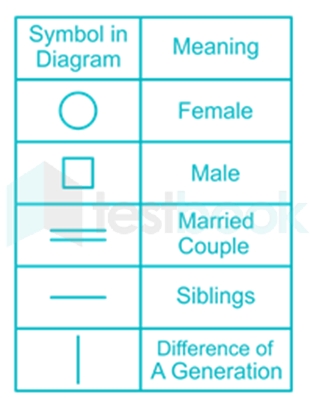
Preparing the family tree using the following symbol:

Family Tree :-

∴ Here, Nikhil is uncle of Nihal or Nikhil is Nihal's mother's brother.

Hence, the correct answer is "mother's brother".

6

In a certain code language, ‘Police caught thief’ is written as ‘ab cd ef’, ‘Thief ran away’ is written as ‘cd ij mn’ and ‘People ran after thief’ is written as ‘pq mn xy cd’. How will ‘Away’ be written in that language?

  1. ((a))

    ef

  2. ((b))

    mn

  3. ((c))

    ij

  4. ((d))

    cd

Show Answer
Answer: ((c))

ij

The logic followed here is :-

∴ Here, 'Away' is coded as 'ij'.

Hence, the correct answer is "ij".

7

Read the given statement and conclusions carefully. Select which conclusion(s) is/are true based on the given statement

Statement

C = H > M ≥ R = W

Conclusions

I) C = R

II) C = W

  1. ((a))

    Only I is true

  2. ((b))

    Only II is true

  3. ((c))

    Neither I nor II is true

  4. ((d))

    Both I and II are true

Show Answer
Answer: ((c))

Neither I nor II is true

Given statements : C = H > M ≥ R = W

Conclusions

I) C = R → False (As C = H > M ≥ R = W → C > R)

II) C = W → False (As C = H > M ≥ R = W → C > W)

Hence, the correct answer is "Neither I nor II is true".

8

If 4 means 9, 2 means 5, ‘-’ means ‘×’ and ‘+’ means ‘÷’, what will be the value of the following expression?

14 ÷ 7 – 2 × 4 + 3

  1. ((a))

    30

  2. ((b))

    12

  3. ((c))

    40

  4. ((d))

    10

Show Answer
Answer: ((a))

30

The logic followed here is :-

By using BODMAS RULE :

Number42
Means95

and

Symbol-+
Means×÷

Given equation : 14 ÷ 7 – 2 × 4 + 3

After replacing the numbers and symbols in given equation the equation is as follows : 14 ÷ 7 × 5 × 9 ÷ 3

= 14 ÷ 7 × 5 × 9 ÷ 3

2 × 5 × 3

= 30

Hence, the correct answer is "30".

9

A statement is given followed by two conclusions. Find which conclusion(s) is/are true based on the given statement.

Statement:

M = P < J < X = T < F

Conclusions:

I. P > X

II. F > J

  1. ((a))

    Only I

  2. ((b))

    Neither I nor II 

  3. ((c))

    Only II

  4. ((d))

    Both I and II

Show Answer
Answer: ((c))

Only II

Given statement : M = P < J < X = T < F

Conclusions:

I. P > X → False (As P < J < X → P < X)

II. F > J → True (As J < X = T < F → F > J)

∴ Here, Conclusion II is true.

Hence, the correct answer is "Only II".

10

Select the option that is related to the third number in the same way as the second number is related to the first number and the sixth number is related to the fifth number.

78 : 56 :: 97 : ? :: 64 : 24

  1. ((a))

    72

  2. ((b))

    63

  3. ((c))

    58

  4. ((d))

    85

Show Answer
Answer: ((b))

63

The logic followed here is :-

Ten's digit × One's digit of 1st number = Second number.

  • 78 : 56 → 7 × 8 = 56

and

  • 64 : 24 → 6 × 4 = 24

Similarly,

  • 97 : ? → 9 × 7 = 63

Hence, the correct answer is "63".

11

Refer to the following letter, number, symbol series and answer the question that follows.

(Left) B % 7 K & 4 D π M 6 R Z Ω S Q 2 @ 3 ∞ E (Right)

As per the given series, three of the following four are alike in a certain way and hence form a group. Which of the following does NOT belong to that group?

  1. ((a))

    DM&

  2. ((b))

    23S

  3. ((c))

    K4%

  4. ((d))

    RSπ

Show Answer
Answer: ((d))

RSπ

Given series :

(Left) B % 7 K & 4 D π M 6 R Z Ω S Q 2 @ 3 ∞ E (Right)

The pattern followed here is :

  • DM& → D + 2 = M and M - 4 = &
  • 23S → 2 + 2 = 3 and 3 - 4 = S
  • K4% → K + 2 = 4 and 4 - 4 = %
  • RSπ → R + 3 = S and S - 6 = π

∴ Here, RSπ is different from other three alternatives.

Hence, the correct answer is "RSπ".

12

Starting from a place V, Anuj walks 10 km towards the east, then turns left and walks 10 km, and then turns left again and walks 10 km. In which direction is he walking now?

  1. ((a))

    South

  2. ((b))

    East

  3. ((c))

    North

  4. ((d))

    West

Show Answer
Answer: ((d))

West

The logic followed here is :-

Starting from a place V, Anuj walks 10 km towards the east, then turns left and walks 10 km, and then turns left again and walks 10 km.

∴ Here, Anuj is walking towards 'West'.

Hence, the correct answer is "West".

13

Select the option in which the letter-pairs share the same relationship as that shared by the letter-pairs in the given triad.

ZS – VO – RK

  1. ((a))

    MK – OL – PN

  2. ((b))

    ZJ – XK – VL

  3. ((c))

    YJ – WL – UM

  4. ((d))

    YI – UE – QA

Show Answer
Answer: ((d))

YI – UE – QA

The logic followed here is :-

ZS – VO – RK

1) MK – OL – PN

2) ZJ – XK – VL

3) YJ – WL – UM

4) YI – UE – QA

Hence, the correct answer is "YI – UE – QA".

14

A statement is given followed by two conclusions. Find which conclusion(s) is/are true based on the given statement.

Statement:

R < A ≤ M < X > Z > I = L ≥ E

Conclusions:

I: X > L

II: E < M

  1. ((a))

    Either I or II

  2. ((b))

    Only II

  3. ((c))

    Only I

  4. ((d))

    Both I and II

Show Answer
Answer: ((c))

Only I

Given statement : R < A ≤ M < X > Z > I = L ≥ E

Conclusions:

I: X > L → True (As X > Z > I = L → X > L)

II: E < M → False (As M < X > Z > I = L ≥ E → No relation given between E and M)

∴ Here, Only conclusion I is true.

Hence, the correct answer is "Only I".

15

In English alphabetical order, a letter is located at the 7th place from the left and the second letter is located at the 14th place towards the right from this 7th place letter.

What is the second letter?

  1. ((a))

    S

  2. ((b))

    U

  3. ((c))

    V

  4. ((d))

    T

Show Answer
Answer: ((b))

U

The logic followed here is :-

In English alphabet order, a letter located at 7th place from left is : G

The second letter is located at the 14th place towards the right from this 7th place letter → 7 + 14 = 21st alphabet

21st alphabet is 'U'.

First and second letters of word is "GU".

∴ The Second letter is "U".

Hence, the correct answer is "U".

16

In a certain code language,

‘A + B’ means ‘A is the daughter of B’,

‘A – B’ means ‘A is the wife of B’,

‘A × B’ means ‘A is the son of B’.

Based on this information, how is E related to R if ‘E + D – M × Q – R’?

  1. ((a))

    Daughter’s daughter

  2. ((b))

    Son’s daughter

  3. ((c))

    Daughter

  4. ((d))

    Son’s wife

Show Answer
Answer: ((b))

Son’s daughter

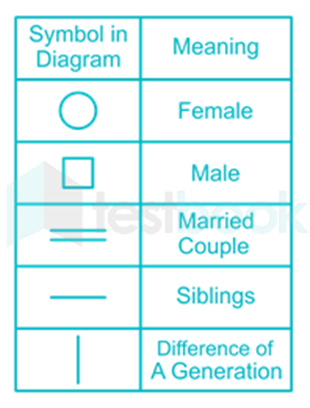
Preparing the family tree using the following symbols:

According to the given information,

A is
Symbol+-×
Meaningdaughterwifeson
Of B

The given expression is :

‘E + D – M × Q – R’ → E is daughter of D, D is wife of M, M is son of Q, Q is the wife of R.

∴ Here, E is R's son daughter (granddaughter) or R is paternal grand father of E.

Hence, the correct answer is "Son’s daughter".

17

49.8 - [20.07 + {30.18 - (19.75 - 4.98)}] = ?

  1. ((a))

    15

  2. ((b))

    24

  3. ((c))

    22

  4. ((d))

    30

Show Answer
Answer: ((a))

15

The logic followed here is :-

By using BODMAS RULE :

Calculations :

49.8 - [20.07 + {30.18 - (19.75 - 4.98)}] = ?

⇒ 50 - [20 + {30 - (20 - 5)}] = ?

⇒ 50 - [20 + {30 - 15}] = ?

⇒ 50 - [20 + 15] = ?

50 - 35 = ?

⇒ 15 = ?

∴ Here, the value of '?' is 15.

Hence, the correct answer is "15".

18

This question is based on the following words.

HAZE MANY TINY SAME

If the first letter of HAZE and MANY are interchanged and of TINY and SAME are interchanged, which of the following will form a new meaningful English word?

  1. ((a))

    Many and Tiny

  2. ((b))

    Haze and Same

  3. ((c))

    Many and Haze

  4. ((d))

    Tiny and Same

Show Answer
Answer: ((b))

Haze and Same

Given words are :

HAZE MANY TINY SAME

  1. Fist letter of HAZE and MANY are interchanged :

MAZE HANY

Maze → A network of paths and hedges designed as a puzzle through which one has to find a way.

2) Fist letter of TINY and SAME are interchanged :

SINY TAME

Tame → Domestic animals.

∴ Here, 'Haze and Same' form a meaningful English word after interchanging there first letters HAZE and MANY, TINY and SAME.

Hence, the correct answer is "Haze and Same".

19

Select the option in which the letter-pairs share the same relationship as that shared by the letter-pairs in the given triad.

FP – IM – LJ

  1. ((a))

    CR – FP – HQ

  2. ((b))

    AZ – EY – FW

  3. ((c))

    BX – EU – HR

  4. ((d))

    ML – PF – RE 

Show Answer
Answer: ((c))

BX – EU – HR

The logic followed here is :-

Given - FP – IM – LJ

1) CR – FP – HQ

2) AZ – EY – FW

3) BX – EU – HR

4) ML – PF – RE 

∴ Here, 'BX – EU – HR' is similar and follow same relation of 'FP – IM – LJ'.

Hence, the correct answer is "BX – EU – HR".

20

Ramesh is facing south. He goes straight for 65 metres, turns left and walks 50 metres, then turns right and goes 55 metres, and then turns right again and covers a distance of 60 metres. In which direction is he going?

  1. ((a))

    South

  2. ((b))

    West

  3. ((c))

    East

  4. ((d))

    North

Show Answer
Answer: ((b))

West

The logic followed here is :-

Ramesh is facing south. He goes straight for 65 metres, turns left and walks 50 metres, then turns right and goes 55 metres, and then turns right again and covers a distance of 60 metres.

∴ Here, Ramesh is facing in 'West' direction.

Hence, the correct answer is "West".

Mental Ability 2 (20 questions)

21

Select the number from among the given options that can replace the question mark (?) in the following series.

105, 110, 119, 136, ?

  1. ((a))

    158

  2. ((b))

    176

  3. ((c))

    169

  4. ((d))

    161

Show Answer
Answer: ((c))

169

The pattern followed here is:


Hence, '169' is the correct answer.

Alternate MethodThe pattern followed is:

Hence, the correct answer is "169".

22

EBC is related to DAB in a certain way based on the English alphabetical order. In the same way, MJK is related to LIJ. To which of the following is SPQ related, following the same logic?

  1. ((a))

    ROQ

  2. ((b))

    RNO

  3. ((c))

    ROP

  4. ((d))

    RPQ

Show Answer
Answer: ((c))

ROP

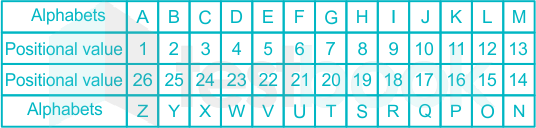
The table is alphabets place value:

The pattern followed here is:

EBC is related to DAB

And,

MJK is related to LIJ

Similarly,

Hence, 'SPQ' is coded as "ROP".

23

Read the given statements and conclusions carefully. Assuming that the information given in the statements is true, even if it appears to be at variance with commonly known facts, decide which of the given conclusions logically follow(s) from the statements.

Statements:

Some goodies are baddies.

Some baddies are wolves.

All goodies are tigers.

Conclusions:

(I) Some tigers are baddies.

(II) Some wolves are baddies.

  1. ((a))

    Both Conclusion (I) and Conclusion (II) definitely follow.

  2. ((b))

    Only Conclusion (I) definitely follows.

  3. ((c))

    Only Conclusion (II) definitely follows.

  4. ((d))

    Both Conclusion (I) and Conclusion (II) definitely donot follow.

Show Answer
Answer: ((a))

Both Conclusion (I) and Conclusion (II) definitely follow.

The least possible diagram for the given statements is as follows

Conclusions:

(I) Some tigers are baddies → True (because some goodies are baddies and all goodies are tigers so some tigers are also baddies)

(II) Some wolves are baddies → True (because statement given some baddies are wolves so some wolves are also baddies)

Hence, “Both Conclusion (I) and Conclusion (II) definitely follow".

24

5 persons are standing in a line, facing north. One of the two persons at the extreme ends is a doctor and the other is a teacher. A businessman is standing to the right of an advocate. A student is to the left of the teacher. The advocate is standing between the doctor and the businessman. Starting from the right, the student is at which position?

  1. ((a))

    2nd

  2. ((b))

    4th

  3. ((c))

    3rd

  4. ((d))

    1st

Show Answer
Answer: ((a))

2nd

Given:

  1. One of the two persons at the extreme ends is a doctor and the other is a teacher.

  2. A student is to the left of the teacher.

  1. The advocate is standing between the doctor and the businessman.

  2. A businessman is standing to the right of an advocate.

Hence, Starting from the right, the student is at "2nd" position.

25

Select the alphanumeric-cluster from among the given options that can replace the question mark (?) in the following series.

JK(11)M, LM(14)O, ?, PQ(26)S, RS(35)U

  1. ((a))

    NO(18)P

  2. ((b))

    NO(19)P

  3. ((c))

    NO(18)Q

  4. ((d))

    NO(19)Q

Show Answer
Answer: ((d))

NO(19)Q

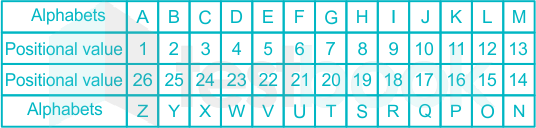
Table show alphabet serial number –

The pattern followed is,

Hence, “NO(19)Q” will replace the question mark (?) in the given series.

26

Four figures have been given, out of which three are alike in some manner and one is different. Select the one that is different.

  1. ((a))

  2. ((b))

  3. ((c))

  4. ((d))

Show Answer
Answer: ((c))

The logic followed here is:

number of concentric figures = (sides of concentric figures -1)

number of concentric figures in hexagon = 6 - 1 = 5; There are 5 concentric hexagon in figure 1.

number of concentric figures in triangle = 3 - 1 = 2; There are 2 concentric triangles in figure 2.

number of concentric figures in square = 4 - 1 = 3 and not 4. There are 4 concentric square in figure 3.

number of concentric figures in pentagon = 5 - 1 = 4. There are 4 concentric pentagon in figure 4.

Hence, 'square/rectangle' is the odd one among the given figure.

27

Select the alphanumeric-cluster from among the given options that can replace the question mark (?) in the following series.

?, 63TS, 48UV, 35XW, 24YZ

  1. ((a))

    80RQ

  2. ((b))

    78QR

  3. ((c))

    80QR

  4. ((d))

    78RQ

Show Answer
Answer: ((c))

80QR

Table show alphabet serial number –

The pattern followed is,

Hence, “80QR” is complete the series.

28

Select the number from among the given options that can replace the question mark (?) in the following series.

21, 30, 79, 200, ?

  1. ((a))

    369

  2. ((b))

    344

  3. ((c))

    425

  4. ((d))

    415

Show Answer
Answer: ((c))

425

The pattern followed here is:

Hence, '425' is the correct answer.

29

Select the figure from the options that can replace the question mark (?) and complete the pattern.

  1. ((a))

  2. ((b))

  3. ((c))

  4. ((d))

Show Answer
Answer: ((c))

The figure that will replace the question mark (?) in the following figure series is shown below:

Middle figure rotate 90 degree a clockwise direction and the arrow increase by one in each term. Dark arrow and light arrow are added alternatively.

Final series is

Hence, ‘option 3’ is the correct answer.

30

Select the alphanumeric-cluster from among the given options that can replace the question mark (?) in the following series.

L30M, N37O, P35Q, ?, T40U

  1. ((a))

    S38R

  2. ((b))

    R42S

  3. ((c))

    S42R

  4. ((d))

    R44S

Show Answer
Answer: ((b))

R42S

Table show alphabet serial number –

The pattern followed is,

Hence, “R42S” is the complete series.

31

A certain number of people are sitting in a row, facing North. S sits third to the left of Q. T sits fourth to the right of R. Only three persons sit between R and Q. Only two persons sit between P and R. If no other person is sitting in the row, what is the total number of persons seated? 

  1. ((a))

    12

  2. ((b))

    9

  3. ((c))

    10

  4. ((d))

    11

Show Answer
Answer: ((a))

12

Given:

A certain number of people are sitting in a row, facing North.

  1. T sits fourth to the right of R.

  2. Only three persons sit between R and Q.

  1. S sits third to the left of Q.

  1. Only two persons sit between P and R.

Case I:

Case II:

In both case total 12 people are sitting in the row.

Hence, Total "12" people are sitting in the row.

32

Five children Rima, Kriss, Somya, Tony and Nitin are standing in a queue facing towards the East. Rima is not standing at the last position. Kriss is standing just behind Tony and just in front of Somya. There are only two children between Rima and Somya. If Nitin is not standing at the first position, then how many children are standing in front of Nitin?

  1. ((a))

    2

  2. ((b))

    4

  3. ((c))

    1

  4. ((d))

    3

Show Answer
Answer: ((b))

4

Given:

  • Five children Rima, Kriss, Somya, Tony and Nitin are standing in a queue facing towards the East.
  1. Rima is not standing at the last position.

  2. Kriss is standing just behind Tony and just in front of Somya.

  3. There are only two children between Rima and Somya.

  1. If Nitin is not standing at the first position.

Hence, "4" children are standing in front of Nitin.

33

Four letter-clusters have been given, out of which three are alike in some manner and one is different. Select the letter-cluster that is different.

  1. ((a))

    HFC

  2. ((b))

    TVX

  3. ((c))

    SQN

  4. ((d))

    WUR

Show Answer
Answer: ((b))

TVX

Table show alphabet serial number –

The pattern followed is,

All follow the same pattern, except 'TVX’.

Hence, “TVX” is the odd one.

34

Select the figure that is related to the third figure in the same way as the second figure is related to the first figure.

  1. ((a))

  2. ((b))

  3. ((c))

  4. ((d))

Show Answer
Answer: ((d))

In figure A and B

In figure C and D

Hence, "Option 4" is the correct answer.

35

Select the figure that will come next in the following series.

<sub>

</sub>
  1. ((a))

  2. ((b))

  3. ((c))

  4. ((d))

Show Answer
Answer: ((d))

The logic followed here is:

i ) increase in number of black squares.(alternate series)

So, the next image will have 7 black squares.

ii) Increase in gap

Hence, 

 will be the next image in the given series.

36

Four letter-clusters have been given, out of which three are alike in some manner and one is different. Select the one that is different.

  1. ((a))

    OMPJ

  2. ((b))

    HFID

  3. ((c))

    XVYT

  4. ((d))

    JHKF

Show Answer
Answer: ((a))

OMPJ

Table show alphabet serial number –

The pattern followed is,

All follow the same pattern, except 'OMPJ’.

Hence, “OMPJ” is the odd one.

37

The sequence of folding a piece of paper and the manner in which the folded paper has been cut is shown in the following figures. How would this paper look when unfolded?

  1. ((a))

  2. ((b))

  3. ((c))

  4. ((d))

Show Answer
Answer: ((a))

The image obtained when the paper is unfolded is,

Hence, option 1 is the correct answer.

38

Select the figure from the options that can replace the question mark (?) and complete the pattern.

  1. ((a))

  2. ((b))

  3. ((c))

  4. ((d))

Show Answer
Answer: ((a))

The figure that will replace the question mark (?) in the following figure series is shown below:

Hence, ‘option 1’ is the correct answer.

Study the given figure and answer the following questions.

39

Who among the following are Advocates but neither Politicians nor Industrialists?

  1. ((a))

    H

  2. ((b))

    J

  3. ((c))

    I

  4. ((d))

    I and J

Show Answer
Answer: ((d))

I and J

The shaded part represents 'Advocates but neither Politicians nor Industrialists'


The letter represents Advocates but neither Politicians nor Industrialists is I and J.

Hence, ‘I and J’ is the correct answer.

40

Who among the following is Industrialists and Advocates but NOT Politicians?

  1. ((a))

    G

  2. ((b))

    A

  3. ((c))

    F

  4. ((d))

    E

Show Answer
Answer: ((a))

G

The shaded part represents 'Industrialists and Advocates but NOT Politicians'


The letter represents Industrialists and Advocates but NOT Politicians is G.

Hence, ‘G’ is the correct answer.

General Awareness 1 (20 questions)

41

Select the group of musical instruments that falls under the category of drums (membranophones).

  1. ((a))

    Santur, Harmonium, Mandar, Guitar

  2. ((b))

    Tabla, Dholak, Damru, Naggada

  3. ((c))

    Shehnai, Harmonium, Cello, Bansuri

  4. ((d))

    Shankh, Bigul, Veena, Sitar

Show Answer
Answer: ((b))

Tabla, Dholak, Damru, Naggada

The correct answer is Tabla, Dholak, Damru, Naggada

Key Points

  • A membranophone is one of a class of musical instruments in which a stretched membrane vibrates to produce sound.
  • Example: Tabla, Dholak, Damru, Naggada
  • In addition to drums, basic types include the mirliton, or kazoo, and friction drums.
  • Musical instruments in which the sound-producing medium is a vibrating membrane fall into four main groups:
  • Kettledrums
  • Tubular drums
  • Rattle drums
  • Mirlitons

Additional Information

  • Sitar, rebab, banjo, mandolin, ukulele, and bouzouki are examples of Chordophones. Chordophones are stringed instruments.
  • An Aerophone is a musical instrument that produces sound primarily by vibrating a body of air without the use of strings or membranes. Example: Trumpet, Flute.
  • An Idiophone is any musical instrument that produces sound primarily from the vibration of the instrument. Examples include bells, clappers, and rattles.
42

MK Stalin became the _________ Chief Minister of Tamil Nadu in May 2021.

  1. ((a))

    fifth

  2. ((b))

    seventh

  3. ((c))

    sixth

  4. ((d))

    eighth

Show Answer
Answer: ((d))

eighth

The correct answer is Eighth 

Key Points

  • Muthuvel Karunanidhi Stalin is an Indian politician who took oath as the 21st Chief Minister of Tamil Nadu, the 8th person to hold the position.
  • Stalin along with the rest of his cabinet took oath as the Chief Minister on 7 May 2021.
  • They won 159 seats out 234, with the Dravida Munnetra Kazhagam (DMK) itself winning an absolute majority with 132 seats.
  • In the 2021 Assembly elections, Stalin led the campaign for the Secular Progressive Alliance.
  • Kanjeevaram Natarajan Annadurai served as the fourth and last Chief Minister of Madras State from 1967 to 1969 and was the first Chief Minister of Tamil Nadu (Madras State renamed as Tamil Nadu) for 20 days before his death.
  • Janaki Ramachandran was the first woman Chief Minister of Tamil Nadu. She was commonly known as VN Janaki who was a famous actress.

Additional Information

  • New Appointments of Chief Minister of India 2021 and 2022
  • 2021  
  • ​Pushkar Singh Dhami - Uttarakhand
  • M.K. Stalin - Tamil Nadu
  • Natesan Krishnasamy Rangasamy - Puducherry
  • Basavaraj Somappa Bommai - Karnataka
  • Himanta Biswa Sarma - Assam
  • Bhupendrabhai Rajnikantbhai Patel - Gujrat
  • 2022
  • Manik Saha - Tripura
  • ​Pushkar Singh Dhami - Uttarakhand
  • Bhagwant Mann - Punjab
  • Shri Sukhvinder Singh Sukhu - Himachal Pradesh
43

Under whose patronage was the Red Fort constructed in Delhi?

  1. ((a))

    Allauddin Khilji

  2. ((b))

    Shahjahan

  3. ((c))

    Aurangzeb

  4. ((d))

    Feroz Shah Tughlaq

Show Answer
Answer: ((b))

Shahjahan

The correct answer is Shahjahan.

Key Points

  • Red Fort, also called Lal Qila is located in Old Delhi, India.
  • It was built by Shah Jahan in the mid-17th century and remains a major tourist attraction.
  • The fort was designated as a UNESCO World Heritage site in 2007.
  • Emperor Shah Jahan began the construction of the Red Fort on 12 May 1638, when he decided to shift his capital from Agra to Delhi.
  • Originally red and white, the Shah's favourite colours, the credit for its design goes to architect Ustad Ahmad Lahori, who also built the Taj Mahal.

Additional Information

  • The famous monuments built by Alauddin Khilji include the Alai Darwaza, the Siri Fort, Hauz Khas and the Zamat Khana Masjid in Delhi.
  • Famous monuments built by Aurangzeb include Badshahi Masjid, Bibi Ka Maqbara, Moti Masjid etc.
  • Firoz Shah Tughlaq mainly worked for the development of infrastructure like schools, hospitals, river canals, and reservoirs in his state.
  • He also repaired the Qutub Minar, which was damaged by the earthquake. He is known to have established four new towns- Firozabad, Fatebabad, Jaunpur and Hissar.
44

Which layer of the earth is the cool layer of rigid rock and its thickness varies from 5 to 80 km depth?

  1. ((a))

    Outer core

  2. ((b))

    Inner core

  3. ((c))

    Mantle

  4. ((d))

    Crust

Show Answer
Answer: ((d))

Crust

The correct answer is Crust.

Key Points

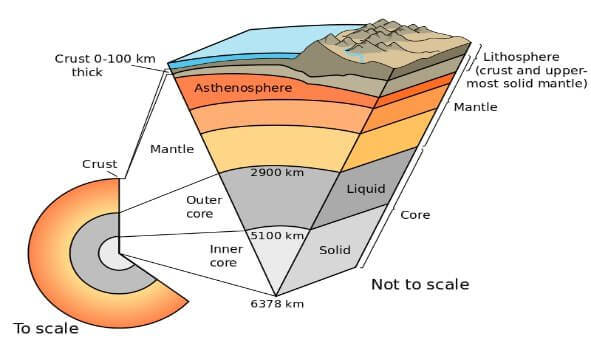
  • The crust is the solid, hard part of our planet that floats on top of the asthenosphere.
  • The crust is a cool layer of rigid rock, which has a thickness that varies from 5 to 80 km in depth.
  • The lithosphere consists of the crust and the cool, rigid, outer 80-100 km of the mantle.
  • The temperature of the crust closest to the mantle is about 500°C.
  • The thinnest portions of the crust are found on the ocean floor and form the ocean crust, which can be less than 5 km thick.
  • NOTE: The uppermost part of the upper mantle is called the asthenosphere. The asthenosphere (from the Greek words “a” + “sthenos” meaning without strength and “sphaira” meaning ball) is made of soft, flowing rock.

Additional Information

  • The Earth's interior is made up of several concentric layers, of which the crust, mantle, outer core, and inner core are important because of their unique physical and chemical properties.
  • The crust is a silicate solid, the mantle is a viscous molten rock, the outer core is a viscous liquid, and the inner core is a denser solid.
  • Earth Core:
  • The innermost layer of the earth is known as the core.
  • It is divided into the inner core and the outer core.
  • It comprises a high concentration of nickel and iron.
  • The mantle is the widest section of the Earth. Its thickness is approximately 2,900 km.
  • The mantle is mainly made up of semi-molten rock known as magma.
  • The rock is hard in the upper part of the mantle, but lower down the rock is softer and begins to melt.
  • The mantle is located directly under the Sima
  • The crust is the outer layer where we live.
  • It is a solid rock layer divided into two types:
  1. Continental crust covers the land
  2. Oceanic crust covers water
  • Sima is an antiquated blended term for the lower layer of Earth's crust. This layer is made of rocks rich in magnesium silicate minerals.

Earth's Layers: Crust, Mantle & Core, Seismic Discontinuities | PMF IAS

45

The term used to denote the net contribution made by a firm is _________.

  1. ((a))

    Intermediate Goods

  2. ((b))

    Double Counting

  3. ((c))

    Factor Payments

  4. ((d))

    Value Additions

Show Answer
Answer: ((d))

Value Additions

The correct answer is Value Additions.

Key Points

  • The term that is used to denote the net contribution made by a firm is called Value Additions.
  • In economics, factor payments are the income people receive for supplying the factors of production: land, labor, capital or entrepreneurship. Payments made of scarce resources, or the factors of production in return for productive services.
  • Double counting in accounting is an error whereby a transaction is counted more than once, for whatever reason. But in social accounting it also refers to a conceptual problem in social accounting practice, when the attempt is made to estimate the new value added by Gross Output, or the value of total investments.
  • Intermediate goods, producer goods or semi-finished products are goods, such as partly finished goods, used as inputs in the production of other goods including final goods. A firm may make and then use intermediate goods, or make and then sell, or buy then use them.
46

Select the correct option regarding the following statements.

I. Ribosomes are composed of RNA and protein.

II. Ribosomes are not surrounded by any membrane.

  1. ((a))

    Only I is correct.

  2. ((b))

    I and II both are incorrect.

  3. ((c))

    I and II both are correct.

  4. ((d))

    Only II is correct.

Show Answer
Answer: ((c))

I and II both are correct.

The correct answer is I and II both are correct.

Key Points

  • Ribosomes are made up of RNA and proteins.
  • Ribosomes are present in both prokaryotic and eukaryotic cells.
  • The prokaryotic cell contains 70S ribosomes and eukaryotic cells contain 80S ribosomes
  • It doesn't have any membrane around him.
  • Cells have many organelles.
  • The primary function of RNA is to create proteins via translation.
  • RNA carries genetic information that is translated by ribosomes into various proteins necessary for cellular processes. mRNA, rRNA, and tRNA are the three main types of RNA involved in protein synthesis.
  • Thus, statement I and II both are correct.
47

Which of the following is a rich source of vitamin C?

  1. ((a))

    Milk

  2. ((b))

    Lemon

  3. ((c))

    Egg

  4. ((d))

    Fish

Show Answer
Answer: ((b))

Lemon

The correct answer is Lemon.

Key Points

  • Lemons contain about 31 grams of Vitamin C.
  • It is also known as ascorbic acid and is found in citrus fruits (like orange, and lemon), kiwifruit, guava, broccoli, strawberries, etc.
  • It is an essential nutrient and is not synthesized by the human body. It is a water-soluble vitamin.
  • Functions - Repair of tissues, acts as a co-factor in many enzymatic reactions, important for the Immune system, acts as an antioxidant.
  • C6H8O6 is the chemical formula of Vitamin C.

Additional Information

  • It is on the List of Essential Medicines of the World Health Organization.
  • Deficiency Disease - The deficiency of Vitamin C causes scurvy.
  • Discovery - It was discovered in 1912 and first isolated in 1928.
48

The main constituent of the Earth’s crust is:

  1. ((a))

    iron

  2. ((b))

    manganese

  3. ((c))

    oxygen

  4. ((d))

    nickel

Show Answer
Answer: ((c))

oxygen

The correct answer is Oxygen.

Key Points

  • Oxygen is an element that is highly reactive and readily combines with other elements.
  • Oxygen is the most abundant element in the Earth's crust. The crust is 46.6% Oxygen by weight.
  • The second most abundant element in Silicon is at 27.7% by weight.
  • In the Earth's crust, there is a great deal of silicate, which is formed from silicon and oxygen.
  • Other elements in decreasing order of abundance are aluminium (8.1), iron (5.0), calcium (3.6), potassium (2.8), sodium (2.6), magnesium (2.1), manganese (0.10), nickel (trace).
  • The Earth's core is believed to consist primarily of a nickel-iron alloy.
49

The top-most portions of the Mauryan Stone Pillars were carved with the figures of:

  1. ((a))

    Mother Goddess

  2. ((b))

    Animals

  3. ((c))

    Buddha

  4. ((d))

    The Bodhi Tree

Show Answer
Answer: ((b))

Animals

The correct answer is Animals.

Key Points

  • Pillars are the best examples of Mauryan-era architecture.
  • There are animal figures on the top of the Ashoka pillars while human figures are on the Iranian pillars.
  • Various animal figures on top of Ashoka Pillars:
  • Basarh pillar – lion
  • Sankisa pillar – elephant
  • Rampurva Pillar – Taurus
  • Lauria Nandgarh – Singh
  • Sanchi and Sarnath – together with the figures of four lions.
  • All these pillars are completely independent in themselves and stand without any support.
  • All are made of Chunar sandstone.
  • It seems that there may have been a pillar manufacturing factory in Chunar (Mirzapur).

Additional Information

  • There are two types of pillars of Ashoka –
  • The pillars on which the Dhamma scripts are inscribed.
  • Absolutely plain column.
  • In the first type, the pillars of Delhi-Meerut, Allahabad (now Prayagraj), Lauria Nandgarh, Lauria Arraj, Rampurwa (Lion Shirsha, Sankisa, Sanchi, Sarnath, Lumbini, Nigali Sagar etc.) are included.
  • In the second type, Rampurva (bullhead), Basadh, Kosam etc. are prominent.
  • All the pillars are shiny, tall, shapely and monolithic (made of a single stone)
  • The Bodhi tree, also known as the Bodhi fig tree or the bow tree, is a large sacred fig tree located in Bodh Gaya, Bihar, India.
50

The cultivation of marine organisms for food and other products is knows as ______.

  1. ((a))

    viticulture

  2. ((b))

    pisciculture

  3. ((c))

    mariculture

  4. ((d))

    sericulture

Show Answer
Answer: ((c))

mariculture

The correct answer is Mariculture

Key Points

  • Marine agriculture or marine farming is a specialized branch of aquaculture and the cultivation of aquatic, marine life forms for food in the open ocean, ponds, or raceways filled with seawater.
  • An example of the latter is the farming of marine fish, including finfish and shellfish such as prawns, or oysters and seashells in saltwater ponds.
  • Non-food products produced by mariculture include fish meal, nutritional agar, and ornaments.
  • Aquaculture is the cultivation of saltwater and freshwater organisms such as finfish, crustaceans, molluscs, and aquatic plants.

Additional Information 

  • Viticulture:- Viticulture (from the Latin word for vine) or winegrowing (growing wine) is the cultivation and harvesting of grapes. It is a branch of Horticulture Science.
  • Pisciculture:- Breeding of fish on a large scale (commercial) for the production of fish for sale in the market.
  • Pisciculture is related to the Blue Revolution (Blue Revolution), an initiative was taken by the government for the development of the aquaculture industry and was started in 1985-1900 during the 7th Five Year Plan.
  • Sericulture:- The process of breeding, growing, and management of silkworms to get pure raw silk is sericulture. It is an agro-based industry.
51

Durga Arya is a famous personality associated with which of the following dance forms?

  1. ((a))

    Manipuri

  2. ((b))

    Kuchipudi

  3. ((c))

    Kathak

  4. ((d))

    Odissi

Show Answer
Answer: ((c))

Kathak

The correct answer is Kathak.

Key Points

  • Durga Arya is a Kathak dancer, choreographer and teacher. She lives in Germany and comes to India every year.
  • Durga Arya was introduced to the Lucknow Gharana of Kathak at a tender age under the tutelage of Smt. Guru Reba Vidyarthi.
  • She later continued her training under the leadership of Shri Munna Shukla and flourished under the guidance of the great Kathak maestro Pandit Birju Maharaj.
  • In India, she performed in respected festivals like Khajuraho Dance Festival, Kalakshetra Dance Festival, Surya Dance Festival, etc.

Additional Information

  • Kathak, a north Indian dance form, is a mixture of dance and drama which is usually performed by both men and women.
  • Kathak is found in three distinct forms, called "Gharanas", named after the cities where the Kathak dance tradition evolved – Jaipur, Banaras and Lucknow.
  • Manipuri is an ancient classical dance that originated in the northeastern state of Manipur, India. Lai Haraoba is the earliest form of dance in Manipur.
  • Kuchipudi is one of the eight major Indian classical dances that originated from a village called Kuchipudi in Andhra Pradesh. Kuchipudi is known for its impressive, quick footwork, dramatic characterization, expressive eye movements and spirited narrative.
  • Odissi or Odissi is one of the pre-eminent classical dance forms of India, originating from Odisha in India. The Natya Shastra refers to this dance as Odar Magadha. It is considered to be one of the oldest dances in the world.
52

Indira Kala Sangit Vishwavidyalaya is located in which Indian state?

  1. ((a))

    West Bengal

  2. ((b))

    Maharashtra

  3. ((c))

    Himachal Pradesh

  4. ((d))

    Chhattisgarh

Show Answer
Answer: ((d))

Chhattisgarh

The correct answer is Chhattisgarh.


Key Points

  • Indira Kala Sangeet Vishwavidyalaya (IKSV), also Indira Kala Sangeet Vishwavidyalaya, is a public university located in Khairagarh, Rajnandgaon district, Chhattisgarh, India.
  • It was established in 1956.
  • It claims to be the first musical university in Asia.
  • This institute was run under the Government of Madhya Pradesh till the creation of the new state of Chhattisgarh in 2000. Thereafter, it is run under the Government of Chhattisgarh.
  • The university has a museum inside it which is under the Department of Ancient Indian History Culture & Archeology.
53

What is the melting point of ice?

  1. ((a))

    283 °K

  2. ((b))

    293 °K

  3. ((c))

    273 °K

  4. ((d))

    253 °K

Show Answer
Answer: ((c))

273 °K

The correct answer is 273 °K

Key Points

  • For ice, the melting point is 0°C or 273K.
  • 0°C is equivalent to 273 kelvins and 32 Fahrenheit.
  • The melting point at which ice a solid turns to water a liquid is 32 F (0°C).
  • The melting point is the temperature at which a solid turns into a liquid.
  • The temperature of the reverse change from liquid to solid is called the freezing point or crystallization point.

Additional Information 

  • Melting points of some common substances:
SubstanceMelting Point
Ice0
Mercury-39
Hydrogen-259
Oxygen-219
Helium-272
Glucose146
Iron1538
Silver961
Gold1064
54

Rani Rampal was awarded the Rajiv Gandhi Khel Ratna Award 2020. She is related to which sport?

  1. ((a))

    Wrestling

  2. ((b))

    Table Tennis

  3. ((c))

    Archery

  4. ((d))

    Hockey

Show Answer
Answer: ((d))

Hockey

The correct answer is Hockey.

Key Points

  • Rani Rampal is an Indian Hockey player. She was born on 4th December 1994 in Shahbad Markanda Village in Kurukshetra district in Haryana.
  • She was conferred with the Rajiv Gandhi Khel Ratna 2020 and she is the first woman hockey player to get this award.
  • Rani Rampal captained India and was the Flag-Bearer in Asian Games 2018 and won the Silver Medals for the country in Women's Hockey.
  • About Rajiv Gandhi Khel Ratna Award:
  • This award was started in 1991. It is the most prestigious and highest award in Sports Fraternity in India.
  • This Award has now been renamed to Dhyan Chand Khel Ratna Award, in tribute to Major Dhyan Chand.
  • Dhyan Chand, whose birthday is celebrated as National Sports Day.

Additional Information

  • All other winners of the Rajiv Gandhi Khel Ratna award 2020 are:
  • Rohit Sharma (Cricket),
  • Manika Batra (Table Tennis),
  • Vinesh Phogat (Wrestling),
  • Mariyappam Thangavelu (Paraolympic High Jumper)
  • Indian women's hockey team fought tooth and nail against some of the top teams in the world at the Tokyo Olympics in July-August 2021. They made history when they defeated the three-time Olympic gold medallists Australia 1-0 in the quarter-final and played in their first-ever Olympic semi-final against Argentina.
55

Which of the following statements is INCORRECT about mercury (Hg)?

  1. ((a))

    Mercury dissolves to form amalgams with gold, zinc, and many other metals.

  2. ((b))

    Mercury is the only metal that is liquid at standard conditions for temperature and pressure.

  3. ((c))

    Mercury is a poor conductor of electricity, but a fair conductor of heat.

  4. ((d))

    Mercury has a unique electron configuration, which strongly resists removal of an electron, making it behave similarly to noble gas elements.

Show Answer
Answer: ((c))

Mercury is a poor conductor of electricity, but a fair conductor of heat.

The answer is Option 3.

Key Points

  • Mercury is a NOT fair it is good conductor of heat, but a poor conductor of electricity.
  • Thus, option 3 is incorrect.
  • Mercury is the only metal that is liquid under standard conditions for temperature and pressure.
  • Thus, option 2 is correct.
  • Mercury has a single electron configuration that strongly opposes the removal of an electron, making it behave similarly to the noble gas elements.
  • Thus, option 4 is correct.
  • Mercury dissolves to form amalgams with gold, zinc, and many other metals. Iron is an exception, and iron flasks have been traditionally used to trade mercury. Sodium amalgam is a common reducing agent in organic synthesis, and it is also used in high-pressure sodium lamps.
  • Thus, option 1 is correct.

Additional Information

  • Mercury is a dense, silvery d-block element.
  • The element other than mercury that is liquid under standard temperature and pressure is bromine, though metals such as caesium, gallium, and rubidium melt just above room temperature.
56

Which of the following algae comes under the Phaeophyceae class?

  1. ((a))

    Green algae

  2. ((b))

    Brown algae

  3. ((c))

    Orange algae

  4. ((d))

    Red algae

Show Answer
Answer: ((b))

Brown algae

The correct answer is Brown algae.

Key Points

  • Members of the Phaeophyceae are brown algae as the yellowish-brown pigments predominate in xanthophylls.
  • Brown algae are mostly marine.
  • They are found in cold waters along the coast.
  • They are either free-floating or found to be attached to the substratum.
  • Ectocarpus is an epiphyte, Fucus is found attached to rocks and Sargassum is an example of free-floating brown algae.

Additional Information 

  • Some brown algae have special gas-filled bladders called pneumatocysts. They are mostly present near the lamina.
  • It provides buoyancy to the algae and helps to keep the algae part close to the surface for photosynthesis.
57

Which of the following is a scalar quantity?

  1. ((a))

    Force

  2. ((b))

    Momentum

  3. ((c))

    Mass

  4. ((d))

    Angular velocity

Show Answer
Answer: ((c))

Mass

The correct answer is Mass.

Key Points

  • A scalar quantity is defined as the physical quantity with magnitude and no direction.
  • The mass has only magnitude, not direction. If we consider the weight, then it is the force experienced by the object due to its mass.
  • Mass, Speed, Distance, Time, Area, Volume, Density, and Temperature are examples of Scalar Quantity.
  • A vector quantity is defined as the physical quantity that has both directions as well as magnitude.
  • Linear momentum, Acceleration, Displacement, Momentum, Angular velocity, Force, Electric field, and Polarization are examples of vector quantity.

Additional Information

  • Electric Current has a definite direction yet it is a scalar quantity.
  • Unit vectors are vectors with a magnitude of 1, they are used to define direction.
  • William Rowan Hamilton is given credit for inventing vectors.
  • A zero vector is a vector with zero magnitudes and an arbitrary direction.
58

Which of the following is the world’s largest lake?

  1. ((a))

    Lake Superior

  2. ((b))

    Lake Van

  3. ((c))

    Caspian Sea

  4. ((d))

    Dal Lake

Show Answer
Answer: ((c))

Caspian Sea

The correct answer is the Caspian Sea.

Key Points

  • The Caspian Sea is the largest inland body of water on the earth's surface.
  • A lake is an area filled with water, localized in a basin, surrounded by land, and distinct from any river or other outlet that serves to feed or drain the lake.
  • Lakes lie on land and are not part of the ocean, although, like the much larger oceans, they do form part of the Earth's water cycle.
  • The Caspian Sea lies at the junction of Europe and Asia.
  • It has the greatest surface area of any lake at 143,200 square miles (370,886 square kilometres).
  • It accounts for 40 to 44% of the total lacustrine waters of the world.
  • The Caspian Sea is best known for its caviar and oil industries.
  • The Caspian Sea is bounded by: 
  • Iran to the south and adjacent corners.
  • Russia from mid-north to mid-west.
  • Kazakhstan from mid-north to mid-east.
  • Azerbaijan to the southwest.
  • The Caspian Sea is bordered by five countries: Russia, Kazakhstan, Turkmenistan, Iran, and Azerbaijan.

Additional Information

  • Lake Superior: Lake Superior is the largest of the Great Lakes of North America, and among freshwater lakes, it is the world's largest in surface area and third-largest by volume.
  • Lake Van: Lake Van is the largest lake in Turkey. It is a saline soda lake and one of the few endorheic lakes in the world (a lake that has no outlet).
  • Dal Lake: Dal Lake is an urban lake located in Srinagar, the summer capital of Jammu and Kashmir. It is integral to tourism and recreation in the Kashmir valley and is variously known as the "Lake of Flowers", "Jewel in the crown of Kashmir" or "Srinagar's Jewel".

Confusion Points

There are two lakes that can be considered the world's largest freshwater lake, depending on whether we measure by surface area or volume:

  1. Lake Superior
  • The world's largest freshwater lake by surface area, Lake Superior is located on the border of the United States and Canada. It has a surface area of around 82,103 square kilometers.
  1. Lake Baikal
  • The world's largest freshwater lake by volume and depth, Lake Baikal is located in the southern region of Siberia in Russia
  • Thus, Caspian Sea is the correct answer.
59

Which team won the Syed Mushtaq Ali T20 Trophy 2020-21?

  1. ((a))

    Tamil Nadu

  2. ((b))

    Punjab

  3. ((c))

    Himachal Pradesh

  4. ((d))

    Baroda

Show Answer
Answer: ((a))

Tamil Nadu

The correct answer is Tamil Nadu

Key Points

  • Syed Mushtaq Ali Trophy is related to Cricket.
  • The 2020–21 Syed Mushtaq Ali Trophy was the thirteenth edition of the Syed Mushtaq Ali Trophy, a Twenty20 competition played in India.
  • It started on 10 January 2021, with the final on 31 January 2021.
  • Tamil Nadu won the tournament by defeating Baroda by seven wickets in the final.
  • Karnataka were the defending champions.
  • The Board of Control for Cricket in India (BCCI) was the administrator of this tournament.


Additional Information 

  • The Tamil Nadu cricket team is a domestic cricket team run by the Tamil Nadu Cricket Association, representing the Indian state of Tamil Nadu.
  • It has been one of the most influential teams in white-ball cricket in the domestic circuit.
  • They have won the Ranji Trophy twice and have been runner-up nine times.
  • The Board of Control for Cricket in India (BCCI) is the governing body of cricket in India.
  • Its headquarter is located at Wankhede Stadium in Mumbai, Maharashtra.
60

Which of the following statements is correct regarding a typhoon?

  1. ((a))

    It is the tropical cyclone of the western and north-western Pacific Ocean and the northern Indian Ocean.

  2. ((b))

    It is the tropical cyclone of the south Pacific Ocean.

  3. ((c))

    It is the tropical cyclone of the north Atlantic Ocean.

  4. ((d))

    It is the tropical cyclone of the Atlantic Ocean, Caribbean Sea, Gulf of Mexico, and the central northern and eastern Pacific Ocean.

Show Answer
Answer: ((a))

It is the tropical cyclone of the western and north-western Pacific Ocean and the northern Indian Ocean.

The correct answer is Option 1.

Key Points

  • Tropical cyclones, also known as typhoons or hurricanes, are among the most destructive weather phenomena.
  • They are intense circular storms that originate over warm tropical oceans and have maximum sustained wind speeds exceeding 119 kilometres per hour and heavy rains.


Important Points 

  • Tropical cyclones are referred to by different names depending on where they originate in the world.
  • Hurricanes occur in the Atlantic Ocean and the eastern north Pacific Ocean.
  • Typhoons occur in the western Pacific Ocean and the northern Indian Ocean.
  • Tropical cyclones occur in the south Pacific Ocean and the Indian Ocean.
  • They have different names in different regions as below:
  • Australia - Willy-Willy
  • China Sea - Typhoons
  • Coastal US - Tornadoes
  • Caribbean Sea - Hurricanes

General Awareness 2 (20 questions)

61

The MM Punchhi Commission was constituted in the year:

  1. ((a))

    2003

  2. ((b))

    2001

  3. ((c))

    2007

  4. ((d))

    2005

Show Answer
Answer: ((c))

2007

The correct answer is 2007.

Key Points 

  • The Centre-State Relations Commission was constituted by the Government of India on 27 April 2007 under the chairmanship of Justice Madan Mohan Punchhi.
  • Highlights of the commission:
  • To examine what could be the role, responsibility, and jurisdiction of the Centre during major and prolonged outbreaks of communal violence, caste violence, or any other social conflicts.
  • To review other aspects of Centre-States relations including taxes and linking of rivers.
  • To study the role, responsibility, and jurisdiction of the Centre vis-à-vis States in promoting effective devolution of powers and autonomy to Panchayati Raj institutions and local bodies.
  • To study the need and relevance of separate taxes for freeing inter-state trade to establish a unified domestic market.

Additional Information

  • Madan Mohan Punchhi was the former Chief Justice of India, appointed on 18-1-1998 and retired on 9-10-1998.
  • He was born on 10th October 1933 at Pakpattan, District, Montgomery (now in Pakistan).
62

Which year was declared as the ‘Year of Social Justice’ in the memory of B. R. Ambedkar?

  1. ((a))

    1996-1997

  2. ((b))

    1985-1986

  3. ((c))

    1978-1979

  4. ((d))

    1990-1991

Show Answer
Answer: ((d))

1990-1991

The correct answer is 1990-1991.

Key Points

  • The period from 14 April 1990 to 14 April 1991 was observed as the "Year of Social Justice" in the memory of B. R. Ambedkar.
  • He is known as the father of the Indian Constitution. He was the then Law Minister who presented the final draft of the Constitution in the Constituent Assembly.
  • B.R Ambedkar is known as the "Modern Manu of India". He is called by this name because he drafted the Hindu code bill.


Important Points

  • B.R. Ambedkar's birthday is celebrated as 'Equality Day' in India, and the demand to declare this day as "International Equality Day" goes to the United Nations.
  • On 6 April 2020, in Canada, it was decided to observe 14 April as "Dr. BR Ambedkar Day of Equality". This decision was taken by the Canadian City Council of Burnaby.
  • On 14 April 1990, Ambedkar was bestowed with the Bharat Ratna award.
63

According to the Census of India 2011, which of the following states has the highest number of women per 1000 men in India?

  1. ((a))

    Delhi

  2. ((b))

    Maharashtra

  3. ((c))

    Kerala

  4. ((d))

    Karnataka

Show Answer
Answer: ((c))

Kerala

The correct answer is Kerala.

Key Points

  • The sex ratio refers to the number of females per 1000 males. According to the 2011 census, Kerala has the highest sex ratio, i.e. 1084 females per 1000 males.
  • As per the 2011 census, Haryana has the lowest sex ratio in India, with only 877 females per 1000 males.
  • According to the 2011 census, the sex ratio of India is 940 females per 1000 males.
  • As per the 2011 census, Mizoram has the highest child sex ratio recorded at 971 girls per 1000 boys.

Additional Information

  • The decadal census of India has been conducted 15 times (7 times after independence) as of 2011.
  • While it has been introduced every 10 years, the first "full census" took place in 1881, under the British Viceroy Lord Ripon 1881, but 1st census took place during the tenure of Lord Mayo in 1872
64

In which year was slavery declared illegal in India?

  1. ((a))

    1843

  2. ((b))

    1853

  3. ((c))

    1813

  4. ((d))

    1833

Show Answer
Answer: ((a))

1843

The correct answer is 1843.

Key Points

  • The Indian Slavery Act, of 1843, also known as Act V of 1843, was an act passed on 7 April 1843 in British India under the rule of the East India Company.
  • The Act stated that the sale of any person as a slave was banned and anyone who bought or sold slaves would be booked under the Indian Penal Code with the offense of severe punishment

Additional Information

  • Lord Ellenborough was the Governor-General of India during the implementation of the Indian Slavery Act, 1843.
  • He was the Chairman of the Board of Control for four terms and also served as the Governor-General of India between 1842 and 1844.
65

Identify the Prime Minister of India who abolished Privy Purses?

  1. ((a))

    Shri V P Singh

  2. ((b))

    Shri Charan Singh

  3. ((c))

    Smt. Indira Gandhi

  4. ((d))

    Shri Lal Bahadur Shastri

Show Answer
Answer: ((c))

Smt. Indira Gandhi

The correct answer is Smt. Indira Gandhi.

Key Points


  • In India, a privy purse was paid to ruling families of erstwhile princely states after India's independence, first in 1947, as part of their agreements to integrate with India.
  • In 1949, there was a discussion about dissolving privy purses but the issue was not taken up further.
  • It was again proposed before the Parliament in 1971 and was successfully passed as the 26th Amendment to the Constitution of India 1971 and extra amounts paid to princely states were stopped.
  • The then Prime Minister Indira Gandhi argued that abolition was based on equal rights for all citizens and the need to reduce the government's revenue deficit.


Additional Information

  • Indira Gandhi was the 3rd Prime Minister of India and served as prime minister from January 1966 to March 1977 and again from January 1980 until her assassination in October 1984.
  • Vishwanath Pratap Singh (25 June 1931 – 27 November 2008), V.P. Singh, abbreviated as Singh, was an Indian politician who was the 7th Prime Minister of India from 1989 to 1990. He is the only Prime Minister of India who has been a member of the former royal family.
  • Chaudhary Charan Singh (23 December 1902 – 29 May 1987) served as the 5th Prime Minister of India between 28 July 1979 and 14 January 1980. He is also known as the 'champion of India's peasants.'
  • Lal Bahadur Shastri (2 October 1904 – 11 January 1966) was an Indian politician who served as the second Prime Minister of India.
66

Which contemporary chronicle describes Sultan Raziya?

  1. ((a))

    Tabaqat-i-Nasiri

  2. ((b))

    Baharisitan-i-Ghaybi

  3. ((c))

    Fathiya Ibriya

  4. ((d))

    Tarikh-i-Firoz Shahi

Show Answer
Answer: ((a))

Tabaqat-i-Nasiri

The correct answer is Tabaqat-i-Nasiri.

Key Points

  • Minhaj-i Siraj was a 13th centurion Persian historian.
  • He wrote Tabaqat-i-Nasiri which contained the history of the Islamic world.
  • Razia Sultan (1236-40) summoned him to Delhi and appointed him the head of Madrassa-i Nasiri in Delhi.
  • His work describes Razia Sultan.

Additional Information

  • The Baharistan-i-Ghaibi written by Mirza Nathan, is a 17th-century chronicle on the history of Bengal, Cooch Behar, Assam, and Bihar under the reign of Mughal emperor Jahangir (1605-1627).
  • Fathiya-i-Ibriyya also known as Tarikh-i-Assam was written by Ibn Muhammad Wali Ahmad, better known as Shihabuddin Talish, which was his poetical name.
  • Tarikh-i Firoz Shahi is a book on Indo-Persian historiography during the Delhi Sultanate period in India. It was written by Ziauddin Barani. Ziauddin Barani was a Muslim political thinker who lived during the reign of Muhammad bin Tughlaq and Firuz Shah Tughlaq. The book covers the data from the reign of Ghiyas ud din Balban to the first six years of the reign of Firoz Shah Tughluq. The book was completed in 1357 CE.
67

The idea of Directive Principles of State Policy was borrowed from:

  1. ((a))

    Britain

  2. ((b))

    France

  3. ((c))

    The US

  4. ((d))

    Ireland

Show Answer
Answer: ((d))

Ireland

The correct answer is Ireland.

Key Points

  • Constitutional Provisions: Part IV of the Constitution of India (Article 36–51) contains the Directive Principles of State Policy (DPSP).
  • They are borrowed from the Constitution of Ireland, which copied it from the Spanish Constitution.
  • Article 37 of the Indian Constitution states the application of the Directive Principles.
  • These principles aim at ensuring socio-economic justice to the people and establishing India as a welfare state whereas fundamental rights ensure political justice.​

Additional Information

  • Borrowed Features of the Indian Constitution:
  • Irish Constitution - Directive Principles of State Policy, Nomination of Rajya Sabha members & Method of the election of the President.
  • US Constitution - Fundamental rights, Independent judiciary and judicial review, Impeachment of the President, Removal of Supreme Court and High Court judges & Post of Vice-President.
  • France Constitution  - Republic, Ideals of liberty, equality, and fraternity in the Preamble.
  • Britain (UK) Constitution - Parliamentary government, Rule of Law, Legislative procedure, Single Citizenship, Cabinet system, Prerogative writs, Parliamentary privileges, Bicameralism.
68

Non-banking Financial Companies Micro-finance Institutions are generally regulated by __________. 

  1. ((a))

    State Bank of India

  2. ((b))

    The Ministry of Finance

  3. ((c))

    Reserve Bank of India

  4. ((d))

    National Bank for Agriculture and Rural Development

Show Answer
Answer: ((c))

Reserve Bank of India

The correct answer is the Reserve Bank of India.

Key Points

  • Non-Banking Financial Companies operate under the Companies Act, 2013, and are regulated by RBI under the RBI Act, 1934.
  • It is typically associated with services related to lending, credits and advances, savings, and investment products, and also performs functions such as trading in the money market, handling a portfolio of stocks, and transferring funds.
  • Under Section 8, Micro-finance Institutions are financial companies that provide small loans to people who do not have any access to banking facilities.
  • Types of Committees to Review the existing framework of NBFCs - James S. Raj Committee and Chakravarty Committee.
  • NBFC reserves the right to accept a deposit (only term deposit). They are not eligible to accept deposits repayable on demand.

Additional Information 

  • State Bank of India, earlier known as “The Imperial Bank of India” became the State Bank of India on 1 July 1955. It is the 43rd largest bank in the world. The current chairman of SBI is Dinesh Kumar Khara (as of June 2022).
  • National Bank for Agriculture and Rural Development (NABARD) was established on the recommendations of the B.Sivaraman Committee on 12 July 1982 to implement the National Bank for Agriculture and Rural Development Act 1981.

Important Points

  • Challa Sreenivasulu Setty became the 27th chairman of SBI on August 28, 2024.
69

The Congress Working Committee, in its meeting in ________ on 14 July 1942, passed the historic ‘Quit India’ resolution.

  1. ((a))

    Surat

  2. ((b))

    Bombay

  3. ((c))

    Wardha

  4. ((d))

    Ahmedabad

Show Answer
Answer: ((c))

Wardha

The correct answer is Wardha.

Key Points

  • The Congress Working Committee (CWC) was formed in December 1920 at the Nagpur session of the Congress, headed by **C. Vijayaraghavacharya.**​
  • The Congress Working Committee meeting held at Wardha on 14 July 1942 passed a resolution demanding Complete Independence from the British Government.
  • It passed the historic ‘Quit India’ resolution.
  • The Indian National Congress session held on 7 August 1942 at Gowalia Tank (Kranti Maidan) in Mumbai gave a call for Quit India Movement.
  • Maulana Abul Kalam Azad was the President of this session.
  • Gandhiji gave a call for 'Do-or-die' during Quit India Movement
  • Lord Linlithgow was the Viceroy of India when the Quit India Movement started in 1942.
70

Andaman and Nicobar Administration has jurisdiction over ______ Tehsils.

  1. ((a))

    six 

  2. ((b))

    nine 

  3. ((c))

    eight 

  4. ((d))

    seven 

    ×

    duplicate options found. English Question 1 options 2,3

    ×

    duplicate options found. English Question 1 options 2,3

    ×

    duplicate options found. English Question 1 options 2,3

Show Answer
Answer: ((b))

nine 

The correct answer is Nine.

Key Points

  • The Andaman Islands and the Nicobar Islands separate the Andaman Sea to the east from the Indian Ocean. These two groups are separated by the 10° N parallel (also known as the Ten Degree Channel), the Andamans lying to the north of this latitude, and the Nicobars to the south.
  • It is made up of 3 Districts only.
  • Andaman and Nicobar Administration has jurisdiction over 9 Tehsils.
  • The Lieutenant Governor of Andaman and Nicobar Islands (UT) is Admiral DK Joshi (as of June 2022).​

Additional Information

  • Union Territory of the Andaman and Nicobar Islands comes under the jurisdiction of the Calcutta High Court.
  • Major tribes: Great Andamanese, Onges, Jarwas, Sentinelese.
  • Barren Island Volcano, 140 km northeast of Port Blair, is the only confirmed active volcano in the Indian subcontinent.
71

Which of the following languages is NOT included in the Eighth Schedule of the Constitution of India?

  1. ((a))

    English

  2. ((b))

    Manipuri

  3. ((c))

    Odia

  4. ((d))

    Nepali

Show Answer
Answer: ((a))

English

The correct answer is English.

Key Points

  • The Eighth Schedule to the Constitution of India lists the official languages of the Republic of India.
  • As per Articles 344 (1) and 351 of the Indian Constitution, the 8th schedule includes 22 languages: Assamese, Bengali, Gujarati, Hindi, Kannada, Kashmiri, Konkani, Malayalam, Manipuri, Marathi, Nepali, Oriya, Punjabi, Sanskrit, Sindhi, Tamil, Telugu, Urdu, Bodo, Santhali, Maithili, and Dogri.
  • Surprisingly these 22 languages do not include “English” which is widely spoken in India.​

Mistake Points

  • Many students confuse these languages with “Classical language” which includes only 11 languages of India and are recognized for their historical significance and rich literary heritage. They include:

Sanskrit, Tamil, Telugu, Kannada, Malayalam, Odia, Prakrit, Pali, Bengali, Assamese, Marathi and Persian.

Additional Information

  • Nepali was originally not present in the 8th schedule of the constitution but later added with the 71st amendment act along with Konkani & Manipuri.
  • Bodo, Dogri, Maithili, and Santhali were added by the 92nd Amendment Act of 2003.
72

The Besnagar Pillar was constructed by:

  1. ((a))

    Alexander

  2. ((b))

    Megasthenes

  3. ((c))

    Heliodorus

  4. ((d))

    Amtalakita

Show Answer
Answer: ((c))

Heliodorus

The correct answer is Heliodorus.


Key Points

  • The Heliodorus pillar is a stone column that was erected around 110 BCE in central India in Vidisha near modern Besnagar, by Heliodorus, a Greek ambassador of the Indo-Greek king Antialcidas to the court of the Sunga king Bhagabhadra.
  • The pillar was discovered by Alexander Cunningham in 1877.
  • The pillar also glorifies the Indian ruler as "Bhagabhadra the saviour".
  • The pillar was called Garuda-manaka by Heliodorus, referring to Garuda.
  • The pillar is also one of the earliest surviving records of a foreign convert into “Vaishnavism”.
  • The locals at the time called the pillar the Khamba Baba or Kham Baba.

Additional Information

  • Alexander the Great overthrew the Persian Empire, carried the arms of Macedonian to India, and laid the foundation for the Hellenistic world of regional empires.
  • Megasthenes was a Greek historian who was the first to describe ancient India, and is therefore called the "father of Indian history".
  • He was the Greek ambassador of Seleucus I Nicator in the court of King Chandragupta Maurya.
73

Who among the following was NOT a member of the Constituent Assembly?

  1. ((a))

    Sarojini Naidu

  2. ((b))

    M K Gandhi

  3. ((c))

    Somnath Lahiri

  4. ((d))

    Baldev Singh

Show Answer
Answer: ((b))

M K Gandhi

The correct answer is Mahatma Gandhi.

Key Points

  • Mahatma Gandhi was not a member of the Constituent Assembly of India.
  • The members were elected by indirect election by the members of the provincial legislative assemblies according to the scheme recommended by the Cabinet Mission.
  • The Assembly consisted of 292 representatives among which 15 were women.
  • There were a total of 22 committees of which some important members were - B.R. Ambedkar, Jawaharlal Nehru, Vallabhbhai Patel, J.B. Kriplani, etc., but Mahatma Gandhi was not included in the list.

Important Points

  • The idea of ​​establishing a Constituent Assembly was given by M.N. Roy in the year 1934.
  • It was finally accepted by the British in 1940 when C. Rajagopalachari raised his voice in the Constituent Assembly held on 15 November 1939.
  • It was proposed via Cabinet Mission Plan to form a Constituent Assembly.​

Additional Information

  • On 26th November 1949, 3 provisions -  Elections, citizenship and provisional Parliament came into force and rest of the provisions only on 26th January 1950.
  • The first speaker of the Constituent assembly was Ganesh Vasudev Mavalankar, popularly known as Dadasaheb.
  • The National Flag of India was adopted on 22 July 1947.
74

Which of the following forests is a type of permanent forests?

  1. ((a))

    Unprotected forests

  2. ((b))

    Reserved forests

  3. ((c))

    Unclassed forests

  4. ((d))

    Community forests

Show Answer
Answer: ((b))

Reserved forests

The correct answer is Reserved Forests

Key Points

  • Permanent Forests: Reserved and protected forests are also referred to as permanent forest estates maintained for the purpose of production of wood and other forest products and for protective reasons. Madhya Pradesh has the largest area under permanent forests.
  • Reserved Forest: More than half of the total forest land has been declared as Reserved Forest. As far as the conservation of forest and wildlife resources is concerned, reserve forests are considered to be the most valuable.
  • The first Reserve Forest of India was Satpura National Park. It is located in the Hoshangabad district of Madhya Pradesh.​

Additional Information

  • Protected Forest: A protected forest is a land that is a reserved forest, and over which the government has property rights, as declared by the state government under section 29 of the Indian Forest Act 1927.
  • Unclassed Forest: Unclassed Forests are forests and wastelands belonging to both government and private individuals and communities. All North-eastern states and parts of Gujarat have a very high percentage of their forests as unclassed forests managed by local communities.
  • Community Forest: A community forest provides local community value and benefits from land, access to and rights to forest resources, and participation in management decisions. These forests can be managed for timber production, agroforestry, recreation, and/or watershed conservation.
75

Which of the following is the world’s longest highway tunnel?

  1. ((a))

    Dr. Syama Prasad Mookerjee Tunnel

  2. ((b))

    Atal Tunnel

  3. ((c))

    Maliguda Tunnel

  4. ((d))

    Pir Panjal Railway Tunnel

Show Answer
Answer: ((b))

Atal Tunnel

The correct answer is Atal Tunnel.

Key Points

  • The Atal Tunnel is a highway tunnel built under the Rohtang Pass in the eastern Pir Panjal Range of the Himalayas on the Leh–Manali highway in Himachal Pradesh, India.
  • It is now the longest highway tunnel in the world at over 10,000 feet and 9.02 km (5.6 mi) long.
  • Atal Tunnel is also known as Rohtang Tunnel and it was inaugurated by Prime Minister Narendra Modi on 3 October 2020.
  • Prime Minister Narendra Modi changed the name of the tunnel to Atal Tunnel in honour of Shri Atal Bihari Vajpayee on Vajpayee's birthday on 25 December 2019.

Additional Information

  • The project was announced by the then Prime Minister Atal Bihari Vajpayee on 3 June 2000 and built by Border Roads Organisation (BRO).
  • The Maliguda Tunnel of Odisha is the fourth largest broad-gauge railway tunnel.
  • The Dr Shyama Prasad Mukherjee Tunnel is a road tunnel in Jammu and Kashmir, India.
  • The Pir Panjal Railway Tunnel or Qazigund Railway Tunnel is an 11.215 km long railway tunnel located in the Pir Panjal Range of the Central Himalayas in Jammu and Kashmir.

76

Equilibrium is achieved when aggregate demand is:

  1. ((a))

    greater than aggregate supply

  2. ((b))

    sum total of consumption and investment

  3. ((c))

    equal to aggregate supply

  4. ((d))

    less than aggregate supply

Show Answer
Answer: ((c))

equal to aggregate supply

The correct answer is Equal to the aggregate supply

Key Points

  • According to Keynesian theory, the equilibrium level of income in an economy is determined when aggregate demand as represented by the C + I curve is equal to aggregate output (aggregate supply or AS).
  • The Aggregate Demand and Aggregate Supply Equilibrium provides information on price levels, real GDP, and changes in unemployment, inflation, and growth as a result of new economic policy.


Additional Information

  • When aggregate demand exceeds aggregate supply, planned inventory will fall below the desired level. To bring inventory back to the desired level, producers expand output. More output means more income.
  • Investment is everything that is left of total expenditure after consumption, government spending, and net exports are subtracted (i.e. I = GDP - C - G - Nx).
  • When aggregate demand is less than aggregate supply at the absolute level of employment, there is a decrease in demand in the economy leading to deflation.
77

Which of the following is referred to as ‘The Heart of Industrial India’?

  1. ((a))

    Chhota Nagpur plateau

  2. ((b))

    Malwa plateau

  3. ((c))

    Deccan plateau

  4. ((d))

    Bundelkhand plateau

Show Answer
Answer: ((a))

Chhota Nagpur plateau

The correct answer is Chhota Nagpur plateau.


Key Points

  • Chhota Nagpur plateau is called the “Heart of industrial India” because it is rich in minerals and power fuels.
  • It is also called the "Ruhr of India".
  • The Chota Nagpur region has the most valuable concentration of mineral resources in India. Its largest division is the Ranchi Plateau.
  • The Damodar Valley has vast deposits of coal, and the Hazaribagh area is one of the major sources of mica in the world.

Additional Information

  • Chota Nagpur plateau is located in eastern India, in northwestern Chhattisgarh and central Jharkhand states.
  • Malwa plateau region, made up of volcanic origin is situated in the central-western part of India. Agriculture is the main occupation of the people of Malwa. The region has been one of the important producers of opium in the world.
  • The Deccan Plateau is a very large plateau located in the southwestern part of India. It is very rich in minerals and precious stones. Tiruvannamalai in Tamil Nadu is often regarded as the Southern gateway of the Deccan plateau.
  • The Bundelkhand region of central India, now included in the northern state of Madhya Pradesh, includes the hilly Vindhya region, cut by valleys, and the northeastern plain.
78

Identify the pair of union territories with the highest population density in India as per Census 2011.

  1. ((a))

    NCT of Delhi and Puducherry

  2. ((b))

    NCT of Delhi and Chandigarh

  3. ((c))

    Daman and Diu and Dadra and Nagar Haveli

  4. ((d))

    Chandigarh and Daman and Diu

Show Answer
Answer: ((b))

NCT of Delhi and Chandigarh

The correct answer is NCT of Delhi and Chandigarh.

Key Points

  • In India, Delhi is the highest populated union territory of India.
  • Delhi has a population density of 11,320​ per square kilometer as per census-2011.
  • Among the Union Territories, Delhi is followed by Chandigarh and then Puducherry.
  • Bihar is the most thickly populated state (1106 persons/sq km.) followed by West Bengal - 1028 and Kerala - 860 as per census 2011.

Additional Information

  • Other union territorys' population density:
  • Lakshadweep - 2,149 people per square km
  • Dadra and Nagar Haveli - 700 persons per square km
  • Daman and Diu - 2,191 persons per square km
  • Chandigarh - 9,258 people per square km
  • Puducherry - 2,547 person per square km
79

Which of the following is NOT a major factor governing the climate of India?

  1. ((a))

    Surface winds

  2. ((b))

    Seismic disturbances

  3. ((c))

    Upper air circulation

  4. ((d))

    Tropical cyclones

Show Answer
Answer: ((b))

Seismic disturbances

The correct answer is Seismic disturbances

Key Points

  • Seismic disturbances are shaking and vibration at the surface of the earth resulting from underground movement along a fault plane or from volcanic activity.
  • Thus they do not play a role in determining the climate conditions on the earth.
  • The elements affecting the climate are latitude, altitude and pressure and winds, distance from the sea (continentality), ocean currents, and relief features.

Additional Information

  • Surface winds and air masses blow over the oceans and move from the coast to the mainland and affect the climate.
  • Upper air circulation occurs when the Sun heats the Earth more at the equator than at the poles. It is also affected by the rotation of the earth.
  • Tropical cyclones, also known as typhoons or hurricanes, are intense circular storms that originate from warm tropical oceans and have maximum sustained wind speeds and heavy rainfall.
80

The Harappans used which of the following grains as their main item of food?

  1. ((a))

    Gram

  2. ((b))

    Bajra

  3. ((c))

    Wheat

  4. ((d))

    Rice

Show Answer
Answer: ((c))

Wheat

The correct answer is Wheat


Key Points

  • The Harappans grew wheat, barley, pulses, peas, rice, sesame, linseed, and mustard.
  • Their staple food was wheat and barley, which were probably made into bread and probably cooked with water as porridge.
  • There is evidence that the Harappans cultivated Italian millet, ragi, and amaranth, as well as sorghum and rice.

Additional Information

  • Millets (Bajra) are found from sites in Gujarat.
  • The first South Asian evidence of Rice cultivation is found in Lothal and Rangpur.
  • Many varieties of wheat have been found at Harappan sites.
  • A good quantity of barley has been discovered at Banawali.

Arithmetic Ability 1 (20 questions)

81

The average income of 30 persons is Rs. 5,600 and that of another 25 persons is Rs. 5,000. Find the average income of the whole group.

  1. ((a))

    ₹4,578.25

  2. ((b))

    ₹4,589.26

  3. ((c))

    ₹5,238.29

  4. ((d))

    ₹5,327.27

Show Answer
Answer: ((d))

₹5,327.27

Given:

Average income of 30 persons = Rs. 5600.

Average income of 25 persons = Rs. 5000.

Formula used:

If average of x entities is 'a' and average of y entities is 'b' then

Weighted average = (xa + yb) / (x + y)

Calculation:

Average income of the whole group is calculated using the above formula.

For x = 30, y = 25, a = 5600 and b = 5000, we get

Average income

= (xa + yb) / (x + y)

30×5600+25×500030+25\dfrac{30\times 5600 + 25 \times 5000 }{30 + 25}

168000+12500030+25\dfrac{168000 + 125000 }{30 + 25}

29300055\dfrac{293000 }{55}

= 5327.27.

∴ Average income of the whole group is Rs. 5327.27.

82

A’s salary is 100% more than B’s salary. By what percentage is B’s salary less than A’s salary?

  1. ((a))

    50

  2. ((b))

    2

  3. ((c))

    60

  4. ((d))

    1

Show Answer
Answer: ((a))

50

Given: 

A's salary is 100% more than B's salary.

Concept used:

For two numbers a and b, the percentage by which b is less than 'a' is found by

= [(a - b) / a] × 100

Calculation:

Let B's salary be x.

Then A's salary 

= x + 100% of x

x+100100×xx + \dfrac{100}{100} \times x

= x + x

= 2x.

Percentage by which B's salary is less than A's salary

= [(A - B) / A] × 100

2xx2x×100\dfrac{2x - x}{2x} \times 100

= (1 / 2) × 100

= 50%.

∴ B's salary is less than A's salary by 50%.

83

Find the compound interest on Rs. 14,000 at 16% per annum for 6 months compounded quarterly.

  1. ((a))

    Rs. 1,142.40

  2. ((b))

    Rs. 1,342.40

  3. ((c))

    Rs. 1,172.40

  4. ((d))

    Rs. 1,042.40

Show Answer
Answer: ((a))

Rs. 1,142.40

Given:

Principal (P) = Rs. 14000.

Rate percent per annum (R) = 16%.

Time (T) = 6 months.

Interest is compounded quarterly.

Formula used:

Amount in compound interest (A)

A = P(1 + R/100)T

For finding C.I. (Compound interest),

A = P + C.I.

where

P = principal.

R = rate percent per annum.

T = time.

When compounded quarterly, the time becomes 4 times and the rate becomes (1 / 4) times.

Calculation:

Rate and time for compound interest compounded quarterly, 

R = 16/4 = 4% and T = 4 × 6 months = 24 months = 2 years.

Putting these in the formula for amount

A = P(1 + R / 100)T

A = 14000 × (1 + 4 / 100)2

A = 14000 × (1 + 1 / 25)2

A=14000×2625×2625A = 14000 \times \dfrac{26}{25} \times \dfrac{26}{25}

A=560×26×2625A = 560 \times 26 \times \dfrac{26}{25}

A = 22.4 × 26 × 26

A = 15142.4.

Now, C.I. will be as follows

A = P + C.I.

15142.4 = 14000 + C.I.

C.I. = 15142.4 - 14000

C.I. = 1142.40

∴ Compound interest is Rs. 1142.40.

84

A cylindrical container of height 16 cm and diameter 8 cm is repeatedly used to fill a spherical bowl of inner radius 12 cm with water. The number of times it has to be used to fill the bowl completely is:

  1. ((a))

    8

  2. ((b))

    6

  3. ((c))

    9

  4. ((d))

    12

Show Answer
Answer: ((c))

9

Shortcut Trick

Number of times (n) = Volume of Sphere ÷ Volume of Cylinder

n = [(4/3) × π × R3] ÷ [π × r2 × h]

n = [4/3 × 12 × 12 × 12] ÷ [4 × 4 × 16]

n = [4 × 4 × 12 × 12] ÷ [16 × 16] = 2304 ÷ 256 = 9

∴ The correct answer is 9.

Alternate Method

Given:

Cylindrical container: Height (h) = 16 cm, Diameter = 8 cm ⇒ Radius (r) = 4 cm

Spherical bowl: Inner Radius (R) = 12 cm

Formula Used:

Volume of Cylinder = πr2h

Volume of Sphere = (4/3)πR3

Calculations:

⇒ Volume of Cylindrical container = π × 4 × 4 × 16 = 256π cm3

⇒ Volume of Spherical bowl = (4/3) × π × 12 × 12 × 12

⇒ Volume of Spherical bowl = 4 × π × 4 × 12 × 12 = 2304π cm3

⇒ Number of times (n) = Volume of Bowl ÷ Volume of Container

⇒ n = 2304π ÷ 256π

⇒ n = 9

∴ The correct answer is 9.

Additional Information

Volume of Hemisphere

If the bowl is a hemisphere, the volume is (2/3)πR3. Always check if the question specifies a full sphere or a hemisphere.

Surface Area of Sphere

The total surface area of a sphere is 4πR2, while for a solid hemisphere, it is 3πR2.

Cylinder Mensuration

Curved Surface Area (CSA) of a cylinder = 2πrh and Total Surface Area (TSA) = 2πr(h + r).

85

The average of the sum of the cubes of the first 10 natural numbers is:

  1. ((a))

    302.5

  2. ((b))

    60.5

  3. ((c))

    1512.5

  4. ((d))

    3025

Show Answer
Answer: ((a))

302.5

Given:

First 10 natural numbers are taken.

Formula used:

Sum of cubes of first n natural numbers is given by

=(n(n+1)2)2= \left(\dfrac {n(n+1)}{2}\right)^2

Average = Sum of numbers / Total numbers taken

Calculation:

Sum of cubes of first 10 natural numbers 

=(n(n+1)2)2= \left(\dfrac {n(n+1)}{2}\right)^2

=(10(10+1)2)2= \left(\dfrac {10(10+1)}{2}\right)^2

=(5×11)2= (5 \times 11)^2

= 552

= 3025.

Average of cubes of first 10 natural numbers

= Sum / Total numbers taken

= 3025 / 10

= 302.5

∴ Average of first 10 natural numbers is 302.5.

86

Using Cryptarithms, find the values of A and B :

\(\rm \begin{array}{l} ,,,,,B,9\ + ,4,A\ _____\ ,,,,,6,5 \end{array}\)

  1. ((a))

    A = 6 and B = 1

  2. ((b))

    A = 2 and B = 6

  3. ((c))

    A = 6 and B = 0

  4. ((d))

    A = 6 and B = 2

Show Answer
Answer: ((a))

A = 6 and B = 1

Given:

\(\rm \begin{array}{l} ,,,,,B,9\ + ,4,A\ _____\ ,,,,,6,5 \end{array} \)

Concept:

In Cryptarithms, we can find the values of letters in place of digits by using hit and trial method or by forming equations.

Calculation:

As 9 is the largest single digit number,

9+A59 + A \neq 5

9 + A = 15

A = 15 - 9

A = 6.

1 gets carried over B and we get,

1 + B + 4 = 6

B = 6 - 5

B = 1.

∴ A = 6 and B = 1.

87

A person received an invoice for ₹50,000 dated 31 August 2021 with terms [5/15, n/30]. He paid the whole amount on 8 September 2021. How much did he effectively pay for the bill? [Note - The condition [5/15, n/30] is read as the person would get 5% discount if he pays within the first 15 days of the month.]

  1. ((a))

    ₹48,000

  2. ((b))

    ₹50,000

  3. ((c))

    ₹49,000

  4. ((d))

    ₹47,500

Show Answer
Answer: ((d))

₹47,500

Given:

Amount of invoice = ₹50,000.

Conditions of invoice = [5/15, n/30].

Invoice dated = 31 August 2021.

Date on which amount paid = 8 September 2021.

Concept:

The condition [5/15, n/30] is read as the person would get 5% discount if he pays within the first 15 days of the month.

Calculation:

As the person paid the amount on the 8th day after the invoice was issued, he will get a discount of 5%.

5% discount on 50000 is calculated as:

= 50000 - 5% of 50000

= 50000 - (5 / 100) × 50000

= 50000 - 2500

= 47500.

∴₹47,500 was effectively paid by the person.

88

3 + 3.33 + 33.3 + 3.03 + 333 = ?

  1. ((a))

    405.63

  2. ((b))

    375.66

  3. ((c))

    402.93

  4. ((d))

    345.69

Show Answer
Answer: ((b))

375.66

Given:

3 + 3.33 + 33.3 + 3.03 + 333

Concept used:

Number of decimals before and after addition is constant.

Calculation:

We have to find the sum of

3 + 3.33 + 33.3 + 3.03 + 333

We add the numbers in pair of two at a time

⇒ (3 + 3.33) + 33.3 + 3.03 + 333

⇒ (6.33 + 33.3) + 3.03 + 333

⇒ (39.63 + 3.03) + 333

⇒ 42.66 + 333

⇒ 375.66.

∴ 3 + 3.33 + 33.3 + 3.03 + 333 = 375.66.

Shortcut Trick⇒ 3 + 3.33 + 33.3 + 3.03 + 333

We has 0.33, 0.03 and 0.3 in decimal places

If we add 0.33 + 0.3 + 0.03 = 0.66

we see only one option having 0.66 as a decimal place

∴ 3 + 3.33 + 33.3 + 3.03 + 333 = 375.66.

89

A cylinder of radius 6 cm and height 128 cm is sliced across one of its diameters and the two parts are cast into a sphere and a cone. If the height of the cone formed is 48 cm, the sum of the radii of the cone and the sphere is:

  1. ((a))

    20 cm

  2. ((b))

    24 cm

  3. ((c))

    12 cm

  4. ((d))

    36 cm

Show Answer
Answer: ((b))

24 cm

Given:

Radius of cylinder (r) = 6 cm.

Height of cylinder = 128 cm.

Cylinder is sliced across its diameter and two parts are cast into a sphere and a cone.

Height of the cone = 48 cm

Concept used:

When the cylinder is sliced across its diameter, its height will be divided into two equal parts.

Volume of cylinder = π × r2 × h

where 

r = radius of cylinder

h = height of cylinder

Volume of cone = (1 / 3) × π × r12 × h1 

where 

r1 = radius of cone

h1 = height of cone

Volume of sphere = (4 / 3) × π × r2

where

r2 = radius of sphere.

Calculation:

Volume of cylinder for each part:

v' = (π × r2 × h)/2 = (π × 36 × 128)  / 2 = 36 × 64 π cm2.

For cone part,

Volume of cone = Volume of first part of sliced cylinder

(1 / 3) × π × r12 × 48 =  36 × 64 π cm2.

13×r12×48=62×64\dfrac{1}{3} \times r_1^2 \times 48 = 6^2 \times 64

r12=36×64×348r_1^2 = \dfrac{36 \times 64 \times 3}{48}

r12 = 144

r1 = 12 cm.

For sphere part,

Volume of sphere = Volume of second part sliced cylinder

(4 / 3) × π × r23  = (π × r2 × h)/2

43×r23=62×64\dfrac{4}{3} \times r_2^3 = 6^2 \times 64

r23=36×64×34r_2^3 = \dfrac{36 \times 64 \times 3}{4}

r23 = 27 × 64

r2 = 3 × 4

r2 = 12 cm.

Sum of radii of cone and sphere

= r1 + r2

= 12 + 12

= 24 cm.

∴ Sum of radii of cone and sphere is 24 cm.

90

Simplify (81+0.81+0.0081)10000 (\sqrt{81} + \sqrt{0.81} + \sqrt{0.0081}) \sqrt{10000} .

  1. ((a))

    999

  2. ((b))

    0.0999

  3. ((c))

    99.9

  4. ((d))

    9.99

Show Answer
Answer: ((a))

999

Given:

We have to simplify

(81+0.81+0.0081)10000 (\sqrt{81} + \sqrt{0.81} + \sqrt{0.0081}) \sqrt{10000}   

Concept used:

81=9\sqrt{81} = 9

100=10\sqrt {100} = 10

10000=100\sqrt {10000} = 100

Calculation:

Simplifying the given equation we get

(81+0.81+0.0081)10000 (\sqrt{81} + \sqrt{0.81} + \sqrt{0.0081}) \sqrt{10000}

=(81+81100+8110000)10000= (\sqrt{81} + \sqrt{\dfrac{81}{100}} + \sqrt{\dfrac{81}{10000}}) \sqrt{10000}    

=(9+910+9100)×100= \left(9 + {\dfrac{9}{10}} + {\dfrac{9}{100}}\right) \times {100}

=(900+90+9100)×100= \left(\dfrac{900 + 90 + 9}{100}\right) \times {100}

= 999.

∴ Simplification of (81+0.81+0.0081)10000 (\sqrt{81} + \sqrt{0.81} + \sqrt{0.0081}) \sqrt{10000}  gives 999.

91

Which of the following numbers is NOT a square of any natural number?

  1. ((a))

    8836

  2. ((b))

    60025

  3. ((c))

    13225

  4. ((d))

    14762

Show Answer
Answer: ((d))

14762

Given:

We have to find which one from the given options is not a square of a natural number.

Concept used:

The unit digit of a square of a natural number can only be 1, 4, 5, 6, 7 or 9.

Solution:

√ 8836 = 94;

√ 60025 = 245;

√ 13225 = 115;

From the given options we see that the unit digit of 14762 is 2, which is not equal to 1, 4, 5, 6 or 9 and hence it cannot be the square of a natural number.

∴14762 is not the square of a natural number.

92

If 42x-1 = (128)2, then find the value of x is :

  1. ((a))

    6

  2. ((b))

    4

  3. ((c))

    2

  4. ((d))

    8

Show Answer
Answer: ((b))

4

Given:

42x-1 = (128)2

Concept used:

In such questions we try to make the base of terms on both the sides of the equation equal, then use the properties:

If ax = ay, then x = y.

Also (bm)n = bmn.

Calculation:

42x-1 = (128)2

(22)2x-1 = (27)2

22(2x - 1) = 27(2)

24x - 2  = 214

Using the property above,

4x - 2 = 14

4x  = 16

x = 4.

∴ The value of x is 4.

93

The outer and inner radius of a hemispherical bowl are 45 cm and 41 cm, respectively. Find the total surface area of the bowl.

  1. ((a))

    6091 π cm2

  2. ((b))

    7756 π cm2

  3. ((c))

    6025 π cm2

  4. ((d))

    7281 π cm2

Show Answer
Answer: ((b))

7756 π cm2

Given:

Outer radius (R) of hemispherical bowl = 45 cm.

Inner radius (r) of hemispherical bowl = 41 cm.

Formula used:

Total surface area (T.S.A) of hemispherical shell 

= 2πR2 + 2πr2 + π(R2 - r2)  

= 2πR2 + 2πr2  + πR2 - πr2 

= 3πR2 + πr2

Calculation:

Using the above formula we get:

T.S.A = 3πR2 + πr2

T.S.A = 3 × π × (45)2 + π × (41)2

T.S.A = 3 × π × 2025 + π × 1681

T.S.A = 6075π + 1681π

T.S.A = 7756π cm2 

∴Total surface area of the bowl is 7756π cm2.

94

The positive difference between the interests payable when a sum is invested for a year at the rate of 10% interest per annum, and the same sum being invested for a year at the rate of 10% interest per annum, but now compounded half-yearly, is Rs. 40. Find the sum invested.

  1. ((a))

    6400

  2. ((b))

    16000

  3. ((c))

    1600

  4. ((d))

    160000

Show Answer
Answer: ((b))

16000

Given:

A sum is invested at 10% rate per annum.

The same sum is now invested at 10% rate per annum, compounded half-yearly.

Time (T) = 1 year.

Difference in interest obtained = Rs. 40.

Formula used:

Amount in compound interest (A)

A = P(1 + R / 100)T

For finding C.I. (Compound interest),

A = P + C.I.

where

P = principal.

R = rate percent per annum.

T = time.

When compounded half-yearly, the time becomes 2 times and the rate becomes (1 / 2) times.

Calculation:

Let the sum be Rs. x.

Amount when compounded yearly,

A = P(1 + R / 100)T

A = x(1 + 10 / 100)1

A = x(1 + 1 / 10)

A = 11x / 10.

Compound interest (C.I.),

A = P + C.I.

11x / 10 = x + C.I.

C.I. = (11x /10) - x

C.I. = x / 10.

Rate and time for compound interest compounded half-yearly,

R' = 10 / 2 = 5% and T' = 2 × 1 year = 2 years.

Putting these in the formula for amount

A' = P(1 + R' / 100)T'

A' = x(1 + 5 / 100)2

A' = x(1 + 1 / 20)2

A=x×2120×2120A' = x \times \dfrac{21}{20} \times \dfrac{21}{20}

A' = 441x / 400

The compound interest when compounded half-yearly,

A' = P + (C.I.)'

(C.I.)' = A - P

(C.I.)' = (441x / 400) - x

(C.I.)' = 41x / 400

Difference between the two compound interests

(C.I.)'  - (C.I.) = Rs. 40

41x400x10=40\dfrac{41x}{400} - \dfrac{x}{10} = 40

41x40040x400=40\dfrac{41x}{400} - \dfrac{40x}{400} = 40

x / 400 = 40

x = 40 × 400

x = 16000.

∴ The sum invested is Rs. 16000.

95

If each edge of a cube is increased by 20%, then the percentage of increase in its surface area is:

  1. ((a))

    44%

  2. ((b))

    46%

  3. ((c))

    40%

  4. ((d))

    42%

Show Answer
Answer: ((a))

44%

Given:

Increase in edge of cube = 20%.

Formula used:

Surface area of cube = 6a2.

where

a = edge of cube.

Calculation:

Let the initial edge of the cube be a.

Initial surface area of cube

= 6a2

Edge of the cube after increment

a' = a + 20% of a

a' = a + (20 / 100) × a

a' = a + (1 / 5) × a

a' = 6a / 5.

Final surface area of the cube

= 6a'2

= 6 × (6a / 5)2

6×36a2256 \times \dfrac{36a^2}{25}

= 216a / 25

= 8.64a2.

Percentage of increase in surface area

=8.64a26a26a2×100= \dfrac {8.64a^2 - 6a^2}{6a^2} \times 100

=2.646×100= \dfrac {2.64}{6} \times 100

= 0.44 × 100

= 44%.

∴ Percentage increase in its surface area is 44%.

96

When n is divided by 5, the remainder is 4. What is the remainder when 2n is divided by 5?

  1. ((a))

    1

  2. ((b))

    3

  3. ((c))

    6

  4. ((d))

    2

Show Answer
Answer: ((b))

3

Given:

When n is divided by 5, the remainder is 4.

Formula used:

Dividend (D) = divisor(d) × quotient(q) + remainder(r)

In symbolic form,

D = dq + r

Calculation:

When n is divided by 5 and the remainder is 4, we get

D = dq + r

n = 5q + 4

When 2n is divided by 5, multiplying the above equation by 2,

2n = 10q + 8

As the divisor is 5, we can write

2n = 5(2q) + 8

2n = 5(2q) + 5 + 3

2n = 5(2q + 1) + 3.

Thus, the remainder is 3.

∴ When 2n is divided by 5, the remainder is 3.

97

What part of a ditch 48 m long, 16.5 m wide and 4 m deep can be filled from the earth taken out of a cylindrical mine of diameter 4 m and length 56 m?

  1. ((a))

    13{ {1} \over 3}

  2. ((b))

    59{ {5} \over 9}

  3. ((c))

    29{ {2} \over 9}

  4. ((d))

    49{ {4} \over 9}

Show Answer
Answer: ((c))

29{ {2} \over 9}

Given:

Length of ditch (l) = 48m.

Width of ditch (b) = 16.5m.

Depth of ditch (h) = 4m.

Diameter of cylindrical mine (d) = 4m.

Length of cylindrical mine (h) = 56m.

Formula used:

Volume of cuboid = l × b × h

where

l = length of cuboid

b = breadth of cuboid

h = height of cuboid

Volume of cylinder = π × r2 × h

where

r = radius of cylinder

h = height of cylinder.

Calculation:

Radius of cylinder (r) = d / 2 = 4 / 2 = 2m.

Let n part of the ditch be filled by the mine then

n × Volume of cuboid = Volume of cylinder

n × l × b × h = π × r2 × h

n×48×16.5×4=227×2×2×56n \times 48 \times 16.5 \times 4 = \dfrac{22}{7} \times 2 \times 2 \times 56  

n × 48 × 16.5 × 4 = 22 × 2 × 2 × 8

n=22×2×2×848×16.5×4n = \dfrac {22 \times 2 \times 2 \times 8}{48 \times 16.5 \times 4}

n = 22 / (33 × 3)

n = 22 / 99

n = 2 / 9.

∴ (2/9) part of ditch can be filled by cylindrical mine.

98

A retailer offers the following discount schemes for buyers on an article.

I. Two successive discounts of 10% and 12%.

II. A discount of 12% followed by a discount of 8%.

III. Successive discounts of 14% and 6%.

IV. A discount of 21%.

The selling price will be minimum under:

  1. ((a))

    scheme-IV

  2. ((b))

    scheme-II

  3. ((c))

    scheme-III

  4. ((d))

    scheme-I

Show Answer
Answer: ((a))

scheme-IV

Given:

A retailer offers four discount schemes.

Scheme I,

Two successive discounts of 10% and 12%.

Scheme II,

A discount of 12% followed by a discount of 8%.

Scheme III,

Successive discounts of 14% and 6%.

Scheme IV,

A discount of 21%.

Formula used:

Successive discount of a and b is

Net Discount=a+ba×b100\text{Net Discount}= a + b - \dfrac {a \times b}{100}

Selling price will be minimum under maximum discount percentage.

Calculation:

For scheme I, 

Net Discount=a+ba×b100\text{Net Discount}= a + b - \dfrac {a \times b}{100}

Net Discount=10+1210×12100\text{Net Discount}= 10 + 12 - \dfrac {10 \times 12}{100}

Net Discount=22120100\text{Net Discount}= 22 - \dfrac {120}{100}

Net Discount = 22 - 1.2

Net Discount = 20.8%.

For scheme II,

Net Discount=a+ba×b100\text{Net Discount}= a + b - \dfrac {a \times b}{100}

Net Discount=12+812×8100\text{Net Discount}= 12 + 8 - \dfrac {12 \times 8}{100}

Net Discount=2096100\text{Net Discount}= 20 - \dfrac {96}{100}

Net Discount = 20 - 0.96

Net Discount = 19.04%.

For scheme III,

Net Discount=a+ba×b100\text{Net Discount}= a + b - \dfrac {a \times b}{100}

Net Discount=14+614×6100\text{Net Discount}= 14 + 6 - \dfrac {14 \times 6}{100}

Net Discount=2084100\text{Net Discount}= 20 - \dfrac {84}{100}

Net Discount = 20 - 0.84

Net Discount = 19.16%.

For scheme IV,

Net Discount = 21%.

Clearly the discount is greatest in scheme IV and hence it will give the minimum selling price.

∴ Selling price will be minimum under scheme IV.

99

Ram lunches once a week for 3 weeks, thrice per week for 13 weeks, 5 times per week for 9 weeks and 7 times per week for 31 weeks.

What is the mean number of lunches Ram has each week?

  1. ((a))

    4.98

  2. ((b))

    5.24

  3. ((c))

    4.89

  4. ((d))

    5.42

Show Answer
Answer: ((d))

5.42

Given:

Time for which Ram lunches once a week = 3 weeks.

Time for which Ram lunches thrice a week = 13 weeks.

Time for which Ram lunches 5 times a week = 9 weeks.

Time for which Ram lunches 7 times a week = 31 weeks.

Formula used:

If w times 'a' is repeated, x times 'b' is repeated, y times 'c' is repeated and z times 'd' is repeated then:

Weighted average = (wa + xb + yc + zd) / (w + x + y + z)

Calculation:

Using the above formula, the mean number of lunches Ram has each week is:

Weighted average

= (wa + xb + yc + zd) / (w + x + y + z)

Putting w = 3 weeks, x = 13 weeks, y = 9 weeks and z = 31 weeks.

Also, a = 1, b = 3, c = 5 and d = 7 we get

=3(1)+13(3)+9(5)+31(7)3+13+9+31= \dfrac{3(1) + 13(3) + 9(5) + 31(7)}{3 + 13 + 9 + 31}

=3+39+45+2173+13+9+31= \dfrac{3 + 39 + 45 + 217}{3 + 13 + 9 + 31}

= 304 / 56

= 5.42.

∴ Mean number of lunches Ram has each week is 5.42.

100

The square root of 2561425 - 6 \sqrt{14}  is :

  1. ((a))

    ±(327)\pm (3\sqrt{2} - \sqrt{7})

  2. ((b))

    ±(2+37)\pm (\sqrt{2} + 3\sqrt{7})

  3. ((c))

    ±(237)\pm (\sqrt{2} - 3\sqrt{7})

  4. ((d))

    ±(32+7)\pm (3\sqrt{2} + \sqrt{7})

Show Answer
Answer: ((a))

±(327)\pm (3\sqrt{2} - \sqrt{7})

Given:

To find the square root of 2561425 - 6 \sqrt{14} .

Formula used:

Algebraic identities:

(a - b)2 = a2 + b2 - 2ab

Calculation:

We first convert 6146 \sqrt{14}  into 2ab

2ab=6142ab = 6 \sqrt{14}

a×b=314a \times b = 3\sqrt{14}  ....... (1)

Also,

a2+b2=25a^2 + b^2 = 25  ...... (2)

Speculating for possible values by (1) and (2), we get

a=32a = 3\sqrt{2}

b=7b = \sqrt{7}

Thus,

25614\sqrt {25 - 6 \sqrt{14}}

=(327)2= \sqrt {(3\sqrt{2} -\sqrt{7})^2}

=±(327)= \pm{(3\sqrt{2} -\sqrt{7})}

∴ The square root of 2561425 - 6 \sqrt{14}  is ±(327)\pm{(3\sqrt{2} -\sqrt{7})} .

Arithmetic Ability 2 (20 questions)

101

200 men working on a field can till it in 54 days. At the end of 15 days, some more men were hired and the job was done in 20 more days. How many additional men were hired?

  1. ((a))

    170

  2. ((b))

    190

  3. ((c))

    200

  4. ((d))

    210

Show Answer
Answer: ((b))

190

Given:

200 men working on a field can till it in 54 days

Formula used:

Total Work = Efficiency × Time taken

Calculation:

let the efficiency of 1 men be 1

Total work = 200 × 1 × 54

= 10800

200 men worked for 15 days and some more men were hired and job was finished in 35 days

let x be the extra men for the next 20 days,

Total Work = 200 × 1 × 15 + (200 + x) × 1 × 20

10800 = 3000 + 4000 + 20x

10800 - 7000 = 20x

20x = 3800

x = 190

190 men were extra additional men hired for the 20 days

Answer is 190.

102

P and Q are two stations 320 km apart. A train starts from P at 9 a.m. and travels towards Q at 50 km/h. Another train starts from Q at 10 a.m. and travels towards P at 40 km/h. At what time do they meet?

  1. ((a))

    1:30 p.m.

  2. ((b))

    1:00 p.m.

  3. ((c))

    12:30 p.m.

  4. ((d))

    12:00 noon

Show Answer
Answer: ((b))

1:00 p.m.

Given:

Distance between P and Q = 320 km

Speed of A = 50 km/hr

Speed of B = 40 km/hr

Formula used:

Distance = Speed × Time taken

Time they meet when two trains travelling opposite to each other = Total DistanceSpeedA+SpeedB\frac{Total\ Distance}{SpeedA+SpeedB}

Calculation:

A train starts from P at 9 a.m and Another train starts from Q at 10 a.m

Second train starts one hour later than First train

So, Distance travelled by A in one hour = 50 km/hr × 1 hr

= 50km

Now distance between the trains = 320 - 50

= 270km

Hence, Two trains started Travelling 270km opposite to each other at 10 a.m.

Time they meet when two trains travelling opposite to each other = Total DistanceSpeedA+SpeedB\frac{Total\ Distance}{SpeedA+SpeedB}

27050+40\frac{270}{50+40}

= 270/90

= 3 hrs

they meet in three hours

Time they meet = 10:00 + 3:00

= 1:00 P.M.

Answer is 1:00 P.M.

Additional Information Time they meet when two trains travelling in same direction  = Total DistanceSpeedASpeedB\frac{Total\ Distance}{SpeedA-SpeedB}

103

A man travels to a place which is 60 km away at an average speed of 12 km/h and returns at 6 km/h. His average speed for the whole journey in km/h is:

  1. ((a))

    8

  2. ((b))

    8.5

  3. ((c))

    9.5

  4. ((d))

    9

Show Answer
Answer: ((a))

8

Given: 

A man travels to a place which is 60 km away at an average speed of 12 km/h and returns at 6 km/h

Formula used:

Average speed = 2×Speed1×Speed2Speed1+Speed2\frac{2×Speed1×Speed2}{Speed1+Speed2} ( this formula is only applicable when distance is same )

Calculation:

Average speed = 2×Speed1×Speed2Speed1+Speed2\frac{2×Speed1×Speed2}{Speed1+Speed2}

2×12×612+6\frac{2×12×6}{12+6} 

2×12×618\frac{2×12×6}{18}

= 8

Answer is 8 km/hr.

Alternate Method

Given: 

A man travels to a place which is 60 km away at an average speed of 12 km/h and returns at 6 km/h

Formula used:

Average speed = Total DistanceTotal Time\frac{Total\ Distance}{Total\ Time}

Calculation:

He travels 60km to and fro

So, Total Distance = 60 + 60 = 120km

Average speed = 1206012+606\frac{120}{\frac{60}{12}+\frac{60}{6}}

12015\frac{120}{15}

= 8km/hr

Answer is 8 km/hr.

104

A sold an article to B at 20% loss. B spent ₹140 on its repairs and sold it to C at a gain of 20%. If C paid ₹1,320 for it, how much did A pay for it?

  1. ((a))

    ₹1,250

  2. ((b))

    ₹1,200

  3. ((c))

    ₹1,000

  4. ((d))

    ₹1,100

Show Answer
Answer: ((b))

₹1,200

Given:

A sold an article to B at 20% loss

B spent ₹140 on its repairs and sold it to C at a gain of 20%

C paid ₹1,320 

Formula used:

Selling Price = Cost Price × (100 - loss)%

Selling Price = Cost Price × (100 + Profit)%

Calculation:

let 100x be the Cost Price of A

Cost Price of A =100x

A sold it to B at 20% loss = 100x × (100 - 20)%

= 100x × 80%

= 80x

B spent Rs. 140 on its repairs and sold at a gain of 20%,

Selling Price of B = (80x + 140) × (100 + 20)%

= (80x + 140) × (120)%

Selling Price of B = Cost Price of C  

C paid 1320

1320 = (80x + 140) × (120)%

1320×100120\frac{1320×100}{120} = 80x + 140

1100 = 80x + 140

1100 - 140 = 80x

960 = 80x

x = 12

Cost Price of A = 100x

= 100 × 12

= 1200

Answer is ₹1,200.

105

In an election between two candidates, 8% of the voters did not cast their vote. Also, 10% of the votes polled were found invalid. The successful person got 60% of the valid votes and won by the majority 4140. The number of voters enrolled in the voter list was:

  1. ((a))

    22000

  2. ((b))

    26000

  3. ((c))

    23000

  4. ((d))

    25000

Show Answer
Answer: ((d))

25000

Given:

8% of the voters did not cast their vote

10% of the votes polled were found invalid

The successful person got 60% of the valid votes and won by the majority 4140

Calculation:

let 100x be the total number of votes

8% of the voters did not cast their vote,

= 100x × (100 - 8)%

= 100x × 92%

Votes polled = 92x

10% of the votes polled were found invalid,

Valid votes = 92x (100 - 10)%

= 92x × 90%

Valid votes = 82.8x

Successful Person got 60% of valid votes

then, Losing Person got 40% of valid votes 

So, Majority of Successful Person = 60% - 40% 

= 20% of valid votes

4140 = 20% × 82.8x

4140×100×1020×828\frac{4140×100×10}{20×828} = x

x = 250

Total number of votes = 100x

= 100 × 250

= 25000

Answer is 25000.

106

In an election of three candidates P, Q and R, R gets 80% more votes than Q. R also defeats P by 48,450 votes. If Q gets 87.5% more votes than P, what is the total number of voters on the voting list if only 85% voters show up for polling and there were no invalid votes?

  1. ((a))

    1,25,000

  2. ((b))

    1,27,500

  3. ((c))

    1,50,000

  4. ((d))

    1,42,500

Show Answer
Answer: ((c))

1,50,000

Given:

R gets 80% more votes than Q

R also defeats P by 48,450 votes

Q gets 87.5% more votes than P

Calculation:

let 100x be the number of votes P gets,

P = 100x

Q gets 87.5% more votes than P

Q = 100x (100 + 87.5)%

= 100x (187.5)%

Q = 187.5x

R gets 80% more votes than Q

R = 187.5x (100 + 80)%

= 187.5x (180)%

R = 337.5x

Ratio of the votes of P, Q, R = 100x : 187.5x : 337.5x

= 40x : 75x : 135x

P : Q : R = 8x : 15x : 27x

R also defeats P by 48,450 votes,

27x - 8x = 48450

19x = 48450

x = 2550

Total number of votes P, Q, R get is,

= 8x + 15x + 27x

= 50x 

= 50 × 2550

= 127500

if only 85% show up for polling,

Then, 85% of total votes = 127500

Total votes = 127500×10085\frac{127500×100}{85}

= 150000

Answer is 150000.

107

Ahmed and Abbas can do a work alone in 10 and 15 days, respectively. They work together for 5 days and leave, after which Akhtar finishes the work in 5 more days. If the total wages for the work are Rs. 6,000, then, respectively, the daily wages of Ahmed, Abbas and Akhtar are:

  1. ((a))

    Rs. 600, Rs. 400 and Rs. 200

  2. ((b))

    Rs. 200, Rs. 400 and Rs. 600

  3. ((c))

    Rs. 600, Rs. 200 and Rs. 400

  4. ((d))

    Rs. 600, Rs. 400 and Rs. 300

Show Answer
Answer: ((a))

Rs. 600, Rs. 400 and Rs. 200

Given:

Ahmed and Abbas can do a work alone in 10 and 15 days

Total wages for the work are Rs. 6,000

Formula used:

Total Work = Efficiency × Time taken

Calculation:

Work done by Ahmed in 5 day = 510\frac{5}{10}

Work done by Abbas in 5 day = 515\frac{5}{15}

They work together for 5 days and leave, after which Akhtar finishes the work in 5 more days,

let x be time that Akhtar takes to finish the work alone,

510\frac{5}{10} + 515\frac{5}{15} + 5x\frac{5}{x} = 1

12\frac{1}{2} + 13\frac{1}{3} + 5x\frac{5}{x} = 1

56\frac{5}{6} + 5x\frac{5}{x} = 1

5x\frac{5}{x} = 1 - 56\frac{5}{6}

5x\frac{5}{x} = 16\frac{1}{6}

x = 30

Akhtar finish the work alone in 30 days

Ratio of the Efficiencies of Ahmed, Abbas and Akhtar = 110\frac{1}{10} : 115\frac{1}{15} : 130\frac{1}{30}

Multiply the ratio by 30 we get,

= 3 : 2 : 1

Total wages = 3a + 2a + a

6000 = 6a 

a = 1000

Daily wages of Ahmed = Total WageNumber Of Days Worked\frac{Total\ Wage}{Number \ Of \ Days \ Worked}

3a5\frac{3a}{5}

30005\frac{3000}{5}

= 600

Daily wages of Abbas = Total WageNumber Of Days Worked\frac{Total\ Wage}{Number \ Of \ Days \ Worked}

2a5\frac{2a}{5}

20005\frac{2000}{5}

= 400

Daily wages of Akhtar = Total WageNumber Of Days Worked\frac{Total\ Wage}{Number \ Of \ Days \ Worked}

a5\frac{a}{5}

10005\frac{1000}{5}

= 200

the daily wages of Ahmed, Abbas and Akhtar are Rs. 600, Rs. 400 and Rs. 200

Answer is Rs. 600, Rs. 400 and Rs. 200.

Alternate Method Given:

Ahmed and Abbas can do a work alone in 10 and 15 days

Total wages for the work are Rs. 6,000

Formula used:

Total Work = Efficiency × Time taken

Calculation:

Ahmed and Abbas can do a work alone in 10 and 15 days

LCM(10,15) = Total work

Total Work = 30

Efficiency of Ahmed = 30/10 = 3

Efficiency of Abbas = 30/15 = 2

Ahmed and Abbas work together for 5 days and leave,

5 × (Efficiency of Ahmed + Efficiency of Abbas ) = 5 × 5

= 25

Remaining work = 30 - 25

= 5 

Remaining work is finished by Akhtar in 5 days

Efficiency of Akhtar = 5/5 = 1

Ratio of the Efficiencies of Ahmed, Abbas and Akhtar = 3 : 2 : 1

Total wages = 3a + 2a + a

6000 = 6a 

a = 1000

Daily wages of Ahmed = Total WageNumber Of Days Worked\frac{Total\ Wage}{Number \ Of \ Days \ Worked}

3a5\frac{3a}{5}

30005\frac{3000}{5}

= 600

Daily wages of Abbas = Total WageNumber Of Days Worked\frac{Total\ Wage}{Number \ Of \ Days \ Worked}

2a5\frac{2a}{5}

20005\frac{2000}{5}

= 400

Daily wages of Akhtar = Total WageNumber Of Days Worked\frac{Total\ Wage}{Number \ Of \ Days \ Worked}

a5\frac{a}{5}

10005\frac{1000}{5}

= 200

the daily wages of Ahmed, Abbas and Akhtar are Rs. 600, Rs. 400 and Rs. 200

Answer is Rs. 600, Rs. 400 and Rs. 200.

108

A toy seller wants to get a 30% profit after selling his toys at a 30% discount. Find the approximate required percentage increase in the marked price.

  1. ((a))

    85%

  2. ((b))

    70%

  3. ((c))

    80%

  4. ((d))

    60%

Show Answer
Answer: ((a))

85%

Given:

Profit = 30%

Discount = 30%

Formula used:

Marked Price (100 - Discount)% = Cost Price  (100 + Profit)%

Marked Price = Cost Price ( 100 + Mark up)%

Calculation:

Marked Price (100 - Discount)% = Cost Price  (100 + Profit)%

Marked Price (100 - 30)% = Cost Price  (100 + 30)%

Marked Price × 70 = Cost Price × 130

Marked PriceCost Price\frac{Marked\ Price}{Cost\ Price} = 13070\frac{130}{70}

let Marked Price be 130 and Cost Price be 70

130 = 70 (100 + Mark up)%

130×10070\frac{130×100}{70} = (100 + Mark up)

185.714(approx.) = 100 + Mark up

Mark up percent = 85.714%(approx)

The approximate required percentage increase in the marked price is 85%(approx).

Answer is 85%.

109

The lateral surface area of a cone depends on the radius and its slant height. If there is a decrease of 10% in the radius and an increment of 10% in the slant height, the percentage increase/decrease in the LSA is:

  1. ((a))

    2% decrease

  2. ((b))

    1% decrease

  3. ((c))

    1% increase

  4. ((d))

    2% increase

Show Answer
Answer: ((b))

1% decrease

Given:

Radius is decreased by 10%

Slant height is increased by 10%

Calculation:

let the lateral surface area of a cone former be 100x

If there is a decrease of 10% in the radius and an increment of 10% in the slant height,

Then, Lateral surface area of a cone latter = 100x × 10010100\frac{100 - 10}{100} × 100+10100\frac{100 + 10}{100} 

= 100x × 90100\frac{90}{100} × 110100\frac{110}{100} 

= x × 9 × 11

= 99x

Decrease% = 100x99x100x\frac{100x-99x}{100x} × 100

= 1%

Answer is 1% decrease.

Alternate MethodGiven:

Radius is decreased by 10%

Slant height is increased by 10%

Formula used:

Successive percent = X ± Y ± XY100\frac{XY}{100} [Positive for increase , negative for decrease]

Calculation:

Successive percent = -10 + 10 - 100100\frac{100}{100} 

= -1 [ negative indicates decrease ]

1% decrease

Answer is 1% decrease.

110

By how much is 30% of 200 greater than 60% of 80?

  1. ((a))

    20%

  2. ((b))

    30%

  3. ((c))

    24%

  4. ((d))

    25%

Show Answer
Answer: ((d))

25%

Given:

30% of 200

60% of 80

Formula used:

By how much percent A is greater than B = ABB\frac{A-B}{B} × 100

Calculation:

let A = 30% of 200 and B = 60% of 80

A = 30100\frac{30}{100} × 200

= 30 × 2

= 60

B = 60100\frac{60}{100} × 80

= 6 × 8

= 48

By how much is 30% of 200 greater than 60% of 80,

604848\frac{60-48}{48} × 100

1248\frac{12}{48} × 100

= 25%

Answer is 25%.

111

The variable L is in joint variation with M and N. When the values of M and N are 6 and 8, L is 32. What is the value of L when M = 10 and N = 15?

  1. ((a))

    100

  2. ((b))

    70

  3. ((c))

    80

  4. ((d))

    90

Show Answer
Answer: ((a))

100

Given:

The variable L is in joint variation with M and N

When the values of M and N are 6 and 8, L is 32

Concept used:

if L is in joint variation with M and N it means L is directly proportional to M and N

L = K × M × N ( K is a constant in place of proportionality)

Calculation:

When the values of M and N are 6 and 8, L is 32

L = K × M × N ( K is a constant in place of proportionality)

32 =  K × 6 × 8

K = 23\frac{2}{3}

if M = 10 and N = 15,

L = K × M × N

23\frac{2}{3} × 10 × 15

= 2 × 10 × 5

= 100

The value of L is 100 when M = 10 and N = 15

Answer is 100.

112

Anil and Batul started a business with Rs. 1,200 and Rs. 2,000 and got a profit of Rs. 800. Half of the profit is shared equally and the remaining is shared according to their investments. Find their profits.

  1. ((a))

    Anil’s profit = Rs. 300; Batul’s profit = Rs. 400

  2. ((b))

    Anil’s profit = Rs. 450; Batul’s profit = Rs. 550

  3. ((c))

    Anil’s profit = Rs. 350; Batul’s profit = Rs. 450

  4. ((d))

    Anil’s profit = Rs. 500; Batul’s profit = Rs. 600

Show Answer
Answer: ((c))

Anil’s profit = Rs. 350; Batul’s profit = Rs. 450

Given:

Anil Investment = 1200

Batul investment = 2000

Total Profit = 800

Formula used:

Investment × Time = Profit

Calculation:

Half of the profit is shared equally

12\frac{1}{2} × 800

= 400

Rs. 400 is shared between Anil and Batul as both of them get Rs. 200

Ratio of their investments = 1200 : 2000

= 3 : 5

let 3x and 5x be the profits of Anil and Batul of the remaining profit

Remaining Profit = 400

3x + 5x = 400

8x = 400

x = 50

Total Profit of Anil = 3x + 200(profit of first half)

= 3(50) + 200

= 150 + 200

= 350

Total Profit of Batul = 3x + 200(profit of first half)

= 5(50) + 200

= 250 + 200

= 450

Answer is Anil’s profit = Rs. 350; Batul’s profit = Rs. 450.

113

An annual instalment of ₹1,925 will discharge a debt of ₹y due in 3 years at 16% simple interest per annum. What is the value of y? (Note: instalments will be paid at the end of year 1, year 2 and year 3.)

  1. ((a))

    6969

  2. ((b))

    6669

  3. ((c))

    6699

    ×

    duplicate options found. English Question 1 options 1,2

  4. ((d))

    6659

Show Answer
Answer: ((c))

6699

×

duplicate options found. English Question 1 options 1,2

Given:

Annual installment = ₹1,925

Time = 3 years

Rate = 16%

Formula used:

Annual installment = Amount×100100T+(RT(T1)2)\frac{Amount×100}{100T+(\frac{RT(T-1)}{2})}

where T is time and R is rate

Calculation:

1925 = Amount×100100×3+(16×3(31)2)\frac{Amount×100}{100×3+(\frac{16×3(3-1)}{2})}

1925 = Amount×100300+(48(2)2)\frac{Amount×100}{300+(\frac{48(2)}{2})}

1925 = Amount×100348\frac{Amount×100}{348}

Amount = 348 × 1925 / 100

Amount = 669900/100

Amount = 6699

An annual instalment of ₹1,925 will discharge a debt of ₹6699 due in 3 years at 16% simple interest per annum

Answer is 6699.

114

With ₹80,000, three partners founded a company. They earn ₹1,800, ₹3,000, and ₹4,800 in profit at the end of the year. Find the investment of the second person.

  1. ((a))

    ₹25,000

  2. ((b))

    ₹31,000

  3. ((c))

    ₹27,000

  4. ((d))

    ₹29,000

Show Answer
Answer: ((a))

₹25,000

Given:

Investment of three partners = ₹80,000

Profit of three partners is ₹1,800, ₹3,000, and ₹4,800

Formula used:

Investment × Time taken = Profit

Calculation:

let x , y and z be the investments of three partners

Investment of first partner × 1 = 1800

Investment of second partner × 1 = 3000

Investment of third partner × 1 = 4800

Ratio of the investments = 1800 : 3000 : 4800

= 3 : 5 : 8

Total investment = 3a + 5a + 8a 

16a = 80,000

a = 5000

Investment of second person = 5a

= 5 × 5000

= 25000

Answer is ₹25,000.

115

Mahesh drives by car, the first 170 km in 3 hours and the next 230 km in the next 5 hours. What is his average speed for the entire trip?

  1. ((a))

    60 km/h

  2. ((b))

    50 km/h

  3. ((c))

    45 km/h

  4. ((d))

    55 km/h

Show Answer
Answer: ((b))

50 km/h

Given:

the first 170 km in 3 hours

the next 230 km in the next 5 hours

Formula used:

Average speed = Total DistanceTotal Time\frac{Total\ Distance}{Total\ Time}

Calculation:

Average speed = 170+2303+5\frac{170+230}{3+5}

4008\frac{400}{8}

= 50

Average speed = 50k/hr

Answer is 50km/hr.

116

In how many years will simple interest of Rs. 6,000 at 12% be Rs. 2,880?

  1. ((a))

    4

  2. ((b))

    3

  3. ((c))

    5

  4. ((d))

    2

Show Answer
Answer: ((a))

4

Given:

Principal = Rs. 6000

Rate = 12%

Simple interest = Rs. 2880

Formula used:

Simple Interest = Principal×Time Taken×Rate100\frac{Principal×Time\ Taken×Rate}{100}

Calculation:

2880 = 6000×Time Taken×12100\frac{6000×Time\ Taken×12}{100}

2880×1006000×12\frac{2880×100}{6000×12} = Time Taken

Time Taken = 4 years

Answer is 4 years.

Alternate MethodGiven:

Principal = Rs. 6000

Rate = 12%

Simple interest = Rs. 2880

Calculation:

let x be the number of years,

100y   →  6000  (y = 60)

12xy   →  2880

x = 4

Time Taken = 4 years

Answer is 4 years.

117

A and B invest ₹24,000 and ₹36,000, respectively, to form a partnership. Their agreement is to share half of the total profit equally, and then share the remaining half in the ratio of their capitals. If they share the entire profit in the ratio of their capitals, B would have got ₹2,500 more than what she would have got otherwise. What is the total profit?

  1. ((a))

    ₹48,500

  2. ((b))

    ₹50,000

  3. ((c))

    ₹47,000

  4. ((d))

    ₹43,000

Show Answer
Answer: ((b))

₹50,000

Given:

Investment of A =  ₹24,000

Investment of B =  ₹36,000

Formula used:

Investment × Time taken = Profit

Calculation:

Time is not given so, lets assume 1 year as time taken for the investment

Step 1: if they share half of the total profit equally, and then share the remaining half in the ratio of their capitals

Profit of A = 24,000 × 1

= 24000

Profit of B = 36000 × 1

= 36000

Ratio of their Profits is,

= 24000 : 36000

= 2 : 3

Total Profit of A and B = 2x + 3x

= 5x

they share half of the profit equally,

12\frac{1}{2} × 5x

= 2.5x

they share 2.5x equally as 1.25x for A and 1.25x for B

Then Remaining half is shared in the ratio of their capitals

Ratio of their capitals = 2 : 3

Remaining Profit = 2.5x

Profit of A in remaining profit = 1

Profit of B in remaining profit = 1.5

Ratio of their total profits,

A : B = 1 + 1.25 : 1.5 + 1.25

= 2.25 : 2.75

Ratio of the Profits of A and B in condition 1 = 9 : 11  ------(1)

Step 2 : If they share the entire profit in the ratio of their capitals

Profit of A = 24,000 × 1

= 24000

Profit of B = 36000 × 1

= 36000

Ratio of their Profits is,

= 24000 : 36000

Ratio of the Profits of A and B in condition 2 = 2 : 3    ------(2)

Multiply (2) × 4 to make the profit ratios equal because profit is equal in both conditions

Condition 1 : Profit of A and B = 9 : 11

Condition 2 : Profit of A and B = 8 : 12

B would have got ₹2,500 in condition 2  more than condition 1

2500 = 12x - 11x

x = 2500

Total Profit = 9x + 11x

= 20x

= 20 × 2500

= 50,000

Answer is ₹50,000.

118

The speed of a pipe is thrice the speed of another pipe. If both working together can fill a tank in 36 minutes, then how much time will the slower pipe take to fill it?

  1. ((a))

    154 minutes

  2. ((b))

    144 minutes

  3. ((c))

    134 minutes

  4. ((d))

    124 minutes

Show Answer
Answer: ((b))

144 minutes

Given:

The speed of a pipe is thrice the speed of another pipe

Both working together can fill a tank in 36 minutes

Formula used:

Total work = Efficiency × Time taken

Calculation:

The speed of a pipe is thrice the speed of another pipe

let the speed of the slower pipe be x and faster pipe be 3x

Both working together can fill a tank in 36 minutes

Total capacity of the tank = (x + 3x) × 36

= 4x × 36

= 144x

Time taken to fill the tank with slower pipe,

144x = Efficiency of slower pipe × Time taken

144x = x × Time taken

Time taken = 144 minutes

Answer is 144 minutes.

Study the table and answer the following questions.

Height (in cm)Numbers of boys
Less than 1306
Less than 13517
Less than 14036
Less than 14542
Less than 15064
Less than 15570
Less than 16082
119

The number of boys whose height is between 155 and 160 cm is:

  1. ((a))

    6

  2. ((b))

    12

  3. ((c))

    18

  4. ((d))

    22

Show Answer
Answer: ((b))

12

Calculation:

From the given table,

Number of boys whose height is between 155 and 160 cm is,

= Less than 160 -  Less than 155 

= 82 - 70 

= 12

Answer is 12.

120

The number of boys whose height is above 140 cm is:

  1. ((a))

    46

  2. ((b))

    78

  3. ((c))

    65

  4. ((d))

    34

Show Answer
Answer: ((a))

46

Calculation:

From the given table,

Number of boys whose height is above 140 cm is,

= Less than 160 -  Less than 140

= 82 - 36

= 46

Answer is 46.

General English 1 (20 questions)

121

Select the most appropriate option to fill in the blank.

He embarrassed me by saying that I can’t __________ a secret.

  1. ((a))

    lose

  2. ((b))

    rise

  3. ((c))

    keep

  4. ((d))

    take

Show Answer
Answer: ((c))

keep

The correct answer is 'keep'.

Key Points

  • Let us look into the meaning of the given options - 
  • lose - be deprived of or cease to have or retain (something).
  • rise - move from a lower position to a higher one; come or go up.
  • keep - have or retain possession of.
  • take - lay hold of (something) with one's hands; reach for and hold.
  • The given sentence implies that the subject (me) was embarrassed as someone had pointed out the subject's inability to hold on to a secret.
  • So, we can say that the subject is unable to 'keep' a secret, based on the above meanings.
  • Thus, option 3 or keep is the most appropriate option to fill in the blank. 

Correct sentence - He embarrassed me by saying that I can’t keep a secret.

Alternate Method

  • The blank can be solved with knowledge about idioms.
  • To keep a secret is an idiomatic expression.
  • If you say that someone can keep a secret, you mean that they can be trusted not to tell other people a secret that you have told them.
  • So, we can conclude that 'keep' is the most appropriate option to fill in the blank.
122

Select the most appropriate option to fill in the blank.

There were four children caught playing on the playground _______ the science period. _________ them was my neighbour’s son as well.

  1. ((a))

    during; Among

  2. ((b))

    in; In

  3. ((c))

    in; Among

  4. ((d))

    during; Amidst

Show Answer
Answer: ((a))

during; Among

The correct answer is 'during; Among'.

Key Points

  • The two blanks in the given sentences need prepositions.

First blank

  • In the first blank we need a preposition of time that would indicate the science period.
  • From the given options it is clear that either during or in can be used for the first blank.
  • During indicates a period or range of time (having duration) and is used to say that something happened. "throughout this time" or "sometime within this time".
  • In specifies when an activity occurs/occurred, the timing of the activity—part of the day, month, season, year.
  • So, we can conclude that during is the most appropriate option to fill in the first blank.

Second blank

  • If during is used in the first blank, then from the given options, we can say that we need to use either among or amidst in the second blank.
  • Among is used for objects or other people.
  • Amidst is used to talk about a condition or a situation.
  • Since the succeeding term refers to children, we can conclude that 'among' is the correct option for the second blank.
  • The combination of during and among is present in option 1 making it the correct answer. 

Correct sentence - There were four children caught playing on the playground during the science period. Among them was my neighbour’s son as well.

123

Select the option that can be used as a one-word substitute for the given group of words/phrase.

A discipline that studies the nature, origin and scope of knowledge

  1. ((a))

    Epistemology

  2. ((b))

    Eschatology

  3. ((c))

    Ontology

  4. ((d))

    Axiology

Show Answer
Answer: ((a))

Epistemology

The correct answer is 'Epistemology'.

Key Points 

  • Let us look into the meaning of the words in the options - 
  • Epistemology - the theory of knowledge, especially with regard to its methods, validity, and scope, and the distinction between justified belief and opinion.
  • Eschatology - the part of theology concerned with death, judgement, and the final destiny of the soul and of humankind.
  • Ontology - the branch of metaphysics dealing with the nature of being.
  • Axiology - the study of the nature of value and valuation, and of the kinds of things that are valuable.
  • From the above meanings, it is clear that epistemology is the best word to substitute for the given group of words.
  • Hence, option 1 is the correct answer.
124

Select the most appropriate preposition to fill in the blank.

A horse-drawn carriage can be seen being driven ______ the market area.

  1. ((a))

    between

  2. ((b))

    among

  3. ((c))

    out

  4. ((d))

    through

Show Answer
Answer: ((d))

through

The correct answer is 'through'.

Key Points

  • Let us look into the meanings of the given prepositions. 
  • between - at, into, or across the space separating (two objects or regions).
  • among - situated more or less centrally in relation to (several other things).
  • out - non-standard contraction of out of which means indicating the source or derivation of something; from.
  • through - moving in one side and out of the other side of (an opening, channel, or location).
  • From the above meanings, it is clear that 'through' is the appropriate preposition for the given blank.
  • Hence, option 4 is the correct answer. 

Correct sentence - A horse-drawn carriage can be seen being driven through the market area.

125

Select the most appropriate option to fill in the blank.

I ______ eaten anything since the last two days.

  1. ((a))

    haven’t

  2. ((b))

    haven-t

  3. ((c))

    haven”t

  4. ((d))

    haven,t

Show Answer
Answer: ((a))

haven’t

The correct answer is 'haven't'.

Key Points

  • From the given options it is clear that we need to fill the given blank with the correct contraction of the phrase 'have not'.
  • Have not is used to say that you don't have the experience of doing something, or you have not (yet) finished an action.
  • The correct contraction of have not is haven't.
  • Hence, option 1 is the correct answer. 

Correct sentence - I haven't eaten anything since the last two days.

Additional Information

  • Contractions are shortened words that use an apostrophe to combine two words into one.
  • When we contract words we replace the letters that were removed from the original words with an apostrophe (').
  • Examples - is + not ⇒ isn't; I + had ⇒ I'd; could + have ⇒ could've
  • Haven't  (contraction of have not) refers to the past up until now.
126

Select the most appropriate set of word and punctuation mark to fill in the blank.

It is too hot ______ isn’t it?

  1. ((a))

    outside-

  2. ((b))

    outside,

  3. ((c))

    "outside"

  4. ((d))

    outside'

Show Answer
Answer: ((b))

outside,

The correct answer is 'outside,'.

Key Points

  • The given options show that the correct word for the given blank is outside.
  • We need to determine the correct punctuation.
  • The given interrogative sentence has two parts - the statement (It is too hot outside) and the following question (isn't it).
  • In such type, we use a comma (,) to separate the statement part from the question part. - I can go, can’t I?
  • So, option 2 or 'outside,' is the most appropriate set of word and punctuation mark to fill in the blank.

Correct sentence - It is too hot outside, isn’t it?

Additional Information

  • The given sentence is an example of a tag question.
  • Tag questions are used to ask for agreement or to ask for things, favours, or new information. 
  • Examples - You came by train, didn’t you?
                     - It’s very windy today, isn’t it?
                     - You can meet me at the station, can’t you?
  • If the sentence is positive, the tag is usually negative, as in the next example. - You told him, didn’t you?
  • We use “it” in a question tag when the sentence includes the words this, that or it.
127

Select the most appropriate option to fill in the blank.

Of these two books, the _______ is more interesting.

  1. ((a))

    later

  2. ((b))

    second

  3. ((c))

    last

  4. ((d))

    latter

Show Answer
Answer: ((d))

latter

The correct answer is 'latter'.

Key Points

  • Let us look into the meaning of the given options - 
  • later - at a time in the near future; soon or afterward.
  • second - constituting number two in a sequence; coming after the first in time or order; 2nd.
  • last - coming after all others in time or order; final.
  • latter - denoting the second or second mentioned of two people or things.
  • From the above meanings, it is clear that 'latter' is the most appropriate option to fill in the blank.
  • We cannot use second as it is the ordinal number corresponding to the cardinal number two while "latter" is relating to or being the second of two items.
  • Hence, option 4 or 'latter' is the most appropriate option to fill in the blank. 

Correct sentence - Of these two books, the latter is more interesting.

128

Select the most appropriate option to fill in the blank.

My mother gave me ____ hundred rupee note.

  1. ((a))

    no article

  2. ((b))

    a

  3. ((c))

    an

  4. ((d))

    the

Show Answer
Answer: ((b))

a

The correct answer is 'a'.

Key Points

  • We need to select the correct article from the given options for the blank.
  • The word succeeding the blank is hundred which is singular and starts with a consonant sound*.*
  • In such a case, we use the **indefinite article 'a'.
  • Hence, option 2 or 'a' is the most appropriate option to fill in the blank.
<br>

Correct Sentence: My mother gave me a hundred rupee note.

129

Select the option that gives the most appropriate meaning of the underlined word.

I have been patient enough with the delay in the doctor’s appointment.

  1. ((a))

    Hard-working

  2. ((b))

    Sufferer

  3. ((c))

    Sick person

  4. ((d))

    Accommodating

Show Answer
Answer: ((d))

Accommodating

The correct answer is 'accommodating'.

Key Points

  • Patient has been used as an adjective in the given sentence and it means able to accept or tolerate delays, problems, or suffering without becoming annoyed or anxious. (नाराज या चिंतित हुए बिना देरी, समस्याओं या पीड़ा को स्वीकार या सहन करने में सक्षम)
  • Let us look into the meaning of the given options - 
  • Hard-working - (of a person) tending to work with energy and commitment; diligent. (मेहनती)
  • Sufferer - a person who is affected by an illness or ailment. (पीड़ित)
  • Sick person - a person who is ill. (बीमार आदमी)
  • Accommodating - willing to fit in with someone's wishes or needs. (मिलनसार)
  • From the above meanings, it is clear that accommodating gives the most appropriate meaning of the underlined word.
  • Hence, option 4 is the correct answer.
130

Direction: Select the most appropriate ANTONYM of the underlined word. 

The lucrative offer that Nancy received was declined by her.

  1. ((a))

    examined

  2. ((b))

    accepted

  3. ((c))

    revealed

  4. ((d))

    rejected

Show Answer
Answer: ((b))

accepted

The correct answer is 'accepted'.

Key Points 

  • Declined is a verb in the given sentence and it means to politely refuse (an invitation or offer).
  • Let us look into the meaning of the given options - 
  • examined - inspect (someone or something) thoroughly in order to determine their nature or condition.
  • accepted - consent to receive or undertake (something offered).
  • revealed - make (previously unknown or secret information) known to others.
  • rejected - dismiss as inadequate, unacceptable, or faulty.
  • From the above meanings, it is clear that 'accepted' is the most appropriate ANTONYM of the underlined word.
  • Hence, option 2 is the correct answer.
131

Select the most appropriate meaning of the given proverb.

There is no use crying over spilt milk.

  1. ((a))

    There is no point in getting upset about a mistake that cannot be undone.

  2. ((b))

    There is no point in getting upset about a mistake that can be undone.

  3. ((c))

    One should be upset about a mistake that cannot be undone.

  4. ((d))

    One should get upset about a mistake that can be undone.

Show Answer
Answer: ((a))

There is no point in getting upset about a mistake that cannot be undone.

The correct answer is 'There is no point in getting upset about a mistake that cannot be undone.'

Key Points

  • There is no use crying over spilt milk is a proverb which means that there's no point to being upset over something that has already happened and cannot be changed.
  • Example - I know you didn't mean to break my phone, so there's no use in crying over spilt milk now.
  • So, 'there is no point in getting upset about a mistake that cannot be undone' is the most appropriate meaning of the given idiom.
  • Hence, option 1 is the correct answer.
132

Select the most appropriate option to fill in the blanks.

The report which my subordinate submitted in ____ afternoon was clear enough to understand the reason for ____ decline in sales.

  1. ((a))

    the, the

  2. ((b))

    the, a

  3. ((c))

    a, the

  4. ((d))

    a, a

Show Answer
Answer: ((a))

the, the

The correct answer is 'during; Among'.

Key Points 

  • The two blanks in the given sentences need articles.
  • First blank
  • The period of time mentioned (afternoon) is a known entity.
  • Hence, in the first blank we need the definite article 'the'.
  • Second blank
  • 'Decline in sales' is a known entity as the sentence mentions that the report explains the reason behind the said decline.
  • So, in the second blank also we need to use the definite article 'the'.
  • The combination of both 'the, the' is present in option 1 making it the correct answer. 

Correct sentence - The report which my subordinate submitted in the afternoon was clear enough to understand the reason for the decline in sales.

133

Select the most appropriate option to fill in the blank and complete the given sentence.

I can give you a ____ estimate of the price of that luxury car.

  1. ((a))

    final

  2. ((b))

    debatable

  3. ((c))

    near

  4. ((d))

    rough

Show Answer
Answer: ((d))

rough

The correct answer is 'rough'.

Key Points

  • Let us look into the meaning of the given options - 
  • final - coming at the end of a series.
  • debatable - open to discussion or argument.
  • near - located a short distance away.
  • rough - not exact or precise; approximate.
  • The given sentence implies that the subject (I) would be able to provide an approximate price of the luxury car.
  • Hence, option 4 or 'rough' is the best adjective to describe the word estimate. 

Correct sentence - I can give you a rough estimate of the price of that luxury car.

134

Select the most appropriate option to fill in the blank.

My room is _______ than your room.

  1. ((a))

    most hottest

  2. ((b))

    hottest

  3. ((c))

    hot

  4. ((d))

    hotter

Show Answer
Answer: ((d))

hotter

The correct answer is 'hotter'.

Key Points

  • The given sentence compares the heat in two rooms.
  • When two aspects are compared, we use a comparative adjective.
  • Hot is the positive or base adjective while hotter is its comparative form and hottest is the superlative form.
  • So, option 4 or hotter is the most appropriate option to fill in the blank. 

Correct sentence - My room is hotter than your room.

135

Select the most appropriate option that can substitute the underlined segment in the given sentence.

Mount Everest is the higher mountain above sea level.

  1. ((a))

    highest

  2. ((b))

    more high

  3. ((c))

    most highest

  4. ((d))

    more higher

Show Answer
Answer: ((a))

highest

The correct answer is 'highest'.

Key Points 

  • The given sentence compares the height of Mount Everest to all other mountains above sea level.
  • When a subject is compared to a group of objects, we use a superlative adjective.
  • High is the positive or base adjective while higher is its comparative form and highest is the superlative form.
  • So, option 1 or 'highest' is the most appropriate option that can substitute the underlined segment in the given sentence.

Correct sentence - Mount Everest is the highest mountain above sea level.

136

Select the most appropriate pronoun to fill in the blank.

The teacher left an everlasting impact on ________ students.

  1. ((a))

    himself

  2. ((b))

    its

  3. ((c))

    mine

  4. ((d))

    his

Show Answer
Answer: ((d))

his

The correct answer is 'his'

Key Points

  • The given blank needs a second person possessive pronoun to show that the students belonged to the teacher. 
  • Himself is a reflexive pronoun.
  • Its is a possessive pronoun but it cannot be used for a person.
  • Mine is a first-person possessive pronoun.
  • His is a second person possessive pronoun.
  • From the above explanation, it is evident that 'his' is the most appropriate pronoun to fill in the blank.
  • Hence, option 4 is the correct answer. 

Correct sentence - The teacher left an everlasting impact on his students.

137

The following sentence has been split into four segments. Identify the segment that contains a grammatical error.

It is a difficult task / to calculate number / of living organisms / on earth.

  1. ((a))

    on earth.

  2. ((b))

    It is a difficult task

  3. ((c))

    to calculate number

  4. ((d))

    of living organisms

Show Answer
Answer: ((c))

to calculate number

The erroneous part is 'to calculate number'.

Key Points

  • In the given sentence, 'number of living organisms' is a definite entity.
  • So, we need to use the definite article 'the' before it as it is a noun phrase with a definite meaning.
  • Since 'the' is missing before 'number', the error lies in the following part - 'to calculate number'.
  • Hence, option 3 is the correct answer. 

Correct sentence - It is a difficult task / to calculate the number / of living organisms / on earth.

138

In the given sentence, four words have been underlined and the underlined words are given as options. Select the option that contains an error.

Most epics in India were originally passed down from generation to generation oral, without any record keeping done in written form.

  1. ((a))

    originally

  2. ((b))

    record keeping

  3. ((c))

    written

  4. ((d))

    oral

Show Answer
Answer: ((d))

oral

The erroneous word is 'oral'.

Key Points

  • The word 'oral' is describing the action of the epics passing from generation to generation.
  • In effect, oral which is an adjective is being used to describe the verb phrase 'passed down'.
  • This is incorrect as an adjective cannot modify a verb.
  • Hence, option 4 or oral is the correct answer.
  • The sentence can be corrected by using the adverb 'orally'. 

Correct sentence - Most epics in India were originally passed down from generation to generation orally, without any record keeping done in written form.

139

Select the most appropriate synonym of the underlined word.

Her performance was so monotonous that the audience left the hall in 15 minutes.

  1. ((a))

    rapturous

  2. ((b))

    absorbing

  3. ((c))

    boring

  4. ((d))

    agreeing

Show Answer
Answer: ((c))

boring

The correct answer is 'boring'.

Key Points  

  • Monotonous is an adjective in the given sentence and it means dull, tedious, repetitious; or lacking in variety and interest.
  • Let us look into the meaning of the given options - 
  • rapturous - characterized by, feeling, or expressing great pleasure or enthusiasm.
  • absorbing - intensely interesting; engrossing.
  • boring - not interesting; tedious.
  • agreeing - have the same opinion about something.
  • From the above meanings, it is clear that 'boring' is the most appropriate synonym of the underlined word.
  • Hence, option 3 is the correct answer.
140

Select the most appropriate meaning of the given idiom.

To have a soft spot for somebody

  1. ((a))

    To be angry with somebody

  2. ((b))

    To be fond of somebody

  3. ((c))

    To feel bored with somebody

  4. ((d))

    To be extremely happy with somebody

Show Answer
Answer: ((b))

To be fond of somebody

The correct answer is 'To be fond of somebody'

Key Points 

  • To have a soft spot for somebody is an idiom that means a sentimental weakness or a strong liking for someone or something.
  • Example - They both have a soft spot for puppies.
  • So, 'to be fond of somebody' is the most appropriate meaning of the given idiom.
  • Hence, option 2 is the correct answer.

General English 2 (20 questions)

141

Parts of a sentence are given in jumbled order. Arrange the parts in the correct order to form a meaningful sentence.

A. The Board of Control for Cricket in India (BCCI) in 2008

B. And is regarded as the brainchild of Lalit Modi, the founder

C. The Indian Premier League (IPL) was founded by

D. And former commissioner of the league.

  1. ((a))

    BCAD

  2. ((b))

    CADB

  3. ((c))

    BACD

  4. ((d))

    CABD

Show Answer
Answer: ((d))

CABD

The correct answer is 'CABD'.

Key Points

  • While arranging the parts of the sentence, we should find some grammatical or contextual connections between them.
  • Part C is the independent part and introduces the topic which relates to the foundation of the Indian Premier League (IPL).
  • So, part C is the first part after rearrangement.
  • Part A states who founded the IPL. Hence, A follows C.
  • Part B which adds who the brainchild behind IPL was should come after sentence A, to maintain continuity on the topic and because it begins with the conjunction and.
  • Part D is the concluding part of the sentence as it provides further information regarding Lalit Modi.
  • Thus, the correct order after rearrangement is option 4 i.e. CABD.

So, the correct sentence is : (C) The Indian Premier League (IPL) was founded by (A) the Board of Control for Cricket in India (BCCI) in 2008 (B) and is regarded as the brainchild of Lalit Modi, the founder (D) and former commissioner of the league.

142

Read the following sentence and change the tense of the underlined verb to the appropriate past tense.

The farmers will plough all their farms after the monsoons rainfall.

  1. ((a))

    had been plough

  2. ((b))

    ploughed

  3. ((c))

    had plough

  4. ((d))

    were plough

Show Answer
Answer: ((b))

ploughed

Here the correct answer is 'ploughed.'

Key Points

  • Plough is the present tense form.
  • In the given sentence we need to use the simple past tense form as the action happened in the past, in sequential order. (The rainfall happened first after which the farmers ploughed the farms.)
  • The **simple past tense form of '**plough' is 'ploughed'.
  • So, option 2 is the correct answer.
143

Choose the option that is the past continuous tense form of the given sentence.

How soundly they sleep in their old tottering cradle.

  1. ((a))

    How soundly they are sleeping in their old tottering cradle.

  2. ((b))

    How soundly they had slept in their old tottering cradle.

  3. ((c))

    How soundly they slept in their old tottering cradle.

  4. ((d))

    How soundly they were sleeping in their old tottering cradle.

Show Answer
Answer: ((d))

How soundly they were sleeping in their old tottering cradle.

The correct answer is 'How soundly they were sleeping in their old tottering cradle.'

Key Points

  • The verb in the given sentence is sleep.
  • Let us look at the verb forms in the given options - 
  • are sleeping - present continuous tense
  • had slept - past perfect tense
  • slept - simple past tense
  • were sleeping - past continuous tense
  • From the above we can conclude that 'How soundly they were sleeping in their old tottering cradle.' is the correct past continuous tense form of the given sentence.
  • Hence, option 4 is the correct answer. 

Correct sentence - How soundly they were sleeping in their old tottering cradle.

144

Parts of a sentence are given below in jumbled order. Identify the option that arranges the parts in the correct order to form a meaningful sentence.

it / a / natural / dies / because / love /errors / and / never / dies / death / but / of / blindness, / betrayals

  1. ((a))

    Love never dies a natural death but it dies because of blindness, errors and betrayals.

  2. ((b))

    A natural death never love dies but it dies because of blindness, errors and betrayals.

  3. ((c))

    Death never dies because of blindness, errors and betrayals but it dies a natural love.

  4. ((d))

    Love dies because of blindness, errors and betrayals but never a natural death it dies.

Show Answer
Answer: ((a))

Love never dies a natural death but it dies because of blindness, errors and betrayals.

Here the correct answer is Love never dies a natural death but it dies because of blindness, errors and betrayals.

Key Point

  • We need to identify the sentence pattern for the given jumbled parts to create a coherent sentence.
  • First we need to identify the subject of the sentence which is love.
  • Since 'but' is there it implies that there are two clauses in the sentence.
  • So we can conclude that 'love' is the subject of the first clause and the pronoun it is the subject for the second clause.
  • blindness, errors and betrayals are the reasons for the fading of love.
  • So, based on this idea we can state the second clause can be patterned in the form 'but it dies because of blindness, errors and betrayals.
  • The first clause can be structured as **'**Love never dies a natural death'.
  • So, the correct sentence after rearrangement is Love never dies a natural death but it dies because of blindness, errors and betrayals.
  • Hence, option 1 is the correct answer.
145

In the given sentence, four words have been underlined and the underlined words are given as options. Select the option that contains an error.

We dug a whole in the garden in order to plant the sapling.

  1. ((a))

    whole

  2. ((b))

    sapling

  3. ((c))

    garden

  4. ((d))

    plant

Show Answer
Answer: ((a))

whole

The erroneous part is 'whole'.

Key Points

  • Whole means 'all of or entire'.
  • It has been incorrectly used in the given sentence as the sentence implies that the subjects made a hollow space in the ground to plant a sapling.
  • Hence, option 1 is the correct answer.
  • The sentence can be made correct by using the word 'hole' which means a hollow place in a solid body or surface.

Correct sentence - We dug a hole in the garden in order to plant the sapling.

146

Parts of a sentence are given below in jumbled order. Identify the option that arranges the parts in the correct order to form a meaningful sentence

(a) and studies for

(b) students require

(c) their overall progress

(d) both games

  1. ((a))

    dbac

  2. ((b))

    bdac

  3. ((c))

    cadb

  4. ((d))

    acbd

Show Answer
Answer: ((b))

bdac

The correct answer is 'bdac'.

Key Points 

  • While arranging the parts of the sentence, we should find some grammatical or contextual connections between them.
  • Part b is the independent part and introduces the topic which relates to something required by students.
  • So, part b is the first part after rearrangement.
  • Part d states one of the requirements which is games while part a states the second requirement which is studies.
  • Both the parts start with conjunctions both / and.
  • When we use the correlative conjunctions both/and; the fragment with 'both' precedes the one with 'and'.
  • Hence, d comes in the second spot followed by a.
  • Part c is the concluding part of the sentence as it provides further information regarding why students need both studies and games.
  • Thus, the correct order after rearrangement is option 2 i.e. bdac.

So, the correct sentence is : (b) students require(d) both games(a) and studies for(c) their overall progress

147

Parts of a sentence are given below in jumbled order. Arrange the parts in the correct order to form a meaningful sentence.

STEM labs / and / is a / dominant / new-age / methodology / teaching / in / school education

  1. ((a))

    STEM labs in school education is teaching methodology a dominant and new-age.

  2. ((b))

    STEM labs is a new-age teaching and dominant methodology in school education.

  3. ((c))

    Dominant and new-age teaching STEM labs is a methodology in school education.

  4. ((d))

    STEM labs is a dominant and new-age teaching methodology in school education.

Show Answer
Answer: ((d))

STEM labs is a dominant and new-age teaching methodology in school education.

Here the correct answer is STEM labs is a dominant and new-age teaching methodology in school education.

Key Points

  • We need to identify the sentence pattern for the given jumbled parts to create a coherent sentence.
  • Let us first look into the different parts - 
  • STEM labs - subject (S)
  • and - conjunction (C)
  • is a - verb +article (V)
  • dominant - adjective (A1)
  • new-age - adjective (A2)
  • methodology - direct object (DO)
  • teaching - gerund (G)
  • in - preposition (P)
  • school education - indirect object (IDO)
  • The correct sentence pattern in such a case is - S + V + A1 + C + A2 + G + DO + P + IDO
  • So, the correct sentence after rearrangement is "STEM labs is a dominant and new-age teaching methodology in school education".
  • Hence, option 4 is the correct answer.
148

The following sentence has been split into four segments. Identify the segment that contains a grammatical error.

By the time / I reached / the theatre, / the movie begun.

  1. ((a))

    I reached

  2. ((b))

    the movie begun

  3. ((c))

    the theatre

  4. ((d))

    By the time

Show Answer
Answer: ((b))

the movie begun

The erroneous part of the sentence is 'the movie begun'.

Key Points

  • The given sentence implies that the movie had already started by the time the subject (I) had reached the theatre.
  • Thus, the action started and completed in the past, making the tense past perfect.
  • Begun is the past participle form of the verb begin.
  • It cannot be used by itself as it would make the sentence grammatically incorrect.
  • Thus, option 2 or the movie begun is the segment that contains a grammatical error.
  • It can be corrected by using the past perfect tense 'had begun'.

Correct sentence - By the time / I reached / the theatre, / the movie had begun.

Additional Information

  • The past tense is a tense while the past participle is a specific verb form used in the past and present perfect tenses.
  • The past participle is not a tense. It's a form of a verb and can't be used on its own.
149

Four words have been given, out of which three are alike in some manner and one is different. Select the one that is different.

A. Shall

B. Will

C. Might

D. Let

  1. ((a))

    Shall

  2. ((b))

    Let

  3. ((c))

    Might

  4. ((d))

    Will

Show Answer
Answer: ((b))

Let

Here the correct answer is Let.

Key Points

  • Let us look into the meaning of the given words and their usage - 
  • Shall - This is a modal verb used for future time reference with I and we.
  • For Example - I shall ask him.
  • Let - This is a verb used to talk about permission. Let is followed by an object and an infinitive without to.
  • For Example - She let me look at the photos.
  • Might - This is a modal verb used when we are not sure about something in the present or future.
  • For Example - I might see you tomorrow.
  • Will - This is a modal verb used for affirmative and negative sentences about the future. It is also used for requests. It is less formal than shall.
  • For Example - Will you ask him?
  • From the above explanation, we can see, that only 'let' is different from the other three options all of which are modal verbs.
  • Hence, option 2 or let is the correct answer.
150

Select the most appropriate option that can substitute the underlined segment in the given sentence.

My grandmother is always lively and energetic despite of her ill health.

  1. ((a))

    despite for her ill health

  2. ((b))

    in spite her ill health

  3. ((c))

    despite her ill health

  4. ((d))

    in despite of her ill health

Show Answer
Answer: ((c))

despite her ill health

The correct answer is 'despite her ill health'.

Key Points

  • In the underlined part there is an erroneous use of the prepositional phrase, 'despite of'.
  • The word despite is a preposition that takes a noun or pronoun as its object, and doesn't require 'of'.
  • Hence, the underlined part is best substituted by 'despite her ill health'.
  • Thus, option 3 is the correct answer. 

Correct sentence - My grandmother is always lively and energetic despite her ill health.

Mistake Points

  • Despite and in spite are similar but 'in spite' is used in the form of a compound prepositional phrase 'in spite of'.
  • So, 'despite of' can be replaced only by 'in spite of'. (Option 2 only uses 'in spite' making it incorrect)

Read the given passage and answer the questions that follow.

Blood vessels are the channels or conduits through which blood is distributed to body tissues. The vessels make up two closed system of tubes that begin and end at the heart. One system, the pulmonary vessels, transports blood from right ventricle to the lungs and back to the left atrium. The other system, the systemic vessels, carries blood from the left ventricle to the tissues in all parts of the body and then returns the blood to the right atrium. Based on their structure and function, blood vessels are classified as either arteries or veins. Veins and arteries are major players in the circulatory system of all vertebrates. They work together to transport blood throughout the body, helping to oxygenate and remove waste from every cell with each heartbeat. Arteries carry oxygenated blood from the heart, while veins carry oxygen-depleted blood back to the heart. The exceptions to this general rule are the pulmonary vessels. The pulmonary veins transport oxygenated blood back to the heart from the lungs, while the pulmonary arteries move deoxygenated blood from the heart to the lungs. As the vessels that are closest to the heart, arteries must contend with intense physical pressure from the blood moving forcibly through them. They pulse with each heartbeat which is why the pulse is taken from an artery. They have thicker walls. Veins experience much less pressure but must contend with the forces of gravity to get blood from the extremities back to the heart. Many veins, especially those in the legs, have valves to prevent the backflow and pooling of blood. Although veins are often depicted as blue in medical diagrams and sometimes appear blue through pale skin, they are not actually blue in colour. Light interacts with skin and deoxygenated blood, which is a darker shade of red, to reflect a blue tone. Veins seen during surgery or in cadavers look nearly identical to arteries.

151

Why is pulse taken from the artery?

  1. ((a))

    They are identical to veins.

  2. ((b))

    They remove waste from every cell.

  3. ((c))

    They throb with each heartbeat.

  4. ((d))

    They are present in the legs.

Show Answer
Answer: ((c))

They throb with each heartbeat.

The correct answer is 'They throb with each heartbeat.'

Key Points

  • The eleventh line of the given passage states that - 
  • 'They pulse with each heartbeat which is why the pulse is taken from an artery.'
  • Throb is synonymous to pulse which means to throb rhythmically or pulsate.
  • Hence, the correct answer is option 3 or They throb with each heartbeat.
152

The meaning of the phrase ‘contend with’ in the context of the given passage is:

  1. ((a))

    conceal

  2. ((b))

    convert

  3. ((c))

    compete

  4. ((d))

    compel

Show Answer
Answer: ((c))

compete

The correct answer is 'compete'.

Key Points

  • The sentence in which the phrase 'contend with' has been used is as follows - 
  • 'Veins experience much less pressure but must contend with the forces of gravity to get blood from the extremities back to the heart.'
  • Contend is a verb that has several meanings - 
  • struggle to surmount (a difficulty) - She had to contend with his uncertain temper.
  • compete with others in a struggle to achieve (something). - The cyclist had to contend with others who had better machines.
  • The sentence from the passage describes how veins experience much less pressure but have to work against gravity.
  • Hence, option 3 is the correct answer.
153

Oxygen-depleted blood is taken from the heart to the lungs by the ________.

  1. ((a))

    right ventricle

  2. ((b))

    pulmonary veins

  3. ((c))

    left atrium

  4. ((d))

    pulmonary arteries

Show Answer
Answer: ((d))

pulmonary arteries

The correct answer is 'pulmonary arteries'

Key Points

  • The tenth line of the given passage states that - 
  • 'The pulmonary veins transport oxygenated blood back to the heart from the lungs, while the pulmonary arteries move deoxygenated blood from the heart to the lungs.'
  • Deoxygenated blood means the blood from which oxygen has been removed.
  • Hence, the correct answer is option 4 or pulmonary arteries.
154

Through this passage, the author wants to discuss:

  1. ((a))

    the intense physical pressure in arteries

  2. ((b))

    the presence of valves in arteries of legs

  3. ((c))

    the types and functions of blood vessels

  4. ((d))

    the depiction of veins in medical diagrams

Show Answer
Answer: ((c))

the types and functions of blood vessels

The correct answer is 'the types and functions of blood vessels'

Key Points

  • The given passage talks about blood vessels.
  • It begins by defining what are blood vessels, after which it states the classification of blood vessels.
  • The passage describes the various functions of the different types of blood vessels and their importance for vertebrates.
  • The passage ends with a physical description of the blood vessels.
  • Thus, option 3 or 'the types and functions of blood vessels' is the correct answer.
155

What is responsible for the prevention of the backflow and pooling of blood in human bodies?

  1. ((a))

    The presence of valves in some veins

  2. ((b))

    The depiction of veins in medical diagrams 

  3. ((c))

    The presence of thicker walls in veins

  4. ((d))

    The interaction of light with skin

Show Answer
Answer: ((a))

The presence of valves in some veins

The correct answer is 'The presence of valves in some veins'.

Key Points

  • The fifteenth line of the given passage states - 
  • 'Many veins, especially those in the legs, have valves to prevent the backflow and pooling of blood.'
  • Hence, we can conclude that the presence of valves is responsible for the prevention of the backflow and pooling of blood in human bodies.
  • Thus, option 1 is the correct answer.

Read the given passage and answer the questions that follow.

One of the most tenacious myths in parenting is the so-called Mozart effect, which says that listening to music by the Austrian composer Wolfgang Amadeus Mozart can increase a child’s intelligence. The idea has been promoted by advocates for arts education and by retailers who sell special recordings of Mozart’s works for infants and toddlers. And it’s not hard to see how Mozart’s name became associated with accelerated development. He was history’s greatest child prodigy, performing astonishing feats of memory and musical dexterity for kings and queens at a very early age.

There is no scientific evidence that listening to Mozart improves children’s cognitive abilities. The idea came from a study done in 1993, which found that college students who listened to Mozart’s Sonata for Two Pianos in D Major (K 448) showed modest improvement in a test of spatial reasoning. This finding was later stretched into something more extravagant by the musician and entrepreneur Don Campbell, who in 1997 published the best seller The Mozart Effect: Tapping the Power of Music to Heal the Body, Strengthen the Mind, and Unlock the Creative Spirit. Campbell’s claims about the miraculous powers of Mozart’s music were repeated endlessly in the media and fuelled a craze for Mozart-based enrichment activities. In 1998, for example, the governor of Georgia requested funds to send classical-music CDs to all parents of newborns in the state.

Since then, scientists have examined the claim that Mozart boosts intelligence and found no evidence for it. The original experiment with college students was reviewed in 1999, and the increase in the students’ spatial skills was found to be negligible. In 2007 the German Federal Ministry of Education and Research commissioned a team of experts to examine the scientific literature regarding Mozart and child development, and they found no reason to believe that it boosted intelligence.

156

The study on the impact of Mozart’s work on the spatial reasoning of college student was re-attempted in:

  1. ((a))

    1997

  2. ((b))

    1998

  3. ((c))

    1993

  4. ((d))

    1999

Show Answer
Answer: ((d))

1999

The correct answer is '1999'

Key Points

  • The second line of the last paragraph in the given passage states that:
  • 'The original experiment with college students was reviewed in 1999, and the increase in the students’ spatial skills was found to be negligible.'
  • Hence, option 4 or 1999 is the correct answer.
157

A child prodigy is someone who:

  1. ((a))

    performs complex tasks at a very young age

  2. ((b))

    displays his/her talent in front of kings and queens

  3. ((c))

    shows modest improvement in spatial reasoning

  4. ((d))

    listens to music when he/she is an infant

Show Answer
Answer: ((a))

performs complex tasks at a very young age

The correct answer is 'performs complex tasks at a very young age'.

Key Points

  • The passage is a critique on a technique called the "Mozart Effect".
  • The passage talks about Mozart a music composer in the first paragraph, where the last line states - 
  • 'He was history’s greatest child prodigy, performing astonishing feats of memory and musical dexterity for kings and queens at a very early age.'
  • From this line, we can conclude that Mozart was considered a 'child prodigy' because of his great ability in music which allowed him to perform for royalty even as a child.
  • Thus, a child prodigy is someone who has the ability to perform complex adult tasks at a young age.
  • This makes option 1 the correct answer.
158

Select the option in which the word ‘extravagant’ can be used in the same context as mentioned in the passage.

  1. ((a))

    The doctor made some __________ assertions about his research on tropical diseases.

  2. ((b))

    The infrastructural changes of the department will cater to __________ and wastage of resources.

  3. ((c))

    My mother yelled at me for me being _________.

  4. ((d))

    In some countries, maintaining a healthy lifestyle is linked to being ________.

Show Answer
Answer: ((a))

The doctor made some __________ assertions about his research on tropical diseases.

The correct answer is Option 1.

Key Points

  • To select the option in which the word extravagant has been used in the same context as mentioned in the passage, we first need to understand the context in which the word was used.
  • The second and third line of the second paragraph from the given passage states that -
  • 'The idea came from a study done in 1993, which found that college students who listened to Mozart’s Sonata for Two Pianos in D Major (K 448) showed modest improvement in a test of spatial reasoning. This finding was later stretched into something more extravagant by the musician and entrepreneur Don Campbell ...'
  • Extravagant is an adjective that means excessive or elaborate.
  • So, in the passage 'extravagant' has been used to explain how a modest improvement was taken out of proportions.
  • Of the given sentences, this meaning is applicable in option 1 where a doctor has made assertions that are out of proportion regarding his research.
  • So, option 1 is the correct answer.

Correct sentence - The doctor made some extravagant assertions about his research on tropical diseases.

Additional Information

  • In option 2, the blank needs a noun and not an adjective. The noun form of extravagant which is extravagance can fit here.
  • The infrastructural changes of the department will cater to extravagance and wastage of resources.
  • Extravagant can also mean lacking restraint in spending money or using resources.
  • This meaning is applicable for options 3 and 4.
  • My mother yelled at me for me being extravagant.
  • In some countries, maintaining a healthy lifestyle is linked to being extravagant.
159

Select the most appropriate title for the given passage.

  1. ((a))

    Wolfgang Amadeus Mozart – A Short Biography

  2. ((b))

    Are You Buying a Mozart CD for Your Child?

  3. ((c))

    A Brief Summary of the Studies on Mozart from 1993 to 1999

  4. ((d))

    The Mozart Effect and Child Intelligence – A Myth

Show Answer
Answer: ((d))

The Mozart Effect and Child Intelligence – A Myth

The correct answer is 'The Mozart Effect and Child Intelligence – A Myth'. 

Key Points

  • The given passage talks about a certain phenomenon called the "Mozart Effect".
  • In the first paragraph, the passage introduces this topic and explains why it is called so.
  • In the remaining paragraphs, the passage explains how this phenomenon was taken out of proportions from a simple study to a worldwide practice for profit-oriented ventures.
  • The passage categorically states how several studies have shown that this effect does not have a lot of influence on a child's intelligence.
  • Thus, the passage proves that the Mozart Effect is in fact a myth.
  • Hence, option 4 or The Mozart Effect and Child Intelligence – A Myth is the most appropriate title for the given passage.
160

According to the author, the first sentence of the passage ‘…listening to music by the Austrian composer Wolfgang Amadeus Mozart is said to increase a child’s intelligence’ is:

  1. ((a))

    a myth

  2. ((b))

    raw data

  3. ((c))

    a fact

  4. ((d))

    an opinion

Show Answer
Answer: ((a))

a myth

The correct answer is 'a myth'. 

Key Points

  • The first line of the first paragraph in the given passage states that:
  • '**One of the most tenacious myths in parenting is the so-called Mozart effect, which says that listening to music by the Austrian composer Wolfgang Amadeus Mozart can increase a child’s intelligence.'
  • Hence, option 1 or a myth is the correct answer.

General Hindi 1 (20 questions)

161

निम्न में से कौन सा शब्द विशेषण से भाववाचक संज्ञा में परिवर्तित है ?

  1. ((a))

    भय

  2. ((b))

    दूर

  3. ((c))

    गर्म

  4. ((d))

    सुंदर

Show Answer
Answer: ((a))

भय

सही उत्तर विकल्प (1) है। अन्य विकल्प असंगत है ।

Key Points

  • भाववाचक संज्ञा- जो शब्द किसी चीज या पदार्थ की अवस्था या भाव का बोध कराता है, इन शब्दों को भाववाचक संज्ञा कहते हैं।
  • संज्ञा अथवा सर्वनाम शब्दों की विशेषता (गुण, दोष, संख्या, परिमाण आदि) बताने वाले शब्द विशेषण कहलाते हैं।
  • जैसे - बड़ा, काला, लंबा, दयालु, भारी, सुन्दर, कायर, टेढ़ा-मेढ़ा, एक, दो आदि।
  • भय शब्द का विशेषण भयवाह होता है।
  • भय एक पुल्लिंग शब्द है जिसका अर्थ होता है डर या खौफ या खतरा
  • भय- वह मानसिक स्थिति जो किसी अनिष्ट या संकट सूचक संभावना से उत्पन्न होती है और जिस से प्राणी चिंतित और विकल होने लगता है।

अन्य विकल्प:

  • दूर शब्द क्रिया विशेषण है जिसका अर्थ है पास ना होने वाला।
  • गर्म शब्द विशेषण है जो किसी चीज की गरम अवस्था को बता रहा है।
  • सुंदर शब्द विशेषण है जिसका अर्थ होता है खूबसूरत ।

Additional Information

विशेषण के प्रकार-

  1. गुणवाचक विशेषण
  2. परिमाणवाचक विशेषण
  3. संख्यावाचक विशेषण
  4. सर्वनामिक विशेषण
  5. व्यक्तिवाचक विशेषण
162

नीचे दिए गए शब्दों में से पुल्लिंग शब्द है-

  1. ((a))

    मुलाक़ात

  2. ((b))

    बंदोबस्त

  3. ((c))

    अदालत

  4. ((d))

    दौलत

Show Answer
Answer: ((b))

बंदोबस्त

सही उत्तर विकल्प (2) है। अन्य विकल्प असंगत हैं।

Key Points

  • बंदोबस्त एक पुल्लिंग शब्द है जिसका अर्थ है प्रबंध या व्यवस्था

अन्य विकल्प:

  • मुलाकात एक स्त्रीलिंग शब्द है जिसका अर्थ होता है जान पहचान करना परिचय करना
  • अदालत एक स्त्रीलिंग शब्द है जिसका अर्थ है न्यायालय
  • दौलत एक स्त्रीलिंग शब्द है जिसका अर्थ होता है संपत्ति

Additional Information

शब्द के जिस रुप से या पता पता चले कि वह पुरुष जाति का बोध करा रहा है या स्त्री जाति का, उसे लिंग कहते हैं।

  • हिंदी भाषा में लिंग के दो भेद होते हैं- पुल्लिंग स्त्रीलिंग

संज्ञा, सर्वनाम तथा विशेषण की सहायता से किसी शब्द के लिंग की पहचान की जा सकती है।

  • जिस लिंग की संज्ञा होगी उसी लिंग का सर्वनाम प्रयोग होगा।।
  • जैसे - किताब के साथ सर्वनाम मेरी का प्रयोग किया जाएगा । इसलिए किताब स्त्रीलिंग शब्द है ।
  • बैग शब्द के साथ सर्वनाम मेरा का प्रयोग किया जाएगा ।
  • मेरा बैग सही शब्द है अतः बैग पुल्लिंग शब्द है।

दिन शब्द के साथ विशेषण अच्छा का प्रयोग किया जाएगा ।

  • अच्छा दिन सही शब्द है। अतः दिन पुल्लिंग शब्द है।
  • शब्द दिन के साथ क्रिया होता का प्रयोग किया जायेगा। दिन होता है सही वाक्य है। इसलिए दिन पुल्लिंग शब्द है।
163

हां देवियों ! सबकी रक्षा करो।

इस वाक्य को शुद्ध करके लिखने से होगा -

  1. ((a))

    हे देवियों ! सबका रक्षा करो।

  2. ((b))

    है देवियों ! सबकी रक्षा करो।

  3. ((c))

    हे देवियों ! सबकी रक्षा करो।

  4. ((d))

    हे देवियाँ ! सवकी रक्षा करो।

Show Answer
Answer: ((c))

हे देवियों ! सबकी रक्षा करो।

सही उत्तर है - "हे देवियों ! सबकी रक्षा करो।"

Key Points

  • 'हे देवियों  ! सबकी रक्षा करो।' यहां पर 'हे' शब्द संबोधन के तौर पर इस्तेमाल किया गया है l
  • हां देवियों अनुचित है क्योंकि यहां पर देवियों को संबोधित किया जा रहा है l
  • जब हम किसी अलौकिक शक्ति या सत्ता को मदद के तौर पर पुकारते हैं, तब हम हे! शब्द का इस्तेमाल करते हैं l
  • जिस प्रकार हम हे भगवान! कहकर ईश्वर को याद करते हैं, उसी प्रकार प्रस्तुत शब्द में 'हे देवियों!' सबकी रक्षा करो कहा गया है l

न्य विकल्प इसलिए अनुचित है क्योंकि:-

  • है देवियों ! सबकी रक्षा करो। - यहां हे के स्थान पर है का इस्तेमाल किया गया है l हे के  स्थान पर है का इस्तेमाल किया गया है l
  • हे देवियाँ ! सवकी रक्षा करो। - संबोधन के लिए देवियाँ के स्थान पर देवियों शब्द का प्रयोग होना चाहिए था l
  • हे देवियों ! सबका रक्षा करो। - रक्षा एक स्त्रीलिंग शब्द है इसलिए सबका के स्थान पर सबकी उचित शब्द है l

Additional Information 

  • संबोधन शब्दों के साथ हमेशा विस्मयादिबोधक चिन्ह का उपयोग किया जाता है (!) l
  • कुछ संबोधन कारक शब्दों वाले वाक्य के उदाहरण:-
  • अरे ! तुम इतनी जल्दी कैसे आये।
  • हे अर्जुन ! तुम्हे यह काम अवश्य करना चाहिए।
  • हे ईश्वर! मेरे साथ ही ऐसा क्यों होता है।
164

रेखांकित पद का लिंग बदलकर वाक्य को पुनः लिखिए।

हमारे गाँव में एक बूढ़ा मर गया।

  1. ((a))

    हमारे गाँव में एक बुढ़िया मर गई ।

  2. ((b))

    हमारे गाँव पर एक बुढ़िया चल गई।

  3. ((c))

    हमारे गाँव में एक बूढ़ी मर गया।

  4. ((d))

    हमारे गाँव में बुढ़ी मारी गए।

Show Answer
Answer: ((a))

हमारे गाँव में एक बुढ़िया मर गई ।

विकल्प (1) सही उत्तर है। अन्य अन्य विकल्प का असंगत हैं। 

Key Points

हमारे गाँव में एक बूढ़ा मर गया।

  • वाक्य में बूढ़ा शब्द पुल्लिंग है अत: बूढ़ा शब्द का स्त्रीलिंग बुढ़िया होता है।
  • इस प्रकार "हमारे गाँव में एक बुढ़िया मर गई।" वाक्य सही उत्तर होगा।


Additional Information 

संज्ञा का वह रूप जिससे उसके स्त्री जाति या पुरुष जाति होने का बोध हो उसे लिंग कहते हैं।

  • हिंदी भाषा में लिंग दो प्रकार के होते हैं -
  • स्त्रीलिंग
  • पुल्लिंग

निम्नलिखित तीन प्रकार से लिंग की पहचान की जा सकती है -

(1) सर्वनाम की सहायता से -

  • जिस लिंग की संज्ञा होगी उसी लिंग का सर्वनाम भी प्रयोग किया जाएगा। सर्वनाम मेरा /मेरी के साथ किताब शब्द का प्रयोग करना है, तो मेरी किताब सही वाक्य है| इसलिए किताब स्त्रीलिंग शब्द है ।

(2) विशेषण से पहचान -

  • बात शब्द के साथ अच्छी या अच्छा शब्द में से अच्छी शब्द का प्रयोग किया जाएगा। अतः बात शब्द स्त्रीलिंग है।

(3) क्रिया से पहचान -

  • रात शब्द के साथ होता या होती शब्द में से होती शब्द का प्रयोग किया जाएगा। इसलिए रात शब्द स्त्रीलिंग होगा।

Hint 

  • यह नियम खड़ी बोली भाषा के लिए ज्यादा सटीक है।
  • कुछ चीजों के नाम हमेशा पुल्लिंग होते हैं।
  • जैसे -पर्वतों के नाम ,देशों के नाम, अनाजों के नाम, हिंदी महीनों के नाम, दिनों के नाम ,जल स्थलों के नाम, विभागों के नाम ,ग्रह नक्षत्रों के नाम (अपवाद पृथ्वी स्त्रीलिंग), पेड़ों के नाम
  • अकारांत ,इकारांत ,उकारांत पुल्लिंग होते हैं ।
  • जैसे- जीवन, सागर, शरीर, धन, कवि, ऋणी आदि।
165

ता, त्व, अ, इमा और य प्रमुख _______ प्रत्यय हैं ?

  1. ((a))

    भाववाचक

  2. ((b))

    स्थान वाचक

  3. ((c))

    जातिवाचक

  4. ((d))

    कर्मवाचक

Show Answer
Answer: ((a))

भाववाचक

सही विकल्प (1) है। अन्य विकल्प असंगत है। ता, त्व, अ, इमा और य प्रमुख भाववाचक प्रत्यय हैं।

Key Pointsभाववाचक तद्धित प्रत्यय 

संज्ञा या विशेषण में आई, त्व, पन, त, हट, वट आदि प्रत्यय लगाकर भाववचक तद्धितांत संज्ञा पद बनते हैं। इनसे भाव, धर्म आदि का बोध होता हैं।

जैसे -

  • त्व - देवता = देवत्य
  • पन - बच्चा = बचपन
  • वट - सज्जा = सजावट
  • हट - चिकना = चिकनाहट

Additional Informationप्रत्यय वह शब्दांश है जो शब्द के अंत में जुड़ कर उसके व्याकरण रूप या अर्थ में परिवर्तन कर देता है।

जैसे -

  • समाज + इक = सामाजिक
  • मीठा + आस = मिठास

हिंदी भाषा में प्रत्यय दो प्रकार के होते हैं-

(1) कृत प्रत्यय:- क्रिया या धातु के बाद जो प्रत्यय लगाये जाते है ,उन्हें कृत प्रत्यय कहते है | कृत प्रत्यय के मेल से बने शब्दों को कृदंत कहते हैं।

जैसे -

  • अक = लेखक,नायक, पाठक आदि।
  • आक = तैराक, लड़ाक आदि।

(2) तद्धित  प्रत्यय:- संज्ञा ,सर्वनाम तथा विशेषण के अंत में लगने वाले प्रत्यय को तद्धित प्रत्यय कहते है | तद्वित प्रत्यय के मेल से बने शब्दों को तद्विततांत कहते हैं| 

जैसे -

  • लघु + त = लघुता
  • बड़ा + आई = बड़ाई
  • सुन्दर + त = सुन्दरता

Important Pointsकृत प्रत्यय का प्रयोग क्रिया के साथ तथा  तद्धित  प्रत्यय संज्ञा ,सर्वनाम, विशेषण के साथ किया जाता है।

166

संदिग्ध वर्तमान काल का उदाहरण है -

  1. ((a))

    यह पढ़ा जाता था।

  2. ((b))

    यह पढ़ा जाता होगा।

  3. ((c))

    यह पढ़ा जाएगा।

  4. ((d))

    यह पढ़ा जाता है।

Show Answer
Answer: ((b))

यह पढ़ा जाता होगा।

विकल्प (2) संदिग्ध वर्तमान काल का सही उदाहरण है- यह पढ़ा जाता होगा। अन्य विकल्प असंगत है।

यह पढ़ा जाता था | यह वाक्य सामान्य भूतकाल का उदहारण है।

यह पढ़ा जायेगा। यह वाक्य सामान्य भविष्यकाल का उदहारण है।

यह पढ़ा जाता है। यह वाक्य सामान्य वर्तमानकल का उदहारण है।

Key Points

संदिग्ध वर्तमान काल:-  

  • क्रिया के जिस रूप से वर्तमान काल क्रिया के होने या करने पर शक हो, उसे संदिग्ध वर्तमान काल कहते है।
  • जिन वाक्यों के अंत में ता होगा, ती होगी, ते होंगे आदि आते हैं, उसे संदिग्ध वर्तमान काल कहते हैं।
  • जैसे- माँ खाना बना रही होगी।

Additional Informationसामान्य वर्तमान:-

  • क्रिया के जिस रूप से वर्त्तमान कल में साधारण रूप से क्रिया के होने का बोध हो उसे सामान्य वर्तमान काल कहते है। उदहारण - सोहन जाता है।
  • पहचान - इन  वाक्यों के अंत में ता है, ती है, ते है, ता हूँ, ती हूँ आदि आते है | ​

सामान्य भविष्यकाल:-

  • इस काल में यह पता चलता है कि कार्य सामान्य रूप से होगा।
  • उदहारण - मैं चला जाऊंगा।

सामान्य भूतकाल:-

  • क्रिया के जिस रूप से काम के सामान्य रूप से बीते हुए समय में होने का बोध हो, उसे सामान्य भूतकाल कहते है l
  • उदहारण - बच्चे ने पाठ पढ़ा l
167

खार का तत्सम शब्द होगा।

  1. ((a))

    खरापन

  2. ((b))

    क्षार

  3. ((c))

    खरा

  4. ((d))

    खारा

Show Answer
Answer: ((b))

क्षार

विकल्प (2) क्षार तत्सम शब्द है। अतः विकल्प 2 सही उत्तर है। अन्य विकल्प इसके अनुचित उत्तर हैं। 

Key Points

  • खार तद्भव शब्द है, जिसका अर्थ है - चिन्तित, उद्विग्न, परेशान, (पु.) फ़िक, चिन्ता, लगाव, सम्बन्ध।
  • खार शब्द का तत्सम शब्द क्षार होगा।
  • क्षार - कुछ विशिष्ट वनस्पतियों आदि को जलाकर अथवा रासायनिक प्रक्रिया से निकाला जाने वाला खारा पदार्थ जो ओषधियों तथा औद्योगिक कार्यों में प्रयुक्त होता है।

अन्य विकल्प: 

  • खारापन शब्द तद्भव है।
  • खरा शब्द तद्भव है।
  • खारा शब्द तद्भव है।

Additional Information

  • तत्सम - तत्सम शब्द ( तत + सम ) शब्द का अर्थ है "उसके सामान"। हिंदी में अनेक शब्द संस्कृत से सीधे आये है और आज भी उसी रूप में प्रयोग किये जारहे है अतः संस्कृत के ऐसे शब्द जिसे हम ज्यों का त्यों प्रयोग में लाते है तत्सम शब्द कहलाते है।
  • जैसे - अग्नि, वायु, पिता, प्रकाश आदि।
  • तद्भव - तद्भव (तत + भव ) शब्द का अर्थ है "उससे होना"। अर्थात् संस्कृत शब्दों से विकृत होकर बने शब्द। हिंदी में अनेक शब्द ऐसे है जो निकले तो संस्कृत है पर प्राकृत, अपभ्रंश, पुरानीं हिंदी से गुजरने के कारण बहुत बदल गए है। वही शब्द तद्भव शब्द कहलाते है।
  • जैसे - ग्राम से गाँव, दुग्ध से दूध आदि।
168

रिक्त स्थान के लिए सही विकल्प का चयन करें।

मनुष्य के लिए गरीबी बहुत बड़ा _________ है।

  1. ((a))

    उत्तम

  2. ((b))

    अच्छा

  3. ((c))

    अभिशाप

  4. ((d))

    बुरा

Show Answer
Answer: ((c))

अभिशाप

रिक्त स्थान को भरने के लिए उचित उत्तर है - 'अभिशाप' l

Key Points

  • संपूर्ण वाक्य: मनुष्य के लिए गरीबी बहुत बड़ा अभिशाप है l
  • अभिशाप शब्द का अर्थ है:-
  • श्राप, अनिष्टकारी, हानिकारक और निंदनीय स्थिति का पैदा होना l
  • गरीबी को अभिशाप इसकी कहा गया है क्योंकि गरीबी के कारण इंसान का जीवन बहुत दुखद और अभावों में बीतता है l

अन्य विकल्पों का विश्लेषण:-

  • अच्छा का अर्थ है:- भला और उचित l
  • उत्तम सबसे अच्छा या श्रेष्ठ को कहा जाता है l
  • बुरा का अर्थ है:- खराब, घटिया l
  • बुरा अच्छा का विलोम है l

Additional Information

  • अभिशाप शब्द का विलोम है - वरदान l
  • अभिशाप शब्द से बने कुछ वाक्य:-
  • दहेज एक अभिशाप है जो हमारे समाज को अपाहिज बना रहा है l
  • आतंकवाद का अभिशाप अंतरराष्ट्रीय सुरक्षा की प्रमुख चुनौती है l
169

इस वाक्य में विराम चिह्नों का प्रयोग कर वाक्य पूर्ण कीजिए I

हाय भगवान, कैसी लड़ाई चल रही है।

  1. ((a))

    हाय, भगवान कैसी लड़ाई चल रही है।

  2. ((b))

    हो, भगवान कैसी लड़ाई चल रही है।

  3. ((c))

    हे भगवान! कैसी लड़ाई चल रही है?

  4. ((d))

    हां! भगवान कैसी लड़ाई चल रही है।

Show Answer
Answer: ((c))

हे भगवान! कैसी लड़ाई चल रही है?

दिए गये विकल्पों में, विकल्प (3) में "हे भगवान! कैसी लड़ाई चल रही है?" वाक्य में सही विराम चिन्ह का प्रयोग किया गया है। अतः विकल्प 3 सही है।

Key Points

  • विराम चिन्ह – भाषा के लिखित रूप में विशेष स्थानों पर रुकने का संकेत करने वाले चिन्हों को विराम चिन्ह कहते हैं।
  • जिन वाक्यों में हर्ष, शोक, घृणा आदि के भाव व्यक्त हो, उन्हें विस्मयादिबोधक वाक्य कहते हैं। ऐसे वाक्य में सामान्यतया (!) का उपयोग किया जाता है।
  • जो शब्द वक्ता या लेखक के हर्ष, शोक, नफरत, ग्लानि आदि भाव का बोध कराता है, उसे विस्मयादिबोधकशब्द कहते हैं। वाक्य में ऐसे शब्दों के बाद चिन्ह (!) का प्रयोग किया जाता है।

जैसे: -

  1. अरे! पीछे हो जाओ गिर जाओगे।
  2. अरे! तुम कब आ गए।
  3. वाह! तुमने तो कमाल कर दिया।
  4. हाय! अब मैं क्या करूं।

Additional Information विस्मयादिबोधक के भेद; -

  • शोकबोधक - जहाँ पर  हाय!, बाप रे बाप!, हे राम ! जैसे शब्द आते हैं ,वहां पर शोकबोधक होता है।
  • तिरस्कारबोधक - जहां पर थू -थू!, धिक्कार!, हट! ,धिक्!, धत!, चुप! आते हैं, वहां पर तिरस्कारबोधक होता है।
  • स्वीकृतिबोधक - जहां पर अच्छा !, ठीक !, हां !, जी हां !, बहुत अच्छा !, जी! आते हैं, वहां पर स्वीकृतिबोधक होता है।
  • विस्मयादिबोधक - जहां पर अरे !, क्या !, ओह !, सच !, है !, ओहो! ,वाह ! आते हैं, वहां पर विस्मयादिबोधक होता है।
  • संबोधनबोधक - जहां पर हो !, अजी !, ओ !, रे !, री !, अरे !, अरी !, हेलो !, आते हैं, वहां पर संबोधनबोधक होता है।
  • हर्षबोधक - जहां पर वाह-वाह !, धन्य !, अति सुंदर !, अहा !, शाबाश ! आते हैं, वहां पर हर्षबोधक होता है।
  • भयबोधक - जहां पर बाप रे बाप ! ओह !, हाय !, उई माँ !, त्राहि-त्राहि ! आते हैं, वहां पर भयबोधक होता है।
  • आशीर्वादबोधक - जहां पर दीर्घायु हो ! जीते रहो ! आते हैं, वहां पर आशीर्वादबोधक होता है।
  • अनुमोदन बोधक - अनुमोदन बोधक एक ऐसे शब्द होते हैं, जिसमें अनुरोध का भाव आता है। हां हां !, बहुत अच्छा !,अवश्य ! आदि शब्दों को अनुमोदनबोधक कहते हैं।
  • विवशताबोधक - विवशताबोधक शब्द ऐसे  होते हैं, जिसमें विवशता का भाव आता है। काश !,कदाचित् !,हे भगवान ! आदि शब्दों को विवशताबोधक कहते है।
  • विदासबोधक - जहाँ पर अच्छा !, अच्छा जी !, टा-टा ! आदि जैसे शब्द आते है, विदासबोधक कहलाते है।
170

घर का जोगी जोगड़ा, आन गाँव का सिद्ध' लोकोक्ति का उपयुक्त अर्थ है -

  1. ((a))

    निकट का गुणी व्यक्ति कम सम्मान पता है, पर दूर का ज्यादा

  2. ((b))

    संत सम्मान के पात्र होते हैं

  3. ((c))

    निकट के व्यक्ति को अधिक और दूर के व्यक्ति को कम सम्मान मिलता है

  4. ((d))

    निकट की वस्तु शीघ्र और दूर की देर से प्राप्त होती है

Show Answer
Answer: ((a))

निकट का गुणी व्यक्ति कम सम्मान पता है, पर दूर का ज्यादा

विकल्प 1 उपरोक्त लोकोक्ति का अर्थ है निकट का गुणी व्यक्ति कम सम्मान पाता है, पर दूर का ज्यादा। अतः विकल्प 1 सही उत्तर हैं।

  • वाक्य प्रयोग:- सुरेश डॉ बनकर गांव वालों की मदद करना चाहता था लेकिन उसकी वहां कद्र नहीं हुई फिर वह दूसरे गांव में प्रैक्टिस करने लगा इसे कहते हैं गांव का जोगी जोगड़ा आन गांव का सिद्ध।

Key Points

  • उपरोक्त लोकक्ति का अर्थ है, जो चीज़ आसानी से सुलभ होती है उसकी कीमत नहीं समझी जाती। जबकि उसी चीज की कीमत अंयत्र अधिक होती हैं। अर्थात् घर के ज्ञानी को सम्मान नही मिलता है।
  • उदहारण - शांतनु अपने गाँव में एकमात्र अद्ध्यापक है, लेकिन अपने गाँव में उसका कोई सम्मान नहीं है, जबकि शहर के विद्यालय में वह एक प्रतिष्ठित अद्ध्यापक है।

Additional Informationलोकोक्ति एक सम्पूर्ण वाक्य होती है। इसका प्रयोग स्वतंत्रत रूप से किया जाता है।

  • उदहारण - "टूट चाप नहि जुरै रिसाने।" अर्थात् नुकसान होने पर क्रोध करने से कोई फायदा नहीं होता है।

मुहावरा एक वाक्यांश होता है। वाक्यांश = वाक् + अंश  इसका स्वतंत्रत प्रयोग नहीं किया जा सकता है।

  • उदहारण - आँख लगाना = निगाह लगाना, कान लगाना = ध्यान देना इत्यादि।
  • वाक्य प्रयोग - कैदियों पर जेलर हमेशा आँख लगाये रहते है।
171

विराम चिह्न की दृष्टि से शुद्ध वाक्य है -

  1. ((a))

    चारों भाई सुंदर, सुशील, नम्र, दयालु और सबल थे।

  2. ((b))

    चारों भाई सुंदर- सुशील, नम्र-दयालु और सबल थे।

  3. ((c))

    चारों भाई, सुंदर, सुशील, नम्र, दयालु और सबल थे।

  4. ((d))

    चारों भाई-- सुंदर, सुशील, नम्र, दयालु और सबल थे।

Show Answer
Answer: ((a))

चारों भाई सुंदर, सुशील, नम्र, दयालु और सबल थे।

विराम चिह्न की दृष्टि से शुद्ध वाक्य है - "चारों भाई सुंदर, सुशील, नम्र, दयालु और सबल थे।"

Key Points

  • 'चारों भाई सुंदर, सुशील, नम्र, दयालु और सबल थे।' प्रस्तुत वाक्य में उचित स्थानों पर अल्पविराम और पूर्ण विराम का प्रयोग किया गया है l
  • जब हम एक से अधिक वस्तुओं की बात करते हैं कुछ अंतराल देने के लिए अल्पविराम का प्रयोग करते हैं l
  • जैसा कि सुंदर, सुशील, नम्र, दयालु के बीच में किया गया है l
  • किसी भी सरल वाक्य के अंत में समाप्ति दर्शाने के लिए पूर्ण विराम का उपयोग किया जाता है l
  • दिया गया वाक्य एक सरल वाक्य है इसलिए, पूर्ण विराम का उपयोग उचित है l

अन्य वाक्यों का विश्लेषण:-

  • चारों भाई सुंदर- सुशील, नम्र-दयालु और सबल थे। - प्रस्तुत वाक्य में अल्पविराम की जगह योजक चिन्ह का इस्तेमाल अनुचित है l योजक चिन्ह का इस्तेमाल दो एक जैसे शब्दों में समानता बिठाने के लिए किया जाता है l यहां सुंदर, सुशील, नम्र, दयालु चार अलग-अलग शब्द है l
  • चारों भाई, सुंदर, सुशील, नम्र, दयालु और सबल थे। - यहां भाई के बाद अल्पविराम का प्रयोग अनुचित है l
  • चारों भाई-- सुंदर, सुशील, नम्र, दयालु और सबल थे। - इस वाक्य में अनावश्यक -लगाए गए हैं जो वाक्य को गलत बनाते हैं l

Additional Information

  • अल्पविराम वाले वाक्य के उदाहरण:-
  • वह आया, नहाया और नए कपड़े पहन कर चला गया।
  • ठहरो, तुम ऐसा नहीं कर सकते।
  • यह दोनों वाक्य सरल वाक्य है इसलिए वाक्यों के अंत में पूर्ण विराम का उपयोग किया गया है l
172

निम्नलिखित वाक्य के भूतकाल में परिवर्तित रूप का चयन विकल्पों में से कीजिए -

कल वह शहर जाएगा।

  1. ((a))

    कल वह शहर गया था।

  2. ((b))

    कल वह शहर जा रहा है।

  3. ((c))

    शायद कल वह शहर जाएगा।

  4. ((d))

    कल वह शहर जा सकता है।

Show Answer
Answer: ((a))

कल वह शहर गया था।

दिए गए विकल्पों में सही उत्तर विकल्प 1 'कल वह शहर गया था।' है। अन्य विकल्प गलत हैं।

Key Points

  • "कल वह शहर गया था।" वाक्य का भूतकाल में परिवर्तित रूप: "कल वह शहर जाएगा।" हो जाएगा।
  • भूतकाल वह समय होता है जो बीत चूका होता है इसके अतरिक्त अन्य सभी विकल्प गलत है क्योंकि  भूतकाल प्रायः निरूपित करने के लिए वाक्य के अंत में था, थी, थे  प्रयोग किया जाता है ।

Additional Information

  • काल तीन प्रकार के होते है
वर्तमान कालजो समय चल रहा है, वह वर्तमान काल होता है इसे पहचानने का आसान तरीका यह है कि वाक्य केअंत में है हूँ हो हैं आदि होता है ।
भूतकालजो समय बीत चुका है , वह भूतकाल होता है। हिन्दी वाक्य के अंत में अगर था थी थे आदि होता है तो वह वाक्य भूतकाल का होता है  ।
भविष्य कालऐसे वाक्य जिनसे भविष्य की घटनाओं का पता चलता है वह वाक्य भविष्य  काल का होता है । हिन्दी वाक्य के अंत में गा गे गी होता है तो वह वाक्य भविष्य काल का होता है
173

'क्या कहा वह ईमानदार है' इस वाक्य में विराम चिह्नों का प्रयोग कर वाक्य पूर्ण कीजिए I

  1. ((a))

    क्या कहा वह ईमानदार है?

  2. ((b))

    क्या? कहा, वह ईमानदार है।

  3. ((c))

    क्या कहा वह, ईमानदार है?

  4. ((d))

    क्या कहा? वह ईमानदार है।

Show Answer
Answer: ((d))

क्या कहा? वह ईमानदार है।

दिए गए विकल्पों में से  'क्या कहा? वह ईमानदार है'। सही है। अन्य विकल्प सही नहीं हैं।

Key Points

  • जिस हिन्दी वाक्य में प्रश्नवाचक शब्द क्या, क्यू, कब, आदि का प्रयोग होता है तो प्रश्नवाचक चिन्ह (?) का प्रयोग होता है।
  • क्या कहा को पढ़कर हमे समझ में आता है कोई किसी से पूछ रहा है और वह ईमानदार है वाक्य को पूर्ण होने को दर्शाता है इसलिए इसके बाद पूर्ण विराम होगा।

Additional Information

विराम चिह्न: विराम चिह्न का अर्थ है ठहराव, विश्राम, रुकना। अर्थात वाक्य लिखते समय विराम को प्रकट करने के लिए लगाए जाने वाले चिह्न को विराम चिह्न कहते हैं। हिंदी में प्रचलित प्रमुख विराम चिह्न निम्नलिखित है:–
(1) अल्प विराम ( , ) (2) अर्द्ध विराम ( ; ) (3) पूर्ण विराम ( । ) (4) उप विराम [ : ] (5) विस्मयादिबोधक चिह्न ( ! ) (6) प्रश्नवाचक चिह्न ( ? ) (7) कोष्ठक ( () )(8) योजक चिह्न ( - ) (9) अवतरण चिह्न या उद्धरणचिह्न ( ''... '' ) (10) लाघव चिह्न ( o ) (11) आदेश चिह्न/सूचना ( :- ) (12) रेखांकन चिह्न (_) (13) लोप चिह्न (...)
174

निम्न में से क्रम की दृष्टि से कौन सा वाक्य शुद्ध है?

  1. ((a))

    श्रमिक आज सुबह से काम पर नहीं आए

  2. ((b))

    आज सुबह से काम पर नहीं आए श्रमिक

  3. ((c))

    श्रमिक काम पर नहीं आए आज सुबह से

  4. ((d))

    काम पर नहीं आए श्रमिक आज सुबह से

Show Answer
Answer: ((a))

श्रमिक आज सुबह से काम पर नहीं आए

दिए गए विकल्पों में विकल्प 1 "श्रमिक आज सुबह से काम पर नहीं आए" सही है। अन्य विकल्प असंगत है। 

स्पष्टीकरण :

प्रस्तुत विकल्पों में पदक्रम संबधी अशुद्धियाँ है कभी -कभी व्याकरण के अनुसार पदों का क्रमबद्ध होना बहुत ही आवश्यक है। पदों के उचित क्रम में ना होने पर उसके भाव या अर्थ में स्पष्टता नही हो हो पाती है इसे वाक्य की पदक्रम सम्बन्धी अशुद्धियाँ कहा जाता है हिन्दी वाक्य में सबसे पहले कर्ता फिर कर्म और उसके बाद क्रिया जो हमें अन्य विकल्प में दे���ने में मिल रहा है अतः स्पष्ट है कि "श्रमिक आज सुबह से काम पर नहीं आए" विकल्प सटीक है। 

अतः तीनों वाक्यों में सभी शब्द समान हैं किन्तु दूसरे, तीसरे, तथा चौथे वाक्य में सही पदक्रम की कमी है जबकि पहला वाक्य उचित पदक्रम के अनुसार है।

175

निम्नलिखित में से कौन-सा मिश्र वाक्य है ?

  1. ((a))

    यद्यपि वह हर तरह के संकट से घिरा था, तथापि निराश नहीं हुआ।

  2. ((b))

    हर तरह के संकटों से घिरा रहने पर भी वह निराश नहीं हुआ।

  3. ((c))

    संकटों से घिरा रहने पर भी वह आशावान बना रहा।

  4. ((d))

    संकटों ने उसे हर तरह से घिरकर भी निराश नहीं किया।

Show Answer
Answer: ((a))

यद्यपि वह हर तरह के संकट से घिरा था, तथापि निराश नहीं हुआ।

दिए गए विकल्पों में विकल्प 1 'यद्यपि वह हर तरह के संकट से घिरा था, तथापि निराश नहीं हुआ।' सही है। अन्य विकल्प गलत है।

Key Points

  • "यद्यपि वह हर तरह के संकट से घिरा था, तथापि निराश नहीं हुआ।" वाक्य मिश्र वाक्य है।
  • मिश्रितवाक्य ऐसे वाक्य होते है जिसमे प्रधान वाक्य के साथ उपवाक्य भी होते है जो क्योंकि, जैसा वैसा, जब तब, यदि  यद्यपि, तो आदि संयोजक अव्यय द्वारा जुड़े होते है। इसमे और दूसरा उपवाक्य प्रधान वाक्य पर आश्रित होता है प्रथम विकल्प में यद्यपि वह हर तरह के संकट से घिरा था प्रधान वाक्य है  तथापि निराश नहीं हुआयह आश्रित उपवाक्य है और ये दोनों यद्यपि और तथापि अव्यय से जुड़े हुए है।

Additional Information

  • व्याकरण रचना के आधार पर वाक्य तीन प्रकार के होते है :
सरल वाक्यराम ने रावण को हरा दिया ।
संयुक्त वाक्यआप नाटक देखने जा रहे हो या सिनेमा ।
मिश्रित वाक्यजब मै घर पहुचा तब सब खाना खा चुके थे ।
176

रिक्त स्थान के लिए सही विकल्प का चयन करें।

_________ और _______ भाई बहन हैं।

  1. ((a))

    काली, गोरा

  2. ((b))

    श्याम, सुंदर

  3. ((c))

    खुशी, श्याम

  4. ((d))

    लंबा, छोटा

Show Answer
Answer: ((c))

खुशी, श्याम

सही विकल्प 3 "खुशी, श्याम" है। अतः अन्य विकल्प अनुचित उत्तर हैं। 

  • "खुशी" और "श्याम" भाई बहन हैं।

Key Points

  1. खुशी और श्याम भाई बहन हैं। रिक्त स्थान का सही उत्तर हैं।
  2. दिए गए वाक्य में व्यक्तिवाचक संज्ञा का प्रयोग हुआ है।

अन्य विकल्पो का विश्लेषण: 

  • काली, गोरा शब्दों से भाववाचक संज्ञा का बोध हो रहा है।
  • श्याम, सुंदर शब्दों से व्यक्तिवाचक और भाववाचक संज्ञा का बोध हो रहा है।
  • लंबा, छोटा शब्दों से भाववाचक संज्ञा का बोध हो रहा है।

Additional Information

  • संज्ञा - किसी जाति, द्रव्य, गुण, भाव, व्यक्ति, स्थान और क्रिया आदि के नाम को संज्ञा कहते हैं।
  • जैसे - पशु (जाति), सुन्दरता (गुण), व्यथा (भाव), मोहन (व्यक्ति), दिल्ली (स्थान), मारना (क्रिया)।
  • यह पाँच प्रकार की होती है --
  • व्यक्तिवाचक संज्ञा - जिन शब्दों से किसी विशेष व्यक्ति, स्थान अथवा वस्तु के नाम का बोध हो, उसे व्यक्तिवाचक संज्ञा कहते हैं
  • जैसे - जयपुर, दिल्ली, भारत, रामायण, अमेरिका, राम इत्यादि।
  • भाववाचक संज्ञा - जिस संज्ञा शब्द से पदार्थों की अवस्था, गुण-दोष, भाव या दशा, धर्म आदि का बोध हो उसे भाववाचक संज्ञा कहते हैं।
  • जैसे - बुढ़ापा, मिठास, बचपन, मोटापा, चढ़ाई, थकावट आदि।
  • समूहवाचक संज्ञा - जब किसी संज्ञा शब्द से व्यक्ति या वस्तु के समूह का बोध होता है तब उसे समूहवाचक संज्ञा कहते हैं।
  • जैसे - परिवार, कक्षा, सेना, भीड़, पुलिस आदि।
  • द्रव्यवाचक संज्ञा - जब किसी संज्ञा शब्द से किसी द्रव्य का बोध हो तो उसे द्रव्यवाचक संज्ञा कहते हैं।
  • जैसे - पानी, लोहा, तेल, घी, दाल, इत्यादि।
  • जातिवाचक संज्ञा - जिस शब्द से किसी प्राणी या वस्तु की समस्त जाति का बोध होता है,उन शब्दों को जातिवाचक संज्ञा कहते हैं।
  • जैसे - घोड़ा, फूल, मनुष्य, वृक्ष इत्यादि।
177

उत्तम पुरुष सर्वनाम से वाक्य की पूर्ति कीजिए।

राम ने कहा, "___________"

  1. ((a))

    आपने खाना खा लिया है।

  2. ((b))

    उसने खाना खा लिया है।

  3. ((c))

    तूने खाना खाया है।

  4. ((d))

    मैंने खाना खा लिया है।

Show Answer
Answer: ((d))

मैंने खाना खा लिया है।

सही विकल्प 4 "मैंने खाना खा लिया है।" है। अतः अन्य विकल्प अनुचित उत्तर हैं। 

Key Points

  • राम ने कहा, "मैंने खाना खा लिया है।" यह विकल्प उत्तम पुरुष सर्वनाम की दृष्टि से उचित उत्तर हैं।

अन्य विकल्प: 

  • आपने खाना खा लिया है। - यहाँ "आपने" अन्य पुरुष सर्वनाम हैं।
  • जैसे – वह, इन्हें, उन्हें, इसे, उसे, ये, वे, उसने, इसका, उसका, आपका ,आपको।
  • उसने खाना खा लिया है। - यहाँ "उसने" अन्य पुरुष सर्वनाम हैं।
  • जैसे – वह, इन्हें, उन्हें, इसे, उसे, ये, वे, उसने, इसका, उसका, आपका, आपको।
  • तूने खाना खाया है। - यहाँ "तूने" मध्यम पुरुष सर्वनाम हैं।
  • जैसे – तू, तुम, आप, तुम्हारा, तुम्हें, तेरा, तुझे।
  • अतः दिए गए विकल्प में से उत्तम पुरुष सर्वनाम की दृष्टि से "मैंने खाना खा लिया है।" विकल्प उचित रहेगा।

Additional Information

  • पुरुषवाचक सर्वनाम - जिन सर्वनाम शब्दों का प्रयोग वक्ता द्वारा दूसरों के लिए या खुद के लिए किया जाता है, उसे पुरुषवाचक सर्वनाम कहते हैं।
  • जैसे – मैं, हम (वक्ता द्वारा खुद के लिए), तुम और आप (सुनने वाले के लिए ) और यह, वह, ये, वे (किसी और के बारे में बात करने के लिए) आदि।
  • पुरुषवाचक सर्वनाम के उदाहरण:
  • मैं घूमना चाहता हूँ।
  • वह ईमानदार लड़का है।
  • तुझे कम बोलना चाहिए।
  • मैं जिम्मेदारी उठाना चाहती हूं।
  • पुरुषवाचक सर्वनाम के भेद:
  1. उत्तम पुरुष सर्वनाम
  2. मध्यम पुरुष सर्वनाम
  3. अन्य पुरुष सर्वनाम
  • उत्तम पुरुष – बोलने वाला उत्तम पुरुष कहलाता है। वक्ता अपने नाम का स्थान पर जिस सर्वनाम का प्रयोग करता है, उत्तम पुरुष कहलाता है।
  • जैसे – मैं, मेरा, मुझे, मेरी, मुझसे, मेरे, हम, हमारा, हमारी, हमें, हमसे।
  • मध्यम पुरुष – सुनने वाला मध्यम पुरुष कहलाता है। श्रोता के नाम के स्थान पर वक्ता द्वारा प्रयुक्त सर्वनाम मध्यम पुरुष होता है।
  • जैसे – तू, तुम, आप, तुम्हारा, तुम्हें, तेरा, तुझे।
  • अन्य पुरुष – जिसके विषय में वार्ता की जा रही है वह अन्य पुरुष कहलाता है।
  • जैसे – यह, वह, इन्हें, उन्हें, इसे, उसे, ये, वे, इसने, उसने, इसका, उसका, आपका।
178

मीनू नौकरी_________। भविष्य काल की दृष्टि से रिक्त स्थान के लिए उचित शब्द है -

  1. ((a))

    करती थी

  2. ((b))

    करेगी

  3. ((c))

    नहीं करती थी

  4. ((d))

    कर रही है

Show Answer
Answer: ((b))

करेगी

सही विकल्प 2 "करेगी" है। अतः अन्य विकल्प अनुचित उत्तर हैं।  

Key Points

  • मीनू नौकरी करेगी भविष्य काल की दृष्टि से रिक्त स्थान के लिए उचित शब्द है।
  • दिए गए विकल्प में से भविष्य काल की दृष्टि से करेगी उचित शब्द है।

अन्य विकल्प-

  • मीनू नौकरी करती थी। - यहाँ यह वाक्य भूतकाल की दृष्टि से सही है।
  • मीनू नौकरी नहीं करती थी। - यहाँ यह वाक्य भूतकाल की दृष्टि से सही है।
  • मीनू नौकरी कर रही है। - यहाँ यह वाक्य वर्तमान काल की दृष्टि से सही है।
  • अतः दिए गए विकल्प में से भविष्य काल की दृष्टि से "मीनू नौकरी करेगी।" विकल्प उचित रहेगा। ​

Additional Information

  • काल की परिभाषा:- क्रिया के होने वाले समय को काल कहते हैं अर्थात् क्रिया के जिस रुप से कार्य संपन्न होने के समय का बोध हो उसे काल कहते हैं।
  • काल के प्रकार-
  1. भूतकाल
  2. वर्तमान काल
  3. भविष्य काल
  • भविष्य काल - क्रिया के जिस रुप से आने वाले समय में कार्य के करने या होने का बोध हो उसे, भविष्य काल कहते हैं।
  • जैसे-
  • वह घर जाएगा।
  • अब वह क्या करे।
  • आप हमारे घर पधारिएगा।
  • विष्य काल तीन प्रकार के होते हैं:
  1. सामान्य भविष्यत् काल
  2. संभाव्य भविष्यत् काल
  3. आज्ञार्थ भविष्यत् काल
179

'अधजल गगरी छलकत जाये' लोकोक्ति का अर्थ क्या है?

  1. ((a))

    समय अधिक लगे काम कम लगे

  2. ((b))

    बुध्दि स्थिर न होना

  3. ((c))

    एक से बढ़कर दूसरा चालाक

  4. ((d))

    डींग हाँकना

Show Answer
Answer: ((d))

डींग हाँकना

सही विकल्प 4 "डींग हाँकना" है। अतः अन्य विकल्प अनुचित उत्तर हैं। 

Key Points

लोकोक्तिअधजल गगरी छलकत जाये
लोकोक्ति का अर्थडींग हाँकना।
लोकोक्ति का वाक्य प्रयोगज्ञानी पुरुष ही अपने ज्ञान के डींग हाँकते हैं, जिनके पास ज्ञान की कमी होती है वही व्यक्ति खुद को पूर्ण ज्ञानी होने का दिखावा करता है।

Additional Information

  • लोकोक्ति - लोकोक्ति शब्द 'लोक + उक्ति' शब्दों से मिलकर बना है जिसका अर्थ है - लोक में प्रचलित उक्ति या कथन। सामान्य अर्थ में लोकोक्ति को 'कहावत' कहा जाता है।
  • जो लोगों में बहुत अधिक प्रचलित हो लोगों के मुँहचढ़े वाक्य लोकोक्ति के तौर पर जाने जाते हैं।
  • इन वाक्यों में लोगों के अनुभव का निचोड़ या सार होता है। इनकी उत्पत्ति एवं रचनाकार ज्ञात नहीं होते।
  • जैसे- 
  • अकेला चना भाड़ नहीं फोड़ सकता
  • अर्थ:- एक साथ मिलकर किया जाने वाला कठिन कार्य अकेला व्यक्ति नहीं कर सकता।
  • जिसकी लाठी उसकी भैंस
  • अर्थ:- शक्ति अनधिकारी को भी अधिकारी बना देती है, शक्तिशाली की ही विजय होती है।
180

उसने तुरंत निर्णय लिया और युद्ध के लिए चल पड़ा। रेखांकित शब्द का सर्वाधिक उपयुक्त तत्सम रूप है -

  1. ((a))

    त्वरित

  2. ((b))

    तैयार

  3. ((c))

    जल्दी

  4. ((d))

    शीघ्र

Show Answer
Answer: ((a))

त्वरित

दिए गए विकल्पों में सही उत्तर विकल्प 1 ‘त्वरित’ होगा। अन्य विकल्प असंगत हैं।

Key Points

  • तुरंत शब्द का सर्वाधिक उपयुक्त तत्सम रूप है - त्वरित होता है।
  • अन्य विकल्प:
तद्भवतत्‍सम
जल्दीत्वरित
तैयारशीघ्र

Additional Information

शब्दपरिभाषाउदाहरण
तत्समऐसे शब्द जो संस्कृत से ज्यों के त्यों लिए गए, तत्सम होते हैं।कूप, उष्ट्र, पंचम आदि
तद्भवसंस्कृत से हिंदी में आने पर जिन शब्दों का रूप बदल गया हो, तद्भव कहलाते हैं।आग, काम, पाँच आदि

General Hindi 2 (20 questions)

181

'मनोविकार' का उचित संधि विच्छेद है -

  1. ((a))

    मनु + विकार

  2. ((b))

    मनो + विकार

  3. ((c))

    मन + विकार

  4. ((d))

    मन: + विकार

Show Answer
Answer: ((d))

मन: + विकार

दिए गए विकल्पों में सही उत्तर विकल्प 4 ‘मन: + विकार’ है। अन्य विकल्प इसके अनुचित उत्तर हैं।

Key Points

  • 'मनोविकार' का उचित संधि विच्छेद है - मन: + विकार।
  • यह विसर्ग प्रकार संधि का उदाहरण हैं।
  • विसर्ग संधि - विसर्ग (:) के बाद स्वर या व्यंजन आने पर विसर्ग में जो विकार (परिवर्तन) होता है उसे विसर्ग-संधि कहते हैं।
  • उदाहरण:
  • मनः + बल = मनोबल।
  • दुः + शासन = दुश्शासन।
  • निः + फल = निष्फल।

Additional Information

  • संधियां मुख्य रूप तीन प्रकार की होती हैं-
  1. स्वर संधि
  2. व्यंजन संधि
  3. विसर्ग संधि
  • स्वर संधि - दो स्वरों के मेल से होने वाले विकार (परिवर्तन) को स्वर-संधि कहते हैं।
  • उदाहरण:
  • मुनि + ईश = मुनीश ।
  • ज्ञान + उपदेश = ज्ञानोपदेश ।
  • सदा + एव = सदैव ।
  • स्वर संधि को निम्नलिखित पाँच भागों में विभाजित किया गया है :
  1. दीर्घ संधि
  2. गुण संधि
  3. वृद्धि संधि
  4. यण संधि
  5. अयादि संधि
  • व्यंजन संधि - किसी व्यंजन का व्यंजन से अथवा किसी स्वर से मेल होने पर जो परिवर्तन होता है उसे व्यंजन संधि कहते हैं।
  • उदाहरण: 
  • शरत् + चंद्र = शरच्चंद्र।
  • त् + हरण = उद्धर।
  • अनु + छेद = अनुच्छेद।
182

निम्नलिखित में एक विकल्प पुनरुक्त शब्द समास के बारे में गलत है ?

  1. ((a))

    घर-घर

  2. ((b))

    नगरी-नगरी

  3. ((c))

    पीढ़ी-दर-पीढ़ी

  4. ((d))

    पल-पल

Show Answer
Answer: ((c))

पीढ़ी-दर-पीढ़ी

दिए गए विकल्पों में सही उत्तर विकल्प 3 ‘पीढ़ी-दर-पीढ़ी’ है। अन्य विकल्प इसके अनुचित उत्तर हैं।

Key Points

  • पीढ़ी-दर-पीढ़ी यह विकल्प पुनरुक्त शब्द समास के बारे में गलत है।
  • पुनरुक्त शब्द समास:
  • जब किसी शब्द की एकसाथ दो बार आवृत्ति होती है अर्थात वही शब्द या उस से मिलता जुलता (प्रति-ध्वन्यात्मक या विलोम) शब्द एक साथ पास-पास आते हैं तो ऐसे शब्द को पुनरुक्त शब्द कहते हैं।
  • उदाहरण:-
  • धडाधड = धड-धड की आवाज के साथ।
  • घर-घर = प्रत्येक घर।
  • रातों रात = रात ही रात में।
  • पुनरुक्त शब्द के कितने भेद:
  1. पूर्ण पुनरुक्ति,
  2. अपूर्ण पुनरुक्ति,
  3. पर्याय शब्द,
  4. विलोम शब्द,
  5. वर्गीय शब्द।

Additional Information

पुनरुक्ति शब्दवे शब्द जिनमे एक ही शब्द को दो बार साथ बोला जाता है और वाक्य को स्पष्ट किया जाता है।गली-गली, घर-घर, साथ-साथ आदि।


  • अव्ययीभाव समास:- 
  • ​यदि एक शब्द की पुनरावृत्ति हो और दोनों शब्द मिलकर अव्यय की तरह प्रयोग हों वहाँ पर अव्ययीभाव समास होता है संस्कृत में उपसर्ग युक्त पद भी अव्ययीभाव समास ही मने जाते हैं।
  • पुनरुक्ति या पुनरुक्त शब्द के भेद –
  • पूर्ण पुनरुक्त
  • अपूर्ण पुनरुक्त तथा
  • अनुकरणवाचक पुनरुक्त।
183

'स्वामी' का विलोम शब्द कौन सा है ?

  1. ((a))

    दीर्घ

  2. ((b))

    अहित

  3. ((c))

    जीत

  4. ((d))

    भृत्य

Show Answer
Answer: ((d))

भृत्य

दिए गए विकल्पों में सही उत्तर विकल्प 4 ‘भृत्य’ है। अन्य विकल्प इसके अनुचित उत्तर हैं।

Key Points

  • 'स्वामी' का विलोम शब्द का भृत्य शब्द है।
  • स्वामी का अर्थ "गुरु, स्वामी" होता है।

अन्य विकल्प: 

  • दीर्घ का विलोम शब्द - लघु, ह्रस्व।
  • अहित का विलोम शब्द - हित।
  • ‌‌जीत का विलोम शब्द - हार।

Additional Information

  • विपरीतार्थक शब्द:-
  • जब कोई एक शब्द किसी दूसरे शब्द का उल्टा या विपरीत अर्थ व्यक्त करे तो उसे विलोम शब्द कहा जाता है। साधारण शब्दों में कहें तो जिन शब्दों से किसी दूसरे शब्द का उल्टा शब्द बनें उन्हें  विपरीतार्थक शब्द कहते है। 
  • जैसे – रात का विपरीतार्थक शब्द दिन है।

विपरीतार्थक शब्द के प्रकार:

  • स्वतंत्र विपरीतार्थक शब्द – इस प्रकार के विलोम शब्दों की अनुलोम शब्दों से किसी प्रकार की स्वभावगत या रुपगत समानता नहीं होती तथा वह अनुमोल (गलती) की रूपप्रवृति से स्वतंत्र होती है। 
  • उदाहरण – गुण-दोष, जन्म- मृत्यु, असली- नकली, आज-कल, छोटा-बड़ा।
  • उपसर्गों से बने विपरीतार्थक शब्द –
  • इस प्रकार के विलोम शब्द में उपसर्ग लगाकर किया जाता है। अनुलोम (morganatic /adjective) शब्दों में उपसर्ग का प्रयोग कर विलोम शब्दों को निर्मित किया जाता है
  • लिंग परिवर्तन के आधार पर बने विपरीतार्थक शब्द – 
  • इसमें ऐसे शब्द आते हैं जिसे शब्द के लिंग बदल कर या परिवर्तन कर उसका उल्टा अर्थ निकाला जाता है जैसे पुल्लिंग से स्त्रीलिंग या फिर स्त्रीलिंग से पुल्लिंग बनाकर किया जाता हैं । 
  • उदाहरण – बेटा से बेटी, पति से पत्नी, नर से नारी, माता से पिता, बहन से भाई, रानी से राजा आदि।
184

रिक्त स्थान के लिए सही विकल्प का चयन करें।

तालाब के चारों ________ अनेक पेड़ हैं।

  1. ((a))

    क्या

  2. ((b))

    के

  3. ((c))

    साथ

  4. ((d))

    ओर

Show Answer
Answer: ((d))

ओर

सही विकल्प 4 "ओर" है। अतः अन्य विकल्प अनुचित उत्तर हैं। ​

Key Points

  • तालाब के चारों ओर अनेक पेड़ हैं।
  • यहाँ "ओर" शब्द रिक्त स्थान के लिए उचित शब्द है।

अन्य विकल्प: 

  • तालाब के चारों क्या अनेक पेड़ हैं। - यहाँ क्या शब्द सही अर्थ नहीं दे रहा है।
  • तालाब के चारों के अनेक पेड़ हैं। - यहाँ के शब्द सही अर्थ नहीं दे रहा है।
  • तालाब के चारों साथ अनेक पेड़ हैं। - यहाँ साथ शब्द सही अर्थ नहीं दे रहा है।
185

कटिबद्ध - कटिबंध का सर्वाधिक उपयुक्त प्रयोग किस वाक्य में हुआ है ? -

  1. ((a))

    वह अपनी कही बात पर कटिबद्ध है।

  2. ((b))

    वह अपनी कही बात पर कटिबंध है।

  3. ((c))

    वह सिर पर कटिबंध बांधकर तैयार है।

  4. ((d))

    वह नया कटिबद्ध लेकर आया।

Show Answer
Answer: ((a))

वह अपनी कही बात पर कटिबद्ध है।

सही विकल्प 1 "वह अपनी कही बात पर कटिबद्ध है।" है। अतः अन्य विकल्प अनुचित उत्तर हैं। 

Key Points

  • कटिबद्ध - कटिबंध का सर्वाधिक उपयुक्त प्रयोग विकल्प 1 "वह अपनी कही बात पर कटिबद्ध है।" वाक्य में हुआ है।
  • कटिबद्ध - कटिबंध समोच्चरित भिन्नार्थक शब्द युग्म है।

शब्दअर्थवाक्य प्रयोग
कटिबन्धकमरबन्द, करधनीकमर में पहने जाने वाला कटिबंध, महिलाओं को विशेष रूप से पंसद है।
कटिबद्धतैयार, कमर बाँधेमैं अपने वचन को पूर्ण करने के लिए कटिबद्ध हूं।

Additional Information

  • श्रुतिसम / समोच्चरित भिन्नार्थक शब्द - ऐसे शब्द शब्द जिनका उच्चारण तो एक समान होता है, लेकिन उनका अर्थ भिन्न होता है, ऐसे शब्दों को समोच्चरित भिन्नार्थक या युग्म शब्द कहते है।
  • जैसे –
  • अम्बर – अम्बार शब्द युग्म का सही अर्थ है –
  • अमर – अमराई
  • वस्त्र – अत्यधिक
  • कपड़ा – सिलाई
  • धात्र – धात्री शब्द युग्म का सही अर्थ है –
  • मकान – सवारी
  • गुफा – बड़ी गुफा
  • झण्डा – धारण करने वाला
  • नौटंकी – नौटंका शब्द युग्म का सही अर्थ है –
  • ड्रामा – अभिनेता
  • संगीत – धूर्तता
  • दिखावा – पहनावा
186

इनमें से कौन-सा कथन सही नहीं है ?

  1. ((a))

    कर्मधारय समास को तत्पुरुष का ही एक भेद माना जाता है।

  2. ((b))

    कर्मधारय समास मे केवल एक पद होता है।

  3. ((c))

    इसके पदों में उपमान-उपमेय का संबंध होता है।

  4. ((d))

    कर्मधारय समास में उत्तर पद प्रधान होता है। 

Show Answer
Answer: ((b))

कर्मधारय समास मे केवल एक पद होता है।

दिए गए विकल्पों में सही उत्तर विकल्प 2 ‘कर्मधारय समास मे केवल एक पद होता है।’ है। 

Key Points

  • कर्मधारय समास:- ऐसा समास वाक्य जिसका पहला पद विशेषण और दूसरा पद विशेष्य होता है एवं पूर्व पद एवं उत्तर पद में उपमान और उसमें का संबंध हो, उन्हें कर्मधारय समास कहा जाता है।
  • उदाहरण:-
  • नील कमल:- नील के समान कमल।
  • सूरजमुख:- सूरज के समान मुख।
  • महारत्न:- महान है जो रत्न।
  • प्रधानाध्यापक:- प्रधान है जो अध्यापक।
  • कर्मधारय समास को तत्पुरुष का ही एक भेद माना जाता है। इसके पदों में उपमान-उपमेय का संबंध होता है।

Additional Information

  • समास:— दो अथवा दो से अधिक शब्दों से मिलकर बने हुए नए सार्थक शब्द (अर्थपूर्ण शब्द) को समास कहते हैं। अर्थात जब कोई दो शब्द मिलकर एक ऐसे नये शब्द का निर्माण करें, जिसका कोई अर्थ हो, ऐसे नए शब्दों को ही समास कहा जाता है।
  • जैसे – घुड़सवार = घोड़े का सवार;
  • पहले पद (शब्द) को पूर्वपद और दूसरे या आखिरी पद (शब्द) को उत्तरपद कहा जाता है। साथ ही समास-पद या समस्त-पद बनने पर दो शब्दों को विभक्त करने वाली विभक्तियाँ (ऐसे शब्द जो दो शब्दों को अलग करते हैं,
  • जैसे – का, के, के द्वारा, को, के लिए, या, और, पर, से, में आदि) लुप्त अर्थात गायब हो जाते हैं।
  • समास के मुख्यतः छह भेद होते हैं —
  1. अव्ययीभाव समास
  2. तत्पुरूष समास
  3. कर्मधारय समास
  4. द्विगु समास
  5. द्वंद्व समास
  6. बहुव्रीहि समास
187

"पद् + हति" का संधि करें?

  1. ((a))

    पढ़ती

  2. ((b))

    पधति

  3. ((c))

    पढती

  4. ((d))

    पद्धति

Show Answer
Answer: ((d))

पद्धति

सही विकल्प 4 "पद्धति" है। अतः अन्य विकल्प अनुचित उत्तर हैं। 

Key Points

  • "पद् + हति" का सही संधि पद्धति होगा।
  • पद्धति में संधि का प्रकार व्यंजन संधि हैं।
  • व्यञ्जन सन्धि - व्यंजन का व्यंजन से अथवा किसी स्वर से मेल होने पर जो परिवर्तन होता है उसे व्यंजन संधि कहते हैं।
  • जैसे-
  • शरत् + चंद्र = शरच्चंद्र।

Additional Information

  • संधि - दो निकटवर्ती वर्णों के परस्पर मेल से जो विकार (परिवर्तन) होता है वह संधि कहलाता है। हिन्दी एवं अन्य भाषाओं में परस्पर स्वरो या वर्णों के मेल से उत्पन्न विकार को सन्धि कहते हैं।
  • जैसे - 
  • भानु + उदय = भानूदय।
  • सम् + तोष = संतोष।
  • देव + इंद्र = देवेंद्र ।
  • सन्धि के भेद:-
  • स्वर सन्धि - दो स्वरों के मेल से होने वाले विकार (परिवर्तन) को स्वर-संधि कहते हैं।
  • जैसे - विद्या + आलय = विद्यालय।
  • स्वर-संधि पाँच प्रकार की होती हैं -
  1. दीर्घ संधि
  2. गुण संधि
  3. वृद्धि संधि
  4. यण संधि
  5. अयादि संधि
  • विसर्ग सन्धि - विसर्ग (:) के बाद स्वर या व्यंजन आने पर विसर्ग में जो विकार होता है उसे विसर्ग-संधि कहते हैं। 
  • जैसे-  मनः + अनुकूल = मनोनुकूल
188

निम्नलिखित में से दीर्घ स्वर सन्धि के उदाहरण का चयन कीजिये -

  1. ((a))

    पितृ + ऋण

  2. ((b))

    पर + उपकार

  3. ((c))

    अ + उ

  4. ((d))

    इ + आ

Show Answer
Answer: ((a))

पितृ + ऋण

सही विकल्प 1 "पितृ + ऋण" है। अतः अन्य विकल्प अनुचित उत्तर हैं। 

Key Points

संधि विच्छेदसंधि का नाम
पितृ + ऋणपितृण


  • पितृ + ऋण=पितृण संधि, स्वर-संधि के भेद दीर्घ संधि का प्रकार हैं।

अन्य विकल्प: 

  • परोपकार में "गुण स्वर संधि" संधि है। परोपकार का संधि विच्छेद "पर + उपकार" होता है।
  • अ + उ = ओ; में गुण संधि है।  
  • ज्ञान + उपदेश = ज्ञानोपदेश
  • ई + आ = या परिवर्तन यण संधि में होता है।

Additional Information

  • संधि - दो निकटवर्ती वर्णों के परस्पर मेल से जो विकार (परिवर्तन) होता है वह संधि कहलाता है। हिन्दी एवं अन्य भाषाओं में परस्पर स्वरो या वर्णों के मेल से उत्पन्न विकार को सन्धि कहते हैं।
  • जैसे - 
  • भानु + उदय = भानूदय।
  • सम् + तोष = संतोष।
  • देव + इंद्र = देवेंद्र ।
  • 1.स्वर सन्धि - दो स्वरों के मेल से होने वाले विकार (परिवर्तन) को स्वर-संधि कहते हैं।
  • जैसे - विद्या + आलय = विद्यालय।
  • स्वर-संधि पाँच प्रकार की होती हैं -
  • दीर्घ संधि - अक् प्रत्याहार के बाद उसका सवर्ण आये तो दोनो मिलकर दीर्घ बन जाते हैं। ह्रस्व या दीर्घ अ, इ, उ के बाद यदि ह्रस्व या दीर्घ अ, इ, उ आ जाएँ तो दोनों मिलकर दीर्घ आ, ई और ऊ हो जाते हैं।
  • जैसे -
  • अ/आ + अ/आ = आ
  • अ + अ = आ → धर्म + अर्थ = धर्मार्थ
  • अ + आ = आ → हिम + आलय = हिमालय
  • अ + आ =आ → पुस्तक + आलय = पुस्तकालय
  • इ और ई की संधि:-
  • इ + इ = ई → रवि + इंद्र = रवींद्र; मुनि + इंद्र = मुनींद्र
  • इ + ई = ई → गिरि + ईश = गिरीश; मुनि + ईश = मुनीश
  • ई + इ = ई → मही + इंद्र = महींद्र; नारी + इंदु = नारींदु
  • ई + ई = ई → नदी + ईश = नदीश; मही + ईश = महीश
  • उ और ऊ की संधि:- 
  • उ + उ = ऊ → भानु + उदय = भानूदय; विधु + उदय = विधूदय
  • उ + ऊ = ऊ → लघु + ऊर्मि = लघूर्मि; सिधु + ऊर्मि = सिंधूर्मि
  • ऊ + उ = ऊ → वधू + उत्सव = वधूत्सव; वधू + उल्लेख = वधूल्लेख
  • ऊ + ऊ = ऊ → भू + ऊर्ध्व = भूर्ध्व; वधू + ऊर्जा = वधूर्जा
189

चिंता सबसे बड़ी _________ है। सटीक एकार्थी शब्द से रिक्त स्थान की पूर्ति कीजिए -

  1. ((a))

    'व्याधि'- शारीरिक बीमारी

  2. ((b))

    'आधि' - मानसिक बीमारी

  3. ((c))

    'बाधा' - रुकावट

  4. ((d))

    'यातना' - शारीरिक, मानसिक पीड़ा देना

Show Answer
Answer: ((b))

'आधि' - मानसिक बीमारी

सही विकल्प 2 "आधि' - मानसिक बीमारी" है। अतः अन्य विकल्प अनुचित उत्तर हैं। 

Key Points

  • चिंता सबसे बड़ी आधि है। सटीक एकार्थी शब्द से रिक्त स्थान की पूर्ति होती है।
  • 'आधि' - मानसिक बीमारी यह विकल्प दिए गए रिक्त स्थान के दृष्टि से सटीक एकार्थी शब्द है।

​अन्य विकल्प: 

  • 'व्याधि'- शारीरिक बीमारी यह विकल्प दिए गए रिक्त स्थान के दृष्टि से सटीक एकार्थी शब्द नही है।
  • 'बाधा' - रुकावट यह विकल्प दिए गए रिक्त स्थान के दृष्टि से सटीक एकार्थी शब्द नही है।
  • 'यातना' - शारीरिक, मानसिक पीड़ा देना यह विकल्प दिए गए रिक्त स्थान के दृष्टि से सटीक एकार्थी शब्द नही है।

Additional Information

  • एकार्थी शब्द - ऐसे शब्द जिनका केवल एक ही अर्थ होता है, तो ऐसे शब्दों को एकार्थी शब्द अथवा एकार्थक शब्द कहते है।
  • उदाहरण-
  • वेदना - शब्द का अर्थ है - पीड़ा
  • समीप - शब्द का अर्थ है - पास
  • शोभा - शब्द का अर्थ है - सुंदरता
  • अनाज - शब्द का अर्थ है - अन्न
  • महिला - शब्द का अर्थ है - नारी
190

मेहमान से ________ पूछ लिया करो। रिक्त स्थान के लिए सर्वाधिक उपयुक्त निरर्थक युग्म शब्द है -

  1. ((a))

    सुख - दुख

  2. ((b))

    चाय - वाय

  3. ((c))

    दाल - रोटी

  4. ((d))

    दुआ - सलाम

Show Answer
Answer: ((b))

चाय - वाय

सही विकल्प 2 "चाय - वाय" है। अतः अन्य विकल्प अनुचित उत्तर हैं। 

Key Points

  • चाय - वाय निरर्थक युग्म रूप के अंतर्गत आते हैं।
  • मेहमान से चाय - वाय पूछ लिया करो। रिक्त स्थान के लिए सर्वाधिक उपयुक्त निरर्थक युग्म शब्द है।
  • सार्थक : निरर्थक युग्म - ये वो शब्द हैं जिसमे एक का अर्थ हमें पता होता है और दूसरे शब्द का कोई अर्थ नहीं होता फिर भी हम उन्हें साथ कहते हैं।

जैसे- 

  • चाय-वाय, पानी-वानी, चिकन-शिकन इत्यादि।

अन्य विकल्प: 

  • सुख - दुख एक दूसरे के विलोम शब्द हैं।
  • दाल - रोटी, दुआ - सलाम दोनों युग्म सार्थक शब्द के उदाहरण हैं।

Additional Information

शब्द युग्म- हिंदी के कुछ ऐसे शब्द होते हैं जो अक्सर ही हम बोल चाल में साथ इस्तेमाल करते हैं। कभी-कभी कुछ शब्दों का अर्थ नहीं निकलता पर साथ बोलने पर उनका अर्थ अपने आप प्रकट हो जाता है। जैसे– दिन-रात, खाना-वाना, चाय-वाय इत्यादि। शब्द युग्म के छ: प्रकार हैं-
शब्द युग्मपरिभाषाउदाहरण
सार्थक-निरर्थक युग्मवो शब्द जिसमे एक का अर्थ हमें पता होता है और दूसरे शब्द का कोई अर्थ नहीं होता फिर भी हम उन्हें साथ कहते हैं।चाय-वाय, पानी-वानी, चिकन-शिकन आदि।
निरर्थक युग्मवो शब्द जिनका अपना कोई अर्थ नहीं होता, पर साथ कहने पे इनका अर्थ स्पष्ट हो जाता है।आलतू-फालतू, चपड़-चपड़, अनाप-शनाप आदि।
विलोम युग्मवो शब्द जिनका अपना-अपना अर्थ होता है और एक दूसरे के विलोम होता है।दिन-रात, आना-जाना, ऊँच-नीच आदि।
सामान-वर्ग युग्मवो शब्द जिनका अपना तो अर्थ होता है पर एक साथ आने पे ये एक विशेष अर्थ बना देते हैं।तितर-बितर, खाना-पीना, सोना-पड़ना आदि।
परसर्ग सहितइन युग्म शब्दों में एक परसर्ग होते हैं जो अर्थ को ज्यादा स्पष्ट करते हैं।कोई-न-कोई, कभी-न-कभी, आज नहीं तो कल आदि।
पुनरुक्ति युग्मवे शब्द जिनमे एक ही शब्द को दो बार साथ बोला जाता है और वाक्य को स्पष्ट किया जाता है।गली-गली, घर-घर, साथ-साथ आदि।

बचपन से लेकर युवा होने के कुछ बाद तक का काल विद्या की प्राप्ति का काल माना जाता है। इस काल में यह निश्चित हो जाता है कि विद्यार्थी का आगे का जीवन कैसा होगा। आदर्श विद्यार्थी विद्या अध्ययन के इस काल का उपयोग कर स्वयं को समर्थ, चरित्रवान और जीवन निर्वाह के योग्य बना लेता है। विद्या की प्राप्ति से बढ़कर विद्यार्थियों का और कोई लक्ष्य नहीं हो सकता । विद्या प्राप्ति के कई माध्यम हैं। नम्र और जिज्ञासु बनकर गुरुजनों से विद्या ग्रहण की जा सकती है। समझ न आने वाले प्रश्न को नम्रतापूर्वक बार-बार पूछकर अपना ज्ञान बढ़ाया जा सकता है। पाठ्य पुस्तकों तथा सामान्य जानकारी की पुस्तकों के निरंतर अभ्यास से जटिल से जटिल विषय को समझा जा सकता है। जीवन में आए दिन मिलने वाले अनुभवों से भी विद्यार्थी बहुत कुछ सीख सकता है। खेलों की बारीकियाँ, नृत्य-संगीत का तालमेल आदि कितनी ही बातें हैं जो अभ्यास से सीखी जा सकती हैं। दैनिक समाचार पत्र के अध्ययन और शैक्षणिक भ्रमण से नई-नई बातों का ज्ञान होता है। आदर्श विद्यार्थी इन सभी विधियों को आजमाकर अपने ज्ञान को बढ़ाता रहता है।

191

प्रस्तुत गद्यांश का उचित शीर्षक अंकित कीजिए।

  1. ((a))

    आदर्श ग्रामवासी

  2. ((b))

    आदर्श देशवासी

  3. ((c))

    आदर्श संतान

  4. ((d))

    आदर्श विद्यार्थी

Show Answer
Answer: ((d))

आदर्श विद्यार्थी

दिए गए विकल्पों में सही उत्तर विकल्प 4 "आदर्श विद्यार्थी" होगा। अन्य विकल्प इसके अनुचित उत्तर हैं।

Key Points 

  • प्रस्तुत गद्यांश का उचित शीर्षक "आदर्श विद्यार्थी" है।
  • आदर्श:-
  • आदर्श का मतलब आदर्श, सूर्य, सिद्धांत, विश्वास, उत्कृष्टता होता है।
  • आदर्श, सूर्य, सिद्धांत, विश्वास, उत्कृष्टता मतलब होने के कारण आदर्श नाम बहुत सुंदर बन जाता है।

Additional Information

  • आदर्श विद्यार्थी विद्या अध्ययन के इस काल का उपयोग कर स्वयं को समर्थ, चरित्रवान और जीवन निर्वाह के योग्य बना लेता है।
  • विद्या की प्राप्ति से बढ़कर विद्यार्थियों का और कोई लक्ष्य नहीं हो सकता ।
192

प्रस्तुत गद्यांश में प्रयोग किए गए 'समर्थ' शब्द का विलोम पहचानिए।

  1. ((a))

    अबोध

  2. ((b))

    चरित्रहीन

  3. ((c))

    असमर्थ

  4. ((d))

    योग्य

Show Answer
Answer: ((c))

असमर्थ

दिए गए विकल्पों में सही उत्तर विकल्प 3 "असमर्थ" होगा। अन्य विकल्प इसके अनुचित उत्तर हैं।

Key Points

  • प्रस्तुत गद्यांश में प्रयोग किए गए 'समर्थ' शब्द का विलोम "असमर्थ" है।​
  • समर्थ:-
  • ​जिसमें कोई काम करने का सामर्थ्य हो। कोई काम करने की योग्यता या ताकत रखनेवाला। उपयुक्त योग्य।
  • जैसे— आप सब कुछ करने में समर्थ हैं।
  • असमर्थ :- 
  • जो योग्य न हो या जिस���ें पात्रता न हो:
  • "प्रबंधक ने असमर्थ व्यक्तियों को संस्था से निकाल दिया"।

अन्य विकल्प: 

  • अबोध का अर्थ होता है - नादान। किसी विषय पर किसी की अनभिज्ञता को दर्शाने के लिए भी इस शब्द का उपयोग किया जाता है।
  • चरित्रहीन का अर्थ - बुरे चरित्रवाला; ख़राब या निंदनीय चाल चलनवाला; दुष्चरित्र; बदचलन।
  • योग्य का अर्थ - उचित; मुनासिब; ठीक।

Additional Information

  • आदर्श विद्यार्थी विद्या अध्ययन के इस काल का उपयोग कर स्वयं को समर्थ, चरित्रवान और जीवन निर्वाह के योग्य बना लेता है।
  • विद्या की प्राप्ति से बढ़कर विद्यार्थियों का और कोई लक्ष्य नहीं हो सकता ।
  • विद्या प्राप्ति के कई माध्यम हैं। नम्र और जिज्ञासु बनकर गुरुजनों से विद्या ग्रहण की जा सकती है। समझ न आने वाले प्रश्न को नम्रतापूर्वक बार-बार पूछकर अपना ज्ञान बढ़ाया जा सकता है।
193

प्रस्तुत गद्यांश का सारांश निम्न में से कौनसा है?

  1. ((a))

    आदर्श विद्यार्थी सेना का निर्माण करते हैं।

  2. ((b))

    आदर्श विद्यार्थी भावी समाज का निर्माण करते हैं।

  3. ((c))

    आदर्श विद्यार्थी घर का निर्माण करते हैं।

  4. ((d))

    आदर्श विद्यार्थी मंदिर का निर्माण करते हैं।

Show Answer
Answer: ((b))

आदर्श विद्यार्थी भावी समाज का निर्माण करते हैं।

दिए गए विकल्पों में सही उत्तर विकल्प 2 "आदर्श विद्यार्थी भावी समाज का निर्माण करते हैं।" होगा। अन्य विकल्प इसके अनुचित उत्तर हैं।

Key Points

  • प्रस्तुत गद्यांश का सारांश 'आदर्श विद्यार्थी भावी समाज का निर्माण करते हैं।' है।​
  • भावी का अर्थ:-
  • भविष्य में होनेवाला,  किस्मत में बदा हुआ।
  • विद्यार्थी जीवन में जिन विचारधाराओं का विकास होता है। आगे चलकर व्यक्ति उन्हीं विचारों का समर्थक होता है। इसलिए विद्यार्थी जीवन प्रत्येक पहलू की दृष्टि से किसी भी राष्ट्र के भविष्य निर्माण में युगांतकारी भूमिका निभाता है ।
  • विद्यार्थी जीवन में भी राष्ट्र के लिए कुछ किया जा सकता है। एक विद्यार्थी आत्म जागरूकता के द्वारा स्वयं को तथा अपने परिवार को स्वस्थ रख सकता है। कहते हैं की स्वास्थ्य सबसे बड़ा धन है इसलिए राष्ट्र की खुशहाली में अहम योगदान दिया जा सकता है। तथा दू���रा पहलू यह भी है कि स्वस्थ शरीर में ही एक अच्छे और चिंतनशील तथा नवाचारी दिमाग का विकास संभव है।
  • विद्यार्थी अपने आसपास स्वच्छता रखकर गंदगी से निजात दिलवा सकता है। विद्यार्थी को सार्वजनिक संपत्ति को नुकसान ना पहुंचा कर भी राष्ट्रप्रेम व्यक्त कर सकता है।
194

दिए गए गद्यांश में विद्यार्थी का आवश्यक गुण निम्नलिखित विकल्पों में से कौनसा है? अंकित कीजिए।

  1. ((a))

    असमर्थ

  2. ((b))

    चरित्रहीन

  3. ((c))

    अस्वावलंबी

  4. ((d))

    चरित्रवान

Show Answer
Answer: ((d))

चरित्रवान

दिए गए विकल्पों में सही उत्तर विकल्प 4 ‘चरित्रवान’ होगा। अन्य विकल्प इसके अनुचित उत्तर हैं।

Key Points

  • दिए गए गद्यांश में विद्यार्थी का आवश्यक गुण "चरित्रवान" है।​
  • **चरित्रवान:-**​
  • अर्थ:- अच्छे चरित्र या चाल-चलनवाला।
  • उदाहरण: सच्चरित्र व्यक्ति ही समाज के सच्चे कर्णधार होते हैं।
  • पर्यायवाची: अनूचान, आचारवान, नेकचलन, शिष्टाचारी, सच्चरित्र, सदाचारी, सुशील ।

अन्य विकल्प:- 

अस्वावलंबीकिसी दूसरे के सहारे पर रहने वाला
चरित्रहीनवह व्यक्ति जिसका चरित्र बुरा या निंदनीय हो।
असमर्थजिसमें क्षमता या शक्ति न हो।
195

दिए गए गद्य खंड में किस भाव को प्रदर्शित किया गया है?

  1. ((a))

    विद्यार्थी को लापरवाह होना चाहिए

  2. ((b))

    विद्यार्थी को परिश्रमी होना चाहिए

  3. ((c))

    विद्यार्थी को कर्मविहीन होना चाहिए

  4. ((d))

    विद्यार्थी को अपरिश्रमी होना चाहिए

Show Answer
Answer: ((b))

विद्यार्थी को परिश्रमी होना चाहिए

दिए गए विकल्पों में सही उत्तर विकल्प 2 ‘विद्यार्थी को परिश्रमी होना चाहिए’ होगा। अन्य विकल्प इसके अनुचित उत्तर हैं।

Key Points 

  • दिए गए गद्य खंड में विद्यार्थी को परिश्रमी होना चाहिए भाव को प्रदर्शित किया गया है।
  • विद्यार्थी जीवन में परिश्रम का सब सर्वाधिक महत्व है क्योंकि विद्यार्थी जीवन के समय किया गया परिश्रम हमें सबसे ज्यादा जो है बेहतर परिणाम दे सकता है
  • परिश्रम ही विद्यार्थी को उसके जीवन में  सही दिशा में मार्गदर्शन करेगा हमारे विकास के समय हम पर्याप्त प्रयत्न अगर हम परिश्रम चाहे वह विद्या अध्ययन में या  शरीर को सही और सुदृढ़ बनाने में ही क्यों न करे एक न एक दिन हम एक सफल व्यक्ति के रूप में  होगे।

अन्य विकल्प: 

  • लापरवाह का अर्थ:- जिसे किसी बात की चिंता न हो; बेफ़िक्र; बेपरवाह।
  • कर्मविहीन का अर्थ:- जो कोई काम न करता हो।

Additional Information

  • बचपन से लेकर युवा होने के कुछ बाद तक का काल विद्या की प्राप्ति का काल माना जाता है।
  • इस काल में यह निश्चित हो जाता है कि विद्यार्थी का आगे का जीवन कैसा होगा।
  • आदर्श विद्यार्थी विद्या अध्ययन के इस काल का उपयोग कर स्वयं को समर्थ, चरित्रवान और जीवन निर्वाह के योग्य बना लेता है।

हिन्दी की सेवा का अर्थ है उस मानव समाज की सेवा, जिस के विचारों के आदान-प्रदान का माध्यम हिन्दी है। मनुष्य की सबसे बड़ी चीज है भाषा, उसी की सेवा के लिए है। साहित्य सृष्टि का भी यही अर्थ है। जो साहित्य अपने आपके लिए लिखा जाता है, उसकी क्या कीमत है, मैं नहीं कह सकता, परंतु जो साहित्य मनुष्य-समाज को रोग-शोक, दारिद्र्य, अज्ञान तथा परमुखापेक्षिता से बचाकर उसमें आत्मबल का संचार करता है, यह निश्चय ही अक्षय निधि है। उसी महत्वपूर्ण साहित्य को हम अपनी भाषा में ले आना चाहते हैं। मैं मनुष्य की इस अतुलनीय शक्ति पर विश्वास करता हूँ कि हम अपनी भाषा और साहित्य के द्वारा इस विषम परिस्थिति को बदल सकेंगे।

196

मनुष्य की सबसे बड़ी चीज क्या है ?

  1. ((a))

    व्यवहार

  2. ((b))

    अज्ञान

  3. ((c))

    भाषा

  4. ((d))

    रीति-रिवाज

Show Answer
Answer: ((c))

भाषा

मनुष्‍य की सबसे बड़ी चीज है ''भाषा''। भाषा मनुष्‍य की सेवा के लिए है। 

Key Points

  • भाषा की परिभाषा - "अपने मन के विचारों को बोलकर या लिखकर प्रकट करने के साधन को भाषा कहते हैं"।
  • विभिन्न भाषाओँ के उदहारण हैं - हिंदी, अंग्रेजी, पंजाबी आदि।
  • प्रत्येक भाषा की अपनी अपनी लिपि होती है - जैसे - हिंदी भाषा की लिपि है देवनागरी।

Confusion Points अक्सर लोग भाषा तथा  बोली में अंतर नहीं ज्ञात नहीं कर पाते। इस वजह से वह कई बोलियों को भाषा का दर्जा दे देते हैं। बोली की अपेक्षा भाषा का क्षेत्र विस्तृत होता है। बोली को उपभाषा भी कहते हैं। 

  • भाषा एवं बोली में अंतर इस प्रकार हैं:-
भाषाबोली
भाषा बोली का विकसित रूप है।बोली भाषा की लघुत्तम इकाई है।
भाषा का क्षेत्र व्यापक होता है। इसकी अपनी लिपि होती है।बोली का क्षेत्र सीमित होता है| इसकी कोई लिपि नहीं होती।
भाषा मौखिक और लिखित दोनों होती है।बोली केवल मौखिक रूप में बोलचाल के काम आती है।
उदहारण: हिंदी, अंग्रेजी, पंजाबी।उदहारण: डोगरी, पहाड़ी, बिहारी।


  • भाषा तथा बोली में समानता:- दोनों विचार व्यक्त करने का साधन हैं

Additional Informationगद्यांश के अनुसार 'व्यवहार', 'अज्ञान' तथा 'रीति-रिवाज़' अनुचित विकल्प हैं।

  • व्यवहार का अर्थ है - बर्ताव अथवा सलूक।

         व्यवहार शब्द दो शब्दों से मिलकर बना है -'वि +अवहार '। 

  • अज्ञान शब्द का अर्थ है - ज्ञान का अभाव।

         विलोम शब्द - ज्ञान

  • रीति-रिवाज़ का अर्थ - परम्पराएं या संस्कार।

        पर्यायवाची शब्द - रस्म, प्रथा, कायदा, विधान आदि।

197

जो साहित्य मनुष्य-समाज को रोग-शोक, दारिद्र्य,अज्ञान तथा परमुखापेक्षिता से बचाकर उसमें आत्मबल का संचार करता है, उसे क्या कहते हैं?

  1. ((a))

    व्यक्तिगत निधि

  2. ((b))

    सरकारी निधि

  3. ((c))

    भविष्य निधि

  4. ((d))

    अक्षय निध

Show Answer
Answer: ((d))

अक्षय निध

दिए गए विकल्पों में "अक्षय निधि" सही उत्तर है। अन्य विकल्प अनुचित उत्तर हैं। 

*जो साहित्य मनुष्य-समाज को रोग-शोक, दारिद्र्य,अज्ञान तथा परमुखापेक्षिता से बचाकर उसमें आत्मबल का संचार करता है,उस साहित्य को ''*अक्षय निधि" कहते हैं।

Key Points

  • **'अक्षय निधि' दो शब्दों से मिलकर बना है - **अक्षय तथा निधि।
  • अक्षय शब्द का अर्थ है शाश्वत या निर्मल एवं निधि शब्द का अर्थ है संपत्ति या धन दौलत।
  • अक्षय निधि का अर्थ है कभी न खत्म होने वाली संपत्ति। इन दोनों शब्दों के अर्थ मिलाने पर यह प्रतीत होता है कि प्रस्तुत गद्यांश में परोपकारी साहित्य को अक्षय निधि कहा गया है। 
  • अ + क्षय = अक्षय। क्षय का अर्थ है विनाश।
  • 'अ' उपसर्ग लगाने पर शब्द का मतलब बन जाता है- जिसका कभी विनाश ना हो या अविनाशी। 
  • अक्षय का विलोम है नश्वर या क्षय।
  • निधि शब्द के पर्यायवाची हैं कोष, भंडार, खजाना।
  • लेखक के अनुसार हमें इसी 'अक्षय निधि' रूपी साहित्य को अपनी भाषा में लाने की जरूरत है ताकि हम विषम परिस्थितियों में साहित्य का अच्छा उपयोग कर सकें।

Additional Information

  • व्यक्तिगत शब्द का मतलब है निजी या व्यक्ति विशेष से संबंध रखने वाला। 
  • व्यक्तिगत का विलोम शब्द है सामूहिक।
  • सरकारी शब्द का अर्थ है सरकार से संबंध रखने वाला या राज्य संबंधी। 
  • सरकारी को शासकीय के पर्याय के रूप में भी उपयोग किया जाता है। गैर सरकारी सरकारी शब्द का विलोम है।
  • भविष्य का अर्थ है आने वाला समय या भावी काल। 
  • भविष्य का विलोम होता है भूत।
  • इन तीनों शब्दों के अर्थ जानने पर यह पता चलता है कि यह तीनों शब्द गद्यांश अनुसार दिए गए प्रश्न के सही उत्तर नहीं है।
198

परमुखापेक्षिता का अर्थ क्या है ?

  1. ((a))

    सामाजिक सेवा

  2. ((b))

    सुन्दर मुखवाला

  3. ((c))

    किसी की उपेक्षा करना

  4. ((d))

    किसी अन्य के भरोसे रहने का स्वभाव

Show Answer
Answer: ((d))

किसी अन्य के भरोसे रहने का स्वभाव

परमुखापेक्षिता का अर्थ है ''किसी अन्य के भरोसे रहने का स्वभाव।'' अन्य विकल्प अनुचित उत्तर हैं। 

Key Points

  • परमुखापेक्षिता का शाब्दिक अर्थ है:- 'दूसरे का मुँह देखने की वृत्ति'
  • परमुखापेक्षिता का विलोम शब्द:- स्वावलंबीआत्मनिर्भरता या अपने बल पर निर्भर रहने की वृत्ति
  • लेखक के अनुसार हमें परमुखापेक्षिता की वृत्ति से बचना चाहिए।

Additional Information

  • विकल्पों में दिए गए अन्य शब्दों के अर्थ:-
वाक्यांशशब्द
सामाजिक सेवासमाजसेवा
सुन्दर मुखवालावामदेव
किसी की उपेक्षा करनाअवहेलना
199

प्रस्तुत गद्यांश का उचित शीर्षक क्या है ?

  1. ((a))

    समाज के दायित्व

  2. ((b))

    परोपकार का महत्त्व

  3. ((c))

    सत्य के प्रयोग

  4. ((d))

    भाषा और साहित्य

Show Answer
Answer: ((d))

भाषा और साहित्य

"भाषा और साहित्य" प्रस्तुत गद्यांश का उचित शीर्षक है। दिए गए अन्य शीर्षकों की तुलना में भाषा एवं साहित्य सर्वोच्च विकल्प है। 

Key Points

  • प्रस्तुत गद्यांश मनुष्य जीवन में भाषा एवं साहित्य के अलावा हिंदी के महत्व को दर्शाता है।
  • भाषा एवं साहित्य हमारे विचारों के आदान-प्रदान का माध्यम है। इस बात पर जोर दिया है कि भाषा मनुष्य के जीवन की सबसे बड़ी चीज है। लेखक इस बात में विश्वास करते हैं कि भाषा तथा साहित्य मनुष्य जीवन की विषम परिस्थितियों में उसमें आत्म बल का संचार कर उसे अतुल्य शक्ति प्रदान कर सकते हैं। 
  • भाषा अपनी बात रखने का माध्यम है तथा साहित्य इस माध्यम का प्रयोग कर सामने रखी गई बात है।
  • हर भाषा का अपना एक साहित्यिक विकास है जिसमें ''कहानियां, उपन्यास, छंद, कविताएं, लेख, निबंध" आदि समाज में संदेश देने के लिए लिखे जाते रहे हैं। 
  • साहित्य का अर्थ है ''सबका हित"। यह शब्द 'स + हित' के मेल से बना है।

Additional Information

  • समाज के दायित्व से हम समझ सकते हैं - ऐसे कर्तव्य या नियम जिनका पालन मनुष्य को समाज की बेहतरी के लिए करना चाहिए। इस शब्द का दिए गए गद्यांश से कोई सीधा संबंध नहीं   है,अर्थात शीर्षक उचित नहीं है
  • सत्य के प्रयोग के विषय में लेखक ने उक्त गद्यांश में कुछ नहीं लिखा है अर्थात यह भी उचित शीर्षक नहीं है
  • परोपकार का अर्थ है दूसरों पर उपकार करना यह दूसरों की भलाई करना। परोपकार का महत्व केवल साहित्य तथा भाषा के संदर्भ में बताया गया है। यह भी उचित शीर्षक नहीं है

 Mistake Points

  • कई विद्यार्थियों को लग सकता है - परोपकार का महत्व सही शीर्षक है क्योंकि यहां पर साहित्य के परोपकारी स्वपरू की प्रशंसा की गई है लेकिन परोपकार का महत्व सही शीर्षक नहीं है क्योंकि परोपकार की बात केवल साहित्य के विषय में ही की गई है। भाषा और साहित्य सही उत्तर इसलिए है क्योंकि लेखक ने बार-बार भाषा तथा साहित्य की मनुष्य जीवन में क्या भूमिका है इसको दर्शाया है
  • हमें उत्तर केवल दिए गए कथन के अनुसार ही देना है
200

हिंदी की सेवा का अर्थ क्या है ?

  1. ((a))

    अधिक मेहनत करना

  2. ((b))

    जिसके विचारों के आदान-प्रदान का माध्यम हिन्दी हो

  3. ((c))

    कम बोलने से

  4. ((d))

    पैसा कमाना

Show Answer
Answer: ((b))

जिसके विचारों के आदान-प्रदान का माध्यम हिन्दी हो

हिंदी की सेवा का अर्थ है- ''​जिसके विचारों के आदान-प्रदान का माध्यम हिन्दी हो''। 

  • उस मानव समाज की सेवा जिसकी विचारों के आदान-प्रदान का माध्यम हिंदी हो ऐसी सेवा को हिंदी की सेवा कहा गया है।

Key Points

  • दूसरों के कल्याण या किसी दूसरे को सुख पहुंचाने के इरादे से किए गए कार्य को सेवा कहा जाता है। लेखक कहते हैं कि साहित्य के माध्यम से भी समाज की सेवा की जा सकती है। इसके लिए हमें ऐसे साहित्य की आवश्यकता है जो दूसरों में आत्म बल का संचार करे तथा समाज में कुशल फैलाए
  • दूसरों के हित के लिए तथा समाज कल्याण की नियत से लिखी गई रचनाओं को ही हिंदी साहित्य कि सेवा माना गया है
  • सेवा शब्द के पर्यायवाची हैं- खिदमत, परिचर्या।
  • सेवा करने का विलोम शब्द है स्वामित्व दिखाना।
  • केवल अपने कल्याण या अपने सुख को ध्यान में रखकर किए गए कार्य को सेवा नहीं कहा जा सकता। सेवा हमेशा परोपकार के भाव से की जाती है।
  • लेखक ने सेवा के भाव से लिखे गए साहित्य की प्रशंसा की गई है

Additional Information

  • कम बोलने से, पैसा कमाना और अधिक मेहनत करना अनुचित उत्तर हैं क्योंकि इनका गद्यांश के संदर्भ में कोई भी मतलब नहीं बन रहा।
  • कम बोलने वाले को ''मितभाषी'' कहा जाता है।

Attempt this paper under real exam conditions

Timed interface, section switching, instant scoring, and question-by-question analytics — free.

Start Timed Attempt