Official Paper

Delhi Police Constable Previous Year Paper (Held on: 27 Nov 2020 Shift 1)

100 questions · 90 minutes · with answers · free

General Knowledge/Current Affairs (50 questions)

1

Who among the following won the United Nations Military Gender Advocate of the Year Award (2019)?

  1. ((a))

    Suman Gawani 

  2. ((b))

    Madhavi Thampi

  3. ((c))

    Tarika Nath

  4. ((d))

    Neerja Bhat

Show Answer
Answer: ((a))

Suman Gawani 

The Correct Answer is "Suman Goswami".

Important Points

  • Indian Army officer and woman peacekeeper Major Suman Gawani has been selected to be honored with the UN Military Gender Advocate of the Year Award.
  • In a first, an Indian Army officer and woman peacekeeper Major Suman Gawani has been selected to be honored with the United Nations Military Gender Advocate of the Year Award (2019) on May 29.
  • Suman Gawani has served with the United Nations Mission in South Sudan (UNMISS) is being awarded for her outstanding contribution to peacekeeping efforts.
  • The award which was created in 2016, honors the dedication and effort of individual military peacekeepers in promoting the UN principles on Women, Peace, and Security in peace operations as nominated by Heads and Force Commanders of peace operations.
  • Indian Major Suman Gawani who hails from Pokhara village in Tehri Garwhal joined the Indian Army in 2011 where she graduated from the Officers Training Academy.
  • Later, she joined the Army Signal Corps.

Additional Information

  • The United Nations Military Gender Advocate of the Year Award recognizes the dedication and effort of an individual peacekeeper in promoting the principles within the United Nations Security Council Resolution 1325.
  • 2016 marks the first year the award will be given out.
  • The selection process for a recipient began in 2015 when the Office of Military Affairs, which sits within the Department for Peacekeeping Operations (DPKO) in the United Nations, requested Force Commanders and Heads of Mission from all DPKO peacekeeping missions to nominate a military peacekeeper whom they felt had best integrated a gender perspective into peacekeeping activities.
2

Which of the following Articles of the Constitution of India declares that the Supreme Court shall be a court of record?

  1. ((a))

    Article 119

  2. ((b))

    Article 111

  3. ((c))

    Article 129

  4. ((d))

    Article 135

Show Answer
Answer: ((c))

Article 129

The Correct Answer is "Article 129".

Important Points

  • Article 129 in The Constitution Of India 1949.
  • The Supreme Court of India shall be a court of record and shall have all the powers of such a court including the power to punish for contempt of itself.
  • Court of Record is defined as "a court whereof the acts and judicial proceedings are enrolled for a perpetual memorial and testimony, and which has power to fine and imprison for contempt of its authority".
  • Contempt of court signifies not only a willful disregard or disobedience of its orders, but such conduct as tends to bring the authority of the court and the administration of the law into disrespect or to defeat, impair, or prejudice the rights of witnesses or parties to pending litigation.
  • It is clear from the above definitions in India the Supreme Court and High Courts act as Court of Records by virtue of Article 129 and Article 215 of the Indian Constitution respectively.


Additional Information

  • There are 104 amendments that have been made in the Indian constitution up to January 25, 2020.
  • The very first amendment in the Indian Constitution was made in 1951.
  • The world's lengthiest written constitution had 395 articles in 22 parts and 8 schedules at the time of commencement.
  • Now the Constitution of India has 448 articles in 25 parts and 12 schedules.
  • There are 104 amendments (which took place on 25th January 2020 to extend the reservation of seats for SCs and STs in the Lok Sabha and states assemblies) that have been made in the Indian constitution so far.
  • The Constitution (One Hundred and Twenty-Fourth Amendment) Bill, 2019 was introduced in Lok Sabha by the Minister of Social Justice and Empowerment, Mr. Thaawar Chand Gehlot on January 8, 2019.
  • The Bill seeks to provide for the advancement of “economically weaker sections” of citizens.
3

As per Article 106 of the Constitution of India, who among the following determines the salaries of the members of either Houses of Parliament?

  1. ((a))

    Parliament

  2. ((b))

    President of India

  3. ((c))

    Union Finance Ministry

  4. ((d))

    Finance Commission

Show Answer
Answer: ((a))

Parliament

The Correct Answer is "Parliament".

Important Points

  • Draft Article 86 (Article 106, Constitution of India, 1950) was discussed on 20 May 1949.
  • It enabled the Parliament to regulate salaries and allowances of the members of the Parliament.
  • Salaries and allowances of members Members of either House of Parliament shall be entitled to receive such salaries and allowances, as may from time to time be determined by Parliament by law and, until provision in that respect, is so made, allowances at such rates and upon such conditions as were immediately before the commencement of this Constitution applicable in the case of members of the Constituent Assembly of the Dominion of India Legislative Procedure.

Additional Information

  • There are 104 amendments that have been made in the Indian constitution up to January 25, 2020.
  • The very first amendment in the Indian Constitution was made in 1951.
  • The world's lengthiest written constitution had 395 articles in 22 parts and 8 schedules at the time of commencement.
  • Now the Constitution of India has 448 articles in 25 parts and 12 schedules.
  • There are 104 amendments (which took place on 25th January 2020 to extend the reservation of seats for SCs and STs in the Lok Sabha and states assemblies) that have been made in the Indian constitution so far.
  • The Constitution (One Hundred and Twenty-Fourth Amendment) Bill, 2019 was introduced in Lok Sabha by the Minister of Social Justice and Empowerment, Mr. Thaawar Chand Gehlot on January 8, 2019.
  • The Bill seeks to provide for the advancement of “economically weaker sections” of citizens.
4

The rate at which the central bank of any country borrows money from the commercial banks within its own territories is called:

  1. ((a))

    Reverse Repo Rate

  2. ((b))

    Secondary Lending Rate

  3. ((c))

    Repo Rate

  4. ((d))

    Primary Lending Rate

Show Answer
Answer: ((a))

Reverse Repo Rate

The Correct Answer is "Reverse Repo Rate".

Important Points

  • Reverse Repo rate is the rate at which the Reserve Bank of India borrows funds from the commercial banks in the country.
  • It is the rate at which commercial banks in India park their excess money with the Reserve Bank of India usually for a short-term.


Key Points

Increase in Reverse Repo Rate:

  • If there is excess liquidity in the banking system, RBI may decide to increase the reverse repo rate.
  • When there is a hike in the reverse repo rate, banks can earn higher interest on their excess funds deposited with the Reserve Bank of India.
  • This is a safer investment option for banks so the overall flow of money into the markets will be decreased as more of the bank’s surplus funds are deposited with RBI instead of being lent out.

Reverse Repo Rate Cut Impact:

  • Whenever RBI decides to reduce the reverse repo rate, banks earn less on their excess money deposited with the Reserve Bank of India.
  • This leads the banks to invest more money in more lucrative avenues such as money markets which increases the overall liquidity available in the economy.
  • While this can also lead to lower interest rates on loans for the bank’s customers, the decision will depend on multiple factors including the bank’s internal liquidity situation and the availability of other potentially less risky and equally lucrative investment opportunities.


Additional Information

  • A lending rate or interest rate is the amount charged by lenders for a certain period as a percentage of the amount lent or deposited.
  • The total interest on the amount of the principal sum is determined by the duration of time over which the amount is deposited or lent
  • Most loans use simple interest.


Repo Rate:

  • The term ‘Repo’ stands for ‘Repurchase agreement’.
  • Repo is a form of short-term, collateral-backed borrowing instrument and the interest rate charged for such borrowings is termed as repo rate.
  • In India, the repo rate is the rate at which the Reserve Bank of India lends money to commercial banks in India if they face a scarcity of funds.
  • Commercial banks sell government securities and bonds to the Reserve Bank of India with an agreement to repurchase the securities and bonds from the Reserve Bank of India on a future date at a pre-determined price including interest charges.
5

With which of the following sectors is the agency short-named as CIBIL associated?

  1. ((a))

    Insurance sector

  2. ((b))

    Banking sector

  3. ((c))

    Automobile sector

  4. ((d))

    Sugar sector

Show Answer
Answer: ((b))

Banking sector

The Correct Answer is "Banking sector".

Important Points

  • A CIBIL Score is a consumer's credit score.
  • Simply put, this is a three-digit numeric summary of a consumer's credit history and a reflection of the person's credit profile.
  • This is based on past credit behavior, such as borrowing and repayment habits as shared by banks and lenders with CIBIL on a regular basis (the details of which are featured in the consumer's CIBIL Report).
  • The Score is based on details found in the 'Accounts' and 'Enquiries' sections of the CIBIL Report, including (but not restricted to) loan accounts or credit cards, payment statuses, outstanding amounts, and days past the due date. Ranging from 300 to 900, the closer a CIBIL Score is to 900, the higher are the chances of the consumer's credit card or loan application getting approved.
  • TransUnion CIBIL (formerly Credit Information Bureau (India) Limited) is India's leading credit information company with one of the largest collections of consumer information.
  • It was established in 2000.

Additional Information

  • A CIBIL report is a consolidated credit report that includes the consumer's CIBIL Score and credit summary, personal information, contact information, employment information, and loan account information.
  • It is important to note that lenders consider both the CIBIL Score and Report to assess a person's loan eligibility.
  • The CIBIL Score is generated by a scoring algorithm, which takes into account a large number of data points and macro-level credit trends.
  • It is based on 36 months of credit history.
  • Primarily, there are four key factors that impact a consumer's CIBIL Score - payment history, credit mix of secured or unsecured loans, enquiries and credit utilisation. However, the latest CIBIL Score algorithm also includes the depth of credit (that is, the duration of your existing credit history from when your oldest credit account was opened), long term trend of outstanding balances, transaction history on credit cards, the ratio of actual repayment amount to total amount due and new accounts opened/accounts closed.
6

Who among the following has NOT received the Ramon Magsaysay award as of August 2020?

  1. ((a))

    Kiran Bedi

  2. ((b))

    Prashant Bhushan

  3. ((c))

    Arvind Kejriwal

  4. ((d))

    Arun Shourie

Show Answer
Answer: ((b))

Prashant Bhushan

The Correct Answer is "Prashant Bhushan".

Important Points

  • Kiran Bedi received the 1994 Ramon Magsaysay Award for Government Service, the Board of Trustees recognizes her building confidence in India’s police through dynamic leadership and effective innovations in crime control, drug rehabilitation, and humane prison reform.
  • In 2006, Kejriwal was awarded the Ramon Magsaysay Award for Emergent Leadership in recognition of his involvement in the grassroots level movement Parivartan using right to information legislation in a campaign against government corruption.
  • Arun Shourie received the 1982 Ramon Magsaysay Award for Journalism, Literature, and Creative Communication Arts, the Board of Trustees recognizes a concerned citizen employing his pen as an effective adversary of corruption, inequality, and injustice.

Additional Information

  • The Ramon Magsaysay Award is an annual award, which is named after seventh Philippine President Ramon Magsaysay who died in a plane crash in 1957.
  • The award was established in April 1957 by the trustees of the Rockefeller Brothers Fund with the cooperation of the Philippine government.
  • The award is conferred by the Ramon Magsaysay Award Foundation to Asian individuals who achieve excellence in their respective fields and to honor those who selflessly serve to help others.
  • The award was traditionally given in five categories- journalism, literature, and creative communication arts; public service; government service; community leadership and peace and international understanding. Five categories, however, were discontinued in 2009.
  • So far, the award has been conferred to more than 330 individuals including world leaders such as late Philippine President Corazon Aquino and Mother Teresa.
7

In the context of Indian agriculture, the terms 'Bewar', 'Dahiya' and 'Podu' are local names of:

  1. ((a))

    primitive form of cultivation

  2. ((b))

    species of cow

  3. ((c))

    species of buffalo

  4. ((d))

    varieties of soil

Show Answer
Answer: ((a))

primitive form of cultivation

The Correct Answer is "Primitive form of cultivation".

Important Points

  • Primitive subsistence agriculture is practiced on small patches of land with the help of primitive tools like hoe, dao and digging sticks, and family/ community labor.
  • This type of farming depends upon monsoon, natural fertility of the soil, and suitability of other environmental conditions to the crops grown.
  • It is a ‘slash and burns agriculture.
  • Farmers clear a patch of land and produce cereals and other food crops to sustain their families.
  • When the soil fertility decreases, the farmers shift and clear a fresh patch of land for cultivation.
  • This type of shifting allows Nature to replenish the fertility of the soil through natural processes; land productivity in this type of agriculture is low as the farmer does not use fertilizers or other modern inputs.
  • It is known by different names in different parts of the country.
  • In India, this primitive form of cultivation is called ‘Bewar’ or ‘Dahiya’ in Madhya Pradesh, ‘Podu’ or ‘Penda’ in Andhra Pradesh, ‘Pama Dabi’ or ‘Koman’ or Bringa’ in Odisha, ‘Kum/ari’ in the Western Ghats, ‘Valre’ or ‘Waltre’ in South-eastern Rajasthan,Khil’ in the Himalayan belt,Kuruwa’ in Jharkhand, and ‘Jhumming’ in the North-eastern region.


X.Geo.chp4.agriculture

8

Which of the following inscriptions refers to the repairing of a lake named 'Sudarshan Lake'?

  1. ((a))

    Hathigumpha inscription of Kharvela

  2. ((b))

    Allahabad prashasti of Samudragupta

  3. ((c))

    Junagarh inscription of Rudradaman

  4. ((d))

    Aihole inscription of Pulkeshin

Show Answer
Answer: ((c))

Junagarh inscription of Rudradaman

The Correct Answer is "Junagarh inscription of Rudradaman".

Important Points

  • The inscription consists of twenty lines.
  • The first eight lines offer a historical record of the restoration work of a reservoir named "Sudarshana Lake" which was built by the great Mauryan Ruler Chandragupta Maurya in the 4th Century BC.
  • The inscription goes on to tell us that during the reign of the Maha Kshtrapa Rudradaman in the Saka year 72, there was a terrible storm.
  • The rain that accompanied the storm had converted the earth into one ocean.
  • Sudarshana Lake was badly damaged.
  • The embarkments were broken and all water flowed out.
  • So great was the damage that Rudradaman's ministers thought was beyond repair.
  • But Rudradaman ordered the job to be done.
  • The lake was repaired and made three times as strong in length and breadth than before, in a very short time without oppressing the inhabitants of the town by taxes and forced labor.
  • The inscription tells us that all this was done in order to benefit the cows and Brahmanas for thousands of years and for the sake of Dharma and Kirti.
<br>

Key Points

  • Rudradaman I, the greatest of the Saka ruler in India is known to us from his coins, but more so from his Junagarh Inscription dated in the Saka year 72 i.e 150 AD.
  • It is located on a rock near Girnar hill, in Junagadh, Gujarat.
  • This inscription written in Brahmi script, entirely in prose, using Sanskrit language was the earliest record ever written in perfect Sanskrit.
  • The Rudradaman inscription is in fact one of the three significant inscriptions found on the same rock, dated to be the second in chronology. The oldest inscription is a version of Ashoka edicts, while the last and third inscription is of the Gupta Emperor Skandagupta.
  • The Rudradaman inscription is near the top, above the Ashoka edict.
<br>

Additional Information

  • Rudradaman I belonged to the Western Kshatrapa dynasty of Kardamkas.
  • The Western Satraps or Western Kshatrapas (35–405 AD) were Indo-Scythian (Saka) rulers of the western and central parts of India.
  • Rudradaman took up the title of Maha-Kshtrapa ("Great Satrap") after he became the king and then strengthened his kingdom.
  • He later married a Hindu woman and converted into Hinduism.
  • The genealogy mentioned in the inscription includes his father Jayadaman and his grandfather Chastana.

 Jungadh rock inscription of Rudradaman I

9

Who among the following authored the book titled 'Barna Parichay'?

  1. ((a))

    Ishwar Chandra Vidyasagar

  2. ((b))

    Ram Mohan Roy

  3. ((c))

    Debendranath Tagore

  4. ((d))

    Rabindra Nath Tagore

Show Answer
Answer: ((a))

Ishwar Chandra Vidyasagar

The Correct Answer is "Ishwar Chandra Vidyasagar".

Important Points

  • Barnaparichay or Barna Parichay (1855) is a Bengali primer written through nineteenth-century Indian social reformer Ishwar Chandra Vidyasagar.
  • This is taken into consideration as "the maximum influential primer of Bengal".
  • The primer has parts (component I & component II) and became published.
  • This pondered Vidayasagar's knowledge, information, and historical past as a Sanskrit scholar.
  • The achievement of the primary part of the primer stimulated Vidyasagar to paintings on the second component.

Additional Information

  • Ishwar Chandra Vidyasagar also spelled Isvarcandra Vidyasagar, (born Sept. 26, 1820, Birsingha, Midnapore district [India]—died July 29, 1891), Indian educator and social reformer considered the father of Bengali prose.
  • He was a brilliant student at Sanskrit College, Calcutta (now Kolkata), where he received the title Vidyasagar (“Ocean of Learning”), and in 1850 he was appointed head pandit (scholar-teacher) of Fort William College, Calcutta.
  • A year later he became principal of Sanskrit College, where he promoted the study of English and admitted students of lower castes.
  • Vidyasagar was well-read in English literature and was influenced by Western ideas.
  • Although an orthodox high-caste Brahman, he took a leading part in social reform movements, notably a successful campaign to legalize remarriage of widows, many of whom had been married for the first time in childhood.
  • He opposed child marriage and polygamy and did much to promote the education of girls, but his reforming zeal met with much opposition from orthodox Hindus.
  • Vidyasagar was a prolific and vigorous writer. Among his works are Vetal pancavimsati (1847; “Twenty-five Tales of a Goblin”); Shakuntala (1854), which was based on a famous play by the Sanskrit poet and dramatist Kalidasa; and Sitar vanavas (1860; “The Exile of Sita”).
10

Two-chambered heart is found in:

  1. ((a))

    crocodiles

  2. ((b))

    scoliodon

  3. ((c))

    lizards

  4. ((d))

    humans

Show Answer
Answer: ((b))

scoliodon

The Correct Answer is "scoliodon".

Important Points

  • Scoliodon belongs to a category of cold-blooded fishes. scoliodon has two-chambered hearts (contains one ventricle and an atrium) that cannot stop blood mixing.
  • Blood mixing causes the animals' blood to become cold.


Additional Information

  • Scoliodon is a genus of requiem sharks in the family Carcharhinidae.
  • It was formerly thought to include only a single Indo-Pacific species, the spade nose shark (S. laticaudus), but recent taxonomic research has found an additional species, the Pacific spade nose shark (S. macrorhynchos).


How to draw scoliodon fish - YouTube

11

Sahitya Akademi Award winner and author Debesh Roy, who breathed his last in May 2020, is known for his compositions in ______ .

  1. ((a))

    Gujarati

  2. ((b))

    Assamese

  3. ((c))

    Bengali

  4. ((d))

    Hindi

Show Answer
Answer: ((c))

Bengali

The Correct Answer is Bengali.

Important Points

  • Veteran Bengali author Debesh Roy passed away recently at the age of 84 after he suffered from a massive cardiac arrest.
  • The author was actively writing articles in several Bengali dailies and had participated in protests against the attack on liberals.
  • He had won several awards during his five-decade-long writing career.
  • He has been conferred the Sahitya Akademi award for his novel 'Teesta Parer Brittanto'.
  • His other famous works are ‘Borisaler Jogen Mondal’, ‘Manush Khun Kore Keno’ and ‘Samay Asamayer Brittanto’.

Additional Information

  • Every year since its inception in 1954, the Sahitya Akademi Award prizes the most outstanding books of literary merit published in any of the major Indian languages recognized by the Akademi.
  • The award amount, which was Rs.5,000 since inception, had been enhanced to Rs.10,000 from 1983, Rs.25,000 from 1988, Rs.40,000 from 2001, Rs.50,000 from 2003 and is now Rs.1,00,000 from 2009.
  • The first Awards were given in 1955.


Sahitya Akademi Awards - BankExamsToday

12

According to Moody's forecast issued in September 2020, Indian economy's growth rate during fiscal year 2021-22 shall be ______.

  1. ((a))

    8.8%

  2. ((b))

    8.5%

  3. ((c))

    9.8%

  4. ((d))

    10.6%

Show Answer
Answer: ((d))

10.6%

The Correct Answer is 10.6%.

Important Points

  • The Economic Survey, tabled by the government in Parliament recently, has projected that the economy will grow at 11 percent, up from an estimated historic decline of 7.7 percent in 2020-21, on account of the COVID-19 pandemic.
  • The Governor said the Union Budget 2021-22, has provided a strong impetus for the revival of sectors such as health and well-being, infrastructure, innovation, and research, among others.
  • The fiscal stimulus under AtmaNirbhar 2.0 and 3.0 schemes of government will likely accelerate public investment, although private investment remains sluggish amidst still low capacity utilization.

Additional Information

  • Gross domestic product (GDP) is the total monetary or market value of all the finished goods and services produced within a country's borders in a specific time period.
  • As a broad measure of overall domestic production, it functions as a comprehensive scorecard of a given country’s economic health.
  • Gross Domestic Product (GDP) is the monetary value of all finished goods and services made within a country during a specific period.
  • GDP provides an economic snapshot of a country, used to estimate the size of an economy and growth rate.
  • GDP can be calculated in three ways, using expenditures, production, or incomes. It can be adjusted for inflation and population to provide deeper insights.
  • Though it has limitations, GDP is a key tool to guide policymakers, investors, and businesses in strategic decision making.
13

In which of the following states is Dhamek Stupa situated?

  1. ((a))

    Uttar Pradesh

  2. ((b))

    Gujarat

  3. ((c))

    Odisha

  4. ((d))

    Rajasthan

Show Answer
Answer: ((a))

Uttar Pradesh

The Correct Answer is Uttar Pradesh.

Important Points

  • It was built in 249 BCE later replaced in 500 CE.
  • It was built by Emperor Ashoka of the Maurya Dynasty.
  • It is located at Sarnath, Varanasi, Uttar Pradesh, India.
  • It was built as a Buddhist Pilgrimage.
  • Architectural Style is Buddhist Art and Architecture.

Additional Information

  • Dhamek Stupa which is also spelled as Dhamekh and Dhamekha is one of the most famous and Buddhist stupas located in Sarnath near Varanasi in Uttar Pradesh, India.
  • Originally built in 249 BCE during the reign of King Ashoka of the Maurya Dynasty, this massive and prominent structure has over time gone through several expansions and additions.
  • This solid cylindrical shaped Stupa made of red bricks and stone in its present position stands at a height of 43.6 m with a diameter of 28 m.
  • The significance of this sacred place is that it marks the spot where Lord Buddha preached the first sermon to His five disciples after attaining enlightenment in Bodh Gaya. Buddhist pilgrims from around the world visit Sarnath to circumambulate the holy Stupa and worship Lord Buddha.
  • National and international tourists also flock to Sarnath to get a glimpse of Buddhist architecture and culture at this significant center of Buddhism.


Sarnath – A Buddhist Pilgrimage - Love My Trips

14

Chuni Goswami, the footballer who breathed his last in April 2020, was also a former national level ______.

  1. ((a))

    shooter

  2. ((b))

    cricketer

  3. ((c))

    swimmer

  4. ((d))

    golfer

Show Answer
Answer: ((b))

cricketer

The Correct Answer is "Cricketer".

Important Points

  • Subimal Goswami (born 15 January 1938) commonly known by his nickname Chuni Goswami is an Indian international footballer and first-class cricketer.
  • He was born in Kishoreganj District of undivided Bengal (now in Bangladesh).
  • As a striker, he played 50 international matches representing India.
  • As a first-class cricketer, he played Ranji Trophy for Bengal.
  • Chuni Goswami holds the distinction of playing for a single club, Mohun Bagan, throughout his club career despite numerous offers from other clubs including one reported offer from Tottenham Hotspur.


Key Points

  • Goswami joined the Mohun Bagan Junior Team in 1946 at the age of 8 years.
  • He was a part of the Junior squad up to 1954 and then graduated to the Mohun Bagan senior team.
  • He continued playing for Mohun Bagan till his retirement in 1968.
  • During his stay with the club, he captained the club in 5 seasons from 1960 to 1964.
  • Chuni Goswami made his first-class debut for Bengal in the Ranji Trophy during the 1962/63 season.
  • He was a Right Handed Batsman and a Right Arm Medium Pacer. After retiring from football, Goswami fully focussed on playing cricket.
  • He led the Bengal cricket team to a Ranji Trophy final.
  • In his cricket career, which spanned up to the 1972/73 season, he played 46 first-class matches, scoring 1592 runs and took 47 wickets.


Additional Information

Chuni Goswami won numerous awards during his playing career as well as after retirement for his contribution to Indian football.

The major awards won by him are:

  • 1962 Best Striker of Asia Award
  • 1963 Arjuna award
  • 1983 Padma Shri award
  • 2005 Mohun Bagan Ratna
15

Who among the following viceroys of India made the declaration known as 'August Offer'?

  1. ((a))

    Lord Chelmsford

  2. ((b))

    Lord Linlithgow

  3. ((c))

    Lord Willingdon

  4. ((d))

    Lord Reading

Show Answer
Answer: ((b))

Lord Linlithgow

The Correct Answer is Lord Linlithgow.

Important Points

  • The Viceroy of India, Lord Linlithgow, issued a statement from Simla on 8 August 1940 known as the August Offer.
  • It was an attempt to secure the cooperation of the Indians in WW II.
  • Winston Churchill was the Prime Minister of England at the time. Some of the provisions of the August Offer were:
  • Dominion status as the objective for India.
  • The number of Indians in the Viceroy’s Executive council will be increased.
  • A representative “Constitution Making Body” shall be appointed immediately after the war.

Key Points

  • When the Congress ministries in the Provinces resigned, the British arose and wanted to get the support of the Congress for war.
  • In March 1940, Congress met at Ramgarh in Bihar in its annual session.
  • The Congress passed a resolution offering the British Government support in war if a provisional National Government is set up at the Centre.
  • This was responded by Lord Linlithgow in the sort of a proposal which is called August Offer.
  • The august Offer turned down the demand of the Congress to set up a national Government at the center but proposed the following:
  • After the war, a representative “Constitution Making Body” shall be appointed immediately after the war.
  • The number of Indians in the Viceroy’s Executive council will be increased.
  • A war Advisory Council would be set up.
  • Congress did not approve the August Offer.
  • Jawahar Lal Nehru said that the whole idea was “as dead as a doornail”.
  • The Muslim League said that it will not be satisfied with anything short of the partition of India.

Additional Information

  • Lord Linlithgow was Viceroy of India from 1936 to 1944 and this eight years period was the longest reign as Viceroy of India.
  • During this period, parts of the Government of India Act 1935 came into force in 1937.
  • Other events included – Resignation of Congress Ministries to protest the involvement of Indians in world war-II; Start of World War-II (1939), the resignation of Subhash Chandra Bose and foundation of “Forward Block”; Escape of SC Bose from India, Jinnah’s two nations theory; Atlanta Charter; August Offer (1940); Foundation of Indian National Army; Cripps Mission (1942); Launch of Quit India Movement; Demand of divide and quit; Bengal Famine of 1943).
16

In the context of the human nervous system, which part of the neuron receives the information?

  1. ((a))

    Axon

  2. ((b))

    Mitochondria

  3. ((c))

    Dendrite

  4. ((d))

    Nerve ending

Show Answer
Answer: ((c))

Dendrite

The correct answer is Dendrite.

Important Points

  • Dendrites are projections of a neuron (nerve cell) that receive signals (information) from other neurons.
  • The transfer of information from one neuron to another is achieved through chemical signals and electric impulses, that is, electrochemical signals.
  • The information transfer is usually received at the dendrites through chemical signals, then it travels to the cell body (soma), continues along the neuronal axon as electric impulses, and it is finally transferred onto the next neuron at the synapse, which is the place where the two neurons exchange information through chemical signals.
  • At the synapse meet the end of one neuron and the beginning—the dendritesof the other.

Key Points

  • The functions of dendrites are to receive signals from other neurons, to process these signals, and to transfer the information to the soma of the neuron.
  • The dendrites resemble the branches of a tree in the sense that they extend from the soma or body of the neuron and open up into gradually smaller projections.
  • At the end of these projections are the synapses, which is where the information transfer occurs.
  • More specifically, synapses are the site where two neurons exchange signals: the upstream or presynaptic neuron releases neurotransmitters (usually at the end of the neuron, also called axonal terminal), and the downstream or post-synaptic neuron detects them (usually in the dendrites).
  • This figure shows the synapse of a pre-synaptic neuron (A) and a post-synaptic neuron (B).


Additional Information

Axon :

  • Axons are in effect the primary transmission lines of the nervous system, and as bundles, they help make up nerves.
  • Individual axons are microscopic in diameter - typically about one micrometer across - but may extend to macroscopic lengths.
  • The longest axons in the human body, for example, are those of the sciatic nerve, which runs from the base of the spine to the big toe of each foot.
  • These single-cell fibers may extend a meter or even longer.

Mitochondria :

  • Mitochondria are often referred to as the powerhouses of the cell.
  • They help turn the energy we take from food into energy that the cell can use. But, there is more to mitochondria than energy production.
  • Present in nearly all types of human cells, mitochondria are vital to our survival.
  • They generate the majority of our adenosine triphosphate (ATP), the energy currency of the cell.
  • Mitochondria are also involved in other tasks, such as signaling between cells and cell death, otherwise known as apoptosis.

Nerve Ending :

  • Nerve endings are the millions of points on the surface of our body and inside it which send messages to our brain when we feel sensations such as heat, cold, and pain.
17

In which of the following states is the Chalcolithic culture site named Daimabad located?

  1. ((a))

    Odisha

  2. ((b))

    Uttar Pradesh

  3. ((c))

    Maharashtra

  4. ((d))

    Punjab

Show Answer
Answer: ((c))

Maharashtra

The Correct Answer is Maharashtra.

Important Points

  • Daimabad is a Chalcolithic or copper age (2200-one thousand BCE) at the left financial institution of Pravara.
  • Daimabad is an abandoned village and an archaeological of Indus Valley Civilization at the left financial institution of the Pravara River, a tributary of the Godavari River in Srirampur taluka in Ahmednagar district of Maharashtra nation in India.
  • This becomes observed with the aid of using B. P. Bopardikar in 1958.
  • It has been excavated 3 instances up to now with the aid of using the Archaeological Survey of India teams.
  • The first excavation in 1958-nine become executed below the course of M. N. Deshpande.
  • The 2nd excavation in 1974-five become led with the aid of using S. R. Rao. Finally, the excavations among 1975-6 and 1978-nine had been executed below the course of S. A. Sali.
  • Discoveries at Daimabad recommend that the Late Harappan lifestyle prolonged into the Deccan Plateau in India.
  • Daimabad is well-known for the healing of many bronze goods, a number of which had been motivated with the aid of using the Harappan lifestyle.
18

In which of the following provinces did the Chauri Chaura incident take place during Non- Cooperation Movement?

  1. ((a))

    United Province

  2. ((b))

    North-West Frontier Province

  3. ((c))

    Central Provinces

  4. ((d))

    Orissa

Show Answer
Answer: ((a))

United Province

The Correct Answer is United Province.

Important Points

  • On 2 February 1922, Non-cooperation Movement was led by a retired Army soldier Bhagwan Ahir against high food prices and liquor sale in United Province.
  • The protestors were beaten by the local police and several leaders were imprisoned at the Chauri Chaura police station.
  • In response to this incident, around 2,000 to 2,500 protesters assembled at Chauri Chaura, Gorakhpur district of the **United Province, British India (**present-day Uttar Pradesh, India) and began marching towards the market on 4 February 1922.
  • They picketed a liquor shop following which their leader was beaten and imprisoned.
  • A group of protestors gathered in front of the local police station, demanding the release of their leader while another group continued marching towards the market and raised anti-government slogans.
  • In an attempt to disperse the protestors, the police fired shots in the air which worsened the situation as protestors began throwing stones at the police.

Additional Information

  • In view of this incident, Martial law was imposed by the British administration in and around the Chauri Chaura area.
  • Raids were also conducted and hundreds of people were arrested in response to the killing of policemen.
  • On 12 February 1922, reacting upon the incident, Mahatma Gandhi halted the non-cooperation movement at the national level.
  • In connection with the incident, Mahatma Gandhi was also arrested and sentenced to six years of imprisonment. However, he was later released on grounds of ill health in February 1924.
19

In India, cultivation of which of the following crops is almost exclusively concentrated in southern states?

  1. ((a))

    Tea

  2. ((b))

    Bamboo

  3. ((c))

    Coffee

  4. ((d))

    Cotton

Show Answer
Answer: ((c))

Coffee

The Correct Answer is Coffee.

Important Points

  • Tea is grown, largely for export, on plantations in Assam, West Bengal, Kerala, and Tamil Nadu, while coffee is grown almost exclusively in southern India, mainly in Karnataka.
  • Tobacco is cultivated chiefly in Gujarat and Andhra Pradesh.
  • More than 50% of the bamboo species occur in Eastern India- Arunachal Pradesh, Assam, Manipur, Meghalaya, Mizoram, Nagaland, Sikkim, Tripura, and West Bengal.
  • Other areas rich in bamboo are the A&N Islands, Chhattisgarh, Madhya Pradesh, and the Western Ghats.
  • Cotton is a Kharif crop in the major parts of the country viz. Punjab, Haryana, Rajasthan, Uttar Pradesh, Madhya Pradesh, Gujarat, Maharashtra, and parts of Andhra Pradesh & Karnataka.
20

Who among the following was appointed as the Defence Minister in the Interim Government in 1946?

  1. ((a))

    C Rajagopalachari

  2. ((b))

    Baldev Singh

  3. ((c))

    Vallabhbhai Patel

  4. ((d))

    Asaf Ali

Show Answer
Answer: ((b))

Baldev Singh

The Correct Answer is "Baldev Singh".

Important Points

  • The Interim Government was formed as a provisional government between an imperial structure and a democratic structure.
  • It lasted till 15th August 1947 when India became independent and was partitioned into India and Pakistan.
  • This Interim Government was formed from the Constituent Assembly which was elected in August 1946.
  • The election to the Constituent Assembly was not direct and representatives were elected by the provincial assemblies.
  • In these elections, the Indian National Congress (INC) won around 69% of the seats and had a majority.
  • The Congress Party won 208 seats and the Muslim League won 73 seats.
  • In the Interim Government, the Viceroy’s Executive Council was equivalent to the position of Council of Ministers which acted as the executive.
  • Pundit Jawaharlal Nehru became its Vice President and served as the de-facto Prime Minister.
  • Even though the Muslim League refused to be a part of the Interim Government, insisting on their demand for a separate nation, it eventually became a part of it. In Muhammad Ali Jinnah’s words, the League was “going into the Interim Government to get a foothold to fight for the cherished goal of Pakistan.”

Additional Information

  • The formation of the Interim government is related to the Second World War.
  • The period post the second world war was a turning point as all the political prisoners were released who were a part of the Quit India movement.
  • The Indian National Congress laid the foundation by declaring its participation in the formation of the Constituent Assembly.
  • The newly formed government of Clement Attlee dispatched the 1946 Cabinet Mission to India to formulate proposals for the formation of a government that would lead to an independent India.

Key Points 

The Cabinet of the Interim Government of India composed of the following members:

  1. President of the Executive Council (Viceroy and Governor-General of India): Viscount Wavell (till February 1947); Lord Mountbatten (from February 1947)
  2. Commander-in-Chief: Sir Claude Auchinleck
  3. Vice President, Also in charge of External Affairs and Commonwealth Relations: Jawaharlal Nehru (INC)
  4. Home Affairs, Information, and Broadcasting: Sardar Vallabhbhai Patel (INC)
  5. Agriculture and Food: Rajendra Prasad (INC)
  6. Commerce: Ibrahim Ismail Chundrigar (ML)
  7. Defense: Baldev Singh (INC)
  8. Finance: Liaquat Ali Khan (ML)
  9. Education and Arts: C Rajagopalachari (INC)
  10. Health: Ghazanfar Ali Khan (ML)
  11. Labour: Jagjivan Ram (INC)
  12. Law: Jogendra Nath Mandal (ML)
  13. Railways and Communications, Post and Air: Abdur Rab Nishtar (ML)
  14. Works, Mines, and Power: C H Bhabha (INC)
21

After the revision of ranking of teams by the International Cricket Council (ICC) in May 2020, which of the following teams bagged second place in Test ranking?

  1. ((a))

    New Zealand

  2. ((b))

    South Africa

  3. ((c))

    England

  4. ((d))

    West Indies

Show Answer
Answer: ((a))

New Zealand

The Correct Answer is "New Zealand".

Important Points

  • The International Cricket Council (ICC) announced the ranking of cricket teams.
  • According to the ranking, Australia ranked top, and India ranked third.
  • New Zealand was ranked second in the ranking.

Key Points

  • For more than 43 months India was placed in the top position.
  • The current ranking considers all the matches played since 2017.
  • The matches played since 2017 were considered 50% and the matches played since 2019 were considered 100%.
  • The points of the countries include Australia with 116 points, New Zealand earned 115 points and India had earned 114 points.
  • The biggest fall in the ranking was suffered by South Africa.
  • It fell by 8 points and dropped below Sri Lanka at 6th.
  • This was because South Africa played three series in the period selected by ICC and had lost 8 tests.
  • It had played a total of 9 test matches since February 2019.
  • The matches were against Sri Lanka, India, and England.

Additional Information

  • The ICC Ranking was introduced in 2003.
  • India’s rank was behind Australia for a period of more than 74 months since its launch.
22

In which year did the Simon Commission come to India?

  1. ((a))

    1919

  2. ((b))

    1928

  3. ((c))

    1923

  4. ((d))

    1925

Show Answer
Answer: ((b))

1928

The Correct Answer is "1928".

Important Points

  • The Mont-Ford Reforms of 1918 and the GoI Act of 1919 had envisaged their review after 10 years.
  • Accordingly, the Simon Commission, under the chairmanship of Sir John Simon, was set up in 1928.
  • It comprised seven British Members of Parliament of the UK, including the Labour leader Clement Attlee (1883-1967) who was subsequently the British Prime Minister between 1945 and 1951.
  • The Commission was tasked with reporting India's constitutional progress and suggesting further constitutional reforms.
  • Outraged at the exclusion of Indians from the Commission that was to determine India’s constitutional future, the Indian National Congress (INC), at its December 1927 meeting in Madras, resolved to boycott the Commission.
  • The Simon Commission, upon its arrival in Bombay on 3 February 1928, was greeted with strikes, protests, and black flags.
  • The protests were repeated in each major city the Commission visited, accompanied by the slogan “Simon go back!” A faction of Muslim League, Hindus, and Sikhs, however, cooperated with the Commission.
  • An All-India Committee for Cooperation with the Simon Commission was established.
  • The Commission’s two-volume report published in May 1930 proposed, inter alia, abolition of diarchy and the establishment of representative government in the provinces; retention of separate communal electorates until tensions between Hindus and Muslims dies down.
  • The Simon Commission ultimately led to the Government of India Act 1935, which established a representative government at the provincial level; and is the basis of many parts of the current Indian Constitution.
  • In accordance with the GoI Act 1935, the first elections were held in the Provinces in 1937 that brought Congress Governments in power in most of the Provinces.
23

The Genetically Modified variety of which of the following crops is allowed to be grown in India?

  1. ((a))

    Brinjal

  2. ((b))

    Cotton

  3. ((c))

    Bitter gourd

  4. ((d))

    Bottle gourd

Show Answer
Answer: ((b))

Cotton

The Correct Answer is Cotton.

Important Points

  • India has the world’s fifth-largest cultivated area under genetically modified (GM) crops, at 11.4 million hectares (MH) in 2017.
  • But unlike other big growers, its entire GM crop area is under a single cropcotton — incorporating genes from the Bacillus thuringiensis or Bt soil bacterium coding for resistance against Heliothis bollworm insect pests

Key Points

  • Organisms that have new genes inserted into them are called transgenic or genetically modified organisms (GMOs).
  • GM is a technology that involves inserting DNA into the genome of an organism.
  • To produce a GM plant, new DNA is transferred into plant cells. Usually, the cells are then grown in tissue culture where they develop into plants.
  • The seeds produced by these plants will inherit the new DNA.
  • Genetic modification of plants involves adding a specific stretch of DNA into the plant’s genome, giving it new or different characteristics.
  • This could include changing the way the plant grows or making it resistant to a particular disease.
  • The new DNA becomes part of the GM plant’s genome which the seeds produced by these plants will contain.

Additional Information

Pros :

  • Spend less money producing more crops, hence increases farmers' income.
  • Use fewer pesticides and herbicides: The number of pesticide chemicals used on the plants is reduced, so their exposure to dangerous pesticides is also reduced.
  • Do less tilling to remove weeds, thereby protecting the soil.
  • Foods with better texture, flavor, and nutritional value.
  • Foods with a longer shelf life for easier shipping.
<br>

Cons :

  • Creating “superweeds” that have evolved a resistance to glyphosate, a common herbicide in GMO food production.
  • Allergic Reactions: It states that genetic modification often adds or mixes proteins that were not indigenous to the original animal or plant, which might cause new allergic reactions in our body.
  • Raise of Super pest: The chance in the evolution of pest is more.
  • Cross-Pollination: Cross-pollination can cover quite large distances, where new genes can be included in the offspring of organic, traditional plants or crops that are miles away. This can result in difficulty in distinguishing which crop fields are organic and which are not, posing a problem to the task of properly labeling non-GMO food products.
24

Which of the following is the target group for the scheme named PM SVANidhi?

  1. ((a))

    Street vendors

  2. ((b))

    Landless agricultural labour

  3. ((c))

    Marginal farmers

  4. ((d))

    Dairy farmers

Show Answer
Answer: ((a))

Street vendors

The Correct Answer is Street vendors.

Important Points

  • Ministry of Housing & Urban Affairs launched a scheme PM Street Vendor's Atma Nirbhar Nidhi (PM SVANidhi) to empower Street Vendors by not only extending loans to them but also for their holistic development and economic upliftment.
  • The scheme intends to facilitate collateral-free working capital loans of up to INR10,000/- of one-year tenure, to approximately 50 lakh street vendors, to help resume their businesses in the urban areas, including surrounding peri-urban/rural areas.

Key Points

Eligibility Criteria :

The PM SVANidhi scheme is available to all street vendors who are engaged in vending in urban areas as on or before March 24, 2020. The eligible vendors are identified as per the following criteria:

  • Street vendors in possession of Certificate of Vending/Identity Card issued by Urban Local Bodies (ULBs)
  • The vendors, who have been identified in the survey but have not been issued Certificate of Vending/Identity Card; Provisional Certificate of Vending would be generated for such vendors through an IT-based Platform. ULBs are encouraged to issue such vendors the permanent Certificate of Vending and Identification Card immediately and positively within a period of one month
  • Street Vendors left out of the ULBled identification survey or who have started vending after completion of the survey and have been issued a Letter of Recommendation (LoR) to that effect by the ULB/Town Vending Committee (TVC)
  • The vendors of surrounding development/peri-urban/rural areas vending in the geographical limits of the ULBs and have been issued a Letter of Recommendation (LoR) to that effect by the ULB/TVC.
25

Who among the following became the first Chief Minister of the National Capital Territory of Delhi in 1993?

  1. ((a))

    Sahib Singh Verma

  2. ((b))

    Sheila Dixit

  3. ((c))

    Madan Lal Khurana

  4. ((d))

    Sushma Swaraj

Show Answer
Answer: ((c))

Madan Lal Khurana

The Correct Answer is Madan Lal Khurana.

Important Points

  • Madan Lal Khurana (15 October 1936 – 27 October 2018) was an Indian politician and former Chief Minister of Delhi from 1993 to 1996.
  • He was succeeded by Indian National Congress's Gurmukh Nihal Singh who assumed office in 1955 just for one year.
  • The States Reorganisation Act, 1956 made Delhi a Union Territory under Central control.
  • In 1993, Delhi became the National Capital Territory with its own Legislature and Chief Minister.
  • Madan Lal Khurana from the Bharatiya Janata Party was the Chief Minister of Delhi from 1993 until he resigned in 1996 after being embroiled in a corruption scandal.
  • He served as the Union Minister of Parliamentary Affairs and Tourism in the Vajpayee government.
  • BJP's Sahib Singh Verma served as Chief Minister of Delhi from 1996 to 1998.
  • He began his socio-political journey as a volunteer in the Rashtriya Swayamsevak Sangh and later climbed the ranks in politics.

Key Points

  • He also served as Governor of Rajasthan in 2004.
  • He was the Union Minister of Parliamentary Affairs and Tourism in the Atal Bihari Vajpayee government.
  • He was a member of Rashtriya Swayansevak Sangh and Bharatiya Janata Party.
26

In which of the following states is the Chitrakoot waterfalls on Indravati river located?

  1. ((a))

    Chhattisgarh

  2. ((b))

    Jharkhand

  3. ((c))

    Maharashtra

  4. ((d))

    Uttar Pradesh

Show Answer
Answer: ((a))

Chhattisgarh

The correct answer is Chhattisgarh.

Key Points

  • Chitrakoot or Chitrakote Waterfall​ is located on the Indravati river in the Bastar district of  Chhattisgarh.
  • It's a natural waterfall.
  • Height- 29 metres.
  • During the rainy days, the water in the fall is reddish.
  • Also called Niagara of India due to similar shape of horse feet.
  • Source:-https://bastar.gov.in/en/tourist-place/chitrakote-waterfall/

STATECAPITAL
ChhattisgarhRaipur
JharkhandRanchi
Uttar PradeshLucknow
MaharashtraMumbai
27

Which of the following Indian beaches is NOT formed by the Arabian Sea?

  1. ((a))

    Kovalam beach

  2. ((b))

    Palolem beach

  3. ((c))

    Radhanagar beach

  4. ((d))

    Varkala beach

Show Answer
Answer: ((c))

Radhanagar beach

The correct answer is Radhanagar beach.

Key Points

  • Radhanagar beach
  • Situated in Havelock Island in Andaman islands.
  • It is commonly known as Beach No. 7 as it is the seventh-best beach in the world.
  • It is made by the Indian Ocean.

Additional Information

  • Kovalam beach
  • It's in Kerala
  • Another Kovalam Beach is located near Mamallapuram in Chengalpattu district of Tamil Nadu which has got Blue Flag certification in the year 2021.
  • Varkala beach
  • Known as Pearl of Arabian Sea
  • Cliff beach situated in Thiruvananthapuram, Kerala
  • Kerala
  • Falls on Arabian Sea shoreline
  • Capital: Thiruvananthapuram
  • Governor: Arif Mohammad Khan (as of March 2021)
  • Chief Minister: Pinarayi Vijayan (as of March 2021)
  • Palolem beach
  • Located- Goa
  • Goa
  • Falls on Arabian Sea shoreline
  • Capital: Panaji
  • Governor: Bhagat Singh Koshyari (as of March 2021)
  • Chief minister: Pramod Sawant (as of March 2021)
28

Who among the following manages the liquidity in Indian economy?

  1. ((a))

    Reserve Bank of India

  2. ((b))

    Union Finance Ministry

  3. ((c))

    Securities and Exchange Board of India

  4. ((d))

    Indian Bank Association

Show Answer
Answer: ((a))

Reserve Bank of India

The correct answer is the Reserve Bank of India.

Key Points

  • Reserve Bank of India manages liquidity in India

Additional Information 

  • Reserve Bank of India
  • Under the jurisdiction of the Ministry of Finance.
  • Functions of RBI include:
  • Issue of Bank Notes
  • Banker to Government i.e. manages the banking needs of the government
  • Represents the Government of India as a member of the IMF and the World Bank.
  • Custodian of Cash Reserves of Commercial Banks
  • Custodian of Country’s Foreign Currency Reserves
  • Lender of Last Resort.
  • Controller of Credit i.e. Managing money supply (Liquidity)
  • General information about RBI
  • Headquarters- Mumbai
  • GovernorShaktikanta Das (as of July 2022)
  • Established on 1 April 1935 in Kolkata.
  • Moved to Mumbai in 1937.
  • Securities and Exchange Board 
  • Regulator of the securities and commodity market
  • Under the jurisdiction of the Ministry of Finance.
  • Established- 12 April 1992
  • Chairperson- Madhabi Puri Buch (as of July 2022)
  • Ministry of Finance
  • Finance Minister- Smt Nirmala Sitharaman (as of July 2022)
  • Minister of State- Dr. Bhagwat Kishanrao Karad and Shri Pankaj Chaudhary (as of July 2022)
  • Finance Secretary- Dr.T. V. Somanathan (as of July 2022)
  • Indian Bank Association
  • Formed26 September 1946
  • It's the representative body of the Indian Banking Industry.
  • ChairmanA K Goel (as of July 2022)
29

The tribal festival named 'Pawl Kut' is traditionally associated with:

  1. ((a))

    Mizoram

  2. ((b))

    Odisha

  3. ((c))

    Sikkim

  4. ((d))

    Rajasthan

Show Answer
Answer: ((a))

Mizoram

The correct answer is Mizoram.

Key Points

  • The Pawl Kut is a festival of Mizoram held in December.
  • It's a straw harvest festival.
  • Pawl means straw.

Additional Information

  • Other important festivals of Mizoram
  • Mim Kut: observed in the months of August and September, following the cultivation of maize.
  • Chapchar Kut-  observed in the month of March.
  • Major Dance 
  • Khuallam
  • Chheih Lam
  • Cheraw
  • Capital- Aizawl
  • Chief Minister- Lalduhoma
  • Governor- Vijay Kumar Singh


STATECAPITALCHIEF MINISTERGOVERNOR
OdishaBhubaneswarMohan Charan MajhiDr. Hari Babu Kambhampatil
SikkimGangtokPrem Singh TamangOm Prakash Mathur
RajasthanJaipurBhajan Lal SharmaHaribhau Bagde
30

Which of the following products are formed during anaerobic respiration in yeast?

  1. ((a))

    Acetic acid + energy

  2. ((b))

    Lactic acid + energy

  3. ((c))

    Ethanol + carbon dioxide + energy

  4. ((d))

    Lactic acid + carbon dioxide + energy

Show Answer
Answer: ((c))

Ethanol + carbon dioxide + energy

The correct answer is Ethanol + carbon dioxide + energy.

Key Points

  • Yeast breaks down glucose, forming ethanol and carbon dioxide and energy.
  • Yeast respires anaerobically.

Additional Information

  • Anaerobic respiration
  • It takes place in the absence of oxygen.
  • Equation of anaerobic respiration- C6H12O6+2ADP+2PHOSPHATE→2C2H5OH+2CO2+2ATP
  • Some prokaryotes i.e. bacteria and archaea, that live in low-oxygen environments rely on anaerobic respiration to break down fuels
  • Aerobic respiration
  • It's a process of respiration that takes place in the presence of oxygen gas to produce energy from food.
  • Example- most of the plants and animals, birds, humans.
  • Water and carbon dioxide are produced as end products.
  • EquationGlucose (C6H12O6)  + Oxygen 6(O2) → Carbon-dioxide 6(CO2)  +  Water 6 (H2O) + Energy (ATP)
31

Which of the following amendments to the Constitution of India put a cap on the number of ministers in the Union Cabinet?

  1. ((a))

    69th

  2. ((b))

    74th

  3. ((c))

    91st

  4. ((d))

    83rd

Show Answer
Answer: ((c))

91st

The correct answer is 91st 

Key Points

  • Ninety-first Amendment of 2003 made a rule that the size of the Council of Ministers including the Prime Minister won't exceed 15% total seat of Lok Sabha.

Additional Information

  • Ninety First Amendment Act, 2003
  • It limited the size of the council of ministers (cabinet) to 15% total seat of Lok Sabha.
  • Any member disqualified on the ground of defection shall also be disqualified to be appointed as a minister.
  • It limited the size of the council of ministers of state (cabinet) to 15% total seat of the lower house of the state ( But not less than 12)
  • Sixty-Ninth Amendment Act, 1991
  • It gave a special status to the Union Territory of Delhi by designating it as the National Capital Territory of Delhi (NCT).
  • Added article 239AA which deals with the NCT of Delhi.
  • Seventy Fourth Amendment Act, 1992
  • Granted constitutional status and protection to the urban local bodies.
  • It added a new Part IX-A entitled ‘the municipalities’ and a new Twelfth Schedule dealing municipalities.
  • Eighty Third Amendment Act 2000
  • It amended article 243M, Stating that Nothing in article 243D, relating to reservation of seats for the Scheduled Castes, shall apply to the State of Arunachal Pradesh.
  • Article 243D- Seats shall be reserved for the Scheduled Castes and the Scheduled Tribes, in every Panchayat.
  • Source:- https://legislative.gov.in/amendment-acts
32

To which of the following countries has India lost the rights to host Men's World Boxing Championship 2021?

  1. ((a))

    Russia

  2. ((b))

    Serbia

  3. ((c))

    France

  4. ((d))

    US

Show Answer
Answer: ((b))

Serbia

The correct answer is Serbia.

Key Points

  • World Boxing Championships are going to be held in Belgrade, Serbia.
  • It will be held from 10 April to 24 April 2021.
  • International Boxing association alleged non-payment of host fees by India as a reason for losing the hosting rights.
  • It is being organized by AIBA.

Additional Information 

  • AIBA
  • PresidentMr. Umar Kremlev (as of March 2021)
  • Secretary-GeneralIstván Kovács (as of March 25, 2021)
  • Recently, Mrs. Mary Kom was appointed as chairperson of the Champions and Veterans Committee of AIBA.
  • Source:https://www.aiba.org/
CountryCapital
SerbiaBelgrade
FranceParis
RussiaMoscow
USWashington D.C
33

As per the estimates released by World Bank in June 2020, India's economy is expected to experience contraction of ______ during the fiscal year 2020-21.

  1. ((a))

    3.2%

  2. ((b))

    2.1%

  3. ((c))

    4.1%

  4. ((d))

    3.7%

Show Answer
Answer: ((a))

3.2%

The correct answer is 3.2%.

Key Points

  • World Bank forecast in June 2020India's economy is expected to experience a contraction of 3.2%.
  • World Bank latest forecast-  9.6 % contraction (As of March 2021)
  • Contraction, in economics a phase in which the economy as a whole is in decline.
  • Expansion- It is a phase where the economy as a whole grows.

Additional Information 

  • World Bank
  • Headquarters: Washington, D.C., United States
  • Parent organization: World Bank Group
  • Founded1944, New Hampshire, United States
  • PresidentDavid R. Malpass
  • Managing Director of Operations- Axel van Trotsenburg
  • Managing Director and World Bank Group Chief Financial Officer- Anshula Kant
  • Source: https://www.worldbank.org/en/home
34

Which of the following Articles of the Constitution of India states that the State shall take steps to organise village panchayats?

  1. ((a))

    Article 40

  2. ((b))

    Article 48

  3. ((c))

    Article 36

  4. ((d))

    Article 34

Show Answer
Answer: ((a))

Article 40

The correct answer is Article 40.

Key Points

  • Article 40- The State shall take steps to organize village panchayats and endow them with such powers and authority as may be necessary to enable them to function as units of self-government.

Additional Information

  • Articles 36-51 form the part of Directive Principles of State Policy(DPSPs) which are non-justiciable in nature i.e. that they are non-enforceable in court.
  • They are taken from the Irish Constitution.
  • The Directive Principles constitute a very comprehensive social, economic, and political program for a modern and welfare state.
  • They denote the ideals that the State should keep in mind while formulating policies and enacting laws.
ArticlesProvisions
Article 48The State shall endeavor to organize agriculture and animal husbandry on modern and scientific lines
Article 36Defines the State for the purpose of DPSPs. State includes the Government and Parliament of India and the Government and the Legislature of each of the States and all local or other authorities within the territory of India or under the control of the Government of India
Article 34Parliament may indemnify any person in respect of any act done by him in connection with the maintenance or restoration of order in any area within the territory of India where martial law was in force or validate any sentence passed, the punishment inflicted, forfeiture ordered, or another act is done under martial law in such area.
35

Which of the following glands secretes the hormone that regulates physical growth in humans?

  1. ((a))

    Thymus

  2. ((b))

    Pituitary

  3. ((c))

    Parathyroid

  4. ((d))

    Adrenal

Show Answer
Answer: ((b))

Pituitary

The correct answer is the Pituitary ​gland.

Key Points

  • Growth hormone (GH) is a peptide hormone that stimulates growth, cell reproduction, and cell regeneration in humans and other animals.
  • It is secreted by the Pituitary ​gland.

Additional Information

GlandsGland informationHormoneFunction
Pituitary gland also known as  Hypophysis- Pea-sized gland - Called the body's 'master gland' - Located in the skull - It's divided into two parts viz. anterior hypophysis and posterior hypophysis.- Growth hormone (GH) - Prolactin- Growth Hormone (GH) acts on bones, cartilage, and muscles to promote the growth of these tissues. - The deficiency of growth hormone becomes very short and the person having too much growth hormone becomes very tall. - Prolactin stimulates the production and secretion of milk by the mammary glands in women.
Parathyroid gland- Four parathyroid glands are embedded in the thyroid gland- Parathormone- Parathormone along with calcitonin and vitamin D regulates calcium levels in the blood.
Thyroid Gland- Located in the anterior cervical region (frontal neck)- Thyroxine (T4) - Triiodothyronine (T3) Calcitonin.- T3 and T4 act to increase the cellular metabolic rate of the body - Calcitonin inhibits the release of calcium cations by bones, thus controlling the level of calcium in the blood.
Thymus gland- Located in the lower part of the neck and upper part of the chest- Thymus hormone- It helps in the development of the immune system of the body.
Adrenal gland- Each adrenal gland is located on the top of each kidney- Adrenaline (epinephrine) - Noradrenaline (norepinephrine)- Both of these hormones increase the breakdown of glycogen into glucose, thus increasing blood sugar and metabolic rate. - They are released during situations of danger - They intensify the strength and rate of the heartbeat
36

In which of the following years did the breakaway faction of the Congress, led by Bal Gangadhar Tilak, re-unite with it?

  1. ((a))

    1916

  2. ((b))

    1917

  3. ((c))

    1915

  4. ((d))

    1918

Show Answer
Answer: ((a))

1916

The correct answer is 1916.

Key Points

  • The extremists led by Bal Gangadhar Tilak and the moderates led by Gopal Krishna Gokhale were reunited at the Lucknow session of the Indian national congress in 1916.
  • The session was presided by Ambica Charan Mazumdar.

Additional Information

  • Indian National Congress bifurcated in 1907 at Surat, which is famously called the Surat split.
  • There were two factions- The extremists and The moderates.
  • Lucknow session 1916
  • Reunion of the moderates and the extremists.
  • A Pact between the Muslim League and Congress for cooperation during the Khilafat movement and the Non-cooperation movement.
  • Congress agreed to separate electorates for Muslims.
  • Khilafat Movement
  • Started in 1919 by Muslims to restore the Caliph of the Ottoman empire to his powers.
  • Caliph was regarded as the highest religious figure among the Muslims.
  • In India, the movement was led by the brothers Shaukat and Muḥammad ʿAli and by Abul Kalam Azad.
  • Joined forces with Gandhi's Non-cooperation movement.
  • Gandhi’s suspension of his movement and his arrest in March 1922 weakened the Khilafat movement.
  • The movement finally collapsed when the caliphate was abolished altogether in 1924.
  • The Non-Cooperation movement
  • It was launched on 5th September 1920 by the Indian National Congress (INC).
  • It was led by Mahatma Gandhi.
  • Gandhi declared it as a non-violent non-cooperation movement.
  • Indians were asked to relinquish their titles and resign from nominated seats in the local bodies as a mark of protest.
  • People were asked to resign from their government jobs.
  • People boycotted foreign goods.
  • Indian goods were promoted.
  • Causes 
  • Resentment against the British after the war.
  • Economic hardships due to World War I
  • Jallianwala Bagh massacre
  • On April 13, 1919, British troops fired on a large crowd of unarmed Indians in an open space known as the Jallianwala Bagh in Amritsar in Punjab.
  • Hundreds were Killed.
  • The Khilafat Movement
  • Reason for withdrawal
  • Chauri Chaura incident
  • In Chaura Chauri, Uttar Pradesh, a violent mob set ablaze a police station killing 22 policemen during a clash between the police and protesters of the movement.
  • Gandhiji called it off as it was primarily a non-violent movement.
  • Indian National Congress
  • Formed- 1885
  • Formed by- A.O Humes
37

As per the Indian practices of national accounting, which of the following is adjusted in the nominal Gross Domestic Product (GDP) to arrive at the real GDP?

  1. ((a))

    Depreciation

  2. ((b))

    Government borrowings

  3. ((c))

    Inflation

  4. ((d))

    Foreign exchange

Show Answer
Answer: ((c))

Inflation

The correct answer is Inflation.

Key Points

  • Real gross domestic product (real GDP) is an inflation-adjusted measure that reflects the value of all goods and services produced by an economy in a given year.

Additional Information

  • Gross domestic product (GDP) is the total monetary or market value of all the finished goods and services produced within a country's borders in a specific time period.
  • Nominal GDP measures a country's gross domestic product using current prices, without adjusting for inflation.
  • Inflation refers to the rise in the prices of most goods and services of daily or common use, such as food, clothing, housing, etc.
  • In other words, Inflation is the decline of purchasing power of a given currency over time.
  • Depreciation- Depreciation represents how much of an asset's value has been used up. 
  • Depreciation in economics is a measure of the amount of value an asset loses from influential factors affecting its market value.
38

Who among the following was the second Vice-President of India?

  1. ((a))

    V V Giri

  2. ((b))

    Gopal Swarup Pathak

  3. ((c))

    B D Jatti

  4. ((d))

    Zakir Hussain

Show Answer
Answer: ((d))

Zakir Hussain

The correct answer is Zakir Hussain.

Key Points

  • The second  vice president of India was Dr. Zakir Hussain (1897-1969)
  • Tenure-1962-1967

Additional Information 

  • The first vice president of India was Dr. Sarvepalli Radhakrishnan (1888-1975)
  • Tenure- 1952-1962
  • Varahagiri Venkatagiri (V V Giri)  (1884-1980)
  • Third vice president of India
  • Tenure1967-1969
  • Gopal Swarup Pathak (1896-1982)
  • Fourth vice president of India
  • Tenure1969-1974
  • B.D. Jatti (1913-2002)
  • Fifth vice president of India
  • Tenure1974-1979
  • Current (Incumbent) vice president of India (as of 2022)
  • Jagdeep Dhankhar
  • He is the 14th vice president of India
  • Source:-https://knowindia.gov.in/general-information/vice-presidents-of-india.php
39

Acclaimed writer and poet Vasdev Mohi, who was selected for the Saraswati Samman in January 2020, is known for his compositions in ______ .

  1. ((a))

    Bangla

  2. ((b))

    Sindhi

  3. ((c))

    Malayalam

  4. ((d))

    Tamil

Show Answer
Answer: ((b))

Sindhi

The correct answer is Sindhi.

Key Points

  • Vasdev Mohi is an acclaimed writer and poet of the Sindhi language.
  • Vasdev Mohi has been honored with 29th Saraswati Samman.
  • He has been awarded for his short stories collection:- Chequebook.

Additional Information

  • Saraswati Samman
  • It is a literary recognition given annually by the KK Birla Foundation.
  • Samman carries a cash award of 15 lakh rupees, a citation, and a plaque.
  • Other awards conferred by the KK Birla Foundation:
  • Vyas Samman
  • It is given for Hindi works by Indian citizens
  • Prof. Sharad Pagare to be conferred with Vyas Samman - 2020
  • Bihari Puraskar
  • It is given for Hindi/Rajasthani works by Rajasthani writers.
  • 30th Bihari Puraskar for 2020 will be given to Mohankrishna Bohara for his Hindi book titled Taslima: Sangharsh Aur Sahitya.
40

As per the Union Budget 2020-21, the target of ₹1 lakh crore fisheries’ exports is to be achieved by _______.

  1. ((a))

    2022-23

  2. ((b))

    2025-26

  3. ((c))

    2023-24

  4. ((d))

    2024-25

Show Answer
Answer: ((d))

2024-25

The correct answer is 2024-25.

Key Points

Additional Information

  • Union Budget
  • The Department of economic affairs (DEA) in the finance ministry is the nodal body responsible for producing the Budget.
  • It is presented in the Parliament by the Union Minister of Finance.
  • Budget 2021 tabled in the Lok Sabha on February 1.
  • Ministry of Finance
  • Finance Minister- Smt Nirmala Sitharaman (as of March 2021)
  • Minister of State- Shri Anurag Singh Thakur (as of March 2021)
  • Finance Secretary- Dr. Ajay Bhusan Prasad Pandey (as of March 2021)
  • Source:-https://finmin.nic.in/
41

In July 2020, the Union Government announced institution of a new award named 'Prerak Dauur Samman'. To which of the following fields does this award belong?

  1. ((a))

    Cleanliness

  2. ((b))

    Organic agriculture

  3. ((c))

    Adult literacy

  4. ((d))

    Skill development

Show Answer
Answer: ((a))

Cleanliness

The correct answer is  Cleanliness.

Key Points

  • Prerak Dauur Samman has been announced as part of Swachh Survekshan 2021.
  • The Prerak Dauur Samman has five additional subcategories
  • Divya (Platinum),
  • Anupam (Gold),
  • Ujjwal (Silver),
  • Udit (Bronze)
  • Aarohi (Aspiring)

Additional Information

  • Swachh Survekshan
  • It is an annual survey of cleanliness, hygiene, and sanitation in cities and towns across India.
  • Swachh Survekshan-Urban is conducted by the Ministry of Housing and Urban Affairs
  • Swachh Survekshan-Rural is conducted by the Ministry of Jal Shakti
  • Ministry of Housing and Urban Affairs
  • Minister of State (Independent Charge)- Hardeep Singh Puri (as of March 25, 2021)
  • SecretaryDurga Shanker Mishra (as of March 25, 2021)
  • Source:http://mohua.gov.in/cms/organization-chart.php
  • Ministry of Jal Shakti
  • MinisterShri Gajendra Singh Shekhawat 9 (As of March 25, 2021)
  • Minister of StateShri Rattan Lal Kataria (As of March 25, 2021)
  • Secretary- Pankaj Kumar (As of March 25, 2021)
  • Source:- http://mowr.gov.in/
42

The tribal festival named 'Yemshe' is traditionally associated with:

  1. ((a))

    Nagaland

  2. ((b))

    Andaman and Nicobar Islands

  3. ((c))

    Jharkhand

  4. ((d))

    Gujarat

Show Answer
Answer: ((a))

Nagaland

The correct answer is Nagaland.

Key Points

  • Yemshe is the major festival of the Pochury tribe of Nagaland.
  • It is a pre-harvest festival for blessing the harvest.
  • Celebrated on October 5

Additional Information

StateCapital
NagalandKohima
JharkhandRanchi
GujratGandhinagar
43

The Alexander Dalrymple Award is given by the Hydrographic Office of___

  1. ((a))

    France

  2. ((b))

    The US

  3. ((c))

    The UK

  4. ((d))

    Norway

Show Answer
Answer: ((c))

The UK

The correct answer is The UK.

Key Points

  • Alexander Dalrymple Award is presented by the UK Ministry of Defence.
  • Recipients of the award are selected by the chief Committee of the UK Hydrographic Office(UKHO).
  • It is given for efforts in raising the standards of hydrography, cartography, and navigation around the world.

Additional Information

  • Vice Admiral Vinay Badhwar has been awarded the Alexander Dalrymple Award 2019.
  • He is India’s Chief Hydrographer.
  • Chief of the Naval Staff:- Admiral R. Hari Kumar (as of 2022)
  • Hydrography is the science that measures and describes the physical features of the navigable portion of the Earth's surface and adjoining coastal areas.
  • Alexander Dalrymple (1737-1808) was a Scottish geographer and first hydrographer of the British Admiralty.
CountryCapitalPresidentPrime Minister
NorwayOsloHarald V (King)Erna Solberg
FranceParisEmmanuel MacronElisabeth Borne
EnglandLondonCharles III (King)Rishi Sunak
USWashington D.CJoe BidenNA


Mistake Points

  • The United Kingdom is not a country.
  • England is the country.
  • Britain is an area that consists of England and Wales.
  • Great Britain is the name of the island that is home to the countries of England, Wales, and Scotland.
  • The United Kingdom (UK) is a union of the countries on the island of Great Britain, along with the country of Northern Ireland.
  • The Republic of Ireland is a different country whose capital is Dublin.
  • London is also the capital of the UK.
44

Which of the following is NOT a rabi crop?

  1. ((a))

    Gram

  2. ((b))

    Cotton

  3. ((c))

    Mustard

  4. ((d))

    Barley

Show Answer
Answer: ((b))

Cotton

The correct answer is Cotton.

Key Points

  • Cotton is not a Rabi crop.
  • Rabi crops are the crops that are sown at the end of the monsoon or at the beginning of the winter season i.e. between September and October.
  • Examples- Wheat, Gram, Peas, Barley, Mustard
  • They are not dependent on rainfall.
  • Harvesting months of Rabi crops are from March to April.

Additional Information

  • Kharif crops
  • Kharif crops are the crops that are sown at the beginning of the rainy season i.e. between April and May.
  • Examples- Rice, Maize, Cotton, Jowar, Bajra, etc
  • These crops depend on the rainfall.
  • Harvesting months of Kharif crops are from September to October.
45

Which of the following sites has an ancient period temple named Lad Khan Temple?

  1. ((a))

    Sanchi

  2. ((b))

    Ellora

  3. ((c))

    Aihole

  4. ((d))

    Elephanta

Show Answer
Answer: ((c))

Aihole

The correct answer is Aihole.

Key Points

  • Lad Khan temple
  • It is located in  Aihole in Karnataka**.**
  • It is one of the oldest Hindu temples.
  • It is dedicated to Shiva.
  • It is also known as The Chalukya Shiva Temple

Additional Information

  • Sanchi is a town in Madhya Pradesh.
  • Sanchi is famous for stupas, monolithic Asokan pillars, Monastries, etc.
  • Ellora
  • Ellora caves are located near Aurangabad in Maharashtra.
  • It is one of the UNESCO World Heritage sites.
  • Elephanta
  • They are the rock-cut Caves in Maharastra.
  • It is a UNESCO World Heritage Site.
STATECAPITAL
KarnatakaBengaluru
Madhya PradeshBhopal
MaharashtraMumbai
46

With which of the following states is the tribal festival named 'Madai' traditionally associated?

  1. ((a))

    Tripura

  2. ((b))

    Chhattisgarh

  3. ((c))

    Himachal Pradesh

  4. ((d))

    Tamil Nadu

Show Answer
Answer: ((b))

Chhattisgarh

The Correct answer is Chhattisgarh.

Key Points

  • Madai festival is a festival of Chhattisgarh.
  • The festival reflects the rich culture and tradition of the state.
  • It is celebrated in March.

Additional Information 

STATECAPITAL
ChhattisgarhRaipur
TripuraAgartala
Himachal PradeshShimla (Summer) Dharamshala (Winter)
Tamil NaduChennai
47

Magnus Carlsen is an international chess player from ______.

  1. ((a))

    Norway

  2. ((b))

    France

  3. ((c))

    Russia

  4. ((d))

    Germany

Show Answer
Answer: ((a))

Norway

The Correct answer is Norway.

Key Points

  • Magnus Carlsen is a chess player from Norway.
  • He is the current world chess champion (as of March 25, 2021)

Additional Information

CountryCapitalPresidentPrime Minister
NorwayOsloHarald V (King)Erna Solberg
RussiaMoscowVladimir PutinMikhail Mishustin
FranceParisEmmanuel MacronJean Castex
GermanyBerlinFrank-Walter SteinmeierAngela Merkel (Chancellor)
48

Which of the following mammals is NOT a common source of fibre?

  1. ((a))

    Alpaca

  2. ((b))

    Llama

  3. ((c))

    Zebra

  4. ((d))

    Angora goat

Show Answer
Answer: ((c))

Zebra

The correct answer is Zebra.

Key Points

  • The animal fibers are wool from domestic sheep and silk.
  • It is not obtained from Zebra.

Additional Information

  • Alpaca
  • It is a South American mammal.
  • The alpaca has a very fine and light fleece.
  • Its fleece does not retain water.
  • Its fleece is a thermal insulator.
  • Llama
  • The llama is a domesticated South American mammal.
  • Their wool is very soft.
  • Angora goat
  • The Angora goat is a breed of domesticated goat found in Kashmir.
  • They produce a lustrous fibre known as Mohair.
49

Which of the following organisms breaks down food outside the body and then absorbs it?

  1. ((a))

    Azadirachta

  2. ((b))

    Rhizopus

  3. ((c))

    Mangifera

  4. ((d))

    Humans

Show Answer
Answer: ((b))

Rhizopus

The correct answer is Rhizopus.

Key Points

  • Extracellular digestion occurs outside the cell.
  • Food is broken down outside the cell either mechanically or with acid by enzymes.
  • Fungi use extracellular digestion.
  • Rhizopus is a fungus. Hence it uses extracellular digestion.
  • It is mainly found in multicellular organisms.

Additional Information

  • Intracellular digestion
  • The process of digestion that takes place within the cell is called intracellular digestion.
  • It is most prevalent in unicellular organisms.
  • Examplesamoebaparamecium.
  • Azadirachta is a genus of two families of plants.
  • Azadirachta indica is commonly known as the Neem tree.
  • Mangifera is a genus of flowering plants.
50

With which of the following states are songs called 'Lotia' traditionally associated?

  1. ((a))

    Rajasthan

  2. ((b))

    Maharashtra

  3. ((c))

    Telangana

  4. ((d))

    Meghalaya

Show Answer
Answer: ((a))

Rajasthan

The correct answer is Rajasthan.

Key Points

  • Lotia is sung in the Chaitra month during the festival Lotia.
  • Women bring lotas and Kalash filled with water from ponds and wells. They decorate them with flowers and come home.

Additional Information

STATECAPITAL
RajasthanJaipur
MaharashtraMumbai
TelanganaHyderabad
MeghalayaShillong

Reasoning (25 questions)

51

Select the Venn diagram that best illustrates the relationship between the following classes.

Surgeons, Doctors, Plumbers

  1. ((a))

  2. ((b))

  3. ((c))

  4. ((d))

Show Answer
Answer: ((b))

The Venn diagram that best illustrates the relationship Surgeons, Doctors, and Plumbers is shown below:

All Surgeons are doctors, Plumber is a tradesperson who specializes in installing and maintaining systems used for potable (drinking) water, sewage and drainage in plumbing systems. There is no relation of Plumber to Doctors or Surgeons.

Hence, 'option 2' is the correct answer.

52

Select the correct combination of mathematical signs that can sequentially replace the * signs from left to right to balance the following equation.

24 * 6 * 32 * 4 * 2 * 28

  1. ((a))

    ×, -, ÷, +, =

  2. ((b))

    ÷, -, ×, +, =

  3. ((c))

    +, ÷, ×, -, =

  4. ((d))

    ÷, +, -, ×, =

Show Answer
Answer: ((d))

÷, +, -, ×, =

  1. ×, -, ÷, +, =

Given expression: 24 * 6 * 32 * 4 * 2 * 28

After replacing the ‘*’ by the symbols given, we get:

24 × 6 - 32 ÷ 4 + 2 = 28

=> 144 – 8 + 2 = 28

=> 146 – 8 = 28

=> 138 ≠ 28

  1. ÷, -, ×, +, =

Given expression: 24 * 6 * 32 * 4 * 2 * 28

After replacing the ‘*’ by the symbols given, we get:

24 ÷ 6 - 32 × 4 + 2 = 28

=> 4 – 128 + 2 = 28

=> 6 – 128 = 28

=> -122 ≠ 28

  1. +, ÷, ×, -, =

Given expression: 24 * 6 * 32 * 4 * 2 * 28

After replacing the ‘*’ by the symbols given, we get:

24 + 6 ÷ 32 × 4 - 2 = 28

=> 24 + 0.75 – 2 = 28

=> 24.75 – 2 = 28

=> 22.75 ≠ 28

  1. ÷, +, -, ×, =

Given expression: 24 * 6 * 32 * 4 * 2 * 28

After replacing the ‘*’ by the symbols given, we get:

24 ÷ 6 + 32 - 4 × 2 = 28

=> 4 + 32 – 8 = 28

=> 36 – 8 = 28

=> 28 = 28

Hence, '÷, +, -, ×, =' is the correct answer.

53

Vishal burrows some X amount of money for one year from Ravi at the rate of 8% per annum. He pays Rs. 2,240 as annual interest for the burrowed amount. Find the value of X.

  1. ((a))

    Rs. 34,000

  2. ((b))

    Rs. 34, 600

  3. ((c))

    Rs. 32,000

  4. ((d))

    Rs. 28,000

Show Answer
Answer: ((d))

Rs. 28,000

Amount = Rs. X

Rate = 8%

Time = 1 year

Interest = Rs. 2, 240

According to question:

I = (P × R × T)/100

=> 2240 = (X × 8 × 1)/100

=> 2240 × 100 = 8X

=> 224000/8 = X

=> X = 28,000

Hence, 'Rs. 28,000' is the correct answer.

54

Select the option figure that can replace the question mark (?) in the given figure to complete the pattern 

  1. ((a))

  2. ((b))

  3. ((c))

  4. ((d))

Show Answer
Answer: ((c))

The option figure that can replace the question mark (?) in the given figure to complete the pattern is shown below:

Hence, 'option 3' is the correct answer.

55

In the following Venn diagram, the 'rectangle' stands for 'farmers', the 'circle' stands for 'land - owners', and the 'triangle' stands for 'cattle-owners'. The given letters represent the groups of persons in that particular category. Which of the following options represents the category of farmers who own cattle but do NOT own land?

  1. ((a))

    D

  2. ((b))

    C

  3. ((c))

    G

  4. ((d))

    F

Show Answer
Answer: ((b))

C

The letter which represents the category of farmers who own cattle but do NOT own land is shown below:


Hence, 'C' is the correct answer.

56

Which of the following option figures will complete the pattern in the figure given below?

  1. ((a))

  2. ((b))

  3. ((c))

  4. ((d))

Show Answer
Answer: ((d))

The option figure that will complete the pattern in the figure given is shown below:

Images at the same position of 1st and 3rd columns are same.

Images at the same position of 2nd and 4th columns are same.

So, option 4 will complete the pattern in the figure.

Hence, 'option 4' is the correct answer.

57

Three of the following four letter-clusters are alike in a certain way and is different. Find the odd one out.

  1. ((a))

    KORVA

  2. ((b))

    TXBFJ

  3. ((c))

    NRVZD

  4. ((d))

    PTXBF

Show Answer
Answer: ((a))

KORVA

The pattern followed here is:

According to the alphabetical positions of the letters,

  1. KORVA → K + 4 = O; O + 3 = R; R + 4 = V; V + 5 = A

  2. TXBFJ → T + 4 = X; X + 4 = B; B + 4 = F; F + 4 = J

  3. NRVZD → N + 4 = R; R + 4 = V; V + 4 = Z; Z + 4 = D

  4. PTXBF → P + 4 = T; T + 4 = X; X + 4 = B; B + 4 = F

Hence, ‘KORVA’ is the odd one out.

58

Three of the given four figures are similar in a certain manner while one is different. Pick the odd one out.

  1. ((a))

    3

  2. ((b))

    2

  3. ((c))

    4

  4. ((d))

    1

Show Answer
Answer: ((a))

3

In the above given figures except figure (3) arrow pointer is between small circle and and square. All given figures move anticlockwise direction and after figure (2) to figure (3) the figure (3) should be as,

Hence, the correct option is figure (3).

59

Select the option in which the figures share the same relationship as that shared by the given pair of figures.

  1. ((a))

  2. ((b))

  3. ((c))

  4. ((d))

Show Answer
Answer: ((b))

In the given pair:

 → Square is inside two circles.

Similarly,

 → Triangle is inside two squares.

Hence, 'option 2' is the correct answer.

60

Select the option that is related to the third figure in the same way as the second figure is related to the first figure.

  1. ((a))

  2. ((b))

  3. ((c))

  4. ((d))

Show Answer
Answer: ((b))

The option that is related to the third figure in the same way as the second figure is related to the first figure is shown below:

Image 2 is the water image of Image 1.

Similarly,

Image 4 is the water image of Image 3.

Hence, 'option 2' is the correct answer.

61

Select the figure that will replace the question mark (?) in the following figure series.

  1. ((a))

  2. ((b))

  3. ((c))

  4. ((d))

Show Answer
Answer: ((d))

The figure that will replace the question mark (?) in the following figure series is shown below:

Images at odd position: Rotating in anticlockwise direction.

Images at even position: Rotating in clockwise direction.

So, the next image in the series will be option 4.

Hence, 'option 4' is the correct answer.

62

A cube is made by folding the given sheet. In the cube so formed, which of the following pairs of letters will be on opposite sides?

  1. ((a))

    U and A

  2. ((b))

    Y and K

  3. ((c))

    Y and S

  4. ((d))

    K and A

Show Answer
Answer: ((d))

K and A

Faces opposite to each other when the cube is made by folding the sheet is shown below:

So, opposite pairs are: YM, AK and SU.

Hence, 'KA' is the correct answer.

63

Select the option figure which is embedded in the figure (X) given below (rotation is NOT allowed).

  1. ((a))

  2. ((b))

  3. ((c))

  4. ((d))

Show Answer
Answer: ((a))

The option figure which is embedded in the figure (X) when rotation is NOT allowed is shown below:

hence, 'option 1' is the correct answer.

64

Select the option in which the given figure (X) is embedded (rotation is NOT allowed).

  1. ((a))

  2. ((b))

  3. ((c))

  4. ((d))

Show Answer
Answer: ((d))

The option in which the given figure (X) is embedded when rotation is NOT allowed is shown below:

Hence, 'option 4' is the correct answer.

65

Select the option that is related to the third word in the same way as the second word is related to the first word. 

Coward : Brave :: Traditional : ?

  1. ((a))

    Culture

  2. ((b))

    National

  3. ((c))

    Modern

  4. ((d))

    Progress

Show Answer
Answer: ((c))

Modern

The logic is:

Coward : Brave → Coward is antonym of Brave.

Similarly,

Traditional : ? → Traditional is antonym of modern.

Hence, 'Modern' is the correct answer.

66

In a code language, 'PROVEN' is written as 'PSQOFW'. How will 'MONGER' be written in that language?

  1. ((a))

    OPNSLJ

  2. ((b))

    OPNSFH

  3. ((c))

    TGOHPN

  4. ((d))

    SFHPOR

Show Answer
Answer: ((b))

OPNSFH

The pattern followed here is:

According to the alphabetical positions of the letters,

Similarly,

Hence, ‘OPNSFH’ is the correct answer.

67

Which number will replace the question mark (?) in the following series?

19, 43, 90, 183, 368, ?

  1. ((a))

    737

  2. ((b))

    645

  3. ((c))

    725

  4. ((d))

    719

Show Answer
Answer: ((a))

737

The logic is:

19 × 2 + 5 = 43

43 × 2 + 4 = 90

90 × 2 + 3 = 183

183 × 2 + 2 = 368

368 × 2 + 1 = 737

Hence, '737' is the correct answer.

68

Which number will replace the question mark (?) in the following series?

45, 72, 101, 133, 169, ?

  1. ((a))

    210

  2. ((b))

    222

  3. ((c))

    209

  4. ((d))

    193

Show Answer
Answer: ((a))

210

The logic is:

Hence, ‘210’ is the correct answer.

69

Three of the given four figures are similar in a certain manner while one is different. Pick the odd one out.

  1. ((a))

    1

  2. ((b))

    3

  3. ((c))

    4

  4. ((d))

    2

Show Answer
Answer: ((b))

3

All images except '3' are polygons that is they have fixed number of sides, while image 3 is a circle which have zero number of sides.

Hence, 'option 2' is the odd one out.

70

Three different positions of the same dice are shown, the six faces of which are numbered from 1 to 6. Select the number that will be on the face opposite to the face showing '2'.

  1. ((a))

    3

  2. ((b))

    4

  3. ((c))

    6

  4. ((d))

    1

Show Answer
Answer: ((a))

3

In the two cubes shown above, 4 and 5 are the common faces, so '3' is opposite to '2'.

So, '3' will be on the face opposite to the face showing '2'.

Hence, '3' is the correct answer.

71

Study the given pattern carefully and select the number that can replace the question mark (?) in it.

51265
714105
913?
  1. ((a))

    102

  2. ((b))

    126

  3. ((c))

    120

  4. ((d))

    135

Show Answer
Answer: ((b))

126

The logic is:

Row 1: 5 × 12 + 5 = 65

Row 2: 7 × 14 + 7 = 105

Similarly,

Row 3: 9 × 13 + 9 = ?

=> 117 + 9 = ?

=> 126 = ?

Hence, '126' is the correct answer.

72

Select the figure that will replace the question mark (?) in the following figure series.

  1. ((a))
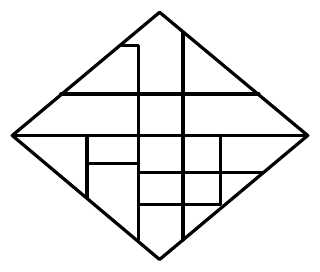
  2. ((b))

  3. ((c))

  4. ((d))

Show Answer
Answer: ((d))

The figure that will replace the question mark (?) in the following figure series is shown below:

The small figures are rotating in clockwise direction.

Also, the horizontal image in image at 1st position is same as image in 3rd position.

So, the horizontal image at 4th position will be similar to image at 2nd position.

So, the next image in the series will be option 4.

Hence, 'option 4' is the correct answer.

73

A paper is folded and cut as shown below. How will it appear when unfolded?

  1. ((a))

  2. ((b))

  3. ((c))

  4. ((d))

Show Answer
Answer: ((b))

The paper when unfolded will appear as shown below:

Hence, 'option 2' is the correct answer.

74

Select the option that is related so the third number in the same way as the second number is related to the first number.

12 : 149 :: 21 : ?

  1. ((a))

    219

  2. ((b))

    406

  3. ((c))

    446

  4. ((d))

    441

Show Answer
Answer: ((c))

446

The logic is:

12 : 149 → 12 : 122 + 5

Similarly,

21 : ? → 21 : 212 + 5

=> ? = 441 + 5

=> ? = 446

Hence, '446' is the correct answer.

75

Select the correct mirror image of the given combination when the mirror is placed at 'PQ' as shown below.

  1. ((a))

  2. ((b))

  3. ((c))

  4. ((d))

Show Answer
Answer: ((b))

The correct mirror image of the given combination when the mirror is placed at 'PQ' is shown below:

Hence, 'option 2' is the correct answer.

Numerical Ability (15 questions)

76

A cow is tied to a peg at one corner of a square shaped grass field of side 25 m. The length of the rope is 14 m long. The area (in m2) of that part of the field in which the cow can graze is: (use π = 227\frac{22}{7})

  1. ((a))

    100

  2. ((b))

    154

  3. ((c))

    77

  4. ((d))

    142

Show Answer
Answer: ((b))

154

Given:

Side of square field = 25 m 

Length of rope = 14 m

Formula Used:

Area of sector = (θ/360) × πr2

Calculation:

Let ABCD be a square field

The area cow can grass will be the sector of the square field

The length of rope = radius of the sector = 14 m

 ∠QBP = 90°  (In squares all angle are 90°)

The area of a sector in which cow can graze =  (θ/360) × πr2  

⇒ (θ/360) × πr2 = (90°/360°) × π(14)2 ⇒ 1/4 × 22/7 × 14 × 14

⇒ Area of sector = 1/4 × 22/7 × 14 × 14 = 154 m2 

∴ The area of that part of the field in which the cow can graze is 154 m2

77

The average monthly salary of five friends is Rs. 62,000. Surinder, one of the five friends, got promotion and a hike in the salary. If the new average of their salaries is Rs. 64, 250, then how much is the increase in the monthly salary of Surinder?

  1. ((a))

    Rs. 14,250

  2. ((b))

    Rs. 11,250

  3. ((c))

    Rs. 73,250

  4. ((d))

    Rs. 12,150

Show Answer
Answer: ((b))

Rs. 11,250

Given:

The average monthly salary of five friends is Rs. 62,000.

The new average of their salaries after the promotion is Rs. 64, 250

Formula used:

Average = Sum of observation/Total number of observation

Calculation:

The total salary of five friends is

⇒ 62000 × 5 = Rs. 310000

The total salary after the promotion is

⇒ 64250 × 5 = Rs. 321250

So, the increment the person gets is

⇒ 321250 - 310000 = Rs.11250

∴ The increment he got is Rs. 11250.

Shortcut TrickTotal change value = change in average × number of observations.

So, Increment in salary is

⇒ (64250 - 62000) × 5

⇒ 2250 × 5 = Rs. 11250

∴ The increment he got is Rs. 11250.

78

A sum invested at 10% per annum amounts to Rs. 20,947.50 at the end of one year, when the interest is compounded half-yearly. What will be the simple interest (in Rs.) on the same sum for 4254\frac{2}{5} years at triple the earlier rate of interest?

  1. ((a))

    25,080

  2. ((b))

    42,020

  3. ((c))

    26,500

  4. ((d))

    27,000

Show Answer
Answer: ((a))

25,080

Given:

A sum invested at 10% per annum amounts to Rs. 20,947.50 in one year, interest is compounded half-yearly

Formula used:

Simple Interest = (P × r × t)/100

Compound interest

⇒ A = P × {1 + (r/100)}t

P = Principal, A = Amount

r = Rate of Interest, t = Time

Calculation:

The rate of interest is 10% per annum

But the interest is compounded half-yearly

So, rate of interest will become 10/2 = 5%

⇒ 20947.50 = P × {1 + (5/100)}2

⇒ 20947.50 = P × (21/20)2

⇒ P = 20947.50 × (20/21)2

⇒ P = 19000

According to the question, the rate of interest is tripled.

⇒ r = 10 × 3 = 30%

The simple interest for 22/5 years is

⇒ {19000 × 30 × (22/5)}/100

⇒ (19000 × 6 × 22)/100

⇒ 2508000/100 = Rs. 25080

∴ The simple interest for 4254\frac{2}{5} is Rs. 25080.

79

A can do a work in 40 days and B can do the same work in 50 days. They worked together for 5 days and then B left the work. In how many days will A finish of remaining work?

  1. ((a))

    40

  2. ((b))

    41

  3. ((c))

    33

  4. ((d))

    31

Show Answer
Answer: ((d))

31

Given:

A can do a work in 40 days and B can do the same work in 50 days

They worked together for 5 days and then B left the work

Concept used:

Efficiency ∝ 1/Time

Calculation:

Let A complete the remaining work in x days.

The efficiency of A is 1/40

And the efficiency of B is 1/50

So, the efficiency of A and B together is

⇒ (1/40) + (1/50)

⇒ (5 + 4)/200 = 9/200

A and B worked for 5 days, rest completed by A

⇒ (9/200) × 5 + (1/40) × x = 1

⇒ 9/40 + x/40 = 1

⇒ 9 + x = 40

⇒ x = 31 days

∴ A will complete the rest of the work in 31 days.

Alternate Method

TimeTotal work (LCM of Time)Efficiency
A405
200
B504

The total efficiency of A and B is

⇒ 5 + 4 = 9

They worked for 5 days

⇒ 9 × 5 = 45

Rest of the work completed by A

⇒ (200 - 45)/5 = 31 days.

∴ A will complete the rest of the work in 31 days.

80

A person spends 22% of the monthly income on house rent, 40% of the income on house expenses and groceries, and 50% of the remaining on children's education and other heads. If the monthly savings are Rs. 3,800, then what is the expenditure (in Rs) on education and other heads?

  1. ((a))

    5,600

  2. ((b))

    1,900

  3. ((c))

    3,800

  4. ((d))

    2,700

Show Answer
Answer: ((c))

3,800

Given:

A person spends 22% of the monthly income on house rent,

40% of the income on house expenses and groceries,

50% of the remaining on children's education and other heads 

And his monthly saving is Rs, 3,800

Formula used:

Percentage = (Part value/Whole value) × 100

Calculation:

Let the monthly income of the person be 100x

The amount he spends on rent

⇒ (22/100) × 100x = 22x

The amount he spends on house expenses and groceries

⇒ (40/100) × 100x = 40x

Remaining amount is

⇒ 100x - 22x - 40x = 38x

50% of the remaining on children's education and other heads 

⇒ (50/100) × 38x = 19x

The person saves 19x of his income

⇒ 19x = 3800

⇒ x = Rs. 200

The amount he spends on children's education and other heads 

⇒ 19 × 200 = Rs. 3800

∴ The person spends Rs. 3800 on children's education and other heads.

Shortcut TrickLet total income be 100%

He spend 22% + 40% = 62%

⇒ Education = (50/100) × 38 = 19%

19% is savings of the person

⇒ savings = education = 19% = 3800

∴ The person spends Rs. 3800 on children's education and other heads.

81

A woman takes 3 hours 20 minutes in walking to a temple and riding back. She would have gained 2 hours by riding both ways. Half of the time she would take to walk both ways is:

  1. ((a))

    2 hours 40 minutes

  2. ((b))

    2 hour 50 minutes 

  3. ((c))

    3 hours 20 minutes

  4. ((d))

    3 hours 10 minutes

Show Answer
Answer: ((a))

2 hours 40 minutes

Given:

Woman takes 3 hours 20 minutes in two ways

Concept used:

Total time = T1 + T2

T1 = Time taken by walking

T2 = Time taken by riding

Calculation:

According to the question,

She takes 2 hours less than actual if she rides both ways

Time for both ways = 3 hours 20 minutes – 2 hours

⇒ 1 hour 20 minutes

⇒ Time for one way = 40 minutes

Time for one way in walking =  3 hours 20 minutes – 40 minutes

⇒ 2 hours 40 minutes

∴ Half of the time she would take to walk both ways is 2 hours 40 minutes

82

Two students A and B are paid a total of Rs. 4,400 as prize money. If A is paid 120 percent of the sum paid to B, how much is B paid (in Rs.) ?

  1. ((a))

    2,000

  2. ((b))

    1,500

  3. ((c))

    2,400

  4. ((d))

    1,800

Show Answer
Answer: ((a))

2,000

Given:

A and B are paid Rs. 4400

A = 120% of B

Concept used:

Total = xA + yB

x and y are ratio

Calculation:

A = 120% of B

⇒ A = 6/5 of B

⇒ 5A = 6B

⇒ A/B = 6/5

⇒ A : B = 6 : 5

A + B = Rs. 4400

⇒ 11 units = 4400

⇒ 1 unit = 400

⇒ 5 units = 2000

⇒ B = Rs. 2000

∴ B paid Rs. 2000

83

On a certain item, the profit is 120% of the cost. If the cost increases by 25% and the selling price remains constant, then what percentage of the selling price is the profit (correct to a whole number)?

  1. ((a))

    43%

  2. ((b))

    39%

  3. ((c))

    47%

  4. ((d))

    51%

Show Answer
Answer: ((a))

43%

Given:

Profit = 120% of the cost

Cost increases by 25%

Shortcut TrickLet's Assume the C.P be 100.

C.PS.PProfit
100220120
12522095

What % of the selling price is the profit,

⇒ (95/220) × 100 = 475/11 = 43.1 ≈ 43%

Alternate Method Concept used:

Profit = [(SP – CP)/CP] × 100

SP = selling price

CP = cost price

Calculation:

Let CP be Rs. 5x

Profit = 5x × 6/5

⇒ 6x

SP = 5x + 6x

⇒ 11x

New CP = 5x × 5/4

⇒ 25x/4

New profit = (11x – 25x/4)

⇒ 19x/4

Required % = (19x/4 ÷ 11x) × 100

⇒ 19/44 × 100

⇒ 43.18 ≈ 43%

∴ Required % is 43%

84

If the annual rate of simple interest increases from 9% to 131213\frac{1}{2} %%, then the yearly interest increases by Rs. 3,690. What is the principal (in Rs.) ?

  1. ((a))

    85,000

  2. ((b))

    80,000

  3. ((c))

    82,000 

  4. ((d))

    88,000

Show Answer
Answer: ((c))

82,000 

Given:

Interest increases = Rs. 3690

Interest rate increases 9% to 131213\frac{1}{2} %%

Shortcut Trick Difference of Interest rate = 13.5% - 9% = 4.5%

⇒ 4.5% = 3690

⇒ 1% = 820

⇒ 100% = 82,000

∴ The principal is Rs. 82000

Alternate Method

Formula used:

I = (P × t × r)/100

I = interest

P = principal

t = time period

r = rate of interest

Calculation:

Let P be Rs. x

[(x × 13.5 × 1)/100] – [(x × 9 × 1)/100] = 3690

⇒ [(13.5x – 9x)/100] = 3690

⇒ (4.5x)/100 = 3690

⇒ x = (3690 × 100)/4.5

⇒ x = 82000

⇒ P = Rs. 82000

∴ The principal is Rs. 82000

85

If (x + y – z) : (y – z + 2w) : (2x + z – w) = 2 : 3 : 1, then the ratio of (5w – 3x – z) : 3w = ?

  1. ((a))

    4 : 3

  2. ((b))

    5 : 3

  3. ((c))

    2: 3

  4. ((d))

    5 : 2

Show Answer
Answer: ((c))

2: 3

Given:

(x + y – z) : (y – z + 2w) : (2x + z – w) = 2 : 3 : 1

Calculation:

(x + y – z) : (y – z + 2w) : (2x + z – w) = 2 : 3 : 1

Here, From given ratio add 2 and 1 which is equal to 3.

⇒ (x + y – z) + (2x + z – w) = (y – z + 2w)

⇒ 3x + y – w = y – z + 2w

⇒ – 3w = – 3x – z

Now,

(5w – 3x – z) : 3w

⇒ (5w – 3w) : 3w

⇒ 2w : 3w

⇒ 2 : 3

∴ Required ratio is 2 : 3

86

The product of two numbers is 9216. When the larger number is divided by the smaller number, the quotient is 16 leaving no remainder. What is the difference between the numbers?

  1. ((a))

    384

  2. ((b))

    408

  3. ((c))

    360

  4. ((d))

    380

Show Answer
Answer: ((c))

360

Given:

The product of two numbers is 9216

Concept used:

The larger number is divided by the smaller number, the quotient is 16 leaving no remainder.

Larger number is 16 times of the smaller number

Calculation:

Let the smaller number be x

And larger number be 16x

According to the question,

The product of two numbers = 9216

⇒ (x × 16x) = 9216

⇒ x= 9216/16

⇒ x2 = 576

⇒ x2 = 242

⇒ x = 24

Now, The smaller number = x = 24

Larger number = 16x = 16 × 24 = 384

Difference = 384 – 24 = 360

∴ The difference between the numbers are 360.

87

What is the least number which should be added to 3432 so that the sum is exactly divisible by 10, 5, 4 and 2?

  1. ((a))

    10

  2. ((b))

    5

  3. ((c))

    6

  4. ((d))

    8

Show Answer
Answer: ((d))

8

Shortcut TrickAny number is divisible by both 5 and 10 only when the unit digit of a number is '0'.

Here, only 1 possibility by adding 8 to the number.

⇒ 3432 + 8 = 3440 

∴ The required number is 8.

Alternate MethodConcept used:

Any number that can be divided by a, b, c, and d is always a multiply a multiple of LCM(a, b, c, and d)

Calculation:

L. C. M of 10, 5, 4 and 2 = 20

On dividing 3432 by 20, the remainder is 12

Number to be added = 20 – 12 = 8

∴ The required number is 8.

88

After allowing three successive discount of 15%, 20% and 18% on the marked price of an article, it is sold for Rs. 2,230.40. The marked price (in Rs) of the article is:

  1. ((a))

    4, 000

  2. ((b))

    4,250

  3. ((c))

    3,500

  4. ((d))

    3,750

Show Answer
Answer: ((a))

4, 000

Given:

Selling price = Rs. 2,230.40

Successive discount = 15%, 20% and 18%

Calculation:

Let the marked price = Rs. x

According to the question:

Selling price = [x × (100 – 15)/100 × (100 – 20)/100 × (100 – 18)/100]

⇒ 2,230.40 = (x × 85/100 × 80/100 × 82/100)

⇒ 2,230.40 = (1394x/2500)

⇒ x = (223040 × 2500)/(1394 × 100) = 4000

∴ The marked price (in Rs) of the article is Rs. 4000.

89

How much be the multiplication of 0.529 and 2.01 is more by 1?

  1. ((a))

    0.09326

  2. ((b))

    0.06329

  3. ((c))

    0.03269

  4. ((d))

    0.02369

Show Answer
Answer: ((b))

0.06329

Given:

Number = 0.529, 2.01

Calculation:

The product of two number = 0.529 × 2.01 = 1.06329

According to the question:

Required difference = 1.06329 – 1 = 0.06329

∴ The required answer is 0.06329.

90

A solid piece of iron in the form of a cuboid of dimensions 24.5 cm × 16.5 cm × 12 cm, is melted to form a solid sphere.

What is the radius (in cm) of the sphere? (Use π = 227\frac{22}{7})

  1. ((a))

    10.5

  2. ((b))

    12.5

  3. ((c))

    11

  4. ((d))

    8

Show Answer
Answer: ((a))

10.5

Given:

Dimensions of cuboid = 24.5 cm × 16.5 cm × 12 cm

Formula used:

Volume of cuboid = lbh

Where, l = length, b = breadth, h = height

Volume of sphere = (4/3)πr3

Concept used:

The solid sphere is formed by melting the Cuboid, their volumes will be equal

Calculation:

According to question:

Volume of cuboid = Volume of sphere

⇒ lbh = (4/3)πr3

⇒ 24.5 × 16.5 × 12 = (4/3) × (22/7) × r3

⇒ r3 = (245 × 165 × 12 × 3 × 7)/(4 × 22 × 100)

⇒ r3 = (49 × 3 × 3 × 7)/(4 × 2)

⇒ r3 = (73 × 33 × 23)/(23 × 23)  

⇒ r = (7 × 3)/2 = 10.5

∴ The radius is 10.5 cm.

Computer Awareness (10 questions)

91

The font size of 36 points in MS-Word 2007 is equal to how many inches?

  1. ((a))

    0.25

  2. ((b))

    1.0

  3. ((c))

    0.125

  4. ((d))

    0.5

Show Answer
Answer: ((d))

0.5

The Correct Answer is "0.5".

Key Points

  • The font in MS word is selected through the Home tab on the ribbon.
  • The smallest and largest font size in Word 2007, available in the front toolbox.
  • The list contains font size in points 8, 9, 10, 11, 12, 14, 16, 18, 20, 22, 24, 26, 28, 36, 48 and 72.
  • If you need, you can have text with font sizes not listed in this tool by using the Font dialog box.
  • It lets you set the font size as smaller 8 as well as larger than 72 points.

Important Points

  • A point is a typographical term for a unit of measure.
  • It is roughly equivalent to 1/72 of an inch.
  • Word uses point sizes to specify the height of all the fonts it uses.
  • when we use a 12-point type, we are using one that occupies a character box approximately 12/72 (or 1/6) of an inch high.
  • Likewise, the 72-point type uses a character box that is about one inch tall.
  • Example :
  • If 1 point equal to 1/72.
  • then 36 point equals 36/72 i.e 0.5.

92

Which of the following is NOT a service offered by an Internet Service Provider?

  1. ((a))

    Domain name registration

  2. ((b))

    Web administration

  3. ((c))

    Dial-up access

  4. ((d))

    Internet access

Show Answer
Answer: ((b))

Web administration

The Correct Answer is "Web administration".

Important Points

  • An Internet service provider (ISP), is a company that provides Internet connections and services to individuals and organizations.
  • In addition to providing access to the Internet, ISPs may also provide software packages and a personal Web site or home page.
  • ISPs can host Web sites for businesses and can also build the Web sites themselves.
  • ISPs are all connected to each other through network access points and public network facilities on the Internet backbone.

Some of these services include:

  • Email services
  • Web hosting services
  • Domain Registration
  • Browser and software package.

Key Points

  • An internet service provider (ISP) is a company that provides web access to both businesses and consumers.
  • ISPs may also provide other services such as email services, domain registration, web hosting, and browser services.
  • An ISP is considered to be an information service provider, storage service provider, internet network service provider (INSP), or a mix of all of them.
  • Internet use has evolved from only those with university or government accounts having access to nearly everyone having access, whether it's paid or free.
  • Access has gone from dial-up connections to high-speed broadband technology.
93

Which of the following is NOT a text function of MS-Excel 2007?

  1. ((a))

    MID

  2. ((b))

    COMBIN

  3. ((c))

    LEFT

  4. ((d))

    RIGHT

Show Answer
Answer: ((b))

COMBIN

The Correct Answer is "COMBIN".

Important Points

  • The Excel TEXT Function is used to convert numbers to text within a spreadsheet.
  • Essentially, the function will convert a numeric value into a text string.
  • TEXT is available in all versions of Excel.
  • 'MID', 'LEFT', and 'RIGHT' are part of the Text function.

Formula :

=Text(Value, format_text)

Where:

  • Value is the numerical value that we need to convert to text.
  • Format_text is the format we want to apply.

Key PointsWe use the TEXT function in the following circumstances:

  • When we want to display dates in a specified format.
  • When we wish to display numbers in a specified format or in a more legible way.
  • When we wish to combine numbers with text or characters.

Additional InformationExamples :

Basic example – Excel Text Function

With the following data, I need to convert the data to “d mmmm, yyyy” format. When we insert the text function, the result would look as follows:


Text Function in Excel

Using Excel TEXT with other functions :

  • We use the old price and the discount given in cells A5 and B5.
  • The quantity is given in C5. We wish to show some text along with the calculations.

We wish to display the information as follows:

  • The final price is $xxx
  • Where xxx would be the price in $ terms.
  • For this, we can use the formula:
  • =”The final price is “&TEXT(A5B5C5, “$###,###.00”)


Excel TEXT Function - Other Functions

94

By default how many worksheets are there in an MS-Excel workbook2007?

  1. ((a))

    1

  2. ((b))

    4

  3. ((c))

    2

  4. ((d))

    3

Show Answer
Answer: ((d))

3

The Correct Answer is "3".

Important Points

  • When we open an Excel workbook, there are three sheets by default, and the default name on the tabs are Sheet1, Sheet2, and Sheet3.
  • These are not very informative names.
  • Excel 2007 allows us to create a meaningful name for each worksheet in a workbook so we can quickly locate information.


New Name for Worksheet

Additional Information

To name a worksheet:

  • Right-click the sheet tab to select it.
  • Choose Rename from the menu that appears.
  • The text is highlighted by a black box.


Rename Worksheet

To insert a new worksheet:

  • Left-click the Insert Worksheet icon.

  • A new sheet will appear.

  • It will be named Sheet4, Sheet5, or whatever the next sequential sheet number may be in the workbook.

  • OR Press the Shift and the F11 keys on your keyboard.


Insert Worksheet

95

Which of the following is NOT an option of cell alignment in a table in MS-Word 2007?

  1. ((a))

    Align bottom right

  2. ((b))

    Align center

  3. ((c))

    Align top left

  4. ((d))

    Align across

Show Answer
Answer: ((d))

Align across

The Correct Answer is "Align across".

Important Points

  • Alignment refers to where and how the text lines up.
  • Default settings in Microsoft Word will left-align your text, but there are many other ways to format a document’s alignment.

Steps :

  • Select the cells, columns, or rows, with text that you want to align (or select your entire table).
  • Go to the (Table Tools) Layout tab.
  • Click an Align button (you may have to click the Alignment button first, depending on the size of your screen).
  • The following figure shows where the Align buttons are on the (Table Tools) Layout tab and how these options align text in a table.

How to change alignment in Excel, justify, distribute and fill cells

​ 


Additional Information

  • Vertical alignment
  • Top Align 

Top Align

 - aligns the contents to the top of the cell.

  • Middle Align 

Middle Align

 - centers the contents between the top and bottom of the cell.

  • Bottom Align 

Bottom Align

 - aligns the contents to the bottom of the cell (the default one).

  • Horizontal alignment
  • Align Left 

Align Left

 - aligns the contents along the left edge of the cell.

  • Center 

Center

 - puts the contents in the middle of the cell.

  • Align Right 

Align Right

 - aligns the contents along the right edge of the cell.

  • We can arrange the cell contents in different ways, for example:
Align to upper-leftAlign to bottom-rightCenter in the middle
of a cell
Align to upper-leftAlign to bottom-rightCenter in the middle of a cell
96

Which of the following is NOT an option of Menu bar in MS-Word 2007?

  1. ((a))

    Insert

  2. ((b))

    Page Layout

  3. ((c))

    Internet

  4. ((d))

    Home

Show Answer
Answer: ((c))

Internet

The Correct Answer is "Internet".

Important Points

  • Menus, Home, Insert, Page Layout, References, Mailings, Review, View, options are available see figure:


Figure 1:Office 2007's Toolbar under Menus tab in Office 2007's Ribbon

97

Which of the following is NOT a valid e-mail address?

  1. ((a))
  2. ((b))
  3. ((c))
  4. ((d))
Show Answer
Answer: ((b))

The Correct Answer is "[email protected]".

Important Points

A valid email address has four parts:

  • Recipient name
  • @ symbol
  • Domain name
  • Top-level domain

Recipient name :

The recipient name represents an email mailbox that belongs to:

  • A specific person
  • A mailing list
  • A department
  • A role within a company (such as sales or customer service)

The recipient name may be a maximum of 64 characters long and consist of:

  • Uppercase and lowercase letters in English (A-Z, a-z)
  • Digits from 0 to 9
  • Special characters such as ! # $ % & ' * + - / = ? ^ _ ` { |


Domain name :

The domain name is a string of letters and digits that defines a space on the Internet owned and controlled by a specific mailbox provider or organization.

Domain names may be a maximum of 253 characters and consist of:

  • Uppercase and lowercase letters in English (A-Z, a-z)
  • Digits from 0 to 9
  • A hyphen (-)
  • A period (.) (used to identify a sub-domain; for example, email.domainsample)


Examples :

Examples of valid email addresses include:


Additional Information

  • An email address is a unique identifier for an email account.
  • It is used to both send and receive email messages over the Internet.
  • Similar to physical mail, an email message requires an address for both the sender and recipient in order to be sent successfully.
98

Which of the given options best matches the items of LIST-1 with the items of LIST-2 with reference to editing cells in a spreadsheet?

LIST-1 LIST-2

(i) Enter (a) moves you to the next cell to the right

(ii) Shift + tab (b) moves you to the next cell down

(iii) Tab (c) moves you in the direction of the arrow

(iv) Arrow key (d) moves you to the next cell to the left

  1. ((a))

    (i) - b, (ii) - a, (iii) - d, (iv) - c

  2. ((b))

    (i) - b, (ii) - d, (iii) - a, (iv) - c

  3. ((c))

    (i) - c, (ii) - d, (iii) - a, (iv) - b

  4. ((d))

    (i) - a, (ii) - d, (iii) - b, (iv) - c

Show Answer
Answer: ((b))

(i) - b, (ii) - d, (iii) - a, (iv) - c

The Correct Answer is "(i) - b, (ii) - d, (iii) - a, (iv) - c".

Important Points

FunctionHot Key
To move to the next cell of the arrow direction keyPress Arrow Keys.
To move to the next cellPress Enter
To move to the next cell to the rightPress TAB.
To move to the next cell to the leftPress SHIFT + TAB.
To move to the edge of a data regionPress CONTROL + Arrow Keys.
To move to the first cell in the rowPress HOME.
To move to the first cellPress CONTROL + HOME.
To move to the last cellPress CONTROL + END.
To scroll downPress PAGE DOWN.
To scroll upPress PAGE UP.
To scroll to the rightPress ALT + PAGE DOWN.
To scroll to the leftPress ALT + PAGE UP.
To move to the next worksheetPress CONTROL + PAGE DOWN.
To move to the previous worksheetPress CONTROL + PAGE UP
99

Borders and Shading option of Table Properties can be used to apply which of the following in MS-Word 2007?

  1. ((a))

    Mailings

  2. ((b))

    Margins

  3. ((c))

    Orientation

  4. ((d))

    Borders

Show Answer
Answer: ((d))

Borders

The Correct Answer is "Borders".

Important Points

  • We can format tables with borders and shading any way we want, calling attention to specific cells or headings.
  • By default, Word inserts tables with a .5-point border around each cell.
  • We can adjust or remove these borders, or specify which cells are bordered and which ones are not.
  • To work with the borders of a table, select the table by clicking the Select Table icon at the upper-left corner of the table, or by clicking inside the table and typing Alt+NumPad5 on your keyboard.
  • We can also select specific cells for which you want to change bordering.
  • Then choose Format, Borders and Shading, and choose the Borders tab.


Borders & Shades in Word 2010 - Tutorialspoint

100

Which of the given options best matches the items of LIST-1 with the items of LIST-2 with reference to web browsers and their vendors?

List-1 List-2

(i) Internet explorer    (a) Mozilla Foundation

(ii) Safari                    (b) Microsoft

(iii) Sea Monkey         (c) Apple

  1. ((a))

    (i) - (a), (ii) - (c), (iii) - (b)

  2. ((b))

    (i) - (b), (ii) - (c), (iii) - (a)

  3. ((c))

    (i) - (a), (ii) - (b), (iii) - (c)

  4. ((d))

    (i) - (b), (ii) - (a), (iii) - (c)

Show Answer
Answer: ((b))

(i) - (b), (ii) - (c), (iii) - (a)

The Correct Answer is "(i) - (b), (ii) - (c), (iii) - (a)".

Important Points

Internet Explorer :

  • Internet Explorer is a series of graphical web browsers developed by Microsoft and are included in the Microsoft Windows line of operating systems, starting in 1995.
  • It was first released as part of the add-on package Plus for Windows 95 that year.


Safari :

  • Safari is a graphical web browser developed by Apple, based on the WebKit engine.
  • First released on the desktop in 2003 with Mac OS X Panther, a mobile version has been bundled with iOS devices since the iPhone's introduction in 2007.
  • Safari is the default browser on Apple devices.


SeaMonkey :

  • Developed by Mozilla Foundation.
  • SeaMonkey is a free and open-source Internet suite.
  • It is the continuation of the former Mozilla Application Suite, based on the same source code, which itself grew out of Netscape Communicator and formed the base of Netscape 6 and Netscape 7.

Attempt this paper under real exam conditions

Timed interface, section switching, instant scoring, and question-by-question analytics — free.

Start Timed Attempt