Official Paper

CTET Paper 2 Social Science 3rd Jan 2022 (English-Hindi) (Previous Year Paper)

150 questions · 150 minutes · with answers · free

Child Development and Pedagogy (30 questions)

1

The social expectations at each stage of development is referred to as 

  1. ((a))

    Developmental tasks 

  2. ((b))

    Developmental needs 

  3. ((c))

    Developmental hazards 

  4. ((d))

    Developmental domains 

Show Answer
Answer: ((a))

Developmental tasks 

A developmental task is one that arises predictably and consistently at or about a certain period in the life of the individual. He believed that learning is basic to life and that people continue to learn throughout life. According to him, a developmental task is a task that an individual has to and wants to solve in a particular life period. He writes, “A developmental task is a midway between an individual need and a social demand. 

Social expectations:  According to the Expectation states theory, group members develop expectations about the future task performance of all group members, including themselves. Once developed, these expectations guide the group interaction.

Key Points Developmental tasks arise from three different sources. In his biopsychosocial model, the first important issue is biology, the second is psychology and the last one is sociology.

  • First, some tasks are mainly based on physical maturation example, learning to walk, talk, and behave acceptably with the opposite sex during adolescence; adjusting to menopause during middle age.
  • Another source of developmental tasks involves personal values and aspirations. These personal factors result from the interaction between ontogenetic and environmental factors and play an active role in the emergence of specific developmental tasks (for example, choosing a certain occupational pathway).
  • The third source of developmental tasks relates to socio-structural and cultural forces. Such influences are based on, for instance, laws (example, minimum age for marriage) and culturally shared expectations of development.
  • Thus by the third mentioned point, we can conclude that developmental tasks refer to the social expectations.

2

Development __________.

  1. ((a))

    proceeds from centre of the body in an outward direction. 

  2. ((b))

    development proceeds from bottom to top. 

  3. ((c))

    is unidimensional. 

  4. ((d))

    is not influenced by environmental efforts. 

Show Answer
Answer: ((a))

proceeds from centre of the body in an outward direction. 

Development:  Development describes the growth of humans throughout their lifespan, from conception to death. It refers to development as patterns of change over time. It does not just involve the biological and physical aspects of growth, but also the cognitive and social aspects related to the development.

Key PointsAccording to the principle of sequentiality of human development, there is a development from the center to the outward direction which is described as follows

 Principle of Sequentiality: The principle of sequentiality states that every individual although exhibit difference in change, they follow the same sequence of change. In the prenatal stage of development, a genetic sequence is followed appearing at fixed intervals with specific characteristics.

  • Proximodistal tendency proceeds from the near to the distant and from parts of the body near the center develop first then the extremities. Therefore the child in the earlier stage of development exercises on the fundamental muscles rather than the smaller muscles or fine motor skills. Thus the child follows the sequence in the development process as s/he first draws some haphazard line before writing an alphabet.

Hence, from the above points, we can conclude that the above question asks about development from near to distant so it is proximo-distal development.

Hint

  • Cephalocaudal and proximodistal tendencies are followed in maintaining sequence and direction of development. The Cephalocaudal tendency exhibits that the development proceeds in the longitudinal direction i.e. from head to foot. That is why the child first gains control overhead before s/he starts walking.
3

Assertion (A) : Cognitive development progresses quite rapidly till middle childhood and then comes to a stop. 

Reason (R) : Human beings cannot learn new things after the stage of middle childhood. 

Choose the correct option.

  1. ((a))

    Both (A) and (R) are true and R is the correct explanation of (A). 

  2. ((b))

    Both (A) and (R) are true but R is not the correct explanation of (A). 

  3. ((c))

    (A) is true but (R) is false. 

  4. ((d))

    Both (A) and (R) are false. 

Show Answer
Answer: ((d))

Both (A) and (R) are false. 

Cognitive Development:  Cognitive development aims at studying a child’s development specifically information processing, conceptual resources, perceptual skill, language learning, and other aspects related to the development of the brain. Research in this field mainly has been focused on understanding how a child conceptualizes the world.

Key PointsCharacteristics of development:

  • Development is a continuous process from conception to death. In the early years of life, the development consists of changes that lead the child to maturity not only in body size and functioning but also in behavior.
  • Even after maturity has been attained, development does not end. Changes continue which lead to the period of life known as senescence or old age.
  • These changes continue until death ends the life cycle. Development depends on the growth and maturity of individuals who interact with the environment.

From the above points, it can be concluded that Cognitive development or development is a continuous process and continues till death.​

Important Points There are some principles of development, which show the features of development, these are:

  • Principle of Continuity: Development follows the principle of continuity which starts with conception and ends with death. It is a never-ending process in life.
  • Principle of Individual Differences: It says that every individual is unique in himself/herself as the heredity and environmental factors make him/her different from others.
  • Principle of Generality to Specificity:  The development process starts with general responses shown by the child as s/he passes through the later stages s/ he starts exhibiting specific behaviors.
  • Principle of Interrelation: The development of an individual is reflected through the balanced interrelation of all the aspects of life. Development in any aspect affects the other aspect also.
  • Principle of Interaction: The principle of interaction suggests that an individual is the product of heredity and environment. In other words, the interaction takes place within and outside forces of the child.
  • Principle of Differentiation in Rate: Differentiation in the rate indicates that individuals differ in the rate of development. There is a difference in the rate of development in girls and boys like girls grow faster than the boys at the early stage of development.
  • Principle of Integration: The principle of Integration refers to the integration of various aspects of development like physical, mental, emotional, social, and moral.
  • Principle of Predictability: Development is predictable i.e. with the help of the uniformity of the pattern and sequence of development, we can predict the behavior to a great extent of a child in one or more aspects in a particular stage of her/his growth and development.
  • Principle of Sequentiality: It states that every individual although exhibit difference in change, they follow the same sequence of change.
4

A group of children enact scenes from a popular dance reality show in their play. As a judge, 8 years old Sana gives comments on other children's dances. This situation highlights the important role of _______ in the socialization of children. 

  1. ((a))

    religious institutions 

  2. ((b))

    family 

  3. ((c))

    media

  4. ((d))

    school 

Show Answer
Answer: ((c))

media

Socialization is the process of internalizing the norms and ideologies of society. Socialization encompasses both learning and teaching. It is "the means by which social and cultural continuity are attained".

Key PointsSocialization cannot take place in a vacuum. Individuals, groups, and institutions create the social context for socialization to take place. It is through these agencies that we learn and incorporate the values and norms of our culture. There are many sources of socialization such as School, College, Friends, Society, Neighbourhood, Religion, Caste, Media, newspapers, Meetings, Events, etc.

  • Media: Media is the source in which observational skills are considered, media such as Television, magazines, Mobile phone, reality shows, newspapers, etc.
  • From the above references, we can conclude that comments by Sana on the dance performance by another student, all show media type socialisation.

Hint

  • Religion: Religion makes child socially active, it gives them knowledge about religions, and Gods, and make them familiar with them.
  • Family: Family is one of the major sources of socialization, a child first comes with respect to the family and engaged with them.

Important Points  Some important characteristics of socialization:

  • It is a lifelong process, it occurs throughout life.
  • The roles a person enacts are the expressions of his social nature.
  • The nature of what one communicates in society is determined by the influence of one's interaction with society.

Additional Information  Various agencies of socialization:

  • Micro-level Socialization:
  • Family
  • Peer group
  • Neighbourhood
  • Meso level of socialization
  • School
  • Religion
  • Social
  • Class
  • Macro-level of socialization:
  • Global Community
  • Electronic media
  • Social media marketing
5

According to Jean Piaget's theory of cognitive development, in which stage children gain the ability to seriate objects in a specified order? 

  1. ((a))

    Sensory motor 

  2. ((b))

    Pre operational 

  3. ((c))

    Concrete operational 

  4. ((d))

    Formal operational 

Show Answer
Answer: ((c))

Concrete operational 

Piaget's theory of cognitive development: Piaget’s theory proposes that Cognitive Development universally follows a pattern of four stages. As a person progresses to higher stages, her/his thinking becomes more refined and evolved.

  • The first three stages span from birth to about eleven years; that is mainly during early to late childhood.
  • The fourth stage is the highest stage of cognitive development and is primarily located during pre-adolescence age till adulthood.

Key Points

Characteristics of concrete operational stage:

  • 'Concrete Operational Stage' lasts around 7 to 11 years of age which refers to the later childhood stage of child development.
  • In this stage, children can classify objects into groups and subgroups and gain the ability to conserve numbers, area, and volume.
  • Children show attainment of the concept of reversibility, seriation, and transitivity as a cognitive capacity.
  • Reversibility is the understanding that a child develops to know that things that have been changed can be returned to their original state.
  • Children can conserve numbers (age 6), mass (age 7), and weight (age 9). Conservation is the understanding that something stays the same in quantity even when its appearance changes.

From the above points, we can conclude that the concrete operational stage involves seriation or the ability of the child to seriate objects develop in the concrete operational stage.

Important Points

  • Sensorimotor Stage: The developments that take place in this stage include Co-ordinating reflexes, Greater control over body movements, and Co-ordinating simple motor actions. Another important development that takes place during this stage is object permanence.
  • Preoperational Stage:  The capacity to mentally do and reverse action is known as operations or operational thinking. Since this second stage comes before the development of such thinking, it is known as preoperational. This is the stage that prepares for such operational thinking. The first step in this direction is a development of a language system
  • Concrete Operational Stage: This stage is considered a significant turning point in the cognitive development of children. Concrete operational reasoning is much more logical, flexible, and organized than sensorimotor or preoperational thought. They apply their reasoning to concrete and specific information which can be directly perceived.
  • Formal operational stage: It is important to note that mathematics and grammar are subjects that demand higher abstract thinking as the student has to work with symbols and with ideas that may not be visible in concrete reality. It is only in this stage that children’s capacity to think mathematically emerges. Such thinking demands the ability for hypothetical (assumptions based), and deductive reasoning.
6

According to Jean Piaget, an ongoing process which refines and transforms mental structures is called ________. 

  1. ((a))

    Deferred Imitation 

  2. ((b))

    Object Permanence 

  3. ((c))

    Assimilation 

  4. ((d))

    Equilibration 

Show Answer
Answer: ((d))

Equilibration 

Piaget’s stage theory describes the cognitive development in children. Cognitive development involves changes in cognitive processes and abilities. In Piaget’s view, early cognitive development involves processes based upon actions and later progresses into changes in mental operations.  According to Piaget's Theory of Cognitive Development, assimilation, accommodation, and equilibrium are the ways through which children integrate new experiences into already existing cognition structures (schema). 

Key Points Equilibration: Piaget believed that all children try to strike a balance between assimilation and accommodation, which is achieved through a mechanism Piaget called equilibration.

  • It was this process that led the child to a better and more sophisticated knowledge of his experience.
  • All these processes are influenced by a child’s experience and activity, social interactions, and biological process of becoming mature (maturation).
  • All these processes help the child in the transformation and in the refining of mental structures.

From the above points, it can be concluded that equilibration serves as a process of maintaining balance and is the process of refining and transforming mental structures. 

Hint

  • Schemas for an organization: Piaget proposed that people are born with a tendency to organize their thinking into schemes (schema). These schemas are psychological (mental) categories in which people organize knowledge. These schemas develop and become more complex with experience as one grows from infant to an adult
  • Adaptation: Two basic processes are involved in adaptation: assimilation and accommodation. Assimilation takes place when people try to understand something new by fitting it into what we already know. Accommodation occurs when a person must change existing schemes to respond to a new situation.
  • Object permanence means knowing that an object still exists, even if it is hidden. It requires the ability to form a mental representation of the object.
  • Assimilation: Piaget defined assimilation as the cognitive process of fitting new information into existing cognitive schemas, perceptions, and understanding.
7

After seeing students struggling to solve a problem, a teacher gave them hints and half solved examples to assist them. 

As per Lev Vygotsky's theory, this is an example of ________.

  1. ((a))

    scaffolding 

  2. ((b))

    reversibility 

  3. ((c))

    seriation 

  4. ((d))

    expository teaching 

Show Answer
Answer: ((a))

scaffolding 

Lev Vygotsky is a Russian Psychologist who proposed the theory of Socio-cultural development. In this theory, Vygotsky emphasizes the role of society and culture in the development of the child There are three ways discussed in his theory that help a child in shaping his/her ideas: the zone of proximal development, scaffolding, and MKO (make knowledgeable others). 

Key Points

  • Scaffolding is a technique to provide the right kind of support in the right amount at right time to increase a child’s competence. When a teacher starts supporting the learner initially for learning, and gradually reduces the support till the learner reaches a situation, where the learner can develop his/ her own meaning and understanding independently. The teacher is scaffolding the learner.

From the above points, it can be concluded that scaffolding is a process of making a child reach his/her goal by providing scaffolding.

Additional Information There are three ways discussed in his theory that help a child in shaping his/her ideas: the zone of proximal development, scaffolding, and MKO.

  • Zone of Proximal Development: Zone of proximal development (ZPD) is a term for a range of tasks that the child cannot do or master independently but they can be learned with some assistance and guidance of an adult or some other more skilled child.
  • MKO (make knowledgeable others)- Vygotsky defined the “More Knowledgeable Other” (MKO) as anyone who has a better understanding or a higher ability level than the learner, particularly in regards to a specific task, concept, or process. MKO could be teachers, parents, tutors, and even peers.
8

Which theorist asserted that cognitive development is a collaborative process?

  1. ((a))

    Lev Vygotsky 

  2. ((b))

    Ivan Pavlov

  3. ((c))

    B. F. Skinner 

  4. ((d))

    John B. Watson 

Show Answer
Answer: ((a))

Lev Vygotsky 

Vygotsky is known as the proposer of social constructivism. Social Constructivism approach talks of the importance of social interaction and context in learning. He believes that learning is social in nature. Through interactions, children shared their views and make their own meaning. So Lev Vygotsky asserted that cognitive development is a collaborative process. 

Key Points The main features of his theory were:

  • Knowledge is distributed among people and environments, which could be developed best by cooperation and interaction with others.
  • the opportunity for children to interact with elders at home or in the community, with other children in the class, or in the playground helps them to refine their own thoughts and develop a shared vision or understanding of a situation/event or object.
  • Vygotsky is of the view that teachers should provide an environment for children to construct knowledge with peers and teachers i.e. co-construction of knowledge.
  • He emphasized the role of culture in learning.
  • Culture helps in acquiring appropriate skills.

From the above points, we can conclude that Lev Vygotsky proposed learning is best through cooperation and social interaction.

Additional InformationVygotsky also proposed the needs of a child in learning and these are:

  • ZPD (zone of proximal development)
  • Scaffolding
  • MKO (make knowledgeable others)​
  • ZPD (zone of proximal development): The difference between the learning of a child by self and the learning of a child with the help of others(society, culture, etc).
  • Scaffolding- Temporary help is given to a child in learning by their peers, family members, teachers, etc.
  • Example: When infants are learning how to walk, they often start by holding onto the clothes or hands of an adult or older child, who guides them.
  • MKO (more knowledgeable others)- Vygotsky defined the “More Knowledgeable Other” (MKO) as anyone who has a better understanding or a higher ability level than the learner, particularly in regards to a specific task, concept, or process. MKO could be teachers, parents, tutors, and even peers.
  • Example: a child learns multiplication of numbers because his tutor
9

One of the chief criticisms of Lawrence Kohlberg's theory is that 

  1. ((a))

    his theory undermines the feminine perspective 

  2. ((b))

    he did not refer to Piaget's theory of moral development 

  3. ((c))

    he does not propose specific responses of children at each stage 

  4. ((d))

    he did not conduct any research on children 

Show Answer
Answer: ((a))

his theory undermines the feminine perspective 

Lawrence Kohlberg's theory of moral development:  He developed his theory of moral development. His theory was much more advanced compared to Piaget’s two-stage theory of moral judgment which differentiated younger children’s responses to moral dilemmas that were fixed, versus older children’s views of moral dilemmas that were relativistic.

Key Points The chief criticism of Kohlberg's theory was:

  • Kohlberg’s moral development theory was biased toward females since the subjects of his study were only males.
  • Men and women have different moral and psychological tendencies. While men think in terms of rules and justice, women emphasize more on care and relationships.
  • In other words, women were not inferior, but rather different than men; and their functioning is based on ethics of care rather than ethics of justice.

From the above points, it is clear that one of the chief criticisms of Lawrence Kohlberg's theory is that his theory undermines the feminine perspective.

Additional Information There are 6 stages of moral development given by Kohlberg's theory are:

  • Stage-I: The Punishment and Obedience Orientation The physical consequences of an action determine whether the action is good or bad regardless of the human value or meaning of these consequences. Avoidance of punishment and deference to power are valued in their own right, not in terms of respect for the underlying moral order:
  • Stage 2: Instrumental Relativist Orientation Right action consists of that which instrumentally satisfies one's own needs and occasionally the needs of others. Human reactions are considered those of market place. Elements of fairness, reciprocity, and equal sharing are present but they are always interpreted.
  • Stage 3: Good boy - Nice Girl Orientation Good behavior is that which pleases or helps others and is approved by them. Behavior at this stage is frequently judged by intentions - "he means well", becomes important for the first time. One earns approval by being good to others.
  • Stage 4: The Law and Order Orientation: There is an orientation towards authority, fixed rules, and the maintenance of social order. Right behavior consists of doing one's duty, showing respect for established or lawful authority, and maintaining given social order for its own sake.
  • Stage 5: The Social Contract, Legalistic Orientation At this stage right actions tend to be defined in terms of general individual rights and standards that have been critically examined and agreed upon by the whole society.
  • Stage 6: The Universal Ethical Principle Orientation Right is defined by the decision of the conscience by self-chosen ethical principles appealing to logical comprehensiveness, universality, and consistency. These are universal principles of justice, the reciprocity and quality of human rights, and respect for the dignity of human beings as individual persons.
10

Howard Gardner suggested that there are distinct kinds of intelligence. 

Which of the following intelligence was not proposed by Gardner?

  1. ((a))

    Musical 

  2. ((b))

    Linguistic 

  3. ((c))

    Body-Kinesthetic 

  4. ((d))

    Practical 

Show Answer
Answer: ((d))

Practical 

Howard Gardner proposed a theory of multiple intelligence. Gardner defines intelligence as "a biopsychological potential to process information that can be activated in a cultural setting to solve problems or create products that are of value in a culture.

Key Points Various types of intelligence as proposed by Gardner is:

  • Linguistic intelligence
  • Logical-Mathematical intelligence
  • Musical intelligence
  • Bodily-kinaesthetic intelligence
  • Interpersonal intelligence
  • Intrapersonal intelligence
  • Spatial intelligence
  • Naturalistic intelligence

From the above points, it can be concluded that Howard Gardner's intelligence does not include a practical type of intelligence in it.

Additional Information

  • Linguistic Intelligence refers to the ability to use language. It is the capacity to use spoken and written words in a skilled way. Individuals with high verbal/linguistic intelligence are very good at using words and language to express themselves, articulate things, and create.
  • Logical-mathematical intelligence is the ability to use logical reasoning and mathematical ability. Individuals high in this intelligence have good abstract reasoning, critical thinking, and good in dealing with numbers. This type of intelligence correlates well with the traditional notion of intelligence. Scientists, engineers, physicists, and economists are people with high logical-mathematical intelligence.
  • Musical Intelligence is the ability to use rhythms, sounds, and patterns to create, compose and perform music. It involves sensitivity to music, and the ability to recognize and manipulate musical patterns. People with high musical intelligence are likely to be singers.
  • Bodily-kinesthetic intelligence is the ability to use and control one’s body movements and actions. Dancers and sports persons are usually high in such intelligence.
  • Spatial Intelligence is the capacity to perceive, understand and use spatial and visual information effectively. Such people are good at spatial orientation, forming visual images and patterns.
  • Interpersonal Intelligence refers to the ability to understand others and social interactions. They can understand the emotions and the perspectives of others and relate well to others. They can establish good interpersonal relationships with others. They have good and effective communication skills.
  • Intrapersonal Intelligence is the ability to understand oneself and know one’s thoughts, emotions, feelings, motives, and desires, and how these influence their behavior.
  • Naturalistic Intelligence is the ability to recognize and understand the various patterns in nature. It includes sensitivity to nature with all its features including flora, fauna, and biodiversity. Gardner has added this eighth type of intelligence to his original seven bits of intelligence.
11

Which of the following illustrates a constructivist learning approach in a progressive classroom?

  1. ((a))

    Multiple interpretations 

  2. ((b))

    Rote memorization and verbatim recall 

  3. ((c))

    Rewards and punishment 

  4. ((d))

    Repeated drill and practice 

Show Answer
Answer: ((a))

Multiple interpretations 

A progressive classroom is a part of progressive education that believes in the capability and potential of every child. It emphasizes enhancing the skills and understanding of the learners by engaging with the contents and experiences. It promotes 'learning by doing to make children self-reliant and productive to use their knowledge and talents effectively. children construct their own knowledge so we can say that Constructive learning is the major characteristic of a progressive classroom.

Constructive Learning: A learning environment facilitating learning through the construction of meaning and development of understanding among children on their own may be viewed as a constructive learning environment.

Key Points  One of the major points of constructive learning:

  • Multiple Perspectives
  • providing an opportunity to experience various dimensions.
  • As you are aware, constructivism does not support the sequential and linear approach to learning, as a teacher
  • you should provide your learners with opportunities, where they can gather information from various perspectives.
  • There should be the opportunity to see the same concept in various ways and develop an understanding with varying objectives and expectations.

From the above points, it is clear that multiple perspectives or multiple interpretations should be allowed for constructivist learning in a progressive classroom.

Additional Information The following are the major points of constructivist learning :

  • Personal constructions of reality: whatever children construct within their own minds is their own reality. They construct their own meaning based on their experiences. Knowledge comes from their experience.
  • Simulated authentic learning environments: the learning environment designed and developed on the basis of real-life experiences. Authentic learning does not mean providing ample information; rather it should provide opportunities to develop a deep understanding.
  • Active learning is a situation where children construct their knowledge by their active engagement in the learning process. It is in contrast to objectivism, where knowledge was supplied by a teacher or a more learned person to a young learner or less knowledgeable person.
  • Collaboration is another key practice of a constructive learning environment. As a constructivist teacher, you should be clear that collaboration is not a means to acquire knowledge from someone else, rather it is a means to create individual meaning with the help of others.
12

In context of multilingualism, which of the following is an appropriate approach?

  1. ((a))

    Students should be penalized for using their mother tongue or local language during school hours. 

  2. ((b))

    The schools should admit only those students whose mother tongue is same as the language of instruction. 

  3. ((c))

    The teacher should respect and create a classroom environment which supports inclusion of all students. 

  4. ((d))

    The teacher should ignore children who use their mother tongue in the class. 

Show Answer
Answer: ((c))

The teacher should respect and create a classroom environment which supports inclusion of all students. 

Multilingualism:  Multilingualism is the knowledge of more than one language by a person or within a social group; it assumes the ability to switch from one language to another in speech, writing, or reading. Other terms describing this phenomenon include bilingualism, polylingualism, and languages-in-contact. 

Key Points The teacher should follow these to have a multilingual classroom:

  • If we begin to appreciate the multilingual diversity in our classrooms, we may be able to follow the path of equality, social justice, and tolerance.
  • A language teacher can play an important role in using multilingualism as a resource in her class. Whether she is teaching a poem or grammar, she can elicit multiple language data from children in her class through translation.
  • Once the data from several languages is on the board, children will be able to observe similarities across Indian languages and generalize their own rules.
  • Such a class would be democratic as several languages get represented and no language assumes a powerful status as a standard language.
  • Multilingualism has to be the new norm in our classrooms.

From the above points, it is clear that the teacher should make the classroom environment such that students from different languages can easily learn together.

Additional Information Advantages of using multilingualism as a resource:

  • Multilingualism, cognitive growth, and educational achievement have a positive relationship as multilingual children are capable of greater cognitive flexibility and perform better academically than monolinguals.
  • In an environment of multilingualism, students get the opportunity to not only master their primary language but also get the opportunity to efficiently learn multiple languages at the same time.
  • The multilingual students make rules across languages in a stimulating environment which helps them to sharpen their skills like observing, deducting, and reasoning thus leading to greater linguistic and cognitive flexibility.
13

Children who often see their parents cross normative gender lines such as mothers repairing the appliances and fathers taking care of the baby, are: ________. 

  1. ((a))

    less likely to adhere to gender stereotypes. 

  2. ((b))

    more likely to practice gender segregation. 

  3. ((c))

    more likely to practice gender stereotypes. 

  4. ((d))

    less likely to break gender norms prevalent in society. 

Show Answer
Answer: ((a))

less likely to adhere to gender stereotypes. 

Gender refers to the socially constructed differences between men and women. It refers to the masculine and feminine qualities, behavior, roles, and responsibilities that society upholds. Gender can be changed / re-oriented.

Gender stereotype is an oversimplified and unfair belief or idea that groups of people have particular characteristics or that all people in a group are the same.

Key Points Example includes:

  • Gender stereotyping often reveals conventionally simplified visuals concerning the standard social roles of men and women.
  • Some of the stereotypes of men and women are: ‘men are not sensitive’; ‘women are not great drivers’ and ‘women love nagging and gossiping’.
  • If a child sees his father cooking at home or if he sees him taking care of his/her younger brother and he is less likely to adapt to gender stereotypes. These acts which the child will be able to see will greatly impact his/her life.

​From the above point, it is clear that if gender stereotyping is negated at home the child is less likely to adhere to the gender stereotypes in his life.

Important Points  Ways to remove gender stereotyping:

  • understand the relevance of gender auditing of classroom transactions.
  • create gender-sensitive teaching and learning classroom environment.
  • Holding equal expectations from both boys and girls.
  • Trying to keep the number of boys and girls equal in the class.
  • Putting boys and girls in roles as opposed to stereotypical roles.
  • create gender-sensitive classrooms through participation and representation.
  • Facilitating classroom discussions about gender traits.
  • Putting boys and girls in roles as opposed to stereotypical roles.
  • create a change in the power equations of the classroom through participatory methods.
  • understand the implications of deconstructing and reconstructing teaching methodologies.
  • So by using all these methods we can conclude that these are effective ways to remove gender stereotyping and promote gender equality.
14

The purposes of assessment according to National Education Policy (2020) are 

(i) to generate stress and induce fear amongst students to ensure learning levels. 

(ii) to revise-teaching learning process. 

(iii) to optimize learning and development.

(iv) to support students inside and outside the classroom.

  1. ((a))

    (i) (ii) (iv) 

  2. ((b))

    (i) (iii)

  3. ((c))

    (i) (ii) (iii) 

  4. ((d))

    (ii) (iii) (iv) 

Show Answer
Answer: ((d))

(ii) (iii) (iv) 

National Education Policy:

The policy focuses on the overall development, a holistic, multi-dimensional, that reflects in detail the progress as well as the uniqueness of each learner in all domains. It will include self-assessment, and peer-assessment besides teacher assessment. It has provided several recommendations for public examination, like students will be given the freedom to choose the range of subjects in which they take board exams.

Key Points The major features of NEP(2020) related to assessment are:

  • Promoting self-assessment and the peer assessment done by the student in the classroom.
  • Respect for diversity and respect for the local context in all curriculum, pedagogy, and policy, always keeping in mind that education is a concurrent subject.
  • Establishment of the linkage of the concepts with the environment or we can say that the linkage of the school with the home.
  • Assessment must be regular, formative, and competency-based,
  • Promote learning and development of students,
  • Test higher-order skills (analysis, critical thinking, and conceptual clarity), and support students inside and outside the classroom.
  • Help the entire schooling system in revising continuously teaching-learning processes to optimize learning.
  • Promoting multilingualism and the power of language in teaching and learning.
  • Creativity and critical thinking encourage logical decision-making and innovation.
  • It emphasizes group work as well as individual work, NEP 2020 links the study to the curriculum.

From the above points, it can be concluded that NEP 2020 focuses mainly on the revision, and optimization of learning and development, and it also focuses on supporting students inside and outside the classroom.

15

Dynamic assessment helps to understand 

  1. ((a))

    the intelligence Quotient of a child 

  2. ((b))

    relative rank of the student in comparison to her peers 

  3. ((c))

    the specific learning needs of a child 

  4. ((d))

    if child is fit to study in a regular school or not. 

Show Answer
Answer: ((c))

the specific learning needs of a child 

Assessment refers to the collection of data and the gathering of evidence from different sources through different tools, whereas evaluation refers to bringing meaning to the collected data through interpretation, analysis, and reflection. An assessment provides feedback on the performance of the student specifying his/ her strengths and areas for improvement which provides insights for taking appropriate steps for improving the learning.

  • If all the performances, be it tests or other forms of assessments, are kept together and learners are asked to prepare this folder, then the learners can look at their growth in the course over a period of time. They can also have the opportunity to improve based on the feedback they receive from previous work and do better in the assignments and tasks they do later in the course. This is known as portfolio assessment. This is also a form of dynamic assessment as learner estimates are formed over a period of time and not as a one-step measure done in pencil and paper tests

Key Points Key features of dynamic assessment are:

  • less biased
  • It involves interaction
  • There is some form of learning that is mediated.
  • This form of assessment helps in the proper understanding of the needs of the child.
  • The shift from procedure to learning basics.

From the above points, we can conclude that dynamic assessment helps to understand the needs of the child.

Additional InformationThere are various types of assessment present which are:

  • Formative Assessment (Assessment for Learning): It is used to evaluate student learning progress and achievement. It helps teachers to identify problem-facing areas and to understand the learning needs of students to ensure their academic growth.
  • Summative Assessment (Assessment of Learning): It evaluates student learning by comparing it against some standard or level. It ‘Sums-up’ how much a student has learned over a period of time.
  • Assessment as learning: When learners are asked to assess their performance on their own, they use various assessment techniques and strategies to assess themselves. This practice helps learners to identify their knowledge gaps, adopt appropriate learning strategies an d use assessment as a tool for new learning.
16

For successful inclusion of students with 'giftedness', which of the following strategy a teacher should avoid to use?

  1. ((a))

    Allow opportunities to express diverse perspectives. 

  2. ((b))

    Provide academic enrichment activities to students. 

  3. ((c))

    Implement teacher-centred curriculum. 

  4. ((d))

    Allow students to pursue independent projects based on their interests. 

Show Answer
Answer: ((c))

Implement teacher-centred curriculum. 

Inclusion in education means education for all children in school as it refers to the inclusion of all children in the education system, regardless of their differences and disabilities.  

The gifted child: Are those children who are born with above average mental IQ. They can be gifted in many areas like sports, studies, dancing, music, etc.

Key Points

  • ​Allowing opportunities to express diverse perspectives will help teachers to understand their students better. And it will also help the students for being an active part of the classroom and they will be open books to teachers and vice versa.
  • Providing academic enrichment activities will help the students to understand the particular topic more easily. Enrichment activities are those activities that help the students to extend their learning to improve skills and knowledge.
  • Allowing students to pursue independent projects based on their interests will help the students to explore their interests, expertise or and mistakes. Then the teacher can also help them to polish their skills.

Hence from the above statements, we can conclude that a teacher-centered curriculum is not suitable for the inclusion of gifted children.

Hint Teacher-centered: In this method, the primary role is of a teacher. In this cannot get involved with studies. they just listen to the teacher.

  • By implementing a teacher-centered curriculum the students might not be able to understand the topic in an effective way. it may help normal students but it won't help gifted children.
17

In order to create a system which respects individual differences among learners, it is important to: 

  1. ((a))

    use standardised curriculum for all learners 

  2. ((b))

    allow variation in learning pace and perspectives 

  3. ((c))

    keep low expectations of learning from all students 

  4. ((d))

    pay attention only towards high achievers in exams 

Show Answer
Answer: ((b))

allow variation in learning pace and perspectives 

Individual differences: No two individuals are exactly the same. We all differ from one another not only in height, weight, color, and appearance but also in behavior. Individual differences are characteristic of all living organisms. The most easily observed differences are physical and developmental.

Key Points

  • If we use a standardized curriculum for all learners then it will become difficult for many students for learning and understanding for some that will seem moderate and for the rest it will become very easier that's why it is recommended to not use a standardized curriculum for all. All learners at their speed and with their own mental abilities.
  • If we keep low expectations of learning from all students that will also not work because in the case of some students teachers will find that they learn and garbs topics very easily and fastly. and if the teacher tells them to slow their learning then they will not be able to do that**. because their mental abilities are high. This will also decrease their motivation to learn.**
  • If the teacher pays attention to high achievers only that it will be called unfair. because for teachers everyone is the same. if a child scores less and is low achier then it is the duty of a teacher to understand and solve their problems so that they can also learn and garbs things easily.
  • Allowing variation in learning pace and perspectives will help the students to understand their skills and expertise better and they will also be able to find their mistakes the teacher can help them to resolve them and they can identify their interests.

Hence from the above points, we can conclude that variations in learning pace and perspectives will help the child and teachers too for the betterment of learning.

18

A student is unable to pay attention in class, becomes distracted easily, can't sit in the assigned seat, fidgets and loses things. These characteristics are indicative of 

  1. ((a))

    Attention Deficit Hyperactivity disorder 

  2. ((b))

    Visual impairment 

  3. ((c))

    Dyslexia 

  4. ((d))

    Dysgraphia 

Show Answer
Answer: ((a))

Attention Deficit Hyperactivity disorder 

Learning Disability: It is a neurological disorder that prevents a person from learning a skill and using it effectively. Generally, it occurs in childhood and is characterized by difficulty with certain skills such as reading, writing, speaking, etc. problems. In this, the child will not be able to learn and understand complex things.

 Attention deficit hyperactivity disorder(ADHD) is a brain disorder that affects how you pay attention, sit, still, and control your behavior.

Key Points

  • It happens in children and teens and can continue into adulthood.
  • Children with ADHD may have trouble paying attention and controlling impulsive behaviors.
  • ADHD is the most commonly diagnosed mental disorder in children.
  • So by all these references, we can conclude that sitting problems, losing things, and fidgets are the characteristics of ADHD.

Important Points

  • Visual Impairment: It is considered as if a child has lost his vision or may have partial vision loss. might get the proper vision by using spectacles.
  • Dyslexia: It is a learning disorder that involves reading problems due to speech and decoding words and letters.
  • Dysgraphia: It is an inability to write coherently. it includes illegible handwriting, inconsistent spacing, poor spatial planning on paper, poor spelling, and difficulty of thinking and writing at the same time.

Additional Information The main symptoms of ADHD include the following: 

  • Physical movement: Lack of muscle coordination, so a person who is ADHD disabled can not move easily.
  • ​Inattention: Short attention span for age (difficulty sustaining attention) Difficulty listening to others.
  • Impulsivity: Has difficulty waiting for his or her turn in school and/or social games, Takes frequent risks, and often without thinking before acting.
  • Hyperactivity: Has difficulty remaining in his/her seat even when it is expected, Fidgets with hands or squirms when in his or her seat; fidgets excessively.
19

For inclusion of students with hearing imapirment, a teacher should ________.

  1. ((a))

    avoid speaking anytime when student can't see her face 

  2. ((b))

    discourage use of sign language 

  3. ((c))

    avoid use of assistive technology 

  4. ((d))

    avoid giving extra time for processing information 

Show Answer
Answer: ((a))

avoid speaking anytime when student can't see her face 

Hearing Impairment: It is also known as hearing loss. sometimes it is like some children listen at a high pitch. and sometimes they can't hear at all.

Key Points

  • Teachers should avoid speaking to a student with a hearing impairment who is not able to see their face. because of the students who have a hearing impairment. they understand things through sign language or by understanding the lip movements of the speaker.
  • A teacher never discourages the use of sign language in which class the student with hearing impairment exists. because for them signs play a vital role in understanding the things which are taught by the teachers.
  • A teacher should provide extra time for processing the information to the students with any disability ( learning disability, hearing impairment, visual impairment) It will provide the students with sufficient time to understand the topic.

Hence, we can conclude that for the inclusion of students with hearing impairment a teacher should avoid speaking anytime when a student cant see her face.

Hint

  • Assistive technology: When many sounds are all mixed together in a room, it is harder to pick up the sounds you want to hear. Assistive technology helps people with hearing loss understand what is being said and communicate more easily. A teacher should not avoid the use of assistive technology as it helps the students.
20

Choosing activities that provide scope for insightful and divergent answers promote ________.

  1. ((a))

    rote memorisation 

  2. ((b))

    creativity 

  3. ((c))

    frustration 

  4. ((d))

    competition 

Show Answer
Answer: ((b))

creativity 

Creativity is the ability to come up with or generate creative ideas and possibilities. It involves thinking in new and original ways to reach a solution.

Key PointsCharacteristics of creativity:

  • Creativity involves divergent thinking and is not restricted by any pre-established rules.
  • The mind of creative learners must have complete freedom (flexibility) to wander around to create a new idea.
  • Having a better understanding of a perspective i.e. "Insightful".
  • Creativity promotes fluency in work, the creative learners work more efficiently and fast than others.
  • It is related to divergent thinking which refers to a way of solving problems with more than one approach.
  • Creativity involves the production of novel and original ideas or solutions to problems.
  • Creativity is a cognitive ability to produce something original by offering a fresh perspective.

Hence, we can conclude that creativity will lead to divergent and insightful answers.

Hint

  • Rote memorization: A teacher should avoid rote memorization as it does not help the child better understand a topic it just helps in mugging up the topics.
  • Frustration: It is a feeling related to anger. and listening to different opinions on a topic will not lead to frustration for the students as it only increases their participation in the class and develops their mental skills.
  • Competition: In a classroom, there must be healthy competition, not an unhealthy one. the competition will lead to more focus on learning to score better from one another, not on divergent thinking.
21

Students who score less marks during exams should ________.

  1. ((a))

    be placed in special schools. 

  2. ((b))

    be guided to pursue only vocational education. 

  3. ((c))

    be subjected to corporal punishment. 

  4. ((d))

    be provided with necessary support as per their individual needs. 

Show Answer
Answer: ((d))

be provided with necessary support as per their individual needs. 

Individual differences are characteristic of all living organisms, variations in individuals of the same age in height, weight, body build, and behavior. Personality, intelligence, and attitudes are also the main focus of individual differences.

  • Example: A child is taller than his friend, here 2 children one is dwarf and another one is tall, which shows individual differences between them.

Key Points

  • Individual differences are the term, which shows diversity in the classroom, and a teacher always respects diversity.
  • Every child has different aspects of learning, and a different pace of learning, so that teachers should have to teach according to their individual needs, and interest.
  • Students who score fewer marks during exams don't mean that they only study vocational education. they must be provided with proper guidance from the teacher in the normal curriculum as every child.
  • Students who score fewer during exams should be provided with the necessary support as per their individual needs. this will also helps the child to score better in the next exams and better understanding of the topic.

Hence we can conclude that students' performance can be increased by catering to their problems on an individual basis.

Hint

  • “Special needs” is a term with many definitions, ranging from mild learning disabilities to severe cognitive disability (mental retardation), terminal illnesses, food allergies, or developmental delays. When a child needs help, outside of the ordinary, they have different needs that have to be met and different goals to achieve. ​

Additional Information The individual difference depends on many factors such as -

  • Genetic - This is a factor by which there are many types of individual differences are formed such as eye color, hair color, body shape, muscle growth, skin color, etc.
  • Environmental factor- Environmental factor makes much impact on the child, such as their developmental pace, their thought power, etc.
  • Cognitive ability- Every child's cognition is different, and their learning power is also different, so it also makes the individual difference between the students.
  • Physical disability- If the child has some physical disability such as tilted bone, a fractured hand, dyslexia, dysgraphia, etc. these types of things make individual differences.
22

Assertion (A) : To ensure meaningful learning, it is essential to connect new materials with something the child already knows. 

Reason (R) : Learning occurs in a linear manner. 

Choose the correct option.

  1. ((a))

    Both (A) and (R) are true and R is the correct explanation of (A). 

  2. ((b))

    Both (A) and (R) are true but R is not the correct explanation of (A). 

  3. ((c))

    (A) is true but (R) is false. 

  4. ((d))

    Both (A) and (R) are false. 

Show Answer
Answer: ((c))

(A) is true but (R) is false. 

Learning is a continuous life-long process that is not inherited but can begin right from birth by providing constant interaction and stimulation received from the physical, social, and cultural environment and it does not stop till the end.

Meaningful learning: Meaningful learning results when a person consciously and explicitly ties new knowledge to relevant concepts they already possess. When meaningful learning occurs, it produces a series of changes within our entire cognitive structure, modifying existing concepts and forming new linkages between concepts.

Key Points Characteristics of Meaningful Learning:

  • It stresses the ability of the learner to apply what is learned because of the involvement of the learners.
  • Meaningful learning is possible only when learners make a deliberate effort to relate new knowledge to the relevant concept they already know.
  • It is the active creation of knowledge structures from personal experience.
  • This type of learning encourages students to ask questions and the logic behind the concepts.
  • Students have been involved directly so meaningful learning is a child-centered method of teaching in which the teacher feels the interest and values of the students.
  • Meaningful learning is the human mechanism par excellence for acquiring and storing a vast quantity of ideas.
  • Meaningful learning is essential for the kids so that they can have lifelong learning.
  • ​Hence, from the above points, we can conclude that previous knowledge connection is important for children to learn new concepts. so that's why (A) is true but (R) is false.

Additional Information

  • students will be able to recall and use what we teach by using their prior knowledge and connecting new information to their previous understanding.
  • Previous knowledge packets are also known as schemas.
  • The linear method of learning only leads to competence.
  • learning occurs in a non-linear manner as it helps in creating the capabilities of a student.
23

Which of the following notions of success in school needs to be challenged?

  1. ((a))

    Students achieve success in school by proving themselves to be better than others. 

  2. ((b))

    Success need not to be about competition. 

  3. ((c))

    Schools should give importance to cognitive as well as emotional domains while conceptualising success. 

  4. ((d))

    In creating an evaluation system in which someone comes 'first', we also create a system in which someone is destined to 'last'. 

Show Answer
Answer: ((a))

Students achieve success in school by proving themselves to be better than others. 

Effective schools are those that successfully progress the learning and development of all of their students. There is no simple recipe for an effective school. Many factors combine to make each school what it is, and each school is unique. However, it is possible to identify a set of factors or characteristics that contribute to school effectiveness. 

  • Sucess of the students as well as school is completely depended on the environment of the school.

Key Points

Success can be improved by:

  • Success needs to be about healthy competition. so that they can understand better and score better during exams.
  • Schools should give importance to cognitive as well as emotional domains while conceptualizing success so that the student can perform well in school as well as in life. emotional development is also an important aspect of learning.
  • Students achieve success in school by proving themselves to be better than others. other than this students achieve success in school for him/her self.

Hence, we can conclude that "Students achieve success in school by proving themselves to be better than others" is to be challenged in school.

Additional Information Characteristics of effective schools:

  • Good conduct
  • Awards
  • High Expectations for Success
  • Instructional Leadership
  • Frequent Monitoring of Student progress
  • Opportunity to Learn and Student Time on Task
  • Safe and Orderly Environment
  • Home-School Relations
  • Regular attendance
24

While teaching a concept which of the following, a teacher should avoid?

  1. ((a))

    Use of analogies across and within domains 

  2. ((b))

    Highlight correlations among different phenomenons 

  3. ((c))

    Ask students to look for cause-effect relations 

  4. ((d))

    Exclude non-examplers and exceptions. 

Show Answer
Answer: ((d))

Exclude non-examplers and exceptions. 

Teaching and learning are closely related terms, and, in the teaching-learning process, the teacher, the learner, the curriculum, and other variables are organized in a systematic way to obtain pre-determined goals.  While teaching a concept a teacher should always use examples for a better understanding. 

Key Points

Teaching-learning process can be improved by:

  • The analogy is a cognitive process of transferring information or meaning of a particular subject or concept. The use of analogies across and within domains will help the child to understand better and also develop their cognitive skills.
  • By highlighting the correlations among different phenomenons a child will get the diverse concept with one and also can use and make changes in their schemas for a better understanding of the topic.
  • Classrooms should be child-centered.
  • Asking students to look for cause-effect relations will help the teachers and students too. so they can have divergent and insightful learning and thought processes.
  • If a teacher excludes Non-examplers and exceptions then it will create a misconception in students' minds about some topics. (For example, the teacher said all the metals are solid at room temperature but didn't about mercury. then he/she will have a misconception regarding mercury.)

Hence, we can conclude that while teaching a concept, a teacher should avoid excluding non-examplers and exceptions. 

Important Points The environment of the classroom should be:

  • The child and not the teacher is the focus of the entire process of teaching-learning.
  • The child is not a passive but an active participant in the classroom process.
  • Has a democratic climate so that the child gets maximum opportunities for interaction with other children in the class, with the teacher, and with a variety of teaching-learning material.
  • Teacher adopts a variety of teaching-learning strategies to address the needs of all children at the same time.
  • The curriculum and the instructional materials serve as a means to foster the child’s all-round development and are not ends in themselves.
25

Which of the following form of learning, a teacher should emphasize upon:

  1. ((a))

    learning through stimulus-response 

  2. ((b))

    learning through process of structured enquiry 

  3. ((c))

    learning through rote-memorisation 

  4. ((d))

    learning to achieve more marks than others 

Show Answer
Answer: ((b))

learning through process of structured enquiry 

Learning is a continuous life-long process that is not inherited but can begin right from birth by providing constant interaction and stimulation received from the physical, social, and cultural environment and it does not stop till the end.

Key PointsTeacher can improve learning by using these methods:

  • In the process of learning through structured inquiry, the students analyze a teacher's presented question through a prescribed procedure and receive step-by-step guidelines at each stage leading to a predetermined outcome, just like you follow a recipe to make a pre-decided dish.
  • Learning should not be memory-based, the teacher should explain all the lessons conceptually.
  • Learning can be improved by making its activities based, students can learn through hands-on practices on these activities.
  • Learning to achieve more marks than others is not relevant as this will lead to acute competition between students.

Hence, we can conclude that learning through the process of structured inquiry is the process a teacher should emphasize.

Hint

  • Rote Memorization: Rote memorization is the learning technique where students repeat certain facts or figures until it is instilled in their memory bank. The concept behind this strategy is that students will be able to quickly recall the meaning of the material the more they repeat it.
  • Stimulus-response is based on the personal or internal feelings of an individual. This can trigger emotional responses.

Additional Information The steps to be followed in inquiry-based learning: 

  • first level: students are provided with the question as well as the (method) to examine the already available results. The learners only have to confirm the results. Information is thus provided on the question/problem, the procedure of inquiry, and also the solution to the problem.
  • second level: the question/problem and procedure are still provided by the teacher, but not the solution. Students generate an explanation on the basis of their findings.
  • third level: the teacher provides students with only the research question, and students design the procedure (method) to find the solution and provide explanations for the findings.
  • the fourth level: is the highest level of inquiry, there are open inquiries, students formulate research questions on the basis of felt needs, i.e. perceived problems, design a procedure for finding its solution, and then arrive at the solution, which they explain.
26

Which of the following is NOT an example of extrinsic motivation?

  1. ((a))

    Avoidance of punishment 

  2. ((b))

    Interest 

  3. ((c))

    Rewards 

  4. ((d))

    Fear of failure 

Show Answer
Answer: ((b))

Interest 

Motivation: The term motivation has been derived from the Latin word ‘movere’, which means ‘to move. “the factors that direct and energize the behavior of humans and other organisms”.

Motivation is of two types, which are:

  • Intrinsic Motivation.
  • Extrinsic Motivation.

Key Points

 Extrinsic motivation – When a task is instrumental in receiving or gaining access to the external reward. In all such situations, the locus of control is external to the person who is asked to undertake the activity. Such situations characterize the kind of motivation which is extrinsic.

  • The sources of motivation are external in extrinsic motivation, such as rewards, parents, teachers, peers, gifts, likes by others, punishment by teachers, etc.
  • In extrinsic motivation, the source of motivation doesn't come from the soul of the learner.
  • This motivation is not longer than intrinsic motivation.

Hence, from the above points, we can conclude that interest is intrinsic motivation.

Hint 

  • Intrinsic Motivation: Intrinsic motivation can be defined as “motivation that comes from within a person and includes the elements of challenge, enjoyment, mastery, and autonomy”.
  • Example: There could be an activity that an individual enjoys doing.
27

Which of the following emotion hinders student's learning? 

  1. ((a))

    Eagerness 

  2. ((b))

    Gratitude 

  3. ((c))

    Curiosity 

  4. ((d))

    Hopelessness 

Show Answer
Answer: ((d))

Hopelessness 

Emotions play an essential role in an individual's life. Emotion is a psychological state with four components, a positive or negative subjective experience, bodily arousal, the activation of specific mental processes and stored information, and characteristic overt behavior”.  There are many types of emotions some of these are- Anxiety, Happiness, Sadness, Frustration, hopelessness, Fear, Anger, Shame, etc.

Key Points

  • Hopelessness is giving no reason to expect good success. This will lead to demotivation among students.​​
  • Homelessness can affect the cognitive approach of the learner so that they can not perform good in their learning.
  • The level of fear of failure may be increased in the students so that they can not perform well in their studies.

Hence, we can conclude that hopelessness is the emotion that will lead to hinder students' learning.

Hint

  • Eagerness refers to showing a strong desire or interest. This is a kind of intrinsic motivation to do something and will lead to better learning for the student.
  • Gratitude is a positive emotion that involves being thankful and appreciative and is associated with several mental and physical health benefits. It helps in feeling more positive emotions and dealing with adversity.
  • Curiosity is associated with a strong desire to learn something. This is linked with asking questions, reading books, and going out to learn about the world.​​​

Additional Information  Each emotion has three basic aspects:

  • Cognitive aspect: It involves thoughts, beliefs, and expectations that are involved when we experience emotions. For example – your friend may find a novel rich in descriptions of people and places whereas you may find it unrealistic.
  • Physiological aspect: It involves physiological activation. When you experience emotions such as fear or anger, you experience an increase in pulse rate, blood pressure, and respiration. You may also perspire.
  • Behavioral aspect: It includes various forms of emotional expressions. If you observe your father or mother during anger and happiness you will notice that facial expressions, bodily postures, and tone of voice vary with anger, joy, and other emotions
28

During the classroom discussion on concept of water, a child responded, "water is not colourless". On enquiring by the teacher, child gave reference of dirty water which he had seen in a drain near his home. A teacher respond to this misconception of the child by:

  1. ((a))

    completely discarding this answer 

  2. ((b))

    asserting that his logic is baseless 

  3. ((c))

    accept the response and explain the logic of calling the water colourless 

  4. ((d))

    emphasing on only one correct answer i.e. water is colourless 

Show Answer
Answer: ((c))

accept the response and explain the logic of calling the water colourless 

Misconceptions refer to a wrong or inaccurate idea that takes place due to the mismatch in previously assimilated and the newly accommodated knowledge. 

  • misconceptions in students' life are playing important role in the teaching-learning process. They are necessary for the learning process to give insight into students' thinking.

Key Points

Misconceptions can be improved by:

  • The teacher should accept the responses in the classroom and act accordingly. as this will motivate the child to at least give answers and take their turns.
  • Teachers should provide a forum for students to confront their misconceptions and should help students reconstruct and internalize their knowledge.
  • Teachers should have to explain full concepts and logic regarding the problem and misconceptions.
  • Use various techniques such as discovery learning, which helps students to identify and correct their misconceptions.
  • By listening to the diverse answers of the students. children will also gain something and the teacher will be able to understand the child's previous knowledge and act accordingly.

Hence from the above points, we can conclude that Accepting responses and providing logic to a certain topic will help in better understanding.

29

Socio-constructivist approach to learning emphasises on importance of ________. 

  1. ((a))

    Rewards and Punishment 

  2. ((b))

    Standardised Assessment 

  3. ((c))

    Cultural Context 

  4. ((d))

    Expository Teaching 

Show Answer
Answer: ((c))

Cultural Context 

Socio-constructivist frame: Students have also to include the social and cultural settings, in which they learn and which also have an impact on students as they change their ideas. From this perspective, sometimes referred to as 'situated cognition, the cultural and the social background of students, use of language, and how meaning is derived from various contexts play a role in the students’ construction of ideas

Key Points

  • Socio-constructivist approach to learning emphasizes the importance of cultural context as the language, customs, or ideas are somehow affected by the environment around the child.
  • Children learn by interacting with people, in the environment, which improves their thinking skills.
  • Cultural context gives a way to think in a diverse manner to the learners.

Hence, from the above points, we can conclude that the socio-constructivist approach to learning emphasizes the importance of cultural context. 

Hint

  • Rewards and punishment: Rewards are the things that are given by the teachers or parents to the students for doing something well. Punishments are given by the teachers or parents when a student has done something wrong.
  • Standardized Assessment:  Standardized tests are constructed by test construction specialists, usually with the assistance of curriculum experts, teachers, and school administrators for the purpose of determining a student's level of performance relative to the performance of other students of similar age and grade.
  • Expository teaching: It is a teaching strategy where the teacher provides the students with subject matter rules and presents examples. ( examples may include pictorial relationships, application of the rules, etc)
30

Learning is most effective and meaningful when 

  1. ((a))

    it occurs in contextualised manner 

  2. ((b))

    learners are performance-oriented 

  3. ((c))

    learners are motivated by extrinsic factors 

  4. ((d))

    information is presented in disconnected chunks 

Show Answer
Answer: ((a))

it occurs in contextualised manner 

Effective learning: The effectiveness of learning is found when the desired goals of learning are achieved through the teaching-learning process.

Meaningful learning: Meaningful learning results when a person consciously and explicitly ties new knowledge to relevant concepts they already possess. When meaningful learning occurs, it produces a series of changes within our entire cognitive structure, modifying existing concepts and forming new linkages between concepts

Key PointsLearning can be improved by using these objectives:

  • Learning is most effective and meaningful when it occurs in a contextualized manner. it is based on the constructivist theory of teaching and learning. it emphasizes problem-solving. It encourages the students to learn from each other.
  • Learning can not be meaningful if that was done only performance-oriented. if the learning goes performance-oriented then it will be a problem because the student will think performance is more important than understanding the concepts.
  • Learning can be effective and meaningful when learners are motivated by intrinsic factors.
  • If the information is provided in disconnected chunks then it will become very difficult for the students to understand the concept which will lead to misunderstanding.

Hence, from the above points, we can conclude that learning is most effective and meaningful when it occurs in a contextualized manner.

Social Studies (60 questions)

31

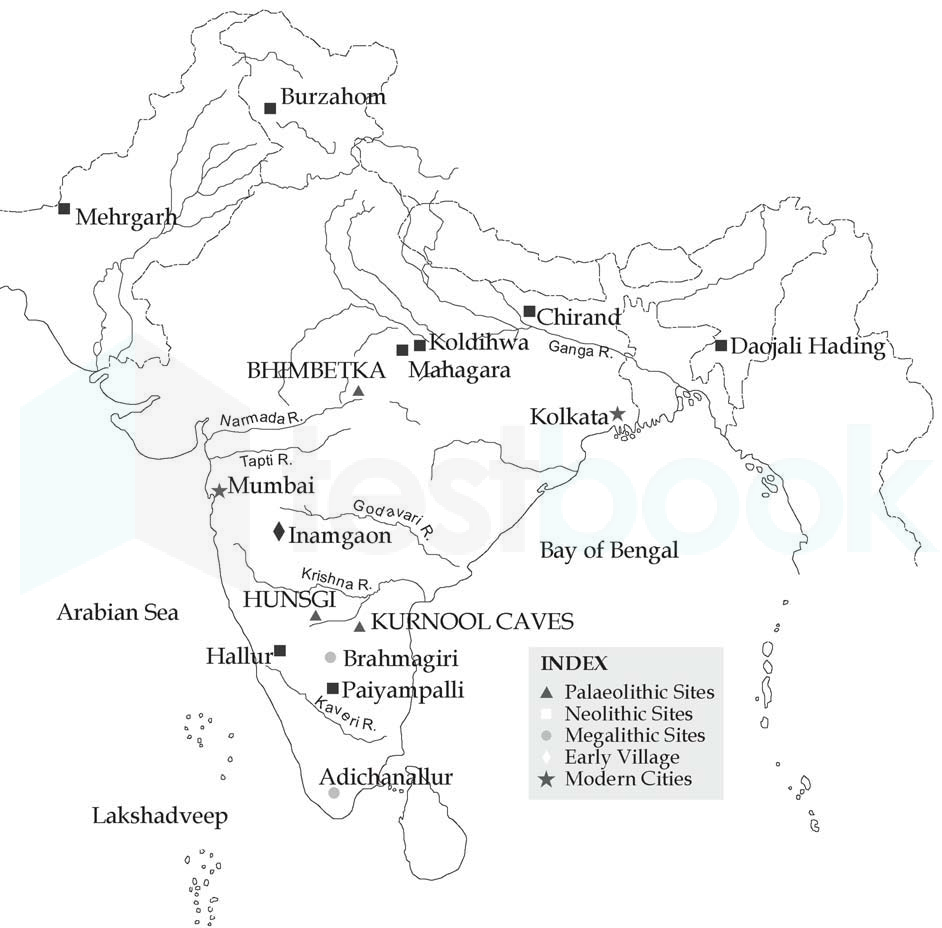
In which state of India can you find the old sites of Bhimbetka?

  1. ((a))

    Andhra Pradesh

  2. ((b))

    Madhya Pradesh

  3. ((c))

    Maharashtra

  4. ((d))

    Karnataka

Show Answer
Answer: ((b))

Madhya Pradesh

The correct answer is Madhya Pradesh

Key Points

  • Bhimbetka in Madhya Pradesh boasts of pre-historic rock shelters and some of the finest prehistoric cave paintings in South Asia.
  • Located 45 km south of Bhopal, on the southern edge of the Vindhyachal hills, Bhimbetka was declared a UNESCO World Heritage Site in 2003.
  • Archaeologists are of the opinion that the caves might have been occupied over 10,000 years ago.
  • The Bhimbetka paintings reflect division of labour based on gender. Men are depicted hunting while women are painted gathering food.

Hence, the correct answer is  Madhya Pradesh.

32

Arrange the following Gupta Kings in chronological order.

(i) Sri Gupta

(ii) Chandra Gupta II

(iii) Skanda Gupta

(iv) Samudra Gupta

  1. ((a))

    (i), (ii), (iii), (iv)

  2. ((b))

    (ii), (i), (iv), (iii)

  3. ((c))

    (iii), (ii), (iv), (i)

  4. ((d))

    (i), (iv), (ii), (iii)

Show Answer
Answer: ((d))

(i), (iv), (ii), (iii)

The correct answer is (i), (iv), (ii), (iii)

Key Points

The Gupta period is generally known as the Golden Age of ancient Indian history.

  • Sri Gupta (240-280 CE):
  • The Gupta Dynasty was founded by him in the 3rd century CE.
  • He used the title of Maharaja.
  • Samudra Gupta (335-375 CE):
  • ​He was the son of Chandragupta I and Kumaradevi.
  • He was known as Lichchhavi-dauhitra (grandson of the Lichchhavis) in the famous Allahabad Pillar Inscription by Harisena.
  • He expanded the Gupta Empire to a great extent.
  • He was called as ‘Napolean of India’ by V.A. Smith.
  • Chandra Gupta II (375-415 CE):
  • ​He succeeded Samudra Gupta and expanded his empire by conquering new areas and by maintaining matrimonial alliances.
  • He was also known as Vikramaditya and Simhavikrama.
  • He had nine famous scholars (Navratnas or nine gems) in his court.
  • Skanda Gupta (455-467 CE):
  • ​He was the son of Kumaragupta.
  • Kahaum Inscription (Uttar Pradesh) mentioned his as Shakropana.
  • Junagadh / Girnar Inscription of his reign tells us that his governor got the Sudharshan lake repaired.
  • He defeated Huns and repulsed them successfully.

Therefore, the correct chronological order is**: Sri Gupta, Samudra Gupta, Chandra Gupta and Skanda Gupta.** Hence, the correct answer is - (i), (iv), (ii), (iii)

33

Assertion (A) - Al-Biruni wrote Kitab al-Hind.

Reasoning (R) - Sultan Mahmud of Ghazni was interested in finding out more about the people he conquered.

Choose the correct option.

  1. ((a))

    (A) is true but (R) is false.

  2. ((b))

    Both (A) and (R) are false.

  3. ((c))

    Both (A) and (R) are true and (R) is the reason of (A).

    ×

    duplicate options found. English Question 1 options 2,4

  4. ((d))

    Both (A) and (R) are true but (R) is not the reason of (A).

Show Answer
Answer: ((c))

Both (A) and (R) are true and (R) is the reason of (A).

×

duplicate options found. English Question 1 options 2,4

Al-Biruni wrote Kitab al-Hind.

  • Al-Biruni wrote Kitab al-Hind is the survey of Indian life based on his observation in between 1017-1030 AD.

Important Points

  • Mahmud of Ghazni was the first Turk ruler to be known as Sultan.
  • He ruled from 997 to 1030 A.D.
  • He extended control over parts of Central Asia, Iran and the north-western part of the subcontinent.
  • He raided the subcontinent almost every year and his targets were wealthy temples including Somnath Temple of Gujarat.
  • He used most of the wealth to create a splendid capital city at Ghazni.
  • He was interested in finding out more about the people he conquered.
  • Due to this, he entrusted a scholar named Al-Biruni to write an account of the subcontinent.
  • This Arabic work, known as the Kitab al-Hind, remains an important source for historians.
  • Al-Biruni consulted Sanskrit scholars to prepare this account.

Based on the above discussion we can conclude that, Both (A) and (R) are true and (R) is the reason of (A).

34

Which is the meaning of Pishtaq, an important aspect of Mughal architecture?

  1. ((a))

    Forty pillared halls.

  2. ((b))

    Tall gateway.

  3. ((c))

    Central Hall surrounded by eight rooms.

  4. ((d))

    Rectangular walled enclosures.

Show Answer
Answer: ((b))

Tall gateway.

The correct answer is Tall gateway.

Key Points

  • A tall gateway visible in front of a Mughal monument is known as a Pishtaq.
  • The central towering dome and the tall gateway known as Pishtaq became important aspects of Mughal architecture, first visible in Humayun's tomb.
  • In Islamic architecture, a Pishtaq is a rectangular frame around an arched opening, usually associated with an iwan.
  • An iwan is a rectangular hall or space, usually vaulted, walled on three sides, with one end entirely open.

Hence, the correct answer is - Tall gateway.

Additional Information

  • Mughals brought in Persian style into Indian architecture.
  • The Mughals constructed excellent forts, mosques, mausoleums, gardens and cities.
  • Some of the main features of Mughal architecture are mentioned below:
  • ​Large halls
  • Very large vaulted gateways
  • Delicate ornamentation
  • Bulbous domes
  • Slender Minarets with cupolas at the four corners
35

Arrange the following in the descending order (background) starting from the recent period:

A. Composing of Rigveda

B. Emergence of Varna system

C. Rise of Mauryan Empire

D. Emergence of Buddhism.

  1. ((a))

    ​B, A, C and D

  2. ((b))

    D, A, C and B

  3. ((c))

    A, B, D and C

  4. ((d))

    C, D, B and A

Show Answer
Answer: ((d))

C, D, B and A

The correct answer is C, D, B and A

Important Points

  • Rise of Mauryan Empire: The Mauryan Empire was a powerful empire that ruled a large part of the Indian subcontinent from 322 BCE to 185 BCE.
  • The empire was founded by Chandragupta Maurya and reached its height under the rule of Ashoka, who promoted Buddhism and is famous for his edicts promoting social welfare and religious tolerance.
  • Emergence of Buddhism: Buddhism emerged in ancient India in the 5th century BCE.
  • It was founded by Siddhartha Gautama, who became known as the Buddha.
  • Buddhism spread rapidly throughout the Indian subcontinent and eventually became one of the major religions of the world.
  • Emergence of Varna system: The Varna system, also known as the caste system, is a social hierarchy that originated in ancient India.
  • It divided society into four main groups, or varnas: Brahmins (priests), Kshatriyas (warriors and rulers), Vaishyas (merchants and traders), and Shudras (laborers and artisans).
  • The Varna system is believed to have emerged around the same time as the composition of the Rigveda.
  • Composing of Rigveda: The Rigveda is one of the oldest sacred texts of Hinduism, and it is believed to have been composed between 1700 BCE and 1100 BCE.
  • It consists of hymns and verses that were recited by priests during Vedic rituals.
  • The Rigveda is an important source of information about ancient Indian society, religion, and culture.

Therefore, the correct order in descending order would be C (Rise of Mauryan Empire), D (Emergence of Buddhism), B (Emergence of Varna system), and A (Composing of Rigveda).

36

Read the statements A and B and choose the correct option.

A. Around 2500 years ago, there is evidence for the growing use of iron tools including axes for clearing forests and the iron plough share, which were useful for increasing agricultural production.

B. Many cities developed from about 2500 years ago.

  1. ((a))

    A is true but B is false.

  2. ((b))

    A is false but B is true.

  3. ((c))

    Both A and B are true and there is a relation between A and B.

  4. ((d))

    Both A and B are true but there is no relation between A and B.

Show Answer
Answer: ((c))

Both A and B are true and there is a relation between A and B.

The correct answer is Both A and B are true and there is a relation between A and B.

Important Points

  • ​Around 2500 years ago, there is evidence for the growing use of iron tools like axes, plough share, sickel etc.
  • People used iron axes to clear forests so that they had more land for farming.
  • Iron ploughshares could dig deeper and turn the soil better. This helped to grow better crops and produce more food.
  • Iron sickles were used for harvesting the ripe crops.
  • With increased agricultural production, everyone did not need to be a farmer.
  • A few people could produce the food that was need whereas others were free to do the other things.
  • Due to this, many cities, towns and urban centres developed.
  • They became the centres of trade as well.

Hence, we can conclude that both the statements A and B are true and there is a relation between A and B.

37

Match the following categories of land during the Chola period with the correct options

List 1List 2
(a)Vellanvagai(i)Land gifted to temple
(b)Brahmadeya(ii)Land for the maintenance of a school
(c)Shalabhoga(iii)Land of  non-Brahmana peasant proprietors
(d)Devadana(iv)Land gifted to Brahmanas
  1. ((a))

    (a) - (iv), (b) - (i), (c) - (iii), (d) - (ii)

  2. ((b))

    (a) - (iii), (b) - (iv), (c) - (ii), (d) - (i)

  3. ((c))

    (a) - (iii), (b) - (iv), (c) - (i), (d) - (ii)

  4. ((d))

    (a) - (ii), (b) - (iii), (c) - (iv), (d) - (i)

Show Answer
Answer: ((b))

(a) - (iii), (b) - (iv), (c) - (ii), (d) - (i)

The correct answer is (a) - (iii), (b) - (iv), (c) - (ii), (d) - (i)

Key Points

  • The Chola Empire was one of the most famous empire in south India that came into prominence in the 9th century AD.
  • Their kingdom was mainly concentrated in the Kaveri-fed delta called Cholamandalam.
  • The Chola inscriptions mentioned various types of land as follows:
  • Brahmadeya: These were the lands gifted to Brahamanas. Therefore, a lot of Brahamana settlements emerged in the Kaveri valley and in the other southern parts of India.
  • Vellanvagai: Land of non-Brahamana peasant proprietors.
  • Shalabhoga: This refers to the land of the maintenance of a school.
  • Devadana: Land gifted to temples.
  • Pallichchhandam: Land donated to Jaina institutions.

Hence, the correct answer is - (a) - (iii), (b) - (iv), (c) - (ii), (d) - (i)

38

Read the statements A and B and choose the correct option.

Assertion (A) – The crisis in Bengal economy after 1765 had adverse effect on artisans and peasants. Artisonal production declined and agricultural cultivation showed signs of collapse. In 1770 a famine killed ten million people in Bengal.

Reason (R) – The effort of the East India Company after getting the Diwani of Bengal was to increase the revenue as much as it could and buy fine cotton and silk cloth as cheap as possible. The revenue collected in Bengal was used to finance the purchase of goods for export.

  1. ((a))

    Both (A) and (R) are true and (R) is the correct explanation of (A).

  2. ((b))

    Both (A) and (R) are true but (R) is not the correct explanation of (A).

  3. ((c))

    (A) is true but (R) is false.

  4. ((d))

    Both (A) and (R) are false.

Show Answer
Answer: ((a))

Both (A) and (R) are true and (R) is the correct explanation of (A).

The correct answer is Both (A) and (R) are true and (R) is the correct explanation of (A).

Important Points

  • The East India Company became the Diwan of Bengal, on 12 August 1765.
  • As Diwan, the Company became the chief financial administrator of the territory under its control.
  • The Company needed to administer the land and organise its revenue resources.
  • It needed to be done in a way that could yield enough revenue to meet the growing expenses of the company.
  • The Company’s aim was to increase the revenue to buy fine cotton and silk cloth as cheaply as possible.
  • Within a span of five years, the value of goods bought by the Company in Bengal doubled.
  • The Company, before 1865, purchased goods in India by importing gold and silver from Britain.
  • Now it was financed by the revenue collected in Bengal.
  • Artisanal production was in decline, and agricultural cultivation showed signs of collapse.
  • Then in 1770, a terrible famine killed ten million people in Bengal.

Based on the above mentioned points, we can conclude that both the statements (A) and (R) are true and (R) is the correct explanation of (A).

39

Who contributed to the banning of Sati in 1829?

  1. ((a))

    Raja Rammohan Roy

  2. ((b))

    Ishwar Chandra Vidya Sagar

  3. ((c))

    Jyoti Rao Phule

  4. ((d))

    Swami Dayanand Saraswati

Show Answer
Answer: ((a))

Raja Rammohan Roy

Raja Rammohan Roy had contributed to the banning of Sati in 1829.

Key Points

  • Sati was the practice of the immolation of a Hindu woman on the death of her husband in his funeral pyre.
  • The widow was supposed to ascend to heaven and this was considered the ultimate sacrifice and proof of a woman’s devotion to her husband.
  • Raja Rammohan Roy, the great Hindu reformer from Bengal fought many social evils prevalent in the Hindu society of Bengal and Sati pratha was one of the chief ones.
  • He had witnessed the live immolation of his own sister-in-law. He started his struggle against this practice in 1812.
  • Raja Rammohan Roy was a vociferous campaigner against Sati. He argued that the Vedas and other ancient Hindu scriptures did not sanction Sati.
  • He wrote articles in his journal Sambad Kaumudi advocating its prohibition. He stressed with the East India Company administration to ban this practice.
  • Lord William Bentinck became the Governor-General of India in 1828. He helped Raja Rammohan Roy to suppress many prevalent social evils like Sati, polygamy, child marriage and female infanticide.
  • Lord Bentinck passed the law banning Sati throughout the British India and this act was made illegal and punishable by the courts in 1829.

Therefore, the correct answer is - Raja Rammohan Roy.

40

Read the statements (A) and (R) and choose the correct option. 

Assertion (A) - Between 1927 and 1935 Ambedkar led three temple entry movements.

Reason (R) - Ambedkar’s aim was to make everyone see the power of British rule in India.

  1. ((a))

    Both (A) and (R) are true and (R) is the correct explanation of (A).

  2. ((b))

    Both (A) and (R) are true but (R) is not the correct explanation of (A).

  3. ((c))

    (A) is true but (R) is false.

  4. ((d))

    Both (A) and (R) are false.

Show Answer
Answer: ((c))

(A) is true but (R) is false.

The correct answer is (A) is true but (R) is false.

Key Points

  • ​Untouchables were treated as inferior human beings, they were not allowed entry inside the temples, they could not bathe in ponds used by upper caste people and they could not use the wells used by upper caste people.
  • A temple entry movement was started by Dr. B.R. Ambedkar in 1927.
  • This temple entry movement saw participation of people from the Mahar Caste.
  • Between 1927 and 1935, Dr. B.R. Ambedkar led three temple entry movements.
  • The objective of the temple entry movement led by Dr. B.R. Ambedkar was to expose the caste prejudices that existed within Indian society.

Therefore, the statement (A) is true but the statement (R) is false.

Additional Information

  • Dr. B.R. Ambedkar was born into a Mahar family.
  • Ambedkar had faced caste discrimination right from his childhood.
  • Ambedkar was not allowed to drink water from the taps that were used by upper caste children.
  • After finishing his higher education in the US, Ambedkar returned to India in 1919 and extensively wrote about caste based discrimination in Indian society.
41

Match the reforms movements with their leaders correctly:

List 1List 2
(a)Matua Panth(i)Jyotirao Phule
(b)Satyashodhak Samaj(ii)Raja Rammohan Roy
(c)Arya Samaj(iii)Haridas Thakur
(d)Brahmo Samaj(iv)Swami Dayanand Saraswati
  1. ((a))

    (a) - (ii), (b) - (iii), (c) - (i), (d) - (iv)

  2. ((b))

    (a) - (iv), (b) - (i), (c) - (ii), (d) - (iii)

  3. ((c))

    (a) - (i), (b) - (iv), (c) - (iii), (d) - (ii)

  4. ((d))

    (a) - (iii), (b) - (i), (c) - (iv), (d) - (ii)

Show Answer
Answer: ((d))

(a) - (iii), (b) - (i), (c) - (iv), (d) - (ii)

The correct answer is (a) - (iii), (b) - (i), (c) - (iv), (d) - (ii)

Key Points

  • Matua Panth:
  • ​Haridas Thakur worked among the untouchable people of Bengal Presidency.
  • He formed the Matua sect or Matua Panth of Hindus.
  • In eastern Bengal, Haridas Thakur’s Matua sect worked among Chandala cultivators.
  • Haridas questioned Brahmanical texts that supported the caste system.
  • Satyashodhak Samaj:
  • ​Jyotiba Phule founded Satyashodhak Samaj in Pune, Maharashtra, on 24th September 1873.
  • It was a reformational society that promoted education, increased social rights, justice and political access in the deprived sections.
  • Moreover, its primary focus was on uplifting and supporting Dalits, Shudras, and women in Maharashtra.
  • Arya Samaj:
  • Arya Samaj was founded by Swami Dayananda at Bombay in 1875.
  • It emphasized on the infallibility of Vedas while rejecting later Hindu texts.
  • Dayanand Saraswati laid down the rules and regulations for the Arya Samajists to follow.
  • They condemned polytheism, religious superstitions and supermacy of Brahmanas.
  • Brahmo Samaj:
  • ​Raja Rammohan Roy founded Brahmo Sabha in 1828 at Calcutta, which was renamed Brahmo Samaj in 1830.
  • Brahmo Samaj discarded faith in divine Avatars.
  • It denounced idolatory and polytheism and criticized caste system.

​​Hence the correct answer is - (iii), (b) - (i), (c) - (iv), (d) - (ii)

42

Read the following statements on emergence of Nationalism and choose the correct option.

A. The Indian National Congress was founded in the year 1885.

B. The early Nationalist leaders were largely from rural and uneducated background.

  1. ((a))

    A is true but B is false

  2. ((b))

    A is false but B is true

  3. ((c))

    Both A and B are true

  4. ((d))

    Both A and B are false

Show Answer
Answer: ((a))

A is true but B is false

The Indian National Congress was founded in the year 1885.

Important Points

  • The Indian National Congress was formed in 1885 by Allan Octavian Hume, a retired British civil servant.
  • Other founding members include Dadabhai Naoroji and Dinshaw Wacha.
  • The first session was held in Bombay under the presidency of Womesh Chandra Bonnerjee in 1885.
  • The first session was attended by 72 delegates from across the country.
  • Viceroy of India at the time was Lord Dufferin who gave his permission to Hume for the first session.
  • The Indian National Congress was formed with the intention of discussing problems faced by the people of the country irrespective of caste, creed, religion or language.
  • It was basically a movement of the upper and middle class nationalist leaders who were largely from urban areas and they were western-educated Indians.

Based on the above points, we can conclude that the statement A is true but the statement B is false.

Additional Information

  • The second session of the Indian National Congress was held at Calcutta and it was presided over by Dadabhai Naoroji.
  • Badruddin Tyabji was elected as the President of the third session, held at Madras.
  • George Yule presided over the fourth session held at Allahabad.
43

Read the Assertion (A) and Reasoning (R) and choose the correct option.

Assertion (A) - The British decided that the proportion of Indian soldiers in the army in India would be reduced and the number of European soldiers would be increased.

Reason (R) - In May 1857 sepoys of the East India Company mutinied in several places in India and a large number of people from different sections of society rose up in rebellion.

  1. ((a))

    (A) is true but (R) is false

  2. ((b))

    Both (A) and (R) are false.

  3. ((c))

    Both (A) and (R) are true and (R) is the correct explanation of (A).

  4. ((d))

    Both (A) and (R) are true but (R) is not the correct explanation of (A).

Show Answer
Answer: ((c))

Both (A) and (R) are true and (R) is the correct explanation of (A).

The correct answer is Both (A) and (R) are true and (R) is the correct explanation of (A).

Important Points

  • After a hundred years of conquest and administration, the English East India Company faced a massive rebellion that started in May 1857 and threatened the Company’s very presence in India.
  • Sepoys mutinied in several places beginning from Meerut and a large number of people from different sections of society rose up in rebellion.
  • Some regard it as the biggest armed resistance to colonialism in the nineteenth century anywhere in the world.
  • However, the British were able to suppress the revolt and regained control of the country by the end of 1859, but they could not carry on ruling the land with the same policies any more.
  • Given below are the important changes in the army that were introduced by the British:
  • It was decided that the proportion of Indian soldiers in the army would be reduced and the number of European soldiers would be increased.
  • It was also decided that instead of recruiting soldiers from Awadh, Bihar, Central India and South India, more soldiers would be recruited from among the Gurkhas, Sikhs and Pathans.
  • Only Europeans were charged with the duty to look after the certain branches of army like artillery, tanks, armoured corps etc.
  • The government tried its best to keep the soldiers isolated from rest of the population as any contact between them could pose threat to the British rule.

Based on the above discussion we can conclude that Both (A) and (R) are true and (R) is the correct explanation of (A).

44

Read the following Assertion (A) and Reasoning (R) on formation of states and choose the correct option.

Assertion (A) - Both Prime Minister Jawaharlal Nehru and Deputy Prime Minister Vallabhbhai Patel were against the creating of linguistic states.

Reasoning (R) - State Reorganisation Commission recommended in 1956 the redrawing of districts and provincial boundaries to form compact provinces at Assamese, Bengali, Oriya, Tamil, Malayalam, Kannada, and Telugu speakers respectively.

  1. ((a))

    Both (A) and (R) are true and (R) is the correct explanation of (A).

  2. ((b))

    Both (A) and (R) are true but (R) is not the correct explanation of (A).

  3. ((c))

    (A) is true but (R) is false.

  4. ((d))

    Both (A) and (R) are false.

Show Answer
Answer: ((b))

Both (A) and (R) are true but (R) is not the correct explanation of (A).

The correct answer is Both (A) and (R) are true but (R) is not the correct explanation of (A).

Important Points

  • The first Prime Minister of India, Jawaharlal Nehru and the Deputy Prime Minister Sardar Vallabhbhai Patel were against the creation of linguistic states.
  • It was because the country was still seething from the partition and they feared that the creation of states based on languages could further lead to the division of society and endanger the unity of the country.
  • However, the death of Potti Sriramulu after fifty-six days hunger strike demanding a separate state of Andhra leads to the formation of the State Reorganisation Act, 1956.
  • Through the States Reorganization Act of 1956, the state of Hyderabad was split up, and its Telugu-speaking districts (constituting Telangana) were joined to the Andhra state on November 1, 1956, to form the new state of Andhra Pradesh.
  • The States Reorganisation Act was passed in 1956 and it led to the creation of 14 states and 6 union territories.
  • The commission recommended the redrawing of the districts and provincial boundaries to form compact provinces at Assamese, Bengali, Oriya, Tamil, Malayalam, Kannada and Telugu speakers respectively.

Based on the above points, we can say that Both (A) and (R) are true but (R) is not the correct explanation of (A).

45

Given statements are about various celestial bodies in the sky. Which of the statements are correct?

A. We do not feel heat and light of countless twinkling stars in the night sky as they are very far away from us.

B. Ursa Major Constellation is a group of seven stars also called Saptarishi.

C. Pole Star keeps changing its position in the sky.

D. Moon appears at different times, in different shapes and at different positions.

Choose the correct option.

  1. ((a))

    A, B and D

  2. ((b))

    A, C and D

  3. ((c))

    B, C and D

  4. ((d))

    A, B and C

Show Answer
Answer: ((a))

A, B and D

The correct answer is A, B and D

Important Points

  • The sun, the moon, the stars and all those objects shining in the night sky are called celestial bodies.
  • Countless twinkling stars in the night sky are similar to the sun. But we do not feel their heat or light, and they look so tiny because they are very very far from us.
  • Various patterns formed by different groups of stars are called constellations. One of the most easily recognisable constellation is the Saptarishi. It is a group of seven stars that forms a part of Ursa Major Constellation.
  • The North star indicates the north direction. It is also called the Pole Star. It always remains in the same position in the sky.
  • Moon appears at different times, in different shapes and at different positions. Examples: Full moon night or Poornima and New moon night or Amavasya.

Thus we can conclude following statements are rue.

  • We do not feel heat and light of countless twinkling stars in the night sky as they are very far away from us.
  • Ursa Major Constellation is a group of seven stars also called Saptarishi.
  • Moon appears at different times, in different shapes and at different positions.
46

Which of the following statements correct description of the globe?

A. Globe is a true model (miniature from) of the Earth.

B. Globes can be of varying size and type.

C. On the globe, countries, continents and oceans are shown in their correct size.

D. It is fixed and cannot be rotated.

  1. ((a))

    Only A, B and C

  2. ((b))

    Only A, C and D

  3. ((c))

    Only A,B and D

  4. ((d))

    Only B, C and D

Show Answer
Answer: ((a))

Only A, B and C

The correct answer is Only A, B and C

Key Points

  • A globe is a three-dimensional sphere, that is used for representing the whole Earth.
  • It is a true model (miniature form) of the Earth.
  • Globes may be of varying size and type – big ones, which cannot be carried easily, small pocket globes, and globe-like balloons, which can be inflated and are handy and carried with ease.
  • The globe is not fixed. It can be rotated the same way as a top spin or a potter’s wheel is rotated.
  • On the globe, countries, continents and oceans are shown in their correct size.
  • A needle is fixed through the globe in a tilted manner, which is called its axis.
  • Two points on the globe through which the needle passes are two poles – North Pole and South Pole.
  • The globe can be moved around this needle from west to east just as the earth moves.
  • The real earth has no such needle. It moves around its axis, which is an imaginary line.

Based on the above given points about the globe, we can conclude that the statements A, B and C are correct.

47

Identify the heat zone of the earth from the characteristics.

A. The midday sun never shines overhead.

B. These areas have moderate temperature.

C. These areas are bounded by the Tropic of Cancer and the Arctic Circle in the Northern Hemisphere and the Tropic of Capricorn and the Antarctic Circle in the southern Hemisphere.

  1. ((a))

    Frigid zone

  2. ((b))

    Temperate zone

  3. ((c))

    Torrid zone

  4. ((d))

    North and South Poles

Show Answer
Answer: ((b))

Temperate zone

The correct answer is Temperate zone

Key Points

  • The Earth is divided into three Heat Zones ie the Torrid zone, the Temperate zone and the Frigid zone.
  • Torrid Zone:
  • ​In this zone, the mid-day sun is exactly overhead at least once a year on all latitudes in between the Tropic of Cancer and the Tropic of Capricorn.
  • This area, therefore, receives the maximum heat.
  • Temperate Zone:
  • The mid-day sun never shines overhead on any latitude beyond the Tropic of Cancer and the Tropic of Capricorn.
  • The angle of the sun’s rays goes on decreasing towards the poles.
  • These areas are bounded by the Tropic of Cancer and the Arctic Circle in the Northern Hemisphere, and the Tropic of Capricorn and the Antarctic Circle in the Southern Hemisphere.
  • This zone have moderate temperature.
  • Frigid Zone:
  • Areas lying between the Arctic Circle and the North Pole in the Northern Hemisphere and the Antarctic Circle and the South Pole in the Southern Hemisphere, are very cold.
  • It is because here the sun does not rise much above the horizon.
  • Therefore, its rays are always slanting and provide less heat.

Therefore, the correct answer is - Temperate zone.

48

India is located east of Greenwich at 82° 30° E. What will be Indian Standard Time (IST) if Greenwich Mean Time is 1PM?

  1. ((a))

    7.30 PM

  2. ((b))

    6.30 PM

  3. ((c))

    6.30 AM

  4. ((d))

    7.30 AM

Show Answer
Answer: ((b))

6.30 PM

The correct answer is 6.30 PM.

Important Points

  • As the earth rotates from west to east, those places east of Greenwich will be ahead of Greenwich time and those to the west will be behind it.
  • The rate of difference can be calculated as follows:
  • The earth rotates 360° in about 24 hours, which means 15° an hour or 1° in four minutes.
  • Thus, when it is 12 noon at Greenwich, the time at 15° east of Greenwich will be 15 × 4 = 60 minutes, ie 1 hour ahead of Greenwich time, which means 1 p.m.
  • But at 15° west of Greenwich, the time will be behind Greenwich time by one hour, i.e., it will be 11.00 a.m.
  • India located east of Greenwich at 82°30'E is 5 hours and 30 minutes ahead of GMT.
  • Hence, the time difference between Indian Standard Time (IST) and Greenwich Mean Time (GMT) is of 5:30 hours.
  • This can be calculated in the following manner:
  • Difference between 0° longitude and 82°30'E longitude = 82°30'
  • Time in the East is ahead by 4 minutes on passing every meridian
  • Hence, time ahead will be 82°30'×4=330 minutes or 5:30 hours.
  • So, IST will be 6:30 PM when GMT is 1 PM.

Therefore the correct answer is - 6:30 PM.

49

In which type of forests do softwood trees like chir, pine and cedar grow?

  1. ((a))

    Temperate deciduous forests

  2. ((b))

    Temperate evergreen forests

  3. ((c))

    Coniferous forests

  4. ((d))

    Tropical deciduous forests

Show Answer
Answer: ((c))

Coniferous forests

Coniferous forests type of forests do softwood trees like chir, pine and cedar grow.

Important Points

  • In the higher latitudes (50° – 70°) of Northern hemisphere the spectacular Coniferous forests are found. These are also called as Taiga.
  • These forests are also seen in the higher altitudes.
  • They are tall, softwood evergreen trees.
  • The woods of these trees are very useful for making pulp, which is used for manufacturing paper and newsprint.
  • Match boxes and packing boxes are also made from softwood.
  • Chir, pine, cedar are the important variety of trees in these forests.
  • Silver fox, mink, polar bear are the common animals found in these forests.

Therefore, the correct answer is - Coniferous forests.

50

Read the given statements and select the correct option.

Assertion (A) : There is a close relationship between height of land and the character of vegetation.

Reason (R) : The growth of vegetation depends on slope and thickness of soil.

  1. ((a))

    Both (A) and (R) are true and (R) is the correct explanation of (A).

  2. ((b))

    Both (A) and (R) are true but (R) is not the correct explanation of (A).

  3. ((c))

    (A) is true but (R) is false.

  4. ((d))

    Both (A) and (R) are false.

Show Answer
Answer: ((b))

Both (A) and (R) are true but (R) is not the correct explanation of (A).

The correct answer is Both (A) and (R) are true but (R) is not the correct explanation of (A).

Key Points

  • Natural vegetation means plants that have not been grown by humans. It doesn’t need help from humans and gets whatever it needs from its natural environment.
  • There is a close relationship between the height of the land and the character of the vegetation.
  • With the change in height, the climate changes and that changes natural vegetation.
  • The growth of vegetation depends on temperature and moisture. It also depends on factors like slope and thickness of soil.
  • The type and thickness of natural vegetation vary from place to place because of the variation in these factors.

Therefore, we can conclude that both (A) and (R) are true but (R) is not the correct explanation of (A).

51

Match the following about movement of water on ocean surface and choose the correct option.

A.Cold ocean currents.(i)Alternate rise and fall of water on ocean surface.
B.Tides(ii)Rhythmic rise and fall of Ocean water twice in a day.
C.Waves(iii)Originated near the equator.
D.Warm ocean currents.(iv)Carry water from polar to tropical latitudes

Select the correct option.

  1. ((a))

    (A) - (iii), (B) - (i), (C) - (iv), (D) - (ii)

  2. ((b))

    (A) - (ii), (B) - (iv), (C) - (iii), (D) - (i)

  3. ((c))

    (A) - (i), (B) - (iii), (C) - (ii), (D) - (iv)

  4. ((d))

    (A) - (iv), (B) - (ii), (C) - (i), (D) - (iii)

Show Answer
Answer: ((d))

(A) - (iv), (B) - (ii), (C) - (i), (D) - (iii)

The correct answer is (A)- (iv), (B)- (ii), (C)- (i), (D)- (iii).

Key Points

  • Tides are the rhythmic rise and fall of water on ocean surface.
  • The moon's gravitational pull on the Earth and the Earth's rotational force are the two main factors that cause high and low tides.
  • Waves are alternative rise and fall of water on ocean surface.
  • Cold ocean currents carry water from the polar to the tropical latitudes.
  • These currents are usually found on the west coast of the continents in the low and middle latitudes.
  • Warm ocean currents originate near the equator.
  • It brings warm water to cold water areas.

 Thus, we can say that the above statements are correct.

52

Choose the correct option Monsoon winds are:

  1. ((a))

    Planetary winds

  2. ((b))

    Seasonal winds

  3. ((c))

    Permanant winds

  4. ((d))

    Local winds

Show Answer
Answer: ((b))

Seasonal winds

The correct answer is Seasonal winds.

Key Points

  • Monsoon is a seasonal change in the direction of prevailing, or strongest winds of a region.
  • Monsoon is a seasonal wind.
  • These are caused when the air over land gets heated and rises up causing winds to blow from the ocean towards land.
  • Monsoons always blow from cold to warm regions.
  • The summer monsoon and the winter monsoon determine the climate of India and Southeast Asia.

 Thus, we can say that monsoon winds are seasonal winds.

Additional Information

Permanent Winds:

  • The winds that blow constantly throughout the year are called Permanent Winds.
  • They also blow constantly in a particular direction.
  • There are types of permanent winds:
  • Trade Winds – These are permanent winds flowing from east-to-west. It flows in the Earth’s equatorial region (between 30°N and 30°S latitudes).
  • Easterlies – It is a prevailing wind blowing from the east. The trade winds in tropical regions and the prevailing winds in the polar regions are easterlies.
  • Westerlies – These are prevailing winds that flow from the west towards the east. It flows in the Earth’s middle latitudes between 30 and 60 degrees latitude.

Seasonal Winds:

  • Seasonal winds are movement of air repetitively and predictively driven by changes in large-scale weather patterns.

Planetary Winds:

  • The winds that flow throughout the year from one latitude to another latitude because of latitudinal differences in the air pressure are called planetary winds.

Local Winds:

  • There are winds that affect local weather. Local winds usually affect small areas and are confined to the lower levels of the troposphere.
53

Which of the following represent represents correct matching of the layers of atmosphere.

A.Exosphere(i)Layer help in radio transmission.
B.Troposphere(ii)Upper most layer of atmosphere.
C.Stratosphere(iii)Lower most layer of atmosphere
D.Thermosphere(iv)Layer contains ozone gas.
  1. ((a))

    (A) - (iv), (B) - (ii), (C) - (i), (D) - (iii)

  2. ((b))

    (A) - (iii), (B) - (i), (C) - (ii), (D) - (iv)

  3. ((c))

    (A) - (i), (B) - (iv), (C) - (iii), (D) - (ii)

  4. ((d))

    (A) - (ii), (B) - (iii), (C) - (iv), (D) - (i)

Show Answer
Answer: ((d))

(A) - (ii), (B) - (iii), (C) - (iv), (D) - (i)

The correct answer is (A)- (ii), (B)- (iii), (C)- (iv), (D)- (i).

Key Points

  • Earth's atmosphere has five layers.
  • These are:
  • Troposphere,
  • Stratosphere,
  • Mesosphere,
  • Thermosphere, and
  • Exosphere
  • Troposphere is the lower most layer of the atmosphere.
  • Stratosphere contains ozone gas.
  • Most meteors burn up in Mesosphere.
  • Thermosphere helps in radio transmission.
  • Exosphere is the upper most layer of atmosphere.

 Thus, we can say that the above statements about the layers of atmosphere are correct.

54

Matching the regions with the animals used for transport in these regions and choose the correct option.

A.Andes Mountains(i)Camels and bullocks.
B.Tibet(ii)Mules and donkeys.
C.Indian desert(iii)Llamas
D.Indian hills(iv)Yaks

Select the correct option.

  1. ((a))

    (A) - (iii), (B) - (iv), (C) - (i), (D) - (ii)

  2. ((b))

    (A) - (i), (B) - (iii), (C) - (ii), (D) - (iv)

  3. ((c))

    (A) - (iv), (B) - (ii), (C) - (iii), (D) - (i)

  4. ((d))

    (A) - (ii), (B) - (i), (C) - (iv), (D) - (iii)

Show Answer
Answer: ((a))

(A) - (iii), (B) - (iv), (C) - (i), (D) - (ii)

The correct answer is (A)- (iii), (B)- (iv), (C)- (i), (D)- (ii).

Key Points

  • People have used animals for transportation since ancient times and still use them.
  • In the Andes mountains of South Africa, Llamas are used for transportation.
  • In Tibet, Yaks are used for transportation.
  • In the Indian Desert, Camels and Bullocks are used.
  • In Indian Hills, transportation is carried on through mules and donkeys.

 Thus, we can say that the above statements are correct.

55

Study the given statements and choose the correct option.

Assertion (A): Utility or usability is what makes an object or substance a resource.

Reason (R): Some resources have economic value, and some do not have economic value.

  1. ((a))

    Both (A) and (R) are true and (R) is the correct explanation of (A).

  2. ((b))

    Both (A) and (R) are true but (R) is not the correct explanation of (A).

  3. ((c))

    (A) is true but (R) is false.

  4. ((d))

    Both (A) and (R) are false.

Show Answer
Answer: ((a))

Both (A) and (R) are true and (R) is the correct explanation of (A).

The correct answer is Both (A) and (R) are true and (R) is the correct explanation of (A).

Key Points

  • Resources include things present in an environment which humans directly use and things which humans transform into usable materials to satisfy their needs.
  • Utility or usability is what makes an object or substance a resource.
  • Some resources have economic value while some do not.
  • Water, electricity, rickshaw etc. all have been used by people and are thus examples of utility.

 Thus, we can say that the above statements are correct.

56

How can we as citizens and teachers help in conserving plants and animals? Choose the correct statements from the following.

A. Planting of trees by students and community members.

B. Dumping of a garbage in vacant spaces and parks.

C. Organise student visits to nature camps.

D. National parks can be developed as tourist spots.

Choose the correct option:

  1. ((a))

    A, B and C

  2. ((b))

    A, C and D

  3. ((c))

    B, C and D

  4. ((d))

    A, B and D

Show Answer
Answer: ((b))

A, C and D

The correct answer is A, C and D.

Key Points

  • To protect our flora and fauna, protected areas called wildlife sanctuaries, national parks and biosphere reserves have been earmarked.
  • Plantation, cultivation, grazing, felling trees, hunting and poaching are prohibited there.
  • Citizens and teachers can help in conserving plants and animals in the following way:
  • Planting of trees by students and community members.
  • Organise a visit to the nature camps.
  • National parks can be developed as tourist spots.

 Thus, we can say that the above statements are correct.

57

Read the following and choose the correct methods of soil conservation.

A. Overuse of chemical fertilizers

B. Mulching

C. Contour barriers

D. Shelter belts

  1. ((a))

    A, B and D

  2. ((b))

    A, C and D

  3. ((c))

    A, B and C

  4. ((d))

    B, C and D

Show Answer
Answer: ((d))

B, C and D

The correct answer is B, C and D.

Key Points

  • Soil conservation is the prevention of loss of the top most layer of soil from erosion.
  • A few methods of soil conservation are:
  • Contour ploughing,
  • Strip cropping,
  • Shelter belts,
  • Mulching,
  • Crop rotation
  • Contour Ploughing is a well-established way of conserving soil.
  • It is a farming practice of planting across a slope following its elevation contour lines.
  • Mulching involves spreading a layer of material on the ground around plants to protect their roots from heat, cold or drought or to keep the fruit clean.
  • Shelter belts are rows of trees along fence lines.
  • They are planted mainly to protect animals or crops from cold winds.

 Thus, we can say that Mulching, Contour barriers and Shelter belts are correct methods of soil conservation.

58

Read the following statements.

Statement (A): There is considerable socio-cultural diversity in India.

Statement (B): Diversity necessarily leads to equal opportunity.

Choose the correct option.

  1. ((a))

    Both (A) and (B) are true and (B) is the correct explanation of (A).

  2. ((b))

    Both (A) and (B) are true but (B) is not the correct explanation of (A).

  3. ((c))

    (A) is true but (B) is false.

  4. ((d))

    Both (A) and (B) are false.

Show Answer
Answer: ((c))

(A) is true but (B) is false.

The correct answer is (A) is true but (B) is false.

Key Points

  • Socio-cultural diversity concerns aspects of culture that can influence an individual's interactions with others of different backgrounds.
  • There is considerable socio-cultural diversity in India.
  • India is a plural society both in letter and spirit.
  • It is rightly characterized by its unity and diversity.
  • A grand synthesis of cultures, religions and languages of the people belonging to different castes and communities has upheld its unity and cohesiveness despite multiple foreign invasions.
  • Thus, statement A is true.
  • There is no equality in opportunity if diversity is not recognized and valued.
  • Diversity refers to recognising and respecting and valuing differences in people.
  • However, diversity will not necessarily lead to equal opportunity.
  • For example, India is a diverse country, but here everyone doesn't have equal opportunities.
  • Thus, statement B is false.

 Thus, we can say that statement (A) is true but statement (B) is false.

59

Match the following.

A.Fixing people into one image(i)Prejudice.
B.Judging other people negatively(ii)Untouchability
C.Treating someone less fairly than others(iii)Stereotype
D.Practising purity and pollution(iv)Discrimination

Select the correct option.

  1. ((a))

    (A) - (iii), (B) - (i), (C) - (iv), (D) - (ii)

  2. ((b))

    (A) - (i), (B) - (iv), (C) - (ii), (D) - (iii)

  3. ((c))

    (A) - (iv), (B) - (iii), (C) - (ii), (D) - (i)

  4. ((d))

    (A) - (ii), (B) - (iii), (C) - (i), (D) - (iv)

Show Answer
Answer: ((a))

(A) - (iii), (B) - (i), (C) - (iv), (D) - (ii)

The correct answer is (A)- (iii), (B)- (i), (C)- (iv), (D)- (ii).

Key Points

  • Prejudice means judging other people negatively.
  • Practising purity and pollution is called untouchability.
  • Stereotyping is fixing people into one image.
  • A stereotype is a fixed, over-generalized belief about a particular group or class of people.
  • Discrimination is termed as treating someone less fairly than others.

 Thus, we can say that the above statements are correct.

60

Who is responsible for measuring land and keeping Land records in a village?

  1. ((a))

    Station House Officer

  2. ((b))

    Block Development Officer

  3. ((c))

    Patwari/Village Administrative officer

  4. ((d))

    District Collector

Show Answer
Answer: ((c))

Patwari/Village Administrative officer

The correct answer is Patwari/Village Administrative Officer.

Key Points

  • A Patwari is responsible for measuirng land and keeping land records in a village.
  • One patwari can be responsible for multiple villages.
  • Patwari is known by different names in different states - Lekhpal, Kanungo or Karamchari.
  • The Patwari maintains and updates the records of the village.

 Thus, we can say that a Patwari is responsible for measuring land and keeping land records in a village.

61

Match the following.

A.Zilla Parishad(i)Village
B.Gram Sabha(ii)Mayor
C.Ward Committee(iii)Municipalities
D.Corporation(iv)District

Choose the correct option.

  1. ((a))

    (A) - (iv), (B) - (i), (C) - (iii), (D) - (ii)

  2. ((b))

    (A) - (i), (B) - (ii), (C) - (iv), (D) - (iii)

  3. ((c))

    (A) - (ii), (B) - (iv), (C) - (ii), (D) - (i)

  4. ((d))

    (A) - (iii), (B) - (i), (C) - (iv), (D) - (ii)

Show Answer
Answer: ((a))

(A) - (iv), (B) - (i), (C) - (iii), (D) - (ii)

The correct answer is (A)- (iv), (B)- (i), (C)- (iii), (D)- (ii).

Key Points

  • Zila Parishad makes developmental plans at the district level.
  • Gram Sabha is a meeting of all adults who live in the village covered by a Panchayat.
  • Ward Committee is made up of members that represent a specific ward.
  • The ward councillor chairs the ward committee.
  • They are intended to serve as formalized communication and interaction between communities and municipalities.
  • The head of the Municipal Corporation is called the Mayor.

 Thus, we can say that the above statements are correct.

62

Which of the following example/s would you give in a class while explaining the term casual worker?

A. Mason working at a constructive site

B. Domestic maids

C. Bank manager in a nationalized bank

Chose the correct option

  1. ((a))

    Only A and B

  2. ((b))

    Only A and C

  3. ((c))

    Only B and C

  4. ((d))

    Only A

Show Answer
Answer: ((a))

Only A and B

The correct answer is Only A and B.

Key Points

  • A Casual worker is a worker on a temporary employment contract with general entitlements to benefits and little or no security of employment.
  • The main attribute is the absence of a continuing relationship of any stability with an employer, which could lead to their not being considered 'employees' at all.
  • Mason working at a construction site and domestic maids are examples of casual workers.

 Thus, we can say that the above statements are correct.

63

Read the following statements

Assertion (A) : Agricultural labourers are seasonal workers.

Reason (R) : Working on a farm requires operations such as preparing the land, sowing, weeding and harvesting of crops.

Choose the correct option

  1. ((a))

    Both (A) and (R) are true and (R) is the correct explanation of (A).

  2. ((b))

    Both (A) and (R) are true but (R) is not the correct explanation of (A).

  3. ((c))

    (A) is true but (R) is false.

  4. ((d))

    Both (A) and (R) are false.

Show Answer
Answer: ((a))

Both (A) and (R) are true and (R) is the correct explanation of (A).

The correct answer is Both (A) and (R) are true and (R) is the correct explanation of (A).

Key Points

  • Agricultural labourers are seasonal workers.
  • A seasonal worker is a worker who is employed for a particular period of the year.
  • They work in the field during a specific period of time.
  • Working on farms involves operations such as preparing the land, sowing, weeding and harvesting of crops.
  • We depend on nature for the growth of these crops. Hence life revolves around certain seasons.
  • People are busy during sowing and harvesting and less so at other times.
  • Rural people in different regions of the country grow different crops.
  • However, we do find similarities in their life situations and in the problems that they face.

 Thus, we can say that both the statement (A) and (R) are true and (R) is the correct explanation of (A).

64

Read the following statements and choose the correct options

A. The Disability Act 1995 states that persons with special needs have equal rights and government should make possible their full participation in society

B. Under this Act the government has to segregate children with special needs into special schools.

  1. ((a))

    Only A is true

  2. ((b))

    Only B is true

  3. ((c))

    Both A and B are true

  4. ((d))

    Both A and B are false

Show Answer
Answer: ((a))

Only A is true

The correct answer is Only A is true.

Key Points

  • The Government of India passed the Disability Act in 1995.
  • The Disability Act 1995 states that persons with special needs have equal rights and government should make possible their full participation in society.
  • The act provides both preventive and promotional aspects of rehabilitation like education, employment and vocational training, and reservation.
  • The government has to provide free education and integrate children with disabilities into mainstream schools.

 Thus, we can say that the above statements are correct.

65

The Hindu Succession Act (2005) has made it possible for

A. Daughters to get equal share in parents’ property

B. Men to have a right in their sister’s dowry and property

Choose the correct option

  1. ((a))

    Both A and B are true

  2. ((b))

    Both A and B are false

  3. ((c))

    A is true B is false

  4. ((d))

    A is false B is true

Show Answer
Answer: ((c))

A is true B is false

The correct answer is A is true and B is false.

Key Points

  • The Hindu Succession Act 1956 was amended in the year 2005.
  • It states that a daughter has an equal right to the parent's property.
  • The Act was enacted to remove the gender discriminatory provisions in the Hindu Succession Act of 1956.
  • Under the amendment, the daughter of a coparcener shall by birth become a coparcener in her own right in the same manner as the son.

 Thus, we can say that the Hindu Succession Act (2005) has made it possible for daughters to get an equal share in their parents' property.

66

Which of the following subjects would come under the State List?

A. The decision to maintain trade relation with Sri Lanka.

B. The introduction of a new 100 rupee note.

C. The decision to introduce Mid Day Meals in primary schools.

D. The decision to provide electricity to farmers.

Choose the correct option

  1. ((a))

    A and C

  2. ((b))

    B and C

  3. ((c))

    C and D

  4. ((d))

    A and D

Show Answer
Answer: ((c))

C and D

The correct answer is C and D.

Key Points

  • There are three lists of the Indian Constitution. These are:
  • State List
  • Union List
  • Concurrent List
  • State List consists of the subjects on which the state has total control.
  • Subjects under the state list include public order, public health, production, manufacture, transport, agriculture, education and research, manufacture etc.
  • The decision to introduce mid-day meals in primary schools and to provide electricity to farmers comes under the State List.

 Thus, we can say that the above statements are correct.

Additional Information

  • The decision to maintain trade with Sri Lanka and introduction of a new 100 rupee note comes under the Union list.
67

If a person is denied medical treatment in a hospital, it is a clear violation of which right?

  1. ((a))

    Right to health

  2. ((b))

    Right to information

  3. ((c))

    Right to medical treatment

  4. ((d))

    Right to life

Show Answer
Answer: ((d))

Right to life

The correct answer is Right to Life.

Key Points

  • If a person is denied medical treatment in a hospital, it is a clear violation of the Right to Life.
  • The right to Life is guaranteed under Article 21 of the Indian Constitution.
  • According to this article, no person shall be deprived of his life or personal liberty except according to the procedure established by law.
  • Right to Life is a fundamental right.

 Thus, we can say that if a person is denied medical treatment in a hospital, it is a clear violation of the Right to Life.

68

In which case did the Supreme Court of India stated that Right to Life is a Fundamental Right under Article 21 of the Constitution and it includes the right to pollution free water and air for full enjoyment of life?

  1. ((a))

    M. C. Mehta vs Union of India

  2. ((b))

    Subhash Kumar vs State of Bihar

  3. ((c))

    Samit Mehta vs Union of India

  4. ((d))

    Art of living case on Yamuna Flood Plains

Show Answer
Answer: ((b))

Subhash Kumar vs State of Bihar

The correct answer is Subhash Kumar vs the State of Bihar.

Key Points

  • Supreme Court held that the right to life under Article 21 of the Constitution is a fundamental right and includes the right to free water and free air from pollution for the full enjoyment of life in the case of Subhash Kumar vs the State of Bihar.
  • The Court has stated that Article 21 includes the enjoyment of pollutant-free water and air for full enjoyment of life as far as the release of industrial pollution into rivers is concerned.

 Thus, we can say that the above statements are correct.

69

In teaching the promotion of social justice a teacher should give example of the following in the class:

A. Abolition of Untouchability: Article 17 of the Constitution.

B. Reservation Policy.

C. Judicial Review.

Choose the correct option.

  1. ((a))

    Only A is true

  2. ((b))

    Only B is true

  3. ((c))

    A and B are true

  4. ((d))

    B and C are true

Show Answer
Answer: ((c))

A and B are true

The correct answer is Only A is true.

Key Points

  • Social justice is the view that everyone deserves equal economic, political and social rights and opportunities.
  • The Constitution abolished the practice of untouchability to promote social equality and ensure that people belonging to ‘lower’ castes have access to temples, jobs and basic necessities like water.
  • Different state governments have also taken some measures to redistribute important resources like land in a more fair manner by instituting land reforms.
  • Thus, statement A is true.
  • Reservations play an important role in providing social justice to Dalits and Adivasis because it is the only way to restore their dignity and to make them join in the mainstream of national life. Thus, statement B is true.

 Thus, we can say that in teaching the promotion of social justice, a teacher should give an example of the abolition of Untouchability and Reservation Policy.

Additional Information

  • Judicial Review is the power of the courts to examine the actions of the legislative, executive and administrative arms.
70

Read the following statements and choose the correct option.

Assertion (A) : People are discriminated against because they are poor.

Reason (R) : Poverty and lack of resources are key reasons for inequality in India

  1. ((a))

    Both (A) and (R) are true and (R) is the correct explanation of (A).

  2. ((b))

    Both (A) and (R) are true but (R) is not the correct explanation of (A).

  3. ((c))

    (A) is true but (R) is false.

  4. ((d))

    Both (A) and (R) are false.

Show Answer
Answer: ((a))

Both (A) and (R) are true and (R) is the correct explanation of (A).

The correct answer is Both (A) and (R) are true and (R) is the correct explanation of (A).

Key Points

  • All persons are discriminated against primarily because of their social and cultural background as well as because they are women.
  • Discrimination on the basis of a person’s religion, caste and sex is another significant factor for why people are treated unequally in India.
  • Poverty and the lack of resources continue to be a key reason why so many people’s lives in India are highly unequal.

Thus, people are discriminated because they are poor and they are poor due to poverty and lack of resources, which is also the reason for the inequality.

71

Read the following statements A and B and choose the correct option.

A. ‘Gendering’ the curriculum is limited to increasing the number of reference to individual women.

B. For ‘Gendering’ the curriculum it is crucial to make the perspectives of women integral to the discussion.

  1. ((a))

    Only A is true

  2. ((b))

    Only B is true

  3. ((c))

    Both A and B are true

  4. ((d))

    Neither A nor B is true

Show Answer
Answer: ((c))

Both A and B are true

Gender is an evolving concept and is used to understand the differential place of women and men in society. A gender role is a set of societal norms dictating the types of behaviors that are generally considered acceptable, appropriate, or desirable for people based on their actual or perceived sex or sexuality. 

Key Points

  • Gender differences are not fixed but vary over time, from place to place, and in different traditions or religious beliefs.
  • The recommendation of 'gendering' the social science curriculum is reflected in the textbooks in the form of:
  • increased references to women and their issues:-  Social science curriculum as a reference to gendering shows the issues and concerns related to women more.
  • including the perspective of women integral to the discussion:- To help the women to be independent and create their own identities so women need to be included in integral part of the discussions.

Thus, it is concluded that Both A and B  statements are correct.

72

To initiate a discussion on the importance of voting in elections, which of the following topics is relevant for the teacher to focus on?

  1. ((a))

    Countries that have a system of universal voting in elections

  2. ((b))

    Fundamental Duties of Indian citizens

  3. ((c))

    Making informed and reasoned decision for public good

  4. ((d))

    Why minors cannot vote?

Show Answer
Answer: ((c))

Making informed and reasoned decision for public good

Social science is one of the important curricular areas in school education that encompass diverse concerns of society. It includes a wide range of contents drawn from the disciplines of history, geography, political science, economics, and sociology. 

  • The teacher uses different teaching strategies to teach the students and to keep them engage actively throughout the teaching-learning process.

Key Points

 Here, the teacher is discussing the importance of elections, so the most important topic to discuss is making informed and reasoned decisions for the public good.

  • This is the most relevant topic as teachers tell them about the importance of voting.
  • They will get to know about the importance of decisions of the public.
  • How they can choose the best person that can make the best decision for the public good.

Thus, it is concluded that Making informed and reasoned decision for public good topic is relevant for the teacher to focus on.

73

A geography teacher wants her students’ to deeply explore ‘the locational factors for industries’. Which of the following could be best employed?

(A) Demonstration

(B) Project

(C) Visit to factory

(D) Discussion on few case studies

Choose the appropriate option.

  1. ((a))

    (A), (B) and (C)

  2. ((b))

    (B), (C) and (D)

  3. ((c))

    (A), (C) and (D)

  4. ((d))

    Only (B) and (C)

Show Answer
Answer: ((b))

(B), (C) and (D)

Social Sciences is one of the school subjects and it encompasses diverse concerns of the society and includes a wide range of content drawn from the disciplines of History, Geography, Political science, Economics, Sociology, and Anthropology. Knowledge of social sciences is indispensable for building a just and peaceful society.

Key PointsGeography is the discipline that seeks to explain the character of places and the distribution of features and events as they occur and change the surface of the earth.

Here, the teacher wants to teach locational factors for industries, the teacher can best employ the following strategies:-

  • Project:- The teacher can teach the topic by the project.She\he can assign the project related to industries to the students so they can learn the topic by doing or experiencing.
  • Visit to factory:- The teacher can take the students to the factory visit for better learning.
  • Discussion on a few case studies:- The teacher can discuss case studies related to the topic so the students can take interest in the topic.

Thus, it is concluded that (B), (C), and (D) are the correct options.

74

During the ‘Emergency’ in India between 1975 and 1977, newspapers were asked to take permission from the government before publishing any piece.

This example is appropriate to explain which of the following concepts?

  1. ((a))

    Social Advertising

  2. ((b))

    Censorship

  3. ((c))

    Discrimination

  4. ((d))

    Disadvantages of democracy

Show Answer
Answer: ((b))

Censorship

The correct answer is Censorship.

Key Points

  • During the 'Emergency' in India between 1975 and 1977, newspapers were asked to take permission from the government before publishing any piece.
  • This is an example of censorship.
  • Censorship is the suppression of speech, public communication, or other information.
  • This may be done on the basis that such material is considered objectionable, harmful, sensitive or inconvenient.

 Thus, we can say that the above statements are correct.

Additional Information

  • Social advertising is advertising that relies on social information in generating, targeting and delivering marketing communications.
  • Discrimination is the unfair treatment of people and groups based on characteristics such as race, caste, sex, age etc.
75

A role play on the childhood experiences of Dr. B. R. Ambedkar can help social science students to understand the following.

A. The ways and means by which Indian Constitution was written.

B. Empathise with the marginalised sections of society.

C. How untouchability was practiced during colonial period.

Choose the correct option.

  1. ((a))

    Only A and B

  2. ((b))

    Only B and C

  3. ((c))

    Only A and C

  4. ((d))

    A, B and C

Show Answer
Answer: ((b))

Only B and C

Social studies have been evolved from social sciences as an instructional area in order to be taught at the school level for promoting healthy social/ democratic living among learners. 

Key Points

  • Dr. B. R Amedkar was a leading activist and social reformer who gave his life working for the upliftment of the Dalits and the socially backward class of India.
  • He had to face severe discrimination from society. He continuously fought for eradication of caste discrimination that had fragmented the Indian society and made it cripple.

Important Points​ A role play on the childhood experiences of Dr. B. R. Ambedkar can help social science students to understand the following:-

  • Empathise with the marginalized sections of society.
  • How untouchability was practiced during colonial period.

​Thus, it is concluded that Only B and C are the correct options.

76

To cover the theme ‘role of government in health sector, an elementary school teacher could plan -

A. Debate on health facilities available in rural and urban area.

B. Discussion about availability of clean drinking water.

C. Comparison of provision of services in public and private health services.

D. Case study of public health system in Kerala.

  1. ((a))

    Only A and C

  2. ((b))

    Only A, B and D

  3. ((c))

    Only A, C and D

  4. ((d))

    A, B, C and D

Show Answer
Answer: ((d))

A, B, C and D

The social sciences subject encompasses diverse concerns of our dynamic society and is drawn from various disciplines of history, geography, political science, economics, and sociology.

  • So, Social Science teaching needs to be helpful towards the learner's knowledge acquisition and skills in an interactive environment. In order to make the process of learning participative, there is a need to shift from lectures to more innovative methods of teaching.

Key Points​ To cover the theme ‘role of government in health sector, an elementary school teacher could plan -

  • Debate on health facilities available in rural and urban area:- The teacher can organize a debate on health facilities so that students understand the topic well.
  • Discussion about availability of clean drinking water:- The teacher can organize discussions in the classroom for better understanding.
  • Comparison of provision of services in public and private health services.
  • Case study of public health system in Kerala.
  • Through all these activities, the teacher can cover the theme role of government and enhances the student's learning.

Thus, it is concluded that A, B, C, and D are the correct options.

77

Which of the following strategies are most suitable be for stimulating a child’s thought process and critical outlook in a social science class?

A. Discussion on issues

B. Audio-visuals

C. Opinions of teacher

Choose the appropriate option.

  1. ((a))

    Only A and B

  2. ((b))

    Only B and C

  3. ((c))

    Only A and C

  4. ((d))

    All A, B and C

Show Answer
Answer: ((a))

Only A and B

Social Sciences constitute a broad field of knowledge and deal with human beings in relation to their social behavior. Social Sciences study the concepts or issues like culture, tradition, lifestyles, places, environment, power and authority, governance, economy, civic sense, etc. which have social implications.

Key Points

  • Discussion on issues and audio-visual strategies are most suitable for stimulating a child's thought process and developing a critical outlook.
  • Through these activities, students would be able to conceptualize and analyze the information gathered by reasoning, observation, statistics, or belief.
  • They would be able to think in multiple ways that help in developing the child's thought process.

Thus, it is concluded that Only A and B are the correct options.

78

A teacher is making a lesson plan to discuss seasons of India. She wants to link it with a concept that she taught earlier. Which of the following concepts should she have taught prior to this lesson?

  1. ((a))

    Leap year

  2. ((b))

    Revolution

  3. ((c))

    Rotation

  4. ((d))

    Circle of Illumination

Show Answer
Answer: ((b))

Revolution

Methods of teaching: It is the pedagogy and general principles used for instruction. The strategy has to be set up based on the educational philosophy, students learning capacity, subject matter, and the classroom demography. Sometimes infrastructure plays an important role in the teaching method.

Key Points Here, the teacher wants to link the concept while teaching seasons of India. 

  • The best topic is a revolution. The movement of the Earth around the Sun in a fixed path is called a revolution. The Earth revolves from west to east i.e, in the anticlockwise direction. The Earth completes one revolution around the Sun in one year or precisely in 365.242 days.
  • The teaching must be always from simple to complex.
  • If the students know about the revolution then they would be able to understand the topic- seasons of India well.

Thus, it is concluded that Revolution concept she should have taught prior to this lesson.

79

Which of the following may provide opportunities to develop critical thinking abilities in social science class?

A. Ask the source of evidence for arguments made

B. Encourage students to explain in their own words

C. Encourage students to interpret in only one way

D. Describe what is stated by the teacher as it is

Choose the correct option.

  1. ((a))

    A and B

  2. ((b))

    A, B and C

  3. ((c))

    C and D

  4. ((d))

    B, C and D

Show Answer
Answer: ((a))

A and B

Critical thinking aims at simplification/ generalization on the one hand and truth and accuracy on the other. It scrupulously adheres to establish canons of logic. Logic is the science of thinking. It offers general rules for thinking.

Key Points The following activities promote critical thinking in the class:-

  • Ask the source of evidence for arguments made.
  • Encourage students to explain in their own words as students would be able to think in multiple ways before doing the activities and analyze facts about it.
  • Other given options are direct activities with only a one-word answer and are factual based.

Thus, it is concluded that A and B options are correct.

80

Which of the following activities promote critical thinking in social science class?

A. Conduct quiz questions in which answers are available in the notes dictated by the teacher.

B. Encourage students to read the textbook contents regularly.

C. Provide a current affairs topic for classroom debate.

D. Encourage students to read a news clip and pose questions on the newship contents.

Choose the correct option.

  1. ((a))

    A and B

  2. ((b))

    A, B and C

  3. ((c))

    B, C and D

  4. ((d))

    C and D

Show Answer
Answer: ((d))

C and D

Critical thinking aims at simplification/ generalization on the one hand and truth and accuracy on the other. It scrupulously adheres to establish canons of logic. Logic is the science of thinking. It offers general rules for thinking.

Key PointsFollowing activities promote critical thinking in the class:-

  • Provide a current affairs topic for classroom debate.
  • Encourage students to read a news clip and pose questions on the new ship contents as students would be able to think in multiple ways before doing the activities and analyze facts about it.
  • Another given options are the direct activities with only a one-word answer and are factual based.

Thus, it is concluded that C and D options are correct.

81

To address students' question on ‘why are our cities dirty’, a teacher decides to focus on providing a perspective in the class. Which of the following would be the most appropriate strategy?

  1. ((a))

    Inviting the local sanitation worker to share their work experiences and challenges they face

  2. ((b))

    Show a documentary on solid-waste management

  3. ((c))

    Ask students to clear up the waste from their class each day for at least a week.

  4. ((d))

    Organise a declaration on importance of hygiene.

Show Answer
Answer: ((a))

Inviting the local sanitation worker to share their work experiences and challenges they face

Social science teaching needs to be revitalized for helping the learner acquire knowledge and skills in an interactive environment. The teaching of social sciences must adopt methods that promote creativity, aesthetics, and critical perspectives and enable children to draw a relationship between past and present to understand changes taking place in the society’’.

Key Points

  • Here, to address the question 'why are our cities dirty' the most appropriate strategy is to invite the local sanitation worker to share their work experiences and challenges they face.
  • The content should be transacted through activities drawing on local resources. The teaching of Social Sciences creates in the learners a strong sense of human values, namely, freedom, trust, mutual respect, and respect for diversity.
  • Through this, students understand the problems and challenges that people are facing.
  • They would be able to understand the situation as they are learning through the live example and got to know their answer well.

​Thus, it is concluded that Option 1 is the correct answer.

82

A Social Science teacher wanted his students to understand a health policy implemented by a previous State Government. The ex-health minister’s article provides an in-depth view of this aspect. However, he was recently accused for corruption. So the teacher wonders whether and how to use this article.

Which of the following is the most responsible approach for the Social Science teacher?

  1. ((a))

    Explain that we should not bother about the author of the article but focus only on the content, which is related to the policy.

  2. ((b))

    Use excerpts from the article in class without attributing to the author, to take advantage of it while avoiding controversy.

  3. ((c))

    Use another, less useful, source as material in the class instead. Discussing the controversy would only lead to waste of time.

  4. ((d))

    Explain that people in government positions can attract controversy, and we should choose articles on academic merit rather than unrelated reputation.

Show Answer
Answer: ((d))

Explain that people in government positions can attract controversy, and we should choose articles on academic merit rather than unrelated reputation.

Social science is any branch of academic study or science that deals with human behavior in its social and cultural aspects. Usually included within the social sciences are cultural (or social) anthropology, sociology, psychology, political science, and economics.

Key Points There are different approaches to teaching social sciences. While some approaches to teaching are subject-oriented and teacher-centered, others are learner-centric in nature.

  • Here, the Social Science teacher wanted his students to understand a health policy implemented by a previous State Government and the teacher was taking the help of the article in which shows that the government employee was accused of corruption.
  • The best way to teach students is to tell them that people in government positions attract controversy which is not always true.
  • Students must be aware of the controversies.
  • Articles must be chosen on the basis of academic merit rather than reputation.

​Thus, it is concluded that Option 4 is correct.

83

Mr Raj is highlighting the relevance of social science to his elementary school students.

A. ‘It would enable you to develop analytical skills.’ 

B. ‘An inter-dependent world required you to adjust and appreciate various cultures’

C. ‘You have to be equipped with contemporary realities’

Choose the statements that is/are appropriate for the topic of his discussion.

  1. ((a))

    Only A and B

  2. ((b))

    Only B and C

  3. ((c))

    Only A and C

  4. ((d))

    A, B and C

Show Answer
Answer: ((d))

A, B and C

The social sciences encompass diverse concerns of society and include a wide range of content, drawn from the disciplines of history, geography, political science, economics, and sociology.

Key Points Following points are highlighted for the relevance of social science in elementary class:-

  • To develop analytical skills.
  • To adjust and appreciate various cultures.
  • To be equipped with contemporary realities.
  • To initiate the learner into a study of India’s past, with references to contemporary developments in other parts of the world.
  • To initiate the learner into a study of her/ his own region, state, and country in the global context.

Thus, it is concluded that A, B, and C options are correct.

84

Which of the following indicates use of primary source by students doing a school social science project?

  1. ((a))

    Reading of news magazine

  2. ((b))

    Watching a feature film.

  3. ((c))

    Watching a documentary

  4. ((d))

    Visiting and examining a historical movement

Show Answer
Answer: ((d))

Visiting and examining a historical movement

Social Science is a branch of science that deals with human behavior and social relationships, which rely primarily on empirical approaches

  • A source in social science can be referred to as something which tells the origin of an object or an event. For example, the Taj Mahal says a lot about Shahjahan.

​​

Key Points

There are two types of sources in social science:

  • Primary Source: These are the sources created when the event had taken place. For example, coins, rivers, forts, etc.
  • Secondary Source: These are sources that are derived from the primary source after some analysis. For example, biographies, dissertation, indexes, etc.

Important Points

  • ​ Here, the teacher can take the students to the historical monument for the social science project and students can use it as a primary source.
  • It is considered a primary source, it shows first-hand information regarding the event.

 Thus, it is concluded that Visiting and examining a historical movement indicates the use of primary sources by students doing a school social science project.

85

A Social Science teacher asked her students to prepare a project on ‘Lives of people living in a desert’.

Arrange the following in a sequence to do this project.

A. Presenting the findings in class.

B. Planning the collection of data.

C. Finding the sources, collecting and presenting data on climate, lifestyle, food habits, etc.,

D. Deciding about a desert area on which the project will be prepared.

E. Developing objectives of the project work.

Choose the correct option.

  1. ((a))

    B, E, D, C, A

  2. ((b))

    D, E, B, C, A

  3. ((c))

    E, D, B, A, C

  4. ((d))

    B, D, E, C, A

Show Answer
Answer: ((b))

D, E, B, C, A

Social Science as a discipline has the unique capability of being able to look at both developmental and normative issues of the society. It includes disciplines of History, Geography, Political Science, Economics, and Sociology.

Key Points

  • A project refers to a series of task that needs to be done by a group of students in order to achieve a particular goal.
  • Projects in Social Science are useful in purposeful theme-based tasks and for group work in class or at home.

Here, the teacher has asked the students to prepare a project on ‘Lives of people living in a desert’.Following is the sequence of the project:-

  1. Deciding about a desert area on which project will be prepared:- It is the first step of the project where the students decide about the desert area.
  2. Developing objectives of the project work:- Then the students decide what are the objectives or aims for the project to start.
  3. Planning the collection of data:- The children should plan out the whole project under the guidance of their teacher. They should plan the data collection.
  4. Finding the sources, collecting and presenting data on climate, lifestyle, food habits, etc.:- After planning, students find out everything about the life of the people of the desert.
  5. Presenting the findings in class:- After completion of the project, the last step is to present the findings in the class,

Thus, it is concluded that D, E, B, C, and A are the correct options.

86

The nature of assessment required to be developed to recruit employees for a school is

  1. ((a))

    Assessment of learning

  2. ((b))

    Assessment as learning

  3. ((c))

    Assessment for learning

  4. ((d))

    Formative assessment

Show Answer
Answer: ((a))

Assessment of learning

Assessment plays a significant role in the teaching-learning process.

 Key Points

  • Assessment of learning is generally summative in nature occurring at the end of a class, course, semester, or academic year and intended to measure learning outcomes and report these outcomes to students, parents, and administrators.
  • Assessment of learning helps a teacher to design his/her teaching in a better way and to know the attainment level of learners in the subject content.
  • From the assessment, it is revealed that if the desired level of mastery has not been attained by learners, the teaching-learning process may be repeated and certain remediation may be provided to them.
  • It is required for recruiting employees for a school as it provides all the feedback regarding the employee by conducting tests.

Thus, it is concluded that the nature of assessment required to be developed to recruit employees for a school is an assessment of learning.

Additional Information

  • Assessment as learning begins only when students become aware of the goals of instruction and the criteria for performance and strive to achieve the goals.
  • Assessment for learning is, generally, formative in nature and helps teachers to monitor their students’ progress and to modify the instruction accordingly. It also helps students to monitor their own progress as they get feedback from their peers and the teacher and find opportunities to revise and refine their thinking.
  • Formative assessment is typically conducted during the development or improvement of a programme or product (or person, and so on) and it is conducted, often more than once, for in house staff of the programme with the extent to improve.
87

Match the following and choose the correct option.

A.Learning Difficultiesi.Summative Assessment
B.Entry Behaviourii.Formative Assessment
C.Certificateiii.Placement Evaluation
D.Learning progressiv.Diagnostic Evaluation
  1. ((a))

    (A) - (iii), (B) - (iv), (C) - (ii), (D) - (i)

  2. ((b))

    (A) - (iv), (B) - (iii), (C) - (i), (D) - (ii)

  3. ((c))

    (A) - (iii), (B) - (ii), (C) - (iv), (D) - (i)

  4. ((d))

    (A) - (iv), (B) - (ii), (C) - (i), (D) - (iii)

Show Answer
Answer: ((b))

(A) - (iv), (B) - (iii), (C) - (i), (D) - (ii)

Assessment refers to the collection of data and the gathering of evidence from different sources through different tools.

Key Points

  • Diagnostic assessment is the assessment that is conducted along with formative assessment during the instructional process. It is carried out based on the data obtained from formative assessment. Diagnostic assessment is specially conducted for removing the learning difficulties of learners.
  • Placement evaluation is conducted before the organization of teaching-learning activities to measure the entry behavior or previous knowledge of learners. The keyword which is used for placement assessment is “entry behavior”.
  • Summative assessment is conducted to know the terminal behavior of learner. The key word in summative assessment is “certification”. Summative assessment is conducted after completion of the whole course.
  • Formative assessment is typically conducted during the development or improvement of a programme or product (or person, and so on) and it is conducted, often more than once, for in house staff of the programme with the extent to improve. The purpose of conducting the formative assessment is to monitor the learning progress of the learner.

Thus,it is concluded that (A) - (iv), (B) - (iii), (C) - (i), (D) - (ii) is the correct answer.

88

Which of the following question assess(es) only the conceptual knowledge of learners?

A. Discuss the difference between state and government?

B. What are Fundamental Rights?

C. When did India become a Republic?

D. What would happen if there were no restrictions on the power of the elected representatives?

  1. ((a))

    A and B

  2. ((b))

    A, B and D

  3. ((c))

    B, C and D

  4. ((d))

    A, B and C

Show Answer
Answer: ((a))

A and B

Conceptual knowledge relates to the formation and development of concepts (abstract ideas) in the mind of the learner.

  • Concepts are results of observation of different situations which allow us to recognize patterns (underlying similarities) in those situations.
  • Concepts are ideas that emerge at the end of abstraction. Abstraction is the process of identifying a special feature in various situations.

Key Points

Following are the questions that assess conceptual knowledge:-

  • Discuss the difference between state and government.:- In this question, students need to know about what is state and government then they would be able to differentiate them.
  • What are Fundamental Rights?:- In this question, students need to know about the concept of fundamental rights.

Thus, it is concluded that A and B are the correct options.

89

Ms Zoya wants to make sure students in her class have conceptually understood the different types of government that she has just finished teaching. Which of the following questions would enable her to make a judgement on their understanding?

  1. ((a))

    How do you think people can be involved in decisions that affect them?

  2. ((b))

    Compare monarchy with democracy.

  3. ((c))

    What are your views on a democracy?

  4. ((d))

    The king has absolute powers in a democracy. Is it true or false?

Show Answer
Answer: ((b))

Compare monarchy with democracy.

Social Sciences study the concepts or issues like culture, tradition, lifestyles, places, environment, power and authority, governance, economy, civic sense, etc. which have social implications.

Key Points Here, the teacher has finished teaching different types of government and wants to assess the conceptual knowledge of the students so she can assess through this question:-

  • Compare monarchy with democracy:- If the students know about the concepts of monarchy and democracy, then they would be explaining about it and their differences. So, this question helps the teacher to make a judgment on their understanding.

​Thus, it is concluded that Compare monarchy with democracy questions would enable her to make a judgment on their understanding.

HintIn other options, all students have different views so they cannot be assessed.

90

An assessment task asks students to draw a diagram explaining the water cycle.

Which of the following aspects of student knowledge and understanding cannot be assessed through this task?

  1. ((a))

    Four main stages of the water cycle

  2. ((b))

    Difference between precipitation and condensation

  3. ((c))

    How water continuously changes its form

  4. ((d))

    Sources of fresh water

Show Answer
Answer: ((d))

Sources of fresh water

Social Sciences constitute a broad field of knowledge and deal with human beings in relation to their social behaviour. Social sciences have their own/distinct content areas and methodologies for approaching and understanding knowledge.

Key Points

  • Water brought back to the surface of the earth by rain, hail, or snow, goes back to the oceans. Thus, water from the ocean and surface of the earth goes into air as vapor; returns as rain, hail, or snow, and finally goes back to the oceans. The circulation of water in this manner is known as the water cycle.
  • The four main stages of the water cycle are evaporation, condensation, precipitation, and infiltration.
  • In explaining the diagram of the water cycle, students need to know four main stages of the water cycle, and how water changes its form.
  • The teacher can assess the following aspects of student knowledge and understanding:-
  • Four main stages of the water cycle.
  • Difference between precipitation and condensation
  • How water continuously changes its form.

​Hence, it is concluded that sources of fresh water aspects of student knowledge and understanding cannot be assessed through this task.

English - I (30 questions)

Read the passage given below and answer the questions/complete the statements that follow by choosing the most appropriate options out of the given ones.

When I visited India again in 1945, the big change I noticed was the increased interest in politics. You cannot understand the modern Indians unless you realise that politics occupy them so passionately and constantly, that artistic problems, and even social problems- are subsidiary. Their attitude is ‘’first we must find the correct political solution and then we can deal with other matters’’ I think the attitude is unsound, and used to say so; still, there it is, and they hold it much more vehemently than they did a quarter of a century ago. When I spoke about the necessity of form in literature and the importance of the individual vision, their attention wandered, although they listened politely. Literature, in their view, should expound or inspire a political creed.

Externally the place has not changed. It looks much as it did from the train. Outside the carriage windows (rather dirty windows) it unrolls as before - monotonous, enigmatic, and at moments sinister. And in some long motor drives which I look through the Deccan there were the same combinations of hills, rocks, bushes, ruins, dusty people and occasional yellow flowers. There is still poverty, and the malnutrition, which persists like a ground-swell beneath the pleasant froth of my immediate experience. Industrialisation has increased though it does not dominate the landscape yet as it does in the west. No, externally India has not changed. And this changelessness in her is called by some observers ‘’the real India’’. I don’t myself like the phrase ‘’the real India". I suspect it. It always makes me prick my ears.

91

In his understanding of India, the writer seems to be:

  1. ((a))

    positive

  2. ((b))

    objective

  3. ((c))

    negative

  4. ((d))

    indifferent

Show Answer
Answer: ((c))

negative

The correct answer is negative

Key Points 

Let's refer to the following lines of the passage:

  • "Their attitude is ‘’first we must find the correct political solution and then we can deal with other matters’’ I think the attitude is unsound"
  • "And this changelessness in her is called by some observers ‘’the real India’’. I don’t myself like the phrase ‘’the real India". I suspect it. It always makes me prick my ears."
  • The writer seems to be negative when he says that he himself doesn't like the phrase 'the real India'. He doesn't even like the thing that the politics has increased a lot in India.

*Therefore, it can be inferred that the correct answer is option 3)*​

Additional Information 

  • Comprehension questions can be answered quickly by:
  • Reading the passage carefully.
  • Identifying the purpose of the passage.
  • Going through the questions correctly and comprehending the correct meaning.
92

In his opinion:

  1. ((a))

    one can be proud of Indian Literature.

  2. ((b))

    India has effected great social reforms.

  3. ((c))

    Indian economy is drawing great attention.

  4. ((d))

    Indians are preoccupied with politics.

Show Answer
Answer: ((d))

Indians are preoccupied with politics.

The correct answer is Indians are preoccupied with politics

Key Points 

Let's refer to the following line of the passage:

  • "When I visited India again in 1945, the big change I noticed was the increased interest in politics. You cannot understand the modern Indians unless you realise that politics occupy them so passionately and constantly, that artistic problems, and even social problems- are subsidiary."

*Therefore, it can be inferred that the correct answer is option 4)*​

Additional Information  

  • Comprehension questions can be answered quickly by:
  • Reading the passage carefully.
  • Identifying the purpose of the passage.
  • Going through the questions correctly and comprehending the correct meaning.
93

Study the following statements:

(a) Indians mostly think of politics at the cost of social reforms.

(b) Indians' approach to the problems of life has not much changed during the last twenty five years.

(c) His audience paid attention only when he spoke about individual vision.

  1. ((a))

    (a) is right, (b) and (c) are wrong.

  2. ((b))

    (b) is right, (c) and (a) are wrong.

  3. ((c))

    (a) and (b) are right and (c) is wrong.

  4. ((d))

    (b) and (c) are right and (a) is wrong.

Show Answer
Answer: ((a))

(a) is right, (b) and (c) are wrong.

The correct answer is (a) is right, (b) and (c) are wrong

Key Points 

Let's refer to the following lines of the passage:

  • "You cannot understand the modern Indians unless you realise that politics occupy them so passionately and constantly, that artistic problems, and even social problems- are subsidiary.- (a) is right
  • "Their attitude is ‘’first we must find the correct political solution and then we can deal with other matters’’ I think the attitude is unsound, and used to say so; still, there it is, and they hold it much more vehemently than they did a quarter of a century ago.- (b) is wrong
  • "When I spoke about the necessity of form in literature and the importance of the individual vision, their attention wandered, although they listened politely.- (c) is wrong 
  • People listened to him not only when he spoke about individual vision but also about the necessity of form in literature.

*Therefore, it can be inferred that the correct answer is option 1)*​

 Additional Information 

  • Comprehension questions can be answered quickly by:
  • Reading the passage carefully.
  • Identifying the purpose of the passage.
  • Going through the questions correctly and comprehending the correct meaning.
94

Study the following statements:

(a) Even in literature Indians want a touch of politics.

(b) He is impressed, though, with the beauty of nature.

  1. ((a))

    (a) is right and (b) is wrong.

  2. ((b))

    (b) is right and (a) is wrong.

  3. ((c))

    both (a) and (b) are right.

  4. ((d))

    both (a) and (b) are wrong.

Show Answer
Answer: ((a))

(a) is right and (b) is wrong.

The correct answer is (a) is right and (b) is wrong

Key Points 

Let's refer to the following lines of the passage:

  • "When I spoke about the necessity of form in literature and the importance of the individual vision, their attention wandered, although they listened politely. Literature, in their view, should expound or inspire a political creed.- (a) is right
  • "Externally the place has not changed. It looks much as it did from the train. Outside the carriage windows (rather dirty windows) it unrolls as before - monotonous, enigmatic, and at moments sinister." - (b) is wrong

*Therefore, it can be inferred that the correct answer is option 1)*​

Additional Information  

  • Comprehension questions can be answered quickly by:
  • Reading the passage carefully.
  • Identifying the purpose of the passage.
  • Going through the questions correctly and comprehending the correct meaning.
95

Which of the following views is not held by the writer?

  1. ((a))

    India is still a poor country.

  2. ((b))

    India’s landscape is not beautiful.

  3. ((c))

    There is no dynamism in India.

  4. ((d))

    Industrialisation is picking up at a fast pace.

Show Answer
Answer: ((d))

Industrialisation is picking up at a fast pace.

The correct answer is Industrialisation is picking up at a fast pace

Key Points  

Let's refer to the following line of the passage:

  • "Industrialisation has increased though it does not dominate the landscape yet as it does in the west."
  • Hence, as per the writer, the rate of industrialisation in India is not very fast.

*Therefore, it can be inferred that the correct answer is option 4)*​

Additional Information  

  • Comprehension questions can be answered quickly by:
  • Reading the passage carefully.
  • Identifying the purpose of the passage.
  • Going through the questions correctly and comprehending the correct meaning.
96

‘economic problems are subsidiary’ :

The underlined word is a/an

  1. ((a))

    noun

  2. ((b))

    verb

  3. ((c))

    adjective

  4. ((d))

    adverb

Show Answer
Answer: ((c))

adjective

The correct answer is adjective

Key Points 

  • ​Subsidiary (adjective) generally means 'connected with something but less important than it ( किसी से संबंधित परंतु उससे कम महत्व का ).
  • Ex: Rahul's priority is gambling earning for the family is subsidiary.

Let's look at the following line of the passage:

  • "You cannot understand the modern Indians unless you realise that politics occupy them so passionately and constantly, that artistic problems, and even social problems- are subsidiary."

Therefore, the correct answer is option 3).

Additional Information  

  • Noun: a word that is the name of a thing, an idea, a place or a person, for example, water, James, India, etc. ( वस्‍तु, विचार, स्‍थान या व्‍यक्ति के नाम का सूचक शब्‍द; संज्ञा​ )
  • Verb: a word or group of words that is used to indicate that something happens or exists, for example, bring, happen, be, do, etc. ( क्रिया (ऐसा शब्‍द या वाक्‍यांश जो किसी घटना के घटने या किसी वस्‍तु के अस्तित्व में होने का अर्थ दे )
  • Adverb: a word that adds more information about the place, time, manner, cause or degree to a verb, an adjective, a phrase, or another adverb, for example, speak slowly, arrive late, etc. ( समय, स्थान, कारण आदि के संबंध में अधिक जानकारी देने या क्रिया, विशेषण, वाक्यांश या अन्य क्रियाविशेषण की श्रेणी को दर्शानेवाला शब्द )
97

'... should inspire a political creed’

The underlined word means the same as:

  1. ((a))

    define

  2. ((b))

    encourage

  3. ((c))

    approve

  4. ((d))

    change

Show Answer
Answer: ((b))

encourage

The correct answer is encourage

 Key Points

  • Inspire generally means, 'to make someone feel that they want to do something and can do it; to influence ( प्रेरित करना )'
  • Ex: His attitude towards work inspires his colleagues a lot.
  • The marked word encourage means, 'to inspire with courage, spirit, or hope ( प्रोत्साहित करना )'
  • Ex: She was encouraged to continue her studies.
  • Hence, Inspire and Encourage are similar in meaning.
<br>

Therefore, the correct answer is option 2).

Additional Information

 Let's look at the meaning of other options:

  • Define: the thing or idea that something represents ( किसी(शब्‍द) के द्वारा निर्दिष्ट वस्‍तु या विचार )
  • Approve: to agree formally to something or to say that something is correct ( औपचारिक रूप से सहमत होना या समर्थन करना )
  • Change: to become different or to make somebody/something different ( बदलना, परिवर्तन करना )
98

'.... it unrolls as before - monotonous ...’

The word opposite in meaning to the underlined word is

  1. ((a))

    changing

  2. ((b))

    similar

  3. ((c))

    attentive

  4. ((d))

    progressive

Show Answer
Answer: ((a))

changing

The correct answer is changing

Key Points 

  • Monotonous generally means, 'never changing and therefore boring ( परिवर्तन-रहित और अतएव उबाऊ, अरोचक )'
  • Ex: The office work was monotonous and I hated it.
  • The marked word changing means, 'to become different or to make somebody/something different ( बदलना, परिवर्तन करना )'
  • Ex: The village has changed a lot since I was a child.
  • Hence, Monotonous and Changing are opposite in meaning.
<br>

Therefore, the correct answer is option 1).

Additional Information 

 Let's look at the meaning of other options:

  • Similar: like somebody/something but not exactly the same ( किसी के समान )
  • Attentive: watching, listening to, or thinking about somebody/something carefully ( सावधान, सतर्क, चौकन्‍ना )
  • Progressive: using modern methods and ideas ( प्रगतिशील​ )
99

‘Though it does not dominate the landscape.’ The above expression is a/an _______ clause.

  1. ((a))

    noun

  2. ((b))

    adjective

  3. ((c))

    adverb

  4. ((d))

    coordinate

Show Answer
Answer: ((d))

coordinate

The correct answer is coordinate

Key Points 

  • Coordinate clause: one or two clauses in a sentence that are of equal importance, usually joined by and, by, though etc.
  • Ex: She was not fond of sweets, but she didn't mind having a piece of cake sometimes.

Let's refer to the following line of the passage:

  • "Industrialisation has increased though it does not dominate the landscape yet as it does in the west."
  • Hence, the above expression is a coordinate clause.

Therefore, it can be inferred that the correct answer is option 1)

Read the poem given below and answer the questions/Complete the statements that follow with the help of the given options.

The sea of faith

Was once, too, at the full, and round earth’s shore

Lay like the folds of a bright girdle furl’d.

But now I only hear

Its melancholy, long, withdrawing roar,

Retreating, to the breath

Of the night-wind, down the vast edges drear

And naked shingles of the world.

Ah, love, let us be true

To one another! for the world which seems

To lie before us like a land of dreams,

So various, so beautiful, so new,

Hath really neither joy, nor love, nor light,

Nor certitude, nor peace, nor help for pain;

And we are here as on a darkling plain

Swept with confused alarms of struggle and flight,

Where ignorant armies clash by night.

100

What does the expression, ‘’But now I only hear its melancholy ....." mean?

  1. ((a))

    It is the time of dusk.

  2. ((b))

    The sound of roaring waves is receding.

  3. ((c))

    A feeling of sadness has overwhelmed the speaker.

  4. ((d))

    He does not like the breaking up of the waves against the shore.

Show Answer
Answer: ((c))

A feeling of sadness has overwhelmed the speaker.

The correct answer is a feeling of sadness has overwhelmed the speaker.

Key Points

  • The poet uses a metaphor to compare the huge amount of faith that humanity depends upon to the actual sea that he can view in front of him.
  • Therefore, the feeling of sadness overwhelms the poet and drowns out the sound of the waves.
  • So, the expression, ‘’But now I only hear its melancholy ....." means a feeling of sadness has overwhelmed the speaker.
  • Hence, option 3 is the correct answer.


Important Points

  • Matthew Arnold regrets the fact that faith, whether it be religious faith, or faith in humanity, has decreased to such a point that he can see no sign of it in front of him.

Mistake Points

  • Remember not to read the sentence literally, and think that Arnold can literally hear the sea waves going back, but rather symbolically.
101

Lay like the folds of a bright girdle furled’

The figure of speech used in the above line is _____

  1. ((a))

    metaphor

  2. ((b))

    hyperbole

  3. ((c))

    simile

  4. ((d))

    bathos

Show Answer
Answer: ((c))

simile

The correct answer is simile.

Key Points

  • A simile is a figure of speech often used in literature in which two unrelated things are compared to each other in order to make the description of the original thing more vivid or clear. For example, "as brave as a lion", "as dead as a doornail", "fast like a rabbit"

Important Points

  • It is important to remember that simile and metaphor are similar to each other; both work by comparison, but simile is more explicit, it contains the word 'like' or 'as' in it. ​


Additional Information 

  • 'Hyperbole' or exaggeration occurs when the writer expresses themselves using language which is not to be taken literally and has been over-emphasized for dramatic effect. For example, the sentence "I'm so hungry I could eat a horse."
  • 'Bathos' or anti-climax is observed when the author's sudden change in language brings about a change in the mood of the text from serious to trivial or ridiculous. For example, the end of the sentence: " He spent the final hour of his life doing what he loved most: arguing with his wife."
  • A metaphor is a figure of speech commonly used by writers to compare two different things or entities indirectly. Examples include "I am drowning in a sea of grief." where the emotion of grief that a person is feeling is compared to a body of water.
102

The poet wishes to indicate by using the phrase, ‘naked shingles’ that:

  1. ((a))

    the waves have hit the rocks.

  2. ((b))

    no one is sitting on the rocks.

  3. ((c))

    the rocks at the shore are pointed and sharp.

  4. ((d))

    the rocks make uncomfortable seats.

Show Answer
Answer: ((b))

no one is sitting on the rocks.

The correct answer is no one is sitting on the rocks.

Key Points

  • The poet is trying to illustrate how the loose rocks on the shoreline ("shingles") are lying exposed all along the coastline, with not a single human being to give them company.
  • No one approaches the rocky coastline of Dover, and Arnold compares it to humanity's movement away from faith.
  • The phrase, ‘naked shingles’ indicates that no one is sitting on the rocks.
  • Hence, option 2 is the correct answer.


Important Points

  • Since this is a metaphor, we must try to understand what the poet is trying to signify rather than accept a literal reading.
  • Arnold is merely pointing out that no one is sitting on the rocks, but does not give us any practical reasons for such avoidance (whether it is because the rocks make uncomfortable seats or if the rocks at the shore are pointed and sharp).
  • The reason for it lies in its symbolic meaning.
103

The lines ‘Ah love....... a land of dreams’ show that:

  1. ((a))

    the speaker wants a positive response to his love

  2. ((b))

    he is truly in love with his beloved.

  3. ((c))

    he feels that his beloved is in two minds.

  4. ((d))

    he does not want to meet her only in dreams.

Show Answer
Answer: ((a))

the speaker wants a positive response to his love

The correct answer is the speaker wants a positive response to his love.

Key Points

  • The specified lines mention that the poet wants them to "be true to one another" which is a clear indication that he hopes for a positive response to his love and affection.
  • The love in this poem is NOT a romantic or sexual attraction, but rather a more general form of love that the poet wants everyone to feel towards all their fellow human-beings.
  • Hence, option 1 is the correct answer choice.


Additional Information 

  • 'Dover Beach' is not a metaphysical love poem like the ones written by John Donne or Andrew Marvell, so there is no question of the poet desiring that his beloved meet him in his dreams, or trying to change her mind.
  • ​He is simply speaking to his wife about how there is very little love and affection left in the world.
104

Study the following statements.

(a) The poet is living in a seemingly beautiful world.

(b) Actually it is torn by conflicts and disbeliefs.

  1. ((a))

    (a) is true and (b) is false.

  2. ((b))

    (b) is true and (a) is false.

  3. ((c))

    Both (a) and (b) are true.

  4. ((d))

    Both (a) and (b) are false

Show Answer
Answer: ((c))

Both (a) and (b) are true.

The correct answer is Both (a) and (b) are true.

Key Points

  • Refer to the lines:
  • "the world which seems

To lie before us like a land of dreams,

So various, so beautiful, so new,

Hath really neither joy, nor love, nor light,

Nor certitude, nor peace, nor help for pain;"

  • It is clear that the poet is trying to tell the reader that the appearance of the world and its reality are different.
  • The wars, violence and bloodshed of the world remain hidden behind empty promises of unity and charity, but according to the poet, that is not the true image of the world.
  • According to the poet, the world is beautiful but there are many individual conflicts, violence and wars that are lowering the beautifulness of the world.
  • Thus, both a and b are true.
105

‘The sea of faith was once, too, at the full.’ Which figure of speech is used here?

  1. ((a))

    Metaphor

  2. ((b))

    Simile

  3. ((c))

    Symbolism

  4. ((d))

    Personification

Show Answer
Answer: ((c))

Symbolism

The correct answer is symbolism

Key Points

  • The poet is using the power of imagery to help the reader understand this image of an ocean, or any large body of water, of which all human beings are a part of.
  • The 'sea of faith' symbolizes the endless capacity for compassion and trust that human beings are capable of, but rarely display.
  • Arnold opines that this boundless care and concern for their fellow humans was more common in earlier times, but had gradually decreased.


Mistake Points 

  • Since Arnold is comparing the waters of the English channel that he can see from the cliffs of Dover to 'sea of faith', you might be tempted to believe that the figure of speech used is a metaphor or a simile, but the structure of the sentence makes 'symbolism' a more appropriate answer. ​
106

Learners acquire a language by

  1. ((a))

    using the language in a natural interactive environment

  2. ((b))

    analyzing the structure of the language

  3. ((c))

    studying the literature of the language

  4. ((d))

    learning about the culture of the speakers of that language

Show Answer
Answer: ((a))

using the language in a natural interactive environment

Language is a tool to communicate with the world. Considering the size of the world, there have been many civilizations in different parts of the world which have developed different languages.

  • The goal of language learning is to develop communicative competence and the communicative approach seeks to develop real communication in a natural setting environment.

Key Points                                                  

  • Children are born with innate language ability. They started using language right after their birth. They cry, weep and smile by showing expressions, all are part of their language.
  • The mother tongue or home language is the language of the learner's home and the kinship group that he acquires naturally from his home and societal environment.
  • The students even before they start their schooling, internalize an extremely complex and rule-governed system called language, and possess full linguistic capabilities in one or more languages.
  • The children learn other languages apart from their mother tongue more effectively when they are encouraged to use it in a natural environment setting.
  • They can learn better while using a language practically rather than memorizing the rules of it, i.e., listening to the conversations, participating in general discussions, and speaking in debates, etc.

Hence, it could be concluded that learners acquire a language by using the language in a natural interactive environment.

107

Which of the following language skills are related to expression?

  1. ((a))

    Reading, listing

  2. ((b))

    Listening, writing

  3. ((c))

    Speaking, Writing

  4. ((d))

    Reading, Speaking and writing

Show Answer
Answer: ((c))

Speaking, Writing

Language skills are necessary for effective communication in any environment and to interact with others. It allows an individual to comprehend and produce language for proper and effective interpersonal communication.

Key Points 

  • The four basic language skills and their natural order are listening-speaking-reading-writing. These foundational skills of language are divided into two categories which are receptive and productive skills.

Let's understand it briefly:

  • Productive skills: 
  • The productive skills of language are speaking and writing because these skills can measure learners' ability to produce language.
  • These skills are also known as Skills of Expression as both skills are concerned with language product or output through speech or written tests.
  • Receptive skills:
  • The receptive skills of language are listening and reading because these skills don't require the production of language.
  • These skills focus on an individual's ability of understanding and comprehend language.


SkillsDescription
ReceptiveListeningReceiving information through the ears.
ReadingProcess of looking at a series of written words/symbols and getting meaning from them.
ProductiveSpeakingDelivery of information through the mouth.
WritingProcess of using symbols (letters of the alphabet, punctuation, and spaces) to communicate thoughts in a readable form.


Hence, from the above-mentioned points, it becomes clear Writing and Speaking skills are related to expression.

108

Identify the disability a child might be suffering from

If she/he is unable to

(a) comprehend text gestures. 

(b) to make contractions.

(c) read at expected rate of speed.

(d) analyse the surface and deep meaning.

  1. ((a))

    Dysgraphia

  2. ((b))

    Dyspraxia

  3. ((c))

    Dyscalculia

  4. ((d))

    Dyslexia

Show Answer
Answer: ((d))

Dyslexia

Learning disabilities are diagnosed particularly when children start going to school and are engaged in academic activities with other children in the school. It may be caused due to premature birth, low birth weight, and malnutrition.

Key Points 

Dyslexia: 

  • Dyslexia is a condition in which a child/student faces persistent challenges in comprehending text gestures and reading at an expected rate of speed because of frequently omitting substitutes or reversing the letters and words while reading.
  • Students having dyslexia are unable to make contractions and analyze the surface and deep meaning. They get confused between similar words, sounds of alphabets, and the same shapes of letters.
  • Also, they make mistakes when reading aloud and face visual disturbances when reading sentences or words. For example, the students can get confused between "69" and "96", and also they may read "saw" as "was".

Hence, it could be concluded that the child might be suffering from dyslexia.

Additional Information 

  • Dysgraphia is a deficiency that affects the ability to write coherently.
  • Dyspraxia is a motor disorder that affects the coordination of the tongue and lips to produce sounds.
  • Dyscalculia is a type of mathematics-related learning disability that hinders learners' basic understanding of numbers.
109

Assertion (A) : Functional model of language is linked with the concept of communicative competence.

Reason (R) : Language is a vehicle for the expression of functional meaning and for performing real-world activities.

  1. ((a))

    both A and R are true and R is the correct explanation of A

  2. ((b))

    both A and R are true but R is not the correct explanation of A

  3. ((c))

    A is true but r is false.

  4. ((d))

    A is false but R is true.

Show Answer
Answer: ((a))

both A and R are true and R is the correct explanation of A

Language teaching refers to a process whereby a child gains communicative comprehension or fluency over a language. It involves practice by learners where facilitation is provided by a teacher.

Key Points

  • Functional model of language is linked with the concept of communicative competence which refers to a learner's ability to use language to communicate successfully. This competence can be oral, written, or even nonverbal.
  • It refers to possessing the knowledge of the language as well as the skill to use the language in real-life situations for fulfilling communicative needs as language is a vehicle for the expression of functional meaning and for performing real-world activities
  • It includes the ability to use grammatical structures in different situations to convey and interpret messages and negotiate meanings. It makes learners confident to communicate by getting involved in real communication.​

From the above-mentioned points, we can conclude that both (A) and (R) are true and (R) is the correct explanation of (A).

110

Which of the following is a subject-oriented writing style which seeks to explain and illuminate an issue, subject and idea?

  1. ((a))

    Expository writing

  2. ((b))

    Descriptive Writing

  3. ((c))

    Narrative writing

  4. ((d))

    Argumentive writing

Show Answer
Answer: ((a))

Expository writing

The process of writing is generally a way to put abstract thoughts, ideas, and concepts into words, and to bring imagination into reality with the help of proper words of a particular language.

Key Points

Expository Writing:

  • Expository writing is the most frequently used type of writing style. It is used to define, explain and illuminate an issue, subject and idea. It is direct and factual.
  • It does not use descriptive language nor does it express the author’s opinion on the subject. The extent of detailing often depends upon the purpose and the reader.
  • Expository writing starts by naming an object, place, concept, or process. If the term is not in common use, then it is defined. The definition will contain the term, the class to which it belongs, its distinctive feature(s), and function(s).
  • Expository writing surrounds us in our daily life: when we read a newspaper or a magazine article that informs and explains about a particular subject.
  • In schools and colleges, the students read textbooks, write research papers and bibliographies for assessment. Then, at the workplace, people are asked to write memos and reports about business deals, transactions, and other occurrences in their organization. All these are examples of expository writing.

From the above points, we can conclude that Expository is a subject-oriented writing style which seeks to explain and illuminate an issue, subject and idea.

Additional Information

  • Descriptive Writing: Description also involves narration, but of a different kind. It is a kind of picture making, indicating what someone, something, or someplace, etc. looks like. All descriptions involve spatial dimensions. Any description would involve one of the two possibilities: either the description would proceed from a particular to the general or, from the general to the particular.
  • Narrative Writing: Narration depends chiefly on temporal order, i.e., upon actions in chronological order at the level of time. The chronological order involves the sequencing of events or actions from beginning to end. A skilled narrator is able to arrange the details in such a way so that a reader’s interest rises to a climax at some point in the narration.
  • Argumentative Writing: In argumentative discourse, the writer argues a case, or expresses an opinion, by looking at a problem from both the sides. Any structure representing argumentation must take into account the pro-and-con nature of the argument. Argumentation can be done in three different ways.
111

Which one of these is cited as an example of a humanistic approach within the language teaching tradition?

  1. ((a))

    Total physical response

  2. ((b))

    Silent way

  3. ((c))

    Natural approach

  4. ((d))

    Community language learning

Show Answer
Answer: ((d))

Community language learning

During the Chomsky Ian Linguistic Revolution, linguistic and language teachers moved away from the audiolingual method which focused on surface structure and on the rote practice of scientifically produced patterns to a new era where the deep structure is paramount. So, a new method was designed in the 70s to address the shortcomings of the audiolingual method and one of the methods was Community Language Learning.

Key Points

  • Community Language Learning was designed by Charles Curran who was a follower of Carl Rogers. Therefore, the method of CLL was based on the person-centered counseling approach (given by Carl Rogers).
  • This approach helps in stress and anxiety coping, solves problems in language learning, and boosts foreign language learning. It also takes into consideration the socio-dynamic of the classroom.
  • Community Language Learning is an example of Humanistic approach which is an approach to education that enables students to discover structure for themselves and to fulfill their own unique potential.
  • In Community language learning, learners in a classroom are seen as a group rather than as a class, a group in the need of certain therapy and counseling. They interact in an interpersonal relationship and constitute a supportive community.

Hence, it is clear that Community Language Learning is cited as an example of a humanistic approach within the language teaching tradition.

Additional Information 

  • Total physical response is the best way to utilize children's motor skills as they respond to commands as quickly as possible. This method is helpful for young learners to learn all aspects of language inductively and actively.
  • Silent Way is a skilled process that refers to accessing meaning without voicing the words that help the reader to comprehend the core sense of the written text. It helps to develop vocabulary, language acquisition, and reading efficiency.
  • Direct method is also known as the 'Natural Approach'. It is a method that facilitates the active participation of students and emphasizes learning the target language directly without translating it into the mother tongue.
112

A ________ is a purposeful collection of student’s work that exhibits the student’s efforts, progress and achievement in one and more areas.

  1. ((a))

    anecdotal record

  2. ((b))

    portfolio

  3. ((c))

    rubrics

  4. ((d))

    project

Show Answer
Answer: ((b))

portfolio

A portfolio is a tool for assessing a variety of skills not usually testable in a single setting of the traditional written paper and pencil tests. It keeps the students’ work of language use and uses it for assessing the learners’ achievement.

Key Points 

  • A collection of students' work that exhibits the student’s efforts, progress, and achievement in one and more areas is known as portfolio.
  • It provides evidence of a learner’s abilities, thoughts, and attitudes. It shows children's gradual progress and paves way for development.
  • It assesses team-based activities, social projects, and peer-related behavior and represents a blend of the instructional process and the evaluation process. It provides an insight into a child’s emotional, social and psychological development.

Hence, it could be concluded that a portfolio is a purposeful collection of students' work that exhibits the student’s efforts, progress, and achievement in one and more areas.

Hint

  • An anecdotal record is an observation that is written in the form of story to provide information regarding a student's development over the period to be shared with parents.
  • Projects refer to a series of task that needs to be done by a group of students in order to achieve a particular goal. Projects are purpose-oriented and provide a rich experience to the pupils.
  • A rubric is a set of scoring guidelines for evaluating students' work. These may include descriptive details of the work, which depend on the feasibility of learners' available time, nature of the task, etc.
113

While designing the activities for language classroom, a teacher should consider to _______

A. design activities which involve meaningful interaction

B. design activities which resemble real world tasks.

  1. ((a))

    A is right

  2. ((b))

    B is right.

  3. ((c))

    Both A and B are right.

  4. ((d))

    Both A and B are wrong.

Show Answer
Answer: ((c))

Both A and B are right.

Language learning is the process of learning to speak and understand a foreign language. It helps children to acquire practical commands of language. It is a result of deliberate and conscious effort for a better understanding of foundational skills of language learning

Key Points

  • Tasks and activities ensure the growth of learners' knowledge and assess their level of understanding. It is an authentic source to determine that the classroom teaching is resulting in actual knowledge enhancement of the learners.
  • While designing the activities for the language classroom, a teacher should consider involving meaningful interaction by providing various situations that can be effectively used to develop language skills such as listening, speaking, reading, and writing.
  • The designed activities should resemble real-world authentic tasks as these tasks relate more closely to learners' needs and provide them with a source of relevant materials for learning.

Hence, from the above-mentioned points, we can conclude that both A and B are right.

114

​National Education Policy (NEP) 2020 recommends the study of _______

  1. ((a))

    mother tongue. modern Indian languages, classical languages, foreign languages

  2. ((b))

    mother tongue or home language, modern Indian languages, Sanskrit, classical languages, Foreign languages

  3. ((c))

    mother tongue or home languages modern Indian languages, Sanskrit foreign languages

  4. ((d))

    mother tongue, English, modem Indian languages, classical languages

Show Answer
Answer: ((b))

mother tongue or home language, modern Indian languages, Sanskrit, classical languages, Foreign languages

National Education Policy is an ambitious and futuristic policy that ensures opportunities for children to hone their talents by fixing the lacunae in the education system.

  • NEP 2020 is the third education policy in the history of independent India after the policy of 1968 and the second policy of 1986.
  • The main goal of the school education regulatory system is to improve educational outcomes so that children can learn to implement the acquired knowledge and skills in their practical life.

Key Points Recommendation of National Education Policy (NEP) 2020:

  • Flexible implementation of three language formulas as the three languages learned by children will be the choices of states, regions, and of course, the students themselves, so long as at least two of the three languages are native to India. 
  • The First language: It has to be studied must be the mother tongue, home language, or the regional language.
  • The Second language: In Hindi-speaking States, the second language will be English or some other modern Indian language. In non-Hindi-speaking States, the second language will be Hindi or English.
  • The Third language: The third language is taught at a later stage in school, and that too for a shorter time, as it is needed only in a limited context i.e. in a social situation where neither first nor second language could help the child to communicate.
  • Study of classical languages as optional languages as the importance, relevance, and beauty of the classical languages and literature of India cannot be overlooked. India has extremely rich literature in other classical languages, including Sanskrit, Tamil, Telugu, Kannada, Malayalam, and Odia.
  • Study of foreign languages as optional languages as in addition to high-quality offerings in Indian languages and English, foreign languages, such as Korean, Japanese, Thai, French, German, Spanish, Portuguese, and Russian, will also be offered at the secondary level, for students to learn about the cultures of the world and to enrich their global knowledge and mobility according to their own interests and aspirations.

Thus, it is clear that ​National Education Policy (NEP) 2020 recommends the study of mother tongue or home language, modern Indian languages, Sanskrit, classical languages, and Foreign languages.

115

A teacher conducts an activity in the class. Students are asked to form a circle. She starts the story with _______

‘once there was a brave girl in a small team of Rajasthan. Her name was Riya’. Then each student in the circle is asked to add a sentence to complete the story in a meaningful way.

The process takes few more minutes till story reaches its end.

This activity is an example of

  1. ((a))

    content assisted language learning

  2. ((b))

    cognitive academic language proficiency

  3. ((c))

    basic interpersonal communication system

  4. ((d))

    content integrated language learning

Show Answer
Answer: ((b))

cognitive academic language proficiency

CALP stands for 'Cognitively Advanced Language Proficiency'. It refers to the idea of developing second language skills is essential for academic learning.  This includes listening, speaking, reading, and writing about subject area content material.

Key Points 

  • The above-mentioned activity is an example of CALP (Cognitive Academic Language Proficiency) as it is context-reduced.
  • Context reduced is the language of the classroom in which there are fewer non-verbal cues and the language is more abstract.
  • It is a Cognitively demanding language that relates to abstract concepts, has specialized vocabulary, and uses a more complex language structure.
  • Cognitively Advanced Language Proficiency is the language skill that is required to:
  • use higher-order thinking skills.
  • occur in a context-reduced environment.
  • discuss academic content in the classroom.
  • interact in decontextualized academic situations.
  • deal with fundamental skills of language essential to academics.

Hence, we conclude that the above-mentioned activity is an example of CALP (Cognitive Academic Language Proficiency).

Additional Information 

  • BICS stands for Basic Interpersonal Communication Skills. These language skills are needed in social situations. It refers to the language that is necessary for day-to-day living, including conversations with friends, and informal interactions.
116

Total physical response (TPR) as a method could be effective for _______

  1. ((a))

    kinaesthetic learners

  2. ((b))

    auditory learners

  3. ((c))

    reading learners

  4. ((d))

    visual learners

Show Answer
Answer: ((a))

kinaesthetic learners

Teaching English, especially for children, should be enjoyable, interesting, repetitive, and understandable. In doing so, there should be appropriate methods for teaching English to them. One of the alternative methods that can be applied in the classroom is the so-called Total Physical Response.

Key Points  

Total Physical Response:

  • ​This method is propounded by James Asher who was an experimental psychologist. Young children acquire their language in their initial years in the form of commands or encouragement to act.
  • It is the best way to utilize children's motor skills as they respond to commands as quickly as possible. This method comes under communicational teaching where the teacher gives commands, and encourages the students to act.
  • Total physical response (TPR) as a method could be effective for kinaesthetic learners as these learners learn lessons easily by acting and performing art. They perform physical activities in a skilled way.
  • They possess 'Bodily-Kinaesthetic Intelligence' which makes them able to co-ordinate their mind with their body and use their whole body to learn something.  These learners usually become good dancers, athletes, surgeons, etc.

Hence, it is clear that the Total Physical Response (TPR) as a method could be effective for kinaesthetic learners.

Additional Information

  • Auditory learners: They possess 'Auditory Intelligence' which makes them able to learn information when they are explained out loud.
  • Visual Learners: They possess 'Visual Intelligence' which makes them able to learn by reading or seeing pictures.
117

Which one of the following language is not included in the VIII Schedule of the Constitution?

  1. ((a))

    Nepali

  2. ((b))

    Konkani

  3. ((c))

    Hindi

  4. ((d))

    Rajasthani

Show Answer
Answer: ((d))

Rajasthani

The Constitution of a country includes the guiding principles for the administration and development of the nation. Keeping in mind the provisions of the Constitution, its vision, and aims, the policies for a country are developed.

Key Points  

  • The Eighth Schedule to the Constitution consists of the following 22 languages: Assamese, Bengali, Gujarati, Hindi, Kannada, Kashmiri, Konkani, Malayalam, Manipuri, Marathi, Nepali, Oriya, Punjabi, Sanskrit, Sindhi, Tamil, Telugu, Urdu, Bodo, Santhali, Maithili, and Dogri.
  • Of these languages, 14 were initially included in the Constitution.
  • The Sindhi language was added in 1967.
  • Thereafter three more languages viz., Konkani, Manipuri, and Nepali were included in 1992.
  • Subsequently, Bodo, Dogri, Maithili, and Santhali were added in 2004.

Thus, it is concluded that Rajasthani is included in the VIII schedule of the constitution.

118

If a person is identifying phonemes, syllables, words, phrases and sentences and then making use of information and context to decode the spoken, written discourse, is an example of _______

  1. ((a))

    top down processing

  2. ((b))

    bottom up processing

  3. ((c))

    inferential decoding

  4. ((d))

    integrated decoding

Show Answer
Answer: ((b))

bottom up processing

Bottom-up model of language learning is a type of information processing based on incoming data from the environment to form a perception. It happens when someone tries to understand language by looking at individual meanings or grammatical characteristics of the most basic units of the text.

Key Points

When a listener while listening, identifies phonemes, syllables, words, phrases, and sentences and then makes use of information and context to decode the spoken, and written discourse, then this type of listening process is known as the Bottom-up process as it is a listening process that focuses on:

  • decoding messages moving from sounds to words, phrases, clauses, and other grammatical elements to sentences.
  • concentrating on individual sounds, words, and phrases while listening, rather than the meaning of the text as a whole.
  • understanding language by looking at the individual and grammatical meaning and going into the detail of the particular topic.
  • listening to the specific details, using keywords to construct a schema of the discourse, and inferring the setting for a text.

Hence, it could be concluded that the above-mentioned phenomenon is an example of Bottom-up processing.

Hint 

  • Top down processing of language learning proceeds from top to bottom and moves from whole to part. It involves looking at language as a whole and concentrating on the meaning rather than the grammatical structures and individual words.
119

A child moves from India to U.S.A and is taught all her subjects in the language of country she has migrated to

What is this processes of teaching is known as?

  1. ((a))

    Immersion

  2. ((b))

    Bilingualism

  3. ((c))

    Multilingualism

  4. ((d))

    Monolingualism

Show Answer
Answer: ((a))

Immersion

The teaching method is a way to put theory into practice. It generally describes the pedagogy of children, general principles, and management strategies that are to be used through the whole teaching-learning process.

  • The teaching of English must be done in a way by selecting appropriate teaching methods so that it could reduce the errors and could compel students to use English in their daily life to give them the confidence and satisfaction to use the language.

Key Points

Immersion method: 

  • Language Immersion is a method of teaching language, usually a second language (L2), in which the larger language is both curriculum content and medium of instruction. A successful language immersion or program shares at least three common characteristics
  • The central characteristic of immersion is the teaching of language content and culture in combination, without the use of the student's first language. Students are taught a language they initially don't understand through the use of a variety of context clues provided by the teacher.
  • The students learn the second language naturally as their mother tongue as they are totally immersed in the language, they hear, speak and learn the language in the most natural manner
  • The use of full immersion to pass the language on to the children, the incorporation of the culture into all aspects of the program, and the involvement of family members and elders in the day-to-day activities.

Thus, it is concluded that the above-mentioned process of teaching is known as Immersion.

Additional Information

  • Multilingualism is the ability to use more than two languages.
  • Bilingualism refers to the ability of a person to speak or use two languages at a time.
  • Monolingualism or unilingualism is the ability of a person to speak and use only one language effectively.
120

Content subjects like science, maths, social science have specific use of language to convey ideas, Concepts and meanings.

A language teacher in collaboration with subject teachers attempts to use this aspect of language to teaching language.

What is this known as?

  1. ((a))

    Register based language teaching

  2. ((b))

    Language through content

  3. ((c))

    Content through language

  4. ((d))

    Content across language.

Show Answer
Answer: ((a))

Register based language teaching

Register:

  • In language learning, it is important to identify varieties of a language from another point of view, distinguished according to use. Such a variety of language distinguished according to its use in various situations is called register.
  • Therefore, our understanding of a language will be inaccurate and incomplete and our attempts to teach it to our students will be made very difficult if we do not recognize the differences in registers.

Key PointsRegister-based language teaching:Registers vary according to the context or situation in which language is used, register variations can be explained in terms of the following three features of a situation. Each of the three features may be said to represent an aspect of the situation and the role of language in it.

  • Field of discourse: This refers to the subject matter or topic that is dealt with. Under this heading, registers are classified according to the subject matter and include both the technical and non or non-technical**.**
  • It includes the registers of science, maths, social science, biology, chemistry, politics, law, and literature, etc. In this, we can say that in the field of discourse, the language teacher collaborates with the subject teacher to make learners aware of concepts, etc.
  • Mode of discourse: This refers to the medium of communication, namely spoken or written. Mode of discourse refers to the mode or medium of the language activity.
  • Style of discourse: This refers to the relations among the participants of the discourse - the speaker(s) and the listener(s), or the writer and the reader(s).

Hence, from the above points, we can conclude that the above-mentioned activity is known as Register Based Language Teaching.

English - II (30 questions)

Read the passage given below and answer the questions/complete the statements that follow with the help of given options.

On one recent evening, after a heavy downpour, one of the Lodhi Garden lawns got filled up with water like a reservoir. To stand by it was like being in that fabled Lake District of England, mostly identified with poet William Wordsworth. By the next day the water had drained off. The lake seemed to be put a mocking dream. 

But there is a place in the heart of the city that is a lake all year long. It is an experience to walk around the lake-or Hauz-in south Delhi's Hauz Khas village, and something has to be said about going there at this time of the year, when the monsoon is still lingering on, and the clouds play hide and seek with the sun throughout the day. In the evening, this playfulness is made sublime by the many shades of light produced by the marriage of the setting sun with the wide array of clouds _ The borders of those clouds then glow with fire with shades of pinks and blues. These clouds fall on the surface of the lake making it a kind of impressionist painting.

This evening the lane circling around the lake is teeming with joggers from Green Park and Safdarjung Enclave, along with many monkeys, boldly sitting on the park benches and fences, watching the equally fearless humans go by. There are also ladies with dogs _ One woman is met walking with her little dog under her arm. In one corner of the lake, curious walkers throw bread pieces into the water to see the surface suddenly getting dark with scores of tiny fish rushing on to claim their bites.

121

The writer has introduced the effect of a heavy shower in the first sentence itself with a ________.

  1. ((a))

    simile 

  2. ((b))

    metaphor 

  3. ((c))

    personification 

  4. ((d))

    hyperbole 

Show Answer
Answer: ((a))

simile 

The correct answer is simile 

Key Points

  • Simile is a figure of speech comparing two, unlike things that are often introduced by like or as ( किसी अन्‍य वस्‍तु से समानता दिखाने के लिए प्रयुक्त शब्‍द या वाक्‍यांश ).
  • Ex: face like a mask; white as snow.
  • Let's refer to the following line of the passage:
  • "On one recent evening, after a heavy downpour, one of the Lodhi Garden lawns got filled up with water like a reservoir."
  • Here, the garden is compared with a reservoir.

Therefore, the correct answer is option 1).

Additional Information  

  • Metaphor: a word or phrase that is used in an imaginative way to show that somebody/something has the same qualities as another thing. Ex: ‘Her words were a knife in his heart’एक वस्‍तु की दूसरी से पूरी समानता दिखाने के लिए किसी शब्‍द का कल्‍पनाशील प्रयोग​ )
  • Personification: representation of a thing or abstraction as a person or by the human form ( मानवीकरण )
  • Hyperbole: a way of speaking or writing that makes something sound better, more exciting, dangerous, etc. than it really is ( किसी वस्‍तु की विशेषता को बढ़ा-चढ़ाकर बखान करने का ढंग )
122

The rainy season has a ________ effect on the writer.

  1. ((a))

    depressing 

  2. ((b))

    cheerful 

  3. ((c))

    hopeful 

  4. ((d))

    promising 

Show Answer
Answer: ((b))

cheerful 

The correct answer is cheerful 

Key Points 

  • Let's refer to the following line of the passage:
  • "It is an experience to walk around the lake-or Hauz-in south Delhi's Hauz Khas village, and something has to be said about going there at this time of the year, when the monsoon is still lingering on, and the clouds play hide and seek with the sun throughout the day. In the evening, this playfulness is made sublime by the many shades of light produced by the marriage of the setting sun with the wide array of clouds. The borders of those clouds then glow with fire with shades of pinks and blues."
  • Hence, it is clear that the rainy season had cheerful impression on the writer.

Therefore, the correct answer is option 2).

Additional Information 

  • Comprehension questions can be answered quickly by:
  • Reading the passage carefully.
  • Identifying the purpose of the passage.
  • Going through the questions correctly and comprehending the correct meaning.
123

The writer's fascination for the rainy season is shown in the fourth sentence with the use of a _______

  1. ((a))

    simile 

  2. ((b))

    metaphor 

  3. ((c))

    hyperbole 

  4. ((d))

    personification 

Show Answer
Answer: ((c))

hyperbole 

The correct answer is hyperbole   

Key Points 

  • ​Hyperbole is a way of speaking or writing that makes something sound better, more exciting, dangerous, etc. than it really is ( किसी वस्‍तु की विशेषता को बढ़ा-चढ़ाकर बखान करने का ढंग, अतिशयोक्ति ).
  • Ex: She is so hungry, she could eat a horse.
  • Let's refer to the following line of the passage:
  • "...when the monsoon is still lingering on, and the clouds play hide and seek with the sun throughout the day. In the evening, this playfulness is made sublime by the many shades of light produced by the marriage of the setting sun with the wide array of clouds"
  • Hence, by the above-underlined parts of the sentence, it is clear that the figure of speech used by the writer in the sentences is hyperbole.

Therefore, the correct answer is option 3).

Additional Information 

  • Simile: a word or phrase that compares something to something else, using the words ‘like’ or ‘as’, for example, ‘face like a mask’ or ‘white as snow ( किसी अन्‍य वस्‍तु से समानता दिखाने के लिए प्रयुक्त शब्‍द या वाक्‍यांश )
  • Metaphor: a word or phrase that is used in an imaginative way to show that somebody/something has the same qualities as another thing. Ex: ‘Her words were a knife in his heart’ ( एक वस्‍तु की दूसरी से पूरी समानता दिखाने के लिए किसी शब्‍द का कल्‍पनाशील प्रयोग​ )
  • Personification: representation of a thing or abstraction as a person or by the human form ( मानवीकरण )
124

The lake in Hauz Khas village is teeming with activity ________

  1. ((a))

    throughout the year. 

  2. ((b))

    only in the rainy season. 

  3. ((c))

    when the monsoon is still lingering on. 

  4. ((d))

    in the spring season. 

Show Answer
Answer: ((c))

when the monsoon is still lingering on. 

The correct answer is when the monsoon is still lingering on

Key Points 

  • Let's refer to the following lines of the passage:
  • "It is an experience to walk around the lake-or Hauz-in south Delhi's Hauz Khas village, and something has to be said about going there at this time of the year when the monsoon is still lingering on..."
  • "This evening the lane circling around the lake is teeming with joggers from Green Park and Safdarjung Enclave, along with many monkeys, boldly sitting on the park benches and fences, watching the equally fearless humans go by."
  • Hence, it is clear that the writer is talking about the evening during the monsoon season of the year.

Therefore, the correct answer is option 3).

Additional Information 

  • Comprehension questions can be answered quickly by:
  • Reading the passage carefully.
  • Identifying the purpose of the passage.
  • Going through the questions correctly and comprehending the correct meaning.
125

Study the following statements : 

(a) In the evening the sun and clouds get literally married to each other. 

(b) Surface of the lake becomes colourful at the time of sunset. 

(c) Clouds become fiery in the evening

  1. ((a))

    (a) is right and (b) is wrong. 

  2. ((b))

    (b) is right and (a) is wrong. 

  3. ((c))

    (b) is right and (c) is wrong. 

  4. ((d))

    both (a) and (b) are right. 

Show Answer
Answer: ((b))

(b) is right and (a) is wrong. 

The correct answer is (b) is right and (a) is wrong

Key Points 

  • Let's refer to the following lines of the passage:
  • "In the evening, this playfulness is made sublime by the many shades of light produced by the marriage of the setting sun with the wide array of clouds _ The borders of those clouds then glow with fire with shades of pinks and blues. These clouds fall on the surface of the lake making it a kind of impressionist painting."
  • Hence, it is clear that the marriage of the sun and the clouds is just an imagination of the writer and they both are not married literally.

Therefore, the correct answer is option 2).

Additional Information 

  • Comprehension questions can be answered quickly by:
  • Reading the passage carefully.
  • Identifying the purpose of the passage.
  • Going through the questions correctly and comprehending the correct meaning.
126

Choose the correct option 

  1. ((a))

    The writer goes for a morning walk to Lodhi Garden. 

  2. ((b))

    He prefers Hauz Khas village to Lodhi Garden. 

  3. ((c))

    He loves nature in all of its forms. 

  4. ((d))

    Lodhi Garden is most beautiful spot in Delhi.

Show Answer
Answer: ((b))

He prefers Hauz Khas village to Lodhi Garden. 

The correct answer is He prefers Hauz Khas village to Lodhi Garden

Key Points 

  • Let's refer to the following lines of the passage:
  • "It is an experience to walk around the lake-or Hauz-in south Delhi's Hauz Khas village, and something has to be said about going there at this time of the year when the monsoon is still lingering on, and the clouds play hide and seek with the sun throughout the day."
  • Hence, it is clear that the writer loves the experience of the lake in Hauz Khas village.

Therefore, it can be inferred that the correct answer is option 2).

Additional Information 

  • Comprehension questions can be answered quickly by:
  • Reading the passage carefully.
  • Identifying the purpose of the passage.
  • Going through the questions correctly and comprehending the correct meaning.
127

Choose the correct option 

  1. ((a))

    The writer in describing some beautiful places in Delhi. 

  2. ((b))

    He is making a comparative description of beautiful places in Delhi. 

  3. ((c))

    He is describing what he enjoys most in the rainy season. 

  4. ((d))

    Lodhi Garden is the most beautiful spot in Delhi. 

Show Answer
Answer: ((a))

The writer in describing some beautiful places in Delhi. 

The correct answer is The writer in describing some beautiful places in Delhi

Key Points 

  • Let's refer to the following lines of the passage:
  • "It is an experience to walk around the lake-or Hauz-in south Delhi's Hauz Khas village, and something has to be said about going there at this time of the year when the monsoon is still lingering on, and the clouds play hide and seek with the sun throughout the day."
  • Hence, the writer is describing his experience of the lake in Hauz Khas village and the environment around it.

Therefore, it can be inferred that the correct answer is option 1).

Additional Information 

  • Comprehension questions can be answered quickly by:
  • Reading the passage carefully.
  • Identifying the purpose of the passage.
  • Going through the questions correctly and comprehending the correct meaning.
128

Which of the following words does NOT mean the same as 'boldly'?

  1. ((a))

    bravely 

  2. ((b))

    fearlessly 

  3. ((c))

    daringly 

  4. ((d))

    badly 

Show Answer
Answer: ((d))

badly 

The correct answer is badly 

Key Points

  • Boldly generally means 'fearless before danger; showing or requiring a fearless daring spirit ( निडरता और निर्भीकता से )'
  • Ex: He said boldly that he has not stolen the ring.
  • The marked word badly means 'in a way that is not good enough; not well ( असंतोषजनक रूप से )'
  • Ex: He performed badly in exams**.
  • Hence, Boldly and Badly are opposite in meaning.

Therefore, the correct answer is option 4).

Additional Information 

Bravely, fearlessly, daringly all the synonyms of Boldly.

Read the passage given below and answer the questions/complete the statements that follow by choosing the correct options from the given ones.

  1. The government has passed the Minimum Wage laws to protect and safeguard the interest of workers against the exploitation of employers. In this the government fixes the minimum wage or floor wage of certain industries and categories of workers, through legislation.
  2. This law has been adopted worldwide. It is particularly relevant to unskilled and inexperienced workers, as this type gets the lowest wage rate. For other workers, the minimum wage is not binding because they earn more than the minimum wage. One of the major objectives of Minimum Wage Act was passed in 1948 and has been revised many time since then. The law has been able to give higher wage to unskilled and some semi-skilled workers. Higher wages do improve the productive efficiency of these workers.
  3. The effect of rise in legal wage rate is to add to the already existing unemployment. The unemployment gap widens. There are workers who are the laid off at higher wages as there is no demand for them at higher wage rate; they become worse off.
  4. Many economists and policy makers believe that tax credit is a better way to raise the income of the poor working class. In this scheme, the government gives payment or credit to low income families which is more than the tax. In India, people with income up to Rs. 2.8 lakh are exempted from tax. However, a senior citizen is not chargeable to tax upto Rs. 5 lakh and a woman tax payer is not chargeable to tax up to Rs. 3 lakh.
129

The Minimum Wage Law passed by the government to 

  1. ((a))

    support the employers.

  2. ((b))

    support the workers.

  3. ((c))

    safeguard the workers against exploitation. 

  4. ((d))

    protect the employers' rights.

Show Answer
Answer: ((c))

safeguard the workers against exploitation. 

The correct answer is to safeguard the workers against exploitation

Key Points 

  • Let's refer to the following lines of the passage:
  • "The government has passed the Minimum Wage laws to protect and safeguard the interest of workers against the exploitation of employers. In this, the government fixes the minimum wage or floor wage of certain industries and categories of workers, through legislation."

Therefore, it can be inferred that the correct answer is option 3).

Additional Information 

  • Comprehension questions can be answered quickly by:
  • Reading the passage carefully.
  • Identifying the purpose of the passage.
  • Going through the questions correctly and comprehending the correct meaning.
130

Study the following statements :-

(a) The government has fixed wages per hour for all semi-skilled workers. 

(b) The minimum wage act has been revised many times.

(c) A higher wage worker works more efficiently.

  1. ((a))

    (a) is right and (b) is wrong 

  2. ((b))

    (b) is right and (a) is wrong 

  3. ((c))

    (b) is right and (c) is wrong 

  4. ((d))

    (a) is right and (c) is wrong 

Show Answer
Answer: ((b))

(b) is right and (a) is wrong 

The correct answer is (b) is right and (a) is wrong 

Key Points 

  • Let's refer to the following lines of the passage:
  • "This law has been adopted worldwide. It is particularly relevant to unskilled and inexperienced workers, as this type gets the lowest wage rate. For other workers, the minimum wage is not binding because they earn more than the minimum wage." - (a) is wrong
  • "One of the major objectives of Minimum Wage Act was passed in 1948 and has been revised many times since then." - (b) is right.

Therefore, it can be inferred that the correct answer is option 2).

Additional Information  

  • Comprehension questions can be answered quickly by:
  • Reading the passage carefully.
  • Identifying the purpose of the passage.
  • Going through the questions correctly and comprehending the correct meaning.
131

According to the passage what is not the objective of Minimum Wage Laws?

  1. ((a))

    Promote equitable distribution of income. 

  2. ((b))

    Protect and safeguard workers from exploitation. 

  3. ((c))

    Give higher wage to unskilled and some semi-skilled workers. 

  4. ((d))

    Improve the productive efficiency of only semi-skilled workers. 

Show Answer
Answer: ((a))

Promote equitable distribution of income. 

The correct answer is Promote equitable distribution of income. 

Key Points 

  • Let's refer to the following lines of the passage:
  • "The government has passed the Minimum Wage laws to protect and safeguard the interest of workers against the exploitation of employers." - Option 2) is right
  • "The law has been able to give higher wages to unskilled and some semi-skilled workers. Higher wages do improve the productive efficiency of these workers." - Option 3) & Option 4) are right.

Therefore, it can be inferred that the correct answer is option 1).

Additional Information

  • Comprehension questions can be answered quickly by:
  • Reading the passage carefully.
  • Identifying the purpose of the passage.
  • Going through the questions correctly and comprehending the correct meaning.
132

The adverse effect of Minimum wage law is 

  1. ((a))

    it increases economic burden on the government. 

  2. ((b))

    unskilled workers are also getting high wages. 

  3. ((c))

    the employers lay off high wage earners to save money. 

  4. ((d))

    it has been revised many times. 

Show Answer
Answer: ((c))

the employers lay off high wage earners to save money. 

The correct answer is the employers lay off high-wage earners to save money 

Key Points 

  • Let's refer to the following lines of the passage:
  • "The effect of rising in legal wage rate is to add to the already existing unemployment. The unemployment gap widens. There are workers who are laid off at higher wages as there is no demand for them at higher wage rate; they become worse off."

Therefore, it can be inferred that the correct answer is option 3).

Additional Information 

  • Comprehension questions can be answered quickly by:
  • Reading the passage carefully.
  • Identifying the purpose of the passage.
  • Going through the questions correctly and comprehending the correct meaning.
133

In order to save the high wage workers form being laid off which strategy has been suggested?

  1. ((a))

    Minimum wage law 

  2. ((b))

    Equitable distribution 

  3. ((c))

    Tax credit 

  4. ((d))

    Fixing the exemption limit 

Show Answer
Answer: ((c))

Tax credit 

The correct answer is Tax credit

Key Points 

  • Let's refer to the following lines of the passage:
  • "Many economists and policymakers believe that tax credit is a better way to raise the income of the poor working class."

Therefore, it can be inferred that the correct answer is option 3).

Additional Information 

  • Comprehension questions can be answered quickly by:
  • Reading the passage carefully.
  • Identifying the purpose of the passage.
  • Going through the questions correctly and comprehending the correct meaning.
134

According to the passage who is not chargeable to tax in India?

  1. ((a))

    Senior Citizen.

  2. ((b))

    People with income up to Rs. 2.5 lakh. 

  3. ((c))

    Women. 

  4. ((d))

    Members of the armed Forces 

Show Answer
Answer: ((b))

People with income up to Rs. 2.5 lakh. 

The correct answer is People with income up to Rs. 2.5 lakh

Key Points 

  • Let's refer to the following lines of the passage:
  • "In India, people with income up to Rs. 2.8 lakh are exempted from tax. However, a senior citizen is not chargeable to tax upto Rs. 5 lakh and a woman taxpayer is not chargeable to tax up to Rs. 3 lakh."

Therefore, it can be inferred that the correct answer is option 2).

Additional Information 

  • Comprehension questions can be answered quickly by:
  • Reading the passage carefully.
  • Identifying the purpose of the passage.
  • Going through the questions correctly and comprehending the correct meaning.
135

'Against the exploitation' of employees. 

The underlined word in the above expression means the same as:

  1. ((a))

    expression 

  2. ((b))

    exposure 

  3. ((c))

    misuse 

  4. ((d))

    export 

Show Answer
Answer: ((c))

misuse 

The correct answer is misuse 

Key Points 

  • Exploitation generally means 'to make use of meanly or unfairly for one's own advantage ( शोषण )'
  • Ex: The owner is exploiting the migrant farm workers.**
  • The marked word Misuse means 'incorrect or improper use ( दुरुपयोग करना )'
  • ​*Ex: These armaments can be dangerous if *misused.
  • Hence, Exploitation and Misuse are similar in meaning.

Therefore, the correct answer is option 3).

Additional Information  

Let's understand the meaning of other words given in the options:

  • Expression: something that you say that shows your opinions or feelings ( विचारों या भावनाओं की अभिव्‍यक्ति )
  • Exposure: the act of making something public; the thing that is made public ( किसी वस्‍तु को प्रदर्शित करने की क्रिया )
  • Export: to send goods, etc. to another country, usually for sale ( वस्‍तुओं का निर्यात करना (प्रायः बिक्री के लिए) )
136

Which one of the following should be the goal of language teaching?

  1. ((a))

    Enabling the students to have academic conversation skills. 

  2. ((b))

    Enabling the students to respond in all situation meaningfully. 

  3. ((c))

    Enabling the students to answer the questions. 

  4. ((d))

    Enabling the students to perform better in examinations. 

Show Answer
Answer: ((b))

Enabling the students to respond in all situation meaningfully. 

Language is a means of communicating meaning. It is a primary tool of thinking. Language learning is an active process that begins at birth and continues throughout our lives.

  • Language teaching refers to a process whereby a child gains communicative comprehension or fluency over a language. It involves practice by learners where facilitation is provided by a teacher.

Key Points

  • The main goal of teaching a language is to enable the students to respond to all situations meaningfully as language teaching emphasizes on making one able to express his/her ideas, thoughts, opinions, feelings, and experiences effectively.
  • Language teaching develops communicative competence to make learners able to interact with others and acquire practical commands of the language. It helps to understand people and their experiences.
  • Language teaching lays emphasis on meaningful communication as it aims to develop learners' competence to communicate fluently in the target language rather than ensuring the correctness of spelling.

Hence, it could be concluded that enabling the students to respond in all situations meaningfully, should be the goal of language teaching.

137

Observe the classroom situation and identify the way of language teaching applied. 

Teacher : (Holding a pen) Look. This is a pen. (2X) (pointing to a clock in wall) That's a clock (2X) All take your pens. (Student all pick up their pens)

Teacher : Listen. This is a pen. (3X) This. (3X)

Students : This is a pen (3X) this. (3X)

  1. ((a))

    Situational language teaching

  2. ((b))

    Task based language teaching 

  3. ((c))

    Content based language teaching 

  4. ((d))

    Text based language teaching 

Show Answer
Answer: ((a))

Situational language teaching

An approach describes the nature of the subject matter to be taught. It is only a notion or an idea that may or may not be effective. An approach is concerned not only with how to teach but also with what to teach.

  • It is a matter of principles derived from experience and is based on the psychological learning of the teaching-learning process.​ Different approaches are used by the teacher to teach the English language. One such approach is Situational Approach.

Key Points

  • Situational language teaching/situational approach suggests that any language item, whether it is a structure or a word, should not be presented in isolation. It has to be introduced and practiced in a context or situation.
  • In Situational language teaching, explanations are discouraged and the learner is expected to apply the language learned in the classroom to a situation inside and outside the classroom.
  • By using situations the use of the mother tongue can be avoided. If the language item is given in meaningful situations the learner can deduce the meaning and context from the situation in which it is used.
  • It is based on the fact that language is used to refer to a particular context or situation. It is very important in language teaching classrooms to create situations that make the learners use the known words and sentences.

Hence, from the above explanation, it can be concluded that the above illustration best describes Situational Language Teaching as here the teacher is creating a situation for communication and a better understanding of learners.

Additional Information 

  • Content-based language teaching also known as also known as content-based instruction focuses on the use of relevant and authentic content for language teaching.
  • Task-based language teaching(TBLT), also known as task-based instruction (TBI), focuses on the use of authentic language and on asking students to do meaningful tasks using the target language.
138

Pick the option that includes the correct matches of column A with Column B. 

Column AColumn B
(i)I bought the ticket - I bought the tickets(a)restatement
(ii)Tell him wait for you - Wait for me(b)inflection
(iii)He knows my address - He doesn’t know my address(c)expansion
(iv)I know him - I hardly know(d)transformation
  1. ((a))

    (i) - (b), (ii) - (a), (iii) - (d), (iv) - (c) 

  2. ((b))

    (i) - (a), (ii) - (c), (iii) - (b), (iv) - (d)

  3. ((c))

    (i) - (c), (ii) - (d), (iii) - (a), (iv) - (b) 

  4. ((d))

    (i) - (d), (ii) - (b), (iii) - (c), (iv) - (a) 

Show Answer
Answer: ((a))

(i) - (b), (ii) - (a), (iii) - (d), (iv) - (c) 

Audio Lingual Method was one of the methods which were based on the Behaviorist – Structuralist Paradigm. This method focused on oral/aural work and pronunciation taught through drills as well as dialogue practice in small groups of motivated learners and native language teachers.

  • Audio Lingual Method relied heavily on drills and practice to form habits as this method stressed the need for oral drilling, pronunciation, and “mastery of the formal properties of language”, which implies good grammatical habits or ‘structure’.

Key PointsTypes of Drills and Practices in Audio Lingual Method:

  • Inflection - One word in an utterance appears in another form when repeated. Example: I bought the ticket. - I bought the tickets., He bought the chocolates. - She bought the chocolates.
  • Restatement - The student rephrases an utterance and addresses it to someone else, according to instructions. Example: Tell him to wait for you. - Wait for me., Ask her how old she is. - How old are you?
  • Expansion - When a word is added, it takes a certain place in the sequence. Example: I know him. - I hardly know him.
  • Transformation - A sentence is transformed by being made negative or interrogative or through changes in tense, mood, voice, aspect, or modality. Example: He knows my address. - He doesn’t know my address., Does he know my address? - He used to know my address.

Hence, it is clear that (i) - (b), (ii) - (a), (iii) - (d), (iv) - (c) includes the correct matches of column A with Column B.

139

Shalini is instructing a student to imagine him/her giving directions to a stranger!

P :- Excuse me, where's the post office?

R :- It's near the Bank of India.

P :- Ok. How to reach the bank?

R :- It's next to cinema. Just go straight and take first left term to reach over there.

Here, language is relate to -

  1. ((a))

    social content orientation 

  2. ((b))

    communicative function 

  3. ((c))

    specific functional meaning 

  4. ((d))

    structural content 

Show Answer
Answer: ((c))

specific functional meaning 

Language occupies a key position in the School curriculum. The all-around development of the learner is the ultimate aim of education. Therefore, the curriculum should be designed and developed so that this ultimate objective could be achieved

  • Language teaching must be done by keeping students in the center and a teacher should consider the individual differences of students while teaching in the classroom. The main aim of teaching a language in education is to make a child proficient in that specific language.

Key Points

  • A language function refers to what students do with language as they engage with content and interact with others.
  • Students use language functions in order to express ideas, communicate with others, and show understanding of content in an academic setting.
  • In the above-mentioned situation, language is related to specific functional meaning as it represents the active use of language for a specific purpose.
  • We use a range of specific functions in order to communicate ideas clearly. These include: explaining location, describing the process, classifying objects or ideas, etc.

Hence, it is clear that in the above-mentioned situation, language is related to specific functional meaning.

140

In a lower primary book of language, words are arranged like - 

Cat, Mat, Bat and Pat

Kit, Hit, Sit and Fit 

Which of the following groupings is used here to arrange the words?

  1. ((a))

    Lexical grouping 

  2. ((b))

    Sematic grouping 

  3. ((c))

    Grammatical grouping 

  4. ((d))

    Phonetic grouping 

Show Answer
Answer: ((d))

Phonetic grouping 

Language teaching is the process whereby a child gains communicative comprehension or fluency over a language. It involves practice by learners where facilitation is provided by a teacher. Some of the Principles of Language Teaching are the Principle of Graded Patterns, Principle of Selection and Gradation, etc.

Key Points

  • The principle of Gradation of the language material means placing the language items in an order. It involves grouping and sequence.
  • Phonetics is concerned with the description and classification of sounds, how they are produced by our vocal organs, how they are perceived by our hearing mechanism, etc.
  • Phonetic grouping in the gradation of language learning means grouping according to sounds. For example, words having the same sound are placed in the one group as, cat, bat, mat, pat, fat, sat; it, bit, fit, hit, kit, it, etc.

Hence, we can conclude that in the above-mentioned situation, phonetic grouping is used to arrange the words.

Hint

  • Lexical grouping, i.e., grouping according to lexical situations. Example: school, teacher, headmaster, peon, classroom, library. All these words are grouped around “school.”
  • Grammatical grouping, i.e., grouping according to similar patterns as, my book/ his book, (pattern grouping): in the room, in the corner/ in the class/in the garden, etc. (phrase grouping)
  • Semantic grouping, i.e., grouping according to meaning. Example: school, college, university; bicycle, rickshaw, car, train, airplane, etc.
141

A reader uses her prior knowledge, makes semantic cues and syntactic cues then moves to other more specific information. What model of reading the reader here adopts?

  1. ((a))

    Bottom up model

  2. ((b))

    Top down model

  3. ((c))

    Interactive model

  4. ((d))

    Whole language model

Show Answer
Answer: ((b))

Top down model

There are different kinds of teaching models in fashion to facilitate language teaching which include Top-down model, Bottom-up model, etc.

Key Points

Top-down model:

In this approach, the learner utilizes the background or previous knowledge to figure out the meaning of language. It is a reading approach that focuses on:

  • looking at language as a whole rather than individual sounds, words and phrases.
  • concentrating on the meaning rather than grammatical structures and individual words.
  • understanding the subject matter without necessarily going into detail of the particular topic.

Hence, we conclude that the above statement refers to the top-down model.

Additional Information

Bottom-up modelIt is a reading approach that focuses on decoding text moving from sounds to words, phrases, clauses and other grammatical elements.
Interactive modelIt is a reading approach that combines both the top-down and bottom-up approaches of reading to ensure meaningful and productive learning.
Whole language modelIt is a reading approach that emphasizes to read words as a whole piece of language to make language learning easy for primary school children.
142

What is the status accorded to the English language in the Indian constitution?

  1. ((a))

    Link language 

  2. ((b))

    Official language 

  3. ((c))

    Associate official language 

  4. ((d))

    Academic language 

Show Answer
Answer: ((c))

Associate official language 

Language is constitutive of being human. It is a marker of a speaker’s identity. Language defines the relationship among the members of a society and encodes the social hierarchies.

Key Points 

  • ​The Official Language Act allows for the continuation of English alongside Hindi in the Indian government indefinitely until legislation decides to change it.
  • Two languages are chosen to be the official languages used by the central administration:
  • Hindi is the language used by the Central Government as per Article 343 when communicating with the states of the Hindi Belt.
  • English is the Associate official language and the language to be used while communicating with the states.
  • Article 343(1) of the Constitution provides that Hindi in Devanagari script shall be the Official Language of the Union and English is the associate official language.
  • Article 343(2) also provided for continuing the use of English in official work of the Union for 15 years (i.e.up to 25 January 1965) from the date of commencement of the Constitution.

Thus, it is concluded that associate official language is the status accorded to the English language in the Indian constitution.

143

Which one of the following comes under content words?

  1. ((a))

    Nouns

  2. ((b))

    Articles 

  3. ((c))

    Conjunctions 

  4. ((d))

    Prepositions 

Show Answer
Answer: ((a))

Nouns

Word is the basic unit of language. It refers to a speech sound, or a mixture of two or more speech sounds in both written and verbal forms of language.

Key Points Content words:

  • "Lexical words" also known as "content words" are meaningful words. Content words are mainly nouns, verbs, adjectives, and adverbs.
  • It refers to the ordinary word that conveys information and meaning in a text. For example, Bird, fear, book, love, etc.
  • Contents words are words that refer to a thing, quality, words state, or action and which have meaning when words are used alone.

Hint 

  • ‘Function word’ also known as ‘grammatical word’ is the word that exists to contribute to the structure of a sentence rather than meaning. It includes articles, determiners, prepositions, pronouns, conjunctions, etc. Eg- the, is, might, etc.

​Hence, it is concluded that Nouns come under content words.

144

What is a 'task' in task-based language learning?

  1. ((a))

    A piece of work which exposes learners to language 

  2. ((b))

    A piece of work assigned by community 

  3. ((c))

    A piece of work for parents to do their children's homework

  4. ((d))

    A piece of work for teachers to do in classroom 

Show Answer
Answer: ((a))

A piece of work which exposes learners to language 

Task-Based Language Learning is an approach that implies the idea that language learning takes place by using language meaningfully and contextually. It is an approach in which students use language to complete a task.

Key Points

  • In task-based language learning, task refers to a piece of work or activity which exposes learners to language.
  • In this approach, tasks focus on having students use the authentic target language in order to complete meaningful tasks. Task enables learners to do an activity.
  • It is a 'piece of work' undertaken for oneself or others, freely or for some reward. Tasks include organizing something, conducting an interview, solving a problem, etc.

Therefore, from the above points, we can infer that in task-based language learning, a task refers to a piece of work that exposes learners to language.

145

Constructivism in language learning focuses on 

  1. ((a))

    engaging learners in exploring new knowledge 

  2. ((b))

    role of imitation as prime excise for learning 

  3. ((c))

    memorising grammar rules correspondence their taker. 

  4. ((d))

    dominant role of teacher in classroom 

Show Answer
Answer: ((a))

engaging learners in exploring new knowledge 

The existing English language teaching methodologies have inherent problems in that they ignore the innate ability of children to acquire language and instead focus on rigid practice-based programs.

  • The constructivist approach, on the other hand, is a movement away from learning to acquisition with new perspectives of looking at language, language acquisition, the learners, teacher, teaching materials, and so on.

Key Points 

  • Constructivism in language learning focuses on engaging learners in exploring new knowledge as this approach views learners as makers of meaning and creators of knowledge through social interaction.
  • This approach allows learners to foster their own strategy of learning to perform a task and prepares learners to design experiments, draw conclusions, and compare their findings.
  • Constructivism as a learning theory believes that learning is socially constructed. It enables learners to create new knowledge based on past experiences and engage in various activities.

Hence, it could be concluded that Constructivism in language learning focuses on engaging learners in exploring new knowledge.

146

Two students read the same passage yet construct entirely different interpretations of its meaning. Which of the following is true about them?

  1. ((a))

    It is not possible and students need to reread the passage.

  2. ((b))

    It is possible because the teacher has not explained the passage. 

  3. ((c))

    It is possible because different factors affect learning of individuals in varied ways. 

  4. ((d))

    It is not possible because learning is not meaning making. 

Show Answer
Answer: ((c))

It is possible because different factors affect learning of individuals in varied ways. 

Teaching is a process related to the effective transmission of knowledge and skills in an individual. It limits or enhances the ways the learners learn and assimilate concepts and ideas.

Key Points

  • The above-mentioned phenomenon is possible because different factors affect the learning of individuals in varied ways and students are individuals who have different learning styles, personalities, intelligence, and interests.
  • Every student is unique means that no two students are alike in their abilities, interests & talents, hence, they interpret the meaning differently*.* Every student has their own individual learning needs and styles.
  • A teacher must keep these differences in mind while preparing for the class. It is important to cater to the different needs of different learners to make the teaching-learning process effective.

Hence, it is clear that the above-mentioned phenomenon is possible because different factors affect the learning of individuals in varied ways.

147

Ritu is an English language Teacher Class VIII. During her classroom teaching some students sitting at the back are not paying attention in classroom discussion. Hence, Ritu should

  1. ((a))

    stop explaining the concept and start dictating the notes to students. 

  2. ((b))

    scold those students for not paying attention and give imposition exercises. 

  3. ((c))

    ignore those students by doing group work asking questions and change her teaching strategy. 

  4. ((d))

     talk to those child to understand the reason behind their behaviour

Show Answer
Answer: ((d))

 talk to those child to understand the reason behind their behaviour

Most children have some behavior problems. Behavior problems arise from conditions within the child or from external influences, the effects of which are often not noticed or understood by others.

  • Behavior problems range from extreme withdrawal to intense hostile aggression, impoliteness, rudeness, etc. In a classroom, students exhibit a range of behaviors. Teachers are required to deal with all kinds of behavior problems in the classroom.
  • Teachers carry a huge responsibility to shape and mold future generations and contribute to their student's successes. They have to tackle many problems associated with students' behavior, learning, progress, abilities, etc.

Key Points 

In the above-mentioned situation, Ritu should talk to those children to understand the reason behind their behavior as it will help the teacher in:

  • recognizing the root of the student's problem.
  • better relating to students' unacceptable behavior.
  • assisting the student with proper guidance in the right way.
  • becoming more vigilant towards the student and counseling him.
  • inculcating good behavior in the student through positive strokes.
  • finding out the reasons for the undesirable behavior and providing remedies.

Hence, it could be concluded that Ritu should talk to those children to understand the reason behind their behavior.

148

Story-telling method is considered as the most important method of language teaching at primary level. The reason which may be attributed to this is _

  1. ((a))

    it is useful for developing integrated language skills. 

  2. ((b))

    it creates fun in classroom and student's love to listen to stories. 

  3. ((c))

    it takes student into imaginary world. 

  4. ((d))

    it improves students vocabulary knowledge. 

Show Answer
Answer: ((a))

it is useful for developing integrated language skills. 

Storytelling refers to the art of narrating a story. It is used as a strategy in language teaching which broadens learners' reading choices. Storytelling promotes a whole language approach.

Key Points

  • Storytelling as a strategy for language learning aims at engaging learners with language to ensure better learning and development of language skills and literacy.
  • It is a pedagogical tool that is used for developing language skills in an integrated manner and it leads to a holistic presentation of the language.
  • It helps children to easily relate themselves to the story while listening and it enhances children's listening, creativity, and imagination power.
  • In a storytelling approach, the story chosen by the teacher to narrate is directly or indirectly related to the lesson to develop their fullest potential, both educationally and morally.

Hence, we conclude that the Storytelling method is useful for developing integrated language skills.

149

Which of the following of the Govt. of India initiative helps students to learn about the remarkable unity of most of the major Indian languages?

  1. ((a))

    Ek Bharat Shrestha Bharat 

  2. ((b))

    Swachh Bharat Abhiyan 

  3. ((c))

    Bhasha Abhiyan 

  4. ((d))

    Digital India campaign 

Show Answer
Answer: ((a))

Ek Bharat Shrestha Bharat 

National Education Policy 2020 is the first education policy of the 21st century and aims to address the many growing developmental imperatives of our country.

  • This Policy proposes the revision and revamping of all aspects of the education structure, including its regulation and governance, to create a new system that is aligned with the aspirational goals of the 21st century.

Key Points

  • The "Ek Bharat Shrestha Bharat" Program aims to actively enhance interaction between people of diverse cultures living in different States and UT's in India, with the objective of promoting greater mutual understanding amongst them.
  • In this project/activity, students will learn about the remarkable unity of most of the major Indian languages, starting with their common phonetic and scientifically-arranged alphabets and scripts, their common grammatical structures, their origins and sources of vocabularies from Sanskrit and other classical languages, as well as their rich inter-influences and differences.
  • They will also learn what geographical areas speak which languages, get a sense of the nature and structure of tribal languages, and learn to say commonly spoken phrases and sentences in every major language of India and also learn a bit about the rich and uplifting literature of each (through suitable translations as necessary).
  • Such an activity would give them both a sense of the unity and the beautiful cultural heritage and diversity of India and would be a wonderful icebreaker for their whole lives as they meet people from other parts of India. This project/activity would be a joyful activity and would not involve any form of assessment

From the above points, we can conclude that the Ek Bharat Shreshtha Bharat scheme of the Govt. of India helps students to learn about the remarkable unity of most of the major Indian languages.

150

Which of the following is the most appropriate for fostering language learning?

  1. ((a))

    Engage children in frequent conversations 

  2. ((b))

    Establish joint attention and comment on what the child sees.

  3. ((c))

    Play the social game 

  4. ((d))

    Engage children in watching the movies

Show Answer
Answer: ((a))

Engage children in frequent conversations 

Language is a symbolic, rule-governed system, shared by a group of people to express their thoughts and feelings. It is a social concept that is based on understanding people and their experiences.

Key Points

  • Language learning refers to the result of deliberate and conscious effort in a formal environment, for a better understanding of foundational skills of language learning.
  • Engaging children in frequent conversations is the most appropriate for fostering language learning as language develops among children once they interact with others as 'Language is a social concept'.
  • A language teacher should plan for pair and group work so that children can interact and converse with peers. The teacher should use more skilled peers to support and guide the other students.
  • Engaging in frequent conversations with peers or someone else will ensure the development of communicative skills by laying emphasis on using language to communicate meaningfully in the target language.

Therefore, it is clear that engaging children in frequent conversations is the most appropriate for fostering language learning.

Attempt this paper under real exam conditions

Timed interface, section switching, instant scoring, and question-by-question analytics — free.

Start Timed Attempt