Official Paper

CTET Paper 2 Social Science 12th Jan 2022 (English-Hindi-Sanskrit) (Previous Year Paper)

150 questions · 150 minutes · with answers · free

Child Development and Pedagogy (30 questions)

1

Child Development is a study of the patterns of growth and change taking place from ______ to _______.

  1. ((a))

    birth; middle childhood

  2. ((b))

    birth; adolescence

  3. ((c))

    conception; middle childhood

  4. ((d))

    conception; adolescence

Show Answer
Answer: ((d))

conception; adolescence

Development describes the growth of humans throughout their lifespan, from conception to death. It refers to development as patterns of change over time. It does not just involve the biological and physical aspects of growth, but also the cognitive and social aspects associated with development.

Key Points  Development is Lifelong: The potential for development extends across the entire life span: there is no assumption that the life course must reach a plateau or decline during adulthood and old age. 

  • But the growth of the child starts from conception till the adolescence of the child.
  • Growth is a quantitative change in the body of the child such as height, length of hands, etc.

Thus by all these references, we can conclude that growth in child development makes changes from conception to adolescence.

Additional Information Other characteristics of life span development:

  • Development is Multidimensional: Multidimensionality refers to the fact that development cannot be described by a single criterion such as increases or decreases in a behavior. It occurs in the biological, cognitive, and social-emotional domains.
  • Development is Multidirectional: Development is often comprised of multiple abilities which take different directions, showing different types of change or constancy. Some dimensions or aspects of development may be increasing while others are declining or not changing.
  • The development follows a definite and predictable pattern: It follows a definite and predictable pattern. There are orderly patterns of physical, motor, intellectual and speech development. Development is governed by certain laws: (i) Cephalocaudal Law- and Proximodistal Law.
  • Development is affected by cultural changes: An individual’s development is molded to conform to cultural standards and norms, while changes in these standards affect the developmental pattern.

2

Assertion (A): Progress and paths of development of children cannot be predicted accurately.

Reason (R): Unique combinations of genetic and environmental factors can result in different paths of change.

Choose the correct option.

  1. ((a))

    Both (A) and (R) are true and (R) is the correct explanation of (A).

  2. ((b))

    Both (A) and (R) are true but (R) is not correct explanation of (A)

  3. ((c))

    (A) is true but (R) is false.

  4. ((d))

    Both (A) and (R) are false.

Show Answer
Answer: ((a))

Both (A) and (R) are true and (R) is the correct explanation of (A).

Development refers to a qualitative change that results in an increase in structure for better and enhanced functioning of organs. Growth refers to a quantitative change that results in an increase in the height, weight, and length of the child.

Key Points Human growth and development are influenced by both 'Hereditary and Environment' as they are the elements that play a vital role in determining the development of an individual.

The relative effects of heredity and environment vary in different areas of development​ as:

  • All mental and social traits depend on the environment.
  • All the inborn traits, instincts, and I. Q. depend on heredity.
  • All the potential inputs for growth and development depend on heredity.
  • Both are complementary to each other in molding the life of an individual.
  • How a person will develop depends on the environment but how far a person can develop depends on heredity.

Thus by all these references, we can consider that development of a child can not determine easily, it is the combination of both heredity and environment. Hence Both (A) and (R) are true and (R) is the correct explanation of (A) is correct.

Important Points

  • Heredity: It refers to the traits that pass down from the parents to their offspring. It is the most important personality and intelligence determinant.
  • Environment: It refers to the circumstances in which an individual lives. A child's immediate environment strongly influences their personality and intelligence.
3

Socialization is a

  1. ((a))

    simple process of passing on customs and ritual of the society.

  2. ((b))

    complex process that takes places in overt as well as covert manner.

  3. ((c))

    linear process that happens in an orderly manner

  4. ((d))

    formal process that is planned by the family only.

Show Answer
Answer: ((b))

complex process that takes places in overt as well as covert manner.

The process of learning to internalize the values and norms into itself or the mode of learning to live in society is called the process of socialization. 

It may be defined more comprehensively as a life-long process of inculcation whereby an individual learns the principles, values, and symbols of the social system in which he participates and the expression of those values and norms in the roles he enacts.

Key Points

  • Socialization has 4 major agents namely family, school, peers, and mass media and children learn social skills from all agents.
  • socialization is a complex process in which several agencies influence children during various times in their lifespan.
  • Socialization is the continuous process of negotiating identities and shaping one’s concept of self, identity, various attitudes, and behaviors.
  • Socialization simply refers to acquiring the socially approved ways of behavior and taking ideal expectations seriously.

Thus by all these references, we can conclude that socialization is a complex process that takes place in an overt as well as covert manner.

Hint

  • Socialization is the process that is not only for family, it covers the overall society so that the learner can learn by interaction.
  • Socialization is not a linear process, it is a complex process in which a learner can learn the concept by using different and multiple ways.

Important Points Socialization can be classified into two broad groups:

  • Primary socialization
  • Secondary socialization.
  • Primary socialization- Inculcation of norms and values within the family is called primary socialization. Here children want to know themselves and try to find their identity and learn the daily routine tasks of humans.
  • Example: Family.
  • Secondary socialization- The process of imbibing norms, values, and behavior patterns of school may be called secondary socialization.
  • Example: Church, School, Media, books, magazines, etc.
4

For children who are in formal operational stage teachers should -

(i) Use diagrams to depict hierarchical relationships

(ii) Present problems that require hypothetical thinking

(iii) Avoid presenting abstract problems

(iv) Give opportunities to solve problems and reason scientifically

  1. ((a))

    (i) (iii) (iv)

  2. ((b))

    (ii) (iii) (iv)

  3. ((c))

    (i) (ii) (iii)

  4. ((d))

    (i) (ii) (iv)

Show Answer
Answer: ((d))

(i) (ii) (iv)

According to Piaget, cognitive development takes place at different rates at different stages of development. At the elementary level, there is not only an increase in children's capacity to learn but also a qualitative change in their thinking process. Piaget has classified the whole continuum into four stages to elaborate on the process of cognitive development.

  • Sensory Motor Period (0-2 years)
  • Pre-operational period (2-7 years)
  • Concrete operation period (7- 11 years)
  • Formal operational period (11-15 years) ​

Key Points  The Formal Operational Period: Formal operational period is the fourth stage of Piaget's classification which starts at about the age of 11 years and continues till about the age of 15 years. At the stage of concrete operation (7-11 years), the child requires mainly four concrete operation stages: Mental representation, which mainly requires less inclusion, and Multiple classifications.  

 Characteristics of formal operational period:

  • A stage of thinking about the thinking process rather than merely thinking about the context of thought.
  • A stage of applying different and flexible ways to think about ideas.
  • A stage of real versus possible. Children do not think only about concrete things but start thinking about imaginary things and possible occurrences.
  • At when elementary level children can use deductive logic, scientific approach and abstract thinking while at the primary level children prefer inductive logic.
  • When children start thinking systematically and methodically.

 Thus by all these references, we can say that the teacher should have to use diagrams to depict hierarchical relationships,  Present problems that require hypothetical thinking, Give opportunities to solve problems, and reason scientifically for the children of the formal operational stage.

Important Points

StagesChanges in child
Sensorimotor stage- Senses are teachers - Reflex actions. - Intimate behavior.
Pre-operational stage- Language development - Irreversibility - Egocentrism - Animism
Concrete operational stage- Logic begins - Reversibility - Classification - Conservation
Formal operational stage- General to specific. - Abstract thinking. - Divergent/Convergent. - Creative thinking.
5

In Jean Piaget's theory of cognitive development, the two complementary process of accommodation and assimilation are a part of -

  1. ((a))

    Adaptation

  2. ((b))

    Zone of proximal Development

  3. ((c))

    Concept maps

  4. ((d))

    Advance Organizer

Show Answer
Answer: ((a))

Adaptation

Jean Piaget made a systematic study of cognitive development among children of different age groups and he categorized it into different developmental stages. He is also known as the father of child Psychology. According to him, development is based on the physical environment or Biological abilities, he ignores social aspects.

According to him stages of the cognitive development are-

  • Sensory-motor:(birth to 2 years) - (Adaptation)
  • Preoperational: (from age 2 years to 7 years) - (Assimilation)
  • Concrete operational:(from 7 years to 11 years) - (Accomodation)
  • Formal operational: (from11+ - adolescence and adulthood). - (Equilibrition).

Key Points Piaget believed that learning is a lasting change in behavior due to the acquisitions that result from experience and this learning process occurs at gradual levels, as the existence of previous mental structures built through individual (assimilation and accommodation) are necessary for the adaptation of a coherent system through a balancing self-regulating. So, the learning process of adaptation is necessary. ​

  • Adaptation: Adaptation is one schema that describes how people learn and understand new information. 
  • ​Example: a child seeing a dog and learning what it is.

Thus by all these references, we can consider that the two complementary processes of accommodation and assimilation are a part of adaptation.

Hint

  • Concepts maps: Concepts maps include graphical and diagrammatical representations to illustrate the meaningful acquisition of various sub-topics of a concept.
  • Zone of Proximal Development (ZPD): The concept of MKO is closely related to ZPD. According to Vygotsky, ZPD is the difference between the present level of development attained without anyone’s assistance and the potential level of development that can be attained under the guidance of MKO.
  • Advance organizer: Advance organizer works as a tool, in which a teacher presents the topics, ways, and structure in which they will learn.
6

While Jean Piaget gives importance to ________ in children's learning, Lev Vygotsky considers ________ to be important.

  1. ((a))

    maturation; cultural tools

  2. ((b))

    reinforcement; change in schemas

  3. ((c))

    drill and practice; reinforcement

  4. ((d))

    stimulus-response associations; organization

Show Answer
Answer: ((a))

maturation; cultural tools

Jean Piaget made a systematic study of cognitive development among children of different age groups and he categorized it into different developmental stages. Jean Piaget, Theory of Cognitive Development, proposes that the development of the child is done in various stages. 

Lev Vygotsky is a Russian Psychologist who proposed the theory of Socio-cultural development. In this theory, Vygotsky emphasizes the role of society and culture in the development of the child. 

Key Points  ​Piaget identified four factors that influence the development of a child and these are Maturation, Activity, Social experiences, Equilibration.

  • Maturation: One of the most important influences on the way we make sense of the world is maturation, the unfolding of the biological changes that are genetically programmed. Parents and teachers have little impact on this aspect of cognitive development, except to be sure that children get the nourishment and care they need to be healthy.

 According to Lev Vygotsky, the learning of children depends on three factors.

  • Social interaction- Society plays an important role in the learning of the child.
  • Language- Language development in a child should be done by the environment, engagement in family, etc.
  • Cultural tools are the main determinant of cognitive development and learning. They play a significant role in human intellectual development and how humans perceive the world. 
  • Learning takes place through the interaction between the child and the culture. Different cultures play a vital role in shaping the abilities and behaviors of a child and work as a tool of intellectual adaptation.​  
  • Example: Maps, Language, traditions, calculators, books, and media, are the basic source of cultural tools.

Thus by all these references, we can consider that Jean Piaget gives importance to maturation in children's learning, and Lev Vygotsky considers cultural tools to be important.

Hint

  • ​Drill and Practice are not the best way of learning and this way can not be facilitated by jean Piaget or Vygotsky.
  • Reinforcement theory of learning given by B.F. skinner.
7

According to Lev Vygotsky which of the following is NOT an appropriate pedagogy to promote cognitive development?

  1. ((a))

    Guided exchanges

  2. ((b))

    Comprehensive discussions

  3. ((c))

    Collaborative learning

  4. ((d))

    Reproduction and recall

Show Answer
Answer: ((d))

Reproduction and recall

Social constructivism is a learning theory propounded by Lev Vygotsky. The theory states that language and culture are the frameworks through which humans experience, communicate, and understand reality.

  • He emphasizes social contexts of learning and the construction of knowledge through social interaction. Vygotsky recognizes that learning always occurs and cannot be separated from a social context.

Key Points 

According to Lev Vygotsky, appropriate pedagogies to promote cognitive development include:

  • Collaborative learning: Collaborative learning is rooted in Lev Vygotsky’s idea of the Zone of Proximal Development. Here, learners rely on one another to accomplish tasks that they otherwise wouldn’t be able to complete individually.
  • Guided exchanges: Vygotsky promoted discussion that has a purpose and there is a meaningful guided exchange between students that promote deeper understanding. During the discussion, the teacher creates an environment where directed and guided interactions can occur.
  • Comprehensive discussions: Vygotsky recognizes that learning cannot be separated from a social context that's why he was also focused on comprehensive discussions in which learners present and share their comprehensive ideas about a particular topic.​

Hint 

  • Vygotsky strongly discouraged reproduction and recall and suggested that learning takes place through the interactions learners have with their peers, teachers, and other experts.

Hence, we can conclude that according to Lev Vygotsky, reproduction and recall is NOT an appropriate pedagogy to promote cognitive development.

8

Carol Gilligan critiqued that Lawrence Kohlberg's theory of moral development devalues feminine morality that emphasizes -

  1. ((a))

    An ethic of care

  2. ((b))

    Moral ideals

  3. ((c))

    An ethic of justice

  4. ((d))

    Concerns for the societal good

Show Answer
Answer: ((a))

An ethic of care

Lawrence Kohlberg, an American psychologist, has propounded the Theory of Moral Development. He has made a systematic study of moral development in his theory that is categorized into 3 levels (Pre-conventional, Conventional, Post Conventional) and 6 stages.

  • Carol Gilligan was one of Kohlberg's research assistants. She believed that Kohlberg's theory was inherently biased against women. Gilligan is an important psychologist who focuses on gender differences and particular moral problems.
  • Gilligan felt that women went through the same three stages of development developed by Kohlberg, but that women reasoned differently than men on moral issues due to having different perspectives on moral issues.

Key Points

  • Carol Gilligan is best known for the critique of Lawrence Kohlberg’s theory of moral development. Gilligan’s work on moral development focuses on how women’s morality is influenced by social interactions and relationships.
  • She argues that the difference between men and women is the product of social influences and gender conditioning. She emphasizes that women's ways of thinking are often undervalued compared to men.
  • According to Gilligan, the women’s point of view on moral development involves caring which shows its effect on human relationships which she termed as "ethics of care".
  • Men prioritize "ethics of justice" where morality is centered on abstract principles and rules that can be applied equally to everyone. Meanwhile, women prioritize an "ethics of care," where morality is centered on interpersonal relationships and moral judgment is based on the context of an issue.

Hence, it is clear that Carol Gilligan critiqued that Lawrence Kohlberg's theory of moral development devalues feminine morality that emphasizes an ethic of care.

9

Howard Gardner -

  1. ((a))

    Proposed the theory of multiple intelligences

  2. ((b))

    Proposed that cognitive ability is the singular trait in determining intelligence

  3. ((c))

    Gave the concept of measuring intelligence as intelligence quotient

  4. ((d))

    Gave elaborate description of 16 types of intelligences as per 4 factors

Show Answer
Answer: ((a))

Proposed the theory of multiple intelligences

Howard Gardner proposed a theory of multiple intelligence. Gardner defines intelligence as "a biopsychological potential to process information that can be activated in a cultural setting to solve problems or create products that are of value in a culture.

Key Points  Howard Gardner's theory of multiple intelligences proposes that people are not born with all of the intelligence they will ever have. It includes eight types of intelligence.

  • Linguistic intelligence
  • Logical-Mathematical intelligence
  • Musical intelligence
  • Bodily-kinaesthetic intelligence
  • Interpersonal intelligence
  • Intrapersonal intelligence
  • Spatial intelligence
  • Naturalistic intelligence

Thus, we consider that Howard Gardner proposes the theory of multiple intelligence in which different types of intelligence are introduced by Howard Gardner.

Important Points 

  • Linguistic Intelligence refers to the ability to use language. It is the capacity to use spoken and written words in a skilled way. Individuals with high verbal/linguistic intelligence are very good at using words and language to express themselves, articulate things, and create.
  • Logical-mathematical intelligence is the ability to use logical reasoning and mathematical ability. Individuals high in this intelligence have good abstract reasoning, critical thinking, and good in dealing with numbers. This type of intelligence correlates well with the traditional notion of intelligence. Scientists, engineers, physicists, and economists are people with high logical-mathematical intelligence.
  • Musical Intelligence is the ability to use rhythms, sounds, and patterns to create, compose and perform music. It involves sensitivity to music, and the ability to recognize and manipulate musical patterns. People with high musical intelligence are likely to be singers.
  • Bodily-kinesthetic intelligence is the ability to use and control one’s body movements and actions. Dancers and sports persons are usually high in such intelligence.
  • Spatial Intelligence is the capacity to perceive, understand and use spatial and visual information effectively. Such people are good at spatial orientation, forming visual images and patterns.
  • Interpersonal Intelligence refers to the ability to understand others and social interactions. They can understand the emotions and the perspectives of others and relate well to others. They can establish good interpersonal relationships with others. They have good and effective communication skills.
  • Intrapersonal Intelligence is the ability to understand oneself and know one’s thoughts, emotions, feelings, motives, and desires, and how these influence their behavior.
  • Naturalistic Intelligence is the ability to recognize and understand the various patterns in nature. It includes sensitivity to nature with all its features including flora, fauna, and biodiversity. Gardner has added this eighth type of intelligence to his original seven bits of intelligence.
10

According to national education policy 2020, the emphasis of education should be on -

  1. ((a))

    Conceptual understanding

  2. ((b))

    Decontextualized content

  3. ((c))

    Rote learning

  4. ((d))

    Learning for exams

Show Answer
Answer: ((a))

Conceptual understanding

National Education Policy 2020-

According to NEP 2020, A good educational institution is one in which every student feels welcomed and cared for, where a safe and stimulating learning environment exists, where a wide range of learning experiences are offered, and where good physical infrastructure and appropriate resources conducive to learning are available to all students.

Key Points Some important fundamental principles of the NEP 2020 are- 

  • Full equity and inclusion as the cornerstone of all educational decisions to ensure that all students are able to thrive in the education system.
  • It includes the overall development of the leader, it covers all three aspects as Cognitive domain, affective domain, and psychomotor domain.
  • Emphasis on conceptual understanding rather than rote learning and learning-for-exams.
  • Promoting self-assessment and the peer assessment done by the student in the classroom.
  • Respect for diversity and respect for the local context in all curriculum, pedagogy, and policy, always keeping in mind that education is a concurrent subject.
  • Establishment of the linkage of the concepts with the environment or we can say that the linkage of the school with the home.
  • Promoting multilingualism and the power of language in teaching and learning.
  • Creativity and critical thinking encourage logical decision-making and innovation.
  • It emphasizes group work as well as individual work, NEP 2020 links the study to the curriculum.

Thus by all these references, we can consider according to the NEP 2020, the emphasis of education should be on conceptual learning.

Hint

  • Contextualized content is a part of the teaching-learning process so contextualized content can not be promoted by NEP 2020.
  • Learning for exams is not promoted by NEP 2020, because the purpose of exams is to find gaps between the learning of the learners, not to judge them by their marks.
11

In a child-centered education, learning takes place primarily -

  1. ((a))

    Through direct instruction by the teachers

  2. ((b))

    From the textbooks

  3. ((c))

    By passive listening of the learners

  4. ((d))

    By exploration from diverse sources

Show Answer
Answer: ((d))

By exploration from diverse sources

Learner or child-centered approach to education means planning and transacting curriculum in the classroom in a way that allows for flexibility in pace and style of learning to keep in mind that children in a classroom are widely different.

  • It, therefore, suggests an approach to teaching different from the existing practice of having a uniform curriculum, uniform learning material and activities, uniform time, and uniform instructional and evaluation strategies for the whole class.

Key Points In child-centered education the learner learns in such ways:

  • By exploring their thoughts in a divergent way.
  • With the help of peers, they can learn through interaction.
  • They can learn by exploration with multiple sources of learning.
  • The learner can learn by exploring their knowledge with the help of different sources and methods.
  • Children are the center of the classroom, they can learn by their own needs and interest.
  • Engagement of the learners in hands-on activities, teamwork, etc.

Thus by all these references, we can conclude that learning in the child-centered classroom should be done through the exploration of the diverse sources of learning.

Hint 

  • Learning from textbooks is not the key feature of the child-centered classroom, learners gain their knowledge through activities and hands-on experiences.
  • Direct instruction-based learning can not be promoted in the child-centered classroom, learning should be based on exploring different sources.
  • Students are the active listener in the child-centered classrooms.
12

Assertion (A): Children begin to get cues on how to behave in 'gender appropriate' ways from the stage of infancy only.

Reason (R) : Isolation and deprivation of social experiences in childhood can cause irreparable damage to children.

Choose the correct option.

  1. ((a))

    Both (A) and (R) are true and (R) is the correct explanation of (A).

  2. ((b))

    Both (A) and (R) are true but (R) is not correct explanation of (A).

  3. ((c))

    (A) is true but (R) is false.

  4. ((d))

    Both (A) and (R) are false.

Show Answer
Answer: ((b))

Both (A) and (R) are true but (R) is not correct explanation of (A).

In everyday life, the term gender generally refers to gender relations (relations between men and women) in households, communities, markets, and state institutions. It is more often used as a synonym for sex, referring to males and females according to genotypic differences and distinct primary sex characteristics. 

Key Points

Gender Role

  • Gender can be described as an achieved or constructed set of norms that are deemed appropriate for men and women. These norms can include constructed roles, behavior, activities, and attributes. Depending on the society, these constructed roles vary and are expected to be performed within their’ bounds.
  • A gender role is a set of societal norms dictating the types of behaviors that are generally considered acceptable, appropriate, or desirable for people based on their actual or perceived sex or sexuality.
  • From the time of infancy till old age one learns about and practices the particular ways of being masculine and feminine that the family and society prescribe. As the roles have been constructed by the patriarchal society to suit one specific sex group, these are learned behavior.

Isolation and Deprivation: 

  • A human being is a social animal and has a culture of its own. Culture is shaped by our social interaction and is bound up with social relations within the members of a group.
  • Isolation and deprivation in childhood can cause serious irreparable damage to the socialization of children. It occurs when people withdraw and become disconnected from family, friends, and community.
  • Social isolation and deprivation increase the risk of depression and anxiety. To address the children from isolated and deprived groups, a teacher should foster a sense of belonging among all children.

Therefore, we can conclude that Both (A) and (R) are true but (R) is not the correct explanation of (A).

13

Teachers should detail the assessment of the child to the parents so that -

  1. ((a))

    The parents can correctly identify the label given to the child-slow, intelligent etc.

  2. ((b))

    The parents can gain an understanding into what and how the child has been learning.

  3. ((c))

    The parents can know what all their child cannot do.

  4. ((d))

    The parents can compare their child to other children in the class.

Show Answer
Answer: ((b))

The parents can gain an understanding into what and how the child has been learning.

Teachers and parents are expected to understand children regarding their developmental needs and the probable problems arising out of ignorance of parents and teachers to meet these needs.

  • A strong parent-teacher/home-school relationship acts as a bridge to connect teachers, children, and parents to ensure the all-around progress of the children. They should also be aware of the importance of providing a conducive environment to children for their optimum development.

Key Points Following are the benefits of involving parents in the child's assessment-

  • Helps parents to motivate and support children in learning.
  • Helps parents to understand and appreciate their children’s efforts.
  • Provides teachers with useful information regarding children’s learning.
  • Helps parents to gain an understanding of what and how the child has been learning.

Therefore, it can be concluded that teachers should detail the assessment of the child to the parents so that the parents can gain an understanding into what and how the child has been learning.

14

To ensure retention of students from socio-economically disadvantaged groups, a teacher should

  1. ((a))

    ensure that they take tuitions at home

  2. ((b))

    ensure that they are given a lot of recall based worksheets

  3. ((c))

    ensure that they do not lose interest in attending school

  4. ((d))

    ensure that standard decontextualized curriculum is followed

Show Answer
Answer: ((c))

ensure that they do not lose interest in attending school

​Socio-Economically Disadvantaged Groups:

  • The socially economically disadvantaged child is one who is from a socially and economically backward section of the community, who cannot profit from school because of deprivation of one sort or another.
  • Such children show cumulative academic deficits, high dropout rates, and progressive decline in intellectual functioning. Some of the major causes are an unstimulating environment, poor sensory experience, poverty, low social status, etc.

Key Points

  • To ensure the retention of students from socio-economically disadvantaged groups, a teacher should ensure that they do not lose interest in attending school and to ensure it the teacher should follow a flexible and contextualized curriculum.
  • Flexible and contextualized curriculum ensures contextual learning which refers to relating subject matter with meaningful situations that are appropriate to the child’s level.
  • When learning happens within contexts, it promotes active participation and longer retention. Children feel motivated when they see learning as a continuum, emerging from their own contexts.
  • When learning happens within purposeful situations children perceive knowledge embedded within their contexts. In this situation, Schools no longer seem to be boring and detached.

Therefore, it can be concluded that to ensure the retention of students from socio-economically disadvantaged groups, a teacher should ensure that they do not lose interest in attending school.

15

Identifying the question that tests the skill of evaluation.

  1. ((a))

    In what ways are the books you read today different from the Rigveda?

  2. ((b))

    Define- 'archaeology'

  3. ((c))

    What metals did people in Harappan civilization use to make tools?

  4. ((d))

    When was the site of Harappan civilization discovered?

Show Answer
Answer: ((a))

In what ways are the books you read today different from the Rigveda?

Evaluation is defined as the process of determining someone's or something's value or worth.

Key Points

1. In what ways Are the books you read today different from the Rigveda?While answering this question, the child will make judgments about the difference between the books we read today and Rigveda. This question develops critical thinking and the ability to make a judgment, it will be helpful in testing the skill of evaluation.
2. Define archaeology.In answer to this question, the child will only define the term "archaeology" and there is no development of critical thinking or evaluation skills.
3. What metals did people in the Harappan civilization use to make tools?This question has a particular or fixed answer hence cannot help in testing the skill of evaluation.
4. When was the site of the Harappan civilization discovered?Having a definite answer, this question cannot test the skill of evaluation.

Hence, we conclude that the question that tests the skill of evaluation is "In what ways are the books you read today different from the Rigveda".

16

In order to promote and facilitate education, which of the following set of measures have been proposed under Right of persons with disabilities Act (2016)?

(i) conduct survey of school going children in every five years

(ii) ensure uniform and standardised curriculum system for all

(iii) provide books, other learning materials and appropriate assistive devices

(iv) use of appropriate augmentative and alternative modes of communication

  1. ((a))

    (i), (ii), (iii)

  2. ((b))

    (i), (ii), (iv)

  3. ((c))

    (i), (iii), (iv)

  4. ((d))

    (ii), (iii), (iv)

Show Answer
Answer: ((c))

(i), (iii), (iv)

"Persons with disabilities" include those who have long-term physical, mental, intellectual, or sensory impairments which in interaction with various barriers may hinder their full and active participation in society on an equal basis with others.

  • The latest legislation passed by the Indian Parliament for people with disability is the Rights of Persons with Disabilities Act.
  • The Rights of Persons with Disabilities (RPWD) Act, 2016 was enacted on 28.12.2016 and came into force on 19.04.2017.
  • 'The RPWD Act 2016' has replaced 'The Person with Disabilities Act, 1995' which was enacted 21 years back.

Key PointsIn order to promote and facilitate education, the following set of measures have been proposed under Right of persons with disabilities Act (2016):

  • To conduct a survey of school-going children in every five years for identifying children with disabilities, ascertaining their special needs and the extent to which these are being met, provided that the first survey shall be conducted within a period of two years from the date of commencement of this Act.
  • To provide books, other learning materials, and appropriate assistive devices to students with benchmark disabilities free of cost up to the age of eighteen years, to provide scholarships in appropriate cases to students with benchmark disabilities.
  • To promote the use of appropriate augmentative and alternative modes including means and formats of communication, Braille and sign language to supplement the use of one’s own speech to fulfill the daily communication needs of persons with speech, communication or language disabilities and enable them to participate and contribute to their community and society.
  • To make suitable modifications in the curriculum and examination system to meet the needs of students with disabilities such as extra time for completion of examination paper, facility of scribe or amanuensis, exemption from second and third language courses.

Hence, it is clear that (i), (iii) and (iv) measures have been proposed under Right of persons with disabilities Act (2016).

17

For the inclusion of students from religious minorities, a teacher should:

  1. ((a))

    Emphasize more on the differences than sameness across religions.

  2. ((b))

    Present the examples of harmony among members of different religions.

  3. ((c))

    Promote the biases about beliefs, and practices in particular religions.

  4. ((d))

    Strengthen the stereotypes related to particular religions.

Show Answer
Answer: ((b))

Present the examples of harmony among members of different religions.

India is a diverse country where the diversity could be seen with reference to the learners learning abilities, socio-economic backgrounds, religious differences cultural variations or even emotional behavioral characteristics.

  • All religions in the world teach love and tolerance but yet it is not very uncommon to hear violence and bloodshed in the name of religion. The system of education calls for providing equal opportunity to every child for optimal development.

Important Points

  • For the inclusion of students from religious minorities, a teacher should present examples of harmony among members of different religions.
  • The core concern of every religion is the well-being of humankind and to help every individual to realize the ultimate truth of human life.
  • Whenever people tried to create discord in the society by misusing the basic tenets of religion, in the long run, they failed in their mission and harmony prevailed upon conflicts.
  • The teacher can promote the idea that as a citizen, we have to raise our voices against the misuse of religion and allow people to live according to their respective beliefs.
  • Concern for religious tolerance and harmony was expressed at different times in our society due to tensions in the name of religion. The teacher can present these ideas of INDIAN THINKERS ON RELIGIOUS HARMONY:
  • In ancient India, great ruler Asoka preached the merit of religious harmony and in medieval India, the same was echoed in the religious policy of Akbar.
  • The Rock Edict XII of Asoka suggests, ‘The faiths of others deserve to be honored for one reason or another. By honoring them one exalts one’s own faith and at the same time performs a service to the faith of others’. ‘
  • Akbar, was extremely supportive of religious tolerance and he made it a recognized duty of the state to make sure that no man should be interfered with on account of religion, and anyone is to be allowed to go over to a religion that pleases him.’
  • During modern times in the World Parliament of Religions in 1893 in America, Swami Vivekananda said, ‘I am proud to belong to a nation which has taught the world both tolerance and universal acceptance. We believe not only in universal tolerance, but we accept all religions as true.’
  • One has to break down the small barriers of one’s own world and to strive for the world which belongs to all of us. ‘The Lord has declared to the Hindu in His incarnation as Krishna: “I am in every religion as the thread through a string of pearls.
  • Vivekananda wrote, ‘I accept all the religions that were in the past, and worship them all; I worship God with every one of them, in whatever form they worship Him. I shall go to the mosque of Mohammedan, I shall enter the Christians Church and kneel before the crucifix; I shall enter the Buddhist temple, where I shall take refuge in Buddha and in his law. I shall go into the forest and sit down in meditation with the Hindu, who is trying to find the light which enlightens the heart of every one’.

Therefore, it can be concluded that for the inclusion of students from religious minorities, a teacher should present examples of harmony among members of different religions.

18

Dysgraphia is primarily associated with difficulty in:

  1. ((a))

    Reading

  2. ((b))

    Thinking

  3. ((c))

    Walking

  4. ((d))

    Writing

Show Answer
Answer: ((d))

Writing

Learning Disability:  It is a neurological disorder that prevents a person from learning a skill and using it effectively. Generally, it occurs in childhood and is characterized by difficulty with certain skills such as reading, writing, speaking, etc.​

Key Points   Dysgraphia: Dysgraphia is a disability in which student faces difficulties related to writing, they can not write properly. 

  • Example: A student writes the number "0' in place of the alphabet "O".​

Thus we can consider that the disability-related to writing is called Dysgraphia.

Important Points A teacher should have to follow these objectives for the students who have a learning disability "dysgraphia"--

  • Teachers should respect all students including the disabled.
  • For the student who has a problem in writing, the best way to cater to that student is by the Oral way, so they also do not feel bad.
  • Increasing the writing amount make disabled student frustrated also they have to face more problem during writing which makes a negative impact on their learning.
  • Teachers should have to use different techniques which helps that students tackle disabilities.
  • Learning of the disabled child should be done using TLMs, play-way methods, activities, etc.

Additional Information Some Other Common Learning Disabilities in Children:

DisabilityRelated to
DyscalculiaCalculation
DysgraphiaWriting
ADHDAttention Deficit Hyperactivity Disorder
DyslexiaReading
AutismSocial Interaction
19

Which of the following practice will be helpful in ensuring successful inclusion of students with visual impairment?

  1. ((a))

    Books with small print and pictures

  2. ((b))

    Use of sign language by teacher and peers

  3. ((c))

    Use of Tactile and embossed materials

  4. ((d))

    Written instructions on the board

Show Answer
Answer: ((c))

Use of Tactile and embossed materials

The term 'visual impairment' is used to refer to not only those who are blind but also those who have low vision. In the teaching-learning process,  visually impaired children suffer from an issue with sight or vision but when they are facilitated with the right training and tools, they develop a good literacy ability.

Key Points  Teaching Material for Visual impaired Learners: Using appropriate teaching-learning materials is vital for children with visual impairment. Some of the common teaching-learning materials available in the market for educating children with visual impairment: 

  • Braille language training: Braille printed books, which have both braille and printed text on each page so that sighted students and adults can read along with students who have visual impairments.
  • Tactile material (globe): These globes have convex and concave features on the surface denoting coastlines and country borders which will useful for visually impaired students.
  • Audio cassettes can also be used for teaching purposes. The audio materials should also have audio so that those without sight can understand their learning effectively.
  • Screen reading software: Screen readers are software programs that allow blind or visually impaired users to read the text that is displayed on the computer screen with a speech synthesizer or braille display.

Thus by all these references, we can conclude that the use of Tactile and embossed materials will be helpful in ensuring the successful inclusion of students with visual impairment.

Hint

  • Sign language training: Any of various formal languages employing a system of hand gestures and their placement relative to the upper body, facial expressions, body postures, and finger spelling, especially for communication by and with deaf people
  • Instruction written on the board makes a harmful effect on the health of the learner who has a visual impairment and can not learn perfectly.
20

In order to cater to the needs of students with high creativity, a teacher should avoid activities which promotes:

  1. ((a))

    Convergent thinking

  2. ((b))

    Curiosity to learn

  3. ((c))

    Originality of ideas

  4. ((d))

    Problem solving skills

Show Answer
Answer: ((a))

Convergent thinking

Creativity is the ability to come up with or generate creative ideas and possibilities. It involves thinking in new and original ways to reach a solution.

Key PointsCharacteristics of creativity:

  • Creativity involves divergent thinking and is not restricted by any pre-established rules.
  • The mind of creative learners must have complete freedom (flexibility) to wander around to create a new idea.
  • Creativity promotes fluency in work, the creative learners work more efficiently and fast than others.
  • Creativity involves the production of novel and original ideas or solutions to problems.
  • Creativity is a cognitive ability to produce something original by offering a fresh perspective.
  • It is related to divergent thinking which refers to a way of solving problems with more than one approach.
  • Creativity thus refers to the originality and uniqueness of ideas or solutions that did not previously exist.

Thus, by all these references we can conclude that a teacher should avoid activities that promote convergent thinking to cater to the needs of students with high creativity.

Hint

  • Originality: refers to the uniqueness or novelty of ideas. It is the ability to produce ideas that are unusual, statistically infrequent, and not obvious.
  • Convergent thinking: Convergent thinking is the type of thinking that focuses on coming up with a single, well-established answer to a problem. It is oriented toward deriving the single best, or most often the correct answer to a question.
  • Problem-solving skills help students determine the source of a problem and find an effective solution. These are skills that help students identify and solve problems effectively and efficiently.
21

In order to support deep, long-lasting knowledge among learners, a teacher should:

  1. ((a))

    prevent elaborating and discussing the recently learnt concepts

  2. ((b))

    give the opportunities to apply the learning to different situations

  3. ((c))

    focus on memorisation of content over its understanding

  4. ((d))

    present information and instructions only in verbal form

Show Answer
Answer: ((b))

give the opportunities to apply the learning to different situations

Knowledge is a highly organized intellectual product of humans that includes personal experience, skills, understanding of the different contexts in which we operate our activities, assimilation of all these, and recording all this in a form that could be communicated to others. 

Key Points Knowlege should be deep and long-lasting by:

  • Providing equal opportunities to all the learners so that they can present their views in different aspects.
  • The curriculum should be free so that the learner can present their views without any hesitation.
  • Teachers should organize such types of activities such as the debate in the classroom so that the learners present their views and learn from the views of others.
  • Knowledge is based on concepts so that the learner can understand them meaningfully.
  • Allow students to discuss any lesson, so that they can learn the concept through interaction.

Thus by all these references, we can consider that giving the opportunities to apply the learning to different situations supports deep and long-lasting knowledge among the learners.

Hint

  • Knowledge should never be based on rote learning or memorization-based learning.
  • Knowledge should not be instruction-based, teacher should have to create a free environment so that the learner can learn actively.
22

Assertion (A): A teacher should encourage her students to make intuitive guesses about answer to a question.

Reason (R): Students should be instructed to answer only when they are absolutely sure of the correct answer.

Choose the correct option.

  1. ((a))

    Both (A) and (R) are true and (R) is the correct explanation of (A).

  2. ((b))

    Both (A) and (R) are true but (R) is not the correct explanation of (A).

  3. ((c))

    (A) is true but (R) is false.

  4. ((d))

    Both (A) and (R) are false.

Show Answer
Answer: ((c))

(A) is true but (R) is false.

Jerome Bruner's research on thinking is based on his interest in educational approaches that "encourage the development of thinking".

  • Bruner emphasized the importance of understanding and the need for active learning as the basis for true understanding, and the value of reasoning in learning.

Key Points

  • The term inquiry learning is interchangeable with discovery learning. Discovery learning is coined by "Jerome Bruner".
  • The purpose of this type of learning is to develop students' thinking skills. Discovery Learning encourages students to actively use their "intuition", "imagination", and "creativity".
  • Bruner suggested that teachers should encourage students to make intuitive guesses about answer to a question with the help of some incomplete sentences, tasks, or situations.
  • Guesses of learners may be right or wrong but they should be promoted. Teachers should not discourage wrong guesses, because through guessing only you can develop intuitive thinking among students.

Hint 

  • Students shouldn't be instructed to answer only when they are absolutely sure of the correct answer because it will hinder students' ability of thinking and using reasoning.

Hence, we can conclude that (A) is true but (R) is false.

23

A teacher should plan activities which yield _______ among learners.

  1. ((a))

    anxiety

  2. ((b))

    boredom

  3. ((c))

    curiosity

  4. ((d))

    demotivation

Show Answer
Answer: ((c))

curiosity

Emotions play an essential role in an individual's life. Emotion is a psychological state with four components, a positive or negative subjective experience, bodily arousal, the activation of specific mental processes and stored information, and characteristic overt behavior

Key Points There are many emotions that affect the learning of the learners, these are - Happiness, Hope, Hopelessness, Pride, shame, fear, Curiosity, Enjoyment, etc.

  • ​Curiosity: The impulse/emotion or desire to investigate, observe, or gather information, particularly when the material is novel or interesting. It refers students to getting the roots of the problem conceptually.

Thus by all these references, we can consider that curiosity is yielded among learners if a teacher should plan activities.

Hint

  • Anxiety: Anxiety is a state of painful discomfort in the mind. During anxiety, a vague fear or apprehension occurs. You may feel anxious if you don’t know the exact cause.
  • Boredom: ​The state of feeling disinterested in one's surroundings, having nothing to do, or feeling that life is dull.

Additional Information There are some other emotions that affect the learning of the students:

  • Pride: Pride is an emotional response or attitude to something with an intimate connection to oneself, due to its perceived value.
  • Joy: A feeling of extreme gladness, delight, or exultation of the spirit arising from a sense of well-being or satisfaction.
  • Hopelessness: Hopelessness is the emotion that did not facilitate learning, this emotion makes a negative impact on the student toward learning.
24

Knowledge about how to do particular task is called _________

  1. ((a))

    assimilative knowledge

  2. ((b))

    conditional knowledge

  3. ((c))

    declaractive knowledge

  4. ((d))

    procedural knowledge

Show Answer
Answer: ((d))

procedural knowledge

Knowledge is often considered synonymous with terms like familiarity, understanding, wisdom, education, awareness, etc. Knowledge can be expressed in the form of data, scientific formulae, product specifications, manuals, universal principles, and so forth. Knowledge may be declarative or procedural.

Key Points 

  • Procedural knowledge is the knowledge of how to perform a specific skill or task, it is considered as knowledge related to methods, procedures, or operation of equipment.
  • It goes hand in hand with appropriate competencies in a particular area. It is largely based on the performance of the right action in the correct sequence.
  • In Procedural Knowledge, the focus is primarily on subject-specific skills and algorithms, techniques and methods, and the knowledge of criteria for determining when to use appropriate procedures.
  • It is also known as imperative knowledge which implies that action must be performed to obtain the desired result. For example, cooking a dish with different ingredients is based on procedural knowledge.

Hence, it could be concluded that Procedural knowledge in learning grammar refers to understanding how a grammatical form functions in use and apply the same.

Hint 

  • Declarative knowledge enables a student to collect facts in memory. It is also called descriptive knowledge which explains the basic knowledge about something.
25

Which of the following doesn't promote meaningful learning among the students?

  1. ((a))

    Exploration

  2. ((b))

    Interaction

  3. ((c))

    Meta-cognition

  4. ((d))

    Passive observation

Show Answer
Answer: ((d))

Passive observation

Learning is a continuous life-long process that is not inherited but can begin right from birth by providing constant interaction and stimulation received from the physical, social, and cultural environment and it does not stop till the end.

Meaningful learning: Meaningful learning results when a person consciously and explicitly ties new knowledge to relevant concepts they already possess. When meaningful learning occurs, it produces a series of changes within our entire cognitive structure, modifying existing concepts and forming new linkages between concepts.

Key PointsMeaningful learning can be facilitated by:

  • Giving extra opportunities to explore their learning by observing the situations actively.
  • Making the curriculum flexible for all the learners.
  • Organizing such types of activities in which all the learners can take part so that they can learn by interaction.
  • By engaging in a different type of learning so that leaner can use their divergent thoughts to understand the concept meaningfully.
  • Learners can learn meaningfully from their own previous concepts and knowledge, they interlinked the concept with their thinking and previous knowledge.

Thus by all these references, we can conclude that passive observation can not make the learning of the learners meaningful.

Hint

  • Observation of the learners should be active, they can relate their concept by observing and understanding things actively, passive observation does not make attention so they can not learn meaningfully.
26

Implicit and explicit knowledge of our own abilities and the strategies which we can use in given situation, depending on the demands of the task in front of us is called _______ knowledge.

  1. ((a))

    declarative

  2. ((b))

    episodic

  3. ((c))

    meta-cognition

  4. ((d))

    procedural

Show Answer
Answer: ((c))

meta-cognition

Cognition is the mental processing of information, which is the function of the human mind that allows perceptions to grow into conceptions. When we have control over our own cognitive functions that are termed metacognition.

Key Points Characteristics of metacognitive capabilities:

  • Metacognition makes students' thoughts divergent and gives them control over their own functionalities.
  • A teacher should have to promote the development of the metacognition of the students through different activities, experiments, and hand-on-performances.
  • Metacognitive strategies include Self-correction as it refers to methods used to help students understand the way they learn; in other words, it means processes designed for students to 'think' about their 'thinking'.
  • Metacognitive capabilities as a way to access the process and learning. The metacognitive strategies provided teachers with concrete actions and thought processes to reflect upon.
  • If a student is able to think about their thinking/way of thinking, it is much more beneficial for their learning, they can improve their learning by changing their thoughts.
  • It deals with the individual's awareness of the self as a knower and processor of information.
  • It is strategic or reflective knowledge about how to go about solving problems, and cognitive tasks, including contextual and conditional knowledge and knowledge of self.
  • Metacognitive knowledge is directed towards achieving the learning outcome.

Thus by all these references, we can conclude that Implicit and explicit knowledge of our own abilities and the strategies which we can use in a given situation, depending on the demands of the task in front of us is called meta-cognition knowledge.

Hint

  • Declarative knowledge enables a student to collect facts in memory. It is also called descriptive knowledge which explains the basic knowledge about something.
  • Procedural knowledge is the knowledge of how to perform a specific skill or task, it is considered as knowledge related to methods, procedures, or operation of equipment.
27

While solving a problem, a student is referring to the similar kind of problems and drawing indications to solve the current problems. This is an example of _______.

  1. ((a))

    analogical thinking

  2. ((b))

    functional fixedness

  3. ((c))

    response set

  4. ((d))

    working-backward strategy

Show Answer
Answer: ((a))

analogical thinking

Problem-solving is part and parcel of our daily life. Every day we solve a number of problems ranging from simple to complex. Some problems take little time whereas some take much time to solve.

  • ​Problem-solving is the process of finding permanent solutions to a particular problem. This process begins with defining the problem correctly and identifying all the possible root causes that can create the problem.

Key Points

Analogical thinking:

  • In analogy, a solution to an earlier problem is used in order to help with an original problem. The current problem is solved on the basis of past experience of solving similar problems.
  • It uses experiences of strategies used to solve past problems in solving a current problem. This strategy relies on discovering common attributes among various problems solved at previous occasions and the problem being faced presently.

Hence, it is clear that the above-mentioned strategy is an example of analogical thinking.

Hint

  • Response set: It is defined as a tendency to perceive and respond to a particular stimulus in a stereotypical manner.
  • Functional fixedness: It refers to the tendency to perceive the objects with their customary and stereotypical use.
  • Working backward strategy: This strategy starts with the goal state and the operator moves backward toward the initial state.
28

During discussion on a scientific concept, a teacher found that a few students have certain misconceptions related to that concept. What should the teacher do in such a scenario?

  1. ((a))

    Let students talk about the misconceptions and provide opportunities for discovering scientific logic.

  2. ((b))

    Outrightly reject those misconceptions and tell them the standard information on that concept.

  3. ((c))

    Refer these children to a special educator and recommend assessment for a learning disability.

  4. ((d))

    Teacher should not respond on those misconceptions and move ahead towards next concept.

Show Answer
Answer: ((a))

Let students talk about the misconceptions and provide opportunities for discovering scientific logic.

Misconceptions refer to a wrong or inaccurate idea that takes place due to the mismatch in previously assimilated and the newly accommodated knowledge. 

  • misconceptions in students' life are playing important role in the teaching-learning process. They are necessary for the learning process to give insight into students' thinking.

Key Points Views of teachers towards misconceptions should:

  • Teachers should not ignore students' misconceptions rather they should identify misconceptions and try to clear them by examples, various methods of teaching, etc.
  • Use various techniques such as discovery learning, which helps students to identify and correct their misconceptions.
  • The teacher should have to provide opportunities related to the concepts so that student can understand their mistakes point and can fix them.
  • ​Teachers should also provide opportunities so that the students can explore their logic and can fix their misconceptions by applying scientific logic.
  • Summative assignments that ask students to explain their reasoning are useful for detecting students' misconceptions.
  • Teachers should provide a forum for students to confront their misconceptions and should help students reconstruct and internalize their knowledge.

Thus by all these references, we can conclude that teachers should talk about the misconceptions and provide opportunities for discovering scientific logic as the best way to fix the misconceptions of the learners.

Hint

  • Referring the students to any other teachers for assistance is not the best way to fix the misconceptions of the learners, teachers should use different ways of the teaching-learning process so that learner can fix their misconceptions.
  • Teacher should not reject the misconceptions of the learners, the teacher should always accept the misconceptions of the learners and tried to fix them in a meaningful way.
29

Which of the following statement about emotion and cognition is correct?

  1. ((a))

    Attention span remains unaltered by any kind of emotions

  2. ((b))

    Emotions and logical thinking are independent of each other

  3. ((c))

    Emotions facilitate the encoding and retrieval of memories

  4. ((d))

    Memory is not associated with positive or negative emotions

Show Answer
Answer: ((c))

Emotions facilitate the encoding and retrieval of memories

Let's understand Cognition and Emotion:

  • Cognition is a term referring to the mental processes involved in gaining knowledge and comprehension. These cognitive processes include thinking, knowing, remembering, judging, and problem-solving.
  • Emotion is an affective state of consciousness in which joy, sorrow, fear, hate, or the like, is experienced, as distinguished from cognitive and volitional states of consciousness.  Emotion can be positive or negative and it affects our cognition in that way.

Key Points

  • Emotions facilitate the encoding and retrieval of memories as cognition and emotions are interrelated and both effects each other.
  • Cognition and Emotion interact to determine ongoing behaviors. Our cognition, i.e. our perceptions, memories, and interpretations are essential ingredients of emotions. So the process of emotion starts with cognition.
  • If pressures due to stress continue, one may suffer from mental overload. This suffering from a high level of stress can rapidly cause individuals to lose their ability to encode and retrieve memories and to make sound decisions.

Hence, we can conclude that emotions facilitate the encoding and retrieval of memories is a correct statement about emotion and cognition.

30

Which of the following belief is likely to keep a student motivated for future attempts?

  1. ((a))

    I am not intelligent and effort won't make any difference to my ability.

  2. ((b))

    I am capable of doing given task if I put required effort in my attempts.

  3. ((c))

    I am an unlucky person and my luck never favours my success at given task.

  4. ((d))

    I lack the ability to do well in science and it is beyond my control to change it.

Show Answer
Answer: ((b))

I am capable of doing given task if I put required effort in my attempts.

Motivation encourages a learner to work in a specific direction to achieve a particular goal. It helps in channelizing the focus of the student to achieve the target.

Key PointsStudents can be motivated with the help of the following ways:

  • If the teacher provides the task according to the needs of the learners, they work with curiosity, hence they are always ready to pick such types of tasks in the future.
  • Motivation in the students can be supported by the positive motivational statement, which makes a positive reflection on the cognition of the learner so that they get the courage to give their best in all situations.
  • Motivation can be emphasized among the learners with the help of rewards, learner can perform well if they are rewarded and enforced from time to time.
  • Motivation can also be affected by the emotional behavior of the child.
  • motivate learners to frame their own questions about various observations. so making the best emotional relationship can also motivate learners.
  • ask learners to interpret a situation in their own way and identify the probable solution of a problem with scaffolding by teachers.

Thus by all these references, we can consider that "I am capable of doing a given task if I put the required effort in my attempts" this statement gives students motivation for future attempts.

Important Points Motivation is of two types, which are:

  • Intrinsic Motivation: Intrinsic motivation can be defined as “motivation that comes from within a person and includes the elements of challenge, enjoyment, mastery, and autonomy”.
  • Example: There could be an activity that an individual enjoys doing.
  • Extrinsic Motivation: Extrinsic motivation can be defined as “motivation that comes from outside the person and usually involves rewards and praises”.
  • Example: reward, praise, money, feedback.

Social Studies (60 questions)

31

Virashaivism is associated with which of the following personalities?

A. Basavanna

B. Allama Prabhu

C. Chokhamela

D. Akkamahadevi

Choose the correct option.

  1. ((a))

    A and B only

  2. ((b))

    A, B and C

  3. ((c))

    A, B and D

  4. ((d))

    B, C and D

Show Answer
Answer: ((c))

A, B and D

Virashaivism is associated with Basavanna, Allama Prabhu and Akkamahadevi.

Key Points

  • The connection between the Tamil bhakti movement and temple worship led to a reaction that is best represented in the Virashaiva movement.
  • The Virashaiva movement was initiated by Basavanna and his companions like Allama Prabhu and Akkamahadevi.
  • This movement began in Karnataka in the mid-twelfth century.
  • The Virashaivas argued strongly for the equality of all human beings and against Brahmanical ideas about caste and the treatment of women.
  • They were also against all forms of ritual and idol worship.

Hence, we can conclude that the correct answer is  - A, B and D.

Additional Information

  • From the thirteenth to the seventeenth centuries Maharashtra saw a great number of saint-poets, whose songs in simple Marathi continue to inspire people.
  • The most important among them were Dnyaneshwar (Gyaneshwar), Namdev, Eknath and Tukaram as well as women like Sakhubai and the family of Chokhamela.
  • Chokhamela came from an untouchable caste called Mahar.
  • Mahars weren’t even allowed to live with the rest of society at that time.
  • They were supposed to live outside the town because they were deemed untouchable.
  • But Chokhamela still wanted to be a devotee of god Vitthala.
32

Match the nomenclature in List-I, for people lived in ancient Tamil region, with their profiles in List-II.

List IList II
A.VellarI.Landless Labor
B.UnnavarII.Independent farmer
C.AdimaiIII.Big landowners
D.GrihpatiIV.Simple Ploughman
  1. ((a))

    a - iii, b - i, c - iv, d - ii

  2. ((b))

    a - iii, b - iv, c - i, d - ii

  3. ((c))

    a - i, b - iii, c - ii, d - iv

  4. ((d))

    a - ii, b - iv, c - iii, d - i

Show Answer
Answer: ((b))

a - iii, b - iv, c - i, d - ii

The correct answer is a - iii, b - iv, c - i, d - ii

Key Points

  • During the ancient period, there were at least three different kinds of people living in most villages in the southern and northern parts of the subcontinent.
  • In the Tamil region, large landowners were known as vellalar, ordinary ploughmen were known as uzhavar, and landless labourers, including slaves, were known as kadaisiyar and adimai.
  • In the northern part of the country, the village headman was known as the grama bhojaka.
  • Apart from the gramabhojaka, there were other independent farmers, known as grihapatis, most of whom were smaller landowners.
  • And then there were men and women such as the dasa karmakara, who did not own land, and had to earn a living working on the fields owned by others.

Hence, we can conclude that the correct matching of the nomenclature in List-I, for people lived in ancient Tamil region, with their profiles in List-II is:

List IList II
A.VellarIII.Big landowners
B.UnnavarIV.Simple Ploughman
C.AdimaiI.Landless Labor
D.GrihpatiII.Independent farmer
33

The term “Silk Route” in the ancient period refers to 

  1. ((a))

    the travelling route of traders from China to other countries carrying silk.

  2. ((b))

    sea routes connecting countries in which silk traders sold their products. 

  3. ((c))

    roads connecting all the countries in which mulberry plants were cultivated.

  4. ((d))

    road and sea routes in which silk products were traded. 

Show Answer
Answer: ((a))

the travelling route of traders from China to other countries carrying silk.

The term “Silk Route” in the ancient period refers to the travelling route of traders from China to other countries carrying silk.

Key Points

  • The rich, glossy colours of silk, as well as its smooth texture, make it a highly valued fabric in most societies.
  • Techniques of making silk were first invented in China around 7000 years ago.
  • While the methods remained a closely guarded secret for thousands of years, some people from China who went to distant lands on foot, horseback, and on camels, carried silk with them.
  • The paths they followed came to be known as the Silk Route.
  • Silk was very expensive, as it had to be brought all the way from China, along dangerous roads, through mountains and deserts.
  • People living along the route often demanded payments for allowing traders to pass through.
  • Some kings tried to control large portions of the silk route so that they could get benefit from taxes, tributes and gifts that were brought by traders travelling along the route.
  • In return, they often protected the traders who passed through their kingdoms from attacks by robbers.
  • The best-known of the rulers who controlled the Silk Route were the Kushanas, who ruled over central Asia and north-west India around 2000 years ago.
  • During their rule, a branch of the Silk Route extended from Central Asia down to the seaports at the mouth of the river Indus, from where silk was shipped westwards to the Roman Empire.
  • The gold coins issued by the Kushans were by the traders along the Silk Route.
  • The map given below shows the Silk Route and its branches:

Therefore, we can conclude that The term “Silk Route” in the ancient period refers to the travelling route of traders from China to other countries carrying silk.

34

Which one of the following 12th century inscription deliberated on the status of rathakaras (chariot makers)?

  1. ((a))

    Badami Chalukya

  2. ((b))

    Boluvampatti

  3. ((c))

    Nandi Besaveshwara

  4. ((d))

    Uyyakoundan Udaiyur

Show Answer
Answer: ((d))

Uyyakoundan Udaiyur

A 12th century inscription from Uyyakoundan Udaiyur deliberated on the status of rathakaras (chariot makers).

Key Points

  • Rathakara or the Chariot maker is mentioned in several Hindu scriptures such as Rigveda, Yajurveda, Atharvaveda, Samhitas etc.
  • During Later Vedic Period, certain sections of artisans such as rathakara or chariot-maker enjoyed a high status, and were entitled to the sacred thread ceremony.
  • A 12th century inscription from Uyyakoundan Udaiyur, in Tiruchirapalli taluka (in present-day Tamil Nadu), describes the deliberations in a sabha of Brahmanas.
  • They deliberated on the status of a group known as rathakaras (chariot makers).
  • They laid down their occupations, which were to include architecture, building coaches and chariots, erecting gateways for temples with images in them, preparing wooden equipment used to perform sacrifices, building mandapas, making jewels for the king.

Hence, we can conclude that a 12th century inscription from Uyyakoundan Udaiyur deliberated on the status of rathakaras (chariot makers).

35

In her book ‘Stripurushtulna’ Tarabai Shinde criticized:

A. the social difference between men and women

B. the natural difference between men and woman

Choose the correct option.

  1. ((a))

    Only A is true

  2. ((b))

    Only B is true

  3. ((c))

    Both A and B are true

  4. ((d))

    Both A and B are false

Show Answer
Answer: ((a))

Only A is true

Among the given statements, only  A is true.

Important Points

  • Tarabai Shinde born in a Maratha family in the year 1850 in Buldhana of Berar Province (in present-day Maharashtra).
  • She was educated at home in Poona.
  • Tarabai Shinde questioned the male-dominated social system and the caste system in India.
  • In 1882, she published a book titled ‘Stripurushtulna (A Comparison between Women and Men)' which is considered as the first feminist book in India.
  • This book was originally published in Marathi in 1882.
  • In this book, she criticized the social differences between men and women.
  • Shinde was also an associate of social activists Jyotirao Phule and Savitribai Phule and was a member of their organisation 'Satyashodak Samaj'.

Based on the above points, we can conclude that in her book ‘Stripurushtulna’ Tarabai Shinde criticized the social difference between men and women.

36

Which one of the following texts compiled in songs of Periyalvar, Andal, Tondaradippodi Alvar and Nammalvar?

  1. ((a))

    Divya Parabandham

  2. ((b))

    Tevaram

  3. ((c))

    Tiruvacakam

  4. ((d))

    Tirumurai

Show Answer
Answer: ((a))

Divya Parabandham

The text compiled in songs of Periyalvar, Andal, Tondaradippodi Alvar and Nammalvar is Divya Parabandham.

Key Points

  • The Alvars were Tamil poet-saints of South India who espoused devotion to the Lord Vishnu or his avatar Lord Krishna in their songs of longing, and service.
  • They were sharply critical of the Buddhists and Jainas and preached ardent love Lord Vishnu as the path to salvation.
  • They drew upon the ideals of love and heroism as found in the Sangam literature and blended them with the values of bhakti.
  • The Alvars went from place to place composing exquisite poems in praise of the deities enshrined in the villages they visited, and set them to music.
  • There were 12 Alvars, who came from equally divergent backgrounds.
  • The best known Alvar saints were Periyalvar, his daughter Andal, Tondaradippodi Alvar and Nammalvar.
  • Their songs were compiled in the Divya Prabandham.

Thus, the correct answer is - Divya Parabandham.

Additional Information

  • The Nayanars were a group of 63 saints devoted to Lord Shiva who lived during the 6th to 8th centuries CE.
  • They belonged to different caste backgrounds such as potters, “untouchable” workers, peasants, hunters, soldiers, Brahmanas and chiefs.
  • The best known among them were Appar, Sambandar, Sundarar and Manikkavasagar.
  • There are two sets of compilations of their songs – Tevaram and Tiruvacakam.
  • Tirumurai is a twelve-volume collection of songs or hymns in praise of Lord Shiva in the Tamil language by various Nayanars poets.
37

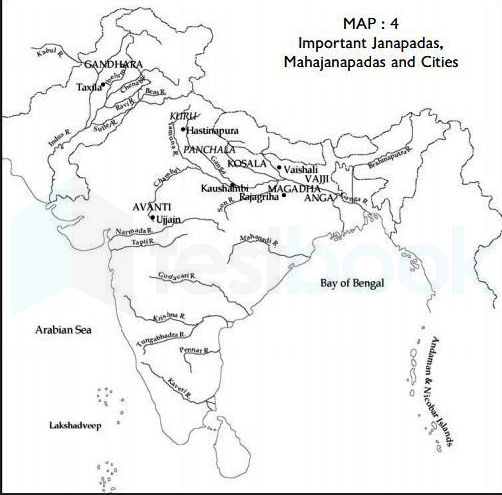
Which one of the following is not the regular taxes collected by the rulers of Mahajanapadas?

  1. ((a))

    Taxes on crops

  2. ((b))

    Taxes on craft persons

  3. ((c))

    Taxes on herders

  4. ((d))

    Taxes on family

Show Answer
Answer: ((d))

Taxes on family

Taxes on family is not the regular taxes collected by the rulers of Mahajanapadas.

Key Points

  • About 2500 years ago, some janapadas became more important than others, and were known as mahajanapadas.
  • As the rulers of the mahajanapadas were (a) building huge forts (b) maintaining big armies, they needed more resources.
  • Hence, they started collecting regular taxes. These include:
  • Taxes on crops - These taxes were very important because most people were farmers. Usually, the tax was fixed at 1/6th of what was produced. This was known as bhaga or a share.
  • Taxes on craft persons - The taxes on craft persons could have been in the form of labour. For example, a weaver or a smith may have had to work for a day every month for the king.
  • Taxes on herders - Herders were also expected to pay taxes in the form of animals and animal produce.
  • Taxes on goods - There were also taxes on goods that were bought and sold, through trade.
  • Taxes on hunters and gatherers - They also had to provide forest produce to the raja.

Based on the above points, we can conclude that taxes on family is not the regular taxes collected by the rulers of Mahajanapadas.

Additional Information

  • A map showing the important Janapadas, Mahajanapadas and Cities:

38

Read the statements related to the impact of colonial rule on tribal communities and choose the correct option.

(A) In Reserved Forest, private rights or privileges were either absolutely prohibited or allowed only under stringent conditions.

(B) In Protected Forest, the government permitted some rights of the local population or private persons to be exercised.

  1. ((a))

    A is incorrect, B is correct

  2. ((b))

    Both A and B are correct 

  3. ((c))

    Both A and B are incorrect

  4. ((d))

    A is correct, B is incorrect

Show Answer
Answer: ((b))

Both A and B are correct 

Both the statements A and B are correct related to the impact of colonial rule on tribal communities.

Important Points

  • The life of tribal communities was directly connected to the forest.
  • So changes in forest laws by the Britishers had a considerable effect on tribal lives.
  • The British extended their control over all forests and declared that forests were state property.
  • The first Forest Act that was passed in India was in 1865, when the Imperial Forest Department tried to establish the control of British over the forests in India.
  • By this Act, any land that was covered in trees was declared as a government forest.
  • In 1878, another Forest Act was passed, which enabled the government to demarcate and administer the forests.
  • They decided the level of availability of the forest to the locals.
  • They attempted to regulate the collection from forest dwellers and declared certain activities as punishable offenses.
  • According to the Forest Act of 1878, the forests were classified into:
  • Reserved forests: The most restricted forests are the reserved forests. The private rights or privileges were either absolutely prohibited or allowed only under stringent conditions in these forests.
  • Protected forests: The Government has proprietary rights over these forests and the power to issue rules regarding the use of these forests. The government permitted some rights of the local population or private persons to be exercised in these forests.
  • Village forests: These forests are the least protected ones and the locals have complete access to them. The rights to the forests are assigned by the Government to the concerned village or community.

Based on the above discussion, we can conclude that both A and B are correct.

39

Which one of the following is the slogan of Shri Narayana Guru?

  1. ((a))

    One caste, one religion, one god for humankind.

  2. ((b))

    One language, one religion, one god for humankind.

  3. ((c))

    One language, one caste, one god for humankind.

  4. ((d))

    One religion, and one god for humankind.

Show Answer
Answer: ((a))

One caste, one religion, one god for humankind.

"One caste, one religion, one god for humankind" is the slogan of Shri Narayana Guru.

Key Points

  • In what is present-day Kerala, a guru from Ezhava caste, Shri Narayana Guru, proclaimed the ideals of unity for his people.
  • He argued against treating people unequally on the basis of caste differences.
  • According to him, all humankind belonged to the same caste.
  • One of his famous slogan was: “oru jati, oru matam, oru daivam manushyanu” (one caste, one religion, one god for humankind).

Hence, we can conclude that the slogan of Shri Narayana Guru was - "One caste, one religion, one god for humankind".

Additional Information

  • Shri Narayana Guru founded the Shri Narayana Dharma Paripalana Yogam or SNDP in 1902.
  • This organisation worked to spread the ideas of equality and reformation in Kerala.
  • He fought for the emancipation of the oppressed castes in the society especially for the Ezhavas.
  • His followers Padmanabhan Palpu and Kumaran Asan popularised SNDP movement in 20th century.
40

Who among the following founded the Self Respect Movement?

  1. ((a))

    E. V. Ramaswamy or Periyar

  2. ((b))

    Shri. Narayan Guru

  3. ((c))

     B. R. Ambedkar

  4. ((d))

     Swami Vivekanand

Show Answer
Answer: ((a))

E. V. Ramaswamy or Periyar

E. V. Ramaswamy or Periyar founded the Self Respect Movement.

Key Points

  • E.V. Ramaswamy Naicker, or Periyar, as he was called, came from a middle-class family.
  • He had been an ascetic in his early life and had studied Sanskrit scriptures carefully.
  • Later, he became a member of the Congress, only to leave it in disgust when he found that at a feast organised by nationalists, seating arrangements followed caste distinctions – that is, the lower castes were made to sit at a distance from the upper castes.
  • Convinced that untouchables had to fight for their dignity, Periyar founded the Self-Respect Movement.
  • He argued that untouchables were the true upholders of an original Tamil and Dravidian culture which had been subjugated by Brahmans.
  • He felt that all religious authorities saw social divisions and inequality as God-given.
  • Untouchables had to free themselves, therefore, from all religions in order to achieve social equality.
  • Periyar was an outspoken critic of Hindu scriptures, especially the Codes of Manu, the ancient lawgiver, and the Bhagavad Gita and the Ramayana.
  • He said that these texts had been used to establish the authority of Brahmans over lower castes and the domination of men over women.

Hence, we can conclude that the Self Respect Movement was founded by E. V. Ramaswamy or Periyar.

Additional Information

  • Shri Narayan Guru founded the Shri  Narayana Dharma Paripalana Yogam or SNDP movement in1902.
  • B. R. Ambedkar started a temple entry movement in 1927, in which his Mahar caste followers participated.
  • Swami Vivekanand founded the Ramakrishna Mission in 1897 to propagate the teachings of his guru.
41

Read the sentences A, B and C given below and choose the correct option.

A. In 19th century expansion of cities created new demands of labour.

B. Relatively rich people from villages and small towns began moving to the cities for labour.

C. Although working conditions were very hard, but work in the new locations gave lower castes to get away from the oppressive hold that upper-caste landowners exercised over them.

  1. ((a))

    Only A and B are true

  2. ((b))

    Only B and C are true

  3. ((c))

    Only A and C are true

  4. ((d))

    All A, B and C are true

Show Answer
Answer: ((c))

Only A and C are true

Among the given sentences, Only A and C are true.

Key Points

  • During the course of the nineteenth century, the poor began leaving their villages to look for jobs that were opening up in the cities.
  • There was work in the factories that were coming up, and jobs in municipalities.
  • The expansion of the cities created new demands of labour.
  • The poor from the villages and small towns, many of them from low castes, began moving to the cities where there was a new demand for labour.
  • Work in the new locations was often very hard.
  • But the poor, the people from low castes, saw this as an opportunity to get away from the oppressive hold that upper-caste landowners exercised over their lives and the daily humiliation they suffered.

Based on the above given points, we can conclude that, the following sentences are correct:

A. In 19th century expansion of cities created new demands of labour.

C. Although working conditions were very hard, but work in the new locations gave lower castes to get away from the oppressive hold that upper-caste landowners exercised over them.

Mistake Points

  • The sentence "Relatively rich people from villages and small towns began moving to the cities for labour" is not correct because it was the poor people from villages and small towns began moving to the cities for labour.
42

Which of the following leaders in a popular pictorial representation ‘driving Krishna's chariot’ was shown guiding other nationalist leaders in the battle against the British by 

  1. ((a))

    Subhas Chandra Bose

  2. ((b))

    Sardar Vallabhbhai Patel

  3. ((c))

    Mohandas Karamchand Gandhi

  4. ((d))

    Chakravarti Rajagopalachari 

Show Answer
Answer: ((c))

Mohandas Karamchand Gandhi

In a popular pictorial representation ‘driving Krishna's chariot’, Mohandas Karamchand Gandhi was shown guiding other nationalist leaders in the battle against the British.

Important Points

  • People thought of Gandhiji (Mohandas Karamchand Gandhi) as a kind of messiah, as someone who could help them overcome their misery and poverty.
  • In popular images too Mahatma Gandhi is often shown as a divine being occupying a place within the pantheon of Indian gods.
  • In the given below image also, he is shown driving Krishna’s chariot, guiding other nationalist leaders in the battle against the British.

Therefore, the correct answer is - Mohandas Karamchand Gandhi

43

Read the following statements A and B.

A. Aurangzeb issued a farman granting the company the right to trade duty free.

B. The company did not want more concessions and manipulation of existing privileges.

Choose the correct option.

  1. ((a))

    A is incorrect, B is correct.

  2. ((b))

    Both A and B are correct.

  3. ((c))

    Both A and B are incorrect.

  4. ((d))

    A is correct, B is incorrect.

Show Answer
Answer: ((d))

A is correct, B is incorrect.

Among the given statements, A is correct but B is incorrect.

Important Points

  • The first English factory was set up on the banks of the river Hugli in 1651.
  • By 1696 it began building a fort around the settlement near the factory.
  • The East India company persuaded the Mughal emperor Aurangzeb to issue a Farman granting the Company the right to trade duty-free.
  • A Farman was a royal edict or an order issued by the Emperor.
  • The Company tried continuously to press for more concessions and manipulate existing privileges.
  • Aurangzeb’s Farman, for instance, had granted only the Company the right to trade duty-free.
  • But officials of the Company, who were carrying on private trade on the side, were expected to pay duty.
  • This they refused to pay, causing an enormous loss of revenue for Bengal.
  • This behavior led to a protest by the Nawab of Bengal, Murshid Quli Khan.​

Based on the above discussion, we can conclude that statement A is correct but statement B is incorrect.

44

Which of the following statements(s) is/are true about the features of Indian Constitution when it was drafted?

A. It adopted voting rights for communities constituting the largest proportion of India

B. It guaranteed equality before the law to all citizens

C. It offered special privileges for the poorest and most disadvantaged Indians

Choose the correct option.

  1. ((a))

    Only A

  2. ((b))

    Only B and C

  3. ((c))

    Only A and C

  4. ((d))

    A, B and C

Show Answer
Answer: ((b))

Only B and C

Among the given statements, only B and C are true about the features of the Indian Constitution when it was drafted.

Key Points

  • The Indian Constitution came into effect on 26 January 1950.
  • Some of the important features of the Indian Constitution when it was drafted are:
  • One feature of the Constitution was its adoption of a universal adult franchise. All Indians, regardless of their gender, class or education, above the age of 21 would be allowed to vote in state and national elections.
  • A second feature of the Constitution was that it guaranteed equality before the law to all citizens, regardless of their caste or religious affiliation.
  • A third feature of the Constitution was that it offered special privileges for the poorest and most disadvantaged Indians.

Thus we can conclude that the following statements are true about the features of the Indian Constitution when it was drafted:

B. It guaranteed equality before the law to all citizens

C. It offered special privileges for the poorest and most disadvantaged Indians

45

Which of the following statements about solar system is correct?

  1. ((a))

    The sun, eight planets and satellites form the solar system.

  2. ((b))

    The sun, eight planets, satellites, Asteroids and Meteoroids form the solar system.

  3. ((c))

    The sun, ten planets, satellites, Meteoroids and Asteroids form the solar system.

  4. ((d))

    The sun and planets form the solar system.

Show Answer
Answer: ((b))

The sun, eight planets, satellites, Asteroids and Meteoroids form the solar system.

The statement "The sun, eight planets, satellites, Asteroids and Meteoroids form the solar system" is correct about solar system.

Important Points

  • The sun, eight planets, satellites and some other celestial bodies known as asteroids and meteoroids form the solar system.
  • The Sun:
  • The sun is in the centre of the solar system.
  • It is huge and made up of extremely hot gases.
  • It provides the pulling force that binds the solar system.
  • The sun is the ultimate source of heat and light for the solar system.
  • Planets:
  • There are eight planets in our solar system.
  • In order of their distance from the sun, they are: Mercury, Venus, Earth, Mars, Jupiter, Saturn, Uranus and Neptune.
  • All the eight planets of the solar system move around the sun in fixed paths. These paths are elongated and are called orbits.
  • Sateliites:
  • The planets have their own satellites.
  • Satellite is a celestial body that moves around the planets in the same way as the planets move around the sun.
  • Our earth has only one satellite, that is, the moon.
  • Asteroids:
  • ​Apart from the stars, planets and satellites, there are numerous tiny bodies which also move around the sun. These bodies are called asteroids.
  • They are found between the orbits of Mars and Jupiter.
  • Meteoroids:
  • ​The small pieces of rocks which move around the sun are called meteoroids.

Based on the above discussion, we can conclude that the correct statement about the solar system is - The sun, eight planets, satellites, Asteroids and Meteoroids form the solar system.

46

Consider the following statements A and B and choose the correct option.

A. The value of latitude is followed by the word either North or South.

B. The longitude of a place is followed by the word either North or South.

  1. ((a))

    Only A is true.

  2. ((b))

    Only B is true.

  3. ((c))

    Both A and B are true.

  4. ((d))

    Both A and B are false.

Show Answer
Answer: ((a))

Only A is true.

The grid of the earth consists of two sets of horizontal and vertical lines, called parallels of latitude and meridians of longitude.

  • Latitudes are imaginary lines running east-west commonly known as the parallels of latitudes.
  • Longitudes are vertical lines running north-south, joining two poles.

Important Points

  • The equator represents the zero degree latitude.
  • Since the distance from the equator to either of the poles is one-fourth of a circle round the earth, it will measure ¼th of 360 degrees, i.e. 90°.
  • Thus, 90 degrees north latitude marks the North Pole and 90 degrees south latitude marks the South Pole.
  • As such, all parallels north of the equator are called ‘north latitudes.’
  • Similarly all parallels south of the equator are called ‘south latitudes.’
  • The value of each latitude is, therefore, followed by either the word north or south.
  • Generally, this is indicated by the letter ‘N’ or ‘S’. For example, both Chandrapur in Maharashtra (India) and Belo Horizonte in Brazil (South America) are located on parallels of about 20° latitude.
  • But the former is 20° north of the equator and the latter is 20° south of it.
  • We, therefore, say that Chandrapur is situated at 20° N latitude and Belo Horizonte is situated at 20° S latitude.

 Thus, we can say that the Longitude of a place is followed by the word East or West.

47

Read the statements and choose the correct option.

Assertion (A) : Torrid zone receives the maximum heat and remains hot throughout the year.

Reasoning (R) : The Mid-day sun is exactly overhead at least once a year on all latitudes between the Tropic of Cancer and the Tropic of Capricorn.

  1. ((a))

     Both (A) and (R) are true and (R) is the correct explanation of (A).

  2. ((b))

    Both (A) and (R) are true but (R) is not the correct explanation of (A).

  3. ((c))

    (A) is true but (R) is false.

  4. ((d))

    Both (A) and (R) are false.

Show Answer
Answer: ((a))

 Both (A) and (R) are true and (R) is the correct explanation of (A).

The correct answer is Both (A) and (R) are true and (R) is the correct explanation of (A).

Key Points

  • The three heat zones of the Earth are:
  • Torrid Zone
  • Temperate Zones
  • Frigid Zones
  • The mid-day sun is exactly overhead at least once a year on all latitudes between the Tropic of Cancer and the Tropic of Capricorn.
  • This area, therefore, receives the maximum heat and is called the Torrid Zone.
  • The torrid zone includes southern Mexico. Central America, the Caribbean, northern South America, Sudan, the southern regions of Western Sahara, Algeria, Egypt and Libya, West Africa, Central Africa, East Africa, south Middle East, southern Indian Subcontinent, Southeast Asia, northern Australia, the northern tip of Zealandia, great part of Oceania.

 Thus, we can say that the above statements are correct.

Additional Information

  • The areas bounded by the Tropic of Cancer and the Arctic Circle in the Northern Hemisphere, the Tropic of Capricorn and the Antarctic Circle in the Southern Hemisphere have moderate temperatures.
  • These are called temperate zones.
  • Areas lying between the Arctic Circle and the North Pole in the Northern Hemisphere and the Antarctic Circle and the South Pole in the southern hemisphere are called Frigid Zones.
48

Read the statements and choose the correct option from the given alternatives.

Assertion (A) : Equator is a very important reference line on the globe.

Reasoning (R) : Equator divides the earth into northern hemisphere and southern hemisphere.

  1. ((a))

    Both (A) and (R) are true and (R) is the correct explanation of (A).

  2. ((b))

    Both (A) and (R) are true but (R) is not the correct explanation of (A).

  3. ((c))

    (A) is true but (R) is false.

  4. ((d))

    Both (A) and (R) are false.

Show Answer
Answer: ((a))

Both (A) and (R) are true and (R) is the correct explanation of (A).

The correct answer is Both (A) and (R) are true and (R) is the correct explanation of (A).

Key Points

  • The Equator is the imaginary circular line running on the globe that divides it into two equal halves.
  • It is a very important reference point on the globe to locate places on the Earth.
  • The northern half of the Earth is the Northern Hemisphere and the southern part is called the Southern Hemisphere.
  • The Equator represents the zero degrees latitude.
  • Since the distance from the equator to either side of the poles is one-fourth of a circle around the earth.

 Thus, we can say that the Equator is a very important reference point on the globe and it divides the earth into the northern and the southern hemisphere.

49

‘If an earthquake happens, the surface of the earth vibrates and vibration can travel to far off places’.

Which of the following options refers to terms that helps in in understanding earthquakes?

  1. ((a))

    Epicentre, Seismograph, Plate boundary

  2. ((b))

    S waves, Vent, Mantle

  3. ((c))

    P waves, Crater, Lava

  4. ((d))

    Gases, Richter, Exogenic forces

Show Answer
Answer: ((a))

Epicentre, Seismograph, Plate boundary

The correct answer is 

Key Points

  • An Earthquake is what happens when two blocks of the earth suddenly slip past one another.
  • The surface when they slip is called the fault or the fault plane.
  • If an earthquake happens, the surface of the Earth vibrates and vibration can travel to far-off places.
  • The terms that help in understanding earthquakes are:
  • ​Epicentre
  • Seismograph
  • Plate boundary
  • The Epicentre is the point on earth's surface vertically above the hypocentre (or focus), point in the crust where a seismic rupture begins.
  • A seismograph is an instrument used to detect and record earthquakes.
  • Most earthquakes occur at the boundaries where the plates meet.
  • Movement in narrow zones along plate boundaries cause most earthquakes.
  • Most seismic activities occur at three types of plate boundaries:
  • divergent
  • convergent
  • transform

 Thus, we can say that the terms that help in understanding earthquakes are epicentre, seismograph and plate boundaries.

50

Read the statements and choose the correct option.

Assertion (A) : The relation between the organisms and their surroundings form an ecosystem.

Reasoning (R) : All plants, animals and human beings depend on their immediate surroundings.

  1. ((a))

    Both (A) and (R) are true and (R) is the correct explanation of (A).

  2. ((b))

    Both (A) and (R) are true but (R) is not the correct explanation of (A).

  3. ((c))

    (A) is true but (R) is false.

  4. ((d))

    Both (A) and (R) are false.

Show Answer
Answer: ((b))

Both (A) and (R) are true but (R) is not the correct explanation of (A).

The correct answer is Both (A) and (R) are true but (R) is not the correct explanation of (A).

Key Points

  • Ecosystem is a system that is formed by the interaction of all living organisms with each other and with the physical and chemical factors of environment in which they live, all linked by transfer of energy and material.
  • All plants, animals and human beings depend on their immediate surroundings.
  • Often they are also independent on each other.
  • This relation between the living organisms, as well as the relation between the organisms and their surroundings form an ecosystem.
  • There could be an ecosystem of large rain forest, grassland, desert, mountains, lake, river, ocean and even a small pond.

 Thus, we can say that both the statements are correct but (R) is not the correct explanation of (A).

51

Match the following domains of environment with their examples.

A.Lithosphere(i)Water bodies like rivers, lakes, seas etc.
B.Atmosphere(ii)Plant and animal kingdom.
C.Biosphere(iii)Rocks and minerals.
D.Hydrosphere(iv)Thin layers of air consisting of gases.

Choose the correct option.

  1. ((a))

    A - (ii), B - (i), C - (iii), D - (iv)

  2. ((b))

    A - (iv), B - (iii), C - (i), D - (ii)

  3. ((c))

    A - (iii), B - (iv), C - (ii), D - (i)

  4. ((d))

    A - (i), B - (ii), C - (iv), D - (iii)

Show Answer
Answer: ((c))

A - (iii), B - (iv), C - (ii), D - (i)

The correct answer is A- (iii), B- (iv), C- (ii), D- (i).

Key Points

  • Atmosphere is the thin layer of air that surrounds the earth
  • Lithosphere is the solid crust or the hard top layer of the earth.
  • It is made up of rocks and minerals and covered by a thin layer of soil.
  • It is an irregular surface with various landforms such as mountains, plateaus, plains, valleys etc.
  • The domain of water is called hydrosphere. It comprises various sources of water and different type of water bodies like rivers, lakes, seas, oceans etc.
  • Plant and animal kingdom together make biosphere or the living world.
  • It is a narrow zone of the earth where land, water and air interact with each other to support life.

 Thus, we can say that lithosphere is made up of rocks and minerals, atmosphere is the thin layer of air, biosphere is the plant and animal kingdom together, hydrosphere comprises of water bodies like rivers, lakes, seas etc.,

52

Which one of the following gases present in the air is a greenhouse gas?

  1. ((a))

    Oxygen

  2. ((b))

    Hydrogen

  3. ((c))

    Helium

  4. ((d))

    Carbon dioxide

Show Answer
Answer: ((d))

Carbon dioxide

The correct answer is Carbon dioxide.

Key Points

  • Greenhouse gas is a gas that absorbs and emits radiant energy within the thermal infrared range, causing the greenhouse effect.
  • The important greenhouse gases in the Earth's atmosphere are:
  • Carbon dioxide
  • Methane
  • Nitrous Oxide
  • Water Vapour
  • Ozone
  • Carbon dioxide is the primary greenhouse gas that is emitted through human activities.
  • Greenhouse gases have different chemical properties and are removed from the atmosphere, over time, by different processes.

 Thus, we can say that Carbon dioxide present in the air is a greenhouse gas.

53

Air is a mixture of various gases. Choose the correct statements about air from the following statements.

A. Plants take nitrogen directly from the air.

B. Green plants release oxygen gas.

C. Helium, Argon, Ozone gases are present in large quantities in the air.

D. Tiny dust particles are present in the air.

  1. ((a))

    A and C are true. B and D are false.

  2. ((b))

    A and D are true, B and C are false.

  3. ((c))

    B and D are true, A and C are false.

  4. ((d))

    B and C are true, A and D are false.

Show Answer
Answer: ((c))

B and D are true, A and C are false.

The correct answer is B and D are true, A and B are false.

Key Points

  • Air is a mixture of various gases.
  • Green plants release oxygen.
  • Hence statement B is correct.
  • 21% of the air comprises of oxygen gas which is essential for human survival.
  • Plants cannot themselves take oxygen directly from the air but rely mainly on the supply of combined nitrogen in the form of ammonia, or nitrates, resulting from nitrogen fixation by free-living bacteria in the soil.
  • Hence statement A is false.
  • Helium, Argon and Ozone gases are present in small quantities in the air.
  • Tiny dust particles are present in the air.
  • Hence statement D is correct.

 Thus, we can say that Green plants release oxygen gas and tiny dust particles are present in the air.

54

Why is the temperature in cities higher than in villages?

Choose the correct set of statement(s)

A. The concrete and metals in buildings get heated during the day.

B. The asaphalt of roads gets heated up during the day.

C. Crowded high rise buildings of cities trap warm air.

D. There are more open space and trees in cities.

  1. ((a))

    A, B and C

  2. ((b))

    B, C and D

  3. ((c))

    A, B and D

  4. ((d))

    A, C and D

Show Answer
Answer: ((a))

A, B and C

The correct answer is A, B and C.

Key Points

  • Temperatures in the cities are higher than in villages.
  • This is because:
  • The concrete and metals in buildings get heated during the day.
  • The asphalt of roads gets heated up during the day.
  • Crowded high rise buildings of cities trap warm air.
  • This heat is less at night in the absence of the sun hence the difference in temperature.

 Thus, we can say that the temperature in cities is higher because the concrete and metals in buildings, as well as the asphalt of roads, get heated during the day and the crowded high-rise buildings of cities trap warm air.

55

Match the following minerals with their types.

A.Ferrous Mineral(i)Limestone
B.Fossil fuel(ii)Lead
C.Non-metallic mineral(iii)Coal
D.Non-ferrous mineral(iv)Manganese

Choose the correct option.

  1. ((a))

    A - (i), B - (ii), C - (iv), D - (iii)

  2. ((b))

    A - (iii), B - (iv), C - (ii), D - (i)

  3. ((c))

    A - (iv), B - (iii), C - (i), D - (ii)

  4. ((d))

    A - (iii), B - (i), C - (ii), D - (iv)

Show Answer
Answer: ((c))

A - (iv), B - (iii), C - (i), D - (ii)

The correct answer is A- (iv), B- (iii), C- (i), D- (ii).

Key Points

  • Minerals are classified as metallic and non-metallic based on their composition.
  • Non-metallic minerals do not contain metals.
  • Limestone, mica and gypsum are examples of non-metallic minerals.
  • Metallic minerals can be:
  • Ferrous minerals
  • Non-Ferrous minerals
  • Ferrous minerals like iron ore, manganese and chromites contain iron.
  • Non-ferrous minerals do not contain iron but may contain other metals such as gold, silver, lead or copper.
  • Coal is the most abundantly found fossil fuel.
  • It is used as a domestic fuel, in industries such as iron and steel, steam engines and to generate electricity.

 Thus. we can say that manganese is a ferrous mineral, coal is a fossil fuel, limestone is a non-metallic mineral and lead is a non-ferrus mineral.

56

Which of the following activities required for the conservation of wildlife?

  1. ((a))

    Deforestation and soil erosion.

  2. ((b))

    Forest fires and landslides.

  3. ((c))

    National parks and wildlife sanctuaries.

  4. ((d))

    Construction activities and poaching.

Show Answer
Answer: ((c))

National parks and wildlife sanctuaries.

The correct answer is National parks and wildlife sanctuaries.

Key Points

  • Wildlife Conservation is the practice of protecting plant and animal species and their habitats.
  • The activities required for the Conservation of wildlife are building up of:
  • National parks
  • Wuldlife sanctuaries
  • A national park is a natural park used for conservation purposes, created and maintained by national governments.
  • A wildlife sanctuary is an area where animal habitats and their surroundings are protected from any sort of disturbance.

 Thus, we can say that National Parks and Wildlife sanctuaries are required for the conservation of wildlife.

57

Choose the correct option on ways to increase farm production to meet the demands of growing population.

A. Use of fertilisers and High Yielding Variety Seeds.

B. Increasing the cropped area.

C. Rain dependent agriculture.

D. Mechanism of agriculture.

Choose the correct option.

  1. ((a))

    A, B and C

  2. ((b))

    A, C and D

  3. ((c))

    A, B and D

  4. ((d))

    B, C and D

Show Answer
Answer: ((c))

A, B and D

The correct answer is A, B and D.

Key Points

  • Efforts made to increase farm production in order to meet the growing demand of increasing population is referred to as Agricultural development.
  • Ways to increase the Farm Production to meet the demands of growing population are:
  • use of fertilizers and high yielding variety seeds
  • Increasing the cropped area
  • Mechanism of agriculture
  • HYV seeds were developed by scientists to improve food supplies and reduce famine in developing countries.
  • These seeds can produce up to ten times more crops than regular seeds on the same area of land.

 Thus, we can say that the ways to increase farm production to meet the demands of growing population are use of fertilizers and High Yielding Variety Seeds, increased the cropped area and mechanism of agriculture.

58

Which of the following would be the appropriate example of explaining the concept of prejudice?

A. People looking at each other equally

B. People judging other people negatively

C. People respecting each other

D. The feeling of superiority and inferiority

Choose the correct option.

  1. ((a))

    A and C

  2. ((b))

    B

  3. ((c))

    C

  4. ((d))

    B and D

Show Answer
Answer: ((d))

B and D

The correct answer is B and D.

Key Points

  • Prejudice means to judge other people negatively or see them as inferior.
  • When we think that only one particular way is the best and right way to do things we often end up not respecting others, who may prefer to do things differently.
  • The concept of prejudice can be explained as:
  • People judging other people negatively
  • The feeling of superiority and inferiority
  • We can be prejudiced about many things: people's religious beliefs, the color of their skin, the region they come from, the accent they speak in, the clothes they wear etc.

 Thus, we can say that Prejudice is people judging other people negatively and the feeling of superiority and inferiority.

59

Which of the following factors influence the diversity of a region?

A. Different eating and clothing habits

B. Practising similar religions

C. Adapting to the geographical areas people inhabit

Choose the correct option.

  1. ((a))

    Only A

  2. ((b))

    A and B

  3. ((c))

    B and C

  4. ((d))

    A and C

Show Answer
Answer: ((d))

A and C

The correct answer is A and C.

Key Points

  • Diversity is the practice of involving people from a range of different social and ethnic backgrounds and of different genders etc.
  • Historical and geographical factors influence the diversity of a region.
  • India is a land of different religions and communities.
  • There is a great diversity in our habits and customs and yet we all live together as Indians.
  • Different eating and clothing habits influence diversity of a region.
  • People adapting to the geographical areas that they inhabit also influence its diversity.

 Thus, we can say that the factors that influence diversity of a region are different eating and clothing habits and people adapting to the geographical areas.

60

Who is the executive head of the State Government?

  1. ((a))

    The Chief Minister

  2. ((b))

    The Governor

  3. ((c))

    The Chief Secretary

  4. ((d))

    The Attorney General

Show Answer
Answer: ((b))

The Governor

The correct answer is The Governor.

Key Points

  • The executive head of the State government is the Governor.
  • State Executive consists of Governor and Council of Minister with Chief Minister as its head.
  • The governors of the states of India have similar powers and functions at the state level as those of the President of India at central level.
  • The governor appoints the Chief Minister, who enjoys the support of the majority in the State Legislative Assembly.

 Thus, we can say that the executive head of the State Government is the Governor.

61

Which of the following sytems of government was adopted by India?

  1. ((a))

    Presidential and Unitary

  2. ((b))

    Parliamentary and Federal

  3. ((c))

    Presidential and Federal

  4. ((d))

    Parliamentary and Unitary

Show Answer
Answer: ((b))

Parliamentary and Federal

The correct answer is Parliamentary and Federal.

Key Points

  • India is a Sovereign Socialist Secular Democratic Republic with a parliamentary system of government.
  • The systems of Government adopted by India are Parliamentary and Federal forms.
  • Parliamentary system is a democratic form of government in which the party with the greatest representation in the parliament forms the government, its leader becoming Prime Minister.
  • Federalism is the system of government in which the same territory is controlled by two levels of governments.
  • A federal system of government divides the power of the government between the national and state and local levels.

 Thus, we can say that the Parliamentary and the Federal systems of government was adopted by India.

62

Which of the following statements is true about life in rural India?

A. About four-fifths of farmers in India are large farmers.

B. Farmers in India get into a debt trap when do not expect yield.

C. Small farmers depend mainly on banks for their credit requirements.

Choose the correct option.

  1. ((a))

    Only A

  2. ((b))

    Only B

  3. ((c))

    Only A and B

  4. ((d))

    Only B and C

Show Answer
Answer: ((b))

Only B

The correct answer is Only B.

Key Points

Agriculture is the major source of livelihood in the rural sector.

  • The percentage of large farmers in India is 20%. Thus, statement A is incorrect.
  • Farmers in India get into a debt trap when they do not expect yield.
  • Farmers normally take crop credits toward the start of the time and reimburse the advance after gathering.
  • Sometimes the disappointment of the harvest makes credit reimbursement inconceivable.
  • Farmers in this way need to offer a piece of their territory to reimburse the credit. Credit in such a condition drives the borrowers into a circumstance from which recuperation is difficult and he gets into the obligation trap.
  • Thus, statement B is correct.
  • Small and marginal farmers are largely dependent on informal sources of credit.
  • Informal sources of credit are moneylenders, traders, employers, friends, and Self Help Groups (SHGs).
  • Thus, statement C is incorrect.
63

Read the following statements and choose the true statements.

(A) About 60 percent of families in India are working as agricultural labourers

(B) Agricultural labourers migrate to distant places due to limited earning opportunities in villages.

(C) Agricultural labourers accept lower than market wages for want of regular employment from farmers.

Choose the correct option.

  1. ((a))

    Only (A) and (B)

  2. ((b))

    Only (B)

  3. ((c))

    Only (B) and (C)

  4. ((d))

    Only (A)

Show Answer
Answer: ((c))

Only (B) and (C)

An agriculture labourer has no right of lease or contract and has no risk in the cultivation of land but merely works on another person’s land for a wage.

Key Points 

  • About 54.6 per cent of families in India are working as agricultural labourers. Hence statement 1 is incorrect.
  • Agricultural labourers migrate to cities in search of work.
  • This is because agriculture takes place on a seasonal basis.
  • The seasonal nature of both agricultural and factory work makes it convenient for people to engage as both agricultural labourers and casual workers.
  • Hence statement 2 is correct.
  • Agricultural labourers accept lower than market wages for want of regular employment from farmers.
  • Due to less demand and more supply, there is great competition for work among the labourers.
  • So they themselves agree to work at much lower wages than the wages fixed by the government.

Additional Information 

There are two types of agricultural labourers. 

  • First, those attached to some other farming households on the basis of a written or oral agreement.
  • They work as per instructed by their masters and cannot work at any other place.
  • Second, those who are free to work in any farm on the payment of daily wages are known as Casual Laborers.
64

The democratic ethos in a country can be strengthened through

A. regular conduct of elections

B. people's participation in decision making process

C. informed public opinion

D. strong and committed bureaucracy

Choose the correct option.

  1. ((a))

    A, B and D

  2. ((b))

    A, B and C

  3. ((c))

    B, C and D

  4. ((d))

    A, C and D

Show Answer
Answer: ((b))

A, B and C

The correct answer is A, B and C.

Key Points

  • A democracy is a system of government in which the people have the power to participate in decision- making.
  • The word comes from the ancient Greek words "demos" meaning 'the people' an "kratos" meaning 'to rule'.
  • The democratic ethos in a country can be strengthened through:
  • regular conduct of elections
  • people's participation in the decision-making process
  • informed public opinion

 Thus, we can say that the democratic ethos in a country can be strengthened by regular conduct of elections, people's participation in the decision-making process and informed public opinion.

65

If a curricular material has illustrations of women as housewives and domestic maids and men as engineers and pilots. This type of depiction is likely to promote

  1. ((a))

    Gender empowerment

  2. ((b))

    Gender role play

  3. ((c))

    Gender stereotyping

  4. ((d))

    Gender constancy

Show Answer
Answer: ((c))

Gender stereotyping

The correct answer is Gender Stereotyping.

Key Points

  • Gender Stereotyping refers to the practice of ascribing to an individual woman or man specific attributes, characteristics, or roles by reason only of her or his membership in the social group of women or men.
  • A gender stereotype is a generalized view or preconception about characteristics or roles that are to be possessed by women or men.
  • An example would be depiction of women as housewives and domestic maids and men as engineers and pilots in a curricular material.

 Thus, we can say that if a curricular material material has illustrations of women as housewives and domestic maids and men as engineers and pilots, this depicts Gender Stereotyping.

66

Read the following statements.

Statement (A) : All democratic countries are likely to have a Constitution.

Statement (B) : All countries that have a Constitution are not necessarily democratic.

Select the correct option from the given alternatives.

  1. ((a))

    Both (A) and (B) are true.

  2. ((b))

    Both (A) and (B) are false.

  3. ((c))

    Only (A) is true.

  4. ((d))

    Only (B) is true.

Show Answer
Answer: ((a))

Both (A) and (B) are true.

The correct answer is Both (A) and (B) are true.

Key Points

  • A democratic country has a system of government in which the people have the power to participate in decision-making.
  • A constitution is an aggregate of fundamental principles or established precedents that constitute the legal basis of polity, organisation or another type of entity and commonly determine how that entity is to be governed.
  • All democratic countries are most likely to have a constitution.
  • However, there are exceptions as a democratic country may not have a constitution.
  • For example, Britain does not have a codified constitution.
  • All countries that have a constitution are not necessarily democratic.

 Thus, we can say that all democratic countries are likely to have a constitution but all countries that have a constitution are not necessarily democratic.

67

What is the term used by the Constitution of India to describe India?

  1. ((a))

    Federation

  2. ((b))

    Union of States

  3. ((c))

    Republic

  4. ((d))

    Bharatvarsh

Show Answer
Answer: ((b))

Union of States

The correct answer is Union of States.

Key Points

  • The constitution of India describes India as a Union of States.
  • It is because our constitution delegates powers to both the Centre and the State, yet more power lies with the Centre.
  • After independence, India was formed by the decision of princely states who decided to join India and thus form a union of states.
  • Article 1 of the constitution states that India shall be a Union of states.

 Thus, we can say that the term used by the Constitution of India to describe India is Union of the States.

68

What is the role of a judge in a fair trial?

Choose the correct option.

A. The judge decides the innocence of the accused person on the basis of evidence present and in accordance with law.

B. The judge conducts the trial impartially and in an open court.

C. The judge gives a quick judgement on cases that shake public conscience.

  1. ((a))

    Only A is true.

  2. ((b))

    B is false.

  3. ((c))

    Only C is true.

  4. ((d))

    Both A and B are true.

Show Answer
Answer: ((d))

Both A and B are true.

The correct answer is Both A and B are true.

Key Points

  • A fair trial means a trial in which bias or prejudice for or against the accused, the witness or the cause which is being tried is eliminated.
  • Fair trials help establish the truth and are vital for everyone involved in a case.
  • The judge decides the innocence of the accused person on the basis of evidence present and in accordance with law.
  • The judge conducts the trial impartial and in an open court.
  • If the accused is convicted, then the judge pronounces the sentence.

 Thus, we can say that the role of the judge in a free trial is that he/she decides the innocence of the accused person on the basis of evidence present and in accordance with law and conducts the trial impartially and in an open court.

69

Consider the following statements A and B and choose the correct option.

A. Right against exploitation says that no one can be forced to work for low wages or under bondage.

B. Many of the laws related to social justice have their basis in the Fundamental Rights guaranteed by the Indian Constitution.

  1. ((a))

    Both (A) and (B) are true and (B) is the correct explanation of (A).

  2. ((b))

    Both (A) and (B) are true but (B) is not the correct explanation of (A).

  3. ((c))

    (A) is true but (B) is false.

  4. ((d))

    (A) is false but (B) is true.

Show Answer
Answer: ((a))

Both (A) and (B) are true and (B) is the correct explanation of (A).

The correct answer is Both (A) and (B) are true and (B) is the correct explanation of (A).

Key Points

  • The employer must pay the employee a minimum wage or more. Every few years, minimum wages are increased. It is part of the right to life (article 21)
  • Fundamental Rights are the basic human rights enshrined in the Constitution of India which are guaranteed to all citizens.
  • Many of the laws related to social justice have their basis in the Fundamental Rights guaranteed by the Indian Constitution.
  • The Right against exploitation is enshrined in Articles 23 and 24 of the Indian Constitution.
  • These are important fundamental rights that guarantee every citizen protection from any kind of forced labor.
  • Right against exploitation says that no one can be forced to work for low wages or under bondage.

 Thus, we can say that the above statements are correct.

70

Which of the following issues are most likely find space in discussion while discussing the issue of Bhopal Gas Tradegy?

A. Lower Safety measures

B. Production of pesticides

C. Cost cutting in industries

D. Compensation to workers

Choose the correct option.

  1. ((a))

    A, B and C

  2. ((b))

    B, C and D

  3. ((c))

    A, C and D

  4. ((d))

    All of the above 

Show Answer
Answer: ((d))

All of the above 

The correct answer is All of the above.

Key Points

Lower safety measures

The UCIL plant had a history of safety problems and was not properly equipped to handle the MIC gas. The leak was caused by a series of errors and omissions, including a lack of training, maintenance, and safety procedures.

Production of pesticides

MIC is a highly toxic gas that is used to produce pesticides. The production of pesticides is a dangerous industry, and there is a risk of accidents if not properly regulated.

Cost-cutting in industries

UCIL was a multinational corporation that was focused on profits. The company cut costs by reducing safety measures and not properly training its employees. This led to the MIC gas leak.

Compensation to workers

The victims of the Bhopal gas tragedy have been fighting for compensation for over 30 years. UCIL has only paid a fraction of the compensation that is owed to the victims.

Additional Information

  • Bhopal Gas Tragedy was a chemical accident on the night of 23 December 1984 at the Union Carbide India Limited pesticide plant in Bhopal, Madhya Pradesh.

  • It was India's first major industrial disaster.

  • It occurred when about 45 tonnes of gas methyl isocyanate escaped from a plant owned by a subsidiary of the U.S. based Union Carbide Corporation.

  • Inestigations later established that standard operating and safety procedures at the unstaffed plant had led to catastrophe.

71

Which of the following statements about the goals of studying social science is most appropriate?

A. To learn to respect differences of opinion, lifestyle and cultural practices.

B. To instil a sense of pride and nostalgia with regard to the past.

C. To grow up as active, responsible and reflective members of society.

D. To understand the society we live in and how its is structured, managed and governed.

Choose the appropriate option.

  1. ((a))

    A, B and C

  2. ((b))

    A, B and D

  3. ((c))

    A, C and D

  4. ((d))

    B, C and D

Show Answer
Answer: ((c))

A, C and D

Social Sciences include a body of knowledge, that deals with social and cultural aspects of human life. The teaching of social sciences is important for many reasons. The basic purpose of teaching social sciences at the school level is to make students informed and rational citizens.

Key Points Following are the goals of teaching social science:-

  • To learn to respect differences of opinion, lifestyle, and cultural practices.
  • To grow up as active, responsible, and reflective members of society.
  • To understand the society we live in and how its is structured, managed, and governed.
  • To understand the social, cultural, and economic forces and dynamics that affect society from time to time.
  • To learn and respect the multiple cultures and traditions which are found and practiced in society.
  • To become active and participative members of society.

Thus, it is concluded that A, C, and D is the correct answer.

72

Consider the two statements (A) and (R) and choose the correct option.

Assertion (A) : There is an urgent need in the social sciences to shift from ethos of utilitarianism to that of egalitarianism.

Reason (R) : The social sciences have traditionally focused on 'developmental' issues, which are important but not sufficient to understand issues of equality, justice and dignity.

  1. ((a))

    Both (A) and (R) are true and (R) is the correct explanation of (A).

  2. ((b))

    Both (A) and (R) are true but (R) is not the correct explanation of (A).

  3. ((c))

    Only (A) is true.

  4. ((d))

    Only (R) is true.

Show Answer
Answer: ((a))

Both (A) and (R) are true and (R) is the correct explanation of (A).

The social sciences encompass diverse concerns of society and include a wide range of content, drawn from the disciplines of history, geography, political science, economics, and sociology.

Key Points

  • The major thrust of the social science curriculum has remained utilitarian in nature. That is to say, it puts more emphasis on developmental issues that are important but not sufficient to understand the normative dimension – issues of equality, justice, and dignity of society polity.
  • In view of this gap, there is a need to achieve a shift in focus from utilitarianism to egalitarianism that would address the normative concerns mentioned above.
  • From time immemorial, social science has been focusing on the ethos of utilitarianism i.e., its products rather than the egalitarian values provided through the analytical skills it fosters.
  • Social Science as a discipline teaches us the concept of social indifferences and the need to develop values that encourage issues of equality, justice, and dignity but due to its nonutility has been considered an important discipline.
  • Therefore, we can say that " There is an urgent need in the social sciences to shift from the ethos of  utilitarianism to that of egalitarianism."  because  " The social sciences have traditionally focused on 'developmental' issues, which are important but not sufficient to understand issues of equality, justice and, dignity."

​ Thus, it is concluded that **Both (A) and (R) are true and (R) is the correct explanation of (A).**​

73

A social science teacher wants to prepare a lesson plan on the theme 'market'. Which of the following sub-concepts are most likely to be part of her plan?

A. Types of markets

B. Chain of markets

C. Unequal opportunities

D. Agricultural production process

E. Bargain in the market

Choose the appropriate option

  1. ((a))

    Only A, B and C

  2. ((b))

    Only A, B and E

  3. ((c))

    Only A, B, C and E

  4. ((d))

    Only A, B, D and E

Show Answer
Answer: ((c))

Only A, B, C and E

Lesson plans specify the learning objectives, content, methods, materials/ equipment, application, and evaluation for each lesson that is taught. It also includes teaching and learning activities related to sub-themes covered in a particular concept. 

Key PointsFollowing sub-concepts are most likely to be part of her plan:- 

  • Types of market
  • Chain of markets and activities that take place in a market such as selling and purchasing, and bargaining.
  • Unequal opportunities are practiced everywhere in society and so in the marketplace as well.

Thus, it is concluded that Only A, B, C, and E are the correct options.

Hint Agricultural Production process is practiced in the field and it is a sub-theme under Agriculture. So, it is completely different from the market.

74

Consider the following statements with reference to a social science classroom.

A. Children brings in a lot of what happens in the outside world.

B. We should take children's experiences as it is in a social science classroom.

C. The reality is portrayed along with an analysis of how we could move towards the ideal.

Choose the correct option.

  1. ((a))

    Only A and B are true.

  2. ((b))

    Only B and C are true.

  3. ((c))

    Only A and C are true.

  4. ((d))

    All A, B and C are true.

Show Answer
Answer: ((c))

Only A and C are true.

Social Science is the study of the relationship between man and society.  It gives full scope to students to experience the concepts taught in the subject in their daily lives. 

Key Points

  • In a social science classroom, children bring in a lot of what happens in the outside world as they experience it.
  • Social Science is all about the development of critical thinking which comes from analysis and reflective thinking. So, in a social science classroom, the reality is portrayed along with an analysis of how we could move towards the ideal.

​Thus, it is concluded that Only A and C are true.

Hint

  • Taking children's experiences as it is in the classroom is not the spirit of teaching-learning of social sciences. Rather the essence is taking the examples from their lives and relating them with the concepts to develop critical thinking and egalitarianism.​
75

Being a social science teacher, what efforts will you make to break gender stereotypes in your classroom?

A. Making girls and boys sit on same benches and rotating this arrangement regularly to give students opportunity to familiarise with each other.

B. Organising class activities which are gender neutral.

C. Encouraging boys to evaluate girls' answer sheets and vice versa.

D. Assigning responsibilities of maintaining cleanliness in class equally among girls and boys.

  1. ((a))

    A, B and D

  2. ((b))

    B, C and D

  3. ((c))

    A, C and D

  4. ((d))

    A, B and C

Show Answer
Answer: ((a))

A, B and D

Gender stereotype is an unfair idea that refers to a generalized view or characteristics that ought to be possessed by women and men.

  • It is the relatively fixed and overgeneralized attitudes and behaviors that are considered normal and appropriate for a person in a particular culture based on his or her biological sex.

Key Points​ Following efforts a social science teacher makes to break gender stereotypes in the classroom:-

  • Address all the students equally.
  • Making girls and boys sit on the same benches and rotating this arrangement regularly gives students the opportunity to familiarise themselves with each other.
  • Organizing class activities that are gender neutral.
  • Assigning responsibilities of maintaining cleanliness in the class equally among girls and boys.

​Thus, it is concluded that A, B, and D are the correct options.

76

The Five E model is considered popular for developing lesson plans in different subjects including social sciences. What is the first step introduced by teachers in this model?

  1. ((a))

    Evaluate

  2. ((b))

    Explain

  3. ((c))

    Engage

  4. ((d))

    Entertain

Show Answer
Answer: ((c))

Engage

In a constructivist classroom, a lesson plan focuses on creating learning situations to meet the needs and interests of diverse learners. The entire focus of the teacher is to plan meaningful learning opportunities that would facilitate all the learners to construct the knowledge of the given textual content.

  • The 5 E instructional model is based on constructivist learning theory which states that people build knowledge and meaning from their own experiences. It focuses on allowing students to understand the concept over time through a series of established steps or phases. These phases include Engage, Explore, Explain, Elaborate, and Evaluate.

Key Points An explanation of each phase step-wise of the 5E model follows:

  • Engage:  Capture the learner's attention, stimulate their thinking and help them access prior knowledge. For this, the teacher has to create a situation to arouse curiosity among learners.
  • Explore: Give time to learners to plan, investigate and collect information and to think and reflect on the data to organize it, to make preliminary meaning. For this, teachers have to facilitate learners with various activities such as group work, discussion, etc.
  • Explain: Encourage and involve learners in group work to share and analyze the data they gathered.
  • Elaborate: Provide learners with an opportunity to extend and codify their understanding of the concept and/or apply it to a real-world situation. Learners are to be encouraged and guided to apply, interpret, extend and enhance the new concept (scaffolding). Teachers have to facilitate and guide learners in expanding their understanding and developing interpretative /creative abilities as well as reflective and critical thinking.
  • Evaluate: Evaluation of learners’ conceptual understanding and ability to use skills begins at the stage of engage and continues throughout the model.

Thus, it is concluded that Engage is the first step introduced by teachers in this model.

77

Which of the following activities would help develop the concept of democracy through experiences?

Asking students to

  1. ((a))

    do a role play showing the main events in the formation of the first government of independent India.

  2. ((b))

    reflect on experience of electing the students' council president.

  3. ((c))

    reflect on experience of getting selected for school teams like debate team, swimming team etc.

  4. ((d))

    make a list of various political parties in India.

Show Answer
Answer: ((b))

reflect on experience of electing the students' council president.

Experiential learning is the learning that takes place through the real-life experiences of an individual. Learning about democracy is easiest when students are involved in a democratic procedure.

Key Points

  • Electing the students' council president involves elections conducted by students and voting by the students which is similar to the democratic procedure followed for choosing the representative in a democratic government. This activity would help in developing the concept of democracy through experiences.
  • Doing a role-play showing the main events in the formation of the first government of independent India does not give a real experience as students are not taking part in real democratic elections.
  • Selection of the school debate team or any other sports team is based on the student's performance in that particular sport and not through any kind of election. So, it is in no way a democratic procedure.
  • Making a list of democratic parties is a factual activity and does not give experiential learning to the students.

​Thus, from the above-mentioned points, it is concluded that  Asking students to reflect on the experience of electing the students' council president activity would help develop the concept of democracy through experiences.

78

Consider the following statements related to the use of social science textbooks in the classroom.

A. Textbooks should be seen as the only source of knowledge and any deviation from it should be discouraged.

B. Learners should be encouraged to go beyond the textbook and to read from various other sources.

C. Textbooks should be used to test the memorization skills of the students.

D. Teachers should enable students to connect the information given in the textbooks with their own observations.

Choose the appropriate option.

  1. ((a))

    Only A is true

  2. ((b))

    Only B is true

  3. ((c))

    Only A and C are true

  4. ((d))

    Only B and D are true

Show Answer
Answer: ((d))

Only B and D are true

Social Science is a branch of science that deals with human behavior and social relationships, which rely primarily on empirical approaches.

Key Points

  • Social Science Textbook is a tool to be used in the Social Science teaching-learning process to facilitate effective and meaningful learning.
  • Textbooks provide organized units of work; they provide you with ideas for planning your instructional process.
  • Learners should be encouraged to go beyond the textbook and to read from various other sources.
  • Teachers should enable students to connect the information given in the textbooks with their own observations.
  • Good textbooks are excellent learning resources for both teachers and students.

Thus, it is concluded that Only B and D are true.

79

Which of the following activities provide opportunities for developing critical thinking in the area of the Indian Constitution?

A. Children may be encouraged to memorize different Articles of the Indian Constitution

B. Children may be provided with case studies in which people struggled to get different rights referred to in the Indian Constitution.

C. A lawyer may be invited to list important cases in which he was able to win

Choose the correct option.

  1. ((a))

    Only A

  2. ((b))

    Only B

  3. ((c))

    Both A and B

  4. ((d))

    Both B and C

Show Answer
Answer: ((b))

Only B

Critical Thinking is the ability to apply reasoning and logic to new or unfamiliar situations, ideas, and opinions. It refers to the process of judging or analyzing facts, events, etc. It requires proper analysis, evaluation, inference, and explanation. 

 Key Points

  • ​ For critical thinking to be developed in children, they must be provided with evidence or observation on which they have to think reflectively.
  • Children when provided with case studies in which people struggled to get different rights referred to in the Indian Constitution will be able to develop critical thinking as they will get involved in reflective thinking and analyses of facts and evidence.

Thus, it is concluded that Only B is correct.

Hint

  • Just memorizing the different Articles of the Indian Constitution is a completely passive process that does not involve any kind of thinking.
  • Presenting the important cases of a lawyer in front of students shows the achievement of the lawyer to the student and does not give them exposure to any kind of reflective thinking.​
80

Which of the following questions provides opportunities to promote critical thinking skills?

A. What role does the Constitution play in people's struggle for equality?

B. What are the different markets through which cotton travels to become a shirt?

C. Who benefits maximum in the production processes of making a shirt?

D. What is the difference between evergreen forests and deciduous forests?

Choose the correct option

  1. ((a))

    A, B and C only

  2. ((b))

    A, B, C and D

  3. ((c))

    A and B only

  4. ((d))

    A and C only

Show Answer
Answer: ((d))

A and C only

Critical Thinking is the ability to apply reasoning and logic to new or unfamiliar situations, ideas, and opinions. It refers to the process of judging or analyzing facts, events, etc. It requires proper analysis, evaluation, inference, and explanation.

Key Points Following questions provide opportunities to promote critical thinking skills:-

  • What role does the Constitution play in people's struggle for equality?
  • Who benefits maximum in the production processes of making a shirt?
  • Both these questions develop critical thinking as students would be able to think in multiple ways before answering the question and analyzing facts about it.
  • Another given options are the direct question and are factually based.

Thus, it is concluded that A and C only is the correct answer.

81

A teacher wishes to help elementary stage students to understand elections held recently in her state. She wants students to see this as a component of democratic process. Which of the sources would be appropriate for this?

A. News clips containing the details of election results of the state.

B. Different articles in the Indian Constitution related to conduct of elections.

C. Video records of election processes made available in youtube.

D. Feature films containing episodes related to elections in USA.

Choose the correct option.

  1. ((a))

    A and B only

  2. ((b))

    A, B, C and D

  3. ((c))

    B, C and D only

  4. ((d))

    A and C only

Show Answer
Answer: ((d))

A and C only

The teacher wants her students to get a realistic understanding of the election procedure as a part of the democratic process. To make the learning more meaningful and realistic she should use audio-visual methods depicting real elections and election procedures to give them actual understanding. 

Key PointsFollowing sources would be appropriate for the above-mentioned situation:-

  • New clips containing the details of election results of the state is the appropriate resource as the students will get an understanding of the current context through a powerful resource.
  • Showing them video records of election processes available on youtube is also one of the most appropriate resources as it is evidence of the real incidents captured in-camera.

Thus, it is concluded that A and C only is the correct answer.

Hint

  • Showing the students different articles in the Indian Constitution related to the conduct of elections does not give experiential learning to the students. Also, it is quite monotonous for the students to go through the article of the Indian constitution. This involves just the factual information.
  • A feature film is not a real incident captured in the camera rather it is a work of fiction hence, would not give real information to the students. So, showing feature films containing episodes related to elections in the USA is not a good resource. Also, it is depicting the election process of another country and each country has differences in the democratic processes. ​
82

Which of the following option/s is/are most relevant for promoting social sciences in elementary schools?

A. Provide students with latest information about societal issues so that they will be able to remember.

B. Emphasise social sciences help in laying the foundation for an analytical and creative mind.

C. Constantly remind students that every problem in society can be solved by studying different social sciences.

Choose the correct option.

  1. ((a))

    Both A and B

  2. ((b))

    Only A

  3. ((c))

    Only B

  4. ((d))

    Only A and C

Show Answer
Answer: ((c))

Only B

Social Science is a discipline that deals with the relationship of man with society. It includes subjects such as history, geography, political science, anthropology, sociology, and psychology.

  • All these subjects provide an analytic view of the relationship man shares with his immediate environment and how his actions affect the world around him.

Key Points

  • Social Science helps us to understand why things happen in our society, and develop policies, interventions, and actions that can work with people to change to get better outcomes for individuals and for society. It is about improving our social and economic well-being.
  • Significance of the social sciences by not only highlighting its increasing relevance for a job in the rapidly expanding service sector but by pointing to its indispensability in laying the foundations for an analytical and creative mindset.
  • There is a need to emphasize that the social sciences are essential to provide social, cultural, and analytical skills required to adjust to an increasingly interdependent world, and to deal with political and economic realities.

Thus, it is concluded that Emphasise social sciences help in laying the foundation for an analytical and creative mind is most relevant for promoting social sciences in elementary schools.

Hint

  • Providing students with the latest information about societal issues so that they will be able to remember will promote monotony in the classroom as it focuses only on the retention of facts and procedures which the students find useless and monotonous.
  • Constantly reminding students that every problem in society can be solved by studying different social sciences is not the appropriate method as the statement itself is not true. Rather developing an analytical and creative mind would be helpful for the child in dealing with societal problems. ​
83

Read the statements and choose the correct option.

Assertion (A) : Teaching social sciences is increasingly becoming complex and challenging.

Reason (R) : There is a shortage of professionally equipped social scientists to teach in educational institutions in India.

  1. ((a))

    Both (A) and (R) are true and (R) is the correct explanation of (A).

  2. ((b))

    Both (A) and (R) are true but (R) is not the correct explanation of (A).

  3. ((c))

    (A) is true but (R) is false.

  4. ((d))

    Both (A) and (R) are false.

Show Answer
Answer: ((c))

(A) is true but (R) is false.

Social Science is a dynamic discipline that is completely influenced by the social and cultural changes that take place with time.  With the evolving society, its study is also continuously evolving and thus making it complex day by day.

Key Points 

  • Since society keeps on changing, so does the nature of social sciences. So, it is appropriate to say that "Teaching social sciences is increasingly becoming complex and challenging. ".
  • Teaching social sciences is increasingly becoming complex and challenging because
  • ​Lack of knowledge, content, skills, and motivation among social science teachers.
  • Lack of teaching resources like maps, globes, etc.
  • Lack of interest among students.
  • It is not true that there is a lack of a sufficient number of teachers to teach social science. It is not the reason for the changing nature of interpretation of historical events makes the teaching of social science a more challenging subject.

Hence, it is concluded that (A) is true but (R) is false. 

 Additional Information

  • Society is evolving with each passing day and Social Science is Intertwined with society in every aspect. Be it Geography, Political Science, or History, all the disciplines keep on evolving with time.
  • To keep the interest of students alive in the study of man's relationship with society, it's very important to evolve the teaching methodologies of social sciences. So, it is the responsibility of the teacher as well as the curriculum designers to update the curriculum and methodologies with time.
84

Which among the following would one use as a primary source for studying how colonial rule impacted the lives of tribal groups in the Indian subcontinent?

  1. ((a))

    A documentary made on the life of Birsa Munda

  2. ((b))

    A historical fiction written by writer Amitav Ghosh

  3. ((c))

    A chapter in a history textbook dedicated to the situation of tribes under colonial rule

  4. ((d))

    Songs that were sung by tribes like the Baigas during that period, and documented by anthropologist Verrier Elwin

Show Answer
Answer: ((d))

Songs that were sung by tribes like the Baigas during that period, and documented by anthropologist Verrier Elwin

Social Science is a branch of science that deals with human behavior and social relationships, which rely primarily on empirical approaches. A source in social science can be referred to as something which tells the origin of an object or an event. For example, the Taj Mahal says a lot about Shahjahan. 

Key PointsPrimary Source: A source will be considered as a primary source in case it carries newly generated information, original work of research, or a new interpretation of already known facts. 

  • The document is the first and often the only published record of original research.
  • The information contained in primary sources is generally scattered and unorganized.
  • For example:- Photographs, diaries, speeches, etc.
  • Songs that were sung by tribes like the Baigas during that period, and documented by anthropologist Verrier Elwin is a primary source as this original.

Thus,it is concluded that Songs that were sung by tribes like the Baigas during that period, and documented by anthropologist Verrier Elwin would one use as a primary source for studying how colonial rule impacted the lives of tribal groups in the Indian subcontinent.

Additional Information

  • Secondary Sources: A source that is more or less completely dependent on primary sources for its existence is a secondary source. Information in secondary sources is organized and arranged according to a definite plan. Indexing and abstracting periodicals, and government documents are examples of secondary sources.
85

If a student proposed to develop a project to understand demographic features of a district, which of the following is required as a possibility?

  1. ((a))

    Data collected through household survey

  2. ((b))

    Data from the Census of India

  3. ((c))

    Data can be collected from Patwari/Village Administrative Officer

  4. ((d))

    Newspaper reporting about demographic features appeared in the past

Show Answer
Answer: ((b))

Data from the Census of India

Demographic features include statistical factors that influence the growth of the population. Such as population size, density, age structure, fecundity (birth rates), mortality (death rates), and sex ratio. 

Key Points

  • Demography includes statistical data only. So, the authentic data is the most reliable one and the data obtained from the census of India is considered to be the most authentic in terms of showcasing the demographic features of India.
  • Also, it is the official data presented by the government of India.

Thus, it is concluded that Data from the Census of India is required as a possibility.

Hint

  • Data collected through a household survey by the students is limited to a particular area and does not give a wide view of the whole country. Also, it is not the official data so it cannot be considered authentic data.
  • Data collected from the Patwari also limits the information to a particular area only.
  • Newspaper reports about the demographic features of India will present an analysis prepared by the newspaper agency and could be biased to the observation and perception of the writer.
86

Which of the following are important features of Assessment For Learning (AFL) framework?

A. Individual and specific needs of each child are identified

B. Used for sharing the learning progress with the stakeholders

C. Students' learning is assessed against criteria based on learning outcomes

D. Provide scope to observe changes in learning progress over time.

Choose the correct option.

  1. ((a))

    A and B only

  2. ((b))

    B and C only

  3. ((c))

    A and C only

  4. ((d))

    A and D only

Show Answer
Answer: ((d))

A and D only

Assessment serves to promote learning by reinforcing the efficacy of teaching-learning when teachers can customize their teaching plans through relevant information on students’ interests, abilities, and learning progress with constant involvement and input from students.

Key Points

  • Assessment for learning is, generally, formative in nature and helps teachers to monitor their students’ progress and to modify the instruction accordingly. It also helps students to monitor their own progress as they get feedback from their peers and the teacher and find opportunities to revise and refine their thinking.

Following are the important features of Assessment for learning:-

  • Individual and specific needs of each child are identified.
  • Provide scope to observe changes in learning progress over time.
  • To make every child know how he/she is doing, understand what he/she needs to do to improve and how to get there. The child gets support he/she needs to be motivated to become an active learner to continuously improve his/her learning.
  • To equip every teacher to make well-founded judgments about students’ attainment, understand the concepts and principles of progression, and know how to use their assessment results to plan for improvement of learning of each student, particularly of those who are not fulfilling their potential.
  • To make every parent or guardian know how their child is doing, what they need to do to improve, and how they can support the child and their teachers.

Thus, it is concluded that A and D only are the correct options.

87

Which of the following principles is true with regard to formulation of curriculum and evaluation procedures for students studying up to elementary stage, as per RTE Act 2009?

A. Children should not be given unmanageable homework

B. It needs to promote all round development of the child

C. Those who give corporal punishment should be given strict warning

D. Direct children to express their views in a disciplined manner

Choose the correct option.

  1. ((a))

    Only A and D

  2. ((b))

    Only B

  3. ((c))

    Only C

  4. ((d))

    A, B and C

Show Answer
Answer: ((b))

Only B

The Right of Children to Free and Compulsory Education (RTE) Act 2009 represents the legislation envisaged under Article 21A. This means that every child has a right to full-time elementary education of satisfactory and equitable quality.

Key Points

  • Section 29(1) of the RTE Act provides that the curriculum and evaluation procedure for elementary education shall be laid down by an academic authority specified by the appropriate Government.
  • Section 29(2) lays down the factors which need to be taken into consideration by the academic authority notified by the States for preparing the curriculum and evaluation procedure.
  • Conformity with Constitutional values.
  • All-round development of the child.
  • Building up the child’s knowledge, potentiality, and talent.
  • Development of physical and mental abilities to the fullest extent.
  • Learning through activities, discovery, and exploration in a child-friendly and child-centered manner.
  • Making the child free of fear, trauma, and anxiety and helping the child to express views freely.
  • Comprehensive and continuous evaluation of the child’s understanding and knowledge and the ability to apply it.

Thus, it is concluded that It needs to promote all-round development of the child principles is true with regard to formulation of curriculum and evaluation procedures for students studying up to elementary stage, as per RTE Act 2009.

88

Which of the following cannot be used for school-based assessment activities?

  1. ((a))

    Summative assessment

  2. ((b))

    Formative assessment

  3. ((c))

    Diagnostic assessment

  4. ((d))

    Placement assessment

Show Answer
Answer: ((d))

Placement assessment

The term school-based assessment may be defined as an Assessment that facilitates the attainment of competencies specified in terms of learning outcomes in a holistic manner during the teaching-learning process.

Key PointsSchool-based assessment includes formative, summative, and diagnostic assessments. Following are the features of school-based assessment:-

  • It helps students to know their progress in learning, and learning difficulties in different subject areas.
  • It not only assigns students grades or marks but also develops their learning habits.
  • It helps in diagnosing learning difficulties of students.
  • It helps in planning new learning experiences.

Thus, it is concluded that Placement assessment cannot be used for school-based assessment.

Additional Information

  • Placement assessment- This is conducted before the organization of teaching-learning activities to measure the entry behavior or previous knowledge of the learner.
  • Diagnostic assessment is an assessment made before the learning of a unit commences in order to determine what a student does and does not know about a topic.
  • Formative assessment is an assessment through which you can gather data during the learning process when the class progresses through a unit of study to determine a student’s knowledge and skills, including learning gaps.
  • Summative assessment is conducted at the end of a course or a unit of a course. It does not provide feedback instead it provides the overall results of the teaching-learning process.
89

A portfolio assessment requires:-

A. Collection of students work.

B. Collection of tests and tasks given by teacher in a given period.

C. A criteria to select works/items to be put in portfolio.

Choose the correct option.

  1. ((a))

    A and B

  2. ((b))

    B and C

  3. ((c))

    A and C

  4. ((d))

    All A, B and C

Show Answer
Answer: ((c))

A and C

A portfolio assessment is a systematic and organized collection of evidence used by the teacher and student to monitor the growth of the student's knowledge, skills, and attitudes in a specific subject area.

Key Points

  • Portfolio assessment requires students to collect and reflect on examples of their work providing both instructional components to the curriculum and offering the opportunity for authentic assessment. It provides evidence of a student's learning.
  • It includes collection of students' work.
  • It contains a student's self-selected samples of work done in a curricular area.
  • Criteria to select works/items.
  • It contains a student's self-selected samples to indicate progress achieved in a curricular area.
  • It is used by schools for certification of students.

Thus, it is concluded that A and C are the correct options.

90

Which of the following questions assesses the 'application' skill of learners?

A. Which gas creates green house effect in the atmosphere?

B. What is air pressure?

C. Name three types of rainfall.

D. What is literacy? List five states which have literacy levels beyond the national level.

E. Private health facilities can mean many things. Explain with the help of some examples from your area.

Choose the correct option.

  1. ((a))

    A, B, C and D

  2. ((b))

    A, B and C

  3. ((c))

    D and E

  4. ((d))

    A and E

Show Answer
Answer: ((c))

D and E

Bloom’s Taxonomy: It is a hierarchical ordering of cognitive, affective, and psychomotor domains and each domain has some objectives that can help teachers teach and students learn.

Key Points Cognitive domains\process: In this domain, a child deals with knowledge and hence, learns to create, evaluate, analyze, apply, understand, and remember. 

The cognitive domain involves mental skills which are categorized into six levels of learning that serve in the development of intellectual skills and acquisition of power. 

Stages& Subdomains of Cognitive Domain:

  • Knowledge: It refers to the process of recognizing and recalling information.
  • Understanding: It refers to the process of interpreting and assimilating information.
  • Application: It refers to the process of utilizing information in new and different situations.
  • Analysis: It refers to the process of identifying the pattern and connection among the given information
  • Synthesis: It refers to the process of combining information and making connections among them to generate a new idea.
  • Evaluation: It refers to the process of making judgments and Justifying decisions about the value of information and materials.

Important Points​ ​Following are the questions that assess the 'application' aspect of the cognitive process:-

  • What is literacy? List five states which have literacy levels beyond the national level.
  • Private health facilities can mean many things. Explain with the help of some examples from your area.
  • Both questions assess the application skill as in both questions the students will be able to use the concepts and will be able to predict the solution.

​Thus, it is concluded that D and E questions assess the 'application' skill of learners.

English - I (30 questions)

Read the passage given below and answer the questions/complete the statement that follows by choosing the correct options out of the given ones.

While ice-cream is made, the manufacturers freeze the base quickly, while constantly stirring to prevent large crystals from forming. Once the ice-cream is made, the next worry is maintaining its quality during storage, ensuring that the crystals don't grow and that the creamy texture stays. This is why mass-manufactured ice-creams often contain stabilizers and emulsifiers, aside from the basics of milk, cream, sugar and flavouring.

Emulsifiers can come from a natural source such as egg yolk or butter milk, or they can be chemically extracted too. Whatever the source, these emulsifiers are used to prevent fat globules in the ice-cream from combining and rising to the top over time. They coat the fat globules and keep the fat and whipped air well-distributed through the ice-cream.

Stabilisers such as guar gum, locust bean gum etc. are often added to increase viscosity and prevent ice crystals from becoming larger during temperature fluctuations. Most of these gums are derived from plants.

For those who would like to avoid the stabilisers - ice-cream expert lovers are not fans of the slightly chewy texture it creates; other consumers worry about what is in a stabiliser - there are premium variants that come without, though they do have almost double the butterfat content.

For those who would like to avoid the sugar. there are sugar-free-ice-creams too. but they are not as creamy. Sugar lowers the freezing point of a mixture. In ice-cream. this helps keep parts of the ice-cream in the liquid phase at freezer temperature. making it easier to scoop and smoother on the tongue.

Some manufacturers replace butterfat with non-dairy fats. either to cut costs or to appeal to vegans. These products are tagged 'frozen desserts'. not ice-creams. Coconut milk and cashew cream frozen desserts can be quite good: those made using cheap refined vegetable oils are typically not.

91

To keep ice-cream soft and creamy ________ is/are added to it.

  1. ((a))

    flavours

  2. ((b))

    stabilisers

  3. ((c))

    extra cream

  4. ((d))

    preservatives

Show Answer
Answer: ((b))

stabilisers

The correct answer is stabilizers

Key Points

  • Refer to these lines given in the passage: Once the ice-cream is made, the next worry is maintaining its quality during storage, ensuring that the crystals don't grow and that the creamy texture stays. This is why mass-manufactured ice-creams often contain stabilizers and emulsifiers, aside from the basics of milk, cream, sugar and flavouring.
  • It can be concluded from the above lines that to keep ice-cream soft and creamy stabilizers and emulsifiers is/are added to it.

Hence, the correct option is 2**.**

Additional Information

  • Flavours (जायके): the taste (of food) Example: A little salt will improve the flavour of food.
  • Stabilisers : a kind of chemical added to a solution to maintain it in a stable or unchanging state
  • Preservatives (भोजन आदि को ख़राब होने से सुरक्षित रखने के लिए प्रयुक्त पदार्थ): a substance that is used for keeping food, etc. in good condition ExamplePreservatives are added to pickles.**
92

________ is/are not the basic constituent(s) of ice- cream.

  1. ((a))

    Cream

  2. ((b))

    Desserts

  3. ((c))

    Milk

  4. ((d))

    Flavours

Show Answer
Answer: ((b))

Desserts

The correct answer is Desserts.

Key Points

  • Refer to these lines given in the passage: While ice-cream is made, the manufacturers freeze the base quickly, while constantly stirring to prevent large crystals from forming. Once the ice-cream is made, the next worry is maintaining its quality during storage, ensuring that the crystals don't grow and that the creamy texture stays. This is why mass-manufactured ice-creams often contain stabilizers and emulsifiers, aside from the basics of milk, cream, sugar and flavouring.
  • It can be concluded from above lines that Cream, milk and flavours are the basic constituents(s) of ice-cream.
  • Desserts is not included in the the basic constituent(s) of ice- cream.

Hence, the correct option is 2**.**

<br>

Additional Information

  • Desserts (भोजन के अंत में परोसा जाने वाला मधुर व्‍यंजन) : (noun) something sweet that is eaten after the main part of a meal

    Example: What would you like for desserts ?

93

Study the following statements:

(a) Emulsifiers are added to keep the ice-cream crystals small.

(b) Emulsifiers can be vegetarian as well as non-vegetarian.

  1. ((a))

    (a) is right and (b) is wrong.

  2. ((b))

    (b) is right and (a) is wrong.

  3. ((c))

    Both (a) and (b) are right.

  4. ((d))

    Both (a) and (d) are wrong.

Show Answer
Answer: ((c))

Both (a) and (b) are right.

The correct answer is Both (a) and (b) are right.

Key Points

  • Refer to these lines given in the passage: Emulsifiers can come from a natural source such as egg yolk or butter milk, or they can be chemically extracted too. Whatever the source, these emulsifiers are used to prevent fat globules in the ice-cream from combining and rising to the top over time. They coat the fat globules and keep the fat and whipped air well-distributed through the ice-cream.
  • It can be concluded that Statement (a) is correct and (b) is correct too.

Hence, the correct option is 3.

94

Study the following statements:

(a) In a good cup of ice-cream, fat and air come to the surface.

(b) Sometimes, certain gums are added to increase the density of the ice-cream.

(c) Expert lovers of ice-cream do not like its chewy texture.

  1. ((a))

    (a) is right while (b) and (c) are wrong.

  2. ((b))

    (b) is right while (a) and (c) are wrong.

  3. ((c))

    (b) is wrong while (a) and (c) are right.

  4. ((d))

    (a) is wrong while (b) and (c) are right.

Show Answer
Answer: ((d))

(a) is wrong while (b) and (c) are right.

The correct answer is (a) is wrong while (b) and (c) are right.

Key Points

  • Refer to these lines given in the passage: While ice-cream is made, the manufacturers freeze the base quickly, while constantly stirring to prevent large crystals from forming. Whatever the source, these emulsifiers are used to prevent fat globules in the ice-cream from combining and rising to the top over time. It can be concluded that Statement (a) is incorrect as a good cup of ice cream is not mentioned here.
  • Refer to these lines given in the passage: Stabilisers such as guar gum, locust bean gum etc. are often added to increase viscosity and prevent ice crystals from becoming larger during temperature fluctuations. Most of these gums are derived from plants. It can be concluded that Statement (b) is correct.
  • Refer to these lines given in the passage: For those who would like to avoid the stabilisers - ice-cream expert lovers are not fans of the slightly chewy texture it creates; other consumers worry about what is in a stabiliser - there are premium variants that come without, though they do have almost double the butterfat content. It can be concluded that Statement (c) is correct.

​Hence, the correct option is 4.

95

Choose the option which is NOT correct from among the  following.

  1. ((a))

    Sugar free ice-creams are not as tasty as sugar ones.

  2. ((b))

    Sugar helps the vendors to scoop up the ice-cream easily.

  3. ((c))

    Vegans help the ice-cream manufactures to sometimes cut costs.

  4. ((d))

    Coconut milk and cashew cream are cheap refined oils.

Show Answer
Answer: ((a))

Sugar free ice-creams are not as tasty as sugar ones.

The correct answer is Sugar free ice-creams are not as tasty as sugar ones. 

Key Points

  • Refer to these lines given in the passage: 

Sugar lowers the freezing point of a mixture. In ice-cream. this helps keep parts of the ice-cream in the liquid phase at freezer temperature. making it easier to scoop and smoother on the tongue.

Some manufacturers replace butterfat with non-dairy fats. either to cut costs or to appeal to vegans. 

Coconut milk and cashew cream frozen desserts can be quite good: those made using cheap refined vegetable oils are typically not.

  • It can be concluded that option 1 is incorrect.
96

'While constantly stirring to prevent'

The underlined word is a/an ___________.

  1. ((a))

    noun

  2. ((b))

    pronoun

  3. ((c))

    verb

  4. ((d))

    adjective

Show Answer
Answer: ((c))

verb

The correct answer is verb.

Key Points

  • Stir (चम्‍मच आदि से किसी तरल पदार्थ को चलाना) : (verb) to move a liquid, etc. round and round, using a spoon, etc.

              Example: She stirred the coffee with a spoon.

           Hence, the correct option is 3.

<br>

Additional Information

  • Noun : A noun is a word that refers to a thing (book), a person , an animal, a place, a quality, an idea, or an action
  • Pronoun : A pronoun is a word that is used instead of a noun or noun phrase. Pronouns refer to either a noun that has already been mentioned or to a noun that does not need to be named specifically.
  • Verb : Verbs are words that show an action, occurrence, or state of being (exist).
  • Adjective : Adjectives are words that describe the qualities or states of being of nouns.
97

'ice-creams often contain stabilisers'.....

The word opposite in meaning to the underlined word is ________.

  1. ((a))

    spread

  2. ((b))

    prevent

  3. ((c))

    eliminate

  4. ((d))

    comprise

Show Answer
Answer: ((a))

spread

The correct answer is spread.

Key Points

  • Contain (समावेशित होना) : (verb) to have something inside or as part of itself

     Example: Each box contains 24 tins.

  • Spread (फैलना या फैलाना) : (verb) disperse

     Example: Rats and flies spread disease.

Hence, the correct option is 1.

<br>

Additional Information

  • Prevent (किसी बात को होने न देना) : (verb) to stop something happening or to stop somebody doing something     Example: This accident could have been prevented.
  • Eliminate (हटा देना) : (verb) to remove somebody/something that is not wanted or needed

    Example: We must try to eliminate the problem.

  • Comprise (मिलकर बना होना) : (verb) to consist of

     Example: Women comprise 62% of the staff.

98

'For those who would like to avoid the sugar',

The underlined expression is a/an ___________ clause.

  1. ((a))

    principal

  2. ((b))

    noun

  3. ((c))

    adjective

  4. ((d))

    adverb

Show Answer
Answer: ((a))

principal

The correct answer is principal.

Key Points

  • A Principal Clause is an independent clause that can exist even without a subordinate clause. It has a main (finite) verb.

Hence, the correct option is 1.


Additional Information

  • Noun Clause: A noun clause is a clause (a group of words with a subject and a verb) that serves as a noun in a sentence. It is a dependent clause that takes the place of any noun in the sentence, whether they are subjects, objects, or subject complements.
  • Adjective Clause: An adjective clause, or relative clause, is a type of dependent clause that works to describe a noun in a sentence. It functions as an adjective.
  • Adverb Clause: An adverb clause is a group of words that forms a dependent clause and acts as an adverb in a sentence.
99

'that is why ice-creams often contain .....'

The underlined word is a/an _______.

  1. ((a))

    noun

  2. ((b))

    pronoun

  3. ((c))

    adjective

  4. ((d))

    adverb

Show Answer
Answer: ((a))

noun

The correct answer is noun.

Key Points

  • Why in the given line depicts the cause or reason for which something is done, so it is used here as a noun.

Hence, the correct option is 1.


Additional Information 

  • Noun: A noun is a word that refers to a thing (book), a person, an animal, a place, a quality, an idea, or an action
  • Pronoun: A pronoun is a word that is used instead of a noun or noun phrase. Pronouns refer to either a noun that has already been mentioned or to a noun that does not need to be named specifically.
  • Verb: Verbs are words that show action, occurrence, or state of being (exist).
  • Adjective: Adjectives are words that describe the qualities or states of being of nouns.

Read the stanzas given below and answer the questions/complete the statements then follow by choosing the correct options out of the given ones.

Three year she grew in sun and shower,

Then Nature said, 'A lovelier flower

On earth was never sown:

This child I to myself will take:

She shall be mine, and I will make

A lady of my own.

Myself will to my darling be

Both law and impulse: and with me

The girl, in rock and plain,

In earth and heaven, in glade and bower,

Shall feel on overseeing power

To kindle or restrain.

100

What/who is 'I' in these lines?

  1. ((a))

    Father

  2. ((b))

    Mother

  3. ((c))

    The poet

  4. ((d))

    Nature

Show Answer
Answer: ((d))

Nature

The correct answer is 'Nature'.

Key Points

  • According to lines from the poem,

Three year she grew in sun and shower,

Then Nature said, 'A lovelier flower

On earth was never sown:

This child I to myself will take:

  • Poet refers that, the poem is narrated by nature herself and compares girl to a beautiful flower. She claims the flower and wants to make her mature lady of nature upon whom she showers her greatest benefits of grace and beauty.
  • Upon perusal of the above lines, it can be concluded that 'I' in these lines is Nature.


Hence, the correct answer is option (4).

101

What did 'I' plan to do?

  1. ((a))

    to teach her

  2. ((b))

    to groom her

  3. ((c))

    to play with her

  4. ((d))

    to feed her

Show Answer
Answer: ((a))

to teach her

The correct answer is 'to teach her'.

Key Points

  • According to the lines from the poem,

Three year she grew in sun and shower,

Then Nature said, 'A lovelier flower

On earth was never sown:

This child I to myself will take:

She shall be mine, and I will make

A lady of my own.

  • Poet refers that, Nature is the greatest teacher possible. Lucy had grown amidst the beauty of Nature for three years when it was decided that Nature would take up the responsibility of her education. She seems to be the most beautiful entity on earth, and Nature proclaims that Lucy will be the finest flower that will eventually bloom and blossom into a Lady.
  • Upon perusal of the above lines, it can be concluded that 'I' plan to teach her.


Hence, the correct answer is option (1).

102

'I' liked the child because:

  1. ((a))

    she was his/her own child.

  2. ((b))

    she was lovely like a flower.

  3. ((c))

    there was no one else for her.

  4. ((d))

    she was born to nature.

Show Answer
Answer: ((b))

she was lovely like a flower.

The correct answer is 'she was lovely like a flower'.

Key Points

  • According to the lines from the poem, 

Three year she grew in sun and shower,

Then Nature said, 'A lovelier flower

On earth was never sown:

This child I to myself will take:

She shall be mine, and I will make

A lady of my own.

  • Poet refers that, It is not hard to imagine a lively young three-year-old, playing in the sun or in the rain. But she was too lovely for the earth. thus, Nature has taken the child for herself because she was too beautiful for the earth.
  • upon perusal of the above lines, it can be concluded that 'I' liked the child because she was lovely like a flower.


Hence, the correct answer is option (2).

103

Where all will she be taken to?

  1. ((a))

    hills and plains

  2. ((b))

    lawns and woods

  3. ((c))

    lakes and sea

  4. ((d))

    only 1 and 2

Show Answer
Answer: ((d))

only 1 and 2

The correct answer is 'only 1 and 2'.

Key Points

  • According to the lines from the poem,

Both law and impulse: and with me

The girl, in rock and plain,

In earth and heaven, in glade and bower,

Shall feel on overseeing power

To kindle or restrain.

  • Poet refers that, With Nature, she will take a trip through hills and plains, learning how to adapt to different situations in life. Through earth and heaven, forest and garden, Nature would accompany her where she would feel the governing laws of nature.
  • Thus, it can be concluded that she will be taken to hills and plains, lawns and woods.


Hence, the correct answer is option (4).

104

'Then Nature said .......'

The figure of speech used in this expression is :

  1. ((a))

    Simile

  2. ((b))

    Metaphor

  3. ((c))

    Personification

  4. ((d))

    Metonymy

Show Answer
Answer: ((c))

Personification

The correct answer is 'Personification'.

Key Points

  • The figure of speech used in this expression is 'personification'.
  • Personification - A statement in which a thing, an idea or an animal is given human attributes. 
  • Example - The car complained as the key was roughly turned in its ignition.
  • In this poem, author personified Nature. He points out the education of nature, and the great influence nature can exercise on human life.
  • Thus, it can be concluded that the figure of speech used is 'personification'.


Hence, the correct answer is option (3).

Additional Information

  • Simile - a figure of speech involving the comparison of one thing with another thing of a different kind, the Simile is usually introduced by words as Like, As or So.
  • ​Example - The shiny new bicycle was like a new toy.
  • Metaphor - An expression, that describe a person or object by referring to something that is considered to have similar characteristics to that person or object.
  • ​Example - The wheels of justice turn slowly.
  • Metonymy - a figure of speech in which one word or phrase is substituted for another with which it's closely associated 
  • Example - In a corner, a cluster of lab coats made lunch plans.
105

'To kindle or restrain.'

The underlined word means the same as:

  1. ((a))

    to awaken

  2. ((b))

    to move

  3. ((c))

    to discipline

  4. ((d))

    to develop

Show Answer
Answer: ((c))

to discipline

The correct answer is 'to discipline'.

Key Points

  • Restrain means to prevent (someone or something) from doing something or keep under control or within limits( (किसी व्यक्ति या वस्तु) को कुछ करने से रोकना या नियंत्रण में या सीमाओं के भीतर रखना)
  • Example - The government has taken measures to restrain inflation.
  • To discipline means the practice of training people to obey rules or a code of behavior(नियमों या व्यवहार के एक कोड का पालन करने के लिए लोगों को प्रशिक्षित करने का अभ्यास)
  • Example - In every mutiny against the discipline of the college he was the ringleader.
  • Thus, it can be concluded that restrain means the same as to discipline.


Hence, the correct answer is option (3).

Additional Information

  • To awaken means to cause to wake up(जागने का कारण बनना) 
  • Example - Old people awaken early in the morning.
106

A regional dialect is _______

  1. ((a))

    Speech characteristics of a language in a region.

  2. ((b))

    Language of a state or country.

  3. ((c))

    Language with a script of a region.

  4. ((d))

    The written language and literature of a region.

Show Answer
Answer: ((a))

Speech characteristics of a language in a region.

Language is not static but is subject to variation, this variation could be due to social factors such as geographical location, socioeconomic status, caste, ethnic group, and so on. This variation in language is termed as Dialect.

Key Points

Regional dialect:

  • When we travel from one place to another in a particular direction, we will notice linguistic differences, from one village to another. When the areas are close to each other, the differences will be relatively small.
  • However, the further we get from our starting point, the larger the differences will become from that point. These differences are known as regional dialects.
  • In other words, a regional dialect is speech characteristics of a language in a region. More particularly, we can say that dialect is regional and it comes from a region.
  • Linguistically, it refers to far greater differences than mere pronunciation which pertains to accents. For instance, take the case of Hindi spoken in different parts of India. We can find differences at the level of sounds, as well as vocabulary and grammar.

Hence, it is clear that a regional dialect is speech characteristics of a language in a region.

107

Which of the following is true of Sign Language?

  1. ((a))

    There is only one Sign Language in the world.

  2. ((b))

    Sign Language is not a natural language.

  3. ((c))

    Sign Language is a natural language.

  4. ((d))

    Sign language is a set of gestures

Show Answer
Answer: ((c))

Sign Language is a natural language.

Sign Language is a visual language that uses hand shapes (the shape of the hand for different words or letters of the alphabet), movements, facial expressions, and body language to convey meaning.

  • Every sign language has a comprehensive vocabulary and its own grammatical rules. These grammatical rules are different from that of spoken languages. Sign language is used by people with different degrees of hearing loss. Some people learn it as young children, while others choose to learn it later in life.

Key Points Main features of sign language include:

  • A sign language has its own grammar, just as Hindi has its own grammar which is quite different from the grammar of Bengali or English.
  • So when a young child is being taught Hindi, he will learn the vocabulary and grammar of Hindi; and when he is taught sign language he will learn the vocabulary and grammar of sign language.
  • Sign language is a natural language as just as a child acquires spoken language by listening to it from the time he is born, sign language is acquired by the young hearing impaired child, by 'seeing' it is used by people around him.

From the above points, we can conclude that 'Sign Language is a natural language' is true of Sign Language.

108

Which of the following is true of second language learning with reference to first language?

  1. ((a))

    Second language is interferences in the learning of the first language.

  2. ((b))

    First language supports the learning of second language.

  3. ((c))

    First language interferes in the learning of second language.

  4. ((d))

    It is not possible to [earn many languages at a time.

Show Answer
Answer: ((b))

First language supports the learning of second language.

Language learning is the process of learning to speak and understand a foreign language. It helps children to acquire practical commands of language. It is a result of deliberate and conscious effort for a better understanding of foundational skills of language learning.

Key Points 

  • A first language is a language to which a child is predominantly exposed from infancy. First language is learned naturally, it doesn't require formal instruction.
  • A second language is a language other than one’s first language that is learned for utilitarian reasons because of its direct value to the speaker as a citizen of his own country.
  • First language supports the learning of a second language as research has shown that many skills acquired in the first language can easily be transferred to another language.
  • For example, if a learner develops good reading skills in Bengali, he/she is likely to be able to apply these skills to learning English.

Hence, it is clear that 'first language supports the learning of second language' is true of second language learning with reference to first language.

109

India's language-in-education policy is known as ________

  1. ((a))

    Language-in-education policy

  2. ((b))

    Mother tongue as a medium of education

  3. ((c))

    First language, second language and English

  4. ((d))

    Three language formula

Show Answer
Answer: ((d))

Three language formula

Language in education is the basis for the learning and development of children during the formative years of school. It is equally important for learning in general and learning the content subjects in particular in later years.

Key Points 

  • The three-language formula is an attempt to address the challenges and opportunities of the linguistic situation in India. It is a strategy that serves as a launching pad for learning of 3 languages: Hindi, English, and a regional language.

The Three-Language Formula as stated in the 1968 Policy is: 

  • The First language: It has to be studied must be the mother tongue, home language, or the regional language.
  • The Second language: In Hindi-speaking States, the second language will be English or some other modern Indian language. In non-Hindi-speaking States, the second language will be Hindi or English.
  • The Third language: The third language is taught at a later stage in school, and that too for a shorter time, as it is needed only in a limited context i.e. in a social situation where neither first nor second language could help the child to communicate.

Hence, it could be concluded that India's language-in-education policy is known as the three-language formula.

110

Competency based language teaching aims at _______

  1. ((a))

    developing the ability to use language in a defined context like education, work, personal or professional development.

  2. ((b))

    developing the ability of the learner to listen, speak, read and write in the classroom.

  3. ((c))

    defining abilities of learners while the curriculum is being implemented.

  4. ((d))

    making learners to learn as many languages as possible.

Show Answer
Answer: ((a))

developing the ability to use language in a defined context like education, work, personal or professional development.

Competency is the essential skill, knowledge, attitude, and behavior required for the effective performance of a real-world task or activity. Competencies are essential skills that one needs to be a successful learner.

Key Points

  • When you are transacting any topic in the classroom, you may ask yourself, “Have the students acquired the knowledge, understanding, and skills that are expected from learning the concepts from the topic?”
  • Well if the expected learning outcomes are spelled out in concrete terms, then we can not only plan how to teach or facilitate students’ learning in order to attain the goal but also assess and find the answer to the above question. Such an outcome-based approach is called ‘competency-based language teaching’.
  • Unlike the traditional teacher-centered approach where coverage of course within the stipulated time is given importance, in a competency-based approach, the unit of progression is mastery of specific knowledge and skills.
  • It is nearer to the learner-centered approach since it aims at developing the ability to use language in a defined context like education, work, personal or professional development.
  • It focuses on the attainment of mastery by nearly all individual students in a particular class. To adopt the competency-based approach, one needs to use a variety of instructional techniques that would facilitate the students to attain the competencies.

From the above points, it is clear that Competency-based language teaching aims at developing the ability to use language in a defined context like education, work, personal or professional development.

111

'Embedding the pedagogy into the materials to enable the teacher adopt the pedagogy' is known as _______

  1. ((a))

    authentic materials and realization of materials.

  2. ((b))

    content validity of the materials.

  3. ((c))

    pedagogical realization of materials.

  4. ((d))

    process validity realization of materials.

Show Answer
Answer: ((c))

pedagogical realization of materials.

The National Curriculum Framework 2005 (NCF 2005) envisioned the aim and methodology of teaching-learning as the process of construction of knowledge by the child. Every experience of life adds to the previous knowledge and helps to create and develop new ideas.

Key Points 

  • Embedded learning implies learning while doing, it motivates or encourages the learner to do the task.
  • Embedding the pedagogy into the materials is a pedagogical realization of materials that are required in the process of teaching.
  • Embedded pedagogy is to teach with those methods that help in learning while doing or using those materials that are realistic and knowledgeful.

Thus, it is concluded that 'Embedding the pedagogy into the materials to enable the teacher adopt the pedagogy' is known as the **pedagogical realization of materials.**​

112

What is the major aim of teaching of poetry?

  1. ((a))

    Poetry is for enjoyment and ideas.

  2. ((b))

    Poetry is for grammar learning.

  3. ((c))

    Poetry is to know about the poet.

  4. ((d))

    Poetry is for vocabulary learning.

Show Answer
Answer: ((a))

Poetry is for enjoyment and ideas.

Poetry is a form of literature in which thoughts and feelings are expressed through aesthetic qualities of language. It is the most interesting genre for children.

Key Points 

  • The major aim of teaching poetry is enjoyment, appreciation, and ideas as poetic words and phrases are always a source of keen pleasure for the learners to develop a genuine feeling and real enjoyment.
  • Poetry uses the aesthetic and rhythmic qualities of a language which helps to develop the aesthetic sense. For example, the night is starry and so beautiful. Here the word "beautiful" is telling us about the aesthetics of that night.

Other Aims of Teaching Poetry:

  • Developing interest and providing fun to learners.
  • Promoting imaginative and creative ability in the learners.
  • Making learners aware of ethics, norms, and values of society.
  • Increasing learners' vocabulary, listening, and critical thinking skills.

Hence, we conclude that 'Poetry is for enjoyment and ideas' is the major aim of teaching poetry.

113

A teacher of class VIII asks her learners to listen to the five sentences she reads out and write them down the exact sentences. Which strategy of listening she attempts to promote?

  1. ((a))

    Top down strategy

  2. ((b))

    Dictation as a strategy

  3. ((c))

    Apt listening strategy

  4. ((d))

    Bottom up strategy

Show Answer
Answer: ((d))

Bottom up strategy

Language skills are necessary for effective communication in any environment and to interact with others. It allows an individual to comprehend and produce language for proper and effective interpersonal communication.

  • The four basic language skills and their natural order are listening-speaking-reading-writing. These foundational skills of language are divided into two categories which are receptive and productive skills.

Key Points

  • Dictation has been regarded as a technique to train pupils to listen carefully, concentrate for the time being and retain what is being spoken, and reproduce it in good handwriting at a reasonable speed.
  • Bottom-up strategy is a listening process that focuses on decoding messages moving from sounds to words, phrases, clauses, and other grammatical elements to sentences.
  • The above-mentioned strategy of listening is known as Bottom up strategy as in order to write down the exact sentences, one has to focuses on listening to the specific details and recognizing cognates and word order patterns.
  • Bottom-up strategy emphasizes understanding language by looking at the individual and grammatical meaning and going into the detail of the particular topic. Activities such as Dictation, Cloze tasks, etc. aim at promoting bottom-up listening processes.

Hint 

  • A top-down strategy of listening is a listening approach that focuses on looking at language as a whole rather than individual sounds, words, and phrases. It concentrates on the meaning rather than grammatical structures and individual words.
114

A teacher writes words and short sentences as language chunks in context as unanalyzed wholes. She then gives the chunks in context for use by learners. What method or approach of teaching vocabulary does this reflect?

  1. ((a))

    Vocabulary as chunks

  2. ((b))

    Lexical approach

  3. ((c))

    Communicative approach

  4. ((d))

    Structural approach

Show Answer
Answer: ((b))

Lexical approach

Language teaching refers to a process whereby a child gains communicative comprehension or fluency over a language. It involves practice by learners where facilitation is provided by a teacher. There are several methods of English language teaching and the Lexical Approach is one of them.

Key Points

Lexical Approach: The lexical approach, proposed by Michael Lewis (1993), has emerged as an alternative to grammar-based approaches to second language teaching. It focuses on developing learners’ proficiency.

  • This approach focuses on developing learners’ proficiency with lexis, or word and word combinations. Lexis includes not only single words but also the word combinations that people store in their mental lexicons.
  • This approach believes that ‘language consists not of traditional grammar and vocabulary but often of multi-word prefabricated chunks’ as this approach is a widespread occurrence of multi-word units or lexical chunks in native speakers’ languages.
  • Lexical phrases in any language offer more communicative and expressive power than grammatical structures. This approach gives special attention to collocations which helps the individuals to communicate effectively in a particular context.
  • For example, a teacher of class VI presented vocabulary to her learners not as individual words, but as unanalyzed chunks like 'as far as possible' 'whenever possible' and so on

Hence, it is clear that the above-mentioned approach of teaching vocabulary is known as the Lexical approach.

Additional Information 

  • A communicative approach is a method of language teaching which makes learners confident to communicate effectively by involving them in real communication. It highlights the importance of real communication.
  • A structural approach is a language tool that helps the learner to master the structure or pattern of sentences. It is the descriptive approach that gives more importance to speech only without reference to meaning.
115

Cognitively Academic Language Proficiency refers to ________.

  1. ((a))

    using language for general day-to-day language functions

  2. ((b))

    using language for a conversation in a birthday party

  3. ((c))

    language use for abstract ideas and higher order language skills

  4. ((d))

    reading a short story of interest as a pastime routine

Show Answer
Answer: ((c))

language use for abstract ideas and higher order language skills

There are two major aspects of language proficiency that must be acquired by second language learners. Jim Cummins has identified these as Basic Interpersonal Communication Skills (BICS), or conversational proficiency, and Cognitive Academic Language Proficiency (CALP), or academic proficiency.

Key Points 

  • CALP stands for 'Cognitively Advanced Language Proficiency'. It refers to the idea of developing second language skills that are essential for academic learning.
  • It is a Cognitively demanding language that relates to abstract concepts, has specialized vocabulary, and uses a more complex abstract language structure.
  • Cognitively Advanced Language Proficiency is the language skill that is required to use higher-order thinking skills and to interact in decontextualized academic situations
  • It takes place in a context-reduced environment and is used to interact in decontextualized academic situations. It deals with fundamental skills of language essential to academics.

Hence, we conclude that Cognitive Academic Language Proficiency (CALP) refers to language use for abstract ideas and higher-order language skills.

Additional Information 

  • BICS stands for Basic Interpersonal Communication Skills. These language skills are needed in social situations. It refers to the language that is necessary for day-to-day living, including conversations with friends, and informal interactions.
116

Which of the following is a task for process approach to writing and which one is for product approach?

(a) Look around the room you are in now. With your friends observe, gather information-objects, people, and actions. Jot down ideas, points, develop an outline, write the draft, edit it and write the final draft. Give a title to your paragraph.

(b) Write a paragraph of 200 words on 'Autobiography of the Snake'.

  1. ((a))

    Both (a) and (b) are process approach tasks.

  2. ((b))

    Both (a) and (b) are product approach tasks.

  3. ((c))

    (b) is process approach task and (a) is product approach task.

  4. ((d))

    (a) is process approach task and (b) is product approach task.

Show Answer
Answer: ((d))

(a) is process approach task and (b) is product approach task.

Writing is one of the language skills which refers to the graphical representation of speech sounds. There are different approaches to writing such as Process Approach, Product Approach, etc.

Key Points 

Process approach: ​

  • Process approach to writing models the writing process rather than the written product. It involves the active participation of learners.
  • It enables learners to learn how to write as it is a writing approach in which learners undergo different stages of writing for developing a good write-up.
  • It focuses on the steps involved in creating a unique/creative piece of writing and emphasizes revising, editing, and producing a text before coming up with the final text.
  • Stages involved in the process approach to writing are Brainstorming, Outlining, Drafting, Revising, Proof-reading, and Writing the final draft.
  • For example,  Look around the room you are in now. With your friends observe, gather information-objects, people, and actions. Jot down ideas, points, develop an outline, write the draft, edit it and write the final draft. Give a title to your paragraph.

Product approach: 

  • Product approach is a writing approach that focuses on the final product of the writing task in which students imitate a writing model text.
  • It views learners’ composition as the visible proof of their knowledge of the rules of writing. The teachers in the product approach ensure the accuracy of usage of spelling, punctuation and, syntax.
  • It encourages learners to emulate the seemingly correct model of writing in terms of appropriate vocabulary and syntactic choices. Therefore, emphasis is paid to learning appropriate language structures at the expense of individual style.
  • For example, Write a paragraph of 200 words on 'Autobiography of the Snake'.

Hence, it could be concluded that (a) is process approach task and (b) is product approach task.

117

Language awareness in learners refers to

  1. ((a))

    grammatical knowledge of the language user.

  2. ((b))

    an enhanced consciousness and sensitivity to the forms and functions of language.

  3. ((c))

    an understanding of the four skills of a language.

  4. ((d))

    an enhanced consciousness and sensitivity to reading and writing in a language.

Show Answer
Answer: ((b))

an enhanced consciousness and sensitivity to the forms and functions of language.

The concept of language awareness is not new. The approach was, however, associated in the 1980s with a reaction to those more prescriptive approaches to language learning which were generally typified by atomistic analysis of language, and reinforced by narrowly formalistic methodologies, such as grammar translation, drills, and pattern practice.

Key Points 

  • Language awareness refers to the development in learners of enhanced consciousness of sensitivity to the forms and functions of language. This approach was started in the 80s to discard the traditional methods which were in use at that time, it included drills, practice and vocabulary development.
  • This approach has been developed in contexts of both second and foreign language learning, and in mother-tongue language education, where the term 'knowledge about language' has sometimes been preferred.
  • 'Language awareness' has cognitive advantages as language awareness does not simply involve a focus on language itself. It makes learners able to understand and identify differences and similarities in languages and reflect upon them.

From the above points, it is clear that Language awareness in learners refers to an enhanced consciousness and sensitivity to the forms and functions of language.

118

Which of the following is NOT a concept of language education

  1. ((a))

    Grammar translation method

  2. ((b))

    Types of networking

  3. ((c))

    Contrastive analysis

  4. ((d))

    Form and function

Show Answer
Answer: ((b))

Types of networking

Language education refers to a process whereby a child gains communicative comprehension or fluency over a language. It involves practice by learners where facilitation is provided by a teacher.

Key PointsThe concepts of language education are:

Grammar translation method:

  • The grammar-translation method was not based on any theory of language teaching, but its roots can be traced to the way classical languages such as Latin and Greek were taught. It was a way of learning a language through a detailed study of its grammar.
  • The learner then applied the rules of grammar in translating sentences and parts of text from the mother tongue into the target language and vice versa. A distinctive feature of this method was its focus on translating the sentence correctly.

Contrastive Analysis: 

  • Contrastive analysis not only claimed to offer a complete explanation of the causes of the learner's faults in terms of interference and transfer of features of Ll into the second language, but it also claimed to be able to predict the errors that the learner would be most likely to make, in terms of the dissimilarities between the two languages in question.
  • In short, if we know the structure of the learner's first language and the structure of the second language being learned, we would know beforehand exactly where the learners would face learning problems.

Form and Function:

  • Language is a complex phenomenon with multiple functions. Various linguists have tried to understand and elucidate the functions of language. The language function is primarily used to convey information.
  • There has been a considerable emphasis on language form in teaching English as a second language. For example, when you learn interrogative sentences you are told that there should be a subject-verb inversion in making questions.

Hint

  • A Computer network includes the network operating system in the client and server machines, the cables, which connect different computers and all supporting hardware in between such as bridges, routers, and switches. According to size networks are classified as LAN (Local Area Network), MAN (Metropolitan Area Network), WAN (Wide Area Network) and Personal Area Network (PAN).

Hence from the above points, we can conclude that types of networking is not a concept of language education.

119

Portfolio assessment aims at _____

  1. ((a))

    collection of instances of learning by learners over a period of time as evidences.

  2. ((b))

    collection of the marks or grades by learners over a period of time as evidences.

  3. ((c))

    conducting written and oral tests in order to judge learners' language learning.

  4. ((d))

    creating a profile of each learner through a progress report card.

Show Answer
Answer: ((a))

collection of instances of learning by learners over a period of time as evidences.

Assessment is a process of collecting, receiving, and using data for the purpose of improvement in the learning process. It is one of the crucial components of the teaching-learning process. 

  • A portfolio is a tool for assessing a variety of skills not usually testable in a single setting of the traditional written paper and pencil tests. It keeps the students’ work of language use and uses it for assessing the learners’ achievement.

Key Points 

  • Collecting and recording the instances of language learning by learners over a period of time as evidences in the assessment record is known as portfolio.
  • It is a collection of students' work (drawings, poems, stories, worksheets, etc.) on a variety of tasks throughout the meant for keeping a record of their performance.
  • It provides evidence of a learner’s abilities, thoughts, and attitudes. It shows children's gradual progress and paves way for development.
  • It assesses team-based activities, social projects, and peer-related behavior and represents a blend of the instructional process and the evaluation process. It provides an insight into a child’s emotional, social and psychological development.

Hence, it could be concluded that Portfolio assessment aims at collection of instances of learning by learners over a period of time as evidences.

120

National Education Policy 2020 recommends the study of a foreign language _______.

  1. ((a))

    as an additional option at the secondary stage

  2. ((b))

    as an option under the three language formula

  3. ((c))

    as a language from the preparatory stage of schooling

  4. ((d))

    as a choice of the schools and learners

Show Answer
Answer: ((a))

as an additional option at the secondary stage

National Education Policy is an ambitious and futuristic policy that ensures opportunities for children to hone their talents by fixing the lacunae in the education system.

  • NEP 2020 is the third education policy in the history of independent India after the policy of 1968 and the second policy of 1986.
  • The main goal of the school education regulatory system is to improve educational outcomes so that children can learn to implement the acquired knowledge and skills in their practical life.

Key Points Recommendation of National Education Policy (NEP) 2020:

  • Study of foreign language as an additional option at the secondary stage as in addition to high-quality offerings in Indian languages and English, foreign languages, such as Korean, Japanese, Thai, French, German, Spanish, Portuguese, and Russian, will also be offered at the secondary level, for students to learn about the cultures of the world and to enrich their global knowledge and mobility according to their own interests and aspirations.
  • Study of classical language as an additional option at the secondary stage as the importance, relevance, and beauty of the classical languages and literature of India cannot be overlooked. India has extremely rich literature in other classical languages, including classical Tamil, Telugu, Kannada, Malayalam, and Odia.
  • Mother tongue/Home language as a medium of instruction up to class V and possibly up to class VIII. Flexible implementation of three language formulas as the three languages learned by children will be the choices of states, regions, and of course, the students themselves, so long as at least two of the three languages are native to India.

Thus, it is clear that National Education Policy (NEP) 2020 recommends the study of foreign languages as an additional option at the secondary stage.

English - II (30 questions)

Read the passage give below and answer the question/complete the statements that follow by choosing the correct options out of the given ones.

Thanks to Dr Kurien’s endeavours, by and large, Anand Milk Union Limited, has emerged as the biggest name today. But, the real contribution of the 'Father of the White Revolution' lies in the empowerment of the poor and in initiating constructive social change in rural areas. This milk revolution today directly benfits about 10 million dairy farmers.

In the 1980s, he replicated the milk revolution in, the sphere of edible oils with 'Operation Golden Flow'. At Anand, Dr Kurien has established one of the finest dairies in Asia, producing whole and skimmed milk powder from the milk of buffaloes. The butter and cheese produced here are the best sellers in elite markets. Teams of professional in dairy and animal husbandry from several countries have visited Anand to learn from India.

The man behind the 'White Revolution' has been Dr Verghese Kurien, the visionary administrator who spearheaded the dairy cooperative movement and made 'Operation Flood' a runaway success. By building India's dairy industry, he has achieved recognition for himself and brought glory to the country. He successfully managed to bring India ahead of all other countries, as the world's largest milk producing country. Today, he occupies a unique position of leadership in the dairy industry and has also been recognised as a prominent dairy expert, internationally.

121

Who is called the 'Father of Milk Revolution'?

  1. ((a))

    Mahatma Gandhi

  2. ((b))

    Anand

  3. ((c))

    Dr Kurien

  4. ((d))

    The Milk farmer

Show Answer
Answer: ((c))

Dr Kurien

The correct answer is Dr. Kurien

Key Points

  • Let's refer to the following lines of the passage:
  • "Thanks to Dr. Kurien’s endeavours, by and large, Anand Milk Union Limited, has emerged as the biggest name today. But, the real contribution of the 'Father of the White Revolution' lies in the empowerment of the poor and in initiating constructive social change in rural areas."

Therefore, it can be inferred that the correct answer is option 3).

Additional Information 

  • Comprehension questions can be answered quickly by:
  • Reading the passage carefully.
  • Identifying the purpose of the passage.
  • Going through the questions correctly and comprehending the correct meaning.
122

What actual change has taken place because of Dr. Kurien?

  1. ((a))

    Countryside has undergone a social change.

  2. ((b))

    Milk is now freely available in Anand.

  3. ((c))

    Its prices have come down.

  4. ((d))

    Anand has attracted dairy farmers to settle down there.

Show Answer
Answer: ((a))

Countryside has undergone a social change.

The correct answer is Countryside has undergone a social change

Key Points 

  • Let's refer to the following lines of the passage:
  • "But, the real contribution of the 'Father of the White Revolution' lies in the empowerment of the poor and in initiating constructive social change in rural areas."

Therefore, it can be inferred that the correct answer is option 1).

Additional Information 

  • Comprehension questions can be answered quickly by:
  • Reading the passage carefully.
  • Identifying the purpose of the passage.
  • Going through the questions correctly and comprehending the correct meaning.
123

'Operation Golden Flow' is connected with:

  1. ((a))

    efficient production of edible oils.

  2. ((b))

    profitable marketing of the same.

  3. ((c))

    both 1 and 2

  4. ((d))

    free import of gold from abroad.

Show Answer
Answer: ((c))

both 1 and 2

The correct answer is both 1 and 2

Key Points 

  • Let's refer to the following lines of the passage:
  • "In the 1980s, he replicated the milk revolution in, the sphere of edible oils with 'Operation Golden Flow'."
  • At Anand, Dr. Kurien has established one of the finest dairies in Asia, producing whole and skimmed milk powder from the milk of buffaloes. The butter and cheese produced here are the best sellers in elite markets."

Therefore, it can be inferred that the correct answer is option 3).

Additional Information 

  • Comprehension questions can be answered quickly by:
  • Reading the passage carefully.
  • Identifying the purpose of the passage.
  • Going through the questions correctly and comprehending the correct meaning.
124

Study the following statements:

(a) Fashionable markets prefer butter and cheese from Anand.

(b) Millions of milk producers from all over India are leading comfortable lives.

  1. ((a))

    (a) is right and (b) is wrong.

  2. ((b))

    (b) is right and (a) is wrong.

  3. ((c))

    Both (a) and (b) are wrong.

  4. ((d))

    Both (a) and (b) are right.

Show Answer
Answer: ((d))

Both (a) and (b) are right.

The correct answer is Both (a) and (b) are right

Key Points

  • Let's refer to the following lines of the passage:
  • At Anand, Dr. Kurien has established one of the finest dairies in Asia, producing whole and skimmed milk powder from the milk of buffaloes. The butter and cheese produced here are the best sellers in elite markets.- (a) is right.
  • "This milk revolution today directly benefits about 10 million dairy farmers." - (b)is right.

Therefore, it can be inferred that the correct answer is option 4).

Additional Information  

  • Comprehension questions can be answered quickly by:
  • Reading the passage carefully.
  • Identifying the purpose of the passage.
  • Going through the questions correctly and comprehending the correct meaning.
125

Study the following statements:

(a) Dairy experts from abroad come to Anand to learn from Indian experience.

(b) Skimmed milk powder is prepared only from cow's milk.

(C) India as become the largest exporter of milk in the world.

  1. ((a))

    (a) and (b) are right but (c) is wrong.

  2. ((b))

    (b) and (c) are right but (a) is wrong.

  3. ((c))

    (c) and (a) are right but (b) is wrong.

  4. ((d))

    (b) and (a) are wrong but (C) is right.

Show Answer
Answer: ((c))

(c) and (a) are right but (b) is wrong.

The correct answer is (c) and (a) are right but (b) is wrong

Key Points 

  • Let's refer to the following lines of the passage:
  • "Teams of professionals in dairy and animal husbandry from several countries have visited Anand to learn from India." - (a) is right.
  • "At Anand, Dr. Kurien has established one of the finest dairies in Asia, producing whole and skimmed milk powder from the milk of buffaloes." - (b) is wrong.
  • "He successfully managed to bring India ahead of all other countries, as the world's largest milk producing country.- (c) is right

Therefore, it can be inferred that the correct answer is option 3).

Additional Information 

  • Comprehension questions can be answered quickly by:
  • Reading the passage carefully.
  • Identifying the purpose of the passage.
  • Going through the questions correctly and comprehending the correct meaning.
126

'as a prominent dairy expert'

The underlined word does NOT mean the same as:

  1. ((a))

    outstanding

  2. ((b))

    modest

  3. ((c))

    notable

  4. ((d))

    eminent

Show Answer
Answer: ((b))

modest

The correct answer is modest

Key Points 

  • Prominent generally means, 'readily noticeable ( प्रमुख )'​
  • ​Ex: She was prominent in the cricket team.
  • The marked word modest generally means, 'simple or normal ( मामूली )' 
  • ​Ex: *She was very modest in nature.*​
  • Hence, Prominent and modest are different in meanings.

Therefore, the correct answer is option 2).

Additional Information 

Let's understand the meaning of other words given in the options:

  • Outstanding, Notable & Eminent are all synonyms of Prominent.
127

'has emerged as the'

The underlined word means the same as:

  1. ((a))

    arose

  2. ((b))

    intruded

  3. ((c))

    imposed

  4. ((d))

    passed

Show Answer
Answer: ((a))

arose

The correct answer is arose

Key Points 

  • Emerged generally means, 'to rise from; come out into view (उभरना)'​
  • ​Ex: He has emerged as a leading contender in the field.
  • The marked word arose generally means, 'to get up or stand up; rise ( उठना )' 
  • ​Ex: *A storm arose last night.*​
  • Hence, Emerged and arose are similar in meaning.

Therefore, the correct answer is option 1).

Additional Information 

Let's understand the meaning of other words given in the options:

  • Intrude: to enter a place or situation without permission ( किसी स्‍थान या अवसर पर बिना अनुमति के या लोगों की इच्‍छा के विपरीत पहुँचना )
  • Impose: to make a law, rule, opinion, etc. be accepted by using your power or authority ( अपनी शक्ति या अधिकार के बल पर क़ानून, नियम आदि को मनवाना, थोपना )
128

'in the sphere of'

The underlined word is a/an                .

  1. ((a))

    Verb

  2. ((b))

    Adverb

  3. ((c))

    Noun

  4. ((d))

    Pronoun

Show Answer
Answer: ((c))

Noun

The correct answer is Noun

Key Points 

  • A Noun is a word that is the name of a thing, an idea, a place, or a person, for example, India, water, etc.
  • Sphere (noun) generally means, 'an area of interest or activity ( अभिरुचि या क्रियाशीलता का क्ष्‍ोत्र )'​
  • ​Ex: *The jobs in the private sphere are getting increased recognition.*​

Therefore, the correct answer is option 3).

Additional Information 

  • Verb: a word or group of words that is used to indicate that something happens or exists, for example, bring, happen, be, doऐसा शब्‍द या वाक्‍यांश जो किसी घटना के घटने या किसी वस्‍तु के अस्तित्व में होने का अर्थ दे )
  • Adverb: a word that adds more information about place, time, manner, cause or degree to a verb, an adjective, a phrase or another adverb ( समय, स्थान, कारण आदि के संबंध में अधिक जानकारी देने या क्रिया, विशेषण, वाक्यांश या अन्य क्रियाविशेषण की श्रेणी को दर्शानेवाला शब्द )
  • Pronoun: a word that is used in place of a noun or a phrase that contains a noun ( संज्ञा अथवा संज्ञावाले वाक्यांश के बदले प्रयुक्त शब्द )

Read the passage given below and answer the questions/complete the statements that follow by choosing the correct options out of the given ones.

His brother's letter reached him addressed to his office. He had not written home ever since he came Malgudi. The brother wrote:

“I am very pleased to know about your whereabouts through your paper, the first issue of which you have been good enough to send me. I have read the explanations you have given in your first editorial, but don't you think that you have set yourself an all too ambitious task? Don't you have to give some more reading for the four annas you are demanding? As it is, the magazine is over too quickly and we have to wait for a whole week again. And then, will you allow me this criticism? You are showing yourself to be an aggressive fellow. Almost every line of your paper is an attack on something. You give a page for politics and it is all abuse; you don't seem to approve of any party or any leader. And then a column for Cinema and Arts - and even here you deal hard knocks. Current publications, the same thing! However, be careful, that is all I wish to say. It wouldn't do at all to get into libel suits with your very first effort." Sathya pondered over this letter, sitting in his office. He admired his brother for detecting the similarity in all the contributions, all of them written by himself.

129

The brother addressed this letter to Sathya at his office as:

  1. ((a))

    he had recently changed is address

  2. ((b))

    the brother had left home many many years ago

  3. ((c))

    the brother had got it from Sathya's newspaper

  4. ((d))

    he had forgotten it completely

Show Answer
Answer: ((b))

the brother had left home many many years ago

The correct answer is the brother had left home many many years ago

Key Points 

  • Let's refer to the following line of the passage:
  • "His brother's letter reached him addressed to his office. He had not written home ever since he came to Malgudi."

Therefore, it can be inferred that the correct answer is option 2).

Additional Information 

  • Comprehension questions can be answered quickly by:
  • Reading the passage carefully.
  • Identifying the purpose of the passage.
  • Going through the questions correctly and comprehending the correct meaning.
130

Study the following statements:

a) His brother was unhappy about the price of the paper.

b) Sathya was very ambitious about his paper.

  1. ((a))

    (a) is right and (b) is wrong

  2. ((b))

    (b) is right and (a) is wrong

  3. ((c))

    Both (a) and (b) are right

  4. ((d))

    Both (a) and (b) are wrong

Show Answer
Answer: ((c))

Both (a) and (b) are right

The correct answer is Both (a) and (b) are right

 Key Points

  • Let's refer to the following line of the passage:
  • "Don't you have to give some more reading for the four annas you are demanding?- (a) is right.
  • "I have read the explanations you have given in your first editorial, but don't you think that you have set yourself an all too ambitious task?- (b) is right.

Therefore, it can be inferred that the correct answer is option 3).

Additional Information 

  • Comprehension questions can be answered quickly by:
  • Reading the passage carefully.
  • Identifying the purpose of the passage.
  • Going through the questions correctly and comprehending the correct meaning.
131

Study the following statements:

a) There was not enough reading material in the paper.

b) Sathya was critical of every political party.

c) Only the cinema and the art were appreciated.

  1. ((a))

    (a) is right while (b) and (c) are wrong

  2. ((b))

    (b) is right while (a) and (c) are wrong

  3. ((c))

    (a) and (b) are right but (c) is wrong

  4. ((d))

    (a) and (b) are wrong but (c) is right

Show Answer
Answer: ((c))

(a) and (b) are right but (c) is wrong

The correct answer is (a) and (b) are right but (c) is wrong

Key Points 

  • Let's refer to the following line of the passage:
  • "Don't you have to give some more reading for the four annas you are demanding?" - (a) is right.
  • "You are showing yourself to be an aggressive fellow. Almost every line of your paper is an attack on something. You give a page for politics and it is all abuse; you don't seem to approve of any party or any leader. And then a column for Cinema and Arts - and even here you deal hard knocks.- (b) is right & (c) is wrong.

Therefore, it can be inferred that the correct answer is option 3).

Additional Information 

  • Comprehension questions can be answered quickly by:
  • Reading the passage carefully.
  • Identifying the purpose of the passage.
  • Going through the questions correctly and comprehending the correct meaning.
132

Choose the incorrect option.

  1. ((a))

    All of the articles were written by Sathya

  2. ((b))

    Sathya's brother was a very observant person

  3. ((c))

    He thought that people would go to court against Sathya

  4. ((d))

    Sathya approved of the new book published during the week

Show Answer
Answer: ((c))

He thought that people would go to court against Sathya

The correct answer is He thought that people would go to court against Sathya

Key Points 

  • Let's refer to the following line of the passage:
  • "Current publications, the same thing! However, be careful, that is all I wish to say. It wouldn't do at all to get into libel suits with your very first effort." - option 3) is wrong.

Therefore, it can be inferred that the correct answer is option 3).

Additional Information 

  • Comprehension questions can be answered quickly by:
  • Reading the passage carefully.
  • Identifying the purpose of the passage.
  • Going through the questions correctly and comprehending the correct meaning.
133

'an all too ambitious a task'

The underlined word here means the same as:

  1. ((a))

    ardent

  2. ((b))

    gallant

  3. ((c))

    noble

  4. ((d))

    terrific

Show Answer
Answer: ((a))

ardent

The correct answer is ardent

Key Points 

  • Ambitious generally means, 'having a desire to be successful, powerful, or famous ( महत्वाकांक्षी)'​
  • ​Ex: Three very ambitious young men established a successful startup.
  • The marked word ardent generally means, 'passionate ( उत्साही )' 
  • ​Ex: *Ronak has always been an ardent lover.*​
  • Hence, Ambitious and ardent are similar in meaning.

Therefore, the correct answer is option 1).

Additional Information 

Let's understand the meaning of other words given in the options:

  • Gallant: (of a person or their behaviour) brave; heroic.
  • Noble: honest; full of courage and care for others ( ईमानदार; साहसी और परोपकारी )
  • Terrific: extremely nice or good; excellent ( बहुत बढ़िया या अच्‍छा )
134

'all seem to be remarkably alike'

The word opposite in meaning to the underlined word is:

  1. ((a))

    notably

  2. ((b))

    deadly

  3. ((c))

    slightly

  4. ((d))

    nobly

Show Answer
Answer: ((c))

slightly

The correct answer is slightly

Key Points 

  • Remarkably generally means, 'worthy of being or likely to be noticed especially as being uncommon or extraordinary ( उल्‍लेखनीय या आश्‍चर्यजनक रूप से )'​
  • ​Ex: The weather, on the whole, is remarkably hot.
  • The marked word slightly generally means, 'small of its kind or in amount ( थोड़ा )' 
  • ​Ex: *His behaviour was slightly rude.*​
  • Hence, Remarkably and slightly are opposite in meaning.

Therefore, the correct answer is option 3).

Additional Information 

Let's understand the meaning of other words given in the options:

  • Notably: used for giving an especially important example of what you are talking about ( चर्चित प्रसंग का विशेषतया उल्‍लेखनीय उदाहरण देने के लिए प्रयुक्त )
  • Deadly: causing or likely to cause death ( घातक, जानलेवा )
  • Nobly: possessing outstanding qualities.
135

'I am very pleased to know'

The underlined word is a/an             .

  1. ((a))

    Noun

  2. ((b))

    Pronoun

  3. ((c))

    Verb

  4. ((d))

    Adverb

Show Answer
Answer: ((d))

Adverb

The correct answer is Adverb

Key Points 

  • An  Adverb is a word that adds more information about place, time, manner, cause or degree to a verb, an adjective, a phrase, or another adverb.
  • Very is generally used as an adverb that means, 'extremely; in a high degree ( अत्‍यधिक, बहुत; बड़ी मात्रा में )'​
  • ​Ex: I don't like coffee very much.​

Therefore, the correct answer is option 4).

Additional Information 

  • Noun: a word that is the name of a thing, an idea, a place, or a person ( वस्‍तु, विचार, स्‍थान या व्‍यक्ति के नाम का सूचक शब्‍द )
  • Pronoun: a word that is used in place of a noun or a phrase that contains a noun ( संज्ञा अथवा संज्ञावाले वाक्यांश के बदले प्रयुक्त शब्द )
  • Verb: a word or group of words that is used to indicate that something happens or exists, for example, bring, happen, be, do, etc.
136

A social dialect is

  1. ((a))

    a sub language of a major language in a state or country.

  2. ((b))

    language with a script of a region and society.

  3. ((c))

    characteristics of a written language and literature of a region.

  4. ((d))

    characteristics of speech of a community or group with in a language.

Show Answer
Answer: ((d))

characteristics of speech of a community or group with in a language.

When we travel from one place to another in a particular direction, we will notice linguistic differences, from one village to another. When the areas are close to each other, the differences will be relatively small. However, the further you get from our starting point, the larger the differences will become from that point. These differences are known as dialects.

  • A dialect is usually associated with a particular geographical area. More particularly, we can say that dialect is regional and it comes from a region.  Linguistically, it refers to far greater differences than mere pronunciation which pertains to accents.

Key Points 

Social Dialects:

  • Besides regional dialects, dialects can also vary due to differences in social class. In fact, all dialects are both regional and social, since all speakers have a social background and a regional location.
  • Social classes, however, cannot be clearly defined, because they are simply aggregates of people with similar social and economic characteristics; and social mobility, i.e., movement up or down the social hierarchy is always possible.
  • A number of research studies have shown that certain phonological or grammatical differences in the speech of of a community or group of people give an indication of the social class to which they belong. When these differences vary in a systematic way, it gives rise to social class dialects.
  • However, if we wish to obtain a true picture of the relationship between language and social class, we must measure both the linguistic and the social phenomenon so that we can correlate the two.

From the above points, we can conclude that a social dialect is the characteristics of speech of a community or group with in a language.

137

Which of the following is NOT true of Sign Language?

  1. ((a))

    Sign Language is a natural language.

  2. ((b))

    Sign Language has a grammar.

  3. ((c))

    Sign Language does not have grammar

  4. ((d))

    There are varieties of Sing Languages

Show Answer
Answer: ((c))

Sign Language does not have grammar

Sign Language is a visual language that uses hand shapes (the shape of the hand for different words or letters of the alphabet), movements, facial expressions, and body language to convey meaning.

  • Every sign language has a comprehensive vocabulary and its own grammatical rules. These grammatical rules are different from that of spoken languages. Sign language is used by people with different degrees of hearing loss. Some people learn it as young children, while others choose to learn it later in life.

Key Points Main features of sign language include:

  • A sign language has its own grammar, just as Hindi has its own grammar which is quite different from the grammar of Bengali or English.
  • So when a young child is being taught Hindi, he will learn the vocabulary and grammar of Hindi; and when he is taught sign language he will learn the vocabulary and grammar of sign language.
  • Like all other languages, it has grown over time and has developed regional variations. The variation is in the vocabulary. The grammar of ISL(Indian Sign Language) is the same in all the variations of ISL used in India.
  • Sign language is a natural language as just as a child acquires spoken language by listening to it from the time he is born, sign language is acquired by the young hearing impaired child, by 'seeing' it being used by people around him.

From the above points, we can conclude that 'Sign Language does not have grammar' is NOT true of Sign Language.

138

Which one of the following is NOT a classical language?

  1. ((a))

    Odia

  2. ((b))

    Tamil

  3. ((c))

    Malayalam

  4. ((d))

    Hindi

Show Answer
Answer: ((d))

Hindi

India is a multilingual country with numerous languages and dialects. There are approximately 1652 languages and dialects that belong to different language families.

Key Points 

  • Languages that have a long history, whose grammar has been the subject of many studies and in which much literature has been written are referred to as classical languages.
  • The classical languages are considered dead languages as they lose their importance in the modern world and their speakers shift to another language. A language becomes dead when the language has no more native speakers.
  • As per the requirements set by the Government of India in 2004, a language is accorded the status of "Classical Language of India" if it fulfills the following criteria:
  • It should have a recorded history of existing for over a period of 1500-2000 years.
  • It would have an original literature tradition and would not borrow anything from any other language family.
  • It should have some ancient literature or epics in it.
  • The language should be different from its modern/later forms.
  • Currently, there are six languages mentioned in the 8th schedule of the Indian constitution that enjoy the "Classical" status in India that are Tamil (declared in 2004), Sanskrit (2005), Kannada (2008), Telugu (2008), Malayalam (2013), and Odia (2014).

Thus, it is concluded that Hindi is NOT a classical language.

139

Sherlie is a teacher of English at the secondary stage. She first asks her learners to listen to a text of six sentences twice. She then asks them to write the gist of the text in about five to six sentences, not exactly the same sentences. What is this known as?

  1. ((a))

    Dictation

  2. ((b))

    Sentence dictation

  3. ((c))

    Paragraph dictation

  4. ((d))

    Grammar dictation

Show Answer
Answer: ((c))

Paragraph dictation

Dictation has been regarded as a technique to train pupils to listen carefully, concentrate for the time being and retain what is being spoken, and reproduce it in good handwriting at a reasonable speed.

Key Points 

Paragraph dictation:

  • A Paragraph is a collection of sentences that helps you fulfill your thesis. A paragraph should be clearly written and specific and it should not wander or make irrelevant remarks.
  • In Paragraph dictation, the teacher reads the paragraph twice and the students are required to work in groups to listen and rewrite the paragraph nearer to what they heard and not exactly the same sentence.
  • Listening to a paragraph demands concentration on the part of students. Besides concentration, it is an exercise in retention and writing neatly and legibly with a good speed.

Thus, we can say that the above-mentioned task is known as paragraph dictation.

Additional Information

  • Sentence dictation refers to the process where the teacher dictates sentences and students listen and reproduce the same through writing.
  • Grammar dictation is a creative or innovative methodology of dictation where the speech is presented at a normal speed, i.e. not with an intention of word-to-word speech-to-text conversion.
140

Which of the following is NOT a concept from language education?​

  1. ((a))

    Comprehensible input

  2. ((b))

    Language learning task

  3. ((c))

    Input devices

  4. ((d))

    Feedback

Show Answer
Answer: ((c))

Input devices

Language education refers to a process whereby a child gains communicative comprehension or fluency over a language. It involves practice by learners where facilitation is provided by a teacher.

Key PointsConcepts related to language education:

Comprehensible input:

  • Comprehensible input emphasiez that language learners improve in a language when they are given language input that is slightly more advanced than their current level.
  • It helps learners in improving language by making them able to communicate efficiently, acquire language naturally and understand the text effectively.

Language learning task:

  • Language learning tasks that involve real communication are essential for language learning. These are designed to practice or rehearse those tasks that are found to be important in a needs analysis and turn out to be important and useful in the real world.
  • Tasks ensure the growth of learners' knowledge and assess their level of understanding. It is an authentic source to determine that the classroom teaching is resulting in actual knowledge enhancement of the learners.

Feedback:

  • Feedback refers to the process of providing information to the learners by the teachers to make them aware of their performance, strengths, and weaknesses. It enables learners to rectify their errors.
  • It is an essential part of the language-learning process which helps learners to maximize their potential at different levels and guides them to adapt and adjust their diverse learning styles.

Hint

  • Input devices let us to transfer data and user command into the computer system. These devices are used to interact with the computer system. For example, we can type in data by using a keyboard, or we can input data in picture form by using a scanner in computer system.

Hence, it is clear that input device is NOT a concept from language education.

141

Language acquisition is_________

  1. ((a))

    conscious and deliberate

  2. ((b))

    natural and deliberate

  3. ((c))

    natural and subconscious

  4. ((d))

    language processing

Show Answer
Answer: ((c))

natural and subconscious

Language is a symbolic, rule-governed system, shared by a group of people to express their thoughts and feelings. In a child, language development takes place through language acquisition and language learning.

Key Points

Language acquisition:

  • It refers to the subconscious process of learning a native or second language because of the innate capacity of the human brain.
  • It is a natural process whereby children acquire language unconsciously by observing and repeating what they hear in the natural/informal setting.
  • Language acquisition does not require any formal instruction, children acquire the language without being taught. It is a natural process so, one does not forget one's native language.

Hence, it could be concluded that language acquisition is natural and subconscious.

Hint 

  • Language learning refers to the result of deliberate and conscious effort for a better understanding of foundational skills of language learning. It takes place in a formal setting.
142

National Education Policy (NEP) 2020 advocates that

  1. ((a))

    mother tongue as essential for all language and content learning.

  2. ((b))

    English as a medium of schooling from the foundational stage

  3. ((c))

    study of a foreign language under three language formula

  4. ((d))

    Study of a classical language under three language formula

Show Answer
Answer: ((a))

mother tongue as essential for all language and content learning.

National Education Policy 2020  is the first education policy of the 21st century and aims to address the many growing developmental imperatives of our country.

  • This Policy proposes the revision and revamping of all aspects of the education structure, including its regulation and governance, to create a new system that is aligned with the aspirational goals of the 21st century.

Key Points 

  • National Education Policy 2020 proposes that children should be taught in their Mother tongue as it is essential for all language and content learning.
  • This policy promotes multilingualism as multilingual education stresses using a student's mother tongue, or native language, to teach students and to make learning effective.
  • NEP emphasizes that children will be exposed to different languages early on (but with a particular emphasis on the mother tongue), starting from the Foundational Stage onwards as multilingualism has great cognitive benefits for young students.
  • As per the new National Education Policy (NEP), the medium of instruction until at least Grade 5, but preferably till Grade 8 and beyond, will be the home language/mother-tongue/local language/regional language.

​Hence, we can conclude that New Education Policy (NEP 2020) advocates mother tongue as essential for all language and content learning.

143

Which of the following statement is true of product approach to writing?

  1. ((a))

    Writing as one time exercise

  2. ((b))

    Writing as a process

  3. ((c))

    Writing is moving from one stage to another

  4. ((d))

    Handwriting matters in writing

Show Answer
Answer: ((a))

Writing as one time exercise

Writing is one of the language skills which refers to the graphical representation of speech sounds. There are different approaches to writing such as Process Approach, Product Approach, etc.

Key PointsProduct approach: 

  • Product approach is a writing approach that considers writing as a one-time exercise as it focuses on the final product of the writing task in which students imitate a writing model text.
  • It views learners’ compositions as visible proof of their knowledge of the rules of writing. The teachers in the product approach ensure the accuracy of usage of spelling, punctuation, and syntax.
  • It encourages learners to emulate the seemingly correct model of writing in terms of appropriate vocabulary and syntactic choices. Therefore, emphasis is paid to learning appropriate language structures at the expense of individual style.
  • For example, Write a paragraph of 200 words on 'Autobiography of the Snake'.

From the above-mentioned points, we can conclude that the product approach considers writing as a one-time exercise.

Additional Information

  • Process approach to writing models the writing process rather than the written product. It involves the active participation of learners.
  • It enables learners to learn how to write as it is a writing approach in which learners undergo different stages of writing for developing a good write-up.
144

What is 'Consciousness Raising' in grammar teaching-learning?

  1. ((a))

    Introducing the grammar item in isolation and enabling the learner to practice through drills and use it for purposes.

  2. ((b))

    Learning grammar through substitution drills and practice

  3. ((c))

    Learning grammar in isolated sentences and memorization of rules

  4. ((d))

    Introducing the grammar item in a context, enabling learners to notice the item and then drawing their attention to discover the grammar rules.

Show Answer
Answer: ((d))

Introducing the grammar item in a context, enabling learners to notice the item and then drawing their attention to discover the grammar rules.

Language learning is the process of learning to speak and understand a foreign language. It helps children to acquire practical commands of language. It is a result of deliberate and conscious effort for a better understanding of foundational skills of language learning

  • Language strategies and activities ensure the growth of learners' knowledge and assess their level of understanding. It is an authentic source to determine that the classroom teaching is resulting in actual knowledge enhancement of the learners.

Key Points 

  • Consciousness-raising refers to introducing the grammar item in a context, enabling learners to notice the item and then drawing their attention to discover the grammar rules as it is the process to raise something to consciousness which means to make learners aware of something.
  • Consciousness-raising activities are designed to raise the learners’ language awareness. The learners are required to solve the problems interactively in order to formulate both the explicit and the implicit knowledge.
  • The consciousness-raising activities can help learners build their conscious knowledge and understanding of how the language works grammatically.
  • These activities make the learners aware of language so that they can achieve an accurate use of grammar in an appropriate context for communication.

Hence we can conclude that Consciousness Raising' in grammar teaching-learning refers to introducing the grammar item in a context, enabling learners to notice the item and then drawing their attention to discover the grammar rules.

145

Which of the following you would not accept as authentic materials?

  1. ((a))

    A cartoon from a newspaper.

  2. ((b))

    An advertisement in a magazine.

  3. ((c))

    A short story by a well-known writer.

  4. ((d))

    An essay on climate change written by textbook writer.

Show Answer
Answer: ((d))

An essay on climate change written by textbook writer.

The learning process is aimed to bring out the permanent desirable changes in the behavior of an individual. The teaching-learning process respects the diversity among students and the teacher follows different paths to achieve the goals of learning.

  • Authentic materials refer to any text, audio, video, or object developed or written in natural language and contexts. Authenticity means that nothing of the original text or material is changed and also its presentation and layout are retained.

Key Points 

  • In linguistics and education, authentic material is “produced for purposes other than to teach language". In other words, a classroom text is authentic if it was originally written for non-classroom audience”
  • Authentic Material gives authentic and cultural information as it includes authentic resources such as cartoon from a newspaper, magazine advertisements, short story by a well-known writer, hoardings, brochures, etc.
  • These materials relate more closely to learners' needs and provide them with a source of relevant materials for learning. It is believed that authentic material provides opportunities for students to see, experience, and perform functions through text which is realistic in nature.

Therefore, it is concluded that "An essay on climate change written by textbook writer" is NOT an authentic material as it is produced specially to teach language.

146

Which one of the following is a study skills?

  1. ((a))

    Listening to a news item to share with friends later.

  2. ((b))

    Making notes while reading a text on scientific inquiry

  3. ((c))

    Preparing a presentation on enquiry based learning

  4. ((d))

    Thinking aloud as one does some actions in the classroom

Show Answer
Answer: ((b))

Making notes while reading a text on scientific inquiry

Study Skills are difficult to define. There is no specific definition for a study skill. The wide variations in the methods and habits of studying practiced by learners make it difficult to define and list specific studying skills.

  • However, in layman’s terms, we may say ‘study skills’ are ‘the different aptitudes that can be developed in order to improve a learner’s capacity to learn’. It is a process of learning. Good use of study skills can lead to one becoming a proficient and effective learner.

Key Points

  • In order to build an effective way to study it is also pertinent that you know the different strategies that you can use to improvise your learning. The different study skills are thinking skills, SQ3R method, note-taking, note-making, outlining text, etc.
  • Note-taking involves reading books and making notes at home or in the library. Note-making is a more leisurely activity.
  • It refers to the practice of creating notes by selecting, analyzing, and summarizing the key element or main idea of a particular topic from several sources.
  • Note-making is meant only for the student’s private use, hence s/he is free to use any abbreviation, symbol, etc. although it would be a good idea to use standard reduction devices.

From the above points, we can conclude that Making notes while reading a text on scientific inquiry is a study skill.

Additional Information

  • Note-taking involves listening to lectures and taking down notes –i.e. the main and subordinate points. This is a skill every student needs to master.
  • The most important thing to remember while note-taking is to make sure the writing is legible because if you cannot read your own writing after taking down the notes, it will be of no use to you.
147

Which of the following is true of grammar learning?

  1. ((a))

    Learner moves from form to meaning.

  2. ((b))

    Rules of grammar need to be learnt first.

  3. ((c))

    Learner moves from meaning and use to form.

  4. ((d))

    Grammar learning is like content subject learning

Show Answer
Answer: ((c))

Learner moves from meaning and use to form.

Grammar is the backbone of any language. It is the womb that gives birth to sentences. These sentences are fertilized using grammar to form correct and appropriate speech.

  • Grammar is defined as a theory of language. We consider language as rule-governed behavior, relating to sounds, word formation, and structure. Here grammar constitutes a subset of rules relating to morphology and syntax.

Key Points 

  • Grammar learning at the initial stage doesn't lend much to language learning and have focused on meaning before form. It is important to move from meaning to the form while introducing the grammar to young learners.
  • Moving from meaning to form in grammar learning refers to the phenomenon where learners use the grammatical item with understanding and discover the rules later. It allows learners to see how rules can be used in real-life.
  • To move from meaning to form in grammar learning, it is important to teach the grammar in context as providing the chance to practice grammar in context will allow learners to understand the meaning of the content and related structure and rules.

Hence, it is clear that 'Learner moves from meaning and use to form' is true of grammar learning.

148

A teacher set the following question based on a text. What would be the name of this type of question?

Imagine you are the visitor in the story, write your diary that evening recalling your experience on that day.

  1. ((a))

    Descriptive question

  2. ((b))

    Extrapolative question

  3. ((c))

    Discursive question

  4. ((d))

    Analytical question

Show Answer
Answer: ((b))

Extrapolative question

Questioning Skills refer to one’s ability to formulate and respond to questions about situations, objects, concepts, and ideas. Questions may derive from oneself or from other people. 

Key Points 

Extrapolative questions:

  • Extrapolation refers to the idea when someone makes a guess or hypothesis based on previous knowledge or experiences.
  • An extrapolative question is a question that needs imagination and prediction thus it requires learners to move beyond the given inputs like reading text.
  • Extrapolative questions require observing a present situation to guess what might eventually happen and making a conclusion about the hypothetical situation based on known information.
  • For example, a teacher asks a learner to imagine you are the visitor in the story, write a diary that evening recalling your experience on that day or imagine you are the character in the story and write a letter to your friend expressing your feelings.

Thus, it is concluded that the abovementioned type of question is known as extrapolative question. 

Hint

  • Descriptive question requires detailed answers and definitional information about the topic.
  • Discursive question requires the knowledge of both aspects of the topic to be answered.
  • Analytical question requires critical thinking and logical reasoning skills to be answered.
149

A teacher gives her learners a set of five words from their day-to-day context and asks them to find words which can befriend the words. Each words should have at least five word friends. What is this vocabulary learning strategy known as?

  1. ((a))

    Word web

  2. ((b))

    Collocation

  3. ((c))

    Word formation

  4. ((d))

    Lexical chunks

Show Answer
Answer: ((b))

Collocation

The world of words in any language is fascinating. When we talk of the expanding vocabulary of a language, we generally refer to words that form the meaning based of that language.

Key Points

  • Here, the teacher is asking to find words that can befriend and each words should have at least five word friends, this stragey is called collocation.
  • Collocations are words that co-occur naturally in a significant way, for example, sunny occurs with day and disposition. They can be grammatical and lexical collocations.
  • In the English language, many words occur in groups or pairs naturally or habitually. These are called word collocations. Example: a quick temper.
  • When two terms are used together frequently, they are said to collocate as collocation refers to the combination of words that are closely affiliated with each other.
  • For example - fast food, bright colors, paying attention, etc. There are various types of collocation like verb, noun, adjective, and business collocations.

Hence, it is clear that the above-mentioned vocabulary learning strategy is known as collocation.

Additional Information 

  • Word web is a diagram like a mind map that is used to enhance a child's vocabulary.
  • Vocabulary refers to the set of words an individual uses as a tool for communication. It is a collection of familiar words used or understood by an individual or group of people.
150

Poetry is meant for                        .

  1. ((a))

    Grammar learning

  2. ((b))

    Vocabulary

  3. ((c))

    Enjoyment and appreciation

  4. ((d))

    Writing and argument

Show Answer
Answer: ((c))

Enjoyment and appreciation

Poetry is a form of literature in which thoughts and feelings are expressed through aesthetic qualities of language. It is the most interesting genre for children. It also develops a sense of appreciation toward nature, the universe, and other things.

Key Points

Characteristics of Poetry: 

  • Poetry is for mainly for appreciation, pleasure, and enjoyment as poetic words and phrases are always a source of keen pleasure for the learners to develop a genuine feeling and real enjoyment.
  • Poetry is an input for language learning. It is a part of literary arts, that uses a combination of realistic thoughts and the imaginative ability of a poet. It also compels a child to think out of the box and to improve comprehension abilities.
  • Poetry develops aesthetics and critical thinking. Aesthetics is a part of philosophy that includes the beauty and art of nature. It is the core pleasing ability of anything that describes its positive qualities.
  • Poetry uses the aesthetic and rhythmic qualities of a language which helps to develop the aesthetic sense. For example, the night is starry and so beautiful. Here the word "beautiful" is telling us about the aesthetics of that night.

Hence, it could be concluded that Poetry is meant for enjoyment and appreciation.

Attempt this paper under real exam conditions

Timed interface, section switching, instant scoring, and question-by-question analytics — free.

Start Timed Attempt