Official Paper

CTET Paper 2 Social Science 11th Jan 2023 (English-Hindi-Sanskrit) (Previous Year Paper)

150 questions · 150 minutes · with answers · free

Child Development and Pedagogy (30 questions)

1

In the context of physical development, children acquire ______ before achieving the capacity to use ________.

  1. ((a))

    gross motor skills; fine muscles 

  2. ((b))

    fine motor skills; gross muscles 

  3. ((c))

    language; analytical reasoning 

  4. ((d))

    analytical reasoning; language  

Show Answer
Answer: ((a))

gross motor skills; fine muscles 

Physical development refers to the changes that occur in the body and its various systems over time, including growth, maturation, and aging. It encompasses a range of areas, including gross and fine motor skills, sensory development, and physical health and fitness.

Key Points

  • Gross motor skills involve the use of large muscle groups and the development of control over movements such as crawling, walking, and running. These skills develop first in young children, typically during the first year of life.
  • Fine motor skills involve the use of smaller muscle groups and the development of control over movements such as grasping, reaching, and manipulating objects. These skills develop later than gross motor skills and require more precision and coordination.

Thus, it is concluded that In the context of physical development, children acquire gross motor skills before achieving the capacity to use fine muscles.

2

Contemporary theories of child development view children as :

  1. ((a))

    blank slate who can be totally molded as per the environment. 

  2. ((b))

    active purposeful beings who contribute substantially to their own development. 

  3. ((c))

    having an innate plan for orderly growth that cannot be changed. 

  4. ((d))

    genetically programmed beings who cannot do anything to alter their own course of development. 

Show Answer
Answer: ((b))

active purposeful beings who contribute substantially to their own development. 

Child development refers to the process of physical, cognitive, social, and emotional growth and the change that occurs in children from birth through adolescence.

Key Points

  • ​Contemporary theories of child development, such as the social-ecological perspective, the bioecological model, and the constructivist theory, view children as active and purposeful beings who play a significant role in their own development.
  • These theories emphasize the importance of the child's environment, interactions with others, and individual experiences in shaping their development.

Therefore, the most accurate description of contemporary theories of child development is that children are active purposeful beings who contribute substantially to their own development.

3

Which of the following statement is correct in the context of development?

  1. ((a))

    Development depends only on environmental factors.

  2. ((b))

    Development depends only on the heredity factors.

  3. ((c))

    Development is a temporary change of short duration.

  4. ((d))

    Development continues in a holistic and systematic manner.

Show Answer
Answer: ((d))

Development continues in a holistic and systematic manner.

Development is a complex and ongoing process that occurs throughout the lifespan, and it involves the interplay of both environmental and genetic factors.

Key Points

  • Development is not a temporary change of short duration, but rather a lifelong process that occurs in a holistic and systematic manner.
  • Holistic development refers to the interconnectedness of the various aspects of development, including physical, cognitive, emotional, and social development, as well as the role of culture and environment.
  • Systematic development refers to the predictable patterns and sequences of the development that individuals typically follow as they progress through their lifespan.

Thus, it is concluded that development is a complex and ongoing process that occurs in a holistic and systematic manner is a correct statement

4

The ability to form and use symbols is a major accomplishment of ________.

  1. ((a))

    Sensori - motor stage 

  2. ((b))

    Pre-operational stage

  3. ((c))

    Concrete operational stage 

  4. ((d))

    Formal operational stage 

Show Answer
Answer: ((b))

Pre-operational stage

According to Piaget, cognitive development occurs in four distinct stages, each marked by increasingly complex and abstract levels of thought.

Key Points

  • The pre-operational stage is the second stage in Jean Piaget's theory of cognitive development, and it typically occurs between the age of 2 to 7 years.
  • During this stage, children develop the ability to use symbols, including words and gestures, to represent objects and ideas in their environment.
  • They also engage in symbolic play, such as pretending a block is a phone, which demonstrates their understanding of symbols.

Thus, it is concluded that the ability to form and use symbols is a major accomplishment of the pre-operational stage.

5

In Piaget's theory, what process describes an infant's action when she changes the way she holds her hand as she reaches for round objects as opposed to square ones?  

  1. ((a))

    Accommodation  

  2. ((b))

    Conditioning 

  3. ((c))

    Inter-subjectivity 

  4. ((d))

    Schemas 

Show Answer
Answer: ((a))

Accommodation  

According to Piaget, cognitive development occurs in four distinct stages, each marked by an increasingly complex and abstract level of thought.

Key Points

  • In Piaget's theory, accommodation refers to the process by which an individual modifies existing cognitive structures or schemas in order to fit new information or experiences.
  • For example, when an infant changes the way she holds her hand as she reaches for round objects as opposed to square ones, she is accommodating her existing schema of grasping to fit the new information about the different shapes.
  • This process of accommodation is important for cognitive growth and adaptation to new experiences.

Hence, it is concluded that accommodation is the correct answer.

Hint

  • Conditioning refers to the process by which a behavior is learned through repeated associations between a stimulus and a response.
  • Inter-subjectivity refers to the process by which two individuals come to a shared understanding of a concept or object through communication and social interaction.
  • A schema is a mental framework or structure that individuals use to organize and make sense of their experiences.
6

According to Lawrence Kohlberg, at which stage does the satisfaction of personal needs determine moral choice? 

  1. ((a))

    Instrumental purpose orientation 

  2. ((b))

    Punishment and obedience orientation 

  3. ((c))

    Universal ethical principles orientation 

  4. ((d))

    Good boy-good girl orientation 

Show Answer
Answer: ((a))

Instrumental purpose orientation 

Kohlberg's theory of moral development proposes that individuals progress through a series of stages as they develop their understanding of right and wrong.

Key Points

  • According to Lawrence Kohlberg's theory of moral development, the stage where the satisfaction of personal needs determines moral choice is the Instrumental Purpose Orientation, which is also known as Stage 2.
  • In this stage, individuals make moral choices based on their own needs and desires, rather than any broader moral principles or concern for others.
  • They are motivated by the desire to receive rewards or avoid punishment, and they view morality as a matter of self-interest.

Thus, it is concluded that Instrumental purpose orientation is the correct answer.

Hint

  • Stage 1: Punishment and Obedience Orientation, where individuals focus on avoiding punishment and obeying authority figures.
  • Stage 3: Good Boy-Good Girl Orientation, where individuals seek to gain approval and avoid disapproval from others.
  • Stage 6: Universal Ethical Principles Orientation, where individuals have a strong sense of justice and are guided by universal ethical principles, even if they conflict with laws or authority figures.
7

Lev Vygotsky proposed that children should be provided _______ to facilitate learning. 

  1. ((a))

    Negative feedback 

  2. ((b))

    Rewards 

  3. ((c))

    Scaffolding 

  4. ((d))

    Positive reinforcement 

Show Answer
Answer: ((c))

Scaffolding 

Vygotsky's theory emphasized the role of social interaction in learning, and he believed that children learn best when they are actively engaged with others in meaningful activities.

Key Points

  • According to Vygotsky, learning is most effective when it takes place in the zone of proximal development (ZPD), which is the range of tasks that a child can perform with the assistance of a more knowledgeable other.
  • Scaffolding helps to bridge the gap between what a child can do independently and what they can do with assistance, gradually reducing the level of support as the child becomes more competent.
  • By providing scaffolding, the child is able to build on their existing knowledge and skills, and gradually develop new abilities.

Hence, it is concluded that Lev Vygotsky proposed that children should be provided with scaffolding to facilitate learning.

8

Lev Vygotsky proposed that thinking :  

  1. ((a))

    Is co-constructed during shared activities between the child and another person. 

  2. ((b))

    Takes place outside of the child's context. 

  3. ((c))

    Happens when stimulus and responses get paired together. 

  4. ((d))

    Is not related to development of language. 

Show Answer
Answer: ((a))

Is co-constructed during shared activities between the child and another person. 

Vygotsky's theory emphasizes the importance of social context in learning and development.

Key Points

  • According to Vygotsky, thinking and learning are social activities that are influenced by the interactions between individuals.
  • He believed that language is a critical tool for thinking and learning, and that language and thought develop in tandem.
  • He argued that language is not simply a means of expressing thought, but that it also plays a crucial role in shaping and organizing thought.
  • Through social interactions, children learn to use language to communicate their thoughts and ideas, and to negotiate meaning with others.

Thus, it is concluded that Lev Vygotsky proposed that thinking is co-constructed during shared activities between the child and another person.

9

In a _______ classroom, the child is an active participant in the learning process and learns at her own pace, needs, and capacities. 

  1. ((a))

    Progressive 

  2. ((b))

    Teacher-centered 

  3. ((c))

    Behaviouristic 

  4. ((d))

    Textbook-centric 

Show Answer
Answer: ((a))

Progressive 

Progressive education is an approach to teaching and learning that emphasizes active, experiential, and student-centered learning, as opposed to traditional teacher-centered methods.

Key Points

  • In a progressive classroom, the teacher takes on the role of a facilitator or guide, rather than an authority figure who delivers information to passive students.
  • Students are encouraged to engage in hands-on, experiential learning activities that allow them to explore and discover new ideas and concepts on their own.
  • This approach to learning is based on the belief that children learn best when they are actively engaged and have a personal interest in what they are learning.

Hence, it is concluded that in a progressive classroom, the child is an active participant in the learning process and learns at their own pace, according to their own needs and capacities.

10

According to the theory of 'Multiple Intelligence,’ every individual has : 

  1. ((a))

    a set of general abilities. 

  2. ((b))

    a fixed IQ determined at the time of birth.  

  3. ((c))

    different cognitive abilities in different amounts. 

  4. ((d))

    five types of cognitive abilities. 

Show Answer
Answer: ((c))

different cognitive abilities in different amounts. 

Multiple Intelligence theory developed by Howard Gardner, proposes that intelligence is not a single, fixed trait that can be measured by a standardized IQ test. Instead, Gardner suggests that there are multiple types of intelligence, each with its own set of cognitive abilities.

Key Points

  • Gardner's theory of Multiple Intelligence identifies eight different types of intelligence.
  • According to this theory, each individual has a unique profile of strengths and weaknesses across these different types of intelligence.
  • By recognizing that students have different strengths and abilities, teachers can create learning activities and assessments that are tailored to each student's individual needs and learning style.

Thus, it is concluded that According to the theory of Multiple Intelligence, every individual has different cognitive abilities in different amounts.

11

Children’s 'private speech’ plays an important role in cognitive development because it helps in guiding & regulating self-thinking. This concept is supported by : 

  1. ((a))

    Noam Chomsky 

  2. ((b))

    Jean Piaget 

  3. ((c))

    Jerome Bruner 

  4. ((d))

    Lev Vygotsky

Show Answer
Answer: ((d))

Lev Vygotsky

The concept that children's private speech plays an important role in cognitive development because it helps in guiding and regulating self-thinking is supported by Lev Vygotsky.

Key Points

  • Vygotsky believed that private speech, or the self-directed speech that children engage in while working on tasks, is a tool that children use to regulate their own thinking and behavior.
  • According to Vygotsky, private speech allows children to plan and execute actions, solve problems, and regulate their emotions and behaviors.
  • As children develop and become more proficient in their use of language, their private speech gradually becomes internalized and takes the form of inner speech or silent thinking.

Thus, it is concluded that the given concept is supported by Lev Vygotsky.

12

The following is an effective strategy for reducing children’s gender stereotyping and gender-role conformity : 

  1. ((a))

    Gender-segregated seating arrangement. 

  2. ((b))

    Focusing upon gender-specific roles.  

  3. ((c))

    Gender-segregated play groups.  

  4. ((d))

    Discussion about gender biases. 

Show Answer
Answer: ((d))

Discussion about gender biases. 

An effective strategy for reducing children's gender stereotyping and gender-role conformity is to have a discussion about gender biases.

Key Points

  • By openly discussing gender stereotypes and biases with children, they can learn to recognize and challenge these attitudes and beliefs.
  • Promoting open discussion and critical thinking about gender can help to expand children's understanding of gender and encourage them to challenge stereotypes and biases.
  • This can include discussions about gender diversity, the representation of different genders in media and literature, and the ways in which gender roles are constructed and perpetuated in society.

Thus, it is concluded that discussion about gender biases is an effective strategy.

Hint

  • Gender-segregated seating arrangements and playgroups can actually reinforce gender stereotypes and limit opportunities for children to interact with peers who may have different gender identities or expressions.
  • Focusing on gender-specific roles can also reinforce traditional gender norms and limit children's opportunities to explore a range of interests and activities.
13

In order to make teaching and learning effective for every child, the teachers should :

  1. ((a))

    use multiple strategies to engage children.  

  2. ((b))

    ignore and disregard individual differences. 

  3. ((c))

    be absolutely rigid in her assessment methods. 

  4. ((d))

    Follow uniform and structured curriculum. 

Show Answer
Answer: ((a))

use multiple strategies to engage children.  

It is important for teachers to establish strong relationships with students and to create a safe and supportive learning environment where students feel valued and respected.

Key Points

  • By using multiple strategies to engage children, teachers can create a more inclusive and dynamic learning environment that meets the needs of diverse learners.
  • This can include using hands-on activities, group projects, technology-based tools, and other approaches that appeal to different learning styles and preferences.

 Hence, it is concluded that in order to make teaching and learning effective for every child, teachers should use multiple strategies to engage children.

Hint

  • Ignoring and disregarding individual differences can lead to disengagement and frustration among students who may struggle to learn in certain ways or require additional support to succeed.
  • Teachers who are inflexible in their assessment methods or who follow a rigid, uniform curriculum may miss opportunities to connect with individual students and create meaningful learning experiences.
14

Assertion (A) : In a socio-constructivist classroom recall-based written tests should be the only basis of assessment.

Reason (R) : Children learn most effectively by rote memorisation.

Choose the correct option :

  1. ((a))

    Both (A) and (R) are true and (R) is the correct explanation of (A). 

  2. ((b))

    Both (A) and (R) are true but (R) is not the correct explanation of (A). 

  3. ((c))

    (A) is true but (R) is false. 

  4. ((d))

    Both (A) and (R) are false. 

Show Answer
Answer: ((d))

Both (A) and (R) are false. 

A socio-constructivist classroom is one in which learning is focused on the social interactions between students and their teacher, and in which students are encouraged to construct their own knowledge and understanding of the world.

Key Points

  • This assertion is incorrect. In this type of classroom, assessment should be varied and should reflect the diverse ways in which students learn and demonstrate their understanding of concepts and ideas.
  • Assessments might include written tests, but could also include group projects, presentations, demonstrations, or other types of assessments that allow students to demonstrate their understanding in different ways.
  • This reason is also incorrect. While rote memorization can be a useful tool for learning some types of information, such as basic facts or vocabulary, it is not an effective or sustainable way for children to learn complex ideas or to develop critical thinking and problem-solving skills.
  • In this type of classroom, children are encouraged to actively engage with ideas and to develop their own understanding through exploration and discussion, rather than simply memorizing information.

Thus, it is concluded that Both (A) and (R) are false.

15

Assertion (A) : Inclusive education refers to an education system that accommodates all children regardless of their physical, intellectual, social, emotional, linguistic or other conditions.

Reason (R) : Inclusion is not confined to the ‘disabled’ but is a broader term.

Choose the correct option :

  1. ((a))

    Both (A) and (R) are true and (R) is the correct explanation of (A). 

  2. ((b))

    Both (A) and (R) are true but (R) is not the correct explanation of (A). 

  3. ((c))

    (A) is true but (R) is false. 

  4. ((d))

    Both (A) and (R) are false. 

Show Answer
Answer: ((a))

Both (A) and (R) are true and (R) is the correct explanation of (A). 

Inclusive education is an approach to education that recognizes and celebrates the diversity of all learners and seeks to ensure that all students have equal opportunities to learn, participate, and succeed in school. 

Key Points

  • The assertion is true. Inclusive education is grounded in the principles of equity, social justice, and respect for diversity, and seeks to create a learning environment that is welcoming and supportive for all students.
  • The reason is also true. Inclusive education is not limited to students with disabilities or special needs, although these students are an important focus of inclusive education efforts. Rather, inclusion is a broader term that encompasses all students who face barriers to learning and participation, including students who are marginalized due to poverty, gender, ethnicity, language, or other factors.

Hence, it is concluded that Both (A) and (R) are true and (R) is the correct explanation of (A).

16

In an elementary classroom, how should teacher view diversity?  

  1. ((a))

    As a barrier to learning 

  2. ((b))

    Ignore diversity 

  3. ((c))

    Minimize diversity and promote standardised curriculum 

  4. ((d))

    As an asset since it promotes heterogeneity 

Show Answer
Answer: ((d))

As an asset since it promotes heterogeneity 

Diversity is an important aspect of any classroom, as it brings different perspectives, experiences, and knowledge that can enrich the learning environment for all students.

Key Points

  • Embracing and celebrating diversity can create a sense of community and foster respect and understanding among students, which can lead to more meaningful and engaging learning experiences.
  • By viewing diversity as an asset, the teacher can create a classroom environment that celebrates differences, promotes inclusion and equity, and supports the academic and social-emotional growth of all students.

Hence, it is concluded that the teacher in an elementary classroom should view diversity as an asset that promotes heterogeneity.

17

Karthik a fifth standard child has persistent difficulty in verbal and non-verbal communication with his friends and teachers. These could be the primary characteristics of: 

  1. ((a))

    Dysgraphia

  2. ((b))

    Dyscalculia  

  3. ((c))

    Autism 

  4. ((d))

    Dyslexia 

Show Answer
Answer: ((c))

Autism 

The primary characteristics described in the scenario suggest that Karthik may have Autism Spectrum Disorder (ASD). ASD is a developmental disorder that affects communication and social interaction, as well as behavior and interests.

Key Points

  • Children with ASD often have difficulty with both verbal and non-verbal communication, such as understanding and using language, interpreting social cues, and making eye contact.
  • They may also struggle with social interaction and have difficulty making friends or participating in group activities.

Thus, it is concluded that these could be primary characteristics of Autism.

Hint Dysgraphia, dyscalculia, and dyslexia are all specific learning disorders that affect different aspects of learning, such as writing, math, and reading, respectively.

18

Which of the following are effective accommodations in the classroom environment as per the needs of students with visual challenges? 

(i) Eliminate unnecessary obstacles from classroom

(ii) Use a variety of visual presentations

(iii) Give a lot of handouts having mind-maps

(iv) Provide recorded materials to supplement classroom teaching

  1. ((a))

    (ii), (iv) 

  2. ((b))

    (ii), (iii), (iv)

  3. ((c))

    (i), (iv)

  4. ((d))

    (i), (ii), (iii), (iv)

Show Answer
Answer: ((c))

(i), (iv)

Students with visual challenges may face difficulties in accessing and processing visual information. As a result, they may need accommodations in the classroom environment to help them learn effectively.

 Key PointsHere are some effective accommodations for students with visual challenges:

  • Eliminating unnecessary obstacles from the classroom: The classroom should be free from obstacles that may pose a risk to students with visual challenges. For example, desks and chairs should be arranged in a way that allows for easy navigation, and there should be no clutter in the classroom.
  • Providing recorded materials to supplement classroom teaching: Students with visual challenges may have difficulty taking notes or copying from the board. Providing recorded materials such as audio recordings or videos can help these students keep up with classroom content.
  • Overall, it is important for teachers to be aware of the needs of students with visual challenges and provide appropriate accommodations to ensure their success in the classroom.

Thus, it is concluded that options (i), (iv) are the correct answers.

19

An identifying characteristic of creativity is : 

  1. ((a))

    Divergent thinking - the ability to propose many different ideas or answers 

  2. ((b))

    Convergent thinking - the ability to focus on one answer 

  3. ((c))

    Ability of passive imitation 

  4. ((d))

    Skill to rote memorise long passages 

Show Answer
Answer: ((a))

Divergent thinking - the ability to propose many different ideas or answers 

Creativity is the ability to use imagination, original ideas, and critical thinking to develop something new or innovative.

Key Points

  • Creativity is often associated with divergent thinking because it involves the ability to generate novel and unique ideas.
  • People who are skilled in divergent thinking are able to approach problems in a flexible and open-minded way, without being constrained by preconceived notions or limited by a single solution.
  • They are able to generate multiple ideas and consider a variety of options, which can lead to more innovative and effective solutions.

Hence, it is concluded that an identifying characteristic of creativity is divergent thinking.

20

If a teacher wants to assess creativity of students, she should avoid : 

  1. ((a))

    focusing on process rather than product. 

  2. ((b))

    comparing the students with each other. 

  3. ((c))

    comparing the students with their previous performance.  

  4. ((d))

    giving opportunity for self assessment. 

Show Answer
Answer: ((b))

comparing the students with each other. 

Creativity is the ability to use imagination, original ideas, and critical thinking to develop something new or innovative.

Key Points

  • Creativity is a unique and individual trait, and comparing students with each other may not be a fair or accurate assessment of their creative abilities.
  • It is also important for the teacher to focus on the process of creativity rather than just the final product, as the creative process is just as important as the end result.

Hence, it is concluded that If a teacher wants to assess the creativity of students, she should avoid comparing the students with each other.

21

Learning : 

  1. ((a))

    is a passive process.

  2. ((b))

    is influenced by personal factors. 

  3. ((c))

    occurs independent of socio-cultural context. 

  4. ((d))

    is a process of only recall and reproduction of information. 

Show Answer
Answer: ((b))

is influenced by personal factors. 

Learning can be defined as a process of acquiring knowledge, skills, values, attitudes, or behaviors through study, experience, practice, or teaching.

Key Points

  • Personal factors such as motivation, interest, and prior knowledge can greatly influence the learning process, as learners bring their own unique perspectives and experiences to the process of learning.
  • Learning is an active process, in which learners engage with new information and actively construct their understanding of it.
  • Socio-cultural context plays a significant role in shaping the learning process, as it provides a framework for understanding and interpreting new information.
  • Learning involves more than recall and reproduction of information, as it requires learners to apply, analyze, synthesize, and evaluate information to solve problems and make decisions.

Hence, it is concluded that learning is influenced by personal factors.

22

Students with which of the following belief will be encouraged to learn and have a better performance in class? 

  1. ((a))

    One cannot change one’s inborn abilities at all. 

  2. ((b))

    Effort can influence one’s learning and performance. 

  3. ((c))

    Getting good marks is a matter of luck. 

  4. ((d))

    One who has not succeeded previously, will not succeed in future as well. 

Show Answer
Answer: ((b))

Effort can influence one’s learning and performance. 

Beliefs about learning can have a significant impact on student motivation and performance in the classroom.

Key Points

  • Students who believe that effort can influence their learning and performance are more likely to be encouraged to learn and have better performance in class.
  • This is because students with this belief are more likely to be motivated to put in the effort and persist in the face of challenges, leading to greater learning and improvement over time.
  • On the other hand, students who hold beliefs such as "one cannot change one's inborn abilities at all" or "getting good marks is a matter of luck" may be more likely to give up easily and have a lower sense of self-efficacy, leading to poorer performance.

Thus, it is concluded that Option 2 is the correct answer.

23

Teachers can encourage students to become mastery-oriented learners by : 

  1. ((a))

    overemphasising scoring high marks.  

  2. ((b))

    encouraging children to win all competitions. 

  3. ((c))

    inculcating love and joy in the process of learning. 

  4. ((d))

    inculcating fear and stress to avoid failure. 

Show Answer
Answer: ((c))

inculcating love and joy in the process of learning. 

Mastery-oriented learners are motivated by the desire to learn and improve their skills rather than the desire to achieve a certain grade or beat others in a competition.

Key Points

  • Teachers can encourage mastery-oriented learning by creating a safe and supportive learning environment, inculcating love and joy, providing constructive feedback, giving students opportunities for self-reflection and self-evaluation, and fostering a growth mindset.
  • Teachers should focus on the process of learning and help students develop a love for learning, rather than just focusing on the outcomes or grades.
  • In addition, teachers can promote mastery-oriented learning by providing students with challenging but achievable tasks and creating opportunities for collaborative learning and problem-solving.

Hence, it is concluded that teachers can encourage students to become mastery-oriented learners by inculcating love and joy in the process of learning.

24

Which of the following strategies will help students to learn meaningfully? 

  1. ((a))

    Relating the knowledge with their everyday life.

  2. ((b))

    Focussing only on teaching for students to get good marks.  

  3. ((c))

    Stressing on repetitive drill and practice. 

  4. ((d))

    Remembering lots of information at the same time.  

Show Answer
Answer: ((a))

Relating the knowledge with their everyday life.

Meaningful learning is the process of acquiring new knowledge or skills by connecting them to existing knowledge or personal experiences.

Key Points

  • When students can connect what they are learning with their everyday lives, it becomes more relevant and interesting to them.
  • This strategy helps them see the value and importance of what they are learning and motivates them to learn more.
  • When learning is relevant to their lives, students are more likely to engage with the material and are better able to remember and apply what they have learned.
  • This is because they are able to make connections between what they already know and the new information they are learning, which helps to deepen their understanding of the topic.

Hence, it is concluded that Relating the knowledge with everyday life is an effective strategy to help students learn meaningfully.

 Hint

  • Strategies like focusing only on teaching students to get good marks, stressing on repetitive drills and practice, and remembering lots of information at the same time, may not be as effective in helping students learn meaningfully.
  • These strategies may lead to rote memorization rather than deeper understanding, and may not be as engaging or relevant to students.
25

In a socio-constructivist classroom, learning promotes :

(i) metacognitive abilities

(ii) self-regulation

(iii) critical thinking

(iv) problem-solving

(v) meaningless drill and rehearsal

  1. ((a))

    (iii), (iv) 

  2. ((b))

    (ii), (iii), (iv)

  3. ((c))

    (i), (ii), (iii), (iv)

  4. ((d))

    (i), (ii), (iii), (iv), (v)

Show Answer
Answer: ((c))

(i), (ii), (iii), (iv)

A socio-constructivist classroom is based on the principles of constructivist theory and social learning theory.

Key Points

  • In this type of classroom, students are encouraged to work together and share their ideas, and the teacher plays the role of a facilitator rather than just a lecturer.
  • The focus is on the student's active involvement in constructing their own knowledge, as opposed to simply receiving information from the teacher.
  • Metacognitive abilities, self-regulation, critical thinking, and problem-solving are all important aspects of learning in a socio-constructivist classroom.
  • These skills are necessary for students to take ownership of their learning and to become independent and self-directed learners. They also help students to understand how they learn, how to set goals for themselves, and how to monitor and regulate their own learning.

Thus, it is concluded that options (i), (ii), (iii), (iv) are the correct answers.

26

Alternative conceptions of concepts among students : 

  1. ((a))

    are indicative of the ‘naive’ theories that students construct. 

  2. ((b))

    should be discouraged through use of punishment. 

  3. ((c))

    are meaningless in the process of learning. 

  4. ((d))

    should be ignored by the teacher while teaching.

Show Answer
Answer: ((a))

are indicative of the ‘naive’ theories that students construct. 

Alternative conceptions, also known as misconceptions, are the ideas or beliefs that learners have about a concept that differs from the scientifically accepted understanding of the same concept.

Key Points

  • Alternative conceptions of concepts among students are indicative of the ‘naive’ theories that students construct.
  • This means that students often develop their own ideas or theories about concepts based on their personal experiences and observations, which may not always be scientifically accurate or consistent with established concepts.
  • It is important for teachers to be aware of these alternative conceptions and address them in the teaching process, rather than ignoring them or punishing the students for having them.
  • By understanding and addressing these alternative conceptions, teachers can help students develop a deeper and more accurate understanding of concepts.

Thus, it is concluded that Option 1 is the correct answer.

27

Children learn by :

(i) experimentation and exploration

(ii) listening and talking

(iii) discussing and reflecting 

(iv) making and doing things

  1. ((a))

    (i), (ii), (iii), (iv)

  2. ((b))

    (i), (ii), (iii)

  3. ((c))

    (i), (iii), (iv)

  4. ((d))

    (ii), (iii), (iv)

Show Answer
Answer: ((a))

(i), (ii), (iii), (iv)

Children learn in a variety of ways, and these ways are not mutually exclusive.

Key Points

  • Experimentation and exploration refer to the process of trying things out and learning from the results. This can be hands-on experimentation, such as trying different materials to see which ones work best for a particular task, or it can be more abstract experimentation, such as testing out different ideas and hypotheses.
  • Listening and talking are important for learning language and communication skills, as well as for developing social skills and understanding others' perspectives.
  • Discussing and reflecting involves sharing ideas and experiences with others, and reflecting on what has been learned. This can be done in a group setting, such as a classroom discussion, or individually through journaling or other forms of reflection.
  • Making and doing things involves hands-on activities such as building, creating, or designing. This can help children develop skills in problem-solving, critical thinking, and creativity.

Thus, it is concluded that (i), (ii), (iii), (iv) are the correct answers.

28

The most motivating and meaningful learning tasks for diverse students in a middle classroom are those that are :  

  1. ((a))

    not challenging at all.  

  2. ((b))

    moderately challenging. 

  3. ((c))

    extremely challenging. 

  4. ((d))

    repetitive and boring, 

Show Answer
Answer: ((b))

moderately challenging. 

Meaningful learning is the process of acquiring new knowledge or skills by connecting them to existing knowledge or personal experiences.

Key Points

  • Tasks that are too easy may not engage students and tasks that are too difficult may lead to frustration and disengagement.
  • When tasks are moderately challenging, students are able to engage in a process of learning and growth, while also experiencing a sense of accomplishment and success.
  • This can help to build confidence and motivate students to continue learning.
  • Additionally, tasks that are relevant to students' interests and experiences can also be motivating and meaningful.

Hence, it is concluded that the most motivating and meaningful learning tasks for diverse students in a middle classroom are those that are moderately challenging.

29

For learning to be meaningful it should be associated with : 

  1. ((a))

    discipline and distress. 

  2. ((b))

    fear and punishment. 

  3. ((c))

    enjoyment and satisfaction. 

  4. ((d))

    achievement and competition. 

Show Answer
Answer: ((c))

enjoyment and satisfaction. 

Meaningful learning is the process of acquiring new knowledge or skills by connecting them to existing knowledge or personal experiences.

Key Points

  • When students find learning enjoyable and satisfying, they are more likely to be engaged, motivated, and willing to invest time and effort in the learning process.
  • Fear, punishment, discipline, distress, achievement, and competition may have their place in certain contexts, but they are not the primary factors that make learning meaningful.
  • Instead, learning that is connected to students' interests and experiences, that allows for exploration and creativity, and that has real-world relevance is more likely to be meaningful to students.

Thus, it is concluded that For learning to be meaningful it should be associated with enjoyment and satisfaction.

30

Assertion (A) : A teacher gives a lot of project work and encourages children to work collaboratively.

Reason (R) : Children learn a lot through discussion with peers.

Choose the correct option :

  1. ((a))

    Both (A) and (R) are true and (R) is the correct explanation of (A). 

  2. ((b))

    Both (A) and (R) are true but (R) is not the correct explanation of (A). 

  3. ((c))

    (A) is true but (R) is false. 

  4. ((d))

    Both (A) and (R) are false. 

Show Answer
Answer: ((a))

Both (A) and (R) are true and (R) is the correct explanation of (A). 

Assertion (A) states that a teacher gives a lot of project work and encourages children to work collaboratively, while reason (R) states that children learn a lot through discussion with peers.

Key Points

  • Both the assertion and the reason are true.
  • When teachers assign project work and encourage students to work collaboratively, they create opportunities for students to engage in discussions and exchange ideas with their peers.
  • Through these discussions, students can learn from each other, gain new perspectives, and refine their understanding of the subject matter.
  • Collaborative learning also promotes social and interpersonal skills such as communication, cooperation, and teamwork.

Thus, it is concluded that Both (A) and (R) are true and (R) is the correct explanation of (A).

Social Studies (60 questions)

31

_______ are grand, long compositions about heroic men and women, and include stories about Gods. 

  1. ((a))

    Historical texts 

  2. ((b))

    Epics 

  3. ((c))

    Narratives 

  4. ((d))

    Bibliographies 

Show Answer
Answer: ((b))

Epics 

Epics are grand, long compositions about heroic men and women, and include stories about Gods.

Key Points

  • Epics are long narrative poems or stories that typically involve heroic deeds and are often centred around a particular culture's mythology or religious beliefs.
  • They often feature larger-than-life characters who face challenges and overcome obstacles through their courage, strength, and wisdom.
  • Epics are typically composed in a poetic form, and they may be written in verse or prose.
  • They often focus on the struggles and triumphs of a particular hero or group of heroes, and they may also include themes such as love, loyalty, betrayal, and the nature of human existence.
  • Many of these epics were written in Sanskrit, others were in Prakrit (languages used by ordinary people) and Tamil.
  • Some of the most famous examples of epics include Homer's "Iliad" and "Odyssey," which are part of the Greek mythological tradition, as well as the "Ramayana" and "Mahabharata" from the Indian subcontinent.
  • Other well-known epics include "Beowulf" from Anglo-Saxon literature and the "Epic of Gilgamesh" from Mesopotamian mythology.

Hence we can conclude that Epics are grand, long compositions about heroic men and women, and include stories about Gods.

32

Consider the following statements :

Statement - I: A new form of Buddhism developed during the rule of King Kanishka.

Statement - II: Mahayana Buddhism had two distinct features; Buddha's presence was depicted through signs and the belief in Bodhisattvas.

  1. ((a))

    Both (I) and (II) are true and (II) is linked to (I). 

  2. ((b))

    (I) is false but (II) is true. 

  3. ((c))

    Both (I) and (II) are true but (II) is not linked to (I). 

  4. ((d))

    (I) is true but (II) is false.  

Show Answer
Answer: ((d))

(I) is true but (II) is false.  

The correct answer is (I) is true but (II) is false.  

 Key PointsStatement I is true. Mahayana Buddhism, also known as the "Great Vehicle," developed during the reign of King Kanishka in the 1st century CE. It is a major branch of Buddhism that emphasizes the bodhisattva ideal, which is the goal of achieving enlightenment for the sake of all sentient beings.

Statement II is false. Mahayana Buddhism does not depict Buddha's presence through signs. Instead, it emphasizes the importance of devotion to the Buddha and bodhisattvas, and the belief in the possibility of attaining enlightenment for all beings.

Here are some of the key features of Mahayana Buddhism:

  • The belief in bodhisattvas, who are enlightened beings who postpone their own nirvana in order to help others achieve enlightenment.
  • The emphasis on compassion and wisdom as the path to enlightenment.
  • The use of mantras and visualization techniques to help practitioners achieve enlightenment.
  • The development of new sutras, or sacred texts, that emphasize the Mahayana teachings.
33

Consider the following statements :

Statement - I : The best known of the rulers who controlled the silk route were the Kushanas.

Statement - II : Kushanas ruled over Central Asia and North West India and were earliest rulers to issue gold coins which were used by traders.

  1. ((a))

    Both (I) and (II) are true but (II) is not correct explanation of (I). 

  2. ((b))

    (I) is true but (II) is false.  

  3. ((c))

    Both (I) and (II) are true and (II) is correct explanation of (I). 

  4. ((d))

    (I) is false but (II) is true. 

Show Answer
Answer: ((a))

Both (I) and (II) are true but (II) is not correct explanation of (I). 

The correct answer is both (I) and (II) are true and (II) is not correct explanation of (I)

Key Points

  • In ancient times, people from China went to distant lands on foot, horseback, and on camels, carried silk with them.
  • The paths they followed came to be known as the Silk Route.
  • The best-known of the rulers who controlled the Silk Route were the Kushanas, who ruled over central Asia and north-west India around 2000 years ago. Hence, statement I is true.
  • Their two major centres of power were Peshawar and Mathura.
  • Taxila was also included in their kingdom.
  • During their rule, a branch of the Silk Route extended from Central Asia down to the seaports at the mouth of the river Indus, from where silk was shipped westwards to the Roman Empire.
  • The Kushanas were amongst the earliest rulers of the subcontinent to issue gold coins.
  • These were used by traders along the Silk Route. Therefore, statement II is true.

Based on the above discussion, we can conclude that both (I) and (II) are true and (II) is not correct explanation of (I).

34

Consider the following statements on kings.

Statement - I : Kings in every dynasty wanted to emphasise it their moral right to be rulers.

Statement - II : Kings constructed places of worship to proclaim their close relationship to God.

  1. ((a))

    Statement (I) is true but (II) is false. 

  2. ((b))

    Both statements (I) and (II) are true and (I) is an explanation for (II).  

  3. ((c))

    Statement (I) is false but (II) is true.  

  4. ((d))

    Both statements (I) and (I) are true but (I) is not an explanation for (II). 

Show Answer
Answer: ((b))

Both statements (I) and (II) are true and (I) is an explanation for (II).  

The correct answer is both statements (I) and (II) are true and (I) is an explanation for (II).  

Key Points

  • Muslim Sultans and Padshahs did not claim to be incarnations of god but Persian court chronicles described the Sultan as the “Shadow of God”.
  • An inscription in the Quwwat al-Islam mosque explained that God chose Alauddin as a king because he had the qualities of Moses and Solomon, the great lawgivers of the past.
  • The greatest lawgiver and architect was God Himself.
  • He created the world out of chaos and introduced order and symmetry.
  • As each new dynasty came to power, kings wanted to emphasise their moral right to be rulers. Hence, Statement (I) is true.
  • Constructing places of worship provided rulers with the chance to proclaim their close relationship with God, especially important in an age of rapid political change. Thus, Statement (II) is true.
  • Rulers also offered patronage to the learned and pious, and tried to transform their capitals and cities into great cultural centres that brought fame to their rule and their realm.
  • It was widely believed that the rule of a just king would be an age of plenty when the heavens would not withhold rain.

Based on the above discussion, we can conclude that both statements (I) and (II) are true and (I) is an explanation for (II).

35

Match the places and/or communities to their crafts.  

(A)Bidar(I)Iron work
(B)Surat(II)Weaving
(C)Panchalas(III)Textile with gold lace borders
(D)Saliyar(IV)Inlay work in silver and copper
  1. ((a))

    A - IV, B - I, C - III, D - II

  2. ((b))

    A - IV, B - II, C - I, D - III

  3. ((c))

    A - I, B - II, C - IV, D - III

  4. ((d))

    A - IV, B - III, C - I, D - II

Show Answer
Answer: ((d))

A - IV, B - III, C - I, D - II

The correct answer is A - IV, B - III, C - I, D - II

Key Points

  • Bidar:
  • The craftspersons of Bidar, a city in the northern part of Karnataka, India, were famous for their inlay work in copper and silver, which became known as Bidri.
  • Bidriware is characterized by its striking black color, which is achieved by a unique process of oxidizing zinc and copper.
  • The designs are then created by inlaying silver into the grooves created by the process.
  • Surat:
  • Surat in Gujarat was the emporium of western trade during the Mughal period along with Cambay (present-day Khambat) and somewhat later, Ahmedabad.
  • Surat was the gateway for trade with West Asia via the Gulf of Ormuz.
  • Surat has also been called the gate to Mecca because many pilgrim ships set sail from here.
  • The textiles of Surat were famous for their gold lace borders (zari) and had a market in West Asia, Africa and Europe.
  • Panchalas:
  • The Panchalas or Vishwakarma community, consisting of goldsmiths, bronzesmiths, blacksmiths, masons and carpenters, were essential to the building of temples.
  • They also played an important role in the construction of palaces, big buildings, tanks and reservoirs.
  • Saliyar:
  • Weavers such as the Saliyar or Kaikkolars emerged as prosperous communities, making donations to temples.
  • Saliyar weavers are a community of traditional weavers from Tamil Nadu, India.
  • They are known for their expertise in weaving silk sarees and fabrics using traditional handloom techniques.
  • The Saliyar community has a long history of weaving and their craft has been passed down through generations.

Thus, the correct matching is: A - IV, B - III, C - I, D - II

36

Consider the following statements :

Statement - I : In his inscriptions Ashoka suggested that rituals are not useful.

Statement - II : People in Mauryan empire followed different religions and this sometimes led to conflict and animal sacrifice.

  1. ((a))

    I is false and II is true. 

  2. ((b))

    Il is false and I is true. 

  3. ((c))

    Both I and II are true but Il is not a cause for I.

  4. ((d))

    Both I and II are true and II is a cause of I.

Show Answer
Answer: ((d))

Both I and II are true and II is a cause of I.

The correct answer is both I and II are true and II is a cause of I.

Key Points

  • Ashoka’s dhamma did not involve worship of a god, or performance of a sacrifice.
  • He felt that just as a father tries to teach his children, he had a duty to instruct his subjects.
  • He was also inspired by the teachings of the Buddha.
  • There were a number of problems that troubled him.
  • People in the Mauryan empire followed different religions, and this sometimes led to conflict.
  • Animals were sacrificed. Hence, statement II is true.
  • Slaves and servants were ill treated.
  • Besides, there were quarrels in families and amongst neighbours.
  • Ashoka felt it was his duty to solve these problems.
  • People performed a variety of rituals when they fall ill, when their children get married, when children are born, or when they go on a journey.
  • In his inscriptions Ashoka suggested that rituals are not useful. Therefore, statement II is true.
  • He also suggested that if instead, people observe other practices, this would be more fruitful.

Based on the above discussion, we can conclude that both the statements are true and statement II is a cause of statement I as King Ashoka felt it was his duty to solve these problems and instruct his subjects through inscriptions.

37

Match the term with its corresponding role in the villages in North India.  

(A)Grama Bhojaka(I)Work on other's fields
(B)Grihapati(II)Craftspersons
(C)Dasa Karmakara(III)Independent farmers
D)Shilpin(IV)Village headman
  1. ((a))

    A - IV, B - III, C - I, D-II

  2. ((b))

    A - II, B - III, C - I, D-IV

  3. ((c))

    A - IV, B - II, C - I, D-III

  4. ((d))

    A - II, B - IV, C - I, D-III

Show Answer
Answer: ((a))

A - IV, B - III, C - I, D-II

The correct answer is: A - IV, B - III, C - I, D-II

Key Points

  • Grama Bhojaka – Village headman.
  • This term is correct.
  • The Grama Bhojaka was the village headman responsible for collecting taxes and maintaining law and order in the village.
  • He often owned large plots of land and was an important figure in rural administration.
  • Grihapati – Independent farmers.
  • This term is correct.
  • Grihapati refers to independent landowners who cultivated their own land and were not dependent on others for livelihood.
  • They played a key role in the agricultural economy of North Indian villages.
  • Dasa Karmakara – Work on other's fields.
  • This term is correct.
  • Dasa Karmakaras were landless laborers or bonded workers who earned their livelihood by working on other people’s fields.
  • They often belonged to the lower strata of society and had limited or no ownership of resources.
  • Shilpin – Craftspersons.
  • This term is correct.
  • Shilpins were skilled artisans or craftspersons who specialized in various trades such as pottery, carpentry, and metalwork.
  • They contributed significantly to the village economy by producing tools, household items, and ornaments.

Hence, the correct matches are as follows:

  • A) Grama Bhojaka – (IV) Village headman
  • B) Grihapati – (III) Independent farmers
  • C) Dasa Karmakara – (I) Work on other's fields
  • D) Shilpin – (II) Craftspersons

Additional Information

  • Role of Villages in Early India:
  • The village was the basic unit of the economy and social structure in early India.
  • Roles were clearly defined, including administrative, agricultural, and artisanal duties.
  • Key Terms:
  • Grama Bhojaka: Represented the village leadership and served as intermediaries for tax collection.
  • Grihapati: Land-owning farmers who were economically self-sufficient.
  • Dasa Karmakara: Indicated dependency on labor for survival, often working under richer landowners.
  • Shilpin: Specialists who provided goods and services necessary for daily life.
  • Economic Interdependence:
  • The village economy functioned on mutual dependence among farmers, laborers, and artisans.
  • Landowners provided employment, while artisans like Shilpins fulfilled essential needs.
38

Consider the following statements A and B :

Statement A : The Ryotwari system of revenues built a direct relationship with the cultivators and tillers.

Statement B : The Ryotwari system emphasised the extraction of revenue through the village headman.

Choose the correct option:

  1. ((a))

    (A) is true, (B) is false. 

  2. ((b))

    (A) is false, (B) is true. 

  3. ((c))

    Both (A) and (B) are true. 

  4. ((d))

    Both (A) and (B) are false.  

Show Answer
Answer: ((a))

(A) is true, (B) is false. 

The correct answer is (A) is true, (B) is false. 

Key Points

  • The Ryotwari system, introduced in South India during British rule, established a direct relationship between the government and the tillers or cultivators.
  • This system aimed to bypass the traditional village hierarchy and the headmen, facilitating the direct extraction of tax from individual peasants.
  • Therefore, while it established a close link with the tillers Statement A is correct
  • It did not emphasize revenue extraction through the village headman Hence, Statement B is incorrect

Hence, the statement (A) is true but statement (B) is false.

39

Match the following social reformers with their work. 

(A)Jyoti Rao Phule(I)started schools for girls in Patna and Calcutta.
(B)Begum Rokeya Sakhawat(II)founded widow's home in Poona.
(C)Tarabai Shinde(III)opened schools for girls in Maharashtra.
(D)Pandita Ramabai(IV)wrote “Stripurushtulna”.
  1. ((a))

    A - I, B - IV, C - II, D - III

  2. ((b))

    A - III, B - I, C - IV, D - II

  3. ((c))

    A - II, B - III, C - I, D - IV

  4. ((d))

    A - IV, B - II, C - III, D - I

Show Answer
Answer: ((b))

A - III, B - I, C - IV, D - II

The correct answer is A - III, B - I, C - IV, D - II

Key Points

  • Jyoti Rao Phule:
  • Jyotirao Phule was an Indian social reformer, thinker, and activist who lived during the 19th century.
  • He founded the Satyashodhak Samaj in 1873, which aimed to educate and empower people from all castes and religions.
  • Jyotirao Phule was a strong advocate for women's education and established schools for girls in Maharashtra.
  • Begum Rokeya Sakhawat:
  • Begum Rokeya Sakhawat Hossain started schools for Muslim girls in Patna and Calcutta.
  • She was a fearless critic of conservative ideas, arguing that religious leaders of every faith accorded an inferior place to women.
  • Tarabai Shinde:
  • Tarabai Shinde, a woman educated at home at Poona, published a book, Stripurushtulna, (A Comparison between Women and Men), criticising the social differences between men and women.
  • Pandita Ramabai:
  • Pandita Ramabai, a great scholar of Sanskrit, felt that Hinduism was oppressive towards women, and wrote a book about the miserable lives of upper-caste Hindu women.
  • She founded a widows’ home at Poona to provide shelter to widows who had been treated badly by their husbands’ relatives.

Hence, the correct matching is:

(A)Jyoti Rao Phule(III)opened schools for girls in Maharashtra.
(B)Begum Rokeya Sakhawat(I)started schools for girls in Patna and Calcutta.
(C)Tarabai Shinde(IV)wrote “Stripurushtulna”.
(D)Pandita Ramabai(II)founded widow's home in Poona.
40

If Veda Samaj condemned the superstitions of orthodox Hinduism, Prathana Samaj sought _______.

  1. ((a))

    removal of caste restrictions 

  2. ((b))

    freedom of thought 

  3. ((c))

    introduction of Western Science to Muslims 

  4. ((d))

    permission for child marriage

Show Answer
Answer: ((a))

removal of caste restrictions 

Prathana Samaj sought the removal of caste restrictions.

Key Points

  • The Veda Samaj was established in Madras (Chennai) in 1864, the Veda Samaj was inspired by the Brahmo Samaj.
  • It worked to abolish caste distinctions and promote widow remarriage and women’s education.
  • Its members believed in one God.
  • They condemned the superstitions and rituals of orthodox Hinduism.
  • Just like the Veda Samaj, the Prarthana Samaj was established in 1867 in Bombay, the Prarthana Samaj sought to remove caste restrictions, abolish child marriage, encourage the education of women, and end the ban on widow remarriage.
  • Its religious meetings drew upon Hindu, Buddhist and Christian texts.
  • The Prarthana Samaj adhered to the tradition of Bhakti that believed in the spiritual equality of all castes.

Hence we conclude that Prathana Samaj sought the removal of caste restrictions.

41

Which of the following statements is true in case of social reform and caste abolition? 

(A) Rammohun Roy wrote pamphlets written as a dialogue to spread his ideas.

(B) Singh Sabha leaders promoted modern education and Sikh teachings.

(C) Periyar's teachings promoted the idea of equality through religion.  

Choose the correct option.

  1. ((a))

    only (A) and (B)

  2. ((b))

    Only (B) and (C)

  3. ((c))

    Only (A) and (C)

  4. ((d))

    (A), (B) and (C)

Show Answer
Answer: ((a))

only (A) and (B)

The correct option is only (A) and (B).

Key Points

  • From the early nineteenth century, we find debates and discussions about social customs and practices taking on a new character.
  • Raja Rammohun Roy (1772–1833) founded a reform association known as the Brahmo Sabha (later known as the Brahmo Samaj) in Calcutta.
  • In the development of new forms of communication for the first time, books, newspapers, magazines, leaflets and pamphlets were printed by social reformers like Rammohun Roy. So statement A is correct.
  • The Singh Sabha Movement Reform organisations of the Sikhs, the first Singh Sabhas were formed at Amritsar in 1873 and at Lahore in 1879.
  • The Sabhas sought to rid Sikhism of superstitions, caste distinctions and practices seen by them as non‐Sikh.
  • They promoted modern education among the Sikhs, often combining modern instruction with Sikh teachings. Thus statement B is also correct.
  • Periyar argued that untouchables were the true upholders of an original Tamil and Dravidian culture which had been subjugated by Brahmans.
  • He felt that all religious authorities saw social divisions and inequality as God-given.
  • Untouchables had to free themselves, from all religions in order to achieve social equality. Hence statement C is incorrect.

Therefore we conclude that the correct option is only (A) and (B).

42

Arrange the following statements from earliest to recent, to reflect the emergence of Nationalism :

(A) Rise of consciousness that Indian people should be sovereign.

(B) Withdrawal of IIbert Bill.

(C) Formation of Indian National Congress.

(D) Enactment of Vernacular Press Act.

  1. ((a))

    (C), (B), (A) and (D)

  2. ((b))

    (B), (A), (D) and (C)

  3. ((c))

    (A), (D), (B) and (C)

  4. ((d))

    (D), (C), (A) and (B)

Show Answer
Answer: ((c))

(A), (D), (B) and (C)

The correct chronological sequence is (A), (D), (B) and (C).

Key Points

  • The consciousness began to be clearly stated by the political associations formed after 1850, especially those that came into being in the 1870s and 1880s.
  • Most of these were led by English-educated professionals such as lawyers.
  • The more important ones were the Poona Sarvajanik Sabha, the Indian Association, the Madras Mahajan Sabha, the Bombay Presidency Association, and of course the Indian National Congress.
  • The Arms Act was passed in 1878, disallowing Indians from possessing arms.
  • In the same year, the Vernacular Press Act was also enacted in an effort to silence those who were critical of the government.
  • The Act allowed the government to confiscate the assets of newspapers including their printing presses if the newspapers published anything that was found “objectionable”.
  • In 1883, there was a furore over the attempt by the government to introduce the Ilbert Bill.
  • The bill provided for the trial of British or European persons by Indians, and sought equality between British and Indian judges in the country.
  • But when the white opposition forced the government to withdraw the bill, Indians were enraged.
  • The event highlighted the racial attitudes of the British in India.
  • The need for an all-India organisation of educated Indians had been felt since 1880, but the Ilbert Bill controversy deepened this desire.
  • The Indian National Congress was established when 72 delegates from all over the country met in Bombay in December 1885.
  • The early leadership – Dadabhai Naoroji, Pherozeshah Mehta, Badruddin Tyabji, W.C. Bonnerji, Surendranath Banerji, Romesh Chandra Dutt, S. Subramania Iyer, among others – was largely from Bombay and Calcutta.

Hence we can conclude that the correct chronological sequence is (A), (D), (B) and (C).

43

The moderate leaders of the National Movement _______.

  1. ((a))

    felt British had no respect for the ideas of freedom when it came to Indians’ just demands. 

  2. ((b))

    emphasized self reliance and constructive work. 

  3. ((c))

    politics of prayers had failed. 

  4. ((d))

    mobilised public opinion against the economic ruin of the country. 

Show Answer
Answer: ((d))

mobilised public opinion against the economic ruin of the country. 

The moderate leaders of the National Movement mobilised public opinion against the economic ruin of the country. 

Key Points

  • The Moderate leaders wanted to develop public awareness about the unjust nature of British rule.
  • They published newspapers, wrote articles, and showed how British rule was leading to the economic ruin of the country.
  • They criticised British rule in their speeches and sent representatives to different parts of the country to mobilise public opinion.
  • They felt that the British had respect for the ideals of freedom and justice, and so they would accept the just demands of Indians.
  • What was necessary, therefore, was to express these demands, and make the government aware of the feelings of Indians.

Hence, we can conclude that the moderate leaders of the National Movement mobilised public opinion against the economic ruin of the country.

44

Consider the following statements :

Statement - I: Second five-year plan was formulated in 1954.

Statement - II: Second five-year plan focused on development of heavy industries under the control of private players.

  1. ((a))

    Both (I) and (II) are true. 

  2. ((b))

    Both (I) and (II) are false. 

  3. ((c))

    (I) is true but (II) is false. 

  4. ((d))

    (I) is false but (II) is true. 

Show Answer
Answer: ((b))

Both (I) and (II) are false. 

The correct answer is Both (I) and (II) are false.

 Key Points

  • In 1956, the Second Five-Year Plan was formulated, not 1954. So statement I is incorrect.
  • This focused strongly on the development of heavy industries such as steel, and on the building of large dams, it's true.
  • But these sectors would be under the control of the State. Hence statement II is also incorrect.
  • This focus on heavy industry and the effort at state regulation of the economy was to guide economic policy for the next few decades.
  • This approach had many strong supporters, but also some vocal critics.

Therefore we conclude that the correct answer is Both (I) and (II) are false.

45

Consider the following statements regarding Solar System.

(A) Inner planets are made of gases and liquids whereas outer planets are made of rocks.

(B) Outer planets are bigger in size as compared to inner planets and some of the outer planets have rings around them.

Choose the correct option.

  1. ((a))

    Both (A) and (B) are true. 

  2. ((b))

    Both (A) and (B) are false. 

  3. ((c))

    (A) is true but (B) is false. 

  4. ((d))

    (A) is false but (B) is true

Show Answer
Answer: ((d))

(A) is false but (B) is true

The correct answer is (A) is false but (B) is true. 

Important Points

Statement (A): Inner planets are made of gases and liquids whereas outer planets are made of rocks.

  • The inner planets of the Solar System, which include Mercury, Venus, Earth, and Mars, are primarily composed of rock and metal.
  • They have solid surfaces and dense, rocky interiors.
  • On the other hand, the outer planets, which include Jupiter, Saturn, Uranus, and Neptune, are called "gas giants" because they are primarily composed of hydrogen, helium, and other gases.
  • They do not have solid surfaces, and their interiors are made up of layers of gas and ice.
  • So, it is the opposite of what the statement suggests.
  • The inner planets are made of rocks, while the outer planets are primarily composed of gases and liquids.

Hence, this statement is incorrect.

Statement (B): Outer planets are bigger in size as compared to inner planets and some of the outer planets have rings around them.

  • The outer planets of the Solar System are generally much larger than the inner planets.
  • Jupiter and Saturn, for example, are much larger than Earth, while Uranus and Neptune are somewhat smaller than Jupiter and Saturn but still much larger than Earth.
  • Additionally, several of the outer planets have rings around them. Jupiter, Saturn, Uranus, and Neptune all have rings, although those of Uranus and Neptune are less prominent than those of Jupiter and Saturn.
  • The inner planets, by contrast, do not have rings.

Hence, this statement is correct.

46

Which of the following are Antarctic Substations of India?

(A) Maitri

(B) Dakshin Gangotri

(C) Bharti

(D) Aditi

  1. ((a))

    (A) and (D) only. 

  2. ((b))

    (B) and (C) only. 

  3. ((c))

    (A), (B) and (C) only. 

  4. ((d))

    (B), (C) and (D) only.  

Show Answer
Answer: ((c))

(A), (B) and (C) only. 

Key Points

The following are the operational Antarctic Substations of India:

(A) Maitri

(B) Bharti

  • India's first Antarctic research station, Dakshin Gangotri, was established in 1983 but it was abandoned in 1990 and is no longer operational.
  • Aditi is not an Antarctic Substation of India.

Additional Information

Maitri:

  • Maitri is the second research station of India in Antarctica, located at the Schirmacher Oasis, about 1,225 kilometers from the Geographic South Pole.
  • It was established on February 26, 1989, and is operational throughout the year.
  • The station conducts research in various fields such as geology, earth sciences, and atmospheric sciences.

Bharti:

  • Bharti is the third and latest research station of India in Antarctica, inaugurated on March 18, 2012.
  • It is located at Larsemann Hills, east of the Antarctic Peninsula, and is equipped with state-of-the-art facilities for conducting research in various fields such as biology, earth sciences, and atmospheric sciences.

Dakshin Gangotri:

  • Dakshin Gangotri was the first research station of India in Antarctica, established on January 7, 1983.
  • It was located at a distance of 2,500 km from India's second station, Maitri.
  • However, the station was abandoned in 1990 due to the harsh weather conditions and the need for a better location.

Aditi:

  • Aditi is not a research station of India in Antarctica.
  • It is a high-performance computing facility established by the Indian Ministry of Earth Sciences in 2018 to support research in earth sciences, atmospheric sciences, and oceanography.
  • It is located in the Indian National Centre for Antarctic and Ocean Research (NCAOR) in Goa, India.
47

Tropic of Cancer, Equator and Tropic of Capricorn do not pass through which of the following continent/s ? 

  1. ((a))

    North America and Antarctica  

  2. ((b))

    Australia and Antarctica 

  3. ((c))

    Europe and Antarctica 

  4. ((d))

    Only Antarctica 

Show Answer
Answer: ((c))

Europe and Antarctica 

Important Points 

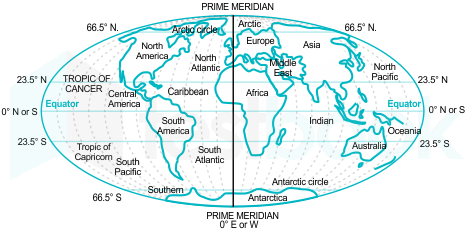
  • The Equator passes through three of the world's continents: South America, Africa, and Asia.
  • The Tropic of Cancer passes through North America, Africa, and Asia,
  • The Tropic of Capricorn passes through South America, Africa, and Australia.
  • Therefore, none of these lines of latitude passes through the continent of Europe, making it the continent through which none of the Tropic of Cancer, Equator and Tropic of Capricorn passes.

![Solved] On which continent the Equator, Tropic of Cancer and Tropic](https://storage.googleapis.com/tb-img/production/23/06/F1_Savita_Civil%20Services%20Exam_8-6-23_D1.png)

Hence, Tropic of Cancer, Equator and Tropic of Capricorn do not pass through Europe and Antarctica.

48

The longitude of 821282\frac{1}{2}^\circ E is treated as the standard meridian for India. It passes through which of the following region ?

  1. ((a))

    Great Indian Desert  

  2. ((b))

    Western Ghats 

  3. ((c))

    Sunderban Delta 

  4. ((d))

    Eastern Ghats 

Show Answer
Answer: ((d))

Eastern Ghats 

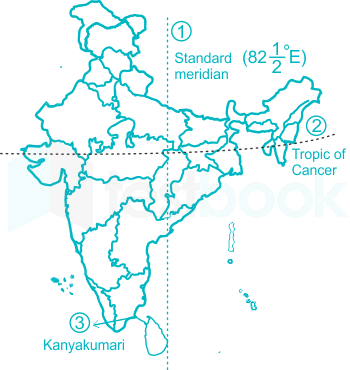
The longitude of 821282\frac{1}{2}^\circ E is treated as the standard meridian for India. It passes through Eastern Ghats.

Important Points

  • Eastern Ghats is the region through which the longitude of E (82°30' E) passes and is treated as the standard meridian for India.
  • This line of longitude passes through the states of Uttar Pradesh, Madhya Pradesh, Chhattisgarh, Odisha, and Andhra Pradesh.
  • The Eastern Ghats is a range of mountains and hills that runs along the eastern coast of India, from Odisha to Tamil Nadu.

![Solved] The Standard - Meridian of India is](https://storage.googleapis.com/tb-img/production/21/08/F1_Uma_Ravi_02.08.21_D4.png)

82°30' E has been selected as the Standard Meridian of India because it is situated in the centre of all longitudes and latitudes in which our country is located.

49

Which type of vegetation occur in the Western Ghats ?

  1. ((a))

    Tropical rain forest on the Western slopes and thorny bushes on the Eastern slopes.

  2. ((b))

    Thorny bushes on the Western slopes and tropical rain forest on the Eastern slopes. 

  3. ((c))

    Tropical rain forest on the both slopes. 

  4. ((d))

    Thorny bushes on the both slopes. 

Show Answer
Answer: ((a))

Tropical rain forest on the Western slopes and thorny bushes on the Eastern slopes.

The correct answer is Tropical rain forest on the Western slopes and thorny bushes on the Eastern slopes.

Key PointsThe Western Ghats, a mountain range in India, runs parallel to the western coast of the country. The region experiences distinct climatic conditions on its western and eastern slopes due to the orographic effect (mountains causing the uplift of moist air, leading to precipitation).

The correct answer is:

  1. Tropical rain forest on the Western slopes and thorny bushes on the Eastern slopes.
  • The Western slopes of the Western Ghats receive a significant amount of rainfall due to the orographic effect, creating an ideal environment for tropical rainforests.
  • These rainforests are characterized by dense vegetation, high biodiversity, and a large number of endemic species.
  • On the other hand, the Eastern slopes of the Western Ghats are located in the rain shadow region, receiving much less rainfall.
  • This results in a drier climate, which supports the growth of thorny bushes and deciduous vegetation.

Additional Information

  • The Western Ghats is a 1,600 km (990 miles) long mountain range that runs parallel to the western coast of India.
  • It is a UNESCO World Heritage site and one of the eight "hottest hotspots" of biological diversity in the world.
  • The western slopes of the Western Ghats receive heavy rainfall due to the moisture-laden winds coming from the Arabian Sea.
  • When these winds encounter the Western Ghats, they are forced to rise, leading to cooling and condensation of the moist air, which results in heavy rainfall on the windward (western) side of the Ghats.
  • This abundant rainfall creates an ideal environment for the growth of tropical rainforests, also known as evergreen forests.
  • These forests are characterized by a dense canopy, high species diversity, and a large number of endemic species, including trees like teak, rosewood, and bamboo, as well as various types of flora and fauna.
50

Cave painting in Sahara desert depicts rivers and different kinds of animals. It shows that : 

  1. ((a))

    People of Sahara had been highly imaginative. 

  2. ((b))

    People of Sahara had travelled across the world. 

  3. ((c))

    Climatic change occurred in the Saharan area. 

  4. ((d))

    Foreigners were staying in Sahara. 

Show Answer
Answer: ((c))

Climatic change occurred in the Saharan area. 

The presence of cave paintings in the Sahara Desert depicting rivers and various types of animals could suggest several things, and the options you listed might all be possible to some degree.

Key Points

However, let's consider each one:

  • People of Sahara had been highly imaginative: This is quite possible.
  • Any kind of art requires a level of imagination, especially when depicting complex scenes or narratives.
  • However, the depiction of rivers and different kinds of animals doesn't necessarily prove high levels of imagination as it could simply reflect the environment they lived in.
  • People of Sahara had travelled across the world: While it's plausible that some individuals or groups may have traveled and brought back depictions of foreign animals, the presence of these paintings does not necessarily prove widespread global travel.
  • Ancient people often depicted what was part of their daily life and environment.
  • Climatic change occurred in the Saharan area: This is likely the strongest inference we can make from these paintings.
  • The Sahara was not always a desert. In fact, it was once a lush, green area with a large variety of fauna, including hippos, elephants, and giraffes.
  • The presence of paintings of rivers and diverse fauna strongly suggests that the Sahara's climate was very different at the time these paintings were made.
  • It's worth noting that this transformation from green to desert, known as desertification, occurred over thousands of years due to shifts in Earth's axial tilt.
  • Foreigners were staying in Sahara:
  • The presence of these paintings alone cannot prove this claim.
  • They could simply reflect the local fauna and landscapes of the time.
  • Further archaeological or anthropological evidence would be needed to substantiate this.

In conclusion, based on the information given, the most supported interpretation is that these paintings suggest climatic change occurred in the Saharan area, transforming it from a lush environment teeming with life to the desert we know today. However, it's important to remember that interpreting ancient art always involves a degree of speculation and educated guesswork.

51

Assertion (A) : Short stunted trees and grasses form the grasslands.

Reason (R) : Amount of moisture regulates the sizes of trees and their density.

Choose the correct option.

  1. ((a))

    Both (A) and (R) are true and (R) is the correct explanation of (A).  

  2. ((b))

    Both (A) and (R) are true but (R) is not the correct explanation of (A). 

  3. ((c))

    (A) is true but (R) is false. 

  4. ((d))

    Both (A) and (R) are false. 

Show Answer
Answer: ((a))

Both (A) and (R) are true and (R) is the correct explanation of (A).  

The correct answer is Both (A) and (R) are true and (R) is the correct explanation of (A). 

Key PointsAssertion (A): Short stunted trees and grasses form the grasslands. - True

  • Grasslands are characterized by a dominance of grasses and the presence of short, stunted trees.
  • The vegetation in grasslands is adapted to various factors such as soil, climate, and disturbances like grazing or fires. Grasslands can be found in various forms, such as savannas, prairies, and steppes, depending on the specific combination of these factors in a particular region.

Reason (R): Amount of moisture regulates the sizes of trees and their density. - True

Moisture availability is one of the critical factors that influence the size of trees and their density in a given ecosystem.

  1. Regions with more moisture, like rainforests or wetter parts of the savannas, tend to have taller and denser trees. The abundant moisture supports rapid growth, allowing trees to reach greater heights and form a dense canopy.
  2. Areas with less moisture, like semi-arid or arid grasslands, have fewer and shorter trees. The limited moisture restricts the growth of trees, leading to a sparser vegetation pattern. In these regions, grasses tend to be the dominant form of vegetation because they can better adapt to the limited water availability.
  • While both the assertion and reason are true, the reason is not the sole explanation for the assertion.
  • Other factors, such as soil type, fire frequency, and grazing pressure, also contribute to the formation of grasslands and the presence of short, stunted trees.
  • For example, frequent fires can limit tree growth and help maintain grass dominance in some grassland ecosystems, even if moisture is not the limiting factor.
52

Which of the following is a permanent wind ?  

  1. ((a))

    Easterlies and Monsoon winds 

  2. ((b))

    Loo and Monsoon winds 

  3. ((c))

    Sea breeze and Westerlies 

  4. ((d))

    Trade winds and Westerlies 

Show Answer
Answer: ((d))

Trade winds and Westerlies 

Permanent winds are those that persist throughout the year and are associated with the Earth's atmospheric circulation system. They help to distribute heat, moisture, and air masses across the planet, playing a crucial role in shaping global climate patterns.

Key PointsTrade winds and Westerlies - Both trade winds and westerlies are examples of permanent winds, making this the correct answer.

  • Trade winds: These are consistent, prevailing winds that blow from the northeast in the Northern Hemisphere and the southeast in the Southern Hemisphere, found between approximately 30° latitude and the equator in both hemispheres.
  • Westerlies: These winds blow from the southwest in the Northern Hemisphere and the northwest in the Southern Hemisphere, generally found between latitudes 30° and 60° in both hemispheres.
  • Easterlies: Also known as polar easterlies, these winds blow from the east near the Earth's poles and are formed as cold air masses move away from the poles towards the lower latitudes.

Additional Information

  • Easterlies and Monsoon winds - Easterlies are permanent winds, but monsoon winds are seasonal.
  • Loo and Monsoon winds - Both loo and monsoon winds are seasonal, not permanent.
  • Sea breeze and Westerlies - Sea breezes are local and diurnal (daily) winds, while westerlies are permanent winds.

Among the given options, Trade winds and Westerlies are the correct answer, as both trade winds and westerlies are examples of permanent winds that persist throughout the year and play a vital role in shaping global climate patterns.

53

Consider the following statements (A) and (B) about the winds :

(A) The wind blows from high pressure to low pressure.

(B) Rotation of the earth is also one of the factor which affects the direction of the winds.

Choose the correct option.

  1. ((a))

    Both (A) and (B) are true and (B) is the correct explanation of (A). 

  2. ((b))

    Both (A) and (B) are true but (B) is not the correct explanation of (A).  

  3. ((c))

    (A) is true but (B) is false. 

  4. ((d))

    (A) is false but (B) is true.  

Show Answer
Answer: ((b))

Both (A) and (B) are true but (B) is not the correct explanation of (A).  

The correct answer is Both (A) and (B) are true but (B) is not the correct explanation of (A). 

Important Points(A) The wind blows from high pressure to low pressure.

  • This statement is true.
  • The movement of air in the atmosphere is driven by differences in air pressure.
  • Air moves from areas of high pressure to areas of low pressure, which creates winds.
  • The pressure gradient force is the force that arises due to the differences in pressure.
  • The air flows from high pressure to low pressure until the pressure is equalized.
  • The pressure gradient force is not the only factor that affects the direction of the wind.
  • Other factors, such as the rotation of the earth, the distribution of heat and moisture, the topography of the land, and the location of high and low-pressure systems, also play a role in determining the direction of the winds.

(B) Rotation of the earth is also one of the factors that affect the direction of the winds.

  • This statement is also true.
  • The rotation of the earth affects the direction of the winds.
  • The earth's rotation causes the Coriolis force, which deflects moving objects to the right in the Northern Hemisphere and to the left in the Southern Hemisphere.
  • This force affects the direction of the winds and causes them to curve instead of moving in a straight line.
  • The Coriolis force is caused by the rotation of the earth and is the strongest at the poles and weakest at the equator.
  • The Coriolis force is not a primary force that drives the movement of the air.
  • Instead, it is a secondary force that modifies the direction of the air movement that is driven by the pressure gradient force.

Therefore, while both statements (A) and (B) are true, statement (B) is not the correct explanation of statement (A) because the direction of wind movement is not solely determined by the rotation of the earth.

The direction of wind movement is primarily determined by the differences in air pressure, and the rotation of the earth is one of the factors that affects the direction of the winds

54

Read the following statements (A) and (B) :

(A) Due to varied climatic conditions, India has a wide range of natural vegetation.

(B) Natural vegetation of any area is dependent only on rainfall in that area.

Choose the correct option.

  1. ((a))

    Only (A) is true. 

  2. ((b))

    Only (B) is true. 

  3. ((c))

    Both (A) and (B) are true. 

  4. ((d))

    Neither (A) is true nor (B). 

Show Answer
Answer: ((a))

Only (A) is true. 

Option (A) is the correct option.

Key Points

(A) Due to varied climatic conditions, India has a wide range of natural vegetation.

  • India is a large country with a diverse range of climatic conditions, from the Himalayan mountains in the north to the tropical forests in the south.
  • As a result, India has a wide range of natural vegetation, which includes tropical rainforests, deciduous forests, alpine forests, grasslands, and deserts.

Statement (A) is true.

(B) Natural vegetation of any area is dependent only on rainfall in that area.​

  • While rainfall is an important factor that influences the growth and distribution of natural vegetation, it is not the only factor.
  • Other factors that play a role include temperature, altitude, soil type, and topography.
  • For example, areas with high rainfall may have different types of vegetation based on other factors such as soil type and temperature.
  • Similarly, areas with similar rainfall may have different types of vegetation based on other factors such as altitude and topography.

Statement (B) is false.

55

Prince Charles mountains, which is associated with iron ore is located in :  

  1. ((a))

    Australia 

  2. ((b))

    Antarctica 

  3. ((c))

    North America 

  4. ((d))

    South America 

Show Answer
Answer: ((b))

Antarctica 

The correct answer is Antarctica.

Key Points The Prince Charles Mountains are a major group of mountains in Mac. Robertson Land, Antarctica, including the Athos Range, the Porthos Range, and the Aramis Range.

  • They were discovered on 13 January 1956 by an Australian National Antarctic Research Expeditions southern party led by W.G. Bewsher.
  • The region is known for its geological significance.
  • The Prince Charles Mountains contain large reserves of iron ore, primarily in the form of magnetite.
  • These reserves were first discovered during the 1980s and 1990s through aeromagnetic surveys and satellite imagery.
  • While the extreme weather conditions and remoteness of the area have limited mining activities, the presence of these resources underscores the mineral richness of Antarctica.
  • So, the Prince Charles Mountains, associated with iron ore, are located in Antarctica.
  • This highlights the continent's potential for future resource extraction, despite the current legal protections and environmental concerns that limit such activities in this region.
56

Which of the given factors can change any substance into resource ?

(A) Time

(B) Technology

(C) Need

  1. ((a))

    (A) and (B) only

  2. ((b))

    (B) and (C) only

  3. ((c))

    (A) and (C) only

  4. ((d))

    (A), (B) and (C) 

Show Answer
Answer: ((a))

(A) and (B) only

The factors (A) Time, and (B) Technology, can change any substance into a resource.

Key PointsThe factors that can change any substance into a resource are interconnected and dynamic.

(A) Time:

  • Over time, societal values and priorities can change, leading to new demands for certain materials or substances.
  • For example, the need for fossil fuels has increased dramatically over the past century due to industrialization and the growing demand for energy.
  • Conversely, resources such as whale oil, which was once a valuable resource for lighting and lubrication, have become less important due to the development of new energy sources.

(B) Technology:

  • Technological advancements play a crucial role in transforming substances into resources.
  • As technology progresses, new methods of extraction, processing, and utilization are developed, making it possible to access and use substances that were previously inaccessible or unprofitable.
  • For example, hydraulic fracturing (fracking) has allowed access to previously untapped natural gas reserves, turning them into valuable resources.
  • Similarly, advancements in renewable energy technology have made solar and wind power increasingly viable alternatives to fossil fuels.

In summary, substances can be transformed into resources based on advancements in technology, and the passage of time.

57

Which of the following plantations are found in the tropical regions of the world ?

(A) Rubber in Malaysia

(B) Coffee in Brazil

(C) Tea in India

(D) Maize in Canada

  1. ((a))

    Only (A) and (C) 

  2. ((b))

    only (A), (B) and (C) 

  3. ((c))

    Only (A), (C) and (D)

  4. ((d))

    Only (B), (C) and (D) 

Show Answer
Answer: ((b))

only (A), (B) and (C) 

The correct answer is   Only (A), (B) and (C).

Key Points

The plantations found in the tropical regions of the world from the list are:

(A) Rubber in Malaysia

(B) Coffee in Brazil

(C) Tea in India

Tropical regions are typically located between the Tropic of Cancer and the Tropic of Capricorn, around the equator. These regions have a warm and humid climate that is ideal for the growth of certain crops like rubber, coffee, and tea.

(D) Maize in Canada is not typically found in a tropical region. Canada has a temperate climate, and maize (or corn) is a crop that can grow in a variety of climates, but it's not typically associated with tropical regions.

Additional Information 

(A) Rubber in Malaysia: Rubber trees require a hot, humid climate with temperatures between 20°C and 34°C (68°F and 93°F). They also need abundant rainfall of around 2000-4500 mm annually, well-distributed throughout the year. Malaysia, being a tropical country, provides these conditions.

(B) Coffee in Brazil: Coffee plants prefer a tropical climate with temperatures between 15°C and 24°C (59°F and 75°F). They require a significant amount of rainfall, around 1500-3000 mm per year, preferably in a pattern that includes a dry period to allow for the coffee cherries to ripen and be harvested. Brazil's climate, especially in its major coffee-growing regions, fits these conditions.

(C) Tea in India: Tea plants thrive in a tropical and subtropical climate with temperatures between 10°C and 30°C (50°F and 86°F). They need a high amount of rainfall, around 1500-2500 mm per year, and prefer well-distributed rain throughout the year. The high-altitude regions of Northeast India (like Assam and Darjeeling) and South India (like Nilgiris) provide these conditions.

(D) Maize in Canada: Maize, or corn, is a versatile crop that can grow in a variety of climates, but it prefers a warm and temperate climate. It needs temperatures between 10°C and 30°C (50°F and 86°F) for optimal growth. It also requires a good amount of rainfall, around 500-1000 mm per year, preferably well-distributed throughout the growing season. While Canada is not a tropical country, its summer conditions in the southern regions are suitable for maize cultivation.

58

Dr. Bhim Rao Ambedkar converted to which religion in search of equality ? 

  1. ((a))

    Jainism 

  2. ((b))

    Christianity  

  3. ((c))

    Buddhism 

  4. ((d))

    Islam 

Show Answer
Answer: ((c))

Buddhism 

The correct answer is Buddhism.

Key Points Frustrated by the persistent social inequality and the caste system in Hinduism, Ambedkar began to explore alternative religious beliefs.

  • He was specifically searching for a religion that promoted social equality and did not endorse caste-based discrimination.
  • In 1956, he publicly converted to Buddhism, leading hundreds of thousands of his followers to do the same.
  • Ambedkar chose Buddhism because he appreciated its principles of equality, fraternity, and justice, which he believed would help uplift the Dalit community.
  • He was also instrumental in reviving Buddhism in India, especially among marginalized communities.
  • His conversion was not just personal; it was a political and social act, symbolizing the rejection of a system that had traditionally oppressed people like him.

Therefore, Dr. Bhim Rao Ambedkar converted to Buddhism in search of equality.

Additional InformationDr. Bhim Rao Ambedkar, often referred to as Babasaheb Ambedkar, was a leading activist and social reformer who dedicated his life to eradicating social inequality in India, particularly the caste-based discrimination.

  • He was born into a Dalit (then called 'untouchable') family, and despite facing immense social and economic challenges, he went on to become one of the most educated individuals in India, earning law degrees and multiple doctorates for his study and research in law, economics, and political science.
59

Which among the following is NOT a valid example of diversity?  

  1. ((a))

    A village has members of different communities who practice different religion. 

  2. ((b))

    A village has people belonging to different castes who are seen in hierarchical manner. 

  3. ((c))

    A village has a public place where different festivals are celebrated.  

  4. ((d))

    A village has many people who speak Hindi and some also speak English and they often engage in common conversation. 

Show Answer
Answer: ((b))

A village has people belonging to different castes who are seen in hierarchical manner. 

A village has people belonging to different castes who are seen in a hierarchical manner.

  • This option is NOT a valid example of diversity because it represents a social hierarchy based on the caste system.
  • Diversity refers to the understanding and appreciation of differences among people, including their beliefs, values, culture, language, and religion.
  • While the presence of different castes in a village does show a variety of backgrounds, the focus on a hierarchical manner implies discrimination and inequality rather than embracing and celebrating diversity.

Additional Information

  • The other options (1, 3, and 4) all reflect instances of diversity, as they showcase different aspects of culture, language, and religion being acknowledged and practiced in a harmonious manner.
60

What is the more popular name for the Council of States in India?  

  1. ((a))

    Sansad 

  2. ((b))

    Lok Sabha 

  3. ((c))

    Rajya Sabha 

  4. ((d))

    Vidhan Sabha 

Show Answer
Answer: ((c))

Rajya Sabha 

The correct option is ' Rajya Sabha '.

Key Points

  • The more popular name for the Council of States in India is the Rajya Sabha.
  • The Rajya Sabha is the upper house of the Indian Parliament and represents the states and union territories of India.
  • It is a permanent body that is not subject to dissolution, with one-third of its members retiring every two years.
  • The Rajya Sabha has a total of 245 members, of which 233 are elected by the legislative assemblies of the states and union territories, and 12 are nominated by the President of India.
  • The Lok Sabha is the lower house of the Indian Parliament and represents the people of India, with a total of 545 members.
  • The Sansad is the Hindi term for the Indian Parliament.
  • The Vidhan Sabha is the state legislative assembly in India.
  • The Rajya Sabha has a fixed term of 6 years for its members, while the Lok Sabha members are elected for a term of 5 years.
  • The Rajya Sabha is a permanent body and not subject to dissolution, while the Lok Sabha can be dissolved by the President on the advice of the Prime Minister.
61

The “question hour” in the Parliament ensures ________.

  1. ((a))

    Executive accountability towards legislature. 

  2. ((b))

    Judicial independence from legislature.  

  3. ((c))

    Legislative control over judiciary. 

  4. ((d))

    Judicial cooperation with the legislature. 

Show Answer
Answer: ((a))

Executive accountability towards legislature. 

The correct option is ' Executive accountability towards the legislature'. 

Key Points

  • Question Hour is an important feature of the parliamentary system of government.
  • It is held in both the Lok Sabha and the Rajya Sabha.
  • During the Question Hour, Members of Parliament can ask questions to the Ministers regarding the administration of their respective ministries.
  • This allows the MPs to hold the Executive accountable for their actions and policies.
  • The questions can be broadly classified into three categories:
  • Starred Questions:
  • These are the questions which require an oral answer from the Minister on the floor of the House.
  • The member who asks the question is given an opportunity to ask a supplementary question.
  • Unstarred Questions:
  • These are the questions which do not require an oral answer.
  • The written answer is given by the Minister to the House.
  • Short Notice Questions:
  • These are the questions which are asked on an urgent matter.
  • The member is required to give a notice of less than 10 days to the Minister.
62

Which among the following is not a type of market? 

  1. ((a))

    Weekly Market 

  2. ((b))

    Shopping Complex 

  3. ((c))

    Putting-Out System 

  4. ((d))

    Malls 

Show Answer
Answer: ((c))

Putting-Out System 

Among the following, Putting-Out System is not a type of market.

Key Points

  • A putting-out system is a method of production in which a company provides materials and instructions to individual workers or small groups of workers who then complete the work in their own homes or workshops.
  • It was a form of subcontracting used in the textile industry during the 17th and 18th centuries.
  • On the other hand, weekly markets, shopping complexes, and malls are types of markets.
  • Weekly markets are temporary markets set up at a specific place on a specific day of the week.
  • Shopping complexes are permanent markets where a variety of products are sold.
  • Malls are large complexes that contain a variety of shops, restaurants, and entertainment facilities.

Therefore, we can conclude that among the following, Putting-Out System is not a type of market.

63

What is the disadvantage for a weaver in the “Putting-Out System” of making a living ? 

  1. ((a))

    Weaver is supplied the new material by the merchant. 

  2. ((b))

    Weaver has to bear the cost of transportation of clothes to market. 

  3. ((c))

    Weaver has no control over pricing of cloth in market and the merchant walks away with the profit.  

  4. ((d))

    Weaver has to work from his/her home in weaving the yarn into cloth. 

Show Answer
Answer: ((c))

Weaver has no control over pricing of cloth in market and the merchant walks away with the profit.  

The correct answer is Weaver has no control over pricing of cloth in the market and the merchant walks away with the profit.

Key Points In the "Putting-Out System," also known as the "domestic system" or "cottage industry," the weaver typically works from home using materials supplied by a merchant.

  • The finished products are then given back to the merchant to sell in the market.
  • The disadvantage of this system for the weaver is that they have little to no control over the pricing of the cloth in the market.
  • The merchant, who provides the raw materials and takes on the task of selling the finished product, often sets the price based on market conditions and their desire for profit.
  • As a result, the weaver may receive a wage that is much less than the value of the finished product, and they have little opportunity to negotiate for higher pay.
  • The merchant, on the other hand, can profit significantly from this arrangement.
  • They can often buy raw materials in bulk at a lower cost, and they benefit from the weaver's labor without having to pay for the full value of their work.
  • In this system, the weaver carries out the labor-intensive task of producing the cloth, while the merchant walks away with the majority of the profit.
  • This system also leaves weavers vulnerable to exploitation and economic instability.
  • If the demand for cloth falls, or if the merchant decides to lower the price for any reason, the weaver's income can decrease significantly, even though they are still doing the same amount of work.
  • Additionally, if the merchant decides to withdraw their business, the weaver is left without a source of income or the materials needed to produce cloth independently.
64

Rosa Parks’ refused to give up her seat to a White man in a bus. This was the commencement of which great movement in modern history ? 

  1. ((a))

    Civil Rights movement in United States of America.  

  2. ((b))

    Anti-Apartheid movement in South Africa, 

  3. ((c))

    French Revolution in France.  

  4. ((d))

    Women's Suffrage movement in England. 

Show Answer
Answer: ((a))

Civil Rights movement in United States of America.  

The correct answer is: Civil Rights Movement in the United States of America.

Key Points Rosa Parks, an African American woman, made history on December 1, 1955, when she refused to give up her seat to a white man on a bus in Montgomery, Alabama.

  • This act of defiance violated the city's racial segregation laws at the time, which mandated separate seating areas for white and black passengers on public buses.
  • When a bus became full, black passengers were expected to give up their seats in the "colored" section for white passengers.
  • Rosa Parks' arrest following her refusal triggered a 381-day boycott of the Montgomery bus system by the African American community.
  • This event, known as the Montgomery Bus Boycott, was a pivotal moment in the American Civil Rights Movement, a social movement in the United States that sought to end racial segregation and discrimination against African Americans.
  • The boycott led to a 1956 Supreme Court decision declaring segregation on public buses to be unconstitutional, marking one of the first major victories for the Civil Rights Movement.
  • Rosa Parks' act of defiance and the subsequent boycott propelled the Civil Rights Movement into the national consciousness and set the stage for further organized actions to challenge racial segregation and discrimination, including the Civil Rights Act of 1964 and the Voting Rights Act of 1965.
  • Rosa Parks became an iconic figure in the struggle for racial equality, and her courage is celebrated as a defining moment in the fight against racial discrimination in the United States.
65

What are Anganwadis?  

  1. ((a))

    Women Protection Homes 

  2. ((b))

    Child-Care Centres 

  3. ((c))

    Mid-Day Meal Centres 

  4. ((d))

    Old-Age Homes

Show Answer
Answer: ((b))

Child-Care Centres 

Anganwadis are Child-Care Centres.

Key Points

  • Anganwadis are child-care centers that were established by the Indian government in 1975 as part of the Integrated Child Development Services (ICDS) program.
  • They are meant to provide a package of services including early childhood education, nutrition, health check-ups, and immunization to children under the age of six, as well as expectant and nursing mothers.
  • The term "Anganwadi" means "courtyard shelter" in Hindi, and refers to the fact that these centers are often located in a community member's courtyard or other local building.
  • The primary aim of Anganwadis is to improve the health, nutrition, and development of young children, as well as empower women by providing them with education and training on health and nutrition-related issues.
  • The services provided by Anganwadis are intended to be comprehensive, including a wide range of interventions that address both the immediate and long-term needs of children and their families.
  • These services include:
  • ​Early childhood education
  • Nutrition
  • Health check-ups
  • Immunization
  • Health and nutrition education
  • In addition to these services, Anganwadis also serve as a platform for community mobilization and empowerment.
  • They provide a space for women to come together, share experiences, and develop leadership skills.
  • This has led to the formation of women's self-help groups, which have played an important role in empowering women and improving their economic and social status.

Hence, we can conclude that Anganwadis are Child-Care Centres.

66

The Right to move courts in case a citizen's Fundamental Rights are violated has been established by which of the following?  

  1. ((a))

    Right against exploitation  

  2. ((b))

    Right to Constitutional Remedies 

  3. ((c))

    Right to Life 

  4. ((d))

    Right to Personal Liberties 

Show Answer
Answer: ((b))

Right to Constitutional Remedies 

The correct option is 'Right to Constitutional Remedies'.

Key Points

  • The Right to move courts in case a citizen's Fundamental Rights are violated has been established by the Right to Constitutional Remedies.
  • This right is enshrined in Article 32 of the Indian Constitution.
  • The Right to Constitutional Remedies is considered the heart and soul of the Indian Constitution as it provides individuals with the power to seek legal remedies and enforcement of their Fundamental Rights.
  • It ensures that citizens can approach the Supreme Court directly in case their Fundamental Rights are violated or threatened.
  • Article 32 grants the power to the Supreme Court to issue writs, including habeas corpus, mandamus, prohibition, quo warranto, and certiorari.
  • These writs serve as legal remedies to protect and enforce the Fundamental Rights of citizens.
  • Through these writs, the Supreme Court can order the release of a person who has been unlawfully detained (habeas corpus), direct a public authority to perform its legal duty (mandamus), prohibit an authority from acting beyond its jurisdiction (prohibition), question the legality of a public appointment (quo warranto), and review decisions of lower courts (certiorari).
  • The Right to Constitutional Remedies ensures that citizens have an effective mechanism to safeguard their Fundamental Rights.
  • It empowers individuals to seek justice and relief from the judiciary if their rights are violated, thereby upholding the rule of law and ensuring the protection of citizens' rights.
67

Consider the following statements and identify the misuse of authority and power :

(A) A minister refuses to sanction a project of his ministry for sound technical reasons.

(B) A senior officer calling the police station to ask them not to register a complaint against a relative.

(C) Falsely accusing a poor student in a class by the class monitor.

Choose the correct option.

  1. ((a))

    Only (B) 

  2. ((b))

    Both (A) and (B) 

  3. ((c))

    Both (B) and (C)

  4. ((d))

    All (A), (B) and (C)

Show Answer
Answer: ((c))

Both (B) and (C)

The correct answer is: Both (B) and (C).

Key PointsHere's why:

  • A minister refusing to sanction a project of his ministry for sound technical reasons is not a misuse of authority or power.
  • They are exercising their responsibility appropriately by considering the technical feasibility of the project.
  • This is within their jurisdiction and duty as a minister.
  • A senior officer calling the police station to ask them not to register a complaint against a relative is a misuse of power and authority.
  • This act interferes with the lawful procedures and processes of the police, potentially preventing justice from being served.
  • It is an abuse of their position for personal gain or to benefit a relative.
  • Falsely accusing a poor student in a class by the class monitor is also a misuse of power.
  • The class monitor is using their authority to falsely accuse someone, which is unjust and could have negative consequences for the accused student.

So, both (B) and (C) represent misuse of authority and power.

68

Which among the following statements is true about Judiciary in India?  

  1. ((a))

    There is no hierarchy between different levels of the judiciary.  

  2. ((b))

    The Chief Justice of a High Court is the highest judge in the country. 

  3. ((c))

    An appeal can be made in a High Court against a judgement passed by the Supreme Court.  

  4. ((d))

    Different levels of court are connected with each other through an appellate system. 

Show Answer
Answer: ((d))

Different levels of court are connected with each other through an appellate system. 

The correct option is 'Different levels of court are connected with each other through an appellate system'.

Key Points

  • There is no hierarchy between the different levels of the judiciary:
  • This statement is incorrect.
  • In India, there is a clear hierarchy among the different levels of the judiciary.
  • The judicial system in India consists of various levels, including district courts, High Courts, and the Supreme Court.
  • Each level has its own jurisdiction and authority, and decisions made by higher courts can overrule decisions made by lower courts.
  • The Chief Justice of a High Court is the highest judge in the country:
  • This statement is incorrect.
  • While the Chief Justice of a High Court holds a significant position within the respective state or union territory, the highest judge in the country is the Chief Justice of India.
  • The Chief Justice of India is the head of the Indian judiciary and holds the highest judicial office in the country.
  • An appeal can be made in a High Court against a judgment passed by the Supreme Court:
  • This statement is incorrect.
  • The Supreme Court of India is the highest court in the country. Its judgments are final and binding, and there is no provision for an appeal against its decisions in a High Court.
  • However, in certain exceptional cases, a review petition may be filed before the Supreme Court to seek a review of its own judgment.
  • Different levels of court are connected with each other through an appellate system:
  • This statement is true.
  • The Indian judicial system follows an appellate system, where different levels of courts are connected through the process of appeals.
  • If a party is dissatisfied with the judgment of a lower court, they can file an appeal to a higher court within the hierarchy.
  • For example, a party can appeal to a High Court against a judgment passed by a subordinate court, and further, an appeal can be made
69

Hakim Seikh and Paschim Banga Khet Mazdoor Samiti had filed a petition in the court to ensure which of the following ? 

  1. ((a))

    Medical Aid and health care 

  2. ((b))

    Minimum wage 

  3. ((c))

    Right to shelter 

  4. ((d))

    Land rights 

Show Answer
Answer: ((a))

Medical Aid and health care 

Hakim Seikh and Paschim Banga Khet Mazdoor Samiti filed a petition in the court to ensure Medical Aid and health care.

Key Points

  • Hakim Seikh, a member of the Paschim Banga Khet Mazdoor Samiti (West Bengal Agricultural Labour Union), fell off a train and injured himself, but was refused treatment by several hospitals.
  • In this case, known as Paschim Banga Khet Mazdoor Samiti vs State of West Bengal, the Supreme Court held that Article 21 of the Indian Constitution, which guarantees the right to life, also includes the right to health and medical care.
  • The Court stated that it was the constitutional obligation of the state to provide adequate medical services to the people.
  • The refusal of a government hospital to provide timely medical treatment to a person in need of such treatment was considered a violation of his right to life guaranteed under Article 21.

This case played a significant role in the development of health rights jurisprudence in India, underlining the obligation of the state to ensure access to health services for all, particularly in emergency situations.

70

Stereotyping a community often results in its ______.

  1. ((a))

    development 

  2. ((b))

    empowerment 

  3. ((c))

    marginalisation 

  4. ((d))

    diversification

Show Answer
Answer: ((c))

marginalisation 

The correct answer is marginalization.

Key Points

  • Stereotyping a community refers to making generalizations or assumptions about a group of people based on certain characteristics, such as race, ethnicity, religion, or gender.
  • These stereotypes often perpetuate biased beliefs and can have negative consequences for the community being stereotyped.
  • Marginalization is the process by which certain individuals or groups are pushed to the margins or edges of society, excluded from full participation, and denied equal opportunities.
  • When a community is stereotyped, it often leads to marginalization because the stereotypes can reinforce discriminatory attitudes and actions against that community.
  • This marginalization can manifest in various ways, including limited access to resources, discrimination in employment or education, social exclusion, and unequal treatment under the law.
  • Stereotyping can have a profound impact on the well-being and opportunities available to individuals within the stereotyped community.
  • It can perpetuate harmful biases, contribute to systemic discrimination, and hinder the community's progress and social mobility.

Therefore, stereotyping ultimately results in the marginalization of the community affected by the stereotypes.

71

While teaching social history, teachers need to be sensitive because :

(A) the past is context-based.

(B) there are multiple pasts.

(C) the past is singular and monolithic.

(D) the past is not contentions.

Choose the correct option.

  1. ((a))

    Only (A) 

  2. ((b))

    Only (A) and (B)  

  3. ((c))

    Only (C)

  4. ((d))

    Only (B), (C) and (D) 

Show Answer
Answer: ((b))

Only (A) and (B)  

History is the study of past events, particularly in human affairs. It is a social science that analyzes and interprets the patterns, causes, and effects of past events and seeks to understand the complexity of human experience over time.

Key Points

  • While teaching social history, teachers need to be sensitive because the past is context-based and there are multiple pasts.
  • This means that historical events and their interpretations are influenced by the social, economic, political, and cultural contexts in which they occurred.
  • Furthermore, there are multiple perspectives and interpretations of the past that are shaped by factors such as ideology, religion, nationality, and gender.
  • Therefore, teachers need to be aware of these complexities and engage students in critical thinking and analysis to help them understand the multiple perspectives and interpretations of the past.

Thus, it is concluded that The correct option is 2) Only (A) and (B).

72

What is the motive behind renaming civics as Social and Political life at upper primary level ?

(A) Civics appeared in the Indian school curriculum in the colonial period against the background of increasing resistance among Indians towards Raj.

(B) Social and Political Life draw its learning experiences mostly from History and Economics.

(C) Social and Political life is based on real life situations which was practical situation to teach concepts.

  1. ((a))

    Only (A) is correct. 

  2. ((b))

    (A) and (B) are correct. 

  3. ((c))

    (A) and (C) are correct. 

  4. ((d))

    (A), (B) and (C) are correct. 

Show Answer
Answer: ((c))

(A) and (C) are correct. 

The motive behind renaming civics as Social and Political life at the upper primary level is to reflect the interdisciplinary nature of the subject and its connection with real-life situations.

Key Points

  • Option (A) states that Civics appeared in the Indian school curriculum during the colonial period when Indians were resisting British Raj. The term 'Civics' had a Western connotation and was associated with Western democratic practices. By renaming it as Social and Political Life, the Indian education system wanted to move away from the colonial legacy and create a more indigenous and inclusive approach to teaching social sciences.
  • Option (C) states that Social and Political life is based on real-life situations, which makes it a practical way to teach concepts. This approach is essential as it allows students to connect theoretical concepts with the practical world, thereby making their learning more meaningful and relevant.

Thus, it is concluded that (A) and (C) are correct.

73

Which pedagogical strategy would encourage meaning-making in learners of the upper primary stage? 

  1. ((a))

    Giving a lot of information by going beyond the textbook. 

  2. ((b))

    Asking learners to explore and discuss in the classroom. 

  3. ((c))

    Use punishment for every wrong answer. 

  4. ((d))

    Use uniform and standardised tests. 

Show Answer
Answer: ((b))

Asking learners to explore and discuss in the classroom. 

Pedagogical strategy refers to the methods and techniques used by teachers to facilitate learning and achieve specific educational goals. It involves the selection of appropriate teaching methods, instructional materials, and assessment techniques that are designed to meet the needs and abilities of students.

Key Points

  • Asking learners to explore and discuss in the classroom strategy involves engaging learners in discussions, debates, and explorations of concepts and ideas that help them develop a deeper understanding of the topic.
  • It encourages them to share their own experiences and perspectives and make connections with their own lives.
  • This approach helps learners to become active participants in their learning and to construct meaning based on their own understanding and experiences.

Hence, it is concluded that the pedagogical strategy that would encourage meaning-making in learners of the upper primary stage is option 2.

Hint Options 1, 3, and 4 do not encourage active learning or meaning-making and may instead lead to rote memorization or a focus on getting the "right" answers rather than a deeper understanding of the material.

74

‘Patriotism’ can be best developed in history classroom by : 

  1. ((a))

    making it compulsory to sing the National Anthem before every class. 

  2. ((b))

    having activities to develop a sense of belongingness and responsibility to the nation and its people.  

  3. ((c))

    praising the efforts of all the socio-religious information without subjecting them to any enquiry, 

  4. ((d))

    giving lectures on golden ancient pasts without talking about the 'social context’. 

Show Answer
Answer: ((b))

having activities to develop a sense of belongingness and responsibility to the nation and its people.  

Patriotism is the feeling of love, devotion, and loyalty towards one's country and a willingness to serve and defend it.

Key Points

  • Having activities to develop a sense of belongingness and responsibility to the nation and its people, would be the best way to develop patriotism in a history classroom.
  • This can include activities such as learning about the struggles and sacrifices of national heroes, visiting historical sites and monuments, participating in community service projects, and engaging in discussions about current events and social issues.
  • The aim should be to instill a sense of civic responsibility and respect for the diversity of cultures and religions in the country.

Thus, it is concluded that the correct answer is option 2.

75

Which one is an example of an inclusive classroom ? 

  1. ((a))

    All students are taught in the same classroom and teacher uses a uniform method for teaching and assessment of all students. 

  2. ((b))

    Teacher takes separate classes for special needs students. 

  3. ((c))

    Teacher announces a weekly test for students and gives an off to special students. 

  4. ((d))

    Teacher provides visually challenged students access to resources in Braille. 

Show Answer
Answer: ((d))

Teacher provides visually challenged students access to resources in Braille. 

An inclusive classroom is a classroom where all students feel valued and supported, regardless of their abilities, backgrounds, or identities.

Key Points

  • The teacher provides visually challenged students access to resources in Braille is an example of an inclusive classroom as the teacher is making an effort to provide access to resources for visually challenged students, ensuring they have equal opportunities to learn.
  • In an inclusive classroom, all students, regardless of their abilities or disabilities, are taught together using teaching methods that are flexible and adaptable to meet the diverse learning needs of students.
  • The focus is on creating a supportive and welcoming environment that fosters the academic and social development of all students.

Thus, it is concluded that Option 4 is the correct answer.

76

Column A represents a situation in a Social -Political life classroom and Column B represents the action taken by a teacher. Match appropriately. 

A : Situation in classroomB : Action taken by teacher
(A)No response(I)Seeking further information
(B)Incomplete response(II)Prompting
(C)Partially correct response(III)Refocusing
(D)Completely correct response(IV)Increasing critical awareness
<br>

Choose the correct options

  1. ((a))

    A - II, B - I, C - IV, D - III

  2. ((b))

    A - III, B - IV, C - II, D - I

  3. ((c))

    A - II, B - I, C - III, D - IV

  4. ((d))

    A - IV, B - III, C - I, D - II

Show Answer
Answer: ((c))

A - II, B - I, C - III, D - IV

Column A describes different situations that can occur in a Social-Political life classroom, and Column B describes the appropriate actions a teacher should take in response to these situations.

Key Points

  • No response- Prompting: This means that in the classroom, the teacher should prompt students to give a response.
  • Seek further information if the students give a more complete response.
  • Refocus the student if they give a partially correct response.
  • Acknowledge and reinforce a completely correct response

​Thus, it is concluded that A-II, B - I, C - III, D - IV is the correct answer.

77

An Elementary School teacher did following activities in her social science classroom :

Discussion on how melting of sea effects animals.

Analysis of weather changes using weather report and data of the country for last 50 years.

Discussion on reasons for rising temperature on earth.

Discussion on what causes Acid Rain.

Which of the following concept is she intending to cover through these activities?

  1. ((a))

    Green House Effect 

  2. ((b))

    Weather Change 

  3. ((c))

    Climate Change 

  4. ((d))

    Temperature Change 

Show Answer
Answer: ((c))

Climate Change 

The teacher is intending to cover the concept of climate change through these activities.

Key Points

  • The activities involve discussions and analysis of various aspects related to the impact of human activities on the environment, such as the melting of the sea affecting animals, rising temperatures on earth, and acid rain.
  • All these aspects are related to climate change, which refers to the long-term alteration of temperature and typical weather patterns in a place.

Therefore, the teacher is using these activities to help students understand the causes and consequences of climate change.

78

At which stage of teaching a teacher will decide about the learning resources to be used for teaching? 

  1. ((a))

    Pre-active stage 

  2. ((b))

    Post-active stage 

  3. ((c))

    Inter-active stage 

  4. ((d))

    While explaining the concept in the classroom  

Show Answer
Answer: ((a))

Pre-active stage 

The teaching process can be divided into three stages: pre-active stage, interactive stage, and post-active stage.

Key Points

  • The pre-active stage of teaching refers to the initial planning phase where the teacher prepares to deliver a lesson or a set of lessons.
  • At Pre-active stage, the teacher plans and prepares for the upcoming teaching-learning process.
  • This includes deciding on the learning resources that will be used for teaching, such as textbooks, audiovisual aids, online resources, etc.
  • The teacher also considers the availability and suitability of these resources for the specific learning objectives and needs of the students.

Thus, it is concluded that at Pre-active stage of teaching a teacher will decide about the learning resources to be used for teaching.

Hint

  • Interactive stage: This is the stage where the actual teaching and learning take place. In this stage, the teacher will use various teaching methods and strategies to engage the students and facilitate their learning.
  • Post-active stage: This stage occurs after teaching and learning has taken place. In this stage, the teacher will assess the learning outcomes and provide feedback to the students.
79

The purpose of probing question in social science is :

(A) To increase number of meaningful questions.

(B) To understand students thinking pattern.

(C) To go deep into pupil's response.

Choose the correct option.

  1. ((a))

    Only statement (A) is correct. 

  2. ((b))

    Statement (A) and (B) are correct. 

  3. ((c))

    Statement (B) and (C) are correct. 

  4. ((d))

    Statement (A) and (C) are correct. 

Show Answer
Answer: ((c))

Statement (B) and (C) are correct. 

Probing questions are used to go deeper into a student's response and help them to clarify their thinking. These questions are designed to elicit more information and help the teacher understand the student's thought process.

Key Points

  • Probing questions are essential in social science because they help the teacher to better understand the student's thought processes, identify any misconceptions they may have, and promote deeper learning.
  • By asking probing questions, the teacher can help students to connect new concepts to prior knowledge, think more deeply about the content, and make more meaningful connections.
  • This can lead to a more thorough understanding of the content, which can ultimately lead to higher achievement.

Therefore, both statements (B) and (C) are correct.

80

India’s diverse social context necessitates that social science classrooms nurture : 

  1. ((a))

    the views of government only. 

  2. ((b))

    the opinion of the majority. 

  3. ((c))

    a golden past and avoid/ contested topics. 

  4. ((d))

    the views of all sections of the larger society. 

Show Answer
Answer: ((d))

the views of all sections of the larger society. 

India's diverse social context necessitates that social science classrooms nurture an inclusive and pluralistic perspective among students.

Key Points

  • India’s diverse social context necessitates that social science classrooms nurture the views of all sections of the larger society.
  • Social science classrooms should be inclusive, respectful of diversity, and provide opportunities for students to learn about different perspectives and opinions.
  • It is important to encourage critical thinking, empathy, and respect for all viewpoints, and avoid any biases or prejudices.
  • In this way, social science classrooms can promote a more informed and tolerant society.

Thus, it is concluded that option 4 is the correct answer.

81

Choose the correct order of steps for inquiry-based learning:

(A) Questioning

(B) Investigating

(C) Planning and Predicting

(D) Recording

(E) Reflecting

  1. ((a))

    (A)-(B)-(C)-(D)-(E)

  2. ((b))

    (A)-(C)-(D)-(B)-(E)

  3. ((c))

    (C)-(A)-(B)-(D)-(E)

  4. ((d))

    (B)-(C)-(A)-(D)-(E)

Show Answer
Answer: ((b))

(A)-(C)-(D)-(B)-(E)

Inquiry-based learning is a process that involves students in investigating and exploring a question, problem, or issue to develop their understanding. The process typically involves a series of steps that guide students through the process of inquiry.

Key Points

  • Questioning: In this step, students generate questions that they will investigate to deepen their understanding of the topic. These questions help students focus their investigation and guide their inquiry process.
  • Planning and predicting: In this step, students develop an understanding of the question or problem they will investigate, identify what they already know, and develop a plan for how they will investigate and explore the question.
  • Recording: In this step, students document their investigation, including their methods, observations, and findings. This step helps students organize their thoughts and data and allows them to communicate their findings to others.
  • Investigating: In this step, students conduct research, collect data, and explore the question or problem they are investigating. This step involves experimentation, data analysis, and interpretation of the data collected.
  • Reflecting: In this step, students review their investigation and consider what they have learned. They evaluate the effectiveness of their investigation, consider alternative explanations, and identify what they still need to learn.

Thus, it is concluded that the correct option is (A)-(C)-(D)-(B)-(E).

82

Consider the following statements :

Statement - A : Social science teaching is a means for inculcating an ideology.

Statement - B : Pedagogy of social science benefits from thematic planning.

Choose the correct option.

  1. ((a))

    (A) is true, (B) is false 

  2. ((b))

    (A) is false, (B) is true 

  3. ((c))

    (A) and (B) are true 

  4. ((d))

    (A) and (B) are false 

Show Answer
Answer: ((b))

(A) is false, (B) is true 

Social science is a branch of academic discipline that deals with the study of human society and the relationships among individuals within the society.

Key Points

  • Statement A is not true: Social science education should ideally promote an objective and unbiased understanding of different ideologies, the presence of biases or the intentional inculcation of a specific ideology can undermine this goal. Teachers should strive for a balanced approach that encourages critical thinking and allows students to explore and evaluate multiple perspectives.
  • Statement B is  true because thematic planning helps to organize social science teaching around specific topics or themes. This approach can help students to better understand the connections between different concepts and to develop a more comprehensive understanding of the subject matter.

Thus, it is concluded that (A) is false, (B) is true.

83

A social science teacher may give which of the following to explain the condition of women in the colonial period.

(A) “Sultana’s dream” written by Rokeya Sakhawat.

(B) Rashsundari Devi's autobiography “Amar Jibon”.

(C) “Padhna jara sochna” written by Krishna Kumar.

(D) “The Subaltern subject in structural historical process” by Denzil Saldenha.

  1. ((a))

    Only (A) 

  2. ((b))

    Only (A) and (B) 

  3. ((c))

    Only (B) 

  4. ((d))

    Only (C) and (D) 

Show Answer
Answer: ((b))

Only (A) and (B) 

By studying social science, we can gain insights into the dynamics of human behavior, social systems, and institutions, and the ways in which they are interconnected.

Key Points

  • Option (A) - “Sultana’s dream” written by Rokeya Sakhawat, is a work of fiction that presents an alternative reality where women have more power and agency than in the real world and an accurate representation of the condition of women in the colonial period.
  • Option (B) - Rashsundari Devi's autobiography “Amar Jibon” would be a suitable option for a social science teacher to explain the condition of women in the colonial period, as it provides a first-hand account of the life of a woman in colonial Bengal.

Thus, it is concluded that Only (A) and (B) is the correct answer.

Hint

  • Option (C) - “Padhna jara sochna” written by Krishna Kumar, is a book on education policy in India and would not be directly relevant to the condition of women in the colonial period.
  • Option (D) - “The Subaltern subject in structural historical process” by Denzil Saldenha, is a theoretical work on postcolonialism and would not provide direct insight into the condition of women in the colonial period.
84

For teaching the topic “India’s Freedom Movement” a teacher brings some old newspaper snippets having pictures and stories of partition. Which method is being used by the teacher? 

  1. ((a))

    Problem solving method 

  2. ((b))

    Field survey method 

  3. ((c))

    Demonstration method 

  4. ((d))

    Source method  

Show Answer
Answer: ((d))

Source method  

Primary sources are original materials that were created at the time of an event or period, while secondary sources are materials that interpret or analyze primary sources.

Key Points

  • In the given scenario, the teacher is using old newspaper snippets (primary sources) to teach about a historical event - India's Freedom Movement.
  • By using these primary sources, the teacher can provide students with a firsthand account of the events and encourage them to analyze and interpret the information presented.
  • Source method can help students to develop critical thinking and analytical skills, as well as a deeper understanding of the topic being studied.
  • Overall, the source method can be an effective way to engage students in active learning and promote a deeper understanding of historical events.

Thus, it is concluded that Source method is being used by the teacher.

85

Which statement is not related to project based learning ? 

  1. ((a))

    It enhances a conformist approach 

  2. ((b))

    It enhances student's creative skill 

  3. ((c))

    It enhances student's problem solving skills 

  4. ((d))

    It enhances student's inquiry skill 

Show Answer
Answer: ((a))

It enhances a conformist approach 

Project-based learning focuses on providing students with opportunities to work on a project that is based on a real-world problem or question.

Key Points

  • It aims to enhance students' creativity, problem-solving skills, and inquiry skills by engaging them in the process of designing, planning, and implementing a project.
  • The emphasis is on students taking ownership of their learning and being active participants in the learning process.
  • A conformist approach is focused on following established norms and rules without questioning them, which is not the focus of project-based learning.

Thus, it is concluded that it enhances a conformist approach is not related to project-based learning.

86

A teacher in her classroom provides students the opportunities to assess themselves. Which of the following assessment practice is she trying to adopt in her class? 

  1. ((a))

    Formative Assessment  

  2. ((b))

    Assessment for Learning 

  3. ((c))

    Assessment of Learning  

  4. ((d))

    Assessment as Learning 

Show Answer
Answer: ((d))

Assessment as Learning 

Assessment is the process of gathering and analyzing information about a student's knowledge, skills, and abilities.

Key Points

  • Assessment as Learning is a type of assessment practice where students actively participate in their own learning by reflecting on their own learning processes, monitoring their own progress, and making necessary adjustments to improve their learning.
  • It involves self-assessment and peer assessment and helps students to become more aware of their own strengths and weaknesses.

So, if the teacher is providing students with opportunities to assess themselves, then it can be considered an example of Assessment as Learning.

Additional Information

  • Formative assessment is a type of assessment practice that takes place during the learning process to provide ongoing feedback to students and teachers to improve learning.
  • Assessment for Learning is an assessment practice in which teachers use assessment to gather information about students' understanding and then use this information to provide feedback to students and adjust their teaching.
  • Assessment of Learning refers to the traditional method of assessing students' learning outcomes at the end of a unit, course, or academic year.
87

Which of the following should be a criteria for assessment in social science :

(A) Questioning

(B) Concern for justice and equality

(C) Remembering

(D) Cooperation

Choose the correct option.

  1. ((a))

    (A), (B) and (C) 

  2. ((b))

    (B), (C) and (D)

  3. ((c))

    (A), (B) and (D)

  4. ((d))

    (A), (C) and (D)

Show Answer
Answer: ((c))

(A), (B) and (D)

Assessment is the process of gathering and analyzing information about a student's knowledge, skills, and abilities. It is used by educators to measure student learning, provide feedback, and evaluate student performance.

Key Points

  • Questioning:- Assessment in social science should not only focus on remembering facts but also on the ability to question and think critically about social issues.
  • Concern for justice and equality is another important criteria for assessment in social science. It helps students understand the importance of fairness, equality, and social justice.
  • Cooperation is also a key criterion for assessment in social science. Social science involves studying people and their interactions, so it is important for students to work collaboratively and learn how to cooperate with others.

Thus, it is concluded that (A), (B), and (D) is the correct answer.

HintRemembering" is not sufficient as a sole criterion for assessment in social science, as it does not reflect the critical thinking skills that are necessary for understanding social issues.

88

Read the following questions which of them assesses the analytical competencies of the students? 

  1. ((a))

    Who is Lekhpal ? What are his roles ? 

  2. ((b))

    Distinguish between a tropical and temperate regions.  

  3. ((c))

    If your home is burgled, where will you go to file a complaint ? 

  4. ((d))

    How does a population pyramid point to the quality of health system available in a particular society ? 

Show Answer
Answer: ((d))

How does a population pyramid point to the quality of health system available in a particular society ? 

Analytical competencies involve the ability to break down complex information into smaller parts and analyze them to form an understanding of the whole.

Key Points

  • How does a population pyramid point to the quality of the health system available in a particular society? requires the students to analyze the data presented in a population pyramid and make connections to the quality of the health system in society.
  • It involves interpreting and analyzing the information provided, identifying patterns and trends, and drawing conclusions based on that analysis.

Therefore, this question assesses the analytical competencies of the students.

Hint

  • Who is Lekhpal? What are his roles? assesses the knowledge and comprehension of the students, as it requires them to identify and recall the roles of a specific position.
  • Distinguish between tropical and temperate regions assesses the student's ability to compare and contrast different concepts, which falls under the competency of critical thinking.
  • If your home is burgled, where will you go to file a complaint? assesses the practical knowledge of the students.
89

Which of the following questions assesses the 'understand' aspect of the cognitive process ? 

  1. ((a))

    Define population explosion. 

  2. ((b))

    List three features that lead to population change. 

  3. ((c))

    How did East India Company bring to an end the Mughal dynasty ?

  4. ((d))

    If rivers dried up what would happen to human life ? 

Show Answer
Answer: ((b))

List three features that lead to population change. 

The cognitive process has different levels or stages that involve different types of mental activity.

  • One of these stages is the "understand" stage, which involves comprehension and interpretation of information.
  • Questions that assess this stage usually require the students to demonstrate their ability to understand and explain concepts, ideas, or processes.

Key Points

  • List three features that lead to population change: This question requires the student to demonstrate their understanding by listing and identifying the key features or factors that contribute to population change. It assesses their ability to recognize and explain the factors that influence population dynamics.

Thus, it is concluded that option 2 is the correct answer.

90

Which of the following option is characteristic of a well written learning outcomes ? 

  1. ((a))

    The specified action by the students must be related to the context taught in the classroom. 

  2. ((b))

    The specified action by the students must be practical in the classroom. 

  3. ((c))

    The specified action by the students must be measurable.  

  4. ((d))

    The specified action by the students must be observable, measurable and done by the students.  

Show Answer
Answer: ((d))

The specified action by the students must be observable, measurable and done by the students.  

Learning outcomes should be aligned with the overall goals and objectives of the course or program.

Key Points

  • Well-written learning outcomes should be specific, observable, measurable, and done by the students.
  • This means that the outcome should be written in a way that describes what the student will be able to do, in a specific and observable way, and the outcome should be able to be measured so that progress can be assessed.
  • Additionally, the outcome should be something that the student is responsible for doing, rather than something that will be done for them.

Thus, it is concluded that The correct option is 4).

English - I (30 questions)

Read the passage given below and answer the question that follow by choosing the correct options.

  1. Trekking is one of the latest trends in tourism in the world. It is treated primarily as a modern form of adventure tourism and geo-tourism. On the one hand, due to the extreme terrain where it can be practiced and a certain dose of adrenaline, is treated as a form of adventure tourism. The desire to achieve, acquire and reach out to many of the most difficult places decide on the characteristics of a sports competition
  2. In 1965 the colonial army of colonel Jimmy Roberts introduced the word trekking into the world tourism vocabulary. As a former officer of the Gurkha force in Nepal and a representative of the British military government in Kathmandu, he spent much time wandering in the Himalayas. These were the beginnings of trekking expeditions.
  3. Although, it seems that in today's world all the places have already been discovered, still there may appear new challenges. On the other hand, the beauty of trekking relies on that it is implemented in an extraordinary and stunning natural and geological environment. Despite many challenges, tourists are attracted by geodiversity and fascinating landscapes, changing weather conditions or spiritual survival. It is often associated only with mountains, but it must be emphasized that one may distinguish eight types of trekking, these are: mountain, desert, tropical, glacial, polar, river, swamps and volcanic trekking. All of these allow a person to come true in very unusual circumstances.
  4. People also discover and learn about their own abilities, both mental and physical. Modern trekker has many more opportunities of exploration of challenging environments. Comfortable clothing and equipment ensure a high level of safety. Adventurers and explorers functioned quite differently for ages, they were condemned to intuition, and had only to wipe the migratory paths on which a larger and larger groups of tourists are wandering.
91

Study the following statements:

(A) Trekking in the contemporary world is nothing but a means to satisfy our intense excitement and stimulation.

(B) Trekking is treated unjustifiably as a modern form of adventure tourism and geo- tourism.

  1. ((a))

    (A) is correct and (B) is incorrect.

  2. ((b))

    (B) is correct and (A) is incorrect.

  3. ((c))

    Both (A) and (B) are correct.

  4. ((d))

    Both (A) and (B) are incorrect.

Show Answer
Answer: ((d))

Both (A) and (B) are incorrect.

The correct answer is 'Both (A) and (B) are incorrect'.

 Key Points

  • Statement (A) suggests that trekking is only for thrill and stimulation. However, while excitement and stimulation can be part of the experience, trekking serves other purposes as well. It can be a means of fitness, an opportunity to connect with nature, and a platform for personal growth and discovery.
  • Statement (B) suggests that trekking is unjustifiably classified as a form of adventure tourism and geo-tourism. This is not entirely correct, as trekking does fall under these categories due to its nature of exploration and adventure. However, it should not be confined to these terms as trekking also has cultural, ecological, and spiritual dimensions.

Therefore, the correct answer is Option 4.

92

“he spent much time wandering in the Himalayas’. Which word from the following can replace the underlined word ?

  1. ((a))

    exploring 

  2. ((b))

    dawdling 

  3. ((c))

    pursuing 

  4. ((d))

    contemplating 

Show Answer
Answer: ((a))

exploring 

The correct answer is 'exploring'

Key Points

  • In the context of 'wandering in the Himalayas', 'exploring' is the most fitting replacement as it implies purposeful travel with an intent to discover or investigate.
  • The other options 'dawdling', 'pursuing', and 'contemplating', while they all could be associated with spending time, do not fully capture the spirit of active engagement with the environment that 'wandering in the Himalayas' suggests.

Therefore, the correct answer is Option 1.

93

What is the misconception related to trekking that people have ? That it is only related to ______

  1. ((a))

    challenges 

  2. ((b))

    geo-diversity 

  3. ((c))

    mountains 

  4. ((d))

    terrains 

Show Answer
Answer: ((c))

mountains 

The correct answer is 'mountains'

 Key Points

  • A common misconception is that trekking is solely related to mountains.
  • While high-altitude trekking in mountains is a popular form, trekking can be done in various terrains like forests, deserts, and coastlines.
  • Option 1, 2 and 4 are not specifically related to the misconception about trekking but are rather aspects or elements of it.

Therefore, the correct answer is Option 3.

94

All of these allow a person to come true in very unusal circumstances. The expression "allows a person to come true” here refers to : 

  1. ((a))

    come face to face with 

  2. ((b))

    come out with his power 

  3. ((c))

    bring out his inner vanities 

  4. ((d))

    bring out the devil in him 

Show Answer
Answer: ((b))

come out with his power 

The correct answer is 'come out with his power'

 Key Points

  • The phrase "allows a person to come true" in this context likely refers to the opportunity for a person to manifest their potential or power, which is most closely associated with Option 2.
  • The other options might be relevant in other contexts but do not accurately capture the essence of this specific phrase.

Therefore, the correct answer is Option 2.

95

‘Trekking in today’s world has become an accepted vacation activity due to : 

  1. ((a))

    its affordability. 

  2. ((b))

    the availability of advanced protective gears. 

  3. ((c))

    more of physical and mental ability. 

  4. ((d))

    more opportunities of spending on adventure. 

Show Answer
Answer: ((a))

its affordability. 

The correct answer is 'its affordability'

Key Points

  • The statement is suggesting a reason for why trekking has become an accepted vacation activity.
  • Among the provided options, affordability would be a major factor driving its acceptance, making it more accessible to a larger group of people.
  • Although the other options could potentially be factors, they do not provide a comprehensive reason why trekking would be a widely accepted vacation activity.

Therefore, the correct answer is Option 1.

96

It not only gives physical and mental stimulation but also helps in : 

  1. ((a))

    psychological growth 

  2. ((b))

    sociological strength  

  3. ((c))

    physiological rush 

  4. ((d))

    biological power 

Show Answer
Answer: ((a))

psychological growth 

The correct answer is 'psychological growth'

Key Points

  • The sentence states that trekking gives physical and mental stimulation but also helps in another aspect.
  • Here, 'psychological growth' fits best as trekking often involves facing challenges and overcoming obstacles, leading to increased self-confidence, resilience, and other psychological benefits.
  • The other options do not fit into the context as well as 'psychological growth'.

Therefore, the correct answer is Option 1.

97

Find the synonym of the word “intuition” (Para 4) from the list given below :  

  1. ((a))

    reasoning 

  2. ((b))

    intelligence 

  3. ((c))

    instinct 

  4. ((d))

    industrious

Show Answer
Answer: ((c))

instinct 

The correct answer is 'instinct '

Key Points

  • The word "intuition" refers to a kind of immediate understanding or knowing that comes spontaneously, not from reasoning or observable facts.
  • From the given list, like intuition, instinct involves an internal, often unexplainable knowing or feeling.
  • Therefore, based on the above definitions, the word that is most synonymous with "intuition" is "instinct".

Therefore, the correct answer is Option 1.

98

Find the antonym of the word ‘condemned’ (Para 4) from the list given below : 

  1. ((a))

    applauded 

  2. ((b))

    denounced 

  3. ((c))

    complained 

  4. ((d))

    endorsed 

Show Answer
Answer: ((a))

applauded 

The correct answer is 'applauded'

Key Points

  • The antonym of 'condemned', which means to express complete disapproval of, would be 'applauded', which means to show approval or praise.
  • The other options 'denounced', 'complained', and 'endorsed' do not represent the opposite meaning of 'condemned'.

Therefore, the correct answer is Option 1.

Additional Information

  • denounced: publicly declare to be wrong or evil
  • complained: express dissatisfaction or annoyance
  • endorsed: declare one's public approval or support of
99

‘he spent much time ___", Which part of speech does ‘much’ belong to?

  1. ((a))

    Pronoun

  2. ((b))

    Preposition 

  3. ((c))

    Conjunction  

  4. ((d))

    Adjective 

Show Answer
Answer: ((d))

Adjective 

The correct answer is 'Adjective'

Key Points

  • In the sentence 'he spent much time', the word 'much' is modifying the noun 'time', indicating the amount of time spent.
  • This function of describing or modifying a noun or pronoun is characteristic of an adjective.
  • It does not fit the other options as 'much' is not replacing a noun (pronoun), indicating a relationship between words (preposition), or connecting clauses or sentences (conjunction).

Therefore, the correct answer is Option 4.

Read the poem given below and answer the question that follow:

And you feel so alone,

when the rain doesn't stop

And you can't make it home,

When it feels all is lost

And you just want to run,

It can't rain forever.

Just wait for the sun.

When family is pain,

When friends can't be found,

When you just want to scream

But you can't find the sound,

When it's all your fault,

And you feel like you're done,

Just wait for the sun.

The sunshine will come.

Dark clouds always pass.

I promise you, hun.

We're all waiting with you.

Just wait for the sun.

100

Identify the poetic device in the given line.

When family is pain,

  1. ((a))

    Metaphor

  2. ((b))

    Alliteration

  3. ((c))

    Onomatopoeia

  4. ((d))

    Simile

Show Answer
Answer: ((a))

Metaphor

The correct answer is 'Metaphor'.

Key Points

  • A metaphor is a figure of speech that refers to one thing by mentioning another. In the given line, "When family is pain," the poet is using "pain" to metaphorically represent the negative emotions or experiences one might feel in the context of family.
  • It's not alliteration because alliteration is the repetition of initial consonant sounds in two or more neighboring words or syllables, and no such pattern is observed in this line.
  • It's not onomatopoeia because onomatopoeia involves words that imitate their sound, and the words in the line don't reflect this device.
  • It's not a simile because similes make comparisons using "like" or "as," neither of which is used in the given line.

Therefore, the correct answer is Option 1.

101

The poem deals with the spirit of :

  1. ((a))

    optimism 

  2. ((b))

    pessimism  

  3. ((c))

    curiosity 

  4. ((d))

    relationship 

Show Answer
Answer: ((a))

optimism 

The correct answer is 'optimism'.

Key Points

  • The poem explicitly discusses feelings of despair but, crucially, always counters them with a message of hope.
  • It's  full of instances of trying situations where one might feel completely alone and overwhelmed; yet, these are consistently followed by the assurance of "Just wait for the sun." Imploring patience, the repetition of this line helps cement the theme of optimism.
  • Phrases such as "And you feel so alone, when the rain doesn't stop" and "When it feels all is lost" evokes a sense of despair and loneliness.
  • But immediately after, the line "It can't rain forever. Just wait for the sun." brings an air of optimism, reassuring that difficult times are temporary and things will improve.
  • Similarly, "When family is pain, When friends can't be found" describes feeling isolated and unsupported.
  • The phrase "We're all waiting with you. Just wait for the sun." emphasizes that the individual is not alone and that life may get better - a shared optimism.

Therefore, the correct answer is Option 1.

102

What does the phrase “dark clouds” stand for ? 

  1. ((a))

    IIlness

  2. ((b))

    Ill fortune

  3. ((c))

    Storm

  4. ((d))

    Downpour

Show Answer
Answer: ((b))

Ill fortune

The correct answer is 'Ill fortune'

Key Points

  • "Dark clouds" is often a metaphor for bad times or misfortune. This metaphor is used because dark clouds are generally seen as a sign of bad weather, just as misfortunes are negative events in one's life.
  • While dark clouds can physically represent a storm or downpour, in a metaphorical or symbolic context, they represent negative circumstances, not specifically illnesses.

Therefore, the correct answer is Option 2.

103

When you are done means _______

  1. ((a))

    exerted 

  2. ((b))

    existed 

  3. ((c))

    exhausted 

  4. ((d))

    exposed 

Show Answer
Answer: ((c))

exhausted 

The correct answer is 'exhausted'

Key Points

  • The phrase "when you are done" generally implies a state of completion or exhaustion.
  • It suggests that one has used up all their energy or resources.
  • "Exerted" means having applied force, effort, or influence, but doesn't necessarily imply completion.
  • "Existed" is about being or living, not completion.
  • "Exposed" means revealed or made visible, which doesn't fit in this context.

Therefore, the correct answer is Option 3.

104

Which of the following expressions can be attributed as slang ? 

  1. ((a))

    Please wait for the sun 

  2. ((b))

    warm up your soul like the sunshine. 

  3. ((c))

    Dark clouds always pass. 

  4. ((d))

    I promise you, hun. 

Show Answer
Answer: ((d))

I promise you, hun. 

The correct answer is 'I promise you, hun.'

Key Points

  • The phrase 'I promise you, hun' could be considered slang because it uses informal language.
  • 'Hun' is a colloquial and affectionate term for a person, often used in informal conversation.
  • The other phrases are not typically considered slang. They may be metaphorical or symbolic, but they do not use informal language.

Therefore, the correct answer is Option 4.

105

It can't rain forever.

Just wait for the sun.

What do the words ‘rain’ and ‘sun’ symbolize here ?

  1. ((a))

    trouble; bliss 

  2. ((b))

    obstacles; melancholy 

  3. ((c))

    blessings; contentment 

  4. ((d))

    complications; despair 

Show Answer
Answer: ((a))

trouble; bliss 

The correct answer is 'trouble; bliss'

Key Points

  • In poetry, 'rain' and 'sun' are often used symbolically.
  • 'Rain' often symbolizes difficulties or challenges, while 'sun' represents happiness, warmth, or bliss.
  • The phrase 'It can't rain forever. Just wait for the sun.' suggests that difficulties don't last forever and happier times will come, aligning with the symbolic meanings of 'trouble' for rain and 'bliss' for sun.
  • The other options, while potentially valid interpretations in different contexts, do not fit the symbolism in this specific phrase.

Therefore, the correct answer is Option 1.

106

As a post reading task of the poem “The Leaf” the teacher of class 7 asked the students to make pictures of different animals using dry leaves. She is : 

  1. ((a))

    engaging students in some activity to finish her task 

  2. ((b))

    integrating language with art 

  3. ((c))

    trying to develop the fine motor skills of students 

  4. ((d))

    integrating language with animals 

Show Answer
Answer: ((b))

integrating language with art 

A post-reading task refers to an activity or assignment that is conducted after the completion of reading a text or passage. It is designed to engage students in further exploration, reflection, and application of the content they have read.

Key Points 

  • The poem, "The Leaf," represents language or literature, and creating pictures with dry leaves is a form of visual art.
  • In short, the teacher is integrating language with art by using a piece of literature as inspiration for an art project.
  • This approach lets students explore the themes of the poem in a hands-on, creative way, which can deepen their understanding and make the learning experience more engaging.
  • By crossing the boundaries between disciplines, the teacher helps students see connections between different fields of study and ways of expressing ideas.

Hence, the teacher is integrating language with art.

107

Indian classrooms are multilingual in nature. This must be used as a resource so that : 

  1. ((a))

    every child learns in the same way 

  2. ((b))

    children are aware of many languages 

  3. ((c))

    the teacher develops proficiency in different languages  

  4. ((d))

    every child feels secure and accepted 

Show Answer
Answer: ((d))

every child feels secure and accepted 

Multilingualism is the ability to use more than two languages. Multilingualism is constitutive of the identity of a child and a typical feature of the Indian linguistic landscape, must be used as a resource, classroom strategy, and a goal by a teacher.

Key Points

Benefits of Multilingual Classroom: 

  • It emphasizes the significance of a smooth transition between the home and school language. It encourages children to believe in themselves.
  • It shows a greater number of independent cognitive strategies at their disposal and exhibits greater flexibility in the use of these strategies to solve problems.
  • It is also a way of ensuring that every child feels secure and accepted and that no one is left behind on account of his / her linguistic background.
  • Multilingual children are capable of greater cognitive flexibility and creativity and perform better academically than monolinguals.

Hence, it could be concluded that Multilingualism must be used as a resource so that every child feels secure and accepted.

108

Intensive reading strategy focusses on :  

  1. ((a))

    reading a text for pleasure 

  2. ((b))

    reading a text for detailed information 

  3. ((c))

    reading a text for overall understanding 

  4. ((d))

    reading a text for others 

Show Answer
Answer: ((b))

reading a text for detailed information 

Reading sub-skill refers to the well-planned reading approach which helps the learners to comprehend and perceive the meaning of the text effectively. There are different kinds of reading sub-skill including Intensive, Extensive, etc.

Key Points

Intensive reading: 

  • Intensive reading emphasizes reading text thoroughly in detail with a specific learning aim that enhances reading comprehension and critical thinking skills.
  • It provides us with the cues to read between the lines as it makes students learn to scan for information, to read with careful attention and concentration, and to extract the major ideas and arguments.
  • Material for intensive reading is chosen with a view to developing the student's powers of judgment and discriminative reasoning of interpretation, and appreciation.

Hence, it could be concluded that intensive reading strategy focusses on reading a text for detailed information

Additional Information 

  • Extensive reading refers to reading for pleasure, fun, and overall understanding of the text. It helps learners to build reading speed and reading fluency which helps to understand language faster and better.
109

Complete the following statement by choosing the best option.

Picture reading can be a valuable resource for emergent readers as _____

  1. ((a))

    it provides important cues about what is happening in the story 

  2. ((b))

    it helps them in improving their handwriting 

  3. ((c))

    it makes them confident and good writer 

  4. ((d))

    it makes them auditory learner 

Show Answer
Answer: ((a))

it provides important cues about what is happening in the story 

Picture reading is particularly beneficial for young or beginning readers who are still developing their decoding and vocabulary skills, as it provides contextual support and aids in building their reading comprehension abilities.

Key Points

  • Picture reading can be a valuable resource for emergent readers as it provides important visual cues that help them understand and make connections to what is happening in the story.
  • Pictures can enhance comprehension, engage children's imagination, and support their overall reading experience.
  • By observing the illustrations, emergent readers can infer meaning, identify characters and settings, predict events, and develop their narrative understanding.

Hence, picture reading can be a valuable resource for emergent readers as it provides important cues about what is happening in the story.

110

An effective paragraph writing involves : 

  1. ((a))

    legible and good handwriting 

  2. ((b))

    difficult words in the content 

  3. ((c))

    ideas, presentation and coherence 

  4. ((d))

    flowery language to engage learners 

Show Answer
Answer: ((c))

ideas, presentation and coherence 

Paragraph writing is the process of composing a group of related sentences that focus on a specific topic or idea, presenting coherent and organized information to convey meaning and support a central theme or argument.

Key PointsAn effective paragraph writing involves the following:

  • Ideas: Clear and relevant ideas that support the main topic or theme of the paragraph. These ideas should be well-developed and provide sufficient detail and examples.
  • Presentation: Structuring the paragraph in a logical and organized manner. This includes using appropriate topic sentences, supporting sentences, and concluding sentences to convey the intended message effectively.
  • Coherence: Ensuring that the sentences and ideas within the paragraph are connected and flow smoothly. This can be achieved through the use of transitional words and phrases, logical sequencing of ideas, etc.

Hence, an effective paragraph writing involves ideas, presentation and coherence.

Hint

  • Legible and good handwriting is important for overall written communication, but it is not specific to paragraph writing.
  • Difficult words in the content may hinder comprehension and should be avoided unless necessary for the specific context.
  • Flowery language may distract from the main ideas and can make the paragraph unnecessarily complex.
111

Small children love to move pencil or crayons in to and fro position on any surface. This is called : 

  1. ((a))

    Invented writing 

  2. ((b))

    Contemporary writing  

  3. ((c))

    Scribbling 

  4. ((d))

    Zig-zag writing 

Show Answer
Answer: ((c))

Scribbling 

Emergent literacy is a new term to conceptualize early reading and writing. This means that children attain knowledge about language, reading, and writing before they enter school.

Key Points

  • A child’s unconventional attempts at reading (pretending to read) or writing (scribbles) are seen as legitimate beginnings of literacy.
  • Emergent readers look forward to books and reading and make early attempts to write through their scribbling. As the toddler is able to hold a pencil, chalk, or a stick in her hand, s/he begins to scribble.
  • S/he moves pencil or crayons in to and fro position on any surface. Scribbling on the floor with a piece of brick or chalk is as much fun as scribbling on paper with crayons. In fact, the floor provides more area.

Hence, it is clear that scribbling is the correct answer.

112

Whole language approach means : 

  1. ((a))

    breaking words into letters and combinations of letters  

  2. ((b))

    establishing letter sound association 

  3. ((c))

    looking at words as whole pieces of language  

  4. ((d))

    focussing on phonics 

Show Answer
Answer: ((c))

looking at words as whole pieces of language  

The whole language approach is an instructional philosophy and approach to literacy that emphasizes the holistic and meaning-centered nature of reading and writing

Key Points

  • Instead of focusing solely on isolated phonics or decoding skills, the whole language approach encourages students to engage with texts as meaningful and complete units of language.
  • It emphasizes the integration of reading, writing, listening, and speaking skills in authentic and purposeful contexts.
  • In the whole language approach, students are exposed to a variety of texts, including books, poems, and real-world materials, to develop their reading and writing abilities.
  • They learn to make connections between spoken and written language, use context and prior knowledge to understand meaning, and develop a love for literature and language.

Hence, whole language approach means looking at words as whole pieces of language.

113

A teacher uses child's native language as medium of instruction for teaching the target language. She is using : 

  1. ((a))

    Grammar translation method 

  2. ((b))

    Direct method  

  3. ((c))

    Structural approach 

  4. ((d))

    Communicative approach 

Show Answer
Answer: ((a))

Grammar translation method 

Methods of language teaching have been influenced by a variety of extant social, political, and psychological factors. There are several methods of English language teaching and the direct method is one of them. 

Key Points

  • The Grammar translation method is a traditional language teaching approach that focuses on the explicit teaching of grammar rules and translation between the native language and the target language.
  • In this method, the native language is used extensively in the classroom for explanations, translation exercises, and reading texts.
  • The emphasis is on learning grammatical structures and vocabulary through memorization and translation rather than on developing communicative language skills.

Hence, the teacher who uses the child's native language as the medium of instruction for teaching the target language is using grammar translation method.

Hint

  • Direct method, Structural approach, and Communicative approach all involve using the target language as the primary medium of instruction for teaching the language.
  • In these methods, the focus is on developing communication skills, fluency, and proficiency in the target language through meaningful interactions, real-life situations, and authentic language use. Therefore, they do not align with the scenario described in the question.
114

Listening is the ability to _______ and appropriately respond to the meaning of another person's spoken and non-verbal messages.  

  1. ((a))

    memorize and understand 

  2. ((b))

    understand and analyze 

  3. ((c))

    judge and analyze 

  4. ((d))

    judge and synthesize 

Show Answer
Answer: ((b))

understand and analyze 

Listening involves identifying the sounds of speech and processing them into words and sentences. ​It involves the construction of a message from phonetic material. 

Key Points

  • Listening involves not only comprehending the spoken and non-verbal messages of another person but also analyzing and interpreting their meaning.
  • It requires actively processing the information received, identifying key points, making inferences, and understanding the speaker's intended message.
  • Effective listening involves paying attention to both verbal and non-verbal cues, such as body language and tone of voice, and appropriately responding to the message being conveyed.

Hence, listening is the ability to understand and analyze and appropriately respond to the meaning of another person's spoken and non-verbal messages.

115

Which is the most useful term for describing the linguistic input to the language acquisition? 

  1. ((a))

    caregiver speech 

  2. ((b))

    child-directed speech 

  3. ((c))

    infant-directed speech 

  4. ((d))

    mother and child communication at the initial stage 

Show Answer
Answer: ((b))

child-directed speech 

Language development contributes to mental development. Language according to Jean Piaget, develops between two to seven years of age. Language development reflects a child's cognitive abilities and limitations. From eighteen months to five years of age, a child's vocabulary quickly expands from about fifty words to several thousand words.

Key Points 

  • The term for describing the linguistic input to the language acquisition child is known as child-directed speech. These "sentences" are very short, there is a lot of repetition and redundancy, there is a sing-song quality to it, and it contains many unique "baby words."
  • Child-Directed Speech refers to the physically exaggerated and tonally high-pitched style of speech. It is spoken in complete sentences for the better understanding of the child.
  • This type of speech comes into existence as a means of getting and keeping the attention of infants and small children, but when carried on too long in a child's life can delay the acquisition of more mature speech patterns.

From the above points, we can conclude that child-directed speech is the most useful term for describing the linguistic input to the language acquisition.

116

If a child during his early years lives in an environment with very little or no exposure of language their language development is very limited. Which of the following supports the above statement? 

  1. ((a))

    problem of syntax 

  2. ((b))

    problem of semantics of language 

  3. ((c))

    sensitive periods of development 

  4. ((d))

    theory of nativism 

Show Answer
Answer: ((c))

sensitive periods of development 

Sensitive periods of development refer to specific time windows in a child's early life during which they are particularly receptive and sensitive to acquiring certain skills or knowledge.

Key Points

  • In the context of language development, there is a critical period in early childhood when children are highly attuned to learning language.
  • If they are not exposed to language during this sensitive period, their language development may be significantly impacted.
  • Children need to be exposed to rich language input from their environment, such as interactions with caregivers, exposure to spoken language, and opportunities to engage in meaningful language experiences.
  • Without sufficient exposure to language, children may struggle with developing their language skills, including syntax (grammar) and semantics (meaning).

Hence, sensitive periods of development supports the above statement.

117

Which of the following is NOT a subskill of reading ?  

  1. ((a))

    Making connections 

  2. ((b))

    Prediction 

  3. ((c))

    Transcription 

  4. ((d))

    Comprehension 

Show Answer
Answer: ((c))

Transcription 

Reading subskills help students to develop a well-rounded reading proficiency that includes the ability to understand longer texts, make inferences, and quickly find specific information.

Key PointsSubskills of Reading:

  • Making connections: This refers to the ability to connect the text being read to prior knowledge, personal experiences, or other texts. It involves making inferences, drawing on background knowledge, and relating the content to one's own understanding.
  • Prediction: This involves making educated guesses or anticipations about what might happen next in the text based on prior information or clues provided by the author.
  • Comprehension: This is a crucial subskill of reading that involves understanding and making sense of the text. It includes understanding the main ideas, identifying supporting details, inferring meaning, analyzing the author's purpose, and drawing conclusions from the text.

Hint

  • Transcription typically refers to the process of converting spoken language into written form, such as through writing or typing. While transcription skills are important for writing, they are not directly related to the act of reading and understanding written text.

Hence, transcription is not a subskill of reading.

118

A teacher believes that students must be given a plenty of comprehensible input as it will facilitate the acquisition of language. This belief of the teacher is related to : 

  1. ((a))

    Vygotsky's socio-cultural theory 

  2. ((b))

    Piaget's theory of cognitive development 

  3. ((c))

    Skinner's theory of behaviorism 

  4. ((d))

    Stephen Krashen’s theory of language acquisition  

Show Answer
Answer: ((d))

Stephen Krashen’s theory of language acquisition  

Stephen Krashen's theory of language acquisition is well-known in the field of second language acquisition.

Key Points

  • According to Krashen, language acquisition occurs through comprehensible input, which refers to language input that is slightly beyond the learner's current level of proficiency but can still be understood with the help of context and other linguistic cues.
  • Krashen proposed that learners acquire language when they receive input that is at the right level of difficulty and engages their interest and attention.
  • By providing students with ample comprehensible input, teachers create opportunities for language acquisition to take place naturally and implicitly, without the need for explicit grammar instruction or correction.
  • The belief that students should be given plenty of comprehensible input aligns with this theory, as it recognizes the value of providing students with rich and meaningful language experiences to support their language learning process.

Hence, the belief of the teacher, that students must be given plenty of comprehensible input to facilitate language acquisition, is related to Stephen Krashen's theory of language acquisition.

Hint

  • Vygotsky's socio-cultural theory: Vygotsky's theory focuses on the role of social interactions and cultural context in cognitive development.
  • Piaget's theory of cognitive development: Piaget's theory primarily focuses on the stages of cognitive development in children.
  • Skinner's theory of behaviorism: Skinner's theory emphasizes the role of reinforcement and conditioning in shaping behavior.
119

Which one of the following is the characteristic of a constructivist classroom ? 

  1. ((a))

    Children are interacting in groups and class is little noisy

  2. ((b))

    Children are noting down the answers written on board in good handwriting 

  3. ((c))

    Children are listening attentively to the teachers 

  4. ((d))

    Children are taught by experienced teachers.

Show Answer
Answer: ((a))

Children are interacting in groups and class is little noisy

Constructivism is centered on the idea that human knowledge and learning are actively constructed by the teacher, not passively received from the environment. It is based on the theory of constructivism which holds that learning always builds upon the knowledge that a student already has.

Key Points

  • The constructivist classroom gives primacy to collaborative learning by involving learners in discussions and projects. It prepares students to design experiments, draw conclusions, and compare their findings
  • In a constructivist classroom, learners interact in groups and the class is somewhat noisy as a constructivist classroom​ allows learners to foster their own strategy of learning to perform a task.
  • It ensures the active involvement of learners and promotes peer tutoring and provides ample opportunities to learners to make them work at their own pace. It also views learners as makers of meaning and creators of knowledge.​

Hence, it could be concluded that 'children are interacting in groups and class is little noisy' is the characteristic of a constructivist classroom.

120

The idea of language relativity is supported by the view that : 

  1. ((a))

    Language reflects rather than determines our thinking and perceptions 

  2. ((b))

    Language and culture are separate and independent 

  3. ((c))

    Language determines the way we think about and perceive the world 

  4. ((d))

    Language has no role in shaping the thoughts 

Show Answer
Answer: ((c))

Language determines the way we think about and perceive the world 

Whether our language control thought or thought to control our language? This has always been a question of debates among psychologists and linguistics since many decades.

Key Points

  • According to linguistic relativity hypothesis or Whorfian theory, our language shapes our thought.
  • Whorf (1956), proposed that the available words of the language influences our thinking; therefore people with different languages may think differently.
  • For example, the Hopi tribe of America do not have any past tense in their language. So according to Whorf, they rarely think of the past.
  • The opposing view on this debate is that our thoughts determine our language. This debate still has not been resolved successfully.

Hence, the idea of language relativity is supported by the view that language determines the way we think about and perceive the world.

English - II (30 questions)

Read the passage given below and answer the question that follow:

1. The World Travel & Tourism Council (WTTC) and the United Nations Environment programme (UNEP), have launched a major new report, addressing the complex issue of single-use plastic products within Travel & Tourism. 2. The report is a first step to mapping single-use plastic products across the Travel & Tourism value chain, identifying hotspots for environmental leakages, and providing practical and strategic recommendations for businesses and policy makers. 3. It is intended to help stakeholders take collective steps towards coordinated actions and policies that drive a shift towards "reduce and reuse" models, in line with circularity principles, as well as current and future waste infrastructures. 4. The report's recommendations include redefining unnecessary single-use plastic products in the context of one's own business; giving contractual preference to suppliers of reusable products; proactively planning procedures that avoid a return to single-use plastic products in the event of disease outbreaks; supporting research and innovation in product design and service models that decrease the use of plastic items, and revising policies and quality standards with waste reduction, and circularity in mind. 5. "The COVID-19 pandemic has accelerated the sustainability agenda with businesses and policy makers now putting an even stronger focus on it. As a growing priority, businesses are expected to continue to reduce single-use plastic products waste for the future and drive circularity to protect not only our people, but importantly, our planet. 6. "It is also becoming clear that consumers are making more conscious choices, and increasingly supporting businesses with sustainability in mind." 7. Single-use plastic products can be a threat to the environment and human health and without deliberate effort across the sector, Travel & Tourism can and will contribute significantly to the issue. 8. The COVID-19 pandemic has had both negative and positive impacts on single-use plastics pollution. The demand for single-use plastic items has increased with safety being a high concern among tourists and take-away services being on the rise.

121

'....first step to mapping single-use plastic products....' means to: 

  1. ((a))

    solve the issue

  2. ((b))

    survey the issue

  3. ((c))

    annihilate the issue

  4. ((d))

    barricade the issue

Show Answer
Answer: ((b))

survey the issue

The correct answer is 'survey the issue'

Key Points

  • "Mapping single-use plastic products" refers to the process of assessing or surveying the extent of the use of these products.
  • It involves identifying and understanding the scale of the issue.
  • Solving, annihilating, or barricading the issue would be subsequent steps that might follow after the initial mapping or surveying.

Therefore, the correct answer is Option 2.

122

Which of the following statements does not hold true to complete the statement? The report advocates __________.

  1. ((a))

    encouraging suppliers of reusable products.

  2. ((b))

    encouraging innovative model that reduces use of plastic articles.

  3. ((c))

    allowing use of plastic items in times of disease outbreak.

  4. ((d))

    revisiting and amending policies and quality standards.

Show Answer
Answer: ((c))

allowing use of plastic items in times of disease outbreak.

The correct answer is 'allowing use of plastic items in times of disease outbreak'

Key Points

  • The other three options align with an advocacy strategy aiming to reduce the use of single-use plastics.
  • Encouraging suppliers of reusable products, innovative models that reduce the use of plastic articles, and revisiting and amending policies are all steps that can contribute to this goal.
  • Allowing the use of plastic items during a disease outbreak does not seem to fit within this advocacy strategy, as it could potentially increase the use of single-use plastics.

Therefore, the correct answer is Option 3.

123

'Pandemic has accelerated the sustainability agenda.' The word 'accelerated' means ___________. 

  1. ((a))

    expedited

  2. ((b))

    motivated

  3. ((c))

    dwindled

  4. ((d))

    receded

Show Answer
Answer: ((a))

expedited

The correct answer is 'expedited'

Key Points

  • The word 'accelerated' means to speed up or make faster.
  • 'Expedited' is a synonym for 'accelerated' as it also means to make something happen sooner or faster.
  • Motivated, dwindled, and receded do not have the same meaning as 'accelerated'.

Therefore, the correct answer is Option 1.

124

Which part of speech is the underlined word in the following expression? '.... and increasingly supporting businesses....'

  1. ((a))

    Adjective

  2. ((b))

    Pronoun

  3. ((c))

    Conjunction

  4. ((d))

    Adverb

Show Answer
Answer: ((d))

Adverb

The correct answer is 'Adverb'

Key Points

  • In the sentence '.... and increasingly supporting businesses....', the word 'increasingly' is an adverb as it modifies the verb 'supporting', giving more information about how businesses are being supported.
  • It's not an adjective as it is not modifying a noun, nor a pronoun as it is not replacing a noun, nor a conjunction as it is not connecting words, phrases, or clauses.

Therefore, the correct answer is Option 4.

125

Which of the following is the correct usage of the word 'launch' as used in the passage?  

  1. ((a))

    The teacher launched a new chapter in the class.

  2. ((b))

    The launch of this restaurant is the best.

  3. ((c))

    'Quench' will launch its new range of beverages soon.

  4. ((d))

    We rested in the launch of the airport for two hours.

Show Answer
Answer: ((c))

'Quench' will launch its new range of beverages soon.

The correct answer is "'Quench' will launch its new range of beverages soon."

Key Points

  • 'Launch' in this context means to officially start something, often with some form of event or announcement.
  • 'Quench' releasing its new range of beverages is an example of this usage.
  • The other options use 'launch' in different contexts or with different meanings, not aligned with the usage in the passage.

Therefore, the correct answer is Option 3.

126

Read the following statements:

Assertion (A): Use of single use plastics has increased dramatically in pandemic times.

Reasoning (R): Culture of home deliveries has become very common and unavoidable.

  1. ((a))

    (A) is correct but (R) is incorrect.

  2. ((b))

    Both (A) and (R) are incorrect.

  3. ((c))

    (A) is incorrect but (R) is correct.

  4. ((d))

    Both (A) and (R) are correct.

Show Answer
Answer: ((d))

Both (A) and (R) are correct.

The correct answer is 'Both (A) and (R) are correct'

Key Points

  • Assertion (A) refers to the increase in the use of single-use plastics during the pandemic times.
  • This is supported by the line in the passage that says: "The COVID-19 pandemic has had both negative and positive impacts on single-use plastics pollution. The demand for single-use plastic items has increased with safety being a high concern among tourists and take-away services being on the rise." This suggests single-use plastics use has indeed gone up.
  • Reasoning (R) states that the culture of home deliveries has become common and unavoidable.
  • This is also supported in the text where it is mentioned that take-away services (which often entail home deliveries) are on the rise. These services usually involve single-use plastics for packaging, leading to an increased use of these materials.
  • Based on the above points, both assertion (A) and reasoning (R) are aligned with the information present in the passage.

Therefore, the correct answer is Option 4.

127

Which one of the following statements from the passage emphasises the sustainability element in resolving the issue of single use plastics? 

  1. ((a))

    providing practical and strategic recommendations for businesses and policy makers

  2. ((b))

    help stakeholders take collective steps towards coordinated actions and policies

  3. ((c))

    drive circularity to protect not only our people, but importantly, our planet 

  4. ((d))

    consumers are making more conscious choices

Show Answer
Answer: ((c))

drive circularity to protect not only our people, but importantly, our planet 

The correct answer is 'drive circularity to protect not only our people, but importantly, our planet'

Key Points

  • Driving circularity implies encouraging a cycle where waste is minimized by turning it back into raw materials to be used again, which is a key aspect of sustainability.
  • The other options may indirectly imply sustainability but do not emphasize the concept as directly as the chosen option does.

Therefore, the correct answer is Option 3.

128

Which of the following words is opposite in meaning to 'deliberate' (Para7) as used in the passage? 

  1. ((a))

    calculated

  2. ((b))

    cautious

  3. ((c))

    thoughtless

  4. ((d))

    speechless

Show Answer
Answer: ((c))

thoughtless

The correct answer is 'thoughtless'

Key Points

  • 'Deliberate' means done consciously and intentionally, so 'thoughtless', meaning lacking consideration or without due regard, would be its opposite.
  • 'Calculated' and 'cautious' both indicate a level of thought and consideration, similar to 'deliberate', and 'speechless' refers to being unable to speak, which is unrelated to 'deliberate'.

Therefore, the correct answer is Option 3.

Read the passage given below and answer the question that follow :

1. All religions and their core teachings are similar. They all teach that God is One. The Vedas call it Brahmn. They say it is nirakar, nirvikar, nirgun-formless, flawless and tendency-less. 2. The images of various deities are merely representations of the qualities of the One. An image can also help in meditating. The Quran calls it Allah. It teaches that Allah is the only, absolute Essence-invisible and formless. 3. Christianity calls this Essence, the Father. The Vedas, Quran and the Bible preach peace, love and compassion for all creatures. None of them advocates mistreating anyone on the basis of caste, religion, creed or race. Astronauts who have gone to space describe the magnificent oneness they experienced when they saw the Earth from above___ how all man-made hierarchies look foolish in the grand cosmic play. 4. Ramakrishna Paramhans is said to have embraced Islam for a while, and offered namaz during that period. Later, he also practiced Christianity briefly, and is believed to have had a vision of Jesus. Then he proclaimed that all religions were the same, there was no difference. 5. Instigators of religious violence mostly never read the scriptures and teachings of great saints. Then there are vested interests that benefit by promoting these schisms. This can only be corrected by understanding true religious teachings. Be loving, helpful, kind and accepting. That's the only way.

129

According to the writer, the core teachings of all religion are - 

  1. ((a))

    alike

  2. ((b))

    conflicting

  3. ((c))

    diverse

  4. ((d))

    heterogeneous

Show Answer
Answer: ((a))

alike

The correct answer is 'alike'

Key Points

  • If the author suggests that the core teachings of all religions are the same, it implies that these teachings have commonalities or are 'alike'.
  • In the first point, the author states that all religions have similar core teachings and that they all emphasize the oneness of God.
  • The writer refers to this singular divine entity as Brahmn in Vedas, Allah in the Quran, and the Father in Christianity.
  • In the third point, the author emphasizes that all of these religious texts, the Vedas, Quran, and Bible, preach the same values of peace, love, and compassion for all creatures.
  • They neither endorse nor promote mistreatment of anyone based on their caste, religion, creed, or race.
  • This further highlights the similarity in their core teachings.
  • ​'Conflicting', 'diverse', and 'heterogeneous' suggest differences rather than similarities.

Therefore, the correct answer is Option 1.

130

According to the Vedas, which of the following is NOT a quality of 'the One' ? 

  1. ((a))

    amorphous

  2. ((b))

    immaculate

  3. ((c))

    invisible

  4. ((d))

    tendency-less

Show Answer
Answer: ((c))

invisible

The correct answer is 'invisible'.

Key Points

  • The Vedas often describe 'the One' or the supreme reality as formless (amorphous), pure (immaculate) and tendencyless.
  • According to the Vedas, as mentioned in the passage, 'the One' is described as nirakar (formless), nirvikar (flawless), and nirgun (tendency-less). The word 'invisible' is not mentioned in the passage as a quality of 'the One'. Therefore, the answer is 'invisible'.
  • However, 'the One' is often seen as having a direction or purpose, rather than being 'tendency-less'.

Therefore, the correct answer is Option 3.

131

What is the 'magnificent oneness' that the astronauts experienced?  

  1. ((a))

    oneness in all religions

  2. ((b))

    man made distinctions are meaningless

  3. ((c))

    baseless violence should not be there

  4. ((d))

    compassion should prevail everywhere

Show Answer
Answer: ((b))

man made distinctions are meaningless

The correct answer is 'man-made distinctions are meaningless'

Key Points

  • The 'magnificent oneness' experienced by astronauts often refers to the realization that from space, our worldly distinctions become insignificant, showing the unity of all things on Earth.
  • Although elements of the other options may be related, they do not capture the entirety of the 'magnificent oneness'.

Therefore, the correct answer is Option 2.

132

Which of the following values matches the teachings of the passage? 

  1. ((a))

    loving, helpful, kind and accepting

  2. ((b))

    helpful, instigating, kind and accepting

  3. ((c))

    kind, obstinate, loving and caring 

  4. ((d))

    caring, kind, loving and intolerant

Show Answer
Answer: ((a))

loving, helpful, kind and accepting

The correct answer is 'loving, helpful, kind and accepting'

Key Points

  • The teachings of the passage are likely to encourage positive, loving and accepting attitudes and behaviours, as stated in the first option.
  • The second, third and fourth options all include words ('instigating', 'obstinate', 'intolerant') that suggest conflict or non-acceptance, which are contrary to the teachings of the passage.

Therefore, the correct answer is Option 1.

133

The writer comes across as a/an _________.

  1. ((a))

    humanist

  2. ((b))

    anarchist

  3. ((c))

    militarist

  4. ((d))

    pacifist

Show Answer
Answer: ((a))

humanist

The correct answer is 'humanist'

Key Points

  • A 'humanist' is someone who emphasizes the value and agency of human beings, and often advocates for equality and compassion, which aligns with the views expressed in the passage.
  • An anarchist, militarist, and pacifist hold beliefs or advocate for principles that are not clearly reflected in the passage.

Therefore, the correct answer is Option 1.

134

Which part of speech is the underlined word in the following sentence? An image can also help in meditating ?

  1. ((a))

    adjective

  2. ((b))

    preposition

  3. ((c))

    noun

  4. ((d))

    determiner

Show Answer
Answer: ((c))

noun

The correct answer is 'noun'

Key Points

  • In the sentence you provided, the underlined word "meditating" is a noun.
  • More specifically, it is a gerund, which is a verb that acts like a noun in the sentence.
  • It's a noun form of a verb, used as the object of the preposition "in.

Therefore, the correct answer is Option 3.

135

Which of the following sentences uses the word "schism" incorrectly?  

  1. ((a))

    The council met to deal with the schism created by Arianism.

  2. ((b))

    The great schism is played out from Freud's perspective.

  3. ((c))

    Gradually I adjusted to the inner schism.

  4. ((d))

    Dean nodded his head in schism and the speaker was relieved.

Show Answer
Answer: ((d))

Dean nodded his head in schism and the speaker was relieved.

The correct answer is 'Dean nodded his head in schism and the speaker was relieved'

Key Points

  • 'Schism' refers to a split or division between strongly opposed sections or parties, caused by differences in opinion or belief.
  • The usage of 'schism' in the fourth sentence does not make sense, as one cannot nod their head in schism.
  • The usage in the other sentences aligns with the correct meaning of 'schism'.

Therefore, the correct answer is Option 4.

136

The multilingual nature of the Indian classroom must be used as a resource so that every child could: 

  1. ((a))

    learn various language skills

  2. ((b))

    learn different languages

  3. ((c))

    feel secure and accepted

  4. ((d))

    express in multiple ways

Show Answer
Answer: ((c))

feel secure and accepted

Multilingualism is the ability to use more than two languages. Multilingualism is constitutive of the identity of a child and a typical feature of the Indian linguistic landscape, must be used as a resource and classroom strategy by a teacher.

Key Points 

Benefits of Multilingual Classroom: 

  • It emphasizes the significance of a smooth transition between the home and school language. It encourages children to believe in themselves.
  • It shows a greater number of independent cognitive strategies at their disposal and exhibits greater flexibility in the use of these strategies to solve problems.
  • It is also a way of ensuring that every child feels secure and accepted and that no one is left behind on account of his / her linguistic background.
  • Multilingual children are capable of greater cognitive flexibility and creativity and perform better academically than monolinguals.

Hence, it could be concluded that the multilingual nature of the Indian classroom must be used as a resource so that every child could feel secure and accepted.

137

Which of the following is most suitable for reading? 

  1. ((a))

    Reading is just decoding symbols

  2. ((b))

    Reading is uttering the text correctly

  3. ((c))

    Reading is comprehending the text

  4. ((d))

    Reading is memorising the spellings in the text

Show Answer
Answer: ((c))

Reading is comprehending the text

Reading is one of the skills among the four skills of language learning. Reading skills are the skills acquired through reading, such as comprehension, fluency, and independence. These skills give people the ability to give clear meaning to the turn words on a page.

Key Points 

  • Reading is a multifaceted process involving word recognition, comprehension, fluency, and motivation. Reading with a purpose helps the reader to direct information towards a goal and focuses their attention.
  • It is the process of comprehending and constructing meaning from written texts. It does not necessarily take longer to read a text which has more symbols rather it requires the coordination of a number of interrelated sources of information.
  • Readers bring their backgrounds, their experiences, as well as their emotions into play in order to derive meaning from a text. It refers to the practice of comprehending and interpreting the written text to perceive the text orderly and meaningfully.

Thus, it is concluded that 'reading is comprehending the text' is most suitable for reading.

138

Which one of the following is NOT the technique of extensive reading? 

  1. ((a))

    Skimming

  2. ((b))

    Scanning

  3. ((c))

    Choral Reading 

  4. ((d))

    Silent reading

Show Answer
Answer: ((c))

Choral Reading 

Extensive reading is a type of reading approach that encourages students to read large amounts of text for general understanding and pleasure. It is typically contrasted with intensive reading, which involves close study of a short text for detailed understanding.

Key PointsTechnique of extensive reading:

  • Skimming: This is a method where you read quickly to get the main idea or an overview of the content. It is often used in extensive reading to quickly assess a text's suitability or to gain a general understanding of the material.
  • Scanning: This involves quickly looking through a text to find specific information. Like skimming, scanning is also often used in extensive reading, especially when you want to find a specific piece of information in a large text.
  • Silent Reading: This is a method where people read quietly to themselves. This is probably the most common method for extensive reading because it allows readers to absorb and process the information at their own pace.

Hint

  • Choral Reading: This is a reading method where a group of people read aloud together. It is the one that is NOT typically a technique of extensive reading.
  • It's more commonly used as a pedagogical tool to improve fluency and pronunciation in group settings, rather than to promote individual understanding and enjoyment of a wide range of texts, which is the aim of extensive reading.

Hence, Choral Reading is NOT the technique of extensive reading.

139

Free writing is helpful for writers because : 

  1. ((a))

    it helps in editing

  2. ((b))

    it provides ideas for writing

  3. ((c))

    it is beneficial for finalising the text

  4. ((d))

    it provides help in proof reading

Show Answer
Answer: ((b))

it provides ideas for writing

Writing skills include all the knowledge and abilities related to expressing yourself through the written word. It is a sound understanding of language through grammar, spelling, and punctuation.

Key Points 

  • Free writing is a technique where a writer writes continuously for a set period of time without worrying about grammar, spelling, punctuation, or even making sense.
  • The main purpose of this exercise is to remove barriers that often impede the writing process, such as self-criticism or the fear of making mistakes.
  • During free writing, the writer allows their thoughts to flow onto the page without any restriction, and this uninhibited exploration often leads to the discovery of new ideas.
  • As the mind makes connections between thoughts, experiences, emotions, and knowledge, these connections can inspire unique concepts or perspectives that might not have emerged in a more structured writing setting.

Hence, "it provides ideas for writing," is the most accurate statement about free writing.

140

In the writing process, creating mind maps can be a great strategy during : 

  1. ((a))

    reviewing

  2. ((b))

    drafting

  3. ((c))

    prewriting 

  4. ((d))

    finalising

Show Answer
Answer: ((c))

prewriting 

Writing skills include all the knowledge and abilities related to expressing yourself through the written word. It is a sound understanding of language through grammar, spelling, and punctuation.

Key Points

  • Mind mapping is a prewriting technique that can be extremely useful for organizing ideas and thoughts before you begin writing.
  • It's a form of brainstorming where you start with a central idea or theme and then draw branches out from that central node to related subtopics or ideas.
  • This visual representation can help writers see connections between ideas, organize thoughts, and structure their writing.
  • It's especially helpful for complex writing tasks where you need to keep track of multiple themes or subtopics. A mind map can be as simple or complex as needed and can be reworked and expanded upon as ideas develop.

Hint

  • Reviewing: This is often where you check your draft for coherence, clarity, grammar, and other elements of good writing.
  • Drafting: While drafting, you are writing your initial version of your paper or essay.
  • Finalizing: This is where you do your final checks and proofreading before submission or publication.

Hence, in the writing process, creating mind maps can be a great strategy during prewriting.

141

A teacher in a language class uses situations from child's real life and motivates them to speak the target language. She uses : 

  1. ((a))

    Communicative approach

  2. ((b))

    Structural approach

  3. ((c))

    Audiolingual method

  4. ((d))

    Grammar translation method

Show Answer
Answer: ((a))

Communicative approach

The communicative approach, also known as communicative language teaching (CLT), focuses on interaction as both the means and the ultimate goal of learning a language.

Key Points

  • It emphasizes the ability to communicate the message in terms of its meaning, instead of concentrating solely on grammatical perfection or phonetics.
  • In this approach, real-life situations are often used in the classroom, and students are encouraged to interact with each other using the target language.
  • The focus is on meaningful communication rather than just learning grammatical structures or vocabulary.

Here's a brief overview of the other methods mentioned:

  • Structural approach: The structural approach to language teaching focuses on the structures, or grammar, of the language.
  • Audiolingual method: The audiolingual method is a style of teaching that focuses on listening and speaking skills through repetition and reinforcement.
  • Grammar translation method: This method focuses on the translation of sentences between the target language and the native language.

Hence, Communicative Approach is the correct answer.

142

The view that language shapes our thought i.e. the language determines the way we think about and perceive the world relates to : 

  1. ((a))

    linguistic relativity

  2. ((b))

    language socialization

  3. ((c))

    Stephen kreshen's theory

  4. ((d))

    Sapir-whorf hypothesis

Show Answer
Answer: ((d))

Sapir-whorf hypothesis

Language is a system of symbols and rules that is used for meaningful communication. A language uses symbols, which are sounds, gestures, or written characters that represent objects, actions, events, and ideas. 

Key Points 

Sapir-Whorf Hypothesis:

  • The relationship between language and our perception of reality and its representation in the human mind was explored by the famous anthropological linguist Edward Sapir (1 994- 1939) and his student Benjamin Lee Whorf (1 897- 194 1 ).
  • Sapir-Whorf Hypothesis has two aspects: linguistic relativity and linguistic determinism.
  • The principle of linguistic relativity says that different people see the world in different ways. There is thus no natural or absolute way of labeling the world around us.
  • According to the theory of linguistic determinism, language provides the framework for our thoughts and it is impossible to think outside this frame.
  • Many people have found the Sapir-Whorfian hypothesis very attractive; they feel that language determines their thought patterns in important ways. We always need words to recall or describe an image, a thought, or an event in our memory.

Hence, the view that language shapes our thought i.e. the language determines the way we think about and perceive the world relates to Sapir-whorf hypothesis.

143

A teacher believes that humans learn language in the same way as other skills and abilities-through experience. With which theorist does she not agree ? 

  1. ((a))

    Piaget

  2. ((b))

    Chomsky

  3. ((c))

    Skinner

  4. ((d))

    Vygotsky

Show Answer
Answer: ((c))

Skinner

Language acquisition: Languages are acquired in a natural setting without any formal teaching, they are learned in formal classroom settings. Language acquisition has incorporated the understanding that acquiring language really involves a natural endowment modified by the environment.​

Key Points

  • Humans learn the language the way they do some other skills and abilities - through experiences, this idea does not resonate with Skinner as he believed that children learn language through operant conditioning.
  • He emphasizes that language is learned through imitation of adults and reinforcement. He also tells that children learn language through prompting, and shaping.
  • Shaping is a process of making someone perform approximately the desired behavior while prompting enhances self-esteem as they themselves arrive at the correct response.

Thus, it states that Skinner is the correct answer.

Hint

  • Chomsky, Piaget, and Vygotsky believe that Humans learn the language the way they do some other skills and abilities - through experiences. Language exists for the purpose of communication and can only be learned by gaining experience in the context of interaction with people. Without experience, children were assumed incapable of reaching their highest cognitive ability.
144

Pre linguistic stage of a child is characterised by __________.

  1. ((a))

    crying, cooing and babbling

  2. ((b))

    utterance of one word

  3. ((c))

    utterance of two words

  4. ((d))

    telegraphic speech

Show Answer
Answer: ((a))

crying, cooing and babbling

The prelinguistic stage refers to the period of a child's life where they are beginning to use vocalizations to communicate, but have not yet started using words.

Key PointsThis stage is typically characterized by the following types of vocalizations:

  • Crying: From birth, babies cry to express their needs, such as hunger or discomfort.
  • Cooing: Around 2 months of age, infants begin to produce drawn-out vowel sounds, such as "oo" and "ah." This is often called cooing.
  • Babbling: Around 6 months of age, babies start to produce repetitive syllable sounds, such as "ba ba ba" or "da da da." This is known as babbling, and it's an important developmental step towards speech as it involves the use of consonants as well as vowels.

Hence, pre linguistic stage of a child is characterised by crying, cooing and babbling.

Hint

The other options refer to later stages of language development:

  • Utterance of one word: This usually starts around the child's first birthday and is known as the "one-word" or "holophrastic" stage. In this stage, children begin to use single words to convey whole thoughts, such as saying "milk" when they want milk.
  • Utterance of two words: This usually starts around 18-24 months of age. In this "two-word" stage, children begin combining words into simple phrases, such as "more milk."
  • Telegraphic speech: This usually starts around 2-3 years of age. Children in this stage combine words to create short sentences that include only the most essential information, similar to a telegram. For example, a child might say "Daddy go car" to express that their father went somewhere in the car.
145

Our body posture, gestures and eye gaze are the examples of : 

  1. ((a))

    signals

  2. ((b))

    non-verbal communication

  3. ((c))

    verbal communication

  4. ((d))

    computer-mediated communication

Show Answer
Answer: ((b))

non-verbal communication

Communication is an integral part of the teaching-learning process. Teaching is a social activity that involves both the teacher and the learners. It is therefore important, that two-way communication exists between them to trigger learning.

Key Points

Types of communication in the classroom:

Verbal Communication: 

  • Such a type of communication in which the message is conveyed either verbally or in written form is called verbal communication.
  • Verbal communication is the expression of ideas with the help of speech sounds or written symbols combined into words, and words into sentences that could effectively convey meaning.

Non-verbal Communication:

  • You might have seen teachers intentionally using their body parts during their lectures. Teachers nod their heads, blink their eyes, stretch their hands, walk throughout the class, point their hands, make eye to eye contact, and so on.
  • While doing such intentional body movements (body language), they do interact and communicate some message with the students. Such communication is known as non-verbal communication.
  • Non-verbal communication involves conveying a message without using words, either spoken or written. Or else the communication between two or more persons using facial expressions, postures, gestures, body language, eye gaze, etc., is called non-verbal communication.

Hence, we can conclude that our body posture, gestures and eye gaze are the examples of non-verbal communication.

146

All languages have a system of rules that helps speakers to combine words and convey meaning. This system of rules is a : 

  1. ((a))

    Syntax 

  2. ((b))

    Grammar

  3. ((c))

    Symbol

  4. ((d))

    Semantic

Show Answer
Answer: ((a))

Syntax 

Language is a symbolic, rule-governed system, shared by a group of people to express their thoughts and feelings.

  • These rules are the set of conventions that organize their proper use and dictate how words relate to one another. Some of these rules that govern a language include phonology, syntax, morphology, semantic, etc.

Key Points

  • Syntax is the system of rules or a form of grammar that governs how words can be meaningfully arranged to form phrases and sentences.
  • It states the format for arranging words, phrases, clauses, and punctuation to form a meaningful sentence. It is a system of principles and rules by which sentences are produced and interpreted.
  • Syntax includes those rules and laws of a language that shows us how the words are used to form sentences and paragraphs. It helps to learn any language effectively as it ensures the systematic and meaningful arrangement of words.

Hence, it is clear that syntax is the correct answer.

147

A teacher asks the students to sit in pairs. She gives them a picture and asks them to share their views with their partner on it. The strategy used by the teacher is : 

  1. ((a))

    peer interaction

  2. ((b))

    group interaction

  3. ((c))

    teacher facilitated learning

  4. ((d))

    project work

Show Answer
Answer: ((a))

peer interaction

Tasks and activities ensure the growth of learners' knowledge and assess their level of understanding. It is an authentic source to determine that the classroom teaching is resulting in actual knowledge enhancement of the learners.

Key Points

  • Peer interaction in this context refers to students working in pairs or small groups to discuss or collaborate on an assignment or task.
  • In this scenario, the teacher is asking the students to work in pairs (which constitutes peer interaction) to share their views on a picture.
  • This method can encourage active learning and enhance students' communication skills, as they need to express their thoughts and listen to the perspectives of their peers.

Hint

  • Group interaction: While the students are indeed interacting in a group (of two), this term is usually used to refer to larger groups.
  • Teacher-facilitated learning: While the teacher is facilitating the activity by providing the picture and the instructions, the primary method of learning in this scenario is through peer interaction.
  • Project work: This typically refers to a more complex, often long-term assignment where students need to produce a tangible output like a report, presentation, or physical project.

Hence, "peer interaction" is the most accurate description of the teaching strategy being used.

148

Dysgraphia is the learning disability that affects : 

  1. ((a))

    identification of speech sounds leading to reading difficulty

  2. ((b))

    movement and coordination

  3. ((c))

    handwriting and fine motor skills

  4. ((d))

    communication

Show Answer
Answer: ((c))

handwriting and fine motor skills

A learning disability refers to a neurological condition that affects the way individuals process and acquire information. It is characterized by difficulties in one or more areas of cognitive functioning, such as reading, writing, etc.

Key Points

  • Dysgraphia is a learning disability that primarily affects a person's ability to write coherently.
  • It is characterized by difficulties in spelling, handwriting, and fine motor skills.
  • Individuals with dysgraphia may struggle with letter formation, spacing, and overall legibility of their writing.
  • They may also experience challenges in organizing their ideas and maintaining a logical flow of information in their written work.

Hence, Dysgraphia is the learning disability that affects handwriting and fine motor skills.

149

In the process writing approach, brainstorming before initiating writing is important because: 

  1. ((a))

    it is a key strategy to revise the draft

  2. ((b))

    it helps in editing

  3. ((c))

    it stimulates thinking

  4. ((d))

    it helps in rewriting

Show Answer
Answer: ((c))

it stimulates thinking

Writing can be defined as the process of expressing thoughts, ideas, or information using written symbols or characters. It is a means of communication and a way to record and preserve knowledge.

Key Points

  • Writing involves the use of a language system, such as alphabet, syllabary, or logographic system, to convey meaning through written words, sentences, paragraphs, and texts
  • The steps to the writing process begin with brainstorming as this step involves stimulating thinking, generating ideas, gathering information, and exploring different perspectives related to the topic.
  • It helps in generating a pool of ideas and organizing thoughts before starting the actual writing.

Hence, in the process writing approach, brainstorming before initiating writing is important because it stimulates thinking.

150

In speaking skills, mechanics of language include ___________.

  1. ((a))

    pronunciation, grammar and vocabulary

  2. ((b))

    written script or words

  3. ((c))

    social and cultural rules of using language

  4. ((d))

    speaking fluently

Show Answer
Answer: ((a))

pronunciation, grammar and vocabulary

Mechanics of language typically refer to the technical aspects of language that allow us to communicate effectively.

Key PointsIn speaking skills, mechanics of language include:

  • Pronunciation: How words are said, including accent, stress, intonation, and sound. Incorrect pronunciation can lead to misunderstandings or difficulty in communication.
  • Grammar: The set of structural rules that dictate how words are combined into phrases, clauses, and sentences. Poor grammar can make spoken language unclear or confusing.
  • Vocabulary: The words a person knows and uses. A limited vocabulary can restrict a person's ability to express themselves fully and accurately.

Hence, in speaking skills, mechanics of language include pronunciation, grammar and vocabulary.

Hint

  • Written script or words: This is more relevant to writing skills rather than speaking skills.
  • Social and cultural rules of using language: While these rules are important in effective communication, they are more about pragmatics.
  • Speaking fluently: Fluency refers to the ability to speak a language smoothly and effortlessly. While important, it's more of an outcome of mastering the mechanics of language along with other skills such as comprehension and confidence, rather than a mechanic itself.

Attempt this paper under real exam conditions

Timed interface, section switching, instant scoring, and question-by-question analytics — free.

Start Timed Attempt