Official Paper

CTET Paper 2 Social Science 11th Jan 2022 (English-Hindi-Sanskrit) (Previous Year Paper)

150 questions · 150 minutes · with answers · free

Child Development and Pedagogy (30 questions)

1

Which of the following examples illustrates-proximodistal principle of development?

  1. ((a))

    Visual abilities are developed before learning to walk

  2. ((b))

    Effective use of arms proceeds the ability to use hands

  3. ((c))

    Grasping cannot be mastered before learning to integrate movement of individual fingers

  4. ((d))

    Patterns of growth for body size, nervous system are different.

Show Answer
Answer: ((b))

Effective use of arms proceeds the ability to use hands

Development describes the growth of humans throughout their lifespan, from conception to death. It refers to development as patterns of change over time. It does not just involve the biological and physical aspects of growth, but also the cognitive and social aspects associated with development.

Key Points Principle of Development Sequences: Every living being followed a pattern of development. A child also develops in an orderly sequence that is almost similar to all children. there are two principles about the development of a child's body. (a) Proximodistal principle (b) Cephalo-caudal Principle.

  • Proximodistal sequence:  means that the development proceeds from the central part of the body towards the peripheries. In this sequence, the spinal cord of the individual develops first, and then outward development takes place. 
  • For example, babies cut their front teeth before they cut their side ones.
  • Thus we can conclude that if Effective use of arms proceeds the ability to use hands means that he follows the Proximodistal principle of development.

Important Points 

  • Cephalo-caudal sequence: means that development spreads over the body from head to foot i.e. individual begins to grow from the head region downwards. Sufi first gained control of her head, then she could catch hold of objects, sit, crawl and later she could stand and walk.​

Additional Information Some Principles of development are:

  • Principle of Individual Differences: It says that every individual is unique in himself/herself as the heredity and environmental factors make him/her different from others.
  • Principle of Generality to Specificity:  The development process starts with general responses shown by the child as s/he passes through the later stages s/ he starts exhibiting specific behaviors.
  • Principle of Interrelation: The development of an individual is reflected through the balanced interrelation of all the aspects of life. Development in any aspect affects the other aspect also.
  • Principle of Interaction: The principle of interaction suggests that an individual is the product of heredity and environment. In other words, the interaction takes place within and outside forces of the child.
2

Developmental changes -

  1. ((a))

    occur in an orderly and sequential manner.

  2. ((b))

    occur at very fast pace in infancy and then there is no growth till adolescence.

  3. ((c))

    always occur in a linear manner rather than a spiral manner.

  4. ((d))

    occur in a forward manner till adolescence and then move backwards.

Show Answer
Answer: ((a))

occur in an orderly and sequential manner.

Development describes the growth of humans throughout their lifespan, from conception to death. It refers to development as patterns of change over time. It does not just involve the biological and physical aspects of growth, but also the cognitive and social aspects associated with development.

Key Points  Principle of Development Sequences: Every living being followed a pattern of development. A child also develops in an orderly sequence that is almost similar to all children. there are two principles about the development of a child's body. (a) Proximodistal principle (b) Cephalo-caudal Principle.

Thus by this principle, we can conclude that developmental changes occur in an orderly and sequential manner.

Important Points

  • Proximodistal sequence: means that the development proceeds from the central part of the body towards the peripheries. In this sequence, the spinal cord of the individual develops first, and then outward development takes place. 
  • For example, babies cut their front teeth before they cut their side ones.
  • Cephalo-caudal sequence: means that development spreads over the body from head to foot i.e. individual begins to grow from the head region downwards. Sufi first gained control of her head, then she could catch hold of objects, sit, crawl and later she could stand and walk.

Hint

  • Development of the child occurs in a spiral manner, it does not follow the linear pattern in the child's development.
  • Development occurs fast in infancy but the growth of the child occurs till adolescence and the development is a continuous process, it is done throughout life.
  • The development of the child is a continuous process it does not reverse back.
3

The interplay of environment and hereditary factors is responsible for-

  1. ((a))

    only physical development

  2. ((b))

    only cognitive development

  3. ((c))

    physical and cognitive development

  4. ((d))

    physical, social and cognitive development

Show Answer
Answer: ((d))

physical, social and cognitive development

Development describes the growth of humans throughout their lifespan, from conception to death. It refers to development as patterns of change over time. It does not just involve the biological and physical aspects of growth, but also the cognitive and social aspects associated with development.

Key Points Characteristics of development are:

  • Development is a continuous process, it occurs throughout life, and the pace of development may be varying at different ages.
  • Development is sometimes predictable as it follows a similar pattern of development as Cephelocaudal and Proximodistal.
  • Developments depended on both heredity and environment, according to Woodworth development is a product of heredity and environment.
  • Example: Color of eyes, hairs of the child is same as their parents because of inheritance.
  • Children can learn much from their environment as such, from school culture, their society, their peer groups, etc.
  • Development is not linear in shape it is spiral and it can be back and forth throughout life.

Thus by all these references, we can consider that heredity and environment can result in the physical, cognitive, and social development of the children.

Important Points  Development is of basically six types and these are:

  • Physical development: Physical development is the development that covers the growth and development of the personal body of the children.
  • Social development: Social development is related to the contexts which explain behaviors, relations, bonding, etc.
  • Emotional development: Emotional development is the development of the child which expresses the feelings of the child, such as happiness, sadness, etc.
  • Language development: This is a development in which a child can learn how to read, write, speak, etc.
  • Moral development: Children are able to decide, about their rights and wrong.
  • Cognitive development: Development of child intellect, thinking process, imaginations, etc.
4

Which of the following statements about socialization of children is correct?

  1. ((a))

    Media is an agency of primary socialization.

  2. ((b))

    Media is an agency of secondary socialization.

  3. ((c))

    Media is an important part of the child's microsystem.

  4. ((d))

    Media is not an agency of socialization.

Show Answer
Answer: ((b))

Media is an agency of secondary socialization.

The process of learning to internalize the values and norms into itself or the mode of learning to live in society is called the process of socialization. It may be defined more comprehensively as a life-long process of inculcation whereby an individual learns the principles, values, and symbols of the social system in which he participates and the expression of those values and norms in the roles he enacts.

Key Points  Socialization can be classified into two broad groups:

  • Primary socialization
  • Secondary socialization.
  • Primary socialization- Inculcation of norms and values within the family is called primary socialization. Here children want to know themselves and try to find their identity and learn the daily routine tasks of humans.
  • Example: Family.
  • Secondary socialization- The process of imbibing norms, values, and behaviour patterns of school may be called secondary socialization.
  • Example: Church, School, Media, etc.
  • So by all these references, we can conclude that Media is an agency of secondary socialization.

Important Points   Some important characteristics of socialization:

  • It is a lifelong process.
  • The roles a person enacts are the expressions of his social nature.
  • The nature of what one communicates in society is determined by the influence of one's interaction with society.

Additional Information There are many sources of socialization such as School, College, Friends, Society, Neighbourhood, Religion, Caste, Media, newspapers, Meetings, Events, etc.

  • Media: Media is the source in which observational skills are considered, media such as Television, magazines, Mobile phone, reality shows, newspapers, etc.
  • Educational institutions: In educational institutions students socialized by learning various subjects,  interacting in different activities, Peer groups, teachers, textbooks, TLMs, etc.
  • Neighbourhood: Children learn many skills by interacting with their neighbourhood, Neighbours play an important role in the socialization of the child.
  • Religion: Religion makes child socially active, it gives them knowledge about religions, and Gods, and make them familiar with them.
5

In Piaget's theory, the tendency to focus attention on only characteristic of an object at a time is referred to as -

  1. ((a))

    centration.

  2. ((b))

    reversibility.

  3. ((c))

    egocentricism.

  4. ((d))

    animism.

Show Answer
Answer: ((a))

centration.

Jean Piaget studied cognitive development among children of different age groups in different developmental stages, According to Piaget, development is based on Physical environment and Biological abilities, he ignores social Aspects. he categorized it into different developmental stages. These stages are-

  • Sensory-motor stage (0 to 2 years)
  • Pre-operational stage (2 to 7 years)
  • Concrete operational stage (7 to 11 years)
  • Formal Operational stage (11+ years to adolescence).​

Key Points 

  • Pre-operational stage: According to Jean Piaget this is a stage in a child in which a child gains Irreversibility, centration, language development, Egocentrism, and animism.
  • During this period, children are thinking at a symbolic level but are not yet using cognitive operations.
  • At this stage, the child focuses on one situation or condition at a time and neglects the other possibilities related to the problem, and this condition is known as centration.
  • So we can conclude that centration is the tendency to focus attention on only one characteristic of an object at a time.

Important Points

  • Egocentrism: It is an inability of a child to see the situation with the perceptions of others.
  • Reversibility is the understanding that a child develops to know that things that have been changed can be returned to their original state.
  • Animism is the ability which the child thinks that inanimate or non-living objects(such as toys, dolls, and teddy bears) have life and feelings and intentions like a person.
6

Choose the correctly matched pair of Piagetian cognitive stage and it's defining characteristic.

  1. ((a))

    Pre-operational Stage - Animism

  2. ((b))

    Sensori-motor - Symbolic Thought

  3. ((c))

    Concrete operational stage - Deferred Imitation

  4. ((d))

    Formal operational stage - Centration

Show Answer
Answer: ((a))

Pre-operational Stage - Animism

Jean Piaget studied cognitive development among children of different age groups in different developmental stages, According to Piaget, development is based on Physical environment and Biological abilities, he ignores social Aspects. he categorized it into different developmental stages. These stages are-

  • Sensory-motor stage (0 to 2 years)
  • Pre-operational stage (2 to 7 years)
  • Concrete operational stage (7 to 11 years)
  • Formal Operational stage (11+ years to adolescence).​

Key Points  Pre-operational stage: According to Jean Piaget this is a stage in a child in which a child gains Irreversibility, perceptual centration, language development, Egocentrism, and animism.

  • Animism is the ability which the child thinks that inanimate or non-living objects(such as toys, dolls, and teddy bears) have life and feelings and intentions like a person.

Thus by all these references, we can consider that animism is the ability that comes in the child at the pre-operational stage of Jean Piaget.

Additional Information 

StageAgeCharacteristics
Sensory Motor Stagebirth-2 years- Sensory-motor activities - Deferred Imitation
Preoperational Stage2-7 years- Symbolic Thought - Centration - Egocentric thought and animism.
Concrete operational stage7 - 11- Conservation - Understanding of Logical principles.
Formal operational stage11 years onwards- Abstract Thinking - Mature moral reasoning
7

Physical tools such as _______ and _________ aid and influence our cognitive development as per Lev Vygotsky.

  1. ((a))

    schemas; maps

  2. ((b))

    schemas; language

  3. ((c))

    maps; calculator

  4. ((d))

    schemas; calculator

Show Answer
Answer: ((c))

maps; calculator

Lev Vygotsky is a Russian Psychologist who proposed the theory of Socio-cultural development. In this theory, Vygotsky emphasizes the role of society and culture in the cognitive development of the child. According to him, there are three main needs for the cognitive development of the child and these are- Social interaction, Culture, and Language.

Key Points  Cultural tools:

  • Lev Vygotsky's social-cultural perspective of learning emphasizes the importance of cultural tools in the process of cognitive development.
  • Cultural tools are the main determinant of cognitive development and learning. They play a significant role in human intellectual development and how humans perceive the world.
  • Learning takes place through the interaction between the child and the culture. Different cultures play a vital role in shaping the abilities and behaviors of a child and work as a tool of intellectual adaptation.​  
  • Example: Maps, Language, computers, traditions, calculators, books, and media, are the basic source of cultural tools.

Thus by all these references, we can conclude that Maps and calculators are the tools that help in the cognitive development of the child.

Important Points Vygotsky also proposed three basic needs of students during learning, these are: ZPD (zone of proximal development), Scaffolding, MKO (more knowledgeable others)

  • ZPD (zone of proximal development):  The difference between the learning of a child by self and the learning of a child with the help of others(society, culture, etc).
  • Scaffolding: Scaffolding is the term, given by Vygotsky, in which he proposed that the temporary help given by the teachers, family, friends, etc. to the children in his learning.
  • MKO (more knowledgeable others)- Vygotsky defined the “More Knowledgeable Other” (MKO) as anyone who has a better understanding or a higher ability level than the learner, particularly in regards to a specific task, concept, or process. MKO could be teachers, parents, tutors, and even peers.
8

In Lev Vygotsky's view, private speech -

  1. ((a))

    serves an important social function.

  2. ((b))

    hinders cognitive development of children.

  3. ((c))

    illustrative egocentric thinking of children.

  4. ((d))

    does not have any cognitive function.

Show Answer
Answer: ((a))

serves an important social function.

Lev Vygotsky is a Russian Psychologist who proposed the theory of Socio-cultural development. In this theory, Vygotsky emphasizes the role of society and culture in the development of the child. Lev Vygotsky also proposes three types of speech in the development of children as social speech, private speech, and silent speech.

Key Points Private Speech: Private speech is speech spoken to oneself for communication, self-guidance, and self-regulation of behavior. It is between the ages of two and seven that children can be observed engaging in private speech. Although it is audible, it is neither intended for nor directed at others.

Private Speech:

  • It refers to the speech produced aloud by young children which seems to be addressed either to the self or to others, which sometimes cannot be easily conceived by a listener.
  • It has a major role in the augmentation of the self and self-consciousness. It is the main aspect of the development of self and subjectivity.
  • It is important in the cognitive development of the child and gradually enables her to regulate oneself, monitor oneself, plan and solve problems.
  • With age, however, private speech disappears or is transformed into silent inner speech or verbal thought but in few cases, it proceeds to the end of adolescence and even later.

Thus by all these references, we can consider that In Lev Vygotsky's view, private speech serves an important social function.

Important Points

  • Social Speech: In no way is this speech related to intellect or thinking. In this stage, a child uses speech to control the behavior of others. A child uses speech to express simple thoughts and emotions such as crying, laughter and shouting. This speech begins when a child is about 2 years or above.
  • Silent/Inner Speech: This is a speech in which the use of words or word images in thinking without audible or visible speaking. The ability of this type of speech comes when a child is about 7 years or above.
9

Which of the following characterize a progressive classroom?

(i) Availability of a variety of materials

(ii) Range of activities and tasks

(iii) Following method of direct instruction

(iv) Focus on memorization and recall

Choose the correct option.

  1. ((a))

    (i), (ii)

  2. ((b))

    (iii), (iv)

  3. ((c))

    (i), (ii), (iii), (iv)

  4. ((d))

    (i), (ii), (iv)

Show Answer
Answer: ((a))

(i), (ii)

A progressive classroom is a part of progressive education that believes in the capability and potential of every child. It emphasizes enhancing the skills and understanding of the learners by engaging with the contents and experiences. It promotes 'learning by doing to make children self-reliant and productive to use their knowledge and talents effectively. 

Key Points  Characteristics of Progressive education:

  • Progressive education emphasizes enhancing the skills and understanding of the learners by engaging with the content and experiences.
  • Range of activities and tasks.
  • Education for society and democracy.
  • It emphasizes Collaborative and cooperative learning.
  • Learning as opposed to rote knowledge.
  • Learning should be done as per the needs of the students, children either can work in an individual manner or in group learning.
  • Importance of inquiry, observation, and investigation so that learners can learn meaningfully.
  • De-emphasize textbooks, and emphasize multiple resources.
  • In a progressive classroom, a teacher facilitates the children to work in groups to achieve a common learning task.
  • Provides opportunities to the learners for the construction of knowledge
  • Progressive education is based on learning by doing. Everything learned by the children should be related to their curriculum and activities.
  • Emphasis on problem-solving and critical thinking.
  • Flexible timetable and seating arrangement.Emphasis on lifelong learning and social skills.
  • Integrated curriculum focused on thematic units.
  • Availability of a variety of materials

Thus by all these references, we can consider that the Availability of a variety of materials and the Range of activities and tasks mentioned in the questions are correct in the context of progressive education.

Hint

  • Progressive education neither follows direct instruction-based learning in the classrooms, the learning should be based on the interest and the needs of the learners.
  • Rote leaning or learning through memorization is not promoted in the progressive way of learning, learning should be meaningful and conceptual in the progressive classrooms.
10

Which of the following is a correctly matched pair of Kohlberg's stages with their underlying principles?

  1. ((a))

    Universal ethical principles - avoidance of punishment

  2. ((b))

    Good-boy - Good-girl orientation - ideal reciprocity

  3. ((c))

    Law and Order Orientation - equal exchange of favours

  4. ((d))

    Social Contract orientation - self-chosen ethical principles of conscience

Show Answer
Answer: ((b))

Good-boy - Good-girl orientation - ideal reciprocity

The gradual formation of an individual's concepts of right and wrong, conscience, ethical and religious values, social attitudes, and behavior is called moral development.​

 The theory of a child's moral development is proposed by Lawrence Kohlberg in 1958. he describes the theory on 3 different levels and these 3 levels are further classified into 6 stages.

Key Points

  • Stage 3: Good boy - Nice Girl Orientation: Good behavior is that which pleases or helps others and is approved by them. Behavior at this stage is frequently judged by intentions - "he means well", becomes important for the first time. One earns approval by being good to others.
  • Good boy /Good girl morality.
  • In this stage, the child avoids disapproval or dislike from others, so this stage refers to a golden rule.
  • The child wants to capture the attention of everyone towards himself.
  • Ideal reciprocity is one of the major characteristics of this stage.
  • The child wants to show that he is the best and he did not have any shortage.

Thus by all these references, we can consider that "Good-boy - Good-girl orientation - ideal reciprocity"  is a correctly matched pair of Kohlberg's stages with their underlying principles.

Important Points Other Stages of Kohlberg's moral development theory:

  • Stage-1: The Punishment and Obedience Orientation: The physical consequences of an action determine whether the action is good or bad regardless of the human value or the meaning of these consequences. Avoidance of punishment and deference to power are valued in their own right, not in terms of respect for the underlying moral order.
  • Stage-2: Instrumental Relativist Orientation: Right action consists of that which instrumentally satisfies one's own needs and occasionally the needs of others.
  • Stage-4 Law and order orientation: There is an orientation towards authority, fixed rules, and maintenance of social order. Right behavior consists of doing one's duty, showing respect for established or lawful authority, and maintaining given social order for its own sake.
  • Stage 5: The Social Contract, Legalistic Orientation:  in terms of general individual rights and standards that have been critically examined and agreed upon by the whole society. Apart from what is constitutional and democratically agreed upon the right is a matter of personal values.
  • Stage 6: The Universal Ethical Principle Orientation: Right is defined by the decision of the conscience in accordance with self-chosen ethical principles appealing to logical comprehensiveness, universality, and consistency. These are universal principles of justice, reciprocity, quality of human rights, and respect for the dignity of human beings as individual persons.
11

As per contemporary theories of intelligence, Intelligence is -

  1. ((a))

    Mere ability to imitate other

  2. ((b))

    A specific ability

  3. ((c))

    A set of capabilities

  4. ((d))

    A singular and generic concept

Show Answer
Answer: ((c))

A set of capabilities

Intelligence refers to the capacity to acquire and apply knowledge. It is the ability to solve problems, learn from experiences, and apply knowledge to deal with new situations.

Key Points Characteristics of intelligence:

  • It is the ability to acquire new skills and use the existing knowledge to complete a task or deal with a situation.
  • Intelligence refers to the capacity to acquire and apply knowledge.
  • It is the ability to solve problems, learn from experiences, and apply knowledge to deal with new situations.
  • Intelligence includes the capacity to understand novel stimuli, learn a language, and communicate with others, be aware of the environment, have the ability to reason, plan, and solve problems creatively.

Thus by all these references, we can conclude that a set of capabilities refers the intelligence.

Additional Information  Some theories related to Intelligence- 

Spearman’s Theory of Intelligence- Charles Spearman’s theory of intelligence is known as the two-factor theory. - two factors namely, the “general” or “g” factor and the “specific” or “s” factor. So, intelligence is a sum of the “g” factor and the “s” factor
Thurstone’s Theory of Intelligence- L.L. Thurstone emphasized that intelligence involved seven clusters of Primary Mental Abilities (PMA).
Sternberg’s Theory of Intelligence- Robert Sternberg developed the ‘Triarchic theory of intelligence.
Gardner’s Theory of Intelligence- According to him, intelligence is the “ability to solve problems or fashion products that are of consequence in a particular cultural setting or community”
Cattell’s Theory of Intelligence- Raymond Cattell (1963) proposed the notion of fluid and crystallized intelligence. - Fluid intelligence is the capacity to reason and solve new problems. - Crystallized intelligence is the ability to use skills, knowledge, and past experiences.
12

Teachers should discuss depiction of men and women in non-conformist gender roles to-

  1. ((a))

    Challenge gender-role flexibility.

  2. ((b))

    Challenge gender stereotyping.

  3. ((c))

    Promote gender bias.

  4. ((d))

    Promote gender discrimination.

Show Answer
Answer: ((b))

Challenge gender stereotyping.

Gender refers to the socially constructed differences between men and women. It refers to the masculine and feminine qualities, behavior, roles, and responsibilities that society upholds. Gender can be changed / re-oriented.

Gender stereotype is an oversimplified and unfair belief or idea that groups of people have particular characteristics or that all people in a group are the same.

Key Points  Gender stereotypes can be challenged by:

  • Promoting flexibility in the classroom.
  • Presenting Non-stereotypical sex roles, such as a girl riding the bike, or a boy cooking in a kitchen.
  • Treating the girls and the boys equally.
  • Teachers should discuss the depiction of men and women in non - conformist gender roles to challenge Gender Stereotyping.
  • Discussions refer to the relatively fixed and overgeneralized attitudes and behaviors that are considered normal and appropriate for a person in a particular culture based on his or her biological sex.
  • Gave the same and equal opportunity to all the students without making any difference between them.
  • Discussion on gender as a social construct reduces children's thoughts towards gender stereotypes, It helps them to build the understanding that there is no difference in boys and girls for any work.
  • Engagement of every student in all the activities without distinguishing them according to their sex.
  • The sitting arrangement of all the boys and girls should not be separated.

Thus by all these references, we can consider that the teachers should discuss the depiction of men and women in non-conformist gender roles to Challenge gender stereotyping.

13

Assertion (A): Teachers should encourage children to work individually and discourage co-operation.

Reason (R): Collaboration is a highly ineffective strategy in a classroom with diverse learners.

Choose the correct option.

  1. ((a))

    Both (A) and (R) are true and (R) is the correct explanation of (A).

  2. ((b))

    Both (A) and (R) are true but (R) is not the correct explanation of (A).

  3. ((c))

    (A) is true but (R) is false.

  4. ((d))

    Both (A) and (R) are false.

Show Answer
Answer: ((d))

Both (A) and (R) are false.

Learning is a continuous life-long process that is not inherited but can begin right from birth by providing constant interaction and stimulation received from the physical, social, and cultural environment and it does not stop till the end.

Collaborative learning is a method of teaching and learning in which students team together to explore a significant question or create a meaningful project.

  • A group of students discussing a lecture or students from different schools working together over the Internet on a shared assignment are both examples of collaborative learning.

Key Points Characteristics of the collaborative learning approach:

  • It emphasizes direct or face-to-face coordination.
  • The teacher encourages collaborative learning which refers to a situation in which two or more people learn or attempt to learn together in a group.
  • Positive interdependence.
  • There are many varieties of learning in collaborative learning such as activities, teamwork, group discussions, etc.
  • It is an effective opportunity for diverse learners, diverse learners can learn through collaboration in different types with their peers and their curriculum.
  • Individual and group accountability.
  • Adolescents provide many opportunities in the classroom to share their views and have much involvement in group discussions.
  • A heterogeneous group of mixed abilities.
  • in collaborative learning, a Group-oriented reward system should be implemented.
  • Group learning to master academic materials.

Thus by all these references, we can consider that collaborative learning is emphasized by the teachers so that the learner can learn through cooperation, also this type of learning method helps the diverse learners to learn the concept in a meaningful way. Hence both (A) and (R) are false.

14

Which of the following statements about assessment is NOT correct?

  1. ((a))

    Assessment for learning takes place before, during and after the teaching - learning process.

  2. ((b))

    Assessment for learning should focus upon formative assessment.

  3. ((c))

    The process of assessment should be dynamic.

  4. ((d))

    Assessment should focus on use of standardized assessment tools.

Show Answer
Answer: ((d))

Assessment should focus on use of standardized assessment tools.

Assessment is a systematic way of collecting information to make a judgment about student learning. It is integral to the teaching-learning process which helps in facilitating student learning and improving instruction. 

Key Points Characteristics of assessment for learning:

  • Assessment for learning takes place before, during, and after the teaching-learning process. It is also known as formative assessment.
  • It helps teachers to identify problem-facing areas and to understand the learning needs of students to ensure their academic growth.
  • Assessment for learning focuses upon a formative type of assessment.
  • The process of assessment should be dynamic. It should focus on a variety of methods to assess learner performance.
  • This is feedback on the learning of the students, there is no judgemental decision taken after formative assessment.
  • It is considered a formal and Informal Method of assessment as it can be conducted at any time or during teaching also.

Thus by all these references, we can consider that Assessment should not focus on the use of standardized assessment tools, this is a dynamic process.

Important Points Assessment of Learning: 

  • It is used for labeling children and reporting it to their guardians, which makes the process tiresome for teachers and students.
  • Its emphasis is entirely on data compilation, calculation of marks/ grades, and cumulative achievement.

 Assessment as Learning:​

  • Assessment as learning builds the capacity of students to absorb new ideas and place them in larger contexts, evaluate their own and their peers’ work against well-defined criteria or learning goals.
  • Out of the three purposes of assessment, ‘Assessment as Learning’, helps imbibe skills of learning to learn and lifelong learning among children and, therefore, is the most crucial component of assessment under CCE.
15

Which of the following is an example of a question to promote conceptual understanding and critical thinking?

  1. ((a))

    Which is the largest state in India?

  2. ((b))

    What is the total area of the state of Kerala?

  3. ((c))

    What measures should be taken to make society inclusive?

  4. ((d))

    What is photosynthesis?

Show Answer
Answer: ((c))

What measures should be taken to make society inclusive?

Thinking is the basis of all cognitive activities or processes and is unique to human beings. It involves the manipulation and analysis of information received from the environment. There are different kinds of thinking styles which include creative, critical, logical, concrete thinking, etc.

Key Points Critical thinking means one looks at the available evidence and evaluates it. It is not possible to find an answer to a question just on the basis of the opinions of one’s friends and family which may be quite misleading. Instead, it is important to consider all possible evidence: data gathered through primary research, information available in existing research, and perspectives of different experts and stakeholders.

  • For example, if the government has to consider how to prepare for an epidemic.

Conceptual understanding is the understanding in which learners get the knowledge of the roots of the problem. Conceptual learning is easy to get if a learner has any prior experience in the related problem because experience (old ideas) helps them to get the concept (new ideas) in the best manner. 

  • It improves the analysis and observational skills of the learners.
  • The path of conceptual learning is from simple to complex, first students have to learn simple concepts, and then they have to learn complex concepts on the basis of simple concepts.
  • Conceptual learners always think divergently, they cover all the possible ways to solve the problem,

Thus by all these references, it is clear that conceptual understanding and critical thinking both promote the divergent type of thinking so "What measures should be taken to make society inclusive?" is the conceptual understanding and critical thinking type question.

16

To promote inclusion, it is important to have:

(i) Flexible curriculum

(ii) Accessible building

(iii) Segregation of students based on ability

(iv) Competition centred pedagogy

Choose the correct option.

  1. ((a))

    (i), (ii)

  2. ((b))

    (i), (iii)

  3. ((c))

    (i) (iv)

  4. ((d))

    (iii) (iv)

Show Answer
Answer: ((a))

(i), (ii)

Inclusive Education means meeting individual differences in the general classroom as It refers to the inclusion of all children in the education system, regardless of their differences and disabilities.

Key Points Characteristics of inclusive education:

  • The main objective of inclusive education is to educate and help them in learning every child not label them by different names on their performance.
  • accepting all learners without imposing normative standards.
  • Equitable education for all, including challenging, backward, disabled children.
  • The curriculum of inclusive classrooms is flexible and easy to access.
  • using diverse pedagogical strategies and respecting individual students’ pace of learning.
  • All the students of different abilities, differences, and disabilities are treated equally.
  • have building, campus, and various facilities accessible
  • Inclusive education provides barrier-free access for all students.
  • Creating an environment in which the child can learn with diversity, not creating a special environment for learning.
  • Emphasis on their learning to read instead of emphasizing teaching.
  • providing choice and options for learners amidst an array of activities and experiences.

Thus by all these references, we can conclude that the buildings are accessible and a flexible curriculum promotes inclusive education.

Hint 

  • The child should not be segregated, make curriculum flexible for all so that they can learn by collaboration and can promote inclusive education.
  • The pedagogy used in the classrooms should be child-centered, it does not teacher-centered or competition centered to promote the learning of the students.

Important Points  Principles of Inclusive Education:

  • Well constructed educational plan.
  • Use of multilingualism as a resource.
  • Equity and equal opportunities for all.
  • Use of specific pedagogical strategies.
  • Sensitization towards individual differences.
17

Which of the following characterizes "repetitive and ritualistic behaviour"?

  1. ((a))

    Autism

  2. ((b))

    Dyscalculia

  3. ((c))

    Dyslexia

  4. ((d))

    Visual Impairment

Show Answer
Answer: ((a))

Autism

The term "Disability" is, generally speaking, a kind of absence or lack of one or more capacities that the majority of human beings possess and without which our physical or mental activities are restricted partially or totally. 

Key Points Autism refers to a neurodevelopment disorder that is characterized by difficulties with social communication and social interaction and restricted and repetitive patterns in behaviors, interests, and activities.

Characteristics of autism include:

  • Autism is a “spectrum condition” that affects people differently and to varying degrees.
  • It is an early-onset disorder that is present from birth and can be diagnosed as early as 2 years of age in the developmental stage.
  • Severe impairment in basic social skills.
  • Presence of repetitive patterns of behavior.
  • Problems or delays in the development of communication skills.

Thus by all these references, we can conclude that repetitive and ritualistic behavior is the characteristic of Autism.

Important Points

  • Dyslexia: It is a Reading disability, which is not due to mental retardation, brain damage, or a lack of intelligence. It is caused by an impairment in the brain’s ability to translate images received from the eyes or ears into understandable language.
  • The term 'visual impairment' is used to refer to not only those who are blind but also those who have low vision.
  • Dyscalculia is a mathematical disability. In this disability, the learner has difficulty in learning or comprehending mathematics.
18

Which of the following will help in the inclusion of students with Attention Deficit Hyperactivity Disorder?

  1. ((a))

    Break task into small, manageable chunks

  2. ((b))

    Give long and repetitive assignments

  3. ((c))

    Increase distraction in the classroom

  4. ((d))

    Restrict multiple ways of engagement in class

Show Answer
Answer: ((a))

Break task into small, manageable chunks

Learning Disability: It is a neurological disorder that prevents a person from learning a skill and using it effectively. Generally, it occurs in childhood and is characterized by difficulty with certain skills such as reading, writing, speaking, etc.

Attention deficit hyperactivity disorder(ADHD) is a brain disorder that affects how you pay attention, sit, still, and control your behaviour. 

Key PointsTeaching strategies used for children who have a disability such as ADHD:

  • Concepts use actual objects and progress from the concrete to the abstract.
  • Breaking the task into small chunks so that disabled learners can do it very well.
  • Seating positions facilitate the use of prompts, cues, or other strategies during learning and teaching.
  • Make a flexible curriculum also the timeline should be flexible.
  • Using various strategies and teaching-learning methods for the students so that the learner can learn the concept meaningfully.
  • Establish a baseline for measuring progress and evaluating treatment outcomes.
  • Providing regular feedback and reducing the gap between the learning of the learner.
  • Learning disabilities can be seen to change over time and with treatment.

Thus we can conclude that ADHD can be cured by breaking the task into small chunks so that they can learn by achieving chunks.

Hint

  • ​Giving long and repetitive assignments makes disabled students irritating and makes a negative impact on their learning.
  • The classroom should be in disciplined way, and distractions in the classroom should impact negatively the learning of the student who is disabled.
  • The teacher should have to provide multiple and various ways to all the learners so that they can improve their divergent thinking while is beneficial for their learning.
19

For the successful inclusion of students from economically weaker sections, a teacher should:

  1. ((a))

    Correlate learning ability with the social class of children.

  2. ((b))

    Place them in a separate section with low expectation.

  3. ((c))

    Respect and consider their socio-economic background.

  4. ((d))

    Use examples related to dominant cultures only.

Show Answer
Answer: ((c))

Respect and consider their socio-economic background.

Inclusive education goes beyond children with disabilities and refers to an education system that accommodates all children regardless of their physical, intellectual, social, emotional, linguistic, or other conditions.

Key Points

The main objective of inclusive education are:

  • accepting all learners such as students with disability, and students from economically weaker sections, without imposing normative standards.
  • Equitable education for all, including challenging, backward, disabled children.
  • using diverse pedagogical strategies and respecting individual students’ pace of learning.
  • The teacher should respect and consider the backgrounds of the learners such as cultural background, economic background, etc.
  • All the students of different abilities, differences, and disabilities are treated equally.
  • Inclusive education provides barrier-free access for all students.
  • Creating an environment in which the child can learn with diversity, not creating a special environment for learning.
  • Emphasis on their learning to read instead of emphasizing teaching.
  • providing choice and options for learners amidst an array of activities and experiences.

Thus by all these references, we can conclude that teachers should respect and consider their socioeconomic background for the successful inclusion of the students from economically weaker sections.

Hint

  • A teacher should not segregate students, all the students have equal write to study in the same classroom.
  • A teacher should not correlate learning abilities with the other students, because all the learners are different and have different abilities of learning.
  • A teacher should have to use different examples while teaching so that examples are good for all type of learners and they can understand the concept meaningfully.
20

Which of the following is a correctly matched pairs of appropriate accommodation strategy with respective to inclusion of students with the specific learning preferences?

  1. ((a))

    Kinesthetic: Read material aloud to them

  2. ((b))

    Auditory: Highlight main points in books/notes

  3. ((c))

    Tactile: Ask for oral summaries of material

  4. ((d))

    Visual: Use maps and flows charts to organize materials

Show Answer
Answer: ((d))

Visual: Use maps and flows charts to organize materials

Learning styles define the way how people learn and how they approach information. VARK is an acronym that refers to the four types of learning styles: Visual, Auditory, Reading/Writing Preference, and Kinesthetic.

Key Points

  • Kinesthetic learners best understand information through the tactile representation of information. They learn best by figuring things out by hand.
  • Auditory learners best understand new content through listening and speaking in situations such as lectures and group discussions.
  • Learners with a strong reading/writing preference learn best through words. These learners are able to translate abstract concepts into words and essays.
  • Visual learners prefer the use of images, maps, and graphic organizers to access and understand new information.

Thus by all these references, we can conclude that "Visual: Use maps and flows charts to organize materials" is a correctly matched pair.

Hint

  • Tactile material (globe): These globes have convex and concave features on the surface denoting coastlines and country borders which will useful for visually impaired students.
21

Assertion (A): The act of learning involves a process of establishing connections among facts observed and experienced by children.

Reason (R): Children learn in a linear way and not in spiral manner.

Choose the correct option.

  1. ((a))

    Both (A) and (R) are true and (R) is the correct explanation of (A).

  2. ((b))

    Both (A) and (R) are true but (R) is not the correct explanation of (A).

  3. ((c))

    (A) is true but (R) is false.

  4. ((d))

    Both (A) and (R) are false.

Show Answer
Answer: ((c))

(A) is true but (R) is false.

Learning is a continuous life-long process that is not inherited but can begin right from birth by providing constant interaction and stimulation received from the physical, social, and cultural environment and it does not stop till the end.

Key Points Spiral way of learning is that type of learning in which a student learns each time about the subject when it is reviewed in the class. We can say that in spiral learning the topic is considered again and again, which enhances the learning of the student.

A teacher can improve learning by:

  • Making the environment of the classroom according to the needs, abilities, and capacities of the learners.
  • Teaching should not be instruction based, it should be done through different activities, experiments, and group discussions, that's why learners can enjoy their learning.
  • Learning should be related to the real world and the surroundings of the students, which makes students familiar with the new concepts.
  • Learning can be improved when the teacher starts linking the new concepts with the previous knowledge/experiences of the students, which helps the student to get the logic of the new concepts.
  • Learning is more interesting by using TLMs for the students.

Thus by all these references, we can conclude that (A) is true but (R) is false.

Important Points

  • Linear way of learning: The learning is going step by step but there is no again encountered is seen towards the taught topic. we can say in other words that no again revision or repetition of the curriculum in a linear way of learning.
22

Which of the following is proposed in National Education Policy 2020?

(i) Learning how to learn

(ii) Increasing course content

(iii) 360-degree holistic progress report card

(iv) Standardized curriculum, pedagogy, and assessment

Choose the correct option.

  1. ((a))

    (ii) (iv)

  2. ((b))

    (i) (iii)

  3. ((c))

    (ii) (iii) (iv)

  4. ((d))

    (i) (ii) (iv)

Show Answer
Answer: ((b))

(i) (iii)

According to NEP 2020, A good educational institution is one in which every student feels welcomed and cared for, where a safe and stimulating learning environment exists, where a wide range of learning experiences are offered, and where good physical infrastructure and appropriate resources conducive to learning are available to all students.

Key Points 

 Some important fundamental principles of the NEP 2020 are- 

  • Full equity and inclusion as the cornerstone of all educational decisions to ensure that all students are able to thrive in the education system.
  • The 360-degree holistic report reflects in great detail the progress as well as the uniqueness of each learner in the cognitive, affective, and psychomotor domains.
  • Emphasis on conceptual understanding rather than rote learning and learning-for-exams.
  • Promoting self-assessment and the peer assessment done by the student in the classroom.
  • Learning how to learn:- The main goal of the school education regulatory system must be to improve educational outcomes so that children can implement the acquired knowledge and skills in real life.
  • Respect for diversity and respect for the local context in all curriculum, pedagogy, and policy, always keeping in mind that education is a concurrent subject.
  • Learning should be done in various methods, and teachers should focus on conceptual learning in a meaningful way.
  • Establishment of the linkage of the concepts with the environment or we can say that the linkage of the school with the home.
  • Promoting multilingualism and the power of language in teaching and learning.
  • It emphasizes group work as well as individual work, NEP 2020 links the study to the curriculum.
  • So by all these references, a 360-degree holistic progress report card, and learning how to learn are the key features of the NEP 2020.

Hint

  • Course content should not increases according to the NEP 2020, the learning of the lessons are done in different methods such as hands-on activities, and experimental way of learning.
  • The curriculum should be flexible did not standardized.
23

Which of the following does NOT facilitate children's thinking?

  1. ((a))

    Giving activities based on transfer of learning

  2. ((b))

    Aiming towards memorization rather than understanding

  3. ((c))

    Providing opportunities for self-regulation and being reflective

  4. ((d))

    Relating new information to prior knowledge

Show Answer
Answer: ((b))

Aiming towards memorization rather than understanding

Thinking is the basis of all cognitive activities or processes and is unique to human beings. It involves the manipulation and analysis of information received from the environment. There are different kinds of thinking styles which include creative, logical, concrete thinking, etc.

Key Points  A learner can gain thinking capacities by:

  • Having engagement in various and different tasks.
  • Giving activities based on the transfer of learning
  • Engaging himself in problem-solving activities.
  • Providing opportunities for self-regulation and being reflective.
  • Creative work such as model making improves thinking power and also makes the learners think divergent.
  • Relating new information to prior knowledge
  • Talking aloud to himself also helps children to think and recall the learned concept.
  • Group discussion, Peer discussion, teamwork, and interaction with society make children's thoughts divergent.

Thus by all these references, we can conclude that Aiming toward memorization rather than understanding can not promote the thinking of the learners.

Hint

  • Rote memorization is defined as memorization by repetition, often without an understanding of the reasoning or relationships involved in the material that is learned.
24

The establishment of a _______ and ________ atmosphere is an essential part of learning at school.

  1. ((a))

    collaborative, co-operative

  2. ((b))

    competitive, boring

  3. ((c))

    constructive, mechanical

  4. ((d))

    threatening, challenging

Show Answer
Answer: ((a))

collaborative, co-operative

Learning is a continuous life-long process that is not inherited but can begin right from birth by providing constant interaction and stimulation received from the physical, social, and cultural environment and it does not stop till the end.

Key Points A teacher can improve learning by:

  • Making the environment of the classroom according to the needs, abilities, and capacities of the learners.
  • Teaching should not be instruction based, it should be done through different activities, experiments, and group discussions, that's why learners can enjoy their learning.
  • Learning should be related to the real world and the surroundings of the students, which makes students familiar with the new concepts.
  • Learning can be improved when the teacher starts linking the new concepts with the previous knowledge/experiences of the students, which helps the student to get the logic of the new concepts.
  • The atmosphere of the classrooms should be collaborative and cooperative so that the learner can learn through interaction with others.
  • Learning is more interesting by using TLMs for the students.

Thus by all these references, we can conclude that a collaborative and cooperative atmosphere is an essential part of learning at school.

Hint

  • The atmosphere of the classroom should not be challenging and competitive, because a challenging and competitive environment can make a negative impact on the learning of the students.
  • The learning of the students should be done in the interest of the learners, they should not get bored while learning in the classroom.
25

The sequence of presentation of concepts should be from:

  1. ((a))

    Application-based to understanding-based

  2. ((b))

    Higher-order to lower-order

  3. ((c))

    Abstract to concrete

  4. ((d))

    Simple to complex

Show Answer
Answer: ((d))

Simple to complex

Concepts are defined as polished ideas created through in-depth Research. Every teacher uses general rules or formulas and applies them while presenting the concepts to make teaching-learning simple and accessible to children. 

Key PointsTeaching strategies-

  • From simple to complex- To instill confidence in the student's ability to learn, the teacher should first introduce them to simple concepts. Gradually, using effective teaching strategies, the students should be introduced to more complex concepts.
  • From concrete to abstract- The concepts should be taught in a way that concrete (tangible objects) concepts should be taught first and then the teacher should move to abstract concepts. It encourages discovery and stimulates thinking.
  • Lower order to higher-order- The teacher should teach lower order concepts first to develop the understanding of the concept and then move towards higher-order thinking which involves the application of the knowledge.
  • Understanding based to application-based- The teacher should first prepare the ground for the basic understanding of the concept and then introduce the concepts based on application.

Hence, we conclude that the sequence of presentation of concept should be from simple to complex.

26

Which of the following facilitates problem-solving skills among the students?

  1. ((a))

    Analogical thinking

  2. ((b))

    Functional fixedness

  3. ((c))

    Response set

  4. ((d))

    Stimulus-response association

Show Answer
Answer: ((a))

Analogical thinking

Problem-solving skills help students determine the source of a problem and find an effective solution. These are skills that help students identify and solve problems effectively and efficiently. Problem-solving is a process of overcoming difficulties that appear to interfere with the attainment of a goal.

Key Points  Some basic characteristics of problem-solving skills are-

  • These skills don't have rigidity.
  • Learners practices different activities, teamwork, and group discussions to improve their skills.
  • The curriculum should be regulated as per the needs and the requirement of the students.
  • Learners use different ways to gain problem-solving skills, their thoughts are divergent.
  • The learner uses their analogical thoughts to solve a single problem in multiple ways.
  • Different methods/functions are used by the teachers as well as learners, there is no fixedness in these skills.

Thus by all these references, we can conclude that analogical thoughts facilitate the problem-solving skill of the students.

Hint

  • Functional fixedness is a characteristic where a person has a fixed mindset and is unable to visualize different functionalities of a particular object. It is not desirable for a problem solver.
  • In the context of problem-solving, getting stuck on one way of representing a problem is called a response set.

Important Points  These are the steps to solve the problem:

  • Identification of problem -We have to identify the problem before solving it.
  • Analyzing the problem-  After the identification of the problem, we have to analyze the problem, so that we can figure out which, methods and steps we have to use to solve it.
  • Evaluating-  After analyzing the problem, the evaluation of the correct step is required.
  • Implementation- Once the Evaluation is completed execute the steps if the result doesn't come, again start by analyzing the problem.
  • It is important to the identification of the problem and ideas which we are going to follow to solve our problems rather than find the solution in the whole problem-solving technique.
27

Which of the following is a constructive way of responding to students errors?

  1. ((a))

    Punishing the student to eliminate erroneous behaviour.

  2. ((b))

    Giving cues & hints to help students identify their own error.

  3. ((c))

    Reducing marks for making errors without any feedback.

  4. ((d))

    Ignoring students' error totally.

Show Answer
Answer: ((b))

Giving cues & hints to help students identify their own error.

Errors are the window of a child's thinking, the error they make represent the way they are thinking.  Errors are not just careless answers but sometimes they are intelligent generalizations made by students with their previous experience.

Key Points Some important points which are helpful for the students to reduce their errors:

  • Errors analysis help teachers to understand the weak lesson of the students so that they can improve them by applying different teaching-learning methods.
  • Errors can be removed by conceptual learning, meaningful learning, learning by doing, etc.
  • Errors of the learners can be improved by providing them clues and hints related to the concept so they can learn by interlinking their knowledge and correcting their concepts.
  • Errors can also be reduced by asking the students or engaging them in the process of problem-solving methods of errors.
  • Errors are part of the teaching-learning process teacher should respect students and errors and explain the logic behind the errors in a polite way.
  • Errors can also be removed by engaging students in different types of activities related to concepts so that students can learn from these activities.
  • Teachers should have to provide opportunities to all these students to find errors in their learning by themselves,
  • Errors facilitate the teaching-learning process in which a teacher gets to the point where a student makes faulty so that he focuses more on that type of conceptual point.

Thus by all these references, we can consider that if the teacher Gives cues & hints to the learners so it helps students in identifying their own errors.

Hint

  • Reducing marks for making errors de-motivate learners so they can not learn in an effective way through these types of activities by the teachers.
  • Teachers should not ignore the errors of the students, they should help them in finding their error points and provide them help to cure them.
  • Punishment is an irrelevant way to reduce the errors of the student in the teaching-learning process.
28

Sometimes stereotypes related to one's social identity cause beliefs about inequities among students. Teachers can overcome the impact of these negative stereotypes by:

  1. ((a))

    Telling the student that learning is an uncontrollable process.

  2. ((b))

    Giving examples that indicates that stereotypes are true.

  3. ((c))

    Emphasizing that learning significantly depends on efforts.

  4. ((d))

    Using frequent rewards and punishments among students.

Show Answer
Answer: ((c))

Emphasizing that learning significantly depends on efforts.

Stereotypes are anything that categorizes a large group of people into having one or many characteristics that may or may not actually be representative of who they are. It is a “quick and easy way of labeling or categorizing the world around us and making it understandable.

Key Points Effective of overcoming the impact of stereotypes thoughts:

  • Emphasis on learning of the students, because all the learners are treated in the equal ways and have equal opportunities.
  • Makes the thoughts of the person divergent, so that they can think out of the stereotype thoughts.
  • Did not segregate the boys and the girls on the basis of work.
  • Collaboration between all types of people increases.

Thus by all these references, we can say that if teachers can overcome the impact of these negative stereotypes by emphasizing that learning significantly depends on effort.

Additional Information  Gender stereotypes can be reduced in the classroom by the following:

  • Making the environment of the classroom flexible for all, all as treated as students instead of girls or a boy.
  • In a classroom, teachers should have to treat boys and girls equally.
  • Teachers should provide equal opportunities to both girls and boys.
  • To avoid the situation of gender stereotype, a family should start involving boys in household chores that were mainly concerned with girls traditionally which gave rise to gender biasing and stereotyping.
29

A student is studying to avoid the last rank in the exams. This is an example of:

  1. ((a))

    Approach-oriented mastery goals

  2. ((b))

    Avoidance-oriented mastery goals

  3. ((c))

    Approach-oriented performance goals

  4. ((d))

    Avoidance-oriented performance goals

Show Answer
Answer: ((d))

Avoidance-oriented performance goals

Achievement goal theory proposes that individuals hold a set of beliefs, emotions, perceptions, and attributions that informs the way they approach achievement activities. Goal orientation is defined as the reasons individuals engage in achievement-related activities.

  • Goal orientation theory is a social-cognitive theory that tries to find the correlation between goals and goal motivation.

Key PointsPerformance goals: Individuals who are performance-oriented are interested in competition. They use other students as comparing points. The main focus is on outperforming others.

  • Students with Avoidance-oriented performance goals are concerned with avoiding failure in front of others. They are extrinsically motivated by a fear of poor performance.
  • Example: Taking extra classes for a subject to achieve the first rank in class, working hard to not get outperformed by others.

Thus by all these references, we can conclude that Avoidance-oriented performance goals are an example of a student is studying to avoid the last rank in the exams.

Hint

  • Approach-oriented mastery goals are defined as a focus on mastering new skills, trying to gain increased understanding, and improving competence. Students adopting mastery goals define success in terms of improvement and learning.
  • Example: Doing a worksheet to improve one's competence in the domain of particular interest.
  • Performance-approach goals show mixed patterns across studies. The performance approach goal has been found to correlate with positive factors such as high performance.
  • Example: Preparing for a test to win the cash prize.
30

Assertion (A): School and life at community should not be linked in any way for effective teaching-learning process.

Reason (R): Linking school and community delimits students' opportunities for social participation.

Choose the correct option.

  1. ((a))

    Both (A) and (R) are true and (R) is the correct explanation of (A).

  2. ((b))

    Both (A) and (R) are true but (R) is not the correct explanation of (A).

  3. ((c))

    (A) is true but (R) is false.

  4. ((d))

    Both (A) and (R) are false.

Show Answer
Answer: ((d))

Both (A) and (R) are false.

The constructivist teaching-learning process is based on the belief that learning occurs as learners are actively involved in a process of meaning and knowledge construction as opposed to passively receiving information.

  • Learners are the makers of meaning and knowledge.
  • In this process teachers observe students actively, learning the students are assessed in different methods by the teachers, teachers never judge the students as weak, intelligent, etc.

Key Points Teaching-learning process of the students can be emphasized by:

  • Makes students active learners in the classroom, they take part in all the activities, programs, etc.
  • Linking of the concepts and learning of the learners with the school, society, and community, because the community provides various ways to solve a single problem.
  • improving the environment of the classroom according to the needs and interests of the students,
  • Classrooms should be child-centered instead of teacher-centered.
  • Assessment of the student should be done using multiple ways.
  • Students are the makers of the knowledge, they connect the concepts with their previous knowledge.
  • Teachers should understand the feelings, environment, and culture of the students.
  • Never judge the student by their marks, or denote them as weak students, low performers, etc.

Thus by all these references, we can consider that the teaching-learning process is much more effective when the linking of the concepts with the society, community, schools etc so that the learner can learn through interaction.

Social Studies (60 questions)

31

The Tamil word to describe heads of three ruling families of Cholas, Cheras and Pandyas is.

  1. ((a))

    Dakshinapatha

  2. ((b))

    Maha-mandaleshwara

  3. ((c))

    Rajarajadeva

  4. ((d))

    Muvendar

Show Answer
Answer: ((d))

Muvendar

The Tamil word to describe heads of three ruling families of Cholas, Cheras and Pandyas is Muvendar.

Key Points

  • The Sangam poems mention about the 'Muvendar'.
  • This is a Tamil word meaning three chiefs, used for the heads of three ruling families, the Cholas, Cheras, and Pandyas who became powerful in south India around 2300 years ago.
  • Each of the three chiefs had two centres of power: one inland, and one on the coast.
  • Of these six cities, two were very important: Puhar or Kaveripattinam, the port of the Cholas, and Madurai, the capital of the Pandyas.
  • The chiefs did not collect regular taxes.
  • Instead, they demanded and received gifts from the people.
  • They also went on military expeditions, and collected tribute from neighbouring areas.
  • They kept some of the wealth and distributed the rest amongst their supporters, including members of their family, soldiers, and poets.
  • Many poets whose compositions are found in the Sangam collection composed poems in praise of chiefs who often rewarded them with precious stones, gold, horses, elephants, chariots, and fine cloth.

Hence we can conclude that Muvendar is the Tamil word used to describe heads of three ruling families of Cholas, Cheras and Pandyas.

32

The Delhi Sultanate policy of 'internal frontier' meant

  1. ((a))

    keeping a check on internal rebellions

  2. ((b))

    conflict over hereditary rights to appoint successor

  3. ((c))

    cutting down forests to consolidate the hinterlands

  4. ((d))

    maintaining a circle of justice for effective control

Show Answer
Answer: ((c))

cutting down forests to consolidate the hinterlands

The Delhi Sultanate policy of 'internal frontier' meant cutting down forests to consolidate the hinterlands.

Important Points

  • In the early thirteenth century, the control of the Delhi Sultans rarely went beyond heavily fortified towns occupied by garrisons.
  • The Sultans seldom controlled the hinterland of the cities and were therefore dependent upon trade, tribute or plunder for supplies.
  • The consolidation of the Delhi Sultanate occurred during the reign of Ghiyasuddin Balban and further expansion under Alauddin Khalji and Muhammad Tughluq.
  • The first set of campaigns along the “internal frontier” of the Sultanate aimed at consolidating the hinterlands of the garrison towns.
  • During these campaigns forests were cleared in the Ganga-Yamuna doab and hunter-gatherers and pastoralists were expelled from their habitat.
  • These lands were given to peasants and agriculture was encouraged.
  • New fortresses, garrison towns, and towns were established to protect trade routes and promote regional trade.

Based on the above discussion. we can conclude that the Delhi Sultanate policy of 'internal frontier' meant cutting down forests to consolidate the hinterlands.

33

Read the statements and choose the correct option:

The farman issued by Aurangzeb granted

A. the East India company the right to trade duty free

B. private traders the right to trade duty free

  1. ((a))

    Only A

  2. ((b))

    Only B

  3. ((c))

    Both A and B

  4. ((d))

    Neither A nor B

Show Answer
Answer: ((a))

Only A

The correct answer is - Only A.

Important Points

  • The first English factory was set up on the banks of the river Hugli in 1651.
  • By 1696 it began building a fort around the settlement near the factory.
  • The East India company persuaded the Mughal emperor Aurangzeb to issue a farman granting the Company the right to trade duty free.
  • A farman was a royal edict or an order issued by the Emperor.
  • Aurangzeb’s farman had granted only the Company the right to trade duty free.
  • The officials of the Company, who were carrying on private trade on the side, were expected to pay duty.
  • However, they did private trades without paying taxes, causing an enormous loss of revenue for Bengal.
  • This behaviour led to a protest by the Nawab of Bengal, Murshid Quli Khan.

Thus, we can conclude that the following statement is correct:

The farman issued by Aurangzeb granted the East India company the right to trade duty free.

34

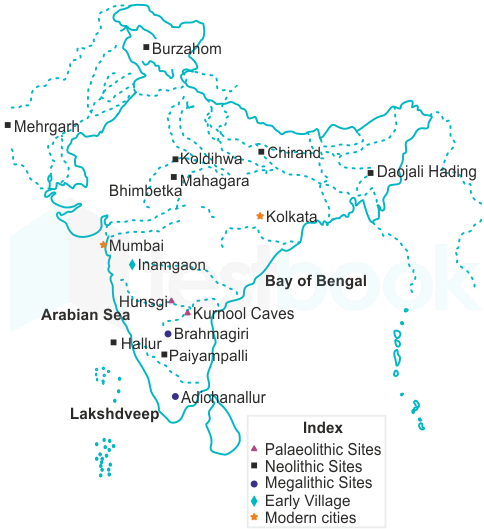
In one of the first settled sites Burzahom, traces of cooking hearths have been found

  1. ((a))

    inside the huts

  2. ((b))

    outside the huts

  3. ((c))

    both inside and outside the huts

  4. ((d))

    far away from the huts

Show Answer
Answer: ((c))

both inside and outside the huts

In one of the first settled sites Burzahom, traces of cooking hearths have been found both inside and outside the huts.

Key Points

  • Archaeologists have found traces of huts or houses at some sites.
  • For instance, in Burzahom (in present-day Kashmir) people built pit- houses, which were dug into the ground, with steps leading into them.
  • These may have provided shelter in cold weather.
  • Archaeologists have also found cooking hearths both inside and outside the huts, which suggests that, depending on the weather, people could cook food either indoors or outdoors.

Hence, we can conclude that at the site of Burzahom the traces of cooking hearths have been found both inside and outside the huts.

35

People who made copies of the manuscripts in the medieval courts are known as

  1. ((a))

    calligraphers

  2. ((b))

    copiers

  3. ((c))

    scribes

  4. ((d))

    muralists

Show Answer
Answer: ((c))

scribes

People who made copies of the manuscripts in the medieval courts are known as scribes.

Key Points

  • During the medieval period, manuscripts (a handwritten document) were collected by wealthy people, rulers, monasteries and temples.
  • They were placed in libraries and archives.
  • These manuscripts and documents provide a lot of detailed information to historians but they are also difficult to use.
  • There was no printing press in those days so scribes copied manuscripts by hand.
  • As scribes copied manuscripts, they also introduced small changes – a word here, a sentence there.
  • These small differences grew over centuries of copying until manuscripts of the same text became substantially different from one another.
  • This is a serious problem because we rarely find the original manuscript of the author today.
  • We are totally dependent upon the copies made by later scribes.
  • As a result historians have to read different manuscript versions of the same text to guess what the author had originally written.

Based on the above discussion, we can conclude that the People who made copies of the manuscripts in the medieval courts are known as scribes.

Additional Information

  • Calligrapher is a person who is skilled at the art of calligraphy (producing beautiful writing, often with a special pen or brush).
  • Copiers are large equipment used to copy any printable document.
  • A muralist is a fine artist who designs, paints and/or applies large paintings or pictures to expansive surfaces, such as walls and ceilings.
36

Read the statements (A) and (R) and choose the correct option.

Assertion (A): Hampi was the centre of commercial and cultural activities.

Reason (R) : Muslim merchants, Chettis and European traders thronged the markets of Hampi

  1. ((a))

    Both (A) and (R) are true and (R) is the correct explanation of (A).

  2. ((b))

    Both (A) and (R) are true and (R) is not the correct explanation of (A).

  3. ((c))

    (A) true, but (R) is false.

  4. ((d))

    (A) is false, but (R) is true.

Show Answer
Answer: ((a))

Both (A) and (R) are true and (R) is the correct explanation of (A).

The correct answer is - Both (A) and (R) are true and (R) is the correct explanation of (A).

Important Points

  • Hampi is located in the Krishna-Tungabhadra basin, which formed the nucleus of the Vijayanagara Empire, founded in 1336.
  • In its heyday in the fifteenth-sixteenth centuries, Hampi bustled with commercial and cultural activities.
  • Muslim merchants, Chettis and agents of European traders such as the Portuguese, thronged the markets of Hampi.
  • Commercial and cultural activities in Hampi were centred around its temples because several religious activities were performed at temples.
  • Hampi fell into ruin following the defeat of Vijayanagara in 1565 by the Deccani Sultans – the rulers of Golconda, Bijapur, Ahmadnagar, Berar and Bidar.

Based on the above discussion, we can conclude that both the statements (A) and (R) are true and (R) is the correct explanation of (A).

37

Read the statements (A) and (R) and choose the correct option.

Assertion (A): East India company introduced Permanent Settlement and Mahalwari Settlement in their territories.

Reasoning (A) : These settlements were required to improve the agricultural practices, particularly irrigation system.

  1. ((a))

    Both (A) and (R) are true and (R) is the correct explanation of (A).

  2. ((b))

    Both (A) and (R) are true and (R) is not the correct explanation of (A).

  3. ((c))

    (A) true, but (R) is false.

  4. ((d))

    Both (A) and (R) are false.

Show Answer
Answer: ((c))

(A) true, but (R) is false.

The correct answer is - (A) true, but (R) is false.

Important Points

  • The biggest source of East India Company's income came from taxing the agricultural produce.
  • Moreover, the expansion of British rule demanded extra revenue for various purposes.
  • Most Company officials began to feel that investment in land had to be encouraged and agriculture had to be improved.
  • Hence, the company devised new methods to increase revenue in India.
  • Permanent Settement:
  • The Company introduced the Permanent Settlement in 1793.
  • According to this settlement, the rajas and taluqdars were recognised as zamindars.
  • They were asked to collect rent from the peasants and pay revenue to the Company.
  • The amount to be paid was fixed permanently, that is, it was not to be increased ever in future.
  • It was felt that this would ensure a regular flow of revenue into the Company’s coffers and at the same time encourage the zamindars to invest in improving the land.
  • Mahalwari Settlement:
  • ​In the North Western Provinces of the Bengal Presidency, an Englishman called Holt Mackenzie devised the new system which came into effect in 1822.
  • Under his directions, collectors went from village to village, inspecting the land, measuring the fields, and recording the customs and rights of different groups.
  • The estimated revenue of each plot within a village was added up to calculate the revenue that each village (mahal) had to pay.
  • This demand was to be revised periodically, not permanently fixed.
  • The charge of collecting the revenue and paying it to the Company was given to the village headman, rather than the zamindar.
  • This system came to be known as the mahalwari settlement.

Based on the above discussion, we can conclude that the statement (A) is true, but (R) is false.

38

Which of the following statement(s) is/are true about Ahoms during the medieval period?

A. They are migrants from present-day Myanmar

B. Ahom state depended on voluntary service for their army

C. Village communities played a crucial role in distributing land to peasants.

Choose the correct option.

  1. ((a))

    Only A

  2. ((b))

    B and C

  3. ((c))

    A and B

  4. ((d))

    A and C

Show Answer
Answer: ((d))

A and C

Among the given statements, the statements A and C are true about Ahoms during the medieval period.

Key Points

  • The Ahoms migrated to the Brahmaputra valley from present-day Myanmar in the thirteenth century.
  • They created a new state by suppressing the older political system of the bhuiyans (landlords).
  • The Ahom state depended upon forced labour and those forced to work for the state were called paiks.
  • Each village had to send a number of paiks by rotation.
  • Almost all adult males served in the army during war.
  • Ahom society was divided into clans or khels.
  • A khel often controlled several villages.
  • The peasant was given land by his village community.
  • Even the king could not take it away without the community’s consent.

Hence, we can conclude that the following statements are true about Ahoms during the medieval period:

A. They are migrants from present-day Myanmar

C. Village communities played a crucial role in distributing land to peasants.

Mistake Points

  • Ahom state depended on voluntary service for their army is not correct because:
  • The Ahom state depended upon forced labour.​
  • Almost all adult males served in the army during war.
39

Consider the following statements and choose the correct option.

(a) Pandita Ramabai founded a widows' home at Poona to provide shelter to widows.

(b) Pandita Ramabai was a great scholar of Sanskrit.

(c) Pandita Ramabai wrote a book about the miserable lives of lower-caste women.

  1. ((a))

    (a), (b) and (c) are correct

  2. ((b))

    (a) and (b) are correct

  3. ((c))

    (a) and (c) are correct

  4. ((d))

    (b) and (c) are correct

Show Answer
Answer: ((b))

(a) and (b) are correct

Among the given statements, the statements (a) and (b) are correct.

Key Points

  • Pandita Ramabai was a great scholar of Sanskrit.
  • She felt that Hinduism was oppressive towards women.
  • She wrote a book about the miserable lives of upper-caste Hindu women.
  • She founded a widows’ home at Poona to provide shelter to widows who had been treated badly by their husbands’ relatives.
  • Here women were trained so that they could support themselves economically.
  • Pandita Ramabai founded the Arya Mahila Sabha in 1881, which was the very first feminist organisation.
  • In 1887, the Ramabai Association was founded which worked for the downtrodden in the society.
  • She founded the Mukti Mission in 1889 which provided housing, education, vocational training and medical services to the abandoned people.

Based on the above given points about Pandita Ramabai  we can conclude that the following statements are correct:

(a) Pandita Ramabai founded a widows' home at Poona to provide shelter to widows.

(b) Pandita Ramabai was a great scholar of Sanskrit.

Mistake Points

  • Pandita Ramabai wrote a book about the miserable lives of lower-caste women is not correct because:
  • She wrote a book about the miserable lives of upper-caste Hindu women.
40

Which among the following tried to show through his/her writings that the practice of widow burning had no sanction in ancient texts?

  1. ((a))

    Ishwarchandra Vidyasagar

  2. ((b))

    Pundita Rama Bai

  3. ((c))

    Raja Rammohan Roy

  4. ((d))

    Dayananda Saraswati

Show Answer
Answer: ((c))

Raja Rammohan Roy

Raja Rammohun Roy (1772-1833) founded a reform association known as the Brahmo Sabha (later known as the Brahmo Samaj) in Calcutta.

  • People such as Rammohun Roy are described as reformers because they felt that changes were necessary for society, and unjust practices needed to be done away with.
  • They thought that the best way to ensure such changes was by persuading people to give up old practices and adopt a new way of life.

Important Points

Rammohun Roy was particularly moved by the problems widows faced in their lives.

  • He began a campaign against the practice of Sati.
  • Rammohun Roy was well versed in Sanskrit, Persian, and several other Indian and European languages.
  • He tried to show through his writings that the practice of widow burning had no sanction in ancient texts.
  • The strategy adopted by Rammohun was used by later reformers as well.
  • Whenever they wished to challenge a practice that seemed harmful, they tried to find a verse or sentence in the ancient sacred texts that supported their point of view.
  • They then suggested that the practice as it existed at present was against early tradition.

Thus, we can say that Raja Rammohan Roy tried to show through his/her writings that the practice of widow burning had no sanction in ancient texts.

41

Which among the following practices was used by Nineteenth century reformers to challenge a harmful practice that existed in the society?

  1. ((a))

    Staging a dharna against such practices.

  2. ((b))

    Name calling the people who were following such practices.

  3. ((c))

    Point out a verse or sentence in the ancient sacred texts that supported their point of view.

  4. ((d))

    Eulogizing the practices of the western societies.

Show Answer
Answer: ((c))

Point out a verse or sentence in the ancient sacred texts that supported their point of view.

Point out a verse or sentence in the ancient sacred texts that supported their point of view is the practice used by Nineteenth century reformers to challenge a harmful practice that existed in the society.

Important Points

  • Ram Mohan Roy was well versed in Sanskrit, Persian and several other Indian and European languages.
  • He tried to show through his writings that the practice of widow burning had no sanction in ancient texts.
  • The strategy adopted by Ram Mohan Roy was used by later reformers as well in the Nineteenth century.
  • Whenever they wished to challenge a practice that seemed harmful, they tried to find a verse or sentence in the ancient sacred texts that supported their point of view.
  • They then suggested that the practice, as it existed at present, was against early tradition.
  • Ishwar Chandra Vidyasagar used the ancient texts to suggest that widows could remarry.

Hence, the correct answer is - Point out a verse or sentence in the ancient sacred texts that supported their point of view.

42

Dadabhai Naoroji was a great publicist. Which of the following is a correct explanation of the term 'publicist'?

  1. ((a))

    Someone who writes in daily newspapers.

  2. ((b))

    Someone who publicises ideas through various means.

  3. ((c))

    Someone who is very popular in his circle.

  4. ((d))

    Someone who holds a public post.

Show Answer
Answer: ((b))

Someone who publicises ideas through various means.

Someone who publicises ideas through various means is a correct explanation of the term 'publicist'.

Key Points

  • A 'publicist' is someone who publicises an idea through various means like by circulating information, writing reports, speaking at meetings etc.
  • Dadabhai Naoroji was a businessman and a great publicist settled in London.
  • He was the first Asian to become a British Member of Parliament when he was elected to the House of Commons in 1892.
  • He formed the London India Society in 1865 to put forth views on Indian political, social and literary subjects.
  • He also founded the East India Association in 1867 with the purpose of putting across Indian viewpoints across to the British public.
  • He was the President of the Congress Party in 1886, 1893 and 1906.
  • Naoroji’s book Poverty and Un-British Rule in India offered a scathing criticism of the economic impact of British rule.

Hence, we can conclude that the term 'publicist' means - Someone who publicises ideas through various means.

43

Match the two columns which show different events and organizations, and the year of formation.

Choose the correct option.

A.Rowlatt Satyagraha(i)1928
B.Hindustan Socialist Republic Organization(ii)1925
C.Communist Party of India(iii)1929
D.Announcement of Purna Swaraj(iv)1919
  1. ((a))

    A - (ii), B - (iv), C - (i) and D - (iii)

  2. ((b))

    A - (i), B - (ii), C - (iv) and D - (iii)

  3. ((c))

    A - (iv), B - (i), C - (ii) and D - (iii)

  4. ((d))

    A - (i), B - (iv), C - (ii) and D - (iii)

Show Answer
Answer: ((c))

A - (iv), B - (i), C - (ii) and D - (iii)

The correct answer is A - (iv), B - (i), C - (ii) and D - (iii)

Key Points

  • Rowlatt Satyagraha:
  • In 1919, Gandhiji gave a call for a satyagraha against the Rowlatt Act that the British had just passed.
  • The Act curbed fundamental rights such as the freedom of expression and strengthened police powers.
  • The Rowlatt Satyagraha turned out to be the first all-India struggle against the British government.
  • During the Rowlatt Satyagraha the participants tried to ensure that Hindus and Muslims were united in the fight against British rule.
  • Hindustan Socialist Republic Organization:
  • Revolutionary nationalists such as Bhagat Singh, Chandra Shekhar Azad, Sukhdev and others wanted to fight against the colonial rule and the rich exploiting classes through a revolution of workers and peasants.
  • For this purpose they founded the Hindustan Socialist Republican Association (HSRA) in 1928 at Ferozeshah Kotla in Delhi.
  • Communist Party of India:
  • It was formed in 1925 at the Indian Communist Conference in Kanpur.
  • The Communist Party of India declared that revolution would be used to build socialism in India.
  • It held  very different ideas about the kind of country India should be.
  • Announcement of Purna Swaraj:
  • Jawaharlal Nehru was the President of the Indian National Congress at the Lahore session of Congress in 1929.
  • Purna Swaraj (complete independence) was declared as the ultimate goal after passing a historic resolution at this session.
  • Consequently, “Independence Day” was observed on 26 January 1930 all over the country.

Therefore, we can conclude that the correct matching of the different events and organizations with their year of formation is:

A.Rowlatt Satyagraha(iv)1919
B.Hindustan Socialist Republic Organization(i)1928
C.Communist Party of India(ii)1925
D.Announcement of Purna Swaraj(iii)1929
44

Who said the following statement in the context of formation of states after India's Independence?

"Everything which helps the growth of nationalism has to go forward and everything which throws obstacles in its way has to be rejected.....We have applied this test to linguistic provinces also, and by this test, in our opinion(they) cannot be supported."

  1. ((a))

    Jawaharlal Nehru

  2. ((b))

    B.R. Ambedkar

  3. ((c))

    M. K. Gandhi

  4. ((d))

    Sardar Vallabhbhai Patel

Show Answer
Answer: ((d))

Sardar Vallabhbhai Patel

Sardar Vallabhbhai Patel said the given statement in the context of formation of states after India's Independence.

Important Points

  • After India's independence, both Prime Minister Jawaharlal Nehru and Deputy Prime Minister Sardar Vallabhbhai Patel were against the creation of linguistic states.
  • After the Partition, Nehru said, “disruptionist tendencies had come to the fore”; to check them, the nation had to be strong and united.
  • India had already been divided on the basis of religion: despite the wishes and efforts of Mahatma Gandhi, freedom had come not to one nation but to two.
  • In the context of formation of states, Sardar Vallabhbhai Patel said that:
  • "​... the first and last need of India at the present moment is that it should be made a nation … Everything which helps the growth of nationalism has to go forward and everything which throws obstacles in its way has to be rejectedWe have applied this test to linguistic provinces also, and by this test, in our opinion [they] cannot be supported".

Therefore the correct answer is - Sardar Vallabhbhai Patel.

Additional Information

  • Sardar Vallabhbhai Patel was an Indian politician who served as the first Home Minister of India and the first Deputy Prime Minister of India.
  • He was a barrister and a very active member of the Indian National Congress.
  • He was born on 31 October 1875 in Nadiad, Gujarat.
  • His father’s name was Jhaverbhai Patel and his mother’s name was Ladba.
  • He was highly influenced by Mahatma Gandhi’s views on non-violence.
  • He strongly emphasized the need for unity of the Indian masses in order to achieve independence from the British rule.
  • He played the most pivotal role in the integration of India as he was the one who convinced almost all the princely states to become a part of India post India’s independence.
  • He became popularly known as Sardar Patel, Iron Man of India, Bismarck of India, Unifier of India, etc.
  • Since 2014, his birth anniversary, 31st October is annually celebrated as “Rashtriya Ekta Diwas” i.e. the “National Unity Day” in India.
45

Consider these sentences in the context of planet earth.

A. The earth's axis makes an angle of 66 ½° with its orbital plane.

B. Revolution is the movement of the earth on its axis.

Choose the correct option.

  1. ((a))

    A is true and B is false

  2. ((b))

    A is false and B is true

  3. ((c))

    Both A and B are true

  4. ((d))

    Both A and B are false

Show Answer
Answer: ((a))

A is true and B is false

The axis of the earth which is an imaginary line makes an angle of 66½° with its orbital plane.

  • The plane formed by the orbit is known as the orbital plane.
  • The earth receives light from the sun.
  • Due to the earth's spherical shape, only half of it gets light from the sun at a time.

Key Points Rotation and Revolution

  • "Rotation" refers to an object's spinning motion about its own axis. Hence statement 2 is incorrect.
  • "Revolution" refers to the object's orbital motion around another object.
  • For example, Earth rotates on its own axis, producing a 24-hour day.
  • Earth revolves around the Sun, having a 365-day year.

Hence we can say that this statement is true "The earth's axis makes an angle of 66 ½° with its orbital plane."

46

How many degrees does the earth rotate in an hour?

  1. ((a))

    90°

  2. ((b))

    60°

  3. ((c))

    30°

  4. ((d))

    15°

Show Answer
Answer: ((d))

15°

The Earth rotates at 15° each hour so to rotate through 30° degrees would take 2 hours.

Key Points

  • Using a division equation again, you can also figure out how many minutes it takes for the earth to spin 1 degree: 60 minutes divided by 15 degrees = 4 minutes per degree.
  • 1 minute of arc is 1/60 degrees and a full rotation of the Earth is 360 degrees.
  • The Earth also moves around the sun, by a little less than one degree per day (360/365.25 = 0.9856 degrees per day).
  • Each degree can be broken into 60 minutes, and each minute can be divided into 60 seconds. Any given location can be described in terms of degrees, minutes, and seconds of longitude and latitude.

Hence we can say that "The  Earth rotates at 15° each hour. "

47

Consider the following statements A, B and C about longitudes and latitudes and choose the correct option.

(A) Longitudes are parallel circles.

(B) Latitudes are parallel circles.

(C) Longitudes are semi-circles.

  1. ((a))

    Both (A) and (B) are true

  2. ((b))

    Both (B) and (C) are true

  3. ((c))

    only c is true

  4. ((d))

    Only (B) is true

Show Answer
Answer: ((b))

Both (B) and (C) are true

  • The lines running North to South are called "Meridians" or "lines of longitude".
  • The lines running East to West are called "Parallels" or "lines of latitude".

 Key Points

  • All parallel circles from the equator to the poles are known as parallels of latitudes. The lines of reference running from the North Pole to the South Pole are known as meridians of longitude.
  • Lines of Longitude are referred to as Meridians of Longitude.
  • These lines are not parallel to each other. They come closer and closer to each other as they approach the north and south poles, where they all meet.
  • Each great circle passing through the north and south poles has the earth's axis as its diameter. Each great circle is divided by the poles into two semi-circles called meridians of longitude. Hence statement C is correct and A is incorrect.
  • Latitude is the measurement of distance north or south of the Equator. It is measured with 180 imaginary lines that form circles around the Earth east-west, parallel to the Equator. These lines are known as parallels. Hence statement B is correct
  • A circle of latitude is an imaginary ring linking all points sharing a parallel.

Hence we can say that  "Latitudes are parallel circles" & "Longitudes are semi-circles."

48

Consider the following statements (A) and (B) and choose the correct option.

(A) By measuring the angle of the pole star from your place you can know the latitude of your place.

(B) To fix the position of a place on earth one needs to know the latitude and longitude of that place.

  1. ((a))

    Both (A) and (B) are true and (B) is the correct explanation of (A)

  2. ((b))

    Both (A) and (B) are true and (B) is not the correct explanation of (A)

  3. ((c))

    (A) true, but (B) is false

  4. ((d))

    (A) is false. but (B) is true

Show Answer
Answer: ((b))

Both (A) and (B) are true and (B) is not the correct explanation of (A)

By measuring the angle of the Pole Star from your place, you can know the latitude of your place is equal halves.

Key Points

  • The equator is an imaginary circular line and is a very important reference point to locate places on the earth.
  • By measuring the angle of the pole star from your place you can know the latitude of your place.
  • To figure out your latitude, you can measure the angle of the North Star, called Polaris, above the horizon. That is your latitude.
  • To fix the position of a place on earth one needs to know the latitude and longitude of that place.
  • if it's during the day, you can measure how far below a vertical line the Sun is at exactly noon (when the shadows are shortest) on March 21st or September 21st.

Hence we can say that both the statements A and B are independently correct and and B is not the correct explanation of A.

49

Which among the following is not a source of fresh water?

  1. ((a))

    Ocean

  2. ((b))

    Rivers

  3. ((c))

    Ponds

  4. ((d))

    Glaciers

Show Answer
Answer: ((a))

Ocean

The water in the oceans is saline and not fresh. The water in the ocean collects all the salt and minerals from all the rivers that flow into it.

Key Points

  • The river is the source of fresh water.
  • Freshwater can be found in glaciers, lakes, reservoirs, ponds, rivers, streams, wetlands and even groundwater.
  • Out of all the water on Earth, just 3% is fresh water.
  • About three-quarters of Earth's freshwater is stored in glaciers.
  • Therefore, glacier ice is the second largest reservoir of water on Earth and the largest reservoir of freshwater on Earth!

Hence we can say that Ocean is not a source of fresh water.

50

Read the following statements A, B and C and choose the statements that are acts of endogenic Forces. 

A. 'There was an earthquake in Afghanistan at 6.00 am today.'

B. 'Mount Fuji has been throwing up lava.'

C. 'The glacial moraines have left a trail of deposits at Zermatt.'

Choose the correct option.

  1. ((a))

    Only A and B

  2. ((b))

    Only B and C

  3. ((c))

    Only A and C

  4. ((d))

    A, B and C

Show Answer
Answer: ((a))

Only A and B

The forces that act in the interior of the earth are called endogenic forces.

  • The horizontal and vertical movements caused by the forces coming from the interior of the earth are known as endogenic forces.
  • The origin of the endogenic force is caused by the contraction and expansion of rocks due to variation in thermal conditions and temperature inside the earth.
  • Movements caused by internal or endogenetic forces affecting the earth's crust are known as Earth Movements. Earth movements are also called tectonic movements as they help in building the relief features on earth's crust through subsequently or simultaneously undergoing changes.

These two statements represent the acts of endogenic forces-

A. 'There was an earthquake in Afghanistan at 6.00 am today.'

B. 'Mount Fuji has been throwing up lava.'

Hence we can say that only A and B are correct statements.

51

Consider the following statements (A), (B) and (C) and choose the correct option.

(A) Landforms are found over the continents, not on the ocean floors.

(B) Natural environment refers to only biotic conditions existing on the earth.

(C) Human environment refers to the activities, creations and interactions among human beings.

  1. ((a))

    Only A is true

  2. ((b))

    Only B is true

  3. ((c))

    Only C is true

  4. ((d))

    Only B and C are true

Show Answer
Answer: ((c))

Only C is true

Statement A and B are incorrect. Only statement C is correct.

Statement A- Incorrect, As landforms can be found over the continents as well as the bottom of the ocean floors.

Statement B- Incorrect, A natural environment refers to both the biotic (living) and abiotic ( non-living) conditions existing on the Earth.

Statement C- Correct, The human environment refers to the activities and interactions among the human beings.

Hence we can say that only Statement (C) is correct.

52

Assertion (A): High tides help in navigation

Reason (R): High tides raise the water level close to the shore and help ships to arrive at the harbour more easily.

Choose the correct option from the following

  1. ((a))

    Both (A) and (R) are true and (R) is the correct explanation of (A)

  2. ((b))

    Both (A) and (R) are true and (R) is not the correct explanation of (A)

  3. ((c))

    (A) true, but (R) is false

  4. ((d))

    Both (A) and (R) are false

Show Answer
Answer: ((a))

Both (A) and (R) are true and (R) is the correct explanation of (A)

Both (A) and (R) are true and (R) is the correct explanation of (A)

Key Points

  • They raise the water level close to the shores.
  • This helps the ships to arrive at the harbor more easily.
  • High tides help in navigation.
  • This helps the ships to arrive at the harbor more easily.
  • The high tides also help in fishing.
  • Tides are also helpful in generating electricity.

Additional Information

  • The importance of tides is,
  • that they can cause a change in the landforms of the Earth. While they can destroy coastlines.
  • They also help in the formation of creeks and inlets.
  • Strong tides help in the building of lower flood plains of rivers.

Hence we can say that Both (A) and (R) are true and (R) is the correct explanation of (A).

53

As we go up the layers of the atmosphere

  1. ((a))

    the pressure increases but the temperature decreases.

  2. ((b))

    the pressure decreases but the temperature increases.

  3. ((c))

    the pressure and the temperature remain the same.

  4. ((d))

    the pressure decreases but the change in temperature varies.

Show Answer
Answer: ((d))

the pressure decreases but the change in temperature varies.

As we go up the layers of the atmosphere, fewer air molecules are above us.

  • So, there will be less weight of air above us.
  • Hence, atmospheric pressure always decreases as we move upward in the atmosphere.
  • The relationship between the atmospheric pressure and the temperature of a place is directly proportional to each other.
  • The temperature of a place increases as the atmospheric pressure of that place rises.
  • On the other hand, the temperature of a place decreases as the atmospheric pressure of the place falls.
  • The temperature in the weather condition of a place increases as the heating effect of the air pressure rises to a high level.
  • When the molecules in the warm air become light then the warm air expands causing less force.
  • The opposite effect takes place when the temperature level of a place decreases to a low level.

Thus, we can conclude that as we go up the layers of the atmosphere the pressure decreases but the change in temperature varies.

54

Read the following statements for physical features of India and choose the correct options:

A. Many popular hill stations are situated in middle Himalaya.

B. Northern plains are highly populated areas because river plains have fertile land for cultivation.

C. Western ghats are rich in minerals and are highly populated.

  1. ((a))

    Only A is correct

  2. ((b))

    Only B is correct

  3. ((c))

    Only A and B are correct

  4. ((d))

    All statements are correct

Show Answer
Answer: ((c))

Only A and B are correct

Let's look at the statements of physical features of India:

  • Statement A - Correct. There are several hill stations in the middle Himalayas such as Barog, Barog, Barot, Tattapani, Triund, Rohtang, Reckong Peo, Palampur, Narkanda, Mashobra, Manali, Kullu, Kufri, Khajjiar, Kasauli, Kalpa, Dharamshala, Dalhousie, Chitkul, Chamba, and Chail.
  • Statement B- Correct. The northern plains are also known as deposited plains due to the availability of Fertile soil, which is suitable for agriculture and cultivation. This prompted many people to settle along the shores of the various northern rivers.
  • Statement C- Incorrect. Western Ghats are best known for their biological diversity and endemism. Also, it one of the world's eight hottest hotspots of biodiversity.

​Hence, we can say that only statements A and B are correct.

55

Uranium found in Ladakh is an example of which kind of resource?

  1. ((a))

    Ubiquitous

  2. ((b))

    Potential

  3. ((c))

    Actual

  4. ((d))

    Renewable

Show Answer
Answer: ((b))

Potential

Uranium found in Ladakh is an example potential resource.

Key Points

  • Resources that are drawn from nature and used without much modification are called natural resources.
  • Natural resources are classified into different groups depending upon their level of development and use; origin; stock and distribution.
  • On the basis of their development and use resources can be classified into two groups - actual resources and potential resources.
  • Potential resources are those whose entire quantity may not be known and these are not being used at present.
  • These resources could be used in the future.
  • The level of technology we have at present may not be advanced enough to easily utilise these resources.
  • The uranium found in Ladakh is an example of potential resource that could be used in the future.

Hence, we can conclude that Uranium found in Ladakh is an example potential resource.

Additional Information

  • Actual resources:
  • ​Actual resources are those resources whose quantity is known.
  • These resources are being used in the present.
  • The rich deposits of coal in Ruhr region of Germany and petroleum in the West Asia, the dark soils of the Deccan plateau in Maharashtra are all actual resources.
  • Renewable resources:
  • Renewable resources are those which get renewed or replenished quickly.
  • Some of these are unlimited and are not affected by human activities, such as solar and wind energy.
  • Ubiquitous resources:
  • ​Resources that are found everywhere like the air we breathe, are ubiquitous.
56

Consider the following statements and choose the correct option.

(A) An economically developed country could be a densely populated country.

(B) More women in population's base necessarily indicates their better status in society.

(C) Population pyramid is a tool to study the population composition of a country.

  1. ((a))

    Both (A) and (B) are correct.

  2. ((b))

    Both (B) and (C) are correct.

  3. ((c))

    Both (A) and (C) are correct.

  4. ((d))

    Only (C ) is correct.

Show Answer
Answer: ((c))

Both (A) and (C) are correct.

The correct answer is - Both (A) and (C) are correct.

Important Points

  • Statement (A) is correct:
  • Population density is the number of people living in a unit area of the earth’s surface.
  • How crowded a country is, has little to do with its level of economic development.
  • For example, both Bangladesh and Japan are very densely populated but Japan is far more economically developed than Bangladesh.
  • Hence, an economically developed country could be a densely populated country.
  • Statement (B) is not correct:
  • ​The number of women and men in a country is an important demographic characteristic.
  • The ratio between the number of women and men in the population is called the Sex Ratio.
  • The sex ratio is an important information about the status of women in a country.
  • In regions where gender discrimination is rampant, the sex ratio is bound to be unfavourable to women.
  • Such areas are those where the practice of female foeticide, female infanticide and domestic violence against women are prevalent.
  • One of the reasons could be lower socio-economic status of women in these areas.
  • However more women in the population's base does not mean they have a better status.
  • It could be that the men might have migrated to other areas for employment.
  • Statement (C) is correct:
  • Population composition refers to the structure of the population.
  • The composition of population helps us to know how many are males or females, which age group they belong to, how educated they are and what type of occupations they are employed in, what their income levels and health conditions are.
  • An important tool for studying the population composition of a country is by looking at the population pyramid.

Based on the above discussion, we can conclude that the correct statements are (A) and (C).

57

Consider the following statements (A) and (B) and choose the correct option.

(A) Agricultural activity is concentrated in those regions of the world where suitable factors for the growing of crops exist.

(B) Wool, dairy and poultry products are considered output of agricultural system

  1. ((a))

    Only (A) is true

  2. ((b))

    Only (B) is true

  3. ((c))

    Both (A) and (B) are true.

  4. ((d))

    Neither (A) nor (B) is true.

Show Answer
Answer: ((c))

Both (A) and (B) are true.

Among the given statements, both the statements (A) and (B) are true.

Important Points

  • Agriculture is a primary activity.
  • It includes growing crops, fruits, vegetables, flowers and rearing of livestock.
  • In the world, 50 per cent of persons are engaged in agricultural activity.
  • Two-thirds of India’s population is still dependent on agriculture.
  • Favourable topography of soil and climate are vital for agricultural activity.
  • The land on which the crops are grown is known as arable land.
  • Agricultural activity is concentrated in those regions of the world where suitable factors for the growing of crops exist.
  • Agriculture or farming can be looked at as a system.
  • The important inputs are seeds, fertilisers, machinery and labour.
  • Some of the operations involved are ploughing, sowing, irrigation, weeding and harvesting.
  • The outputs from the system include crops, wool, dairy and poultry products.
  • Given below is a map to show the world distribution of arable land:

Based on the above given points, we can conclude that both the statements (A) and (B) are true.

58

Which of the following languages belongs to the Tibeto-Burman family?

  1. ((a))

    Assamese

  2. ((b))

    Persian

  3. ((c))

    Sindhi

  4. ((d))

    Khasi

Show Answer
Answer: ((d))

Khasi

Khasi language belongs to the Tibeto-Burman family.

Important Points

  • The languages used in the subcontinent belong to different families.
  • They are called a family because they originally had words in common.
  • There are mainly four families of the languages:
  • Indo European family - It includes Sanskrit, Assamese, Gujarati, Hindi, Kashmiri and Sindhi. Asian languages such as Persian and many European languages such as English, French, German, Greek, Italian and Spanish also belong to this family.
  • Tibeto-Burman family - The languages used in the north-east belong to Tibeto-Burman family. Example - Khasi
  • Dravidian family - The languages like Tamil, Telugu, Kannada and Malayalam belong to the Dravidian family.
  • Austro-Asiatic family - The languages spoken in Jharkhand and parts of central India belong to the Austro-Asiatic family.

Therefore the correct answer is -  Khasi.

59

Social advertising refers to__________.

  1. ((a))

    making advertisement at social gatherings

  2. ((b))

    bringing people from different sections of society in creating advertisements

  3. ((c))

    creating advertisement with a social message

  4. ((d))

    making advertisement on social functions

Show Answer
Answer: ((c))

creating advertisement with a social message

Social advertising refers to creating advertisement with a social message.

Key Points

  • Advertisement is a promotional activity through which information on a particular product or service is given to customers.
  • Advertisements aim to induce consumers into buying a particular product or service.
  • Advertisements help in creating brands or an image of a product.
  • Social advertisements are the advertisements that contain social messages.
  • Social advertisements refer to advertisements made by the Government or private agencies that have a larger message for society.
  • The objective of such advertisements is to change public attitude and behaviour by creating awareness on certain important issues, such as educating the girl child or the vaccination against polio.
  • The following is an example of social advertisement regarding crossing of manned/unmanned level crossings:

Hence, we can conclude that Social advertising refers to creating advertisement with a social message.

60

Consider the following statements A and B select the answer from the alternatives given below -

A - There are two or more levels of government

B - Each level has its own jurisdiction in matters of legislation, taxation and administration

  1. ((a))

    A is true and B is false

  2. ((b))

    Both A and B are true

  3. ((c))

    Both A and B are false

  4. ((d))

    A is false and B is true

Show Answer
Answer: ((b))

Both A and B are true

Among the given statements, both A and B are true.

Key Points

  • Federalism is a system of government in which the power is divided between a central authority and various constituent units of the country.
  • Some of the key features of federalism are: 
  • There are two or more levels (or tiers) of government.
  • Different tiers of government govern the same citizens, but each tier has its own jurisdiction in specific matters of legislation, taxation and administration.
  • The jurisdictions of the respective levels or tiers of government are specified in the constitution. So the existence and authority of each tier of government is constitutionally guaranteed.
  • The fundamental provisions of the constitution cannot be unilaterally changed by one level of government. Such changes require the consent of both the levels of government.
  • Courts have the power to interpret the constitution and the powers of different levels of government. The highest court acts as an umpire if disputes arise between different levels of government in the exercise of their respective powers.
  • Sources of revenue for each level of government are clearly specified to ensure its financial autonomy.
  • The federal system thus has dual objectives: to safeguard and promote unity of the country, while at the same time accommodate regional diversity.

Based on the above discussion regarding federalism we can conclude that, both the statements A and B are true.

61

Which of the following taxes are collected by administrative organs of the local governments in India?

A. Goods and Services Tax

B. Water tax

C. Property tax

D. Income tax

Choose the correct option.

  1. ((a))

    A, B and C

  2. ((b))

    B, C and D

  3. ((c))

    A and B

  4. ((d))

    B and C

Show Answer
Answer: ((d))

B and C

The correct answer is - B and C.

Important Points

  • The local government in India is one of the most important organs of the three-tier government system.
  • It is responsible for the all-round development of its designated area.
  • It undertakes all the public facilities and welfare works like sanitation, water, road, education, health, etc.
  • As these works require funds, so it collects revenue from the residents living in that area.
  • It levies taxes on property, water, and other services.
  • Taxes are fixed on the measurement and consumption of the services.
  • Taxes are levied on education and other amenities like owning a hotel, entertainment etc.

Mistake Points

  • Income tax is not the source of income of the local governments because it is collected by the central government.
  • Goods and Services Tax is collected by the central government and the state governments.

Hence we can conclude that the following taxes are collected by administrative organs of the local governments in India:

B. Water tax

C. Property tax

62

Read the statements (A) and (R) and choose the correct option

(A) Goods are cheap in the weekly markets.

(R) There are more shops selling the same goods in the weekly market, hence there is more competition.

  1. ((a))

    Both (A) and (R) are true and (R) is the correct explanation of (A)

  2. ((b))

    Both (A) and (R) are true and (R) is not the correct explanation of (A)

  3. ((c))

    (A) true, but (R) is false

  4. ((d))

    Both (A) and (R) are false

Show Answer
Answer: ((a))

Both (A) and (R) are true and (R) is the correct explanation of (A)

The correct answer is Both (A) and (R) are true and (R) is the correct explanation of (A).

Key Points

Goods are cheap in the weekly markets.

  • This is because, in weekly markets, the shop owners are helped by their family members.
  • These shop owners store the things that they sell at home.
  • Weekly markets also have a large number of shops selling the same goods which means there is competition among them.
  • Moroever, there are more shops selling the same goods in the weekly market, hence, there is more competition.
  • If a trader charges a higher rate, people would move to another shop where the same thing will be available more cheaply or where the buyer can bargain and bring the price down.

 Thus, we can say that both (A) and (R) are true and (R) is the correct explanation of (A).

63

Read the statements (A) and (R) and choose the correct option

(A) Goods sold in a permanent shop are usually costlier than goods sold in the weekly markets.

(R) Permanent shops incur a lot of expenditure in the form of rent, electricity bills, workers' wages etc.

  1. ((a))

    Both (A) and (R) are true and (R) is the correct explanation of (A).

  2. ((b))

    Both (A) and (R) are true and (R) is not the correct explanation of (A).

  3. ((c))

    (A) true, but (R) is false.

  4. ((d))

    Both (A) and (R) are false.

Show Answer
Answer: ((a))

Both (A) and (R) are true and (R) is the correct explanation of (A).

The correct answer is Both (A) and (R) are true and (R) is the correct explanation of (A).

Key Points

  • A weekly market is so-called because it is held on a specific day of the week.
  • Weekly markets do not have permanent shops.
  • Goods sold in a permanent shop are usually costlier than goods sold in the weekly market.
  • It is because permanent shops incur a lot of expenditure in the form of rent, electricity bills, workers' wages, etc.
  • On the other hand, in weekly markets, these shop owners store the things they sell at home.
  • Most of them are helped by their family members and thus do not need to hire workers.

 Thus, we can say that both the statements (A) and (R) are true and (R) is the correct explanation of (A).

64

Read the statements (A) and (R) and choose the correct option

(A) Democratic governments are also often called representative democracies.

(R) People do not participate in the government directly, but, instead, choose their representatives through the election process.

  1. ((a))

    Both (A) and (R) are true and (R) is the correct explanation of (A)

  2. ((b))

    Both (A) and (R) are true and (R) is not the correct explanation of (A)

  3. ((c))

    (A) true, but (R) is false

  4. ((d))

    Both (A) and (R) are false

Show Answer
Answer: ((a))

Both (A) and (R) are true and (R) is the correct explanation of (A)

The correct answer is A is true and R is the correct explanation of A.

Key Points 

  • Democratic governments in our times are referred to as Representative democracies.
  • In representative democracies, people do not participate directly but choose their representatives through an election process.
  • These MLAs meet and make decisions for the entire population.
  • These days, a government cannot call itself democratic unless it allows what is known as Universal Adult Franchise.
  • This means that all adult citizens of the country have the right to vote.

 Thus, we can say that the above statements are correct.

65

Lata sells tea at 5.00 am. She then goes to fetch water from a faraway well. After reaching home she cooks food, washes clothes, cleans the house, sweeps and then she goes off to purchase items for her tea shop.

All this together can be referred to as :

  1. ((a))

    Care giving

  2. ((b))

    Double-burden

  3. ((c))

    House work

  4. ((d))

    Paid work

Show Answer
Answer: ((b))

Double-burden

The correct answer is Double-Burden.

Key Points

  • Double-burden, literally means a double load.
  • This term is commonly used to describe the women’s work situation.
  • It has emerged from a recognition that women typically labour both inside the home (housework) and outside.
  • The double burden of work prevents women from enjoying leisure time.
  • The work done by them goes unrecognised and unpaid by society.
  • If Lata sells tea at 5.00 am. She then goes to fetch water from a faraway well. After reaching home she cooks food, washes clothes, cleans the house, sweeps, and, then goes off to purchase items for her tea shop.
  • All this together can be referred to as Double-burden as she is not enjoying any leisure time. Along with that, her work is not recognised and it's unpaid.

Additional Information Let's understand the other terms: 

  • Caregiving refers to a range of tasks related to looking after and nurturing. Besides physical tasks, they also involve a strong emotional aspect.
  • Paid work means work for financial gain or reward.
66

Which among the following was not a part of the original constitution of India adopted in 1950 ?

  1. ((a))

    Fundamental Rights

  2. ((b))

    Directive Principles of State Policy

  3. ((c))

    Fundamental Duties

  4. ((d))

    Emergency Provisions

Show Answer
Answer: ((c))

Fundamental Duties

The correct answer is Fundamental Duties.

Key Points

  • The original constitution of India adopted in 1950 did not include Fundamental Duties.
  • Fundamental Duties were added in the constitution of India in 1976 by the 42th amendment.
  • There were 10 fundamental duties initially, eleventh was added by te 86th amendment in 2002.
  • They are dealt with Article 51A under Part-IV of the Indian Constitution.
  • They are an inalienable part of fundamental rights.

 Thus, we can say that the Fundamental Duties were not a part of the original constitution of India adopted in 1950.

67

Which one of the following is NOT an example of an exercise of Fundamental Rights?

  1. ((a))

    Workers from Bihar go to Punjab to work on the farms.

  2. ((b))

    Christian missionaries set up a chain of missionary schools.

  3. ((c))

    Men and Women government employees get the same salary and allowances.

  4. ((d))

    Paternal property is inherited by their children.

Show Answer
Answer: ((d))

Paternal property is inherited by their children.

The correct answer is Paternal property is inherited by their children.

Key Points 

  • Paternal property inherited by their children is not an instance of an exercise of a fundamental right as the inheritance of property is not a fundamental right provided by the constitution of India.
  • Workers from Bihar going to Punjab to work on the farms is an instance of an exercise of a fundamental right as:
  • Article 19 (g) in The Constitution Of India states that all citizens shall have the right to practice any profession or to carry on any occupation, trade, or business, and
  • Article 19 (d) states that all citizens shall have the right to move freely throughout the territory of India.
  • Christian missions set up a chain of missionary schools is an instance of an exercise of a fundamental right as:
  • Article 30 of the Indian Constitution states the right of minorities to establish and administer educational institutions.
  • It says: “All minorities, whether based on religion or language, shall have the right to establish and administer educational institutions of their choice.”
  • Men and women government employees get the same salary is an instance of an exercise of a fundamental right as:
  • Article 16 states that there shall be equality of opportunity for all citizens in matters relating to employment or appointment to any office under the State.
  • It also states that no citizen shall, on grounds only of religion, race, caste, sex, descent, place of birth, residence, or any of them, be ineligible for, or discriminated against in respect of, any employment or office under the State.
68

Under Article 22 of the Indian Constitution, which one of the following is Fundamental Rights guaranteed to a person arrested?

A. Right to be informed at the time of arrest of the offence for which the person is arrested

B. Right to be presented before a magistrate within 24 hours of arrest

C. Confessions made in police custody need to be recorded and used as evidence against the accused

D. Boys below 15 years of age and women cannot be called to the police station only for interrogation

  1. ((a))

    A, B and C

  2. ((b))

    B, C and D

  3. ((c))

    A, B and D

  4. ((d))

    A, C and D

Show Answer
Answer: ((c))

A, B and D

The correct answer is A, B and D.

Key Points

  • Article 22 deals with protection against arrest and detention in certain cases.
  • Under Article 22 of the Indian Constitution, fundamental rights guaranteed to a person arrested are:
  • Right to be informed at the time of arrest of the offence for which the person is arrested.
  • Right to be presented before a magistrate within 24 hours of arrest.
  • Boys below 15 years of age and women cannot be called to the police station only for interrogation.

 Thus, we can say that the above fundamental rights are guaranteed to a person arrested under Article 22.

Additional Information

  • Under section 25 of the Indian Evidence Act, a confession to a Police officer is inadmissible in evidence, and hence when an accused person confesses during the Police investigation the Police frequently get it recorded by a Magistrate under section 164 of the Criminal Procedure Code, and it can then be used to the extent to which it may be admissible under the Indian Evidence Act.
69

Amnesty International Organization volunteers campaign for:

  1. ((a))

    Human rights all over the world

  2. ((b))

    Human values worldwide

  3. ((c))

    Human evolution studies

  4. ((d))

    Human free education rights

Show Answer
Answer: ((a))

Human rights all over the world

The correct answer is human rights all over the world.

Key Points

  • Amnesty International Organization volunteers campaign for Human rights all over the world.
  • It was founded in 1961 in London by a British lawyer, Peter Benenson.
  • It is an international non-governmental organization focused on human rights.
  • It has its headquarters in the United Kingdom.
  • The mission of the organisation is to campaign for a world in which every person enjoys all of the human rights enshrined in the Universal Declaration of Human Rights.
  • Human Rights are moral principles or norms for certain standards of human behaviour and are regularly protected in municipal and international law.

 Thus, we can say that Amnesty International Organization volunteers campaign for Human rights all over the world.

70

The term ghettoisation is most likely reflected in which of the following areas?

  1. ((a))

    Area A, where residents of a community have moved in following fears for their lives.

  2. ((b))

    Area B, where army personnel have set up a camp.

  3. ((c))

    Area C, where residents have moved in as schools here are better.

  4. ((d))

    Area D, where residents belong to elite and privileged class.

Show Answer
Answer: ((a))

Area A, where residents of a community have moved in following fears for their lives.

The correct answer is Area A- where residents of a community have moved in following fears for their lives.

Key Points

 Ghettoisation: A ghetto is an area or locality that is populated largely by members of a particular community.

  • Ghettoisation refers to the process that leads to such a situation.
  • This may occur due to various social, cultural and economic reasons.
  • Fear or hostility may also compel a community to group together as they feel more secure living amongst their own.
  • Often a ‘ghettoised’ community has few options of moving out, which may lead to them becoming alienated from the rest of the society.

Thus, Area A reflect ghettoisation as residents of a community have moved because they were afraid for their lives.

71

Which of the following activities is useful to develop 'critical thinking skills in history?

A. Examining events through facts and evidence

B. Developing viewpoints on topics through debate and discussion

C. Learning about events based on a particular historian's account

D. Seeing videos on the internet

Choose the correct option.

  1. ((a))

    Only A and B 

  2. ((b))

    Only B and C

  3. ((c))

    Only C and D

  4. ((d))

    Only A and D

Show Answer
Answer: ((a))

Only A and B 

History is the study of life in society in the past, in all its aspects, in relation to present developments and future hopes. History aims at helping students to understand the present existing social, political, religious, and economic conditions of the people.

Key Points Critical thinking is the process of thinking about ideas or situations in order to understand them fully, identify their implications, make a judgment, and rest of and/or guide decision-making. 

  • Examining events through facts and evidence.
  • Developing viewpoints on topics through debate and discussion.
  • ​Both above activities help in developing critical thinking skills as in these activities students analyze the facts and evidence. Discussion and debate help them in learning skills and develop their viewpoints.

Thus, it is concluded that Only A and B are the correct options.

72

According to Kothari Commission, _________

A. India should not be seen simply in terms of developmentalist approach.

B. The problem with this approach has been that it treated poverty, illiteracy and casteism as an obstacle to nation's progress. It also ignored gender issues.

Choose the correct option.

  1. ((a))

    Only A is true

  2. ((b))

    Only B is true

  3. ((c))

    Both A and B are true

  4. ((d))

    Neither A nor B is true

Show Answer
Answer: ((c))

Both A and B are true

National Education Commission, popularly known as Kothari Commission, was set up by the Government of India to examine all aspects of the educational sector in India, to evolve a general pattern of education, and to advise guidelines and policies for the development of education in India. It was formed on 14 July 1964 under the chairmanship of Daulat Singh Kothari, then chairman of the University Grants Commission.

Key Points

  • Kothari Commission has emphasized that India should not be seen simply in terms of the development list approach.
  • The problem with this approach has been that it treated poverty, illiteracy, and casteism as obstacles to national progress, and also ignored gender issues.
  • This mode of thinking may suggest that the common 'illiterate masses have failed the nation. The Committee suggests an epistemological shift in reorienting/redesigning the curriculum so as to accommodate the multiple ways of imagining the Indian nation.
  • Along with the national perspective, the local also needs to be creatively balanced. In order to achieve balancing between national and local, it is necessary to incorporate the local perceptions through which the people can relate themselves to the nation.
  • Doing this will also ensure a much deeper and richer understanding of the nation.

Thus, it is concluded that Both A and B are true.

73

A teacher wants to engage her students on the theme 'portrayal of women in Indian media'. Which of the following strategy/strategies is/are most suitable?

A. Discussion on advertisements from various newspapers

B. Interview with a local leader

C. Collage making and presentation

Choose the appropriate option.

  1. ((a))

    Only A

  2. ((b))

    Both A and B

  3. ((c))

    Both A and C

  4. ((d))

    All A, B and C

Show Answer
Answer: ((c))

Both A and C

The portrayal of women in Indian Media involves anything that the media depicts through its various sources such as newspapers, magazines, television, news, or social media. So, it is important to involve students in an activity that uses media resources. 

Key Points

  • It is the responsibility of the teacher to sensitize the students toward the portrayal of women in mass media.
  • Students must be made aware of the importance of all the genders and the teacher must strive to remove gender parity through her methods of teaching.

Important Points​ Statement A and C talk about the use of resources such as the newspaper, magazines, etc.

  • Advertisements in the newspaper are a wide source of information for the mass population of our country. The content provided through these advertisements impacts the masses. The portrayal of women in the advertisements tells a lot about the position of women in our country. It also has a great impact on the large population of the country. Hence, it is important to be discussed in a social science classroom.
  • Collage Making and Presentation include the use of media resources such as newspapers or magazines used in the making of the collage. So, it is an interesting activity to be done to depict the portrayal of women by the Media.

Thus, it is concluded that Both A and C are the correct options.

Hint

  • An interview with the local leader does not show the role of the media. A politician will present his/her personal views which might have some impact on the media but it does not tell us the portrayal of women by the media.
74

Which of the following resources would be useful to introduce elementary school students to the issue of oppression through caste-based discrimination?

  1. ((a))

    Ashokan Edicts

  2. ((b))

    Allahabad University's policies on reservation for backward classes

  3. ((c))

    Universal Declaration of Human Rights

  4. ((d))

    Narrative on childhood experiences of Dr BR Ambedkar

Show Answer
Answer: ((d))

Narrative on childhood experiences of Dr BR Ambedkar

The correct answer is Narrative of childhood experiences of Dr B.R. Ambedkar.

Key Points

  • Discrimination is the act of making unjustified distinctions between people based on groups, classes, to which they belong.
  • People face discrimination on the basis of caste, sex, age, religion etc.
  • Dr. B.R. Ambedkar was an Indian jurist, economist, reformer, and political leader.
  • Dr. B.R. Ambedkar faced immense discrimination based on caste in his childhood.
  • In his school, he was forced to sit outside the classroom on the ground.
  • He was not even allowed to drink water from the taps that upper-class children used.
  • These narratives of his childhood can be useful to students for introducing oppression through caste-based discrimination.

 Thus, we can say that to introduce elementary school students to issue of oppression through caste-based discrimination, narratives of childhood experience of Dr. BR Ambedkar are helpful.

75

A teacher wants to discuss struggles against inequality. Which of the following examples would be suited for discussion?

A. Story of Rosa Parks

B. Song titled 'the right to know' [By Vinay Mahajan]

C. Tawa Matsya Sangh's protest

D. Any experience from a student's life

Choose the appropriate option.

  1. ((a))

    Only A, B and C

  2. ((b))

    Only B, C and D

  3. ((c))

    Only A, C and D

  4. ((d))

    Only A, B, C and D

Show Answer
Answer: ((d))

Only A, B, C and D

The correct answer is Only A, B, C and D.

Key Points

Inequality is the difference in social status, wealth, or opportunity between people or groups. 

  • Discrimination on the basis of a person's religion, caste, and sex is a factor in why people are treated unequally.
  • Discussing the struggles against inequality, the examples given below would be helpful for a teacher.
  • Tawa Matsya Sangh was a Fisherworker's cooperative.
  • It was an organization that fought for the rights of the displaced forest dwellers of the Satpura forest in Madhya Pradesh.
  • Song titled 'The Right to know' by Vinay Mahajan was written as part of the Right to Information campaign.
  • Rosa parks helped in initiating the civil rights movement in the United States.
  • An experience from a student's life can also be used as an example of inequality.

 Thus, we can say that the above examples can be used to teach struggles against inequality.

76

Which of the following concepts are necessary to be covered before introducing the concept of 'circle of illumination"?

A. Orbital plane

B. Axis of the Earth

C. Rotation of the Earth

D. Spherical shape of the Earth

  1. ((a))

    B and D

  2. ((b))

    A and C

  3. ((c))

    C and D

  4. ((d))

    B, C and D

Show Answer
Answer: ((d))

B, C and D

The correct answer is B, C, and D.

Key Points The circle that divides the day from night on the globe is called the Circle of Illumination.

  • Earth’s axis refers to an imaginary line going through the center of the earth from top to bottom.
  • Thus, while a circle of illumination separates light from darkness and day from night, the axis is a line along which the earth rotates.
  • Rotation is the movement of Earth on its axis.
  • Due to the spherical shape of the earth, only half of it gets light from the sun at a time.
  • The portion facing the sun experiences day while the other half away from the sun experiences night.

 Thus, we can say that the concepts necessary to be covered before introducing the concept of the circle of illumination are the axis of the Earth, the Rotation of the Earth, and the spherical shape of the Earth.

77

The Five E model is considered as one of the popular lesson plans used to develop lesson plans in different subjects including social sciences. Which of the following teacher activities does not form part of this model?

  1. ((a))

    Evaluate

  2. ((b))

    Elaborate

  3. ((c))

    Explore

  4. ((d))

    Entertain

Show Answer
Answer: ((d))

Entertain

In a constructivist classroom, a lesson plan focuses on creating learning situations to meet the needs and interests of diverse learners. The entire focus of the teacher is to plan meaningful learning opportunities that would facilitate all the learners to construct the knowledge of the given textual content.

  • The 5 E instructional model is based on constructivist learning theory which states that people build knowledge and meaning from their own experiences. It focuses on allowing students to understand the concept over time through a series of established steps or phases. These phases include Engage, Explore, Explain, Elaborate, and Evaluate.

Key Points An explanation of each phase of the 5E model follows:

  • Engage: Capture the learner's attention, stimulate their thinking and help them access prior knowledge. For this, the teacher has to create a situation to arouse curiosity among learners.
  • Explore: Give time to learners to plan, investigate and collect information and to think and reflect on the data to organize it, to make preliminary meaning. For this, teachers have to facilitate learners with various activities such as group work, discussion, etc.
  • Explain: Encourage and involve learners in group work to share and analyze the data they gathered.
  • Elaborate: Provide learners with an opportunity to extend and codify their understanding of the concept and/or apply it to a real-world situation. Learners are to be encouraged and guided to apply, interpret, extend and enhance the new concept (scaffolding). Teachers have to facilitate and guide learners in expanding their understanding and developing interpretative /creative abilities as well as reflective and critical thinking.
  • Evaluate: Evaluation of learners’ conceptual understanding and ability to use skills begins at the stage of engage and continues throughout the model.

Thus, it is concluded that Entertain does not form part of this model.

78

A geography teacher wants to teach about natural vegetation. Which of the following could she plan for an appropriate classroom based session on the topic?

A. Bringing pictures of various types of trees

B. Asking students to bring few objects made up of softwood

C. Bringing charts comparing the characteristics of various forests and vegetation available in them.

D. Discussing how climate affects the nature of vegetation.

Choose the appropriate option

  1. ((a))

    Only A, B and C

  2. ((b))

    Only A, C and D

  3. ((c))

    Only B, C and D

  4. ((d))

    Only A, B, C and D

Show Answer
Answer: ((d))

Only A, B, C and D

Teaching geography in the classroom must involve the use of more and more teaching resources to make the learning real and interesting for the students.

Key Points

While teaching the topic of natural vegetation in the classroom, various resources can be used as they are available around us. Apart from this students' experiences must also be used as a resource as each child dwell in a different area and bring knowledge of different vegetation to the classroom.

  • Bringing pictures of various types of trees gives the students exposure to various information about the type of trees. Also, they would be able to retain the information better due to the use of visual resources in the form of pictures.
  • Asking students to bring objects of softwood would give the students exposure to different types of vegetation and their uses for humankind.
  • Bringing charts comparing the characteristics of various forests and vegetation available in them will provide the students with a comparative view of the different vegetation and will develop analytical skills.
  • Discussion is an important aspect of the teaching-learning process**.** So, discussing how climate affects the nature of vegetation is also helpful in covering one more subtopic of the concept.
  • All the options mentioned above help in making the learning about the concept more innovative and cover the different aspects of the topic.

Thus, it is concluded that Only A, B, C, and D is the correct option.

79

A student in class says, "In ancient India, townships seems to have developed around major temples, just like Madurai and Thanjavur in Tamil Nadu."

Which of the following type of reasoning is the student using while making this statement?

  1. ((a))

    Inductive reasoning

  2. ((b))

    Deductive reasoning

  3. ((c))

    Cause-effect reasoning

  4. ((d))

    Reductive reasoning

Show Answer
Answer: ((a))

Inductive reasoning

Reasoning can be regarded as an instrument that enables mankind to grasp the ‘unknown’ with the help of the ‘known’. ’ The reasoning is the process of using existing knowledge to draw conclusions, make predictions, or construct explanations.

Key Points Here, a student says, "In ancient India, townships seem to have developed around major temples, just like Madurai and Thanjavur in Tamil Nadu." This statement begins with observations from specific to general and proceeds to a conclusion. So, this is inductive reasoning.

Inductive reasoning:- It proceeds from the particular to general from the concrete to the abstract. 

  • Inductive reasoning begins with observations that are specific and limited in scope and proceeds to a generalized conclusion that is likely, but not certain, in light of accumulated evidence.
  • Inductive reasoning moves from the specific to the general.
  • Much scientific research is carried out by the inductive method: gathering evidence, seeking patterns, and forming a hypothesis or theory to explain what is seen.
  • Conclusions reached by the inductive method are not logical necessities; no amount of inductive evidence guarantees the conclusion. This is because there is no way to know that all the possible evidence has been gathered and that there exists no further bit of unobserved evidence that might invalidate my hypothesis.

Thus, from the above-mentioned points, it is clear that the inductive type of reasoning is the student uses while making this statement.

Additional Information

  • Deductive reasoning starts with the assertion of a general rule and proceeds from there to a guaranteed specific conclusion. Deductive reasoning moves from the general rule to the specific application.
  • Cause-effect reasoning is an important part of verbal reasoning, which asserts or denies that one thing causes another, or that one thing is caused by another.
  • Reductive reasoning:- It is a subset of argumentative reasoning which seeks to demonstrate that a statement is true by showing that a false or absurd result follows from its denial. It is considered as a mixture of deductive and inductive reasoning.
80

Which of the following questions build the 'critical thinking skills of students on the topic 'daily wage laborers'?

  1. ((a))

    Where do daily wage workers live in cities?

  2. ((b))

    Are the working conditions better in a call center compared to a factory?

  3. ((c))

    Do factory workers have long working hours?

  4. ((d))

    Which cities across the world have the highest number of daily wage workers?

Show Answer
Answer: ((b))

Are the working conditions better in a call center compared to a factory?

Critical thinking is the process of thinking about ideas or situations in order to understand them fully, identify their implications, make a judgment, and rest of and/or guide decision-making.

Key Points

  • Here, Are the working conditions better in a call center compared to a factory? helps in developing critical thinking skills.
  • Students apply logic and reasoning in this situation and identify facts and evidence that helps in developing their critical thinking skills.

​Thus, it is concluded that the working conditions are better in a call center compared to a factory question build 'critical thinking skills of students on the topic 'daily wage laborers.

81

Mr. D'Souza wants his students to empirically find out that 'price levels cannot be very different in a competitive market'.

Which of the following would be an appropriate vacation project for this purpose?

  1. ((a))

    Collect from news websites the price of 1 litre of petrol over the years and draw a graph.

  2. ((b))

    Group different brands of smartphones based on price and derive which brands are competing against each other.

  3. ((c))

    Go to a weekly vegetable market and ask different vendors the price of cabbage.

  4. ((d))

    Go to a weekly shoe market and note down prices of a few types of shoes at each shop.

Show Answer
Answer: ((c))

Go to a weekly vegetable market and ask different vendors the price of cabbage.

Empirical Investigation is the procedure for conducting an investigation that relies upon experimentation and systematic observation rather than theoretical speculation. 

Key Points

  • ​Social Science is a completely empirical discipline. So it is really important for the teachers to involve empirical methods in the teaching of social sciences and this would develop the interest of students in the discipline.
  • When using empirical methods, we are building knowledge-based on systematic observations rather than textual information.
  • Going to a weekly vegetable market and asking different vendors the price of cabbage is the perfect example of the empirical method as involves systematic observation and data collection by the students.
  • They would directly go to the market and talk to the vendor regarding the prices which would give them a more clear understanding of the competition prevailing in the market.

Thus, it is concluded that Go to a weekly vegetable market and ask different vendors the price of cabbage would be an appropriate vacation project for this purpose.

Hint

  • ​Collecting the price of petrol through news websites is not empirical data collection since it does not involve active experimentation and observation made by the students. They are using the information provided by the website.
  • Grouping different brands of smartphones based on price and deriving which brands are competing against each other is a completely analytical procedure and it does not include empirical data collection.
  • Go to a weekly shoe market and note down prices of a few types of shoes at each shop:- Only noting down the price is not sufficient, as it does not involve discussion.
82

Read the following statements related to the problems in teaching social science and choose the correct option.

Assertion (A): Changing the nature of the interpretation of historical events makes the teaching of social science a more challenging subject.

Reasoning (R): There is a lack of a sufficient number of teachers to teach social science.

Choose the correct option.

  1. ((a))

    Both (A) and (R) are true and (R) is the correct explanation of (A).

  2. ((b))

    Both (A) and (R) are true but (R) is not the correct explanation of (A).

  3. ((c))

    (A) is true but (R) is false

  4. ((d))

    Both (A) and (R) are false.

Show Answer
Answer: ((c))

(A) is true but (R) is false

Social Science is a dynamic discipline that is completely influenced by the social and cultural changes that take place with time.  History keeps on changing with time as everything that takes place today becomes a part of history after some time.

 Key Points

  • Since history keeps on changing. Hence, it is appropriate to say that the "Changing nature of interpretation of historical events makes the teaching of social science a more challenging subject ".
  • It is true and related to the problem of teaching science.
  • It is not true that there is a lack of a sufficient number of teachers to teach social science.
  • It is not the reason for the changing nature of interpretation of historical events makes the teaching of social science a more challenging subject.

Hence, it is concluded that (A) is true but (R) is false.

83

You are showing your students a documentary and after half of it is over, you come across a scene that paints a particular community in a negative light.

What would be the most responsible way of dealing with this situation?

  1. ((a))

    Ignore the scene and move on with the documentary to avoid wasting time on the unnecessary point.

  2. ((b))

    Tell students that you were not aware of this scene and they should only use their textbook for learning various topics.

  3. ((c))

    Analyse the scene along with students, where they can contest the assumptions and generalizations made about the community.

  4. ((d))

    Continue with the documentary but if there are any students from the community mentioned, apologise to them for the negative portrayal.

Show Answer
Answer: ((c))

Analyse the scene along with students, where they can contest the assumptions and generalizations made about the community.

Social Science as a discipline can be taught through showing documentaries that involve various information related to different social communities. But it is the responsibility of the teacher to choose appropriate resources and use the material sensibly.

Key Points

  • The teacher must not emphasize anything negative about any particular community. So, if something negative comes up while showing a documentary to the students, the teacher should discuss it with the students so that they don't get a wrong interpretation of that community.
  • "Analysing the scene along with students, where they can contest the assumptions and generalizations made about the community" must be done to make the students aware of the reality. The students should not get a negative image of a particular community.

Thus, it is concluded that Option 3 is the correct answer.

 Hint

  • Ignoring the scene and moving ahead shows irresponsibility and insensibility on the part of the teacher as the students will get a negative interpretation of a particular community.
  • Giving the students an explanation about the teacher being unaware of such scenes is not appropriate. It shows the teacher's irresponsibility towards her roles and duties.
  • Continuing with the documentary and apologizing to the students of that community is of no use  This kind of action does not show the quality of a sensible teacher.
84

A history teacher wants to teach his students about the different battles that took place during the reign of Babur.

Which of the following sources would be a 'primary source' for this?

  1. ((a))

    Baburnama or the Memoirs of Babur

  2. ((b))

    A museum with a collection of clothing and accessories worn by people in Babur's time

  3. ((c))

    Raiders from the North by Alex Rutherford - a book on Mughal Kings

  4. ((d))

    The Illustrated Baburnama - By Som Prakash Verma

Show Answer
Answer: ((a))

Baburnama or the Memoirs of Babur

The correct answer is Baburnama or the Memoirs of Babur.

Key Points

  • Sources of history can be classified into:
  • Primary sources
  • Secondary sources
  • Primary sources are documents or artifacts created by a witness to an event. These include diary, letters, interviews, poems, novels, plays and music etc.
  • Secondary sources includes books and articles.
  • To study about the different battles that took place during the reign of Babur, Baburnama or the Memoirs of Babur is a primary source.
  • Baburnama is the autobiography of the first Mughal emperor, Babur.

 Thus, we can say that Baburnama is a primary source that is helpful to study about the different battles that took place during the reign of Babur.

85

Which of the following topics could be attempted through a field survey by elementary stage students residing in rural areas as part of project work?

  1. ((a))

    Landforms on the earth

  2. ((b))

    Life of Chera, Chola and Pandya kings

  3. ((c))

    Temple Architecture

  4. ((d))

    Farming Practices

Show Answer
Answer: ((d))

Farming Practices

A field survey is an investigation, generally descriptive in nature and, done "in the field," usually with participants drawn from the general population of a community such as case-finding and contact tracing in epidemics, or to household and community surveys. 

Key Points

  • Since a field survey is all about going to the field to do an investigation about the problem.
  • It is very much appropriate for the students of rural areas to visit a Farm and do a survey on Farming Practices since it is easily accessible to them and also requires them to go to the field and carry on the investigation.
  • This helps them in developing their critical thinking skills.

Thus, it is concluded that Farming Practices topics could be attempted through a field survey by elementary stage students residing in rural areas as part of project work.

Hint

  • Landforms on the earth is an observation-based project and not a field survey. Also, it is not appropriate for elementary grade students.
  • A project on the Life of Chera, Chola, and Pandya is not possible through a field survey as it is a historical topic.
  • Project on temple architecture cannot be conducted through field survey as it is an observation-based project and does not involve any kind of survey.

Additional Information

  • ​ Project-Based Learning is a teaching method in which students learn by actively engaging in real-world and personally meaningful projects.
  • It is a modern approach to education proposed by JOHN DEWEY'S educational philosophy.
  • Project-based learning requires the application of knowledge and skills, not the retention of facts and information. Unlike rote learning to assess a single fact, it assesses how students apply a variety of academic content in new contexts. As students engage in a project, they begin by asking a question. The inquiry leads the student to think critically as they are using their academic knowledge in real-world applications.
86

Learning objective: Students will show their understanding of the purposes of Civil Law and Criminal Law.

Which of the following questions is relevant to achieve this learning objective?

  1. ((a))

    Identify wrong-doings from a newspaper and classify them as civil or criminal law cases along with reasons.

  2. ((b))

    Find data of the last 3 years and estimate whether India has more cases under civil or criminal law in general.

  3. ((c))

    Name the different branches of legal system in India and define them.

  4. ((d))

    Draw flow-charts showing the difference in steps to be followed by the affected party under civil and criminal laws.

Show Answer
Answer: ((a))

Identify wrong-doings from a newspaper and classify them as civil or criminal law cases along with reasons.

Learning Objectives: In the process of education, the aims of education are clear from the ‘why’ aspect of education. These are broad and long-term objectives are the smaller steps, achievable through the teaching-learning process in the classroom and the achievement of objectives helps us in moving closer to the aim. Objectives are the well-defined purposes of education that are achieved through various subjects taught in the school.

Key Points A learning objective is an outcome statement that captures specifically what knowledge, skills, and attitudes learners should be able to exhibit following instructions.

  • Here**, Identifying wrong-doings from a newspaper and classifying them as civil or criminal law** cases along with the reasons question shows the learning objective of understanding of the purposes of Civil Law and Criminal Law.
  • The purpose of criminal law is to protect the community and to punch those who commit crimes. While civil cares take place between different parties, criminal cases leave behind the individual accused of a crime against the entire community.

Thus, it is concluded that Identify wrong-doings from a newspaper and classify them as civil or criminal law cases along with reasons questions is relevant to achieve this learning objective.

87

Which of the following social science questions provides opportunity to develop students' critical thinking?

A. In what ways are the work of the Panchayat and the work of the village administrative officer/Patwari related to each other?

B. What in your opinion, is the importance of Gram Sabha? Do you think all members should attend Gram Sabha meetings? Why?

C. What is the difference between Gram Sabha and Gram Panchayat?

Choose the correct option.

  1. ((a))

    A and B

  2. ((b))

    A and C

  3. ((c))

    Only A

  4. ((d))

    Only C

Show Answer
Answer: ((a))

A and B

Critical thinking is the process of thinking about ideas or situations in order to understand them fully, identify their implications, make a judgment, and rest of and/or guide decision-making. 

Key PointsPatwari is a government servant at the village level, who maintains land records and collects land revenue at the village level. The waves of Gram Panchayat and Patwari are linked to each other as they work equally for the problems and welfare of the villagers. These social science questions provide an opportunity to develop the critical thinking of the students.

  • In what ways are the work of the Panchayat and the work of the village administrative officer/Patwari related to each other?
  • What is your opinion, is the importance of Gram Sabha? Do you think all members should attend Gram Sabha meetings? Why?

​Thus, it is concluded that A and B are the correct options.

88

The students of class 6 have been assigned the task of creating a project on conservation of wild life in India.

Which of the following would be the most effective method for summative evaluation of this project?

  1. ((a))

    Short test with questions on conservation of wild life

  2. ((b))

    Students exchanging and assessing each other's project

  3. ((c))

    Reflective questions on why and how of wild life conservation

  4. ((d))

    Rubric with a set of criteria related to creating the project

Show Answer
Answer: ((d))

Rubric with a set of criteria related to creating the project

Summative Evaluation is the evaluation used to evaluate student learning, skill acquisition, and academic achievement at the conclusion of a defined instructional period—typically at the end of a project, unit, course, semester, program, or school year. They are used to determine whether students have learned what they were expected to learn.

Key Points

  • Setting a rubric with a set of criteria is done to create a benchmark for learning outcomes and to determine whether the students have learned what they were expected to learn is the perfect example of summative evaluation.
  • Conducting a short test with questions on the conservation of wildlife is a perfect example of formative evaluation since it involves a short assessment on a short topic.
  • Students exchanging and assessing each other's projects is a perfect example of peer assessment and not summative assessment since they will not be able to evaluate the learning outcome according to the benchmark set.
  • Asking reflective questions is a perfect example of assessment as learning and not a summative assessment.

 Thus, from the above-mentioned points, it is clear that Rubric with a set of criteria related to creating the project would be the most effective method for summative evaluation of this project.

Additional Information 

Assessment is a  systematic basis for making inferences about the learning and development of students and it is of two types.

  • Formative assessment evaluate how and what someone is learning throughout a course. They're used on a regular basis.
  • Summative assessment almost always takes place at the end of a course or project. They are often cumulative and used to evaluate a student’s long-term information retention. They evaluate how prepared someone is to go to the next academic level.
89

Mr. Harpreet asked his students to research and write a short note on "the most pivotal moment that led to 1857 rebellion".

He then wanted to use the submitted assignments for "assessment as learning". What would be the most relevant question for him to ask students?

  1. ((a))

    What was your thought process in deciding the most pivotal moment?

  2. ((b))

    What resources did you use to conduct the research for your assignment?

  3. ((c))

    Pair up with a friend and argue to each other why the pivotal moment you choose was most relevant.

  4. ((d))

    What was the impact of the 1857 rebellion?

Show Answer
Answer: ((a))

What was your thought process in deciding the most pivotal moment?

Assessment as learning builds the capacity of students to absorb new ideas and place them in larger contexts, evaluate their own and their peers’ work against well-defined criteria or learning goals. It includes how students self-regulate their own learning and make complex decisions and engage with the learning priorities of the classroom. 

Key Points

  • Here, What was your thought process in deciding the most pivotal moment? This will be the relevant question in the context of assessment as learning.
  • As, in this question, they get involved in goal-setting, monitoring their progress, and reflecting on results.
  • Students are trying to analyze the most pivotal moment, so their thought process is involved.

Thus, it is concluded that What was your thought process in deciding the most pivotal moment? would be the most relevant question for him to ask students.​

Additional Information

  • Assessment for learning is the use of information about student progress to support and improve student learning and regulate instructional practices.
  • Assessment of learning takes place when the teachers use evidence of student learning to make judgments about student achievement. It takes place at the end of a learning cycle.
  • Assessment as learning actively involves students' thinking and reflection on learning, monitoring their own progress, and supporting students in critically analyzing learning related to curricular outcomes.
90

Four students are looking at a map of India with scale of 1 cm = 100 km.

Student 1: Let's draw a large scale map our colony now.

Student 2: Why do you feel we need a large paper to draw our colony? A small one is enough.

Student 3: Large scale does not mean large paper. We need to change the scale. Let's make it 1 cm = 500 km.

Student 4: No no, since we only need to draw our colony, a centimeter can show much less distance.

Arrange the four students in increasing order of the conceptual clarity (i.e. from least clear to most clear)

  1. ((a))

    4 < 1 < 2 < 3

  2. ((b))

    2 < 1 < 4 < 3

  3. ((c))

    2 < 3 < 1 < 4

  4. ((d))

    1 < 3 < 2 < 4

Show Answer
Answer: ((c))

2 < 3 < 1 < 4

Students are taught map skills to develop spatial understanding and scaling skills. For students to able be to understand a map and draw a map, certain prerequisite skills are required without they will not be able to get the map and draw a map. 

 Key Points

  • First of all the child needs to understand that large -sizes sheets are required to depict a map properly. A very small sheet of paper will not include everything that has to be depicted through a map.
  • The students need to be aware of the scaling system like how much they should do the scale up to denote a particular distance.
  • For showing a whole colony students need to depict various houses, roads, etc. in it. So, depicting it on a very small scale will not serve the purpose. Hence they must use appropriate distance for the scale.

Important Points​Conceptual knowledge\understanding- It is referred to as the knowledge of the concepts, principles, and theories that the students learn in the class mainly through reading, writing, and experiencing.The four students in increasing order of the conceptual clarity.

  • Student 2: Why do you feel we need a large paper to draw our colony? A small one is enough.
  • Student 3: Large scale does not mean large paper. We need to change the scale. Let's make it 1 cm = 500 km.
  • Student 1: Let's draw a large-scale map of our colony now.
  • Student 4: No no, since we only need to draw our colony, a centimeter can show much less distance.

Thus, it is concluded that 2 < 3 < 1 < 4 is the correct answer.

English - I (30 questions)

Read the passage given below and answer the questions/complete the statements that follow by choosing the correct options out of the given ones.

I married early, and was happy to find in my wife a disposition not very dissimilar to my own temperament. Observing my partiality for having pets at home, she lost no opportunity of procuring those of the most agreeable kind. We had birds, gold-fish, a fine dog, rabbits, a small monkey, and a cat.

This latter was a remarkably large and beautiful animal, entirely black, observant and thoughtful to an astonishing degree. In speaking of his intelligence, my wife, who at heart was not a little superstitions, made frequent allusions to the ancient popular notion, which regarded all black cats as witches in disguise. Not that she was ever serious upon this point - and I mention the matter at all for no reason than that it happens, just now, to be remembered.

Pluto - this was the cat's name - was my favourite pet and playmate. I alone fed him, and he attended me wherever I went about the house. It was even with difficulty that I could prevent him from following me through the streets.

Our friendship lasted, in this manner, for many years, during which my general temperament underwent a change for the worse. I grew, day by day, more moody, more irritable, more regardless of the feeling of others. I suffered myself to use foul language to my wife. At length I offered her violence. My pets, of course, were made to feel the change in my behaviour. I not only neglected, but ill-used them. For Pluto, however, I still retained sufficient regard to 'restrain' me from maltreating him. But my disease grew upon me - for what disease is like Alcohol! And at length even Pluto, who was now becoming old and somewhat peevish - even Pluto began to experience the effects of my ill temper.

91

The writer found in his wife a:

  1. ((a))

    rich and beautiful lady.

  2. ((b))

    lady belonging to a noble family.

  3. ((c))

    lady with a similar taste and temperament.

  4. ((d))

    sophisticated and cultured lady.

Show Answer
Answer: ((c))

lady with a similar taste and temperament.

The correct answer is lady with a similar taste and temperament

Key Points

  • Let's refer to the following line of the passage:
  • "I married early and was happy to find in my wife a disposition not very dissimilar to my own temperament. Observing my partiality for having pets at home, she lost no opportunity of procuring those of the most agreeable kind. We had birds, goldfish, a fine dog, rabbits, a small monkey, and a cat."

Therefore, it can be inferred that the correct answer is option 3)*.*​

Additional Information

  • Comprehension questions can be answered easily by:
  • Reading the passage carefully.
  • Identifying the purpose of the passage.
  • Going through the questions correctly and comprehend the correct meaning.
92

His wife shared his:

  1. ((a))

    love for books

  2. ((b))

    taste in historical movies.

  3. ((c))

    deep desire for alcohol.

  4. ((d))

    love for small homely pets.

Show Answer
Answer: ((d))

love for small homely pets.

The correct answer is love for small homely pets

Key Points

  • Let's refer to the following line of the passage:
  • "Observing my partiality for having pets at home, she lost no opportunity of procuring those of the most agreeable kind. We had birds, gold-fish, a fine dog, rabbits, a small monkey, and a cat."

Therefore, it can be inferred that the correct answer is option 4)*.*​

Additional Information

  • Comprehension questions can be answered easily by:
  • Reading the passage carefully.
  • Identifying the purpose of the passage.
  • Going through the questions correctly and comprehend the correct meaning.
93

Choose the correct option:

  1. ((a))

    Pluto was the writer's constant companion at home and outside.

  2. ((b))

    He never ill-treated Pluto.

  3. ((c))

    His wife cared for Pluto more than he.

  4. ((d))

    She was very superstitious.

Show Answer
Answer: ((a))

Pluto was the writer's constant companion at home and outside.

The correct answer is Pluto was the writer's constant companion at home and outside

Key Points

  • Let's refer to the following line of the passage:
  • "Pluto - this was the cat's name - was my favourite pet and playmate. I alone fed him, and he attended me wherever I went about the house. It was even with difficulty that I could prevent him from following me through the streets."

Therefore, it can be inferred that the correct answer is option 1)*.*​

Additional Information

  • Comprehension questions can be answered easily by:
  • Reading the passage carefully.
  • Identifying the purpose of the passage.
  • Going through the questions correctly and comprehend the correct meaning.
94

Study the following statements.

(a) The writer's wife believed that black cats are actually witches.

(b) She procured a black cat for her husband.

  1. ((a))

    (a) is right and (b) is wrong.

  2. ((b))

    (b) is right and (a) is wrong.

  3. ((c))

    Both (a) and (b) are right and (b) follows (a).

  4. ((d))

    Both (a) and (b) are right and (b) does not follows (a).

Show Answer
Answer: ((b))

(b) is right and (a) is wrong.

The correct answer is (b) is right and (a) is wrong

Key Points

  • Let's refer to the following lines of the passage:
  • "Observing my partiality for having pets at home, she lost no opportunity of procuring those of the most agreeable kind. We had birds, goldfish, a fine dog, rabbits, a small monkey, and a cat. This latter was a remarkably large and beautiful animal, entirely black, observant, and thoughtful to an astonishing degree."
  • The writer's wife procures a beautiful black cat for him.
  • "*In speaking of his intelligence, my wife, who at heart was not a little superstitious, made frequent allusions to the ancient popular notion, which regarded all black cats as witches in disguise. *Not that she was ever serious upon this point."
  • From the above, it is clear that the writer's wife was not a superstitious woman and she never seriously believed that black cats are witches.

Therefore, it can be inferred that the correct answer is option 2)*.*​

Additional Information

  • Comprehension questions can be answered easily by:
  • Reading the passage carefully.
  • Identifying the purpose of the passage.
  • Going through the questions correctly and comprehend the correct meaning.
95

Study the following statements:

(a) 'Pluto was most devoted to the writer.

(b) Over a period of time a change for the worse came about in the writer's temperament.

(c) Yet, he continued to love his wife.

  1. ((a))

    (a) is right and (b) is wrong.

  2. ((b))

    (b) is right and (a) is wrong.

  3. ((c))

    (c) is right and (b) is wrong.

  4. ((d))

    (b) is right and (c) is wrong.

Show Answer
Answer: ((d))

(b) is right and (c) is wrong.

The correct answer is (b) is right and (c) is wrong

Key Points

  • Let's refer to the following lines of the passage:
  • "Our friendship lasted, in this manner, for many years, during which my general temperament underwent a change for the worse. I grew, day by day, more moody, more irritable, more regardless of the feeling of others."
  • Hence, gradually over a period of time, a change for the worse came about in the writer's temperament.
  • "I suffered myself to use foul language to my wife. At length, I offered her violence.**"
  • The writer started to use foul language toward his wife and even offered her violence*,* which means he stopped loving his wife.

Therefore, it can be inferred that the correct answer is option 4)*.*​

Additional Information

  • Comprehension questions can be answered easily by:
  • Reading the passage carefully.
  • Identifying the purpose of the passage.
  • Going through the questions correctly and comprehend the correct meaning.
96

'a disposition not very dissimilar ....'

The underlined word here means the same as:

  1. ((a))

    inclination

  2. ((b))

    disposal

  3. ((c))

    settlement

  4. ((d))

    illness

Show Answer
Answer: ((a))

inclination

The correct answer is inclination

Key Points

  • Disposition generally means 'prevailing tendency, mood, or inclination ( स्‍वभाव, मिज़ाज )'
  • Ex: John has a warm smile and a friendly disposition.
  • Marked option 'Inclination' means 'a particular disposition of mind or character ( मन या चरित्र का एक विशेष स्वभाव )'
  • Ex: He had a natural inclination for coding.
  • Here, the reference is to the state of mind; the mood of a person.
  • Hence, Disposition and Inclination are similar in meaning.

Therefore, the correct answer is option 1).

Additional Information 

  • Let's look at the meaning of other options:
  • Disposal: the act of getting rid of something ( किसी वस्‍तु से मुक्ति पाना )
  • Settlement: the act or process of settling; the act of reaching an agreement ( समझौता​ )
  • Illness: an unhealthy condition of body or mind ( शरीर या मन की अस्वस्थ स्थिति; बीमारी )
97

'opportunity of procuring those ....'

An antonym of the underlined word is:

  1. ((a))

    approving of

  2. ((b))

    disposing of

  3. ((c))

    ignoring 

  4. ((d))

    depending upon

Show Answer
Answer: ((b))

disposing of

The correct answer is disposing of

Key Points 

  • Procure generally means 'to get possession of (something) ( कुछ प्राप्‍त करना ); to obtain (something) by particular care and effort ( ध्यान से या कठिनाई से कुछ प्राप्त करना )'
  • Ex: Sapna managed to procure the limited edition car.
  • Marked option 'disposing of' means 'to get rid of (some possession) ( ( किसी वस्तु से ) छुटकारा पाना );'
  • Ex: Disposing of the toxic chemicals into the rivers is banned.
  • Here, the reference is with possession of something.
  • Hence, Procure and disposing of are opposite in meaning.

Therefore, the correct answer is option 2).

Additional Information 

  • Let's look at the meaning of other options:
  • Approve: to accept as satisfactory ( संतुष्‍ट होना )
  • Ignore: to refuse to take notice of ( व्‍यक्ति या वस्‍तु पर कोई ध्यान न देना​ )
  • Depending upon: to be determined or decided by (something) ( किसी चीज पर निर्भर होना )
98

'I alone fed him'

I underlined word is a/an ________.

  1. ((a))

    Noun

  2. ((b))

    Pronoun

  3. ((c))

    Adjective

  4. ((d))

    Verb

Show Answer
Answer: ((c))

Adjective

The correct answer is adjective

Key Points

  • Let's refer to the meaning of alone: Exclusive of anyone or anything ( अकेला; बिना किसी अन्‍य व्‍यक्ति के )'
  • Alone is an adjective that describes something or someone as being secluded or alone.
  • Ex: He lives alone in the house.
  • In the line 'I alone fed him', the writer is describing that he only fed the cat and not his wife.

Therefore, the correct answer is option 3)*.*​

Additional Information

  • Noun: a word that is the name of a thing, an idea, a place or a person, for example, water, happiness, India, etc. ( वस्‍तु, विचार, स्‍थान या व्‍यक्ति के नाम का सूचक शब्‍द; संज्ञा )
  • Pronoun: a word that is used in place of a noun or a phrase that contains a noun, for example, he, she, it, they, etc. ( संज्ञा अथवा संज्ञावाले वाक्यांश के बदले प्रयुक्त शब्द; सर्वनाम )
  • Verb: a word or group of words that is used to indicate that something happens or exists, for example, bring, happen, be, do, etc. ( क्रिया (ऐसा शब्‍द या वाक्‍यांश जो किसी घटना के घटने या किसी वस्‍तु के अस्तित्व में होने का अर्थ दे )
  • Adjective: a word that tells you more about a noun*, for example beautiful, smooth, etc.* ( संज्ञा की विशेषता बताने वाला शब्‍द; विशेषण )

Read the passage given below and answer the questions/complete the statements that follow by choosing the correct options out of the given ones.

I married early, and was happy to find in my wife a disposition not very dissimilar to my own temperament. Observing my partiality for having pets at home, she lost no opportunity of procuring those of the most agreeable kind. We had birds, gold-fish, a fine dog, rabbits, a small monkey, and a cat.

This latter was a remarkably large and beautiful animal, entirely black, observant and thoughtful to an astonishing degree. In speaking of his intelligence, my wife, who at heart was not a little superstitions, made frequent allusions to the ancient popular notion, which regarded all black cats as witches in disguise. Not that she was ever serious upon this point - and I mention the matter at all for no reason than that it happens, just now, to be remembered.

Pluto - this was the cat's name - was my favourite pet and playmate. I alone fed him, and he attended me wherever I went about the house. It was even with difficulty that I could prevent him from following me through the streets.

Our friendship lasted, in this manner, for many years, during which my general temperament underwent a change for the worse. I grew, day by day, more moody, more irritable, more regardless of the feeling of others. I suffered myself to use foul language to my wife. At length I offered her violence. My pets, of course, were made to feel the change in my behaviour. I not only neglected, but ill-used them. For Pluto, however, I still retained sufficient regard to 'restrain' me from maltreating him. But my disease grew upon me - for what disease is like Alcohol! And at length even Pluto, who was now becoming old and somewhat peevish - even Pluto began to experience the effects of my ill temper.

99

'my wife, who at heart was not .....'

The underlined expression is a/an _________ clause.

  1. ((a))

    Principal

  2. ((b))

    Noun

  3. ((c))

    Adjective

  4. ((d))

    Adverb

Show Answer
Answer: ((c))

Adjective

The correct answer is Principal

Key Points 

  • A clause is a part of a sentence that contains a subject and predicate of its own.
  • A Principal clause can exist independently without a subordinate clause.
  • Ex: I saw the boy who snatched the bracelet.
  • 'I saw the boy' itself is complete and can exist independently in the sentence.
  • In the above sentence 'my wife, who at heart was not a little superstitious, made frequent allusions to the ancient popular notion' is a Principal clause as it can exist without the remaining part of the sentence

Therefore, the correct answer is option 1).

Additional Information 

  • A subordinate clause depends on the principal clause and cannot exist without it.
  • Hence, its also known as the dependent clause.
  • Ex: I played out until it started raining.
  • 'Until it started raining' is the subordinate clause.

Read the stanzas given below and answer the questions/complete the statement that follow by choosing the correct options out of the given ones.

The birds around me hopp'd and play'd    1

Their thought I cannot measure, ____      2

But the least motion which they made      3

It seem'd a thrill of pleasure.                     4

The budding twigs spread out their fan     5

To catch the breezy air;                             6

And I must think do all I can,                     7

That there was pleasure there.                 8

If this belief from heaven be sent,             9

If such be Nature's holy plan,                   10

Have I not reason to lament                      11

What Man has made of Man?                   12

100

The poet seems to be sitting:

  1. ((a))

    in a forest.

  2. ((b))

    near a lake.

  3. ((c))

    on the seashore.

  4. ((d))

    in a zoo.

Show Answer
Answer: ((a))

in a forest.

The correct answer is 'in a forest'.

Key Points

  • According to the lines from the poem,

The birds around me hopp'd and play'd    1

Their thought I cannot measure,               2

But the least motion which they made      3

It seem'd a thrill of pleasure.                     4

The budding twigs spread out their fan     5

To catch the breezy air;                             6

  • Poet refers that, Birds hopped playfully around him. He can't know what they think but to him it looked like all of their tiny movements gave them pleasure. The budding branches of the trees spread out like opening fans to catch the breeze.
  • Upon the perusal of the lines, it can be concluded that poet is sitting in a forest.


Hence, the correct answer is option (1).

101

At the moment the poet is:

  1. ((a))

    happy

  2. ((b))

    introspective

  3. ((c))

    sad

  4. ((d))

    curious

Show Answer
Answer: ((c))

sad

The correct answer is 'sad'.

Key Points

  • According to the lines from the poem,

If this belief from heaven be sent,             9

If such be Nature's holy plan,                   10

Have I not reason to lament                      11

What Man has made of Man?                   12

  • Poet refers that, instead of following nature's example and existing in peace and harmony, people fight each other and destroy the natural environments in which they live. The sad thoughts that came to the poet in his pleasant mood are the laments that he has about man’s place in the world, and how the system and society we have built do not line up with the expectations that nature set out for us.
  • ​Lament means a passionate expression of grief or sorrow(दुःख या दुःख की एक भावुक अभिव्यक्ति)
  • Upon perusal of the above lines, it can be concluded that at the moment the poet is sad.

Hence, the correct answer is option (3).

102

The season of the year in which these events are taking place is:

  1. ((a))

    Autumn

  2. ((b))

    Rainy

  3. ((c))

    Winter

  4. ((d))

    Spring

Show Answer
Answer: ((d))

Spring

The correct answer is 'Spring'.

Key Points

  • According to the lines from the poem,

The budding twigs spread out their fan     5

To catch the breezy air;                                6

  • Poet refers that, the budding twigs were stretched out to feel the cool air in the forest. Spring is a time for renewal, as what was buried by the wintery cold is revived by the warmth of spring. The budding of the twigs shows that nature is continuously growing and evolving
  • upon the perusal of the above lines, it can be concluded that the season of the year in which these events are taking place is spring.


Hence, the correct answer is option (4).

103

Study the following statements:

(a) Every object of nature around is enjoying itself.

(b) The poet is concerned about - why Man can't take part in this enjoyment.

(c) Man is looking for the happiness in nature.

  1. ((a))

    (a) is right and (b) is wrong.

  2. ((b))

    (a) and (b) are right and (c) is wrong.

  3. ((c))

    (c) is right and (a) is wrong.

  4. ((d))

    (b) is right and (a) is wrong.

Show Answer
Answer: ((b))

(a) and (b) are right and (c) is wrong.

The correct answer is '(a) and (b) are right and (c) is wrong'.

Key Points

  • According to the lines from the poem,

The budding twigs spread out their fan     5

To catch the breezy air;                             6

And I must think do all I can,                     7

That there was pleasure there.                 8

  • Poet refers that, these twigs are also living in bliss. They find pleasure in their growth, as opposed to the anxiety of mankind and the troubles of their lives.
  • Thus, it can be concluded that Every object of nature around is enjoying itself.
  • Referring to the lines from the poem,

If this belief from heaven be sent,             9

If such be Nature's holy plan,                   10

Have I not reason to lament                      11

What Man has made of Man?                   12

  • Here poet refers that, the life of man is linked to the desire of nature, so it is clear that man is also supposed to have this life of pure enjoyment, and no fear of the days that come. but humanity twisted themselves into a maze of suffering while nature provided them with a beautiful route of bliss. Man made a population of people who worry, stress and do not have the time or energy to really enjoy being alive for any significant amount of time.
  • Thus, it can be concluded that the poet is concerned about - why Man can't take part in this enjoyment. but nowhere in the poem it is implied that Man is looking for the happiness in nature.
  • Therefore, it can be concluded that '(a) and (b) are right and (c) is wrong'.


Hence, the correct answer is option (2).

104

The figure of speech used in the lines 5-6 is _______.

  1. ((a))

    simile

  2. ((b))

    metaphor

  3. ((c))

    personification

  4. ((d))

    irony

Show Answer
Answer: ((c))

personification

The correct answer is 'personification'.

Key Points

  • The figure of speech used in lines 5-6 is Personification.
  • Personification - A statement in which a thing, an idea, or an animal is given human attributes. 
  • Example - My alarm clock yells at me to get out of bed every morning.
  • Here, the twigs are personified, as they are said to independently fan themselves out to catch the breeze in the forest. They are capable of undertaking action, and thus the figure of speech is personification.


Hence, the correct answer is option (3).

Additional Information

  • Simile - a figure of speech involving the comparison of one thing with another thing of a different kind, the Simile is usually introduced by words as Like, As or So.
  • ​Example - They fought like cats and dogs.
  • Metaphor - An expression, that describes a person or object by referring to something that is considered to have similar characteristics to that person or object.
  • ​Example - He has a heart of gold.
  • Irony - a figure of speech in which the literal meaning of what someone says is different from and often opposite to what they actually mean.
  • ​Example - Coming home to a big mess and saying, “it’s great to be back”
105

'Have not reason to lament'

The underline word means the same as:

  1. ((a))

    regret

  2. ((b))

    question

  3. ((c))

    learn 

  4. ((d))

    rejoice

Show Answer
Answer: ((a))

regret

The correct answer is 'regret'.

Key Points

  • Lament means **a passionate expression of grief or sorrow (दुःख या दुःख की एक भावुक अभिव्यक्ति)**​
  • ​Example - On the 15th of October 1389, he died, with few to lament him.
  • Regret means a feeling of sadness, or disappointment over an occurrence or something that one has done or failed to do(उदासी की भावना, या किसी घटना या किसी चीज पर निराशा जो किसी ने किया है या करने में विफल रहा है)
  • ​Example - One wrong thought may cause a lifelong regret.
  • Thus, it can be concluded that 'lament' means the same as 'regret'.


Hence, the correct answer is option (1).

Additional Information

  • Rejoice means to feel or show great joy or delight( बहुत खुशी या खुशी महसूस करना या दिखाना)
  • ​Example - We rejoice in his good health.
106

Which of the following is 'comprehensible input'?

  1. ((a))

    Exposing learners to language slightly above their level.

  2. ((b))

    Exposing learners to language slightly below their level.

  3. ((c))

    Exposing learners to language to their comprehension level.

  4. ((d))

    Providing language exposure to learners to understand.

Show Answer
Answer: ((a))

Exposing learners to language slightly above their level.

Language Acquisition is the process in which a child acquires the capacity to comprehend language. Language acquisition is the process in which a child learns his mother tongue. When language is learned without any practice and with the help of surroundings, it is known as language acquisition.

Key Points

  • In the Theory of Second Language Acquisition, Stephen Krashen proposed the five main hypotheses, the input hypothesis is one of them.
  • According to the Input hypothesis, comprehensible input exposes learners to input that is slightly above their current level of mastery.
  • It helps learners in language learning by making them able to communicate efficiently, acquire language naturally and understand the text effectively.
  • Language is acquired not when the input is repeated several times, but when that input is understood, when the learner understands what it means and can make use of it.

Hence, it is clear that 'comprehensible input' exposes learners to language slightly above their level.

107

Sheela does the following language-related activities. Find which one of them is Basic Interpersonal Communicative Skills (BICS) and which one of them is Cognitive Academic Language Proficiency (CALP).

a. Conversing with her friends and socializing with her friends in English.

b. Taking notes in her Physics classroom and writing report on the experiments.

  1. ((a))

    a is CALP and b is BICS

  2. ((b))

    Both a and b are BICS

  3. ((c))

    Both a and b are CALP

  4. ((d))

    a is BICS and b is CALP

Show Answer
Answer: ((d))

a is BICS and b is CALP

There are two major aspects of language proficiency that must be acquired by second language learners. Jim Cummins has identified these as Basic Interpersonal Communication Skills (BICS), or conversational proficiency, and Cognitive Academic Language Proficiency (CALP), or academic proficiency.

Key Points 

BICS:

  • BICS stands for Basic Interpersonal Communication Skills. These language skills are needed in social situations.
  • It refers to the language that is necessary for day-to-day living, including conversations with friends, and informal interactions.
  • It is context embedded. Context embedded means that the conversation is often face-to-face, and offers many cues to the listener such as facial expressions, gestures, and concrete objects of reference.
  • It is a cognitively undemanding language, i.e. it is easy to understand, deals with everyday language and occurrences, and uses a simple language structure. For example, Sheela is conversing and socializing with her friends in English.

CALP:

  • CALP stands for Cognitively Advanced Language Proficiency. It refers to the idea of developing second language skills that are essential for academic learning.
  • CALP refers to formal academic learning. It includes listening, speaking, reading, and writing about subject area content material.
  • It is context-reduced. Context reduced is the language of the classroom in which there are fewer non-verbal cues and the language is more abstract.
  • It is a Cognitively demanding language that relates to abstract concepts, has specialized vocabulary, and uses a more complex language structure. For example,  Sheela is taking notes in her Physics classroom and writing report on the experiments.

Hence, it is clear that situation a is BICS and b is CALP.

108

Which of the following is NOT true of a language?

  1. ((a))

    Language is a system of systems.

  2. ((b))

    Language is an arbitrary.

  3. ((c))

    Language is a logical system.

  4. ((d))

    Language is meaning focused.

Show Answer
Answer: ((c))

Language is a logical system.

Language is a symbolic, rule-governed system, shared by a group of people to express their thoughts and feelings. Language is the institution whereby humans communicate and interact with each, other by means of habitually used oral-auditory arbitrary symbols.

Key Points 

  • The idea that language is arbitrary in nature implies that there is no inherent relationship between the words and their meaning.
  • Language is a system of systems, it is a 'system of sounds, words, patterns, etc, used by humans to communicate thoughts and feelings.'
  • Language is a patterned system of arbitrary sound signals, characterized by structure dependence, creativity, displacement, duality, and cultural transmission.
  • Language is related to the culture of society as language is the roadmap of a culture. It tells you where its people came from and where they are going.
  • Language is meaning-focused as when we say we know a language, it implies that we are able to produce certain sounds, which are naturally interpretable as having certain meanings.

Hence, it is clear that 'Language is a logical system' is NOT true of a language.

109

A teacher of class V presented to her learners vocabulary not as individual words, but as unanalyzed chunks like 'as far as possible' 'whenever possible' and so on. What does the method or approach known as?

  1. ((a))

    Word chunks

  2. ((b))

    Phrasal chunks

  3. ((c))

    Lexical approach

  4. ((d))

    Communicative approach

Show Answer
Answer: ((c))

Lexical approach

Language teaching refers to a process whereby a child gains communicative comprehension or fluency over a language. It involves practice by learners where facilitation is provided by a teacher. There are several methods of English language teaching and the Lexical Approach is one of them.

Key Points 

Lexical Approach: The lexical approach, proposed by Michael Lewis (1993), has emerged as an alternative to grammar-based approaches to second language teaching. It focuses on developing learners’ proficiency.

  • This approach focuses on developing learners’ proficiency with lexis, or word and word combinations. Lexis includes not only single words but also the word combinations that people store in their mental lexicons.
  • This approach believes that ‘language consists not of traditional grammar and vocabulary but often of multi-word prefabricated chunks’ as this approach is a widespread occurrence of multi-word units or lexical chunks in native speakers’ languages.
  • Lexical phrases in any language offer more communicative and expressive power than grammatical structures. This approach gives special attention to collocations which helps the individuals to communicate effectively in a particular context.

Hence, it is clear that the above-mentioned method is known as the Lexical approach.

Additional Information 

  • A communicative approach is a method of language teaching which makes learners confident to communicate effectively by involving them in real communication. It highlights the importance of real communication.
  • Word chunks refer to the smaller units of words. Several smaller units are combined to form large chunks. For creating chunks, it is important to discover some organizational principles, which can link smaller units.
110

Which of the following are some of the bottom-up listening activities?

  1. ((a))

    Listening to whole message and applying the background knowledge to summarize.

  2. ((b))

    Dictation, cloze listening, use of multiple choice questions, identifying positive and negative statements.

  3. ((c))

    Rearranging the jumbled words into sentences as one listens.

  4. ((d))

    Memorization and recitation of poetry, extempore speech, debate discussions, etc.

Show Answer
Answer: ((b))

Dictation, cloze listening, use of multiple choice questions, identifying positive and negative statements.

Language skills are necessary for effective communication in any environment and to interact with others. It allows an individual to comprehend and produce language for proper and effective interpersonal communication.

  • The four basic language skills and their natural order are listening-speaking-reading-writing. These foundational skills of language are divided into two categories which are receptive and productive skills.

Key Points 

  • In the Bottom-up Model of listening process, the learners move from part to whole as it is a listening process that focuses on decoding messages moving from sounds to words, phrases, clauses, and other grammatical elements to sentences.
  • It concentrates on individual sounds, words, and phrases while listening, rather than the meaning of the text as a whole. Some of the bottom-up listening activities include:
  • Dictation has been regarded as a technique to train pupils to listen carefully, concentrate for the time being and retain what is being spoken, and reproduce it in good handwriting at a reasonable speed.
  • Cloze task is a task in which the words are replaced with spaces at regular intervals in a given text and the student has to fill the spaces with suitable words to make meaningful sentences.
  • Multiple choice question: A multiple-choice item consists of three parts - a stem, a key, and a number of distracters. It is used to select the correct answer among several alternative answers.
  • Identifying positive and negative statements: In order to identify positive and negative statements, one has to concentrate on every single word of the sentence.
  • In all these activities, the learners have to understand language by looking at individual meanings or grammatical characteristics of the most basic units of the text and move from these to try to understand the whole text.

Hence, it is clear that Dictation, Cloze listening, Use of multiple-choice questions, and Identifying positive and negative statements are some of the bottom-up listening activities.

Additional Information 

  • A top-down listening process is a listening approach that focuses on looking at language as a whole rather than individual sounds, words, and phrases. It concentrates on the meaning rather than grammatical structures and individual words.
  • It makes learners understand the subject matter without necessarily going into detail about the particular topic. Some of the Top-down listening activities include:
  • Extrapolation refers to the idea when someone makes a guess or hypothesis based on previous knowledge or experiences.
  • Summarising refers to providing the brief meaning of the given context or comprehension in own words that gives the main idea of the context.
111

A learner recognizes words and clause divisions and retains the input while it is being processed. What types of listening processes does the learner adopts here?

  1. ((a))

    Bottom-up strategies

  2. ((b))

    Top-down strategies.

  3. ((c))

    Both top-down and bottom-up strategies.

  4. ((d))

    Neither bottom-up nor top-down strategies

Show Answer
Answer: ((a))

Bottom-up strategies

Bottom-up model of language learning is a type of information processing based on incoming data from the environment to form a perception. It happens when someone tries to understand language by looking at individual meanings or grammatical characteristics of the most basic units of the text.

Key Points  

  • Bottom-up process is a listening process that focuses on decoding messages moving from sounds to words, phrases, clauses, and other grammatical elements to sentences.
  • It focuses on listening to the specific details and recognizing cognates and word order patterns. It also emphasizes using keywords to construct a schema of the discourse and inferring the setting for a text.
  • It emphasizes understanding language by looking at the individual and grammatical meaning and going into the detail of the particular topic. For example, A learner recognizes words and clause divisions and retains the input while it is being processed.

Hence, it could be concluded that the learner has adopted the bottom-up strategy of listening.

Hint 

  • A top-down strategy of listening is a listening approach that focuses on looking at language as a whole rather than individual sounds, words, and phrases. It concentrates on the meaning rather than grammatical structures and individual words.
112

What is receptive vocabulary?

  1. ((a))

    Words that we recognize when we hear or see.

  2. ((b))

    Words are mostly spelt wrong.

  3. ((c))

    Words we know the spelling.

  4. ((d))

    Words used in writing and speaking by a language user.

Show Answer
Answer: ((a))

Words that we recognize when we hear or see.

Vocabulary refers to the set of words an individual uses as a tool for communication. It is a collection of familiar words used or understood by an individual or group of people. There are mainly two types of vocabulary which include Active/Productive and Passive/Receptive vocabulary.

Key Points

  • Receptive vocabulary refers to the set of words that we recognize when we hear or see as these words can't be recalled and used easily and frequently.
  • One can recognize these words in a text or when spoken by others and can guess the meaning of these words but cannot use them confidently.
  • Our productive vocabulary is more limited (smaller) than our receptive vocabulary. Students try their best to increase the repertoire of both Productive and Receptive vocabulary and gradually try to convert their receptive into their productive vocabulary.

Hence, it could be concluded that Receptive Vocabulary refers to the set of words that we recognize when we hear or see.

Additional Information 

  • Productive vocabulary refers to a set of words that we use in different contexts and understand their meanings and usages. These words are regularly used and clearly understood by the learners while speaking and writing.
113

Knowledge about the form, describing and apply it in limited practice is known ______.

  1. ((a))

    Procedural knowledge of grammar

  2. ((b))

    Grammar in context

  3. ((c))

    Declarative knowledge of grammar

  4. ((d))

    Practical knowledge of grammar

Show Answer
Answer: ((c))

Declarative knowledge of grammar

Knowledge is often considered synonymous with terms like familiarity, understanding, wisdom, education, awareness, etc. Knowledge can be expressed in the form of data, scientific formulae, product specifications, manuals, universal principles, and so forth. Knowledge may be declarative or procedural.

Key Points 

  • Declarative knowledge comprises a number of knowledge consisting of known facts and active goals.
  • Declarative encoding in learning grammar means that the information, i.e. an explicit grammar rule, is provided usually through instruction.
  • The aim is for a learner to develop the language structure. It enables a student to describe a rule of grammar and apply it in structured and limited practice drills.
  • It means establishing knowledge of grammar rules or patterns in the learners’ minds.  In other words, here, students learn the form or pattern and the teacher should make sure that the form is established there in the students’ minds.

From the above, we can conclude that ‘Knowledge about the form, describing and applying it in limited practice’ is known as declarative knowledge.

Additional Information 

  • Grammar in context means moving from meaning to form as teaching grammar in context provides accuracy in the target language and allows learners to see how rules can be used in sentences.
  • Procedural knowledge in learning grammar refers to understanding how a grammatical form functions in use and applying the same. It is the knowledge of how to perform a specific skill or task and is considered knowledge related to methods, procedures, or operation of equipment.
114

A novel is _____

  1. ((a))

    an argumentative writing

  2. ((b))

    a persuasive writing

  3. ((c))

    a comparative writing

  4. ((d))

    a narrative writing

Show Answer
Answer: ((d))

a narrative writing

Narrative Writing: Narratives are intrinsic to human nature. Everyone likes a story well-told. From time immemorial, human beings have been telling stories from generation to generation. Stories entertain and tell us about ourselves and the world. They feed into our imagination. Narratives are also written to teach and change attitudes.

Key Points

  • Narrative writing in its simplest form must have plot, setting, and characterization. The events that take place in a story give rise to a plot. The time and location in which a story takes place is the setting.
  • The writer presents the personality of a character through what he/she says, does, from other people’s opinions and his/her own attitudes towards this character. This is called characterization.
  • Narratives come in different forms. They include fairy tales, detective stories, mysteries, romance dramas, novels, horror stories, adventure stories, historical narratives, films, documentaries, and so on.
  • A novel is a 'narrative writing' as a novel is a narrative work of prose fiction that tells a story about specific human experiences over a considerable length. The 'novel' as a genre is not easy to define, due to its extremely open and flexible form.

From the above points, we can conclude that a novel is narrative writing.

Additional Information

  • Comparative writing is a form of writing that compares two different subjects such as people, texts, events, and theories.
  • Persuasive writing has an intention to convince readers to believe in an idea or opinion and to do an action.
  • Argumentative writing requires the student to investigate a topic, collect, generate, and evaluate evidence, and establish a position on the topic in a concise manner.
115

An approach to writing which advocates 'learning to write by writing' is known as ______

  1. ((a))

    Process Approach

  2. ((b))

    Product Approach

  3. ((c))

    Cognitive Approach

  4. ((d))

    Constructive Approach

Show Answer
Answer: ((a))

Process Approach

Writing is one of the language skills which refers to the graphical representation of speech sounds. There are different approaches to writing and the 'Process Approach' is one of them.

Key Points 

  • Process approach to writing models the writing process rather than the written product. It involves the active participation of learners.
  • This approach could be stated as 'learning to write by writing' as it is a writing approach in which learners undergo stages for developing a good write-up.
  • It focuses on the steps involved in creating a unique/creative piece of writing and emphasizes revising, editing, and producing a text before coming up with the final text.
  • Stages involved in the process approach to writing are Brainstorming, Outlining, Drafting, Revising, Proof-reading, and Writing the final draft.

Hence, it could be concluded that an approach to writing which advocates 'learning to write by writing' is known as the process approach to writing.

Additional Information

  • Product approach is a writing approach that focuses on the final product of the writing task in which students imitate a writing model text.
  • Cognitive approach suggests that a child first becomes aware of a concept, such as relative size, and only afterward do they acquire the words and patterns to convey that concept.
  • Constructive Approach is one of the most important principles of language teaching. It is action-oriented. A constructive approach to language teaching is based on the foundation that knowledge is constructed.
116

Which of the following would you include for assessment of writing?

  1. ((a))

    Grammatical knowledge and use of form.

  2. ((b))

    Content, grammatical control and coherence.

  3. ((c))

    Accuracy of the write-up

  4. ((d))

    Theme, ideas form and handwriting

Show Answer
Answer: ((b))

Content, grammatical control and coherence.

Assessment is a process of collecting, receiving, and using data for the purpose of improvement in the learning process. It is one of the crucial components of the teaching-learning process. 

  • Writing is generally a way to put abstract thoughts, ideas, and concepts into words, and to bring imagination into reality with the help of proper words of a particular language.

Key PointsWhile assessing a child’s writing, a teacher needs to look at the following:

  • Content: The content created through writing should be self-expressive and original. The presentation of content should be effective so that it could convey the information in the best way.
  • It should be assessed whether the child is able to express herself/himself clearly through the choice of suitable vocabulary. This will naturally be somewhat limited, there will be repetition, and sometimes the lack of the right word will affect clarity.
  • Grammatical control: Grammar is the backbone of any language. It is the womb that gives birth to sentences. These sentences are fertilized using grammar to form correct and appropriate speech.
  • It should be assessed to which extent the students are able to use grammar in writing. Grammar may not be correct at all times, but it should not affect the meaning of what the child is trying to convey
  • Coherence: In a written text, all sentences work together to support the main idea as a text is not the number of sentences that constitute it but the unity and coherence of ideas among these sentences.
  • It should be assessed to which extent a child is able to produce a coherent piece of writing with a logical order in the flow of events. At the initial stage, simple sentences with little attempt at cohesion are acceptable.

From the above points, we can conclude that content, grammatical control, and coherence should be included in the assessment of writing.

117

Which of the following is true of the National Education Policy (NEP) 2020 on language education in schools?

  1. ((a))

    Multilingualism both as a policy, resource and strategy.

  2. ((b))

    Compulsory study of many languages in school education

  3. ((c))

    Promotion of the study of classical languages during the early years

  4. ((d))

    English medium from early years.

Show Answer
Answer: ((a))

Multilingualism both as a policy, resource and strategy.

The New Education Policy lays particular emphasis on the development of the creative potential of each individual. It is based on the principle that education must develop not only cognitive capacities - both the ‘foundational capacities ’of literacy and numeracy and ‘higher-order’ cognitive capacities, such as critical thinking and problem solving – but also social, ethical, and emotional capacities and dispositions.

Key Points

  • Multilingualism has great cognitive benefits for young students, children will be exposed to different languages early on (but with a particular emphasis on the mother tongue), starting from the Foundational Stage onwards. It can be used as a resource and strategy to teach language to children.
  • It is well understood that young children learn and grasp nontrivial concepts more quickly in their home language/mother tongue. Home language is usually the same language as the mother tongue or that which is spoken by local communities.
  • However, at times in multi-lingual families, there can be a home language spoken by other family members which may sometimes be different from the mother tongue or local language. Wherever possible, the medium of instruction until at least Grade 5, but preferably till Grade 8 and beyond, will be the home language/mother-tongue/local language/regional language.
  • Teachers will be encouraged to use a bilingual approach, including bilingual teaching-learning materials, with those students whose home language may be different from the medium of instruction. All languages will be taught with high quality to all students; a language does not need to be the medium of instruction for it to be taught and learned well.

Thus, it is concluded that Multilingualism both as a policy, resource, and strategy is true of the National Education Policy (NEP) 2020 on language education in schools

118

A reader reads a magazine and is looking for the overall idea of the cover story. What is this reading known as?

  1. ((a))

    Scanning

  2. ((b))

    Skimming

  3. ((c))

    Reading for pleasure

  4. ((d))

    Intensive reading

Show Answer
Answer: ((b))

Skimming

Reading sub-skill refers to the well-planned reading approach which helps the learners to comprehend and perceive the meaning of the text effectively. There are different kinds of reading sub-skill and 'Skimming' is one of them.

Key Points 

Skimming:

  • Skimming is one of the reading techniques which focuses on reading rapidly to get the overall idea or gist of the text.
  • It looks at the keywords of the text for a general overview. It ignores or skips unnecessary information to get the main idea.
  • It involves one going through the text to get the central idea. All the insignificant words are avoided and the focus is on the meaning-bearing elements.
  • For example, a reader reads a magazine and is looking for the overall idea of the cover story.

Hence, it is clear that the above-mentioned reading strategy is known as Skimming.

Additional Information 

  • Intensive is a reading strategy that focuses on gaining a deeper and better understanding of the text and enhancing reading comprehension and critical thinking skills.
  • Extensive is a reading strategy that focuses on reading for pleasure/joy and overall understanding of the text. It is not done for finding our minute details rather it involves reading longer texts for pleasure.
  • Scanning involves quickly glancing through the text to find out a specific piece of information. It is used when looking into a dictionary, invoices, catalogs, etc. It involves going through a text in search of a specific piece of information; such as searching for a specific name, date, word, etc.
119

Which of the following activities are part of assessment for learning?

  1. ((a))

    Project work and assignment

  2. ((b))

    Term tests and monthly test

  3. ((c))

    Near end examination and practical examination

  4. ((d))

    Field visit and tours

Show Answer
Answer: ((a))

Project work and assignment

Assessment is educational evaluation, the systematic way of collecting information and reading the work of class which is used to guide and improve students' performance in terms of learning and development. 

  • There are several methods that teachers use to assess the learning progress and skills of students or the need for any academic assistance. It actually determines whether or not the goals of education are met.

Key Points

Formative Assessment (Assessment for Learning) :

  • Assessment for Learning is also known as Formative Assessment, used to evaluate student learning progress and achievement.
  • It helps teachers to identify problem-facing areas and to understand the learning needs of students to ensure their academic growth.
  • It is considered an Informal Method of assessment as it can be conducted at any time or during teaching also.
  • Project work, Oral testing, Anecdotal records, Portfolios, Class test, Assignments, etc. are the tools of assessment for learning.
  • Assignment refers to a piece of work allocated to students as part of the course of study. It significantly enhances the learning capabilities of students. It provides extended learning opportunities to learners and gives teachers an idea of students' progress.
  • Projects refer to a series of task that needs to be done by a group of students in order to achieve a particular goal. Projects are purpose-oriented and provide a rich experience to the pupils.

Hence, it is clear that project work and assignments are part of assessment for learning.

Additional Information 

Summative Assessment (Assessment of Learning):  

  • It evaluates student learning by comparing it against some standard or level. It ‘Sums-up’ how much a student has learned over a period of time.
  • The main objective is to rank, grade, classify and compare students periodically that indicate their level of performance.
  • It is considered a Formal method of Assessment as it is conducted at a specific time. Example: Annual examinations, Mid-term Exams, Unit tests, Final projects, Semester exams, etc.
120

A teacher of class VI found in her classroom there are about seven languages. She uses the languages of learners to teach-learn languages and content subject. What is the strategy known as?

  1. ((a))

    Multilingualism

  2. ((b))

    Translanguaging

  3. ((c))

    Multi language teaching

  4. ((d))

    Translation as a method

Show Answer
Answer: ((b))

Translanguaging

Translanguaging is something most people do all the time with their friends, family and other members of the community without even thinking about it. In the classroom, translanguaging may involve translating between languages and comparing and being playful with different languages.

Key Points 

  • ‘Translanguaging’ is a relatively new term for an age-old practice – that of switching between the languages one knows in order to maximize communicative potential.
  • Translanguaging is flexible multilingualism. It involves combining elements from different languages and using the languages of learners to teach-learn content and languages.
  • As a resource for both teachers and students, translanguaging has many educational benefits because it validates multilingualism, viewing it as a valuable asset rather than a problem or a temporary transitional interactional tool in early schooling.
  • It represents more efficient and effective teaching and learning technique that is possible in one language only and offers opportunities for individuals to develop rich and varied communicative repertoires for use within and outside school.

Hence, it is clear that the above-mentioned strategy is known as translanguaging.

Additional Information

  • Multilingualism is the ability to use more than two languages. Multilingualism is constitutive of the identity of a child and a typical feature of the Indian linguistic landscape must be used as a resource, classroom strategy, and a goal by a creative language teacher.

English - II (30 questions)

Read the passage given below and answer the questions/complete the statements that follow by choosing the correct options out of the given ones.

Initially the milk lake of Kaira district in Anand in Gujarat was still. The cooperative movement led by Tribhuvandas Patel, under the guidance of Sardar Patel began to stir that lake. In due course of time it overflowed and start spreading throughout the country. All this would not have been possible without the steady presence of Dr Kurien. Incidentally, Dr Kurien first came to work with the Dairy Research Institute in 1949, which became an integral part of the stream of milk consciousness. He took over an already existing dairy cooperative, run by Tribhuvandas Patel and mobilised the Milk Producers' cooperatives, after office hours. He totally transformed the concept of dairying, by making the entire programme as comprehensive as possible with innovative methods such as having a network of veterinary services and cattle breeding centres.

India's Dairy Development Programme started in an era of acute milk shortage, when milk powder and butter oil were gifted to India, by the World Food Organisation, which subsequently emerged as a tremendous success. 'Operation Flood', a dairy cooperative system evolved by Dr Kurien on a national scale, has steered the country from milk scarcity to surplus, for other milk products. Under the umbrella of the National Dairy Development Board, 6 million dairy owners in 75,000 villages and milk producers' cooperative societies have been producing and marketing milk to 500 cities and towns, throughout India.

121

What did Tribhuvandas Patel do to the milk lake of Kaira?

  1. ((a))

    He bought all the milk.

  2. ((b))

    He supplied the milk all over India.

  3. ((c))

    He turned it into milk powder.

  4. ((d))

    He started it to make butter.

Show Answer
Answer: ((b))

He supplied the milk all over India.

The correct answer is He supplied the milk all over India

Key Points 

  • Let's refer to the following lines of the passage:
  • "The cooperative movement led by Tribhuvandas Patel, under the guidance of Sardar Patel began to stir that lake. In due course of time it overflowed and start spreading throughout the country."​

Therefore, it can be inferred that the correct answer is option 2).

Additional Information 

  • Comprehension questions can be answered quickly by:
  • Reading the passage carefully.
  • Identifying the purpose of the passage.
  • Going through the questions correctly and comprehending the correct meaning.
122

Study the following statements:

(a) Both the Patels worked in the field to start the cooperative movement.

(b) Real help came from Dr Kurien.

(c) There was a dairy cooperative even before Dr Kurien agreed to help.

  1. ((a))

    (a) is right and (b) is wrong.

  2. ((b))

    (b) is right and (c) is wrong.

  3. ((c))

    (c) is right and (a) is wrong.

  4. ((d))

    Both (b) and (c) are right.

Show Answer
Answer: ((d))

Both (b) and (c) are right.

The correct answer is Both (b) and (c) are right

Key Points 

  • Let's refer to the following lines of the passage:
  • "All this would not have been possible without the steady presence of Dr Kurien. Incidentally, Dr Kurien first came to work with the Dairy Research Institute in 1949, which became an integral part of the stream of milk consciousness."​ - (b) is right.
  • "He took over an already existing dairy cooperative, run by Tribhuvandas Patel and mobilised the Milk Producers' cooperatives, after office hours.- (a) is right.

Therefore, it can be inferred that the correct answer is option 4).

Additional Information 

  • Comprehension questions can be answered quickly by:
  • Reading the passage carefully.
  • Identifying the purpose of the passage.
  • Going through the questions correctly and comprehending the correct meaning.
123

Which of the following is a true statement?

  1. ((a))

    Kaira is part of Anand in Gujarat.

  2. ((b))

    Dr Kurien worked whole time of Dairy Research Institute.

  3. ((c))

    Sardar Patel inspired Tribhuvandas Patel to join politics.

  4. ((d))

    Dairy Research Institute mobilised the Milk Producers' Cooperatives.

Show Answer
Answer: ((a))

Kaira is part of Anand in Gujarat.

The correct answer is Kaira is part of Anand in Gujarat

Key Points

  • Let's refer to the following lines of the passage:
  • "Initially the milk lake of Kaira district in Anand in Gujarat was still. The cooperative movement led by Tribhuvandas Patel, under the guidance of Sardar Patel, began to stir that lake."​

Therefore, it can be inferred that the correct answer is option 1).

Additional Information 

  • Comprehension questions can be answered quickly by:
  • Reading the passage carefully.
  • Identifying the purpose of the passage.
  • Going through the questions correctly and comprehending the correct meaning.
124

Dr Kurien transformed the concept of dairying by:

  1. ((a))

    paying proper prices for dairy products.

  2. ((b))

    offering veterinary services network.

  3. ((c))

    helping the dairy farmers in getting better breeds of cows.

  4. ((d))

    Both 2 and 3 .

Show Answer
Answer: ((d))

Both 2 and 3 .

The correct answer is Both 2 and 3

Key Points 

  • Let's refer to the following lines of the passage:
  • "He totally transformed the concept of dairying, by making the entire programme as comprehensive as possible with innovative methods such as having a network of veterinary services and cattle breeding centers."​

Therefore, it can be inferred that the correct answer is option 4).

Additional Information 

  • Comprehension questions can be answered quickly by:
  • Reading the passage carefully.
  • Identifying the purpose of the passage.
  • Going through the questions correctly and comprehending the correct meaning.
125

'Operation Flood' is significant as

  1. ((a))

    India has started producing surplus milk.

  2. ((b))

    it has helped millions of dairy owners.

  3. ((c))

    India has started exporting milk.

  4. ((d))

    both 1 and 2 .

Show Answer
Answer: ((d))

both 1 and 2 .

The correct answer is Both 1 and 2

Key Points 

  • Let's refer to the following lines of the passage:
  • "'Operation Flood', a dairy cooperative system evolved by Dr Kurien on a national scale, has steered the country from milk scarcity to surplus, for other milk products."​ - 1) is true
  • "Under the umbrella of the National Dairy Development Board, 6 million dairy owners in 75,000 villages and milk producers' cooperative societies have been producing and marketing milk to 500 cities and towns, throughout India.- 2) is true

Therefore, it can be inferred that the correct answer is option 4).

Additional Information 

  • Comprehension questions can be answered quickly by:
  • Reading the passage carefully.
  • Identifying the purpose of the passage.
  • Going through the questions correctly and comprehending the correct meaning.
126

'has steered the country from ....'

The underlined word means:

  1. ((a))

    reared

  2. ((b))

    guided

  3. ((c))

    restored

  4. ((d))

    stopped

Show Answer
Answer: ((b))

guided

The correct answer is guided

Key Points 

  • Steered generally means, 'to take control of a situation and try to influence the way it develops ( स्थिति को नियंत्रण में कर उसके विकास को निर्देशित करना )'​
  • ​Ex: He tried to steer the conversation towards the main objective.
  • The marked word guided generally means, 'to have an influence on somebody/something (in right direction) ( व्‍यक्ति या वस्‍तु पर असर होना )'. 
  • Ex: He was guided by his friend's advice.
  • Hence, steered and guided are similar in meaning.

*Therefore, the correct answer is option 2).*​

Additional Information 

Let's understand the meaning of other words given in the options:

  • Reared: to look after
  • Restored: o put somebody/something back into his/her/its former condition or position ( व्‍यक्ति या वस्‍तु को उसकी पूर्व दशा या स्थिति में लाना )
127

'Which became an integral part of ....'

The underlined word does NOT mean:

  1. ((a))

    inbuilt

  2. ((b))

    inherent

  3. ((c))

    missing

  4. ((d))

    connected

Show Answer
Answer: ((c))

missing

The correct answer is missing

Key Points 

  • Integral generally means, 'including something as a part ( संपूर्णता के लिए आवश्‍यक )'​
  • ​Ex: Keyboard is an integral part of a computer.
  • The marked word missing generally means, 'lost, or not in the right or usual place( गुम; अपने स्‍थान से ग़ायब या अनुपस्थित )'. 
  • Ex: Many pieces of evidence were missing from the crime scene*.*
  • Hence, Integral and missing are different in meaning.

*Therefore, the correct answer is option 3).*​

Additional Information 

Let's understand the meaning of other words given in the options:

  • Inbuilt: existing as an original or essential part of something or someone
  • Inherent: that is a basic or permanent part of somebody/something and that cannot be removed ( व्‍यक्ति या वस्‍तु का मूलवर्ती या स्‍थायी अंश )
128

'When milk powder and butter oil were gifted to India'

The above expression is an example of a/an __________clause.

  1. ((a))

    Principal

  2. ((b))

    Noun

  3. ((c))

    Adjective

  4. ((d))

    Adverb

Show Answer
Answer: ((a))

Principal

The correct answer is Principal

Key Points

  • A  clause is a part of a sentence that contains a subject and predicate of its own.
  • A Principal clause can exist independently without a subordinate clause.
  • Ex: I saw the boy who snatched the bracelet.
  • 'I saw the boy' itself is complete and can exist independently in the sentence.
  • In the above sentence, 'When milk powder and butter oil were gifted to India' is a Principal clause as it can exist without the remaining part of the sentence.

Therefore, the correct answer is option 1).

Additional Information 

  • A subordinate clause depends on the principal clause and cannot exist without it.
  • Hence, its also known as the dependent clause.
  • Ex: I played out until it started raining.
  • 'Until it started raining' is the subordinate clause.

Read the passage given below and answer the questions/complete the statements that follow by choosing the correct options out of the given ones.

The old man was overjoyed when he heard of the invitation. He became nearly incoherent with joy. He was torn between the attraction of the offer and shyness. For the first time Srinivas observed that the man could be moved by shyness. "No, no, I never eat anywhere. Oh, don't trouble yourself about it... No, no ..." he said' but all the same got up and followed Srinivas into the kitchen. He grinned affably at Srinivas's wife and commented flatteringly: "I have always told a lot of people to come and observe this lady for a model. How well she looks after the house. I wish modern girls were all like her." Srinivas gently propelled him to a plank, on which he sat down. He observed from his wife's face that she was pleased with the compliment, and Srinivas felt that old man's coffee was now assured. His wife came out with a tumbler of water and two leaves and set them in front of them. She then served a couple of cakes on each leaf, and the old man rubbed his hands with the joy of anticipation.

At a signal from Srinivas he fell to; and Srinivas wondered how long it was since the other had had any. "What do you eat at nights?" he asked testingly. The old man tore off a piece of cake and stuffed it in his mouth and swallowed it before he answered, shaking his head: 'I'm not a youth. Time was when I used to take three meals a day - three full meals a day in addition to tiffin twice a day. Do you know __________"

"That's remarkable." Agreed Srinivas admiringly. "But now what do you do?"

"I'm a sanyasi, my dear young man."

129

On receiving the invitation the old man was overjoyed as:

  1. ((a))

    he was very hungry

  2. ((b))

    the meal was cooked by an expert cook

  3. ((c))

    Srinivas would not have accepted no as an answer

  4. ((d))

    a rich aroma was floating out of the kitchen

Show Answer
Answer: ((a))

he was very hungry

The correct answer is he was very hungry

Key Points 

  • Let's refer to the following lines of the passage:
  • "At a signal from Srinivas he fell to, and Srinivas wondered how long it was since the other had had any. "What do you eat at nights?" he asked testingly."​
  • It can be easily understood that the man was feeling very hungry by the expression of Srinivas.

Therefore, it can be inferred that the correct answer is option 1).

Additional Information 

  • Comprehension questions can be answered quickly by:
  • Reading the passage carefully.
  • Identifying the purpose of the passage.
  • Going through the questions correctly and comprehending the correct meaning.
130

He was feeling shy as:

  1. ((a))

    Srinivas was a very rich man

  2. ((b))

    he himself had never invited him

  3. ((c))

    he used to eat only at home

  4. ((d))

    he did not know what he would get to eat

Show Answer
Answer: ((c))

he used to eat only at home

The correct answer is he used to eat only at home

Key Points 

  • Let's refer to the following lines of the passage:
  • "No, no, I never eat anywhere. Oh, don't trouble yourself about it... No, no ..." he said' but all the same got up and followed Srinivas into the kitchen."​

Therefore, it can be inferred that the correct answer is option 3).

Additional Information 

  • Comprehension questions can be answered quickly by:
  • Reading the passage carefully.
  • Identifying the purpose of the passage.
  • Going through the questions correctly and comprehending the correct meaning.
131

He flattered Srinivas's wife as:

  1. ((a))

    it is an example of good manners

  2. ((b))

    he wanted to be welcomed

  3. ((c))

    he had met her for the first time

  4. ((d))

    both 1 and 2 .

Show Answer
Answer: ((d))

both 1 and 2 .

The correct answer is both 1 and 2

Key Points 

  • Let's refer to the following lines of the passage:
  • "He grinned affably at Srinivas's wife and commented flatteringly: "I have always told a lot of people to come and observe this lady for a model. How well she looks after the house. I wish modern girls were all like her."
  • "He observed from his wife's face that she was pleased with the compliment, and Srinivas felt that old man's coffee was now assured."
  • Hence, it can be understood that complimenting someone is an example of good manners also after getting the compliment the old man was welcomed more warmingly.

Therefore, it can be inferred that the correct answer is option 4).

Additional Information 

  • Comprehension questions can be answered quickly by:
  • Reading the passage carefully.
  • Identifying the purpose of the passage.
  • Going through the questions correctly and comprehending the correct meaning.
132

Study the following statements.

(a) Srinivas's wife was a good host.

(b) The old man relished his food.

  1. ((a))

    (a) is right and (b) is wrong

  2. ((b))

    (b) is right and (a) is wrong

  3. ((c))

    Both (a) and (b) are right

  4. ((d))

    Both (a) and (b) are wrong

Show Answer
Answer: ((c))

Both (a) and (b) are right

The correct answer is Both (a) and (b) are right

Key Points 

  • Let's refer to the following lines of the passage:
  • "His wife came out with a tumbler of water and two leaves and set them in front of them. She then served a couple of cakes on each leaf, and the old man rubbed his hands with the joy of anticipation.- (a) is right
  • "The old man tore off a piece of cake and stuffed it in his mouth and swallowed it before he answered, shaking his head: 'I'm not a youth.- (b) is right

Therefore, it can be inferred that the correct answer is option 3).

Additional Information 

  • Comprehension questions can be answered quickly by:
  • Reading the passage carefully.
  • Identifying the purpose of the passage.
  • Going through the questions correctly and comprehending the correct meaning.
133

'He was torn between the attraction ...'

The word opposite in meaning to the underlined word is______.

  1. ((a))

    culmination

  2. ((b))

    exclamation

  3. ((c))

    repulsion

  4. ((d))

    fascination

Show Answer
Answer: ((c))

repulsion

The correct answer is repulsion

Key Points 

  • Attraction generally means, 'a feeling of liking somebody/something ( आकर्षण )'​
  • ​Ex: Taj Mahal is a great place of tourist attraction.
  • The marked word repulsion generally means, 'a strong feeling of not liking something that you find extremely unpleasant ( अत्‍यधिक अरुचि, नफ़रत )'. 
  • Ex: She has a repulsion for lizards*.*
  • Hence, Attraction and repulsion are opposite in meaning.

*Therefore, the correct answer is option 3).*​

Additional Information 

Let's understand the meaning of other words given in the options:

  • Culmination: to reach the highest or decisive point
  • Exclamation: a sharp or sudden utterance
  • Fascination: to be irresistibly attractive
134

'Srinivas propelled him ...'

The underlined word means the same as:

  1. ((a))

    pushed

  2. ((b))

    persuaded

  3. ((c))

    permitted

  4. ((d))

    pleaded

Show Answer
Answer: ((a))

pushed

The correct answer is pushed

Key Points 

  • Propelled generally means, 'to move, drive or push somebody/something forward or in a particular direction ( आगे की ओर या दिशा-विशेष में व्‍यक्ति या वस्‍तु को धकेलना या चलाना )'​
  • ​Ex: The train is propelled by steam.
  • The marked word pushed generally means, 'to move or endeavor to move away or ahead by steady pressure ( आगे बढ़ने का प्रयास करना )'. 
  • Ex: Do you want me to push your cart?.
  • Hence, Propelled and pushed are similar in meaning.

*Therefore, the correct answer is option 1).*​

Additional Information 

Let's understand the meaning of other words given in the options:

  • Persuade: to make somebody do something by giving him/her good reasons ( समझा-बुझाकर किसी को काम के लिए राज़ी करना, मनाना )
  • Permit: to allow somebody to do something or to allow something to happen ( किसी बात की अनुमति देना या कोई बात होने देना )
  • Plead: to ask somebody for something in a very strong and serious way ( गंभीरतापूर्वक याचना करना )
135

'I have always told a lot ...'

The underlined word is a/an _________.

  1. ((a))

    Noun

  2. ((b))

    Verb

  3. ((c))

    Adjective

  4. ((d))

    Adverb

Show Answer
Answer: ((b))

Verb

The correct answer is Verb

Key Points 

  • ​A Verb is a word or group of words that is used to indicate that something happens or exists, for example, bring, happen, be, do, etc.
  • The underlined word, 'told' is used as a verb that means, 'to give information to somebody by speaking or writing ( कुछ बताना, जानकारी देना )'
  • Ex: He told his mother about the problem.

Therefore, the correct answer is option 2).

Additional Information 

  • Noun: a word that is the name of a thing, an idea, a place, or a person for example, water, happiness, etc. ( वस्‍तु, विचार, स्‍थान या व्‍यक्ति के नाम का सूचक शब्‍द )
  • Adjective: a word that tells you more about a noun ( संज्ञा की विशेषता बताने वाला शब्‍द )
  • Adverb: a word that adds more information about the place, time, manner, cause, or degree to a verb, an adjective, a phrase, or another adverb, for example, speak slowly, arrive late, etc. ( समय, स्थान, कारण आदि के संबंध में अधिक जानकारी देने या क्रिया, विशेषण, वाक्यांश या अन्य क्रियाविशेषण की श्रेणी को दर्शानेवाला शब्द )
136

'Input' is likely to become intake__________.

  1. ((a))

    if affective filter is low and attitudes are positive and motivation is strong.

  2. ((b))

    if negative filter is low and attitudes are positive and motivation is strong.

  3. ((c))

    if learners take interest in reading and listening

  4. ((d))

    if learners internalize the form and moves to make meaning.

Show Answer
Answer: ((a))

if affective filter is low and attitudes are positive and motivation is strong.

In language learning, input is the language data to which the learner is exposed. It helps learners in language learning by making them able to communicate efficiently. Intake refers to the part of the input that the learner comprehends and acts on to develop his or her internal grammar of the target language and its rules of use.

Key Points 

  • The affective filter hypothesis is first proposed by Dulay and Burt and is incorporated by Krashen as one of his five input Hypotheses in 1985.
  • The Affective Filter hypothesis implies that our pedagogical goals should not only include supplying comprehensible input, but also creating a situation that encourages a low filter.
  • For this purpose, the first goal of the study was to provide an atmosphere full of “fun” to help our students have a low filter but high pleasure of language learning.
  • Krashen argued that people acquire second languages only if they obtain comprehensible input and if their affective filters are low enough to allow the input ‘in’. In his theory, affect includes motivation, attitude, anxiety, and self-confidence.”
  • The affective filter filtrates the amount of input in learners’ brains. People with a high affective filter will lower their intake whereas people with a low affective filter allow more input into their language acquisition device.

Hence, it is clear that 'Input' is likely to become intake if the affective filter is low and attitudes are positive and motivation is strong.

137

Which of the following is NOT true of a dialect?

  1. ((a))

    A dialect is language characteristic of a region.

  2. ((b))

    A dialect is language characteristic of a social or an occupational group.

  3. ((c))

    A dialect is part of the same language, not a new language.

  4. ((d))

    A dialect is a new language of the same family of languages.

Show Answer
Answer: ((d))

A dialect is a new language of the same family of languages.

If you travel from one place to another in a particular direction, you will often notice linguistic differences, say, from one village to another. When the areas are close to each other, the differences will be relatively small.

  • However, the further you get from our starting point, the larger the differences will become from that point. These differences are known as dialects.

Key Points 

  • A dialect refers to the language characteristics of a region, social or occupational group as it is usually associated with a particular geographical area.
  • A dialect is part of the same language, not a new language. Linguistically, it refers to far greater differences than mere pronunciation which pertains to accents.
  • For instance, take the case of Hindi spoken in different parts of India. We can find differences at the level of sounds, as well as vocabulary and grammar.
  • The dialectal differences may be due to social factors, regional separation, class, caste, ethnic group, and so on.

From the above points, it is clear that 'A dialect is a new language of the same family of languages' is NOT true of a dialect.

138

A teacher of class VII does the following to make children learn language

'Pick up the box from your table and give it to me.' 'Run quickly to the wall and touch it.'

What is this method of teaching language known as?

  1. ((a))

    Total Physical Response

  2. ((b))

    Suggestopaedia

  3. ((c))

    Communicative Approach

  4. ((d))

    Constructivism

Show Answer
Answer: ((a))

Total Physical Response

Teaching English, especially for children, should be enjoyable, interesting, repetitive, and understandable. In doing so, there should be appropriate methods for teaching English to them. One of the alternative methods that can be applied in the classroom is the so-called Total Physical Response.

Key Points 

Total physical response:

  • ​This method is propounded by James Asher who was an experimental psychologist. He emphasizes that young children acquire their language in their initial years in the form of commands or encouragement to act.
  • It is the best way to utilize children's motor skills as they respond to commands as quickly as possible. This method is helpful for young learners to learn all aspects of language inductively and actively.
  • This method comes under communicational teaching where the teacher gives commands, encourages the students to act, and communicates with them in a rhythmic way. It is a fun and pleasure-giving activity.
  • In the above-mentioned situation, the teacher is giving commands to students to pick up the box, run quickly, and touch the wall. The students will do the same in order to respond to the teacher's command.

Hence, it could be concluded that the above-mentioned method of teaching language is known as Total Physical Response.

Additional Information 

  • Constructivist approach to language learning includes inquiry-based learning as the constructivist approach enables students to engage in inquiry and hands-on activities to provide experiential learning.
  • Communicative approach is a method of language teaching which makes learners confident to communicate effectively by involving them in real communication. It highlights the importance of real communication.
  • Suggestopaedia eliminates psychological barriers to learning, accelerates the pace of learning and makes learning a funny process. In this method, learning is facilitated in a comfortable and positive reinforcement.
139

A teacher reads out the following text to her class and learners are asked to listen to it carefully and recreate the text nearer to it, not exactly the same text. What is this strategy known as?

Humans have evolved over a period of millions of years. Whatever the body we have today is not a simple product. It has gone through harsh weather conditions, conducive environment, good and bad times. So feel happy that you are at a point of time where more comfort and facilities are available to us.

  1. ((a))

    Paragraph dictation

  2. ((b))

    Scaffolding dictation

  3. ((c))

    Top-down strategy

  4. ((d))

    Bottom-up strategy

Show Answer
Answer: ((c))

Top-down strategy

Language skills are necessary for effective communication in any environment and to interact with others. It allows an individual to comprehend and produce language for proper and effective interpersonal communication.

  • The four basic language skills and their natural order are listening-speaking-reading-writing. These foundational skills of language are divided into two categories which are receptive and productive skills.

Key Points 

  • The above-mentioned strategy is known as the Top-down strategy of listening. In this approach, the learner utilizes the background or previous knowledge to figure out the meaning of language.
  • It focuses on concentrating on the meaning rather than grammatical structures that's why in the above activity the students are asked to recreate the text nearer to the previous one which could be done by just capturing the meaning.
  • This approach emphasizes understanding the subject matter without necessarily going into detail about the particular topic. It focuses on looking at language as a whole rather than individual sounds.

Hence, we conclude that the above-mentioned strategy is known as Top-down strategy.

Additional Information 

  • Bottom-up approach: It is a listening process that focuses on decoding text moving from sounds to words, phrases, clauses, and other grammatical elements.
  • In Paragraph dictation, the teacher reads the paragraph twice and the students are required to work in groups to listen and rewrite the paragraph nearer to what they heard and not exactly the same sentence.
140

Read the following conversation between two friends and find the purpose of the conversation

Rahul: Hello! How do you do? I am Rahul.

Sheela: Hello! I am doing fine. How do you do?

Rahul: I am fine too. I welcome you to our school.

Sheela: I am glad and excited to be here.

  1. ((a))

    Personal communication

  2. ((b))

    Informative purpose

  3. ((c))

    Transactional purpose

  4. ((d))

    Interactional purpose

Show Answer
Answer: ((d))

Interactional purpose

Human society is a product of interaction. Social interaction is the process by which we act and react in relation to those around us on. Social interactions are acts, actions, or practices of two or more people mutually oriented towards each other's selves. 

Key Points

  • Here, the conversation is regarding social interaction as they are talking casually. So, the conversation is done with an interactional purpose.
  • It can be observed that "Rahul" is curious about the well-being of "Sheela" and welcomes her into the school. In a reciprocating manner, "Sheela" has answered the curiosity of  "Rahul" and asked about his well-being.
  • Both of them are interacting with each other to know what is going on in each other life. This is how society interacts with each other and shows care towards each other.

Thus, it is concluded that the purpose of the above interaction is interactional.

141

Understanding how a grammatical form is and applying same in context is______________.

  1. ((a))

    Declarative knowledge of grammar

  2. ((b))

    Procedural knowledge of grammar

  3. ((c))

    Grammar in context

  4. ((d))

    Content knowledge of grammar

Show Answer
Answer: ((b))

Procedural knowledge of grammar

Knowledge is often considered synonymous with terms like familiarity, understanding, wisdom, education, awareness, etc. Knowledge can be expressed in the form of data, scientific formulae, product specifications, manuals, universal principles, and so forth. Knowledge may be declarative or procedural.

Key Points 

  • Procedural knowledge in learning grammar refers to understanding how a grammatical form functions in use and applying the same.
  • It is the knowledge of how to perform a specific skill or task and is considered knowledge related to methods, procedures, or operation of equipment.
  • It goes hand in hand with appropriate competencies in a particular area. It is largely based on the performance of the right action in the correct sequence.
  • Procedural knowledge in language helps learners to learn grammar, and their structures and apply it while communicating. It is also known as imperative knowledge which implies that action must be performed to obtain the desired result.

Hence, it could be concluded that understanding how a grammatical form is and applying the same in context is known as procedural knowledge.

Additional Information 

  • Declarative knowledge enables a student to describe a rule of grammar and apply it in structured and limited practice. It means establishing knowledge of grammar rules or patterns in the learners’ minds.
  • Grammar in context means moving from meaning to form as teaching grammar in context provides accuracy in the target language and allows learners to see how rules can be used in sentences.
142

Rya Kumar, a teacher of class VIII plans her grammar lesson to teach 'voice and tense'. She first makes her learners to read a story/text in which the form in active and passive voice appear many times and discussed it through some more examples in single sentences. She also gave them some sentences in a task to use the form on their own. Then she drew her attention to use (when and how) of the form. What strategy is this known as?

  1. ((a))

    Present-practice-produce

  2. ((b))

    Active and passive voice

  3. ((c))

    Consciousness raising

  4. ((d))

    Grammar through text

Show Answer
Answer: ((c))

Consciousness raising

Language learning is the process of learning to speak and understand a foreign language. It helps children to acquire practical commands of language. It is a result of deliberate and conscious effort for a better understanding of foundational skills of language learning

  • Language strategies and activities ensure the growth of learners' knowledge and assess their level of understanding. It is an authentic source to determine that the classroom teaching is resulting in actual knowledge enhancement of the learners.

Key Points 

  • The above-mentioned strategy is known as Consciousness-raising which refers to drawing the attention of the learners through examples to context and use as it is the process to raise something to consciousness which means to make learners aware of something.
  • Consciousness-raising activities are designed to raise the learners’ language awareness. The learners are required to solve the problems interactively in order to formulate both the explicit and the implicit knowledge.
  • The consciousness-raising activities can help learners build their conscious knowledge and understanding of how the language works grammatically. These activities make the learners aware of language so they can achieve an accurate use of the tenses in an appropriate context for communication.

Hence we can conclude that the above-mentioned strategy is known as Consciousness-raising.

143

Which one of the following does not come under institutional writing?

  1. ((a))

    Research reviews

  2. ((b))

    A Resume

  3. ((c))

    An Official letter

  4. ((d))

    A condolence message

Show Answer
Answer: ((d))

A condolence message

Teaching language skills are necessary for effective communication in any environment and to interact with others. It allows an individual to comprehend and produce spoken language for proper and effective interpersonal communication.

  • Writing is the fourth language expertise we may gain in our learning. Writing abilities might be improved by giving activities on a piece and exploratory writing.

Key Points 

  • Institutional writing is an entire field that encompasses all types of non-fictional writing, mostly corporate in nature, that usually happen behind the scenes.
  • Some content may reach an audience outside of your workplace in the form of manuals, pamphlets, and other similar purpose-oriented works. Research reviews, Resume, and Official letters come under institutional writing.
  • Reviews are made by an institution for the purpose of analyzing its growth and progress over a period of time. It is only for internal quality checks and is not shared with people outside the institution.
  • A resume contains specific details of the employees including their educational qualifications, these are not shared with people outside the institution.
  • An Official letter involves formal conversation or the language that we use outside the home. It is often written generally in the form of official reports, business letters, etc.

Hence, it is clear that Condolence message does not come under institutional writing because they are shared in the public domain and are not restricted only to the members of the institution.

144

Which of the following is true of Sign Language?

  1. ((a))

    Sign language has a grammar.

  2. ((b))

    Sign language does not have grammar.

  3. ((c))

    Sign language is a set of gestures.

  4. ((d))

    Sign is not a natural language.

Show Answer
Answer: ((a))

Sign language has a grammar.

Sign Language is a visual language that uses hand shapes (the shape of the hand for different words or letters of the alphabet), movements, facial expressions, and body language to convey meaning.

  • Every sign language has a comprehensive vocabulary and its own grammatical rules. These grammatical rules are different from that of spoken languages. Sign language is used by people with different degrees of hearing loss. Some people learn it as young children, while others choose to learn it later in life.

Key Points Main features of sign language include:

  • A sign language has its own grammar, just as Hindi has its own grammar which is quite different from the grammar of Bengali or English.
  • So when a young child is being taught Hindi, he will learn the vocabulary and grammar of Hindi; and when he is taught sign language he will learn the vocabulary and grammar of sign language.
  • Sign language is a natural language as just as a child acquires spoken language by listening to it from the time he is born, sign language is acquired by the young hearing impaired child, by 'seeing' it being used by people around him.

From the above points, we can conclude that 'Sign language has a grammar' is true of Sign Language.

145

Which one of the following is NOT the purpose of teaching poetry?

  1. ((a))

    For appreciation and enjoyment

  2. ((b))

    For learning grammar and form

  3. ((c))

    For understanding the social and culture aspects.

  4. ((d))

    For learning the poetic devices.

Show Answer
Answer: ((b))

For learning grammar and form

Poetry is a form of literature in which thoughts and feelings are expressed through aesthetic qualities of language. It is the most interesting genre for children.

Key Points

Purpose of teaching poetry:

  • The major purpose of teaching poetry is enjoyment and appreciation as poetic words and phrases are always a source of keen pleasure for the learners to develop a genuine feeling and real enjoyment.
  • Making children learn the poetic devices is also a purpose of teaching poetry as poetic devices are important tools in writing poems that are considered vital in enhancing the aesthetic beauty of a poem.
  • Remarkably, they enable the readers to understand the content in different ways, leading to getting the unique meaning of the poems. The poetic devices are Metaphor, Imagery, etc.
  • Poem also helps to understand the social and cultural aspects and makes learners aware of ethics, norms, and values of society. It increases learners' vocabulary, listening, and critical thinking skills.

Hence, we conclude that for learning grammar and form is NOT the purpose of teaching poetry.

146

Which of the following is a study skill?

  1. ((a))

    Reading to take notes and to summarize the text.

  2. ((b))

    Reading for pleasure and share with others.

  3. ((c))

    Reading a newspaper as a hobby.

  4. ((d))

    Reading a short story and to discuss about it.

Show Answer
Answer: ((a))

Reading to take notes and to summarize the text.

Study Skills are difficult to define. There is no specific definition for a study skill. The wide variations in the methods and habits of studying practiced by learners make it difficult to define and list specific studying skills.

  • However, in layman’s terms, we may say ‘study skills’ are ‘the different aptitudes that can be developed in order to improve a learner’s capacity to learn’. It is a process of learning. Good use of study skills can lead to one becoming a proficient and effective learner.

Key Points In order to build an effective way to study it is also pertinent that you know the different strategies that you can use to improvise your learning. The different study skills are thinking skills, SQ3R method, note-taking skills, outlining text, etc. 

Note-Taking: 

  • Note-taking involves listening to lectures and taking down notes –i.e. the main and subordinate points. This is a skill every student needs to master.
  • The most important thing to remember while note-taking is to make sure the writing is legible because if you cannot read your own writing after taking down the notes, it will be of no use to you.
  • If you just hear what your academic counselor/teacher is saying then you may note down points that will not make any sense later on. It is, therefore, suggested that while the teaching takes place listen carefully and note down only the important points that you will be able to put together later on.
  • For example. taking long notes is not going to be helpful because while trying to take notes of whatever the teacher is saying you will lose out on the other important points. Therefore, take notes of relevant points only.

From the above points, we can conclude that reading to take notes and to summarize the text is a study skill.

147

Which of the following is NOT an authentic materials?

  1. ((a))

    A newspaper weather report.

  2. ((b))

    A hotel menu

  3. ((c))

    An advertisement in a magazine.

  4. ((d))

    A text on education written by textbook writer.

Show Answer
Answer: ((d))

A text on education written by textbook writer.

The learning process is aimed to bring out the permanent desirable changes in the behavior of an individual. The teaching-learning process respects the diversity among students and the teacher follows different paths to achieve the goals of learning.

  • Authentic materials refer to any text, audio, video, or object developed or written in natural language and contexts. Authenticity means that nothing of the original text or material is changed and also its presentation and layout are retained.

Key Points  

  • In linguistics and education, authentic material is “produced for purposes other than to teach language". In other words, a classroom text is authentic if it was originally written for non-classroom audience”
  • Authentic Material gives authentic and cultural information as it includes authentic resources such as newspaper reports, magazine advertisements, hotel menus, hoardings, brochures, etc.
  • These materials relate more closely to learners' needs and provide them with a source of relevant materials for learning. It is believed that authentic material provides opportunities for students to see, experience, and perform functions through text which is realistic in nature.

Therefore, it is concluded that "A text on education written by a textbook writer" is NOT an authentic material as it is produced specially to teach language.

148

Which of the following are true of assessment purposes?

a. To assess the skills and competencies acquired by learners over a period of time.

b. To inform the learners about their learning with reference to their peers

c. To inform learners to compete well with others in her classroom.

d. To inform teachers about their learners' grammatical fluency at the end of the year.

  1. ((a))

    a and b are correct

  2. ((b))

    c and d are correct

  3. ((c))

    b and c are correct

  4. ((d))

    d and a are correct

Show Answer
Answer: ((a))

a and b are correct

Assessment is done to determine the outcomes (what students have learned), process (the way they learned), and their approach to the learning before, during, or after the program or course.

Key Points 

Purpose of assessment:  

  • Providing credible feedback on learning.
  • Motivating children to develop an interest in the study.
  • Providing feedback to each pupil about his/her progress in study.
  • Informing learners about their learning with reference to their peers.
  • Giving feedback to the teacher about the effectiveness of his/her teaching.
  • Assessing the skills and competencies acquired by learners over a period of time.
  • Enhancing the teaching-learning process so that the learning of students can be benefitted.
  • Assessing the remembering, understanding, applying, analyzing, evaluating, and creating abilities of learners.

Hence, it could be concluded that a and b are correct of assessment purposes.

149

Here is what a teacher does in her classroom. She asks her learners to find ways and means in which water is available and used in their villages and towns. Later she asks them write a report of the same. She also asks them to read stories on water in their languages. Learners present the report and discuss with peers in their classioom. What is this activity known as?

  1. ((a))

    Assignment

  2. ((b))

    Environmental Science activity

  3. ((c))

    Project work

  4. ((d))

    Learning activity

Show Answer
Answer: ((c))

Project work

Language is an inseparable part of human life which consists of a set of sounds and written symbols to express thoughts, ideas and feelings. Language cannot be learned in isolation. It should always be presented in natural, communicative situations that are meaningful to children.

  • Activities or tasks that involve real communication are essential for language learning. Real-world activities are designed to practice or rehearse those tasks that are found to be important in a needs analysis and turn out to be important and useful in the real world.

Key Points

  • Here the above-mentioned activity is known as Project Work as a project is an educational method where students work individually or in small groups to analyze and develop “real-life” problems or tackle a present-day theme within a preset time limit.
  • Projects refer to a series of task that needs to be done by a group of students in order to achieve a particular goal. Projects are purpose-oriented and provide a rich experience to the pupils.
  • It emphasizes active learning by association and mutual cooperation of a group of peers to complete a specific project and its report. It encourages the application of practical knowledge and ensures learners' individual and collective development.

From the above points, we can conclude that the above-mentioned activity is known as Project work.

Additional Information 

  • Assignment refers to a piece of work allocated to students as part of the course of study. It significantly enhances the learning capabilities of students.
150

Overarching purpose of literature in language classroom is ________

  1. ((a))

    to enhance vocabulary and grammar.

  2. ((b))

    to develop the skill of decoding the words.

  3. ((c))

    to promote reading-aloud as a strategy.

  4. ((d))

    to develop knowledge, creativity and critical thinking.

Show Answer
Answer: ((d))

to develop knowledge, creativity and critical thinking.

Literature is considered to be a group of works of art made up of words in written or sometimes spoken forms. Travelogues, one-act plays, memoirs, poetry, plays, and novels are forms of literature.

Key Points

  • Children's literature is considered as an authentic source of reading as it is a genuine material covering various genres and a variety of languages.
  • The overarching purpose of literature in language classrooms is to develop knowledge and creativity.  It increases children's critical thinking skills and their insight into different matters.
  • It gives them the chance to create their own world of imagination and fantasy. It makes them able to connect pictures and written words with thoughts and makes them understand and respect diverse cultures.
  • Children's literature broadens their mental horizons and helps in increasing reading proficiency. It nurtures and expands their personal viewpoints and experiences about the content.

Hence, we conclude that the overarching purpose of literature in language classrooms is to develop knowledge, creativity, and critical thinking.

Attempt this paper under real exam conditions

Timed interface, section switching, instant scoring, and question-by-question analytics — free.

Start Timed Attempt