Official Paper

CISF Head Constable Ministerial Official Paper (Held On: 06 Aug 2023, Shift 1) (Previous Year Paper)

100 questions · 120 minutes · with answers · free

General Knowledge (25 questions)

1

With effect from 1 April 2019, which of the following banks stands merged with the Bank of Baroda?

  1. ((a))

    Oriental Bank of Commerce

  2. ((b))

    United Bank of India

  3. ((c))

    Bank of Maharashtra

  4. ((d))

    Dena Bank

Show Answer
Answer: ((d))

Dena Bank

The correct answer is Dena Bank

Key Points

  • Dena Bank merged with the Bank of Baroda with effect from 1 April 2019.
  • This merger was part of the Indian government's strategy to consolidate the banking sector and create stronger and more resilient banks.
  • Along with Dena Bank, Vijaya Bank also merged with Bank of Baroda at the same time.
  • The merger aimed to improve operational efficiency, customer service, and financial inclusion.

Additional Information

  • The merger of Dena Bank and Vijaya Bank with Bank of Baroda was approved by the Union Cabinet in January 2019.
  • This was the first-ever three-way merger in the Indian banking sector.
  • The amalgamated entity became the third-largest bank in India, after State Bank of India and ICICI Bank.
  • The merger was expected to result in better economies of scale and enhanced customer reach.
2

Which is the highest peak of the Aravalli Mountain range?

  1. ((a))

    Saltoro Kangri

  2. ((b))

    Chaukhamba

  3. ((c))

    Kamet

  4. ((d))

    Guru Shikhar

Show Answer
Answer: ((d))

Guru Shikhar

The correct answer is Guru Shikhar

Key Points

  • Guru Shikhar is the highest peak of the Aravalli Mountain range.
  • It is located in the state of Rajasthan, India.
  • Guru Shikhar stands at an elevation of 1,722 meters (5,650 feet).
  • The peak is a popular tourist destination and offers a panoramic view of the surrounding region.
  • There is a temple dedicated to Dattatreya at the summit of Guru Shikhar.

Additional Information

  • The Aravalli Range is one of the oldest mountain ranges in the world.
  • It extends approximately 692 km from Gujarat to Delhi.
  • The range acts as a barrier to the Thar Desert, helping to moderate the climate in the region.
  • The Aravalli Range is rich in minerals and has historically been a significant site for mining activities.
  • Efforts are ongoing to conserve the ecosystem of the Aravalli Range due to increasing environmental concerns.
3

India ranked ___________ on the Global Hunger Index 2019.

  1. ((a))

    98th

  2. ((b))

    102th

  3. ((c))

    104nd

  4. ((d))

    92nd

Show Answer
Answer: ((b))

102th

The correct answer is 102th

Key Points

  • India ranked 102th on the Global Hunger Index 2019.
  • The Global Hunger Index (GHI) is a tool designed to comprehensively measure and track hunger at global, regional, and national levels.
  • It is calculated annually, and its scores are based on four indicators: undernourishment, child wasting, child stunting, and child mortality.
  • The GHI aims to raise awareness and understanding of the struggle against hunger and to provide a way to compare levels of hunger between countries and regions.

Additional Information

  • The GHI is released by the International Food Policy Research Institute (IFPRI) along with Concern Worldwide and Welthungerhilfe.
  • The 2019 GHI report highlights the serious levels of hunger in India, driven by factors such as high levels of child undernutrition and inadequate food distribution systems.
  • India's performance on the GHI has significant implications for its health and development policies, especially those targeting nutrition and food security.
  • The Global Hunger Index is part of a broader effort to track progress towards the United Nations' Sustainable Development Goal of Zero Hunger by 2030.
4

In February 2020, the Indian Railways launched its first 'Restaurant on Wheels'. The restaurant was inaugurated at the circulating area of the _________ Railway station.

  1. ((a))

    Chennai Central

  2. ((b))

    Trivandrum Central

  3. ((c))

    Asansol

  4. ((d))

    Cuttack

Show Answer
Answer: ((c))

Asansol

The correct answer is Asansol

Key Points

  • The Indian Railways launched its first 'Restaurant on Wheels' in February 2020.
  • The restaurant was inaugurated at the circulating area of the Asansol Railway station.
  • This initiative is part of the Railways' efforts to enhance passenger amenities and provide a unique dining experience.
  • The 'Restaurant on Wheels' is set up using two over-aged MEMU coaches, which have been transformed into a dining space.
  • This concept is aimed at generating non-fare revenue for the Railways.

Additional Information

  • Asansol is one of the major railway divisions under the Eastern Railway zone of Indian Railways.
  • The city of Asansol is located in the Indian state of West Bengal.
  • Indian Railways continues to explore various avenues to improve passenger services and optimize the use of its assets.
  • Such initiatives are part of the broader vision of modernization and increasing the commercial viability of railway properties.
5

Which of the following states has an underground bunker museum in the official residence of its Governor?

  1. ((a))

    Karnataka

  2. ((b))

    Tamil Nadu

  3. ((c))

    Maharashtra

  4. ((d))

    Gujarat

Show Answer
Answer: ((c))

Maharashtra

The correct answer is Maharashtra

Key Points

  • An underground bunker museum is located in the official residence of the Governor of Maharashtra.
  • This museum was inaugurated to showcase the historical significance of the bunker, which dates back to the British era.
  • The bunker museum features various artifacts and exhibits related to military history and the role of the bunker during significant historical events.
  • The initiative aims to preserve and promote the heritage of the state and educate visitors about the historical context of the bunker.

Additional Information

  • The bunker was discovered during renovation work at Raj Bhavan in Mumbai.
  • It is a 150-meter long underground passage with 13 rooms, which were used for various purposes during the British rule.
  • The museum includes audio-visual displays, photographs, and other memorabilia that provide insights into the historical significance of the site.
  • The initiative is part of a larger effort to preserve the cultural and historical heritage of Maharashtra.
6

Grafting and ________ are horticulture techniques used to join parts from two or more plants, so they appear to grow as a single plant. 

  1. ((a))

    layering 

  2. ((b))

    cutting 

  3. ((c))

    budding 

  4. ((d))

    fusion

Show Answer
Answer: ((c))

budding 

The correct answer is budding

Key Points

  • Grafting and budding are horticulture techniques used to join parts from two or more plants, so they appear to grow as a single plant.
  • These techniques are commonly used in the propagation of fruit trees and other plants where it is desirable to combine the best characteristics of different plants.
  • In grafting, a piece of stem with leaf buds is inserted into the stock of a tree.
  • In budding, a bud is taken from one plant and grown on another.
  • Both methods are used to produce plants that are genetically identical to the parent plant.

Additional Information

  • Layering, cutting, and fusion are other plant propagation methods, but they are not used to join parts from two or more plants to grow as a single plant.
  • Layering involves rooting a part of the parent plant while it is still attached to the parent plant.
  • Cutting involves rooting a severed piece of the parent plant.
  • Fusion is not a standard horticultural term used in the context of plant propagation.
7

Alum is made by dissolving bauxite in ________.

  1. ((a))

    Phosphoric Acid

  2. ((b))

    Citric Acid

  3. ((c))

    Boric Acid

  4. ((d))

    Sulphuric Acid

Show Answer
Answer: ((d))

Sulphuric Acid

The correct answer is Sulphuric Acid

Key Points

  • Sulphuric Acid is used to dissolve bauxite in the process of making alum.
  • Bauxite is primarily composed of aluminum oxide minerals, which react with sulphuric acid to form aluminum sulphate.
  • Aluminum sulphate is a key ingredient in the production of alum, which is used in water purification, paper manufacturing, and as a mordant in dyeing and printing textiles.
  • The chemical reaction between bauxite and sulphuric acid is crucial for the extraction of alumina, which is further processed to produce alum.

Additional Information

  • Alum is a term generally referring to a class of chemical compounds composed of double sulfates of aluminum.
  • The most common form of alum is potassium aluminum sulfate, also known as potash alum.
  • Alum has a wide range of applications including water treatment, where it is used as a coagulant to remove impurities.
  • In the food industry, alum is used as a food additive, particularly in pickling and baking.
  • Historically, alum was also used in medicine for its astringent and antiseptic properties.
8

Which of the following articles of the Constitution of India declares the age of 35 years as one of the eligibility criteria for the post of the President of India?

  1. ((a))

    Article 60

  2. ((b))

    Article 62

  3. ((c))

    Article 56

  4. ((d))

    Article 58

Show Answer
Answer: ((d))

Article 58

The correct answer is Article 58

Key Points

  • Article 58 of the Constitution of India specifies the qualifications for the election of the President of India.
  • One of the key eligibility criteria mentioned in Article 58 is that the candidate must be at least 35 years of age.
  • Other qualifications include that the candidate must be a citizen of India and must be qualified for election as a member of the House of the People (Lok Sabha).
  • The article ensures that the highest office in India is held by someone with a certain level of maturity and experience.

Additional Information

  • The President of India is the head of state and the supreme commander of the armed forces.
  • The President is elected by an electoral college consisting of elected members of both houses of Parliament, as well as the elected members of the Legislative Assemblies of States and Union territories.
  • The term of the President is five years, and they can be re-elected.
  • The President has the power to appoint the Prime Minister, other ministers, judges of the Supreme Court and High Courts, and other key officials.
  • The President plays a crucial role in the functioning of the Indian democracy, including the promulgation of ordinances and the declaration of emergency situations.
9

In which of the following years did Jahangir die?

  1. ((a))

    1675

  2. ((b))

    1627

  3. ((c))

    1559

  4. ((d))

    1557

Show Answer
Answer: ((b))

1627

The correct answer is 1627

Key Points

  • Jahangir, the fourth Mughal Emperor of India, died in the year 1627.
  • He was known for his contributions to the arts and his interest in architecture, which continued the rich cultural legacy of the Mughal Empire.
  • Jahangir's reign lasted from 1605 until his death in 1627.
  • He was succeeded by his son, Shah Jahan, who is best known for commissioning the Taj Mahal.

Additional Information

  • Jahangir's full name was Nur-ud-din Muhammad Salim, but he was more commonly known by his regnal name.
  • He was the son of Akbar the Great and continued many of his father's policies, including those related to religious tolerance and administrative reforms.
  • One of the most notable events during Jahangir's reign was the arrival of the British East India Company, which would later play a significant role in the history of India.
  • Jahangir's tomb is located in Shahdara Bagh, Lahore, in present-day Pakistan, and is a popular historical site.
10

Through which of the following states does the chambal river, a tributary of Yamuna River NOT pass?

  1. ((a))

    Rajasthan

  2. ((b))

    Madhya Pradesh

  3. ((c))

    Uttar Pradesh

  4. ((d))

    Gujarat

Show Answer
Answer: ((d))

Gujarat

The correct answer is Option 4 (Gujarat)

Key Points

  • The Chambal River is a tributary of the Yamuna River and flows through the states of Rajasthan, Madhya Pradesh, and Uttar Pradesh.
  • However, the Chambal River does NOT pass through the state of Gujarat.

Additional Information

  • The Chambal River originates from the Vindhya Range in Madhya Pradesh and flows northwards through Rajasthan before entering Uttar Pradesh.
  • The river is known for its deep ravines and is a part of the larger Yamuna River basin.
  • The Chambal River is also famous for the Chambal Valley, which has been a historic refuge for dacoits and is now a protected area for its unique wildlife, including the critically endangered gharial.
11

Which of the following articles of the Indian constitution gives centre the power to take over a state administration on the recommendation of the Governor?

  1. ((a))

    Article 243

  2. ((b))

    Article 356

  3. ((c))

    Article 124

  4. ((d))

    Article 105

Show Answer
Answer: ((b))

Article 356

The correct answer is Article 356

Key Points

  • Article 356 of the Indian Constitution empowers the central government to take over the administration of a state on the recommendation of the Governor.
  • This provision is also known as the President's Rule.
  • When a state government is unable to function according to the constitutional provisions, the President can assume control over the state's executive and legislative functions.
  • The imposition of President's Rule is subject to parliamentary approval and can initially last for six months, but can be extended for a maximum of three years with repeated parliamentary approval every six months.

Additional Information

  • The Constitution of India was adopted by the Constituent Assembly on 26th November 1949 and came into effect on 26th January 1950.
  • It lays down the framework defining fundamental political principles, establishes the structure, procedures, powers, and duties of government institutions, and sets out fundamental rights, directive principles, and the duties of citizens.
  • The Constitution of India is the longest written constitution of any country in the world.
  • It declares India a sovereign, socialist, secular, and democratic republic, assuring its citizens justice, equality, and liberty, and endeavors to promote fraternity.
  • The Seventh Schedule of the Constitution contains three lists which delineate the subjects under the Union, State, and Concurrent lists.
  • Amendments to the Constitution can be made through a process outlined in Article 368.
  • The Union List has been amended several times to meet the evolving needs of the nation.
12

The president of India may be removed from office by impeachment for:

  1. ((a))

    any criminal offence

  2. ((b))

    violation of the constitution

  3. ((c))

    unsoundness of mind

  4. ((d))

    moral degradation

Show Answer
Answer: ((b))

violation of the constitution

The correct answer is violation of the constitution

Key Points

  • The President of India can be removed from office by impeachment for the violation of the Constitution.
  • The process of impeachment is detailed in Article 61 of the Indian Constitution.
  • Impeachment charges can be initiated by either House of Parliament.
  • The charges must be in the form of a resolution signed by at least one-fourth of the total members of the House and must be passed by a two-thirds majority of the total membership of the House.
  • If the other House investigates and finds the President guilty, it can also pass the resolution by a two-thirds majority, leading to the President's removal.

Additional Information

  • The President holds office for a term of five years, but they can resign before the completion of their term by submitting a resignation letter to the Vice-President.
  • The President can also be removed for other reasons such as incapacity or violation of the Constitution, but the process must follow the constitutional provisions.
  • In the history of India, no President has been impeached so far.
  • The Vice-President of India serves as the ex-officio Chairman of the Rajya Sabha and can act as President in the event of the President's death, resignation, or removal until a new President is elected.
  • The Indian Constitution ensures a system of checks and balances to prevent misuse of power by the President.
13

Jhijhiya Dance is a popular folk dance of which of the following states?

  1. ((a))

    Bihar

  2. ((b))

    Uttar Pradesh

  3. ((c))

    Madhya Pradesh

  4. ((d))

    Haryana

Show Answer
Answer: ((a))

Bihar

Jhijhiya Dance

Key Points

  • Jhijhiya Dance is a popular folk dance of Bihar.
  • This dance is traditionally performed during the festival of Dussehra to appease the Goddess Durga.
  • It involves women dancing with earthen pots on their heads, which contain a lit lamp, symbolizing the victory of light over darkness.
  • The dance is accompanied by folk songs that praise the goddess and seek her blessings for prosperity and well-being.

Additional Information

  • Folk dances like Jhijhiya are an integral part of Bihar's cultural heritage, reflecting the traditional practices and beliefs of the community.
  • These dances are not only a form of entertainment but also serve as a medium to pass down cultural values and stories from one generation to the next.
  • Other popular folk dances of Bihar include Jat-Jatin, Bidesia, and Sohar-Khilouna.
  • The state of Bihar has a rich cultural history that is showcased through its various art forms, including dance, music, and festivals.
14

Which of the following is a technique of watering plants by making use of narrow tubings which deliver water tubing directly at the base of the plant?

  1. ((a))

    Sprinkler irrigation

  2. ((b))

    Drip irrigation

  3. ((c))

    Step farming

  4. ((d))

    Sub - irrigation

Show Answer
Answer: ((b))

Drip irrigation

The correct answer is Drip irrigation

Key Points

  • Drip irrigation is a technique of watering plants by making use of narrow tubings which deliver water directly at the base of the plant.
  • This method is highly efficient as it minimizes water wastage and ensures that water reaches the roots of the plants directly.
  • Drip irrigation is particularly useful in areas with water scarcity and for crops that require precise watering.
  • It helps in reducing weed growth since water is only supplied to the plants and not the entire field.
  • This technique also reduces soil erosion and nutrient leaching.

Additional Information

  • Sprinkler irrigation involves watering plants by spraying water over them, simulating rainfall.
  • Step farming, also known as terracing, is a method used in hilly areas to prevent soil erosion and manage water runoff.
  • Sub-irrigation involves watering plants from below the soil surface, usually through a system of buried pipes.
  • Drip irrigation systems can be automated, providing precise amounts of water based on the plant's needs, thereby conserving water and reducing labor.
  • Modern drip irrigation systems can also include fertigation, where fertilizers are delivered through the irrigation system, ensuring that plants receive nutrients directly at the root zone.
15

Which article of the Constitution of India grants constitutional remedies to citizens of India?

  1. ((a))

    Article 54

  2. ((b))

    Article 45

  3. ((c))

    Article 32

  4. ((d))

    Article 19

Show Answer
Answer: ((c))

Article 32

The correct answer is Article 32

Key Points

  • Article 32 of the Constitution of India grants the right to constitutional remedies to the citizens of India.
  • It empowers individuals to move the Supreme Court and High Courts to seek enforcement of their fundamental rights.
  • Dr. B.R. Ambedkar referred to Article 32 as the "heart and soul" of the Constitution because it provides a guaranteed remedy for the protection of fundamental rights.
  • The Supreme Court has the power to issue writs, including habeas corpus, mandamus, prohibition, quo warranto, and certiorari, under this article.
  • This article ensures that the fundamental rights of citizens are not just theoretical but can be practically enforced.

Additional Information

  • The Constitution of India was adopted by the Constituent Assembly on 26th November 1949 and came into effect on 26th January 1950.
  • It lays down the framework defining fundamental political principles, establishes the structure, procedures, powers, and duties of government institutions, and sets out fundamental rights, directive principles, and the duties of citizens.
  • The Constitution of India is the longest written constitution of any country in the world.
  • It declares India a sovereign, socialist, secular, and democratic republic, assuring its citizens justice, equality, and liberty, and endeavors to promote fraternity.
  • The Seventh Schedule of the Constitution contains three lists which delineate the subjects under the Union, State, and Concurrent lists.
  • Amendments to the Constitution can be made through a process outlined in Article 368.
  • The Union List has been amended several times to meet the evolving needs of the nation.
16

The Dhuandhar Falls are located on the _______ river.

  1. ((a))

    Gandak

  2. ((b))

    Godavari

  3. ((c))

    Narmada

  4. ((d))

    Kaveri

Show Answer
Answer: ((c))

Narmada

The correct answer is Narmada

Key Points

  • The Dhuandhar Falls are located on the Narmada River in the Indian state of Madhya Pradesh.
  • The name 'Dhuandhar' is derived from two Hindi words 'Dhuan' (smoke) and 'Dhar' (flow), referring to the mist created by the force of the waterfall.
  • The falls are a popular tourist attraction and are known for their scenic beauty and the roar of the water as it cascades down.
  • The Dhuandhar Falls are situated near the city of Jabalpur and are part of the Narmada Valley.

Additional Information

  • The Narmada River is one of the major rivers in central India, often referred to as the lifeline of Madhya Pradesh.
  • It is the fifth longest river in the Indian subcontinent and the third longest river that flows entirely within India, after the Ganges and Godavari.
  • The river flows westwards over a length of 1,312 km (815 mi) before draining through the Gulf of Khambhat into the Arabian Sea, making it one of the few major rivers in India that flows westward.
  • The Narmada Valley is known for its rich cultural heritage and is home to several ancient and historical sites.
17

How many oxygen atoms are there in a molecule of acetic acid?

  1. ((a))

    1

  2. ((b))

    3

  3. ((c))

    2

  4. ((d))

    4

Show Answer
Answer: ((c))

2

The correct answer is 2

Key Points

  • 2 oxygen atoms are present in a molecule of acetic acid.
  • Acetic acid, also known as ethanoic acid, has the chemical formula CH₃COOH.
  • The molecular structure includes a carboxyl group (COOH) which contains two oxygen atoms.
  • Acetic acid is a common carboxylic acid used in vinegar and various industrial processes.

Additional Information

  • Acetic acid is a simple carboxylic acid and is a key component of vinegar.
  • It is produced both synthetically and by bacterial fermentation.
  • Acetic acid is used in the production of various chemical compounds, including esters, acetic anhydride, and acetate salts.
  • It has a distinctive sour taste and pungent smell.
  • In its pure form, it is known as glacial acetic acid due to its ability to form ice-like crystals at low temperatures.
18

'Khadar'-a type of alluvial soil-is the new alluvium and is deposited by:

  1. ((a))

    wind

  2. ((b))

    floods

  3. ((c))

    rain

  4. ((d))

    snow

Show Answer
Answer: ((b))

floods

The correct answer is floods

Key Points

  • Khadar is a type of alluvial soil known as the new alluvium.
  • It is deposited by floods in river plains.
  • This deposition occurs during the annual flooding of rivers, which brings new layers of fertile soil.
  • Khadar soil is usually more fertile compared to older alluvium due to the regular replenishment of nutrients.
  • It is found in the floodplains of major rivers like the Ganges, Yamuna, and Brahmaputra.

Additional Information

  • Alluvial soil is formed by the deposition of sediments carried by rivers and is known for its fertility.
  • The two types of alluvial soils are Khadar (new alluvium) and Bhangar (old alluvium).
  • Khadar soil is lighter in color and texture compared to Bhangar soil.
  • It is typically found in the lower reaches of river valleys.
  • Alluvial soils cover about 40% of the total land area of India, making it one of the most important soil types for agriculture in the country.
19

Which among the following has the same dimension as that of energy?

  1. ((a))

    Torque

  2. ((b))

    Linear momentum

  3. ((c))

    Moment of Inertia

  4. ((d))

    Angular Momentum

Show Answer
Answer: ((a))

Torque

The correct answer is Torque

Key Points

  • Torque has the same dimension as that of energy.
  • Both energy and torque have the dimensional formula [M L2 T-2].
  • Energy is the capacity to do work, while torque is the measure of the force that can cause an object to rotate about an axis.
  • Other options like Linear momentum, Moment of Inertia, and Angular Momentum do not share the same dimensions as energy.

Additional Information

  • Linear momentum has the dimensional formula [M L T-1].
  • Moment of Inertia has the dimensional formula [M L2].
  • Angular Momentum has the dimensional formula [M L2 T-1].
  • Understanding the dimensional formulas helps in validating the correctness of equations and converting units from one system to another.
20

What does the Second 'G' stand for in the abbreviation MGNREGA?

  1. ((a))

    Gramsewa

  2. ((b))

    Gramin

  3. ((c))

    Gross

  4. ((d))

    Guarantee

Show Answer
Answer: ((d))

Guarantee

The correct answer is Guarantee

Key Points

  • The second 'G' in MGNREGA stands for Guarantee.
  • MGNREGA stands for the Mahatma Gandhi National Rural Employment Guarantee Act.
  • This act was enacted in 2005 to provide a legal guarantee for at least 100 days of wage employment in a financial year to every rural household whose adult members volunteer to do unskilled manual work.
  • The primary objective of MGNREGA is to enhance livelihood security in rural areas by providing wage employment.
  • It also aims to create durable assets and strengthen the livelihood resource base of the rural poor.

Additional Information

  • The MGNREGA is a social measure that guarantees the right to work.
  • It was initially known as the National Rural Employment Guarantee Act (NREGA), but was renamed in 2009.
  • The act aims to address the causes of chronic poverty through the 'works' (projects) that are undertaken, and thus ensure sustainable development.
  • MGNREGA is one of the largest social welfare programs in the world, impacting millions of rural households.
  • The scheme is implemented by the Ministry of Rural Development in collaboration with state governments.
21

Which among the following is known as the Marsh Gas?

  1. ((a))

    Chlorine

  2. ((b))

    Ethyne

  3. ((c))

    Ethane

  4. ((d))

    Methane

Show Answer
Answer: ((d))

Methane

The correct answer is Methane

Key Points

  • Methane is commonly known as Marsh Gas.
  • It is a simple hydrocarbon with the chemical formula CH4.
  • Methane is produced naturally by the anaerobic decomposition of organic matter in wetlands, hence the name Marsh Gas.
  • It is a colorless, odorless, and highly flammable gas.
  • Methane is a significant component of natural gas and is used as a fuel and in the production of chemicals.

Additional Information

  • Methane is a potent greenhouse gas, with a global warming potential many times greater than that of carbon dioxide over a 20-year period.
  • It is released into the atmosphere from both natural sources, such as wetlands and termites, and human activities, such as agriculture, landfills, and the fossil fuel industry.
  • Efforts to reduce methane emissions are crucial in mitigating climate change.
22

Exposure to sunlight synthesizes which among the following vitamins?

  1. ((a))

    K

  2. ((b))

    C

  3. ((c))

    D

  4. ((d))

    E

Show Answer
Answer: ((c))

D

The correct answer is Vitamin D

Key Points

  • Vitamin D is synthesized in the skin upon exposure to sunlight, specifically ultraviolet B (UVB) radiation.
  • It plays a crucial role in calcium absorption and bone health.
  • Vitamin D is also important for immune system function and has been linked to mood regulation and protection against certain diseases.
  • Natural sources of Vitamin D include fatty fish, liver, egg yolks, and fortified foods, but sunlight exposure remains a significant source.

Additional Information

  • Vitamin D deficiency can lead to rickets in children and osteomalacia in adults, conditions characterized by weakened bones.
  • Factors affecting Vitamin D synthesis include geographic location, skin pigmentation, age, and sunscreen use.
  • Regular, moderate exposure to sunlight, along with a balanced diet, can help maintain adequate Vitamin D levels.
  • In regions with limited sunlight, especially during winter months, Vitamin D supplements may be recommended.
23

In the 1857 Revolt, Begum Hazrat Mahal led the revolt from which of the following places?

  1. ((a))

    Jhansi

  2. ((b))

    Delhi

  3. ((c))

    Lucknow

  4. ((d))

    Banaras

Show Answer
Answer: ((c))

Lucknow

The correct answer is Lucknow

Key Points

  • Begum Hazrat Mahal led the revolt from Lucknow during the 1857 Revolt.
  • She was one of the prominent leaders who actively participated in the fight against the British East India Company.
  • Begum Hazrat Mahal is known for her remarkable leadership and courage in mobilizing and leading her troops in the rebellion.
  • Her efforts were pivotal in challenging British authority and inspiring others to join the cause.
  • Despite facing numerous challenges, she continued to resist British forces until her eventual retreat to Nepal.

Additional Information

  • The 1857 Revolt, also known as the First War of Indian Independence, was a major, but ultimately unsuccessful, uprising in India against the rule of the British East India Company.
  • It began on 10 May 1857 in the form of a mutiny of sepoys of the Company's army in the garrison town of Meerut, and soon escalated into other mutinies and civilian rebellions largely in the upper Gangetic plain and central India.
  • The rebellion posed a significant threat to British rule in India and marked a turning point in the history of British colonialism in the region.
  • After the suppression of the revolt, the British Crown took direct control of India, leading to the establishment of the British Raj.
24

What is the S.I. unit for measuring the luminous intensity?

  1. ((a))

    Mole

  2. ((b))

    Candela

  3. ((c))

    Ampere

  4. ((d))

    Kelvin

Show Answer
Answer: ((b))

Candela

The correct answer is Candela

Key Points

  • Candela is the S.I. unit for measuring luminous intensity.
  • The term "candela" is derived from the Latin word for candle.
  • One candela is roughly equivalent to the luminous intensity of a common candle.
  • The candela is one of the seven base units in the International System of Units (SI).

Additional Information

  • The International System of Units (SI) was established in 1960 by the 11th General Conference on Weights and Measures (CGPM).
  • The SI base units include the meter, kilogram, second, ampere, kelvin, mole, and candela.
  • Luminous intensity measures the wavelength-weighted power emitted by a light source in a particular direction.
  • The candela is defined by the luminous efficacy of monochromatic radiation of frequency 540×1012 Hz.
25

Ram Nath Kovind is the ________ th President of India.

  1. ((a))

    12th

  2. ((b))

    11th

  3. ((c))

    13th

  4. ((d))

    14th

Show Answer
Answer: ((d))

14th

The correct answer is 14th

Key Points

  • Ram Nath Kovind is the 14th President of India.
  • He assumed office on 25th July 2017.
  • Prior to his presidency, Kovind served as the Governor of Bihar from 2015 to 2017.
  • He is a member of the Bharatiya Janata Party (BJP) and was a Member of Parliament in the Rajya Sabha from 1994 to 2006.
  • Kovind is the second Dalit president after K. R. Narayanan and the first president from Uttar Pradesh.

Additional Information

  • The President of India is the head of state and the Supreme Commander of the Indian Armed Forces.
  • The President is elected by an electoral college consisting of the elected members of both houses of Parliament, as well as the elected members of the Legislative Assemblies of States and Union territories.
  • The President's term of office is five years, although they can resign or be removed from office before the end of their term.
  • The President has the power to grant pardons, reprieves, respites, or remissions of punishment, or to suspend, remit, or commute the sentence of any person convicted of any offense.
  • In the event of a vacancy in the office of the President due to death, resignation, or removal, the Vice President of India serves as the Acting President until a new president is elected.

Arithmetic Ability (25 questions)

26

Anil is asked to divide any number by 7, but he multiply that number by 7. If he got an answer of 7 then what will be the correct answer?

  1. ((a))

    1

  2. ((b))

    49

  3. ((c))

    17\frac{1}{7}

  4. ((d))

    7

Show Answer
Answer: ((c))

17\frac{1}{7}

Given:

Anil is asked to divide any number by 7, but he multiplies that number by 7. He got an answer of 7.

Concept:

To find the correct answer, we need to reverse the wrong operation and apply the correct one.

Calculation:

Let the number be x.

Anil multiplies the number by 7 instead of dividing:

⇒ 7x = 7

To find the value of x, we divide both sides by 7:

⇒ x = 7 / 7

⇒ x = 1

Therefore, the correct answer should be obtained by dividing 1 by 7:

⇒ Correct answer = 1 / 7

∴ The correct answer is option 3.

27

What is the least number which when divided by 8, 9, 12 and 15 leaves the same remainder 1 in each case?

  1. ((a))

    179

  2. ((b))

    181

  3. ((c))

    359

  4. ((d))

    361

Show Answer
Answer: ((d))

361

Given:

We need to find the least number which when divided by 8, 9, 12, and 15 leaves the same remainder 1 in each case.

Concept Used:

The least number which leaves the same remainder when divided by multiple numbers can be found by calculating the Least Common Multiple (LCM) of those numbers and then adding the remainder.

Formula Used:

Required Number = LCM(8, 9, 12, 15) + Remainder

Calculation:

First, find the LCM of 8, 9, 12, and 15.

Prime factorization:

8 = 23

9 = 32

12 = 22 × 3

15 = 3 × 5

LCM is found by taking the highest powers of all prime factors.

⇒ LCM = 23 × 32 × 5

⇒ LCM = 8 × 9 × 5

⇒ LCM = 72 × 5

⇒ LCM = 360

Adding the remainder:

⇒ Required Number = 360 + 1

⇒ Required Number = 361

Therefore, the correct answer is option 4.

∴ The least number which when divided by 8, 9, 12, and 15 leaves the same remainder 1 in each case is 361.

28

If X% of one hour is 1 minute 12 second, then X is equal to:

  1. ((a))

    2

  2. ((b))

    1

  3. ((c))

    12\frac{1}{2}

  4. ((d))

    14\frac{1}{4}

Show Answer
Answer: ((a))

2

Given:

X% of one hour is 1 minute 12 seconds.

Concept Used:

Percentage calculation and conversion of time units.

Formula Used:

1 hour = 60 minutes = 3600 seconds.

Calculation:

1 minute 12 seconds = 1 × 60 + 12

⇒ 1 minute 12 seconds = 72 seconds

X% of 3600 seconds = 72 seconds

⇒ (X/100) × 3600 = 72

⇒ X/100 = 72/3600

⇒ X/100 = 1/50

⇒ X = 1/50 × 100

⇒ X = 2

∴ X is equal to 2.

29

9 boys can do a work in 20 days, 6 adults can do it in 15 days. If 5 adults and 10 boys work together, then the work will be done in:

  1. ((a))

    9 days

  2. ((b))

    17.5 days

  3. ((c))

    11 days

  4. ((d))

    question is incomplete

Show Answer
Answer: ((a))

9 days

Given:

9 boys can do a work in 20 days.

6 adults can do it in 15 days.

We need to find the time required if 5 adults and 10 boys work together.

Concept:

Work done by a group is the sum of the individual work rates of all members.

Formula Used:

Work Rate = Work / Time

Combined Work Rate = Sum of Individual Work Rates

Total Time = Work / Combined Work Rate

Calculation:

Let the total work be W.

⇒ Work rate of 9 boys = W / 20

⇒ Work rate of 1 boy = (W / 20) / 9 = W / 180

⇒ Work rate of 6 adults = W / 15

⇒ Work rate of 1 adult = (W / 15) / 6 = W / 90

⇒ Work rate of 10 boys = 10 × (W / 180) = W / 18

⇒ Work rate of 5 adults = 5 × (W / 90) = W / 18

⇒ Combined Work Rate = W / 18 + W / 18 = 2W / 18 = W / 9

⇒ Total Time = Work / Combined Work Rate

⇒ Total Time = W / (W / 9)

⇒ Total Time = 9 days

∴ The work will be done in 9 days.

30

A dealer buys a wrist watch for Rs. 225 and spends Rs. 15 on its repairs. If he sells the same for Rs. 300 , his profit percent is:

  1. ((a))

    15%

  2. ((b))

    20%

  3. ((c))

    25%

  4. ((d))

    30%

Show Answer
Answer: ((c))

25%

Given:

Cost price (C.P.) = Rs. 225

Repair cost = Rs. 15

Selling price (S.P.) = Rs. 300

Concept Used:

Profit percent calculation

Formula Used:

Profit = S.P. - (C.P. + Repair cost)

Profit Percent = (Profit / (C.P. + Repair cost)) × 100

Calculation:

⇒ Total Cost Price = C.P. + Repair cost

⇒ Total Cost Price = 225 + 15

⇒ Total Cost Price = Rs. 240

⇒ Profit = S.P. - Total Cost Price

⇒ Profit = 300 - 240

⇒ Profit = Rs. 60

⇒ Profit Percent = (Profit / Total Cost Price) × 100

⇒ Profit Percent = (60 / 240) × 100

⇒ Profit Percent = 0.25 × 100

⇒ Profit Percent = 25%

∴ The correct answer is option 3.

31

A can do a piece of work in 25 days and B can finish it in 20 days. They work together for 5 days and then A leaves. In how many days will B finish the remaining work?

  1. ((a))

    15 days

  2. ((b))

    14 days

  3. ((c))

    13 days

  4. ((d))

    11 days

Show Answer
Answer: ((d))

11 days

Given:

A can do a piece of work in 25 days and B can finish it in 20 days. They work together for 5 days and then A leaves.

Concept:

Work done by a person in 1 day is the reciprocal of the number of days required to complete the work alone.

Formula Used:

Work done by A in 1 day = 1/25

Work done by B in 1 day = 1/20

Calculation:

We have,

⇒ Work done by A and B together in 1 day = 1/25 + 1/20

⇒ Work done by A and B together in 1 day = 4/100 + 5/100 = 9/100

⇒ Work done by A and B together in 5 days = 5 × 9/100 = 45/100 = 9/20

Remaining work after 5 days = 1 - 9/20 = 11/20

Work done by B in 1 day = 1/20

Let the number of days B takes to finish the remaining work be x.

⇒ x × 1/20 = 11/20

⇒ x = 11 days

∴ B will finish the remaining work in 11 days.

32

The perimeters of five squares are 24 cm, 32 cm, 40 cm, 76 cm, 80 cm, respectively. The perimeter of another square, equal in area to sum of the areas of these squares is:

  1. ((a))

    31 cm

  2. ((b))

    62 cm

  3. ((c))

    124 cm

  4. ((d))

    961 cm

Show Answer
Answer: ((c))

124 cm

Given:

Perimeters of five squares are 24 cm, 32 cm, 40 cm, 76 cm, 80 cm.

Concept:

The perimeter of a square is given by 4 × side length.

The area of a square is given by side length2.

The area of the new square is equal to the sum of the areas of the given squares.

Calculation:

We have,

⇒ Side length of square 1 = 24 cm / 4 = 6 cm

⇒ Side length of square 2 = 32 cm / 4 = 8 cm

⇒ Side length of square 3 = 40 cm / 4 = 10 cm

⇒ Side length of square 4 = 76 cm / 4 = 19 cm

⇒ Side length of square 5 = 80 cm / 4 = 20 cm

⇒ Area of square 1 = 62 = 36 cm2

⇒ Area of square 2 = 82 = 64 cm2

⇒ Area of square 3 = 102 = 100 cm2

⇒ Area of square 4 = 192 = 361 cm2

⇒ Area of square 5 = 202 = 400 cm2

Total area of the new square = 36 + 64 + 100 + 361 + 400 = 961 cm2

⇒ Side length of the new square = √961 = 31 cm

⇒ Perimeter of the new square = 4 × 31 cm = 124 cm

∴ The correct answer is option 3, 124 cm.

33

The breadth of a rectangular field is one third of its length. If the perimeter of the field is 240 m, the length of the field will be?

  1. ((a))

    90 m

  2. ((b))

    30 m

  3. ((c))

    50 m

  4. ((d))

    60 m

Show Answer
Answer: ((a))

90 m

Given:

The breadth of a rectangular field is one third of its length. The perimeter of the field is 240 m.

Concept:

Perimeter of a rectangle is given by 2 × (length + breadth).

Formula Used:

Let the length of the field be L meters. Then, breadth B = L/3 meters.

Calculation:

We have,

⇒ Perimeter = 2 × (L + B)

⇒ 240 = 2 × (L + L/3)

⇒ 240 = 2 × (4L/3)

⇒ 240 = 8L/3

⇒ 240 × 3 = 8L

⇒ 720 = 8L

⇒ L = 720 / 8

⇒ L = 90

∴ The length of the field is 90 meters.

34

The average of 7 consecutive numbers is 20. The largest of these numbers is:

  1. ((a))

    24

  2. ((b))

    23

  3. ((c))

    22

  4. ((d))

    20

Show Answer
Answer: ((b))

23

Given:

The average of 7 consecutive numbers is 20.

Concept:

The average of consecutive numbers formula and properties.

Formula Used:

Average of n consecutive numbers = (First number + Last number) / 2

Calculation:

Let the 7 consecutive numbers be x, x+1, x+2, x+3, x+4, x+5, x+6.

The average is given by:

⇒ (x + (x+1) + (x+2) + (x+3) + (x+4) + (x+5) + (x+6)) / 7 = 20

⇒ (7x + 21) / 7 = 20

⇒ 7x + 21 = 140

⇒ 7x = 119

⇒ x = 17

Hence, the 7 consecutive numbers are 17, 18, 19, 20, 21, 22, 23.

The largest number is:

⇒ 23

∴ The correct answer is option 2.

35

The decimal fraction 2.3492.3 \overline{49} is equal to

  1. ((a))

    2326999\frac{2326}{999}

  2. ((b))

    2326990\frac{2326}{990}

  3. ((c))

    2347999\frac{2347}{999}

  4. ((d))

    2347990\frac{2347}{990}

Show Answer
Answer: ((b))

2326990\frac{2326}{990}

Calculation:

Let 

x = 2.3492.3 \overline{49}

x = 2+0.3492+0.3 \overline{49}

x = 2 + (349 - 3)/990

x = 2 + 346/990

x = 2326990\frac{2326}{990}

the\

36

Arrange the following fractions in descending order:

35,79,1113\frac{3}{5}, \frac{7}{9}, \frac{11}{13}

  1. ((a))

    35,79,1113\frac{3}{5}, \frac{7}{9}, \frac{11}{13}

  2. ((b))

    79,35,1113\frac{7}{9}, \frac{3}{5}, \frac{11}{13}

  3. ((c))

    1113,79,35\frac{11}{13}, \frac{7}{9}, \frac{3}{5}

  4. ((d))

    1113,35,79\frac{11}{13}, \frac{3}{5}, \frac{7}{9}

Show Answer
Answer: ((c))

1113,79,35\frac{11}{13}, \frac{7}{9}, \frac{3}{5}

Given:

Fractions to arrange: (3)/(5), (7)/(9), (11)/(13)

Concept:

To arrange fractions in descending order, we need to compare their values. One way to compare fractions is to convert them to decimals or cross-multiply to find the relative sizes.

Calculation:

Convert each fraction to a decimal:

⇒ (3)/(5) = 0.6

⇒ (7)/(9) ≈ 0.7778

⇒ (11)/(13) ≈ 0.8462

Now, arrange these decimals in descending order:

⇒ 0.8462, 0.7778, 0.6

Convert back to fractions:

⇒ (11)/(13), (7)/(9), (3)/(5)

Hence, the fractions in descending order are:

∴ (11)/(13), (7)/(9), (3)/(5)

37

Find the pythagorean triplet whose one number is 6:

  1. ((a))

    6, 8, 10

  2. ((b))

    6, 9, 11

  3. ((c))

    6, 12, 7

  4. ((d))

    6, 8, 11

Show Answer
Answer: ((a))

6, 8, 10

Given:

We need to find the Pythagorean triplet where one of the numbers is 6.

Concept Used:

A Pythagorean triplet consists of three positive integers a, b, and c, such that a2 + b2 = c2. If one of the numbers is given, we can use the properties of Pythagorean triplets to find the other two numbers.

Calculation:

Let the given number be a = 6. We need to find b and c such that:

⇒ 62 + b2 = c2

⇒ 36 + b2 = c2

Let's try b = 8 (common Pythagorean triplet):

⇒ 36 + 82 = c2

⇒ 36 + 64 = c2

⇒ 100 = c2

⇒ c = √100

⇒ c = 10

Hence, the Pythagorean triplet is (6, 8, 10).

∴ The correct answer is (6, 8, 10).

38

Raman's salary is increased by 5% this year. If his present salary is Rs.1806, the last year's salary was?

  1. ((a))

    Rs. 1720

  2. ((b))

    Rs. 1620

  3. ((c))

    Rs. 1520

  4. ((d))

    Rs. 1801

Show Answer
Answer: ((a))

Rs. 1720

Given:

Raman's present salary = Rs. 1806

Salary increase = 5%

Concept:

To find the original salary before a percentage increase, we use the formula:

Original Salary = Present Salary / (1 + Percentage Increase)

Calculation:

Let the last year's salary be x.

⇒ x × (1 + 5/100) = 1806

⇒ x × 1.05 = 1806

⇒ x = 1806 / 1.05

⇒ x = 1720

∴ Last year's salary was Rs. 1720.

39

Rs. 800 amounts to Rs.920 in 3 years at simple interest. If the interest rate is increased by 3%, how much would it amount to?

  1. ((a))

    Rs. 992

  2. ((b))

    Rs. 1056

  3. ((c))

    Rs. 1112

  4. ((d))

    Rs.1182

Show Answer
Answer: ((a))

Rs. 992

Formula Used:

SI = (A - P)

R = (SI × 100) / (P × T)

New Amount (A') = P + (P × R' × T / 100)

Calculation:

We have,

⇒ SI = A - P

⇒ SI = 920 - 800

⇒ SI = Rs. 120

⇒ R = (SI × 100) / (P × T)

⇒ R = (120 × 100) / (800 × 3)

⇒ R = 5%

New Rate of Interest (R') = R + 3%

⇒ R' = 5% + 3%

⇒ R' = 8%

New Amount (A'):

⇒ A' = P + (P × R' × T / 100)

⇒ A' = 800 + (800 × 8 × 3 / 100)

⇒ A' = 800 + (192)

⇒ A' = Rs. 992

∴ The correct answer is option 1, Rs. 992.

40

The present age of the father is four times the present age of his son. If five years ago the age of the father was seven times the age of the son, then what is the present age of the father?

  1. ((a))

    30 years

  2. ((b))

    35 years

  3. ((c))

    40 years

  4. ((d))

    45 years

Show Answer
Answer: ((c))

40 years

Concept:

We need to set up equations based on the given conditions and solve them to find the present age of the father.

Calculation:

Let the present age of the son be S years.

Then, the present age of the father is 4S years.

Five years ago:

Age of the son was (S - 5) years.

Age of the father was (4S - 5) years.

According to the given condition:

4S - 5 = 7(S - 5)

Solving the equation:

⇒ 4S - 5 = 7S - 35

⇒ 4S - 7S = -35 + 5

⇒ -3S = -30

⇒ S = 10

Thus, the present age of the father is:

⇒ 4S = 4 × 10 = 40 years

∴ The correct answer is option 3.

41

The difference between the two perpendicular sides of a right angled triangle is 17 cm and its area is 84 cm2. What is the perimeter of the triangle?

  1. ((a))

    40 cm

  2. ((b))

    49 cm

  3. ((c))

    36 cm

  4. ((d))

    56 cm

Show Answer
Answer: ((d))

56 cm

Given:

The difference between the two perpendicular sides of a right-angles triangle is 17 cm and its area is 84cm2

Formula used:

H2 = P2 + B2

Area of right angled triangle = 1/2 × base × height

Calculation:

Let one side of triangle = x cm ⇒ other perpendicular side = x - 17 (∵ difference between the two perpendicular sides of a right-angles triangle is 17 cm)

Area of right angled triangle = 1/2 × x × (17 - x) = 84

⇒ x2 - 17x - 168 = 0

⇒ x2 - 24x + 7x - 168 = 0

⇒ x (x - 24) +7 (x - 24) = 0

⇒ (x +7) (x - 24) = 0

⇒ x = 24 (∵ side cannot be negative)

Thus, H2 = (24)2 + (7)2 = 625 = (25)2

∴ 3 sides of triangle are x = 24 cm, x - 17 = 7 cm and H = 25 cm

∴ Perimeter of triangle = 24 + 7 + 25 = 56 cm

42

A pond is 50 m long, 35 m wide and 2.5 m deep. Find the capacity of the pond.

  1. ((a))

    4165

  2. ((b))

    4375

  3. ((c))

    4166

  4. ((d))

    3850

Show Answer
Answer: ((b))

4375

Given:

Length of the pond (L) = 50 m

Width of the pond (W) = 35 m

Depth of the pond (D) = 2.5 m

Concept:

The capacity of the pond can be found using the formula for the volume of a rectangular prism.

Formula Used:

Volume = Length × Width × Depth

Calculation:

⇒ Volume = L × W × D

⇒ Volume = 50 m × 35 m × 2.5 m

⇒ Volume = 4375 m3

∴ The capacity of the pond is 4375 m3.

43

An article is sold for Rs. 6500 so as to earn a profit of 4%. A second article whose cost price is Rs. 3750, is sold at a loss of 4%. What is the overall gain or loss percent in the whole transaction?

  1. ((a))

    Gain 45%

  2. ((b))

    Loss 1%

  3. ((c))

    Loss 4%

  4. ((d))

    Gain 1%

Show Answer
Answer: ((d))

Gain 1%

Calculation:

SP of the first article = Rs. 6500

CP of the first article = 6500 × (100/104) = Rs. 6250

CP of the second article = Rs. 3750

SP of the second article = 3750 × (96/100) = Rs. 3600

Total cost price of the both articles = Rs. 6250 + Rs. 3750 = 10,000

Total selling price of the both articles = Rs. 6500 + Rs. 3600 = 10,100

Profit = 10,100 – 10,000 = 100

Profit percentage = 100/10,000 × 100 = 1%

44

If the volume of the cube is 27 m3. Find its surface area (in m2)

  1. ((a))

    9

  2. ((b))

    27

  3. ((c))

    54

  4. ((d))

    24

Show Answer
Answer: ((c))

54

Given:

The volume of the cube is 27 m3

Concept:

To find the surface area of a cube, we need to know the length of one side. The volume of a cube is given by side3, and the surface area is given by 6 × side2.

Calculation:

We have,

⇒ Volume = side3 = 27 m3

⇒ side = ∛27

⇒ side = 3 m

Now, the surface area is given by:

⇒ Surface Area = 6 × side2

⇒ Surface Area = 6 × (3 m)2

⇒ Surface Area = 6 × 9 m2

⇒ Surface Area = 54 m2

∴ The correct answer is option 3.

45

The number of factors of 3600 is:

  1. ((a))

    45

  2. ((b))

    44

  3. ((c))

    43

  4. ((d))

    42

Show Answer
Answer: ((a))

45

3600 = 24 × 32 × 52

Total number of factors = (4 + 1) × (2 + 1) × (2 + 1) = 5 × 3 × 3 = 45

46

What is the sum of first 30 natural numbers?

  1. ((a))

    465

  2. ((b))

    460

  3. ((c))

    400

  4. ((d))

    462

Show Answer
Answer: ((a))

465

Given:

We need to find the sum of the first 30 natural numbers.

Concept:

The sum of the first n natural numbers can be found using the formula:

Formula Used:

Sum = n(n + 1)/2

Calculation:

We have, n = 30

⇒ Sum = 30(30 + 1)/2

⇒ Sum = 30 × 31/2

⇒ Sum = 930/2

⇒ Sum = 465

∴ The sum of the first 30 natural numbers is 465.

47

Of the following fractions the greatest fraction is:

13,415,89,56\frac{1}{3}, \frac{4}{15}, \frac{8}{9}, \frac{5}{6}

  1. ((a))

    89\frac{8}{9}

  2. ((b))

    56\frac{5}{6}

  3. ((c))

    415\frac{4}{15}

  4. ((d))

    13\frac{1}{3}

Show Answer
Answer: ((a))

89\frac{8}{9}

Given:

We need to find the greatest fraction among the following:

(1)/(3), (4)/(15), (8)/(9), (5)/(6)

Concept:

To compare fractions, we can use the concept of finding a common denominator or directly comparing their decimal values.

Calculation:

Convert each fraction to its decimal form:

⇒ (1)/(3) = 0.3333

⇒ (4)/(15) = 0.2667

⇒ (8)/(9) = 0.8889

⇒ (5)/(6) = 0.8333

Compare the decimal values:

⇒ 0.3333, 0.2667, 0.8889, 0.8333

Hence, the greatest fraction is (8)/(9).

∴ The correct answer is option 1.

48

Which of the following numbers is the average of 15\frac{1}{5} and 1325\frac{13}{25}?

  1. ((a))

    35\frac{3}{5}

  2. ((b))

    715\frac{7}{15}

  3. ((c))

    925\frac{9}{25}

  4. ((d))

    1825\frac{18}{25}

Show Answer
Answer: ((c))

925\frac{9}{25}

Formula Used:

Average = (a + b) / 2

Calculation:

⇒ Average = (1/5 + 13/25) / 2

⇒ Average = (5/25 + 13/25) / 2

⇒ Average = (18/25) / 2 = 9/25

∴ The correct answer is option 3.

49

The least integer which should be added to 1000 so as to make it a perfect square is:

  1. ((a))

    10

  2. ((b))

    18

  3. ((c))

    24

  4. ((d))

    89

Show Answer
Answer: ((c))

24

Calculation:

⇒ √1000 ≈ 31.62

The next integer greater than 31.62 is 32.

⇒ Next perfect square = 322

⇒ Next perfect square = 1024

The least integer to be added = 1024 - 1000

⇒ The least integer to be added = 24

∴ The correct answer is (24).

50

The square root of 0.000064 is:

  1. ((a))

    0.008

  2. ((b))

    0.08

  3. ((c))

    0.8

  4. ((d))

    0.00008

Show Answer
Answer: ((a))

0.008

Calculation:

We have,

√0.000064 

⇒ √64/1000000

⇒ √(8/1000)2

⇒ 8/1000 

∴ √0.000064  = 0.008

General Intelligence (25 questions)

51

Substitute the correct mathematical symbols in place of '*' in the following expression.

24 ⋆ 2 ⋆ 4 ⋆ 8

  1. ((a))
    • ÷ =
  2. ((b))

    = ÷ -

  3. ((c))

    ÷ = -

  4. ((d))

    ÷ - =

Show Answer
Answer: ((d))

÷ - =

Let's check each option,

Given Equation: 24 ⋆ 2 ⋆ 4 ⋆ 8

1) - ÷ = →

24 - 2 ÷ 4 = 8

= 24 - 1/2

= 23.5

→ LHS ≠ RHS

2) = ÷ - →

24 = 2 ÷ 4 - 8

= 1/2 - 8

= -7.5

→ LHS ≠ RHS

3) ÷ = - →

24 ÷ 2 = 4 - 8

= 12 ≠ -4

→ LHS ≠ RHS

4) ÷ - = →

24 ÷ 2 - 4 = 8

= 12 - 4

= 8

→ LHS = RHS → Satisfies the equation.

Here, we can see that only Option 4 satisfies the equation.

Hence, the correct answer is "÷ - =".

52

A cyclist goes straight 7 Km eastwards, then turns right and goes straight 3 Km and turns right again and goes straight 10 Km. In which direction is he from the starting point?

  1. ((a))

    South-West

  2. ((b))

    North-West

  3. ((c))

    North-East

  4. ((d))

    South-East

Show Answer
Answer: ((a))

South-West

As per the given information;

The cyclist is in South-West direction from starting point.

Hence, the correct answer is "South-West".

53

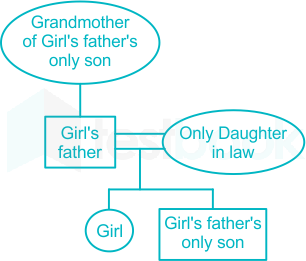
Pointing out to a lady, a girl said," She is the only daughter-in-law of the grand mother of my father's only son". How is the lady related to the girl?

  1. ((a))

    Daughter

  2. ((b))

    Sister

  3. ((c))

    Mother

  4. ((d))

    Cousin

Show Answer
Answer: ((c))

Mother

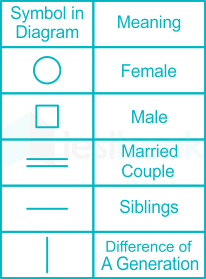
Preparing the family tree using the following symbols:

A possible tree diagram will be:

Lady is the mother of the Girl.

Hence, the correct answer is "Mother".

54

Identify the diagram that best depicts the relation among Classroom, Black Board and school.

  1. ((a))

    a

  2. ((b))

    b

  3. ((c))

    c

  4. ((d))

    d

Show Answer
Answer: ((a))

a

Venn diagram according to the given information is:

Classroom, Black Board and school.

Both Classroom and Blackboard in School.

And Black board in Classroom.

Hence, the correct answer is "Option (1)".

55

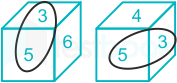
Three positions of a dice are given below. Identify the number on the face opposite to 6.

  1. ((a))

    1

  2. ((b))

    4

  3. ((c))

    5

  4. ((d))

    7

Show Answer
Answer: ((b))

4

Taking Dice position (2) and (3), as 3 and 5 are common;

The remaining number in Dice position (2) is 6.

The remaining number in Dice position (3) is 4.

So, 6 and 4 are opposite number pairs.

Hence, "4" is the correct answer.

56

Select the figure from the answer figures which would replace the question mark (?).

  1. ((a))

  2. ((b))

  3. ((c))

  4. ((d))

Show Answer
Answer: ((a))

Logic: One Figure is Added.

In Figure 1 and Figure 2 →

One Triangle is added in first Figure.

Similarly;

In Figure 3 and Figure 4 →

One Circle is added in first Figure.

Hence, the correct answer is "Option (1)".

57

Find the figure which is different from the other three.

  1. ((a))

    a

  2. ((b))

    b

  3. ((c))

    c

  4. ((d))

    d

Show Answer
Answer: ((c))

c

Figure 1:

One Small Squares in the middle.

Figure 2:

One Small Squares in the middle.

Figure 3:

Two Small Squares in the middle.

Figure 4:

One Small Squares in the middle.

Figure (3) is different from all other figures.

Hence, the correct answer is "Option (3)".

58

One out of the 4 options resembles these figure which is obtained by folding the transparent sheet along the dotted line. Find the answer.

  1. ((a))

  2. ((b))

  3. ((c))

  4. ((d))

Show Answer
Answer: ((b))

The given figure when unfolded is as follows:

Hence, option (2) is the correct answer.

59

'Metal' is related to which of the following options in the same way as 'Omelet' is related to 'Eggs'?

  1. ((a))

    ore

  2. ((b))

    iron

  3. ((c))

    gold

  4. ((d))

    aluminum

Show Answer
Answer: ((a))

ore

An omelet is made from eggs.

Similarly;

Metal is processed or extracted from ore.

In both cases, the first term is a product or end result of the second term.

Hence, the correct answer is "Ore".

60

If the sum of three consecutive numbers is 15, what is the square of the middle number?

  1. ((a))

    16

  2. ((b))

    25

  3. ((c))

    36

  4. ((d))

    9

Show Answer
Answer: ((b))

25

Let one number be x.

So, the other numbers are (x + 1) and (x + 2).

According to Questions;

x + (x + 1) + (x + 2) = 15

3x = 12

x = 4.

So the middle number is x + 1 = 5

Thus, the square of middle number is 52 = 25.

Hence, the correct answer is "25".

61

Select the correct mirror image of the given figure when the mirror is placed to the right of the figure.

  1. ((a))

  2. ((b))

  3. ((c))

  4. ((d))

Show Answer
Answer: ((c))

The mirror image of this image is:

Hence, the correct answer is "Option (3)".

62

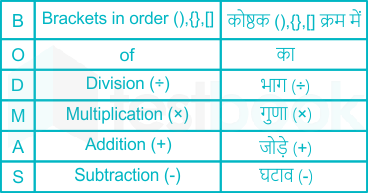
If × means ÷, + means ×, then solve the expression 16 + 4 × M = 8 and find the value of M?

  1. ((a))

    4

  2. ((b))

    8

  3. ((c))

    6

  4. ((d))

    12

Show Answer
Answer: ((b))

8

The logic followed is:

Decoding the information, 

Symbol×+
Meaning÷×


Given the equation: 16 + 4 × M = 8

After replacing the signs from left to right and using the BODMAS rule,

⇒ 16 + 4 × M = 8

⇒ 16 × 4 ÷ M = 8

⇒ 64/M = 8

⇒ M = 64/8

⇒ M = 8

Hence, the correct answer is "8".

63

The given words are in jumbled order. Put these words in a systematic order.

  1. Country
  2. Furniture
  3. Forest
  4. Wood
  5. Tree
  1. ((a))

    1, 3, 5, 4, 2

  2. ((b))

    2, 4, 3, 1, 5

  3. ((c))

    5, 2, 3, 1, 4

  4. ((d))

    1, 4, 3, 2, 5

Show Answer
Answer: ((a))

1, 3, 5, 4, 2

Arrangement
1. Country
3. Forest
5. Tree
4. Wood
2. Furniture

Here the order is determined as : one thing is subpart of other.

In this case, Furniture is made of wood, wood is extracted from a tree, a tree is found in the forest, and forests are a part of a country.

Hence, the correct answer is "Option (1)".

64

What number will come in place of the question mark (?) in the given number series?

5, 10, 20, 40, 80, ?

  1. ((a))

    140

  2. ((b))

    150

  3. ((c))

    160

  4. ((d))

    120

Show Answer
Answer: ((c))

160

The Pattern followed here is;

Hence, the correct answer is "160".

65

What number will come in place of the question mark (?) in the given number series?

55, 58, 64, ?, 85

  1. ((a))

    77

  2. ((b))

    70

  3. ((c))

    67

  4. ((d))

    73

Show Answer
Answer: ((d))

73

The patten followed here is:

Hence, the correct answer is "73".

66

Which letter will come in place of the question mark (?) in the given letter series?

BDF, DHL, FLR, ?

  1. ((a))

    HPX

  2. ((b))

    HPY

  3. ((c))

    HOX

  4. ((d))

    IQY

Show Answer
Answer: ((a))

HPX

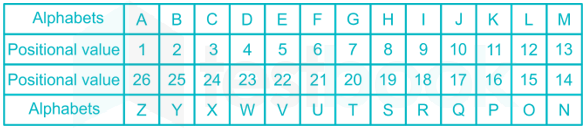
According to the English Alphabet series and the positional values:

The pattern followed here is, 

Hence, the correct answer is "HPX".

67

State which one of these words is different from the other three words.

  1. ((a))

    wood

  2. ((b))

    Stone

  3. ((c))

    engine

  4. ((d))

    tree

Show Answer
Answer: ((c))

engine

The words wood, stone, and tree are all naturally occurring materials or entities in the environment.

  • "Wood" comes from trees.
  • "Stone" is a naturally occurring solid substance.
  • "Tree" is a plant.

On the other hand;

"Engine" is a man-made object and does not naturally occur in the environment.

  • It is created by humans for specific usage, usually for converting energy into useful mechanical motion.
  • This fundamental difference sets "engine" apart from the other three words.

Hence, the correct answer is "Engine".

68

Select the correct option and replace the question mark.

AB ∶ EF ∶∶ IJ ∶ ?

  1. ((a))

    MN

  2. ((b))

    KL

  3. ((c))

    OP

  4. ((d))

    LM

Show Answer
Answer: ((a))

MN

The positions of the letters according to the English alphabet series:

The pattern for this is as follows;

Similarly;

Hence, the correct answer is "MN".

69

Select the odd word from the given alternatives.

  1. ((a))

    Larva

  2. ((b))

    Bark

  3. ((c))

    Croak

  4. ((d))

    Bleat

Show Answer
Answer: ((a))

Larva

"Larva" is different from the other words as it is a stage in the life cycle of many animals, typically insects or amphibians.

It describes a developmental phase.

On the other hand;

"Bark," "Croak," and "Bleat" are all verbs that describe the sounds made by different types of animals.

  • Dogs ("bark")
  • Frogs ("croak")
  • Sheep or goats ("bleat").

Thus, these three words are related to animal sounds, while "Larva" describes a stage in an animal's life cycle.

Hence, the correct answer is "Larva".

70

Replace the question mark (?) with the suitable option.

3, 8, 5, 27, 8, 64, 12, 125, 17, ?

  1. ((a))

    216

  2. ((b))

    361

  3. ((c))

    625

  4. ((d))

    441

Show Answer
Answer: ((a))

216

The pattern followed here is:

Hence, the correct answer is "216".

71

Study the arrangement of letters carefully and answer the question.

XUVMRSTMWNVWOPMWUVACWMV

If all the vowels are dropped from the above arrangement, which of the following will be 8th from right end?

  1. ((a))

    W

  2. ((b))

    P

  3. ((c))

    M

  4. ((d))

    C

Show Answer
Answer: ((b))

P

Given:

XUVMRSTMWNVWOPMWUVACWMV

All the vowels are dropped from the above arrangement:

XVMRSTMWNVWPMWVCWMV

Letter 8th from right end = P

XVMRSTMWNVWPMWVCWMV

Hence, the correct answer is "P".

72

In a certain code language 'FROM' is coded as 'HTQO', then how will 'COME' be written in that language?

  1. ((a))

    REOQ

  2. ((b))

    MOLE

  3. ((c))

    GOOE

  4. ((d))

    EQOG

Show Answer
Answer: ((d))

EQOG

The positions of the letters according to the English alphabet series:

The pattern for this is as follows;

Similarly;

Hence, the correct answer is "EQOG".

73

Arrange the following words in a logical sequence as they would appear in the english dictionary.

  1. Examine
  2. Excited
  3. Exclaim
  4. Example
  5. Execute
  1. ((a))

    4, 1, 3, 5, 2

  2. ((b))

    5, 3, 4, 1, 2

  3. ((c))

    1, 4, 2, 5, 3

  4. ((d))

    1, 4, 2, 3, 5

Show Answer
Answer: ((d))

1, 4, 2, 3, 5

As per the dictionary, the given words can be arranged as:

  1. Examine
  2. Example
  3. Excited
  4. Exclaim
  5. Execute

The correct sequence is "1, 4, 2, 3, 5".

Hence, the correct answer is "1, 4, 2, 3, 5".

74

Assume that the characters in each set follow a similar pattern, find the missing character.

  1. ((a))

    32

  2. ((b))

    36

  3. ((c))

    30

  4. ((d))

    28

Show Answer
Answer: ((b))

36

The logic followed here is;

Sum of all the corner numbers × 2 = Middle Number 

Figure 1:

(5 + 2 + 3 + 4) × 2 

= 14 × 2 

= 28

Figure 2:

(6 + 1 + 4 + 2) × 2

= 13 × 2

= 26

Figure 3:

(5 + 3 + 6 + 4) × 2

= 18 × 2

= 36

Hence, the correct answer is "36".

75

In a group of five districts Akbarpur is smaller than Fatehpur, Dhanbad is bigger than Palamu and Barabanki is bigger than Fatehpur but not as big as Palamu. Which district is the biggest?

  1. ((a))

    Akbarpur

  2. ((b))

    Fatehpur

  3. ((c))

    Palamu

  4. ((d))

    Dhanbad

Show Answer
Answer: ((d))

Dhanbad

  1. Akbarpur is smaller than Fatehpur.

Fatehpur > Akbarpur

2) Dhanbad is bigger than Palamu.

Dhanbad > Palamu

  1. Barabanki is bigger than Fatehpur but not as big as Palamu. 

Palamu > Barabanki > Fatehpur 

Combining the statements;

Dhanbad > Palamu > Barabanki > Fatehpur > Akbarpur

Dhanbad is the biggest district.

Hence, the correct answer is "Dhanbad".

General English (25 questions)

76

Directions: Select the option which best expresses the same sentence in indirect/direct speech.
He said to the interviewer, "Can you please repeat the question?"

  1. ((a))

    He requested the interviewer if he can repeat the question.

  2. ((b))

    He requested the interviewer to please repeat the question.

  3. ((c))

    He requested the interviewer if he could repeat the question.

  4. ((d))

    He told the interviewer to repeat the question.

Show Answer
Answer: ((c))

He requested the interviewer if he could repeat the question.

The correct answer is '3' i.e. He requested the interviewer if he could repeat the question.

Key Points

  • In indirect speech, a request is often reported using verbs like 'ask', 'request', or 'beg', and frequently incorporates 'if' or 'whether' to introduce the request.
  • Direct Speech: "Can you please repeat the question?" asked to the interviewer.
  • Indirect Speech: He requested the interviewer if he could repeat the question.
  • Option 3 correctly uses 'if' to introduce the request and shifts the modal verb 'can' to 'could' to reflect reported speech.
  • Option 2, while grammatically valid, inappropriately emphasizes 'please' in the structure of reported speech.
  • Options 1 and 4 either incorrectly use modal verbs or alter the request into an imperative statement, which is not the intended meaning.

Hence, the correct answer is option 3.

77

Directions: Select the option which best expresses the same sentence in indirect/direct speech.

He said, "Be quiet and listen to my words".

  1. ((a))

    He said you should be quiet and listen to my words.

  2. ((b))

    He urged them and said be quiet and listen to words.

  3. ((c))

    He said they should be quiet and listen to his words.

  4. ((d))

    He urged them to be quiet and listen to his words.

Show Answer
Answer: ((d))

He urged them to be quiet and listen to his words.

The correct answer is "He urged them to be quiet and listen to his words."

 Key Points

  • The statement "Be quiet and listen to my words" is an imperative sentence showing command or request. This is correctly converted to indirect speech with 'urged them to'.
  • Using 'them' indicates he was speaking to one or more persons, which matches the original context.
  • The original imperative mood of the sentence('Be quiet and listen to my words') is maintained in the indirect sentence.
  • So, the proper indirect form of "He said, Be quiet and listen to my words" is "He urged them to be quiet and listen to his words."

Hence, the correct answer is ‘Option 4’.

78

Directions: Select the one which best expresses the same sentence in passive/active voice.

When did he return my books?

  1. ((a))

    When has he returned my books?

  2. ((b))

    When will my books be returned by him?

  3. ((c))

    When were my books returned by him?

  4. ((d))

    When are my books retuned by him?

Show Answer
Answer: ((c))

When were my books returned by him?

The correct answer is "When were my books returned by him?"

 Key Points

  • The sentence "When did he return my books?" is a simple past tense question. The corresponding passive form also should maintain this tense.
  • The particular action of returning books is already completed. Therefore, the simple past passive 'were returned' is appropriate.
  • 'By him' retains the agent of the original sentence, making the passive voice equivalent in meaning to the original active sentence.
  • So, the proper passive form of "When did he return my books?" is "When were my books returned by him?"

Hence, the correct answer is ‘Option 3’.

79

Directions: Select the one which best expresses the same sentence in passive/active voice.

Gandhiji started the Quit India Movement in 1942.

  1. ((a))

    The Quit India Movement had been started by Gandhiji in 1942.

  2. ((b))

    The Quit India Movement was been started by Gandhiji in 1942.

  3. ((c))

    The Quit India Movement was started by Gandhiji in 1942.

  4. ((d))

    The Quit India Movement started by Gandhiji in 1942.

Show Answer
Answer: ((c))

The Quit India Movement was started by Gandhiji in 1942.

The correct answer is "The Quit India Movement was started by Gandhiji in 1942."

 Key Points

  • The sentence "Gandhiji started the Quit India Movement in 1942" is in the simple past tense, hence when transforming into the passive voice, the verb form 'was started' is the correct choice keeping the tense intact.
  • Here, 'The Quit India Movement' is the object in the active sentence that becomes the subject in the passive one.
  • Similarly, the subject 'Gandhiji' in the active sentence becomes the agent 'by Gandhiji' in the passive sentence.
  • So, the proper passive form of the sentence "Gandhiji started the Quit India Movement in 1942" is "The Quit India Movement was started by Gandhiji in 1942."

Hence, the correct answer is ‘Option 3’

80

Directions: Select the one which best expresses the same sentence in passive/active voice.

The modern means of communication have made life so much easier.

  1. ((a))

    Life has been made so much easier by the modern means of communication.

  2. ((b))

    Life is being so much easier by the modern means of communication.

  3. ((c))

    Life had been made so much easier by the modern means of communication.

  4. ((d))

    Life was made so much easier by the modern means of communication.

Show Answer
Answer: ((a))

Life has been made so much easier by the modern means of communication.

The correct answer is "Life has been made so much easier by the modern means of communication."

 Key Points

  • The sentence "The modern means of communication have made life so much easier" is in the present perfect tense. The corresponding passive form also should maintain this tense which is 'has been made'.
  • The sentence in passive voice gives more emphasis on the effect (Life) rather than the cause (The modern means of communication), making it the preferred choice in this context.
  • The passive voice maintains the tense and connotations of the original active sentence.
  • So, the proper passive form of the sentence "The modern means of communication have made life so much easier" is "Life has been made so much easier by the modern means of communication."

Hence, the correct answer is ‘Option 1’.

81

Directions: Choose the word nearest in meaning to the given words.

DISASTER

  1. ((a))

    hindrance

  2. ((b))

    weather

  3. ((c))

    misfortune

  4. ((d))

    none

Show Answer
Answer: ((c))

misfortune

The correct answer is "misfortune".

 Key Points

  • The word "Disaster" primarily refers to a sudden event, such as an accident or a natural catastrophe, that causes great damage or loss of life. It represents a grave misfortune or setback.(एक ऐसी आवेगशीली घटना का जैसे कि दुर्घटना या प्राकृतिक विनाश, जिससे भारी क्षति या जीवन की हानि होती है)
  • Example- The earthquake was a disaster that resulted in significant loss of life.
  • "Misfortune" means bad luck or an unfortunate condition or event.(दुर्भाग्य या एक अनहोनी स्थिति या घटना।)
  • Example- His life was filled with a series of misfortunes.
  • Hence, the option that is similar in meaning to the given word is 'Misfortune'.

Therefore, the correct answer is 'Option 3'.

 Additional Information

  • Let’s have a look at the meaning of the remaining options.
  • "Hindrance" signifies an obstacle or something that provides resistance, delay, or obstruction to something or someone.(बाधा).
  • "Weather" denotes the day-to-day atmospheric conditions.(मौसम).
82

Directions: Choose the word nearest in meaning to the given words.

DEMOLISH

  1. ((a))

    praise

  2. ((b))

    none

  3. ((c))

    meditate

  4. ((d))

    dismantle

Show Answer
Answer: ((d))

dismantle

The correct answer is "dismantle".

 Key Points

  • "Demolish" primarily signifies to completely destroy a building, structure, or idea.
  • (नष्ट कर देना मुख्य रूप से ज्यादातर एक इमारत, संरचना, या विचार को पूरी तरह से नष्ट कर देने का संकेत देता है।)
  • Example- The old building was demolished to make way for a new shopping center.
  • "Dismantle" means to take a machine or structure to pieces.
  • (एक मशीन या संरचना को टुकड़ों में ले जाना।)
  • Example- They had to dismantle the engine to find the problem.
  • Hence, the option that is similar in meaning to the given word is 'Dismantle'.

Therefore, the correct answer is 'Option 4'.

 Additional Information

  • Let’s have a look at the meaning of the remaining options.
  • "Praise" means expressing approval or admiration for someone or something.(प्रशंसा).
  • "Meditate" signifies deeply think about something.(ध्यान लगाना).
83

Directions: Choose the word nearest in meaning to the given words.

DEDICATE

  1. ((a))

    delay

  2. ((b))

    reveal

  3. ((c))

    none

  4. ((d))

    devote

Show Answer
Answer: ((d))

devote

The correct answer is "devote".

 Key Points

  • "Dedicate" typically refers to devoting time, effort, or oneself to a particular task or purpose.(एक विशेष कार्य या उद्देश्य के लिए समय, प्रयास, या स्वयं को समर्पित करने का संकेत देता है।)
  • Example- She dedicated her life to helping the poor.
  • "Devote" means dedicating or giving time, effort, or resources to something.(विशेष रूप से किसी चीज़ के लिए समय, प्रयास, या संसाधनों को देना।)
  • Example- He needs to devote more time to his studies.
  • Hence, the option that is similar in meaning to the given word is 'Devote'.

Therefore, the correct answer is 'Option 4'.

 Additional Information

  • Let’s have a look at the meaning of the remaining options.
  • "Delay" means to make something happen at a later time than originally planned.(देर).
84

Directions: Select the word/phrase which is closest to the opposite in meaning of the given word or phrase.

Cumbersome

  1. ((a))

    heavy

  2. ((b))

    automatic

  3. ((c))

    smooth

  4. ((d))

    convenient

Show Answer
Answer: ((d))

convenient

The correct answer is 'convenient'.

 Key Points

  • "Cumbersome" mainly refers to something that is large or heavy and therefore difficult to carry or use; or slow or complicated and therefore inefficient.(बोझिल मुख्यत: किसी चीज का संकेत देता है जो बड़ी या भारी होती है और इसलिए उसे उठाने या उपयोग करने में कठिनाई होती है)
  • Example- The application process for the scholarship is quite cumbersome.
  • "Convenient" represents something that suits your purposes or situation and is therefore easy and suitable for you to use.(सुविधाजनक ऐसी चीज का प्रतीक होता है जो आपके उद्देश्यों या परिस्थितियों के अनुरूप होती है)
  • Example- Online shopping is convenient because you can buy things without leaving your house.
  • Hence, the option that is opposite in meaning to the given word is 'Convenient'.

Therefore, the correct answer is 'Option 4'.

 Additional Information

  • Let’s take a look at the meaning of the remaining options.
  • "Heavy" is used to describe something that is hard to lift or move because of its size or weight. In Devanagari, it is (भारी).
  • "Automatic" refers to something that is self-acting or self-regulating. It's translated in Devanagari as (स्वतः).
85

Directions: Select the word/phrase which is closest to the opposite in meaning of the given word or phrase.

Procrastinate

  1. ((a))

    experiment

  2. ((b))

    expedite

  3. ((c))

    exclude

  4. ((d))

    propagate

Show Answer
Answer: ((b))

expedite

The correct answer is "expedite".

 Key Points

  • "Procrastinate" refers to the act of delaying or postponing something.(टाल-मटोल का तात्पर्य किसी चीज को देरी करने या स्थगित करने के काम का है।)
  • Example- Students often procrastinate when it comes to studying.
  • "Expedite" signifies making an action or process happen quicker or be accomplished faster.(शीघ्र करने का अर्थ है किसी कार्रवाई या प्रक्रिया को तेजी से घटित करने या इसे तेजी से पूरा करना।)
  • Example-They made a request to expedite the processing of their visa application.
  • Hence, the option that is opposite in meaning to the given word is 'Expedite'.

Therefore, the correct answer is 'Option 2'.

 Additional Information

  • Let’s have a look at the meaning of the remaining options.
  • "Experiment" means a scientific procedure undertaken to make a discovery or test a hypothesis.(प्रयोग).
  • "Propagate" means spread and promote (an idea, theory, etc.) widely.(प्रसारित करना).
86

Directions:- Choose the alternative that best expresses the meaning of the expression for the underlined

She rejected his proposal of marriage point blank.

  1. ((a))

    absurdly

  2. ((b))

    pointedly

  3. ((c))

    directly

  4. ((d))

    briefly

Show Answer
Answer: ((c))

directly

The correct answer is "directly"

 Key Points

  • The phrase 'point blank' in its typical usage refers to a situation where something is done or said straightforwardly or in a direct or immediate manner. It means without any intervening medium or without further elaboration.
  • In the context of the sentence - "She rejected his proposal of marriage point blank", it means she turned down the proposal without any circumlocution or any palliative phrases to lessen the bluntness of her response.
  • Hence, among the given options, 'directly' is the most accurate as it expresses the directness and immediateness that the phrase 'point blank' typically implies.
  • None of the remaining options, ‘absurdly’, ‘pointedly’, or ‘briefly’, correctly mirrors the intended meaning conveyed by 'point blank". They either add a level of ridicule, intentionality or succinctness which are not inherent in the original phrase.

Hence, the correct answer is ‘Option 3’.

87

Directions:- Choose the alternative that best expresses the meaning of the expression given in Bold

His most trusted friend proved to be a snake in the grass.

  1. ((a))

    a hidden enemy

  2. ((b))

    an unreliable and deceitful person

  3. ((c))

    cowardly and brutal

  4. ((d))

    low and mean

Show Answer
Answer: ((a))

a hidden enemy

The correct answer is "a hidden enemy."

 Key Points

  • The idiom 'a snake in the grass' refers to a person who is treacherous, deceitful, or cannot be trusted.
  • It is used to describe an individual who feigns friendship while harbouring harmful intentions.
  • Examining the options:
  • "a hidden enemy" - This option is a good fit as it brings out the aspect of treachery concealed under a façade of friendship, similar to a snake hiding in the grass, ready to strike unexpectedly.
  • "an unreliable and deceitful person" - This option is also suitable as it directly points to the qualities of dishonesty and untrustworthiness associated with a 'snake in the grass.'
  • "cowardly and brutal" - This phrase does not entirely catch the essence of 'a snake in the grass.' While it could be argued that someone who betrays trust might be cowardly, the key concept of hidden malice is not conveyed.
  • "low and mean" – While some aspects could arguably apply to a 'snake in the grass,' it doesn't fully encapsulate the cunning and hidden deceit implied by the phrase.
  • Looking at all the options, the best fit would be "a hidden enemy."
  • It captures the essence of unexpected harm attributed to a 'snake in the grass.'
  • However, it should be noted that "an unreliable and deceitful person" is also a correct interpretation stressing more on the character traits of the person.
  • So, depending on the context either option 1 or 2 could be correct.
  • In this specific context where no other details are given, option 1 might be more appropriate as the expression 'snake in the grass' tends to emphasize the sneaky and hidden harmful intentions akin to a 'hidden enemy.'

Therefore, the correct answer is "Option 1".

88

Directions: Choose the one which can be substituted for the given words/phrases.

The act of producing beautiful handwriting using a brush or a special pen.

  1. ((a))

    Hieroglyphics

  2. ((b))

    Calligraphy

  3. ((c))

    Stencilling

  4. ((d))

    Graphics

Show Answer
Answer: ((b))

Calligraphy

The correct answer is "Calligraphy"

 Key Points

  • The act of producing beautiful handwriting using a brush or a special pen is known as 'Calligraphy'. It is a visual art where writing is regarded as an expression of creativity.
  • Among the options provided, 'Hieroglyphics', 'Stencilling', and 'Graphics', though all related to the domain of art or writing in some form, do not specifically refer to the creation of beautiful handwriting via specialized tools.
  • 'Hieroglyphics' refers to a system of writing using ancient picture symbols, 'Stencilling' is an art form by which images are created by applying pigment to a surface over an intermediary object and 'Graphics' pertains to the generic field involving the creation of visual content.
  • Hence, 'calligraphy' stands as the correct substitution for the phrase based on the specificity and relevance it maintains with respect to the original phrase.

Hence, the correct answer is ‘Option 2’.

89

Choose the one which can be substituted for the given words/phrases.

A study of sounds.

  1. ((a))

    phonetics

  2. ((b))

    stylistics

  3. ((c))

    linguistics

  4. ((d))

    semantics

Show Answer
Answer: ((a))

phonetics

The correct answer is "phonetics"

 Key Points

  • The term for the study of sounds, specifically those produced during human speech, is 'Phonetics'. It delves into the physical sounds themselves, how we hear and perceive them, and how they are produced.
  • Among the options, 'stylistics', 'linguistics' and 'semantics', do not represent the study of sounds directly. They are related to language and speech but deal with different aspects of it.
  • 'Stylistics' is the study and interpretation of texts with regard to their linguistic and tonal style. 'Linguistics' refers to the scientific study of language and its structure. 'Semantics' pertains to the aspect of language concerned with meaning.
  • Therefore, with its direct relevance to the question, 'phonetics' is the correct substitution for the phrase.

Hence, the correct answer is ‘Option 1’.

Directions: Read the given passage and answer the questions that follow.

Difficult times could create feelings of anxiety, insecurity and fear. As we navigate through undesirable situations and uncertainties, we find that negativities surrounding the problems consume our mind. It is in those times that we have to exert ourselves to change our perspective and adopt a more positive and solution-driven attitude. Wise people have always chosen to leverage adversities as opportunities for growth and progress, rather than succumb to negative thought patterns. Saint Kabir described how different people respond when challenged by problems: "Gold, virtuous people and saints are resilient; you may break them a hundred times and yet they will re-join. In contrast, negative people and clay pots are fragile; once shattered, they are broken forever."

The distinguishing feature of the successful is that they have a mindset that enable them to, remain positive in the face of adversity and even utilise the negative situation for their benefit. The eagle can teach us a few lessons on this. When the storm starts blowing, it does not cower down before it. It flies to a higher point and waits for the wind to blow over. When the storm sets in, the eagle spreads its wings and uses the draft of the wind to rise higher and higher in the sky. It does not run away from the storm, rather it uses the storm rather it uses the storm to its advantage. While the storm rages below, the eagle soars above it.

The winning altitude to overcome despair and stress is to realise that adversities have opportunities inherent in them, and opportunities do not come without problems. Hence, difficulties and obstacles have a positive side to them as they make us grow from within. A gem gets polished with friction. The finest steel is produced by putting it in fire. Similarly, the more hardships we face, the stronger we become.

90

Saint Kabir believed that saintly people:

  1. ((a))

    can be broken easily

  2. ((b))

    can regain their strength easily

  3. ((c))

    can be overcome by fear easily

  4. ((d))

    are not willing to suffer a hundred times

Show Answer
Answer: ((b))

can regain their strength easily

The correct answer is "can regain their strength easily".

Key Points

  • In the given passage, Saint Kabir indicates that virtuous people and saints are not easily broken. Instead, even when they are broken, they can regain their strength and reunite, which metaphorically implies that they regain their lost resilience and bounce back from adversity.
  • He contrasts this with negative people and clay pots which, once broken, cannot be restored. This comparison magnifies the resilience and strength of virtuous individuals.
  • Saint Kabir emphasizes that true resilience is not about avoiding breakdown but about one's ability to recuperate and restore themselves regardless of how many times they are 'broken'.
  • Saintly people, according to him, possess this unique capacity to restore and rejuvenate themselves even after facing multiple challenges and hardships.

Hence, the correct answer is 'Option 2'.

91

Which of the following is NOT a message that the passage gives up?

  1. ((a))

    Difficulties enable us to become stronger as we learn to face them.

  2. ((b))

    Those who are positive are fragile and can be easily shattered by difficulties.

  3. ((c))

    We have to change our view point and adopt a more positive and soultion-driven attitude towards difficulties.

  4. ((d))

    Adversities have opportunities as well as obstacles inherent in them.

Show Answer
Answer: ((b))

Those who are positive are fragile and can be easily shattered by difficulties.

The correct answer is "Those who are positive are fragile and can be easily shattered by difficulties."

Key Points

  • Contrary to the statement in this option, the passage suggests that individuals with a positive mindset tend to be resilient and are able to use adversities for their own benefit.
  • The passage further emphasizes the idea of leveraging adversity as an opportunity for growth and progress rather than capitulating to negativity.
  • It also denotes that people with a positive mindset, much like the eagle in the storm, do not avoid adversity but rather rise above it, using it as an impetus to grow stronger.
  • Hence, people who maintain a positive and solution-driven attitude are resistant to difficulties and are not easily broken, contrary to the claim made in this option.

Hence, the correct answer is 'Option 2'.

92

Which of the following is an ideal way of handling a difficult situation?

  1. ((a))

    Thinking deeply about the impact of adversities

  2. ((b))

    Making the best use of a situation to your advantage

  3. ((c))

    Moving away from difficulties

  4. ((d))

    Becoming overcome by stress and negativity

Show Answer
Answer: ((b))

Making the best use of a situation to your advantage

The correct answer is "Making the best use of a situation to your advantage".

Key Points

  • According to the passage, a winning attitude towards adversity involves seeing the inherent opportunities, rather than focusing solely on the difficulties. This involves actively seeking ways to utilize the situation to one's advantage.
  • This approach encompasses the use of hardships and obstacles as catalysts for individual growth and progress, akin to gems becoming polished through friction or steel becoming refined through fire.
  • The passage inspires using the example of an eagle that doesn't run from the storm but rather uses it to rise higher in the sky.
  • It promotes enduring resilience and a proactive attitude towards adversities, emphasizing the importance of using such challenges to stimulate growth.

Hence, the correct answer is 'Option 2'.

93

When there is a storm, an eagle ______

  1. ((a))

    uses it to fly away to safety

  2. ((b))

    flies high above it, using its force

  3. ((c))

    waits for it to end, then starts flying

  4. ((d))

    gets scared and hidęs to save itself

Show Answer
Answer: ((b))

flies high above it, using its force

The correct answer is "flies high above it, using its force".

Key Points

  • In the passage, the behavior of an eagle during a storm is used as a metaphor to convey an approach towards adversity.
  • Instead of avoiding the adversities, denoted by the storm, the eagle uses the very force of the storm (the challenges) to rise higher in the sky (to grow stronger and progress).
  • The eagle becomes an embodiment of resilience, strength, and wisdom, not just surviving the storm, but utilizing it to its own advantage.
  • This metaphor drives the message that facing difficulties head on and utilizing them for growth is the key to success.

Hence, the correct answer is 'Option 2'.

94

As per the passage, when we face difficult times:

  1. ((a))

    our minds get overcome by negative thoughts

  2. ((b))

    we become passively engaged in overcoming them

  3. ((c))

    we start changing our views on life

  4. ((d))

    we look at them as opportunities for improvement

Show Answer
Answer: ((a))

our minds get overcome by negative thoughts

The correct answer is "our minds get overcome by negative thoughts".

Key Points

  • The passage mentions that difficult times often instill feelings of anxiety, fear, and insecurity. These negative emotions can consume our minds when faced with adversities.
  • It identifies that at such times, it becomes essential to strive towards changing our perspective to a more positive and solution-driven mindset.
  • The passage does not imply that we passively engage, change our views on life, or view adversities as opportunities immediately, but rather highlights the initial instinct of the mind to focus on the negative aspects.
  • It encourages individuals to comprehend the situation and gradually shift their mindset to view the adversity as a potential for growth.

Hence, the correct answer is 'Option 1'.

95

Directions: Select the must suitable alternative to fill in the blanks.

He is like a body without a soul, an eye without light or a flower without ________

  1. ((a))

    leaves

  2. ((b))

    fragrance

  3. ((c))

    petal

  4. ((d))

    stem

Show Answer
Answer: ((b))

fragrance

The correct answer is "fragrance".

 Key Points

  • The first part of the sentence sets up a metaphor comparing someone to a body without a soul, then an eye without light. This rhetoric device frames the entities as incomplete or lacking something essential for them to function or express their essence in the fullness.
  • A body needs a soul, an eye needs light; similarly, a flower needs fragrance to be complete. Fragrance is an intrinsic characteristic of a flower that makes its presence enjoyable and noticeable.
  • The options leaves, petal, and stem although also parts of a flower, their absence doesn't stop the flower from being enjoyed, expressed, or noticed save for the physical existence. But fragrance links more directly to a fuller sensual experience, analogous to a body's need for the soul or an eye's need for light.
  • Therefore, the most suitable alternative to fill in the blanks is 'fragrance'.

Hence, the correct answer is 'Option 2'.

96

Directions: Select the must suitable alternative to fill in the blanks.

The Deputy Manager __________ to resign because all his proposals were _________ down by his superiors.

  1. ((a))

    offered; thrown

  2. ((b))

    threatened; turned

  3. ((c))

    began; kept

  4. ((d))

    gave; held

Show Answer
Answer: ((b))

threatened; turned

The correct answer is "threatened, turned"

 Key Points

  • The sentence describes a situation where the Deputy Manager is reacting to the repeated rejection of his proposals by his superiors.
  • Thus, the context suggests a sense of frustration or dissatisfaction.
  • The phrase "threatened to resign" accurately captures the Deputy Manager's reaction to his situation, indicating that he warned or indicated his intention to leave his job as a form of protest or due to dissatisfaction.
  • The phrase "turned down" is a common idiom that means to reject or refuse an offer, request, or proposal.
  • It correctly represents the superiors' response to the proposals.
  • The combination of "threatened" and "turned down" logically and grammatically fits the context of the sentence, making it the most suitable choice.
  • Therefore, the correct answer is "Option 2".

Additional Information

  • "Offered; thrown" may seem like plausible choices, but "offered to resign" lacks the implication of frustration or protest suggested by the context, and "thrown down" is not the correct idiom for rejection in this context.
  • "Began; kept" does not accurately convey the meaning intended in the sentence.
  • "Began to resign" implies starting the process without the same connotation of protest or frustration, and "kept down" does not fit the context of proposal rejection.
  • "Gave; held" also fails to match the context.
  • "Gave to resign" is not a commonly used expression, and "held down" does not accurately represent the action of rejecting proposals.
97

Directions: Select the must suitable alternative to fill in the blanks.

The counter clerk was very busy and _________ not pay ______ to Sameer's request.

  1. ((a))

    can; help

  2. ((b))

    could; respect

  3. ((c))

    had; cash

  4. ((d))

    did; attention

Show Answer
Answer: ((d))

did; attention

The correct answer is "did, attention".

 Key Points

  • The sentence context involves a busy counter clerk who failed to notice Sameer's request. The verb that best completes this scenario is 'did', because it accurately implies that the action was not performed.
  • The phrase 'did not pay attention' is a common expression to denote that no heed or consideration was given to a matter or in this case, Sameer's request.
  • Other verbs like 'can', 'could', 'had' do not align appropriately with the intended context of the sentence.
  • Similarly, phrases like 'pay help', 'pay respect', 'pay cash' do not fit well in this context describing the interaction between the counter clerk and Sameer.

Hence, the correct answer is 'Option 4'.

98

Directions: Fill up the blanks with suitable prepositions.

Disruptive forces in the country are fatal _________ the integrity of the nation.

  1. ((a))

    to

  2. ((b))

    for

  3. ((c))

    with

  4. ((d))

    none of these

Show Answer
Answer: ((a))

to

The correct answer is "to".

 Key Points

  • The preposition 'to' correctly explains the relation between 'disruptive forces' and 'the integrity of the nation'.
  • 'To' indicates a negative impact or detrimental effect, communicating that disruptive forces can harm or destroy the nation's integrity.
  • The prepositions 'for', 'with', and 'none of these' fail to accurately express the damaging relationship between the disruptive forces and the nation's integrity needed in the sentence context.
  • In English language usage, the adjective 'fatal' is frequently followed by the preposition 'to' when referring to something that's harmful or deadly for something or someone else.

Hence, the correct answer is 'Option 1'.

99

Directions: Fill up the blanks with suitable prepositions.

Politeness is a quality that is alien _______ Mrs. Kapoor.

  1. ((a))

    form

  2. ((b))

    of

  3. ((c))

    to

  4. ((d))

    none of these

Show Answer
Answer: ((c))

to

The correct answer is "to".

 Key Points

  • The preposition 'to' correctly links the adjective 'alien' with 'Mrs. Kapoor', implying that politeness is a quality unfamiliar or atypical to her.
  • 'To' expresses the unfamiliarity or the lack of the quality (politeness) in Mrs. Kapoor.
  • The prepositions 'form', 'of', and 'none of these' don't accurately convey the needed meaning in this sentence.
  • The adjective 'alien' is usually followed by the preposition 'to' when indicating that a certain characteristic is unfamiliar or strange to a person or situation.

Hence, the correct answer is 'Option 3'.

100

Directions: Fill up the blanks with suitable prepositions.

The attitude of the fanatics is always prejudicial _________ other religion.

  1. ((a))

    through

  2. ((b))

    by

  3. ((c))

    to

  4. ((d))

    none of these

Show Answer
Answer: ((c))

to

The correct answer is "to".

 Key Points

  • The preposition 'to' successfully conveys the potentially harmful effect of fanatics’ attitudes on other religions.
  • 'To' indicates a negative or detrimental influence, expressing that the fanatics' attitude is biased against or damaging to other religions.
  • The prepositions 'through', 'by', and 'none of these' don't coherently convey the contextual relationship needed between 'prejudicial' and 'other religions'.
  • The adjective 'prejudicial' is typically followed by the preposition 'to' when referring to something that is harmful or biased towards someone or something else.

Hence, the correct answer is 'Option 3'.

Attempt this paper under real exam conditions

Timed interface, section switching, instant scoring, and question-by-question analytics — free.

Start Timed Attempt