Official Paper

BPSC Assistant 2014 Official Paper (Previous Year Paper)

150 questions · 135 minutes · with answers · free

Test (150 questions)

1

'The Sea of ​​Innocence' is written by

  1. ((a))

    Raghu Rai

  2. ((b))

    Kishwar Desai

  3. ((c))

    Yuvraj Singh

  4. ((d))

    Y. V. Reddy

Show Answer
Answer: ((b))

Kishwar Desai

The correct answer is Kishwar Desai.

Key Points

  • Kishwar Desai is an Indian author and columnist.
  • Her latest novel The Sea of Innocence has just been published in India.
  • Her first novel, Witness the Night won the Costa Book Award in 2010 for Best First Novel and has been translated into over 25 languages.

 Additional InformationRaghu Rai:

  • He is an Indian photographer and photojournalist.
  • Rai was born in the village of Jhang, Punjab, British India.
  • He is known for his books, Raghu Rai's India: Reflections in Colour and Reflections in Black and White.

Yuvraj Singh:

  • He is a former Indian international cricketer.
  • Yuvraj was a member of the Indian cricket team in One Day Internationals (ODIs) between 2000 and 2017.
  • In a match against England at the 2007 World Twenty20, he famously hit six sixes in one over bowled by Stuart Broad.

Y.V Reddy:

  • Yaga Venugopal Reddy  is an Indian economist and a retired Indian Administrative Service (IAS) officer of the 1964 batch belonging to Andhra Pradesh cadre.
  • He served as governor of the Reserve Bank of India (RBI).
  • He received Padma Vibhushan in 2010.
2

'My dear Bapu' is written by

  1. ((a))

    Gopal Krishna Gandhi

  2. ((b))

    Jaswant Singh

  3. ((c))

    Ramachandra Guha

  4. ((d))

    K. N. Panikkar

Show Answer
Answer: ((a))

Gopal Krishna Gandhi

The correct answer is Gopal Krishna Gandhi.

Key PointsGopalkrishna Devadas Gandhi:

  • Gopalkrishna Devadas Gandhi  is a former administrator and diplomat who served as the 22nd Governor of West Bengal.
  • He is the grandson of Mahatma Gandhi.
  • He served as Secretary to the President of India and as High Commissioner to South Africa and Sri Lanka.

Jaswant Singh:

  • Jaswant Singh  was an officer of the Indian Army and an Indian Cabinet Minister.
  • He was one of the founding members of the Bharatiya Janata Party (BJP).

Ramachandra Guha:

  • He is an Indian historian, environmentalist, writer and public intellectual whose research interests include social, political, contemporary, environmental and cricket history, and the field of economics.
  • He is an important authority on the history of modern India.

K. N. Panikkar:

  • He  is an Indian historian, associated with the Marxist school of historiography.
  • K. N. Panikkar has written and edited a number of books, including A Concerned Indian’s Guide to Communalism and the ICHR volume on Towards Freedom, 1940: A Documentary History of the Freedom Struggle.
3

The motto of National Service Scheme is:

  1. ((a))

    For everyone

  2. ((b))

    Service fot all

  3. ((c))

    Selfless service

  4. ((d))

    Not me but you

Show Answer
Answer: ((d))

Not me but you

The correct answer is Not me but you.

Key PointsNational Service Scheme:

  • NSS is a Central Sector Scheme that was launched in 1969.
  • The objective of developing the personality and character of the student youth through voluntary community service.
  • The ideology of NSS is inspired by the ideals of Mahatma Gandhi.
  • Its Motto is Not me but You.
  • It is being implemented by the Ministry of Youth Affairs and Sports.

Additional InformationActivities undertaken by NSS:

  • National Integration Camp
  • Shramdaan
  • Blood donation
  • Immunisation
  • Plantation
  • Disaster Management
  • Adventure programs.
4

Bharatiya Mahila Bank was started in 2013 on her date of birth

  1. ((a))

    Kasturba Gandhi

  2. ((b))

    Indira Gandhi

  3. ((c))

    Sonia Gandhi

  4. ((d))

    None of these

Show Answer
Answer: ((b))

Indira Gandhi

The correct answer is Indira Gandhi.

Key PointsBharatiya Mahila Bank:

  • BMB was an Indian investment bank located in Mumbai.
  • On 19 November 2013, former Indian Prime Minister Manmohan Singh launched the system on the 96th anniversary of former Indian PM Indira Gandhi's birthday.
  • Its objective is to focus on the banking needs of the women and promote economic empowerment.
  • It also seeks to address the gender related issues and will be helpful in financial inclusion.

Headquarter of Bharatiya Mahila Bank is located in New Delhi.

Additional InformationIndira Gandhi:

  • In 1950s, she serves as the President of the Indian National Congress.
  • In January 1966, Indira Gandhi became the first and only female Prime Minister of India to date.
  • She nationalised 14 largest banks in India in 1969.
  • In 1971, 'Garibi Hatao' was the slogan for Indira Gandhi's political bid in response to the opposition's slogan as 'Indira Hatao'.

Kasturba Gandhi:

  • Kasturbai Mohandas Gandhi was an Indian political activist.
  • She was married to Mohandas Gandhi, more commonly known as Mahatma Gandhi, in 1883.

Sonia Gandhi:

  • She is an Indian politician.
  • She is the longest serving president of the Indian National Congress, a social democratic political party.
  • Spouse: Rajiv Gandhi
5

President gives assent to National Food Security Bill, 2013

  1. ((a))

    In August

  2. ((b))

    In September

  3. ((c))

    In October

  4. ((d))

    In November

Show Answer
Answer: ((b))

In September

The correct answer is President gives assent to National Food Security Bill, 2013 in September.

Key PointsNational Food Security Act (NFSA), 2013

  • Notified on: 10th September, 2013.
  • Objective: To provide for food and nutritional security in the human life cycle approach, by ensuring access to adequate quantities of quality food at affordable prices to people to live a life with dignity.
  • Coverage: 75% of the rural population and upto 50% of the urban population for receiving subsidized foodgrains under Targeted Public Distribution System (TPDS).
  • Overall, NFSA caters to 67% of the total population.

Eligibility:

  • Priority Households to be covered under TPDS, according to guidelines by the State government.
  • Households covered under existing Antyodaya Anna Yojana.

Provisions:

  • 5 Kgs of foodgrains per person per month at Rs. 3/2/1 per Kg for rice/wheat/coarse grains.
  • The existing AAY household will continue to receive 35 Kgs of foodgrains per household per month.
  • Meal and maternity benefit of not less than Rs. 6,000 to pregnant women and lactating mothers during pregnancy and six months after the child birth.
  • Meals for children upto 14 years of age.
  • Food security allowance to beneficiaries in case of non-supply of entitled foodgrains or meals.
  • Setting up of grievance redressal mechanisms at the district and state level.
6

In which state was the three-tier Panchayati Raj first adopted?

  1. ((a))

    Bihar

  2. ((b))

    Rajasthan

  3. ((c))

    Madhya Pradesh

  4. ((d))

    Uttar Pradesh

Show Answer
Answer: ((b))

Rajasthan

The correct answer is Rajasthan.

Key Points

Rajasthan state was the first to establish Panchayati Raj System in India.

  • The Panchayat Raj system was first adopted by the state of Rajasthan in Nagaur district on 2 Oct 1959 but was first started by Andhra Pradesh.
  • During the 1950s and 60s, other state governments adopted this system as laws were passed to establish panchayats in various states.
  • The modern Panchayati Raj system was introduced in India by the 73rd constitutional amendment in 1993.
  • although it is based upon the historical Panchayati raj system of the Indian subcontinent and is also present in Pakistan, Bangladesh, and Nepal.
  • It states that this part does not apply to the states of Nagaland, Meghalaya, and Mizoram.

Additional Information Panchayati Raj :

  • Panchayati Raj is the system of local self-government of villages in rural India as opposed to urban and suburban municipalities.
  • It consists of the Panchayati Raj Institutions (PRIs) through which the self-government of villages is realized.
  • They are tasked with "economic development, strengthening social justice and implementation of Central and State Government Schemes including those 29 subjects listed in the Eleventh Schedule."
  • Part IX of the Indian Constitution is the section of the Constitution relating to the Panchayats.
  • It stipulates that in states or Union Territories with more than two million inhabitants there are three levels of PRIs:
  • the Gram Panchayats at village level
  • the Ksetra Panchayats at block level and
  • the District Panchayats at district level.
7

Emperor Akihito and Empress Michiko of Japan visited India in the meantime

  1. ((a))

    August-September, 2013

  2. ((b))

    September October, 2013

  3. ((c))

    October-November, 2013

  4. ((d))

    November December, 2013

Show Answer
Answer: ((c))

October-November, 2013

The correct answer is October-November, 2013.

Key Points

  • Emperor Akihito and Empress Michiko of Japan visited India in October-November, 2013.
  • It comes 53 years after Emperor Akihito and Empress Michiko first visited India as the crown prince and princess in 1960.
  • At the time, they were hosted by the first leaders of independent India – President Rajendra Prasad, Vice President Sarvepalli Radhakrishnan, and Prime Minister Jawaharlal Nehru.
Additional Information

  • Japan is an island country in East Asia.
  • Capital: Tokyo
  • Prime minister: Fumio Kishida

Shinzo Abe:

  • He was a Japanese politician who served as Prime Minister of Japan.
  • Abe was assassinated on 8 July 2022 while delivering a campaign speech in Nara.

India-Japan initiatives

  • Supply Chain Resilience Initiative (SCRI)
  • Acquisition and Cross-Servicing Agreement (ACSA)
  • Special Strategic and Global Partnership
  • Comprehensive Economic Partnership Agreement (CEPA)

Defence exercises:

  • JIMEX- bilateral naval exercise
  • SHINYU Maitri- bilateral air force exercise
  • Dharma Guardian- bilateral army exercise
  • Malabar- QUAD naval exercise
8

Which was the first capital of Magadha?

  1. ((a))

    Vaisali

  2. ((b))

    Champa

  3. ((c))

    Girivraj (Rajgrih)

  4. ((d))

    Patliputra

Show Answer
Answer: ((c))

Girivraj (Rajgrih)

The correct answer is Girivraj (Rajgrih)

Key PointsThe ancient city of Pataliputra was founded in the 5th century BCE by Udayin, king of Magadha (South Bihar). 

  • Udayin was the Indian ruler of the Haryanaka dynasty who ruled over Magadha from 460 BCE to 440 BCE.
  • He was the son of Ajatashatru and the grandson of king Bimbisara.
  • King Udayin laid the foundation of the city of Pataliputra at the confluence of two rivers, the Sone and the Ganges.
  • He shifted his capital from Rajgriha to Patliputra because of the latter's central location in the Magadha empire.


Important Points

  • In Ancient history, in the 6th century BC, North Indian provinces were divided into seven kingdoms out of which Avanti, Kosla, Vatsa, and Magadha.
  • Among which Magadha rose as an emerging power defeating other surrounding provinces.
  • Also, Magadha was a good center for trade and fertile land.
  • The first dynasty ruled over Magadha was the Haryanaka Dynasty whose prominent rulers were Bimbisara and Ajatshatru.
  • Bimbisara made Rajagriha as the capital.
9

Which Buddhist council was held during the time of Ashoka?

  1. ((a))

    First

  2. ((b))

    Second

  3. ((c))

    Third

  4. ((d))

    Fourth

Show Answer
Answer: ((c))

Third

The correct answer is Third.

Key Points 

  • The 3rd Buddhist council was held in 250 BC.
  • Venue: Ashoka Rama Vihar, Patliputra
  • Chairman: Moggaliputta Tissa
  • Patron: Ashoka (Maurya Dynasty)
  • Result: (i) Compilation of Mahavibhasa Sastra (ii) the division of Buddhists into Hinayanists.

Additional Information 

BUDDHIST COUNCILYEARVENUECHAIRMANPATRON
1st Buddhist Council483 BCRajgrihaMahakassapaAjatashatru
2nd Buddhist Council383 BCVaishaliSabbakamiKalashoka
3rd Buddhist Council250BCPatliputraMogaliputta TissaAshoka
4th Buddhist CouncilFirst-century ADKundalvanVasumitra/AswaghoshKanishka
10

Who was the chairman of the Constituent Assembly?

  1. ((a))

    Jawaharlal Nehru

  2. ((b))

    K. M. Munshi

  3. ((c))

    Dr. B. R. Ambedkar

  4. ((d))

    Dr. Rajendra Prasad

Show Answer
Answer: ((d))

Dr. Rajendra Prasad

The correct answer is Dr. Rajendra Prasad.

Key Points 

  • The constituent assembly was set up on 6th December 1946.
  • It was formed under the provisions of the cabinet mission plan.
  • The constitution of India was framed by the constituent assembly.
  • It takes 2 years 11 months and 18 days to frame the constitution of India.
  • The first meeting of the constituent assembly was held on 9th December 1946.
  • Dr. Sachidanda Sinha was elected as the temporary president of the assembly during its first meeting.
  • Dr. Rajendra Prasad was elected as the permanent president of the constituent assembly on 11th December 1946.
  • H C Mukharjee was the vice president of the constituent assembly.
  • B. N Rao was the constitutional advisor of the constituent assembly.

Additional Information 

  • Dr.B. R. Ambedkar was the chairman of the drafting committee.
  • Jawaharlal Nehru introduced the objective resolution in the constituent assembly on 13th December 1946.
  • He was the chairman of the union constitution committee.
  • Sardar Patel was the chairman of the committee on fundamental rights and minorities.
11

Who was the chairman of the constitution drafting committee?

  1. ((a))

    Sachchidanand Sinha

  2. ((b))

    Dr. B. R. Ambedkar

  3. ((c))

    Dr. Rajendra Prasad

  4. ((d))

    Maulana Abdul Kalam Azad

Show Answer
Answer: ((b))

Dr. B. R. Ambedkar

The correct answer is Dr. B.R. Ambedkar.

  • The Drafting Committee of the Constitution was chaired by Dr. B.R Ambedkar.
  • B. R. Ambedkar was a wise constitutional expert, he studied the constitutions of about 60 countries.
  • Ambedkar is recognized as the "Father of the Constitution of India".

Key Points 

  • The drafting committee was entrusted with the responsibility to prepare the Draft constitution.
  • The drafting committee was set up on 29 August 1947 under the chairmanship of Dr. B R Ambedkar.
  • The constituent assembly took 2 years, 11 months, and 18 days to frame the constitution.
  • There were 22 parts, 395 articles, and 8 schedules in the original constitution.
  • The constitution had got ready on 26th November 1949 and some provisions relating to Citizenship, Elections, provisional parliament, and temporary & transitional provisions were given immediate effect.
  • The rest of the constitution came into force on 26 January 1950.

Important Points 

  • 26 January 1930 marked the “Poorna Swarajya“ resolution of the Indian National Congress under Jawahar Lal Nehru and so the date was chosen in 1950 to be our republic day.
  • It must be noted that the idea of the constituent assembly was not of congress.
  • The idea was put forward by MN Roy in 1934.
  • The idea put forward by MN Roy was officially raised by Congress in 1935 and the British Government accepted this demand.
  • This demand of constituent assembly was accepted in the August offer of 1940.
12

Who was born in 1902 in Sitabadiyara (Bihar)?

  1. ((a))

    Jai Prakash Narayan

  2. ((b))

    Karpoori Thakur

  3. ((c))

    Ramdhari Singh Dinkar

  4. ((d))

    Dr. Rajendra Prasad

Show Answer
Answer: ((a))

Jai Prakash Narayan

The correct answer is Jai Prakash Narayan.

Key Points

  • Loknayak Jayaprakash Narayan was born on 11 October 1902 in Sitabadiyara, Bihar.
  • Jayaprakash Narayan is popularly known as JP or Lok Nayak.
  • He was an Indian independence activist, theorist, socialist and political leader.
  • He is also known as the "Hero of Quit India Movement".
  • JP Narayan is best known for opposing former Prime Minister Indira Gandhi.
  • It is said that Indira Gandhi's power was snatched away from her after the "JP movement" and gave the famous slogan "Sinhaasan khaali karo ki janta aati hai".
  • In 1948, he led the Socialist Party of the Congress and later formed the Samajwadi Socialist Party in association with the Gandhian Party.
13

What type of rock is slate?

  1. ((a))

    Sedimentary 

  2. ((b))

    Igneous 

  3. ((c))

    Metamorphic

  4. ((d))

    None of the above

Show Answer
Answer: ((c))

Metamorphic

The correct answer is Metamorphic.

Key PointsMetamorphic Rocks:

  • The word metamorphic means ‘change of form’.
  • Metamorphism is a process by which recrystallisation and reorganisation of minerals occur within a rock.
  • This occurs due to pressure, volume and temperature changes.
  • When rocks are forced down to lower levels by tectonic processes or when molten magma rising through the crust comes in contact with the crustal rocks, metamorphosis occurs.
  • In the process of metamorphism in some rocks grains or minerals get arranged in layers or lines. Such an arrangement is called foliation or lineation.
  • Sometimes minerals or materials of different groups are arranged into alternating thin to thick layers. Such a structure in is called banding.
  • Gneissoid, slate, schist, marble, quartzite etc. are some examples of metamorphic rocks.

Additional InformationIgneous Rocks:

  • It is formed out of magma and lava from the interior of the earth.
  • They are also known as primary rocks.
  • When magma in its upward movement cools and turns into a solid form it is called igneous rock.
  • The process of cooling and solidification can happen in the crust of the earth or on the surface of the earth.
  • Igneous rocks are classified based on texture.
  • Examples of igneous rocks:
  • Granite, Gabbro, Pegmatite, Basalt, Volcanic, Breccia,Tuff.

Sedimentary Rocks

  • Rocks of the earth’s surface area exposed to denudation agents and are broken up into various sizes of fragments.
  • These fragments are carried by various exogenous agencies and deposited.
  • These deposits through compaction turn into rocks. This process is called lithification.
  • In several sedimentary rocks, the layers of deposits maintain their characteristics even after lithification.
  • Sandstone, shale are some of the examples for Sedimentary Rocks.

Depending upon the mode of formation, sedimentary rocks are categorized into three groups:

  • Mechanically formed
  • Eg: Sandstone, conglomerate, limestone, shale, loess, etc.
  • Chemically formed
  • Eg: Chert, limestone, halite, potash, etc.
  • Organically formed
  • Eg: Geyserite, chalk, limestone, coal, etc.
14

The height of mount everest is

  1. ((a))

    8000 meter

  2. ((b))

    800 meter

  3. ((c))

    8848 meter

  4. ((d))

    8900 meter

Show Answer
Answer: ((c))

8848 meter

The correct answer is 8848 meters. 

Important Points 

  • Mount Everest, Sanskrit, and Nepali Sagarmatha, Tibetan Chomolungma, Chinese (Pinyin) Zhumulangma Feng, mountain on the crest of the Great Himalayas of southern Asia that lies on the border between Nepal and the Tibet Autonomous Region of China, at 27°59′ N 86°56′ E.
  • It has an elevation of 29,032 feet (8,848 meters) and is the highest mountain in the world. Hence, option 2 is the correct answer.

Additional Information 

  • Mount Everest has long been revered by local people.
  • Its most common Tibetan name, Chomolungma, means “Goddess Mother of the World” or “Goddess of the Valley.”
  • The Sanskrit name Sagarmatha means literally “Peak of Heaven.”
  • Its identity as the highest point on the Earth’s surface was not recognized, however, until 1852, when the governmental Survey of India established that fact.
  • In 1865 the mountain—previously referred to as Peak XV—was renamed for Sir George Everest, British surveyor general of India from 1830 to 1843.
15

Bokaro coalfield is located in-

  1. ((a))

    In Uttar Pradesh

  2. ((b))

    In Bihar

  3. ((c))

    In Jharkhand

  4. ((d))

    In West Bengal

Show Answer
Answer: ((c))

In Jharkhand

The correct answer is Jharkhand.

Key Points 

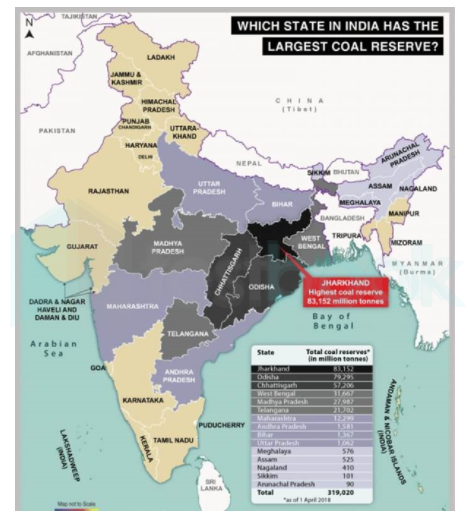
  • Jharkhand has the largest reserves of coal in India followed by Odisha and Chhattisgarh.
  • The Coal Resources of India:
  • It is mainly available in older Gondwana Formations of peninsular India and younger Tertiary formations of the northeastern region.
  • About 80 percent of the coal deposits in India are of the bituminous type and are of non-coking grade.
  • The most important Gondwana coal fields in India are located in Damodar Valley.
  • They lie in the Jharkhand-Bengal coal belt and the important coalfields in this region are Raniganj, Jharia, Bokaro, Giridih, and Karanpura.

Jharia is the largest coalfield followed by Raniganj.

  • The other river valleys associated with coal are the Godavari, Mahanadi, and Sone.
  • The most important coal-mining center is Singrauli in Madhya Pradesh (part of Singrauli coalfield lies in Uttar Pradesh), Korba in Chhattisgarh, Talcher, and Rampur in Odisha, Chanda-Wardha, Kamptee, and Bander in Maharashtra, and Singareni in Telangana and Pandur in Andhra Pradesh.
  • Tertiary coals occur in Assam, Arunachal Pradesh, Meghalaya, and Nagaland. It is extracted from Darangiri, Cherrapunji, Mewlong, and Langrin (Meghalaya); Makum, Jaipur, and Nazira in upper Assam, Namchik - Namphuk (Arunachal Pradesh), and Kalakot (Jammu and Kashmir).
  • The lignite reserves stand at a level of around 36 billion tons, of which 90 % occur in the southern State of Tamil Nadu.

Additional Information 

  • The map depicting the highest coal reserve:

16

The largest producer of mica in India is

  1. ((a))

    Uttar Pradesh and Uttarakhand

  2. ((b))

    Bihar and Jharkhand

  3. ((c))

    West Bengal and Odisha

  4. ((d))

    Tamil Nadu and Maharashtra

Show Answer
Answer: ((b))

Bihar and Jharkhand

The correct answer is Bihar and Jharkhand.

Key Points

  • The largest producer of mica in India is Jharkhand.
  • Mica (waste and scrap) is largely produced by the states of Bihar, Jharkhand, Andhra Pradesh and Rajasthan.

Additional Information 

  • In Jharkhand, Koderma is the leading producer of Mica. It is located in the Hazaribagh belt of Jharkhand. Jharkhand is quite rich in minerals.
  • The Koderma district and the Lokai-Indarwa area cover the southern part of the Great Mica-Belt of Jharkhand and Bihar.
  • The mica belt stretches from Gurpa in Gaya district in the west through Nawada, Koderma, Hazaribagh, Giridih in Jharkhand and Jamui as well as Bhagalpur district of the Bihar state in the east.
  • Its maximum width is about 40 km in the Koderma-Hazaribagh-Nawada area.
17

Hirakud project is on this river

  1. ((a))

    Bhagirathi

  2. ((b))

    Mahanadi

  3. ((c))

    krishna

  4. ((d))

    Chambal

Show Answer
Answer: ((b))

Mahanadi

The correct answer is Mahanadi.

Key Points

  • Hirakud Dam Project is a multipurpose project for flood control, irrigation, and power generation.
  • It is built across the river Mahanadi in Odisha.
  • It is the longest earthen dam in the world.
  • ​Mahanadi is the longest river in Odisha.
  • Mahanadi originates from a mountain range named Sihawa located in the Dhamtari district near Raipur.
  • The Mahanadi river is known as the sorrow of Odisha.
  • Paradeep port is located at the mouth of the Mahanadi river.

Additional Information

  • Major dams built across the river Mahanadi is:
  • Dudhawa Dam
  • Gangrel Dam
  • Sondur Dam
18

Which country is called the 'Land of the Midnight Sun'?

  1. ((a))

    Norway

  2. ((b))

    Japan

  3. ((c))

    Australia

  4. ((d))

    Sweden

Show Answer
Answer: ((a))

Norway

The correct answer is Norway.

Key Points 

  • Norway country is also known as the 'Land of Midnight Sun'.
  • The country, Norway has acquired the name of the Land of Midnight Sun, as Norway experiences, the natural phenomenon called the midnight sun.
  • The land of the midnight sun is called so because the northern part of the country is located above the Arctic circle, where the sun shines 24 hours a day from Mid-May to Mid-July.
  • From late May to late July, the sun never completely descends beneath the horizon in areas north of the Arctic Circle.
  • The rest of the country experiences up to 20 hours of daylight per day.

Additional Information 

  • The midnight sun is a natural phenomenon that occurs in the summer months in places north of the Arctic Circle or south of the Antarctic Circle when the sun remains visible at the local midnight.
  • When the midnight sun is seen in the Arctic, the sun appears to move from left to right, but in Antarctica, the equivalent apparent motion is from right to left.
  • This occurs at latitudes from 65°44' to 90° north or south, and this doesn't stop exactly at the Arctic Circle or the Antarctic Circle, due to refraction.
19

Nelson Mandela's life span was

  1. ((a))

    From 1916 to 2013 AD

  2. ((b))

    From 1917 to 2013 AD

  3. ((c))

    From 1918 to 2013 AD

  4. ((d))

    From 1916 to 2012 AD

Show Answer
Answer: ((c))

From 1918 to 2013 AD

The correct answer is From 1918 to 2013 AD

Key Points 

  • Nelson Rolihlahla Mandela was a South African anti-apartheid revolutionary, political leader, and philanthropist who served as the first president of South Africa from 1994 to 1999.
  • Mandela was born on 18 July 1918 in the village of Mvezo in Umtata, then part of South Africa's Cape Province.
  • He died on December 5, 2013, in Johannesburg.
  • He was the country's first black head of state and the first elected in a fully representative democratic election.

Additional Information 

  • In recognition of the former South African President’s contribution to the culture of peace and freedom, the UN General Assembly declared 18 July as "Nelson Mandela International Day".
  • Long Walk to Freedom is an autobiography credited to South African President Nelson Mandela.
  • It was ghostwritten by Richard Stengel and first published in 1994 by Little Brown & Co.
  • The book profiles his early life, coming of age, education, and 27 years spent in prison.
20

The position of various parties according to the results of the Delhi Assembly elections in 2013 was

  1. ((a))

    BJP = 31

    AAP= 29

    Congress = 9, Others = 1

  2. ((b))

    BJP = 32

    AAP = 28

    Congress = 8 Others = 2

  3. ((c))

    BJP = 32

    AAP = 28

    Congress = 7, Others = 3

  4. ((d))

    BJP = 31

    AAP = 28

    Congress = 9, Others = 2

Show Answer
Answer: ((c))

BJP = 32

AAP = 28

Congress = 7, Others = 3

The correct answer is Option 3.

Key Points

  • The Aam Aadmi Party (AAP) emerged as a significant force in Delhi politics in these elections, and went on to form the government with the support of the Congress party.
  • However, the government lasted for only 49 days before the AAP leader, Arvind Kejriwal, resigned as Chief Minister over the issue of the Jan Lokpal Bill.
  • Subsequently, fresh elections were held in Delhi in 2015, in which the AAP won a sweeping victory, winning 67 out of 70 seats in the assembly.
21

Which fighter aircraft is likely to replace the MiG-21?

  1. ((a))

    Tej

  2. ((b))

    Tejas

  3. ((c))

    Tejaswi

  4. ((d))

    Tejwant

Show Answer
Answer: ((b))

Tejas

The correct answer is Tejas.

Key Points

  • Tejas fighter aircraft is expected to replace the aging MiG-21 fighter jets in the Indian Air Force (IAF).
  • The MiG-21, also known as the "Flying Coffin", has been in service with the IAF for over five decades and is now considered outdated and unsafe.
  • The Tejas is a fourth-generation fighter aircraft developed by the Aeronautical Development Agency (ADA) in India.
  • It is a light-weight, multi-role combat aircraft that is designed to meet the requirements of the IAF and the Indian Navy.
  • The Tejas has been in development for over three decades and has undergone extensive testing and trials.
  • The IAF has already inducted a few squadrons of the Tejas aircraft, and more are expected to join the fleet in the coming years.
  • The Tejas is expected to play a crucial role in strengthening the IAF's combat capabilities and in enhancing India's self-reliance in defense manufacturing.
22

Which missile was successfully test fired from Wheeler Island in Odisha in September 2013?

  1. ((a))

    Agni II

  2. ((b))

    Agni III

  3. ((c))

    Agni IV

  4. ((d))

    Agni V

Show Answer
Answer: ((b))

Agni III

The correct answer is Agni III.

Key PointsAgni Missiles:-

  • The Agni missile class is the backbone of India's nuclear launch capability, as are Prithvi short-range ballistic missiles, submarine-launched ballistic missiles, and fighter aircraft.
  • Agni-1 to 5 missiles are designed & developed by Defence Research and Development Organisation (DRDO).

Other Ranges of Agni Missiles:

  • Agni I: Range of 700-800 km.
  • Agni II: Range more than 2000 km.
  • Agni III: Range of more than 2,500 Km
  • Agni IV: Range is more than 3,500 km and can fire from a road mobile launcher.
  • Agni-V: The longest of the Agni series, an Inter-Continental Ballistic Missile (ICBM) with a range of over 5,000 km.

Wheeler Island: 

  • The Integrated Test Range missile testing facility is located on Dr Abdul Kalam Island, formerly known as Wheeler Island, an island off the coast of Odisha.

Additional InformationIntegrated Guided Missile Development Programme:-

  • IGMDP was the brainchild of renowned scientist Dr. APJ Abdul Kalam.
  • It was intended to attain self-sufficiency in the field of missile technology.
  • After keeping in mind, the requirements of various types of missiles by the defense forces, the program recognized the need to develop five missile systems.
  • The IGMDP formally got the approval of the Indian government in 1983.

The missiles developed under IGMDP are:

  • Short-range surface-to-surface ballistic missile – Prithvi
  • Intermediate-range surface-to-surface ballistic missile – Agni
  • Short-range low-level surface-to-air missile – Trishul
  • Medium-range surface-to-air missile – Akash
  • Third generation anti-tank missile – Nag
23

Name the largest offshore patrol vessel commissioned by the Indian Navy on January 21, 2013

  1. ((a))

    INS Saryu

  2. ((b))

    INS Sagar

  3. ((c))

    INS Sunaina

  4. ((d))

    INS Payodhi

Show Answer
Answer: ((a))

INS Saryu

The correct answer is INS Saryu.

Key Points

  • The largest offshore patrol vessel commissioned by the Indian Navy on January 21, 2013, was indeed INS Saryu.
  • INS Saryu is the lead ship of the Saryu class of offshore patrol vessels, which are used for maritime surveillance, anti-piracy patrols, and other naval operations.
  • It was built by the Goa Shipyard Limited and commissioned into the Indian Navy in 2013.
24

Raghuram Rajan held which of the following positions before being appointed as the Governor of the Reserve Bank of India?

  1. ((a))

    Finance secretary

  2. ((b))

    Chief economic advisor

  3. ((c))

    Chairman, Central Board of Direct Taxes

  4. ((d))

    Chairman, SEBI

Show Answer
Answer: ((b))

Chief economic advisor

The correct answer is Chief economic advisor.

Key PointsCEA:

  • The Chief Economic Adviser (CEA) is a post in Government of India and is equivalent to rank of Secretary to the Government of India.
  • The CEA is the ex-officio cadre controlling authority of the Indian Economic Service.
  • The CEA is head of Economic Division of the Department of Economic Affairs, Ministry of Finance, Government of India.
  • The CEA reports directly to the Minister of Finance.
  • Anantha Nageswaran as the new Chief Economic Advisor.

Important Points

  • Raghuram Govindarajan is an Indian economist as well as the Distinguished Service Professor of Finance at the University of Chicago Booth School of Business.
  • He was born on February 3, 1963.
  • He served as the International Monetary Fund’s Chief Economist and Director of Research between 2003 and 2006.
  • He served as the 23rd Governor of the Reserve Bank of India from September 2013 to September 2016.

Additional InformationThe Finance Secretary:

  • It is the administrative head of the Ministry of Finance.

The Central Board of Direct Taxes:

  • It  is a statutory authority functioning under the Central Board of Revenue Act, 1963.
  • The officials of the Board in their ex-officio capacity also function as a Division of the Ministry of Finance dealing with matters relating to levy and collection of direct taxes.
  • The Central Board of Direct Taxes (CBDT) is a part of the Department of Revenue in the Ministry of Finance, Government of India.
  • It provides essential inputs for policy and planning of direct taxes in India and is also responsible for administration of the direct tax laws through Income Tax Department.
  • It is India’s official Financial Action Task Force unit.
  • The Central Board of Revenue as the Department apex body charged with the administration of taxes came into existence as a result of the Central Board of Revenue Act, 1924.

SEBI:

  • It is a statutory body established on April 12, 1992 in accordance with the provisions of the Securities and Exchange Board of India Act, 1992.
  • The basic functions of the Securities and Exchange Board of India is to protect the interests of investors in securities and to promote and regulate the securities market.
  • Headquarters : Mumbai, Maharashtra.
25

Sugatha Kumari, who was awarded Saraswati Samman for the year 2012, is an eminent poetess.

  1. ((a))

    Tamil

  2. ((b))

    Kannada

  3. ((c))

    Telugu

  4. ((d))

    Malyalam

Show Answer
Answer: ((d))

Malyalam

The correct answer is Malyalam.

Key Points

  • Sugatha Kumari is not a Kannada poetess but a Malayalam poetess from Kerala, India.
  • She was awarded the Saraswati Samman for the year 2012 for her poetry collection titled "Manalezhuthu" (The Writing on the Sand).
  • She is one of the most prominent modern poets in Malayalam literature and has made significant contributions to the field of literature, particularly poetry.

Additional Information

  • Saraswati Samman is a prestigious literary award in India, which is awarded annually to an outstanding literary work written in any Indian language and published during the last 10 years.
  • It is named after the Hindu goddess of learning, Saraswati.
  • The Saraswati Samman was first instituted in 1991 by the K.K. Birla Foundation, a philanthropic organization based in India.
  • The award carries a cash prize of Rs. 15 lakhs and a citation. The award is considered one of the most prestigious literary awards in India, and is highly coveted by Indian writers.
26

Which event happened in December 2013?

  1. ((a))

    Lokpal and Lokayukta Bill passed by Lok Sabha

  2. ((b))

    Death of Nelson Mandela

  3. ((c))

    Indian diplomat Devyani Khobragade arrested in New York

  4. ((d))

    All of the above

Show Answer
Answer: ((d))

All of the above

The correct answer is All of the above.

Key Points

  • Lokpal and Lokayukta Bill passed by Lok Sabha:
  • The Lokpal and Lokayukta Bill, 2013 was passed by the Lok Sabha (the lower house of the Indian parliament) on December 18, 2013.
  • The bill aims to establish an independent ombudsman (Lokpal) to investigate corruption complaints against public officials, including the Prime Minister.
  • The bill had been in discussion for several years and had undergone multiple changes before it was finally passed by the Lok Sabha.
  • The bill was later passed by the Rajya Sabha (the upper house) in December 2014 and received Presidential assent in January 2014.
  • Death of Nelson Mandela:
  • Nelson Mandela, the former President of South Africa and anti-apartheid activist, died on December 5, 2013, at the age of 95.
  • Mandela was a symbol of the struggle against apartheid and his death was mourned across the world.
  • Mandela was imprisoned for 27 years for his activism before he was released in 1990.
  • He became the first black President of South Africa in 1994 and served until 1999.
  • Indian diplomat Devyani Khobragade arrested in New York:
  • Devyani Khobragade, an Indian diplomat, was arrested in New York on December 12, 2013, on charges of visa fraud and underpaying her housekeeper.
  • Khobragade was the Deputy Consul General of India in New York at the time of her arrest.
  • The incident caused a diplomatic row between India and the United States, with India protesting against the treatment of Khobragade and the United States arguing that she had violated U.S. law.
  • The case was eventually resolved through a plea bargain and Khobragade was allowed to return to India.
27

By whom was the 'Satya-Shodhak Samaj' founded?

  1. ((a))

    Swami Vivekanand

  2. ((b))

    Dr. B. R. Ambedkar

  3. ((c))

    Jyotirao Phule

  4. ((d))

    Mahatma Gandhi

Show Answer
Answer: ((c))

Jyotirao Phule

The correct answer is Jyotirao Phule

Key Points

  • The Satya Shodhak Samaj (The Truth Seekers' society) was founded by Jyotirao Phule in Pune, Maharashtra, on 24 September 1873.
  • It focussed on the uplift of the unprivileged class and focussed mainly on women, Shudras, and Dalits.

<br>

Additional Information

  • Some Important Socio-religious reform organizations of 19th century are-
NameFounder and Founding yearPurpose
Brahmo SamajRaja Rammohan Roy, 1828- Hindu socio -reform movement. - Advocated monotheism. - Opposed sati, idolatry and superstition
Young Bengal MovementHenry Vivian Derozio, 1826-31- Opposed the vices of society. - Believed in truth, freedom and reason.
Rahnumai Mazdayasnan SabhaS S Bengali, Naoroji Furdonji, Dadabhai Naoroji- To improve social conditions of Parsis and restore the purity of Zoroastrianism.
Prarthana SamajAtmaram Pandurang, Govind Ranade, R G Bhandarkar, 1867- Reform of society, women upliftment, abolition of caste discrimination and religious orthodoxy.
Arya SamajDayanand Saraswati, 1875- Revivalist movement - Gave a call to “go back to vedas”. - Opposed Brahmin supremacy, superstitions and idolatry.
Aligarh MovementSyed Ahmed Khan- Religious reform in Indian Islam. - Emphasis on critical thinking, reasoning and rational outlook.
The Theosophical SocietyH P Blavatsky, H S Olcott, 1875- Religious revival and social reform - Drew Inspiration from Upnishads - Believed in Vedanta
Ramakrishna MissionSwami Vivekananda, 1897- Hindu religious revival. - Believed in Vedanta philosophy - Opposed superstitions, castism, and oppression.
The Servant of India SocietyGopal Krishna Gokhale, 1905- Famine relief and upliftment of tribals. - Promotion of education, removal of untouchability.
28

"Go back to the Vedas." Who gave this slogan?

  1. ((a))

    Dayanand Saraswati

  2. ((b))

    Ramakrishna Paramhansa

  3. ((c))

    Keshav Chandra Sen

  4. ((d))

    Bal Gangadhar Tilak

Show Answer
Answer: ((a))

Dayanand Saraswati

Option 1 is correct, i.e. Dayanand Saraswati.

Key Points

  • Dayanand Saraswati gave the slogan 'Back to the Vedas'.
  • Mool Shankar was the paternal name of Swami Dayanand Saraswati.
  • Swami Dayanand Saraswati was the founder of Arya Samaj and a religious leader of India.
  • He was born in Tankara, Gujarat on 12 February 1824.
  • He founded the Arya Samaj on 10 April 1875 in Bombay (present Mumbai).
29

'Satyamev Jayate' is taken from which Upanishad?

  1. ((a))

    Ken

  2. ((b))

    Manduk

  3. ((c))

    Kaushatki

  4. ((d))

    Atreya

Show Answer
Answer: ((b))

Manduk

The correct answer is Mundaka.

Key Points 

  • The national motto of India Satyamev Jayate inscribed below the Emblem of India is taken from Mundaka Upanishad.
  • This Motto means with truth alone triumphs.
  • It is written in the Devanagari script.
  • Mundaka Upanishad is listed as number 5 in the Muktika canon of 108 Upanishads of Hinduism.
  • The opening is a poetic words style Upanishad with 64 verses written in the form of mantras.

Additional Information 

Prasna UpanishadThe Prashnopanishad is an ancient Sanskrit text, embedded inside the Atharva Veda, ascribed to Pippalada Sakha of Vedic scholars. It is a Mukhya Upanishad and is listed as number 4 in the Muktika canon of 108 Upanishads of Hinduism.
Aitareya UpanishadIt comprises the fourth, fifth, and sixth chapters of the second book of Aitareya Aranyaka.
Adhyatma UpanishadAdhyatma Upanishad or Adhyatmopanishad is one of the 108 Upanishadic Hindu scriptures, written in Sanskrit. It is one of the 19 Upanishads under the Shukla Yajurveda or White Yajurveda. It is classified as a Samanya Upanishad.
30

Who came to India during the time of Harshvardhan?

  1. ((a))

    Itsing

  2. ((b))

    Megasthenes

  3. ((c))

    Faxian

  4. ((d))

    Xuanzang

Show Answer
Answer: ((d))

Xuanzang

The correct answer is Xuanzang.

Key Points

  • With the commencement of the 7th century, Harshavardhana (606-647 A.D.) ascended the throne of Thaneshwar and Kannauj on the death of his brother, Rajyavardhana.
  • By 612 Harshavardhana consolidated his kingdom in northern India.
  • In 620 A.D. Harshavardhana invaded the Chalukya kingdom in the Deccan, which was then ruled by Pulakesin II. But the Chalukya resistance proved tough for Harshavardhana and he was defeated.
  • He maintained diplomatic relations with China and sent envoys, who exchanged ideas of the Chinese rulers and developed their knowledge about each other.
  • The Chinese traveller, Hiuen Tsang, also known as "Xuanzang" who visited India during his reign, has given a vivid description of the social, economic and religious conditions, under the rule of Harsha spoke highly of the king.
  • Harsha's death, once again, left India without any central paramount power.
31

Where was Mahavir Swami born?

  1. ((a))

    Kundgram

  2. ((b))

    Kapilvastu

  3. ((c))

    Nalanda

  4. ((d))

    Pataliputra

Show Answer
Answer: ((a))

Kundgram

The correct answer is Kundagram.

Key Points 

  • Mahavira was born into King Siddhartha and Queen Trishala.
  • Mahavira was born in 540 BCE.
  • Mahavira belongs to the Ikshvaku dynasty.
  • Kundagrama near Vaishali is considered to be the birthplace of Mahavira.
  • Mahavira got enlightened under the Sal tree on the banks of river Rijupalika in Bihar.
  • Mahavira was the 24th Tirthankara of Jain.
  • Mahavira was at the age of 42 when he attained Kaivalya.
  • He was enlightened after 12 years of rigorous penance.
  • He died at the age of 72 in 468 BCE in Pavapuri in Bihar.​

 Additional InformationJain Councils:

CouncilPlaceYearPresident
FirstPataliputraAround 300 BCSthulabahu
The compilation of 12 angas. These texts were accepted by Svetambaras. After this council, Jainism was divided into two parts: Svetambaras: They wore white clothes under the leadership of Sthulbahu.
Digambaras: They wore no clothes under the leadership of Bhadrabahu.
SecondVallabhi512 ADDevaradhi Kshamasramana
The final compilation of 12 angas, & 12 upangas. The Maitrakas ruled Vallabhi from the 5th to - 8th century AD. Except for Dharapatta, all the kings of this dynasty were followers of Shaivism.
32

Where did Mahatma Buddha attain 'Mahaparinirvana'?

  1. ((a))

    Kashi

  2. ((b))

    Kushinagar

  3. ((c))

    Kaushambi

  4. ((d))

    Bodhgaya

Show Answer
Answer: ((b))

Kushinagar

Gautam Buddha attained Mahaparinirvana at Kushinagar.

Key Points 

  • Gautam Buddha, the founder of Buddhism, was born in Lumbini in 563 BC.
  • He belonged to the Shakya dynasty, his real name was Siddhartha.
  • Gautama attained enlightenment under a Peepal tree at Bodh Gaya in Bihar.
  • Buddha gave his first sermon in Sarnath village near Varanasi in Uttar Pradesh.
  • This event is known as Dharma Chakra Pravartan.
  • He died in 483 BCE at the age of 80 at Kushinagar in the Gorakhpur district of Uttar Pradesh.
  • This event is known as Mahaparinirvana.

Hence we can conclude that Gautam Buddha attained Mahaparinirvana at Kushinagar.

Additional Information 

  • Bodhgaya:
  • ​Bodh Gaya is one of the major religious places in India
  • People from every corner of the country and the world come to visit the Mahabodhi temple.
  • Mahatma Buddha attained enlightenment at this place.
  • In the year 2002, this city was declared a World Heritage Site by UNESCO.
  • Kapilvastu:
  • Kapilavastu, situated in the Lumbini district in the Terai of Nepal, is the birthplace of Gautama Buddha.
  • Kapilavastu was the capital of the kingdom of Shakya king Shuddhodana, the father of Mahatma Buddha.
  • Rajgira:
  • Rajgir is a historical town located in the Nalanda district of the state of Bihar.
  • It was the capital of the Magadha Empire.
  • Rajgir was also known as Giribraj due to being surrounded by mountains from all sides.
33

Where was the session of the Indian National Congress held in Bihar in 1912?

  1. ((a))

    Gaya

  2. ((b))

    Patna

  3. ((c))

    Sahasram

  4. ((d))

    Madhubani

Show Answer
Answer: ((b))

Patna

The correct answer is Patna.

Key Points 

  • The 27th session of the Indian National Congress was held at Bankipore near Patna in 1912.
  • This session was presided by Shri Raghunath Narasinha Mudholkar.

Additional Information 

  • Ramgarh-:
  • The 53rd session of the Indian National Congress was held at Ramgarh near Ranchi in 1940.
  • This session was presided by Maulana Abul Kalam Azad.
  • In December 1922, the All India Congress Session was held in Gaya under the presidency of Chittaranjan Das.
  • This session resultant an ideological faction in congress- one who supports the entry of the legislative council and others who opposes and supported the Gandhian path.
  • CR Das, Motilal Nehru, and Ajmal Khan was a supporter of the entry of the legislative council.
  • Vallabhai Patel, C Rajagopalachari, and MA Ansari were the non-supporters of the entry of the legislative council.
  • Motilal Nehru and Chitranjan Das formed Swaraj Dal.
  • Narayan Prasad was the first Chairman and Abdul Bari was the first Secretary.
  • A branch of Swaraj Dal was formed in Bihar which was led by Srikrishna Singh.
34

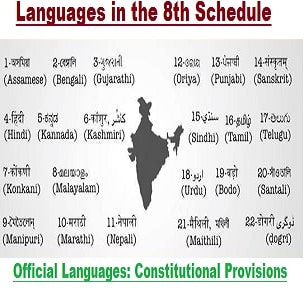
In which year Maithili language was included in the Eighth Schedule of the Indian Constitution?

  1. ((a))

    2001 AD

  2. ((b))

    2002 AD

  3. ((c))

    2003 AD

  4. ((d))

    2004 AD

Show Answer
Answer: ((c))

2003 AD

The correct answer is 2003.

Key Points

  • Maithili was included in the Eighth Schedule of the Indian Constitution as a recognized Indian language in 2003, which allows it to be used in education, government, and other official contexts in India.
  • The Maithili language is included as an optional paper in the UPSC Exam.

Important Points 

  • The Indian constitution, in 1950, declared Hindi in the Devanagari script to be the official language of the union.
  • Unless Parliament decided otherwise, the use of English for official purposes was to cease 15 years after the constitution came into effect, i.e., on 26 January 1965.
  • Hindi and English are used for official purposes such as parliamentary proceedings, judiciary, and communications between the Central Government and a State Government. States within India have the liberty and powers to specify their own official language(s) through legislation and therefore there are 22 officially recognized languages in India.

35

Kunwar Singh of Jagdishpur (Bihar) is related to

  1. ((a))

    Revolt of 1857 AD

  2. ((b))

    From Champaran Satyagraha

  3. ((c))

    From the non-cooperation movement

  4. ((d))

    Quit India Movement

Show Answer
Answer: ((a))

Revolt of 1857 AD

The correct answer is the Revolt of 1857 AD

Key Points 

  • The Revolt of 1857 was also called the First War of Independence and the 'Sepoy Mutiny'.
  • It was a widespread but unsuccessful revolt against British Rule from 1857-59.
  • In Bihar, the revolt was led by Kunwar Singh, the zamindar of Jagdishpur.
  • Babu Kunwar Singh ( 1777- 1858) was a zamindar of Jagdishpur near Arrah in the state of Bihar.
  • He belonged to a royal Ujjainiya (Panwar) Rajput house of Jagdispur, currently a part of Bhojpur district, Bihar.
  • He was the son of Raja Shahabzada Singh and Rani Panchratan Kunwar Devi Singh.
  • At the age of 80 years, during India's first war of Independence (1857-58), he assumed command of the soldiers who had revolted at Danapur on 5 July 1857.
  • He occupied Arrah which was relieved by major Eyre on 3rd  August.

In his last battle which was fought on 23 April 1858 near Jagdishpur, Kunwar Singh had a victory over the force led by Captain Le Grand.

Additional Information 

PlaceLeader
BarrackporeMangal Pandey
DelhiBahadur Shah II, General Bakht Khan
DelhiHakim Ahsanullah (Chief advisor to Bahadur Shah II)
KanpurNana Sahib, Rao Sahib (nephew of Nana), Tantia Tope, Azimullah Khan (advisor of Nana Sahib)
LucknowBegum Hazrat Mahal, Birjis Qadir, Ahmadullah (advisor of the ex-Nawab of Awadh)
JhansiRani Laxmibai
Bihar (Jagdishpur)Kunwar Singh, Amar Singh
Allahabad and BanarasMaulvi Liyakat Ali
FaizabadMaulvi Ahmadullah (He declared the Revolt as Jihad against English)
FarrukhabadTufzal Hasan Khan
BijnorMohammad Khan
BareillyKhan Bahadur Khan
MuradabadAbdul Ali Khan
MandsaurFiroz Shah
Gwalior/KanpurTantia Tope
AssamKandapareshwar Singh, Manorama Datta
OrissaSurendra Shahi, Ujjwal Shahi
36

Bhola Paswan Shastri was the Chief Minister of Bihar.

  1. ((a))

    Once

  2. ((b))

    Twice

  3. ((c))

    Three times

  4. ((d))

    Four times

Show Answer
Answer: ((c))

Three times

The correct answer is Three times.

Key Points

  • Bhola Paswan Shastri served as the Chief Minister of Bihar on three occasions between 1968-71.
  • Bhola Paswan Shastri was an Indian freedom fighter and a prominent leader of the Indian National Congress.
  • He was born on 21 September 1914 in a small village in Bihar.
  • He actively participated in the Indian independence movement and was imprisoned several times by the British authorities.
  • Shastri was elected to the Bihar Legislative Assembly in 1952.
  • He served as a member of the assembly for several terms and also served as a member of the Rajya Sabha.
  • Shastri was appointed as the Chief Minister of Bihar for the first time in 1968 and he served in this position for a brief period.
  • He was reappointed as the Chief Minister two more times, first in 1969 and then in 1970.
37

Guru Gobind Singh, the tenth Guru of the Sikhs, was born

  1. ((a))

    In Amritsar

  2. ((b))

    In Lahore

  3. ((c))

    In panipat

  4. ((d))

    In Patna

Show Answer
Answer: ((d))

In Patna

The correct answer is Patna.

Key Points Guru Gobind Singh:-

  • The tenth and the last guru of Sikhs, Guru Gobind Singh was born on 5 January 1666 in Patna, Bihar.
  • ​He became a Guru at the age of 9 on 24 November 1675. He was the tenth and last Guru of Sikhism.
  • He introduced the five Ks of Sikhism which refers to the 5 items that a Khalsa Sikh should wear at all times. These are as follows:​
  • Kesh- uncut hair
  • Kangha- a wooden comb for hair
  • Kirpan- iron dagger
  • Kara- an iron bracelet
  • Kachera- cotton tieable undergarments

Important Points 

Sikh gurus and his works-

S.NOSikh GuruWorks
Guru Nanak (1469-1539)Founder of Sikhism and Introduced the concept of Langers (Common Kitchen).
Guru Angad (1539-1552)He introduced the Gurmukhi Script.
Guru Amardas Singh (1552-1574)He introduced the Anand Kharj-Marriage ceremony of Sikhs and is famous for appointing Manji (male Sikh preacher) and Piri (Female Sikh preacher) for preaching religion.
Guru Ram Das (1574-1581)He founded the City of Amritsar.
Guru Arjan Dev (1581-1606)He laid the foundation of the Golden temple and also compiled Guru Granth Sahib who was executed by Jahangir.
Guru Hargobind Singh (1606-1644)He constructed the Akal Takht or the Throne of Immortal.
Guru Har Rai (1644-1661)He gave shelter to Dara Shikoh son of Shah Jahan from Aurangzeb (1618-1707).
Guru Har Krishan (1661-1665)He was the Youngest of all (5 years of age) and died in the court of Aurangzeb (1658-1707).
Guru Teg Bahadur (1665-1675)He established the town of Anandapur and he was executed by Aurangzeb (1618-1707).
Guru Gobind Singh (1675-1708)He created Khalsa and last guru in human form.
Guru Granth SahibIt is the holy book of Sikhs nominated by Guru Gobind Singh as their Guru. It is also called Adi Granth.
38

Whose tomb is there in Sasaram?

  1. ((a))

    Humayun

  2. ((b))

    Shershah

  3. ((c))

    Jahangir

  4. ((d))

    None of these

Show Answer
Answer: ((b))

Shershah

The correct answer is Sher Shah.

Important Points

  • The tomb of Sher Shah Suri is located in Sasaram, Bihar.
  • Sher Shah Suri defeated the Mughal Empire and founded the Suri Empire in northern India.
  • Sher Shah Suri's tomb is an example of Indo-Islamic architecture.
  • It was designed by the architect Mir Muhammad Aliwal Khan.

Additional Information

  • Humayun
  • Humayun's tomb is located in Delhi.
  • It is the first garden tomb in the Indian subcontinent.
  • It was designed by the architect Mirak Mirza Ghiyath.
  • Jahangir
  • Jahangir was born to Maryam-uz-Zamani and Akbar on August 30, 1569.
  • He was named Sultan Muhammad Salim after Shaikh Salim Chishti of Fatehpur Sikri.
  • Akbar called him Sheik Babu.
  • After his coronation, he assumed the title of Nur-ud-din Muhammad Jahangir Badshah Ghazi.
  • Jahangir was the only surviving son of Akbar who after his father’s death ascended the throne in 1604, at the age of 34 years.
39

Who was the Governor-General of India during the Revolt of 1857 AD?

  1. ((a))

    Lord Amherst

  2. ((b))

    Lord Canning

  3. ((c))

    Lord Curzon

  4. ((d))

    Earl of Dalhousie

Show Answer
Answer: ((b))

Lord Canning

The correct answer is Lord Canning.

Key Points

  • Lord Canning (1856-1862) was the Viceroy of India during the 'Sepoy Mutiny' or the great revolt that took place.
  • The Revolt of 1857 is an important landmark in India's history, which occurred during the governor generalship of Lord Canning.
  • Sepoy Mutiny or First War of Independence, widespread but unsuccessful rebellion against British rule in 1857.
  • Event during his regime - 
  • Revolt of 1857
  • Establishment of three universities at Calcutta, Madras and Bombay in 1857
  • Abolition of East India Company and transfer of control to the Crown by the Government of India Act, 1858
  • Indian Councils Act of 1861

Additional Information 

  • Grievances of Sepoy:
  • Discrimination in payment and promotion.
  • Refusal of the British to pay foreign service allowance while fighting in remote regions such as Punjab or Sindh.
  • Religious objections of the high caste Hindu sepoys to Lord Canning's General Service Enlistment Act (1856) ordering all recruits to be ready for service both within and outside India.
40

In which year Bihar state was reorganized?

  1. ((a))

    1999 AD

  2. ((b))

    2000 AD

  3. ((c))

    2001 AD

  4. ((d))

    2002 AD

Show Answer
Answer: ((b))

2000 AD

The correct answer is 2000 AD.

Key Points

  • Bihar was reorganized on November 15, 2000, when the southern part of the state was carved out to create a new state called Jharkhand.
  • This reorganization resulted in Bihar losing 18 of its districts to the new state of Jharkhand.
  • The process of reorganization was initiated by the Bihar Reorganization Act, which was passed by the Indian parliament in August 2000.
  • This act provided for the creation of Jharkhand and the transfer of the 18 districts from Bihar to Jharkhand.
  • The act also made provisions for the establishment of a new capital for Jharkhand, which became Ranchi.

Additional Information

  • The reorganization of Bihar was aimed at promoting better administration and governance in the region by creating smaller and more manageable states.
  • The new state of Jharkhand was formed to cater to the specific needs of the tribal population residing in the region, who were demanding a separate state for a long time.
41

In which year did Gandhiji do the Champaran Satyagraha?

  1. ((a))

    1914 AD

  2. ((b))

    1915 AD

  3. ((c))

    1916 AD

  4. ((d))

    1917 AD

Show Answer
Answer: ((d))

1917 AD

The correct answer is 1917 AD

Key Points 

Champaran Satyagraha: 

  • The Champaran Satyagraha of 1917 was the first Satyagraha movement led by Gandhiji in India and is considered a historically important revolt in the Indian Independence Movement.
  • It was a farmer's uprising that took place in the Champaran district of Bihar, India, during the British colonial period. The farmers were protesting against having to grow indigo with barely any payment for it.
  • Champaran, where tens of thousands of landless serfs, indentured laborers, and poor farmers were forced to grow indigo and other cash crops instead of the food crops which were necessary for their survival.
  • These goods were bought from the farmers at a very low price. Suppressed by the brutal militias of the landlords, they were given negligible compensation, leaving them in extreme poverty.
  • Even in the painful time of devastating famine, the British government levied a heavy tax on them and insisted on increasing the rate.
  • Without food and money, the situation was growing progressively unbearable and the peasants in Champaran revolted against the government in indigo plant cultivation in 1914 (at Pipra) and in 1916 at (Turkaulia).
  • Raj Kumar Shukla who was an indigo cultivator persuaded Mahatma Gandhi to go to Champaran and hence, the Champaran Satyagraha began. Gandhiji arrived in Champaran on 10 April 1917 with a team of eminent lawyers i.e.Brajkishore Prasad, Rajendra Prasad, Anugrah Narayan Sinha, and  Acharya Kripalani.
42

Who among the following was the chief guest at the 64th Republic Day celebrations of India in New Delhi?

  1. ((a))

    President of Russia

  2. ((b))

    Primeminister of Iraq

  3. ((c))

    King of Bhutan

  4. ((d))

    Mauritius President

Show Answer
Answer: ((c))

King of Bhutan

The correct answer is The King of Bhutan.

Key Points 

  • The King of Bhutan Jigme Khesar Namgyel Wangchuck was the Chief Guest at the 64th Republic Day celebrations.
  • Jigme Khesar Namgyel Wangchuck:
  • Jigme Khesar Namgyel Wangchuck is a "Dragon King" of the Kingdom of Bhutan.
  • After his father Jigme Singye Wangchuck renounced the throne in his favor, he became the monarch on 9 December 2006.
  • A public accession ceremony was held on 1 November 2008, a year that marked 100 years of monarchy in Bhutan.
43

The Punjab government has decided to name the Amritsar-Wagah road after which of the following personalities?

  1. ((a))

    Swami Vivekananda

  2. ((b))

    Udham Singh

  3. ((c))

    Lala Lajpat Rai

  4. ((d))

    Bhagat Singh

Show Answer
Answer: ((a))

Swami Vivekananda

The correct answer is Swami Vivekananda.

Key Points

  • The former Chief Minister of Punjab, Parkash Badal has decided to name the road from Attari to Wagah border as "Vivekananda road" in honor of Swami Vivekananda, a renowned spiritual leader and philosopher of India.
  • Swami Vivekananda was a key figure in the Indian spiritual and cultural renaissance of the late 19th century, and his teachings and philosophy continue to inspire many people around the world today.
  • The road is a significant gateway between India and Pakistan.

Key Points

  • Udham Singh:
  • Udham Singh was born on December 26, 1899, in the Sangrur district of Punjab.
  • He was present at Jallianwala Bagh when Massacre took place on April 13, 1919, and was deeply moved by the mishap.
  • After that, he went to Africa to work as a laborer and from there moved to the USA.
  • In the USA, he worked with the Ghadar Party.
  • He returned back to India after being called by Bhagat Singh in 1927 but was arrested here because of being involved in the activities of the Ghadar Party.
  • He was released in 1931, went to Germany and to England in 1933.
  • On March 13, 1940, Michael O'Dwyer was attending a meeting of the East India Association and Central Asian Society, of which Udham Singh was also a part.
  • As soon as the meeting concluded Udham Singh shot O'Dwyer dead.
  • Bhagat Singh:
  • Bhagat Singh was born on September 1907, in Lyallpur western Punjab, India ( Now in Pakistan)
  • In 1923, he joined National College in Lahore founded by Lala Lajpat Rai.
  • Bhagat Singh was deeply affected by the Jallianwala Bagh massacre.
  • In 1928, He established the Hindustan Socialist Republican Association (HSRA) along with Chandrashekhar and others.
  • Bhagat Singh and Batukeshwar Dutt, on April 8th,1929, threw a bomb in the Central Legislative Assembly.
  • On 23 March 1931 Bhagat Singh, Rajguru and Sukhdev were Hanged by the British Government.
  • Lala Lajpat Rai:
  • He founded the National School at Lahore.
  • He presided over the AITUC in 1920 AD.
  • He boycotted the Simon Commission and demonstrated against it at Lahore, during which he was brutally assaulted by the police and he subsequently succumbed to his injuries.
  • He was called the Sher-e-Punjab (Lion of Punjab).
  • He was inspired by Mahatma Hansraj.
  • He was the President of the special session of the Congress at Calcutta, 1920 AD.
  • He opposed the withdrawal of the Non-Cooperation Movement in 1922 AD.
  • He founded Swaraj Party with Motilal Nehru and C.R. Das.
  • He was the editor of Bande Matram, Punjab and The People.
44

The national aquatic animal of India is

  1. ((a))

    Mahseer

  2. ((b))

    Blue whale

  3. ((c))

    Waterflown

  4. ((d))

    Dolphin

Show Answer
Answer: ((d))

Dolphin

The correct answer is Dolphins.

Key Points 

  • The Gangetic river dolphin is India's national aquatic animal and is popularly known as ‘Susu’.
  • Dolphins are one of the oldest creatures in the world along with some species of turtles, crocodiles, and sharks.
  • The Ganges river dolphin was officially discovered in 1801.
  • Ganges river dolphins once lived in the Ganges-Brahmaputra-Meghna and Karnaphuli-Sangu river systems of Nepal, India, and Bangladesh. But the species is extinct from most of its early distribution ranges.
  • The Ganges river dolphin can only live in freshwater and is essentially blind.
  • They hunt by emitting ultrasonic sounds, which bounce off of fish and other prey, enabling them to “see” an image in their mind.
  • They are frequently found alone or in small groups, and generally a mother and calf travel together.
  • Calves are chocolate brown at birth and then have grey-brown smooth, hairless skin as adults.
  • Females are larger than males and give birth once every two to three years to only one calf.
  • It is among the four freshwater dolphins in the world- the other three are:
  • The ‘Baiji’ is now likely extinct from the Yangtze River in China.
  • The ‘Bhutan’ of the Indus in Pakistan
  • The ‘Boto’ of the Amazon River in Latin America.

Important Points 

  • Vikramshila Gangetic Dolphin Sanctuary:
  • It is situated in the Bhagalpur district of Bihar, India.
  • The sanctuary is a 50 km stretch of the Ganges River from Sultanganj to Kahalgaon.
  • It was designated as a protected area for the endangered Gangetic dolphins in 1991.
45

Sun Yat-sen belongs to which country?

  1. ((a))

    Sri Lanka

  2. ((b))

    India

  3. ((c))

    Japan

  4. ((d))

    China

Show Answer
Answer: ((d))

China

The correct answer is China.

Key Points

  • Sun Yat-sen belonged to China
  • The Manchu empire was overthrown and a republic was established in 1911 under Sun Yat-sen (1866-1925) who is unanimously regarded as the founder of modern China.
  • He came from a poor family and studied in missionary schools where he was introduced to democracy and Christianity.
  • He studied medicine but was greatly concerned about the fate of China.

Additional Information

  • His programme was called the Three Principles (San min Chui).
  • These were:
  • Nationalism – this meant overthrowing the Manchus who were seen as a foreign dynasty, as well as other foreign imperialists;
  • Democracy – establishing democratic government; and
  • Socialism – regulating capital and equalizing landholdings.
46

Who was selected for the 2013 Nobel Prize in Literature?

  1. ((a))

    Alice Munro

  2. ((b))

    Peter W. Higgs

  3. ((c))

    Peter A. Diamond

  4. ((d))

    James E. Rothman

Show Answer
Answer: ((a))

Alice Munro

The correct answer is ​Alice Munro.

Key Points 

  • Alice Munro was selected for the 2013 Nobel Prize in Literature.
  • In 2013, Alice Munro, "master of the contemporary short story.", a Canadian short story writer won Nobel Prize for Literature.
  • Munro's work has been described as having revolutionized the architecture of short stories, especially in its tendency to move forward and backward in time.
  • Her stories have been said to "embed more than announce, reveal more than a parade."

Additional Information

  • The Nobel Prize in Literature is a Swedish literature prize that is awarded annually, since 1901.
  • It is one of the five Nobel Prizes established by the will of Alfred Nobel in 1895.
  • Alfred Nobel was a Swedish chemist, engineer, and industrialist most famously known for the invention of dynamite.
  • Nobel Prizes are awarded in the fields of Physics, Chemistry, Physiology or Medicine, Literature, and Peace.
  • Malala Yousuafzai became the Youngest person to receive a Nobel Prize at the age of 17, Nobel Peace Prize (2014).
  • John B. Goodenough; at the age of 97, received the Nobel Prize in Chemistry (2019) and is the Oldest person to receive a Nobel Prize.
  • Rabindranath Tagore was the first Indian to receive a Nobel Prize.
  • He was awarded the Nobel Prize for Literature in recognition of his work Geetanjali, a collection of poems, in 1913.
47

Who was awarded the Dadasaheb Phalke Award in May 2013?

  1. ((a))

    Pran Krishna Sikand

  2. ((b))

    Rajesh Khanna

  3. ((c))

    Manna Dey

  4. ((d))

    Dilip Kumar

Show Answer
Answer: ((a))

Pran Krishna Sikand

The correct answer is Pran Krishna Sikand 

Key Points

  • The Dadasaheb Phalke Award 2012 was awarded to the legendary Indian actor Pran Krishan Sikand, popularly known as Pran.
  • He was one of the most versatile actors in Indian cinema and had worked in more than 350 films in his career spanning over six decades.
  • Pran was known for his powerful and unforgettable performances in movies like "Madhumati", "Zanjeer", "Don", and "Amar Akbar Anthony", among others.
  • He was honored with the prestigious Dadasaheb Phalke Award for his contribution to Indian cinema in the year 2013.
48

India qualified for the 2013 Women's Hockey Junior World Cup

  1. ((a))

    First

  2. ((b))

    Second

  3. ((c))

    Third

  4. ((d))

    None of the above

Show Answer
Answer: ((c))

Third

The correct answer is Third

Key Points

  • Women's Hockey Junior World Cup 2013 was the seventh edition, held from 27 July to 4 August 2013 in Mönchengladbach, Germany.
  • India won the bronze medal by defeating England in the third-place match
  • This was a historic achievement for the Indian team as it was their first-ever medal at the Junior World Cup
  • Defending champions the Netherlands won the tournament for a record third time after defeating Argentina 4–2 in the final on a penalty shootout after a 1–1 draw.
  • India won the third place match by defeating England 3–2 on a penalty shootout after a 1–1 draw to claim their first ever Junior World Cup medal.
49

Chaurabari Glacier is in which district of Uttarakhand?

  1. ((a))

    Chamoli

  2. ((b))

    Uttarkashi

  3. ((c))

    Rudraprayag

  4. ((d))

    Pithoragarh

Show Answer
Answer: ((c))

Rudraprayag

The correct answer is Rudraprayag. 

Key Points

  • Chaurabari Glacier is a small glacier located in the Rudraprayag district of Uttarakhand, India.
  • It is situated at an elevation of about 3,800 meters (12,500 feet) above sea level and is surrounded by some of the highest peaks in the region, including Kedarnath Peak, Kirti Stambh, and Bharatekuntha.
  • The glacier is a source of the Mandakini River, which is one of the major tributaries of the Ganges.
  • It is approximately 6 kilometers (3.7 miles) long and 2 kilometers (1.2 miles) wide.
50

World human rights day

  1. ((a))

    30 January

  2. ((b))

    11 July

  3. ((c))

    1 December

  4. ((d))

    10 December

Show Answer
Answer: ((d))

10 December

The correct answer is 10th December.

Important Points Every year on December 10th, Human Rights Day commemorates the adoption of the Universal Declaration of Human Rights by the United Nations General Assembly in 1948 (UDHR).

  • The Universal Declaration of Human Rights (UDHR) is a landmark declaration that declares that everyone has intrinsic rights as a human being, regardless of race, colour, religion, sex, language, political or other opinions, national or social origin, property, birth, or other position.
  • It is the most translated document in the world, having been translated into over 500 languages.
  • This year’s Human Rights Day theme relates to “Equality” and article 1 of the UDHR – “All human beings are born free and equal in dignity and rights”.
  • The principles of equality and non-discrimination are at the heart of human rights.
51

Pneumatic bone is a characteristic of

  1. ((a))

    Reptilian

  2. ((b))

    Birds

  3. ((c))

    Amphibians

  4. ((d))

    None of the above

Show Answer
Answer: ((b))

Birds

The correct answer is Birds.

Key Points

  • Pneumatic bone is a characteristic of Birds.
  • Present throughout the body of birds, pneumatic bones are hollow bones filled with air cells.
  • This makes the skeleton light thereby enabling the birds to fly.

Additional Information

  • The study of birds is known as ''Ornithology''.
  • All the birds are included in class Aves.
52

The connecting link between reptiles and birds is

  1. ((a))

    Archeopteryx

  2. ((b))

    Neopylina

  3. ((c))

    Balanoglossus

  4. ((d))

    None of the above

Show Answer
Answer: ((a))

Archeopteryx

The correct answer is Archeopteryx.

Key Points

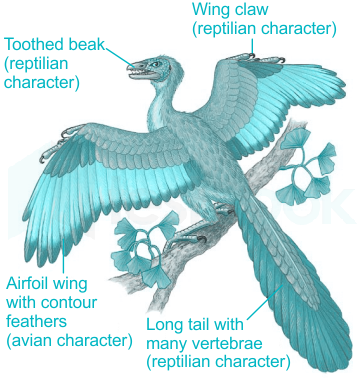
  • The connecting link between reptiles and birds is Archeopteryx.
  • Archaeopteryx had some features like wings, the structure of legs, etc were similar to Aves (bird).
  • And some characteristics of the beak, tail, scales on the body, etc were similar to reptiles.

Archaeopteryx Pictures & Facts - The Dinosaur Database

Additional Information 

  • Platypus and echidna are the connecting links between Reptilia and Mammalia.
  • Darwin gave the theory of natural selection for organic evolution.
  • Hugo de Vries gave the theory of mutation.
  • Lamarck gave the theory of acquired characters.
53

The largest gland in the human body is

  1. ((a))

    Spleen

  2. ((b))

    Kidney

  3. ((c))

    Pancreas

  4. ((d))

    Liver

Show Answer
Answer: ((d))

Liver

The correct answer is Liver.

Key Points  

  • Liver
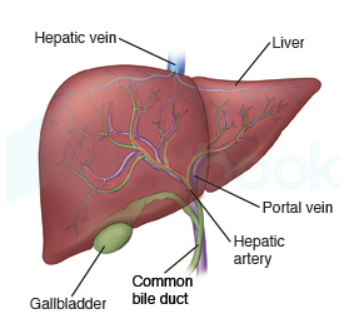
  • It is the largest gland of the body and is an accessory organ of the digestive system.
  • It continuously produces bile.
  • Bile flows out of the liver into the right and left hepatic ducts, into the common hepatic ducts, and toward the small intestine to help with digestion and the absorption of fats.
  • In humans, it is located in the right upper quadrant of the abdomen, below the diaphragm.

Important Points 

  • Important facts about the human body are as follows
  • Smallest Gland - Pineal
  • Largest artery - Aorta
  • The longest bone in the Human body - Femur
  • Smallest bone - Stapes
  • Strongest muscle - masseter muscle (The strongest muscle in the human body is the masseter muscle, which is located in the jaw and is used for chewing.)
54

Indians are the father of Bryophytology

  1. ((a))

    S. R. Kashyap

  2. ((b))

    Birbal Sahani

  3. ((c))

    M. O. P. Iyengar

  4. ((d))

    J. C. Bose

Show Answer
Answer: ((a))

S. R. Kashyap

The correct answer is 1) S. R. Kashyap.

Key Points

  • S. R. Kashyap was an Indian bryologist who is widely regarded as the "father of Bryophytology" in India.
  • He was born in 1884 in Karnataka, India and went on to study botany at the University of Edinburgh in Scotland.
  • He also authored several important books on the subject, including "Bryophytes of British India" and "Bryophyta of Southern India".

Additional Information

Birbal Sahani

  • He was an Indian paleobotanist who made significant contributions to the study of fossil plants.
  • He is known for his work on Glossopteris, a genus of seed ferns that lived during the Permian period.

M. O. P. Iyengar 

  • He was an Indian botanist who specialized in the study of algae. He made significant contributions to the taxonomy and ecology of Indian algae.

J. C. Bose

  • He was an Indian physicist and plant physiologist who made significant contributions to the study of plant responses to stimuli.
  • He is known for his work on the electrical and mechanical responses of plants.
55

Camphor is refined

  1. ((a))

    By sublimation

  2. ((b))

    By crystallization

  3. ((c))

    By dephlegmation

  4. ((d))

    By filtration

Show Answer
Answer: ((a))

By sublimation

The correct answer is By sublimation.

Key Points

  • Camphor is refined by Sublimation.
  • Sublimation is the process in which there is a change of state directly from a solid to a gas without changing into a liquid state.
  • Examples of sublimate substances: Ammonium chloride, Camphor, Iodine, Naphthalene, and Dry Ice.
56

Which element has two protons in its nucleus?

  1. ((a))

    Hydrogen

  2. ((b))

    Helium

  3. ((c))

    Lithium

  4. ((d))

    Boron

Show Answer
Answer: ((b))

Helium

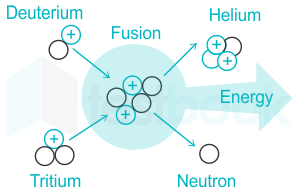
The correct answer is Helium.

Key Points

  • Helium has two protons in its nucleus.
  • The number of protons within the nucleus of a given atom is equal to the atomic number of the corresponding element.
  • The atomic number of Helium is two. Therefore, the number of protons is also two.

Additional Information

  • The nucleus of an atom contains protons and neutrons. Protons and neutrons have nearly equal masses, but they differ in charge.
  • The mass number of an atom is equal to the total number of protons and neutrons.
57

In the production of which formaldehyde is used as a starting material, it is

  1. ((a))

    Bakelite

  2. ((b))

    DDT

  3. ((c))

    Rayon

  4. ((d))

    Polyethylene

Show Answer
Answer: ((a))

Bakelite

The correct answer is Bakelite.

Key Points

  • Bakelite is a synthetic plastic made from phenol and formaldehyde.
  • Formaldehyde is used as a starting material in the production of Bakelite.
  • The material was invented by Belgian chemist Leo Baekeland in 1907 and was the first plastic made from synthetic components.

Additional Information

  • DDT (Dichloro-Diphenyl-Trichloroethane) is a synthetic pesticide made from chloral and chlorobenzene, not formaldehyde.
  • Rayon is a semi-synthetic fabric made from cellulose, which is obtained from wood pulp or cotton fibers, and is not directly produced from formaldehyde.
  • Polyethylene is a thermoplastic polymer made from the polymerization of ethylene monomers and does not involve formaldehyde in its production.
58

The number of elements in the third period of the periodic table is

  1. ((a))

    8

  2. ((b))

    18

  3. ((c))

    32

  4. ((d))

    2

Show Answer
Answer: ((a))

8

The correct answer is 8.

Important Points 

  • The periodic table is the tabular arrangement of chemical elements.
  • The Modern Periodic table consists of 18 groups and 7 periods

  • From the above table, it is clear that the number of elements in the third period of the Periodic Table is 8. Therefore, option 1 is correct.
59

Mitosis does not occur

  1. ((a))

    In bacteria

  2. ((b))

    In green algae

  3. ((c))

    In fungi

  4. ((d))

    In higher plants

Show Answer
Answer: ((a))

In bacteria

The correct answer is option 1) Mitosis does not occur in bacteria.

Key Points

  • Mitosis is a type of cell division that occurs in most eukaryotic organisms, including fungi and higher plants.
  • However, bacteria and some algae do not undergo mitosis because they lack a nucleus and other organelles that are necessary for the process.
  • Green algae, on the other hand, do undergo mitosis as they are eukaryotic organisms with a nucleus and other organelles.
60

Which of the following is not a part of the nucleotide of DNA?

  1. ((a))

    Nitrogenous base

  2. ((b))

    Deoxyribose sugar

  3. ((c))

    Phosphoric acid

  4. ((d))

    Amino acid

Show Answer
Answer: ((d))

Amino acid

The correct answer is option 4) Amino acid.

Key Points

  • Amino acids are not a part of the nucleotide structure of DNA.
  • The nucleotide is the building block of DNA and is composed of three parts: a nitrogenous base (adenine, guanine, cytosine, or thymine), a deoxyribose sugar, and a phosphate group.
  • The nitrogenous base and deoxyribose sugar make up the nucleoside, and the addition of a phosphate group forms the nucleotide.
  • Amino acids, on the other hand, are the building blocks of proteins, and are not directly involved in the structure of DNA.

Additional Information

  • Nitrogenous base: Nitrogenous base is one of the three parts that make up a nucleotide, along with a deoxyribose sugar and a phosphate group. The nitrogenous bases in DNA are adenine, guanine, cytosine, and thymine. These bases pair up with each other in a specific way to form the rungs of the DNA ladder, which is the double helix structure of DNA.
  • Deoxyribose sugar: Deoxyribose sugar is another component of a nucleotide. It is a five-carbon sugar that makes up the backbone of DNA along with the phosphate group. The nitrogenous bases are attached to this sugar molecule, and it is the specific sequence of these bases that determines the genetic information encoded in DNA.
  • Phosphoric acid: Phosphoric acid, also known as a phosphate group, is the third component of a nucleotide. It is a molecule made up of phosphorus and oxygen atoms, and it gives DNA its negative charge. The phosphate groups form the backbone of the DNA strand along with the deoxyribose sugar.
61

The wavelength of standing waves generated in a stretched string of length L will be

  1. ((a))

    2L/n

  2. ((b))

    2Ln

  3. ((c))

    L2/n

  4. ((d))

    n/L

Show Answer
Answer: ((a))

2L/n

The correct answer is option 1) 2L/n

Key Points

Standing Waves

  • Standing Waves are a type of wave that occur when two waves of the same frequency and amplitude, traveling in opposite directions, interfere with each other.
  • The resulting wave pattern appears to be standing still, hence the name "standing wave."

Calculation

The wavelength of standing waves generated in a stretched string of length L will depend on the mode of the standing wave and the boundary conditions of the string.

  • For a string fixed at both ends, such as a guitar string, the possible standing waves are called the harmonic series.
  • The harmonic series is given by: λn = 2L/n

where:

  • λn is the wavelength of the nth harmonic
  • L is the length of the string
  • n is an integer representing the harmonic number.
62

Convert sound energy into electrical energy

  1. ((a))

    By microphone

  2. ((b))

    By loudspeaker

  3. ((c))

    By sonometer

  4. ((d))

    By earphone

Show Answer
Answer: ((a))

By microphone

The correct answer is option 1 By microphone

CONCEPT:

MicrophoneA device that converts sound waves into electrical energy variations.
LoudspeakerA device that changes electrical signals into a sound that is loud enough to be heard at a distance.
Solar CellA device that converts the energy of light directly into electricity by the photovoltaic effect.
GramophoneA device for recording and replaying sound.
  • The basic use of a microphone is best explained with the help of the following diagram:

EXPLANATION:

  • From the above discussion, the Conversion of sound energy into electrical energy is done by a microphone. So option 1 is correct.
63

The water waves are

  1. ((a))

    Longitudinal

  2. ((b))

    Transverse

  3. ((c))

    Both longitudinal and transverse

  4. ((d))

    Elliptical 

Show Answer
Answer: ((c))

Both longitudinal and transverse

The correct answer is option 3

Key Points

  • Water waves are a type of disturbance that travels through a body of water, causing the water to oscillate up and down or side to side.
  • These waves can be caused by a variety of factors, such as wind, tides, and earthquakes.
  • There are two main types of water waves: transverse waves and longitudinal waves.
  • Transverse waves occur when the water moves up and down at a right angle to the direction of the wave's travel.
  • Longitudinal waves occur when the water moves back and forth in the same direction as the wave's travel.

Water waves can actually exhibit both longitudinal and transverse motion, so option 3) "Both longitudinal and transverse" is correct.

64

Flower is a transformation

  1. ((a))

    Root

  2. ((b))

    Bud

  3. ((c))

    Shoot

  4. ((d))

    Leaf

Show Answer
Answer: ((b))

Bud

The correct answer is Bud.

Key Points

Bud:

  • A bud is a small, undeveloped plant structure that contains embryonic shoots, leaves, and/or flowers.
  • Buds are the precursor to a flower, and the transformation of a bud into a flower involves complex changes in gene expression, hormone levels, and cellular differentiation.
  • The stages of bud development include dormancy, initiation, growth, maturation, and senescence.
  • The development of buds is influenced by environmental factors such as temperature, light, and moisture.

Additional Information 1. Root:

  • A root is a plant organ that anchors the plant in the soil and absorbs water and nutrients.
  • It is not a transformation of a flower, but rather a distinct structure that develops from the plant's embryonic root system.
  • Roots can develop from different parts of a plant, including stem cuttings, adventitious buds, and root initials.
  • The development of roots is influenced by environmental factors such as soil moisture, temperature, and nutrient availability.

2. Shoot:

  • A shoot is a plant structure that includes the stem, leaves, and buds.
  • It develops from the plant's embryonic shoot system and is responsible for the plant's above-ground growth and development.
  • The transformation of a bud into a flower involves the development of a floral shoot that bears the flower.
  • The development of shoots is influenced by environmental factors such as light, temperature, and nutrients.

3. Leaf:

  • A leaf is a plant structure that is responsible for photosynthesis and transpiration.
  • It develops from the plant's embryonic leaf primordia and is not a transformation of a flower.
  • The development of leaves is influenced by environmental factors such as light, temperature, and moisture.
  • Leaves play an important role in plant growth and development, as they are responsible for the production of food and the regulation of water loss.
65

The time period of a simple pendulum inside a satellite orbiting the Earth will be

  1. ((a))

    zero

  2. ((b))

  3. ((c))

    T

  4. ((d))

    2T

Show Answer
Answer: ((b))

CONCEPT:

Satellite:

  • Satellites are natural or artificial bodies describing an orbit around a planet under its gravitational attraction.
  • The weight of all the objects inside the satellite is zero because the gravitational force due to the planet on the object gets balanced by the centrifugal force.
  • So there is no gravity inside the satellite.

Simple pendulum:

  • When a point mass is attached to an inextensible string and suspended from fixed support then it is called a simple pendulum.
  • The time period of a simple pendulum is defined as the time taken by the pendulum to finish one complete oscillation.

T=2πlg⇒ T = 2\pi\sqrt{\frac{l}{g}}

  • The above formula is only valid for small angular displacements.

Where, T = Time period of oscillation, l = length of the pendulum, and g = gravitational acceleration 

  • The amplitude of a simple pendulum is defined as the maximum distance traveled by the pendulum from the equilibrium position to one side.
  • The length of a simple pendulum is defined as the distance between the point of suspension to the center of the bob.

CALCULATION:

The time period of a simple pendulum is given as,

T=2πlg⇒ T = 2\pi\sqrt{\frac{l}{g}}     -----(1)

  • Since there is no gravity inside the satellite orbiting around the earth. So,

⇒ g = 0m/s2     -----(2)

By equation 1 and equation 2,

T=2πl0⇒ T = 2\pi\sqrt{\frac{l}{0}}

⇒ T = ∞

  • Hence, option 2 is correct.
66

Producer gas has

  1. ((a))

    CO and H2

  2. ((b))

    CO and N2

  3. ((c))

    CO2 and H2

  4. ((d))

    CO2 and CH4

Show Answer
Answer: ((b))

CO and N2

The correct answer is CO and N2

<br>

Key PointsProducer gas:

  • It is a mixture of carbon monoxide and nitrogen gas (CO + N2).
  • It is generated by passing air with steam over burning coke or coal in a furnace and used as fuel at a temperature of 1100° C.
  • Its calorific value is low.
  • It is cheapest among all gaseous fuels.
  • It burns with a blue flame.
  • This gases is poisonous in nature due to the presence of Carbon monoxide (CO).
67

Which of the following ions is diamagnetic?

  1. ((a))

    Mn2+

  2. ((b))

    Fe3+

  3. ((c))

    Ni2+

  4. ((d))

    Cu+

Show Answer
Answer: ((d))

Cu+

The correct answer is Cu+

Key Points

  • Diamagnetic materials have all their electrons paired up in the electronic configuration, while paramagnetic materials have unpaired electrons.

Out of the given options, Cu+ is diamagnetic.

  • The electronic configuration of Cu+ is 1s2 2s2 2p6 3s2 3p6 3d`10, where all the 10 electrons in the 3d sub-shell are paired up. Hence, the net spin is zero, and the Cu+ ion is diamagnetic.
  • In contrast, Mn2+ and Fe3+ have unpaired electrons in their electronic configuration, and they are paramagnetic. Ni2+ also has an unpaired electron and is diamagnetic.
68

The source of the sun's energy

  1. ((a))

    Fusion of heavy nuclei

  2. ((b))

    Fusion of lighter nuclei

  3. ((c))

    Fission of light nuclei

  4. ((d))

    Fission of heavy nuclei

Show Answer
Answer: ((b))

Fusion of lighter nuclei

Concept:

  • Nuclear fusion is a reaction in which two or more atomic nuclei come closer enough to form one or more different atomic nuclei and subatomic particles (neutrons or protons).
  • A hydrogen bomb is an immensely powerful bomb whose destructive power comes from the rapid release of energy during the nuclear fusion of isotopes of hydrogen (deuterium and tritium), using an atom bomb as a trigger.
  • Sun is the best example of nuclear fusion in which smaller nuclei of atoms fused at very high temperature and pressure into a larger nucleus.

21H+21Hat highΔT42He\frac{2}{1}H+\frac{2}{1}H \xrightarrow{at\ high \Delta T}{} \frac{4}{2}He

Explanation:

  • Nuclear fusion in the sun is a type of nuclear reaction in which there is a collision of two or more atomic nuclei at high energy levels. There is a formation of a new nucleus.
  • In the Sun, the temperature is around 15 Million kelvins and pressure are millions of times higher than the Earth's surface.
  • At this high temperature and pressure, the Coulomb barrier is overcome and nuclear fusion takes place.
  • This fission happens inside the core of the sun and the energy later escapes to the surface of the sun.
  • It is responsible for the generation of solar radiation.


Nuclear fission is a nuclear reaction process in which a heavy nucleus splits into two nuclei of nearly equal mass.

Nuclear fusion is the nuclear reaction in which two or more atomic nuclei are combined to form one or more different atomic nuclei and subatomic particles.

  • Hydrogen bomb is an immensely powerful bomb whose destructive power comes from the rapid release of energy during the nuclear fusion of isotopes of hydrogen (deuterium and tritium), using an atom bomb as a trigger.

69

Sun appears red at sunset because

  1. ((a))

    The sun has only red color

  2. ((b))

    Red color is scattered more than other colors

  3. ((c))

    Red color scatters less than other colors

  4. ((d))

    Our eyes are more sensitive to red

Show Answer
Answer: ((c))

Red color scatters less than other colors

CONCEPT:

  • When light rays travel from one medium to another then there is bending in the light ray. This phenomenon is called as refraction of light.
  • The refraction occurs due to different refractive indexes of the medium for different colours of light.
  • When the light ray strikes on a small molecule of any medium particles then it gets spread in different directions then this phenomenon is called as a scattering of light.
  • White light coming from the sun consists of seven constituent colours.
  • These are – Violet, Indigo, blue, green, yellow, orange and red
  • The red colour light has the longest wavelength among them and Violet has the shortest wavelength.

EXPLANATION:

  • During the sunrise and sunset time, the light ray coming from the sun travel a longer distance in the atmosphere because the sun is on the horizon.
  • The light having the least wavelength will be scattered most and light having the longest wavelength will be scattered least.
  • Since the red and orange colour light has maximum wavelength among all other colours so it will be least scattered in the atmosphere and will come directly to our eye.
  • As the combination of red and orange colours will come directly to our eyes so the sun appears reddish-orange. This is due to the least scattering by the atmosphere. Hence option 3 is correct.
70

Laser is a device that produces

  1. ((a))

    Beam of white light

  2. ((b))

    A beam of non-coherent light

  3. ((c))

    A beam of coherent light

  4. ((d))

    Beam of multicolored light

Show Answer
Answer: ((c))

A beam of coherent light

The correct answer is A beam of coherent light.

Key Points

LASER - Light Amplification by Stimulated Emission of Radiation:

  • A laser is an unusual light source as it is quite different from a light bulb or a flashlight.
  • A laser is a device that is used to produce a highly monochromatic, coherent, a unidirectional beam of light
  • A laser device makes use of atoms or molecules to emit light at particular wavelengths and amplifies that light to produce a narrow beam of radiation.​
  • Wavelength has measured the distance between the adjacent crest or trough
71

The oxidation number of Mn in KMnO4 is

  1. ((a))

    +2

  2. ((b))

    −2

  3. ((c))

    +7

  4. ((d))

    −7

Show Answer
Answer: ((c))

+7

The Correct Answer is +7.

Key Points

  • The oxidation number of alkali metals (Li, Na, K, Rb, Cs) in the molecule is always +1.
  • The oxidation number of oxygen is -2 (oxide)
  • KMnO4:
  • Let the oxidation number of Mn is x.
  • 1 + x + (-2)x4 = 0
  • 1 + x - 8 = 0
  • x = +7 (Therefore oxidation number of Mn is +7)
72

Obtained from the hydration of Ethene

  1. ((a))

    Ethanol

  2. ((b))

    Ethanal

  3. ((c))

    Ethane

  4. ((d))

    Ethanoic acid

Show Answer
Answer: ((a))

Ethanol

The correct answer is Ethanol

Key Points

  • Ethanol is obtained from the hydration of ethene. The process of hydration involves adding water (H2O) to ethene (C2H4) in the presence of a catalyst.
  • The chemical equation for the reaction is: C2H4 + H2O → CH3CH2OH
  • In this reaction, the double bond in ethene is broken, and the carbon atoms form new bonds with the hydrogen and hydroxyl (OH) groups of water, resulting in the formation of ethanol (CH3CH2OH).
  • This reaction is an example of an addition reaction, where two or more reactants combine to form a single product. The hydration of ethene is an important industrial process for the production of ethanol, which is used as a fuel, solvent, and in the production of various chemicals.
73

22.4 liters of H2 gas will weight

  1. ((a))

    122 grams

  2. ((b))

    44.8 grams

  3. ((c))

    2.0 grams

  4. ((d))

    20 grams

Show Answer
Answer: ((c))

2.0 grams

The correct answer is 2.0 Grams

Concept:

To calculate the weight of 22.4 liters of H2 gas, we need to use the ideal gas law equation: PV = nRT

where:

  • P = pressure (in atmospheres), V = volume (in liters), n = number of moles of gas, R = gas constant (0.0821 L·atm/mol·K), T = temperature (in Kelvin)
  • The Standard temperature and pressure (STP), which is defined as 0°C (273 K) and 1 atmosphere of pressure, one mole of any gas occupies 22.4 liters.
  • So, if we have 22.4 liters of H2 gas at STP, we know that it represents one mole of H2 gas.

The atomic weight of hydrogen (H) is 1.008, so the molecular weight of H2 is 2.016 (since H2 is a diatomic molecule).

Therefore, one mole of H2 gas weighs 2.016 grams.

Calculation:

Putting it all together, we can calculate the weight of 22.4 liters of H2 gas as follows:

 PV = nRT

(1 atm) x (22.4 L) = (1 mol) x (0.0821 L·atm/mol·K) x (273 K)

 n = 1 mol

So, we have one mole of H2 gas, which weighs 2.016 grams.

Therefore, the weight of 22.4 liters of H2 gas at STP is 2.016 grams.

74

Which of the following compounds has Cis–trans isomerism?

  1. ((a))

    Butane

  2. ((b))

    2-Buteyne

  3. ((c))

    2-Butene

  4. ((d))

    2-Butanol

Show Answer
Answer: ((c))

2-Butene

The correct answer is 2-Butene.

Key Points

Isomers:

  • These are the compounds that have the same molecular formula but different structures or stereochemistries.
  • There is a wide range of classification of organic molecules based on their structures.​

Basic principles in organic chemistry: Structural isomerism – Open Teaching  Project

Geometrical isomerism:

  • Geometrical isomerism is shown in molecules that have a carbon-carbon double bond C = C.
  • Geometrical isomerism is shown only when each carbon atom of the double bond is attached to two different atoms or groups.
  • Compounds of the type abC = Cad, abC = Cab, and abC = Cde will show geometrical isomerism.
  • The cause of geometrical isomerism is restricted rotation about a C = C bond.

Explanation:

Cis and trans isomerism:

  • In a geometrical isomer, if the two identical groups are situated on the same side of the C = C then that is called the cis isomer.
  • In a geometrical isomer, if the two identical groups are situated on the opposite side of the C = C then that is called the trans isomer.

13.2: Cis-Trans Isomers (Geometric Isomers) - Chemistry LibreTexts

Let us examine the given molecules.

2 - Butene

  • The molecule has the formula CH3-CH=CH-CH3.
  • It is of abC = Cab type and will thus show cis-trans isomerism.


Geometric Isomerism

2 Butyne 

  • The molecular formula for 2 Butyne is C4H6.


  • It has no double bond and does not show geometrical isomerism.

2 Butanol: 

  • The molecule does not contain a C=C.

Thus does not fulfill the criteria to show geometrical isomerism.

Butene:

  • The molecule contains a C = C but does not have two different groups attached to it.

Thus it doesn't fulfill the criteria to show geometrical isomerism.

Hence, only 2 - Butene shows cis-trans isomerism.

Additional Information 

  • The cis and trans isomers have different physical and chemical properties.
  • The trans isomers generally gave higher melting points than the cis ones.
  • The dipole moment is greater in the case of cis isomers.

Important Points 

  • Cis trans isomerism is also shown in cyclic compounds in which two of its ring atoms have different groups attached to its exocyclic single bonds.

13.2: Cis-Trans Isomers (Geometric Isomers) - Chemistry LibreTexts

75

One femtometer is equivalent

  1. ((a))

    1012 meter

  2. ((b))

    10−12 meter

  3. ((c))

    1015 meter

  4. ((d))

    10−15 meter

Show Answer
Answer: ((d))

10−15 meter

The correct answer is 10−15 m.

Key Points

  • One femtometer is equivalent to 10−15 m.
  • Femi is a unit of length used to measure nuclear distances.
  • 1 fermi = 10⁻¹⁵ meter.
  • it was named for the Italian physicist Enrico Fermi (1901–1954).
  • It is now obsolete, replaced by the SI term femtometer (symbol, fm).

one fermi = one femtometer.

Additional Information 

The prefix used for the SI units
For small measurements
FactorPrefixSymbol
10-1DeciD
10-2centiC
10-3Millim
10-6Microµ
10-9Nanon
10-12Picop
76

The smallest flowering plant is

  1. ((a))

    Polyanthea

  2. ((b))

    Rafflesia

  3. ((c))

    Wolfia

  4. ((d))

    Mangifera

Show Answer
Answer: ((c))

Wolfia

The correct answer is Wolfia

Key Points

  • The world's smallest flowering plant is Wolffia globosa, also known as the Asian watermeal or duckweed.
  • This tiny aquatic plant is part of the duckweed family and measures only 0.5-1.5 millimeters in length, making it almost invisible to the naked eye.
  • Despite its small size, it produces flowers and fruits and is capable of photosynthesis.
  • It is found in freshwater habitats such as ponds, lakes, and slow-moving streams, and is distributed throughout much of the world.
77

The term 'ecosystem' is given by

  1. ((a))

    Odom

  2. ((b))

    Clement

  3. ((c))

    Tensley

  4. ((d))

    Newton

Show Answer
Answer: ((c))

Tensley

The correct answer is Tensley.

Important Points 

An ecosystem is a community which comprises of both living and non-living components and their interaction with each other and the environment. The term ecosystem is proposed by A.G. Tensley.

The types of ecosystems include forest, grassland, tundra, marine, freshwater, and desert ecosystem.

Additional Information 

Types of the ecosystem:

  • A forest ecosystem is a natural unit that includes animals, plants, and microorganisms and their interaction with the abiotic components of the environment. These are further classified as temperate and tropical.
  • Grassland ecosystems can be found in steppes, savannas, and prairies.
  • Tundra ecosystems are treeless regions that are found in windy and cold climatic areas.
  • The marine ecosystem is one of the largest aquatic ecosystems on the earth. They have a high salt content.
  • Freshwater ecosystems are found in springs, lakes, rivers, ponds, etc.
  • Desert ecosystems exist where there is low precipitation.
78

The brain of the cell

  1. ((a))

    Nucleolus

  2. ((b))

    Nucleus

  3. ((c))

    Reaper

  4. ((d))

    None of the above

Show Answer
Answer: ((b))

Nucleus

The correct answer is Nucleus.

Cell OrganellesOther Names
NucleusThe brain of the cell
MitochondriaThe power-house of the cell
CytoplasmProtoplasm, Cytosol
LysosomeSuicide Bags
79

The number of neutrons in C12 is

  1. ((a))

    6

  2. ((b))

    12

  3. ((c))

    8

  4. ((d))

    4

Show Answer
Answer: ((a))

6

The number of neutrons in carbon-12 (C12) is 6.

Key Points

  • Carbon-12 is one of the isotopes of carbon, and it has an atomic number of 6, which means it has 6 protons in its nucleus. In a neutral atom, the number of electrons is also 6, which balances out the positive charge of the protons.
  • To determine the number of neutrons in an atom, you subtract the atomic number from the mass number. Carbon-12 has a mass number of 12, which means it has 12 - 6 = 6 neutrons.
80

Johannsen has given the word

  1. ((a))

    Virus

  2. ((b))

    Gene

  3. ((c))

    RBC

  4. ((d))

    Chromosome

Show Answer
Answer: ((b))

Gene

The correct answer is Gene

Key Points

1. Gene

  • The word "Gene" was first coined by Danish botanist and geneticist Wilhelm Johannsen in 1909.
  • A sequence of DNA that contains the instructions for making a specific protein or RNA molecule.
  • Genes are the basic unit of heredity and are passed down from parents to their offspring.
  • The human genome contains approximately 20,000-25,000 protein-coding genes.

Additional Information1. Virus:

  • Microscopic infectious agents that can cause a range of diseases in animals, plants, and bacteria.
  • Can be composed of DNA or RNA surrounded by a protein coat, and sometimes a  lipid envelope.
  • Examples include influenza, HIV, COVID-19, and the common cold.

2. RBC:

  • Red blood cells, also known as erythrocytes.
  • Blood cells that transport oxygen from the lungs to the body's tissues and carbon dioxide from the tissues to the lungs.
  • Contains the protein hemoglobin, which gives the cells their red color.

3. Chromosome:

  • A structure in the cell nucleus that carries genetic information in the form of DNA.
  • Made up of DNA and proteins called histones.
  • Humans have 23 pairs of chromosomes, for a total of 46 chromosomes in each cell.
81

Coastal regions of Tamil Nadu receive rainfall

  1. ((a))

    Mainly in the rainy season

  2. ((b))

    Mainly in the summer months

  3. ((c))

    Mainly in the winter months

  4. ((d))

    Throughout the year

Show Answer
Answer: ((c))

Mainly in the winter months

The correct answer is  Mainly in the winter months.

Key Points

  • Tamil Nadu is located on the eastern coast of India.
  • South India usually receives rainfall from south west monsoons.
  • But these south west monsoon arising from Arabian Sea gets obstructed by Western Ghats.
  • Hence, Tamil Nadu receives most of its rain from north east and retreating monsoons during winter season.
  • Moreover, many low pressure systems develop in the Bay of Bengal during this period and move towards the east coast of Tamil Nadu causing heavy rainfall.

 Tamil Nadu receives rainfall from Northeast trade winds.

  • From early June to mid-September, between 100- 120 days is the duration of the monsoon. Some places like Tamil Nadu receive a major portion of its rainfall during October and November, but most parts of the country receive rainfall from June to September.
  • During the winter season, the winds prevailing in the country are the Northeast trade winds.
  • In major parts of the country, it is a dry season, as the winds blow from land to sea.
  • When the winds blow from sea to land, it picks up moisture from the sea and brings rainfall to the country.
  • Due to the geographical location, the east coast receives rainfall as the north east trade winds blow from sea to land in this location. Hence the coast of Tamil Nadu receives winter rainfall.

Additional Information  Monsoon

  • Generally, across the world, the monsoons are experienced in the tropical area roughly between 20° N and 20° S.
  • The climate of India is described as the ‘monsoon’ type. In Asia, this type of climate is found mainly in the south and the southeast.
  • Out of a total of 4 seasonal divisions of India, monsoon occupies 2 divisions, namely.
  • The southwest monsoon season - Rainfall received from the southwest monsoons is seasonal in character, and occurs between June and September.
  • The retreating monsoon season - The months of October and November are known for retreating monsoons.
  • Factors Influencing South-West Monsoon Formation
  • The differential heating and cooling of land and water create a low pressure on the landmass of India while the seas around experience comparatively high pressure.
  • The shift of the position of Inter Tropical Convergence Zone (ITCZ) in summer, over the Ganga plain (this is the equatorial trough normally positioned about 5°N of the equator. It is also known as the monsoon-trough during the monsoon season).
82

Which of the following is made of corals?

  1. ((a))

    Andaman

  2. ((b))

    Diu

  3. ((c))

    Lakshadweep

  4. ((d))

    Nicobar

Show Answer
Answer: ((c))

Lakshadweep

The correct answer is Lakshadweep.

  • Lakshadweep Islands are made of small atolls and reefs in the Arabian Sea.

Key Points 

  • Lakshadweep Islands consists of approx. 36 islands of which 11 are inhabited.
  • Most of them have low elevation and do not rise more than five-meter above sea level and their topography does not have streams, valleys, etc. features.
  • Aminidiv Islands, Laccadive Islands, and Minicoy Islands are three major Islands of Lakshadweep.​

Additional Information 

  • The major island groups of India are Andaman and Nicobar in the Bay of Bengal and Lakshadweep islands in the Arabian Sea.
  • Some features of Andaman and Nicobar Islands are as follows-
  • Duncan's passage separates Little Andaman from South Andaman.
  • Ten Degree Channel separates The Great Andaman group of islands in the North from the Nicobar group in the south.
  • Port Blair, the capital of Andaman Nicobar Islands.
  • Saddle peak (737 m) in North Andaman is the highest peak.
  • These islands are formed of granitic rocks.
  • Onges, Sentinelese, Jarawas, and Shompen are major tribes here.
83

Which of the following touches the boundary of India?

  1. ((a))

    Arabian Sea

  2. ((b))

    Bay of Bengal

  3. ((c))

    Indian Ocean

  4. ((d))

    All of the above

Show Answer
Answer: ((d))

All of the above

The correct answer is All of the above.

Key Points

  • The Arabian Sea and the Bay of Bengal are situated on the western and eastern sides of peninsular India respectively.
  • The many topographical and climatic features of South India are included in Peninsular India.
  • The peninsula is shaped like a large inverted triangle, with the Vindhya and Satpura ranges bordering it on the north.
  • The Bay of Bengal on the east, and the Arabian Sea on the west.

Additional Information

  • The Indian Ocean is the third-largest of the world's five oceanic divisions, covering 70,560,000 km².
  • The deepest point in the Indian Ocean, at 24,442 feet (7,450 meters).
  • The deepest point in the Indian Ocean is the Sunda Deep of the Java Trench off the southern coast of the island of Java (Indonesia).
  • The Indian Ocean has relatively few islands Madagascar, Maldives, Seychelles, Socotra, and Sri Lanka.
  • The Indian Ocean Covers 20% of the Earth's Surface.
  • The Ocean through 57 island groups,16 African countries and,18 Asian countries is connected directly through its waters.
  • The Indian Ocean Oil Deposit Accounts for 40% of World Production.
84

Great Escarpment is

  1. ((a))

    Aravali

  2. ((b))

    Eastern Ghats

  3. ((c))

    Himalayan

  4. ((d))

    Western Ghats

Show Answer
Answer: ((d))

Western Ghats

The correct answer is Western Ghats.​

Key Points

Western Ghats 

  • It is sometimes called the Great Escarpment of India.
  • The main watershed of most of the peninsular river lies in the Western Ghats.
  • The Western Ghats is a mountain range that covers an area of 160,000 km2 (62,000 sq mi) in a stretch of 1,600 km (990 mi) parallel to the western coast of the Indian peninsula, traversing the states of Tamil Nadu, Kerala, Karnataka, Goa, Maharashtra, and Gujarat.
  • It is a UNESCO World Heritage Site and one of the eight hotspots of biological diversity globally.

Additional Information 

  • The highest peak of Western Ghats is Anamudi.
  • The highest peak of Eastern Ghats is Jindaghada Peak.
85

Chhotanagpur plateau is wide

  1. ((a))

    In Andhra Pradesh

  2. ((b))

    In Maharashtra

  3. ((c))

    In Jharkhand

  4. ((d))

    In Vidarbha

Show Answer
Answer: ((c))

In Jharkhand

The correct answer is In Jharkhand.

Key Points

  • Chhotanagpur plateau is wide in Jharkhand.
  • Chotanagpur plateau represents the north-eastern projection of the Indian Peninsula. The Chotonagpur plateau is primarily composed of archaeon rocks of granite and gneiss etc.
  • Mostly in Jharkhand, the northern part of Chhatisgarh and Purulia district of West Bengal.
  • The average height of the plateau is 700 m above sea level. This plateau is composed mainly of Gondwana rocks.
  • The Damodar River flows through the middle of this region in a rift valley from west to east. In this region Gondwana coal fields are found which provide the bulk of coal in India.
  • North of the Damodar river is the Hazaribagh plateau with an average height of 600 m above mean sea level. This plateau has isolated hills. It looks like a peneplain due to large scale erosion.
  • The Ranchi Plateau to the south of the Damodar Valley rises to about 600 m above mean sea level. Most of the surface is rolling where the city of Ranchi (661 m) is located.
  • The highest peak of this plateau is almost 1370m high from the sea level which is also known as the Parashnath mountain.
86

Aiyer Dam is built on the ________ river.

  1. ((a))

    Barakar

  2. ((b))

    kaweri

  3. ((c))

    Damodar

  4. ((d))

    Krishna

Show Answer
Answer: ((c))

Damodar

The correct answer is Damodar river.

Key Points

  • Aiyer Dam is a dam located in the Central Eastern region of India. This dam is built on Damodar river in Jharkhand. This dam blocks the water of the river and is used to store water.

Additional Information1.  Barakar:

  • A tributary of the Damodar River in eastern India.
  • Originates in Jharkhand and flows through the states of Jharkhand and West Bengal before joining the Damodar River.
  • The Barakar Dam, also known as the Panchet Dam, is located on the Barakar River in Jharkhand.

2. Kaveri:

  • A large river in southern India that flows through the states of Karnataka and Tamil Nadu.
  • Originates in the Western Ghats and empties into the Bay of Bengal.
  • The Kaveri River is an important source of water for irrigation and drinking in the region.

3. Damodar:

  • A river in eastern India that flows through the states of Jharkhand and West Bengal.
  • Known as the "sorrow of Bengal" due to its frequent flooding and devastating impact on the region's economy and people.
  • Several dams and reservoirs have been built on the Damodar River for flood control, irrigation, and power generation.

4. Krishna:

  • A major river in southern India that flows through the states of Maharashtra, Karnataka, and Andhra Pradesh.
  • Originates in the Western Ghats and empties into the Bay of Bengal.
  • The Krishna River is an important source of water for irrigation, hydropower, and drinking in the region.
87

Which one of the following months is the month with longest days in Bihar?

  1. ((a))

    January

  2. ((b))

    May

  3. ((c))

    June

  4. ((d))

    December

Show Answer
Answer: ((c))

June

The correct answer is June.

Key Points 

  • The longest day in the year is 21 June which is generally termed as Summer Solstice.
  • The summer solstice which is generally termed as an estival solstice or midsummer occurs when one of the Earth's poles has its maximum tilt toward the Sun.
  • It happens twice annually, once in each hemisphere (Northern and Southern).
  • For that hemisphere, the summer solstice is when the Sun reaches its apex position in the sky and is the day with the longest period of daylight.
  • Within the Arctic circle (for the northern hemisphere) or Antarctic circle (for the southern hemisphere), there is incessant daylight around the summer solstice.
  • On the summer solstice, the earth's maximum axial tilt toward the Sun is 23.44°.

Additional Information 

  • In addition to, the Sun's declination from the celestial equator is 23.44°.
  • The summer solstice occurs during the summer period.
  • This is the June solstice in the Northern Hemisphere and the December solstice in the Southern Hemisphere.
  • Depending on the shift of the calendar, the summer solstice happens sometime between June 20 and June 22 in the Northern Hemisphere and between December 20 and December 23 in the Southern Hemisphere.
  • The same dates in the contrary hemisphere are referred to as the winter solstice.
88

On the banks of which of the following rivers is Patna situated?

  1. ((a))

    Budhi Gandak

  2. ((b))

    Ganges

  3. ((c))

    Kosi

  4. ((d))

    Sarayu

Show Answer
Answer: ((b))

Ganges

The correct answer is Ganges.

Key Points The Ganga System

  • The Ganga is the most important river in India both from the point of view of its basin and cultural significance.
  • It rises in the Gangotri glacier near Gaumukh (3,900 m) in the Uttarkashi district of Uttarakhand. Here, it is known as the Bhagirathi.
  • It cuts through the Central and the Lesser Himalayas in narrow gorges.
  • At Devprayag, the Bhagirathi meets the Alaknanda; hereafter, it is known as the Ganga.
  • The Alaknanda has its source in the Satopanth glacier above Badrinath.
  • The Alaknanda consists of the Dhauli and the Vishnu Ganga which meet at Joshimath or Vishnu Prayag.
  • The other tributaries of Alaknanda such as the Pindar join it at Karna Prayag while Mandakini or Kali Ganga meets it at Rudra Prayag.
  • The Ganga enters the plains at Haridwar. From here, it flows first to the south, then to the southeast and east before splitting into two distributaries, namely the Bhagirathi and the Padma.
  • The river has a length of 2,525 km.
  • It is shared by Uttarakhand (110 km) and Uttar Pradesh (1,450 km), Bihar (445 km), and West Bengal (520 km).
  • The Son is its major right-bank tributary.
  • The important left-bank tributaries are the Ramganga, the Gomati, the Ghaghara, the Gandak, the Kosi, and the Mahananda.
  • The river finally discharges itself into the Bay of Bengal near Sagar Island.
89

The equator divides the globe

  1. ((a))

    Horizontal equal halves

  2. ((b))

    In oblique halves

  3. ((c))

    Into two unequal parts

  4. ((d))

    Vertical equal halves

Show Answer
Answer: ((a))

Horizontal equal halves

The correct answer is Horizontal equal halves.

Key Points

  • The equator is an imaginary line that divides the earth into two equal parts, i.e. in the Northern Hemisphere and the Southern Hemisphere.
  • Tropic of Cancer is the northerly circle of latitude on earth at which the sun gets directly overhead.
  • Tropic of Capricorn is the southernmost latitude where the sun is directly overhead.

90

Which of the following rivers flows through Bihar?

  1. ((a))

    Kaweri

  2. ((b))

    Ganges

  3. ((c))

    Saraswati

  4. ((d))

    Yamuna

Show Answer
Answer: ((b))

Ganges

The correct answer is Ganges.

Key Points 

  • River Ganga:
  • The River Ganga originates from the Gangotri glacier in Uttarakhand.
  • Alaknanda River joins Bhagirathi at Devprayag and from there the river is called Ganga.
  • Yamuna(Largest right bank tributary of Ganga), Damodar (Sorrow of Bengal), Ghagra, Gomti, Gandak, Ramganga, Kosi (Sorrow of Bihar), Son, Mahananda are major tributaries of River Ganga.
  • It flows through the states of Uttarakhand, Uttar Pradesh, Bihar, Jharkhand, and West Bengal.
  • It is a transboundary river, flows through India and Bangladesh.
  • The total length of the river is 2525 km.

Additional Information 

  • Bihar:
  • Bihar is bordered by Nepal and the Indian states of Uttar Pradesh, Jharkhand, and West Bengal.
91

The ratio of Ramesh's height to Rajeev's height is 14 to 15. If the height of Ramesh is 161 cm, then the height of Rajeev is

  1. ((a))

    172.5 cm

  2. ((b))

    171.5 cm

  3. ((c))

    163.5 cm

  4. ((d))

    162.5 cm

Show Answer
Answer: ((a))

172.5 cm

Given:

The ratio of Ramesh's height to Rajeev's height is 14 to 15.

The height of Ramesh is 161 cm,

Calculation:

Let the height be x.

Ramesh : Rajeev = 14x : 15x

According to the question,

The height of Ramesh = 161

⇒ 14x = 161

⇒ x = 16114\dfrac{161}{14} cm

The height of Rajeev = 15x

⇒ 15 × 16114\dfrac{161}{14} = 172.5 cm

∴ The height of Rajeev is 172.5 cm.

92

If a salesman's commission is 27%, how much money will he earn by selling goods worth Rs. 8,100?

  1. ((a))

    Rs 300

  2. ((b))

    Rs 3,000

  3. ((c))

    Rs 2,187

  4. ((d))

    Rs 2,178

Show Answer
Answer: ((c))

Rs 2,187

Shortcut Trick

Commission = 27% of Sales Value

Commission = 27/100 × 8100

Commission = 27 × 81

Commission = 2187

∴ The correct answer is Rs 2,187.

Alternate Method

Given:

Total value of goods (Sales) = Rs 8,100

Commission Rate = 27%

Formula Used:

Commission Earned = (Commission % ÷ 100) × Total Sales Value

Calculations:

⇒ Commission = 27% of 8,100

⇒ Commission = (27 ÷ 100) × 8,100

⇒ Commission = 27 × 81

⇒ Commission = 2,187

∴ The correct answer is Rs 2,187.

Additional Information

Percentage Change

To find the percentage of a number, multiply the number by the percentage rate and divide by 100. Formula: (Value × %) ÷ 100.

Net Sales Income

The amount remaining for the owner after paying commission is: Total Sales − Commission Earned.

Successive Commission

If multiple commissions are applied, use the effective percentage formula: a + b + (ab/100) or calculate step-by-step on the remaining value.

93

If Raman buys a car for Rs 5,00,000 and sells it for Rs 4,20,000, then the percentage loss of Raman is

  1. ((a))

    16

  2. ((b))

    160

  3. ((c))

    80

  4. ((d))

    800

Show Answer
Answer: ((a))

16

Shortcut Trick

Ratio of Cost Price (CP) to Selling Price (SP) = 5,00,000 : 4,20,000 = 50 : 42.

Loss in units = 50 − 42 = 8 units.

Loss% = (Loss ÷ CP) × 100 = (8 ÷ 50) × 100.

Loss% = 8 × 2 = 16%.

∴ The correct answer is 16%.

Alternate Method

Given: CP = Rs 5,00,000 and SP = Rs 4,20,000.

Formulas: Loss = CP − SP | Loss% = (Loss ÷ CP) × 100

⇒ Loss = 5,00,000 − 4,20,000 = 80,000

⇒ Loss% = (80,000 ÷ 5,00,000) × 100

⇒ Loss% = (8 ÷ 50) × 100 = 16%

∴ The correct answer is 16%.

Additional Information

Loss Condition

A Loss occurs when the Selling Price (SP) is less than the Cost Price (CP). Formula: Loss = CP − SP.

Loss Percentage

Loss percentage is always calculated on the Cost Price unless stated otherwise. Formula: Loss% = (Loss/CP) × 100.

94

The value of 3[5{2 − (6 − 1)} + 20] is equal to

  1. ((a))

    -15

  2. ((b))

    10

  3. ((c))

    20

  4. ((d))

    15

Show Answer
Answer: ((d))

15

Given:

3[5{2 − (6 − 1)} + 20] 

Calculation:

3[5{2 − (6 − 1)} + 20] 

⇒ 3[5{2 − 5} + 20] 

⇒ 3[5 × - 3 + 20] 

⇒ 3[- 15 + 20] 

⇒ 3[- 15 + 20] 

⇒ 3 × 5 = 15

∴ 3[5{2 − (6 − 1)} + 20] = 15

95

Sachin borrows Rs 2,500 for three years and decides to pay back Rs 1,000 in installments every year. The rate of simple interest paid by Sachin per annum is

  1. ((a))

    20%

  2. ((b))

    12.5%

  3. ((c))

    1009\frac{100}{9}%

  4. ((d))

    313\frac{31}{3}%

Show Answer
Answer: ((c))

1009\frac{100}{9}%

Given:

Principal = ₹2500

T = 3 years

Equal Installment = ₹1000

Formula Used:

1. Equal Installments = A×200T[200+(T1)R]\frac{A×200}{T[200+(T-1)R]}

2. Amount = Principal × (100+RT100\frac{100+RT}{100})

Where A = Amount, T = Time(in years), R = Rate

Calculations:

Amount = 2500 × (100+RT100\frac{100+RT}{100})

According to the question,

Equal Installments = 1000

⇒ 1000 = 2500×(100+3R100)×2003[200+2R]\frac{2500×(\frac{100+3R}{100})× 200}{3[200+2R]}

⇒ 600 + 6R = 500 × (100+3R100)(\frac{100+3R}{100})

⇒ 600 + 6R = 500 + 15R

⇒ 9R = 100

⇒ R = (100/9)%

∴ The rate of simple interest paid by Sachin per annum is (100/9)%.

Mistake Points

Concept of EQUAL INSTALLMENTS is to be used as mentioned above to solve the question.

Avoid the mistake of considering Amount = ₹3000 and Principal = ₹2500.

96

The sum of first 20 even numbers is

  1. ((a))

    650

  2. ((b))

    630

  3. ((c))

    420

  4. ((d))

    400

Show Answer
Answer: ((c))

420

Formula used:

Sn = n2\dfrac{n}{2}[2a + (n - 1)d]

Calculation:

We have to find the sum n terms of the AP =  2, 4, 6, 8, ...

Here, a = 2 and d = 2

Sn = n2\dfrac{n}{2}[2a + (n - 1)d]

The sum of the first 20 even numbers = 202\dfrac{20}{2}[2 × 2 + (20 - 1)2]

⇒ 10[4 + 38]

⇒ 10 × 42 = 420

∴ The sum of the first 20 even numbers is 420.

Alternate MethodThe sum of even numbers = n(n+1)

n = 20

So, The sum of the first 20 even numbers = 20(20 + 1)

⇒ 20 × 21 = 420

∴ The sum of the first 20 even numbers is 420.

97

In a company there are 21 male employees > 35 years of age, which is 13\frac{1}{3}rd of the female employees. The number of male employees is 11 more than double that of females. The total number of employees of the company is

  1. ((a))

    100

  2. ((b))

    200

  3. ((c))

    300

  4. ((d))

    400

Show Answer
Answer: ((b))

200

Given:

In a company, there are 21 male employees > 35 years of age, which is 1/3rd of the female employees

The number of male employees is 11 more than double that of females. 

Calculation:

Let the number of male and female employees be M and F.

According to the question,

There are 21 male employees > 35 years of age, which is 1/3rd of the female employees.

So, Total number of female employees = 21 × 3 = 63

Again, M = 2F + 11

⇒ M = 2 × 63 + 11 = 137

⇒ Total number of male employees, M = 137

The total number of employees of the company = M + F

⇒ 137 + 63 = 200

∴ The total number of employees of the company is 200.

98

In a school every student plays either cricket or badminton or both. 50.7% play cricket, 64.3% play badminton. If the total number of students was 600, then how many students play both Cricket and Badminton?

  1. ((a))

    30

  2. ((b))

    60

  3. ((c))

    90

  4. ((d))

    120

Show Answer
Answer: ((c))

90

Given:

The total number of students was 600

Students play Cricket is 50.7%

Students play Badminton is 64.3%

Calculation:

Using the Venn diagram,

%students play both Cricket and Badminton,

⇒ (50.7 + 64.3) – 100

⇒ 115 – 100

⇒ 15%

Out of 100% of students, 15% play both Cricket and Badminton.

The total number of students play Cricket and Badminton is,

⇒ 15% of 600

⇒ 15/100 × 600

⇒ 15 × 6

⇒ 90

∴ 90 students play both Cricket and Badminton.

99

In the given figure all the small squares have the same side:

The area of ​​the shaded region in cm2 is

  1. ((a))

    90

  2. ((b))

    60

  3. ((c))

    35

  4. ((d))

    45

Show Answer
Answer: ((b))

60

Given:

In the given figure all the small squares have the same side.

Formula used:

Area of trapezium = 12\dfrac{1}{2} × (a + b) × h

Area of rectangle = L × B

Area of triangle = 12\dfrac{1}{2} × Base × Height

Calculation:

According to the question,

In PQRS,

Side distance of all small squares = SR4\dfrac{SR}{4} = 84\dfrac{8}{4} = 2 cm

In Figure trapezium HIBG and CDEF,

BG = CF = 6 cm and HI = DE = 2 cm

And Height = 2 cm

Area of (HIBG and CDEF) trapezium = 2[12\dfrac{1}{2} × (6 + 2) × 2] 

⇒ 2 × 8 = 16 cm2

In figure rectangle BCFG,

Area of rectangle = BG × BC = 6 × 4 = 24 cm2

In figure triangle ABC,

Area of triangle = 12\dfrac{1}{2} × base × height

⇒ 12\dfrac{1}{2} × 4 × 10 = 20 cm2

The area of ​​the shaded region = (16 + 24 + 20) cm2 = 60 cm2

∴ The area of ​​the shaded region is 60 cm2.

100

There are two sections X and Y in a class. If the average height of one student out of 50 students in section X is 160 cm and that of one student out of 60 students in section Y is 162 cm, then the average height of a student in a class of 110 students in both sections X and Y is length in cm

  1. ((a))

    161

  2. ((b))

    116

  3. ((c))

    163

  4. ((d))

    164

Show Answer
Answer: ((a))

161

Formula used:

Average =  Sum of observations / Number of observations

Calculation:

The average height of one student out of 50 students in section X is 160 cm. So the total height of all 50 students in section X is:

Total height in section X = 160 cm × 50 = 8000 cm

Similarly, 

Total height in section Y = 162 cm × 60 = 9720 cm

Total height in both sections = Total height in section X + Total height in section Y

⇒ 8000 cm + 9720 cm

⇒ 17720 cm

Total number of students in both sections = 50 + 60 = 110

Average height of a student in a class of 110 students in both sections X and Y is:

Average =  Sum of observations / Number of observations

⇒ 17720110\dfrac{17720}{110} = 161.09 ≈ 161 cm

∴ The average height of a student in a class of 110 students from both sections X and Y is 161 cm.

101

In how many minimum steps can the word 'LOCK' be changed to 'BANK' by changing one letter at a time? Each change should result in a meaningful word.

  1. ((a))

    6

  2. ((b))

    5

  3. ((c))

    4

  4. ((d))

    3

Show Answer
Answer: ((d))

3

The logic followed here is :

Logic: Changing one letter at a time. 

Here are the steps:

In each step, only one letter is changed, and the resulting word is a meaningful word.

Therefore, it is possible to change 'LOCK' to 'BANK' in a minimum of 3 steps.

Hence, "Option (4)" is the correct answer.

102

What is the minimum number of steps required to change the word 'HAMMER' to 'NUMBER'? You have to change two letters simultaneously at a time and each change should form a meaningful word.

  1. ((a))

    6

  2. ((b))

    4

  3. ((c))

    2

  4. ((d))

    3

Show Answer
Answer: ((c))

2

The logic followed here is :

Logic: Change two letters side by side at a time.

Here are the steps:

In each step,  two letters are changed simultaneously, and the resulting word is a meaningful word.

Therefore, it is possible to change ''HAMMER' to 'NUMBER' in a minimum of 2 steps.

Hence, "Option (3)" is the correct answer.

103

Among the following, identify the one in which 'So' is added anywhere to form a meaningful word.

  1. ((a))

    Demn

  2. ((b))

    Lemn

  3. ((c))

    Mnor

  4. ((d))

    Tter

Show Answer
Answer: ((b))

Lemn

The logic followed here is:

Add "So" to the beginning of each word:

Demn → Sodemn → not real words

Lemn → Solemn → a real word 

Mnor → Somnor → not real words

Tter → Sotter → not real words

Adding "So" to the end of each word:

Demn → Demnso → not real words

Lemn → Lemnso → not real words

Mnor → Mnorso → not real words

Tter → Tterso → not real words

Therefore, the answer is "Lemn" because "So" can be added to the beginning of it to form the meaningful word "Solemn."

Hence, "Option (2)" is the correct answer.

104

In a certain code, BOMB is written as @8#@ and LIFE is written as %6$5. MOBILE will be written in the same code

  1. ((a))

    #826%5

  2. ((b))

    #82%6$

  3. ((c))

    #8@6%5

  4. ((d))

    #8@%5$

Show Answer
Answer: ((c))

#8@6%5

The logic followed here is:

Logic: Use the place code to find the desired code 

BOMB is written as @8#@

<br>

LIFE is written as %6$5

<br>

Now, MOBILE will be written as


<br>

Therefore, MOBILE will be written as "#8@6%5".

Hence, "Option (3)" is the correct answer.

105

If cloud is called fire, fire is called air, air is called water and water is called sky, then tell where the birds will fly.

  1. ((a))

    Water

  2. ((b))

    Sky

  3. ((c))

    Fire

  4. ((d))

    Cloud

Show Answer
Answer: ((a))

Water

The logic followed here is:

As we all know that birds is fly in air.

It is given 'air is called water'.

So the required answer is 'water'.

Hence, "Option (1)" is the correct answer.

106

The word which is made up of only the letters DANGEROUS is

  1. ((a))

    GORGEOUS

  2. ((b))

    DANCERS

  3. ((c))

    DRAGNESS

  4. ((d))

    GARDENS

Show Answer
Answer: ((d))

GARDENS

he logic followed here is:

Given word 'DANGEROUS'

Option (1): GORGEOUS → DANGEROUS →   'G and O' is not present, it can not be formed.

Option (2): DANCERS → DANGEROUS →  'C' is not present, it can not be formed.

Option (3): DRAGNESS → DANGEROUS →  'S' is not present, it can not be formed.

Option (4): GARDENS → DANGEROUS → can be formed.

Therefore, using all words only 'GARDENS' can be formed.

Hence, "Option (4)" is the correct answer.

107

Arrange the following in a logical sequence :

  1. Rectangle
  2. Straight line
  3. Triangle
  4. Point
  5. Angle
  1. ((a))

    4, 2, 3, 1, 5

  2. ((b))

    4, 2, 5, 3, 1

  3. ((c))

    1, 3, 5, 4, 2

  4. ((d))

    1, 3, 4, 5, 2

Show Answer
Answer: ((b))

4, 2, 5, 3, 1

The logic followed here is:

4. Point → This sequence starts from the simplest geometric object, which is a point.

2. Straight line  A straight line is the shortest distance between two points.

5. Angle  Then comes an angle, which is formed by two intersecting lines.

3. Triangle  Next is a triangle, which is a closed polygon formed by three straight lines.

1. Rectangle  Finally, there is a rectangle, which is a special type of quadrilateral with four right angles and two pairs of parallel sides.

Therefore, the correct sequence is '4, 2, 5, 3, 1'.

Hence, "Option (2)" is the correct answer.

108

P is the brother of K; M is the sister of K; P is the son of R; M is the daughter of S. S is related to K

  1. ((a))

    Mother

  2. ((b))

    Father

  3. ((c))

    Parent

  4. ((d))

    Undefined

Show Answer
Answer: ((c))

Parent

The logic followed here is:

Family Chart:

Now, draw the family tree

  • P is the brother of K;
  • M is the sister of K;
  • P is the son of R;
  • M is the daughter of S.


Therefore, S is the parent (mother or father) of K because the "S" gender is not clearly given.

Hence, "Option (3)" is the correct answer.

109

If a means '+', b means '×', c means '÷' and d means '−', then 4a5b30c10d7 = ?

  1. ((a))

    54

  2. ((b))

    12

  3. ((c))

    20

  4. ((d))

    90

Show Answer
Answer: ((b))

12

Decoding the given information:

Latterabcd
Means+×÷


Given expression: 4a5b30c10d7 = ?

After substituting the sign"

⇒ 4 + 5 × 30 ÷ 10 – 7 = ?

⇒ 4 + 5 × 3 – 7 = ?

4 + 15 – 7 = ?

⇒ 19 – 7 = ?

⇒ 12 = ?

Therefore, '12' is the value of the expression.

Hence, "Option (2)" is the correct answer.

110

Given

Identify the British who is Mathematicians but not Physicists.

  1. ((a))

    w

  2. ((b))

    t

  3. ((c))

    v

  4. ((d))

    y

Show Answer
Answer: ((c))

v

The logic followed here is:

The shaded part represents the British who are Mathematicians but not Physicists.

Therefore, the British who is Mathematicians but not Physicists is 'v'.

Hence, 'Option (3)' is the correct answer.

111

The numbers in the figure below represent people who know the languages:

The ratio of people who know all languages ​​to people who know only  one language is

  1. ((a))

    16\frac{1}{6}

  2. ((b))

    19\frac{1}{9}

  3. ((c))

    13\frac{1}{3}

  4. ((d))

    89\frac{8}{9}

Show Answer
Answer: ((a))

16\frac{1}{6}

The logic followed here is:

The shaded part represents the people who know all languages.


So, it is 100

The shaded part represents only one language.


So, it is = 210 + 200 + 190 = 600

Now the ratio is

=100600=16=\dfrac{100}{600}=\dfrac{1}{6}

Therefore, the required ratio is 16\dfrac{1}{6}

Hence, 'Option (1)' is the correct answer.

112

Arrange the following in a logical sequence :

  1. Entrance Exam
  2. College
  3. Title
  4. Job
  5. Interview
  1. ((a))

    1, 2, 3, 5, 4

  2. ((b))

    1, 3, 5, 2, 4

  3. ((c))

    1, 5, 3, 2, 4

  4. ((d))

    1, 5, 3, 4, 2

Show Answer
Answer: ((a))

1, 2, 3, 5, 4

The logic followed here is:

Logic: This sequence represents a typical career path.

1. Entrance Exam → Take an entrance exam to gain admission.

2. College → Enrolled into a college or university.

3. Title → Take a degree or a specific academic title.

5. Interview → Give job interviews.

4. Job → Get the Job related to your degree or academic title.

Therefore, the correct sequence is '1, 2, 3, 5, 4'.

Hence, "Option (1)" is the correct answer.

Additional Information ​They must be arranged in the order in which they occur.

  1. Entrance Exam
  2. College
  3. Title
  4. Interview
  5. Job
113

Arrange the following in a logical sequence :

  1. Book
  2. Table
  3. Student
  4. Chair
  5. Room
  1. ((a))

    5, 1, 3, 2, 4

  2. ((b))

    2, 3, 5, 1, 4

  3. ((c))

    2, 3, 5, 4, 1

  4. ((d))

    5, 4, 3, 2, 1

Show Answer
Answer: ((d))

5, 4, 3, 2, 1

The logic followed here is:

Logic : Scenario for study.

5. Room → Starting with the room.

4. Chair → A chair is typically placed in the room

3. Student → A student would then sits at the chair.

2. Table → A table is placed in front of the student.

1. Book → A book on the table for the student to read.

Therefore, the correct sequence is '5, 4, 3, 2, 1'.

Hence, "Option (4)" is the correct answer.

Additional Information 

They must be arranged in the order in which they occur.

Starting with the room, a chair is typically placed in the room, a student would then sits at the chair, a table is placed in front of the boy, and finally, there might be a book on the table for the student to read.

Room5
Chair4
Student3
Table2
Book1
114

Which of the following when properly arranged will spell the word 'HUNTER'?

  1. ((a))

    SUN, MON, TUE, FRI

  2. ((b))

    MON, THU, FRI, SAT

  3. ((c))

    WED, THU, FRI, SAT

  4. ((d))

    SUN, WED, THU, FRI

Show Answer
Answer: ((d))

SUN, WED, THU, FRI

The logic followed here is:

The word "HUNTER" has 6 letters, namely H, U, N, T, E, and R.

We need to find the option that has all these letters available in it.

Let's check each option:

  1. SUN, MON, TUE, FRI → H U N T E R → H is missing, not possible.

  2. MON, THU, FRI, SAT → H U N T E R → E is missing, not possible.

  3. WED, THU, FRI, SAT → H U N T E R → N is missing, not possible.

  4. SUN, WED, THU, FRI → H U N T E R → It is possible.

Therefore, "SUN, WED, THU, FRI" contains all the letters we need. To spell the word "HUNTER",

Hence, "Option (4)" is the correct answer.

115

Pointing to Rita, David said, "I am the only son of her mother's son." How is Rita related to David?

  1. ((a))

    Mother

  2. ((b))

    Paternal Aunt

  3. ((c))

    Maternal Aunt

  4. ((d))

    Mother or Maternal Aunt

Show Answer
Answer: ((b))

Paternal Aunt

Family Chart:

Now, draw the family tree

  • David said, "I am the only son of her mother's son"


According to the family tree, it is clear that Rita is a paternal aunt of David.

Hence, the correct answer is "Paternal Aunt".

116

How many digits in the number 8261479 will remain unchanged when these digits are written in ascending order?

  1. ((a))

    1

  2. ((b))

    2

  3. ((c))

    3

  4. ((d))

    4

Show Answer
Answer: ((b))

2

The logic followed here is:

The given number is 8261479,

Now arrange in ascending order

Before8261479
After ascending order1246789

Therefore, two digits in the number remain unchanged.

Hence, "Option (2)" is the correct answer.

117

It is given that "No pond is a river. All seas are rivers".

Which of the following is correct?

  1. ((a))

    No sea is a pond

  2. ((b))

    Some ponds are seas

  3. ((c))

    No river is sea

  4. ((d))

    None of the above

Show Answer
Answer: ((a))

No sea is a pond

Draw the Venn diagram:

  • No pond is a river.
  • All seas are rivers.

Options:

1. No sea is a pond → True (No pond is a river and all seas are rivers) 2. Some ponds are seas → False (No pond is a river and all seas are rivers) 3. No river is sea →  False (​All seas are rivers so some river is also sea)

Therefore, the correct answer is "No sea is a pond".

Hence, the correct answer is "Option (1)".

Additional Information 

118

Given that "All men are either women or children. Some children are both men and women." Which of the following is correct?

  1. ((a))

    No woman is child

  2. ((b))

    No woman is man

  3. ((c))

    Some women are both men and children.

  4. ((d))

    None of the above

Show Answer
Answer: ((c))

Some women are both men and children.

Given:

All men are either women or children. Some children are both men and women.

There will be two cases for the "Either or" condition.

Case I :

  • All men are women.
  • Some children are both men and women.

Case II :

  • All men are children.
  • Some children are both men and women.

Options:

1. No woman is child → False (Some children are both men and women) 2. No woman is man → False (In both conditions some woman is man) 3. Some women are both men and children →  True (All men are either women or children and Some children are both men and women)

Therefore, the correct answer is "Some women are both men and children".

Hence, the correct answer is "Option (3)".

Additional Information 

119

Given shape

Which of the following best depicts the relationship between?

  1. ((a))

    chair, table, furniture

  2. ((b))

    minutes, days, months

  3. ((c))

    lawyer, vegetarian, non-vegetarian

  4. ((d))

    milk, cream, petrol

Show Answer
Answer: ((b))

minutes, days, months

Minutes, days, and months are represented by the following Venn diagram.

  • All minutes are days.
  • All days are months.

Hence, "minutes, days, months" is the correct answer.

Hint Minutes, days, months → Minutes, days, and months are all units of time, but they differ in terms of their duration.

120

It is given that "Rajkumar has cleared the preliminary examination of BPSC". Which of the following conclusions is correct?

  1. ((a))

    Questions were not level

  2. ((b))

    It is easier to crack BPSC exam than other states

  3. ((c))

    Rajkumar is a very good student

  4. ((d))

    None of the above

Show Answer
Answer: ((c))

Rajkumar is a very good student

Given the statement, "Rajkumar has cleared the preliminary examination of BPSC,

Check all options:

  1. Questions were not level → False (cannot be concluded because there is no information about the level of the questions)

  2. It is easier to crack the BPSC exam than in other states → False (cannot be concluded because there is no comparison made between BPSC and exams in other states)

  3. Rajkumar is a very good student → True (Rajkumar has cleared the preliminary examination of BPSC) 

Therefore, the correct option is "Rajkumar is a very good student".

Hence, "Option (3)" is the correct answer.

121

Rahul and Deepak are brothers. Pramod is the father of Deepak. Sheela is the sister of Pramod. Prema is Pramod's niece. How does Rahul related to Prema?

  1. ((a))

    Brother

  2. ((b))

    Cousin

  3. ((c))

    Uncle

  4. ((d))

    Nephew

Show Answer
Answer: ((b))

Cousin

Family Chart:

Now, draw the family tree

  • Rahul and Deepak are brothers.

  • Pramod is the father of Deepak.

  • Sheela is the sister of Pramod.

  • Prema is Pramod's niece


According to the family tree, it is clear that Rahul is a Cousin of Prema.

Hence, the correct answer is "Cousin".

122

The nearest integer to the number 437.437 is

  1. ((a))

    437

  2. ((b))

    438

  3. ((c))

    436

  4. ((d))

    439

Show Answer
Answer: ((a))

437

The logic followed here is:

To find the nearest integer to the number 437.437, we can consider the number's decimal part.

The decimal part of 437.437 is 0.437.

Since this decimal part is less than 0.5, rounding up the number will give us the nearest integer.

Therefore, the nearest integer to 437.437 is 437.

So, the correct option is 437.

Hence, "Option (1)" is the correct answer.

Hint

  • If the digit in the tenth place is less than 5, then round down, which means the unit digit remains the same.
  • If the digit in the tenth place is 5 or greater, then round up, which means you should increase the unit digit by one.
123

What is the next term in sequence XBZ, VDY, TFX, RHW, ?

  1. ((a))

    PLT

  2. ((b))

    PJV

  3. ((c))

    PJT

  4. ((d))

    PLV

Show Answer
Answer: ((b))

PJV

The table shows the place value of the alphabet from A to Z and Z to A.

The logic followed here is:

Given series is XBZ, VDY, TFX, RHW, ? 

Therefore, "PJV" is the next series.

Hence,  "Option (2)" is the correct answer.

124

The missing term in the series CD, EF, IJ, KL, ?, QR, UV is

  1. ((a))

    MN

  2. ((b))

    WX

  3. ((c))

    OP

  4. ((d))

    ST

Show Answer
Answer: ((c))

OP

Given series CD, EF, IJ, KL, ?, UV 

The logic followed here is:


Therefore, the missing term is "OP".

Hence, "Option (3)" is the correct answer.

125

Among the digits 0 to 9, the missing digit in the equation y × (20x3 + x2) = 18765 is

  1. ((a))

    x = 4, y = 3

  2. ((b))

    x = 9, y = 4

  3. ((c))

    x = 4, y = 9

  4. ((d))

    x = 8, y = 3

Show Answer
Answer: ((c))

x = 4, y = 9

The logic followed here is:

Check all options:

1) x = 4, y = 3

y × (20x3 + x2) = 18765

3 × (2043 + 42) = 18765

3 × 2085 = 18765

6255 \ne 18765

So, it is not missing digits.

2) x = 9, y = 4

y × (20x3 + x2) = 18765

4 × (2093 + 92) = 18765

4 × 2185 = 18765

8740  \ne  18765

So, it is not missing digits

3) x = 4, y = 9

y × (20x3 + x2) = 18765

9 × (2043 + 42) = 18765

9 × 2085 = 18765

18765 = 18765

So, it is missing digits

4) x = 8, y = 3

y × (20x3 + x2) = 18765

9 × (2083 + 82) = 18765

9 × 2165= 18765

19485  \ne  18765

So, it is not missing digits.

Hence, "Option (3)" is the correct answer.

126

What is the sum of the equation CAT + CAT + CAT = RAT, if C = 3, A = 0, R = 9?

  1. ((a))

    300

  2. ((b))

    946

  3. ((c))

    900

  4. ((d))

    646

Show Answer
Answer: ((c))

900

Given:

CAT + CAT + CAT = RAT

if C = 3, A = 0, R = 9

Logic:

⇒ CAT + CAT + CAT = RAT

⇒ 30T + 30T + 30T = 90T

The possible value of T = 0, then

⇒ 300 + 300 + 300 = 900

⇒ 900 = 900

If T= 1

⇒ 301 + 301 + 301 \neq 901

⇒ 903 \neq 901 

Here, the possible value of T = 0, as per logic

Hence, the correct answer is "900".

127

if '<' means '−'; '÷' means '×'; '$' stands for '÷' and '#' stands for '+', then the value of 5 < 3 ÷ 6 $ 2 # 4 is

  1. ((a))

    10

  2. ((b))

    2

  3. ((c))

    0

  4. ((d))

    3

Show Answer
Answer: ((c))

0

Given:

5 < 3 ÷ 6 $ 2 # 4

SymbolMeans
<-
÷×
$÷
#+

Put all the values in the given equation,

⇒ 5 - 3 × 6 ÷ 2 + 4

⇒ 5 - 3 × 3 + 4

⇒ 5 - 9 + 4

⇒ 9 - 9 = 0

Here, '0' is the correct answer as per logic.

Hence, the correct answer is "0".

128

If X + Y means X is the mother of Y; X − Y means X is the brother of Y; X ÷ Y means X is the father of Y; X × Y means X is sister of Y, then which of the following means L is uncle of O?

  1. ((a))

    L − M + N ÷ O

  2. ((b))

    O ÷ M + N × L

  3. ((c))

    L − M × N ÷ O

  4. ((d))

    L + M − N × O

Show Answer
Answer: ((c))

L − M × N ÷ O

Preparing the family tree by using the following symbol:

Here, we make a table for the given relation:

X is
Symbol+-÷×
MeaningMotherBrotherFatherSister
of Y

Check all the options:

1) L − M + N ÷ O →

L is the brother of M, M is the mother of N, and N ids the father of O.

2) O ÷ M + N × L →

O is the father of M, M is the mother of N, and N is the sister of L.

3) L − M × N ÷ O →

L is the brother of M, M is the sister of N, and N is the father of O.

So, clearly seen "L is uncle of O".

4) L + M − N × O →

L is the mother of M, M is the brother of N, and N is the sister of O.

Here, in 'Option (3)' clearly see L is uncle of O.

Hence, the correct answer is "Option (3)".

129

How many such 6s are there in the following number series which are immediately preceded by 5 but not immediately followed by 7?

56725649256563568649567

  1. ((a))

    1

  2. ((b))

    2

  3. ((c))

    3

  4. ((d))

    4

Show Answer
Answer: ((d))

4

Given series:

5 6 7 2 5 6 4 9 2 5 6 5 6 3 5 6 8 6 4 9 5 6 7

6s are there in the following number series which are immediately preceded by 5 but not immediately followed by 7

Required Pattern: 5 → 6s → not 7

5 6 7 2 5 6 4 9 2 5 6 5 6 3 5 6 8 6 4 9 5 6 7

Here, 'four' 6s are there in the following number series which are immediately preceded by 5 but not immediately followed by 7.

Here, 'Option (4)' is the correct answer as per logic.

Hence, the correct answer is "Option (4)".

130

Ramesh ranks 14th from the top and 49th from the bottom in a class. How many students are there in the class?

  1. ((a))

    65

  2. ((b))

    64

  3. ((c))

    63

  4. ((d))

    62

Show Answer
Answer: ((d))

62

Formula used:

Total students in the class = {(rank from the top + rank from the bottom) - 1}

As per the given information:

Ramesh ranks 14th from the top and 49th from the bottom in a class.

then,

Total students in the class = {(14 + 49) - 1}

Total students in the class = 63 - 1 = 62

Here, the total student in the class is 62.

Hence, the correct answer is "62".

131

A man is facing east. He turns 45° in the anti-clockwise direction and then 270° in the clockwise direction, then again 135° in the anti-clockwise direction. In which direction is he facing now?

  1. ((a))

    South-West

  2. ((b))

    North-West

  3. ((c))

    West

  4. ((d))

    South

Show Answer
Answer: ((d))

South

The direction diagram as per the given information:

  • A man is facing east. He turns 45° in the anti-clockwise direction.
  • Then 270° in the clockwise direction.
  • Then again 135° in the anti-clockwise direction.


Here, The man is facing now in the 'South direction' as per the diagram.

Hence, the correct answer is "South".

132

You go 1 km towards North, turn 90° right and go 1 km, then turn 90° left and go 1 km, again turn 90° left and go 1 km, then again turn 90° left and go 2 km. Your direction is.

  1. ((a))

    North 

  2. ((b))

    South

  3. ((c))

    East

  4. ((d))

    West

Show Answer
Answer: ((b))

South

The distance and direction diagram as per the given information:

  • You go 1 km towards North, turn 90° right and go 1 km.
  • Then turn 90° left and go 1 km.
  • Again turn 90° left and go 1 km.
  • Then again turn 90° left and go 2 km.


Here, 'South' is the correct answer as per the diagram.

Hence, the correct answer is "South".

133

Six friends p, q, r, s, t and u are sitting around a round table in such a way that r is on the immediate right of p and t is on the immediate left; s is between q and t; q is between s and u, then who is on the immediate right of r?

  1. ((a))

    t

  2. ((b))

    s

  3. ((c))

    u

  4. ((d))

    q

Show Answer
Answer: ((c))

u

As per the given information:

1) Six friends p, q, r, s, t and u are sitting around a round table in such a way that r sits immediately right of p and t is on the immediate left.

2) s is between q and t.


  1. q is between s and u.

Here, "u" is on the immediate right of r as per arrangement.

Hence, the correct answer is "u".

134

In an examination which was of Mathematics, the marks obtained by Ram was more than the sum of the marks obtained by Sonu and Monu. The total marks of Sonu and Pankaj were more than the marks of Ram. Neha got more marks than Pankaj. Radha got more marks than Ram. Which of the following got the highest marks?

  1. ((a))

    Radha

  2. ((b))

    Ram

  3. ((c))

    Pankaj

  4. ((d))

    Data is insufficient

Show Answer
Answer: ((d))

Data is insufficient

As per the given information:

1) In an examination which was of Mathematics, the marks obtained by Ram was more than the sum of the marks obtained by Sonu and Monu.

Ram > Sonu + Monu

2) The total marks of Sonu and Pankaj were more than the marks of Ram.

Ram < Sonu + Pankaj

then,

Pankaj > Monu

3) Neha got more marks than Pankaj.

Neha > Pankaj

4) Radha got more marks than Ram.

Radha > Ram

There is no data is given between Radha, Neha, and Pankaj that who got maximum marks.

Hence, the correct answer is "Option (4)".

135

If Ornithologist ∶ Bird

Then anthropologist ∶ ?

  1. ((a))

    Plant

  2. ((b))

    Animal

  3. ((c))

    Mankind

  4. ((d))

    Environment

Show Answer
Answer: ((c))

Mankind

Logic:

Ornithologist ∶ Bird → An Ornithologist may study the behavior, physiology, and conservation of birds and birds' habitats.

Similarly,

anthropologist ∶ Mankind → An  Anthropologist is a person engaged in the practice of anthropology. Anthropology is the study of mankind.

Here, 'anthropologist ∶ Mankind' is the correct pair as per logic.

Hence, the correct answer is "Mankind".

136

Choose the odd one out from the groups given below :

  1. ((a))

    Nose

  2. ((b))

    Tooth 

  3. ((c))

    Ear

  4. ((d))

    Tongue

Show Answer
Answer: ((b))

Tooth 

Logic:

The nose, Ear, and Tongue are sense organs of the human body.

but, The tooth is not a sense organ.

Here, Tooth is odd of all other options.

Hence, the correct answer is "Tooth".

Additional InformationThe five sense organs in the human body are the eyes, ear, tongue, nose, and skin.

137

Select the option which is different from the other three options.

  1. ((a))

    Petrol - Car

  2. ((b))

    Dust - Vacuum cleaner

  3. ((c))

    Ink pen

  4. ((d))

    Electricity -  fan

Show Answer
Answer: ((b))

Dust - Vacuum cleaner

Logic:

Check all the options:

1) Petrol - Car → Car needs petrol for the run.

2) Dust - Vacuum cleaner → Vacum cleaner is used to clean the dust and Vaccum cleaner needs electricity to start.

3) Ink pen → Pen needs inks for writing.

4) Electricity -  fan → Fan needs electricity to start.

Here, 'Dust - Vacuum cleaner' is different from all others as per logic.

Hence, the correct answer is "Dust - Vacuum cleaner".

138

The water-image of 'D6Z7F4' is

  1. ((a))

  2. ((b))

  3. ((c))

  4. ((d))

    None of the above

Show Answer
Answer: ((b))

The water image is given below:

Here, 'Option (2)' is the correct answer as per logic.

Hence, the correct answer is "Option (2)".

139

In the following series 3, 50, 6, 44, 9, 32, 12, ?, ? What are the missing numbers in

  1. ((a))

    16, 15

  2. ((b))

    14, 15

  3. ((c))

    15, 15

  4. ((d))

    15, 16

Show Answer
Answer: ((b))

14, 15

Given series:

3, 50, 6, 44, 9, 32, 12, ?, ?

Logic:

Here, 'Option (2)' is the correct answer as per logic.

Hence, the correct answer is "Option (2)".

140

The sum of the first six odd natural numbers is

  1. ((a))

    22 × 32

  2. ((b))

    22 × 33

  3. ((c))

    23 × 33

  4. ((d))

    23 × 32

Show Answer
Answer: ((a))

22 × 32

Formula used:

The sum of n odd natural number = n2

Calculations:

n = 6 (given)

⇒ The sum of 6 odd natural numbers = 62

⇒ The sum of 6 odd natural numbers = 36 = 22 × 32

The sum of 6 odd natural numbers is 22 × 32

Hence, the correct answer is "22 × 32".

141

If 'MALE' can be written as 15 + 3 + 14 + 7, then 'BHEL' can be written as

  1. ((a))

    2 + 6 + 14 + 7

  2. ((b))

    4 + 10 + 7 + 14

  3. ((c))

    4 + 12 + 7 + 14

  4. ((d))

    2 + 6 + 7 + 14

Show Answer
Answer: ((b))

4 + 10 + 7 + 14

Here we use the table given below:

Logic:

Alphabet place value + 2 = coded number.

Given:

'MALE' can be written as 15 + 3 + 14 + 7,

Similarly,

'BHEL' can be written as

Here, 'Option (2)' is the correct answer as per logic.

Hence, the correct answer is "Option (2)".

142

What is the next word in the following letter series?

HOT, DOG, RAT, GEL, ?

  1. ((a))

    EGG

  2. ((b))

    EVM

  3. ((c))

    LEG

  4. ((d))

    CAT

Show Answer
Answer: ((d))

CAT

The logic follow here:

  • The middle letter is a vowel.
  • Alternate 'T' repeat in the last position of the word.

Hence, "CAT" is the correct answer.

143

PROFESSOR is related to PRROOSFSE in the same way as BEAUTIFUL is related to

  1. ((a))

    From BLEAUFIUT

  2. ((b))

    From BLEUAFUIT

  3. ((c))

    From BEAFULTUI

  4. ((d))

    From BEAULFIUT

Show Answer
Answer: ((b))

From BLEUAFUIT

The logic follows here:

Similarly,

Here, 'BLEUAFUIT' is the correct answer as per the diagram.

Hence, the correct answer is "BLEUAFUIT".

144

How many squares are there in the following figure?

  1. ((a))

    9

  2. ((b))

    11

  3. ((c))

    12

  4. ((d))

    15

Show Answer
Answer: ((c))

12

Given:

'12' squares are there in the given figure is given below,

Here, the total number of squares in the given figure is = 12

Hence, the correct answer is "12".

145

How many squares and how many triangles are there in the following figure?

  1. ((a))

    3 squares, 10 triangles

  2. ((b))

    2 squares, 16 triangles

  3. ((c))

    3 squares, 18 triangles

  4. ((d))

    2 squares, 10 triangles

Show Answer
Answer: ((c))

3 squares, 18 triangles

Given:

Counting square:


'3' squares are there in the given figure given below,

Counting triangle:

'18' triangles are there in the given figure given below,

Here, the total square in the given figure is = 3

Total triangles in the given figure are = 18

Hence, the correct answer is "Option (3)".

146

In the following series 1, 7, 31, ? what is the next number?

  1. ((a))

    120

  2. ((b))

    121

  3. ((c))

    73

  4. ((d))

    127

Show Answer
Answer: ((d))

127

Given:

1, 7, 31, ?

Logic:


Here, '127' is the correct answer as per the diagram.

Hence, the correct answer is "127".

147

Rearrange the letters of any of the given words to get a word that means festival.

  1. ((a))

    Reste

  2. ((b))

    Safte

  3. ((c))

    Eatlrlly

  4. ((d))

    Atsur

Show Answer
Answer: ((b))

Safte

In option (2): Safte → Feast (means 'festival')

Here, we can see Option (2) is the correct answer as per logic.

Hence, the correct answer is "Option (2)".

148

Choose the pair similar to Force ∶ Newton:

  1. ((a))

    Internet ∶ Email

  2. ((b))

    Power ∶ Unit

  3. ((c))

    Current ∶ Ampere

  4. ((d))

    Volume ∶ Meter

Show Answer
Answer: ((c))

Current ∶ Ampere

Logic:

Force : Newton → The SI unit of force is Newton.

Similarly,

Current ∶ Ampere → The SI unit of Current is Ampere.

Here, 'Current ∶ Ampere' is the correct pair as per logic.

Hence, the correct answer is "Current ∶ Ampere".

149

Which of the following is related to 'Hearing' in the same way as 'Speaking' is related to 'Mouth'?

  1. ((a))

    Nose

  2. ((b))

    Hear

  3. ((c))

    Ear

  4. ((d))

    Sound

Show Answer
Answer: ((c))

Ear

The logic follows here:

'Speaking' is related to 'Mouth' → The Mouth is used for speaking.

Similarly,

'Ear' is related to 'Hearing' → The ear is used for hearing.

Hence, the correct answer is "Ear".

150

If Utensils ∶ Spoons, then Calendar ∶ ?

  1. ((a))

    Date

  2. ((b))

    Paper

  3. ((c))

    Printing

  4. ((d))

    Time

Show Answer
Answer: ((a))

Date

The logic follow here:

Utensils ∶ Spoons → Spoons are part of utensils.

Similarly,

Calendar ∶ Date → Date is part of the Calendar. The calendar displays the date and the day.

Hence, the correct answer is "Date".

Attempt this paper under real exam conditions

Timed interface, section switching, instant scoring, and question-by-question analytics — free.

Start Timed Attempt