Official Paper

Bihar Police Constable Memory Based Paper (Held On: 1 Oct 2023 Shift 2) (Previous Year Paper)

100 questions · 120 minutes · with answers · free

Written Test (100 questions)

1

Which of the following does not wet the walls of the glass vessel in which it is kept ?

  1. ((a))

    Water

  2. ((b))

    Alcohol

  3. ((c))

    Mercury

  4. ((d))

    Phenol

Show Answer
Answer: ((c))

Mercury

The correct option is 3 i.e. Mercury.

  • Mercury does not wet the glass surface.
  • The cohesive forces within the drops of mercury are stronger than the adhesive forces between the drops and glass.
  • When liquid mercury is confined in a tube, its surface (meniscus) has a convex shape because the cohesive forces in liquid mercury tend to draw it into a drop.
  • When liquid water is confined in a tube, its surface (meniscus) has a concave shape because water wets the surface and creeps up the side.
  • The attractive force between molecules of the same type is called cohesive force.
  • The attractive force between molecules of different types is called adhesive force.
2

In which form is the supplied heat energy stored during change in temperature of a substance?

  1. ((a))

    Heat energy form

  2. ((b))

    Kinetic energy form

  3. ((c))

    Potential energy form

  4. ((d))

    Both kinetic energy and potential energy form

Show Answer
Answer: ((b))

Kinetic energy form

The correct answer is Kinetic energy form.

Key Points

  • When heat energy is supplied to a substance, it causes the molecules of the substance to move faster.
  • This increase in the kinetic energy of the molecules results in an increase in the temperature of the substance.
  • The temperature of a substance is a measure of the average kinetic energy of its molecules.
  • As the temperature of a substance increases, the molecules move faster and collide with each other more frequently.
  • These collisions transfer energy from one molecule to another, and the overall kinetic energy of the substance increases.
  • Therefore, the supplied heat energy is stored in the form of kinetic energy of the molecules of the substance.
3

When the driver of a moving bus suddenly applies brakes, the passengers sitting in it fall in the forward direction. This can be explained by

  1. ((a))

    the theory of relativity

  2. ((b))

    Newton's first law

  3. ((c))

    Newton's second law

  4. ((d))

    Newton's third law

Show Answer
Answer: ((b))

Newton's first law

The correct answer is Newton's first law.

Key Points

  • When a moving bus suddenly applies brakes, the passengers sitting in it fall in the forward direction. This can be explained by Newton’s first law
  • This is true because of the law of inertia when the bus was moving with some constant velocity hence passengers will also move with the bus.
  • And suddenly when the bus driver applies the brake, the velocity of the bus will become zero but the passengers will keep moving forward unless no external force is applied on the bus
  • Hence only option B is correct.

Additional Information

  • Newton's Third Law of Motion states that 'To every action, there is an equal and opposite reaction'.
  • When the rocket is ignited, it releases gases from its thrusters thereby creating a force that will push rocket upwards which provides a necessary force that helps it in moving ahead.
  • Newton's Second Law of motion states that the rate of change of momentum of an object is proportional to the applied force in the direction of the force. i.e. F=ma. Where F is the force applied, m is the mass of the body, and a is the acceleration produced.
  • A fielder pulling his hand back while catching a ball is an application of Newton's second law of motion.
  • Newton First law states that Every object remains in uniform motion in a straight line unless compelled to change its state by the action of an external force.
  • When a bus starts suddenly, the passengers receive a backward jerk an application of Newton's first law of motion.
4

'सखि वे मुझसे कहकर जाते' किस कवि की काव्य पंक्ति है ?

  1. ((a))

    सियाराम शरण गुप्त

  2. ((b))

    मैथिलीशरण गुप्त

  3. ((c))

    अयोध्या सिंह उपाध्याय 'हरिऔध'

  4. ((d))

    जगदीश गुप्त

Show Answer
Answer: ((b))

मैथिलीशरण गुप्त

सही उत्तर "मैथिलीशरण गुप्त" है। अन्‍य व‍िकल्‍प असंगत हैं। 

Key Points

  • ‘सखि वे मुझसे कहकर जाते’ यह काव्य पंक्ति मैथिलीशरण गुप्त की कविता ‘सखि वे मुझसे कहकर जाते’ की पंक्तियाँ हैं।
  • अतः सही विकल्प मैथिलीशरण गुप्त हैं।

Important Points

कव‍िरचनाऍं
सियाराम शरण गुप्तमौर्य विजय(1914), अनाथ(1917), आर्द्रा(1927), विषाद(1925), दूर्वा दल(1924), आत्मोत्सर्ग(1931) आद‍ि।
मैथिलीशरण गुप्तजयद्रथ वध 1910, भारत-भारती 1912, पंचवटी 1925, द्वापर 1936, जय भारत 1952, युद्ध, झंकार 1929 आद‍ि।
अयोध्या सिंह उपाध्याय 'हरिऔध'पारिजात (1937), रस-कलश (1940)
,चुभते चौपदे 1932), चोखे चौपदे (1924) आद‍ि।
जगदीश गुप्तनाव के पाँव, शम्बूक, आदित्य एकान्त, हिम-विद्ध, शब्द-दंश, युग्म आद‍ि।
5

सही क्रम चुनिए :

(i) सांसदों में सबसे महत्वपूर्ण स्थान प्रधानमंत्री का होता है।

(ii) सांसद चुनाव के द्वारा आते हैं।

(iii) भारत में संसदीय व्यवस्था कायम है।

(iv) प्रधानमंत्री लोक सभा के सांसदों द्वारा चुने जाते हैं।

  1. ((a))

    (i) (ii) (iii) (iv)

  2. ((b))

    (ii) (i) (iii) (iv)

  3. ((c))

    (iv) (iii) (ii) (i)

  4. ((d))

    (iii) (ii) (i) (iv)

Show Answer
Answer: ((d))

(iii) (ii) (i) (iv)

सही उत्तर व‍िकल्‍प (4) (iii) (ii) (i) (iv) है। अन्‍य व‍िकल्‍प असंगत हैं। 

Key Points सही वाक्‍य क्रम- 

  • (iii) भारत में संसदीय व्यवस्था कायम है।
  • (ii) सांसद चुनाव के द्वारा आते हैं।
  • (i) सांसदों में सबसे महत्वपूर्ण स्थान प्रधानमंत्री का होता है।
  • (iv) प्रधानमंत्री लोक सभा के सांसदों द्वारा चुने जाते हैं।

Additional Information 

  • सार्थक वाक्‍य-  भारत में संसदीय व्यवस्था कायम है। सांसद चुनाव के द्वारा आते हैं। सांसदों में सबसे महत्वपूर्ण स्थान प्रधानमंत्री का होता है। प्रधानमंत्री लोक सभा के सांसदों द्वारा चुने जाते हैं।
6

शुद्ध वर्तनी का चयन कीजिए :

  1. ((a))

    तकनिकी

  2. ((b))

    तक्नीकी

  3. ((c))

    तकनीकी 

  4. ((d))

    तक्निकी

Show Answer
Answer: ((c))

तकनीकी 

'तकनीकी' शब्‍द की वर्तनी शुध्‍द है। अन्‍य व‍िकल्‍प असंगत हैं। 

Key Points 

  • 'तकनीकी' का अर्थ प्राविधिक
  • अन्‍य व‍िकल्‍पों में दिए गए शब्‍दों की वर्तनी अशुध्‍द हैं।

Important Points

अशुध्‍द शब्‍दशुध्‍द शब्‍द
महत्‍वमहत्त्व
उज्‍जवलउज्‍ज्‍वल
कवियित्रीक‍वयित्री
रसायणरसायन

Additional Information

वर्तनी- किसी शब्‍द में आए हुए अक्षरों को मात्राओं सहित कहने या लिखने की रीति को वर्तनी कहते है। वर्तनी का सम्‍बन्‍ध उच्‍चारण से होता है।
7

सही पर्यायवाची शब्द चुनिए :

"रमा"

  1. ((a))

    इन्दिरा

  2. ((b))

    कामाक्षी

  3. ((c))

    दामिनी

  4. ((d))

    कामिनी

Show Answer
Answer: ((a))

इन्दिरा

रमा का उच‍ित पर्यायवाची शब्‍द "इन्दिरा" है। 

Key Points 

  • रमा के अन्‍य पर्यायवाची शब्‍द- हरिप्रिया, लक्ष्मी, कमला, पद्मा, पद्मासना, समुद्रजा, श्रीभार्गवी, क्षीरोदतनया आद‍ि।

अन्‍य व‍िकल्‍प- 

शब्‍दपर्यायवाची
दामिनीताडित, चंचला, सौदामनी, बिजली, घनप्रिया, इन्द्र्वज्र, चपला आद‍ि।
कामिनीकान्ता, सुंदरी, औरत, वनिता, स्त्री, अबला, नारी, महिला आद‍ि।

Important Points कुछ महत्‍वपूर्ण पर्यायवाची शब्‍द-

शब्‍दपर्यायवाची
अतिथिमेहमान, अभ्यागत, आगन्तुक, पाहुना
अलंकारआभूषण, भूषण, विभूषण, गहना, जेवर
अश्वहय, तुरंग, वाजि, घोडा, घोटक
अरण्यजंगल, वन, कानन, अटवी, कान्तार
अंतरिक्षखगोल, नभमंडल, गगनमंडल, आकाशमंडल
अंबुजकमल, पंकज, नीरज, वारिज, जलज
8

समानार्थी शब्द बताएँ :

वर्ण्य

  1. ((a))

    वर्णन योग्य

  2. ((b))

    परित्यक्त 

  3. ((c))

    निषिद्ध

  4. ((d))

    अनुचित

Show Answer
Answer: ((a))

वर्णन योग्य

वर्ण्य का सही समानार्थी शब्‍द वर्णन योग्य है। अन्‍य व‍िकल्‍प असंगत हैं। 

Key Points

  • वर्ण्‍य का अर्थ- वर्णन योग्य

​अन्‍य व‍िकल्‍प- 

शब्‍दअर्थ
परित्यक्तजिसे उपेक्षापूर्वक छोड़ दिया गया हो।
निषिद्धनिषेध किया गया
अनुचितग़लत

Additional Information

शब्‍दपरिभाषाउदाहरण
पर्यायवाची या समानार्थीजिन शब्‍दों से समान अथवा आंशिक समान अर्थ का बोध होता है, उसे पर्यायवाची शब्‍द कहते है। 'पर्यायवाची' शब्‍द को 'समानार्थी' शब्‍द भी कहा जाता है।यमुना-अर्कजा, रविजा, सूर्यजा दूध- अमृत, क्षीर, गोरस
9

विपरीतार्थक शब्द बताएँ :

उत्कर्ष

  1. ((a))

    संघर्ष

  2. ((b))

    परामर्श

  3. ((c))

    अपकर्ष

  4. ((d))

    अउत्कर्ष

Show Answer
Answer: ((c))

अपकर्ष

"उत्कर्ष" का उचित विलोम 'अपकर्ष' है। अन्‍य व‍िकल्‍प असंगत हैं। 

Key Points

  • उत्कर्ष का विलोम अपकर्ष है।
  • उत्कर्ष का अर्थ- उन्नति
  • अपकर्ष का अर्थ- अवनति

Important Points कुछ अन्‍य व‍िलोम शब्‍द- 

शब्‍दविलोम
जड़चेतन
वक्‍ताश्रोता
उन्‍मूलनरोपण
आघातप्रतिघात
अनिवार्यऐच्छिक
आवृत्तअनावृत्त
विज्ञअज्ञ
आलोकतिमिर
कृत्रिमप्राकृतिक
10

सांझ और रात के बीच के समय को कहते है

  1. ((a))

    मार्तंड

  2. ((b))

    पूर्वाह्न

  3. ((c))

    गोधूलि

  4. ((d))

    ऊष्मा

Show Answer
Answer: ((c))

गोधूलि

सांझ और रात के बीच का समय "गोधूलि" कहलाता है। अन्‍य व‍िकल्‍प असंगत हैं। 

Key Points 

  • गोधूलि- सांझ और रात के बीच का समय।

अन्‍य व‍िकल्‍प- 

शब्‍दवाक्‍यांश
मार्तंडसूर्य
पूर्वाह्नसबेरे से दोपहर तक का समय
ऊष्मागरमी, ताप
11

असंगत (बेमेल) शब्द का चयन कीजिए:

  1. ((a))

    रोष 

  2. ((b))

    कोप

  3. ((c))

    अमर्ष

  4. ((d))

    अशोक

Show Answer
Answer: ((d))

अशोक

अशोक असंगत (बेमेल) शब्‍द है। अन्‍य व‍िकल्‍प असंगत हैं। 

Key Points

  • रोष, कोप और अमर्ष सभी क्रोध के पर्यायवाची शब्द हैं।
  • अत: अशोक असंगत शब्‍द है।
  • अशोक का अर्थ- जिसे शोक न हो, शोकरहित।

Important Pointsकुछ महत्‍वपूर्ण पर्यायवाची शब्‍द-

शब्‍दपर्यायवाची
अतिथिमेहमान, अभ्यागत, आगन्तुक, पाहुना
अलंकारआभूषण, भूषण, विभूषण, गहना, जेवर
अश्वहय, तुरंग, वाजि, घोडा, घोटक
अरण्यजंगल, वन, कानन, अटवी, कान्तार
अंतरिक्षखगोल, नभमंडल, गगनमंडल, आकाशमंडल
अंबुजकमल, पंकज, नीरज, वारिज, जलज
12

रिक्त स्थान की पूर्ति करें :

______ इस गुफा में गया, कालकवलित हो गया।

  1. ((a))

    कौन

  2. ((b))

    कोई

  3. ((c))

    जो

  4. ((d))

    जो कोई

Show Answer
Answer: ((c))

जो

र‍िक्‍त स्‍थान की पूर्ति के उच‍ित शब्‍द जो है। अन्‍य व‍िकल्‍प असंगत हैं। 

Key Points

  • जो इस गुफा में गया, कालकवलित हो गया।
  • र‍िक्‍त स्‍थान की पूर्ति के ल‍िए जो शब्‍द का प्रयोग होगा।

Additional Information

  • देश में बढ़ता भ्रष्‍टाचार घोर चिन्‍ता का विषय है।
  • हमने दर्शक दीर्घा में बैठकर संसद की कार्यवाही देखी।
  • ईश्‍वर तुम्‍हारा कल्‍याण करें।
  • मस्तिष्क हमें सोचने की अनुमति देता है।
13

वाक्य के अशुद्ध भाग (त्रुटिपूर्ण भाग) का चयन कीजिए:

पिताजी मुझको नई कमीज [A] / और माँ के लिए [B] / एक सुन्दर साड़ी लाए। [C] / कोई त्रुटि नहीं [D]

  1. ((a))

    [A]

  2. ((b))

    [B]

  3. ((c))

    [C]

  4. ((d))

    [D]

Show Answer
Answer: ((a))

[A]

वाक्‍य का भाग [A] अशुद्ध है। अन्‍य व‍िकल्‍प असंगत हैं। 

Key Points

  • वाक्‍य- पिताजी मुझको नई कमीज [A] / और माँ के लिए [B] / एक सुन्दर साड़ी लाए। [C] / कोई त्रुटि नहीं [D]
  • इस वाक्‍य के भाग  [A] में मुझको शब्‍द का प्रयोग सही नहीं क‍िया गया है।
  • मुझको शब्‍द के स्‍थान पर मेरे ल‍िए शब्‍द का प्रयोग होगा।
  • शुद्ध वाक्‍य-  पिताजी मेरे ल‍िए नई कमीज [A] / और माँ के लिए [B] / एक सुन्दर साड़ी लाए। [C] / कोई त्रुटि नहीं [D]
  • सार्थक वाक्‍य- पिताजी मेरे ल‍िए नई कमीज और माँ के लिए एक सुन्दर साड़ी लाए।
14

Select the most appropriate option to fill in the blank :

Two young men _______ the chain from the women's neck and ran away.

  1. ((a))

    pulled

  2. ((b))

    squeezed

  3. ((c))

    pushed 

  4. ((d))

    turned

Show Answer
Answer: ((a))

pulled

The correct answer is "Pulled".

Key Points

  • The sentence describes an action involving taking something forcefully, specifically a chain from a woman's neck, and running away.
  • "Pulled" is the verb that best conveys the idea of forcibly taking something away.

Therefore, the correct answer is "Option 1".

Complete Sentence: Two young men pulled the chain from the women's neck and ran away.

Additional Information

  • "Squeezed" implies applying pressure or compressing something.
  • "Pushed" indicates moving something away with force in a certain direction.
  • "Turned" implies rotating or changing the direction of something.
15

In the following question, a sentence has been given in direct/indirect speech. Out of four alternatives suggested, select the one which best expresses the same sentence in indirect/direct speech:

He said, "Let Hari come with us, mother. I'll take care of him."

  1. ((a))

    He requested his mother to let Hari come with them as he will take care of him

  2. ((b))

    He informed his mother to let Hari come with them as he would take care of him

  3. ((c))

    He told his mother to let Hari come of with them as he would take care of him 

  4. ((d))

    He told to his mother let Hari come with us as he would take care of him

Show Answer
Answer: ((b))

He informed his mother to let Hari come with them as he would take care of him

The correct answer is "He informed his mother to let Hari come with them as he would take care of him".

Key Points

  • The given sentence is in direct speech and we have to convert it into indirect speech.
  • Reporting verb "said" will be changed to "informed".
  • "Us" changes to "them" as it refers to the people the speaker is addressing.
  • "I'll" changes to "he would" to shift the tense in reported speech.

Therefore, the correct answer is "Option 2".

16

In the following question, choose the correctly spelt word :

  1. ((a))

    Fabullous

  2. ((b))

    Fablous

  3. ((c))

    Fabulous

  4. ((d))

    Fabuleous

Show Answer
Answer: ((c))

Fabulous

The correct answer is "Fabulous".

Key Point

  • The correct spelling is "Fabulous".
  • The word "fabulous" means extremely pleasing or excellent.  
  • For Example - She wore a fabulous dress to the party, adorned with intricate embroidery and sparkling sequins.

Therefore, the correct answer is "Option 3".

17

Fill up the blank with suitable prepositions from the alternatives given under the sentence:

Kanishka was initiated ________ Buddhism by Buddhist monks.

  1. ((a))

    to

  2. ((b))

    into

  3. ((c))

    in

  4. ((d))

    at

Show Answer
Answer: ((b))

into

The correct answer is "into".

Key Points

  • The most appropriate preposition to fill in the blank is "into".
  • The verb "initiated" is commonly followed by the preposition "into" when talking about introducing someone into a new practice, belief, or organization.
  • In this sentence, Kanishka is being introduced or brought into the sphere or practice of Buddhism by the Buddhist monks.

Therefore, the correct answer is "Option 2".

Complete Sentence: Kanishka was initiated into Buddhism by Buddhist monks.

18

Select the most appropriate option that can substitute the underlined segment in the given sentence. If there is no need to substitute it, select 'No substitution required':

I must replying this letter immediately.

  1. ((a))

    reply for this letter

  2. ((b))

    reply this letter

  3. ((c))

    reply to this letter

  4. ((d))

    No substitution required

Show Answer
Answer: ((c))

reply to this letter

The correct answer is "reply to this letter".

Key Points

  • The verb "reply" needs a preposition to connect it to the object it refers to (in this case, "this letter").
  • The correct preposition to use after the verb "reply" when referring to a letter is "to."
  • The correct structure is "reply to."
  • This phrase "reply to this letter" is the correct way to express the action of responding to the specific letter mentioned.

Therefore, the correct answer is "Option 3".

Correct Sentence: I must reply to this letter immediately.

19

Select the option that is closest in meaning to the underlined idiom/phrase in the given sentence :

I will always be grateful to my friend because she has been with me through thick and thin.

  1. ((a))

    in your own place and other places

  2. ((b))

    in both good times and bad times

  3. ((c))

    over a long period of time 

  4. ((d))

    during different stages of life

Show Answer
Answer: ((b))

in both good times and bad times

The correct answer is "in both good times and bad times".

Key Points

  • The phrase "through thick and thin" is an idiomatic expression used to convey unwavering support, commitment, and loyalty in various situations, both favorable and challenging.
  • It signifies standing by someone or something regardless of the circumstances.
  • For Example - Despite all the hardships I faced in my business, my partner stood by me through thick and thin.

Therefore, the correct answer is "Option 2".

20

Frame a question tag to get the following answer :

Answer : He has gone to the railway station to see off his cousin.

  1. ((a))

    Why _______?

  2. ((b))

    How much ______?

  3. ((c))

    Whose ______?

  4. ((d))

    None of the above

Show Answer
Answer: ((a))

Why _______?

The correct answer is "Why ______?".

Key Points

  • The question tag is formed by taking the auxiliary verb from the original sentence ("has") and inverting it with the subject ("he"), then adding the rest of the question.
  • In this case, the original sentence is in the present perfect tense ("has gone"), so the question tag maintains the same tense with the auxiliary verb "has."
  • Therefore, the correct sentence would be "Why has he gone to the railway station?".

Thus, the correct answer is "Option 1".

21

Select the most appropriate synonym of the given word:

Erect

  1. ((a))

    Topple

  2. ((b))

    Lower

  3. ((c))

    Raze

  4. ((d))

    Raise

Show Answer
Answer: ((d))

Raise

The correct answer is "Raise".

Key Points

  • "Erect" means to build, construct, or set up something in an upright position. It implies the act of creating or establishing something, especially a structure or object, in an upright or vertical position.
  • Raise - It means to lift or elevate something to a higher position or to build or establish something, which aligns well with the meaning of "erect."

Therefore, the correct answer is "option 4".

Additional Information

  • Topple - The opposite of "erect." "Topple" means to fall, collapse, or overturn from an upright position, suggesting the opposite action of erecting something.
  • Lower - "Lower" means to move something downward, reducing its height or position.
  • Raze - "Raze" means to completely destroy or demolish a building or structure, often by tearing it down to the ground.
22

Centre-State relations in India are dependent upon

(i) Constitutional provisions

(ii) conventions and practices

(iii) judicial interpretations

(iv) mechanics for dialogue

Select the correct answer using the code given below:

  1. ((a))

    (i) and (ii)

  2. ((b))

    (i), (ii) and (iii)

  3. ((c))

    (ii), (iii) and (iv)

  4. ((d))

    All of the above

Show Answer
Answer: ((d))

All of the above

The correct answer is All of the above

Key Points

  • Centre-state relations in India are regulated by the provisions of the Constitution, which divide all legislative, executive, and financial powers between the Center and the States.
  • The Constitution also provides for the establishment of various institutions and mechanisms to facilitate cooperation and coordination between the Center and the States, such as the Inter-State Council, the National Development Council, and the Finance Commission.
  • In addition to constitutional provisions, conventions and practices have also played a significant role in shaping Centre-State relations in India.
  • These conventions and practices have emerged over time and have been shaped by historical, political, and social factors.
  • Judicial interpretations have also played an important role in defining the scope and nature of Centre-State relations in India.
  • The Supreme Court of India has issued several landmark judgments that have clarified the constitutional provisions related to Centre-State relations and have helped to resolve disputes between the Center and the States.
  • Various mechanisms for dialogue, such as the Zonal Councils and the Chief Ministers’ Conferences, have been established to facilitate regular interaction and consultation between the Center and the States.
23

The concept of sovereign parliament was given by which country?

  1. ((a))

    England

  2. ((b))

    India

  3. ((c))

    France

  4. ((d))

    Japan 

Show Answer
Answer: ((a))

England

The correct answer is England.

Key Points

  • The concept of sovereign parliament was first developed in England.
  • The principle of parliamentary sovereignty emerged in England during the 17th century, particularly during the English Civil War and the Glorious Revolution.
  • It was a reaction to the absolute power of the monarch and the need to establish a more representative and accountable form of government.
24

How many spokes are there in the Ashoka Wheel of the Indian National Flag?

  1. ((a))

    24

  2. ((b))

    23

  3. ((c))

    22

  4. ((d))

    18

Show Answer
Answer: ((a))

24

The correct answer is 24.

Key Points

  • The chakra, which includes twenty-four spokes in the center of the tricolor. It was adopted on 22 July 1947.
  • The wheel is named Ashoka Chakra since it appears on a number of Ashoka edicts, the most famous of them is the Lion Capital of Ashoka.
  • Each one of them spoke on the chakra symbolizes one life concept and also the twenty-four hours of the day, which is why it is also called the 'Wheel of Time.'
  • Some of the twenty-four values expressed by the spokes are-among others, devotion, bravery, patience, self-sacrifice, truthfulness, justice, moral understanding, and faith.
25

What is the meaning of fraternity? 

  1. ((a))

    Feeling of brotherhood

  2. ((b))

    Fatherly behavior

  3. ((c))

    Unity and integrity

  4. ((d))

    Repeal of economic justice

Show Answer
Answer: ((a))

Feeling of brotherhood

The correct answer is Feeling of brotherhood.

Key Points

  • Fraternity, one of the fundamental principles of Indian democracy, embodies a sense of brotherhood and solidarity among the nation's citizens.
  • It is a concept deeply rooted in the ideals of equality, justice, and unity, fostering a sense of belonging and shared purpose among all Indians, regardless of their social, economic, or cultural backgrounds.
  • Fraternity extends beyond mere tolerance and acceptance; it actively promotes mutual respect, understanding, and compassion.
  • It encourages individuals to recognize their common humanity and to work together towards a more just and equitable society.
  • The Preamble to the Constitution of India eloquently captures the essence of fraternity, stating that the nation seeks to ensure "the dignity of the individual and the unity and integrity of the Nation."
26

Subjects like computer software come under the

  1. ((a))

    Union list

  2. ((b))

    State list

  3. ((c))

    Concurrent list

  4. ((d))

    Residuary list

Show Answer
Answer: ((d))

Residuary list

The correct answer is Residuary list.

Key Points

  • Subjects like computer software come under the Residuary list.
  • The Indian Constitution divides the legislative powers between the Union government and the state governments.
  • The Union List, State List, and Concurrent List are the three lists that specify which level of government has the authority to make laws on particular subjects.
  • Subjects that are not included in any of these three lists are known as residuary subjects.
  • Computer software is a residuary subject because it was not envisioned when the Constitution was written in 1949.
  • As a result, the Union government has the primary responsibility for making laws about computer software, although the state governments may also make laws on the subject in certain cases.

Additional Information


Here is a table summarizing the three lists and the residuary list:


Union ListSubjects on which only the Union government can make laws
State ListSubjects on which only state governments can make laws
Concurrent ListSubjects on which both the Union government and state governments can make laws
Residuary ListSubjects that are not included in any of the other three lists
27

Which Article deals with the Directive Principles of State Policy?

  1. ((a))

    Article 53

  2. ((b))

    Article 56

  3. ((c))

    Article 55

  4. ((d))

    Article 44

Show Answer
Answer: ((d))

Article 44

The correct answer is Article 44.

Key Points

  • The Directive Principles of State Policy are dealt with in Article 36 to 51.
  • These principles are not legally enforceable, but they are considered to be important guidelines for the government to follow in its efforts to promote social and economic justice.
  • Here is a table of the Directive Principles of State Policy:
  • | Article | Principle | | --- | --- | | 36 | Definition of "the State" | | 37 | Application of the principles contained in Part IV | | 38 | State to strive to promote the welfare of the people | | 39 | Right to an adequate means of livelihood | | 40 | Organisation of village panchayats | | 41 | Right to work, education and public assistance | | 42 | Provision for just and humane conditions of work and maternity relief | | 43 | Living wage for workers | | 44 | Uniform civil code for the citizens | | 45 | State's endeavour to provide early childhood care and education to children | | 46 | Promotion of educational and economic interests of Scheduled Castes, Scheduled Tribes and other weaker sections | | 47 | Duty of the State to raise the level of nutrition and the standard of living and to improve public health | | 48 | Organisation of agriculture and animal husbandry | | 48A | Protection and improvement of environment and safeguarding of forests and wildlife | | 49 | Protection of monuments and places of historical importance |
28

The Prime Minister, Union Cabinet Ministers, Chief Ministers and Council of Ministers, all are members of the

  1. ((a))

    Planning Commission

  2. ((b))

    National Development Council

  3. ((c))

    Zonal Council

  4. ((d))

    Regional Council

Show Answer
Answer: ((b))

National Development Council

National Development Council (NDC): 

  • It is the apex body for decision-making and deliberations on development matters in India presided over by the Prime Minister.
  • National Development Council was set up on August 6, 1952, to strengthen and mobilize the effort and resources of the nation in support of the Plan, to promote common economic policies in all vital spheres, and to ensure the balanced and rapid development of all parts of the country.
  • The National Development Council comprises the following members –
  • Indian Prime Minister
  • All the Union Cabinet Ministers
  • Chief Ministers of all States or their substitutes
  • Representatives of the union territories and
  • The members of the NITI Aayog (erstwhile planning commission).

Thus, we can conclude that the Prime Minister. Union Cabinet Minister, Chief Minister, and Council of Ministers are all members of the National Development Council.

Additional Information

  • Zonal Councils are advisory councils and are made up of the states of India that have been grouped into five zones to foster cooperation among them.
  • These were set up vide Part-III of the States Reorganisation Act, 1956.
  • The Home Minister of Central Government is the common chairman of five zonal councils. Each chief minister acts as a vice-chairman of the council by rotation, holding office for a period of one year at a time.
  • The Planning Commission was set up by a Resolution of the Government of India in March 1950 in pursuance of declared objectives of the Government to promote a rapid rise in the standard of living of the people by efficient exploitation of the resources of the country, increasing production and offering opportunities to all for employment in the service of the community.
  • The Planning Commission was charged with the responsibility of making assessments of all resources of the country, augmenting deficient resources, formulating plans for the most effective and balanced utilization of resources, and determining priorities.
  • Jawaharlal Nehru was the first Chairman of the Planning Commission.
29

What is the tenure of the Comptroller and Auditor General of India?

  1. ((a))

    Five years

  2. ((b))

    Three years

  3. ((c))

    Six years

  4. ((d))

    Two years

Show Answer
Answer: ((c))

Six years

The correct answer is 6 years.

Key Points 

  • Constitutional Body: Article 148 provides for an independent office of the CAG.
  • It is the supreme audit institution of India.
  • Appointment:
  • Appointed by the President of India by a warrant under his hand and seal.
  • Tenure:
  • A period of six years or up to the age of 65 years, whichever is earlier.
  • Removal:
  • CAG can be removed by the President on the same grounds and in the same manner as a judge of the Supreme Court.
  • He does not hold his office till the pleasure of the President.

Additional Information 

  • Profile in Brief:
  • Head of the Indian Audit and Accounts Department - created in 1753.
  • Guardian of the public purse and controls the entire financial system of the country at both the levels–the Centre and the state.
  • One of the bulwarks of the democratic system of government in India.
  • The others being the Supreme Court, the Election Commission, and the Union Public Service Commission.
  • The accountability of the executive (i.e. Council of Ministers) to the Parliament in the sphere of financial administration is secured through audit reports of the CAG.

Important Points 

  • Girish Chandra Murmu has been appointed the Comptroller and Auditor General of India (CAG).
  • He has replaced Rajiv Mehrishi and will have a tenure up to 20th November 2024.
30

Which of the following is true?

(i) The Indian Constitution provides three types of municipalities.

(ii) The CAG of India is appointed by the Prime Minister of India.

(iii) Schedule 11 of the Indian Constitution deals with languages. 

(iv) The President of India is elected for a term of 5 years.

Select the correct option:

  1. ((a))

    Only (i) and (iv)

  2. ((b))

    Only (iii) 

  3. ((c))

    Only (i), (ii) and (iv)

  4. ((d))

    All of these

Show Answer
Answer: ((a))

Only (i) and (iv)

The correct answer is Only (i) and (iv)

Key Points

  • The Indian Constitution provides for three types of municipalities, depending upon the size and area in every state. These are:
  • Nagar Panchayat (for an area in transition from rural to the urban area)
  • Municipal Corporation (for a larger urban area)
  • Municipal Council (for a smaller urban area) Therefore, the first statement is true.
  • The Comptroller and Auditor General (CAG) of India is appointed by the President of India by a warrant under his hand and seal.
  • The CAG holds office for six years or up to the age of 65 years, whichever is earlier.
  • He can resign at any time from his office by addressing the resignation letter to the president. Therefore, the second statement is false.
  • Schedule 11 of the Indian Constitution contains provisions that specify the powers, authority, and responsibilities of Panchayats. 
  • It has 29 subjects such as Agriculture, Animal Husbandry, Fishery, etc. Therefore, the third statement is false.
  • The President of India holds office for a term of five years from the date on which he enters his office. 
  • He shall, however, continue to hold office notwithstanding the expiry of his term, until his successor enters upon his office . Therefore, the fourth statement is true.

Therefore, the correct option is (i) and (iv).

31

Which historian called Din - i - Ilahi, propounded by Akbar, as a religion?

  1. ((a))

    Abul Fazl

  2. ((b))

    Nizamuddin Ahmad

  3. ((c))

    Abdul Qadir Badayuni

  4. ((d))

    None of them

Show Answer
Answer: ((a))

Abul Fazl

The correct answer is Abul Fazl

Key Points

  • The Din-i-Ilahi was a syncretic religion or spiritual program propounded by the Mughal emperor Akbar in 1582.
  • It was based on the Timurid concept of Yasa-i Changezi (Code of Genghis Khan), which considered all sects as one.
  • The religion was a combination of Islam and Hinduism, with elements drawn from different religions such as Christianity, Zoroastrianism, and Jainism.

Important Points

  • Akbar set up Ibadat khana at Sikri Fatehpur to discuss religion with various religious scholars.
  • He was not satisfied with any of the religions and the setup of and new religion called Din-e-Ilahi.
  • Akbar used to call it Tauhid-e-Ilahi.
  • There were no religious sculptures, no rituals, no religious place of worship, and no priestly class.
  • It was open to all and had good features of all the religions.
  • He used to give a Mantra in the ear of the person who wanted to join it.
  • Most Nobles refused to join this religion but Birbal joined.
32

Who was the last independent ruler of Bengal?

  1. ((a))

    Dharmapala

  2. ((b))

    Rampala

  3. ((c))

    Ballal Sen

  4. ((d))

    None of them

Show Answer
Answer: ((d))

None of them

The correct answer is None of them

Key Points

 Ghiyasuddin Mahmud Shah (c. 1533-1535 CE)

  • The last Sultan of the Hussain Shahi dynasty, who ruled from Sonargaon and was a weak, pleasure-loving and easy-going ruler who according to many historians neither had diplomatic foresight, nor any practical approach to the political problems which beset Bengal during his reign.
  • His reign was marked by rebellions, including those by Khuda Baksh khan, his general and governor of the Chittagong area, and Makhdum Alam, the governor of Hajipur.
  • During his reign in 1534 CE, the Portuguese who had earlier arrived in Chittagong, were captured and sent to Gaur as prisoners on charges of misbehaviour. But even at the position of superiority, he reconciled with them and permitted them to establish factories at Chittagong and Hughli.
  • Ghiyasuddin and his Portuguese allies were defeated by Sher Shah Suri and his Afghans in 1538 CE, as his appeals to Mughal Emperor Humayun went unanswered.
33

The Independence of Bangladesh was declared in the year 

  1. ((a))

    1960

  2. ((b))

    1956

  3. ((c))

    1971

  4. ((d))

    1984

Show Answer
Answer: ((c))

1971

The correct answer is 1971

Key Points

  • The Bangladesh Liberation War of 1971 was a revolution and armed conflict sparked by the increase of the Bengali nationalist and self-determination movement in then East Pakistan.
  • The war resulted in the independence of Bangladesh from West Pakistan.
  • East and West Pakistan weren't only separated geographically, but they differed in language, culture, etc.
  • East Bengal was Muslim Muslim-dominated region while the west was Hindu-dominated.
  • In 1948, Jinnah declared that Urdu would be the official language which led to widespread protests and the Language Movement began.
  • Bengalis were deprived of every aspect of administration and military.  Though East Pakistan had more population than the West yet received lower budget allotments.
  • In 1970 Cyclone Bhola caused floods and lakhs of individuals died in East Pakistan, but the government failed to provide adequate relief.
  • Again they refused to acknowledge Mujibur Rahman’s win in the 1970's Election.
  • This led to civil disobedience and a call for independence in Dhaka and on 23 March 1971 flag of Bangladesh was raised for the primary time.
  • The Indo-Pak war of 1971 liberated Bangladesh.

Additional Information 

  • On 26 March 1971, Bangladesh was proclaimed as an independent nation by Sheikh Mujibur Rahman, which is celebrated as their Independence Day.
  • Mukti Bahini was a Bengali military force in East Pakistan formed by Sheikh Mujibur Rahman.
34

The Opium War was held between which two countries? 

  1. ((a))

    China and Russia

  2. ((b))

    China and England

  3. ((c))

    England and France

  4. ((d))

    Russia and England

Show Answer
Answer: ((b))

China and England

The correct answer is China and England

Key Points

Opium Wars:

  • The Opium War was fought from 1839 to 1842.
  • It was fought between China and England
  • China was represented by the Qing dynasty.
  • The First Opium War was fought between 1839–42.
  • It was fought between China and Britain.
  • The Second Opium War was fought between 1856–60.
  • It is also known as the Arrow War or the Anglo-French War.
  • It was fought by Britain and France against China.
35

Whom did the people of Indus Valley Civilization worship?

  1. ((a))

    Vishnu

  2. ((b))

    Pashupati

  3. ((c))

    Indra

  4. ((d))

    Brahma 

Show Answer
Answer: ((b))

Pashupati

The correct answer is Pashupati

Key Points

Pashupati

  • Pashupati is believed by Hindus to be an incarnation of the Hindu god Shiva "lord of the animals".
  • He is revered by Shaivites throughout the Hindu world in general Pashupatinath means lord of all animals.

Indus Valley Civilization

  • It is one of the oldest civilizations of the world along with Mesopotamia in Iraq on the banks of River Tigris & the Ancient Egypt civilization on the banks of river Nile.
  • It is also known by the name of Harappan civilization because Harappa was the 1st & important site.
  • It includes the whole of Pakistan and some parts of India, Afghanistan & Iran.
  • It belongs to the Bronze Age.

Additional Information

Vishnu

  • Vishnu is one of the members of the Trimurti in Hinduism.
  • Vishnu is the preserver god, which means he protects the universe from being destroyed and keeps it going.
  • Vishnu's wife is Lakshmi, the goddess of fortune.
  • Lord Vishnu is usually shown with light blue skin and four arms.

Indra

  • Indra is a guardian deity in Buddhism and the king of the highest heaven called Saudharmakapa in Jainism.
  • He is also an important deity worshipped in the Kalasha religion.
  • In the Vedas Indra is the king of Svarga along with his capital city Amaravati and the Devas.

Brahma

  • Brahma is one of the principal deities of Hinduism
  • He is also referred to as Svayambhu and is associated with the creation
  • Brahma is frequently identified with the Vedic god Prajapati.
36

Who among the following saints was active in the region of Maharashtra?

  1. ((a))

    Nammalvar

  2. ((b))

    Surdas

  3. ((c))

    Eknath

  4. ((d))

    Ramananda

Show Answer
Answer: ((c))

Eknath

The correct answer is Eknath

Key Points

Sant Eknath Maharaj :

  • Sant Eknath Maharaj was an Indian Hindu saint, philosopher and poet.
  • He was a devotee of the Hindu deity Krishna and is a major figure of the Warkari tradition.
  • Eknath is often viewed as a spiritual successor to the prominent Marathi saints Dnyaneshwar and Namdev.
  • He was born into a Deshastha Rigvedi Brahmin (DRB) family of Vishwamitra gotra to Suryanarayan and Rukminibai at Paithan.
  • His father probably held the title of Kulkarni and kept financial accounts.
  • Their family deity is Ekvira.
  • His parents died while Eknath was young.
  • He was then raised by his grandfather, Chakrapani.
  • His great-grandfather Bhanudas was another revered saint of the Warkari sect.
  • Eknath was a disciple of Janardan Swami who was a devotee of the Hindu deity Dattatreya.

Important Points 

Literature : 

  • Eknath's writings include a variation of the Hindu religious text Bhagavata Purana, known as Eknathi Bhagavata.
  • He also wrote a variation of the Hindu epic Ramayana, known as Bhavarth Ramayan.
  • He also composed Rukmini Swayamwar Hastamalak, a literary piece consisting of 764 owee (poetic metre) and based on a Sanskrit hymn of the same name.
  • His other literary works include Shukashtak (447 owee), Swatma-Sukha (510 owee), Ananda-Lahari (154 owee), Chiranjeewa-Pad (42 owee), Geeta-Saar and Prahlad-Vijaya.
  • He introduced a new form of devotional melodies called Bharood and wrote nearly 300 of them.
37

Which mountain volcano buried Pompeii city with ash in 79 AD?

  1. ((a))

    Mount Pelee

  2. ((b))

    Mount Tambora

  3. ((c))

    Mount Etna

  4. ((d))

    Mount Vesuvius

Show Answer
Answer: ((d))

Mount Vesuvius

The correct answer is Mount Vesuvius

Key Points

  • Mount Vesuvius is a somma-stratovolcano located on the Gulf of Naples in Campania, Italy.
  • It is one of the most dangerous and famous volcanoes in the world, having erupted in 79 AD destroying Pompeii and Herculaneum.
  • The volcano has erupted more than 50 times since then.
  • It is regarded as one of the most dangerous volcanoes in the world because 3,000,000 people live near enough to be affected by an eruption, with at least 600,000 in the danger zone.
  • This is the most densely populated volcanic region in the world.
  • Eruptions tend to be violent and explosive; these are known as Plinian eruptions.
38

Which of the following is the breeding site for Gharials in Bihar?

  1. ((a))

    Punpun river

  2. ((b))

    Gandak river

  3. ((c))

    Ajay river

  4. ((d))

    None of the above

Show Answer
Answer: ((b))

Gandak river

The correct answer is Gandak river

Key Points

  • The Gandak River in Bihar has become the second successful breeding site for gharials in India after the Chambal sanctuary.
  • The survey found 217 gharials in the river, up from 30 in 2014.
  • The Gandak River was identified as a nesting habitat of the critically endangered gharials for the first time in 2016.
  • Since 2018, gharial nesting has become a permanent feature in the river in every nesting year and the river has become an important gharial population with breeding records.

Additional Information

Gandak river

  • Gandak River originates from the north of Dhaulagiri in Tibet near Nepal and enters into the Indian Territory near Treveni town in Nepal.
  • Gandak flows in a southern direction and forms a boundary between Uttar Pradesh and Bihar. Gandak drains its water in West Champaran, East Champaran, Muzaffarpur, Gopalgunj, Siwan, Saran, and Vaishali districts of Bihar.
  • It is the Triveni Canal that gets water from the Gandak River.

Punpun river

  • Punpun River is a tributary of Ganga.
  • It originates in the Palamu district of Jharkhand.
  • The other main tributaries of the Ganga River are the Son River, Ghaghara River, Gomti River, and Yamuna River.
  • River son joins at just above Patna.

Ajay river

  • ​It originates in the Jamui district in Bihar.
  • It flows through Bihar, Jharkhand, and West Bengal.
39

Which of the following companies has secured first rank in Best Industry Category at 4th National Water Awards?

  1. ((a))

    NTPC Barh

  2. ((b))

    NTPC Kahalgaon

  3. ((c))

    NTPC Barauni

  4. ((d))

    BRBCL Nabinagar

Show Answer
Answer: ((c))

NTPC Barauni

The correct answer is NTPC Barauni

Key Points

  • The company that secured the first rank in the Best Industry Category at the 4th National Water Awards is Barauni Thermal Power Station located in Begusarai, Bihar.

Additional Information

  • Barauni Thermal Power Station is a coal-fired power station located in Begusarai district, Bihar, India.
  • It was established with the technical help of Yugoslavia and Poland, while the USA helped finance the project.
  • The foundation stone of the Barauni station was laid by late Dr. Krishna Singh, Chief Minister of Bihar on January 26, 1960.
  • The station has a total capacity of 720 megawatts and is currently owned by NTPC Limited.
40

Who among the following personalities of Bihar has been awarded with Padma Shri, 2023?

  1. ((a))

    Dulari Devi

  2. ((b))

    Shaibal Gupta

  3. ((c))

    Subhadra Devi

  4. ((d))

    None of them

Show Answer
Answer: ((c))

Subhadra Devi

The correct answer is Subhadra Devi

Key Points

  • The three personalities from Bihar selected for the Padma Shri award are Subhadra Devi, Anand Kumar and Kapil Dev Prasad.
  • Subhadra Devi and Kapil Dev Prasad have been selected for the Padma Shri award for distinguished service in the field of art, while Anand Kumar has been selected for the Padma Shri award for distinguished service in the field of literature and education.
  • Subhadra Devi of Madhubani is a Paper Massy artist. He brought this art to the people.
  • At the same time, Kapildev Prasad of Nalanda has given an identity to Bawan Buti art, sarees made from this art are very much liked by him.
  • Super 30 founder Anand Kumar has been a mathematician as well as editor of many national and international level journals.
  • These awards are presented by the President of India in ceremonial ceremonies which are usually held at Rashtrapati Bhavan around March/April every year.
41

Which of the following statements about the Patna -Ranchi Vande Bharat Express is/are correct?

  1. ((a))

    It is the first Vande Bharat train to run in Bihar.

  2. ((b))

    Ranchi - Patna Vande Bharat Express train was flagged off by Prime Minister Narendra Modi through video conferencing on 27 June 2023

  3. ((c))

    Both (1) and (2)

  4. ((d))

    None of the above

Show Answer
Answer: ((c))

Both (1) and (2)

The correct answer is Both (1) and (2)

Key Points

  • The Patna-Ranchi Vande Bharat Express is a semi-high-speed train that runs between Patna and Ranchi. It was flagged off on June 27, 2023 .
42

What was the GNPA ratio of Scheduled Commercial Banks in March, 2023? 

  1. ((a))

    9.9%

  2. ((b))

    7·9%

  3. ((c))

    5.9%

  4. ((d))

    3.9%

Show Answer
Answer: ((d))

3.9%

The correct answer is 3.9%.

Key Points

  • The GNPA ratio of Scheduled Commercial Banks in March, 2023 was 3.9%.
  • Reserve Bank of India has informed that the Gross Non-Performing Assets (GNPA) ratio of Scheduled Commercial Banks has fallen to 10 year low of 3.9 percent in March 2023.
  • The net non-performing assets (NNPA) ratio declined to 1 percent.

Additional Information

  • GNPA
  • GNPA stands for gross non-performing assets.
  • It tells us the total value of gross non-performing assets for the bank in a particular quarter or financial year as the case may be.
43

Which of the following is the cause of poverty in India?

  1. ((a))

    Low capital formation 

  2. ((b))

    Lack of infrastructure.

  3. ((c))

    Pressure of population

  4. ((d))

    All of these

Show Answer
Answer: ((d))

All of these

The correct answer is All of these

Key Points

  • Sometimes it becomes difficult even to collect the necessary things to make a living.
  • Poverty is faced due to a lack of essential things. Poverty is born even when the production is good but its distribution is unequal.
  • When a few people have a monopoly on the means of production, they take most of the profits. In this way, inequality of income continues to exist. Hence poverty also exists among the people.
  • Unequal distribution of wealth and age, business recession, and unemployment also generate poverty. In the event of a recession in business, many people become bankrupt and their accumulated capital is spent. Even in a state of unemployment, a person becomes unable to fulfil his needs. As a result, his working capacity decreases, and thus poverty arises.

Important Points

The causes of poverty in India are multifaceted. According to a source, some of the main causes of poverty in India include:

  • Pressure of population
  • Low productivity in agriculture
  • Lack of infrastructure.
  • Underutilized resources
  • Low capital formation
  • A low tax base, high levels of tax evasion, and wealthy individuals avoiding paying taxes
  • A lack of access to essentials such as water, food, shelter, education, and healthcare
  • Inequities such as gender or ethnic discrimination, bad governance, conflict, exploitation, and domestic violence
  • Caste system and unequal distribution of income and resources
  • Unskilled workers are paid very low despite the hard work they put in daily.
44

Sweet potato is an underground structure which stores food. Where is the food prepared in this plant?

  1. ((a))

    Leaves

  2. ((b))

    Fruit

  3. ((c))

    Stem

  4. ((d))

    Root

Show Answer
Answer: ((a))

Leaves

The correct answer is Leaves

Key Points

In plants, the process of photosynthesis occurs predominantly in the leaves.

  • During photosynthesis, chlorophyll-containing cells in the leaves capture sunlight energy and use it to convert carbon dioxide and water into glucose (a type of sugar) and oxygen.
  • Glucose serves as the primary source of energy for the plant, while oxygen is released into the atmosphere as a byproduct.
  • Once synthesized in the leaves, the glucose produced during photosynthesis is transported to various parts of the plant for storage and energy utilization.
  • In the case of sweet potatoes, which are underground storage organs, the glucose and other nutrients are transported from the leaves to the storage roots, where they are stored in the form of starch.
  • These storage roots, commonly referred to as sweet potatoes, serve as a reservoir of energy and nutrients for the plant, providing sustenance during periods of limited sunlight or adverse conditions.
  • Therefore, while the leaves are primarily responsible for synthesizing food through photosynthesis, the storage roots, such as sweet potatoes, serve as the site of food storage within the plant.
  • The sweet potato is a modified storage root.
  • In sweet potatoes, the fleshy tuberous root is swollen and serves as a storage organ for the plant.
  • This modified root is rich in starch and sugars, making it a valuable source of energy for the plant.
  • The sweet potato plant belongs to the morning glory family (Convolvulaceae), and the edible part that we commonly refer to as the "sweet potato" is, botanically speaking, the enlarged root.

Additional Information 

Photosynthesis - Food-Making Process in Plants

In plants, leaves are the food factories.

  • Hence, all the raw materials, like water and minerals, carbon dioxide must reach leaves.
  • Chlorophyll, the green pigment present in leaves helps to capture the energy of the sunlight to synthesize (prepare) food from carbon dioxide and water.
  • The process is called photosynthesis because the synthesis of food occurs in the presence of sunlight.
45

Opening and closing of stomata is a function performed by

  1. ((a))

    stamen

  2. ((b))

    chlorophyll

  3. ((c))

    chloroplast

  4. ((d))

    guard cells

Show Answer
Answer: ((d))

guard cells

The correct answer is guard cells.

Key Points

  • Stomata opening and closure is a process that regulates gas exchange and water balance in plants.
  • The process is controlled by two main cells called the guard cells.
  • Guard cells are located around the stomatal pore and are responsible for opening and closing the pore.
  • The water uptake controls the opening of the stomata by the guard cells
  • It leads to turgor pressure and an increase in the size of the guard cells.
  • This causes the stomata to open and allow the exchange of gases
  • Gases such as carbon dioxide and oxygen are exchanged between the plant and the atmosphere.
  • The stomata's closure results from water loss from the guard cells and a decrease in turgor pressure.
  • This causes the guard cells to shrink, resulting in the stomata closing.
  • Nucleus position and protein composition do not have any major effect on the stomata closure and opening.
46

Red rot of sugarcane is caused by

  1. ((a))

    Phytophthora infestans

  2. ((b))

    Alternaria alternata

  3. ((c))

    Colletotrichum falcatum

  4. ((d))

    Cercospora personatas

Show Answer
Answer: ((c))

Colletotrichum falcatum

The correct answer is Colletotrichum falcatum.

Key Points

  • Red rot of sugarcane is caused by the fungus Colletotrichum falcatum.
  • It attacks the leaf midribs, stubble rhizomes, and stalks of the sugarcane plant.
47

The term plasma membrane was given by

  1. ((a))

    Robertson

  2. ((b))

    Nageli

  3. ((c))

    N. Grew

  4. ((d))

    J. Q. Plowe

Show Answer
Answer: ((d))

J. Q. Plowe

The correct answer is J. Q. Plowe.

Key Points

  • The cell membrane is referred to as the plasmalemma or Plasma Membrane.
  • It is a biological membrane that separates the interior of all cells from the outside environment.
  • Cell membranes are composed primarily of fatty-acid-based lipids and proteins.
  • The term 'Plasmalemma' was given by ''J. Q. Plowe'' in the year 1931.
  • She was a biologist and she demonstrated that the cell membrane is physical, instead of an interface between two different liquids.
48

Agriculture insurance schemes include

  1. ((a))

    Pradhan Mantri Fasal Bima Yojana

  2. ((b))

    Restructured Weather Based Crop Insurance Scheme (RWBCIS, 2016)

  3. ((c))

    Both (1) and (2)

  4. ((d))

    None of the above

Show Answer
Answer: ((c))

Both (1) and (2)

The correct answer is Both (1) and (2)

Key Points

  • The Indian government has introduced two crop insurance schemes to provide financial support to farmers suffering crop loss/damage arising out of natural calamities, and adverse weather incidents and to stabilize the income of farmers.
  • These schemes are:
  • Pradhan Mantri Fasal Bima Yojana (PMFBY):
  • This is a yield-based crop insurance scheme that integrates multiple stakeholders on a single platform. It was introduced in Kharif 2016.
  • Restructured Weather-Based Crop Insurance Scheme (RWBCIS, 2016):
  • This is a weather-based crop insurance scheme that uses weather parameters as a proxy for crop yields in compensating the cultivators for deemed crop losses. It was introduced in Kharif 2016.
49

What is correct about the popular idea of "Triple Bottom Line"?

  1. ((a))

    This is an idea of promoting higher growth rates together with keeping inflation and wages both to their lower sides.

  2. ((b))

    This is the idea of promoting higher growth rates together with keeping stable inflation and exchange rates.

  3. ((c))

    This is the idea of generating social and environmental goods together with money profits by the corporate houses.

  4. ((d))

    This is the idea of promoting higher export growth rates without cutting down imports and export subsidies.

Show Answer
Answer: ((c))

This is the idea of generating social and environmental goods together with money profits by the corporate houses.

The correct answer is This is the idea of generating social and environmental goods together with money profits by the corporate houses.

Key Points

  • Triple Bottom Line (TBL) is an accounting framework that evaluates the performance of an organization in three dimensions: social, environmental, and economic.
  • The TBL framework is used to measure the financial, social, and environmental performance of a company over time.
  • The three dimensions of TBL are also referred to as the “three Ps”: People, Planet, and Profit.
  • The TBL framework is adopted by some organizations to evaluate their performance from a broader perspective to create greater business value.
  • The triple bottom line aims to measure the financial, social, and environmental performance of a company over time.
  • TBL may result in retaining employees, increasing external investments, boosting sales from ESG-interested customers, and gaining long-term operational efficiencies.
  • The TBL framework is used to evaluate the sustainability of an organization.
  • The TBL framework is useful for companies that want to evaluate their performance from a broader perspective to create greater business value.
  • The TBL framework is also useful for companies that want to positively impact the environment, society, or both, while also benefiting shareholders.
  • The TBL framework is a method of combining a company’s social and environmental goals with its financial goals.
  • Business leaders are increasingly realizing the power of sustainable business strategies in not only addressing the world’s most pressing challenges but also driving their firms’ success.
50

Which of the following cities will set up India's first e - waste recycling unit?

  1. ((a))

    Lucknow

  2. ((b))

    Bengaluru

  3. ((c))

    New Delhi

  4. ((d))

    Mumbai

Show Answer
Answer: ((b))

Bengaluru

The correct answer is Bengaluru.

 Key Points

  • The Central government has decided to set up the first ever e-waste recycling plant in the country in Bengaluru, Karnataka.
  • Bengaluru is the third largest source of e-waste in the country after Delhi and Mumbai and generates around 92000 tonnes of e-waste annually.
  • Computers comprise 70% of the e-waste in India followed by telecommunication equipment with a 12% share.
51

India and five ASEAN Countries namely Cambodia, Laos - PDR, Myanmar, Thailand and Vietnam form

  1. ((a))

    BIMSTEC (Bay of Bengal Initiative for Multi -Sectoral Technical and Economic Cooperation)

  2. ((b))

    SCO (Shanghai Co - Operation Organization)

  3. ((c))

    Mekong Ganga Cooperation (MGC)

  4. ((d))

    None of the above

Show Answer
Answer: ((c))

Mekong Ganga Cooperation (MGC)

The correct answer is Mekong Ganga Cooperation (MGC).

Key Points

  • The Mekong-Ganga Cooperation (MGC) is an initiative by six countries – India and five ASEAN countries, namely, Cambodia, Lao PDR, Myanmar, Thailand and Vietnam
  • It is formed for cooperation in tourism, culture, education, as well as transport and communications.
  • It was launched in 2000 at Vientiane, Lao PDR.

Additional Information 

  • BIMSTEC:
  • The Bay of Bengal Initiative for Multi-Sectoral Technical and Economic Cooperation (BIMSTEC) is a regional organization, which comprises seven member states in South Asia and Southeast Asia.
  • BIMSTEC was set up in 1997, on account of the Bangkok Declaration.
  • It is headquartered in Dhaka, Bangladesh.
  • It comprises of seven member countries: Bangladesh, Bhutan, India, Nepal, Sri Lanka, Myanmar and Thailand.
  • Shanghai Cooperation Organisation (SCO)
  • It is a permanent intergovernmental international organization.
  • Its creation was announced on 15 June 2001 in Shanghai (China) by the Republic of Kazakhstan, the People’s Republic of China, the Kyrgyz Republic, the Russian Federation, the Republic of Tajikistan, and the Republic of Uzbekistan.
  • India and Pakistan joined SCO as full members on 9 June 2017 at a summit in Astana, Kazakhstan.
52

Which of the following taxes is not a direct tax?

  1. ((a))

    Sales tax

  2. ((b))

    Estate duty Tourna

  3. ((c))

    Gift tax

  4. ((d))

    Wealth tax

Show Answer
Answer: ((a))

Sales tax

The correct answer is Sales tax.

Key Points

  • Sales tax is not a direct tax.
  • Sales tax is paid to the government for the sale of goods and services.

Additional Information

  • A direct tax is one that an individual or organization pays directly to the body that is enforcing it.
  • Direct taxes are non-transferable to another person or entity.
  • Estate duty
  • It was imposed on the estate of a person which was inherited by him.
  • The rate ranged from 4 to 40% of the value of the estate.
  • It was imposed and collected by the central government but proceeds were passed on to states.
  • It was abolished in March 1985 as the yield was too low.
  • Gift tax
  • Imposed in April 1958.
  • Charged and collected every financial year on gifts received during the previous year.
  • Again abolished in 1998 due to low yield.
  • Wealth tax
  • Levied on accumulated wealth or property of every individual.
  • The tax was abolished in the 2016 budget.
53

Consider the following statements about Dairy Cooperatives :

(i) Government to give 2% loan interest subvention to dairy cooperatives.

(ii) 100% vaccination of domestic animals against Foot and Mouth Disease (FMD) and for brucellosis.

(iii) Animal Husbandry Infrastructure Development Fund will be set up with ₹15,000 crores.

  1. ((a))

    Only (i) is correct

  2. ((b))

    Only (ii) and (iii) are correct

  3. ((c))

    (i), (ii) and (iii) are correct

  4. ((d))

    None of these

Show Answer
Answer: ((c))

(i), (ii) and (iii) are correct

The correct answer is (i), (ii) and (iii) are correct

Key Points

  • The government has announced a 2% loan interest subvention to dairy cooperatives. This Statement  is true
  • The government has announced a plan for 100% vaccination of domestic animals against Foot and Mouth Disease (FMD) and brucellosis. This Statement is true
  • The government has announced the creation of an Animal Husbandry Infrastructure Development Fund with a corpus of ₹15,000 crores. This Statement is also True
  • Therefore, The correct answer is all (i), (ii) and (iii).

Important PointsDairy Cooperatives in Bihar: 

  • The Bihar State Milk Co-Operative Federation Ltd is a state government cooperative of the Government of Bihar.
  • It markets its products under the label “Sudha Dairy”.
  • Some of the major players in the dairy industry in Bihar include Sudha, Anuj Dairy, Ganga Dairy, and Amul.
54

UNDP prepares

  1. ((a))

    Human Development Index

  2. ((b))

    Standard of Living Index

  3. ((c))

    Index Number of Price Level 

  4. ((d))

    Physical Quality Index

Show Answer
Answer: ((a))

Human Development Index

The correct answer is Human Development Index.

Key Points

  • UNDP prepares Human Development Index.
  • The HDI was created to emphasize that people and their capabilities should be the ultimate criteria for assessing the development of a country, not economic growth alone.
  • The HDI can also be used to question national policy choices, asking how two countries with the same level of GNI per capita can end up with different human development outcomes.
  • These contrasts can stimulate debate about government policy priorities.
  • The Human Development Index (HDI) is a summary measure of average achievement in key dimensions of human development:
  • A long and healthy life
  • Being knowledgeable
  • Have a decent standard of living
  • The HDI is the geometric mean of normalized indices for each of the three dimensions.
  • The HDI simplifies and captures only part of what human development entails.
  • It does not reflect on inequalities, poverty, human security, empowerment.
  • India ranked 132 among 191 countries and territories on the 2021 Human Development Index (HDI).
55

According to the new Public Sector Enterprise (PSE) Policy (2021), which statements are true or false?

(i) Strategic sector contains

  1. Atomic energy, space and defence
  2. Transport and telecom
  3. Power, petroleum, coal and other minerals
  4. Banking, insurance and financial services

(ii) Minimum one Government company will be kept. The remaining will be merged/privatized/shut down.

  1. ((a))

    Only (i) is true and (ii) is false

  2. ((b))

    Only (ii) is true and (i) is false

  3. ((c))

    (i) and (ii) both are true

  4. ((d))

    (i) and (ii) both are false

Show Answer
Answer: ((a))

Only (i) is true and (ii) is false

The correct answer is Only (i) is true and (ii) is false

Key Points

  • The New Public Sector Enterprise (PSE) Policy (2021) was approved by the Indian government on February 4, 2021.
  • The policy aims to provide a clear roadmap for disinvestment in all non-strategic and strategic sectors.
  • The policy envisages the classification of Central Public Sector Enterprises (CPSEs) into strategic and non-strategic sectors and exempts certain CPSEs such as those set up as not-for-profit companies under the Companies Act, 2013, or those supporting vulnerable and weaker sections of society from the scope of the policy.
  • The strategic sectors include atomic energy, space, defence, transport and telecommunications, power, petroleum, coal, other minerals, banking, insurance, and financial services. Hence, the statement i is true.
  • The remaining companies in strategic sectors will be considered for privatization/merger/closure, and non-strategic sectors will be considered for privatization, where feasible, or closure.
  • In strategic sectors, the minimum presence of existing companies at the holding level will be retained under government control.
  • The strategic sectors have a limited number of players, restricting it to a maximum of four public sector enterprises of the holding nature. Hence Statement ii is false
  • Players, restricting it to a maximum of four public sector enterprises of the holding nature.
  • The new PSE Policy envisages the classification of CPSEs into Strategic and Non-Strategic Sectors and exempts certain CPSEs such as those set as not-for-profit companies under the Companies Act, 2013 or those supporting vulnerable and weaker sections of society, from the scope of the Policy.
56

Choose the correct answer from the following:

(i) Modern Indian coins are token coins.

(ii) Cupronickel metal is used to discourage melting.

(iii) Coinage Act, 2011 prohibits melting of coins.

  1. ((a))

    Only (i) and (iii) are correct

  2. ((b))

    Only (ii) and (iii) are correct

  3. ((c))

    (i), (ii) and (iii) are correct

  4. ((d))

    None of the above

Show Answer
Answer: ((c))

(i), (ii) and (iii) are correct

The correct answer is Option 3.

Key Points

  • Modern Indian coins are token coins.
  • This statement is true. The value of modern Indian coins is determined not by the value of their content, but by their date of issue by the government.
  • Cupronickel metal is used to discourage melting.
  • This statement is also true. Cupronickel metal is an alloy consisting of copper, nickel, and other metals. This metal is much harder than iron, and it is more difficult to melt.
  • The Coinage Act, 2011, prohibits melting of coins.
  • This statement is also true. According to the Coinage Act, 2011, it is illegal for any person to melt or destroy coins without permission from the government.
57

In the following question, find out the letter series which follows the given rule :

The number of letters skipped in between the adjacent letters in the series are multiples of 3.

  1. ((a))

    GKOTZ

  2. ((b))

    LORUX

  3. ((c))

    AELPZ

  4. ((d))

    DHLPU

Show Answer
Answer: ((c))

AELPZ

Position values of the letters, according to English alphabet series,

The followed is:

Condition to be checked: The number of letters skipped in between the adjacent letters in the series are multiples of 3.

(1): GKOTZ 

(2): LORUX

(3): AELPZ

Here, number of letters between adjacent letters is multiple of 3.

(4): DHLPU

Hence, the correct answer is "AELPZ".

58

Find the missing character in the following figure: 

  1. ((a))

    9

  2. ((b))

    18

  3. ((c))

    24

  4. ((d))

    27

Show Answer
Answer: ((a))

9

The logic follows here is:

⇒ 34 = 81

Similarly,

⇒ 94 = 6561

Hence, the correct answer is 9.

59

J, H, Q, S, X, L and I are sitting in a straight row facing south, but not necessarily in the above order. Two persons sit between J and Q. X sits between J and S and sits second to the right of H. L sits second to the left of Q and sits immediate to the left of I. Q and H are sitting at the extreme ends of the straight row. Who among the following sits third to the left of J? 

  1. ((a))

    S

  2. ((b))

    H

  3. ((c))

    Q

  4. ((d))

    L

Show Answer
Answer: ((b))

H

J, H, Q, S, X, L and I are sitting in a straight line facing south, but not necessarily in the same order.

  1. X is sitting between J and S and is second to the right of H. 2. Q and H are at the extreme ends of the straight line.


  1. L is sitting at the second place to the left of Q and to the immediate left of I.

There are two people between J and Q, so case 2 will be eliminated.

From Case I, H sits third to the left of J.

From the options, we can conclude that H sits third to the left of J.

Hence, 'H' is the correct answer.

60

Which two numbers have to be interchanged to correct the given equation? 

55 + 32 - 4 × (1 × 12) + (16 ÷ 4) = 31

  1. ((a))

    16 and 32

  2. ((b))

    55 and 32

  3. ((c))

    12 and 32

  4. ((d))

    12 and 16

Show Answer
Answer: ((a))

16 and 32

1) 16 and 32

Given equation: 55 + 32 – 4 × (1 × 12) + (16 ÷ 4) = 31

After interchanging ‘16 and 32’, we get:

L.H.S = 55 + 16 – 4 × (1 × 12) + (32 ÷ 4)

= 55 + 16 – 4 × 12 + 8

= 55 + 16 – 48 + 8

= 79 – 48

= 31 = R.H.S

  1. 55 and 32

Given equation: 55 + 32 – 4 × (1 × 12) + (16 ÷ 4) = 31

After interchanging ‘55 and 32’, we get:

L.H.S = 32 + 55 – 4 × (1 × 12) + (16 ÷ 4)

= 32 + 55 – 4 × 12 + 4

= 32 + 55 – 48 + 4

= 32 + 23 + 3

= 58 ≠ R.H.S

  1. 12 and 32

Given equation: 55 + 32 – 4 × (1 × 12) + (16 ÷ 4) = 31

After interchanging ‘12 and 32’, we get:

L.H.S = 55 + 12 – 4 × (1 × 32) + (16 ÷ 4)

= 55 + 12 – 4 × 32 + 4

= 55 + 12 – 128 + 4

= 71 – 128

= - 57 ≠ R.H.S

  1. 12 and 16

Given equation: 55 + 32 – 4 × (1 × 12) + (16 ÷ 4) = 31

After interchanging ‘12 and 16’, we get:

L.H.S = 55 + 32 – 4 × (1 × 16) + (12 ÷ 4)

= 55 + 32 – 4 × 16 + 3

= 55 + 32 – 64 + 3

= 90 – 64

= 26 ≠ R.H.S

Hence, ‘16 and 32’ is the correct answer

61

From the given answer-figures, select the figure in which the question - figure is contained :  

  1. ((a))

  2. ((b))

  3. ((c))

  4. ((d))

Show Answer
Answer: ((d))

Completing the incomplete pattern;

Hence, the correct answer is option (4).

62

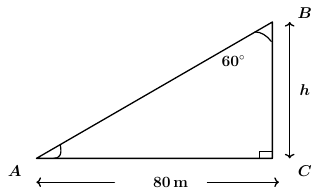
The angle of depression of the top of a tower to a point A is 60°. If the point is 80 m away from the foot of the tower, then the height of the tower is 

  1. ((a))

    803\frac{80}{\sqrt{3}} m

  2. ((b))

    803\sqrt3 m

  3. ((c))

    80 + 3\sqrt3 m

  4. ((d))

    None of these 

Show Answer
Answer: ((a))

803\frac{80}{\sqrt{3}} m

Given:

The angle of depression of the top of a tower = 60°

If the point is 80 m away from the foot of the tower.

Concept Used:

Opposite side = tan(angle) × adjacent side

Calculation:

If the angle of depression is 60°, then the angle inside the triangle at the top of the tower is 90° - 60° = 30°.

We want to use this 30° angle in our trigonometric 

Now, tan30° = h/80

⇒ h = 13\dfrac{1}{ \sqrt{3} } × 80  

⇒ h = 803\dfrac{80}{ \sqrt{3} }

The height of the tower is 803\dfrac{80}{ \sqrt{3} } m.

63

If 4 tan θ = 3, then is (4sinθcosθ4sinθ+cosθ)\left(\frac{4 \sin \theta-\cos \theta}{4 \sin \theta+\cos \theta}\right) equal to

  1. ((a))

    23\frac{2}{3}

  2. ((b))

    13\frac{1}{3}

  3. ((c))

    12\frac{1}{2}

  4. ((d))

    34\frac{3}{4}

Show Answer
Answer: ((c))

12\frac{1}{2}

Given:

4 tan θ = 3

Calculation:

4 tan θ = 3 ⇒ tan θ = 3/4      ----(1)

⇒ (4sinθcosθ4sinθ+cosθ)\left(\dfrac{4 \sin \theta-\cos \theta}{4 \sin \theta+\cos \theta}\right)

Dividing the above expression by cosθ;

⇒ 4sinθcosθcosθcosθ4sinθcosθ+cosθcosθ \dfrac{{\frac{{4sin{\rm{\theta }}}}{{{\rm{cos\theta }}}} - \frac{{cos{\rm{\theta }}}}{{{\rm{cos\theta }}}}}}{{\frac{{4sin{\rm{\theta }}}}{{{\rm{cos\theta }}}} + \frac{{cos{\rm{\theta }}}}{{{\rm{cos\theta }}}}}}

⇒ (4 tan θ – 1)/(4 tan θ + 1)

From equation (1),

⇒ (4 × 34\dfrac{3}{4} – 1)/(4 × 34\dfrac{3}{4} + 1)

⇒ (3 – 1)/(3 + 1)

24\dfrac{2}{4}  = 12\dfrac{1}{2}

∴ (4sinθcosθ4sinθ+cosθ)\left(\frac{4 \sin \theta-\cos \theta}{4 \sin \theta+\cos \theta}\right) = 12\dfrac{1}{2}

64

The area of a rectangular field is 15 times the sum of its length and breadth. If the length of that field is 40 m, then what is the breadth of that field?

  1. ((a))

    24 m

  2. ((b))

    25 m

  3. ((c))

    28 m

  4. ((d))

    32 m

Show Answer
Answer: ((a))

24 m

Shortcut Trick

Let the breadth of the field be B.

Area = 15 × (Length + Breadth) ⇒ 40 × B = 15 × (40 + B)

Dividing by 5: 8B = 3(40 + B) ⇒ 8B = 120 + 3B

5B = 120 ⇒ B = 24 m.

∴ The correct answer is 24 m.

Alternate Method

Given:

Length of the rectangular field (L) = 40 m

Area of the field = 15 × (Length + Breadth)

Formula Used:

Area of a rectangle = Length × Breadth

Calculations:

⇒ Area = 15 × (Length + Breadth)

⇒ Length × Breadth = 15 × (Length + Breadth)

⇒ 40 × B = 15 × (40 + B)

⇒ 40B = (15 × 40) + (15 × B)

⇒ 40B = 600 + 15B

⇒ 40B − 15B = 600

⇒ 25B = 600

⇒ B = 600 ÷ 25

⇒ B = 24 m

∴ The correct answer is 24 m.

Additional Information

Perimeter of a Rectangle

The perimeter is the total distance around the rectangle, calculated as P = 2 × (L + B).

Diagonal of a Rectangle

The diagonal (d) of a rectangle can be found using the Pythagoras theorem: d = √(L2 + B2).

Properties of a Rectangle

A rectangle is a quadrilateral where all four interior angles are 90° and opposite sides are equal and parallel.

65

If the sum of the areas of two circles with radii R1 and R2 is equal to the area of a circle of radius R, then

  1. ((a))

    R1 + R2 = R

  2. ((b))

    R12+R22=R2R_1^2+R_2^2=R^2

  3. ((c))

    R1 + R2 < R

  4. ((d))

    R12+R22<R2R_1^2+R_2^2<R^2

Show Answer
Answer: ((b))

R12+R22=R2R_1^2+R_2^2=R^2

Given:

If the sum of the areas of two circles with radii R1 and R2

Formula used:

The area of the circle = πr2

Calculation:

According to the question,

πR12 + πR22 = πR2

⇒ π(R12 + R22) = πR2

⇒ R12 + R22 = R2

∴ Option 2 is the correct answer.

66

The average age of 5 boys is 16 years, out of which average age of 4 boys is 16 years 3 months. The age of the 5th boy is

  1. ((a))

    15 years

  2. ((b))

    15 years 6 months

  3. ((c))

    15 years 4 months

  4. ((d))

    15 years 2 months

Show Answer
Answer: ((a))

15 years

Shortcut Trick

Average of 5 boys = 16 years.

Average of 4 boys = 16 years 3 months (Deviation = +3 months per boy).

Total deviation for 4 boys = 4 × 3 = +12 months = +1 year.

To maintain the overall average, the 5th boy must be 1 year less than the average.

Age of 5th boy = 16 years − 1 year = 15 years.

∴ The correct answer is 15 years.

Alternate Method

Given:

Number of boys = 5 | Average age = 16 years

Number of boys (subset) = 4 | Average age = 16 years 3 months = 16.25 years

Formula Used:

Sum of observations = Average × Number of observations

Calculations:

⇒ Total age of 5 boys = 5 × 16 = 80 years

⇒ Total age of 4 boys = 4 × 16.25 = 65 years

⇒ Age of 5th boy = Total age of 5 boys − Total age of 4 boys

⇒ Age of 5th boy = 80 − 65 = 15 years

∴ The correct answer is 15 years.

Additional Information

Average Concept

Average is the sum of all values divided by the total number of values. Formula: Average = Sum ÷ n.

Weighted Average

When two groups are combined, the new average is (n1x1 + n2x2) ÷ (n1 + n2).

Age Calculations

Always convert months to years by dividing by 12 (e.g., 3 months = 3/12 = 0.25 years) for uniform calculation.

67

729 ml of a mixture contains milk and water in the ratio of 7 ∶ 2. How much more water is to be added to get a new mixture containing milk and water in the ratio of 7 ∶ 3?

  1. ((a))

    81 ml

  2. ((b))

    60 ml

  3. ((c))

    71 ml

  4. ((d))

    52 ml

Show Answer
Answer: ((a))

81 ml

Given:

The mixture contains milk and water in a ratio of 7 ∶ 2. 

New mixture containing milk and water in the ratio 7 : 3

Total Mixture = 729 ml

Concept used:

Ratio proportion

Calculation:

The ratio between the milk and water mixture is 7: 2

∴ Let the milk and water be 7a ml and 2a ml

Total volume of mixture = 729 ml

⇒ 9a = 729

⇒ a = 81 ml

∴ Volume of water = 2a = 162 ml

The volume of milk = 567 ml

Let the volume of water to be added be w ml.

New ratio = 7 : 3

567162+w=73∴ \dfrac{{567}}{{162 + w}} = \dfrac{7}{3}

⇒ 1701 = 1134 + 7w

⇒ w = 81 ml

∴ 81 ml of water is to be added.

68

If the roots of the equation x2 - bx + c = 0 are α and β, then the equation whose roots are -α and -β will be

  1. ((a))

    x2 - bx - c = 0

  2. ((b))

    x2 + bx + c = 0

  3. ((c))

    x2 + bx - c = 0

  4. ((d))

    None of these

Show Answer
Answer: ((b))

x2 + bx + c = 0

Given:

If the roots of the equation x2 - bx + c = 0.

Calculation:

The roots of the given equation are α and β that is,

⇒ x2 - bx + c = 0 ........(1)

The sum of the roots (α and β) is given by - (- b) = b And the product of the roots (αβ) is given by c.

Now, you want the equation whose roots are - α and - β.

∴ The sum of these roots (- α and - β) is - α - β = - (α + β) = - b and The product of these roots ( - α - β) = αβ = c.

⇒ x2 - Sx + P = 0, where S is the sum of the roots and P the product of the roots.

So the equation will be: x2 + bx + c = 0

∴ Option 2 is the correct answer.

69

Choose the correct option:

Graphically, the pair of equations

6x - 3y + 10 = 0

2x - y + 9 = 0

represents two lines which are

  1. ((a))

    intersecting at exactly one point 

  2. ((b))

    intersecting at exactly two points 

  3. ((c))

    coincident

  4. ((d))

    parallel

Show Answer
Answer: ((d))

parallel

Given:

The pair of equations

6x - 3y + 10 = 0

2x - y + 9 = 0

Formula used:

Equations in slope-intercept form: y = mx + b

Calculation:

To understand why, we should first rewrite the equations in slope-intercept form, y = mx + b, where m represents the slope and b represents the y-intercept.

For the first equation: 6x - 3y + 10 = 0

⇒ -3y = -6x - 10

⇒ y = 2x + 10/3

For the second equation: 2x - y + 9 = 0

⇒ -y = -2x - 9

⇒ y = 2x + 9

The slopes of both lines are 2. Which means the lines are parallel (parallel lines have the same slope)

∴ Option 4 is the correct answer.

70

18\frac{1}{8}th part of a pencil is black and 12\frac{1}{2} part of the remaining is white. If the remaining part is blue and length of this blue part is 312\frac{1}{2} cm, then find the length of the pencil.

  1. ((a))

    6 cm

  2. ((b))

    7 cm

  3. ((c))

    8 cm

  4. ((d))

    9 cm

Show Answer
Answer: ((c))

8 cm

Given:

Part of Black Pencil = 18\dfrac{1 }{8}

Part of white Pencil = 12\dfrac{1 }{2}

the remaining 3123\dfrac{1}{2}is blue 

Calculation:

Let the total length of the pencil be LCM of 18\dfrac{1 }{8}  and 12\dfrac{1 }{2}  = 16x

Length of black colour =18\dfrac{1 }{8} × 16x = 2x

Remaining = 16x - 2x  = 14x

Length of white colour = 12\dfrac{1}{2}  × 14x = 7x

The remaining  3123\dfrac{1}{2} is blue.

Remaining = 14x - 7x = 7x = 72\dfrac{7 }{2}

⇒ x = 12\dfrac{1 }{2}

Total length of the pencil = 16x = 16 × 12\dfrac{1 }{2}  = 8m

∴ Option 3 is the correct answer.

71

Evaluate

(46)23(2)+6189÷3×5\frac{-(4-6)^2-3(-2)+|-6|}{18-9 \div 3 \times 5}

  1. ((a))

    38\frac{3}{8}

  2. ((b))

    47\frac{4}{7}

  3. ((c))

    83\frac{8}{3}

  4. ((d))

    74\frac{7}{4}

Show Answer
Answer: ((c))

83\frac{8}{3}

Calculation:

(46)23(2)+6189÷3×5\frac{-(4-6)^2-3(-2)+|-6|}{18-9 \div 3 \times 5}

⇒ (2)2+6+6183×5\frac{-(-2)^2+6+6}{18-3\times 5}

⇒ 4+6+61815\frac{-4+6+6}{18-15}

⇒ 83\dfrac{8}{3}

(46)23(2)+6189÷3×5\frac{-(4-6)^2-3(-2)+|-6|}{18-9 \div 3 \times 5} = 83\frac{8}{3}

72

Animals of which phylum have jointed legs?

  1. ((a))

    Mollusca

  2. ((b))

    Nematoda 

  3. ((c))

    Arthropoda

  4. ((d))

    Echinodermata

Show Answer
Answer: ((c))

Arthropoda

The correct answer is Arthropoda.

Key Points

  • Arthropoda is a group of invertebrate animals having an exoskeleton, a segmented body, and jointed legs.
  • Their body consists of segments with a pair of appendages.
  • Their reproduction occurs by internal fertilization (terrestrial species) and internal or external fertilization (aquatic species).
  • They have an open circulatory system.
  • Types of Arthropods –
  • Insects: Ants, Aphids, Butterflies, Grasshoppers, Termites, etc.
  • Arachnids: Scorpions, Mites, Spiders
  • Crustacean: Crabs, Fish, Lobsters, Shrimp, etc.
  • Largest phylum of invertebrate animals.
73

Which of the following is called 'Vaccinia' in Latin?

  1. ((a))

    Cowpox

  2. ((b))

    AIDS 

  3. ((c))

    Smallpox 

  4. ((d))

    Malaria 

Show Answer
Answer: ((a))

Cowpox

The correct answer is Cowpox.

Key Points

  • In Latin, “cow” is “vacca” and “cowpox” is “vaccinia”. From these roots, the term ‘vaccination’ has come into our usage.
  • Vaccinia Virus is also the name of a poxvirus (species Vaccinia virus of the genus Orthopoxvirus) that differs from but is closely related to the viruses causing smallpox and cowpox and that includes a strain used in making vaccines against smallpox.
  • Famously in 1796, Edward Jenner, an English physician realized that milkmaids who had had cowpox did not catch smallpox even during epidemics.
  • Jenner tried deliberately giving cowpox to people and found that they were now resistant to smallpox.
  • This was because the smallpox virus is closely related to the cowpox virus.
  • It was the first successful vaccine to be developed.
74

Evolutionary history of an organism is known as

  1. ((a))

    ancestry

  2. ((b))

    palaeontology

  3. ((c))

    ontogeny

  4. ((d))

    phylogeny

Show Answer
Answer: ((d))

phylogeny

The correct answer is phylogeny.

Key Points

  • Evolution is the gradual and continuous process of change that occurs over a period of time, due to slight variations in genetic compositions as well as changes in the environment, which leads to the formation of new species.
  • Phylogeny: It is the study of the development of an organism through various generations during the process of evolution or in other words, it is the evolutionary history of an organism. The phylogenetic relationships are represented in the form of a phylogenetic tree (cladogram), which shows how one taxon is related to another taxon. The phylogenetic tree diagram is based on molecular sequencing data analyses. Character or trait is the unit of data used in the phylogenetic.


75

Wings of pigeons, mosquitoes and bats show

  1. ((a))

    divergent evolution

  2. ((b))

    atavism

  3. ((c))

    convergent evolution

  4. ((d))

    All of these

Show Answer
Answer: ((c))

convergent evolution

The correct answer is convergent evolution.

Key Points

  • Wings of pigeons, mosquitoes and bats shows convergent evolution.
  • Wings of pigeon, mosquito and bats are analogous structure that is those organs which have similar functions but are different in their structural details and origin and they are adapted for flying. Thus, they give evidence of convergent evolution.

Additional Information

  • Divergent evolution
  • Divergent evolution is the process whereby groups from the same common ancestor evolve and accumulate differences, resulting in the formation of new species.
  • Atavism
  • Certain characters that were lost and were present in the ancestor of the organism return to the organism. This phenomenon is known as atavism.
  • Examples of atavism in human beings:
  • Presence of short tail in some babies.
  • Some persons have the power of moving pinnae.
76

Bacilli are bacteria which are

  1. ((a))

    comma - shaped

  2. ((b))

    rod - shaped 

  3. ((c))

    spiral

  4. ((d))

    spherical

Show Answer
Answer: ((b))

rod - shaped 

The correct answer is rod-shaped.

Key Points

  • Bacteria exist in a variety of forms, mainly spherical, rod-shaped and spiral-shaped.
  • Rod-shaped Bacillus: bacilli
  • Spherical Coccus: cocci
  • Comma-shaped Vibrium: vibrio
  • Spiral Spirillum: spirilla
77

What are the edible sea fishes? 

  1. ((a))

    Katla, Rohu, Hilsa 

  2. ((b))

    Hilsa, Common Carp, Mackerel

  3. ((c))

    Hilsa, Pomfret, Mackerel 

  4. ((d))

    None of these

Show Answer
Answer: ((c))

Hilsa, Pomfret, Mackerel 

The correct answer is Hilsa, Pomfret, Mackerel.

Key Points

  • The fishery is an industry devoted to the catching, processing, or selling of fish, shellfish, or other aquatic animals.
  • A large number of our population is dependent on fish, fish products, and other aquatic animals such as prawns, crab, lobster, edible oysters, etc., for food.
  • Fishes can be divided into two broad categories - freshwater fishes & marine fishes.
  • Some of the freshwater fishes that are very common include Catla, Rohu, and common carp.
  • Some of the marine fishes that are eaten include – Hilsa, Sardines, Mackerel, and Pomfrets.
78

Which one of the following is the hardest metal?

  1. ((a))

    Gold

  2. ((b))

    Iron

  3. ((c))

    Platinum

  4. ((d))

    Tungsten

Show Answer
Answer: ((d))

Tungsten

The correct answer is Tungsten.

Key Points

  • Tungsten
  • The metal tungsten is used for the filaments in incandescent bulbs.
  • It has a high melting point and retains its strength when heated.
  • Filaments of the light bulbs are made up of the Tungsten element.
  • Its symbol is ‘W’ because of its scientific name ‘Wolfram’ and its and the atomic number 74.

Additional Information

  • Gold
  • Gold is a naturally occurring chemical compound with atomic number 79.
  • The chemical symbol of Gold is Au.
  • Gold is one of the malleable metal which can be drawn into wire and it is also ductile metal that can be and made into sheets.
  • It is considered to be one of the precious metals that are used in jewellery, art.
  • Electronic Configuration of Gold is [Xe] 4f14 5d10 6s1.
  • Iron
  • Iron is a silvery-white or grayish metal.
  • It is ductile and malleable.
  • Wrought Iron is the purest form of iron.
  • Iron is the fourth most abundant element in the Earth's crust.
  • Atomic Number is 26.
  • Platinum
  • Platinum is an element with the atomic number 78 and an atomic mass of 195 in the periodic table.
  • It is an extremely rare element found in the crust of the earth.
  • Physically, platinum is a soft, lustrous, silver-coloured metal.
79

Which of the following metals does not form amalgam with mercury?

  1. ((a))

    Zinc

  2. ((b))

    Copper

  3. ((c))

    Magnesium

  4. ((d))

    Iron

Show Answer
Answer: ((d))

Iron

The correct answer is Iron.

Key Points

  • Iron does not form amalgam with mercury.
  • The majority of the metals form amalgams with mercury but there are some exceptions, the notable exceptions being iron, platinum, tungsten, and tantalum.

Additional Information

  • Zinc
  • A silvery-white metal with a blue tinge. It tarnishes in the air.
  • Most zinc is used to galvanise other metals, such as iron, to prevent rusting.
  • Galvanised steel is used for car bodies, street lamp posts, safety barriers and suspension bridges.
  • Copper
  • A reddish-gold metal that is easily worked and drawn into wires.
  • Most copper is used in electrical equipment such as wiring and motors.
  • This is because it conducts both heat and electricity very well, and can be drawn into wires.
  • It also has uses in construction (for example roofing and plumbing), and industrial machinery (such as heat exchangers).
  • Magnesium
  • A silvery-white metal that ignites easily in air and burns with a bright light.
  • Magnesium is used in products that benefit from being lightweight, such as car seats, luggage, laptops, cameras and power tools.
  • It is also added to molten iron and steel to remove sulfur.
80

Alcohol that is derived from fermentation of germinated barley grains is known as

  1. ((a))

    beer

  2. ((b))

    wine

  3. ((c))

    vodka

  4. ((d))

    rum

Show Answer
Answer: ((a))

beer

The correct answer is beer.

Key Points

  • Beer is a fermented beverage made from malted grains (usually barley), hops, yeast, and water.
  • It has a complex composition, containing a vast number of compounds widely ranging in nature and in concentration level.
  • In addition to water and ethanol, major beer components are carbohydrates comprising fermentable sugars as well as glucose oligosaccharides and arabinoxylans.
  • The source of carbohydrates in beer is starch-rich cereals, mainly malted barley, but other cereals including wheat, rice, maize, oats, sorghum, and sugar syrups may also be used.
  • The brewing process converts the malt starch to soluble sugars and then uses yeast to ferment these to alcohol.
  • Fermentation takes place at 7–13°C for lagers (using bottom-fermenting yeast, Saccharomyces carsbergensis) or 16–18°C for ales (using top-fermenting yeast Saccharomyces cerevisiae).
81

A radioactive substance has a half-life of four months. Three - fourth of the substance would decay in 

  1. ((a))

    3 months

  2. ((b))

    4 months 

  3. ((c))

    8 months

  4. ((d))

    12 months

Show Answer
Answer: ((c))

8 months

The correct answer is 8 months.

Key Points

  • A half-life indicates how long it takes for half of a given quantity of a radioactive substance to decay. In this case, the radioactive substance has a half-life of four months.
  • This means that every four months, half of the substance remains.
  • Firstly consider that three-fourths (or 75%) of the substance decaying means that one-fourth (or 25%) of the substance remains.
  • Let's think of the remaining amount as fractions of a whole, with each half-life:
  • After 1 half-life (4 months), 1/2 of the substance remains.
  • Another half-life (another 4 months) and half of the half remaining would be left, or 1/2 × 1/2 = 1/4 of the original substance remains.
  • So, three-fourths of the substance (or 75%) would decay in 8 months
82

When eno salt is poured into water, bubbles

  1. ((a))

    O2 gas

  2. ((b))

    CO2 gas

  3. ((c))

    CO gas

  4. ((d))

    H2 gas

Show Answer
Answer: ((b))

CO2 gas

The correct answer is CO2 gas.

Key Points

  • The Eno reacts with the water to make bubbles of carbon dioxide.
  • The bubbles attach themselves to the blobs of water and bring them to the top of the glass.
  • The carbon dioxide gas relieves bloating of the stomach and the soda in it neutralizes the acid.
83

Among the following which element was first produced artificially?

  1. ((a))

    Neptunium

  2. ((b))

    Plutonium

  3. ((c))

    Francium

  4. ((d))

    Technetium

Show Answer
Answer: ((d))

Technetium

The correct answer is Technetium.

Key Points

  • It is a chemical element with atomic number 43. It is represented by the symbol (Tc).
  • It is the lightest element whose all isotopes are radioactive, none of which are stable apart from the fully ionized state of 97Tc.
  • It is a silvery-gray radioactive metal with an appearance akin to platinum, commonly derived as a gray powder.
  • Technetium dissolves in aqua regia, nitric acid, and concentrated sulfuric acid, but it is insoluble in hydrochloric acid.
  • Carlo Perrier and Emilio Segrè discovered Technetium in 1937.
  • Technetium is utilized in radioactive isotope for medical tests.
84

Which of the following elements does not contain neutrons?

  1. ((a))

    Oxygen

  2. ((b))

    Nitrogen

  3. ((c))

    Hydrogen

  4. ((d))

    None of these

Show Answer
Answer: ((c))

Hydrogen

The correct answer is Hydrogen.

Key Points

  • The hydrogen (H) atom does not have any neutrons in its tiny nucleus.
  • It has only one electron (-ve charged) and one proton (+ve charged).
  • The first isotope of Hydrogen called Protium has no neutron in its atom.
  • Neutrons are the particles in an atom that has a neutral charge.
85

Which of the following gases is used in tear gas? 

  1. ((a))

    H2

  2. ((b))

    SO2

  3. ((c))

    NH3

  4. ((d))

    ​Cl2

Show Answer
Answer: ((d))

​Cl2

The correct answer is ​Cl2.

Key Points

  • Chloropicrin is one type of Tear gas agent.
  • It stimulates the nerves which supply the tear gland of our eye and increases the secretion of the tear.
  • It is widely used in riot control nowadays.
  • The chemical name of chloropicrin is Trichloronitromethane.
  • The chemical formula is CCl3NO2.
  • Thus Chlorine gas is used in tear gas.
86

A polymer used for making non - stick surface coating for utensils is 

  1. ((a))

    polyvinyl chloride

  2. ((b))

    teflon

  3. ((c))

    polystyrene

  4. ((d))

    polypropylene 

Show Answer
Answer: ((b))

teflon

The correct answer is teflon.

Key Points

  • A non-stick surface is a surface engineered to reduce the ability of other materials to stick to it.
  • Non-stick cookware is a common application, where the non-stick coating allows food to brown without sticking to the pan.
  • Non-stick is often used to refer to surfaces coated with polytetrafluoroethylene (PTFE), a well-known brand of which is Teflon.
  • Polytetrafluoroethylene (PTFE) is a synthetic fluoropolymer used in various applications including non-stick coatings.
  • The irregular surface promotes adhesion of the PTFE and also resists abrasion of the PTFE.
87

Which of the following cities are associated with ship building?

(i) Antwerp

(ii) Trieste

(iii) Minsk

(iv) Hamburg

Select the correct answer using the code given below:

  1. ((a))

    (i), (ii) and (iv) only

  2. ((b))

    (i) and (ii) only

  3. ((c))

    (ii), (iii) and (iv) only

  4. ((d))

    (i), (iii) and (iv) only

Show Answer
Answer: ((a))

(i), (ii) and (iv) only

The correct answer is Option 1.

Key Points

  • Antwerp is a major port city of Belgium, and is a major center for shipbuilding.
  • There are many shipbuilding companies in Antwerp, which build various types of ships, including cargo ships, passenger ships, and military ships.
  • Trieste is a port city in Italy, and is a major center for shipbuilding.
  • There are many shipbuilding companies in Trieste, which build various types of ships, including cargo ships, passenger ships, and submarines.
  • Hamburg is a major port city of Germany, and is a major center for shipbuilding.
  • There are many shipbuilding companies in Hamburg, which build various types of ships, including cargo ships, passenger ships, and frigates.
  • Minsk is the capital of Belarus, and it is not a port city. There is no shipbuilding industry in Minsk.
88

Who among the following is known as the land of red river and blue hills?

  1. ((a))

    Denmark

  2. ((b))

    Finland

  3. ((c))

    Assam

  4. ((d))

    Rajasthan

Show Answer
Answer: ((c))

Assam

The correct answer is Assam.

Key Points

  • Assam is known as the land of the Red River and Blue Hills.

  • Assam is referred so as the Red River refers to the river Brahmaputra, and the blue hills refer to the hills that shine at a distance forming a blue cloud.

Additional Information

  • Assam is a state in Northeast India, situated south of the eastern Himalayas along the Brahmaputra and Barak River valleys.
  • Assam covers an area of 78,438 km² (30,285 sq mi).
  • According to Area, the Indian State Assam ranked 16th in India.
  • Guwahati is the largest metropolitan area and urban conglomeration in Assam, administered under the highest form of the local urban body-Guwahati Municipal Corporation.
  • The state is bounded to the north by Bhutan and Arunachal Pradesh; to the east by Nagaland and Manipur; to the south by Meghalaya, Tripura, Mizoram, and Bangladesh; and to the west by the Siliguri Corridor by West Bengal.
89

Which of the following statements about India's scientific and research mission in Antarctica is/are correct?

  1. The first scientific base station in Antarctica was Dakshin Gangotri.
  2. Dakshin Gangotri is now being used as supply base and transit camp.
  3. The Maitri station is manned throughout the year for scientific activities.

Select the correct answer using the code given below:

  1. ((a))

    1 only

  2. ((b))

    1 and 3 only

  3. ((c))

    1 and 2 only

  4. ((d))

    1, 2 and 3

Show Answer
Answer: ((d))

1, 2 and 3

The correct answer is 1, 2 and 3.

Key Points

  • India established Dakshin Gangotri in 1983 as the first permanent research station in Antarctica. Therefore, statement (i) is correct.
  • Dakshin Gangotri was converted into a supply base and transit camp to support scientific and logistic activities in Antarctica After the construction of a new station named Maitri. Therefore, statement (ii) is correct.
  • The Maitri station is manned throughout the year to conduct various scientific research and studies in Antarctica. Therefore, statement (iii) is correct.

Additional Information

  • The Indian Antarctic Bill, 2022
  • The legislation is related to the activities of the Indian Antarctic Program, which is under the purview of the Ministry of Earth Sciences.
  • The bill also aims to give effect to the Antarctic Treaty, the Convention on the Conservation of Antarctic Marine Living Resources, and the Protocol on Environmental Protection to the Antarctic Treaty.
90

The Arctic region and the Antarctica continent are situated near

  1. ((a))

    the Sahara Desert

  2. ((b))

    the North and South Poles

  3. ((c))

    the Amazon Basin

  4. ((d))

    the Equator

Show Answer
Answer: ((b))

the North and South Poles

The correct answer is Option 2.

Key Points

  • The Arctic region and the continent of Antarctica are located near the North and South Poles.
  • The Arctic region is located around the North Pole, and it is located in the Northern Hemisphere.
  • This area is mainly covered with snow, and the temperatures here are very low.
  • The continent of Antarctica is located around the South Pole, and it is located in the Southern Hemisphere. This region is the coldest and driest continent on Earth.
  • The Sahara Desert, the Amazon Basin, and the Equator lie far from these poles.
91

Match List - I with List - II and select the correct answer using the code given below the lists:

List - I (Railway Zone)List - II (Headquarters)
(i)West Central(a)Jabalpur
(ii)South East Central(b)Gorakhpur
(iii)East Central(c)Bilaspur
(iv)North Eastern(d)Hajipur
  1. ((a))

    (i) - (d), (ii) - (b), (iii) - (a), (iv) - (c)

  2. ((b))

    (i) - (a), (ii) - (c), (iii) - (d), (iv) - (b)

  3. ((c))

    (i) - (a), (ii) - (b), (iii) - (c), (iv) - (d)

  4. ((d))

    (i) - (b), (ii) - (c), (iii) - (a), (iv) - (d)

Show Answer
Answer: ((b))

(i) - (a), (ii) - (c), (iii) - (d), (iv) - (b)

The correct answer is Option 2.

Key Points

  • There are a total of 19 railway zones in India, divided into 6 regions.
  • The West Central Railway zone covers the states of Chhattisgarh, Madhya Pradesh, and Maharashtra.
  • The South East Central Railway zone includes the states of Chhattisgarh, Odisha, and Jharkhand.
  • The East Central Railway zone includes the states of Bihar, Jharkhand, and Uttar Pradesh.
  • The North Eastern Railway zone includes the states of Assam, Bihar, Jharkhand, and Uttar Pradesh.
  • Thus, from the given options, Jabalpur, Bilaspur, Gorakhpur, and Hajipur are the headquarters of West Central, South East Central, North Eastern Central, and East Central Railway zones respectively.
92

The first Union Territory of India to run 100% on solar energy 

  1. ((a))

    Andaman - Nicobar

  2. ((b))

    Diu

  3. ((c))

    Chandigarh 

  4. ((d))

    Puducherry 

Show Answer
Answer: ((b))

Diu

The correct answer is Diu.

Key Points

  • Diu is the first Union Territory in India to run on 100% solar power.
  • Diu switched to 100% solar power in 2023, making it the first and only union territory in India to run entirely on renewable energy.
  • Diu's solar energy initiative is led by Diu Power Corporation Limited.
  • The objective of this initiative is to make Diu an environment-friendly and energy efficient Union Territory.
93

Consider the following statements with reference to the Union Territory of Puducherry :

(i) On the east, it is bounded by the Bay of Bengal and by Tamil Nadu on the other three sides.

(ii) The Union Territory of Puducherry consists of four small unconnected districts.

Which of the statement(s) given above is / are correct?

  1. ((a))

    (i) only

  2. ((b))

    (ii) only

  3. ((c))

    Both (i) and (ii)

  4. ((d))

    Neither (i) nor (ii)

Show Answer
Answer: ((c))

Both (i) and (ii)

The correct answer is Option 3.

Key Points

  • It is bounded by the Bay of Bengal in the east and Tamil Nadu on the remaining three sides.
  • This statement is correct. Puducherry is a union territory located on the south-eastern coast of India.
  • It is bounded by the Bay of Bengal on the east, and by the state of Tamil Nadu on the remaining three sides.
  • There are four small undivided districts in the union territory of Puducherry.
  • This statement is also correct. Puducherry has four districts:
  • Puducherry
  • Mangalore
  • Arcot
  • karaikal
  • These districts are not connected to each other, and they lie within the state of Tamil Nadu.
94

An important crop of commercial grain cultivation is

  1. ((a))

    wheat

  2. ((b))

    sugarcane

  3. ((c))

    cotton

  4. ((d))

    jute

Show Answer
Answer: ((a))

wheat

The correct answer is Wheat.

Key Points

  • Wheat is an important crop of commercial grain agriculture.
  • It is a major food crop, used to produce bread, pasta, and other foods.
  • Wheat is cultivated throughout the world, and is also a major export crop.
  • Sugarcane, cotton, and jute are other important crops of commercial agriculture, but they are not grains.
  • Sugarcane is a cash crop, which is used to produce sugar. Cotton is another cash crop, which is used to produce clothes and other products.
  • Jute is a fibrous crop used to produce bags, fibers, and other products.
95

The laws of reflection holds true for 

  1. ((a))

    plane mirrors only

  2. ((b))

    concave mirrors only

  3. ((c))

    convex mirrors only

  4. ((d))

    all reflecting surfaces

Show Answer
Answer: ((d))

all reflecting surfaces

The correct answer is all reflecting surfaces.

Key Points

  • Reflection: The phenomenon in which a light ray is sent back into the same medium from which it is coming, on interaction with boundary, is called reflection.
  • Laws of reflection: it states that if a light ray is reflected from a plane flat polished surface its angle of the incident will always be equal to the angle of reflection

 i.e., The angle of incidence (θi) = Angle of reflection (θr)

  • The incident ray, the reflected ray, and the normal to the surface all lie in the same plane.
  • The laws of reflection are also valid for all curved and spherical surfaces.
96

Which is a better conductor?

  1. ((a))

    Chromium

  2. ((b))

    Nickel

  3. ((c))

    Nichrome

  4. ((d))

    Iron

Show Answer
Answer: ((b))

Nickel

The correct answer is Nickel.

Key Points

  • The property of a conductor which resists the flow of electric current is called resistivity.
  • So, the lower the resistivity, the better the conductivity.
  • Resistivity of the given materials:
  • Resistivity of Nickel is 6.85×10⁻⁸Ωm.
  • Resistivity of Iron is 9.71×10⁻⁸Ωm.
  • Resistivity of Chromium is 13×10−8Ωm.
  • Resistivity of Nichrome is 1.1 x10⁻⁶Ωm or 110 x 10-8 Ωm.
  • Since the resistivity of Nickel is the lowest, we can say that Nickel is a better conductor.
97

The image formed by an astronomical telescope is

  1. ((a))

    virtual and diminished

  2. ((b))

    virtual and magnified

  3. ((c))

    real and diminished

  4. ((d))

    real and magnified

Show Answer
Answer: ((b))

virtual and magnified

The correct answer is virtual and magnified.

Key Points

  • Simple Microscope:
  • It is used to see the magnified image of objects.
  • It was invented by Antonie Van Leeuwenhoek.
  • It produces images that are virtual and enlarged.
  • Terrestrial telescope:
  • It is used to view distant objects on land.
  • The image produced by the telescope is virtual, erect, and small.
  • It consists of three lenses the third lens is to produce the erect image.
  • Compound Microscope:
  • A compound microscope uses two or more lenses to produce a magnified image of an object.
  • The image produced by the microscope is magnified, virtual, and inverted.
  • Astronomical telescope:
  • It is used to view celestial bodies like stars and planets.
  • The image produced by this telescope is virtual, inverted, and enlarged.
98

Loudness of sound is measured in terms of

  1. ((a))

    frequency

  2. ((b))

    amplitude

  3. ((c))

    velocity

  4. ((d))

    wavelength

Show Answer
Answer: ((b))

amplitude

The correct answer is amplitude.

Key Points 

  • Loudness is measured in a unit called amplitude.
  • The loudness of the sound is directly proportional to the square of the amplitude of the vibration producing the sound.
  • The loudness of sound also depends on the density of the medium through which it propagates.
  • The loudness of a sound relates the intensity of any given sound to the intensity at the threshold of hearing.
  • The loudness of sound depends on the amplitude of the vibration producing the sound.
  • A sound is louder as the amplitude of the vibration is greater, and the intensity decreases as the distance from the source increases.

Additional Information 

QuantityUnit
ChargeCoulomb
TimeSecond
CurrentAmpere
PowerWatts
EnergyJoules
PressurePascal
FrequencyHertz
Angular accelerationrad/sec2
StrainUnitless
HeatJoule
VoltageVolt
Resistance (R)ohm
temperatureKelvin(K) or degree Celsius( °C)
Capacitance (C)Coulomb/volt or Farad
Resistivity or Specific resistance (ρ)Ohm-mete

Power of a lens
dioptre
99

On which of the following techniques, does Photostat machine work?

  1. ((a))

    Magnetic image making

  2. ((b))

    Thermal image making

  3. ((c))

    Electrostatic image making

  4. ((d))

    Electromagnetic image making

Show Answer
Answer: ((c))

Electrostatic image making

The correct answer is Option 3.

Key Points

  • Electrostatic image making techniques, does Photostat machine work
  • Photostat machine works on electrostatic image formation technology. In this technology, a photoresistive drum is used, which is sensitive to light.
  • When the drum is placed in front of the original document, the surface exposed to light becomes charged.
  • Then, a toner powder, which is negatively charged, is applied to the drum.
  • Toner powder sticks only to areas that are charged. Finally, the toner powder is transferred to the paper, creating a copy.
100

One astronomical unit is the average distance between

  1. ((a))

    the Earth and the Sun

  2. ((b))

    the Earth and the Moon

  3. ((c))

    the Jupiter and the Sun 

  4. ((d))

    the Pluto and the Sun

Show Answer
Answer: ((a))

the Earth and the Sun

The correct answer is Option 1.

Key Points

  • An astronomical unit, the average distance between the Earth and the Sun.
  • This is approximately 150 million kilometers or 93 million miles.
  • The distance between the Earth and the Moon is approximately 384,400 kilometers.
  • The distance between Jupiter and the Sun is approximately 5.20 astronomical units.
  • The distance between Pluto and the Sun is approximately 39.5 astronomical units.

Attempt this paper under real exam conditions

Timed interface, section switching, instant scoring, and question-by-question analytics — free.

Start Timed Attempt