Official Paper

Army Soldier GD Lansdowne (LUC) 28 March 2021 Official Paper. (Previous Year Paper)

50 questions · 60 minutes · with answers · free

General Knowledge (15 questions)

1

Who was admired as tempestuous Hindu in 1893 in the world parliament of Religions in Chicago?

  1. ((a))

    Swami Vivekanand

  2. ((b))

    Gautam Buddha

  3. ((c))

    Swami Dayananad Saraswati

  4. ((d))

    Rabindra Nath Tagore

Show Answer
Answer: ((a))

Swami Vivekanand

The correct answer is Swami Vivekanand. 

  • Swami Vivekananda represented India and Hinduism at the Parliament of the World's Religions (1893).
  • He founded the Ramakrishna Mission in May 1897.
  • He died in 1902 at Belur Math in present-day West Bengal.
  • He was influenced by Ramakrishna Paramahansa who was also his Guru.

Additional Information

  • Gautam Buddha
  • Buddha was born in Lumbini (Nepal), obtained his enlightenment in Bodh Gaya, gave his first sermon in Sarnath, and died in Kushinagar.
  • Kushinagar is a town in the Indian state of Uttar Pradesh.
  • Sarnath is the place where Gautama Buddha first taught the Dharma then Buddhist Sangha has originated.
  • Gautam Budhha is the founder of the world religion of Buddhism. Siddhartha Gautama is the original name of Buddha.
  • Dayanand Saraswati 
  • He was a Hindu religious leader and founder of the Arya Samaj.
  • Swamiji was sent to Ajmer for better medical care.
  • There was no improvement in his health and he died on the morning of 30 October 1883.
  • Rabindranath Tagore 
  • He was the youngest son of Debendranath Tagore.
  • Debendranath Tagore was a leader of the Brahmo Samaj.
  • In 1913 Rabindranath Tagore became the first non-European to receive the Nobel Prize for Literature.
  • Rabindranath Tagore was knighted by the ruling British Government in 1915.
2

Meenambakkam International Airport is in?

  1. ((a))

    Bangulru

  2. ((b))

    Hyderabad

  3. ((c))

    Chennai

  4. ((d))

    Coimbatore

Show Answer
Answer: ((c))

Chennai

The corrected answer is Chennai.

  • Meenambakkam is a Chennai in the Indian state of Tamil Nadu.
  • The name Meenambakkam signifies that it is a settlement near the coast.
  • Pakkam means a settlement near the coast.


List of International airports in Tamil Nadu.

Airport NameCity Served
Chennai International AirportChennai
Coimbatore International AirportCoimbatore
Madurai AirportMadurai
Tiruchirapalli International AirportTiruchirapalli


Additional Information

  • List of International airports in Kerala:
  • Trivandrum International Airport in Thiruvananthapuram district.
  • Cochin International Airport in Nedumbassery in Ernakulam district.
  • Calicut International Airport in Karipur in Malappuram district.
  • Kannur International Airport in Mattanur in Kannur district.
  • List of International Airports in Maharashtra:
  • Chhatrapati Shivaji Maharaj International Airport Mumbai
  • Navi Mumbai International Airport
  • Dr Babasaheb Ambedkar International Airport Nagpur
  • Pune International Airport
  • List of International Airports in West Bengal:
  • Netaji Subhas Chandra Bose International Airport
  • Bagdogra International Airport
  • Kaji Nazrul Islam Airport
  • List of International Airports in Karnataka
  • Kempegowda International Airport
  • Mangalore International Airport
3

Headquarter of which bank is located in Manipal, Karnataka?

  1. ((a))

    Vijaya Bank

  2. ((b))

    Canara Bank

  3. ((c))

    Syndicate Bank

  4. ((d))

    Corporation Bank

Show Answer
Answer: ((c))

Syndicate Bank

The correct answer is Syndicate Bank.

Key Points

  • Syndicate Bank was founded in 1925 in Manipal, Udupi, Princely State of Mysore.
  • Headquarter is located in Manipal, Karnataka.
  • It was founded by Upendra Ananth Pai, T. M. A. Pai, and Vaman Srinivas Kudva.
  • Syndicate Bank was nationalized in 1969.​​
  • At the time of its establishment, the bank was known as Canara Industrial and Banking Syndicate Limited.
  • Syndicate bank, along with the other 13 major commercial banks of India, was nationalized on 19 July 1969, by the Government of India.
  • The Bank was headquartered in the university town of Manipal, India.
  • On 1st April 2020, the bank was merged into Canara Bank.

Additional Information

List of banks with their headquarters. 

BanksHeadquarters
Andhra BankHyderabad
Axis BankMumbai
Bank of Baroda (Vijaya Bank & Dena Bank)Vadodara
Bank of IndiaMumbai
Bank of MaharashtraPune
Bandhan BankKolkata
Canara Bank (Syndicate Bank)Bengaluru
Central Bank of IndiaMumbai
Corporation BankMangalore
Citi Union BankTamil Nadu
Dhanlaxmi BankKerala
Federal BankKerala
HDFC BankMumbai
IDBI BankMumbai
Indian Bank (Allahabad Bank)Chennai
Indian Overseas BankChennai
ICICI BankMumbai
IDFC BankMumbai
IndusInd BankMumbai
Karnataka BankMangaluru
Karur Vysya BankTamil Nadu
Kotak Mahindra BankMumbai
Lakshmi Vilas BankChennai
Punjab National Bank (Oriental Bank of Commerce &  United Bank of India)New Delhi
Punjab & Sind BankNew Delhi
RBL Bank (Ratnakar)Mumbai
State Bank of IndiaMumbai
Syndicate BankManipal, Karnataka
South Indian BankThrissur, Kerala
UCO BankKolkata
Union Bank of IndiaMumbai
Yes BankMumbai
4

Which of the following kingdoms were associated with the life of the buddha?

  1. ((a))

    Gandhara

  2. ((b))

    Kosala

  3. ((c))

    Kuru

  4. ((d))

    Avanti

Show Answer
Answer: ((b))

Kosala

The correct answer is Kosala.

  • Gandhara is not directly associated with the life of Buddha. It flourished during the ruling of the Mauryan Period, especially during the period of Ashoka.
  • Maha Maya, the mother of Gautama Buddha belongs to the Kosala Dynasty. So Kosala is most appropriate.

Additional Information

  • Buddhism:
  • Founded by Siddhartha Gautam.
  • He was born in Lumbini near Nepal in 563 BC.
  • After 49 days of meditation under a pipal tree, Gautama attained Bodhi (enlightenment) at Bodhgaya in Bihar.
  • Buddha gave his first sermon at Sarnath, UP and the event is known as Dharma-Chakra-Pravartana.
  • He followed 'Madhyam Marg' or the middle path
  • He died at Kushinagar, UP and the event is known as Mahaparinibban.
  • The Tri Ratnas of Buddhism are: Buddha (spiritual potential), Dhamma (teachings of Buddha) and Sangha (order of monks who follow Buddhism).
5

The air that contains moisture to its full capacity:

  1. ((a))

    Absolute humidity

  2. ((b))

    Specific humidity

  3. ((c))

    Relative humidity

  4. ((d))

    Saturated air

Show Answer
Answer: ((d))

Saturated air

The correct answer is Saturated air.

  • Saturated air has a relative humidity of 100%.
  • Humidity is the amount of water vapor in the air.
  • If there is a lot of water vapor in the air, the humidity will be high. The higher the humidity, the wetter it feels outside.
  • There are three main measurements of humidity: relative, absolute, and specific.

Additional Information

  • Absolute humidity:
  • Its unit is grams of water vapor per cubic meter volume of air.
  • It is a measure of the actual amount of water vapor in the air, regardless of the air's temperature.
  • The higher the amount of water vapor, the higher the absolute humidity.
  • For example, a maximum of about 30 grams of water vapor can exist in a cubic meter volume of air with a temperature in the middle 80s.
  • Relative humidity:
  • It is expressed as a percent, which is a measure of the amount of water vapor that air is holding compared to the amount it can hold at a specific temperature.
  • Warm air can possess more water vapor (moisture) than cold air, so with the same amount of absolute/specific humidity, air will have higher relative humidity.
  • Relative humidity of 50% means the air holds on that day (specific temperature) holds 50% of the water needed for the air to be saturated.
  • The relative humidity of an air-water mixture is also defined as the ratio of the partial pressure of water vapor in the mixture to the saturated vapor pressure of water at a given temperature.
  • Thus the relative humidity of air is a function of both water content and temperature.
  • Specific humidity:
  • Specific humidity refers to the weight of water vapor contained in a unit weight (amount) of air (expressed as grams of water vapor per kilogram of air).
  • Absolute and specific humidity are quite similar in concept.
6

Which of among following is an important tribe of the Dhauladhar Range

  1. ((a))

    Lepcha

  2. ((b))

    Gaddi

  3. ((c))

    Tharu

  4. ((d))

    Abor

Show Answer
Answer: ((b))

Gaddi

The correct answer is Gaddi.

Key Points

  • Gaddi tribes are famous tribes of the Dhauladhar range.
  • Gaddi tribes are mainly living in Himachal Pradesh and Jammu and Kashmir region.
  • Gaddi is a generic name and it includes Khatris, Brahmins, and Rajput.

Additional Information 

  • The Arbore tribe is a native ethnic group found in southern Ethiopia.
  • Lepcha tribes are found in Bhutan, Tibet, Darjeeling, eastern Nepal, and in the hills of West Bengal.
  • Tharu tribes are found in Northern India and southern Nepal.
7

Term of Rajya Sabha member is 

  1. ((a))

    6 years

  2. ((b))

    5 years

  3. ((c))

    2 years

  4. ((d))

    None of these

Show Answer
Answer: ((a))

6 years

The correct answer is 6 years.

Key Points

  • The Council of States or Rajya Sabha is the upper house of the bicameral Parliament of India.
  • Rajya Sabha is a permanent body and it can never dissolve.
  • There is no tenure of Rajya Sabha whereas the member of Rajya Sahba has a tenure of 6 years.
  • One-third of members of the Rajya Sabha retire every second year in a cyclic manner.

Additional Information

  • Rajya Sabha-
  • As of 2021, the Rajya Sabha has a maximum membership of 245.
  • Out of 245, 233 are elected by the legislatures of the states and union territories using single transferable votes through Open Ballot and the President can appoint 12 members for their contributions to literature, art, science, and social services.
  • The potential seating capacity of the house (Rajya Sabha) is 250 (238 elected, 12 Nominated by the President of India), according to article 80 of the Constitution of India.
  • The Vice President of India is the ex-officio Chairman of the Rajya Sabha.


  • The Indian Parliament is the supreme legislative body of the Republic of India.
  • The Parliament is a bicameral legislature composed of the President of India and 2 houses: the Lok Sabha and Rajya Sabha.
  • The term of office of a Lok Sabha member is 5 years.
  • The Indian Constitution provides that the maximum strength of Lok Sabha be 550 members.
8

The largest irrigation canal in India is called the ______

  1. ((a))

    Indira Gandhi Canal

  2. ((b))

    Sirhand canal

  3. ((c))

    Yamuna canal

  4. ((d))

    Upper Bari Doab

Show Answer
Answer: ((a))

Indira Gandhi Canal

The correct answer is the Indira Gandhi canal.

  • Indira Gandhi canal is the largest irrigation canal in India.
  • It was originally called the Rajasthan Canal.
  • It is 650 km long.

Key Points

  • Indira Gandhi canal starts from the Harike Barrage at Harike, near the confluence of the Satluj and Beas rivers in the state of Punjab and terminates in irrigation facilities in the Thar Desert in the north-west of Rajasthan state.
  • It consists of Rajasthan feeder canal and Rajasthan main canal which runs through 167 km in Punjab and Haryana and remaining 492 km in Rajasthan.
  • The canal is one of the projects of Green revolution in India and also runs through The Great Thar Desert.

Additional Information

  • Yamuna canal was renovated in 1335 by Firoz Shah Tughlaq.
  • It was originally built before the era of Prithviraj Chauhan.
  • Sirhind Canal carries water from the Sutlej River in Punjab.
  • Upper Bari Doab Canal is located on the region between Ravi and Beas hence, is known as Bari Doab.
9

Who was the first muslim woman ruler of Delhi?

  1. ((a))

    Begam Hazarat Mahal

  2. ((b))

    Sultana Razia

  3. ((c))

    Noorjahan

  4. ((d))

    Chand Bibi

Show Answer
Answer: ((b))

Sultana Razia

The correct answer is Sultana Razia.

  • Razia Sultana Begum was a ruler of the Delhi sultanate.
  • She was the first female Muslim ruler of the Indian subcontinent.
  • She ruled the Delhi sultanate from 1236 to 1240.
  • She was defeated by her half-brother Muizuddin Bahram in 1240.
  • Mamluk Sultan Iltumish was the father of Sultana Razia Begum.

Additional Information

  • Begam Hazrat Mahal was related to the 1857 revolt from Lucknow.
  • Jahangir was married to Mahrun Nisha (Noor Jahan), widow of Sher Afgani in 1611.
  • Chand Bibi is known for defending Ahmednagar against the Mughal Emperor Akbar.
10

Khasi and Garo Tribes mainly live in ______

  1. ((a))

    Meghalaya

  2. ((b))

    Mizoram

  3. ((c))

    Nagaland

  4. ((d))

    Manipur

Show Answer
Answer: ((a))

Meghalaya

The correct answer is Meghalaya.

Key Points 

  • The Garo Khasi And Jayantia Hills were formed in the same age as of the Malwa Plateau.
  • The Garo, Khasi, And Jayantia Hills are located in Meghalaya.
  • The hills are named after the tribes found particularly in that region.
  • Meghalaya is also known as the Scotland of the East.

Additional Information

  • ​Garo Hills:
  • It is the part of the Garo- Khasi range in Meghalaya, India.
  • The range is part of the Meghalaya Subtropical forest ecoregion. The Garo's call themselves A.chik (locally used).
  • Nokrek Peak is the highest peak of Garo hills.
  • Khasi Hills:
  • It is located in the Shillong Plateau in the Meghalaya State of India.
  • The Khasi hills are a part of the Garo-Khasi-Jaintia range and connect with Purvanchal range and larger Patkai range further east.
  • The highest peak is Lum Shillong which is 1968m high.
  • Jaintia Hills:
  • The Jaintia hills are located further to the east of Khasi Hills in the state of Meghalaya.
  • It is a part of the Patkai hill range that extends across the Indo- Myanmar borders.
11

Prime Meridian is located at _______ degree meridian.

  1. ((a))

    0

  2. ((b))

    180

  3. ((c))

    60

  4. ((d))

    90

Show Answer
Answer: ((a))

0

The correct answer is 0°.

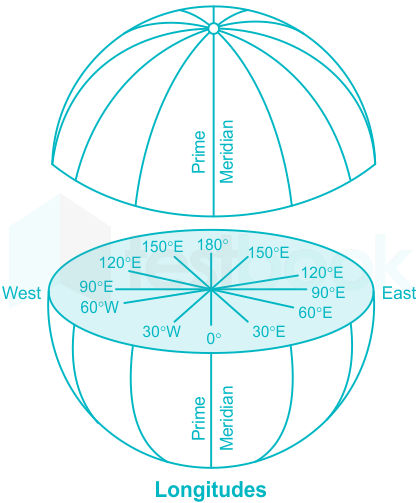
  • The prime meridian passes through Greenwich in England which is zero degrees longitude. So It is also called the Greenwich Meridian.

Important Points


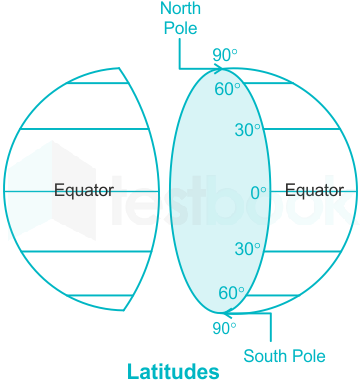
  • For locating places on a map, imaginary lines called latitudes and longitudes are drawn.
  • Longitudes are vertical lines that run from north to south.
  • Prime Meridian is the 0° longitude that divides Earth into the Eastern and Western hemispheres.

Additional Information

  • Opposite of prime meridian is IDL which is at 180-degree longitude.​
  • IDL is a zigzag line and passes through Bering Strait.
  • When one crosses the International Date Line, the day and date changes.
  • When one crosses IDL to the west, one loses the day.
  • When one goes from west to east, one gains a day.
  • 1 degree of longitude is equal to 4 minutes.
  • 15-degree longitude is 1 hour.
  • One degree of latitude is 111 km on Earth's surface.
12

'Kambala race' a traditional buffalo race is being held in _______

  1. ((a))

    Kerala

  2. ((b))

    Telangana

  3. ((c))

    Tamil Nadu

  4. ((d))

    Karnataka

Show Answer
Answer: ((d))

Karnataka

The correct answer is Karnataka

  • Kambala buffalo race is related to the state of Karnataka.
  • The Kambala season starts in November and ends in March.
  • The festival is dedicated to Kadri's Lord Manjunatha, an incarnation of Lord Shiva.

Additional Information

  • The list of some Indian festivals are:
  • Bihar - Chhath Puja
  • Gujarat - Navratri, Janmashtami, Kutch Utsav
  • Kerala - Onam, Vishu
  • Tamil Nadu - Pongal
  • Maharashtra - Ganesh Utsav, Gudi Padva
  • Odisha - Rath Yatra, Raja Parba
  • Rajasthan - Gangaur, Teej
  • Sikkim - Losar, Saga Dawa
  • Jammu and Kashmir - Har Navami, Chhari, Bahu Mela
  • Himachal Pradesh - Rakhadumni, Gochi Festival
  • Haryana - Baisakhi, Surajkund Mela
  • Chhattisgarh - Maghi Purnima, Bastar
  • Nagaland - Hornbill festival
13

The most important uranium mine in India is _______

  1. ((a))

    Vashi

  2. ((b))

    Manavalakurichi

  3. ((c))

    Gauribidanur

  4. ((d))

    Jaduguda

Show Answer
Answer: ((d))

Jaduguda

The correct answer is Jaduguda​.

  • The first Uranium mine of India, the Jaduguda mines, is located in Jharkhand.
  • The Jaduguda Mine is a uranium mine situated in Jaduguda village, in Jharkhand Indian state's Purbi Singhbhum district.
  • It started operation in 1967 and became India's first uranium mine.
  • The deposits were found at that mine in 1951.
  • India possesses only two functional uranium mines as of March 2012, including this Jaduguda Mine.
  • The Jaduguda mine provides up to 25 per cent of the raw materials required to power the nuclear reactors in India.
14

Where is Lal Bahadur Shastri National Academy of Administration located _______?

  1. ((a))

    Shimla

  2. ((b))

    Ooty

  3. ((c))

    Mussoorie

  4. ((d))

    Delhi

Show Answer
Answer: ((c))

Mussoorie

The correct answer is Mussoorie.

  • Lal Bahadur Shastri National Academy of Administration is  located in Mussoorie.
  • Foundational courses and refresher courses organized by the National Academy of Administration, Mussoorie is an example of pre-entry training for IAS.

Additional Information

  • National Academy of Administration It is the premier training institution in our country.
  • It was established in 1959 at Mussoorie, a famous hill station in Uttaranchal.
  • In 1972, it was renamed the Lal Bahadur Shastri National Academy of Administration.
  • Presently, it is under the Ministry of Personnel.
  • IPS Training
  • The Indian Police Service (IPS) trainees move on to the Sardar Vallabhbhai Patel National Police Academy in Hyderabad.
  • Police Training College is an example of Departmental Training.
  • IFoS Training
  • The Indian Forest Service (IFoS) officers go to the Indira Gandhi National Forest Academy in Dehradun for their training.
  • IFS Training
  • Other group-A Central Services officers such as the Indian Foreign Service (IFS) proceed to the Foreign Service Institute (FSI) India located in New Delhi.
  • IRS Training
  • Indian Revenue Services (IRS) officers move on to either the National Academy of Direct Taxes, Nagpur or the National Academy of Customs, Excise & Narcotics, Faridabad depending on the branch they are allocated to go. (there are two branches of the IRS: IRS – Income Tax; and IRS – Customs and Central Excise).
15

The first session of the congress was held in :

  1. ((a))

    Surat

  2. ((b))

    Bombay

  3. ((c))

    Calcutta

  4. ((d))

    Delhi

Show Answer
Answer: ((b))

Bombay

The correct answer is Bombay.

Key Points

  • The first session was held in a hall at the Gokuldas Tejpal Sanskrit College in Bombay.
  • Indian National Congress was formed in 1885 by A.O Hume a member of the Imperial Civil Service.
  • The first meeting of the Indian National Congress was held on December 28th, 1885.
  • Womesh Chunder Bonnerjee was the first president of the Indian National Congress. He was an Indian barrister.
  • In the first session out of 72, 39 were lawyers and this trend continued i.e. more than one-third of delegates were from the legal background.

Additional Information

The list of some of the sessions of the Indian National Congress before the Indian Independence.

YearLocationPresident and significance
1885BombayWomesh Chandra Bannerjee [1st session attended by 72 delegates]
1886CalcuttaDadabhai Naoroji National [Congress and National Conference]
1887MadrasBadruddin Tyyabji [first Muslim President]
1888AllahabadGeorge Yule

General Science (15 questions)

16

Tooth decay starts when pH of mouth is lower than _______

  1. ((a))

    10

  2. ((b))

    7

  3. ((c))

    8

  4. ((d))

    5.5

Show Answer
Answer: ((d))

5.5

The correct answer is 5.5.

Key Points

  • Tooth decay starts when the pH of the mouth is lower than 5.5.
  • Tooth enamel, made up of calcium phosphate is the hardest substance in the body.
  • It does not dissolve in water but is corroded when the pH in the mouth is below 5.5.
  • Bacteria present in the mouth produce acids by the degradation of sugar and food particles remaining in the mouth after eating.
  • The best way to prevent this is to clean the mouth after eating food.
  • At the pH of 5.5, the teeth risk of cavities and tooth decay begins in the mouth.

Additional Information

  • The role of toothpaste to prevent tooth decay is as follows-
  • A healthy mouth is in a neutral pH range. Teeth can actually become stronger and re-mineralize when the pH of the mouth is 7.5 or above.
  • Bacteria present in the mouth produce acids by the degradation of sugar and food particles remaining in the mouth after eating.
  • Using toothpaste, which is generally basic, for cleaning the teeth can neutralize the excess acid and prevent tooth decay.
  • Fluoride is a mineral that can prevent tooth decay from progressing. It can even reverse or stop, early tooth decay. Hence most of the toothpastes have fluoride ions.
  • Also, tooth-pastes have salts in them which decreases the acidity of mouth.
17

The melting point of copper is ______

  1. ((a))

    1038°C

  2. ((b))

    1085°C.

  3. ((c))

    100°C

  4. ((d))

    None of these

Show Answer
Answer: ((b))

1085°C.

The correct answer is 1085°C.

Key Points

Melting and Melting Point:

  • The process of change of state from solid to liquid is called melting.
  • The temperature at which a solid starts to liquify is known as the melting point of that solid.
  • The melting point of a substance at atmospheric pressure is called a normal melting point.

Additional Information

Melting point of some common metals.

MetalMelting Point (in °C)
Tungsten3380
Silicon1414
Mild Steel1370
Copper1085
Aluminum659
Titanium1668
Gold1063
Silver951
18

The molecular formula of cane sugar is _______

  1. ((a))

    C12H22O11

  2. ((b))

    H2CO3

  3. ((c))

    C6H12O6

  4. ((d))

    H2C2O4

Show Answer
Answer: ((a))

C12H22O11

Key Points

  • The molecular formula for sucrose is C12H22O11.
  • Cane sugar is called Sucrose, as it is obtained from sugarcane.
  • Sucrose is also called Table Sugar. It is basically a nonreducing disaccharide composed of glucose and fructose.
  • The fructose and glucose molecules are connected via a glycosidic bond.
  • It can also undergo a combustion reaction to yield carbon dioxide and water.
  • Commercially, it is obtained from sugarcane, sugar beet, etc.
  • It is extensively used as a sweetener.
  • It also serves as an antioxidant and a food preservative.

Additional Information

SugarCommon nameReason
GlucoseGrape sugarObtained from ripe grapes
SucroseCane sugarObtained from sugarcane
FructoseFruit sugarObtained from several fruits like berries
19

Which among the following helps in circulation of blood?

  1. ((a))

    Lymphocytes

  2. ((b))

    Monocytes

  3. ((c))

    None of these

  4. ((d))

    Blood Platelets

Show Answer
Answer: ((a))

Lymphocytes

The correct answer is Lymphocytes.

Key Points

  • Lymphocytes: These are a type of white blood cell that provides an immune response to the body.
  • Lymphocytes, which are part of the lymphatic system collect excess fluid that drains from cells and tissue throughout your body and returns it to your bloodstream, which is then recirculated through your body.

Additional Information

  • Lymphocytes are mainly of two types: B-lymphocytes & T-lymphocytes.
  • Both B & T-lymphocytes originates in the bone marrow.
  • T-lymphocytes move to the thymus for maturation while B-lymphocytes matures in the bone marrow only.
  • The B-lymphocytes cells produce antibodies to fight foreign pathogens like viruses & bacteria entering the body.
  • The T-lymphocytes act on self-body cells, which have become cancerous or taken over by viruses and destroys them.
  • Blood Platelets (also known as thrombocytes) are also crucial but for blood clotting, not directly aiding in circulation.

Note - the heart, arteries, veins, and capillaries are the main components that help in the circulation of blood. They pump and carry blood to all parts of the body.

20

Which is the correct unit for measuring astronomical distances?

  1. ((a))

    Centimeter

  2. ((b))

    Light year

  3. ((c))

    Meter

  4. ((d))

    Kilometer

Show Answer
Answer: ((b))

Light year

The correct answer is Light year.


Key Points

  • Light year:  The distance travelled by light in one year is called a light-year.
  • It is a unit of astronomical distance.
  • 1 light-year = 9.461 trillion kilometres which is a very large distance.
  • Hence option 2 is correct.

Additional Information .

  • As defined, a light-year is a distance travelled by light in free space in one year.
  • Also, the speed of light = 3 × 108 m/s
  • Time = 1 year or 365 days
  • Hence, by formula  Distance = Speed / time
  • We got that, one light-year = 9.46 × 1015 m
  • Or, 1 light-year = 9.461 trillion kilometres.
21

Botany is the study of ______.

  1. ((a))

    Animals life

  2. ((b))

    Human life

  3. ((c))

    Birds life

  4. ((d))

    Plants life

Show Answer
Answer: ((d))

Plants life

The correct answer is Plants life.

Key Points

  • Biology is the science of life.
  • Biology can be divided into several branches like Botany, Zoology, microbiology, virology, genetics, ecology, morphology, biotechnology, etc.
  • Botany: It is the scientific study of plants. Botany is further divided into many branches: Morphology, histology, anatomy, plant physiology, taxonomy, plant breeding, plant embryology, etc

Additional Information 

  • Zoology: It is the study of both living and extinct animals.
  • Physiology: It is the study of how the human body works.
  • Ornithology: It is the study of Birds.
22

At high altitude nose bleeding occurs due to :

  1. ((a))

    Low atmospheric pressure

  2. ((b))

    Severe cold

  3. ((c))

    High atmospheric pressure

  4. ((d))

    None of these

Show Answer
Answer: ((a))

Low atmospheric pressure

The correct answer is Low atmospheric pressure.

Key Points

  • We know that atmospheric pressure decreases with high altitude.
  • The blood pressure is counterbalanced with the atmospheric pressure at normal altitude.
  • But, at higher altitudes, atmospheric pressure is lower compared to the pressure at the surface of the earth.
  • So, at higher altitudes, the blood pressure inside our body is more than the atmospheric pressure which forces the blood to ooze out from openings like the nose.
  • Hence, bleeding starts from body parts having weak skin like the nose and eyes (in severe cases).
  • In some cases, internal bleeding may also occur from capillaries.
23

Which of the following is a primary fuel?

  1. ((a))

    Charcoal

  2. ((b))

    Petroleum

  3. ((c))

    Coal

  4. ((d))

    None of these

Show Answer
Answer: ((c))

Coal

The correct answer is Coal.

Key Points

  • Primary fuels are fuels that are found in nature and can be extracted, captured, cleaned, or graded without any sort of energy conversion or transformation process.
  • Coal is a Primary fuel because it can be extracted directly without any sort of energy conversion or transformation process.
  • There are other primary energy sources like wind and solar power.
  • Please note that there is a difference between fuel and energy sources.
  • Fuels are anything that can be burned to release energy. Energy sources on the other hand provide energy that can be transformed into usable forms to meet our needs (burning not required necessarily).
  • All fuels are energy sources but all energy sources are not fuels.
24

Photosynthesis occurs maximum in

  1. ((a))

    Red light

  2. ((b))

    Blue light

  3. ((c))

    White light

  4. ((d))

    Green light

Show Answer
Answer: ((a))

Red light

The correct answer is Red.

Mistake Points

  • Here the question is not about the color of the leaves which is responsible for maximum photosynthesis, but about the color of light present in the surroundings.
  • The rate of photosynthesis is different for different colors of lights as shown in the diagram below. Hence white light cannot be the answer and Red is correct.
  • The color present in leaves is not due to a single pigment but due to four pigments:
  • Chlorophyll a (bright or blue-green in the chromatogram)
  • Chlorophyll b (yellow-green)
  • Xanthophylls (yellow)
  • Arotenoids (yellow to yellow-orange)
  • Pigments are substances that have the ability to absorb light, at specific wavelengths.

Key Points

About Photosynthesis:

  • Photosynthesis is the process in which Green plants transform (Light energy into Chemical energy). During the time of photosynthesis in green plants, light energy is captured and used to convert (Carbon dioxideCO2, Water H20, and minerals) into Oxygen and energy-rich organic compounds.
  • The Oxidation of water takes place to form (Oxygen O2) and the reduction of Carbon dioxide(CO2) takes place to form Glucose.
  • During the time of Photosynthesis, the Red color is (maximum) and the Violet color attends the (least) color of light. Because Light is absorbed by Photosystem (Membrane-Bound).
  • It absorbs (Infrared and Red light). On the other hand, Blue light is absorbed by (Chlorophyll) and Carotenoids but some of the carotenoids are not found in Chloroplasts.
  • Carotenoids are constituted by the (Carotenes and Xanthophylls) where carotenes do not transfer absorbed energy as it is effective to (Chlorophyll).
  • Hence, some portion of the absorbed light falling under (Blue light) is not passed to the photosynthesis while all of the Red light is absorbed by Chlorophyll and it is effectively used.

Image of the Electromagnetic spectrum of light:

Notes:

  • The term Photosynthesis was first coined by Jan Ingenhousz. He is known as the "Father of Photosynthesis".
25

What do you understand by Aerodynamics?

  1. ((a))

    It is a science that deals with the study of body pain.

  2. ((b))

    It is a science of movement in a flow of air and gas

  3. ((c))

    None of these

  4. ((d))

    It is a science of generative organs

Show Answer
Answer: ((b))

It is a science of movement in a flow of air and gas

The correct answer is It is a science of movement in a flow of air and gas.

Key Points

  • Aerodynamics is the way air moves around things. The rules of aerodynamics explain how an airplane is able to fly.
  • Anything that moves through air reacts to aerodynamics. A rocket blasting off the launch pad and a kite in the sky react to aerodynamics. Aerodynamics even acts on cars, since air flows around cars.

Additional Information

  • The Four Forces of Flight are- 
  • Lift,
  • weight,
  • thrust and
  • drag.
  • These forces make an object move up and down, and faster or slower. How much of each force there are changes how the object moves through the air.
  • Weight- Everything on Earth has weight. This force comes from gravity pulling down on objects. To fly, an aircraft needs something to push it in the opposite direction from gravity. The weight of an object controls how strong the push has to be. A kite needs a lot less upward push than a jumbo jet does.
  • Lift- It is the push that lets something move up. It is the force that is the opposite of weight. Everything that flies must have a lift. For an aircraft to move upward, it must have more lift than weight. A hot air balloon has a lift because the hot air inside is lighter than the air around it. Hot air rises and carries the balloon with it. A helicopter's lift comes from the rotor blades at the top of the helicopter. Their motion through the air moves the helicopter upward. Lift for an airplane comes from its wings.
  • Drag- It is a force that tries to slow something down. It makes it hard for an object to move. It is harder to walk or run through water than through air. That is because water causes more drag than air. The shape of an object also changes the amount of drag. Most round surfaces have less drag than flat ones. Narrow surfaces usually have less drag than wide ones. The more air that hits a surface, the more drag it makes.
  • Thrust- It is the force that is the opposite of drag. Thrust is the push that moves something forward. For an aircraft to keep moving forward, it must have more thrust than drag. A small airplane might get its thrust from a propeller. A larger airplane might get its thrust from jet engines. A glider does not have thrust. It can only fly until the drag causes it to slow down and land.
26

Coronagraph is used for _______

  1. ((a))

    Study the veins

  2. ((b))

    Study blood pressure

  3. ((c))

    Observing and photographing the sun's corona.

  4. ((d))

    Studying the arteries

Show Answer
Answer: ((c))

Observing and photographing the sun's corona.

The correct answer is Observing and photographing the sun's corona.

Key Points

  • A coronagraph is a specialized instrument designed to block out the light of the sun so that researchers can glimpse the burning star's hot, thin, outermost layer, called the corona.
  • A French astronomer Bernard Lyot invented the coronagraph in the 1930s, according to the American Museum of Natural History, and the instrument has since found many other uses.
  • The sun's corona is normally visible only during solar eclipses when the moon's shadow covers the bright central layers of our parent star and allows its dimmer corona to appear.
  • A coronagraph mimics this natural phenomenon with a circular mask that sits inside a telescope and selectively blocks the bulk of the sun's light.
  • More recently, the development of a new class of coronagraph has allowed scientists to directly view the light from distant exoplanets.
  • Planetary companions are often between a thousand and a billion times fainter than the stars they orbit, making it nearly impossible to image them without blocking light from the overpowering star.
  • In such cases, coronagraph has proved itself to be of immense importance.
27

Which of the following was the first calculating device?

  1. ((a))

    Calculator

  2. ((b))

    Turing machine

  3. ((c))

    Abacus

  4. ((d))

    Pascaline

Show Answer
Answer: ((c))

Abacus

The correct answer is Abacus.

Key Points

  • The abacus was one of the counting devices invented in ancient times to help count large numbers, but it is believed that the abacus was first used by the Babylonians as early as 2,400 B.C.
  • The abacus was used in Europe, China, and Russia, centuries before the adoption of the written Hindu-Arabic numeral system.
  • The abacus (plural abaci or abacuses), also called a counting frame, is a calculating tool that has been used since ancient times and is still in use today.
  • It was used in the ancient Near East, Europe, China, and Russia, centuries before the adoption of the written Arabic numeral system.

Additional Information

  • The primary objective of using Abacus is:
  • To enhance the brain skills of the learners.
  • It is mainly used for counting, addition, subtraction, multiplication, and division.
  • It can also be used to calculate decimals, square root, and cube root.
  • It makes arithmetic calculations easier and simpler.
  • It enhances spatial ability which helps in other subjects too like Sciences, Engineering, etc.
  • It is a great tool to be used with dyslexic students.
  • It allows young learners to learn concepts of numbers and place value easily.
  • Hence, it can be concluded that the abacus is used for lower classes for counting.
28

Hertz (Hz) is the unit of ______.

  1. ((a))

    Frequency

  2. ((b))

    Pressure

  3. ((c))

    None of these

  4. ((d))

    Force

Show Answer
Answer: ((a))

Frequency

The correct answer is Frequency

Key Points

  • Frequency
  • It tells us how frequently an event occurs.
  • The number of complete waves produced in one second is called the frequency of the waves.
  • Hertz is the SI unit of Frequency. It is named in honor of Rudolf Hertz.
  • 1 Hertz= 1 vibration per second.

Additional Information

  • Pressure- Pressure is the force applied perpendicular to the surface of an object per unit area over which that force is distributed. Its SI unit is Pascal.
  • Force- Force is an agent capable of changing the state of rest or motion of a particular body. It has a magnitude and a direction. The SI unit of force is Newton.
29

Who among the following is considered as the 'father' of artificial intelligence?

  1. ((a))

    John McCarthy

  2. ((b))

    Charles Babbage

  3. ((c))

    JP Eckert

  4. ((d))

    Lee De Forest

Show Answer
Answer: ((a))

John McCarthy

The correct answer is John McCarthy.

Key Points

  • John McCarthy is widely recognized as the father of Artificial Intelligence due to his astounding contribution in the field of Computer Science and AI.
  • It was in the mid-1950s that McCarthy coined the term “Artificial Intelligence” which he defined as “the science and engineering of making intelligent machines”.

Additional Information

  • Along with being considered the father of AI, John McCarthy was a prominent computer scientist and cognitive scientist.
  • McCarthy presented his definition of Artificial Intelligence at a conference on the campus of Dartmouth College in the summer of 1956 indicating the beginning of AI research, and the attendees, including him, became the leaders of AI research for many decades.
  • McCarthy also created Lisp, the standard programming language used in robotics and other scientific applications and in a multitude of Internet-based services, from credit-card fraud detection to airline scheduling.
  • At Stanford University, McCarthy founded an AI laboratory where he worked on early versions of a self-driving car. He produced papers on robot consciousness and free will and worked on ways of making programs understand or mimic human common-sense decision-making more effectively.
  • Another major McCarthy innovation was an early system of computer time-sharing or networking, which allowed many people to share data by linking to a central computer, and in 1960, when he opined that “computation may someday be organized as a public utility” the underlying concept of cloud computing was stated.
  • In 1966, the father of AI got the world’s attention when he hosted a series of four simultaneous computer chess matches carried out via telegraph against rivals in Russia. The matches lasted several months, and the result was that McCarthy lost two of the matches and drew two.
30

The revolver was invented by ______

  1. ((a))

    Theodor Bergmann

  2. ((b))

    Henry Deringer

  3. ((c))

    John Browning

  4. ((d))

    Samuel Colt

Show Answer
Answer: ((d))

Samuel Colt

The correct answer is Samuel Colt.

Key Points

  • Samuel Colt was an American industrialist and businessman who is credited with the invention of the revolver.
  • Edward Jenner was a British physician who is credited with the discovery of the smallpox vaccine.
  • Alexander Fleming is a Scottish physician and microbiologist who is credited with the discovery of penicillin.
  • Albert Einstein was a German-born physicist who is known for his theory of relativity.

Additional Information

ScientistProduct
Theodor BergmannFirearms, Bergmann Pistol
Henry DeringerDerringer pistol
John BrowningMilitary and civilian firearms, cartridges, and gun mechanisms

Mathematics (15 questions)

31

A motor boat takes 2 h to travel a distance of 9 km down the current and it takes 6 h to travel the same against the current. The speed of the boat in still water and the current (in km/h), respectively are

  1. ((a))

    3 km/h and 1 km/h

  2. ((b))

    3 km/h and 1.5 km/h

  3. ((c))

    3 km/h and 2 km/h

  4. ((d))

    3 km/h and 2.5 km/h

Show Answer
Answer: ((b))

3 km/h and 1.5 km/h

Given:

A motor boat takes 2 h to travel a distance of 9 km down the current.

It takes 6 h to travel the same against the current

Formula used:

Speed = Distance / Time

Speed of boat downstream = (x + y) km/hr

Speed of boat upstream = (x - y) km/hr

Calculation

Let the speed of boat in still water be x km/hr

Speed of current be y km/hr

Speed of boat downstream 

⇒ x + y = 9/2

⇒ x + y = 4.5 km/hr  - - (i)

Speed of boat against the current 

⇒ x - y = 9/6

⇒ x - y = 1.5 km/hr - - (ii)

Solving equations i and ii

Add eqn i and ii we get

⇒ x = (4.5 + 1.5) / 2

⇒ x = 3 km/hr

Substracting eqn 1 from 2 we get

⇒ y = (4.5 - 1.5) / 2

⇒ y = 1.5 km/hr

Speed of boat in still water = 3 km/hr 

Speed of boat against the current = 1.5 km/hr

32

Find 30% of (1500 + 600) = ?

  1. ((a))

    650

  2. ((b))

    60

  3. ((c))

    600

  4. ((d))

    630

Show Answer
Answer: ((d))

630

Calculation:

30% of (1500 + 600) 

⇒ 2100 × (30/100) 

⇒ 30 × 21

⇒ 630

∴ The value of 30% of (1500 + 600) is 630.

33

The perimeter of a triangle is 600 m. If the ratio of sides is 12 ∶ 13 ∶ 15 ∶ then find the longest side.

  1. ((a))

    195

  2. ((b))

    182

  3. ((c))

    220

  4. ((d))

    225

Show Answer
Answer: ((d))

225

Given:

Perimeter of triangle = 600 m

Ratio of sides of triangle = 12 : 13 : 15

Concept used:

Sum of all sides of triangle = Perimeter of triangle

Calculation:

Sum of all sides of triangle 

⇒ 12x + 13x + 15x = 40x

⇒ 40x = 600

⇒ x = 15

Longest side = 15x

⇒ 15 × 15 = 225 cm

∴ The longest side is 225 cm.

34

A person sells 320 mangoes at the cost price of 400 mangoes. What is his profit percentage?

  1. ((a))

    10%

  2. ((b))

    25%

  3. ((c))

    15%

  4. ((d))

    20%

Show Answer
Answer: ((b))

25%

Given

A person sells 320 mangoes at the cost price of 400 mangoes

Concept used

Profit = SP - CP

Profit % = (Profit / cp) × 100

Calculation

Let the cost price of one mango be Rs.1

Cost Pice of 320 mangoes = Rs.320

Selling price of 320 mangoes = Cost price of 400 mangoes 

Selling price of 320 mangoes =  Rs.400

Selling price = Rs.400

Gain = 400 - 320

Gain = Rs.80

Profit% = (80/320) × 100

Profit% = (1/4) × 100

Profit% = 25%

∴ The profit percentage is 25%.

35

The product of a rational and an irrational number is ______

  1. ((a))

    always an integer

  2. ((b))

    Sometimes rational and sometimes irrational number

  3. ((c))

    Always an irrational number

  4. ((d))

    always a rational number

Show Answer
Answer: ((b))

Sometimes rational and sometimes irrational number

Concept used:

Any number which can be represented in the form of p/q is a rational number. but q is not equal to 0.

An irrational number is a real number that cannot be expressed as a ratio of integers, for example, √2

Calculation:

The product of rational and irrational numbers is Sometimes rational and sometimes irrational number

Example :

The product of rational and irrational numbers is always irrational if the rational number is non-zero.

Rational number = 4

Irrational number = √2

Rational × Irrational = 4√2

The product of rational and irrational numbers is always rational if the rational number is zero.

Second case Rational number = 0

Irrational number = √3

Rational × irrational = 0 × √3 = 0 

Additional Information

  • Rational numbers are those numbers that we can  represent in the form of simple fractions a/b, and b is not equal to zero.
  • Irrational numbers are those numbers that we can not represent in the form of simple fractions a/b, and b is not equal to zero.
  • When we add any two rational numbers then their sum will always remain rational.
  • But if we add an irrational number with a rational number then the sum will always be an irrational number.
36

In how many different ways can the letters of the word ARISE be arranged?

  1. ((a))

    60

  2. ((b))

    90

  3. ((c))

    120

  4. ((d))

    180

Show Answer
Answer: ((c))

120

Given:

Word = ARISE

Formula Used:

Arrangement of n different things = n!

n! = n(n - 1)(n - 2).......3.2.1

Calculation

Here number of letters in word arise is 5

Different ways in which arise can be arranged is 5!

5! = 5 × 4 × 3 × 2 × 1

5! = 120

∴ The way of arrange of the word ARISE is 120.

37

Convert 1589 miligram into grams.

  1. ((a))

    15.89 grams

  2. ((b))

    1.589 grams

  3. ((c))

    158.9 grams

  4. ((d))

    1589 grams

Show Answer
Answer: ((b))

1.589 grams

Concept used

1000 miligram = 1 gram

Calculation

1000 miligram = 1 gram

1 miligram =1/1000 gram 

1589 miligram = 1589/1000 gram 

⇒ 1.589 grams

38

If an event cannot occur, then its probability is ______.

  1. ((a))

    0

  2. ((b))

    34\dfrac{3}{4}

  3. ((c))

    12\dfrac{1}{2}

  4. ((d))

    1

Show Answer
Answer: ((a))

0

If there is no event then its probability is zero.

For probability some event has to happen.

39

A batsman in his 12th innings makes a score of 63 runs and thereby increasing his average score by 2, what is his average after the 12th innings?

  1. ((a))

    41

  2. ((b))

    39

  3. ((c))

    13

  4. ((d))

    87

Show Answer
Answer: ((a))

41

Given

A batsman in his 12th inning makes a score of 63 runs and thereby increasing his average score by 2

Concept used

Average = Sum of the observation/Total observation

Calculation

Let the total number of runs in 11 innings be "x".

the average number of runs in 11 innings is x/11

Let the total number of runs in 12 innings after scoring 63 runs in 12th innings be x + 63.

Average number of runs in 12th innings is = (x + 63)/12

⇒ (x + 63)/12 = x/11 + 2

⇒ (x + 63)/12 = (x + 22)/11

⇒ 11(x + 63) = 12(x + 22)

⇒ 11x + 693 = 12x + 264

⇒ 693 - 264 = 12x - 11x

⇒ 429 = x

Average of his score after 12 innings

⇒ (x + 63)/12

⇒ (429 + 63)/12

⇒ 41

∴ His average after the 12th innings is 41.

Alternate Method

A batsman in his 12th inning makes a score of 63 runs

His average increases by 2 runs

Increased runs = 11 × 2

Increased runs = 22 runs

His average after 12 innings 

⇒ 63 - 22

⇒ 41

40

Find which is the next number in series ?

31, 7, 25, 13, 19, 19, 13 ______

  1. ((a))

    7

  2. ((b))

    31

  3. ((c))

    25

  4. ((d))

    14

Show Answer
Answer: ((c))

25

Calculation

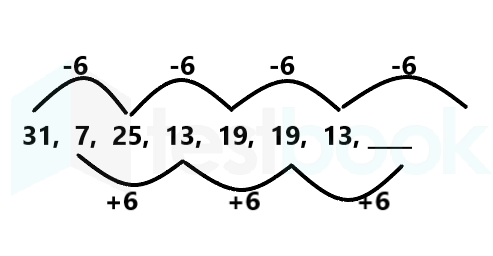
31, 7, 25, 13, 19, 19, 13 _

Here we can see the difference of six in first, third, fifth

And same in the second, fourth and sixth term 

We will follow the downward pattern of adding 6.

⇒ 7 + 6 = 13

⇒ 13 + 6 = 19

⇒ 19 + 6 = 25

∴ The next number is 25

41

A polygon has 44 diagonal's. Find the number of its side?

  1. ((a))

    12

  2. ((b))

    13

  3. ((c))

    11

  4. ((d))

    10

Show Answer
Answer: ((c))

11

Given:

Number of diagonal = 44

Formula Used:

Number of diagonal = n(n - 3)/2

Where, n = number of sides of polygon

Calculation:

Let assume the number of sides be x

Number of diagonal = n(n - 3)/2

⇒ 44 = x (x - 3)/2

⇒ 88 = x2 - 3x

⇒ x2 - 3x - 88 = 0

⇒ x2 - 11x + 8x - 88 = 0 

⇒ x(x - 11) + 8(x - 11) = 0

⇒ (x - 11)(x + 8) = 0

⇒ x - 11 = 0 or x + 8 = 0

⇒ x = 11, or -8

Sides can't be negative,

Side of polygon = 11

∴ The number of sides is 11.

42

The difference of two number is 2 and difference of their squares is 28. The sum of the numbers will be:-

  1. ((a))

    15

  2. ((b))

    19

  3. ((c))

    14

  4. ((d))

    21

Show Answer
Answer: ((c))

14

Given:

Difference of two numbers is 2

Difference of their squares is 28.

Concept used:

a2 - b2 = (a - b) (a + b)

Calculation:

Let the two number be x and y

⇒ x - y = 2  - - (i)

Difference of their squares

⇒ x2 - y2 = 28  - - (ii)

Using the formulae

⇒ 28 = 2 (x + y)

⇒ x + y = 28/2

⇒ x + y = 14

∴ The sun of the number is 14.

43

Which is the next number in the series?

5, 25, 125, ____

  1. ((a))

    625

  2. ((b))

    650

  3. ((c))

    675

  4. ((d))

    600

Show Answer
Answer: ((a))

625

Calculation:

⇒ 5 × 5 = 25

⇒ 25 × 5 = 125

⇒ 25 × 5 = 625

∴ The next number is 625.

44

'A' and 'B' can do a work in 10 days and 15 days respectively. If 'A' starts on the work and both work alternately days after day, in how many days will be work be completed?

  1. ((a))

    10

  2. ((b))

    9

  3. ((c))

    8

  4. ((d))

    12

Show Answer
Answer: ((d))

12

Given:

'A' and 'B' can do a work in 10 days and 15 days respectively.

'A' starts on the work and both work alternately days after days.

Concept used:

Total work = Number of days × efficiency

Calculation

Let the total work be: Lcm of 10 and 15

Total work be 30 units.

Efficiency of A = 30/10 = 3 unit

Efficiency of B = 30/15 = 2 unit

A and B works on the alternate days

⇒ 2 days = (3 + 2) units

⇒ 2 days = 5 unit 

⇒ Multiplying 6 on both sides

30 units work done in

⇒ 2 × 6 = 12 days

∴ In 12 days will be work be completed

45

The average age of 7 boys is 20 years. If the average age of the first six boys is 191219\dfrac{1}{2}years, then the 7th boy will be how many years old?

  1. ((a))

    20 years

  2. ((b))

    23 years

  3. ((c))

    21 years

  4. ((d))

    18 years

Show Answer
Answer: ((b))

23 years

Given:

The average age of 7 boys is 20 years.

average age of the first six boys is 191219\dfrac{1}{2} years.

Concept used:

Average =  Sum of observations / Number of observations

Calculation:

Sum of Age of 7 boys 

⇒ 20 × 7 = 140 

Sum of Age of six boys

⇒ 6 × 39/2 = 117

Age of 7th boy 

⇒ 140 - 117 = 23 years.

∴ 7th boy is 23 years old.

Logical Reasoning (5 questions)

46

An accurate clock shows 7 a.m. Through how many degrees will the hour hand rotate when clock shows 1 p.m.?

  1. ((a))

    180°

  2. ((b))

    170°

  3. ((c))

    154°

  4. ((d))

    160°

Show Answer
Answer: ((a))

180°

Total Central Angle of clock = 360º

Total hours in a clock = 12

Degree per hour = 360º/ 12 = 30º

Now, according to the question,

From 7 am to 1 pm covers 6 hours

Thus, Total degrees = 6 × 30º = 180º

Hence, 180º is the correct answer.

47

Choose the number pair/group which is different from others:-

  1. ((a))

    15 : 5

  2. ((b))

    32 : 2

  3. ((c))

    42 : 4

  4. ((d))

    36 : 6

Show Answer
Answer: ((c))

42 : 4

By checking options:

(1) 15 : 5 → 15/5 = 3 (15 is completely divisible by 5).

(2) 32 : 2 → 32/2 = 16 (32 is completely divisible by 2).

(3) 42 : 4 → 42/4 = 10.5 (42 is not completely divisible by 4).

(4) 36 : 6 → 36/6 = 6 (36 is completely divisible by 6).

Hence, 42 : 4 is different from others.

48

'Man' is coded as 'woman', 'woman' is coded as 'girl', 'girl' is coded as 'boy', 'boy' as coded as 'worker', then 6 year old female is coded as ______

  1. ((a))

    Man

  2. ((b))

    Girl

  3. ((c))

    Woman

  4. ((d))

    Boy

Show Answer
Answer: ((d))

Boy

Given:

'Man' is coded as 'woman',

'Woman' is coded as 'girl',

'Girl' is coded as 'boy',

'Boy' as coded as 'worker'.

Now, we know that a 6 year old female is a girl and girl is coded as boy.

Hence, 6 year old female is coded as boy.

49

Find the odd one out from the series 3, 5, 7, 9, 11

  1. ((a))

    7

  2. ((b))

    11

  3. ((c))

    9

  4. ((d))

    5

Show Answer
Answer: ((c))

9

Given series: 3, 5, 7, 9, 11

Logic: 3, 5, 7, and 11 are prime numbers whereas 9 is not a prime number as it is divisible by 3.

Hence, 9 is the odd one out.

50

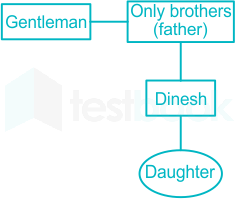
Pointing to a gentlemen, Dinesh (male) said, "His only brother is the father of my daughter's father." How is the gentleman related to Dinesh?

  1. ((a))

    Uncle

  2. ((b))

    Grandfather

  3. ((c))

    Father

  4. ((d))

    Brother-in-law

Show Answer
Answer: ((a))

Uncle

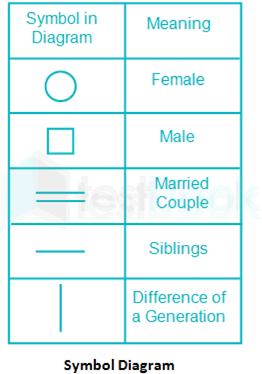
My (Dinesh) daughter's father means Dinesh himself. His (gentleman) only brother is the father of Dinesh means gentleman is the uncle of Dinesh.

The family tree diagram is shown below:

Hence, uncle is the correct answer.

Attempt this paper under real exam conditions

Timed interface, section switching, instant scoring, and question-by-question analytics — free.

Start Timed Attempt