Official Paper

Army Soldier GD (Jabalpur) 1 Nov 2020 Official Paper. (Previous Year Paper)

50 questions · 60 minutes · with answers · free

General Knowledge (15 questions)

1

How many countries are members of 'SAARC'?

  1. ((a))

    3

  2. ((b))

    6

  3. ((c))

    5

  4. ((d))

    8

Show Answer
Answer: ((d))

8

The correct answer is 8.

Key Points

  • The South Asian Association for Regional Cooperation (SAARC) was established with the signing of the SAARC Charter in Dhaka on 8 December 1985.
  • The SAARC Secretariat was established in Kathmandu on 16 January 1987.
  • SAARC comprises of eight-member countries:
  • Afghanistan
  • Bangladesh
  • Bhutan
  • India
  • Maldives
  • Nepal
  • Pakistan
  • Sri Lanka


Additional Information

  • You can remember the names of SAARC Countries using the mnemonic.
  • "MBBS PAIN" for Maldives, Bhutan, Bangladesh, Sri Lanka, Pakistan, Afghanistan, India, Nepal.

2

'East India Company' was formed in which year?

  1. ((a))

    1602

  2. ((b))

    1605

  3. ((c))

    1600

  4. ((d))

    1596

Show Answer
Answer: ((c))

1600

The correct answer is 1600.

  • The 'East India Company' was formed in 1600.

Key Points


  • The Governor and company of merchants of London trading into the East Indies, popularly known as the English East India Company, were formed in 1600 AD.
  • Captain William Hawkins arrived at Jahangir’s court in 1609 AD to seek permission to open a factory in Surat.
  • A Farman was issued by Jahangir, permitting the English to build a factory in Surat.
  • In 1613, a permanent factory of East India Company was established at Surat.
  • In 1611, the company established its first factory in the south in Masulipattanam.

Additional Information

  • The Dutch East India Company established factories in India at Masulipatnam in 1605 AD, Pulicat (1610 AD), Surat (1616 AD), Bimlipatam (1641 AD), Karaikal (1645 AD).
  • The Danes arrived in India in 1616 AD.
  • They established settlement at Tranquebar (Tamil Nadu) in 1620 AD and Serampore (Bengal) in 1676 AD.
  • Serampore was their headquarters.
  • The French East India Company was formed in 1664 AD by Colbert under state patronage during the reign of Louis XIV.
3

Who invented the computer mouse?

  1. ((a))

    Douglas Engelbart 

  2. ((b))

    Bill Gates

  3. ((c))

    Ivan Sutherland

  4. ((d))

    Alan Turing

Show Answer
Answer: ((a))

Douglas Engelbart 

  • Douglas Engelbart invented the computer Mouse.
  • A computer mouse is a pointing device used to control/operate a computer.
  • A mouse tracks the 2-D movement on the surface it is kept/used and correspondingly moves the pointer on the monitor.
  • Engelbart has also founded a separate field**,** human–computer interaction (HCI).
  • A human using the mouse to interact with a computer would come under the ambit of HCI.
NameFamous For
Bill Gates- Co-founder (with Paul Allen) of Microsoft Corporation. - Also founded a charitable foundation with his wife – the Bill and Melinda Gates Foundation.
Ivan Sutherland- Regarded as the "Father of computer graphics”. - Has received Turing Award in 1988 for the invention of Sketchpad, an early predecessor to the sort of graphical user interface (GUI).
Alan Turing- “Father of Modern Computing” - First to suggest that machines can be made to solve complex problems. - Paved the way for creation of calculating machines which were later known as computers.
4

The first Bullet train in India will connect ______.

  1. ((a))

    Delhi and Ahmedabad

  2. ((b))

    Delhi and Mumbai

  3. ((c))

    Ahmedabad and Mumbai

  4. ((d))

    Ahmedabad and Agra

Show Answer
Answer: ((c))

Ahmedabad and Mumbai

The correct answer is Ahmedabad and Mumbai.

  • The first Bullet train in India will connect Ahmedabad and Mumbai.

Key Points

  • In September 2017, Prime Minister Narendra Modi and Shinzo Abe laid the foundation stone of the bullet train project.
  • Due to their appearance and speedJapan's Shinkansen high-speed trains are referred to as bullet trains.  Any train of speed above 250 km/h is termed as the Bullet train.
  • The Mumbai-Ahmedabad bullet train route is a 508-kilometer stretch.
5

Where is 'National Museum of India' located?

  1. ((a))

    Bangalore

  2. ((b))

    Patna

  3. ((c))

    Delhi

  4. ((d))

    Chennai

Show Answer
Answer: ((c))

Delhi

The correct answer is Delhi.

  • The National Museum of India is located in New Delhi.

Key Points

  • It is also known as the National Museum in New Delhi.
  • It was inaugurated by C.Rajgopalachari.
  • It was established in 1949.

Additional Information

  • The largest Museum of India is the National Museum, Kolkata.
  • Central Museum Authority is located in New Delhi.
  • The biggest museum in the world is the British Museum (London).
6

'One people, One state, One leader' was the policy of _________?

  1. ((a))

    Stalin

  2. ((b))

    Lenin

  3. ((c))

    Hitler

  4. ((d))

    Mussolini

Show Answer
Answer: ((c))

Hitler

The correct answer is Hitler.

Key Points

  • In 1938 Adolf Hitler integrated Germany and Austria under the slogan, One peopleOne state, and One leader.
  • Adolf Hitler was a German politician and leader of the Nazi Party. He rose to power as the chancellor of Germany in 1933 and then as Fuhrer in 1934.
  • During his dictatorship from 1933 to 1945, On 1 September 1939, he initiated World War II in Europe by invading Poland.
7

The tenure of Vice President is of how many years?

  1. ((a))

    6 years

  2. ((b))

    5 years

  3. ((c))

    3 years

  4. ((d))

    2 years

Show Answer
Answer: ((b))

5 years

The correct answer is 5 years.

  • The Vice-President:
  • Vice-President is indirectly elected by means of a single transferable vote.
  • He holds his office for 5 years.
  • State Legislatures do not take part in the election of Vice-President.
  • Electoral College of Vice-President consists of elected and nominated members of both the Houses of Parliament.
  • All disputes regarding the election of Vice- President are adjudicated by the Supreme Court.
  • In case a member of the Legislature is elected Vice-President, he shall be deemed to have vacated his seat in the House to which he belongs.

Additional Information

  • Qualifications:
  • To be eligible for election as Vice-President, a person should fulfil the following qualifications:
  • He should be a citizen of India.
  • He should have completed 35 years of age.
  • He should be qualified for election as a member of the Rajya Sabha.
  • He should not hold any office of profit under the Union government or any state government or any local authority or any other public authority.
8

Which is the largest populated state of India?

  1. ((a))

    Madhya Pradesh

  2. ((b))

    Uttar Pradesh

  3. ((c))

    Maharashtra

  4. ((d))

    Rajasthan

Show Answer
Answer: ((b))

Uttar Pradesh

The correct answer is Uttar Pradesh.

  • Uttar Pradesh is the largest populated state in India.

Key Points

  • Census 2011 was covered 71 districts of Uttar Pradesh, 312 tehsils, 915 cities (648 statutory towns and 267 census towns), and 106774 villages.
  • The total population of the state is 199,812,341.
  • It is 16.51% of the total population of India and 3,36,14,420 more than the 2001 census.
  • The total female population of the state is 9,53,31,831 which is 47.71% of the total population of Uttar Pradesh. Whereas in the census of 2001 it was 7,86,32,552.
  • The total male population of the state is 10,44,80,510 which is 52.29% of the total population of Uttar Pradesh. Whereas in the 2001 census it was 8,75,65,369.

Important Point

  • | Rank | State | Population | Density | Sex-Ratio | Literacy | | --- | --- | --- | --- | --- | --- | | 1 | Uttar Pradesh | 199,812,341 | 829 | 912 | 67.68 | | 2 | Maharashtra | 112,374,333 | 365 | 929 | 82.34 | | 3 | Bihar | 104,099,452 | 1,106 | 918 | 61.8 | | 4 | West Bengal | 91,276,115 | 1,028 | 950 | 76.26 | | 5 | Andhra Pradesh | 84,580,777 | 308 | 993 | 67.02 | | 6 | Madhya Pradesh | 72,626,809 | 236 | 931 | 69.32 | | 7 | Tamil Nadu | 72,147,030 | 555 | 996 | 80.09 | | 8 | Rajasthan | 68,548,437 | 200 | 928 | 66.11 |

Additional Information

  • The first synchronized census in India took place in 1881.
  • Since 1901, it has been taking place every decade.
  • Census 2011, is the 15th census and the 7th after independence.
  • The slogan of Census 2011 is “Our Census, Our Future”.
  • India was the first country to adopt family planning in the world.
  • Some other important facts about Census 2011 are-
  • Bihar has the highest population density in Census 2011.
  • According to the Census 2011, Arunachal Pradesh has the lowest population density.
9

Which among following is the capital of Chhattisgarh?

  1. ((a))

    Bilaspur

  2. ((b))

    Raipur

  3. ((c))

    Hyderabad

  4. ((d))

    Bengaluru

Show Answer
Answer: ((b))

Raipur

The correct answer is Raipur.

  • Raipur is the capital of Chhattisgarh.

Key Points

  • Governor: Biswabhusan Harichandan
  • Chief minister: Vishnu Deo Sai
  • Chhattisgarh shares its borders with Uttar Pradesh, Jharkhand, Odisha, Telangana, Maharashtra, and Madhya Pradesh.

Additional Information

  • Bilaspur in Chattisgarh was the capital of a Gond kingdom
  • Hyderabad is the capital of Telangana.
  • Bengaluru is the capital of Karnataka.
  • Naya Raipur, officially known as Atal Nagar-Nava Raipur, is a planned city and fully Greenfield city in Indian state of Chhattisgarh.
  • It is planned to replace Raipur as the capital city of Chhattisgarh.
10

What is the name of largest irrigation canal in India?

  1. ((a))

    Indira Gandhi canal

  2. ((b))

    Upper Bhari Doab canal

  3. ((c))

    Yamuna canal

  4. ((d))

    Sirhand canal

Show Answer
Answer: ((a))

Indira Gandhi canal

The correct answer is option 1) i.e  Indira Gandhi Canal.

Key Points

  • The Indira Gandhi Canal (Originally known as Rajasthan Canal) is the longest canal of India. It starts from the Harike Barrage at Harike, a few kilometers below the confluence of the Beas and Satluj rivers in Punjab and terminates in irrigation facilities in the Thar Desert in the north west of Rajasthan state.
  • This canal was Previously known as the Rajasthan Canal, it was renamed on 2 November 1984 namely, the Indira Gandhi Canal following the assassination of Prime Minister Indira Gandhi.
  • The canal enters Haryana state from Punjab near Lohgarh village then runs through the western part of the Sirsa district before entering Rajasthan state near Kharakhera village in the Tibbi tehsil of the Hanumangarh district.
  • The canal consists of the Rajasthan feeder canal with the first 167 km in Punjab state and Haryana state and a further 37 km in Rajasthan followed by the 445 km of the Rajasthan main canal, which is entirely within Rajasthan.
11

In which state is Akshardham Temple located?

  1. ((a))

    Gujarat

  2. ((b))

    Andhra Pradesh

  3. ((c))

    Tamil Nadu

  4. ((d))

    Haryana

Show Answer
Answer: ((a))

Gujarat

The correct answer is Gujarat.

Key Points

  • The foundation stone-laying for the Akshardham temple ceremony was conducted by Pramukh Swami on 14 December 1979, and the foundation of the temple was completed in 1981.
  • Swaminarayan Akshardham is located in the capital of Gujarat state, Gandhinagar. It is a large Hindu temple complex inspired by Yogiji Maharaj (1892-1971) the fourth spiritual successor of Swaminarayan and created by Pramukh Swami Maharaj (1921-2016).
  • The fifth spiritual successor of Swaminarayan according to the BAPS denomination of Swaminarayan Hinduism. The complex was built over 13 years and is a tribute to Swaminarayan and his life and teachings.
  • At the center of the 23-acre complex is the Akshardham mandir, which is built from 6,000 metric tons of pink sandstone from Rajasthan.

Additional Information

GovernorMr. Acharya Devvrat
Chief MinisterMr. Vijay Rupani
12

Which of the following is the deepest ocean in the world?

  1. ((a))

    Pacific Ocean

  2. ((b))

    Indian Ocean

  3. ((c))

    Atlantic Ocean

  4. ((d))

    Arctic Ocean

Show Answer
Answer: ((a))

Pacific Ocean

  • Pacific Ocean is the deepest ocean in the world.
  • The Mariana Trench is located in the western North Pacific ocean is the deepest point in the world, reaching a depth of 10,911 meters (35,797 feet).
  • The Pacific Ocean has an area of 169.2 million square kilometres, the larger than all of the Earth's land area combined.
  • The Pacific contains 25,000 islands (over half the islands in the world), most of which are south of the equator.

Important Points

OceanAverage Depth (m)
Pacific Ocean3970
Atlantic Ocean3646
Indian Ocean3741
Southern Ocean3270
Arctic Ocean1205
13

Who was the Father of 'Russian Revolution'?

  1. ((a))

    Max Muller

  2. ((b))

    George Washington

  3. ((c))

    Lenin

  4. ((d))

    Adolf Hitler

Show Answer
Answer: ((c))

Lenin

The correct answer is Lenin.

  • Lenin was the Father of the 'Russian Revolution'.

Key Points

  • Vladimir Lenin was the founder of the Russian Communist Party and leader of the Bolshevik Revolution of 1917.

Additional Information 

  • Adolf Hitler was the leader of the Nazi Party and the Führer of Germany.
  • ​Mein Kampf (My Struggle) was written by Adolf Hitler.
  • Adolf Hitler assumed the title of Der Führer
  • Friedrich Max Muller was a German philologist and Orientalist.
  • Philology is the study of literary texts.
  • George Washington served as the first president of the United States.
14

'Mohan Bagan' is a team of which sport?

  1. ((a))

    Football

  2. ((b))

    Hockey

  3. ((c))

    Cricket

  4. ((d))

    Basketball

Show Answer
Answer: ((a))

Football

The correct answer is Football.

  • 'Mohan Bagan' is a Football team.

Key Points

  • Mohan Bagan is a sports club known for its association football team and one of the oldest football clubs in Asia.
  • Mohun Bagan Athletic Club was founded in August 1889.
  • Bhupendra Nath Bose was the first president of the club.
  • In 1911, Mohun Bagan Athletic Club became the first Indian team to win IFA Shield.
  • It has won National League/I-League five times and Federation Cup for a record fourteen times.
15

Kalahari desert is located in which country?

  1. ((a))

    Chile

  2. ((b))

    Saudi Arabia

  3. ((c))

    India

  4. ((d))

    South Africa

Show Answer
Answer: ((d))

South Africa

The correct answer is South Africa.

  • Kalahari desert is located in South Africa.

Key Points

  • The Kalahari Desert is a large semi-arid sandy desert in Southern Africa.
  • The name “ Kalahari” is derived from the Tswana word Kgala which means "the great thirst", or Kgalagadi, meaning "a waterless place".
  • In summer, temperatures can reach 45 degrees Celsius and on winter nights it can drop to minus 15 degrees Celsius.
  • The Kalahari Desert covers an area of Botswana, the eastern third of Namibia and the northernmost part of the Northern Cape Province in South Africa.

Additional Information

  • The Atacama Desert is located in Chile.
  • Rub' Al Khali is the biggest desert in Saudi Arabia.
  • The Thar desert is located in India.
  • The Sahara desert is the largest desert in the world and is located in Africa.

General Science (15 questions)

16

What is the SI unit of power?

  1. ((a))

    Watt

  2. ((b))

    Joule

  3. ((c))

    Ampere

  4. ((d))

    Volt

Show Answer
Answer: ((a))

Watt

Explanation:

Power is defined as the rate at which work is done upon an object.

  • Power = Work/time
  • P = W/t
  • Watt = Joule/Time
  • The SI unit of power is known as the Watt.
  • It is when 1 joule of energy is used in 1 second of time.
  • Power is generally expressed in kilowatts (kW).
  • Joule - Energy, Ampere - Current, Volt - Potential difference.
17

In our body Ligaments connect _____________.

  1. ((a))

    Muscle to Muscle

  2. ((b))

    Muscle to Bone

  3. ((c))

    Muscle to Skin

  4. ((d))

    Bone to Bone

Show Answer
Answer: ((d))

Bone to Bone

The correct answer is Bone to Bone.

Key Points

Ligaments.

  • Ligaments are the connective tissue that connects two bones to each other.
  • Ligaments are a short band of tough flexible connective tissues that connects two bones.
  • Ligaments connect bones to other bones.
  • Tendons are made up of collagen.
  • Tendons connect bones to muscles.
  • There are 11 major organ systems in humans.
  • Cartilage is an important structural component of the body. It is a firm tissue but is softer and much more flexible than bone.
18

When a moving train stops suddenly, a man tends to fall __________.

  1. ((a))

    Upward

  2. ((b))

    Forward

  3. ((c))

    Backward

  4. ((d))

    Downwards

Show Answer
Answer: ((b))

Forward

The correct answer is Forward.

  • When the bus or train stopped suddenly, a passenger sits inside tends to fall forward.
  • Because the lower part of the body comes to rest with the bus while the upper part tends to continue its motion due to inertia

Key Points

Newton's laws of motion:

  • ​Newton’s first law states that, if a body is at rest or moving at a constant speed in a straight line, it will remain at rest or keep moving in a straight line at constant speed unless it is acted upon by a force. This postulate is known as the law of inertia.
  • Newton’s second law is a quantitative description of the changes that a force can produce on the motion of a body. It states that the time rate of change of the momentum of a body is equal in both magnitude and direction to the force imposed on it. The momentum of a body is equal to the product of its mass and its velocity.
  • Newton’s third law states that when two bodies interact, they apply forces to one another that are equal in magnitude and opposite in direction. The third law is also known as the law of action and reaction. This law is important in analyzing problems of static equilibrium, where all forces are balanced, but it also applies to bodies in uniform or accelerated motion.

Additional Information

  • Newton's first law is also known as the "law of inertia."
  • This law states that if an object is at rest or motion, then it will stay at rest or motion until an external force is applied by another object.
  • The law states that an object in motion will stay in motion unless it is acted upon by an unbalanced force.
  • Inertia is the property of the inability of a body to change its position of rest or uniform motion in a straight line.
  • It is valid only in an inertial frame of reference.
  • Inertial Frame: A frame of rest or uniform motion.
  • Ex- A bus moving with constant acceleration.
19

Which mirror is used in headlights of car?

  1. ((a))

    Black

  2. ((b))

    Convex

  3. ((c))

    Plane

  4. ((d))

    Concave

Show Answer
Answer: ((d))

Concave

The Correct Answer is concave mirror.

Key Points

  • A concave mirror is used in a car headlight. The explanation is that a concave mirror is a converging mirror, as opposed to a convex mirror, which is a diverging mirror.
  • The bulb is held at the middle of the mirror in the headlights. Now before we examine the importance of this placement, let's take a look at what the ray diagram could be.
  • Convex mirrors often deviate from the beams of light falling on it. It is therefore never used in a vehicle's headlight.
  • If the hollow sphere is split into pieces and the outer surface of the cut part is painted, it becomes a mirror with its inner surface as a reflection surface. This type of mirror is referred to as a concave mirror.

Important Points

  • If the cut section of the hollow sphere is painted from the inside, the outside surface of the hollow sphere becomes the reflective surface. This type of mirror is known as a convex mirror.
  • Spherical mirrors are mirrors with curved surfaces that are painted on one side.
  • A flat smooth reflective surface is a plane mirror.
20

The largest gland in the Human body is

  1. ((a))

    Liver

  2. ((b))

    Pancreas

  3. ((c))

    Kidney

  4. ((d))

    Pituitary

Show Answer
Answer: ((a))

Liver

The correct answer is option 1, i.e Liver.

  • The small intestine
  • The small intestine is highly coiled and is about 7.5 metres long. It receives secretions from the liver and the pancreas.
  • Besides, its wall also secretes juices.
  • The liver is a reddish-brown gland situated in the upper part of the abdomen on the right side.
  • It is the largest gland in the body.
  • It secretes bile juice that is stored in a sac called the gallbladder.
  • The bile plays an important role in the digestion of fats.
  • The pancreas is a large cream coloured gland located just below the stomach.
  • The pancreatic juice acts on carbohydrates, fats and proteins and changes them into simpler forms.
  • The kidneys are a pair of bean-shaped organs on either side of the spine, below the ribs and behind the belly.
  • Each kidney is about 4 or 5 inches long, roughly the size of a large fist.
  • The kidneys' job is to filter your blood.
  • The pituitary is an important gland in the body and it is often referred to as the 'master gland' because it controls several of the other hormone glands.
  • It is an endocrine gland, a pea-sized body attached to the base of the brain.
  • It is important in controlling growth and development and the functioning of the other endocrine glands.
21

Rabies is caused by ____________.

  1. ((a))

    Dog bite

  2. ((b))

    Contaminated water

  3. ((c))

    Pollution

  4. ((d))

    Unhygienic food

Show Answer
Answer: ((a))

Dog bite

The correct answer is Dog Bite.

  • Rabies is caused by a dog bite.
  • Rabies is an infectious viral disease, caused 99% by the domestic dogs.

Key Points

  • The disease is almost always fatal following the onset of clinical symptoms.
  • Rabies can affect both domestic and wild animals.
  • It is spread to people through bites or scratches, usually via saliva.
  • Rabies is a vaccine-preventable disease.
  • Vaccinating dogs is the most cost-effective strategy for preventing rabies in people.
  • Initial symptoms of rabies include a fever with pain and unusual or unexplained tingling, pricking, or burning sensation at the wound site.
  • As the virus spreads to the central nervous system, a progressive and fatal inflammation of the brain and spinal cord develops.
22

Natural source of energy is ___________.

  1. ((a))

    Electricity

  2. ((b))

    Friction

  3. ((c))

    Battery

  4. ((d))

    Sun

Show Answer
Answer: ((d))

Sun

The correct answer is Sun.

Key Points

  • The sun is considered the ultimate source of energy.
  • Plants convert light energy from the sun into chemical energy (food) by the process of photosynthesis.
  • Hence the food we get from plants and animals also has its primary sunlight source.
  • Every day, the sun radiates (sends out) an enormous amount of energy.
  • It radiates more energy each day than the world uses in one year.
  • Solar energy is a renewable energy source.
  • The sun’s energy comes from within the sun itself.
  • Like most stars, the sun is made up mostly of hydrogen and helium atoms in a plasma state.
  • The sun generates energy from a process called nuclear fusion

Additional Information

  • Resources that are drawn from nature and used without much modification are called natural resources.
  • Natural resources can be divided into renewable and non-renewable resources.
  • Renewable resources are those which get renewed naturally over time.
  • Examples of renewable resources are:
  • The sun.
  • Wind.
  • Wildlife
  • Fisheries.
  • Hydropower(water).
  • Geothermal power.
  • Renewable resources like solar and wind energy are unlimited and are not affected by human activities.
  • Water seems to be an unlimited renewable resource yet careless use of water, soil, and forest can affect their stock.
23

Which of the following is the universal recipient blood group?

  1. ((a))

    O

  2. ((b))

    A

  3. ((c))

    AB

  4. ((d))

    B

Show Answer
Answer: ((c))

AB

  • The AB blood group is the universal recipient blood group.
  • The blood group of a person is inherited and the blood group depends on the type of antigens on the surface of the red blood cells (RBCs) of the body.
  • There are two types of antigens, type A and type B which create 4 blood groups, A, B, AB and O.
  • Since people with blood group AB have both antigens on the surface of the RBCs they can accept any type.
  • On the other hand blood group O is a universal donor as they have none of the antigens on the surface of the RBCs.
24

Which substance is used in Thermometer?

  1. ((a))

    Mercury

  2. ((b))

    Water

  3. ((c))

    Iron

  4. ((d))

    OIl

Show Answer
Answer: ((a))

Mercury

The correct answer is Mercury.

Key Points

  • Mercury is used in thermometers because it remains in liquid form throughout a wide range of temperatures i.e -37.89 degrees Fahrenheit to 674.06 degrees Fahrenheit.
  • The mercury thermometer was invented by physicist Daniel Gabriel Fahrenheit in Amsterdam.
  • Mercury has a greater coefficient of thermal expansion than alcohol.
  • A thermometer with alcohol is used to measure low temperature because its freezing point is low i.e -1170C.
  • It is Impossible to measure high temperatures because it’s a low boiling point.
  • The thermometer with mercury cannot be used to measure the very low temperature because its freezing point is high i.e -38.88 °C.
  • Mercury is the only one in liquid state at room temperature.
  • It's used in thermometers because it has a high coefficient of expansion.
  • It also has a high boiling point which makes it very suitable to measure higher temperatures.
  • It has a shiny appearance and doesn't stick to the glass surface of the glass.
25

Sulphuric acid is ________.

  1. ((a))

    Monobasic

  2. ((b))

    Dibasic

  3. ((c))

    Tribasic

  4. ((d))

    Tetrabasic

Show Answer
Answer: ((b))

Dibasic

  • Sulphuric acid is Dibasic.
  • Any substance that can donate two hydrogens or protons is referred to as dibasic acid.
  • Dibasic acid is also known as diprotic acid.
  • Sulphuric acid gives two hydrogen atoms, hence it is considered as dibasic acid.
  • Example: H2SO4 → 2H+ + SO4-2
26

The chemical symbol of sodium is ____________.

  1. ((a))

    Nu

  2. ((b))

    Na

  3. ((c))

    Sd

  4. ((d))

    So

Show Answer
Answer: ((b))

Na

The correct answer is Na.

Key Points

  • Sodium is a chemical element with the atomic number 11 and denoted by symbol Na.
  • It is a soft, silvery-white, highly reactive metal. Sodium is an alkali metal, being in group 1 of the periodic table.
  • Its only stable isotope is ²³Na. The free metal does not occur in nature and must be prepared from compounds.
  • Sodium is the sixth most abundant element in the Earth's crust and exists in numerous minerals such as sodalite, feldspars, and rock salt (NaCl).

Additional Information

  • It is used as a heat exchanger in some nuclear reactors, and as a reagent in the chemicals industry.
  • But sodium salts have more uses than the metal itself. The most common compound of sodium is sodium chloride NaCl (common salt).
  • It is added to food and used to de-ice roads in winter.
27

Which among the following is reason for Heart attack?

  1. ((a))

    Blood Protein

  2. ((b))

    Blood Sugar

  3. ((c))

    Blood Urea

  4. ((d))

    Cholesterol

Show Answer
Answer: ((d))

Cholesterol

The correct answer is Cholesterol.

Key Points

  • CHD is a condition in which the coronary arteries (the major blood vessels that supply the heart with blood) become clogged with deposits of cholesterol. Coronary heart disease (CHD) is the leading cause of heart attacks.
  • This is when deposits of fat and other substances build up in the inner lining of an artery. This build-up is called atheroma or plaque. If one of the plaques crack, a blood clot will form which can block the artery and cause a heart attack.
  • These deposits are called plaques. A heart attack happens when blood stops flowing to part of your heart muscle.
  • Unless blood flow is restored quickly, this can result in permanent heart damage.
28

The compounds of carbon and hydrogen are called _________.

  1. ((a))

    Sugar

  2. ((b))

    Organic Compounds

  3. ((c))

    Carbohydrates

  4. ((d))

    Hydrocarbons

Show Answer
Answer: ((d))

Hydrocarbons

The correct answer is Hydrocarbons.

Key Points

  • The compounds which are formed by the covalent bond between carbon & hydrogen, are known as hydrocarbons.
  • These are also known as 'parent compounds'.
  • Carbon is placed in the Second period.
  • The atomic number of carbon is 6 while the weight is 12.
  • Carbon needs 4 electrons to complete the octet state and it is full filled by covalent bonds.

Additional Information

  • Examples of Hydrocarbon.
  • Natural Gas:
  • Natural gas contains 97% of Methane.
  • It is a colourless highly flammable gaseous hydrocarbon.
  • It is used as fuel for generating electricity and heat.
  • Natural gas is a compressed form that is used as fuel for vehicles which is known as CNG.
  • This is used for making fertilizers also, mainly ammonia.
  • Methane:
  • Methane was discovered by the Italian scientist Alessandro Volta between 1776-1778 while he was studying the gases found in marshy land.
  • Melting Point- -182.5 degree
  • Boiling point- -161.5 degree
  • Methane gas is colourless and is less dense than water.
  • This gas is highly inflammable. While burning with oxygen it has a bluish flame.
  • Sugar:
  • ​Sugar is an organic compound because it is made up of carbon, hydrogen and oxygen
  • Its molecular formula is C12H22O11.
  • It is also known as cane sugar.
  • Organic Compound:
  • ​The compounds of carbon (covalent compounds) that have low melting and boiling points are known as an organic compounds.
  • Most of the carbon compounds are the non-conductors of electricity.
  • Carbohydrates:
  • Carbohydrates (also called carbs) are a type of macronutrient found in certain foods and drinks.
  • Sugars, starches, and fiber are carbohydrates.
  • Carbohydrates have the general formula Cx(H2O)y, where x and y are integers.
29

'Bauxite' is an ore of which of the following metal?

  1. ((a))

    Calcium 

  2. ((b))

    Aluminium

  3. ((c))

    Magnesium

  4. ((d))

    Sodium

Show Answer
Answer: ((b))

Aluminium

  • Bauxite is an ore of Aluminium with chemical formula Al2O3.2H2O. It is the primary ore of Aluminium.
  • Ore is a naturally occurring mineral or rock from which metal can be extracted.

Trick: Students were very excited (Bauxite) for Alumni (Aluminium) meeting.


Important Points Some important metals and theirs ores.

Metalsores
Calcium- calcite - dolomite - gypsum - anhydrite
Aluminium- Bauxite - Cryolite - Corundum - Feldspar
Magnesium- Magnesite. - Dolomite. - Carnallite.
Sodium- Chile saltpetre - Trona - Borax - Common salt
Copper- Malachite. - Cuprite. - Copper pyrites.
Zinc- Calamine. - Sphalerite. - Zinc blende.
30

Seismograph is an instrument used to ________.

  1. ((a))

    Record strength of wind

  2. ((b))

    Record lightening

  3. ((c))

    Record temperature

  4. ((d))

    Record vibrations of earthquake

Show Answer
Answer: ((d))

Record vibrations of earthquake

The correct answer is to Record the vibrations of an earthquake.

Important Points

  • A seismograph is an instrument used to record the vibrations of an earthquake.
  • A seismograph consists of an attached mass with a fixed base. During the time of the earthquake, the base moves and the mass does not.
  • The first seismograph was invented in 132 AD by Chinese astronomer and mathematician Zhang Heng.

Additional Information

  • An anemometer is used to record the strength of wind and wind pressure.
  • A lightning detector is a device that is used to record lightening.
  • A glass thermometer is an instrument used to record the temperature.

Mathematics (15 questions)

31

Cost price of an article is Rs. 200. If it is sold for Rs. 198 then find the loss percentage?

  1. ((a))

    2%

  2. ((b))

    1%

  3. ((c))

    8%

  4. ((d))

    12%

Show Answer
Answer: ((b))

1%

Given:

C.P = Rs. 200

S.P = Rs. 198

Formula used:

Loss = S.P - C.P

Loss% = (Loss/C.P) × 100%

Loss occurs when S.P > C.P

Where, C.P = Cost Price 

S.P = Selling Price

Calculation:

According to the given condition 

S.P > C.P

So, Loss = 200 – 198 = 2

According to the formula used

Loss% = (2/200) × 100%

⇒ 1%

∴ The loss percentage is 1%.

32

Find the value of : 2492 - 2482 = ?

  1. ((a))

    478

  2. ((b))

    487

  3. ((c))

    497

  4. ((d))

    477

Show Answer
Answer: ((c))

497

Formula used:

a2 – b2 = (a + b) (a – b)

Calculation:

2492 – 2482 = ?

⇒ (249 + 248) (249 – 248) = ?

⇒ 497 × 1 = ?

⇒ 497 = ?

∴ The value of ? is 497.

33

Solve: (x + 2)2 = ?

  1. ((a))

    x2 + 8x

  2. ((b))

    x + 4 + 4x2

  3. ((c))

    x + 4

  4. ((d))

    x2 + 4x + 4

Show Answer
Answer: ((d))

x2 + 4x + 4

Formula used:

(a + b)2 = a2 + b2 + 2ab

Calculation:

⇒ (x + 2)2 = ?

⇒ x2 + 4 + 2 × x × 2 = ?

⇒ x2 + 4 + 4x = ?

∴ The value of ? is x2 + 4x + 4.

34

Find the sum of 1/2, 1/3, 1/4

  1. ((a))

    11/12

  2. ((b))

    1/9

  3. ((c))

    1/24

  4. ((d))

    13/12

Show Answer
Answer: ((d))

13/12

Calculation:

Sum = (1/2) + (1/3) + (1/4)

⇒ (6 + 4 + 3)/12

⇒ 13/12

∴ The sum is 13/12.

35

Solve: (11/15) – (7/15) = ?

  1. ((a))

    7/15

  2. ((b))

    4/15

  3. ((c))

    6/15

  4. ((d))

    3/15

Show Answer
Answer: ((b))

4/15

Calculation:

(11/15) – (7/15) = ?

⇒ (11 - 7)/15 = ?

⇒ 4/15 = ?

∴ The value of ? is 4/15.

36

Write the ratio of (24 : 44) in the simplest form?

  1. ((a))

    4 : 11

  2. ((b))

    6 : 4

  3. ((c))

    6 : 8

  4. ((d))

    6 : 11

Show Answer
Answer: ((d))

6 : 11

Calculation:

Given ratio is 24 : 44

HCF of 24 and 44 is 4

And we know that we can divide the ratio by any number 

So, (24 ÷ 4) : (44 ÷ 4)

⇒ 6 : 11

∴ The required ratio is 6 : 11.

37

In a cricket team, the average age of 11 players and the coach is 18 years. If the age of the coach is not considered, then the average decreases by 1 year. Find the age of the coach?

  1. ((a))

    39 years

  2. ((b))

    27 years

  3. ((c))

    29 years

  4. ((d))

    21 years

Show Answer
Answer: ((c))

29 years

Shortcut Trick

Coach's age = Old Average + (New Number of People × Decrease in Average)

Here, Old Average = 18 years, New Number of Players = 11, Decrease = 1 year.

⇒ Coach's Age = 18 + (11 × 1) = 18 + 11 = 29 years.

∴ The correct answer is 29 years.

Alternate Method

Given: Average age of 12 people (11 players + 1 coach) = 18 years. Average age of 11 players = 17 years.

⇒ Total age of 11 players and the coach = 12 × 18 = 216 years.

⇒ New average age when the coach is excluded = 18 − 1 = 17 years.

⇒ Total age of 11 players = 11 × 17 = 187 years.

⇒ Age of the coach = Total age with coach − Total age without coach

⇒ Age of the coach = 216 − 187 = 29 years.

∴ The correct answer is 29 years.

Additional Information

Average Formula

The basic formula for average is Sum of observations ÷ Total number of observations.

Effect of Exclusion

When a person is excluded and the average decreases, the excluded person's value is greater than the initial average. If the average increases, the excluded value is smaller.

Weighted Average

For two groups with averages A1 and A2 and sizes n1 and n2, the combined average is (n1A1 + n2A2) ÷ (n1 + n2).

38

Two numbers are in the ratio 2 : 3. If 5 is added to each number, the ratio becomes 5 : 7. Find the bigger number?

  1. ((a))

    60

  2. ((b))

    40

  3. ((c))

    20

  4. ((d))

    30

Show Answer
Answer: ((d))

30

Given:

Ratio of two numbers = 2 : 3

New ratio after 5 is added to each number = 5 : 7

Calculation:

Let the number be 2x and 3x respectively

Increased numbers = 2x + 5 and 3x + 5

According to question,

⇒ (2x + 5)/(3x + 5) = 5/7

⇒ 7 (2x + 5) = 5 (3x + 5)

⇒ 14x + 35 = 15x + 25

⇒ x = 10

The bigger number = 3x 

⇒ 3 × 10

⇒ 30

∴ The bigger number is 30.

39

In a rectangle the base is 12 cm and the height is 5 cm. What will be the area of rectangle?

  1. ((a))

    30 cm2

  2. ((b))

    60 cm2

  3. ((c))

    40 cm2

  4. ((d))

    50 cm2

Show Answer
Answer: ((b))

60 cm2

Given:

Base of rectangle (Length) = 12 cm

Height of rectangle (Breadth) = 5 cm

Formula used:

Area of rectangle = Length × Breadth

Calculation:

Area of rectangle = 12 cm × 5 cm

⇒ 60 cm2

∴ The area of the rectangle is 60 cm2.

40

Two cubes have Volumes in the ratio 1 : 27. Find the ratio of their Surface Areas?

  1. ((a))

    1 : 9

  2. ((b))

    1 : 8

  3. ((c))

    1 : 18

  4. ((d))

    1 : 3

Show Answer
Answer: ((a))

1 : 9

Given:

Ratio of volume of cube = 1 : 27

Formula used:

Volume of cube = a3

Surface area of cube = 6a2

Calculation:

Let the sides of two cubes be a1 and a2 respectively

Then, (a1)3 : (a2)3 = 1 : 27

⇒ a1 : a2 = 1 : 3

Ratio of surface areas = 6(a1)2 : 6(a2)2

⇒ (a1): (a2)2

⇒ 12 : 32

⇒ 1 : 9

∴ The ratio of their surface areas is 1 : 9

41

A cricketer scores the following runs in eight innings: 58, 76, 40, 35, 46, 45, 100, 0

What will be his mean score?

  1. ((a))

    400

  2. ((b))

    100

  3. ((c))

    200

  4. ((d))

    50

Show Answer
Answer: ((d))

50

Given:

Runs scored in 8 innings = 58, 76, 40, 35, 46, 45, 100 and 0

Formula used:

Average = Sum of observations/Number of observations

Calculation:

Sum of observations = (58 + 76 + 40 + 35 + 46 + 45 + 100 + 0)

⇒ 400

Number of innings = 8

Average = 400/8

⇒ 50

∴ The mean score is 50.

42

HCF of two numbers is 11 and LCM is 7700. If one of the number is 275, then find the other number?

  1. ((a))

    279

  2. ((b))

    308

  3. ((c))

    283

  4. ((d))

    318

Show Answer
Answer: ((b))

308

Given:

HCF of two numbers = 11

LCM of two numbers = 7700

One number = 275

Formula used:

LCM × HCF = Product of two numbers

Calculation:

Let the other number be x

⇒ 11 × 7700 = 275 × x

⇒ x = (11 × 7700)/275

⇒ 11 × 28

⇒ 308

∴ The other number is 308.

43

Solve: 15% of 15 = ?

  1. ((a))

    2.25

  2. ((b))

    0.01

  3. ((c))

    0.3

  4. ((d))

    0.15

Show Answer
Answer: ((a))

2.25

Calculation:

15% of 15 = ?

⇒ (15/100) × 15 = ?

⇒ 225/100 = ?

⇒ 2.25 = ?

∴ The value of ? is 2.25

44

45 men take 25 days to dig a pond. If the pond would have to be dug in 15 days, then what is the number of men to be employed?

  1. ((a))

    81

  2. ((b))

    75

  3. ((c))

    67

  4. ((d))

    84

Show Answer
Answer: ((b))

75

Given:

Number of days taken by 45 men to dig a pond = 25 days

Concept used:

Total work = Number of men × Time taken

Calculation:

Total work = (45 × 25) units

Number of men required to dig it in 15 days = (45 × 25)/15 men

⇒ 75 men

∴ The number of men to be employed is 75


Alternate Method

We can use MDH formula here 

MDH1 = MDH2

Given,

M1 = 45, D1 = 25, M2 = ?,  D2 = 15

So, 45 × 25 = M2 ×  15

⇒ M2 = (45 × 25)/15

⇒ M2 = 75 men

∴ The required number of men is 75.

45

How many surfaces are there in a cube?

  1. ((a))

    12

  2. ((b))

    8

  3. ((c))

    6

  4. ((d))

    10

Show Answer
Answer: ((c))

6

Calculation:

A cube is a three-dimensional solid object bounded by six square faces with three meeting at each vertex.

It has 6 faces, 12 edges, and 8 vertices

∴ A cube has 6 surfaces

Logical Reasoning (5 questions)

46

From the options, Find the missing number in the series: [1, 4, 9, 16, 25, 36, ..., 64, 81, 100]

  1. ((a))

    07

  2. ((b))

    49

  3. ((c))

    50

  4. ((d))

    70

Show Answer
Answer: ((b))

49

The logic is:

The series follows the square of the consecutive natural number starting with 1.

Hence, ‘49’ is the correct answer.

47

From the given options, find the next term in the series: ABC, EFG, IJK, MNO, (________)

  1. ((a))

    TUV

  2. ((b))

    XYZ

  3. ((c))

    QRS

  4. ((d))

    PQR

Show Answer
Answer: ((c))

QRS

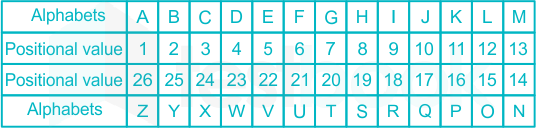
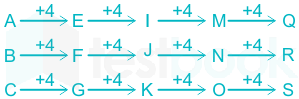
According to the alphabetical positions of the letters,

The pattern followed here is:

Hence, ‘QRS’ is the correct answer.

48

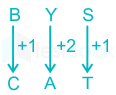
In a certain code 'AYS' is written as 'BAT' then how 'BYS' will be written?

  1. ((a))

    CBT

  2. ((b))

    AAT

  3. ((c))

    MAT

  4. ((d))

    CAT

Show Answer
Answer: ((d))

CAT

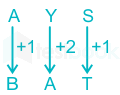
According to the alphabetical positions of the letters,

The pattern followed here is:

Similarly,

Hence, ‘CAT’ is the correct answer.

49

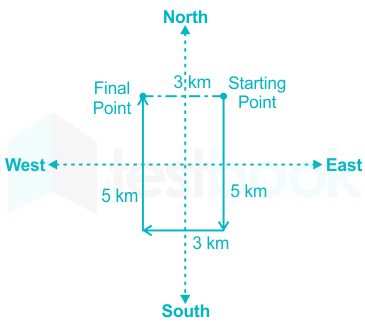
Vijay walks 5 km towards South, then he walks 3 km turning to right, again he turns to the right and walk 5 km. How far is he now from the starting point?

  1. ((a))

    6 km

  2. ((b))

    8 km

  3. ((c))

    5 km

  4. ((d))

    3 km

Show Answer
Answer: ((d))

3 km

According to given conditions,

So, Vijay is 3 km far from his starting point.

Hence, ‘3 km’ is the correct answer.

50

If in a certain code 1 5 7 8 9 is written as X T Z A L and 2 3 4 0 as N P S U then how will 2 3 5 4 9 be written in the same code?

  1. ((a))

    NPTSL

  2. ((b))

    NPTUL

  3. ((c))

    NBTSL

  4. ((d))

    PNTSL

Show Answer
Answer: ((a))

NPTSL

Given,

XTZAL
15789

and 

NPSU
2340


So, 2 3 4 5 9  is code for :

23549
NPTSL


Hence, 'NPTSL' is the correct answer.

Attempt this paper under real exam conditions

Timed interface, section switching, instant scoring, and question-by-question analytics — free.

Start Timed Attempt