Official Paper

Army Soldier GD (Gaya) 1 Nov 2020 Official Paper. (Previous Year Paper)

50 questions · 60 minutes · with answers · free

General Knowledge (15 questions)

1

In which among the following state is 'Akshardham Temple' located?

  1. ((a))

    Andhra Pradesh

  2. ((b))

    Haryana

  3. ((c))

    Tamil Nadu

  4. ((d))

    Gujarat

Show Answer
Answer: ((d))

Gujarat

The correct answer is Gujarat.

Key Points

  • 'Akshardham Temple' is located in Gujarat.
  • The temple is dedicated to Lord Swaminarayan.
  • Akshardham Temple is a large Hindu temple complex that is inspired by Yogiji Maharaj.
  • Yogiji Maharaj was the fourth spiritual successor of Swaminarayan.
  • The temple was constructed in 1992.

Additional Information

StateFamous Temples
Andhra PradeshLepakshi Temple, Sri Venkateshwara Temple
HaryanaBirla Gita Temple, Agroha Dham
Tamil NaduBrihadeeswarar Temple, Sri Ranganathaswamy Temple, Ramanathaswamy Temple

Important Points

  • 'Akshardham' means the divine abode of God.
  • It is hailed as an eternal place of devotion, purity, and peace.
  • One of the Swaminarayan Akshardham temples is also located in New Delhi.
  • It was opened on 6th November 2005.
2

What is the name of largest irrigation canal in India?

  1. ((a))

    Upper Bari Doab canal

  2. ((b))

    Yamuna canal

  3. ((c))

    Sirhand canal

  4. ((d))

    Indira Gandhi canal

Show Answer
Answer: ((d))

Indira Gandhi canal

The correct answer is the Indira Gandhi canal.

  • Indira Gandhi canal is the largest irrigation canal in India.
  • It was originally called the Rajasthan Canal.
  • It is 650 km long.

Key Points

  • Indira Gandhi canal starts from the Harike Barrage at Harike, near the confluence of the Satluj and Beas rivers in the state of Punjab, and terminates in irrigation facilities in the Thar Desert in the north-west of Rajasthan state.
  • It consists of the Rajasthan feeder canal and Rajasthan main canal which runs through 167 km in Punjab and Haryana and the remaining 492 km in Rajasthan.
  • The canal is one of the projects of the Green revolution in India and also runs through The Great Thar Desert.

Additional Information

  • Yamuna canal was renovated in 1335 by Firoz Shah Tughlaq.
  • It was originally built before the era of Prithviraj Chauhan.
  • Sirhind Canal carries water from the Sutlej River in Punjab.
  • Upper Bari Doab Canal is located on the region between Ravi and Beas hence, is known as Bari Doab.
3

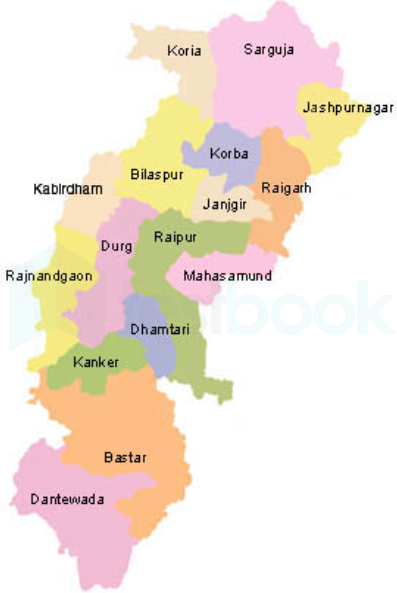
Which among following is the capital of Chhattisgarh?

  1. ((a))

    Hyderabad

  2. ((b))

    Raipur

  3. ((c))

    Bilaspur

  4. ((d))

    Bengaluru

Show Answer
Answer: ((b))

Raipur

The correct answer is Raipur.

  • Raipur is the capital of Chhattisgarh.

Key Points

  • Governor: Anusuiya Uikey
  • Chief minister: Bhupesh Baghel
  • Chhattisgarh shares its borders with Uttar Pradesh, Jharkhand, Odisha, Telangana, Maharashtra, and Madhya Pradesh.

Additional Information

  • Bilaspur in Chattisgarh was the capital of a Gond kingdom.
  • Hyderabad is the capital of Telangana.
  • Bengaluru is the capital of Karnataka.
4

Which is the largest populated state of India?

  1. ((a))

    Madhya Pradesh

  2. ((b))

    Uttar Pradesh

  3. ((c))

    Maharashtra

  4. ((d))

    Rajasthan

Show Answer
Answer: ((b))

Uttar Pradesh

The correct answer is Uttar Pradesh.

  • Uttar Pradesh is the largest populated state in India.

Key Points

  • Census 2011 was covered 71 districts of Uttar Pradesh, 312 tehsils, 915 cities (648 statutory towns and 267 census towns), and 106774 villages.
  • The total population of the state is 199,812,341.
  • It is 16.51% of the total population of India and 3,36,14,420 more than the 2001 census.
  • The total female population of the state is 9,53,31,831 which is 47.71% of the total population of Uttar Pradesh. Whereas in the census of 2001 it was 7,86,32,552.
  • The total male population of the state is 10,44,80,510 which is 52.29% of the total population of Uttar Pradesh. Whereas in the 2001 census it was 8,75,65,369.

Important Point

  • | Rank | State | Population | Density | Sex-Ratio | Literacy | | --- | --- | --- | --- | --- | --- | | 1 | Uttar Pradesh | 199,812,341 | 829 | 912 | 67.68 | | 2 | Maharashtra | 112,374,333 | 365 | 929 | 82.34 | | 3 | Bihar | 104,099,452 | 1,106 | 918 | 61.8 | | 4 | West Bengal | 91,276,115 | 1,028 | 950 | 76.26 | | 5 | Andhra Pradesh | 84,580,777 | 308 | 993 | 67.02 | | 6 | Madhya Pradesh | 72,626,809 | 236 | 931 | 69.32 | | 7 | Tamil Nadu | 72,147,030 | 555 | 996 | 80.09 | | 8 | Rajasthan | 68,548,437 | 200 | 928 | 66.11 |

Additional Information

  • The first synchronized census in India took place in 1881.
  • Since 1901, it has been taking place every decade.
  • Census 2011, is the 15th census and the 7th after independence.
  • The slogan of Census 2011 is “Our Census, Our Future”.
  • India was the first country to adopt family planning in the world.
  • Some other important facts about Census 2011 are-
  • Bihar has the highest population density in Census 2011.
  • According to the Census 2011, Arunachal Pradesh has the lowest population density.
5

Kalahari desert is located in which country?

  1. ((a))

    Chile

  2. ((b))

    Saudi Arabia

  3. ((c))

    India

  4. ((d))

    South Africa

Show Answer
Answer: ((d))

South Africa

The correct answer is South Africa.

  • Kalahari desert is located in South Africa.

Key Points

  • The Kalahari Desert is a large semi-arid sandy desert in Southern Africa.
  • The name “ Kalahari” is derived from the Tswana word Kgala which means "the great thirst", or Kgalagadi, meaning "a waterless place".
  • In summer, temperatures can reach 45 degrees Celsius and on winter nights it can drop to minus 15 degrees Celsius.
  • The Kalahari Desert covers an area of Botswana, the eastern third of Namibia and the northernmost part of the Northern Cape Province in South Africa.

Additional Information

  • The Atacama Desert is located in Chile.
  • Rub' Al Khali is the biggest desert in Saudi Arabia.
  • The Thar desert is located in India.
  • The Sahara desert is the largest desert in the world and is located in Africa.
6

The tenure of Vice President is of how many years?

  1. ((a))

    6 years

  2. ((b))

    5 years

  3. ((c))

    3 years

  4. ((d))

    2 years

Show Answer
Answer: ((b))

5 years

The correct answer is 5 years.

  • The Vice-President:
  • Vice-President is indirectly elected by means of a single transferable vote.
  • He holds his office for 5 years.
  • State Legislatures do not take part in the election of Vice-President.
  • Electoral College of Vice-President consists of elected and nominated members of both the Houses of Parliament.
  • All disputes regarding the election of Vice- President are adjudicated by the Supreme Court.
  • In case a member of the Legislature is elected Vice-President, he shall be deemed to have vacated his seat in the House to which he belongs.

Additional Information

  • Qualifications:
  • To be eligible for election as Vice-President, a person should fulfil the following qualifications:
  • He should be a citizen of India.
  • He should have completed 35 years of age.
  • He should be qualified for election as a member of the Rajya Sabha.
  • He should not hold any office of profit under the Union government or any state government or any local authority or any other public authority.
7

The first Bullet train in India will connect _______ ?

  1. ((a))

    Delhi and Ahmedabad

  2. ((b))

    Ahmedabad and Mumbai

  3. ((c))

    Ahmedabad and Agra

  4. ((d))

    Delhi and Mumbai

Show Answer
Answer: ((b))

Ahmedabad and Mumbai

The correct answer is Ahmedabad and Mumbai.

  • The first Bullet train in India will connect Ahmedabad and Mumbai.

Key Points

  • In September 2017, Prime Minister Narendra Modi and Shinzo Abe laid the foundation stone of the bullet train project.
  • Japan's Shinkansen high-speed trains are referred to as bullet trains due to their appearance and speed.
  • Any train of speed above 250 km/h is termed as a Bullet train.
  • The Mumbai-Ahmedabad bullet train route is a 508-kilometer stretch.

Additional Information

  • The first bullet train in the world was launched in Japan in 1964.
  • It ran between Tokyo and Osaka.
8

'East India Company' was formed in which year?

  1. ((a))

    1602

  2. ((b))

    1600

  3. ((c))

    1605

  4. ((d))

    1598

Show Answer
Answer: ((b))

1600

The correct answer is 1600.

  • The 'East India Company' was formed in 1600.

Key Points

  • The Governor and company of merchants of London trading into the East Indies, popularly known as the English East India Company, were formed in 1600 AD.
  • Captain William Hawkins arrived at Jahangir’s court in 1609 AD to seek permission to open a factory in Surat.
  • A Farman was issued by Jahangir, permitting the English to build a factory in Surat.
  • In 1613, a permanent factory of East India Company was established at Surat.
  • In 1616, the company established its first factory in the south in Masulipattanam.

Additional Information

  • The Dutch East India Company established factories in India at Masulipatnam in 1605 AD, Pulicat (1610 AD), Surat (1616 AD), Bimlipatam (1641 AD), Karaikal (1645 AD).
  • The Danes arrived in India in 1616 AD.
  • They established settlement at Tranquebar (Tamil Nadu) in 1620 AD and Serampore (Bengal) in 1676 AD.
  • Serampore was their headquarters.
  • The French East India Company was formed in 1664 AD by Colbert under state patronage during the reign of Louis XIV.
9

How many countries are members of 'SAARC'?

  1. ((a))

    8

  2. ((b))

    6

  3. ((c))

    3

  4. ((d))

    5

Show Answer
Answer: ((a))

8

The correct answer is 8.

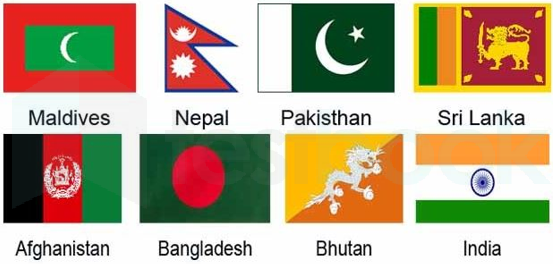
  • 8 countries are members of 'SAARC'.

Key Points

  • South Asian Association for Regional Cooperation (SAARC):
  • It was established with the signing of the SAARC Charter in Dhaka on 8 December 1985.
  • The Headquarters of the Association is in Kathmandu, Nepal.
  • Its member countries are Afghanistan, Bangladesh, Bhutan, India, Maldives, Nepal, Pakistan, Sri Lanka
  • Afghanistan became the newest member of SAARC at the 14th annual summit in 2007.
  • SAARC comprises 3% of the world's area, 21% of the world's population, and 3.8% of the total global economy.
  • Its objectives are to promote welfare and accelerate the economic growth of the people of South Asia.
  • SAARC Charter Day is observed every year on 8th December.

Important Points

  • | SAARC Member States | SAARC Observer States | | --- | --- | | 1. Afghanistan 2. Bangladesh 3. Bhutan 4. India 5. Maldives 6. Nepal 7. Pakistan 8. Sri Lanka | 1. Australia 2. China 3. European union 4. Iran 5. Japan 6. Mauritius 7. United States 8. Myanmar 9. Republic of Korea |

10

Where is 'National Museum of India' located?

  1. ((a))

    Patna

  2. ((b))

    Delhi

  3. ((c))

    Bangalore

  4. ((d))

    Chennai

Show Answer
Answer: ((b))

Delhi

The correct answer is Delhi.

  • The National Museum of India is located in New Delhi.

Key Points

  • It is also known as the National Museum in New Delhi.
  • On August 15, 1949, the National Museum, New Delhi, was inaugurated in the Rashtrapati Bhawan by Shri R.C. Rajagopalachari, the Governor-General of India.
  • The foundation of the present building was laid by Pandit Jawaharlal Nehru, the Prime Minister of India, on May 12, 1955.
  • The first phase of the National Museum building was formally inaugurated by Dr. Sarvepalli Radhakrishnan, the Vice President of India, on December 18, 1960.
  • The second phase of the building was completed in 1989.

Additional Information

  • The largest Museum of India is the National Museum, Kolkata.
  • Central Museum Authority is located in New Delhi.
  • The biggest museum in the world is the State Hermitage Museum (Russia).
11

"One people, One state, One leader" was the policy of _______?

  1. ((a))

    Stalin

  2. ((b))

    Mussolini

  3. ((c))

    Lenin

  4. ((d))

    Hitler

Show Answer
Answer: ((d))

Hitler

The correct answer is Hitler.

  • "One people, One state, One leader" was the policy of Adolf Hitler.

Key Points

  • Adolf Hitler was the leader of the Nazi Party and the Führer of Germany.
  • Under his leadership, Germany’s invasion of Poland in 1939 led to the outbreak of World War II.
  • By 1941 Nazi forces had occupied much of Europe.
  • Mein Kampf (My Struggle) was written by Adolf Hitler.
  • Adolf Hitler assumed the title of Der Führer.

Additional Information

  • Joseph Stalin was the secretary-general of the Communist Party of the Soviet Union.
  • Benito Mussolini was an Italian political leader who later became the fascist dictator of Italy from 1925 to 1945. 
  • He assumed the title of II Duke.
  • Vladimir Lenin was the founder of the Russian Communist Party and leader of the Bolshevik Revolution of 1917.
12

Who invented the 'Computer'?

  1. ((a))

    Charles Babbage

  2. ((b))

    Fahrenheit

  3. ((c))

    Grenvile

  4. ((d))

    Einstein

Show Answer
Answer: ((a))

Charles Babbage

The correct answer is Charles Babbage.

Key Points

  • During the mid-1830s Charles Babbage developed plans for the Analytical Engine. He was an English mathematician and inventor of computers, he was credited with having conceived the first automatic digital computer.
  • computer is a machine that can be instructed to carry out sequences of arithmetic or logical operations automatically via computer programming.
  • Modern computers have the ability to follow generalized sets of operations, called programs.
  • These programs enable computers to perform an extremely wide range of tasks. A "complete" computer including the hardware, the operating system (main software), and peripheral equipment required and used for "full" operation can be referred to as a computer system.

Additional Information

  • The credit for developing the first computer program goes to Ada Lovelace, a student of Babbage.
  • Howard Aiken developed the first Mechanical Computer ‘Mark-I’ in ‘ENIAC‑I’ in 1946.
  • Albert Einstein established a relation between mass and energy on the basis of the special theory of relativity in 1905.
  • According to this mass can be converted into energy and vice-versa. i.e., E = mc2.
  • Fahrenheit Scale was invented by Fahrenheit.
  • Alan Turing, Father of the Modern Computer.
13

'Mohan Bagan' is a team of which sport?

  1. ((a))

    Basketball

  2. ((b))

    Cricket

  3. ((c))

    Hockey

  4. ((d))

    Football

Show Answer
Answer: ((d))

Football

The correct answer is Football.

  • 'Mohan Bagan' is a Football team.

Key Points

  • Mohan Bagan is a sports club known for its association football team and one of the oldest football clubs in Asia.
  • Mohan Bagan Athletic Club was founded in August 1889.
  • Bhupendra Nath Bose was the first president of the club.
  • In 1911, Mohan Bagan Athletic Club became the first Indian team to win IFA Shield.
  • It has won National League/I-League five times and Federation Cup for a record fourteen times.

Important Points

  • | Sport | Term Related | | --- | --- | | Hockey | Advantage, Back-stick, Bully, Cary, Centre Forward, Centre, Corner, Dribble, Flick, Free-hit, Goal Line, Blue line, Halfway Line, Hat-trick, Off-side, Red Car, Roll-in, Scoop, Short Corner, Sixteen-yard hit. | | Cricket | Boundary, Bowling, Caught, Chinaman, Cover Drive, Crease, Duck, Duckworth-Lewis, Fine Leg, Follow On, Full Toss, Googly, Gully, Hat-trick, Hit-Wicket, In-swinger, L.B.W., Leg-break, Leg-bye, Leg Glance, late Cut, maiden over, No Ball, Over, over Pitch, Popping Crease, Run Out, Short Pitch, Silly Point, Slip, Square Leg, Straight Drive, Stumped, Short leg, Spin, Swing, Third-man, Yorker. | | Golf | Bogey, Bunker, Caddie, Fairway, Fourball, Greed Holes, Links, Par, Put, Rough, Stymied, Tee. | | Football | Bend, Dribble, Dummy, Feint, Free Kick, Header, Red Card, Throwins. | | Archery | Target, Bull’s Eye. | | Swimming | Breast Stroke, Crawl, Butterfly, Freestyle, Back Stroke. | | Fencing | Allez, Assault, Black Card, Foil, Saber, Hilt, Jury, Lame. | | Basketball | Dunk, Frontcourt, Held Ball, Lay-Up, Pivot, Rebound. | | Billiards | Baulk Line, Break, Bolting, Cannon, Cue, Hazard, In-off, Jigger, Long, Jenny, Pot, Scratch, Screw Back, Spot Stroke, Strike. | | Baseball | Diamond, Hitter, Home, Pinch, Pitcher Plate, Pullout, Short Stop, Hitter, Batter, Strike, Infield, Outfield, Base, Battery, Bunting, Catcher. | | Chess | Bishop, Capture, Castling, Checkmate, En Passant, Gambit, Grand Master, King, Knight, Pawn, Queen, Rook, Stalemate, Sicilian Defence. | | Table Tennis | Foil, End line, Late control, Flat hit, Block stroke, Service, Penholder grip, Backspin, Centreline, Half Court, Side spin, Swing stroke, Push Stroke, Rally, Let, Reverse, Top Spin, Drop shot, Lob, Chopped return. | | Volley Ball | Antennae, Attack hit, Ace, Base-line, Blocking, Doubling, Foot Fault, Heave, Holding, Jump Set, Lob Pass, Love-All, Point, Quick Smash, Scouting, Service, Spike, Tactical Ball, Volley, Windmill Service. |
14

Who was the Father of 'Russian Revolution'?

  1. ((a))

    Max Muller

  2. ((b))

    Lenin

  3. ((c))

    Adolf Hitler

  4. ((d))

    George Washington

Show Answer
Answer: ((b))

Lenin

The correct answer is Lenin.

  • Lenin was the Father of the 'Russian Revolution'.

Key Points

  • Russian Revolution
  • Vladimir Lenin, also called Vladimir Ilich Lenin, original name Vladimir Ilich Ulyanov founder of the Russian Communist Party (Bolsheviks), inspirer, and leader of the Bolshevik Revolution (1917), and the architect, builder, and first head (1917-24) of the Soviet state.
  • Vladimir Lenin was the founder of the Russian Communist Party and leader of the Bolshevik Revolution of 1917.
  • He was the founder of the organization known as Comintern (Communist International) and the posthumous source of Leninism, the doctrine codified and conjoined with Karl Marx’s works by Lenin’s successors to form Marxism-Leninism, which became the Communist worldview.
  • The Russian Revolution of 1917 was one of the most significant events of the twentieth century that ended centuries of monarchy in Russia and brought forth the first constitutionally communist state in the world.
  • The Russian Revolution was made in October 1917.
  • It is also known as the Bolshevik Revolution. It was a proletarian-socialist revolution, inspired by the ideals of communism the Russian Revolution aimed at the creation of a socialist society in Russia.
  • The Leadership in this revolution was provided by the Russian Social Democratic Labour Party, particularly the Bolsheviks.
  • The peasantry also played a significant role. In fact, the Russian Revolution was brought about by the working people of Russia, because they were the most oppressed and therefore most interested in a total transformation of the social and political system which exploited them.

Additional Information

  • Adolf Hitler was the leader of the Nazi Party and the Führer of Germany.
  • ​Mein Kampf (My Struggle) was written by Adolf Hitler.
  • Adolf Hitler assumed the title of Der Führer
  • Friedrich Max Muller was a German philologist and Orientalist.
  • Philology is the study of literary texts.
  • George Washington served as the first president of the United States.
15

The deepest ocean of the world is __________?

  1. ((a))

    Arctic Ocean

  2. ((b))

    Pacific Ocean

  3. ((c))

    Indian Ocean

  4. ((d))

    Atlantic Ocean

Show Answer
Answer: ((b))

Pacific Ocean

The correct answer is the Pacific Ocean.

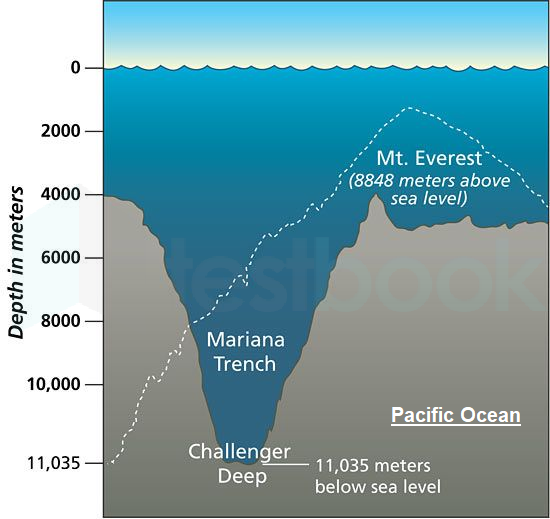
  • The deepest ocean in the world is the Pacific Ocean.

Key Points

  • Pacific Ocean:
  • It is the deepest ocean with an average depth of 4,200 m.
  • The Mariana Trench is the world’s deepest trench with a depth of 11,033 meters (36,201 feet).
  • Most of the islands of this Ocean are of volcanic or coral origin.

Additional Information

  • Atlantic Ocean:
  • The Atlantic Ocean has the longest coastline.
  • The Atlantic Ocean is the busiest Ocean for trade and commerce.
  • Indian Ocean:
  • The Indian Ocean is deeper than the Atlantic Ocean.
  • It contains numerous continental islands; Madagascar and Sri Lanka are being the largest ones.
  • Some of the islands of volcanic origin are those of Mauritius, Andaman and Nicobar, Seychelles, Maldives and Lakshadweep are of coral origin.
  • Arctic Ocean:
  • It lies within the Arctic Circle, hence the name Arctic Ocean.
  • The North Pole lies in the middle of the Arctic Ocean.
  • It is the shallowest of all oceans, with an average depth of 1,500 m.
  • It has less salinity than all the oceans have.
  • Oceans with their location.

Watery Earth Lesson 8 - Bodies of Water: Ocean - What's going on in Mr.  Solarz' Class?

General Science (15 questions)

16

What is the chemical formula of common salt?

  1. ((a))

    KCI

  2. ((b))

    H2O

  3. ((c))

    Xe

  4. ((d))

    NaCl

Show Answer
Answer: ((d))

NaCl

The correct answer is NaCl.

Key Points

  • Common Salt
  • Sodium chloride, commonly known as salt, is an ionic compound with the chemical formula NaCl, representing a 1:1 ratio of sodium and chloride ions.
  • With molar masses of 22.99 and 35.45 g/mol respectively, 100 g of NaCl contains 39.34 g Na and 60.66 g Cl.
  • It is formed by the chemical reaction between hydrochloric acid and sodium hydroxide.
  • The Chemical Formula of common salt​ is NaCl. Hence, Option 2 is correct.
  • Molar mass: 58.44 g/mol
  • Melting point: 801 °C
  • Density: 2.16 g/cm³
  • Boiling point: 1,465 °C
  • Soluble in: Water, Ammonia, Ethanol, Glycerol, Methanol, Formic acid, Propylene glycol, Formamide​

Additional Information

KCl- The formula for potassium chloride - Used in the salt bridge
H2O- Formula for water - Up to 60% of the human adult body is water.
Xe- The formula for noble gas, Xenon - Used in special lighting devices
17

Which of the following gases is filled in soft drinks?

  1. ((a))

    CO2

  2. ((b))

    H2

  3. ((c))

    N2

  4. ((d))

    O2

Show Answer
Answer: ((a))

CO2

The correct answer is CO2.

Key Points

  • Carbon dioxide or CO2 is filled in beverages like soft drinks to give a fizzy nature to the beverage.
  • The process of adding carbon dioxide gas to a beverage is called Carbonation.
  • The process of carbonation imparts a sparkle and a tangy taste and also prevents spoilage of the beverage.
  • Increasing pressure and lowering temperature maximize gas absorption by the beverage.

Additional Information

H2- The formula for Hydrogen gas. - Used in a fuel cell, petroleum refining
N2- The formula for Nitrogen Gas - Used in the production of fertilizers, explosives, nitric acid, etc
O2- The formula for Oxygen gas. - Used by plants and animals, steel production, the welding industry
18

What is the SI unit of resistance?

  1. ((a))

    Ohm (Ω) 

  2. ((b))

    Ohm meter  (Ω. m) 

  3. ((c))

    Ampere

  4. ((d))

    Coulomb

Show Answer
Answer: ((a))

Ohm (Ω) 

The correct answer is Ohm (Ω).

Key Points

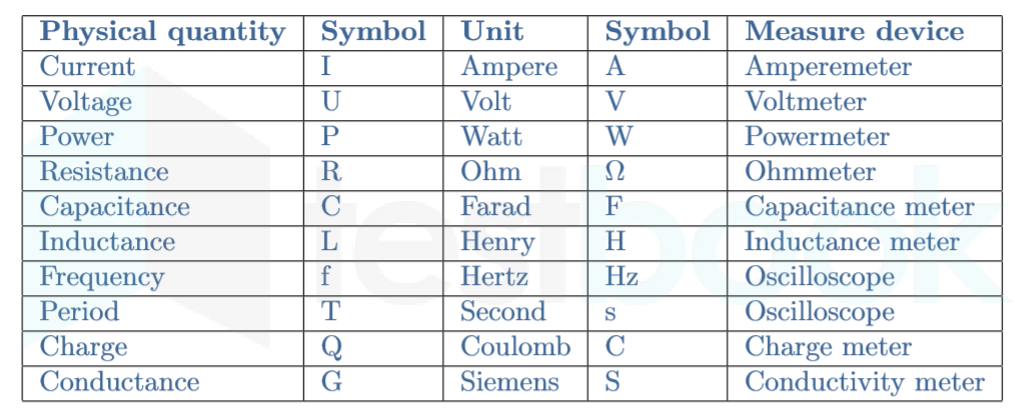
  • Resistance is a measure of the opposition to current flow in an electrical circuit.
  • Resistance is measured in ohms, symbolized by the Greek letter omega (Ω).
  • Ohms are named after Georg Simon Ohm (1784-1854), a German physicist who studied the relationship between voltage, current, and resistance.

  • Hence, the correct option is 1.

Additional Information

  • Ampere is the SI unit of current.
  • Ohm-meter is the SI unit of electrical resistivity which is the measure of an object's ability to oppose the flow of current.
19

What does 32° Fahrenheit equals to?

  1. ((a))

    373.15 K

  2. ((b))

    100° C

  3. ((c))

    89.6° C

  4. ((d))

    273.15 K

Show Answer
Answer: ((d))

273.15 K

CONCEPT:

Celsius scale:

  • In this scale, a lower fixed point (ice point) is designated as 0° and the upper fixed point (steam point) is designated as 100°.
  • The temperature measured on this scale was all in degrees Celsius (° C).

Fahrenheit scale:

  • On this scale of the temperature scale, the melting point of ice is considered to be 32° F and the boiling point of water is 212° F.
  • The change in temperature of 1° F corresponds to a change of less than 1° C on the Celsius scale.

Kelvin scale:

  • We also know the Kelvin temperature scale as the thermodynamic scale.
  • On the Kelvin scale, the boiling point of the water is considered to be 373.15 K and its freezing point is 273.15 K.
  • Whereas it was assumed that at 0 K there is no relative motion of particles,
  • The change in temperature of 1° K corresponds to a change of less than 1° C on the Celsius scale.
  • Whereas all these units of temperatures are related to each other by the following relationship:

F329=C5=K273.155\frac{{F - 32}}{9} = \frac{C}{5} = \frac{{K - 273.15}}{5}

EXPLANATION:

Given, F = 32° Fahrenheit

  • The relation between the Kelvin scale and Celsius scale is given by

F329=K273.155⇒ \frac{F-32}{9}=\frac{K-273.15}{5}

32329=K273.155⇒ \frac{32-32}{9}=\frac{K-273.15}{5}

K = 273.15 K

20

The Unit of measuring Astronomical Distance is _______.

  1. ((a))

    Kilometer

  2. ((b))

    Meter

  3. ((c))

    Light Year

  4. ((d))

    Nautical Mile

Show Answer
Answer: ((c))

Light Year

The correct answer is Light Year.

Key Points

  • A light-year is a distance measurement and not time (as the name might suggest).
  • A light-year is the distance in a single Earth year, or 6 trillion miles, that a beam of light travels (9.7 trillion kilometres).
  • Measuring in light-years often helps astronomers to assess how far they are looking back in time.
  • However, the primary reason for using light-years is that the distances we deal with in space are enormous.

Additional Information

  • Other units of measuring distances in space are the Astronomical unit (AU) and Parsec.
  • The AU is known as the average distance between the Earth and the Sun. It is roughly 150 million km long (93 million miles).
  • However, when we start talking about distances to objects beyond our solar system, the AU is not large enough as a unit.
  • Astronomers use the units of a light-year or Parsec for distances to other areas of the Milky Way Galaxy (or much farther away).
  • Parsec is equivalent to 3.3 light-years.
21

Which of the following is not an electronic device?

  1. ((a))

    Television

  2. ((b))

    Bulb

  3. ((c))

    Computer

  4. ((d))

    Radio

Show Answer
Answer: ((b))

Bulb

The correct answer is Bulb.

Key Points

  • The bulb is not an electronic device because it does not have any current controlling semiconductor device.
  • A bulb is an electric device that consists of a glass casing, a filament through which the current passes, contact wires, and a base.
  • The filament is made up of tungsten and the bulb is filled with argon gas.
  • All other options have some semiconductor devices like transistors, diodes, etc.

Additional Information

ElectronicElectric
Made up of semiconductor materials like silicon and Germenium.Made up of conducting material
These are miniature devices with low-value currents usuallyCurrent values are comparatively larger
Examples: Diode, SCR, Transistors, BJT, MOSFET, etcExamples: Fan, Electric Bulb, Transformers, etc
22

The heating element in an electric heater is made of which metal?

  1. ((a))

    Silver

  2. ((b))

    Copper

  3. ((c))

    Lead

  4. ((d))

    Nichrome

Show Answer
Answer: ((d))

Nichrome

The correct answer is Nichrome.

Key Points

  • The heating element in an electric heater is made up of Nichrome.
  • Nichrome is used in heating elements because of its high melting point (1400ºC), high electrical resistivity (40 µΩ -cm), and high resistance to oxidation.

Additional Information

  • Nichrome is an alloy of 80% Nickel and 20% Chromium.
  • When the heating element is heated the first time, chromium of alloy reacts with oxygen of the atmosphere and forms a layer of chromium oxide on the outer surface of the heating element.
  • This layer of chromium oxide works as a protective layer for elements and protects the material beneath these layers against oxidation, preventing the element wire from breaking and burning out.
23

When blue litmus paper is kept in acetic acid, the blue litmus paper turns to which colour?

  1. ((a))

    Yellow

  2. ((b))

    Light Green

  3. ((c))

    Red

  4. ((d))

    Violet

Show Answer
Answer: ((c))

Red

The correct answer is Red. 

Key Points

  • Acetic acid or Ethanoic acid is a weak acid. The formula for acetic acid is CH₃COOH.
  • Since acetic acid is a weak acid it will turn blue litmus paper into red color.
  • A 1.0 M solution (about the concentration of domestic vinegar) has a **pH of 2.4.  **​

Additional Information

  • Litmus paper is an indicator used to detect the presence of acids or bases in a solution.
  • Acids turn blue litmus into red and bases turn red litmus into blue color.
  • Litmus is also available in the form of a solution.
  • The litmus solution is a purple dye solution.
  • It is extracted from a plant called  Lichen.
24

Speed of sound in air at 0 degree centigrade is _____?

  1. ((a))

    350 m/sec

  2. ((b))

    211 m/sec

  3. ((c))

    332 m/sec

  4. ((d))

    330 m/sec

Show Answer
Answer: ((c))

332 m/sec

Explanation:

I) We have seen above that for a gas Pρ=RTM\rm \frac{P}{\rho}=\frac{RT}{M}

Where M is the molecular weight of the gas and T is the absolute temperature. Hence the speed of sould in the gas is.

v=(γPρ)=(γRTM)\rm v=\sqrt{\left(\frac{\gamma P}{\rho}\right)}=\sqrt{\left(\frac{\gamma RT}{M}\right)}

Thus it is clear from above equation that the speed of sound in a gas is directly proportional to the square-root of its absolute temperature.

(iii) Now, if v0 be the speed of 0°C and vt the speed t°C, then from the above equation, we get

v0=(γRM)(273)\rm v_0=\sqrt{\left(\frac{\gamma R}{M}\right)}\sqrt{(273)}     ..........(2)

and v1=(γRM)(273+1)\rm v_1=\sqrt{\left(\frac{\gamma R}{M}\right)}\sqrt{(273+1)}       ..........(3)

Dividing equations (3) by (2), we get

v1v0=(273+1273)=(1+1273),v1=v0(1+1273)1/2=v0(1+12×1273)\rm \frac{v_1}{v_0}=\sqrt{\left(\frac{273+1}{273}\right)}=\sqrt{\left(1+\frac{1}{273}\right)},v_1=v_0\left(1+\frac{1}{273}\right)^{1/2}=v_0\left(1+\frac{1}{2}\times\frac{1}{273}\right)

If the speed of sound in air at 0°C be taken 331 m/s, then

v1=331(1+12×273)=(331+0.61t)m/s\rm v_1=331\left(1+\frac{1}{2\times273}\right)=(331+0.61t)m/s

25

Main constituent of Natural gas is _______?

  1. ((a))

    Butane

  2. ((b))

    Methane

  3. ((c))

    Ethane

  4. ((d))

    Propane

Show Answer
Answer: ((b))

Methane

The correct answer is Methane.

Key Points

  • The largest component of natural gas is methane, a compound with one carbon atom and four hydrogen atoms (CH4).
  • Natural gas also contains smaller amounts of natural gas liquids (NGL, which are also hydrocarbon gas liquids), and nonhydrocarbon gases, such as carbon dioxide and water vapor.
  • Natural gas is a fossil energy source that formed deep beneath the earth's surface. We use natural gas as a fuel and to make materials and chemicals.

Additional Information

  • How natural gas is formed?
  • Millions to hundreds of millions of years ago and over long periods of time, the remains of plants and animals built up in thick layers on the earth’s surface and ocean floors, sometimes mixed with sand, silt, and calcium carbonate.
  • Over time, these layers were buried under sand, silt, and rock.
  • Pressure and heat changed some of this carbon and hydrogen-rich material into coal, some into oil (petroleum), and some into natural gas.

Important Points

  • Biogas: The mixture of gases that are produced due to the breakdown of organic matter in the absence of oxygen is called biogas.
  • The major constituent of biogas is Methane and Carbon dioxide while some traces of H2S and ammonia are also there.
  • It is released when the Cow, Buffalo, and Pig manure is processed Anaerobically i.e. in the absence of Oxygen.
  • Biogas can be used for Space Heating, Generation of Electricity, Fuel for Cooking, etc.
  • Compressed Natural Gas (CNG): it is composed of compressed Methane and Ethane.
  • It can be used in place of gasoline, diesel fuel and liquefied petroleum gas (LPG).
  • Liquefied petroleum gas (LPG) mainly consists of propane and butane.
  • It is odorless that's why Ethyl Mercaptan is added to it so there may be a smell if LPG leaks from its storage container.
26

Loudness of sound is measured in _______?

  1. ((a))

    Decibel

  2. ((b))

    Joule

  3. ((c))

    Hours

  4. ((d))

    Meter

Show Answer
Answer: ((a))

Decibel

The correct answer is Decibel.

Key Points

  • Sound is a wave of pressure created by vibrating something, causing particles to bump into each other and then detach.
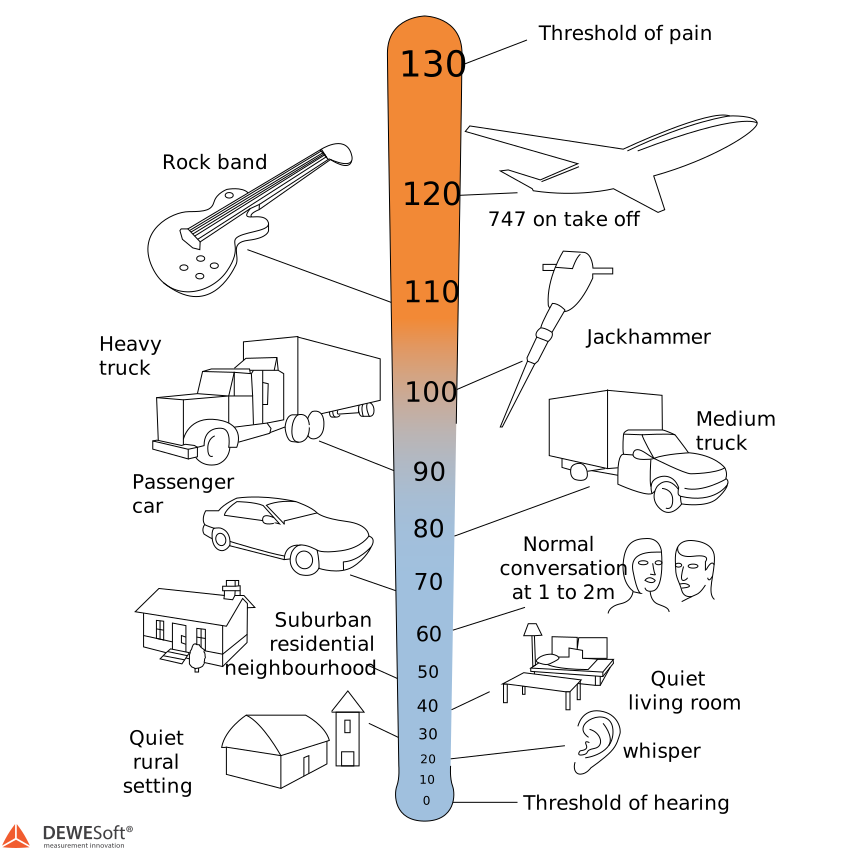
  • the loudness of sound is measured in decibels (dB).
  • Actually, this is a measure of intensity, which refers to how much energy the wave of pressure has.
  • Decibels are a relative measurement.
  • The intensity of a pressure wave is related to natural or standard pressure in terms of decibels.
  • The quietest noises we hear are about 10dB for the human ear in the air, while the sounds of 130dB are considered painful.

Sound pressure level in Decibels of different real-life scenarios:

Important Points

7 FUNDAMENTAL UNITS
Physical QuantitySI unitSymbol
Lengthmeterm
MassKilogramkg
Timeseconds
Electric currentampereA
TemperatureKelvinK
Luminous intensityCandelaCd
Amount of substanceMolemol
27

The eyes of a patient suffering from Jaundice turns to which colour?

  1. ((a))

    Orange

  2. ((b))

    Red

  3. ((c))

    Blue

  4. ((d))

    Yellow

Show Answer
Answer: ((d))

Yellow

The correct answer is Yellow.

Key Points

  • Jaundice is a condition in which the skin, white part of the eyes, and mucous membranes turn yellow.
  • Jaundice is also known as icterus.

Additional Information

  • Jaundice happens because of a high level of bilirubin, a yellow-orange bile pigment.
  • Jaundice has many causes, including hepatitis, gallstones, and tumors.
  • An inflamed liver or obstructed bile duct can lead to jaundice, as well as other underlying conditions.
  • Diagnosis of jaundice can involve a range of tests.
  • Jaundice is treated by managing the underlying cause.
28

Which metal was used first by man on earth?

  1. ((a))

    Copper

  2. ((b))

    Gold

  3. ((c))

    Aluminium

  4. ((d))

    Iron

Show Answer
Answer: ((a))

Copper

The correct answer is Copper.​

Key Points

  • Copper was first used by man over 10,000 years ago.
  • A copper pendant found in what is now northern Iraq dates back to around 8700 B.C.
  • Copper had been the only metal known to man for nearly five centuries and therefore had all metal applications.
  • Man used copper during the pre-historic period to manufacture instruments, implements, and weapons.
  • Ancient cultures have used copper for medicinal purposes, in addition to using copper to create artifacts.
  • Among the Indians, the surgical instruments used by doctors contained **copper.**​

Additional Information

  • Copper is a chemical element referred to chemically as Cuprum. Cu is its chemical symbol.
  • Cuprum is a Latin term meaning from the island of Cyprus.
  • Copper occurs naturally in the seas, the earth's crust, lakes, and rivers.
  • By color, it is a reddish-brown metal.
  • Copper is an excellent conductor of heat and electricity.
  • Other properties include its malleability and ductility.
29

What is the Percentage of Oxygen in Air?

  1. ((a))

    21%

  2. ((b))

    45%

  3. ((c))

    78%

  4. ((d))

    31%

Show Answer
Answer: ((a))

21%

The correct answer is 21%.

Key Points

  • The layer of gases covering the earth is the atmosphere.
  • The main gases found in the atmosphere are nitrogen, oxygen, argon, carbon dioxide, and other gases.
  • The percentage of ambient oxygen present is 21.
  • The chemical element with the symbol O and atomic number 8 is oxygen.
  • It is a highly reactive non-metal and an oxidizing agent that easily forms oxides with most elements as well as with other compounds.
  • Oxygen is the third-most abundant element in the universe by mass, after hydrogen and helium.
  • Two atoms of the element bind to form dioxygen, a colorless and odorless diatomic gas with the formula O2, at normal temperature and pressure.
  • In the Earth's atmosphere, oxygen is constantly replenished by photosynthesis, which uses the energy of sunlight to generate oxygen from water and carbon dioxide.

Additional Information

Percentage of oxygen in atmosphere of earth is :

30

Deficiency of Vitamin 'C' in the body causes which diseases?

  1. ((a))

    Pellagra

  2. ((b))

    Scurvy

  3. ((c))

    Goiter

  4. ((d))

    Night Blindness

Show Answer
Answer: ((b))

Scurvy

The correct answer is Scurvy.

Key Points

  • Scurvy is a disease resulting from the deficiency of vitamin C. Its symptoms include weakness, feeling tired, and sore arms and legs.
  • The deficiency may be caused by not eating enough fresh fruits and vegetables.
  • It can cause bruising, dry hair and skin, gum and dental problems, and anemia.
  • Typical symptoms and sometimes blood tests are the basis of the diagnosis.

Additional Information

  • Vitamin C (ascorbic acid) is vital for bone, skin, and connective tissue formation, growth, and repair.
  • It is also important for normal blood vessel function.
  • Vitamin C helps preserve healthy gums and teeth.
  • It helps the body to absorb the iron needed for the production of red blood cells.
  • Vitamin C also assists in healing burns and wounds.
  • Citrus fruits, tomatoes, potatoes, broccoli, strawberries, and sweet peppers are good sources of vitamin C.
  • The deficiency is usually corrected by increasing the consumption of fresh fruits and vegetables or by taking vitamin C supplements orally.
DiseaseCause
PellagraVitamin B3
Night BlindnessVitamin A
Beri BeriVitamin B1
GoiterIodine
AnemiaIron

Mathematics (15 questions)

31

If 5 is added to twice of a number it becomes 6, then the number is?

  1. ((a))

    0.25

  2. ((b))

    50

  3. ((c))

    0.5

  4. ((d))

    5

Show Answer
Answer: ((c))

0.5

Calculation:

Let the number be x

Hence, twice the number is 2x.

According to question,

⇒ 2x + 5 = 6

⇒ 2x = 1

⇒ x = 0.5

∴ The number is 0.5

32

Convert 35 meter/sec into km/h?

  1. ((a))

    126

  2. ((b))

    140

  3. ((c))

    130

  4. ((d))

    136

Show Answer
Answer: ((a))

126

Concept used:

To convert meter/sec to km/hr, we will have to multiply it by 185\frac{18}{5}

Calculation:

35 m/s = 35 × (185\frac{18}{5}) km/hr

⇒ (7 × 18) km/hr

⇒ 126 km/hr

∴ The required answer is 126 km/hr

33

Solve: 25% of 100 = ?

  1. ((a))

    20

  2. ((b))

    35

  3. ((c))

    30

  4. ((d))

    25

Show Answer
Answer: ((d))

25

Calculation:

25% of 100 = ?

⇒ (25/100) × 100 = ?

⇒ 25 = ?

∴ The value of ? is 25

34

Salary of a man was Rs. 20,000. The same was increased by 14%. Find the new salary.

  1. ((a))

    24800

  2. ((b))

    21600

  3. ((c))

    22800

  4. ((d))

    25600

Show Answer
Answer: ((c))

22800

Given:

Initial salary = Rs. 20,000

Increase% = 14%

Concept:

If a number x increases by a% then a new number is

x(1+a100)x(1+\frac{a}{100})

Calculation:

New salary = Rs. 20,000(1+14100)(1+\frac{14}{100}) 

⇒ Rs. 20000 × (114100\frac{114}{100}) = 22800

∴ The new salary is Rs. 22,800

35

Which of the following is a perfect square?

  1. ((a))

    1935

  2. ((b))

    1520

  3. ((c))

    730

  4. ((d))

    1681

Show Answer
Answer: ((d))

1681

Concept used:

Perfect square should have a pair of each prime factor

Calculation:

1935 = 3 × 3 × 5 × 43

1520 = 2 × 2 × 2 × 2 × 5 × 19

730 = 2 × 5 × 73

1681 = 41 × 41

Here, only 1681 has a pair of each prime factor

∴ The perfect square is 1681

36

What is the remainder when 496 is divided by 6?

  1. ((a))

    1

  2. ((b))

    4

  3. ((c))

    2

  4. ((d))

    3

Show Answer
Answer: ((b))

4

Calculation:

496 = 6 × 82 + 4

It means remainder will be 4

∴ The remainder when 496 is divided by 6 is 4

37

If Raj bought an umbrella for Rs. 100 and sold it for a profit of Rs. 10 then find the selling price of umbrella?

  1. ((a))

    Rs. 115

  2. ((b))

    Rs. 100

  3. ((c))

    Rs. 90

  4. ((d))

    Rs. 110

Show Answer
Answer: ((d))

Rs. 110

Given:

C.P of umbrella = Rs. 100

Profit = Rs. 10

Formula used:

S.P = C.P + Profit

Calculation:

Selling price = Rs. 100 + Rs. 10

⇒ Rs. 110

∴ The selling price of umbrella is Rs. 110

38

6 persons can finish a work in 7 days, so 21 persons will finish that work in how many days?

  1. ((a))

    7

  2. ((b))

    3

  3. ((c))

    6

  4. ((d))

    2

Show Answer
Answer: ((d))

2

Concept used:

Work = Total manpower × Total days

M1D1/W1 = M2D2/W2

Calculation:

Here, M1 = 6, M2 = 21, D1 = 7, D2 = ?, W1 = W2 = 1

Using the above concept

(6 × 7)/(1) = (21 × D2)/(1)

⇒ 42 = 21D2

⇒ D2 = 2

Hence, ‘2’ is the correct answer.

39

What will be the mean of first 5 positive odd integers?

  1. ((a))

    2

  2. ((b))

    4

  3. ((c))

    3

  4. ((d))

    5

Show Answer
Answer: ((d))

5

Given:

First 5 odd integers = 1, 3, 5, 7 and 9

Formula used:

Mean = Sum of observations/Number of observations

Calculation:

Sum of observations (1 + 3 + 5 + 7 + 9) = 25

Number of observations = 5

Mean = 25/5 = 5

∴ The mean of first five odd integers is 5

Additional InformationEven number:  Any integer that can be divided exactly by 2 is an even number. The last digit is 0, 2, 4, 6 or 8

Odd Number: Any integer that cannot be divided exactly by 2 is an odd number. The last digit is 1, 3, 5, 7 or 9

40

A sum of money becomes Rs. 900 in 4 yr at 5% per annum on Simple Interest. The sum is?

  1. ((a))

    Rs. 550

  2. ((b))

    Rs. 650

  3. ((c))

    Rs. 750

  4. ((d))

    Rs. 500

Show Answer
Answer: ((c))

Rs. 750

Given:

Amount = Rs. 900

Time = 4 years

Rate of interest = 5%

Formula used:

Amount = Principal + Interest

S.I = PRT/100

Calculation:

S.I = PRT/100

S.I = (P × 4 × 5)/100

⇒ P/5

Now, According to the question,

Amount = Principal + Interest

⇒ P + (P/5) = Rs. 900

⇒ 6P/5 = Rs. 900

⇒ P = Rs. 150 × 5

⇒ Rs. 750

∴ The sum is Rs. 750

41

If perpendicular of a right angled triangle is 8 cm and its area is 20 cm2, the length of base is?

  1. ((a))

    20 cm

  2. ((b))

    05 cm

  3. ((c))

    40 cm

  4. ((d))

    08 cm

Show Answer
Answer: ((b))

05 cm

Given:

Perpendicular of right angled triangle = 8 cm

Area = 20 cm2

Formula used:

Area of right angled triangle = (1/2) × perpendicular × base

Calculation:

⇒ 20 cm2 = (1/2) × 8 × base

⇒ base = 20/4

⇒ 5 cm

∴ The length of base is 5 cm

42

What will be the sum of the greatest and smallest numbers of four digits?

  1. ((a))

    8999

  2. ((b))

    10999

  3. ((c))

    11110

  4. ((d))

    11111

Show Answer
Answer: ((b))

10999

Given:

Smallest 4 digit number = 1000

Greatest 4 digit number = 9999

Calculation:

Sum = 1000 + 9999

⇒ 10999

∴ The sum of smallest and greatest four digits number is 10999

43

HCF of two numbers is 11 and their LCM is 693. If one number is 77, find the other number?

  1. ((a))

    89

  2. ((b))

    99

  3. ((c))

    94

  4. ((d))

    92

Show Answer
Answer: ((b))

99

Given:

HCF of two numbers = 11

LCM of two numbers = 693

Formula used:

LCM × HCF = Product of two numbers

Calculation:

Let the other number be x

⇒ 11 × 693 = 77 × x

⇒ x = 693/7

⇒ 99

∴ The other number is 99

44

How many rectangular plots of dimensions 40 m by 60 m can be made from a rectangular field of dimensions 120 m by 160 m?

  1. ((a))

    4

  2. ((b))

    2

  3. ((c))

    3

  4. ((d))

    8

Show Answer
Answer: ((d))

8

Given:

Dimension of smaller rectangular plot = 40 × 60

Dimension of larger rectangular plot = 120 × 160

Formula used:

Area of rectangle = Length × width

Calculation:

Area of smaller rectangular plots = (40 × 60) m2

⇒ 2400 m2

Area of larger rectangular plots = (120 × 160) m2

⇒ 19200 m2

Number of rectangular plots which can be made = (19200 m2/2400 m2)

⇒ 8

∴ The required number of rectangular plots is 8

45

If 20 people can do a work in 20 days then in how many days the same work can be completed by 40 people?

  1. ((a))

    40

  2. ((b))

    25

  3. ((c))

    30

  4. ((d))

    10

Show Answer
Answer: ((d))

10

Given:

Number of days taken by 20 people to complete a work = 20 days

Formula used:

Total work = Number of people × Time taken

Calculation:

Total work = 20 × 20

⇒ 400

Time taken by 40 people to complete the work = 400/40

⇒ 10 days

∴ The number of days taken by 40 people to complete the work is 10 days

Logical Reasoning (5 questions)

46

From the given options fill the blank space: 10, 16, 21, 25, (_)

  1. ((a))

    27

  2. ((b))

    31

  3. ((c))

    29

  4. ((d))

    28

Show Answer
Answer: ((d))

28

The logic is:

Hence, ‘28’ is the correct answer.

47

If PALE is coded as 2134, EARTH is coded as 41590, how will PEARL be coded?

  1. ((a))

    29530

  2. ((b))

    23145

  3. ((c))

    24153

  4. ((d))

    25430

Show Answer
Answer: ((c))

24153

The logic is:

PALE
2134


EARTH
41590


Similarly,

PEARL
24153


Hence, ‘24153’ is the correct answer.

48

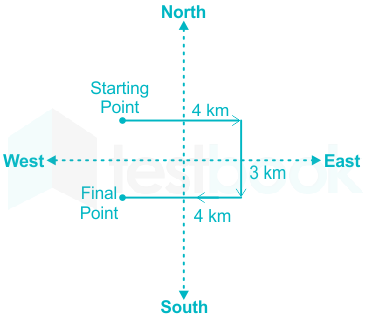
Mohan walked 4 kms forward towards East then turned right and walked 3 kms. Again he turned right and walked 4 kms. After this he turned back, now in which direction is he facing?

  1. ((a))

    East

  2. ((b))

    South

  3. ((c))

    North

  4. ((d))

    West

Show Answer
Answer: ((a))

East

According to given conditions,

Mistake Points

At the final point, before he turns back, he faces ‘West’ direction and when he turns back, he faces ‘East’ direction.

Hence, ‘East’ is the correct answer.

49

Karim ranks 15th from the top in a class of 49 students. What is his rank from the bottom?

  1. ((a))

    34

  2. ((b))

    33

  3. ((c))

    35

  4. ((d))

    32

Show Answer
Answer: ((c))

35

Karim ranks 15th from the top in a class of 49 students.

Karim’s rank from the bottom = 49 – 15 + 1

= 50 – 15

= 35

So, his rank from the bottom is 35th.

Hence, ‘35’ is the correct answer.

50

From the given options complete the series: 7, 14, 28, 56, (_).

  1. ((a))

    112

  2. ((b))

    110

  3. ((c))

    100

  4. ((d))

    115

Show Answer
Answer: ((a))

112

Calculation:

The series follows following pattern

⇒ 7 × 2 = 14

⇒ 14 × 2 = 28

⇒ 28 × 2 = 56

⇒ 56 × 2 = 112

∴ The required answer is 112

Attempt this paper under real exam conditions

Timed interface, section switching, instant scoring, and question-by-question analytics — free.

Start Timed Attempt