Official Paper

Agniveer Army GD 25 April 2024 (Shift 2) Memory-Based Paper (Previous Year Paper)

50 questions · 60 minutes · with answers · free

General Knowledge (15 questions)

1

Article 17 is related to _________.

  1. ((a))

    Right to Education

  2. ((b))

    Abolition of Untouchability

  3. ((c))

    Abolition of Title

  4. ((d))

    Right to Religion

Show Answer
Answer: ((b))

Abolition of Untouchability

The correct answer is the Abolition of Untouchability

Key Points

  • Abolition of Untouchability is abolished and its practice in any form is forbidden.
  • The enforcement of any disability arising out of untouchability shall be an offence punishable in accordance with the law.
  • In order to end the caste system, the practice of untouchability, discrimination, and other types of practices that is prevalent in our society for centuries, Article 17 was given space in the Indian constitution.
  • Article 17 is the only Absolute Article of all the rights articles written in the Constitution. That is, it is illegal to practice untouchability in any form.
  • There is no definition of untouchability in the Indian Constitution and not in any act passed by the Parliament.
  • But the Mysore High Court has clarified its meaning in one of its decisions. The court said that the subject matter of Article 17 is not untouchable in its literal or grammatical sense but the ‘practice as it had developed historically in the country. It refers to the social disabilities imposed on certain classes of persons because of their birth in certain cases. Hence, it does not cover the social boycott of a few individuals or their exclusion from religious services, etc.
  • Due to the many verdict and instructions given by the court, some works will be treated as the observance of untouchability, for which a provision of punishment has also been made.
  • As per Section 8 in The Representation of the People Act, 1951, a person convicted of the offence of untouchability is disqualified for election to the parliament or state legislature.

Additional Information

ArticlesDescription
Article 21ARight to Education
Article 18Abolition of Title
Article 25-28Right to Freedom of Religion
2

The Tarang Shakti exercise is projected to be _____________.

  1. ((a))

    the smallest air exercise ever conducted in India

  2. ((b))

    an largest Naval exercise in India

  3. ((c))

    the largest air exercise ever conducted in India

  4. ((d))

    the first air exercise ever conducted in India

Show Answer
Answer: ((c))

the largest air exercise ever conducted in India

The correct answer is the largest air exercise ever conducted in India.

Key Points 

  • In a significant development for India’s military prowess and global alliances, the Indian Air Force (IAF) is gearing up to host its first-ever largest multilateral air force exercise later this year.
  • The exercise, named `Tarang Shakti’, will witness the participation of twelve nations, with six nations joining with their aircraft and the remaining six as observers.
  • This major air exercise marks a momentous occasion for the IAF and underscores its growing importance in international military cooperation.
  • Although the participating countries have not been officially announced yet, sources in the defence and security establishment have indicated that the Quad nations — United States, Japan, Australia and others including France and the United Kingdom, are among the nations sending their aircraft for this landmark exercise. 
  • Hence, countries Pakistan & China are not a part of it.
  • It is set to take place in the Rajasthan sector.
  • `Tarang Shakti’ aims to enhance coordination, interoperability, and integration among the participating air forces, sending a strong message to potential adversaries in the region.
3

"Gulamgiri" book is written by:

  1. ((a))

    Dr. B. R. Ambedkar

  2. ((b))

    Mahatma Jyotiba Phule

  3. ((c))

    Gopal Ganesh Agarkar

  4. ((d))

    Pandita Ramabai

Show Answer
Answer: ((b))

Mahatma Jyotiba Phule

The correct answer is Mahatma Jyotiba Phule.

Key Points

  • Mahatma Jyotiba Phule wrote "Gulamgiri" in 1873 for the downtrodden section of society, to make them realize the discrimination and oppression of the caste system.
  • Gulamgiri talks about Brahminical supremacy and hegemonies in the social structure of Indian society.
  • It criticized the institution of the caste system.
  • Mahatma Jyotiba Phule and their work:
  • In 1848 he started the first Girl School in Budhawar Peth, Pune.
  • In 1851 he started the first school for untouchables in Pune.
  • In 1873 he formed Satyashodhak Samaj to focus on the rights of depressed groups such as women, the untouchables.

Additional Information

  • Books by Dr. B. R. Ambedkar:
  • Ranade, Gandhi, and Jinnah
  • Riddles in Hinduism
  • The Problem of Rupee
  • Buddha and his Dhamma
  • Who were the Shudras?
  • Annihilation of Caste
  • Books by Gopal Ganesh Agarkar:
  • Marathi translation of Hamlet
  • Futke Nashib
  • Alankar Mimmansa
  • Books by Pandita Ramabai:
  • The high caste Hindu woman
4

Which is the highest peak in the world?

  1. ((a))

    Kanchenjunga

  2. ((b))

    Mount everest

  3. ((c))

    Godwin austin

  4. ((d))

    None of these

Show Answer
Answer: ((b))

Mount everest

The correct answer is Mount Everest.

Key Points

  • Mount Everest
  • The highest mountain in the world is Mount Everest. Hence, Option 2 is correct.
  • It’s pretty famous.
  • The big pointy thing in the Himalayas in Nepal. Sits up at 8,848m.
  • It’s a really high mountain.
  • Everyone knows about Mount Everest.
  • Most people also know the second-highest mountain in the world is K2.
  • But very few people know the third highest mountain in the world is called Kangchenjunga.
  • Or how to spell that. It’s not quite as simple as ‘K2’, that’s for sure.
  • First climbed by Sir Edmund Hillary and Tenzing Norgay in 1953, Mount Everest is, of course, the highest mountain in the world.
  • Kangchenjunga
  • Kangchenjunga is the third highest mountain in the world.
  • It can be found between Nepal and Sikkim in India, with three of the peaks on the border and the other two in the Taplejung District of Nepal.
  • Kangchenjunga was actually thought to be the highest mountain in the world until 1852.
  • The Godwin-Austen Glacier
  • It is a glacier in the Karakoram range and is close to K2, the second tallest peak on Earth, in Gilgit–Baltistan, Pakistan.
  • Its confluence with the Baltoro Glacier is called Concordia and is a popular trekking destination as it provides views of four of the five eight-thousanders in the region.
5

Which treaty was signed during Third Anglo-Maratha War?

  1. ((a))

    Treaty of Salbai

  2. ((b))

    Treaty of Pondicherry

  3. ((c))

    Treaty of Mandasaur

  4. ((d))

    Treaty of Mangalore

Show Answer
Answer: ((c))

Treaty of Mandasaur

The correct answer is the Treaty of Mandasaur.

Mistake Points

  • The Treaty of Salbai ended the First Anglo-Maratha War, was signed on 17 May 1782 between the British East India Company and the Marathas.

Key Points

Name of the BattleYearBattle betweenSignificance/Outcome
First Anglo-Maratha War1775-1782British EIC and MarathasThe war was won by the Marathas and ended with the Treaty of Salbai
Third Anglo-Maratha War1817-1818British EIC and MarathasThe war was won by the British EIC and the Treaty of Mandasaur was signed.
Second Carnatic War1748-54English and FrenchThe war was won by the British and ended with the Treaty of Pondicherry
Second Anglo-Mysore War1780-84British EIC and MysoreHyder Ali died during the second Anglo-Mysore war and the war ended with the Treaty of Mangalore
  • Third Anglo-Maratha War (1817-19):
  • ​Result: The Peshwa was defeated at Khirki, Bhonsle at

Sitabuldi, and Holkar at Mahidpur.

Some important treaties were signed. These were:

  • June 1817, Treaty of Poona, with Peshwa.
  • November 1817, Treaty of Gwalior, with Sindhia.
  • January 1818, Treaty of Mandasor, with Holkar.
6

The Akhaura-Agartala rail link connects India to which country?

  1. ((a))

    Bhutan

  2. ((b))

    Bangladesh

  3. ((c))

    Myanmar

  4. ((d))

    China

Show Answer
Answer: ((b))

Bangladesh

The correct answer is Bangladesh.

Key Points

  • Agartala-Akhaura Rail Link between India and Bangladesh.
  • The Agartala-Akhaura Rail Link between India and Bangladesh is a project aimed at establishing a rail link between Agartala in India and Akhaura in Bangladesh.
  • It will enhance connectivity and promote economic cooperation between the two countries.
  • Intermodal transport linkages and inland waterways through Bangladesh.
  • Intermodal transport linkages and inland waterways through Bangladesh are initiatives that leverage the waterways and transport infrastructure in Bangladesh to facilitate trade and connectivity between India and Southeast Asian countries.

Additional Information

  • Kaladan Multimodal Transit Transport Project and the Trilateral Highway Project connecting the North East with Myanmar and Thailand.
  • The Kaladan Multimodal Transit Transport Project and the Trilateral Highway Project are infrastructure projects that aim to connect India's Northeast region with Myanmar and Thailand.
  • These projects will improve regional connectivity, trade, and people-to-people exchanges.
7

Banaras Hindu University was established in:

  1. ((a))

    1916

  2. ((b))

    1945

  3. ((c))

    1894

  4. ((d))

    1901

Show Answer
Answer: ((a))

1916

The correct answer is 1916.

Key Points

  • Banaras Hindu University (BHU)
  • It was established in 1916.
  • It was founded by the great nationalist leader, Pandit Madan Mohan Malviya with cooperation of great personalities like Dr Annie Besant, who viewed it as the University of India.
  • It is an internationally reputed temple of learning, situated in the holy city of Varanasi.
  • It has 6 centres of Advanced Studies, 10 Departments under Special Assistance Programme and a large number of specialized Research Centers.
  • Bharat Kala Bhavan, the reputed museum of the university, is a treasure trove of rare collections.
  • The 927 bed hospital of the University is equipped with all the modern amenities.

Additional Information 

  • In 2012, it was converted into Indian Institute of Technology, Banaras Hindu University IIT (BHU), Varanasi with the vision of imparting world class engineering education, research and innovation.
  • Pandit Madan Mohan Malviya 
  • He was also called Mahamana.
  • He was an Indian scholar, educational reformer and freedom fighter.
  • He was also one of the founders of Scout and Guide in India.
  • In 2014, Pandit Malviya was posthumously conferred with Bharat Ratna, the country's highest civilian award.
8

What is the minimum age of elders who can vote from home?

  1. ((a))

    75

  2. ((b))

    80

  3. ((c))

    85

  4. ((d))

    90

Show Answer
Answer: ((c))

85

The correct answer is 85.

Key Points

  • The minimum age for elders eligible to vote from home is above 85 years.
  • This initiative is part of the 2024 Lok Sabha elections in India.
  • It aims to provide inclusivity and accessibility to the electoral process.
  • Persons with Disabilities (PwDs) meeting the 40% benchmark disability criteria are also eligible.
  • Over 81 lakh 85+ aged voters and 90 lakh+ PwD voters are registered across the country.
  • The procedure involves filling out Form 12D within five days of the election notification.
  • PwD voters must submit a baseline disability certificate along with their applications.
  • The Booth Level Officer (BLO) retrieves Form 12D from the elector's residence.
  • A dedicated team of polling officials visits the voter's residence to collect their votes.
  • The process is videographed for transparency, ensuring the integrity of the electoral process.
9

Which union territory of India had the lowest sex ratio in 2011?

  1. ((a))

    Chandigarh

  2. ((b))

    Daman and Diu

  3. ((c))

    Andaman and Nicobar Islands

  4. ((d))

    Dadra and Nagar Haveli

Show Answer
Answer: ((b))

Daman and Diu

The correct answer is Daman and Diu.

Key Points 

  • The Sex ratio is used to describe the number of females per 1000 males.
  • It is a valuable source for finding the population of women in India and what is the ratio of women to that of men in India.
  • In the Population Census of 2011, it was revealed that the population ratio in India is 943 females per 1000 males.
  • The Sex Ratio 2011 shows an upward trend from the census 2011 data.
  • Considering all Union Territories and States, as per the 2011 census, Daman and Diu have the lowest sex ratio of 618 and Kerala has the highest sex ratio of 1084.

Additional Information

Census 2011:

  • It is the 15th National Census Survey conducted by the Census Organization of India.
  • Shri C. Chandramouli is the Commissioner and Registrar General of the Census of India 2011.
  • As per the Census of India 2011, the population density of India was 382 per square km.
  • The Indian Census is the most credible source of information on Demography (Population characteristics), Economic Activity, Literacy and Education, Housing Household Amenities, Urbanisation, Fertility, Mortality, etc.
  • Census was introduced in India during the era of Lord Mayo in the year 1872. It came into force in 1881.
  • The slogan of census 2011 was 'Our Census, Our future'.
  • The population of the nation as per the provisional figures of Census 2011 was 1210.19 million of which 623.7 million (51.54%) were males and 586.46 million (48.46%) were females. Uttar Pradesh is the most populous state in India its population is more than the population of Brazil.
10

Which of the following sports does Shubman Gill belong to?

  1. ((a))

    Cricket

  2. ((b))

    Football

  3. ((c))

    Hockey

  4. ((d))

    Badminton

Show Answer
Answer: ((a))

Cricket

  • Shubnam Gill belongs to cricket and he is a right-handed batsman.
  • He was the Vice Captain of the team that won ICC U-19 World Cup in 2018.
  • He plays for Team India and in Indian Premier League he bats for Gujarat Titans.
11

Who is the current CM of Chhattisgarh?

  1. ((a))

    Vishnu Deo Sai

  2. ((b))

    Dr. Raman Singh

  3. ((c))

    Bhupesh Baghel

  4. ((d))

    Ramvichar Netam

Show Answer
Answer: ((a))

Vishnu Deo Sai

The correct answer is Vishnu Deo Sai

Key Points

  • On December 10, 2023, Vishnu Deo Sai was elected as the Chief Minister of Chhattisgarh.
  • He is a member of the Bharatiya Janata Party (BJP) and represents Kunkuri as an MLA.
  • Vishnu Deo Sai will be the 4th individual to serve as Chief Minister of the state.
  • He marks a historic milestone as the state's 1st tribal Chief Minister.

Additional Information

  • Dr. Raman Singh, the former Chief Minister of Chhattisgarh, has been elected as the Speaker of the Chhattisgarh Assembly.
12

The word 'Mahayana' is related to which religion?

  1. ((a))

    Jainism

  2. ((b))

    Buddhism

  3. ((c))

    Shaivism

  4. ((d))

    Sikhism

Show Answer
Answer: ((b))

Buddhism

The correct answer is Buddhism.

Key Points

  • Mahayana is a sect of Buddhism which refers to 'The Great Vehicle'.
  • During the fourth Buddhist council held at Kashmir (in 72 AD) under the king Kanishka, the Buddhism got divided into two sects namely:
  • Mahayana: The greater vehicle
  • Hinayana: The lesser vehicle.
  • Mahayana:
  • This sect of Buddhism believed in idol worship and mantras.
  • They believed in the supremacy of Buddha and considered him as a god.
  • According to this sect, one can achieve salvation by worshipping buddha.
  • This sect spread to China, Japan and Southeast Asia.
  • Hinayana:
  • Buddha was not given the status of god and idol worship is prohibited under this sect.
  • This sect believed in the attainment of salvation by following the teachings of Buddha.
  • They followed the path of self-discipline and meditation.
  • This ideology spread into Srilanka.
13

Which festival do Sikhs celebrate in the form of "Bandi Chhor"?

  1. ((a))

    Vaisakhi

  2. ((b))

    Diwali

  3. ((c))

    Gurpurab

  4. ((d))

    Holi

Show Answer
Answer: ((b))

Diwali

The correct answer is Diwali.

Key Points

  • Bandi Chhor Divas, celebrated by Sikhs, marks the release of Guru Hargobind Sahib from Gwalior Fort prison and his arrival in Amritsar during the Diwali season.
  • It is synonymous with Diwali for Sikhs and signifies the victory of light over darkness and good over evil.
  • The festival involves lighting up homes and gurdwaras, fireworks, and sharing meals with family and friends, reflecting joy and happiness similar to the broader Diwali celebrations.
  • Guru Hargobind Sahib was imprisoned along with 52 princes. Upon release, he refused to leave without the princes, which led to the negotiation that whoever could hold onto his cloak could leave with him. He cleverly had a cloak made with 52 tassels, hence securing their release as well.

Additional Information

  • Vaisakhi: Celebrated in April, Vaisakhi marks the Sikh new year and commemorates the formation of the Khalsa panth of warriors under Guru Gobind Singh in 1699.
  • Gurpurab: Refers to the anniversaries related to the lives of the Sikh gurus. Among them, the most celebrated are the birth anniversaries of Guru Nanak and Guru Gobind Singh.
  • Holi: Although primarily a Hindu festival symbolizing the victory of good over evil, some Sikhs also participate in Holi celebrations, especially in regions where communities celebrate together, albeit it does not have the same religious significance as in Hinduism.
14

In Bareilly, the revolt of 1857 was led by _________________.

  1. ((a))

    Khan Bahadur

  2. ((b))

    Rani Lakshmi Bai

  3. ((c))

    Tatya Tope

  4. ((d))

    Maulvi Ahmad Shah

Show Answer
Answer: ((a))

Khan Bahadur

The correct answer is Khan Bahadur.

Key Points

  • Khan Bahadur Khan Rohilla was born in 1823.
  • In the revolt of 1857, he formed his Government to fight against the British.
  • When his territory was subjugated, he was captured by Nepalese and was sent to the British. He was sentenced to death in Kotwali on 24 February 1860.

Important Points

  • Rani Lakshmi Bai -
  • She was one of the prominent leaders in the first war of independence.
  • She is known for her fighting spirit and leadership qualities.
  • During the annexation of her territory due to the Doctrine of Lapse, she said: "I shall not surrender my Jhansi".
  • Sir Huge Rose, who led the British against her said that she is the only man among the mutineers.
  • Tatya Tope - 
  • Tatya Tope was born in 1814 in Yeola.
  • His full name is Ramchandra Panduranga Tope.
  • He led the revolt of 1857 from Kanpur.
  • He was defeated by Sir Colin Campbell.
  • Maulvi Ahmad Shah -
  • Maulvi Ahmadullah Shah led the revolt of 1857 from Awadh.
  • He is also known as the Lighthouse of rebellion in the Awadh region.
  • He belongs to the 22nd Infantry Regiment.
15

In January 2024 who has been appointed as the Chairman of the 16th Finance Commission?

  1. ((a))

    Amitabh Kant 

  2. ((b))

    Rajiv Kumar 

  3. ((c))

    Arvind Subramanian 

  4. ((d))

    Dr Arvind Panagariya

Show Answer
Answer: ((d))

Dr Arvind Panagariya

The correct answer is Dr Arvind Panagariya

In News 

  • Centre has constituted the 16th Finance Commission with Dr Arvind Panagariya as its Chairman.

Key Points 

  • Prior to this, Dr Panagariya served as the Vice Chairman of NITI Aayog and is currently a Professor at Columbia University.
  • As the Chairman, his responsibilities will include making recommendations on important matters such as the distribution of net tax proceeds between the Union and the States and actions needed to augment the Consolidated Fund of a State to supplement the resources of its Panchayats and Municipalities.
  • He will also possibly review the existing arrangements for financing Disaster Management initiatives.
  • The Finance Commission, under Dr Panagariya's leadership, is expected to present its report by October 31, 2025, which will cover five years starting from April 1, 2026.

Dr Arvind Panagariya वित्त आयोग के चेयरमेन नियुक्त – Officers Times

Additional Information 

  • FINANCE COMMISSION*:*
  • Finance Commissions (FCs) are constitutional entities established under Article 280 of the Indian Constitution, with the mandate to advise on the distribution of financial resources between Union and State governments.
  • The recommendations by FCs cover three main aspects: The share of states in central tax pool (Vertical Devolution), allocation of resources among states based on a formula reflecting fiscal needs and performances (Horizontal Distribution), and Grants-in-aid for states or sectors in need of assistance.
  • Some notable initiatives by FCs include: Higher tax devolution to states, performance-based incentives for fiscal discipline, disaster relief funds, grants for local bodies and sectors such as health, education and justice delivery.
  • Despite the recommendations being advisory in nature, they are typically accepted by the Union government with only minor modifications and deviations.
  • The Union government indicates acceptance of the recommendations through a Presidential Order, which specifies the period of their validity.

General Science (15 questions)

16

Which vitamin is easily destroyed during cooking?

  1. ((a))

    Vitamin A

  2. ((b))

    Vitamin B

  3. ((c))

    Vitamin C

  4. ((d))

    Vitamin K

Show Answer
Answer: ((c))

Vitamin C

The correct answer is Vitamin C.

Key Points

  • A large amount of Vitamin C is lost when they’re cooked in water.
  • In fact, boiling reduces vitamin C content more than any other cooking method.
  • Because vitamin C is water-soluble and sensitive to heat, it can leach out of vegetables when they’re immersed in hot water.
  • B vitamins are similarly heated sensitive.
  • Since boiling occurs at the highest temperature compared to other methods of cooking the nutrients lost in this method of cooking is the highest.

Additional Information

  • Water-soluble vitamins are those which are carried to the body's tissues but are not stored in the body.
  • Vitamin C and some forms of Vitamin B complex are water-soluble.
  • Vitamin: These are organic compounds that do not produce any energy but are required for our body.
  • They are often known as essential vital nutrients, as they are required for the proper functioning of the body.
  • Invented by F.G Hopkins.
  • Term coined by C. Funk.
  • Fat-soluble vitamins: They are soluble in organic solvents and are absorbed and transported in the same manner as fats do.
  • ​Eg: Vit A, Vit D, Vit E, Vit K.

Important Points

VitaminSoluble inDeficiency
A (Retinol)FatNight blindness
D (Calciferol)FatRickets and osteomalacia
E (Tocopherols)FatLess Fertility
K (Phylloquinone)FatThe problem in clotting of blood
B1 (Thiamin)WaterBeriberi.
B2 (Riboflavin)WaterCracked skin, reddish eyes.
B3 (Niacin)WaterPellagra
B5 (Pantothenic acid)WaterPre-matured fraying of hair
B6 (Pyridoxine)WaterPeripheral neuropathy
B7 (Biotin)WaterAnaemia
B9 (Folic acid)WaterThe problem in pregnancy.
B12 (Cyanocobalamine)WaterPernicious anaemia.
C (Ascorbic acid)WaterScurvy
17

Gastric digestion takes place efficiently in ________.

  1. ((a))

    Acidic medium

  2. ((b))

    Basic medium

  3. ((c))

    Neutral medium

  4. ((d))

    None of these

Show Answer
Answer: ((a))

Acidic medium

  • Digestion is the breakdown of large insoluble food molecules into small water-soluble food molecules so that they can be absorbed into the watery blood plasma.

  • Gastric juice in the stomach starts protein digestion. Gastric juice mainly contains hydrochloric acid and pepsin,thus gastric digestion takes place best in acidic medium.

  • Acidic gastric juice, exhibits enzymatic activities, pronounced antibacterial properties, and a capacity to denature cell structures.

18

In which of the following species does external fertilisation take place?

  1. ((a))

    Hen

  2. ((b))

    Cat

  3. ((c))

    Frog

  4. ((d))

    Snake

Show Answer
Answer: ((c))

Frog

The correct answer is Frog

Key Points 

  • External fertilization occurs when eggs are shed by the female and fertilized by the male outside of the body. This type of fertilization is common in aquatic organisms, such as fish and amphibians.
  • Among options (hen, cat, frog, and snake), the frog is an example of a species where external fertilization takes place. The other listed animals - hen (a species of bird), cat (a mammalian species), and snake (a species of reptiles) - practice internal fertilization.
19

Fruit develops from which of the following flower part?  

  1. ((a))

    Stamen 

  2. ((b))

    Stigma 

  3. ((c))

    Ovary 

  4. ((d))

    Ovule

Show Answer
Answer: ((c))

Ovary 

The correct answer is Ovary.

Explanation-

Fruit develops from the ovary of a flower. After the process of pollination and fertilization, the ovary begins to grow and mature, transforming into a fruit, while the ovules inside the ovary develop into seeds.

Concept-

The development of a fruit is a sequence of steps involved after the pollination and fertilization process in a flower. It involves multiple stages and a series of developmental and physiological changes. Parts of a flower:-

  • Stamen: Male reproductive organ of a flower, it consists of anther and filament. The anther produces pollen grains.
  • Pistil/Carpel: Female reproductive organ of the flower, consisting of the stigma, style, and ovary. The ovary contains one or multiple ovules.
  • Petal: Usually brightly colored to attract insects.
  • Sepal: These protect the flower bud.
  • Ovule: This is contained within the ovary and, upon fertilization, will become a seed.


The process begins with pollination, which is the transfer of pollen from an anther to a stigma, usually aided by wind, water, or animals, particularly insects.

  • Once a compatible pollen grain lands on a stigma, it germinates and forms a pollen tube through the style to reach the ovules in the ovary. This is termed pollen tube growth.
  • The pollen carries the male reproductive cells, and upon reaching an ovule, fertilization occurs. Two sperms are delivered to the ovule: one fertilizes the egg cell to form the zygote (which eventually becomes the embryo), and the other fuses with two polar nuclei to form the endosperm (a food store for the developing embryo).
  • After fertilization, the ovule begins to develop into a seed, and the ovary starts to mature into a fruit. The fruit is, thus, a mature ovary designed to aid in the dispersal of seeds.

Conclusion- The fruit develops from Ovary.

20

Which among the following commonly called the windpipe, is the main airway to the lungs?

  1. ((a))

    Larynx

  2. ((b))

    Trachea

  3. ((c))

    Pharynx

  4. ((d))

    Both 1 and 3

Show Answer
Answer: ((b))

Trachea

The correct answer is Trachea

  • The trachea, commonly called the windpipe, is the main airway to the lungs.

Key Points

  • It is the large tube-like structure that delivers air from the upper respiratory tract to the bronchi.
  • It is connected to the larynx through a ring of cartilage known as the cricoid cartilage.
  • It serves as the main passageway through which air passes from the upper respiratory tract to the lungs.
  • When a person inhales, air travels through the nose or mouth, down the trachea, and into the lungs.
  • When the lungs expel the air, the air travels back up the trachea and flows out through the mouth or nose.
21

The process in which the organism can be cut into any number of pieces and each piece grows into a complete organism is called ______.

  1. ((a))

    Regeneration

  2. ((b))

    Budding

  3. ((c))

    Spore formation

  4. ((d))

    No option is correct.

Show Answer
Answer: ((a))

Regeneration

The correct answer is Regeneration.​

Explanation:

Regeneration:

  • Many fully differentiated organisms have the ability to give rise to new individual organisms from their body parts.
  • That is if the individual is somehow cut or broken up into many pieces, many of these pieces grow into separate individuals.
  • For example, simple animals like Hydra and Planaria can be cut into any number of pieces and each piece grows into a complete organism. This is known as regeneration.
  • Regeneration is a process in which the organism can be cut into any number of pieces and each piece grows into a complete organism.
  • Liver in the human body is the only organ capable of regeneration as it can be split in half and transplanted into two different bodies.

Budding:

  • Organisms such as Hydra use regenerative cells for reproduction in the process of budding.
  • In Hydra, a bud develops as an outgrowth due to repeated cell division at one specific site.
  • These buds develop into tiny individuals and when fully mature, detach from the parent body and become new independent individuals.
  • Bacteria, yeast and sea anemones are the organisms which reproduce through budding
22

Soaps are  

  1. ((a))

    sodium and potassium salts of higher fatty acids

  2. ((b))

    sodium salts of sulphonic acids  

  3. ((c))

    high molecular mass alcohols  

  4. ((d))

    mixtures of glycerol and phenol  

Show Answer
Answer: ((a))

sodium and potassium salts of higher fatty acids

The Correct Answer is sodium and potassium salts of higher fatty acids

Key Points

  • Soaps are sodium or potassium salts of long-chain carboxylic acids, also known as fatty acids.
  • These fatty acids are typically derived from animal fats or vegetable oils.
  • The process of making soap, known as saponification, involves reacting the fatty acids with a strong base, such as sodium hydroxide or potassium hydroxide, to form the soap and glycerol.

Additional Information 

  • Cleaning Action: Soaps work by emulsifying dirt and oil, allowing water to wash them away. The long hydrocarbon chains of the fatty acids attract the dirt and oil, while the polar carboxyl group interacts with the water molecules. This creates micelles, which are small spherical structures that trap the dirt and oil and allow them to be rinsed away.
  • Mildness: Soaps are generally considered to be mild cleansers because they have a neutral pH, which means they are neither acidic nor alkaline. This makes them suitable for use on the skin and hair without causing irritation or dryness.
  • Biodegradability: Soaps are biodegradable, meaning they can be broken down by microorganisms in the environment. This makes them an environmentally friendly alternative to synthetic detergents, which can persist in the environment and accumulate in water bodies.
  • Lathering Property: Soaps have a lathering property, which means they produce a foam when mixed with water. This lather helps to distribute the soap evenly over the surface being cleaned and aids in the removal of dirt and oil.
  • Versatility: Soaps can be used for a variety of cleaning purposes, including washing hands, bathing, and cleaning clothes, dishes, and other household surfaces.
  • History: The use of soaps dates back to ancient times. The earliest evidence of soap-making was found in ancient Babylon around 2800 BC. Soaps were also used by the ancient Egyptians, Greeks, and Romans.
  • Types of Soaps: There are many different types of soaps available, each formulated for a specific purpose. Some common types include bar soaps, liquid soaps, laundry detergents, and dishwashing liquids.
23

Which of the following metals can be cut with a knife ?

  1. ((a))

    Zinc

  2. ((b))

    Iron

  3. ((c))

    Sodium

  4. ((d))

    Copper

Show Answer
Answer: ((c))

Sodium

The correct answer is Sodium.

Key Points

  • Sodium is an alkali metal and is so soft that it can be easily cut by a knife.
  • It is a soft solid that has a low melting point and can be cut with a knife.
  • While iron and gold are hard and dense metals that are malleable and ductile.
  • Potassium metal can also be cut by a knife.
  • Sodium and Potassium are highly reactive metals and react vigorously with the oxygen, carbon dioxide, and moisture present in the air such that it may even cause a fire. To prevent this explosive reaction, Sodium is kept stored in kerosene oil and potassium kept wrapped in paraffin wax.
24

The process by which solid directly Converted into liquid phase is?

  1. ((a))

    Distillation

  2. ((b))

    Condensation

  3. ((c))

    Melting

  4. ((d))

    Sublimation

Show Answer
Answer: ((c))

Melting

The correct answer is Melting.

  • The process by which a solid is directly Converted into a liquid phase is Melting.

Key Points

  • Melting, or fusion, is a physical process that results in the phase transition of a substance from a solid to a liquid.

Additional Information

  • The method of distillation is used to separate the liquids having sufficient difference in their boiling points. Liquids having different boiling points vaporise at different temperatures, the vapours are cooled and the liquids so formed are collected separately.
  • Condensation is the process of converting gases into liquid.
  • Sublimation is the process of conversion of solid into gases.
25

The process of conversion of solid into vapour without passing through the liquid state is known as?

  1. ((a))

    Evaporation

  2. ((b))

    Distillation

  3. ((c))

    Fractional Distillation

  4. ((d))

    Sublimation

Show Answer
Answer: ((d))

Sublimation

The correct answer is Sublimation.

Key Points

  • Sublimation is the process of conversion of a solid into vapor without passing through the liquid state.
  • Being sublime refers to an object that has skipped the transition into a liquid from a solid to a gas.
  • Examples of Sublime are Naphthalene, Ammonium Chloride (NH4Cl), Camphor, Iodine, etc.

Additional Information 

Evaporation- It is a process of converting liquid into a gas at room temperature. - Evaporation causes cooling - Ex- Making of salt from seawater
Distillation- Process of conversion of liquid into a gas by heating and then condensing it back to liquid by cooling. - It involves both evaporation and condensation. - It is used to separate liquids having different melting points. - Ex-separation of ethanol from water i.e. purification of alcohol
Fractional distillation- More or less the same as distillation i.e. Process of conversion of liquid into a gas by heating and then condensing it back to liquid by cooling. - In this fractionating columns are used to separate two or more volatile liquids. - Ex- Refining of crude oil to get petrol, diesel, kerosene, etc.


  • Volatile liquids are those liquids that can easily change to their vapour state at a particular temperature.
26

Which of the following has the highest melting point?

  1. ((a))

    Copper

  2. ((b))

    Aluminum

  3. ((c))

    Tungsten

  4. ((d))

    Gold

Show Answer
Answer: ((c))

Tungsten

Explanation:

  • Melting Point: It is defined as the temperature at which the solid substance changes its state from solid to liquid.
  • Boiling Point: It is defined as the temperature at which a liquid changes into a gas.
  • Tungsten (W) is the metal (in pure form) with the highest melting point with a melting point of 3695 K (3410°C)
  • Also, with a boiling point of 6203 K, Tungsten has the highest boiling point of all metals.
  • It is used in X-ray tubes, light bulbs, and due to its hard and brittle nature, it is also used in welding, radiation shielding, and military applications.

Additional Information

Name of the elementAtomic NumberMelting point
Copper (Cu)291084°C
Tungsten (W)743410.0 °C
Gold (Au)791064 °C
Aluminum (Al)13660.3 °C
  • So, Tungsten has the highest melting point.
27

Mass of an object is a _____.

  1. ((a))

    Physical Quantity

  2. ((b))

    Fundamental Quantity

  3. ((c))

    Scalar Quantity

  4. ((d))

    All options are correct

Show Answer
Answer: ((d))

All options are correct

Mass of an object is a Physical Quantity, Fundamental Quantity, and Scalar Quantity. It doesn't change irrespective of place and time and doesn't have any direction specified to it.

28

When a force resists the relative motion between two surfaces, it is called _______

  1. ((a))

    Resistance

  2. ((b))

    Convection

  3. ((c))

    Friction

  4. ((d))

    Induction

Show Answer
Answer: ((c))

Friction

The correct answer is Friction.

  • The resistance offered by the surfaces that are in contact with each other when they move over each other is known as friction.
  • Friction works in the opposite direction in which the body is moving making the body slow down.
  • There are four types of friction:
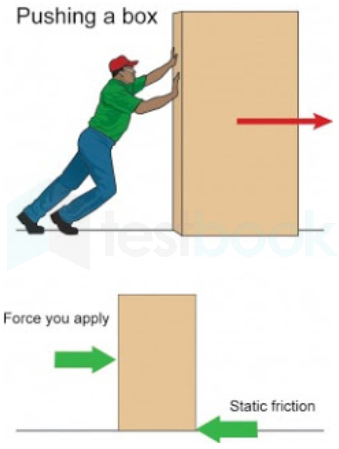
  • Static friction is defined as the frictional force that acts between the surfaces when they are at rest with respect to each other.
  • Sliding friction is defined as the resistance that is created between any two objects when they are sliding against each other.
  • Rolling friction is defined as the force which resists the motion of a ball or wheel and is the weakest type of friction.
  • Fluid friction is defined as the friction that exists between the layers of the fluid when they are moving relative to each other.

Additional Information

TermMeaning
ResistanceResistance is a measure of the opposition to current flow in an electrical circuit. Resistance is measured in ohms.
ConvectionConvection is the transfer of heat due to the bulk movement of molecules within fluids, including molten rock.
InductionInduction is the magnetic field which is proportional to the rate of change of the magnetic field.
29

Which of the following can be used to complete an electric circuit if one runs out of connecting wire?

  1. ((a))

    A paper strip

  2. ((b))

    A rubber belt

  3. ((c))

    A wooden stick

  4. ((d))

    A blade

Show Answer
Answer: ((d))

A blade

Electric Circuit: An electric circuit is a closed-loop through which electric charge flows as a result of a driving voltage. It may also be an open circuit where the electron flow is cut short because the path is broken.

  • An open circuit does not allow electrical current to flow. A simple circuit has conductors, a switch, a load, and a power source.
  • An electric circuit includes a device that gives energy to the charged particles constituting the current, such as a battery or a generator, devices that use current, such as lamps, electric motors, and the connecting wires or transmission lines.

Electrical Conductors: Those materials that can conduct electricity as its electrons can move freely from one atom to another. For example Seawater, iron blade, gold, silver, copper, aluminum, and graphite, etc. All these are good conductors of electricity.

  • Through the conductor, electric current can flow easily or electrons can move freely from one atom to another. So, a blade can be used to complete an electric circuit if one runs out of connecting wire.
  • Bad conductors of electricity- plastic, rubber, glass, air, wooden stickpaper strip, charcoal, and diamond.
  • Electric current can not flow through bad conductors of electricity.

Hence, from the above-mentioned points, it becomes clear that a blade can be used to complete an electric circuit if one runs out of connecting wire.

30

Acceleration is equal to the rate of change of _________.

  1. ((a))

    displacement

  2. ((b))

    position

  3. ((c))

    momentum

  4. ((d))

    velocity

Show Answer
Answer: ((d))

velocity

The correct answer is velocity.

Key Points 

CONCEPT:

  • Velocity/ speed: The rate of change of displacement/distance of a body is called the velocity/speed of that body.
  • Velocity is a vector quantity that has both magnitudes as well as direction.
  • Acceleration: The rate of change of velocity is called the acceleration of the body.
  • Acceleration is also a vector quantity.
  • The slope of any velocity-time graph gives an acceleration of the body.
  • Displacement: The minimum path length between two points is called displacement.
  • Distance: The total path length between two points is called distance.

Explanation:

From the above explanation, we can see that, 

  • Acceleration is the rate of change of velocity
  • In other words, it is the ratio of change in velocity and time taken
  • It has SI units of m/s2 and is also the derivative of velocity

Additional Information

NameDescription
DisplacementThe shortest distance between two points
SpeedDistance travelled per unit time
JerkRate of change of acceleration

Maths (15 questions)

31

What is the largest four-digit number?

  1. ((a))

    1000

  2. ((b))

    999

  3. ((c))

    1009

  4. ((d))

    9999

Show Answer
Answer: ((d))

9999

Given:

Requirement for the largest four-digit number.

Concept:

The largest number in a digit category fills all places with the maximum digit (9).

Calculation:

Identify the digit limit = 4 digits.

Fill each digit place with 9 = 9999.

Hence, the largest four-digit number is 9999.

32

Evaluate:  9.72 × 10 = ?

  1. ((a))

    90.1

  2. ((b))

    92.3

  3. ((c))

    91.1

  4. ((d))

    97.2

Show Answer
Answer: ((d))

97.2

Given:

The operation to solve is 9.72 × 10

Formula Used:

Multiplying a number by 10 involves shifting the decimal point one place to the right.

Calculation:

⇒ 9.72 × 10 = 97.2

Therefore, the result is 97.2

33

If the average of three numbers is 20 and the sum of the first two numbers is 40, what is the third number?

  1. ((a))

    45

  2. ((b))

    25

  3. ((c))

    20

  4. ((d))

    50

Show Answer
Answer: ((c))

20

Given:

Average of three numbers = 20

Sum of first two numbers = 40

Concept:

Average = (sum of all numbers) / (number of numbers)

Calculation:

Let the three numbers be a, b, and c

According to the average given, (a + b + c) / 3 = 20

Therefore, a + b + c = 20 × 3 = 60

It's given that a + b = 40

Subtracting the sum of the first two numbers from the total sum:

60 - 40 = 20

Hence, the third number is 20.

34

"What is the time taken to travel a distance of 60 km at a speed of 30 km/h?"

  1. ((a))

    3h

  2. ((b))

    2h

  3. ((c))

    1.5h

  4. ((d))

    10h

Show Answer
Answer: ((b))

2h

Given:

Distance = 60 km

Speed  = 30 km/h

Concept:

Time  = distance/speed

Calculation:

Time = 60 km / 30 km/h

⇒ Time = 2 h

Therefore, 2 h is the time taken.

35

"What is the length of the rectangle if its perimeter is 3.2 meters and breadth is 60 centimeters?"

  1. ((a))

    100cm

  2. ((b))

    110cm

  3. ((c))

    320cm

  4. ((d))

    200cm

Show Answer
Answer: ((a))

100cm

Given:

Perimeter (P) = 3.2m = 320cm (1m = 100cm)

Breadth (b) = 60cm

Concept:

Perimeter of rectangle = 2×(length + breadth)

Calculation:

Let the length be L cm.

Perimeter of rectangle = 2 × (L + b)

⇒ 320 = 2 × (L + 60)

⇒ 320 = 2L + 120

⇒ 2L = 320 - 120

⇒ 2L = 200 

⇒ L = 200 / 2

⇒ L = 100cm

Hence, the length of the rectangle is 100cm.

36

What is the decimal form of 30%?

  1. ((a))

    1.3

  2. ((b))

    10.3

  3. ((c))

    000.3

  4. ((d))

    0.3

Show Answer
Answer: ((d))

0.3

To convert a percentage to decimal form, divide the percentage by 100.

For 30%:

30% = 30 / 100 = 0.3

Therefore, the decimal form of 30% is 0.3

37

In a class of 40 students, if 40% of the students pass, what is the number of students who fail?

  1. ((a))

    26

  2. ((b))

    32

  3. ((c))

    24

  4. ((d))

    18

Show Answer
Answer: ((c))

24

Given:

Total number of students = 40

Percentage of students who pass = 40%

Formula Used:

Number of students failing = Total students - Number of students passing

Calculation:

⇒ Number of students passing = 40% of 40 = 0.40 × 40 = 16

⇒ Number of students failing = 40 - 16 = 24

Therefore, the number of students who fail is 24.

38

What is the sum of 3/11 and 5/11 ?

  1. ((a))

    9/11

  2. ((b))

    10/11

  3. ((c))

    8/11

  4. ((d))

    11/3

Show Answer
Answer: ((c))

8/11

Given:

To find the sum of 3/11 and 5/11

Concept:

Simply add the numerators together because the denominators are the same.

Calculation:

⇒ 3/11 + 5/11 = (3 + 5)/11 = 8/11

Therefore, the sum of 3/11 and 5/11 is 8/11.

39

What is the least common multiple (LCM) of 2, 3 and 8 ?

  1. ((a))

    16

  2. ((b))

    24 

  3. ((c))

    12

  4. ((d))

    32

Show Answer
Answer: ((b))

24 

Given:

Numbers: 2, 3, 8.

Concept:

The Least Common Multiple (LCM) of numbers is the smallest multiple that is divisible by each of the numbers.

Calculation:

Find the prime factors of each number:

2 = 2

3 = 3

8 = 2 × 2 × 2 = 23

Identify the highest power of each prime factor:

23

31

Multiply the highest powers together to find the LCM:

LCM = 23 × 31 = 8 × 3 = 24.

Therefore, the LCM of 2, 3, and 8 is 24.

40

"What are the measures of all the angles in a triangle if the ratio between the interior angles is 1:2:2?"

  1. ((a))

     30°, 60°, 90°

  2. ((b))

    45°, 45°, 90°

  3. ((c))

    36°, 72°,72°

  4. ((d))

    40°, 70°, 70

Show Answer
Answer: ((c))

36°, 72°,72°

Given:

Ratio of angles = 1: 2 : 2

Concept:

Sum of angles in a triangle = 180°

Calculation:

Let the angles be x, 2x, and 2x.

Sum of angles = x + 2x + 2x = 180°

Simplify = 5x = 180°

Solve for x

⇒ x = 180° ÷ 5 = 36°

Calculate each angle

⇒ x = 36°, 2x = 72°, 2x = 72°

Hence, the angles are 36°, 72°, and 72°.

41

What is the simplified form of 160cm divided by 2m?

  1. ((a))

    4/5

  2. ((b))

    5/4

  3. ((c))

    1/3

  4. ((d))

    3/5

Show Answer
Answer: ((a))

4/5

Given:

160cm

2m

Concept:

Division of measurements after converting to the same unit.

Calculation:

Convert 2m to cm = 2m = 2 × 100cm = 200cm

Divide 160cm by 200cm = 160cm /200cm = 4/5

Hence, the simplified form is 4/5

42

What is the sum of four numbers if their average is 15?

  1. ((a))

    30

  2. ((b))

    60

  3. ((c))

    80

  4. ((d))

    90

Show Answer
Answer: ((b))

60

Concept:

Average = Sum of all values / Number of values.

Using this formula in reverse, you multiply the average by the number of values to get the sum:

Calculation:

Sum of four numbers = 15 × 4 = 60.

Therefore, the sum of the four numbers is 60.

43

If the ratio of ages between A and B is 4 : 5 and A's age is 20 years, what is B's age?

  1. ((a))

    45 years

  2. ((b))

    15 years

  3. ((c))

    25 years

  4. ((d))

    35 years

Show Answer
Answer: ((c))

25 years

Given:

Ratio of ages A:B = 4:5

Age of A = 20 years

Concept:

Age B = (Ratio of B / Ratio of A) × Age of A

Calculation:

⇒ Age of B = (5 / 4) × 20

⇒ Age of B = 25 years

Hence, B's age is 25 years.

44

What is the number of coins for both denominations if the total value of Rs. 2 and Rs. 5 coins is Rs. 78, and the number of Rs. 2 coins is four times the number of Rs. 5 coins?

  1. ((a))

    6 Rs. 5 coins and 24 Rs. 2 coins 

  2. ((b))

    8 Rs. 5 coins and 16 Rs. 2 coins

  3. ((c))

    10 Rs. 5 coins and 20 Rs. 2 coins

  4. ((d))

    14 Rs. 5 coins and 28 Rs. 2 coins

Show Answer
Answer: ((a))

6 Rs. 5 coins and 24 Rs. 2 coins 

Shortcut Trick

Ratio of the number of Rs. 5 coins to Rs. 2 coins = 1 : 4

Ratio of their monetary values = (1 × 5) : (4 × 2) = 5 : 8

Total value per unit ratio = 5 + 8 = 13

Actual total value = 78 ⇒ Multiplier = 78 ÷ 13 = 6

Number of Rs. 5 coins = 1 × 6 = 6, and Rs. 2 coins = 4 × 6 = 24

∴ The correct answer is 6 Rs. 5 coins and 24 Rs. 2 coins.

Alternate Method

₹5 Number = x Value = 5x

₹2 Number = 4x Value = 8x

Total Value = 13x = ₹78

Given:

Total value of all coins = Rs. 78

The number of Rs. 2 coins is 4 times the number of Rs. 5 coins.

Calculations:

⇒ Let the total number of Rs. 5 coins be x.

⇒ Then, the total number of Rs. 2 coins = 4x

⇒ Total value of Rs. 5 coins = 5 × x = 5x

⇒ Total value of Rs. 2 coins = 2 × 4x = 8x

⇒ Total monetary value = 5x + 8x = 13x

⇒ 13x = 78

⇒ x = 78 ÷ 13 = 6

⇒ Number of Rs. 5 coins = 6

⇒ Number of Rs. 2 coins = 4 × 6 = 24

∴ The correct answer is 6 Rs. 5 coins and 24 Rs. 2 coins.

Additional Information

Ratio of Coins to Values

If coins of denominations A, B, and C are given in the ratio of their numbers as x : y : z, then the ratio of their total values is Ax : By : Cz.

Given Total Value

When the total value of all the coins is known in the problem, convert the given ratio of the number of coins into the ratio of their monetary values before equating it to the total amount.

Given Total Coins

If the total number of coins is given instead of the amount, and the ratio of their monetary values is provided, you must divide the value ratio by their respective denominations to find the number ratio.

45

What is 25% of 200?

  1. ((a))

    25

  2. ((b))

    50

  3. ((c))

    100

  4. ((d))

    150

Show Answer
Answer: ((b))

50

Given data:

The percentage is 25%.

<br>

The total amount is 200.

Solution:

⇒ 25% = 0.25.

⇒ 200 × 0.25 = 50.

Hence, 25% of 200 is 50.

Logical Reasoning (5 questions)

46

Select the option that is related to the third letter cluster in the same way as the second letter cluster is related to the first letter cluster.

AFN : BDQ :: DLR : ?

  1. ((a))

    EUJ

  2. ((b))

    JUN

  3. ((c))

    UJE

  4. ((d))

    EJU

Show Answer
Answer: ((d))

EJU

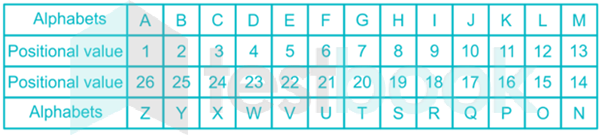
The logic followed here is:

Similarly,

Hence, 'EJU' is the correct answer.

47

In a certain code language, ‘CAKE’ is written as ‘6’ and ‘JUICE’ is written as ‘7’. How will ‘JUG’ be written in that language? 

  1. ((a))

    4

  2. ((b))

    5

  3. ((c))

    3

  4. ((d))

    6

Show Answer
Answer: ((b))

5

The logic followed here is,

Counting the number of letters in the given word, and then the addition of two to the given number of letters.

In the word CAKE, No. of letters = 4  

CAKE ⇒ 4 + 2 = 6

In the same way, 'JUICE' No. of letters = 5

JUICE ⇒ 5 + 2 = 7

Similarly, for the word JUG, No. of letters = 3

JUG ⇒ 3 + 2 = 5

Hence, the correct answer is option 2.

48

Which of the following letter cluster will replace the question mark (?) in the given series?

VY, ZC, DG, HK, ?

  1. ((a))

    LM

  2. ((b))

    LN

  3. ((c))

    MO

  4. ((d))

    LO

Show Answer
Answer: ((d))

LO

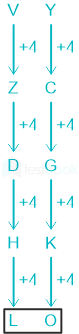
The logic followed here is:

So, 'LO' will replace the question mark in the given series.

Hence, the correct answer is "Option 4".

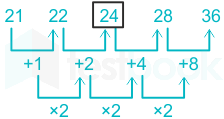
49

Select the number from among the given options that can replace the question mark (?) in the following series.

21, 22, ?, 28, 36

  1. ((a))

    24

  2. ((b))

    26

  3. ((c))

    25

  4. ((d))

    23

Show Answer
Answer: ((a))

24

The Pattern followed here is;

Hence, the correct answer is "24".

50

A girl is standing in a row and her rank is 27 from the top and 5 from the bottom. Find the total number of people standing in the queue.

  1. ((a))

    32

  2. ((b))

    31

  3. ((c))

    30

  4. ((d))

    22

Show Answer
Answer: ((b))

31

Calculation:

Here, the formula we used is:-

Total number of people = Rank from the top + Rank from the bottom -1

Total number of people = 27 + 5 - 1 = 31

Hence, the correct answer is "option (2)".

Attempt this paper under real exam conditions

Timed interface, section switching, instant scoring, and question-by-question analytics — free.

Start Timed Attempt