Official Paper

Allahabad High Court RO Official Paper (Held On: 10 Dec, 2021 Shift 1) (Previous Year Paper)

200 questions · 180 minutes · with answers · free

Test (200 questions)

1

Study the pattern carefully and select the number that can replace the question mark (?)

  1. ((a))

    33

  2. ((b))

    32

  3. ((c))

    31

  4. ((d))

    30

Show Answer
Answer: ((c))

31

The logic followed here is: 

 → (21 - 6) × (21 + 6) = 15 × 27 ⇒ 405

And,

→ (23 - 5) × (23 + 5) = 18 × 28 ⇒ 504

Similarly,

 → (? - 9) × (? + 9) = 880

→ (?)2 - (9)2 = 880

→ (?)2 = 880 + 81

→ ? = √961

→ ? = 31

Hence, "Option 3" is the correct answer.

2

Which number will replace the question mark (?) in the following series ?

4, 10, 18, 38, \( _?_ \), 150

  1. ((a))

    86

  2. ((b))

    78

  3. ((c))

    76

  4. ((d))

    74

Show Answer
Answer: ((d))

74

The logic followed here is:


Hence, "Option 4" is the correct answer.

3

How many triangles are there in the following Figure ?

  1. ((a))

    20

  2. ((b))

    24

  3. ((c))

    22

  4. ((d))

    26

Show Answer
Answer: ((c))

22

The total number of triangles in the given figure is shown below:

Thus, there are a total of 22 triangles.

Hence, "Option 3" is the correct answer.

4

In a code language, MATH is written as LWEP. How will CLUB be written using same code ?

  1. ((a))

    FPXF

  2. ((b))

    FXFP

  3. ((c))

    FXPF

  4. ((d))

    FPFX

Show Answer
Answer: ((c))

FXPF

The pattern followed here is:

MATH is written as LWEP​

Similarly,

CLUB is written as

Hence, ‘Option 3’ is the correct answer.

5

Three of the following numbers are similar and one is different. Find the odd one out.

  1. ((a))

    12

  2. ((b))

    14

  3. ((c))

    56

  4. ((d))

    20

Show Answer
Answer: ((b))

14

The logic followed here is: 

Option 1) 12 → Multiple of consecutive integers → 3 × 4 = 12

Option 2) 14 → Not a Multiple of consecutive integers → 2 × 7 = 14

Option 3) 56 → Multiple of consecutive integers → 7 × 8 = 56

Option 4) 20 → Multiple of consecutive integers → 4 × 5 = 20

Hence, "Option 2" is the correct answer.

6

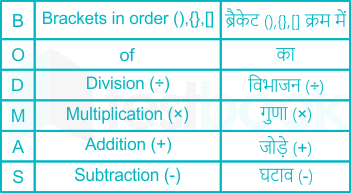
If + + denotes , -, - denotes ×,× \times, \times denotes ÷ \div and ÷ \div denotes +, +, then 252÷10×5+2=? 25-2 \div 10 \times 5+2=?

  1. ((a))

    10

  2. ((b))

    26

  3. ((c))

    58

  4. ((d))

    50

Show Answer
Answer: ((d))

50

Decoding signs:

Sign+-×÷
Stands For-×÷+

Given: 25 - 2 ÷ 10 × 5 + 2 = ?

25 - 2 ÷ 10 × 5 + 2 = ? ⇒ 25 × 2 + 10 ÷ 5 - 2 = ?

⇒ 25 × 2 + 10 ÷ 5 - 2 = ?

⇒ 25 × 2 + 2 - 2 = ?

50 + 2 - 2 = ?

52 - 2 = ?

⇒ 50 = ?

Hence, "Option 4" is the correct answer.

7

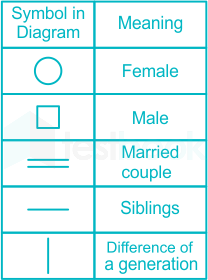
A+B A + B means A A is brother of B B

AB A - B means A A is wife of B B

A×B A \times B means A A is daughter of B B

A÷B A \div B means A A is father of B B

If P+S×Q×RT÷V÷U P+S \times Q \times R-T \div V \div U then how is T T related to P P ?

  1. ((a))

    Paternal grandmother

  2. ((b))

    Paternal grandfather

  3. ((c))

    Maternal grandmother

  4. ((d))

    Maternal grandfather

Show Answer
Answer: ((d))

Maternal grandfather

Decoding symbols:

A is
Symbol+-×÷
MeaningBrotherWifeDaughterFather
to B

Given: P + S × Q × R - T ÷ V ÷ U  

P + S → P is the brother of S. 

S × Q → S is the daughter of Q.

Q × R → Q is the daughter of R.

R - T → R is the wife of T.

T ÷ V → T is the father of V.

V ÷ U → V is the father of U

Here, T is P's maternal grandfather.

Hence, "Option 4" is the correct answer.

8

Three different positions of the same dice are shown below. Which number is on the face of the dice opposite the face showing the number 1?

  1. ((a))

    3

  2. ((b))

    4

  3. ((c))

    6

  4. ((d))

    2

Show Answer
Answer: ((b))

4

The logic followed here is :-

From the given three different cubes the adjacent sides are as shown below :

As 5 is common on both the dice I and II, it is clear that 1, 3, 4 and 6 are adjacent to it, and the remaining i.e., 2 will be opposite to it.

Opposite pairs:

1 → 4

3 → 6

5 → 2

So, the opposite side of "1" will be side "4".

Hence, the correct answer is "Option 2".

9

Choose the correct option for the Venn diagram given below

  1. ((a))

    Cows, buffaloes, cattle

  2. ((b))

    Solids, liquids, gases

  3. ((c))

    Fathers, men, teachers

  4. ((d))

    Yellow, red, colours

Show Answer
Answer: ((c))

Fathers, men, teachers

The diagram that best represents the relationship between the given classes is shown below :

Some men can be fathers and thus will be part of the father's category.

Some men can be teachers.

Some fathers can be teachers.

Hence, "Option 3" is the correct answer.

Additional Information

  1. fathers, men, teachers

  1. cows, buffaloes, cattle

  1. solids, liquids, gases

  1. yellow, red, colours

10

Amit is older than Vijay. Shaun is older than Joy. Ketan is younger than Joy. Vijay is older than Shaun. Who is the youngest in the group ?

  1. ((a))

    Shaun

  2. ((b))

    Ketan

  3. ((c))

    Joy

  4. ((d))

    Vijay

Show Answer
Answer: ((b))

Ketan

Given:

1) Amit is older than Vijay

2) Vijay is older than Shaun.

Amit > Vijay > Shaun

3) Shaun is older than Joy.

  1. Ketan is younger than Joy.

Amit > Vijay > Shaun > Joy > Ketan

Thus, Ketan is the youngest in the group.

Hence, "Option 2" is the correct answer.

11

Study the pattern and replace the question mark (?) from the given alternatives.

213
216512729
47?
  1. ((a))

    6

  2. ((b))

    5

  3. ((c))

    8

  4. ((d))

    9

Show Answer
Answer: ((a))

6

The logic followed here is: 

Logic followed here is column wise → (1st number + 3rd number)3 = (2nd number)3

1st column → (2 + 4)3 = (6)3 ⇒ 216

2nd column → (1 + 7)3 = (8)3 ⇒ 512

3rd column → (3 + 6)3 = (9)3 ⇒ 729

Hence, "Option 1" is the correct answer.

12

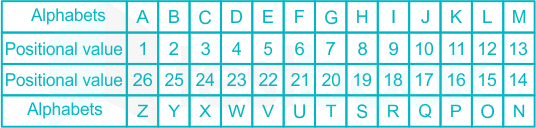
If X = 48 and ACT = 48, then TRUE = _______

  1. ((a))

    124

  2. ((b))

    126

  3. ((c))

    128

  4. ((d))

    130

Show Answer
Answer: ((c))

128

The pattern followed here is:

X = 48

And,

ACT = 48

Similarly,

TRUE = ____

Hence, ‘Option 3’ is the correct answer.

13

In a Mathematics assignment Ravi got thrice as many sums wrong as he got right. If he attempted 72 sums in all, how many did he solve correctly ?

  1. ((a))

    54

  2. ((b))

    36

  3. ((c))

    18

  4. ((d))

    24

Show Answer
Answer: ((c))

18

According to the question:

Let say Ravi got a Number of Sums Right  = S

Then he got thrice as many sums wrong as he got right.

Number of Sums Wrong = 3 S

Total number of sums he solved =  Right Sums + Wrong Sums

Total number of sums he solved =  3S + S = 4S

4S = 72

S = 18

Solved correctly  = S = 18

Hence, "Option 3" is the correct answer.
14

The figure A is embedded in one of the following four options. Select the correct option.

  1. ((a))

  2. ((b))

  3. ((c))

  4. ((d))

Show Answer
Answer: ((a))

The image embedded in the given figure is as shown below :

∴ Here, given figure is embedded in the option figure 1.

Hence, the correct answer is "Option 1".

15

Three of the following terms are similar. Find the odd one out.

  1. ((a))

    SO

  2. ((b))

    ME

  3. ((c))

    PL

  4. ((d))

    KG

Show Answer
Answer: ((b))

ME

The pattern followed here is:

Option 1) SO

Option 2) ME

Option 3) PL

Option 4) KG

Thus, 'ME' is the odd one out.

Hence, ‘Option 2’ is the correct answer.

16

Select the letter cluster that will replace the question mark (?) in the following series.

AOS, CQU, ?, GUY, IWA

  1. ((a))

    FSW

  2. ((b))

    ETW

  3. ((c))

    ESW

  4. ((d))

    ESV

Show Answer
Answer: ((c))

ESW

The pattern followed here is:

Hence, ‘Option 3’ is the correct answer.

17

Select the option that is related to the third term in the same way as the second term is related to the first term.

BGK : EJN :: DSV : ________

  1. ((a))

    HUX

  2. ((b))

    ITW

  3. ((c))

    GVY

  4. ((d))

    HVZ

Show Answer
Answer: ((c))

GVY

The pattern followed here is:

BGK : EJN

Similarly,

DSV : ___

Hence, ‘Option 3’ is the correct answer.

18

In the following diagram, the triangle represents actors, the circle represents musicians and the rectangle represents dancers.

The numbers in different segments show the number of persons.

<br>

How many dancers are musicians but not actors ?

  1. ((a))

    21

  2. ((b))

    12

  3. ((c))

    16

  4. ((d))

    17

Show Answer
Answer: ((d))

17

According to the given Venn diagram:

The shaded area represents dancers who are musicians but not actors → 9 + 8 = 17

Hence, the correct answer is "Option 4"

19

Select the option that is related to the third number in the same way as the second number is related to the first number.

\( 14 : 67 :: 19 : \text{_______} \)

  1. ((a))

    92

  2. ((b))

    95

  3. ((c))

    96

  4. ((d))

    99

Show Answer
Answer: ((a))

92

The logic followed here is:

14 : 67 → (14 × 5) - 3 = 70 - 3 ⇒ 67

Similarly,

19 : ___ → (19 × 5) - 3 = 95 - 3 ⇒ 92

Hence, "Option 1" is the correct answer.

20

Rakesh starts walking from his house and then takes two left turns and one right turn to reach the market. If he is facing north on reaching the market, in which direction was Rakesh facing when he started from his house ?

  1. ((a))

    North

  2. ((b))

    South

  3. ((c))

    East

  4. ((d))

    West

Show Answer
Answer: ((c))

East

Given:

Rakesh starts walking from his house and

then takes two left turns and

one right turn to reach the market.

he is facing north on reaching the market.

Thus, Rakesh is facing east when he started from his house.

Hence, the correct answer is "Option 3".

21

Select the number pair in which the two numbers are related in the same way as are the two numbers of the following number pair.

453:151 453 : 151

  1. ((a))

    364:121 364 : 121

  2. ((b))

    353:117 353 : 117

  3. ((c))

    313:104 313 : 104

  4. ((d))

    354:118 354 : 118

Show Answer
Answer: ((d))

354:118 354 : 118

The logic followed here is:

453 : 151 → 453 ÷ 3 ⇒ 151

Similarly,

354 : 118 → 354 ÷ 3 ⇒ 118

Hence, "Option 4" is the correct answer.

22

Directions for questions:

According to a certain code.

(I) ‘pic vic nic’ means ‘winter is cold’

(II) ‘tic nic ric’ means ‘summer is hot’

(III) ‘ric pic bic’ means ‘winter and summer’

(IV) ‘vic hic pac’ means ‘nights are cold’

<br>

Which letter code stands for ‘cold’ ?

  1. ((a))

    pic

  2. ((b))

    vic

  3. ((c))

    nic

  4. ((d))

    pac

Show Answer
Answer: ((b))

vic

According to the question:

Thus, 'vic' is coded as 'cold'.

Hence, "Option 2" is the correct answer.

23

Directions for questions:

According to a certain code.

(I) ‘pic vic nic’ means ‘winter is cold’

(II) ‘tic nic ric’ means ‘summer is hot’

(III) ‘ric pic bic’ means ‘winter and summer’

(IV) ‘vic hic pac’ means ‘nights are cold’

<br>

Which word is represented by ‘ric’ ?

  1. ((a))

    summer

  2. ((b))

    is

  3. ((c))

    hot

  4. ((d))

    and

Show Answer
Answer: ((a))

summer

According to the question:

Thus, 'ric' is coded as 'summer'.

Hence, "Option 1" is the correct answer.

24

Directions for questions:

According to a certain code.

(I) ‘pic vic nic’ means ‘winter is cold’

(II) ‘tic nic ric’ means ‘summer is hot’

(III) ‘ric pic bic’ means ‘winter and summer’

(IV) ‘vic hic pac’ means ‘nights are cold’

<br>

Which word is represented by ‘nic’ ?

  1. ((a))

    winter

  2. ((b))

    summer

  3. ((c))

    hot

  4. ((d))

    is

Show Answer
Answer: ((d))

is

According to the question:

Thus, 'nic' is coded as 'is'.

Hence, "Option 4" is the correct answer.

25

Select the option that is related to the third word in the same way as the second word is related to the first word.

Teeth : Chatter : : Leaves : ___________

  1. ((a))

    Ripple

  2. ((b))

    Cackle

  3. ((c))

    Rustle

  4. ((d))

    Whistle

Show Answer
Answer: ((c))

Rustle

The logic followed here is:

Teeth : Chatter → Chatter is a natural sound/action associated with teeth.

Similarly,

Leaves : ____ → Rustle is a natural sound/action associated with leaves.

Hence, "Option 3" is the correct answer.

26

The term GIGO is related to :

  1. ((a))

    Accuracy

  2. ((b))

    Automatic

  3. ((c))

    Flexibility

  4. ((d))

    Versatility

Show Answer
Answer: ((a))

Accuracy

The correct answer is Accuracy.

Key Points

  • The term GIGO stands for Garbage In, Garbage Out.
  • It is a fundamental concept in computer science and information technology which states that the quality of the output is strictly determined by the quality of the input.
  • If flawed, incomplete, or nonsense data ("garbage") is entered into a computer system, the resulting output or analysis will also be flawed and meaningless.
  • Therefore, the principle of GIGO is most closely related to the accuracy of data. It serves as a reminder that no matter how sophisticated a processing system is, it cannot produce correct results from incorrect input data.

Additional Information

  • Automatic: Refers to a computer's ability to execute a series of instructions or operations independently, without the need for constant human intervention, once a task has been initiated.
  • Flexibility: The capacity of a computer system or software architecture to easily adapt to new, different, or changing operational requirements over time.
  • Versatility: One of the key characteristics of a computer, referring to its ability to perform a wide variety of completely different tasks—such as scientific calculations, word processing, graphic design, and media playback—using the same core hardware.
27

‘Text Edit’ is a text editor in which of the following operating system ?

  1. ((a))

    Windows

  2. ((b))

    Google chrome

  3. ((c))

    Mozilla Firefox

  4. ((d))

    Macintosh

Show Answer
Answer: ((d))

Macintosh

The correct answer is Macintosh.

Key Points

  • TextEdit is the default, simple word processor and text editor that comes pre-installed on Apple's Macintosh operating systems (macOS).
  • It allows users to create, open, and edit rich text documents (RTF), plain text files, Microsoft Word documents, and HTML files.
  • TextEdit originally debuted in the NEXTSTEP operating system and was brought over to Macintosh systems to replace the older SimpleText application when Mac OS X was introduced.

Additional Information

  • Windows: The default text editor built natively into Microsoft Windows operating systems is Notepad. For slightly more advanced rich text editing, Windows historically included WordPad.
  • Google Chrome: This is a cross-platform web browser developed by Google, not an operating system itself (although Google does develop ChromeOS, which uses a different native app simply called "Text").
  • Mozilla Firefox: This is a popular, free, and open-source web browser developed by the Mozilla Foundation. Like Chrome, it is an application used for browsing the internet, not an operating system.
28

A collection of unprocessed items is :

  1. ((a))

    Information

  2. ((b))

    Data

  3. ((c))

    Reports

  4. ((d))

    Memory

Show Answer
Answer: ((b))

Data

The correct answer is Data.

Key Points

  • A collection of unprocessed items is referred to as data. It represents raw facts and figures that have not yet been organized, analyzed, or interpreted.
  • Once data is processed and structured, it becomes information, which is meaningful and useful for decision-making.
  • Examples of data include numbers, characters, measurements, or observations that are collected through various means, such as surveys, experiments, or sensors.
  • Data can be categorized into different types, such as qualitative (descriptive) and quantitative (numerical) data.
  • Data serves as the foundation for generating insights, conducting research, and making informed decisions in various fields.

Additional Information

  • Characteristics of Data:
  • Data is unprocessed and does not provide direct meaning or context.
  • It can exist in various forms, such as text, numbers, images, audio, or video.
  • Data can be structured (organized in a defined format) or unstructured (random and unorganized).
  • Differences Between Data and Information:
  • Data: Raw and unorganized facts. Example: "John, 25, Engineer."
  • Information: Processed and organized data that provides meaning. Example: "John is a 25-year-old engineer."
  • Importance of Data:
  • Data is the basis for analysis, predictions, and decision-making in various sectors, such as business, healthcare, and technology.
  • It is essential for identifying trends, understanding customer behavior, and improving processes.
  • With the advent of Big Data and advanced analytics, data has become a critical asset for organizations.
  • Data Management:
  • Effective data management ensures data accuracy, security, and accessibility.
  • Techniques such as data cleaning, storage, and visualization help in deriving meaningful insights from raw data.
29

A flat metallic disk that contains a large amount of permanently stored information read optically is called a _______________

  1. ((a))

    ALU

  2. ((b))

    CD-ROM

  3. ((c))

    RAM

  4. ((d))

    ASCII

Show Answer
Answer: ((b))

CD-ROM

The correct answer is CD-ROM.

Key Points

  • CD-ROM stands for Compact Disc Read-Only Memory, which is an optical disc used to store data permanently.
  • It is read optically using a laser beam rather than magnetically or electrically.
  • The data stored on a CD-ROM cannot be modified or erased, making it suitable for distributing software, games, and multimedia content.
  • CD-ROMs have a storage capacity of approximately 700 MB, making them ideal for medium-sized data storage.
  • They are widely used in applications where data integrity and durability are essential.

Additional Information

  • Features of CD-ROM:
  • CD-ROMs are made of polycarbonate plastic with a reflective metallic layer and a protective coating.
  • They are highly durable and can retain data for decades under proper storage conditions.
  • The data is stored in the form of tiny pits and lands, which are read by a laser beam in a CD drive.
  • Advantages of CD-ROM:
  • Cost-effective and easy to mass-produce for software distribution.
  • Highly portable and lightweight compared to other storage media.
  • Provides read-only access, ensuring data security and preventing unauthorized modifications.
  • Limitations of CD-ROM:
  • Limited storage capacity compared to modern storage solutions like USB drives and cloud storage.
  • Susceptible to scratches and physical damage, which can render the disc unreadable.
  • Requires a dedicated optical drive to access the stored data.
  • Applications of CD-ROM:
  • Distribution of software, games, and multimedia content such as music and videos.
  • Archival storage of data and documentation.
  • Educational materials, including e-books and interactive tutorials, are often distributed on CD-ROMs.
30

Storage and memory of a computer differ with respect to which of the following characteristics ?

(a) Price

(b) Reliability

(c) Speed

  1. ((a))

    Only (a)

  2. ((b))

    (a) and (b)

  3. ((c))

    Only (c)

  4. ((d))

    (a), (b) and (c)

Show Answer
Answer: ((d))

(a), (b) and (c)

The correct answer is (a), (b) and (c).

Key Points

  • Price: Memory (like RAM) is more expensive than storage (like hard disk) per unit capacity.
  • Reliability: Storage devices are more reliable for long-term data retention, while memory is volatile.
  • Speed: Memory is much faster than storage in accessing and processing data.
  • Thus, all three characteristics differ between storage and memory.

Additional Information

  • Comparison:
  • Memory (RAM): Fast, expensive, volatile
  • Storage (HDD/SSD): Slower, cheaper, non-volatile

 Important Points

  • Memory is used for temporary data processing.
  • Storage is used for permanent data storage.
  • Both differ in multiple aspects including cost, speed, and reliability.
31

What is UBUNTU ?

  1. ((a))

    Operating system

  2. ((b))

    Programming languages

  3. ((c))

    Microprocessor

  4. ((d))

    MS-DOS

Show Answer
Answer: ((a))

Operating system

The correct answer is Operating system.

Key Points

  • Ubuntu is a Linux-based operating system that is widely used for personal computers, servers, and cloud computing.
  • It is developed and maintained by Canonical Ltd., and is known for its user-friendly interface and open-source nature.
  • Ubuntu supports a wide variety of software applications, making it suitable for both technical and non-technical users.
  • This operating system is popular among developers and system administrators due to its stability, security, and extensive community support.
  • It is available in multiple editions such as Desktop, Server, and Core, catering to different use cases and requirements.

Additional Information

  • Features of Ubuntu:
  • User-friendly Interface: Ubuntu provides a clean and intuitive graphical interface, making it accessible even for beginners.
  • Open Source: Being open-source, users can freely customize and modify the operating system according to their needs.
  • Wide Software Support: It supports a vast array of software applications, including office tools, programming environments, and multimedia applications.
  • Uses of Ubuntu:
  • Personal Computers: Ubuntu is widely used as an alternative to proprietary operating systems like Windows and macOS.
  • Servers: It is a popular choice for hosting web applications and databases due to its stability and security features.
  • Cloud Computing: Ubuntu powers many cloud platforms, offering scalability and performance optimization.
  • Advantages of Ubuntu:
  • Provides a secure and stable operating environment.
  • Free to use and distribute, making it cost-effective for individuals and organizations.
  • Regular updates and extensive community support ensure continuous improvement and troubleshooting.
  • Important Points:
  • Ubuntu is based on Debian, another popular Linux distribution.
  • It uses the APT package management system for installing and updating software.
  • It is available in both 32-bit and 64-bit versions, although recent releases focus on 64-bit architecture.
32

The first PC virus was developed in :

  1. ((a))

    1980

  2. ((b))

    1984

  3. ((c))

    1986

  4. ((d))

    1988

Show Answer
Answer: ((b))

1984

The correct answer is 1984.

Key Points

  • The first PC virus was developed in 1984, marking the beginning of a new era in cybersecurity challenges.
  • It was named Brain, created by two Pakistani brothers, Amjad Farooq Alvi and Basit Farooq Alvi, as a way to protect their software.
  • Brain was initially designed to prevent unauthorized copying of software but later became known as the first widespread virus.
  • It targeted IBM PC systems and boot sectors of floppy disks, spreading from one computer to another.
  • The development of Brain highlighted vulnerabilities in computer systems, leading to advancements in antivirus and security technologies.

Additional Information

  • Types of Computer Viruses:
  • Boot Sector Virus: Infects the boot sector of storage devices; examples include Brain and Michelangelo.
  • File Infector Virus: Attaches itself to executable files; activates when the infected file runs.
  • Macro Virus: Targets applications like Microsoft Word or Excel; spreads through macros embedded in documents.
  • Impact of Viruses:
  • Disrupts system functionality and slows down performance.
  • Leads to data loss, corruption, and unauthorized access.
  • Causes financial losses due to downtime and recovery efforts.
  • Measures to Prevent Virus Attacks:
  • Install and update reliable antivirus software.
  • Avoid downloading attachments or files from unknown sources.
  • Regularly update operating systems and applications to patch vulnerabilities.
  • Important Points:
  • Computer viruses are malicious software designed to harm or exploit systems.
  • Early viruses like Brain were relatively harmless compared to modern malware.
  • Cybersecurity awareness and precautions are crucial in minimizing risks.
33

Specialized programs that assist users in locating information on the web are called

  1. ((a))

    Information engines

  2. ((b))

    Search engines

  3. ((c))

    Search resources

  4. ((d))

    Locator engines

Show Answer
Answer: ((b))

Search engines

The correct answer is Search engines.

Key Points

  • Search engines are specialized software programs designed to assist users in locating information on the web by indexing and retrieving data from web pages.
  • These programs work by crawling websites, indexing their content, and providing users with relevant results based on their search queries.
  • Examples of popular search engines include Google, Bing, Yahoo, and DuckDuckGo.
  • Search engines utilize algorithms to rank web pages based on relevance, user experience, and other factors to deliver accurate and efficient results.
  • They are an essential tool for navigating the vast amount of information available on the internet, enabling users to find specific data quickly and easily.

Additional Information

  • Common Features of Search Engines:
  • Keyword Search: Users can input keywords to find relevant information from indexed web pages.
  • Advanced Search Options: Allows users to refine their searches using filters like date, file type, and specific domains.
  • Image and Video Search: Enables users to locate multimedia content alongside textual information.
  • Voice Search: Modern search engines support voice commands for hands-free searching.
  • Types of Search Engines:
  • Crawler-Based Search Engines: Use bots to index web pages, such as Google and Bing.
  • Human-Powered Directories: Rely on human editors to manually categorize websites, like the now-defunct Yahoo Directory.
  • Meta Search Engines: Aggregate results from multiple search engines, such as Dogpile and Metacrawler.
  • Advantages of Using Search Engines:
  • Quickly locate information from millions of web pages.
  • Facilitate access to multimedia, academic, and business content.
  • Provide personalized results based on user preferences and location.
  • Important Points:
  • Search engines are powered by complex algorithms that determine the relevance and ranking of web pages.
  • They use techniques like Search Engine Optimization (SEO) to improve the visibility of web content.
  • Ensuring a secure browsing experience, many search engines now emphasize user privacy and data protection.
34

A database that contains tables linked by common field is called a :

  1. ((a))

    Centralised database

  2. ((b))

    Flat file database

  3. ((c))

    Relational database

  4. ((d))

    Null database

Show Answer
Answer: ((a))

Centralised database

The correct answer is Centralised database.

Key Points

  • A centralised database is a type of database where all the data is stored and maintained in a single location, often managed by a central database management system.
  • It allows for easier management, maintenance, and control over the data, ensuring consistency and reducing redundancy.
  • Centralised databases are commonly used in organizations where information needs to be stored centrally and accessed by multiple users or systems.
  • While they offer advantages in terms of control and consistency, they may also pose challenges, such as a single point of failure and potential performance bottlenecks.
  • Examples of centralised databases include systems used by banks, government institutions, and large enterprises for centralized data management.

Additional Information

  • Other Types of Databases:
  • Flat File Database: A simple database model where data is stored in a single table or file without any relationships between data points.
  • Relational Database: A more complex database model where data is stored in multiple tables linked by common fields or relationships.
  • Distributed Database: Data is stored across multiple locations or systems, allowing for better scalability and fault tolerance.
  • Cloud Database: A database that is hosted and accessed through cloud computing platforms, offering flexibility and accessibility.
  • Advantages of a Centralised Database:
  • Easy to manage and maintain, as all data is stored in one location.
  • Ensures data consistency and reduces the risk of duplication.
  • Provides better control over data security and access.
  • Disadvantages of a Centralised Database:
  • Single point of failure can disrupt the entire system if the database server crashes.
  • May experience performance bottlenecks due to high demand on the central server.
  • Scalability can be limited compared to distributed database systems.
35

Start or restart of the computer is called

  1. ((a))

    Exit

  2. ((b))

    Kick

  3. ((c))

    Boot

  4. ((d))

    Kick-start

Show Answer
Answer: ((c))

Boot

The correct answer is Boot.

Key Points

  • Boot refers to the process of starting or restarting a computer.
  • During booting, the computer initializes hardware components and loads the operating system into memory.
  • The term originates from "bootstrap," which metaphorically describes the process of pulling oneself up by bootstraps, referring to the computer loading itself.
  • There are two types of boot processes: cold boot, which occurs when the computer is powered on, and warm boot, which occurs during a restart.
  • Booting is a critical step in ensuring that the computer hardware and software are operational and ready for user interaction.

Additional Information

  • Steps in the Boot Process:
  • Power-On Self-Test (POST): The computer checks hardware components for errors and ensures everything is functioning correctly.
  • Loading the Boot Loader: The boot loader is responsible for loading the operating system into memory.
  • Operating System Initialization: The operating system configures hardware, loads essential drivers, and prepares the environment for user interaction.
  • Types of Boot:
  • Cold Boot: Starting the computer after it has been powered off.
  • Warm Boot: Restarting the computer without turning off the power, usually through the operating system.
  • Advantages of Boot Process:
  • Ensures proper initialization of hardware and software components.
  • Allows the operating system to load essential files and drivers for smooth functioning.
  • Enables error detection during the Power-On Self-Test (POST).
  • Important Points:
  • The boot process is automated and typically takes a few seconds to complete.
  • Issues during booting, such as hardware errors or missing files, may result in failure to start the computer.
  • Regular maintenance and updates can help prevent boot-related problems.
36

Which one of the following is an example of a Web Browser ?

  1. ((a))

    Opera

  2. ((b))

    Star Works

  3. ((c))

    Google Apps

  4. ((d))

    Odilla

Show Answer
Answer: ((a))

Opera

The correct answer is Opera.

Key Points

  • Opera is a widely used web browser known for its speed, built-in ad blocker, and free VPN service.
  • Web browsers are software applications used to access and view websites on the internet.
  • Popular web browsers include Google Chrome, Mozilla Firefox, Safari, Microsoft Edge, and Opera.
  • They are essential tools for navigating the World Wide Web, supporting various web technologies and standards.
  • Web browsers can be used on different devices, such as computers, smartphones, and tablets.

Additional Information

  • Features of Modern Web Browsers:
  • Tabbed Browsing: Allows users to open multiple web pages within a single browser window.
  • Privacy Mode: Also known as incognito or private browsing, it prevents the browser from storing browsing history, cookies, and temporary files.
  • Extensions and Add-ons: Enhance browser functionality by adding tools such as ad blockers, password managers, and productivity apps.
  • Synchronization: Allows users to sync bookmarks, history, and settings across multiple devices.
  • Security Features: Includes phishing protection, secure connections (HTTPS), and automatic updates to guard against vulnerabilities.
  • Types of Web Browsers:
  • Text-based Browsers: Such as Lynx, primarily display text and are used in low-bandwidth environments.
  • Graphical Browsers: Such as Chrome, Firefox, and Opera, support multimedia content like images, videos, and animations.
  • Mobile Browsers: Optimized for use on smartphones and tablets, providing a responsive design for small screens.
  • Common Uses of Web Browsers:
  • Accessing websites for information, entertainment, or online shopping.
  • Using web-based applications such as email, cloud storage, and office tools.
  • Streaming videos, music, and other multimedia content.
  • Performing online transactions, including banking and bill payments.
  • Interesting Facts:
  • The first web browser, WorldWideWeb (later renamed Nexus), was created by Tim Berners-Lee in 1990.
  • Modern browsers use sophisticated rendering engines like Blink (used by Chrome and Opera) or Gecko (used by Firefox) to display web content.
  • Web browsers have become integral to daily life, with billions of people using them worldwide.
37

The operating system called UNIX is typically used for :

  1. ((a))

    Desktop computers

  2. ((b))

    Laptop computers

  3. ((c))

    Super computers

  4. ((d))

    Web servers

Show Answer
Answer: ((d))

Web servers

The correct answer is Web servers.

Key Points

  • UNIX is a powerful, multi-user, multitasking operating system widely used in server environments.
  • It is known for its stability, security, and reliability, making it ideal for web servers.
  • Many modern server systems (including Linux, a UNIX-like OS) are based on UNIX principles.
  • UNIX is commonly used to host websites and manage large-scale network services.

Additional Information

  • Other Uses of UNIX:
  • Also used in supercomputers and enterprise systems.
  • Preferred for networking and distributed systems.
  • Important Points:
  • UNIX is not commonly used in personal desktops or laptops.
  • Its strength lies in server-side and backend operations.
38

The Napier's technology used for calculation is called ___________.

  1. ((a))

    Naptologia

  2. ((b))

    Vibologia

  3. ((c))

    Semiconductor

  4. ((d))

    Rabdologia

Show Answer
Answer: ((d))

Rabdologia

The correct answer is Rabdologia.

Key Points

  • Rabdologia refers to a method of calculation introduced by John Napier, the inventor of logarithms.
  • This technique uses a set of rods, also called "Napier's bones," to simplify multiplication, division, and square root calculations.
  • The rods are inscribed with multiplication tables, allowing users to perform complex calculations efficiently.
  • Napier's invention was a significant milestone in the history of computational devices, paving the way for modern calculators.
  • The term Rabdologia is derived from the Greek words "rabdos," meaning rod, and "logos," meaning computation or discourse.

Additional Information

  • Uses of Napier's Bones:
  • Multiplication: Simplifies complex multiplication by breaking it down into smaller steps using the rods.
  • Division: Facilitates division by representing the process visually through the arrangement of rods.
  • Square Roots: Assists in approximating square roots through iterative calculations.
  • Teaching Tool: Used historically to teach arithmetic concepts and techniques in schools.
  • Advantages of Rabdologia:
  • Provides a visual and hands-on approach to understanding arithmetic operations.
  • Reduces the complexity of calculations, making them more accessible to learners.
  • Requires no electricity or advanced technology, making it suitable for use in any environment.
  • Legacy of Napier's Inventions:
  • Napier's work laid the foundation for the development of logarithmic tables, slide rules, and modern computational devices.
  • His contributions are considered groundbreaking in the field of mathematics and computation.
  • Important Points:
  • Napier's bones were made of materials like ivory, wood, or metal and were portable for ease of use.
  • The method is an example of early mechanical computing, demonstrating ingenuity in pre-digital eras.
39

Which virus spreads in application software ?

  1. ((a))

    Macro virus

  2. ((b))

    Boot virus

  3. ((c))

    File virus

  4. ((d))

    Antivirus

Show Answer
Answer: ((c))

File virus

The correct answer is File virus.

Key Points

  • File viruses are malicious programs that attach themselves to executable files (.exe, .com, etc.) and spread when the infected file is run.
  • These viruses may alter, corrupt, or delete files, and can even render an application unusable.
  • File viruses typically spread through shared software, email attachments, or downloaded files from untrusted sources.
  • They are a common threat to application software and can disrupt the functioning of programs by injecting harmful code.
  • To protect against file viruses, it is crucial to use reliable antivirus software and avoid downloading files from unknown or suspicious sources.

Additional Information

  • Other Types of Viruses:
  • Macro Virus: These infect documents and spreadsheets by exploiting macro functionalities in applications like MS Word and Excel.
  • Boot Virus: These infect the boot sector of a storage device, affecting the system's ability to start properly.
  • Antivirus: It is not a virus but a protective software designed to detect and eliminate various types of malware, including file viruses.
  • How File Viruses Spread:
  • Through infected software installations.
  • Via email attachments containing malicious executable files.
  • By downloading files from untrusted websites.
  • Through removable media, such as USB drives, containing infected files.
  • Preventive Measures:
  • Install and update antivirus software regularly.
  • Avoid opening email attachments from unknown sources.
  • Download software and files only from trusted websites.
  • Keep your operating system and applications up to date with security patches.
  • Important Points:
  • File viruses can severely impact system performance and compromise data security.
  • They are one of the most common types of viruses targeting application software.
  • Regular system scans and cautious internet usage are essential to minimize the risk of infection.
40

Encryption and decryption are the functions of :

  1. ((a))

    transport layer

  2. ((b))

    session layer

  3. ((c))

    presentation layer

  4. ((d))

    switch

Show Answer
Answer: ((c))

presentation layer

The correct answer is Presentation layer.

Key Points

  • The Presentation layer is the sixth layer of the OSI (Open Systems Interconnection) networking model.
  • It is primarily responsible for data translation, data compression, and encryption and decryption.
  • This layer ensures that data transferred from the application layer of one system can be read and understood by the application layer of another system.
  • When data needs to be secured, the presentation layer encrypts the data at the sender's end before it passes down the OSI stack, and decrypts it at the receiver's end before passing it up to the application.

Additional Information

  • Transport layer: The fourth layer of the OSI model. It is responsible for end-to-end communication control, reliable data delivery, flow control, and error recovery (e.g., using TCP or UDP protocols).
  • Session layer: The fifth layer of the OSI model. It handles the establishment, management, synchronization, and termination of communication sessions between applications.
  • Switch: A piece of networking hardware that operates primarily at the Data Link layer (Layer 2). It uses MAC addresses to forward data frames directly to specific devices within a Local Area Network (LAN), unlike a hub which broadcasts data to all ports.
41

A button that makes characters either upper or lower case :

  1. ((a))

    Tab

  2. ((b))

    Shift key

  3. ((c))

    Monitor

  4. ((d))

    Mouse

Show Answer
Answer: ((b))

Shift key

The correct answer is Shift key.

Key Points

  • The Shift key is a modifier key on a computer keyboard primarily used to type capital letters and access alternate "upper" characters on keys with multiple symbols.
  • When pressed in combination with an alphabetic key, it toggles the case of the character. If Caps Lock is turned off, holding Shift outputs an uppercase letter. Conversely, if Caps Lock is turned on, holding Shift outputs a lowercase letter.
  • Standard keyboards typically feature two Shift keys, strategically located on the lower left and right sides of the main alphanumeric typing area for ergonomic access.

Additional Information

  • Tab: A key used to advance the cursor to the next predefined tab stop in a text document, or to shift focus between selectable interactive elements within a software application or web browser.
  • Monitor: A primary output hardware device that visually displays the text, video, and graphical user interface generated by the computer's graphics processing unit. It is a standalone component, not a keyboard button.
  • Mouse: A hand-held input pointing device used to move a cursor across the screen, select text, and interact with graphical objects. Like the monitor, it is a separate peripheral device.
42

What type of disk is used to cold boot a PC ?

  1. ((a))

    Setup disk

  2. ((b))

    System disk

  3. ((c))

    Diagnostic disk

  4. ((d))

    Program disk

Show Answer
Answer: ((b))

System disk

The correct answer is System disk.

Key Points

  • A System disk (often referred to as a boot disk or startup disk) is a storage device containing the essential operating system files required to boot a computer.
  • A cold boot (or hard boot) is the process of starting a computer from a completely powered-off state, which involves initializing the hardware and loading the operating system into the main memory (RAM).
  • During a cold boot, the computer's BIOS or UEFI specifically looks for a system disk to find the master boot record or bootloader, which subsequently hands over control to the operating system.

Additional Information

  • Setup disk: A disk containing installation files required to install an operating system or a software application onto a computer's main storage. It is used during the installation phase, not for regular daily booting.
  • Diagnostic disk: A specialized disk containing utility tools and software designed to test, troubleshoot, and identify hardware or system errors independently of the main operating system.
  • Program disk: A storage medium that holds specific application software (such as games, word processors, or enterprise tools) but lacks the core system files necessary to boot the computer hardware itself.
43

What is the short cut key for centering the text selected by the user in Word ?

  1. ((a))

    Ctrl+A

  2. ((b))

    Ctrl+B

  3. ((c))

    Ctrl+E

  4. ((d))

    Ctrl+D

Show Answer
Answer: ((c))

Ctrl+E

The correct answer is Ctrl+E.

Key Points

  • Ctrl+E is the shortcut key used to center the text selected by the user in Microsoft Word.
  • This command aligns the text to the center of the document or text box, making it visually balanced.
  • Center alignment is often used for headings, titles, and other important text elements in a document.
  • It is one of the commonly used formatting shortcuts in Word for quick text alignment.
  • Other alignment shortcuts include Ctrl+L for left alignment and Ctrl+R for right alignment.

Additional Information

  • Other Shortcut Keys in Microsoft Word:
  • Ctrl+A: Selects all the text in the document.
  • Ctrl+B: Applies bold formatting to the selected text.
  • Ctrl+D: Opens the font dialog box to customize text appearance.
  • Ctrl+E: Centers the selected text, making it visually balanced.
  • Importance of Shortcut Keys:
  • Enhances productivity by reducing the time spent on manual formatting.
  • Provides quick access to frequently used commands in Word.
  • Helps users navigate and edit documents efficiently.
  • Tips for Using Shortcuts:
  • Familiarize yourself with commonly used shortcuts to speed up document editing.
  • Practice using shortcuts regularly to improve efficiency.
  • Combine shortcuts with mouse actions for seamless navigation.
44

When data changes in multiple lists and all lists are not updated, it causes

  1. ((a))

    Data redundancy

  2. ((b))

    Duplicate data

  3. ((c))

    Data consistency

  4. ((d))

    Data inconsistency

Show Answer
Answer: ((d))

Data inconsistency

The correct answer is Data inconsistency.

Key Points

  • Data inconsistency occurs when data is not updated uniformly across multiple lists or databases, leading to conflicting information.
  • This issue arises due to changes in one list not being reflected in others, causing discrepancies in the stored data.
  • Inconsistent data can result in errors, misinterpretations, and unreliable results when analyzing or utilizing the information.
  • Maintaining data consistency is crucial for ensuring the accuracy and integrity of information across all systems.
  • Organizations often use tools and processes, such as database normalization and synchronization, to minimize data inconsistency.

Additional Information

  • Causes of Data Inconsistency:
  • Human Errors: Manual data entry mistakes can lead to inconsistent information across systems.
  • System Failures: Technical glitches or system crashes may result in incomplete or unsynchronized data updates.
  • Lack of Integration: Poor integration between different systems or applications can prevent automatic data synchronization.
  • Impact of Data Inconsistency:
  • Leads to unreliable decision-making based on incorrect or incomplete data.
  • Causes operational inefficiencies and delays due to conflicting information.
  • Results in loss of credibility and trust among stakeholders.
  • Preventive Measures:
  • Implement robust data management practices to ensure uniform updates across systems.
  • Use automated tools for data synchronization to reduce manual errors.
  • Regularly audit and validate data to identify and resolve inconsistencies.
  • Important Points:
  • Data consistency ensures accurate and reliable information across systems.
  • Investing in advanced data integration solutions can significantly reduce inconsistency issues.
  • Training employees on best practices for data handling can minimize human errors.
45

To access a mainframe, users often use a ___________.

  1. ((a))

    terminal

  2. ((b))

    node

  3. ((c))

    desktop

  4. ((d))

    hand held

Show Answer
Answer: ((a))

terminal

The correct answer is terminal.

Key Points

  • To access a mainframe computer, users traditionally use a terminal.
  • A terminal (often historically referred to as a "dumb terminal") is an electronic hardware device used for entering data into, and displaying data from, a central computing system.
  • Unlike personal computers, standard terminals typically do not have their own processing power; they rely entirely on the mainframe's central processing unit to execute all commands and tasks.
  • In modern environments, users access mainframes using "terminal emulator" software installed on their PCs or laptops, which replicates the exact functions and communication protocols of a physical terminal.

Additional Information

  • Node: In computer networking, a node is any physical device within a network of other devices that's able to send, receive, or forward information (such as a router, switch, or computer).
  • Desktop: A personal computer designed to stay in a single location. It contains its own CPU, memory, and storage to process data locally, independent of a mainframe.
  • Hand held: A compact, portable computing device designed to be comfortably held and operated in the hands, such as a smartphone or a tablet.
46

A __________ is a large and expensive computer capable of simultaneously processing data for hundreds or thousands of users.

  1. ((a))

    hand held computer

  2. ((b))

    mainframe computer

  3. ((c))

    personal computer

  4. ((d))

    tablet computer

Show Answer
Answer: ((b))

mainframe computer

The correct answer is Mainframe Computer.

Key Points

  • Mainframe computers are large and powerful systems designed to handle and process vast amounts of data simultaneously.
  • They are capable of serving hundreds or thousands of users at the same time, making them ideal for organizations with high processing demands.
  • Mainframes are used in industries such as banking, healthcare, and government for tasks like transaction processing, database management, and large-scale simulations.
  • These computers are highly reliable and secure, ensuring the integrity of critical data and applications.
  • Mainframes often operate 24/7 and are built to handle high workloads without interruptions or downtime.

Additional Information

  • Characteristics of Mainframe Computers:
  • Large size and high processing power to handle complex computations.
  • Ability to support multiple operating systems and virtualization.
  • Designed for scalability and efficient resource utilization.
  • Applications of Mainframe Computers:
  • Transaction processing in banking systems.
  • Data warehousing and analytics for large corporations.
  • Managing sensitive information in government organizations.
  • Advantages of Mainframe Computers:
  • High reliability and fault tolerance.
  • Extensive security features to protect critical data.
  • Capability to process millions of transactions per second.
  • Important Points:
  • Mainframes are not typically used for personal or small-scale computing.
  • They require specialized infrastructure and skilled personnel for maintenance.
  • Despite their high cost, they are invaluable for organizations with massive computational needs.
47

__________ provide expansion capability for a computer system.

  1. ((a))

    sockets

  2. ((b))

    slots

  3. ((c))

    bytes

  4. ((d))

    bays

Show Answer
Answer: ((b))

slots

The correct answer is slots.

Key Points

  • Slots are physical connectors or interfaces on a computer motherboard that provide expansion capabilities for the system.
  • They are designed to hold various types of expansion cards, such as graphics cards, sound cards, network cards, and storage controllers.
  • Slots enable users to enhance the functionality of their computer by adding specialized hardware components.
  • Common types of slots include PCI (Peripheral Component Interconnect), PCI Express, and older standards like ISA.
  • The use of expansion slots ensures that the computer system remains adaptable to evolving technology and user requirements.

Additional Information

  • Uses of Expansion Slots:
  • Graphics Cards: Enhance the computer's ability to render high-quality images and videos, crucial for gaming and design applications.
  • Network Cards: Provide connectivity to wired or wireless networks, improving internet access and data transfer capabilities.
  • Sound Cards: Enhance audio output for professional audio production and high-quality playback.
  • Storage Controllers: Facilitate connection to additional hard drives or SSDs, expanding storage capacity.
  • Types of Expansion Slots:
  • PCI Slots: Standard interface for connecting expansion cards; widely used in older systems.
  • PCI Express (PCIe) Slots: Modern, high-speed interface designed for graphics cards and other advanced peripherals.
  • AGP Slots: Older interface specifically for graphics cards; largely replaced by PCIe.
  • Advantages of Using Expansion Slots:
  • Allow customization and upgrading of the computer system to meet specific needs.
  • Enable the addition of new functionalities without replacing the entire motherboard.
  • Ensure compatibility with a wide range of hardware components.
  • Important Points:
  • Proper installation of expansion cards is essential to ensure functionality and avoid damage to the system.
  • Some slots have specific orientations or locking mechanisms to secure the card in place.
  • Motherboards vary in the number and type of slots available; users should check compatibility before purchasing expansion cards.
48

Select the correct meaning of the given idiom from the options :

'Not worth one’s salt'

  1. ((a))

    uncertain

  2. ((b))

    inseparable

  3. ((c))

    almost nothing

  4. ((d))

    not deserving

Show Answer
Answer: ((d))

not deserving

The correct answer is: 4) Not deserving.

Key Points

  • The idiom "Not worth one’s salt" means someone is not deserving of the salary, respect, or position they have because they are not competent or hardworking. (किसी कार्य के योग्य न होना)
  • Example: Any teacher who does not care about their students' progress is not worth their salt.
  • The phrase comes from the ancient practice of paying workers with salt, which was highly valuable at the time.

Therefore, the correct answer is: 4) Not deserving.

Additional Information

Here are the other options explained along with their Hindi meanings and example sentences:

  • Uncertain (अनिश्चित): Refers to something that is not clearly determined or fixed; unpredictable.
  • Example: The future of the project is uncertain due to budget constraints.
  • Inseparable (अविभाज्य): Something or someone that cannot be separated or divided from another.
  • Example: The two best friends were inseparable during college.
  • Almost nothing (लगभग कुछ नहीं): Refers to a very small or negligible amount of something.
  • Example: The old coin is worth almost nothing in today’s market.
49

Choose from the options, the antonym of the given word.

‘EXCULPATE’

  1. ((a))

    Absolve

  2. ((b))

    Arraign

  3. ((c))

    Entail

  4. ((d))

    Exude

Show Answer
Answer: ((b))

Arraign

The correct answer is: 2) Arraign.

Key Points

  • The word "Exculpate" means to show or declare that someone is not guilty of wrongdoing; it is used to absolve someone from blame. (निर्दोष साबित करना)
  • Example: The lawyer worked hard to exculpate the client by providing strong evidence of their innocence.
  • "Arraign" refers to formally accusing someone of a crime in a court of law. (अभियोग लगाना)
  • Example: The suspect was arraigned before the court for theft and other criminal activities.
  • Hence, the antonym of 'Exculpate' is 'Arraign'.

Therefore, the correct answer is: Arraign.

Additional Information

Here are the other options explained along with their Hindi meanings and example sentences:

  • Absolve (छुटकारा देना): To free someone from blame, guilt, or responsibility.
  • Example: The court absolved him of all charges due to lack of evidence.
  • Entail (शामिल करना): To involve something as a necessary or inevitable part or consequence.
  • Example: This project will entail a lot of hard work and dedication.
  • Exude (बहा देना): To display an emotion or quality strongly and openly.
  • Example: She exuded confidence and charisma during her presentation.
50

In the given sentence, find out which part of the sentence has an error. If ‘no error’ then choose option IV.

The prolific cries of the (I)/orphaned children moved everybody (II)/present at the funeral. (III)/no error (IV)

  1. ((a))

    (I)

  2. ((b))

    (II)

  3. ((c))

    (III)

  4. ((d))

    (IV)

Show Answer
Answer: ((a))

(I)

The correct answer is Option 1.


Key Points

  • The primary issue in the sentence is the incorrect use of the adjective "prolific" to describe cries.
  • The word "prolific" means producing a large amount of something (like a prolific writer or artist) and does not make sense in the context of emotional sounds.
  • The sentence requires an adjective that conveys deep sorrow or mournfulness, such as "plaintive," "piteous," or "heart-rending."
  • Thus, the error is located in part (I) of the sentence.

Therefore, the correct answer is Option 1.


Correct Sentence: "The plaintive cries of the orphaned children moved everybody present at the funeral."


Additional Information

  • (II): "orphaned children moved everybody" – This part of the sentence is grammatically correct and does not require any changes.
  • (III): "present at the funeral." – This part of the sentence is grammatically correct and does not require any changes.
  • (IV): "no error" – This would be the correct option if there were no mistakes in the sentence, but there is a semantic error in part (I).
51

Re-arrange the parts to make a meaningful sentence.
allowing parents to continue (I)
help keep the children (II)
extended families (III)
and pursue careers (IV)
in the family healthier (V)

  1. ((a))

    (III) (II) (V) (I) (IV)

  2. ((b))

    (I) (IV) (II) (V) (III)

  3. ((c))

    (I) (II) (V) (III) (IV)

  4. ((d))

    (III) (I) (IV) (II) (V)

Show Answer
Answer: ((d))

(III) (I) (IV) (II) (V)

The correct answer is Option (4) i.e. (III) (I) (IV) (II) (V)

Key Points

  • The sentence needs to be arranged in a logical and grammatically correct manner to convey a meaningful idea.
  • Part (III): "Extended families" is the correct starting point, as it introduces the subject of the sentence.
  • Part (I): "allowing parents to continue" logically follows (III), explaining what extended families enable.
  • Part (IV): "and pursue careers" comes next, completing the idea of what parents are allowed to do.
  • Part (II): "help keep the children" logically follows, explaining the benefit of extended families for children.
  • Part (V): "in the family healthier" concludes the sentence by describing the overall outcome.

Correct sentence: Extended families allowing parents to continue and pursue careers help keep the children in the family healthier.

Additional Information

  • Option 1 (III) (II) (V) (I) (IV): This option creates a fragmented and illogical sentence, as "help keep the children" cannot follow "Extended families" directly.
  • Option 2 (I) (IV) (II) (V) (III): Starting with "allowing parents to continue" without introducing the subject "Extended families" makes the sentence incomplete.
  • Option 3 (I) (II) (V) (III) (IV): This option creates a grammatically incorrect structure and fails to convey the intended meaning.
52

Fill in the blank with the correct option.
She is ______ and simple in her looks, though her husband is ______.

  1. ((a))

    taciturn ; quite

  2. ((b))

    plain ; flamboyant

  3. ((c))

    garrulous ; talkative

  4. ((d))

    credulous ; gullible

Show Answer
Answer: ((b))

plain ; flamboyant

The correct answer is '2' i.e. plain; flamboyant.


Key Points

  • The first blank describes the woman as being simple in her looks, which aligns with the word plain.
  • The second blank contrasts her appearance with her husband’s, who is described as showy or extravagant. The word flamboyant aptly fits this description.
  • Option 1: "taciturn; quite" is incorrect as "taciturn" refers to being reserved in speech, which does not fit the context of describing appearance.
  • Option 3: "garrulous; talkative" is incorrect as both words relate to talking rather than appearance.
  • Option 4: "credulous; gullible" is incorrect as both words describe personality traits, not physical appearance or demeanor.

Therefore, the correct answer is Option 2.


Complete Sentence: "She is plain and simple in her looks, though her husband is flamboyant."


Additional Information

  • Plain: Simple or unadorned in appearance.
  • Flamboyant: Attracting attention due to exuberance, confidence, or stylishness.
  • Contrast: The sentence uses juxtaposition to highlight the difference in personality or demeanor between the woman and her husband.
53

Which of the following options best replaces the set of words given below ?

‘Science of preparing and serving food’

  1. ((a))

    Augury

  2. ((b))

    Ergonomy

  3. ((c))

    Physiognomy

  4. ((d))

    Gastronomy

Show Answer
Answer: ((d))

Gastronomy

The correct answer is: 4) Gastronomy.

Key Points

  • The word "Gastronomy" refers to the art or science of good eating, including the preparation and serving of food. (भोजन बनाने और परोसने की कला/विज्ञान)
  • Example: His passion for gastronomy led him to open a gourmet restaurant specializing in traditional dishes.
  • The question specifies the phrase "Science of preparing and serving food," which directly aligns with the meaning of gastronomy.

Therefore, the correct answer is: 4) Gastronomy.

Additional Information

Here are the other options explained along with their Hindi meanings and example sentences:

  • Augury (शकुन): The practice of interpreting omens or signs to predict the future.
  • Example: The priest claimed that the flight of birds was an augury of success for the upcoming harvest.
  • Ergonomy (श्रमविज्ञान): The study of designing equipment and devices to fit the human body and its movements.
  • Example: Ergonomy is a critical factor in designing comfortable office chairs and desks.
  • Physiognomy (मुखाकृति विज्ञान): The practice of assessing a person's character or personality based on their facial features.
  • Example: In medieval times, physiognomy was often used to determine a person's temperament.
54

Fill in the blank with the most appropriate option.
The political party will ______ its views on globalisation at the public rally.

  1. ((a))

    set up

  2. ((b))

    set in

  3. ((c))

    set forth

  4. ((d))

    set about

Show Answer
Answer: ((c))

set forth

The correct answer is: Option 3 i.e. set forth.

Key Points

  • The word "set forth" means to explain or express an idea, opinion, or plan clearly. (व्याख्या करना / स्पष्ट रूप से व्यक्त करना)
  • Example: The scientist set forth his findings in a detailed report.
  • In the given sentence, the political party is expected to express or explain its views on globalisation at the public rally. Hence, "set forth" is the most appropriate verb.
  • Hindi Meaning: "Set forth" का अर्थ है किसी विचार, योजना या राय को स्पष्ट रूप से व्यक्त करना।
  • Example: नेता ने अपनी योजनाओं को सार्वजनिक मंच पर स्पष्ट रूप से व्यक्त किया।

Therefore, the correct answer is: Option 3 i.e. set forth.

Additional Information

Here are the other options explained along with their Hindi meanings and example sentences:

  • Set up (स्थापित करना): To establish or arrange something.
  • Example: The company plans to set up a new office in the city.
  • Set in (शुरू होना): Refers to the beginning of something unpleasant or undesirable.
  • Example: The rainy season has set in earlier than expected.
  • Set about (आरंभ करना): To begin doing something, especially with determination.
  • Example: He set about cleaning the house early in the morning.
55

Choose the misspelt word :

  1. ((a))

    Dilligent

  2. ((b))

    Diaspora

  3. ((c))

    Conspicuous

  4. ((d))

    Abysmal

Show Answer
Answer: ((a))

Dilligent

The correct answer is option 1.

Key Points

The misspelled word is 'Dilligent'.

  • The correct spelling would be 'Diligent'.
  • The word 'Diligent' is an adjective which means 'showing care and effort in one’s work or duties'. (परिश्रमी)
  • For Example -
  • She is a diligent student who always completes her assignments on time.

Therefore, the correct answer would be 'Dilligent'.

Additional Information

Let's understand the meanings of the other marked words - 

  • Diaspora - the dispersion of any people from their original homeland (प्रवासी समुदाय)
  • Conspicuous - standing out so as to be clearly visible (स्पष्ट)
  • Abysmal - extremely bad; appalling (बहुत खराब)
56

Choose the most appropriate synonym from the given options :
'UNGAINLY'

  1. ((a))

    USEFUL

  2. ((b))

    HANDY

  3. ((c))

    AWKWARD

  4. ((d))

    FORBID

Show Answer
Answer: ((c))

AWKWARD

The correct answer is: 3) Awkward.

Key Points

  • The word "Ungainly" means something or someone that is clumsy, awkward, or lacking grace in movement or posture. (असुविधाजनक या बेढंगा)
  • Example: The ungainly bird struggled to take off from the ground.
  • "Awkward" refers to being clumsy, ungraceful, or causing discomfort or embarrassment. (बेढंगा)
  • Example: He felt awkward while giving a speech in front of a large audience.
  • Hence, the synonym for 'Ungainly' is 'Awkward'.

Therefore, the correct answer is: 3) Awkward.

Additional Information

Here are the other options explained along with their Hindi meanings and example sentences:

  • Useful (उपयोगी): Something that can be of help or serve a purpose.
  • Example: This tool is extremely useful for fixing small appliances.
  • Handy (सुविधाजनक): Something that is convenient to use or easily accessible.
  • Example: Keep a handy notebook for jotting down quick ideas.
  • Forbid (मना करना): To prohibit something or order someone not to do something.
  • Example: The company forbids employees from sharing confidential information.
57

Identify the part of speech of the underlined word in the given sentence :
We shall not see his like again.

  1. ((a))

    Adjective

  2. ((b))

    Noun

  3. ((c))

    Adverb

  4. ((d))

    Verb

Show Answer
Answer: ((b))

Noun

The correct answer is Option 2 i.e 'Noun'.

Key Points

  • The underlined word "like" in the sentence "We shall not see his like again" functions as a noun.
  • Explanation: In this context, "like" means "something similar to or resembling" the subject being referred to, which is a characteristic of a noun.
  • It is used to represent a category or type, making it a noun in this particular sentence structure.
  • Nouns can serve as the subject or object in a sentence, and here, "like" is the object of the verb "see."

Therefore, the correct answer is- Option 2.

Additional Information

  • Adjective: An adjective modifies or describes a noun or pronoun. In this sentence, "like" does not serve to describe any noun or pronoun, so it is not an adjective.
  • Adverb: An adverb modifies a verb, adjective, or another adverb by providing additional information such as how, when, or to what extent. However, "like" does not modify any verb, adjective, or adverb in the given context, so it is not an adverb.
  • Verb: A verb expresses an action, occurrence, or state of being. In this case, the verb in the sentence is "see," and "like" is not functioning as a verb.
58

‘उसके मुँह का पानी उतर गया हैं।’

रेखांकित शब्द का अर्थ है :

  1. ((a))

    जल

  2. ((b))

    इज्जत

  3. ((c))

    लावण्य

  4. ((d))

    शाण

Show Answer
Answer: ((b))

इज्जत

सही उत्तर - लावण्य

Key Points

  • यहाँ 'पानी' शब्द का प्रयोग चेहरे की कांति, चमक या लावण्य के संदर्भ में किया गया है। जब कोई व्यक्ति शर्मिंदा होता है या डर जाता है, तो उसके चेहरे की स्वाभाविक चमक (लावण्य) कम हो जाती है, जिसे 'पानी उतरना' कहा जाता है।
  • व्याकरण के अनुसार, 'पानी' एक अनेकार्थी शब्द है, जिसके अर्थ संदर्भ के अनुसार बदल जाते हैं। काव्य और मुहावरों में चेहरे के लिए इसका अर्थ चमक या लावण्य होता है।
  • उदाहरण: "रहिमन पानी राखिये, बिन पानी सब सून। पानी गये न ऊबरे, मोती, मानुष, चून।" - यहाँ मोती के संदर्भ में पानी का अर्थ चमक (लावण्य) है।
  • अन्य उदाहरण: "इस मोती का पानी उतर गया है।" (यहाँ भी पानी का अर्थ चमक है)।

अन्य विकल्प -

शब्द/विकल्पविग्रह/अर्थभेद/प्रकार
जलसामान्य पेय पदार्थ जिसे नीर या वारि भी कहते हैं।द्रव्यवाचक संज्ञा
इज्जतमान-मर्यादा या प्रतिष्ठा के अर्थ में प्रयुक्त।भाववाचक संज्ञा
शाणहथियार या औजार की धार तेज करने वाला पत्थर।जातिवाचक संज्ञा

Important Points 

 अनेकार्थी शब्द के भेद/महत्व-

  1. प्रसंगानुसार अर्थ: वाक्य के संदर्भ के आधार पर शब्द का अर्थ निश्चित होता है।
  2. साहित्यिक प्रयोग: श्लेष अलंकार में अनेकार्थी शब्दों का सर्वाधिक प्रयोग होता है।
  3. शब्द सामर्थ्य: एक ही शब्द द्वारा भिन्न-भिन्न भावों की अभिव्यक्ति।

Additional Information

शब्दपरिभाषा (अनेकार्थी)विभिन्न अर्थ (उदाहरण)
कनकवे शब्द जिनके एक से अधिक अर्थ होते हैं, उन्हें अनेकार्थी शब्द कहते हैं।सोना = बहुमूल्य धातु धतूरा = नशीला पदार्थ गेहूँ = अनाज
हरिसंदर्भ के अनुसार विभिन्न अर्थों का बोध कराने वाले शब्द।विष्णु = भगवान बंदर = पशु सिंह = वनराज
59

‘यद्यपि वह हर तरह के संकटों से घिरा था, तथापि वह निराश नहीं हुआ।’

उपर्युक्त वाक्य उदाहरण हैं :

  1. ((a))

    मिश्रवाक्य का

  2. ((b))

    संयुक्तवाक्य का

  3. ((c))

    संदेहवाचक वाक्य का

  4. ((d))

    सरलवाक्य का

Show Answer
Answer: ((a))

मिश्रवाक्य का

सही उत्तर है- मिश्रवाक्य का

Key Points

  • मिश्र वाक्य में एक प्रधान उपवाक्य होता है और अन्य उपवाक्य उस पर आश्रित होते हैं।
  • जिस वाक्य में एक साधारण वाक्य के अतिरिक्त उसके अधीन कोई दूसरा अंग वाक्य हो, उसे मिश्र वाक्य कहते हैं। इसमें प्रायः यद्यपि-तथापि, जो-सो, जैसा-वैसा, यदि-तो, क्योंकि जैसे योजक शब्दों का प्रयोग होता है।
  • उदाहरण: 1. ज्यों ही उसने दवा पी, वह सो गया। 2. यदि परिश्रम करोगे, तो उत्तीर्ण हो जाओगे।

अन्य विकल्प -

शब्द/विकल्पविग्रह/अर्थभेद/प्रकार
सरलवाक्यजिस वाक्य में केवल एक ही उद्देश्य और एक ही विधेय (क्रिया) होती है।रचना के आधार पर
संयुक्तवाक्यजहाँ दो या दो से अधिक सरल वाक्य और, एवं, तथा, या, अथवा, किंतु, परंतु आदि से जुड़े हों।रचना के आधार पर
संदेहवाचक वाक्यजिन वाक्यों से कार्य के होने में संदेह या संभावना का बोध हो, जैसे- शायद आज वर्षा हो।अर्थ के आधार पर

Important Points 

 रचना के आधार पर वाक्य के भेद-

  1. सरल वाक्य
  2. संयुक्त वाक्य
  3. मिश्र वाक्य

Additional Information

प्रकार/भेदपरिभाषाउदाहरण
संयुक्त वाक्यजिस वाक्य में दो या दो से अधिक स्वतंत्र उपवाक्य किसी समुच्चयबोधक अव्यय द्वारा जुड़े होते हैं।वह सुबह गया और शाम को लौट आया। प्रिय बोलो पर असत्य नहीं।
सरल वाक्यजिस वाक्य में एक ही मुख्य क्रिया होती है और वह स्वतंत्र रूप से अपना अर्थ प्रकट करता है।राम पुस्तक पढ़ता है। बच्चे मैदान में खेल रहे हैं।
60

‘जब तक जीवन है’ के लिए समस्त पद है :

  1. ((a))

    तावतजीवन

  2. ((b))

    यावतजीवन

  3. ((c))

    यावज्जीवन

  4. ((d))

    तावज्जीवन

Show Answer
Answer: ((c))

यावज्जीवन

सही उत्तर है- यावज्जीवन

Key Points

  • ‘यावज्जीवन’ शब्द का विग्रह ‘जब तक जीवन है’ या ‘जीवन पर्यंत’ होता है। यह अव्ययीभाव समास का उदाहरण है।
  • व्याकरणिक नियम के अनुसार, जब अव्यय पद का संज्ञा पद के साथ समास होता है और पहला पद प्रधान होता है, तो उसे अव्ययीभाव समास कहते हैं। संधि के नियमानुसार 'यावत् + जीवन' मिलकर 'यावज्जीवन' बनता है (व्यंजन संधि)।
  • अव्ययीभाव समास के अन्य उदाहरण:
  • यथाशक्ति - शक्ति के अनुसार
  • आजीवन - जीवन भर

अन्य विकल्प -

शब्द/विकल्पविग्रह/अर्थभेद/प्रकार
यावतजीवनयह अशुद्ध वर्तनी है क्योंकि इसमें संधि नियम (त् + ज = ज्ज) का पालन नहीं किया गया है।अशुद्ध शब्द
तावज्जीवनइसका अर्थ 'तब तक जीवन' होता है, जो 'जब तक' के सन्दर्भ में सही नहीं है।अव्ययीभाव (परिवर्तित अर्थ)
तावतजीवनयह भी व्याकरणिक रूप से अशुद्ध है।अशुद्ध शब्द

Important Points 

 समास के मुख्य भेद-

  1. अव्ययीभाव समास
  2. तत्पुरुष समास
  3. कर्मधारय समास
  4. द्विगु समास
  5. द्वंद्व समास
  6. बहुव्रीहि समास

Additional Informationसमास के अन्य महत्त्वपूर्ण उदाहरण :

समाससमास विग्रहउदाहरण
शरणागतशरण को आया हुआतत्पुरुष समास
नीलकमलनीला है जो कमलकर्मधारय समास
चौराहाचार राहों का समूहद्विगु समास
सुख-दुःखसुख और दुःखद्वंद्व समास
देशभक्तिदेश के लिए भक्तितत्पुरुष समास
त्रिलोकतीन लोकों का समाहारद्विगु समास
61

निम्नलिखित में से अशुद्ध शब्द का चयन कीजिए :

  1. ((a))

    महत्त्वाकांक्षा

  2. ((b))

    मुहुर्त्त

  3. ((c))

    वांछनीय

  4. ((d))

    सत्त्व

Show Answer
Answer: ((b))

मुहुर्त्त

सही उत्तर है- मुहुर्त्त

Key Points

  • विकल्पों में दिया गया शब्द 'मुहुर्त्त' अशुद्ध है। इसकी शुद्ध वर्तनी 'मुहूर्त' होती है।
  • शुद्ध वर्तनी का अर्थ है- शब्दों में वर्णों का सही क्रम और सही मात्राओं का प्रयोग करना। वर्तनी का सीधा संबंध उच्चारण से होता है; यदि उच्चारण अशुद्ध होगा तो लेखन भी अशुद्ध होगा।
  • मुहूर्त शब्द में 'ह' पर दीर्घ 'ऊ' (ू) की मात्रा आती है और 'त' का द्वित्व (त्त) नहीं होता है।
  • अन्य उदाहरण:
  • अशुद्ध: अशिर्वाद - शुद्ध: आशीर्वाद
  • अशुद्ध: उज्वल - शुद्ध: उज्ज्वल

अन्य विकल्प -

शब्द/विकल्पविग्रह/अर्थभेद/प्रकार
महत्त्वाकांक्षामहत् + आकांक्षा (बड़ी उन्नति प्राप्त करने की प्रबल इच्छा)शुद्ध शब्द
वांछनीयजो चाहने योग्य हो या जिसकी इच्छा की जाएशुद्ध शब्द
सत्त्वसत् + त्व (सार, अस्तित्व या यथार्थ भाव)शुद्ध शब्द

Additional Information वर्तनी अशुद्धि के मुख्य भेद-

  1. स्वर संबंधी अशुद्धि: जब शब्दों में मात्राओं (इ, ई, उ, ऊ आदि) का गलत प्रयोग हो।
  2. व्यंजन संबंधी अशुद्धि: जब वर्णों (जैसे- ण/न, ड/ड़, श/ष/स) का गलत स्थान पर प्रयोग हो।
  3. संधि/समास संबंधी अशुद्धि: शब्दों को जोड़ते समय नियमों का पालन न करना।
62

पर्यायवाची शब्द - युग्म है :

  1. ((a))

    सूर्य - हिरण्य

  2. ((b))

    रात - शर्वरी

  3. ((c))

    बिजली - झष

  4. ((d))

    सलिल - सर

Show Answer
Answer: ((b))

रात - शर्वरी

सही उत्तर है- रात - शर्वरी

Key Points

  • 'रात' और 'शर्वरी' दोनों का अर्थ 'रात्रि' होता है, इसलिए यह एक सही पर्यायवाची युग्म है।
  • जिन शब्दों के अर्थ में समानता होती है, उन्हें पर्यायवाची या समानार्थी शब्द कहते हैं।
  • रात के अन्य पर्यायवाची शब्द: निशा, रजनी, यामिनी, विभावरी आदि।

अन्य विकल्प -

शब्द/विकल्पविग्रह/अर्थभेद/प्रकार
सूर्य - हिरण्यसूर्य का अर्थ सूरज है, जबकि हिरण्य का अर्थ सोना (स्वर्ण) होता है।भिन्नार्थक शब्द
बिजली - झषबिजली का अर्थ चपला है, जबकि झष का अर्थ मछली होता है।भिन्नार्थक शब्द
सलिल - सरसलिल का अर्थ पानी है, जबकि सर का अर्थ तालाब होता है।संबंधित शब्द

Important Points 

 पर्यायवाची शब्द के भेद-

  1. पूर्ण पर्याय (जो शब्द एक-दूसरे के स्थान पर पूरी तरह प्रयुक्त हो सकें)
  2. पूर्णापूर्ण पर्याय (जो एक प्रसंग में तो पर्याय हों किन्तु दूसरे प्रसंग में नहीं)
  3. अपूर्ण पर्याय (समानार्थी होते हुए भी सूक्ष्म अंतर वाले शब्द)

Additional Information

शब्दपरिभाषापर्यायवाची शब्द
सूर्यआकाश में चमकने वाला प्रकाश पुंजरवि, भानु, भास्कर, दिवाकर
बिजलीबादलों के घर्षण से उत्पन्न विद्युतदामिनी, तड़ित, सौदामिनी, चंचला
जल (सलिल)जीवन के लिए अनिवार्य तरल पदार्थनीर, वारि, अंबु, तोय
63

'अन्वित' का संधि-विच्छेद है :

  1. ((a))

    अन्+वित

  2. ((b))

    अनु+इत

  3. ((c))

    अन्वि+त

  4. ((d))

    अनु+अय+इत

Show Answer
Answer: ((b))

अनु+इत

सही उत्तर है- अनु + इत

Key Points

  • 'अन्वित' का सही संधि-विच्छेद 'अनु + इत' है। यहाँ 'उ' और 'इ' के मेल से 'वि' बना है।
  • यह यण स्वर संधि का उदाहरण है। यण संधि के नियमानुसार जब ह्स्व या दीर्घ 'इ, उ, ऋ' के बाद कोई असमान स्वर आए, तो 'इ-ई' का 'य', 'उ-ऊ' का 'व' और 'ऋ' का 'र' हो जाता है।
  • नियम: उ + इ = वि (यहाँ 'अनु' का 'उ' और 'इत' का 'इ' मिलकर 'वि' हो गए और 'न' आधा रह गया)।
  • अन्य उदाहरण:
  • सु + आगत = स्वागत (उ + आ = वा)
  • अनु + एषण = अन्वेषण (उ + ए = वे)

अन्य विकल्प -

शब्द/विकल्पविग्रह/अर्थभेद/प्रकार
अन्+वितयह संधि के नियमों के विरुद्ध है।निरर्थक विच्छेद
अन्वि+तइसमें मूल शब्द और प्रत्यय का सही संयोजन नहीं है।अशुद्ध विच्छेद
अनु+अय+इतयह अन्वय+इत की प्रक्रिया को दर्शाता है, जो अन्वित के लिए जटिल है।अशुद्ध विच्छेद

Important Points 

 स्वर संधि के भेद-

  1. दीर्घ संधि
  2. गुण संधि
  3. वृद्धि संधि
  4. यण संधि
  5. अयादि संधि

Additional Information

प्रकार/भेदपरिभाषाउदाहरण
यण संधिजब इ, ई, उ, ऊ या ऋ के बाद कोई भिन्न स्वर आता है, तो वे क्रमशः य, व, र में बदल जाते हैं।अति + अधिक = अत्यधिक
पितृ + आज्ञा = पित्राज्ञा

अधि+अयन= अध्ययन 

नि + ऊन=न्यून 

नदी + अर्पण=नद्यर्पण

देवी + अर्पण=देव्यर्पण

अभि + अर्थी = अभ्यर्थी

उपरि + उक्त = उपर्युक्त
64

विपरीतार्थक शब्द-युग्म है :

  1. ((a))

    प्राच्य - अप्राच्य

  2. ((b))

    प्राकृतिक - विकृत

  3. ((c))

    निर्जर - दुर्जर

  4. ((d))

    उत्कर्ष - निष्कर्ष

Show Answer
Answer: ((a))

प्राच्य - अप्राच्य

सही उत्तर है- प्राच्य - अप्राच्य

Key Points

  • 'प्राच्य' शब्द का अर्थ 'पूर्व दिशा से संबंधित' या 'पुराना' होता है। इसका सटीक विलोम 'पाश्चात्य' या 'प्रतीच्य' होता है, परंतु व्याकरणिक दृष्टि से 'अ' उपसर्ग लगाकर बनाया गया शब्द 'अप्राच्य' भी इसका विपरीत अर्थ (जो प्राच्य न हो) प्रकट करता है।
  • हिंदी व्याकरण में किसी शब्द के विपरीत अर्थ को प्रकट करने के लिए मूल शब्द के साथ निषेधवाचक उपसर्ग (जैसे अ, अन, अप, नि) जोड़कर विलोम शब्द बनाए जाते हैं।
  • अन्य उदाहरण: सफल - असफल, दृश्य - अदृश्य

अन्य विकल्प -

शब्द/विकल्पविग्रह/अर्थसही विलोम
प्राकृतिक - विकृतप्राकृतिक का अर्थ प्रकृति प्रदत्त है, जबकि विकृत का अर्थ बिगड़ा हुआ है।कृत्रिम
निर्जर - दुर्जरनिर्जर का अर्थ है जो बूढ़ा न हो (देवता)। दुर्जर कोई मानक विलोम नहीं है।जर / मर्त्य
उत्कर्ष - निष्कर्षउत्कर्ष का अर्थ उन्नति है, जबकि निष्कर्ष का अर्थ परिणाम होता है।अपकर्ष

Additional Information विलोम शब्दके निर्माण के भेद-

  1. लिंग परिवर्तन द्वारा: जैसे - राजा-रानी, भाई-बहन।
  2. उपसर्ग जोड़कर: जैसे - मान-अपमान, ईश्वर-अनीश्वर।
  3. उपसर्ग परिवर्तन द्वारा: जैसे - अनुकूल-प्रतिकूल, आयात-निर्यात।
  4. नञ् समास के पद द्वारा: जैसे - सार्थक-निरर्थक।
65

'जो आगे की बात सोचता है' के लिए एकशब्द है :

  1. ((a))

    अग्रवेत्ता

  2. ((b))

    अग्रगामी

  3. ((c))

    अग्रसोची

  4. ((d))

    अग्रशोची

Show Answer
Answer: ((c))

अग्रसोची

सही उत्तर है- अग्रसोची

Key Points

  • 'जो आगे की बात सोचता है' के लिए सही शब्द 'अग्रसोची' है। यह शब्द 'अग्र' (आगे) और 'सोची' (सोचने वाला) के मेल से बना है।
  • हिंदी व्याकरण में कम से कम शब्दों में अधिक से अधिक भाव प्रकट करने के लिए वाक्यांश के लिए एक शब्द का प्रयोग किया जाता है, जिससे भाषा प्रभावशाली और संक्षिप्त बनती है।
  • अन्य उदाहरण:
  • जो पहले जन्मा हो - अग्रज
  • जो बहुत कम जानता हो - अल्पज्ञ

अन्य विकल्प -

शब्द/विकल्पविग्रह/अर्थभेद/प्रकार
अग्रवेत्ताजो आगे की बात को जानने वाला हो।वाक्यांश के लिए एक शब्द
अग्रगामीजो आगे की ओर चलने वाला हो।वाक्यांश के लिए एक शब्द
अग्रशोचीयह शब्द वर्तनी की दृष्टि से अशुद्ध है। 'सोची' में 'स' का प्रयोग होता है न कि 'श' का।अशुद्ध वर्तनी

Important Points 

 वाक्यांश के लिए एक शब्द के मुख्य भेद-

  1. काल या समय से संबंधित शब्द
  2. स्थान या दिशा से संबंधित शब्द
  3. गुण, दोष या स्वभाव से संबंधित शब्द
  4. संबंध या पद से संबंधित शब्द

Additional Informatioअन्य महत्त्वपूर्ण उदाहरण :

  • जिसके पास कुछ न हो - अकिंचन
  • जो कानून के विरुद्ध हो - अवैध
  • जिसकी कल्पना न की जा सके - अकल्पनीय
  • जो पहले न पढ़ा गया हो - अपठित
  • जिसका कोई अंत न हो - अनंत
  • जो वंदना करने योग्य हो - वंदनीय
  • जो सब जगह व्याप्त हो - सर्वव्यापी
  • जो परीक्षा में उत्तीर्ण न हो - अनुत्तीर्ण
  • जिसका कोई मूल्य न हो - अमूल्य
  • जिसके माता-पिता न हों - अनाथ
66

एक ध्वनि जब दो व्यंजनों से संयुक्त हो जाए, तब वह ________ ध्वनि कहलाती है।

  1. ((a))

    संयुक्त

  2. ((b))

    संपृक्त

  3. ((c))

    युग्मक

  4. ((d))

    निरनुनासिक

Show Answer
Answer: ((b))

संपृक्त

सही उत्तर है- संपृक्त

Key Points

  • जब एक ध्वनि दो व्यंजनों से संयुक्त हो जाती है, तो उसे संपृक्त ध्वनि कहते हैं। इसमें एक व्यंजन ध्वनि दो अन्य व्यंजनों के बीच में आकर उनसे जुड़ जाती है।
  • व्याकरण के अनुसार, जब एक ही ध्वनि का प्रयोग दो भिन्न व्यंजनों के साथ जुड़ने के लिए किया जाता है, तब वह संपृक्त ध्वनि कहलाती है।
  • उदाहरण: 'संबल' (इसमें 'म' ध्वनि 'स' और 'ब' व्यंजनों के साथ संयुक्त हुई है), 'कंबल' (यहाँ 'म' ध्वनि 'क' और 'ब' के बीच संयुक्त है)।

अन्य विकल्प -

शब्द/विकल्पविग्रह/अर्थभेद/प्रकार
संयुक्त ध्वनिजब दो या दो से अधिक व्यंजन ध्वनियाँ परस्पर मिलकर एक स्वर के सहारे बोली जाएँ।व्यंजन गुच्छ
युग्मक ध्वनिजब एक ही ध्वनि का द्वित्व (दो बार आना) हो जाए।द्वित्व व्यंजन
निरनुनासिकजिन ध्वनियों के उच्चारण में हवा केवल मुख से निकलती है।उच्चारण स्थान आधारित

Important Points 

 ध्वनि संयोग के मुख्य भेद-

  1. संयुक्त ध्वनियाँ
  2. संपृक्त ध्वनियाँ
  3. युग्मक ध्वनियाँ

Additional Information

प्रकार/भेदपरिभाषाउदाहरण
संयुक्त ध्वनियाँदो या दो से अधिक व्यंजन ध्वनियाँ जब एक ही स्वर के सहारे बोली जाती हैं। इसमें ध्वनियाँ शुरू में आती हैं।प्राण = प् + र + आ + ण क्लेश = क् + ल + ए + श
युग्मक ध्वनियाँजब एक ही शब्द में एक ही ध्वनि का दो बार प्रयोग हो (पहला आधा, दूसरा पूरा)।दिल्ली = द् + इ + ल् + ल् + ई पक्का = प् + अ + क् + क् + आ
67

'आँख में खून उतरना' मुहावरे का अर्थ हैं :

  1. ((a))

    डरना

  2. ((b))

    प्रभाव उत्पन्न करना

  3. ((c))

    अधिक क्रोध करना

  4. ((d))

    आमने-सामने होना

Show Answer
Answer: ((c))

अधिक क्रोध करना

सही  उत्तर है  - अधिक क्रोध करना

Key Points

  • 'आँख में खून उतरना' मुहावरे का अर्थ है अत्यधिक क्रोधित होना या गुस्से में आँखें लाल हो जाना। जब कोई व्यक्ति बहुत अधिक गुस्से में होता है, तो उसकी आँखों में रक्त का संचार बढ़ जाता है, जो क्रोध की तीव्रता को दर्शाता है।
  • ऐसे वाक्यांश जो अपने सामान्य अर्थ को छोड़कर किसी विशेष अर्थ को प्रकट करते हैं, उन्हें मुहावरा कहते हैं।
  • उदाहरण:
  • वाक्य प्रयोग: अपने भाई के हत्यारे को सामने देखकर रमेश की आँखों में खून उतर आया
  • अन्य समान मुहावरा: आग बबूला होना

अन्य विकल्प -

शब्द/विकल्पविग्रह/अर्थसंबंधित मुहावरा
डरनाभयभीत होना या सहम जानाभीगी बिल्ली बनना
प्रभाव उत्पन्न करनाअपनी धाक जमाना या असर दिखानासिक्का जमाना
आमने-सामने होनाप्रत्यक्ष रूप से मुकाबला होनादो-दो हाथ करना

Additional Information 


 मुहावरों की मुख्य विशेषताएँ-

  1. मुहावरे का अर्थ प्रसंग के अनुसार होता है।
  2. मुहावरा पूर्ण वाक्य नहीं होता, यह वाक्यांश होता है।
  3. इसका अर्थ सीधा न होकर लाक्षणिक  होता है।
68

If a Minister loses a no-confidence motion, then :

  1. ((a))

    Lok Sabha is dissolved

  2. ((b))

    Only Prime Minister and that minister resigns

  3. ((c))

    The whole Council of Ministers resigns

  4. ((d))

    The Minister resigns

Show Answer
Answer: ((c))

The whole Council of Ministers resigns

The correct answer is The whole Council of Ministers resigns.

Key Points

  • According to Article 75(3) of the Constitution of India, the Council of Ministers is collectively responsible to the Lok Sabha (the lower house of Parliament).
  • The principle of collective responsibility means that all ministers are jointly responsible to the Lok Sabha for all their acts of omission and commission. They function as a single team, and the defeat of one minister on a matter of policy is considered a defeat of the entire Council.
  • If a No-Confidence Motion is passed in the Lok Sabha against the government or a specific minister, it indicates that the executive has lost the support of the majority of the House. In such a case, the Prime Minister and the entire Council of Ministers must submit their resignation to the President. Hence, the statement that the whole Council of Ministers resigns is correct.
  • The No-Confidence Motion is a powerful tool used by the Opposition to challenge the authority and majority of the ruling Government. It can only be introduced in the Lok Sabha and not in the Rajya Sabha.
  • When the motion is passed, the Government falls because it no longer possesses the "confidence" of the people's representatives. This is a fundamental feature of the Parliamentary form of government followed in India.

Additional Information

  • Rule 198 of the Lok Sabha Rules of Procedure specifies the process for moving a No-Confidence Motion. For the motion to be admitted, it must have the support of at least 50 members of the House.
  • The Speaker of the Lok Sabha determines whether the motion is in order and then allots a day or part of a day for the discussion on the motion, which must occur within 10 days from the date of grant of leave.
  • A No-Confidence Motion does not require the Opposition to state the specific grounds or reasons for which it is being moved, unlike a Censure Motion.
  • Historical Context: The first No-Confidence Motion in independent India was moved by Acharya Kripalani against the Jawaharlal Nehru government in August 1963. Although it failed, it set a precedent for parliamentary accountability.
  • The Prime Minister is the "keystone of the cabinet arch"; if the Prime Minister resigns due to the loss of confidence, the entire Council is automatically dissolved without the need for individual resignations.

Important Points

  • Censure Motion vs. No-Confidence Motion: While a No-Confidence Motion is moved against the entire Council to remove them from office, a Censure Motion can be moved against an individual minister or a group of ministers to censure them for specific actions or policies. Passage of a Censure Motion does not mandate the resignation of the government.
  • Role of the President: Upon the passage of the motion, the President of India accepts the resignation of the Council of Ministers. If no other party can form a stable government, the President may dissolve the Lok Sabha on the advice of the outgoing Cabinet (if they still hold a majority) or by using discretionary powers to call for fresh elections.
  • Constitutional Mandate: Under Article 74 and Article 75, the President must act on the aid and advice of the Council of Ministers, but that council must command the confidence of the Lok Sabha to remain validly in power.
  • Defeat on Money Bills: It is important to note that if the Government is defeated on a Money Bill or a Budget in the Lok Sabha, it is also considered a loss of confidence, and the Council of Ministers is expected to resign.
69

Emergency provisions in Indian Constitution are taken from :

  1. ((a))

    Australia

  2. ((b))

    Japan

  3. ((c))

    Germany

  4. ((d))

    Canada

Show Answer
Answer: ((c))

Germany

The correct answer is Germany.

Key Points

  • The Emergency provisions of the Indian Constitution are primarily borrowed from the Weimar Constitution of Germany. These provisions allow the President to deal with any abnormal situation to protect the sovereignty, unity, integrity, and security of the country. Hence, the option Germany is correct.
  • These provisions are mentioned in Part XVIII of the Constitution of India, covering Article 352 to Article 360.
  • The unique feature of these provisions is that during an Emergency, the federal structure of the Indian government converts into a unitary one without a formal amendment to the Constitution.
  • The specific feature borrowed from Germany is the suspension of Fundamental Rights during the period of a National Emergency. This ensures that the state can function with supreme authority during crises.
  • While the administrative blueprint for emergency was heavily influenced by the Government of India Act of 1935, the specific mechanism for suspending rights is attributed to the German influence.

Additional Information

  • Australia:
  • The Constitution of India borrowed the Concurrent List, Freedom of trade, commerce and intercourse, and the concept of a Joint sitting of the two Houses of Parliament from Australia. Hence, this statement is incorrect in the context of emergency provisions.
  • Japan:
  • The procedure established by Law, as mentioned under Article 21 of the Indian Constitution, was borrowed from the Japanese Constitution. Hence, this statement is incorrect.
  • Canada:
  • India adopted the Federation with a strong Centre, the vesting of Residuary powers in the Centre, the appointment of state governors by the Centre, and the Advisory jurisdiction of the Supreme Court from the Canadian Constitution. Hence, this statement is incorrect.
  • United Kingdom (UK):
  • The Parliamentary form of government, Rule of Law, Single Citizenship, and Cabinet system were taken from the British Constitution.
  • United States (USA):
  • The Fundamental Rights, Judicial Review, and the Impeachment of the President were borrowed from the US Constitution.

Important Points

  • Types of Emergencies in India:
  • National Emergency (Article 352): Can be declared due to war, external aggression, or armed rebellion. It has been proclaimed three times in India (1962, 1971, and 1975).
  • President’s Rule (Article 356): Also known as State Emergency, it is declared when the constitutional machinery in a state fails. The first instance was in Punjab in 1951.
  • Financial Emergency (Article 360): It is declared if the financial stability or credit of India is threatened. To date, a Financial Emergency has never been declared in India.
  • Suspension of Rights: During a National Emergency, Article 19 is automatically suspended, but Articles 20 and 21 cannot be suspended even during an emergency as per the 44th Amendment Act of 1978.
70

The State of Emergency in India was declared in which of the following year ?

  1. ((a))

    1972

  2. ((b))

    1973

  3. ((c))

    1974

  4. ((d))

    1975

Show Answer
Answer: ((d))

1975

The correct answer is 1975.

Key Points

  • The State of Emergency in India was officially proclaimed on the night of 25 June 1975 and remained in effect until 21 March 1977.
  • It was issued by President Fakhruddin Ali Ahmed under Article 352 of the Indian Constitution, acting on the recommendation of the then Prime Minister, Indira Gandhi.
  • The primary ground cited for the declaration was "internal disturbance," a term that was later modified by subsequent constitutional amendments to prevent future misuse.
  • This period lasted for a duration of 21 months, during which the government exercised extraordinary powers, leading to the suspension of Fundamental Rights and the imprisonment of several political leaders.
  • The Emergency ended in 1977, followed by the Sixth General Elections, where the Janata Party came to power, marking the first non-Congress government at the Center.

Additional Information

  • Article 352 (National Emergency):
  • This article empowers the President to declare a National Emergency when the security of India or a part of it is threatened by war, external aggression, or armed rebellion.
  • In the history of independent India, a National Emergency has been proclaimed three times: in 1962 (Indo-China War), 1971 (Indo-Pakistan War), and 1975 (Internal Disturbance).
  • The 42nd Amendment Act (1976):
  • Passed during the Emergency, this act is often referred to as the "Mini Constitution" due to its large-scale changes.
  • It attempted to reduce the power of the Supreme Court and High Courts and added the words "Socialist," "Secular," and "Integrity" to the Preamble.
  • The 44th Amendment Act (1978):
  • Enacted by the Janata Government to undo the distortions introduced during the Emergency.
  • It replaced the phrase "internal disturbance" with "armed rebellion" under Article 352.
  • Crucially, it ensured that the right to life and personal liberty under Articles 20 and 21 cannot be suspended even during an emergency.
  • Shah Commission:
  • Established in 1977 by the Government of India, chaired by Justice J.C. Shah, to inquire into all the excesses, malpractices, and abuse of authority committed during the Emergency.

Important Points

  • Types of Emergencies in India:
  • National Emergency (Article 352): Declared due to war, external aggression, or armed rebellion.
  • President's Rule (Article 356): Declared in a state due to the failure of constitutional machinery. It is also known as a State Emergency.
  • Financial Emergency (Article 360): Declared if the financial stability or credit of India is threatened. Notably, this has never been declared in India to date.
  • Impact on Fundamental Rights:
  • During the 1975 Emergency, the government suspended the right of citizens to move the court for the enforcement of Fundamental Rights, including Article 21 (Right to Life), which was a subject of the famous ADM Jabalpur vs. Shivkant Shukla case.
  • The 44th Amendment eventually restricted this power, safeguarding basic human rights during future crises.
71

The Chairman of Public Accounts Committee is appointed by :

  1. ((a))

    Speaker of Lok Sabha

  2. ((b))

    President

  3. ((c))

    Prime Minister

  4. ((d))

    Chief Justice

Show Answer
Answer: ((a))

Speaker of Lok Sabha

The correct answer is Speaker of Lok Sabha.

Key Points

  • The Chairman of the Public Accounts Committee (PAC) is appointed by the Speaker of Lok Sabha from among its members. Hence, the statement regarding the Speaker of Lok Sabha is correct.
  • Until 1966-67, the Chairman of the committee belonged to the ruling party. However, a convention was established in 1967 where the Chairman is invariably selected from the Opposition.
  • The Public Accounts Committee consists of 22 members, with 15 members elected from the Lok Sabha and 7 members from the Rajya Sabha.
  • The term of office of the members is one year, ensuring a regular rotation and scrutiny of public accounts.
  • A Minister cannot be elected as a member of the committee to maintain parliamentary oversight independent of the executive. If a member is appointed as a minister after election to the committee, they cease to be a member from the date of such appointment.
  • The President of India is the Head of State and appoints the Prime Minister and the Comptroller and Auditor General (CAG), but does not appoint committee chairmen. Hence, the statement regarding the President is incorrect.
  • The Prime Minister is the Head of Government and leader of the executive, but the appointment of legislative committee chairs is a prerogative of the Presiding Officer of the House. Hence, the statement regarding the Prime Minister is incorrect.
  • The Chief Justice of India is the head of the Judiciary and does not interfere in the internal administrative or legislative procedures of the Parliament. Hence, the statement regarding the Chief Justice is incorrect.

Additional Information

  • Historical Background: The Public Accounts Committee was first established in 1921 under the provisions of the Government of India Act of 1919 (also known as the Montagu-Chelmsford Reforms).
  • Election Method: The members are elected by the Parliament every year from amongst its members according to the principle of proportional representation by means of the single transferable vote.
  • Primary Function: The main duty of the committee is to examine the audit reports submitted by the Comptroller and Auditor General (CAG) of India. These reports include the Appropriation Accounts and Finance Accounts.
  • Scope of Work: The committee examines the expenditure of the Government of India to ensure that money granted by Parliament has been spent within the scope of the demand and for the authorized purpose.
  • Financial Committees: The PAC is one of the three Financial Standing Committees of the Indian Parliament, alongside the Estimates Committee and the Committee on Public Undertakings.

Important Points

  • Role of CAG: The Comptroller and Auditor General (CAG) acts as a "friend, philosopher, and guide" to the Public Accounts Committee during its deliberations and examination of public spending.
  • Limitations: The committee is not an executive body; it can only examine the expenditure after it has been incurred. Its findings are advisory in nature, and it cannot issue binding orders to the government.
  • Administrative Accountability: The PAC plays a vital role in ensuring administrative accountability by highlighting technical irregularities, wasteful expenditure, and financial mismanagement in various government departments.
  • Transparency: By scrutinizing revenue receipts and expenditure, the committee helps maintain transparency in public finance, which is a cornerstone of democratic governance in India.
72

Who was the only Lok Sabha Speaker to have become the President of India ?

  1. ((a))

    V.V. Giri

  2. ((b))

    Neelam Sanjiva Reddy

  3. ((c))

    Gaini Zail Singh

  4. ((d))

    S. Radhakrishnan

Show Answer
Answer: ((b))

Neelam Sanjiva Reddy

The correct answer is Neelam Sanjiva Reddy.

Key Points

  • Neelam Sanjiva Reddy holds the unique distinction of being the only Speaker of the Lok Sabha to have been elected as the President of India.
  • He served as the Speaker of the Fourth Lok Sabha from 1967 to 1969. He resigned from the post of Speaker to contest the Presidential election in 1969 as the official candidate of the Indian National Congress, though he lost that particular election to V.V. Giri.
  • He was elected again as the Speaker of the Sixth Lok Sabha on 26 March 1977. However, he resigned from the Speaker’s office shortly after on 13 July 1977 to contest for the presidency once more.
  • On 25 July 1977, he was sworn in as the Sixth President of India, serving a full term until 1982.
  • He is also the only President in the history of India to have been elected unopposed. Hence, the statement regarding his transition from Speaker to President is correct.

Additional Information

  • Early Life and State Politics: Neelam Sanjiva Reddy was born on 19 May 1913 in Illur village of Anantapur district in Andhra Pradesh. Before moving to national politics, he served as the first Chief Minister of Andhra Pradesh from 1956 to 1960 and again from 1962 to 1964.
  • Union Ministry: He held several significant portfolios in the Union Cabinet, including the Minister of Transport, Civil Aviation, Shipping, and Tourism in 1966. He was also a member of the Rajya Sabha.
  • Congress Leadership: He served as the President of the Indian National Congress during the 1960 to 1962 period, presiding over the 64th, 65th, and 66th sessions at Bangalore, Bhavnagar, and Patna.
  • The 1977 Election: Following the Internal Emergency (1975-1977), Reddy won the election to the Lok Sabha from the Nandyal constituency in Andhra Pradesh as a candidate of the Janata Party.

Important Points

  • V.V. Giri: He was the Fourth President of India (1969–1974). He previously served as the Vice President and became the Acting President upon the death of Zakir Husain. He was never the Speaker of the Lok Sabha.
  • Giani Zail Singh: He served as the Seventh President of India (1982–1987). Prior to his presidency, he was the Chief Minister of Punjab and the Union Home Minister. He did not hold the post of Speaker.
  • S. Radhakrishnan: He was the Second President of India (1962–1967) and the first Vice President of India. He was an eminent philosopher and statesman, but he never served as the Speaker of the Lok Sabha.
  • Constitutional Provision: Under Article 52 of the Indian Constitution, there shall be a President of India. The President is the Head of State and the Supreme Commander of the Armed Forces. The Speaker of the Lok Sabha is the presiding officer of the Lower House, elected by the members under Article 93.
73

“Pandwani” is the famous folk dance form of which State ?

  1. ((a))

    Uttarakhand

  2. ((b))

    Chhattisgarh

  3. ((c))

    Madhya Pradesh

  4. ((d))

    Uttar Pradesh

Show Answer
Answer: ((b))

Chhattisgarh

The correct answer is Chhattisgarh.

Key Points

  • Pandwani is a traditional folk dance-drama and narrative singing style originating from the Indian state of Chhattisgarh. It is one of the most celebrated oral traditions of Central India, often performed in parts of Madhya Pradesh, Odisha, and Andhra Pradesh as well.
  • The performance revolves around the episodes of the Mahabharata, specifically focusing on the lives of the Pandavas. The term Pandwani literally means "stories or songs of the Pandavas."
  • The main artist typically narrates the story with great vigor and emotion, holding a Tambura (a long-necked plucked string instrument) decorated with peacock feathers and small bells. The Tambura is used not just as a musical instrument but as a prop to represent a mace, bow, or a sword during the enactment.
  • The lead singer is supported by a group of musicians playing instruments like the Harmonium, Tabla, Dholak, and Manjira. The performers often use Kartals (wooden clappers) to maintain the rhythm.
  • Teejan Bai is the most iconic exponent of this art form. She was the first woman to perform Pandwani in the Kapalik style, which was traditionally a male domain. She was honored with the Padma Shri in 1987, Padma Bhushan in 2003, and the Padma Vibhushan in 2019.

Additional Information

  • Styles of Pandwani:
  • Vedamati Style: In this traditional style, the artist performs in a sitting position throughout the narration. It is more poetic and follows a structured musical format. Punaram Nishad is a famous proponent of this style.
  • Kapalik Style: This is a more dynamic and theatrical style where the performer is standing, moving, and dancing while narrating. It involves improvisation and intense physical gestures to depict battle scenes.
  • Geographic and Ethnic Context: Chhattisgarh, formed on 1 November 2000, is home to diverse tribal communities like the Gonds, Baigas, and Bhils. Pandwani is deeply rooted in the tribal culture of these regions.
  • Other Notable Folk Arts of Chhattisgarh:
  • Raut Nacha: A ceremonial dance performed by the Yaduvanshi community during Dev Uthani Ekadashi, usually involving sticks and colorful costumes.
  • Panthi Dance: A sacred dance of the Satnami community, often performed on the birth anniversary of Guru Ghasidas.
  • Karma Dance: Performed by tribals during the Karma festival in August, symbolizing the planting of trees.
  • Uttarakhand: Known for folk forms like Choliya (a sword dance) and Jhora-Chanchri. Pandav Nritya is also performed here, which is different from the narrative singing of Pandwani.
  • Madhya Pradesh: Famous for Maach (folk theatre) and Matki dance. While Pandwani is performed here, its geographical heart remains in the Durg and Raipur regions of Chhattisgarh.
  • Uttar Pradesh: Renowned for Kathak (classical), Nautanki, and Raslila.

Important Points

  • The Pandwani tradition was historically a male-dominated field until artists like Teejan Bai and Binny Bai broke social barriers to perform in public.
  • The Sahitya Akademi and Sangeet Natak Akademi have played significant roles in promoting this folk form globally through festivals and grants.
  • The stories in Pandwani are not just recitations; they include humor, satire, and social commentary, making it a versatile tool for communication in rural India.
  • Numerical Value: There are approximately 18 Parvas (books) in the original Mahabharata, and a full Pandwani cycle can last for several nights, though modern versions are condensed into 2 to 3-hour performances.
74

“Khalsa Panth” was founded by Guru Gobind Singh in which year ?

  1. ((a))

    1599

  2. ((b))

    1699

  3. ((c))

    1707

  4. ((d))

    1657

Show Answer
Answer: ((b))

1699

The correct answer is 1699.

Key Points

  • The Khalsa Panth was formally founded by Guru Gobind Singh, the 10th Sikh Guru, on 13 April 1699. This momentous event took place at Anandpur Sahib in Punjab on the auspicious day of Vaisakhi.
  • The creation of the Khalsa marked the transformation of the Sikh community into a group of saint-soldiers. The Guru initiated the first five members, known as the Panj Pyare (the Five Beloved Ones), who came from different castes and regions of India, symbolizing equality and unity.
  • During the initiation ceremony, Guru Gobind Singh prepared Amrit (holy nectar) in an iron bowl using a Khanda (double-edged sword) while reciting Gurbani. This baptism ceremony (Amrit Sanchar) became the standard for entry into the Khalsa.
  • Members of the Khalsa were instructed to wear the Five Ks (Panj Kakar) at all times: Kesh (uncut hair), Kangha (a wooden comb), Kara (an iron bracelet), Kachera (cotton undergarments), and Kirpan (an iron sword).
  • The Guru gave the title of Singh (Lion) to men and Kaur (Princess) to women, effectively abolishing the caste-based surnames that were prevalent in society at that time.

Additional Information

  • Guru Gobind Singh: He was born in 1666 at Patna, Bihar. He became the Guru at the young age of nine following the martyrdom of his father, Guru Tegh Bahadur, who was executed by the Mughal Emperor Aurangzeb for protecting religious freedom.
  • Historical Context: The founding of the Khalsa was a response to the religious persecution and tyranny of the Mughal Empire. It provided a structured military and social framework for Sikhs to defend themselves and the oppressed.
  • Linguistic and Literary Contributions: Guru Gobind Singh was a great scholar and poet. His writings are compiled in the Dasam Granth. He also composed the Zafarnama (Victory Letter) in Persian, addressed to Aurangzeb, criticizing the Emperor's lack of morality and justice.
  • Guru Granth Sahib: Before his death in 1708 at Nanded, Maharashtra, Guru Gobind Singh declared that there would be no more human Gurus. He installed the Adi Granth as the Guru Granth Sahib, the eternal spiritual guide for the Sikh Panth.
  • Vaisakhi Festival: While it was originally a harvest festival in North India, Vaisakhi gained supreme religious importance for Sikhs after the 1699 event, celebrating the birthday of the Khalsa.

Important Points

  • Social Reform: The establishment of the Khalsa was one of the most radical social reforms in Indian history, as it completely rejected Brahmanical social hierarchies and advocated for gender equality and fraternity.
  • The Khalsa Code (Rahit Maryada): The Guru established a code of conduct for the Khalsa, which prohibited tobacco, intoxicants, and adultery, while emphasizing daily prayers (Nitnem) and charity (Dasvandh).
  • Military Prowess: Under the leadership of the Guru, the Khalsa fought several battles against the Mughal forces and the Hill Rajas, such as the Battle of Bhangani and the Battle of Chamkaur, demonstrating extraordinary courage and tactical skill.
75

MODVAT is related to :

  1. ((a))

    Sales Tax

  2. ((b))

    Wealth Tax

  3. ((c))

    Excise Duty

  4. ((d))

    Income Tax

Show Answer
Answer: ((c))

Excise Duty

The correct answer is Excise Duty.

Key Points

  • MODVAT, which stands for Modified Value Added Tax, is a tax scheme that was specifically designed to be an extension and modification of the Central Excise Duty in India.
  • It was officially introduced in the Union Budget of 1986-87 by the then Finance Minister Vishwanath Pratap Singh (V.P. Singh) to reform the indirect tax structure of the country.
  • The primary objective of MODVAT was to eliminate or reduce the cascading effect of taxes, which refers to the phenomenon of "tax on tax" where the tax is levied at every stage of production without relief for taxes paid on inputs.
  • Under this system, manufacturers were allowed to claim credit for the excise duty paid on raw materials, components, and other inputs used in the process of manufacturing the final product.
  • By providing this input tax credit, the scheme ensured that the excise duty was effectively levied only on the value added at each stage of production, making Indian goods more competitive in the market.

Additional Information

  • Excise Duty: This is an indirect tax levied by the Government of India on the manufacture or production of goods within the domestic territory. It is distinct from Customs Duty, which is levied on imports. Currently, most excise duties (except on petroleum and alcohol) have been subsumed into GST.
  • Sales Tax: Historically, this was a tax levied on the sale or purchase of goods. In India, it was primarily a state-level tax. It was later replaced by Value Added Tax (VAT) in 2005, and eventually by the Goods and Services Tax (GST) in 2017.
  • Wealth Tax: This was a direct tax charged on the net wealth of individuals, Hindu Undivided Families (HUFs), and companies. It was governed by the Wealth Tax Act, 1957, but was abolished in the Union Budget of 2015-16 to simplify the tax system and reduce the cost of collection.
  • Income Tax: This is a direct tax levied on the annual income of individuals and businesses. It is governed by the Income Tax Act, 1961. The tax rates are determined by slabs and are revised annually in the Union Budget.

Important Points

  • Transition to CENVAT: In the year 2000-01, MODVAT was replaced and renamed as CENVAT (Central Value Added Tax). This change aimed to further expand the scope of tax credits and simplify the excise duty administration.
  • GST Implementation: On July 1, 2017, India underwent a massive tax overhaul with the implementation of the Goods and Services Tax (GST). This comprehensive indirect tax subsumed CENVAT, Service Tax, VAT, and Central Sales Tax into a single unified system.
  • Legislative Framework: The legal framework for excise duties in India was originally provided by the Central Excise Act, 1944 and the Central Excise Tariff Act, 1985. These laws defined the taxable event as the manufacture of goods.
  • Economic Impact: The introduction of MODVAT and its successors helped in reducing the overall cost of production for manufacturers, which eventually benefited the final consumers by keeping prices in check and encouraging industrial growth.
76

The Union Public Service Commission of India has been established under the Article :

  1. ((a))

    Article 122

  2. ((b))

    Article 178

  3. ((c))

    Article 272

  4. ((d))

    Article 315

Show Answer
Answer: ((d))

Article 315

The correct answer is Article 315.

Key Points

  • Article 315 of the Constitution of India provides for the establishment of a Public Service Commission for the Union and a Public Service Commission for each State. It is under this provision that the Union Public Service Commission (UPSC) is constituted as an independent constitutional body.
  • The UPSC serves as the central recruiting agency in India, responsible for conducting examinations for appointments to the services of the Union, including the All India Services, Central Services, and Public Services of the Union Territories.
  • The Chairman and other members of the Union Public Service Commission are appointed by the President of India. The Constitution does not specify the strength of the Commission but leaves it to the discretion of the President; typically, it consists of 9 to 11 members.
  • As per Article 316, a member of the UPSC holds office for a term of six years or until they attain the age of 65 years, whichever is earlier.
  • The Commission is mandated to present an annual report to the President regarding its performance, which is then laid before both Houses of Parliament along with a memorandum explaining cases where the advice of the Commission was not accepted.

Additional Information

  • Article 122: This article pertains to the Parliament and stipulates that the validity of any proceedings in Parliament shall not be called in question on the ground of any alleged irregularity of procedure. It essentially bars the Courts from inquiring into the internal proceedings of the Legislature.
  • Article 178: This article deals with the State Legislature. It mandates that every Legislative Assembly of a State shall choose two members of the Assembly to be respectively the Speaker and Deputy Speaker thereof.
  • Article 272: This article was related to taxes which were levied and collected by the Union and could be distributed between the Union and the States. However, it was omitted by the Constitution (Eightieth Amendment) Act, 2000.
  • Historical Background of UPSC: The first Public Service Commission was established on October 1, 1926, following the recommendations of the Lee Commission of 1924. Later, the Government of India Act, 1935 provided for a Federal Public Service Commission, which was renamed the Union Public Service Commission after Independence in 1950.
  • State Public Service Commission (SPSC): Just as the UPSC is established for the Union under Article 315, the same article provides for the creation of an SPSC for individual states. The members of an SPSC are appointed by the Governor of the state but can only be removed by the President.

Important Points

  • Independence of the Commission: To ensure the functional autonomy of the UPSC, the Chairman is ineligible for further employment under the Government of India or any State Government after ceasing to hold office.
  • Removal Procedure: The President can remove the Chairman or any member for misbehavior, but only after the Supreme Court conducts an inquiry and upholds the cause for removal. This process ensures protection against arbitrary political interference.
  • Expenses: The entire expenses of the UPSC, including salaries, allowances, and pensions of members and staff, are charged on the Consolidated Fund of India. This means they are not subject to the annual vote of the Parliament, further safeguarding its independence.
  • Consultative Role: Under Article 320, the UPSC must be consulted on all disciplinary matters affecting a person serving the Government in a civil capacity and on any claim for the award of a pension in respect of injuries sustained while serving.
77

Who was the first Comptroller and Auditor General of Independent India ?

  1. ((a))

    A.K. Chandra

  2. ((b))

    A.K. Roy

  3. ((c))

    S. Ranganathan

  4. ((d))

    V. Narahari Rao

Show Answer
Answer: ((d))

V. Narahari Rao

The correct answer is V. Narahari Rao.

Key Points

  • V. Narahari Rao served as the first Comptroller and Auditor General (CAG) of Independent India. His tenure spanned from 1948 to 1954.
  • He was instrumental in establishing the foundations of the audit and accounts system in the newly independent nation, ensuring financial accountability of the executive to the legislature.
  • For his distinguished contributions to civil service and public administration, he was awarded the Padma Bhushan, India's third-highest civilian honor, in the year 1954.
  • The position of the CAG is a constitutional post, and V. Narahari Rao was the first to hold it under the provisions of the Constitution of India which came into effect in 1950.
  • During his term, he worked on the reorganization of the Indian Audit and Accounts Department to align with the needs of a sovereign democratic republic.

Additional Information

  • Constitutional Status: The Comptroller and Auditor General of India is established under Article 148 of the Constitution. It is regarded as one of the four bulwarks of the Indian Constitution, alongside the Supreme Court, the Election Commission, and the Union Public Service Commission.
  • Appointment and Removal: The CAG is appointed by the President of India by warrant under his hand and seal. The removal process is rigorous, being identical to that of a Judge of the Supreme Court, requiring a special majority in both houses of Parliament on grounds of proved misbehavior or incapacity.
  • Tenure and Conditions: The CAG holds office for a period of 6 years or until they attain the age of 65 years, whichever is earlier. To maintain independence, the CAG is ineligible for any further office under the Government of India or any State Government after retirement.
  • Guardian of the Public Purse: The CAG controls the entire financial system of the country at both the Union and State levels. Dr. B.R. Ambedkar famously stated that the CAG shall be the most important officer under the Constitution of India.
  • Current Leadership: As of recent records, the office is held by Girish Chandra Murmu, who assumed the position as the 14th CAG of India on 8th August 2020. He previously served as the first Lieutenant Governor of the Union Territory of Jammu and Kashmir.

Important Points

  • Duties and Powers (Article 149): The CAG audits the accounts related to all expenditure from the Consolidated Fund of India, the Consolidated Fund of each State, and each Union Territory having a Legislative Assembly.
  • Reports (Article 151): The CAG submits three audit reports to the President: Audit report on appropriation accounts, Audit report on finance accounts, and Audit report on public undertakings. These are then placed before the Public Accounts Committee (PAC) of the Parliament.
  • Administrative Expenses: The administrative expenses of the office of the CAG, including all salaries, allowances, and pensions, are charged upon the Consolidated Fund of India and are not subject to vote by the Parliament.
  • Audit of Receipts: Apart from expenditure, the CAG also audits receipts of the Union and the States to ensure that the rules and procedures in that behalf are designed to secure an effective check on the assessment, collection, and proper allocation of revenue.
78

Who administers the oath of office to the President of India before he assumes office ?

  1. ((a))

    Chief Justice

  2. ((b))

    Speaker

  3. ((c))

    Vice President

  4. ((d))

    Prime Minister

Show Answer
Answer: ((a))

Chief Justice

The correct answer is Chief Justice.

Key Points

  • According to Article 60 of the Constitution of India, every President and every person acting as President or discharging the functions of the President shall, before entering upon his office, make and subscribe in the presence of the Chief Justice of India an oath or affirmation.
  • In the absence of the Chief Justice of India, the oath is administered by the senior-most Judge of the Supreme Court available at that time.
  • The substance of the oath is that the President will faithfully execute the office, preserve, protect, and defend the Constitution and the law, and devote himself/herself to the service and well-being of the people of India.
  • The President is the nominal executive authority or the constitutional head of the state, and all executive decisions are taken in his/her name under Article 77.
  • This administrative ceremony usually takes place in the Central Hall of Parliament in New Delhi.

Additional Information

  • Qualifications for Election as President (Article 58):
  • The person must be a citizen of India.
  • He/she must have completed the age of 35 years.
  • The candidate must be qualified for election as a member of the Lok Sabha (House of the People).
  • The person should not hold any office of profit under the Government of India, the Government of any State, or any local or other authority.
  • Term and Resignation (Article 56):
  • The President holds office for a term of 5 years from the date on which he/she enters the office.
  • The President may, by writing under his/her hand addressed to the Vice President, resign from the office.
  • The President can be removed from office by impeachment for the violation of the Constitution as per Article 61.
  • Election of President (Article 54):
  • The President is elected not directly by the people but by members of an electoral college.
  • This college consists of the elected members of both Houses of Parliament and the elected members of the Legislative Assemblies of the States (including National Capital Territory of Delhi and the Union Territory of Puducherry).

Important Points

  • Constitutional Status: The President is the First Citizen of India and acts as the symbol of unity, integrity, and solidarity of the nation.
  • Salary and Perks: The President of India receives a monthly salary of Rs. 5 lakh (as per the latest revision in 2018) along with other allowances and post-retirement benefits.
  • Powers: The President has Executive, Legislative, Financial, Judicial, Diplomatic, Military, and Emergency powers. Under Article 72, the President has the power to grant pardons, reprieves, respites, or remissions of punishment.
  • Historical Fact: Dr. Rajendra Prasad was the first President of India and held the office for the longest duration (from 1950 to 1962).
  • Current Context: Smt. Droupadi Murmu is the 15th and current President of India, assuming office on 25 July 2022; she is the first person belonging to a tribal community to hold this position.
79

Who appoints the Chief Election Commissioner of India ?

  1. ((a))

    Chief Justice of India

  2. ((b))

    President

  3. ((c))

    Prime Minister

  4. ((d))

    Vice - President

Show Answer
Answer: ((b))

President

The correct answer is President.

Key Points

  • The Chief Election Commissioner (CEC) and other Election Commissioners (ECs) are appointed by the President of India. This power is exercised under Article 324(2) of the Constitution of India.
  • According to the Chief Election Commissioner and other Election Commissioners (Appointment, Conditions of Service and Term of Office) Act, 2023, the President makes these appointments based on the recommendation of a specialized Selection Committee.
  • The Selection Committee is a high-level body chaired by the Prime Minister. Its members include the Leader of Opposition in the Lok Sabha (or the leader of the single largest opposition party) and a Union Cabinet Minister nominated by the Prime Minister.
  • Before the Selection Committee meets, a Search Committee headed by the Cabinet Secretary prepares a panel of five potential candidates for consideration.
  • The Election Commission originally had only one Chief Election Commissioner, but since the Election Commissioner Amendment Act, 1989, and subsequently from 1993, it has functioned as a multi-member body consisting of one CEC and two ECs.

Additional Information

  • Tenure and Age Limit: The Chief Election Commissioner and Election Commissioners hold office for a term of 6 years or until they attain the age of 65 years, whichever is earlier. They have the same status and receive the same salary and perks as Judges of the Supreme Court of India.
  • Constitutional Framework: Part XV of the Indian Constitution (Articles 324 to 329) deals with the establishment, powers, and functions of the Election Commission of India. It is an autonomous constitutional authority responsible for administering election processes in India.
  • Removal Process: To ensure independence, the CEC can only be removed from office in a manner similar to a Judge of the Supreme Court, which requires a resolution passed by Parliament with a special majority on the grounds of proved misbehaviour or incapacity. However, other Election Commissioners can be removed by the President on the recommendation of the CEC.
  • Scope of Authority: The Election Commission oversees elections for the Lok Sabha, Rajya Sabha, State Legislative Assemblies, and the offices of the President and Vice-President. It does not handle elections for Panchayats and Municipalities, which are managed by the respective State Election Commissions.
  • Headquarters: The secretariat of the Election Commission of India is located in New Delhi, known as Nirvachan Sadan.

Important Points

  • First Chief Election Commissioner: The first person to hold this prestigious post was Sukumar Sen, who served from 21 March 1950 to 19 December 1958.
  • National Voters' Day: To mark the foundation day of the Election Commission (established on 25 January 1950), January 25th is celebrated every year as National Voters' Day to encourage electoral participation.
  • Voting Age: The voting age in India was reduced from 21 years to 18 years by the 61st Constitutional Amendment Act, 1988, which came into force in 1989.
  • Powers: The Commission has the power of superintendence, direction, and control of elections. It issues the Model Code of Conduct and monitors the election expenses of candidates and parties.
  • Current Status: As of 2024, Rajiv Kumar serves as the Chief Election Commissioner of India.
80

From which country the concept of “Fundamental Duties” in Indian Constitution has been taken ?

  1. ((a))

    USA

  2. ((b))

    Russia

  3. ((c))

    South Africa

  4. ((d))

    Canada

Show Answer
Answer: ((b))

Russia

The correct answer is Russia.

Key Points

  • The concept of Fundamental Duties in the Indian Constitution was inspired by the Constitution of the erstwhile USSR (now Russia). These duties serve as a reminder to the citizens that while enjoying their rights, they also have certain obligations towards their country and society.
  • The Fundamental Duties were not part of the original Constitution of India adopted in 1949. They were incorporated later based on the recommendations of the Swaran Singh Committee, which was established by the Government of India in 1976.
  • The 42nd Constitutional Amendment Act of 1976 added a new Part IV-A and a single Article 51A to the Constitution, which originally listed 10 Fundamental Duties.
  • In the year 2002, the 86th Constitutional Amendment Act added the 11th Fundamental Duty, which relates to providing opportunities for education to children between the age of 6 and 14 years.
  • Unlike Fundamental Rights, these duties are non-justiciable in nature, meaning the Constitution does not provide for their direct enforcement by the courts. However, Parliament is free to enforce them by suitable legislation.

Additional Information

  • United States of America (USA):
  • The Indian Constitution borrowed several features from the USA, including the Fundamental Rights (Articles 12 to 35), Independence of the Judiciary, Judicial Review, and the Preamble.
  • It also adopted the procedure for the impeachment of the President and the removal of Supreme Court and High Court judges.
  • South Africa:
  • The features borrowed from South Africa include the procedure for amendment of the Constitution under Article 368.
  • The election of members of the Rajya Sabha (Upper House) is also based on the South African model.
  • Canada:
  • From Canada, India adopted a Federation with a strong Centre and the vesting of residuary powers in the Centre.
  • The appointment of State Governors by the Centre and the advisory jurisdiction of the Supreme Court (Article 143) are other key features sourced from Canada.

Important Points

  • Significance of Fundamental Duties: They act as a warning against anti-social and anti-national activities like burning the National Flag or destroying public property.
  • Verma Committee (1999): This committee identified the existence of legal provisions for the implementation of some of the Fundamental Duties, such as the Prevention of Insults to National Honour Act (1971) and the Wildlife (Protection) Act of 1972.
  • Article 51A: Specifies duties such as abiding by the Constitution, cherishing the noble ideals of the freedom struggle, upholding the sovereignty and integrity of India, and safeguarding public property.
  • The Fundamental Duties apply only to the citizens of India and do not extend to foreigners.
81

Fiscal Policy is related to :

  1. ((a))

    Money supply in the economy

  2. ((b))

    Regulation of the banking system

  3. ((c))

    Planning for economic development

  4. ((d))

    Government's Revenue and Expenditure

Show Answer
Answer: ((d))

Government's Revenue and Expenditure

The correct answer is Government's Revenue and Expenditure.

Key Points

  • Fiscal Policy is the process by which the government adjusts its spending levels and tax rates to monitor and influence the nation's economy. It is fundamentally concerned with the revenue collection (income) and expenditure (spending) of the state.
  • In India, the Ministry of Finance is responsible for formulating and implementing fiscal policy through the Union Budget presented annually in Parliament.
  • The primary objectives of fiscal policy include maintaining price stability, achieving full employment, and accelerating the economic growth of the country. It serves as a tool to balance the demand and supply in the market.
  • It is distinct from Monetary Policy, which is managed by the Reserve Bank of India (RBI). While monetary policy deals with money supply and interest rates (Options 1 and 2), fiscal policy specifically addresses public finance.
  • The policy instruments used include taxation, public spending, public debt, and deficit financing. By increasing spending or lowering taxes, the government can stimulate a stagnant economy (Expansionary Fiscal Policy). Conversely, to curb inflation, it may decrease spending or increase taxes (Contractionary Fiscal Policy).

Additional Information

  • Components of Government Revenue:
  • Revenue Receipts: These include tax revenue (Direct taxes like Income Tax, Corporate Tax and Indirect taxes like GST) and non-tax revenue (Interest, dividends, and profits from public sector enterprises).
  • Capital Receipts: These refer to receipts that create liabilities or reduce financial assets, such as market borrowings, disinvestment, and recovery of loans.
  • Components of Government Expenditure:
  • Revenue Expenditure: Spending on salaries, pensions, subsidies, and interest payments that does not create assets.
  • Capital Expenditure: Investment in infrastructure, roads, bridges, and machinery that helps in long-term asset creation and boosts the productive capacity of the country.
  • Constitutional Provision: Under Article 112 of the Constitution of India, the President causes to be laid before Parliament the Annual Financial Statement (the Budget), which is the primary document reflecting the government's fiscal stance.
  • Deficit Concepts:
  • Fiscal Deficit: The difference between the total expenditure and total receipts (excluding borrowings). It indicates the total borrowing requirements of the government.
  • Revenue Deficit: Occurs when revenue expenditure exceeds revenue receipts, indicating the government is spending beyond its current income.

Important Points

  • FRBM Act, 2003: The Fiscal Responsibility and Budget Management Act was enacted to institutionalize financial discipline and reduce India's fiscal deficit. It aims for a transparent fiscal management system.
  • Automatic Stabilizers: These are features of fiscal policy (like progressive income taxes and unemployment benefits) that automatically help to dampen the fluctuations in GDP without explicit government action.
  • Crowding Out Effect: A situation where high government borrowing leads to an increase in interest rates, which can reduce private investment. This is a critical feature monitored by economists when analyzing fiscal deficits.
  • NITI Aayog: While the Ministry of Finance handles fiscal policy, NITI Aayog (formed on 1 January 2015) focuses on Planning for economic development (Option 3), providing the framework and strategic advice for long-term growth.
82

Who is the founder of “Mimamsa” philosophy ?

  1. ((a))

    Vashisht

  2. ((b))

    Kapil

  3. ((c))

    Gautam

  4. ((d))

    Gemini

Show Answer
Answer: ((d))

Gemini

The correct answer is Gemini.

Key Points

  • The founder of the Mimamsa (specifically Purva Mimamsa) school of Indian philosophy is Maharishi Jaimini (often transliterated as Gemini).
  • Jaimini was a distinguished philosopher and a disciple of the great sage Veda Vyasa. He is believed to have lived around the 4th to 2nd century BCE.
  • The foundational text of this school is the Mimamsa Sutras, which is divided into 12 chapters and contains nearly 2,700 sutras.
  • The primary focus of Mimamsa is the interpretation of the Vedas and the systematic investigation into the nature of Dharma through Vedic rituals and sacrifices.
  • This school of thought emphasizes the Karma-kanda (the ritualistic portion) of the Vedas, asserting that the performance of Vedic sacrifices is the only way to attain Swarga (heaven) and spiritual merit. Hence, the option mentioning Gemini is correct.

Additional Information

  • Kapila:
  • Kapila Muni is regarded as the founder of the Sankhya school of philosophy, which is one of the oldest orthodox systems in India.
  • The Sankhya system is dualistic and revolves around two eternal realities: Purusha (consciousness) and Prakriti (nature/matter).
  • It lists 25 Tattvas (elements) that constitute the universe.
  • Gautama:
  • Maharishi Gautama (also known as Akshapada Gautama) is the founder of the Nyaya school of philosophy.
  • The Nyaya Sutras is the primary text of this school, focusing on logic, epistemology, and the scientific method of reasoning.
  • It identifies four sources of knowledge: Pratyaksha (perception), Anumana (inference), Upamana (comparison), and Shabda (verbal testimony).
  • Vashisht:
  • Sage Vashisht is one of the Saptarishis (seven great sages) and is the author of the Vashistha Samhita.
  • He is traditionally associated with the Yoga Vashistha, a philosophical text that explores themes of Advaita Vedanta through dialogues with Lord Rama.
  • However, he is not credited as the primary founder of any of the six orthodox (Astika) schools of philosophy.
  • Shad Darshana (Six Schools):
  • The six orthodox schools of Indian philosophy include Sankhya (Kapila), Yoga (Patanjali), Nyaya (Gautama), Vaisheshika (Kanada), Purva Mimamsa (Jaimini), and Uttara Mimamsa/Vedanta (Badarayana).

Important Points

  • Purva vs. Uttara Mimamsa: While Jaimini founded Purva Mimamsa (dealing with rituals), Badarayana founded Uttara Mimamsa, commonly known as Vedanta, which focuses on Brahman (the ultimate reality) and the Upanishads.
  • Concept of Apaurusheyatva: The Mimamsa school strongly believes in the eternality of the Vedas. They claim the Vedas are Apaurusheya, meaning they were not created by any human or divine being but have existed eternally.
  • Philological Meaning: The word Mimamsa literally means "revered thought" or "critical investigation."
  • Sabara Svamin: One of the most famous commentators on Jaimini's work is Sabara Svamin, whose Bhashya (commentary) is a key text for understanding Mimamsa philosophy.
83

“Gayatri Mantra” is present in which Veda ?

  1. ((a))

    Rigveda

  2. ((b))

    Yajurveda

  3. ((c))

    Samveda

  4. ((d))

    Atharvaveda

Show Answer
Answer: ((a))

Rigveda

The correct answer is Rigveda.

Key Points

  • The Gayatri Mantra is one of the most revered and ancient mantras from the Rigveda, which is the oldest of the four Vedas in Hinduism.
  • It is specifically located in the third Mandala (Book 3) of the Rigveda, within Hymn 62 and is designated as Verse 10 (3.62.10).
  • The mantra is dedicated to Savitr, a solar deity who represents the aspect of the Sun as the stimulator of life and intellect.
  • The composition of the third Mandala, including this sacred hymn, is traditionally attributed to the great Sage Vishvamitra.
  • It is composed in the Gayatri meter, a poetic structure consisting of 24 syllables typically arranged in three lines of 8 syllables each.

Additional Information

  • Rigveda:
  • It is the oldest Indo-Aryan text, dating back to approximately 1500 BCE - 1200 BCE.
  • It consists of 1028 hymns (Suktas) and is divided into 10 books called Mandalas.
  • The Rigveda contains information about the political, social, and religious life of the Early Vedic period in India.
  • Yajurveda:
  • This Veda focuses on rituals and sacrificial formulas used by priests.
  • It is divided into two parts: Shukla (White) Yajurveda and Krishna (Black) Yajurveda.
  • It provides detailed instructions for the performance of Yajnas (sacrifices).
  • Samveda:
  • Known as the Veda of Melodies or Chants, it is the foundation of Indian Classical Music.
  • It contains 1549 verses, almost all of which are taken from the Rigveda and set to music.
  • Atharvaveda:
  • It is the fourth Veda and contains charms, spells, and incantations.
  • It deals with healing, protection, and daily life rituals, reflecting the popular beliefs of the Vedic people.

Important Points

  • The Gayatri Mantra is preceded by the Mahavyahrti, which consists of the words Om bhūr bhuvaḥ svaḥ, representing the three planes of existence: Earth, Atmosphere, and Heaven.
  • The primary function of the mantra is the stimulation of the intellect (Dhi) and seeking divine light to guide one's path.
  • In Vedic tradition, the Upanayana ceremony (sacred thread ceremony) marks the formal initiation of a student into the study of the Vedas, where they are taught the Gayatri Mantra.
  • The Rigveda's oldest Mandalas are 2 through 7, often called the Family Books, while Mandalas 1 and 10 are the most recently added chronological layers.
  • The Vedic Chanting tradition, including the recitation of the Rigveda, was declared a Masterpiece of the Oral and Intangible Heritage of Humanity by UNESCO in 2003.
84

“Hornbill festival”, which occurs in the December month of every year, belongs to which State ?

  1. ((a))

    Nagaland

  2. ((b))

    Sikkim

  3. ((c))

    Meghalaya

  4. ((d))

    Goa

Show Answer
Answer: ((a))

Nagaland

The correct answer is Nagaland.

Key Points

  • The Hornbill Festival is one of the most significant cultural events in India, specifically held in the state of Nagaland. It is organized by the State Tourism and Art & Culture Departments to encourage inter-tribal interaction and promote the cultural heritage of the state.
  • This festival is celebrated annually during the first week of December, specifically from 1st December to 10th December. The commencement of the festival coincides with Nagaland Statehood Day, which is observed on 1st December.
  • The venue for this grand celebration is the Naga Heritage Village at Kisama, which is situated about 12 km from the state capital, Kohima. The village is designed to showcase the traditional architecture and lifestyle of the different Naga tribes.
  • Commonly known as the "Festival of Festivals", it brings together all 16 major tribes of Nagaland. Each tribe performs its traditional dances, folk songs, and indigenous games, creating a vibrant display of the region's ethnic diversity.
  • The festival is named after the Indian Hornbill, a large and colorful forest bird that is displayed in the folklore and songs of most of the Naga tribes. The bird is a symbol of alertness, beauty, and grandeur in Naga culture.

Additional Information

  • Nagaland: Located in Northeast India, it became the 16th state of the Indian Union on 1st December 1963. Apart from the Hornbill Festival, other major festivals include Sekrenyi (Angami tribe), Moatsu (Ao tribe), and Aoleang (Konyak tribe).
  • Sikkim: This Himalayan state is famous for festivals like Saga Dawa (celebrating Lord Buddha), Losoong (the Sikkimese New Year), and Pang Lhabsol. Sikkim joined the Indian Union in 1975 and is known for its rich Buddhist heritage.
  • Meghalaya: Known as the "Abode of Clouds," Meghalaya celebrates the Wangala Festival, also known as the 100 Drums Festival, which marks the end of the harvest season for the Garo tribe. Other festivals include Nongkrem and the Shillong Cherry Blossom Festival held in November.
  • Goa: Located on the southwestern coast of India, Goa is famous for the Goa Carnival, which dates back to the Portuguese era. Other notable events include the Shigmo Festival (a spring festival) and the Feast of St. Francis Xavier celebrated in December.

Important Points

  • Economic Impact: The Hornbill Festival serves as a major tourism driver for Nagaland, attracting thousands of domestic and international tourists every year. It provides a platform for local artisans to sell handicrafts, traditional Naga shawls, and ethnic food.
  • Activities: The festival features a variety of activities including the Hornbill International Rock Contest, traditional archery, wrestling, herbal medicine stalls, and the Chilli Eating Challenge (featuring the famous Bhut Jolokia or Ghost Pepper).
  • Cultural Conservation: Through this event, the Government of Nagaland aims to protect and revive the indigenous culture and traditions that might otherwise be lost to modernization. The Morungs (traditional youth dormitories) of each tribe are a primary attraction at the Kisama site.
  • Great Indian Hornbill: While the festival is named after the bird, it is important to note that the Great Hornbill is the State Bird of Kerala and Arunachal Pradesh, yet it holds deep mythical value in the heart of Nagaland.
85

“Madana” the famous folk art form belongs to which State of India ?

  1. ((a))

    Rajasthan

  2. ((b))

    Gujarat

  3. ((c))

    Maharashtra

  4. ((d))

    Bihar

Show Answer
Answer: ((a))

Rajasthan

The correct answer is Rajasthan.

Key Points

  • Mandana (often referred to as Madana) is one of the oldest forms of tribal folk art in India, primarily belonging to the state of Rajasthan.
  • It is a traditional wall and floor painting practice carried out by the Meena community, who are among the oldest inhabitants of the Aravalli region in Rajasthan.
  • The primary function of this art is to safeguard the home, welcome gods, and mark festive occasions. It is particularly associated with Goddess Lakshmi during the festival of Diwali.
  • The art is characterized by its simplicity and use of basic colors; Khariya (white lime or chalk) and Geru (red clay) are the most common materials used for the base and the drawing.
  • The designs are usually geometric in nature, representing the universe, nature, and deities. Because the art is found in Rajasthan, the first option is the correct answer.

Additional Information

  • Bihar: This state is globally renowned for Madhubani or Mithila painting. Originally practiced by women of the Mithila region, it uses natural dyes and pigments and is characterized by eye-catching geometrical patterns and depictions of Hindu deities.
  • Maharashtra: This state is the home of Warli art. Practiced by the Warli tribe in the Western Ghats, this art form uses a basic graphic vocabulary: a circle, a triangle, and a square. It typically depicts social life rather than mythological characters.
  • Gujarat: Known for Pithora paintings, which are highly ritualistic wall paintings executed by the Rathwa and Bhil tribes. These paintings are performed as a thanksgiving ritual to Baba Pithora.
  • Other States: Various other states have unique folk arts, such as Patachitra in Odisha and West Bengal, and Kalamkari in Andhra Pradesh, each serving specific cultural and religious functions.

Important Points

  • Technique and Materials: In Rajasthan, the Mandana art is created by first plastering the wall or floor with a mixture of cow dung and clay. The patterns are then drawn using a brush made from a date palm stick or a piece of cotton.
  • Common Motifs: Popular designs in Mandana include Peacocks, Swastikas, Floral patterns, Surya (Sun), and Chaukis (pedestals). These motifs are often passed down from mother to daughter through generations.
  • Occasions: Apart from Diwali, this art form is prominently seen during Holi, Makar Sankranti, and life events like birth and marriage ceremonies within Rajasthani households.
  • Preservation: While modernization has led to a decline in traditional mud-house art, various NGOs and the Government of India are working to document and preserve Mandana as a significant part of India’s intangible cultural heritage.
86

The elements on the right side of the periodic table are :

  1. ((a))

    Metals

  2. ((b))

    Metalloids

  3. ((c))

    Non-metals

  4. ((d))

    Transition elements

Show Answer
Answer: ((c))

Non-metals

The correct answer is Non-metals.

Key Points

  • The elements on the right side of the Periodic Table are primarily classified as Non-metals. These elements are located in the p-block (except for Hydrogen, which is a non-metal located on the top left).
  • Non-metals are characterized by their ability to gain or share electrons when reacting with other elements, making them electronegative in nature.
  • Physically, these elements are poor conductors of heat and electricity. Unlike metals, they are not malleable or ductile; instead, they are often brittle in their solid state.
  • The Non-metals include elements in various states of matter at room temperature: gases (like Nitrogen, Oxygen, and Fluorine), a liquid (Bromine), and solids (like Carbon, Phosphorus, and Sulfur).
  • A zig-zag line (or staircase) separates the metals on the left from the non-metals on the right. Elements adjacent to this line are often Metalloids.

Additional Information

  • Metals:
  • These elements occupy the left side and the center of the Periodic Table. They include the Alkali Metals (Group 1), Alkaline Earth Metals (Group 2), and Transition Metals.
  • Metals are known for being lustrous (shiny), malleable, and excellent conductors of electricity. About 80% of the known elements are metals.
  • Metalloids:
  • These elements lie along the border between metals and non-metals. Examples include Boron (B), Silicon (Si), Germanium (Ge), Arsenic (As), Antimony (Sb), and Tellurium (Te).
  • They possess intermediate properties, acting as semiconductors, which makes them vital for the electronics industry.
  • Transition Elements:
  • Located in Groups 3 to 12 (the d-block) of the periodic table. These are all metals that exhibit variable oxidation states and often form colored compounds.
  • Famous examples include Iron (Fe), Copper (Cu), and Gold (Au). They are known for high melting points and densities.
  • Noble Gases:
  • Located at the extreme right side in Group 18. These are a specific subset of non-metals that are chemically inert due to their stable octet electron configuration.
  • Examples include Helium (He), Neon (Ne), and Argon (Ar).

Important Points

  • Electronegativity Trend: As you move from left to right across a period, the non-metallic character increases because the nuclear charge increases, pulling electrons more strongly.
  • Ionization Energy: Non-metals typically have high ionization energy, meaning it requires a significant amount of energy to remove an electron from their valence shell.
  • Chemical Nature: Non-metals generally form acidic oxides (e.g., CO2, SO2) when reacted with oxygen, whereas metals form basic oxides.
  • Halogens: Found in Group 17, these are the most reactive non-metals. This group includes Fluorine, which is the most electronegative element in the entire Periodic Table.
  • Hydrogen Anomaly: Although Hydrogen (H) is placed in Group 1 with alkali metals due to its 1s1 configuration, it is chemically a non-metal and shares many properties with the halogens.
87

Which of the following is used in the treatment of Cancer?

  1. ((a))

    Manganese 53

  2. ((b))

    Uranium - 234

  3. ((c))

    Plutonium - 238

  4. ((d))

    Cobalt - 60

Show Answer
Answer: ((d))

Cobalt - 60

The correct answer is Cobalt - 60.

Key Points

  • Cobalt - 60 (60Co) is a synthetic radioactive isotope of cobalt with a half-life of approximately 5.27 years.
  • It is widely utilized in medical applications, specifically in radiotherapy (also known as teletherapy) for the treatment of various types of cancer. Hence, the statement regarding Cobalt-60 is correct.
  • This isotope emits high-energy gamma rays (photons) that are directed at malignant tumors to damage the DNA of cancer cells, thereby inhibiting their ability to grow and divide.
  • The production of Cobalt-60 occurs in nuclear reactors through a process called neutron activation, where stable Cobalt-59 is bombarded with neutrons.
  • Apart from medicine, it is also used in industrial applications such as sterilizing medical equipment, food irradiation to eliminate bacteria, and industrial radiography to detect structural flaws in metal parts.

Additional Information

  • Manganese - 53:
  • It is a radioactive isotope of manganese with a very long half-life of about 3.7 million years.
  • It is primarily used in geology and cosmochemistry to study the history of the Solar System and to estimate the exposure age of meteorites and cosmic dust. It is not used in cancer treatment. Hence, this statement is incorrect.
  • Uranium - 234:
  • It is an isotope of uranium and is a member of the Uranium-238 decay series.
  • It has a half-life of 245,500 years and is used in geochronology (specifically Uranium-Thorium dating) to determine the age of sediments, corals, and cave deposits. It does not have an application in oncology. Hence, this statement is incorrect.
  • Plutonium - 238:
  • This is a radioactive isotope with a half-life of 87.7 years.
  • It is a powerful alpha emitter and is used as a heat source in Radioisotope Thermoelectric Generators (RTGs). These power sources are essential for deep space missions, including the Voyager probes, New Horizons, and the Perseverance Rover on Mars. It is not utilized for cancer therapy. Hence, this statement is incorrect.

Important Points

  • Iodine - 131: This isotope is frequently used in nuclear medicine for the diagnosis and treatment of thyroid cancer and hyperthyroidism because the thyroid gland naturally absorbs iodine.
  • Phosphorus - 32: It is used in the treatment of certain blood disorders like Polycythemia vera and sometimes for leukemia.
  • Carbon - 14: Widely known for radiocarbon dating, it helps archaeologists determine the age of organic materials up to about 50,000 years old.
  • Sodium - 24: Used in medical science to study the circulation of blood and to detect clots or obstructions in the circulatory system.
88

The tendency of a drop of liquid to contract and occupy minimum area is due to :

  1. ((a))

    Surface tension

  2. ((b))

    Vapour pressure

  3. ((c))

    Density

  4. ((d))

    Viscosity

Show Answer
Answer: ((a))

Surface tension

The correct answer is Surface tension.

Key Points

  • Surface tension is the property of a liquid by virtue of which its free surface at rest behaves like an elastic stretched membrane tending to contract so as to occupy the minimum surface area. Hence, this option is correct.
  • This phenomenon occurs due to the cohesive forces between liquid molecules. While a molecule inside the liquid is attracted equally in all directions by surrounding molecules, a molecule at the surface experiences a net inward pull.
  • Mathematically, a sphere has the minimum surface area for a given volume. Consequently, small liquid drops, such as raindrops or mercury droplets, naturally assume a spherical shape to minimize their surface energy.
  • The surface tension of a liquid is measured as the force acting per unit length on an imaginary line drawn on the liquid surface.

Additional Information

  • Vapour Pressure:
  • Vapour pressure is the pressure exerted by a vapour in thermodynamic equilibrium with its condensed phases (solid or liquid) at a given temperature in a closed system.
  • It indicates the evaporation rate of a liquid; liquids with high vapour pressure at normal temperatures are often referred to as volatile. However, it does not govern the contraction of the liquid's area. Hence, this statement is incorrect.
  • Density:
  • Density is defined as the mass per unit volume of a substance (ρ = m/V).
  • In the SI system, it is measured in kg/m³. While density affects the buoyancy and weight of a liquid drop, it is not the reason for the contraction of the surface. Hence, this statement is incorrect.
  • Viscosity:
  • Viscosity is the measure of a fluid's resistance to flow or deformation. It describes the internal friction of a moving fluid.
  • A fluid with high viscosity (like honey) resists motion because its molecular makeup gives it a lot of internal friction. While it affects how a drop moves, it does not cause the area to minimize. Hence, this statement is incorrect.

Important Points

  • Units and Dimensions: The SI unit of surface tension is Newton per meter (N/m), and its CGS unit is dyne/cm. Its dimensional formula is [MT⁻²].
  • Temperature Dependence: Surface tension generally decreases with an increase in temperature. This happens because the kinetic energy of the molecules increases, which weakens the intermolecular cohesive forces.
  • Effect of Impurities: Soluble impurities like salt increase the surface tension of water, whereas sparingly soluble substances like detergents or soap significantly decrease it. This reduction allows water to spread and penetrate deeper into fabrics for better cleaning.
  • Capillary Action: Surface tension is the driving force behind capillary action, which is the ability of a liquid to flow in narrow spaces without the assistance of, or even in opposition to, external forces like gravity. This is seen in the rise of sap in plants or ink in a blotting paper.
  • Common Examples: Small insects like water striders can walk on the surface of water because their weight is not enough to penetrate the surface film created by surface tension.
89

In Tropical regions, the greatest number is of ___________ :

  1. ((a))

    Producers

  2. ((b))

    Primary Consumers

  3. ((c))

    Secondary Consumers

  4. ((d))

    Tertiary Consumers

Show Answer
Answer: ((a))

Producers

The correct answer is Producers.

Key Points

  • In any ecosystem, particularly in Tropical regions, the Producers (green plants) always constitute the greatest number in an upright Pyramid of Numbers. This is because they form the foundation of the food chain, capturing solar energy to create organic matter.
  • Producers, also known as autotrophs, use photosynthesis to convert carbon dioxide and water into glucose. In tropical areas, the high intensity of sunlight and abundant rainfall throughout the year result in a massive density of plant life, including trees, shrubs, and epiphytes.
  • The Pyramid of Numbers is a graphical representation that shows the population of each trophic level in a food chain. For the ecosystem to remain stable, the number of individuals at the base (producers) must be significantly higher than the levels above it to provide sufficient energy.
  • Primary Consumers (herbivores) depend directly on producers for food. Since energy is lost at each transfer, the number of primary consumers is always less than the number of Producers.
  • Secondary and Tertiary Consumers represent even smaller populations. As one moves up from the base to the apex of the pyramid, the numerical value of organisms decreases due to the limited energy available at higher levels.

Additional Information

  • Tropical Regions: These are located between the Tropic of Cancer (23.5° N) and the Tropic of Capricorn (23.5° S). These regions are characterized by high biodiversity and Net Primary Productivity (NPP), which can exceed 2000 grams per square meter per year in rainforests.
  • Primary Consumers: These are herbivores such as insects, fruit-eating birds, and ruminants that feed on plants. In a tropical forest, while their numbers are high, they are still vastly outnumbered by the individual plants and trees.
  • Secondary Consumers: These are carnivores that prey on herbivores. Examples include frogs, small snakes, and insectivorous birds. Their population is regulated by the availability of primary consumers.
  • Tertiary Consumers: These are top predators or apex predators like tigers, eagles, or jaguars. They occupy the highest trophic level and have the smallest population size in the ecosystem to ensure a balance in the biological community.
  • The 10% Law: Formulated by Raymond Lindeman in 1942, this law states that during the transfer of organic food energy from one trophic level to the next, only about 10% of the energy is stored as biomass. The rest is lost during respiration or as heat.

Important Points

  • Ecological Pyramids: The concept was first introduced by Charles Elton in 1927, which is why they are often referred to as Eltonian Pyramids. He observed that the animals at the base of a food chain are relatively abundant, while those at the end are relatively few.
  • Types of Pyramids:
  • Pyramid of Numbers: Deals with the total number of individuals at each level. It is usually upright in grasslands and tropical forests but can be inverted in a parasitic food chain or a single-tree ecosystem.
  • Pyramid of Biomass: Measures the dry weight of organic matter. In terrestrial ecosystems, it is upright, but in aquatic ecosystems (like oceans), it is often inverted because the biomass of phytoplankton is less than that of the fish feeding on them at any given time.
  • Pyramid of Energy: This is always upright because energy is inevitably lost as heat at every trophic transfer. It can never be inverted, following the Second Law of Thermodynamics.
  • Trophic Levels: The position an organism occupies in a food web. Level 1 consists of Producers, Level 2 consists of Herbivores, and Levels 3 and above consist of Carnivores.
90

The acid used in eye wash is :

  1. ((a))

    Oxalic acid

  2. ((b))

    Nitric acid

  3. ((c))

    Boric acid

  4. ((d))

    Acetic acid

Show Answer
Answer: ((c))

Boric acid

The correct answer is Boric acid.

Key Points

  • Boric acid, also known as hydrogen borate or orthoboric acid, is a weak, monobasic Lewis acid of boron. It is frequently used as an antiseptic, insecticide, and flame retardant. Hence, statement 3 is correct.
  • In the field of medicine, Boric acid is specifically used in ophthalmic solutions (eye washes) to provide temporary relief from eye irritation, redness, or discomfort caused by pollutants such as dust, chlorine, or chemicals.
  • It possesses mild antibacterial and antifungal properties, which help in cleansing the eye and preventing minor infections. The typical concentration of Boric acid used in eye washes is very low, usually around 2% to 3%, making it safe for delicate ocular tissues.
  • Oxalic acid is a strong organic acid found in many plants like spinach and rhubarb. It is primarily used as a bleaching agent and for removing rust or ink stains. It is highly toxic and corrosive, making it completely unsuitable for use in the eyes. Hence, statement 1 is incorrect.
  • Nitric acid (HNO3) is a highly corrosive mineral acid. It is a major industrial chemical used in the manufacture of fertilizers like ammonium nitrate and explosives like TNT. Contact with eyes can cause permanent blindness and severe chemical burns. Hence, statement 2 is incorrect.
  • Acetic acid (CH3COOH) is the primary component of vinegar. While it is used as a food preservative and solvent, even in dilute forms, it acts as a severe irritant to the eyes and is not used in eye wash formulations. Hence, statement 4 is incorrect.

Additional Information

  • Chemical Properties of Boric Acid: It has the chemical formula H3BO3. It exists in the form of colorless crystals or a white powder that dissolves easily in water. It is naturally found in certain volcanic districts and within minerals like borax.
  • Uses of Oxalic Acid: Apart from industrial cleaning, it is used in the textile industry for dyeing and tanning. In pharmacology, it is used as an analytical reagent. It is a dicarboxylic acid and its salts are called oxalates.
  • Applications of Nitric Acid: It is used in the purification of gold and silver. In the aerospace industry, it is used as an oxidizer in liquid-fueled rockets. It is also used in the pickling of stainless steel.
  • Features of Acetic Acid: Pure acetic acid, known as glacial acetic acid, freezes at 16.6°C. It is used in the production of cellulose acetate for photographic film and polyvinyl acetate for wood glue.

Important Points

  • Safety and Ophthalmic Use: While Boric acid is used in eye washes, it must be used in pharmaceutical-grade formulations. Homemade solutions are discouraged due to the risk of contamination or incorrect pH levels, which could damage the cornea.
  • pH Regulation: In ophthalmic preparations, Boric acid often acts as a buffering agent to maintain the pH balance of the solution close to that of natural human tears (approximately 7.4).
  • Antiseptic History: Boric acid was first prepared by Wilhelm Homberg in the year 1702 from borax. It has been used for centuries in first aid for minor burns and cuts.
91

Mendel worked on :

  1. ((a))

    Edible pea

  2. ((b))

    Wild pea

  3. ((c))

    Garden pea

  4. ((d))

    Pigeon pea

Show Answer
Answer: ((c))

Garden pea

The correct answer is Garden pea.

Key Points

  • Gregor Johann Mendel, an Austrian monk, is recognized as the Father of Genetics for his pioneering work on the laws of inheritance.
  • He conducted his historic hybridization experiments on the Garden pea, scientifically known as Pisum sativum.
  • Mendel performed his breeding experiments over a period of seven years, specifically from 1856 to 1863.
  • The Garden pea was chosen because it possesses distinct contrasting traits (such as tall vs. dwarf height) that are easy to distinguish and track through generations.
  • Another major advantage of Pisum sativum is its short life cycle, which allowed Mendel to study several generations in a relatively short span of time.
  • The plant is naturally self-pollinating, but cross-pollination can be easily achieved manually by removing anthers (emasculation), making it an ideal model organism for genetic studies.

Additional Information

  • Taxonomy and Characteristics: The Garden pea belongs to the family Fabaceae. It is a herbaceous annual plant widely cultivated for its edible seeds, which are rich in protein and carbohydrates.
  • The Seven Traits: Mendel specifically tracked seven pairs of contrasting characters:
  • Stem height (Tall/Dwarf)
  • Seed shape (Round/Wrinkled)
  • Seed color (Yellow/Green)
  • Flower color (Violet/White)
  • Pod shape (Full/Constricted)
  • Pod color (Green/Yellow)
  • Flower position (Axial/Terminal)
  • Scientific Recognition: Mendel published his results in 1866 in the paper titled "Experiments on Plant Hybridization". However, his work remained largely ignored until it was rediscovered in 1900.
  • The Rediscoverers: Three botanists independently rediscovered Mendel's principles: Hugo de Vries (Holland), Carl Correns (Germany), and Erich von Tschermak (Austria).
  • Experimental Ratios: In his monohybrid crosses, Mendel consistently observed a phenotypic ratio of 3:1 in the F2 generation. In dihybrid crosses, the phenotypic ratio observed was 9:3:3:1.

Important Points

  • Mendel's Laws: Based on his work with the Garden pea, he proposed three laws:
  • Law of Dominance: In a heterozygous pair, the dominant allele expresses itself, while the recessive allele remains hidden.
  • Law of Segregation: During gamete formation, the two alleles for a trait segregate so that each gamete receives only one allele. This is also known as the Law of Purity of Gametes.
  • Law of Independent Assortment: The inheritance of one trait does not affect the inheritance of another trait when the genes are located on different chromosomes.
  • Genotype vs. Phenotype: Mendel's work introduced the concept of the Genotype (the genetic makeup, like TT or Tt) and the Phenotype (the physical appearance, like Tall).
  • Statistical Analysis: One of the reasons for Mendel's success was his application of mathematical logic and statistical analysis to biological problems, which was revolutionary for the 19th century.
  • Modern Genetics: Today, the principles derived from the Garden pea experiments form the basis of modern genomics, agriculture, and medical genetics.
92

Chromosomes are made up of :

  1. ((a))

    DNA

  2. ((b))

    RNA

  3. ((c))

    Protein

  4. ((d))

    DNA and Protein

Show Answer
Answer: ((d))

DNA and Protein

The correct answer is DNA and Protein.

Key Points

  • Chromosomes are thread-like structures located inside the nucleus of animal and plant cells. They are essentially composed of a single molecule of Deoxyribonucleic Acid (DNA) and specific proteins. Hence, the option DNA and Protein is correct.
  • The primary protein components found in chromosomes are called histones. These proteins act as spools around which the DNA strands are tightly wound to fit inside the microscopic nucleus.
  • Without this protein packaging, the DNA molecules would be too long to fit inside the cell. For example, if all DNA molecules in a single human cell were unwound, they would stretch to about 2 meters in length.
  • Chromosomes are not visible in the cell's nucleus—not even under a microscope—when the cell is not dividing. However, the DNA that makes up chromosomes becomes more tightly packed during cell division, making them visible under a microscope.
  • Each chromosome has a constriction point called the centromere, which divides the chromosome into two sections, or "arms." The location of the centromere on each chromosome gives it its characteristic shape.

Additional Information

  • DNA (Deoxyribonucleic Acid):
  • DNA is the hereditary material in humans and almost all other organisms. The information in DNA is stored as a code made up of four chemical bases: adenine (A), guanine (G), cytosine (C), and thymine (T).
  • In 1953, James Watson and Francis Crick discovered the double helix structure of DNA, which is critical for understanding how genetic information is copied and passed on.
  • Proteins (Histones):
  • Histones are highly alkaline proteins found in eukaryotic cell nuclei. They function as the chief protein components of chromatin, acting as spools around which DNA winds.
  • There are five main families of histones: H1/H5, H2A, H2B, H3, and H4. They play a massive role in gene regulation and DNA replication.
  • Discovery and History:
  • The term "chromosome" was coined by the German anatomist Heinrich Wilhelm Waldeyer in 1888.
  • Earlier, in 1882, Walther Flemming provided a detailed description of chromosome behavior during mitosis.
  • Human Chromosomes:
  • Humans typically have 23 pairs of chromosomes, for a total of 46.
  • Of these, 22 pairs, called autosomes, look the same in both males and females. The 23rd pair, the sex chromosomes, differ between males (XY) and females (XX).

Important Points

  • Genes: These are segments of DNA located on chromosomes that contain the instructions for making specific proteins. A single chromosome can contain hundreds to thousands of genes.
  • Chromatin vs. Chromosome: Chromatin is the lower order of DNA organization, while chromosomes are the higher order of DNA organization. Chromatin exists during the interphase of the cell cycle, whereas chromosomes appear during prophase.
  • Functions:
  • The main function of chromosomes is to carry the genetic code from one generation to another.
  • They protect the DNA from getting damaged during the process of cell division.
  • They ensure that DNA is accurately replicated and distributed during mitosis and meiosis.
  • Applications in Science:
  • Karyotyping is a laboratory technique used to examine a full set of chromosomes to look for abnormalities in number or structure, such as in Down Syndrome (Trisomy 21).
93

Which of the following has the strongest interparticle forces at room temperature ?

  1. ((a))

    Oxygen

  2. ((b))

    Water

  3. ((c))

    Bromine

  4. ((d))

    Iron

Show Answer
Answer: ((d))

Iron

The correct answer is Iron.

Key Points

  • Interparticle forces refer to the forces of attraction or repulsion that act between neighboring particles (atoms, molecules, or ions). The strength of these forces determines the physical state of a substance at room temperature (typically 25°C or 298 K).
  • Iron is a solid at room temperature. In solids, the interparticle forces are the strongest, which keeps the particles in fixed positions, resulting in a definite shape and volume. The specific bonding in Iron is metallic bonding, which is exceptionally strong due to the attraction between positive metal ions and a sea of delocalized electrons.
  • Water exists as a liquid at room temperature. While it possesses Hydrogen bonding (a strong type of intermolecular force), these forces are significantly weaker than the metallic bonds found in Iron. This allows Water molecules to move past each other.
  • Bromine is also a liquid at room temperature. It is one of the two elements (the other being Mercury) that are liquid under standard conditions. The interparticle forces in Bromine are Van der Waals forces (specifically London dispersion forces), which are weaker than those in Iron.
  • Oxygen is a gas at room temperature. This indicates that its interparticle forces are very weak, allowing the molecules to move randomly at high velocities with large spaces between them.

Additional Information

  • States of Matter and Force Strength:
  • In Solids, the kinetic energy is low and interparticle forces are high.
  • In Liquids, there is a balance where kinetic energy is sufficient to break the rigid structure but not enough to separate particles completely.
  • In Gases, high kinetic energy completely overcomes the interparticle forces.
  • Characteristics of Iron:
  • Iron (symbol Fe, atomic number 26) is a transition metal.
  • It has a high melting point of approximately 1538°C and a boiling point of 2862°C, which is a direct consequence of its strong interparticle forces.
  • It is used extensively in construction, machinery, and infrastructure due to its strength and durability.
  • Characteristics of Bromine:
  • Bromine (symbol Br, atomic number 35) belongs to the Halogen group (Group 17).
  • It is a reddish-brown liquid that evaporates easily at room temperature to form a toxic vapor.
  • Characteristics of Oxygen:
  • Oxygen (symbol O, atomic number 8) constitutes about 21% of the Earth's atmosphere.
  • It has a very low boiling point of -183°C, reflecting its minimal intermolecular attraction.

Important Points

  • Types of Forces: The hierarchy of strength generally follows: Ionic/Metallic/Covalent Bonds (Intramolecular/Primary) > Hydrogen Bonding > Dipole-Dipole > London Dispersion Forces.
  • Density: Stronger interparticle forces usually lead to higher density. Iron has a density of 7.87 g/cm³, while Water has a density of 1.00 g/cm³ at 4°C.
  • Influence of Temperature: As temperature increases, the kinetic energy of particles increases, which can eventually overcome interparticle forces, leading to phase changes (melting or boiling).
94

The rate of change of momentum of a body is equal to the resultant :

  1. ((a))

    Energy

  2. ((b))

    Power

  3. ((c))

    Force

  4. ((d))

    Impulse

Show Answer
Answer: ((c))

Force

The correct answer is Force.

Key Points

  • According to Newton's Second Law of Motion, the rate of change of momentum of a body is directly proportional to the applied resultant force and takes place in the direction in which the force acts.
  • Mathematically, Momentum (p) is the product of mass (m) and velocity (v), expressed as p = mv. The rate of change of momentum is dp/dt.
  • By derivation, Force (F) = dp/dt = d(mv)/dt. For a constant mass, this simplifies to F = m(dv/dt), where dv/dt represents acceleration (a). Therefore, Force = mass × acceleration.
  • This law provides a quantitative definition of Force. If the resultant force acting on a body is zero, the rate of change of momentum is also zero, meaning the body maintains a constant velocity.
  • The SI unit of Force is the Newton (N), which is defined as the force required to provide an acceleration of 1 m/s² to an object with a mass of 1 kg.

Additional Information

  • Energy:
  • It is defined as the capacity to do work. It exists in various forms such as Kinetic Energy, Potential Energy, and Thermal Energy.
  • Energy is a scalar quantity, and its SI unit is the Joule (J). It is not equivalent to the rate of change of momentum.
  • Power:
  • Power is the rate at which work is done or energy is transformed over time.
  • The formula for Power (P) is P = Work / Time. Its SI unit is the Watt (W), where 1 Watt = 1 Joule/second.
  • Impulse:
  • Impulse is defined as the product of the average force and the time interval for which it acts.
  • According to the Impulse-Momentum Theorem, Impulse is equal to the total change in momentum (Δp), whereas the Force is the rate of that change.
  • The SI unit for Impulse is Newton-second (N·s) or kg·m/s.
  • Newton's Laws of Motion:
  • First Law (Law of Inertia): An object will remain at rest or in uniform motion unless acted upon by an external force.
  • Third Law: For every action, there is an equal and opposite reaction. These forces act on two different bodies.

Important Points

  • Momentum is a vector quantity, meaning it has both magnitude and direction. The direction of momentum is the same as the direction of velocity.
  • In classical mechanics, mass is usually considered constant; however, in relativistic mechanics or systems like rockets (where fuel is consumed), mass changes over time, and the full F = dp/dt formula must be used.
  • The concept of rate of change is a calculus-based approach (differentiation) that helps in determining instantaneous force acting on a particle at any given second or millisecond.
  • In the CGS system, the unit of Force is the dyne, where 1 Newton is equal to 10⁵ dynes.
95

A homogenous mixture can be separated by :

  1. ((a))

    Filtration

  2. ((b))

    Evaporation

  3. ((c))

    Distillation

  4. ((d))

    Condensation

Show Answer
Answer: ((c))

Distillation

The correct answer is Distillation.

Key Points

  • Distillation is a highly effective process used to separate the components of a homogeneous mixture consisting of two or more miscible liquids that boil without decomposition.
  • This technique relies on the difference in the boiling points of the constituent substances. When the mixture is heated, the component with the lower boiling point vaporizes first.
  • The process involves two primary physical changes: evaporation, where the liquid is converted into vapor, and condensation, where the vapor is cooled back into a liquid state.
  • A common example is the separation of acetone and water. Acetone has a lower boiling point (approx 56°C) compared to water (100°C), allowing it to vaporize and be collected first through a condenser.
  • Unlike filtration, which is used for heterogeneous mixtures, distillation works at the molecular level, making it suitable for solutions where the solute is completely dissolved in the solvent.

Additional Information

  • Evaporation:
  • This method is used to separate a homogeneous mixture of a solid dissolved in a liquid.
  • In this process, the solvent is heated until it escapes as vapor, leaving the solid residue behind.
  • A primary application is the production of common salt from seawater in coastal areas like Gujarat, India.
  • Filtration:
  • This is a physical separation method used for heterogeneous mixtures containing insoluble solids in a liquid.
  • The mixture is passed through a filter paper or membrane; the solid remains as residue, and the liquid passes through as filtrate.
  • It cannot be used for homogeneous mixtures because the dissolved particles are too small to be trapped by the filter.
  • Fractional Distillation:
  • This is used when the difference in boiling points of the miscible liquids is less than 25 K (or 25°C).
  • It utilizes a fractionating column to provide multiple surfaces for repeated condensation and vaporization, ensuring higher purity.
  • It is the standard industrial application for petroleum refining to separate crude oil into petrol, diesel, and kerosene.
  • Centrifugation:
  • This technique separates components based on density, size, and viscosity by spinning the mixture at high speeds.
  • Denser particles are forced to the bottom while lighter ones stay at the top. It is widely used in diagnostic laboratories for blood and urine tests and in dairies to separate cream from milk.

Important Points

  • Homogeneous Mixtures: These possess a uniform composition throughout their mass. There are no visible boundaries of separation between the constituents. Examples include sugar in water, alloys like brass, and air.
  • Miscibility: This refers to the property of two substances to mix in all proportions, forming a homogeneous solution. Distillation is the primary tool for separating such liquids.
  • Physical Properties: The choice of a separation method depends entirely on the physical properties of the components, such as solubility, magnetic properties, density, and volatility.
  • Vapor Pressure: During distillation, the component with the higher vapor pressure at a lower temperature will reach its boiling point faster and be separated first.
96

Spirulina is :

  1. ((a))

    An alga

  2. ((b))

    A moss

  3. ((c))

    A liverwort

  4. ((d))

    A fungus

Show Answer
Answer: ((a))

An alga

The correct answer is An alga.

Key Points

  • Spirulina is a biomass of cyanobacteria (blue-green algae) that can be consumed by humans and animals. It is scientifically known as Arthrospira platensis and Arthrospira maxima.
  • It is a multicellular and filamentous organism that thrives in alkaline water bodies. It is classified under the kingdom Monera due to its prokaryotic nature but is traditionally and popularly referred to as blue-green algae.
  • It is considered one of the most nutrient-dense foods on the planet, containing around 60% to 70% protein by dry weight, which is higher than the protein content of many meats and vegetables.
  • In 1974, the United Nations World Food Conference lauded Spirulina as the "best food for the future" due to its potential to combat malnutrition and food insecurity globally.
  • It is a Single Cell Protein (SCP), meaning it is an edible unicellular or multicellular microbe. Because it is highly digestible, it is widely used as a nutritional supplement in the form of tablets, flakes, and powders.

Additional Information

  • Historical Context: Spirulina has been a food source for humans since the 16th century. Records indicate that the Aztecs in Mexico harvested it from Lake Texcoco to make "Tecuitlatl," a type of blue-green cake.
  • Geographical Location: It naturally occurs in tropical and subtropical lakes with high pH levels and high concentrations of carbonate and bicarbonate. Major natural habitats are found in Africa (Lake Chad), Asia, and South America.
  • Nutritional Profile: It is rich in Vitamin B1 (thiamine), B2 (riboflavin), B3 (nicotinamide), Iron, Copper, and Magnesium. It also contains significant amounts of Gamma-linolenic acid (GLA), an essential fatty acid.
  • Space Exploration: Because of its compact nature and extreme nutritional value, both NASA and the European Space Agency (ESA) have proposed Spirulina as a primary food source for astronauts during long-term space missions and for cultivation on Mars.
  • Industrial Uses: Apart from being a superfood, it is used in the aquaculture industry to improve the growth and pigmentation of fish and shrimp, and in the cosmetic industry for its antioxidant properties.

Important Points

  • Differentiation from Other Options:
  • Fungus: Unlike Spirulina, a fungus (such as mushrooms or yeast) is heterotrophic, meaning it cannot produce its own food through photosynthesis and lacks chlorophyll.
  • Mosses and Liverworts: These are Bryophytes, which are primitive multicellular land plants. They have a more complex structure than algae, featuring specialized tissues for water movement, though they lack a true vascular system.
  • Health Benefits: Spirulina contains Phycocyanin, which is a powerful antioxidant and anti-inflammatory agent. Research suggests it helps in reducing blood pressure, managing cholesterol levels, and improving muscle strength and endurance.
  • Environmental Impact: Cultivating Spirulina requires significantly less land and water than livestock or traditional crops, making it a sustainable and eco-friendly source of protein that helps in reducing carbon footprints.
97

N shell can have a maximum number of ________ electrons.

  1. ((a))

    2

  2. ((b))

    8

  3. ((c))

    18

  4. ((d))

    32

Show Answer
Answer: ((d))

32

The correct answer is 32.

Key Points

  • The maximum number of electrons that can be accommodated in a particular shell of an atom is determined by the formula 2n2, where 'n' represents the orbit number or energy level index.
  • For the N shell, the principal quantum number (n) is 4. This is because the shells are named alphabetically starting from the nucleus as K (n=1), L (n=2), M (n=3), and N (n=4).
  • By applying the Bohr-Bury formula to the N shell: Maximum electrons = 2 × (4)2 = 2 × 16 = 32. Hence, the option containing 32 is correct.
  • The distribution of electrons in different orbits was suggested by Neil Bohr and Bury in the year 1921. This scheme ensures that the energy levels are filled in a systematic manner.
  • While the N shell can hold up to 32 electrons when it is an inner shell, the outermost shell of any atom cannot accommodate more than 8 electrons, even if it has a higher capacity, according to the Octet Rule.

Additional Information

  • Shell Capacities:
  • K Shell (n=1): The first shell can hold a maximum of 2 electrons (2 × 12).
  • L Shell (n=2): The second shell can hold a maximum of 8 electrons (2 × 22).
  • M Shell (n=3): The third shell can hold a maximum of 18 electrons (2 × 32).
  • N Shell (n=4): The fourth shell can hold a maximum of 32 electrons (2 × 42).
  • Subshells and Orbitals: Each shell is further divided into subshells denoted as s, p, d, and f.
  • The N shell (n=4) consists of four subshells: 4s, 4p, 4d, and 4f.
  • The 4s subshell holds 2 electrons, 4p holds 6, 4d holds 10, and 4f holds 14. The sum (2+6+10+14) equals 32.
  • Bohr's Atomic Model: Proposed by Neils Bohr in 1913, this model describes atoms as a small, positively charged nucleus surrounded by electrons that travel in circular orbits. It explains that electrons only exist in certain fixed orbits (shells) with discrete energy levels.

Important Points

  • Valence Electrons: The electrons present in the outermost shell are known as valence electrons. They determine the chemical reactivity and valency of an element.
  • Electronic Configuration: The arrangement of electrons in various shells and subshells of an atom. For example, the electronic configuration of Krypton (Atomic Number 36) involves filling the N shell as 4s2 4p6.
  • Atomic Number: It represents the number of protons in the nucleus and, in a neutral atom, the total number of electrons distributed across these K, L, M, and N shells.
98

Which of the following is not a vector quantity ?

  1. ((a))

    Momentum

  2. ((b))

    Moment of a force

  3. ((c))

    Electric current

  4. ((d))

    Displacement

Show Answer
Answer: ((c))

Electric current

The correct answer is Electric current.

Key Points

  • Electric current is defined as the rate of flow of electric charge through a specific cross-section of a conductor. While it possesses both magnitude and a direction of flow (conventionally from positive to negative), it is not a vector quantity because it does not obey the laws of vector addition, such as the triangle law or parallelogram law. Instead, it follows scalar addition rules. Hence, this is the correct option as it is not a vector quantity.
  • Momentum is the product of the mass of an object and its velocity. Because velocity is a vector, momentum must also have a direction associated with its magnitude. The direction of momentum is the same as the direction of the velocity. Hence, this statement describes a vector quantity.
  • Moment of a force, commonly known as torque, represents the rotational effect of a force applied to an object. It is a vector quantity because its effect depends on the direction of the applied force and the position vector of the point of application relative to the axis of rotation. Hence, this statement describes a vector quantity.
  • Displacement is defined as the change in position of an object. It is a vector quantity because it specifies the shortest distance between the starting point and the ending point along with the specific direction of travel. Hence, this statement describes a vector quantity.

Additional Information

  • Scalar Quantities: These are physical quantities that are fully described by a magnitude (a numerical value) alone. They do not have a direction. Common examples include distance, speed, mass, energy, density, power, temperature, and time. The addition of these quantities follows simple algebraic rules.
  • Vector Quantities: These are physical quantities that require both magnitude and a specific direction for a complete description. Examples include displacement, velocity, acceleration, force, weight, and electric field intensity. These quantities are represented by arrows and follow vector algebra.
  • The Case of Electric Current: The primary reason electric current is a scalar is its addition property. If two wires carrying currents of 3 Amperes and 4 Amperes meet at a junction at any angle, the resulting current in the third wire will always be 7 Amperes. In contrast, if these were vectors (like forces), the resultant would depend on the angle between them.
  • Tensors: Some quantities that have different values in different directions but aren't vectors are sometimes called tensors. Electric current is sometimes technically referred to as a zeroth-order tensor (which is a scalar), though in introductory physics, it is simply classified as a scalar.

Important Points

  • SI Units: The International System of Units for the mentioned quantities are: Electric current is measured in Amperes (A); Momentum is measured in kilogram-meter per second (kg·m/s); Displacement is measured in meters (m); and Moment of a force is measured in Newton-meters (N·m).
  • Formulas:
  • Momentum (p) = mass (m) × velocity (v).
  • Electric Current (I) = Charge (Q) / Time (t).
  • Torque (τ) = Force (F) × Distance (r) × sin(θ).
  • Pressure: Similar to current, pressure is also a scalar quantity even though it acts in a specific direction (normal to the surface), because it does not have a unique intrinsic direction and follows scalar addition.
99

What is the S.I. unit of electric charge ?

  1. ((a))

    Volts

  2. ((b))

    Coulomb

  3. ((c))

    Kelvin

  4. ((d))

    Kilogram

Show Answer
Answer: ((b))

Coulomb

The correct answer is Coulomb.

Key Points

  • Electric charge is a fundamental physical property of matter that causes it to experience a force when placed in an electromagnetic field. The SI unit used to measure this charge is the Coulomb, denoted by the symbol C.
  • One Coulomb is formally defined as the quantity of electricity transported in one second by a constant current of one ampere. The mathematical relationship is expressed as Q = I × t, where Q is the charge, I is the current in Amperes, and t is the time in seconds.
  • The unit is named after the famous French physicist Charles-Augustin de Coulomb, who formulated Coulomb's Law in the year 1785. This law describes the electrostatic force of attraction or repulsion between two point charges.
  • Electric charge is a scalar quantity, and it can be either positive (carried by protons) or negative (carried by electrons). In a closed system, the total electric charge is always conserved.
  • The value of a Coulomb is quite large in practical electrostatic applications; for instance, the charge on a single electron is approximately -1.602 × 10⁻¹⁹ Coulombs.

Additional Information

  • Volts:
  • The Volt (symbol: V) is the SI unit of electric potential, electric potential difference (voltage), and electromotive force.
  • It is named after the Italian physicist Alessandro Volta, who invented the voltaic pile, the first chemical battery, in the year 1800.
  • Application: It is used to measure the potential energy per unit charge. 1 Volt is defined as 1 Joule per Coulomb.
  • Kelvin:
  • The Kelvin (symbol: K) is the primary SI unit of thermodynamic temperature.
  • It is named after the Belfast-born engineer and physicist William Thomson, 1st Baron Kelvin.
  • Features: The Kelvin scale is an absolute scale, where 0 K represents absolute zero, the point at which all thermal motion ceases. Unlike Celsius or Fahrenheit, it does not use the degree symbol.
  • Kilogram:
  • The Kilogram (symbol: kg) is the SI unit of mass.
  • Functions: It is used globally for trade, science, and daily measurements of weight.
  • Fact: Since May 20, 2019, the kilogram has been defined in terms of the Planck constant (h), rather than a physical prototype, ensuring long-term stability and accuracy.

Important Points

  • Elementary Charge: The smallest unit of electric charge that can exist independently is the elementary charge (e), which has a numerical value of 1.602176634 × 10⁻¹⁹ C.
  • Quantization of Charge: Electric charge is always an integral multiple of the elementary charge. This means the charge Q of any object can be written as Q = ne, where n is an integer.
  • Conservation Law: According to the Law of Conservation of Charge, the net electric charge of an isolated system remains constant regardless of any internal changes.
  • Other Electrical Units: Other significant SI units in electricity include the Ohm (resistance), Watt (power), Ampere (electric current), and Farad (capacitance).
100

Ozone layer shields the surface of Earth from :

  1. ((a))

    Infra red rays

  2. ((b))

    UV rays

  3. ((c))

    X rays

  4. ((d))

    Gamma rays

Show Answer
Answer: ((b))

UV rays

The correct answer is UV rays.

Key Points

  • The Ozone layer is a thin part of the Earth's atmosphere that contains relatively high concentrations of Ozone (O3). It is primarily found in the lower portion of the Stratosphere, approximately 15 to 35 kilometers above Earth.
  • Its main function is to act as a filter or shield against Ultraviolet (UV) radiation. It absorbs about 97% to 99% of the Sun's medium-frequency ultraviolet light, which otherwise would potentially damage exposed life forms near the surface.
  • UV rays are categorized into three types based on their wavelength: UV-A, UV-B, and UV-C. The ozone layer is particularly effective at blocking the most dangerous UV-C and most of the UV-B rays. Hence, the statement that it shields Earth from UV rays is correct.
  • While Infra red rays are associated with heat and the Greenhouse Effect, they are not primarily shielded by the ozone layer; instead, they are absorbed and emitted by greenhouse gases like carbon dioxide and water vapor. Hence, the option involving Infra red rays is incorrect.
  • X-rays and Gamma rays are high-energy electromagnetic radiations. These are mostly absorbed by the Thermosphere and Ionosphere (higher layers of the atmosphere) and do not reach the ozone layer in significant amounts. Hence, the options involving X-rays and Gamma rays are incorrect.

Additional Information

  • Discovery and Measurement: The ozone layer was discovered in 1913 by the French physicists Charles Fabry and Henri Buisson. The standard unit for measuring the concentration of ozone in a column of the atmosphere is the Dobson Unit (DU). A typical ozone layer thickness is about 300 Dobson Units.
  • Montreal Protocol: Signed in 1987, this international treaty was designed to protect the ozone layer by phasing out the production of numerous substances that are responsible for Ozone Depletion, such as Chlorofluorocarbons (CFCs) and Halons.
  • Ozone Hole: In 1985, scientists discovered a massive depletion of the ozone layer over Antarctica. This "hole" is a seasonal phenomenon where the ozone concentration drops drastically during the Antarctic spring due to chemical reactions involving chlorine and bromine.
  • Health and Environmental Impact: Increased exposure to UV-B radiation due to a thinning ozone layer can lead to higher rates of Skin Cancer, Cataracts, and damage to the Immune System in humans. It also affects Phytoplankton productivity in oceans and damages Crops like rice and wheat.
  • Good vs. Bad Ozone: Ozone in the Stratosphere is "good" because it protects us from radiation. However, ozone in the Troposphere (ground level) is "bad" as it is a toxic air pollutant and a key component of Smog, often formed by reactions between nitrogen oxides and volatile organic compounds.

Important Points

  • UV-A (315–400 nm): This radiation is not absorbed by the ozone layer. It penetrates deep into the skin and is responsible for Premature Aging and indirect DNA damage.
  • UV-B (280–315 nm): This is partially absorbed by the ozone layer. It is the primary cause of Sunburns and plays a major role in the development of Skin Cancer.
  • UV-C (100–280 nm): This is the most energetic and dangerous form of UV radiation. Fortunately, it is completely absorbed by the Ozone Layer and oxygen in the atmosphere, never reaching the Earth's surface.
  • Chemical Reaction: Ozone is constantly being formed and broken down in the stratosphere through the Chapman Cycle, where UV radiation breaks oxygen molecules (O2) into individual atoms that then combine with other O2 molecules to form O3.
101

Which of he following is essential for blood clotting ?

  1. ((a))

    Potassium

  2. ((b))

    Sodium

  3. ((c))

    Only Vitamin K

  4. ((d))

    Vitamin K and Calcium

Show Answer
Answer: ((d))

Vitamin K and Calcium

The correct answer is Vitamin K and Calcium.

Key Points

  • Blood clotting, also known as coagulation, is a complex process that prevents excessive bleeding when a blood vessel is injured. It involves a cascade of chemical reactions requiring specific nutrients and minerals.
  • Vitamin K is a fat-soluble vitamin that is indispensable for the production of several proteins called clotting factors. Specifically, it is required for the synthesis of Factor II (prothrombin), Factor VII, Factor IX, and Factor X in the liver. Hence, the requirement for Vitamin K is correct.
  • Calcium acts as Factor IV in the coagulation cascade. It serves as a vital cofactor that allows clotting factors to bind to phospholipids on the surface of platelets, facilitating the conversion of prothrombin into thrombin. Hence, the requirement for Calcium is correct.
  • While Vitamin K is often the most cited nutrient for clotting, it cannot function effectively in the coagulation pathway without the presence of Calcium ions (Ca2+). Therefore, the statement "Only Vitamin K" is incomplete for the physiological process of hemostasis. Hence, the option "Vitamin K and Calcium" is the most accurate.
  • The clotting process culminates in the conversion of fibrinogen (a soluble protein) into fibrin (an insoluble mesh), which traps red blood cells to form a stable clot.

Additional Information

  • Sources of Vitamin K: It is primarily found in green leafy vegetables such as spinach, kale, and broccoli. It is also synthesized by bacteria in the human intestines (specifically Vitamin K2).
  • Sources of Calcium: This mineral is abundant in dairy products like milk and cheese, as well as in fortified cereals, almonds, and soybeans.
  • Role of Platelets: Also known as thrombocytes, these are small cell fragments in the blood that aggregate at the site of a wound to form a platelet plug, which is the first step in clotting.
  • Anticoagulants: These are substances that inhibit blood clotting. Examples include Heparin (naturally produced in the body) and Warfarin (a medication that acts as a Vitamin K antagonist).
  • Electrolytes like Sodium and Potassium: While Sodium and Potassium are essential for nerve impulse transmission and muscle contraction, they do not play a direct role in the biochemical cascade of blood coagulation.

Important Points

  • Hemophilia: This is a genetic disorder where the blood does not clot properly due to a lack of specific clotting factors (usually Factor VIII or Factor IX), leading to spontaneous bleeding.
  • Thrombosis: This is the formation of a blood clot inside a blood vessel, which can obstruct blood flow. If the clot travels through the bloodstream, it is called an embolus.
  • Vitamin K Deficiency: A lack of this vitamin can result in delayed clotting time and hemorrhaging. In many countries, newborns are given a Vitamin K injection shortly after birth to prevent Vitamin K Deficiency Bleeding (VKDB).
  • The Coagulation Cascade: It is divided into the intrinsic pathway (triggered by internal vessel damage) and the extrinsic pathway (triggered by external tissue trauma), both of which meet at the common pathway involving Factor X, Calcium, and prothrombin.
102

Who is the author of the book ‘Origin of Species by Means of Natural Selection’ published in 1859 ?

  1. ((a))

    Lamarck

  2. ((b))

    Wallace

  3. ((c))

    Oparin

  4. ((d))

    Darwin

Show Answer
Answer: ((d))

Darwin

The correct answer is Darwin.

Key Points

  • The book titled 'On the Origin of Species by Means of Natural Selection' was authored by the renowned English naturalist Charles Darwin.
  • It was published on 24 November 1859 and is considered to be the foundation of evolutionary biology.
  • In this work, Charles Darwin introduced the scientific theory that populations evolve over the course of generations through a process known as natural selection.
  • The book provided a wealth of evidence that the diversity of life arose by common descent through a branching pattern of evolution.
  • The primary statement in the question identifies the author of this specific 1859 publication. Since Charles Darwin is the confirmed author of 'Origin of Species', the answer is correct.

Additional Information

  • Charles Darwin:
  • Born in 1809 in Shrewsbury, England, he embarked on a five-year voyage around the world on the HMS Beagle from 1831 to 1836.
  • His observations, particularly in the Galápagos Islands, led him to develop his theories on adaptation and evolution.
  • He was also the author of other significant works such as 'The Descent of Man' published in 1871.
  • Jean-Baptiste Lamarck:
  • A French naturalist who preceded Darwin. He is famous for the theory of Inheritance of Acquired Characteristics.
  • He proposed in his 1809 book, 'Philosophie Zoologique', that an organism can pass on characteristics that it has acquired during its lifetime to its offspring.
  • While his ideas were a precursor to evolutionary thought, they were largely superseded by Darwinian genetics.
  • Alfred Russel Wallace:
  • A British naturalist, explorer, and biologist who independently conceived the theory of evolution through natural selection.
  • His paper on the subject was published jointly with Charles Darwin's writings in 1858, which prompted Darwin to publish 'Origin of Species' shortly after.
  • He is often called the "father of biogeography" for his work in the Malay Archipelago.
  • Alexander Oparin:
  • A Soviet biochemist who is best known for his theories regarding the origin of life from abiotic matter.
  • In 1924, he published his influential work 'The Origin of Life', suggesting that life developed through gradual chemical evolution in a "primordial soup".
  • His research focused on the biochemical processes that led to the first living cells on Earth.

Important Points

  • Natural Selection: This is the differential survival and reproduction of individuals due to differences in phenotype. It is a key mechanism of evolution, the change in the heritable traits characteristic of a population over generations.
  • Survival of the Fittest: This phrase was actually coined by Herbert Spencer after reading Darwin's work, but Darwin later used it in the 5th edition of his book published in 1869.
  • Scientific Impact: The publication of 'Origin of Species' shifted the scientific consensus away from creationism and toward the evolutionary perspective, fundamentally changing the field of biology.
103

Which Chinese traveller came to India during the reign of Harshavardhana ?

  1. ((a))

    Fahien

  2. ((b))

    Itsing

  3. ((c))

    Megasthenese

  4. ((d))

    Hiuen Tsang

Show Answer
Answer: ((d))

Hiuen Tsang

The correct answer is Hiuen Tsang.

Key Points

  • Hiuen Tsang, also known as Xuanzang, was a world-famous Chinese Buddhist monk and scholar who travelled to India in the 7th century during the reign of King Harshavardhana.
  • He set out on his journey from China in 629 AD and reached India in 630 AD, spending nearly 15 years (until 645 AD) exploring the subcontinent.
  • His primary objective was to visit the holy sites associated with Lord Buddha and to acquire authentic Buddhist manuscripts to take back to China.
  • Hiuen Tsang stayed at the court of Harshavardhana for several years and developed a deep friendship with the Emperor, who was a great patron of Buddhism and learning.
  • He documented his extensive travels in a detailed travelogue titled Si-Yu-Ki (Record of the Western World), which serves as a vital historical source for understanding the political, social, and religious life of India during Harsha's era.
  • During his stay, he participated in the Kanauj Assembly in 643 AD, a grand religious gathering organized by Harsha to propagate Mahayana Buddhism and honor Hiuen Tsang.

Additional Information

  • Fahien (Faxian):
  • He was the first Chinese Buddhist pilgrim to visit India during the 5th century.
  • His visit occurred during the reign of Chandragupta II (also known as Vikramaditya) of the Gupta Dynasty (around 399–412 AD).
  • His accounts focus heavily on Buddhist religious conditions and the peaceful administration of the Gupta empire, though he rarely mentions the Emperor by name.
  • Megasthenes:
  • He was a Greek ethnographer and ambassador sent by Seleucus I Nicator.
  • He resided at the court of Chandragupta Maurya, the founder of the Mauryan Empire, around 302 BC.
  • He is famous for writing the book Indika, which describes the Mauryan administration, military, and the seven-tier social structure of ancient India.
  • Itsing (Yijing):
  • He was another prominent Chinese traveller who arrived in India in the late 7th century (around 671–695 AD), shortly after Hiuen Tsang's time.
  • He travelled via the sea route and spent about 10 years at Nalanda University, translating over 60 Sanskrit texts into Chinese.
  • His writings provide essential information regarding the monastic rules and daily lives of Buddhist monks in India.
  • Harshavardhana:
  • He belonged to the Pushyabhuti or Vardhana dynasty and ruled from 606 AD to 647 AD.
  • His capital was initially at Thanesar but was later shifted to Kanauj for better administrative control over Northern India.
  • He was a gifted scholar himself and authored three Sanskrit plays: Ratnavali, Priyadarsika, and Nagananda.

Important Points

  • Hiuen Tsang is often hailed by historians as the "Prince of Pilgrims" due to the depth and accuracy of his observations.
  • He spent 5 years studying at Nalanda University, which was then the premier educational institution in the world, under the guidance of the abbot Shilabhadra.
  • His accounts mention the Prayag Assembly, also known as the Maha Moksha Parishad, which Harsha held every 5 years at the confluence of the Ganga, Yamuna, and Saraswati rivers to distribute charity.
  • According to Hiuen Tsang, the Indian economy during the 7th century was largely agrarian, and he noted the high moral character of the Indian people and their dedication to justice.
  • He also observed that Pataliputra, the former Mauryan capital, had declined in prominence, while Kanauj had emerged as the metropolis of Northern India.
104

Who composed the Gayatri Mantra ?

  1. ((a))

    Vishwamitra

  2. ((b))

    Vashishtha

  3. ((c))

    Indra

  4. ((d))

    Parikshit

Show Answer
Answer: ((a))

Vishwamitra

The correct answer is Vishwamitra.

Key Points

  • The Gayatri Mantra is one of the most sacred and widely recited mantras in Hinduism, appearing in the Rigveda, which is the oldest of the four Vedas dating back to approximately 1500–1200 BCE.
  • The composition of this mantra is attributed to Rishi Vishwamitra. He is one of the most venerated Saptarishis (Seven Sages) of ancient India. Hence, the statement regarding Vishwamitra is correct.
  • The mantra is found in the third Mandala (Book 3) of the Rigveda, specifically in Hymn 62, Verse 10. This Mandala consists of 62 hymns, many of which are credited to the Vishwamitra family.
  • The Gayatri Mantra is dedicated to Savitr (or Savita), the solar deity who represents the aspect of the Sun before sunrise. It is a prayer for the illumination of the intellect or Dhi.
  • It is composed in the Gayatri Meter, which consists of 24 syllables typically arranged in a triplet of eight syllables each.

Additional Information

  • Rishi Vashishtha:
  • He was a contemporary and a great rival of Vishwamitra. He is the principal author of the seventh Mandala (Mandala 7) of the Rigveda.
  • Vashishtha is known for his patience and is one of the Saptarishis. He was the Kula-Guru (family priest) of the Solar Dynasty (Suryavansha), including King Dasharatha and Lord Rama. Hence, the statement regarding Vashishtha is incorrect.
  • Indra:
  • He is the King of the Devas and the God of Thunder, Lightning, and Rain in Vedic Mythology.
  • In the Rigveda, Indra is the most prominent deity, with nearly 250 hymns dedicated specifically to him. However, he is a deity being praised, not the composer of the Gayatri Mantra. Hence, the statement regarding Indra is incorrect.
  • Parikshit:
  • He was a Kuru King who ruled during the Vedic period (approx. 1200–900 BCE). He was the son of Abhimanyu and the grandson of Arjuna.
  • While he is an important historical and legendary figure mentioned in the Mahabharata and Puranas (specifically the Bhagavata Purana), he lived long after the initial composition of the Rigveda. Hence, the statement regarding Parikshit is incorrect.

Important Points

  • Significance: The Gayatri Mantra is often referred to as the "Mother of the Vedas." In traditional Hindu culture, it is taught to young boys during the Upanayana (sacred thread) ceremony to mark the beginning of their Vedic education.
  • Structure: The mantra begins with the Mahavyahriti (mystical utterances): "Om Bhur Bhuvah Svah." The main verse is: "Tat Savitur Varenyam, Bhargo Devasya Dhimahi, Dhiyo Yo Nah Prachodayat."
  • Vishwamitra's Background: Vishwamitra was originally a Kshatriya king (named Kaushika) who through intense penance and meditation attained the status of a Brahmarishi. This transformation is a significant story in Indian mythology, highlighting that spiritual status can be earned through merit.
  • Geographical Context: The Vedas were composed in the Sapta-Sindhu region (the land of seven rivers), primarily in the northwestern part of the Indian subcontinent.
  • Historical Value: The Gayatri Mantra has been chanted for over 3000 years, making it one of the oldest living cultural traditions in the world.
105

Who founded four “MATHs” in four corners of India ?

  1. ((a))

    Adi Shankaracharya

  2. ((b))

    Adi Ramanujacharya

  3. ((c))

    Adi Bhaskaracharya

  4. ((d))

    Adi Madhvacharya

Show Answer
Answer: ((a))

Adi Shankaracharya

The correct answer is Adi Shankaracharya.

Key Points

  • Adi Shankaracharya, an 8th-century Indian philosopher and theologian, is credited with establishing four major monasteries, known as Mathas, in the four corners of the Indian subcontinent to promote the philosophy of Advaita Vedanta. Hence, option 1 is correct.
  • The four Mathas established by him are:
  • Jyotir Math (North) located in Badrinath, Uttarakhand.
  • Sringeri Sharada Peetham (South) located in Sringeri, Karnataka.
  • Govardhan Math (East) located in Puri, Odisha.
  • Dwarka Sharada Peetham (West) located in Dwarka, Gujarat.
  • Adi Ramanujacharya was an 11th-12th century philosopher who propounded the Vishishtadvaita (qualified monism) school of thought and was a key figure in the Bhakti movement, but he did not found these four specific corner mathas. Hence, option 2 is incorrect.
  • Adi Bhaskaracharya was a 9th-century philosopher who advocated the Bhedabheda philosophy, emphasizing both difference and non-difference between the individual soul and Brahman. Hence, option 3 is incorrect.
  • Adi Madhvacharya was a 13th-century saint who founded the Dvaita (dualism) school of Vedanta and established the Ashta Mathas in Udupi, Karnataka, rather than the four corner mathas. Hence, option 4 is incorrect.

Additional Information

  • Adi Shankaracharya was born in Kalady, Kerala, and is considered an incarnation of Lord Shiva by many followers. He travelled across India to engage in philosophical debates with other scholars to unify the fragmented religious practices of his time.
  • The Advaita Vedanta philosophy taught by Shankaracharya emphasizes the concept of "Aham Brahmasmi" (I am Brahman), suggesting that the individual soul (Atman) and the Supreme Reality (Brahman) are one and the same.
  • The Mathas serve as centers for religious study, preservation of Sanskrit literature, and the leadership of the Dashanami Sampradaya (a monastic tradition). Each Matha is headed by a spiritual leader who carries the title of Shankaracharya.
  • His most famous literary works include commentaries (Bhashyas) on the Prasthanatrayi, which consists of the Upanishads, the Bhagavad Gita, and the Brahma Sutras. He also composed popular devotional hymns like Bhaja Govindam and Soundarya Lahari.
  • The establishment of these institutions played a crucial role in the cultural integration of India, as pilgrims from different regions would travel to these geographically distant points, fostering a sense of national and spiritual unity.

Important Points

  • Each of the four Mathas is associated with one of the four Vedas, ensuring the preservation of the Vedic tradition:
  • Govardhan Math is associated with the Rig Veda.
  • Sringeri Sharada Peetham is associated with the Yajur Veda.
  • Dwarka Sharada Peetham is associated with the Sama Veda.
  • Jyotir Math is associated with the Atharva Veda.
  • The Mahavakyas (Great Sayings) associated with each Matha are also distinct, such as "Prajnanam Brahma" for Puri and "Aham Brahmasmi" for Sringeri, guiding the spiritual practice of the monks residing there.
  • These institutions have survived for over 1,200 years, maintaining a continuous lineage of teachers and playing a pivotal role in the modern Hindu identity.
106

The Kingdom of Vijayanagar was founded by :

  1. ((a))

    Vijaya Raja

  2. ((b))

    Harihar II

  3. ((c))

    Harihar and Bukka

  4. ((d))

    Bukka II

Show Answer
Answer: ((c))

Harihar and Bukka

The correct answer is Harihar and Bukka.

Key Points

  • The Kingdom of Vijayanagar was founded in the year 1336 by two brothers, Harihara I (also known as Hakka) and Bukka Raya I. They belonged to the Sangama Dynasty, the first of the four dynasties that ruled the empire.
  • The brothers were originally in the service of the Kakatiya King Prataparudra of Warangal. After the fall of the Kakatiyas, they moved to Kampili and were later taken as prisoners to Delhi by Muhammad bin Tughlaq, where they briefly converted to Islam.
  • They were sent back to the Deccan to suppress rebellions, but under the spiritual influence of Saint Vidyaranya, they reverted to Hinduism and established an independent kingdom on the southern bank of the Tungabhadra River.
  • The capital of the empire was Vijayanagara (meaning "City of Victory"), which is located in modern-day Karnataka, India. The ruins of this capital are now a UNESCO World Heritage Site known as Hampi.
  • The founding of the kingdom was a significant event in South Indian history as it served as a powerful bulwark against the expansion of the Delhi Sultanate and later the Bahmani Sultanate.

Additional Information

  • Dynasties of Vijayanagar: The empire was ruled by four distinct dynasties: the Sangama Dynasty (1336–1485), the Saluva Dynasty (1485–1505), the Tuluva Dynasty (1505–1570), and the Aravidu Dynasty (1570–1646).
  • Krishnadevaraya: The most famous and powerful ruler of the empire was Krishnadevaraya (1509–1529) from the Tuluva Dynasty. During his reign, the empire reached its zenith in terms of military conquest, literature, and architecture. He was a great patron of Telugu literature and wrote Amuktamalyada.
  • Foreign Travelers: Several foreign travelers visited the empire and provided detailed accounts of its wealth and splendor. Notable among them are Nicolo de Conti (Italian) during the reign of Deva Raya I, Abdur Razzaq (Persian) during Deva Raya II, and Domingo Paes and Fernao Nuniz (Portuguese) during Krishnadevaraya's era.
  • Economy and Currency: The empire had a flourishing economy based on agriculture and international trade. The gold coins issued by the empire were known as Varahas or Pagodas. Trade was conducted with countries like Portugal, Arabia, and Persia in items such as spices, textiles, and precious stones.
  • Decline and Fall: The empire faced a major setback in 1565 during the Battle of Talikota (also known as Rakshasi-Tangadi), where a coalition of Deccan Sultanates (Bijapur, Ahmednagar, Golconda, and Bidar) defeated the Vijayanagar army led by Rama Raya. This event marked the beginning of the end for the empire.

Important Points

  • Administration: The king was the ultimate authority, but the empire was divided into provinces called Rajyas or Mandalam. A unique feature was the Nayankara System, where military leaders called Nayakas were given land grants (Amirams) in return for maintaining troops for the king.
  • Architecture: The Vijayanagar style of architecture is characterized by tall Rayagopurams (gateways) and Kalyanamandapams (marriage halls) with intricately carved pillars. Famous examples include the Virupaksha Temple, the Hazara Rama Temple, and the Vittala Temple, which houses the iconic Stone Chariot.
  • Cultural Impact: The empire played a crucial role in preserving Hindu culture, Sanskrit, and Dravidian languages (Kannada, Telugu, Tamil, and Malayalam). The Ashtadiggajas (eight great poets) flourished in the court of Krishnadevaraya.
  • Geography: The location of the empire allowed it to control the fertile Raichur Doab (the land between the Krishna and Tungabhadra rivers), which was a constant point of conflict with the Bahmani Sultanate.
107

Till date, who is the only Indian to have been awarded the Nobel Prize for Literature ?

  1. ((a))

    Ramdhari Singh Dinkar

  2. ((b))

    Bankim Chandra Chatterjee

  3. ((c))

    Rabindra Nath Tagore

  4. ((d))

    R. K. Narayan

Show Answer
Answer: ((c))

Rabindra Nath Tagore

The correct answer is Rabindra Nath Tagore.

Key Points

  • Rabindra Nath Tagore was awarded the Nobel Prize in Literature in the year 1913. He remains the only Indian to have received this specific honor to date. Hence, this option is correct.
  • He was the first non-European and the first Asian to be awarded a Nobel Prize, marking a significant moment in global literary history.
  • The award was bestowed upon him following the publication of his collection of poems titled "Gitanjali" (Song Offerings), which was originally written in Bengali and later translated into English.
  • The Swedish Academy recognized his "profoundly sensitive, fresh and beautiful verse," which allowed his poetic thought to become part of Western literature.
  • Born on May 7, 1861, in Calcutta (now Kolkata), West Bengal, India, he was a polymath who reshaped Bengali literature and music, as well as Indian art with Contextual Modernism.

Additional Information

  • Ramdhari Singh Dinkar:
  • He was a prominent Hindi poet, essayist, and academic, widely regarded as a "Rashtrakavi" (National Poet) of India.
  • He received the Sahitya Akademi Award in 1959 for "Sanskriti Ke Char Adhyaya" and the Jnanpith Award in 1972 for his work "Urvashi." However, he never won a Nobel Prize. Hence, this option is incorrect.
  • Bankim Chandra Chatterjee:
  • He was a Bengali novelist and poet, most famous for composing "Vande Mataram," which became the National Song of India.
  • His notable novel "Anandamath" (1882) played a vital role in the Indian independence movement. Since the Nobel Prizes only began in 1901 and he passed away in 1894, he was never a recipient. Hence, this option is incorrect.
  • R. K. Narayan:
  • One of the earliest and most famous Indian writers in English, known for his works set in the fictional South Indian town of Malgudi.
  • He won the Sahitya Akademi Award in 1958 for "The Guide." While he was nominated for the Nobel Prize multiple times, he was never awarded the prize. Hence, this option is incorrect.
  • Nobel Prize History:
  • The Nobel Prizes were established by the 1895 will of Alfred Nobel, a Swedish inventor. They are awarded for outstanding contributions to humanity in Physics, Chemistry, Physiology or Medicine, Literature, and Peace.

Important Points

  • National Anthems: Rabindra Nath Tagore holds the unique distinction of having composed the national anthems for two countries: "Jana Gana Mana" for India and "Amar Shonar Bangla" for Bangladesh.
  • Visva-Bharati University: In 1921, he founded Visva-Bharati University at Santiniketan, West Bengal, using the Nobel Prize money. The institution was recently recognized as a UNESCO World Heritage Site in 2023.
  • Other Indian Laureates: While Tagore is the only one in Literature, other Indians or individuals of Indian origin have won in different categories, such as Sir C.V. Raman (Physics, 1930), Mother Teresa (Peace, 1979), and Amartya Sen (Economics, 1998).
  • Knighthood: Tagore was awarded a Knighthood by the British Crown in 1915, but he renounced it in 1919 as a protest against the Jallianwala Bagh Massacre in Amritsar.
108

What is the full form of AD used with dates ?

  1. ((a))

    Anno Domini

  2. ((b))

    Assistant Director

  3. ((c))

    Acknowledgement Due

  4. ((d))

    After Date

Show Answer
Answer: ((a))

Anno Domini

The correct answer is Anno Domini.

Key Points

  • AD stands for Anno Domini, which is a Medieval Latin term meaning "in the year of the Lord". It refers specifically to the calendar era based on the traditionally reckoned year of the conception or birth of Jesus Christ.
  • The Anno Domini dating system was devised in the year 525 AD by a monk named Dionysius Exiguus. He created the system to determine the correct dates for Easter in his Easter table, moving away from the Era of Martyrs (Diocletian era) which was then in use.
  • This system became more prevalent in Western Europe after it was utilized by the Venerable Bede, an English monk and historian, in his work "Ecclesiastical History of the English People," completed in 731 AD.
  • In this chronological system, there is no year zero. The year 1 AD immediately follows the year 1 BC. This transition is a key feature of the Julian and Gregorian calendars.
  • The term AD is traditionally placed before the numerical year (e.g., AD 2024), although in modern usage, it is often seen after the year as well.

Additional Information

  • BC (Before Christ): This is the era used to denote the period before the estimated birth of Jesus Christ. Unlike AD, the years in BC count backward. For example, 500 BC occurred before 200 BC.
  • CE and BCE: In recent decades, many scientific and academic institutions have transitioned to using CE (Common Era) and BCE (Before Common Era). These terms are religiously neutral but correspond exactly to the years in the AD and BC systems respectively.
  • Gregorian Calendar: This is the most widely used civil calendar in the world today. It was introduced by Pope Gregory XIII in February 1582 via the papal bull Inter gravissimas to correct the drift in the Julian Calendar.
  • ISO 8601: This is the international standard for the exchange of date and time-related data. It uses the proleptic Gregorian calendar and typically employs a four-digit year format to ensure global consistency in data and fact recording.
  • Holocene Era: Some historians suggest using the Holocene calendar, which adds 10,000 years to the AD system to include the entirety of human civilization's development since the end of the last ice age.

Important Points

  • Calculation Inaccuracies: Modern historians and astronomers generally believe that Dionysius Exiguus made a calculation error and that Jesus was likely born between 6 BC and 4 BC, during the reign of Herod the Great.
  • Chronological Application: The AD system is essential for archaeology, anthropology, and historical documentation to provide a synchronized timeline of human events across different countries and continents.
  • Usage in India: India officially adopted the Gregorian calendar for administrative purposes during the British Raj. However, alongside this, the Saka Era (starting 78 AD) is used for the National Calendar of India, as adopted in 1957.
  • Other Dating Systems: Different cultures use different eras; for instance, the Islamic calendar (Hijri) begins in 622 AD (the year of the Hegira), and the Hebrew calendar counts from the creation of the world according to biblical tradition.
  • Historical Documents: When reading charters or acts from the Middle Ages, the AD date is often accompanied by the regnal year of the sitting monarch to ensure authenticity and precision.
109

The Qutab Minar was completed by the famous ruler :

  1. ((a))

    Qutubuddin Aibak

  2. ((b))

    Iltutmish

  3. ((c))

    Firoz Shah Tughlaq

  4. ((d))

    Alauddin Khilji

Show Answer
Answer: ((b))

Iltutmish

The correct answer is Iltutmish.

Key Points

  • The construction of the Qutab Minar was initiated by Qutubuddin Aibak, the founder of the Slave Dynasty, in the year 1192 or 1199 AD. However, he was only able to complete the first story (the basement) before his death.
  • The tower was completed by his successor and son-in-law, Shams-ud-din Iltutmish, who added three more stories to the structure around 1220 AD. Hence, historically, the completion of the main structure is attributed to Iltutmish.
  • The Qutab Minar is a 73-meter (240 feet) tall tapering tower located in the Mehrauli area of Delhi, India. It is widely regarded as the world's tallest brick minaret.
  • The tower is built using red sandstone and marble, featuring intricate carvings and verses from the Quran inscribed on its walls.
  • The architectural style is a classic example of Indo-Islamic architecture, showing the fusion of Central Asian and Indian craftsmanship.

Additional Information

  • Firoz Shah Tughlaq's Contribution: In the year 1368 AD, the top story of the minar was severely damaged by lightning. Firoz Shah Tughlaq replaced the damaged story and added a fifth story, using white marble and red sandstone, which gave the tower its final height.
  • Alauddin Khilji: He attempted to build a tower called the Alai Minar within the same complex, intended to be double the height of the Qutab Minar. However, the project remained incomplete after his death in 1316 AD, and only the first story (uncovered core) exists today.
  • UNESCO Recognition: The Qutb Complex, which includes the minar, was designated as a UNESCO World Heritage Site in 1993 due to its cultural and historical importance.
  • Sufi Connection: The minar is believed to be named after the Sufi saint Khwaja Qutbuddin Bakhtiar Kaki, who was highly revered by Iltutmish.
  • Major Repairs: Apart from Firoz Shah Tughlaq, the tower was also repaired by Sikandar Lodi in 1503 AD and later by Major Robert Smith of the British Indian Army in 1828 following earthquake damage.

Important Points

  • Quwwat-ul-Islam Mosque: Situated at the foot of the Qutab Minar, this was the first mosque built in Delhi after the Ghurid conquest. It was constructed by Qutubuddin Aibak using materials from 27 demolished Hindu and Jain temples.
  • The Iron Pillar: Located within the Qutb Complex, this 7-meter high pillar belongs to the Gupta Empire (specifically Chandragupta II, around 4th Century AD). It is world-famous for its high rust-resistance despite being made of iron and exposed to the elements for over 1,600 years.
  • Dimensions and Tiers: The minar has a diameter of 14.3 meters at the base and tapers to 2.7 meters at the peak. It contains a spiral staircase with 379 steps leading to the top, which is currently closed to the public for safety reasons.
  • Geographical Context: The site is one of the most visited tourist destinations in India and serves as a primary example of the Delhi Sultanate's architectural legacy in South Asia.
110

Amir Khusaro the ‘Parrot of India’, was born at :

  1. ((a))

    Patiyali

  2. ((b))

    Patti

  3. ((c))

    Patil

  4. ((d))

    Patiala

Show Answer
Answer: ((a))

Patiyali

The correct answer is Patiyali.

Key Points

  • Amir Khusrau, a legendary figure in Indian history, was born in the year 1253 (or 651 AH) in Patiyali. This town is situated in the Kasganj district (formerly under Etah district) of the state of Uttar Pradesh, India.
  • He is popularly known by the title "Tuti-e-Hind", which translates to the "Parrot of India", a testament to his sweet and eloquent poetic style.
  • Amir Khusrau is celebrated as a prolific Sufi musician, poet, and scholar. He is often called the "Father of Urdu Literature" for his pioneering work in Hindavi, an early stage of the Urdu and Hindi languages.
  • His career as a court poet was extraordinary, as he served under the patronage of approximately seven to eight different rulers of the Delhi Sultanate. These included prominent figures such as Ghiyas ud-din Balban, Jalaluddin Khalji, Alauddin Khalji, and Ghiyasuddin Tughlaq.
  • He is credited with the introduction of Qawwali, a form of Sufi devotional music, to the Indian subcontinent, which remains highly popular in India and Pakistan today.

Additional Information

  • Spiritual Bond: Amir Khusrau was the most beloved disciple of the famous Sufi saint Hazrat Nizamuddin Auliya. Their spiritual relationship was so deep that Khusrau passed away in 1325, only six months after the death of his mentor. His Dargah (tomb) is located within the Nizamuddin Dargah complex in Delhi.
  • Literary Contributions: He wrote extensively in Persian and Hindavi. Some of his most famous literary works include Khaza'in ul-Futuh (The Treasures of Victories), Tughlaq Nama (Book of the Tughlaqs), and Nuh Sipihr (The Nine Skies), where he praised India's flora, fauna, and culture.
  • Musical Innovations: In addition to Qawwali, Khusrau is traditionally credited with the invention of musical instruments like the Sitar (by modifying the Veena) and the Tabla (by splitting the Pakhawaj), as well as developing musical genres like Tarana and Khyal.
  • Cultural Synthesis: He was a major proponent of the Ganga-Jamuni Tehzeeb, representing a synthesis of Persian, Turkic, and Indian cultural elements. He often used Sanskrit words and Indian themes in his poetry, showcasing his love for his homeland, India.
  • Historical Context: During his time, the Delhi Sultanate was undergoing significant territorial expansion. Khusrau accompanied several military expeditions, providing eye-witness accounts that serve as valuable historical data for modern researchers.

Important Points

  • Geographical Significance: Patiyali remains a site of historical importance because of its association with Khusrau. Every year, an Urs (death anniversary) is celebrated to honor his legacy.
  • Language Development: The development of the Khariboli dialect, which is the base for modern Standard Hindi and Urdu, owes a great deal to Khusrau’s playful riddles (Paheliyan) and songs (Geet).
  • The Title: The designation "Parrot of India" was not just a nickname but a recognition of his status as the most versatile intellectual of the 13th and 14th centuries in the Islamic world.
  • Date of Birth and Death: He was born in 1253 and died in 1325. These years represent a peak in the medieval socio-cultural evolution of the Indian subcontinent.
111

'Quit India movement' was launched in response to :

  1. ((a))

    Cabinet Mission

  2. ((b))

    Cripps Proposals

  3. ((c))

    Simon Commission Report

  4. ((d))

    Wavel Plan

Show Answer
Answer: ((b))

Cripps Proposals

The correct answer is Cripps Proposals.

Key Points

  • The Quit India Movement, also known as the August Movement, was launched by Mahatma Gandhi on 8 August 1942, during World War II.
  • The primary cause for the launch of this movement was the failure of the Cripps Mission in March 1942. The mission, led by Sir Stafford Cripps, failed because it did not offer full independence to India but instead proposed Dominion Status with the provision of partition.
  • Mahatma Gandhi gave the famous slogan "Do or Die" (Karo ya Maro) during his speech at the Gowalia Tank Maidan in Bombay (now Mumbai).
  • The movement demanded an immediate withdrawal of the British from India. Since the movement was a direct response to the unsatisfactory Cripps Proposals, this option is the determining factor for the uprising.
  • Immediately after the resolution was passed, the British government arrested almost all the top leaders of the Indian National Congress under Operation Zero Hour, including Gandhi, Jawaharlal Nehru, and Sardar Vallabhbhai Patel.

Additional Information

  • Cabinet Mission (1946):
  • The Cabinet Mission was sent to India in March 1946 to discuss the transfer of power from the British Raj to Indian leadership.
  • It aimed to preserve India's unity and grant it independence. It proposed a three-tier administrative structure and the formation of a Constituent Assembly.
  • While it was a landmark event, the Quit India Movement preceded it by four years, so it was not the cause of the movement.
  • Simon Commission Report (1927-1930):
  • The Simon Commission was a group of seven British Members of Parliament sent to India in 1928 to study constitutional reforms.
  • It was boycotted by Indians because it had no Indian members. The protest against this commission led to the death of Lala Lajpat Rai and eventually triggered the Civil Disobedience Movement in 1930, not the Quit India Movement.
  • Wavell Plan (1945):
  • Proposed by Lord Wavell, the Viceroy of India, in 1945 during the Shimla Conference.
  • The plan was a proposal to reach an agreement on self-government that would feature separate representation for different religious groups.
  • The Wavell Plan came after the Quit India Movement had already slowed down and the Second World War was nearing its end.
  • Features of the Quit India Movement:
  • It was a leaderless movement as most prominent leaders were jailed. This led to the emergence of younger leaders like Aruna Asaf Ali, Ram Manohar Lohia, and Jayaprakash Narayan.
  • Aruna Asaf Ali is famously remembered for hoisting the Indian National Flag at the Gowalia Tank Maidan on 9 August 1942.
  • The movement saw the establishment of parallel governments in places like Ballia (led by Chittu Pandey), Tamluk, and Satara.
  • Usha Mehta helped set up an underground radio station (Congress Radio) to spread news of the movement despite strict British censorship.

Important Points

  • The Cripps Mission was described by Mahatma Gandhi as a "post-dated cheque on a crashing bank" because it offered future promises that the British might not be able to fulfill.
  • The All-India Congress Committee meeting in Bombay on August 8, 1942, officially ratified the Quit India Resolution.
  • Unlike earlier movements like Non-Cooperation, the Quit India Movement was more violent in certain areas as the masses reacted to the sudden arrest of their leaders.
  • The movement significantly weakened the British Empire's grip on India, making it clear that ruling India without the consent of its people was no longer sustainable after 1945.
112

Kautilya was the Prime Minister of :

  1. ((a))

    Chandragupta Vikramaditya

  2. ((b))

    Ashoka

  3. ((c))

    Chandragupta Maurya

  4. ((d))

    Raja Janak

Show Answer
Answer: ((c))

Chandragupta Maurya

The correct answer is Chandragupta Maurya.

Key Points

  • Kautilya, also widely known as Chanakya or Vishnugupta, was the Prime Minister and chief advisor to Chandragupta Maurya, the founder of the Mauryan Empire.
  • He played a crucial role in the transition of power in Ancient India by helping Chandragupta Maurya overthrow the Nanda Dynasty and its last ruler, Dhana Nanda, in approximately 322 BCE.
  • Kautilya is the celebrated author of the Arthashastra, an ancient Indian Sanskrit treatise on statecraft, political science, economic policy, and military strategy. This text remains a foundational work in the study of monarchy and governance.
  • His strategic brilliance was instrumental in the expansion of the Mauryan Empire, which eventually covered most of the Indian subcontinent, stretching from the Himalayas in the north to the Deccan Plateau in the south, and from Afghanistan in the west to Bengal in the east.
  • He was a professor of political science and economics at the ancient University of Taxila (located in modern-day Pakistan), where he mentored a young Chandragupta.

Additional Information

  • Chandragupta Maurya (Reign: c. 321 – 297 BCE):
  • He was the first emperor to unify most of India under one administration. After defeating Seleucus I Nicator in 305 BCE, he secured territories in the Trans-Indus region.
  • Historical records from the Greek ambassador Megasthenes, who wrote the book Indica, provide detailed accounts of the Mauryan capital, Pataliputra (modern-day Patna).
  • Chandragupta Vikramaditya (Chandragupta II):
  • He was a powerful ruler of the Gupta Empire who reigned from approximately 375 to 415 CE. Although he shared a similar name, he lived more than 600 years after the Mauryan era.
  • He is famous for his Navaratnas (nine gems) in his court, including the great poet Kalidasa.
  • Ashoka the Great (Reign: c. 268 – 232 BCE):
  • He was the grandson of Chandragupta Maurya. While Kautilya served the grandfather, Ashoka is remembered for his conversion to Buddhism after the Kalinga War in 261 BCE.
  • He propagated Dhamma through his numerous Rock Edicts and Pillar Edicts found across the subcontinent.
  • Raja Janak:
  • He was the legendary King of Videha and the father of Sita in the Ramayana. He belonged to the Vedic period, which predates the Mauryan Empire by several centuries.

Important Points

  • Saptanga Theory: In the Arthashastra, Kautilya described the seven limbs of the state (Saptanga), which include the Swami (King), Amatya (Minister), Janapada (Territory), Durga (Fort), Kosha (Treasury), Danda (Army), and Mitra (Ally).
  • Mandal Theory: This is Kautilya’s contribution to Foreign Policy, suggesting that your neighbor is your natural enemy and your neighbor's neighbor is your natural friend.
  • Literary References: The Sanskrit play Mudrarakshasa, written by Vishakhadatta during the Gupta period, narrates the political schemes of Chanakya to install Chandragupta Maurya on the throne.
  • Diplomacy: Kautilya is often called the Indian Machiavelli due to his pragmatic and sometimes ruthless approach to maintaining the security and prosperity of the state.
113

What do the paintings of Ajanta depict ?

  1. ((a))

    Ramayana

  2. ((b))

    Mahabharata

  3. ((c))

    Jatakas

  4. ((d))

    Panchatantra

Show Answer
Answer: ((c))

Jatakas

The correct answer is Jatakas.

Key Points

  • The paintings of Ajanta primarily depict the Jatakas, which are a voluminous body of literature native to India concerning the previous births of Gautama Buddha in both human and animal form.
  • These paintings are located in the Aurangabad district of Maharashtra, India, and represent some of the finest surviving examples of ancient Indian art, particularly expressive painting that presents emotions through gesture, pose, and form. Hence, the statement regarding Jatakas is correct.
  • The Ajanta Caves consist of about 30 rock-cut Buddhist cave monuments which date from the 2nd Century BCE to about 480 CE.
  • The Jataka tales illustrated on the walls describe the life of the Bodhisattva and his practice of Paramitas (perfections) such as charity, patience, and wisdom.
  • The Ramayana and Mahabharata are great Indian epics, but they are not the central themes of the Ajanta murals; they are more commonly found in later Hindu temple carvings like those at Ellora. Hence, the statements regarding Ramayana and Mahabharata are incorrect.
  • The Panchatantra is an ancient Indian collection of interrelated animal fables in Sanskrit verse and prose, but these are not the subjects depicted in the Ajanta paintings. Hence, the statement regarding Panchatantra is incorrect.

Additional Information

  • Geographical Location: The caves are carved into the side of a cliff that is on the south side of a U-shaped gorge on the small river Waghora.
  • Patronage: The second phase of Ajanta painting and architecture was carried out under the patronage of the Vakataka Dynasty, particularly during the reign of Emperor Harishena in the 5th Century CE.
  • Painting Technique: The technique used in Ajanta is often referred to as Fresco-secco. This involved applying a thick layer of mud, clay, straw, and cow dung on the rock walls, followed by a coat of lime plaster. The pigments were then applied once the surface was dry.
  • Natural Pigments: The artists used natural pigments derived from minerals and plants, such as ochre (yellow and red), terra verte (green), lapis lazuli (blue), and kaolin (white).
  • UNESCO Recognition: Due to their historical and artistic significance, the Ajanta Caves were designated as a UNESCO World Heritage Site in 1983.

Important Points

  • Chronological Phases: The caves were built in two distinct phases: the Satavahana Period (approx. 2nd Century BCE to 1st Century CE) and the Vakataka Period (approx. 4th to 6th Century CE).
  • Types of Caves: The site includes Viharas (monastic residential halls) and Chaitya-grihas (stupa monument halls for worship). Cave 19 and Cave 26 are famous examples of Chaityas.
  • Famous Paintings: Some of the most iconic paintings include the Padmapani and Vajrapani (the Bodhisattvas) found in Cave 1. These figures represent the peak of Classical Indian Art.
  • Discovery: The caves were "rediscovered" in April 1819 by a British officer named John Smith of the 28th Cavalry while he was on a tiger hunt.
  • Artistic Features: The paintings are known for their three-dimensional effect, use of shading, and the depiction of various human emotions, jewelry, and hairstyles reflecting the contemporary Indian lifestyle of that era.
114

Buddha’s preachings were mainly related to :

  1. ((a))

    belief in one God

  2. ((b))

    practice of rituals

  3. ((c))

    purity of thoughts and conduct

  4. ((d))

    idol worship

Show Answer
Answer: ((c))

purity of thoughts and conduct

The correct answer is purity of thoughts and conduct.

Key Points

  • Gautama Buddha, the founder of Buddhism, emphasized that the essence of spiritual life lies in the purity of thoughts and conduct. He focused on ethical living and mental discipline as the primary means to end suffering.
  • His teachings were centered on the Four Noble Truths (Chatvari Arya Satyani) and the Eightfold Path (Ashtangika Marga), which provide a practical framework for maintaining moral conduct and mental clarity.
  • Buddha's philosophy was essentially non-theistic; he remained silent on the existence of a creator, meaning belief in one God was not a core part of his preachings. Hence, the first option is incorrect.
  • He strongly criticized the practice of rituals and animal sacrifices prevalent in the Vedic religion of the time, arguing that external ceremonies do not lead to internal purification. Hence, the second option is incorrect.
  • The original preachings of Buddha did not include idol worship. In fact, Buddha was represented through symbols (like the Bodhi tree or footprints) for centuries before human statues were created by the Gandhara and Mathura schools of art. Hence, the fourth option is incorrect.
  • Buddha taught the Middle Path (Madhyama Pratipada), which balances between extreme self-indulgence and extreme asceticism to achieve a state of Nirvana. Hence, the statement regarding purity of thoughts and conduct is correct.

Additional Information

  • Life of Buddha: Born as Siddhartha Gautama in 563 BCE (approx.) in Lumbini, he belonged to the Sakya Clan. He left his palace at the age of 29 (the Great Renunciation) to seek the cause of human suffering.
  • Enlightenment: After years of meditation, he attained Nirvana at the age of 35 under a Peepal tree in Bodh Gaya, Bihar, on the banks of the Niranjana river.
  • First Sermon: He delivered his first sermon, known as Dharmachakrapravartana (Turning the Wheel of Law), at Sarnath near Varanasi to five disciples.
  • Literature: The core preachings are recorded in the Tripitakas (Three Baskets), written in the Pali language. These include the Sutta Pitaka (teachings), Vinaya Pitaka (monastic rules), and Abhidhamma Pitaka (philosophical analysis).
  • Social Equality: Buddha rejected the Caste System (Varna system) and opened the Sangha (monastic order) to everyone regardless of social status, emphasizing that character and conduct define a person, not birth.

Important Points

  • The Eightfold Path: To achieve purity of conduct, Buddha prescribed eight practices: Right View, Right Resolve, Right Speech, Right Action, Right Livelihood, Right Effort, Right Mindfulness, and Right Concentration.
  • Pancha Sila: Buddha's code of conduct for lay followers includes five precepts: avoiding killing (Ahimsa), avoiding stealing, avoiding sexual misconduct, avoiding lying, and avoiding intoxicants.
  • Spread of Buddhism: King Ashoka of the Mauryan Empire played a pivotal role in spreading these teachings across India, Sri Lanka, and Central Asia during the 3rd Century BCE.
  • Buddhist Councils: Four major councils were held to codify the teachings. The first was at Rajgir (483 BCE), the second at Vaishali (383 BCE), the third at Pataliputra (250 BCE), and the fourth in Kashmir (72 AD) under Kanishka, where Buddhism split into Hinayana and Mahayana sects.
115

The Source of entertainment of primitive man in the palaeolithic age was :

  1. ((a))

    Gambling

  2. ((b))

    Music

  3. ((c))

    Horse riding

  4. ((d))

    Hunting

Show Answer
Answer: ((d))

Hunting

The correct answer is Hunting.

Key Points

  • The Palaeolithic Age, also referred to as the Old Stone Age, is the earliest period of human development, spanning from approximately 2.5 million years ago to 10,000 BCE.
  • During this era, primitive man lived as nomadic hunter-gatherers. Since they did not know how to produce food through agriculture, their daily lives revolved entirely around the pursuit of food and survival.
  • Hunting served as the primary source of entertainment and social interaction for primitive man. It was a group activity that required cooperation, physical prowess, and strategic planning, providing a sense of achievement and communal bonding. Hence, the statement regarding hunting is correct.
  • Evidence of hunting as a central cultural and recreational theme is found in prehistoric rock art. For instance, the Bhimbetka Rock Shelters in Madhya Pradesh, India, contain numerous paintings depicting humans hunting animals like bison, boars, and deer.
  • Other activities such as Gambling, Music (in a sophisticated form), and Horse riding were not present during the Palaeolithic Age. Horse riding requires the domestication of animals, which only began much later during the Neolithic Age (around 6000 BCE to 3000 BCE). Hence, these statements are incorrect.

Additional Information

  • Phases of the Palaeolithic Age: This period is subdivided into three phases based on the nature of stone tools and climatic changes: Lower Palaeolithic (hand-axes and cleavers), Middle Palaeolithic (flake tools), and Upper Palaeolithic (blades and burins).
  • Tool Technology: Humans in this age used crude stone tools made of quartzite. Because of this, Palaeolithic men in India are often called Quartzite Men. These tools were essential for hunting, skinning animals, and digging for roots.
  • Discovery of Fire: One of the most significant features of the Palaeolithic Age was the discovery of fire. It allowed primitive humans to cook meat, provide warmth during the Ice Age (Pleistocene epoch), and ward off dangerous predators.
  • Social Structure: People lived in small groups or bands. There was no concept of private property or settled life. They took shelter in caves, rock shelters, or tree hollows near water sources like the Narmada River or Soan Valley.
  • Geographic Locations in India: Key Palaeolithic sites include the Hunsgi in Karnataka, Kurnool Caves in Andhra Pradesh (where ash deposits indicate the use of fire), and the Didwana region in Rajasthan.

Important Points

  • Dietary Habits: The diet of primitive man consisted of raw meat, wild fruits, roots, and seeds. The transition to cooked food happened gradually after the controlled use of fire.
  • Clothing: In the Palaeolithic age, humans wore very little or used animal skins, leaves, and bark of trees to protect themselves from harsh weather.
  • Language and Communication: While formal languages had not yet developed, primitive man likely used sounds, gestures, and cave paintings to communicate information about hunting grounds and danger.
  • Transition to Mesolithic: As the climate became warmer around 10,000 BCE, the Palaeolithic Age gave way to the Mesolithic Age, characterized by microliths (tiny stone tools) and the beginning of animal husbandry.
116

Gandhiji travelled to Ahmedabad to organise a Satyagraha movement :

  1. ((a))

    Among the plantation workers

  2. ((b))

    Among the cotton mill workers

  3. ((c))

    Among the untouchables

  4. ((d))

    Among the Muslim workers

Show Answer
Answer: ((b))

Among the cotton mill workers

The correct answer is Among the cotton mill workers.

Key Points

  • In 1918, Mahatma Gandhi organized a Satyagraha movement in Ahmedabad, Gujarat, specifically to support the cause of cotton mill workers who were in a state of conflict with the mill owners.
  • The primary reason for the dispute was the withdrawal of the “Plague Bonus” by the mill owners; the workers demanded a 35% wage hike to offset the inflation caused by World War I.
  • This movement is historically significant because it marked the first hunger strike undertaken by Gandhiji in India as a means of protest.
  • The Ahmedabad Mill Strike followed the successful Champaran Satyagraha of 1917, further establishing Satyagraha as a potent tool for social and industrial justice in the Indian Independence Movement.
  • As a result of Gandhiji’s intervention and his three-day fast, the mill owners eventually agreed to refer the matter to a tribunal, which subsequently awarded the workers the 35% increase they had requested.

Additional Information

  • Champaran Satyagraha (1917):
  • This was the first Satyagraha led by Mahatma Gandhi in India. It took place in the Champaran district of Bihar.
  • It was organized for Indigo plantation workers who were being oppressed under the Tinkathia system, where they were forced to grow indigo on 3/20th of their land.
  • Kheda Satyagraha (1918):
  • Occurring shortly after the Ahmedabad strike, this movement was based in the Kheda district of Gujarat.
  • It was directed toward peasants who were unable to pay land revenue due to crop failure and a plague epidemic, yet were being forced by the British government to pay full taxes.
  • Anusuya Sarabhai:
  • She was a pioneering social worker and the sister of Ambalal Sarabhai (one of the mill owners). She played a vital role in the Ahmedabad movement by inviting Gandhiji to lead the mill workers.
  • She later helped found the Ahmedabad Textile Labour Association (Majoor Mahajan Sangh) in 1920, based on Gandhian principles.
  • Trusteeship Theory:
  • During the Ahmedabad strike, Gandhi promoted the concept of Trusteeship, suggesting that capitalists should act as trustees of the wealth they possess for the welfare of the workers and the society at large.

Important Points

  • The Ahmedabad movement highlighted the urban and industrial application of Satyagraha, proving that the method was effective beyond rural agricultural issues.
  • Date of the movement: The strike began in February 1918 and concluded in March 1918.
  • The successful resolution of the Ahmedabad Mill Strike, alongside Champaran and Kheda, catapulted Mahatma Gandhi to the forefront of national leadership in India.
  • The movement emphasized non-violence (Ahimsa) and the moral strength of the protestors, setting a precedent for future labor movements in post-independence India.
117

Who presides over the joint session of Parliament ?

  1. ((a))

    Lok Sabha Speaker

  2. ((b))

    Chairman of Rajya Sabha

  3. ((c))

    A Special Presiding Officer

  4. ((d))

    Pro-term Speaker

Show Answer
Answer: ((a))

Lok Sabha Speaker

The correct answer is Lok Sabha Speaker.

Key Points

  • According to Article 118(4) of the Constitution of India, the Speaker of the Lok Sabha is the designated authority to preside over a joint sitting of the Parliament.
  • In the absence of the Speaker, the Deputy Speaker of the Lok Sabha takes the chair to lead the session.
  • If both the Speaker and the Deputy Speaker are unavailable, the Deputy Chairman of the Rajya Sabha presides over the joint session.
  • The Chairman of the Rajya Sabha, who is the Vice-President of India, does not preside over a joint sitting under any circumstances because they are not a member of either House of Parliament.
  • The President of India has the power to summon the joint sitting under Article 108, but they do not preside over it.

Additional Information

  • Joint Sitting of Parliament:
  • The provision for a Joint Sitting is mentioned in Article 108 of the Indian Constitution. It is a mechanism intended to resolve a deadlock between the Lok Sabha and the Rajya Sabha regarding the passage of a bill.
  • A deadlock is deemed to have occurred if a bill is rejected by the other house, there is a final disagreement on amendments, or more than 6 months have passed without the bill being passed by the receiving house.
  • The rules of procedure of the Lok Sabha apply during a joint sitting, rather than those of the Rajya Sabha.
  • Limitations of Joint Sitting:
  • A joint sitting cannot be called for Money Bills (under Article 110), as the Lok Sabha has overriding powers.
  • It also cannot be summoned for Constitution Amendment Bills (under Article 368), as these must be passed by each House separately with a special majority.
  • Quorum and Voting:
  • The quorum required to constitute a joint sitting is one-tenth of the total number of members of both Houses.
  • The bill in a joint sitting is passed by a simple majority of the total number of members of both Houses present and voting.

Important Points

  • Since the Independence of India, only three bills have been passed through a joint sitting of Parliament:
  • Dowry Prohibition Act, 1961: To address the social evil of dowry.
  • Banking Service Commission (Repeal) Bill, 1978: Concerning the recruitment processes in banks.
  • Prevention of Terrorism Act (POTA), 2002: To strengthen anti-terrorism laws.
  • The numerical strength of the Lok Sabha (currently 543 members) compared to the Rajya Sabha (currently 245 members) gives the Lower House a strategic advantage during a joint session.
  • The Speaker maintains order and decorum and has a casting vote in the event of an equality of votes during the joint sitting.
118

The first Anglo-Afghan war was fought around the middle of the :

  1. ((a))

    Sixteenth Century

  2. ((b))

    Seventeenth Century

  3. ((c))

    Eighteenth Century

  4. ((d))

    Nineteenth Century

Show Answer
Answer: ((d))

Nineteenth Century

The correct answer is Nineteenth Century.

Key Points

  • The First Anglo-Afghan War was fought between 1839 and 1842. As these years fall within the 1800s, the conflict is historically situated in the Nineteenth Century. Hence, the statement regarding the time period is correct.
  • The war was a major conflict of the Great Game, which was a 19th-century strategic competition between the British Empire and the Russian Empire for supremacy in Central Asia.
  • The primary cause of the war was the British fear of increasing Russian influence in Afghanistan. The British East India Company sought to establish a "buffer state" to protect their interests in India.
  • Under the Governor-Generalship of Lord Auckland, the British launched an invasion to depose Dost Mohammad Khan, the Emir of Afghanistan, and replace him with the former ruler, Shah Shuja, who was perceived as more favorable to British interests.
  • The conflict initially saw British success with the capture of Kandahar, Ghazni, and Kabul in 1839, but it eventually turned into one of the greatest military disasters for the British in the 19th Century during their retreat in 1842.

Additional Information

  • The Tripartite Treaty (1838): Before the war, a treaty was signed between Lord Auckland, the Sikh ruler Maharaja Ranjit Singh, and Shah Shuja. The objective was to reinstate Shah Shuja on the throne of Kabul with the help of British and Sikh forces.
  • The Army of the Indus: This was the name of the British force that invaded Afghanistan in 1839. It consisted of approximately 21,000 British and Indian troops along with nearly 38,000 camp followers.
  • The Retreat from Kabul: Following a massive uprising in Kabul led by Akbar Khan (the son of Dost Mohammad), the British force of about 4,500 soldiers and 12,000 followers attempted to retreat to Jalalabad in January 1842. Most were killed or died of exposure in the Hindu Kush mountains; Dr. William Brydon is famously cited as the lone survivor to reach the garrison.
  • Dost Mohammad Khan: After the British "Army of Retribution" briefly reoccupied Kabul later in 1842 to rescue prisoners, they realized the futility of the occupation. They withdrew, and Dost Mohammad Khan was allowed to return from India to resume his rule as Emir.

Important Points

  • Second Anglo-Afghan War (1878–1880): This conflict occurred later in the Nineteenth Century when the British again invaded Afghanistan. It led to the Treaty of Gandamak in 1879, giving the British control over Afghanistan’s foreign relations.
  • Third Anglo-Afghan War (1919): Fought in the early Twentieth Century, this brief war resulted in the Treaty of Rawalpindi, through which Afghanistan gained full independence and sovereignty from British influence.
  • Geopolitical Impact: The wars defined the borders of modern-day Afghanistan and Pakistan, most notably through the Durand Line established in 1893, which served as the international border between British India and the Emirate of Afghanistan.
  • Lord Ellenborough: He succeeded Lord Auckland as Governor-General in 1842 and was responsible for ordering the final withdrawal of British troops from Afghan territory after the destruction of the Grand Bazaar in Kabul.
119

What was the code name of the action which the Indian Armed Forces used when they invaded the state of Hyderabad and overthrew its Nizam ?

  1. ((a))

    Operation Polo

  2. ((b))

    Operation Cobra

  3. ((c))

    Operation Gondwaha

  4. ((d))

    Operation Midnight

Show Answer
Answer: ((a))

Operation Polo

The correct answer is Operation Polo.

Key Points

  • Operation Polo was the code name given to the military operation conducted by the Indian Armed Forces in September 1948 to integrate the princely state of Hyderabad into the Union of India.
  • The operation was initiated on September 13, 1948, and concluded on September 18, 1948, lasting for a duration of five days.
  • The primary objective was to overthrow the Nizam of Hyderabad, Mir Osman Ali Khan, who had refused to join India after Independence in 1947 and was attempting to maintain an independent state.
  • The military action was led by Major General J.N. Chaudhuri, who commanded the 1st Armoured Division of the Indian Army.
  • This intervention is often historically referred to as "Police Action" by the Indian government to characterize it as an internal matter rather than an international war.

Additional Information

  • Nizam of Hyderabad: At the time of 1947, Mir Osman Ali Khan was one of the wealthiest men in the world and ruled a territory that was larger than France, located in the heart of the Indian peninsula.
  • The Razakars: A private militia led by Kasim Razvi that supported the Nizam. They committed widespread atrocities and violence against the pro-India population, which provided the Government of India a moral and legal ground for intervention.
  • Sardar Vallabhbhai Patel: As the first Home Minister of India, he played a decisive role in the integration of 562 princely states. He famously described the independent Hyderabad as a "cancer in the heart of India" that required surgical removal.
  • Standstill Agreement: Signed in November 1947, this agreement between the Dominion of India and Hyderabad meant to maintain the status quo for one year while a permanent accession was negotiated. However, the agreement was repeatedly violated by the Nizam’s administration.
  • Geopolitical Context: Since Hyderabad was landlocked within India, its attempt to remain independent or align with Pakistan was seen as a massive security threat to the stability of the newly independent Indian nation.

Important Points

  • Sunderlal Committee Report: Following the annexation, the Indian government appointed a committee led by Pandit Sunderlal in 1948 to investigate reports of communal violence that occurred during and after Operation Polo.
  • Casualties and Surrender: The Hyderabad state forces officially surrendered on September 17, 1948. The Nizam announced a ceasefire on the radio, and Major General J.N. Chaudhuri was appointed as the Military Governor of the state until 1949.
  • Transition to Democracy: In 1950, M.K. Vellodi, a senior civil servant, took over as the Chief Minister. Later, in 1952, the first democratic elections were held in the Hyderabad State.
  • Final Reorganisation: Under the States Reorganisation Act of 1956, Hyderabad State was dissolved. Its territories were divided based on linguistic lines and merged into Andhra Pradesh, Bombay State (now Maharashtra), and Mysore State (now Karnataka).
  • Other Options: Operation Cobra was a World War II military offensive by the United States in 1944, while Operation Gondwana and Operation Midnight are not historically associated with the annexation of Hyderabad.
120

Who among the following were called ‘Kukas’ ?

  1. ((a))

    Nirankari

  2. ((b))

    Namdhari

  3. ((c))

    Tribal People from Afghanistan

  4. ((d))

    Fugitives in Sindh region

Show Answer
Answer: ((b))

Namdhari

The correct answer is Namdhari.

Key Points

  • The Namdhari sect of Sikhism is famously known as the Kukas because of their habit of emitting loud cries or shouts (known as 'Kook' in Punjabi) during their religious chanting and states of spiritual ecstasy.
  • The movement was a significant religious-political uprising in the Punjab region during the 19th century, specifically gaining momentum in the 1860s and 1870s.
  • It was initially founded by Bhagat Jawahar Mal (popularly known as Sian Sahib) in the Western Punjab around the year 1840, and later carried forward by Baba Balak Singh.
  • The most prominent and influential leader of the Kuka Movement was Baba Ram Singh, who shifted the headquarters of the movement to Bhaini Sahib in the Ludhiana district of Punjab.
  • The Kukas were known for their strict adherence to Sikh principles, their distinctive white clothing, and their unique way of tying their turbans (horizontally across the forehead).

Additional Information

  • Social and Religious Reforms:
  • The Namdharis advocated for major social changes, including the abolition of the caste system, the encouragement of inter-caste marriages, and the prohibition of alcohol, meat, and tobacco.
  • They were strong advocates for women's rights and performed simple, low-cost mass marriage ceremonies called Anand Karaj, which discouraged the practice of dowry.
  • Political Resistance and Non-Cooperation:
  • Under the leadership of Baba Ram Singh, the Kukas practiced a form of non-cooperation against British rule long before Mahatma Gandhi popularized it.
  • They established their own independent postal service, boycotted British educational institutions, and refused to use foreign-made goods or government law courts.
  • The Malerkotla Incident (1872):
  • A major conflict occurred in January 1872 when a group of Kukas attacked a slaughterhouse in Malerkotla to protect cows, which they considered sacred.
  • The British response was brutal; 66 Namdharis were executed by being blown away from cannons without a formal trial, a tragic event in the history of the Indian freedom struggle.
  • Other Sects Mentioned:
  • Nirankaris: Founded by Baba Dayal Das in the 1850s, this sect emphasized the worship of God as Nirankar (formless) and sought to purge Sikhism of Hindu rituals.
  • Tribal People from Afghanistan: These groups were largely involved in the Frontier wars but were not associated with the Kuka religious movement of Punjab.

Important Points

  • Baba Ram Singh was eventually arrested and exiled by the British to Rangoon (now Yangon, Myanmar) in 1872, where he spent the remainder of his life in custody until 1885.
  • The Kuka movement is often regarded as the first major challenge to British authority in the Punjab after the Annexation of Punjab in 1849.
  • The Namdhari community continues to exist today, maintaining its traditional lifestyle, vegetarianism, and reverence for Baba Ram Singh as a Satguru.
  • Their contribution to the Swadeshi movement and civil disobedience is highly documented in modern Indian history as a precursor to the nationalist movements of the 20th century.
121

Anandvan was founded by :

  1. ((a))

    Baba Amte

  2. ((b))

    Rajiv Gandhi

  3. ((c))

    Mahatma Gandhi

  4. ((d))

    Anna Hazare

Show Answer
Answer: ((a))

Baba Amte

The correct answer is Baba Amte.

Key Points

  • Anandvan, which translates to the "Forest of Joy," was founded in 1949 by the renowned social activist Murlidhar Devidas Amte, affectionately known as Baba Amte.
  • It is located in Warora, in the Chandrapur district of the state of Maharashtra, India.
  • The institution was established specifically to provide treatment, rehabilitation, and a sense of dignity to leprosy patients who were socially excluded and stigmatized at the time.
  • It is managed by the Maharogi Sewa Samiti (Leprosy Service Society), a public charitable trust that was formally registered in 1951.
  • Baba Amte started this mission with only 6 leprosy patients, a lame cow, and a meager amount of 14 rupees, showcasing immense courage and determination.

Additional Information

  • Baba Amte (1914–2008):
  • He was a trained lawyer who left his lucrative practice to join the Indian Independence Movement and later dedicated his life to social service after a life-changing encounter with a leprosy patient named Tulshiram.
  • He was deeply influenced by the philosophy of Mahatma Gandhi and followed the principle of "Shramayajnya" (worship through labor).
  • For his selfless service, he was honored with several prestigious awards, including the Padma Shri (1971), the Ramon Magsaysay Award (1985), the Padma Vibhushan (1986), and the Gandhi Peace Prize (1999).
  • Other Personalities mentioned:
  • Mahatma Gandhi: The "Father of the Nation" who led India to independence through non-violence. While Baba Amte followed his ideals, Gandhi did not found Anandvan.
  • Anna Hazare: A prominent social activist known for his contribution to the development of Ralegan Siddhi and his leadership in the 2011 Indian anti-corruption movement.
  • Rajiv Gandhi: The 6th Prime Minister of India who served from 1984 to 1989.
  • Structure and Philosophy:
  • Anandvan operates on the philosophy "Charity destroys, work builds," encouraging residents to be self-reliant rather than dependent on alms.
  • Today, it has evolved into a self-sustaining village that includes hospitals, schools for the blind and deaf, a college, and various vocational training centers.

Important Points

  • Environmental and Social Initiatives:
  • Apart from leprosy care, Baba Amte was a staunch environmentalist. He stayed at Nijibal on the banks of the Narmada River for many years to support the Narmada Bachao Andolan (Save Narmada Movement).
  • In 1985, he launched the Knit India (Bharat Jodo) movement, traveling from Kanyakumari to Kashmir at the age of 72 to inspire national unity.
  • Legacy:
  • His legacy is carried forward by his family. His son, Dr. Vikas Amte, manages Anandvan, and his other son, Dr. Prakash Amte, runs the Lok Biradari Prakalp in Hemalkasa, which provides healthcare and education to the Madia Gond tribes.
122

Which of the following statements is/are correct about India’s Freedom Struggle ?
(i) The Satyagraha Sabha was established to oppose the Rowlatt Act.
(ii) Mahatma Gandhi took part in the first Round Table Conference
(iii) Gandhi Suspended the Civil Disobedience Movement after the Gandhi - Irwin Pact
Select the correct answer using the codes given below :

  1. ((a))

    (i) only

  2. ((b))

    (i) and (ii) only

  3. ((c))

    (i) and (iii) only

  4. ((d))

    (ii) and (iii) only

Show Answer
Answer: ((c))

(i) and (iii) only

The correct answer is (i) and (iii) only.

Key Points

  • In response to the repressive Rowlatt Act of 1919, Mahatma Gandhi established the Satyagraha Sabha in February 1919 at Bombay. The Satyagraha Sabha was intended to organize a nationwide protest and disobey the "Black Act" through non-violent means. Hence, statement (i) is correct.
  • The First Round Table Conference took place in London from November 12, 1930, to January 19, 1931. However, the Indian National Congress, including Mahatma Gandhi, did not participate in this conference as they were involved in the Civil Disobedience Movement. Hence, statement (ii) is incorrect.
  • The Gandhi-Irwin Pact was a political agreement signed by Mahatma Gandhi and the then Viceroy of India, Lord Irwin, on March 5, 1931. As a result of this pact, the Indian National Congress agreed to suspend the Civil Disobedience Movement and participate in the Second Round Table Conference. Hence, statement (iii) is correct.
  • The Rowlatt Act, officially known as the Anarchical and Revolutionary Crimes Act of 1919, allowed the British Government to detain political activists without trial for up to two years. This led to widespread anger and the eventual Jallianwala Bagh Massacre on April 13, 1919.

Additional Information

  • The Rowlatt Act (1919):
  • Named after the Rowlatt Committee headed by Justice S.A.T. Rowlatt, it was enacted to curb the upsurge of nationalist activities.
  • It gave the British administration enormous powers to repress political activities and allowed the detention of political prisoners without trial.
  • Mahatma Gandhi organized a Rowlatt Satyagraha, calling for a nationwide Hartal (strike) on April 6, 1919.
  • Civil Disobedience Movement (1930):
  • The movement began with the famous Dandi March or Salt Satyagraha on March 12, 1930.
  • Mahatma Gandhi walked from Sabarmati Ashram to Dandi, a coastal village in Gujarat, to break the salt law by manufacturing salt from seawater.
  • The movement saw large-scale participation from women, students, and merchants across the country.
  • Round Table Conferences (1930-1932):
  • There were three Round Table Conferences held in London to discuss constitutional reforms in India.
  • The Second Round Table Conference (1931) was the only one attended by Mahatma Gandhi as the sole representative of the Indian National Congress.
  • The Third Round Table Conference (1932) was boycotted by the Congress and ignored by most Indian political leaders.
  • Gandhi-Irwin Pact (1931):
  • Key features of the pact included the release of all political prisoners not convicted of violence and the withdrawal of all ordinances.
  • It also allowed Indians to make salt for personal consumption in coastal villages and permitted peaceful picketing of liquor and foreign cloth shops.

Important Points

  • Linguistic and Regional Impact: The Rowlatt Satyagraha was the first all-India struggle against the British government, although it was largely restricted to cities.
  • Participation Data: During the Civil Disobedience Movement, over 90,000 people were arrested, including Mahatma Gandhi and Jawaharlal Nehru.
  • Simon Commission (1927): The Round Table Conferences were a result of the recommendations made by the Simon Commission, which had been boycotted by Indians because it had no Indian members.
  • Poona Pact (1932): Following the Communal Award announced after the Third Round Table Conference, the Poona Pact was signed between Mahatma Gandhi and Dr. B.R. Ambedkar to provide reserved seats for the depressed classes.
123

Which of the following treaties was signed at the end of the first world war ?

  1. ((a))

    Treaty of Versailles

  2. ((b))

    Maastricht Treaty

  3. ((c))

    Treaty of Lisbon

  4. ((d))

    Treaty of Rome

Show Answer
Answer: ((a))

Treaty of Versailles

The correct answer is Treaty of Versailles.

Key Points

  • The Treaty of Versailles was the most important of the peace treaties that brought World War I to an end. It ended the state of war between Germany and the Allied Powers.
  • It was signed on 28 June 1919 in the Hall of Mirrors at the Palace of Versailles, exactly five years after the assassination of Archduke Franz Ferdinand, which had directly led to the war.
  • The treaty was registered by the Secretariat of the League of Nations on 21 October 1919. Its main goal was to ensure that Germany would never again pose a military threat to Europe.
  • The "Big Four" leaders who dominated the negotiations were David Lloyd George of the United Kingdom, Georges Clemenceau of France, Woodrow Wilson of the United States, and Vittorio Emanuele Orlando of Italy.
  • The treaty forced Germany to surrender colonies in Africa, Asia, and the Pacific; cede territory to other nations like France and Poland; reduce the size of its military; pay war reparations to the Allied countries; and accept guilt for the war. Hence, the Treaty of Versailles is the correct option.

Additional Information

  • Maastricht Treaty:
  • Formally known as the Treaty on European Union, it was signed on 7 February 1992.
  • It led to the creation of the European Union (EU) and established the Euro as a common currency.
  • It introduced the criteria for countries to join the Eurozone and strengthened the powers of the European Parliament.
  • Treaty of Lisbon:
  • Signed on 13 December 2007, it updated the regulations for the European Union, establishing a more centralized leadership.
  • It created the post of President of the European Council and a High Representative of the Union for Foreign Affairs and Security Policy.
  • It aimed to make the EU more democratic, efficient, and better able to address global problems, such as climate change and international security.
  • Treaty of Rome:
  • Signed on 25 March 1957, this treaty established the European Economic Community (EEC).
  • The signatories were Belgium, France, Italy, Luxembourg, the Netherlands, and West Germany.
  • It proposed the creation of a common market and the customs union, which laid the foundations for modern European integration.

Important Points

  • Article 231: Known as the "War Guilt Clause," this forced Germany to accept full responsibility for causing all the loss and damage during World War I.
  • Territorial Changes: Germany lost 13% of its European territory and about one-tenth of its population. Alsace-Lorraine was returned to France, and the Rhineland was demilitarized.
  • Reparations: The total sum of war reparations demanded from Germany was eventually set at 132 billion gold marks (approximately $33 billion at the time).
  • Military Restrictions: The German Army was restricted to 100,000 men, and the country was forbidden from having an air force or submarines.
  • League of Nations: The treaty also established the League of Nations, an international organization headquartered in Geneva, Switzerland, aimed at resolving international disputes through diplomacy rather than war.
124

The first session of Indian National Congress after Independence in 1948 was held in :

  1. ((a))

    Lucknow

  2. ((b))

    Pune

  3. ((c))

    Guwahati

  4. ((d))

    Jaipur

Show Answer
Answer: ((d))

Jaipur

The correct answer is Jaipur.

Key Points

  • The 55th session of the Indian National Congress (INC), which took place in 1948, was the first session held after India achieved Independence from British rule on August 15, 1947.
  • The session was organized in the city of Jaipur, located in the state of Rajasthan, in December 1948.
  • The 1948 Jaipur session was presided over by Dr. Bhogaraju Pattabhi Sitaramayya, a renowned freedom fighter, physician, and the official historian of the Congress party.
  • This gathering was significant as it marked the transition of the Indian National Congress from a national liberation movement to a dominant political party responsible for governance and the task of nation-building in a sovereign democratic republic.
  • During this session, the leadership discussed critical issues including the integration of Princely States, the progress of the Constituent Assembly, and the socio-economic roadmap for the newly independent India.

Additional Information

  • Dr. Pattabhi Sitaramayya (President of 1948 Session):
  • He was a veteran leader from Andhra Pradesh and is well-known for founding the Andhra Bank in 1923.
  • In the 1939 Tripuri session, he was Mahatma Gandhi’s preferred candidate for the presidency but was defeated by Subhash Chandra Bose. His election in 1948 served as a recognition of his long-standing service to the party.
  • He authored the comprehensive book titled 'The History of the Indian National Congress', which documents the party's evolution from its inception.
  • Last Pre-Independence Session (1946):
  • The last session of the INC before Independence was held in Meerut in November 1946.
  • This session was presided over by Acharya J.B. Kripalani, who was the President of the Congress during the actual transfer of power in 1947.
  • Historical Context of Sessions in Other Options:
  • Lucknow: This city hosted several historic sessions, most notably the 1916 session presided over by Ambica Charan Mazumdar, where the Lucknow Pact between the Congress and the Muslim League was signed. It also hosted the 1936 session under Jawaharlal Nehru.
  • Pune: It was originally intended to be the venue for the very first session of the Indian National Congress in 1885, but the venue was shifted to Bombay (now Mumbai) due to an outbreak of cholera in the city.
  • Guwahati: The city in Assam hosted the 41st session of the INC in 1926, which was presided over by S. Srinivasa Iyengar.
  • Foundation of INC:
  • The Indian National Congress was founded in December 1885. The inaugural session was held at Gokuldas Tejpal Sanskrit College in Bombay, presided over by Womesh Chandra Bonnerjee and attended by 72 delegates.
  • The initiative for the formation of the party was significantly aided by Allan Octavian Hume (A.O. Hume), a retired British civil servant.

Important Points

  • The Jaipur session of 1948 is often remembered for the formal approval of the JVP Committee (consisting of Jawaharlal Nehru, Vallabhbhai Patel, and Pattabhi Sitaramayya) to examine the recommendations of the Dhar Commission regarding the reorganization of states on a linguistic basis.
  • While the Congress had supported linguistic states earlier, the JVP report submitted after the Jaipur session advised caution, suggesting that the primary focus should be on national unity and security in the immediate aftermath of Partition.
125

The Cabinet Mission recommended :
(i) Partition of India
(ii) Formulation of an Interim Government
(iii) Formulation of a constituent assembly
Select the correct answer using the codes given below :

  1. ((a))

    (i) and (ii) only

  2. ((b))

    (ii) and (iii) only

  3. ((c))

    (i) and (iii) only

  4. ((d))

    (i), (ii) and (iii)

Show Answer
Answer: ((b))

(ii) and (iii) only

The correct answer is (ii) and (iii) only.

Key Points

  • The Cabinet Mission arrived in India in March 1946 with the primary goal of discussing the transfer of power from the British Government to the Indian leadership.
  • One of the most critical aspects of the Cabinet Mission Plan was that it rejected the demand for the Partition of India and the creation of a separate sovereign state of Pakistan, as it found the proposal geographically and administratively unfeasible. Hence, statement (i) is incorrect.
  • The mission recommended the Formulation of an Interim Government that would be formed at the center, consisting of representatives from all major political parties to administer the country while the new Constitution was being drafted. Hence, statement (ii) is correct.
  • It also proposed the Formulation of a Constituent Assembly, which was to be elected by the Provincial Legislative Assemblies through proportional representation to frame the future Constitution of India. Hence, statement (iii) is correct.
  • The mission consisted of three British cabinet members: Lord Pethick-Lawrence (Secretary of State for India), Sir Stafford Cripps (President of the Board of Trade), and A.V. Alexander (First Lord of the Admiralty).

Additional Information

  • Structure of the Union:
  • The Cabinet Mission Plan proposed a Union of India that would deal with only three subjects: Foreign Affairs, Defense, and Communications.
  • All other subjects (residuary powers) were to be vested in the Provinces, giving them significant autonomy.
  • Grouping of Provinces:
  • The plan suggested grouping the Provincial Assemblies into three sections: Section A (Hindu-majority provinces like Madras, Bombay, UP), Section B (Muslim-majority provinces like Punjab, NWFP, Sindh), and Section C (Bengal and Assam).
  • This grouping was intended to provide a degree of political safeguard to the Muslim League without partitioning the country.
  • Rejection and Direct Action:
  • Initially, both the Indian National Congress and the Muslim League accepted the plan, but disagreements over the interpretation of the grouping clause led to the Muslim League withdrawing its acceptance on July 29, 1946.
  • This withdrawal led to the call for Direct Action Day on August 16, 1946, by Muhammad Ali Jinnah, resulting in widespread communal violence.

Important Points

  • Formation of the Interim Government:
  • Following the recommendations, an Interim Government was sworn in on September 2, 1946, with Jawaharlal Nehru as the Vice President of the Executive Council.
  • The Muslim League initially stayed away but joined the Interim Government later in October 1946 to protect its interests.
  • Constituent Assembly Elections:
  • Elections for the 296 seats assigned to the British Indian Provinces were held in July-August 1946.
  • The Indian National Congress won 208 seats, while the Muslim League secured 73 seats.
  • The first meeting of the Constituent Assembly took place on December 9, 1946, which was boycotted by the Muslim League.
126

The Anglo-French struggle was started in India for the first time in :

  1. ((a))

    Northern region

  2. ((b))

    Southern region

  3. ((c))

    Central region

  4. ((d))

    Western region

Show Answer
Answer: ((b))

Southern region

The correct answer is Southern region.

Key Points

  • The Anglo-French struggle for supremacy in India, famously known as the Carnatic Wars, began for the first time in the Southern region of the Indian subcontinent.
  • The conflict was centered in the Carnatic region, which was the name given by Europeans to the Coromandel Coast and its hinterland, located in modern-day Tamil Nadu and parts of Andhra Pradesh.
  • The First Carnatic War broke out in 1746 and lasted until 1748; it was a direct consequence of the War of the Austrian Succession that was being fought in Europe between Britain and France.
  • During this initial struggle in the South, the French Governor-General Joseph François Dupleix successfully captured Madras (now Chennai) from the British in 1746, marking a significant early victory for France in the Southern region.
  • The Southern region was chosen as the primary theater of war due to the strategic importance of trading ports like Pondicherry (held by the French) and Madras (held by the British), which were vital for the maritime trade of the 18th century.

Additional Information

  • The First Carnatic War (1746–1748):
  • This war is notable for the Battle of St. Thome fought in 1746, where a small French force defeated the much larger army of Anwar-ud-din, the Nawab of Carnatic.
  • The war concluded with the Treaty of Aix-la-Chapelle in 1748, under which Madras was returned to the British in exchange for Louisbourg in North America.
  • The Second Carnatic War (1749–1754):
  • This phase was triggered by local dynastic disputes in Hyderabad and the Carnatic, where the British and French supported rival candidates for the throne.
  • The Siege of Arcot in 1751 was a turning point where Robert Clive of the British East India Company emerged as a brilliant military leader, strengthening the British position in the Southern region.
  • The Third Carnatic War (1758–1763):
  • This conflict was part of the global Seven Years' War. The decisive Battle of Wandiwash took place in 1760, where the British general Sir Eyre Coote defeated the French forces led by Comte de Lally.
  • The war ended with the Treaty of Paris in 1763, which effectively ended French political ambitions in India, restricting them to small trading enclaves like Pondicherry and Chandannagar.

Important Points

  • Geopolitical Impact: The victory in the Southern region allowed the British East India Company to eliminate its most potent European rival, paving the way for the eventual colonization of the entire Indian subcontinent.
  • Military Evolution: These wars demonstrated the superiority of European disciplined infantry and modern artillery over the traditional, larger cavalry-based armies of the Indian princes.
  • Key Personalities: Joseph François Dupleix is credited with the strategy of intervening in the internal politics of Indian rulers to build a colonial empire, a tactic later perfected by the British.
  • Dates and Timeline: The struggle spanned nearly 20 years, beginning in 1746 and culminating in the total British hegemony by 1763.
127

Who among the following was the first Honorary President of Muslim League ?

  1. ((a))

    Aga Khan

  2. ((b))

    Mustaq Hussain

  3. ((c))

    Salimullah

  4. ((d))

    Syed Ahmed Khan

Show Answer
Answer: ((a))

Aga Khan

The correct answer is Aga Khan.

Key Points

  • Sir Sultan Muhammad Shah, famously known as Aga Khan III, was appointed as the first Honorary President of the All-India Muslim League in 1908.
  • The All-India Muslim League (AIML) was a political party established on 30 December 1906, during the All India Muhammadan Educational Conference held at Ahsan Manzil in Dacca (now Dhaka, Bangladesh).
  • Aga Khan III served as the permanent President of the organization for its formative years, from 1908 until 1913, providing financial support and political leadership.
  • The primary objective of the Muslim League under his leadership was to safeguard the political rights and interests of Muslims in India and to promote loyalty toward the British Government.
  • The Shimla Deputation, led by Aga Khan in October 1906, was a precursor to the formation of the League, where a group of 35 prominent Muslim leaders met Lord Minto (the Viceroy) to demand separate electorates for Muslims.

Additional Information

  • Nawab Salimullah:
  • He was the Nawab of Dacca and the chief architect and proposer of the All-India Muslim League.
  • He hosted the historic meeting at Ahsan Manzil in 1906 where the party was officially founded.
  • His proposal for a political organization for Muslims was motivated by the Partition of Bengal (1905) and the need for a platform to counter the Indian National Congress.
  • Nawab Viqar-ul-Mulk (Mustaq Hussain):
  • He was one of the founding members of the Muslim League and served as its first Joint Secretary.
  • He presided over the inaugural session of the All-India Muslim League in Dacca on 30 December 1906.
  • He was a prominent leader of the Aligarh Movement and worked closely with Sir Syed Ahmed Khan.
  • Sir Syed Ahmed Khan:
  • Though he died in 1898 (before the League was formed), he is considered the spiritual father of the Muslim League.
  • He founded the Muhammadan Anglo-Oriental College (now Aligarh Muslim University) in 1875.
  • He advocated for Western education for Muslims and formulated the Two-Nation Theory, which laid the ideological foundation for the Muslim League.
  • Nawab Mohsin-ul-Mulk:
  • Another key figure of the Aligarh Movement, he was a founder-member and the Joint Secretary alongside Viqar-ul-Mulk.
  • He was instrumental in organizing the Shimla Deputation in 1906.

Important Points

  • Formation and Structure: The headquarters of the All-India Muslim League was initially established at Aligarh, but later shifted to Lucknow in 1910.
  • Lal Kothi (Dacca): This was the venue for the first deliberations of the party members.
  • Political Milestones:
  • 1909: The demand for separate electorates was granted through the Morley-Minto Reforms.
  • 1913: Muhammad Ali Jinnah joined the Muslim League, which eventually changed the political trajectory of the party toward the demand for a sovereign state.
  • 1916: The Lucknow Pact was signed between the Congress and the Muslim League, marking a brief period of Hindu-Muslim unity.
  • Evolution of Goal: Initially focused on constitutional rights, the League passed the Lahore Resolution on 23 March 1940, which formally demanded the creation of Pakistan.
128

The first State brought under Wellesley’s Subsidiary Alliance in 1798 was :

  1. ((a))

    Oudh

  2. ((b))

    Tanjore

  3. ((c))

    Surat

  4. ((d))

    Hyderabad

Show Answer
Answer: ((d))

Hyderabad

The correct answer is Hyderabad.

Key Points

  • The Nizam of Hyderabad was the first Indian ruler to accept the Subsidiary Alliance in the year 1798. This agreement forced the Nizam to disband his French-trained troops and maintain a British contingent within his location.
  • The Subsidiary Alliance was a system introduced by Lord Wellesley, who served as the Governor-General of India from 1798 to 1805. Its primary application was to establish British paramountcy over Indian states without direct annexation.
  • Under the terms of the treaty signed in 1798, the Nizam had to pay an annual numerical value of approximately 24 lakh rupees for the maintenance of the British subsidiary force.
  • The features of this alliance required the state to surrender its foreign relations to the British East India Company, meaning the Nizam could not declare war or negotiate treaties with any other power without British consent.
  • The functions of the alliance also included the permanent stationing of a British Resident at the Hyderabad court, who effectively monitored the administration and internal affairs of the state.

Additional Information

  • Chronology of States joining the Alliance: Following Hyderabad in 1798, several other states were brought under the system. Mysore and Tanjore accepted it in 1799. The Nawab of Awadh (Oudh) was forced to sign the treaty in 1801, and the Peshwa signed the Treaty of Bassein in 1802. Later, the Bhonsle Raja of Berar (1803) and the Sindhia (1804) also joined.
  • Lord Wellesley’s Objectives: The Governor-General designed this policy to counter French influence in India during the era of Napoleon Bonaparte. By forcing Indian rulers to expel foreigners of other European nationalities, the British ensured total monopoly over the subcontinent.
  • Impact on Indian States: The rulers who signed the Subsidiary Alliance lost their sovereignty. While they were "protected" from external aggression, they became politically and financially dependent on the Company. The uses of this system allowed the British to maintain a large army at the expense of Indian monarchs.
  • Oudh (Awadh): The Nawab of Oudh surrendered nearly half of his territory, including Rohilkhand and the Doab, to the British in 1801 as payment for the subsidiary troops.
  • Surat and Tanjore: In the cases of Tanjore (1799) and Surat (1800), Lord Wellesley went beyond the alliance to assume the administration of these states directly, while the rulers were retired with pensions.

Important Points

  • The "Non-Intervention" Policy: The Subsidiary Alliance was a significant departure from the policy of non-intervention followed by previous Governor-Generals like Sir John Shore. It transformed the British East India Company from a trading body into the supreme political power in India.
  • Internal Decay: A major consequence of the alliance was the administrative decay of the protected states. Since the rulers were protected by British bayonets, they often neglected the welfare of their subjects, leading to misgovernance, which the British later used as a pretext for annexation (as seen in Awadh in 1856).
  • Resource Drain: The data suggests that the financial burden of maintaining the subsidiary force was so high that many states fell into massive debt, eventually leading to the seizure of their most fertile lands by the Company.
129

Consider the following statements regarding the Bardoli Satyagraha :
(i) It sparked off in 1926, when the British authorities decided to increase the land revenue by 30% 30\%
(ii) Vallabhbhai Patel was conferred the title of “Sardar” in this movement
Which of the following statements given below is/are correct ?

  1. ((a))

    (i) only

  2. ((b))

    (ii) only

  3. ((c))

    Both (i) and (ii)

  4. ((d))

    Neither (i) nor (ii)

Show Answer
Answer: ((c))

Both (i) and (ii)

The correct answer is Both (i) and (ii).

Key Points

  • The Bardoli Satyagraha was a major episode of civil disobedience and revolt in the Indian Independence Movement. It originated in 1926 when the British authorities of the Bombay Presidency decided to increase the land revenue by 30%. This sparked off significant resentment among the local farmers as the region was already reeling under the effects of famine and floods, making the tax hike unjustifiable and oppressive. Hence, statement (i) is correct.
  • Vallabhbhai Patel was invited by the local leaders to lead the movement. Under his leadership, the farmers of Bardoli refused to pay the revised taxes. His exceptional organizational skills and ability to unite the peasantry led to the ultimate success of the movement. During this struggle, the women of Bardoli were so impressed by his determination and leadership that they conferred upon him the title of "Sardar", which means Chief or Leader. Hence, statement (ii) is correct.
  • The movement was characterized by strict non-violence and total non-cooperation with the government officials. The farmers took oaths in the name of God and their respective religions that they would not pay the tax even if their lands were confiscated or they were imprisoned.
  • The Bardoli Satyagraha served as a precursor to the larger Civil Disobedience Movement and established Sardar Vallabhbhai Patel as one of the most prominent leaders of the Indian National Congress at the national level.

Additional Information

  • Geographical Location: The movement took place in the Bardoli taluka, which is located in the Surat district of the present-day state of Gujarat, India.
  • Role of the Press: The movement gained widespread attention through the "Bardoli Satyagraha Patrika", which was published to educate the masses and keep the morale of the satyagrahis high. National leaders like Mahatma Gandhi also provided moral support through his writings in Young India and Navjivan.
  • The No-Tax Campaign: The primary strategy of the movement was the No-Tax movement. Despite the British Government seizing livestock, property, and land, the farmers remained steadfast. The government even auctioned the lands of the protesting farmers to outsiders, but the community successfully boycotted the buyers.
  • Social Dimensions: The movement saw participation from various social groups, including the Patidars, Anavil Brahmins, and lower-caste groups like the Kaliparaj (dark-skinned people). Patel worked toward the social upliftment of the Kaliparaj and renamed them Raniparaj (people of the forest) to give them dignity.

Important Points

  • Outcome and Resolution: Fearing that the movement might turn into a national uprising, the British Government appointed the Maxwell-Broomfield Commission to investigate the matter. The commission found the 30% increase to be unjustified and recommended a revised rate of 6.03%.
  • Restoration of Lands: As a result of the victory, the confiscated lands were returned to the farmers, and the imprisoned satyagrahis were released. The success in 1928 boosted the confidence of the Indian National Congress to launch a nationwide movement against British rule.
  • Key Associates: Sardar Patel was assisted by several local leaders including Kalyanji Mehta, Kunverji Mehta, and Abbas Tyabji, who played vital roles in mobilizing the masses at the grassroots level.
  • Historical Context: The Bardoli Satyagraha remains one of the most successful examples of agrarian resistance in India, proving that non-violent protest and unity could force the mighty British Empire to concede to the demands of the common people.
130

English education in India was introduced by :

  1. ((a))

    Lord William Bentinck

  2. ((b))

    Lord Hastings

  3. ((c))

    Lord Minto

  4. ((d))

    Lord Ripon

Show Answer
Answer: ((a))

Lord William Bentinck

The correct answer is Lord William Bentinck.

Key Points

  • English education was officially introduced in India during the tenure of Lord William Bentinck, who served as the Governor-General of India from 1828 to 1835.
  • The decision was solidified by the English Education Act of 1835, which was passed following the recommendations of Thomas Babington Macaulay.
  • Macaulay’s Minute, presented in February 1835, argued strongly in favor of Western education and the English language, famously stating that "a single shelf of a good European library was worth the whole native literature of India and Arabia."
  • Under this Act, the British government decided to spend funds allocated for education solely on the promotion of Western sciences and literature through the medium of English.
  • This move effectively ended the support for Orientalism, which favored traditional Sanskrit, Arabic, and Persian learning, and established English as the language of instruction for higher education in the country.

Additional Information

  • Lord William Bentinck: He is remembered for several significant social reforms in India, most notably the Abolition of Sati in 1829 and the suppression of Thugee. He was the first Governor-General of India under the Charter Act of 1833.
  • Lord Ripon: Known as the "Father of Local Self-Government" in India, he served as Viceroy from 1880 to 1884. He appointed the Hunter Education Commission in 1882 to review the progress of education since Wood’s Despatch.
  • Lord Hastings: He served as Governor-General from 1813 to 1823. His tenure is marked by the Third Anglo-Maratha War and the Treaty of Sagauli with Nepal. He also abolished the censorship of the press.
  • Lord Minto I: He was the Governor-General from 1807 to 1813. During his time, the Charter Act of 1813 was passed, which provided an annual sum of one lakh rupees for the spread of education among the Indian people.

Important Points

  • Downward Filtration Theory: This was the educational strategy adopted by the British, where they intended to educate a small group of upper and middle-class Indians who would then act as interpreters and spread Western culture to the masses.
  • Wood’s Despatch (1854): Introduced by Sir Charles Wood, it is often called the "Magna Carta of English Education in India." It recommended the establishment of universities in Calcutta, Bombay, and Madras based on the model of London University.
  • Charter Act of 1833: This legislation made Lord William Bentinck the first Governor-General of India (previously Governor-General of Fort William) and centralized the administration of the British East India Company.
  • Vernacular Education: While the focus of Macaulay was English, later commissions like the Hunter Commission (1882) emphasized the importance of primary education in vernacular languages.
131

Pod borer is commonly found in :

  1. ((a))

    Wheat

  2. ((b))

    Lentils

  3. ((c))

    Maize

  4. ((d))

    Potato

Show Answer
Answer: ((b))

Lentils

The correct answer is Lentils.

Key Points

  • The Pod borer, scientifically known as Helicoverpa armigera, is a highly polyphagous pest, meaning it feeds on a wide variety of plants, but it is most notorious for attacking Pulses and Legumes.
  • Among the options provided, Lentils (Lens culinaris) are a primary host for this pest. The larvae of the pod borer damage the crop by boring into the pods and consuming the developing seeds, which significantly reduces the yield and quality of the produce. Hence, statement 2 is correct.
  • In India, the pod borer is often referred to as the Gram pod borer because of its devastating impact on Chickpea (Gram) and other pulses like Pigeon pea (Arhar) and Lentils.
  • The pest is known for its high mobility, high fecundity (ability to produce many offspring), and its ability to develop resistance to various chemical pesticides.
  • It is found extensively in Asia, Africa, Europe, and Australasia, making it a global agricultural concern.

Additional Information

  • Wheat (Triticum aestivum):
  • The major pests affecting Wheat include Termites, Aphids, and the Pink Stem Borer (Sesamia inferens).
  • While the Pink Borer exists in wheat, the specific Pod Borer (Helicoverpa) is not a common pest for this cereal crop as it lacks pods. Hence, statement 1 is incorrect.
  • Maize (Zea mays):
  • Maize is primarily attacked by the Maize Stem Borer (Chilo partellus) and the Fall Armyworm (Spodoptera frugiperda).
  • The Fall Armyworm was first detected in India in the year 2018 and has since become a major threat to maize cultivation across Karnataka, Andhra Pradesh, and Maharashtra. Hence, statement 3 is incorrect.
  • Potato (Solanum tuberosum):
  • Common pests for Potato include Aphids, Jassids, and the Potato Tuber Moth (Phthorimaea operculella).
  • The Tuber Moth is particularly dangerous as it damages the crop both in the field and during storage in warehouses. Hence, statement 4 is incorrect.

Important Points

  • Life Cycle: The life cycle of a Pod borer consists of four stages: Egg, Larva (the most destructive stage), Pupa, and Adult (Moth). A single female can lay up to 1000 to 1500 eggs on the leaves and flowers of the host plant.
  • Economic Impact: In India, Helicoverpa armigera is responsible for an estimated annual loss of over $300 million in pulse crops alone.
  • Management: Farmers use Integrated Pest Management (IPM) techniques, which include the use of Pheromone traps (at a rate of 5 to 10 traps per hectare), Biopesticides like Neem oil, and the release of natural enemies like Trichogramma wasps to control the population.
  • Host Range: Besides pulses, it can also affect Cotton (where it is known as the American Bollworm), Tomato (as the Fruit Borer), and Okra.
132

Which one of the following is called the King of Pulses ?

  1. ((a))

    Tur

  2. ((b))

    Pea

  3. ((c))

    Chickpea

  4. ((d))

    Moong

Show Answer
Answer: ((c))

Chickpea

The correct answer is Chickpea.

Key Points

  • Chickpea, scientifically known as Cicer arietinum, is widely recognized as the King of Pulses due to its dominant position in terms of production and nutritional importance.
  • It is the most important pulse crop in India, accounting for nearly 40% to 50% of the total pulse production in the country.
  • The crop is a rich source of protein, containing approximately 18% to 22% protein by weight, along with essential minerals and vitamins.
  • It is primarily grown as a Rabi crop (winter crop) in India, with sowing typically occurring in the months of October and November.
  • While Chickpea holds the title of "King," Pigeon Pea (Tur/Arhar) is commonly referred to as the Queen of Pulses.

Additional Information

  • Chickpea (Gram):
  • There are two main varieties grown globally: Desi (small, dark seeds) and Kabuli (large, beige seeds).
  • India is the largest producer and consumer of chickpeas in the world, followed by countries like Australia, Turkey, and Myanmar.
  • In terms of location within India, the state of Madhya Pradesh is the leading producer, followed by Maharashtra and Rajasthan.
  • Its uses range from human consumption in the form of whole seeds, flour (Besan), and sprouts to being used as high-quality cattle feed.
  • Tur (Pigeon Pea/Arhar):
  • Known as Cajanus cajan, it is a Kharif crop that requires a warm climate for growth.
  • It is an excellent source of iron, iodine, and essential amino acids.
  • The maturation period of Tur varies from 150 to 280 days depending on the variety.
  • Moong (Green Gram):
  • Known as Vigna radiata, it is considered the most digestible pulse among all legumes.
  • It is highly valued for its short duration (60 to 90 days), allowing it to be grown in Zaid, Kharif, and Rabi seasons.
  • It is an important catch crop used to maintain soil health between major cropping seasons.
  • Pea (Field Pea):
  • Scientifically termed Pisum sativum, it is a cool-season Rabi crop.
  • It is used in various applications including fresh green vegetables, canned peas, and dried split peas.

Important Points

  • Soil Health and Functions: Pulses like Chickpea possess root nodules containing Rhizobium bacteria, which perform the function of biological nitrogen fixation, fixing about 30 kg to 50 kg of nitrogen per hectare into the soil.
  • International Recognition: The United Nations (UN) declared the year 2016 as the International Year of Pulses to increase awareness about the role of pulses in sustainable food production.
  • Dietary Facts: According to ICMR (Indian Council of Medical Research) guidelines, an average adult should consume approximately 40 grams to 60 grams of pulses daily for a balanced diet.
  • Climate Features: Chickpeas are relatively drought-tolerant and can thrive on residual moisture in the soil, requiring 60 cm to 90 cm of annual rainfall.
133

Osteomalacia is a deficiency symptom of which of the following vitamins ?

  1. ((a))

    Vitamin C

  2. ((b))

    Vitamin D

  3. ((c))

    Vitamin K

  4. ((d))

    Vitamin H

Show Answer
Answer: ((b))

Vitamin D

The correct answer is Vitamin D.

Key Points

  • Osteomalacia is a medical condition characterized by the softening of the bones, which is primarily caused by a severe and prolonged deficiency of Vitamin D.
  • The role of Vitamin D is vital for the body as it facilitates the absorption of calcium and phosphorus from the intestines. These minerals are essential for the mineralization process that keeps bones hard and strong.
  • When Vitamin D levels are insufficient, the body cannot maintain adequate levels of calcium and phosphate, leading to a failure in the bone-building process. In adults, this condition is known as Osteomalacia, whereas in children, it is referred to as Rickets.
  • Common symptoms of Osteomalacia include persistent bone pain (especially in the hips, lower back, and legs) and muscle weakness. This can lead to a waddling gait and an increased susceptibility to fractures even with minor injuries.

Additional Information

  • Vitamin C (Ascorbic Acid):
  • It is a water-soluble vitamin that acts as a powerful antioxidant and is essential for the synthesis of collagen, a structural protein found in skin, tendons, and ligaments.
  • A deficiency of Vitamin C leads to Scurvy, a disease characterized by bleeding gums, joint pain, and poor wound healing. Hence, the first option is incorrect.
  • Vitamin K (Phylloquinone/Menaquinone):
  • This fat-soluble vitamin is crucial for the coagulation (clotting) of blood and helps in the synthesis of proteins required for bone health.
  • A deficiency in Vitamin K can lead to excessive bleeding and increased prothrombin time, making it difficult for wounds to stop bleeding. Hence, the third option is incorrect.
  • Vitamin H (Biotin or Vitamin B7):
  • Part of the Vitamin B-complex family, it is a water-soluble vitamin that serves as a coenzyme for various metabolic processes involving fatty acids, amino acids, and glucose.
  • Deficiency symptoms of Vitamin H include hair thinning (alopecia), skin rashes around the eyes/nose/mouth, and brittle nails. Hence, the fourth option is incorrect.
  • Sources of Vitamin D:
  • Commonly known as the sunshine vitamin, it is synthesized in the skin when exposed to ultraviolet B (UVB) radiation from sunlight.
  • Dietary sources include fatty fish (like salmon and tuna), cod liver oil, egg yolks, and fortified foods like milk and cereals.

Important Points

  • The chemical names for Vitamin D variants are Ergocalciferol (D2), derived from plants, and Cholecalciferol (D3), which is synthesized in the human body.
  • It is important to distinguish Osteomalacia from Osteoporosis; the former is a defect in the mineralization (bone-building) process, while the latter is the gradual thinning of already well-mineralized bone.
  • The Recommended Dietary Allowance (RDA) for adults is approximately 600 to 800 IU (International Units) per day to prevent bone-related ailments.
  • Individuals with darker skin, those who live in northern latitudes, or those who have kidney or liver diseases are at a higher risk of Vitamin D deficiency because these organs are responsible for converting the vitamin into its active form (Calcitriol).
134

Silver revolution deals with :

  1. ((a))

    Fish Production

  2. ((b))

    Fruit/Honey Production

  3. ((c))

    Egg Production

  4. ((d))

    Biofuel Production

Show Answer
Answer: ((c))

Egg Production

The correct answer is Egg Production.

Key Points

  • The Silver Revolution in India refers to the period of significant growth and modernization in the Egg production and poultry farming sector. It aimed to make India self-sufficient in protein-rich food sources. Hence, the statement regarding Egg Production is correct.
  • The movement was spearheaded by the former Prime Minister of India, Indira Gandhi, who is often referred to as the Mother of Silver Revolution. Her policies focused on improving the economic status of small farmers through livestock management.
  • This revolution occurred primarily between the late 1960s and the early 1980s, coinciding with advancements in medical science and veterinary services to prevent poultry diseases.
  • It involved the adoption of hybrid varieties of hens and improved scientific techniques in animal husbandry, which drastically increased the yield of eggs per bird.
  • As a result of this initiative, India successfully transitioned from being a net importer to one of the leading producers of eggs in the world.

Additional Information

  • Blue Revolution (Fish Production):
  • This revolution is associated with the rapid growth of Fish Production and aquaculture. It was launched in India during the 7th Five-Year Plan (1985-1990).
  • The fathers of the Blue Revolution in India are Dr. Hiralal Chaudhuri and Dr. Arun Krishnan. It focuses on the management of marine and freshwater resources.
  • Golden Revolution (Fruit/Honey Production):
  • The Golden Revolution relates to the growth in Horticulture, Fruit Production, and Honey Production.
  • It took place between 1991 and 2003. Nirpakh Tutej is considered the Father of the Golden Revolution in India.
  • Black Revolution (Biofuel Production):
  • This revolution aims to increase the production of Petroleum and Biofuels, specifically by promoting the blending of Ethanol with petrol.
  • The Government of India set a target to achieve 20% ethanol blending in petrol by the year 2025 to reduce carbon emissions and crude oil import bills.
  • Other Important Revolutions:
  • Yellow Revolution: Deals with Oilseeds production (specifically mustard and sunflower).
  • Round Revolution: Relates to Potato production to increase food security.
  • Grey Revolution: Associated with the increased use of Fertilizers in agriculture.

Important Points

  • Current Status: As per the Food and Agriculture Organization (FAO), India currently ranks 3rd in the world in Egg production, producing over 120 billion eggs annually as of 2022-23.
  • Geographic Concentration: The state of Andhra Pradesh is the largest producer of eggs in India, followed by Tamil Nadu and Telangana. These regions are often called the Egg Basket of Asia.
  • Nutritional Impact: The revolution significantly improved the per capita availability of eggs in India, contributing to nutritional security by providing a cheap source of animal protein.
  • Economic Value: The poultry sector contributes about 1% to the total GDP of India and approximately 14% to the Livestock GDP, providing employment to over 5 million people directly and indirectly.
135

Main function of NABARD is :

  1. ((a))

    Agricultural research

  2. ((b))

    Refinancing to agricultural financing institutions

  3. ((c))

    Farmer loaning

  4. ((d))

    Providing fertilizers

Show Answer
Answer: ((b))

Refinancing to agricultural financing institutions

The correct answer is Refinancing to agricultural financing institutions.

Key Points

  • The National Bank for Agriculture and Rural Development (NABARD) serves as the apex development financial institution in India. Its primary and most significant function is to provide refinance to various financial institutions that lend money to the rural sector.
  • Unlike commercial banks, NABARD does not provide direct loans to individual farmers or the general public; instead, it strengthens the financial position of Regional Rural Banks (RRBs), State Cooperative Banks, and Land Development Banks so they can further extend credit to the agriculture sector.
  • It acts as a refinancing agency for short-term, medium-term, and long-term credit used for promoting agriculture, small-scale industries, cottage and village industries, and other allied economic activities in rural areas.
  • By providing refinancing facilities, NABARD ensures that there is a steady flow of credit to the rural economy, which helps in the overall development of the agricultural infrastructure.
  • While agricultural research and providing fertilizers are important for the sector, they are the mandates of organizations like the Indian Council of Agricultural Research (ICAR) and various fertilizer corporations, not the core financial function of NABARD.

Additional Information

  • Establishment and History: NABARD was established on 12 July 1982. It was created by a special Act of Parliament (the National Bank for Agriculture and Rural Development Act, 1981) to implement the recommendations of the B. Sivaraman Committee.
  • Headquarters: The main headquarters of the organization is located in Mumbai, Maharashtra, with regional offices spread across all states and Union Territories of India.
  • Ownership: Initially, it was a joint venture between the Reserve Bank of India (RBI) and the Government of India. However, it is now 100% owned by the Government of India.
  • Primary Objectives: The mission of NABARD is to promote sustainable and equitable agriculture and rural development through participative financial and non-financial interventions, innovations, technology, and institutional development for securing prosperity.
  • Important Schemes: It manages the Rural Infrastructure Development Fund (RIDF), which was set up in 1995-96 to provide low-cost fund support to State Governments and State-owned corporations for quick completion of ongoing rural infrastructure projects.

Important Points

  • Supervisory Role: NABARD performs the statutory inspection of Regional Rural Banks (RRBs) and State Cooperative Banks under the provisions of the Banking Regulation Act, 1949. This ensures that these financial institutions remain healthy and compliant with national banking standards.
  • Developmental Initiatives: It has been a pioneer in the Self-Help Group (SHG) Bank Linkage Program, which has become the world's largest microfinance project. This initiative helps in the financial inclusion of rural women and the marginalized sections of society.
  • Financial Inclusion: NABARD provides support for financial literacy and the adoption of banking technology in cooperative banks and RRBs to bring the unbanked population into the formal financial fold.
  • Kisan Credit Card (KCC): NABARD played a crucial role in the design and implementation of the Kisan Credit Card scheme in 1998, which provides timely and hassle-free credit to farmers for their cultivation and other needs.
  • Climate Change: NABARD is the National Implementing Entity (NIE) for the Adaptation Fund and the Green Climate Fund (GCF) under the United Nations Framework Convention on Climate Change (UNFCCC), managing projects that help the agricultural sector adapt to climate risks.
136

What is the term used to develop planet Mars, similar to earth’s atmosphere ?

  1. ((a))

    Terra farming

  2. ((b))

    Response farming

  3. ((c))

    Precision farming

  4. ((d))

    Eco farming

Show Answer
Answer: ((a))

Terra farming

The correct answer is Terra farming.

Key Points

  • Terra farming, often used interchangeably with the scientific term Terraforming, refers to the hypothetical process of deliberately modifying the atmosphere, temperature, surface topography, or ecology of a celestial body to be similar to the environment of Earth.
  • The primary objective of Terra farming on Mars is to make the planet habitable for humans by creating a breathable atmosphere and allowing liquid water to exist on its surface.
  • Mars is considered the best candidate for this process in our solar system because it has a similar axial tilt (approx 25 degrees) and a rotation period (sol) of 24 hours and 37 minutes, which is very close to an Earth day.
  • The process would involve thickening the Martian atmosphere, which is currently less than 1% of Earth's atmospheric pressure, primarily composed of 95% Carbon Dioxide.
  • Techniques proposed for Terra farming include the release of greenhouse gases to trap solar heat, orbital mirrors to melt polar ice caps, and the introduction of cyanobacteria or algae to produce Oxygen through photosynthesis.

Additional Information

  • Response farming: This is a method of agricultural management where farmers modify their cropping patterns and input applications (like fertilizers) based on weather forecasts and real-time rainfall data to minimize risk and maximize yield.
  • Precision farming: Also known as Satellite Farming, it utilizes high-tech tools like Global Positioning System (GPS), Remote Sensing, and Internet of Things (IoT) to ensure that crops and soil receive exactly what they need for optimum health and productivity.
  • Eco farming: This refers to Ecological Farming, which focuses on sustainable agricultural practices that work in harmony with the local ecosystem, avoiding chemical pesticides and synthetic fertilizers while promoting biodiversity and soil health.
  • Mars Facts: Known as the Red Planet due to Iron Oxide on its surface, it is the fourth planet from the Sun. It has two moons, Phobos and Deimos, and houses the largest volcano in the solar system, Olympus Mons.
  • Atmospheric Composition: While Earth's atmosphere is 78% Nitrogen and 21% Oxygen, Mars lacks a significant magnetic field, which causes its atmosphere to be stripped away by solar winds.

Important Points

  • The Paraterraforming Concept: This is a variation where "world houses" or large enclosed pressurized habitats are built on Mars instead of modifying the entire planet at once, which might be more feasible in the near future.
  • Historical Context: The term Terraforming was first coined by Jack Williamson in a science fiction story published in 1942, but it became a serious scientific discussion following papers by Carl Sagan in the 1960s and 1970s.
  • Technological Challenges: Current technology is insufficient to carry out large-scale Terra farming. Scientists estimate it could take anywhere from hundreds to thousands of years to make the Martian atmosphere fully breathable for humans.
  • Role of Private Organizations: Companies like SpaceX, led by Elon Musk, have expressed long-term goals of colonizing Mars, which has renewed global interest in the practical applications of planetary engineering and Terra farming.
137

Indian State with largest forest area is :

  1. ((a))

    Uttar Pradesh

  2. ((b))

    Madhya Pradesh

  3. ((c))

    Rajasthan

  4. ((d))

    Punjab

Show Answer
Answer: ((b))

Madhya Pradesh

The correct answer is Madhya Pradesh.

Key Points

  • According to the India State of Forest Report (ISFR) 2021, Madhya Pradesh has the largest forest cover in the country in terms of area. The state has a forest cover of 77,493 sq km, which accounts for roughly 25.14% of its total geographical area. Hence, the option Madhya Pradesh is correct.
  • In terms of area, Madhya Pradesh is followed by Arunachal Pradesh (66,431 sq km), Chhattisgarh (55,717 sq km), Odisha (52,156 sq km), and Maharashtra (50,798 sq km).
  • Uttar Pradesh has a significantly lower forest area compared to central and northeastern states, with a forest cover of approximately 14,818 sq km, representing only about 6.15% of its geographical area. Hence, the statement regarding Uttar Pradesh is incorrect.
  • Rajasthan, being a largely arid and semi-arid region dominated by the Thar Desert, has a forest cover of about 16,655 sq km, which is roughly 4.87% of its geographical area. Hence, the statement regarding Rajasthan is incorrect.
  • Punjab has one of the lowest forest covers in India due to extensive agricultural land use, with only about 1,847 sq km (3.67%) of its area under forest cover. Hence, the statement regarding Punjab is incorrect.

Additional Information

  • India State of Forest Report (ISFR): This is a biennial publication of the Forest Survey of India (FSI), an organization under the Ministry of Environment, Forest and Climate Change (MoEFCC). The first report was published in 1987, and the ISFR 2021 is the 17th report in the series.
  • Forest Cover vs. Percentage: While Madhya Pradesh leads in terms of total area, the states with the highest forest cover as a percentage of total geographical area are Mizoram (84.53%), Arunachal Pradesh (79.33%), Meghalaya (76.00%), Manipur (74.34%), and Nagaland (73.90%).
  • Total Forest Cover in India: As per the 2021 survey, the total forest cover of India is 7,13,789 sq km, which is 21.71% of the country's total geographical area. When combined with tree cover (95,748 sq km), the total reaches 24.62%.
  • National Forest Policy 1988: The government aims to bring 33% of India's total geographical area under forest and tree cover to maintain ecological stability.
  • Classification of Forests: The FSI classifies forest cover into three categories: Very Dense Forest (canopy density > 70%), Moderately Dense Forest (canopy density 40-70%), and Open Forest (canopy density 10-40%).

Important Points

  • Top Gaining States: The states showing the highest increase in forest cover according to the 2021 report are Andhra Pradesh (647 sq km), Telangana (632 sq km), and Odisha (537 sq km).
  • Mangrove Cover: The total mangrove cover in India is 4,992 sq km. West Bengal has the highest percentage of area under mangroves in India, home to the Sundarbans, the largest mangrove forest in the world.
  • Forest Fires: The ISFR 2021 noted that more than 35% of India’s forest cover is prone to forest fires, with states like Odisha, Madhya Pradesh, and Chhattisgarh recording high frequencies.
  • Carbon Stock: The total carbon stock in the country’s forests is estimated to be 7,204 million tonnes, showing an increase of 79.4 million tonnes since the 2019 assessment.
138

Black soil is deficient in which nutrient ?

  1. ((a))

    Nitrogen and Phosphorus

  2. ((b))

    Lime

  3. ((c))

    Iron

  4. ((d))

    Potash

Show Answer
Answer: ((a))

Nitrogen and Phosphorus

The correct answer is Nitrogen and Phosphorus.

Key Points

  • Black soil is characterized by its high clay content and is well-known for its water-retaining capacity; however, it is naturally deficient in Nitrogen, Phosphorus, and organic matter (humus). Hence, the statement regarding Nitrogen and Phosphorus deficiency is correct.
  • This soil type is chemically rich in nutrients such as Calcium Carbonate, Magnesium, Potash, and Lime, which support the growth of various specific crops. Hence, the option mentioning Lime is incorrect as a deficiency.
  • The soil contains significant amounts of Iron and Alumina, often derived from the weathering of volcanic basaltic rocks. Hence, the option mentioning Iron is incorrect as a deficiency.
  • While Potash levels are generally adequate or high in black soils, they lack the essential phosphatic content required for diverse agricultural needs without external fertilization. Hence, the option mentioning Potash is incorrect as a deficiency.
  • The deficiency of Nitrogen is a common feature across most Indian soils, and black soil is no exception, requiring the application of fertilizers to maintain soil fertility for intensive farming.

Additional Information

  • Origin and Formation: Black soil, also known as Regur Soil, is formed from the denudation of igneous rocks and the cooling of lava after volcanic eruptions during the Cretaceous period. It is predominantly found in the Deccan Trap (Basalt) region.
  • Geographical Distribution: This soil covers approximately 15% of the total geographical area of India. It is spread across the Deccan Plateau, including states like Maharashtra, Gujarat, Madhya Pradesh, and parts of Karnataka, Andhra Pradesh, and Tamil Nadu.
  • Physical Characteristics: The soil is famous for its self-ploughing characteristic. During the dry season, it develops deep cracks, which allow for oxygenation and aeration of the soil layers. In the rainy season, it becomes sticky and difficult to work with unless tilled immediately after the first shower.
  • Crop Suitability: It is most suitable for Cotton cultivation, earning it the name Black Cotton Soil. Other crops grown in this soil include Sugarcane, Wheat, Jowar, Linseed, Castor, and Sunflower.
  • Coloration: The typical dark color of the soil is attributed to the presence of titaniferous magnetite or iron and aluminum silicates.

Important Points

  • Nutrient Management: Due to the deficiency in Phosphorus and Nitrogen, farmers often use N-P-K fertilizers to balance the nutrient profile. The high cation exchange capacity of black soil helps it hold onto Calcium and Magnesium effectively.
  • Comparison with other soils: Unlike Alluvial soil, which is rich in Potash but poor in Phosphorus, or Red soil, which is rich in Iron but poor in Nitrogen and Lime, Black soil provides a unique high-lime and high-magnesium environment.
  • Moisture Retention: Because of its fine-grained (clayey) texture, it can retain moisture for a very long duration, which is highly beneficial for rain-fed crops during the rabi season.
139

World Food Day is celebrated on :

  1. ((a))

    5th June

  2. ((b))

    24th December

  3. ((c))

    16th October

  4. ((d))

    21st April

Show Answer
Answer: ((c))

16th October

The correct answer is 16th October.

Key Points

  • World Food Day is celebrated every year across the globe on 16th October. This specific date was chosen to commemorate the founding of the Food and Agriculture Organization (FAO) of the United Nations in the year 1945.
  • The primary objective of observing this day is to raise global awareness and take collective action for those who suffer from hunger and to ensure the necessity of food security and nutritious diets for everyone on the planet.
  • The day was officially established by FAO's member countries during the organization's 20th General Conference held in November 1979. The Hungarian Delegation, led by the then Minister of Agriculture and Food Dr. Pal Romany, played a significant role in proposing the idea.
  • Since 1981, World Food Day has adopted a different theme each year to highlight specific areas of the food system that require urgent attention, such as climate change, social protection, and sustainable agriculture.
  • It is one of the most celebrated days of the United Nations calendar, with events organized by over 150 countries worldwide, involving governments, local authorities, and civil society.

Additional Information

  • 5th June: This day is globally recognized as World Environment Day. It was established by the United Nations General Assembly in 1972 during the Stockholm Conference on the Human Environment. It serves as the principal vehicle for encouraging awareness and action for the protection of our environment.
  • 24th December: In India, this day is celebrated as National Consumer Rights Day. It commemorates the day the Consumer Protection Act, 1986 received the President's assent. The purpose is to educate consumers about their rights and responsibilities to prevent exploitation in the market.
  • 21st April: This date is observed as National Civil Services Day in India. It marks the anniversary of the day in 1947 when Sardar Vallabhbhai Patel, the first Home Minister of independent India, addressed the probationers of Administrative Services Officers at Metcalf House in Delhi, famously referring to them as the "steel frame of India".
  • Food and Agriculture Organization (FAO): This is a specialized agency of the United Nations that leads international efforts to defeat hunger. Its headquarters are located in Rome, Italy, and it works in over 130 countries worldwide.

Important Points

  • Sustainable Development Goal 2 (SDG 2): This is one of the 17 Sustainable Development Goals established by the United Nations in 2015. Known as "Zero Hunger," it aims to end hunger, achieve food security, improve nutrition, and promote sustainable agriculture by the year 2030.
  • Global Hunger Index (GHI): This is a peer-reviewed annual report, jointly published by Concern Worldwide and Welthungerhilfe, designed to comprehensively measure and track hunger at the global, regional, and country levels.
  • World Food Programme (WFP): Closely associated with World Food Day, the WFP is the world's largest humanitarian organization addressing hunger and promoting food security. It was awarded the Nobel Peace Prize in 2020 for its efforts to combat hunger.
140

Tag colour of certified seeds is :

  1. ((a))

    Blue

  2. ((b))

    Orange

  3. ((c))

    Purple

  4. ((d))

    White

Show Answer
Answer: ((a))

Blue

The correct answer is Blue.

Key Points

  • The tag color for Certified seeds is Azure Blue. This color coding is a standardized method used to help farmers and agricultural officers identify the quality and class of the seeds easily.
  • Certified seeds are the progeny of foundation seeds or certified seeds themselves, provided that the reproduction does not exceed two generations beyond the foundation stage. These seeds are produced by registered seed growers under the strict supervision of the State Seed Certification Agency (SSCA).
  • The primary function of the Azure Blue tag is to certify that the seeds meet the minimum prescribed standards of quality, which include high genetic purity and physical purity. For most crops, the genetic purity must be at least 99%, while the physical purity should be above 98%.
  • These seeds are meant for commercial distribution to farmers for crop production. The certification process involves field inspections at different stages of crop growth (like flowering and harvesting) and laboratory testing of seed samples for germination percentage and moisture content.
  • In India, the Seeds Act of 1966 provides the legal framework for the certification and regulation of seed quality to ensure food security and improve agricultural productivity.

Additional Information

  • Breeder Seed: This is the progeny of nucleus seed and is produced by the originating plant breeder or institute. The tag color used for Breeder seeds is Golden Yellow. It possesses 100% genetic purity and is used to produce foundation seeds.
  • Foundation Seed: It is the progeny of breeder seed and is produced by National Seeds Corporation (NSC) or State Farm Corporation of India. The tag color assigned to Foundation seeds is White. It serves as the source for producing certified seeds and maintains a very high level of genetic identity.
  • Nucleus Seed: This is the initial seed of a variety produced by the breeder who developed it. It is maintained under pedigree records and does not usually carry a formal colored tag, though it may sometimes have a buff colored label. It has maximum genetic and physical purity.
  • Registered Seed: This class is the progeny of foundation seeds. While not very common in the Indian seed multiplication system, where registered seeds are used, they are identified by a Purple or Orange tag.
  • Truthfully Labeled Seed (TLS): These are seeds that do not come under the mandatory certification but are labeled by the producer themselves. The tag color for Truthfully Labeled seeds is Opal Green. The producer is responsible for the quality standards mentioned on the label.

Important Points

  • The generation system of seed multiplication in India generally follows the sequence: Nucleus SeedBreeder SeedFoundation SeedCertified Seed. This ensures that the quality of the original variety is maintained over several years of use.
  • Physical Purity refers to the percentage of pure seeds in a lot, excluding inert matter (like stones or sticks), weed seeds, and seeds of other crops.
  • Genetic Purity refers to the trueness to type. It ensures that the seeds possess all the genetic characteristics of the variety as described by the breeder.
  • The Indian Minimum Seed Certification Standards (IMSCS) set the specific numerical values for germination and purity for different crop species. For instance, the minimum germination for wheat certified seeds is typically 85%.
  • The use of certified seeds is a critical input in modern agriculture, as it can increase crop yields by 15% to 20% compared to using farm-saved seeds.
141

Weed causing 'Asthma' is :

  1. ((a))

    Krishna Neel

  2. ((b))

    Bathua

  3. ((c))

    Parthenium

  4. ((d))

    Hiran Khuri

Show Answer
Answer: ((c))

Parthenium

The correct answer is Parthenium.

Key Points

  • Parthenium hysterophorus, commonly known as Carrot Grass or Gajar Ghas in India, is a highly invasive weed known for causing severe respiratory and skin issues.
  • It is the primary weed responsible for causing Asthma, allergic rhinitis, and bronchitis in humans due to the dispersal of its microscopic pollen grains in the air.
  • The plant contains a toxic chemical called parthenin, which is a sesquiterpene lactone that acts as a potent allergen; exposure to this plant can also lead to contact dermatitis (skin rashes).
  • Parthenium is native to the Mexico, Central America, and the USA, but it has spread to over 50 countries across Asia, Africa, and Australia.
  • In India, it was first noticed in Pune, Maharashtra, in the year 1955, having been accidentally introduced through contaminated wheat imported from the USA under the PL-480 (Food for Peace) program.
  • A single plant of Parthenium can produce up to 25,000 seeds and thousands of pollen grains, which are easily carried by the wind, making it a significant environmental and health hazard.

Additional Information

  • Krishna Neel (Anagallis arvensis):
  • Also known as the Blue Pimpernel, it is a low-growing annual herb often found as a weed in wheat and other rabi crops in India.
  • While it is considered a weed, it is also used in traditional herbal medicine for treating infections and wounds, though it can be toxic to livestock like sheep and cattle if consumed in large quantities.
  • It is typically found in temperate and subtropical regions and is characterized by its bright blue flowers that close when the sun is not shining.
  • Bathua (Chenopodium album):
  • Commonly known as Lamb's Quarters, it is a fast-growing weedy annual plant found across Europe and Asia.
  • In India, it is widely cultivated and consumed as a leafy vegetable, especially during the winter season, due to its high nutritional value.
  • It is an excellent source of Vitamin A, Vitamin C, Iron, Calcium, and Potassium.
  • Farmers often treat it as a weed in cereal crops, but its applications in culinary dishes like saag and raita make it economically significant.
  • Hiran Khuri (Convolvulus arvensis):
  • Commonly known as Field Bindweed, it is a perennial climbing or creeping herb that is notorious for wrapping around crop stems.
  • It has a very deep and extensive root system, sometimes reaching depths of 20 to 30 feet, which makes it extremely difficult to eradicate from agricultural fields.
  • It is native to Europe and Asia but is now a cosmopolitan weed that competes heavily with crops for nutrients and water.
  • In Ayurvedic medicine, it has been used for its purgative properties, but in a modern agricultural context, it is primarily viewed as a destructive invasive species.

Important Points

  • Health Impact Data: Studies indicate that nearly 10% to 15% of the population living in Parthenium-infested areas may develop respiratory allergies or asthma due to prolonged exposure.
  • Ecological Threat: This weed is allelopathic, meaning it releases chemicals into the soil that inhibit the growth of surrounding indigenous plants and crops, thereby reducing biodiversity and crop yields by up to 40%.
  • Control Measures: Biological control using the Mexican Beetle (Zygogramma bicolorata) has been introduced in several parts of India to manage its spread naturally.
142

Genetically modified Rice, the Golden Rice, has which of the following traits ?

  1. ((a))

    Rich in β \beta -carotene

  2. ((b))

    Insect resistant variety

  3. ((c))

    High on herbicide resistant trait

  4. ((d))

    High yielding variety

Show Answer
Answer: ((a))

Rich in β \beta -carotene

The correct answer is Rich in beta-carotene.

Key Points

  • Golden Rice is a genetically modified (GM) variety of Oryza sativa (rice) that has been specifically engineered to biosynthesize beta-carotene, which is a precursor of Vitamin A. The presence of beta-carotene gives the grain a distinctive golden-yellow color, which is how it earned its name. This makes the trait of being Rich in beta-carotene the correct defining characteristic.
  • This variety was developed in the late 1990s (specifically around 1999) by Ingo Potrykus of the Swiss Federal Institute of Technology and Peter Beyer of the University of Freiburg. Their goal was to use biotechnology to solve a major public health crisis.
  • The primary function of Golden Rice is to act as a biofortified food source to combat Vitamin A Deficiency (VAD). VAD is a leading cause of preventable blindness in children and increases the risk of disease and death from severe infections in developing countries.
  • While traditional rice plants produce beta-carotene in their leaves for photosynthesis, they do not naturally produce it in the edible part of the grain. Golden Rice is unique because it expresses this nutrient in the endosperm (the starchy part of the rice), making it available for human consumption.

Additional Information

  • Genetic Engineering Process: To create Golden Rice, scientists inserted two specific genes into the rice genome: the psy (phytoene synthase) gene from maize (originally from daffodil) and the crtI (phytoene desaturase) gene from a soil bacterium called Pantoea ananatis (formerly known as Erwinia amylovora). These genes allow the rice to complete the metabolic pathway for provitamin A production.
  • Global Approval and Location: In July 2021, the Philippines became the first country in the world to provide regulatory approval for the commercial propagation of Golden Rice. Other countries like Australia, New Zealand, Canada, and the USA have published food safety approvals for its consumption.
  • Vitamin A Deficiency (VAD) Statistics: According to World Health Organization (WHO) reports, approximately 250 million preschool children are affected by VAD globally. Providing Golden Rice is seen as a sustainable, low-cost intervention to provide 30-50% of the estimated average requirement for Vitamin A.
  • Humanitarian Use: The Golden Rice technology is often distributed under a humanitarian license, meaning that resource-poor farmers in developing nations can grow the seeds without paying royalties, provided their income remains below a certain numerical value (e.g., $10,000 USD per year).

Important Points

  • Insect resistant variety: This trait is commonly associated with Bt crops, such as Bt Cotton or Bt Brinjal, which use genes from the bacterium Bacillus thuringiensis to produce Cry proteins that are toxic to specific pests. This statement is incorrect regarding Golden Rice.
  • High on herbicide resistant trait: Herbicide tolerance (like glyphosate resistance) is a common feature in GM crops like soybeans and maize (often called Roundup Ready crops) to allow farmers to spray fields for weeds without killing the crop. This statement is incorrect regarding Golden Rice.
  • High yielding variety: While Golden Rice is cross-bred into high yielding varieties of local rice to ensure farmers do not lose productivity, the "Golden" trait itself refers to nutritional enrichment, not the numerical value of the yield per hectare. This statement is incorrect as the primary trait.
  • Biofortification: This is the application of breeding or genetic engineering to increase the nutritional value of food crops. Golden Rice is a flagship example of transgenic biofortification.
143

Central Rice Research Institute is located in :

  1. ((a))

    Bengaluru

  2. ((b))

    Cuttack

  3. ((c))

    Kanpur

  4. ((d))

    Coimbatore

Show Answer
Answer: ((b))

Cuttack

The correct answer is Cuttack.

Key Points

  • The Central Rice Research Institute (CRRI) is one of the premier agricultural research institutes in India, established on April 23, 1946.
  • It is located at Bidyadharpur, in the city of Cuttack, which is situated in the state of Odisha. The location was chosen due to the diverse rice-growing ecosystems found in the region.
  • The institute was initially set up by the Government of India to address the food crisis following the Great Bengal Famine of 1943, with a mission to ensure food security through the enhancement of rice productivity.
  • In 1966, the administrative control of the institute was transferred to the Indian Council of Agricultural Research (ICAR), an autonomous body under the Ministry of Agriculture and Farmers Welfare.
  • The institute was formally renamed the National Rice Research Institute (NRRI) in the year 2015 to better reflect its national importance and expanded mandate in rice research.

Additional Information

  • Bengaluru: While it is a hub for technology and science, it is primarily known for institutions like the Indian Institute of Science (IISc) and the National Institute of Advanced Studies. It does not host the main national rice research center.
  • Kanpur: This city in Uttar Pradesh is prominent for the Indian Institute of Pulses Research (IIPR), which focuses on the genetic improvement and crop management of various pulses.
  • Coimbatore: Located in Tamil Nadu, it is the headquarters of the Sugarcane Breeding Institute (SBI), which was established in 1912 and is instrumental in sugarcane research in India.
  • International Rice Research Institute (IRRI): On a global scale, rice research is spearheaded by the IRRI, which is headquartered in Los Baños, Philippines. It was established in 1960 to reduce poverty and hunger through improved rice varieties.
  • Indian Institute of Rice Research (IIRR): It is important to distinguish CRRI from the Indian Institute of Rice Research, which is located in Hyderabad, Telangana, and focuses on coordinating multi-location testing of rice varieties across the country.

Important Points

  • Rice Production in India: India is the second-largest producer of rice globally, trailing only China. Rice is a staple food for more than half of the Indian population.
  • Top Producing States: As per recent data, West Bengal is the largest producer of rice in India, followed by Uttar Pradesh, Punjab, and Andhra Pradesh.
  • Climatic Conditions: Rice is primarily a Kharif crop in India. It requires high temperatures (averaging above 25 degrees Celsius) and high humidity, with an annual rainfall of at least 100 cm.
  • Varieties and Science: The NRRI (Cuttack) has developed over 160 high-yielding varieties of rice, including the famous 'Luna Sankhi' and 'CR Dhan' series, suited for different ecological conditions like uplands, lowlands, and saline soils.
  • Golden Rice: Research in institutions like these often touches upon biofortified varieties such as Golden Rice, which is engineered to provide Vitamin A to combat malnutrition.
144

Most commonly used disinfectant in water purification is :

  1. ((a))

    Propane

  2. ((b))

    Carbon dioxide

  3. ((c))

    Chlorine

  4. ((d))

    Oxygen

Show Answer
Answer: ((c))

Chlorine

The correct answer is Chlorine.

Key Points

  • Chlorine is the most widely utilized chemical disinfectant in water purification systems globally due to its high efficiency in neutralizing a wide spectrum of pathogenic microorganisms. It is highly effective against bacteria and viruses that cause waterborne diseases.
  • The primary function of chlorination is to provide residual disinfection. Unlike other methods, chlorine remains in the water supply as it travels through distribution pipes, ensuring that any re-contamination occurring after the initial treatment is neutralized.
  • It acts as a strong oxidizing agent. When added to water, it forms hypochlorous acid and hypochlorite ions, which penetrate the cell walls of microbes and disrupt their metabolic processes, leading to their death.
  • Chlorination was first used as a continuous process in the United Kingdom in the late 19th century (specifically in 1897 at Maidstone) and in the United States in 1908 to prevent typhoid outbreaks.
  • This method is preferred in developing countries and large municipalities because it is cost-effective, easy to apply, and the concentration levels can be easily monitored using simple testing kits.

Additional Information

  • Propane: This is a flammable hydrocarbon gas often used as a fuel for engines, heating, and cooking. It has no applications in the disinfection or biological purification of drinking water.
  • Carbon dioxide: While CO2 is used in water treatment, its primary feature is pH adjustment and re-carbonation after lime softening. It does not possess the properties required to kill pathogens.
  • Oxygen: In the context of water, oxygen is used during aeration to remove odors, tastes, and volatile organic compounds (VOCs). It also helps in the oxidation of iron and manganese, but it is not a disinfectant in its standard form.
  • Ozone (O3): This is a powerful alternative disinfectant. It is more effective than chlorine at killing cryptosporidium and giardia. However, it is more expensive and does not provide residual protection in the piping system.
  • Ultraviolet (UV) Radiation: This is a physical process that deactivates the DNA of microorganisms. Like ozone, it leaves no residual disinfectant in the water, meaning chlorine is often added anyway as a secondary measure.

Important Points

  • The World Health Organization (WHO) guidelines suggest a residual chlorine level of 0.2 to 0.5 mg/L (milligrams per liter) at the point of delivery to ensure the water remains potable and safe from microbial growth.
  • In India, the Bureau of Indian Standards (BIS) under IS 10500:2012 mandates a residual chlorine limit of 0.2 mg/L minimum, though it can go up to 1.0 mg/L in case of epidemics.
  • Forms of Chlorine: In large treatment plants, chlorine gas is used. For smaller community wells or swimming pools, calcium hypochlorite (bleaching powder) or sodium hypochlorite (liquid bleach) are more common applications.
  • Disinfection By-Products (DBPs): A fact to consider is that chlorine can react with organic matter in water to form trihalomethanes (THMs) and haloacetic acids. Modern water treatment filters the water before chlorination to minimize these health risks.
  • Disease Prevention: The implementation of chlorination is credited with drastically reducing mortality rates globally by nearly eliminating cholera, dysentery, and typhoid in urban centers.
145

Which one of the following pairs is correctly matched ?

  1. ((a))

    West Bengal - Highest density of population

  2. ((b))

    Himachal Pradesh - Highest sex ratio

  3. ((c))

    Uttar Pradesh - Highest percentage of Scheduled Caste population

  4. ((d))

    Nagaland - Highest percentage of Scheduled Tribe population

Show Answer
Answer: ((a))

West Bengal - Highest density of population

The correct answer is West Bengal - Highest density of population.

Key Points

  • West Bengal - Highest density of population: According to the 2001 Census, West Bengal was the most densely populated state in India with a density of 903 persons per sq km. In the 2011 Census, the density of population in West Bengal increased to 1,028, although it was surpassed by Bihar. Hence, statement 1 is correctly matched in the context of historical census rankings.
  • Himachal Pradesh - Highest sex ratio: The sex ratio refers to the number of females per 1,000 males. In the 2011 Census, Himachal Pradesh recorded a sex ratio of 972, while the state of Kerala recorded the highest sex ratio in the country at 1,084. Hence, statement 2 is incorrect.
  • Uttar Pradesh - Highest percentage of Scheduled Caste population: While Uttar Pradesh has the highest total population of Scheduled Castes in terms of numerical value (approx 4.13 crore), the state with the highest percentage of Scheduled Caste population relative to its total population is Punjab, at 31.9%. Hence, statement 3 is incorrect.
  • Nagaland - Highest percentage of Scheduled Tribe population: Nagaland has a high Scheduled Tribe population of 86.5%. However, the state of Mizoram holds the highest percentage of Scheduled Tribe population among Indian states at 94.4%, according to the 2011 Census. Hence, statement 4 is incorrect.

Additional Information

  • Census of India 2011: The 2011 Census was the 15th National Census of India since 1872. It is the primary source of data on demography, literacy, and socio-economic status. It was conducted by the Registrar General and Census Commissioner of India under the Ministry of Home Affairs.
  • Density of Population: This index is calculated as the number of persons per unit area (usually per square kilometer). The average density of India in 2011 was 382 persons per sq km. Bihar ranks first with 1,106, followed by West Bengal at 1,028.
  • Sex Ratio Trends: The overall sex ratio in India improved from 933 in 2001 to 943 in 2011. Kerala (1,084) and Tamil Nadu (996) are among the top-performing states, whereas Haryana (879) remains at the lower end.
  • Scheduled Castes (SC) and Scheduled Tribes (ST): As per Census 2011, Scheduled Castes constitute 16.6% of the total population, and Scheduled Tribes constitute 8.6%. The President of India notifies the lists of SCs and STs under Article 341 and Article 342 of the Constitution of India respectively.

Important Points

  • State-specific Demographic Facts:
  • Highest Literacy Rate: Kerala holds the highest literacy rate at 94.0%, whereas Bihar has the lowest at 61.8%.
  • Largest State by Population: Uttar Pradesh is the most populous state with a total population of nearly 19.98 crore.
  • Smallest State by Population: Sikkim is the least populous state with a population of approximately 6.10 lakh.
  • UT with Highest Density: Delhi has the highest density among Union Territories with 11,320 persons per sq km.
  • Scheduled Tribe Distribution: Madhya Pradesh has the highest absolute population of Scheduled Tribes in India (1.53 crore).
  • Administrative Functions: Census data is crucial for government planning, the delimitation of constituencies, and the allocation of resources across different geographical locations.
146

The largest percentage share of the Scheduled Caste population is in :

  1. ((a))

    Uttar Pradesh

  2. ((b))

    Punjab

  3. ((c))

    Maharashtra

  4. ((d))

    Andhra Pradesh

Show Answer
Answer: ((b))

Punjab

The correct answer is Punjab.

Key Points

  • Based on the Census 2011 data, Punjab records the highest percentage of Scheduled Caste (SC) population in India, accounting for 31.9% of the state's total population. Hence, the option Punjab is correct.
  • While Uttar Pradesh has the highest number of Scheduled Castes in terms of absolute numerical values, its percentage share relative to its total population is approximately 20.7%, which is significantly lower than that of Punjab. Hence, the option Uttar Pradesh is incorrect in the context of percentage share.
  • The state of Maharashtra has a large SC population, but it constitutes only about 11.8% of the state's total population, ranking it lower than several other states in terms of percentage. Hence, the option Maharashtra is incorrect.
  • In Andhra Pradesh (before the bifurcation into Telangana and Andhra Pradesh), the SC population percentage was approximately 16.4% according to the 2011 survey. Hence, the option Andhra Pradesh is incorrect.
  • The total Scheduled Caste population in India as per the 2011 Census is 20.14 crore, which represents 16.6% of the country’s total population.

Additional Information

  • Regional Distribution: After Punjab, the states with the highest percentage of SC population are Himachal Pradesh (25.2%) and West Bengal (23.5%). This distribution highlights the density of these communities in the Northern and Eastern regions of India.
  • Total Population (Absolute Numbers): In terms of sheer numerical value, Uttar Pradesh leads the country with more than 4.13 crore individuals belonging to Scheduled Castes, followed by West Bengal and Bihar.
  • Union Territories: Among Union Territories, Chandigarh has a high percentage of SC population at 18.9%, while Delhi stands at 16.7% according to the 2011 census report.
  • Absence of SC Population: It is a notable fact that there is no Scheduled Caste population returned in the states of Nagaland and Arunachal Pradesh, and the Union Territories of Lakshadweep and Andaman & Nicobar Islands.
  • Census of India 2011: This was the 15th National Census of the country, which provides the most comprehensive data and statistics regarding the socio-economic status and demographic features of various communities in India.

Important Points

  • Constitutional Provisions: Article 341 of the Constitution of India provides the President with the power to specify the castes, races, or tribes which shall be deemed to be Scheduled Castes in relation to a particular State or Union Territory.
  • National Commission: The National Commission for Scheduled Castes is a constitutional body established under Article 338 to monitor all matters relating to the safeguards provided for the SCs under the Constitution or under any other law.
  • Growth Rate: The decadal growth of the SC population during 2001-2011 was 20.8%, which was slightly higher than the overall national population growth rate of 17.7% for the same year period.
  • Sex Ratio: The sex ratio among the Scheduled Caste population at the national level was 945 females per 1000 males in 2011, which showed an improvement from the 936 recorded in the 2001 census.
147

High Proportion of young population would mean that the region has :

  1. ((a))

    High birth rate and the population is youthful

  2. ((b))

    Low birth rate and the population is youthful

  3. ((c))

    High female population and ageing population

  4. ((d))

    Low birth rate and population is not youthful

Show Answer
Answer: ((a))

High birth rate and the population is youthful

The correct answer is High birth rate and the population is youthful.

Key Points

  • A High Proportion of the young population (typically defined as individuals in the age group of 0 to 14 years) is a direct consequence of a High birth rate. When a region experiences many births per thousand people annually, the base of the population pyramid widens, leading to a youthful demographic structure.
  • A youthful population is characterized by a median age that is relatively low, often below 20 years. This is common in many developing countries where Total Fertility Rates (TFR) remain significantly above the replacement level of 2.1.
  • The age structure of a population reflects its socio-economic conditions. A region with a high proportion of young people indicates that the population is growing rapidly. Hence, the statement regarding high birth rate and youthful population is correct.
  • In contrast, a low birth rate over a long period leads to an ageing population, where the proportion of elderly people (above 65 years) increases, and the youthful cohort shrinks.
  • The Dependency Ratio in such regions is often high because a large number of children (the younger dependents) rely on the working-age population (typically 15 to 64 years) for resources, education, and healthcare.

Additional Information

  • Demographic Dividend: This refers to the economic growth potential that can result from shifts in a population’s age structure, specifically when the share of the working-age population is larger than the non-working-age share. For a youthful population to transition into a demographic dividend, the state must invest in education, health, and skill development.
  • Expansive Population Pyramid: Regions with high birth rates and youthful populations display an expansive pyramid. It is broad at the base and tapers off toward the top, indicating high fertility and, sometimes, lower life expectancy. Examples include countries like Niger, Mali, and Afghanistan.
  • Impact on Resources: A high proportion of young people places immense pressure on social infrastructure. There is a high demand for primary schools, pediatric healthcare, and maternal health services. In the long term, this population will enter the labor market, necessitating the creation of millions of jobs annually.
  • Global Trends: While much of Sub-Saharan Africa and parts of South Asia (like India in previous decades) have youthful populations, developed nations like Japan, Germany, and Italy are facing the opposite challenge of population decline and ageing due to low birth rates.

Important Points

  • Total Fertility Rate (TFR): It is the average number of children born to a woman during her childbearing years. A TFR higher than the replacement level (roughly 2.1) ensures a youthful and growing population.
  • Age Composition: This is the number of people in different age groups in a country. It is one of the most basic characteristics of a population. Usually, the population is divided into three categories: Children (0-14 years), Working Age (15-59 or 64 years), and Aged (60/65 years and above).
  • Life Expectancy: While a youthful population is driven by birth rates, it is also influenced by the infant mortality rate (IMR). As healthcare improves and IMR drops, more children survive, further increasing the youthful proportion if birth rates remain high.
  • Geographic Location: According to UN data, Africa has the world's youngest population, with a median age of approximately 19 years. In contrast, Europe has the oldest, with a median age exceeding 42 years.
148

All the interacting organisms in an area together with the non-living constituents of the environment form :

  1. ((a))

    Community

  2. ((b))

    Ecosystem

  3. ((c))

    Atmosphere

  4. ((d))

    Soil

Show Answer
Answer: ((b))

Ecosystem

The correct answer is Ecosystem.

Key Points

  • An Ecosystem is defined as a functional unit of nature, where living organisms interact among themselves and also with the surrounding physical environment. The statement that interacting organisms together with non-living constituents form an ecosystem is correct.
  • The concept of the ecosystem was first proposed by A.G. Tansley in the year 1935. He described it as the whole system, including not only the organism-complex, but also the whole complex of physical factors forming what we call the environment.
  • An ecosystem consists of two main components: Biotic components (living organisms such as plants, animals, and microbes) and Abiotic components (non-living elements like sunlight, temperature, water, soil, and air).
  • Ecosystems can vary greatly in size; they can be as small as a single pond or as large as the entire biosphere. They are generally classified into Terrestrial ecosystems (forests, grasslands, and deserts) and Aquatic ecosystems (ponds, lakes, wetlands, rivers, and estuaries).
  • There are also Artificial or Man-made ecosystems created and maintained by humans, such as agricultural crop fields, botanical gardens, and aquariums. The statement that these are functional units managed by human intervention is correct.

Additional Information

  • Community:
  • In ecology, a Community (also known as a biotic community) refers to an assemblage of populations of different species living in the same geographical area and interacting with each other.
  • Unlike an ecosystem, a community focuses strictly on the living organisms and their biological interactions (like predation, competition, and mutualism) rather than the non-living environmental factors.
  • Atmosphere:
  • The Atmosphere is the protective envelope of gases surrounding the Earth. It is held in place by gravity and is essential for life as it provides oxygen and carbon dioxide while filtering harmful ultraviolet (UV) radiation.
  • The composition of the Earth's atmosphere includes approximately 78% Nitrogen, 21% Oxygen, 0.9% Argon, and 0.04% Carbon Dioxide, along with water vapor and trace gases.
  • Soil:
  • Soil is the thin layer of material covering the Earth's surface and is formed from the weathering of rocks. It is mainly made up of mineral particles, organic materials, air, water, and living organisms.
  • The study of soil is known as Pedology. Soil plays a vital role in the ecosystem by acting as a medium for plant growth, a means of water storage and purification, and a habitat for billions of organisms.
  • Ecosystem Functions:
  • Ecosystems perform vital functions such as Productivity (rate of biomass production), Decomposition (breaking down complex organic matter), Energy flow (from producers to consumers), and Nutrient cycling (movement of elements through the biotic and abiotic parts).

Important Points

  • Energy Flow: Energy enters the ecosystem through photosynthesis performed by Producers (green plants). According to the 10% Law proposed by Raymond Lindeman in 1942, only about 10 percent of the energy is transferred from one trophic level to the next.
  • Trophic Levels: Organisms occupy a specific place in the food chain based on their source of nutrition. These levels include Primary Producers, Primary Consumers (herbivores), Secondary Consumers (carnivores), and Tertiary Consumers (top predators).
  • Stability: The stability of an ecosystem is often linked to its biodiversity. More complex ecosystems with diverse food webs are generally more resilient to environmental changes and disturbances.
149

The decadal growth of Urban population (in percent) was highest in India during :

  1. ((a))

    1961 - 71

  2. ((b))

    1971 - 81

  3. ((c))

    1981 - 91

  4. ((d))

    1991 - 2001

Show Answer
Answer: ((b))

1971 - 81

The correct answer is 1971 - 81.

Key Points

  • The decade 1971 - 81 witnessed the highest-ever decadal growth rate of the urban population in India, recorded at 46.14%. During this period, the urban population increased from approximately 109.1 million in 1971 to 159.4 million in 1981.
  • This unprecedented growth was primarily driven by a high natural increase in population, significant rural-to-urban migration, and the reclassification of several large rural settlements into urban areas or census towns.
  • In comparison, the decadal growth rate for the period 1961 - 71 was 38.23%, which was substantial but lower than the succeeding decade. Hence, the statement regarding 1971-81 having the highest growth is correct.
  • During the 1981 - 91 decade, the growth rate slowed down to 36.47%, and it further declined to 31.48% during the 1991 - 2001 period, reflecting a stabilization in the pace of urbanization.
  • The Census of India data reveals that the 1971 - 81 decade remains a landmark in Indian demographic history for its rapid shift toward urbanization and the expansion of metropolitan cities.

Additional Information

  • Urbanization Trends in India:
  • At the beginning of the 20th century in 1901, the urban population was only 10.8% of the total population. By the 2011 Census, this figure rose significantly to 31.16%.
  • The total urban population in India as per the 2011 Census was approximately 377.1 million, living across 7,933 towns.
  • Criteria for Urban Areas:
  • The Census of India defines an urban area as having a minimum population of 5,000, at least 75% of the male main working population engaged in non-agricultural pursuits, and a density of population of at least 400 persons per sq. km.
  • Statutory Towns are settlements with a local body like a Municipal Corporation or Municipality, whereas Census Towns are those that satisfy the demographic criteria but lack a formal local government.
  • Factors Influencing Growth:
  • The push factors in rural areas (lack of jobs, land pressure) and pull factors in urban areas (industrialization, better healthcare, and education) are the primary drivers of migration.
  • The expansion of industrial corridors and the services sector post-1970 accelerated the growth of cities like Delhi, Mumbai, and Bangalore.

Important Points

  • Significant Decades:
  • 1911 - 1921: This was the only decade in Indian history to record a negative decadal growth rate (-0.03%) due to the Spanish Flu pandemic and famines, though urban growth remained slightly positive.
  • 1941 - 1951: This decade saw a high urban growth of 41.42%, largely attributed to the partition of India in 1947, which led to a massive influx of refugees into urban centers.
  • Administrative Authority:
  • The Census of India is conducted every 10 years by the Office of the Registrar General and Census Commissioner, which operates under the Ministry of Home Affairs, Government of India.
  • The 74th Constitutional Amendment Act of 1992 provided a framework for Urban Local Bodies (ULBs) to manage the growing challenges of urbanization and infrastructure.
150

This is an Inverted Pyramid :

  1. ((a))

    Pyramid of Numbers in a grassland

  2. ((b))

    Pyramid of Energy in Pond ecosystem

  3. ((c))

    Pyramid of Biomass in a grassland

  4. ((d))

    Pyramid of Biomass in Pond ecosystem

Show Answer
Answer: ((d))

Pyramid of Biomass in Pond ecosystem

The correct answer is Pyramid of Biomass in Pond ecosystem.

Key Points

  • Ecological pyramids are graphical representations of the relationship between different organisms in an ecosystem at various trophic levels. They can represent number, biomass, or energy.
  • Pyramid of Biomass in a Pond ecosystem: In many aquatic ecosystems, the pyramid of biomass may assume an inverted shape. This is because the biomass of the primary producers (phytoplankton) is much less than the biomass of the next trophic level (zooplankton and fish). Hence, statement 4 is correct.
  • The inverted biomass pyramid in a pond occurs because phytoplankton have a very high turnover rate; they reproduce and die rapidly, so even though their total biomass at any single point in time is small, they provide enough food for a larger biomass of consumers.
  • Pyramid of Numbers in a grassland: This is typically upright because a large number of grasses (producers) support a smaller number of herbivores, which in turn support even fewer carnivores. Hence, statement 1 is incorrect.
  • Pyramid of Energy in Pond ecosystem: The pyramid of energy is always upright in every ecosystem without exception. This is due to the Second Law of Thermodynamics, where energy is lost as heat at each transfer between trophic levels. Hence, statement 2 is incorrect.
  • Pyramid of Biomass in a grassland: In terrestrial ecosystems like grasslands, the biomass of producers (grasses) is significantly higher than that of primary consumers (rabbits, insects) and secondary consumers (snakes). Therefore, it is upright. Hence, statement 3 is incorrect.

Additional Information

  • Pyramid of Numbers: Developed by Charles Elton in 1927, it displays the total number of individual organisms at each level. While usually upright, it can be inverted in specific cases, such as a single large tree (producer) supporting thousands of insects (consumers).
  • Pyramid of Biomass: This measures the total dry weight of living organic matter at each trophic level. In terrestrial ecosystems (forests, grasslands), the base is wide (large biomass), while in aquatic ecosystems (ponds, oceans), the base is often narrow (low biomass of producers).
  • Pyramid of Energy: This indicates the total amount of energy present at each level. According to Raymond Lindeman's 10% Law (1942), only about 10 percent of the energy is transferred from one trophic level to the next.
  • Functional Characteristics: Pyramids help in understanding the trophic structure and energy flow within an ecosystem. The producers always occupy the first trophic level, followed by herbivores at the second, and carnivores at the third and fourth levels.

Important Points

  • Inverted Pyramid of Numbers: An example is a parasitic food chain where one host (like a bird) supports numerous parasites (lice), which in turn support even more hyper-parasites.
  • Limitation of Ecological Pyramids: They do not take into account the same species belonging to two or more trophic levels and do not include saprophytes (decomposers), even though they play a vital role in the ecosystem.
  • Biomass Calculation: Biomass is usually measured as dry weight to avoid fluctuations caused by the water content of organisms, providing a more accurate measure of the chemical energy stored in the organic matter.
  • Ecosystem Balance: The shape of these pyramids serves as an index of the health and stability of the environment. Any significant change in the width of a level can indicate environmental stress or pollution (e.g., biomagnification of toxins).
151

A large ecosystem with its associated plants and animals is called :

  1. ((a))

    Habitat

  2. ((b))

    Biome

  3. ((c))

    Biomass

  4. ((d))

    Biota

Show Answer
Answer: ((b))

Biome

The correct answer is Biome.

Key Points

  • A Biome is defined as a large-scale ecosystem that spans a vast geographical area and is primarily characterized by its unique climate, soil types, and distinct communities of plants (flora) and animals (fauna). Hence, the option "Biome" is the correct answer.
  • The classification of a biome is largely determined by abiotic factors such as average temperature and annual precipitation, which dictate the type of vegetation that can survive in that specific region.
  • Biomes represent the highest level of organization within the biosphere below the entire planet itself, serving as a collection of various ecosystems that share similar environmental conditions.
  • Common examples of terrestrial biomes include the Tropical Rainforest, Tundra, Desert, Savanna, and Taiga, each hosting specialized species adapted to those climatic conditions.
  • In a Biome, the associated plants and animals have evolved adaptations to survive the specific seasonal variations and nutrient availability of that location.

Additional Information

  • Habitat:
  • A Habitat refers to the specific environment or physical place where an organism or a population of organisms lives, provides food, shelter, and water.
  • It is a much smaller unit than a biome and focuses on the immediate surroundings of a species, such as a hollow log, a pond, or a coral reef. Hence, this statement is incorrect as it does not describe a large ecosystem.
  • Biomass:
  • Biomass is a biological term used to describe the total mass or weight of living organisms (plants and animals) within a given area or volume at a particular time.
  • It is often measured in dry weight and is used in ecology to understand energy flow across different trophic levels in an ecosystem. Hence, this statement is incorrect as it refers to mass, not a geographical ecosystem.
  • Biota:
  • Biota is a collective term for the total living components, including flora, fauna, and microorganisms, found in a particular region or geological period.
  • While it describes the living organisms, it does not encompass the abiotic environment (like climate and soil) that forms the "ecosystem" structure. Hence, this statement is incorrect as it refers only to the life forms themselves.

Important Points

  • Global Distribution: Biomes are distributed across the Earth based on latitude and altitude. For example, Tropical biomes are found near the Equator (0° latitude), while Arctic biomes are found near the Poles.
  • Aquatic Biomes: Apart from terrestrial ones, there are Aquatic Biomes, which include Marine (oceans, coral reefs) and Freshwater (rivers, lakes) systems, covering approximately 75% of the Earth's surface.
  • Ecotone: The transition area between two different biomes is called an Ecotone, which often contains a high biodiversity as it hosts species from both adjacent communities.
  • Climograph: Scientists use a Climograph to plot the temperature and rainfall of a region to identify which biome it belongs to, highlighting the correlation between climate and vegetation.
  • Functions: Biomes play a critical role in the global carbon cycle, oxygen production, and climate regulation, making their conservation vital for environmental stability.
152

During which decade did the population of India record a negative growth rate :

  1. ((a))

    1911 - 21

  2. ((b))

    1921 - 31

  3. ((c))

    1931 - 41

  4. ((d))

    1941 - 51

Show Answer
Answer: ((a))

1911 - 21

The correct answer is 1911 - 21.

Key Points

  • The decade of 1911 - 1921 is the only period in India's history where the population recorded a negative growth rate. According to the Census data, the population decreased by approximately 0.31% during this ten-year span. Hence, the option 1911 - 21 is correct.
  • The Census of 1921 is historically referred to as the "Year of the Great Divide". This term is used because, prior to 1921, the population was unstable, showing periods of both increase and decrease, but after this year, India's population has consistently and rapidly increased.
  • The primary reason for this negative growth was the exceptionally high mortality rate. The period was marked by the Influenza pandemic (Spanish Flu) of 1918-1919, which claimed millions of lives across the country.
  • In addition to the pandemic, India suffered from widespread famines and other epidemic diseases like plague, cholera, and malaria during this decade, which significantly curtailed population growth.
  • The 1921-31 decade recorded a growth rate of 11%, signaling the end of the stagnant demographic phase. Hence, the statement 1921-31 is incorrect.
  • The 1931-41 decade continued the trend of growth with a rate of 14.22%. Hence, the statement 1931-41 is incorrect.
  • The 1941-51 decade saw a growth rate of 13.31%, despite the social and political upheavals of Independence and Partition in 1947. Hence, the statement 1941-51 is incorrect.

Additional Information

  • Stages of Demographic Transition in India:
  • Stage I (1901-1921): Known as the period of stagnant or stationary phase of growth. Both birth rates and death rates were high, keeping the net growth low.
  • Stage II (1921-1951): Known as the period of steady growth. Improvements in health and sanitation led to a decrease in the mortality rate while fertility rates remained high.
  • Stage III (1951-1981): This is the period of population explosion in India. The growth rate reached its peak as the death rate plummeted due to better medical facilities and centralized planning.
  • Stage IV (1981 to present): The period of high growth but with a definite signs of slowing down. The birth rate has started to decline significantly.
  • Census of India:
  • The first Census in India was conducted in 1872 under Lord Mayo, but the first synchronous Census was held in 1881.
  • It is conducted every 10 years by the Office of the Registrar General and Census Commissioner under the Ministry of Home Affairs.
  • The Census Act was passed in 1948 to provide a legal framework for the exercise.

Important Points

  • Impact of the Spanish Flu (1918): It is estimated that between 12 to 17 million people died in India during the pandemic, which was approximately 5% of the total population at that time.
  • The Year of the Great Divide: The year 1921 is a crucial demographic landmark. Prior to this, the population grew by only 1.22 crore between 1891 and 1921. However, after 1921, the growth became continuous.
  • Geographic Variation: While the national growth was negative in 1911-21, some regions like Kerala showed positive growth, whereas states like Maharashtra and Rajasthan saw significant declines due to the plague and famine.
153

Sea Otter is an example of :

  1. ((a))

    Flagship species

  2. ((b))

    Umbrella species

  3. ((c))

    Indicator species

  4. ((d))

    Keystone species

Show Answer
Answer: ((d))

Keystone species

The correct answer is Keystone species.

Key Points

  • A Keystone species is an organism that helps define an entire ecosystem. Without its keystone species, the ecosystem would be dramatically different or cease to exist altogether. Hence, the statement regarding Sea Otters as keystone species is correct.
  • Sea Otters (Enhydra lutris) are a classic example of this concept because they exert top-down control on their environment in the North Pacific Ocean.
  • The primary function of Sea Otters is to prey upon Sea Urchins. If Sea Otters are removed, the Sea Urchin population explodes, leading to the destruction of Kelp forests.
  • Kelp forests serve as critical habitats for numerous other marine species, including fish and invertebrates. By maintaining the Sea Urchin population, Sea Otters indirectly protect the biodiversity of the entire coastal region.
  • This ecological role demonstrates how a single species, despite not being the most numerous, can have a disproportionately large effect on its natural environment.

Additional Information

  • Flagship species:
  • A Flagship species is a species chosen to raise support for biodiversity conservation in a given place or social context.
  • These are usually iconic animals that have cultural or emotional appeal to the public.
  • Examples include the Bengal Tiger in India, the Giant Panda in China, and the African Elephant.
  • The primary use of these species is as an ambassador or symbol for a campaign or environmental organization.
  • Umbrella species:
  • Umbrella species are species selected for making conservation-related decisions because protecting these species indirectly protects the many other species that make up the ecological community of its habitat.
  • They typically have a large habitat range. Examples include the Grizzly Bear and the Northern Spotted Owl.
  • The location and size of the protected area are often determined based on the requirements of the umbrella species.
  • Indicator species:
  • An Indicator species is any biological species that defines a trait or characteristic of the environment.
  • They are used as proxies to monitor environmental health and ecosystem changes.
  • Examples include Lichens (which indicate air quality and pollution levels) and Frogs (which indicate water quality).
  • Changes in their population, behavior, or physiology provide data on the health of the ecosystem.

Important Points

  • The term Keystone Species was first coined by zoologist Robert T. Paine in the year 1969.
  • Sea Otters are found along the coasts of the Pacific Ocean in North America and Asia.
  • Beyond habitat protection, Sea Otters contribute to climate change mitigation. Since Kelp absorbs carbon dioxide during photosynthesis, the preservation of Kelp forests by Sea Otters helps in carbon sequestration.
  • According to historical data, Sea Otters were hunted almost to extinction for their fur during the 18th and 19th centuries, which led to a massive ecological collapse in Kelp ecosystems until legal protections were implemented in the 20th century.
  • The IUCN Red List currently categorizes the Sea Otter as an Endangered species.
154

Species which are restricted only to a particular area are known as :

  1. ((a))

    Endemic

  2. ((b))

    Rare

  3. ((c))

    Endangered

  4. ((d))

    Threatened

Show Answer
Answer: ((a))

Endemic

The correct answer is Endemic.

Key Points

  • Endemic species are those species of plants and animals which are found exclusively in a particular area and are not naturally found anywhere else.
  • A particular type of animal or plant may be endemic to a zone, a state, or a country. These species are often geographically isolated by barriers such as mountains, oceans, or deserts, which prevent them from spreading to other regions.
  • The existence of these species is often threatened by habitat destruction, increasing human population, and the introduction of new species, which may affect the natural habitat of endemic species and endanger their survival.
  • Examples of endemic species in India include the Asiatic Lion in Gir National Park (Gujarat), the Lion-tailed Macaque in the Western Ghats, and the Sangai deer (brow-antlered deer) found only in Keibul Lamjao National Park in Manipur.
  • The Pachmarhi Biosphere Reserve is also known for its endemic flora like Sal and Wild Mango, and endemic fauna such as the Bison, Indian Giant Squirrel, and Flying Squirrel.

Additional Information

  • Endangered Species: These are species which are in danger of extinction. The survival of such species is difficult if the negative factors that have led to a decline in their population continue to operate. Examples include the Black Buck, Crocodile, Indian Wild Ass, and Indian Rhino.
  • Rare Species: These are species with a small population that may move into the endangered or vulnerable category if the negative factors affecting them continue to operate. Examples include the Himalayan Brown Bear, Wild Asiatic Buffalo, and Desert Fox.
  • Threatened Species: This is a broad category used by the IUCN (International Union for Conservation of Nature) to describe species that are Vulnerable, Endangered, or Critically Endangered. These are species likely to become extinct in the near future if conservation efforts are not implemented.
  • Vulnerable Species: These are species whose population has declined to levels from where it is likely to move into the endangered category in the near future if negative factors continue to operate. Examples include the Blue Sheep, Asiatic Elephant, and Gangetic Dolphin.
  • Extinct Species: These are species which are not found after searches of known or likely areas where they may occur. A species may be extinct from a local area, region, country, continent, or the entire earth. Examples include the Asiatic Cheetah (declared extinct in India in 1952) and the Pink-headed Duck.

Important Points

  • The IUCN Red List of Threatened Species, founded in 1964, is the world's most comprehensive inventory of the global conservation status of biological species.
  • India is one of the 17 mega-diverse countries in the world. With only 2.4% of the world's land area, India accounts for nearly 7% to 8% of the recorded species of the world.
  • Biodiversity Hotspots: To qualify as a biodiversity hotspot, a region must meet two strict criteria: it must contain at least 1,500 species of vascular plants (> 0.5% of the world’s total) as endemics, and it has to have lost at least 70% of its primary vegetation.
  • In India, major hotspots rich in endemic species include the Himalayas, the Western Ghats, the Indo-Burma region, and the Sundaland (including Nicobar Islands).
  • Conservation of endemic species is a high priority because once they are lost from their native habitat, they are lost forever from the wild.
155

The study of population is called :

  1. ((a))

    Paleontology

  2. ((b))

    Geography

  3. ((c))

    Demography

  4. ((d))

    Sociology

Show Answer
Answer: ((c))

Demography

The correct answer is Demography.

Key Points

  • Demography is the scientific and statistical study of human populations. It encompasses the study of the size, structure, and distribution of these populations and the spatial or temporal changes in them in response to births, deaths, migration, and aging.
  • The term is derived from the Greek words 'demos', meaning people, and 'graphia', meaning writing, description, or measurement. It was first coined by Achille Guillard in 1855.
  • It focuses on three main processes: fertility (birth rates), mortality (death rates), and migration (movement of people). These factors determine how a population grows or declines over a specific period.
  • Demographers use various data sources, primarily the Census, to analyze trends. This information is vital for governments to plan for infrastructure, education, healthcare, and resource allocation.
  • The study can be divided into Formal Demography, which focuses on mathematical and statistical analysis, and Social Demography, which examines the socio-economic causes and consequences of population changes.

Additional Information

  • Paleontology:
  • It is the scientific study of life that existed prior to, and sometimes including, the start of the Holocene Epoch (roughly 11,700 years before present).
  • It involves the examination of fossils to determine organisms' evolution and interactions with each other and their environments.
  • It helps in understanding the geological time scale and the history of the Earth.
  • Geography:
  • This is a field of science devoted to the study of the lands, features, inhabitants, and the phenomena of the Earth and planets.
  • It is broadly divided into Physical Geography (natural environment) and Human Geography (built environment and how humans create, view, and manage space).
  • Population Geography is a sub-discipline of human geography that often overlaps with Demography but focuses more on spatial variations and location.
  • Sociology:
  • It is the social science that focuses on society, human social behavior, patterns of social relationships, social interaction, and culture.
  • It explores how social institutions like the family, religion, and state influence individual behavior and how social change occurs over time.
  • While Demography provides the numerical data, Sociology often explains the social reasons behind those numbers.

Important Points

  • Census in India: The Census is the single largest source of demographic data in India. The first non-synchronous census was conducted in 1872 under Lord Mayo, but the first complete synchronous census was conducted in 1881.
  • Demographic Transition Model (DTM): This is a theoretical model used in Demography to describe the transition of countries from high birth and death rates to low birth and death rates as they move from a pre-industrial to an industrialized economic system.
  • Malthusian Theory: Proposed by Thomas Robert Malthus in his 1798 work, "An Essay on the Principle of Population", it argued that population increases geometrically (1, 2, 4, 8...) while food supply increases arithmetically (1, 2, 3, 4...), eventually leading to a Malthusian catastrophe.
  • Total Fertility Rate (TFR): A key demographic index representing the average number of children a woman would have in her lifetime. The Replacement Level Fertility is generally considered to be 2.1 in most countries.
  • Sex Ratio: A critical demographic feature defined as the number of females per 1,000 males. In the 2011 Census of India, the national sex ratio was 943.
156

The population of a metropolitan city is generally :

  1. ((a))

    more than 10 lakh

  2. ((b))

    more than 2 lakh

  3. ((c))

    more than 5 lakh

  4. ((d))

    more than 7 lakh

Show Answer
Answer: ((a))

more than 10 lakh

The correct answer is more than 10 lakh.

Key Points

  • A metropolitan city is generally defined in the Indian Census context as an urban area having a population of 10 lakh (one million) or more.
  • According to Article 243P of the Constitution of India (introduced via the 74th Constitutional Amendment Act, 1992), a Metropolitan area is an area having a population of 10 lakh or more, comprised in one or more districts and consisting of two or more Municipalities or Panchayats or other contiguous areas.
  • These cities serve as significant economic, political, and cultural hubs for their respective regions and the country as a whole, characterized by high population density and extensive infrastructure.
  • The classification is crucial for administrative planning, as metropolitan areas are entitled to set up a Metropolitan Planning Committee to prepare draft development plans for the entire area.
  • As per the Census of India 2011, the number of "Million Plus" cities or Urban Agglomerations in the country increased to 53, up from 35 recorded during the 2001 Census.

Additional Information

  • Urban Agglomeration (UA): This is a continuous urban spread constituting a town and its adjoining outgrowths (OGs), or two or more physically contiguous towns together with or without outgrowths of such towns. For a UA to be classified as a Million Plus UA, its total population must be at least 10 lakh.
  • Mega Cities: These are a specific subset of metropolitan cities that possess a population of more than 10 million (1 crore). In India, according to the 2011 Census, cities like Greater Mumbai, Delhi, and Kolkata fall into this category.
  • Class I Cities: Towns or cities that have a population of 1,00,000 (1 lakh) or more are categorized as Class I cities by the Registrar General and Census Commissioner of India.
  • Demographic Trends: The 2011 Census revealed that nearly 42.6% of India's total urban population resides in these 53 million-plus cities. These cities are major drivers of urbanization and migration trends in the 21st century.
  • State-wise Distribution: States like Uttar Pradesh and Kerala have the highest number of million-plus cities/UAs as per the last decadal survey. For example, Kerala has 7 such cities, while Uttar Pradesh also has 7.

Important Points

  • Economic Contribution: Metropolitan cities are often referred to as the "engines of economic growth." For instance, Mumbai is known as the Financial Capital of India, while Bengaluru is the IT hub, contributing a massive share to the national GDP.
  • Global Comparisons: Globally, the United Nations often uses the term "metropolis" or "metropolitan area" to describe large urban centers, though the population threshold may vary by country. In India, the 10 lakh mark remains the standard statistical and legal benchmark.
  • 74th Amendment Act: This Act of 1992 provided constitutional status to Urban Local Bodies (ULBs). It mandates that in every Metropolitan area, a Metropolitan Planning Committee shall be constituted to consolidate plans prepared by the Municipalities and the Panchayats in the area.
  • Function and Application: The designation as a metropolitan city influences government funding, transportation projects (like Metro Rail), and housing schemes aimed at managing the challenges of rapid urban growth.
157

Which of the following sectors got major thrust during the Second Five Year Plan ?

  1. ((a))

    Agriculture

  2. ((b))

    Services

  3. ((c))

    Industry

  4. ((d))

    Transport

Show Answer
Answer: ((c))

Industry

The correct answer is Industry.

Key Points

  • The Second Five Year Plan, which covered the period from 1956 to 1961, shifted the focus of Indian economic planning from agriculture to rapid Industrialization. It specifically targeted the development of heavy and basic industries to build a strong industrial base for the country. Hence, the option Industry is correct.
  • This plan was based on the Mahalanobis Model, named after the famous Indian statistician Prasanta Chandra Mahalanobis, who emphasized that for a developing economy to grow, it must prioritize the capital goods sector over the consumer goods sector.
  • Under this plan, the Government of India established several steel plants with international collaboration: the Bhilai Steel Plant was set up with assistance from the USSR, the Durgapur Steel Plant with the United Kingdom, and the Rourkela Steel Plant with West Germany.
  • The target growth rate for the Second Five Year Plan was set at 4.5%, while the actual growth rate achieved was approximately 4.27%, indicating a fairly successful implementation despite a foreign exchange crisis during the later years.
  • The Industrial Policy Resolution of 1956 was adopted during this period, which aimed at establishing a socialistic pattern of society and gave the public sector a strategic role in the industrial development of India.

Additional Information

  • First Five Year Plan (1951–1956):
  • Unlike the second plan, the First Five Year Plan was based on the Harrod-Domar Model and primarily focused on Agriculture and irrigation to overcome the food crisis caused by the partition of the country.
  • Major multipurpose projects like the Bhakra-Nangal Dam, Hirakud Dam, and Mettur Dam were initiated during this period.
  • Third Five Year Plan (1961–1966):
  • This plan aimed to make the economy self-reliant and "self-generating." However, it was severely hampered by the Sino-Indian War (1962) and the Indo-Pakistani War (1965), leading to a shift in focus toward defense and price stabilization.
  • Fourth Five Year Plan (1969–1974):
  • Following a series of "Plan Holidays" from 1966 to 1969, the Fourth Plan was launched with the objectives of growth with stability and the attainment of self-reliance.
  • A significant event during this plan was the nationalization of 14 major Indian banks in July 1969.
  • Sectoral Roles:
  • While Agriculture was the primary focus of the 1st Plan, Transport and Communications were allocated significant resources across all plans to facilitate the movement of goods and people, particularly to support Industrial growth during the 2nd Plan.

Important Points

  • Planning Commission: The Five Year Plans were formulated by the Planning Commission of India, which was established on 15 March 1950. It was replaced by the NITI Aayog on 1 January 2015.
  • Role of the Public Sector: The Second Plan marked the beginning of the dominance of the State in the industrial sector, leading to the creation of many Public Sector Undertakings (PSUs).
  • Atomic Energy: The Atomic Energy Commission was also established during this era in 1958, with Homi J. Bhabha as its first chairman, further emphasizing the push toward high-tech industrial and scientific capabilities.
158

Which one of the following group is taken into account while preparing the Human Development Index in India :

  1. ((a))

    Life expectancy at birth and Adult Literacy rate

  2. ((b))

    Infant mortality rate and National income

  3. ((c))

    Population growth and Population density

  4. ((d))

    Sex ratio and Fertility rate

Show Answer
Answer: ((a))

Life expectancy at birth and Adult Literacy rate

The correct answer is Life expectancy at birth and Adult Literacy rate.

Key Points

  • The Human Development Index (HDI) is a composite statistical measure used to rank countries by level of human development. In India, while following the global standards set by the United Nations Development Programme (UNDP), the index focuses on three basic dimensions: Health, Education, and Standard of Living.
  • Life expectancy at birth is the primary indicator used to measure the Health dimension. It indicates the average number of years a newborn is expected to live if mortality patterns at the time of its birth remain the same throughout its life. Hence, this component is a core part of the HDI calculation.
  • The Knowledge or Education dimension is traditionally measured through the Adult Literacy rate and the combined primary, secondary, and tertiary gross enrolment ratio. In older frameworks and various state-level reports in India, Adult Literacy has been a pivotal metric to assess the educational attainment of the population aged 15 years and older.
  • The Standard of Living dimension is typically accounted for by Gross National Income (GNI) per capita (PPP US$). In the context of India's historical National Human Development Reports prepared by the erstwhile Planning Commission, indicators like per capita consumption expenditure were often used as proxies for income.
  • The group Life expectancy at birth and Adult Literacy rate correctly identifies the two most significant social indicators that distinguish the HDI from purely economic measures like GDP or National Income.

Additional Information

  • Origin of HDI: The index was created by Pakistani economist Mahbub ul Haq and Indian Nobel laureate Amartya Sen in 1990. It was published by the UNDP to shift the focus of development economics from national income accounting to people-centered policies.
  • Indicators for Education: In the modern UNDP methodology (since 2010), the education index is measured by Mean Years of Schooling for adults aged 25 years and Expected Years of Schooling for children of school-entering age.
  • India's Performance: In the Human Development Report 2021-22, India was ranked 132nd out of 191 countries with an HDI value of 0.633, placing it in the Medium Human Development category.
  • NITI Aayog's Role: Following the dissolution of the Planning Commission in 2014, NITI Aayog has been responsible for monitoring Sustainable Development Goals (SDGs) and various indices that track human development at the state and district levels in India.
  • State-wise Rankings: Historically, Kerala has consistently topped the HDI rankings among Indian states, primarily due to its high Literacy Rate (exceeding 94%) and superior Health infrastructure.

Important Points

  • Inequality-adjusted HDI (IHDI): This is another version of the HDI that accounts for inequality in the distribution of each dimension across the population. If there is no inequality, the IHDI equals the HDI; the greater the inequality, the lower the IHDI compared to the HDI.
  • Gender Inequality Index (GII): This index measures gender inequalities in three important aspects of human development: reproductive health, empowerment, and economic status. Indicators include Maternal Mortality Ratio and Adolescent Birth Rate.
  • Plan Formulation: In India, human development data is vital for formulating Five-Year Plans (historically) and the current Three-Year Action Agenda to address regional disparities in Bihar, Uttar Pradesh, and Odisha.
  • Standard of Living Calculation: For Global HDI, the logarithm of income is used to reflect the diminishing importance of income as GNI increases, emphasizing that the first few dollars of income are more critical for human development than subsequent ones.
159

In India, which of the following is an exotic tree ?

  1. ((a))

    Teak

  2. ((b))

    Sal

  3. ((c))

    Neem

  4. ((d))

    Poplar

Show Answer
Answer: ((d))

Poplar

The correct answer is Poplar.

Key Points

  • Poplar (scientific name: Populus deltoides) is an exotic tree in India because it is not indigenous to the Indian subcontinent. It was introduced primarily for agroforestry and commercial wood production. Hence, statement 4 is correct.
  • Teak (Tectona grandis) is a native tree species of India and Southeast Asia. It is widely found in the tropical deciduous forests of Central and South India. Hence, statement 1 is incorrect.
  • Sal (Shorea robusta) is an indigenous tree that forms extensive forests in the Terai region of the Himalayas and throughout Central India. It is one of the most important sources of hardwood timber in India. Hence, statement 2 is incorrect.
  • Neem (Azadirachta indica) is a native tree of the Indian subcontinent. It has been used for thousands of years in Ayurveda and traditional medicine across India and Myanmar. Hence, statement 3 is incorrect.
  • An exotic species is defined as a plant or animal that is not native to a specific location but has been introduced from another country or continent.

Additional Information

  • Poplar Trees:
  • Origin: They were introduced to India in the 1950s, with clones mainly brought from North America (specifically the USA and Canada).
  • Location: They are extensively grown in the Northern states of India, including Punjab, Haryana, Western Uttar Pradesh, and Uttarakhand.
  • Applications: Their wood is primarily used in the plywood industry, matchstick manufacturing, and for making paper pulp.
  • Features: They are deciduous trees known for their extremely fast growth rate, with a short rotation period of just 6 to 8 years.
  • Indigenous Trees of India:
  • Teak (Tectona grandis): Known for its durability and resistance to water and termites. It is a major feature of Monsoon forests.
  • Sal (Shorea robusta): It constitutes about 14% of the total forest area in India. It is a slow-growing tree with hardwood used for railway sleepers and shipbuilding.
  • Neem (Azadirachta indica): Often called the "Village Pharmacy," it has antifungal and antibacterial properties. The Government of India mandated 100% Neem Coated Urea in 2015 to reduce fertilizer misuse.

Important Points

  • Other well-known exotic trees in India include Eucalyptus (from Australia), Silver Oak (Grevillea robusta from Australia), and Subabul (Leucaena leucocephala from Mexico and Central America).
  • Invasive Exotic Species: Some introduced trees like Prosopis juliflora (introduced in 1877 from Mexico) have become invasive, harming local biodiversity and depleting groundwater levels in arid regions.
  • The Forest Survey of India (FSI), established in 1981, monitors these species through its biennial India State of Forest Report (ISFR), providing data on the distribution of both native and exotic species.
  • Ecological Impact: While exotic trees like Poplar provide economic benefits through agroforestry, they sometimes lack the ecological benefits of native trees, such as providing habitat and food for local wildlife.
160

Western Coastal strip south of Goa is known as :

  1. ((a))

    Malabar

  2. ((b))

    Konkan

  3. ((c))

    Coromandal

  4. ((d))

    Sahyadri

Show Answer
Answer: ((a))

Malabar

The correct answer is Malabar.

Key Points

  • The Western Coastal Plain is a narrow strip of land located between the Western Ghats and the Arabian Sea. It stretches from Gujarat in the north to Kanyakumari in the south.
  • The coastal plain is divided into three distinct sections based on their geographical locations. The northern part of the coast is called the Konkan, which encompasses the coastal areas of Maharashtra and Goa.
  • The central stretch of the western coast is known as the Kannada Plain (also called the Canara coast), which covers the state of Karnataka.
  • The southern stretch of the western coastal strip, which lies south of Goa and primarily along the state of Kerala, is known as the Malabar Coast. Hence, the statement regarding the southern strip is correct.
  • The Malabar Coast is famous for its beautiful backwaters, locally known as Kayals, which are used for fishing and inland navigation. A prominent example is the Vembanad Lake in Kerala.

Additional Information

  • Konkan Coast:
  • This region extends from the Daman in the north to Goa in the south. It is a rugged and indented coastline, which provides excellent sites for natural harbors.
  • The Konkan region is significant for Mumbai, India's largest port, and plays a vital role in the maritime trade of the country.
  • Coromandel Coast:
  • Unlike the western coast, the Coromandel Coast is located on the eastern side of India, facing the Bay of Bengal.
  • It extends from the False Divi Point in Andhra Pradesh to Kanyakumari in Tamil Nadu. This coast receives heavy rainfall during the winter season due to the North-East Monsoon.
  • Sahyadri:
  • The term Sahyadri refers to the Western Ghats mountain range itself, rather than a coastal strip. It runs parallel to the western coast of the Indian peninsula.
  • The Sahyadri range has an average elevation of about 1,200 meters and is a UNESCO World Heritage Site known for its immense biodiversity.
  • Geographical Characteristics of the West Coast:
  • The Western Coastal Plains are an example of submerged coastal plains. Because of this submergence, it provides a narrow belt that is ideal for the development of ports like Kandla, Mazagaon, and Mangalore.
  • The rivers flowing through this region, such as the Narmada and Tapi, do not form deltas; instead, they form estuaries due to the steep slope of the Western Ghats.

Important Points

  • The Malabar Coast experiences high annual rainfall exceeding 250 cm, making it one of the wettest regions in India.
  • Economically, the Malabar region is highly productive, known for the cultivation of spices (like black pepper and cardamom), coconut, rubber, and coffee.
  • The Vembanad Lake, the longest lake in India, is a major tourist attraction on the Malabar Coast and hosts the famous Nehru Trophy Boat Race held in August every year.
  • Historically, the Malabar Coast was the point of arrival for the first European, Vasco da Gama, who reached Calicut (now Kozhikode) in 1498, marking the beginning of the colonial era in India.
161

Low-latitude grasslands in South America are called :

  1. ((a))

    Prairies

  2. ((b))

    Pampas

  3. ((c))

    Lianos

  4. ((d))

    Steppes

Show Answer
Answer: ((c))

Lianos

The correct answer is Lianos.

Key Points

  • The Lianos (commonly spelled as Llanos) are vast tropical or low-latitude grasslands located in the northern part of South America. These grasslands are situated primarily within the Orinoco River basin, covering extensive areas in Venezuela and Colombia.
  • Being in the low-latitude zone (between the Tropic of Cancer and the Equator), this region experiences a tropical wet and dry climate. This results in distinct seasons where the landscape transforms from a parched brown during the dry season to a lush green during the monsoon rains.
  • The vegetation of the Lianos consists mainly of tall grasses and scattered trees like palms. It serves as a crucial region for extensive cattle ranching, which has been the primary economic activity for centuries.
  • The Lianos are ecologically significant due to their biodiversity, hosting species such as the capybara (the world's largest rodent), anacondas, and various species of caimans and exotic birds.

Additional Information

  • Pampas:
  • These are temperate grasslands located in the mid-latitude regions of South America. They cover over 750,000 square kilometers across Argentina, Uruguay, and the southernmost state of Brazil (Rio Grande do Sul).
  • Unlike the tropical Lianos, the Pampas have a humid subtropical climate with more even rainfall throughout the year. They are world-renowned for fertile soil (Chernozem-like), making them the "breadbasket" of Argentina for wheat and maize production.
  • Prairies:
  • The Prairies are the temperate grasslands of North America, spanning the United States and Canada. They are located in the interior plains between the Rocky Mountains and the Appalachian Mountains.
  • This region is characterized by extreme temperatures (hot summers and cold winters) and is famous for the mechanized farming of wheat, earning it the title "Granary of the World."
  • Steppes:
  • The Steppes refer to the vast semi-arid, temperate grasslands of Eurasia, stretching from Ukraine and Russia to Central Asia.
  • The climate here is continental with low precipitation, resulting in short-grass vegetation. Historically, these areas were the home of nomadic tribes and are now used for grain cultivation and livestock grazing.

Important Points

  • Classification of Grasslands: Grasslands are globally divided into two main types: Tropical Grasslands (located near the equator, like the Savanna in Africa, Campos in Brazil, and Llanos in Venezuela) and Temperate Grasslands (found in mid-latitudes, like Veld in South Africa, Downs in Australia, and Cantebury in New Zealand).
  • Geographical Context of South America: The continent contains both low-latitude (Tropical) and mid-latitude (Temperate) zones.
  • Llanos: Tropical/Low-latitude (North). Correct identification for the question.
  • Selvas: The equatorial rainforests of the Amazon Basin.
  • Campos: Tropical grasslands of the Brazilian Highlands.
  • Pampas: Temperate/Mid-latitude (South).
  • Economic Importance: Low-latitude grasslands like the Lianos are vital for pastoralism and are increasingly being explored for oil and gas reserves, particularly in the Orinoco belt of Venezuela.
162

Which of the following is not an area of low precipitation ?

  1. ((a))

    Leh

  2. ((b))

    Windward side of Western Ghats

  3. ((c))

    East of Sahyadris

  4. ((d))

    Interior of Deccan Plateau

Show Answer
Answer: ((b))

Windward side of Western Ghats

The correct answer is Windward side of Western Ghats.

Key Points

  • The Windward side of Western Ghats receives heavy rainfall, often exceeding 250 cm to 400 cm annually, due to orographic precipitation caused by the South-West Monsoon winds. Hence, this statement is correct as it is an area of high precipitation.
  • Leh is located in the cold desert region of Ladakh, which lies in the Trans-Himalayas. It receives extremely low precipitation, often less than 10 cm per year, because it is shielded by high mountain ranges. Hence, this statement is incorrect as it is a low precipitation area.
  • The East of Sahyadris refers to the leeward side of the Western Ghats. As the monsoon winds descend on this side, they become warmer and their humidity decreases, creating a rain shadow area with low rainfall. Hence, this statement is incorrect.
  • The Interior of Deccan Plateau is situated away from the coastal influence and is largely blocked by the Sahyadri range. Most of this region receives low rainfall, typically between 30 cm and 60 cm. Hence, this statement is incorrect.
  • Precipitation in India is highly uneven, with the Western Coast and North-Eastern India receiving the maximum, while the Thar Desert and Ladakh receive the minimum.

Additional Information

  • Orographic Rainfall: This occurs when moist air is forced to rise over a physical barrier like the Western Ghats or the Himalayas. The rising air cools, condenses, and results in heavy rain on the windward side.
  • South-West Monsoon: This is the primary source of rainfall in India, active from June to September. It splits into two branches: the Arabian Sea branch and the Bay of Bengal branch.
  • High Precipitation Zones: Areas such as the Western Coast, the Sub-Himalayan areas of the north-east, and the Khasi and Jaintia Hills of Meghalaya receive rainfall over 200 cm. Mawsynram holds the record for the highest average annual rainfall in the world.
  • Low Precipitation Zones: These include Western Rajasthan, parts of Gujarat, Haryana, Punjab, and the rain shadow regions of the Deccan Plateau east of the Western Ghats.
  • Rain Shadow Area: This is a dry area on the leeward side of a mountainous area (away from the wind). The mountains block the passage of rain-producing weather systems and cast a "shadow" of dryness behind them.

Important Points

  • The Western Ghats, also known as Sahyadri, run parallel to the western coast of the Indian peninsula for about 1,600 km.
  • The average annual rainfall in India is approximately 125 cm, but the spatial distribution varies from less than 20 cm in Jaisalmer to over 1,000 cm in parts of Meghalaya.
  • The Deccan Plateau receives most of its limited rainfall from the South-West Monsoon, but its central and eastern parts also receive some rainfall during the Retreating Monsoon (October–November).
  • Leh and Ladakh are classified as high-altitude deserts because the Himalayan range prevents the entry of moisture-laden monsoon winds into the region.
163

From which glacier does 'Bhagirathi' originate ?

  1. ((a))

    Siachen Glacier

  2. ((b))

    Gangotri Glacier

  3. ((c))

    Milam Glacier

  4. ((d))

    Sona Glacier

Show Answer
Answer: ((b))

Gangotri Glacier

The correct answer is Gangotri Glacier.

Key Points

  • The Bhagirathi river originates from the Gangotri Glacier, which is one of the largest glaciers in the Himalayas.
  • The specific point of origin at the snout of the glacier is known as Gaumukh (meaning "mouth of a cow"), situated at an elevation of approximately 3,892 meters (12,769 feet) above sea level.
  • This glacier is located in the Uttarkashi District of the northern Indian state of Uttarakhand.
  • The Bhagirathi is historically and culturally considered the source stream of the Ganga river. It flows for about 205 km through the Garhwal Himalayas before reaching its confluence point.
  • It joins the Alaknanda river at Devprayag; from this junction onwards, the combined stream is officially known as the Ganga. Hence, the statement regarding its origin from Gangotri Glacier is correct.

Additional Information

  • Siachen Glacier: Located in the eastern Karakoram Range in the Himalayas, it is the longest glacier in the Karakoram and the second-longest in the world's non-polar areas, with a length of about 76 km. It is the source of the Nubra River, which eventually joins the Shyok River.
  • Milam Glacier: Situated in the Kumaon Himalayas within the Pithoragarh district of Uttarakhand. It covers an area of about 37 sq km and is the primary source of the Goriganga River.
  • Sona Glacier: This is a relatively smaller glacier located in the Kumaon region of Uttarakhand, contributing to the local drainage basins of the Pithoragarh area.
  • Gangotri Glacier Dimensions: It has a length of roughly 30 km and a width varying between 2 and 4 km. It is surrounded by majestic peaks such as Shivling, Thalay Sagar, and the Bhagirathi sisters (I, II, and III).

Important Points

  • Glacial Retreat: Scientific surveys indicate that the Gangotri Glacier has been retreating rapidly. Observations from the Indian Space Research Organisation (ISRO) and other agencies suggest a retreat rate of approximately 20 to 25 meters per year due to global warming.
  • Hydroelectric Projects: The Tehri Dam, which is one of the highest dams in the world and the tallest in India, is constructed on the Bhagirathi River in Uttarakhand. It was commissioned in 2006 for electricity generation and irrigation.
  • The Five Confluences (Panch Prayag): The Alaknanda river meets several tributaries before joining the Bhagirathi. These include Vishnuprayag (with Dhauliganga), Nandaprayag (with Nandakini), Karnaprayag (with Pindar), and Rudraprayag (with Mandakini).
  • Cultural Significance: The origin site, Gangotri, is a part of the Chota Char Dham pilgrimage circuit in India, which attracts millions of devotees and tourists annually to the Himalayan heights.
164

Toothpastes are made white with :

  1. ((a))

    Mica

  2. ((b))

    Fluoride

  3. ((c))

    Titanium oxide

  4. ((d))

    Silica

Show Answer
Answer: ((c))

Titanium oxide

The correct answer is Titanium oxide.

Key Points

  • Titanium oxide, specifically in the form of Titanium dioxide (TiO2), is a naturally occurring oxide of titanium. It is the most widely used white pigment in the world due to its extreme whiteness and high refractive index.
  • In toothpaste manufacturing, it serves the primary function of providing opacity and a bright white color to the paste. Without this chemical compound, many toothpastes would appear translucent or dull grey/brown.
  • The application of Titanium dioxide is based on its ability to scatter visible light, which results in a vibrant white appearance. It is often sourced from minerals such as rutile, anatase, and brookite.
  • Beyond aesthetics, it is used because it is chemically inert, meaning it does not react with other ingredients in the toothpaste like fluoride or flavoring agents.
  • The U.S. Food and Drug Administration (FDA) and other global regulatory bodies have traditionally recognized it as safe for use in cosmetics and food products, though its use in food is currently under re-evaluation in some regions like the European Union.

Additional Information

  • Abrasives (Silica and Calcium Carbonate):
  • Silica (Hydrated Silica) is a common abrasive used in toothpaste to remove plaque and stains from the tooth enamel.
  • Unlike Titanium oxide, its primary purpose is mechanical cleaning and polishing rather than coloration. It can also act as a thickening agent to provide the desired texture.
  • Fluoride:
  • Fluoride, often found as Sodium Fluoride or Sodium Monofluorophosphate, is the most critical active ingredient for dental health.
  • Its function is to prevent dental caries (cavities) by promoting remineralization of the enamel and making it more resistant to acid attacks from bacteria.
  • Mica:
  • Mica is a mineral added to some toothpastes to provide a sparkling or shimmering effect.
  • It acts as a mild abrasive and enhances the visual appeal of the product, particularly in gel-based toothpastes, but it is not the primary whitening agent for the paste itself.
  • Humectants and Surfactants:
  • Humectants like Sorbitol and Glycerin are added to prevent the toothpaste from drying out when the tube is opened.
  • Surfactants, such as Sodium Lauryl Sulfate (SLS), are responsible for the foaming action, which helps in the distribution of the toothpaste throughout the oral cavity during brushing.

Important Points

  • Physical Properties: Titanium dioxide has a melting point of approximately 1,843 degrees Celsius. Its high refractive index (about 2.4 to 2.7) surpasses even that of diamond, allowing it to provide maximum opacity even in small numerical values or concentrations.
  • Industrial Uses: Apart from oral care, Titanium oxide is extensively used in sunscreens (as a UV filter), paints, plastics, paper, and pharmaceutical tablet coatings.
  • Safety Standards: In the Year 2022, the European Food Safety Authority (EFSA) banned Titanium dioxide (E171) as a food additive due to concerns over genotoxicity when ingested, although it remains permitted in topical applications and many non-EU countries like the USA and India still allow its use in toothpaste and food.
  • History: The commercial production of Titanium dioxide began in the early 20th century (around 1916), replacing toxic lead-based white pigments in various consumer applications.
165

Which of the following coal types is the most popular coal in commercial use ?

  1. ((a))

    Peat

  2. ((b))

    Lignite

  3. ((c))

    Bituminous

  4. ((d))

    Anthracite

Show Answer
Answer: ((c))

Bituminous

The correct answer is Bituminous.

Key Points

  • Bituminous coal is the most widely used and most popular coal in commercial use globally, primarily due to its high heating value and abundance.
  • It is a dense sedimentary rock that is usually black or sometimes dark brown, often showing distinct layers of shiny and dull material.
  • This coal type contains approximately 60% to 80% carbon, making it an efficient fuel source for power generation and industrial processes.
  • It has been buried deep under the earth and subjected to high temperatures and intense pressure over millions of years, which increases its energy density compared to lower grades like lignite.
  • In the industrial sector, High-grade Bituminous coal is specifically valued for smelting iron in blast furnaces, a process for which it is uniquely suited.

Additional Information

  • Peat:
  • This is the first stage of the transformation of decaying vegetable matter into coal.
  • It has a low carbon content (less than 40-50%) and a very high moisture content.
  • Due to its low calorific value, it produces a lot of smoke and very little heat when burnt, making it the least efficient form of coal.
  • Lignite:
  • Often referred to as brown coal, it is a low-grade coal that is relatively soft with a high moisture content.
  • It contains about 40% to 55% carbon.
  • In India, significant reserves of Lignite are located in Neyveli in the state of Tamil Nadu, where it is primarily used for electricity generation.
  • Anthracite:
  • This is the highest quality and hardest grade of coal available.
  • It boasts a carbon content of over 80% to 95%, giving it the highest energy density.
  • It burns slowly with a blue flame, produces minimal smoke, and leaves very little ash.
  • In the Indian context, it is found in very limited quantities, mainly in the Reasi district of Jammu and Kashmir.
  • Metallurgical Coal:
  • A specific variety of Bituminous coal is known as metallurgical or coking coal.
  • It is indispensable for the iron and steel industry because it can be converted into coke, which is used as a fuel and a reducing agent in smelting.

Important Points

  • Coal Formation: The process of converting dead vegetation into coal is called carbonization, which occurs over millions of years under specific geological conditions.
  • Geological Age in India: Coal in India is found in two main geological rock series:
  • Gondwana Coal: Over 200 million years old, providing the bulk of India's Bituminous reserves. Major fields are in the Damodar Valley (West Bengal-Jharkhand), Mahanadi, and Godavari valleys.
  • Tertiary Coal: Only about 55 million years old, found mainly in the North-Eastern states like Meghalaya, Assam, and Arunachal Pradesh.
  • Industrial Use: Because of its versatility, coal is frequently called Black Gold. It remains the backbone of the energy sector in many developing nations, including India and China.
  • Environmental Impact: While Bituminous coal is commercially popular, its combustion releases Carbon Dioxide (CO2), Sulfur Dioxide (SO2), and Nitrogen Oxides (NOx), contributing to global warming and air pollution.
166

The Indian Standard Meridian is :

  1. ((a))

    8230 W 82^\circ 30' \text{ W}

  2. ((b))

    8230 S 82^\circ 30' \text{ S}

  3. ((c))

    8230 E 82^\circ 30' \text{ E}

  4. ((d))

    8230 N 82^\circ 30' \text{ N}

Show Answer
Answer: ((c))

8230 E 82^\circ 30' \text{ E}

The correct answer is 82° 30' E.

Key Points

  • The Indian Standard Meridian is located at 82° 30' E longitude. This specific longitude is used to determine the Indian Standard Time (IST), which is the uniform time observed throughout India.
  • It passes through Mirzapur in the state of Uttar Pradesh, which is considered the reference point for time calculation in the country. Some sources also mention it passing near Shankargarh Fort in Prayagraj (formerly Allahabad).
  • The longitude of 82° 30' E was chosen because it is nearly the central meridian for the longitudinal extent of India, ensuring a minimal time difference between the eastern and western parts of the country.
  • The Indian Standard Time (IST) is ahead of Greenwich Mean Time (GMT) by 5 hours and 30 minutes. This is calculated based on the fact that 1 degree of longitude corresponds to 4 minutes of time difference (82.5 degrees x 4 = 330 minutes).

Additional Information

  • Geographical Extent of India:
  • India lies entirely in the Northern Hemisphere and Eastern Hemisphere. Its latitudinal extent is between 8° 4' N and 37° 6' N.
  • The longitudinal extent of the mainland is between 68° 7' E (Guahar Moti, Gujarat) and 97° 25' E (Kibithu, Arunachal Pradesh).
  • States through which the Meridian Passes:
  • The Standard Meridian of India passes through five states: Uttar Pradesh, Madhya Pradesh, Chhattisgarh, Odisha, and Andhra Pradesh.
  • Time Lag:
  • Because of the vast longitudinal spread of nearly 30 degrees, there is a time lag of approximately 2 hours between the easternmost point in Arunachal Pradesh and the westernmost point in Gujarat.
  • To avoid confusion in train timings, flight schedules, and administrative work, the time at 82° 30' E is taken as the Standard Time for the entire nation.
  • Significance of the Value:
  • The value 82° 30' E is a multiple of 7° 30', which is a standard convention followed globally for selecting Standard Meridians, where each 7.5-degree interval represents a 30-minute time difference.

Important Points

  • Intersection with Tropic of Cancer: The Standard Meridian (82° 30' E) and the Tropic of Cancer (23° 30' N) intersect each other at Koriya district in Chhattisgarh (specifically near Baikunthpur).
  • Time Management: The Council of Scientific and Industrial Research-National Physical Laboratory (CSIR-NPL) located in New Delhi is the official custodian of Indian Standard Time and maintains the primary time scale for the country using Atomic Clocks.
  • Historical Context: IST was officially established on January 1, 1947. Before this, India had different time zones like Bombay Time and Calcutta Time. Tea Garden Time (Bagan Time) is still an unofficial time zone followed in the tea gardens of Assam to maximize the use of daylight.
167

__________ hills are not a part of the Purvanchal ?

  1. ((a))

    Mizo Hills

  2. ((b))

    Naga Hills

  3. ((c))

    Patkai Hills

  4. ((d))

    Jaintia Hills

Show Answer
Answer: ((d))

Jaintia Hills

The correct answer is Jaintia Hills.

Key Points

  • The Purvanchal Range, also known as the Eastern Highlands, is an extension of the Himalayan mountain system in Northeast India. It runs through the states of Arunachal Pradesh, Nagaland, Manipur, and Mizoram.
  • Mizo Hills: These hills, formerly known as the Lushai Hills, are located in the state of Mizoram and form the southern part of the Purvanchal range. Hence, statement 1 is incorrect as they are a part of Purvanchal.
  • Naga Hills: Located in Nagaland, these hills form a part of the complex mountain barrier between India and Myanmar and are a core component of the Purvanchal system. Hence, statement 2 is incorrect as they are a part of Purvanchal.
  • Patkai Hills: Situated on the India-Myanmar border in Arunachal Pradesh, the Patkai Bum hills are the northernmost part of the Purvanchal range. Hence, statement 3 is incorrect as they are a part of Purvanchal.
  • Jaintia Hills: These hills are located in the state of Meghalaya. Geologically, they are not part of the Himalayas or the Purvanchal but are an extension of the Peninsular Plateau (specifically the Meghalaya Plateau). Hence, statement 4 is correct.

Additional Information

  • The Meghalaya Plateau: This plateau consists of the Garo, Khasi, and Jaintia Hills. It is a detached portion of the Chotanagpur Plateau. The separation occurred due to the Malda Fault (or Garo-Rajmahal Gap), which was created by tectonic movements and subsequently filled by Ganga and Brahmaputra sediments.
  • Purvanchal Characteristics: The mountains in this range are composed of Strong Sandstones and Sedimentary rocks. They are characterized by thick forests and run as parallel ranges and valleys. The range acts as a natural barrier between India and Myanmar.
  • Linguistic and Cultural Ties: The hills of the Meghalaya Plateau (Garo, Khasi, Jaintia) are named after the major Tribal Groups inhabiting them. These tribes have distinct cultural and linguistic identities compared to the tribes of the Purvanchal range.
  • Climatic Impact: The Khasi and Jaintia Hills are instrumental in trapping the Southwest Monsoon winds, leading to extremely high rainfall in regions like Mawsynram and Cherrapunji, which are among the wettest places on Earth.

Important Points

  • Mount Saramati: At an elevation of 3,826 meters, it is the highest peak in the Purvanchal Range, located in the Naga Hills on the border of India and Myanmar.
  • Geological Origin: While the Himalayas (and Purvanchal) were formed during the Tertiary Period due to the collision of the Indian Plate and the Eurasian Plate, the Jaintia Hills are part of a much older Precambrian shield.
  • Regional Divisions: The Purvanchal includes the Patkai Bum, Naga Hills, Manipur Hills, and Mizo Hills. Some classifications also include the Barail Range, which connects the Naga Hills with the Jaintia Hills but serves as a transition zone between the Himalayan and Peninsular systems.
  • Political Geography: Most of the Purvanchal falls within the Seven Sister States of Northeast India, excluding the Meghalaya Plateau and the Assam plains from its geological definition.
168

India occupies an important strategic position in South Asia. It shares its North-West Boundaries with :

  1. ((a))

    Nepal and Afghanistan

  2. ((b))

    Pakistan and Iraq

  3. ((c))

    Pakistan and Afghanistan

  4. ((d))

    Bhutan and Nepal

Show Answer
Answer: ((c))

Pakistan and Afghanistan

The correct answer is Pakistan and Afghanistan.

Key Points

  • India is a vast country located in South Asia and occupies a strategic position connecting East and West Asia. It shares its North-West boundaries with Pakistan and Afghanistan.
  • The land border with Pakistan is approximately 3,323 km long. This boundary is known as the Radcliffe Line, which was drawn in 1947 during the partition.
  • The boundary with Afghanistan is the shortest land border of India, measuring about 106 km. It is located in the Wakhan Corridor of the Ladakh region and is part of the Durand Line.
  • The North-West frontier has historically been a significant route for trade and invasions, highlighting its strategic and geopolitical importance for the Indian subcontinent.
  • India consists of 28 states and 8 Union Territories, and its landmass covers about 2.4 percent of the total geographical area of the world.

Additional Information

  • India's Land Neighbors:
  • In the North, India shares borders with China (Tibet), Nepal, and Bhutan.
  • In the East, the neighbors are Myanmar and Bangladesh. Bangladesh shares the longest border with India, measuring 4,096.7 km.
  • To the South, the island neighbors include Sri Lanka and the Maldives. Sri Lanka is separated from India by a narrow channel of sea formed by the Palk Strait and the Gulf of Mannar.
  • Maritime Boundaries:
  • The Indian Ocean provides India with a vast coastline of 7,516.6 km, including the mainland, Lakshadweep, and Andaman and Nicobar Islands.
  • The Arabian Sea lies to the West, while the Bay of Bengal lies to the East of the Indian peninsula.
  • Geographical Extent:
  • The main land of India extends between latitudes 8°4'N and 37°6'N and longitudes 68°7'E and 97°25'E.
  • The Tropic of Cancer (23°30'N) passes through the center of the country, dividing it into almost two equal parts.

Important Points

  • States Bordering Pakistan: The Indian states and territories that share a border with Pakistan include Gujarat, Rajasthan, Punjab, and the Union Territories of Jammu and Kashmir and Ladakh.
  • Bordering Afghanistan: Currently, the Union Territory of Ladakh is the only Indian territory that shares a border with Afghanistan. This area is situated in Pakistan Occupied Kashmir (POK).
  • International Boundaries: The boundary between India and China is known as the McMahon Line, while the Durand Line serves as the boundary between Pakistan and Afghanistan.
  • Southernmost Point: The southernmost point of the Indian Union is Indira Point, which was submerged under sea water during the 2004 Tsunami.
  • Standard Meridian: The Standard Meridian of India (82°30'E) passes through Mirzapur in Uttar Pradesh and is taken as the Standard Time for the entire country.
169

What is Toucan ?

  1. ((a))

    Name of a Staple food

  2. ((b))

    Name of a bird

  3. ((c))

    Name of a river

  4. ((d))

    Name of a mountain peak

Show Answer
Answer: ((b))

Name of a bird

The correct answer is Name of a bird.

Key Points

  • A Toucan is a brightly colored bird belonging to the biological family Ramphastidae. They are primarily known for their oversized and colorful bills (beaks), which in some species can be more than half the length of their body. Hence, the statement that it is a bird is correct.
  • These birds are native to the Neotropics, which includes regions from Southern Mexico, through Central America, and into South America as far south as northern Argentina.
  • Toucans are arboreal, meaning they spend the majority of their lives in the canopy of trees within tropical rainforests. They do not migrate and are typically found in small flocks.
  • The Toco Toucan (Ramphastos toco) is the most recognized and largest species in the family, reaching a length of up to 63 centimeters (25 inches).

Additional Information

  • Physical Features: The most striking feature of the toucan is its massive bill. Despite its size, the bill is surprisingly light because it is made of keratin (the same protein in human hair and nails) and has a honeycomb-like structure of bone inside. This structure provides strength without adding much weight.
  • Functions of the Bill: Scientists have discovered that the bill serves as a highly efficient thermoregulation system. By adjusting blood flow to the beak, the bird can release excess body heat, helping it stay cool in hot tropical climates. It is also used to reach fruit on branches that are too thin to support the bird's weight.
  • Diet and Nutrition: Toucans are primarily frugivores, meaning their diet consists mostly of fruits. However, they are also opportunistic omnivores and will consume insects, lizards, and occasionally the eggs or nestlings of other birds.
  • Habitat and Distribution: They are predominantly found in the Amazon Basin and the Guianas. Countries where they are frequently sighted include Brazil, Venezuela, Colombia, and Bolivia. They prefer lowland rainforests but some species live in montane forests.
  • Social Behavior: Toucans are highly social animals and communicate through loud vocalizations that sound like croaks or rattles. They nest in hollow tree cavities often created by woodpeckers.

Important Points

  • Zygodactyl Feet: Like parrots, toucans have zygodactyl feet, meaning they have two toes pointing forward and two pointing backward. This adaptation allows them to have a firm grip on tree branches while climbing or hopping.
  • Seed Dispersal: Toucans play a vital ecological role as seed dispersers. Because they eat a wide variety of fruits and travel throughout the forest, they help maintain the biodiversity of the rainforest by spreading seeds in their droppings.
  • Conservation Status: While many species are of Least Concern according to the IUCN Red List, some are threatened by habitat loss due to deforestation and the illegal wildlife trade.
  • Lifespan: In the wild, toucans typically have a lifespan of 12 to 20 years, depending on the species and environmental factors.
170

Antwerp, a leading place for cutting and trading diamond, is located in :

  1. ((a))

    Luxembourg

  2. ((b))

    France

  3. ((c))

    The Netherlands

  4. ((d))

    Belgium

Show Answer
Answer: ((d))

Belgium

The correct answer is Belgium.

Key Points

  • Antwerp is a major city in Belgium and is globally recognized as the Diamond Capital of the World. It is located in the Flanders region and serves as the capital of the Antwerp Province.
  • The city is famous for its Diamond District (Diamantkwartier), which covers an area of about one square mile. In this concentrated zone, approximately 84% of the world's rough diamonds and 50% of all cut diamonds pass through for trading and processing.
  • Historical records indicate that the diamond trade in Antwerp began as early as the year 1447, establishing a prestigious, centuries-old tradition of expertise in gemstone craftsmanship and global commerce.
  • Antwerp houses four major diamond exchanges, including the Antwerp Diamond Bourse and the Diamond Club of Antwerp, making it the most significant international node for the gemstone industry.
  • The Antwerp World Diamond Centre (AWDC) is the official private foundation that represents and coordinates the Belgian diamond sector, ensuring the city maintains its competitive dominance in the global market.

Additional Information

  • Belgium: It is a federal constitutional monarchy in Western Europe and a founding member of the European Union. It is bordered by France, Germany, Luxembourg, and The Netherlands.
  • Luxembourg: A small landlocked country in Europe known for being a powerful global financial center and holding one of the highest GDP per capita values in the world. While it shares a border with Belgium, it is not a primary hub for diamond trading.
  • France: A neighboring country of Belgium, world-renowned for its luxury goods, fashion, tourism, and agriculture. Although it has a luxury market, it does not function as the primary processing center for the world's rough diamonds.
  • The Netherlands: Amsterdam was once a major rival in diamond cutting during the 17th to 19th centuries. However, Antwerp surpassed it during the 20th century to become the lead trading node in the region.
  • Global Diamond Industry: While Antwerp is the trade leader, Surat in India has emerged as the world's largest diamond cutting and polishing hub, processing nearly 90% of the world's diamonds by volume due to cost-effective skilled labor.

Important Points

  • The Port of Antwerp-Bruges is one of the largest and most vital maritime gateways in Europe, facilitating the transport of vast quantities of goods across the Atlantic Ocean and to the North Sea.
  • In terms of geography, Antwerp is situated on the right bank of the River Scheldt, providing the city with essential maritime connectivity that fueled its historical growth as a merchant city.
  • The diamond industry contributes significantly to Belgium's economy, accounting for approximately 5% of the country's total export revenue.
  • The city is also a major cultural hotspot, famously known for its Baroque art, specifically the legacy of painter Peter Paul Rubens, and its influential fashion designers known as the Antwerp Six.
171

The Hirakund Project basin on __________ river integrates conservation of water with flood control.

  1. ((a))

    Godavari

  2. ((b))

    Mahanadi

  3. ((c))

    Krishna

  4. ((d))

    Kaveri

Show Answer
Answer: ((b))

Mahanadi

The correct answer is Mahanadi.

Key Points

  • The Hirakud Project is a multi-purpose scheme built across the Mahanadi River in the state of Odisha. It is situated about 15 kilometers from the city of Sambalpur.
  • This project was primarily conceived to address the devastating floods in the Mahanadi delta, which previously earned the river the nickname "Sorrow of Odisha." By integrating flood control with water conservation, the project provides a steady supply of water for irrigation and industrial use throughout the year.
  • The Hirakud Dam is notable for being one of the first major multipurpose river valley projects started in India after Independence in 1947.
  • The dam is the longest earthen dam in the world, with a total length of approximately 25.79 kilometers, including the main dam and the dykes.
  • The reservoir created by the dam, known as the Hirakud Reservoir, is one of the largest artificial lakes in Asia, spanning an area of more than 743 square kilometers with a shore line of over 640 kilometers.

Additional Information

  • Mahanadi River System:
  • The Mahanadi originates from the foothills of Sihawa in the Dhamtari district of Chhattisgarh. It flows for a total length of about 858 kilometers before emptying into the Bay of Bengal.
  • The river basin is spread across the states of Chhattisgarh, Odisha, and small portions of Jharkhand, Maharashtra, and Madhya Pradesh.
  • Important tributaries of the Mahanadi include the Seonath, Hasdeo, Mand, and Ib on the left bank, and the Ong, Tel, and Jonk on the right bank.
  • Comparison with Other Rivers:
  • Godavari: Known as the Dakshin Ganga, it is the longest river in Peninsular India, originating from Trimbakeshwar in Nashik, Maharashtra.
  • Krishna: It originates at Mahabaleshwar in Maharashtra and is the second-largest eastward-flowing peninsular river.
  • Kaveri: Originating from the Brahmagiri hills in Karnataka, it is a sacred river for the people of South India and is known for the Shivasamudram Falls.

Important Points

  • Historical Context: The proposal for the Hirakud Dam was first suggested by Sir M. Visvesvaraya in 1937 as a solution to the recurrent floods. The foundation stone was laid by Sir Hawthorne Lewis in 1946, and it was formally inaugurated by Prime Minister Pandit Jawaharlal Nehru on 13 January 1957.
  • Power Generation: The project features two hydroelectric power houses—one at Burla and another at Chiplima. The total installed capacity of the project is approximately 347.5 Megawatts (MW), supporting the industrial growth of Odisha.
  • Irrigation Benefits: It provides irrigation to over 2,35,000 hectares of land in the districts of Sambalpur, Bargarh, Bolangir, and Subarnapur, significantly boosting the agricultural productivity of the region.
  • Ecological Importance: The Hirakud Reservoir was designated as a Ramsar site in August 2022 due to its ecological significance. It serves as a vital habitat for many species of migratory birds and supporting local fisheries.
  • Technical Features: The dam consists of 98 flood gates (64 sluice gates and 34 crest gates) to regulate the discharge of water during the monsoon season.
172

Oldest Mountains in India are :

  1. ((a))

    Himalaya

  2. ((b))

    Vindhyachal

  3. ((c))

    Satpura

  4. ((d))

    Aravali

Show Answer
Answer: ((d))

Aravali

The correct answer is Aravali.

Key Points

  • The Aravali Range is the oldest mountain range in India and is also considered one of the oldest geological features in the world. It evolved during the Precambrian era, approximately 2 billion years ago. Hence, the option Aravali is correct.
  • Geographically, the range stretches approximately 800 km in a northeast-to-southwest direction, starting from Himmatnagar in Gujarat, spanning across Rajasthan and Haryana, and ending at Raisina Hill in Delhi.
  • While it was once a massive system of fold mountains comparable to the modern Himalayas, it has been worn down by weathering and erosion over millions of years, leading it to be classified as relict mountains today.
  • The highest peak of the Aravali Range is Guru Shikhar, located in Mount Abu, Rajasthan, with an elevation of 1722 meters (5650 feet) above sea level.
  • The range acts as a climatic divide, preventing the Thar Desert from expanding towards the fertile Indo-Gangetic plains of Northern India.

Additional Information

  • Himalaya:
  • The Himalaya is a young fold mountain range located in Northern and Northeastern India.
  • It was formed during the Cenozoic era (about 40 to 50 million years ago) due to the tectonic collision between the Indian Plate and the Eurasian Plate.
  • It is the highest mountain range in the world, containing peaks like Mount Everest (8848.86 meters) and Kanchenjunga. Hence, the statement regarding Himalaya being the oldest is incorrect.
  • Vindhyachal (Vindhya Range):
  • The Vindhyachal range is a complex system of discontinuous mountain ridges and plateaus in Central India.
  • It historically acts as a geographical barrier between North India (the Indo-Gangetic plain) and South India (the Deccan Plateau).
  • The average elevation of this range is between 300 to 650 meters, and it is primarily composed of sandstone and shale. Hence, the statement regarding Vindhyachal being the oldest is incorrect.
  • Satpura Range:
  • The Satpura Range is a series of seven hills (hence the name "Sat-pura") located in Central India, running parallel to the Vindhyas.
  • It is classified as a block mountain range, formed due to the subsidence of land between two parallel faults.
  • It lies between the Narmada and Tapti rivers and reaches its highest point at Dhupgarh (1350 meters) in Pachmarhi, Madhya Pradesh. Hence, the statement regarding Satpura being the oldest is incorrect.

Important Points

  • Economic Significance: The Aravali Range is exceptionally rich in non-ferrous minerals such as copper, zinc, lead, and silver. It also provides high-quality marble and granite used in construction across India.
  • Hydrological Role: Several important rivers originate from or are fed by the Aravali, including the Luni (which flows into the Rann of Kutch), the Banas, and the Sabarmati.
  • Biodiversity: The range hosts diverse flora and fauna and includes protected areas such as the Sariska Tiger Reserve and the Mount Abu Wildlife Sanctuary.
  • Environmental Concerns: Illegal mining and deforestation in the Aravali districts of Haryana and Rajasthan have led to serious ecological threats, prompting interventions by the Supreme Court of India to protect the "green lungs" of the National Capital Region (NCR).
173

According to the World Air quality report 2020, which of the following has been declared as the world’s most polluted city :

  1. ((a))

    New Delhi

  2. ((b))

    Beijing

  3. ((c))

    Dhaka

  4. ((d))

    Columbo

Show Answer
Answer: ((a))

New Delhi

The correct answer is New Delhi.

Key Points

  • The World Air Quality Report 2020 was released by IQAir, a Swiss air quality technology company that specializes in protection against airborne pollutants and developing air quality monitoring and air cleaning products.
  • According to this report, New Delhi was ranked as the world's most polluted capital city for the third consecutive year in 2020. Hence, the statement identifying New Delhi as the most polluted city among the given options is correct.
  • The report revealed that India is home to 22 of the world’s 30 most polluted cities, highlighting a significant environmental challenge for the country.
  • The primary pollutant measured in this report is PM2.5 (fine particulate matter with a diameter of less than 2.5 micrometers), which is considered the most harmful to human health.
  • In 2020, New Delhi’s average annual PM2.5 concentration was 84.1 µg/m³, which is more than 8 times the World Health Organization (WHO) exposure guideline of 10 µg/m³.

Additional Information

  • Country-wise Rankings:
  • In the 2020 report, Bangladesh was ranked as the most polluted country in the world, followed by Pakistan and India.
  • India moved from the 5th position in 2019 to the 3rd most polluted country in 2020 globally, despite the nationwide lockdowns due to COVID-19.
  • City-specific Data:
  • While New Delhi led the capital cities, Hotan in China was ranked as the most polluted city overall in the world in 2020, largely due to sandstorms.
  • Following Hotan, the next most polluted cities were mostly in India, including Ghaziabad, Bulandshahr, and Bisrakh Jalalpur.
  • Beijing, once notorious for its pollution, has seen improvements due to strict policy measures and was not among the top 10 most polluted capitals in the 2020 report.
  • Sources of Pollution:
  • Major sources of PM2.5 in India include transportation, biomass burning for cooking, electricity generation, industry, and construction.
  • Agricultural stubble burning in northern India during the months of October and November significantly spikes pollution levels in New Delhi.

Important Points

  • Health Impact of PM2.5:
  • Exposure to high levels of PM2.5 is linked to respiratory diseases, cardiovascular problems, and reduced life expectancy.
  • The WHO updated its air quality guidelines in 2021, making them even more stringent, suggesting an annual PM2.5 limit of 5 µg/m³.
  • Policy and Initiatives:
  • The National Clean Air Programme (NCAP) was launched by the Government of India in 2019 to reduce particulate matter (PM) concentration by 20% to 30% by 2024.
  • Graded Response Action Plan (GRAP) is an emergency measure implemented in Delhi-NCR to tackle varying levels of air quality deterioration.
174

Who overtook Lionel Messi to become the second highest active International goal scorer :

  1. ((a))

    Lallianzuala Chhangle

  2. ((b))

    Sunil Chhetri

  3. ((c))

    Jeje Lakpekhlua

  4. ((d))

    Udanta Singh

Show Answer
Answer: ((b))

Sunil Chhetri

The correct answer is Sunil Chhetri.

Key Points

  • On June 7, 2021, the Indian football captain Sunil Chhetri achieved a historic milestone by overtaking Argentina's Lionel Messi to become the second-highest active international goalscorer.
  • He accomplished this feat during a combined qualifying match for the FIFA World Cup 2022 and AFC Asian Cup 2023 held at the Jassim Bin Hamad Stadium in Doha, Qatar.
  • Chhetri scored two crucial goals against Bangladesh in that match, leading India to a 2-0 victory. These goals took his international tally to 74, surpassing Messi, who had 72 goals at that particular time.
  • Following this performance, he was positioned only behind Portugal's Cristiano Ronaldo in the list of active international goalscorers, solidifying his legacy in global football.
  • The All India Football Federation (AIFF) and fans worldwide celebrated this achievement as it highlighted the prowess of Indian football on the international stage.

Additional Information

  • Sunil Chhetri:
  • Born on August 3, 1984, in Secunderabad, Telangana, India, Sunil Chhetri is an Indian professional footballer who plays as a forward and captains both the Indian National Team and the Indian Super League club Bengaluru FC.
  • He is famously known by the nickname "Captain Fantastic" and holds the record for both the most appearances and the most goals for the Indian national team.
  • In 2021, he was awarded the Major Dhyan Chand Khel Ratna Award, becoming the first footballer to receive India's highest sporting honor.
  • He has also been conferred with the Padma Shri (2019), India's fourth-highest civilian award, and the Arjuna Award (2011) for his outstanding achievements in sports.
  • He has won the AIFF Player of the Year award a record 7 times, in the years 2007, 2011, 2013, 2014, 2017, 2018-19, and 2021-22.
  • International Career Highlights:
  • He made his international debut for India in 2005 against Pakistan and scored his first goal in that match.
  • His career includes major tournament wins such as the Nehru Cup (2007, 2009, 2012) and the SAFF Championship (2011, 2015, 2021, 2023).
  • He also played a vital role in India winning the 2008 AFC Challenge Cup, which helped the country qualify for its first AFC Asian Cup in 27 years.

Important Points

  • Global Ranking: As of his retirement from international football in June 2024, Sunil Chhetri remains among the top four all-time highest international goalscorers in history, alongside Cristiano Ronaldo, Lionel Messi, and Ali Daei.
  • Club Career: Apart from his successful stint with Bengaluru FC, Chhetri has played for storied Indian clubs like East Bengal and Mohun Bagan. He also had short overseas spells with Kansas City Wizards in the USA (Major League Soccer) and Sporting CP B in Portugal.
  • International Retirements: He played his final international match for India against Kuwait on June 6, 2024, at the Salt Lake Stadium in Kolkata, ending an era of 19 years in international football.
  • Comparison Data: At the time of the record mentioned in the question (June 2021), Cristiano Ronaldo led the active scorers with 103 goals, followed by Sunil Chhetri at 74, Ali Mabkhout at 73, and Lionel Messi at 72.
175

Which of the following event series was inaugurated to mark the 75 years of India’s Independence ?

  1. ((a))

    Azadi Ka Amrit Mahotsav

  2. ((b))

    Azadi Ka Swarnim Mahotsav

  3. ((c))

    Azadi Ka Parv

  4. ((d))

    Azadi Ki Yatra

Show Answer
Answer: ((a))

Azadi Ka Amrit Mahotsav

The correct answer is Azadi Ka Amrit Mahotsav.

Key Points

  • Azadi Ka Amrit Mahotsav is an initiative of the Government of India to celebrate and commemorate 75 years of independence and the glorious history of its people, culture, and achievements. Hence, statement 1 is correct.
  • The official journey of Azadi Ka Amrit Mahotsav commenced on 12th March 2021 which started a 75-week countdown to our 75th anniversary of independence and ended post a year on 15th August 2023.
  • This event series was inaugurated by Prime Minister Narendra Modi from Sabarmati Ashram in Ahmedabad, Gujarat. The choice of 12th March was significant as it marked the 91st anniversary of the Dandi March (Salt Satyagraha) led by Mahatma Gandhi.
  • The initiative was based on five specific themes: Freedom Struggle, Ideas@75, Resolve@75, Actions@75, and Achievements@75. These themes served as the guiding force for various programs across the country.
  • Azadi Ka Swarnim Mahotsav is not the official name of the 75th-anniversary celebration; the term "Swarnim" (Golden) usually refers to 50th anniversaries, such as the Swarnim Vijay Varsh celebrated in 2021 to mark 50 years of the 1971 War victory. Hence, statement 2 is incorrect.
  • Azadi Ka Parv and Azadi Ki Yatra are general phrases and were not the official titles of the nation-wide event series launched for the 75th year. Hence, statements 3 and 4 are incorrect.

Additional Information

  • Har Ghar Tiranga Campaign: As a part of the Azadi Ka Amrit Mahotsav, the Government of India launched the Har Ghar Tiranga campaign in August 2022. It encouraged people to bring the Tiranga (National Flag) home and to hoist it to mark the 75th year of India’s independence. This campaign aimed to invoke the feeling of patriotism in the hearts of the people and promote awareness about the Indian National Flag.
  • Panch Pran of Amrit Kaal: During his Independence Day speech in 2022, PM Narendra Modi articulated the Panch Pran (five pledges) for the Amrit Kaal (the next 25 years leading to India@100 in 2047). These include a Developed India, removing any trace of colonial mindset, taking pride in our roots, unity, and a sense of duty among citizens.
  • Meri Maati Mera Desh: This was the concluding event of Azadi Ka Amrit Mahotsav, launched in August 2023. It involved the collection of soil (Maati) from various parts of the country to develop the Amrit Vatika (a unique garden) near the National War Memorial in New Delhi.
  • Digital District Repository: Under this initiative, stories of unsung heroes of the Freedom Struggle were documented at the district level. Over 2,000 stories were compiled to ensure that local freedom fighters received due recognition during the 75-year celebrations.

Important Points

  • Nodal Ministry: The Ministry of Culture was the nodal ministry for overseeing the implementation of Azadi Ka Amrit Mahotsav, coordinating with various state governments and Union Territories.
  • Jan Bhagidari: The core philosophy of the mahotsav was Jan Bhagidari (People's Participation), turning the celebration into a Jan Andolan (People's Movement) where every citizen of India could contribute and celebrate.
  • Global Reach: The celebrations were not limited to the geographical boundaries of India; Indian Embassies and High Commissions worldwide organized events to showcase Indian culture and progress to the global community.
  • Statistical Data: Thousands of events were organized across the country and the world, ranging from science exhibitions and literary festivals to heritage walks and yoga sessions, making it one of the largest cultural festivals ever conducted by a nation.
176

Harshit Raja is associated with which sport ?

  1. ((a))

    Table Tennis

  2. ((b))

    Chess

  3. ((c))

    Badminton

  4. ((d))

    Tennis

Show Answer
Answer: ((b))

Chess

The correct answer is Chess.

Key Points

  • Harshit Raja is a professional Chess player from India who achieved significant international recognition in the year 2021.
  • In August 2021, he became India's 69th Chess Grandmaster (GM). He attained this prestigious title at the age of 20 years.
  • He secured his final Grandmaster norm and surpassed the required 2500 ELO rating mark during the Biel Masters Open held in Switzerland.
  • Hailing from Pune, Maharashtra, Harshit Raja started playing Chess at a very young age and has represented India in various national and international forums.
  • His journey to the Grandmaster title involved achieving three GM norms in different competitive tournaments, showcasing consistent performance against high-rated opponents globally.

Additional Information

  • The Grandmaster (GM) Title:
  • The Grandmaster title is the highest title a Chess player can attain, awarded by the World Chess Federation (FIDE).
  • To become a Grandmaster, a player must achieve a FIDE ELO rating of at least 2500 and earn three Grandmaster norms in international tournaments.
  • Once achieved, the title is held for life, unless revoked for cheating or ethical violations.
  • Indian Chess Legacy:
  • Viswanathan Anand became the first Indian Grandmaster in 1988, sparking a Chess revolution in the country.
  • As of 2024, India has produced over 80 Grandmasters, making it one of the strongest Chess nations in the world.
  • Prominent recent Grandmasters include D Gukesh, R Praggnanandhaa, and Arjun Erigaisi, who are ranked among the top players globally.
  • Chess Governing Bodies:
  • The All India Chess Federation (AICF) is the central administrative body for Chess in India, founded in 1951.
  • FIDE (Federation Internationale des Echecs) is the international organization that connects various national Chess federations and acts as the governing body of international Chess competition.

Important Points

  • Other Sports mentioned in Options:
  • Table Tennis: A popular indoor sport in India. Top athletes include Achanta Sharath Kamal (multiple Commonwealth Games gold medalist) and Manika Batra, who was the first Indian woman to win a breakthrough medal at the Asian Cup.
  • Badminton: India is a global powerhouse in Badminton. Key figures include P.V. Sindhu (two-time Olympic medalist), Saina Nehwal, and Lakshya Sen. India also won the historic Thomas Cup in 2022.
  • Tennis: Notable Indian players include Rohan Bopanna (Australian Open 2024 doubles champion), Sania Mirza, and Leander Paes. The sport is governed by the All India Tennis Association (AITA).
  • Significance of ELO Rating: The ELO rating system is a method for calculating the relative skill levels of players in zero-sum games such as Chess. A rating of 2500 is the threshold for Grandmaster status, while Super Grandmasters typically have ratings above 2700.
177

Which Indian thinktank has been ranked 20th 20^{th} among 174 top thinktanks worldwide ?

  1. ((a))

    Institute of Defence Studies and Analyses

  2. ((b))

    Observer Research Foundation

  3. ((c))

    Centre for Civil Society

  4. ((d))

    Centre for Public Policy Research

Show Answer
Answer: ((b))

Observer Research Foundation

The correct answer is Observer Research Foundation.

Key Points

  • The Observer Research Foundation (ORF) has been ranked 20th among the top 174 think tanks globally according to the 2020 Global Go To Think Tank Index Report.
  • This prestigious index is released annually by the Think Tanks and Civil Societies Program (TTCSP) of the Lauder Institute at the University of Pennsylvania.
  • The 2020 report marked a significant improvement for ORF, as it climbed from the 27th position in 2019 to the 20th position in the "Top Think Tanks Worldwide (U.S. and non-U.S.)" category.
  • In addition to the global ranking, ORF was recognized as the number one think tank in the category of "Top Think Tanks in China, India, Japan, and the Republic of Korea" for the year 2020.
  • The foundation also featured prominently in other categories, ranking 15th in "Best Managed Think Tanks" and 5th in "Think Tanks with the Best Use of Social Media and Networks."

Additional Information

  • Observer Research Foundation (ORF):
  • It was established in September 1990 as a non-profit, independent think tank based in India.
  • The organization is headquartered in New Delhi and maintains active centers in Mumbai, Chennai, and Kolkata, along with an international presence in Washington, D.C.
  • ORF is well-known for organizing the Raisina Dialogue, which is India's premier conference on geopolitics and geo-economics, held in collaboration with the Ministry of External Affairs.
  • Its research focus spans several domains, including international relations, security and strategy, economy and growth, energy and climate change, and urban governance.
  • Other Prominent Indian Think Tanks:
  • The Institute for Defence Studies and Analyses (IDSA), located in New Delhi, is a premier national institute for advanced research in international relations and security.
  • The Centre for Civil Society (CCS) is a Delhi-based non-profit that signifies the importance of social change through public policy and was ranked among the top think tanks for institutional collaboration.
  • Centre for Public Policy Research (CPPR), based in Kochi, Kerala, focuses on governance, education, and urban reforms.

Important Points

  • Global Context:
  • The Brookings Institution in the United States consistently secures the top rank in the global index, recognized for its comprehensive research and policy influence.
  • India currently holds the third-highest number of think tanks in the world, with over 500 such institutions, trailing only behind the United States and China.
  • The TTCSP index uses criteria such as research quality, academic reputation, policy impact, and media outreach to determine the final rankings of thousands of institutions worldwide.
  • The rise of Indian think tanks like ORF reflects India's growing role in global policy discourse and its ability to provide intellectual leadership on international platforms.
178

Which app was launched by the Government of India for the registration of the COVID-19 Vaccine ?

  1. ((a))

    CO-WIN

  2. ((b))

    Co-Vax

  3. ((c))

    Co-Bharat

  4. ((d))

    Co-Vijay

Show Answer
Answer: ((a))

CO-WIN

The correct answer is CO-WIN.

Key Points

  • CO-WIN (Covid Vaccine Intelligence Work) is a digital platform launched by the Government of India to facilitate the registration, appointment scheduling, and tracking of the COVID-19 vaccination process across the country.
  • The platform was officially rolled out in January 2021, coinciding with the launch of the National COVID-19 Vaccination Programme on January 16, 2021.
  • It is an extension of the electronic Vaccine Intelligence Network (eVIN), which is a specialized system used for digitized vaccine logistics management.
  • The primary function of the CO-WIN app and portal is to provide a robust cloud-based IT solution for planning, implementation, monitoring, and evaluation of COVID-19 vaccination in India.
  • It allows citizens to register using their mobile number and government-approved ID proofs like Aadhaar Card, PAN Card, or Voter ID.

Additional Information

  • Ownership and Management: The CO-WIN platform is owned and operated by the Ministry of Health and Family Welfare (MoHFW) of India, with technical support from the National Informatics Centre (NIC).
  • Digital Certificates: One of the most significant features of CO-WIN is the issuance of a digitally verifiable COVID-19 vaccination certificate. These certificates contain a QR code to prevent forgery and are accepted internationally for travel purposes.
  • Scalability: The platform was designed to handle a population of over 1.3 billion people, making it one of the largest digital health initiatives in the world.
  • Global Interest: Due to its success and open-source nature, India offered the CO-WIN platform to other countries as a Global Public Good to help them manage their own vaccination campaigns.
  • Integration: The CO-WIN service was also integrated into other government apps like Aarogya Setu and UMANG to ensure wider accessibility for users in both urban and rural locations.

Important Points

  • Distinction between Names: While CO-WIN is the application/portal for registration, Covaxin and Covishield are the names of the vaccines primarily used in India.
  • Co-Vax, Co-Bharat, and Co-Vijay were not the official names of the registration app; they are distractor terms used in the question.
  • Data Privacy: The Government of India ensured that user data on the CO-WIN platform is stored in secure servers within India, adhering to data protection guidelines.
  • Accessibility: To bridge the digital divide, the government allowed on-site registration (walk-ins) and Common Service Centers (CSCs) to assist people without internet access or smartphones.
  • Vaccination Milestone: Using CO-WIN, India successfully crossed the landmark of 200 crore (2 billion) vaccine doses administered by July 2022.
179

Which country hosted Afghan Peace Meet in March 2021 ?

  1. ((a))

    Afghanistan

  2. ((b))

    India

  3. ((c))

    USA

  4. ((d))

    Russia

Show Answer
Answer: ((d))

Russia

The correct answer is Russia.

Key Points

  • The Afghan Peace Meet, also known as the Moscow Conference or the Moscow Format, was hosted by Russia on March 18, 2021.
  • The meeting was held in Moscow and aimed to accelerate the peace process between the Afghan Government and the Taliban amidst the planned withdrawal of foreign troops.
  • The Russian Federation invited the "Troika Plus" group, which includes Russia, the United States, China, and Pakistan, to discuss ways to reach a political settlement.
  • Representatives from the High Council for National Reconciliation of Afghanistan and the Taliban leadership attended the talks to negotiate a permanent ceasefire and a power-sharing arrangement.
  • The host country, Russia, played a mediating role to ensure regional stability and prevent the spillover of terrorism or conflict into Central Asia.

Additional Information

  • Role of India:
  • India was invited to the Moscow meet in March 2021 as a significant regional stakeholder.
  • It was the first time India officially participated in such a high-level multilateral meeting involving the Taliban, signifying a shift in Indian foreign policy towards Afghanistan.
  • India has consistently advocated for an "Afghan-led, Afghan-owned, and Afghan-controlled" peace and reconciliation process.
  • The Troika Plus Mechanism:
  • The Troika Plus is a diplomatic framework consisting of Russia, the USA, China, and Pakistan.
  • The group focuses on coordinating international efforts to bring peace to Afghanistan and ensuring that the country does not become a safe haven for international terrorist organizations like Al-Qaeda or ISIS.
  • Comparison with Doha Talks (Qatar):
  • While Russia hosted the March 2021 meet, the primary venue for peace talks had been Doha, Qatar, where the US-Taliban Agreement was signed in February 2020.
  • The Moscow meet was seen as a parallel effort to push the stalled Doha negotiations forward before the May 1, 2021 deadline (later extended) for troop withdrawal.
  • Context of 2021:
  • The year 2021 was critical for Afghanistan as the United States under President Joe Biden announced the complete withdrawal of forces by September 11, 2021.
  • The withdrawal was eventually completed by August 31, 2021, which coincided with the rapid advancement and eventual takeover of Kabul by the Taliban on August 15, 2021.

Important Points

  • Moscow Format Background: The Moscow Format was established by Russia in 2017. It is a regional platform that includes Afghanistan, China, Pakistan, Iran, India, and Central Asian republics.
  • Key Participant Names: The Afghan delegation was led by Dr. Abdullah Abdullah (Chairman of the High Council for National Reconciliation), while the Taliban delegation was led by Mullah Abdul Ghani Baradar.
  • Joint Statement Outcomes: At the end of the March 2021 meet, the Troika Plus issued a statement that they would not support any government in Afghanistan imposed by force and called for the protection of the rights of women and minorities.
  • Regional Security: Russia's interest in hosting the meet was largely driven by concerns regarding the Islamic State-Khorasan (IS-K) and the security of its allies in Tajikistan and Uzbekistan.
180

With the aim of doubling the income of farmers which government has launched ‘Kisan Kalyan Mission’ ?

  1. ((a))

    Uttar Pradesh

  2. ((b))

    Bihar

  3. ((c))

    Jharkhand

  4. ((d))

    Orissa

Show Answer
Answer: ((a))

Uttar Pradesh

The correct answer is Uttar Pradesh.

Key Points

  • The Kisan Kalyan Mission is a specialized program launched by the Uttar Pradesh state government to achieve the goal of doubling the income of farmers in the state.
  • The mission was officially inaugurated by Chief Minister Yogi Adityanath on January 6, 2021. The launch event took place in the Sarojini Nagar development block of Lucknow.
  • The program was designed to be implemented across all 825 development blocks of the 75 districts of Uttar Pradesh in a phased manner.
  • The primary focus of this mission is to promote scientific farming, provide information on new agricultural laws, and assist farmers in diversifying their crop production to enhance profitability.
  • Under this mission, various departments including Agriculture, Horticulture, Animal Husbandry, Fisheries, and Sericulture work together to provide a comprehensive support system for the rural population.

Additional Information

  • State Profile: Uttar Pradesh:
  • Uttar Pradesh is the most populous state in India and is a major agricultural hub, ranking as the largest producer of wheat, sugarcane, and potatoes in the country.
  • The Capital of the state is Lucknow, and as of 2024, the Governor is Anandiben Patel and the Chief Minister is Yogi Adityanath.
  • The state contributes significantly to the National Food Security, producing nearly 20% of the total food grains in India.
  • Agricultural Initiatives:
  • The goal of doubling farmers' income was a nationwide target set by the Central Government based on the recommendations of the Ashok Dalwai Committee.
  • In addition to Kisan Kalyan Mission, the state implements the PM-KISAN (Pradhan Mantri Kisan Samman Nidhi) scheme, which provides an annual financial benefit of ₹6,000 to eligible farmer families.
  • The state also focuses on Organic Farming and the 'One District One Product' (ODOP) scheme, which includes several agricultural and processed food products like Kalanamak Rice from Siddharthnagar.

Important Points

  • Program Implementation:
  • The mission involves holding agricultural exhibitions at the block level where progressive farmers are felicitated to encourage others to adopt modern practices.
  • It facilitates the distribution of Soil Health Cards, which helps farmers understand the nutrient profile of their land and reduce fertilizer costs.
  • The Kisan Kalyan Mission acts as a bridge to ensure that the benefits of Central and State government schemes reach the marginal and small farmers who constitute the majority of the farming community in Uttar Pradesh.
  • Technological Integration:
  • Farmers are educated on the use of Solar Pumps under the Kusum Yojana to reduce dependency on diesel and electricity.
  • Emphasis is placed on Micro-irrigation techniques like Drip and Sprinkler irrigation to conserve water in drought-prone regions like Bundelkhand.
181

The Cabinet has approved an MoU with which country on cooperation in the field of Disaster Management ?

  1. ((a))

    Japan

  2. ((b))

    Bangladesh

  3. ((c))

    Sri Lanka

  4. ((d))

    Nepal

Show Answer
Answer: ((b))

Bangladesh

The correct answer is Bangladesh.

Key Points

  • The Union Cabinet, chaired by Prime Minister Narendra Modi, approved the Memorandum of Understanding (MoU) between India and Bangladesh in June 2021, following its signing in March 2021.
  • The primary objective of this MoU is to foster cooperation in the field of Disaster Management, Resilience, and Mitigation between the two neighboring nations.
  • This agreement was signed between the Ministry of Home Affairs of the Republic of India and the Ministry of Disaster Management and Relief of the People’s Republic of Bangladesh.
  • The MoU seeks to put in place a system whereby both India and Bangladesh will benefit from each other's disaster management mechanisms and help to strengthen the areas of preparedness, response, and capacity building.
  • The cooperation includes the exchange of relevant information, remote sensing data, and other scientific data to improve early warning systems for natural disasters like floods and cyclones.

Additional Information

  • Geographical Context: India and Bangladesh share a long land border of approximately 4,096 kilometers and are both highly susceptible to natural calamities such as tropical cyclones in the Bay of Bengal and monsoon floods.
  • National Disaster Management Authority (NDMA): In India, the NDMA is the apex statutory body for disaster management, established under the Disaster Management Act, 2005. It is responsible for framing policies and ensuring a timely and effective response to disasters.
  • Sendai Framework: This MoU aligns with the Sendai Framework for Disaster Risk Reduction (2015-2030), an international treaty to which both India and Bangladesh are signatories, aiming for a substantial reduction of disaster risk.
  • BIMSTEC Cooperation: Both nations are active members of BIMSTEC (Bay of Bengal Initiative for Multi-Sectoral Technical and Economic Cooperation), which prioritizes environment and disaster management as a key sector for regional collaboration.
  • Historical Significance: The MoU was finalized during the historic visit of Prime Minister Narendra Modi to Dhaka to participate in the 50th anniversary of the Independence of Bangladesh and the centenary year of Sheikh Mujibur Rahman.
  • Joint Exercises: Apart from administrative MoUs, both countries participate in joint disaster relief exercises, such as the PANEX-21, to practice Humanitarian Assistance and Disaster Relief (HADR) operations within the South Asian region.

Important Points

  • Mutual Support: Under this MoU, either country can extend mutual support in the event of a large-scale natural disaster, including the deployment of relief materials and specialized rescue teams.
  • Technological Exchange: The agreement emphasizes the use of Advanced Information Technology and Space technology for disaster risk reduction, focusing on the Bay of Bengal region.
  • Training and Research: It involves the exchange of trainees and experts between the National Institute of Disaster Management (NIDM) in India and relevant institutions in Bangladesh to conduct joint research and simulation exercises.
  • Strategic Partnership: The MoU reinforces the "Neighborhood First" policy of the Government of India, focusing on building resilient infrastructure and safety nets for citizens across the borders.
182

Recently which Scorpene submarine has been inducted by the Indian Navy which is known as silent killer :

  1. ((a))

    INS Khanderi

  2. ((b))

    INS Kalvari

  3. ((c))

    INS Karanj

  4. ((d))

    INS Vikrant

Show Answer
Answer: ((c))

INS Karanj

The correct answer is INS Karanj.

Key Points

  • INS Karanj is the third of the six Scorpene-class submarines (Kalvari-class) to be inducted into the Indian Navy. It was commissioned on March 10, 2021, at the Naval Dockyard in Mumbai. Hence, the statement regarding its induction is correct.
  • The submarine is famously known as the "Silent Killer" due to its advanced stealth features. These features include acoustic silencing, low radiated noise levels, and a hydro-dynamic shape that makes it extremely difficult for enemy sonars and radars to detect.
  • It was constructed by Mazagon Dock Shipbuilders Limited (MDL) in Mumbai, in technical collaboration with the Naval Group (formerly DCNS) of France. This collaboration was part of the Project-75 initiative of the Indian Navy.
  • INS Karanj is a diesel-electric attack submarine. It is designed to operate in various environments, including the tropics, and is capable of performing diverse missions such as anti-surface warfare, anti-submarine warfare, intelligence gathering, mine laying, and area surveillance.
  • The submarine is equipped with precision-guided weapons. It can launch attacks using torpedoes and tube-launched anti-ship missiles (like the Exocet SM39) both while submerged and on the surface.

Additional Information

  • Project-75:
  • This project involves the construction of six Scorpene-class submarines within India. These are INS Kalvari, INS Khanderi, INS Karanj, INS Vela, INS Vagir, and INS Vagsheer.
  • INS Kalvari (S21): It was the first submarine of the class, commissioned on December 14, 2017.
  • INS Khanderi (S22): It was the second submarine of the class, commissioned on September 28, 2019.
  • INS Vela (S24): The fourth submarine, commissioned on November 25, 2021.
  • INS Vagir (S25): The fifth submarine, commissioned on January 23, 2023.
  • INS Vagsheer (S26): The sixth and final submarine, which was launched in April 2022 and is undergoing sea trials.
  • INS Vikrant:
  • Unlike the other options, INS Vikrant is not a submarine. It is India's first Indigenous Aircraft Carrier (IAC-1).
  • It was commissioned on September 2, 2022, by Prime Minister Narendra Modi at Cochin Shipyard Limited.
  • The ship is 262 meters long and has a full displacement of nearly 45,000 tonnes, making it the largest ship ever built in India.

Important Points

  • Technical Specifications of INS Karanj: The submarine has an overall length of 67.5 meters, a height of 12.3 meters, and a beam of 6.2 meters. It can reach speeds of up to 20 knots (submerged) and 11 knots (surface).
  • Significance: The induction of these submarines is a major step towards Atmanirbhar Bharat (Self-reliant India) in the defense sector. The high level of indigenization strengthens the Indian Navy's capabilities in the Indian Ocean Region (IOR).
  • Future Upgrades: There are plans to integrate Air Independent Propulsion (AIP) modules into these submarines during their major refits. The AIP technology, developed by DRDO, will allow the submarines to remain submerged for longer durations, significantly enhancing their lethality and endurance.
  • Historical Context: The name Karanj is derived from the previous INS Karanj (S21), a Foxtrot-class submarine commissioned in 1969 that played a crucial role in the 1971 Indo-Pak War and was decommissioned in 2003.
183

Which state has recently launched a project to clean its ‘Bindu Sagar Lake’ ?

  1. ((a))

    Andhra Pradesh

  2. ((b))

    Odisha

  3. ((c))

    Karnataka

  4. ((d))

    Telangana

Show Answer
Answer: ((b))

Odisha

The correct answer is Odisha.

Key Points

  • On January 9, 2021, the Odisha state government launched a massive project for the cleaning and rejuvenation of the historic Bindu Sagar Lake.
  • The project was inaugurated by Odisha Chief Minister Naveen Patnaik and Union Minister for Petroleum and Natural Gas Dharmendra Pradhan in the capital city, Bhubaneswar.
  • The features of this project include the application of Hydrodynamic Cavitation technology, which is a state-of-the-art process designed to improve the water quality of the lake by reducing the organic load and increasing the dissolved oxygen level.
  • This ecological initiative is being implemented through a collaboration between Indian Oil Corporation Limited (IOCL) and the Institute of Chemical Technology (ICT), Mumbai, specifically the ICT-IOC Bhubaneswar campus.
  • The funding for this environmental restoration project, amounting to approximately Rs. 70 lakh, was provided by IOCL under its Corporate Social Responsibility (CSR) activities.

Additional Information

  • Location and Dimensions: Bindu Sagar Lake is the largest water tank in Bhubaneswar, measuring about 1,300 feet in length and 700 feet in width. It is located in the vicinity of the 7th-century Lingaraj Temple.
  • Religious and Cultural Significance: Historically, the lake is considered highly sacred. According to local mythology and facts, the water of this lake consists of drops from every holy river and lake in India, making it a primary location for ritual baths during festivals like Ashokastami and Boita Bandana.
  • Tourism and Heritage: The rejuvenation of Bindu Sagar is a key component of the Ekamra Kshetra heritage conservation plan. The Odisha government aims to boost tourism and preserve the cultural heritage of the Temple City by maintaining the sanctity and cleanliness of its water bodies.
  • Other States in Options:
  • Andhra Pradesh: Known for the Pulicat Lake and Kolleru Lake. It recently focused on the Nadu-Nedu scheme for infrastructure development.
  • Karnataka: Home to many lakes like Ulsoor and Bellandur in Bengaluru, which have frequently been in the news for conservation efforts.
  • Telangana: Renowned for Hussain Sagar Lake in Hyderabad and the Mission Kakatiya project for the restoration of minor irrigation tanks and lakes.

Important Points

  • Environmental Impact: The primary function of the hydrodynamic cavitation technology used in the lake is to target the harmful algal blooms and pathogens that have degraded the water over the years due to ritualistic offerings and urban discharge.
  • Government Collaboration: This project highlights a successful model of cooperation between the State Government of Odisha and the Central Government entities to achieve sustainable development goals.
  • Economic Value: By restoring the aesthetic appeal and ecological health of Bindu Sagar, the state expects an increase in the footfall of international and domestic tourists, contributing to the local economy of Bhubaneswar.
184

Which Indian politician was awarded the Global Energy and Environmental Leadership Award ?

  1. ((a))

    Prakash Javadekar

  2. ((b))

    Ramnath Kovind

  3. ((c))

    Narendra Modi

  4. ((d))

    Venkaiah Naidu

Show Answer
Answer: ((c))

Narendra Modi

The correct answer is Narendra Modi.

Key Points

  • The Prime Minister of India, Narendra Modi, was honored with the Global Energy and Environmental Leadership Award in March 2021.
  • This prestigious award was conferred during the CERAWeek 2021, which is an annual international energy conference. The event was held virtually due to the pandemic.
  • The award was presented by IHS Markit, a global information provider. The citation recognized the Prime Minister's leadership in the field of sustainable development and his commitment to meeting the world's future energy needs through clean energy.
  • During his acceptance speech, Narendra Modi emphasized India's commitment to the Paris Agreement and the country's ambitious goal of achieving 450 Gigawatts (GW) of renewable energy capacity by the year 2030.
  • The recognition highlighted India's proactive role in climate change mitigation and the promotion of environmental stewardship on a global scale. Hence, the option featuring Narendra Modi is correct.

Additional Information

  • CERAWeek:
  • It was founded in 1983 by Dr. Daniel Yergin. It is considered the world's premier energy conference, attended by global industry leaders, policymakers, and technologists.
  • The CERAWeek Global Energy and Environmental Leadership Award was instituted in 2016 to recognize leadership in the future of global energy and environment.
  • India's Environmental Initiatives:
  • International Solar Alliance (ISA): Launched by India and France in 2015 to promote solar energy in "sunshine countries."
  • PM Ujjwala Yojana: Launched in May 2016, providing LPG connections to women of BPL households to reduce indoor air pollution.
  • National Hydrogen Mission: Announced in 2021 to make India a global hub for Green Hydrogen production and export.
  • Other Notable Awards for Narendra Modi:
  • Champions of the Earth Award (2018): Conferred by the United Nations Environment Programme (UNEP) for his leadership in the International Solar Alliance.
  • Zayed Medal (2019): The highest civilian decoration of the UAE.
  • Order of St. Andrew the Apostle (2019): The highest civilian honor of Russia.

Important Points

  • Prakash Javadekar: He served as the Union Minister of Environment, Forest and Climate Change during the period the award was announced. While he represented India at various climate summits like COP25, he was not the recipient of this specific leadership award.
  • Ram Nath Kovind: He was the 14th President of India (serving from 2017 to 2022). As the Head of State, he presided over numerous national environmental initiatives but did not receive this international energy award.
  • Venkaiah Naidu: He served as the 13th Vice President of India (from 2017 to 2022). He has been a vocal advocate for sustainable urban development and agriculture but was not the awardee of the CERAWeek honor.
  • The award specifically targets executive leadership and political vision that creates a tangible impact on the global energy transition.
185

Which State Government has declared an area at Amboli in Western Ghats as a biodiversity heritage site ?

  1. ((a))

    Gujarat

  2. ((b))

    Maharashtra

  3. ((c))

    Goa

  4. ((d))

    Karnataka

Show Answer
Answer: ((b))

Maharashtra

The correct answer is Maharashtra.

Key Points

  • The Maharashtra government declared an area at Amboli in Sindhudurg district in the Western Ghats as a Biodiversity Heritage Site (BHS) in March 2021.
  • This decision was taken following the discovery of a rare, colorful freshwater fish species named Schistura hiranyakeshi in the Hiranyakeshi river near the Amboli village.
  • The fish species, Schistura hiranyakeshi, is a sub-species of Schistura, which is a type of freshwater loach. It was named after the Hiranyakeshi river, which originates near the ancient Hiranyakeshi temple in the Sindhudurg district.
  • The declaration aims to protect this rare species and its habitat from various anthropogenic pressures and environmental degradation, ensuring the conservation of the local aquatic ecosystem.
  • The Maharashtra State Biodiversity Board played a crucial role in recommending this site for heritage status under the provisions of the Biological Diversity Act, 2002.

Additional Information

  • Biodiversity Heritage Sites (BHS):
  • Under Section 37 of the Biological Diversity Act, 2002, State Governments are empowered to notify areas of biodiversity importance as Biodiversity Heritage Sites in consultation with local bodies.
  • These sites are unique and fragile ecosystems that can be terrestrial, coastal, inland waters, or marine areas exhibiting high species richness, endemic species, or presence of rare and threatened species.
  • Western Ghats:
  • The Western Ghats is a mountain range that runs parallel to the western coast of the Indian peninsula, spanning the states of Gujarat, Maharashtra, Goa, Karnataka, Kerala, and Tamil Nadu.
  • It is recognized as one of the 36 global biodiversity hotspots and is a UNESCO World Heritage Site due to its immense biological value and ecological significance.
  • Other Biodiversity Heritage Sites in Maharashtra:
  • Apart from Amboli, Maharashtra has several other notified sites including Glory of Allapalli (Gadchiroli), Bambarde Myristica Swamps (Sindhudurg), Ganeshkhind Garden (Pune), and Landor Khori (Jalgaon).
  • The Bambarde Myristica Swamps is particularly notable as it is one of the oldest and rarest forest types in the Konkan region.

Important Points

  • Schistura hiranyakeshi: This rare fish was discovered by a team led by Tejas Thackeray (son of the then Chief Minister Uddhav Thackeray). It is characterized by its vibrant colors and is found specifically in the perennial waters of the Hiranyakeshi river.
  • Biological Diversity Act, 2002: This Act was enacted by the Parliament of India to provide for the conservation of biological diversity, sustainable use of its components, and fair and equitable sharing of the benefits arising out of the use of biological resources.
  • Location Details: Amboli is a hill station located in the Sahyadri range of South Maharashtra. It is often referred to as the "Cherrapunji of Maharashtra" due to its high annual rainfall, which exceeds 7,000 mm in some years.
  • Conservation Impact: The BHS status restricts certain activities that could harm the local flora and fauna, thereby providing a legal framework for the Gram Panchayat and local communities to manage and protect their natural heritage.
186

Who has been honoured with the WHO Director - General Special Award for the efforts to control tobacco consumption in India :

  1. ((a))

    Naveen Patnaik

  2. ((b))

    Nitin Gadkari

  3. ((c))

    Prakash Javadekar

  4. ((d))

    Dr. Harsh Vardhan

Show Answer
Answer: ((d))

Dr. Harsh Vardhan

The correct answer is Dr. Harsh Vardhan.

Key Points

  • Dr. Harsh Vardhan, the former Union Minister of Health and Family Welfare of India, was conferred with the WHO Director-General Special Award in May 2021.
  • The recognition was specifically awarded for his leadership and relentless efforts in tobacco control, including the landmark legislation to ban E-cigarettes and heated tobacco products in India. Hence, the option Dr. Harsh Vardhan is correct.
  • The Prohibition of Electronic Cigarettes Act was passed in 2019 under his tenure, which aimed at protecting the youth from the harmful effects of nicotine addiction.
  • The award is presented annually by the World Health Organization (WHO) to individuals or organizations that have made significant contributions to the advancement of the policies and measures outlined in the WHO Framework Convention on Tobacco Control (FCTC).
  • His efforts were highlighted during the World No Tobacco Day celebrations, emphasizing India's commitment to reducing tobacco consumption and improving public health outcomes.

Additional Information

  • World No Tobacco Day (WNTD): This global event is observed every year on May 31 to raise awareness about the health risks associated with tobacco use. The theme for the year 2021 was "Commit to Quit".
  • World Health Organization (WHO): It is a specialized agency of the United Nations responsible for international public health. It was established on April 7, 1948, and is headquartered in Geneva, Switzerland. The current Director-General is Dr. Tedros Adhanom Ghebreyesus.
  • Cigarettes and Other Tobacco Products Act (COTPA), 2003: This is the primary legislation in India that regulates the advertisement, production, supply, and distribution of tobacco products. It prohibits smoking in public places and restricts the sale of tobacco to minors (below 18 years of age).
  • Impact of Tobacco in India: According to the Global Adult Tobacco Survey (GATS), India is the second-largest consumer and producer of tobacco. Tobacco-related diseases cause over 1.3 million deaths in India every year.

Important Points

  • Naveen Patnaik: He is the former Chief Minister of Odisha and is known for his disaster management strategies and welfare schemes in the state, but he was not the recipient of this specific WHO tobacco control award. Hence, this statement is incorrect.
  • Nitin Gadkari: He serves as the Minister for Road Transport and Highways in the Government of India. His work primarily focuses on infrastructure, highway development, and green fuels. Hence, this statement is incorrect.
  • Prakash Javadekar: He has served as the Union Minister for Environment, Forest and Climate Change, and Information and Broadcasting. While he has been involved in several environmental policies, he did not receive the WHO Director-General Special Award for tobacco control. Hence, this statement is incorrect.
  • E-cigarette Ban (2019): The Prohibition of Electronic Cigarettes Act makes the production, manufacture, import, export, transport, sale, distribution, storage, and advertisement of e-cigarettes a cognizable offense in India, carrying a jail term of up to one year for the first offense.
187

Which one of the following players of Uttar Pradesh has received both Arjuna Award and Lakshman Award ?

  1. ((a))

    Mohammad Kaif

  2. ((b))

    R. P. Singh

  3. ((c))

    Suresh Raina

  4. ((d))

    Ranbir Singh

Show Answer
Answer: ((d))

Ranbir Singh

The correct answer is Ranbir Singh.

Key Points

  • Ranbir Singh is a legendary Volleyball player hailing from the state of Uttar Pradesh. He is recognized for his immense contribution to the sport at both the national and state levels.
  • He has been honored with the Arjuna Award, which is the second-highest sporting honor in India, presented by the Ministry of Youth Affairs and Sports. He received this prestigious national award in the year 1977-78.
  • In addition to national recognition, he was also conferred with the Lakshman Award by the Government of Uttar Pradesh. This award is considered the highest sports decoration bestowed by the state government to male athletes for their outstanding performance.
  • The Lakshman Award is given to those who have brought laurels to Uttar Pradesh by representing the state or the country in national and international competitions. Ranbir Singh is one of the rare athletes from the state to hold both these distinguished honors simultaneously.
  • His career in Volleyball served as an inspiration for many young athletes in North India, particularly in the 1970s and 1980s, helping to popularize the sport in rural and urban areas of Uttar Pradesh.

Additional Information

  • Mohammad Kaif: A renowned cricketer from Allahabad (now Prayagraj), Uttar Pradesh. He is best known for his heroics in the 2002 NatWest Series final. He was awarded the Arjuna Award in 2002 and the Mohammad Shahid Award (a state-level honor), but he is primarily celebrated for his national cricketing career.
  • R. P. Singh (Rudra Pratap Singh): A left-arm fast bowler born in Rae Bareli, Uttar Pradesh. He played a pivotal role in India’s victory during the 2007 ICC World T20. While he has received various accolades for his performance in international cricket and the IPL, he is not the primary answer regarding the specific dual award combination mentioned in the question.
  • Suresh Raina: An aggressive left-handed batsman from Ghaziabad, Uttar Pradesh. He was the first Indian batsman to hit a century in all three formats of international cricket. He has received significant recognition, including the Padma Shri (nominated/awarded context) and various sports awards, but is not the recipient of the Lakshman Award in the same historical context as Ranbir Singh.
  • Arjuna Award: Established in 1961, this award recognizes outstanding achievement in National Sports. As of the latest revisions, it carries a cash prize of ₹15 lakh, a bronze statue of Arjuna, and a scroll.

Important Points

  • Lakshman Award: This state award was named after Lakshman from the Ramayana. It is given by the Uttar Pradesh Sports Department. The female equivalent of this award is the Rani Laxmi Bai Award.
  • Prize Money: Recipients of the Lakshman Award and Rani Laxmi Bai Award receive a bronze statue, a citation, and a cash prize which was recently enhanced to ₹3,11,000.
  • Selection Criteria: To be eligible for the Lakshman Award, a sportsperson must be a native of Uttar Pradesh or have resided in the state for at least three years. Their performance over the preceding three years in national and international circuits is taken into account.
  • Uttar Pradesh Sports Policy: The state government has been proactive in rewarding athletes who win medals at the Olympics, Asian Games, and Commonwealth Games, often providing Gazetted Officer rank jobs to Lakshman Award winners and international medalists.
188

Which temple has been built by Devi Singh Bundela in Lalitpur in Uttar Pradesh ?

  1. ((a))

    Vishnu Mandir, Lalitpur

  2. ((b))

    Shiv Mandir, Lalitpur

  3. ((c))

    Narsingh Mandir, Devgarh fort

  4. ((d))

    Dashavatar Temple

Show Answer
Answer: ((c))

Narsingh Mandir, Devgarh fort

The correct answer is Narsingh Mandir, Devgarh fort.

Key Points

  • The Narsingh Mandir, dedicated to Lord Narasimha (an incarnation of Lord Vishnu), was built by Devi Singh Bundela. Hence, the third option is correct.
  • This temple is situated within the premises of the Devgarh Fort (also known as Deogarh), which is located in the Lalitpur district of Uttar Pradesh.
  • Devi Singh Bundela was a prominent ruler of the Bundela Rajput clan who contributed significantly to the architectural landscape of the Bundelkhand region.
  • The temple reflects the Bundela style of architecture, which often combined traditional Hindu elements with robust fort-like structures for protection during the medieval period.
  • The Devgarh Fort itself is perched on a hill on the right bank of the Betwa River, providing a strategic and scenic location for the Narsingh Mandir.

Additional Information

  • Lalitpur District:
  • Located in the southwestern part of Uttar Pradesh, this district is almost entirely surrounded by the state of Madhya Pradesh.
  • It was carving out from the Jhansi district in the year 1974.
  • The district is rich in uranium and rock phosphate deposits and is known for its proximity to several historical sites.
  • Dashavatar Temple, Deogarh:
  • Unlike the Narsingh Mandir built by the Bundelas, the Dashavatar Temple is an ancient structure dating back to the 6th century AD (circa 500-550 AD).
  • It was built during the Gupta Period and is considered one of the earliest known Panchayatana temples in North India.
  • It is dedicated to Lord Vishnu and is famous for its ornate carvings and the depiction of the ten incarnations of Vishnu.
  • Bundela Dynasty:
  • The Bundelas were a Rajput clan that established their kingdom in the 14th century.
  • They were famous for building grand palaces, forts, and temples in Orchha, Jhansi, and Datia.
  • Prominent rulers like Raja Bir Singh Deo were known for their close ties with the Mughal Empire and for commissioning the Jhansi Fort and the Jahangir Mahal.

Important Points

  • Religious Significance: Deogarh is a "Sangam" (confluence) of diverse religious architectures, including Hindu and Jain structures.
  • Jain Temples: There are nearly 31 Jain temples within the Devgarh Fort, mostly belonging to the 9th to 11th century AD (the Gurjara-Pratihara and Chandela periods).
  • Archaeological Value: The area is maintained by the Archaeological Survey of India (ASI) due to the high density of inscriptions and sculptures found in the vicinity.
  • Geographic context: The Betwa River acts as a natural boundary and was a vital water source for the inhabitants of the Devgarh Fort and visitors to the Narsingh Mandir.
189

Nuclear Energy Plant established in Uttar Pradesh is in :

  1. ((a))

    Mathura

  2. ((b))

    Singrauli

  3. ((c))

    Narora

  4. ((d))

    Aligarh

Show Answer
Answer: ((c))

Narora

The correct answer is Narora.

Key Points

  • The Narora Atomic Power Station (NAPS) is located in Narora, which falls under the Bulandshahr district of Uttar Pradesh. It stands as the only nuclear power facility in the state of Uttar Pradesh.
  • The plant is operated by the Nuclear Power Corporation of India Limited (NPCIL), a Public Sector Undertaking under the Department of Atomic Energy.
  • NAPS features two units of Pressurized Heavy Water Reactors (PHWR). Each unit has a capacity of 220 MW, making the total installed capacity of the station 440 MW.
  • The first unit (Unit-1) of the Narora plant was commissioned on 1 January 1991, while the second unit (Unit-2) began its commercial operations on 1 July 1992.
  • The facility is strategically situated on the banks of the Ganga River, which serves as a source for cooling requirements. The plant is notable for being located in a seismic zone, and its design includes specialized safety features to withstand potential earthquakes.

Additional Information

  • Mathura: This city is primarily famous for the Mathura Refinery, which is one of the largest oil refineries in India, owned by Indian Oil Corporation (IOCL). It was commissioned in 1982. Mathura is also a significant religious destination known as the birthplace of Lord Krishna.
  • Singrauli: Often referred to as the Energy Capital of India, Singrauli is located in the eastern part of Uttar Pradesh and Madhya Pradesh. It is famous for its massive coal mines operated by Northern Coalfields Limited (NCL) and several Super Thermal Power Stations operated by NTPC.
  • Aligarh: This city is globally recognized for its Lock industry and the Aligarh Muslim University (AMU), which was founded by Sir Syed Ahmed Khan in 1875 (as Mohammedan Anglo-Oriental College). It does not house a nuclear power plant.
  • Nuclear Power in India: India currently has 22 nuclear reactors in operation in 7 nuclear power plants, with a total installed capacity of over 6,780 MW. The Kudankulam Nuclear Power Plant in Tamil Nadu is currently the highest-capacity nuclear plant in the country.

Important Points

  • The Narora reactors were the first in India to be built using a standardized PHWR design, which served as a blueprint for several subsequent reactors in the country, such as those at Kakrapar and Kaiga.
  • Safety Standards: The plant has been awarded several times for its safety records and environmental protection measures, including the Golden Peacock Award for Occupational Health and Safety.
  • Geographic Importance: Being located in the Indo-Gangetic plain, the plant plays a crucial role in stabilizing the Northern Power Grid of India, providing base-load power to states like Uttar Pradesh, Delhi, and Haryana.
  • Future Expansion: Under the Three-Stage Nuclear Power Programme formulated by Homi J. Bhabha, India is moving towards using Thorium as a fuel source to ensure long-term energy security.
190

Obra Thermal Power Centre is established with the support of :

  1. ((a))

    Soviet Russia

  2. ((b))

    Japan

  3. ((c))

    Germany

  4. ((d))

    America

Show Answer
Answer: ((a))

Soviet Russia

The correct answer is Soviet Russia.

Key Points

  • The Obra Thermal Power Station is located in the Sonbhadra district of Uttar Pradesh, India. This location is strategically chosen due to its proximity to coal mines and water resources.
  • The power plant was established with the technical and financial support of the Soviet Union (formerly known as the USSR or Soviet Russia). The collaboration was a part of India's early industrialization efforts and bilateral agreements with the Soviet Union during the late 1960s.
  • The project was initiated to meet the growing electricity demands of the northern region of India, particularly for the industrial development of Uttar Pradesh. The commissioning of the first unit took place in the year 1967.
  • The plant is owned and operated by the Uttar Pradesh Rajya Vidyut Utpadan Nigam Limited (UPRVUNL), which is a state-owned corporation responsible for thermal power generation in the state.
  • It is situated on the banks of the Rihand River, and the Obra Dam serves as the primary source of water for cooling and other operational requirements of the power station.

Additional Information

  • Capacity and Infrastructure: The Obra Thermal Power Station is divided into two main sections: Obra 'A' and Obra 'B'. The total installed capacity of the plant is approximately 1322 MW, although several older units are undergoing renovation or decommissioning to improve efficiency.
  • Fuel Source: The plant primarily uses bituminous coal for power generation. It receives its coal supply from the nearby Singrauli Coalfields, operated by Northern Coalfields Limited (NCL). This proximity significantly reduces transportation costs and ensures a steady supply of raw material.
  • Strategic Location: Sonbhadra is often referred to as the "Energy Capital of India" because it houses multiple power plants and is rich in mineral resources. The presence of the Obra plant contributes heavily to the national power grid.
  • Geographical Context: The Obra plant is located near the Obra Dam, which is a gravity dam on the Rihand River. This area is characterized by rugged terrain and a climate suitable for large-scale industrial operations.
  • Environmental Measures: To mitigate the impact of fly ash and carbon emissions, the plant utilizes Electrostatic Precipitators (ESP) and ash dykes. Recent updates focus on meeting the environmental guidelines set by the Ministry of Environment, Forest and Climate Change.

Important Points

  • Historical Context: The establishment of the Obra plant during the 1960s was a milestone in Indo-Soviet cooperation. The Soviet Russia assistance included the supply of heavy machinery, turbines, and technical training for Indian engineers.
  • Economic Impact: The power generated at Obra supports massive industrial hubs in Varanasi, Mirzapur, and the surrounding regions. It plays a vital role in the socio-economic development of eastern Uttar Pradesh.
  • Technological Specifications: While the initial units were based on Soviet technology, later expansions and maintenance projects have seen the involvement of Bharat Heavy Electricals Limited (BHEL), showcasing India's growing self-reliance in the power sector.
  • Administrative Control: The UPRVUNL manages the daily operations, and the electricity produced is distributed via the Uttar Pradesh Power Corporation Limited (UPPCL) to various sectors including agriculture, domestic, and commercial.
191

On which river in Uttar Pradesh Rani Laxmibai Dam Project is situated :

  1. ((a))

    Ramganga

  2. ((b))

    Ghaghara

  3. ((c))

    Betwa

  4. ((d))

    Bhagirathi

Show Answer
Answer: ((c))

Betwa

The correct answer is Betwa.

Key Points

  • The Rani Laxmibai Dam Project is a major multipurpose river valley project situated on the Betwa River.
  • It is located in the Lalitpur district of Uttar Pradesh, providing essential water resources to the drought-prone Bundelkhand region.
  • The dam was formerly known as the Matatila Dam and was constructed in the year 1958.
  • This project is an inter-state initiative between the governments of Uttar Pradesh and Madhya Pradesh, aimed at sharing water for irrigation and power generation.
  • The dam stands at a height of approximately 33.53 meters and has a massive storage capacity that supports the agricultural needs of several districts in both states.
  • It facilitates the irrigation of about 1,13,800 hectares in Uttar Pradesh and 1,09,000 hectares in Madhya Pradesh.

Additional Information

  • Betwa River:
  • The river originates from the Vindhya Range in the Raisen district of Madhya Pradesh.
  • It travels a total distance of 590 kilometers before joining the Yamuna River as a tributary near Hamirpur in Uttar Pradesh.
  • Apart from the Rani Laxmibai Dam, other significant projects on this river include the Rajghat Dam and the Parichha Dam.
  • Ramganga River:
  • This river originates in the Pauri Garhwal district of Uttarakhand and is a major tributary of the Ganges.
  • It flows through the Jim Corbett National Park and joins the Ganges near Kannauj in Uttar Pradesh.
  • Ghaghara River:
  • Known as Karnali in Nepal, it is a perennial trans-boundary river originating from the Tibetan Plateau near Lake Mansarovar.
  • It is the largest tributary of the Ganges by volume and joins it at Revelganj in Bihar.
  • Bhagirathi River:
  • Originating from the Gaumukh glacier in Uttarakhand, it is one of the two headstreams of the Ganges.
  • The Tehri Dam, which is the highest dam in India (height of 260.5 meters), is constructed on this river.

Important Points

  • The Rani Laxmibai Dam (Matatila) also generates hydroelectric power with an installed capacity of 30 MW (3 units of 10 MW each).
  • The Ken-Betwa River Link Project is India's first river interlinking project aimed at transferring surplus water from the Ken River in Madhya Pradesh to the Betwa River in Uttar Pradesh to irrigate the Bundelkhand region.
  • The Betwa River is often referred to as the "Ganga of Madhya Pradesh" due to its cultural and religious significance in the region.
  • The dam site is also a popular tourist location, known for its scenic beauty and the Matatila Garden located nearby.
192

Which one is mismatched regarding National Parks and Sanctuaries in Uttar Pradesh ?

  1. ((a))

    Chandraprabha Wildlife Sanctuary - Varanasi

  2. ((b))

    Kartaniaghat Sanctuary - Pilibhit

  3. ((c))

    Dudhwa National Park - Lakhimpur Khiri

  4. ((d))

    Ranipur Sanctuary - Chitrakoot

Show Answer
Answer: ((b))

Kartaniaghat Sanctuary - Pilibhit

The correct answer is Kartaniaghat Sanctuary - Pilibhit.

Key Points

  • Chandraprabha Wildlife Sanctuary: This sanctuary is located in the Chandauli district, which was historically part of Varanasi. Established in May 1957, it was the first wildlife sanctuary in Uttar Pradesh and is famous for its scenic waterfalls like Rajdari and Devdari. Hence, statement 1 is partially correct in a historical context but technically mismatched with the modern district.
  • Katarniaghat Wildlife Sanctuary: This sanctuary is situated in the Bahraich district of Uttar Pradesh, not in Pilibhit. It covers an area of approximately 400 sq km and is part of the Dudhwa Tiger Reserve project. It provides a strategic connectivity between the terrestrial habitats of Dudhwa and Kishanpur in India and Bardia National Park in Nepal. Hence, statement 2 is mismatched.
  • Dudhwa National Park: Located in the Lakhimpur Kheri district, it is the only National Park in the state of Uttar Pradesh. It was notified as a national park in January 1977 and is known for its population of Swamp Deer (Barasingha) and Tigers. Hence, statement 3 is correct.
  • Ranipur Wildlife Sanctuary: It is located in the Chitrakoot district of Uttar Pradesh, not in Prayagraj. In 2022, it was designated as the Ranipur Tiger Reserve, making it the fourth tiger reserve in the state and the 53rd in India. Hence, statement 4 is mismatched.

Additional Information

  • Pilibhit Tiger Reserve: While the option incorrectly linked Katarniaghat to Pilibhit, the Pilibhit Tiger Reserve itself is a significant conservation area located in the Pilibhit and Shahjahanpur districts. It was declared a tiger reserve in 2014 and famously won the international TX2 Award in 2020 for doubling its tiger population in just four years.
  • Biodiversity of Katarniaghat: The Katarniaghat Wildlife Sanctuary is one of the few places in India where Gharials, Gangetic Dolphins, and Tigers can be found in the same ecosystem. The Gerua River flowing through the sanctuary is a vital habitat for the critically endangered gharial.
  • Flora and Fauna of Dudhwa: The Dudhwa National Park represents the Terai ecosystem, characterized by Sal forests and tall wet grasslands. Apart from tigers, it is home to the One-horned Rhinoceros, which was successfully reintroduced to the area in 1984.
  • Wildlife Governance in UP: Wildlife conservation in the state is managed under the Wildlife Protection Act, 1972. Currently, Uttar Pradesh hosts one National Park, four Tiger Reserves (Dudhwa, Pilibhit, Amanagarh, and Ranipur), and several wildlife and bird sanctuaries like Okhla and Nawabganj.

Important Points

  • District Reorganization: It is important to note that many older textbooks list Chandraprabha under Varanasi because the Chandauli district was only carved out of Varanasi in May 1997.
  • Ranipur's Significance: The transformation of Ranipur into a Tiger Reserve in October 2022 was a major step for the Bundelkhand region, as it does not have its own resident tiger population but serves as an important corridor for tigers moving from Panna Tiger Reserve in Madhya Pradesh.
  • Area and Coverage: Lakhimpur Kheri, where Dudhwa is situated, is the largest district in Uttar Pradesh by area, which facilitates the large expanse required for a national park.
  • Kishanpur Wildlife Sanctuary: Often mentioned alongside Dudhwa, it is also located in Lakhimpur Kheri and forms an integral part of the Dudhwa Tiger Reserve landscape.
193

Which of the following organisations facilitates the availability of the long term loans to the small and medium industries in Uttar Pradesh :

  1. ((a))

    Uttar Pradesh Small Industry Corporation

  2. ((b))

    Uttar Pradesh Industrial Development Corporation

  3. ((c))

    Uttar Pradesh Financial Corporation

  4. ((d))

    Lucknow Development Authority

Show Answer
Answer: ((c))

Uttar Pradesh Financial Corporation

The correct answer is Uttar Pradesh Financial Corporation.

Key Points

  • The Uttar Pradesh Financial Corporation (UPFC) is the premier term-lending institution in the state of Uttar Pradesh, established on November 1, 1954.
  • It was established under the State Financial Corporations Act, 1951, an act passed by the Parliament of India to provide a dedicated financial framework for small and medium enterprises at the state level.
  • The primary function of the organization is to facilitate the availability of long-term loans for the establishment of new industrial units, as well as for the expansion, modernization, and diversification of existing units.
  • The corporation provides financial assistance to small and medium-scale industries for the acquisition of fixed assets such as land, buildings, and plant and machinery.
  • Headquartered in Kanpur, the Uttar Pradesh Financial Corporation operates through various regional and branch offices to ensure financial reach across the diverse geography of the state.

Additional Information

  • Uttar Pradesh Industrial Development Corporation (UPSIDC): Established in 1961, its primary mandate is the infrastructure development of industrial areas. It focuses on land acquisition, developing industrial plots, and maintaining industrial estates rather than providing direct long-term financial loans.
  • Uttar Pradesh Small Industry Corporation (UPSIC): This organization is mainly involved in providing marketing assistance, facilitating the procurement of raw materials, and offering warehousing facilities for small-scale units in the state.
  • Lucknow Development Authority (LDA): This is a city-specific statutory body focused on the urban planning, housing, and infrastructure development of Lucknow, the capital city of Uttar Pradesh; it does not have a mandate for state-wide industrial financing.
  • Industrial Finance Corporation of India (IFCI): While the UPFC operates at the state level, the IFCI was the first Development Financial Institution established by the Government of India in 1948 to provide long-term finance to the industrial sector at a national level.
  • State Financial Corporations (SFCs): These institutions are vital for balanced regional growth as they cater to the specific financial needs of MSMEs (Micro, Small and Medium Enterprises) which might find it difficult to secure capital from traditional commercial banks.

Important Points

  • The UPFC supports a wide range of industrial activities, including manufacturing, preservation, processing of goods, mining, and the hotel industry.
  • Under the State Financial Corporations Act, the upper limit for financial assistance provided by the corporation is periodically revised to match the economic requirements and inflationary trends of the industry.
  • The corporation plays a significant role in promoting entrepreneurship among women, ex-servicemen, and physically challenged individuals through various subsidized schemes and concessional interest rates.
  • It also acts as an agent for the State Government and the Central Government in the disbursement of subsidies and incentives intended for industrial growth in backward areas.
  • The eligibility criteria for loans usually include the technical feasibility and economic viability of the project report submitted by the applicant enterprise.
194

Which one of the following is not a folk song of the Uttar Pradesh ?

  1. ((a))

    Birha

  2. ((b))

    Dhola Maru

  3. ((c))

    Kajari

  4. ((d))

    Rasia

Show Answer
Answer: ((b))

Dhola Maru

The correct answer is Dhola Maru.

Key Points

  • Birha is a popular folk song genre that originated in the Bhojpuri-speaking regions of Eastern Uttar Pradesh and Western Bihar. It is traditionally a narrative of separation and is frequently performed by the Ahir (Yadav) community. Since it is a folk song of Uttar Pradesh, this statement is correct.
  • Dhola Maru is a famous romantic folk ballad and song that belongs to the state of Rajasthan. It tells the legendary 11th-century love story of Prince Dhola from Narwar and Princess Maru from Poogal. It is also celebrated in parts of Gujarat and Haryana but is not native to Uttar Pradesh. Hence, this statement is incorrect.
  • Kajari is a renowned folk song of Uttar Pradesh, particularly associated with the Mirzapur and Varanasi districts. It is traditionally sung by women during the monsoon season (the month of Sawan) to express the longing for a lover. Since it is a folk song of Uttar Pradesh, this statement is correct.
  • Rasia is a vibrant folk song tradition deeply rooted in the Braj region of Uttar Pradesh, including Mathura, Vrindavan, and Agra. These songs are centered around the divine love and leelas (acts) of Lord Krishna and Radha. Since it is a folk song of Uttar Pradesh, this statement is correct.

Additional Information

  • Folk Heritage of Uttar Pradesh: The state of Uttar Pradesh possesses one of the most diverse cultural landscapes in India. Other prominent folk forms include Alha (a heroic ballad from Bundelkhand), Chaiti (semi-classical songs sung in the month of Chaitra), and Nautanki (a form of folk theater). Nautanki often utilizes Hathrasi and Kanpuri styles to tell stories through songs and dance.
  • Significance of Dhola Maru: In Rajasthan, Dhola Maru is not just a song but a significant cultural icon representing eternal love and chivalry. The story was first documented by the poet Kallol in the 1400s. The Narwar fort in Madhya Pradesh is also historically linked to the legend of Dhola, highlighting the inter-state cultural exchange.
  • Seasonal Songs and Festivals: Most folk songs in India are tied to agricultural cycles and festivals. For instance, Hori or Phag songs are sung during the Holi festival across Uttar Pradesh and Bihar. These songs are characterized by the use of traditional instruments like the Dholak, Manjira, and Harmonium.
  • Cultural Regions of UP: The folk music of Uttar Pradesh is divided into regional zones: Braj (western), Awadh (central), Bhojpuri (eastern), and Bundelkhand (southern). Each region has its unique dialect, such as Brij Bhasha, Awadhi, and Bundeli, which dictates the lyrical flow of the songs.

Important Points

  • Performance Styles: Rasia is often accompanied by the Daph (a large tambourine) and is a key feature of the Lathmar Holi celebrations in Barsana. In contrast, Birha is often a competitive performance where two singers engage in a musical dialogue or debate.
  • Musical Instruments: Folk songs in North India utilize indigenous instruments. For Kajari, the Sarangi and Tabla are common, while Dhola Maru in Rajasthan often features the Kamayacha or Sarangi played by the Langa and Manganiyar communities.
  • Geographical Facts: While Rajasthan is a desert state with songs reflecting its arid landscape and nomadic history, Uttar Pradesh is primarily a fertile Gangetic plain where songs often celebrate river life and greenery.
195

Moradabad city of Uttar Pradesh is famous for which Industry ?

  1. ((a))

    Brass utensil Industry

  2. ((b))

    ‘Zari’ Industry

  3. ((c))

    Glass Industry

  4. ((d))

    Scissors Industry

Show Answer
Answer: ((a))

Brass utensil Industry

The correct answer is Brass utensil Industry.

Key Points

  • Moradabad, a prominent city in Uttar Pradesh, is globally famous for its Brass utensil Industry and intricate brass handicrafts. The city is popularly known as "Pital Nagri" (the Brass City) because of its centuries-old tradition of metalworking.
  • The industry in Moradabad involves the production of a wide variety of items, including brass utensils, decorative lamps, figurines, and trophies. These products are manufactured using traditional techniques such as sand casting and engraving.
  • Under the One District One Product (ODOP) scheme of the Uttar Pradesh government, Moradabad has been designated as the hub for metal craft, further boosting its industrial and export potential. Hence, the option 'Brass utensil Industry' is correct.
  • The city contributes significantly to India's economy, with brass exports from this region reaching countries like the USA, United Kingdom, Germany, and several nations in the Middle East.
  • The foundation of the modern brass industry in the city can be traced back to the 19th century, although metalworking in the region has historical roots dating much further back.

Additional Information

  • ‘Zari’ Industry:
  • The Zari-Zardosi industry is a traditional form of embroidery using metallic threads (gold and silver). In Uttar Pradesh, this industry is primarily concentrated in Varanasi, Bareilly, Budaun, and Lucknow.
  • Varanasi is particularly famous for its Banarasi Silk Saris which feature extensive zari work. Bareilly is known for the Zardosi embroidery found on bridal wear.
  • Glass Industry:
  • The city of Firozabad in Uttar Pradesh is the undisputed hub for the Glass Industry in India. It is famously known as the "Suhag Nagri" because it is the world's largest producer of glass bangles.
  • Apart from bangles, Firozabad produces high-quality glassware, laboratory equipment, and decorative items. The industry dates back several centuries and employs a large workforce of skilled glass blowers.
  • Scissors Industry:
  • Meerut is known as the "Scissors City" of India. The industry here is over 300 years old, started during the colonial era to supply the military and local tailors.
  • The Meerut Scissors are unique because they are often made from scrap metal and are known for their durability. They were granted the Geographical Indication (GI) tag in 2013.

Important Points

  • Geographic Location: Moradabad is situated on the banks of the Ramganga River, a tributary of the Ganges. Its location facilitates easy logistics for raw materials and finished goods.
  • Historical Context: The city was established in 1625 by Rustam Khan, a general under the Mughal Emperor Shah Jahan, and was named after Prince Murad Baksh.
  • Economic Impact: The metal craft sector in Moradabad provides employment to more than 10 lakh (1 million) people, including artisans, craftsmen, and traders. It accounts for nearly 40% of the total handicrafts exports from India.
  • Technological Evolution: While traditional methods like hand-beating are still prevalent, the industry has integrated modern electroplating and lacquering techniques to meet international quality standards.
  • Export Volume: In recent fiscal years, Moradabad has recorded annual exports exceeding 8,000 crore INR, making it a vital Special Economic Zone (SEZ) for Uttar Pradesh.
196

The Sinh Stambh (Sinh Pillar), the National Symbol of India, which was made by Ashoka, is situated in :

  1. ((a))

    Prayagraj

  2. ((b))

    Sarnath

  3. ((c))

    Mathura

  4. ((d))

    Aligarh

Show Answer
Answer: ((b))

Sarnath

The correct answer is Sarnath.

Key Points

  • The Lion Capital of Ashoka, popularly known as the Sinh Stambh, is a sculpture depicting four Asiatic lions standing back to back and is situated in Sarnath, Uttar Pradesh.
  • It was originally placed atop the Ashoka Pillar at the Buddhist site of Sarnath by the Mauryan Emperor Ashoka in approximately 250 BCE.
  • The National Emblem of India, which was officially adopted on January 26, 1950, is an adaptation of this specific Sarnath Lion Capital.
  • The capital is carved out of a single block of polished Chunar sandstone and was built to commemorate the site where Gautama Buddha first preached the Dharma (the Dhammacakkappavattana Sutta) to his five disciples.
  • The structure features an abacus decorated with reliefs of an elephant, a galloping horse, a bull, and a lion, separated by intervening Dharma Chakras (wheels).

Additional Information

  • Emperor Ashoka: He was the third ruler of the Mauryan Empire, reigning from 268 to 232 BCE. Following the Kalinga War in 261 BCE, he renounced violence and became a patron of Buddhism, erecting numerous pillars and edicts across the Indian subcontinent.
  • Symbolism: The four lions symbolize power, courage, confidence, and pride. The Dharma Chakra situated at the center of the National Flag of India is also derived from this capital, featuring 24 spokes.
  • National Motto: The words "Satyameva Jayate" (Truth Alone Triumphs) are inscribed below the abacus in Devanagari script. This phrase is a mantra from the ancient Indian scripture, the Mundaka Upanishad.
  • Museum Preservation: While the Ashoka Pillar itself remains at its original location in the archaeological site of Sarnath, the Lion Capital is preserved and displayed in the Sarnath Archaeological Museum for better conservation.
  • Artistic Features: The Mauryan polish on the stone is so distinct that it gives the sandstone a mirror-like finish, a characteristic feature of Mauryan architecture and sculpture.

Important Points

  • Prayagraj (Allahabad): This location also houses an Ashoka Pillar, often referred to as the Prayag Prashasti, which contains inscriptions by Ashoka, Samudragupta, and Jahangir.
  • Mathura: Historically a major center for Kushan art and culture, Mathura is famous for its distinct red sandstone sculptures and was a prominent hub for Hinduism, Jainism, and Buddhism.
  • Buddhist Circuit: Sarnath is one of the four primary pilgrimage sites for Buddhists globally, alongside Lumbini (birthplace), Bodh Gaya (enlightenment), and Kushinagar (death).
  • Designation: The National Emblem used by the Government of India only shows three lions, as the fourth one is hidden from view at the back. It is used on all official government documents, currency, and passports.
197

Which one of the following pairs about the rivers and their place of origin is mismatched :

  1. ((a))

    Ganga - Gaumukh Glacier

  2. ((b))

    Yamuna - Yamunotri

  3. ((c))

    Sharada - Koniyala

  4. ((d))

    Ghaghara - Marcha Chungu

Show Answer
Answer: ((c))

Sharada - Koniyala

The correct answer is Sharada - Koniyala.

Key Points

  • The Ganga river originates as the Bhagirathi from the Gangotri Glacier near Gaumukh in the Uttarkashi district of Uttarakhand. It is situated at an elevation of approximately 3,892 meters. Hence, the statement Ganga - Gaumukh Glacier is correct.
  • The Yamuna river, the largest tributary of the Ganga, originates from the Yamunotri Glacier on the western slopes of the Banderpooch peaks in the Garhwal Himalayas. Its source is located at an altitude of about 6,387 meters in Uttarakhand. Hence, the statement Yamuna - Yamunotri is correct.
  • The Sharada river, also known as the Kali or Mahakali river, originates in the Himalayas at Kalapani in the Pithoragarh district of Uttarakhand, near the Indo-Tibetan border. Koniyala (or Karnali) is actually a name associated with the upper reaches of the Ghaghara river in Nepal, not the Sharada. Hence, the statement Sharada - Koniyala is incorrect and mismatched.
  • The Ghaghara river originates from the Mapchachungo (or Marcha Chungu) glacier located on the Tibetan Plateau near Lake Mansarovar. It flows through Nepal where it is known as the Karnali before entering India. Hence, the statement Ghaghara - Marcha Chungu is correct.

Additional Information

  • The Ganga River System:
  • The Ganga is the national river of India and covers a length of 2,525 km.
  • It is formed by the confluence of the Alaknanda and Bhagirathi at Devprayag.
  • Major tributaries include the Yamuna, Ghaghara, Gandak, and Kosi on the left bank, and the Son on the right bank.
  • The Yamuna River:
  • The Yamuna flows for a distance of 1,376 km before merging with the Ganga at Prayagraj (Triveni Sangam).
  • Important tributaries of the Yamuna include the Chambal, Sind, Betwa, and Ken.
  • It serves as a primary water source for Delhi, Haryana, and Uttar Pradesh.
  • The Sharada (Mahakali) River:
  • The river defines the western boundary of Nepal with India.
  • It joins the Ghaghara river at Bahraich in Uttar Pradesh.
  • The Pancheshwar Multipurpose Project is a major dam project proposed on this river.
  • The Ghaghara River:
  • It is a perennial trans-boundary river and the largest tributary of the Ganga by volume.
  • It has a total length of approximately 1,080 km.
  • In Ayodhya, a segment of this river is famously known as the Saryu river.

Important Points

  • Geographical Locations: Most of these rivers originate in the Great Himalayas or the Tibetan Plateau, characterized by high-altitude glaciers and extreme climatic conditions.
  • Historical and Religious Significance: The Ganga and Yamuna are considered sacred in Hinduism, with many pilgrimage sites like Haridwar, Varanasi, and Yamunotri situated along their banks.
  • Trans-boundary Nature: Rivers like the Ghaghara and Sharada involve international cooperation between India and Nepal for irrigation, flood control, and hydroelectric power.
  • Drainage Basin: The Ganga basin is the largest in India, supporting nearly 40% of the country's population through agriculture and industrial uses.
198

Indian Veterinary Research Institute is situated in :

  1. ((a))

    Sarnath, Varanasi

  2. ((b))

    Ghaziabad

  3. ((c))

    Kanpur

  4. ((d))

    Ijjat Nagar, Bareilly

Show Answer
Answer: ((d))

Ijjat Nagar, Bareilly

The correct answer is Ijjat Nagar, Bareilly.

Key Points

  • The Indian Veterinary Research Institute (IVRI) is a premier research facility located in Ijjat Nagar, Bareilly in the state of Uttar Pradesh.
  • It is one of the oldest and most prestigious institutions in the field of veterinary medicine and animal sciences in India.
  • The institute functions under the administrative control of the Indian Council of Agricultural Research (ICAR), New Delhi.
  • Recognizing its contribution to research and education, the University Grants Commission (UGC) conferred the status of Deemed to be University upon the institute on 16th November 1983.
  • It has several regional stations located across the country, including Mukteshwar (Uttarakhand), Bengaluru (Karnataka), Palampur (Himachal Pradesh), Kolkata (West Bengal), and Srinagar (Jammu and Kashmir).

Additional Information

  • Historical Background:
  • The institute was originally established on 9th December 1889 at Pune (Maharashtra) as the Imperial Bacteriological Laboratory.
  • In 1893, it was shifted to Mukteshwar, and the Ijjat Nagar campus in Bareilly was established in 1913 to handle large-scale manufacturing of vaccines and biologicals.
  • The name was changed to Imperial Veterinary Research Institute in 1925 and finally to Indian Veterinary Research Institute after Independence in 1947.
  • Research and Applications:
  • IVRI focuses on research related to livestock health, production, and animal products technology.
  • It plays a vital role in developing diagnostics and therapeutics to combat various zoonotic diseases (diseases that spread from animals to humans).
  • The institute has contributed significantly to the White Revolution in India by improving cattle breeds and ensuring animal health safety.
  • Academic Programs:
  • It offers Post Graduate (M.V.Sc.) and Doctoral (Ph.D.) programs in more than 20 disciplines of veterinary and animal sciences.
  • The university attracts students from various parts of the world, highlighting its global reputation in livestock research.

Important Points

  • Significance of Other Locations mentioned in options:
  • Sarnath, Varanasi: It is primarily known as a major Buddhist pilgrimage site where Gautama Buddha first taught the Dharma. However, Varanasi is also home to the Indian Institute of Vegetable Research (IIVR).
  • Kanpur: This city is a major industrial hub and houses the Indian Institute of Pulses Research (IIPR) and the National Sugar Institute (NSI).
  • Ghaziabad: It is home to the National Centre of Organic Farming (NCOF) and the Central Institute of Higher Tibetan Studies is located nearby in Sarnath.
  • Key Achievements:
  • IVRI was instrumental in the eradication of Rinderpest (cattle plague) from India, a major milestone in veterinary science achieved in 2006.
  • The institute holds numerous patents for vaccine technologies, including those for Sheep Pox, Classical Swine Fever, and Peste des Petits Ruminants (PPR).
  • It maintains a massive livestock farm and national library dedicated to veterinary sciences for data and research support.
199

What is another name of Special Central Scheme (Innovative Scheme) of Uttar Pradesh ?

  1. ((a))

    Umbrella Scheme of Jawahar Employment Scheme

  2. ((b))

    Intensified Jawahar Employment Scheme

  3. ((c))

    Self-Employment Scheme

  4. ((d))

    Rural Development Scheme

Show Answer
Answer: ((a))

Umbrella Scheme of Jawahar Employment Scheme

The correct answer is Umbrella Scheme of Jawahar Employment Scheme.

Key Points

  • The Special Central Scheme, often referred to as the Innovative Scheme, was designed as the Umbrella Scheme of Jawahar Employment Scheme to address specific developmental needs that were not covered under the general guidelines of standard employment programs.
  • In the state of Uttar Pradesh, this initiative was crucial for implementing projects that required a departure from traditional wage employment models to foster innovation and localized infrastructure development.
  • The primary function of this umbrella framework was to provide the State Government with the flexibility to initiate projects aimed at poverty alleviation and the prevention of rural-to-urban migration.
  • It operated under the broader financial and administrative umbrella of the Jawahar Rozgar Yojana (JRY), which was the largest national employment scheme of its time, launched in the year 1989.
  • The scheme specifically targeted the rural poor and underprivileged sections, ensuring that the benefits of central funding reached the grassroots level through Panchayati Raj Institutions.

Additional Information

  • Jawahar Rozgar Yojana (JRY):
  • This landmark scheme was launched on April 1, 1989, by the then Prime Minister Rajiv Gandhi.
  • It was created by merging two existing schemes: the National Rural Employment Programme (NREP) and the Rural Landless Employment Guarantee Programme (RLEGP).
  • The funding for JRY was shared between the Central Government and the State Government in a 80:20 ratio.
  • Intensified Jawahar Employment Scheme (IJRY):
  • Also known as the Second Stream of JRY, it was introduced in 1993-94.
  • This was implemented in 120 backward districts across India, including several regions in Uttar Pradesh, where the unemployment rate was significantly higher.
  • It focused on watershed development and drought-proofing measures alongside employment generation.
  • Evolution into JGSY:
  • In April 1999, the Jawahar Rozgar Yojana was restructured and renamed as the Jawahar Gram Samridhi Yojana (JGSY).
  • The focus shifted from mere wage employment to the creation of durable community assets and rural infrastructure at the village level.
  • Administrative Oversight in Uttar Pradesh:
  • The Department of Rural Development in Uttar Pradesh was responsible for the monitoring and execution of these schemes.
  • The District Rural Development Agencies (DRDA) played a pivotal role in identifying beneficiaries and coordinating with local Gram Panchayats.

Important Points

  • Target Group: The scheme primarily served Scheduled Castes (SCs), Scheduled Tribes (STs), and women living below the poverty line in rural Uttar Pradesh.
  • Special Central Assistance: This component allowed for top-up funding to ensure that innovative projects like minor irrigation, social forestry, and rural housing (under Indira Awaas Yojana) were successfully integrated.
  • Employment Data: During its peak years in the 1990s, these schemes generated millions of mandays of work, significantly boosting the rural economy of North India.
  • Geographic Scope: While the Umbrella Scheme was a central concept, its implementation was tailored to the geographical diversity of Uttar Pradesh, from the plains of Purvanchal to the hilly terrains (then including Uttarakhand).
200

Which one of the following is mismatched :

  1. ((a))

    Jaishankar Prasad - Kamayani

  2. ((b))

    Harivansh Rai Bachchan - Madhushala

  3. ((c))

    Mahadevi Verma - Godan

  4. ((d))

    Maithalisharan Gupt - Saket

Show Answer
Answer: ((c))

Mahadevi Verma - Godan

The correct answer is Mahadevi Verma - Godan.

Key Points

  • Jaishankar Prasad - Kamayani: Kamayani is a celebrated Hindi epic poem written by Jaishankar Prasad and was published in 1936. It is considered one of the greatest literary works of the Chhayavad school of poetry, focusing on the evolution of human consciousness through characters like Manu and Shraddha. Hence, this pair is correctly matched.
  • Harivansh Rai Bachchan - Madhushala: Madhushala is a highly famous collection of 135 quatrains (rubaiyat) by Harivansh Rai Bachchan, first published in 1935. It became a cornerstone of the Halavad movement and is renowned for its profound philosophical take on life using metaphors of wine and taverns. Hence, this pair is correctly matched.
  • Mahadevi Verma - Godan: This is a mismatched pair. Godan (The Gift of a Cow) is the most famous Hindi novel written by Munshi Premchand and was published in 1936. While Mahadevi Verma is a legendary poetess and prose writer, she did not write this novel; her famous works include Yama and Deepshikha. Hence, this pair is mismatched.
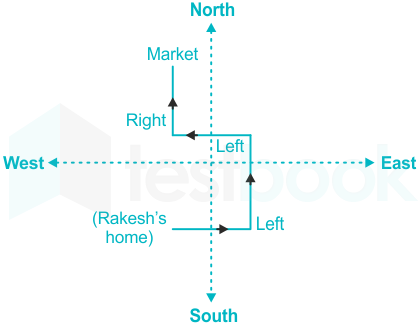
  • Maithalisharan Gupt - Saket: Saket is a renowned Hindi epic poem written by Maithalisharan Gupt, first published in 1931. It is a modern retelling of the Ramayana that elevates the character of Urmila, the wife of Lakshmana, who was traditionally ignored in classical texts. Hence, this pair is correctly matched.

Additional Information

  • Munshi Premchand: Born in 1880 in Lamhi near Varanasi, he is known as the Upanyas Samrat (Emperor of Novels). His masterpiece, Godan, depicts the socio-economic struggles of the Indian peasantry and the caste system during the colonial era.
  • Mahadevi Verma: Known as the Modern Meera, she was born in 1907 in Farrukhabad, Uttar Pradesh. She was a leading figure of the Chhayavad era and was honored with the Jnanpith Award in 1982 for her poetry collection Yama.
  • Jaishankar Prasad: A pioneer of modern Hindi theater and poetry, he was born in 1889. Apart from Kamayani, his significant plays include Chandragupta, Skandagupta, and Dhruvaswamini, which blended history with philosophy.
  • Harivansh Rai Bachchan: Born in 1907, he was a prolific poet who served as a member of the Rajya Sabha. His work Madhushala remains one of the most recited and popular works in Hindi literature, reflecting Sufi influences and secular thought.
  • Maithalisharan Gupt: He was designated as the Rashtrakavi (National Poet) by Mahatma Gandhi for his patriotic writings. His work Bharat-Bharati (1912) played a significant role in awakening the national spirit during the Indian Independence Movement.

Important Points

  • Chhayavad Movement: This was a major period of Romanticism in Hindi literature (approx. 1918–1937). Jaishankar Prasad, Mahadevi Verma, Suryakant Tripathi 'Nirala', and Sumitranandan Pant are considered its four pillars.
  • Language Evolution: These authors were instrumental in transitioning Hindi literature from Braj Bhasha to Khari Boli, making it the standard literary language of North India.
  • Epic Poetry Characteristics: Both Kamayani and Saket are classified as Mahakavyas (Epic Poems) because they consist of multiple cantos (Sargas) and deal with grand themes of morality, spirituality, and humanity.
  • Literary Awards: Many of these authors are recipients of India's highest literary honors, including the Sahitya Akademi Award and the Padma Bhushan, reflecting their immense contribution to the national culture.

Attempt this paper under real exam conditions

Timed interface, section switching, instant scoring, and question-by-question analytics — free.

Start Timed Attempt