Official Paper

Allahabad High Court ARO 2019 Official Paper 2 (Held On : 24 Feb 2020) (Previous Year Paper)

200 questions · 150 minutes · with answers · free

Full Test (200 questions)

1

Which among the following is NOT an example of Impact Printer?

  1. ((a))

    Dot matrix

  2. ((b))

    Daisy-wheel

  3. ((c))

    Line

  4. ((d))

    Laser

Show Answer
Answer: ((d))

Laser

​The correct answer is Laser.

  • Laser printer is not an example of Impact Printer
  • A printer is an external output device that uses computer data and produces output in the form of graphics/technology on paper.
  • Printers are classified into two types: Impact printers and Non-Impact printers.

Key Points 

Impact printer

  • An impact printer forms characters and images on a piece of paper by hitting an ink ribbon mechanism that contacts the paper physically.
  • Impact printers are classified into two types: Character Printer and Line Printer.
  • Character printer: A Character printer prints a single character at a time. They are low-speed printers. Their printing speed lies in the range of 10-600 characters/second. Character printers are classified into two types: Daisy Wheel printer and Dot-matrix printer.
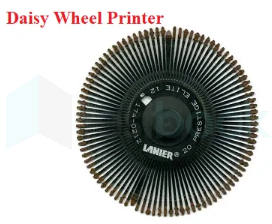
  • Daisy Wheel printer: These printers use a print wheel font, which is termed a daisy wheel. Each petal or hammer of Daisy-Wheel has a character raised on it. A motor spins the wheel at a rapid rate. The speed of these Daisy-Wheel Printers normally ranged between 10-75 characters per second.
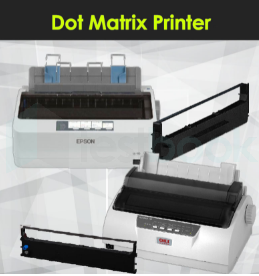
  • Dot-matrix printer: These printers print each character as a pattern of dots. The print head is made up of a matrix of tiny needles, typically 9 rows with 7 columns (9 *7 matrix needles). These shapes of each character are formed in the form of tiny dots. The printing quality of a dot matrix printer is inferior to a daisy wheel printer. The printing speed of a Dot Matrix Printer is ranged from 40 to 600 characters per second.
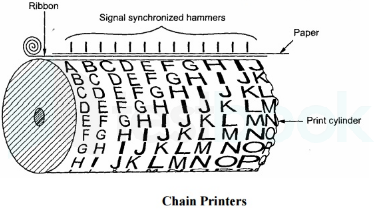
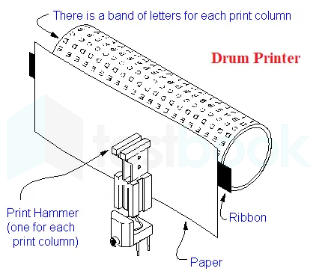
  • Line Printer: Line printers use special devices that can print a whole line at once, usually they can print the range from 1,200 to 6,000 lines per minute. Line printers are classified into two types: Drum printers and Chain printers.
  • Drum printers: A drum printer is a large, cylindrical drum that has raised characters on its surface in strips. Drum printer speeds are between 300 and 2000 lines per minute.
  • Chain printers: A chain printer uses a print chain, wrapped around two pulleys. Chain printer speeds vary between 400 and 2500 characters per minute.
Non-Impact printer

  • A non-impact printer forms characters and graphics on a piece of paper without hitting the paper.
  • Laser printers, Inkjet printers, and Thermal printers are the different types of non-impact printers.
  • Laser printer: A laser printer uses electronics, lasers, xerography, and other techniques, which is called the electrophotographic technique. A laser beam is directed across the surface of light or a photosensitive drum.
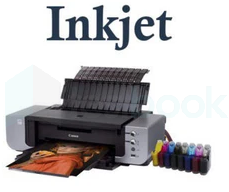
  • Inkjet printer: Inkjet printer uses the dot matrix approach to print text and graphics. They print characters by spraying small drops of ink onto paper. A special type of ink having high iron content is used for forming drops.
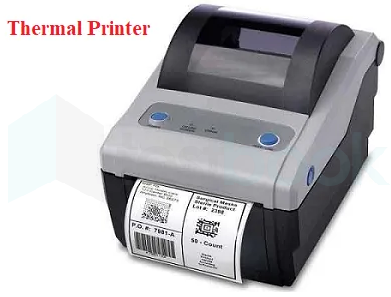
  • Thermal printer: The printer that produces images by pushing electrically heated pins against the special heat-sensitive paper, is known as a thermal printer.

 

Important Points

  • The printing speed of a printer is measured in pages per minute (ppm).
  • Printer resolution is often measured in dots per inch (dpi).

2

What is the full form of PNG in the computer image format?

  1. ((a))

    Printable New Graphic

  2. ((b))

    Printable New Graphical

  3. ((c))

    Port Natural Graphics

  4. ((d))

    Portable Network Graphics

Show Answer
Answer: ((d))

Portable Network Graphics

​The correct answer is Portable Network Graphics.

  • Portable Network Graphics is the full form of PNG in the computer image format.

Key Points

  • PNG (Portable Network Graphics) PNG (Portable Network Graphics)
  • PNG is a format for storing bit-mapped or raster images on the computer.
  • PNG is also known as a successor of GIF format images.
  • It uses the less compression technique to save images like GIF files but without copyright issues.
  • It contains a bitmap of indexed color so it is also called a bit-mapped image.
  • Portable Network Graphics Format was developed in early 1995.
  • PNG form was created by a team working under Thomas Boutell.
  • The main reason behind its development was the limitation of 256 colors only in GIF.
  • PNG has a file extension ".png".
  • PNG provides low-resolution images that look good and load quickly.
  • The amount of transparency can be controlled.
  • The format supports interlacing, and it can be developed faster than the GIF format.
  • PNG format also supports Gamma correction.
  • Images can be saved by using true color.
  • It can also be saved by using palette and grayscale formats provided by GIF.

Additional Information 

  • JPEG (or JPG) - Joint Photographic Experts Group.
  • GIF - Graphics Interchange Format.
  • TIFF - Tagged Image File Format.
  • BMP - BitMaP.
  • SVG - Scalable Vector Graphics
  • PSD - Photoshop Document.
  • PDF - Portable Document Format.
  • EPS - Encapsulated Postscript.
  • RAW -Raw Image Formats
  • AI - Adobe Illustrator Document.
3

What does X stand for in document formatting language "XML"?

  1. ((a))

    Expandable

  2. ((b))

    Executive

  3. ((c))

    Extensible

  4. ((d))

    None of these

Show Answer
Answer: ((c))

Extensible

​The correct answer is Extensible

  • X stand for Extensible in document formatting language "XML".

Additional Information

  • XML stands for  "Extensible Markup Language".
  • XML is a software- and hardware-independent tool for storing and transporting data.
  • XML stores data in plain text format.
  • XML was designed to be both human- and machine-readable.
  • XML was designed to be self-descriptive.
  • XML is a W3C Recommendation.
  • XML is a markup language much like HTML.
  • XML tags are not predefined like HTML tags are.
  • XML also makes it easier to expand or upgrade to new operating systems, new applications, or new browsers, without losing data.
  • XML is used in many aspects of web development.
  • XML is often used to separate data from presentation.
  • XML documents form a tree structure that starts at "the root" and branches to "the leaves".
  • The syntax rules of XML are very simple and logical.
  • An XML document contains XML Elements.
  • An XML element is everything from (including) the element's start tag to (including) the element's end tag.
  • The other most popular Markup Languages are: 
  • HTML – Hypertext Markup Language.
  • KML – Keyhole Markup Language.
  • MathML – Mathematical Markup Language.
  • SGML – Standard Generalized Markup Language.
  • XHTML – eXtensible Hypertext Markup Language.

Important Points

  • WWW was invented by Tim Berners Lee.
  • HTML was invented by Tim Berners Lee.
  • First Computer Programmer - Ada Lovelace.
4

Which of the following registers holds the contents of data or instruction read from, or written in memory?

  1. ((a))

    Memory Buffer Register

  2. ((b))

    Memory Address Register

  3. ((c))

    Index Register

  4. ((d))

    Program Counter

Show Answer
Answer: ((a))

Memory Buffer Register

​The correct answer is Memory Buffer Register.

  • Memory Buffer Register holds the contents of data or instruction read from, or written in memory.

Additional InformationMemory Buffer Register

  • Memory Buffer Register is mostly called MBR.
  • The MBR contains the Metadata of the data and instruction written in or read from memory.
  • In simple words, it adds is used to store the upcoming data/instruction from the memory and going to memory.

Memory Address Register

  • The MAR is a special type of register that contains the memory address of the data and instruction.
  • The main task of the MAR is to access instruction and data from memory in the execution phase.
  • The MAR stores the address of the memory location where the data is to be read or to be stored by the CPU.

Index Register

  • The Index Register is the hardware element that holds the number.
  • The number adds to the computer instruction's address to create an effective address.
  • In CPU, the index register is a processor register used to modify the operand address during the running program.

Program Counter

  • Program Counter (PC) holds the address of the memory location of the next instruction, which is to be fetched after the current instruction is completed.
  • So, it is used to maintain the path of execution of the different programs and thus executes the programs one by one, when the previous instruction gets completed.

5

In microprogrammed control unit, subsequent instruction words are fetched into the _______.

  1. ((a))

    Instruction Register

  2. ((b))

    Transistor

  3. ((c))

    CMOS battery

  4. ((d))

    Program Counter

Show Answer
Answer: ((a))

Instruction Register

​The correct answer is Instruction Register.

  • In the microprogrammed control unit, subsequent instruction words are fetched into the **Instruction Register.**​

Additional InformationInstruction Register

  • Instructor Register is a 16-bit register.
  • It stores the instruction which is fetched from the main memory.
  • So, it is used to hold instruction codes, which are to be executed.
  • The Control Unit takes instruction from the Instructor Register, then decodes and executes it.

Transistor

  • A transistor is a semiconductor device used to amplify or switch electronic signals and electrical power.
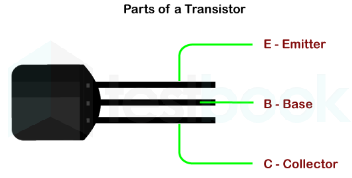
  • A transistor consists of three terminals: input, output, and controlling switching.
  • The name of the three terminals contained by the transistor is the emitter, base, and collector.
  • Base
  • The primary function of the base terminal is to activate the transistor, which designs two circuits; the output circuit the collector and input with the emitter.
  • The thin layers are used to make it, which is the middle section of a transistor.
  • The low resistance to the circuit is offered by the emitter-base circuit, which is forward biased.
  • The higher resistance to the circuit is provided by the collector-base junction, which is located in opposite bias.
  • Collector
  • It is the left part of the diode and the positive lead of the transistor.
  • Removing the majority charges from the junction with the base is a primary function of the collector.
  • Emitter
  • The emitter diode is the right part of the diode, which functions for the large sector of the majority trust carrier.
  • It is the negative lead of the transistor that functions for the majority charge carrier to the base.

CMOS

  • ​CMOS is an integrated circuit designed on a printed circuit board (PCB), a widely used type of semiconductor used in transistors.
  • It is a battery-powered memory chip that simply stores the startup information and BIOS uses this information to turn on your computer i.e. during the boot up process.
  • CMOS uses only one charge at a time.

Program Counter

  • Program Counter (PC) holds the address of the memory location of the next instruction, which is to be fetched after the current instruction is completed.
  • So, it is used to maintain the path of execution of the different programs and thus executes the programs one by one, when the previous instruction gets completed.

Important Points

  • Transistor was invented by William Shockley, John Bardeen, and Walter Brattain in 1947.
6

Which among the following carries control information between the CPU and other devices within the computer?

  1. ((a))

    Control Bus

  2. ((b))

    UPS

  3. ((c))

    ROM

  4. ((d))

    RAID

Show Answer
Answer: ((a))

Control Bus

​The correct answer is Control Bus.

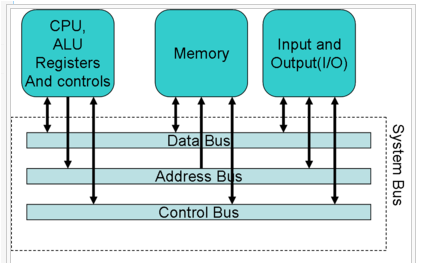
  • Control Bus carries control information between the CPU and other devices within the computer.

Additional Information

Control Bus

  • A control bus is a computer bus that is used by the CPU to communicate with devices that are contained within the computer.
  • This occurs through physical connections such as cables or printed circuits.
  • The CPU transmits a variety of control signals to components and devices to transmit control signals to the CPU using the control bus.
  • The main objective of a bus is to minimize the lines that are needed for communication.
  • The control bus is bidirectional and assists the CPU in synchronizing control signals to internal devices and external components.
  • It is comprised of interrupt lines, byte enables lines, read/write signals, and status lines.

UPS (Uninterruptible Power Supply)

  • UPS runs on a battery that is used to supply power in the absence of a primary source or when supply is cut off.
  • A UPS can keep a computer running for some minutes giving you enough time to save all your data in order not to lose it.
  • Many UPSs now offer software that automatically saves your data and shut down your computer.
  • Battery size is also an important factor in the selection of UPS systems.
  • The two types of UPS systems are Stand by Power System and Online UPS.

Read-only memory (ROM)

  • Read-only memory (ROM) is a storage medium used in computers and other electronic devices.
  • ROM is non-volatile and the contents are retained even after the power is switched off.
  • ROM is a primary memory and only allows reading.
  • ROM is programmed during the manufacturing process.
  • ROM refers to computer memory chips containing permanent or semi-permanent data.
  • ROM is a combination of different IC's.
  • In ROM, each bit combination that comes out of the output lines is called a data word. Usually, a word consists of 16-bits or 2-bytes.
  • The types of ROM include MROM, PROM, EPROM, and EEPROM.

RAID (Redundant Array of Independent Disks)

  • RAID is a data storage virtualization technology that combines multiple physical disk drive components into one or more logical units for data redundancy, performance improvement, or both.
  • It is a way of storing the same data in different places on multiple hard disks or solid-state drives to protect data in the case of a drive failure.
  • A RAID system consists of two or more drives working in parallel.
  • RAID systems can use with several interfaces, including SATA, SCSI, IDE, or FC (fiber channel.)
7

Which of the following is the full form of OPC?

  1. ((a))

    Optical Code Reading

  2. ((b))

    Optical Program Counter

  3. ((c))

    Operating Computer Resource

  4. ((d))

    Open Platform Communication

Show Answer
Answer: ((d))

Open Platform Communication

​The correct answer is Open Platform Communication.

  • Open Platform Communication is the full form of OPC.

Additional Information

Open Platform Communication**(OPC)**

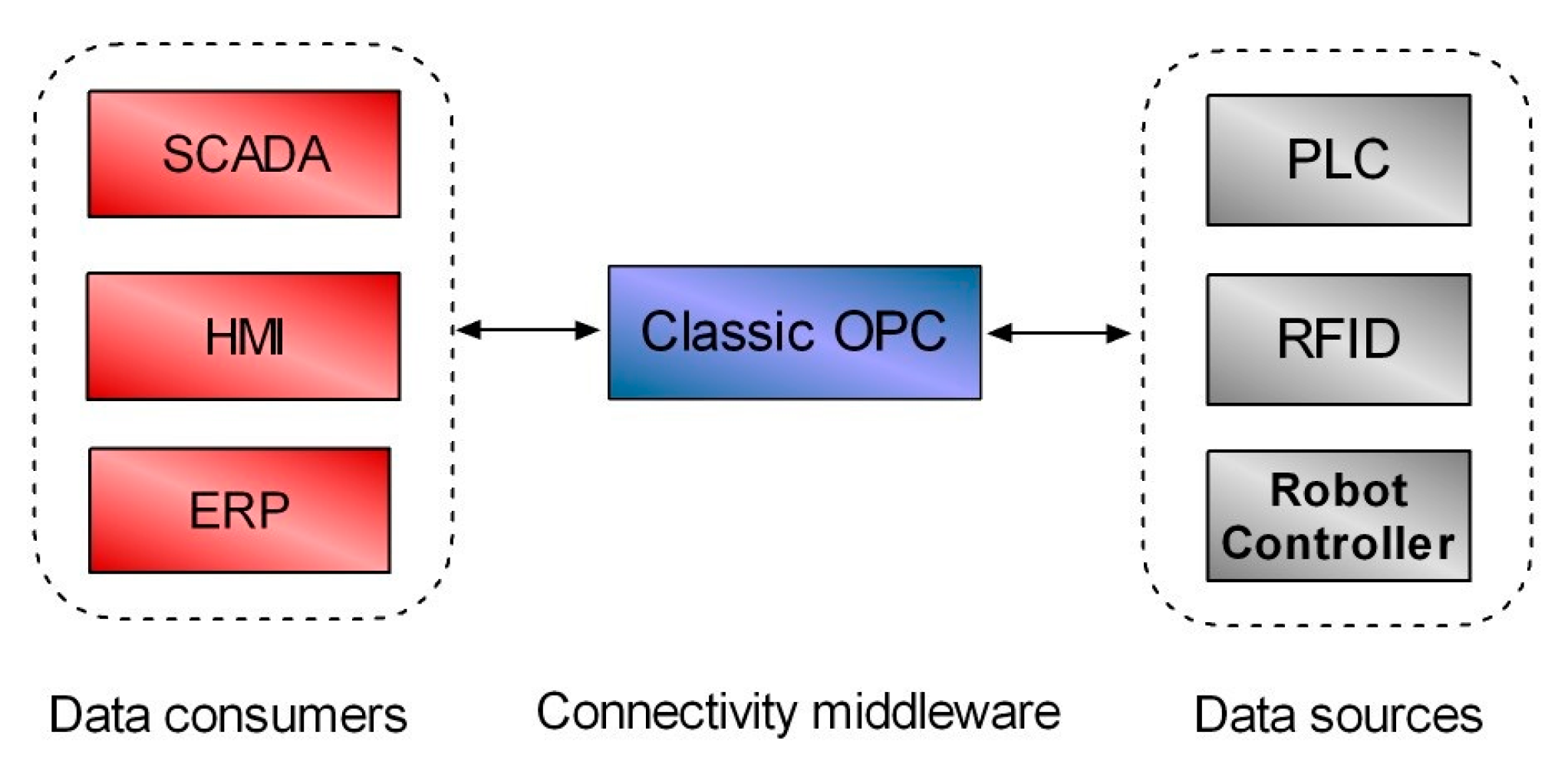
  • OPC is a software interface interoperability standard that allows a secure and reliable exchange of data between Windows programs and industrial hardware devices.
  • It is platform-independent and ensures the continuous flow of information across multiple vendor devices.

OCR (Optical Character Recognition)

  • OCR has also known as Optical Character Reader or text recognition.
  • An OCR device is made up of hardware and software combinations.
  • Hardware of OCR (optical scanner or a circuit board) copies and reads the text, whereas the software deals with advanced processing.
  • The software can also make use of artificial intelligence to use advanced methods of intelligent character recognition (ICR), like the ability to identify language or style of handwriting.
  • It is designed to convert scanned paper documents, or images of documents captured by a digital camera into machine-readable, editable, and searchable data.
8

The computer that provides resources to other computers on a network is known as which among the following?

  1. ((a))

    Network

  2. ((b))

    Server

  3. ((c))

    Supercomputer

  4. ((d))

    Microcomputer

Show Answer
Answer: ((b))

Server

​The correct answer is Server.

  • The computer that provides resources to other computers on a network is known as Server.

Key Points

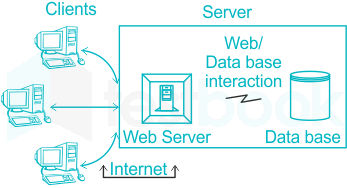
  • A server commonly refers to a computer program that receives and responds to requests made over a network.
  • It receives the request for a web document from the client and sends the requested information to the client's computer on the Internet.
  • A device can be both a client and a server at the same time, as an individual system has the ability to provide resources and use them from another system in one go. There are different types of servers: Web server, Application server, Cloud server, Database server, Print server, Proxy server, File server, Mail server, Standalone server, Domain name service.

Additional Information

Network

  • A network set up by connecting two or more computers and other supporting hardware devices through communication channels is called a computer network.
  • It enables computers to communicate with each other and to share commands, data, etc., including the hardware and software resources.
  • The important computer networks are LAN, MAN, and WAN.
  • A Local Area Network (LAN) is a computer network that interconnects computers within a limited area such as a residence, school, laboratory, university campus, or office building.
  • Metropolitan Area Network (MAN) is a high-speed network that spreads over a large geographical area such as a metro city or town.
  • A Wide Area Network (WAN) is a telecommunications network that extends over a large geographic area for the primary purpose of computer networking.

Super Computer

  • Supercomputers are the biggest and fastest computers.
  • They are designed to process a huge amount of data.
  • A supercomputer can process trillions of instructions in a second.
  • It has thousands of interconnected processors.
  • Supercomputers are particularly used in scientific and engineering applications such as weather forecasting, scientific simulations, and nuclear energy research.

Microcomputer

  • A microcomputer is also known as a personal computer.
  • It is a general-purpose computer that is designed for individual use.
  • It has a microprocessor as a central processing unit, memory, storage area, input unit, and output unit.
  • Laptops and desktop computers are examples of microcomputers.

Important Points

  • The first supercomputer was developed by Roger Cray in 1976.
  • Father of computer - Charles Babbage.
9

Which among the following is used to identify a user who returns to a website?

  1. ((a))

    Cookies

  2. ((b))

    Plug-in

  3. ((c))

    Scripts

  4. ((d))

    None of the above

Show Answer
Answer: ((a))

Cookies

​The correct answer is Cookies.

  • Cookies are used to identify a user who returns to a website.
  • Google Chrome, Mozilla Firefox, Microsoft Edge, Apple Safari, and Opera are the most important web browsers.

Additional InformationCookies

  • A cookie is a small file of letters and numbers downloaded onto your computer when you access certain websites.
  • Like virtual door keys, cookies unlock a computer's memory and allow a website to recognize users when they return to a site by opening doors to different content or services.
  • An HTTP cookie is a small piece of data sent from a website and stored in a user's web browser while the user is browsing that website.

Plug-in

  • A plugin is a piece of software that acts as an add-on to a web browser and gives the browser additional functionality.
  • Plugins can allow a web browser to display additional content it was not originally designed to display.
  • Every web browser has an official website where you can download and install plugins (also called "add-ons" or "extensions").
  • The web browser publisher verifies the plugins are not harmful before making them available to download.

Scripts

  • Scripts are lists of commands executed by certain programs or scripting engines.
  • They are usually text documents with instructions written using a scripting language.
  • They are used to generate Web pages and to automate computer processes.

Important Points

  • The first Web browser "Nexus" was developed by Tim Berners Lee in 1990.
  • Fastest Web browser - Safari.
  • Epic is the first Web browser developed in Indiaby a Bangalore-based startup company "Hidden Reflex".
  • Father of Internet - Vint Cerf.
10

In PowerPoint presentation, the collection of images in Clip Art is:

  1. ((a))

    Ready to use

  2. ((b))

    Partially ready for usage

  3. ((c))

    Not at all ready to use

  4. ((d))

    Unavailable

Show Answer
Answer: ((a))

Ready to use

​The correct answer is Ready to use.

  • In PowerPoint presentation, the collection of images in Clip Art is Ready to use.

Additional Information

  • Microsoft PowerPoint is a software application that is particularly used to present data and information by using text, diagrams with animation, images, and transitional effects, etc in the form of slides.
  • It is used to make presentations for personal and professional purposes.
  • It helps people to better understand the idea or topic in front of the audience practically and easily.
  • The file extension of a saved Microsoft Powerpoint presentation is “.ppt”.
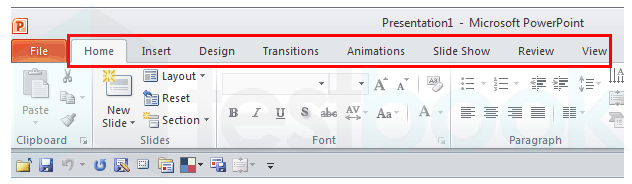
  • The ribbon is located on the top of the PowerPoint window just below the Title bar.
  • It is made up of seven tabs; Home, Insert, Design, Animations, Slide Show, Review, and View.
  • Each tab is divided into groups of related commands that are displayed on the Ribbon.
  • To view additional commands of a group click the arrow at the right bottom corner of the group.

Important Points

  • ​Microsoft PowerPoint is invented by Robert Gaskins and Dennis Austin.
  • The founder of Microsoft - Bill Gates and Paul Allen.
  • The CEO of Microsoft - Satya Nadella.
11

Which among the following is used as an identifier of mobile money?

  1. ((a))

    MIMD

  2. ((b))

    MISD

  3. ((c))

    MMID

  4. ((d))

    MCID

Show Answer
Answer: ((c))

MMID

​The correct answer is MMID.

  • MMID is used as an identifier of mobile money.

Additional Information

  • Mobile Money Identifier (MMID) is a seven-digit number, issued by banks for effecting financial transactions through the user's mobile phone.
  • MMID is a code that allows for interbank transfers via the mobile banking platform.
  • This system works through the Immediate Payment System (IMPS) interface.
  • The MMID service was first launched in India in 2010.
  • The MMID service is a successor to two commonly used transfer methods – the Real Time Gross Settlement (RTGS) fund transfers and the National Electronic Fund Transfer(NEFT) service.
  • It offers those without access to net banking, a good platform to send and receive money without any challenges.
  • In order for a successful fund transfer to take place, both the sender (remitter) and the beneficiary/payee should have an MMID.
  • Money can be sent and received using a handset through the MMID facility through SMS.
  • There are three ways to generate an MMID:
  • Mobile Banking
  • Login to your’s banks mobile banking app.
  • Go to the ‘Account’ option.
  • Proceed to click on the ‘Generate MMID’ tab.
  • Net Banking
  • Login to the bank’s internet banking portal by providing all login credentials.
  • Go to the home page and proceed to click on the ‘Generate MMID’.
  • Key in necessary details and verify the same.
  • MMID will be generated for the respective account.
  • Phone Banking
  • Call the bank’s phone banking number.
  • Choose the language and select the banking option.
  • Talk to a customer care representative and ask for the generation of MMID.
  • MMID will be sent to the account holder’s registered mobile number within a 24-hour window.
12

What does E stand for in IMEI code of mobile phone?

  1. ((a))

    Engage

  2. ((b))

    Equipment

  3. ((c))

    Electronic

  4. ((d))

    Ethical

Show Answer
Answer: ((b))

Equipment

​The correct answer is Equipment.

  • E stand for Equipment in IMEI code of the mobile phone.

Additional Information

  • International Mobile Equipment Identity is the full form of IMEI.
  • IMEI is a number that facilitates device validity identification.
  • International Mobile Equipment Identity is a factory-installed unique serial number that identifies each unit or line of service under GSM (Global System for Mobile Communications) specifications.
  • The IMEI is strictly used for identification by Global System for Mobile Communications (GSM), Wideband Code Division Multiple Access (WCDMA), and some satellite devices.
  • The IMEI number is unique and typically 15 or 17 digits.
  • In most mobile communications devices, the IMEI appears on the display when the user enters the character sequence *#06# or is stored on the battery's backside.
  • Motorola phones only have 14 digits so add the number 0 at the end.
  • Most phones have one IMEI number, but dual SIM phones are two.
  • The IMEI number does not have a permanent subscriber relationship.
  • Swapping a SIM card cannot prevent phone banning because the IMEI number is stored inside the phone - not the SIM card.
  • The IMEI number's primary purpose is blocking or tracking lost mobile phones via the IMEI database (IMEI DB).
  • IMEI database (IMEI DB) is a central database containing basic IMEI information.
  • The IMEI number is transmitted and verified by the IMEI DB in the network's Equipment Identity Register (EIR).
  • The EIR is a database for all IMEIs and it stores all device identifications registered for this network.
  • The GSM association provides IMEI DB member access to GSM and 3G operators across the world.
  • Network operators use IMEI DB data to determine customer device types and supported features.
  • When a phone set is lost or stolen, the owner can call the CEIR (Central Equipment Identity Register) and blacklist the device according to its IMEI number.
  • SIM (Subscriber Identity Module) is a ''smart'' card installed or inserted into a mobile device containing all subscriber-related data. The SIM number is 15 digits.
  • MSN (Mobile Serial Number) is also referred to as serial number (SN) is a 10-digit number. It is required for each SIM card-capable device.
  • PIN (Personal Identification Number) identifies the equipment model and is normally associated with a SIM card.

Important Points

  • First mobile in the world - Motorola.
  • The mobile phone was invented by Martin Cooper in 1973.
13

Which among the following is NOT an advantage of E-commerce business?

  1. ((a))

    High initial cost

  2. ((b))

    Location independent business

  3. ((c))

    Convenient global reach

  4. ((d))

    Unlimited business hours

Show Answer
Answer: ((a))

High initial cost

​The correct answer is High initial cost.

  • The high initial cost is not an advantage of an E-commerce business.

Key Points 

  • E-commerce stands for Electronic Commerce.
  • E-commerce business is the buying and selling of goods and services, or the transmitting of funds or data, over an electronic network, primarily the internet.
  • E-Commerce also pertains to any form of business transaction in which the parties interact electronically rather than by physical exchanges or direct physical contact.
  • Types of E-Commerce: 
  • B2B (Business-to-Business) - Companies sell products or services to other companies over the Internet. The B2B e-commerce encompasses all electronic transactions of goods or services carried on between the companies.
  • B2C (Business-to-Consumer) - The business sells products or services directly to consumers over the Internet. The B2C type of e-commerce is distinguished by the establishment of Electronic Business Relationships between Businesses and Final consumers.
  • C2B (Consumer-to-Business) - It is consumer Selling Products or Services to Businesses. In C2B there is a complete reversal of the traditional sense of exchanging goods. This type of E-commerce is quite common in crowdsourcing-based projects.
  • C2C (Consumer-to-Consumer) - It is basically a Consumer selling Products or Services directly to other consumers. C2C type E-commerce encompasses all electronic transactions of goods or services conducted among the consumers.

Additional Information

  • Examples of E-Commerce Industry  
  • Online Ticketing
  • Internet Banking
  • Electronic auction
  • Online selling (Buying and Selling of goods)
  • Online selling (Buying and Selling of services)
  • Transmitting or funds or data
  • Advantages of E-Commerce
  • Faster buying/selling procedure
  • Buying / Selling 24 / 7
  • Low operational costs with better quality of services
  • Easy to start and manage a business
  • Cost-Effective including higher Margin
  • Better Productivity
  • Allows for product and Price Comparison
  • No standing in Queues or being placed on hold forever
  • Ease of communication and superior customization
  • Enhance convenience
  • Amazon, Flipkart, Myntra, eBay, Paytm, and OLX are some of the E-Commerce websites.
14

An Excel spreadsheet helps in:

  1. ((a))

    Sorting data

  2. ((b))

    Arranging data easily

  3. ((c))

    Calculating numerical data

  4. ((d))

    All of the above

Show Answer
Answer: ((d))

All of the above

​The correct answer is All of the above.

  • An Excel spreadsheet helps in Sorting data, Arranging data easily, and Calculating numerical data.

Additional Information

  • Microsoft Excel is part of the Microsoft Office suite of programs and was developed by Microsoft in 1987.
  • Microsoft Excel is a spreadsheet program used to record and analyze numerical and statistical data.
  • Microsoft Excel provides multiple features to perform various operations like calculations, pivot tables, graph tools, macro programming, etc.
  • An Excel spreadsheet can be understood as a collection of columns and rows that form a table.
  • A worksheet is made of rows and columns that intersect each other to form cells where data is entered.
  • Alphabetical letters are usually assigned to columns, and numbers are usually assigned to rows.
  • The point where a column and a row meet is called a cell.
  • The address of a cell is given by the letter representing the column and the number representing a row.
  • The main features of MS Excel are:
  • AutoFormat: It allows Excel users to use predefined table formatting options.
  • AutoSum: AutoSum feature helps us to calculate the sum of a row or column automatically by inserting an addition formula for a range of cells.
  • List AutoFill: It automatically develops cell formatting when a new component is added to the end of a list.
  • AutoFill: This feature allows us to quickly fill cells with a repetitive or sequential record such as chronological dates or numbers and repeated documents. AutoFill can also be used to copy functions. We can also alter text and numbers with this feature.
  • AutoShapes: AutoShapes toolbar will allow us to draw some geometrical shapes, arrows, flowchart items, stars, and more. With these shapes, we can draw our graphs.
  • Wizard: It guides us to work effectively while we work by displaying several helpful tips and techniques based on what we are doing. The drag and Drop feature will help us to reposition the record and text by simply dragging the data with the help of the mouse.
  • Charts: This feature will help you to present the data in graphical form by using Pie, Bar, Line charts, and more.
  • PivotTable: It flips and sums data in seconds and allows us to execute data analysis and generating documents like periodic financial statements, statistical documents, etc. We can also analyze complex data relationships graphically.
  • Shortcut Menu: The shortcut menu helps users to make the work done through shortcut commands that need a lengthy process.

Important Points

  • The founder of Microsoft - Bill Gates and Paul Allen.
  • The CEO of Microsoft - Satya Nadella.
15

Which of the following is a protective wall which is used to prevent unauthorized access to your computer?

  1. ((a))

    Sidewall

  2. ((b))

    Firewall

  3. ((c))

    Wallpaper

  4. ((d))

    None of the above

Show Answer
Answer: ((b))

Firewall

​The correct answer is Firewall.

  • Firewall is a protective wall that is used to prevent unauthorized access to your computer

Additional Information

  • A firewall can be defined as a special type of network security device or a software program that monitors and filters incoming and outgoing network traffic based on a defined set of security rules.
  • It acts as a barrier between internal private networks and external sources.
  • Firewalls are primarily used to prevent malware and network-based attacks.
  • A firewall is to allow non-threatening traffic and prevent malicious or unwanted data traffic for protecting the computer from viruses and attacks.
  • A firewall is a cybersecurity tool that filters network traffic and helps users block malicious software from accessing the Internet in infected computers.
  • Firewalls have become so powerful, and include a variety of functions and capabilities with built-in features:
  • Network Threat Prevention
  • Application and Identity-Based Control
  • Hybrid Cloud Support.
  • Scalable Performance.
  • Network Traffic Management and Control.
  • Access Validation.
  • Record and Report on Events.
  • Types of firewall
  • Packet filtering: A small amount of data is analyzed and distributed according to the filter’s standards.
  • Proxy service: Network security system that protects while filtering messages at the application layer.
  • Stateful Multilayer Inspection: Dynamic packet filtering that monitors active connections to determine which network packets to allow through the Firewall.
  • Next-Generation Firewall (NGFW): Deep packet inspection Firewall with the application-level inspection.

16

Which one of the following attributes allows display but prevents the users from modifying or deleting an object?

  1. ((a))

    Write only

  2. ((b))

    Read only

  3. ((c))

    Once only

  4. ((d))

    Modify only

Show Answer
Answer: ((b))

Read only

​The correct answer is Read-only.

  • Read-only attributes allow display but prevent the users from modifying or deleting an object.

Additional Information

Read-only memory (ROM)

  • Read-only memory (ROM) is a storage medium used in computers and other electronic devices.
  • ROM is non-volatile and the contents are retained even after the power is switched off.
  • ROM is a primary memory.
  • ROM only allows reading.
  • ROM is programmed during the manufacturing process.
  • ROM refers to computer memory chips containing permanent or semi-permanent data.
  • Data stored in ROM can only be modified slowly or with difficulty, or not at all.
  • ROM is a combination of different IC's.
  • In ROM, each bit combination that comes out of the output lines is called a data word. Usually, a word consists of 16-bits or 2-bytes.
  • The types of ROM include MROM, PROM, EPROM, and EEPROM.
  • MROM (Masked Read-Only Memory) is a type of memory that is masked off during production and is used in systems that require long-term sustainability.
  • PROM (Programmable Read-Only Memory) is a memory chip on which data can be written only once. Once programmed, the information written is permanent and cannot be deleted.
  • EPROM - (Erasable Programmable Read-Only Memory) is a special type of PROM that can be erased by exposing it to ultraviolet light.
  • EEPROM - (Electrically Erasable Programmable Read-Only Memory) is a special type of PROM that can be erased by exposing it to an electrical charge.

Random Access Memory (RAM),

  • Random Access Memory (RAM) allows the computer to store data for immediate manipulation and to keep track of what is currently being processed.
  • RAM is volatile memory and the content is lost when the power is turned off.
  • RAM is also known as read/write memory as information can be read from and written onto it.
  • The two main types of RAM are Static RAM and Dynamic RAM.
  • Static RAM (SRAM) is a type of random access memory that retains its state for data bits or holds data as long as it receives the power. It is often used as CPU Cache memory.
  • Dynamic Random Access Memory (DRAM) is a memory chip that can hold more data than an SRAM chip but requires more power.
17

Which of the following is an online payment mode?

  1. ((a))

    Cash on delivery

  2. ((b))

    Cash before delivery

  3. ((c))

    Demand draft

  4. ((d))

    NEFT

Show Answer
Answer: ((d))

NEFT

​The correct answer is NEFT.

  • NEFT is an online payment mode.
  • The full form of NEFT is National Electronic Funds Transfer.

Additional Information

NEFT (National Electronic Funds Transfer)

  • NEFT is a mode of online funds transfer that is introduced by the Reserve Bank of India (RBI).
  • It quickly transfers money between banks throughout India.
  • A bank branch must be NEFT-enabled for a customer to be able to transfer the funds to another party.
  • The objective behind this new clearance system is to promote digital transactions and the global integration of Indian financial markets.
  • You can place an NEFT request at any point in time.
  • The NEFT request will be sent to a queue.
  • All the NEFT requests in the queue will be cleared once every hour.
  • IFSC or Indian Financial System Code is an alpha-numeric code that uniquely identifies a bank branch participating in the NEFT system.
  • It’s an 11-digit code with the first 4 alpha characters representing the bank, and the last 6 characters representing the branch, and the 5th character is 0 (zero).
  • IFSC is used by the NEFT system to identify the originating / destination banks/branches and also to route the messages appropriately to the concerned banks/branches.
  • There is no limit imposed by the RBI for funds transfer through the NEFT system.
  • The NEFT system is available round the clock throughout the year on all days( 24x7x365 basis).
  • NEFT presently operates in batches at half-hourly intervals throughout the day.
  • The essential elements of beneficiary's identification are:
  • Beneficiary's Name
  • Beneficiary's Branch Name
  • Beneficiary's Bank Name
  • Beneficiary's Account Type
  • Beneficiary's Account Number
  • Beneficiary's Branch IFSC
  • The RBI does not levy any charges from member banks for NEFT transactions.
  • There are no charges to be levied for Inward transactions at destination bank branches for giving credit to beneficiary accounts.
  • For outward transactions, the maximum charges that banks can levy from their customer for NEFT transactions are as follows:
Transfer Amount (in ₹ )Transaction charges (in ₹ )
Up to 100002.5 + GST
10000 - 1 lakh5 + GST
1 lakh - 2 lakh15 + GST
Above 2 lakh25 + GST

Demand draft

  • A demand draft is a method used by an individual to make a transfer payment from one bank account to another.
  • Demand drafts differ from regular normal checks in that they do not require signatures to be cashed.
  • A demand draft is a negotiable instrument similar to a bill of exchange.
  • A bank issues a demand draft to a client, directing another bank or one of its own branches to pay a certain sum to the specified party.
18

Which of the following topology is an arrangement of the network, in which every node is connected to the central hub, switch or a central computer?

  1. ((a))

    Star

  2. ((b))

    Mesh

  3. ((c))

    Ring

  4. ((d))

    Bus

Show Answer
Answer: ((a))

Star

​The correct answer is Star.

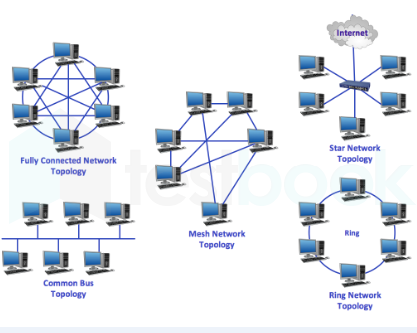
  • Star topology is an arrangement of the network, in which every node is connected to the central hub, switch, or a central computer.

Additional Information

  • Topology defines the structure of the network of how all the components are interconnected to each other.
  • There are two types of topology: physical and logical topology.
  • Physical topology is the geometric representation of all the nodes in a network.
  • The different types of physical topologies are Bus, Mesh, Ring, Star, and Tree.
  • Star
  • Star topology is an arrangement of the network in which every node is connected to the central hub, switch, or a central computer.
  • The central computer is known as a server, and the peripheral devices attached to the server are known as clients.
  • Coaxial cable or RJ-45 cables are used to connect the computers.
  • Hubs or Switches are mainly used as connected devices in a physical star topology.
  • Star topology is the most popular topology in network implementation.
  • Mesh
  • Mesh technology is an arrangement of the network in which computers are interconnected with each other through various redundant connections.
  • There are multiple paths from one computer to another computer.
  • It does not contain the switch, hub, or any central computer which acts as a central point of communication.
  • The Internet is an example of mesh topology.
  • Mesh topology is mainly used for WAN implementations where communication failures are a critical concern.
  • Mesh topology is mainly used for wireless networks.
  • Ring
  • Ring topology is like a bus topology, but with connected ends.
  • The node that receives the message from the previous computer will retransmit to the next node.
  • The data flows in one direction, i.e., it is unidirectional.
  • The data flows in a single loop continuously known as an endless loop.
  • It has no terminated ends, i.e., each node is connected to another node and having no termination point.
  • The data in a ring topology flow in a clockwise direction.
  • The most common access method of the ring topology is token passing.
  • Bus
  • The bus topology is designed in such a way that all the stations are connected through a single cable known as a backbone cable.
  • Each node is either connected to the backbone cable by drop cable or directly connected to the backbone cable.
  • The bus topology is mainly used in 802.3 (ethernet) and 802.4 standard networks.
  • The configuration of a bus topology is quite simpler as compared to other topologies.
  • The backbone cable is considered as a "single lane" through which the message is broadcast to all the stations.
  • The most common access method of the bus topologies is CSMA (Carrier Sense Multiple Access).
  • Tree
  • A tree topology combines the characteristics of bus topology and star topology.
  • A tree topology is a type of structure in which all the computers are connected with each other in a hierarchical fashion.
  • The top-most node in tree topology is known as a root node, and all other nodes are the descendants of the root node.
  • There is only one path that exists between two nodes for the data transmission. Thus, it forms a parent-child hierarchy.

19

Which of the following is the shortcut to create a new presentation in MS PowerPoint?

  1. ((a))

    Alt + W

  2. ((b))

    Ctrl + Q

  3. ((c))

    Alt + H

  4. ((d))

    Ctrl + N

Show Answer
Answer: ((d))

Ctrl + N

​The correct answer is Ctrl +N.

Key Points 

  • Ctrl + N is the shortcut to create a new presentation in MS PowerPoint.

 Additional Information

KeysFunctions
Ctrl + NTo create a new presentation
Alt + WTo open the view tab
Ctrl + QClose the Powerpoint
Alt + HGo to the Home tab
  • Microsoft PowerPoint is a software application that is particularly used to present data and information by using text, diagrams with animation, images, and transitional effects, etc in the form of slides.
  • It is used to make presentations for personal and professional purposes.
  • It helps people to better understand the idea or topic in front of the audience practically and easily.
  • The file extension of a saved Microsoft Powerpoint presentation is “.ppt”.
  • Ribbon is located on the top of the PowerPoint window just below the Title bar.
  • It is made up of seven tabs; Home, Insert, Design, Animations, Slide Show, Review, and View.
  • Each tab is divided into groups of related commands that are displayed on the Ribbon.
  • To view additional commands of a group click the arrow at the right bottom corner of the group.

  • Some other important keys and functions are:
KeysFunctions
Ctrl + NTo create a new slide
Ctrl + ATo select all the objects
Ctrl + CCopy the selected text, object, or selected slide
Ctrl + VTo paste the selected objects
Ctrl + OOpen an existing presentation document
Ctrl + ZTo undo an action
Ctrl + YTo redo an action
F5To play the presentation from the start
EscTo end the slideshow
Shift + F5To start the presentation from the current slide

Important Points 

  • ​Microsoft PowerPoint is invented by Robert Gaskins and Dennis Austin.
  • The founder of Microsoft - Bill Gates and Paul Allen.
  • The CEO of Microsoft - Satya Nadella.
20

To use a uniform background image/appearance to all the slides in a PowerPoint presentation, choose:

  1. ((a))

    Same to All

  2. ((b))

    Apply to All

  3. ((c))

    All

  4. ((d))

    Apply

Show Answer
Answer: ((b))

Apply to All

​The correct answer is Apply to All.

  • To use a uniform background image/appearance to all the slides in a PowerPoint presentation, choose 'Apply to All.'
  • If you want to have all slides have the same background color, Go to Design tab > Select Format Background > Apply to All

Additional Information

  • Microsoft PowerPoint is a software application that is particularly used to present data and information by using text, diagrams with animation, images, and transitional effects, etc in the form of slides.
  • It is used to make presentations for personal and professional purposes.
  • It helps people to better understand the idea or topic in front of the audience practically and easily.
  • The file extension of a saved Microsoft Powerpoint presentation is “.ppt”.
  • Ribbon is located on the top of the PowerPoint window just below the Title bar.
  • It is made up of seven tabs; Home, Insert, Design, Animations, Slide Show, Review, and View.
  • Each tab is divided into groups of related commands that are displayed on the Ribbon.
  • To view additional commands of a group click the arrow at the right bottom corner of the group.

Important Points

  • ​Microsoft PowerPoint is invented by Robert Gaskins and Dennis Austin.
  • The founder of Microsoft - Bill Gates and Paul Allen.
  • The CEO of Microsoft - Satya Nadella.
21

निम्नलिखित में से कौन-सा शब्द 'अनिवार्य'का विपरीतार्थक शब्द है?

  1. ((a))

    निअनिवार्य

  2. ((b))

    अनअनिवार्य

  3. ((c))

    औपचारिक

  4. ((d))

    वैकल्पिक

Show Answer
Answer: ((d))

वैकल्पिक

सही उत्तर 'वैकल्पिक' है।

Key Points

  • 'अनिवार्य' का सही विलोम शब्द 'वैकल्पिक' है।
  • 'अनिवार्य' का अर्थ - जिसका निवारण न हो सके।
  • 'वैकल्पिक' का अर्थ - ऐच्छिक।

अन्य विकल्प - 

शब्दविलोम
औपचारिकअनौपचारिक

नोट - 'निअनिवार्य और 'अनअनिवार्य' शब्दों में वर्तनीगत अशुद्धि हैं।

22

दिए गये विकल्पों में से सही वर्तनी का चुनाव करें:

  1. ((a))

    कीत्वर्यनिष्ठा

  2. ((b))

    कर्यत्वनिष्ठा

  3. ((c))

    कर्तव्यनिष्ठा 

  4. ((d))

    कत्वनिष्ठा

Show Answer
Answer: ((c))

कर्तव्यनिष्ठा 

सही उत्तर 'कर्तव्यनिष्ठा​' है। 

Key Points

  • कर्तव्यनिष्ठा शुद्ध वर्तनी है।
  • 'कर्तव्यनिष्ठा' का अर्थ 'कर्त्तव्य करने में निपुण' होता है।
  • वाक्य - वो एक कर्तव्यनिष्ठा सुलझी महिला थीं।

Additional Information

वर्तनीकिसी शब्द में आए हुए अक्षरों को मात्राओं सहित कहने या लिखने की रीति को 'वर्तनी' या 'अक्षरी' कहते हैं।  वर्तनी का सम्बन्ध उच्चारण से होता है।
23

नीचे दिए गए वाक्यांश के लिए दिए गए एक शब्द के विकल्पों में से उचित विकल्प चुनिए -

"जो सब कुछ जानता हो"

  1. ((a))

    सर्वज्ञ

  2. ((b))

    शत्रुघ्न

  3. ((c))

    वैज्ञानिक

  4. ((d))

    स्वार्थी

Show Answer
Answer: ((a))

सर्वज्ञ

सही उत्तर 'सर्वज्ञ' है।

Key Points

  • ‘जो सब कुछ जानता हो’ वाक्यांश के लिए एक शब्द ‘सर्वज्ञ’ होगा।

अन्य विकल्प - 

शब्दवाक्यांश
शत्रुघ्नजो शत्रु की हत्या करता है
वैज्ञानिकविज्ञान-संबंधी खोज करनेवाला
स्वार्थीअपना ही स्वार्थ चाहने वाला

Additional Information

वाक्यांशभाषा को सुंदर, आकर्षक और प्रभावशाली बनाने के लिए अनेक शब्दों के स्थान पर एक शब्द का प्रयोग किया जाता है तो वह वाक्यांश के लिए एक शब्द कहलाता है। जैसे- जिसे देखकर डर लगे- डरावना
24

"फूल" निम्नलिखित में से कौन-सी संज्ञा है?

  1. ((a))

    भाववाचक

  2. ((b))

    जातिवाचक

  3. ((c))

    समूहवाचक

  4. ((d))

    इनमें से कोई नहीं

Show Answer
Answer: ((b))

जातिवाचक

सही उत्तर 'जातिवाचक​​' है।

Key Points

  • 'फूल' जातिवाचक संज्ञा है।
  • 'फूल' शब्द संपूर्ण फूल की जाति का बोध करता है।
  • जो शब्द किसी व्यक्ति, वस्तु या स्थान की संपूर्ण जाति का बोध कराते हैं, उन शब्दों को जातिवाचक संज्ञा कहते हैं। ​

Additional Information

संज्ञाकिसी भी व्यक्ति, वस्तु, जाति, भाव या स्थान के नाम को ही संज्ञा कहते हैं। इसके पांच भेद माने गए हैं।
व्यक्तिवाचकजो शब्द केवल एक व्यक्ति, वस्तु या स्थान का बोध कराते हैं उन शब्दों को व्यक्तिवाचक संज्ञा कहते हैं।चीन (स्थान),  साइकिल (वस्तु), सुरेश(व्यक्ति) आदि।
जातिवाचकजो शब्द किसी व्यक्ति, वस्तु या स्थान की संपूर्ण जाति का बोध कराते हैं, उन शब्दों को जातिवाचक संज्ञा कहते हैं।टीवी (वस्तु), गाँव, स्कूल (स्थान), जानवर (प्राणी) आदि।
भाववाचकजो शब्द किसी चीज़ या पदार्थ की अवस्था, दशा या भाव का बोध कराते हैं, उन शब्दों को भाववाचक संज्ञा कहते हैं।बचपन, बुढ़ापा, मोटापा, मिठास आदि।
द्रव्यवाचकजब किसी संज्ञा शब्द से किसी द्रव्य का बोध हो तो उसे द्रव्यवाचक संज्ञा कहते हैं।पानी, लोहा, तेल, घी, दाल, इत्यादि।
समूहवाचकजब किसी संज्ञा शब्द से व्यक्ति या वस्तु के समूह का बोध होता है तब उसे समूहवाचक संज्ञा कहते हैं।परिवार, कक्षा, सेना, भीड़, पुलिस आदि।
25

दिये गये चार शब्दों में से तीन समान लिंग के हैं।

विसंगत विकल्प को चुने।

  1. ((a))

    कविता

  2. ((b))

    पहाड़

  3. ((c))

    मिठाई

  4. ((d))

    प्यास

Show Answer
Answer: ((b))

पहाड़

सही उत्तर 'पहाड़' है।

Key Points

  • 'पहाड़' शब्द पुल्लिंग है।
  • 'पहाड़' शब्द का वाक्य प्रयोग - वह पहाड़ बहुत बड़ा है। - यहाँ बड़ी है शब्द का उपयोग करना अनुचित होगा अर्थात 'पहाड़' शब्द पुल्लिंग है।

अन्य विकल्प - 

शब्दलिंगवाक्य प्रयोग
कवितास्त्रीलिंगमैंने कविता पढ़ी।
मिठाईस्त्रीलिंगमैंने मिठाई खाई।
प्यासस्त्रीलिंगमुझे प्यास लगी है।


Additional Information

लिंग - संज्ञा के जिस रूप से व्यक्ति या वस्तु की नर या मादा जाति का बोध हो, उसे व्याकरण में 'लिंग' कहते है। सरल शब्दों में- शब्द की जाति को 'लिंग' कहते है। हिन्दी में दो लिंग होते हैं—
लिंगपरिभाषाउदाहरण
पुल्लिंगजिन संज्ञा के शब्दों से पुरुष जाति का पता चलता है, उसे पुल्लिंग कहते हैं।जैसे – पिता, राजा, कुत्ता, आदमी आदि।
स्त्रीलिंगजिन संज्ञा के शब्दों से स्त्री जाति का पता चलता है, उसे स्त्रीलिंग कहते हैं।जैसे - माता, रानी, कुतिया, औरत आदि।

निम्नलिखित अवतरण को ध्यानपूर्वक पढ़िए तथा प्रश्नों के उत्तर गद्यांश में वर्णित तथ्यों के आधार पर दीजिए:

विद्यार्थी जीवन ही वह समय है जिसमें बच्चों के चरित्र, व्यवहार तथा आचरण को जैसा चाहे वैसा रूप दिया जा सकता है। यह अवस्था भावी वृक्ष की उस कोमल शाखा की भाँति है जिसे जिधर चाहे मोड़ा जा सकता है। पूर्णतः विकसित वृक्ष की शाखाओं को मोड़ना संभव नहीं । उन्हें मोड़ने का प्रयास करने पर वे टूट तो सकती हैं, पर मुड़ नहीं सकती। छात्रावस्था उस श्वेत चादर की तरह होती हैं जिसमें जैसा प्रभाव डालना हो, डाला जा सकता है। सफेद चादर पर एक बार जो रंग चढ़ गया, सो चढ़ गया; फिर से वह पूर्वावस्था को प्राप्त नहीं हो सकती। इसीलिए प्राचीन काल से ही विद्यार्थी जीवन के महत्त्व को स्वीकार किया गया है| इसी अवस्था में सुसंस्कार और सद्वृत्तियाँ पोषित की जा सकती हैं। इसीलिए प्राचीन समय में बांलक को घर से दूर, गुरूकुल में रहकर कठोर अनुशासन का पालन करना होता था।

26

छात्रों को गुरुकुल में क्यों छोड़ा जाता था?

  1. ((a))

    अलग रहकर अपना काम स्वयं ना करें।

  2. ((b))

    कठोर अनुशासन का पालन करने सीखें जिससे उनमें सुसंस्कार और सद्वृत्तियाँ पोषित हों।

  3. ((c))

    विद्यार्थी जीवन का महत्त्व अस्वीकार हो।

  4. ((d))

    घर में संस्कार देना संभव नहीं।

Show Answer
Answer: ((b))

कठोर अनुशासन का पालन करने सीखें जिससे उनमें सुसंस्कार और सद्वृत्तियाँ पोषित हों।

सही उत्तर 'कठोर अनुशासन का पालन करने सीखें जिससे उनमें सुसंस्कार और सद्वृत्तियाँ पोषित हों​' है।

Key Points

  • 'कठोर अनुशासन का पालन करने सीखें जिससे उनमें सुसंस्कार और सद्वृत्तियाँ पोषित करने के लिए छात्रों को गुरुकुल में छोड़ा जाता है।
  • सन्दर्भ पंक्ति -  इसीलिए प्राचीन काल से ही विद्यार्थी जीवन के महत्त्व को स्वीकार किया गया है| इसी अवस्था में सुसंस्कार और सद्वृत्तियाँ पोषित की जा सकती हैं। इसीलिए प्राचीन समय में बांलक को घर से दूर, गुरूकुल में रहकर कठोर अनुशासन का पालन करना होता था।

Additional Information

गद्यांश का सार  - उपर्युक्त गद्यांश में विद्यार्थी जीवन में अनुशासन और संस्कारों के महत्त्व को स्वीकार करते हुए उसमें गुरुकुल की भूमिका को रेखांकित किया गया है।
27

दिए गये विकल्पों में से अकर्मक क्रिया चुनें।

  1. ((a))

    दिखाना

  2. ((b))

    खुजलाना

  3. ((c))

    हटाना

  4. ((d))

    हँसना

Show Answer
Answer: ((d))

हँसना

सही उत्तर 'हँसना​​' है।

Key Points

  • 'हँसना' में 'पतंग' अकर्मक क्रिया है।
  • अकर्मक क्रिया वहाँ पर होती है जहाँ कर्ता द्वारा किया गया कार्य किसी अन्य चीज को प्रभावित नहीं करता है।
  • वाक्य - सीता हँसती है। ​

Additional Information

क्रियाजिन शब्दों से किसी कार्य का करना या होना व्यक्त हो उन्हें क्रिया कहते हैं। जैसे- रोया, खा रहा, जायेगा आदि। इसके दो भेद हैं -
सकर्मक क्रियाजिस क्रिया से सूचित होने वाले व्यापार का फल कर्ता पर न पड़कर कर्म पर पड़े, उसे सकर्मक क्रिया कहते हैं।जैसे- श्याम पुस्तक पढ़ता है।
अकर्मक क्रियाअकर्मक क्रिया वहां पर होती है जहां कर्ता द्वारा किया गया कार्य किसी अन्य चीज को प्रभावित नहीं करता है।उसैन बोल्ट दौड़ता है।
28

निम्नलिखित में से कौन-सा शब्द "पुल्लिंग शब्दों" की श्रेणी में नहीं आता है?

  1. ((a))

    सन्तान

  2. ((b))

    गुस्सा

  3. ((c))

    बचपन

  4. ((d))

    हीरा

Show Answer
Answer: ((a))

सन्तान

सही उत्तर 'सन्तान​' है।

Key Points

  • 'सन्तान' शब्द पुल्लिंग नहीं है।
  • 'सन्तान' शब्द का वाक्य प्रयोग - राजा की संतानें अच्छी हैं। - यहाँ संतानें अच्छा हैं - का प्रयोग करना अनुचित होगा अर्थात संतान शब्द स्त्रीलिंग है।

अन्य विकल्प - 

शब्दलिंगवाक्य प्रयोग
गुस्सापुल्लिंगमुझे बहुत गुस्सा आता है।
बचपनपुल्लिंगमेरा बचपन अच्छा नहीं था।
हीरापुल्लिंगमुझे हीरा नहीं चाहिए।


Additional Information

लिंग - संज्ञा के जिस रूप से व्यक्ति या वस्तु की नर या मादा जाति का बोध हो, उसे व्याकरण में 'लिंग' कहते है। सरल शब्दों में- शब्द की जाति को 'लिंग' कहते है। हिन्दी में दो लिंग होते हैं—
वचनपरिभाषाउदाहरण
पुल्लिंगजिन संज्ञा के शब्दों से पुरुष जाति का पता चलता है, उसे पुल्लिंग कहते हैं।जैसे – पिता, राजा, आदमी आदि।
स्त्रीलिंगजिन संज्ञा के शब्दों से स्त्री जाति का पता चलता है, उसे स्त्रीलिंग कहते हैं।जैसे - माता, रानी, औरत आदि।
29

दिए गये विकल्पों में से "उच्चारण" का सही संधि-विच्छेद चुनें।

  1. ((a))

    उच्च + चारण

  2. ((b))

    उत् + चारण

  3. ((c))

    अत + चारण

  4. ((d))

    अतः + चारण

Show Answer
Answer: ((b))

उत् + चारण

‘उत् + चारण’ सही उत्तर है।

Key Points

  • 'उच्चारण' का सही सन्धि विच्छेद होगा - उत् + चारण।
  • 'उच्चारण - उत् + चारण' में व्यंजन संधि  है।
  • 'उच्चारण - उत् + चारण' (त्/द् + च = च्च)।
  • व्यंजन संधि करते समय त्/द् के साथ च् हो तो 'त्' का 'च्' बन जाता है।
<br>

Additional Information

संधि - दो शब्दों के मेल से जो विकार (परिवर्तन) होता है उसे संधि कहते हैं। संधि के तीन प्रकार हैं - 1. स्वर, 2. व्यंजन और 3. विसर्ग,
संधिपरिभाषाउदाहरण
स्वरस्वर वर्ण के साथ स्वर वर्ण के मेल से विकार उत्पन्न होता है।विद्या + अर्थी = विद्यार्थी महा + ईश = महेश
व्यंजनएक व्यंजन से दूसरे व्यंजन या स्वर के मेल से विकार उत्पन्न होता है।अहम् + कार = अहंकार उत् + लास = उल्लास
विसर्गविसर्ग के साथ स्वर या व्यंजन के मेल से विकार उत्पन्न होता है।दुः + आत्मा =दुरात्मा निः + कपट =निष्कपट
30

दिये गये विकल्पों में से "नीलकमल" शब्द समास की किस श्रेणी में आता है?

  1. ((a))

    तत्पुरुष समास

  2. ((b))

    कर्मधारय समास

  3. ((c))

    द्विगु समास

  4. ((d))

    बहुव्रीहि समास

Show Answer
Answer: ((b))

कर्मधारय समास

सही उत्तर ‘कर्मधारय समास​’ होगा। 

Key Points

  • 'नीलकमल' कर्मधारय समास का उदाहरण है।
  • 'नीलकमल' का समास विग्रह होगा - नीला है कमल जो
कर्मधारय समासजिस समास के दोनों शब्दों के बीच विशेषण-विशेष्य अथवा उपमान-उपमेय का सम्बन्ध हो, पहचान: विग्रह करने पर दोनों पद के मध्य में 'है जो', 'के समान' आदि आते हैं।कमल के समान नयन = कमलनयन, महान है जो देव = महादेव।

पदों की प्रधानता के आधार पर समास का वर्गीकरण निम्न प्रकार है -  

  1. पूर्वपद प्रधान- अव्ययीभाव समास
  2. उत्तरपद प्रधान- तत्पुरुष समास, कर्मधारय समास, द्विगु  समास
  3. दोनों पद प्रधान- द्वंद्व समास
  4. दोनों पद अप्रधान- बहुव्रीहि समास

संधि और समास- अर्थ की दृष्टि से दोनों शब्द सामान हैं यद्यपि दोनों में कुछ अंतर है जैसे- 

  1. संधि वर्णों का मेल है और समास शब्दों का मेल है।
  2. संधि में वर्णों के मेल से वर्ण परिवर्तन अथवा विकार उत्पन्न होता है जबकि समास में ऐसा नहीं होता।
  3. संधि के द्वारा बने शब्दों को पुनः मूल अवस्था में लाने को संधि-विच्छेद कहते हैं जबकि समास के पदों को अलग करने की प्रक्रिया समास-विग्रह कहलाती है।

Additional Information

समास - समास उस प्रक्रिया को कहते हैं, जिसमें दो शब्द मिलाकर उनके बीच के संबंधसूचक आदि का लोप करके नया शब्द बनाया जाता है। समास से तात्पर्य 'संक्षिप्तीकरण' से है। समास के माध्यम से कम शब्दों में अधिक अर्थ प्रकट किया जाता है। जैसे - राजा का पुत्र – राजपुत्र, समास के छःप्रकार हैं -
समास का नामपरिभाषाउदाहरण
तत्पुरुष समासजिस समास में उत्तरपद प्रधान हो तथा समास करने के उपरांत विभक्ति (कारक चिन्ह) का लोप हो।धर्म का ग्रन्थ = धर्मग्रन्थ, तुलसीदास द्वारा कृत = तुलसीदासकृत।
बहुव्रीहि समासजिस समास में दोनों पद प्रधान नहीं होते हैं और दोनों पद मिलकर किसी अन्य विशेष अर्थ की ओर संकेत कर रहे होते हैं।जो महान वीर है = महावीर अर्थात हनुमान, तीन आँखों वाला = त्रिलोचन अर्थात शिव।
कर्मधारय समासजिस समास के दोनों शब��दों के बीच विशेषण-विशेष्य अथवा उपमान-उपमेय का सम्बन्ध हो, पहचान: विग्रह करने पर दोनों पद के मध्य में 'है जो', 'के समान' आदि आते हैं।कमल के समान नयन = कमलनयन, महान है जो देव = महादेव।
द्विगु समासजिस समास में पूर्वपद (पहला पद) संख्यावाचक विशेषण हो।दो पहरों का समूह = दोपहर, तीनों लोकों का समाहार = त्रिलोक।
अव्यययीभाव समासजिस समास में पहला पद प्रधान हो और समस्त शब्द अव्यय का काम करे।प्रति + दिन = प्रतिदिन, एक + एक = एकाएक
द्वंद्व समासद्वन्द्व समास में समस्तपद के दोनों पद प्रधान हों या दोनों पद सामान हों एवं दोंनों पदों को मिलाते समय "और, अथवा, या, एवं" आदि योजक लुप्त हो जाएँ, वह समास द्वंद्व समास कहलाता है।माता- पिता = माता और पिता, हाँ- न = हाँ या न
31

निम्नलिखित लोकोक्ति/मुहावरे का क्या आशय है?

"घड़ों पानी पड़ना"

  1. ((a))

    गुस्सा होना

  2. ((b))

    पानी ख़त्म होना

  3. ((c))

    बहुत ज्यादा नहाना

  4. ((d))

    शर्मिंदा होना

Show Answer
Answer: ((d))

शर्मिंदा होना

सही उत्तर 'शर्मिंदा होना' है।

Key Points

  • 'घड़ों पानी पड़ना' मुहावरे का अर्थ है- शर्मिंदा होना।
  • वाक्य प्रयोग - वह हमेशा कक्षा में प्रथम आता था मगर इस बार परीक्षा में चोरी करते समय रँगे हाथ पकड़े जाने पर मनीष पर घड़ों पानी पड़ गया।

Additional Information

मुहावरा परिभाषाउदाहरण
मुहावरा का शाब्दिक अर्थ ‘अभ्यास’ है। मुहावरा शब्द अरबी भाषा का शब्द है। हिन्दी में ऐसे वाक्यांशों को मुहावरा कहा जाता है, जो अपने साधारण अर्थ को छोड़कर  विशेष अर्थ को व्यक्त करते हैं।अंक भरना- स्नेह से लिपटा लेना वाक्य-माँ ने स्नेह से अपने पुत्र को अंक में भर लिया।
32

"चिरायु" शब्द में उपसर्ग के रूप में किसका प्रयोग किया गया है?

  1. ((a))

    चिर

  2. ((b))

    चीरा

  3. ((c))

    चिरा

  4. ((d))

    यू

Show Answer
Answer: ((a))

चिर

सही उत्तर 'चिर’ है।

Key Points

  • 'चिरायु' = चिर + आयु।
  • ‘चिर’ उपसर्ग से बन���े वाले अन्य शब्द - चिरकुमार, चिरकाल, चिरंजीवी इत्यादि।
  • ‘चिर’ का अर्थ –  दीर्घकालीन।

Additional Information

शब्दपरिभाषाउदाहरण
उपसर्गऐसे शब्दांश जो किसी शब्द के पूर्व जुड़कर उसके अर्थ में परिवर्तन कर देते हैं।प्रति + क्षण = प्रतिक्षण सम् + गम = संगम
33

निम्नलिखित में कौन-सा अलंकार है?

"रहिमन पानी राखिए, बिन पानी सब सून ।

पानी गए न ऊबरे, मोती मानस चून ।।"

  1. ((a))

    श्लेष

  2. ((b))

    रूपक

  3. ((c))

    अनुप्रास

  4. ((d))

    उत्प्रेक्षा

Show Answer
Answer: ((a))

श्लेष

सही उत्तर 'श्लेष' है।

Key Points

  • 'रहिमन पानी राखिए, बिन पानी सब सून। पानी गए न ऊबरे, मोती मानस चून।।' में श्लेष अलंकार है।
  • जहाँ एक शब्द अनेक अर्थों में प्रयुक्त होता है, वहाँ शब्द-श्लेष होता है।
  • यहाँ एक शब्द 'पानी' के द्वारा अनेक अर्थों का बोध कराए जाने के कारण यहाँ श्लेष अलंकार है।

अन्य विकल्प - 

अलंकारपरिभाषाउदाहरण
रूपक अलंकारजहाँ पर उपमेय और उपमान में कोई अंतर न दिखाई दे वहाँ रूपक अलंकार होता है अथार्त जहाँ पर उपमेय और उपमान के बीच के भेद को समाप्त करके उसे एक कर दिया जाता है वहाँ पर रूपक अलंकार होता है।मैंने राम रतन धन पायो।
अनुप्रास अलंकारजब किसी वाक्य में किसी वर्ण या व्यंजन की एक से अधिक बार आवृति होती है तब वहां अनुप्रास अलंकार होता है।चारु चन्द्र की चंचल किरणें, खेल रही थी जल-थल में।
उत्प्रेक्षा अलंकारजहाँ उपमेय में उपमान होने की संभावना या कल्पना की जाती है, वहाँ उत्प्रेक्षा अलंकार होता है। इसक��� लक्षण है- जनु, मनु, इव, मानो, मनो, मनहुँ, आदि। पहचान – मनो, मानो, मनु, मनुह, जानो, इव, जनु, जानहु, ज्यों आदि शब्द अगर किसी अलंकार में आते है तो वह उत्प्रेक्षा अलंकार होता है।ले चला मैं तुझे कनक, ज्यों भिक्षुक लेकर स्वर्ण झनक।


Additional Information

अलंकार की​ परिभाषा
अलंकार का शाब्दिक अर्थ होता है- 'आभूषण', जिस प्रकार स्त्री की शोभा आभूषण से उसी प्रकार काव्य की शोभा अलंकार से होती है अर्थात जो किसी वस्तु को अलंकृत करे वह अलंकार कहलाता है।
34

दिए गये विकल्पों में से "ज्येष्ठ" का तद्भव रूप क्या होगा?

  1. ((a))

    जेठ

  2. ((b))

    जेठानी

  3. ((c))

    जेठमलानी

  4. ((d))

    ज्येष्ठा

Show Answer
Answer: ((a))

जेठ

सही उत्तर 'जेठ' है।

Key Points

  • 'जेठ' तद्भव शब्द है, जो संस्कृत के 'ज्येष्ठ' शब्द से निकला है।
  • ऐसे शब्द जो संस्कृत से हिंदी में आने पर उनका रूप बदल गया तद्भव शब्द कहलाते हैं, जैसे- आग, खीर, लकड़ी आदि।

Additional Information

शब्दपरिभाषाउदाहरण
तत्सम शब्दऐसे शब्द जिन्हें बिना किसी परिवर्तन के संस्कृत से हिन्दी में शामिल कर लिया गए हैं।जैसे - आम्र, उष्ट्र, ऐश्वर्य, षष्ठी आदि।
तद्भव शब्दऐसे शब्द जो संस्कृत से हिंदी में आने पर उनका रूप बदल गया।जैसे - आग, खीर, छत आदि।
देशज शब्दऐसे शब्द जो देश की अन्य या क्षेत्रीय भाषा से हिंदी में सम्मिलित हुए ।जैसे – थैला, लोटा, टाँग, पगड़ी आदि।
विदेशज/ आगत/ विदेशी शब्दअन्य देश की भाषा से आये हुए शब्द जो हिंदी भाषा में सम्मिलित हुए। इन विदेशी भाषाओं में मुख्यतः अरबी, फारसी, तुर्की, उर्दू, अंग्रेजी व पुर्तगाली शामिल हैं।जैसे - अदालत, ऑफिसर, बुखार, हज़म आदि।
संकर शब्दहिंदी में वे शब्द जो अलग-अलग भाषाओं के शब्दों को मिलाकर बनाए गए हैं, संकर शब्द कहलाते हैं।जैसे - उप-बोली, भोजन-घर, छायादार, फलदार इत्यादि।
35

Choose the correct option which has the same relation as that in the given words:

Vociferous : noisy :: intransigent : _______

  1. ((a))

    pliant

  2. ((b))

    docile

  3. ((c))

    flexible

  4. ((d))

    stubborn

Show Answer
Answer: ((d))

stubborn

The correct answer is 'stubborn'. 

Key Points

  • The given question is an example of an analogy.
  • Analogy: a comparison between one thing and another, typically for the purpose of explanation or clarification.
  • Here in the given question 'Vociferous: Noisy' are synonyms.
  • Similarly, 'Intransigent: Stubborn' are synonyms.
  • Therefore, as per the points mentioned above, we find that the correct answer is Option 4.

Correct Answer: stubborn.

Additional Information

  • Let's look at the meaning of given words:
WordsMeaning
Vociferousexpressing your opinions or feelings in a loud and confident way
अपनी भावनाओं या विचारों को ज़ोरदार और गंभीर ढंग से व्‍यक्त करते हुए
Noisymaking a lot of or too much noise; full of noise
शोर मचाने वाला; शोर-भरा, कोलाहलपूर्ण
Intransigentunwilling or refusing to change one's views or to agree about something. (किसी के विचारों को बदलने या किसी बात पर सहमत होने के लिए अनिच्छुक या इनकार करना।)
Stubbornnot wanting to do what other people want you to do; refusing to change your plans or decisions
दूसरों की बात न मानने वाला हठी, ज़िद्दी; अपनी (बातों, योजनाओं और फ़ैसलों) पर अड़ने वाला; अड़ियल
Plainta complaint or lamentation. (एक शिकायत या विलाप।)
Docile(used about a person or animal) quiet and easy to control
(व्‍यक्ति या पशु) शांत और सरलता से नियंत्रण में आने वाला या सधने वाला; शांत और विनीत
Flexibleable to bend or move easily without breaking (लचीला, लचकदार)
36

Convert the following sentence into Simple Past tense.

Vinay hears a strange noise in the night.

  1. ((a))

    Vinay will hear a strange noise in the night.

  2. ((b))

    Vinay would have heard a strange noise in the night.

  3. ((c))

    Vinay heard a strange noise in the night.

  4. ((d))

    Vinay has heard a strange noise in the night.

Show Answer
Answer: ((c))

Vinay heard a strange noise in the night.

The correct answer is 'Vinay heard a strange noise in the night.'

Key Points

  • The most appropriate conversion of the given sentence is 'Vinay heard a strange noise in the night.'
  • The simple past is used to describe an action that occurred and was completed in the past.
  • Here, in the given sentence 'hears' is a verb.
  • With simple past tense 'second form of the verb' is used.
  • The second form of the verb 'hear' is 'heard'.
  • Therefore, as per the points mentioned above, we find that the correct answer is Option 3.

Correct Sentence: Vinay heard a strange noise in the night.

Additional Information

  • If the point of time words are mentioned in the sentence like 'Last, Yesterday, the other day, ago, back, before, last, etc.' then the second form of the verb is used.
  • Example: Tina appeared in the UPSC examination last year.
37

Choose the appropriate one-word substitute for the given words/sentence:

Fear of clowns

  1. ((a))

    Cynophobia

  2. ((b))

    Gamophobia

  3. ((c))

    Geraphobia

  4. ((d))

    Coulrophobia

Show Answer
Answer: ((d))

Coulrophobia

The correct answer is 'Coulrophobia'.

Key Points

  • The most appropriate one-word substitute for the given group of words is 'Coulrophobia'.
  • The word Coulrophobia means an 'extreme or irrational fear of clowns (जोकरों का अत्यधिक या तर्कहीन भय)'.
  • Example: It has emerged that the multi-millionaire entrepreneur suffers from coulrophobia.
  • Therefore, as per the points mentioned above, we find that the correct answer is Option 4.

Correct Answer: Coulrophobia.

Additional Information

  • Let's look at the meaning of other words:
WordsMeaning
Cynophobiathe fear of dogs (कुत्तों का डर)
Gamophobiaa fear of commitment or marriage (प्रतिबद्धता या शादी का डर)
GeraphobiaIrrational fear of old age  (वृद्धावस्था का तर्कहीन भय)
38

Fill in the blank with an appropriate option:

Annu, though ill-equipped for the project, had _______ tried her best.

  1. ((a))

    for

  2. ((b))

    nevertheless

  3. ((c))

    last

  4. ((d))

    if

Show Answer
Answer: ((b))

nevertheless

The correct answer is 'nevertheless'.

Key Points

  • The most appropriate word to fill in the given blank is 'nevertheless'.
  • The word 'nevertheless' means 'in spite of that (तथापि, ऐसा होने पर भी)'.
  • Example: It was a cold, rainy day. Nevertheless, more people came than we had expected.
  • We use 'nevertheless' when saying something that contrasts with what has just been said.
  • Therefore, as per the points mentioned above, we find that the correct answer is Option 2.

Correct Sentence: Annu, though ill-equipped for the project, had nevertheless tried her best.

39

Choose from the options, the synonym of the given word:

Unassailable

  1. ((a))

    Vulnerable

  2. ((b))

    Insecure

  3. ((c))

    Invincible

  4. ((d))

    Unprotected

Show Answer
Answer: ((c))

Invincible

The correct answer is 'Invincible'.

Key Points 

  • The word 'Unassailable' means 'unable to be attacked, questioned, or defeated (हमला करने, पूछताछ करने या पराजित करने में असमर्थ)'.
  • The synonyms of the word 'Unassailable' are "hallowed, holy, inviolable, invincible, sacred, sacrosanct, untouchable".
  • From the synonym of the given word, we can say that the word 'Invincible' is the most similar in meaning.
  • The word 'Invincible' means 'incapable of being conquered, overcome, or subdued (विजय प्राप्त करने, दूर करने या वश में करने में असमर्थ)'.

Hence, the correct answer is option 3. Let's see the meaning of other given options:-

WordsMeaning
Vulnerableweak and easy to hurt physically or emotionally
दुर्बल और नाज़ुक (जिसे आसानी से शारीरिक या मानसिक आघात पहुँचाया जा सके), असुरक्षित, सुभेद्य, आघात योग्‍य
Insecurenot confident about yourself or your relationships with other people
जिसे अपने ऊपर विश्‍वास हो ना दूसरों पर; आत्‍मविश्‍वासहीन, असुरक्षा-भावना से ग्रस्‍त
Unprotectednot protected or kept safe from harm or injury (सुरक्षित नहीं है या नुकसान या चोट से सुरक्षित नहीं रखा गया है)
<br>

Additional Information 

  • Example of 'Unassailable' in a sentence:
  • We maintained an unassailable sea power from our own resources.
40

Choose the correctly spelt word from the option:

  1. ((a))

    Persumptions

  2. ((b))

    Blatant

  3. ((c))

    Cumullative

  4. ((d))

    Benovolent

Show Answer
Answer: ((b))

Blatant

The correct answer is 'Blatant'.

Key Points

  • The correctly spelt word is 'Blatant'.
  • The word means 'very clear or obvious साफ़, खुला या स्‍पष्‍ट'.
  • Example: He lifted his head in blatant rejection.
  • Therefore, as per the points mentioned above, we find that the correct answer is Option 2.

Correct Answer: Blatant.

Additional Information

  • Let's look at the meaning of other spelling:
WordsMeaning
Presumptionan idea that is taken to be true on the basis of probability (परिकल्‍पना, धारणा, संभावना)
Cumulativeincreasing steadily in amount, degree, etc. (परिमाण आदि की दृष्टि से निरंतर बढ़ने वाला; संचयी)
Benevolentkind, friendly and helpful to others (दयालु, मित्रवत और परोपकारी)
41

Fill in the blank with the appropriate option:

The ancient fountain was hidden _______ the trees.

  1. ((a))

    among

  2. ((b))

    form

  3. ((c))

    follow

  4. ((d))

    during

Show Answer
Answer: ((a))

among

The correct answer is 'among'.

Key Points

  • The most appropriate word to fill in the given blank is 'among'.
  • The word 'among' means 'surrounded by; in the middle of से घिरा हुआ; के बीच में'.
  • Example: I often feel nervous when I’m among strangers.
  • Among is used when someone or something that is situated or moving among a group of things or people is surrounded by them.
  • Therefore, as per the points mentioned above, we find that the correct answer is Option 1.

Correct Sentence: The ancient fountain was hidden among the trees.

42

Change the given sentence from direct speech to indirect speech:

Mr. Mathur said, "I want to meet your parents."

  1. ((a))

    Mr. Mathur said that he wanting to meet my parents.

  2. ((b))

    Mr. Mathur said he had wanted to meet my parents.

  3. ((c))

    Mr. Mathur said that he want to meet my parents.

  4. ((d))

    Mr. Mathur said that he wanted to meet my parents.

Show Answer
Answer: ((d))

Mr. Mathur said that he wanted to meet my parents.

The correct answer is 'Mr. Mathur said that he wanted to meet my parents.'

Key Points

  • The given sentence is in Direct Speech. As per the given question we have to change it into Indirect Speech.
  • The process of transformation is as follows:
  • In the given sentence the reporting verb has no object. Hence, 'said' will not be changed.
  • Comma and inverted commas will be removed.
  • The conjunction 'that' will be added.
  • Here, 'want' will be changed into 'wanted'.
  • And lastly, 'your' will be changed into 'my'. Because the second person pronoun is changed according to the object of the reporting verb.
  • Therefore, as per the points, mentioned above, we find that the correct answer is Option 4. 

Correct Sentence: Mr. Mathur said that he wanted to meet my parents.

Additional Information

  • Change in adverbs and determines in Direct To Indirect Speech.
Adverbs in 'direct speech'Adverbs in 'indirect speech'
NowThen
TodayThat day
HereThere
ThisThat
TheseThose
AgoBefore
TodayThat day
TomorrowThe next day
  • The following table will enable us to know how tense changes into Indirect speech:
Direct SpeechIndirect Speech
Present simple (Subject +V1st + Object)Past simple (Subject +V2 + Object)
Present continuous (Subject +is/am/are+V1 +ing+ Object)Past Continuous (Subject +was/were+V1 +ing+ Object)
Present perfect (Subject + has/have+V3+Object)Past perfect (Subject+had+V3+Object)
Past simple (Subject+V2+Object)Past perfect (Subject+had+V3+Object)
Past Continuous (Subject +was/were+V1 +ing+ Object)Past perfect continuous (Subject +had been+V1 +ing+ Object)
Future simple (Subject+ will/shall+V1+object)Present Conditional (Subject+ would+V1+object)
Future Continuous (Subject +will/shall+be+V1 +ing+ Object)Conditional Continuous (Subject +would+be+V1 +ing+ Object)
43

Fill in the blank with the correct option:

That white house over there _______ belong to my family.

  1. ((a))

    used to

  2. ((b))

    get used to

  3. ((c))

    ever

  4. ((d))

    uses

Show Answer
Answer: ((a))

used to

The correct answer is 'used to'.

Key Points

  • The most appropriate word to fill in the given blank is 'used to'.
  • We use used to when we refer to things in the past that is no longer true.
  • It can refer to repeated actions or to a state or situation. 
  • Example: He used to play football for the local team, but he’s too old now.
  • Therefore, as per the points mentioned above, we find that the correct answer is Option 1.

Correct Sentence: That white house over there used to belong to my family.

44

Fill in the blank with the correct option.

There are _______ birds in the countryside now than there were 30 years ago.

  1. ((a))

    much

  2. ((b))

    a little

  3. ((c))

    fewer

  4. ((d))

    least

Show Answer
Answer: ((c))

fewer

The correct answer is 'fewer'.

Key Points

  • The most determiner to fill in the given blank is 'fewer'.
  • When we use fewer or less before articles (a/an, the), demonstratives (this, that), possessives (my, your), or pronouns (him, them), we need to use of.
  • We use less with singular nouns and fewer with plural nouns.
  • Example: Better cycle routes would mean fewer cars and fewer accidents.
  • Therefore, as per the points mentioned above, we find that the correct answer is Option 3.

Correct Sentence: There are fewer birds in the countryside now than there were 30 years ago.

Additional Information

  • A few means some.
  • 'A few’ has a positive meaning, and is opposed to ‘none’. 
  • ​Example: A few words spoken in earnest will convince her.
  • The few means not many, but all there are. 
  • Example: The few friends he has are all very poor.
45

Fill in the blank with the correct option:

The cold weather has really _______ her health.

  1. ((a))

    effected

  2. ((b))

    affected

  3. ((c))

    affect

  4. ((d))

    effects

Show Answer
Answer: ((b))

affected

The correct answer is 'affected'.

Key Points

  • The most appropriate word to fill in the given blank is 'affected'.
  • The word affected means 'to produce an effect upon'.
  • "Affect" is usually used as a verb, an action. "Effect" is usually used as a noun, a thing.
  • Example:
  • One effect of the earthquake was that many people lost their homes.
  • The earthquake affected many people.​
  • She wiped her face, affected by his words.
  • Therefore, as per the points mentioned above, we find that the correct answer is Option 2.

Correct Sentence: The cold weather has really affected her health.

46

Choose the correct meaning of the given proverb/idiom:

Jump on the bandwagon

  1. ((a))

    To get out of difficulty

  2. ((b))

    To judge by appearance

  3. ((c))

    To join a popular trend

  4. ((d))

    To get into trouble

Show Answer
Answer: ((c))

To join a popular trend

The correct answer is 'To join a popular trend'.

Key Points

  • The most appropriate meaning of the given idiom 'Jump on the bandwagon' means 'To join a popular trend'.
  • Jump on the bandwagon: join others in doing or supporting something fashionable or likely to be successful.
  • Example: Scientists and doctors alike have jumped on the bandwagon.
  • Therefore, as per the points mentioned above, we find that the correct answer is Option 3.

Correct Answer: To join a popular trend.

Additional Information

  • Let's look at some idioms:
IdiomMeaningExample
Bite the bulletTo endure a painful or difficult situation with courage and determination.Despite the challenges , she decided to bite the bullet and pursue her dream of starting her own business.
A piece of the piea share of somethingWhen the business started making money, everyone in his family wanted a piece of the pie.
A piece of cakesomething easily achievedRahul said the test would be difficult, but it was a piece of cake.
47

Choose the correctly spelt word from the options:

  1. ((a))

    Sacriligeous

  2. ((b))

    Sacrilegious

  3. ((c))

    Sacriligious

  4. ((d))

    Sacrilegeous

Show Answer
Answer: ((b))

Sacrilegious

The correct answer is 'Sacrilegious'.

Key Points

  • The correctly spelt word among the given options is 'Sacrilegious'.
  • The word 'Sacrilegious' means 'treating something holy or important without respect सम्मान के बिना कुछ पवित्र या महत्वपूर्ण व्यवहार करना'.
  • Example: The performance is not sacrilegious or blasphemous.
  • Therefore, as per the points mentioned above, we find that the correct answer is Option 2.

Correct Answer: Sacrilegious.

48

Select the segment in which a word has been INCORRECTLY used.

You can drink chocolate milk either haute in the winter or cold in the summer

  1. ((a))

    You can drink

  2. ((b))

    chocolate milk either

  3. ((c))

    haute in the winter

  4. ((d))

    or cold in the summer

Show Answer
Answer: ((c))

haute in the winter

The correct answer is 'haute in the winter'.

Key Points

  • The given sentence is grammatically incorrect.
  • Here, 'hot in the winter' should be used in place of 'haute in the winter'.
  • As per the given context of the sentence, 'haute' should be changed into 'hot' because Part IV tells us that in summer 'cold' chocolate milk can be drunk.
  • And in the winter 'hot' chocolate milk can be drunk.
  • Therefore, as per the points mentioned above, we find that the correct answer is Option 3.

Correct Sentence: You can drink chocolate milk either hot in the winter or cold in the summer.

49

Fill in the blank using the appropriate option:

They say that a new baby is _______ every five minutes.

  1. ((a))

    born

  2. ((b))

    borne

  3. ((c))

    bore

  4. ((d))

    bourn

Show Answer
Answer: ((a))

born

The correct answer is 'born'.

Key Points

  • The most appropriate usage for the given fill-in-the-blank is 'born'.
  • The word 'born' means 'to come into the world by birth; to start existing (जन्‍म लेना, पैदा होना; अस्तित्व का आरंभ होना)'.
  • Example: I was born in Lucknow but I grew up in Varanasi.
  • Therefore, as per the points mentioned above, we find that the correct answer is Option 1.

Correct Sentence: They say that a new baby is born every five minutes.

Additional Information

  • Let's look at the meaning of other words given in the options:
WordsMeaning
Bornecarried by the thing mentioned (-आनीत, -जात, से वाहित)
Boreto make somebody feel bored, especially by talking too much (किसी को ऊबा देना विशेषतः बहुत अधिक बोलकर)
Bourna small stream, especially one that flows intermittently or seasonally (एक छोटी धारा, विशेष रूप से वह जो रुक-रुक कर या मौसमी रूप से बहती है।)
50

Choose from the options, the correct synonym of the given word:

Expediency

  1. ((a))

    Expense

  2. ((b))

    Convenience

  3. ((c))

    Disadvantage

  4. ((d))

    Altruism

Show Answer
Answer: ((b))

Convenience

The correct answer is 'Convenience'.

Key Points

  • The word 'Expediency' means 'the quality of being convenient and practical despite possibly being improper or immoral; convenience. (संभवतः अनुचित या अनैतिक होने के बावजूद सुविधाजनक और व्यावहारिक होने का गुण; सुविधा।)'.
  • The synonyms of the word 'Expediency' are "advisability, advisableness, desirability, convenience, desirableness, expedience, judiciousness, prudence, wisdom".
  • From the synonym of the given word, we can say that the word 'Convenience' is the most similar in meaning.
  • The word 'Convenience' means 'the quality of being easy, useful or suitable for somebody (आसानी, सुविधा, उपयुक्तता)'.

Hence, the correct answer is option 2. Let's see the meaning of other given options:-

WordsMeaning
Expensethe cost of something in time or money
ख़र्च, क़ीमत (समय या धन का)
Disadvantagesomething that may make you less successful than other people
प्रतिकूल बात, घाटे की बात, सफलता या उन्‍नति में बाधक
Altruismthe fact of caring about the needs and happiness of other people more than your own परोपकारिता, परहितवाद
<br>

Additional Information

  • The antonyms of the word 'Expediency' are "imprudence, inadvisability, inexpedience, inexpediency, injudiciousness, unwisdom".
  • Example of 'Expediency' in a sentence:
  • He acted out of expediency, not principle.
51

Directions: Choose from the options, the correct antonym of the given word:

Demure

  1. ((a))

    Humble

  2. ((b))

    Shy

  3. ((c))

    Arrogant

  4. ((d))

    Coy

Show Answer
Answer: ((c))

Arrogant

The correct answer is 'Arrogant.'

Key Points

  • The given word 'Demure' means (used especially about a girl or young woman) shy, quiet and polite. (शरमीली, शांत और विनीत लड़की या युवती)
  • ​Let's see the meaning of other given options:-
  • 'Humble' means not thinking that you are better or more important than other people; not proud. (विनम्र, विनीत; घमंडी नहीं)
  • 'Shy' means nervous and uncomfortable about meeting and speaking to people. (लोगों से मिलने और बात करने में घबराहट और बेचैनी अनुभव करने वाला; संकोची)
  • 'Arrogant' means thinking that you are better and more important than other people. (अक्‍खड़, घमंडी, अभिमानी)
  • 'Coy' means pretending to be shy or innocent. (दिखावटी तौर पर लज्‍जालु या भोला)

Hence, the correct answer is option 3.

<br>

Additional Information

  • The antonyms of the word 'Demure' are "arrogant, conceited, egotistic".
  • The synonyms of the word 'Demure' are "down-to-earth, humble, modest".
52

Directions: Fill in the blank with the correct option:

The salesman was _______ travelling up and down the country.

  1. ((a))

    used to

  2. ((b))

    got-used to

  3. ((c))

    use

  4. ((d))

    uses

Show Answer
Answer: ((a))

used to

The correct answer is 'used to.'

Key Points

  • The given sentence is saying something about the salesman travelling up and down the country.
  • ''Used to'' refers to actions and situations in the past which no longer happen or are no longer true. It always refers to the past.
  • We use the following construction: subject + to be + used to + gerund.
  • This means that the salesman was accustomed to travelling up and down the country: he did it a lot and felt comfortable doing it.
  • Therefore, the phrase ''used to'' should be used in the blank.

Hence, the correct answer is option 1.

Complete Sentence: The salesman was used to travelling up and down the country.

Additional Information

  • Let us explore the other options:
  • ''Got used to'' is incorrect as it means someone is, was, or will become accustomed to something. (''Got used to'' गलत है क्योंकि इसका मतलब है कि कोई है, था या कुछ का आदी हो जाएगा)
  • Use is incorrect as it is the base or root form of the verb. (Use गलत है क्योंकि यह क्रिया का मूल रूप है)
  • Uses is incorrect as it is the third-person present form of the verb. (Uses गलत है क्योंकि यह third-person present form है verb की)

Hinglish

  • दिया गया वाक्य पूरे देश में विभिन्न स्थानों की यात्रा करने वाले सेल्समैन के बारे में कुछ कह रहा है
  • ''Used to'' अतीत में उन कार्यों और स्थितियों को संदर्भित करता है जो अब नहीं होती हैं या अब सच नहीं हैं। यह हमेशा अतीत को संदर्भित करता है।
  • हम निम्नलिखित निर्माण का उपयोग करते हैं: subject + to be + used to + gerund.
  • इसका मतलब है कि विक्रेता पूरे देश में यात्रा करने का आदी था
  • इसलिए रिक्त स्थान में ''used to'' शब्द का प्रयोग करना चाहिए।

अत: सही उत्तर विकल्प 1 है ।

सही वाक्य: The salesman was used to travelling up and down the country.

53

Directions: Choose the correctly spelt word.

  1. ((a))

    Puritanical

  2. ((b))

    Puirtanical

  3. ((c))

    Pruitanical

  4. ((d))

    Pirutanical

Show Answer
Answer: ((a))

Puritanical

The correct answer is 'Puritanical.'

Key Points

  • Let us explore the options:-
  • 'Puritanical': The correctly spelled word is 'Puritanical' and it means believing or involving the belief that it is important to work hard and control yourself, and that pleasure is wrong or unnecessary. (विश्वास करना या इस विश्वास को शामिल करना कि कड़ी मेहनत करना और खुद को नियंत्रित करना महत्वपूर्ण है, और यह आनंद गलत या अनावश्यक है)
  • 'Puirtanical': There is no such word in English or we can say that there is some spelling mistake in this word.
  • 'Pruitanical': There is no such word in English or we can say that there is some spelling mistake in this word.
  • 'Pirutanical': There is no such word in English or we can say that there is some spelling mistake in this word.

Hence, the correct answer is option 1.

Additional Information

  • Example of 'Puritanical' in a sentence:
  • His puritanical parents saw any kind of pleasure as the road to damnation.
54

Directions: Choose  the correct meaning of given proverb/idiom.

Hit the nail on the head

  1. ((a))

    Go to bed

  2. ((b))

    Do or say something exactly right

  3. ((c))

    Series of problems

  4. ((d))

    Someone who lacks intelligence

Show Answer
Answer: ((b))

Do or say something exactly right

The correct answer is 'Do or say something exactly right.'

Key Points

  • Given Idiom: Hit the nail on the head means to do or say something exactly right. (किसी चीज़ के बारे में सटीक रूप से सही होना या करना)
  • Example: Every word he said hit the nail on the head.
  • From the given options, the second option is the most appropriate meaning of the given idiom.

Hence, the correct answer is option 2.

<br>

Mistake Points

  • We may think from the phrase "Hit the nail on the head" that it is all about hitting the nail on someone's head.

Additional Information

  • This phrase, quite obviously, has its roots in carpentry, however, it is not clear as to when it started being used. The analogy is simple while hammering in a nail, you would want to hit it on its head to get the desired result. Missing the head could mean causing damage to the surface or even injury to yourself.
55

Fill in the blank with the appropriate option:

The thieves were equipped with __________ keys to the safe.

  1. ((a))

    duplicity

  2. ((b))

    duplicates

  3. ((c))

    duplicate 

  4. ((d))

    duplicacy

Show Answer
Answer: ((c))

duplicate 

The correct answer is 'Option 3' i.e. duplicate.

Key Points

  • The sentence requires a noun to describe the type of keys the thieves had.
  • The word "duplicate" correctly fits as it describes keys that are copies of the original.
  • "Duplicate" is used in the singular form here to describe the general category of keys.
  • The other options either do not fit grammatically or do not convey the correct meaning.

Therefore, the correct answer is option 3.

Additional Information

  • Duplicity: Means deceitfulness or double-dealing, not related to the context of keys.
  • Duplicates: The plural form would be incorrect here as the sentence seems to be referring to the type of key, not the number of keys.
  • Duplicacy: This word is not standard in English and does not fit the context.
56

In the given question, find out which part of the sentence (I / II / III) has an error. In case of No error, answer would be (IV). Choose the correct option accordingly.

Each of these (I) / three roads lead (II) / to the railway station. (III) / No error (IV)

  1. ((a))

    I

  2. ((b))

    II

  3. ((c))

    III

  4. ((d))

    IV

Show Answer
Answer: ((b))

II

The correct answer is 'Option 2'

Key Points

  • In the second part of the given sentence, the singular form of the verb 'lead' is incorrect.
  • The subject 'Each of these' is singular and requires a singular verb.
  • When 'each' is used as a subject, it always takes a singular verb.
  • Therefore, the correct verb form should be 'leads' instead of 'lead'.

Hence, the correct answer is option 2.

Correct sentence: Each of these three roads leads to the railway station.

<br>

Additional Information

  • The first part (I) 'Each of these' is correct and does not contain any errors.
  • The third part (III) 'to the railway station' is grammatically correct and does not contain any errors.
57

Choose the correct alternative for the underlined part of the given sentence. In case no improvement is needed, choose 'No improvement'.

I calling her office at 4 o'clock yesterday afternoon.

  1. ((a))

    were calling

  2. ((b))

    call 

  3. ((c))

    called

  4. ((d))

    No improvement

Show Answer
Answer: ((c))

called

The correct answer is Option 3 i.e.  called.

Key Points

  • The sentence refers to an action that occurred at a specific time in the past, which is "4 o'clock yesterday afternoon."
  • The present continuous tense ("I calling") is incorrect for describing a completed action that occurred at a definite past time.
  • The correct tense to use here is the simple past tense, which is "called."
  • The correct sentence should read: "I called her office at 4 o'clock yesterday afternoon."

Therefore, the correct answer is: called.

Additional Information

  • Option 1 (were calling): "Were calling" is the past continuous tense and is used for ongoing actions in the past. It does not fit the context of a single completed action at a specific time.
  • Option 2 (call): "Call" is the base form of the verb and is incorrect. The sentence requires a past tense verb.
  • Option 4 (No improvement): The original sentence "I calling her office at 4 o'clock yesterday afternoon" is grammatically incorrect and needs improvement.
58

Fill in the blank with the correct option:

A diesel car is usually more _______ than a petrol one.

  1. ((a))

    economical 

  2. ((b))

    economy

  3. ((c))

    economics 

  4. ((d))

    economies

Show Answer
Answer: ((a))

economical 

The correct answer is 'Option 1' i.e. economical.

Key Points

  • The blank in the sentence requires an adjective to describe the diesel car in comparison to a petrol car.
  • The term "economical" is the correct adjective which means cost-effective or giving good value in relation to the money, time, or effort spent.
  • The other options do not fit grammatically or contextually as they are either nouns or unrelated terms.
  • Using "economical" accurately conveys the intended meaning that diesel cars are generally cheaper to run than petrol cars.

Therefore, the correct answer is Option 1.

Additional Information

  • Option 2: economy - This is a noun which refers to the state of a country or region in terms of the production and consumption of goods and services and the supply of money. It does not fit the context of the sentence which requires an adjective.
  • Option 3: economics - This is a noun that refers to the social science that studies the production, distribution, and consumption of goods and services. It is not suitable in the given context.
  • Option 4: economies - This is the plural form of 'economy' and refers to multiple economic systems or savings. It does not fit grammatically in the sentence.
59

Identify the part of speech underlined in the following sentence.

You can check in online but you have to do it at least four hours before your flight.

  1. ((a))

    Preposition

  2. ((b))

    Verb

  3. ((c))

    Adjective

  4. ((d))

    Noun

Show Answer
Answer: ((a))

Preposition

The correct answer is: Option 1 (Preposition).

Key Points

  • The word "before" refers to a point in time earlier than a particular event or moment. (पहले / पूर्व)
  • Example: She finished her homework before dinner.
  • "Preposition" is a part of speech used to show the relationship of a noun or pronoun with another word in the sentence, often indicating time, place, direction, or cause. (संबंधबोधक अव्यय)
  • Example: The meeting will start before noon.
  • In the sentence, the word "before" shows the relationship of time between four hours and your flight.
  • Thus, "before" functions as a preposition because it connects the phrase "four hours" with "your flight" and expresses a time relationship.

Therefore, the correct answer is- Option 1 (Preposition).

Additional Information

Here are the other options explained along with their Hindi meanings:

  • Verb (क्रिया): A word that expresses an action, occurrence, or state of being.
  • Example: She runs every morning.
  • Adjective (विशेषण): A word that describes or modifies a noun or pronoun.
  • Example: It was a beautiful day.
  • Noun (संज्ञा): A word that names a person, place, thing, or idea.
  • Example: The teacher explained the lesson clearly.
60

Directions: Fill in the blank with an appropriate tense form of the word given in the bracket:

They _____ (stay) in the hotel next to ours.

  1. ((a))

    have staying

  2. ((b))

    was staying

  3. ((c))

    were staying

  4. ((d))

    had staying

Show Answer
Answer: ((c))

were staying

The correct answer is 'were staying.'

Key Points

  • The given sentence is saying something about some people staying next to author's hotel.
  • The given sentence is giving a reason or context for an event.
  • We often use the past continuous tense to give a reason or context for an event.
  • The past continuous tense is formed by combining the past tense of ''to be'' (i.e., was/were) with the verb’s present participle (-ing word).
  • Therefore, the option 'were staying' is the correct answer.

Conclusion: Some people were staying next to the author's hotel. (कुछ लोग लेखक के होटल के बगल में ठहरे हुए थे)

Hence, the correct answer is option 3.

Complete Sentence: They were staying in the hotel next to ours.

<br>

Additional Information

  • Let us explore the other options:
  • Have staying is incorrect as the past participle 'stayed' should be used with 'have'. (Have staying गलत है क्योंकि past participle 'stayed' का प्रयोग 'have' के साथ किया जाना चाहिए)
  • Was staying is incorrect as the singular verb 'was' cannot be used with the plural pronoun 'they'. (Was staying गलत है क्योंकि singular verb 'was' का प्रयोग plural pronoun 'they' के साथ नहीं किया जा सकता है)
  • Had staying is incorrect as the past participle 'stayed' should be used with 'had'. (Had staying गलत है क्योंकि past participle 'stayed' का प्रयोग 'had' के साथ किया जाना चाहिए)

Hinglish

  • दिया गया वाक्य लेखक के होटल के बगल में रहने वाले कुछ लोगों के बारे में कुछ कह रहा है।​
  • दिया गया वाक्य किसी घटना का कारण या प्रसंग बता रहा है।
  • हम अक्सर किसी घटना के लिए कारण या संदर्भ देने के लिए past continuous tense का उपयोग करते हैं।
  • Past continuous tense का निर्माण क्रिया के present participle (-ing word) के साथ past tense of ''to be'' (i.e., was/were) के संयोजन से होता है।
  • इसलिए, विकल्प 'were staying' सही उत्तर है।

अत: सही उत्तर विकल्प 3 है ।

सही वाक्य: They were staying in the hotel next to ours.

61

Directions: Choose the appropriate active form of the given  sentence:

The book Baking Delights was published by Penguin Random House.

  1. ((a))

    The book Baking Delights had published Penguin Random House.

  2. ((b))

    Penguin Random House has published the book Baking Delights.

  3. ((c))

    The book Baking Delights published Penguin Random House.

  4. ((d))

    Penguin Random House published the book Baking Delights.

Show Answer
Answer: ((d))

Penguin Random House published the book Baking Delights.

The correct answer is 'Penguin Random House published the book Baking Delights.'

Key Points

  • In Active Voice, a sentence emphasizes the subject, performing an action.
  • In Passive Voice, a sentence emphasizes the action or the object of the sentence.
  • The given sentence is in the passive voice and it is in the past simple tense.
  • When we convert this sentence into an active voice, the subject 'The book Baking Delights' of the passive voice becomes the object, the object 'Penguin Random House' becomes the subject.
  • The passive format "was + V3 (published)" should be converted into the active format "V2 (published)".
  • This is the active and passive voice rule for the past simple tense.
<br>

Hence, the correct answer is option 4.

Additional Information

Verbs of passive format have a different set of tenses (*V3 - Past participle or Third form of the Verb) as given below in the table:

TENSEACTIVEPASSIVEPASSIVE CONVERSION
Present SimpleHe plays footballam/is/are + V3Football is played by him
Present ContinuousHe is playing footballam/is/are + being + V3Football is being played by him
Present PerfectHe has played footballHas/have + been + V3Football has been played by him
Present Perfect ContinuousHe has been playing footballNot used and unusual.Not used and unusual
Past SimpleHe played footballWas/were + V3Football was played by him
Past ContinuousHe was playing footballWas/were + being + V3Football was being played by him
Past PerfectHe had played footballHad + been + V3Football had been played by him
Past Perfect ContinuousHe had been playing footballNot used and unusualNot used and unusual
Future SimpleHe will play footballWill + be + V3Football will be played by him
Future ContinuousHe will be playing footballNot used and unusualNot used and unusual
Future PerfectHe will have played footballWill have been + V3Football will have been played by him
Future Perfect ContinuousHe will have been playing footballNot used and unusualNot used and unusual
<br>

Hinglish

  • Active Voice में , एक वाक्य विषय पर जोर देता है, एक क्रिया करता है।
  • Passive Voice में , एक वाक्य वाक्य की क्रिया या वस्तु पर जोर देता है।
  • दिया गया वाक्य passive voice में है और यह past simple tense में है।
  • Passive format "was + V3 (published)" को active format "V2 (published)" में परिवर्तित किया जाना चाहिए।
  • यह past simple tense के लिए active and passive voice rule है।

अतः सही उत्तर विकल्प 4 है।

62

Choose the option that best: expresses the meaning of the given idiomatic expression:

To kill the fatted calf

  1. ((a))

    To murder somebody

  2. ((b))

    To defeat a strong competitor

  3. ((c))

    To celebrate

  4. ((d))

    To win a lottery

Show Answer
Answer: ((c))

To celebrate

The correct answer is 'To celebrate'.

Key Points

  • The most appropriate meaning of the given word 'To kill the fatted calf' is 'To celebrate'.
  • The idiom 'To kill the fatted calf' means 'produce one's best food to celebrate, especially at a prodigal's return'.
  • Example: We're going to kill the fatted calf for Alfred when he comes back from his expedition.
  • Therefore, as per the points mentioned above, we find that the correct answer is Option 3.

Correct Answer: To celebrate.

Additional Information

  • Let's look at the meaning and examples of some idioms of the word 'Play':
IdiomMeaningExample
play (merry) hell with sthto seriously damage or confuse somethingThe power cuts played hell with our computers.
play (sth) by earto play a piece of music by remembering the notesHe did not need sheet music. He could play the piece by ear.
play a joke/trick on sbto confuse someone or cause a problem for themFate played a cruel trick on him when he was injured in his first game.
63

Choose the correct option that forms a meaningful complete sentence:

and we decided (I) / playing up (II) / Ananya came over (III) / because hers was (IV) / to use my car (V).

  1. ((a))

    1, II, I, IV, V

  2. ((b))

    III, I, V, IV, II

  3. ((c))

    IV, III, II, V, I

  4. ((d))

    V, I, III, II, IV

Show Answer
Answer: ((b))

III, I, V, IV, II

The correct answer is 'III, I, V, IV, II'.

Key Points

  • Let's look at the explanation given below:
  • The given sentence is an example of an assertive sentence.
  • We know that assertive sentences generally start with a noun, pronoun, or an article followed by an auxiliary verb or verb.
  • Hence, only Part III can be the starting sentence.
  • Only Option 2 starts with Part III.
  • Therefore, as per the points mentioned above, we find that the correct answer is Option 2.

Correct Sentence: Ananya came over and we decided to use my car because hers was playing up.

64

Choose from the given options, the best antonym for 'Condemn'.

  1. ((a))

    Denounce

  2. ((b))

    Pardon

  3. ((c))

    Convict

  4. ((d))

    Criticize

Show Answer
Answer: ((b))

Pardon

The correct answer is: Option 2 i.e. Pardon.

Key Points

  • The word "Condemn" means to express complete disapproval of, typically in public; censure. (निंदा करना)
  • Example: The council was quick to condemn the vandalism of the park.
  • "Pardon" refers to the action of forgiving or being forgiven for an error or offense. (क्षमा करना)
  • Example: The president decided to pardon the prisoner after reviewing the case.
  • Hence, we can infer that the opposite of 'Condemn' is 'Pardon'.

Therefore, the correct answer is: Pardon.

Additional Information

Here are the other options explained along with their Hindi meanings and example sentences:

  • Denounce (निंदा करना): Publicly declare to be wrong or evil.
  • Example: The mayor denounced the actions of the corrupt officials.
  • Convict (दोषी ठहराना): Declare someone to be guilty of a criminal offense.
  • Example: The jury convicted him of theft.
  • Criticize (आलोचना करना): Indicate the faults of someone or something in a disapproving way.
  • Example: She was quick to criticize the new policy.
65

In the given question, find out which part of the sentence (I/ II / III / IV) has an error. Choose the correct option accordingly.

A fire (I) / has broke out (II) / at a disused hotel (III) / on the seafront. (IV)

  1. ((a))

    I

  2. ((b))

    II

  3. ((c))

    III

  4. ((d))

    IV

Show Answer
Answer: ((b))

II

The correct answer is 'Option 2'.

Key Points

  • In the second part of the given sentence, the verb form 'has broke out' is incorrect.
  • The correct form should be 'has broken out', which is the present perfect tense.
  • The present perfect tense is formed by 'has/have' + past participle of the verb.
  • Therefore, the correct form should be 'has broken out' instead of 'has broke out'.

Hence, the correct answer is option 2.

Correct sentence: A fire has broken out at a disused hotel on the seafront.

<br>

Additional Information

  • Option 1: 'A fire' - This part is correct as it is the subject of the sentence.
  • Option 3: 'at a disused hotel' - This part is correct and provides additional information about the location.
  • Option 4: 'on the seafront' - This part is correct and further specifies the location.
66

What is the synonym of the word "Ecstasy" ?

  1. ((a))

    Delight

  2. ((b))

    Agony

  3. ((c))

    Despair

  4. ((d))

    Torment

Show Answer
Answer: ((a))

Delight

The correct answer is: Option 1 i.e. Delight.

Key Points

  • The word "Ecstasy" means an overwhelming feeling of great happiness or joyful excitement. (परमानंद)
  • Example: She was in ecstasy when she received the news of her promotion.
  • "Delight" refers to a feeling of great pleasure or happiness. (आनंद)
  • Example: The children screamed with delight as they opened their gifts.
  • Hence, we can infer that the synonym of 'Ecstasy' is 'Delight'.

Therefore, the correct answer is: Delight.

Additional Information

Here are the other options explained along with their Hindi meanings and example sentences:

  • Agony (पीड़ा): Extreme physical or mental suffering.
  • Example: He was in agony after breaking his leg in the accident.
  • Despair (निराशा): The complete loss or absence of hope.
  • Example: She was in despair after failing the exam for the third time.
  • Torment (यातना): Severe physical or mental suffering.
  • Example: The constant noise was a torment to him.
67

What is the synonym of the word "Intrepid" ?

  1. ((a))

    Timid

  2. ((b))

    Valiant

  3. ((c))

    Mousy

  4. ((d))

    Coward

Show Answer
Answer: ((b))

Valiant

The correct answer is: Option 2 i.e. Valiant.

Key Points

  • The word "Intrepid" means fearless and adventurous, often used to describe someone who is brave and willing to take risks. (निर्भीक)
  • Example: The intrepid explorer ventured into the unknown regions of the Amazon rainforest.
  • "Valiant" refers to showing courage or determination, similar to being intrepid. (वीर)
  • Example: The valiant firefighter saved many lives during the blaze.

Therefore, the correct answer is: Valiant.

Additional Information

Here are the other options explained along with their Hindi meanings and example sentences:

  • Timid (डरपोक): Showing a lack of courage or confidence; easily frightened.
  • Example: The timid child hid behind his mother when strangers approached.
  • Mousy (डरपोक): Quiet, shy, and lacking in confidence.
  • Example: She was a mousy girl who rarely spoke in class.
  • Coward (कायर): A person who lacks the courage to do or endure dangerous or unpleasant things.
  • Example: He was labeled a coward for not standing up to the bully.
68

Choose the option that is the antonym of the given word:

Spendthrift

  1. ((a))

    Extravagant

  2. ((b))

    Spender

  3. ((c))

    Stingy

  4. ((d))

    Wastrel

Show Answer
Answer: ((c))

Stingy

The correct answer is: Option 3 i.e. Stingy.

Key Points

  • The word "spendthrift" means someone who spends money in an extravagant, irresponsible way. (अपव्ययी)
  • Example: Being a spendthrift, he quickly ran through his inheritance.
  • "Stingy" refers to someone who is unwilling to spend money; miserly. (कंजूस)
  • Example: He is so stingy that he never even leaves a tip at restaurants.
  • Hence, we can infer that the opposite of 'spendthrift' is 'stingy'.

Therefore, the correct answer is: Stingy.

Additional Information

Here are the other options explained along with their Hindi meanings and example sentences:

  • Extravagant (फिजूलखर्च): Spending money in an uncontrolled or wasteful way.
  • Example: She has an extravagant lifestyle that she can hardly afford.
  • Spender (खर्चीला): A person who spends money.
  • Example: He is a big spender when it comes to electronics and gadgets.
  • Wastrel (निकम्मा): A person who wastes their money or resources.
  • Example: His family considered him a wastrel who would never amount to anything.
69

Which of the following words can be used as both, a noun and a verb ?

  1. ((a))

    Presume

  2. ((b))

    Permit

  3. ((c))

    Prestige

  4. ((d))

    Presser

Show Answer
Answer: ((b))

Permit

The correct answer is 'Permit'.

Key Points

  • In the given options the word 'Permit' can be used as both 'a noun and a verb'.
  • Noun: a word that is the name of a thing, an idea, a place, or a person.
  • Verb: a word or group of words that is used to indicate that something happens or exists, for example, bring, happen, be, do
  • Usage of the word 'Permit' as a noun
  • an official document that says you are allowed to do something, especially for a limited period of time
  • Example: Next month I’ll have to apply for a new work permit.
  • Usage of the word 'Permit' as a verb: 
  • to allow somebody to do something or to allow something to happen
  • Example: You are not permitted to smoke in the hospital.
  • Therefore, as per the points mentioned above, we find that the correct answer is Option 2.

Correct Answer: Permit.

Additional Information

  • Let's look at the meaning of other words:
WordsMeaning
Presumeto think that something is true even if you do not know for sure; to suppose (किसी बात की पक्‍की जानकारी न होने पर भी उसे सच मान लेना; किसी बात की कल्‍पना कर लेना या धारणा बना लेना)
Prestigethe respect and admiration that people feel for a person because he/she has a high social position or has been very successful
उच्‍च सामाजिक पद पर स्थित या अत्‍यंत सफल रहे व्‍यक्ति के प्रति आदर और प्रशंसा का भाव; प्रतिष्‍ठा, ख्‍याति
Pressera press conference
70

Fill in the blank using the correct option:

The nation’s _____ has made two and even three-car families the norm.

  1. ((a))

    poverty

  2. ((b))

    dearth

  3. ((c))

    affluence

  4. ((d))

    crisis

Show Answer
Answer: ((c))

affluence

The correct answer is 'affluence'.

Key Points

  • The most appropriate word to fill in the given blank is 'affluence'.
  • The word affluence means 'the state of having a great deal of money; wealth (समृद्धि, अमीरी)'.
  • Example: Increased exports have brought new affluence.
  • Affluence is the state of having a lot of money or a high standard of living.
  • Therefore, as per the points mentioned above, we find that the correct answer is Option 3.

Correct Sentence: The nation's affluence has made two and even three-car families the norm.

Additional Information

  • Let's look at the meaning of other words given in the options:
WordsMeaning
Povertythe state of being poor (ग़रीबी, निर्धनता)
Deartha lack of something; not enough of something (किसी वस्‍तु की कमी; अपर्याप्त)
Crisisa time of great danger or difficulty; the moment when things change and either improve or get worse (घोर संकट या कठिनाई की घड़ी; वस्‍तुओं में परिवर्तन (सुधार या बिगाड़) का क्षण)
71

Directions: What is meant by the idiom “Far cry from”?

  1. ((a))

    Very distant

  2. ((b))

    Very different

  3. ((c))

    Very old wound

  4. ((d))

    Very shrill scream

Show Answer
Answer: ((b))

Very different

The correct answer is 'Very different.'

Key Points

  • Underlined Idiom: Far cry from means very different from something. (किसी चीज से बहुत अलग)
  • Example: The movie is a far cry from the book.
  • From the given options, the second option is the most appropriate meaning of the given idiom.
  • The option 'very different' means not the same. (भिन्‍न, अलग प्रकार का, एक जैसा नहीं)

Hence, the correct answer is option 2.

<br>

Mistake Points

  • We may think from the phrase "far cry from" that it is all about someone crying somewhere.

Additional Information

  • This expression is believed to have its source in measuring one’s distance from an enemy in terms of shouting. Sir Walter Scott indicated (The Legend of Montrose, 1819) that it was a proverbial expression of the Campbell clan, which meant that their ancient hereditary domains lay beyond the reach of invaders.
72

Directions: Complete the given sentence using the correct option.

They stand ______ crimes against humanity.

  1. ((a))

    accuse or

  2. ((b))

    accused of

  3. ((c))

    accuse only

  4. ((d))

    accuse within

Show Answer
Answer: ((b))

accused of

The correct answer is 'accused of.'

Key Points

  • The preposition 'of' follows the verb 'accused'.
  • ''Accused of'' means to blame one for a crime or wrongdoing.
  • For example: He was accused of murder.
  • Therefore the phrase ''accused of'' should be used in the blank.

Hence, the correct answer is option 2.

Complete Sentence: They stand accused of crimes against humanity.

Hinglish

  • Preposition 'of', verb 'accused' का अनुसरण करता है।
  • ''Accused of'' का अर्थ है किसी को अपराध या गलत काम के लिए दोषी ठहराना
  • उदाहरण: He was accused of murder.
  • इसलिए रिक्त स्थान में वाक्यांश ''accused of'' का प्रयोग किया जाना चाहिए।

अत: सही उत्तर विकल्प 2 है।

सही वाक्य: They stand accused of crimes against humanity.

73

Directions: Which of the following options is the opposite of the word “Comity”?

  1. ((a))

    Courtesy

  2. ((b))

    Hostility

  3. ((c))

    Amenity

  4. ((d))

    Benevolence

Show Answer
Answer: ((b))

Hostility

The correct answer is 'Hostility.'

Key Points

  • The given word 'Comity' means peaceful coexistence. (शांतिपूर्ण सह-अस्तित्व)
  • ​Let's see the meaning of other given options:-
  • 'Courtesy' means not thinking that you are better or more important than other people; not proud. (विनम्र, विनीत; घमंडी नहीं)
  • 'Hostility' means unfriendliness or opposition; very strong feelings against somebody or something. (विरोध; व्‍यक्ति या वस्‍तु के प्रति अत्‍यंत उग्र भावनाएँ; शत्रुता)
  • 'Amenity' means something that makes a place pleasant or easy to live in. (किसी स्‍थान को अधिक आरामदेह बनाने के लिए सुख-साधन; सुविधाएँ)
  • 'Benevolence' means the quality of being well meaning; kindness. (परोपकरी, हितकामना)

Hence, the correct answer is option 2.

<br>

Additional Information

  • The antonyms of the word 'Comity' are "hostility, hatred, conflict".
  • The synonyms of the word 'Comity' are "serenity, harmony, peace".
74

Directions: Which of the following is meant by the idiom “Hit the sack”?

  1. ((a))

    To go to bed

  2. ((b))

    To make good use of opportunities

  3. ((c))

    To do the right thing

  4. ((d))

    To work hard

Show Answer
Answer: ((a))

To go to bed

The correct answer is 'To go to bed.'

Key Points

  • Given Idiom: Hit the sack means to go to bed or sleep. (सोने जाना)
  • Example: She wanted to hit the sack and did not feel like going out to party with her friends.
  • From the given options, the first option is the most appropriate meaning of the given idiom.

Hence, the correct answer is option 1.

<br>

Mistake Points

  • We may think from the phrase "Hit the sack" that it is all about hitting the large bag.

Additional Information

  • This phrase originated in America around the late 1800s to early 1900s, when mattresses used to consist of old sacks filled with hay or straw.
75

Which of the following words is spelt correctly?

  1. ((a))

    Shilouette

  2. ((b))

    Silhouette

  3. ((c))

    Shiluoette

  4. ((d))

    Silhuette

Show Answer
Answer: ((b))

Silhouette

The correct answer is: Option 2 i.e. Silhouette.

Key Points

  • The word "silhouette" means an outline that appears dark against a light background, often used to describe the shape or outline of an object. (आकृति)
  • Example: The silhouette of the mountain was striking against the evening sky.
  • "Silhouette" is correctly spelled and is used to describe an outline or shape that is visible due to backlighting. (आकृति)
  • Example: She admired the silhouette of the tree as the sun set behind it.

Therefore, the correct answer is: Silhouette

76

Complete the sentence using the appropriate option :

He was promoted to the rank of Major in recognition of his _________ during the battle.

  1. ((a))

    valour

  2. ((b))

    timidity

  3. ((c))

    wimpiness

  4. ((d))

    cowardice

Show Answer
Answer: ((a))

valour

The correct answer is Option 1 i.e. valour.

Key Points

  • The sentence indicates that he was promoted in recognition of his bravery during the battle.
  • The word "valour" means great courage in the face of danger, especially in battle, which fits the context of the sentence.
  • The words "timidity," "wimpiness," and "cowardice" all convey a lack of bravery, making them incorrect choices based on the sentence's positive indication of bravery.
  • Understanding the meaning of "valour" in the context of the sentence helps to clarify that his promotion was due to his courageous actions during the battle.

Therefore, the correct answer is- valour.

Additional Information

  • **Timidity (**संकोच) means lack of courage or confidence.
  • **Wimpiness (**कमजोरी)refers to being weak and ineffectual.
  • **Cowardice (**कायरता)means lack of bravery.
77

Which of the following is meant by the word "Detritus" ?

  1. ((a))

    A sum of money that somebody owes

  2. ((b))

    Self - harm or damage.

  3. ((c))

    Waste material

  4. ((d))

    Someone who criticizes unfairly

Show Answer
Answer: ((c))

Waste material

The correct answer is: Option 3 i.e. Waste material.

Key Points

  • The word "Detritus" means waste or debris of any kind; it is often used to describe the remains of something that has been broken down or destroyed. (मलबा)
  • Example: After the flood, the streets were filled with detritus from the destroyed homes.
  • "Waste material" refers to any material that is discarded because it is no longer useful or required. (कचरा)
  • Example: The factory produces a large amount of waste material that needs to be disposed of properly.
  • Hence, we can infer that "Detritus" means "Waste material".

Therefore, the correct answer is: Waste material.

Additional Information

Here are the other options explained along with their Hindi meanings and example sentences:

  • A sum of money that somebody owes (ऋण): An amount of money that needs to be paid back.
  • Example: He has a large sum of money that he owes to the bank.
  • Self-harm or damage (आत्म-क्षति): The act of causing harm or damage to oneself.
  • Example: Self-harm is a serious issue that requires professional help.
  • Someone who criticizes unfairly (अनुचित आलोचक): A person who makes unfair or harsh criticisms.
  • Example: He is known to be someone who criticizes unfairly without understanding the full context.
78

Change the following sentence into passive voice:

I remember my father taking me to the theatre.

  1. ((a))

    I remember been taking to the theatre by my father.

  2. ((b))

    I remember being taken to the theatre my father.

  3. ((c))

    I remember being taken to the theatre by my father.

  4. ((d))

    I remember been taken the theatre by my father.

Show Answer
Answer: ((c))

I remember being taken to the theatre by my father.

The correct answer is Option 3 i.e. I remember being taken to the theatre by my father.

Key Points

  • The verb structure in passive voice should be "being taken" rather than "been taking" or "been taken".
  • The phrase "by my father" correctly indicates the doer of the action in the passive voice.
  • "Being taken" is the correct form to use in this sentence to indicate an action that was done to the subject.
  • Passive voice is correctly formed by placing the object of the active sentence ("me") as the subject in the passive sentence, followed by the appropriate form of the verb and the doer of the action ("by my father").

Therefore, the correct answer is Option 3 i.e. I remember being taken to the theatre by my father.

Additional Information

  • Option 1: "I remember been taking to the theatre by my father." - "been taking" is incorrect; the correct form should be "being taken".
  • Option 2: "I remember being taken to the theatre my father." - Missing the preposition "by" to indicate the doer of the action.
  • Option 4: "I remember been taken the theatre by my father." - "been taken" is incorrect; the correct form should be "being taken". Also, it misses the preposition "to" before "the theatre".
79

What is the correct meaning of 'knackered' in the following sentence?

I'm too knackered to go out this evening.

  1. ((a))

    Energetic

  2. ((b))

    Tired

  3. ((c))

    Happy

  4. ((d))

    Angry

Show Answer
Answer: ((b))

Tired

The correct answer is: Option 2 i.e. Tired.

Key Points

  • The word "knackered" means extremely tired or exhausted. (बहुत थका हुआ)
  • Example: After working a 12-hour shift, I felt completely knackered.
  • "Tired" refers to the state of needing rest or sleep; feeling weary. (थका हुआ)
  • Example: She was so tired after the long journey that she went straight to bed.
  • Hence, we can infer that the correct meaning of 'knackered' is 'tired'.

Therefore, the correct answer is: Tired.

Additional Information

Here are the other options explained along with their Hindi meanings and example sentences:

  • Energetic (ऊर्जावान): Showing or involving great activity or vitality.
  • Example: The energetic children played in the park all afternoon.
  • Happy (खुश): Feeling or showing pleasure or contentment.
  • Example: She was happy to see her old friends at the reunion.
  • Angry (गुस्से में): Feeling or showing strong annoyance, displeasure, or hostility.
  • Example: He was angry when he found out that his car had been scratched.
80

Directions: Complete the analogy:

William Shakespeare : Venus and Adonis :: William Wordsworth: ?

  1. ((a))

    A Complaint

  2. ((b))

    Modern Love

  3. ((c))

    Fireflies in the Garden

  4. ((d))

    Love and Death

Show Answer
Answer: ((a))

A Complaint

The correct answer is 'A Complaint.'

Key Points

  • The relationship between the given two words is that William Shakespeare is the author of the poem 'Venus and Adonis'. (दिए गए दो शब्दों के बीच संबंध यह है कि 'वीनस और एडोनिस' कविता के लेखक विलियम शेक्सपियर हैं)
  • William Wordsworth is the author of the poem 'A Complaint'. ('ए कंप्लेंट' कविता के लेखक विलियम वर्ड्सवर्थ हैं)

Hence, the correct answer is option 1.

Additional Information

  • ​Let's see the meaning of other given options:-
  • 'Modern Love' is a poem written by George Meredith.
  • 'Fireflies in the Garden' is a poem written by Robert Frost.
  • 'Love and Death' is a poem written by Sarojini Naidu.
81

Directions: Choose the correctly spelt word from the following:

  1. ((a))

    Schrizophenia

  2. ((b))

    Schizophenia

  3. ((c))

    Schyzophrenia

  4. ((d))

    Schizophrenia

Show Answer
Answer: ((d))

Schizophrenia

The correct answer is 'Schizophrenia.'

Key Points

  • Let us explore the options:-
  • 'Schrizophenia': There is no such word in English or we can say that there is some spelling mistake in this word.
  • 'Schizophenia': There is no such word in English or we can say that there is some spelling mistake in this word.
  • 'Schyzophrenia': There is no such word in English or we can say that there is some spelling mistake in this word.
  • 'Schizophrenia': The correctly spelt word is 'Schizophrenia' and it means a serious mental illness in which a person confuses the real world and the world of the imagination and often behaves in strange and unexpected ways. (एक गंभीर मनोरोग जिसमें रोगी वास्‍तविक और काल्‍पनिक संसार में भेद नहीं कर पाता तथा विचित्र एवं अनपेक्षित रीति से आचरण करता है)

Hence, the correct answer is option 4.

Additional Information

  • Example of 'Schizophrenia' in a sentence:
  • One of the most common symptoms of schizophrenia is hearing imaginary voices.
82

Directions: In the given question, find out which part of the sentence (I/II/III/IV) has an error. Choose the correct option accordingly.

Are you coming (I)/ or is you staying at home (II)/ or will you go (III)/ and see Mum (IV)?

  1. ((a))

    I

  2. ((b))

    II

  3. ((c))

    III

  4. ((d))

    IV

Show Answer
Answer: ((b))

II

The correct answer is 'II' i.e. this part of the sentence has an error.

Key Points

  • In the second part of the given sentence, the use of the singular verb 'is' is incorrect.
  • The words 'is' and 'are' are conjugated forms of the verb ''to be''.
  • 'You' is the second-person plural pronoun.
  • The form 'are' belongs to the person 'you', both in singular and in the plural.
  • Therefore, the plural form of the verb 'are' should be used in place of the singular form of the verb 'is'.

Hence, the correct answer is option 2.

Correct sentence: Are you coming or are you staying at home or will you go and see Mum?

Hinglish

  • दिए गए वाक्य के दूसरे भाग में एकवचन क्रिया 'is' का प्रयोग गलत है
  • शब्द 'is' और 'are' क्रिया ''to be'' के संयुग्मित रूप हैं।
  • 'You' दूसरा व्यक्ति बहुवचन सर्वनाम है।
  • रूप 'are' व्यक्ति 'you' से संबंधित है, एकवचन और बहुवचन दोनों में
  • इसलिए, plural form of the verb 'are' का प्रयोग singular form of the verb 'is' के स्थान पर किया जाना चाहिए।

अत: सही उत्तर विकल्प 2 है ।

सही वाक्य: Are you coming or are you staying at home or will you go and see Mum?

83

Directions: In the given question, find out which part of the sentence (I/II/III/IV) has an error. In case of no error, the answer would be (IV). Choose the correct option accordingly.

I tried to get the surgeon (I)/ to illicit that she just needed time (II)/ to get used to the idea (III)/ No error (IV).

  1. ((a))

    I

  2. ((b))

    II

  3. ((c))

    III

  4. ((d))

    IV

Show Answer
Answer: ((b))

II

The correct answer is 'II' i.e. this part of the sentence has an error.

Key Points

  • In the second part of the given sentence, the use of the determiner 'some' before the uncountable noun 'time' is missing.
  • The noun 'time' in the given sentence is an uncountable noun.
  • Determiners precede nouns and show what kind of reference the noun has.
  • The determiner 'some' should be used with the uncountable noun 'time'.
  • The determiner 'some' is used to refer to someone or something that is unknown or unspecified.
  • Therefore, the determiner 'some' should precede the uncountable noun 'time'.
  • Also, the adjective 'illicit' used in the second part is incorrect.
  • The adjective 'illicit' means an activity or substance not allowed by law or by the rules of society.
  • The verb 'elicit' should be used as per the context of the sentence.
  • The verb 'elicit' means to draw out something hidden, latent, or reserved.

.

Hence, the correct answer is option 2.

Correct sentence: I tried to get the surgeon to elicit that she just needed some time to get used to the idea.

Hinglish

  • दिए गए वाक्य के दूसरे भाग में uncountable noun 'time' के पूर्व determiner 'some' के प्रयोग का अभाव है।
  • दिए गए वाक्य में noun 'time' एक uncountable noun है।
  • Determiners, nouns से पहले आते हैं और दिखाते हैं कि noun का किस प्रकार का संदर्भ है।
  • Determiner 'some' का उपयोग uncountable noun 'time' के साथ किया जाना चाहिए।
  • Determiner 'some' का उपयोग किसी अज्ञात या अनिर्दिष्ट व्यक्ति या किसी चीज़ को संदर्भित करने के लिए किया जाता है।
  • इसलिए, determiner 'some' को uncountable noun 'time' से पहले होना चाहिए।
  • साथ ही दूसरे भाग में प्रयुक्त adjective 'illicit' गलत है।
  • Adjective 'illicit' का अर्थ है ग़ैर-क़ानूनी; अवैध
  • वाक्य के संदर्भ के अनुसार verb 'elicit' का प्रयोग किया जाना चाहिए।
  • Verb 'elicit' का अर्थ है प्रकाश में लाना

अत: सही उत्तर विकल्प 2 है ।

सही वाक्य: I tried to get the surgeon to elicit that she just needed some time to get used to the idea.

84

Directions: What is the synonym of the word Emaciated?

  1. ((a))

    Lean

  2. ((b))

    Haggard

  3. ((c))

    Anger

  4. ((d))

    Corpulent

Show Answer
Answer: ((b))

Haggard

The correct answer is 'Haggard.'

Key Points 

  • The given word 'Emaciated' means very thin and weak, usually because of illness or extreme hunger. (बहुत पतला और कमजोर, आमतौर पर बीमारी या अत्यधिक भूख के कारण)
  • ​Let's see the meaning of other given options:-
  • 'Lean' means (used about a person or animal) thin and in good health. (पतला और स्‍वस्‍थ व्‍यक्ति या पशु)
  • 'Haggard' means (used about a person) looking ill or tired, often with dark skin under the eyes. (बीमार या थका हुआ दिखना, अक्सर आंखों के नीचे काली त्वचा के साथ)
  • 'Anger' means the strong feeling that you have when something has happened or somebody has done something that you do not like. (क्रोध, ग़ुस्‍सा, रोष)
  • 'Corpulent' means (of a person) fat. (मोटा व्यक्ति)

Hence, the correct answer is option 2.

<br>

Additional Information

  • The synonyms of the word 'Emaciated' are "haggard, skeletal, skinny".
  • The antonyms of the word 'Emaciated' are "chubby, corpulent, fat".
85

What are the organisms which feed on the wastes or dead bodies of other organisms such as mites and earthworms called ?

  1. ((a))

    Omnivores

  2. ((b))

    Decomposers

  3. ((c))

    Carnivores

  4. ((d))

    Detritivores

Show Answer
Answer: ((d))

Detritivores

The correct answer is Detritivores.

Key Points

  • Detritivores
  • A detritivore is an organism that eats dead or decaying plants or animals as food. Hence, Option 4 is correct.
  • Detritivores include microorganisms such as bacteria and larger organisms such as fungi, insects, worms, and some crustaceans.
  • Detritivore is a combination of the word detritus and the suffix -vore. Detritus means waste or debris—in this case, dead plants and animals.
  • The suffix -vore means “one that eats,” as seen in herbivore (plant-eater) and carnivore (meat-eater).
  • So a detritivore eats dead plants and animals.
  • Animals classified as scavengers also eat dead matter, but on a larger scale.
  • Detritivores are an essential part of the food chain because they help to break down dead plant or animal matter.
  • This returns essential nutrients to the ecosystem and helps to prevent a buildup of dead or rotting material that could spread disease and have other negative consequences.
  • Ecological Pyramids. - ppt download

Additional Information

  • Decomposers
  • It plays a critical role in the flow of energy through an ecosystem.
  • They break apart dead organisms into simpler inorganic materials, making nutrients available to primary producers.
  • Decomposers feed on dead things: dead plant materials such as leaf litter and wood, animal carcasses, and feces.
  • They perform a valuable service as Earth’s cleanup crew.
  • Without decomposers, dead leaves, dead insects, and dead animals would pile up everywhere.
  • Fungi are important decomposers, especially in forests.
  • Some kinds of fungi, such as mushrooms, look like plants.
  • But fungi do not contain chlorophyll, the pigment that green plants use to make their food with the energy of sunlight.
  • Instead, fungi get all their nutrients from dead materials that they break down with special enzymes.
  • An omnivore
  • It is an organism that eats plants and animals.
  • Omnivores are a diverse group of animals.
  • Examples of omnivores include bears, birds, dogs, raccoons, foxes, certain insects, and even humans.
  • Animals that hunt other animals are known as predators, while those that are hunted are known as prey.
  • A carnivore
  • It is an organism, in most cases an animal, that eats meat.
  • A carnivorous animal that hunts other animals is called a predator; an animal that is hunted is called prey.
  • An animal's diet determines where it falls on the food chain, a sequence of organisms that provide energy and nutrients for other organisms.
86

Which of the following soil is transported by gravity ?

  1. ((a))

    Aeolian soil

  2. ((b))

    Colluvium soil

  3. ((c))

    Alluvium soil

  4. ((d))

    Glacial soil

Show Answer
Answer: ((b))

Colluvium soil

The correct answer is Colluvium soil.

  • Colluvium soil is transported by gravity.
  • Colluvium is a type of parent material that moved downslope due to gravitational forces (in some cases water may play a role in initiation of the movement).
  • Colluvium is heterogeneous, unsorted material of all particle sizes (from boulders to clay) with relatively little abrasion to round the particles.
  • Colluvium consists of very sharp, angular rock fragments accumulated at the base of steep slopes.

Key Points

  • Aeolian soil is a type of soil that is transported from one place to another by the wind.
  • Alluvium soil is a loose, unconsolidated (not cemented together into a solid rock) soil or sediments, which has been eroded, reshaped by water in some form and redeposited in a non-marine setting.
  • Glacial soil is an unsorted, non-stratified glacial deposit consisting of clay, silt, sand, and boulders transported and deposited by glacial ice.

Additional Information

  • Transported soil is weathered soil deposits that are transported from one place to another by natural agents like wind, water, and glaciers.
  • Based on the means of transportation, there are wind-transported soils, water-deposited soil and glacier-deposited soils.
  • Water-deposited soils
  • Water forms one of the major transporters of soil deposits.
  • The size of the soil deposits carried by the water depends on the velocity of the moving water.
  • High swift water can carry a large amount of soil (both coarse and fine) either by suspension or through rolling.
  • When the velocity almost moves to zero, a delta is formed at the receiving body of still water.
  • The soils carried and deposited by water are called alluvial deposits.
  • Those deposits made in the lake are called lacustrine deposits.
  • When these deposits are carried to the ocean or sea, it is called as marine deposits.
  • Wind-transported soils
  • The soil deposited by wind is called aeolian deposits.
  • The size of particles transported is dependent on the velocity of the wind.
  • In arid regions and the leeward side of the sea, large sand dunes are formed due to wind.
  • A type of silt deposited by wind is loess.
  • This soil has a low density and is highly compressible.
  • This type of soil lacks sufficient bearing capacity.
  • Glacier-deposited soils
  • Large glaciers during their movement, carry soils of various sizes to huge boulders.
  • The soil gets mixed up with the glacier and gets transported to large distances.
  • The deposits made by glaciers either directly or indirectly are known as drifts.
  • When soil deposits are formed by the melting of glaciers, it is called till.
  • The deposits formed by glaciers are called glaciofluvial.
  • These soil deposits are made by melting water and finally possess stratification.
  • These deposits of glacial till possess high shear strength and can be compacted to sufficient dry density.
  • Gravity-deposited soils
  • Soils can be transported and deposited by the action of gravity.
  • The movement is a very small distance.
  • For example, the movement from a steep slope under the action of gravitational force.
  • Talus is a type of colluvial soil that is deposited by gravitational force.
  • It consists of good coarse-grained particles and rock pieces which are highly demanded in engineering works.
87

India has successively passed through all the phases of demographic transition and is now widely believed to have entered the final phase. which is normally characterised by rapidly declining ______.

  1. ((a))

    migration

  2. ((b))

    crop rate

  3. ((c))

    fertility

  4. ((d))

    interest rate

Show Answer
Answer: ((c))

fertility

The correct answer is fertility.

  • India has successively passed through all the phases of demographic transition and is now widely believed to have entered the final phase. which is normally characterized by rapidly declining fertility.
  • Fertility is the ability to produce a child.

Key Points 

  • Father of Indian Statistics - P. C. Mahalanobis.
  • Indian Statistics day is observed on June 29 (the birthday anniversary of  P. C. Mahalanobis).
  • The theme of National Statistics Day 2021 is Sustainable Development Goals (SDGs)-2  (End Hunger, Achieve Food Security and Improved Nutrition and Promote Sustainable Agriculture).​

Additional Information 

  • Demography is the statistical study of populations, especially human beings.
  • Demographic analysis can cover whole societies or groups defined by criteria such as education, nationality, religion, and ethnicity.
  • Census is an official enumeration of the population from time to time.
  • Census has been conducted every 10 years by the Registrar General and Census Commissioner of India under the Ministry of Home Affairs.
  • The 16th Indian census will be taken in 2021.
  • In September 2019, Union Home Minister Amit Shah had stated that the 2021 national census would be held fully digitally through a mobile phone application.
  • In February 2021, Union Finance Minister Nirmala Sitharaman confirmed in her budget speech that the 2021 census will be the first-ever digital census in India.
  • 2021 census will be carried out in 16 languages.
  • The 15th Indian census was taken in 2011.
  • India is the second most populated country in the world.
  • The population in India is 139 crores.
  • India has 17.7% of the world's population.
  • The population density in India is 464 per km2.
  • The first census in India was conducted by the Viceroy - Lord Mayo (1872).
  • The first official census in India was conducted by the Viceroy - Lord Rippon (1881).

Important Points 

  • The state with the highest literacy rate - Kerala.
  • The state with the lowest literacy rate - Bihar.
  • The most populous state in India - Uttar Pradesh.
  • The least populous state in India - Sikkim.
  • The state with the highest population growth rate - Meghalaya.
  • The state with the least population growth rate - Nagaland.
  • The most densely populous state in India - West Bengal.
  • The least densely populous state in India - Arunachal Pradesh.
  • The state with the highest sex ratio - Kerala.
  • The state with the lowest sex ratio - Haryana.
  • The state with the highest literacy rate - Kerala.
  • The state with the lowest literacy rate - Bihar.
  • The most populous Union Territory in India - Delhi.
  • The least populous Union Territory in India - Lakshadweep.
  • The most densely populous Union Territory in India - Delhi.
  • The least densely populous Union Territory in India - Andaman Nicobar Islands.
  • The Union Territory with the highest sex ratio - Puducherry.
  • The Union Territory with the lowest sex ratio - Daman and Diu and Dadra and Nagar Haveli.
  • The Union Territory with the highest literacy rate -  Lakshadweep.
  • The Union Territory with the lowest literacy rate - Daman and Diu and Dadra and Nagar Haveli.
88

Which of the following is NOT included in the common characteristics of urbanization ?

  1. ((a))

    A guaranteed high quality life

  2. ((b))

    Shifting from agriculture to occupations like services and industries

  3. ((c))

    Transfer of population from the rural to urban centres

  4. ((d))

    Shifting from agriculture to the industries

Show Answer
Answer: ((a))

A guaranteed high quality life

The correct answer is A guaranteed high quality life.

  • A guaranteed high-quality life is not included in the common characteristics of urbanization.

Key Points

  • Urbanization refers to the population shift from rural to urban areas, the corresponding decrease in the proportion of people living in rural areas, and the ways in which societies adapt to this change.
  • It is predominantly the process by which towns and cities are formed and become larger as more people begin living and working in central areas.

Additional Information

  • Census is an official enumeration of the population from time to time.
  • Census has been conducted every 10 years by the Registrar General and Census Commissioner of India under the Ministry of Home Affairs.
  • The 16th Indian census will be taken in 2021.
  • In September 2019, Union Home Minister Amit Shah had stated that the 2021 national census would be held fully digitally through a mobile phone application.
  • In February 2021, Union Finance Minister Nirmala Sitharaman confirmed in her budget speech that the 2021 census will be the first-ever digital census in India.
  • The 15th Indian census was taken in 2011.
  • India is the second most populated country in the world.
  • The population in India is 139 crores.
  • India has 17.7% of the world's population (as per current data).
  • As per Census 2011, India's population accounts for the world's 17.5% population.
  • The population density in India is 382 per km2.
  • The first census in India was conducted by the Viceroy - Lord Mayo (1872).
  • The first official census in India was conducted by the Viceroy - Lord Rippon (1881).
  • Father of Indian Statistics - P. C. Mahalanobis.
  • Indian Statistics day is observed on June 29 (the birthday anniversary of  P. C. Mahalanobis).
  • The theme of National Statistics Day 2021 is Sustainable Development Goals (SDGs)-2  (End Hunger, Achieve Food Security and Improved Nutrition and Promote Sustainable Agriculture).

Important Points

  • The state with the highest literacy rate - Kerala.
  • The state with the lowest literacy rate - Bihar.
  • The most populous state in India - Uttar Pradesh.
  • The least populous state in India - Sikkim.
  • The state with the highest population growth rate - Meghalaya.
  • The state with the least population growth rate - Nagaland.
  • The most densely populous state in India - Bihar.
  • The least densely populous state in India - Arunachal Pradesh.
  • The state with the highest sex ratio - Kerala.
  • The state with the lowest sex ratio - Haryana.
  • The state with the highest literacy rate - Kerala.
  • The state with the lowest literacy rate - Bihar.
  • The most populous Union Territory in India - Delhi.
  • The least populous Union Territory in India - Lakshadweep.
  • The most densely populous Union Territory in India - Delhi.
  • The least densely populous Union Territory in India - Andaman Nicobar Islands.
  • The Union Territory with the highest sex ratio - Puducherry.
  • The Union Territory with the lowest sex ratio - Daman and Diu and Dadra and Nagar Haveli.
  • The Union Territory with the highest literacy rate -  Lakshadweep.
  • The Union Territory with the lowest literacy rate - Daman and Diu and Dadra and Nagar Haveli.
89

Which of these are negative syndrome forces of poverty-induced migration ?

  1. ((a))

    Only Globalisation

  2. ((b))

    Only Liberalization

  3. ((c))

    Only Privatization

  4. ((d))

    Globalisation, Liberalization, Privatization

Show Answer
Answer: ((d))

Globalisation, Liberalization, Privatization

The correct answer is Globalisation, Liberalization, Privatization.

  • Globalisation, Liberalization, Privatization are negative syndrome forces of poverty-induced migration.

Key Points

  • Urbanization refers to the population shift from rural to urban areas, the corresponding decrease in the proportion of people living in rural areas, and the ways in which societies adapt to this change.
  • It is predominantly the process by which towns and cities are formed and become larger as more people begin living and working in central areas.

Additional InformationGlobalization

  • Globalization is the process by which the world is becoming increasingly interconnected as a result of massively increased trade and cultural exchange.
  • Globalization is the process of interaction and integration among people, companies, and governments worldwide.
  • Globalization has increased the production of goods and services.
  • Globalization has accelerated since the 18th century due to advances in transportation and communication technology.
  • This increase in global interactions has caused a growth in international trade and the exchange of ideas, beliefs, and culture.
  • Globalization is primarily an economic process of interaction and integration that is associated with social and cultural aspects.
  • Economically, globalization involves goods, services, data, technology, and the economic resources of capital.

Liberalization

  • Liberalization is the process or means of the elimination of control of the state over economic activities.
  • It provides greater autonomy to the business enterprises in decision-making and eliminates government interference.
  • Liberalization or Liberalisation is a broad term that refers to the practice of making laws, systems, or opinions less severe, usually in the sense of eliminating certain government regulations or restrictions.
  • The term is used most often in relation to economics, where it refers to economic liberalization, the removal or reduction of restrictions placed upon (a particular sphere of) economic activity.
  • However, liberalization can also be used as a synonym for decriminalization or legalization (the act of making something legal after it used to be illegal), for example when describing drug liberalization.

Privatization

  • Privatization is the transfer of publicly owned or publicly operated means of production to private ownership or operation.
  • The argument for this transfer is usually that privately run enterprises are subject to the discipline of the market and therefore they will be more efficient.
  • Privatization can mean different things including moving something from the public sector into the private sector.
  • It is also sometimes used as a synonym for deregulation when a heavily regulated private company or industry becomes less regulated.
  • Government functions and services may also be privatized (which may also be known as "franchising" or "out-sourcing"); in this case, private entities are tasked with the implementation of government programs or performance of government services that had previously been the purview of state-run agencies.
  • Some examples include revenue collection, law enforcement, water supply, and prison management.
90

The final group of organisms in a food chain of an ecosystem are bacteria and fungi, which are called

  1. ((a))

    Decomposers

  2. ((b))

    Producers

  3. ((c))

    Carnivores

  4. ((d))

    Herbivores

Show Answer
Answer: ((a))

Decomposers

The correct answer is Decomposers.

  • The final group of organisms in a food chain of an ecosystem are bacteria and fungi, which are called Decomposers.

Additional Information

  • The food chain, in ecology, is the sequence of transfers of matter and energy in the form of food from organism to organism.
  • A food chain is a linear network of links in a food web starting from producer organisms (such as grass or trees which use radiation from the Sun to make their food) and ending at an apex predator species (like grizzly bears or killer whales), detritivores (like earthworms or woodlice), or decomposer species (such as fungi or bacteria).
  • Every level in a food chain is known as a trophic level.
  • A trophic level refers to the sequential stages in a food chain, starting with producers at the bottom, followed by primary, secondary, and tertiary consumers.

Important Points

  • The first and lowest level contains the producers, green plants.
  • The plants or their products are consumed by the second-level organisms are called the herbivores, or plant-eaters.
  • At the third level, primary carnivores, or meat-eaters, eat the herbivores.
  • At the fourth level, secondary carnivores eat the primary carnivores.
  • These categories are not strictly defined, as many organisms feed on several trophic levels; for example, some carnivores also consume plant materials or carrion and are called omnivores, and some herbivores occasionally consume animal matter.
  • The last trophic level, the decomposers or transformers, consists of organisms such as bacteria and fungi that break down dead organisms and waste materials into nutrients usable by the producers.
  • The sun is the initial source of energy.
  • Producers:
  • Producers are the first stage in a food chain.
  • Producers are any plant or other organisms that produce their own nutrients through photosynthesis.
  • Producers are also known as autotrophs (they make their own food).
  • The producers in a food chain include all autotrophs such as green plants, algae, phytoplankton, cyanobacteria.
  • Consumers:
  • Consumers are the largest part of a food web.
  • Consumers contain almost all living organisms.
  • Consumers are all organisms that are dependent on plants or other organisms for food.
  • It includes herbivores which are animals that eat plants, carnivores which are animals that eat other animals, omnivores that eat both plants and animals.
  • Decomposers:
  • Decomposers are the last stage in a food chain.
  • Decomposers are organisms that get energy from dead or waste organic material.
  • Decomposers are an integral part of a food chain, as they convert organic waste materials into inorganic materials like nutrient-rich soil or land.

Image of Decomposers with Example:

91

Which of the following are the factors of growth rate of population?

  1. ((a))

    Only fertility and migration

  2. ((b))

    Only fertility and mortality

  3. ((c))

    Only mortality and migration

  4. ((d))

    Fertility, mortality and migration

Show Answer
Answer: ((d))

Fertility, mortality and migration

The correct answer is Fertility, mortality and migration.

  • Fertility, mortality and migration are the factors of the growth rate of the population.

Key Points 

  • Father of Indian Statistics - P. C. Mahalanobis.
  • Indian Statistics day is observed on June 29 (the birthday anniversary of  P. C. Mahalanobis).
  • The theme of National Statistics Day 2021 is Sustainable Development Goals (SDGs)-2  (End Hunger, Achieve Food Security and Improved Nutrition and Promote Sustainable Agriculture).​

Additional Information 

  • Census is an official enumeration of the population from time to time.
  • Census has been conducted every 10 years by the Registrar General and Census Commissioner of India under the Ministry of Home Affairs.
  • The 16th Indian census will be taken in 2021.
  • In September 2019, Union Home Minister Amit Shah had stated that the 2021 national census would be held fully digitally through a mobile phone application.
  • In February 2021, Union Finance Minister Nirmala Sitharaman confirmed in her budget speech that the 2021 census will be the first-ever digital census in India.
  • 2021 census will be carried out in 16 languages.
  • The 15th Indian census was taken in 2011.
  • India is the second most populated country in the world.
  • The population in India is 139 crores.
  • India has 17.7% of the world's population.
  • The population density in India is 464 per km2.
  • The first census in India was conducted by the Viceroy - Lord Mayo (1872).
  • The first official census in India was conducted by the Viceroy - Lord Rippon (1881).

Important Points 

  • According to Census 2011:
  • The state with the highest literacy rate - Kerala.
  • The state with the lowest literacy rate - Bihar.
  • The most populous state in India - Uttar Pradesh.
  • The least populous state in India - Sikkim.
  • The state with the highest population growth rate - Meghalaya.
  • The state with the least population growth rate - Nagaland.
  • The most densely populous state in India - Bihar.
  • The least densely populous state in India - Arunachal Pradesh.
  • The state with the highest sex ratio - Kerala.
  • The state with the lowest sex ratio - Haryana.
  • The state with the highest literacy rate - Kerala.
  • The state with the lowest literacy rate - Bihar.
  • The most populous Union Territory in India - Delhi.
  • The least populous Union Territory in India - Lakshadweep.
  • The most densely populous Union Territory in India - Delhi.
  • The least densely populous Union Territory in India - Andaman Nicobar Islands.
  • The Union Territory with the highest sex ratio - Puducherry.
  • The Union Territory with the lowest sex ratio - Daman and Diu and Dadra and Nagar Haveli.
  • The Union Territory with the highest literacy rate -  Lakshadweep.
  • The Union Territory with the lowest literacy rate - Daman and Diu and Dadra and Nagar Haveli.

92

In an oversimplified concept of grazing food chains, snakes can be categorized as ____.

  1. ((a))

    Producer

  2. ((b))

    Herbivore

  3. ((c))

    Primary carnivore

  4. ((d))

    Secondary carnivore

Show Answer
Answer: ((d))

Secondary carnivore

The correct answer is Secondary carnivores.

  • In an oversimplified concept of grazing food chains, snakes can be categorized as Secondary carnivores.

Additional Information

  • The food chain, in ecology, is the sequence of transfers of matter and energy in the form of food from organism to organism.
  • A food chain is a linear network of links in a food web starting from producer organisms (such as grass or trees which use radiation from the Sun to make their food) and ending at an apex predator species (like grizzly bears or killer whales), detritivores (like earthworms or woodlice), or decomposer species (such as fungi or bacteria).
  • Every level in a food chain is known as a trophic level.
  • A trophic level refers to the sequential stages in a food chain, starting with producers at the bottom, followed by primary, secondary, and tertiary consumers.
  • The first and lowest level contains the producers, green plants.
  • The plants or their products are consumed by the second-level organisms are called the herbivores, or plant-eaters.
  • At the third level, primary carnivores, or meat-eaters, eat the herbivores.
  • At the fourth level, secondary carnivores eat the primary carnivores.
  • These categories are not strictly defined, as many organisms feed on several trophic levels; for example, some carnivores also consume plant materials or carrion and are called omnivores, and some herbivores occasionally consume animal matter.
  • The last trophic level, the decomposers or transformers, consists of organisms such as bacteria and fungi that break down dead organisms and waste materials into nutrients usable by the producers.
  • The sun is the initial source of energy.
  • Producers:
  • Producers are the first stage in a food chain.
  • Producers are any plant or other organisms that produce their own nutrients through photosynthesis.
  • Producers are also known as autotrophs (they make their own food).
  • The producers in a food chain include all autotrophs such as green plants, algae, phytoplankton, cyanobacteria.
  • Consumers:
  • Consumers are the largest part of a food web.
  • Consumers contain almost all living organisms.
  • Consumers are all organisms that are dependent on plants or other organisms for food.
  • It includes herbivores which are animals that eat plants, carnivores which are animals that eat other animals, omnivores that eat both plants and animals.
  • Decomposers:
  • Decomposers are the last stage in a food chain.
  • Decomposers are organisms that get energy from dead or waste organic material.
  • Decomposers are an integral part of a food chain, as they convert organic waste materials into inorganic materials like nutrient-rich soil or land.

93

Basic characteristics of urbanization in India can be highlighted as:

I. massive growth of slums

Il. industrialization and strong economic base

III. poor quality of urbanization

IV. urbanisation occurs due to urban pull

  1. ((a))

    Only I and III

  2. ((b))

    Only I and II

  3. ((c))

    Only I and IV

  4. ((d))

    Only II and III

Show Answer
Answer: ((a))

Only I and III

The correct answer is Only I and III.

  • Basic characteristics of urbanization in India can be highlighted as the massive growth of slums and poor quality of urbanization.

Key Points

  • Urbanization refers to the population shift from rural to urban areas, the corresponding decrease in the proportion of people living in rural areas, and the ways in which societies adapt to this change.
  • It is predominantly the process by which towns and cities are formed and become larger as more people begin living and working in central areas.

Additional Information

  • Census is an official enumeration of the population from time to time.
  • Census has been conducted every 10 years by the Registrar General and Census Commissioner of India under the Ministry of Home Affairs.
  • The 16th Indian census will be taken in 2021.
  • In September 2019, Union Home Minister Amit Shah had stated that the 2021 national census would be held fully digitally through a mobile phone application.
  • In February 2021, Union Finance Minister Nirmala Sitharaman confirmed in her budget speech that the 2021 census will be the first-ever digital census in India.
  • 2021 census will be carried out in 16 languages.
  • The 15th Indian census was taken in 2011.
  • India is the second most populated country in the world.
  • The population in India is 139 crores.
  • India has 17.7% of the world's population.
  • The population density in India is 464 per km2.
  • The first census in India was conducted by the Viceroy - Lord Mayo (1872).
  • The first official census in India was conducted by the Viceroy - Lord Rippon (1881).
  • Father of Indian Statistics - P. C. Mahalanobis.
  • Indian Statistics day is observed on June 29 (the birthday anniversary of  P. C. Mahalanobis).
  • The theme of National Statistics Day 2021 is Sustainable Development Goals (SDGs)-2  (End Hunger, Achieve Food Security and Improved Nutrition and Promote Sustainable Agriculture).

Important Points

  • The state with the highest literacy rate - Kerala.
  • The state with the lowest literacy rate - Bihar.
  • The most populous state in India - Uttar Pradesh.
  • The least populous state in India - Sikkim.
  • The state with the highest population growth rate - Meghalaya.
  • The state with the least population growth rate - Nagaland.
  • The most densely populous state in India - West Bengal.
  • The least densely populous state in India - Arunachal Pradesh.
  • The state with the highest sex ratio - Kerala.
  • The state with the lowest sex ratio - Haryana.
  • The state with the highest literacy rate - Kerala.
  • The state with the lowest literacy rate - Bihar.
  • The most populous Union Territory in India - Delhi.
  • The least populous Union Territory in India - Lakshadweep.
  • The most densely populous Union Territory in India - Delhi.
  • The least densely populous Union Territory in India - Andaman Nicobar Islands.
  • The Union Territory with the highest sex ratio - Puducherry.
  • The Union Territory with the lowest sex ratio - Daman and Diu and Dadra and Nagar Haveli.
  • The Union Territory with the highest literacy rate -  Lakshadweep.
  • The Union Territory with the lowest literacy rate - Daman and Diu and Dadra and Nagar Haveli.
94

The areas of low density suffer from either low rainfall or rough terrain or harsh climatic conditions or a combination of these factors. Which of the following areas has a similar condition?

  1. ((a))

    Puducherry

  2. ((b))

    Sikkim

  3. ((c))

    Daman and Diu

  4. ((d))

    Delhi

Show Answer
Answer: ((b))

Sikkim

The correct answer is Sikkim.

  • Sikkim has areas of low density that suffer from either low rainfall or rough terrain or harsh climatic conditions or a combination of these factors.

Additional InformationSikkim

  • State formed: 16th May 1975.
  • Capital: Gangtok.
  • Chief Minister: Prem Singh Tamang.
  • Governor: Ganga Prasad.
  • Official Language: English.
  • Sikkim is the least populous state in India.
  • Sikkim is the second smallest state in India after Goa.
  • Sikkim High court is the smallest High court in India.
  • Sikkim is the first state to start the online lottery.
  • The world's highest ATM is located at Nathu La pass (Thegu) in Sikkim.
  • Teesta river is called the "Lifeline of Sikkim".
  • Sikkim is the only state which does not have a rail network.

Puducherry

  • The Union Territory with highest sex-ratio (1037 females/ 1000 males).
  • In 1962, Puducherry became a Union Territory.
  • The name Pondicherry is renamed Puducherry in 2006.
  • The Union Territory where the people speak French.
  • The first Union Territory in India to form a Legislative Assembly.
  • Puducherry consists of four districts such as Puducherry, Karaikkal (Tamil Nadu), Yanam (Andhra Pradesh), Mahe (Kerala).
  • The smallest district in India is Mahe.
  • Mayyazhi River (Mahe River) is known as the "English Channel" as it separated the British and French-occupied territories in Kerala.
  • Puducherry and Yanam are situated adjacent to the Bay of Bengal and Mahe situated adjacent to the Arabian Sea.

Daman and Diu

  • On 26th January 2020, Daman and Diu and Dadra and Nagar Haveli merged into a Union Territory.
  • Capital - Daman
  • Administrator - Praful Patel
  • Dadra and Nagar Haveli comes under the jurisdiction of the Mumbai High Court.
  • Daman and Diu is the lowest sex ratio Union Territory.
  • Daman and Diu is the least literate Union Territory.

Delhi

  • The new capital of India was inaugurated on 13th February 1931.
  • Delhi became the capital of India when it was shifted from Kolkata in 1911.
  • Delhi became the Union Territory in 1956.
  • Delhi was given the status of National Capital Territory in 1992 by the 69th Constitutional Amendment Act 1991.
  • Delhi was earlier known as Indraprastha.
  • Delhi was designed by the British architects  Edwin Luytens and Herbert Baker.
  • The India Gate is primarily known as the "All India War Memorial".
  • Lotus Temple, Jama Masjid, Connaught Palace, Humayun Tomb, Akshardham Temple, and Red Fort are situated in Delhi.
  • The first Asian Games were held in Delhi in 1951.
  • Indira Gandhi International Airport is situated in Delhi.
  • The first food bank in India is in Delhi.
  • New Delhi is the headquarter of the Indian Army, Air Force, Navy, CBI, Indian Railway, ITBP, and Punjab National Bank.
  • The first driverless metro in India.
  • Delhi is the most populous and most densely populated Union Territory in India.
  • Chief Minister - Arvind Kejriwal.
  • Lieutenant Governor - Anil Baijal.
95

Which of the following are brown carbon emissions?

  1. ((a))

    Carbon captured by the world’s oceans and coastal ecosystems

  2. ((b))

    Industrial emissions of greenhouse gases that affect the climate

  3. ((c))

    Carbon incorporated into plant biomass and the soils below

  4. ((d))

    Formed through incomplete combustion of fuels

Show Answer
Answer: ((b))

Industrial emissions of greenhouse gases that affect the climate

The correct answer is Industrial emissions of greenhouse gases that affect the climate.

  • Brown carbon emissions are industrial emissions of greenhouse gases that affect the climate.

Additional Information

  • There are both natural and human sources of carbon dioxide emissions.
  • Natural sources include decomposition, ocean release, and respiration.
  • Human sources come from activities like cement production, deforestation as well as the burning of fossil fuels like coal, oil and natural gas.
  • Blue carbon is the term carbon captured by the world’s oceans and coastal ecosystems.
  • Blue carbon is carbon sequestration (the removal of carbon dioxide from the earth's atmosphere) by the world's oceanic and coastal ecosystems, mostly by algae, seagrasses, macroalgae, mangroves, salt marshes, and other plants in coastal wetlands.
  • This occurs through plant growth and the accumulation and burial of organic matter in the soil.
  • Because oceans cover 70% of the planet, ocean ecosystem restoration has the greatest blue carbon development potential.
  • Fossil fuel use is the primary source of CO2.
  • CO2 can also be emitted from direct human-induced impacts on forestry and other land use, such as through deforestation, land clearing for agriculture, and degradation of soils.
  • Land can also remove CO2 from the atmosphere through reforestation, improvement of soils, and other activities.

Image Process:

96

Which planet in our solar system has NO moon (satellite) ?

  1. ((a))

    Jupiter

  2. ((b))

    Mars

  3. ((c))

    Venus

  4. ((d))

    Uranus

Show Answer
Answer: ((c))

Venus

The correct answer is Venus.

  • Venus planet in our solar system has no moon (satellite).

Key Points

  • The Solar System consists of the Sun and eight planets.
  • The eight planets are Mercury, Venus, Earth, Mars, Jupiter, Saturn, Uranus, Neptune.
  • A planet is a large celestial body that revolves around the sun in fixed orbits.
  • The Sun is the center of the Solar system.


Additional Information 

Venus

  • Venus is the second planet from the Sun.
  • Venus is called the morning or an evening star.
  • Venus is the brightest and hottest planet.
  • Venus is also called "Earth’s twin".
  • Venus has no moon or satellite of its own.
  • It rotates from east to west while the Earth rotates from west to east.
  • It takes 5,832 hours to complete a rotation.
  • Venus has the slowest rotational speed.

Jupiter

  • Jupiter is the fifth planet from the Sun.
  • Jupiter is the largest planet in the solar system.
  • Jupiter is the fastest rotating planet and it takes only 10 hours to complete a rotation.

Mars

  • Mars is the fourth planet from the Sun.
  • Mars is also called the "Red planet".
  • Mars has two small natural satellites (Phobos and Deimos).
  • It takes 25 hours to complete a rotation.

Uranus

  • Uranus is the seventh planet from the Sun.
  • Uranus is also called the "Green planet".
  • Uranus is known as "Rolling planet or Lying planet".
  • Uranus is the first planet that was discovered with the use of a telescope.

Important Points 

  • Smallest planet - Mercury.
  • Blue planet -Earth.
  • Densest planet - Earth.
  • Farthest and Coldest planet - Neptune.
  • The planet has the fastest revolution - Mercury.
  • The planet has the slowest revolution - Neptune.
  • The largest satellite in our solar system - is Ganymede.
  • The smallest moon is Deimos, at Mars, only seven miles in diameter, although its size now is rivaled by the small shepherd moons discovered by Cassini at Saturn.
97

In which State is the Sundarban delta located ?  

  1. ((a))

    Assam

  2. ((b))

    Odisha

  3. ((c))

    Bihar

  4. ((d))

    West Bengal

Show Answer
Answer: ((d))

West Bengal

The correct answer is West Bengal.

  • The Sundarban delta is located in West Bengal.

Key Points

  • Sundarbans is a mangrove area in the delta formed by the confluence of the Ganges, Brahmaputra, and Meghna Rivers in the Bay of Bengal.
  • It is located across the South 24 Parganas and North 24 Parganas districts of West Bengal.
  • It spans from the Hooghly River in India's state of West Bengal to the Baleswar River in Bangladesh's division of Khulna.
  • Four protected areas in the Sundarbans are enlisted as UNESCO World Heritage Sites, viz. Sundarbans National Park, Sundarbans West, Sundarbans South and Sundarbans East Wildlife Sanctuaries.

Additional InformationWest Bengal

  • State Formed: 1st November 1956.
  • Job Charnok is the architect of Kolkata city.
  • Capital: Kolkata.
  • Chief Minister: Mamata Banerjee.
  • Governor: Jagdeep Dhankhar.
  • Official Language: Bengali.
  • City of Palaces and City of Joy - Kolkata.
  • The sorrow of Bengal: Damodar.
  • India's first underground railway system and first metro train service were established in Kolkata.
  • India's first IIT was set up at Kharagpur.
  • The Himalayan Mountaineering Institute was established in Darjeeling.
  • Largest Cantilever bridge in India - Howrah Bridge.
  • The leading producer of Rice and Jute.
  • Raniganj is the first coal mine in India.
  • India's first telegraph line and telephone line were set up in Kolkata.
  • The first post office in India was opened in Kolkata
  • India's first fingerprint bureau was established in Kolkata.
  • Bengal Bank is the first bank to introduce the Cheque system in India (1784).
  • Eden Gardens stadium in Kolkata is known as the 'Lord's of Asia'.
  • Kolkata is known as the 'Mecca of Indian Football.

Assam

  • State Formed: 1st November 1956.
  • Capital: Dispur.
  • Chief Minister: Himanta Biswas Sarma.
  • Governor: Jagdish Mukhi.
  • Official Language: Assamese.
  • Kamarupa is the old name of Assam.
  • Assam is known as the 'Tea Garden of India'.
  • Assam is the leading producer of tea in India.
  • Assam is known as the 'Gateway to the North Eastern States of India'.
  • Assam shares international boundaries with Bhutan and Bangladesh.
  • Guwahati is known as the 'light of the east'.
  • Guwahati High court is the largest jurisdiction in terms of states (4 states).
  • Jorhat is the cultural capital of Assam.
  • The Brahmaputra is known as Sorrow of Assam.
  • Manas National Park is famous for Royal Bengal Tigers.
  • Kaziranga National Park is famous for its one-horned rhinoceros.
  • Orang National Park is known as the Mini Kaziranga.
  • Dibru Saikhova in Assam is the smallest biosphere reserve in India.
  • Majuli Island is the biggest riverine island in the world is situated in the river Brahmaputra.
  • Bhupen Hazarika Bridge or Dhola Sadiya bridge is the longest bridge in India, over the River Lohit, in Assam.

Odisha

  • State formed: 1st November 1956.
  • Capital: Bhubaneswar.
  • Chief Minister: Naveen Patnaik.
  • Governor: Ganeshi Lal.
  • Official Language: Odia.
  • The old name of Odhisa was Kalinga.
  • The tagline of Odhisa is "The soul of Incredible India".
  • Bhubaneswar is the capital of Odhisa and is known as the 'Temple city' and 'Cathedral city of India'.
  • Rourkela is the industrial capital of Odhisa.
  • Cuttack is the cultural capital of Odhisa.
  • Cuttack is known as 'Millenium city and Silver city'.
  • The high court of Odhisa is situated in Cuttack
  • Konark Sun Temple is known as 'Black Pagoda' is at Odhisa.
  • Jaganatha Temple is situated at Puri in Odhisa.
  • Chilka Lake is the largest saline water lake in India.
  • Hirakud is the longest dam in the world built across the Mahanadi river.
  • The Mahanadi is known as Sorrow of Odhisa.
  • Nandankanan Tiger Reserve is famous for White Tigers.
  • Paradip is the major seaport of Odhisa.

Bihar

  • State Formed: 1st November 1956.
  • Capital: Patna.
  • Chief Minister: Nitish Kumar.
  • Governor: Phagu Chauhan.
  • Official Language: Hindi.
  • The old name of Bihar was Magadha.
  • Pataliputra was the old name of Patna.
  • Bihar is known as the "Land of Viharas".
  • Bihar is the state with the lowest literacy rate.
  • Bihar is the most densely populous state in India.
  • Mahatma Gandhi Sethu is the second-longest river bridge in India.
  • Nalanda University was founded by Kumaragupta I.
  • Barauni oil refinery is located in Bihar.
  • Asia's first Dolphin Research Center is in Patna.

Important Points

  • Sundarban delta is the largest delta in the world.
  • Largest Planetarium in India - Birla Planetarium in Kolkata.
98

Which one among the following countries have the maximum number of neighbours ?

  1. ((a))

    Brazil

  2. ((b))

    Germany

  3. ((c))

    Canada

  4. ((d))

    China

Show Answer
Answer: ((d))

China

The correct answer is China.

Key Points

  • China sharing the maximum number of neighboring countries in Asia.
  • The 14 neighboring countries of China are Afghanistan, Bhutan, India, Kazakhstan, Kyrgyzstan, Laos, Myanmar, Mongolia, Nepal, North Korea, Pakistan, Russia, Tajikistan, and Vietnam.

Additional InformationChina

  • China is the most populous country in the world.
  • Beijing is the capital of China.
  • Shanghai is the largest city in China.
  • Renminbi is the currency of China.
  • Chinese is the official language of China.
  • Xi Jinping is the President of China.

Brazil

  • Brazil is the world's fifth-largest country by area and the sixth-most populous.
  • Brazil is the largest country by area and the most populous country in South America.
  • Brasilia is the capital of Brazil.
  • Brazilian Real is the currency of Brazil.
  • Portuguese is the official language of Brazil.
  • Jair Bolsonaro is the President of Brazil.

Germany

  • Germany is the second-most populous country in Europe after Russia.
  • Germany is the most populous member state of the European Union.
  • Berlin is the capital of Germany.
  • Euro is the currency of Germany.
  • German is the official language of Germany.
  • Frank-Walter Steinmeier is the President of Germany.
  • Germany is a great power with a strong economy and it has the largest economy in Europe.
  • Germany is the world's fourth-largest economy by nominal GDP, and the fifth-largest by PPP (Purchasing Power Party).
  • Germany has the third-greatest number of UNESCO World Heritage Sites.

Canada

  • Canada has the longest coastline in the world.
  • Ottawa is the capital of Canada.
  • Toronto is the largest city in Canada.
  • Canadian Dollar is the currency of Canada.
  • English is the official language of Canada.
  • Justin Trudeau is the Prime Minister of Canada.

Important Points

  • The headquarter of the Asian Infrastructure Investment Bank (AIIB) - Beijing, China.
  • The headquarter of the New Development Bank (BRICS) - Shanghai, China.
  • The headquarter of the European Central Bank (ECB) - Frankfurt, Germany.
  • The headquarter of the United Nations Framework Convention on Climate Change (UNFCCC) - Bonn, Germany.
  • The headquarter of the International Civil Aviation Organization (ICAO) - Montreal, Canada.
  • The headquarter of Transparency International - Berlin, Germany.

World Map:

99

What are Tornadoes ?

  1. ((a))

    Powerful whirling winds, accompanied by funnel-shaped clouds

  2. ((b))

    A huge wave created by an underwater earthquake, or by a volcanic eruption

  3. ((c))

    Powerful seasonal storms with low winds

  4. ((d))

    A vent in the Earth’s surface through which molten rock and hot gases escape

Show Answer
Answer: ((a))

Powerful whirling winds, accompanied by funnel-shaped clouds

The correct answer is Powerful whirling winds, accompanied by funnel-shaped clouds.

Key Points

  • Tornadoes, known as the most violent atmospheric calamity, in some sense are the enfant terrible of the cyclones: they cannot develop without powerful tower-like cumulonimbus clouds formed either in a tropical cyclone or on a cold front in an extratropical cyclone.
  • A tornado is a violently rotating column of air extending from a thunderstorm to the ground. Hence, option 1st is correct.

Additional Information

  • Tornadoes develop from severe thunderstorms in warm, moist, unstable air along and ahead of cold fronts. Such thunderstorms also may generate large hail and damaging winds. When intense springtime storm systems produce large, persistent areas that support tornado development, major outbreaks can occur. During the late spring, tornadic thunderstorms can develop in the southern High Plains along a “dry line,” the interface between warm, moist air to the east and hot, dry air to the west.
  • (A tornado can potentially develop from a cumulonimbus cloud not connected with any cyclone or front, but it would never become very powerful.)
  • And a bit like with children, their number can vary significantly from one "parent" to another: most cyclones do not have tornadoes at all, while some cyclones (both tropical and extratropical) generate more than 100 of them. Furthermore, sometimes one can observe "twins": several (up to 5 or even more) tornadoes generated by one cloud.
  • One would expect that more powerful "parents" (i.e. tropical cyclones) would also cause stronger tornadoes, but in fact, the most powerful and destructive tornadoes are those generated on cold fronts of extratropical cyclones.

Map of Tornado Formation:

Tornadoes - Terra Explained

100

The name given to the occasional development of warm ocean surface waters along the coast of Ecuador and Peru is:

  1. ((a))

    EI Nino

  2. ((b))

    La Nina

  3. ((c))

    Katrina

  4. ((d))

    Rita

Show Answer
Answer: ((a))

EI Nino

The correct answer is EI Nino.

  • The name given to the occasional development of warm ocean surface waters along the coast of Ecuador and Peru is EI Nino.

Additional Information

La Nina

  • La Nina is a climate pattern that describes the cooling of surface ocean waters along the tropical west coast of South America.
  • La Nina is the counterpart of El Nino.
  • La Lina means Little Girl in Spanish.
  • La Lina occurs at irregular intervals of about two to seven years.
  • La Niña is caused by a build-up of cooler-than-normal waters in the tropical Pacific, the area of the Pacific Ocean between the Tropic of Cancer and the Tropic of Capricorn.
  • Unusually strong, eastward-moving trade winds and ocean currents bring this cold water to the surface, a process known as upwelling.

El Nino

  • El Nino is a climate pattern that describes the unusual warming of surface waters in the eastern tropical Pacific Ocean.
  • El Nino means Christ child or Littel Boy in Spanish
  • During the time of El Nino, the trade winds weaken and warm water pushed back east towards the coast of Latin American countries.
  • El Nino can affect our weather significantly and trade winds.
  • El Nino has a strong effect on marine life off the Pacific coast.

Katrina

  • Hurricane Katrina was a large Category 5 Atlantic hurricane that caused over 1,800 deaths and $125 billion in damage in late August 2005, particularly in the city of New Orleans and the surrounding areas.
  • It was at the time the costliest tropical cyclone on record and is now tied with 2017's Hurricane Harvey.
  • The storm was the twelfth tropical cyclone, the fifth hurricane, and the third major hurricane of the 2005 Atlantic hurricane season, as well as the fourth-most intense Atlantic hurricane on record to make landfall in the contiguous United States.
  • Katrina originated on August 23, 2005, as a tropical depression from the merger of a tropical wave and the remnants of Tropical Depression Ten.

Rita

  • Hurricanes form over tropical waters, encouraged by sea surface temperatures of 26.5 °C (80 °F) or higher.
  • Like its predecessor Katrina, Hurricane Rita picked up steam in its trip over the warm Gulf of Mexico.
  • A quartet of satellites, including NASA’s Topex/Poseidon and Jason satellites, monitored sea surface height during Rita’s journey toward the Gulf Coast.
  • Sea surface height is a useful measure of potential hurricane activity because storm-fueling warm water is higher than surrounding cooler water.
  • A hurricane’s track depends primarily on the winds that steer it, and these winds are forecasted with atmospheric models.
  • Hurricanes travel over both strong ocean currents and smaller currents running in different directions (eddies).
  • As of September 22, 2005, Hurricane Rita was forecasted to continue crossing a circulation feature in the Gulf of Mexico known as the Loop Current, then pass near a warm-water eddy known as the Eddy Vortex.
  • The Eddy Vortex is in the north-central Gulf, south of Louisiana.

Important Points

CountryEcuadorPeru
CapitalQuitoLima
CurrencyUS DollarSol
LanguageSpanishSpanish
PresidentGuillermo LassoPedro Castillo

El Nino and La Nina:

101

Which of the climate shows the given characteristics?

  • Suitable for low growing mosses, lichens and flowering plants
  • Region of permafrost where the subsoil is permanently frozen
  • During summer very long duration of daylight
  • Short growing season and waterlogging support only low growing plants
  1. ((a))

    Ice Cap Climate

  2. ((b))

    Tundra Climate

  3. ((c))

    Mediterranean Climate

  4. ((d))

    High-land Climate

Show Answer
Answer: ((b))

Tundra Climate

The correct answer is Tundra Climate.

Additional InformationTundra Climate:

  • Tundra climate is found along the Arctic Ocean and is an extremely harsh climate during the winter.
  • Tundra climate is usually found between the 60-75 degree latitude lines.
  • Summers are cool and never completely melt the soil, creating permafrost.
  • The frozen soil prevents trees from growing and water from draining into the Earth.
  • Winters are very harsh in the Tundra climate.
  • Winter month's temperatures are usually between -18 and -50 degrees.
  • "Summer" temperatures range from 35-50 degrees.
  • High latitudes are the main cause of low temperatures.
  • During the summer, Tundra mainly receives indirect sunlight.
  • Tundra climates receive low levels of precipitation, between 5-15 inches of precipitation falls every year, usually in the summer.
  • Many different types of mosses, lichens, and algae grow in the Tundra climate.
  • Some grasses and low shrubs can also survive.
  • The main animals found in the Tundra climate are Polar Bears, Musk Ox, Arctic Fox, Snow Owl, reindeer, and lemmings.

Ice Cap Climate

  • Ice Cap climate is the most extreme climate on Earth.
  • Temperatures regularly reach -90 during the winter, which also experiences "days" with 24 hours of darkness.
  • The main cause of this climate is latitude.
  • Ice Cap is only found near the North and South Pole, but this climate covers nearly 20% of the Earth.
  • Ice Cap temperatures are so low because of the latitude near the poles.
  • This area receives zero direct sunlight and therefore regular cold temperatures.
  • Ice Cap climate is mainly found in Antarctica and the land around the Arctic Ocean, especially Greenland.
  • The seasons are determined by the amount of light, there are 2 different seasons.
  • During the "summer", there are nearly 24 hours of light, since the pole is pointed toward the sun.
  • During the "winter" the pole is facing away from the sun, which causes nearly 24 hours of darkness.
  • Ice Cap is the coldest climate on Earth.
  • Antarctica is usually colder than the Arctic.

Mediterranean Climate

  • Mediterranean climate is a very pleasant climate with warm, dry summers and cool, mild winters.
  • The Mediterranean climate gets its name from the Mediterranean Sea.
  • Most of the coastal land around the Mediterranean Sea experience this climate.
  • Mediterranean climate is found between the 30 degrees and 45 degrees latitudes.
  • This climate is often found on the western sides of continents.
  • Evergreens such as Pine and Cypress trees are mixed with deciduous trees such as some Oaks.
  • Fruit trees and vines such as grapes, figs, olives, and citrus fruits grow well here.

High-land Climate

  • Highland climate is pretty simple and it is the climate found around high land.
  • High land means mountains.
  • Highland climate is often called Alpine Climate.
  • It is found on single mountains such as Mount Kilimanjaro and also large areas of high elevation such as the Plateau of Tibet.
  • The Plateau of Tibet (below) averages 20,000 feet above sea level and it is the largest area of high land on Earth.
  • Mountains can have a completely different climate at the bottom compared to the top.
  • The temperatures and amount of precipitation in the Highland climate depend on the elevation.
  • The type of vegetation that grows in Highland also depends on the elevation.

Image of All the Climate:

102

What is Archipelago?

  1. ((a))

    A piece of land jutting out into the sea

  2. ((b))

    A group of islands that lie in fairly close proximity

  3. ((c))

    A big geographical unit which stands out distinctly from the rest of the continent

  4. ((d))

    None of these

Show Answer
Answer: ((b))

A group of islands that lie in fairly close proximity

The correct answer is A group of islands that lie in fairly close proximity.

Key Points

  • An archipelago is a group of islands that lie in fairly close proximity.
  • The sub-Continent is a big geographical unit that stands out distinctly from the rest of the continent.
  • A promontory is a piece of land jutting out into the sea.

Additional Information

  • An archipelago is an area that contains a chain or group of islands scattered in lakes, rivers, or the ocean.
  • The word archipelago is derived from ancient Greek.
  • The Malay Archipelago is the largest archipelago in the world was formed by glacial retreat
  • The Malay Archipelago is located between the Pacific and Indian Oceans.
  • The Malay Archipelago contains more than 25,000 islands in Southeast Asia.
  • The thousands of islands of Indonesia and Malaysia are a part of the Malay Archipelago.

Important Points

  • Largest and deepest ocean in the world - Pacific Ocean.
  • Longest coastline and busiest ocean for trade and commerce in the world - Atlantic Ocean.
  • Smallest ocean in the world - Arctic Ocean.
  • Largest sea in the world - Meditteranean Sea.
  • Smallest sea in the world - Baltic Sea.
  • The largest continent in the world - Asia.
  • The smallest continent in the world - Australia.
103

Uluru refers to:

  1. ((a))

    a massive block of sandstone which stands almost in the middle of Australia

  2. ((b))

    the world's largest coral reef

  3. ((c))

    the world's largest butterfly

  4. ((d))

    one of the largest cities in U.S.A.

Show Answer
Answer: ((a))

a massive block of sandstone which stands almost in the middle of Australia

The correct answer is a massive block of sandstone which stands almost in the middle of Australia.

  • Uluru refers to a massive block of sandstone which stands almost in the middle of Australia.

Additional Information

  • Uluru is also known as Ayers.
  • Uluru is a large sandstone formation in the southern part of the Northern Territory in Australia.
  • It lies 335 km (208 mi) southwest of the nearest large town: Alice Springs.
  • The sandstone formation stands 348 m (1,142 ft) high, rising 863 m (2,831 ft) above sea level with most of its bulk lying underground, and has a total perimeter of 9.4 km (5.8 mi).
  • Uluru is sacred to the Pitjantjatjara, the Aboriginal people of the area, known as the Anangu.
  • The area around the formation is home to an abundance of springs, waterholes, rock caves, and ancient paintings.
  • Uluru is listed as a UNESCO World Heritage Site.
  • Uluru and Kata Tjuta, also known as the Olgas, are the two major features of the Uluru-Kata Tjuta National Park.
  • Uluru is one of Australia's most recognizable natural landmarks and has been a popular destination for tourists since the late 1930s.
  • It is also one of the most important indigenous sites in Australia.

Important Points

  • The Great Barrier Reef is the largest coral reef system in the world and the reef is located off the coast of Queensland, Australia, in the Coral Sea.
  • Queen Alexandra's Birdwing is the largest butterfly in the world with a wingspan of 30cm at least 10 times the size of common butterflies and was discovered in Papua New Guinea in 1906.
104

According to Koeppen's Scheme of Climate Classification, humid conditions are characterized by which of the given options?

I. A - Tropical

II. B - Dry Climate

III. C - Warm Temperate

IV. D - Cold Snow Forest Climate

V. E - Cold Climate

VI. H - High land

  1. ((a))

    I, II, IV and VI

  2. ((b))

    I, II, V and VI

  3. ((c))

    I, III, IV and V

  4. ((d))

    II, III, V and VI

Show Answer
Answer: ((c))

I, III, IV and V

The correct answer is I, III, IV and V.

  • According to Koeppen's Scheme of Climate Classification, humid conditions are characterized by Tropical, Warm Temperate, Cold Snow Forest Climate, and Cold Climate.

Additional Information


  • The Koppen Climate Classification System was developed by the German - Russian Botanist - Climatologist Wladimir Koppen in 1884.
  • The Koppen Climate Classification System is the most widely used system for classifying the world's climates.
  • Its categories are based on the annual and monthly averages of temperature and precipitation.
  • The Köppen system recognizes five major climatic types; each type is designated by a capital letter.
  1. A - Tropical Moist Climates: all months have average temperatures above 18° Celsius.
  2. B - Dry Climates: with deficient precipitation during most of the year.
  3. C - Moist Mid-latitude Climates with Mild Winters.
  4. D - Moist Mid-Latitude Climates with Cold Winters.
  5. E - Polar Climates: with extremely cold winters and summers.

Important Points

Tropical Moist Climates (A)

  • Tropical moist climates extend northward and southward from the equator to about 15 to 25° of latitude.
  • In these climates, all months have average temperatures greater than 18° Celsius.
  • Annual precipitation is greater than 1500 mm.
  • Three minor Köppen climate types exist in the A group, and their designation is based on the seasonal distribution of rainfall.
  • Af or tropical wet is a tropical climate where precipitation occurs all year long.
  • Monthly temperature variations in this climate are less than 3° Celsius.
  • Because of intense surface heating and high humidity, cumulus and cumulonimbus clouds form early in the afternoons almost every day.
  • Daily highs are about 32° Celsius, while nighttime temperatures average 22° Celsius.
  • Am is a tropical monsoon climate. Annual rainfall is equal to or greater than Af, but most of the precipitation falls in the 7 to 9 hottest months.
  • During the dry season, very little rainfall occurs.
  • The tropical wet and dry or savanna (Aw) has an extended dry season during winter.
  • Precipitation during the wet season is usually less than 1000 mm, and only during the summer season.

Dry Climates (B)

  • The most obvious climatic feature of this climate is that potential evaporation and transpiration exceed precipitation.
  • These climates extend from 20 - 35° North and South of the equator and in large continental regions of the mid-latitudes often surrounded by mountains.
  • Minor types of this climate include:
  • BW - dry arid (desert) is a true desert climate. It covers 12% of the Earth's land surface and is dominated by xerophytic vegetation.
  • The additional letters h and k are used generally to distinguish whether the dry arid climate is found in the subtropics or in the mid-latitudes, respectively.
  • BS - dry semiarid (steppe). Is a grassland climate that covers 14% of the Earth's land surface.
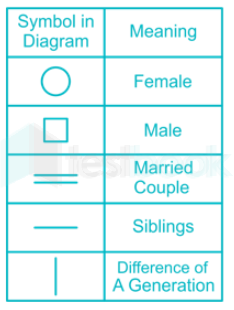
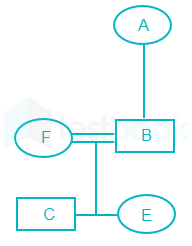
  • It receives more precipitation than the BW either from the intertropical convergence zone or from mid-latitude cyclones. Once again, the additional letters h and k are used generally to distinguish whether the dry semiarid climate is found in the subtropics or in the mid-latitudes, respectively.

Moist Subtropical Mid-Latitude Climates (C)

  • This climate generally has warm and humid summers with mild winters.
  • Its extent is from 30 to 50° of latitude mainly on the eastern and western borders of most continents.
  • During the winter, the main weather feature is the mid-latitude cyclone. Convective thunderstorms dominate the summer months.
  • Three minor types exist Cfa - humid subtropicalCs - Mediterranean; and Cfb - marine.
  • The humid subtropical climate (Cfa) has hot muggy summers and frequent thunderstorms.
  • Winters are mild and precipitation during this season comes from mid-latitude cyclones.
  • A good example of a Cfa climate is the southeastern USA.
  • Cfb marine climates are found on the western coasts of continents.
  • They have a humid climate with short dry summer. Heavy precipitation occurs during the mild winters because of the continuous presence of mid-latitude cyclones.
  • Mediterranean climates (Cs) receive rain primarily during the winter season from the mid-latitude cyclone.
  • Extreme summer aridity is caused by the sinking air of the subtropical highs and may exist for up to 5 months.
  • Locations in North America are from Portland, Oregon to all of California.

Moist Continental Mid-latitude Climates (D)

  • Moist continental mid-latitude climates have warm to cool summers and cold winters.
  • The location of these climates is poleward of the C climates.
  • The average temperature of the warmest month is greater than 10° Celsius, while the coldest month is less than -3° Celsius.
  • Winters are severe with snowstorms, strong winds, and bitter cold from Continental Polar or Arctic air masses.
  • Like the C climates there are three minor types: Dw - dry wintersDs - dry summers; and Df - wet all seasons.

Polar Climates (E)

  • Polar climates have year-round cold temperatures with the warmest month less than 10° Celsius.
  • Polar climates are found on the northern coastal areas of North America, Europe, Asia, and on the landmasses of Greenland and Antarctica.
  • Two minor climate types exist.
  • ET or polar tundra is a climate where the soil is permanently frozen to depths of hundreds of meters, a condition known as permafrost. Vegetation is dominated by mosses, lichens, dwarf trees, and scattered woody shrubs.
  • EF or polar ice caps have a surface that is permanently covered with snow and ice.

105

In which continent is the country Brazil located?

  1. ((a))

    North America

  2. ((b))

    Africa

  3. ((c))

    South America

  4. ((d))

    Europe

Show Answer
Answer: ((c))

South America

The correct answer is South America.

  • South America continent is the country Brazil is located.

Key Points 

  • Brazil is the largest country by area and the most populous country in South America.
  • Brasilia is the capital of Brazil.
  • Brazilian Real is the currency of Brazil.
  • Portuguese is the official language of Brazil.
  • Lula da Silva is the President of Brazil.

 Additional Information

South America

  • South America is the fourth-largest continent in the world.
  • South America is bordered on the west by the Pacific Ocean and on the north and east by the Atlantic Ocean, North America and the Caribbean Sea lie to the northwest.
  • It is situated between the Atlantic and the Pacific Oceans.
  • It is connected to North America through the Isthmus of Panama.

North America

  • North America is the third-largest continent by area.
  • North America is the fourth largest continent by population.
  • North America is a continent in the Northern Hemisphere and almost entirely within the Western Hemisphere.
  • North America lying for the most part between the Arctic Circle and the Tropic of Cancer.
  • The United Nations formally recognizes North America as comprising three areas: Northern America, Central America, and the Caribbean.

Africa

  • Africa is the second-largest continent in the world.
  • Africa is the second-most populous continent in the world.
  • The number of countries by continent - Africa.
  • African population is considered the youngest of all continents.
  • Africa is the most centrally located continent in the world, with both the prime meridian (0 degrees longitude), and the equator (0 degrees latitude) cut across it.
  • Africa is surrounded by the Red Sea to the northeast, the Indian Ocean to the southeast, the Mediterranean Sea to the north, Atlantic Ocean to the west, and Isthmus of Suez.
  • Africa is the hottest continent in the world.

Europe

  • Europe is the second smallest continent in the world by area after Australia.
  • Europe is a continent located entirely in the Northern Hemisphere and mostly in the Eastern Hemisphere.
  • Europe is bordered by the Arctic Ocean to the north, the Atlantic Ocean to the west, the Mediterranean Sea to the south, and Asia to the east.
  • Russia is the largest and most populous country in Europe.
  • Vatican City is in Rome, Italy is the smallest country in the world both in terms of area and population.
  • Europe comprises around 11% of the world’s population.
  • Europe covers about 10,180,000 km2 (3,930,000 sq mi), or 2% of the Earth's surface (6.8% of land area)​
ContinentsNumber of Countries
Africa54
Asia48
Europe44
North America23
South America12
Australia/Oceania14
Antarctica0

Important Points

  • Largest Continent - Asia.
  • Smallest Continent - Australia.
  • Africa is known as the "Dark Continent".
  • Antarctica is the least populated continent.
  • The most populous continent in the world  - Asia.
  • Canada has the longest coastline in the world.
  • Russia is part of both Europe and Asia.

Map of South American Countries:

106

Which of the following is the lowest place of Earth?

  1. ((a))

    Death Valley

  2. ((b))

    Caspian Sea

  3. ((c))

    Dead Sea

  4. ((d))

    Sundarban Delta

Show Answer
Answer: ((c))

Dead Sea

The correct answer is Dead Sea.

  • Dead Sea is the lowest place on Earth.

Key Points

  • The Dead Sea is a salt lake bordered by Jordan to the east and Israel and the West Bank to the west.
  • It lies in the Jordan Rift Valley, and its main tributary is the Jordan River.
  • The lake's surface is 430.5 meters below sea level, making its shores the lowest land-based elevation on Earth.

Additional Information

Death Valley

  • Death Valley is a desert valley in Eastern California, in the northern Mojave Desert, bordering the Great Basin Desert.
  • It is one of the hottest places on Earth, along with deserts in the Middle East and the Sahara.

Caspian Sea

  • The Caspian Sea is the largest inland body of water in the world and accounts for 40 to 44% of the total lacustrine waters of the world.
  • It lies between Europe and Asia; east of the Caucasus, west of the broad steppe of Central Asia, south of the fertile plains of Southern Russia in Eastern Europe, and north of the mountainous Iranian Plateau of Western Asia.
  • It covers 371,000 km2 and a volume of 78,200 km3.

Sundarban Delta

  • Sundarbans is a mangrove area in the delta formed by the confluence of the Ganges, Brahmaputra, and Meghna Rivers in the Bay of Bengal.
  • It is located across the South 24 Parganas and North 24 Parganas districts of West Bengal.
  • It spans from the Hooghly River in India's state of West Bengal to the Baleswar River in Bangladesh's division of Khulna.
  • Four protected areas in the Sundarbans are enlisted as UNESCO World Heritage Sites, viz. Sundarbans National Park, Sundarbans West, Sundarbans South and Sundarbans East Wildlife Sanctuaries.

Important Points

  • Sundarban Delta is the largest delta in the world.
  • The Caspian Sea is the largest salt lake in the world.
107

Who among the following was elected as the Managing Director of IMF on September 25, 2019?

  1. ((a))

    Abebe Aemro Selassie

  2. ((b))

    Kristalina Georgieva

  3. ((c))

    Tao Zhang

  4. ((d))

    Gita Gopinath

Show Answer
Answer: ((b))

Kristalina Georgieva

The correct answer is Kristalina Georgieva.

  • Kristalina Georgieva was elected as the Managing Director of IMF on September 25, 2019.

Key Points

  • Kristalina Georgieva is a Bulgarian Economist.
  • Abebe Aemro Selassie is the Director of the African Department at the IMF, a position he has held since 2016.
  • Gita Gopinath was appointed as Chief Economist of IMF from 1st October 2018.

Additional Information

  • IMF is an international financial institution formed on 27th December 1945.
  • The IMF was originally created in 1945 as part of the Bretton Woods Agreement 1944, which attempted to encourage international financial cooperation by introducing a system of convertible currencies at fixed exchange rates.
  • At the Bretton Woods Conference primarily by the ideas of Harry Dexter White and John Maynard Keynes.
  • The IMF is an organization of 189 countries.
  • The main objectives of IMF are
  • To foster global monetary cooperation.
  • To secure financial stability.
  • To facilitate international trade
  • To promote high employment and sustainable economic growth.
  • To reduce poverty around the world.

Important Points

  • The current Managing Director - Kristalina Georgieva.
  • The current Deputy Managing Director of IMF - Geoffrey W. S. Okamoto.
  • Headquarter of IMF - Washington DC.
  • The first Managing Director of IMF - Dr. Camille Gutt.
  • The First Deputy Managing Director of IMF - Andrew N Overby.
  • The first Chief Economist of IMF - Edward M. Bernstein.
108

Which of the following is a recent innovative initiative by PM Modi along with the UN chief Antino Guterres and other world leaders at UN, under which an agreement is made to plant 150 trees?

  1. ((a))

    Gandhi Era of Violence

  2. ((b))

    Gandhi Solar System

  3. ((c))

    Gandhi Peace Garden

  4. ((d))

    Gandhi Alliance Group

Show Answer
Answer: ((c))

Gandhi Peace Garden

The correct answer is Gandhi Peace Garden.

  • Gandhi Peace Garden is a recent innovative initiative by PM Modi along with the UN chief Antino Guterres and other world leaders at UN, under which an agreement is made to plant 150 trees.

Key Points

  • Modi was also joined by South Korean President Moon Jae-in, Singapore Prime Minister Lee Hsien Loong, Bangladesh Prime Minister Sheikh Hasina, Jamaican Prime Minister Andrew Holness, and New Zealand Prime Minister Jacinda Ardern remotely inaugurated the 50-kilowatt Gandhi Solar Park and the Gandhi Peace Garden at the UN Headquarters.
  • The special commemorative event 'Leadership Matters: Relevance of Gandhi in the Contemporary World' was hosted by Modi on September 24, to mark Gandhi's 150th birth anniversary.

Additional Information

  • The United Nations is an intergovernmental organization aiming to maintain international peace and security, develop friendly relations among nations, achieve international cooperation, and be a center for harmonizing the actions of nations.
  • It is the world's largest, and most familiar, international organization.
  • United Nations is celebrated on 24th October every year since 1948.
  • The UN is headquartered on international territory in New York City.
  • The other main offices are in Geneva, Nairobi, Vienna, and The Hague.
  • The UN was established after World War II with the aim of preventing future wars, succeeding the ineffective League of Nations.
  • On 25th April 1945, 50 governments met in San Francisco for a conference and started drafting the UN Charter.
  • UN was adopted on 25th June 1945.
  • UN took effect on 24th October 1945.
  • The official languages are Arabic, Chinese, English, French, Russian, and Spanish.
  • The UN has six principal organs:
  • The General Assembly
  • The Security Council
  • The Economic and Social Council (ECOSOC)
  • The Trusteeship Council
  • The International Court of Justice
  • The UN Secretariat.
  • The UN System includes a multitude of specialized agencies, funds, and programmes such as the World Bank Group, the World Health Organization, the World Food Programme, UNESCO, and UNICEF.

Important Points

  • The current Secretary-General of UNO - António Guterres.
  • The current Deputy Secretary-General - Amina J. Mohammed.
  • The first Secretary-General of UNO - Trygve Lie.
  • Narendra Damodardas Modi is an Indian politician serving as the 14th and current Prime Minister of India since 2014.
  • He was the Chief Minister of Gujarat from 2001 to 2014 and is a member of Parliament for Varanasi.
  • Modi is a member of the Bharatiya Janata Party and its National Democratic Alliance.
  • He is also a member of the Rashtriya Swayamsevak Sangh (RSS), a Hindu nationalist volunteer organization.
  • He is the first Prime Minister born after India's independence.
  • He is the second non-Congress one to win two consecutive terms after Atal Bihari Vajpayee and the first from outside the Congress to win both terms with a majority in the Lok Sabha.
  • Second Prime Minister to visit Siachen Glacier.
109

What is the name of the tallest tower of Sri Lanka that was unveiled in Colombo city in September 2019?

  1. ((a))

    Lotus Tower

  2. ((b))

    Ping Tower

  3. ((c))

    Lion Tower

  4. ((d))

    Lanka Tower

Show Answer
Answer: ((a))

Lotus Tower

The correct answer is Lotus Tower.

  • Lotus Tower is the name of the tallest tower of Sri Lanka that was unveiled in Colombo city in September 2019.

Key Points

  • The Lion Tower is a small fortress located at the far eastern end of the Tripoli harbor in North Lebanon.
  • The Ping An International Finance Center (also known as the Ping An IFC)  is a 115-story, 599 m (1,965 ft) supertall skyscraper in Shenzhen, Guangdong, China, and the 4th tallest building in the world.

Additional Information

  • Lotus Tower, also referred to as Colombo Lotus Tower is a tower 350 m high, located in Colombo, Sri Lanka.
  • Lotus Tower is called a symbolic landmark of Sri Lanka.
  • As of 2019, the tower is the tallest self-supported structure in South Asia.
  • Lotus Tower is the second tallest structure in South Asia after the guy-wire-supported INS Kattabomman in India.
  • Lotus Tower is the 11th tallest tower in Asia and the 19th tallest tower in the world.
  • It was first proposed to be built in the suburb of Peliyagoda but later the Government of Sri Lanka decided to change the location.
  • The lotus-shaped tower is used for communication, observation, and other leisure facilities.
  • The construction cost $104.3 million.
  • The tower was opened to the public on 16th September 2019 by President Maithripala Sirisena.
  • Sri Lanka, formerly known as Ceylon.
  • Sri Lanka is an island country in South Asia.
  • It is separated from the Indian subcontinent by the Gulf of Mannar and the Palk Strait.
  • Capital of Sri Lanka - Sri Jayawardenepura Kotte ( Legislative), Colombo (Executive and Judiciary).
  • Currency of Sri Lanka -  Sri Lankan Rupee.
  • The official language of Sri Lanka - Sinhala.
  • The largest city in Sri Lanka - Colombo.
  • President of Sri Lanka - Gotabaya Rajapaksa.
  • Prime Minister of Sri Lanka - Mahinda Rajapaksa.

Important Points

  • Sri Lanka is the highest-ranked South Asian nation on the Human Development Index.
  • Sri Lanka is the second-highest per capita income in South Asia.
110

The Fourth Indian Ocean Conference, 2019, was held in which of the following places?

  1. ((a))

    Hanoi

  2. ((b))

    Colombo

  3. ((c))

    Singapore

  4. ((d))

    Male

Show Answer
Answer: ((d))

Male

The correct answer is Male.

  • The Fourth Indian Ocean Conference, 2019, was held in Male.

Additional Information

  • The fourth Indian Ocean Conference 2019 was recently held in Male, the capital of Maldives.
  • The two-day conference was held from 3-4 September 2019.
  • It was organised by India Foundation based in New Delhi, in association with the Government of the Maldives and S Rajaratnam School of International Studies (RSIS) in Singapore.
  • Indian External Affairs Minister S. Jaishankar was one of the speakers at the Indian Ocean Conference 2019 event.
  • The theme for the 4th Indian Ocean Conference 2019 was: ‘Securing the Indian Ocean Region: Traditional and Non-Traditional Challenges’.
  • This edition of the conference will provide yet another opportunity for stakeholders of the Indian Ocean Region (IOR) to deliberate on building an institutional framework for managing the threats to regional peace and human security.
  • Chair of the conference - Sri Lankan Prime Minister Ranil Wickremesinghe.
  • Conference discussion themes were grouped under 3 broad categories:
  • Marine Ecology: Climate Change, Global warming and the consequent rise of sea levels, pollution, the sustainable harnessing of oceanic resources.
  • Navigational Security: Freedom of navigation, United Nations Convention on Law of the Sea (UNCLOS) and its effective implementation, natural and manmade hazards to navigation, piracy.
  • Terrorism: The rising spectre of terrorism in IOR, marine terrorism Importance of IOR.
  • The key issues for IOR underlined during the conference include:
  • Climate change, rising seawater levels.
  • Hazardous levels of sea pollution are leading to the depletion of marine livestock.
  • The illegal, unreported, and unregulated (IUU) fishing elude consensus in international deliberation.
  • Proper implementation of maritime laws under UNCLOS.
  • Combating illicit trafficking of humans and narcotics.

Important Points

CountryCapitalCurrencyLanguagePresident
MaldivesMaleMaldivian RufiyaaDhivehiIbrahim Mohamed Solih
VietnamHanoiVietnamese DongVietnameseNguyen Xuan Phuc
Sri LankaColomboSri Lankan RupeeSinhalaGotabaya Rajapaksa
SingaporeSingapore CitySingapore DollarEnglish, MalayHalimah Yacob
IndiaNew DelhiIndian RupeeHindiRam Nath Govind
111

United Nations observed World Day against Trafficking in Persons on _______, 2019.

  1. ((a))

    August 29th

  2. ((b))

    July 30th

  3. ((c))

    September 9th

  4. ((d))

    October 1st

Show Answer
Answer: ((b))

July 30th

The correct answer is July 30th.

  • United Nations observed World Day against Trafficking in Persons on July 30th, 2019.

Key Point

  • The 2021 theme for the World Day Against Trafficking in Persons is 'Victims' voices lead the way.'
  • This year’s theme puts victims of human trafficking at the centre of the campaign and will highlight the importance of listening to and learning from survivors of human trafficking.

Additional Information

  • The United Nations is an intergovernmental organization aiming to maintain international peace and security, develop friendly relations among nations, achieve international cooperation, and be a center for harmonizing the actions of nations.
  • It is the world's largest, and most familiar, international organization.
  • United Nations is celebrated on 24th October every year since 1948.
  • The UN is headquartered on international territory in New York City.
  • The other main offices are in Geneva, Nairobi, Vienna, and The Hague.
  • The UN was established after World War II with the aim of preventing future wars, succeeding the ineffective League of Nations.
  • On 25th April 1945, 50 governments met in San Francisco for a conference and started drafting the UN Charter.
  • UN was adopted on 25th June 1945.
  • UN took effect on 24th October 1945.
  • The official languages are Arabic, Chinese, English, French, Russian, and Spanish.
  • The UN has six principal organs:
  • The General Assembly
  • The Security Council
  • The Economic and Social Council (ECOSOC)
  • The Trusteeship Council
  • The International Court of Justice
  • The UN Secretariat.
  • The UN System includes a multitude of specialized agencies, funds, and programs such as the World Bank Group, the World Health Organization, the World Food Programme, UNESCO, and UNICEF.

Important Points

  • The current Secretary-General of UNO - António Guterres.
  • The current Deputy Secretary-General - Amina J. Mohammed.
  • The first Secretary-General of UNO - Trygve Lie.
  • August 29th - National Sports Day.
  • October 1st - International Day of the Older Persons.
112

Prime Minister Shri Narendra Modi launched the Fit India Movement at a ceremony in New Delhi on the occasion of National Sports Day on _______, 2019.

  1. ((a))

    25th September

  2. ((b))

    29th August

  3. ((c))

    13th July

  4. ((d))

    11th October

Show Answer
Answer: ((b))

29th August

The correct answer is 29th August.

  • Prime Minister Shri Narendra Modi launched the Fit India Movement at a ceremony in New Delhi on the occasion of National Sports Day on 29th August 2019.

Key Points

  • The National Sports Day in India is celebrated on August 29  annually on the birth anniversary of the legendary Hockey player and Olympian Major Dhyan Chand.
  • National Sports Day is also called with the name Rashtriya Khel Divas.
  • Recently Prime Minister Narendra Modi has announced that Rajiv Gandhi Khel Ratna Award will be renamed as Major Dhyan Chand Khel Ratna Award.
  • Major Dhyan Chand Khel Ratna Award is the highest sporting honour of the Republic of India.
  • It is awarded annually by the Ministry of Youth Affairs and Sports.

Additional Information

Narendra Damodardas Modi

  • Narendra Damodardas Modi is an Indian politician serving as the 14th and current Prime Minister of India since 2014.
  • He was the Chief Minister of Gujarat from 2001 to 2014 and is a member of Parliament for Varanasi.
  • Modi is a member of the Bharatiya Janata Party and its National Democratic Alliance.
  • He is also a member of the Rashtriya Swayamsevak Sangh (RSS), a Hindu nationalist volunteer organization.
  • He is the first Prime Minister born after India's independence.
  • He is the second non-Congress one to win two consecutive terms after Atal Bihari Vajpayee and the first from outside the Congress to win both terms with a majority in the Lok Sabha.
  • Second Prime Minister to visit Siachen Glacier.

Important Points

  • India's first sports Museum was started at Patiala.National sports of India - Hockey.
  • The current Minister of Youth Affairs and Sports - Anurag Thakur.
  • On 25th September 2014 'Antyodaya Diwas'  in honor of Pandit Deen Dayal Upadhyaya's 98th Birth Anniversary.
  • 11th October - International Day of the Girl Child.
  • 13th July - National French Fry-day.
113

"Kalvi Tholaikatchi", the exclusive education TV channel aimed at benefiting students, was launched by the Chief Minister of which Indian State?

  1. ((a))

    Karnataka

  2. ((b))

    Andhra Pradesh

  3. ((c))

    Kerala

  4. ((d))

    Tamil Nadu

Show Answer
Answer: ((d))

Tamil Nadu

The correct answer is Tamil Nadu.

  • "Kalvi Tholaikatchi", the exclusive education TV channel aimed at benefiting students, was launched by the Chief Minister of Tamil Nadu.

Additional Information

  • All the Current Information as of October 2021.

Tamil Nadu

  • State Formed: 26th November 1950
  • Capital: Chennai
  • Chief Minister: M K Stalin
  • Governor: R. N. Ravi
  • Official Language: Tamil
  • Deepavali and Pongal are the important traditional festivals of Tamil Nadu.
  • The Western Ghats and the Eastern Ghats intersect at Nilgiri in Tamil Nadu.
  • Marina beach is the longest beach in India is located in Chennai.
  • Tamil Nadu is known as the 'Fort of Local Political Parties'.
  • Tamil Nadu is the first Indian state which is fully computerized its Panchayaths.
  • Tamil Nadu is the first Indian state to ban lotteries.
  • Tamil Nadu is the first Indian state to ban mobile phones in assembly halls.
  • Tamil is the first language to get the status of classical language and the oldest Dravidian language.
  • First Biosphere Reserve in India - Nilgiri in Tamil Nadu.
  • The largest producer of Coconut and Banana.
  • Queen of Mountains in South IndiaOoty in Tamil Nadu.
  • Central Sugarcane Breeding Institute - Coimbatore in Tamil Nadu.
  • Headquarter of Southern RailwayChennai Tamil Nadu

Karnataka

  • State Formed: 1st November 1956
  • The old name of Karnataka was Mysore.
  • Mysore is the cultural capital of Karnataka.
  • Mysore became Karnataka on 1st November 1973.
  • Kempe Gowda is the architect of Bengaluru City.
  • India's first cyber police station was set up in Bengaluru.
  • Karnataka is the first state in India to launch a health Adalat.
  • The headquarter of ISRO is in Bengaluru.
  • Bengaluru is known as the 'Electronics city', 'City of Suicide', 'Silicon valley of India'.
  • The biggest dome in India is at Bijapur, Karnataka.
  • Kolar gold mine is situated in Karnataka.
  • Tipu Sultan Muesem is loctaed at Srirangapattanam.
  • Kodagu is known as the 'Cradle of Indian Hockey'.
  • Capital: Bengaluru.
  • Chief Minister: Basavaraj Bommai.
  • Governor: Thawar Chand Gehlot.
  • Official Language: Kannada

Andhra Pradesh

  • State Formed: 1st November 1956
  • Andhra Pradesh is the first state formed on a linguistic basis.
  • Capital: Amaravati (Legislative Capital), Visakhapatnam (Executive Capital), Kurnool (Judicial Capital).
  • Chief Minister: Y. S. Jaganmohan Reddy. (April 2021)
  • Governor: Biswabhusan Harichandan. (April 2021)
  • State Animal: Black Buck.
  • State Bird: Parrot.
  • State Tree: Neem.
  • State Flower: Jasmine.
  • Sriharikota is the only satellite launching station in India.
  • Kolleru in Andhra Pradesh is one of the largest freshwater lakes in India.
  • Andhra Pradesh is known as the 'Kohinoor of India'.
  • Andhra Pradesh is known as the 'Granary of South India' and Egg Bowl of India.
  • India's first submarine museum was set up in Vishakapatnam.
  • Andhra Pradesh is the first South Indian state to implement Panchayat Raj.
  • The famous temple Tirupati is in Andhra Pradesh.

Kerala

  • State Formed: 1st November 1956
  • Kerala is known as 'God's Own Country.
  • Kerala is the 'Spice Garden of India'.
  • Kerala is the state having the highest literacy rate in India.
  • Kerala is the first state in India to achieve 100% primary education.
  • Kerala is the state having the highest sex ratio in India.
  • Kerala is the first baby-friendly state in India.
  • Kerala is the first total banking state in India.
  • Kerala is the first state in India to set up Disaster Management Authority.
  • Kathakali and Mohiniyattam is a classical dance form of Kerala
  • Capital: Thiruvananthapuram
  • Chief Minister: Pinarayi Vijayan
  • Governor: Arif Mohammad Khan
  • Official Language: Malayalam
114

Which from the following is the Humanoid Robot that Russia has launched into space in August 2019?

  1. ((a))

    Skybot B-830

  2. ((b))

    Skybot B-730

  3. ((c))

    Skybot A-803

  4. ((d))

    Skybot A-308

Show Answer
Answer: ((a))

Skybot B-830

The correct answer is Skybot B-830.

  • Skybot B-830 is the Humanoid Robot that Russia has launched into space in August 2019.

Additional Information

  • Russia sends its first humanoid robot Fedor into space.
  • Named Fedor, short for Final Experimental Demonstration Object Research, the robot is the first-ever sent up by Russia.
  • The robot, which launched toward the International Space Station on Aug. 22, 2019, blasted off on a test flight so Russian cosmonauts wouldn't have to risk their lives testing whether their Soyuz spacecraft could safely fly on an upgraded Soyuz 2.1a rocket.
  • The mission was part of the verification process by Russia's space agency Roscosmos to prepare its crewed Soyuz capsules for future launches on the upgraded Soyuz.
  • The mission also marked the first spaceflight of a humanoid robot for Russia.

Important Points

  • Capital of Russia - Moscow.
  • Currency of Russia - Russian Rubble.
  • Language of Russia - Russian.
  • President of Russia - Vladimir Putin.
115

The theme of National Statistics Day observed on 29th June, 2019 was:

  1. ((a))

    Sustainable Development Goals (SDGs)

  2. ((b))

    Quality Assurance in Official Statistics

  3. ((c))

    Administrative Statistics

  4. ((d))

    Social Development

Show Answer
Answer: ((a))

Sustainable Development Goals (SDGs)

The correct answer is Sustainable Development Goals (SDGs).

  • The theme of National Statistics Day observed on 29th June 2019 was Sustainable Development Goals (SDGs)

Key Points

  • Father of Indian Statistics - P. C. Mahalanobis.
  • Indian Statistics day is observed on June 29 (the birthday anniversary of  P. C. Mahalanobis).
  • The theme of National Statistics Day 2021 is Sustainable Development Goals (SDGs)-2  (End Hunger, Achieve Food Security and Improved Nutrition and Promote Sustainable Agriculture).
  • The theme of National Statistics Day 2020 was SDG- 3 (Ensure healthy lives and promote well-being for all at all ages) & SDG- 5 (Achieve gender equality and empower all women and girls).
  • In 2019 the theme of Statistics Day was “Sustainable Development Goals (SDGs)”.

Additional Information

  • Census is an official enumeration of the population from time to time.
  • Census has been conducted every 10 years by the Registrar General and Census Commissioner of India under the Ministry of Home Affairs.
  • The 16th Indian census will be taken in 2021.
  • In September 2019, Union Home Minister Amit Shah had stated that the 2021 national census would be held fully digitally through a mobile phone application.
  • In February 2021, Union Finance Minister Nirmala Sitharaman confirmed in her budget speech that the 2021 census will be the first-ever digital census in India.
  • 2021 census will be carried out in 16 languages.
  • The 15th Indian census was taken in 2011.
  • India is the second most populated country in the world.
  • The population in India is 139 crores.
  • India has 17.7% of the world's population.
  • The population density in India is 464 per km2.
  • The first census in India was conducted by the Viceroy - Lord Mayo (1872).
  • The first official census in India was conducted by the Viceroy - Lord Rippon (1881).

Important Points

  • The state with the highest literacy rate - Kerala.
  • The state with the lowest literacy rate - Bihar.
  • The most populous state in India - Uttar Pradesh.
  • The least populous state in India - Sikkim.
  • The state with the highest population growth rate - Meghalaya.
  • The state with the least population growth rate - Nagaland.
  • The most densely populous state in India - West Bengal.
  • The least densely populous state in India - Arunachal Pradesh.
  • The state with the highest sex ratio - Kerala.
  • The state with the lowest sex ratio - Haryana.
  • The state with the highest literacy rate - Kerala.
  • The state with the lowest literacy rate - Bihar.
  • The most populous Union Territory in India - Delhi.
  • The least populous Union Territory in India - Lakshadweep.
  • The most densely populous Union Territory in India - Delhi.
  • The least densely populous Union Territory in India - Andaman Nicobar Islands.
  • The Union Territory with the highest sex ratio - Puducherry.
  • The Union Territory with the lowest sex ratio - Daman and Diu and Dadra and Nagar Haveli.
  • The Union Territory with the highest literacy rate -  Lakshadweep.
  • The Union Territory with the lowest literacy rate - Daman and Diu and Dadra and Nagar Haveli.
116

Who among the following has been elected as the new President of Federation of Indian Export Organisations (FIEO)?

  1. ((a))

    Sushil Patwari

  2. ((b))

    Sharad Kumar Saraf

  3. ((c))

    Mahesh Chandra Keyal

  4. ((d))

    Ajay Sahai

Show Answer
Answer: ((b))

Sharad Kumar Saraf

The correct answer is Sharad Kumar Saraf.

  • Sharad Kumar Saraf has been elected as the new President of the Federation of Indian Export Organisations (FIEO).

Key Points

  • Mr. Sakthivel is the current President of FIEO (As of Oct 2021).
  • Mr. Sakthivel is also the Chairman of the Apparel Export Promotion Council (AEPC) and has served as a top functionary in Tiruppur Exporters’ Association.
  • Mr. Mahesh Chandra Keyal has been unanimously elected the new Vice-President of FIEO.
  • Sushil Patwari is appointed the managing director and Chairman of Nagreeka Capital & Infrastructure Ltd.

Additional Information

  • Federation of Indian Export Organisations (FIEO) is the apex trade promotion organization in India set up by the Ministry of Commerce, Government of India, and the private trade and industry segment.
  • The Federation of Indian Export Organisations is formed in 1965.
  • The organization is responsible for representing and assisting Indian entrepreneurs and exporters in foreign markets.
  • New Delhi is the headquarter of FIEO.
  • FIEO is the premier body comprising of export promotion councils, export development authorities, and commodity boards in India.
  • It provides a crucial interface between the international trading community of India and the central & state governments, ports, railways, financial institutions, surface transport, etc in export trade facilitation.
  • The Union Minister of Commerce & Industry, Piyush Goyal, launched the “Ease of Logistic Portal” on September 27, 2021.
  • The minister noted that the ‘Rules of Business’ have to be the same for all stakeholders.
  • Portal was launched during ‘Vanijya Saptah Samapan Samaroh’, which was organised by FIEO.
  • On 8 August 2018, Suresh Prabhu, the Commerce, and Industry Minister launched the Niryat Mitra application.
  • The Ministry of Commerce and Industry administers two departments:
  • Department of Commerce.
  • Department for Promotion of Industry & Internal Trade (formerly Department of Industrial Policy & Promotion).

Important Points

  • The current President of FIEO - Dr. A. Sakthivel.
  • The current Vice-President of FIEO - Khalid M Khan.
  • Director-General and CEO of FIEO - Ajay Sahai.
  • Ministry of Commerce and Industry - Piyush Goyal.
  • The first Minister of Commerce and Industry of independent India - Shyama Prasad Mukherjee.
117

The 24th World Energy Congress was held from 9th - 12th September 2019, in _______

  1. ((a))

    Istanbul

  2. ((b))

    Daegu

  3. ((c))

    Abu Dhabi

  4. ((d))

    Moscow

Show Answer
Answer: ((c))

Abu Dhabi

The correct answer is Abu Dhabi.

  • The 24th World Energy Congress was held from 9th - 12th September 2019, in Abu Dhabi.

Key Points

  • The 24th World Energy Congress was held in Abu Dhabi, at the Abu Dhabi National Exhibition Centre, United Arab Emirates (UAE) from 9-12 September 2019.
  • It was held under the patronage of Sheikh Khalifa bin Zayed Al Nahyan, President of UAE.
  • The theme of the 24th World Energy Congress: ‘Energy for Prosperity.
  • This theme also represents the ambitious and dynamic energy transition of the UAE.
  • The objective of the 24th World Energy Congress is to bring together international energy stakeholders including governments, academia and media, private and state corporations.
  • The Congress welcomed more than 15,000 participants including 72 Ministers, 250 high-level speakers, 500 CEOs, 1000 media persons with 40,000 square-meter exhibition space that will cover the entire energy spectrum.

Additional Information

  • The World Energy Council is a global forum for thought-leadership and tangible engagement.
  • Its mission is 'To promote the sustainable supply and use of energy for the greatest benefit of all people'.
  • The headquarters of the World Energy Council in London, United Kingdom.
  • With over 150 countries represented, WEC is the world’s largest and most influential energy event that covers all aspects of the energy agenda.
  • It is a global flagship event of the World Energy Council.
  • It offers a unique platform for global energy leaders to explore new energy futures, new strategies, and critical innovation areas.
  • The congress enables dialogue amongst Ministers, CEOs, policy-makers, and industry practitioners on critical developments in the energy sector.
CountryCapitalCurrencyLanguagePresident
UAEAbu DhabiUAE DirhamArabicKhalifa bin Zayed Al Nahyan
TurkeyAnkaraTurkish LiraTurkishRecep Tayyip Erdogan
RussiaMoscowRussian RubbleRussianVladimir Putin
South KoreaSeoulKoreanMoon Jae-in

Important Points

  • The 22nd World Energy Congress was held in Daegu, South Korea in 2013.
  • The 23rd World Energy Congress was held in Istanbul, Turkey in 2016.
  • The 25th World Energy Congress was held from 18th - 20th May 2022, in St. Peterburg, Russia.
118

Which of the following country ranks 1st in the IMD World Digital Competitiveness Ranking 2019?

  1. ((a))

    USA

  2. ((b))

    Netherlands

  3. ((c))

    India

  4. ((d))

    China

Show Answer
Answer: ((a))

USA

The correct answer is USA.

  • USA ranks 1st in the IMD World Digital Competitiveness Ranking 2019.

 Key Points

  • The ranking measures the readiness and capacity of 63 economies to adopt digital technologies.
  • It gives its ranking based on the digital exploration skills of the economies for economic transformation in governance, business, and society.
  • The yearbook is published by the Swiss-based International Institute for Management Development.
  • The yearbook is being published since 1989. However, the ranking was begun in 2017.
  • The rank of India advanced 4 places from 48th to the 44th.

Additional Information

USA

  • The USA is the fourth-largest country in the world.
  • The USA is the world's largest economy by GDP.
  • Washington DC is the capital of the USA.
  • New York is the largest city in the USA.
  • US Dollar is the currency of the USA.
  • English is the official language of the USA.
  • Joe Biden is the President of the USA.
  • Kamala Harris is the vice President of the USA

Netherlands

  • The Netherlands is formerly known as Holland.
  • Amsterdam is the capital of the Netherlands.
  • Euro is the currency of the Netherlands.
  • Dutch is the official language of the Netherlands.
  • Mark Rutte is the Prime Minister of the Netherlands.

China

  • China is the third-largest country in the world.
  • China is the most populous country in the world.
  • Beijing is the capital of China.
  • Shanghai is the largest city in China.
  • Renminbi is the currency of China.
  • Chinese is the official language of China.
  • Xi Jinping is the President of China.

India

  • India is the seventh-largest country in the world.
  • India is the second-most populous country in the world.
  • New Delhi is the capital of India.
  • Indian Rupee is the currency of India.
  • Ram Nath Govind is the President of India.
  • National Flag - Tricolor Flag.
  • National Anthem - Jana Gana Mana.
  • National Song - Vande Mataram.
  • National Language - Hindi.
  • National Bird - Peacock.
  • National Animal - Tiger.
  • National Fruit - Mango.
  • National Flower - Lotus.
  • National Tree - Banyan tree.
  • National River - The Ganges.
  • National Aquatic Animal - The Ganges Dolphin.
  • National Heritage Animal - Elephant.
  • National Calendar - Saka Calendar.
  • National Fish - Ayakoora (King Mackarel)

Important Points

  • The top ten IMD World Digital Competitiveness Ranking 2019.


RankCountry
1USA
2Singapore
3Sweden
4Denmark
5Switzerland
6Netherlands
7Finland
8Hong Kong
9Norway
10Republic of Korea


  • The top ten IMD World Digital Competitiveness Ranking 2020.

119

Who among the following IPS Officer has been appointed as the next Director General (DG) of the country's largest border guarding force, BSF in July 2019?

  1. ((a))

    Ashok Kumar

  2. ((b))

    Vinod Chaubey

  3. ((c))

    Sanjeev Tripathi

  4. ((d))

    V. K. Johri

Show Answer
Answer: ((d))

V. K. Johri

The correct answer is V. K. Johri.

  • IPS Officer V. K. Johri has been appointed as the next Director General (DG) of the country's largest border guarding force, BSF in July 2019.

Key Points

  • Vinod Kumar Choubey was an Indian Police Service officer of the 1998 batch who was killed in an encounter with Naxalites in the Rajnandgaon ambush in July 2009.
  • Sanjeev Tripathi is a member of the BJP and former Chief of the Research and Analysis Wing, India's foreign intelligence service.

Additional Information

  • BSF has been termed as the First Line of Defence of Indian Territories.
  • The Border Security Force (BSF) is India's border guarding organization on its border with Pakistan and Bangladesh.
  • It is one of the five Central Armed Police Forces of India, and was raised in the wake of the 1965 War on 1 December 1965, "for ensuring the security of the borders of India and for matters connected there with".
  • It is the only CAPF to have a Full-fledged Water Wing, Air Wing, and even an Artillery Regiment of its own.
  • BSF comes under the Ministry of Home Affairs.
  • The BSF has its own cadre of officers but its head, designated as a Director-General (DG) since its raising has been an officer from the Indian Police Service.
  • The BSF has grown exponentially from a few battalions in 1965, to 186 battalions with a sanctioned strength of 257,363 personnel including an expanding Airwing, a Marine wing, An artillery regiment, and specialized units.
  • BSF currently stands as the world's largest border guarding force.

Important Points

  • The current Director-General of BSFPankaj Kumar Singh (As of Oct 2021).
  • The first Director-General of BSF - Khusro Faramurz Rustamji.
  • Headquarter of BSF - New Delhi.
  • The motto of BSF - Duty Unto Death.
  • The current Minister of Home Affairs - Amit Shah.
120

Which Indian sand artist has won the People's Choice Prize at the International Sand Sculpting Championship 2019, held in Boston city of US?

  1. ((a))

    Sudarsan Pattnaik

  2. ((b))

    Manas Kumar Sahoo

  3. ((c))

    Sudhir Kumar pandit

  4. ((d))

    Neha Umak

Show Answer
Answer: ((a))

Sudarsan Pattnaik

The correct answer is Sudarsan Pattnaik.

  • Sudarsan Pattnaik Indian sand artist has won the People's Choice Prize at the International Sand Sculpting Championship 2019, held in Boston city of US.

Image of Sudarsan Pattnaik:

Additional Information

  • Sudarsan Pattnaik won the People's Choice Prize at Boston International Sand Art Championship.
  • Renowned Indian sand artist and Padma Awardee Sudarsan Pattnaik have won the People's Choice Award at a prestigious sand sculpting festival in the U.S., wowing the American public with his sculpture that highlighted the message of combating plastic pollution in oceans.
  • Sudarshan Pattnaik has added another feather to his cap by bagging the People's Choice Prize at the Boston International Sand Art Championship.

Important Points

USA:

  • The USA is the fourth-largest country in the world.
  • The USA is the world's largest economy by GDP.
  • Washington DC is the capital of the USA.
  • New York is the largest city in the USA (By population).
  • US Dollar is the currency of the USA.
  • English is the official language of the USA.
  • Joe Biden is the President of the USA.
  • Kamala Harris is the Vice President of the USA
121

Two words separated by a ':', and bearing a certain relationship with each other, have been given on one side of "::'. From among the options, select the one that bears a similar relationship with the words given on the other side of  '::'.

Quiver : Arrows :: Scabbard : ?

  1. ((a))

    Baby

  2. ((b))

    Tennis Racket

  3. ((c))

    Binoculars

  4. ((d))

    Sword

Show Answer
Answer: ((d))

Sword

A quiver is a case that is used in carrying or holding arrows. 

Similarly, a scabbard is the cover or case of a sword.

The cases or covers of Binoculars and Tennis Racket are generally called covers.

Hence, "sword" is the correct option.

122

What will come in place of the question mark (?) in the following number series?

125, 171, 263, 401, 585, ?

  1. ((a))

    835

  2. ((b))

    815

  3. ((c))

    792

  4. ((d))

    788

Show Answer
Answer: ((b))

815

Calculation:

⇒ 125 + 46 = 171

⇒ 171 + 92 = 263

⇒ 263 + 138 = 401

⇒ 401 + 184 = 585

⇒ 585 + 230 = 815

∴ The value of ? is 815

123

Six friends, namely A, B, C, D, E and F, are sitting on a round table facing each other. C is at the fourth place from A's right. F is at the immediate right of A. C is between B and D. E is between B and F.

On the basis of the above conditions, select the statement that is not true.

  1. ((a))

    C is to the immediate left of A.

  2. ((b))

    F is between A and E.

  3. ((c))

    D is between A and C.

  4. ((d))

    D is sitting opposite E.

Show Answer
Answer: ((a))

C is to the immediate left of A.

1) C is at the fourth place from A's right.

As it is a circular arrangement, we can randomly pick a seat for A and then we can place C accordingly.

2)  F is at the immediate right of A.

3) E is between B and F.

It is only possible if we place E to the immediate right of F and B to the immediate left of C.

4) C is between B and D.

Implies, D is sitting to the immediate right of C.

Options:

  1. C is to the immediate left of A → It is not true as C is sitting second to the left of A.

2) F is between A and E → True

3) D is between A and C → True

4) D is sitting opposite E → True

Hence, "C is to the immediate left of A" is definitely not true and "option (1)" is correct.

124

The question given below is based on the following letter-number-symbol arrangement. Study it carefully and answer the given question.

@ J @ 1 # 2 K 3 6 L242R642G52 L 2 4 2 R 6 4 2 G 5 2  ∅ 4 2 %

Which letter/number/symbol will be the 7th letter to the left of the letter/number/symbol which is 3rd from the right?

  1. ((a))

    4

  2. ((b))

    3

  3. ((c))

    5

  4. ((d))

    1

Show Answer
Answer: ((a))

4

The given series:

@ J @ 1 # 2 K 3 6 L242R642G52 L 2 4 2 R 6 4 2 G 5 2  ∅ 4 2 %

In the above series, '4' is the third term from the right end. Also, the seventh term to the left of '4' is also '4'.

Left: @ J @ 1 # 2 K 3 6 $ L 2 4 2 R 6 4 2 G 5 2 $ ∅ 4 2 % Right

Hence, "4" is the 7th term to the left of the 3rd term from the right end.

125

How many sets of two letters have as many letters between them as they have in the alphabetical order in the word 'PRUDENT'?

  1. ((a))

    4

  2. ((b))

    0

  3. ((c))

    2

  4. ((d))

    3

Show Answer
Answer: ((c))

2

The given word: PRUDENT

  1. D is immediately followed by E in the word just like in the alphabet series.

  2. There are three letters between N and R in the word just like in the alphabet series.

Hence, there are "2" sets of letters that have as many letters between them as they have in the alphabetical order in the word 'PRUDENT.

126

Directions: In the following question below are given two statements followed by two conclusions numbered I and II. You have to take the two given statements to be true even if they seem to be at variance from commonly known facts and decide which of the given conclusion(s) logically follow(s) from the two given statements, disregarding commonly known facts.

Statements:

I. Some rats are rabbits.

II. Some rabbits are mosquitos.

Conclusions:

I. Some mosquitos must be rats.

II. All rabbits are rats.

Give answer as

  1. ((a))

    If only conclusion I follows

  2. ((b))

    If only conclusion II follows

  3. ((c))

    If both conclusions I and II follow

  4. ((d))

    If neither conclusion I nor conclusion II follows

Show Answer
Answer: ((d))

If neither conclusion I nor conclusion II follows

The Venn Diagram for the given data:

Conclusions:

I. Some mosquitos must be rats → False (There is no definite relation between Rat and Mosquitos. Therefore, it is possible but not definite.)

II. All rabbits are rats → False (Some rats being rabbits, implies, some rabbits are rats.)

Hence, "neither conclusion I nor conclusion II follows".

127

Directions: In the following question below are given a question and two statements numbered I and II. You have to decide whether the data provided in the statements are sufficient to answer the question. Read both the statements and give your answer.

What is the code for 'walks' in the code language?

Statements:

I. In the code language, 'she walks fast' is written as 'he ka to'.

II. In the code language, 'she learns fast' is written as 'jo ka he'.

  1. ((a))

    If the data in Statement I alone are sufficient to answer the question, while the data in Statement II alone are not sufficient to answer the question.

  2. ((b))

    If the data in Statement II alone are sufficient to answer the question, while the data in Statement I alone are not sufficient to answer the question.

  3. ((c))

    If the data in both the Statements I and II together are necessary to answer the question.

  4. ((d))

    If the data in both the Statements I and II are not sufficient to answer the question.

Show Answer
Answer: ((c))

If the data in both the Statements I and II together are necessary to answer the question.

Using statement I:

I. In the code language, 'she walks fast' is written as 'he ka to'.

We can not determine the code for "walks".

Using statement II:

II. In the code language, 'she learns fast' is written as 'jo ka he'.

Using this statement we can not determine the code for "walks".

By combining statements I and II:

I. In the code language, 'she walks fast' is written as 'he ka to'.

II. In the code language, 'she learns fast' is written as 'jo ka he'.

The words 'she' and 'fast' are common in both sentences and so are the codes 'he' and 'ka'. Implies, 'he' and 'ka' are the codes for 'she' and 'fast' but not necessarily in the same order.

It further implies that 'to' is the code for the word 'walks' and both statements are required to answer the question.

Hence, "data in both statements I and II together are necessary to answer the question".

128

If 'P × Q' means 'P is the daughter of Q', 'P + Q' means 'P is the father of Q'; 'P ÷ Q' means 'P is the mother of Q' and 'P - Q' means 'P is the brother of Q', then in the expression A ÷ B + C - E × F, how is A related to F?

  1. ((a))

    Mother-in-Law

  2. ((b))

    Aunt

  3. ((c))

    Daughter-in-law

  4. ((d))

    Sister-in-law

Show Answer
Answer: ((a))

Mother-in-Law

According to the question:

P is
×+÷-
DaughterFatherMotherBrother
of Q


 A ÷ B + C - E × F → A is the mother of B who is the father of C who is the brother of E who is the daughter of F.

As B is the father of C and E, and E is the daughter of F, implies, F is the wife of B.


Hence, A is the "mother-in-law" of F.

129

In a certain code, BREAKING is written as BFSCFMHJ. How will MOTHERLY be written in that code?

  1. ((a))

    IUPNZMSF

  2. ((b))

    IUPNXKQD

  3. ((c))

    IUPNFSMZ

  4. ((d))

    GSNLZMSF

Show Answer
Answer: ((b))

IUPNXKQD

To form the code of a word, the order of the first four letters of the words are reversed and then they are replaced by their successors as per the English alphabetical series. Also, the order of the last four letters are also reversed and then they are replaced by their predecessors as per the English alphabetical series.

If we apply the same logic to MOTHERLY, we get:

Hence, "IUPNXKQD" is the code for the word MOTHERLY.

130

E M 3 P 5 7 R T V Z 9 D I F Q X 4 6 H I 2 8 W

Which of the following is exactly in the middle between the 7th letter/number from the left end and the 9th letter/number from the right end of the above sequence?

  1. ((a))

    D

  2. ((b))

    9

  3. ((c))

    I

  4. ((d))

    V

Show Answer
Answer: ((b))

9

The given series:

E M 3 P 5 7 R T V Z 9 D I F Q X 4 6 H I 2 8 W

The seventh term from the left end is 'R'. The ninth term from the right end is 'Q'.

E M 3 P 5 7 R T V Z 9 D I F Q X 4 6 H I 2 8 W

There are seven terms between R and Q in the above series. Thus, the fourth term either to the right of R or Q will be the middle term.

R T V Z 9 D I F Q

Hence, "9" is exactly in the middle between the 7th letter/number from the left end and the 9th letter/number from the right end.

131

Which answer image completes the pattern shown in the question image?

  1. ((a))

  2. ((b))

  3. ((c))

  4. ((d))

Show Answer
Answer: ((c))

The given image:

In the first pair, the first image is rotated by 180 degrees in the anti-clockwise direction. Also, the parallel lines were inside the shape in the first figure is now outside the shape in the second figure.

Hence, we apply the same criteria in the first image of the second pair, we get:

FInal figure:

Hence, "option (3)" is correct.

132

Which one of the following words cannot be formed by using the letters of the word VOCABULARY?

  1. ((a))

    CAR

  2. ((b))

    CABLE

  3. ((c))

    OAR

  4. ((d))

    OCULAR

Show Answer
Answer: ((b))

CABLE

The given word: VOCABULARY

CAR → VOCABULARY

CABLE → VOCABULARY (E is missing in  VOCABULARY)

OAR →  VOCABULARY

OCULAR →  VOCABULARY

Hence, "CABLE" cannot be formed using the letters of the word VOCABULARY.

133

Which among the following States share their boundaries with Uttar Pradesh?

  1. ((a))

    Chhattisgarh, Jharkhand, Rajasthan, Himachal Pradesh

  2. ((b))

    Chhattisgarh, Himachal Pradesh, Punjab, Jharkhand

  3. ((c))

    Jharkhand, Rajasthan, West Bengal, Telangana

  4. ((d))

    Himachal Pradesh, Punjab, Jharkhand, Rajasthan

Show Answer
Answer: ((a))

Chhattisgarh, Jharkhand, Rajasthan, Himachal Pradesh

The correct answer is Chhattisgarh, Jharkhand, Rajasthan, and Himachal Pradesh.

  • Chhattisgarh, Jharkhand, Rajasthan, and Himachal Pradesh are the states that share their boundaries with Uttar Pradesh.

Key Points

  • Uttar Pradesh shares its boundary with the most number of states in India.
  • Uttar Pradesh shares its boundary with 9 Indian states/Union territory.
  • The 9 states/UT are Rajasthan, Haryana, Himachal Pradesh, Delhi, Uttarakhand, Bihar, Madhya Pradesh, Jharkhand, and Chhattisgarh including Delhi and Nepal).

Additional Information

Uttar Pradesh 

  • Foundation Day: 24th January 1950.
  • Capital: Lucknow.
  • Chief Minister: Yogi Adityanath.
  • Governor: Anandiben Patel.
  • State Animal: Swamp Deer (Barasingha).
  • State Bird: Sarus Crane.
  • State Tree: Ashoka.
  • State Flower: Palash (Butea monosperma)
  • The High Court of Uttar Pradesh is located in Allahabad.
  • The headquarter of the North-Central Railway is in Allahabad.
  • Chaudhary Charan Singh International Airport is located in Lucknow.
  • Uttar Pradesh has the largest number of monuments in India.
  • Uttar Pradesh is the state through which most numbers of the National Highways pass.
  • Uttar Pradesh is the 'Sugar Bowl of India'.
  • Uttar Pradesh is the first Bicycle Highway in Asia.
  • The First Air Mail system in India was established in Allahabad.
  • Asia's first DNA bank is in Lucknow in Uttar Pradesh.
  • Central Drug Research Institute is located in Lucknow.
  • Indian Institute of Sugar Technology is situated in Kanpur.
  • Indian Institute of Pulses Research is situated in Kanpur.
  • Banaras University is located in Varanasi in Uttar Pradesh.
  • Narora Atomic Power Station is in Uttar Pradesh.
  • Lucknow is known as the 'City of Nawabs'.
  • Kanpur is known as the 'Manchester of North India'.
  • Kanpur is known as the 'Leather City of India'.
  • Kanpur is known as the 'Industrial and Economic Capital of Uttar Pradesh'.
  • Allahabad is known as the 'City of Prime Ministers'.
  • Varanasi is known as the 'Religious Capital of India'.
  • Vrindavan in Uttar Pradesh is known as the 'City of Widows'.
  • Aligarh is famous for 'Lock Production'.​

Important Points

  • Uttar Pradesh is the most populous state in India.
  • Uttar Pradesh has the maximum membership (80 seats) in the Lok Sabha.
  • Uttar Pradesh has the largest representation in the Rajya Sabha (31 members).
134

Which city of Uttar Pradesh is known as the cultural capital of India?

  1. ((a))

    Basti

  2. ((b))

    Mathura

  3. ((c))

    Varanasi

  4. ((d))

    Banda

Show Answer
Answer: ((c))

Varanasi

The correct answer is Varanasi.

  • Varanasi city of Uttar Pradesh is known as the cultural capital of India.

Key Points 

  • Varanasi is known as the 'Religious Capital of India'.
  • Varanasi is also known as 'Kashi'.
  • Varanasi is a famous Hindu holy city situated on the banks of the River Ganges.
  • Varanasi is mainly associated with 'Shaivism'.
  • Dasawamedh Ghat is Varanasi's holiest spot.
  • Vishwanath Temple is a beautiful quiet place where one can learn about different Gods of the Hindu religion.

Additional Information

Uttar Pradesh ​

  • Uttar Pradesh is the most populous state in India.
  • Uttar Pradesh has the maximum membership (80 seats) in the Lok Sabha.
  • Uttar Pradesh has the largest representation in the Rajya Sabha (31 members).
  • The High Court of Uttar Pradesh is located in Prayagraj .
  • The headquarter of the North-Central Railway is in Prayagraj.
  • Chaudhary Charan Singh International Airport is located in Lucknow.
  • Uttar Pradesh has the largest number of monuments in India.
  • Uttar Pradesh is the state through which most numbers of the National Highways pass.
  • Uttar Pradesh is the 'Sugar Bowl of India'.
  • Uttar Pradesh is the first Bicycle Highway in Asia.
  • The First Air Mail system in India was established in Prayagraj.
  • Asia's first DNA bank is in Lucknow in Uttar Pradesh.
  • Central Drug Research Institute is located in Lucknow.
  • Indian Institute of Sugar Technology is situated in Kanpur.
  • Indian Institute of Pulses Research is situated in Kanpur.
  • Banaras University is located in Varanasi in Uttar Pradesh.
  • Narora Atomic Power Station is in Uttar Pradesh.​

Important Points

  • Lucknow is known as the 'City of Nawabs'.
  • Kanpur is known as the 'Manchester of North India'.
  • Kanpur is known as the 'Leather City of India'.
  • Kanpur is known as the 'Industrial and Economic Capital of Uttar Pradesh'.
  • Prayagraj is known as the 'City of Prime Ministers'.
  • Vrindavan in Uttar Pradesh is known as the 'City of Widows'.
  • Aligarh is famous for 'Lock Production'.
135

The four headed lion, adopted as a national emblem by the Government of India, is located in _______.

  1. ((a))

    Agra

  2. ((b))

    Mathura

  3. ((c))

    Sarnath

  4. ((d))

    Vrindavan

Show Answer
Answer: ((c))

Sarnath

The correct answer is Sarnath.​

  • The four-headed lion, adopted as a national emblem by the Government of India, is located in Sarnath.

Key Points

  • Mathura is one of the seven sacred places of the Hindus and the birthplace of God Krishna.
  • The Government Museum Mathura was established in 1874, formerly the Curzon Museum of Archaeology.
  • The Taj Mahal, Agra Fort, and Fatehpur Sikri are the three World UNESCO sites situated in Agra.
  • Vrindavan in Uttar Pradesh is known as the 'City of Widows'.​

Additional Information

  • The National Emblem is adapted from Ashoka’s Lion Capital from 250 CE at Sarnath.
  • Currently, the symbol is kept at Sarnath Museum in Varanasi since 1910.
  • The National Emblem of India was officially adopted by Madhav Sawhney on the day India became a republic, on 26th January 1950.
  • The National Emblem commands high respect, pride, confidence, power, and courage.
  • It is used only for official purposes and events of national importance.
  • It appears on all Government official letterheads, Indian currency, and passports.
  • The Emblem features four lions that stand back to back, making only three of them visible.
  • The lions are placed on the circular abacus, below which are featured a galloping horse and bull separated by a wheel, called the Wheel of the Law (Dharma Chakra).
  • Below the Abacus is inscribed the now-famous quote "Satyameva Jayate" written in "Devanagari script".
  • The words are a quote from Mundaka Upanishad which translates to "Truth Alone Triumphs".
  • The four lions symbolize the four noble truths.
  • Further, the lions placed looking at all the four directions also symbolize vigilance in all the directions.
  • In the 2D form of the National Emblem, only one Ashok Chakra is visible in the front with the galloping horse on the left and the bull on the right of it.
  • The Ashok Chakra is actually a form of the Buddhist Dharma Chakra.
  • The capital as a wheel depicts the spread of Dharma in all directions.
  • The Dharma Chakra features right below the four lions, has 24 spokes which represent 24 hours in a day, signifying that time cannot be bounded and its passage is inevitable.
  • The bull represents hard work and steadfastness, while the horse represents loyalty, speed, and energy.
  • The National Emblem is the symbol of the Sovereignty of India.
  • State Emblem of India (Prohibition of Improper Use) Act, 2005, prohibits improper use of State Emblem of India for professional and commercial purposes.

Important Points

  • National Flag - Tricolor Flag.
  • National Anthem - Jana Gana Mana.
  • National Song - Vande Mataram.
  • Official Language - Hindi.
  • National Bird - Peacock.
  • National Animal - Tiger.
  • National Fruit - Mango.
  • National Flower - Lotus.
  • National Tree - Banyan tree.
  • National Sports - Hockey.
  • National River - The Ganges.
  • National Aquatic Animal - The Ganges Dolphin.
  • National Heritage Animal - Elephant.
  • National Calendar - Saka Calendar.
  • National Fish - Indian Mackerel
136

Who among the following had established the Banaras Hindu University?

  1. ((a))

    Raja Ram Mohan Roy

  2. ((b))

    Syed Ahmed Khan

  3. ((c))

    Jawahar Lal Nehru

  4. ((d))

    Madan Mohan Malviya

Show Answer
Answer: ((d))

Madan Mohan Malviya

The correct answer is Madan Mohan Malviya.

  • Madan Mohan Malviya established the Banaras Hindu University.
  • Banaras Hindu University was established by Madan Mohan Malviya, Annie Besant, Prabhu Narayana Singh, Rameshwar Singh, and Sunder Lal in 1916.

Key Points

  • Banaras Hindu University, earlier known as The Central Hindu College was founded by Annie Besant in 1898 in Varanasi.
  • The Central Hindu College was later gifted to Pandit Madan Mohan Malviya for the latter to get it converted into Banaras Hindu University.
  • The foundation for the main campus of Banaras Hindu University was laid by Lord Hardinge on 4th February 1916, on the occasion of Vasant Panchami.
  • The Engineering Institute in the University was designated as an Indian Institute of Technology (IIT BHU) in 2012.
  • Banaras Hindu University is the largest residential University in Asia.

Additional Information

Madan Mohan Malviya

  • Madan Mohan Malviya is popularly known as the 'Prince of Beggars'.
  • Tagore gave the title 'Mahamana' to Madan Mohan Malviya.
  • Gandhiji called Malviya 'Devata Purush.'
  • The slogan Satyameva Jayate was popularised by him.
  • He established the Hindu Samaj in 1880 and Hindu Mahasabha in 1914.
  • He founded Banaras Hindu University at Varanasi in 1916.
  • He founded the newspaper Indian Union, The Leader, Hindi Newspaper.

Raja Ram Mohan Roy

  • Raja Ram Mohan Roy is known as the 'Father of Indian Renaissance.'
  • He is also known as the 'Prophet of Indian Nationalism'.
  • He started Atmiya Sabha in 1814 and Brahmo Samaj in 1828.
  • He launched a movement for the abolition of Sati through his journals Sambad Kaumudi (1819) and Precepts of Jesus (1820).
  • The Mughal emperor Akbar II gave the title 'Raja' to Ram Mohan Roy.

Jawahar Lal Nehru

  • He is the first Prime Minister of India born on 14th November 1889 at Allahabad in Uttar Pradesh and his birthday is celebrated as 'Children's Day.
  • He is the longest-serving PM of India (15th August 1947 to 27th May 1964).
  • He is the "Architect of the Preamble" of the Indian Constitution.
  • He was the First Chairman of the Planning Commission and President of the National Planning Board.
  • He was the first PM to get Bharat Ratna in 1955.
  • The first PM to appear on Postal stamps and coins.
  • The newspaper started by Nehru - National Herald.
  • In 1929 Lahore Congress was presided by Nehru and passed the resolution Poorna Swaraj (Complete Independence).
  • First PM to die in harness.
  • Resting place - Shantivan

Syed Ahmed Khan

  • Sir Syed Ahmad Khan is best known for the Aligarh Movement
  • The Aligarh movement is a systemic movement aimed at reforming the social, political, and educational aspects of the Muslim community.
  • He founded the Scientific Society in 1863.

Important Points

  • Vice-Chancellor of Banaras Hindu University - V. K. Shukla.
137

Which one of the following cities has the only oil refinery located in Uttar Pradesh?

  1. ((a))

    Agra

  2. ((b))

    Mathura

  3. ((c))

    Barauni

  4. ((d))

    Kanpur

Show Answer
Answer: ((b))

Mathura

​The correct answer is Mathura.

  • Mathura city has the only oil refinery located in Uttar Pradesh.
  • Mathura is located in Western Uttar Pradesh state and lies in the Ganges - Yamuna doab on the Yamuna river.

Key Points

  • Mathura is one of the seven sacred places of the Hindus.
  • Mathura is the birthplace of God Krishna.
  • The Government Museum Mathura was established in 1874, formerly the Curzon Museum of Archaeology.

Additional Information

  • Mathura oil refinery is owned by Indian Oil Corporation.
  • It was alleged for causing the white marble of the Taj mahal to be yellow color.
  • The Indian Oil Corporation recently launched the first 100 Octane petrol.
  • The fuel was manufactured by the Indian Oil Corporation Mathura refinery.
  • The Taj Mahal, Agra Fort, and Fatehpur Sikri are the three World UNESCO sites situated in Agra.
  • Barauni oil refinery is located in the Begusarai District of the Bihar State.
<br>

Important Points

  • Kanpur is known as the 'Manchester of North India'.
  • Kanpur is known as the 'Leather City of India'.
  • Kanpur is known as the 'Industrial and Economic Capital of Uttar Pradesh'.
  • Uttar Pradesh is the 'Sugar Bowl of India'.
  • Minister of Petroleum and Natural gas - Hardeep Singh Puri.
138

Which of the following cities are correctly matched to their specialities?

I. Moradabad - Leather, Textiles

II. Firozabad - Glass & Glass & Glass products

III. Kanpur - Brassware

IV. Varanasi - Handloom & Handicrafts

  1. ((a))

    I and II

  2. ((b))

    II and III

  3. ((c))

    II and IV

  4. ((d))

    III and IV

Show Answer
Answer: ((c))

II and IV

​The correct answer is II and IV.

  • Firozabad - Glass & Glass & Glass products and Varanasi - Handloom & Handicrafts cities are correctly matched to their specialties.

Additional Information

CitiesSpecialties
MoradabadBrassware
FirozabadGlass & Glass & Glass products
KanpurLeather, Textiles
VaranasiHandloom & Handicrafts

Moradabad 

  • Moradabad is a city in Moradabad district in the state of Uttar Pradesh in India.
  • Moradabad is situated on the banks of the Ramganga river.
  • Moradabad is famous for the brass handicrafts industry.

Kanpur

  • Kanpur is a metropolitan city in the state of Uttar Pradesh in India and was founded in 1803.
  • Kanpur became one of the most important commercial and military stations of British India.
  • Kanpur is situated on the banks of the Ganges River.
  • Kanpur is the major financial and industrial center of North India.
  • Kanpur is the ninth-largest urban economy in India.
  • It is the 12th most populous city and the 11th most populous urban agglomeration in India.
  • The first woolen mill of India, commonly known as the Lal Imli (literally meaning "Red Tamarind", for a brand produced by the mill) by the British India Corporation established in Kanpur in 1876 by Alexander MacRobert.

Varanasi

  • Varanasi is a famous Hindu holy city situated on the banks of the River Ganges.
  • Varanasi is also known as 'Kashi or Banaras'.
  • Varanasi is the holiest of seven sacred cities in Hinduism in India.
  • Varanasi is an important industrial center famous for its muslin and silk fabrics, perfumes, ivory works, and sculpture.
  • Banarasi Silk Sari is the famous silk saris in the entire world.

Firozabad

  • Firozabad is a city near Agra in the state of Uttar Pradesh in India.
  • It is the center of India's glassmaking industry and is known for the quality of the bangles and also glasswares produced there.
  • Firozabad is situated on the banks of the Yamuna river.

Important Points

  • Varanasi city of Uttar Pradesh is known as the "Cultural Capital of India".
  • Varanasi is known as the 'Religious and Spiritual Capital of India'.​
  • Varanasi is known as the 'City of Lights'.
  • Kanpur is known as the 'Manchester of North India'.
  • Kanpur is known as the 'Leather City of India'.
  • Kanpur is known as the 'Industrial and Economic Capital of Uttar Pradesh'.
  • Moradabad is known as the 'Brass City' (Pital Nagri).
  • Firozabad is known as the 'Glass city of India'.
  • Firozabad is known as the 'City of Bangles'.
139

Which of the following statements is true about Govind Ballabh Pant?

  1. ((a))

    Renowned singer from Agra Gharana

  2. ((b))

    First Governor of UP

  3. ((c))

    First Chief Minister of UP

  4. ((d))

    Important exponent of the classical dance form of Kathak

Show Answer
Answer: ((c))

First Chief Minister of UP

​The correct answer is First Chief Minister of UP.

  • First Chief Minister of UP is the statement that is true about Govind Ballabh Pant.

Key Points

  • The Agra Gharana is a tradition of Hindustani classical vocal music descended from the Nauhar Bani.
  • Sarojini Naidu is the first Governor of Uttar Pradesh.
  • Kathak is one of the important dance forms of Uttar Pradesh.

Additional InformationGovind Ballabh Pant

  • Govind Ballabh Pant was born on 10th September 1887 at Almora district in Uttarakhand.
  • Pant was the most prominent Indian freedom fighter and one of the architects of modern India.
  • Govind Ballabh Pant was the first Chief Minister of UP (1946 - 1954).
  • Pant was appointed Minister of Home Affairs (1955 - 1961) in the Union Cabinet on 10th January 1955 in New Delhi by Jawaharlal Nehru.
  • His chief achievement was the "Reorganization of States along linguistic lines".
  • He was also responsible for the establishment of Hindi as an official language of the central government and a few states.
  • He worked for the upliftment of the farmers and the eradication of untouchability.
  • Pant received the Bharat Ratna award in 1957.

Uttar Pradesh 

  • Uttar Pradesh is the most populous state in India.
  • Uttar Pradesh has the maximum membership (80 seats) in the Lok Sabha.
  • Uttar Pradesh has the largest representation in the Rajya Sabha (31 members).
  • Uttar Pradesh has the largest number of monuments in India.
  • Uttar Pradesh shares its boundary with the most number of states in India.
  • Uttar Pradesh is the state through which most numbers of the National Highways pass.
  • Uttar Pradesh is the 'Sugar Bowl of India'.
  • Uttar Pradesh has the first Bicycle Highway in Asia.
  • The High Court of Uttar Pradesh is located in Allahabad.
  • Chaudhary Charan Singh International Airport is located in Lucknow.
  • Central Drug Research Institute is located in Lucknow.
  • Banaras University is located in Varanasi in Uttar Pradesh.
  • Lucknow is known as the 'City of Nawabs'.
  • Kanpur is known as the 'Manchester of North India' and 'Leather City of India'.
  • Kanpur is also known as the 'Industrial and Economic Capital of Uttar Pradesh'.
  • Allahabad is known as the 'City of Prime Ministers'.
  • Varanasi is known as the 'Religious and Spiritual Capital of India'.​

Important Points

  • Foundation Day: 24th January 1950.
  • Capital: Lucknow.
  • State Animal: Swamp Deer (Barasingha).
  • State Bird: Sarus Crane.
  • State Tree: Ashoka.
  • State Flower: Brahma Kamal.
  • Present Chief Minister of Uttar Pradesh -  Yogi Adityanath.
  • Present Governor of Uttar Pradesh - Anandiben Patel.
  • The first female chief minister in India-  Sucheta Kripalani ( 2 October 1963 as chief minister of Uttar Pradesh).
140

Which of the following items is produced in Mirzapur, Bhadohi and Khamaria (Uttar Pradesh) that accounts for almost 90% of total exports of India?

  1. ((a))

    Bangles

  2. ((b))

    Carpets

  3. ((c))

    Utensils

  4. ((d))

    Silk Sarees

Show Answer
Answer: ((b))

Carpets

​The correct answer is Carpets.

  • Carpets item is produced in Mirzapur, Bhadohi, and Khamaria (Uttar Pradesh) that accounts for almost 90% of total exports of India.

Key Points

  • Mirzapur is a city in Uttar Pradesh and it is known for carpets and brassware industries.
  • Bhadohi is a district of Uttar Pradesh and it is one of the largest centers of Carpet Industries in India.
  • Bhadohi is known as the 'Carpet City'.
  • Carpets of Bhadohi have a 'Geographical Indication' tag attached to them.
  • Khamaria is a town and a Nagar panchayat in Bhadohi district in the Indian state of Uttar Pradesh.

Additional Information

Varanasi

  • Varanasi is famous for the Banarasi Silk Sarees.
  • Varanasi is an important industrial center famous for its muslin and silk fabrics, perfumes, ivory works, and sculpture.
  • Varanasi is a famous Hindu holy city situated on the banks of the River Ganges.
  • Varanasi is also known as 'Kashi or Banaras'.
  • Varanasi is the holiest of seven sacred cities in Hinduism in India.

Firozabad

  • Firozabad is a city near Agra in the state of Uttar Pradesh in India.
  • It is the center of India's glassmaking industry and is known for the quality of the bangles and also glasswares produced there.
  • Firozabad is situated on the banks of the Yamuna river.

Moradabad

  • Moradabad is a city in Moradabad district in the state of Uttar Pradesh in India.
  • Moradabad is situated on the banks of the Ramganga river.
  • Moradabad is famous for the brass handicrafts industry.

Important Points

  • Varanasi city of Uttar Pradesh is known as the "Cultural Capital of India".
  • Varanasi is known as the 'Religious and Spiritual Capital of India'.​
  • Varanasi is known as the 'City of Lights'.
  • Bhadohi is known as the 'Carpet City of India'.
  • Kanpur is known as the 'Leather City of India'.
  • Moradabad is known as the 'Brass City' (Pital Nagri).
  • Firozabad is known as the 'Glass city of India'.
  • Firozabad is known as the 'City of Bangles'.
141

How many members does the Vidhan Sabha of Uttar Pradesh have?

  1. ((a))

    400 are elected and 3 nominated

  2. ((b))

    403 are elected and (1 nominated, abolished by the 104th Constitutional Amendment Act, 2019)

  3. ((c))

    401 are elected and 3 nominated

  4. ((d))

    405 are elected

Show Answer
Answer: ((b))

403 are elected and (1 nominated, abolished by the 104th Constitutional Amendment Act, 2019)

The State of Uttar Pradesh has a bicameral legislature comprising of Legislative Council, an upper House, and Legislative Assembly, the Lower House.

  • This is the largest legislature in India.
  • The Uttar Pradesh Assembly consists of 403 elected members and one nominated Anglo-Indian member.
  • The Uttar Pradesh Legislative Council has 100 members.
  • Prior to 1967, the strength of the Legislative Assembly was 431 members including one nominated Anglo-Indian member which was revised to 426 including one nominated Anglo-Indian member.
  • After the reorganization of the State of Uttar Pradesh and the formation of Uttarakhand on 9th November 2000, the strength of the Legislative Assembly has been reduced to 404 including one nominated Anglo-Indian member.
  • The term of the Legislative Assembly is five years unless dissolved earlier.
  • The first Legislative Assembly was constituted on 8th March 1952.
  • Since then, it has been constituted Seventeen times.

Hence, the current composition is:

  • 403 elected members.
  • 0 nominated members.

Confusion Points

  • The Anglo-Indian reserved seats in the Parliament and State Legislatures of India were abolished by the 104th Constitutional Amendment Act, 2019.
142

Who was the 1st Governor of Uttar Pradesh (formerly United Provice) in Independent India?

  1. ((a))

    Francis Verner Wylie

  2. ((b))

    Sarojini Naidu

  3. ((c))

    Justice Shri B. B. Malik

  4. ((d))

    H. P. Modi

Show Answer
Answer: ((b))

Sarojini Naidu

The correct answer is Sarojini Naidu.

Key Points

  • Smt. Sarojini Naidu:
  • She Was the First Governor of the United Provinces of Independent India From 15-08-1947 To 02-03-1949.
  • Indian freedom fighter Sarojini Naidu became the first female Governor of a state in independent India when she was appointed as Governor of the United Provinces, now Uttar Pradesh, in 1947.
  • Sarojini Naidu was an Indian independence activist, poet, and politician.
  • A renowned orator and accomplished poet, she is often known by the moniker ‘The Nightingale of India’.
  • As a prodigious child, Naidu wrote the play "Maher Muneer", which earned her a scholarship to study abroad.
  • She became the second woman president of the Indian National Congress.
  • She was the first woman Governor of an Indian state after independence.
  • Her collection of poems earned her literary acclaim.
  • In 1905, she published her first book, a collection of poems, under the title of "Golden Threshold".
  • A contemporary poet, Bappaditya Bandopadhyay quoted Sarojini Naidu inspired the Indian renaissance movement and had a mission to improve the life of Indian women.
  • Also known as the 'Nightingale of India', Naidu also served as the first Indian woman President of the Indian National Congress.

Additional Information

  • Sir Francis Verner Wylie:
  • He was an Indian Civil Servant.
  • Francis Wylie was educated in Ireland at the Royal School, Dungannon, in County Tyrone, Ulster, and at Trinity College, Dublin.
  • He entered the Indian Civil Service in 1914.
  • In 1915, he arrived in India and was on military duty from 1916–19.
  • Justice Shri B. B. Malik:
  • He was the former governor of Uttar Pradesh From 03-03-1949 to 01-05-1949.
  • Sir Hormasji Pherozshah Modi:
  • Generally known as Sir Homi Mody was a noted Parsi businessman associated with Tata Group and an administrator of India.
  • He started his career as a lawyer at Bombay and in 1913 became chairman of Bombay Municipal Corporation.
  • He Was Member of the Indian Legislative Assembly from 1929-1943; Constituent assembly, 1948-1949; First Round Table Conference, 1929; went to Geneva in 1937, as employer's delegate to the International Labour Conference; Member for Supply, Viceroy's Executive Council, 1941-43; appointed Governor of Bombay in September 1947; Governor of Uttar Pradesh from 1949 to 1952.
143

How does High Court set up function in Uttar Pradesh?

  1. ((a))

    High Court and its bench, both are at Allahabad

  2. ((b))

    High Court is at Allahabad with its bench at Lucknow

  3. ((c))

    High Courts is at Lucknow with its bench at Allahabad

  4. ((d))

    High Court and its bench, both are at Lucknow

Show Answer
Answer: ((b))

High Court is at Allahabad with its bench at Lucknow

The correct answer is High Court is at Allahabad with its bench at Lucknow.

Key Points

  • High Court:
  • The High Court is the apex court in the State in respect of civil and criminal cases.
  • The Board of Revenue is the highest court in respect of revenue cases.
  • Under Article 277 of the Constitution, the High Court has been given the power of superintendence over all other courts and tribunals.
  • The Uttar Pradesh State has also a High Court at Allahabad with its bench at Lucknow. Hence, Option 2 is correct.
  • The High Court is a Court of records which means that its work and proceedings serve as perpetual evidence.
  • Its records are of such high authority that their content cannot be challenged in any lower court.
  • As a court of record, it has also the power to punish persons guilty of its contempt.
  • The Chief Justice of the High Court is appointed by the President of India on the advice of the Chief Justice of the Supreme Court of India and the Governor of the State.
  • Other Judges are appointed by him on the advice of the Chief Justice.
  • Only such persons are eligible for the post of High Court who has worked as an advocate for at least ten years or held office in any Judicial Service for the same period.
  • The High Court is empowered to issue writs to any person or office for protecting the fundamental rights enshrined in the Constitution.
  • It has both original and appellate jurisdiction in civil as well as criminal cases.

Additional Information

  • Uttar Pradesh High Court:
  • By the Indian High Courts Act passed by British Parliament in 1861, provision was made, not only for the replacement of the Supreme Courts of Calcutta, Madras, and Bombay and for the establishment of High Courts in their places, but the establishment of a High Court by Letters Patent in any other part of Her Majesty’s territories not already included in the jurisdiction of another High Court.
  • In the year 1866, the High Court of Judicature for the North-Western Provinces came into existence at Agra under Letters Patent of the 17th March 1866, replacing the old Sudder Diwanny Adawlat.
  • Sir Walter Morgan, Barrister-at-Law, and Mr. Simpson were appointed the first Chief Justice and the first Registrar respectively of High Court of North-Western Provinces.
  • The seat of the High Court for the North-Western Provinces was shifted from Agra to Allahabad in 1869 and its designation was altered to ‘the High Court of Judicature at Allahabad’ by supplementary Letters patent issued on March 11, 1919.
  • By the U.P. High Court Amalgamation Order, 1948, the Chief Court of Oudh was amalgamated with the High Court of Allahabad, and the new High Court has conferred the jurisdiction of both the Courts so amalgamated.
  • By the Amalgamation Order, the jurisdiction of the Court under the Letters Patent and that of the Chief Court under the Oudh Courts Act was preserved.
  • In July 1949 the States Merger (Governor’s Provinces) order was passed which was amended in November the States Merger (United Provinces) Order, 1949 whereby the powers of the Government of some Indian States specified in the Schedule, which had vested in the Dominion Government were transferred to the adjoining Governors’ Provinces.
  • On the eve of the Republic Day celebrations on the 26th January 1950 the date of commencement of the Constitution of India, the High Court of Judicature at Allahabad came to have jurisdiction throughout the entire length and breadth of the State of Uttar Pradesh.
  • By the Uttar Pradesh Reorganisation Act, 2000, State of Uttaranchal and Uttaranchal High Court came into existence from the midnight intervening 8 and 9 November 2000 and given section 35 of the Act, High Court at Allahabad ceased to have jurisdiction of 13 districts falling within the territory of State of Uttaranchal.
  • At present, sanctioned strength of Judges of the High Court of Judicature at Allahabad is 160.
  • The Chief Justice of Allahabad High Court is  Mr. Justice Rajesh Bindal, Chief Justice (As of Janurary 2023).

Court Structure in India:

144

Which of these minerals are found in Mirzapur district of Uttar Pradesh?

  1. ((a))

    Bauxite, Glass-sand, Limestone

  2. ((b))

    Glass-sand, Marble, Dolomite

  3. ((c))

    Limestone, Dolomite, Marble

  4. ((d))

    Bauxite, Glass-sand, Magnetite

Show Answer
Answer: ((c))

Limestone, Dolomite, Marble

Key PointsMirzapur:

  • Mirzapur district is bounded on the north by Bhadohi and Varanasi districts.
  • Mirzapur district is known for its carpets and brassware industries.
  • Mirzapur district is also famous for the holy shrine of Vindhyachal, and Ashtbhuja.

Important Points

Minerals can be found in the Mirzapur district of Uttar Pradesh:

  • Andalusite
  • Calcite
  • Sandstone
  • Asbestos
  • Marble
  • Limestone
  • Dolomite

Thus, the minerals found in Mirzapur district of Uttar Pradesh are Limestone, Dolomite, Marble.

145

Which of the following Tiger Reserved are located in Uttar Pradesh?

  1. ((a))

    Dudhwa, Kanha, Amangarh, Bandhavgarh

  2. ((b))

    Pilibhit, Bandipur, Ranthambore, Rajaji

  3. ((c))

    Amargarh, Bandhavgarh, Pilibhit, Bandipur

  4. ((d))

    Dudhwa, Amangarh, Pilibhit

Show Answer
Answer: ((d))

Dudhwa, Amangarh, Pilibhit

The correct answer is Dudhwa, Amangarh, Pilibhit.

Key Points

  • Tiger Reserved in Uttar Pradesh
  • UP is home to a large population of tigers.
  • The three tiger reserves in UP, Pilibhit, Dudhwa, and Amangarh make the state a potential ground for thriving ecotourism. Hence, Option 4 is correct.
  • Protected areas in the state also have a fleeting population of tigers who cross over from neighboring Uttarakhand and Madhya Pradesh.
  • UP has tremendous potential to attract tourists to tiger reserves in the Terai belt as it is well-connected by road and train network.
  • The area has a healthy tiger population.
  • The 2018 tiger census had projected around 173 tigers in UP which was a remarkable increase of about 48% against the national average of 33% from the previous census held in 2014 which counted around 117 tigers in UP.
  • Pilibhit Tiger Reserve in November 2020 was awarded the coveted TX2 Award for doubling the number of tigers in four years against the target of 10.
  • Pilibhit Tiger Reserve was the first reserve to receive the award among 13 tiger range countries.
  • The reserve had 25 tigers in 2014 and the number increased to 65 in 2018. The award also won international recognition.
  • The tiger reserves of Dudhwa, Kishanpur, Pilibhit, and Katerniaghat are home to unique species like one-horned rhinoceros, swamp deer, sloth bear, Asiatic elephants, and around 550 species of birds.

Additional Information

Name of Tiger ReserveState
KanhaMadhya Pradesh
DudhwaUttar Pradesh
Amangarh (buffer of Corbett TR)Uttar Pradesh
BandhavgarhMadhya Pradesh
RanthamboreRajasthan
PilibhitUttar Pradesh
Rajaji Tige ReserveUttarakhand
BandipurKarnataka

All the Tiger reserves in India:

146

What are the System International (SI) units of mass, length and time?

  1. ((a))

    kilogram (kg), meter (m) and second (s)

  2. ((b))

    gram (g), meter (m) and second (s)

  3. ((c))

    gram (g), kilometer (km) second (s)

  4. ((d))

    kilogram (kg), kilometer (km) and hour (h)

Show Answer
Answer: ((a))

kilogram (kg), meter (m) and second (s)

The correct answer is the kilogram (kg), meter (m), and second (s).

Key Points

  • The International System of Units
  • It is a scientific method of expressing the magnitudes or quantities of important natural phenomena.
  • There are seven base units in the system, from which other units are derived.
  • This system was formerly called the meter-kilogram-second (MKS) system.
  • All SI units can be expressed in terms of standard multiple or fractional quantities, as well as directly.
  • Multiple and fractional SI units are defined by prefix multipliers according to powers of 10 ranging from 10 -24 to 10 24.
  • SI base units:
  • The meter (abbreviation, m) is the SI unit of displacement or length.
  • One meter is the distance traveled by a ray of electromagnetic (EM) energy through a vacuum in 1/299,792,458 (3.33564095 x 10 -9 ) seconds.
  • The meter was originally defined as one ten-millionth (0.0000001 or 10 -7 ) of the distance, as measured over the earth's surface is a great circle passing through Paris, France, from the geographic north pole to the equator.
  • The kilogram (abbreviation, kg) is the SI unit of mass.
  • It is defined as the mass of a particular international prototype made of platinum-iridium and kept at the International Bureau of Weights and Measures.
  • It was originally defined as the mass of one liter (10 -3 cubic meters) of pure water.
  • The second (abbreviation, s or sec) is the SI unit of time.
  • One second is the time that elapses during 9.192631770 x 10 9 cycles of the radiation produced by the transition between two levels of Cesium 133.
  • It is also the time required for an EM field to propagate 299,792,458 (2.99792458 x 10 8 ) meters through a vacuum.
  • Hence, Option 1 is correct.

Additional Information

  • The kelvin (abbreviation K), also called the degree Kelvin (abbreviation, o K), is the SI unit of temperature.
  • One Kelvin is 1/273.16 (3.6609 x 10 -3 ) of the thermodynamic temperature of the triple point of pure water (H 2 O).
  • The ampere (abbreviation, A) is the SI unit of the electric current.
  • One ampere is the current that would produce a force of 0.0000002 (2 x 10 -7 ) newton between two straight, parallel, perfectly conducting wires having infinite length and zero diameters, separated by one meter in a vacuum.
  • One ampere represents 6.24 x 10 18 unit electric charge carriers, such as electrons, passing a specified fixed point in one second.
  • The candela (abbreviation, cd) is the SI unit of luminous intensity.
  • It is the electromagnetic radiation, in a specified direction, that has an intensity of 1/683 (1.46 x 10 -3 ) watt per steradian at a frequency of 540 terahertz (5.40 x 10 14 hertz).
  • The mole (abbreviation, mol) is the SI unit of material quantity.
  • One mole is the number of atoms in 0.012 kilograms of the most common isotope of elemental carbon (C-12).
  • This is approximately 6.022169 x 10 23 and is also called the Avogadro constant.
  • SI-derived units include the hertz, the newton, the pascal (unit of pressure or stress), the ohm, the farad, the joule, the coulomb, the tesla, the lumen, the becquerel, the siemens, the volt, and the watt.
147

Which among the following is the heaviest element found on Earth in terms of Atomic Weight?

  1. ((a))

    Copper

  2. ((b))

    Iron

  3. ((c))

    Silver

  4. ((d))

    Uranium

Show Answer
Answer: ((d))

Uranium

The correct answer is Uranium.

Key Points

  • Uranium
  • It is a silvery-white metallic chemical element in the periodic table, with atomic number 92.
  • It is assigned the chemical symbol U. A uranium atom has 92 protons and 92 electrons, of which 6 are valence electrons.
  • Uranium has the highest atomic weight (19 kg m) of all naturally occurring elements. Hence, Option 4 is correct.
  • The heaviest element discovered is Ununoctium or Organesson with atomic number 118 but it is man-made.
  • The heaviest naturally occurring element is Uranium with atomic number 92 and atomic weight 238 gm.
  • The repulsive force of 118's positively charged protons put enormous pressure on the nucleus, and it lasted for a little under a millisecond before splitting itself into lighter nuclei.

Additional Information

  • Copper
  • It is a chemical element with the symbol Cu and atomic number 29.
  • It is a soft, malleable, and ductile metal with very high thermal and electrical conductivity.
  • A freshly exposed surface of pure copper has a pinkish-orange color.
  • Iron
  • It is a chemical element with the symbol Fe and atomic number 26.
  • It is a metal that belongs to the first transition series and group 8 of the periodic table.
  • It is, by mass, the most common element on Earth, right in front of oxygen, forming much of Earth's outer and inner core.
  • Silver
  • It is a chemical element with the symbol Ag and atomic number 47.
  • A soft, white, lustrous transition metal, it exhibits the highest electrical conductivity, thermal conductivity, and reflectivity of any metal.
148

Which branch of Medicine deals with "Body tissues and fluids"?

  1. ((a))

    Pharmacology

  2. ((b))

    Paediatrics

  3. ((c))

    Pathology

  4. ((d))

    Physiotherapy

Show Answer
Answer: ((c))

Pathology

The correct answer is Pathology.

Key Points

  • Pathology:
  • The word ‘Pathology’ is derived from two Greek words:
  • Pathos- meaning suffering, and logos - meaning study.
  • It is the branch of science that deals with the scientific study of structure and function of the body in disease through laboratory examinations of samples of blood, body fluids, tissues (biopsy samples), surgically removed organs, and in some cases the whole body (autopsy), for diagnostic or forensic purposes. Hence, Option 3 is correct.
  • Pathologists are often called 'Doctor's Doctor.
  • Medical practitioners who are pathologists have expertise in illness and disease.
  • This expertise is extremely helpful in all aspects of healthcare, from helping doctors in diagnosing and treating common diseases, to using pioneering technologies to treat patients with critical health conditions.

Additional Information

  • Pharmacology:
  • It is a branch of science that deals with the study of drugs and their actions on living systems - that is, the study of how drugs work in the body (sometimes referred to as 'drug actions').
  • To understand this we need to consider what a drug is, how it affects our physical, emotional, and psychological wellbeing, the type of drug being used, the modes of administration, how the drug is absorbed, and the characteristics of the person taking the drug.
  • Pediatrics:
  • It is the branch of medicine that involves the medical care of infants, children, and adolescents.
  • The American Academy of Pediatrics recommends people seek pediatric care through the age of 21.
  • In the United Kingdom, pediatrics covers patients until age 18.
  • Physical therapy
  • It is also known as physiotherapy, is one of the allied health professions.
  • It is provided by physical therapists who promote, maintain or restore health through physical examination, diagnosis, prognosis, patient education, physical intervention, rehabilitation, disease prevention, and health promotion.
149

Which of these is the appropriate method to increase the friction between the surface and the object?

  1. ((a))

    Increasing the roughness of the surface

  2. ((b))

    Use of rollers

  3. ((c))

    Use of ball bearings

  4. ((d))

    By lubrication

Show Answer
Answer: ((a))

Increasing the roughness of the surface

The correct answer is Increasing the roughness of the surface.

Key Points

  • Friction:
  • It is defined as the force which opposes the motion of an object on the surface it is in contact with.
  • It has pros and cons such as friction making it easy to walk on the roads without slipping which is an advantage for us.
  • Whereas moving heavy objects becomes difficult because of the friction which is against us.
  • Static friction, rolling friction, sliding friction, and fluid friction are types of friction.
  • Friction exists when the two surfaces that are in contact with each other are having irregularities.
  • These irregularities get interlocked making friction come into the picture.
  • Therefore, it can be said that friction is dependent on the roughness and smoothness of the surface. Hence, Option 1 is correct.

Additional Information

  • Advantages of friction:
  • Friction between the feet and the ground makes it easy to walk and run on the ground without falling.
  • Writing on paper or the board becomes easy because friction exists between the pen and paper or the board.
  • Disadvantages of friction:
  • Friction leads to wear and tear of the moving parts in machines and soles in shoes.
  • Heat is produced during friction which is a waste of energy in machines.

Important Points

  • Friction can either be increased or decreased with the help of lubricants.
  • Lubricants such as castor oil and grease help in reducing friction and they are used in machines to reduce the wear and tear of the surfaces that are in contact and also make the working smooth.
  • By making grooves and treading in the objects, the friction between these objects and the surface can be increased.
  • It can be said that depending on the situation, friction can be considered to be evil or not.
150

Which of the following type of lever is used in "Working of a Nut cracker"?

  1. ((a))

    Class 1 lever

  2. ((b))

    Class 2 lever

  3. ((c))

    Class 3 lever

  4. ((d))

    None of these

Show Answer
Answer: ((b))

Class 2 lever

The correct answer is the Class 2 lever.

Key Points

  • Levers
  • It is the most basic machine which is used to do some work with minimal effort.
  • A lever amplifies an input force to provide a greater output force, which is said to provide leverage.
  • We are aware there are various types of levers depending upon the position of the fulcrum, the force, and the weight.
  • Every tool which is used to perform work comes under any one of these categories.
  • According to where the load and effort are located concerning the fulcrum, there are three types or classes of lever:
  • First-Class Lever
  • Second Class Lever
  • Third Class Lever
  • Second Class Lever
  • In this, the fulcrum is at one end and the force applied is on the other end.
  • The weight is situated in the middle of these two.
  • The order of this would be fulcrum-weight-force.
  • The application of force at one end will result in some work done on the other end.
  • Example:
  • Working of a Nutcracker. Therefore, We can say the Class 2 lever is used in "Working of a Nutcracker. Hence, Option 2 is correct.
  • Wheelbarrow
  • Staplers
  • Doors or gates
  • Bottle openers
  • Nutcracker
  • Nail clippers

Additional Information

  • First-Class Lever
  • It is a type of lever which has the fulcrum in between the weight and the force applied.
  • Its order is represented as force-fulcrum-weight.
  • This is the most basic type of lever.
  • Example:
  • Our hand pushing an object or seesaws, crowbars.
  • Using scissors represents the use of two first-class levers.
  • A wheel and axle is also an example.
  • Pulling a nail out of a wooden plank also represents a first-class lever.
  • Third Class Lever
  • It is the levers in which the fulcrum is at one end and the force is applied in the middle and the weight is on the other end.
  • The order is represented as a weight-force-fulcrum.
  • In this case, we have to apply more energy to displace the weight to a longer distance.
  • Example:
  • Fishing rod
  • A broom
  • A baseball bat
  • A bow and arrow
  • Human jaw

Lever and It's Kinds - Medium | Definition, Examples, Diagrams

151

Which of the following Vitamin is found mostly in Citrus fruits, strawberries and potatoes?

  1. ((a))

    Vitamin A

  2. ((b))

    Vitamin D

  3. ((c))

    Vitamin E

  4. ((d))

    Vitamin C

Show Answer
Answer: ((d))

Vitamin C

The correct answer is Vitamin C.

Key Points

  • Vitamins
  • Vitamins are chemical compounds that are required in small amounts for growth and good health and are obtained from our food.
  • The vitamins are not synthesized in the body that's why they must be supplied through the diet.
  • ​Vitamin C
  • ​Vitamin C is a water-soluble compound found in living organisms.
  • It is an essential nutrient for various metabolism in our body and also serves as a reagent for the preparation of many materials in the pharmaceutical and food industry.
  • Vitamin C also known as ascorbic acid is an essential nutrient in many multicellular organisms, especially in humans.
  • Ascorbic acid is a water-soluble vitamin and is found in variable quantities in fruits and vegetables and organ meats.​

Additional Information

  • ​Vitamin A

  • ​Vitamin A is a fat-soluble vitamin that is naturally present in many foods.

  • Vitamin A is important for normal vision, the immune system, and reproduction.

  • Vitamin A also helps the heart, lungs, kidneys, and other organs work properly.

  • | Vitamins | Chemical Name | Deficiency Disease | | --- | --- | --- | | Vitamin A | Retinol | Night Blindness | | Vitamin B1 | Thiamine | Beri-Beri | | Vitamin B2 | Riboflavin | Angular Stomatitis | | Vitamin B3 | Niacin | Pellagra | | Vitamin B5 | Pantothenic Acid | Paresthesia | | Vitamin B6 | Pyridoxine | Anemia | | Vitamin B7 | Biotin | Dermatitis | | Vitamin B9 | Folic Acid | Megaloblastic Anemia | | Vitamin B12 | Methylcobalamin | Anemia | | Vitamin C | Ascorbic Acid | Scurvy | | Vitamin D | Cholecalciferol | Rickets | | Vitamin E | Tocopherols | Less Fertility | | Vitamin K | Menaquinones | Non-Clotting of Blood |

  • ​Fat-Soluble Vitamins: Vitamins K, E, D, A.

  • Water Soluble Vitamins: Vitamins B, C.

152

A litmus paper test is conducted for solutions I, II, and III respectively with the following results:

I. Litmus turned red

II.Litmus turned blue

III Litmus didn't change colour

What conclusions can be drawn from this?

  1. ((a))

    Solution I is acidic, II is alkali and III is neutral

  2. ((b))

    Solution I is acidic, II is neutral and II is alkali

  3. ((c))

    Solution I is neutral, II is alkali and II is acidic

  4. ((d))

    Solution I is neutral, II is acidic and II is alkali

Show Answer
Answer: ((a))

Solution I is acidic, II is alkali and III is neutral

The correct answer is Solution I is acidic, II is alkali and III is neutral.

Key Points

  • Litmus paper test
  • Litmus paper is a type of pH paper made by treating the paper with natural dyes from lichens.
  • The litmus test is performed by placing a small drop of sample onto the coloured paper.
  • Usually, litmus paper is either red or blue. Red paper turns blue when the pH is alkaline, while blue paper turns red when the pH turns acidic.
  • Litmus paper is most often used to test the pH of liquids, it can also be used to test gases if the paper is dampened with distilled water before exposure to the gas.
  • LItmus paper that has changed from red to blue can be reused as blue litmus paper. Paper that has changed from blue to red can be reused as red litmus paper.
  • Bases turn red litmus blue and acids turn blue litmus red.
  • Neutral paper turns into red colour under acidic conditions and blue colour under alkaline conditions.​​

Additional Information

SolutionRed Litmus paperBlue Litmus paper
AcidicRedRed
BasicBlueBlue
NeutralNo change in colourNo change in colour
153

Which of the following statements are true about catalysts?

I. It increases the rate of reaction.

II. It changes itself, at the end of the reaction.

III. Light can't be considered as a catalyst.

IV. Enzymes are biological catalysts.

  1. ((a))

    I and II

  2. ((b))

    I and III

  3. ((c))

    I and IV

  4. ((d))

    II and III

Show Answer
Answer: ((c))

I and IV

The correct answer is I and IV.

Key Points

  • Catalysts
  • Substances that alter the rate of a chemical reaction and themselves remain chemically and quantitatively unchanged after the reaction are known as catalysts.
  • Berzelius in 1835 was the first to observe the process of catalysis.
  • A catalyst provides a new reaction path with different activation energy so that more and more reactant molecules can form the product.
  • A catalyst catalysis the spontaneous reactions but does not catalyze non-spontaneous reactions.
  • Catalyst doesn't change the equilibrium constant of a reaction, rather it helps to attain the equilibrium faster.
  • It catalysis the forward as well as backward reactions to the same extent so that the equilibrium state remains the same but is reached earlier.
  • Enzymes - biological catalyst
  • Enzymes are substances found in biological systems that are catalysts for specific biochemical processes.
  • Enzymes are proteins that act as biological catalysts.
  • Enzymes accelerate reactions also by altering the conformation of their substrates to approach that of the transition state.
154

Which of the following is an example of invertebrate animals?

  1. ((a))

    Fish

  2. ((b))

    Earthworms and leeches

  3. ((c))

    Snakes and lizards

  4. ((d))

    Frogs

Show Answer
Answer: ((b))

Earthworms and leeches

The correct answer is Earthworms and leeches.

Key Points

  • Invertebrate animals
  • An invertebrate is a cold-blooded animal with no backbone.
  • Invertebrates can live on land-like insects, spiders, and worms-or in water.
  • Marine invertebrates include crustaceans, molluscs, and coral.
  • More than 90 percent of all living animal species are invertebrates.
  • Worldwide in distribution, they include animals as diverse as sea stars, sea urchins, earthworms, sponges, lobsters, crabs, insects, spiders, snails, clams, and squid.
  • Invertebrates are especially important as agricultural pests, parasites or agents for the transmission of parasitic infections to humans and other vertebrates.
  • Invertebrates serve as food for humans are key elements in food chains that support birds, fish, and many other vertebrate species, and play important roles in plant pollination.
155

Which part of the brain is responsible for different functions, such as movement, touch, vision, hearing and thought?

  1. ((a))

    Cerebellum

  2. ((b))

    Brain stem

  3. ((c))

    Cortex

  4. ((d))

    Thalamus

Show Answer
Answer: ((a))

Cerebellum

The correct answer is Cerebellum.

Key Points

  • Cerebellum
  • It is the second-largest part of the human brain.
  • It is found just below your cerebrum and behind the upper portion of your brain stem. It is the area at the base of your skull where your head meets your neck.
  • It controls rapid muscular activities such as running, typing, and even talking.
  • All activities are involuntary in nature but sometimes may involve learning in the early stages.
  • The cerebellum only accounts for about 10 percent of your brain’s total size.​

Additional Information

  • Brain Stem
  • The brainstem lies at the base of the brain at the top of the spinal cord.
  • The brainstem is the structure that connects the cerebrum of the brain to the spinal cord and cerebellum.
  • It is composed of 3 sections in descending order: the midbrain, pons, and medulla oblongata.
  • It is responsible for many vital functions of life, such as breathing, consciousness, blood pressure, heart rate, and sleep.
  • Cortex
  • It is the outermost layer of the brain, made up primarily of grey matter.
  • It is the most prominent visible feature of the human brain, and although it is only a few millimeters thick, it comprises about half of the weight of the brain.
  • The surface of the cortex is extensively folded, forming ridges called gyri and valleys called sulci.
  • Cortex is separated into two cerebral hemispheres by a large sulcus called the medial longitudinal fissure.
  • Thalamus
  • It is a small structure within the brain located just above the brain stem between the cerebral cortex and the midbrain and has extensive nerve connections to both.
  • The primary function of the thalamus is to relay motor and sensory signals to the cerebral cortex.
  • It also regulates sleep, alertness, and wakefulness.
156

If in a transformer, primary winding has more turns of wire than the secondary winding then:

  1. ((a))

    the output voltage at the secondary is higher than the primary and as a result current increases

  2. ((b))

    the output voltage at the secondary is higher than the primary and as a result current decreases

  3. ((c))

    the output voltage at the secondary is lower than the primary and as a result current decreases

  4. ((d))

    the output voltage at the secondary is lower than the primary and as a result current increases

Show Answer
Answer: ((d))

the output voltage at the secondary is lower than the primary and as a result current increases

The correct answer is the output voltage at the secondary is lower than the primary and as a result current increases.

Key Points

  • Transformer
  • It is an electrical device that converts the high voltage into low or low voltage into high.
  • A transformer is an electrical device that, by the principles of electromagnetic induction, transfers electrical energy from one electric circuit to another, without changing the frequency.
  • The energy transfer usually takes place with a change of voltage and current.
  • Transformers do not generate electrical power, they transfer electrical power from one AC circuit to another using magnetic coupling.
  • The core of the transformer is used to provide a controlled path for the magnetic flux generated in the transformer by the current flowing through the windings, which are also known as coils.
  • When an input voltage is applied to the primary winding, alternating current starts to flow in the primary winding. As the current flows, a changing magnetic field is set up in the transformer core. As this magnetic field cuts across the secondary winding, an alternating voltage is produced in the secondary winding.
  • The ratio between the number of actual turns of wire in each coil is the key in determining the type of transformer and what the output voltage will be.
  • The ratio between the output voltage and the input voltage is the same as the ratio of the number of turns between the two windings.
  • The output voltage is stepped up, and considered to be a "step-up transformer".
  • If the secondary winding has fewer turns than the primary winding, the output voltage is lower. This is a "step-down transformer".
  • Hence, If in a transformer, primary winding has more turns of wire than the secondary winding then the output voltage at the secondary is lower than the primary and as a result current increases.
157

When a free falling skydiver outstretches his arms and legs, what will immediately happen to the speed with which he is falling?

  1. ((a))

    His speed will increase because drag becomes greater than gravitational force

  2. ((b))

    His speed will decrease because drag becomes equal to gravitational force

  3. ((c))

    His speed will increase because drag becomes equal to gravitational force

  4. ((d))

    His speed will increase because drag becomes lesser than gravitational force

Show Answer
Answer: ((b))

His speed will decrease because drag becomes equal to gravitational force

The correct answer is His speed will decrease because drag becomes equal to gravitational force.

Key Points

  • Speed of a Skydiver (terminal velocity)
  • The terminal velocity of a falling body occurs during free fall when a falling body experiences zero acceleration. This is because of the retarding force known as air resistance.
  • Air resistance exists because air molecules collide into a falling body creating an upward force opposite gravity. This upward force will eventually balance the falling body's weight. It will continue to fall at a constant velocity known as the terminal velocity.
  • The magnitude of terminal velocity depends on the weight of the falling body. For a heavy object, the terminal velocity is generally greater than a light object. This is because air resistance is proportional to the falling body's velocity squared. For an object to experience terminal velocity, air resistance must balance weight.
  • An example that shows this phenomenon was the classic illustration of a rock and a feather being dropped simultaneously. In a vacuum with zero air resistance, these two objects will experience the same acceleration. but on the earth, this is not true.
  • The terminal velocity for a skydiver was found to be in a range from 53m/s to 76m/s.

Additional Information

  • Gravitational force
  • Each body in this universe attracts other bodies towards itself with a force known as Gravitational Force.
  • It is the study of the interaction between two masses. out of the two masses, the heavier one is called source mass and the lighter one is called test mass.
  • Gravitational force is a central force that depends only on the position of test mass from the source mass and always acts along the line joining the centers of the two masses.
  • Gravitational force is explained using Newton’s law of gravitation.
158

Alex says: If the Moon has twice the mass that it does, the force between the Earth and the Moon would be twice as large.

Tracy says: If the Moon were half the distance from the Earth, the gravitational force would be four times as large.

Who is correct?

  1. ((a))

    Only Alex is correct

  2. ((b))

    Only Tracy is correct

  3. ((c))

    Alex and Tracy both are correct

  4. ((d))

    Alex and Tracy both are wrong

Show Answer
Answer: ((c))

Alex and Tracy both are correct

The correct answer is Alex and Tracy both are correct.

Key Points

  • If the Moon has twice the mass that it does, the force between the Earth and the Moon would be twice as large.
  • F= G x (mass of moon ) x (mass of Earth) / distance2
  • So, if the Moon was twice as massive, the attractive force of Earth on the moon be twice as large and the attractive force of the moon on Earth would be both twice bigger.
  • If the Moon were half the distance from the Earth, the gravitational force would be four times as large
  • F = G x (mass of moon) x (mass of Earth)/ distance2
  • According to the formula it clearly visible that if the moon were half the distance from the Earth, the gravitational force would be four times as large.
159

Which of the following is a non-Indian religion?

  1. ((a))

    Buddhism

  2. ((b))

    Jainism

  3. ((c))

    Judaism

  4. ((d))

    Hinduism

Show Answer
Answer: ((c))

Judaism

The correct answer is Judaism.

Key Points

  • Judaism Religion
  • Judaism is an Abrahamic, monotheistic, and ethnic religion comprising the collective religious, cultural, and legal tradition and civilization of the Jewish people, also sometimes called Israelites.
  • Judaism is considered by religious Jews to be the expression of the covenant that God expression with the Children of Israel.
  • It encompasses a wide body of texts, practices, theological positions, and forms of organization.
  • Judaism is the tenth-largest religion in the world.

Additional Information

  • Buddhism
  • Buddhism started in India over 2,600 years ago as a way of life that had the potential of transforming a person.
  • It is one of the important religions of South and South-Eastern Asian countries.
  • The religion is based upon the teachings, life experiences of its founder Siddhartha Gautam, born circa 563 BCE.
  • He was born into the royal family of the Sakya clan who ruled from Kapivastu, in Lumbini which is situated near the Indo-Nepal Border.
  • At the age of 29, Gautama left home and rejected his life of riches, and embraced a lifestyle of asceticism or extreme self-discipline.
  • After 49 consecutive days of meditation, Gautama attained Bodhi under a pipal tree at Bodhgaya a village in Bihar.
  • Jainism
  • Jainism is an ancient religion that is rooted in the philosophy that teaches the way to liberation and a path to spiritual purity and enlightenment through disciplined nonviolence to all living creatures.
  • Jainism came into prominence in the 6th century B.C., when Lord Mahavira propagated the religion.
  • The word 'Jain' is derived from Jina or Jaina which means the 'Conqueror'.
  • There were 24 Tirthankaras the last of which was Vardhaman Mahavira
  • Varna system had rigidified and people of the lower castes led miserable lives, Jainism offered them an honourable place.
  • Hinduism
  • Hinduism is the world's oldest religion, according to many scholars, with roots and customs dating back more than 4,000 years.
  • Hinduism is the third-largest religion behind Christianity and Islam.
  • The religion has no specific founder, it's difficult to trace its origins and history.
  • Hinduism is unique in that it's not a single religion but a compilation of many traditions and philosophies.
160

Chandragupta's advisor, Kautilya became very famous for his great text _______.

  1. ((a))

    Kamasutra

  2. ((b))

    Abhigyan Shakuntalam

  3. ((c))

    Arthashastra

  4. ((d))

    Manusmriti

Show Answer
Answer: ((c))

Arthashastra

The correct answer is Arthashastra.

The  Arthashastra is an old Indian discourse on statecraft, economic policy, and military strategy, written in Sanskrit. It is one of the sources to learn about the history of the Mauryan Period.

  • It had a wide influence on Sanskrit literature.
  • Kautilya, also recognized as Vishnugupta and Chanakya, is traditionally credited as the author of the text.
  • Arthashastra entails the science (sastra) of wealth/earth/polity (artha). 'Artha' however is a bit wider and an all-embracing term with different meanings.
  • In a simple way, 'Arthashastra' can be explained as 'science and art of politics and diplomacy.
  • This treatise is divided into sixteen books dealing with virtually every topic concerned with the running of a state, taxation, law, diplomacy, military strategy, economics, bureaucracy, etc.
  • The book is a masterwork that includes an array of topics like statecraft, politics, strategy, selection, and training of employees, leadership skills, legal systems, accounting systems, taxation, fiscal policies, civil rules, internal and foreign trade, etc.
  • Arthashastra backs rational ethics to the conduct of the affairs of the state.
  • The emphasis is on the systematization of law and uniformity of law throughout the empire.

Thus, it is clear that Chandragupta's advisor, Kautilya became very famous for his great text Arthashastra.

Additional Information

  • Vatsyayana was an Indian writer, popularly known for his work in Kamasutra which is based on the human sexuality concept.
  • Abhigyan Shakuntalam is a Sanskrit play written by Kalidasa, an Indian poet who was also a court poet of Chandragupta II.
  • Manusmriti is usually translated as "code of Manu", but it literally means "reflections of Manu".
  • It was written in Sanskrit.
  • It presents itself as a document that compiles and organizes the code of conduct for human society.
  • Manu-smriti is the popular name of the work, which is officially known as Manava-dharma-shastra.
161

The first battle of Panipat was fought between whom among the following?

  1. ((a))

    Rana Sanga and Babur

  2. ((b))

    Ibrahim Lodi and Babur

  3. ((c))

    Qutub Khan and Rana Sanga

  4. ((d))

    Akbar and Rana Sanga

Show Answer
Answer: ((b))

Ibrahim Lodi and Babur

The correct answer is Ibrahim Lodi and Babur.

Key Points

  • The first battle of Panipat 
  • The First Battle of Panipat was fought between the invading forces of Babar and the Lodi Empire, which took place on 21st April 1526 in North India.
  • It marked the beginning of the Mughal Empire.
  • This was one of the earliest battles involving gunpowder firearms and field artillery/cannons.
  • The battle was fought on 21st April near the small village of Panipat, in the present-day state of Haryana, an area that has been the site of a number of decisive battles for the control of Northern India since the 12th century.
  • The new war tactics introduced by Babur were the Tulughma and the Araba.
  • Ibrahim Lodi died on the field of Battle abandoned by his feudatories and generals.
  • It is estimated that Babur's forces numbered around 15k men and had 20 to 24 pieces of field artillery, while Lodi has around 30k to 40k men in total, along with at least 1000 war elephants.

Additional Information

  • Second Battle of Panipat (1556)
  • The Second Battle of Panipat was fought between the forces of Samrat Hem Chandra Vikramaditya, popularly called Hemu, the Hindu king who was ruling North India from Delhi, and the army of Akbar, on November 5, 1556.
  • It was a decisive victory for Akbar's generals Khan Zaman I and Bairam Khan.
  • Third Battle of Panipat( 1761)
  • The Third Battle of Panipat took place on 14 January 1761, at Panipat, about 60 miles (95.5km) north of Delhi.
  • It was fought between a northern expeditionary force of the Maratha Empire and a coalition of the king of Afghanistan, Ahmad Shah Durrani with two Indian Muslim allies- The Rohilla Afghans of the Doab, and Shuja-ud-Duala, the Nawab of Oudh.
  • The Durrani Afghan forces and their allies finally won and defeated the Marathas.
162

Which dynasty did Krishnadeva Raya, the most famous ruler of Vijayanagara belong to?

  1. ((a))

    Maurya

  2. ((b))

    Tuluva

  3. ((c))

    Sangama

  4. ((d))

    None of these

Show Answer
Answer: ((b))

Tuluva

The correct answer is Tuluva.

Key Points

  • Krishnadeva Raya
  • He was the ruler of the Tuluva dynasty of the Vijayanagar empire (1509-29 AD).
  • His rule was characterized by expansion and consolidation.
  • He is credit with building some fine temples and adding impressive gopurams to many important south Indian temples.
  • He also founded a suburban township near Vijayanagar called Nagalapuram after his mother.
  • He composed a work on statecraft in Telugu known as the Amuktamalyada.
  • Tuluva
  • It was the third dynasty to rule Vijayanagar Empire.
  • The most famous ruler of the Vijayanagar kingdom, Krishna Deva Raya belonged to this dynasty.

Additional Information

  • Maurya
  • Chandragupta Maurya is the founder of the Mauryan dynasty. In the wake of the death of Alexander the Great in 323 BCE, Chandragupta conquered the Punjab region from the southeastern edges of Alexander’s former empire.
  • The Maurya empire was finally destroyed by Pushyamitra Shunga in 185 BC. Although a brahmana, he was a general of the last Maurya ruler called Brihadratha.
  • Sangama
  • This dynasty was founded in 1336 C.E. by two brothers Harihara and Bukka.
  • These two brothers were feudatories in Kampli of Karnataka.
  • Harihara (1336 – 1356 C.E.), was the first ruler of the Vijayanagar empire and also the Sangama dynasty.
163

Which of the following is arranged as per the timeline of Major Periods in Early Indian Archaeology?

  1. ((a))

    Neolithic → Mesolithic → Palaeolithic → Harappan civilisation

  2. ((b))

    Palaeolithic → Mesolithic → Neolithic → Harappan civilisation

  3. ((c))

    Palaeolithic → Neolithic → Mesolithic → Harappan civilisation

  4. ((d))

    Harappan civilisation → Palaeolithic → Mesolithic → Neolithic

Show Answer
Answer: ((b))

Palaeolithic → Mesolithic → Neolithic → Harappan civilisation

The correct answer is Palaeolithic → Mesolithic → Neolithic → Harappan civilisation.

Key Points

  • Palaeolithic
  • The term 'Palaeolithic' is derived from the Greek word 'paleo which means old and 'lithic' meaning stone.
  • The old stone age or palaeolithic culture of India developed in the Pleistocene period or the Ice Age, which is a geological period of the age when the earth was covered with ice and the weather was so cold that humans or plant life could not survive.
  • They were food gatherers, ate wild fruits and vegetables, and lived on Hunting.
  • Humans used unpolished, rough stones like hand axes, choppers, blades, burins and scrapers.
  • The Indian people are believed to have belonged to the 'Negrito' race and lived in the open air, river valleys, caves and rock shelters.
  • In the upper palaeolithic age, there is evidence of art in the form of paintings.
  • Mesolithic
  • The term Mesolithic is derived from two Greek words - meso and lithic. In Greek, meso means middle and lithic means stone.
  • Both Mesolithic and Neolithic phases being to the Holocene era. In this era, there was a rise in temperature, the climate became warm which resulted in the melting of ice and also brought changes in flora and fauna.
  • The people of this age lived on hunting, fishing and food gathering initially but later on, they also domesticated animals and cultivated plants, thereby paving the way for agriculture.
  • The Mesolithic people lived in semi-permanent settlements along with occupying caves and open grounds.
  • Neolithic
  • The term Neolithic is derived from the Greek word neo which means new and lithic meaning stone.
  • It is also termed as 'Neolithic revolution since it introduced a lot of important changes in man's social and economic life.
  • The Neolithic age saw a man turning into a food producer from a food gatherer.
  • The people of the Neolithic age cultivated land and grew fruits and corn like ragi and horse gram (kulati).
  • The people of the Neolithic age lived in rectangular or circular houses which were made of mud and reeds.
  • Harappan Civilization
  • The history of India begins with the birth of the Indus Valley Civilization (IVC), also known as the Harappan Civilization.
  • Prof. Daya Ram Sahani was the first excavator of the Harappan Civilization.
  • The IVC is one of the oldest civilizations of the world along with Mesopotamia in Iraq on the banks of the River Tigris & The Ancient Egypt civilization on the banks of the River Nile.
  • It flourished around 2,500 BC, in the western part of the Indus Valley civilization, also known as Harappan Civilization.
  • The Harappan villages, mostly situated near the flood plains, produced sufficient food grains.
  • Wheat, barley, rai, peas, sesame, lentil chickpea and mustard were produced Millets are also found from sites in Gujarat.
164

During the 15-16th century, for commercial trade, Hundi was commonly used. What does Hundi refer to?

  1. ((a))

    A form of currency used to purchase goods

  2. ((b))

    A kind of bank used to keep money

  3. ((c))

    A marketplace where goods can be bartered

  4. ((d))

    Bills of exchange

Show Answer
Answer: ((d))

Bills of exchange

The correct answer is Bill of exchange.

Key Points

  • Hundi
  • Hundi is a financial instrument that was developed in Medieval India for use in trade and credit transactions.
  • A Hundi is an unconditional order in writing made by a person directing another to pay a certain sum of money to a person named in the order.
  • Hundis, being a part of the informal system have no legal status and are not covered under the Negotiable Instruments Act, 1881.
  • It is regarded as bills of exchange, they were more often used as equivalents of cheques issued by indigenous bankers.

Additional Information

  • Bills of exchange
  • A bill of exchange is a written order binding one party to pay a fixed sum of money to another party on demand or at some point in the future.
  • A bill of exchange often includes three parties-the drawees is the party that pays the sum, the payee receives that sum, and the drawer is the one that obliges the drawee to pay the payee.
  • A bill of exchange is used in international trade to help importers and exporters fulfil transactions.
  • A bill of exchange is not a contract itself, the involved parties can use it to specify the terms of a transaction, such as the credit terms and the rate of accrued interest.
165

Who among the following was popularly known as Napoleon of ancient India?

  1. ((a))

    Samudragupta

  2. ((b))

    Chandragupta II

  3. ((c))

    Kamishka

  4. ((d))

    Ashoka

Show Answer
Answer: ((a))

Samudragupta

The correct answer is Samudragupta.

Key Points

  • Samudragupta
  • Samudragupta (335-375 AD) of the Gupta Dynasty is known as the Napoleon of India.
  • He was the first significant ruler of the Gupta Dynasty.
  • The caste status of Samudra Gupta and his successors remains uncertain.
  • He was a great warrior.
  • Samudragupta was a brilliant commander and a great conqueror is proved by Harisena's description of his conquests.

Additional Information

  • Chandragupta II
  • Chandragupta II was a powerful emperor of northern India.
  • He was the son of Samudra Gupta and grandson of Chandragupta I.
  • During his reign, art, architecture, and sculpture flourished, and the cultural development of ancient India reached its climax.
  • Chandragupta II was well qualified to govern an extensive empire.
  • He was also called Vikramaditya.
  • Ashoka
  • Ashoka was the son of Bindusara.
  • He was governor of Taxila and Ujjain during his father's reign.
  • Ashoka sat on the throne around 268 B.C after defeating his brothers.
  • There was an interval of four years between Ashoka's accession to the throne (273B.C.) and his actual coronation.
166

Who among the following was responsible for the destruction of the famous Somnath temple on the Gujarat coast?

  1. ((a))

    Muhammad Ghori

  2. ((b))

    Mahmud of Ghazni

  3. ((c))

    Bakhtiyar Khilji

  4. ((d))

    Qutb-ud-din Aibak

Show Answer
Answer: ((b))

Mahmud of Ghazni

The correct answer is Mahmud of Ghazni.

Key Points

  • Mahmud of Ghazni
  • The first invasion of India by Mahmud of Ghazni took place in 1001 AD.
  • Mahmud of Ghazni also known as Yamin ad-Dawlah Mahmud was the ruler of the Ghaznavid Empire from 997 C.E. until his death.
  • Mahmud turned the former provincial city of Ghazni into the wealthy capital of an extensive empire which included modern-day Afghanistan, Pakistan, most of Iran and parts of northwest India.
  • He was also the first ruler to carry the title Sultan.
  • He is remembered as a hero of Islam by some, as a defiler of Hindu, Jain and Buddhist shrines by others.
  • By establishing Muslim rule over a substantial part of the Indian Sub-continent, he permanently changed the nature of sub-continental politics, religion, and culture.

Additional Information

  • Muhammad Ghori
  • Muhammad Ghori is popularly known as Shihab-al-Din.
  • He was the Muslim ruler who laid the foundation for the subsequent Islamic ruling dynasties of India which saw its pinnacle later in the Mughal Empire.
  • He ruled a vast area comprising parts of modern-day Afghanistan, Pakistan, India, Iran, Bangladesh, Turkmenistan, Tajikistan together with his elder brother Ghiyath al-Din Muhammad which widely came to be known as the Ghurid or Ghorid Empire.
  • Muhammad Ghori was of Persian origin, however, his exact ethnicity is still debated.
  • Bakhtiar Khilji
  • He was a Turko-Afghan military general who led the Muslim conquests of the eastern Indian regions of Bengal and Bihar and established himself as their ruler.
  • He was also known as Bakhtiyar Khalji.
  • He was killed in 1206. He was succeeded by Muhammad Shiran Khalji.
  • Qutb-ud-din-Aibak
  • Qutb-ud-din Aibak began his career as Malik or Sipahasalar under Muhammad Ghori.
  • He led the Ghorian army to Benaras and sacked it in 1194.
  • In 1197, he was able to defeat the Raja of Anhilwara and the kingdom of Gujarat which was not won by Muhammad Ghori was won by Qutb-ud-din Aibak.
  • He laid the foundation of the Qutub Minar and named it not after his own name but after the name of a Sufi saint Khwaja Qutb-ud-din Bakhtiyar Kaki.
  • Qutub Minar was later finished by IItutmish.
167

The study of coins, including visual elements such as scripts and images, metallurgical analysis and the contexts in which they have been found is called _______.

  1. ((a))

    Epigraphy

  2. ((b))

    Numismatics

  3. ((c))

    Archaeology

  4. ((d))

    History

Show Answer
Answer: ((b))

Numismatics

The correct answer is Numismatics.

Key Points

  • Numismatics
  • The study of the physical embodiment of various payment media.
  • The study of numismatics as it applies to coins is often in the research of the production and use of the coins to determine their rarity.
  • Numismatics has many subfields, including but not limited to:
  • Notaphily - the study of paper money (i.e. banknotes)
  • Exonumia - the study of coin-like items such as metals used in place of currency
  • Scripophily - the study of securities (i.e. stocks and bonds)
  • Numismatics study the physical properties, production technology, and historical context of specimens of currency.

Additional Information

  • Epigraphy
  • Epigraphy is the study of the written matter recorded on hard or durable material.
  • The term is derived from the Classical Greek epigraphic and epigraph.
  • It is one of the most fascinating and instructive studies.
  • It deals with the art of writing, which distinguishes man from animals and provides us with an instrument for conservation and transmission of historical traditions from generation to generation.
  • It serves as primary documentary evidence to establish legal, socio-cultural, literary, archaeological, and historical antiquity on the basis of engravings.
  • Archaeology
  • Archaeology is the study of the human past using material remains.
  • Archaeologists might study the million-year-old fossils of our earliest human ancestors in Africa.
168

As per the power rule established in late 1700s in Bengal, which of the following is not true?

  1. ((a))

    Zamindars were responsible for paying revenue to the Company.

  2. ((b))

    Village ryot paid rent to the zamindar.

  3. ((c))

    Jotedars gave out loans to other ryots and sold their produce.

  4. ((d))

    Ryots distributed the revenue demand (jama) over villages.

Show Answer
Answer: ((c))

Jotedars gave out loans to other ryots and sold their produce.

The correct answer is Jotedars gave out loans to other ryots and sold their produce.

Key Points

  • Power rule in the late 1700s in Bengal.
  • During the 1700s, the Zamindars were facing a major crisis, a class of rich peasants called the jotedars consolidated their power and position in the villages.
  • They were most active in the regions of the NOrthern Bengal. They were also called gantidars or mandals.
  • By the early 19th century, the jotedars had acquired vast areas of land. When the estates of the zamindars were auctioned because of their failure to pay taxes, jotedars were mostly the purchasers. Thus they emerged as the commanding figures in Northern Bengal.
  • They controlled local trade and moneylending, thus exercising huge power and authority over the poorer cultivators. They mostly practised sharecropping.
  • Their land was leased to sharecroppers who brought their own equipment, worked in the field, and handed over half the produce to the jotedars after the harvest. Thus they are able to control the peasants.
  • The jotedars were housed in the villages themselves and had direct control over the villagers. They resisted the efforts of zamindars to increase the JAMA of the village, prevented zamindari officials from performing their duties.
169

Who was the first President of the Indian National Congress, founded in 1885?

  1. ((a))

    Motilal Nehru

  2. ((b))

    W. C. Bannerjee

  3. ((c))

    Jawaharlal Nehru

  4. ((d))

    Mahatma Gandhi

Show Answer
Answer: ((b))

W. C. Bannerjee

The correct answer is W.C. Bannerjee.

Key Points

  • W.C. Bonnerjee
  • W.C. Banerjee was born on 29th December 1844 at Calcutta. He finished his schooling at Oriental Seminary and Hindu School.
  • In 1862, he joined a law firm in Calcutta as a clerk from where he got acquainted with the law.
  • In 1882, he became the first Indian to be appointed as a Standing Counsel.
  • He famously defended Surendranath Banerjee in contempt of court case in the High Court of Calcutta.
  • In the first session of the INC in December 1885 at Bombay, Bonnerjee was the President. This session was attended by 72 members.
  • Although he was defeated, he became the first Indian to stand for election for the British Parliament.
  • He passed away at Calcutta in 1906 aged 61.

Additional Information

  • Motilal Nehru 
  • Motilal Nehru was a leader of the Indian independence movement, cofounder of the Swaraj Party, and the father of India's first prime minister, Jawaharlal Nehru.
  • The massacre of hundreds of Indians by the British at Amritsar in 1919 prompted Motilal to join Mahatma Gandhi's non-cooperation movement, giving up his career in law and changing to a simpler, non-Anglicized style of life.
  • In 1923 Motilal helped found the Swaraj Party (1923–27), the policy of which was to win election to the Central Legislative Assembly and obstruct its proceedings from within.
  • Jawaharlal Nehru
  • On 14 November 1889, Jawaharlal Nehru was born in Allahabad to parents with Kashmiri Pandit lineage.
  • He played a prominent role in the freedom struggle and became the first prime minister of independent India.
  • He became the General Secretary of the All India Congress Committee in September 1923. He was the party president in the Lahore session in 1929 when the declaration of complete independence as the goal of the freedom movement was passed.
  • He became the president of the All India States Peoples Conference in 1935. He threw open its membership to people across the political spectrum. This organisation would play an important part in the integration of the princely states into India.
  • Mahatma Gandhi
  • Mohandas Karamchand Gandhi was an Indian lawyer, anti-colonial nationalist, and political ethicist.
  • He was known as the Father of the Nation and commonly called Bapu.
  • His birthday on 2 October is commemorated in India as Gandhi Jayanti, a national holiday.
  • He was a prolific writer. One of Gandhi's publications Hind Swaraj published in Gujrati in 1909.
  • He was the leader of various movements (Satyagraha, Champaran Movement, Kheda Movement, Quit India Movement).
170

Where, among the following places, did the Ghadar Movement start?

  1. ((a))

    Burma

  2. ((b))

    Australia

  3. ((c))

    U.S.A.

  4. ((d))

    Japan

Show Answer
Answer: ((c))

U.S.A.

The correct answer is U.S.A.

Key Points

  • Ghadar Movement
  • The Ghadar Movement was an important episode in India's freedom struggle.
  • A ship named Komagatamaru, filled with Indian immigrants was turned back from Canada. As the ship returned to India several of its passengers were killed or arrested in a clash with the British police.
  • Ghadar MOvement based in North America (to overthrow British rule)
  • All activities shifted to the USA, because of the free political atmosphere there with Lala Hardyal as the main leader.
  • Ghadar means Revolt so intentions clear from the name itself.
  • The Indian population numbers 7 crores in the Indian States and 24 crores in British India, while there are only 80,000 officers and soldiers and 40000 volunteers who are Englishmen.
171

In 1853, from where did the British-built Indian railway system run its first train?

  1. ((a))

    Bombay to Thane

  2. ((b))

    Bombay to Pune

  3. ((c))

    Bombay to Nashik

  4. ((d))

    Pune to Thane

Show Answer
Answer: ((a))

Bombay to Thane

The correct answer is Bombay to Thane.

Key Points

  • British built Indian railway system run its first train
  • The history of Indian Railways dates back to over 160 years ago.
  • On 16th April 1853, the first passenger train between Bori Bunder (Bombay) and Thane, a distance of 34 km.
  • It was operated by three locomotives, named Sahib, Sultan and Sidh, and had thirteen carriages.
  • It was dedicated by Lord Dalhousie.
  • The passenger line was built and operated by the Great Indian Peninsula Railway.
  • It was built in a 1,676 mm broad gauge, which became the country's standard for railways.
  • The line was built through an alliance between the Great Indian Peninsular Railway (GIPR) – incorporated in 1849 – and the East India Company, which at that point ruled large swathes in India.
  • The inaugural journey received a salute of 21 guns.
  • The fares from Mumbai to Thane in 1853 were Rs 2 and annas 10 for the first class, Rs 1 and anna 1 for the second class and annas 5 and 3 pice for the third class. The third class fare was about 3 pies per mile.
  • 10,000 men worked on the project and 10,000 pounds had been spent to lay the railway line.
  • Mumbai-Thane railway route train carried 4,50,000 passengers in the first year without any accident.
172

Why was Doctrine of Lapse used by Lord Dalhousie?

  1. ((a))

    To wage war with the State of Jhansi

  2. ((b))

    To annex the State of Jhansi

  3. ((c))

    To arrest Rani Lakshmibai, the queen of Jhansi

  4. ((d))

    To execute Rani Lakshmibai

Show Answer
Answer: ((b))

To annex the State of Jhansi

The correct answer is To annex the State of Jhansi.

Key Points

  • Doctrine of Lapse
  • The Doctrine of Lapse was an annexation policy followed widely by Lord Dalhousie when he was India's Governor-General from 1848 to 1856.
  • The Doctrine of Lapse was one of the underlying factors that led to the revolt of 1857.
  • Many Indian states lost their sovereignty and became British territories.
  • A lot of people were unhappy with the illegal nature of this doctrine and this was one of the causes of the Indian Revolt of 1857.
  • The Doctrine of Lapse was an imperialist approach by the British to expand their empire in Indian territory.
  • The Doctrine of Lapse policy stated that it was customary for the Indian rulers without natural heirs to ask permission from the British to adopt a son in order to succeed him.
  • It was stated that the adopted son could inherit only the private property of the foster father and not the state.
  • It was stated that the policy was based on Hindu law. But as per the Hindu Law, an individual or the ruler without a natural heir can adopt a son and the adopted son can inherit all the properties of the foster father. Thus the Doctrine of Lapse was inconclusive in this post.
  • Nana Sahib and the Rani of Jhansi had grievances against the British because the former’s pension was stopped by the British after his foster father died, and Rani’s adopted son was denied the throne under the doctrine of lapse.
  • Lord Dalhousie
  • From 1848 to 1856, he was the Governor-General of India.
  • His main intention was the expansion of British rule in India.
  • The Doctrine of Lapse was introduced by him in India and he annexed eight states during his period.
  • The Second Anglo Sikh was fought during his period and the whole of Punjab was brought under the British empire by him.
  • The States annexed by him under the policy are as follows
Annexed StatesYear of Annexation
Satara1848
Sambalpur1849
Jaipur1849
Bhagat1850
Udaipur1850
Nagpur1854
Jhansi1855
Awadh1856
173

Which of the following is not connected at all with the purpose of Mahatma Gandhi's Dandi March?

  1. ((a))

    Civil disobedience movement

  2. ((b))

    To disregard the provisions of the salt laws

  3. ((c))

    To garner countrywide mass participation for Poorna Swaraj

  4. ((d))

    To boycott the foreign clothes

Show Answer
Answer: ((d))

To boycott the foreign clothes

The correct answer is To boycott the foreign clothes.

Key Points

  • Dandi March
  • The Dandi March, also known as the Salt March and the Dandi Satyagraha was an act of nonviolent civil disobedience led by Mohandas Karamchand Gandhi.
  • The march lasted from 12th March 1930 to 6th April 1930 as a direct action campaign of tax resistance and nonviolent protest against the British salt monopoly.
  • On 12th March, Gandhiji set out from Sabarmati with 78 followers on a 241 mile march to the coastal town of Dandi on the Arabian Sea. There, Gandhi and his supporters were to defy British policy by making salt from seawater.
  • At Dandi, thousands more followed his lead, and in the coastal cities of Bombay and Karachi, Indian nationalists led crowds of citizens in making salt.
  • Civil disobedience broke out all across India, soon involving millions of Indians and British authorities arrested more than 60,000 people Gandhiji himself was arrested on 5th May, but the Satyagraha continued without him.
  • On 21st May, the poet Sarojini Naidu led 2,500 marchers on the Dharasana Salt Works some 150 miles north of Bombay. The incident recorded by American journalist Webb Miller prompted an international outcry against British policy in India.

Additional Information

  • Mahatma Gandhi
  • Mohandas Karamchand Gandhi was an Indian lawyer, anti-colonial nationalist, and political ethicist.
  • He was known as the Father of the Nation and commonly called Bapu.
  • His birthday on 2 October is commemorated in India as Gandhi Jayanti, a national holiday.
  • He was a prolific writer. One of Gandhi's publications Hind Swaraj published in Gujrati in 1909.
  • He was the leader of various movements (Satyagraha, Champaran Movement, Kheda Movement, Quit India Movement).
174

Which of the following leader was considered as a part of moderate faction in Indian National Congress after the Congress had split between moderates and extremists groups?

  1. ((a))

    Lala Lajpat Rai

  2. ((b))

    Gopal Krishna Gokhale

  3. ((c))

    Bal Gangadhar Tilak

  4. ((d))

    Bipin Chandra Pal

Show Answer
Answer: ((b))

Gopal Krishna Gokhale

The correct answer is Gopal Krishna Gokhale.

Key Points

  • Gopal Krishna Gokhale.
  • He was born on 9 May 1866 in Kotluk village in present-day Maharashtra in a Brahmin family.
  • He worked towards social empowerment, expansion of education, struggle for freedom in India for three decades and rejected the use of reactionary or revolutionary ways.
  • Between 1899 and 1902, he was a member of the Bombay Legislative Council followed by work at the Imperial Legislative Council from 1902 till his death (1915).
  • He has associated with the Moderate Group of Indian National Congress joined in 1889.
  • He became president of INC in 1905 in the Banaras session.
  • Despite the ideological difference in 1907 he intensely campaigned for the release of Lala Lajpat Rai, who was imprisoned that year by the British at Mandalay in present-day Myanmar.

Additional Information

  • Lala Lajpat Rai
  • He was one of the greatest freedom fighters of India.
  • He was also called 'Punjab Kesari' and 'Lion of Punjab'.
  • He studied law at the Government College, Lahore.
  • He was influenced by Swami Dayananda Saraswati and joined the Arya Samaj in Lahore.
  • He was involved with Hindu Mahasabha.
  • Bal Gangadhar Tilak
  • He was born on 23rd July 1856 in Ratnagiri, Maharashtra.
  • He was also known as Lokmanya Tilak.
  • He was the founder of the Deccan Education Society (1884) along with his associate Gopal Ganesh Agarkar and others.
  • His Slogan was "Swaraj is my birthright and I shall have it".
  • Bipin Chandra Pal
  • He was born to Ramchandra Pal in the village of Poil. His family was a wealthy Hindu family. His father was a Persian scholar.
  • Pal was also inspired by the ideas of Lala Lajpat Rai, Bal Gangadhar Tilak and Aurobindo Ghosh.
  • He started popularising the idea of 'swaraj' to Indians.
175

Who among the following was the founder of Aligarh Muslim University?

  1. ((a))

    Badruddin Tyabji

  2. ((b))

    Hamid Ali Khan

  3. ((c))

    Maulana Abul Kalam Azad

  4. ((d))

    Syed Ahmed Khan

Show Answer
Answer: ((d))

Syed Ahmed Khan

The correct answer is Syed Ahmed Khan.

Key Points

  • Syed Ahmed Khan was born in Delhi, the capital of the Mughal Empire to an affluent and aristocratic family that had close ties with the Mughal court.
  • During the 1857 revolt, he lost many relatives. He was highly affected by the defeat of the Mughal Empire.
  • He wrote a profound booklet 'Asbab-e-Baghawat-e-Hind' which cited British ignorance and aggressive expansion policies as the chief cause of the revolt.
  • Syed stressed the importance of modern scientific education for Muslims to advance their conditions.
  • He believed that Muslim society could move ahead only if rigid orthodoxy was abandoned and pragmatism was adopted.

Additional Information

  • Badruddin Tyabji
  • Badruddin Tyabi was the first Muslim president of the Indian National Congress party. After WC Bannerjee and Dadabhai Naoroji, he was elected as the third President of the Congress, serving from 1887 to 1888.
  • In 1895, he was appointed to the Bombay High Court as the first Muslim judge and the third Indian to hold the seat.
  • To facilitate Muslim group social engagement, he founded the Islam Club and the Islam Gymkhana.
  • Hamid Ali Khan
  • He was the Nawab of the princely state of Rampur from 1889 to 1930.
  • He was only thirteen when he ascended the throne of Rampur, he ruled under a regency to 1896, when Victor Bruce, 9th Earl of Elgin invested him with full ruling powers.
  • He was instrumental in the foundation of Shia College, Lucknow.
  • He was succeeded by his son, Sir Raza Ali Khan Bahadur.
  • Maulana Abul Kalam Azad
  • He was an Islamic theologian who was one of the leaders of the Indian independence movement against British rule in the first half of the 20th century.
  • He was the son of an Indian Muslim scholar living in Mecca and his Arabic wife.
  • Azad was involved in Gandhi's various civil disobedience (Satyagraha) campaigns, including the Salt March (1930).
  • He was president of the Congress Party in 1923 and 1945, though the party was largely inactive during much of his second term.
176

Who among the following led the abolition of Sati influenced by the frontal attack launched by Indian reformers?

  1. ((a))

    Jyotiba Phule

  2. ((b))

    Gopalhari Deshmukh

  3. ((c))

    Raja Ram Mohan Roy

  4. ((d))

    B. M. Malabari

Show Answer
Answer: ((c))

Raja Ram Mohan Roy

The correct answer is Raja Ram Mohan Roy.

Key Points

  • Raja Ram Mohan Roy was born on 22 May 1772 in an orthodox Brahman family at Radhanagar in Bengal.
  • Ram Mohan Roy's early education included the study of Persian and Arabic at Patna where he read the Quran, the works of Sufi mystic poets, and the Arabic translation of the works of Plato and Aristotle.
  • At the age of sixteen, he wrote a rational critique of Hindu idol worship.
  • From 1803 to 1814, he worked for East India Company as the personal diwan first of Woodforde and then of Digby.
  • In 1814, he resigned from his job and moved to Calcutta in order to devote his life to religious, social, and political reforms.
  • He was given the title of 'Raja' by the titular Mughal Emperor of Delhi, Akbar II.
  • In his address, entitled 'Inaugurator of the Modern Age in India.' Tagore referred to Ram Mohan as 'a luminous star in the firmament of Indian history.

Additional Information

  • Jyotiba Phule
  • Phule was born on 11th April 1827 in present-day Maharashtra and belonged to the Mali caste of gardeners and vegetable farmers.
  • In 1841, Phule was enrolled at the Scottish Missionary High School (Pune), where he completed education for farmers.
  • His ideology was based on: Liberty, Egalitarianism, Socialism.
  • He was influenced by Thomas Paine's book titled The Rights of Man and believed that the only solution to combat the social evils was the enlightenment of women and members of the lower castes.
  • Phule along with his followers formed Satyashodhak Samaj in 1873 which meant 'Seekers of Truth' in order to attain social and economic benefits for the lower castes in Maharashtra.
  • He was bestowed with the title of Mahatma on 11th May 1888 by a Maharashtrian social activist Vithalrao.
  • Gopal Hari Deshmukh
  • He was a member of the Governor General's Council and a judge in 1880.
  • He was also known as "Lokahitawadi"
  • He was a great social reformer and rational thinker, encouraged people to be self-sufficient and seek Wester education.
  • He was a brilliant scholar who published hundreds of articles on social issues as well as volumes on History.
  • B. M. Malabari
  • He was born in Baroda on May 18, 1853.
  • In 1885, he founded Seva Sadan.
  • He was also against child marriage and forced widowhood.
  • He became well-known in the United Kingdom for his work advocating for women's rights, especially the rights of Hindu widows.
177

At which of the following session did Dadabhai Naoroji declare Self-government or Swaraj as the goal of the Congress?

  1. ((a))

    Calcutta

  2. ((b))

    Lahore

  3. ((c))

    Bombay

  4. ((d))

    Surat

Show Answer
Answer: ((a))

Calcutta

The correct answer is Calcutta.

Key Points 

  • In 1906, the session at Calcutta was presided by Dada Bhai Naoroji.
  • The moderated choose Dada Bhai Naoroji to preside at the Congress.
  • Dada Bhai Naoroji, the Grand Oldman of India was respected by the moderates and extremists alike.
  • In this session, the congress was compelled by the extremists to adopt the following resolutions which were accepted by the moderates with half heart.
  • The main extremist leaders were Lala Lajpat Rai, Bal Gangadhar Tilak, Bipin Chandra Pal. They were called Lal Bal Pal.
  • The extremists wanted to extend the boycott all over India and refuse cooperation so that the task of administration becomes impossible.
  • At this session, resolutions on the partition of Bengal, Self Government (Swaraj), Swadeshi, national education were passed.
178

Which of these were main points of the Mountbatten Plan?

I. Punjab and Bengal Legislative Assemblies would meet in two groups, Hindus and Muslims, to vote for Independence with Partition.

II. Sindh would be part of Pakistan.

III. NWFP will be part of Pakistan while Sylhet district of Bengal will be part of India.

IV. In case of partition, two dominions and two constituent assemblies would be created.

  1. ((a))

    Only I and II

  2. ((b))

    Only II and III

  3. ((c))

    Only I and IV

  4. ((d))

    I, II, III and IV

Show Answer
Answer: ((c))

Only I and IV

The correct answer is Only I and IV.

Key Points

  • ​Lord Mountbatten came to India as the last Viceroy and was assigned the task of a speedy transfer of power by the then British Prime Minister Clement Atlee.
  • In May 1947, Mountbatten came up with a plan under which he proposed that the provinces be declared independent successor states and then be allowed to choose whether to join the constituent assembly or not. This plan was called the 'Dickie Bird Plan'.
  • Jawaharlal Nehru when apprised of the plan, vehemently opposed it saying it would lead to the Balkanisation of the country.
  • The Viceroy came up with another plan called the June 3 Plan. This plan was the last plan for Indian independence. It is also called Mountbatten Plan.
  • The June 3 Plan included the principles of partition, autonomy, sovereignty to both nations, right to make their own constitution.
  • The Princely States such as Jammu and Kashmir were given a choice to either join India or Pakistan.
  • This plan was accepted by both Congress and the Muslim league. By then, Congress had also accepted the inevitability of the partition.
  • This plan was put into action by the Indian Independence Act 1947 which was passed in the British Parliament and received royal assent on 18 July 1947.
  • The Constitution framed by the Constituent Assembly would not be applicable to the Muslim majority areas. The question of a separate constituent assembly for the Muslim majority areas would be decided by these provinces.
  • As per the plan, the legislative assemblies of Bengal and Punjab met and Voted for the partition. Accordingly, it was decided to partition these two provinces along religious lines.
  • To fix the international boundaries between the two countries, the Boundary Commission was established chaired by Sir Cyril Radcliffe. The commission was to demarcate Bengal and Punjab into the two new countries.
  • The princely states were given the choice to either remain independent or accede to Indian or Pakistan. The British suzerainty over these kingdoms was terminated.
179

Traditional Phulkari embroidery style is most popular in which state?

  1. ((a))

    West Bengal

  2. ((b))

    Odisha

  3. ((c))

    Punjab

  4. ((d))

    Uttar Pradesh

Show Answer
Answer: ((c))

Punjab

The correct answer is Punjab.

Key Points

  • Phulkari embroidery is the folk embroidery of Punjab.
  • The main characteristics of Phulkari embroidery are the use of darn stitch on the wrong side of coarse cotton cloth with colored silken thread.
  • The Phulkari is more than just an item of clothing, it's a part of an ethos steeped in social and ritualistic traditions.
  • Phulkari is brought to the Indian Subcontinent by the migrant Jat people of Central Asia in ancient times.
  • Techniques and patterns of phulkari were not documented but transmitted by word of mouth.

Additional Information 

  • The tradition of phulkari was often associated with the Sikh heritage but as it was also shared with Hindus and Muslims, it happens to be more geographically specific than religiously specific.
  • Phulkari has been mentioned in the famous, Punjabi folklore of Heer Ranjha by Waris Shah whose ancestors migrated to India from Iran.
  • Its present form and popularity go back to the 15th century during Maharaja Ranjit Singh's reign.
  • Embroidery work was invariably made on a plain cotton fabric whose thread was manually spun, loomed, and dyed with natural pigments.
180

Which among the following has Ragini as a popular form of folk song?

  1. ((a))

    Madhya Pradesh

  2. ((b))

    Haryana

  3. ((c))

    Rajasthan

  4. ((d))

    West Bengal

Show Answer
Answer: ((b))

Haryana

The correct answer is Haryana.

Key Points

  • The Ragini form of theatre was popularised by Lakhmi Chand.
  • Singing is a great way of demolishing societal differences as folk singers are highly esteemed and they are sought after and invited for events, ceremonies, and special occasions regardless of caste or status.

Additional Information

  • There are many different folk singing styles prevalent in Haryana like Jhoolana, Gharwa Gayan, Rasia**, Patka, etc.**
  • These styles differ from each other in the way they are sung or performed by folk singers of different areas of the state.
  • Similarly, ballads are a very important section of folk music.
  • They don’t generally have lyrical qualities of folk poetry as in songs instanced above.
  • They are the unwritten history of the community.
  • In Haryana, folk singers sing the glories of their success.
  • Fine examples are war songs of Haryana. These poems are called ‘Dohas’ and are sung by bards, known as ‘Jogis’.
181

What do we call the market value of all final goods and services produced within a domestic territory of a country measured in a year?

  1. ((a))

    Gross Domestic Product at Market Prices

  2. ((b))

    GDP at Factor Cost

  3. ((c))

    Net Domestic Product at Market Prices

  4. ((d))

    NDP at Factor Cost

Show Answer
Answer: ((a))

Gross Domestic Product at Market Prices

The correct answer is Gross Domestic Product at Market Prices.

Key Points

  • ​​Gross domestic product is the total monetary or market value of all the finished goods and services produced within a country's borders in a specific time period.
  • Gross domestic product at market prices aims to measure the wealth created by all private and public agents in a national territory during a given period.
  • The way of measuring GDP at market prices is the production approach as the sum of added values of all activities which produce goods and services, plus taxes and minus subsidies on products.
  • GDP is typically calculated on an annual basis, it is sometimes calculated on a quarterly basis as well.
  • The individual data sets included in this report are given in real terms, so the data is adjusted for price changes and is, therefore, net of inflation.
  • GDP provides an economic snapshot of a country, used to estimate the size of an economy and growth rate.
  • GDP can be calculated in three ways, using expenditures, production, or incomes. It can be adjusted for inflation and population to provide deeper insights.
  • GDP is a key tool to guide policy-makers, investors, and businesses in strategic decision-making.

Additional Information

  • GDP at Factor Cost
  • GDP at factor cost is the total value of goods and commodities produced in a year in a country by its all production units.
  • The value calculated here is inclusive of the depreciation as well.
  • ​GDP at Factor cost = Sum of all GVA at factor cost, where GVA stands for Gross Value Added.
  • Net Domestic Product at Market Prices
  • ​Net Domestic Product at market price is otherwise called the net value added at a market price within the domestic territory of a country.
  • ​It is the market value of all final goods and services produced within the domestic territory of a country during an accounting period minus depreciation.
  • NDP at Factor Cost
  • The net domestic product at factor cost is the sum total of net values added by all the producers in the domestic territory of the country during an accounting year.
  • NDP at factor cost is equal to the value added at factor cost.
  • ​It includes all the elements of NDP at a market price of net value added except net indirect taxes.
182

Average propensity to consume is _______.

  1. ((a))

    the savings per unit of income.

  2. ((b))

    the consumption per unit of income

  3. ((c))

    the change in savings per unit change in income.

  4. ((d))

    the change in consumption per unit change in income.

Show Answer
Answer: ((b))

the consumption per unit of income

The correct answer is the consumption per unit of income.

Key Points

The average propensity to consume measures the percentage of income that is spent rather than saved.

  • It may be calculated who wants to know where the money is going or by an economist who wants to track the spending and saving habits of an entire nation.

Additional Information 

  • The propensity to consume can be determined by dividing average household consumption, or spending, by average household income or earnings.
  • The percentage of income spent is the propensity to consume.
  • The percentage of (after-tax) income saved is the propensity to save.
  • The sum of the average propensity to consume and the average propensity to save is always equivalent to one.
  • An individual determining personal propensities to consume and save should probably use the disposable income figure as well for a more realistic measure.
183

Which of the following statements are true about the Silk Route?

I. The Silk Route was exclusively used for trading of silk.

II. The route also served as a great channel for the transmission of cultures.

III. The Silk Route bifurcates into Eastern, Western, Northern and Southern Silk Route.

IV. Khotan was one of the most important place on the Southern Silk Route.

  1. ((a))

    II and IV

  2. ((b))

    I, II and III

  3. ((c))

    II, III and IV

  4. ((d))

    I, II, III and IV

Show Answer
Answer: ((a))

II and IV

The correct answer is II and IV.

Key Points

  • The Silk Route was a historic trade route that dated from the second century B.C. until the 14th century A.D. It stretched from Asia to the Mediterranean, traversing China, India, Persia, Arabia, Greece, and Italy.
  • It was dubbed the Silk Route because of the heavy silk trading that took place during that period. This valuable fabric originated in China, which initially had a monopoly on silk production until the secrets of its creation spread.
  • In addition to silk, the route facilitated the trade of other fabrics, spices, grains, fruits and vegetables, animal hides, wood and metalwork, precious stones, and other items of value.
  • The original Silk Route was established during the Han Dynasty by Zhang Quian, a Chinese official and diplomat.
  • The Silk Route was popular during the Tang Dynasty from 618 to 907 A.D.

Additional Information 

  • In 2013 China announced plans it would revive the Silk Route, connecting it with more than 60 countries in Asia, Europe, Africa, and the Middle East.
  • The opening of the Silk Route brought many products that would have a big impact on the West. Many of these commodities have their roots in China and included gunpowder and paper.
184

Which of the following statements are true with respect to Sufism?

I. They preached spirituality through music and doctrines.

II. The Sufis were very conservative in their religious outlook.

III. The Sufis were organised into religious orders or silsilahs.

IV. These started the tradition of piri-muridi.

  1. ((a))

    I, II and III

  2. ((b))

    I, III and IV

  3. ((c))

    II, III and IV

  4. ((d))

    I, II, III and IV

Show Answer
Answer: ((b))

I, III and IV

The correct answer is I, III and IV.

Key Points

  • Sufism is a mystical form of Islam, a school of practice that focuses on the spiritual search for God and Shuns materialism.
  • The term 'Sufi' is probably derived from Arabic.
  • It is a form of Islamic mysticism which stresses asceticism. There is a lot of emphasis on devotion towards God.
  • In Sufism, self-discipline is considered an essential condition to gain knowledge of God by a sense of perception.

Additional Information 

  • Unlike orthodox Muslims which emphasize external conduct, the Sufis lay stress on inner purity.
  • Sufis believe service to humanity is tantamount to service to God.
  • In India, Sufism adopted many native Indian concepts such as Yogic postures, music, and dance. Sufism found adherents among both Muslims and Hindus.
  • There were two broad Sufi orders:
  • Beshara - Those who were more liberal.
  • Bashara - Those who obeyed Islamic laws.
185

The difference between the value of exports and value of imports of goods of a country in a given period of time is called _______.

  1. ((a))

    The balance of Payments (BoP)

  2. ((b))

    Overall balance of payments deficit (surplus)

  3. ((c))

    Net Invisibles

  4. ((d))

    Balance of Trade (BoT)

Show Answer
Answer: ((d))

Balance of Trade (BoT)

The correct answer is Balance of Trade(BOT).

Key Points

  • ​Balance of trade is the difference between the value of a country's exports and the value of a country's imports for a given period.
  • It is the largest component of a country's balance of payments (BOP).
  • Sometimes the BOT between a country's goods and the BOT of its services are distinguished as two separate figures.
  • The balance of trade is also referred to as the trade balance.
  • The formula for calculating the BOT = (Total value of exports - The total value of its imports).

Additional Information

  • Net Invisibles
  • Net invisible trade is the total international transaction that does not include an exchange of tangible goods.
  • Global financial services and insurance companies, shipping services, and tourism all engage in invisible trade.
  • Medical tourism is one of the modern businesses that has emerged in invisible trade.
  • The Balance of Payments (BOP)
  • The balance of payments is a statement of all transactions made between entities in one country and the rest of the world over a defined period, such as a quarter or a year.
  • It summarizes all transactions that a country's individuals, companies, and government bodies complete with individuals, companies, and government bodies outside the country.
  • The balance of Payments includes both the current account and capital account.
  • The overall balance of payments deficit (surplus)
  • The account by which the money coming into a nation is more than the money going out in a particular time frame.
  • The decrease or increase in official reserves is known as the overall balance of payments deficit or surplus.
186

India is part of which of the regional and global economic groupings?

  1. ((a))

    G7

  2. ((b))

    G20

  3. ((c))

    ASEAN

  4. ((d))

    European Union

Show Answer
Answer: ((b))

G20

The correct answer is G20.

Key Points

  • G20
  • The G20 is an informal group of 19 countries and the European Union, with representatives of the International Monetary Fund and the World Bank.
  • Amid the 2008 Financial Crisis, the world saw the need for a new consensus-building at the highest political level. It was decided that the G20 leaders would begin meeting once annually.
  • To help prepare these summits, the G20 finance ministers and central bank governors continue to meet on their own twice a year. They meet at the same time as the International Monetary Fund and The World Bank.
  • The finance track comprises all meetings with G20 finance ministers and central bank governors and their deputies. Meeting several times throughout the year they focus on monetary and fiscal issues, financial regulations, etc.
  • The members of the G20 are Argentina, Australia, Brazil, Canada, China, France, Germany, India, Indonesia, Italy, Japan, Republic of Korea, Mexico, Russia, Saudi Arabia, South Africa, Turkey, The United Kingdom, The United States, and the European Union.

Additional Information

  • G7
  • The G7 or the Group of Seven is a group of the seven most advanced economies as per the International Monetary Fund.
  • The seven countries are Canada, the USA, UK, France, Germany, Japan and Italy.
  • The 47th G7 Summit was held between June 11 and 13, 2021. It was the first physical G7 summit held in two years and took place in Carbis Bay, Cornwall, the UK. The Indian Prime Minister Narendra Modi had also been invited.
  • The concept of a forum for the world's major industrialized countries emerged before the 1973 oil crisis.
  • ASEAN
  • The Association of Southeast Asian Nations is a regional organization that was established to promote political and social stability amid rising tensions among the Asia Pacific's post-colonial states.
  • The motto of ASEAN is "One Vision, One Identity, One Comunity".
  • 8th August is observed as ASEAN Day.
  • ASEAN Secretariat is located in Indonesia.
  • European Union
  • The European Union is a group of 27 countries that operate as a cohesive economic and political block.
  • 19 of these countries use EURO as their official currency. 9 EU members do not use the euro.
  • The EU grew out of a desire to form a single European political entity to end centuries of warfare among European countries that culminated with World War II and decimated much of the continent.
  • ​​The EU has developed an internal single market through a standardised system of laws that apply in all member states in matters, where members have agreed to act as one.
187

Who is the Supreme Commander of the defence forces of India?

  1. ((a))

    Prime Minister

  2. ((b))

    Defence Minister

  3. ((c))

    The President

  4. ((d))

    Army Chief

Show Answer
Answer: ((c))

The President

The correct answer is The President.

Key Points

  • The President
  • President is a part of Union Executive provisions of which are dealt with Article 52-78 including articles related to President.
  • Once President is elected he holds office for five years.
  • There is no direct election for the Indian President. An electoral college elects him.
  • He has pardoning power under Article 72.
  • The President is the supreme commander of the defence forces of India.
  • Article 123 deals with the ordinance making power of the President.
  • The Indian President is the head of the state (Article 52) and he is also called the first citizen of India.

Additional Information

  • Prime Minister
  • The Prime Minister of India is the head of the government.
  • Prime Minister is appointed by the Indian President after the political party wins a general election and nominates a candidate for the post.
  • Article 75 of the Indian constitution deals with the appointment of Prime Ministers and other ministers of India.
188

Whose removal is initiated by the process of impeachment for 'violation of the Constitution'?

  1. ((a))

    Vice President

  2. ((b))

    President

  3. ((c))

    Prime Minister

  4. ((d))

    Speaker

Show Answer
Answer: ((b))

President

The correct answer is President.

 Important Points

  • Article 61: Procedure for impeachment of the President.
  • The President can be removed from office by a process of impeachment for ‘violation of the Constitution. Hence, statement 1 is correct.
  • However, the Constitution does not define the meaning of the phrase ‘violation of the Constitution. Hence, statement 2 is not correct.
  • The impeachment charges can be initiated by either House of Parliament. Hence, statement 3 is not correct.
  • These charges should be signed by one-fourth of members of the House (that framed the charges), and a 14 days’ notice should be given to the President.
  • After the impeachment resolution is passed by a majority of two-thirds of the total membership of that House, it is sent to the other House, which should investigate the charges.
  • The President has the right to appear and to be represented in such an investigation.
  • If the other House also sustains the charges and passes the impeachment resolution by a majority of two-thirds of the total membership, then the President stands removed from his office from the date on which the resolution is so passed.
  • Thus, impeachment is a quasi-judicial procedure in Parliament.
  • In this context, two things should be noted:
  • The nominated members of either House of Parliament can participate in the impeachment of the President though they do not participate in his election
  • The elected members of the legislative assemblies of states and the Union Territories of Delhi and Puducherry do not participate in the impeachment of the President though they participate in his election.
  • In India, no President has been impeached so far.

Key Points

  • The President
  • President is a part of Union Executive provisions of which are dealt with Article 52-78 including articles related to President.
  • Once President is elected, he holds office for five years.
  • There is no direct election for the Indian President. An electoral college elects him.
  • He has pardoning power under article 72.
  • The President is the supreme commander of the defence forces of India.
  • Article 123 deals with the ordinance making power of the President.
  • The Indian President is the head of the state (article 52) and he is also called the first citizen of India.

Additional Information

  • Prime Minister
  • The Prime Minister of India is the head of the government.
  • Prime Minister is appointed by the Indian President after the political party wins a general election and nominates a candidate for the post.
  • Article 75 of the Indian constitution deals with the appointment of Prime Ministers and other ministers of India.
  • Vice President
  • There shall be a Vice President of India - Article 63.
  • The Vice President shall be ex-officio chairman of the Council of States and shall not hold any other office of profit.
  • The Vice-President shall be elected by the members of an electoral college consisting of the members of both Houses of Parliament in accordance with the system of proportional representation by means of a single transferable vote and the voting at such election shall be by secret ballot.
  • Speaker
  • Speaker is the presiding officer of the Lok Sabha house.
  • There is a deputy speaker too and a panel of 10 chairpersons for the Lok Sabha nominated by the speaker from amongst Lok Sabha MP's to preside if both are absent.
  • When even these panellists are absent, any member of the house, as determined by the house acts as the presiding officer.
  • Speaker is elected from amongst the member of the LS and remains in office during the life of the Lok Sabha unless he resigns.
189

What is Fiscal Deficit?

  1. ((a))

    A situation when the government's income and tax receipts fail to cover its expenditure

  2. ((b))

    A sustained rise in the general price level

  3. ((c))

    The amount of money the Government borrows to overcome revenue deficit

  4. ((d))

    A fall in the exchange rate which reduces the value of a currency in terms of other currencies

Show Answer
Answer: ((a))

A situation when the government's income and tax receipts fail to cover its expenditure

The correct answer is A situation when the government's income and tax receipts fail to cover its expenditure​.

Key Points

  • Fiscal Deficit
  • A fiscal deficit is a shortfall in a government's income compared with its spending. The government that has a fiscal deficit is spending beyond its means.
  • A fiscal deficit is calculated as a percentage of gross domestic product (GDP), or simply as total dollars spent in excess of income.
  • A fiscal deficit is different from fiscal debt. The latter is the total debt accumulated over years of deficit spending.
  • A government creates a fiscal deficit by spending more money than it takes in from taxes and other revenues excluding debt.
  • The gap between income and spending is closed by government borrowing.
  • The fiscal deficit calculations are based on two components — income and expenditure.
  • The U.S. government has had a fiscal deficit in most of the years since World War II.
190

Which factors contribute to soil erosion?

  1. ((a))

    Only rain and human activities like construction

  2. ((b))

    Only human activities like construction and overgrazing of animals

  3. ((c))

    Only rain and wind

  4. ((d))

    Human activities like construction, overgrazing of animals, rain and wind

Show Answer
Answer: ((d))

Human activities like construction, overgrazing of animals, rain and wind

The correct answer is Human activities like construction, overgrazing of animals, rain and wind.

Key Points

  • Soil Erosion:
  • Soil involves is the removal of soil, sand and rock material from the top surface of the ground and then transportation of it.
  • Agents of soil erosion:
  • Running water
  • Wind
  • Causes of Soil erosion:
  • Deforestation
  • Runoff water
  • Overgrazing
  • Glacial erosion
  • Out of all these, the human factor responsible for soil erosion is Deforestation and Overgrazing.
  • Deforestation:
  • The roots of plants and trees go deep as they grow big.
  • This helps in holding the soil and excessive cutting of trees leads to loosening of this soil leading to soil erosion. Hence, statement 1 is correct
  • Overgrazing:
  • Grass and shrubs also play their part in holding the soil with their roots and overgrazing by cattle and other animals lead to the loosening of the soil leading to soil erosion. Hence, statement 3 is correct
191

For horticulture and floriculture, which of these is not a focus area?

  1. ((a))

    Seed farms

  2. ((b))

    Promoting sustainable aquaculture practices

  3. ((c))

    Bee-keeping

  4. ((d))

    Tissue culture laboratories

Show Answer
Answer: ((b))

Promoting sustainable aquaculture practices

The correct answer is to promote sustainable aquaculture practices.

Key Points

  • Horticulture
  • Horticulture is the art and practice of garden cultivation and management.
  • It involves different types of garden crops, including fruits, vegetables, and ornamental plants.
  • Plants involved in horticulture also provide us with nutritious food.
  • Horticulture is the growing of fruits and vegetables, flowers, and ornamental plants. We can categorize horticulture into several categories.
  • Horticulture is simply the art and practice of garden cultivation and management.
  • Horticulture is a branch of agriculture that deals with the cultivation of fruits, vegetables, and ornamental plants.
  • There are four main classes of horticulture:
  • Pomology (fruit farming)
  • Olericulture (vegetable farming)
  • Floriculture (flowers farming)
  • Landscape gardening
  • Olericulture is the science of vegetable growing, dealing with the culture of non-woody (herbaceous) plants for food.
  • Olericulture is the production of plants for use of the edible parts.
  • Vegetable crops can be classified into nine major categories: Potherbs and greens, spinach, and collards.

Important Points

  • Floriculture
  • Floriculture is a special branch of horticulture that focuses on producing flowering and foliage plants for decorative use.
  • It involves flowering and foliage plants
  • Involves flowers and plants we use for the cosmetic, perfume, and pharmaceutical industry as well as for flowers and plants used for decorative and aesthetic purposes.
192

Surface mulching is an example of which among the following?

  1. ((a))

    Mechanical and agronomic soil and water conservation

  2. ((b))

    Watershed based management system

  3. ((c))

    Resource conserving technologies

  4. ((d))

    Water harvesting through tanks

Show Answer
Answer: ((a))

Mechanical and agronomic soil and water conservation

The correct answer is Mechanical and agronomic soil and water conservation.

Key Points

  • Mechanical and agronomic soil and water conservation
  • Agronomic conservation measures function by:
  • Reducing the impact of raindrops through interception and thus reducing soil erosion.
  • Increasing infiltration rates and thereby reducing surface runoff and soil erosion.
  • These measures can be applied together with physical or biological soil and water conservation measures.
  • In some systems, they may be more effective than structural measures.
  • It is the cheapest way of soil and water conservation.
  • The differences in erosion rates caused by different land-use practices on the same soil are much greater than the corresponding values from different soils under the same land use.
  • Agronomic measures are often more difficult to implement compared with structural ones as they require a change in familiar practices.

Additional Information

  • Watershed based management system
  • The word watershed introduce in 1920 was used for the water parting boundaries.
  • A Watershed is a land area that drains or contributes runoff to a common outlet.
  • A Watershed is defined as a geohydrological unit draining to a common point by a system of drains.
  • All lands on earth are part of one watershed or another.
  • Resource conserving technologies
  • Resource conserving technologies refers to those practices or technologies that enhance resources or input use efficiency such as new varieties that use nitrogen more efficiently, zero or reduced tillage practices that save water, etc, which may be considered as RTCs.
  • Water Harvesting through tanks
  • The practise of rainwater harvesting is gaining its sustainability with more and more people contributing to the cause, along with the government intervention at the Central, State and local level.
  • The information resources available online are proving helpful too.
  • Water tanks are used to store collected rainwater, transferred via pipes. It is important to understand the characteristics of the suitable type of water tank for your rainwater harvesting system.
193

The purpose of the subsidy is:

I. Productivity Enhancement

II. Promotion of Technology

III. Infrastructural Development

IV. Export Promotion

V. To increase the profit of farmers

  1. ((a))

    I, II and III

  2. ((b))

    II, III and IV

  3. ((c))

    I, II, III and IV

  4. ((d))

    I, II, III, IV and V

Show Answer
Answer: ((c))

I, II, III and IV

The correct answer is I, II, III and IV.

Key Points

  • Subsidy
  • Subsidy refers to the discount given by the government to make available the essential items to the public at affordable prices, which is often much below the cost of producing such items.
  • Specific entities or individuals can receive these subsidies in the form of tax rebates or cash payments.
  • As a large chunk of the population is below the poverty line, the government provides certain subsidies to companies to make some essential goods and services affordable to poor peple.
  • Subsidies help make items of daily needs affordable such as food and fuel, among others. The government provides subsidized education so that the youth of the country can become employable and thereby, contribute to the GDP of the country.
  • Subsidies are also given in the form of tax exemptions to certain sectors in a bid to promote industrialisation. Travelling, for instance, has become affordable with subsidies on public transport.
  • Advantages of Subsidies
  • Lowering prices and controlling inflation.
  • ​Preventing the long-term decline of industries.
  • A greater supply of goods.
  • Disadvantages of Subsidies
  • Shortage of supply
  • Difficulty in measuring success
  • Higher taxes
194

Ad valorem tax refers to:

  1. ((a))

    tax imposed on the price charged in the market

  2. ((b))

    tax imposed on the producers irrespective of the level of output produced

  3. ((c))

    tax imposed as a levy on the units of output produced

  4. ((d))

    tax imposed on the income of the producers

Show Answer
Answer: ((a))

tax imposed on the price charged in the market

The correct answer is the tax imposed on the price charged in the market.

Key Points

  • Ad valorem tax is a tax based on the assessed value of an item, such as real estate or personal property.
  • The most common ad valorem taxes are property taxes levied on real estate.
  • Ad valorem taxes may also extend to a number of tax applications, such as import duty taxes on goods from abroad.
  • Ad valorem taxes are generally levied on both real property and major personal property, such as a car or boat.
  • Property Ad Valorem taxes are usually levied by local jurisdictions, such as countries or school districts.
  • In the most common application of ad valorem taxes, which are municipal property taxes, the real estate of property owners is periodically assessed by a public tax assessor to determine its current value.
195

What is acidification and nitrate leaching?

  1. ((a))

    Oxygen depletion reducing fish population and species diversity

  2. ((b))

    A process of chemical seepage into soils

  3. ((c))

    Impact on air quality manifests in  terms of nitric acid gas emissions

  4. ((d))

    Use of natural gas to manufacture inorganic fertilizer

Show Answer
Answer: ((b))

A process of chemical seepage into soils

The correct answer is A process of chemical seepage into soils.

Key Points

  • The leaching of nitrogen in the nitrate form is a very important factor in soil acidity.
  • Nitrogen is a major nutrient for plant growth..
  • Fertiliser nitrogen that enters and leaves the system in the same form does not contribute to soil acidification.
196

Which of these measures will have negative impact on environment?

  1. ((a))

    Tillage 

  2. ((b))

    Watershed based management system

  3. ((c))

    Resource conserving technologies

  4. ((d))

    Water harvesting through tanks

Show Answer
Answer: ((a))

Tillage 

The correct answer is Tillage.

Key Points

  • Tillage is a farming system that promotes maintenance of a permanent soil cover, minimum soil disturbance and diversification of plant species.
  • Tillage is an agricultural land preparation through mechanical agitation which includes digging, stirring and overturning.
  • Zero tillage is the process where the crop seed will be sown through drillers without prior land preparation and disturbing the soil where previous crop stubbles are present.
  • Zero tillage not only reduce the cost of cultivation it also reduces the soil erosion, crop duration and irrigation requirement and weed effect which is better than tillage.

Additional Information

  • Watershed based management system
  • The word watershed introduce in 1920 was used for the water parting boundaries.
  • Watershed is a land area that drains or contributes runoff to a common outlet.
  • All lands on earth are part of one watershed or another.
  • Resource conserving technologies
  • Resource conserving technologies refers to those practices or technologies that enhance resources or input use efficiency such as new varieties that use nitrogen more efficiently, zero or reduced tillage practices that save water, etc, which may be considered as RTCs.
  • Water Harvesting through tanks
  • The practise of rainwater harvesting is gaining its sustainability with more and more people contributing to the cause, along with the government intervention at the Central, State and local level.
  • Water tanks are used to store collected rainwater, transferred via pipes.
  • It is important to understand the characteristics of the suitable type of water tank for your rainwater harvesting system.
197

A method of growing two or more crops simultaneously without any definite row pattern is called _______

  1. ((a))

    Mixed-cropping

  2. ((b))

    Sequence-cropping

  3. ((c))

    Inter-cropping

  4. ((d))

    Relay/Ratoon-cropping

Show Answer
Answer: ((a))

Mixed-cropping

The correct answer is Mixed-Cropping.

Key Points

  • Mixed Cropping including intercropping is the oldest form of systemized agricultural production and involves the growing of two or more species or cultivars of the same species simultaneously in the same field.
  • Mixed cropping has been little replaced by sole crop systems, especially in developed countries. Some of the advantages of mixed cropping are, for example, resource use efficiency and yield stability, but there are also several challenges, such as weed management and competition.
  • The possibility of having several crops in a mixture is very challenging in the region due to the short growing season and extremely cold temperatures, meaning that crop earliness and overwintering capacity are considerable restrictions for year-round mixed cropping.
  • Mixed cropping is also known as inter-cropping, polyculture, or co-cultivation.

Additional Information

  • Sequence Cropping
  • Sequential cropping refers to growing crops in sequence within a crop year, one crop being sown after the harvest of the other.
  • When two or more crops are grown in a year on the same land, the system is referred to be double-cropping or multiple cropping.
  • Example- Planting maize in the long rains, then beans during the short rains. Sequential Cropping involves growing two crops in the same field, one after the other in the same year.
  • Inter-cropping
  • Intercropping is the practice of growing two or more crops in proximity. The most common goal of intercropping is to produce a greater yield on a given piece of land by making use of resources that would otherwise not be utilized by a single crop.
  • Numerous types of intercropping, all of which vary the temporal and spatial mixture to some degree, have been identified: mixed intercropping, row cropping relay cropping, relay cropping, etc.
  • Examples of intercropping strategies are planting a deep-rooted crop with a shallow-rooted crop, or planting a tall crop with a shorter crop that requires partial shade.
198

Which of the following are effects of over-irrigation and poor drainage?

I. Waterlogging

II. Soil salinization

III. Water tables rising artificially

IV. Preventing plant roots from getting adequate oxygen

  1. ((a))

    I and II

  2. ((b))

    II and III

  3. ((c))

    I, III and IV

  4. ((d))

    I, II, III and IV

Show Answer
Answer: ((d))

I, II, III and IV

The correct answer is I, II, III and IV.

Key Points

  • Waterlogging is simply the saturation of soil with water, either temporarily or permanently.
  • The soil ought to absorb the water on the surface and regain its natural state.
  • The soil is either unable to do that, or human activity makes it difficult for groundwater to go anywhere.
  • It leads to a condition referred to as waterlogging, where the land is soaked up and water just rises up.
  • The soil might become waterlogged and fail to dry up.

Additional Information

  • Soil salinization
  • Soil salinization involves a combination of processes like evaporation, salt precipitation and dissolution, salt transport, and ion exchange etc.
  • The salt-affected soils contain excessive concentrations of either soluble salts or exchangeable sodium or both to inadequate leaching of base-forming cations.
  • The major soil salinity effect on plant growth is tampering with water absorption.
199

Contour cultivation, contour strip-cropping, mixed-cropping and tillage are examples of which of these terminologies?

  1. ((a))

    Integrated pest and nutritional management

  2. ((b))

    Mechanical and agronomic soil and water conservation

  3. ((c))

    Watershed based management system

  4. ((d))

    Resource conserving technologies

Show Answer
Answer: ((b))

Mechanical and agronomic soil and water conservation

The correct answer is Mechanical and agronomic soil and water conservation.

Key Points

  • Agronomic conservation measures function by:
  • Reducing the impact of raindrops through interception and thus reducing soil erosion.
  • Increasing infiltration rates and thereby reducing surface runoff and soil erosion.
  • These measures can be applied together with physical or biological soil and water conservation measures.
  • In some systems, they may be more effective than structural measures.
  • It is the cheapest way of soil and water conservation.
  • The differences in erosion rates caused by different land-use practices on the same soil are much greater than the corresponding values from different soils under the same land use.
  • Agronomic measures are often more difficult to implement compared with structural ones as they require a change in familiar practices.

Additional Information

  • Integrated Pest and nutritional management
  • Integrated pest management is a broad-based approach that integrates practices for Organization defines IPM as the careful consideration of all available pest control techniques and subsequent integration of appropriate measures that minimize risks to human health and the environment.
  • The introduction and spread of invasive species can also be managed with Integrated Pest Management by reducing risks while maximizing benefits and reducing costs.
  • Entomologists and ecologists have urged the adoption of IPM pest control since the 1970s. IPM allows for safer pest control.
  • Watershed based management system
  • The word watershed introduce in 1920 was used for the water parting boundaries.
  • A Watershed is a land area that drains or contributes runoff to a common outlet.
  • A Watershed is defined as a geohydrological unit draining to a common point by a system of drains.
  • All lands on earth are part of one watershed or another.
  • Resource conserving technologies
  • Resource conserving technologies refers to those practices or technologies that enhance resources or input use efficiency such as new varieties that use nitrogen more efficiently, zero or reduced tillage practices that save water, etc, which may be considered as RTCs.
200

For successful inter-cropping, which of these conditions are required to be ideally fulfilled?

I. Competition for light should be minimum among the different crops sown.

II. Complementarity must exist between crops sown.

III. The time of peak nutrient demand of component crops should not overlap.

IV. The difference in maturity of component crops should be at least 120 days.

  1. ((a))

    I, II and IV

  2. ((b))

    II, III and IV

  3. ((c))

    I, II and III

  4. ((d))

    III and IV

Show Answer
Answer: ((c))

I, II and III

The correct answer is I, II and III.

Key Points

  • Intercropping is the practice of growing two or more crops in proximity. The most common goal of intercropping is to produce a greater yield on a given piece of land by making use of resources that would otherwise not be utilized by a single crop.
  • Numerous types of intercropping, all of which vary the temporal and spatial mixture to some degree, have been identified: mixed intercropping, row cropping relay cropping, relay cropping, etc.
  • Examples of intercropping strategies are planting a deep-rooted crop with a shallow-rooted crop, or planting a tall crop with a shorter crop that requires partial shade.

Attempt this paper under real exam conditions

Timed interface, section switching, instant scoring, and question-by-question analytics — free.

Start Timed Attempt